
Breed profile
Slovak Rough-haired Pointer Price in India: Three Clauses India Forbids
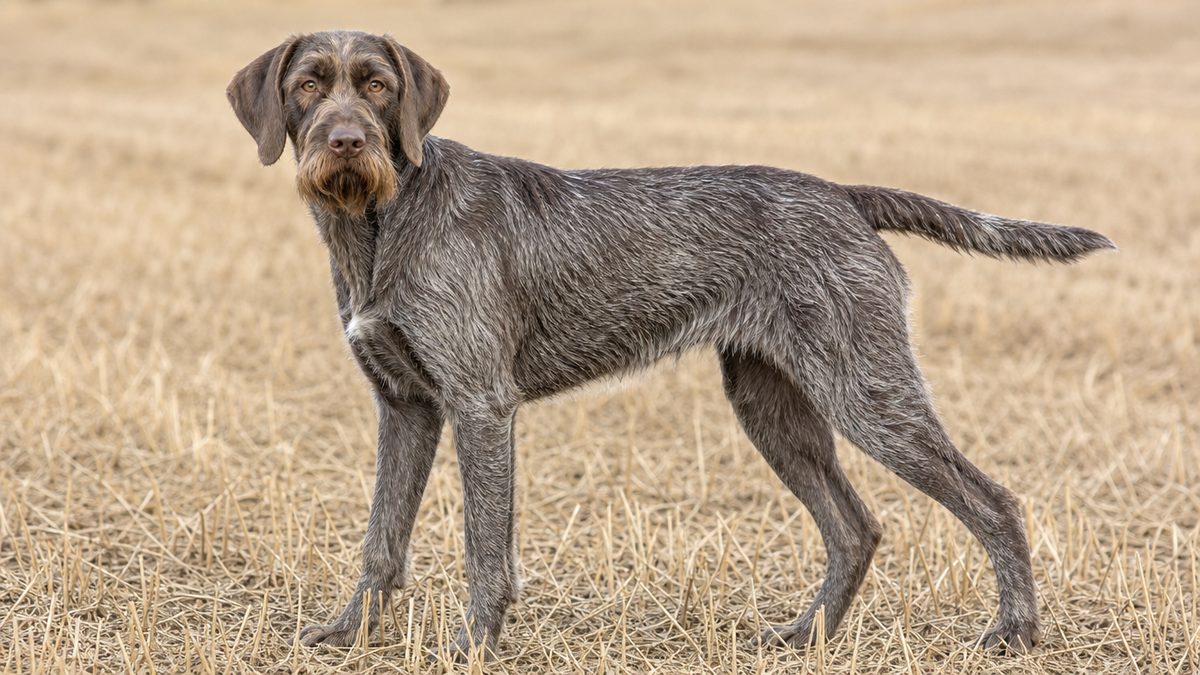
A 57 to 68 cm grey wirehaired Slovak gundog with amber eyes and a moustache the standard insists on. Its breed standard also requires a docked tail, removed dewclaws and removed inner-toe claws, and Indian law prohibits all three.
Quick answer
No Indian seller lists this breed, so there is no verifiable Slovak Rough-haired Pointer price in India. The finding that matters more is legal: this breed's FCI standard requires a tail docked at half length, dewclaws removed and inner-toe claws removed, and India's Dog Breeding and Marketing Rules 2017 forbid docking and de-clawing outright. A conforming dog cannot lawfully be produced here.
This page reports registry documents, breed-standard text and Indian veterinary literature. It is not veterinary advice and it cannot diagnose your dog. No peer-reviewed paper anywhere names this breed and it has no row in any published screening database, so a widely repeated claim that it is one of the healthiest gundog breeds is untested rather than verified. Entropion and ectropion are disqualifying faults in its own standard and are conditions a veterinary ophthalmologist should assess. Consult your nearby vet before acting on anything here, and take an unwell dog to a registered veterinarian rather than to a web page.
Slovak Rough-haired Pointer at a glance
What the Slovak Rough-haired Pointer is, and the four names it answers to
The Slovak Rough-haired Pointer is a grey wirehaired Slovak gundog, held by the FCI as breed standard 320 in Group 7, Section 1.1, Continental Pointing Dogs of Braque type, and subject to a working trial. Males stand 62 to 68 cm and females 57 to 64 cm.
Four names, and why that matters when you go looking
This breed has more usable English names than any other on this site, and each institution uses a different one. Getting that wrong is how a reader, a vet or an answer engine concludes there is no information.
| Institution | The name it uses |
|---|---|
| FCI, native name | Slovensky Hrubosrsty Stavac (Ohar) |
| FCI, English name | Wirehaired Slovakian Pointer |
| FCI, French name | Braque Slovaque a Poil Dur |
| FCI, German name | Slowakischer Rauhbart |
| McMillan 2024 Table S5 | Slovakian Rough Haired Pointer |
| Orthopedic Foundation for Animals | Slovakian Wirehaired Pointer, code SWP |
| British sources and the working community | Slovakian Rough Haired Pointer, usually abbreviated SRHP |
Bonbeno read the FCI number off the FCI's own letter index rather than assembling a URL, because an FCI address built from a guessed number returns a complete and correct page for whichever breed owns that number. The index files this one under S as SLOVENSKY HRUBOSRSTY STAVAC (OHAR) and links it as breed 320.
What the standard specifies
The general appearance clause is unusually descriptive: a dog of moderate strength, working type, but with nobleness in his lines, whose basic coat colour is called grey and whose hair is harsh, fit and able to work on the plain, in the woods and in the water, and especially to work after the shooting, searching and retrieving wounded game. It adds that he is obedient and easy to train.
- Proportions are sexed. Body length to height at withers must be 10 to 9 in males and 10 to 8 in females, so bitches are proportionally longer.
- Eyes amber, almond-shaped, well set into the socket, with dark eyelids. In puppies and young dogs they are bluish, which the standard calls azure.
- Coat about 4 cm, harsh, straight and flat, over an undercoat of short fine down that the standard says is normally lost in the summer.
- A moustache is required. Hair at the lower muzzle is longer and softer, and hair too short or without moustaches is a severe fault.
- Colour is brown shaded sable, called grey, and any other basic colour is a disqualifying fault.
- No weight is stated, in a standard that otherwise specifies five joint angles to the degree.
Those angles are scapulo-humeral 110 degrees, elbow 135 degrees, hip 80 to 85 degrees, femoral-tibial or stifle between 125 and 130 degrees, and hock between 125 and 135 degrees. A standard that dimensions a hip joint to a five-degree band and then declines to give a weight is telling you something about what its authors thought mattered. On size and weight the record is therefore half complete. The height is fixed at 62 to 68 cm for males and 57 to 64 cm for females, and the weight is nowhere: not in the standard, and not supplied by the ranking pages either, several of which describe the dog's build in adjectives instead. VioVet calls the breed unpretentious in structure or appearance and as modest in temperament as it is in looks, and DogZone describes a hard and versatile worker renowned for its loyal nature. Wikipedia's article, likewise, carries no weight figure sourced to the standard. So a reader wanting a kilogram range for this breed is reading somebody's estimate wherever they find one. The wirehaired coat is the other half of the identity and it is specified precisely: a topcoat of about 4 cm, harsh, straight and flat, over an undercoat of short fine down that the standard says is normally lost in the summer. That combination, a flat harsh jacket over a seasonal undercoat, is what makes this the most workable Central European coat in India of the six breeds Bonbeno built in this pass.
This standard's disqualifying faults include prognathism upper and lower, entropion and ectropion, and irregular position of the legs. Entropion and ectropion are two of the conditions India's Dog Breeding and Marketing Rules, 2017 separately require a breeding dog to have been tested for, under Second Schedule Part III paragraph 8(10). On eyes, the breed standard and the Indian statute want exactly the same thing. On tails they do not, and the next section is about that.
Three clauses in the breed standard that Indian law strictly forbids
FCI Standard 320 requires three separate surgical procedures on this breed, and India's Dog Breeding and Marketing Rules, 2017 prohibit all three by name. A dog conforming to this standard cannot lawfully be produced in India. No page anywhere makes this observation, and it is the most decision-relevant fact on this page.
| FCI Standard 320 says | Where in the standard | Indian law |
|---|---|---|
| 'The tail is shortened (docked) at half length.' | TAIL | Prohibited. Second Schedule Part II para 6(8) |
| 'Claws of inner toes must be removed.' | FOREQUARTERS, Forefeet | Prohibited as de-clawing, same clause |
| 'Dewclaws must be removed.' | HINDQUARTERS, Hind feet | Prohibited as de-clawing, same clause |
The Indian provision reads, verbatim from the gazette, which Bonbeno extracted with pypdf rather than reading any summary of: 'There shall be no tail docking, ear cropping de-barking, de-clawing, branding, dyeing, injecting substances to enhance visual appeal, performing a surgery or procedure to camouflage or hide any defect or infirmity or any other kind of mutilation of any body part of the pup and any change of appearance by artificial means is strictly forbidden.';
Three things. First, an Indian-bred dog of this breed will carry a full tail, hind dewclaws and inner toe claws, and will therefore not conform to its own standard on three points. Second, that is the law working as intended and is not a defect in the dog. Third, and most usefully: a docked Slovak Rough-haired Pointer puppy offered in India was either produced abroad or produced here in breach of paragraph 6(8), and a seller who cannot say which is not a seller to buy from.
Reading the clause carefully, because precision matters here
Bonbeno checked the gazette's own wording rather than paraphrasing it. The Rules say de-clawing; the word 'dewclaw' appears zero times in the 51,953 extracted characters of the document. So the argument is that removing a dewclaw is de-clawing, which is the natural reading and is also covered twice over by the clause's closing catch-all, 'any other kind of mutilation of any body part of the pup and any change of appearance by artificial means is strictly forbidden'. Tail docking, by contrast, is named in the first three words of the clause and needs no interpretation at all.
It is also worth being precise about where in the Rules this sits, because the numbering is routinely got wrong. The Rules themselves run from 1 to 13 and there is no Rule 14, so a citation of the form 'Rule 21' is wrong by construction. This provision is Second Schedule, Part II, paragraph 6(8), and the Second Schedule's paragraphs run continuously from 1 to 30 across four Parts rather than restarting per Part.
How this compares with the other five breeds in this batch
Bonbeno built six Polish and Slovak breed pages in one research pass and checked every standard against the same clause. This is the only one that fails outright.
| Breed | What its standard says about tail and claws | Producible in India |
|---|---|---|
| Slovak Rough-haired Pointer (320) | Tail docked at half length; dewclaws and inner-toe claws must be removed | No |
| Polish Lowland Sheepdog (251) | Offers a docked tail as one of two options; an undocked tail is the other | Yes, undocked |
| Slovak Cuvac (142) | Dewclaws undesired and a fault, but no removal instructed | Yes, with the fault |
| Slovensky kopov (244) | No dewclaws; no removal instructed and no docking clause | Yes |
| Polish Greyhound (333) | Full feathered tail required; nothing about claws | Yes |
| Polish Hound (52) | Full tail reaching below the hock; nothing about claws | Yes |
So of six Central European standards, one instructs docking outright, one offers it as an option, one penalises dewclaws without instructing removal, and three are silent. Only this breed's standard cannot be satisfied lawfully by an Indian breeder. That is a genuinely useful thing to know before importing a dog whose breeding you intend to continue here.
Two footnotes for fairness. Many European countries have themselves banned docking since this standard was published in 1995, so dogs bred in those countries also carry full tails and the FCI accommodates that in practice at shows. And the FCI's own recent standards increasingly avoid mandating procedures. Nothing here suggests the breed's custodians are indifferent to the issue; it suggests the document is thirty-one years old and has not been revised.
History and origin: a deliberate 1950s creation, and a named creator
The Slovak Rough-haired Pointer is a modern breed, assembled deliberately in Slovakia in the 1950s from existing Continental pointing stock. Unlike the other five breeds in this batch, its history and origin are recent enough to be documented by people who were there.
Purina UK records that this relatively modern breed was created by the gundog specialist Koloman Slimak by crossbreeding Czech pointing stock. Gundog Journal gives the same period and names the components, describing a breed developed in Slovakia in the 1950s by crossing the Czech pointer with the German wirehaired pointer and other Continental stock. Omlet describes it as a relatively new breed that originated in Czechoslovakia.
FCI Standard 320 carries no BRIEF HISTORICAL SUMMARY at all. It goes from ORIGIN straight to UTILIZATION. So the standard cannot be cited for anything about this breed's ancestry, and every origin account you will read, including the one above, comes from elsewhere. That is worth knowing before treating any particular list of founding breeds as settled: the governing document is silent, and the secondary sources broadly agree without being independent of one another.
The registry timeline, from the FCI's own record
| Field | Value |
|---|---|
| FCI breed number | 320 |
| Group and section | Group 7 Pointing Dogs, Section 1.1 Continental Pointing Dogs, Braque type |
| Definitive acceptance | 17 February 1982 |
| Currently valid standard published | 6 January 1995 |
| English text published | 24 July 1996 |
| Spanish text published | 17 February 1998 |
| Authentic language | German |
| Working trial | Subject to one |
| Country of origin | Slovakia |
Two of those dates prove the FCI's own month-first convention on this record without needing to know any house style: 17 February 1982 and 24 July 1996 both have a second field above twelve, so the first field cannot be the day. The playbook rule applies generally, and it is worth using: whenever an FCI date is ambiguous, look down the column for a row where one field exceeds 12, and that row settles the format for the whole table.
The gap between definitive acceptance in 1982 and the current standard in 1995 is ordinary. What is less ordinary is that the 1995 text is still current thirty-one years later, and still instructs docking, in a Europe where most of the breed's home countries have since prohibited it.
Where the breed actually lives now
Outside Slovakia the breed's centre of gravity is Britain, which is why almost every source ranking for it in India is British. The British Association for Shooting and Conservation ran a breed spotlight on it in July 2024, Purina UK carries a breed page, and the working community discusses it on stalking and gundog forums. One Welsh breeder's page notes that although still fairly rare outside parts of Europe, the breed is slowly becoming more popular. That is a real trend and it is a British one, not an Indian one.
Slovak Rough-haired Pointer price in India: a British breed with no Indian market
There is no Slovak Rough-haired Pointer price in India. India's largest puppy listing site carries a breed selector of roughly three hundred entries and no Slovak breed of any kind appears in it. Google India returned about 164 results for the query Bonbeno used, and every commercial page on it is British.
| Site | Country | What it is |
|---|---|---|
| purina.co.uk | United Kingdom | Food manufacturer breed page. No price |
| basc.org.uk | United Kingdom | Shooting and conservation body. Breed spotlight, July 2024 |
| omlet.co.uk | United Kingdom | Pet products retailer breed page. No price |
| gundogjournal.com | United Kingdom | Working gundog magazine. No price |
| scrumbles.co.uk | United Kingdom | Pet food brand breed guide. No price |
| dogzone.com | United Kingdom | Breed directory. No Indian price |
| viovet.co.uk | United Kingdom | Veterinary retailer. No Indian price |
| brookes.wales | United Kingdom | A Welsh breeder's own page |
| thestalkingdirectory.co.uk | United Kingdom | Working owners' forum. The most candid source on the list |
| youtube.com | United Kingdom | Breed videos, including a breed club secretary |
Nine of ten results are British and none is Indian. That is the cleanest single-country concentration of any of the six breeds in this batch, and it tells you exactly where this dog's English-language community actually is. It also means that everything an Indian reader will find about the breed has been written for a temperate island with a shooting season.
Why Bonbeno publishes no converted figure
Several of those pages price the breed in pounds sterling. Converting a British puppy price into rupees would produce a number that looks like a price and describes nothing: no Indian seller, no Indian transaction, no Indian dog. In the same research session Bonbeno caught Google's own AI Mode doing exactly that on two related breeds, once at a flat 75.00 rupees to the dollar and once as a rounded sterling conversion at two different implied rates within a single sentence.
Dogs are a Restricted import in India. Entry is permitted for a pet accompanying its owner with a valid pet book in the importer's name, for research with a CPCSEA recommendation, and for defence or police use, while applications for trading or breeding purposes are rejected and entry is limited to a named list of ports. Combine that with the docking clause and the position is unusually clear: you cannot lawfully import this breed to breed from, and if you could, you could not lawfully produce a conforming dog.
What an Indian buyer would actually be offered
Because no verified supply exists here, a grey wirehaired dog offered under this name in India is more likely to be a German Wirehaired Pointer, a Weimaraner cross, or a wirehaired crossbreed. The identification checks from the standard are quick and decisive: amber eyes in an adult, not brown; a moustache at the lower muzzle, since a coat too short and without moustaches is a severe fault; a topcoat of about 4 cm that is harsh, straight and flat rather than curly; and a base colour of brown shaded sable, with any other basic colour a disqualifying fault.
One more check that is specific to India. Ask about the tail and the dewclaws. A dog with a full tail and intact dewclaws is either Indian-bred, which is lawful, or bred in a European country that has banned docking, which is common. A docked dog with removed dewclaws was produced somewhere that permits both, and the paperwork should say where.
Cost of ownership in India for a 62 to 68 cm working gundog
The cost of ownership for this breed in India is calculable even though the purchase price is not. The standard gives no weight to plan against, so use the height, 62 to 68 cm for males, and expect a dog at the upper end of the common parasite-control band.
| Item | Published figure | Source |
|---|---|---|
| Puppy core vaccination course | from Rs 6,499 | Vetic, national page |
| Annual booster | from Rs 3,199 | Vetic, national page |
| Anti-rabies, single dose | Rs 699 | Vetic |
| Nine-in-one DHPPiL | Rs 899 | Vetic |
| Kennel cough | Rs 1,349 | Vetic |
| Consultation | Rs 500 to Rs 1,000 | VOSD, treated as one data point |
| NexGard Spectra, 15 to 30 kg, per month | Rs 1,103 | Supertails, Rs 3,308 for three tablets |
| Professional bath | from Rs 934 | Vetic Delhi grooming |
| Boarding, overnight to 24 hours | Rs 899 | PawSpace Bengaluru |
| Delhi MCD pet dog registration | Rs 500 | MCD Delhi, dogs only |
| Chennai GCC pet licence | Rs 50 | Greater Chennai Corporation |
Read the parasite band carefully
Supertails lists NexGard Spectra for dogs of 15 to 30 kg at Rs 3,308 for three tablets, which is Rs 1,103 a month. A 62 to 68 cm Continental pointer in working condition sits near the top of that band and a heavy male may cross it. Bonbeno publishes no figure for the next band because it did not price that product, and scaling one by arithmetic would be an invention rather than a price.
A hunt point retrieve dog worked in Indian cover meets ticks constantly, and the Indian literature is blunt about the load. A West Bengal series of 584 dogs screened at veterinary clinics found *Babesia gibsoni* in 76.54 percent and Anaplasma in 55.75 percent, with 72.9 percent of the 584 dogs screened carrying two or more pathogens. A southern Indian series of 120 dogs found Babesia in 80 of 120, which is 66.7 percent, peaking pre-monsoon from March to May. Both sampled clinic caseloads rather than random populations, so read them as what an Indian vet sees rather than as a street prevalence.
A harsh flat 4 cm topcoat is easier to tick-check by hand than a profuse double coat, and easier to dry after a swim than a woolly one. That is a genuine practical advantage over the other five breeds in this batch, and it is worth naming because so little else about keeping a Central European working dog in India is advantageous.
Municipal costs are small and durable. Delhi's Municipal Corporation charges Rs 500 to register a pet dog and publishes its own counters, 18,958 certificates issued since 2021 and 71 of 1,006 applications rejected in FY 2026-27. Greater Chennai Corporation charges Rs 50, issued 9,115 licences in 2024, and runs six municipal clinics providing treatment and anti-rabies vaccination free of cost.
Boarding is Rs 899 overnight to 24 hours at one published Bengaluru rate card, against a wider Indian range of Rs 500 to Rs 2,000 a day. For this breed the question to ask is exercise rather than cooling: a gundog crated for a week without work comes home a different animal, and a facility that only walks dogs on lead is not adequate for one.
Bonbeno quotes no single monthly total. A headline figure would have to assume a city, a clinic and a food brand, and Indian breed sites that print one are usually reprinting a preset row shared across unrelated breeds. This is an expensive dog to keep properly in India, and the expense is exercise access rather than veterinary spend.
Heat tolerance: the best coat of the six, and the worst workload
This breed's heat tolerance is the best of the six Polish and Slovak breeds Bonbeno covers, and it is still only moderate. The standard describes an undercoat of short fine down that normally loses it in the summer, under a topcoat of about 4 cm that is harsh, straight and flat. That combination is genuinely more workable in India than a dense wavy double coat.
Say that plainly before the rest of the section takes it away. A flat harsh wire coat over a shedding undercoat sheds heat far better than the Slovensky kopov's mandated year-round undercoat, the Slovak Cuvac's 5 to 15 cm wavy topcoat, or the Polish Lowland Sheepdog's coarse profuse double coat. Of the six standards, this is the only one whose coat clause actively describes summer coat loss without also penalising it.
The problem is the job, not the coat
The utilization clause asks the dog to be fit and able to work on the plain, in the woods and in the water, and especially to work after the shooting, searching and retrieving wounded game, and the gait clause says that at work on the plain the dog gallops. A galloping gundog generates heat faster than any coat can shed it, and that is where the risk sits.
Hall and colleagues, working 905,543 UK dogs under primary veterinary care in 2016, recorded 1,259 heat-related illness events from 1,222 dogs, of which the 879 events with a recorded trigger split into 652 exertional, which is 74.2 percent, 113 environmental and 46 from vehicular confinement. The companion paper on the same cohort, with a stricter case definition and 395 confirmed events, gives an incidence of 0.04 percent and a fatality rate of 14.18 percent. Name which paper you are reading, because the two share authors, a year and a cohort. Working gundogs are the archetype of the exertional category.
The homeland, and what can and cannot be measured
Bonbeno queried NASA POWER by explicit latitude and longitude for five Slovak points and echoed the model cell elevation on every one. Only Bratislava, on the Danube plain, returned a cell that describes an actual town, at 162.22 m against a real elevation near 134 m. The central Slovak points failed: Zvolen and Banska Bystrica returned a byte-identical series from one 553.06 m cell, overshooting the real towns by 258 m and 191 m, and Poprad's cell reads 1,033.53 m against a real 672 m.
| Place | Hottest month | Coolest month |
|---|---|---|
| Bratislava, Slovakia | July, 22.73 C | January, minus 1.20 C |
| Delhi | June, 35.88 C | January, 13.61 C |
| Chennai | May, 31.51 C | January, 24.09 C |
| Mumbai | May, 31.19 C | January, 23.19 C |
| Kolkata | May, 31.53 C | January, 17.31 C |
| Bengaluru | April, 28.37 C | December, 20.22 C |
| Pune | April, 28.93 C | December, 19.62 C |
| Kochi | March, 29.42 C | August, 25.91 C |
Bratislava, the warmest part of this breed's country, averages 22.73 C in July. Chennai's coolest month averages 24.09 C. A heat-sensitive working gundog asked to gallop on an Indian plain is being asked to do in permanent summer what it was bred to do in a Slovak autumn. The coat is not the limiting factor. The clock is.
- Bengaluru and Pune are the only Indian metros where genuine gundog work is arguable, and both peak in April rather than May and are coolest in December rather than January.
- Delhi offers a real working window from December to February and nothing usable from April to September, peaking in June at 35.88 C.
- Chennai, Mumbai, Kolkata and Kochi offer no working season at all for a galloping dog. Kochi is coolest in August, in the monsoon.
- Water access changes the calculation more for this breed than for the others, because the standard specifically asks it to work in water and a dog that can swim during a session sheds heat far faster than one that cannot.
India's own housing rule reaches the question. Second Schedule Part IV paragraph 21(1) of the Dog Breeding and Marketing Rules, 2017 bars keeping dogs in outdoor facilities without the attending veterinary practitioner's written approval where they are not accustomed to the temperatures prevalent in the area, or are of breeds that cannot tolerate them. A 4 cm wire coat is not a long coat, so the clause's own worked example does not fit, but its first limb, a dog not accustomed to local temperatures, reaches an imported Slovak gundog directly.
Temperament: a consensus, and one dissent worth printing
Every published source agrees that the Slovak Rough-haired Pointer is calm indoors, affectionate with family, sociable with strangers and sensitive to harsh handling. One source does not, and it is the one written by people who worked the dogs.
| Source | What it says |
|---|---|
| FCI Standard 320 | 'He is obedient and easy to train.' Also 'nobleness in his lines' |
| Purina UK | Bold and intelligent, an active energetic breed; great family dog; needs a large garden |
| Omlet UK | Laid back and affectionate; sociable dogs who do best fully integrated into the family |
| Scrumbles | Calm, intelligent and affectionate, with a calm and steady demeanour |
| DogZone | A hard and versatile worker renowned for its loyal nature |
| A gundog club | Generally happy to meet strangers and should get on fine with other dogs |
| The Stalking Directory | 'As said above untrainable, hard and headstrong. They work hard, but not for the...' |
That last row comes from a working forum, from a poster describing a good friend who has owned two of the breed and whom the poster calls a very experienced hunt point retrieve man. It is one account and it is not a study. But it is the only source on the list written by somebody with nothing to sell, about dogs they actually handled in the field, and it points the opposite way from six pages that all describe the same soft, biddable, sensitive dog. Bonbeno's position is that both descriptions are probably true of different lines, and that a buyer should ask which line a puppy comes from.
How to reconcile them
Breeds the FCI files as subject to a working trial typically carry two populations: a working line selected for drive and independence, and a show or companion line selected for biddability. The FCI files this breed with a working trial, and Britain, where most English-language material about it originates, has an active shooting community using it in the field. A dog from a hard-working line and a dog from a family line are genuinely different animals, and a buyer reading only breed pages meets only the second.
What this means in an Indian household
- This is the most socially straightforward of the six breeds in this batch. Friendly with visitors, generally fine with other dogs, and not a guardian. In a country of daily domestic traffic that is a real advantage over the Slovak Cuvac.
- Sensitivity is the training constraint. Multiple sources say the breed does not tolerate harsh handling, shouting or aversive methods and can shut down. In India that matters because traditional local training culture still leans firm.
- Prey drive is real but pointing rather than chasing. A hunt point retrieve breed freezes on game rather than launching at it, which is safer around Indian street animals than a sighthound or scent hound, though not safe.
- Separation is the risk that gets underestimated. A sociable working dog that has bonded closely to a family and is then left alone for an Indian working day, unexercised, is the classic profile for destructive behaviour.
With children the sources are consistently positive and no behavioural study exists, so Bonbeno reports the consensus without dressing it as evidence. What can be said structurally is that a 62 to 68 cm dog moving at speed is a collision risk regardless of intent, and that a sensitive breed is a poor match for a household where children are not yet reliable about handling.
Training a sensitive gundog: reward-based, and never harsh
To train a Slovak Rough-haired Pointer, use reward-based methods and avoid aversive handling entirely, because the trait every source agrees on is sensitivity. The standard itself says the dog is obedient and easy to train, and the qualification is that this is only true of handlers it trusts.
Multiple sources make the same point in different words: this breed has a softer character and does not tolerate harsh handling, shouting or aversive training methods, which can cause it to shut down Scrumbles, Slovakian Rough Haired Pointer…. That is a specific and useful warning, and it is the opposite of the advice a Slovak Cuvac or a Kopov owner needs. Firmness here buys you a dog that stops offering behaviour.
The order to teach things in
- Name response and engagement first, built with food and play, because everything in a hunt point retrieve breed depends on the dog choosing to work with you rather than for itself.
- Lead manners second. A 65 cm gundog that pulls is genuinely difficult on an Indian pavement shared with traffic and cattle.
- Recall third, and it is achievable in this breed unlike in the sighthound and scent hound Bonbeno also covers, because a pointing dog's default is to work in contact with a handler.
- Water introduction fourth, gently, since the standard asks the dog to work in water and in India a dog that swims has a cooling option that a dog that does not lacks.
- Settle and place fifth, which is what turns an exercised gundog into the calm house dog every source describes.
- Retrieve and hold sixth, taught for fun rather than for game, because it satisfies the breed's actual selection history in a country with no shooting season for it.
Do not train in the middle of an Indian day. A galloping breed worked in short bursts is precisely the exertional pattern behind 652 of the 879 triggered UK heat-illness events. First light and after dark, and shorter sessions in the hot months than the dog appears to want.
Socialisation, in the Indian version
Socialise early and to what the dog will actually meet: autorickshaws, temple bells, firecrackers, cattle, monkeys, building watchmen, lift doors and street dogs at a controlled distance. A European checklist covers almost none of it. The window closes near sixteen weeks, and for a sensitive breed a bad experience inside it lasts longer than it would in a robust one.
Plan the first festival season deliberately. Diwali and wedding season produce sustained close-range noise in Indian residential areas, and a sensitive gundog is exactly the profile that generalises one bad night into a lasting noise phobia. Start low-volume desensitisation in the first month and prepare a quiet interior room before the week itself.
This is the one breed of the six where a genuinely reliable off-lead recall in open ground is a realistic goal, because a pointing dog is bred to range in front of a handler and check back rather than to commit to a chase or a trail. That does not make it a park dog in an Indian city with street animals and traffic, but it does mean the training investment pays back in a way it does not for a Chart Polski or a Kopov.
Exercise needs: the highest of the six, and the hardest to meet in India
A Slovak Rough-haired Pointer's exercise needs are the highest of any breed in this batch, at two hours a day minimum with real running rather than walking. Its standard asks it to work on the plain, in the woods and in the water, and to gallop while doing it.
Every source repeats the same conditional: calm indoors if their high energy needs are met outdoors Omlet UK, Slovakian Rough Haired Pointer…. That conditional is doing all the work, and in an Indian city it is where the arrangement fails. A dog with a full shooting day's stamina, restricted to two cool windows and a lead, does not become a calm house dog. It becomes a frustrated one.
| When | What | Why |
|---|---|---|
| Daily, first light | 60 to 75 minutes, including free running in a fenced space | Walking alone does not touch a galloping breed's requirement |
| Daily, after dark | 45 minutes on lead plus training | Second session and the day's mental work together |
| Two or three times a week | Swimming, wherever it is safely available | The standard asks for water work, and swimming is the only Indian exercise that cools rather than heats |
| Daily, indoors | 15 to 20 minutes of retrieve, scent or shaping games | A working gundog needs a task, and this is the part that can be done at midday |
| Never | Exercise between 11am and 4pm, in any Indian month | Exertional heat illness accounted for 652 of 879 triggered UK events |
Water is the Indian answer, where it exists
This is the one breed in the batch whose standard explicitly asks for water work, and that turns out to matter practically. Swimming is the only common form of exercise that removes heat rather than adding it, and a dog that will swim can be worked harder in a warm Indian month than a dog that will not. Access is the constraint: safe, clean, non-stagnant water is not universally available in Indian cities, and stagnant water carries its own risks. Where it exists, use it.
Under-exercise looks like this
- Destructive behaviour indoors, which several sources name directly for this breed, and which is boredom rather than anxiety in most cases.
- An inability to settle, which is the direct negation of the calm-indoors description every breed page leads with.
- Weight gain, which is harder to judge here than in most breeds because the standard states no weight at all to compare against.
- Ranging further on walks and becoming less responsive, since an unexercised pointing dog starts self-employing.
Growth is the exception. A large slow-maturing gundog's growth plates close around fourteen to eighteen months, and forced roadwork, stairs and repetitive jumping before then add joint risk without adding fitness, in a breed with no published hip screening data anywhere. Free movement on soft ground in bursts the puppy chooses to end is the whole prescription until then, plus as much retrieve and scent work as you like.
Grooming a wire coat in Indian humidity, and the one thing not to do
Groom a Slovak Rough-haired Pointer with a weekly brush and a hand-strip once or twice a year. The coat is a topcoat of about 4 cm, harsh, straight and flat, over an undercoat of short fine down that the standard says is normally lost in summer. It is the lowest-maintenance coat in this batch.
The routine
- Brush weekly with a slicker or a stiff bristle brush, ten minutes, more often during the summer undercoat shed.
- Hand-strip once or twice a year, or have a groomer do it, to remove dead topcoat and keep the harsh texture the standard requires.
- Tidy the moustache and the eyebrow hair rather than removing them, since hair too short and without moustaches is a severe fault and the eyebrow hair laying obliquely is a breed feature.
- Dry the ears actively after every swim or bath, which matters more in an Indian monsoon than in a Slovak autumn.
- Check between the toes after every off-path outing, because a working dog picks up grass seeds and thorns and Indian humidity turns them into abscesses quickly.
- Check the skin under the coat weekly in the monsoon, since a harsh flat coat hides a hot spot less well than a profuse one but hides ticks more than a smooth one.
This is the single grooming error that is specific to wirehaired breeds and it is the most common one in hot countries. Clipping cuts the harsh guard hairs rather than removing dead ones, and the coat regrows softer, denser and less weather-resistant, which is worse in humidity rather than better. It is also a fault under the standard, which makes hair too long or silky a severe fault. Hand-strip instead, and manage heat with timing, shade and water.
The coat's Indian advantages, stated fairly
Three things genuinely work in this coat's favour here, and it is worth saying so on a page that is otherwise sceptical about keeping Central European breeds in India. It sheds its undercoat in summer, which the Slovensky kopov's standard forbids. It is flat and only 4 cm, so air reaches the skin, which a 15 cm wavy coat does not allow. And it dries fast after swimming, which matters because swimming is the best exercise available to this breed in a hot country.
Bathing every four to six weeks with a mild dog shampoo is sufficient, and over-bathing a wire coat softens it. Vetic's Delhi grooming page lists bathing from Rs 934 and a complete bath and styling from Rs 1,869. Ask specifically whether the groomer hand-strips, because many Indian salons do not and will reach for clippers on a wire coat by default.
Shedding is moderate and seasonal, and in an air-conditioned Indian home most owners report steady low-level loss year round instead of a concentrated moult. Nobody markets this breed as hypoallergenic, and if they did, Vredegoor and colleagues measured Can f 1 across 196 dogs of so-called hypoallergenic breeds against 160 controls and found the hypoallergenic group came back higher, concluding there is a lack of evidence to describe any dog breed as hypoallergenic. A wire coat holds shed hair rather than dropping it, which makes a tidier house and not a less allergenic dog.
Health problems: one of the healthiest gundog breeds, and nobody has checked
A British shooting organisation states that the Slovakian rough-haired pointer appears to be in a good position as one of the healthiest gundog breeds. That may well be right. Bonbeno went looking for the evidence and found none at all, in any direction, and this section is about what that does and does not mean.
| Instrument | Result for this breed | Control in the same session |
|---|---|---|
| PubMed, 'Slovakian Rough-haired Pointer'[tiab] | 0 records | Labrador Retriever tiab, 1,109 |
| PubMed, 'Slovakian Wirehaired Pointer'[tiab] | 0 records | Labrador hip dysplasia, 126 |
| PubMed, 'Wirehaired Slovakian Pointer'[tiab] | 0 records | as above |
| PubMed, 'Slovensky Hrubosrsty Stavac'[tiab] | 0 records | as above |
| PubMed, 'Slovak Rough Haired Pointer'[tiab] | 0 records | as above |
| OFA breed code list | Code SWP exists | Labrador LR, Greyhound GH present |
| OFA statistics dump | 0 rows | LABRADOR 109, GREYHOUND 93, BORZOI 62 |
| McMillan 2024 Table S5 | Listed, flag N, Gundog group | Labrador and Whippet both flag Y |
Five name forms, all zero, with controls passing in the same session. That is as thorough a literature absence as this site records, and it was worth doing five ways precisely because this breed has four institutional names and a search under the wrong one manufactures a false negative.
For a breed with zero papers, no OFA statistics row and a considered exclusion from the largest UK longevity dataset there is, nobody has ever been in a position to test the claim. Absence of reported disease in a breed nobody has studied is absence of study. That is not an accusation against anyone: BASC is reporting what its community observes, and a small, working, recently-created breed with an active founder base plausibly is in reasonable shape. It is simply not a finding, and it should not be read as a reason to skip screening.
Life expectancy: no figure exists
McMillan and colleagues published the largest UK companion-dog longevity analysis in Scientific Reports in 2024, covering 155 purebred breeds. Bonbeno downloaded the supplementary tables from the publisher rather than reading the article body, because a breed's absence from an article's prose proves nothing. Supplementary Table S5 lists 'Slovakian Rough Haired Pointer' with flag N in the Gundog group and no reclassification. Considered, and excluded.
So there is no median and no confidence interval. Figures of 12 to 14 years circulate on breed pages and trace to no study naming this breed. For scale, McMillan's Table S3 gives the Labrador Retriever a median of 13.1 years built on 43,428 dogs and 16,155 deaths. That is what a gundog row with real data behind it looks like.
What the standard itself tells you to watch
Where no population data exists, the standard is the best available guide to what the breed's own custodians were worried about. Its disqualifying faults include all anatomical faults such as prognathism upper and lower, entropion, ectropion and irregular position of the legs. Naming two eyelid conditions as disqualifying is a strong signal: standards disqualify what breeders have actually had trouble with.
Second Schedule Part III paragraph 8(10) of India's Dog Breeding and Marketing Rules, 2017 requires that breeding dogs have been tested for genetic defects including hip dysplasia, progressive retinal atrophy, night blindness, hypothyroidism, entropion, ectropion, overshot, undershot jaw (when incisors do not touch or mesh), wry mouth, two or more missing teeth, unilateral cryptorchid or full cryptorchid males. Entropion, ectropion and jaw malocclusion are all in that list and all disqualifying under this breed's standard. On eyes and bites, the FCI and the Indian statute want the same dog. The word in the statute is 'including', so the list is illustrative rather than closed.
Hip dysplasia is the screening priority for any 62 to 68 cm working breed even with no breed figure, and it is the first item in that Indian list. Ask any breeder to screen both parents' hips and to show the certificates, and ask specifically about eyelid conformation, because the standard tells you that is where this breed's own community has drawn a line.
Bonbeno publishes no prevalence percentage for any condition in this breed, because none has been measured anywhere. Any page that gives you one has borrowed it from the German Wirehaired Pointer. Consult your nearby vet about a screening plan before breeding, and treat every health claim about this breed, including the favourable ones, as a hypothesis.
Feeding a working gundog in India, with no weight in the standard
Feed a Slovak Rough-haired Pointer to body condition, because its standard states no weight at all to plan against. Ribs easily felt under a light covering, a visible waist from above, and a moderate tuck-up, which the standard describes as moderately tucked in.
The absence of a weight clause is worth naming because it recurs across this batch: four of the six Polish and Slovak standards Bonbeno read give no weight at all. In this breed's case the standard compensates with proportion, requiring body length to height at withers of 10 to 9 in males and 10 to 8 in females, and asking for a solidly built dog that is not of a heavy type. Judge by feel and by proportion, not by a chart.
| Stage | Meals per day | What matters most |
|---|---|---|
| 8 to 16 weeks | 4 | A large-breed puppy formulation with controlled calcium. Do not free-feed |
| 4 to 8 months | 3 | Fastest growth, and the window where overfeeding buys joint problems in a breed with no screening data |
| 8 to 14 months | 2 | Keep visibly lean through a long growth-plate window |
| 14 months to 7 years | 2 | Feed to condition and to workload. A worked gundog and a walked one need different rations |
| 7 years and older | 2 | Watch weight as activity falls, which in India it will as the dog ages and heat tolerance drops |
Never feed immediately before or after hard exercise. Split the daily ration into two meals, leave at least an hour after eating before any work, and half an hour after work before feeding. The standard describes a chest that is sufficiently long and broad, oval, and let down to the elbow, which is a body shape associated with gastric dilatation-volvulus. Consult your nearby vet about what the early signs look like before you need to recognise them.
Water, which matters more for this breed than for most
A galloping dog worked at first light in an Indian summer drinks heavily afterwards, and gulping a large volume at once after exertion is itself a bloat risk factor. Offer measured amounts over twenty minutes rather than leaving a full bucket down immediately. If the dog swims, rinse and dry the coat afterwards rather than letting it air dry, particularly around the ears and the moustache, where damp sits.
Storage is the standing Indian problem. Dry food in a humid coastal city degrades faster than the same bag in Slovakia. Buy smaller bags more often, decant into an airtight container, keep it off the floor and out of sun, and discard anything that smells sharp. In the monsoon treat an opened bag as a two-to-three-week item.
Use part of the ration for training and retrieve games rather than adding treats on top. A hunt point retrieve breed will work for food enthusiastically, and in a country where outdoor exercise is confined to two windows a day, food-based work indoors is a substantial part of how the dog's day gets filled.
The first year, month by month, in Indian conditions
A Slovak Rough-haired Pointer puppy's first year in India runs on four clocks: the vaccination schedule, the socialisation window closing near sixteen weeks, growth plates that stay open to about fourteen months, and the coat, which comes in harsh somewhere between six and twelve months.
| Age | What happens | The Indian complication |
|---|---|---|
| 8 weeks | Legal minimum age of sale in India under Rule 8(1)(a). Vaccination begins | A puppy offered below eight weeks is being sold unlawfully. Walk away |
| 8 to 12 weeks | Socialisation at full speed. Eyes still bluish, which the standard says is normal | Carry the puppy in public until the course completes. Street-dog contact is a real disease risk |
| 12 to 16 weeks | Course completes. Engagement and recall foundations begin | All of it before 8am. A puppy has almost no heat regulation |
| 4 to 8 months | Adult teeth. Eyes turn amber. Coat starts coming in harsh | First monsoon. Ear checks after every swim, weekly otherwise |
| 6 to 12 months | Working drive appears. Ranging and pointing behaviour start on walks | Fence audit. A gundog that ranges will range through a gap |
| 12 to 14 months | Coat settles. Stamina builds | First full Indian summer as an adult. Two windows a day, and water where you can find it |
| 14 to 18 months | Growth plates close. Structured running and distance can begin | Hip screening conversation with your vet starts at twelve months |
The eye colour change is a real milestone
The standard states that in puppies and young dogs the eyes are bluish, described as azure, and that the adult colour is amber. That is genuinely useful for a buyer, because it means blue eyes in a young puppy are correct and expected rather than a fault, while blue eyes in a mature dog are not. It is also one of the quickest ways to sanity-check that a puppy you are shown is the breed it is said to be.
The eight-week rule, and the tail question
Rule 8(1)(a) of the Prevention of Cruelty to Animals (Dog Breeding and Marketing) Rules, 2017 requires every breeder to ensure that pups less than eight weeks in age are not sold. Rule 8(1)(b) requires that dogs over six months are not sold without prior sterilisation unless sold to a registered breeder.
Is the tail docked, and if so where was the litter bred? Docking happens in the first days of life, so a docked puppy in India was either produced abroad or produced here in breach of Second Schedule Part II paragraph 6(8). What are the hip results for both parents, given no published screening statistics exist for this breed anywhere? And is this a working line or a show line, since the temperament accounts diverge sharply between them?
Plan the first festival season deliberately. Diwali and wedding season produce sustained close-range noise in Indian residential areas, and every source describes this breed as sensitive. Start low-volume desensitisation in the first month you own the dog and prepare a quiet interior room before the week itself. For a gundog that may one day be expected to tolerate gunfire, noise confidence built early is worth more than it looks.
SRHP against the gundogs Indian buyers actually cross-shop
An Indian buyer looking at this breed is realistically choosing between it, the German Wirehaired Pointer, the Weimaraner and an Indian dog. On sourced figures the SRHP is the least documented and the least available, and it is the only one whose standard cannot lawfully be satisfied here.
| Slovak Rough-haired Pointer | German Wirehaired Pointer | Weimaraner | Indian pariah type | |
|---|---|---|---|---|
| FCI standard number | 320 | 98 | 99 | None |
| Height, males | 62 to 68 cm | 61 to 68 cm | 59 to 70 cm | Varies |
| Weight in its FCI standard | Not stated | Stated | Stated | No standard |
| Docking required by its standard | Yes, at half length | No such instruction | No such instruction | Not applicable |
| Dewclaw removal required | Yes, twice over | No | No | Not applicable |
| Producible lawfully in India to standard | No | Yes | Yes | Yes |
| Papers naming the breed in PubMed | 0 | Many | Many | Very few |
| Rows in OFA published statistics | None, holds code SWP | Present | Present | None |
| McMillan 2024 median lifespan | No row, flag N | Present in S3 | Present in S3 | No row |
| Available in India | No evidence of any | Occasionally | Yes, listed | Everywhere |
Three rows carry the decision. The docking and dewclaw rows are unique to this breed among the four and are the practical reason an Indian breeder cannot work with it. The evidence rows mean that if your dog develops a problem, neither you nor your vet has a breed baseline, while both German breeds have one. And the availability row means the question is largely academic for most Indian readers anyway.
Against the other two Slovak breeds on this site
The three Slovak breeds make an instructive set. The Cuvac is a 36 to 44 kg guardian with a 1965 standard reporting a Czechoslovak census in the present tense. The Kopov is a 15 to 20 kg scent hound with a 1963 standard requiring a summer undercoat and a Cyrillic character in its own name. The rough-haired pointer is a 57 to 68 cm gundog with a 1995 standard requiring three prohibited procedures. All three carry McMillan flag N and none has an OFA statistics row.
On coat and temperament, this one. It has the most workable coat of the six, the friendliest disposition, the most achievable recall and the only standard that describes summer undercoat loss without penalising it. On law and availability it is the worst of the six, because it is the only one whose standard India's Rules make impossible to satisfy. That combination is unusual and worth stating rather than smoothing over.
For most Indian readers the honest recommendation remains an Indian dog, and for a reader who specifically wants a wirehaired Continental gundog, the German Wirehaired Pointer is available here, legally producible, and carries an evidence base this breed does not. The SRHP's genuine merits, a hardy flat coat, a sociable temperament and a real working brain, are all obtainable in a dog you can actually buy.
Mistakes Indian buyers make with this breed
The commonest mistake with this breed in India is not knowing that its own breed standard requires three things Indian law forbids. The second is reading 'one of the healthiest gundog breeds' as a finding when no study of the breed exists.
- Buying a docked puppy without asking where it was bred. Docking happens in the first days of life, so a docked dog in India was produced abroad or produced here unlawfully.
- Assuming an Indian-bred dog is faulty because it has a full tail and dewclaws. It is the law working, not a defect, and every honest Indian breeder will produce dogs exactly like that.
- Reading the health claim as evidence. Zero papers across five name forms, no OFA rows and a McMillan flag of N mean nobody has looked.
- Searching under one name. Four institutions use four different English names for this dog, and searching the wrong one returns nothing and looks like an absence.
- Clipping the wire coat in an Indian summer, which softens it permanently and makes it worse in humidity rather than better.
- Training with pressure. Every source names sensitivity, and harsh handling produces a dog that shuts down rather than a dog that complies.
- Meeting the exercise requirement with walking. This is a galloping breed and the calm-indoors description every page leads with is conditional on real running.
- Believing the temperament consensus without noticing the dissent from an experienced working handler who describes dogs he knew as hard and headstrong.
How to check a claim about this breed in five minutes
| Claim you are told | How to check it | What you will find |
|---|---|---|
| A docked tail is normal for this breed | Read the standard, then read Second Schedule Part II para 6(8) | The standard requires it and Indian law strictly forbids it |
| A weight quoted as the breed standard | Open FCI Standard 320 and search for kg | No weight anywhere in the document |
| The breed is one of the healthiest gundogs | Search PubMed under all five name forms, then OFA | Zero records and zero statistics rows, with controls passing |
| A lifespan sourced to research | Search McMillan 2024 Table S5 for Slovakian Rough Haired Pointer | Listed with flag N. No median exists |
| This adult dog is an SRHP, with brown eyes | Read the standard's EYES clause | Adult eyes are amber; bluish is a puppy feature only |
An Indian vet searching the literature for 'Slovak Rough-haired Pointer' will find nothing, and so will one searching for 'Wirehaired Slovakian Pointer', 'Slovakian Wirehaired Pointer' or 'Slovensky Hrubosrsty Stavac'. Bonbeno tried all five. The zero is real in this case, but for other breeds it would not be, and the general habit is worth having: search every name a breed answers to before concluding anything from an absence. The FCI, McMillan and OFA all use different English names for this one dog.
One observation belongs to the search engines. Google India's People also ask panel for this breed returned the best composition of any of the six in this batch: two questions directly on-breed and two about pointing breeds generally, with no generic Indian price boilerplate. That reflects a genuine and reasonably healthy British information ecosystem around the dog. What none of those British sources does is ask what happens when the standard meets a jurisdiction that bans docking.
Adoption, sourcing, and the clause that settles it
The realistic route to a gundog in India is to adopt one that is already here, because Indian import policy does not permit bringing a dog in to buy, sell or breed from, and because this breed's standard cannot lawfully be satisfied by an Indian breeder anyway.
The position, stated once and plainly
Two independent obstacles stand between an Indian buyer and this breed, and either alone would be decisive.
- Import. Dogs are a Restricted import in India. Entry is permitted for a pet accompanying its owner with a valid pet book in the importer's name, for research with a CPCSEA recommendation, and for defence or police use, while applications for trading or breeding purposes are rejected and entry is limited to a named list of ports. No Indian breeder can lawfully import foundation stock.
- Conformation. Even with stock, FCI Standard 320 requires a tail docked at half length, removed dewclaws and removed inner-toe claws, and Second Schedule Part II paragraph 6(8) of the Dog Breeding and Marketing Rules, 2017 prohibits tail docking and de-clawing and forbids any change of appearance by artificial means.
Breed the dog undocked, with its dewclaws, and accept that it does not conform to the standard on those three points. That is the lawful answer and it is the right one. It also means such a dog cannot be shown to the standard as written, which is a real cost to a breeder and worth being honest about rather than pretending the conflict away. The alternative, docking in breach of the Rules, is not a grey area: the clause says strictly forbidden.
The rest of what Indian breeding law would require
- Second Schedule Part II paragraph 6(3) prohibits in breeding, defined as breeding between relatives of the 2nd to 4th grade in straight or side line within the first four generations, and incest breeding, defined as mating between parents and children or between brother and sister. Only out breeding and line breeding are permitted.
- Second Schedule Part III paragraph 8(10) requires breeding dogs to have been tested for genetic defects including hip dysplasia, progressive retinal atrophy, night blindness, hypothyroidism, entropion and ectropion. The last two are disqualifying faults in this breed's own standard, so here the two documents agree.
- Rule 8(1)(a) prohibits selling pups under eight weeks, and Rule 8(1)(b) prohibits selling dogs over six months without prior sterilisation unless the buyer is a registered breeder.
- Rule 8 is a Rule, and paragraphs 6 and 8 are Second Schedule paragraphs. The Rules themselves stop at 13, so any citation reading 'Rule 21' or higher is wrong by construction, and it is worth checking that in anything you are shown.
The route that is actually open
India has no Slovak Rough-haired Pointer rescue because India has no Slovak Rough-haired Pointers. It does have gundog types in need of homes, and a reader who wants this kind of dog can have one.
- Rehomed Pointers, Labradors and Weimaraners, which are surrendered in Indian cities regularly and specifically because owners underestimated exercise needs, which is exactly the failure mode this breed would present.
- Indian pariah dogs of athletic build, which are common, free, robust, heat-adapted and by a wide margin the best-suited large dog available in India.
- Gundog crosses from shelters, which turn up in metro rescues and carry the temperament without the closed gene pool or the legal complication.
- Municipal shelters and NGO drives, several of which cost nothing beyond vaccination. Greater Chennai Corporation's six pet clinics provide treatment and anti-rabies vaccination free of cost.
Register whichever dog you take home. Delhi charges Rs 500 and has issued 18,958 pet dog certificates since 2021; Greater Chennai Corporation charges Rs 50 and issued 9,115 licences in 2024. For a ranging gundog that will one day work a hedgerow out of sight, a registered identity is worth far more than the fee.
Bonbeno does not recommend breeders, link puppy listings or quote live prices as offers. If you decide this is your breed and can source one properly in its country of origin, ask for hip certificates on both parents, ask whether the line is working or show, ask about eyelid conformation given what the standard disqualifies, and ask the breeder directly what they think about the docking clause. Their answer to that last question will tell you a great deal about how they think.
Slovak Rough-haired Pointer questions Indian buyers actually ask
What is the temperament of a Slovakian Rough Haired Pointer?
Calm indoors, driven outdoors, and sensitive to harsh handling. Purina UK calls the breed bold and intelligent, an active energetic breed, and a gundog club describes them as sociable dogs who do best fully integrated into the family and are generally happy to meet strangers. The dissent worth knowing comes from an experienced hunt point retrieve handler on a stalking forum who describes dogs he has known as hard and headstrong.
Are Slovakian wirehaired pointers good pets?
For an active household with real outdoor access, yes. This is the most socially straightforward of the six Polish and Slovak breeds Bonbeno covers: friendly with strangers, generally good with other dogs, and calm in the house once exercised. In an Indian flat with two short exercise windows a day, the calm half of that sentence does not arrive.
Which Pointer is the calmest?
No study ranks pointing breeds for calmness, so the question has no data behind it. What the sources say about this one specifically is consistent: calm and steady indoors, laid back and affectionate, happy to lounge once its energy needs are met. Every one of those descriptions carries the same conditional, and in an Indian summer the condition is the hard part.
Do pointers make good family dogs?
Continental pointing breeds generally suit active families and suit sedentary ones badly, and this breed follows the pattern. It is sociable, gentle with children by most accounts, and needs long daily work. The breed-specific caution for India is not temperament at all: its FCI standard requires a docked tail and removed dewclaws, and Indian law prohibits both.
How much does a Slovak Rough-haired Pointer cost in India?
There is no Indian price, because no Indian seller lists the breed. India's largest puppy listing site carries a selector of roughly three hundred breeds and no Slovak breed of any kind appears in it. The ranking pages are British and price in pounds, and converting those into rupees would produce a number describing no Indian transaction.
Is it legal to dock a Slovak Rough-haired Pointer's tail in India?
No. The FCI standard for this breed states that the tail is shortened, docked, at half length, and Second Schedule Part II paragraph 6(8) of India's Dog Breeding and Marketing Rules, 2017 states that there shall be no tail docking, ear cropping, de-barking or de-clawing, and that any change of appearance by artificial means is strictly forbidden. A conforming dog cannot lawfully be bred in India.
Does this breed really need its dewclaws removed?
Its breed standard says so twice. Under FOREQUARTERS it states that claws of the inner toes must be removed, and under HINDQUARTERS that dewclaws must be removed. Those are instructions rather than preferences, and both fall inside the de-clawing prohibition in Indian breeding law. An Indian-bred dog will therefore keep them, and will not conform to the standard on that point.
How long do Slovak Rough-haired Pointers live?
No breed-specific study exists. McMillan 2024, the largest UK longevity dataset, lists 'Slovakian Rough Haired Pointer' in Supplementary Table S5 with flag N in the Gundog group, meaning the authors considered the breed and excluded it, so there is no median and no confidence interval. Figures of 12 to 14 years circulate and trace to no study naming this breed.
Is the Slovak Rough-haired Pointer really one of the healthiest gundog breeds?
It is widely said and it has never been tested. A British shooting organisation states the breed appears to be in a good position as one of the healthiest gundog breeds. Against that, PubMed returns zero records across five name forms with controls passing, OFA publishes no statistics row despite the breed holding code SWP, and McMillan 2024 excluded it. Absence of reported disease in a breed nobody has studied is absence of study.
What colour is a Slovak Rough-haired Pointer?
Grey, in the specific sense the standard means. The basic colour is brown shaded sable, which the standard puts in quotation marks as 'grey', with varying lighter and darker shadings, either without white markings or with white on the legs and chest, and it may also be grey with larger markings or speckled. Any other basic colour is a disqualifying fault.
Why do Slovak Rough-haired Pointer puppies have blue eyes?
Because the standard says they do. Its EYES clause specifies almond-shaped eyes of amber colour with an intelligent expression, and adds that in puppies and young dogs they are bluish, described as azure. Adult amber eyes are correct and adult blue eyes are not, so a mature dog with blue eyes is worth a question rather than an assumption.
Can a Slovak Rough-haired Pointer handle Indian heat?
Better than the other five Polish and Slovak breeds Bonbeno covers, and still not well. Its standard says the undercoat is normally lost in summer, under a flat harsh 4 cm topcoat, which is the most workable combination in this batch. The problem is the workload: Bratislava's warmest month averages 22.73 C while Chennai's coolest averages 24.09 C, and this is a dog built to gallop on the plain.
Compare with similar breeds
Slovak Rough-haired Pointer sits in 1 Bonbeno group. Each one compares it directly against the breeds it is genuinely an alternative to, on the same figures.