
Breed profile
German Wirehaired Pointer (Deutsch Drahthaar): India Guide
A German hunting dog that cannot breed at home until it has passed a field test, sold in India by two pages that show no puppies and one that shows eight of other breeds.
Quick answer
The German Wirehaired Pointer price in India runs Rs 30,000 to Rs 70,000 across the two Indian pages that publish a figure, one quoting Rs 40,000 to Rs 55,000 and the other Rs 30,000 to Rs 70,000. Neither band divides into a plausible dollar price at 84.38 or 74, so both are rupee-native round numbers, and neither buys the German testing this breed is bred under.
This guide summarises breed-standard documents, kennel-club register data, peer-reviewed veterinary research, Indian breeding law and satellite climate data as general information for Indian pet owners. It is not a diagnosis and it is not treatment advice. Consult a registered veterinarian near you before acting on anything you read here, and treat collapse, laboured panting that does not settle, a swollen or tight abdomen with unproductive retching, sudden severe ear pain, or unexplained bruising and bleeding as an emergency and go straight to a clinic.
German Wirehaired Pointer at a glance
What the German Wirehaired Pointer actually is
The German Wirehaired Pointer is a versatile German hunting dog registered in its homeland as the Deutsch Drahthaar and recognised by the Federation Cynologique Internationale as standard number 98, Group 7, Section 1.1, Continental Pointing Dogs of Braque type, with working trial.
The FCI accepted the breed on a definitive basis on 26 November 1954, names German as the official authentic language of the standard, published the valid standard on 25 October 2000, and dates the English translation 23 October 2002. The classification line carries the phrase "Subject to a working trial according to the FCI Breeds Nomenclature", which is not decoration. It means the FCI treats a hunting working trial as part of the breed's definition rather than as a hobby for enthusiasts.
The standard's own utilization clause states the job in one sentence: "According to his purpose of a versatile working gundog the German Wirehaired Pointer must possess all the dispositions asked for the breed. He must be usable for all the work in the field, in the woods and in water before and after the shot."; Read that again with an Indian flat in mind. Nothing in it describes a companion animal.
Where the breed came from, in its own standard's words
The Drahthaar was assembled deliberately, and recently. Its standard dates the start of breeding to the end of the 19th century with the Griffon Korthals, then credits systematic work from the beginning of the 20th century to the ideas of "Hegewald", the pen name of Sigismund Freiherr von Zedlitz und Neukirch, with the aim of "creating an assertive, efficient wirehaired German gundog";. The founding principle is printed in the document as "by working ability to type", which is the same idea the breed club states today as "From Performance to Type";.
The genetic ingredients are named in the standard rather than guessed at. It says the breed was developed "from the best of the rough coated types (Pudelpointer, Griffon Korthals, German Broken Coated Pointing Dog) and by using the German Shorthaired Pointer";. The German Broken Coated Pointing Dog is the Deutsch Stichelhaar, which this site covers as the German Roughhaired Pointer, and the German Shorthaired Pointer is the Deutsch Kurzhaar. So the Drahthaar is not one of four ancient parallel varieties. It is the youngest of the group and it was built partly out of two of the others.
The names, and which one is the register
Four names describe this dog and they are not interchangeable. Deutsch Drahthaar is the German register name and the FCI's own heading. German Wire-haired Pointing Dog is the FCI's English name. German Wirehaired Pointer is the American Kennel Club name and the one Indian sellers use. GWP is the working abbreviation. The distinction matters commercially, because in North America the Deutsch Drahthaar and the German Wirehaired Pointer have become two separately registered populations under two sets of rules, which the next sections set out in detail.
Every Indian page ranking for this breed prices it. None of them uses a German source. This guide is built on FCI Standard 98, the VDD's own breeding regulation, the VDH puppy register, the OFA statistics tables with their denominators, the Royal Kennel Club's published DNA report, the Indian gazette text of the 2017 breeding Rules and NASA satellite climate data for eight Indian cities.
One recognition question has a clean answer. India appears in the FCI's members register as a Full member represented by the Kennel Club of India at Nr 28, AA Block, First street Anna Nagar, 600 040 Chennai. So the KCI issues pedigrees against FCI nomenclature, and the FCI recognises the Deutsch Drahthaar definitively. Asking a seller which register a puppy's parents sit in is a more useful question than asking whether it is "KCI registered", because both answers can be yes and mean very different things.
Four German pointers, and the one the FCI files somewhere else
Germany fields four pointing breeds named for their coats, and the FCI does not classify them together: the Kurzhaar, the Drahthaar and the Stichelhaar sit in Section 1.1 as Braque types, while the Langhaar sits in Section 1.2 with the Spaniel types.
That is the correction most sources miss. The popular framing is that Germany has one pointing dog in four coats. The FCI's own Group 7 listing, which prints every breed's section, subsection, number and standard date on a single page, says otherwise. Read it and the Deutsch Langhaar is filed beside the Kleiner Muensterlaender and the Grosser Muensterlaender, not beside its short-haired and wire-haired namesakes.
| Breed | FCI no. | FCI section | VDH puppies 2025 | VDH puppies 2021 |
|---|---|---|---|---|
| Deutsch Drahthaar (German Wirehaired Pointer) | 98 | 1.1 Braque type | 2,215 | 3,629 |
| Deutsch Kurzhaar (German Shorthaired Pointer) | 119 | 1.1 Braque type | 1,198 | 1,842 |
| Deutsch Stichelhaar (German Roughhaired Pointer) | 232 | 1.1 Braque type | 15 | 48 |
| Deutsch Langhaar (German Longhaired Pointer) | 117 | 1.2 Spaniel type | 382 | 581 |
| Pudelpointer | 216 | 1.1 Braque type | 105 | 214 |
| Weimaraner | 99 | 1.1 Braque type | 334 | 473 |
| Kleiner Muensterlaender | 102 | 1.2 Spaniel type | 1,102 | 1,448 |
| Grosser Muensterlaender Vorstehhund | 118 | 1.2 Spaniel type | 277 | 452 |
Two things fall out of that table. First, Germany does not field four pointing breeds, it fields eight, and the Pudelpointer and the two Muensterlaenders are as German as the four with coat names. Verband fuer das Deutsche Hundewesen (VDH) Second, the four coat-named breeds are wildly unequal. The Drahthaar registered 2,215 puppies with the VDH in 2025 against 1,198 Kurzhaar, 382 Langhaar and 15 Stichelhaar. The wirehaired dog outnumbers the shorthaired one roughly two to one and the roughhaired one by about 148 to one.
How to tell them apart when a seller will not
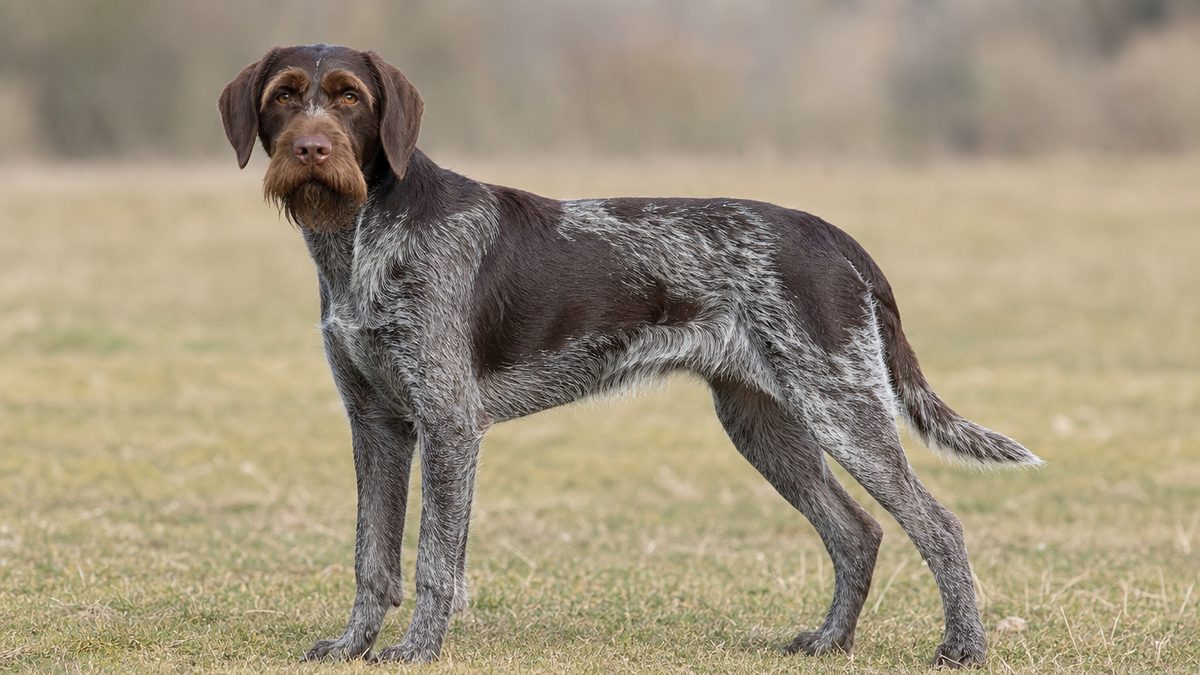
Use the coat, then the paperwork. The Drahthaar's standard specifies a wirehaired jacket, "harsh, flat lying and dense", with an outer coat approximately 2 to 4 cm long over a dense water-resistant undercoat, pronounced eyebrows and a beard that is "not too long, as harsh as possible";. The Kurzhaar is short and smooth with no beard. The Langhaar is feathered and silky. The Stichelhaar is harsh but shaggier and, on the German register, effectively a museum breed.
The paperwork tells you more than the coat does. An FCI-system pedigree will name the breed Deutsch Drahthaar and carry a German-style Ahnentafel; a pedigree descending from the American register will say German Wirehaired Pointer and mean something different about how the dog was bred. If an Indian seller says only "German Pointer", ask which of the eight, then ask to see the pedigree. A seller who cannot answer the first question will not survive the second.
India's largest puppy marketplace has a breed selector listing German Shorthaired Pointer but no German Wirehaired Pointer at all, and its only other pointing-dog page is for the English Pointer, where all six listings describe English Pointer puppies. A search for the wirehaired breed there resolves to a page about a different breed from a different country.
The breed standard, and the three registries that disagree about black
FCI Standard 98 sets height at 61 to 68 cm for dogs and 57 to 64 cm for bitches and permits black roan, while the American Kennel Club standard says "Any black in the coat is to be severely penalized" and the Royal Kennel Club lists Black and White as a breed-standard colour. American Kennel Club Royal Kennel Club
One visible trait, three registries, three answers. That is a real and checkable disagreement, and no Indian page mentions it. The FCI's colour clause is a closed list ending "No other colour is permitted", and black roan with or without patches is on it. The AKC's clause opens "The coat is liver and white" and closes by severely penalising any black, although the AKC still registers Black and White under code 019. American Kennel Club The Royal Kennel Club prints Black and White and Black and White Ticked among its breed standard colours outright.
The German breed club adds a fourth position, and it is the most specific of the four. Its regulation excludes from breeding dogs with "black (even with a chest patch), white or yellow dogs, and yellow roan, dead leaf color", so solid black is out while black roan, the Schwarzschimmel, is in. It then bans a Schwarzschimmel being mated to another Schwarzschimmel or to a solid brown dog, and stamps any resulting puppies "Zuchtverbot";. That is a colour-genetics rule with teeth, and it exists in no other register.
| Source | Male height | Female height | Outer coat length | Black permitted? |
|---|---|---|---|---|
| FCI Standard 98, 23.10.2002 | 61 to 68 cm | 57 to 64 cm | approx. 2 to 4 cm | Yes, black roan |
| AKC standard, effective 01.01.2007 | 24 to 26 in (61.0 to 66.0 cm) | not under 22 in (55.9 cm), no upper limit | 1 to 2 in (2.5 to 5.1 cm) | No, severely penalised |
| Royal Kennel Club breed page | not stated on the breed page | not stated on the breed page | listed as medium | Yes, Black and White |
| Asia Pets (India) | 22 to 26 in, both sexes | 22 to 26 in, both sexes | not stated | not listed |
| Puppiezo (India) | 22 to 26 in, both sexes | 22 to 26 in, both sexes | not stated | not listed |
Look at the bottom two rows. Both Indian pages give one height range for both sexes, which no registry does, and both use the AKC's inch figures rather than the FCI's centimetres. The FCI separates dogs from bitches by 4 cm at both ends, and the AKC separates them too. A spec card that flattens a real sex difference is a sign the page was assembled rather than checked. Asia Pets also converts its 22 to 26 inch range as "56 to 67 cm", where 26 inches is 66.0 cm.
Coat length is the other measurable disagreement
The two standards want different coats. The FCI asks for an outer coat "approximately 2 to 4 cm long", which is 0.8 to 1.6 inches. The AKC asks for one "from one to two inches in length", which is 2.5 to 5.1 cm. Those ranges overlap only between about 2.5 and 4 cm. A dog at the FCI's shortest is below the AKC's floor, and a dog at the AKC's longest is a centimetre past the FCI's ceiling. This is the kind of divergence that produces two dogs that look like different breeds in a photograph, and it is why an Indian buyer comparing an imported German dog with an American-descended one should expect them to look different.
Both standards agree on the important part. The coat is a working jacket: harsh, flat lying, dense, with a water-resistant undercoat, and the FCI lists "Sparce coat, lacking undercoat" as a severe fault while the AKC severely penalises a short smooth coat, a soft woolly coat or an excessively long one. The AKC adds a line that matters more in Chennai than in Wisconsin: the undercoat "is dense enough in winter to insulate against the cold but is so thin in summer as to be almost invisible."; A double coat that thins seasonally is a coat built for a climate that has seasons.
The disqualifying faults worth knowing before you buy
FCI 98 disqualifies aggressive or overly shy dogs, over- or undershot bites, wry mouth, missing teeth other than P1, canines set too narrow, entropion, ectropion, differently coloured eyes, an innate kinky or stumpy tail, and faulty pigment. The two eyelid faults matter later, because Indian law names both of them in its own genetic-defect testing clause. Note also what is absent: unlike the Kurzhaar's standard, FCI 98 does not list dewclaws as a disqualifying fault at all, which quietly removes one collision with Indian law that the shorthaired breed has.
The Deutsch Drahthaar and the German Wirehaired Pointer are now two populations
In North America the Deutsch Drahthaar and the German Wirehaired Pointer are registered by different bodies under different rules, and the VDD's own regulation keeps them apart: Article 13 states that in DD groups outside Germany, "dogs may not be registered with another Breed Registry in the same country of the respective DD group.";
That single clause is the mechanism. The Verein Deutsch-Drahthaar runs an official chapter in the United States and Canada, the Group of North America, with its own stud-dog register, its own breed shows and its own Armbruster Zuchtpruefung. A dog in that chapter is registered in the VDD's German stud book and holds a German Ahnentafel. Article 13 bars it from also being registered with the AKC. Article 13 adds that Deutsch Drahthaar in the VDD stud book "will be banned from breeding for life if they have been used for breeding outside the Breeding Regulations";.
So the two names are not two spellings of one thing. They are two gene pools with a wall between them, and the wall was built deliberately by the German club. An Indian buyer told a puppy is "imported German bloodline" is being told almost nothing until they establish which side of that wall the parents sit on.
| Requirement | VDD (Deutsch Drahthaar) | AKC and GWPCA (German Wirehaired Pointer) |
|---|---|---|
| Breeder must hold a hunting licence | Yes, Article 4(1)(b) | No such requirement |
| Hunting performance test passed | Yes, Article 9(2)(e): VJP, HZP, Hegewald, VGP or VSwP | None required |
| Proof of hardness in real hunting | Yes, Article 9(2)(b), the Haertenachweis | None required |
| Water work and tracking graded | Yes, at least 'sufficient' in both | None required |
| Conformation grade at a breed show | Yes, Article 9(1), by the Formwert judging group | Not required to breed |
| Hip screening | Required, only grade A or B counts as HD-frei | Recommended for a CHIC number |
| Shoulder OCD screening | Required since 01.01.2012 | Not a CHIC requirement |
| Thyroid screening | Not in the breeding-approval list | A CHIC requirement, yearly to age four |
| Cardiac examination | Not in the breeding-approval list | A CHIC requirement |
| Abnormal results still allow registration | No. HD grade C or worse is excluded | Yes. CHIC states results need not be normal |
| Litters per bitch per year | One, Article 21 | No club rule |
| Stud services per dog per year | Six, Article 12 | No club rule |
| Kennel inspected before breeding | Yes, Article 6(2) | No |
| Litter inspected, tattooed or chipped | Yes at 7 to 8 weeks, Article 28 | No |
| Blood sample banked before pedigrees issue | Yes, Article 28(8) | No |
The row that decides everything is the tenth. The OFA states in its own words that for CHIC certification "all results do not need to be normal, but they must all be in the public domain so that responsible breeders can make more informed breeding decisions";. A CHIC number is a transparency badge. The VDD's Zuchttauglichkeit stamp is a breeding approval, and a Drahthaar with hips graded C cannot have it. Both systems are defensible. They are simply not the same system, and a seller who blurs them is selling you the German reputation with the American rulebook.
Ask which register the parents are in and ask to see the document. A VDD Ahnentafel carries a Zuchttauglich stamp with the breed warden's date and signature, and an HD-frei stamp showing the A or B grade. An AKC pedigree carries neither, because the AKC does not issue them. Neither answer is disqualifying. Not being able to get an answer is.
Germany will not let this dog breed until it has passed a hunting test
A Deutsch Drahthaar cannot be bred until it has passed a field performance test with water work and tracking, proved its hardness in real hunting, been graded free of hip dysplasia and shoulder OCD, been judged for conformation at a breed show, and been bred by someone holding a valid hunting licence.
The Verein Deutsch-Drahthaar publishes the conditions in full, as Article 9 of its Breeding Regulations, 20th revision, effective 1 July 2019. The association's own wording is a list of lettered sub-clauses, not a set of recommendations. A dog is suitable for breeding when it has none of the faults listed in Article 14, has passed the toughness evaluation, is HD-frei, is OCD-frei as of 1 January 2012, and has passed a hunting test: a VJP, an HZP, a Hegewald-type breed test, a VGP or a VSwP.
Article 9 then adds a floor that most summaries drop. In all cases the dog must achieve at least the "sufficient" predicate in tracking and in independent search in water with dense cover, and must show no gun sensitivity and no game shyness in field and water. Results from tests the dog failed still count against it. You cannot quietly enter a nervous dog until it passes.
What the tests actually are
The test names on a German pedigree come from the Jagdgebrauchshundverband, which publishes its report forms in English. The VJP is the spring breed test for young dogs, Form 3. The HZP is the autumn breed test, Form 5. The VGP is the autumn utility test, Form 7, and it is the two-day examination across field, water, forest and obedience that the system is built around. Form 10 covers the test after shooting, Form 21 the Armbruster hold award, Forms 23a and 23b the certificate of loud hunting, and Form 25 the retrieving reliability test. Those forms are why a result earned in one club is comparable in another. The JGHV also publishes its association by-laws, its regulations on association judgeship and a document titled The German Versatile Dog Studbook in English, so the machinery behind those results is inspectable rather than merely asserted.
The VDD layers its own competition on top. Its Breeding Register, the Zuchtregister, is a higher bar than mere breeding approval: a dog must meet all of Article 9, have a beard, be at least 15 months old, be HD-frei and OCD-frei, earn at least "good" in both conformation and coat at a breed show, and have passed at least an HZP or a VGP with at least "good" in tracking and in independent water search. Dogs that hunt silently, or give tongue with no game present, are barred from the register even though neither fault disqualifies them from breeding.
- Breeding age. Bitches not before 15 months and not after the eighth birthday; stud dogs not after the ninth. Article 11.
- Litter frequency. One litter per bitch per calendar year, with an automatic 15-month protection period and a fine of twice the going puppy price for a breach. Article 21.
- Stud use. Six successful services per stud dog per breeding year. Article 12.
- Caesareans. A bitch may not be bred again after two Caesarean deliveries. Article 18(4).
- Litter handling. The whole litter and the dam are inspected at seven to eight weeks and no puppy may be transferred before that. Article 28.
- Identity. Pedigrees issue only after a blood sample reaches the association's bank, and the head breed warden may demand a DNA test at any time. Articles 28(8) and 19.
What HD-frei actually means, because it is looser than it sounds
The VDD counts two hip grades as free. Article 25 says HD-free dogs are those assessed as "free" (A) of symptoms of hip dysplasia, and adds in its own words that "The assessment 'almost normal' (B) is considered HD-free."; The A or B status must be printed inside the stamp on the pedigree, so a buyer can tell the two apart. Grade C and worse are excluded from breeding under Article 14(1)(a), which lists HD, OCD, elbow dysplasia, epilepsy-like seizures and bleeding disorders together as breeding-relevant diseases.
This is where the German system earns its reputation and also where it should be read honestly. It does not screen thyroid function and it does not require a cardiac examination, both of which the American system does. What it does instead is refuse to let an untested, unproven or unsound dog breed at all.
Read the German edition of the breeding rules, not the English one
The English translation of the VDD Breeding Regulations circulating online is the 20th revision of 1 July 2019, while the German original on the association’s own site is valid from 1 April 2024, and the two differ on five clauses including the one governing first-degree matings.
One practical warning for anyone checking these rules themselves. The English translation circulating online is the 20th revision, effective 1 July 2019, and the German original on the association's own site is a later edition whose cover reads "Stand 1. April 2024" and which was last amended at the members' meeting of 23 March 2024. Verein Deutsch-Drahthaar e.V. They are not identical, and the differences are not cosmetic.
| Clause | English 20th revision, 2019 | German edition, valid from 01.04.2024 |
|---|---|---|
| Article 9(2), breeding suitability | Five conditions, blood banking not among them | Six conditions, and the first is that blood has been banked with the institution the VDD names |
| Article 14(3), first-degree matings | Require prior permission of the head breed warden | "sind unzulaessig", not permitted |
| Article 14(1)(h), colour | Excludes solid black, white, yellow, yellow roan, with a Scandinavian exception | Same exclusions, no Scandinavian exception, plus any other substantial deviation from the standard |
| Article 34(2), penalties | Article 4 breaches punishable up to EUR 2,500 | Article 4 breaches punishable up to EUR 5,000 |
| Article 4(1)(b), the breeder | Possesses a valid hunting license | Must prove a passed Jaegerpruefung, the German hunting examination |
The direction of travel is worth noting. Every one of those changes tightens the rule, and the biggest of them closes a discretion that used to exist. A page quoting the 2019 English text as current, as this one initially did, understates how strict the German system now is.
The German edition also prints its fee schedule, valid from 1 April 2024, which is what actually stands behind a VDD pedigree: kennel protection including the VDH fee at 70.59 euro, FCI kennel protection at 29.41 euro, an Ahnentafel with registration and chip at 40.00 euro, a duplicate pedigree at 50 euro for members and 100 for non-members, and a 15.00 euro processing fee per transaction, all plus VAT. Those are administrative costs. The radiographs, the DNA banking through Laboklin and the test entries are separate, and the association publishes distinct HD, OC(D) and ED forms plus radiograph instructions in both German and English for exactly that reason.
What the American and British systems actually require
The American system recommends five health screenings and requires none of them, while the Royal Kennel Club requires a von Willebrand disease result before it will register an imported German Wirehaired Pointer at all. Royal Kennel Club
Start with the American wording, because the verb is the whole point. The OFA's CHIC page for breed code GWP says: "The OFA, working with the breed's parent club, recommends the following basic health screening tests for all breeding stock." The German Wirehaired Pointer Club of America uses the same verb, saying it "recommends that all breeding dogs complete recommended health screenings to obtain a CHIC number through OFA", and lists hips, elbows, eyes, cardiac, thyroid and optional vWD.
| Screening | What counts | Minimum age |
|---|---|---|
| Hip dysplasia | OFA evaluation or PennHIP evaluation | 24 months for OFA, 12 for PennHIP |
| Elbow dysplasia | OFA evaluation | 24 months |
| Autoimmune thyroiditis | OFA evaluation from an approved laboratory | 2 years, then yearly to age four |
| Eyes | ACVO eye examination, yearly if in a breeding programme | any age |
| Cardiac | Basic cardiac exam by a cardiologist, or advanced cardiac exam | not stated |
| von Willebrand's disease | Optional. DNA test from an approved lab | not stated |
| Identification | Microchip or tattoo, required across all CHIC breeds | not stated |
The club's own breeder directory, counted
The GWPCA publishes a breeder listing and is unusually candid about what it is. The page states that the directory is "a form of classified advertising where members of the GWPCA can pay a fee for an annual listing", that appearance on it "does not constitute a recommendation by the GWPCA or its members", and that the club "does not endorse or recommend any advertiser and/or their breeding practices";.
Each entry declares its own screening. Counting them on 31 August 2026, the directory carried 19 listings, of which 12 declared all five CHIC screenings and seven declared fewer. Two declared hips and elbows only, one declared hips, elbows and thyroid, one declared hips, elbows, eyes and von Willebrand's, and two Oregon kennels declared hip and thyroid work without elbows, eyes or cardiac. These are self-declared entries in a paid advertisement, so treat them as claims rather than as verified records, but the spread is the point: a system that recommends produces a range, and roughly a third of the club's own advertisers are not completing the recommendation.
Britain requires one test and gates imports on it
The Royal Kennel Club takes a third position. Its best-practice pre-breeding list is a DNA test for von Willebrand disease type II, plus BVA/KC hip and elbow scoring and BVA/KC/ISDS eye testing. It does not ask for thyroid or cardiac work. But it does something neither of the others does. With effect from 6 January 2025, imported German Wirehaired Pointers and litters from overseas sires are eligible for registration only if proven clear or carriers of vWD2, or hereditarily clear, with carriers usable only when mated to a clear or hereditarily clear dog. The club says the scheme was introduced at the request of the breed clubs "to safeguard the UK German Wirehaired Pointer population from the introduction of this condition".
So the three systems are not ranked, they are different shapes. Germany gates on performance and orthopaedics. America publishes everything and requires nothing. Britain requires one DNA result and only at the border. An Indian buyer should ask which of the three a puppy's ancestry passed through, because it changes what the paperwork proves.
A correction: the American dogs are tested, just not by the kennel club
It would be wrong to leave the impression that German Wirehaired Pointers in North America go untested. They do not. The testing simply happens outside the registry, through the North American Versatile Hunting Dog Association, which runs four levels of test: the Natural Ability test, open to dogs up to and including the day they reach 16 months, the Gun Dog Test, the Utility Test, and the Invitational.
The structure is closer to the German system than to a dog show. Entrants are judged one at a time by three judges and scored against a standard rather than against each other, so if every dog performs well every dog can be placed, in Prize I, II or III. The Natural Ability test evaluates nose, search, pointing, desire to work, cooperation and gun shyness in the field, tracking a flightless running pheasant or chukar, willingness to swim, and then teeth, eyes and coat. The Utility Test adds a 30-minute field group with steadiness on game, a retrieve of shot bird and a retrieve of dragged game, and a water group with a duck search, walking at heel, remaining and steadiness by a blind and a duck retrieve. Dogs passing the Invitational take the title Versatile Champion.
Fourteen of the nineteen kennels in the GWPCA breeder directory name a NAVHDA chapter among their affiliations. So the honest summary is not that America does not test. It is that in Germany the test is a condition of breeding and in America it is a voluntary parallel institution, and only the German one can stop a litter being registered.
How many German Wirehaired Pointers exist, from the German register
German breeders registered 2,215 Deutsch Drahthaar puppies with the VDH in 2025, against 2,587 in 2024, 2,618 in 2023, 3,119 in 2022 and 3,629 in the pandemic year 2021.
Those figures come from the Verband fuer das Deutsche Hundewesen's own annual table and were read off a live fetch of the page rather than from a search snippet. Fifteen years of the series put the breed in context: it sat between 2,783 and 3,124 every year from 2011 to 2017, peaked at 3,629 in 2021, and has fallen in each of the four years since. That is a 39 percent decline from the 2021 peak, and it tracks a general German collapse rather than a breed-specific one, because total VDH registrations across all breeds fell from 85,595 in 2021 to 55,053 in 2025.
| Breed | 2025 | 2024 | 2023 | 2022 | 2021 |
|---|---|---|---|---|---|
| Deutscher Schaeferhund (German Shepherd) | 6,374 | 6,316 | 6,242 | 8,395 | 10,031 |
| Teckel (Dachshund) | 4,508 | 4,788 | 5,475 | 6,296 | 7,205 |
| Labrador Retriever | 2,401 | 2,367 | 2,326 | 2,630 | 3,219 |
| Deutsch Drahthaar | 2,215 | 2,587 | 2,618 | 3,119 | 3,629 |
| Pudel (Poodle) | 2,035 | 1,997 | 2,123 | 2,134 | 2,593 |
| Golden Retriever | 2,007 | 1,952 | 1,941 | 2,166 | 2,412 |
| Rottweiler | 1,376 | 1,259 | 1,351 | 1,388 | 1,778 |
| Deutsch Kurzhaar | 1,198 | 1,236 | 1,278 | 1,304 | 1,842 |
| Kleiner Muensterlaender | 1,102 | 1,059 | 1,226 | 1,227 | 1,448 |
| All VDH breeds combined | 55,053 | 56,851 | 60,306 | 69,381 | 85,595 |
Read that table the right way and it destroys the most common Indian description of this breed. The Deutsch Drahthaar is not rare. It was the fourth most-registered breed in Germany in 2025, ahead of the Poodle, the Golden Retriever and the Rottweiler, and it accounted for 4.0 percent of every pedigree puppy the VDH registered that year. It is a mainstream working dog in its homeland with an unglamorous, entirely functional following.
The Verein Deutsch-Drahthaar puts the same point in words on its own site: "The Drahthaar is the most frequently used hunting dog by the hunting establishment in Germany, and that is not without reason."; That claim is consistent with the register rather than merely asserted against it, which is more than most breed-club claims manage.
In the United States the picture is different. The AKC ranks the German Wirehaired Pointer 58th of 210 breeds for 2025 and has recognised it since 1959, the same year the German Wirehaired Pointer Club of America was established. So one country's fourth-commonest pedigree dog is another country's mid-table specialist, and the two populations are not even registered together.
The Kennel Club of India publishes no breed-by-breed registration statistics, so nothing equivalent to the VDH table exists for India. Every Indian claim about how common this breed is here rests on marketplace listing counts rather than on a register. Say so rather than guessing at a number.
German Wirehaired Pointer price in India, and what the published bands really are
The German Wirehaired Pointer price in India runs Rs 30,000 to Rs 70,000 across the two Indian pages that publish a figure for this breed, with one quoting Rs 40,000 to Rs 55,000 and the other Rs 30,000 to Rs 70,000. Puppiezo, German Wirehaired Pointer Puppies…
Those are the only two numbers on the Indian internet that are actually attached to this breed, and they disagree at both ends. Asia Pets prints "Rs 30,000 - Rs 70,000 in India" on its breed page, with 27 to 32 kg, 22 to 26 inches and a 12 to 14 year lifespan. Puppiezo writes that "German Wirehaired Pointer Prices in India can range from Rs 40,000 to Rs 55,000 or more, depending on factors like pedigree and breed", with 22 to 26 inches, 25 to 34 kg and the same 12 to 14 years.
Neither figure is sourced, neither is attached to a named litter, and neither seller shows the price on the page. Puppiezo hides every price behind a "View Price" popup. Asia Pets routes you to a WhatsApp number. Bonbeno reports published ranges as editorial content and does not broker sales, so treat both bands as claims about a market rather than as offers.
| Source | Band quoted | Attached to a German Wirehaired Pointer? | Price visible on the page? |
|---|---|---|---|
| Asia Pets breed page | Rs 30,000 to Rs 70,000 | Yes, as a breed-level estimate | Yes |
| Puppiezo breed page | Rs 40,000 to Rs 55,000 or more | Yes, as a breed-level estimate | No, behind a popup |
| Puppiezo available-puppies carousel | Rs 76,499 to Rs 1,20,000 | No. Zero of the eight animals are this breed | Yes |
| Mr n Mrs Pet Pointer page | INR 40,000 to INR 1,40,000+ | No. This is the English Pointer | No, behind a sign-up wall |
What the money does not buy
Neither Indian band buys anything the German system produces. A Rs 55,000 puppy in Delhi has no Zuchttauglich stamp, no HD-frei grade printed with its A or B status, no OCD result, no VJP or HZP pass in its parents' file and no blood sample in the VDD bank, because none of those things exist outside the VDD's register. It may still be a healthy, well-bred dog. It is simply not the dog the marketing is invoking when it says "German".
For scale, the German association's fee schedule is public and the numbers are small. Nothing in the Indian price reflects a testing cost, because no Indian test exists to pay for.
The honest summary for an Indian buyer is that this is an expensive dog to keep and a cheap dog to buy, which is exactly the wrong way round. The purchase price is the smallest number in the whole exercise, and the cost-of-ownership section below shows why.
Testing the Indian price figures with arithmetic
None of the Indian bands for this breed divides cleanly into a plausible dollar price at 84.38 or at 74, so these are rupee-native round numbers rather than a converted American price list.
This site runs the same three division tests on every Indian price it publishes, because Indian breed pages routinely reprint a United States price list run through one exchange rate. The tests are cheap and a reader can repeat them in a calculator.
| Rupee figure | At 84.38 | At 74.00 | At 66.67 | Verdict |
|---|---|---|---|---|
| Rs 30,000 | USD 355.53 | USD 405.41 | USD 449.98 | No clean dollar price at 84.38 or 74 |
| Rs 40,000 | USD 474.05 | USD 540.54 | USD 599.97 | No clean dollar price at 84.38 or 74 |
| Rs 55,000 | USD 651.81 | USD 743.24 | USD 824.96 | No clean dollar price at 84.38 or 74 |
| Rs 70,000 | USD 829.58 | USD 945.95 | USD 1,049.95 | No clean dollar price at 84.38 or 74 |
Report the quotient, not just whether it divided. At 84.38 the four figures give 355.53, 474.05, 651.82 and 829.58 dollars, and no seller anywhere prices a puppy at 474 dollars and 5 cents. At 74 they give 405.41, 540.54, 743.24 and 945.95, which is the same story. Both rates are ruled out, and that is a finding rather than a failure: it means these numbers were typed in rupees by a person, not generated by dividing an American list.
The 66.67 column is arithmetic, not evidence
Look at the third column and every row lands within five paise of a whole number of dollars: 449.98, 599.97, 824.96 and 1,049.95. That looks like a smoking gun and it is not. 66.67 is 200 divided by 3, so dividing by it is the same as multiplying by 0.015, and any rupee figure that is a multiple of 1,000 gives a clean result by construction. Rs 1,000 at 66.67 is exactly 15 dollars. Four round rupee numbers passing this test proves nothing at all.
That is the same structural weakness this site has already documented for a flat rate of 80, where 1,000 divided by 80 is 12.5 and any figure ending in three zeros passes automatically. 84.38 is the strong test precisely because it is an ugly number that a round rupee figure will not survive by accident. Treat a match at 66.67 or 80 as evidence only when the quotient is also a price a human would print, and say so on the page when one of those rates is the only one that matches.
The plausibility check, which the division tests cannot do
Ask separately whether each figure makes sense as a rupee price at all, because the third contamination mechanism strips the currency symbol and does no arithmetic, which defeats every division test. Here the answer is reassuring. Rs 30,000 to Rs 70,000 is a coherent Indian band for an uncommon large gundog, it sits alongside the Rs 25,000 to Rs 70,000 this site records for the German Shorthaired Pointer, and it is not obviously a dollar figure with the sign removed. The Mr n Mrs Pet band of INR 40,000 to INR 1,40,000+ is also plausible in rupees, but it belongs to the English Pointer and not to this breed.
When any Indian page quotes a breed price, divide it by 84.38 and look at the answer. If it lands on 500, 800, 1,500 or another number a shop would print, you are reading a converted American list. If it lands on 474.05, you are reading a rupee number. Then ask whether the rupee number is plausible on its own terms, because a stripped currency symbol leaves a fingerprint rather than a quotient.
What Indian listings for this breed actually contain
The page that ranks first in India for this breed's price shows eight available puppies and not one of them is a German Wirehaired Pointer.
On 31 August 2026 the Puppiezo German Wirehaired Pointer page carried an "Available German Wirehaired Pointer Puppies For Sale" carousel with eight animals: two Maltipoos named Fizey and Samy, two Poodles named Kuzo and Dugu, a Cane Corso named Kazuka, a Goldendoodle named Doir, a Rottweiler named Tugi and a Doxiepoo named Yoki. Every one is eight weeks old. None is the breed the page is about.
The prices beside them are the giveaway. Rs 98,999 appears three times on this single page, on Fizey the Maltipoo, Samy the Maltipoo and Yoki the Doxiepoo, alongside Rs 92,599 twice, Rs 94,999, Rs 1,20,000 and Rs 76,499. That is not a breed price. It is a house price point attached to whatever puppy is in stock, and this site has now recorded the identical figure with the identical animals across a run of unrelated breed pages on the same site.
Rs 98,999 divides to 1,173.25 dollars at 84.38, so it is not even a conversion. It is a rupee-native charm price ending in 999, which is what a retailer prints when it wants a number to look like a discount. Never treat it as any breed's price, and be suspicious of any Indian breed guide that quotes a figure in the high nineties of thousands without naming the animal it came from.
The largest Indian marketplace does not list this breed at all
Mr n Mrs Pet, which describes itself as India's number one pet platform, has no German Wirehaired Pointer page. Its breed selector runs from Affenpinscher to Yorkshire Terrier and includes German Pinscher, German Shepherd, German Shorthaired Pointer and German Spitz, but not the wirehaired breed. The nearest thing it offers is a "Pointer" page, and that page is about a different dog: its own specification table reads "BREED NAME Pointer (English Pointer), ORIGIN England", and all six listings on it describe English Pointer puppies.
The controls on the same page make that absence meaningful rather than a search artefact. The site's most-popular-breeds panel prints live counts of 650 Shih Tzu, 549 Siberian Husky, 487 Golden Retriever, 454 Labrador Retriever, 412 German Shepherd, 274 Beagle, 263 Poodle, 162 Rottweiler, 136 Pomeranian and 134 Cane Corso. The instrument works. The breed is simply not on it.
The Pointer page is assembled from another breed's template
Read the Mr n Mrs Pet Pointer page closely and the seams show. One section says Pointers have "Low Grooming Needs" and a "short, smooth coat", while the FAQ on the same page says "Pointer have dense, curly coats that need trimming every 4-6 weeks to prevent matting";. A dog cannot have both. Two of the three quality cards say the puppy is a "Good representation of the Poodle blend", and one FAQ tells the reader they can buy "through our verified and responsible Corgi breeders";.
Those are the fingerprints of a template built for one breed and refilled for another, and they are worth knowing because the same mechanism produces the confident-sounding care advice further down such pages. When a page contradicts itself about the coat of the dog it is selling, nothing else on it should be trusted without a second source.
Nobody can say, and any page that gives you a number is guessing. Even the search engines cannot help: on 31 August 2026 Bing India returned, for the query german wirehaired pointer, ten organic results about learning the German language, and returned the identical result set and the identical About 145,000 results count for the separate query german wirehaired pointer price in india. No conclusion is drawn from that in either direction; it is recorded because it is why this page carries no People Also Ask questions. The KCI publishes no breed registration statistics, the largest marketplace does not carry the breed, and the two pages that do carry it show no actual animals. The honest answer is that the German Wirehaired Pointer is present in India in small numbers, is genuinely rare here compared with the Labrador or the German Shepherd, and has no visible supply chain that a buyer can inspect.
Suitability for the Indian climate: the homeland numbers
Hannover, in the German lowlands where this breed was assembled, has never had a month whose 30-year mean air temperature reached 25 degrees Celsius, while Chennai has ten such months every year.
That is the heat tolerance question answered with numbers rather than adjectives. The figures below come from NASA's Prediction Of Worldwide Energy Resources climatology, 1991 to 2020, queried by explicit latitude and longitude so that no place-name slug can silently hand back a different city. Wet-bulb temperature is computed from the same air temperature and relative humidity fields using Stull's approximation. Wet-bulb matters more than air temperature for a dog, because a panting dog cools by evaporation and evaporation stalls as the air approaches saturation.
| Place | Annual mean C | Hottest month | Peak wet-bulb month | Months over 25 C |
|---|---|---|---|---|
| Munich, Germany (48.135 N, 11.582 E) | 8.25 | Jul, 17.97 | Jul, 15.29 WB | 0 of 12 |
| Hannover, Germany (52.376 N, 9.732 E) | 9.29 | Jul, 18.52 | Jul, 15.43 WB | 0 of 12 |
| Chennai (13.083 N, 80.271 E) | 27.91 | May, 31.57 | May, 26.03 WB | 10 of 12 |
| Mumbai (19.076 N, 72.878 E) | 26.65 | May, 31.03 | Jun, 25.68 WB | 9 of 12 |
| Kolkata (22.573 N, 88.364 E) | 25.83 | May, 31.55 | Jun, 26.99 WB | 8 of 12 |
| Delhi (28.614 N, 77.209 E) | 25.65 | Jun, 35.95 | Jul, 26.43 WB | 7 of 12 |
| Pune (18.520 N, 73.857 E) | 23.74 | Apr, 28.74 | Jun, 22.90 WB | 4 of 12 |
| Bengaluru (12.972 N, 77.595 E) | 23.63 | Apr, 28.41 | May, 21.74 WB | 3 of 12 |
| Dehradun (30.317 N, 78.032 E) | 17.94 | Jun, 26.21 | Jul, 20.85 WB | 2 of 12 |
| Shillong (25.579 N, 91.893 E) | 17.87 | Jul, 22.37 | Jul, 21.29 WB | 0 of 12 |
Compare the wet-bulb column and the gap is stark. Hannover's worst month averages 15.43 C wet-bulb and Munich's 15.29. Kolkata's worst month averages 26.99 C, which is 11.56 points above Hannover. Chennai reaches 26.03, Delhi 26.43 and Mumbai 25.68. Even Bengaluru, the mildest big metro on the list, runs 21.74 against Hannover's 15.43, a gap of 6.31 points in the friendliest comparison available.
Chennai deserves its own sentence. Its coolest month, January, averages 23.99 C. Hannover's hottest month, July, averages 18.52 C. The coldest month of the year in Chennai is 5.47 C warmer than the warmest month of the year in the breed's homeland. There is no season in Chennai that resembles a German summer, and no acclimatisation period that turns one into the other.
The coat is the complication the shorthaired breeds do not have
This is where the Drahthaar differs from its shorthaired cousin, and it differs in the wrong direction. FCI 98 specifies a weatherproof jacket over a "dense, water resistant undercoat", and the AKC adds that the undercoat "is dense enough in winter to insulate against the cold but is so thin in summer as to be almost invisible";. Two things follow for India. The seasonal thinning is triggered by a temperate photoperiod and temperature cycle that most of India does not provide, and the harsh outer coat holds moisture against the skin in humidity in a way a smooth coat does not.
The Royal Kennel Club, describing the same breed for a maritime climate, sets its exercise requirement at more than two hours per day and its housing at a large house with a large garden in the country. Two hours of hard work per day in a city that spends ten months above a 25 C monthly mean is the actual problem with this breed in India, and no coat helps with it.
Heat management city by city, and what the research says about the risk
Manage this breed's heat risk by moving its work to the coolest hours and by keeping it lean, because the largest UK study of heat-related illness found exertion rather than parked cars to be the dominant trigger.
Hall, Carter and O'Neill, writing in *Animals* in 2020, studied 905,543 UK dogs under primary veterinary care in 2016 and recorded 1,259 heat-related illness events from 1,222 dogs. Of those, 380 events had no trigger recorded, leaving 879 with a recorded trigger, of which 652 were exertional, which is 74.2 percent of the events with a recorded trigger. Environmental heat accounted for 113 events at 12.9 percent and vehicular confinement for 46 at 5.2 percent, with care by a clinic or groomer at 40, building confinement at 24 and blanket entrapment at 4. Those six counts sum to 879 exactly. The percentages are computed on 879 and not on 1,259, and quoting them against the larger number would overstate the exertional count by more than 40 percent.
The same authors, writing in *Scientific Reports* in the same year on the same 2016 cohort but with a different case definition, counted 395 confirmed events from 390 dogs, estimated the 2016 incidence at 0.04 percent and the event fatality rate at 14.18 percent, and found that dogs at or above their breed and sex mean bodyweight carried an odds ratio of 1.42 with a confidence interval of 1.12 to 1.80. These are two different papers with two different case definitions, and neither corrects the other. Cite the journal, not a bare year.
Two findings from the Scientific Reports paper transfer directly to this breed. Purebred dogs carried 1.86 times the odds of crossbred dogs, interval 1.39 to 2.49, and dogs over 50 kg carried 3.42 times the odds of dogs under 10 kg, interval 1.54 to 7.57. A German Wirehaired Pointer weighs 50 to 70 pounds, roughly 23 to 32 kg, so the over-50 kg band does not apply to it. The transferable finding is the bodyweight one: a Drahthaar carrying extra weight is the version of this dog at measurable risk, and this is a breed that gains weight fast the moment its exercise is cut for the summer.
A practical schedule by city
- Chennai and Kolkata. Work the dog before sunrise and after dark, all year. Chennai has no cool month at all and Kolkata's wet-bulb peaks higher than any other city sampled here, at 26.99 C in June.
- Mumbai. Treat March to October as the restricted season, nine months above a 25 C monthly mean, and use December to February for anything demanding.
- Delhi. Split the year. April to June is dry heat reaching a 35.95 C mean in June, which this dog handles better than the July wet-bulb peak of 26.43 C. A January mean of 13.83 C is the closest an Indian plain gets to a German autumn.
- Pune and Bengaluru. The two mainland metros where a fit adult can work in the morning most of the year. Bengaluru's peak wet-bulb of 21.74 C is the mildest on this list.
- Dehradun and Shillong. The genuinely comfortable options. Shillong has no month averaging above 25 C, and its wet-bulb peak of 21.29 C is the closest India comes to the homeland, though still 5.86 points above Hannover's.
Signs of trouble come in a fixed order and you should know them before you need them. Heavy panting that does not settle within a few minutes of stopping, bright red gums, unsteadiness on the feet, and vomiting are an emergency rather than a rest break. Cool the dog with tap-temperature water over the whole body and get to a clinic immediately rather than waiting to see whether it improves. The UK fatality figure of 14.18 percent is not a reason to panic, but it is a reason not to wait.
Temperament and who should not buy this dog
The German Wirehaired Pointer is a firm, self-controlled, affectionate working dog that bonds hard to one household and is reserved with strangers, which makes it a poor fit for a busy Indian flat where people come and go all day.
Both standards describe the same animal in almost the same words. FCI 98 asks for a dog that is "Firm, self-controlled, wellbalanced, without shyness of game, neither sensitive when shots are fired nor shy or aggressive";. The AKC standard calls for a dog "of sound, reliable temperament" that is "at times aloof but not unfriendly toward strangers; a loyal and affectionate companion who is eager to please and enthusiastic to learn";. Note what neither says. Neither describes a dog that loves everybody, and neither promises the placid family pet that Indian listings advertise. This is an energetic, work-oriented animal whose own FCI standard opens by defining it as a versatile working gundog rather than as a companion.
The AKC's own breed page adds the working owner's version, quoting a veteran owner: "The need for running in the great outdoors is a must! This breed will not be happy to be on the couch all day." It also warns that the breed's "independent, inquisitive nature might frustrate novice owners" and that German Wirehairs "crave human companionship, and undesirable behaviors can result if they are regularly left alone for long periods of time";. Those two sentences together describe the exact failure mode of an Indian placement: a dog that needs both hard work and company, in a household that provides neither on a weekday.
The one-person tendency is real and it is documented
Even the Indian pages notice it. Asia Pets, answering its own question about how the wirehaired breed differs from the shorthaired one, writes that the GWP "has a harsh wiry coat for weather protection, is slightly larger, and tends to be more one-person oriented";. Its friendliness scale rates the breed 5 for family, 4 for children, 3 for other pets and 2 for strangers. That last number is the one to take seriously in an Indian apartment building with shared corridors, delivery riders and a security desk.
The VDD's own description is warmer and worth quoting for balance: "The Drahthaar is a passionate hunting dog with industry and endurance, calm by nature, friendly in relations... The Drahthaar is gentle with children and a suitable family dog. He is no problem to keep in the kennel or the house." It immediately adds the condition: "As with every genuine working dog, however, he needs legitimate specialty training and guidance. Only when given sufficient activity does he feel content."; The association is not overselling. It is stating a conditional.
Who should buy one, and who should not
- Buy one if you live in Bengaluru, Pune, Dehradun, Shillong or a hill town, have a securely fenced garden, and will genuinely commit two hard sessions a day in the cool hours all year.
- Buy one if you already run, cycle, hike or swim regularly and want the dog with you, not waiting at home.
- Do not buy one if this is your first dog. Both the AKC and the German club describe an independent dog that needs structure, and a novice owner learns on an easier animal.
- Do not buy one if the household is out from nine to seven. A bored Drahthaar redecorates.
- Do not buy one if you want a dog that greets every visitor. That is a Labrador, and the honest recommendation is to buy the Labrador.
- Do not buy one on the strength of the word German. It is doing a lot of work in Indian marketing and almost none of it is about this dog's actual needs.
One more point that Indian sellers rarely make. This is a breed with a high prey drive, developed to find, point and retrieve game and to track wounded animals. In an Indian city that means cats, street dogs, monkeys, poultry and traffic, and it means a long line rather than an off-lead park until the recall is genuinely proofed.
Training a dog bred to be tested
Train this breed with short, structured, reward-based sessions from eight weeks, because it is highly trainable and learns unwanted behaviour exactly as fast as it learns wanted behaviour.
The AKC's own guidance is a good starting point and it is unusually specific: German Wirehaired Pointers "are very intelligent, responsive, and eager to please, so they are generally easy to train", early socialisation and puppy classes are recommended, and the breed "excels in a wide range of canine sports and activities";. The catch is in the same paragraph: undesirable behaviours result when the dog is regularly left alone for long periods.
The German system tells you something the American one does not, which is what this dog can actually be taught. To breed, a Drahthaar must show at least "sufficient" in tracking and in independent search in water with dense cover, must have proved hardness in real hunting practice, and must have demonstrated no gun sensitivity and no game shyness in field and water. A dog selected for a century against that specification is a dog with a very high ceiling and a corresponding need for a job.
A realistic Indian timeline
- Weeks 8 to 16. Socialise deliberately and daily. Lifts, autos, traffic, temple bells, monsoon rain on a metal roof, delivery riders at the gate, the security desk, cows, street dogs at a safe distance. Reward calm looking, never forced greeting.
- Weeks 12 to 24. Build a recall on a 10 metre long line before the prey drive matures. Pay for the recall with food or a retrieve every single time for the first year.
- Months 4 to 9. Add impulse work: a settle on a mat, waiting at doors, taking food gently. Teach handling for ears, feet and coat now, because you will be doing all three weekly for the next decade.
- Months 6 to 18. Expect the adolescent regression. The recall gets worse, the dog tests boundaries, and this is when Indian rehoming peaks. Shorten sessions, raise the reward rate, keep the long line on.
- From 12 months. Give it a real job. Scent games, a formal retrieve, tracking a dragged article, swimming, canicross in the cool hours. A versatile gundog with nothing to find will invent something.
One method note. Nothing in this breed's history rewards harsh handling, and the German test system explicitly disqualifies dogs that are gun shy, game shy, very nervous or fear-biting from breeding at all, which means the population has been selected for stability rather than for tolerance of pressure. Use markers, food and retrieves. A dog that shuts down in a training session is not being stubborn.
The Indian-specific training problems
Three come up repeatedly. The first is that heat forces training into two narrow windows, so the sessions have to be short and dense rather than long and rambling. The second is that Indian apartment lifts and stairwells create a lifetime of close-quarters encounters with strangers, which a reserved breed needs deliberate work on rather than exposure alone. The third is street dogs. A confident Drahthaar will not back down, so manage the environment rather than testing the dog: change your route, keep the lead short in a pinch point, and never let a greeting happen on a narrow lane.
The daily exercise requirement, and what happens without it
Give an adult German Wirehaired Pointer at least two hours of activity a day, split into two sessions in the cool hours, because that is the figure the Royal Kennel Club publishes for the breed and the Indian pages that quote less are not describing the same dog.
The Royal Kennel Club's breed characteristics panel is blunt: exercise "More than 2 hours per day", size of home "Large house", size of garden "Large garden", town or country "Country". Puppiezo's own spec block agrees on the energy if not the hours, listing energy level "Very High", ideal space "Large" and exercise routine "Daily vigorous activity, running, tracking, games";. Asia Pets lists "High energy" first among its five considerations.
So the sources agree, and the disagreement is only about whether an Indian buyer is told plainly what two hours a day means in a city that is above a 25 C monthly mean for seven to ten months of the year. It means getting up before sunrise, every day, for twelve to fourteen years. One in-house disagreement is worth flagging rather than hiding. Bonbeno’s German Shorthaired Pointer guide puts this breed at 60 to 90 minutes a day in its cross-shop table, which is an estimate carried across from the shorthaired breed. This page uses the Royal Kennel Club’s own published figure of more than two hours a day for the German Wirehaired Pointer specifically, because a registry figure attached to this breed beats an estimate borrowed from its cousin. Take the higher number.
| Session | When | What | Why it works |
|---|---|---|---|
| Morning, 45 to 70 min | Before sunrise | Off-lead running in a secured space, or a long line plus a retrieve, or canicross | The only window in Chennai, Kolkata or Mumbai where the wet-bulb is survivable for sustained work |
| Midday, 10 to 15 min | Indoors | Scent games, a food puzzle, a settle-on-mat session | Mental load substitutes for physical load when the heat closes the window |
| Evening, 45 to 60 min | After dark | Swimming where available, structured walk plus training, a hill route in Pune or Bengaluru | Radiant heat from concrete persists after sunset, so shaded and wet options beat pavement |
| Weekly | Any cool day | A long hike, a swim, or a tracking session on a dragged article | This is the session that stops the destructive behaviour on weekdays |
Swimming is the Indian answer and the standard says so
This dog is built for water. FCI 98 requires it to be "usable for all the work in the field, in the woods and in water before and after the shot", the VDD will not approve a dog for breeding unless it scores at least "sufficient" in independent search in water with dense cover, and the JGHV publishes a separate certificate for duck search. Verein Deutsch-Drahthaar e.V. Jagdgebrauchshundverband e.V. (JGHV) A dog that will swim happily has an exercise option that does not depend on air temperature at all, and in India that is worth more than any other single piece of management.
Two cautions attach to it. Dry the ears properly afterwards, for reasons the grooming section sets out in detail. And do not swim a dog in standing urban water during or after the monsoon, when leptospirosis risk is highest.
What under-exercise actually produces
Not a calm dog. A destructive one. The AKC warns directly that undesirable behaviours result when this breed is left alone for long periods. In Indian households the sequence is predictable: chewed furniture and skirting at four to nine months, barking that generates neighbour complaints, escape attempts over compound walls, then a rehoming advertisement at ten to eighteen months describing a "very active dog needing space". Under-exercise also puts weight on, and weight is the one heat-illness risk factor from Hall 2020 in *Scientific Reports* that genuinely applies to a dog of this size.
Coat care in Indian humidity, and the ears that decide it
You strip a wire coat rather than clipping it, and in India the ears matter more than the coat, because an Assam series of 5,312 dogs found otitis occurrence peaking in the monsoon at 41.96 percent of all cases and pendulous-eared dogs carrying 65.19 percent of them.
Start with what the coat is. FCI 98 describes a wire coat that is "harsh, flat lying and dense", an outer coat about 2 to 4 cm long, a dense water-resistant undercoat, shorter and denser hair on head and ears but never softer, pronounced eyebrows and a beard "not too long, as harsh as possible". The AKC adds that a correct coat is the breed's most distinctive feature and that "A dog must have a correct coat to be of correct type", severely penalising a short smooth coat, a soft woolly coat or an excessively long one.
That is why clipping is wrong. Clipping cuts the harsh guard hairs and leaves the soft undercoat, which over two or three cycles converts a weatherproof jacket into exactly the woolly coat both standards penalise, and a woolly coat holds far more moisture against the skin in an Indian monsoon. Hand-stripping, or raking out the dead hair with a stripping knife and a coarse comb, keeps the harsh texture and takes the dead undercoat out with it.
- Weekly. Comb through with a coarse comb and a slicker to lift dead coat, then check the beard, armpits, groin and between the toes for matted or damp hair.
- Every 8 to 12 weeks. Hand-strip the body coat, or have a groomer do it. Ask specifically for stripping, not clipping, and expect to explain what that means.
- Daily in the monsoon. Towel the beard and the ear leathers dry after every walk. A wet beard sits against the throat all day.
- After every swim or bath. Dry the ear canal opening with cotton wool, never a cotton bud pushed into the canal, and let the dog shake before towelling.
- Monthly. Trim the nails and check the pads, which split on hot Indian pavement more often than owners expect.
The care advice from cold-climate clubs does not transfer
The AKC's grooming note says the harsh coat "requires minimal maintenance" and that a weekly comb and soft slicker will do the job. That is true in a temperate climate and incomplete in India, where the relevant variable is not dirt but moisture. The Royal Kennel Club, writing for a wetter country, sets grooming at "More than once a week";. Take the higher figure and add ear drying, because the Indian evidence points squarely at ears.
The Indian ear numbers, with the arithmetic shown
An Assam study screened 5,312 dogs presented at a veterinary clinical complex, found 572 with ear affections and confirmed 112 cases of otitis, an overall prevalence of 2.11 percent. The seasonal split reconciles exactly: monsoon 47 cases, post-monsoon 32, winter 19 and pre-monsoon 14, which sums to 112 and gives occurrences of 41.96, 28.57, 16.96 and 12.50 percent. Monsoon prevalence within the season was 3.77 percent of 1,248 dogs presented, against 0.74 percent printed for the pre-monsoon.
One small discrepancy is worth flagging rather than hiding. Recomputing the pre-monsoon prevalence from the paper's own counts gives 14 of 1,852, which is 0.76 percent rather than the printed 0.74. Every other row in the table reconciles to the decimal, so this reads as a rounding or typesetting slip rather than a problem with the study, and the seasonal pattern is unaffected.
The ear-carriage table is the one that matters here. Of the 112 confirmed cases, 73 were in pendulous-eared dogs and 39 in erect-eared dogs, which is 65.19 percent against 34.81 percent and sums correctly to 112. The Drahthaar's ears are, in the standard's words, "of medium size, set on high and wide, not twisted", and the AKC describes them as "rounded but not too broad" and hanging "close to the head";. American Kennel Club That is a drop ear over a canal, on a dog you are being told to swim. Plug or dry the ears, every time.
Recurrent otitis in a drop-eared working dog turns into chronic ear disease, and chronic ear disease ends in surgery. Treat repeated head-shaking, a yeasty smell, or a dog that will not let you touch one ear as a veterinary appointment rather than something to manage with a shop-bought cleaner.
Health: hips, elbows, and a lifespan the sources cannot agree on
The OFA records 8.9 percent hip dysplasia across 5,906 German Wirehaired Pointer evaluations and 2.9 percent elbow abnormality across 2,047, which is better than most large breeds and more than twice the German Shorthaired Pointer's hip rate.
The breed code was read out of the OFA's own raw markup as `value="GWP" data-name="GERMAN WIREHAIRED POINTER"`, and the returned CHIC page prints GERMAN WIREHAIRED POINTER as its own heading, which is how the identity was confirmed before any figure was taken. Orthopedic Foundation for Animals Guessing an OFA code returns a real, complete, plausible table for a different breed, so this matters.
| Breed | Evaluations | Normal % | Dysplastic % | Moderate + severe % |
|---|---|---|---|---|
| German Shorthaired Pointer | 23,618 | 95.9 | 3.7 | 1.2 |
| Vizsla | 20,248 | 92.6 | 6.7 | 2.0 |
| Wirehaired Pointing Griffon | 3,914 | 90.8 | 8.5 | 3.2 |
| Weimaraner | 14,678 | 90.5 | 8.5 | 2.8 |
| German Wirehaired Pointer | 5,906 | 90.0 | 8.9 | 2.6 |
| Pudelpointer | 1,040 | 88.9 | 10.1 | 3.9 |
| Labrador Retriever | 324,780 | 87.5 | 11.3 | 4.8 |
| Golden Retriever | 192,946 | 78.3 | 19.3 | 6.5 |
| German Shepherd Dog | 146,707 | 77.2 | 20.4 | 8.5 |
The Drahthaar's row reconciles exactly: excellent 18.9 plus good 59.9 plus fair 11.2 equals the printed 90.0 percent normal, and mild 6.3 plus moderate 2.4 plus severe 0.2 equals the printed 8.9 percent dysplastic. That is a genuinely good result for a large breed: 8.9 percent dysplastic against the Labrador's 11.3 and the German Shepherd's 20.4. It is also 2.4 times the German Shorthaired Pointer's 3.7 percent, which is worth knowing if you are choosing between the two coats on the assumption that they are the same dog underneath.
The ALL BREEDS row on the hips table prints 84.3 percent normal with excellent 14.6, good 0.0 and fair 0.0, components that cannot sum to the whole, while every individual breed row above it sums exactly. Its dysplastic side does reconcile at 8.8 plus 4.6 plus 0.8 equals 14.2. Check the arithmetic of any aggregate row before you build a comparison on it.
Elbows are better still. The OFA's CHIC page reports 2,047 elbow evaluations with 1,983 normal at 96.9 percent, 60 abnormal at 2.9 percent and 4 equivocal at 0.2 percent, and those three counts sum to 2,047 exactly. The German Shorthaired Pointer is better again at 1.4 percent of 7,786, but both sit far under the 12.0 percent OFA records across all breeds.
Lifespan: three sources, three answers, and no way to average them
The AKC gives a life expectancy of 14 to 16 years. Both Indian pages give 12 to 14 years. Puppiezo, German Wirehaired Pointer Puppies… The Royal Kennel Club gives only "Over 10 years";. Those are not variations on one figure. The AKC's upper bound is four years above the Indian lower bound.
There is a reason to be cautious about the highest of them. McMillan and colleagues, analysing 584,734 UK dogs including 284,734 deceased across 155 breeds, report median survival of 12.7 years for small purebreds, 12.5 for medium and 11.9 years for large purebreds. A 24 to 26 inch, 50 to 70 pound gundog sits in the large or upper-medium class, so the AKC's 14 to 16 years is two to four years above the population median for dogs of that size. The words "German Wirehaired" appear zero times in that paper's main text, so it publishes no breed row for this dog that could settle the question.
Bonbeno's position is to print the disagreement rather than pick a number. Plan financially for twelve to fourteen years, hope for more, and treat any seller quoting sixteen as quoting a marketing figure rather than a study.
The thyroid figure nobody quotes, and the eye numbers that contradict themselves
The German Wirehaired Pointer ranks 12th on the OFA's thyroid table with 1,803 evaluations, 80.4 percent normal and 10.0 percent abnormal, which is four times the German Shorthaired Pointer's rate and is the real screening story for this breed.
This is the most useful health number on the page and no Indian source mentions it. The OFA's CHIC statistics for breed code GWP report 1,803 thyroid evaluations with 1,449 normal at 80.4 percent, 180 abnormal at 10.0 percent and 174 equivocal at 9.7 percent. The disease-statistics table breaks the abnormal figure into 0.5 percent autoimmune thyroiditis, 9.2 percent compensative autoimmune thyroiditis and 0.3 percent idiopathic hypothyroidism, and those three sum to the 10.0 percent the CHIC page prints.
| Breed | Rank | Evaluations | Normal % | Abnormal % (three categories summed) |
|---|---|---|---|---|
| German Wirehaired Pointer | 12 | 1,803 | 80.4 | 10.0 |
| Eurasier | 11 | 322 | 75.2 | 10.3 |
| Welsh Springer Spaniel | 13 | 1,633 | 78.8 | 9.6 |
| ALL BREEDS | - | 121,451 | 84.8 | 5.2 |
| German Shorthaired Pointer | 81 | 939 | 89.7 | 2.3 |
| Labrador Retriever | 84 | 1,453 | 89.5 | 2.2 |
The rank column was checked rather than assumed. Reading ranks 4 through 19 off the table and summing the three abnormal categories for each gives a monotonically decreasing series, so the ranking is by total thyroid abnormality, worst first. The German Wirehaired Pointer therefore sits twelfth worst of every breed OFA publishes for thyroid, with a rate more than four times the German Shorthaired Pointer's 2.3 percent and nearly double the 5.2 percent across all breeds.
This is exactly why the American parent club puts thyroid screening on its CHIC list and why the OFA requires the test at a minimum of two years of age, before breeding and yearly thereafter until four. It is also the one place where the American system asks for something the German system does not: the VDD's Article 9 breeding-approval list does not include thyroid. Neither system is complete, and this is the clearest illustration of it.
There is good news in the trend. The CHIC page's percentage trend by birth year shows normal results rising from 33.3 percent for dogs born up to 1990, through 61.9, 63.1, 77.4, 81.4 and 79.8, to 82.8 for 2016 to 2020 and 81.9 for 2021 onward. Whatever the American breeders have been doing since 1990, it has moved the number a long way.
The eye numbers, and why you should not quote either of them alone
OFA's eye summary for this breed reports 963 evaluations, 936 normal at 97.2 percent and 27 abnormal at 2.8 percent. Its own detail rows, on the same 963 dogs, report that only 816 were recorded as NORMAL (OTHER), which is 84.7 percent. Those two figures cannot both be "the" normal rate, and the gap is 12.5 points.
The detail rows also produce a part that exceeds its whole. Persistent pupillary membranes, iris to iris, were recorded in 38 of 963 dogs, which is 3.9 percent, and that alone is larger than the summary's entire 2.8 percent abnormal. Distichiasis accounted for 15 dogs at 1.6 percent, cataract of unknown significance 35 at 3.6 percent, and about fifteen further findings ran between one and fourteen dogs each.
The resolution is arithmetic rather than mysterious, and it is worth stating because it changes what a buyer should ask. Of 963 dogs, 147 had something recorded, of which 27 were classed abnormal, leaving roughly 120 carrying a finding that OFA does not treat as disqualifying. So the honest sentences are: 97.2 percent passed, 84.7 percent had nothing recorded at all, and neither number means what "normal eyes" sounds like. The same shape appears in the German Shorthaired Pointer's rows, where 4,413 of 5,856 were NORMAL (OTHER) at 75.4 percent against a 96.4 percent summary, so this is a property of the register rather than of this breed.
Von Willebrand disease, and the one carrier in 584 published results
Across the two registries that publish results, 413 UK and 171 US German Wirehaired Pointers have been DNA tested for von Willebrand disease type II and exactly one carrier is recorded, a German import tested in 2012. Orthopedic Foundation for Animals
Von Willebrand disease is a bleeding disorder, and type II is the form associated with this breed. The Royal Kennel Club publishes its complete DNA vWD2 test report for the breed as a 17-page document listing every tested dog with its registration number, date of birth, sex, sire, dam, test date and result. Counting the result cells gives 412 Clear, 1 Carrier and 0 Affected. The single carrier is a dog registered as CYRUS V D KARTHANE (IMP DEU), born 2 May 2009 and tested on 17 November 2012.
The OFA's American figures point the same way. Its von Willebrands table records 171 German Wirehaired Pointers tested with 100.0 percent normal, no carriers and no affected dogs, against 93.3 percent normal and 5.9 percent carriers across all breeds in the same table. So across 584 published results in two countries there is one recorded carrier.
One carrier in 584 published results does not mean the variant is absent from the breed. It means the dogs that have been tested and published are almost all clear, which is what a screening programme is supposed to produce. It also means the denominator is small: 584 tested dogs is a fraction of a breed registering 2,215 puppies a year in Germany alone.
The interesting part is what Britain did about it. With effect from 6 January 2025, the Royal Kennel Club will register an imported German Wirehaired Pointer, or a litter by an overseas sire, only if the dog is proven clear or a carrier of vWD2 or has hereditary clear status, with carriers usable only when mated to a clear or hereditarily clear dog. The club says the scheme came in at the request of the breed clubs "to safeguard the UK German Wirehaired Pointer population from the introduction of this condition";.
Set that beside the identity of the one carrier in the UK report, a dog imported from Germany, and the rule reads as a considered response to a specific route of entry rather than as a general precaution. It is also the only place in the three registries where a health result is a kennel club registration condition rather than a recommendation, and it is worth an Indian buyer's attention because it is the one screen that is cheap, definitive and lifelong: a DNA test done once answers the question forever.
The rest of the OFA panel, briefly
- Advanced cardiac. 237 evaluations, 94.5 percent normal, 2.5 percent abnormal, against 91.2 percent normal for all breeds.
- Basic cardiac. 271 evaluations, 99.6 percent normal.
- Congenital cardiac. 331 evaluations, 98.8 percent normal, 0.6 percent abnormal.
- Degenerative myelopathy. 50 evaluations, 96.0 percent normal, one carrier and one affected result. Fifty is OFA's minimum for publication, so treat this as a very thin sample.
- Exercise-induced collapse. 51 evaluations, all normal.
- Health survey. The OFA page states plainly that "The parent club has not initiated a health survey for this breed."
One structural caution applies to all of these. Live registers drift as evaluations are added, so every figure here is published with the sample size beside it, and a reader checking in a year should expect the decimals to have moved.
Indian law, and the German club rule that would break it
The German breed club permits a Drahthaar bitch to be bred at 15 months, and Indian law does not: the Prevention of Cruelty to Animals (Dog Breeding and Marketing) Rules, 2017 require that "Only normal, healthy, mature female dogs that have reached their eighteenth month shall be bred";. Animal Welfare Board of India
That is a three-month gap, and it survives in the current German text as well as the English one, which makes it the sharpest collision on this page. The VDD's Article 11 sets the minimum breeding age for brood bitches at 15 months. Second Schedule Part II paragraph 5(2) of the Indian Rules sets it at 18 months and adds that the bitch must be certified healthy by a veterinary practitioner at least ten days before mating. A mating that is entirely correct in Germany is unlawful here. An Indian breeder importing German practice wholesale would be breaking the law without ever intending to.
| Question | VDD Breeding Regulations | Indian Rules, 2017 | Who is stricter |
|---|---|---|---|
| Minimum age, bitch | 15 months (Article 11) | 18 months (Sch. II Pt II para 5(2)) | India |
| Minimum age, dog | Not specified | 18 months (para 5(7)) | India |
| Maximum age, bitch | Not after the 8th birthday (Article 11) | Not mated after age eight (para 6(4)) | The same |
| Litters per year | One per breeding year (Article 21) | Only one litter in one year (para 5(5)) | The same |
| Litters per lifetime | No cap | No more than five (para 5(6)) | India |
| Cousin and uncle-niece matings | Not restricted | Prohibited to the 4th generation (para 6(3)) | India |
| Parent-child and full-sibling matings | Prohibited outright in the 2024 German text (Article 14(3)) | Prohibited outright (para 6(3)) | India |
| Tail docking | The breeder arranges it by a vet where lawful (Article 4(2)(c)) | Strictly forbidden (para 6(8)) | India |
| Minimum age at sale | No pup transferred before the 7 to 8 week litter inspection (Article 28) | Pups under eight weeks not sold (Rule 8(1)(a)) | India |
The clauses in the gazette's own words
The in-breeding clause is the one most often paraphrased wrongly, so here it is as printed. Second Schedule Part II paragraph 6(3) prohibits two named techniques and defines both.
"(3) The following two mating techniques are not permitted and are prohibited under these rules, namely:- (i) in breeding - mating between dogs that are related, which means that at least one ancestor of either is present on the side of both sire and dam and in breeding is breeding between relatives of the 2nd to 4th grade in straight or side line within the first four generations e.g. uncle to niece, nephew to aunt, cousin to cousin, grandparents to grandchildren; (ii) incest breeding - mating between parents and children or between brother and sister, i.e. 1st grade relatives"
Note the citation form. This is a paragraph of the Second Schedule, not a Rule, so it is Second Schedule Part II para 6(3) and never "Rule 6(3)". The Rules' own Rule 6 is a different provision headed "Requirements to be met by breeders and establishments", and it is what gives the Schedule its force. Citing the paragraph as a Rule sends anyone who checks to the wrong text.
Now set that against the VDD, and note a correction this page has to make to its own earlier reading. The English translation published by the association's North American group is the 20th revision of 1 July 2019, and its Article 14(3) says grade-one incest breedings, meaning parents to children, full brother to sister and half brother to sister, "require prior permission of the VDD Head Breed Warden". The current German text says something different. The Zuchtordnung whose own cover reads "Stand 1. April 2024", last amended at the members' meeting of 23 March 2024, states at Article 14(3) that matings of first-degree relatives, incest, covering parents with children, full siblings with each other and half siblings with each other, "sind unzulaessig", which means they are not permitted.
Docking, dewclaws and the genetic-defect clause
A full-tailed German Wirehaired Pointer is the only lawful version of the breed in India, because FCI Standard 98 permits a natural tail where docking is prohibited and Second Schedule Part II paragraph 6(8) of the 2017 Rules prohibits it. Animal Welfare Board of India
FCI 98 says the tail is "Docked for the hunting purposes" and then provides the exit: "In countries where docking is prohibited by law, the tail may be left natural. It should reach to the hocks and should be carried straight or slightly sabre-like."; The AKC standard has no such clause. It says only that "The tail is docked to approximately two-fifths of its original length" and that "Dewclaws are generally removed", front and rear.
"(8) There shall be no tail docking, ear cropping de-barking, de-clawing, branding, dyeing, injecting substances to enhance visual appeal, performing a surgery or procedure to camouflage or hide any defect or infirmity or any other kind of mutilation of any body part of the pup and any change of appearance by artificial means is strictly forbidden."
So a full-tailed German Wirehaired Pointer in India is correct under the FCI standard and lawful under Indian law, and a docked one is neither. Any Indian seller who tells you a docked tail is required is describing a procedure that is illegal here. The dewclaw position is the same: removal is de-clawing, which paragraph 6(8) names outright, and unlike the shorthaired breed's standard FCI 98 does not disqualify dewclaws, so nothing is lost. Animal Welfare Board of India
The genetic-defect clause, and what it does not contain
Second Schedule Part III paragraph 8(10) requires that dogs used for breeding "shall have been tested for genetic defects, including hip dysplasia, progressive retinal atrophy, night blindness, hypothyroidism, entropion, ectropion, overshot, undershot jaw (when incisors do not touch or mesh), wry mouth, two or more missing teeth, unilateral cryptorchid or full cryptorchid males."; Four of those bite here. Hip dysplasia is the breed's principal orthopaedic screen. Hypothyroidism is the finding this breed ranks twelfth worst for. Entropion and ectropion are disqualifying faults in FCI Standard 98 itself, and missing teeth other than P1 disqualify under the same standard.
The word in the clause is "including", so the list is illustrative rather than closed, and a defect is not outside the requirement merely because it is unnamed. Equally, do not overclaim. Across all fourteen pages of the gazette the words patella and luxation appear zero times, dental and deaf appear zero times, BAER appears zero times, and the single occurrence of "hearing" is an appeal hearing before the Secretary, Animal Husbandry. There is no Indian patellar-grading requirement and no Indian hearing-test requirement, whatever a seller tells you.
What a German Wirehaired Pointer actually costs to keep in India
Budget between roughly Rs 6,000 and Rs 14,000 a month for an adult German Wirehaired Pointer in an Indian metro, and treat the purchase price as the smallest line in the whole exercise.
Bonbeno does not have a published Indian monthly cost figure that is specific to this breed, because no Indian page publishes one. That absence is itself worth stating rather than filling with an invented number. What follows is a structure with its assumptions on the surface, so a reader in Kochi and a reader in Gurugram can both adjust it.
| Line | Indicative monthly range | What actually drives it |
|---|---|---|
| Food | Rs 3,000 to Rs 6,000 | A 27 to 32 kg working-bred adult eats more than a Labrador of the same weight because it burns more |
| Preventive veterinary care | Rs 700 to Rs 1,500 | Annual vaccination, monthly tick and flea control, deworming. Tick control is not optional in India |
| Grooming | Rs 600 to Rs 1,500 | Hand-stripping every 8 to 12 weeks, amortised. Clipping is cheaper and wrong |
| Ear care and consumables | Rs 200 to Rs 500 | Cleaner, cotton wool, towels. Higher in the monsoon |
| Exercise and enrichment | Rs 500 to Rs 2,000 | Long lines, retrieving dummies, replacement toys, occasional day care or a walker |
| Contingency and insurance | Rs 1,000 to Rs 2,500 | An ear surgery, a foreign-body ingestion or a cruciate injury are the realistic large bills |
That comes to roughly Rs 6,000 to Rs 14,000 a month depending on city and standard of care, and the honest headline is that this is an expensive dog to run relative to its purchase price. A Rs 40,000 puppy costs more than that every four to six months to keep properly.
The one-off costs Indian buyers underestimate
- Fencing. A high-drive gundog clears a low compound wall. Fencing or an escape-proof run is a real capital cost and it comes before the puppy, not after.
- Screening you choose to pay for. No Indian body requires hip or elbow scoring, so if you want it done on your own dog you are paying privately for radiographs under sedation.
- Training. Group classes plus one-to-one work in the first year is money well spent on a breed the AKC itself says can frustrate a novice owner.
- Cooling. In Chennai, Kolkata or Delhi, a fan is not enough for a double-coated dog in May. Factor the electricity.
One line deliberately absent from the table is a breeding-approval cost, because none exists in India. In Germany the association charges for hip, shoulder and elbow assessment and for DNA banking, and those fees are what stand behind the word Zuchttauglich on a pedigree. An Indian buyer pays none of them and receives none of what they buy, which is the honest way to think about why an Indian puppy is cheaper than a German one.
Feeding a working dog that is not working
Feed an adult German Wirehaired Pointer to a body condition you can see rather than to a chart, because the one heat-illness risk factor that genuinely applies to a 23 to 32 kg dog is carrying weight at or above its breed and sex mean. American Kennel Club
That is the whole nutrition argument for this breed in India, and it is unusually well evidenced. Hall and colleagues in *Scientific Reports* found that dogs at or above the relative breed and sex mean bodyweight had 1.42 times the odds of heat-related illness, with a confidence interval of 1.12 to 1.80. An Indian summer forces this dog's exercise down for months at a time while its appetite stays where it was, and that is exactly how a lean gundog becomes a heavier one.
- Puppy, 8 weeks to 4 months. Four meals a day, then three. Feed a large-breed puppy food and resist growing the dog fast. Rapid growth is the one dietary factor with a plausible link to orthopaedic problems in a large breed.
- 4 to 12 months. Two or three meals. Reassess the ration monthly against the ribs, not the bag.
- Adult. Two meals a day, and cut the ration in the restricted season rather than after the weight appears.
- Around exercise. Feed at least an hour after hard work and do not exercise hard on a full stomach. A deep-chested dog and a full stomach is the standard bloat scenario.
- Water. Free access, always, and carry it on every walk from March to October.
Judge condition by hand every week. You should feel the ribs easily under a thin layer, see a waist from above and a tuck-up from the side. FCI 98 describes exactly that silhouette, asking for a "Slight tuck-up towards the rear in an elegant curve" and skin that is "Tight, close-fitting, without folds";. A Drahthaar that has lost its tuck-up is overweight, whatever the scale says.
Indian availability, honestly
There is no breed-specific food for this dog sold in India and there does not need to be. A large-breed puppy formula followed by a good adult maintenance food is sufficient, and the AKC's own guidance says only to feed "a high-quality dog food appropriate to the dog's age and activity level" with clean fresh water always available. Where Indian conditions do change the plan is storage: kibble spoils fast in monsoon humidity, so buy smaller bags more often and keep them sealed and off the floor.
One caution specific to a nose-driven breed. This dog will eat what it finds on a street walk. Teach a solid leave-it early, keep a hand on the lead in market areas, and treat sudden vomiting with abdominal pain as a foreign body until a vet says otherwise.
The first year, month by month
Bring the puppy home no earlier than eight weeks, because Rule 8(1)(a) of the 2017 Rules requires that "pups less than eight weeks in age are not sold" and the German club will not release a puppy before its seven to eight week litter inspection either. Verein Deutsch-Drahthaar e.V.
| Age | What matters most | The Indian complication |
|---|---|---|
| 8 to 10 weeks | Settling, house training, first vaccinations, gentle handling of ears and feet | Do not bring a puppy home in peak May heat in Chennai or Delhi if you can time it otherwise |
| 10 to 16 weeks | The socialisation window. Deliberate, positive exposure to city noise, surfaces and strangers | Lifts, autos, generators and monsoon rain on metal are the specific Indian sounds to plan for |
| 4 to 6 months | Recall on a long line before the prey drive matures. Tick prevention starts and never stops | Teething coincides with the monsoon in most of India, so provide safe chews and dry the beard daily |
| 6 to 9 months | Impulse control, settle work, first real scent games. Growth plates still open | Avoid repetitive concrete running and forced stairs. Swim instead where you safely can |
| 9 to 14 months | Adolescence. Expect the recall to fall apart and the boundaries to be tested | This is when Indian rehoming peaks. Shorten sessions, raise reward rates, keep the line on |
| 14 to 24 months | Adult workload builds. Hip and elbow radiographs are possible from 24 months if you want them | Two hard sessions a day in the cool hours becomes the permanent shape of the routine |
Two dates are worth marking in a diary. Twenty-four months is the earliest age at which an OFA hip or elbow evaluation counts, and two years is also the minimum age for the OFA thyroid test, which is then repeated yearly to age four. If you ever intend to breed, or simply want to know what you have, those are the appointments.
The other date is the eight-week floor, and it is worth understanding why both systems land near it. Indian law prohibits sale below eight weeks outright. The VDD reaches the same place from the other direction: Article 28 requires the whole litter and the dam to be inspected by the breed warden at approximately seven to eight weeks and states that "No puppy may be transferred prior to this time";. A seller offering a six-week puppy is breaking Indian law, and no reputable system anywhere permits it.
The dam, with the litter, in the place they were raised. The pedigree, and which register issued it. Any hip, elbow, thyroid, eye, cardiac or vWD results on either parent, with the certificate rather than a verbal claim. The vaccination and deworming record. If a seller cannot produce the first item, nothing else on the list is worth checking.
Head to head against the breeds Indian buyers cross-shop
An Indian buyer looking at a German Wirehaired Pointer is usually also looking at a German Shorthaired Pointer, a Labrador, a German Shepherd or an Indian Pariah Dog, and the honest comparison is about exercise logistics and coat, not price.
| Breed | German 2025 registrations | OFA hip dysplasia | Daily exercise | Indian verdict |
|---|---|---|---|---|
| German Wirehaired Pointer | 2,215 (Deutsch Drahthaar) | 8.9% of 5,906 | Over 2 hours | Harsh double coat holds moisture. The hardest of the four German pointers to keep cool |
| German Shorthaired Pointer | 1,198 (Deutsch Kurzhaar) | 3.7% of 23,618 | 60 to 90 min, hard | Same exercise problem, easier coat, far better hip record |
| Labrador Retriever | 2,401 | 11.3% of 324,780 | 45 to 60 min | More forgiving of a missed walk and vastly more available in India |
| German Shepherd | 6,374 (Deutscher Schaeferhund) | 20.4% of 146,707 | 60 min plus training | Double coat, well documented heat load, worst hip record here |
| Weimaraner | 334 | 8.5% of 14,678 | Over 2 hours | Almost identical hip figure and exercise need, short coat |
| Indian Pariah Dog | Not registered by the VDH | No published register | 30 to 60 min | Adapted to the climate. Free to adopt |
Against the German Shorthaired Pointer
This is the comparison that actually decides most purchases, and the register makes it easy. The Drahthaar outnumbers the Kurzhaar in Germany by roughly two to one, 2,215 puppies to 1,198 in 2025. Both are versatile hunting breeds tested under the same JGHV system with the same test names. The differences that matter in India are two: the wire coat is harsher, needs stripping and holds more moisture in humidity, and the wirehaired breed's OFA hip dysplasia rate of 8.9 percent is 2.4 times the shorthaired breed's 3.7 percent. For India, the short-haired one is the more sensible of the two.
Against the Labrador
The Labrador is the default Indian family gundog and it is the easier dog: more forgiving of a missed walk, more tolerant of a flat, and vastly more available. India's largest marketplace listed 454 Labradors on a single day and does not carry the German Wirehaired Pointer at all. The Drahthaar is the better athlete, the better nose and the more interesting dog. If your honest weekly exercise commitment is under ten hours, choose the Labrador.
Against the Indian Pariah Dog
This is the comparison nobody selling a puppy will make. An Indian Pariah Dog is heat-adapted, costs nothing to adopt, carries none of the inherited conditions on this page and needs perhaps a third of the exercise. There is even a study finding on its side: Hall and colleagues found purebred dogs carried 1.86 times the odds of heat-related illness of crossbreds, interval 1.39 to 2.49. Choose a German Wirehaired Pointer because you want that specific dog and can meet its needs, not because you want a good dog.
What Indian owners actually get wrong with this breed
The commonest mistake is buying the word German rather than the dog, and the second commonest is clipping the coat that the breed is named for.
- Assuming a Deutsch Drahthaar and a German Wirehaired Pointer are the same thing. In North America they are separately registered populations under different rules, and the VDD's Article 13 forbids its dogs abroad from being registered with another registry in the same country. Ask which register, then ask to see the paper.
- Clipping instead of stripping. Clipping removes the harsh guard hair and leaves the soft undercoat, which produces the woolly coat both standards severely penalise and which holds far more moisture in an Indian monsoon. Ask a groomer for stripping and expect to explain it.
- Ignoring the ears. An Assam series found 65.19 percent of confirmed otitis cases in pendulous-eared dogs and occurrence peaking in the monsoon at 41.96 percent. This is a drop-eared dog you are being encouraged to swim. Dry the canal opening every single time.
- Cutting exercise in summer instead of moving it. The Royal Kennel Club sets the requirement above two hours a day. Cut it and you get weight gain, and weight at or above the breed and sex mean is the heat-illness risk factor that applies to a dog this size.
- Believing a docked tail is required. FCI 98 explicitly permits a natural tail where docking is prohibited, and paragraph 6(8) prohibits it in India. Animal Welfare Board of India A docked Indian-bred puppy is evidence about the breeder, not about the breed.
- Skipping the thyroid question. This breed sits 12th worst on OFA's thyroid table at 10.0 percent abnormal across 1,803 evaluations, four times the German Shorthaired Pointer's rate. Unexplained weight gain, coat loss or lethargy in a middle-aged dog deserves a thyroid panel rather than a diet.
- Treating a marketplace price as a market. The page ranking first in India for this breed's price shows eight puppies and none of them is this breed, at a house price of Rs 98,999 repeated three times. A price with no animal attached is not a price.
- Buying it as a first dog. The AKC says plainly that the breed's independent, inquisitive nature "might frustrate novice owners". Believe it.
One further mistake is subtler and worth naming. Indian buyers often verify the wrong thing, checking that a puppy is "KCI registered" and stopping there. The Kennel Club of India is the FCI's Full member for India and issues pedigrees against FCI nomenclature, so KCI registration tells you the paperwork exists. It tells you nothing about whether either parent was screened for hips, elbows, thyroid or eyes, because no Indian body requires any of that. The useful question is not whether there is a pedigree but what is written on it.
Adoption and responsible sourcing
Look for a German Wirehaired Pointer through breed-specific rescue and general shelters before looking at a marketplace, because the breed's Indian supply chain is invisible and the dogs that do come up are usually adolescents surrendered for the exact reason this page has been describing.
Bonbeno does not broker sales and does not recommend breeders. What it can do is tell you what the sourcing landscape actually looks like. There is no Indian breed club for the Deutsch Drahthaar, no Indian registration series to consult, and India's largest puppy marketplace does not carry the breed at all. The two Indian pages that do carry it show no animals and hide their prices. Puppiezo, German Wirehaired Pointer Puppies…
Where a dog of this type actually turns up in India
- General municipal and NGO shelters in the large metros, where surrendered large working dogs are common and a wire-coated pointer will be listed simply as a mixed breed.
- Breed-agnostic rescue networks on social platforms, which is where most Indian rehoming actually happens. Search for the description rather than the breed name.
- Owner surrenders at ten to eighteen months, the adolescent peak, usually advertised as "very active, needs space". That is the same dog, and it is often a good one.
- Expatriate departures, where a dog imported as a pet needs rehoming. Ask for the original pedigree and import paperwork, and check which register issued it.
If you are buying, the checklist is short and it is not negotiable
Insist on seeing the dam with the litter where they were raised. Insist on eight weeks minimum, which is the law rather than a preference. Ask for the pedigree and establish which register issued it, because a VDD Ahnentafel with a Zuchttauglich stamp and an HD-frei grade means something specific and an unmarked pedigree does not. Ask for parental health certificates rather than assurances. Walk away from a docked tail, from any breeder who will not let you visit, and from anyone quoting Rs 98,999.
The honest alternative
If what you want is an athletic, intelligent, hardy dog for an Indian city, the Indian Pariah Dog is free, heat-adapted, needs less exercise and carries none of the screening questions on this page. It is the better answer for most households and it is available in every city in the country. Choose a German Wirehaired Pointer only if you specifically want this dog, understand that it is a versatile hunting breed rather than a companion breed, and can commit two hours a day in the cool hours for the next twelve to fourteen years.
The Verein Deutsch-Drahthaar states in its own words that the dog "needs legitimate specialty training and guidance" and that "Only when given sufficient activity does he feel content."; That is not a disclaimer buried in small print. It is the association describing the animal accurately, and it is a fairer account than anything currently ranking for this breed in India.
German Wirehaired Pointer: the questions Indian buyers actually ask
Are German Wirehaired Pointers expensive?
Two Indian pages publish a figure and they disagree. Asia Pets gives Rs 30,000 to Rs 70,000 and Puppiezo gives Rs 40,000 to Rs 55,000 or more. Neither band divides into a plausible dollar price at 84.38 or at 74, so both are rupee-native round numbers rather than a converted American price list.
Is a Deutsch Drahthaar the same as a German Wirehaired Pointer?
Not in practice. They are the same FCI breed, standard 98, but in North America they have become two separately registered populations under different rules. The VDD's Article 13 states that its dogs abroad may not be registered with another breed registry in the same country, which keeps the two gene pools apart.
Can a German Wirehaired Pointer survive in Indian heat?
It can live in India but not comfortably in the hot coastal metros. Hannover has no month averaging above 25 C while Chennai has ten, and Kolkata's June wet-bulb of 26.99 C is 11.56 points above Hannover's July peak. Bengaluru, Pune, Dehradun and Shillong are far better bets than Chennai, Mumbai or Kolkata.
How much exercise does a German Wirehaired Pointer need?
More than two hours a day, which is the figure the Royal Kennel Club publishes for the breed, split into two sessions in the cool hours. Swimming and scent work substitute when heat closes the window, but reducing the total rather than moving it produces weight gain and destructive behaviour.
Is the German Wirehaired Pointer a rare breed?
Not in Germany, where it registered 2,215 puppies with the VDH in 2025 and was the fourth most-registered breed of any kind. It is genuinely rare in India, where the largest puppy marketplace does not list it at all and no Indian registration statistics exist.
Do you clip or strip a German Wirehaired Pointer?
Strip it. Clipping cuts the harsh guard hairs and leaves the soft undercoat, producing the woolly coat that both the FCI and AKC standards severely penalise and that holds far more moisture against the skin in an Indian monsoon. Hand-strip every eight to twelve weeks and comb weekly.
What health tests should the parents have?
Ask for hips, elbows, thyroid, eyes and cardiac. The American CHIC programme recommends exactly those five plus an optional von Willebrand DNA test, the German club requires hips and shoulder OCD before breeding approval, and the Royal Kennel Club gates imported dogs on a von Willebrand type II result.
How long do German Wirehaired Pointers live?
The sources disagree and Bonbeno prints the disagreement. The AKC says 14 to 16 years, both Indian pages say 12 to 14, and the Royal Kennel Club says only over 10 years. A UK study of 584,734 dogs put median survival for large purebreds at 11.9 years, so plan for twelve to fourteen.
Is a docked tail normal for this breed in India?
No, and it is illegal. Second Schedule Part II paragraph 6(8) of the 2017 Rules forbids tail docking outright, and FCI Standard 98 explicitly permits a natural tail reaching to the hocks in countries where docking is prohibited. A full-tailed dog is correct here, not faulty.
Are German Wirehaired Pointers good for first-time owners?
Generally not. The AKC states that the breed's independent, inquisitive nature might frustrate novice owners and warns that undesirable behaviours result when the dog is left alone for long periods. Combine that with two hours of daily exercise in a hot country and it is a demanding first dog.
Do German Wirehaired Pointers get ear infections in India?
They are at elevated risk because they are drop-eared dogs encouraged to swim. An Assam series of 5,312 dogs found 73 of 112 confirmed otitis cases in pendulous-eared dogs, 65.19 percent, with 41.96 percent of all cases occurring in the monsoon. Dry the ear canal opening after every swim and every wet walk.
What colours are correct for a German Wirehaired Pointer?
The three registries disagree. FCI Standard 98 permits black roan, brown with or without a white chest patch, and light roan, and permits nothing else. The AKC says any black in the coat is to be severely penalised. The Royal Kennel Club lists Black and White among its breed-standard colours.
Is a KCI-registered puppy health tested?
Not necessarily. The Kennel Club of India is the FCI's Full member for India and issues pedigrees against FCI nomenclature, so registration confirms the paperwork exists. It says nothing about whether either parent was screened for hips, elbows, thyroid or eyes, because no Indian body requires it.
What is the difference between the German Wirehaired and German Shorthaired Pointer?
Coat, size and hip record. The wirehaired breed has a harsh 2 to 4 cm jacket with a beard and eyebrows and stands 61 to 68 cm, the shorthaired one is smooth and slightly smaller, and the wirehaired breed's OFA hip dysplasia rate of 8.9 percent is 2.4 times the shorthaired breed's 3.7 percent.
Is a German Wirehaired Pointer a good family dog?
Conditionally, and the breed's own German association states the condition. The VDD describes a passionate hunting dog, calm by nature, friendly in relations, gentle with children and a suitable family dog, then adds that, as with every genuine working dog, it needs legitimate specialty training and guidance and is content only when given sufficient activity. Asia Pets rates it 5 for family, 4 for children, 3 for other pets and 2 for strangers, and the AKC warns that undesirable behaviours result when it is regularly left alone for long periods, so a household out from nine to seven is the wrong home.
Are German wirehairs aggressive?
No, by both standards, and reserved is the word to expect instead. FCI 98 asks for a dog that is firm, self-controlled, well balanced, without shyness of game, neither sensitive when shots are fired nor shy or aggressive, and the AKC standard calls for a sound, reliable temperament that is at times aloof but not unfriendly toward strangers. What the breed does carry is a high prey drive, developed to find, point and retrieve game and track wounded animals, which in an Indian city means cats, street dogs, monkeys, poultry and traffic, and a long line until the recall is genuinely proofed.
Are German Wirehaired Pointers good pets?
Good working companions, poor couch pets, and the AKC's own page says so through a veteran owner: the need for running in the great outdoors is a must, and this breed will not be happy on the couch all day. The AKC adds that the breed's independent, inquisitive nature might frustrate novice owners and that German Wirehairs crave human companionship. The Royal Kennel Club puts the exercise need at more than two hours a day. It suits an owner who already runs, cycles, hikes or swims and wants the dog along, and not a first-time owner or a household that wants a dog that greets every visitor.
Compare with similar breeds
German Wirehaired Pointer sits in 2 Bonbeno groups. Each one compares it directly against the breeds it is genuinely an alternative to, on the same figures.