
Breed profile
Small Munsterlander: The India Guide
Germany's brown and white pointing dog, measured against Indian heat, Indian law and an Indian market that sells the book instead of the dog.
Quick answer
The Small Munsterlander is a German versatile pointing dog with no Indian market, no Indian price you can verify and no Indian breed club. Germany registered 1,102 puppies with the VDH in 2025, four times the Large Munsterlander's 277. Its FCI standard sets one height, 54 cm for dogs and 52 cm for bitches with a two centimetre tolerance, and gives no weight at all. Every rupee figure attached to the name in India belongs to a book.
This guide summarises breed-standard documents, kennel-club registration data, peer-reviewed veterinary research, Indian breeding and import law and satellite climate data as general information for Indian pet owners. It is not a diagnosis and it is not treatment advice. Consult your nearby vet, a registered veterinarian you can reach the same day, before acting on anything you read here, and treat collapse, laboured panting that does not settle after fifteen minutes in shade, or a dog that cannot stand after exercise in heat as an emergency.
Small Munsterlander at a glance
What the Small Munsterlander actually is
The Small Munsterlander is one German breed, registered by the Federation Cynologique Internationale as the Kleiner Muensterlaender at number 102, with no varieties, no size classes and no colour splits.
It sits in Group 7, Pointing Dogs, one of the 36 breeds the FCI files in that group, in Section 1.2, Continental Pointing Dogs, Spaniel type, and it carries a working trial, meaning the FCI expects the breed to be judged on what it does in the field as well as on how it looks. The FCI accepted it on a definitive basis on 14 February 1955, the country of origin is Germany, and the authentic language of the standard is German.
One detail is worth pausing on because it shapes every search you will run. The FCI has no English name for this breed. Its record prints a French name, Petit Epagneul de Munster, and a Spanish name, Pequeno Muensterlaender, but the English row simply repeats the German, Kleiner Muensterlaender. Compare the Large Munsterlander, which the FCI does give an English name at number 118. So Small Munsterlander is a name the English-speaking dog world uses, not a name the registry issued, and that is part of why the breed is so hard to pin down online.
The breed standard, in numbers
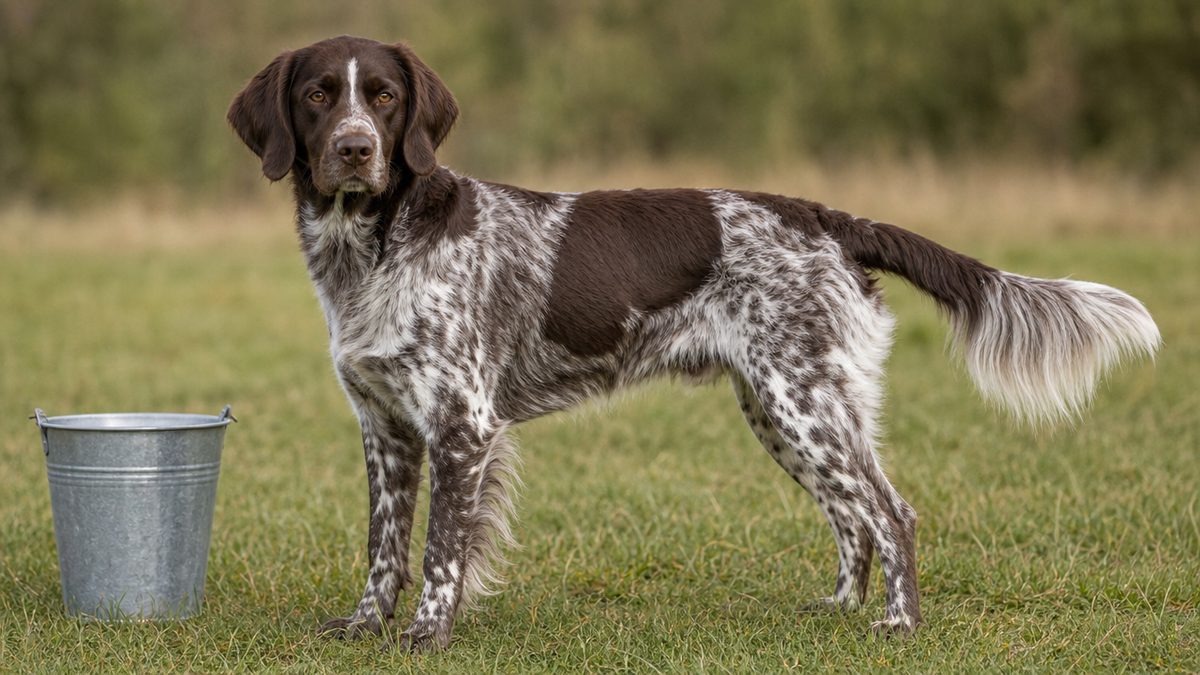
The standard sets one ideal height rather than a range. Dogs stand 54 cm at the withers and bitches 52 cm, with a deviation of plus or minus 2 cm inside the standard, a severe fault between 2 and 4 cm, and disqualification beyond 4 cm. It gives no weight at all. Colour is brown-white and brown roan with brown patches, brown mantle or brown ticking, a blaze is permitted, and tan markings on the muzzle, over the eyes, around the anus and on the ears, tail and legs are permissible under the name Jungklaus markings. The nose must be whole-coloured brown, and a wholecoloured dog is a disqualifying fault.
| Field | FCI standard 102 | Royal Kennel Club | American Kennel Club |
|---|---|---|---|
| Name used | Kleiner Muensterlaender, no English name issued | Small Munsterlander (Imp) | Small Munsterlander |
| Status | Definitively recognised since 1955 | Imported breed register, Gundog group | Miscellaneous Class, not full recognition |
| Height | 54 cm dogs, 52 cm bitches, plus or minus 2 cm | Not published | 20.5 to 21 inches, that is 52.07 to 53.34 cm |
| Weight | Not stated anywhere in the standard | Not published | 40 to 60 pounds |
| Lifespan | Not stated | Over 10 years | 12 to 14 years |
| Exercise | Must work field, forest and water | Up to 1 hour per day | Regular exercise |
| Colours accepted | Brown-white and brown roan | Brown and White, Brown Roan | Not published as a list |
Read the height row across and the disagreement is real rather than cosmetic. The AKC's ceiling of 21 inches converts to 53.34 cm, which is below the FCI's own ideal height for a dog. A male Small Munsterlander standing exactly at the FCI's 54 cm is above the AKC's stated maximum, and a dog at the top of the FCI's tolerance, 56 cm, is 2.66 cm over it. The weight row is starker: the FCI standard contains no weight figure, and the AKC prints one anyway.
History, and the club that wrote it down
Breeding in the north German Muensterland has been documented since around 1870, and the standard says the blood of hundreds of years of old flushing and pointing dogs flowed in the Kleiner Muensterlaender. In 1912 an association for Kleine Muensterlaender pointing dogs, also called Heidewachtelhunde, was founded in Germany to preserve and promote them as an independent hunting breed, with the aim of giving hunters a medium-sized, passionate, intelligent and affectionate, fully versatile dog for field, forest and water. In 1921 Dr. Dr. Friedrich Jungklaus wrote the first breed standard, and his name survives inside the current one, because the tan markings the standard permits are called Jungklaus markings.
The Royal Kennel Club tells the story differently and more simply, saying the breed was developed in the early years of the 20th century by crossing the Large Munsterlander with spaniels to produce a smaller dog with a brown and white coat. Both accounts are published by bodies that recognise the breed, and they are not the same claim: one describes an old regional population being formalised, the other describes a deliberate cross. Where two registries disagree about a history, the honest thing is to print both.
The English translation of standard 102 prints the 1912 club as an association for Kleine Muensterlaender Poining Dogs, missing a letter from Pointing, and in the temperament section it asks for versability where it means versatility. Neither changes the meaning, but both matter if you are searching inside the document, because an exact-phrase search for the correct spelling returns nothing. The authentic German text carries neither error, which is the usual pattern: the authentic-language version of an FCI standard is generally the cleaner document.
Where the breed sits in each register, and why the answer keeps changing
The Small Munsterlander is fully recognised by the FCI, held on an imported register by the Royal Kennel Club, and parked in the Miscellaneous Class by the American Kennel Club, so its status depends entirely on which country you ask.
The AKC position is the one people get wrong, and it is also the one a real search-engine question asks about. The AKC's own breed page carries the group value miscellaneous-class. Checked the same way in the same session, the Large Munsterlander, the Stabyhoun, the Wetterhoun and the Drentsche Patrijshond all return foundation-stock-service, while the Labrador Retriever and the Bracco Italiano return sporting and the Lancashire Heeler returns herding. The controls passing on both sides is what makes the reading trustworthy.
So the ladder is legible. The Foundation Stock Service is the AKC's entry register. The Miscellaneous Class sits above it and below full recognition. The Small Munsterlander has climbed one rung further than its larger relative, which is the opposite of what most readers assume from the two names.
The British position, and what Imp means
The Royal Kennel Club lists the breed in its A to Z as Small Munsterlander (Imp), in the Gundog group. The Imp suffix marks the imported breed register, and it sits alongside Barbet (Imp) and Braque d'Auvergne (Imp) in the same group index. The club rates the breed Breed Watch Category 1, meaning no points of concern specific to the breed have been identified for special attention by judges, and Colour Watch Category 0, meaning there are no non-breed-standard colour registration options at all. Only two colours are breed standard with the club, Brown and White and Brown Roan, which matches the FCI exactly.
The club also states there are no additional breed-specific breeding restrictions in place. That is a positive statement of absence, not an oversight, and it is worth having in writing.
The Indian position
India is a full FCI member represented by the Kennel Club of India, so the register an Indian pedigree would be issued against is FCI nomenclature, and this breed exists there at 102. What does not exist is any Indian activity in the breed. The KCI reported 33,880 pure-bred dogs registered with its studbook in 2025, down from a 2021 peak of 89,571, across 80 member clubs and 342 individual members. None of the material examined for this page connects any of those registrations to the Small Munsterlander, and no Indian breed club for it was found.
The same FCI table reports India's approximate total dog population as 157,500,000 in 2017 and 15,794,584 in 2018. A national dog population cannot fall by ninety percent in a year. The series before 2018 is an order of magnitude out, and only the 2018 onwards figures, which run from 15.8 million to 17.2 million, are usable. Quote the registration rows, which are internally consistent, and not the population row.
Small Munsterlander price in India
There is no Small Munsterlander price in India, because there is no Small Munsterlander for sale in India, and every rupee figure the breed name returns here belongs to a book rather than a dog.
That is the whole answer, and it is worth giving before the evidence rather than after it. Searching the breed name on an Indian result set returns a Flipkart product page whose title reads Small Munsterlander: Buy Small Munsterlander by unknown at Low Price in India. The page is a paperback, credited to an author recorded as unknown, and the only rupee figure on it is 999. The Amazon.in result is a Small Munsterlander Complete Owners Manual, a book about care, costs, feeding, grooming, health and training, listed at Rs 1,604 against a Rs 1,797 list price. There is also an Etsy market page for the breed name.
This matters more than an empty result would, because a price-shaped number attached to a breed name is exactly what a careless page, or an answer engine, will lift and republish as a puppy price. Rs 999 is the price of a book. If you meet an Indian page quoting a Small Munsterlander puppy price, ask it to name a litter, a breeder and a registration number before you believe it.
Why no lawful Indian supply can form
Indian import law closes the commercial route rather than merely making it difficult. Dogs enter the Indian tariff at ITC (HS) 01061900, Mammals: Other, with an import policy of Restricted. The DGFT trade notice sets out the only permitted purposes: a pet dog with a valid pet book and records in the importer's name, dogs imported by research organisations with the recommendation of the CPCSEA, and dogs for internal security by the Defence and Police Force. Policy Condition 8 then states that import of commercial dogs for breeding or any other commercial activities other than those purposes is not permitted, and the notice adds that any applications for trading or breeding purposes, or applications made on behalf of another person or entity, shall be duly rejected.
The personal route survives but is narrow. Import as passenger baggage without DGFT authorisation is allowed only to people transferring their residence to India after two years of continuous stay abroad, only for cats and dogs, and only up to two animals, and entry is restricted to the airports and seaports of Delhi, Mumbai, Chennai, Hyderabad, Bengaluru and Kolkata and, since October 2024, Kochi airport Department of Animal Husbandry…. The notice advises starting the authorisation process at least two months before travel. The full route is set out in how to import a dog to India.
Put those together and the position is simple. A returning Indian family can bring a Small Munsterlander home. A breeder cannot import one to found a line, and a shop cannot import one to sell. That is why the breed has no Indian market rather than a small one, and it is a structural fact rather than a matter of demand.
What a price would look like if one existed
The honest answer to what you would pay is that Bonbeno does not know and will not convert a foreign figure into rupees to fill the gap. A euro or dollar asking price divided by an exchange rate is an arithmetic operation, not an Indian observation, and publishing it would create exactly the fake data point this page exists to warn against. What can be said is that the German supply is real and substantial, at 1,102 VDH puppies in 2025, and that acquiring one in India would be an import problem and a quarantine problem rather than a shopping problem.
Divide the rupee figure by 84.38, then by 80, then by 74. If any of those yields a round foreign price a seller would actually print, such as 800, 1,500 or 2,000, the number is a converted overseas asking price rather than an Indian one. Then ask the second question: does the listing sell a live animal, or a book, a poster, a mug or a photo? For this breed, in India, the answer so far has always been the second.
Monthly cost of ownership for a dog this size in India
Budget roughly Rs 6,000 to Rs 12,000 a month for a 20 to 25 kg working-bred gundog in an Indian metro, built from Indian care costs rather than from any breed-specific figure, because no credible breed-specific Indian cost row exists.
Every number below is an Indian price for a service any dog of this size needs. None of it is specific to the Small Munsterlander, and saying so is the point: Indian breed sites routinely publish cost tables that look breed-specific and are assembled from a small set of shared preset lines, so a matching total across unrelated breeds is a template artefact rather than an observation.
| Item | Indian price | Frequency | Source |
|---|---|---|---|
| Anti-rabies vaccine | Rs 699 | Annual | Vetic clinic price list |
| Nine-in-one DHPPiL | Rs 899 | Annual booster | Vetic clinic price list |
| Kennel cough | Rs 1,349 | Annual, optional | Vetic clinic price list |
| Adult annual booster course | From Rs 3,199 | Annual | Vetic clinic price list |
| NexGard Spectra 15 to 30 kg | Rs 3,308 for 3 tablets, about Rs 1,103 a month | Monthly | Supertails listing |
| Bath and styling | From Rs 934 to Rs 1,869 | Every 4 to 8 weeks | Vetic Delhi grooming |
| Boarding, per 24 hours | Rs 650 to Rs 899 | As needed | Bengaluru operators |
| Delhi MCD pet dog registration | Rs 500 new, Rs 500 renewal, Rs 100 per month late fee | Annual | MCD Delhi |
| Chennai GCC pet licence | Rs 50 | Annual | Greater Chennai Corporation |
The single most useful Indian fact in that table is not a price at all. Greater Chennai Corporation's six municipal veterinary clinics provide treatment and anti-rabies vaccination free of cost, and the corporation issued 9,115 pet licences in 2024 at Rs 50 each. Delhi's Municipal Corporation charges Rs 500 for a new pet dog registration and the same for renewal, with a Rs 100 per month late fee. Those two figures are ten times apart for the same statutory act, which tells you more about Indian pet ownership than any breed price would.
Where the money actually goes for this breed
Parasite cover is the largest recurring line, at about Rs 1,103 a month using NexGard Spectra for the 15 to 30 kg band, which covers the tick and flea role and the roundworm and hookworm role in one monthly tablet. For a dog that is out in vegetation, which is what this breed is for, that is not a line to trim. Food is the second largest and the hardest to quote honestly, because retail kibble prices in India move within weeks and a monthly figure is arithmetic rather than a quoted price.
Grooming is a genuine cost here in a way it is not in Germany. The coat is dense and of medium length with feathering on the forelegs, breeching on the hindlegs and a long flag on the tail, and in an Indian monsoon every one of those holds water. A bath and dry at a Delhi clinic starts at Rs 934 and a complete bath and styling at Rs 1,869.
No monthly food figure and no breed-specific insurance premium appear above, because neither could be sourced to a current Indian price for this breed. A retail kibble figure quoted here would be stale within weeks, and one of five retail figures in the reference pack behind this page went stale in days. Municipal fees are the durable half; retail prices are the perishable half.
Suitability for the Indian climate
The Small Munsterlander is a poor fit for Indian heat, and the reason is measurable rather than impressionistic: its home city's peak wet-bulb load is 11.59 degrees below Kolkata's, which is the largest single obstacle to keeping this breed here.
Start with the homeland, because a heat tolerance rating is only meaningful against the climate the breed was actually selected in. Muenster, in the Muensterland where the breed was documented from around 1870, runs an annual mean of 9.92 degrees at 82.35 percent relative humidity, its hottest month is July at 18.78 degrees, and its coolest is January at 1.39 degrees. The satellite cell for that point sits at 66.33 metres against a real town elevation near 60 metres, an error of 6.33 metres, so the reading describes the town rather than a hillside above it.
Homeland against seven Indian cities
| Place | Annual mean C | Relative humidity % | Hottest month | Peak wet-bulb C | Cell elevation m |
|---|---|---|---|---|---|
| Muenster, Germany | 9.92 | 82.35 | July, 18.78 | 15.50 | 66.33 |
| Chennai | 27.95 | 72.39 | May, 31.51 | 26.11 | 48.95 |
| Mumbai | 26.77 | 67.39 | May, 31.19 | 25.77 | 97.15 |
| Kolkata | 25.81 | 73.93 | May, 31.53 | 27.09 | 7.35 |
| Delhi | 25.60 | 45.56 | June, 35.88 | 26.50 | 206.37 |
| Pune | 23.86 | 66.80 | April, 28.93 | 22.97 | 635.99 |
| Bengaluru | 23.74 | 67.94 | April, 28.37 | 21.86 | 841.72 |
Three things in that table are worth reading carefully. First, Delhi peaks in June and not May, and Bengaluru and Pune both peak in April, which is why a page that writes May beside every Indian city is not reporting a measurement. Second, Bengaluru and Pune are coolest in December rather than January. Third, and most important for this breed, the wet-bulb column is where the real gap sits.
Humidity is not the problem. Wet-bulb load is
It would be easy and wrong to write that Indian humidity will finish a north German breed. Muenster is more humid than every Indian city in that table, at 82.35 percent against Chennai's 72.39 and Delhi's 45.56. Damp air is what this dog comes from. What it does not come from is damp air at 27 degrees.
Wet-bulb temperature combines heat and humidity into the single number that governs whether an animal can shed heat by evaporation, and it is the honest comparison. Muenster's peak is 15.50 degrees in July. Kolkata's is 27.09 degrees in June, Delhi's is 26.50 in July, Chennai's is 26.11 in May, and Mumbai's is 25.77 in June. The gap between Muenster and Kolkata is 11.59 degrees, and that gap, not the humidity, is why this breed is heat-sensitive here.
Bengaluru at 21.86 and Pune at 22.97 are the two mainland metros where the load is materially lower, and both sit on the Deccan plateau at real elevations near 920 and 560 metres. Mumbai, at 25.77 in June on an annual mean of 26.77 degrees, gets no such relief despite being coastal. They are still 6 to 7 degrees of wet-bulb above the breed's homeland peak, so they are the least bad option rather than a good one.
What the heat literature supports, and what it does not
Hall 2020, in Scientific Reports, modelled heat-related illness across 905,543 UK dogs under primary veterinary care in 2016 and found 395 confirmed events, with dogs at or above their breed and sex mean bodyweight carrying 1.42 times the odds and dogs over 50 kg carrying 3.42 times. The companion paper in Animals, on the same cohort but a wider case definition, recorded 1,259 events from 1,222 dogs, of which 879 had a recorded trigger, and 652 of those 879, or 74.2 percent, were exertional rather than caused by a hot car or a hot day alone.
The Small Munsterlander is not among the breeds either paper modelled separately, so no breed-specific odds ratio exists and none should be invented. What transfers is the mechanism: the dominant trigger is exercise, not confinement, and the breed most exposed to an exertional trigger is one bred to work all day. That is this breed exactly.
Second Schedule Part IV paragraph 21(1) of the Prevention of Cruelty to Animals (Dog Breeding and Marketing) Rules 2017 bars keeping in outdoor facilities, without the attending veterinary practitioner's written approval, dogs that are not accustomed to local temperatures, dog breeds that cannot tolerate them such as long-haired breeds in high temperature locations, and sick, infirm, aged or young animals. A brown roan gundog from a place whose hottest month averages 18.78 degrees is squarely inside the first category.
Temperament and household fit
The Small Munsterlander is an affectionate, highly trainable family dog with a hunting drive its own standard calls passionate and persevering, and the second half of that sentence is what decides whether an Indian household should take one on.
The FCI standard is unusually specific about character, which is a consequence of the working trial. It asks for a dog that is intelligent and capable of learning, full of temperament but even, with steady character, whose attitude towards people is alert and friendly, and it adds the parenthesis suitable for family life in the standard's own text. It asks for good social behaviour and close contact with its master, which it names team spirit. Then, in the same paragraph, it asks for passionate, persevering predatory instinct, versatile hunting aptitudes, strong nerves and keenness for game.
Both halves are the breed. A registry does not write predatory instinct into a temperament clause as a caution; it writes it as a requirement, because a dog that will not hunt fails the working trial and cannot be bred from. Anyone reading the friendly half and skipping the other half is planning for a dog that does not exist.
What that means in an Indian neighbourhood
Indian residential streets carry free-ranging cats, poultry in many towns, and community dogs almost everywhere. A breed selected for a hundred years to find, point and retrieve small game will read all of that as work. That is a management problem with a known solution, which is a long line, a reliable recall built early, and a fenced space to run in, and it is not a temperament flaw. It does mean that off-lead freedom in an unfenced Indian park is not available to this dog in the way it is to a placid companion breed.
- Households with a garden and a secure boundary, where the dog can run without a lead, get the best of this breed.
- Households with children generally do well, since the standard's own words are alert and friendly with good social behaviour.
- Households with resident cats or poultry need a serious, deliberate introduction plan, not optimism.
- Households where the dog is alone nine hours a day should choose a different breed, because close contact with its master is a selected trait.
- Households in a high-rise flat with no outdoor ground should choose a different breed, and the Royal Kennel Club says so by rating it Country.
The Royal Kennel Club's own summary agrees on the practical points and is blunter about the setting: it rates the breed Medium in size, Country rather than Town or Country, and prescribes a small house with a small or medium garden. It is not a warning about aggression. It is a warning about square metres.
Training approach and what this breed resists
To train a Small Munsterlander, work with the cooperative instinct the standard selects for rather than against it, because this is a biddable breed that learns fast and therefore learns your mistakes fast too.
The standard requires natural ability to hunt in close cooperation with its handler in field, forest and water, and to retrieve game to the hunter. Cooperation is the operative word. Unlike hound breeds that were selected to work independently and out of sight, this dog was selected to keep checking in. That makes recall, the hardest thing to teach most gundogs in a country full of distractions, comparatively achievable here.
A realistic Indian training sequence
- Weeks 8 to 16, socialise deliberately and daily, in the cool hours, to traffic, autorickshaws, cattle, community dogs and building-site noise.
- Weeks 10 to 20, build a recall on a long line before the dog has ever had a chance to self-reward by chasing something.
- Months 4 to 8, train an emergency stop and a settle on a mat, because both buy you control in a country where dogs meet livestock at close range.
- Months 6 to 12, introduce water work if you have safe water, since the standard expects it and the dog will find it satisfying.
- Months 9 to 18, proof everything you taught indoors against real distraction, which is where most Indian training plans quietly stop.
What this breed resists is dullness rather than instruction. A dog bred to solve scent problems for six hours will not accept twenty minutes of lead walking as a day's work, and the behaviours people describe as stubbornness in versatile gundogs are usually under-exercised dogs finding their own jobs. The trainability rating on this page is a five for that reason: the difficulty is supply of work, not receptiveness.
German and North American training advice for this breed assumes access to open country, cool weather and legal hunting. None of the three transfers directly to an Indian city. Take the structure of the advice, which is early cooperation and early recall, and rebuild the schedule around dawn and dusk. Do not copy the assumption that a dog can work through a summer afternoon.
Daily exercise requirement, and what happens without it
Plan for 60 to 90 minutes of real exercise a day split across the cool hours, and note that the two registries that recognise this breed disagree about the requirement by a wide margin.
The Royal Kennel Club rates the Small Munsterlander at up to 1 hour per day. The FCI standard requires a dog capable of working field, forest and water and passing a working trial before it may be bred from. Those are not the same dog, and an Indian buyer reading only the British figure will under-provide.
The useful comparison is inside the same British club. For the Large Munsterlander the Royal Kennel Club prescribes more than 2 hours per day and a large house with a large garden, against up to 1 hour and a small house with a small or medium garden for the Small. The club is drawing a real distinction between the two breeds, and it is the clearest published statement anywhere that the smaller one is the more manageable of the pair.
The Indian constraint is timing, not distance
For most of the Indian year the limit on this dog is not how far it can go but when. Delhi's hottest month averages 35.88 degrees and peaks for wet-bulb load in July at 26.50; Chennai peaks at 26.11 in May. Exertional heat illness, not confinement, is the dominant recorded trigger in the largest study of the problem, accounting for 652 of the 879 events with a recorded trigger. An energetic gundog exercised at 4 p.m. in an Indian May is the precise scenario that literature describes.
- March to October, exercise before sunrise and after dark, and treat the middle of the day as indoor time.
- November to February in the north, most of the day is usable, and this is when to do the hard conditioning.
- Year-round in Bengaluru and Pune, the plateau elevation buys about 4 degrees of wet-bulb relief against Kolkata, which widens the usable window rather than removing the limit.
- Swimming is the single best Indian exercise for this breed where clean water exists, provided the ears are dried afterwards.
- Scent work in a shaded courtyard replaces distance on days when distance is unsafe.
Without enough of it, the failure mode is predictable and is the same one reported for every versatile gundog kept as a pet: destructive chewing, fence work, self-appointed guarding, and a recall that erodes because the dog has learned that its own plans are more interesting than yours.
Grooming and coat care in Indian humidity
Groom a Small Munsterlander once a week as a baseline and treat ear drying as the daily job through the monsoon, because the coat's feathering sits exactly where moisture collects.
The standard describes a dense coat of medium length, not or only slightly wavy, close lying and water-repellent, dense enough to protect against weather, unfavourable terrain and injuries. Forelegs are feathered, hindlegs carry breeching down to the hocks, and the tail carries a long flag with a white tip. Short smooth coat on the ears is a fault, and abundant coat on the fore chest is undesirable. The Royal Kennel Club rates grooming at once a week, coat length medium, and confirms the breed sheds.
Once a week is a Northern European baseline. In an Indian monsoon it is a floor. The feathering on the forelegs, the breeching, the tail flag and the ear fringes all hold water, and a coat that is designed to be water-repellent is also slow to dry once it is genuinely soaked.
Ears are the part that actually goes wrong
The ears are broad, set on high and lie close to the head, which is the classic canine design for trapping warm damp air against the ear canal. An Indian series from the Palam Valley in Himachal Pradesh found otitis externa concentrated in dogs with pendulous ear carriage and recorded a clear seasonal pattern, and the paper's ear-carriage table carries an internal arithmetic error worth knowing about: it prints 53 pendulous-ear cases at 69.13 percent of 81, but 53 divided by 81 is 65.43 percent, and 69.13 percent of 81 is 56, which is the figure that makes the table balance against the 25 erect-ear cases.
Quote it carefully or not at all. What is not in dispute is the direction: drop ears plus humidity plus water work is the combination that produces ear disease, and this breed has all three.
- Dry the ear leather and the canal entrance after every swim and every bath, without exception, from June to September.
- Brush the feathering and breeching twice a week in the monsoon rather than once, because matted feather holds water against skin.
- Check between the toes weekly for grass seed and for the soft early signs of interdigital infection.
- Bathe only when the dog is genuinely dirty, since a water-repellent coat stripped of oil dries slower, not faster.
- Never shave the coat for heat. It is the dog's protection against sun on skin, and it does not grow back the same.
Northern European and North American breed guidance for medium-coated gundogs routinely says to towel the dog and let it air dry. That is correct in Muenster, where the July mean is 18.78 degrees. It is wrong in a Kolkata August at a wet-bulb load of 27.09 degrees, where air drying means hours of warm damp against skin and ear. Dry actively, and dry the ears first.
Health risks and lifespan, and how little is actually published
No breed-specific lifespan, screening or prevalence figure exists for the Small Munsterlander, and the honest health section for this breed is mostly a map of what nobody has measured.
That is not a failure of research effort. It is the finding. Four separate instruments were run, and three of them return nothing for this breed while returning correct answers for their controls.
What each source actually returns
| Instrument | Result for this breed | Control in the same session |
|---|---|---|
| McMillan 2024 Table S5 | Present, inclusion flag N, no reclassification | Labrador Retriever flag Y, Great Pyrenees flag Y |
| McMillan 2024 Table S3 | No row, so no median and no hazard ratio | 155 purebred rows plus a Crossbreed row present |
| Royal Kennel Club screening | No named test; Good Practice reads only Prioritising genetic diversity | Club publishes named schemes for other breeds |
| OFA published statistics | Not retrievable at all this session | Both statistics hosts refused connections |
| PubMed, Munsterlander in title or abstract | 13 records, most about the Large | Labrador plus hip dysplasia returned 126 |
The McMillan result deserves precision, because it is the one most often reported wrongly. The Small Munsterlander is in the study's breed table, at Supplementary Table S5, with the inclusion flag N, a phylogeny reclassification of NA, KC group Gundog, body size Medium and cephalic index Mesocephalic. Flag N with reclassification NA means the breed was considered and excluded, not merged into another breed's row and not overlooked. The study itself covers 155 purebred breeds against a crossbred comparator and is the largest of its kind for the United Kingdom. That matters because in the same table the German Wirehaired Pointer's reclassification column reads German Longhaired Pointer and German Roughhaired Pointer, so those two genuinely are merged and their dogs are counted inside another row. Reporting a merge as an absence, or an exclusion as a merge, are different errors and both are wrong.
The relative's figures, and why they must not be borrowed
The Large Munsterlander does have a measured lifespan: median survival 14.1 years, lower confidence bound 13.5, upper bound not estimable, on 139 dogs and 26 deaths, with a hazard ratio of 0.47 against the crossbred comparator of 111,053 dogs and 72,445 deaths at a median of 12.0 years. It is a genuinely good figure and it belongs to a different breed on 26 deaths, which is a small denominator even for the one it does describe.
The same warning applies harder to a 2025 Swedish insurance study of mammary tumours across just over 600,000 dogs. It reports that the Large Munsterlander had the highest risk of mammary-tumour-related death of any breed studied, at a relative risk of 40.3 with a confidence interval running from 8.28 to 118.4. That is the Large Munsterlander. Transferring it to the Small would be fabrication wearing a citation, and the enormous confidence interval says the estimate rests on very few deaths even in the breed it does describe.
What the literature does contain
PubMed returns 13 records for Munsterlander in title or abstract and 14 across all fields, against a control of 126 for Labrador retriever hip dysplasia run twice in the same session. The named-breed query Kleiner Munsterlander returns exactly one record, a German canine neosporosis study from 2000 reporting clinical and pathological findings and the first isolation of Neospora caninum in Germany. Searches for the breed's other German name, Heidewachtel and Heidewachtelhund, return zero with PubMed reporting the phrase as not found.
One paper is worth reading for what it says about the whole group rather than this breed. Akkad and colleagues compared the genomes of pointing dogs, using the Large Munsterlander and the Weimaraner, against herding breeds, and identified variants in SETDB2 and CYSLTR2 that they propose contribute to pointing behaviour, reporting consistent homozygosity for both in six of seven pointing breeds tested. The Small Munsterlander is not named in that abstract, so the finding is a fact about pointing dogs generally and not a genotype claim about this breed.
What the standard and Indian law both flag
The FCI standard disqualifies entropion, ectropion and distichiasis, which is an unusually explicit eyelid list for a gundog standard. Indian law reaches the same conditions from the other direction. Second Schedule Part III paragraph 8(10) of the Dog Breeding and Marketing Rules 2017 requires that breeding dogs have been tested for genetic defects, including hip dysplasia, progressive retinal atrophy, night blindness, hypothyroidism, entropion, ectropion, overshot and undershot jaw, wry mouth, two or more missing teeth and cryptorchidism. The word in the clause is including, so the list is illustrative rather than closed.
That is a rare case of alignment rather than collision. The registry that wrote the standard and the Indian statute that would govern breeding here are asking for the same eye screening, and it is the British club, with its single Good Practice line reading Prioritising genetic diversity and no named scheme at all, that asks for least.
No OFA figure appears on this page. api.ofa.org and wp.ofa.org both refused connections from this environment, and ofa.org's own statistics page returned a 49 KB JavaScript shell carrying zero table rows and zero breed names, with the string Searching Database, Please wait still printed in it. That is an instrument failure rather than a finding about the breed, and OFA's own publication threshold, 100 hip evaluations or 50 for its other databases, means a small imported population may not appear even when the site is reachable.
Feeding a working gundog in India
Feed to body condition rather than to a chart, because the FCI standard gives no weight for this breed at all and the only published weight, the AKC's 40 to 60 pounds, appears in no primary document.
This is a real practical problem and not a pedantic one. Feeding guides on kibble packs are indexed to bodyweight. The breed's own standard sets height and says nothing about mass. The AKC prints 40 to 60 pounds, that is 18.1 to 27.2 kg, a range so wide that a feeding chart entered at the bottom and the top of it differs by roughly half again in daily quantity.
The answer is the nine-point body condition score. Ribs should be easily felt with a light covering, the waist should be visible from above, and the abdominal tuck should be visible from the side, which is score 4 or 5 of 9. Score the dog every fortnight and adjust the quantity, and the missing weight figure stops mattering.
Life-stage feeding, adapted for Indian conditions
- Weeks 8 to 16, four meals a day of a complete puppy food, kept cool and never left down in Indian heat, where kibble in a bowl attracts ants within the hour.
- Months 4 to 8, three meals a day, and resist pushing growth, since fast growth in a medium sporting breed loads developing joints.
- Months 8 to 12, two meals a day, moving to an adult formulation towards the end of that window.
- Adult, two meals a day, with the larger meal after the evening exercise rather than before it.
- Through summer, feed the main meal after dark, because a dog that has just eaten sheds heat less efficiently.
Water matters more here than food. A working-bred dog exercised at dawn in a Chennai May will drink more than an Indian owner expects, and free access to clean water is the single cheapest heat intervention available.
Indian kibble prices move fast enough that a monthly figure quoted today would mislead within weeks. A large-breed 15 kg bag priced during the research behind this page had already been replaced at its own URL by a different product at a different price. Weigh your dog's actual daily ration, price your actual bag, and do the arithmetic yourself. Any page that prints a confident monthly food cost for a breed with no Indian population is printing a template.
Month by month through the first year
A Small Munsterlander puppy timeline in India runs on two clocks at once, the developmental one every puppy follows and the seasonal one that decides when the dog can safely be outside.
| Age | Developmental job | Indian constraint |
|---|---|---|
| Under 8 weeks | Stays with the litter | Indian law forbids sale below this age under Rule 8(1)(a) |
| 7 to 18 weeks | Core vaccination course | The Rules themselves say vaccination can start at seven to eight weeks and is usually completed at eighteen |
| 8 to 16 weeks | Socialisation window | All of it in the cool hours from March to October |
| 3 months | Microchipping | Second Schedule paragraph 30(b) requires a vet to microchip pups over three months |
| 4 to 6 months | Recall on a long line | Build it before the first monsoon, when outdoor time collapses |
| 6 to 9 months | Growth plates still open | No forced road work, no stairs drilling, no jumping |
| 9 to 12 months | Adult coat and adult stamina arrive | Condition through the cool season, not through summer |
| Over 6 months | Sale rules change | Rule 8(1)(b) bars sale of a dog over six months unless it has been sterilised, except between licensed breeders |
Two of those rows are law rather than advice, and they are worth quoting because Indian buyers are rarely told them. Rule 8(1)(a) requires that pups less than eight weeks in age are not sold. Rule 8(1)(b) requires that dogs over six months in age are not sold without first being sterilised, unless they are being sold to another licensed breeder. Second Schedule Part IV paragraph 30 requires every dog to be identified by an official tag on its collar and requires identification of all breeding stock and of pups over three months to be performed by a veterinary practitioner through micro-chipping.
Note the spelling in that last clause. The gazette hyphenates micro-chipping, so an exact search for microchipping inside the document behaves differently from a search for the hyphenated form, and a reader checking the law needs to search both.
The seasonal clock
A puppy that arrives in November in Delhi gets a full cool season for its socialisation window and its early conditioning, and meets its first real heat at around eight months old with an adult coat and adult judgement. A puppy that arrives in April gets the opposite, and its socialisation window falls entirely inside the months when it cannot safely be outside in daylight. The second puppy is not doomed, but its owner has to work much harder, indoors, with deliberately constructed exposure.
Greater Chennai Corporation's six municipal veterinary clinics provide treatment and anti-rabies vaccination free of cost. For a first-year puppy that is the single largest avoidable cost in the whole schedule, and it is a municipal service most Chennai owners do not know exists.
Head to head against the breeds an Indian buyer would actually get
An Indian buyer cannot get a Small Munsterlander, so the useful comparison is against the versatile gundogs that are genuinely obtainable here and against the relative it is most often confused with.
| Breed | FCI number | Height | McMillan 2024 median lifespan | Indian availability |
|---|---|---|---|---|
| Small Munsterlander | 102 | 54 cm dogs, 52 cm bitches | None published, flag N in Table S5 | None found |
| Large Munsterlander | 118 | 60 to 65 cm dogs | 14.1 years on 26 deaths | None found |
| German Shorthaired Pointer | 119 | 62 to 66 cm dogs | 13.4 years on 947 deaths | Present, and imported into India |
| German Wirehaired Pointer | 98 | 61 to 68 cm dogs | 13.0 years on 138 deaths | Occasionally present |
| Labrador Retriever | 122 | Not compared here | 13.1 years on 16,155 deaths | India's most common pedigree breed |
The lifespan column is the honest part of that table and the part that argues against buying on lifespan at all. The Large Munsterlander's 14.1 years rests on 26 deaths; the Labrador's 13.1 years rests on 16,155. Those two numbers are not comparable in confidence even though they sit in the same column of the same table, and the German Wirehaired Pointer's 13.0 years is itself a merged figure covering the German Longhaired and German Roughhaired Pointers as well.
The confusion that actually costs people money
The Small and Large Munsterlander are two breeds, not two sizes of one breed. They hold separate FCI numbers, 102 and 118, separate standards and separate colours: the Small is brown and white or brown roan with a whole-coloured brown nose, and the Large is black and white with a solid black head. A black-headed dog is not a Small Munsterlander, whatever a listing calls it. That single check will catch most misidentification, and it is more reliable than height, because the two overlap far less in colour than an inexperienced buyer expects them to in size.
The Royal Kennel Club's own ratings separate them further: up to 1 hour of exercise a day and a small house for the Small, more than 2 hours and a large house with a large garden for the Large.
If what appeals about this breed is a versatile, biddable, medium-to-large pointing dog, the German Shorthaired Pointer does the same job, is genuinely obtainable in India, has a lifespan measured on 947 deaths rather than 26, and carries a short coat that is easier to dry in an Indian monsoon. It is a bigger dog and it needs more exercise, and it is still the more practical answer for almost every Indian household.
Common mistakes Indian buyers and owners make with this breed
The commonest Indian mistake with the Small Munsterlander is believing a price for it, and the second commonest is buying a black-headed dog under its name.
- Treating a rupee figure as a puppy price. The only Indian rupee figures the breed name returns are Rs 999 for a Flipkart paperback and Rs 1,604 for an Amazon.in owners manual, both books.
- Accepting a black-headed dog as a Small Munsterlander. The standard requires a whole-coloured brown nose and brown-white or brown roan colour, and disqualifies a wholecoloured dog.
- Reading the Royal Kennel Club's up to 1 hour rating as the whole exercise requirement, when the same breed's FCI standard demands work in field, forest and water.
- Borrowing the Large Munsterlander's lifespan figure, which McMillan 2024 measured on 26 deaths, for a breed the same study explicitly excluded.
- Copying overseas grooming advice to towel and air dry, which is correct at a July mean of 18.78 degrees and wrong at a wet-bulb load of 27.09.
- Assuming the AKC does not recognise the breed at all, when it sits in the Miscellaneous Class, one rung above its larger relative.
- Planning to import a puppy to breed from, which Policy Condition 8 of the Indian import policy does not permit.
The mistake that reaches furthest
The most consequential error is not about this breed at all. It is treating a page's confident tone as evidence. Several of the sites that rank for rare gundog names publish breed pages assembled from a template, where the cost table, the size class and sometimes the entire body copy belong to a different dog. The tell is cheap to check: pull one other unrelated breed from the same site and compare the cost lines to the rupee. If they match exactly, the row is a shared preset and not an observation of that breed.
The same discipline applies to any Indian price you meet for a breed with no Indian population. Divide it by 84.38, then 80, then 74, and look at what comes out. A rupee figure that resolves to 800 or 1,500 dollars is a converted overseas asking price. A figure that resolves to nothing plausible is rupee-native and arbitrary. Neither is an Indian market price, and this breed has no Indian market price to find.
Adoption and responsible sourcing
Adopting a Small Munsterlander in India is not a realistic route, and the useful advice is what to do with the impulse that led you here rather than how to chase a dog that is not present.
No Indian rescue listing, breed-rescue network or shelter placement for this breed was found. That is what a breed with no domestic population looks like: there is nothing to rescue, because nothing was bred or imported in numbers.
The three routes that do exist, ranked
- Adopt an Indian dog of a similar working temperament from a shelter, which is the only route that is immediately available and the only one with no import problem.
- Choose a versatile gundog that is genuinely present in India, such as the German Shorthaired Pointer, and get a breed with published health data and a supply chain you can inspect.
- Import a pet under the baggage route only if you are personally transferring residence to India after two years of continuous stay abroad, which is the single lawful private path.
The third route is worth spelling out because people assume it is closed. It is not closed; it is narrow. Import as passenger baggage without a DGFT authorisation is available to a person transferring residence after two years abroad, for up to two animals, cats and dogs only, through the airports and seaports of Delhi, Mumbai, Chennai, Hyderabad, Bengaluru and Kolkata and, since October 2024, Kochi airport Department of Animal Husbandry…. The animal needs a valid pet book and records in the importer's name, and applications made on behalf of another person are duly rejected, which closes the obvious workaround of asking a returning relative to import a dog for you.
How to verify a seller, anywhere
- Ask which register the litter is recorded in and check the number, because FCI nomenclature is what a Kennel Club of India pedigree is issued against.
- Ask to see the sire's and dam's working qualifications, since the FCI files this breed with a working trial.
- Ask what the parents were screened for, and expect a real answer, since the Indian Rules require testing for genetic defects including hip dysplasia and progressive retinal atrophy.
- Ask the age of the pups, because Indian law forbids sale below eight weeks.
- Walk away from any seller who quotes a price before answering all four.
If you have read this far because you liked the look of a brown roan gundog, the realistic Indian version of that wish is a shelter dog with a working temperament and a life in front of it, or a German Shorthaired Pointer from a breeder you can visit. Neither requires an import authorisation, and both are dogs you can actually meet before you commit.
What the pages ranking in India actually tell you
The Indian result set for this breed is a North American hunting conversation, and half of it is Reddit, which is why an Indian buyer finishes a search knowing about pheasant cover and nothing about heat, law or cost.
Harvesting the ranking set was itself difficult this session, and the difficulty is worth recording because it changes how much weight the harvest carries. Google, queried with an Indian geo and language, returned a 92 KB page whose entire visible body read that there was trouble accessing Google Search, with zero organic results on a Labrador Retriever control. Bing India returned HTTP 200, the correct page title and the correct Indian language chips, and then ten organic results about an Indonesian internet-banking service, again on the Labrador control. DuckDuckGo served a CAPTCHA asking the searcher to select all squares containing a duck. Three engines, three different failures, all on the control. Brave Search with an Indian country parameter passed the control and is the instrument behind every result set on this page.
What ranks, and what it covers
On the bare breed query the top of the Indian result set is the AKC breed page, the English Wikipedia article, an American pheasant-hunting forum thread, and then six consecutive Reddit threads. The Reddit titles are themselves informative about what people want to know: small munsterlander haters, Small Munsterlander vs large Munsterlander, and Not supposed to have this breed, now what. Those are real questions and no ranking page answers them in an Indian context.
The People-also-ask module is where the instrument behaved most interestingly. The bare query rendered no such module at all: its module list carried Discussions, Videos, Find elsewhere and Factsheet, with zero question blocks, while the Labrador control in the same session returned three. Re-asking the question informationally, as is the small munsterlander a good family dog, recovered a genuine module with three questions, which this page answers verbatim in its FAQ.
The gap this page fills
None of the ranking pages tells an Indian reader that the FCI issues no English name for this breed, that the AKC has it in the Miscellaneous Class while its larger relative is still in the Foundation Stock Service, that the Royal Kennel Club asks for no named health test at all, that McMillan 2024 considered and excluded it rather than overlooking it, or that Indian import policy forbids bringing one in to breed from. None of them mentions that the only Indian rupee figures attached to the name belong to books. That set of absences is the reason this page exists.
Small Munsterlander questions Indian buyers actually ask
Is a Munsterlander a good choice for a first-time dog owner?
No, not in an Indian city. The Royal Kennel Club rates the Small Munsterlander Country rather than Town or Country, prescribes a garden, and the FCI standard requires a dog that hunts field, forest and water and passes a working trial before it can breed. A first dog in a Pune or Chennai flat wants a breed whose exercise need can be met on a lead in the cool hours, and this is not one. The trainability is genuinely high, which is what makes people recommend it, but a biddable dog with nowhere to work becomes a destructive dog quickly.
Is a Small Munsterlander recognized by the AKC?
Not fully. The American Kennel Club files the Small Munsterlander in the Miscellaneous Class, which is the rung between the Foundation Stock Service and full recognition, and its own breed page carries the group value miscellaneous-class. Its larger relative the Large Munsterlander, the Stabyhoun and the Wetterhoun all still sit in the Foundation Stock Service, while the Labrador Retriever and the Bracco Italiano return sporting on the same check. So the Small Munsterlander is further along the AKC ladder than any of its close relatives and is still not a fully recognised breed.
What is the temperament of a Small Munsterlander?
The FCI standard describes it as intelligent and capable of learning, full of temperament but even, with steady character, an alert and friendly attitude towards people that the standard itself calls suitable for family life, good social behaviour and close contact with its master, which the standard names team spirit. It also requires passionate and persevering predatory instinct, versatile hunting aptitudes, strong nerves and keenness for game. Read the second half as carefully as the first, because a strong predatory drive in an Indian neighbourhood with free-ranging cats and poultry is a management problem, not a personality quirk.
What is the Small Munsterlander price in India?
No verifiable Indian price exists, because no Indian seller lists the dog. The only rupee figures the breed name returns in India belong to print. Flipkart's Small Munsterlander product page is a paperback credited to an author recorded as unknown, and Amazon.in sells a Small Munsterlander owners manual at Rs 1,604 against a Rs 1,797 list price. Treat any Indian page quoting a puppy price for this breed as unsourced until it names a litter, a breeder and a registration number. The English Wikipedia article, which holds position 2 on the Indian result set, gives the breed no price at all in any currency, which is the correct treatment and a useful reminder that an absent price is not the same as an expensive one.
How big does a Small Munsterlander get?
The FCI sets a single ideal height rather than a range: 54 cm at the withers for dogs and 52 cm for bitches, with a deviation of two centimetres either way inside the standard, a severe fault between two and four centimetres, and disqualification beyond four. The standard gives no weight at all. The AKC prints 20.5 to 21 inches and 40 to 60 pounds, and its 21 inch ceiling is 53.34 cm, which sits below the FCI's own ideal male height, so the two registries do not describe the same dog.
How long do Small Munsterlanders live?
No breed-specific study figure exists. McMillan 2024, the largest UK longevity study, lists the Small Munsterlander in its Supplementary Table S5 with the inclusion flag N and no reclassification, meaning the breed was considered and excluded rather than merged into another row or overlooked. The Royal Kennel Club says over 10 years and the AKC says 12 to 14 years, and neither publishes the data behind it. The Large Munsterlander does have a measured figure, 14.1 years on 26 deaths, and it must not be borrowed for this breed.
Can a Small Munsterlander handle Indian heat?
Not without the day being rebuilt around it. Muenster, the breed's home city, runs an annual mean of 9.92 degrees and its hottest month averages 18.78 degrees, while Chennai's annual mean alone is 27.95 degrees. The measure that matters is wet-bulb load, which combines heat and humidity: Muenster peaks at 15.50 degrees in July and Kolkata at 27.09 degrees in June. A dog carrying a dense medium-length coat bred for that first number cannot dump heat in the second, so exercise moves to first light and after dark from March to October.
Is the Small Munsterlander the same as the Large Munsterlander?
No. They are two separate FCI breeds with two numbers, two standards and two colours. The Small Munsterlander is 102, brown and white or brown roan, with a whole-coloured brown nose and a single ideal height of 54 cm. The Large Munsterlander is 118, black and white with a solid black head, and stands 60 to 65 cm. The Royal Kennel Club rates the small one at up to an hour of exercise a day and the large one at more than two hours, so the difference is not just size.
Does the Kennel Club of India register Small Munsterlanders?
No Indian registration for this breed was found. India is a full FCI member represented by the Kennel Club of India, so FCI nomenclature is the register an Indian pedigree would be issued against, and the breed exists in that nomenclature at number 102. What does not exist is any Indian litter, breeder or club. The KCI registered 33,880 pure-bred dogs in 2025 across 80 member clubs, and none of the material examined for this page attaches any of them to this breed.
What health tests should a Small Munsterlander breeder do?
The Royal Kennel Club names none. Its pre-breeding health screening section for this breed carries a single Good Practice entry reading Prioritising genetic diversity, with no named scheme, no BVA or KC eye or hip scheme, and a note that the club does not currently offer a breed-specific DNA testing package. Indian law is more prescriptive than the British club here: the Dog Breeding and Marketing Rules 2017 require breeding dogs to have been tested for genetic defects including hip dysplasia, progressive retinal atrophy, night blindness, hypothyroidism, entropion and ectropion, and the FCI standard disqualifies the last two plus distichiasis outright.
Is the Small Munsterlander a rare breed?
Not in Germany and completely absent from India. The VDH registered 1,102 puppies in 2025, which is 46 percent of the Labrador Retriever's 2,401 and four times the Large Munsterlander's 277, so in its own country it is a mainstream working gundog rather than a rarity. Across 2011 to 2025 the VDH registered 16,963 of them. The rarity is geographic: the Royal Kennel Club files it on the imported register and the AKC has it in the Miscellaneous Class.
What does a Small Munsterlander cost per month in India?
Budget roughly Rs 6,000 to Rs 12,000 a month for a 20 to 25 kg working-bred dog in a metro, and understand that the figure is built from Indian care costs rather than from anything breed-specific. Parasite cover alone runs about Rs 1,103 a month if you use NexGard Spectra for the 15 to 30 kg band at Rs 3,308 for three tablets. Add food, an annual booster from Rs 3,199, and grooming from Rs 934 for a bath. Nobody publishes a Small Munsterlander cost row for India, so treat any page that does as templated.
Compare with similar breeds
Small Munsterlander sits in 2 Bonbeno groups. Each one compares it directly against the breeds it is genuinely an alternative to, on the same figures.