
Breed profile
Large Munsterlander: The India Guide
Germany's black and white long-haired pointing dog, measured against Indian heat, Indian law and an Indian market that does not exist.
Quick answer
The Large Munsterlander is a German long-haired pointing dog with no established presence in India, no Indian price you can verify and no Indian breed club. German breeders registered 277 puppies with the VDH in 2025, and the breed club will not release a dog for breeding until it is at least 15 months old, has passed graded hunting tests, has proved it hunts giving tongue, and is graded free of hip and elbow dysplasia.
This guide summarises breed-standard documents, breed-club breeding regulations, kennel-club register data, peer-reviewed veterinary research, Indian breeding law and satellite climate data as general information for Indian pet owners. It is not a diagnosis and it is not treatment advice. Consult a registered veterinarian near you before acting on anything you read here, and treat collapse, laboured panting that does not settle, blood in the urine or straining to pass urine as an emergency that needs a vet the same day.
Large Munsterlander at a glance
What the Large Munsterlander actually is
The Large Munsterlander is a German long-haired pointing dog registered by the FCI as Grosser Muensterlaender Vorstehhund, breed number 118, in Group 7 Section 1.2 among the spaniel-type continental pointers, accepted on a definitive basis on 20 December 1954 and subject to a working trial.
German is the authentic language of the standard, and the English text says so on its own second page: the translation is credited to Mrs Peggy Davis with additions by Christina Bailey, revised by the VDH, over the line 'Official language (DE)';. Where the two versions could disagree, the German governs. On this breed they do not disagree. The German text gives Widerristhoehe 60 to 65 cm for males and 58 to 63 cm for females with a Toleranzgrenze of 2 cm upward, and Gewicht 'um 30 kg'; the English gives 60 to 65 cm and 58 to 63 cm with '2 cms over specified size tolerated' and 'Approx. 30 kgs';. Both documents were extracted independently and compared line by line, and the size, tolerance, weight and colour clauses match. That negative result is worth recording, because on other FCI standards this site has found the translation quietly changing a figure.
The breed's history is unusually well dated for a gundog, and the standard tells it plainly. The Large Munsterlander descends from the white and particolour bird and hawking dog of the Middle Ages by way of the Stoeberhund and the Wachtelhund, and belongs with the Small Munsterlander and the Deutsch Langhaar to the family of long-haired German pointing dogs. It exists because of a colour rule. When the German Longhair Club finally excluded black from its breeding in 1909, the breeders of the black and white dogs were left without a register, and the Club for the pure breeding of the black and white Muensterland Pointers was founded in 1919 to take them in. Planned breeding of the Large Munsterlander began in 1922, and the foundation list comprised exactly 83 dogs. Every registered Large Munsterlander alive today descends from that list.
The stud book has stayed in one place ever since. The standard names the Verband Grosse Muensterlaender e.V. as the club keeping the records, organised in eight independent regional groups, and a member of both the VDH and the JGHV, the federation of working gundog clubs. That double membership is the whole architecture of the breed: the VDH issues the pedigree, and the JGHV runs the tests that decide whether a pedigree may be issued at all.
What the dog looks like, and the three colours
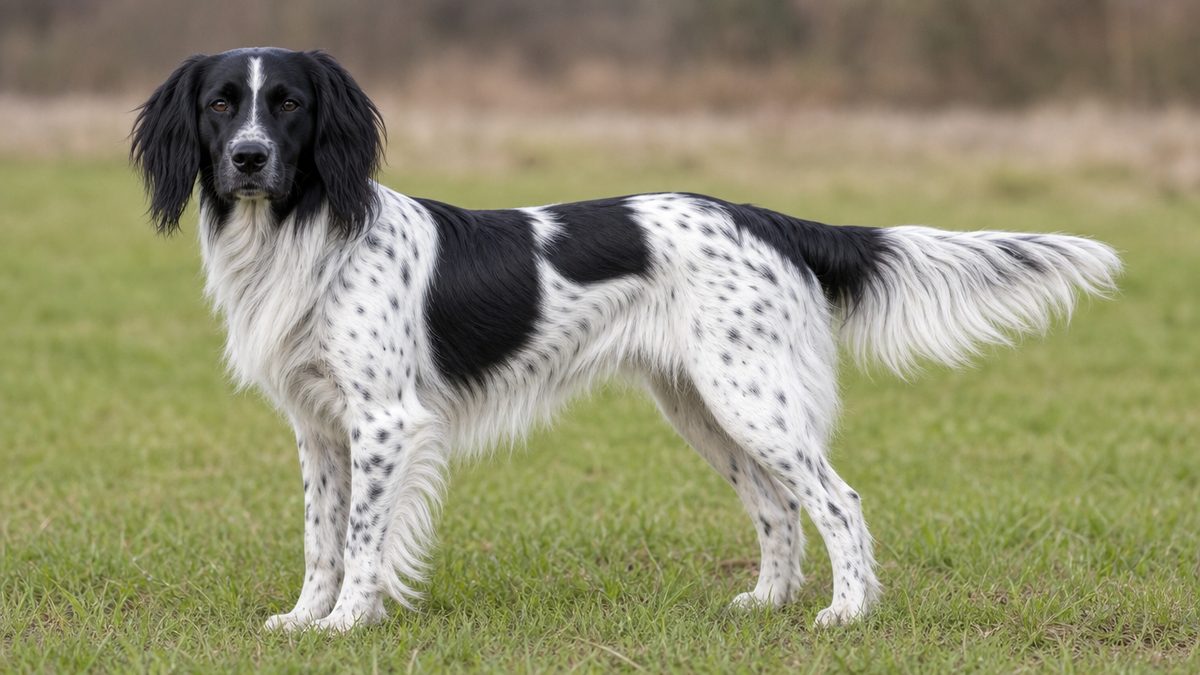
Colour is the breed's identity and the standard is short about it. Three colour varieties are permitted: white with black patches and spots, blue roan, or pure black. The head is always black, possibly with a white snip or blaze. The Royal Kennel Club lists the same three under UK breed-standard colours as Black and Blue Roan, Black and White, and White and Black. There is no tan point, no liver and no brown anywhere in the breed, which is the quickest way to tell a photograph of a Large Munsterlander from a photograph of a Deutsch Langhaar.
The coat is long and dense, yet sleek, and the standard specifically faults a curly or stand-off coat because it hinders hunting ability. Feathering is heavy on the backs of the front and hind legs and on the tail, with the strongest tail feathering in the middle of its length, while the hair on the head is short and smooth. The ear hair should form good fringes that reach clearly and evenly past the ear tips.
Two structural details matter for an Indian reader. The standard specifies 'no dewclaws' on both the forefeet and the hind feet, and the tail is carried horizontally or slightly higher in continuation of the topline, with no mention of docking anywhere in the document. Both points are worth knowing before you look at a photograph, because a docked dog or a dog with dewclaws removed after birth would raise questions under Indian law that this page returns to below.
FCI breed URLs resolve on the trailing number and ignore the name in front of it, so a guessed address returns a real, complete standard for a different dog. The document behind number 118 prints GROSSER MUENSTERLAENDER VORSTEHHUND as its own heading, which is how the identity of every figure on this page was confirmed.
Germany fields eight pointing breeds, and two of them are not Braques
Germany has eight breeds in FCI Group 7, not four, and the Large Munsterlander is one of the three the FCI files away from the Braques. Read from the Group 7 register directly, Section 1.1 Braque type holds Deutsch Stichelhaar 232, Deutsch Kurzhaar 119, Deutsch Drahthaar 98, Pudelpointer 216 and Weimaraner 99, while Section 1.2 Spaniel type holds Deutsch Langhaar 117, Kleiner Muensterlaender 102 and Grosser Muensterlaender Vorstehhund 118.
That subsection matters more than it looks. Almost every English page that mentions this breed calls it a German pointer and leaves it there, which invites a reader to picture a Kurzhaar with longer hair. The FCI does not group it that way. It sits with the spaniel types because of its coat and its build, next to the Langhaar it was split from in 1909 and the Small Munsterlander it shares a name with. A buyer comparing grooming load across German gundogs should compare within Section 1.2, not across the whole group.
| Breed | FCI number | Subsection | German puppies, 2025 |
|---|---|---|---|
| Deutsch Drahthaar | 98 | 1.1 Braque | 2,215 |
| Deutsch Kurzhaar | 119 | 1.1 Braque | 1,198 |
| Weimaraner | 99 | 1.1 Braque | 334 |
| Pudelpointer | 216 | 1.1 Braque | 105 |
| Deutsch Stichelhaar | 232 | 1.1 Braque | 15 |
| Kleiner Muensterlaender | 102 | 1.2 Spaniel | 1,102 |
| Deutsch Langhaar | 117 | 1.2 Spaniel | 382 |
| Grosser Muensterlaender | 118 | 1.2 Spaniel | 277 |
The registration column comes from the VDH's own puppy statistics rather than from any secondary summary, and it reframes the breed. The Large Munsterlander is not merely rare; it is the third rarest of Germany's eight pointing breeds, with only the Pudelpointer at 105 and the Stichelhaar at 15 below it. Set against the Drahthaar's 2,215, the breed registers about one puppy in Germany for every eight Drahthaar puppies.
All eight breeds carry the same working-trial marker in the register, which is the FCI's way of saying that a champion title in these breeds requires proven field work rather than looks alone. That is not true of most groups. It is the structural reason a German pointing breed behaves differently from a show-bred gundog of the same size, and it is why the breeding rules described further down this page are as heavy as they are.
One further detail settles a question Indian buyers ask. The four German gundogs sitting in the AKC's Foundation Stock Service, on the current list revised 1 September 2026, are the Large Munsterlander, the Small Munsterlander, the German Longhaired Pointer and the Deutscher Wachtelhund, alongside the Pudelpointer. All the Section 1.2 spaniel-type Germans are FSS breeds, and none of them is fully AKC-recognised. That is a fair summary of the breed's standing outside Germany: recognised, registerable, and nowhere numerous.
What the German club requires before a Large Munsterlander may breed
To breed a Large Munsterlander in Germany you must clear eleven separate conditions, and the club rewrote them as recently as 1 March 2026. The Verband Grosse Muensterlaender publishes its Zuchtordnung openly, and Section VIII sets the minimum requirements for breeding approval at a minimum age of 15 months plus graded test passes, hip and elbow grades, DNA storage, a conformation assessment, proof the dog hunts giving tongue and a proof of hardness.
Take the hunting test requirement first, because it is the one no companion buyer expects. The dog must have passed the VJP spring breed test with at least 9 points on the hare track and the HZP autumn breed test with at least 9 points for flushing behind the live duck, or an equivalent combination the rules spell out in full, including a VGP utility test route. Those are JGHV association tests judged by panels against a published scale, not club formalities. A Large Munsterlander that has never hunted cannot pass them, and a Large Munsterlander that cannot pass them does not breed.
The health thresholds are numeric
Hips must be assessed by the competent central office as HD-frei, meaning no indication of hip dysplasia, or as HD-Verdacht, the transitional grade. Section X then excludes HD grades C, D and E from breeding outright. Elbows must be graded ED-frei or ED-Grenzfall, borderline, and since 1 April 2019 elbow radiographs have been compulsory for any dog newly X-rayed. Radiographs may not be taken before 12 months of age and are uploaded to the GRSK evaluation portal.
Two genetic requirements sit alongside the radiographs. DNA must be deposited for every stud dog and brood bitch, and a hyperuricosuria test is required whenever a carrier is paired with a genetically free dog. The club prints the nomenclature it uses: N/N free, N/HUU carrier, HUU/HUU affected, with affected dogs excluded from breeding. Pairing two carriers is forbidden, as is pairing two dogs graded HD-B, two dogs graded ED-Grenzfall, or two dogs whose conformation grade is only 'gut'.
The rule about barking, which is not a joke
Only loud-hunting Large Munsterlanders may be bred. One of any pair must have demonstrated Sichtlaut, giving tongue on sight, or Spurlaut, giving tongue on the trail; pairing two dogs that carry only Stoeberlaut is not permitted; and a dog proven mute or waidlaut is not released for breeding at all. A dog recorded as mute can still qualify later by proving loud hunting. This single clause has shaped the breed's voice for a century, and it is the reason an Indian flat is the wrong home for one.
A Haertenachweis, proof of hardness assessed under JGHV guidelines, is required of dogs and bitches alike before breeding release. Conformation and coat are graded at a VGM breed show at 15 months or older, and a dog graded merely 'genuegend' or disqualified must be presented to a specialist breed judge before it can be approved.
Kennel inspection, litter caps and the eight-week rule
The club inspects the premises before any mating. Every active breeder must have a Zwingerabnahmeprotokoll completed by the regional breeding warden, repeated every five years and at every change of breeding site, and only puppies from an approved kennel are registered. Breeding advice from a warden must precede the mating, with the protocol no more than three months old, on pain of a triple registration fee. Litters must be reported within three weeks, puppies are chipped from the seventh week, and no puppy may be released before eight weeks of age.
| Limit | What the rulebook says |
|---|---|
| Minimum breeding age | 15 months, dog and bitch alike |
| Litters per bitch, lifetime | Not more than 4 |
| Interval between litters | At least 12 months |
| Repeat matings | Not allowed |
| Matings per approved stud, per year | 2 successful matings |
| Matings per approved stud, lifetime | 8 in Germany |
| Upper age | Dogs to the 9th year, bitches to the 8th |
| Inbreeding coefficient | Above 3.00% needs the breeding commission's prior approval |
| Artificial insemination | Not permitted domestically |
Read the last two rows together and you have the club's genetic policy in one line. It has put a number on inbreeding rather than a procedure, and it has closed the artificial-insemination route that would otherwise let one popular sire flood a small population. For a breed founded on 83 dogs, that is the point.
How the Munsterlander regime differs from the Drahthaar's
The two German clubs run recognisably the same system and disagree on four things that matter, and the Munsterlander club is stricter on three of them. Bonbeno's German Wirehaired Pointer page established the Verein Deutsch-Drahthaar regime; this page compares it against the Verband Grosse Muensterlaender rulebook clause by clause. Verband Grosse Muensterlaender e.V. (VGM)
| Requirement | Verband Grosse Muensterlaender, 2026 | Verein Deutsch-Drahthaar, 20th Revision |
|---|---|---|
| Breeder must hold a hunting licence | Not required anywhere in the Zuchtordnung | Required: the breeder 'possesses a valid hunting license' |
| Minimum breeding age | 15 months | 15 months for bitches |
| Stud dog use | 2 successful matings a year, 8 in a lifetime | 6 successful stud services within a breeding year |
| Bitch litter cap | 4 in a lifetime, 12 months apart | 1 litter in a breeding year, no lifetime cap stated |
| Close inbreeding | Numeric ceiling: above 3.00% needs approval | Grade-1 incest matings need the Head Breed Warden's permission |
| Hips | HD-frei or HD-Verdacht; C, D and E excluded | HD-frei, where grade B counts as free |
| Elbows | ED-frei or ED-Grenzfall, compulsory since 1.4.2019 | ED among the excluding diseases; OCD-frei required from 2012 |
| Hardness | Haertenachweis required of both sexes | Toughness evaluation required |
| Voice | Only loud-hunting dogs may breed | Mute or waidlaut dogs excluded from the Breeding Register |
The hunting-licence line is the sharpest difference and it needed checking twice. The VDD's English Breeding Regulations, 20th Revision, effective 1 July 2019, define the breeder in Article 4 paragraph 1 and require in sub-paragraph (b) that he or she 'possesses a valid hunting license'. The VGM's Zuchtordnung has no equivalent clause; the word Jagdschein does not appear in it at all, and the only membership condition is that breeders must be VGM members. So a person with no hunting qualification can, on the face of the rulebook, be a registered Large Munsterlander breeder in Germany and cannot be a registered Deutsch Drahthaar breeder.
The word Jagdschein also appears zero times in the VDD's current German Zuchtordnung dated 1 April 2024, while the English 20th Revision carries the requirement in Article 4(1)(b). Both documents were extracted and searched directly. This site has already recorded that the two VDD editions differ on one article; this is a second point on which they do not read alike, and a reader relying on either alone should say which edition they read.
On stud-dog use the Munsterlander club is far tighter, and the arithmetic is worth spelling out. A VDD stud dog may serve six bitches a year for its whole breeding life; a VGM stud dog may serve two a year and eight in total, ever. Verband Grosse Muensterlaender e.V. (VGM) Over a five-year breeding career that is thirty litters against eight. In a population registering 277 puppies a year, capping a popular sire at eight lifetime matings is the difference between a founder effect and a functioning gene pool.
On inbreeding the two clubs solve the same problem differently. The VDD subjects grade-1 incest matings, meaning parent to child and full brother to sister, to the Head Breed Warden's prior permission. The VGM instead sets a number, refusing without prior approval any mating whose puppies would carry an inbreeding coefficient above 3.00 percent, and separately forbidding the pairing of full sisters with the same dog or with his full brothers. A numeric ceiling is harder to argue with than a discretion, and it catches accumulated relatedness that a pedigree glance would miss.
Both regimes stop well short of what an Indian buyer is used to being offered, and both stop well short of what Indian law would demand of a licensed Indian breeder. That comparison is the subject of the law section below.
How rare the Large Munsterlander is, with dates
German breeders registered 277 Large Munsterlander puppies with the VDH in 2025, the fourth consecutive annual fall from a fifteen-year high of 452 in 2021. The full row, read from the VDH's own puppy statistics rather than from any summary, runs 277 in 2025, 284 in 2024, 306 in 2023, 340 in 2022, 452 in 2021, 360 in 2020, 368 in 2019, 320 in 2018, 332 in 2017, 246 in 2016, 400 in 2015, 396 in 2014, 311 in 2013, 282 in 2012 and 310 in 2011.
Two things follow from that series, and only one of them is the obvious one. The obvious one is that the breed is small: 277 puppies a year is a single village of dogs, and it is why no Indian supply chain has ever formed. The less obvious one is that the breed is holding its ground better than German pedigree dogs generally. Against 310 puppies in 2011 the 2025 figure of 277 is a fall of 10.6 percent, while the VDH's all-breeds total fell from 80,719 to 55,053 over the same fifteen years, a fall of 31.8 percent. The breed's share of all VDH puppies therefore rose from 0.38 percent in 2011 to 0.50 percent in 2025.
That is not a rounding artefact and it is worth stating plainly, because the standard line about a rare working breed is that it is dying out. On this evidence the Large Munsterlander is shrinking more slowly than the German pedigree register around it. The 2021 spike to 452 is visible in almost every breed row in the same table and reflects the pandemic-era surge in German puppy registrations rather than anything about this breed.
Where the breed stands outside Germany
The Royal Kennel Club recognised the breed in 1971 and files it in the Gundog group, listing it under Breed Watch Category 1, meaning no points of concern specific to the breed have been identified for judges' special attention. The American Kennel Club records it in the Foundation Stock Service as one of 88 FSS breeds and one of 17 in the Sporting group, on the list revised 1 September 2026, so it is registerable but not fully recognised in the United States. India, as a Full FCI member represented by the Kennel Club of India, sits downstream of the FCI nomenclature, which means the breed is recognised in principle for Indian pedigree purposes and has no Indian population to register.
Read out of OFA's own markup, LARGE MUNSTERLANDER is code LMU and SMALL MUNSTERLANDER is SMU, but a third entry sits between them: a bare MUNSTERLANDER, code MU, with no registry group attached at all. It has its own hip row of 283 evaluations at 12.4 percent dysplastic, worse than either named breed. Anyone who looks up 'the Munsterlander figure' has a one-in-three chance of quoting a row that does not describe a recognised breed.
Large Munsterlander price in India: there is no verifiable one
There is no Large Munsterlander price in India that Bonbeno can verify, because there is no Indian seller, no Indian breeder and no Indian breed club for the breed. A commercial search restricted to India returned ten results, and not one of them offered an Indian dog.
Here is exactly what came back, because naming it is more useful than any number. Nine of the ten results were foreign: a United States puppy marketplace quoting a national range in dollars, the American Kennel Club breed page, two American breed-list sites, the Large Munsterlander Association of America's own puppies page, two Facebook group threads, a United Kingdom breed-information page and a Russian site quoting roubles. The single India-hosted result was an Etsy India category page whose rupee figures, running from roughly 280 to 528 rupees, are the prices of printed merchandise. No dog is on offer anywhere on it.
That absence was tested rather than assumed. The same search was repeated under the German name Grosser Muensterlaender and its umlauted form, and returned no Indian source either. A Labrador Retriever control query run in the same session returned ten genuine Indian pages carrying real rupee bands, including one with an INR 30,000 to INR 1,20,000 ladder and an eight-city table, so the search instrument was working correctly. A zero produced by a working instrument is evidence. A zero produced by a broken one is not, and this one was checked.
What you would actually be sold
Assume that any Indian listing you eventually find for this breed is something else until proved otherwise. The plausible substitutions are specific: a black and white English Springer Spaniel, a long-coated German Shepherd cross, a Small Munsterlander, or a Deutsch Langhaar. Verify against the standard before you verify against a photograph. The head must be solid black with at most a white snip or blaze, there must be no tan, brown or liver pigment anywhere, and the coat must be long, dense and sleek rather than curly. A brown-headed dog is not this breed under any of the three permitted colour varieties.
The only price bands that exist for the breed are foreign, and this page publishes none of them converted. Converting a dollar or a pound figure into rupees produces a number that describes no transaction anyone has made in India, and that arithmetic is exactly how fabricated Indian prices enter circulation. Where a rupee figure for a rare breed does appear on an Indian page, divide it by 84.38 and by 74 before believing it; a clean quotient in dollars means you are reading a converted foreign list rather than an Indian market.
No Indian price exists for the Large Munsterlander. That is not a gap in this page's research; it is the most useful thing the page can tell an Indian buyer, because it means any figure you are quoted came from somewhere other than a real Indian sale of this breed.
What a Large Munsterlander would cost to keep in India
The recurring monthly cost of keeping a 30 kg working dog in India is checkable even though the purchase price is not, and the veterinary line is the part with published figures behind it. A full puppy vaccination course runs 3,000 to 6,000 rupees across the first sixteen weeks, and the annual booster afterwards is roughly 1,000 to 2,000 rupees.
| Item | Published Indian range |
|---|---|
| DHPPi or 7-in-1 combined vaccine, per dose | Rs 500 to Rs 1,200 |
| 9-in-1 combined vaccine, per dose | Rs 800 to Rs 1,500 |
| Anti-rabies, per dose | Rs 300 to Rs 600 |
| Kennel cough (Bordetella), per dose | Rs 500 to Rs 900 |
| Full puppy course, first 16 weeks | Rs 3,000 to Rs 6,000 |
| Consultation or injection charge, per visit | Rs 300 to Rs 800 |
| Annual booster, DHPPi plus rabies | Rs 1,000 to Rs 2,000 |
| Parvovirus hospital stay, if it happens | Rs 15,000 to Rs 50,000 |
Those figures come from an Indian guide medically reviewed by a veterinarian and last reviewed in July 2026, and the page states plainly that prices move with city, clinic and vaccine brand. Treat them as ranges to confirm locally, not as quotes. The last row is the one worth staring at: the entire first-year vaccine bill is smaller than the cheap end of a parvo admission.
The lines this breed adds that a smaller dog does not
Four costs scale with this particular dog rather than with dogs in general. Food is the first, because a 30 kg dog asked for more than two hours of work a day eats accordingly, and the standard gives approximately 30 kg as the breed's weight. Royal Kennel Club Tick and flea prevention is the second, and in India it is not optional: a Tamil Nadu study found 229 of 230 dogs examined, 99.6 percent, carrying ticks with a mean intensity of 5.65. Ear care is the third, because the long fringed drop ear on a dog that swims is the most expensive part of it to neglect. Grooming is the fourth, and the Royal Kennel Club puts this breed at more than once a week.
A fifth line is specific to this breed and no Indian cost table anywhere includes it. A hyperuricosuria DNA test, and a purine-restricted diet for a dog that turns out to be affected, is a lifetime cost rather than a one-off, and the numbers in the health section below explain why it is a real probability rather than a theoretical one.
Indian breed sites publish running costs as shared template constants across groups of unrelated breeds, and the grouping is not the size label: a toy breed and a hand-stripped wire terrier have been found printing the identical grooming line. Before trusting any Indian monthly cost you are shown for a rare breed, open an unrelated breed on the same site and compare the rows to the rupee. If they match, you are reading boilerplate rather than an observation of this breed.
Bonbeno publishes no monthly rupee total for this breed. A total would have to rest either on an Indian cost table for a breed nobody keeps in India, or on a foreign figure converted at an exchange rate, and both are inventions. What the table above gives you is real: the vaccination line for a dog of this size, in India, in 2026.
Suitability for the Indian climate: the homeland numbers first
The Large Munsterlander comes from a place where no month averages above 25 degrees, and Chennai's coolest month is warmer than its homeland's hottest. Queried by explicit latitude and longitude so no place name can substitute another location, Muenster averages 9.66 degrees across the year, peaks at 18.57 degrees in July and drops to 1.27 degrees in January.
Two homeland points were taken rather than one, because a single grid cell can mislead. Muenster, at 51.9607 north and 7.6261 east, is the town the breed is named for and holds the stud book. Berlin, at 52.52 north and 13.405 east, was queried as a second north German lowland reference. They agree closely: Berlin averages 9.43 degrees across the year against Muenster's 9.66, peaks at 20.25 degrees in July against 18.57, and likewise has zero months averaging above 25 degrees. Whichever point you take, the breed was selected in a climate with no hot season at all by Indian standards.
Elevation was echoed back for every point and checked against the real ground, because the model returns a grid cell rather than a place. Muenster's cell sits at 66.33 metres against a town near 60 metres, a divergence of about 6 metres, and Berlin's at 48.98 metres against about 34 metres. Both are the town. That check matters because in mountainous terrain the same model can miss by more than a kilometre, and a wrong homeland baseline corrupts every comparison built on it.
Humidity is the half the temperature hides
Muenster is a humid place, averaging 82.76 percent relative humidity across the year, so a reader might reasonably assume the breed is humidity-adapted. It is not, and wet-bulb temperature is the figure that shows why. Wet-bulb combines heat and humidity into the number that actually governs whether a panting dog can shed heat, and computed from the same two fields with Stull's 2011 approximation, Muenster's peak wet-bulb is 15.40 degrees in July. Kolkata's is 26.99 degrees in June and Chennai's is 26.03 degrees in May. That gap of more than eleven degrees is the whole argument. Muenster is wet and cold; Kolkata is wet and hot, and only one of those lets a heavy-coated dog work.
| Place | Annual mean T | Hottest month | Peak wet-bulb | Months above 25 C |
|---|---|---|---|---|
| Muenster, Germany | 9.66 C | 18.57 C (Jul) | 15.40 C | 0 of 12 |
| Berlin, Germany | 9.43 C | 20.25 C (Jul) | 15.84 C | 0 of 12 |
| Chennai | 27.90 C | 31.57 C (May) | 26.03 C | 10 of 12 |
| Mumbai | 26.65 C | 31.03 C (May) | 25.68 C | 9 of 12 |
| Kolkata | 25.82 C | 31.55 C (May) | 26.99 C | 8 of 12 |
| Delhi | 25.62 C | 35.95 C (Jun) | 26.43 C | 7 of 12 |
| Pune | 23.74 C | 28.74 C (Apr) | 22.90 C | 4 of 12 |
| Bengaluru | 23.64 C | 28.41 C (Apr) | 21.74 C | 3 of 12 |
The single most decision-relevant number in that table is not the hottest month. It is Chennai's coolest month, January, at 23.99 degrees, which is 5.4 degrees warmer than the hottest month this breed's homeland has ever averaged. There is no season in Chennai during which a Large Munsterlander experiences German summer conditions.
The research on what heat does to dogs is UK-based but the mechanism travels. Reviewing 905,543 dogs under primary veterinary care in 2016, Hall and colleagues found exertional heat-related illness the predominant trigger at 74.2 percent of events, well ahead of environmental heat at 12.9 percent and vehicular confinement at 5.2 percent. The companion paper on the same cohort, using a stricter case definition, put the 2016 incidence at 0.04 percent and the event fatality rate at 14.18 percent, and identified higher bodyweight relative to the breed and sex mean, and being over two years of age, among the significant risk factors. It also flagged dogs weighing over 50 kg, which at approximately 30 kg this breed is not, so that band does not transfer here and this page does not borrow it.
The commonest heat-illness trigger in a large veterinary dataset was exercise, not a hot vehicle. For a breed the Royal Kennel Club rates at more than two hours of exercise a day, that finding is the single most important thing on this page. In India the dog is not at risk because someone left it in a car. It is at risk because someone took it running at four in the afternoon.
Heat management city by city, and one figure you should not trust
Manage this breed by the wet-bulb reading rather than the thermometer, and split the day differently in each city because the constraint differs. Delhi's problem is a dry 35.95-degree June; Kolkata's is a 26.99-degree wet-bulb in the same month, which is worse for a panting dog even though the air temperature is lower.
Chennai and Mumbai are the hardest, and for the same reason. Chennai averages above 25 degrees in ten of twelve months and Mumbai in nine, so there is no long window in which normal work is possible. Both are coastal and humid, which flattens the day-night swing and removes the cool early morning that inland cities still offer. In practice a Large Munsterlander in either city works before six in the morning and after nine at night, and does scent work or swims for the rest.
Delhi is the deceptive one. Its June average of 35.95 degrees at 35.3 percent humidity is brutal to stand in but relatively survivable for a panting dog, because evaporation still works. Then the monsoon arrives and the July wet-bulb climbs to 26.43 degrees, the highest of any month in the city, while the thermometer falls to 32.53. That reversal catches Indian owners every year: the dog copes with dry May and collapses in humid July.
Bengaluru and Pune are genuinely easier and should be named as such. Bengaluru averages above 25 degrees in only three months of twelve and peaks at a wet-bulb of 21.74 degrees; Pune manages four months and 22.90 degrees. Neither is Muenster, and neither makes this breed a sensible choice, but both give a working dog several usable hours a day for most of the year rather than a two-hour window.
The hill-station figure this page will not print
Readers reach for hill stations for cold-climate breeds, and one of the two checked here returned a figure that cannot be used. NASA POWER's cell for Dehradun reports an elevation of 1,403.86 metres against a town sitting near 640 metres in the Doon valley, a divergence of about 764 metres. The model is describing the ridge above the town, not the town. At the standard lapse rate of roughly 6.5 degrees per 1,000 metres that cell runs about 5 degrees too cold, which would turn Dehradun's real June into something near 31 degrees rather than the 26.21 the cell reports. This page therefore publishes no Dehradun figure as observed, and flags the correction as an estimate rather than a measurement.
Shillong's cell diverges in the other direction, reporting 1,224.61 metres against a town near 1,496 metres, so its figures run roughly 1.8 degrees too warm. Corrected, Shillong is genuinely mild for this breed, but its July relative humidity of 91.5 percent is the highest of any point checked here, and a long-coated dog in 91 percent humidity has an ear and skin problem even when it does not have a heat problem.
Every plains point checked here landed on its town: Kolkata within 2 metres, Delhi within 10, Chennai within 43, Pune within 76 and Mumbai within 83. Only the two hill points diverged, one by 764 metres and one by 271. So the check is cheap and it is only needed in the hills, which is unfortunately exactly where a reader will look for somewhere this breed could live.
Indian law reaches the same conclusion the climate data does, and does it explicitly. Second Schedule Part IV paragraph 21(1) of the Dog Breeding and Marketing Rules 2017 bars keeping in outdoor facilities, without the attending veterinary practitioner's written approval, dogs not accustomed to local temperatures and 'dog breeds that cannot tolerate the temperatures prevalent in the area or region in question, such as long-haired breeds in high temperature locations'. The FCI standard describes this breed's coat as 'Typical long-hair';. The clause names the category by its own standard's word.
Temperament, and who should not buy this dog
The FCI standard puts trainability first and says so in one sentence: 'The most important qualities are: to be tractable and easily taught, dependable for use as a gundog, in particular after the shot. Lively temperament without being nervous.'; That is a working brief rather than a companion description, and reading it as one is the first mistake an Indian buyer makes.
Two things in that clause deserve unpacking. 'Dependable for use as a gundog, in particular after the shot' means the breed was selected for the retrieving and tracking work that follows the shot, which is the demanding, thinking half of a gundog's job. And 'lively temperament without being nervous' sets a floor, not a ceiling: the standard wants energy, and it wants stable nerves alongside it. The disqualifying faults confirm which way that cuts, listing aggressive or overly shy dogs, gun shy or gun-sensitive dogs in any degree, shyness of living game, fear biters and fear of strangers.
The breeding rules enforce the same thing harder than the standard does. The VGM excludes from breeding any dog showing gun shyness or gun sensitivity of any degree, shyness at live game, fearfulness of strangers, aggression toward other dogs or any aggression toward people, and any dog judged skittish or insecure. Separately, dogs showing signs of nervous weakness are declared fundamentally unsuitable for breeding. A century of that filter has produced a breed described by its own club and its own standard as sound-tempered, and an Indian buyer worried about aggression is worrying about the wrong risk with this dog.
The real risk is noise and unemployment
The risk that actually bites in India is the voice. The VGM will only release loud-hunting dogs for breeding, requires one of any pair to have proved Sichtlaut or Spurlaut, and refuses breeding release to a dog proven mute. A century of selecting for a dog that barks on a trail does not switch off in a housing society. Expect a vocal, energetic dog that announces the stairwell, and understand that this is the breed working correctly rather than a training failure.
The second risk is what an unemployed working dog does with a day. This is an affectionate, biddable and highly trainable animal that bonds hard to its handler, and it is also independent enough to make its own decisions when nobody gives it any. The FCI describes its purpose as meeting all the challenges of field, forest and water work before and after the shot. Deny that for eight hours a day in a flat and you get destruction, barking and eventually a rehoming attempt into a country with no breed rescue for it.
- Buy this breed only if you have land, daily time and a real job for the dog, whether that is field work, scent sport or long water work.
- Skip this breed if you live in an apartment, work full days away from home, or want a quiet dog for a shared building.
- Skip this breed if your household wants a first dog, because there is no Indian breed club, no Indian mentor network and no Indian rescue to fall back on.
- Consider this breed if you are in a hill or plateau city with land, can work the dog in the cool hours, and can fund the screening described below.
Nobody should buy a Large Munsterlander for its looks. It is a handsome, hardy dog with a striking black head, and every single thing that makes it handsome, the coat, the feathering, the ears, is a liability in Indian humidity.
Training a dog that is graded, not just trained
Train this breed against the German test scale rather than against a generic obedience syllabus, because the scale is what shaped the dog. The FCI defines its utilization as a versatile gundog that 'has to meet all the necessary challenges and has to be able to work in the field, in the forest and in the water before and after the shot';.
The German system tests aptitude before it tests obedience, and understanding that order tells you what your puppy will find easy. The VJP is a spring test of natural ability taken in the dog's first year, scoring things like the hare track; the HZP is an autumn breed test adding retrieving and water work; the VGP is the full utility test. The VGM demands specific point scores on named subjects rather than a bare pass, requiring at least 9 points on the hare track at the VJP and at least 9 for flushing behind the live duck at the HZP. The dog you buy is descended from animals that scored 9 or better on exactly those tasks.
What comes easily, and what does not
Nose work, water entry and retrieving come easily, because that is what the ancestors were selected on. Heritability work on hunting behaviours in dogs has covered this breed group, and separate genetic mapping work looking for the basis of pointing behaviour has used Large Munsterlander samples. Akkad DA and colleagues. Homozygosity… Neither line of work licenses a claim that any particular behaviour is fixed, and this page makes none, but both explain why the breed learns field tasks in a fraction of the sessions a non-gundog needs.
What does not come easily is silence and stillness. The breed is bred to give tongue, so training a reliable quiet cue takes months rather than weeks and works best as a trained alternative behaviour rather than a suppression. Recall away from live game is the second hard one, and in India it is the dangerous one, because the game the dog finds may be a monitor lizard, a monkey troop or a free-ranging dog pack rather than a partridge.
- Socialise deliberately from eight weeks, and socialise to Indian street life specifically: traffic, cattle, autorickshaws, temple noise, other dogs at distance.
- Build the recall before the dog is physically able to outrun you, which means before five months.
- Introduce water early and voluntarily, because the breed's own breeding rules test water work and a dog forced in at six months often refuses at two years.
- Train scent games indoors during the hot months, so the dog gets mental work when physical work is unsafe.
- Delay formal retrieving drills until the adult teeth are in and settled, usually after seven months.
- Train a settle on a mat as seriously as you train recall, because in an Indian home the off switch is the skill you will use daily.
One warning specific to this breed. Because it is so trainable, owners over-train it and under-exercise it, and then complain about a dog that is obedient indoors and uncontrollable outdoors. A Large Munsterlander that has had two hours of real work is easy to live with. The same dog after twenty minutes on a lead is not, and no amount of obedience class fixes that.
The daily exercise requirement, and what India does to it
The Large Munsterlander's exercise needs run to more than two hours per day, and the Royal Kennel Club pairs that figure with a large house and a large garden rather than treating it as optional. In India that requirement collides with a climate that removes most of the usable day for most of the year.
Work backwards from the wet-bulb figures rather than from a schedule. Chennai averages above 25 degrees in ten months of twelve and peaks at a wet-bulb of 26.03 degrees; Kolkata reaches 26.99. At those readings a heavy-coated 30 kg dog cannot dump heat by panting fast enough to sustain hard work, whatever the thermometer says. The practical rule is that the dog exercises when the wet-bulb is low, which in coastal India means before sunrise and well after dark, and in Bengaluru or Pune means a wider morning window for most of the year.
| Season | Morning session | Evening session | Heat substitute |
|---|---|---|---|
| Cool months, roughly December to February | 60 to 75 minutes from first light | 45 to 60 minutes after sunset | Not usually needed |
| Pre-monsoon heat, March to May | 45 to 60 minutes, finished before 06:30 | 30 to 45 minutes after 21:00 | Scent games indoors, 20 minutes |
| Monsoon, June to September | 40 minutes, watch the wet-bulb not the sky | 30 minutes, dry the ears afterwards | Swimming where clean water exists |
| Post-monsoon, October to November | 60 minutes | 45 minutes | Tapering off |
Swimming deserves its own line because it is the one activity that solves two problems at once. The breed's own breeding tests score water work, so the drive is there, and immersion removes the heat constraint that governs everything else. The caveat is Indian and specific: water that is safe to swim in is not the same as water that is available, and a dog that swims must have its ears dried afterwards every single time, for reasons the grooming section sets out.
What happens without the exercise is predictable and it is not mysterious. An under-exercised working gundog barks, digs, chews, patrols and escalates, and because this breed was bred to give tongue the barking is the part the neighbours notice. Owners then reduce the dog's freedom further, which makes it worse. If the honest answer is that you cannot deliver two hours a day in the cool hours, the honest conclusion is that you should not have this breed.
In a review of 905,543 UK dogs, exertional heat-related illness was the predominant trigger at 74.2 percent of events, against 12.9 percent environmental and 5.2 percent vehicular confinement. The companion analysis of the same cohort put the event fatality rate at 14.18 percent. A breed that needs more than two hours of exercise a day carries that risk daily in India, not occasionally.
Coat care in Indian humidity, and the ears that decide everything
Groom this coat at least twice a week in India rather than the once a week the Royal Kennel Club sets as a minimum, and dry the ears after every swim and every wet walk. The long coat is not the problem by itself; the problem is where it is longest, which is exactly where moisture sits.
The standard describes the coat precisely enough to plan around. Hair is long and dense yet sleek, never curly or stand-off, with the coat 'specially long and dense on backs of front and hind legs' in both sexes, particularly long hair on the tail with the strongest feathering at the middle of its length, and long ear hair forming fringes that reach clearly and evenly past the ear tips. The hair on the head is short and smooth. So you have four moisture traps: ear fringes, leg feathering, tail feathering and the belly coat.
The ear is the expensive part
This breed carries a broad, close-fitting, well-fringed drop ear, and it is bred to work in water. That combination is the classic setup for otitis externa, and an ear infection in an Indian monsoon is not a minor irritation: it is a recurring, antibiotic-consuming problem that ends in chronic canal changes if it is left. The overseas care advice that says to towel the dog and let it air dry is written for a temperate climate and does not transfer. In an Indian July, air drying a fringed ear canal is how the infection starts.
- Dry inside the ear leather and around the canal opening after every swim, every bath and every wet walk, using a plain absorbent cloth rather than pushing anything into the canal.
- Comb the ear fringes, leg feathering and tail out at least twice a week, working to the skin rather than over the top of the coat.
- Check the belly coat and the groin for damp matting weekly through the monsoon, because that is where owners never look.
- Never clip this coat short in the belief that it cools the dog, because the long single coat also shields the skin from direct sun and a clipped working coat regrows unevenly.
- Bathe only when the dog is genuinely dirty, and dry it fully afterwards rather than letting it dry in humid air.
Ticks change the grooming calculus in India entirely, and there is Indian evidence for how bad it is. In Tamil Nadu, 229 of 230 dogs examined were tick-infested, 99.6 percent, with a mean intensity of 5.65 ticks per dog, and 156 of the 230, 67.8 percent, carried at least one vector-borne pathogen. A four-city Indian survey found 261 of 525 dogs, 49.7 percent, PCR-positive for at least one tick-borne pathogen, with Hepatozoon canis at 30 percent and Ehrlichia canis at 20.6 percent, and concurrent infection with more than one pathogen in 39 percent of cases. A feathered dog gives ticks more places to hide than a smooth-coated one, so the weekly comb-out is a tick check as much as a grooming session.
In a country where roughly half of surveyed dogs carry a tick-borne pathogen and where an ear infection compounds through a four-month monsoon, the comb is a diagnostic tool. Anything you find in the coat, you find during grooming or you find at the vet.
Health: hips, elbows and a life expectancy nobody has measured
The Large Munsterlander's two documented health issues are hyperuricosuria and hip dysplasia, and on hips it does better than the average dog. The OFA hip table records 9.1 percent dysplastic across 186 Large Munsterlander evaluations, against 14.2 percent across all breeds, and the breed appears in that one table and nowhere else in OFA's published statistics.
Read the full row rather than the headline. Of 186 evaluations, 90.9 percent were normal, split 26.9 percent excellent, 57.0 percent good and 7.0 percent fair, with 9.1 percent dysplastic split 3.2 percent mild, 5.9 percent moderate and 0.0 percent severe. Those components reconcile exactly: 26.9 plus 57.0 plus 7.0 is 90.9, and 3.2 plus 5.9 plus 0.0 is 9.1. The excellent share of 26.9 percent is high, and no severe grade appears at all in the sample. Against that, 186 evaluations is a small denominator, and OFA requires 100 hip evaluations before publishing a breed at all, so this breed sits only just above the publication threshold.
| Row label | Evaluations | Normal % | Dysplastic % |
|---|---|---|---|
| LARGE MUNSTERLANDER | 186 | 90.9 | 9.1 |
| SMALL MUNSTERLANDER | 409 | 93.4 | 6.1 |
| MUNSTERLANDER (no group) | 283 | 87.6 | 12.4 |
| GERMAN WIREHAIRED POINTER | 5,906 | 90.0 | 8.9 |
| ALL BREEDS | 1,713,098 | 84.3 | 14.2 |
Two cautions belong with that table. First, the bare MUNSTERLANDER row is not a breed: OFA's own markup gives it code MU with no registry group attached, against LMU for the Large and SMU for the Small. It has the worst hip rate of the three and it would be the natural row for a careless reader to quote. Second, the ALL BREEDS row fails its own arithmetic. It prints 84.3 percent normal with excellent 14.6, good 0.0 and fair 0.0, components that cannot sum to the whole, while every individual breed row above it sums exactly. Use the 14.2 percent dysplastic figure as a rough baseline and do not build anything on the aggregate row's normal breakdown.
Elbows, eyes and what the registries ask for
The Royal Kennel Club splits its screening advice into two tiers for this breed. Good Practice, the minimum it recommends before breeding, is hip testing and elbow testing under the BVA and Kennel Club schemes plus attention to genetic diversity. Best Practice adds the hyperuricosuria DNA test and eye testing under the BVA, Kennel Club and ISDS scheme. The German club requires hips graded free or transitional and elbows graded free or borderline before it will release a dog for breeding at all, and has made elbow radiographs compulsory for every dog X-rayed since 1 April 2019.
That German list also names the conditions that permanently exclude a dog from breeding, and it is longer than most clubs publish: epilepsy, aseptic humeral head necrosis, elbow grades 1 to 3, hip grades C to E, homozygous hyperuricosuria, spontaneous cruciate ligament rupture, uni- and bilateral cryptorchidism, entropion, ectropion, open eye and hereditary eye defects, and serious bite and tooth faults. An Indian buyer looking at an imported pedigree can use that list directly as the questions to ask.
Life expectancy: no figure, and why this page prints none
The Royal Kennel Club records the breed's lifespan as 'Over 10 years' and gives no upper bound. No breed-specific longevity study for the Large Munsterlander was located, and this page therefore publishes no median age at death rather than borrowing one from a related German gundog or from a general large-breed average. The honest life expectancy statement is that the breed's own national registry will only commit to more than ten years, and that no larger dataset has ever reported it separately.
Searching the veterinary literature for the breed returns 7 records under the exact phrase 'Large Munsterlander' and 15 across every Munsterlander name form tried, against a control search on Labrador Retriever and hip dysplasia returning 47 in the same session. The two records that carry clinically useful breed-specific findings are a hyperuricosuria allele-frequency screen and a dermatology paper on black hair follicular dysplasia. von Bomhard W, Mauldin EA, Schmutz SM That is a genuinely small literature, and most of the rest of it is genetics rather than clinical medicine. It is why a page like this one leans on registry data and breed-club rulebooks: for this breed, those are the largest datasets that exist.
Hyperuricosuria: the one number this breed is actually defined by
Hyperuricosuria is the Large Munsterlander's signature inherited problem, and the Royal Kennel Club's own published test report puts real counts on it. Extracting that report and counting it result by result gives 127 clear, 50 carriers and 4 affected among 181 tested dogs, which sums exactly to the 181 records the document itself declares.
The condition is a defect of the SLC2A9 urate transporter. A dog carrying two copies excretes large quantities of uric acid in its urine and forms ammonium urate stones, which in practice means blood in the urine, straining, and in a male dog the real risk of a blocked urethra. Karmi and colleagues screened 3,530 dogs from 127 breeds for the causal mutation and identified it in ten breeds including the Large Munsterlander, reporting mutant allele frequencies across those ten breeds ranging from 0.001 to 0.15. The published abstract gives the range across the group and does not break the frequency out per breed, so this page quotes the range and attributes no single figure to the Large Munsterlander.
| Result | Dogs | Share of 181 |
|---|---|---|
| Clear | 127 | 70.2% |
| Carrier | 50 | 27.6% |
| Affected | 4 | 2.2% |
| Total records declared by the document | 181 | 100% |
Those shares matter more than the allele frequency does, because they are what a buyer meets. Roughly three in ten tested UK Large Munsterlanders carry at least one copy, and four dogs in the report are affected outright. The Kennel Club acted on it: with effect from 6 January 2025, imported Large Munsterlanders and litters from overseas sires are only eligible for Kennel Club registration if they are proven clear or carriers of hyperuricosuria, or hold hereditary clear status, and an identified carrier may only be mated to a dog that is hereditarily clear or DNA-tested clear. The Kennel Club states plainly that the scheme was introduced at the breed clubs' own request to protect the UK population.
Germany runs the same policy from the other end. The VGM requires DNA to be stored for every stud dog and brood bitch, requires an HUU test whenever a carrier is paired with a free dog, forbids carrier-to-carrier matings, and excludes homozygous dogs from breeding entirely. Where both parents test free, the club waives the test on the offspring, since they are free by descent. So two independent national registries, working from different data, arrived at the same rule at roughly the same time.
Why this matters more in India than in Germany
Urate stones form when urine is concentrated, and Indian conditions concentrate urine. A dog that spends ten months of the year in a city averaging above 25 degrees, exercising in heat, is losing water through panting all day. The management for an affected dog is unglamorous and constant: a purine-restricted diet, and above all water intake high enough to keep the urine dilute. In a Chennai summer that is a harder target than in a German winter, and an owner who lets it slip finds out through a surgical bill rather than a warning sign.
The same mutation has now been documented in the other German hunting breed on this site. A 2024 case report describes the first detection of the SLC2A9 p.C188F variant in a German Hunting Terrier, a 1.5-year-old male presented with haematuria in 2018 and diagnosed with ammonium urate urolithiasis in 2019 after a cystotomy, tested homozygous for the variant. Its authors urge practitioners to consider the defect in breeds beyond the Dalmatian. For an Indian vet seeing an unusual dog with urate crystals, that is the practical message.
Ask for the hyperuricosuria DNA result on both parents, in writing, with the laboratory name and date. It is the single most informative document available for this breed, both national registries now require or recommend it, and no honest breeder of a Large Munsterlander in 2026 will be surprised to be asked.
Black hair follicular dysplasia, and the colour that carries it
The Large Munsterlander has a published skin condition tied directly to the colour its standard requires, and it appears in the black hair. Black hair follicular dysplasia was described in four Large Muensterlaender cross-bred dogs, with skin sampled weekly across the first 19 weeks of life alongside one unaffected control littermate.
The mechanism is a pigment-transport failure rather than an infection. Affected dogs were born with silvery grey hair caused by melanin clumping in the hair shafts; the hair bulb melanocytes were densely pigmented and full of mature melanosomes, while the neighbouring keratinocytes lacked them, so the pigment was made but not handed over. Follicular changes progressed through the hair bulb and then the upper follicle to dysplastic hair shafts, and alopecia developed progressively in the pigmented areas. The authors note that the same silver-grey hair, melanin clumping and failure of melanosome transfer are classic features of human Griscelli syndrome, and propose a defect in intracellular melanosome transport as the mechanism.
The reason this belongs on an India page is the phrase 'alopecia in pigmented areas'. The FCI standard requires that the head is always black and permits pure black as one of the three colour varieties. So the colour that defines the breed is the colour that goes bald in an affected dog, and the exposed skin is exposed under Indian sun rather than German. Sunburn and secondary bacterial infection on a hairless black-pigmented back are a materially bigger problem at 13 degrees north than at 52.
- Look at a puppy's coat colour at eight weeks, because affected dogs were born with silvery grey rather than true black hair.
- Ask whether any littermate or earlier litter from the same pairing showed patchy coat loss over black areas in the first year.
- Treat progressive hair loss confined to the black regions as a dermatology referral, not as a mange assumption.
- Keep an affected dog out of direct midday sun entirely, and discuss sun protection for exposed skin with your vet rather than improvising.
Note one limit on that paper honestly. The four affected dogs were Large Muensterlaender cross-breds rather than registered purebreds, so the study describes the condition in dogs of this breed's ancestry and does not establish a prevalence in the registered population. No prevalence figure for black hair follicular dysplasia in the Large Munsterlander was found anywhere, and this page publishes none.
The German club's exclusion list reaches this territory from a different direction, barring from breeding any Large Munsterlander with serious pigment faults such as a white nose leather, and any dog whose colour does not conform to the standard. Pigment is not a cosmetic matter in this breed's rulebook, and the dermatology literature suggests the club is right to treat it that way.
Indian law, and the four clauses that touch this breed
Four provisions of the Prevention of Cruelty to Animals (Dog Breeding and Marketing) Rules 2017 apply directly to a Large Munsterlander in India, and on one of them Indian law is stricter than the German breed club. The gazette text was extracted and searched directly rather than summarised, and every clause below is quoted from it.
1. Outdoor housing, and the phrase that names this coat
Second Schedule Part IV paragraph 21(1), headed Outdoor housing facilities, provides that the following categories of dogs shall not be kept in outdoor facilities unless the practice is specifically approved by the attending veterinary practitioner in writing: dogs that are not accustomed to the temperatures prevalent in the area, 'dog breeds that cannot tolerate the temperatures prevalent in the area or region in question, such as long-haired breeds in high temperature locations', and sick, infirm, aged or young animals. The FCI standard calls this breed's coat 'Typical long-hair';. The clause therefore names the category by the breed standard's own word, and a Large Munsterlander kennelled outdoors in Chennai or Nagpur without written veterinary approval sits squarely inside it.
2. In-breeding, where India is stricter than the club
Second Schedule Part II paragraph 6(3) prohibits two named techniques outright. In-breeding is defined as breeding between relatives of the 2nd to 4th grade in straight or side line within the first four generations, with uncle to niece, nephew to aunt, cousin to cousin and grandparent to grandchild given as examples; incest breeding is mating between parents and children or between brother and sister, described as 1st grade relatives. The VGM's answer to the same problem is a number, refusing without prior approval any mating whose puppies would carry an inbreeding coefficient above 3.00 percent. A cousin-to-cousin mating can sit under 3.00 percent and would be permissible in Germany on that basis; it is prohibited outright in India, with no approval route. An Indian breeder following the German rulebook would break Indian law.
3. Dewclaws, docking and the mutilation clause
Second Schedule Part II paragraph 6(8) reads that there 'shall be no tail docking, ear cropping, de-barking, de-clawing, branding, dyeing, injecting substances to enhance visual appeal, performing a surgery or procedure to camouflage or hide any defect or infirmity or any other kind of mutilation of any body part of the pup and any change of appearance by artificial means is strictly forbidden';. This breed is fortunate here: its standard describes an undocked tail carried horizontally and natural drop ears, so nothing in the standard asks for a prohibited procedure. One line does need care. The standard specifies 'no dewclaws' on both forefeet and hind feet, which describes the natural foot rather than authorising removal, and removing a dewclaw to meet a standard would fall inside the words 'de-clawing' and 'any change of appearance by artificial means'.
4. The genetic-defect testing clause
Second Schedule Part III paragraph 8(10) provides that 'the dogs shall have been tested for genetic defects, including hip dysplasia, progressive retinal atrophy, night blindness, hypothyroidism, entropion, ectropion, overshot, undershot jaw (when incisors do not touch or mesh), wry mouth, two or more missing teeth, unilateral cryptorchid or full cryptorchid males';. The word is 'including', so the list is illustrative rather than closed. Three of the named defects, hip dysplasia, entropion and ectropion, are also on the German club's own breeding-exclusion list, so a properly bred imported dog will already have the paperwork. Note what the Rules do not contain: across the whole 14-page gazette the words patella, luxation, BAER and deaf appear zero times, so there is no Indian patella-grading or hearing-test requirement to point to.
The numbered Rules in this instrument run 1 to 13 and stop at Rule 13, No licence without registration. The string 'Rule 14' appears nowhere in the gazette. Everything numbered above 13 is a Second Schedule paragraph, so a source that cites the outdoor-housing heat clause as 'Rule 21' is citing a provision that does not exist. The correct form is Second Schedule Part IV paragraph 21(1).
On one point Indian law and the German club agree exactly. Rule 8(1)(a) requires that every breeder ensure 'pups less than eight weeks in age are not sold', and the VGM's own procedure permits release of a puppy only after registration, marking and litter inspection and 'at the earliest at the age of eight weeks';. Verband Grosse Muensterlaender e.V. (VGM) If an Indian seller offers you a puppy of this or any breed at six or seven weeks, they have broken Indian law and the breed's own rulebook in the same sentence. That single agreement between a German gundog club and an Indian statutory instrument is the clearest signal on this page of what a legitimate transaction looks like.
Feeding a working dog in a country that will not let it work
Feed to body condition rather than to the bag chart, and feed a Large Munsterlander in India as the sedentary dog it will mostly be rather than the working dog it was bred to be. The FCI standard puts the breed at approximately 30 kg, and that is the only weight figure it gives.
The reason to be strict about weight is not cosmetic. In the Scientific Reports analysis of 905,543 UK dogs, higher bodyweight relative to the breed and sex mean was a significant risk factor for heat-related illness, alongside being over two years of age. In India that finding compounds with everything else on this page. An overweight Large Munsterlander in Chennai is carrying a heat penalty in a place where ten of twelve months already average above 25 degrees.
- Weigh the dog monthly and record it, because a coated dog hides weight gain until it is substantial.
- Ribs should be easy to feel under a thin fat cover and the waist should be visible from above, in a coat that makes both harder to judge by eye.
- Feed two meals a day rather than one, and leave at least an hour either side of hard exercise given the breed's deep chest.
- Increase water rather than food in hot months, and make sure water is available at every point the dog rests.
- Reassess intake whenever the exercise pattern changes, which in India means at least twice a year as the seasons close and open the working window.
The diet question that is specific to this breed
A Large Munsterlander that tests homozygous for the hyperuricosuria variant needs a purine-restricted diet for life, and that changes the feeding conversation entirely. Purines are concentrated in organ meat, some fish and yeast, and a home-cooked Indian diet built around liver and small whole fish is close to the worst possible feeding plan for such a dog. Water intake matters as much as the diet does, because the stones form when urine is concentrated, and a panting dog in Indian heat concentrates urine all day. Get the DNA result before you design the diet, not after the first blocked urethra.
For everything else, ordinary sound feeding applies and no exotic regime is needed. Indian availability of large-breed complete diets is adequate in the metros and thin outside them, so establish supply before the dog arrives rather than after. Puppy growth should be steady rather than fast, since this is a breed whose own club will not radiograph hips before twelve months and whose skeleton is still finishing at that point.
The first year, month by month
Plan the first year around three fixed dates rather than around a training syllabus: the eight-week release, the sixteen-week vaccination backstop, and the twelve-month radiograph. Indian law and the breed's own rulebook both set the first at eight weeks, and the German club will not X-ray hips before twelve months. Verband Grosse Muensterlaender e.V. (VGM)
| Age | What should be happening |
|---|---|
| 8 weeks | Earliest lawful release, after registration, marking and litter inspection. Vaccination course already begun by the breeder. |
| 8 to 12 weeks | Socialisation to Indian street life. Second DHPPi dose. Ear-drying routine established from the first bath. |
| 12 to 16 weeks | Third DHPPi and first anti-rabies. Recall training begins. Keep off unknown ground until a week after the final booster. |
| 4 to 6 months | Recall proofed before the dog can outrun you. Voluntary water introduction. Tick prevention running year-round. |
| 6 to 8 months | Adult teeth in. Formal retrieving drills can begin. Coat starts lengthening; twice-weekly combing becomes non-negotiable. |
| 8 to 12 months | Exercise increases toward the adult two hours, split into cool-hour sessions. Body condition scored monthly. |
| 12 months | Earliest point the German club permits hip and elbow radiographs. Hyperuricosuria DNA result should already be on file. |
| 12 to 15 months | Adult coat and feathering complete. In Germany, the earliest age at which the dog could be assessed for breeding at all. |
The vaccination backstop deserves its own note because Indian puppies die of the two diseases it prevents. The standard Indian schedule starts core vaccination at six to eight weeks and repeats every three to four weeks until at least sixteen weeks, with anti-rabies from around twelve weeks and a yearly booster thereafter. The final dose must land at or after sixteen weeks whatever came before it, because the mother's fading antibodies can block an earlier dose from taking. Keep an unfinished puppy off unknown ground until about a week after that last booster.
Two Indian-specific additions belong in the first year and neither appears on a European puppy chart. Tick prevention starts immediately rather than at six months, because a Tamil Nadu survey found 99.6 percent of examined dogs infested. And heat conditioning is a training subject in its own right: a puppy raised to rest through the middle of the day and work at the edges of it grows into an adult that does the same, while a puppy allowed to run at noon in its first cool season learns a habit that becomes dangerous in its first hot one.
Head to head against the breeds an Indian buyer is really choosing between
Nobody in India is choosing between a Large Munsterlander and a Small Munsterlander, because neither is available. The real comparison is against the gundogs an Indian household can actually buy, and on that comparison the Large Munsterlander loses on availability before it is judged on anything else.
| Breed | Coat | Heat tolerance | Indian availability | Screening you can actually get |
|---|---|---|---|---|
| Large Munsterlander | Long, dense, sleek, heavily feathered | Very low | None found | Only via an imported pedigree |
| German Shorthaired Pointer | Short and smooth | Low but the best of the German pointers | Occasional, in metros | OFA and KCI paperwork sometimes available |
| Labrador Retriever | Short dense double | Low to moderate | Widely available at Rs 30,000 to Rs 1,20,000 in published Indian bands | Hip and elbow screening routinely offered |
| English Cocker Spaniel | Medium, feathered, drop ear | Moderate | Widely available | Eye and hip schemes available |
| Indian Pariah Dog | Short single | High, and it is the local baseline | Free, everywhere | Not applicable |
The Labrador row is the honest benchmark and the figures are real Indian ones. One Indian marketplace publishes a ladder of INR 30,000 to INR 1,20,000 across Basic, KCI Registered and Champion Bloodline tiers, with a city table covering Hyderabad, Bangalore, Delhi, Chennai, Lucknow, Mumbai, Jaipur and Pune. That is what a functioning Indian market for a gundog looks like: multiple sellers, multiple cities, a visible price ladder. The Large Munsterlander has none of it. Read that table carefully all the same, because all eight cities print the identical band, which makes it city-labelled rather than city-specific.
Against its own German relatives
If you are choosing among German gundogs on paper, the differences that matter in India are coat and availability rather than temperament. The Deutsch Kurzhaar's smooth coat is materially easier in Indian humidity than this breed's feathering, and Germany registers it at 1,198 puppies a year against 277. The Kleiner Muensterlaender is roughly four times commoner than the Large at 1,102, and smaller, which matters in an Indian flat even though neither breed belongs in one. The Deutsch Drahthaar is by far the commonest at 2,215, and its harsh wire coat sits between the two on grooming load.
On health screening the comparison runs the other way, and it is the strongest argument for this breed. Its OFA hip rate of 9.1 percent across 186 evaluations is close to the German Wirehaired Pointer's 8.9 percent across 5,906, and both are well below the 14.2 percent all-breed figure. More importantly, this breed has a single well-characterised genetic disease with a cheap definitive DNA test and two national registries enforcing it. Verband Grosse Muensterlaender e.V. (VGM) Very few gundogs offer a buyer that much certainty about what they are getting.
What Indian buyers actually get wrong with this breed
The commonest mistake is buying a dog that is not this breed, and the second commonest is clipping the coat in the belief that it cools the dog. Both are avoidable in an afternoon, and both are more expensive to undo than to prevent.
- Accepting a brown or tan dog. The standard permits white with black patches and spots, blue roan, or pure black, with a head that is always black. There is no liver, brown or tan variety. A brown-headed 'Munsterlander' is another breed.
- Clipping the coat for the heat. The long single coat also shields skin from direct sun, and a clipped working coat regrows unevenly. Cool the dog by changing when it works, not by removing what protects it.
- Air-drying the ears. Overseas breed-club grooming advice that says to towel the dog and let it air dry was written for a temperate summer. In an Indian monsoon, a fringed drop ear left to air dry is how otitis starts.
- Skipping the hyperuricosuria test because the dog looks healthy. Carriers look healthy by definition. Roughly three in ten tested dogs in the UK register carry a copy, and the test is a one-off.
- Treating the barking as a training failure. The breed's own rulebook refuses breeding release to a mute dog. You bought the voice along with the nose.
- Buying on a photograph from an Indian listing. No Indian breeder for this breed was found. A listing is far more likely to be a different dog than a genuine one.
Two mistakes that come from the internet rather than from the dog
The first is trusting a converted price. Foreign price bands for this breed exist in dollars, pounds and roubles, and running any of them through an exchange rate produces an Indian-looking figure that describes no Indian transaction. If a rupee figure for a rare breed divides cleanly by 84.38 or by 74 into a round foreign price, you are looking at arithmetic rather than a market.
The second is trusting a template running-cost table. Indian breed sites publish monthly cost rows as shared constants across unrelated breeds, so an expensive-looking figure attached to this breed may have been written for a Pug. Pull an unrelated breed from the same site and compare the rows to the rupee before you quote anything.
The single most damaging decision is buying this breed into an Indian apartment because it looks calm in photographs. The Royal Kennel Club specifies a large house and a large garden, and the German breeding rules select for a dog that hunts giving tongue. Neither of those facts is visible in a photograph, and both will decide how the next twelve years go.
Adoption and responsible sourcing
Adopt an Indian dog if what you want is a companion, and import through a verified pedigree if what you want is specifically this breed. There is no third route: no Indian breeder, no Indian breed club and no Indian rescue for the Large Munsterlander could be found, so anything presented as a local shortcut deserves suspicion rather than a deposit.
Start with the honest question. Almost everything an Indian household actually wants from a dog, companionship, alertness, a manageable size, tolerance of heat, is better delivered by an Indian pariah dog that is free to adopt and adapted to the climate this page has spent several sections describing. A Large Munsterlander is a specialised tool bought by people who intend to use it. If you do not intend to use it, adopt instead.
If you are set on the breed, here is what to verify
- A pedigree from an FCI-affiliated registry, with the breed printed as Grosser Muensterlaender Vorstehhund or Large Munsterlander and the number 118 traceable to the FCI nomenclature.
- The hyperuricosuria DNA result for both parents, in writing, with the laboratory name and date. Both the German club and the Royal Kennel Club now require or recommend it, and the UK has restricted registration of imports without it since 6 January 2025.
- Hip and elbow grades for both parents. The German club will not release a dog for breeding without HD graded free or transitional and ED graded free or borderline.
- Evidence the parents passed the breed tests, which for a German-bred dog means named VJP, HZP or VGP results with the point scores, not a generic 'working lines' claim.
- The kennel inspection record, since the German club requires a Zwingerabnahmeprotokoll before mating and repeats it every five years.
- Age at release. Eight weeks is the floor under both Indian law and the German rulebook, and a seller offering younger has already told you what kind of seller they are.
Verify the registry entry yourself rather than accepting a scan. India is a Full FCI member represented by the Kennel Club of India in Chennai, so an FCI-scheme pedigree is meaningful here and an unaffiliated 'registry' certificate is not. The FCI's own breed record for number 118 is public and takes a minute to check.
The rescue reality
There is no breed rescue for the Large Munsterlander in India because there is no population to rescue from. That cuts both ways and the second way is the one buyers ignore: if this dog does not work out in your household, there is no specialist network to take it, and a 30 kg vocal working gundog is among the hardest animals to rehome in an Indian city. Assume you are the dog's only home for its whole life, which the Royal Kennel Club puts at over ten years.
If you have already been sold something described as this breed and now doubt it, the check is cheap and it is the standard rather than a DNA test. Look at the head: it must be solid black, at most with a white snip or blaze, in every one of the three permitted colour varieties. A dog whose head is not black is not a Large Munsterlander, whatever the paperwork says, and that single observation resolves most Indian identification disputes without anyone spending money.
Large Munsterlander questions Indian buyers ask
What is the Large Munsterlander price in India?
There is no verifiable Large Munsterlander price in India, because no Indian breeder, classified listing or breed club for the breed could be found. A search restricted to India returned nine foreign pages and one Etsy India page selling printed merchandise. A Labrador control query in the same session returned ten genuine Indian price pages, so the instrument worked and the absence is real.
Is the Large Munsterlander recognised in India?
Yes, indirectly. India is a Full member of the FCI, represented by the Kennel Club of India in Chennai, and the FCI recognises the breed on a definitive basis as standard 118 with acceptance dated 20 December 1954. That means a pedigree is possible in principle, though no Indian breeding population exists to issue one from.
Can a Large Munsterlander survive the Indian climate?
It can be kept alive in a cool, air-conditioned home with exercise confined to the coolest hours, but it cannot do its work. Muenster's hottest month averages 18.57 degrees and Chennai's coolest month averages 23.99 degrees, so Chennai's mildest month is warmer than the homeland's hottest. Ten of Chennai's twelve months average above 25 degrees.
How much exercise does a Large Munsterlander need?
The Royal Kennel Club puts the exercise needs at more than two hours per day and specifies a large house with a large garden. In India that has to be split into two sessions in the cool hours, with swimming and scent work substituted when the heat closes the window entirely.
What is the Large Munsterlander life expectancy?
The Royal Kennel Club records the lifespan as over ten years and gives no upper figure. No breed-specific lifespan study for the Large Munsterlander was found, so this page publishes no median age at death rather than borrowing a related breed's number.
Do Large Munsterlanders have hip dysplasia?
Yes, at a rate below the all-breed average. The OFA hip table records 9.1 percent dysplastic across 186 Large Munsterlander evaluations, against 14.2 percent across all breeds, with none graded severe. The 186-evaluation denominator is small, so treat the figure as indicative rather than settled.
What health tests should a Large Munsterlander breeder do?
Hips, elbows, eyes and a hyperuricosuria DNA test. The Royal Kennel Club lists hip and elbow screening and genetic diversity as Good Practice, and the HUU DNA test and eye screening as Best Practice. The German club goes further and refuses breeding approval without hip and elbow grades and DNA storage.
What is hyperuricosuria and why does it matter for this breed?
Hyperuricosuria is an inherited defect of the SLC2A9 urate transporter that makes a dog excrete large amounts of uric acid and form urate bladder stones. Counting the Royal Kennel Club's published test report result by result gives 127 clear, 50 carriers and 4 affected among 181 Large Munsterlanders, which is why UK imports have been restricted since 6 January 2025.
How much does it cost to keep a big dog in India per month?
The recurring vet line is checkable even though the puppy cost is not. A full puppy vaccination course runs 3,000 to 6,000 rupees in India, an anti-rabies dose 300 to 600 rupees, a DHPPi dose 500 to 1,200 rupees, and the annual booster around 1,000 to 2,000 rupees, with a consultation or injection charge of 300 to 800 rupees on top.
Is the Large Munsterlander a good family dog for a flat?
No. The Royal Kennel Club specifies a large house and a large garden, and the German breeding rules select for a dog that hunts giving tongue, which is the opposite of what a shared Indian stairwell needs. The breed suits a rural household with land and daily work, not an apartment.
What is the difference between a Large Munsterlander and a Small Munsterlander?
They are two separate FCI breeds with different numbers, different sizes and different colours. The Large is number 118 at 60 to 65 centimetres in a male and always black-headed; the Small is number 102 and much smaller. Germany registered 277 Large against 1,102 Small puppies in 2025, so the Small is roughly four times commoner.
Would the German breeding rules for this breed be legal in India?
Mostly yes, and on one point Indian law is stricter. The VGM caps a mating at an inbreeding coefficient of 3.00 percent and bans repeat matings, which sits comfortably inside Indian law. But Second Schedule Part II paragraph 6(3) of the Dog Breeding and Marketing Rules 2017 prohibits in-breeding within four generations outright, with no permission mechanism at all.
How much is a Large Munsterlander puppy?
In India there is no verifiable figure, because no Indian breeder, classified listing or breed club for the breed could be found: an India-restricted search returned nine foreign pages and one Etsy India page selling printed merchandise, while a Labrador control in the same session returned ten genuine Indian price pages. Bonbeno will not convert a foreign asking price into rupees. Assume any Indian listing you do find is a black and white Springer, a long-coated Shepherd cross, a Small Munsterlander or a Deutsch Langhaar until the standard proves otherwise.
Are Large Munsterlanders good pets?
For a rural household with land and daily work, yes; for an Indian flat, no. The FCI standard puts trainability first, tractable and easily taught, dependable as a gundog after the shot, lively without being nervous, and that is a working brief rather than a companion description. The Royal Kennel Club puts exercise at more than two hours a day and specifies a large house with a large garden, and the German breeding rules select for a dog that hunts giving tongue, the opposite of what a shared stairwell needs.
Is a Large Munsterlander a spaniel?
No, it is a long-haired German pointing dog, but the FCI files it among the spaniel types. Group 7 Section 1.2, spaniel-type continental pointers, holds the Deutsch Langhaar 117, the Kleiner Muensterlaender 102 and the Grosser Muensterlaender Vorstehhund 118, while the Kurzhaar, Drahthaar, Stichelhaar, Pudelpointer and Weimaraner sit in Section 1.1 as Braque types. The breed descends from the medieval bird and hawking dog by way of the Stoeberhund and the Wachtelhund, which is why its coat and build read as spaniel rather than pointer.
Compare with similar breeds
Large Munsterlander sits in 2 Bonbeno groups. Each one compares it directly against the breeds it is genuinely an alternative to, on the same figures.