
Breed profile
German Spaniel (Deutscher Wachtelhund): India Guide
A German flushing dog bred by hunters for hunters, where breeding approval turns on test grades rather than show wins, and where India has one advertised listing that could not be opened.
Quick answer
The German Spaniel, or Deutscher Wachtelhund, is a hunters-only German flushing dog with no established presence in India. German breeders registered 357 puppies with the VDH in 2025, down from 662 in 2021, and the breed club will not approve a dog for breeding until it has scored at least grade 5 in five hunting-aptitude subjects and been X-rayed for hips and elbows. India has no breed club, no registration series and no verifiable listing.
This guide summarises breed-standard documents, breed-club breeding regulations, kennel-club register data, a published breed health survey, peer-reviewed veterinary research, Indian breeding law and satellite climate data as general information for Indian pet owners. It is not a diagnosis and it is not treatment advice. Consult a registered veterinarian near you before acting on anything you read here, and treat collapse, laboured panting that does not settle, a seizure, sudden severe ear pain or a swollen abdomen with unproductive retching as an emergency and go straight to a clinic.
German Spaniel at a glance
What the German Spaniel actually is
The German Spaniel is the Deutscher Wachtelhund, a medium-sized German flushing dog recognised by the Federation Cynologique Internationale as standard number 104 in Group 8, Section 2, and its own standard says the breed "was and is still bred exclusively by hunters for hunters";.
The FCI accepted the breed definitively on 3 December 1954, names German as the official authentic language, published the valid standard on 24 July 1996 and dates the English translation 12 March 1999. The classification line carries the phrase "With working trial", and the utilization clause is two words plus a qualifier: "Flushing Dog, versatile hunting dog."; FCI-Standard N 104 Nothing in that describes a companion animal, and the breed has never been selected as one.
This is the first thing an Indian reader needs to understand, because the English name misleads. "Spaniel" in India means a Cocker or a Springer, both of which are widely kept as pets. The Deutscher Wachtelhund is a different animal from a different tradition. Its standard lists among its defining characteristics that it is "Sharp with game and vermin", "Reliable at giving tongue" and "firm in tracking", and adds flatly that "The trait to point was not given attention since breeding began."; It barks on a trail, by design.
Where it came from, and why the founding population matters
The standard names the progenitor: "Lord Augusta 1834 L", from Staufenberg in Upper Bavaria, with studbook breeding beginning at the turn of the twentieth century from a few suitable bitches. The brown roan colour entered through one bitch, "Baby auf der Schanze 1838 L";. A breed founded on that few animals has a genetic diversity problem built into it, and the club has organised its entire rulebook around that problem ever since.
The breed standard credits Rudolf Friess with the solution. He introduced separate colour breeding for browns and roans, and the standard says that "By carefully planned matings within both colour strains he succeded to establish the important precondition - in spite of the small gene pool - to keep away from the damages through inbreeding." It then adds an honest correction: the old idea that the browns were short-distance hunters and the roans long-distance trailers "can nowadays no longer be regarded as a valid distinction", because numerous matings between the strains have taken place, though the separation still counts as preserving an unrelated reservoir of blood.
What it looks like, from the standard rather than from a stock photo
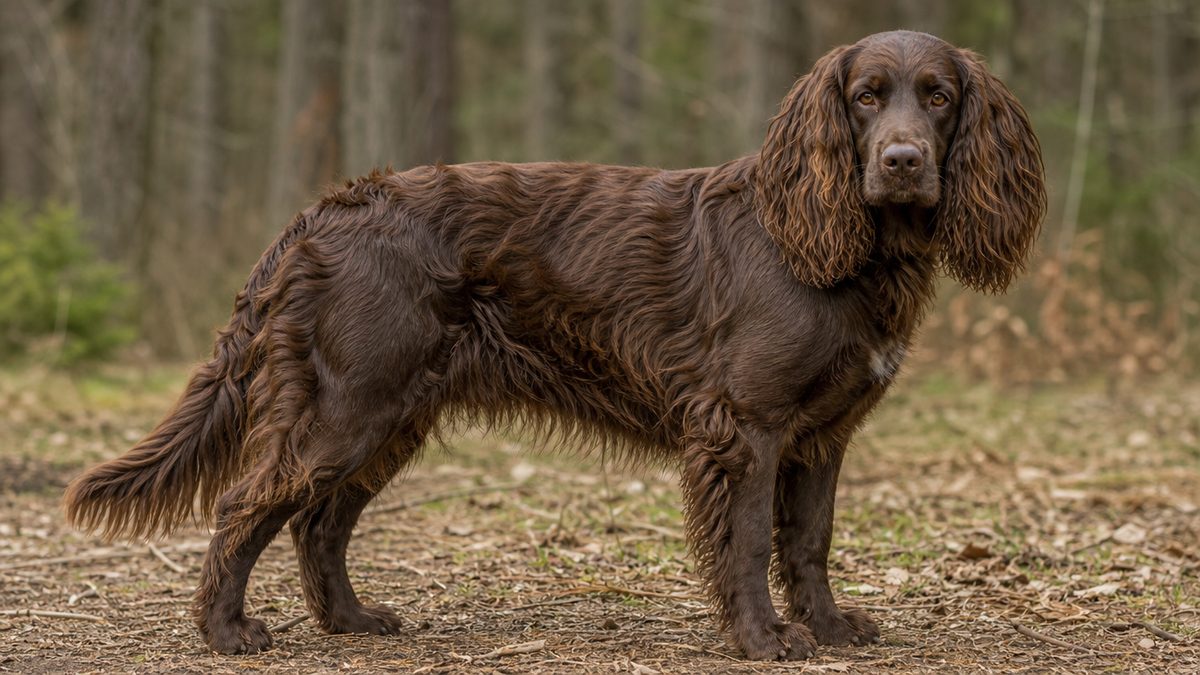
FCI 104 describes a medium-sized, long-haired, very muscular flushing dog with a noble head and strong bone, longer than high but never leggy, with a body-length to height ratio of 1.2 to 1 and a chest-depth to height ratio of 0.5 to 1. Dogs stand 48 to 54 cm and bitches 45 to 52 cm, at 18 to 25 kg. The coat is "Strong, close fitting, mostly wavy, sometimes curly (astrakhan) or smooth long coat, with thick undercoat", with feathering on the rear of the legs and tail, a frequent frill on the neck and a well-coated belly. It comes in two varieties, solid brown and brown roan, and black coat colour is a disqualifying fault.
FCI 104 lists "Too narrow ear channels (disposition for ear trouble)" among its ordinary faults, and lists "Skins problems: Dermatitis, atopy" among its SEVERE faults. A breed standard that names an ear predisposition and an atopy predisposition in writing is telling you exactly what will go wrong in a hot, humid country, and the health section below shows the club's own survey confirming both.
The only German breed in the FCI's flushing-dog section
One document settles where this breed sits. The FCI's Group 8 listing, which prints every breed's section, country, number and standard date on a single page, shows Section 2 Flushing Dogs containing exactly nine breeds, and the Deutscher Wachtelhund 104 is the only German one. Its companions are six British spaniels, the Clumber 109, English Cocker 5, English Springer 125, Field 123, Sussex 127 and Welsh Springer 126, plus the Dutch Nederlandse Kooikerhondje 314 and the American Cocker Spaniel 167.
The same page carries a column most readers never notice, and it separates this breed from two of its section-mates. The Wachtelhund and all six British spaniels carry the working trial asterisk; the Nederlandse Kooikerhondje and the American Cocker Spaniel do not. So of the nine flushing breeds the FCI recognises, this is the only continental one that must still prove itself in the field to be considered complete.
What the Verein fuer Deutsche Wachtelhunde actually requires
A Deutscher Wachtelhund cannot be bred in Germany until it has scored at least grade 5 in five hunting-aptitude subjects, grade 2 at water, grade 8 for gun-steadiness in the woods, at least "good" for conformation, and been X-rayed as hips A, B or C and elbows free or grade 1.
That is breeding approval defined by numbers, and the club publishes the numbers. The Zuchtbestimmungen of the Verein fuer Deutsche Wachtelhunde, in the version carrying the resolutions of the general meeting of 2 June 2018, sets out the whole scheme in its Zuchtordnung. The club was founded in 1903 and is the breed's Stammverein, the parent association that writes the standard and lodges it with the FCI through the VDH.
Its first breeding principle is not a show quality. Clause 1.1 states that the breed was founded on a numerically small starting population and that, to avoid inbreeding depression, "the supreme breeding principle is to preserve the genetic diversity in the breed";. Clause 1.2 implements it: the breed is bred in two separate strains, the browns and the brown roans, with solid red dogs assigned to the browns and red roans to the roans.
| Requirement | The threshold | Clause |
|---|---|---|
| Nose, giving tongue on trail, trail willingness, trail sureness, flushing | At least grade 5, meaning good, once in each | 4.1.4(1) |
| Behaviour at water and water work | At least grade 2, meaning sufficient | 4.1.4(1) |
| Gun-steadiness in the woods | Grade 8, gun-steady | 4.1.4(1) |
| Gun-steadiness at water, if tested | The predicate JA, yes | 4.1.4(1) |
| Conformation | At least the predicate Gut from a conformation judge | 4.1.3 |
| A passed club test | At least one DW test, plus an EP, EPB or GP if bred after 36 months | 4.1.4(2) and 4.1.4(4) |
| Hips | A, B or C only. D and E excluded, as is a breeding value of 115 or more | 4.1.5 |
| Parents' average hip breeding value | At most 105 for browns, at most 100 for roans and mixed matings | 4.1.5 |
| Elbows | ED-free or ED 1. ED 2 and ED 3 excluded, compulsory from birth year 2010 | 4.1.5 |
| Age | Minimum 15 months; bitches not after the eighth birthday; one litter a year | 4.1.6 |
| Blood sample | Required from every dog used for breeding for the first time, sent for DNA | Sonstige Bestimmungen |
Two of those rows have no equivalent in any English-language kennel club. The hip dysplasia rule is not a pass or fail on the individual dog: it uses an estimated breeding value computed from the whole relationship group, recalculated twice a year after the spring and autumn test results, and it caps the average of both parents. So a dog with clear hips can still be barred because its relatives are not.
The radiograph quota, which is the sharpest rule of all
Clause 4.1.9 requires the regional breed warden to check, before issuing a mating certificate, that the breeder has met a compulsory radiograph quota of 30 percent of every litter for hips and elbows, counted from dogs examined between the completed 18th and 36th month against the litter total. If the quota is not met, the mating certificate is refused, and the breeder gets a two-year breeding pause counted from the last litter's whelping date. First-time breeders are exempt because the calculation cannot apply to them.
Stud dogs face a parallel control. A breeding-approved male gets a maximum of three mating tokens a year, with 365 days required between the issue of token one and token four, and before tokens six to nine a quantitative progeny check applies: ten of his offspring must have been radiographed and presented at juvenile tests. That is a club refusing to let a popular sire flood the gene pool untested.
Clause 2.1.1 of the Zuchtbuchordnung grants breeding rights and kennel protection only to members "who are entitled to take out a German hunting licence", with their own household in Germany capable of raising a litter properly. The Test Regulations apply the same gate at the test door: "Handlers must document the possession of a valid hunting license."; This breed is not merely popular with hunters. It is structurally closed to everyone else.
The test system the breeding grades come from
The grades in the breeding rules come from the VDW's own Test Regulations, in English and in force since 1 January 2007, which score every subject from 0 to 9 and require a hunting test panel of three judges who must announce each dog's score to its handler on the spot.
The regulations are old and they say so. Their own preamble records that they rest on the rules adopted at the general meeting in Fuerth-Nuernberg in 1911, with amendments adopted at general meetings in 1918, 1922, 1923, 1926, 1928, 1930, 1933, 1934, 1948, 1949, 1962, 1972, 1982, 1986, 1988, 1992, 1996 and 2006. This is a continuously maintained instrument, not a marketing document.
| Score | Predicate | What it means for breeding |
|---|---|---|
| 9 | excellent, available only for Nose and the Will to Track | Above the requirement |
| 7 and 8 | very good | Grade 8 is the gun-steadiness threshold |
| 5 and 6 | good | Grade 5 is the threshold in the five aptitude subjects |
| 2, 3 and 4 | sufficient | Grade 2 is the threshold at water |
| 1 | not adequate | Below the requirement |
| 0 | insufficient | Below the requirement |
| - | not tested | No result |
Read that table against the breeding rules and the picture sharpens. The club demands the middle of the scale in nose, giving tongue, trail willingness, trail sureness and flushing, the bottom of the sufficient band at water, and a specific high predicate for gun-steadiness. It is not asking for brilliance. It is asking that every breeding dog be demonstrably competent at the job in every one of those subjects, which is a different and harder thing than a show win.
The four tests, and what is in them
- Juvenile Test (JP). For dogs up to 18 months. Subjects are nose, scent-loud hunting, the will to track, tracking proficiency, track reliability, natural flushing ability, behaviour at the water, gunshot soundness and cooperation.
- Versatile Ability Test (EP), and EPB without the hare track. Adds flushing, gunshot soundness in forest and water, a blind retrieve from densely vegetated water, flushing a duck in dense cover, retrieving duck, retrieves from a drag of feathered and furred game, general obedience and blood tracking.
- Utility Test (GP). The full examination: retrieve of hare, optional retrieve of fox, blood tracking on leash, dead-game bayer and dead-game guide, search under the gun, steadiness to gunshot, heeling on and off leash, down stay, obedience during a drive hunt and in the presence of split-hoofed game, and work ethics.
- Performance awards while hunting. Separate awards for natural blood tracking, the Long Distance Hunter, work in the presence of wild boar and the hardness test.
Three procedural details are worth knowing because they are what make the results usable. Each judging team must be three judges, at least two of them VDW judges. Judges may not judge dogs they own, bred or trained, or whose parents they own. And Paragraph 9(3) requires "Open Judging": as soon as a team finishes a category, the senior judge must tell each handler how the dog was evaluated and what score it received.
The results then feed a wider system. The JGHV publishes its by-laws, its regulations on association judgeship and a document titled The German Versatile Dog Studbook in English, which is how a Wachtelhund result becomes comparable with a Drahthaar result across clubs. Its report forms for the association tests and certificates, including the test after shooting, the certificate of loud hunting and the retrieving reliability test, are published in English too.
One more layer sits above the club's own tests. The JGHV publishes a separate index of association test regulations, including the Verbandszuchtpruefungen of 2018, the utility and after-the-shot regulations, the blood-tracking and track-shoe regulations, and, most relevant to this breed, the Ordnung fuer Verbandsstoeberpruefungen in its 2025 edition, which is the association-level regulation for flushing tests specifically. Several of them, including the utility-test and breed-test regulations, are published in English editions, so a reader outside Germany can check what a result on a pedigree actually represents rather than taking a seller's word for it.
How rare the German Spaniel really is, with dates
German breeders registered 357 Deutscher Wachtelhund puppies with the VDH in 2025, against 443 in 2024, 411 in 2023, 536 in 2022 and 662 in 2021, which is the lowest figure in the fifteen years the VDH publishes.
Say the number rather than the adjective. "Rare" is what every breed page says; 357 puppies in one register in one named year is what a reader can check. The full VDH series for this breed runs 357, 443, 411, 536, 662, 568, 619, 569, 604, 590, 564, 642, 556, 578 and 577 for 2025 back to 2011. Two things stand out. The breed sat between 556 and 662 for fourteen straight years, and then dropped 46 percent in four years to 357.
That drop is partly the German market and partly not. Total VDH registrations across every breed fell from 85,595 in 2021 to 55,053 in 2025, a decline of 36 percent. So the Wachtelhund fell faster than the market, but not dramatically faster. What it does mean is that a reader who finds a 600-a-year figure quoted on an older page is reading a number that has since moved.
| Breed | 2025 | 2024 | 2023 | 2022 | 2021 |
|---|---|---|---|---|---|
| Deutsch Drahthaar | 2,215 | 2,587 | 2,618 | 3,119 | 3,629 |
| Deutsch Kurzhaar | 1,198 | 1,236 | 1,278 | 1,304 | 1,842 |
| Kleiner Muensterlaender | 1,102 | 1,059 | 1,226 | 1,227 | 1,448 |
| Deutsch Langhaar | 382 | 358 | 374 | 468 | 581 |
| Deutscher Wachtelhund | 357 | 443 | 411 | 536 | 662 |
| Grosser Muensterlaender Vorstehhund | 277 | 284 | 306 | 340 | 452 |
| Pudelpointer | 105 | 111 | 135 | 116 | 214 |
| Deutsch Stichelhaar | 15 | 46 | 32 | 44 | 48 |
| All VDH breeds combined | 55,053 | 56,851 | 60,306 | 69,381 | 85,595 |
Read in that company the breed is uncommon rather than endangered. It registers roughly one puppy for every six Deutsch Drahthaar, sits just below the Deutsch Langhaar, and outnumbers the Deutsch Stichelhaar by about 24 to one. It is a working population of a few hundred litters a year, entirely inside a hunting community.
Where else it is registered
The American Kennel Club records the breed rather than recognising it. Its own list of Foundation Stock Service breeds, revised 10 June 2026 and stating that "There are currently 88 breeds in the FSS program", places the Deutscher Wachtelhund in the Sporting Group among 17 FSS sporting breeds, alongside the German Longhaired Pointer, the Pudelpointer, and both Muensterlaenders. FSS status means the AKC keeps a record of pedigrees; it does not mean the breed can be shown at an AKC conformation event as a recognised breed.
The Orthopedic Foundation for Animals carries the breed twice under two codes, read out of its own raw markup: `value="GSL" data-name="GERMAN SPANIEL"` with no group and no key at all, and `value="DW" data-name="WACHTELHUND"` filed under Sporting with the note "AKC Sporting Group (DEUTSCHER WACHTELHUND); UKC Gun Dog Group (DEUTSCHER WACHTELHUND)";. Holding a code is not the same as having data, and the health section returns to what OFA actually publishes for this breed, which is nothing.
India is an FCI Full member represented by the Kennel Club of India at Nr 28, AA Block, First street Anna Nagar, Chennai 600 040, so a KCI pedigree would be issued against FCI nomenclature and this breed would be FCI 104 on it. But the KCI publishes no breed-by-breed registration statistics, so kennel club registration numbers for India do not exist for this or any breed. Any page giving you an Indian population figure is guessing.
German Spaniel price in India: there is no verifiable one
No Indian price in india figure for the German Spaniel could be verified, because the single Indian listing a search surfaced sat on a site that returned HTTP 403 behind a CAPTCHA when it was opened.
That is the honest answer and it is more useful than an invented band. A search restricted to India for this breed's name and price returned ten results. One was a United States breed directory. One was a Scribd copy of the Wikipedia article. One was an Indian classifieds page for the breed. The other seven were merchandise: an Etsy wall clock, an Amazon book of do-it-yourself Christmas cards, a Facebook post about a 2005 postage-stamp sheetlet, a European breed-comparison page, a Pinterest board, an eBay guide and a gift mug on an Indian import site.
When the one Indian classifieds URL was fetched, it returned HTTP 403 with a page reading "PetzLover - Verify You Are Human" and a CAPTCHA image. A search snippet is drawn from a crawler's index, not from a live fetch, so nothing on that page has been used here. Bonbeno does not publish a price it could not open the page to read.
What a puppy cost would look like if a supply chain existed
It does not exist, and the reason is structural rather than accidental. Breeding rights in the VDW go only to members entitled to take out a German hunting licence, with a household in Germany. Puppies may not be released before the day after the eighth week and may not be sold or transferred to pet shops or the commercial dog trade at all, on pain of expulsion from the club and blocking of the studbook. A club that expels members for selling into the trade is not going to supply an Indian retail market.
So the routes that would have to exist do not. There is no Indian breed club. There is no Indian registration series. Neither of India's two largest puppy marketplaces carries the breed. And the German club's own rules block the commercial channel at source.
If an Indian seller advertises a German Spaniel, the probability is very high that the animal is something else. The name invites confusion with the English Cocker Spaniel and the English Springer Spaniel, both common in India, and "German" invites confusion with the German Shepherd. Ask for the pedigree, ask which register issued it, and verify that the document names Deutscher Wachtelhund or FCI 104. A photograph is not a pedigree.
One more thing worth saying plainly. This page carries no rupee figure at all, and that is the correct outcome rather than a gap. The only ways to produce one would be to convert a foreign price or to repeat an unverified listing, and both are fabrication. Where an Indian market genuinely does not exist, saying so is the finding.
Suitability for the Indian climate
Munich, in the southern German country where this breed was founded, has never had a month whose 30-year mean temperature reached 25 degrees Celsius, while Chennai has ten such months a year, and that gap is the whole heat tolerance answer for a thick-undercoated woodland dog.
The figures below come from NASA's Prediction Of Worldwide Energy Resources climatology, 1991 to 2020, queried by explicit latitude and longitude so that no place-name slug can hand back a different city. Wet-bulb temperature is computed from the same air temperature and humidity fields using Stull's approximation, and it matters more than air temperature because a panting dog cools by evaporation and evaporation stalls as the air approaches saturation.
| Place | Annual mean C | Hottest month | Peak wet-bulb month | Months over 25 C |
|---|---|---|---|---|
| Munich, Germany (48.135 N, 11.582 E) | 8.25 | Jul, 17.97 | Jul, 15.29 WB | 0 of 12 |
| Hannover, Germany (52.376 N, 9.732 E) | 9.29 | Jul, 18.52 | Jul, 15.43 WB | 0 of 12 |
| Chennai (13.083 N, 80.271 E) | 27.91 | May, 31.57 | May, 26.03 WB | 10 of 12 |
| Mumbai (19.076 N, 72.878 E) | 26.65 | May, 31.03 | Jun, 25.68 WB | 9 of 12 |
| Kolkata (22.573 N, 88.364 E) | 25.83 | May, 31.55 | Jun, 26.99 WB | 8 of 12 |
| Delhi (28.614 N, 77.209 E) | 25.65 | Jun, 35.95 | Jul, 26.43 WB | 7 of 12 |
| Pune (18.520 N, 73.857 E) | 23.74 | Apr, 28.74 | Jun, 22.90 WB | 4 of 12 |
| Bengaluru (12.972 N, 77.595 E) | 23.63 | Apr, 28.41 | May, 21.74 WB | 3 of 12 |
| Dehradun (30.317 N, 78.032 E) | 17.94 | Jun, 26.21 | Jul, 20.85 WB | 2 of 12 |
| Shillong (25.579 N, 91.893 E) | 17.87 | Jul, 22.37 | Jul, 21.29 WB | 0 of 12 |
Munich's worst month averages 15.29 C wet-bulb. Kolkata's worst averages 26.99 C, which is 11.70 points higher. Chennai reaches 26.03, Delhi 26.43 and Mumbai 25.68. Even Bengaluru, the mildest large Indian metro on the list, runs 21.74 against Munich's 15.29, a gap of 6.45 points in the friendliest comparison available.
Chennai deserves its own line. Its coolest month, January, averages 23.99 C. Munich's hottest month, July, averages 17.97 C. The coldest month of the year in Chennai is 6.02 C warmer than the warmest month of the year in the breed's home region.
The coat is the problem, and the standard describes it precisely
This is not a short-coated gundog. FCI 104 asks for a coat that is "Strong, close fitting, mostly wavy, sometimes curly (astrakhan) or smooth long coat, with thick undercoat", explicitly faults a "Thin, sparse or silky coat" and a "sparsely coated belly", and requires the underside to be "covered as much as possible by protective hair and undercoat". Feathering runs down the rear of the legs and the tail, the ear leathers are covered with curls or dense wavy hair, and there is often a frill on the neck.
Every one of those features is insulation designed for cold, wet German woodland, and every one of them holds water in an Indian monsoon. A double coat that thins seasonally needs a temperate photoperiod and temperature cycle to trigger the moult, which most of India does not provide. The dog does not stop being a woodland dog because it moved.
None of this makes the breed unkeepable in Dehradun, Shillong or a hill station. It makes it a poor proposition in Chennai, Mumbai, Kolkata or Delhi, and it means the exercise has to move to the cool hours rather than shrink.
Heat management, and what the research actually says
Move the work to the coolest hours and keep the dog lean, because the largest UK study of heat-related illness found exertion rather than hot cars to be the dominant trigger, and bodyweight at or above the breed and sex mean carried an odds ratio of 1.42. Hall EJ, Carter AJ
Hall, Carter and O'Neill, writing in *Animals* in 2020, studied 905,543 UK dogs under primary veterinary care in 2016 and recorded 1,259 heat-related illness events from 1,222 dogs. Of those, 380 had no trigger recorded, leaving 879 with a recorded trigger, of which 652 were exertional, which is 74.2 percent of the events with a recorded trigger. Environmental heat accounted for 113 at 12.9 percent and vehicular confinement for 46 at 5.2 percent. The percentages are computed on 879 rather than on 1,259, and quoting them against the larger number would overstate the exertional count by more than 40 percent.
The same authors, writing in *Scientific Reports* in the same year on the same cohort but with a different case definition, counted 395 confirmed events from 390 dogs, put the 2016 incidence at 0.04 percent and the event fatality rate at 14.18 percent, and found dogs at or above their breed and sex mean bodyweight carried an odds ratio of 1.42, interval 1.12 to 1.80. Two papers, two case definitions, neither correcting the other. Name the journal, never a bare year.
One further finding from the *Scientific Reports* paper transfers here and is worth an Indian reader's attention: purebred dogs carried 1.86 times the odds of crossbred dogs, interval 1.39 to 2.49. At 18 to 25 kg this breed is nowhere near the over-50 kg band that carried an odds ratio of 3.42, so the transferable risk factors are the bodyweight one and the purebred one.
A practical schedule
- Chennai, Mumbai, Kolkata. Before sunrise and after dark, all year. There is no month in Chennai that is not restricted, and Kolkata's June wet-bulb of 26.99 C is the highest figure on this page.
- Delhi. Use December to February for anything demanding. A January mean of 13.83 C is the closest an Indian plain comes to a German autumn; July and August at a 26.43 C wet-bulb are the hardest weeks of the year.
- Pune and Bengaluru. Morning work is realistic most of the year. Bengaluru's peak wet-bulb of 21.74 C is the mildest metro figure here.
- Dehradun and Shillong. The genuinely workable options. Shillong has no month averaging above 25 C at all.
- Everywhere. Swim where the water is clean, because a dog whose breeding approval depends on water work will swim willingly and swimming removes air temperature from the equation. Dry the ears afterwards, every time.
Know the warning signs before you need them. Heavy panting that does not settle within a few minutes of stopping, bright red gums, unsteadiness and vomiting are an emergency rather than a rest break. Cool the dog with tap-temperature water over the whole body and get to a clinic rather than waiting to see whether it improves.
Temperament, and the trait Indian buyers will notice first
The German Spaniel is a lively, affectionate, very docile and adaptable dog that is also sharp with game and vermin and gives tongue reliably on a trail, and that last trait is the one an Indian apartment building will notice within a week.
FCI 104 sets out the temperament in two parts and both matter. The general line reads "Lively, passionate hunter, friendly, assured, very docile and adaptable, neither nervous nor aggressive." Then it lists the breed's defining characteristics, and they are working characteristics: possessed of a strong desire to find; able to pick up scent, firm in tracking; reliable at giving tongue; a fine nose; likes retrieving and work in water; sharp with game and vermin; working independently but in a controlled manner when appropriately trained and guided.
"Reliable at giving tongue" means the dog barks while following a scent, and it is not a fault to be trained out. It is a graded breeding requirement: the club demands at least grade 5 in Spurlaut, giving tongue on the trail, before a dog may be bred. A century of selecting for a vocal trailing dog does not switch off in a flat in Bandra.
The club's own rules also treat the opposite fault seriously. Dogs judged waidlaut, meaning giving tongue with no game present, are excluded from breeding, and so are dogs proven silent. The breed is bred to bark at the right time, precisely.
Sharp with game and vermin
That phrase in the standard is doing a lot of work. The club's testing includes a performance award for work in the presence of wild boar and a hardness test under JGHV rules. This is a dog selected to face and hold dangerous game. On an Indian street it will meet cats, monkeys, poultry, street dogs and traffic, and the standard is telling you in advance how it will respond. Manage the environment rather than testing the dog.
Who this breed suits, and who it does not
- It suits someone in a hill station or a cool-climate town with land, who wants a scent-working dog and will do formal tracking, retrieving and swimming work several times a week for a decade.
- It suits a household that is home most of the day and is untroubled by a dog that vocalises.
- It does not suit an apartment. A vocal, scent-driven, thick-coated woodland dog in a shared building with neighbours below is a complaint waiting to happen.
- It does not suit a first-time owner. The standard describes a dog that works independently and needs appropriate training and guidance to stay controlled.
- It does not suit a household with free-ranging small pets, poultry or rabbits. Sharp with vermin means what it says.
- It does not suit anyone who has not seen the breed in person, which in India means almost everyone reading this.
The one genuinely reassuring number comes from the club's own health survey. Asked whether they would get another Deutscher Wachtelhund, 90 percent of the participating owners said yes, and the authors describe satisfaction with the breed as very high. These are hunters answering about a hunting dog, so it is not a general-purpose endorsement, but within its own world the breed is clearly well liked.
Training a dog graded on nose and obedience
Train this breed with structured, reward-based work from eight weeks and give it a scent job, because it is highly trainable in its own domain and the German test system grades cooperation and general obedience alongside nose and tracking.
The Utility Test tells you what the ceiling looks like. A fully trained Wachtelhund is expected to demonstrate heeling on and off leash, a down stay, obedience during a drive hunt, obedience in the presence of split-hoofed game, steadiness to gunshot, retrieve reliability and work ethics, on top of the nose and water work. A dog capable of that is capable of anything an Indian household needs, provided somebody actually does the work.
The Juvenile Test sets the other end. It is open to dogs up to 18 months and grades nose, scent-loud hunting, the will to track, tracking proficiency, track reliability, natural flushing ability, behaviour at the water, gunshot soundness and cooperation. Cooperation is scored on the same 0 to 9 scale as the nose. The system treats biddability as a heritable trait to be measured, not a training outcome.
A realistic Indian plan
- Weeks 8 to 16. Socialise deliberately and daily. Lifts, autos, traffic, monsoon rain on a metal roof, delivery riders, the security desk, cows, street dogs at a safe distance. Reward calm observation, never forced greeting.
- Weeks 10 to 20. Start ear, foot and coat handling now. You will be drying ears and combing feathering for the next twelve years and a dog that objects makes both jobs impossible.
- Weeks 12 to 24. Build a recall on a 10 metre long line before the prey drive matures, and pay for it every single time in the first year.
- Months 4 to 12. Give the nose a job: scent games, a dragged article, a formal retrieve. A dog bred for a strong desire to find will find something whether you direct it or not.
- Months 6 to 18. Work on the barking specifically. You cannot remove it, but you can put it on cue and teach an alternative behaviour, and doing that early is far easier than doing it after a neighbour complains.
One method note. The club's rules exclude from breeding any dog that is gun-shy, game-shy, nervous or a fear-biter, so the population has been selected for stability rather than for tolerance of pressure. Markers, food and retrieves work. A dog that shuts down under a heavy hand is not being stubborn.
Daily exercise, and why swimming is the Indian answer
Give an adult German Spaniel two hard sessions a day plus scent work, and exercise it in water wherever the water is clean, because water work is a graded breeding requirement for this breed and swimming takes air temperature out of the equation.
The breed's own rulebook is the best guide to its needs. Before a Wachtelhund can be bred it must score at least grade 2 in behaviour at the water and water work, and the Versatile Ability and Utility tests require a blind retrieve from densely vegetated water, flushing a duck out of dense cover in water, and a duck retrieve from deep water. Verein fuer Deutsche Wachtelhunde This is not a dog that tolerates water. It is a dog examined on it.
| Session | When | What | Why |
|---|---|---|---|
| Morning, 45 to 60 min | Before sunrise | Off-lead running in a secured space or a long line plus retrieves | The only window in Chennai, Mumbai or Kolkata where sustained work is survivable |
| Midday, 15 min | Indoors | Scent games, a snuffle mat, a food puzzle, a settle-on-mat session | Nose work substitutes for physical work when the heat closes the window |
| Evening, 45 to 60 min | After dark | Swimming where clean water exists, or a structured walk plus training | Concrete radiates heat after sunset, so wet and shaded options beat pavement |
| Weekly | Any cool day | A long hike, a tracking session on a dragged article, a swim | This is the session that prevents the weekday destruction and barking |
Two cautions attach to the water. Dry the ear canal opening every single time, for the reasons the grooming and health sections set out. And avoid standing urban water during and after the monsoon, when leptospirosis risk is highest in Indian cities.
What under-exercise produces
Not a calm dog. A barking one. The club's health survey found that 456 dogs, 21.3 percent of the 2,143 in the sample, were temporarily restricted from hunting by a problem or illness and 120, 5.6 percent, permanently. Those are dogs whose owners were actively trying to work them. A dog with no job at all, in a flat, in a hot city, has nothing to be restricted from and everything to invent.
Coat care in Indian humidity, and the ears above all
Groom this coat weekly at minimum and dry the ears daily through the monsoon, because the breed's own club found ear problems in 608 of 2,143 dogs, 28.4 percent, in a temperate country, and the FCI standard already names narrow ear channels as a fault predisposing to ear trouble.
Start with what the coat is. FCI 104 describes hair that is "Strong, close fitting, mostly wavy, sometimes curly (astrakhan) or smooth long coat, with thick undercoat", with the rear of the legs and the tail "well feathered", frequently a frill on the neck, a well-coated belly, and ear leathers "covered by curls or dense wavy hair which also reaches beyond their inner edge";. Interdigital gaps carry dense hair too.
Now translate that into Indian coat care. Every one of those features is a moisture trap. The feathering wicks water up the legs, the belly coat picks up wet ground, the neck frill holds sweat and rain against the skin, the interdigital hair keeps the feet damp, and the ear leathers sit over the canal with dense hair on both sides of the opening.
- Twice weekly. Comb the whole coat through to the skin with a coarse comb, then a slicker. Check the armpits, groin, ear bases and between the toes for damp or matted hair.
- Daily in the monsoon. Towel the ear leathers, the leg feathering and the belly after every walk. Do not let a wet dog air dry indoors, which is standard advice in a cold climate and wrong in Indian humidity.
- After every swim or bath. Dry the ear canal opening with cotton wool, never a bud pushed into the canal, and let the dog shake before towelling.
- Every 6 to 10 weeks. Tidy the feathering and the hair between the pads. This is trimming for hygiene rather than for style, and it materially reduces the moisture load.
- Monthly. Nails and pads. The club's survey found nail problems in 225 dogs, 10.5 percent, which is high enough to be worth a routine check.
The Indian ear evidence, with the arithmetic
An Assam study screened 5,312 dogs presented at a veterinary clinical complex, found 572 with ear affections and confirmed 112 cases of otitis, an overall prevalence of 2.11 percent. The seasonal split reconciles exactly: 47 cases in the monsoon, 32 post-monsoon, 19 in winter and 14 pre-monsoon, summing to 112 and giving occurrences of 41.96, 28.57, 16.96 and 12.50 percent. Monsoon prevalence within the season was 3.77 percent of 1,248 dogs presented.
One discrepancy is worth flagging rather than hiding. Recomputing the pre-monsoon prevalence from the paper's own counts gives 14 of 1,852, which is 0.76 percent rather than the printed 0.74. Every other row reconciles to the decimal, so this reads as a rounding slip and the seasonal pattern is unaffected.
The ear-carriage table is the one that matters here. Of the 112 confirmed cases, 73 were in pendulous-eared dogs and 39 in erect-eared dogs, which is 65.19 against 34.81 percent and sums correctly. The Deutscher Wachtelhund has leathers "set on high and broad, flat without any twist, hanging directly behind eye" which, laid forward, "reach nose leather";. That is a long, heavy, densely furnished drop ear over a canal the standard already flags as a risk, on a dog you are being encouraged to swim. An ear infection here is a predictable event, not bad luck.
Health: the breed club published its own survey, and the numbers are usable
The Verein fuer Deutsche Wachtelhunde surveyed owners of 2,143 dogs born between 2001 and 2009 and found that 37 percent had no problem reported at all, while ear problems affected 608 dogs at 28.4 percent, skin changes 271 at 12.6 percent, skin allergies 220 at 10.3 percent, eye problems 233 at 10.9 percent and epilepsy 61 at 2.8 percent.
That is a real breed health issues dataset, published by the club itself, and it is rarer than the breed is. Over 5,000 questionnaires went to owners in Germany, 2,237 came back, and 2,143 carried usable answers, a 42.8 percent return. The authors, Dr Helga Adolph and Wilfried Schlecht, checked representativeness by comparing the response rate among dogs already known to the studbook office as epilepsy-suspect against the overall return, and found both around 40 percent.
The origin story is worth telling because it explains the candour. The survey was commissioned after reports reached the studbook office that Wachtelhunde had epilepsy and in some cases had died of it, after "black lists" of affected dogs began circulating on social media, and after claims about a large unreported number unsettled breeders and owners. The club's answer was to run a 5,000-questionnaire survey and publish the result, with funding support from the Margarete Mueller-Bull Stiftung and the Gesellschaft fuer kynologische Forschung. The authors write that they hope to have made a contribution to openness and transparency in breeding management.
| Finding | Dogs | Percent | Check |
|---|---|---|---|
| No problems or illnesses of any kind | not stated as a count | 37% | Stated directly in the summary |
| Some problem or illness of any kind | not stated as a count | 63% | Stated directly in the summary |
| Ear problems | 608 | 28.4% | 608 of 2,143 = 28.37% |
| Skin changes | 271 | 12.6% | 271 of 2,143 = 12.65% |
| Eye problems | 233 | 10.9% | 233 of 2,143 = 10.87% |
| Nail problems | 225 | 10.5% | 225 of 2,143 = 10.50% |
| Skin allergies | 220 | 10.3% | 220 of 2,143 = 10.27% |
| Any illness reported | 700 | 32.7% | 700 of 2,143 = 32.66% |
| Cancers and mammary tumours | 256 | not stated | The largest single illness group |
| Food intolerance | 123 | not stated | Reported separately |
| Epilepsy | 61 | 2.8% | 61 of 2,143 = 2.85% |
| Permanently restricted for hunting | 120 | 5.6% | 120 of 2,143 = 5.60% |
| Temporarily restricted for hunting | 456 | 21.3% | 456 of 2,143 = 21.28% |
Every figure in that table reproduces from its own denominator, which is more than can be said for several statistics this site has had to correct elsewhere. The survey also examined the elbow condition IOCH, incomplete ossification of the humeral condyle: ten handlers reported it directly, while 66 reported that their dog had had an elbow operation, of which a veterinarian's estimate attributed about 15 to IOCH. A further 322 owners reported that their dogs regularly spare a leg.
What the club did about epilepsy
Two things, and both are in the rulebook rather than in a press release. Clause 6.2 states that breeding suitability lapses if the dog itself suffers epileptiform seizures, or if two or more dogs in the group comprising its parents, full siblings and direct offspring suffer them. Clause 7 makes reporting compulsory: breed wardens, judges, board members, breeders and every handler of a hereditarily ill dog must report to the breeding director and the studbook office, with a veterinary certificate, for entry into the club database. Suspected cases may not be published.
The survey went further and applied an estimated genotype-probability calculation to epilepsy, finding that for the five dogs affected by seizures in the 2010 to 2012 birth years, the calculated probability lay clearly above that of all dogs in those years, and concluding that using the method for breeding management over a multi-year observation period appears worthwhile.
A live search of OFA's full disease-statistics dump, roughly 2.21 million characters, found zero occurrences of WACHTELHUND and zero of GERMAN SPANIEL, while controls run in the same session returned 109 occurrences of LABRADOR and 749 of SPANIEL. The absence is real rather than a broken query. OFA requires 100 hip evaluations, or 50 for its other databases, before a breed is published, so the correct sentence is that this breed has no row in OFA's published statistics tables, not that it is absent from the database.
Life expectancy: no verifiable breed figure
No published life expectancy for this breed could be verified. FCI Standard 104 gives none. The club's health survey reports problems rather than survival. And the largest UK longevity study, covering 584,734 dogs including 284,734 deceased across 155 breeds, reports medians by size class of 12.7 years for small purebreds, 12.5 for medium and 11.9 for large, without a row for this breed. At 18 to 25 kg the breed sits in the medium class, so 12.5 years is the best available anchor and it is a class median rather than a breed figure. Bonbeno publishes no breed-specific number here because none exists.
Indian law, and where it is stricter than the German club
Indian law is stricter than the German breed club on two points that matter: it sets the minimum breeding age at 18 months against the club's 15, and it prohibits cousin, uncle-niece and grandparent matings outright where the club regulates only first-degree pairings.
Second Schedule Part II paragraph 5(2) of the Prevention of Cruelty to Animals (Dog Breeding and Marketing) Rules, 2017 provides that "Only normal, healthy, mature female dogs that have reached their eighteenth month shall be bred", with certification by a veterinary practitioner at least ten days before mating, and paragraph 5(7) applies the same eighteenth-month floor to males. The VDW's clause 4.1.6 sets 15 months. A mating that is correct in Germany would be unlawful here.
| Question | VDW Zuchtbestimmungen | Indian Rules, 2017 | Stricter |
|---|---|---|---|
| Minimum breeding age, bitch | 15 months (4.1.6) | 18 months (Sch. II Pt II para 5(2)) | India |
| Minimum breeding age, dog | 15 months (4.1.6) | 18 months (para 5(7)) | India |
| Maximum age, bitch | Not after the eighth birthday (4.1.6) | Not mated after age eight (para 6(4)) | The same |
| Litters per year | As a rule one a year (4.1.6) | Only one litter in one year (para 5(5)) | The same |
| Litters per lifetime | No cap stated | No more than five (para 5(6)) | India |
| Cousin, uncle-niece, grandparent matings | Not restricted | Prohibited to the fourth generation (para 6(3)) | India |
| Parent-child and full-sibling matings | Permitted only on prior application, purpose stated (8.2) | Prohibited outright (para 6(3)) | India |
| Half-sibling matings | Not named in the club's incest definition | Not named in the Indian definition either | Neither |
| Tail docking | Breeder must observe s.6(1) of the German animal welfare act (5.6) | Strictly forbidden (para 6(8)) | India |
| Minimum age at sale | Day after completion of the eighth week (5.6) | Pups under eight weeks not sold (Rule 8(1)(a)) | The same |
| Hip and elbow screening | Compulsory, with grade limits and a 30% litter quota (4.1.5, 4.1.9) | Testing for genetic defects including hip dysplasia (Pt III para 8(10)) | Germany, in specificity |
"(3) The following two mating techniques are not permitted and are prohibited under these rules, namely:- (i) in breeding - mating between dogs that are related, which means that at least one ancestor of either is present on the side of both sire and dam and in breeding is breeding between relatives of the 2nd to 4th grade in straight or side line within the first four generations e.g. uncle to niece, nephew to aunt, cousin to cousin, grandparents to grandchildren; (ii) incest breeding - mating between parents and children or between brother and sister, i.e. 1st grade relatives"
Note the citation form. This is a paragraph of the Second Schedule, not a Rule, so it is Second Schedule Part II para 6(3) and never "Rule 6(3)". The Rules' own Rule 6 is a different provision headed "Requirements to be met by breeders and establishments", and it is what gives the Schedule its force.
The German club's clause 8 takes a different approach to the same problem. It defines incest breeding as sibling pairing and father-to-daughter or son-to-mother, requires the breeder to apply in advance through the regional breed warden stating the purpose, allows the breeding director to refuse, and requires the entire resulting litter to be presented at a juvenile test for assessment of form, temperament and hereditary faults. Puppies from unapproved incest matings receive only a descent certificate rather than a pedigree and are provisionally breeding-blocked. That is careful supervision of a technique a breed with a tiny founding population may occasionally need. Indian law simply forbids it.
Docking, and the standard's own escape clause
FCI 104 says that "To avoid injury, the tail should be shortened (docked) by not more than a third during the first three days after birth" and then provides the exit: "In countries where docking is not permitted, the tail can be left natural."; Second Schedule Part II paragraph 6(8) of the Indian Rules prohibits tail docking, ear cropping, de-barking, de-clawing and "any other kind of mutilation of any body part of the pup", and states that "any change of appearance by artificial means is strictly forbidden";.
So a full-tailed German Spaniel is correct under the FCI standard in India and a docked one is unlawful. Any seller who tells you a docked tail is required for this breed is describing a procedure that is illegal here, and is also misreading a standard that anticipated exactly this situation.
What a German Spaniel would cost to keep in India
Budget roughly Rs 5,500 to Rs 12,000 a month for a 20 kg double-coated dog in an Indian metro, with grooming and ear care taking a larger share than for a short-coated breed of the same size.
No Indian monthly cost figure exists for this breed, because no Indian page publishes one and no Indian population exists to survey. What follows is a structure with its assumptions visible, so a reader in Dehradun and a reader in Chennai can both adjust it. It is not a quoted figure and should not be read as one.
| Line | Indicative monthly range | What drives it |
|---|---|---|
| Food | Rs 2,500 to Rs 4,500 | An 18 to 25 kg working-bred dog eats more than a sedentary dog of the same weight |
| Preventive veterinary care | Rs 700 to Rs 1,500 | Vaccination, monthly tick and flea control, deworming. Not optional in India |
| Grooming | Rs 800 to Rs 2,000 | A wavy double coat with feathering, combed twice weekly and tidied every 6 to 10 weeks |
| Ear and skin care | Rs 400 to Rs 1,000 | Higher than for most breeds, because the standard names both ear channels and atopy |
| Exercise and enrichment | Rs 500 to Rs 1,500 | Long lines, retrieving dummies, scent-work kit, replacement toys |
| Contingency and insurance | Rs 600 to Rs 1,500 | The realistic large bills are chronic ear disease, skin work-ups and an elbow |
That totals roughly Rs 5,500 to Rs 12,000 a month. The line that separates this breed from a short-coated dog of the same size is the third and fourth together: grooming plus ear and skin care runs Rs 1,200 to Rs 3,000, which is a fifth of the budget going on a coat that was designed for German woodland.
One further point about expensive care that Indian owners underestimate. Chronic otitis in a heavy drop-eared breed is not a one-off cost. It is repeat consultations, cytology, culture and sensitivity, medicated flushes, and in the worst cases surgery. In a breed whose own club records ear problems in 28.4 percent of dogs in a temperate climate, budgeting for it is realistic rather than pessimistic.
Absent from the table is any screening cost, because no Indian body requires hip or elbow radiography. In Germany the club requires both, caps the grades, uses estimated breeding values and enforces a 30 percent litter quota, and the breeder pays for all of it. An Indian buyer pays none of that and receives none of what it buys, which is the honest way to think about what a pedigree from outside that system is worth.
Feeding a working dog in a hot country
Feed an adult German Spaniel to a visible body condition rather than to a chart, because bodyweight at or above the breed and sex mean carried an odds ratio of 1.42 for heat-related illness and this is a dog whose exercise India forces you to compress.
The nutrition argument for this breed in India is short and evidence-led. Hall and colleagues in *Scientific Reports* found dogs at or above their relative breed and sex mean bodyweight had 1.42 times the odds of heat-related illness, with a confidence interval of 1.12 to 1.80. An Indian summer compresses this dog's working window for months while its appetite stays where it was, and that is how a lean flushing dog becomes a heavier one.
- Puppy, 8 weeks to 4 months. Four meals a day, then three. Do not push growth. The breed's own club requires hip and elbow radiographs before breeding and its survey recorded elbow surgery in 66 dogs, so joints are worth protecting from the start.
- 4 to 12 months. Two or three meals. Reassess the ration monthly against the ribs rather than against the bag.
- Adult. Two meals a day, and cut the ration when the season closes the exercise window rather than after the weight appears.
- Around exercise. Feed at least an hour after hard work and do not work a dog hard on a full stomach.
- Water. Free access always, and carry it on every walk from March to October.
Judge condition by hand each week. FCI 104 asks for a dog "Tucked up moderately from last (false) rib to rear" with skin that is "Coarse and close fitting, no folds";. A Wachtelhund that has lost its tuck-up is carrying weight, whatever the scale says, and on a heavily coated dog the scale is easier to fool than the hand.
The skin question, which is a feeding question here
This is one of the few breeds where diet and the standard intersect directly. FCI 104 lists "Skins problems: Dermatitis, atopy" among its severe faults, and the club's survey found skin changes in 271 dogs and skin allergies in 220, 12.6 and 10.3 percent respectively, plus food intolerance reported for 123 dogs. Adolph H, Schlecht W. Gesundheit beim… In Indian humidity, atopic and food-responsive skin disease are both harder to manage than in a dry temperate climate.
The practical implication is not a special diet. It is that a dog of this breed with recurrent itching, ear disease and paw licking deserves a proper veterinary work-up including a diet trial rather than a series of shampoo changes, and that the owner should keep a written record of what was fed and when. Storage matters too: kibble spoils fast in monsoon humidity, so buy smaller bags more often and keep them sealed.
The first year, month by month
Bring a puppy home no earlier than eight weeks, because Rule 8(1)(a) of the 2017 Rules requires that "pups less than eight weeks in age are not sold" and the German club's own rule permits release only from the day after the eighth week is completed. Verein fuer Deutsche Wachtelhunde e.V.
Both systems land on the same floor from opposite directions, which is worth knowing because it means eight weeks is not a preference anyone can negotiate. The VDW adds two conditions of its own: the litter inspection happens at the earliest in the eighth week, every puppy must be chipped, and the breeder must produce an international vaccination passport showing basic immunisation of at least distemper, hepatitis, leptospirosis and parvovirus, with worming at least three times before that.
| Age | What matters most | The Indian complication |
|---|---|---|
| 8 to 10 weeks | Settling, house training, vaccination, daily gentle handling of ears and feet | Avoid arriving in peak May heat in a plains city if the timing can be chosen |
| 10 to 16 weeks | The socialisation window. Deliberate positive exposure to city noise, surfaces, people | Lifts, autos, generators and monsoon rain on metal roofs are the specific Indian sounds |
| 4 to 6 months | Recall on a long line before the prey drive matures. Tick prevention starts permanently | Teething coincides with the monsoon in most of India, so dry the ears and coat daily |
| 6 to 9 months | Impulse control, settle work, first scent games, work on the barking | Growth plates still open, so avoid repetitive concrete running and forced stairs |
| 9 to 14 months | Adolescence. The recall degrades and the boundaries get tested | This is when Indian rehoming peaks. Shorten sessions and keep the long line on |
| 14 to 24 months | Adult workload builds. Hip and elbow radiography becomes meaningful | Two sessions a day in the cool hours becomes the permanent shape of the routine |
One date is worth marking. The German club counts its compulsory radiograph quota from dogs examined between the completed 18th and 36th month, and its juvenile test is open to dogs up to 18 months. Verein fuer Deutsche Wachtelhunde If you ever want to know what you actually have, radiography between 18 and 36 months is the window the breed's own system uses.
The dam, with the litter, where they were raised. The pedigree, and which register issued it, with the words Deutscher Wachtelhund or FCI 104 on it. The parents' hip and elbow results with the certificates rather than a verbal claim. The test results on the pedigree, since the VDW records them there. The vaccination and worming record. If a seller in India cannot produce the first item, nothing else on the list is worth checking.
Head to head against the breeds an Indian buyer would actually be choosing between
An Indian reader who has landed on this breed is realistically choosing between an English Cocker or Springer Spaniel, a German gundog they can actually find, and an adopted Indian dog, and on availability alone the German Spaniel loses all three comparisons.
| Breed | German 2025 registrations | Findable in India? | Coat in Indian humidity | Verdict |
|---|---|---|---|---|
| Deutscher Wachtelhund (German Spaniel) | 357 | No verifiable listing | Wavy double coat, feathering, heavy drop ears | Not obtainable, and not suited to the plains |
| Deutsch Drahthaar (German Wirehaired Pointer) | 2,215 | Two Indian pages, no visible animals | Harsh double coat, worse in humidity | More findable, still a hard climate fit |
| Deutsch Kurzhaar (German Shorthaired Pointer) | 1,198 | Yes, a handful of listings | Short and dense, the easiest of the German gundogs | The realistic German gundog for India |
| English Cocker Spaniel | 765 | Widely available | Medium, feathered, heavy drop ears | The breed most often confused with this one |
| Labrador Retriever | 2,401 | 454 listed on one Indian marketplace in a day | Dense double coat, gains weight easily | The default and the easiest |
| Indian Pariah Dog | Not registered by the VDH | Every city, free to adopt | Short, heat-adapted | The heat-adapted answer for most households |
Against the English Cocker Spaniel
This is the comparison that matters most, because the shared word "Spaniel" is what brings Indian readers here. The English Cocker registered 765 puppies with the VDH in 2025 against the Wachtelhund's 357, and is common in India, where the German breed is not. More importantly they are different animals. The Deutscher Wachtelhund's standard describes a dog sharp with game and vermin, reliable at giving tongue on a trail, and firm in tracking, and its breeding approval requires graded performance in nose, trail work and water. Verein fuer Deutsche Wachtelhunde e.V. A Cocker is not selected for barking on a trail or for wild boar work. If what you want is a friendly, medium, feathered gundog for a family, the Cocker is the breed you are describing.
Against the German gundogs
If the appeal is specifically the German testing system, the German Wirehaired Pointer and the German Shorthaired Pointer sit inside the same JGHV framework and are six and three times more numerous in Germany. Jagdgebrauchshundverband e.V. (JGHV) The Kurzhaar's short coat is by a clear margin the easiest of the German gundogs in Indian humidity. All three remain high-exercise working breeds that a hot Indian city serves badly.
Against the Indian Pariah Dog
An Indian Pariah Dog is heat-adapted, costs nothing to adopt, needs no imported bloodline and carries none of the ear and skin load this page documents. It is also, on the evidence, less likely to suffer heat-related illness: Hall and colleagues found purebred dogs carried 1.86 times the odds of crossbreds, interval 1.39 to 2.49. For an Indian household wanting a medium, hardy, energetic, intelligent dog, it is the better answer and it is available today.
What goes wrong when Indians pursue this breed
The commonest mistake is assuming the word Spaniel means what it means in India, and the second is paying for a dog nobody can prove is the breed.
- Assuming it is a Cocker or Springer variant. It is a separate FCI breed from a different group, standard 104, whose own text says the trait to point was never selected for and that the dog is sharp with game and vermin and reliable at giving tongue.
- Believing an unverifiable listing. The one Indian classifieds page a search surfaced returned HTTP 403 behind a CAPTCHA. A search snippet comes from a crawler's index, not from the live page, and a listing you cannot open is not evidence of a dog.
- Ignoring the barking. Giving tongue on a trail is a graded breeding requirement at grade 5 or better. It is the breed working correctly, and in a shared Indian building it is the fastest route to a complaint.
- Underestimating the ears. The FCI standard names narrow ear channels as a fault predisposing to ear trouble, the club's survey found ear problems in 28.4 percent of 2,143 dogs in a temperate country, and an Assam series put 65.19 percent of confirmed otitis cases in pendulous-eared dogs. Barua A, Phukan A, Dutta JB
- Dismissing the skin. Dermatitis and atopy are severe faults in the standard itself, and the club's survey found skin changes in 12.6 percent and skin allergies in 10.3 percent. Adolph H, Schlecht W. Gesundheit beim… Indian humidity makes both harder to manage.
- Accepting a docked tail. FCI 104 permits a natural tail where docking is prohibited, and Indian paragraph 6(8) prohibits it. Animal Welfare Board of India A docked Indian-bred puppy tells you about the breeder.
- Treating a KCI pedigree as proof of health screening. The KCI issues pedigrees against FCI nomenclature as India's FCI Full member, so a pedigree confirms paperwork. It does not mean anyone screened the parents' hips or elbows, because no Indian body requires it.
- Trying to import without understanding the club. The VDW grants breeding rights only to members entitled to a German hunting licence with a household in Germany, and expels members who sell into the commercial dog trade. That is a closed system by design.
One mistake is subtler and worth naming separately. Readers looking for a versatile hunting dog sometimes conclude that any German breed with a test system will do. The Wachtelhund is a flushing dog, not a pointing dog: its standard says explicitly that the trait to point was never given attention. If what you actually want is a pointing gundog, the four German pointing breeds are a different set with different rules, and this site covers them separately.
Adoption and responsible sourcing
There is no responsible route to acquiring a German Spaniel in India, and the honest recommendation for an Indian reader is to adopt a dog that already needs a home rather than to pursue this one.
Bonbeno does not broker sales and does not recommend breeders. What it can do is describe the landscape accurately. There is no Indian breed club for the Deutscher Wachtelhund. The Kennel Club of India publishes no registration statistics. Neither of India's largest puppy marketplaces carries the breed. The single Indian listing a search surfaced could not be opened. And the German parent club's rules block the commercial channel at source by restricting breeding rights to licensed hunters with a German household and expelling members who sell into the trade.
That is not an accident of obscurity. It is a breed club deliberately keeping a working population inside a working community, and the 2014 health survey shows the same instinct: the club responded to rumours about epilepsy by mailing 5,000 questionnaires and publishing what came back, including the uncomfortable parts. A system like that is admirable, and it is also structurally incompatible with a retail market in a country with no hunting tradition of the German kind.
If you are determined, the only defensible route
- Contact the VDW itself before contacting anyone else, and be honest about the intended home. The club publishes its own downloads including its breeding rules, its test regulations in English and its health survey, so its expectations are readable in advance.
- Expect to be turned down if the dog will live in a plains Indian city with no hunting work. That is the club doing its job.
- Ask for the parents' hip and elbow results and their test grades, with certificates. In this breed those exist as a matter of course, and a seller who cannot produce them is not inside the system.
- Establish the import route properly before committing to anything, and never treat a pedigree photograph as a document.
The alternative that actually helps a dog
Indian shelters and rescue networks in every metro carry medium, active, intelligent dogs today. An Indian Pariah Dog is heat-adapted, needs no imported line, carries none of the documented ear and skin load on this page, and costs nothing to adopt. For a household that wants a feathered, biddable, family gundog specifically, English Cocker Spaniels appear in Indian rescue regularly and are common enough that a well-bred puppy is findable.
Choose the Deutscher Wachtelhund only if you are a working handler in a cool part of India, with land and water access, who genuinely wants a vocal, scent-driven flushing dog and can meet a German breed club's expectations. That is a real but very small group, and everyone outside it is better served by a different dog.
The Verein fuer Deutsche Wachtelhunde makes its breeding rules, its test regulations and a 44-page health survey of 2,143 dogs publicly downloadable, and it publishes the ear, skin and epilepsy figures rather than the flattering ones. Set that beside the OFA page for the German Wirehaired Pointer, which records that the parent club has not initiated a health survey for that breed, and it is clear which system gives a buyer more to work with.
German Spaniel: the questions a serious Indian enquirer actually has
What is a German Spaniel?
The German Spaniel is the Deutscher Wachtelhund, a medium-sized German flushing dog recognised as FCI standard 104 in Group 8, Section 2. Its own standard says it was and is still bred exclusively by hunters for hunters as a flushing and versatile hunting dog, and it carries a working-trial requirement.
Can you buy a German Spaniel in India?
Not in any verifiable way. There is no Indian breed club, the Kennel Club of India publishes no breed registration statistics, and the one Indian listing a search surfaced sat on a site that returned HTTP 403 behind a CAPTCHA, so it could not be confirmed on the page itself.
How rare is the German Spaniel?
German breeders registered 357 Deutscher Wachtelhund puppies with the VDH in 2025, against 443 in 2024, 411 in 2023, 536 in 2022 and 662 in 2021. That is the lowest figure in the fifteen years the VDH publishes, and it is a small fraction of the 2,215 Deutsch Drahthaar registered the same year.
What does the German breed club require before a dog can be bred?
At least grade 5 in nose, giving tongue on the trail, trail willingness, trail sureness and flushing, grade 2 at water, grade 8 for gun-steadiness in the woods, a conformation grade of at least good, a passed club test, and hips graded A, B or C with elbows free or grade 1.
Is the German Spaniel recognised by the AKC?
It is recorded in the AKC's Foundation Stock Service rather than fully recognised. The AKC's own list, revised 10 June 2026, places the Deutscher Wachtelhund in the Sporting Group among 17 FSS sporting breeds, out of 88 breeds in the FSS programme overall.
What health problems does the German Spaniel have?
The breed club's own 2014 survey of 2,143 dogs found ear problems in 608 dogs at 28.4 percent, skin changes in 271 at 12.6 percent, skin allergies in 220 at 10.3 percent, eye problems in 233 at 10.9 percent and epilepsy in 61 at 2.8 percent, while 37 percent of dogs had no problem reported at all.
Why are German Spaniels bred in two colours separately?
To keep genetic diversity in a breed founded on a very small population. The club's first breeding principle is preserving genetic diversity, and the browns and the brown roans are bred as two separate strains so the breed keeps two relatively unrelated pools of blood.
Can a German Spaniel live in Indian heat?
Poorly in the plains and the coastal metros. Munich has no month averaging above 25 C and a peak wet-bulb of 15.29 C, while Chennai has ten such months and Kolkata's June wet-bulb reaches 26.99 C. This is a thick-undercoated woodland dog with no heat adaptation whatsoever.
Do German Spaniels get ear infections?
Yes, and the FCI standard itself names the risk. It lists too narrow ear channels as a fault with the explicit note disposition for ear trouble, the club's survey found ear problems in 28.4 percent of dogs, and an Assam series found 65.19 percent of confirmed canine otitis cases in pendulous-eared dogs.
Is a docked tail correct for this breed?
Not in India, where it is illegal. FCI Standard 104 asks for the tail to be shortened by not more than a third in the first three days after birth but adds that in countries where docking is not permitted the tail can be left natural, and Second Schedule Part II paragraph 6(8) of the Indian 2017 Rules forbids docking outright.
What is the lifespan of a German Spaniel?
No breed-specific published figure could be verified. FCI Standard 104 gives no life expectancy, the club's health survey reports problems rather than lifespan, and the breed has no row in the largest UK longevity study, whose medium-size purebred median was 12.5 years across 584,734 dogs.
Is the German Spaniel the same as an English Cocker or Springer Spaniel?
No. It is a separate FCI breed, standard 104, from a different country, and its standard says the trait to point was never given attention and that the dog is sharp with game and vermin and reliable at giving tongue. Cockers and Springers are not selected for barking on a trail or for boar work.
How many German Spaniels are in OFA's health database?
None with published statistics. OFA holds two separate breed codes, GSL for German Spaniel and DW for Wachtelhund, but neither name appears anywhere in the published statistics tables, while controls run in the same session returned 109 hits for Labrador and 749 for Spaniel.
Who should consider this breed in India?
Almost nobody, and that is the honest answer. It is a working flushing dog with a heavy coat, high prey drive, a documented ear and skin load, no Indian supply chain and no Indian club. An Indian buyer wanting an active medium dog has far better options, starting with an adopted Indian Pariah Dog.
Was ist ein Deutscher Wachtelhund?
The German Spaniel: a medium-sized German flushing dog, FCI standard 104 in Group 8, Section 2, bred, its own standard says, exclusively by hunters for hunters, with a working-trial requirement. The VDH registered 357 puppies in 2025, and the AKC holds it only in its Foundation Stock Service.
Ist der Deutsche Wachtelhund familienfreundlich?
Yes. FCI 104 asks for a lively, passionate hunter, friendly, assured, very docile and adaptable, neither nervous nor aggressive, and 90 percent of owners in the club's health survey would get another. The same standard makes it vocal on a trail and sharp with vermin, so it suits a house, not a flat.
Ist der Deutsche Wachtelhund ein Anfängerhund?
No. The standard describes a dog that works independently and needs appropriate training and guidance to stay controlled, and the club will not breed one without graded hunting performance, at least grade 5 in nose, giving tongue, trail work and flushing. This page's own list rules out first-time owners.
Compare with similar breeds
German Spaniel sits in 1 Bonbeno group. Each one compares it directly against the breeds it is genuinely an alternative to, on the same figures.