
Breed profile
Kooikerhondje in India: Price, Health and Heat Reality
A rare Dutch duck-decoy dog rebuilt from a handful of founders, with the inherited disease burden that follows, and no honest Indian price.
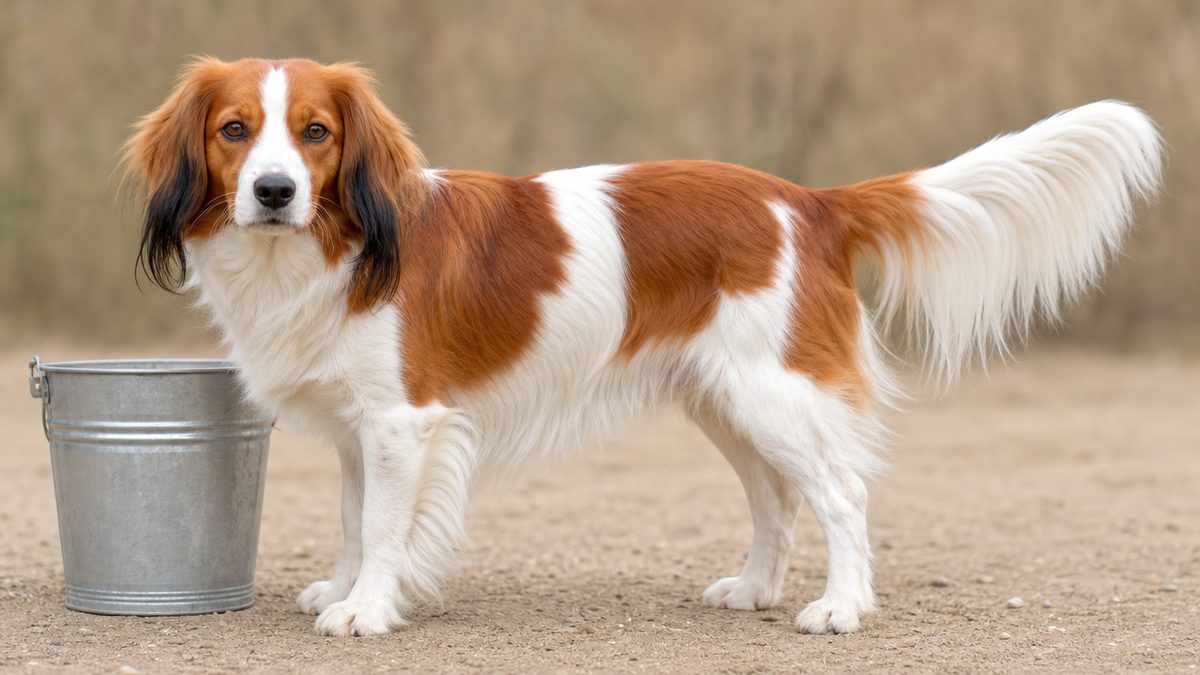
Quick answer
No Kooikerhondje price in india survives checking. The one India-hosted page quoting Rs 40,000 to Rs 60,000 prints monthly costs identical to its Lagotto Romagnolo page, and the marketplace page titled for the breed lists eight dogs, none of them this one. What is real is the health record: a Dutch cohort of 842 dogs found patellar luxation in 24 percent, and the breed club makes four tests compulsory before breeding.
This page reports published veterinary research and registry data for general information. It is not veterinary advice and cannot substitute for examining your own dog. A Kooikerhondje that bruises easily, bleeds longer than expected from a small wound, tires on walks it used to manage, drools or struggles to swallow, or skips on a hind leg needs a registered veterinary practitioner, not a web page. Take any suspected bleeding disorder to a vet before any surgery, dental procedure or spay or neuter.
Kooikerhondje at a glance
What a Kooikerhondje is, and why it nearly did not exist
The Kooikerhondje is a small orange-red and white Dutch sporting dog rebuilt from almost nothing after 1942, and its whole character as a breed follows from that rebuild. It stands about 40 cm at the withers, works a duck decoy by waving its plumed white tail rather than by hunting, and carries a documented inherited disease load that traces directly to how few dogs it started from.
The FCI recognises it as Standard 314, Nederlandse Kooikerhondje, in Group 8 Section 2 Flushing Dogs, origin the Netherlands, accepted on a definitive basis on 31 January 1990. Read the standard itself and the recency is startling for a breed people describe as ancient. Its own brief historical summary says that in 1942, during the Second World War, Baroness van Hardenbroek van Ammerstol began to recreate the Kooikerhondje, gave a picture of the dog she wanted to a pedlar, and had him find a bitch on a farm in Friesland. That bitch, Tommy, became the founding bitch of the breed. The Raad van Beheer adopted it as an interim breed in 1966 and recognised it officially in 1971.
So the modern breed is younger than the Indian republic. It is a reconstruction, not a survival, and the twenty-nine years between one farm bitch and official recognition is the entire genetic history you are buying into.
What the breed standard actually specifies
The standard describes a harmoniously built orange-red parti-coloured small sporting dog of almost square proportions, moving with its head high and its well-feathered tail waving level with or above the topline. The ears carry black hair tips, the so-called earrings, and the dog is shown with a natural, untrimmed coat. Colour is distinct patches of clear orange-red on pure white, with the orange-red predominant, a clearly visible blaze running down to the nose, and colouring on the cheeks and around the eyes.
Two details in that document are worth more than they look.
- The size tolerance is asymmetric. The ideal is 40 cm for males and 38 cm for females, and the standard permits 2 cm over or 3 cm under. A correct male may therefore stand anywhere from 37 to 42 cm, and a correct female from 35 to 40 cm. Most secondary pages flatten this into a single symmetric range that appears in no document.
- The standard states no weight. Not a range, not a guide, nothing. Every weight you will read for this breed comes from somewhere else.
We checked the French text for the drift that has been found in other FCI standards, where a translation quietly turns a one-sided tolerance into a symmetric one. It has not happened here. The French prints *Tolérance : 2cm au-dessus ou 3 cm en dessous de la hauteur idéale* and names the authentic language explicitly as *Langue faisant foi : (EN)*, so the English governs and the two agree. That is a negative result and it is worth recording, because it means you can quote either version safely.
Three registries, three different groups
The same dog is filed three different ways depending on who is filing it, which tells you how hard it is to classify a small flushing dog that does not flush.
| Registry | Group | Size given | Life expectancy given |
|---|---|---|---|
| FCI (Standard 314) | Group 8, Flushing Dogs | Ideal 40 cm male, 38 cm female; no weight | Not stated |
| Raad van Beheer (Netherlands) | FCI Group 8 | 35 to 40 cm, 9 to 13 kg | 10 to 14 years |
| American Kennel Club | Sporting | 16 in male, 15 in female; 20 to 30 lb | 12 to 15 years |
| The Royal Kennel Club | Utility | Per the FCI standard | Not stated |
The Dutch entry is the odd one. The Raad van Beheer is the FCI member for the breed's own country of origin, and it publishes a height range of 35 to 40 cm. That is the female range. It silently excludes the correct male at 41 or 42 cm that its own national standard permits. We are not calling it an error so much as a simplification, but if you are measuring a dog against a registry page rather than against the standard, you can reject a perfectly correct male.
The AKC files the breed in the Sporting group and ranks it 161 of 210 for popularity, while the Royal Kennel Club files it in Utility. Nothing about the dog changed. Only the filing cabinet did.
The job it was built for
A *kooiker* is the keeper of an eendenkooi, a traditional Dutch duck decoy: a pond with curved reed-screened channels leading to a trap. The dog's task, as the standard describes it, is to lure ducks into the decoy with its gaily waving tail. It does not hunt them. It moves calmly between the screens to provoke the ducks' curiosity and draw them further down the pipe, where they are caught and either killed for the table or ringed for ornithological research.
That is a very specific brief and it explains the dog you get. The waving white tail plume is a working tool. The reserve with strangers is functional, because a decoy dog that ran to greet visitors would be useless. And the breed's habit of working quietly at a distance from its handler is why the Dutch registry calls it watchful but says it only barks when there is a reason.
The founder bottleneck, measured rather than described
Every serious health problem in this breed traces to the same cause, and Dutch researchers have measured it four separate ways. The Kooikerhondje was rebuilt from a very small number of dogs, and the resulting loss of genetic diversity is not a vague worry. It shows up as a number in litter size, in relatedness, in a disease that killed 22 dogs descended from one pair, and in a carrier rate.
Start with the cleanest measurement. A study of Dutch Kooiker dogs born between 1956 and 1990 modelled litter size against homozygosity and found a negative effect of minus 3.175 puppies per litter for homozygosity of the litter. That is inbreeding depression stated in animals rather than in coefficients. The same paper found a positive effect of paternal homozygosity of 2.30, which the authors attribute to the frequent use of a small number of related sires, which is itself the bottleneck showing up from the other side.
How it compares to a common breed
A 2001 study compared five Dutch purebred populations born in 1994 using the same parameters, and the Kooiker Dog came out worst on every measure of diversity.
| Breed | Litters | Sires | Litters per sire | Mean relatedness | Mean inbreeding |
|---|---|---|---|---|---|
| Kooiker Dog | 101 | 41 | 2.46 | 0.146 | 0.070 |
| Golden Retriever | 840 | 234 | 3.59 | 0.020 | 0.018 |
| Bernese Mountain Dog | not stated | not stated | 4.59 | 0.102 | 0.056 |
| Boxer | not stated | not stated | not stated | 0.087 | 0.061 |
| Bouvier des Flandres | not stated | not stated | not stated | 0.041 | 0.046 |
Read the first two rows against each other. The Kooiker's mean relatedness of 0.146 is more than seven times the Golden Retriever's 0.020, and its mean inbreeding of 0.070 is nearly four times the Golden's 0.018. The paper reports the litter-per-sire ratio as largest in the Bernese at 4.59 and lowest in the Kooiker at 2.46, which on its face looks like good practice. It is not evidence of a wide gene pool; it is 101 litters spread across only 41 available sires.
The 3.59 litters per sire we print for the Golden Retriever is our own division of the paper's 840 litters by its 234 sires, not a figure the authors state. The 2.46 and 4.59 are theirs. We show the working so you can check it.
The disease that proves the pedigree
Hereditary necrotising myelopathy is the clearest single demonstration. A retrospective study of 22 affected Kooiker dogs found that clinical signs began at three to twelve months, that all of them showed progressive hindlimb paresis, that cervical segments C4 to C8 were involved in every one, and that every patient was descended from one pair. The affected dogs also had a significantly higher inbreeding coefficient than the breed population at large, at P = 0.001, and segregation analysis pointed to a simple autosomal recessive trait.
That genetic cause was finally identified thirty years later. A genome-wide analysis using six affected and 17 unrelated unaffected Kooiker dogs mapped the locus to the centromeric 5 Mb of canine chromosome 14, with the most associated SNP reaching a LOD score of 6.1, and found a pathogenic variant in the iron-sulfur cluster assembly gene IBA57 causing the amino acid substitution R147W. In humans, pathogenic IBA57 variants cause multiple mitochondrial dysfunction syndrome 3.
The Dutch breed club names the condition *Kooikerverlamming*, Kooiker paralysis, and describes the course plainly. Affected dogs show signs from six to fifteen months, walk as if drunk behind, are not in pain, and die before reaching the age of two.
The peer-reviewed study gives three to twelve months. The breed club's own page gives six to fifteen months. Both are current, both are authoritative, and we are not going to average them. If your young Kooikerhondje develops hind-end incoordination at any point in its first eighteen months, the window is open on either account.
How small the population still is
A joint survey by the Centre for Genetic Resources at Wageningen and the Dutch rare-breeds foundation counted the whole Dutch population in 2008. The Kooikerhondje stood at roughly 2,500 bitches and 2,500 dogs, of which 130 were breeding bitches and 44 were stud dogs, producing 85 litters and about 450 puppies a year, and the survey classed it *kwetsbaar*, vulnerable. Under the FAO risk classification the article quotes, a breed with fewer than five thousand breeding females is vulnerable and fewer than a thousand is endangered.
Forty-four stud dogs is the number to hold on to. It is the reason the four screening tests in the next section exist, and it is why this breed cannot simply outbreed its problems.
Kooikerhondje price in India: why no figure survives checking
There is no verifiable Kooikerhondje price in india. Two India-facing pages publish rupee numbers for this breed, and neither of them survives a basic check. This section shows the checks so you can run them yourself on any breed, because the same two mechanisms produce most of the Indian price internet for rare dogs.
Start with what ranks. A Bing search with country set to India for kooikerhondje price in india returned About 10,400 results and ten organic results, and not one of them is hosted in India. The set is English Wikipedia, the AKC, Dogster, Dog Breeds List, the Royal Kennel Club, The Spruce Pets, Dutch Wikipedia, FindMyDogBreed, the Dutch breed club and 101DogBreeds. For a query that literally contains the words *in india*, the Indian search engine returns the Dutch breed club and a UK kennel club.
That result set is trustworthy because the control worked. Run in the same session, labrador retriever price in india returned About 26,400 results and ten genuine Indian price and listing pages. So the instrument was functioning, and the absence of Indian pages for the Kooikerhondje is a real absence rather than a broken query.
Source one: a price on a page whose costs belong to another breed
The single India-hosted page publishing a figure gives *the average price of a Kooikerhondje dog can vary from Rs 40,000 to Rs 60,000 in India*, and beneath it a set of monthly running costs. We pulled the same site's page for the Lagotto Romagnolo, an Italian truffle-hunting water dog with no relationship to this breed whatsoever. Here is what came back.
| Figure | Kooikerhondje | Lagotto Romagnolo | Norwich Terrier |
|---|---|---|---|
| Cost of buying | Rs 40,000 - 60,000 | Rs 1,25,000 - 2,00,000 | Rs 60,000 - 1,00,000 |
| Average monthly expenses | Rs 4,650 - 6,600 | Rs 4,650 - 6,600 | Rs 2,200 - 3,750 |
| Monthly food | Rs 2,250 - 3,000 | Rs 2,250 - 3,000 | Rs 1,200 - 1,800 |
| Healthcare | Rs 1,200 - 1,800 | Rs 1,200 - 1,800 | Rs 300 - 750 |
| Grooming | Rs 1,200 - 1,800 | Rs 1,200 - 1,800 | Rs 700 - 1,200 |
Four of the five rows are byte-identical between the Kooikerhondje and the Lagotto Romagnolo. The Norwich Terrier carries a third, different set. So the site is not costing breeds; it is assigning size bands and printing the band's constants. That does not make the buying price fabricated on its own, but it does tell you nobody priced this breed in India. It tells you a template did.
The page carries the template's fingerprint in its headings too. One of its H2s reads Prerequisites to pet a Kooikerhondje, which is a default string with the URL slug dropped into it, and the same site prints *Healthcare Guide for your Kromfohrlander* on the other breed we researched this week. Headings a human retypes name the breed naturally; headings the software fills read like that.
Running the division tests, and why they do not settle it here
Indian pages routinely publish a US dollar price run through one exchange rate. The arithmetic tests for that are worth doing every time.
- At 84.38, Rs 40,000 and Rs 60,000 become USD 474.0 and 711.1. Not round, so no match.
- At 74.00, they become USD 540.5 and 810.8. No match.
- At 80.00, they become USD 500 and 750, which looks clean. It proves nothing, because any figure ending in three zeros divides cleanly at 80 by construction.
- At 66.67, they become USD 600 and 900, also clean, for exactly the same structural reason.
Two rates matching means the input was a round number, not that a conversion happened. So the arithmetic is inconclusive here, and that is the honest answer. What settles the question is the control page, not the division: a site whose monthly costs for a Dutch decoy dog are identical to its costs for an Italian water dog is not reporting Indian market data about either.
Source two: a marketplace page with none of the breed on it
The other India-facing result is a marketplace page titled for the Nederlandse Kooikerhondje. It lists no Kooikerhondje at all. Its carousel offers eight dogs: Fizey and Samy, both Maltipoos, and Yoki, a Doxiepoo, all three at Rs 98,999; Kuzo and Dugu, both Poodles, at Rs 92,599; Kazuka, a Cane Corso, at Rs 94,999; Doir, a Goldendoodle, at Rs 1,20,000; and Tugi, a Rottweiler, at Rs 76,499.
That figure and those animals appear on this site's pages for many breeds it does not stock. Rs 98,999 divides to about USD 1,173, so it is not even a conversion; it is a rupee-native charm price attached to whichever puppy is in stock. If a page quotes you Rs 98,999 for a rare breed, you are reading a shop's default, not a valuation.
So the complete honest answer is that a Kooikerhondje has no Indian market price because it has no Indian market. The Netherlands produced about 450 puppies in a whole year at the last published census, and Indian law forbids importing a dog to breed or sell it. Between those two facts, no lawful Indian supply chain can form, and any rupee figure you are quoted is a guess with a currency symbol in front of it.
What a 9 to 13 kg European dog actually costs to keep in India
There is no Indian purchase price for this breed, but the cost of ownership is real, sourceable and worth knowing, because it applies to any 9 to 13 kg dog living in an Indian city. Two costs are specific to this breed rather than to its size: the screening tests, and the veterinary consequences of a bleeding disorder in a country with heavy tick pressure.
Separate the two questions before you budget. A breed price is what a puppy sells for, and for the Kooikerhondje in India that number does not exist. A breed's cost of ownership is what feeding, vaccinating, grooming and treating a dog of its size costs here, and that is knowable. Anyone who conflates the two ends up quoting a template.
The registry costs, which are published
If a Kooikerhondje did reach India lawfully as an owner's pet, the paperwork has a published tariff. The Kennel Club of India charges Rs 2,500 to register an imported dog, Rs 1,000 for a certified four-generation pedigree, Rs 1,500 for a five-generation pedigree, Rs 2,000 for an export pedigree, and Rs 500 to transfer ownership of a registered dog within twelve months of the puppies' date of birth, rising to Rs 1,000 after that. Litter registration, which would only matter to a breeder, runs at Rs 750 per puppy within 60 days.
Those are the only Indian rupee figures on this page that come from an Indian institution rather than from a content site, and they are worth naming for that reason alone.
The screening bill nobody budgets for
This is where the breed differs from a generic small dog. The Dutch breed club makes four investigations compulsory for parent animals before a litter can be registered: an ECVO eye examination, a patellar luxation grading, and DNA tests for von willebrand disease and hereditary necrotising myelopathy. The Raad van Beheer published a formal set of breeding norms for the breed on 1 July 2026 and begins checking compliance at mating registration from 1 October 2026.
An Indian owner is not bound by any of that, because Indian law requires none of it. But an Indian owner who skips it is buying an unscreened dog from a breed whose four named problems are exactly the four things those tests look for. The DNA tests are one-off and can be run from an imported sample; the ECVO eye examination and the patella grading need a veterinary ophthalmologist and an orthopaedically confident vet respectively, and both are metro-only services in India.
We could not find a published Indian price list for ECVO-style eye certification or for DNA panels from an Indian laboratory that we were able to open and verify this session. Rather than convert a European price or repeat an unsourced number, we are saying plainly that we do not have it. Ask two referral hospitals in your city and compare.
The costs that scale with size, not with breed
For the recurring bill, treat the Kooikerhondje as what it is: a small dog at the top of the small band, 9 to 13 kg by the Dutch registry's figure and 20 to 30 pounds by the AKC's. That is materially cheaper to run than the large European breeds Indian buyers usually cross-shop.
- Food scales almost linearly with bodyweight, so a 11 kg dog eats roughly a third of what a 33 kg retriever eats. This is the single largest recurring line and the one where the breed's small size genuinely saves money.
- Grooming is low, because the Dutch registry says the coat needs no trimming and copes well with damp, so you brush rather than pay a salon. Budget for a good bristle brush and an undercoat rake, not for monthly professional appointments.
- Ear care is a real recurring line for this breed in India rather than an optional one, because the ears are long-feathered and carried flat against the cheeks. Weekly checks cost nothing; an untreated otitis costs a course of drops and a consultation.
- Tick and flea prevention is not optional anywhere in India, and for this breed it is arguably a bleeding-risk control as much as a parasite control. See the health section.
The cost item that is genuinely breed-specific
Polymyositis is the expensive disease in this breed, and the published treatment record tells you why. A study of 97 affected Dutch Kooiker dogs compared three regimes across three eras: glucocorticoid monotherapy before 2007, glucocorticoids with vitamin B, L-carnitine and coenzyme Q10 from 2007 to 2015, and that combination plus oclacitinib after 2015. Dogs on the third regime had the longest survival, though the authors state plainly that the difference was not statistically significant.
Read as a budget item, that is lifelong immunosuppressive medication plus supplements plus repeat creatine kinase blood tests, for a disease with an estimated penetrance of 10 to 20 percent in dogs homozygous for the risk deletion. It will not happen to most dogs. If it happens to yours, it is a permanent monthly cost and not a one-time treatment.
A Kooikerhondje is cheap to feed and cheap to groom by the standards of the imported breeds Indian buyers usually consider, and expensive to screen properly. If you are going to save money anywhere, save it on the grooming salon, not on the eye examination.
Heat tolerance: a 10 degree homeland against a 28 degree country
The Kooikerhondje has poor heat tolerance and the gap is larger than for almost any breed we have measured. Its homeland averages 10.27 degrees C across the year with a warmest month of 18.34 degrees C. Chennai's coolest month averages 24.09 degrees C, which is 5.75 degrees C hotter than the hottest month this dog was built for.
We queried NASA POWER by explicit latitude and longitude rather than by place name, because climate sites serve the wrong city at HTTP 200 more often than anyone expects. The returned cell for Utrecht reports an elevation of 3.51 m against a real elevation near 5 m, so the cell genuinely is the place and the figures can be used. We ran Leeuwarden in Friesland as well, because Friesland is where the founding bitch was found, and that cell reports 0.12 m against a real elevation near 1 m. Both are flat coastal Netherlands and both are accurate.
| Place | Cell elevation | Annual mean | Warmest month mean | Annual relative humidity |
|---|---|---|---|---|
| Utrecht, Netherlands | 3.51 m | 10.27 C | 18.34 C (July) | 83.98 % |
| Leeuwarden, Friesland | 0.12 m | 10.35 C | 17.95 C (August) | 84.77 % |
| Chennai | 48.95 m | 27.95 C | 31.51 C (May) | 72.39 % |
| Delhi | 206.37 m | 25.60 C | 35.88 C (June) | 45.56 % |
| Mumbai | 97.15 m | 26.77 C | 31.19 C (May) | 67.39 % |
The annual gap between Utrecht and Chennai is 17.68 degrees C. That is not a difference of degree, it is a different planet for a dog carrying the well-developed undercoat the breed standard specifies.
The humidity finding that surprises people
The Netherlands is more humid than Chennai on an annual average, at 83.98 percent against 72.39 percent NASA POWER climatology API queried…. So this is not a dry-to-humid transition and you should not describe it as one. The Kooikerhondje comes from a permanently damp country, its coat is built for damp, and the Dutch registry says the coat copes well with moisture.
What changes in India is not the humidity, it is the humidity plus eighteen degrees. Cold and wet is what the coat was designed for. Hot and wet is the combination that stops evaporative cooling from a panting dog working properly, and Mumbai in August runs 90.36 percent relative humidity at a mean of 26.63 degrees C. Delhi is the opposite problem, drier at 45.56 percent annual but reaching a June mean of 35.88 degrees C with a recorded cell maximum of 48.79 degrees C.
What the heat research does and does not say about this breed
The largest study of canine heat-related illness examined 905,543 UK dogs under primary veterinary care in 2016 and recorded 1,259 heat-related illness events from 1,222 dogs. Of the 879 events with a recorded trigger, 652, or 74.2 percent, were exertional, against 113 environmental and 46 from vehicular confinement. Its companion paper using the same cohort but a stricter case definition found 395 confirmed events, an incidence of 0.04 percent and a case fatality of 14.18 percent.
Those papers model breeds that met an inclusion threshold. The Kooikerhondje is far too rare in the UK to have cleared it, and it is not in the over-50 kg high-risk band either, so no breed-specific odds ratio for it exists and we are not going to import one. What transfers is the mechanism, not the number: three quarters of heat-related illness follows exercise rather than being shut in a car, and that is a decision an owner makes.
The practical reading is simple. Heatstroke in this breed will not come from a parked car. It will come from a 6 p.m. walk in April because the owner thought the sun was down.
The law, cited correctly
Indian law addresses this directly, and it is routinely miscited. The relevant provision is Second Schedule Part IV paragraph 21(1) of the Prevention of Cruelty to Animals (Dog Breeding and Marketing) Rules, 2017, headed *Outdoor housing facilities*. It bars keeping in outdoor facilities, without the attending veterinary practitioner's written approval, dogs that are not accustomed to local temperatures, dog breeds that cannot tolerate the temperatures prevalent in the area or region in question, such as long-haired breeds in high temperature locations, and sick, infirm, aged or young animals.
We extracted the gazette ourselves with pypdf and the string 'Rule 21' occurs zero times in it. The Rules themselves stop at Rule 13. Everything numbered above that is a Second Schedule paragraph. Pages that cite 'Rule 21' are citing a provision that does not exist, and this site has corrected eighteen such citations of its own.
The hill-station question, and the trap in answering it
Owners reasonably ask whether Ooty or Shimla would suit the breed better. They would, and you cannot answer that from raw satellite data. The NASA POWER cell for Ooty reports an elevation of 784.64 m against a real town elevation near 2,240 m, an error of 1,455 m, and returns an annual mean of 23.5 degrees C for a place that is nothing like that warm. Applying the standard lapse rate of roughly 6.5 degrees C per 1,000 m gives an estimated real annual mean near 14.0 degrees C, which is a plausible Nilgiris figure and about 3.7 degrees C above Utrecht.
We label that a correction rather than a measurement. The point stands either way: the Indian hill stations are the only places in the country where this breed's coat is not fighting the weather every day, and the plains cities are not. Delhi's cell elevation of 206.37 m against a real 216 m confirms that the plains figures above need no correction at all.
- Walk before sunrise and after full dark from March to October in every plains city. Not at dusk.
- Test the pavement with the back of your hand for five seconds before every walk, because a 38 cm dog's chest sits close to hot ground.
- Give the dog shade and moving air indoors, not a shaved coat. Shaving a double coat removes the insulation that keeps heat out as well as in.
- Watch for early heat distress as a change in gait and a refusal to continue, which come before collapse.
Health issues, lifespan, and which studies actually included this breed
The Kooikerhondje carries four well-documented inherited diseases and every one of them was described in this breed specifically rather than borrowed from a relative. That is unusual and it is the strongest reason to trust this section. Where a figure comes from a study that did not include the breed, we say so instead of quoting it.
Before any number, the test that matters. Each figure below comes from a paper or registry whose subject animals were Kooikerhondjes. We checked, because transferring another breed's prevalence onto a rare dog is the commonest way these pages go wrong.
| Source | Subjects | Includes this breed? |
|---|---|---|
| Slappendel 1998, type III vWD | 38 affected Dutch kooiker dogs, 717 screened | Yes, exclusively |
| van Oost 2004, DNA test | Kooiker dogs, Dutch breeding club | Yes, exclusively |
| Mandigers 1993, myelopathy | 22 Kooiker dogs | Yes, exclusively |
| Mandigers 2023, IBA57 | 6 affected and 17 unaffected Kooiker dogs | Yes, exclusively |
| Wangdee 2014, patellar luxation | 842 Kooiker dogs in a 1,737-dog pedigree | Yes, exclusively |
| Opmeer 2023 and 2025, polymyositis | 160 then 97 then 33 cases, all Kooiker dogs | Yes, exclusively |
| Schulze 1998, renal dysplasia | 3 Dutch kooiker dogs | Yes, exclusively |
| McMillan 2024 life expectancy, 155 breeds | Dogs Trust UK dataset | No. Breed absent from the table |
| Hall 2020 heat-related illness | 905,543 UK dogs, breeds above a case threshold | No breed-specific figure for this breed |
Type III von Willebrand disease, and the eradication that worked
Type III von willebrand disease is the severe form, a total absence of von Willebrand factor rather than a reduction. It was diagnosed in 38 Dutch kooiker dogs: 19 probands, ten male and nine female, referred independently for a moderate to severe bleeding tendency, plus another 19 found by screening 717 Dutch kooiker dogs including 356 puppies. Diagnosis rested on non-detectable von Willebrand factor antigen below 1.6 percent by ELISA, with prolonged capillary bleeding time. In 39 obligatory carriers, antigen ranged from 30 to 114 percent with a median of 64 percent, and was subnormal in only nine animals, which is exactly why an antigen assay could not reliably find carriers.
That is the problem a DNA test solved. Researchers developed PCR tests for two previously described mutations, a splice site mutation at the intron 16 and exon 16 border and a missense mutation in exon 3. The exon 3 variant turned out to be a neutral polymorphism present in many breeds; the splice site test was the real one, and the Dutch breeding club used it to select animals cleared to breed. The authors record that within a few years the mutation was eliminated from the breeding stock without an apparent increase in inbreeding or preferential sire usage, which for a breed with 44 stud dogs is a genuinely impressive piece of population management.
The breed club now states that because DNA analysis is available, no affected animals are born within its population.
The club's page says DNA analysis has been available since 1990. The peer-reviewed record puts identification of the causal mutations in 1998 and the applied breeding test in 2004. We print both and follow the papers, because they carry their own dates. Either way, a dog bred before the test was in routine use is an unscreened dog.
What OFA's tables show, and their limits
OFA holds separate databases for two conditions that exist almost nowhere else. Reading the live tables, retrieved 2 September 2026 under the printed label NEDERLANDSE KOOIKERHONDJE, and confirming the control string LABRADOR appears 109 times in the same file, the rows are these.
| Database | Evaluations | Result | Rank |
|---|---|---|---|
| Hips | 322 | 95.0 % normal, 4.3 % dysplastic, all of it mild | 188 |
| Patella | 344 | 94.8 % normal, 5.2 % abnormal (3.8 grade 1, 1.5 grade 2) | 35 |
| Eyes (summary) | 424 | 99.1 % normal, 0.9 % abnormal | 230 |
| Von Willebrands | 289 | 100.0 % normal, 0 carriers, 0 abnormal | 22 |
| Hereditary necrotizing myelopathy | 291 | 93.1 % normal, 6.9 % carrier | 1 |
| Polymyositis | 57 | 61.4 % normal, 38.6 % carrier | 1 |
Two things in that table are worth pausing on. First, on both the myelopathy and polymyositis tables the ALL BREEDS row reads exactly the same numbers, 291 and 57. The Kooikerhondje is not merely ranked first in those databases; it is the entire database. Second, the 100 percent normal von Willebrand result across 289 dogs is not luck. It is what the Dutch eradication programme looks like measured twenty years later, against an all-breeds baseline of 93.3 percent normal and 5.9 percent carriers across 17,766 evaluations.
The summary line says 99.1 percent normal of 424 dogs, implying about four abnormal animals. The detail rows in the same snapshot record NORMAL at 367 of 424, which is 86.6 percent, leaving 57 dogs with a finding. Those findings include cataract of unknown significance in 16 dogs, persistent pupillary membranes iris to iris in 8, punctate capsular opacity in 8 and Y-suture tip opacities in 7. Both numbers are OFA's. We are quoting neither as the rate.
The patellar luxation disagreement, which is the big one
OFA records 5.2 percent abnormal. A Dutch screening cohort of 842 Kooiker dogs, the offspring of 195 sires and 318 dams, screened from 1994 to 2011 inside a nine-generation pedigree of 1,737 dogs, found patellar luxation in 24 percent. Unilateral and bilateral luxation occurred equally often; medial luxation was commonest at 61 percent, against 32 percent lateral and 7 percent bidirectional. Heritability was 0.27 plus or minus 0.07, and prevalence fell from 28 percent to 19 percent over the life of the screening programme. A genome-wide association study of 48 cases and 42 controls suggested a region on chromosome 3, which a validation group did not confirm.
The breed club's own figures land in the same place as the Dutch cohort rather than OFA's: roughly 15 percent with mild changes up to grade 1, about 5 percent with grade 2, and under 1 percent at grades 3 and 4. Add those and you get about 21 percent, close to the cohort's 24 and its later 19.
The explanation is selection, not error. OFA publishes what owners choose to submit, and owners submit dogs they expect to pass. The Dutch figure comes from a breed-wide programme in which submission is the norm. For a breed with a compulsory screen in its home country, believe the home country's number.
Polymyositis, the disease still being solved
An inflammatory myopathy emerged in the breed in 1972 and has been increasing since. A 2023 study characterised 160 affected dogs, 40 at Tier I, 33 at Tier II and 87 at Tier III confidence, presenting with locomotory problems, dysphagia signs such as drooling and difficulty eating and drinking, or both, with creatine kinase raised in all but one dog. The same paper notes that the Dutch Kooiker dog is one of nine Dutch breeds and that heritable diseases have been recorded in it since 1960.
The genetics followed in 2025. A genome-wide association study of 33 cases and 106 controls implicated chromosome 19 at p = 4.7 x 10 to the minus 10, and next-generation sequencing found a 39 kb deletion located 10 kb upstream of the interleukin genes IL21 and IL2. The deletion allele ran at frequency 0.81 in cases and 0.25 in a random sample of the breed, and penetrance was estimated at 10 to 20 percent for homozygous dogs and 0.5 to 2 percent for heterozygotes.
If the deletion allele sits at 0.25 in the breed, Hardy-Weinberg predicts a carrier frequency of 2 x 0.75 x 0.25 = 37.5 percent. OFA's polymyositis table reports 38.6 percent carriers across 57 dogs. A Dutch research cohort and an American registry, using different animals, land within 1.1 percentage points of each other. That is our arithmetic, not either source's, but it is the kind of agreement that makes a figure trustworthy.
Renal dysplasia, epilepsy and the rest
Renal dysplasia was first reported in the breed in three young adults presented with apathy, weakness, anaemia and uraemia; two had been thin and inappetent from an early age. One died during emergency treatment, one was euthanised, and one survived seven months on a low-protein diet. The authors explicitly link the cluster to the breed's small gene pool and call it a probable familial nephropathy. The breed club reports epilepsy at between one and five cases a year under a strict breeding policy.
Why tick-borne disease matters more in this breed than in most
This is the part no page written for the Netherlands can tell you, and it is the strongest India-specific argument on this page. A survey of 525 dogs across four Indian cities found that 261 of them, 49.7 percent, carried at least one tick-borne pathogen by PCR, with Hepatozoon canis in 30 percent, Ehrlichia canis in 20.6 percent, Mycoplasma haemocanis in 12.2 percent, Anaplasma platys in 6.5 percent and Babesia vogeli in 5.5 percent. Co-infection with more than one pathogen occurred in 39 percent of cases, and potential tick vectors were found on 278 dogs, 53 percent of those examined.
Now place that beside the breed. Ehrlichia canis causes thrombocytopenia and bleeding. Anaplasma platys attacks platelets directly. A Kooikerhondje with untested parents may carry the complete-absence form of von Willebrand factor, and a dog with no von Willebrand factor that also acquires a platelet-destroying infection is not facing two problems, it is facing one compounded one.
The second interaction is treatment. Hereditary polymyositis in this breed is managed with glucocorticoids, and the most recent regime adds oclacitinib on top. That is deliberate immunosuppression, in a country where half the dogs surveyed were carrying a vector-borne pathogen. Neither fact is a reason to avoid the breed, and both are reasons why tick prevention here is a clinical intervention rather than a convenience.
Year-round tick control is not optional for this breed in India. Before starting any immunosuppressive treatment, ask your vet to screen for tick-borne disease first, because steroids given to a dog with an undiagnosed ehrlichial infection make it worse.
Lifespan, and why we will not give you one number
Two registries disagree. The Raad van Beheer gives an average of 10 to 14 years; the AKC gives 12 to 15. Neither is a mortality study, and the breed has no row at all in the Dogs Trust table of 155 breeds behind the 2024 life expectancy work, where our control, the Labrador Retriever, appears at 13.1 years from 43,428 dogs and 16,155 deaths.
So no cohort-derived life expectancy for this breed exists in that dataset, and we are not going to manufacture one by borrowing a spaniel's. The honest summary is a small dog that most sources place in the low teens, with the caveat that hereditary necrotising myelopathy kills affected dogs before two and polymyositis shortens life in an unknown fraction of the rest. English Wikipedia's health section for the breed is short and points at the same Dutch conditions.
Temperament and household fit: who should not buy this dog
The Kooikerhondje is a sensitive, alert, reserved working dog in a small friendly-looking package, and the mismatch between how it looks and how it behaves is the commonest reason the wrong household buys one. It is faithful and easy-going with its own people and genuinely wary with everyone else.
The breed standard describes it as lively and agile, self-confident, with sufficient perseverance and stamina, good natured and alert but not noisy, faithful, easy-going and friendly. Outside the hunting season it is expected to be a companion with a zest for working and a cheerful character. Anxious behaviour is listed as a severe fault, and aggressive or overly shy dogs are a disqualifying fault.
The Dutch registry, describing the dog Dutch owners actually live with rather than the one judges see, is more specific and more useful. It says the Kooikerhondje is cheerful but not too loud, very attached to its surroundings, friendly and attentive, and highly adaptable indoors, quiet and modest by turns and then playful and bubbling with life. It is watchful and barks only when there is a reason. It is sensitive to noise and to harsh words. And then the sentence most buyers need to read twice: it is not everybody's friend. It is initially reserved towards strangers, children and other dogs, and depending on temperament will either flee or growl when it feels unsure. Once it has accepted someone, the friendship is for life.
Who this breed suits in India
- A quiet adult household or a family with older, calm children who understand that a dog gets to walk away.
- Someone home most of the day. This is a dog bred to work alongside one person at a decoy, and it does not do well left alone through a working day.
- A hill-station or high-altitude household, or a plains household genuinely willing to run a pre-dawn and post-dark schedule for eight months a year.
- An owner who wants to train, because the breed rewards scentwork, retrieving and obedience out of all proportion to its size.
Who should not buy one
- Anyone wanting a dog that greets guests. A decoy dog that ran to visitors would have been useless, and the reserve is in the breed by design, not by accident of socialisation.
- A busy joint-family flat with constant footfall and noise, because the registry names noise sensitivity explicitly.
- A household with toddlers, given the same registry describes initial reserve towards children and a flee-or-growl response to uncertainty.
- Anyone who trains by correction. A sensitive dog handled harshly shuts down, and this one is described as needing neither a hard voice nor a hard hand.
- Anyone buying on looks. It is an orange-red and white dog that photographs beautifully and behaves like a small gundog with opinions.
US-facing aggregator pages describe the breed as good with children and other pets more or less flatly, and a page holding position 4 on the Indian result set gives the usual friendly-family framing with no source. The country-of-origin registry says the opposite about first meetings. Where a Dutch national body and an American aggregator disagree about a Dutch breed, we follow the Dutch body.
Training a sensitive breed: what works and what this dog resists
Train the Kooikerhondje with food, play and absolute consistency, and it learns fast. Train it with corrections and it stops offering behaviour altogether. The Dutch registry states the rule directly: the sensitive, intelligent Kooikerhondje usually needs neither a hard voice nor a hard hand, but it does need a very consistent approach and decisive leadership.
That single sentence from the Raad van Beheer is the whole method. Decisive leadership here does not mean dominance; it means the rules never move. A dog this attentive notices immediately when a rule is enforced on Tuesday and ignored on Wednesday, and inconsistency reads to it as uncertainty.
What the breed takes to easily
- Scentwork, because the dog was bred to work a decoy pipe by reading its environment carefully.
- Retrieving games, which give a small dog in a small flat real work to do.
- Obedience and rally, where sensitivity is an advantage rather than a liability.
- Trick training, which builds confidence in a dog that defaults to caution.
What it resists
Three things reliably go wrong, and all three are the same thing seen from different angles.
- Forced greetings. Making a reserved dog accept a stranger's hand teaches it that you will not protect it. Let people ignore the dog and let the dog approach.
- Repetition drilling. A dog described as intelligent and attentive disengages from the eleventh identical repetition. Three good reps and a game beats twenty grinding ones.
- Harsh correction of a fear response. Punishing a growl removes the warning and leaves the fear, which is how a reserved dog becomes a biting dog.
The socialisation window, and the Indian complication
Socialise the puppy deliberately from the day it comes home, because the reserve is genetic and only exposure moderates it. Introduce it to surfaces, sounds, traffic, lifts, vehicles and calm strangers in small, positive doses, and let it retreat every single time it wants to.
The Indian complication is that the best socialisation hours and the safe walking hours are the same hours. From March to October in a plains city, the window when it is cool enough to walk this dog is before sunrise and after dark, which is exactly when there is least to socialise it to. Plan around that: use car trips, terraces, quiet stairwells and controlled visitor meetings indoors rather than trying to buy the experience on a 3 p.m. pavement.
Nothing in the Dog Breeding and Marketing Rules 2017 regulates training collars, and we are not going to imply that it does. What the Rules do address, in Second Schedule Part II paragraph 6(8), is a prohibition on de-barking and on any change of appearance by artificial means. A vocal dog is a training problem, not a surgical one, and this breed is not a barker to begin with.
Timelines are realistic rather than heroic. Expect a reliable house-trained puppy in six to ten weeks with consistent handling, a solid recall in a fenced space by six months and a recall you can trust outdoors somewhere between twelve and eighteen months, and full emotional maturity, meaning an adult who no longer startles at everything, around two years. Question sets on the ranking pages ask whether the breed is easy to train for first-time owners. It is, for a patient first-time owner, and it is not for an impatient one.
Daily exercise: 45 to 60 minutes, and when you can actually take it
Give a Kooikerhondje 45 to 60 minutes of movement a day plus real mental work, and in most Indian cities schedule all of it before sunrise and after full dark for eight months of the year. The Raad van Beheer states the requirement plainly: it is a working dog, which means it needs a lot of exercise.
Two mistakes bracket this breed. The first is treating a 38 cm dog as a lap dog and giving it a courtyard walk. The second is treating a sporting dog as an endurance athlete and running it in Indian heat. The country-of-origin registry describes a working dog needing plenty of movement, and the breed standard credits it with sufficient perseverance and stamina and flowing, springy movement with good drive. That is a dog with genuine engine in a small frame.
What a week should contain
- Two walks a day, roughly 25 to 30 minutes each, at a pace the dog sets rather than a stroll.
- Three scentwork sessions a week of ten minutes, hiding food or a toy indoors. This tires the breed faster than distance does.
- Retrieving work wherever you have a safe enclosed space, because it is the job the breed was built around.
- Swimming, if you have lawful access to safe water. This is a water-adjacent breed from a country of canals, and the Dutch registry notes the coat handles damp well.
The Indian schedule, city by city
Work it from the temperature rather than from habit. The homeland peaks at a monthly mean of 18.34 degrees C in July. Chennai's coolest month runs 24.09 degrees C and its warmest 31.51 degrees C; Delhi's warmest month runs a mean of 35.88 degrees C, and its cell maximum touches 48.79 degrees C; Mumbai combines a 31.19 degrees C peak with 90.36 percent August humidity.
| City type | Cool months | Hot months | Note |
|---|---|---|---|
| Delhi and the north plains | Dec to Feb, most daylight hours usable | Mar to Oct, pre-dawn and post-dark only | Dry heat, so water and shade matter more than humidity |
| Chennai and the coast | Dec to Jan only, and even then early | Feb to Nov, pre-dawn and post-dark only | No genuinely cool season; the floor is 24 C |
| Mumbai and Pune | Dec to Feb | Mar to Nov, pre-dawn and post-dark only | Monsoon humidity above 89 percent blocks evaporative cooling |
| Bengaluru | Most of the year, early and late | Mar to May, pre-dawn and post-dark | The most workable large Indian city for this breed |
| Hill stations | Most of the year | Brief, and mild | The only Indian setting where the coat is not fighting the weather |
The reason to be strict about timing rather than about duration is in the heat data. Of 879 UK heat-related illness events with a recorded trigger, 652, or 74.2 percent, were exertional rather than environmental or vehicular. Heatstroke in this breed will arrive on a walk, not in a car, and the walk is the variable you control.
Stop and cool the dog at the first change of gait, a widening stance, a refusal to keep going, or frantic panting that does not settle within a minute of stopping in shade. Case fatality in confirmed UK heat-related illness was 14.18 percent, and the dogs that die are usually the ones whose owners read early signs as tiredness.
Grooming a double coat in Indian humidity, and the ear problem
Brush the Kooikerhondje weekly, more during the moult, and never shave it. The coat needs no trimming and handles damp well, which the Dutch registry states directly. The real Indian grooming risk is not the coat at all. It is the long-feathered ears carried flat against the cheeks, in a country where otitis externa is common and seasonal.
The standard describes hair of medium length, slightly wavy or straight and close lying, soft, with a well-developed undercoat. Front legs carry moderate feathering to the pastern joints, hind legs fairly long feathered breeches with no feathering below the hock, and the tail a white plume. The head, the front of the legs and the feet are short-coated. The dog is presented naturally and untrimmed. Curly or silky hair is a fault, which tells you the correct coat is neither.
The Raad van Beheer's care note is the practical version: the coat does not need to be trimmed and copes well with moisture, maintenance is easy, and regular brushing with a good brush keeps it in prime condition and the house reasonably hair-free.
The routine that works here
- Brush weekly with a bristle brush, and daily through the two annual moults, working the undercoat out with a rake rather than cutting it off.
- Dry the dog properly after any bath or swim, paying attention to the feathering behind the elbows and on the breeches where damp sits longest.
- Check the ears every week, lifting the leather and looking and smelling. This takes ten seconds and prevents most of what follows.
- Keep the feet clean and dry through monsoon, because interdigital damp turns into interdigital infection fast.
The undercoat insulates against heat as well as cold, and shaving it removes the dog's own shade while exposing thin skin to sun. It also frequently grows back wrong. If the dog is hot, change the schedule and the airflow, not the coat.
Ears: the Indian evidence, including where it disagrees
The ears are the weak point. They are moderately large, well feathered, and carried close to the cheeks without a fold. That is a warm, poorly ventilated canal in a hot country.
Indian data on when otitis strikes is not settled, and this page publishes the disagreement rather than picking a side. A study in and around Durg district, Chhattisgarh, examined 281 dogs and found 51 positive cases, distributed by season as 21 in summer (41.18 percent), 17 in the rainy season (33.33 percent) and 13 in winter (25.49 percent). Prevalence climbed steeply with age, from 5.88 percent in dogs up to one year to 45.10 percent in dogs of five years and above, and cytology found cocci in 76.1 percent of smears, bacilli in 47.6 percent and yeast in 19.0 percent.
The Durg series peaks in summer. Other Indian series this site has cited peak in the monsoon. Both are real Indian data and neither is wrong. The useful conclusion for a Kooikerhondje owner is that there is no safe season, so check the ears weekly all year rather than only when the rain starts.
The overseas advice that does not transfer
Northern European grooming guidance for damp-coated breeds routinely says to towel a dog and let it air dry. In a Dutch autumn that is fine. In an Indian monsoon, air-drying a dog with feathered ears lying flat against its cheeks means the canal stays wet for hours. Dry the ear leather and the surrounding feathering deliberately, and if you bathe the dog, keep water out of the canal in the first place. That is the single Indian adaptation this breed's care needs, and no overseas source will tell you to make it.
Feeding a 9 to 13 kg working dog in India
Feed the Kooikerhondje as a small active dog, not as a toy breed and not as a sporting dog twice its size. The Dutch registry's guidance is one sentence and it is the right one: plain, good-quality food produces a lean, muscular dog. Body condition, not a bag chart, is how you know you have it right.
Get the target weight straight first, because three sources give three answers and none of them is the breed standard. The FCI standard states no weight at all. The Raad van Beheer publishes 9 to 13 kg. The AKC publishes 20 to 30 pounds, which is 9.1 to 13.6 kg. The two registries agree closely with each other and neither is quoting the standard, so treat 9 to 13 kg as a working range and your own dog's frame as the real guide.
The registry's feeding line is *sobere voeding, van goede kwaliteit*, which means plain or frugal food of good quality, and it explicitly connects that to a slim, muscular dog. For an Indian owner the practical translation is that this breed does not need a premium performance formula, and it does very badly on the free-fed biscuit-plus-leftovers pattern common in Indian households.
Life stages
| Stage | Meals per day | What matters most |
|---|---|---|
| 8 to 16 weeks | 4 | Small, frequent meals; a complete puppy food; steady growth rather than fast growth |
| 4 to 8 months | 3 | Watch the ribs weekly; this is when Indian owners overfeed most |
| 8 to 12 months | 2 | Transition to adult food; growth is finishing on a small breed |
| 1 to 8 years | 2 | Hold a lean body condition; adjust for the walk schedule, not the season on the calendar |
| 8 years and over | 2 | Reassess protein and joint support with a vet, especially with any patella history |
Body condition beats the bag
You should feel the ribs easily under a thin layer with light pressure, see a waist from above and a tuck-up from the side. The breed standard itself describes a slight tuck-up towards the loin, so the dog's correct outline is your target. If you cannot feel ribs, cut ten percent and recheck in three weeks.
Weight matters here more than in most small breeds for one specific reason. Patellar luxation runs at roughly a fifth to a quarter of this breed depending on whose cohort you use, and carrying extra weight on a knee that already tracks poorly turns a grade 1 that never bothered the dog into a grade 2 that does.
The Indian practicalities
- Store food against humidity. Decant into an airtight container rather than rolling the bag down, because Indian coastal humidity turns kibble rancid and mouldy faster than the printed shelf life suggests.
- Feed after the walk, not before, in hot months, and leave a gap either side of exercise.
- Keep water available and changed, because a double-coated dog in Indian heat drinks far more than the same dog in the Netherlands.
- Do not free-feed. A dog bred to be lean and muscular gains weight quietly on an Indian schedule with fewer walking hours.
- Skip the raw fashion unless your vet supervises it, given the breed's bleeding-disorder history makes any avoidable gastrointestinal upset a worse gamble than usual.
We are not printing a rupee-per-month food figure. The only India-hosted page that publishes one for this breed prints the identical number for an unrelated Italian water dog, and we would rather say we do not have a verified figure than repeat a template constant. Price two brands you would actually feed, at 150 to 250 g a day, and you will have a better number than anything published.
The first year, month by month
Plan the first year around three things this breed specifically needs: early careful socialisation against genetic reserve, a screening and paperwork schedule Indian law does not require, and a heat calendar that dictates when the puppy can be outside at all.
Indian law fixes the starting point. Rule 8(1)(a) of the Dog Breeding and Marketing Rules 2017 provides that pups less than eight weeks in age are not sold, and Rule 8(1)(e) requires each pup sold to be micro-chipped with a complete record of treatment and vaccination maintained. Note the numbering: that is a genuine Rule, unlike the housing and breeding clauses elsewhere on this page, which are Second Schedule paragraphs.
| Age | What to do | Breed-specific note |
|---|---|---|
| 8 to 10 weeks | Settle in, start house training, begin the vaccination course | Vaccination can start at seven to eight weeks and usually completes at eighteen weeks under the Rules |
| 10 to 14 weeks | Deliberate, gentle socialisation in small doses | The reserve is genetic. Let the puppy approach; never let a stranger reach for it |
| 3 to 4 months | Lead work, name response, handling practice for ears and feet | Weekly ear handling now makes lifelong ear checks easy |
| 4 to 6 months | Recall in an enclosed space, first scentwork games | Keep sessions short; this breed disengages from drilling |
| 6 to 9 months | Adolescence. Rules stay identical | Watch for any hind-limb incoordination and report it immediately |
| 9 to 12 months | Adult food, longer structured walks, first knee check | Ask your vet to grade the patellae now rather than after a limp |
| 12 months | Discuss desexing timing with your vet | Do not book any surgery before the bleeding-risk conversation below |
This breed carries a history of type III von willebrand disease, the complete-absence form, diagnosed in 38 Dutch dogs. If your dog's parents were not DNA-tested with the splice-site test the Dutch club used, tell your vet before a spay, a neuter, a dental or any biopsy. A buccal mucosal bleeding time or a factor assay before surgery costs very little compared with an intraoperative bleed.
The screening schedule nobody in India will prompt you for
The Dutch breed club requires four investigations of parent animals: an ECVO eye examination, patellar luxation grading, and DNA tests for von Willebrand disease and hereditary necrotising myelopathy. Indian law requires none of them. Second Schedule Part III paragraph 8(10) of the 2017 Rules lists the genetic defects a breeding dog must have been tested for, and while the list opens with the word including, so it is illustrative rather than closed, it names hip dysplasia, progressive retinal atrophy, night blindness, hypothyroidism, entropion, ectropion, overshot and undershot jaw, wry mouth, two or more missing teeth and cryptorchidism.
Read that against this breed's actual problems. The word 'patella' appears zero times in the entire gazette. Neither von Willebrand disease nor hereditary necrotising myelopathy nor polymyositis is named. So Indian law mandates testing for a set of conditions this breed largely does not have, and mandates nothing for the four it does. That gap is the single most useful thing an Indian buyer can know, and it is why the screening burden falls entirely on you.
The heat calendar for a puppy
A puppy's first year in a plains Indian city is a scheduling problem. From March to October, all outdoor time moves to before sunrise and after dark. Second Schedule Part IV paragraph 21(1) also bars keeping young animals in outdoor facilities without a vet's written approval, alongside breeds that cannot tolerate local temperatures, so a puppy of this breed sits in two of the three listed categories at once. It lives indoors.
Head to head against the breeds Indian buyers cross-shop
Indian buyers who reach a Kooikerhondje page are almost always comparing it against a Cavalier King Charles Spaniel, a Beagle, an Indian Spitz or a Nova Scotia Duck Tolling Retriever, because those are the dogs that look similar or fill the same slot. On availability, cost and heat, three of those four beat it comprehensively.
Set the comparison honestly. This is not a table of which dog is better. It is a table of which dog you can actually get, lawfully screen and keep alive comfortably in an Indian city.
| Kooikerhondje | Cavalier King Charles Spaniel | Beagle | Indian Spitz | |
|---|---|---|---|---|
| Available in India | No verified listing found | Widely, in every metro | Widely | Very widely |
| Verified Indian price | None | Published by many Indian sellers | Published by many Indian sellers | Published by many Indian sellers |
| Adult weight | 9 to 13 kg | About 6 to 8 kg | About 10 to 11 kg | About 5 to 20 kg by type |
| Coat | Medium, well-developed undercoat | Silky, feathered, no heavy undercoat | Short, dense | Double, heavy |
| Heat tolerance | Poor | Poor to moderate | Moderate | Adapted over generations to India |
| Documented inherited burden | vWD III, myelopathy, polymyositis, patella | Mitral valve disease, syringomyelia | Several, well studied | Little published data |
| Screening available in India | Effectively none | Cardiac auscultation widely available | Widely available | Not applicable |
| Lawful import to breed or sell | No | No | No | Not needed |
Against the Cavalier, which it most resembles
The two look alike enough that Indian sellers occasionally offer one as the other, which is worth knowing before you pay for a rare import. The distinguishing marks are in the standard: the Kooikerhondje is orange-red on pure white with a clearly visible blaze, black hair tips on the ears, a white-plumed tail, and an almost square outline at 38 to 40 cm. Black and white or tricolour is a disqualifying fault, so a tricolour dog offered as a Kooikerhondje is not one.
On health the trade is real rather than rhetorical. The Cavalier's problems are cardiac and neurological and near-universal; the Kooikerhondje's are haematological, neuromuscular and orthopaedic and mostly manageable if the parents were screened. The catch is that Cavalier screening exists in India and Kooikerhondje screening does not.
Against the Nova Scotia Duck Tolling Retriever
This is the comparison the breed invites, because both are small red-and-white dogs that lure waterfowl by movement rather than by hunting them. The Toller is larger, more driven and far more available internationally. For an Indian household the Toller's higher exercise requirement makes it a harder fit, not an easier one, in a country where the walking window is four hours a day for most of the year.
Against two Dutch and German siblings on this site
If what attracts you is a rare European reconstruction rather than this specific dog, read the neighbours. The Drentse Patrijshond is another of the nine Dutch breeds and has the best published breed-club health surveillance of any dog we have covered. The Hovawart is the closest structural parallel, a German breed rebuilt from 1922, and its Indian price section rests on the same single source ours does. The Kromfohrländer has a narrower founder base still.
Our Hovawart guide describes Happy Pet Care as the single Indian page publishing a price, which is accurate, and treats the figure as a quotable published price band. This page goes further: we pulled two control breeds from the same site and found the monthly cost figures are template constants shared across unrelated breeds Happy Pet Care, Norwich Terrier breed page. That finding applies to the Hovawart page too, and it should be applied there.
What Indian owners get wrong with this breed
Six mistakes account for most of the harm done to Kooikerhondjes in India, and five of them come from treating a reserved Dutch working dog as a friendly small pet. The sixth is buying a dog that is not one.
1. Paying a rare-breed premium for a dog that is not the breed
This is the expensive one. No verified Kooikerhondje listing exists in India, the marketplace page carrying the breed name lists eight dogs of six other breeds, and the only rupee band in circulation comes from a template. Anyone offering you a Kooikerhondje puppy in an Indian city is far more likely to be offering a Cavalier cross, a small spaniel mix or an imported dog with no health testing behind it. Ask for the parents' four Dutch screening results by certificate number before you discuss price.
2. Forcing the dog to be friendly
The Dutch registry says the breed is not everybody's friend and is initially reserved with strangers, children and other dogs. Indian social norms around visiting mean a new dog is passed around, patted by everyone and expected to perform. Do the opposite. Let visitors ignore it. A dog that is allowed to opt out becomes confident; a dog that is cornered becomes a growler, and then a biter.
3. Walking it at the wrong time of day
Almost three-quarters of heat-related illness with a recorded trigger in the largest study of the subject was exertional. In a Chennai where the coolest month averages 24.09 degrees C, an evening walk that feels acceptable to a human is the single most dangerous routine thing an owner does to this dog.
4. Shaving the coat in summer
The standard specifies a well-developed undercoat and the Dutch registry says the coat needs no trimming. Shaving removes insulation that works in both directions and exposes pale skin under an orange-red coat to Indian sun. Brush the undercoat out instead.
5. Ignoring the ears until they smell
Long feathered ears carried flat to the cheek in a hot country need a weekly ten-second check. Indian otitis data shows prevalence rising from 5.88 percent in dogs under one year to 45.10 percent in dogs over five, so this is a problem that accumulates quietly across a dog's life.
6. Booking surgery without mentioning the bleeding history
A breed whose defining genetic disease is the complete-absence form of von willebrand disease should never go to theatre without the vet knowing. This is a two-minute conversation that prevents the one genuinely catastrophic outcome on this page.
Rebuilding a rare breed tempts people toward close matings. Second Schedule Part II paragraph 6(3) of the Dog Breeding and Marketing Rules 2017 prohibits in breeding, defined as breeding between relatives of the 2nd to 4th grade within the first four generations, and incest breeding, defined as mating between parents and children or between brother and sister. Only out breeding and line breeding are permitted. A breeding plan copied from a European rare-breed programme can be unlawful here.
Adoption, lawful import, and how to verify what you are being offered
Adoption is the only route to a Kooikerhondje in India that does not involve either an unverifiable seller or an international move, and it is genuinely rare. The lawful import route exists but permits exactly one purpose: bringing your own pet with you. Importing to breed or sell is prohibited outright.
Take the law first, because it defines what is possible. DGFT Trade Notice 22/2022-23 of 19 December 2022 places dogs under ITC(HS) 01061900 as Restricted. Policy Condition (7) allows import only for a pet dog with a valid pet book and records in the importer's name, for research organisations with a CPCSEA recommendation, or for internal security by Defence and Police forces. Policy Condition (8) states that import of commercial dogs for breeding or any other commercial activity is not permitted, and paragraph 6 adds that applications for trading or breeding purposes shall be duly rejected.
- Permanent import as baggage is allowed without DGFT authorisation only to a person transferring residence to India after two years of continuous stay abroad, for up to two pets.
- Anything else needs a DGFT import authorisation, applied for against an Importer Exporter Code or the permanent personal-use code, with the application examined by the Department of Animal Husbandry and Dairying.
- Entry is limited to seven ports: Delhi, Mumbai, Chennai, Hyderabad, Bengaluru, Kolkata and, since October 2024, Kochi, with quarantine at the government station where required. The full route is set out in how to import a dog to India.
- Start two months early. The notice itself advises initiating the authorisation process at least two months before travel.
So the honest position is that a Kooikerhondje reaches India as somebody's relocating pet, and essentially never as a puppy for sale. That is not a gap in this page; it is the answer.
Registering the dog once it is here
The FCI members register lists India as a Full member represented by the Kennel Club of India in Chennai, so the KCI issues pedigrees against FCI nomenclature and the breed's FCI Standard 314 status carries across. Registering an imported dog costs Rs 2,500, a certified four-generation pedigree Rs 1,000 and a five-generation pedigree Rs 1,500.
The adoption route
Adopt where you can. Two realistic paths exist for this breed and neither is quick.
- Breed-club rehoming abroad. The Dutch breed club runs a rehoming service alongside its breeder list, which is the correct first contact for anyone serious about the breed rather than about the look.
- Indian shelters and rescues, where the dog you actually meet will not be a Kooikerhondje but may be a small, sensitive, biddable dog that suits the same household far better, and that is already adapted to the climate.
Verifying a dog somebody offers you
If a seller in India offers you this breed, five checks separate a real dog from a story. None of them requires expertise.
- Ask for the FCI or KCI pedigree number and check the breed printed on it, not the breed in the advertisement.
- Ask for the parents' four screening certificates: ECVO eye, patella grading, and DNA results for von Willebrand disease and hereditary necrotising myelopathy.
- Check the colour against the standard. Orange-red on white with a blaze is correct. Black and white or tricolour is disqualifying.
- Ask where the dog entered India and under whose name, given the only lawful route is a personal pet import.
- Refuse any sale of a puppy under eight weeks, which Rule 8(1)(a) prohibits, and insist on the microchip and vaccination record Rule 8(1)(e) requires.
A seller who cannot produce a pedigree, cannot name the import route and prices the dog at Rs 98,999 is selling you a story with a puppy attached. The kindest version of this page's conclusion is that the Kooikerhondje is a genuinely lovely, genuinely rare dog that almost nobody in India can lawfully obtain, and that an Indian household wanting a small, sensitive, trainable companion has better and more honest options in front of it.
Kooikerhondje questions Indian buyers actually ask
What is the Kooikerhondje price in India?
No Kooikerhondje price in india can be verified. One India-hosted page quotes Rs 40,000 to Rs 60,000, and the same page prints average monthly costs of Rs 4,650 to Rs 6,600 that are byte-identical to its Lagotto Romagnolo page, an unrelated Italian water dog. A marketplace page titled for the breed lists eight puppies, none of which is a Kooikerhondje. Treat both as template output rather than as a price.
Are Kooikerhondjes easy to train for first-time dog owners?
Yes for a patient first-time owner, no for a heavy-handed one. The Dutch registry says the sensitive, intelligent Kooikerhondje usually needs neither a hard voice nor a hard hand but does need a very consistent approach and decisive leadership. Train with food, play and short sessions, and socialise the puppy carefully, because the same source calls it initially reserved with strangers, children and other dogs.
What are common health concerns for Kooikerhondjes?
Four dominate, and all four trace to the narrow founder base. Type III von willebrand disease was diagnosed in 38 Dutch dogs, hereditary necrotising myelopathy killed 22 dogs all descended from one pair, patellar luxation ran at 24 percent in a cohort of 842, and polymyositis has been described in 160 dogs and linked to a 39 kb deletion. Renal dysplasia and epilepsy are also recorded at low frequency.
How big do Kooikerhondjes usually get?
The breed standard gives an ideal 40 cm at the withers for males and 38 cm for females, with an unusual asymmetric tolerance of 2 cm over or 3 cm under, so a correct male may stand 37 to 42 cm. The standard states no weight at all. The Dutch registry publishes 9 to 13 kg and the AKC 20 to 30 pounds, and neither figure comes from the standard.
What is the average lifespan of a Kooikerhondje?
Two registries disagree and this page prints both. The Dutch registry gives an average of 10 to 14 years, while the AKC gives 12 to 15 years. Neither is a mortality study. The breed has no row in the Dogs Trust table of 155 breeds behind the 2024 life expectancy paper, where the control Labrador Retriever appears at 13.1 years from 43,428 dogs, so no life expectancy estimate from that dataset exists for this breed.
Do Kooikerhondjes shed a lot and how should they be groomed?
They shed steadily and heavily twice a year, because the standard specifies a well-developed undercoat under medium-length hair. Grooming is easy: the Dutch registry says the coat needs no trimming and copes well with damp, and a weekly brush with a good bristle brush keeps it in condition. Never shave a double coat in Indian summer; brush the dead undercoat out instead.
Can a Kooikerhondje survive the Indian climate?
It can live in India with real management, and it is not suited to it. The homeland cell at Utrecht averages 10.27 degrees C across the year and peaks at 18.34 degrees C in July. Chennai's coolest month averages 24.09 degrees C, hotter than the hottest month the breed was built for. Heat tolerance is the weakest trait on this page, and Indian law bars keeping heat-intolerant breeds outdoors without a vet's written approval.
Is a Kooikerhondje good with children and other pets?
It is good with a calm family and poor with a chaotic one. The Dutch registry describes a dog that is friendly and good-natured in the house but initially reserved with strangers, children and other dogs, sensitive to noise and to harsh words, and inclined to either flee or growl when it feels unsure. It is explicitly not described as everybody's friend.
How much exercise does a Kooikerhondje need daily?
Plan on 45 to 60 minutes of real movement plus scentwork, because the Raad van Beheer states plainly that it is a working dog that needs a lot of exercise. In most of India that whole allowance has to move to before sunrise and after dark from March to October, which is a scheduling decision you make before you buy, not after.
What is the typical temperament of a Kooikerhondje?
Lively, alert and self-confident outdoors, adaptable and quiet indoors. The breed standard calls it good natured and alert but not noisy, faithful, easy-going and friendly, with sufficient perseverance and stamina. The Dutch registry adds that it is watchful and barks only when there is a reason, and that once it accepts someone the friendship is for life.
Can I legally import a Kooikerhondje into India?
You can import one as your own pet and you cannot import one to breed or sell. DGFT Trade Notice 22/2022-23 classes dogs as Restricted under ITC(HS) 01061900 and permits import only for a pet dog with a valid pet book in the importer's name, for research with CPCSEA recommendation, or for Defence and Police use. It states that applications for trading or breeding purposes shall be duly rejected, and limits entry to six ports. DAHD added a seventh port, Cochin International Airport at Kochi, for pets arriving under the baggage rules in October 2024.
Does the Kennel Club of India recognise the Kooikerhondje?
Effectively yes, through the FCI. The FCI members register lists India as a Full member represented by the Kennel Club of India in Chennai, so the KCI issues pedigrees against FCI nomenclature, and the Kooikerhondje holds FCI Standard 314 on a definitive basis. Registering an imported dog costs Rs 2,500 and a certified four-generation pedigree costs Rs 1,000.
Why do OFA and the Dutch data disagree so much on patellar luxation?
Because they measure different populations. OFA's snapshot records 5.2 percent abnormal across 344 evaluations, while a Dutch cohort of 842 dogs screened between 1994 and 2011 found 24 percent affected. OFA publishes what owners choose to submit, which favours dogs that pass, whereas the Dutch figure comes from a breed-wide screening programme. The Dutch club's own page reports roughly 15 percent at grade 1, 5 percent at grade 2 and under 1 percent at grades 3 and 4.
Is the Kooikerhondje hypoallergenic?
No, and no dog is. Vredegoor and colleagues at Utrecht measured Can f 1 across 196 dogs of so-called hypoallergenic breeds against 160 control dogs and found the hypoallergenic group higher in hair at 2.26 against 0.77 micrograms per gram, with no difference in airborne allergen, concluding there is no evidence for the classification. The Kooikerhondje standard describes a well-developed undercoat and says nothing about reduced shedding.
Compare with similar breeds
Kooikerhondje sits in 2 Bonbeno groups. Each one compares it directly against the breeds it is genuinely an alternative to, on the same figures.