
Breed profile
Lagotto Romagnolo in India: Price, Heat and Health
The only breed the FCI recognises as a truffle dog, and the numbers an Indian buyer actually needs before paying lakhs for one.
Quick answer
One Indian site publishes a Lagotto Romagnolo price in India of Rs 1,25,000 to Rs 2,00,000, and no second Indian source confirms it. Treat that as a single unverified listing, not a market rate. Before price, weigh two things: the breed carries juvenile epilepsy and a storage disease with DNA tests showing 15.9 percent and 3.7 percent carriers, and its waterproof woolly coat suits Ravenna at 16 degrees, not Chennai at 28.
This page reports published veterinary research and registry data for general information. It is not veterinary advice and cannot replace examining your own dog. A Lagotto Romagnolo puppy that twitches, staggers or has a focal seizure between five and thirteen weeks, or an adult that becomes progressively wobbly, circles, or develops flicking eye movements, needs a registered veterinary practitioner the same day and not a web page. Take any suspected seizure, any sudden change in gait, and any red, weeping or cloudy eye to a vet rather than waiting to see whether it settles.
Lagotto Romagnolo at a glance
What the Lagotto Romagnolo actually is
The Lagotto Romagnolo is a small to medium Italian water dog that the FCI recognises specifically as a truffle dog, and it is the only breed in the nomenclature whose stated utilisation is that job.
FCI Standard 298 files the breed under the English name Romagna Water Dog and prints its utilisation in two words: Truffle dog. No other entry in the FCI nomenclature says that. The dog sits in Group 8, Retrievers, Flushing Dogs and Water Dogs, Section 3 Water Dogs, with a working trial optional, and the currently valid text was published on 30 September 2019 and dated 11 October 2019. That document names English as its official language, so the English wording is the authentic text rather than a translation, which matters because FCI standards have been caught drifting between languages on numbers.
The history in the standard is short and it explains the whole animal. The breed worked as a retrieving water dog in the lowlands of Comacchio and the marshlands of Ravenna. Those marshes were drained and turned into arable land, and the dog changed jobs, becoming a searcher for truffles in the flat open country and the hills of Romagna. Everything an Indian buyer needs to know follows from that sentence. The coat was built for cold water. The nose was kept. The prey drive was deliberately removed.
The breed standard, in the numbers that matter
| Measure | FCI Standard 298 | American Kennel Club |
|---|---|---|
| Height, male | 43-48 cm, ideal 46 cm | 17-19 in, which is 43.2-48.3 cm |
| Height, female | 41-46 cm, ideal 43 cm | 16-18 in, which is 40.6-45.7 cm |
| Weight, male | 13-16 kg | 28.5-35 lb, which is 12.9-15.9 kg |
| Weight, female | 11-14 kg | 24-31 lb, which is 10.9-14.1 kg |
| Life expectancy | Not stated | 15-17 years |
| Tolerance | 1 cm over or under | Not stated |
The two registries agree, and that is worth saying out loud because on this site they frequently do not. Convert the AKC's imperial figures and every band lands inside or within a whisker of the FCI's. A buyer being offered a 25 kg Lagotto is being offered something else.
Note what those numbers rule out. At 13 to 16 kg this is a compact dog, not a large one, and the over-50 kg heat-illness risk band identified in the UK VetCompass work does not touch it. That band applies to individual dogs weighing more than 50 kg, and the heaviest Lagotto the standard permits is under a third of that. We say so explicitly because the temptation on a heat page is to reach for the most dramatic odds ratio available, and importing a finding onto a breed it never covered is fabrication wearing a citation.
Appearance, and the one thing the standard forbids
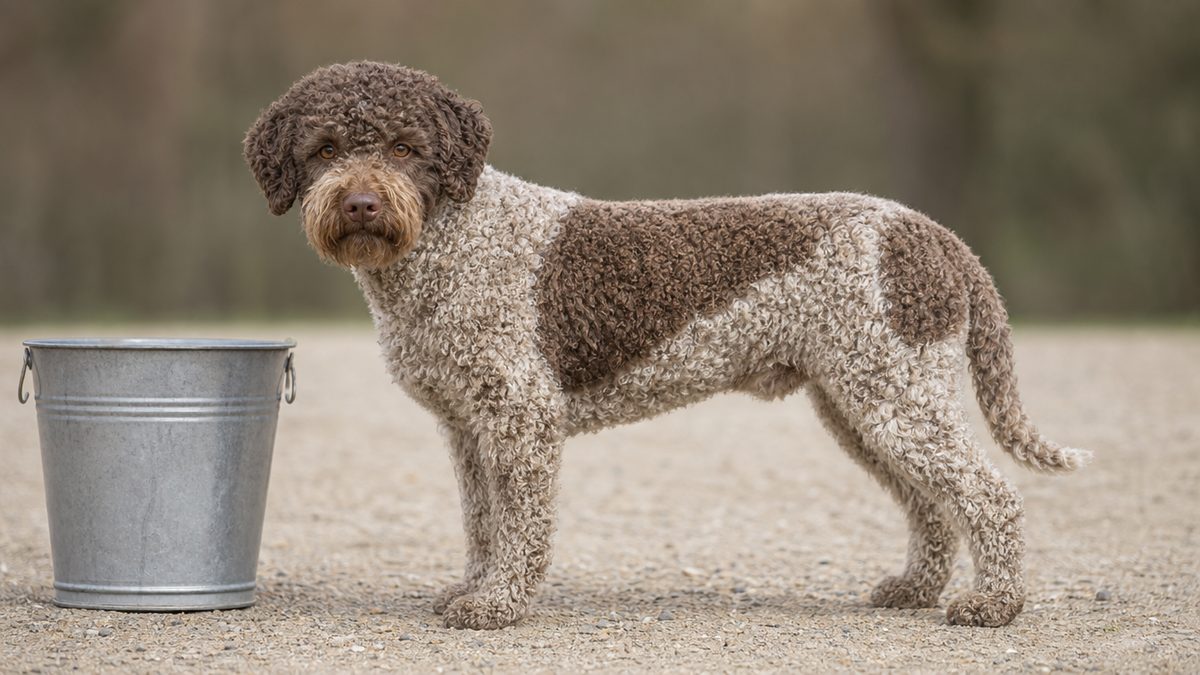
The coat is the breed. FCI 298 requires hair of woolly texture, never twisted into thin cords, semi-rough on the surface, with tight ring-shaped curly curls evenly distributed over the body and tail, and a visible undercoat. Both the topcoat and, the standard specifies, especially the undercoat are waterproof. On the head the curls loosen into abundant eyebrows, whiskers and a beard, and the ears carry looser waves rather than short hair.
Colour is generous: off-white solid, white with brown or orange patches, orange roan, brown roan, brown in various shades with or without white, orange with or without white, sometimes with a brown to dark brown mask, and tan markings are allowed. What is disqualifying is black. Black coat colour, black patches and black pigmentation all put the dog out. So do a corded coat, a sculptured clip, a coat clipped so short the curl cannot be assessed, and a docked tail.
FCI 298 disqualifies a docked tail, and separately the standard's overall appearance is described as rustic and unpretentious. Indian law reaches the same place from the other direction: Second Schedule Part II paragraph 6(8) of the Dog Breeding and Marketing Rules 2017 forbids tail docking, ear cropping, de-barking, de-clawing and any change of appearance by artificial means. A docked Lagotto in India is both an unshowable dog and the product of a prohibited procedure.
One more detail the standard settles, because Indian sellers get it wrong. The rear pasterns carry no dewclaws. A breeder who tells you dewclaw removal was needed for the standard has it backwards, and paragraph 6(8) would in any case bar the removal.
The truffle claim, checked against the register
The Lagotto Romagnolo is the only breed in the FCI nomenclature whose stated utilisation is truffle searching, and we verified that by reading the register itself rather than repeating the marketing line.
Every page about this breed says it is the world's only truffle dog. That is the kind of claim this site checks rather than repeats, because a superlative that everyone copies is usually copied from one source that nobody opened.
How we checked it
We went to the FCI's own nomenclature index rather than assembling a URL from the breed name, because on fci.be the trailing number decides which document you get and the name in the path is discarded. A guessed URL there returns a real, complete standard for a different breed at HTTP 200, with nothing that looks wrong. The letter L index links this breed as ROMAGNA-WATER-DOG-298, and the document that comes back carries the title LAGOTTO ROMAGNOLO.
The standard then prints the claim in the plainest form available. Under UTILIZATION it says two words: Truffle dog. Group 8, Section 3 Water Dogs, working trial optional. That is the registry's own classification of what this animal is for.
It means the FCI recognises no other breed for this work. It does not mean no other dog finds truffles, and in practice mixed-breed dogs and other breeds are trained to do it across Italy and France. The precise version of the claim is that this is the only breed selected and registered for the job, which is both true and more interesting than the version that gets repeated.
The genetic selection that makes it possible
The mechanism is stated in the standard's behaviour section and it is the most remarkable sentence in the document. A natural gift for searching and a very good nose made the breed efficient at truffle searching, and the former hunting instinct has been modified by genetic selection, so that the dog's work is not distracted by the scent of game.
Think about what that describes. A gundog is valuable because it responds to game scent. This breed was made valuable by removing that response while keeping the nose. A truffle grows underground and does not move; a hare crosses the path and does. A dog that cannot ignore the hare is useless for the job. Centuries of selection in Romagna produced an animal that walks past the hare.
That is also why the breed suits an Indian flat better than its working-gundog classification suggests. The prey drive that makes a pointer or a spaniel difficult around cats, squirrels and street dogs has been deliberately reduced here. What remains is a nose that needs a problem to solve, and a problem can be set on a living-room floor.
From marsh to hillside, in one paragraph of history
The standard's brief historical summary is four sentences and it explains the whole dog. An ancient breed of retrieving water dog in the lowlands of Comacchio and the marshlands of Ravenna. The great marshlands were drained over the centuries and turned into arable land. The Lagotto changed from a water dog to a dog for searching truffles in the flat open country and the hills of Romagna.
The coat did not change when the job did. That is the single most important consequence for an Indian owner, and no ranking page draws it out. The waterproof woolly double coat with a visible undercoat is equipment for retrieving birds from cold marsh water, and it stayed on a dog that now works dry ground. It is why a dog whose modern job involves no water at all is still carrying insulation designed for it, and why Chennai at 27.95 degrees C annual mean is a harder problem for this breed than its size suggests.
What the encyclopedia entries leave out
The general-reference coverage of this breed is thin in a specific way. The Wikipedia article covers History, Characteristics and Use, and carries no Indian price, no cost figure and no climate content at all. The US-facing aggregator ranking alongside it publishes a USD 3,000 to USD 5,000 average and likewise no rupee figure. Neither is wrong. Both are written for somebody else.
That gap is the reason this page exists. An Indian reader searching the price in india for this breed does not need another description of the curly coat. They need to know that the one Indian price has no second source, that the monthly cost is a template, that the hips are worse than the all-breeds average, that two DNA tests decide the purchase, and that the coat was built for a place 11.83 degrees C cooler than Chennai.
Lagotto Romagnolo price in India, and why one number is all there is
Exactly one India-hosted page publishes a Lagotto Romagnolo price in india, and it prints Rs 1,25,000 to Rs 2,00,000 with no second Indian source to check it against.
We pulled that page ourselves and read the figure out of its raw markup rather than off a search snippet, because on this project a search result has been caught quoting a rupee band from a page containing no rupee figure at all. The number is really there: Cost of buying Rs 1,25,000 to Rs 2,00,000. That is the entire Indian price evidence for this breed.
Running the division tests on it
A rupee figure on an Indian breed page is often a US dollar price passed through an exchange rate, so every figure here was divided by the four rates this site has caught in circulation. Rs 1,25,000 gives 1,481 at 84.38, 1,562.50 at 80, 1,689 at 74 and 1,875 at 66.67. Rs 2,00,000 gives 2,370, 2,500, 2,703 and 3,000. Only the flat-80 test produces anything a seller might print, and 1,562.50 is not a price a human quotes, so the pair fails even there. Both ends are round lakh-scale numbers, 1.25 lakh and 2 lakh, which is how a rupee-native figure looks.
So the honest verdict is narrow. The figure was not converted from dollars. It was typed in rupees. That says nothing about whether any Lagotto has ever changed hands in India at that price, and we found no evidence that one has.
What the rest of the page-one results are selling
| Position | Domain | What it actually offers |
|---|---|---|
| 1 | youtube.com | A Delhi NCR dog-market video listing the breed name among many others |
| 2 | northwestlagotto.com | A US breeder quoting USD 1,500 to USD 12,000 and up |
| 3 | allevamentovalledeimedici.it | An Italian kennel's pricing rationale, in euros |
| 4 | reddit.com | A US thread comparing USD 4,000 to 5,000 against USD 1,000 to 2,000 |
| 5 | amazon.in | A paperback breed guide at Rs 2,373 |
| 6 | dogbreedslist.info | A US aggregator quoting USD 3,000 to USD 5,000 and no rupee figure |
| 7 | lagottodogrescue.org | US rescue adoption fees |
| 8 | etsy.com | A stained-glass suncatcher at Rs 2,717 |
| 9 | supertails.com | A 40-breed Indian price list that does not include this breed |
| 10 | zooplus.co.uk | A UK care guide with no price in rupees |
Three of the ten Indian results are selling merchandise, and two of those rupee figures, Rs 2,373 and Rs 2,717, are for a book and a suncatcher. An Indian reader skimming this page could easily carry away a four-figure rupee impression of what a Lagotto costs. It is worth naming that trap plainly.
A US town called Indian Trail
Broadening the search made it worse rather than better. The top result for a query pairing the breed with India and rupees was a listing page for Lagotto Romagnolo puppies in Indian Trail, North Carolina, at USD 4,500 to USD 4,750. Indian Trail is a town in Union County. Nothing about that result is Indian, and nothing about it errored. It is a name collision, and it is exactly why the word India in a result title has to be checked against the page behind it.
We will not convert a US or Italian price into rupees to fill this gap. The published overseas figures run from USD 1,500 to USD 12,000, a spread of eight times, and multiplying any point in that range by a rate we choose would manufacture an Indian price that no seller has ever quoted. Several Indian pages already do exactly that, and this site has caught the arithmetic at four different rates.
If you are actually being offered a Lagotto in India, the useful questions are not about price. Ask for the two DNA certificates, ask which registry the pedigree is against, and ask to see the dam. A dog offered at Rs 1,25,000 with no epilepsy or storage disease result is worse value than a healthy dog at twice that, and an affordable puppy with no paperwork is the most expensive one on the list.
Monthly cost of ownership, and the template behind the only Indian figure
The single Indian monthly cost published for this breed, Rs 4,650 to Rs 6,600, is a template value shared with unrelated breeds rather than an observation of a Lagotto Romagnolo, and we proved it by pulling the controls.
Happy Pet Care prints a Lagotto Romagnolo monthly cost of Rs 4,650 to Rs 6,600, broken into food Rs 2,250 to Rs 3,000, veterinary Rs 1,200 to Rs 1,800 and grooming Rs 1,200 to Rs 1,800. The arithmetic closes cleanly in both directions: 2,250 plus 1,200 plus 1,200 is 4,650, and 3,000 plus 1,800 plus 1,800 is 6,600. It looks like a measurement.
It is not. We pulled four other breeds from the same site on the same day and read every figure out of the raw markup.
| Breed | Size label | Food | Veterinary | Grooming | Total |
|---|---|---|---|---|---|
| Lagotto Romagnolo | Medium | 2,250-3,000 | 1,200-1,800 | 1,200-1,800 | Rs 4,650-6,600 |
| American Cocker Spaniel | Medium | 2,250-3,000 | 1,200-1,800 | 1,200-1,800 | Rs 4,650-6,600 |
| Kooikerhondje | Medium | as above | as above | as above | Rs 4,650-6,600 |
| Whippet | Medium | 2,250-3,000 | 600-1,200 | 700-1,200 | Rs 3,550-5,400 |
| Basset Hound | Medium | 2,250-3,000 | 600-1,200 | 700-1,200 | Rs 3,550-5,400 |
The American Cocker Spaniel is an American gundog with no relationship to an Italian water dog, and its food, veterinary and grooming lines match the Lagotto's to the rupee. So the answer to the question this page set out to test is yes: the constant holds. The figure being sold as a Lagotto running cost is a default.
But it is not a size-band constant, and that correction matters
The received version of this finding on our site was that the numbers are assigned by size band. The controls say otherwise. The Whippet and the Basset Hound carry the same Medium Breed label as the Lagotto and print a different set entirely, Rs 3,550 to Rs 5,400. Happy Pet Care, Basset Hound breed page Meanwhile the Poodle, labelled Small Breed, prints a third value at Rs 3,300 to Rs 5,400.
Run the same test on the giant end and the label breaks down completely. The Leonberger and the Newfoundland, both tagged Giant Breed, print Rs 5,700 to Rs 8,550. So do the Hovawart and the Tornjak, both tagged Large Breed. The Great Dane, also tagged Giant Breed, prints Rs 4,900 to Rs 7,650.
Two breeds carrying the same printed size label can receive different cost figures, and two breeds carrying different labels can receive identical ones. So the tell is not the size band. It is that a handful of template values circulate across the whole site, and the label you can see is not the key that selects them. Before quoting any cost line from an Indian breed directory, pull a second unrelated breed of similar size AND a third of a different size, because one control can accidentally agree.
What genuinely varies per breed on that page
The buying price, the ideal-weather band, the stated life expectancy and the shedding level all differ between those pages: the Lagotto shows Rs 1,25,000 to Rs 2,00,000, 10 to 25 degrees C, 14 to 17 years and Low Shedding, while the American Cocker Spaniel shows Rs 15,000 to Rs 40,000, 15 to 25 degrees C, 12 to 15 years and Moderate Shedding. That mixture is what makes the page persuasive. Real per-breed fields sit next to template fields, and nothing marks the difference.
The costs you can actually verify in India
Two rupee figures on this page are checkable primary data rather than estimates. Registering an imported dog with the Kennel Club of India costs Rs 2,500 inclusive of GST, a certified four-generation pedigree costs Rs 1,000, a five-generation pedigree Rs 1,500, and an export pedigree Rs 2,000, all under the KCI tariff effective 1 April 2024. Litter registration runs Rs 750 per puppy within 60 days of whelping, rising to Rs 2,000 if the breeder leaves it past 120 days, which is a small but real signal of how organised a breeder is.
For everything else, build your own number from your own city. Price a clip at two local groomers, because that is the line item this breed adds and it is the one the template is least likely to have right. Price a consultation and a vaccination course at the practice you would actually use. Then add the annual clip cost multiplied by two or three, following the higher shearing frequency a European guide recommends rather than the standard's stated annual minimum. A budget built that way is worth more than any national average, template or otherwise.
Heat tolerance: Ravenna at 16 degrees against Chennai at 28
The Lagotto Romagnolo has poor heat tolerance because its coat was built to keep it warm in cold Italian marsh water, and the gap between its homeland and an Indian plains city is 11.83 degrees C on the annual mean.
We queried NASA POWER by explicit latitude and longitude rather than by place name, because a climate site has repeatedly served this project a complete, correctly formatted page for the wrong city. Every figure below is printed with the elevation the service reports for its grid cell, so you can see whether the cell is standing where the town is.
| Place | Cell elevation | Annual mean | Warmest month | Coolest month | Annual humidity |
|---|---|---|---|---|---|
| Ravenna, Italy | 12.0 m | 16.12 C | Aug 25.73 C | Jan 7.33 C | 73.66% |
| Comacchio, Italy | 71.04 m | 15.03 C | Jul 26.52 C | Jan 4.51 C | 71.98% |
| Chennai | 48.95 m | 27.95 C | May 31.51 C | Jan 24.09 C | 72.39% |
| Mumbai | 97.15 m | 26.77 C | May 31.19 C | Jan 23.19 C | 67.39% |
| Delhi | 206.37 m | 25.60 C | Jun 35.88 C | Jan 13.61 C | 45.56% |
| Kolkata | 7.35 m | 25.81 C | May 31.53 C | Jan 17.31 C | 73.93% |
| Pune | 635.99 m | 23.86 C | Apr 28.93 C | Dec 19.62 C | 66.80% |
| Bengaluru | 841.72 m | 23.74 C | Apr 28.37 C | Dec 20.22 C | 67.94% |
Read the Ravenna row against the Chennai row and the problem is stated in one line. Ravenna's hottest month, August at 25.73 degrees C, is only 1.64 degrees warmer than Chennai's coolest month. A Lagotto in Chennai spends its entire year at or above the top of the temperature range its ancestors met once, in August.
The humidity is familiar. The heat is not.
This is the part every other page gets backwards. Ravenna's annual relative humidity is 73.66 percent and Chennai's is 72.39 percent, so the two places are almost identically humid. The Lagotto is not walking into unfamiliar moisture. It is walking into unfamiliar heat while carrying a coat the standard describes as waterproof in both topcoat and undercoat. Insulation that traps warmth in a cold marsh does exactly the same thing at 30 degrees, and evaporative cooling from panting works less well when the air is already three-quarters saturated.
That combination is why the honest recommendation for this breed is Bengaluru and Pune ahead of Chennai, Mumbai and Kolkata. Bengaluru's coolest month at 20.22 degrees and Pune's at 19.62 are the only Indian figures in the table that come close to the homeland's annual mean, and both sit on the Deccan plateau at cell elevations of 841 and 636 metres that match their real elevations of about 920 and 560 metres. Delhi is the awkward case: its winters at 13.61 degrees are genuinely comfortable for the breed, and its June mean of 35.88 degrees is not survivable for it outdoors.
Why we do not send this breed to a hill station
The obvious answer is Shimla or Ooty, and the data will lie to you if you take it at face value. NASA POWER returns a grid cell rather than a point, and in hills the cell can sit a kilometre away from the town vertically. Shimla's cell reports 897.65 metres against a town near 2,200, Ooty's reports 784.64 against roughly 2,240, Darjeeling's 1,313.52 against roughly 2,045, and Manali's 3,984.73 against roughly 2,050. The first three come back too warm and the fourth far too cold.
The plains cells in the same session were accurate to within about 80 metres, so this is a terrain failure rather than an India failure. The practical consequence is simple: a hill-station temperature quoted from this source is a figure for the cell, not for the town, and we will not build a recommendation on one. If you live in a genuine hill station the breed will do better than it does in Chennai, and we decline to put a number on how much better.
What Indian law says about keeping a coated breed outdoors
Second Schedule Part IV paragraph 21(1) of the Prevention of Cruelty to Animals (Dog Breeding and Marketing) Rules 2017 bars keeping three categories of dog in outdoor facilities without the attending veterinary practitioner's written approval: dogs not accustomed to the temperatures prevalent in the area, dog breeds that cannot tolerate them, and sick, infirm, aged or young animals. The clause gives its own worked example for the second category, long-haired breeds in high temperature locations.
This provision is a Second Schedule paragraph, not a Rule. The Rules themselves run from 1 to 13 and end at Rule 13, No licence without registration, which we confirmed by extracting the gazette and listing every numbered provision. Any citation reading Rule 21 is wrong by construction, and the string Rule 21 appears nowhere in the document.
The clause binds a registered breeder rather than a pet owner, so it does not make a hot terrace illegal in your flat. What it does is establish the Indian regulatory view that a coated breed in a hot location is a welfare question requiring a vet's sign-off. A heat-sensitive dog with a woolly undercoat in Chennai is precisely the animal that clause has in mind.
Practical version, for an owner rather than a breeder. Exercise the dog before sunrise and after dark, never in the middle of the day. Keep the clip current, because a felted coat is worse in heat than a clipped one. Do not shave to the skin, because the coat that traps heat also blocks sun. And let the dog swim where clean water is available, which it will enjoy more than any other cooling method you can offer.
Temperament and household fit
The Lagotto Romagnolo is an affectionate, tractable, strongly owner-attached working dog whose defining behavioural trait is a nose that was kept when the prey drive was deliberately bred out.
FCI 298 describes the breed as tractable, undemanding, keen, affectionate, very attached to his owner and easy to train, and also a very good companion and an excellent watchdog. Those are the standard's own words and they hold up well against owner accounts. The important clause sits just before them: a natural gift for searching and a very good nose have made the breed efficient at truffle searching, and the former hunting instinct has been modified by genetic selection so that work is not distracted by the scent of game.
That single sentence is the most useful thing on this page for judging household fit. A gundog with an intact prey drive chases the cat, the squirrel and the neighbour's chickens. A dog selected to ignore game scent while retaining an exceptional nose is a different proposition: obsessively interested in smells, and comparatively uninterested in chasing what made them.
Who this dog suits in India
- Households that are home most of the day, because a dog described as very attached to his owner does not do well left alone for eleven hours.
- Owners willing to run scent games indoors through April to June, when outdoor exercise is off the table in most Indian cities.
- Families with older children, since a 13 to 16 kg dog is neither fragile nor overwhelming.
- Flats with air conditioning, which matters far more than floor area for this coat.
- People who want to train, because the breed's trainability is its best feature and wasting it produces a bored, noisy dog.
Who should not buy one
Three groups, stated plainly. Anyone whose main reason is that the dog is hypoallergenic, which it is not. Anyone in a top-floor Chennai or Kolkata flat without cooling, where the coat becomes a year-round welfare problem rather than a seasonal one. And anyone unwilling to chase two DNA certificates from a seller, because the epilepsy and storage-disease risks are created at the mating and are invisible in the puppy.
The barking question, which Indian buyers under-weight
The standard calls the breed an excellent watchdog. In a Romagna farmhouse that is a feature. In a Bengaluru apartment block with shared walls and a busy corridor it is the single most likely reason a Lagotto ends up rehomed. Start on it in the first week: teach a marked quiet, reward silence at the door rather than reacting to noise, and do not let a bored dog discover that barking summons you.
A behavioural finding specific to this breed
One temperament item here is measured rather than anecdotal, and it is easy to miss. In the long-term follow-up of dogs that had juvenile epilepsy as puppies, the affected group scored significantly higher on Inattention (P = .003) and on Excitability and Impulsivity (P = .021) than 91 breed controls, in a pattern the authors liken to ADHD. Only one of the 25 ever seized again, so the seizures really do remit.
If you are offered an adult or older puppy whose history includes seizures that stopped, the seizure prognosis is genuinely good, and you should expect a dog that is harder to focus and quicker to arouse than its litter-mates. That is a training and management question rather than a medical one, and it is worth knowing before you commit rather than after.
Socialise early and broadly, as with any watchdog-inclined breed in a dense Indian city. The window that matters closes before the puppy has finished its vaccination course, so use carried outings, controlled visitors and surfaces rather than waiting. A confident Lagotto is a quiet one.
Training: work the nose, and do it indoors
Train a Lagotto Romagnolo by giving it scenting work rather than obedience drills, because the breed standard describes a dog selected for searching whose former hunting instinct was deliberately bred out.
The standard calls the breed trainable in as many words: tractable, undemanding, keen and easy to train. That is not marketing. A breed selected across generations to work a scent problem alongside a handler, and selected against being distracted by game, is close to the ideal training subject. The failure mode is not stubbornness. It is under-employment.
The Indian adaptation that makes this breed workable
Most breed guides tell you to walk a working dog more. In Chennai, Delhi in June, or Kolkata in May, that advice is unusable for four to five months of the year: Delhi's June mean is 35.88 degrees C and Chennai's May mean is 31.51. The Lagotto is the rare working breed where this does not have to be a problem, because its job was never a running job. Truffle searching is slow, methodical nose work.
So build the routine around scent rather than distance. Thirty minutes of genuine searching indoors on an air-conditioned floor tires this dog more thoroughly than an hour of walking, and it can be done at two in the afternoon in May.
- Train a find-it cue with treats hidden in a room, starting visible and progressing to hidden, then to another room entirely.
- Feed part of the daily ration through scatter feeding and snuffle mats rather than a bowl, which converts eating into twenty minutes of work.
- Exercise the nose with a scent-discrimination game: one scented container among five, rewarding only the correct indication.
- Socialise deliberately alongside the scent work, so the dog learns to work calmly around noise, lifts, delivery riders and other dogs.
- Screen each session for overheating even indoors, because a dog concentrating hard pants less than a dog running and can overheat quietly.
What this breed resists
Repetition without purpose. A Lagotto asked to do the same sit-stay twenty times disengages, and an owner reads that as stubbornness. It is not. Vary the problem, keep sessions to ten or fifteen minutes, and finish while the dog still wants more.
The second thing it resists is being ignored. A dog the standard describes as very attached to his owner and which is left alone all day will find its own entertainment, and in a flat that means barking, chewing and digging at doors. If your household is empty from nine to seven, this is the wrong breed and no training plan fixes it.
Realistic timelines
| Age | Realistic goal |
|---|---|
| 8-12 weeks | Name, house training started, carried socialisation outings, first find-it games |
| 3-4 months | Reliable recall indoors, settled crate, calm around household noise, quiet cue started |
| 4-6 months | Recall outdoors in a safe space, walking without pulling, scent discrimination with two containers |
| 6-12 months | Genuine search work, reliable quiet cue at the door, calm alone for two to three hours |
| 12-18 months | An adult working routine, and the point at which under-exercised dogs start showing problems |
This is a water dog and it will swim enthusiastically. Where you have access to clean water, swimming is the best hot-weather exercise available for the breed and it is far safer than a hot walk. Dry the coat and the ear canals thoroughly afterwards, every time, because the same session that cools the dog is the one that seeds an ear infection.
Daily exercise requirement, and the Indian timetable
A Lagotto Romagnolo needs roughly 60 to 90 minutes of activity a day, and in most Indian cities that has to be split into a dawn walk, a dusk walk and indoor nose work through the hot hours.
The 60 to 90 minute figure is what the Indian page publishing this breed states, and unlike its cost lines that field does vary between breeds on the same site, so it is at least a per-breed value rather than a template default. It is also consistent with the standard's description of a working searcher whose gait is a regular walk and an energetic, brisk trot with gallop for short periods only. This is not a distance-running breed.
The timetable that actually works
| Season | Morning | Midday | Evening |
|---|---|---|---|
| Nov to Feb, most cities | 45-60 min walk after sunrise | Free, or a short garden session | 30-45 min walk plus training |
| Mar to Jun, plains cities | 40 min walk before sunrise, no later | Indoor scent work only, air conditioned | 30 min walk after dark, on shaded surfaces |
| Jul to Sep, monsoon | 30-45 min between showers | Indoor scent work | Short walk, then dry the coat and ears fully |
| Bengaluru and Pune, all year | 45-60 min | Shaded outdoor play is often viable | 45 min walk plus training |
The reason the March to June row is so restrictive is not squeamishness. Delhi's June mean is 35.88 degrees C with a monthly maximum reaching 48.79, and Chennai does not drop below a 24.09 degree monthly mean at any point in the year. A dog carrying a waterproof double-layer coat has no route to shed that load except panting.
What happens without it
Three predictable outcomes, in the order Indian owners report them. First barking, because a watchdog-inclined breed with nothing to do starts monitoring the corridor. Second destruction, usually doors and skirting, because the dog is trying to get to you. Third weight gain, which matters more than it sounds: bodyweight at or above the breed and sex mean was an independent risk factor for heat-related illness in a cohort of 905,543 UK dogs, at an odds ratio of 1.42.
The over-50 kg risk band from that study does not touch a 13 to 16 kg dog and we do not apply it. The bodyweight-relative-to-breed-mean factor does, and it is the one an owner can control. A slightly overweight Lagotto in Chennai is meaningfully more likely to suffer heat-related illness than a lean one, and that is the single most actionable heat finding on this page.
Puppy limits
Do not run a Lagotto puppy on hard surfaces before the growth plates close, and be conservative given the breed's OFA hip figure of 21.5 percent dysplastic across 1,086 evaluations. Free play on grass, short walks that the puppy sets the pace of, and swimming where clean water is available are all better than structured road walking under twelve months.
Swimming deserves its own line for this breed. It is a water dog with very well developed interdigital membranes specified in the standard, so it swims well and enjoys it. In an Indian summer it is the best exercise available. The cost is an ear-drying routine after every session, without exception.
Grooming and coat care in Indian humidity
Coat care for a Lagotto Romagnolo is a health task rather than a cosmetic one, because the breed standard states that an unclipped coat becomes felted and requires a complete clipping at least once a year.
The standard's wording is unusually direct for an FCI document. If not clipped, the hair tends to become felted as it continues to grow, therefore a complete clipping must be performed at least once a year, and felted topcoat and undercoat must be removed periodically. The clipped coat must not exceed about four centimetres and should follow the silhouette of the dog.
A ranking European guide sets a higher frequency, recommending shearing two to three times a year. We follow the higher figure for India and say why: felting is driven by moisture and friction, and a Chennai or Kolkata monsoon supplies far more of both than a Romagna autumn does. Where an overseas guide and Indian conditions disagree, Indian conditions win.
Why felting is a medical problem here
A felted curly coat is a closed mat sitting against the skin. It holds water after a bath, after rain and after a swim, and in 90 percent August humidity in Mumbai or 91 percent in Pune it does not dry. What grows underneath is the ordinary Indian summer trio of moist dermatitis, secondary bacterial infection and, where the mat sits over the ear base, an ear infection.
Care guides written for European owners routinely say to towel a water dog off and let it air dry. That is fine in Ravenna, where January humidity is 80 percent but January temperature is 7.33 degrees C so nothing incubates. In an Indian monsoon at 28 degrees and 90 percent humidity, air drying a felted woolly coat is how you grow a skin infection. Dry this breed actively, to the skin, with a stand dryer or a towel and a fan, and check the ear canals afterwards.
The weekly routine
- Brush the coat out to the skin twice a week, working in sections, because surface brushing on a curly coat leaves the mat forming underneath where you cannot see it.
- Clip the whole dog two to three times a year, keeping the length under four centimetres and following the body line rather than sculpting it.
- Screen the ear canals every week for smell, redness and head-shaking, and dry them after every swim and every bath.
- Groom the beard and moustache daily in practice, because a wet beard in a hot climate sours fast and the standard requires the hair to be there.
- Clip the hair around the genitals and anus short, which the standard specifically calls for and which matters more in India than in Italy.
Two things the standard forbids are worth repeating to an Indian groomer who has never seen the breed. Do not sculpt it. The coat must not be formed and brushed up in the fashion of the Poodle or Bichon Frise breeds, and any excessive hair styling excludes the dog from being qualified. And do not shave it to the skin. A coat clipped too short is a disqualifying fault, and practically the coat that traps heat also blocks sun, so a shaved Lagotto in Delhi in June is a sunburn risk rather than a cooler dog.
What this costs, honestly
We are not going to give you a national grooming average, because the only Indian figure available is a template value shared with the American Cocker Spaniel and the Kooikerhondje. Instead, price a full clip at two groomers in your own city and multiply by three. Ask specifically whether they have clipped a curly-coated breed before and what length they finish at, because a groomer who defaults to a Poodle finish will produce a dog that is both wrong to the standard and, in the short version, sunburnt.
The rustic finish the standard asks for is genuinely easier to achieve than a show trim, which is the good news. The correct clip is described as unpretentious and intended to accentuate the natural look of the breed. A competent Indian groomer with clear instructions can do it. A groomer left to their own judgement will almost certainly make it look like a Poodle.
Health issues: two named neurological diseases with DNA tests
The Lagotto Romagnolo carries four documented neurological diseases, two of which have commercial DNA tests, and a buyer who checks nothing else should check those two.
A 2025 veterinary pathology paper opens by stating the position plainly: four neurologic diseases affect dogs of this breed, namely benign juvenile epilepsy, vacuolar storage disease, and two forms of cerebellar cortical degeneration. That is an unusual sentence to be able to write about a breed of this size, and it is the reason this page leads with health rather than price.
Benign familial juvenile epilepsy
Puppies seize, and then most of them stop. The original Helsinki series examined 25 affected Lagotto puppies from nine different litters plus three affected adults. Seizures began at five to nine weeks of age and usually resolved spontaneously by eight to thirteen weeks. Fourteen of 16 affected puppies, 87.5 percent, showed epileptiform activity on EEG, as did two of three adults. Pedigree analysis suggested autosomal recessive inheritance.
The gene was found four years later. A pedigree of around 34 affected animals, mapped by genome-wide association in 11 discordant sib-pairs, localised the disease to a 1.7 Mb homozygous region on chromosome 3 containing a protein-truncating mutation in Lgi2. The dog version onsets at about seven weeks and remits by four months, which maps onto human ages of roughly two and eight years.
The long-term follow-up is the part a buyer needs. Twenty-five dogs with a history of the syndrome were compared against 91 breed controls. Only one of the 25 seized again after remission in puppyhood, so the seizure outcome genuinely is good. But the affected dogs scored significantly higher on Inattention (P = .003) and on Excitability and Impulsivity (P = .021) than controls, a pattern the authors compare to ADHD in humans. Benign refers to the seizures, not to the whole outcome.
Lagotto storage disease
This one does not remit. Affected dogs suffer progressive cerebellar ataxia, sometimes with episodic nystagmus and behavioural change, and the pathology shows profound neuronal cytoplasmic vacuolisation. The cause is a missense change, c.1288G>A leading to p.A430T, in the autophagy gene ATG4D on canine chromosome 20, with a disease association of p = 3.8 x 10 to the minus 136 in a cohort of more than 2,300 Lagotto Romagnolo dogs. That denominator is worth noticing: this is not a two-dog case report.
What the DNA registry actually shows
| Test | Evaluations | Normal | Carrier | Affected |
|---|---|---|---|---|
| Benign familial juvenile epilepsy | 705 | 84.0% | 15.9% | 0.1% |
| Lagotto storage disease | 705 | 96.3% | 3.7% | 0.0% |
| Progressive retinal atrophy | 80 | 98.8% | 1.3% | 0.0% |
| Neuroaxonal dystrophy | 91 | 95.6% | 4.4% | 0.0% |
| Hyperuricosuria | 428 | 99.5% | 0.5% | 0.0% |
| Degenerative myelopathy | 151 | 100.0% | 0.0% | 0.0% |
Roughly one tested Lagotto in six is an epilepsy carrier. Both diseases are recessive, so a carrier is a healthy dog and two carriers bred together are the problem. That is precisely why the certificates matter more than the price: the risk is created at the mating, and it is invisible in the puppy in front of you.
We took these figures after reading the breed code out of OFA's own markup rather than guessing it. The code is RWD, from the breed's English name Romagna Water Dog. Guessing LR would have returned the Labrador Retriever's tables, complete and plausible and about a different dog.
Hips, and a disagreement with our own Barbet page
OFA records hip dysplasia in 21.5 percent of 1,086 Lagotto evaluations, against 14.2 percent across all breeds, split 15.7 percent mild, 5.3 percent moderate and 0.5 percent severe. For a 13 to 16 kg dog that is a poor result, and it is worse than the all-breeds figure that includes every giant breed in the registry.
Our Barbet page records the Lagotto at 1,002 evaluations and 22.1 percent dysplastic. This page records 1,086 and 21.5 percent. Neither is an error. OFA is a live register and counts move as evaluations are added, which is exactly why every percentage here is printed with its sample size. Quote the denominator or the number is worthless a year later.
One caution about the same OFA page. Its ALL BREEDS hip row prints 84.3 percent normal alongside Excellent 14.6, Good 0.0 and Fair 0.0, components that cannot sum to the stated whole, while every individual breed row we checked sums exactly. Use the breed rows and treat the aggregate row with suspicion.
Other findings, and what they are not
Two further papers name real variants in single families rather than breed-wide risks, and the distinction is the whole point. A nonsense variant in PKD1, c.7195G>T leading to p.(Glu2399*), was found in one index female and her progeny, producing six affected and seven unaffected offspring across two litters in an autosomal dominant pattern, and it arose de novo. A separate report describes two unrelated dogs with cerebellar cortical abiotrophy in two different pathological forms. Neither is a reason to avoid the breed. Both are reasons to ask what a breeder screens for.
Finally, a caution against over-reading pathology. A 2025 study of 23 Lagotto found proteinaceous neuronal inclusion bodies common in the breed regardless of neurological signs, with inclusions in the cerebral cortex actually associated with an absence of clinical disease, and no significant difference in inclusion burden between dogs with and without signs. An abnormal-looking finding is not automatically a disease.
Eyes and lifespan: two numbers nobody should quote as settled
The Lagotto Romagnolo has no measured life expectancy in the largest UK longevity dataset because it was excluded from the analysis, and its two published eye figures contradict each other by 21 percentage points.
Start with lifespan, because every ranking page states one with confidence. The American Kennel Club gives 15 to 17 years. The Indian page gives 14 to 17. Both are registry or club estimates, not measured medians, and neither carries a sample size or a confidence interval.
We checked the one dataset that would settle it. McMillan 2024 is the largest UK companion-dog longevity study, covering 155 recognised purebred groups against a crossbred median of 12.0 years. Its supplementary Table S5 lists every breed with a Y or N for inclusion in the survival analysis, and the Lagotto Romagnolo row reads N.
That paper folds some breeds into their close relatives through a phylogeny reclassification, so a missing row can mean the breed's deaths were counted under another name rather than not counted at all. The Lagotto's reclassification field reads NA, meaning no merge. It is simply absent from the analysis. The correct answer is therefore that no median lifespan for this breed exists in that dataset, and we publish none.
So the honest position is that the 15 to 17 year figure is what the registry states and not what anyone has measured. Take it as a club expectation. It is plausible for a healthy 14 kg dog and it is not evidence.
The eye figures, and why both are printed here
An Italian multicentre study reviewed 216 Lagotto Romagnolo seen between 2012 and 2020. Eighty-five dogs, 39.35 percent, were ophthalmologically healthy. Forty-three, 19.91 percent, had ocular disease presumed not hereditary. Eighty-eight, 40.74 percent, carried a known or presumed hereditary eye disease. Every percentage in that paper reproduces exactly from its own counts, which is more than can be said for several sources on this site.
| Diagnosis | Dogs | Share of the 88 |
|---|---|---|
| Cataract | 28 | 31.82% |
| Corneal endothelial dystrophy | 17 | 19.32% |
| Retinal dysplasia | 9 | 10.23% |
| Lens instability | 7 | 7.95% |
| Progressive retinal atrophy | 6 | 6.82% |
| Keratoconjunctivitis sicca | 6 | 6.82% |
Read the denominator carefully. Those percentages are shares of the 88 affected dogs, not of the 216 examined, and 216 dogs seen at referral clinics are not a random sample of the breed. Dogs arrive at a referral eye clinic because something is wrong. The 40.74 percent figure describes that population and overstates the general one.
A registry that contradicts itself
OFA's summary line reports the Lagotto Romagnolo at 98.1 percent normal across 2,420 eye examinations. Its own detail rows, on the same denominator on the same page, record the row NORMAL (OTHER .000) for 1,864 dogs, which is 77.0 percent. That is a gap of 21.1 percentage points inside a single source.
This is not a quirk of one breed. The same contradiction has now been found on the Field Spaniel, English Shepherd, Entlebucher, Dandie Dinmont, Clumber Spaniel and Dogo Argentino, always in the same direction, and the Leonberger's version of it is worse still. Neither figure should be quoted as the breed's eye health rate. We print both, show the arithmetic, and say they disagree.
The detail rows do carry usable per-diagnosis counts, and two stand out for this breed. Distichiasis, extra eyelashes growing from the meibomian glands, was recorded in 213 of 2,420 dogs, which is 8.8 percent. Persistent pupillary membranes from iris to iris were recorded in 163, which is 6.7 percent. Distichiasis is the one that matters practically, because in a hot dusty Indian summer an eyelash rubbing the cornea is the difference between a comfortable dog and a chronically weeping one.
What Indian law requires here
Second Schedule Part III paragraph 8(10) of the Dog Breeding and Marketing Rules 2017 requires that breeding dogs have been tested for genetic defects, including hip dysplasia, progressive retinal atrophy, night blindness, hypothyroidism, entropion, ectropion, overshot and undershot jaw, wry mouth, two or more missing teeth and cryptorchidism. The word is including, so the list is illustrative rather than closed.
Two of the items on that list are live questions for this breed. PRA is named explicitly and OFA holds a Lagotto PRA DNA table, so an Indian breeder has a clear legal hook and an available test. And the jaw entry is worth reading against the standard: FCI 298 accepts a slightly reverse scissors bite while disqualifying a pronounced undershot bite, and paragraph 8(10) defines the defect as an undershot jaw where the incisors do not touch or mesh. A reverse scissors bite in which the incisors still meet is not obviously caught, but a breeder relying on that reading should get it in writing from their attending vet rather than from us.
Is the Lagotto Romagnolo hypoallergenic? No, and here is the careful version
No dog breed is hypoallergenic, and the study that settled the question did not sample the Lagotto Romagnolo, so this page states both facts rather than the convenient one.
Indian sellers market this breed hard on its curly, low-shedding coat, and the Indian page we pulled prints Shedding Level: Low Shedding on its spec card. Low shedding is a real property of a curly coat. It is not the same claim as hypoallergenic, and the two get merged in almost every listing.
What the evidence actually says
Vredegoor and colleagues measured Can f 1, the major dog allergen, in hair and coat samples and in home dust across 196 dogs of so-called hypoallergenic breeds and 160 non-hypoallergenic dogs. The hypoallergenic group came back higher, not lower: hair geometric mean 2.26 against 0.77 micrograms per gram, and coat 27.04 against 12.98. No difference was found in airborne allergen levels between groups. The authors conclude that there is no evidence for the classification of certain dog breeds as being hypoallergenic.
The honest caveat, which nobody else prints
The four breeds sampled in that hypoallergenic group were the Labradoodle, Poodle, Spanish Water Dog and Airedale Terrier, against Labrador Retrievers and a control group. The Lagotto Romagnolo was not among them. A page that quotes the study as though the breed were tested is overstating it, and we are not going to do that.
What we can say is stronger than it looks, and it rests on one specific fact. The nearest tested breed is the Spanish Water Dog, and it is not merely a rough analogue. It sits in the same FCI group and the same Section 3 Water Dogs as the Lagotto, it carries the same clipped curly working coat, and genetically the two share a curl allele: the second KRT71 variant, a structural change c.1266_1273delinsACA in exon 7, was found at lower frequencies in five breeds including the Lagotto Romagnolo and the Spanish Water Dog.
The definitive study found no allergen advantage for curly, low-shedding, clipped water dogs, and one of the breeds it sampled shares both a working coat type and a curl variant with the Lagotto Romagnolo. There is no published Can f 1 measurement for the Lagotto itself. An Indian buyer paying a premium for an allergy-safe dog is buying a claim that has never been tested on this breed and has been refuted on its closest tested relative.
The breed standard is silent on the whole subject, which is itself informative. FCI 298 describes coat texture, curl, colour and clipping at length and says nothing whatever about shedding or allergy. The marketing claim is not coming from the registry.
The curl is not even fully explained yet
One more finding from the same genetics paper is worth knowing, because it undercuts the idea that a DNA test can guarantee coat type. Among the dogs studied, one curly-coated Lagotto carried neither of the two known KRT71 variants, which means at least one further curl allele exists and has not been found. A breeder promising a specific coat outcome from a specific test result is promising more than the science supports.
What to do if someone in the household is allergic
Test the person, not the breed. Ask an allergist for specific IgE testing, then spend time with adult dogs of this breed before committing, because Vredegoor found differences between breeds were small relative to the variability within a breed. Individual dogs differ more than breeds do, so an individual trial is worth more than any label. If you still want a curly water dog, the Poodle is the breed that was actually measured, is genuinely available in India, and is priced and vetted here in a way the Lagotto is not.
Feeding a Lagotto Romagnolo in India
Feed a Lagotto Romagnolo to a lean body condition above everything else, because bodyweight at or above the breed and sex mean carries an odds ratio of 1.42 for heat-related illness and this is a coated breed living in a hot country.
That figure comes from 905,543 UK dogs under primary veterinary care in 2016, in which 395 confirmed heat-related illness events were identified, with an estimated incidence of 0.04 percent and an event fatality rate of 14.18 percent. The bodyweight factor is measured relative to each breed's own mean, so it applies to a 15 kg dog exactly as it applies to a 60 kg one. In India, where the ambient load is far higher than in the UK cohort, it is the most useful single feeding rule available.
Body condition, not portion size
Weigh the dog monthly and score its condition rather than measuring cups. You should feel the ribs easily under a thin layer, see a waist from above, and see an abdominal tuck from the side. The standard's own proportions help here: the depth of chest is less than 50 percent of the height at the withers, about 44 percent, and the underline has only a slight tuck-up. A Lagotto with no visible waist is overweight even if the scale looks acceptable.
Life-stage feeding
| Stage | Approach | The Indian complication |
|---|---|---|
| 8-16 weeks | Four meals daily, puppy formulation, free access to water | Vaccination course overlaps this window; do not change diet in the same week as a vaccine |
| 4-12 months | Three meals falling to two, growth-appropriate calcium and phosphorus | Avoid over-supplementing calcium, which is common advice in Indian pet shops and unhelpful for joints |
| 12 months to 8 years | Two meals, adult maintenance, part of the ration fed through scent work | Cut the ration in the hot months when exercise drops, or the dog gains through summer |
| 8 years onward | Two meals, senior formulation if condition or bloodwork calls for it | Monitor for the slow gait change that would signal a neurological problem rather than age |
Split the daily ration rather than adding to it. Using part of the food for scatter feeding and find-it games is the cheapest enrichment available for this breed and it costs nothing in calories, which matters because indoor scent work is exactly what replaces walks from March to June.
Water, and the one thing to watch after swimming
Free access to clean water at all times, obviously, and more of it than an owner in a temperate country would expect. Less obviously: a dog that has been swimming or playing in water can drink far more than it needs while doing so. Watch for a dog that becomes disoriented or vomits after a long water session and treat it as an emergency rather than tiredness.
Indian owners frequently ask about raw feeding for this breed. We take no position on raw versus commercial, because no published evidence addresses the Lagotto Romagnolo specifically and inventing one would be dishonest. What we will say is that whichever route you take should be formulated by a veterinary nutritionist rather than assembled from forum advice, and that a home-cooked diet in a hot climate needs more attention to storage and hygiene than the same diet in Europe.
One breed-specific note. The DNA panel shows hyperuricosuria carriers at 0.5 percent of 428 dogs tested, so purine handling is not a meaningful concern for this breed and there is no reason to restrict organ meat or legumes on that basis. Feed normally and manage the waistline.
Month by month through the first year
The first year of a Lagotto Romagnolo has one unusual feature: the window in which juvenile epilepsy appears and resolves falls between five and thirteen weeks, so the most important months are the first three.
Every other breed timeline on this site is about socialisation and growth. This one has a medical clock running through it, and an Indian owner who does not know that will misread the most important thing that can happen to their puppy.
| Age | Development | What to watch for |
|---|---|---|
| 5-8 weeks | Still with the breeder, weaning, first vaccines from seven to eight weeks | The epilepsy window opens. Seizures in affected puppies begin at five to nine weeks |
| 8 weeks | Legal earliest sale in India under Rule 8(1)(a) | Ask the breeder directly whether any puppy in the litter has seized |
| 8-12 weeks | Home, house training, carried socialisation, four meals a day | Focal seizures, twitching, staggering. Film anything odd and take it to a vet the same day |
| 12-16 weeks | Vaccination course completing at around 16 to 18 weeks | In affected puppies seizures usually resolve by eight to thirteen weeks |
| 4-6 months | Adult coat starting to curl in properly, teething | First real grooming sessions; get the puppy used to a dryer now, not later |
| 6-9 months | First clip due, growth slowing, recall and search work developing | Do not shave. Book a groomer who has been briefed on the rustic finish |
| 9-12 months | Near adult height at 43-48 cm males, 41-46 cm females | Hip screening becomes possible; discuss timing with your vet |
| 12-18 months | Physical and mental maturity, adult working routine | Weight creep through the first hot season is the commonest failure |
The eight-week rule, and how to use it
Rule 8(1)(a) of the Dog Breeding and Marketing Rules 2017 requires that pups less than eight weeks in age are not sold. That is a genuine Rule rather than a Schedule paragraph, and it is the single most useful sentence an Indian buyer can quote back at a seller. A breeder offering a six-week-old puppy is breaking it, and a breeder who does not know it exists is telling you something about the rest of their practice.
Ask whether any puppy in this litter, or any puppy from either parent's previous litters, has had a seizure between five and thirteen weeks. A breeder who screens for benign familial juvenile epilepsy will answer immediately and produce the DNA results for both parents. A breeder who is offended by the question has not done the work. On the registry, 15.9 percent of 705 tested dogs are carriers, so this is a common enough allele that a serious breeder will have thought about it.
The first hot season
Time the purchase if you can. A puppy arriving in October in Delhi or Pune gets six comfortable months to grow, settle and learn a routine before it meets its first April. A puppy arriving in March meets the hardest conditions of its life while it is still learning where the water bowl is.
Through that first summer, keep three habits. Feed to a lean condition, because weight gained in the first hot season tends to stay. Groom and dry actively rather than letting the coat air dry. And exercise before dawn and after dark only, with indoor scent work filling the middle of the day.
What the first year costs in paperwork
If the dog is imported, budget Rs 2,500 for Kennel Club of India registration of an import dog and Rs 1,000 for a certified four-generation pedigree under the tariff effective 1 April 2024. If it is born in India to registered parents, litter registration is Rs 750 per puppy within 60 days, and a breeder who has left it past 120 days pays Rs 2,000, which is a small but genuine signal about how the establishment is run.
Lagotto Romagnolo against the breeds Indian buyers cross-shop
An Indian buyer looking at a Lagotto Romagnolo is almost always choosing between curly non-shedding coats, and on availability, price transparency and hips the Poodle wins that comparison outright.
The cross-shopping set here is narrow and predictable. Anyone who has reached this breed has usually typed something like curly non-shedding dog India, and the shortlist that produces is a Poodle, a Cocker, a Kooikerhondje if they have gone deep, and this dog.
| Breed | Available in India | Indian price evidence | OFA hip dysplasia | Heat tolerance |
|---|---|---|---|---|
| Lagotto Romagnolo | Very rare, no verified sale | One unconfirmed listing at Rs 1,25,000-2,00,000 | 21.5% of 1,086 | 2 of 5 |
| Poodle, standard | Widely, with published prices | Multiple Indian sources | Better than the Lagotto per the Barbet page comparison | 2 of 5 |
| American Cocker Spaniel | Widely | Rs 15,000-40,000 on the same site | Not compared here | 2 of 5 |
| Barbet | Effectively absent | None | Better than the Lagotto | 2 of 5 |
| Kooikerhondje | Effectively absent | Template value only | See its own page | 2 of 5 |
| Indian pariah dog | Free, in every Indian city | Adoption fee only | Not a screened population | 5 of 5 |
Two of those rows are the honest recommendations and neither is the Lagotto. If the curly coat is what you want and you want a dog you can actually buy, see and vet in India, the Poodle is the answer, and it has the additional merit of being the breed the hypoallergenic study actually measured. If what you want is a dog that thrives here, the Indian pariah dog is heat-adapted, healthy, free and waiting in every city.
Where the Lagotto genuinely wins
Three things, and they are real. It is the only breed the FCI recognises for truffle work, which is a genuine distinction rather than a marketing line. Its life expectancy as stated by the AKC, 15 to 17 years, is at the top of the range for any breed, even though no measured median exists to confirm it. And its temperament, described in the standard as tractable, undemanding and easy to train with the game drive bred out, is genuinely unusual among working gundogs.
Where it loses, and by how much
Hips are the clearest loss. At 21.5 percent dysplastic across 1,086 OFA evaluations, this 13 to 16 kg dog is worse than the all-breeds figure of 14.2 percent that includes every giant breed in the registry. Our Barbet page puts the Lagotto and the Spanish Water Dog together at the bottom of a table of water-dog hips, with the Barbet, Labrador and Poodle in a clearly better band.
Availability is the second loss and it is decisive. We could not verify a single Lagotto Romagnolo sale in India from any source, the ranking page-one results are a video, two overseas breeders, a US rescue, a paperback and a suncatcher, and the search engine substituted every query we ran about the breed while the control passed. Buying a dog nobody in the country demonstrably sells means importing one, and the import route is closed for anything but your own pet.
The Lagotto and the American Cocker Spaniel are published with identical Indian running costs on the same site, to the rupee, despite a purchase price differing by roughly eight times. That tells you nothing about either dog and everything about the source. Where two breeds share a cost line, compare them on health data instead, because that is where the numbers are real.
Mistakes Indian owners make with this breed
The commonest mistake with a Lagotto Romagnolo in India is buying it as a hypoallergenic dog, and the second commonest is shaving the coat in April to keep it cool.
1. Buying it for allergies
The claim has never been tested on this breed, and it was refuted on the Spanish Water Dog, which shares both a working coat type and a KRT71 curl variant with it. Salmela E, Niskanen J, Arumilli M Low shedding and low allergen are different claims and only the first one is true. Test the allergic person, then spend time with adult dogs before committing.
2. Shaving to the skin in summer
It feels obviously right and it is wrong twice over. A coat clipped too short is a disqualifying fault under the standard, and more importantly the coat that traps heat also blocks sun, so a shaved dog in Delhi in June is a sunburn and heatstroke risk rather than a cooler animal. Keep the clip at up to four centimetres, following the body line, and cool the dog by timing and water instead.
3. Letting the coat air dry
Overseas care guides say to towel a water dog and let it air dry. In Ravenna in January that is safe because it is 7.33 degrees C. In Mumbai in July at 90 percent humidity it is how you grow moist dermatitis and an ear infection under a felted mat. Dry actively to the skin, and dry the ear canals after every swim and every bath.
4. Treating a puppy seizure as a quirk
Between five and thirteen weeks, an affected Lagotto puppy may show focal seizures, twitching, ataxia and hypermetria, and owners who have not been warned describe it as clumsiness or a funny turn. Film it and take it to a vet the same day. The prognosis is usually good, but the diagnosis matters for the dog, for the breeder and for every future litter from those parents.
5. Paying for a pedigree without the two DNA tests
A KCI pedigree records ancestry, not health. It costs Rs 1,000 for four generations and it tells you nothing about whether both parents were clear of benign familial juvenile epilepsy and Lagotto storage disease. On the registry 15.9 percent of tested dogs are epilepsy carriers, so the risk is real and the test exists. Ask for both certificates by name, for both parents.
6. Believing an Indian monthly cost figure
The one available figure is a template shared with an unrelated American gundog and with the Kooikerhondje, and the buying price on the same page is a single unconfirmed listing. Build your own budget from your own city's groomer and vet rates. This breed's distinctive cost is the clip, two to three times a year, and that is exactly the line a national template is least likely to have right.
7. Assuming a hill station solves the heat
It helps, and the data you will find to justify it is unreliable. NASA POWER returns a grid cell, and for Shimla it reports 897.65 metres against a real town elevation near 2,200, for Ooty 784.64 against roughly 2,240. Both come back far too warm. Do not plan a move on a hill-station temperature quoted from a gridded model without checking what elevation the model thinks it is standing at.
Write down the denominator with every number you are given. A price with no second source, a monthly cost with no control breed, an eye statistic with no sample size, and a lifespan with no dataset behind it are all the same kind of claim. This page prints its denominators precisely so that you can do the same when a seller quotes you something.
Adoption and responsible sourcing
Nobody in India is verifiably selling Lagotto Romagnolo puppies, so the realistic routes are adoption of a similar dog, a breed-specific rescue abroad, or a long wait with a European breeder, and the import rules close the commercial option entirely.
We ran the searches and the honest result is an absence we cannot fully prove. Four separate queries about this breed on 2 September 2026 returned substituted result sets, one of them ten pages about YouTube and the letter Y, while the control query for a common breed succeeded in the same session. So the instrument was working and these queries were hijacked. We therefore claim no proven absence of Indian listings. What we can say is that no page we opened offered a Lagotto for sale in India, and that the only India-hosted price is a single unconfirmed figure.
The import route, and why it is not a purchase route
Dogs sit under ITC(HS) 01061900 as a Restricted import. Entry is permitted for a pet accompanying a transferee of residence with a valid pet book in the importer's name, for research with a CPCSEA recommendation, and for Defence and Police use, and applications for trading or breeding purposes are to be rejected. Read that plainly: you can bring your own Lagotto when you move to India, and you cannot import one to buy or to breed from.
That single fact settles most of the page. A breed with no lawful commercial import channel and no verifiable domestic supply cannot have a real market price in India, which is why the one published figure has no second source to check it against.
If you are set on this breed
- Adopt first, and mean it: breed-specific rescues exist for this breed abroad, and a rehomed adult arrives with a known temperament and often with health results already in hand.
- Screen any breeder on health before price, asking for DNA results for benign familial juvenile epilepsy and Lagotto storage disease on both parents, plus hip scores and a recent eye examination.
- Train yourself to check the paperwork rather than the puppy, because both diseases are recessive and a carrier puppy looks exactly like a clear one.
- Register the dog with the Kennel Club of India if you import it, at Rs 2,500 for an import dog under the tariff effective 1 April 2024.
- Adopt an Indian dog instead if any of the above stalls, which is not a consolation prize in a country where a heat-adapted dog is available free in every city.
What you are likely to actually be offered
If an Indian seller does offer you a Lagotto Romagnolo, treat it as a claim to be verified rather than a listing. Ask which registry the pedigree is against, and expect the answer to involve the FCI, because India is a full FCI member represented by the Kennel Club of India and the KCI issues pedigrees against FCI nomenclature. Ask to see the dam. Ask for the two DNA certificates by name. A curly brown dog of roughly the right size is not a Lagotto, and the standard's disqualifying faults give you a free check: any black coat, black patches or black pigmentation puts the dog out, as does a corded coat or a docked tail.
This page has spent several thousand words on a dog that is hard to buy here, expensive to keep in coat, poor in heat, and carries two named neurological diseases and a 21.5 percent hip dysplasia rate. An Indian pariah dog costs an adoption fee, is adapted to the climate this breed cannot handle, and is available in every city today. If the truffle-dog story is what drew you here, that is a genuinely interesting story and it is not a reason to import a dog that will spend its life indoors under air conditioning.
One last practical note for anyone bringing a dog in. Personal pet import runs on a different instrument from the commercial route, under the Livestock Importation Act 1898, and S.O. 4396(E) of 10 October 2024 permits pet dogs and cats through Cochin International Airport under the Animal Quarantine and Certification Station, Chennai. Whether that changes the port list in the DGFT trade notice is a separate question we have not checked against the notice itself, so read your own route's instrument rather than relying on a summary.
Lagotto Romagnolo questions Indian buyers actually ask
What is the Lagotto Romagnolo price in India?
One India-hosted page lists a Lagotto Romagnolo price in India of Rs 1,25,000 to Rs 2,00,000, and we found no second Indian source that confirms it. Both ends are round lakh-scale rupee figures rather than a converted dollar band, so the number is rupee-native, but a single unconfirmed listing is not a market rate and should not be treated as one.
Is the Lagotto Romagnolo hypoallergenic?
No dog breed is hypoallergenic, and the study that settled it never sampled this one. Vredegoor 2012 measured Can f 1 across 196 dogs of so-called hypoallergenic breeds against 160 controls and found the hypoallergenic group higher, not lower, concluding there is no evidence for the classification. The breeds it sampled were the Labradoodle, Poodle, Spanish Water Dog and Airedale Terrier.
How long does a Lagotto Romagnolo live?
The American Kennel Club states 15 to 17 years, and that is a registry estimate rather than a measured median. The largest UK longevity study excludes the breed outright: its Table S5 marks the Lagotto Romagnolo N for inclusion in the survival analysis with no phylogeny reclassification, so no median lifespan exists for it in that dataset.
Does the Lagotto Romagnolo really hunt truffles?
Yes, and the registry says so in one word. FCI Standard 298 prints the breed's utilisation as Truffle dog, and its behaviour section states that the former hunting instinct has been modified by genetic selection so that the dog's work is not distracted by the scent of game. That selection is what separates a truffle dog from a gundog.
What health tests should a Lagotto Romagnolo puppy's parents have?
Ask for four things: DNA results for benign familial juvenile epilepsy and for Lagotto storage disease, a hip score, and a recent eye examination. On the OFA registry 15.9 percent of 705 dogs tested are epilepsy carriers and 3.7 percent of 705 are storage-disease carriers, so a seller who cannot produce both results has not done the basic work.
Can a Lagotto Romagnolo handle Indian heat?
Badly, and the coat is the reason. FCI 298 specifies a woolly coat with visible undercoat in which topcoat and especially undercoat are waterproof. Its homeland cell at Ravenna averages 16.12 degrees C a year against Chennai's 27.95, and Ravenna's hottest month, August at 25.73, is barely above Chennai's coolest month at 24.09.
How much does it cost per month to keep a Lagotto Romagnolo in India?
Nobody has actually measured it. The one Indian page publishing a monthly figure prints Rs 4,650 to Rs 6,600, but the American Cocker Spaniel page on the same site prints the identical food, veterinary and grooming lines to the rupee, so that number describes a template rather than this breed. Budget from your own city's vet and grooming rates instead.
Do Lagotto Romagnolo puppies really have seizures?
Some do, and in most of them it stops. In the original series of 25 affected puppies from nine litters, seizures began at five to nine weeks and usually resolved spontaneously by eight to thirteen weeks, and a later follow-up of 25 affected dogs found only one that seized again after remission. The same follow-up found higher inattention and impulsivity scores in affected dogs.
How often does a Lagotto Romagnolo need clipping?
At least once a year as a minimum, and more often in Indian humidity. The breed standard states that an unclipped coat tends to become felted as it continues to grow and requires a complete clipping at least once a year, with felted topcoat and undercoat removed periodically. One ranking European guide recommends shearing two to three times a year.
Are Lagotto Romagnolo hips a problem?
Yes, more than the breed's size suggests. The OFA hip table records 21.5 percent dysplastic across 1,086 evaluations, against 14.2 percent for all breeds combined, with 15.7 percent mild, 5.3 percent moderate and 0.5 percent severe. Publish the sample size with any such figure, because the register moves as evaluations are added.
Is the Lagotto Romagnolo recognised by the Kennel Club of India?
India is a full FCI member represented by the Kennel Club of India, so the KCI issues pedigrees against FCI nomenclature, and the Lagotto Romagnolo sits in that nomenclature as Standard 298. Registering an imported dog with the KCI costs Rs 2,500 inclusive of GST under its tariff effective 1 April 2024.
Can I import a Lagotto Romagnolo into India?
Only as your own pet, and never to breed or sell. Dogs sit under ITC(HS) 01061900 as a Restricted import, with entry permitted for a pet accompanying a transferee of residence holding a valid pet book in the importer's name, for research with a CPCSEA recommendation, or for Defence and Police use, while applications for trading or breeding purposes are to be rejected.
What eye problems does the Lagotto Romagnolo get?
Cataract leads the list. In an Italian referral series of 216 dogs, 88 carried a known or presumed hereditary eye disease, and within those 88 the commonest were cataract in 28 dogs, corneal endothelial dystrophy in 17, retinal dysplasia in 9, lens instability in 7, and progressive retinal atrophy and dry eye in 6 each. A referral population is not the general population.
Is a Lagotto Romagnolo a good first dog?
The temperament is easy and the paperwork is not. The standard calls the breed tractable, undemanding, keen and easy to train, so the dog itself suits a beginner. What defeats first-time owners is verifying two DNA tests, arranging an annual clip, and recognising a focal seizure in a nine-week-old puppy as a medical event.
Is the Lagotto Romagnolo a good family dog?
Yes on temperament. FCI Standard 298 describes the breed as tractable, undemanding, keen, affectionate, very attached to its owner and easy to train, a very good companion and an excellent watchdog, and its former hunting instinct has been bred out so it is obsessed with smells rather than with chasing. What defeats Indian families is not the dog but the rest: verifying two DNA tests, arranging an annual clip, recognising a focal seizure in a young puppy, and a woolly waterproof coat in Indian heat.
How much does a Lagotto Romagnolo cost?
In India, one hosted page lists Rs 1,25,000 to Rs 2,00,000 and no second Indian source confirms it, so treat that as a single unconfirmed listing rather than a market rate. Both ends are round lakh-scale rupee figures rather than a converted dollar band. The only Indian monthly figure, Rs 4,650 to Rs 6,600, is a template value the same site prints for the American Cocker Spaniel and the Kooikerhondje, so budget from your own city's vet, food and grooming prices instead.
Is Lagotto a poodle?
No. The Lagotto Romagnolo is a separate Italian water breed, FCI Standard 298, and the only breed in the nomenclature whose stated utilisation is truffle dog. The standard forbids forming and brushing the coat up in the fashion of the Poodle or Bichon Frise and asks for a rustic, unpretentious clip instead. The two also differ on evidence: the Poodle was sampled in the hypoallergenic allergen study and the Lagotto was not, and the Lagotto's hips, 21.5 percent dysplastic across 1,086 OFA evaluations, sit in a worse band.
Compare with similar breeds
Lagotto Romagnolo sits in 1 Bonbeno group. Each one compares it directly against the breeds it is genuinely an alternative to, on the same figures.