
Breed profile
Spanish Water Dog in India: Price, Coat, Health and Anaesthesia Risk
A curly-coated Andalusian working dog with three named jobs, four mapped genetic diseases, one of the longest measured lifespans of any breed, and an anaesthetic risk finding published in 2025 that almost no page carries.
Quick answer
No verifiable Spanish Water Dog price in India exists, and an Indian search for one returns a Portuguese Water Dog listing instead. What this page can give you is measured: a 13.7 year median lifespan from a 265-dog cohort, four mapped genetic diseases with DNA tests, a coat rule that forbids brushing, and a 2025 study in which this breed was one of only two whose anaesthetic mortality stayed raised after adjustment.
This page is reference information, not veterinary advice. Two things on it should reach a veterinarian rather than stay on a screen: this breed carries four separately mapped inherited diseases with DNA tests available, and a 2025 analysis of 55,019 anaesthetics found its adjusted mortality risk raised. Tell your nearby vet the breed before any procedure requiring anaesthesia, and discuss screening before breeding.
Spanish Water Dog traits, rated for India
What the Spanish Water Dog is, and the two documents that define it
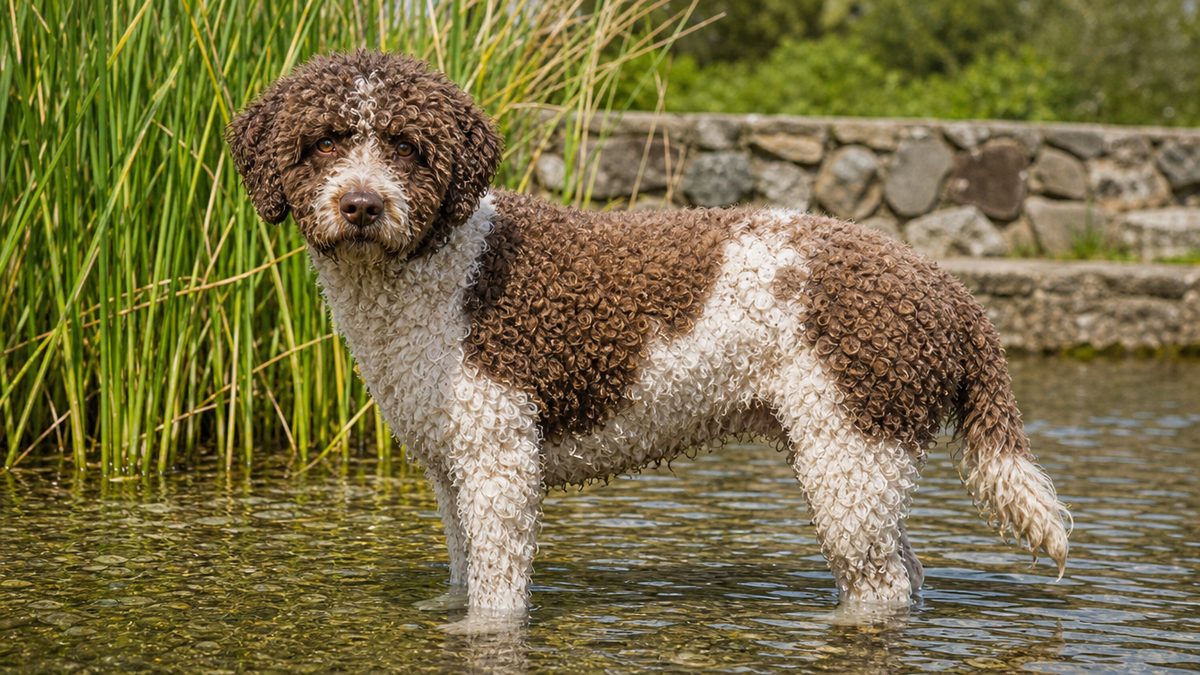
The Spanish Water Dog is a medium-sized Andalusian working dog with a curly woolly coat, recognised by the Federation Cynologique Internationale as standard 336 on a definitive basis since 30 May 1999 and listed by name in the annex to Spain's Real Decreto 558/2001.
Two official texts describe this breed and they are, unusually, almost the same document. FCI standard 336 was published in its current form on 11 October 2019 against an official valid standard dated 1 October 2019, and the FCI record names Spanish as the official authentic language. The racial prototype printed in the annex to Real Decreto 558/2001 runs from page 33 of the consolidated Spanish text. Set them side by side and the heights, the weights, the two centimetre tolerance, the coat clause, the colour rules and the disqualifying faults match.
The general appearance clause opens with one word that sets the tone. It calls this a rustic dog, well proportioned and of medium weight, dolichocephalic, of rather elongated harmonious shape and attractive appearance, of an athletic nature with well developed muscles owing to his regular exercise, with sight, hearing and scent all well developed. Rustic is the same word the Spanish Mastiff's standard uses, and in both cases it means a working animal rather than a delicate one.
The measurements are precise, which is a relief after the Spanish giants. Males stand 44 to 50 cm at the withers and females 40 to 46 cm, with a maximum deviation of 2 cm allowed in either sex provided the dog keeps proportions compatible with its height. Males weigh 18 to 22 kg and females 14 to 18 kg. The important proportions are given as ratios: body length to height 9 to 8, chest depth to height 4 to 8, muzzle length to skull length 2 to 3.
A working dog with three named jobs
The standard states the utilization plainly: shepherd dog, hunting dog, and assistant to the fisherman. Its historical summary is more specific still. It places the breed's densest population in Andalusia, where it works as a shepherd dog and has been known for centuries as the Turkish dog, and it says the qualities of the coat are adapted to the variation of humidity and drought of the marshy regions. That single sentence is the most useful thing in the document for an Indian reader, and the climate section below tests it.
The standard also calls the dog dolichocephalic, in both the English and the authentic Spanish, alongside a flat skull, a barely marked stop and skull and muzzle axes that run parallel. McMillan 2024's supplementary table classifies the breed as mesocephalic instead. Neither is a mistake so much as a different measurement, and the standard is the document that governs what a judge is looking at.
Two clauses that Indian law contradicts head-on
Read the tail clause before you look at a photograph of this breed. FCI 336 states that docking must be done at the height of the second to the fourth caudal vertebra, and the authentic Spanish is blunter still: *la cola debe amputarse de la segunda a la cuarta vertebra*. The national prototype in Real Decreto 558/2001 carries the identical instruction. The standard adds that certain dogs show a congenital shortened tail, brachyouria, which is why some undocked specimens are naturally short-tailed.
Then read the disqualifying faults. Presence of dewclaws disqualifies a Spanish Water Dog from the ring, in both official texts. A standard that disqualifies a dog for having dewclaws is, in practice, a standard that expects them removed.
Second Schedule Part II paragraph 6(8) of the Prevention of Cruelty to Animals (Dog Breeding and Marketing) Rules 2017 reads that there shall be no tail docking, ear cropping, de-barking, de-clawing, branding, dyeing, injecting substances to enhance visual appeal, performing a surgery or procedure to camouflage or hide any defect or infirmity or any other kind of mutilation of any body part of the pup, and that any change of appearance by artificial means is strictly forbidden. So a Spanish Water Dog bred and kept lawfully in India carries a full tail and its dewclaws, and is therefore ineligible for the breed's own show standard on two counts. That is a genuine collision between a breed standard and Indian law, and this page states it rather than showing you a docked dog.
One more figure is worth having because it is where most Indian confusion starts. English Wikipedia records that the breed was recognised by the Real Sociedad Canina de Espana in 1975, definitively accepted by the FCI in 1999 and recognised in Spanish law by royal decree in 2001. All three of those check out against the primary documents, which is worth saying because on this site that is not the usual resultReal Decreto 558/2001, de 25 de mayo.
Spanish Water Dog price in India, and what a search actually returns
There is no verifiable Spanish Water Dog price in India, and searching for one in India returns a Portuguese Water Dog sales page instead. Bonbeno publishes no rupee figure for this breed.
The substitution is the finding, so look at it closely. The Indian listing page that surfaces for this query is titled Buy Portuguese Water Dog Puppies For Sale in India. Read live on 9 September 2026, the string Spanish Water Dog appears on it zero times. It carries a specification block for the Portuguese breed, an Indian city selector running from Ahmedabad to Vadodara, and a carousel headed Other Available Pets.
That carousel is where the page gives itself away. Its animals are Fizey, a Maltipoo, at Rs 98,999; Kuzo, a Poodle, at Rs 92,599; Dugu, a Poodle, at Rs 92,599; and Kazuka, a Cane Corso, at Rs 94,999, with further entries at Rs 1,20,000, Rs 76,499 and a second Rs 98,999. Not one animal in it is a water dog of any nationality. A page selling the wrong breed, stocked with none of either breed, at a price attached to whichever puppy is in the carousel, is not a price observation.
| Result | What it promises | What it contains |
|---|---|---|
| Puppiezo listing | Water dog puppies for sale in India | A Portuguese Water Dog spec sheet, and a carousel of a Maltipoo, two Poodles and a Cane Corso |
| US marketplaces | Spanish Water Dog puppies | Real listings, priced in dollars, in a country the dog cannot lawfully be imported from for sale |
| General breed pages | Price, temperament, life span | US price bands and lifespans with no cited source |
| ENCI Italy record | Registry information | A genuine national registry record, and evidence the breed is registered in Europe rather than in India |
Why this page converts no foreign price
American sources put a Spanish Water Dog puppy somewhere between about 1,500 and 3,000 US dollars. Multiplying that by an exchange rate would produce a confident rupee band, and it would be a fabrication. This site has repeatedly caught Indian pages and AI answers doing exactly that, printing a rupee range that divides cleanly by 74, 80 or 84.38 straight back into the dollar figure it was made from. A converted foreign asking price is not an Indian price, and there is no Indian market here for it to describe.
What can honestly be said about availability is a composition argument rather than a volume one. There is no lawful commercial import route into India for this breed, no Indian breed club, and no Indian listing that actually holds one. The recurring-cost section below is where an Indian reader's real budget lives.
What a Spanish Water Dog costs to keep in India
A Spanish Water Dog is a mid-priced dog to run in India, and it sits in the most common weight bands rather than at the extremes. At 18 to 22 kg it lands squarely inside the 15 to 30 kg parasiticide pack and inside most Indian boarding tiers.
Start with the lines that are actually published. Vetic quotes a single anti-rabies vaccine at Rs 699, a 9-in-1 DHPPiL from Rs 899 and kennel cough at Rs 1,349, and those are promotional starting prices from one clinic chain rather than a market average. Deworming with Drontal Plus works out at Rs 125.67 a tablet, dosed one per 10 kg, so a 20 kg Spanish Water Dog needs two tablets, about Rs 251 a dose.
Parasite prevention is the line where this breed's size is an advantage. NexGard Spectra's 15 to 30 kg pack is Rs 3,308 for three tablets, about Rs 1,103 a month, and an 18 to 22 kg dog fits that pack exactly rather than needing the next one up. For a working-coated dog that swims, monthly tick and flea cover is not optional in India.
| Line | Published Indian figure | Notes for this breed |
|---|---|---|
| Anti-rabies, single | Rs 699 at a Vetic clinic | Not weight-banded. A Goa government veterinary hospital charges Rs 100 inclusive of certificate |
| 9-in-1 DHPPiL | From Rs 899 | A Goa government hospital charges Rs 600, a 3.3 times spread on the same vaccine |
| Kennel cough | Rs 1,349 | Worth doing before boarding, and this breed boards well |
| Deworming | About Rs 251 a dose at 20 kg | Two Drontal Plus tablets at Rs 125.67 each |
| Monthly tick, flea and worm cover | About Rs 1,103 | NexGard Spectra 15 to 30 kg, and this dog fits the pack |
| Full clip at a salon | From Rs 1,869 in Delhi | Once or twice a year, not monthly, which is the cost advantage of a corded coat |
| Overnight boarding | Rs 899 for 24 hours in Bengaluru | A 20 kg dog sits inside most facilities' accepted size |
| Municipal registration | Rs 500 in Delhi, Rs 50 in Chennai | Delhi has issued 18,958 pet dog certificates since 2021 |
This is not an expensive dog to run by Indian standards, and that is worth stating because rare foreign breeds usually are. A 20 kg heat-sensitive working dog on monthly parasite cover, two clips a year and ordinary vaccination sits in the same annual band as a Labrador, and well below any of the Spanish giants. What makes it expensive is getting the coat wrong and paying a salon monthly for it.
Grooming is where this breed is genuinely cheap to run and where most Indian owners will overspend anyway. The coat is clipped completely once or twice a year rather than trimmed monthly, so the honest annual grooming budget is two salon visits. What drives the cost up is asking an Indian salon for a poodle-style scissor finish, which the standard rules out and which the coat is not built for.
The costs specific to a water dog in an Indian city
- Ear care consumables, because a drop-eared dog that swims in Indian humidity needs cleaner and drying solution as a routine purchase, not an occasional one
- Somewhere to swim, which in most Indian cities does not exist safely and turns into a fuel and travel line instead
- A clipper you can use at home, because two full clips a year at salon rates cost more than the machine
- Genetic testing, which is the one line unique to this breed and is discussed under health
- Anaesthesia planning, because the 2025 evidence below is a reason to choose the practice as carefully as the procedure
Registration and municipal fees stay flat regardless of breed. Delhi charges Rs 500 to register a pet dog and Rs 500 to renew, with a Rs 100 per month late fee, and has issued 18,958 certificates since 2021. Chennai charges Rs 50 for a pet licence, issued 9,115 in 2024, and runs six municipal pet clinics that give treatment and anti-rabies vaccination free of cost. Boarding in Bengaluru runs Rs 599 for four hours, Rs 799 for a ten-hour day and Rs 899 for twenty-four hours.
Can a Spanish Water Dog handle the Indian climate
A Spanish Water Dog handles Indian humidity better than almost any coated European breed, because its homeland is as humid as Kolkata. What it cannot handle is the heat sitting behind that humidity, and the number that shows the difference is wet bulb rather than air temperature.
This is the section where the usual reasoning about coated breeds in India goes wrong, so it is worth doing carefully. The standard itself says the coat is adapted to the variation of humidity and drought of the marshy regions. Testing that claim needs the homeland's own humidity, not an assumption about Mediterranean dryness.
Queried by explicit latitude and longitude so no place name can be silently substituted, NASA POWER gives Jerez de la Frontera, in the breed's Andalusian core, an annual mean of 18.29 C and an annual relative humidity of 73.84 percent, on a cell reported at 35.86 m against a real 56 m, an error of minus 20.1 m. Kolkata's annual relative humidity, from the same API and the same climatology window, is 73.84 percent, on a cell at 7.35 m against a real 9 m. Those two figures are identical to two decimal places, which is a coincidence of rounding rather than a meaningful equality, but the point survives: the damp is the same.
| Place | Cell elevation and error | Annual mean | Annual humidity | Hottest month | Peak wet bulb |
|---|---|---|---|---|---|
| Jerez, Andalusia | 35.86 m, minus 20.1 | 18.29 C | 73.84 % | August, 25.16 C | 20.33 C, August |
| Donana marisma | 42.99 m, plus 38.0 | 18.45 C | 67.57 % | August, 27.46 C | 19.94 C, August |
| Delhi | 206.37 m, minus 9.6 | 25.57 C | 45.51 % | June, 35.88 C | 26.50 C, July |
| Chennai | 48.95 m, plus 43.0 | 27.94 C | 72.39 % | May, 31.51 C | 26.11 C, May |
| Mumbai | 97.15 m, plus 83.2 | 26.77 C | 67.28 % | May, 31.19 C | 25.77 C, June |
| Kolkata | 7.35 m, minus 1.7 | 25.80 C | 73.84 % | May, 31.53 C | 27.09 C, June |
| Bengaluru | 841.72 m, minus 78.3 | 23.74 C | 67.84 % | April, 28.37 C | 21.86 C, May |
| Pune | 635.99 m, plus 76.0 | 23.86 C | 66.68 % | April, 28.93 C | 22.97 C, June |
Read the humidity column and then the wet-bulb column, in that order. Jerez at 73.84 percent is wetter than Mumbai, Bengaluru and Pune and level with Kolkata, so a claim that Indian damp will overwhelm this breed is simply not supported. Now read across to wet bulb, which is the number that decides whether panting still works: Jerez peaks at 20.33 C and Kolkata at 27.09 C. That 6.76 degree gap is the whole problem, and it is heat, not moisture.
At 21.86 C and 22.97 C peak wet bulb, Bengaluru and Pune sit within about two degrees of the breed's Andalusian summer, which no other Indian metro does. That is a real finding rather than a hedge, and it is the strongest climate case any breed in this Spanish cluster has for an Indian city.
What still has to be managed
Exertion is the risk, not ambient heat by itself. Hall 2020 recorded 1,259 heat-related illness events from 1,222 dogs, of which 879 carried a recorded trigger, and 652 of those 879, or 74.2 percent, were exertional. This is an athletic dog with a working drive and an owner who will want to exercise it, which is the exact combination that produces those events. Keep the work to before about 7 am and after about 8 pm from March to October in the plains cities.
Bodyweight matters here too, in the direction owners rarely expect. Hall 2020 in Scientific Reports found that a bodyweight at or above the breed and sex mean carried 1.42 times the odds of heat-related illness, 1.12 to 1.80. A Spanish Water Dog kept at the top of its 18 to 22 kg range is carrying an avoidable risk factor into an Indian summer.
Indian law names the outdoor-housing question directly, and this breed sits inside its second category during the hot months. Second Schedule Part IV paragraph 21(1) bars keeping dogs in outdoor facilities without the attending veterinary practitioner's written approval where the dog is not accustomed to local temperatures, where the breed cannot tolerate them, such as long-haired breeds in high temperature locations, or where the animal is sick, infirm, aged or young.
Spanish Water Dog temperament and household fit
The Spanish Water Dog is faithful, obedient, cheerful, hard working, watchful and well balanced, and its standard describes an outstanding learning ability owing to an extraordinary mental grasp. It is a far easier temperament to live with than any of Spain's guardian breeds, and its difficulty is energy rather than independence.
Take the description from the standard, which is unusually warm about this breed. Both official texts give the same list: faithful, obedient, cheerful, hard working, watchful and well balanced, with a learning ability the text calls outstanding and an ability to adapt to all situations and conditionsReal Decreto 558/2001, de 25 de mayo. A lack of balance in character is a disqualifying fault, so temperament is judged rather than assumed.
Watchful is the word to weigh before an Indian flat. This breed was a shepherd before it was anything else, and it announces arrivals. That is manageable with early socialisation and a settle, and it is a genuine consideration in a building where a dog barking at every lift arrival becomes a complaint.
Who this breed genuinely suits
- Households that can give 60 to 90 minutes of real activity a day, in the cool hours, every day
- Owners who enjoy training, because this dog learns fast enough to make training rewarding rather than a chore
- Families in Bengaluru, Pune or a hill station, where the wet-bulb figures are within reach of the homeland
- People who will accept a corded coat as it is, rather than trying to make it look like a poodle
- Anyone who will actually run the genetic tests and tell a vet the breed before an anaesthetic
It suits fewer households than that list suggests, for one reason. An intelligent working dog that is under-exercised does not become calm, it becomes inventive, and in an Indian flat inventive means barking, chewing and door guarding. The breed's biddability is what makes it feel like an easy choice and what makes an under-stimulated one so obviously unhappy.
The health literature for the Spanish Water Dog is unusually good for a rare breed, but none of the nine papers studies behaviour. Everything in this section comes from two breed standards. Treat it as description rather than measurement, and judge the individual dog in front of you.
Training a Spanish Water Dog, which is the easy part
Train a Spanish Water Dog the way you would train a working gundog, with short frequent sessions, clear markers and real jobs. Its own standard calls its learning ability outstanding, and the practical risk with this breed is under-training rather than resistance.
The standard's wording is worth taking literally. It describes learning ability as outstanding owing to an extraordinary mental grasp, and a dog that adapts to all situations and conditions. In practice that means a Spanish Water Dog picks up a new behaviour in a handful of repetitions and then, if you stop there, invents its own use for it.
Socialise the puppy before you teach it anything, because watchfulness is in the standard alongside the biddability. Between eight and sixteen weeks, aim for a new person, surface, vehicle or sound every day, in the cool hours. In an Indian city that list needs auto-rickshaws, delivery riders, lift doors, temple bells, cattle in the road and firecrackers, and it needs to happen before the dog's own opinions harden.
What to teach, in order
- Name response and a marker word, in the first fortnight, because everything else is built on them
- A settle on a mat, which is the single behaviour that makes a watchful breed liveable in a flat
- Loose-lead walking, taught early while the dog is under 15 kg and easy to out-manoeuvre
- A recall that survives another dog, a bird and water, in that order of difficulty
- An off switch, taught deliberately, because an intelligent working dog does not acquire one on its own
Give the dog work rather than repetition. Scent games, retrieves, a search for a hidden toy, a puzzle feeder and simple obedience chains all satisfy this breed far better than drilling a sit. Its three ancestral jobs were shepherding, hunting and helping fishermen, and all three are problem-solving jobs done alongside a person.
Timelines are quick by the standards of this site. Expect house training in three to six weeks, a usable settle by twelve weeks, loose-lead walking that holds under distraction by six months, and a reliable recall between nine and fifteen months. That speed is exactly why so many owners stop training at six months and then meet a bored, noisy adolescent at ten.
Exertional heat illness accounted for 652 of the 879 heat-related illness events with a recorded trigger in Hall 2020, or 74.2 percent. Training is exercise, and an eager dog will not tell you when to stop. Move the session, not the intensity.
Daily exercise a Spanish Water Dog actually needs
A Spanish Water Dog needs 60 to 90 minutes of activity a day, split across the two coolest parts of an Indian day, and at least half of it should be mental rather than purely physical. This is an athletic dog whose standard describes well developed muscles owing to regular exercise.
The standard's general appearance clause is effectively an exercise prescription. It describes an athletic nature with well developed muscles owing to his regular exercise, and it names the trot as the preferred gait. A dog described that way does not stay sound on twenty minutes around a block.
Swimming is the ideal exercise for this breed and the hardest to arrange in India. Water carries the load and the heat at once, which is exactly what a heat-limited working dog needs. Where a clean, safe, supervised swim is available, it is worth planning around. Where it is not, never improvise in an untreated tank, a canal or a monsoon drain, because leptospirosis and blue-green algae are real Indian hazards and neither announces itself.
A realistic Indian week
- Two walks a day of 30 to 45 minutes each, before about 7 am and after about 8 pm from March to October
- Three or four short scent or search sessions a week, indoors, which cost nothing and tire the dog properly
- One longer outing a week where the ground allows a sustained trot rather than stop-start lead walking
- Swimming wherever it is genuinely safe, which for most Indian owners means a few times a year rather than weekly
- A puzzle feeder or scatter feed on any day when the weather cancels the walk, which in an Indian summer is many days
Under-exercise in this breed shows up early and audibly. Barking at ambient noise, guarding doorways, chewing and pacing are the usual signs, and all four are commonly mistaken for a training failure when they are a workload failure. The dog is not being disobedient; it has nothing to do.
Growth-stage limits are gentler than in a giant breed but still real. Keep forced exercise low until about four months, restrict repetitive jumping and hard surfaces through the first year, and let a puppy stop when it wants to. A medium athletic breed reaches skeletal maturity somewhere around twelve to fifteen months.
Grooming a Spanish Water Dog, which means not grooming it
Never brush or comb a Spanish Water Dog. The coat is left to curl and cord on its own and is clipped right down completely and evenly once or twice a year, and the standard forbids any clipping that turns into aesthetic grooming.
The coat clause is short and unusually prescriptive, so read it before you book a salon. The hair is always curly and of a woolly texture, curly when short and able to form cords when long. Clipped subjects are admitted, the clipping must always be complete and even, and it must never become an aesthetic grooming. The recommended maximum length for shows is 12 cm, or 15 cm extending the curl, and the minimum is 3 cm so a judge can see the quality of the curl. Puppies are always born with curly hair.
Two coat states are disqualifying rather than merely faulty. A smooth or wavy coat disqualifies, as does a spotty or flecked coat and a black and tan or chestnut and tan one. So a Spanish Water Dog that has been brushed straight is not simply badly presented, it is presented in a state the standard rules out.
| The coat needs | What that means in practice | The common Indian mistake |
|---|---|---|
| No brushing at all | Separate large cords by hand occasionally, and otherwise leave the coat alone | A slicker brush and a blow dry, producing the wavy coat the standard disqualifies |
| A complete, even clip once or twice a year | One machine length all over, including the head and tail | A scissored poodle outline, which the standard rules out as aesthetic grooming |
| Thorough drying after every wetting | Towel, then a low-heat blower to the skin, especially in the monsoon | Letting the dog air dry, which is advice written for a Spanish summer |
| Ears kept dry and checked often | Plug before bathing, clean and dry after swimming | Treating a drop-eared water dog like a prick-eared one |
| Feet and cords checked for grit | Look between the toes weekly | Ignoring the feet because the coat hides them |
The monsoon is the real test, and it is the opposite of the usual advice
Overseas advice for this breed assumes a climate where a wet coat dries. The standard itself says the coat is adapted to the variation of humidity and drought of the marshy regions, and the operative word is variation. Andalusia is humid, but it also dries out. An Indian monsoon does not, and a woolly corded coat that never dries fully is a hot, dark, damp environment held against the skin for weeks.
So the Indian adaptation is straightforward. Clip shorter going into the monsoon rather than longer, dry the dog properly every time it gets wet rather than letting it air dry, and check the skin under the cords rather than just the coat over them. If the coat smells different, that is the first sign, and it comes before anything is visible.
Do not shave to the skin for summer, and do not confuse that with clipping. A complete even clip to a few centimetres is what the standard contemplates and what keeps the dog cool. Taking the coat off entirely exposes skin the standard describes as supple, fine and well adhering, which may carry no pigment at all depending on coat colour, to Indian sun.
The cost consequence is genuinely favourable. Two full clips a year at Delhi rates, where a complete bath and styling starts at Rs 1,869, is a smaller annual grooming bill than a monthly-trim breed carries. The saving disappears the moment somebody asks for a scissor finish.
Spanish Water Dog health, including the finding almost no page carries
The Spanish Water Dog is the best-documented breed in this Spanish cluster, with a measured median lifespan of 13.7 years, four separately mapped genetic variants, and one finding that belongs in front of a vet: a 2025 analysis of 54,542 anaesthetics in which this breed was one of only two whose mortality risk stayed raised after adjustment.
Take the anaesthetic finding first, because it is the most actionable. Redondo 2025 analysed a prospective multicentre cohort of 55,019 canine anaesthetic procedures from premedication to 48 hours after extubation; after excluding euthanasias and non-anaesthetic deaths, 54,542 anaesthetics remained. Overall mortality was 0.69 percent, 378 of 54,542, with a 95 percent interval of 0.62 to 0.76, and mixed-breed dogs, the benchmark, ran at 0.68 percent.
Unadjusted, the highest rates were the German Shepherd Dog at 1.46 percent, the Chihuahua at 1.35 percent and the Bulldog at 1.26 percent. The important sentence is what happened next. After adjustment for ASA physical status, excess risk persisted for only two breeds: the Chihuahua at RR 1.80 (1.08 to 2.99) and the Spanish Water Dog at RR 2.72 (1.23 to 6.01), and not for the German Shepherd Dog or the Bulldog.
Tell your vet the breed before any procedure needing anaesthesia, including a neuter or a dental. That is the whole action. Do NOT read this as a reason to refuse anaesthesia: overall mortality in that study was 0.69 percent, the confidence interval on 2.72 runs from 1.23 to 6.01 and is therefore wide, and the authors' own conclusion is that anaesthetic mortality was low overall and that between-breed differences largely reflected case severity, supporting breed-aware, ASA-centred risk communication. An owner who argues a vet out of an appropriate anaesthetic has made this worse, not better.
A long life, measured rather than claimed
This breed has a real lifespan figure, which almost none on this site do. McMillan 2024's supplementary Table S3 gives the Spanish Water Dog a median survival of 13.7 years on 37 deaths from a cohort of 265 dogs, with a lower 95 percent bound of 13.3 and an upper bound that was not estimable, and a hazard ratio of 0.51 (0.37 to 0.70), p below 0.001 against the crossbred group. A hazard ratio of 0.51 against crossbreds is a strong result, and the comparator is crossbreds specifically rather than all dogs.
One caveat belongs with that figure. The paper's Table S3 gives 265 dogs while its Table S6 gives 201 alive and 238 total for the same breed, and this site has seen the same disagreement on eight other breed pairs. The death count is identical in both tables at 37, which is why this page quotes deaths, the median and the interval rather than picking a denominator.
Four mapped variants, and what each one means
| Gene | What it causes | What was found | Is a test available |
|---|---|---|---|
| PDE6B | Early-onset progressive retinal atrophy | A 6 bp deletion in exon 19, c.2218-2223del, p.Phe740_Phe741del, removing two highly conserved amino acids from the enzymatic domain, segregating with disease in 18 dogs of which 6 were affected | Yes, a DNA test was designed from it |
| TPO | Congenital hypothyroidism with goitre, autosomal recessive | A single guanosine insertion in the first exon, in two half-sib pups with absent TPO enzyme activity, segregating with the disease allele in the breed and absent from unrelated dogs of other breeds | The variant is published and testable |
| SLC2A9 | Urate urolithiasis | One dog homozygous for the mutated gene, with an ammonium urate urethrolith and primary portal vein hypoplasia; the first Spanish water dog described with this mutation | Yes, SLC2A9 testing is widely offered |
| KRT71 | The curly coat itself, not a disease | A structural variant in exon 7, c.1266_1273delinsACA, a second curl allele found at lower frequency in this breed and four others | Yes, and it explains coat type rather than risk |
Progressive retinal atrophy is the one to ask a breeder about first. Winkler 2020 identified the PDE6B deletion by combining an exclusion analysis with whole genome sequencing of two affected siblings and two phenotypically normal relatives, and the resulting DNA test was designed specifically so breeders could genotype and make informed decisions. The same gene causes PRA in the Irish Setter, the Sloughi and the American Staffordshire Terrier, which is a reminder that a shared gene is not a shared variant.
Congenital hypothyroidism with goitre is rarer and more dramatic. Fyfe 2013 describes two half-sib pups diagnosed on clinical signs, endocrine testing and thyroid histology, with TPO enzyme activity absent and immuno-cross-reactive TPO undetectable in affected thyroid tissue. The paper's wider point is that dogs have a canid-specific TPO gene structure, which is why the causal insertion sits at a site nobody expected to be coding.
Urate stones matter for feeding as much as for medicine, which the feeding section picks up. Cosgrove 2015 reports a Spanish water dog with an ammonium urate urethrolith that was both homozygous for the mutated SLC2A9 gene and diagnosed with primary portal vein hypoplasia, and records it as the first case of those two things together.
Three single-case reports worth knowing exist
Two oesophageal conditions and one eye study round out the literature. Ruiz-Campillo 2024 describes a seven-year-old neutered female with progressive weight loss, chronic vomiting and regurgitation, whose necropsy showed severe oesophageal dilation and a severe lymphocytic infiltrate with marked tropism to autonomic neuronal bodies, mostly CD3 positive T cells, and which the authors report as the first description of that infiltrate in an adult dog with no other clinical signs. Kaminen 2014 describes surgical management of a congenital tracheoesophageal fistula in a young Spanish water dog.
Merchan 2023 is the quietly useful one. It measured optic nerve head parameters by digital planimetry in the Spanish Water Dog and the Spanish Greyhound and found significant differences in every parameter, with the water dog showing greater disc height, width, area and top height and lower circularity. That matters because optic disc appearance varies enormously between dogs, and a vet comparing this breed's fundus against a general reference may read a normal disc as abnormal.
No OFA figure is published on this page. The Orthopedic Foundation for Animals disease-statistics page returned HTTP 200 with 1,752 characters of visible text ending in Searching Database, Please wait and no rows at all, and a LABRADOR control returned zero on the same fetch, which makes it an instrument failure rather than an absence.
The Indian risks, which are not breed-specific but are the likeliest
Tick-borne disease outranks everything above for a dog living in India. A survey of 584 dogs in West Bengal found Babesia gibsoni in 76.54 percent and two or more pathogens in 72.9 percent of the 584 dogs screened, sampled from veterinary clinic caseloads rather than from a random population. A dense corded coat hides ticks far better than a short one, so monthly parasiticide cover and a hands-on weekly check both matter more here than the coat's appearance does.
Ear disease is the second, and this breed's anatomy invites it. Drop ears, a woolly coat and a dog that likes water is the worst combination in an Indian monsoon. Plug the ears before a bath, dry them after every swim, and treat a head shake or an odour as a reason to see a vet rather than to buy a cleaner.
Feeding a Spanish Water Dog in India
Feed a Spanish Water Dog to a lean body condition on a good quality adult food split across two meals, and know that this is one of the few breeds where a published genetic finding has a direct dietary consequence. An SLC2A9 variant associated with urate stones changes what a positive dog should eat.
Portion by weighed grams rather than by scoop, and adjust by feel. At 18 to 22 kg for males and 14 to 18 kg for females, the breed has a genuine published weight range to plan against, which most breeds on this site do not. Score the dog weekly: ribs easily felt under a thin fat covering, a visible waist from above, a tuck from the side.
Keeping this dog lean is not cosmetic. Hall 2020 found a bodyweight at or above the breed and sex mean carried 1.42 times the odds of heat-related illness. In an Indian summer, a Spanish Water Dog kept at 22 kg rather than 19 kg has taken on a measurable risk for no benefit.
The urate question, which is breed-specific
Ask about SLC2A9 before you build a diet. Dogs homozygous for the mutated SLC2A9 gene excrete uric acid rather than allantoin and form urate stones, and Cosgrove 2015 records the first Spanish water dog described with that mutation, presenting with an ammonium urate urethrolith. For a dog that tests homozygous, purine intake and water intake become clinical questions rather than preferences, and that is a conversation for your own vet rather than for a breed page.
- Test rather than assume, because the variant is present in the breed and a single case report is not a prevalence figure
- Keep water available and encourage intake, which matters for any stone-forming dog and doubly in Indian heat
- Discuss purine-restricted diets with a vet if a dog tests homozygous or has formed a stone, rather than restricting protein on your own
- Watch for straining, blood in urine or a dog posturing without producing, which in a male dog is an emergency
- Keep the food traceable and dry, because aflatoxin from mould on maize and groundnut in humid Indian storage is a real hazard for any breed
Meal structure is ordinary otherwise. Two meals a day for an adult, three or four for a puppy, an hour of rest either side of a meal, and a slow bowl for a fast eater. A medium deep-chested athletic dog is not at the top of the bloat risk table, but it is not at the bottom either, and the habit costs nothing.
Storage deserves the same attention it gets on every Indian page here. Buy pack sizes you will finish in a few weeks, decant into an airtight container, keep the sack off the floor, and throw away anything that smells musty. The monsoon is when a stored sack of kibble goes wrong, and it goes wrong silently.
Spanish Water Dog puppy timeline, month by month
A Spanish Water Dog's first year has two fixed legal points and one that is unique to the breed. No puppy may lawfully be sold in India below eight weeks, vaccination is expected to run from seven or eight weeks to about eighteen, and the coat changes character somewhere in the middle of the year.
Both legal points come from the gazette rather than from convention. Rule 8(1)(a) of the Prevention of Cruelty to Animals (Dog Breeding and Marketing) Rules 2017 requires that pups less than eight weeks in age are not sold, and Second Schedule Part III paragraph 8(9) states that all pups shall be vaccinated, which can start at seven to eight weeks and is usually completed at eighteen weeks.
| Age | What matters most | What to avoid |
|---|---|---|
| 8 to 10 weeks | Legal earliest sale. Vaccination course begins. Handle feet, ears and mouth daily | Buying below eight weeks, which is unlawful rather than merely unwise |
| 10 to 16 weeks | The socialisation window, in the cool hours. A new person, surface or sound every day | Brushing the coat, which starts a habit the standard rules out |
| 16 to 18 weeks | Vaccination completes. Introduce water calmly and shallowly if a safe place exists | Throwing a puppy into water, which makes a water dog afraid of water |
| 4 to 6 months | First full clip, complete and even, before the coat begins to cord | A scissored or styled trim, and any air drying in the monsoon |
| 6 to 9 months | Coat begins forming cords. Adolescent barking and watchfulness appear | Assuming the training is finished because the dog learned fast |
| 9 to 12 months | Genetic testing before any breeding decision. PDE6B, TPO and SLC2A9 are all published | Breeding on appearance alone in a breed with four mapped variants |
| 12 to 15 months | Skeletal maturity. Exercise can extend to sustained trotting work | Repetitive jumping and hard surfaces before this point |
Introduce water properly, because this is the one thing a water dog can be permanently spoiled on. Shallow, warm, safe and voluntary is the whole method, with the puppy choosing to walk in rather than being carried or thrown. In India the practical constraint is finding water that is clean enough, and a supervised shallow pool or a clean stream in the cool hours is worth arranging.
A Spanish Water Dog's puppy coat is curly; the cords come later. The first complete clip sets the pattern for the dog's life, and asking for a poodle silhouette at that appointment is how an owner ends up fighting the coat for a decade. Ask for one machine length all over and explain why.
Spanish Water Dog against the curly breeds people cross-shop
Four curly working breeds are cross-shopped against the Spanish Water Dog, and on the evidence available it wins on two things that matter: a measured lifespan and a genuinely documented set of inherited diseases. It loses on availability in India, where none of them is easy to find honestly.
| Breed | FCI standard | Median lifespan in McMillan 2024 | Coat handling | Available in India |
|---|---|---|---|---|
| Spanish Water Dog | 336, definitive 1999 | 13.7 years on 37 deaths, HR 0.51 | Never brushed, clipped completely once or twice a year | No lawful purchase route; a search returns a different breed |
| Portuguese Water Dog | 37, definitive | 13.0 years on 36 deaths, HR 0.85, p 0.32 | Clipped and often styled, higher maintenance | Listed by Indian sellers, which is exactly the substitution problem |
| Lagotto Romagnolo | 298, definitive | Not included in the survival analysis | Curly, clipped, shares the second KRT71 curl variant | Occasionally, at high prices |
| Irish Water Spaniel | 124, definitive | 10.8 years on 68 deaths, HR 1.33 (1.05 to 1.68), p 0.02 | Curly with a distinctive rat tail, needs regular work | Effectively absent |
| Poodle | 172, definitive | 14.0 years on 2,399 deaths, HR 0.64, p below 0.001 | High-maintenance styled coat, monthly grooming | Yes, widely, and the coat comparison that misleads |
Two rows on that table deserve a second look. The Irish Water Spaniel is the outlier in the wrong direction, at a median of 10.8 years on 68 deaths with a hazard ratio of 1.33 (1.05 to 1.68) and p of 0.02, meaning it dies significantly earlier than crossbreds while the Spanish Water Dog dies significantly later. And the Poodle, on 2,399 deaths, reaches 14.0 years at HR 0.64, so the breed most Indian buyers can actually obtain is also, on the numbers, an excellent one.
The Portuguese comparison is the one to think about hardest, because it is the breed an Indian buyer will actually be offered. McMillan 2024 gives the Portuguese Water Dog a median of 13.0 years on 36 deaths with a hazard ratio of 0.85 and a p value of 0.32, which is not statistically distinguishable from crossbreds, against the Spanish Water Dog's 13.7 years on 37 deaths at HR 0.51 with p below 0.001. Two similar breeds, similar death counts, and meaningfully different results.
If you want the coat
The Poodle is what most Indian groomers are trained on and what most Indian buyers can actually obtain, and it is a genuinely good dog. It is also a monthly-grooming breed rather than a twice-yearly one, so the running cost runs the other way. The Lagotto Romagnolo is closer to the Spanish Water Dog's working temperament and shares the second KRT71 curl variant with it.
If you want the dog
Ask what you actually want from it. A biddable, athletic, watchful medium dog that needs 60 to 90 minutes a day and a job is a description that fits many breeds available in India, including Indian ones. The Indian Pariah Dog is heat-adapted, free of all four of these variants and adoptable this week, and for most Indian households that is the honest recommendation.
Mistakes Indian owners make with this breed
Five mistakes account for most of what goes wrong with a Spanish Water Dog in India, and three of them are about the coat. None is about training, because this breed makes training easy.
- Brushing the coat, which produces the wavy finish the standard disqualifies and destroys the cords it is supposed to form
- Asking for a poodle-style scissored trim, which the standard rules out as aesthetic grooming
- Letting the dog air dry after a wash or a swim, which is advice written for Andalusia and wrong in an Indian monsoon
- Not telling the vet the breed before an anaesthetic, when this is one of only two breeds whose adjusted mortality risk stayed raised in a 54,542-case study
- Buying a Portuguese Water Dog believing it is this breed, which is what an Indian search actually offers
The drying mistake causes more harm than it sounds like. A woolly corded coat holds water against skin the standard describes as fine and well adhering, and in a Mumbai or Kolkata July that water does not leave on its own. Towel first, then a low-heat blower directed at the skin rather than the coat surface, and check by feel rather than by look.
Two mistakes that are specifically legal
Buying a docked puppy is the first. FCI 336 directs docking at the second to fourth caudal vertebra, so a puppy imported or bred to the standard may arrive docked, and in India that procedure is prohibited under Second Schedule Part II paragraph 6(8) Federation Cynologique Internationale. A seller offering docked puppies in India is describing an unlawful act, whatever the standard says.
Assuming an Indian pedigree means an Indian studbook is the second. The Spanish Water Dog's genealogical book is kept by the Real Sociedad Canina de Espana under the authority of the Junta de Andalucia, not by any Indian body. India is a full FCI member represented by the Kennel Club of India, so an FCI-recognised pedigree can be honoured here, but the origin register is Spanish.
This breed genuinely does better in Bengaluru and Pune than on the coastal plains, and Indian owners who move a heat-limited dog to a hill or plateau city are reasoning correctly. Bengaluru peaks at a 21.86 C wet bulb and Pune at 22.97 C, against Kolkata's 27.09 C, which puts both within about two degrees of the breed's Andalusian summer.
Adoption, sourcing and the Indian import position
You cannot lawfully import a Spanish Water Dog into India in order to buy one, and no Indian breeding population exists. Adopting a dog already in India is the honest route, and for most households it is also the better one.
Read the import position from the instrument. The Directorate General of Foreign Trade's own FAQ states that the import policy for pet dogs and cats is restricted and permitted only with a DGFT authorisation under ITC(HS) code 01061900, and it lists the permitted purposes exhaustively: research by R&D organisations with a CPCSEA recommendation, internal security by the Defence and Police Force, a therapy or emotional support dog with a medical certificate, and a dog that has been the applicant's own pet for at least two years where the applicant is transferring residence to India after two years of continuous stay abroad.
It then closes the commercial route in one line. Dogs for commercial purposes like breeding or as a gift or for other purposes are not allowed to be imported, and new born puppies are not allowed. Import without authorisation is permitted only to a person shifting residence permanently to India under the customs baggage rules, capped at two pets, and only through the airports and seaports of Delhi, Mumbai, Chennai, Hyderabad, Bengaluru and Kolkata and, since October 2024, Kochi airport Department of Animal Husbandry…. The full route is set out in how to import a dog to India.
What to ask if you are buying anyway
- Ask for the PDE6B result, because a DNA test exists and a breeder who has not run it has not screened for the breed's best-documented blinding disease
- Ask whether either parent has been tested for the SLC2A9 variant, which changes what the dog should eat for life
- Ask to see the tail, because a docked puppy in India means an unlawful procedure was performed here or the dog came from somewhere that permits it
- Ask which register the pedigree comes from, and expect the answer to be the Real Sociedad Canina de Espana rather than an Indian body
- Ask for the vaccination record, which Indian law already requires a breeder to keep
Verify anything you are told against the register rather than against the seller. The FCI's group 8 index lists the Spanish Water Dog at 336 alongside the Portuguese Water Dog at 37, the Barbet at 105, the Irish Water Spaniel at 124, the Lagotto Romagnolo at 298 and the American Water Spaniel at 301, and reading it that way is how you catch a listing that has quietly substituted one for another.
The case for adopting instead
Most Indian households wanting this breed want a medium, biddable, trainable, active dog. Every Indian metro shelter holds dogs that fit that description, that are already adapted to the local wet-bulb load, that carry none of the four variants above, and that cost a fraction of an import to acquire. Registration is cheap and quick: Rs 500 in Delhi, Rs 50 in Chennai, where six municipal clinics also give treatment and anti-rabies vaccination free.
If you are genuinely relocating from Spain with your own dog, the transfer-of-residence route exists and is the one to use. It needs proof of two years of continuous stay abroad, an advance No Objection Certificate from the Animal Quarantine and Certification Service regional officer at the port of entry obtained seven days before travel and relaxable to three, and a health certificate from a veterinarian in the exporting country. Plan the arrival for the cool months, and plan the first clip for shortly after.
Spanish Water Dog questions Indian buyers actually ask
How much does a Spanish Water Dog puppy cost?
No verifiable Spanish Water Dog price in India exists. An Indian search for the breed surfaces a listing page for the Portuguese Water Dog instead, and that page's own carousel of available animals contains a Maltipoo, two Poodles, a Cane Corso and a Doxiepoo, and no water dog of either nationality. Bonbeno publishes no price for this breed.
How long do Spanish Water Dogs live?
13.7 years is the measured median, and it is one of the longest on record. McMillan 2024 gives a median survival of 13.7 years for the Spanish Water Dog from 37 deaths in a cohort of 265 dogs, with a lower 95 percent confidence bound of 13.3 and an upper bound that was not estimable, and a hazard ratio of 0.51 against crossbred dogs.
Do you brush a Spanish Water Dog?
No. The coat is never brushed or combed. It is left to curl and cord naturally and is clipped right down once or twice a year, completely and evenly. The standard is explicit that clipping must never become aesthetic grooming, and a smooth or wavy coat is a disqualifying fault.
Is Spanish Water Dog hypoallergenic?
No dog breed is. Vredegoor 2012 measured Can f 1 across 196 dogs of so-called hypoallergenic breeds against 160 control dogs and found the hypoallergenic group higher rather than lower, 2.26 against 0.77 micrograms per gram on hair, with no difference in airborne allergen. The FCI standard for this breed says nothing about shedding or allergy.
Should a Spanish Water Dog's tail be docked?
The standard says yes and Indian law says no, and in India the law governs. FCI 336 directs that docking must be done at the second to fourth caudal vertebra, and the authentic Spanish text says la cola debe amputarse. Second Schedule Part II paragraph 6(8) of the Prevention of Cruelty to Animals (Dog Breeding and Marketing) Rules 2017 forbids tail docking outright.
What health tests does a Spanish Water Dog need?
Four things are testable in this breed and all four have published variants. A DNA test exists for the PDE6B deletion causing early-onset progressive retinal atrophy, a TPO insertion causes congenital hypothyroidism with goitre, an SLC2A9 variant is associated with urate stones, and KRT71 explains the coat. Ask a breeder which of those they have run.
Is anaesthesia riskier for a Spanish Water Dog?
The best available evidence says yes, with a wide confidence interval. Redondo 2025 analysed 54,542 anaesthetics and found that after adjusting for ASA physical status, excess mortality risk persisted for only two breeds, the Chihuahua at RR 1.80 and the Spanish Water Dog at RR 2.72 with a 95 percent interval of 1.23 to 6.01. Overall mortality in that study was 0.69 percent, so the absolute risk stays low.
Can a Spanish Water Dog live in Indian heat?
With management, better than most coated breeds, and the reason is not what people assume. Its homeland at Jerez runs a 73.84 percent annual mean humidity, identical to Kolkata's, so damp air is not the shock. The heat behind the damp is: Jerez peaks at a 20.33 C wet bulb against Chennai's 26.11 C.
Where does the Spanish Water Dog come from?
Andalusia, and the standard says so. FCI 336's historical summary states that its densest population is in Andalusia, where it works as a shepherd dog and has been known for centuries as the Turkish dog, and that the quality of its coat is adapted to the variation of humidity and drought of the marshy regions.
Who keeps the Spanish Water Dog studbook?
The Real Sociedad Canina de Espana keeps it, under the authority of the Junta de Andalucia. That is unusual on the Spanish list, where most native breeds have a dedicated breed club as the authorised keeper, and it matters because any population or rarity figure for this breed is a figure from that one register.
Is the Spanish Water Dog recognised in India?
Indirectly, through the FCI. India is a full Federation Cynologique Internationale member represented by the Kennel Club of India, so the FCI's definitive recognition of standard 336 on 30 May 1999 is the operative answer. The Kennel Club of India publishes no breed list of its own, so an absence there proves nothing.
Can you import a Spanish Water Dog into India?
Not in order to buy one. India's pet import policy is restricted, needs a Directorate General of Foreign Trade authorisation, and permits import only for research with CPCSEA recommendation, Defence and Police use, a therapy or emotional support dog, or your own pet of at least two years on transfer of residence. Dogs for commercial purposes like breeding are not allowed to be imported.
Is a Spanish Water Dog a good pet?
Yes, for a household that can work it. Both official standards give the same list, faithful, obedient, cheerful, hard working, watchful and well balanced, with a learning ability the text calls outstanding and an ability to adapt to all situations and conditions, and a lack of balance in character is a disqualifying fault, so temperament is judged rather than assumed. It is a far easier temperament to live with than any of Spain's guardian breeds, and its difficulty is energy rather than independence: under-exercise shows up early and audibly as barking at ambient noise, guarding doorways, chewing and pacing, all of which are a workload failure rather than a training failure. The coat is never brushed and is clipped down once or twice a year, and the measured median lifespan is 13.7 years.
What's the difference between a Spanish and Portuguese Water Dog?
They are separate FCI breeds, 336 and 37 respectively in the Group 8 index, and the measured difference that matters is longevity. McMillan 2024 gives the Spanish Water Dog a median survival of 13.7 years on 37 deaths from a cohort of 265 dogs with a hazard ratio of 0.51 against crossbreds and p below 0.001, while the Portuguese Water Dog's median is 13.0 years on 36 deaths at a hazard ratio of 0.85 and p of 0.32, which is not statistically distinguishable from crossbreds. Two similar breeds, similar death counts, meaningfully different results. The comparison is the one to think about hardest in India, because the listing page an Indian search surfaces for the Spanish breed is a Portuguese Water Dog sales page on which the words Spanish Water Dog appear zero times.
Compare with similar breeds
Spanish Water Dog sits in 1 Bonbeno group. Each one compares it directly against the breeds it is genuinely an alternative to, on the same figures.