
Breed profile
Spinone Italiano: Price in India, Climate Fit and Health
A large Italian gundog with no undercoat, a documented epilepsy problem and no lawful route into India.
Quick answer
The Spinone Italiano has no established price in India, because no lawful commercial supply route exists: India's import policy for dogs is restricted and DGFT states plainly that dogs for breeding or as a gift are not allowed to be imported. Budget instead for care. A large 35 kg gundog costs roughly Rs 6,000 to Rs 12,000 a month to keep in an Indian metro, and the breed carries two documented inherited diseases.
This page reports published veterinary research and breed-registry screening guidance. It is not a diagnosis and it is not a treatment plan. Seizures, an unsteady gait in a puppy, and heat collapse are all emergencies. Consult your nearby vet before acting on anything here, and take any dog showing these signs to a veterinarian the same day.
Spinone Italiano at a glance
What the Spinone Italiano is, and what the standard actually says
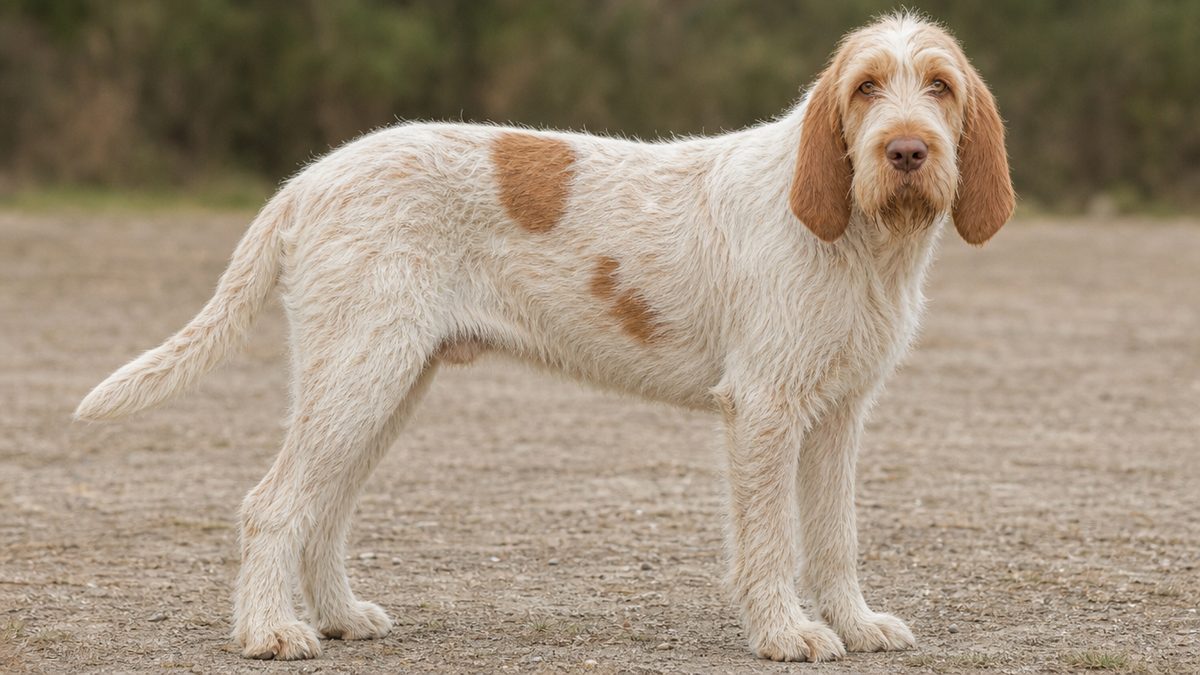
The Spinone Italiano is a large rough-coated Italian pointing dog, registered by the Federation Cynologique Internationale as standard 165 in Group 7 and accepted on a definitive basis on 30 April 1955.
It is a hunt, point and retrieve gundog built for stamina rather than speed. The FCI standard describes a dog of solid construction, robust and vigorous, with powerful bone, well-developed muscles and a rough coat. Its build tends to fit into a square: the length of the body equals the height at the withers, with a tolerance of 1 to 2 cm longer. The Royal Kennel Club puts the same dog more plainly, calling the trotting action pounding and saying it gives him stamina rather than speed.
Size, and where the two registries disagree
Two primary documents give this breed two different weights, and the gap matters for feeding and for drug dosing. The FCI standard prints 60 to 70 cm at the withers for males and 58 to 65 cm for females, with weights of 32 to 37 kg and 28 to 30 kg, and all four of its language editions agree to the kilogram FCI Standard N 165 Spinone Italiano FCI Standard N 165 Spinone Italiano. The Royal Kennel Club prints identical heights and heavier weights, 34 to 39 kg for dogs and 29 to 34 kg for bitches. Nothing reconciles them, so this page quotes both rather than averaging them.
| Measure | FCI standard 165 | Royal Kennel Club |
|---|---|---|
| Height, males | 60 to 70 cm | 60 to 70 cm |
| Height, females | 58 to 65 cm | 58 to 65 cm |
| Weight, males | 32 to 37 kg | 34 to 39 kg |
| Weight, females | 28 to 30 kg | 29 to 34 kg |
| Group | Group 7, Pointing Dogs | Gundog |
History, as the standard tells it
The FCI's own brief historical summary names two pieces of evidence and no more. Selincourt's 1683 book Le parfait chasseur speaks of a griffon coming from Italy and the Piedmont, and the best known depiction is a fifteenth-century fresco by Andrea Mantegna in the ducal palace of Mantua. Italy's own national register, ENCI, prints the same two references in Italian on its Libro genealogico record for the breed. The Royal Kennel Club adds that the breed was first seen in the UK in the early 1980s at the Game Fair, and that its ancestry is thought to contain Italian Hound with perhaps some coarse-haired Segugio blood and perhaps Setter or Mastiff input, while saying openly that there is much speculation on this. Treat the ancestry as unsettled, because the club that publishes it does.
A document defect worth knowing about
The FCI's register and the FCI's own standard contradict each other about which language governs this breed. The breed record for 165 lists the official authentic language as French, while all four language editions of the standard declare English: the English edition says Official language (EN), the French says Langue faisant foi (EN), the German says Offizielle Originalsprache (EN) and the Spanish says Idioma oficial EN FCI Standard N 165 Spinone Italiano FCI Standard N 165 Spinone Italiano FCI Standard N 165 Spinone Italiano. Three other FCI records checked alongside it in the same session were internally consistent, so 165 is the outlier rather than a house habit. It changes nothing about the measurements, which all four editions agree on, but it is a reminder that a primary source can disagree with itself.
Every page currently ranking for this breed was written for an American or British reader. None of them addresses whether you can lawfully get one in India, what it costs to keep here, or how a 35 kg dog with no undercoat copes with a Chennai May.
Spinone Italiano price in India, and why there is not one
There is no Spinone Italiano price in India, because there is no lawful commercial supply of the breed into India and no Indian breeding population to supply one.
Start with the law, because it settles the question. India's import policy for pet dogs and cats is restricted, filed under ITC(HS) code 01061900, and import needs an authorisation from DGFT. The DGFT import FAQ lists the only permitted purposes, and its fifth item reads that dogs for commercial purposes like breeding, as a gift or other purposes are not allowed to be imported, while its sixth adds that new born puppies are not allowed. A private person moving to India can bring their own dog. Nobody can lawfully import one to breed from, which is the only way a domestic price would ever form.
What the Indian search results actually contain
The commercial query returns merchandise, not dogs. Searching the Indian index for the breed price returned ten results of which six were books sold on Flipkart, Amazon.in and Snapdeal, including an owners manual and a title called I Want a Pet Spinone Italiano, plus a Christmas tree ornament bearing the breed name. Of the two live-animal listings, one was an American stud service and the other was a page whose own indexed title reads puppies and dogs for sale in United States. Run as a control in the same session, the query for Labrador retriever price in India returned ten genuine Indian price pages from Indian domains, so the instrument was working when the breed query ran. That contrast, not the number of results, is the evidence.
- Verify the animal before the price. Ask to see the dog, its dam and the import authorisation.
- Verify the pedigree. A genuine Spinone in India would carry an FCI-nomenclature pedigree, since the Kennel Club of India is India's FCI member body.
- Verify the coat against the standard. Hair 4 to 6 cm, stiff and harsh with no undercoat, is not the soft wavy coat of a Lagotto Romagnolo.
- Walk away from any quoted rupee figure that nobody will evidence.
Why no rupee figure appears on this page
Converting a European or American asking price into rupees would be fabrication with a calculator attached, so this page does not do it. A price quoted at a plausible exchange rate reads exactly like an Indian market observation and is nothing of the sort. Where a genuine Indian figure exists on this page it is a care cost, because vaccination, deworming, consultation, grooming and boarding are real published Indian prices that apply to any 35 kg dog living here. Those are in the next section.
If somebody quotes you a Spinone Italiano price in India, ask which of the DGFT's permitted import purposes the dog arrived under. Breeding and gifting are not among them, and new born puppies are excluded outright.
Monthly cost of ownership for a 35 kg dog in India
Keeping a 35 kg gundog in an Indian metro costs roughly Rs 6,000 to Rs 12,000 a month once food, parasite control and routine veterinary care are counted, and the spread is driven by delivery model rather than by the drug.
Every figure below was read live from the seller's or the municipality's own page on 9 September 2026. Prices move, so re-check anything you are about to budget on.
| Item | Published price | Source |
|---|---|---|
| Puppy core vaccination course | From Rs 6,499 (list Rs 8,111) | Vetic national page |
| Annual booster | From Rs 3,199 (list Rs 3,806) | Vetic national page |
| Anti-rabies, single dose | Rs 699 | Vetic |
| 9-in-1 DHPPiL | Rs 899 | Vetic |
| Kennel cough | Rs 1,349 | Vetic |
| NexGard Spectra 15 to 30 kg, 3 tablets | Rs 3,308 (MRP Rs 3,375) | Supertails |
| Drontal Plus, 6 tablets | Rs 813 (MRP Rs 838) | Supertails |
| Consultation | Rs 500 to Rs 1,000 | VOSD |
| Boarding, 24 hours, Bengaluru | Rs 899 | PawSpace |
| Delhi pet dog registration, new | Rs 500 | MCD Delhi |
| Chennai pet licence | Rs 50 | Greater Chennai Corporation |
| Microchipping, Chennai | Rs 1,250 | SKS Veterinary Hospital |
The parasite line is the one people underestimate
NexGard Spectra for the 15 to 30 kg band runs Rs 3,308 for three tablets, which is Rs 1,103 a month, and it covers the tick and flea role together with roundworm and hookworm in one product. A 35 kg Spinone sits above that band, so the real monthly figure is higher than Rs 1,103. Drontal Plus is dosed at one tablet per 10 kg and costs Rs 813 for six tablets, which is Rs 135.50 a tablet and so Rs 474 to Rs 542 per deworming for a 35 to 40 kg dog. That Drontal price has moved since this site last recorded it at Rs 754, while the printed MRP of Rs 838 has not, which is a useful reminder that retail figures are perishable and municipal fees are not.
The same vaccine, three prices
The most useful cost fact for an Indian owner is not any single figure, it is the spread. The identical 9-in-1 vaccine is Rs 899 at a Vetic clinic, while a government veterinary hospital and an at-home vet service sit either side of that. Anti-rabies is Rs 699 at the clinic, and Greater Chennai Corporation's six municipal pet clinics provide treatment and anti-rabies vaccination free of cost. Price here is a function of who delivers the injection, not of what is in the syringe.
- Register the dog. Delhi charges Rs 500 for a new pet dog registration and Rs 500 to renew, with a Rs 100 per month late fee and a one-month grace period.
- Licence it in Chennai for Rs 50, which covers pet animals generally.
- Microchip it. A Chennai hospital's own transacted price is Rs 1,250.
- Budget boarding at Rs 899 for 24 hours in Bengaluru before you travel.
A dog sanctuary's own published Indian cost guide puts a routine consultation at Rs 500 to Rs 1,000 and boarding at Rs 500 to Rs 2,000 a day, which brackets the clinic and boarding figures above. Food is the largest and least predictable line, and it is arithmetic rather than a quoted price. A large-breed adult kibble at Indian retail runs in the region of Rs 600 to Rs 700 a kilogram, and a 35 kg working-built dog eats roughly 400 to 500 g a day, so the monthly food figure lands near Rs 7,000 to Rs 10,500 on its own. Weigh the food rather than scooping it, and check the body condition score every fortnight; an expensive dog fed by eye is how a gundog becomes an orthopaedic case.
Heat tolerance in India, measured against the homeland
Heat tolerance is this breed's binding constraint in India, and the reason is mass and workload rather than coat: the Spinone's homeland is as humid as Chennai but 13.26 C cooler across the year.
Most breed pages assert that a European dog will struggle in Indian humidity. That reasoning is usually wrong, and it is wrong here. NASA POWER, queried by explicit latitude and longitude for Mantua in Lombardy, the town the FCI standard itself names for the Mantegna fresco, returns an annual mean relative humidity of 72.16 percent. Chennai returns 72.39 percent. Those are the same number. The homeland is a humid place, so damp air is not the shock. Temperature is.
| Place | Annual mean C | Annual RH % | Hottest month | Peak wet bulb C | POWER cell vs real elevation |
|---|---|---|---|---|---|
| Mantua, Lombardy (homeland) | 14.69 | 72.16 | July 26.74 | 20.09 | 23 m vs 19 m, +4 |
| Delhi | 25.60 | 45.56 | June 35.88 | 26.50 | 206 m vs 216 m, -10 |
| Kolkata | 25.81 | 73.93 | May 31.53 | 27.09 | 7 m vs 9 m, -2 |
| Mumbai | 26.77 | 67.39 | May 31.19 | 25.77 | 97 m vs 14 m, +83 |
| Chennai | 27.95 | 72.39 | May 31.51 | 26.11 | 49 m vs 6 m, +43 |
| Pune | 23.86 | 66.80 | April 28.93 | 22.97 | 636 m vs 560 m, +76 |
| Bengaluru | 23.74 | 67.94 | April 28.37 | 21.86 | 842 m vs 920 m, -78 |
Reading that table honestly
Three things in it are easy to get wrong. The cell-elevation column is there because NASA POWER returns a grid cell rather than a point, and in hilly terrain the cell can sit hundreds of metres away from the town underneath it. All seven points here are plains or low-lying, and the worst error is Mumbai at 83 m, so the cells describe the places. The wet-bulb column is computed from the mean temperature and the mean humidity, never from the period maximum, because pairing an extreme with a mean produces wet-bulb figures higher than any ever recorded on Earth. And the hottest-month column is the mean for that month, so Delhi peaks in June rather than May, and Bengaluru and Pune peak in April.
The comparison that matters is the wet-bulb gap. Mantua's hottest month reaches a wet bulb of 20.09 C. Kolkata reaches 27.09 C in June and Delhi 26.50 C in July. That is roughly seven degrees of additional evaporative load in the months when an Indian owner would most want to exercise the dog. Bengaluru at 21.86 C and Pune at 22.97 C are the two mainland metros that come closest to the homeland, and they are where this breed would be least unreasonable.
Why size makes it worse
Hall 2020 measured heat-related illness across 905,543 UK dogs under primary veterinary care in 2016 and found bodyweight at or above the breed and sex mean carried odds of 1.42 (1.12 to 1.80), while dogs over 50 kg carried odds of 3.42 (1.54 to 7.57). A Spinone is not a 50 kg dog, so that top band does not apply to it, and the breed is not separately modelled in that paper. What does transfer is the bodyweight factor and the trigger split from the companion paper: of the 879 heat-illness events with a recorded trigger, 652 were exertional, which is 74.2 percent, against 113 environmental and 46 from vehicular confinement. Heat illness in dogs is mostly caused by exercise, not by hot cars, and this is a breed the Royal Kennel Club says needs more than two hours of exercise a day.
The Prevention of Cruelty to Animals (Dog Breeding and Marketing) Rules 2017, Second Schedule Part IV paragraph 21(1), bars keeping in outdoor facilities, without the attending veterinary practitioner's written approval, dogs not accustomed to local temperatures and breeds that cannot tolerate them, giving long-haired breeds in high temperature locations as its own example.
Temperament and which Indian household this suits
The Spinone Italiano is sociable, docile and patient by its own breed standard, which makes it an easy dog to live with and a poor fit for the Indian flat most buyers keep.
The FCI standard puts temperament first among the working qualities: naturally sociable, docile and patient, an experienced hunter in all terrains, very resistant to tiredness, going easily into thorny underwood or throwing himself into cold water, with remarkable dispositions for an extended and fast trot and an excellent natural retriever. The Royal Kennel Club's own words are sociable, docile, affectionate and patient, and it notes the kind, almost human expression twice in one standard.
That is a genuinely gentle dog, and it is the reason the breed keeps being recommended to families. The problem in India is not the temperament, it is everything the temperament was built to do. This is a hardy working animal designed to trot across heavy ground for hours.
Who this breed suits
- A household with a large house and a large garden, which is the Royal Kennel Club's own stated requirement for the breed.
- An owner who will walk the dog for more than two hours daily, split before sunrise and after dark for eight months of the Indian year.
- A family in Bengaluru or Pune rather than Chennai, Kolkata or coastal Mumbai, on the wet-bulb evidence above.
- An owner willing to fund and interpret hip and elbow scoring and a cerebellar ataxia DNA test before breeding, none of which is routine in India.
Who it does not suit
- Anyone in an apartment. The Royal Kennel Club rates this breed as needing a large house.
- A first-time owner. A slow-maturing 35 kg gundog with a documented seizure risk is not a starter dog.
- Anyone who wants a low-shedding dog. Shedding is recorded as yes, and the coat is harsh rather than hypoallergenic.
- Anyone who cannot supervise around water and food. The beard soaks, and the deep chest raises the usual large-breed bloat question.
One trait carries a practical warning. A dog bred to be patient and unbothered will not protest loudly when it is overheating, and it will keep working past the point at which a sharper breed would quit. Docility and heat are a bad combination in an Indian summer, so the handler has to call the walk rather than waiting for the dog to.
The breed's Italian plural is Spinoni Italiani, which is how the veterinary literature and PetMD's own headings write it. Searching only the singular form misses records.
Training a Spinone, and what this breed resists
Train a Spinone with short repeated sessions and food, because the breed is biddable but deliberate, and it resists pressure and drilling rather than resisting instruction.
This is a hunt, point and retrieve breed, so it was selected to work in front of a handler and to take direction at distance. The FCI classifies it as subject to a working trial, which means the international breed programme still tests field ability rather than conformation alone. That heritage is why a Spinone takes recall and retrieve work readily.
The realistic timeline
| Age | Priority | Indian-specific note |
|---|---|---|
| 8 to 16 weeks | Socialise widely, handle the feet, ears and beard daily | Lawful sale is not before eight weeks under Rule 8(1)(a) of the 2017 Rules |
| 4 to 6 months | Recall on a long line, crate rest, mouth and body handling | Watch for any unsteady gait; ataxia presents from about four months |
| 6 to 12 months | Loose-lead walking, settle on a mat, tolerate grooming tools | Keep sessions before 7 am from March to June |
| 12 to 24 months | Retrieve, water work, distance direction | Growth plates close late in a large breed; avoid forced running on hard surfaces |
What actually fails
Three training approaches fail with this breed, and all three are common in India. Harsh correction fails because a docile dog shuts down rather than arguing, and you lose the willingness that made the breed easy in the first place. Long drilling fails because the dog is deliberate and will simply slow further. And leaving the dog alone all day fails because a sociable working animal without company or a job finds one, usually involving your furniture.
Socialise deliberately rather than casually. An Indian street is a far busier sensory environment than the Italian farmland this breed was built for, and a large dog that startles is a public problem as well as a private one. Take the puppy to see traffic, to hear temple and construction noise and to meet other dogs on lead, and keep every one of those sessions short and calm.
Scent games cost nothing and tire a pointing breed faster than a walk does, which matters when the outdoor window is an hour before sunrise. Hide food in a room and let the dog find it, then build to a garden search.
Daily exercise requirement, and what happens without it
A Spinone Italiano needs more than two hours of exercise a day, which is the Royal Kennel Club's published figure for the breed, and in India that has to be delivered outside daylight for most of the year.
The Royal Kennel Club rates the breed's exercise need as more than two hours per day and its home requirement as a large house with a large garden. That is not a suggestion attached to a working line of the breed; it is the club's own figure for the pet population.
The Indian scheduling problem
Delhi's mean June temperature is 35.88 C and Kolkata's May mean is 31.53 C NASA POWER climatology 2001-2020…. Two hours of trotting in that is not exercise, it is an exertional heat-illness risk, and exertion is what causes most canine heat illness rather than hot cars. The practical answer is two windows: forty-five to sixty minutes before sunrise, and a longer session after dark once the surface has cooled. Test the pavement with the back of your hand for seven seconds before you set off.
- Morning window, before 6.30 am from March to June in the plains.
- Evening window, after 8 pm, once tar and concrete have released the day's heat.
- Indoor scent work and retrieve games on the worst days, which tire the dog without loading it.
- Swimming where it is genuinely available and clean, since the standard describes a dog that throws himself into cold water.
What under-exercise does to this breed
An under-exercised Spinone does not become destructive in the terrier sense. It becomes heavy, and that is worse for it. Bodyweight at or above the breed and sex mean carried 1.42 times the odds of heat-related illness in Hall 2020, so a fat Spinone in Chennai has compounded the two risks that matter most. Weight also loads hips and elbows that the Royal Kennel Club already asks breeders to screen.
Because the dog trots rather than sprints, owners routinely under-read how much work it has actually done. A slow steady hour beside a walking human is a fraction of what the breed was built to cover. Judge the exercise by the dog's body condition and its settle at home rather than by the clock.
Grooming a harsh coat in Indian humidity
Groom a Spinone by brushing the harsh 4 to 6 cm coat weekly and by drying and checking the beard and ears after every wetting, because the breed has no undercoat but does have a pendulous ear and a beard that stays damp.
The FCI standard describes the coat precisely, and all three language editions checked agree: hair 4 to 6 cm long on the body, shorter on the muzzle, head, ears and the front of the legs, stiff, harsh, dense and rather flat, with a lack of undercoat. The French prints depourvu de sous-poil and the German es gibt keine Unterwolle FCI Standard N 165 Spinone Italiano. Long stiff hairs form thick eyebrows, a moustache and a tufted beard.
That single harsh coat is genuinely better in Indian heat than a plush double coat would be, and it is the one physical feature working in the breed's favour here. It is not a licence to shave the dog. The coat is the barrier between a pale-skinned animal and Indian sun.
The beard, and the monsoon
The beard and moustache are the practical grooming problem. They soak up water at every drink and hold food after every meal, and in the monsoon they stay damp. Rinse and towel the beard daily, and brush the body coat weekly with a slicker and a stripping comb rather than clipping it, since clipping a harsh coat softens the regrowth.
Ear care is not optional here
A pendulous, low-set ear covered in dense hair is the classic setup for an ear infection, and Indian monsoon humidity is the aggravating factor. Overseas breed-club grooming advice routinely says to towel a gundog and let it air dry, which is sound in a European autumn and poor advice in a Mumbai August. Dry the ear canal opening properly, do not let water sit in it after a bath, and look inside the ear weekly rather than waiting for a smell.
- Brush the body weekly, more often while the coat is blowing.
- Rinse and dry the beard daily, and after every meal of wet food.
- Check both ears weekly and after any swim or bath.
- Never shave the coat, because it protects the skin from sun rather than insulating against heat.
- Trim nails fortnightly; a heavy dog on hard Indian flooring wears them unevenly.
Shedding, and the hypoallergenic claim
The Royal Kennel Club records shedding for this breed as yes and grooming as more than once a week. Rough-coated breeds are widely sold in India as low-shedding or hypoallergenic, and the evidence does not support the claim for any breed. Neither the FCI standard nor the Royal Kennel Club standard makes an allergy claim, and the sensible position is that a Spinone sheds like any other dog with a single harsh coat.
Brushing is when you find ticks. Indian clinic-based studies report high tick-borne disease burdens among dogs tested at veterinary clinics, so run your hands over the ears, neck and groin every time you groom.
Health issues, screening and life span
The Spinone Italiano's two documented health issues are idiopathic epilepsy, which ran at 5.3 percent in the UK Kennel Club population, and spinocerebellar ataxia, an autosomal recessive disease that appears at about four months and has a DNA test.
Every page currently ranking for this breed lists the same generic large-breed set: hip dysplasia, elbow dysplasia, eye problems, hypothyroidism and bloat. Those are real concerns for a 35 kg dog. They are not what the breed's own literature is about, and neither of the two diseases that have been studied in the Spinone appears in any ranking page's headings.
Idiopathic epilepsy, the bigger problem
De Risio and colleagues surveyed the UK Kennel Club population of the breed, 3,331 dogs born between 2000 and 2011. The owners of 1,192 dogs returned the first questionnaire, and 63 of those dogs had idiopathic epilepsy, which the authors put at a prevalence of 5.3 percent with a 95 percent confidence interval of 4.03 to 6.57 percent. Their comparator is the striking part: the figure for dogs generally in the UK is 0.6 percent, so this breed carries roughly nine times the background rate.
The phenotype is severe rather than mild. The authors record that seizure remission occurred in only three dogs, that survival was significantly shorter in dogs euthanised for poorly controlled epilepsy, and that survival was significantly longer where antiepileptic medication was started after the second seizure rather than after three or more, at p equal to 0.044. That last finding is directly actionable for an owner: the timing of treatment changed survival in this breed.
There is no DNA test for the epilepsy, and there will not be a simple one
A 2025 genome-wide association study settles a question buyers keep asking. Jenkins and colleagues ran a meta-analysis of 52 cases and 51 controls, then genotyped a further 175 controls and an independent validation set of 23 cases and 23 controls. Two regions reached statistical significance in the meta-analysis, and the findings were not reproduced in the validation set. The authors conclude that epilepsy in the breed is not monogenic and describe the difficulty of studying a complex inherited disease in a numerically small population. So no breeder can hand you a clear certificate for epilepsy, because no such test exists.
Spinocerebellar ataxia, which does have a test
Forman and colleagues mapped a progressive gait abnormality that manifests from approximately four months of age, follows an autosomal recessive pattern, and leads to affected dogs usually being euthanised by one year of age on welfare grounds because they cannot walk. Using homozygosity mapping with six cases and six controls they placed the locus on chromosome 20, with microsatellite C20.374 reaching a maximum LOD score of 4.41, and then found a GAA repeat expansion in intron 35 of ITPR1 that was homozygous in every case and heterozygous in obligate carriers. The paper describes it as the first naturally occurring pathogenic intronic GAA repeat expansion reported in a non-human species.
Because the disease is recessive and has a marker, it is preventable by testing. The Royal Kennel Club lists a DNA test for cerebellar ataxia under Good Practice, its wording for tests it strongly recommends before breeding because evidence indicates the condition is a significant concern in the breed, and it attaches a specific note that imported dogs must be tested to prevent reintroduction into the UK population. An Indian buyer importing a dog should read that line twice.
What the registries actually ask breeders to screen
| Item | Scheme | Royal Kennel Club category |
|---|---|---|
| Cerebellar ataxia | DNA test | Good Practice, with imported dogs specifically named |
| Elbow dysplasia | BVA/KC Elbow Dysplasia Scheme | Good Practice |
| Hip dysplasia | BVA/KC Hip Dysplasia Scheme | Good Practice |
| Judging points of concern | Breed Watch | Category 1, no breed-specific points listed |
Distinguish those categories rather than blurring them, because a reader will act on the difference between what a registry requires and what a club recommends. All three tests above sit in the club's Good Practice tier, which is a strong recommendation to breeders, not a registration condition.
Life span
McMillan 2024, published in Scientific Reports as Longevity of companion dog breeds: those at risk from early death, gives this breed a median survival of 11.9 years, with a 95 percent confidence interval of 11.6 to 12.4, computed on 693 dogs of which 215 had died. Its hazard ratio against the crossbred comparator group is 1.00 with a confidence interval of 0.88 to 1.15 and a p-value of 0.97. That is about as close to no difference as a study can report, and it is worth stating plainly: on this evidence the Spinone's life span is indistinguishable from a crossbred dog's, which is not true of every large purebred. The breed is flagged for inclusion in the survival analysis in table S5 with no reclassification, so this is the breed's own row rather than a merged figure.
Indian risks that have nothing to do with the breed
Tick-borne disease is the health problem an imported gundog is most likely to meet in India, and it is a place problem rather than a breed one. A West Bengal study of 584 dogs found Babesia gibsoni in 76.54 percent and reported that 72.9 percent of the 584 dogs screened carried two or more pathogens. A Kerala study of 120 dogs found Babesia in 66.7 percent and a pre-monsoon peak between March and May. Both sampled dogs presented at veterinary clinics rather than a random population, so read them as the burden among dogs tested at clinics, not as a national prevalence. The practical consequence is the same either way: year-round tick control is not optional here.
An unsteady or worsening gait in a puppy from about four months, any first seizure at any age, a distended abdomen with unproductive retching, or collapse during or after exercise. Consult your nearby vet immediately rather than waiting to see whether it settles.
Feeding a large gundog in India
Feed an adult Spinone Italiano roughly 400 to 500 g of a large-breed dry food a day, split across two meals, and weigh the food rather than scooping it, because this breed's commonest preventable problem in India is weight.
There is no breed-specific feeding study for the Spinone, so this section reasons from mass, life stage and Indian availability rather than pretending otherwise. An adult sits at 32 to 39 kg depending on which registry's standard you follow The Royal Kennel Club, and a working-built dog of that size on a moderate activity level eats in the region of 400 to 500 g of dry food daily.
Life-stage feeding
- Eight weeks to four months: four meals a day of a large-breed puppy food, which controls calcium and growth rate rather than maximising it.
- Four to twelve months: three meals, then two. Large breeds that grow fast load their joints.
- Twelve months to adult: two meals a day, never one, because a deep-chested dog fed a single large meal is the classic bloat setup.
- Senior, from about eight years: keep the protein, cut the calories, and watch the body condition score monthly.
Two Indian complications
Heat suppresses appetite, and Indian summers routinely produce a dog that eats poorly in May and then over-eats in the monsoon. Feed to a body condition score rather than to a bowl size, and move the main meal to the cooler end of the day. The second complication is the beard. A Spinone eating wet food carries a good deal of it around on its face, which is a hygiene problem in a humid climate; rinse and dry after meals.
Do not free-feed. A patient, docile dog with a permanently full bowl in a household that feeds table scraps is how a 35 kg dog becomes a 45 kg dog, and bodyweight at or above the breed mean carried 1.42 times the odds of heat-related illness in Hall 2020. In India that arithmetic is not academic.
What large-breed food costs here
A large-breed adult kibble at Indian retail runs roughly Rs 600 to Rs 700 per kilogram, so 400 to 500 g a day is about Rs 7,200 to Rs 10,500 a month before treats. That is the single largest line in the cost of ownership table above and it dwarfs the veterinary line in a healthy year. Buy the largest bag your household can store dry, because per-kilogram pricing improves sharply with bag size, and store it sealed against Indian humidity rather than in the opened sack.
Feed two smaller meals, avoid hard exercise for an hour either side of a meal, and use a slow-feeder bowl if the dog gulps. None of this is proven to prevent gastric dilatation volvulus, but all of it is free.
Month by month through the first year
Plan a Spinone puppy's first year around three fixed points: the eight-week legal minimum for sale, the four-month window when spinocerebellar ataxia would first show, and the slow skeletal maturity of a large breed.
| Age | What matters | What to do |
|---|---|---|
| 8 to 10 weeks | Lawful minimum age and first settling | Rule 8(1)(a) of the 2017 Rules bars sale of pups under eight weeks. Start vaccination. |
| 10 to 16 weeks | Socialisation window | Traffic, noise, other dogs on lead, handling of feet, ears and beard. Keep it short. |
| 4 months | Ataxia would present here | Watch gait on smooth floors. Any progressive unsteadiness is a same-day veterinary visit. |
| 4 to 6 months | Growth and joints | Large-breed puppy food, no forced running, no stairs repetitions, no jumping from height. |
| 6 to 9 months | Heat management begins in earnest | First Indian summer. Move all exercise before sunrise and after dark. |
| 9 to 12 months | Adolescence and recall regression | Long-line work. Expect the recall to fall apart and rebuild it. |
| 12 to 18 months | Skeletal maturity | Only now build sustained trotting distance. Hip and elbow scoring is possible from 12 months. |
The four-month checkpoint is the one nobody mentions
Spinocerebellar ataxia in this breed manifests from approximately four months of age and is progressive, and affected dogs are usually euthanised by one year on welfare grounds because they cannot ambulate. That is a devastating outcome and it is entirely preventable by testing the parents, since the disease is autosomal recessive and a DNA test exists. If you are taking a puppy from an imported line, ask for both parents' ataxia results in writing before you commit, not after.
Vaccination and parasite timing
The Indian clinic schedule runs a puppy core course across several visits, priced from Rs 6,499 at one national chain against a struck-through list price of Rs 8,111, with anti-rabies at Rs 699 and the 9-in-1 at Rs 899 as individual doses. Start tick and flea cover as soon as the product's weight band allows, because the Indian tick-borne burden is the practical risk to a puppy here. Register the dog once it is old enough: Delhi charges Rs 500 and Chennai Rs 50.
A dog that will reach 60 to 70 cm at the withers needs an adult-sized crate, and buying for the puppy means buying twice. Size it from the standard, not from what arrives.
Spinone Italiano against the breeds Indian buyers cross-shop
Compare the Spinone Italiano against the Bracco Italiano, the Labrador Retriever and the Golden Retriever on three axes that decide the outcome in India: whether you can lawfully buy one, what the breed's own literature says about its health, and how it handles heat.
| Breed | Median survival, McMillan 2024 | Deaths in that dataset | Indian supply | Breed-specific inherited disease with published evidence |
|---|---|---|---|---|
| Spinone Italiano | 11.9 years (11.6 to 12.4) | 215 | None lawful for breeding or sale | Idiopathic epilepsy 5.3%, ITPR1 spinocerebellar ataxia |
| Bracco Italiano | 13.8 years (11.8 to NA) | 22 | None lawful for breeding or sale | Small sample; no comparable breed survey |
| Labrador Retriever | See the Labrador page | 16,155 in the same table | Widely available, real Indian price range | Hip and elbow dysplasia, exercise-induced collapse |
| Golden Retriever | See the Golden Retriever page | Large sample in the same table | Widely available | Hip and elbow dysplasia, cancer burden |
Against the Bracco Italiano
The Bracco is the closer comparison and the harder call. Both are large Italian pointing dogs with no lawful Indian supply route, and both sit in FCI Group 7. McMillan gives the Bracco a median of 13.8 years, but on only 22 deaths from 106 dogs, and its upper confidence bound is not even estimable. The Spinone's 11.9 years rests on 215 deaths from 693 dogs. A shorter median measured on ten times the sample is more informative than a longer one measured on a handful, so do not read the Bracco as the longer-lived breed on this evidence alone.
Against the retrievers
For almost every Indian household the honest recommendation is a Labrador or a Golden, and the reason is supply rather than merit. Both are available here through routes a buyer can inspect, both have Indian price ranges you can compare across published sources, and both have Indian veterinary familiarity behind them. A Spinone in India is a dog whose nearest specialist knowledge sits in the United Kingdom and Italy.
The comparison nobody publishes
On heat, the Spinone is not obviously worse than a Labrador and may be slightly better. It carries no undercoat, where a Labrador carries a dense water-resistant double coat. What tilts it back is workload: the Royal Kennel Club asks for more than two hours a day for a Spinone, and exertion is the trigger in 74.2 percent of heat-illness events with a recorded cause. A breed that needs more exercise in an Indian summer is a breed at more risk, whatever its coat is doing.
Mistakes Indian owners actually make with this breed
Five mistakes account for most bad outcomes with a Spinone Italiano in India, and the first one happens before the dog arrives.
- Paying a quoted rupee price without asking how the dog entered India. DGFT's own FAQ says dogs for commercial purposes like breeding or as a gift are not allowed to be imported, so the question has a right answer and a seller should be able to give it.
- Accepting a puppy without both parents' cerebellar ataxia results. The disease is autosomal recessive with a DNA test, and the Royal Kennel Club specifically asks that imported dogs be tested Forman OP, De Risio L, Matiasek K, Platt S.
- Waiting out a first seizure. Survival was significantly longer where medication began after the second seizure rather than after three or more, so a first seizure is a veterinary conversation, not a wait-and-see.
- Exercising in daylight through an Indian summer. Exertion is the recorded trigger in 74.2 percent of heat-illness events with a known cause.
- Shaving the coat to cool the dog. The coat carries no undercoat and sits between pale skin and Indian sun; removing it makes sunburn likely and cooling no better.
A sixth, specific to imported breeds
Copying overseas breed-club care advice unedited is the quiet mistake. British and American gundog guidance frequently says to towel the dog and let it air dry after swimming. In a European autumn that is fine. In an Indian monsoon, with a pendulous ear covered in dense hair, it invites an ear infection. Read every piece of imported care advice and ask what climate it assumes before you follow it.
And one legal mistake
Some Spinoni abroad are shown with docked tails, and FCI standard 165 still contemplates one, specifying that if docked for hunting purposes the tail must be 15 to 25 cm from the base. In India the Prevention of Cruelty to Animals (Dog Breeding and Marketing) Rules 2017, Second Schedule Part II paragraph 6(8), states there shall be no tail docking, ear cropping, de-barking, de-clawing, branding, dyeing, injecting substances to enhance visual appeal, or any other kind of mutilation, and that any change of appearance by artificial means is strictly forbidden. An Indian dog keeps its tail, and an imported breed standard does not override an Indian gazette.
Paragraph 6(9) of the same Schedule adds that breeding to create new breeds of dogs or unusual looks shall be strictly prohibited, and paragraph 6(3) prohibits in breeding and incest breeding as it defines them. Any breeder quoting a foreign standard at you should be asked about these first.
Adoption and responsible sourcing
Adopt rather than import, because the realistic Indian route to a dog of this type is a rescue or a rehomed gundog cross, not a Spinone Italiano puppy.
Almost nobody in India will ever adopt a purebred Spinone, and saying so is more useful than pretending a rescue network exists. The breed has no Indian breeding population, no lawful commercial import route, and consequently no surrender pipeline. What does exist in Indian shelters is a steady supply of large, biddable, medium-coated dogs that will give a household most of what draws people to this breed.
If you are set on this breed
- Contact the breed's national club in its home country and in the United Kingdom, and ask about rehoming rather than puppies.
- Establish which DGFT permitted purpose your import would fall under before you commit money.
- Insist on cerebellar ataxia DNA results and BVA/KC hip and elbow scores for both parents.
- Plan the quarantine and port logistics; DGFT allows pet import only through the airports and seaports of Delhi, Mumbai, Chennai, Hyderabad, Bangalore and Kolkata. DAHD added a seventh port, Cochin International Airport at Kochi, for pets arriving under the baggage rules in October 2024. The full route is set out in how to import a dog to India.
- Budget the care costs in the table above before the purchase price, because they recur for twelve years.
What to ask any Indian seller
Four questions separate a real transaction from a fabricated one. Which of DGFT's permitted purposes did this dog or its parents arrive under. What is the FCI-nomenclature pedigree number, given that the Kennel Club of India is India's FCI member body. What are the parents' cerebellar ataxia results. And may I see the dam. A seller who cannot answer the first two is not selling what they say they are selling.
The better Indian option
An Indian household that wants a large, gentle, people-focused dog and can supply two hours of daily exercise has excellent options in shelters in every metro. Those dogs are already acclimatised to Indian heat, already exposed to the local disease pressure, and cost a fraction of the veterinary attention an imported European gundog will need. Greater Chennai Corporation's six municipal pet clinics provide treatment and anti-rabies vaccination free of cost, which removes a real barrier for a first-time adopter.
This page reports published price and care data as editorial content. It does not recommend breeders, link puppy listings or quote a live price as an offer.
Spinone Italiano questions Indian buyers actually ask
How much does an Italian Spinone cost?
No reliable Spinone Italiano price in India exists, and any figure you are quoted should be treated as invented until the seller shows you the dog's pedigree and import papers. India's import policy for dogs is restricted and the DGFT import FAQ states that dogs for commercial purposes like breeding or as a gift are not allowed to be imported, so no lawful supply chain can form.
Is the Spinone Italiano recognised in India?
Yes, indirectly. The Kennel Club of India is India's FCI member body, and the FCI recognises the Spinone Italiano on a definitive basis as standard 165 in Group 7, accepted on 30 April 1955. That means a pedigree issued against FCI nomenclature covers the breed, even though no Indian breeding population exists.
How long does a Spinone Italiano live?
Median survival is 11.9 years with a 95 percent confidence interval of 11.6 to 12.4 years, measured across 693 dogs and 215 deaths in McMillan 2024's supplementary table S3. Its hazard ratio against the crossbred group is exactly 1.00, so on this evidence the breed dies neither earlier nor later than a crossbred dog.
Does the Spinone Italiano have health problems?
Two are documented in the breed's own literature rather than assumed from its size. Idiopathic epilepsy ran at 5.3 percent in the UK Kennel Club population against 0.6 percent in dogs generally, and spinocerebellar ataxia is an autosomal recessive disease that appears at about four months and is usually fatal within the first year.
Can a Spinone Italiano handle Indian heat?
Poorly on the plains. Its homeland at Mantua averages 14.69 C across the year and 26.74 C in its hottest month, while Chennai averages 27.95 C across the year and 31.51 C in May. The dog is also large, and Hall 2020 found dogs over 50 kg carried 3.42 times the odds of heat-related illness compared with lighter dogs.
How big does a Spinone Italiano get?
The FCI standard gives 60 to 70 cm at the withers for males and 58 to 65 cm for females, with weights of 32 to 37 kg and 28 to 30 kg. The Royal Kennel Club prints the same heights but heavier weights, 34 to 39 kg for dogs and 29 to 34 kg for bitches, so the two registries disagree on mass while agreeing on height.
Does the Spinone Italiano shed?
Yes. The Royal Kennel Club records the breed as shedding, and the FCI standard describes hair 4 to 6 cm long that is stiff, harsh, dense and rather flat with no undercoat. A wiry coat is not a non-shedding coat, and nothing in either standard supports a hypoallergenic claim.
How much exercise does a Spinone Italiano need?
More than two hours a day, which is the Royal Kennel Club's own published figure for the breed, alongside a large house and a large garden. In an Indian summer that has to be split across the hours before sunrise and after dark, which is the practical reason the breed fails in most Indian households.
Is there a DNA test for Spinone Italiano epilepsy?
No, and a 2025 genome-wide association study explains why. Jenkins and colleagues ran a meta-analysis of 52 cases and 51 controls plus an independent validation set of 23 cases and 23 controls, and the associations that reached significance were not reproduced in validation. They concluded the trait is not monogenic, so no single-gene test is possible.
What does it cost to keep a Spinone Italiano in India each month?
Budget roughly Rs 6,000 to Rs 12,000 a month in a metro for a 35 kg dog, driven mainly by food and parasite control. NexGard Spectra for the 15 to 30 kg band costs Rs 3,308 for three tablets, which is Rs 1,103 a month, and a 35 kg dog sits above that band, so the real parasite line runs higher.
Can I import a Spinone Italiano into India?
Only as your own pet, not to breed or to sell. DGFT allows pet import through the airports and seaports of Delhi, Mumbai, Chennai, Hyderabad, Bangalore and Kolkata, and its FAQ says dogs for commercial purposes like breeding or as a gift are not allowed, and that new born puppies are not allowed either. DAHD added a seventh port, Cochin International Airport at Kochi, for pets arriving under the baggage rules in October 2024.
Is tail docking legal for a Spinone Italiano in India?
No. FCI standard 165 still describes a docked tail of 15 to 25 cm for hunting purposes, but the Prevention of Cruelty to Animals (Dog Breeding and Marketing) Rules 2017, Second Schedule Part II paragraph 6(8), says there shall be no tail docking and that any change of appearance by artificial means is strictly forbidden.
Is an Italian Spinone a good family dog?
On temperament, one of the best in the gundog group; on workload, a poor fit for the Indian flat most buyers keep. The FCI standard puts temperament first among the working qualities, naturally sociable, docile and patient, and the Royal Kennel Club's own words are sociable, docile, affectionate and patient, with a kind, almost human expression noted twice in one standard. The problem is everything that temperament was built to do: a hardy working animal designed to trot across heavy ground for hours, for which the Royal Kennel Club publishes more than two hours of exercise a day, a large house and a large garden. Add a homeland hottest month of 26.74 C against Chennai's 27.95 C annual mean, and a docile dog that will not protest when it is overheating, so the handler has to call the walk.
Are Spinone italianos aggressive?
No, and both standards say the opposite. The FCI text describes the breed as naturally sociable, docile and patient, and the Royal Kennel Club's standard says sociable, docile, affectionate and patient. The practical evidence on this page runs the same way: harsh correction fails with this breed because a docile dog shuts down rather than arguing, and long drilling fails because the dog is deliberate and simply slows further. What a sociable working animal does do when left alone all day without company or a job is find one, usually involving your furniture, which is boredom rather than aggression.
Compare with similar breeds
Spinone Italiano sits in 2 Bonbeno groups. Each one compares it directly against the breeds it is genuinely an alternative to, on the same figures.