
Breed profile
Tarsus Catalburun: Split Nose, Price in India and Health
A rare Turkish pointing dog whose split nose was traced in 2025 to a loss-of-function variant in a gene linked to orofacial clefts.
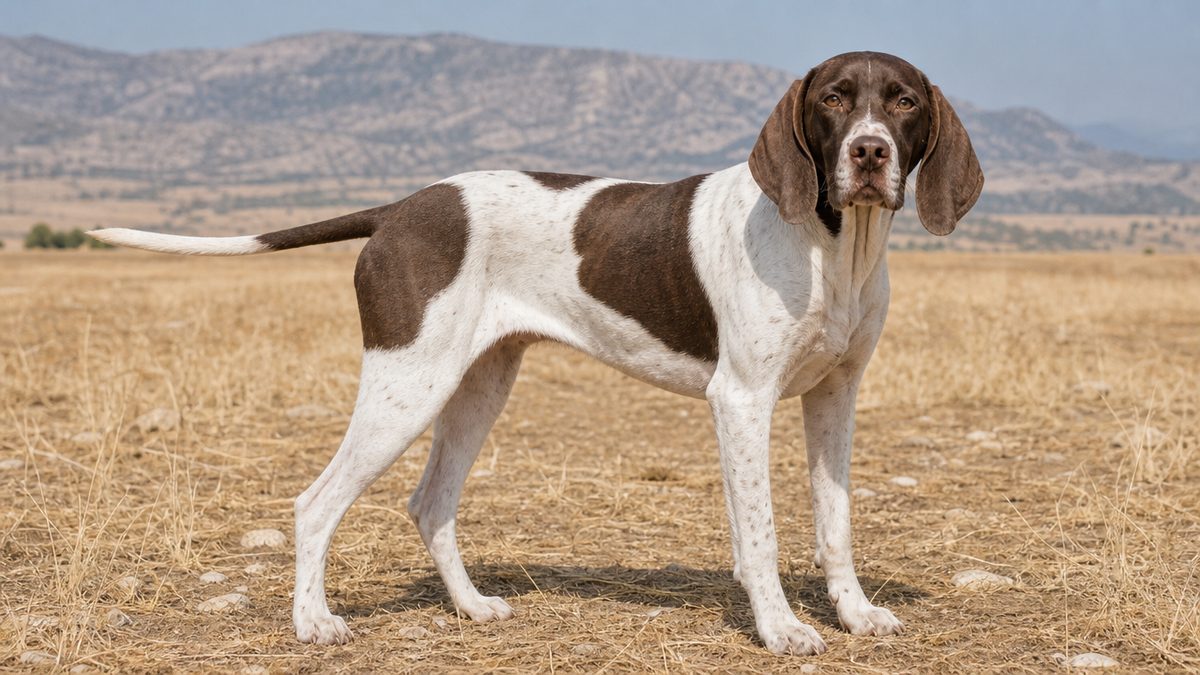
Quick answer
The Tarsus Catalburun has no price in India and appears in no registry: it is absent from the FCI's nomenclature and from the complete breed list of KIF, Turkey's own national canine federation, even from the KIF group reserved for breeds the FCI does not recognise. Its split nose was associated in 2025 with a splice-acceptor variant in PDGFRA, a gene the same study links to orofacial clefts.
This page reports published genetic and veterinary research. It is not a diagnosis and it is not a treatment plan. A split nose is a midline developmental difference and any dog with a facial cleft, difficulty nursing as a puppy, nasal discharge or repeated respiratory infection needs professional assessment. Consult your nearby vet before acting on anything here.
Tarsus Catalburun at a glance
What the Tarsus Catalburun is, and what is actually documented
The Tarsus Catalburun is a rare Turkish pointing dog from the Tarsus district of Mersin province, defined by a bifid or split nose, and it is documented by exactly two peer-reviewed papers and no breed standard at all.
Almost everything written in English about this breed is written without a primary source, because until recently there was not one to use. That changed in 2025, and this page is built on what can actually be evidenced rather than on the anecdotes that circulate.
The split nose, and why it is the whole breed
The Catalburun's defining feature is a nose divided by a vertical cleft, so that the two nostrils sit on either side of a visible split in the nose leather. In the veterinary genetics literature the trait is called a bifid nose. It is the only feature that distinguishes the breed from other Anatolian hunting dogs, which is why a photograph without a clear view of the nose is not evidence of the breed at all.
What no document provides
There is no published breed standard for this dog. That is not a gap in this page's research; it is the position. No standard means no agreed height, no agreed weight, no agreed coat description and no fault list, so any specification you read online for the Catalburun has been written by whoever published it. This page therefore gives no height or weight range, because quoting one would mean inventing an authority that does not exist.
| Question | Answer | Source |
|---|---|---|
| Why the nose is split | Splice-acceptor variant in PDGFRA, Chr 13:47440160 | Buckley 2025, Genome Research |
| How many dogs were genotyped | 3, all heterozygous | Buckley 2025, Table 1 |
| Blood type distribution | 50.0% DEA 1.1 positive of 16 dogs | Ergul Ekiz 2011 |
| Recognised by the FCI | No, absent from the letter C index | FCI nomenclature |
| Recognised by KIF in Turkey | No, absent from the 460-breed list | KIF breed index |
| Published breed standard | None found | This page's searches |
| Published life span | None; no row in McMillan 2024 Table S5 | McMillan 2024 |
| Height and weight | No registry figure exists | This page's searches |
The name
Catalburun is Turkish for forked nose, from catal meaning forked and burun meaning nose, and the Tarsus prefix names the district in Mersin province the breed is associated with. Because the accented Turkish spelling is Catalburun with a cedilla on the C, searching for the breed is genuinely awkward: this page found the 2025 paper only because PubMed's index accepts the unaccented form, while English Wikipedia returns HTTP 404 for both the plain and the accented article titles.
English Wikipedia has no article on this breed under either spelling, but it does have one on the Pachon Navarro, the Spanish split-nosed breed. The attention sits on the Spanish dog and the published genetics sit on the Turkish one, which is exactly how material gets transferred in the wrong direction.
Which registries hold this breed, checked with controls
No registry checked for this page holds the Tarsus Catalburun, and the most telling absence is from Turkey's own national federation, which maintains a group specifically for breeds the FCI does not recognise and does not put this breed in it.
An absence is a strong claim, so each of the three below was tested against a document that contains breeds the search would have found if the instrument were working.
The FCI
The FCI's alphabetical nomenclature index for the letter C returned 44 entries in original-language mode, including Cane Corso Italiano, Cirneco dell'Etna and Crnogorski planinski gonic, and no Catalburun. The register of breeds recognised on a provisional basis returned 20 entries and does not contain it either. For completeness the letter K index carries 14 entries of which exactly one is Turkish, the Kangal Coban Kopegi at number 331. So the FCI holds one Turkish breed and this is not it.
KIF, and the finding that matters most
Turkey's national canine body is the Kopek Irklari ve Kinoloji Federasyonu, KIF. Its complete A to Z breed index runs to 25,492 characters of text and states on its own face that it holds 460 breeds. Searching it with Turkish-aware character folding returns two occurrences each of Kangal, Akbas Coban, Kars Coban, Aksaray, Anadolu and Labrador, and twenty-four occurrences of Kopoy, the Turkish scenthound family. It returns zero for Catalburun, zero for Tarsus and zero for Zerdava.
The reason that absence is decisive rather than merely suggestive is what KIF's group structure contains. Its groups run from Grup 1, Coban Kopekleri ve Sigir Kopekleri, through to Grup 10, Tazilar, mirroring the FCI's ten groups, and then it adds one of its own: Grup 11, FCI Tarafindan Taninmayan Irklar, meaning breeds not recognised by the FCI. That group is populated, and it is populated with Turkish natives: the Akbas Coban Kopegi and the Aksaray Maklisi both sit in it.
So Turkey's own federation maintains a home for native breeds the FCI has not accepted, uses it for other Turkish breeds, and does not use it for this one. That is a considered absence rather than an oversight, and it is a stronger statement than the FCI's silence.
Spain's RSCE files non-FCI breeds in a Grupo 11 headed Razas no reconocidas por la FCI, and Brazil's CBKC runs a Grupo 11 headed Racas Nao Reconhecidas pela FCI. Turkey's KIF does the same thing with the same number. The FCI has ten groups, so an eleventh is always a national register speaking for itself.
The research literature
The breed is not in McMillan 2024's Table S5 either, the study's complete 345-row list of every breed it considered. Unlike the Tornjak and the Sarplaninac, which appear in that list flagged as excluded, the Catalburun has no row at all, so it was never in the study's frame. PubMed returns two records for the breed and both are discussed on this page.
None of that means the dogs do not exist. It means nobody has written the documents that would let a buyer verify a claim about them, and a page that supplies confident specifications is filling that vacuum with invention.
The genetics of the split nose, read carefully
A 2025 study in Genome Research associated the Catalburun's split nose with a splice-acceptor variant in PDGFRA and grouped the trait with orofacial clefts, and its sample was three dogs, all of them heterozygous.
This is the most important section on the page and the easiest to overstate, so the numbers come first and the interpretation second.
What the study did
Buckley and colleagues investigated coding variation from over 2,000 dogs, prioritising breed-enriched variants according to gene constraint calculated from a mutation model derived from trinucleotide substitution probabilities. Among the variants they report is, in their own words, a splice-acceptor variant in PDGFRA associated with bifid nose, a characteristic trait of Catalburun dogs, implicating the gene's role in midline closure. The author list includes Turkish researchers at Ankara and Selcuk alongside the Ostrander laboratory at the US National Human Genome Research Institute.
The sample, stated exactly
Table 1 of the paper gives the genotype counts, and they matter more than the headline. For the variant at chromosome 13 position 47440160, an A to C change classified as a splice acceptor, the Catalburun row reads allele frequency 0.5, reference homozygotes 0, heterozygotes 3 and variant homozygotes 0.
| Field | Value |
|---|---|
| Variant | Chr 13:47440160, A/C, PDGFRA, splice acceptor |
| Allele frequency in the breed sample | 0.5 |
| Reference homozygotes | 0 |
| Heterozygotes | 3 |
| Variant homozygotes | 0 |
| Implied number of dogs | 3 |
Three dogs is a very small sample and the allele frequency of 0.5 follows arithmetically from it: three heterozygotes carry three variant alleles out of six, which is exactly half. Nothing about that figure implies anything is known about the wider population.
What is not established, and must not be inferred
No variant homozygote was observed. It is tempting to read that as evidence that two copies are lethal, in the way two copies of the tailless allele are lethal in the Manx cat, and this page does not do so. With three dogs, observing no homozygote is exactly what chance would produce anyway, and the authors draw no such conclusion. The honest statement is that homozygote viability in this breed is untested.
Equally, the study does not report cleft palate, cleft lip or any other clinical outcome in Catalburun dogs. What it does is place the bifid nose in the orofacial cleft category, describing the PDGFRA variants as those found within dogs with orofacial clefts and implicating the gene in midline closure. That is a statement about developmental biology, not a prevalence figure, and this page publishes no prevalence figure because none exists.
The independent corroboration inside the same paper
One detail makes the association much stronger than a three-dog sample would otherwise support. The paper also reports a mixed-breed dog, identified as Dog 40931, that has a bifid nose and is heterozygous for a different PDGFRA splice-acceptor variant. Two unrelated loss-of-function variants in the same gene, in two unrelated dogs, both presenting the same phenotype, is convergent evidence that does not depend on breed sample size.
Blood typing, which is the one clinically actionable finding
The other paper naming this breed is a 2011 blood-typing study, and it is the piece of evidence an owner or a vet could actually use. Ergul Ekiz and colleagues typed 178 blood samples for dog erythrocyte antigen 1.1 across four Turkish native breeds and found 50.0 percent of 16 Catalburuns positive, against 71.2 percent of 59 Kars dogs, 67.9 percent of 53 Kangals and 60.0 percent of 50 Akbas dogs. The four sample sizes sum to 178, matching the stated total.
Their conclusion is that the frequency of DEA 1.1 positive dogs among these four Turkish breeds is high compared with most other breeds previously surveyed, that the predicted risk of sensitisation and of a DEA 1.1 related haemolytic transfusion reaction between Turkish dogs of the same or different breeds is considerable, and that donors and recipients should be typed, that DEA 1.1 negative recipients should receive only DEA 1.1 negative blood, and that blood should be cross-matched before transfusing any dog four or more days after a first transfusion. Sixteen dogs is a small sample and the percentage should be read with that in mind.
The transfusion guidance above is the single most useful thing on this page for anyone who actually owns one of these dogs. Consult your nearby vet, ask for DEA 1.1 typing before any planned transfusion, and mention that published Turkish native-breed frequencies are high.
Tarsus Catalburun price in India, and why the question does not arise
There is no Tarsus Catalburun price in India, no Indian listing of any kind was found, and no registry issues a pedigree that would let a buyer verify what they were being sold.
Two separate barriers sit between this breed and an Indian buyer, and either one alone would settle the question.
The first is the law. India's import policy for pet dogs and cats is restricted, filed under ITC(HS) code 01061900, and requires an authorisation from DGFT. The DGFT import FAQ states that dogs for commercial purposes like breeding, as a gift or other purposes are not allowed to be imported, and that new born puppies are not allowed. So no lawful route exists to found an Indian population.
The second is documentation. Even a lawful personal import runs into the fact that no registry holds the breed Federation Cynologique Internationale, so there is no pedigree to present and no standard against which anybody could confirm that a given dog is a Catalburun rather than a local dog with an unusual nose. For a breed whose entire identity rests on one facial feature, that is a serious verification problem.
What the Indian search returned
Nothing usable, and the reason is the engine rather than the breed. Bing India was run with a control in the same session: the Labrador retriever price query returned ten genuine Indian price pages. The Catalburun price query then returned eight results about downloading the mobile game Hill Climb Racing, under an About 8 results count, and the split-nose query returned Chinese-language forum threads. A substituted result set proves nothing in either direction, so this page claims no absence from it and rests the supply argument on the law.
- Verify the registry claim first. No FCI or KIF pedigree exists for this breed, so any certificate offered is from some other body and you should ask which.
- Verify the nose in person and in daylight. A split nose is the only distinguishing feature and photographs are easy to angle.
- Verify the import route. Ask which DGFT permitted purpose applied.
- Walk away from any quoted rupee figure, because none can be sourced.
This page quotes no purchase price at all, in any currency. Converting a foreign asking price into rupees would produce something that reads like an Indian market observation and is not one. Every rupee figure here is an Indian care cost with a live source.
Monthly cost of ownership for a medium hunting dog in India
Keeping a medium short-coated hunting dog in an Indian metro costs roughly Rs 4,500 to Rs 9,000 a month once food, parasite control and routine veterinary care are counted, and the grooming line is genuinely small for this coat.
No registry weight exists for this breed, so the figures below are for a medium dog in the 15 to 30 kg band, which is where the commonest Indian parasite products are priced. Every figure was read live on 9 September 2026.
| Item | Published price | Source |
|---|---|---|
| Puppy core vaccination course | From Rs 6,499 (list Rs 8,111) | Vetic national page |
| Annual booster | From Rs 3,199 (list Rs 3,806) | Vetic national page |
| Anti-rabies, single dose | Rs 699 | Vetic |
| 9-in-1 DHPPiL | Rs 899 | Vetic |
| Kennel cough | Rs 1,349 | Vetic |
| NexGard Spectra 15 to 30 kg, 3 tablets | Rs 3,308 (MRP Rs 3,375) | Supertails |
| Drontal Plus, 6 tablets | Rs 813 (MRP Rs 838) | Supertails |
| Consultation | Rs 500 to Rs 1,000 | VOSD |
| Boarding, 24 hours, Bengaluru | Rs 899 | PawSpace |
| Delhi pet dog registration, new | Rs 500 | MCD Delhi |
| Chennai pet licence | Rs 50 | Greater Chennai Corporation |
| Microchipping, Chennai | Rs 1,250 | SKS Veterinary Hospital |
Where a short-coated hunting dog is cheap, and where it is not
Grooming is the saving. A short smooth coat needs a brush and an ear check, not a groomer, so the line that costs a double-coated guardian one to two thousand rupees a month costs this dog almost nothing. Parasite control is not a saving: NexGard Spectra for the 15 to 30 kg band is Rs 3,308 for three tablets, or Rs 1,103 a month, and a working dog that goes into scrub needs it year round. Drontal Plus is Rs 813 for six tablets dosed at one per 10 kg, so a 25 kg dog needs two and a half tablets a treatment.
The delivery-model spread
The identical 9-in-1 vaccine costs Rs 899 at a private clinic chain, while Greater Chennai Corporation's six municipal pet clinics provide treatment and anti-rabies vaccination free of cost. A dog sanctuary's published guide puts routine consultation at Rs 500 to Rs 1,000. Where you go matters more than what you buy.
- Register the dog. Delhi charges Rs 500 new and Rs 500 to renew, with a Rs 100 per month late fee and a one-month grace period.
- Licence it in Chennai for Rs 50.
- Microchip it at about Rs 1,250 in Chennai.
- Budget boarding at Rs 899 for 24 hours in Bengaluru.
Food for a 20 to 25 kg dog on a medium-breed kibble at roughly Rs 600 to Rs 700 a kilogram, at about 300 to 350 g a day, lands near Rs 5,400 to Rs 7,400 a month. That remains the largest line, as it is for every dog on this site.
Heat tolerance in India, and the only hot homeland on this site
The Tarsus Catalburun is the rare imported breed whose homeland is genuinely hot, so the Indian question for it is humidity and wet-bulb load rather than temperature.
Establishing the baseline needed three attempts, and the failures are worth reporting because they are dramatic. NASA POWER returns a grid cell rather than a point, so each cell's reported elevation has to be checked against the real one.
| Point | Real elevation | POWER cell elevation | Error | Verdict |
|---|---|---|---|---|
| Adana | 23 m | 80.90 m | +58 m | Usable |
| Tarsus | 23 m | 231.67 m | +209 m | Not usable |
| Mersin | 10 m | 1,331.95 m | +1,322 m | Not usable |
The Mersin result is the worst single-point error this site has measured. POWER placed a Mediterranean coastal city at 1,331.95 m and returned an annual mean of 12.14 C with a January mean of 0.68 C. A near-freezing January is impossible on the Turkish Riviera, so here both tells fire together: the elevation is absurd and the temperature is visibly wrong. Tarsus itself is unusable too, at 209 m too high, because the Taurus mountains rise immediately behind the town and the cell has averaged them in. Adana, 40 km east on the same plain and at the same real elevation, comes back at 58 m too high, which is within tolerance, so Adana is the baseline this page uses.
| Place | Annual mean C | Annual RH % | Hottest month | Coolest month | Peak wet bulb C |
|---|---|---|---|---|---|
| Adana (homeland proxy) | 19.37 | 61.68 | August 30.30 | January 7.88 | 23.21 |
| Delhi | 25.60 | 45.56 | June 35.88 | January 13.61 | 26.50 |
| Kolkata | 25.81 | 73.93 | May 31.53 | January 17.31 | 27.09 |
| Chennai | 27.95 | 72.39 | May 31.51 | January 24.09 | 26.11 |
| Bengaluru | 23.74 | 67.94 | April 28.37 | December 20.22 | 21.86 |
| Pune | 23.86 | 66.80 | April 28.93 | December 19.62 | 22.97 |
Reading that table
Three things separate this breed from every other imported dog on this site. Its homeland's hottest month, August at 30.30 C, is within about one degree of Chennai's May at 31.51 C, so summer heat is not new to it. Its homeland is dry, at 61.68 percent annual relative humidity and only 54 percent in August, against Chennai's 72.39 percent and Kolkata's 73.93 percent NASA POWER climatology 2001-2020 for Delhi. And its homeland has a real winter, with a January mean of 7.88 C against Chennai's 24.09 C, so the dog gets an annual recovery season that south India would not give it.
The wet-bulb column is where the Indian cost actually appears. Adana peaks at 23.21 C, Bengaluru at 21.86 C and Pune at 22.97 C, so those two Indian cities are no worse than the homeland on evaporative load. Chennai at 26.11 C and Kolkata at 27.09 C are roughly three to four degrees worse. That is a real difference and it is a much smaller one than any other breed in this batch faces.
The coat helps too
A short, close, smooth coat is the right coat for Indian heat, and this breed has one. There is no undercoat to trap air against the skin and no long guard hair to clip, which removes the single commonest Indian owner mistake with imported breeds at a stroke. Do not shave it regardless: short coats still shield pale skin from Indian sun.
Size is the other favourable factor. Hall 2020 found bodyweight at or above the breed and sex mean carried odds of heat-related illness of 1.42, and dogs over 50 kg carried odds of 3.42. A medium hunting dog is nowhere near that upper band, so the mass penalty that dominates the guardian breeds does not apply.
Exertion is the recorded trigger in 74.2 percent of heat-illness events with a known cause, against 12.9 percent environmental and 5.2 percent from vehicular confinement. This is a hunting breed with real drive, and a dog that works willingly in a Chennai afternoon is at risk however well its homeland prepared it.
Temperament, and how little is actually known
No published research describes this breed's temperament and no registry standard sets one out, so this section says what can be inferred from its function and marks the rest as unknown.
Most breed pages write a temperament section with confidence because a breed standard supplies one. There is no standard here, and neither of the two papers naming the breed studied behaviour Ergul Ekiz E, Arslan M, Ozcan M. So the honest position is that the Catalburun's temperament has not been characterised in any source this page could verify.
What can be inferred, and labelled as inference
The breed is used as a hunting dog and specifically as a pointing dog, which is a functional description rather than a temperament one but constrains it. Pointing breeds are selected to work in front of and in cooperation with a handler, to hold position under excitement, and to tolerate other dogs in the field. Breeds selected that way are usually people-oriented and biddable rather than independent, and usually carry high working drive. That is a reasonable expectation and it is not evidence.
Who this breed would suit, if you could get one
- A household that wants a working dog and has somewhere for it to work.
- An owner comfortable with a breed for which no health screening scheme, no lifespan figure and no standard exists.
- A Bengaluru or Pune household rather than a coastal one, on the wet-bulb evidence above, though the margin here is smaller than for any other breed on this site.
- Somebody who will tell a vet about the DEA 1.1 findings before any transfusion.
Who it does not suit
- Anyone who wants documentation. There is none, and that is the defining fact about owning this breed.
- Anyone buying on the strength of the nose as a novelty.
- A household with no capacity for a hunting dog's exercise requirement.
- Anyone in India, in practice, because no lawful supply route exists.
A page that wrote four hundred confident words about this breed's temperament would be making them up. The absence of evidence is itself the most useful thing a prospective owner can be told.
Training, and what a pointing breed needs
Train a Catalburun as a pointing breed, with early socialisation, recall on a long line and short reward-based sessions, because that is what its function implies even though no standard describes its trainability.
There is no breed-specific training research for this dog, so this section applies what is established for pointing breeds generally and says so. Nothing here is a claim about the Catalburun in particular beyond its use as a hunting dog.
| Age | Priority | Indian-specific note |
|---|---|---|
| 8 to 16 weeks | Socialise widely, handle feet, ears and muzzle daily | Lawful sale is not before eight weeks under Rule 8(1)(a) of the 2017 Rules |
| 4 to 6 months | Recall on a long line, crate rest, settle on a mat | Sessions before 7 am from March to June |
| 6 to 12 months | Loose-lead walking, retrieve games, water introduction | Watch for heat during any sustained work |
| 12 to 24 months | Distance direction and endurance work | Build sustained work only once growth plates have closed |
Handle the muzzle from the first week
This breed has one training requirement no other dog has, and it follows from its anatomy. A split nose means the nose leather and the surrounding tissue will need to be looked at by a vet more often than a normal nose would, and a dog that objects to having its face handled makes that harder every time. Build muzzle and nose handling into daily handling from the day the puppy arrives, and pair it with food.
Socialise for an Indian street
An Indian street is a busier sensory environment than the Cilician farmland this dog was developed on. Take the puppy to meet traffic, construction noise, livestock and other dogs on lead, keep each session short, and stop before the puppy is overwhelmed. A hunting breed that has not learned to ignore stimuli will chase them.
Do not use aversive handling on a working pointing breed. The willingness that makes these dogs trainable is the same willingness that punishment removes, and there is no published research to tell you how this particular breed recovers from a handling mistake.
Whatever the split nose does or does not do to olfaction, and no study has measured that, this is a scenting hunting breed and nose games tire it faster than walking does. That matters when the outdoor window is limited to early morning and after dark.
Daily exercise requirement
Plan for a working hunting dog's exercise, meaning at least an hour a day of real activity split across two sessions, because no registry has published a figure for this breed and its function is the only guide available.
No breed standard exists to state an exercise requirement, so this page gives a range for a medium working pointing dog rather than pretending to a breed-specific number. An hour to ninety minutes daily, with mental work alongside, is the realistic expectation for a dog of this type.
Scheduling it in India
This breed has an easier time than most imports here, and the numbers show why. Its homeland proxy at Adana reaches an August mean of 30.30 C, so a hot afternoon is not novel to the breed. What is novel is the humidity: Chennai's peak wet bulb of 26.11 C and Kolkata's 27.09 C sit three to four degrees above Adana's 23.21 C, and evaporative cooling is what a panting dog relies on.
- Morning session before 7 am from March to June in the plains.
- Evening session after dark, once surfaces have cooled.
- Free running in a secure area rather than forced road work, so the dog can regulate its own effort.
- Water and shade available throughout, and no sustained work in the monsoon's worst humidity.
- Scent games indoors on the days when neither window is usable.
The risk to actually manage
Exertional heat illness is the risk, not ambient heat. Of the heat-illness events with a recorded trigger in Hall 2020, 652 of 879 were exertional, which is 74.2 percent, against 113 environmental and 46 from vehicular confinement. A willing hunting dog will keep working past the point at which it should stop, and in a humid Indian summer the handler has to make that call.
Weight is the other lever and it is easy to control on a short-coated dog where you can see the outline. Bodyweight at or above the breed and sex mean carried 1.42 times the odds of heat-related illness, and on a breed with no published weight standard the only usable measure is body condition scoring rather than a target number.
Grooming a short-coated dog in Indian humidity
Groom a Catalburun in about five minutes a week with a rubber curry brush, and spend the rest of the time on the ears and the nose, because a short smooth coat is the easiest coat there is in Indian conditions.
This is the lowest grooming burden of any breed in this batch and the difference is not marginal. A short close coat carries no undercoat to rake out, does not mat, does not need professional attention and does not trap monsoon damp against the skin. For an Indian household that is a genuine advantage over every European breed on this site.
- Brush weekly with a rubber curry or a hound glove to lift dead hair and distribute oils.
- Check both ears weekly. Long pendant ears on a hunting dog collect grass seed and stay damp in the monsoon, and this is where infections start.
- Inspect the nose at every grooming session, gently and with the dog comfortable, and note any crusting, discharge or asymmetry to raise with a vet.
- Trim nails fortnightly, and check between the pads after any work in scrub.
- Run your hands over the whole dog for ticks each session. A short coat makes them easy to find, which is another real advantage here.
The nose needs looking at, not treating
A split nose is a structural difference in the midline, and the sensible owner routine is observation rather than intervention. Do not apply creams, do not clean inside the cleft, and do not let anybody tell you it needs cosmetic attention. What matters is noticing change: new crusting, one-sided discharge, bleeding or a change in the shape of the division are all reasons to see a vet rather than to treat at home.
Tick control is the real grooming job in India
Indian clinic-based studies report a heavy tick-borne burden among dogs presented at veterinary clinics: a West Bengal series of 584 dogs found Babesia gibsoni in 76.54 percent, with 72.9 percent of the 584 dogs screened carrying two or more pathogens, and a Kerala series of 120 dogs found Babesia in 66.7 percent, Ehrlichia canis in 5.0 percent and a pre-monsoon peak from March to May. Those describe clinic caseloads rather than the general population. For a hunting dog that goes into scrub, year-round preventive cover is the response, at about Rs 1,103 a month for the 15 to 30 kg band.
Every other imported breed on this site needs a grooming plan built around Indian humidity. This one needs a brush and a habit of looking at its ears.
Feeding a medium working dog in India
Feed a Catalburun-sized working dog about 300 to 350 g of a medium-breed dry food a day across two meals, adjusted by body condition, because no registry weight exists for the breed and a target number would be invented.
Every other breed page on this site can quote a standard's weight range. This one cannot, because no registry publishes a standard for the Catalburun. So feed to the dog rather than to a number: ribs easily felt but not seen, a visible waist from above and a tucked abdomen from the side, checked fortnightly.
Life-stage feeding
- Eight weeks to four months: four meals a day of a medium-breed puppy food.
- Four to twelve months: three meals, moving to two by the end of the first year.
- Adult: two measured meals a day, with the main meal at the cool end of the day in summer.
- Working season: increase quantity while the dog is actually working, and reduce it again afterwards rather than leaving the higher ration in place.
One feeding consideration specific to this breed
A split nose is a midline difference at the front of the face, and a puppy with any midline developmental difference is worth watching closely while it is nursing and while it moves onto solids. Milk or food coming back down the nose, repeated coughing after meals, or slow weight gain in a puppy are all reasons to see a vet promptly rather than to wait. No published study reports feeding difficulty in this breed, so this is a precaution drawn from the anatomy rather than a documented breed problem, and it is stated as such.
Indian complications
Heat suppresses appetite in every dog, and this breed's homeland at least prepares it for that: Adana's August mean of 30.30 C is close to Chennai's May. The genuine Indian difference is humidity, which affects how hard the dog has to work to cool itself after eating, so avoid feeding immediately before or after exercise in the monsoon.
What it costs
A medium-breed kibble at Indian retail runs roughly Rs 600 to Rs 700 per kilogram, so 300 to 350 g a day is about Rs 5,400 to Rs 7,400 a month before treats. Against that, the puppy vaccination course starts at Rs 6,499 and the annual booster at Rs 3,199 on one national chain's own page, so in the first year vaccination is a comparable line to two months of food.
With no published weight standard for this breed, body condition scoring is not a refinement, it is the only available method. A kitchen scale and a fortnightly hands-on check are the whole system.
Month by month through the first year
Plan a Catalburun puppy's first year around three things: the eight-week legal minimum for sale, the socialisation window that closes at about sixteen weeks, and daily handling of the face so that veterinary inspection of the nose is never a fight.
| Age | What matters | What to do |
|---|---|---|
| 8 to 10 weeks | Lawful minimum age, settling, first vaccinations | Rule 8(1)(a) of the 2017 Rules bars sale of pups under eight weeks |
| 8 to 12 weeks | Watch feeding closely | Any food returning down the nose, coughing after meals or slow weight gain warrants a vet |
| 10 to 16 weeks | Socialisation window and face handling | Daily muzzle, nose and ear handling paired with food, thirty seconds at a time |
| 4 to 6 months | Recall on a long line, crate rest | All sessions before 7 am from March to June |
| 6 to 9 months | First Indian summer | Short sessions only; humidity, not temperature, is the new variable for this breed |
| 9 to 12 months | Adolescence and hunting drive | Expect recall to regress as the drive develops, and rebuild it on a long line |
| 12 to 24 months | Endurance and skeletal maturity | Build sustained work only after growth plates close |
One thing to establish before you take the puppy
Ask what the breeder knows about the parents' noses and about any littermates with facial differences beyond the nose. The 2025 study places the bifid nose in the orofacial cleft category and links PDGFRA to midline closure, and while no cleft palate prevalence has been published for the breed, a breeder who has noticed nothing and recorded nothing is telling you something about their record-keeping.
Vaccination, parasites and paperwork
Start the core course on the clinic's schedule; a puppy course begins from Rs 6,499 at one national chain, with anti-rabies at Rs 699 and the 9-in-1 at Rs 899 individually. Begin tick and flea cover as soon as the weight band allows, because a hunting breed in Indian scrub is the highest-exposure category there is. Register the dog: Rs 500 in Delhi, Rs 50 in Chennai, microchipping about Rs 1,250.
Ask your vet to type the dog for DEA 1.1 at a routine visit rather than in an emergency. Half of the sixteen Catalburuns in the published study were positive, and the authors recommend typing donors and recipients and cross-matching before any transfusion four or more days after a first one.
Tarsus Catalburun against the breeds it is compared with
Compare the Tarsus Catalburun against the Pachon Navarro, the Kangal and a registry-documented pointing breed, because those three comparisons expose what is and is not known about it.
| Breed | Registry standard | Breed-specific genetics | English Wikipedia article | Indian supply |
|---|---|---|---|---|
| Tarsus Catalburun | None found in FCI or KIF | PDGFRA splice-acceptor variant, 3 dogs, 2025 | No, HTTP 404 at both spellings | None |
| Pachon Navarro | Not checked on this page | No PubMed records at all | Yes, five headings | None |
| Kangal Shepherd Dog | FCI standard 331 | Blood typing, 53 dogs, 2011 | Not checked on this page | Occasionally offered |
| Spinone Italiano | FCI standard 165 | ITPR1 ataxia and epilepsy studies | Yes | None lawful for breeding or sale |
Against the Pachon Navarro, and why not to merge them
The Pachon Navarro is a Spanish breed that also carries a split nose, and the two are constantly conflated. They should not be. They are different breeds from different countries with different histories, and crucially the evidence runs one way only: PubMed returns zero records for Pachon Navarro, so there is no Spanish genetic finding available to transfer, while the Turkish breed has a named variant at a named position. Anything you read attributing the Catalburun's genetics to work on the Spanish breed is invented.
One detail from the 2025 paper is worth knowing precisely because it invites the confusion. The authors illustrate the phenotype with a photograph of an eighteenth-century statue of a bifid-nosed dog at the Palace of Bertemati in Andalusia, Spain. That is a historical illustration of the trait in Spain, not a genetic finding about the Spanish breed, and it should not be read as one.
Against the Kangal
The Kangal is the comparison that shows what recognition buys. It has an FCI standard at number 331, it appears in KIF's list, and it appeared in the same 2011 blood-typing study with a sample of 53 dogs against this breed's 16. Same country, same researchers, same year, three times the sample, and a standard against which a buyer can check a dog. That is the practical difference between a documented breed and an undocumented one.
Against a documented pointing breed
Set beside the Spinone Italiano, which has an FCI standard, a published median lifespan from 693 dogs, a DNA test for one inherited disease and a genome-wide study of another, the Catalburun's evidence base is two papers totalling nineteen dogs. That is not a criticism of the breed. It is the information position a prospective owner is actually in, and it should be the deciding factor rather than the nose.
Mistakes people make with this breed
Five mistakes recur with the Tarsus Catalburun, and four of them come from treating the split nose as a curiosity rather than as a documented developmental variant.
- Treating the split nose as a harmless quirk. The study that identified its genetic basis frames it within orofacial clefts and links the gene to midline closure, which is a different framing from a cosmetic breed marking.
- Reading three dogs as a population. The genotype counts are 3 heterozygotes and 0 homozygotes, and nothing about the wider breed follows from that sample.
- Inferring that two copies are lethal. No homozygote was observed, but with three dogs that is what chance predicts anyway, and the authors draw no such conclusion.
- Transferring Pachon Navarro material. PubMed returns zero records for that breed, so there is nothing to transfer even if it were valid to do so.
- Believing any published height, weight or lifespan figure. No registry standard exists and the breed has no row in McMillan 2024's 345-breed table.
The Indian legal mistake
Anyone contemplating breeding this dog in India should read one clause first. The Prevention of Cruelty to Animals (Dog Breeding and Marketing) Rules 2017, Second Schedule Part II paragraph 6(9), states in a single sentence that breeding to create new breeds of dogs or unusual looks shall be strictly prohibited. A deliberately propagated split nose is an unusual look on any ordinary reading of those words, so breeding for this trait in India runs directly at that prohibition.
A related clause is worth knowing for its structure rather than its list. Part III paragraph 8(10) requires that dogs shall have been tested for genetic defects, including hip dysplasia, progressive retinal atrophy, night blindness, hypothyroidism, entropion, ectropion, overshot, undershot jaw, wry mouth, two or more missing teeth and cryptorchidism. The word including makes that list illustrative rather than closed, so a midline closure defect is not outside the clause merely because it is unnamed.
And one about verification
Do not buy this breed from a photograph. The split nose is the only feature distinguishing it, photographs are easy to angle, and there is no pedigree system to fall back on Kopek Irklari ve Kinoloji Federasyonu. Verify the dog in person, in daylight, and ask to see the parents.
Half of sixteen tested Catalburuns were DEA 1.1 positive, and the study's authors recommend typing all donors and recipients, giving DEA 1.1 negative recipients only negative blood, and cross-matching before transfusing any dog four or more days after a first transfusion.
Adoption and responsible sourcing
There is no adoption route to a Tarsus Catalburun in India and no lawful commercial import route, so the responsible answer is to adopt an Indian dog and to read this page as documentation rather than as a buying guide.
This breed has no Indian population, no registry pedigree and no lawful import route for breeding or sale. It follows that there is no Indian rescue pipeline and cannot be one. Anybody offering a Catalburun in India is offering something they cannot document.
If you are genuinely pursuing this breed
- Accept first that no registry will certify the dog Kopek Irklari ve Kinoloji Federasyonu, so ordinary pedigree verification is unavailable.
- Work through Turkish sources in Turkey rather than through international sellers.
- Establish which DGFT permitted purpose an import would fall under before any money moves.
- Ask about the parents' noses and about any littermate facial differences.
- Have the dog DEA 1.1 typed on arrival and record the result.
The welfare question worth sitting with
The breed's defining characteristic is a loss-of-function variant in a developmental gene, propagated deliberately because of how it looks. That is not a reason to condemn the dogs, which are living animals with the same claim on good care as any other. It is a reason to be careful about creating demand. India's own breeding rules prohibit breeding for unusual looks, and an Indian reader is entitled to know that the trait they find charming is, in the genetics literature, filed under orofacial clefts.
The better option in India
An Indian household that wants a short-coated, heat-tolerant, high-drive working dog has excellent options in every shelter in every metro, already acclimatised to the local climate and the local disease pressure. Greater Chennai Corporation's six municipal pet clinics provide treatment and anti-rabies vaccination free of cost, and a routine consultation elsewhere runs Rs 500 to Rs 1,000. None of those dogs will have a split nose, and none of them will need one to be a good dog.
This page reports published genetic, registry and price data as editorial content. It does not recommend breeders, link puppy listings or quote a live price as an offer.
Tarsus Catalburun questions people actually ask
What is the Tarsus Catalburun price in India?
No Tarsus Catalburun price in India exists, and no Indian listing of any kind was found. India's import policy for dogs is restricted under ITC(HS) 01061900 and DGFT states that dogs for commercial purposes like breeding or as a gift are not allowed to be imported, so no supply chain can lawfully form.
Why does the Catalburun have a split nose?
A 2025 study in Genome Research associated the trait with a splice-acceptor variant in PDGFRA, at chromosome 13 position 47440160, and described the gene's role in midline closure. The paper groups the bifid nose with orofacial clefts rather than treating it as a cosmetic quirk.
How many Catalburun dogs were in that genetic study?
Three. Table 1 of the paper gives the breed an allele frequency of 0.5 with zero reference homozygotes, three heterozygotes and zero variant homozygotes, so every sampled dog carried one copy and none carried two. That is a very small sample and the paper does not present it as anything else.
Is the split nose the same as a cleft palate?
Not the same thing, but the study places them in the same category. It titles its analysis around orofacial clefts, describes the PDGFRA variants as found within dogs with orofacial clefts, and implicates the gene in midline closure. No cleft palate prevalence has been published for this breed.
Is the Tarsus Catalburun a recognised breed?
No registry checked for this page holds it. It is absent from the FCI's letter C index of 44 entries and from the 20-entry provisional register, and it is absent from the complete 460-breed list of KIF, Turkey's own national canine federation, including KIF's group for breeds the FCI does not recognise.
What blood type does a Catalburun have?
Half the dogs tested were DEA 1.1 positive. A 2011 study typed 16 Catalburuns and found 50.0 percent positive, against 71.2 percent of 59 Kars dogs, 67.9 percent of 53 Kangals and 60.0 percent of 50 Akbas dogs, and concluded the frequency across these Turkish breeds is high compared with most breeds surveyed elsewhere.
Can a Tarsus Catalburun handle Indian heat?
Better than any other breed on this page's comparison, because its homeland is genuinely hot. Adana on the same plain as Tarsus averages 19.37 C across the year with an August mean of 30.30 C. What differs in India is humidity: Adana runs 61.68 percent annual relative humidity against Chennai's 72.39 percent.
How long does a Tarsus Catalburun live?
No published life span figure exists. The breed has no row in McMillan 2024's Table S5, the study's complete 345-breed list, and no other population survey names it. Any lifespan figure you see for this breed is an estimate somebody made rather than a measurement.
Is the Catalburun the same as the Pachon Navarro?
No, and material should not be transferred between them. They are different breeds from different countries that share a split-nose trait. PubMed returns zero records for Pachon Navarro, so there is no Spanish genetic evidence to borrow, while the Turkish breed has a 2025 study naming a specific variant.
Would breeding a Catalburun be legal in India?
It would run directly into the Prevention of Cruelty to Animals (Dog Breeding and Marketing) Rules 2017, whose Second Schedule Part II paragraph 6(9) states that breeding to create new breeds of dogs or unusual looks shall be strictly prohibited. A deliberately propagated split nose is an unusual look on any reading.
What does it cost to keep a medium hunting dog in India each month?
Budget roughly Rs 4,500 to Rs 9,000 a month in a metro. NexGard Spectra for the 15 to 30 kg band costs Rs 3,308 for three tablets, which is Rs 1,103 a month, a puppy vaccination course starts at Rs 6,499 and an annual booster at Rs 3,199 on one national chain's page.
Can I import a Tarsus Catalburun into India?
Only as your own pet, and in practice not at all, because no registry issues pedigrees for the breed. DGFT permits pet import through the airports and seaports of Delhi, Mumbai, Chennai, Hyderabad, Bangalore and Kolkata, and states that dogs for breeding or as a gift are not allowed and that new born puppies are not allowed. DAHD added a seventh port, Cochin International Airport at Kochi, for pets arriving under the baggage rules in October 2024. The full route is set out in how to import a dog to India.
Is the Catalburun a rare breed?
Yes. The Tarsus Catalburun is a rare Turkish pointing dog from the Tarsus district of Mersin province, and the research that names it shows how few dogs were ever sampled: the 2025 Genome Research study that traced its split nose to a PDGFRA variant typed three Catalburuns, and the 2011 blood-typing study found 16. No registry checked for this page holds the breed.
Are Catalburun dogs good family pets?
Nobody has measured it. No published research describes the Catalburun's temperament and no registry standard sets one out, so the only honest answer is inference from its job: pointing breeds are selected to work in cooperation with a handler, hold position under excitement and tolerate other dogs, so they are usually people-oriented and biddable with high working drive. That is a reasonable expectation, not evidence.
Compare with similar breeds
Tarsus Catalburun sits in 2 Bonbeno groups. Each one compares it directly against the breeds it is genuinely an alternative to, on the same figures.