
Breed profile
Zerdava: Price in India, Real Measurements and Health
A medium Turkish spitz hunting dog from the eastern Black Sea coast, measured properly in a study of 100 dogs that almost nobody can find.
Quick answer
The Zerdava has no price in India and no lawful commercial import route, and no registry lists it: it is absent from the FCI's nomenclature and from the 460-breed list of KIF, Turkey's own canine federation. It is nonetheless one of the better-measured rare breeds anywhere, because a 2020 study weighed and measured 100 Zerdava dogs and sequenced their mitochondrial DNA.
This page reports published morphological and genetic research and Indian price data. It is not a diagnosis and it is not a treatment plan. No health screening scheme exists for this breed and no disease prevalence has been published for it, so nothing here should be read as reassurance about an individual dog. Consult your nearby vet, and ask a veterinarian to assess any individual dog, before acting on anything here.
Zerdava at a glance
What the Zerdava is, with the measurements somebody actually took
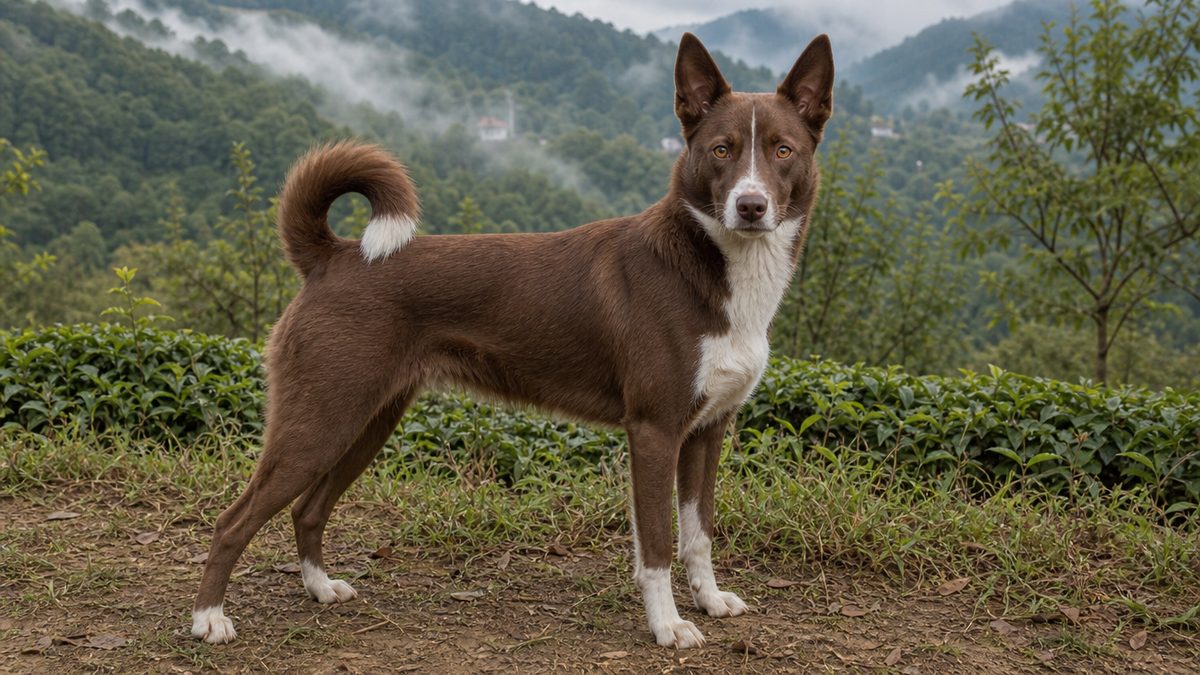
The Zerdava is a compact medium spitz-type hunting dog from the Trabzon and Giresun provinces of Turkey's eastern Black Sea coast, measured in a 2020 study at a mean 48.20 cm at the withers and 16.02 kg.
Most rare-breed pages open by saying that little is documented. That is the wrong thing to say about this dog. A study funded by TUBITAK, Turkey's Scientific and Technological Research Council, took blood samples from 100 Zerdava dogs, fifty females and fifty males, all twelve months or older, in Trabzon and Giresun provinces, and measured them properly. That is a larger and better-controlled sample than most recognised breeds get.
The measurements
| Measurement | Mean | Standard error |
|---|---|---|
| Live weight | 16.02 kg | +/- 0.35 |
| Withers height | 48.20 cm | +/- 0.21 |
| Rump height | 47.08 cm | +/- 0.24 |
| Body length | 51.24 cm | +/- 0.23 |
Read those four numbers together and they describe the dog better than any adjective. Body length of 51.24 cm against a withers height of 48.20 cm means the dog is slightly longer than tall rather than square. A rump height of 47.08 cm against a withers height of 48.20 cm means it stands very slightly higher at the front. And 16.02 kg on a 48 cm frame is a lean working build, not a heavy one. Every figure carries a standard error under half a centimetre or under half a kilogram, which is what a properly conducted measurement session on a hundred animals looks like.
Appearance and behaviour, from the secondary description
The study measured the breed rather than describing it, so the coat and temperament account below comes from the English secondary literature and is labelled as such. The Zerdava is described as a spitz with a compact athletic body, triangular upright ears, a curved sickle tail usually tipped in white, and a double coat that is either solid liver brown or liver combined with white in ticked, piebald or roan patterns. The brown is described as marten-like, puppies are often nearly black at birth, and the nose is brown rather than black with yellow-brown eyes.
The behavioural description is that of a laika-type hunting dog: hardy and versatile, treeing small game, stalking larger prey and working in teams on jackal, bear and boar, and particularly valued for avoiding injury while hunting boar, which is a crop pest in the region. It is devoted to its own people and distrustful of strangers, earning the nickname the Gate Dog, and puppies are said to need considerable socialisation to avoid growing up shy or aggressive.
The same source reports that Zerdava often struggle with being rehomed and will try to escape and find their original owner. For anybody contemplating importing an adult dog across continents, that is the single most relevant sentence written about the breed.
Origin, and what the genetics say about it
The Zerdava is a landrace of Turkey's eastern Black Sea region whose mitochondrial DNA points to two dominant maternal lines, and whose low genetic variation the 2020 study reads as evidence that local breeders kept it distinct.
The written history of this breed is thin, because a landrace does not generate one. It has no founding date, no founder and no studbook, which is normal for a landrace and unusual for a page like this one to be able to say with evidence rather than by assumption. What stands in for a documented history here is genetic evidence.
What the DNA showed
The 2020 study ran both microsatellite markers and mitochondrial DNA. It amplified the mtDNA control region, the d-loop, and worked with sequences arranged to a length of 582 base pairs. Two haplotypes dominated the sample: A018 at 72 percent and B001 at 16 percent, and the authors conclude that the majority of Zerdava dogs originate from two different maternal lines.
The microsatellite results point the same way. Observed heterozygosity came out at 0.708 plus or minus 0.091 against an expected 0.694 plus or minus 0.077, and the mean inbreeding coefficient F IS was 0.0361 plus or minus 0.0003. The authors' own reading is that the phenotypic and genotypic variations of Zerdava dogs were low, and that this may suggest the dogs have been protected by local breeders and can be considered a separate breed.
Reading that carefully
Two points deserve care. Low variation within a population is consistent with a distinct, closed landrace and it is also consistent with a small one, and the study does not distinguish those readings. But observed heterozygosity slightly exceeding expected, together with an inbreeding coefficient of 0.0361, is not what a heavily inbred population looks like. So the honest summary is that the sampled Turkish population shows distinctness without a severe inbreeding signal.
That matters because the picture reported for the population outside Turkey is very different. English Wikipedia, citing an Agricultural Biodiversity of Georgia source written in Georgian, states that the Georgian population is critically endangered due to frequent inbreeding, with an estimated 15 to 20 purebred dogs left and experts agreeing that the only way to stabilise it is by importing dogs from Turkey. This page could not read the Georgian original, so that is reported as a secondary claim about Georgia rather than as a finding about the breed as a whole.
A modern use, reported second hand
The most concrete recent development reported for the breed is institutional. From 2016 the Turkish Armed Forces are said to have trained Zerdava for bomb and narcotic detection, search and rescue, and personnel detention, a claim Wikipedia credits to a 2019 Anadolu Agency report. This page could not read that report directly and does not treat it as established, but it is worth knowing because a state adopting a landrace for working roles is usually what precedes formal recognition.
Which registries hold this breed, and why PubMed misses the research
No registry holds the Zerdava, and the more useful finding is methodological: PubMed returns zero for the breed under every name tried, while a peer-reviewed study of 100 of these dogs exists in a journal PubMed only partly indexes.
Two separate absences are reported here and they mean very different things. One is a real absence from registries. The other is an artefact of a database, and confusing them is how pages come to say that nothing is known about this breed.
The registry absence, with controls
The FCI's alphabetical nomenclature index for the letter Z returned three entries on 9 September 2026, being the Zapadno-Sibirskaia Laika at 306, the Zwergpinscher at 185 and the Zwergschnauzer at 183. The register of breeds recognised on a provisional basis returned 20 entries and does not include the Zerdava either.
The stronger absence is domestic. Turkey's national canine body, the Kopek Irklari ve Kinoloji Federasyonu, publishes a complete A to Z index running to 25,492 characters and stating on its own face that it holds 460 breeds. Searched with Turkish-aware character folding, that document returns two occurrences each of Kangal, Akbas Coban, Kars Coban, Aksaray, Anadolu and Labrador, and twenty-four occurrences of Kopoy, the Turkish scenthound family, and zero occurrences of Zerdava.
KIF's group structure is what makes that decisive. Its groups mirror the FCI's ten and then it adds an eleventh of its own, Grup 11, FCI Tarafindan Taninmayan Irklar, meaning breeds not recognised by the FCI, and that group is populated with Turkish natives including the Akbas Coban Kopegi and the Aksaray Maklisi. Turkey's own federation maintains a home for exactly this kind of breed, uses it for other Turkish landraces, and does not use it for the Zerdava.
The breed also has no row in McMillan 2024's Table S5, the study's complete 345-breed list McMillan KM, Bielby J, Williams CL, and it was not among the four Turkish breeds in the 2011 blood-typing study that covered the Kars, Kangal, Akbas and Catalburun.
The database absence, which is not the same thing
PubMed returns nothing for this breed, and the temptation is to conclude that no research exists. That conclusion is wrong, and the searches below show why it is worth running the control before drawing it.
| Query | Records returned | What it shows |
|---|---|---|
| "Zerdava"[tiab] | 0 | quoted phrase not found in the index |
| "Zerdava" | 0 | same result unrestricted |
| Zerdava[All Fields] | 0 | no rewrite occurred; a genuine index miss |
| "Kapi Kopegi"[tiab] | 0 | the native name, Gate Dog, also absent |
| "Turkish Laika"[tiab] | 0 | the proposed alternative identity, absent |
| "Zerdava dog" | 404,664 | a rewrite: the phrase failed and it searched dog alone |
| "Kangal"[tiab] | 42 | control, a Turkish breed, passes |
| "Labrador Retriever"[tiab] AND "hip dysplasia"[tiab] | 47 | control passes |
Two of those rows carry the lesson. The Zerdava dog query returning 404,664 records is not evidence of a large literature; PubMed could not match the phrase, fell back, and searched the word dog on its own, which its query translation shows plainly. And Zerdava[All Fields] returning zero with no rewrite at all is the honest measurement: the index does not contain the term.
Yet the research exists. The 2020 study is real, its DOI resolves, and Crossref confirms the article, the journal and its five authors. Searching PubMed for the journal name returns nine records, so it is partly indexed and this article is not among them. The absence is a property of the index, not of the world.
The journal's article pages are addressed by a numeric id, and a guessed id served a completely different paper, about Actinobacillus and Haemophilus detection in pigs. The DOI resolved straight to the correct 7-page PDF. Resolve the DOI; never guess an article id.
Zerdava price in India, and why there is not one
There is no Zerdava price in India, no Indian listing was found, and no registry issues a pedigree that would let a buyer verify what they were being offered.
India's import policy for pet dogs and cats is restricted, filed under ITC(HS) code 01061900, and requires an authorisation from DGFT. The DGFT import FAQ lists the permitted purposes and then states that dogs for commercial purposes like breeding, as a gift or other purposes are not allowed to be imported, and that new born puppies are not allowed. That closes the commercial route.
Documentation closes the private one in practice. With no FCI and no KIF entry Kopek Irklari ve Kinoloji Federasyonu, there is no pedigree system to verify a dog against, and the breed's own study is a population description rather than a standard. An Indian buyer offered a Zerdava would have no way to establish that the animal was one.
What the Indian search returned
Nothing usable, and the reason is the engine. Bing India was run with the Labrador retriever price control in the same session and returned ten genuine Indian price pages, then substituted every Turkish-breed query put to it. The DuckDuckGo html endpoint served its anti-bot challenge to the control as well as to the breed queries. Neither instrument produced a result set worth reading, so this page draws no conclusion from search composition and rests the supply argument on the import law instead.
- Verify the registry position first. No FCI or KIF entry exists, so any certificate offered comes from some other body and you should ask which.
- Verify against the published measurements. A 2020 study puts the breed at a mean 48.20 cm and 16.02 kg, which is a usable check on a dog in front of you.
- Verify the import route. Ask which DGFT permitted purpose applied.
- Walk away from a quoted rupee figure, because none can be sourced to anything.
This page quotes no purchase price in any currency. Converting a foreign asking price into rupees produces a number that reads like an Indian observation and is not one. Every rupee figure here is an Indian care cost with a live source.
Monthly cost of ownership for a 16 kg dog in India
Keeping a 16 kg dog in an Indian metro costs roughly Rs 4,000 to Rs 8,000 a month once food, parasite control and routine veterinary care are counted, and this breed's published weight makes that unusually easy to calculate.
Most rare-breed pages have to guess at size before they can cost anything. This one does not: the mean live weight of 16.02 kg comes from a hundred measured dogs, which places the breed squarely in the 15 to 30 kg band that Indian parasite products are priced for. Every figure below was read live on 9 September 2026.
| Item | Published price | Source |
|---|---|---|
| Puppy core vaccination course | From Rs 6,499 (list Rs 8,111) | Vetic national page |
| Annual booster | From Rs 3,199 (list Rs 3,806) | Vetic national page |
| Anti-rabies, single dose | Rs 699 | Vetic |
| 9-in-1 DHPPiL | Rs 899 | Vetic |
| Kennel cough | Rs 1,349 | Vetic |
| NexGard Spectra 15 to 30 kg, 3 tablets | Rs 3,308 (MRP Rs 3,375) | Supertails |
| Drontal Plus, 6 tablets | Rs 813 (MRP Rs 838) | Supertails |
| Deworming dose for a 16 kg dog | About Rs 271, two tablets | Derived from the above |
| Consultation | Rs 500 to Rs 1,000 | VOSD |
| Boarding, 24 hours, Bengaluru | Rs 899 | PawSpace |
| Delhi pet dog registration, new | Rs 500 | MCD Delhi |
| Chennai pet licence | Rs 50 | Greater Chennai Corporation |
| Microchipping, Chennai | Rs 1,250 | SKS Veterinary Hospital |
Working the parasite line from a real weight
Drontal Plus is dosed at one tablet per 10 kg and costs Rs 813 for six tablets, which is Rs 135.50 a tablet, so a 16 kg dog needs two tablets, about Rs 271 a treatment. NexGard Spectra covers 15 to 30 kg at Rs 3,308 for three tablets, or Rs 1,103 a month, and the breed sits at the bottom of that band rather than above it, so unlike the large guardians on this site the published price is the price you actually pay.
The delivery-model spread
The identical 9-in-1 vaccine costs Rs 899 at a private clinic chain, while Greater Chennai Corporation's six municipal pet clinics provide treatment and anti-rabies vaccination free of cost. A dog sanctuary's published guide puts a routine consultation at Rs 500 to Rs 1,000. Where an Indian owner goes matters more than what they buy.
- Register the dog. Delhi charges Rs 500 new and Rs 500 to renew, with a Rs 100 per month late fee and a one-month grace period.
- Licence it in Chennai for Rs 50.
- Microchip it at about Rs 1,250 in Chennai.
- Budget boarding at Rs 899 for 24 hours in Bengaluru.
Food for a 16 kg working dog on a medium-breed kibble at roughly Rs 600 to Rs 700 a kilogram, at about 250 to 300 g a day, lands near Rs 4,500 to Rs 6,300 a month. That remains the largest single line, and at this size the vaccination course in the first year is comparable to about six weeks of food.
Heat tolerance in India, measured against a humid coast
The Zerdava is adapted to humidity rather than to heat, because its Black Sea homeland runs 70.74 percent annual relative humidity, close to Chennai's, while averaging 15.93 C against Chennai's 27.95 C.
This is the second Turkish breed on this site and it inverts the first. The Catalburun comes from a hot dry Mediterranean plain. The Zerdava comes from a mild wet coast. Setting them side by side shows why a single sentence about whether a breed suits India is usually wrong.
As always the cell elevation has to be checked before any figure is used. Three Black Sea points were tested and one of them is unusable.
| Point | Real elevation | POWER cell elevation | Error | Verdict |
|---|---|---|---|---|
| Trabzon | 39 m | 155.92 m | +117 m | Usable, and one of the study's two provinces |
| Samsun | 15 m | 157.87 m | +143 m | Usable, at the edge of tolerance |
| Rize | 5 m | 936.23 m | +931 m | Not usable |
Rize is the cautionary one. It sits on the same coast a hundred kilometres east of Trabzon, at five metres above the sea, and POWER returned a cell at 936 metres, which is the Pontic mountains immediately behind the town averaged into the same square. Trabzon is the point this page uses, and it has the additional merit of being one of the two provinces where the breed's own study collected its samples.
| Place | Annual mean C | Annual RH % | Hottest month | Coolest month | Peak wet bulb C |
|---|---|---|---|---|---|
| Trabzon (homeland) | 15.93 | 70.74 | August 24.33 | January 7.80 | 21.12 |
| Samsun (same coast) | 14.40 | 75.91 | August 24.01 | January 5.93 | 20.47 |
| Delhi | 25.60 | 45.56 | June 35.88 | January 13.61 | 26.50 |
| Kolkata | 25.81 | 73.93 | May 31.53 | January 17.31 | 27.09 |
| Chennai | 27.95 | 72.39 | May 31.51 | January 24.09 | 26.11 |
| Bengaluru | 23.74 | 67.94 | April 28.37 | December 20.22 | 21.86 |
| Pune | 23.86 | 66.80 | April 28.93 | December 19.62 | 22.97 |
Humidity is familiar; heat is not
Trabzon runs 70.74 percent annual relative humidity and its wettest months sit at 75 and 76 percent, against Chennai's 72.39 percent and Kolkata's 73.93 percent NASA POWER climatology 2001-2020…. Samsun on the same coast is more humid still at 75.91 percent. So a Zerdava arriving in coastal India would find the air much as it left it.
What it would not find is the temperature. Trabzon's annual mean of 15.93 C sits 12.02 degrees below Chennai's 27.95 C, and its hottest month, August at 24.33 C, is below the coolest month of the year in Chennai, which is January at 24.09 C by a margin of a quarter of a degree. Read that again, because it is the whole climate argument: this breed's hottest month is essentially Chennai's coolest. Bengaluru at 23.74 C annual and Pune at 23.86 C NASA POWER climatology 2001-2020 for Delhi are the least unreasonable Indian options and are still eight degrees warmer than the homeland across the year.
The wet bulb column carries the same message with the humidity folded in, because a wet bulb figure combines heat and moisture into the single number that decides whether a panting dog can shed heat at all. Trabzon peaks at 21.12 C, Bengaluru at 21.86 C and Pune at 22.97 C, so those two are within about two degrees. Chennai at 26.11 C and Kolkata at 27.09 C are five to six degrees worse, which is a substantial additional evaporative load on a double-coated dog.
The coat and the workload
The breed carries a double coat, which is the wrong coat for Indian plains heat, and it is a working hunting dog, which is the wrong workload. Exertion is the recorded trigger in 74.2 percent of heat-illness events with a known cause, against 12.9 percent environmental and 5.2 percent from vehicular confinement. At 16.02 kg the mass penalty is small, since Hall 2020's steep odds ratio of 3.42 applies to dogs over 50 kg, so the risk here comes from the coat and the work rather than from the size.
The Prevention of Cruelty to Animals (Dog Breeding and Marketing) Rules 2017, Second Schedule Part IV paragraph 21(1), bars keeping in outdoor facilities, without the attending veterinary practitioner's written approval, dogs not accustomed to local temperatures and breeds that cannot tolerate them, naming long-haired breeds in high temperature locations as its own example.
Temperament and household fit
The Zerdava is described as devoted to its own people, distrustful of strangers and difficult to rehome, which makes it a poor candidate for an international move and a reasonable one for a settled rural household.
The 2020 study measured bodies and genes rather than behaviour, so this section rests on the English secondary description and says so.
That description is consistent and specific. The breed is presented as a hardy, versatile hunter that trees small game, stalks larger prey silently and works in teams against jackal, bear and boar, with particular value placed on its ability to avoid injury while hunting boar. It is devoted to its humans and distrustful of strangers, which earned it the nickname the Gate Dog. Puppies are said to need considerable socialisation to avoid growing up overly shy or aggressive.
The rehoming problem
One reported trait should weigh heavily on anybody considering acquiring an adult of this breed. Zerdava are described as struggling with being rehomed, and as attempting to escape in order to find their original owner. Whatever the strength of that evidence, a strongly bonded landrace hunting dog moved between continents into a hot climate is a foreseeable welfare problem, and this is the one breed on this site where the sourcing objection is about the dog's experience rather than about paperwork.
Who this would suit
- A rural or semi-rural household with land and a stable long-term home.
- An owner who wants a hunting or working dog rather than a companion.
- A cooler Indian location, with Bengaluru and Pune the only metros within a couple of degrees of the homeland on wet-bulb load.
- Somebody prepared to socialise a puppy heavily from eight to sixteen weeks.
Who it does not suit
- Anyone in an Indian apartment, on both the guarding and the exercise questions.
- Anyone wanting a dog that greets visitors warmly.
- Anyone contemplating importing an adult, given the reported rehoming difficulty.
- Anyone who needs documentation, since no registry issues any.
Every behavioural statement here comes from secondary English description rather than from research, because the research that exists measured morphology and genetics. That is a real limit and it is better stated than papered over.
Training a Zerdava, and what matters most
Train a Zerdava by socialising the puppy heavily before sixteen weeks and by building a reliable recall, because the reported temperament is a bonded, stranger-wary hunting dog with a strong homing drive.
No training research exists for this breed, so what follows applies established practice for bonded spitz-type hunting dogs and says so. The two priorities are set by the two reported traits: distrust of strangers, and a tendency to leave in search of a former owner.
| Age | Priority | Indian-specific note |
|---|---|---|
| 8 to 16 weeks | Heavy socialisation with people of every kind | Lawful sale is not before eight weeks under Rule 8(1)(a) of the 2017 Rules |
| 4 to 6 months | Recall on a long line, and containment | Check fencing and gates properly before the dog is old enough to test them |
| 6 to 9 months | First Indian summer | Move all work outside daylight; the homeland's hottest month is Chennai's coolest |
| 9 to 14 months | Hunting drive and independence develop | Expect recall to regress; rebuild on a long line rather than off lead |
| 12 to 24 months | Consolidation and endurance | Build sustained work as the dog matures |
Socialisation is the whole job
The description explicitly warns that puppies need considerable socialisation with people to avoid overly shy or aggressive behaviour. In an Indian household the number of unfamiliar people who legitimately come through a gate is high, so every category of them should be normal to the dog before sixteen weeks. Sale below eight weeks is prohibited, so part of that window always sits with the breeder and you should ask what they did with it.
Containment is the second job
A dog reported to escape in order to find a former owner is a dog whose fencing you check before you need it. Secure the perimeter, use a long line rather than off-lead freedom during adolescence, and microchip the dog early; a Chennai hospital's own transacted microchipping price is Rs 1,250. Registration adds a second identification route at Rs 500 in Delhi and Rs 50 in Chennai.
Do not use aversive handling. A stranger-wary breed that is punished for warning tends to stop warning, which is worse, and no research exists to tell you how this particular breed recovers from a handling error.
Scent work suits a treeing and tracking dog and can be run indoors before sunrise, which matters when the outdoor window is short for eight months of the Indian year.
Daily exercise requirement
Plan for a working hunting dog's exercise, meaning at least an hour a day of real activity split across two sessions, because the breed is used on boar and small game and no registry has published a figure for it.
No breed standard exists to state a requirement, so this page gives a range for a 16 kg working hunting spitz rather than inventing a breed-specific number. A breed standard would normally supply this figure, and the absence of one is why it cannot. An hour to ninety minutes of genuine activity daily, plus scent work, is the realistic expectation.
Scheduling it in India
The scheduling constraint here is severe and the numbers make it plain. Trabzon's hottest month averages 24.33 C, while Delhi's June mean is 35.88 C and Chennai's May mean is 31.51 C NASA POWER climatology 2001-2020…. A dog whose summer is 24 degrees cannot work in a plains Indian afternoon, and exertion is the trigger in 74.2 percent of heat-illness events with a known cause.
- Morning session before 6.30 am from March to June in the plains.
- Evening session after dark, once surfaces have cooled.
- Free running in a secure area rather than road work, so the dog regulates its own effort.
- Shade, moving air and water available all day.
- Indoor scent games on the days when neither window is usable.
What under-exercise does
An under-exercised bonded hunting dog escapes. That is the specific risk here rather than destructiveness, given the reported homing behaviour, and it compounds in India because a loose 16 kg hunting dog in an unfamiliar city is in real danger. Weight is the secondary concern: bodyweight at or above the breed and sex mean carried 1.42 times the odds of heat-related illness in Hall 2020, and this breed has a published mean of 16.02 kg to measure against, which is a luxury most rare breeds do not offer.
Grooming a double coat in Indian humidity
Groom a Zerdava by brushing the double coat weekly and daily through the moult, and concentrate on drying it properly, because the breed comes from a wet climate but not a hot one and Indian monsoon humidity arrives with far more heat behind it.
The breed is described as carrying a double coat, either solid liver brown or liver combined with white in ticked, piebald or roan patterns, on a compact athletic frame. On a 16 kg dog that is a manageable amount of coat, and the grooming burden sits well below the guardian breeds on this site and well above the short-coated Catalburun.
- Brush weekly with a slicker and then a comb, working to the skin rather than over the surface, and daily during the seasonal moult.
- Dry the coat properly after any bath or swim. A double coat that stays damp in Indian heat is a skin problem waiting to happen, and the homeland's damp is cool damp rather than warm damp.
- Check the ears weekly. Upright ears drain better than pendant ones, which is one small advantage this breed has over the pointing breeds on this site.
- Run your hands over the dog for ticks at every session, particularly after any work in cover.
- Never clip the coat. It insulates against heat as well as cold and shields the skin from Indian sun.
Why the homeland's humidity does not transfer
It is tempting to conclude that a dog from a coast running 70.74 percent annual relative humidity will cope with Indian damp, and the humidity figures do look similar to Chennai's 72.39 percent. The trap is that humidity only matters in combination with heat. Trabzon's wettest months sit at 75 and 76 percent while averaging around 24 C, whereas Kolkata reaches 89 percent in August at 28.2 C. Same wet air, very different wet-bulb load, and the coat has to shed heat into it.
Tick control is the real grooming job here
Indian clinic-based studies report a heavy tick-borne burden among dogs presented at veterinary clinics: a West Bengal series of 584 dogs found Babesia gibsoni in 76.54 percent, with 72.9 percent of the 584 dogs screened carrying two or more pathogens, and a Kerala series of 120 dogs found Babesia in 66.7 percent, Ehrlichia canis in 5.0 percent and a pre-monsoon peak from March to May. Those describe clinic caseloads rather than the general population. For a hunting dog with a double coat, year-round preventive cover at about Rs 1,103 a month for the 15 to 30 kg band is the response.
Health, life span and what has and has not been studied
No disease has been reported in the Zerdava in any source this page could verify, and no life span figure exists, so the only health evidence available is the population genetics from the 2020 study.
This section is short because the evidence is, and padding it would mean inventing content about a breed's health, which is the worst thing a page like this can do.
What the genetics say about population health
The 2020 study is the only quantitative health-adjacent evidence for the breed. Across 100 dogs it reported a mean inbreeding coefficient of 0.0361 plus or minus 0.0003, observed heterozygosity of 0.708 plus or minus 0.091 and expected heterozygosity of 0.694 plus or minus 0.077. Observed heterozygosity slightly exceeding expected, alongside a very low inbreeding coefficient, is not the profile of a population in genetic trouble.
Against that, the study also found low phenotypic and genotypic variation overall, and concluded the dogs may have been protected by local breeders and can be considered a separate breed. Those two readings are compatible: a distinct population that is not, on this sample, closely inbred.
| Question | Position |
|---|---|
| Inbreeding coefficient | 0.0361, measured on 100 dogs |
| Observed vs expected heterozygosity | 0.708 vs 0.694, measured |
| Named inherited disease | None reported in any source read for this page |
| Screening scheme | None; no registry holds the breed |
| DNA test | None |
| Published life span | None; no row in McMillan 2024 Table S5 |
| Blood type frequency | Not studied; the breed was not among the four in the 2011 survey |
| Clinical case literature | None found in PubMed under any name form |
The claim about hardiness, and how to read it
The English secondary description says Zerdava are prized for their excellent health in harsh conditions with minimal care, and adds that, like other laika, it is more common for females to come into season only once a year. Treat the first half as breeder reputation rather than as evidence: it is not a study, no denominator sits behind it, and landraces are routinely described that way. The once-yearly oestrus is a genuine and checkable characteristic of several northern spitz and laika types and matters practically if you are planning veterinary timings.
Life span
No published figure exists. The breed has no row in McMillan 2024's Table S5, the study's complete 345-breed list McMillan KM, Bielby J, Williams CL, and the Turkish study measured morphology and genetics rather than longevity. This page therefore publishes no life span at all, rather than borrowing a figure from another spitz.
What an Indian owner would actually face
The health risks that would matter to a Zerdava living in India are the ones that come with India rather than with the breed. Tick-borne disease is the first, on the clinic-caseload evidence above Venugopal V, Deepa PM, Muhasin Asaf VN. Heat is the second, and this breed's homeland gives it no preparation for Indian plains temperatures. Neither is a breed-specific finding, and saying so is more useful than a list of conditions nobody has documented in these dogs.
No reported inherited disease does not mean no inherited disease. It means nobody has looked, because no registry holds the breed and no screening scheme exists. Consult your nearby vet about any individual dog rather than reading this section as a clean bill of health.
Feeding a 16 kg working dog in India
Feed an adult Zerdava about 250 to 300 g of a medium-breed dry food a day across two meals, and use the published mean weight of 16.02 kg as the target that most rare-breed owners never get.
The advantage this breed has over almost every other rare dog on this site is that somebody measured a hundred of them. A mean live weight of 16.02 kg plus or minus 0.35 is a real target to feed towards, rather than an estimate from a photograph.
Life-stage feeding
- Eight weeks to four months: four meals a day of a medium-breed puppy food.
- Four to twelve months: three meals, moving to two by the end of the first year.
- Adult: two measured meals a day, with the main meal at the cool end of the day in summer.
- Working season: raise the ration while the dog is actually working and lower it again afterwards, rather than leaving the higher amount in place.
The Indian complications
Heat suppresses appetite, and this breed has no homeland preparation for Indian summer temperatures, so expect poor eating from April to June in the plains and a rebound in the monsoon. Feed to body condition and weigh the dog monthly against the 16 kg reference. A dog whose homeland tops out at 24.33 C in its hottest month will also drink far more than its owner expects, so water availability matters as much as food.
Do not free-feed a bonded working dog. A hunting breed that is under-exercised because of Indian heat and free-fed because it is a small dog gets heavy quickly, and bodyweight at or above the breed mean carried 1.42 times the odds of heat-related illness in Hall 2020.
What it costs
A medium-breed kibble at Indian retail runs roughly Rs 600 to Rs 700 per kilogram, so 250 to 300 g a day is about Rs 4,500 to Rs 6,300 a month before treats. That sits below the vaccination line in the first year, since a puppy course starts at Rs 6,499 on one national chain's own page, and it is the cheapest food line of any breed in this batch.
Most rare-breed owners have no published weight to aim at. This one does. Use 16.02 kg as the reference and body condition scoring as the check.
Month by month through the first year
Plan a Zerdava puppy's first year around the socialisation window that closes at about sixteen weeks, secure containment before adolescence, and the first Indian summer.
| Age | What matters | What to do |
|---|---|---|
| 8 to 10 weeks | Lawful minimum age, settling, first vaccinations | Rule 8(1)(a) of the 2017 Rules bars sale of pups under eight weeks |
| 10 to 16 weeks | Socialisation, and the description warns it must be considerable | Meet every category of visitor calmly and repeatedly; keep sessions short |
| 4 to 6 months | Recall and containment | Check fences and gates before the dog is old enough to test them |
| 6 to 9 months | First Indian summer | The homeland's hottest month is 24.33 C; move all activity outside daylight |
| 9 to 14 months | Hunting drive and independence | Long-line work only; expect recall to regress |
| 12 to 24 months | Adult routine and endurance | Weigh monthly against the published 16.02 kg mean |
Two things to do in the first month
Microchip and register the dog early. A breed reported to escape in search of a former owner needs two independent identification routes before it is old enough to try. Microchipping runs about Rs 1,250 at a Chennai hospital's own price, registration is Rs 500 in Delhi and Rs 50 in Chennai.
Start tick and flea cover as soon as the product's weight band allows, because a hunting breed in Indian cover is the highest-exposure category there is. Begin the core vaccination course on the clinic's schedule; a puppy course starts from Rs 6,499, with anti-rabies at Rs 699 and the 9-in-1 at Rs 899 individually.
Because the breed has published means for withers height, rump height, body length and weight, a breeder who has measured their own dogs can be checked against them. That is a verification route almost no rare breed offers, and it is worth using.
Zerdava against the breeds it is compared with
Compare the Zerdava against the Tarsus Catalburun, the Kangal and the Indian Spitz, because those three comparisons cover the two things that decide an Indian outcome: documentation and climate.
| Breed | Published measurements | Registry standard | Homeland climate | Indian supply |
|---|---|---|---|---|
| Zerdava | Yes, 100 dogs, 48.20 cm and 16.02 kg | None | Humid and mild, 15.93 C annual, 70.74% RH | None |
| Tarsus Catalburun | None published | None | Hot and dry, 19.37 C annual, 61.68% RH | None |
| Kangal Shepherd Dog | In its FCI standard | FCI standard 331 | Central Anatolian, not measured on this page | Occasionally offered |
| Indian Spitz | Not compared on this page | Not compared on this page | Already Indian | Widely available |
Against the Catalburun, which is the interesting one
These two Turkish breeds sit at opposite corners of the same problem. The Catalburun comes from a hot dry Mediterranean plain, so heat is familiar to it and humidity is not. The Zerdava comes from a mild wet Black Sea coast, so humidity is familiar and heat is not. India delivers both at once, which is why neither transfers cleanly and why a single sentence about European or Turkish breeds coping with India is always wrong.
On documentation the comparison reverses. The Catalburun has genetics and no measurements; the Zerdava has measurements and no genetics of disease. Between them they show that a breed's evidence base is not one thing, and that asking whether a breed is well documented is less useful than asking which parts of it are.
Against the Kangal
The Kangal is what recognition looks like: an FCI standard at number 331, a place in KIF's list, 42 PubMed records against this breed's zero, and inclusion in the 2011 Turkish blood-typing study that the Zerdava was not part of. Same country, completely different information position.
The comparison that should decide it
For an Indian household the honest recommendation is the Indian Spitz. It is a locally bred spitz already acclimatised to Indian heat over generations, available through routes a buyer can inspect, and supported by Indian veterinary familiarity. The Zerdava offers nothing it does not, except a rarity that in India translates into no pedigree, no vet who has seen one and no lawful way to buy one.
Mistakes people make with this breed
Five mistakes recur with the Zerdava, and the first is the one that keeps the breed's own research invisible.
- Concluding from PubMed that nothing is known. Zerdava returns zero there under every name form including the native Kapi Kopegi, while a TUBITAK-funded study of 100 dogs exists in a journal PubMed only partly indexes Crossref record for DOI….
- Quoting a height or weight from a breed directory. The measured means are 48.20 cm at the withers and 16.02 kg from a hundred dogs, and any other figure has a weaker basis.
- Assuming the humid homeland means Indian heat is fine. Trabzon's hottest month averages 24.33 C, which is fractionally below Chennai's coolest month NASA POWER climatology 2001-2020….
- Importing an adult. The breed is reported to struggle with rehoming and to attempt to return to a previous owner, which makes an intercontinental move a foreseeable welfare problem.
- Skipping socialisation. The description explicitly warns that puppies need considerable socialisation to avoid shy or aggressive behaviour.
A research mistake worth avoiding
Do not read the query that returned 404,664 records as evidence of a literature. PubMed could not match the phrase Zerdava dog, fell back and searched the word dog alone, which its own query translation shows. A large number from a database is not the same as coverage, and the honest measurement here is the all-fields search that returned zero without any rewrite.
And a retrieval mistake
Do not reach the breed's study through a guessed article id. The journal addresses its articles by numeric id, and a guessed one returned a completely different paper about pig respiratory pathogens. The DOI resolved directly to the correct seven-page PDF Crossref record for DOI…. Resolve the DOI.
No Indian law bans this breed, and none of the 2017 Rules names it. What the Rules do reach is conduct: Second Schedule Part II paragraph 6(8) forbids tail docking, ear cropping, de-barking, de-clawing and any change of appearance by artificial means, and Part IV paragraph 21(1) restricts outdoor housing of breeds that cannot tolerate local temperatures.
Adoption and responsible sourcing
Adopt an Indian dog rather than importing a Zerdava, because no Indian population, no rescue route and no lawful commercial import route exists, and because this breed in particular is reported to take rehoming badly.
The sourcing argument for this breed is unusual in that it is partly about the dog. Every other page in this batch rests on law and documentation; here there is a third reason. A landrace hunting dog described as bonded to its own household, distrustful of strangers and prone to escaping in order to find a previous owner is not a good candidate for being moved between continents into a climate its homeland never prepared it for.
The formal position
India's import policy is restricted and DGFT states that dogs for commercial purposes like breeding or as a gift are not allowed to be imported, and that new born puppies are not allowed. No registry issues a pedigree for the breed Federation Cynologique Internationale, so even a lawful personal import would arrive undocumented. There is no Indian rescue pipeline and cannot be one.
If you are genuinely pursuing this breed
- Work in Turkey, in the Trabzon and Giresun area the study sampled, rather than through international sellers.
- Prefer a puppy to an adult, on the rehoming evidence.
- Measure the parents against the published means of 48.20 cm and 16.02 kg.
- Establish which DGFT permitted purpose an import would fall under before any money moves.
- Plan for a cool-season arrival and a Bengaluru or Pune style climate rather than a coastal one.
The conservation angle, stated carefully
There is a real conservation argument for leaving this breed where it is. The Turkish population sampled in 2020 shows distinctness without a severe inbreeding signal, while the population reported in Georgia is described as critically endangered at an estimated 15 to 20 purebred dogs, with importing from Turkey named as the only route to stabilising it. Whatever the strength of that second claim, which this page could not verify at its Georgian source, the useful dogs are the ones in the region, not the ones exported to countries with no breeding programme.
The better Indian option
An Indian household that wants an alert, medium, double-coated, people-bonded dog has the Indian Spitz and a shelter full of dogs already suited to the climate. Greater Chennai Corporation's six municipal pet clinics provide treatment and anti-rabies vaccination free of cost, and a routine consultation elsewhere runs Rs 500 to Rs 1,000.
This page reports published research, registry and price data as editorial content. It does not recommend breeders, link puppy listings or quote a live price as an offer.
Zerdava questions people actually ask
What is the Zerdava price in India?
No Zerdava price in India exists and no Indian listing was found. India's import policy for dogs is restricted under ITC(HS) 01061900, and DGFT states that dogs for commercial purposes like breeding or as a gift are not allowed to be imported, so no lawful supply chain can form.
How big is a Zerdava?
A 2020 study measured 100 Zerdava dogs and reported a mean withers height of 48.20 cm plus or minus 0.21, a mean rump height of 47.08 cm, a mean body length of 51.24 cm and a mean live weight of 16.02 kg plus or minus 0.35. That makes it a compact medium dog, slightly longer than tall.
Is the Zerdava a recognised breed?
No registry checked for this page holds it. It is absent from the FCI's letter Z index and from the 20-entry provisional register, and absent from the complete 460-breed list of KIF, Turkey's own canine federation, including the KIF group maintained specifically for breeds the FCI does not recognise.
Is the Zerdava inbred?
Not on the published evidence. The 2020 study reported a mean inbreeding coefficient of 0.0361, with observed heterozygosity of 0.708 slightly above the expected 0.694, which is not the signature of a heavily inbred population. The authors concluded the dogs may have been protected by local breeders.
Why does PubMed return nothing for the Zerdava?
Because the journal that published the breed's study is not fully indexed there. Zerdava returns zero in PubMed as a quoted phrase, unquoted, and across all fields, and zero for the native name Kapi Kopegi, while Kangal returns 42 records and the Labrador control 47 in the same session. The study exists; the index does not carry it.
What colour is a Zerdava?
Liver brown based, either solid or combined with white. English-language descriptions give solid liver brown or liver and white in patterns such as ticked, piebald and roan, with a brown nose rather than a black one, yellow-brown eyes and usually a white tail tip, and note that puppies are often nearly black at birth.
Can a Zerdava handle Indian heat?
Poorly, and the reason is temperature rather than humidity. Trabzon, one of the two provinces the study sampled, averages 15.93 C across the year with an August mean of 24.33 C, against Chennai's 27.95 C and 31.51 C. Its annual humidity of 70.74 percent is close to Chennai's 72.39 percent, so damp air is familiar.
How long does a Zerdava live?
No published life span figure exists. The breed has no row in McMillan 2024's Table S5, the study's complete 345-breed list, and the 2020 Turkish study measured morphology and genetics rather than longevity. Any lifespan figure you see for this breed is an estimate rather than a measurement.
Is the Zerdava used by the Turkish military?
Reportedly yes, since 2016. English Wikipedia states that the Turkish Armed Forces have trained Zerdava for bomb and narcotic detection, search and rescue, and personnel detention, crediting an Anadolu Agency report of 2019. This page could not read that report directly, so treat it as a secondary claim.
Is the Zerdava endangered?
In Georgia, reportedly yes. English Wikipedia, citing an Agricultural Biodiversity of Georgia source in Georgian, states that the Georgian population is critically endangered with an estimated 15 to 20 purebred dogs left. That is a claim about Georgia rather than Turkey, and this page could not read the Georgian original.
What does it cost to keep a 16 kg dog in India each month?
Budget roughly Rs 4,000 to Rs 8,000 a month in a metro. NexGard Spectra for the 15 to 30 kg band costs Rs 3,308 for three tablets, which is Rs 1,103 a month, deworming runs about Rs 271 per treatment at one tablet per 10 kg, and a puppy vaccination course starts at Rs 6,499.
Can I import a Zerdava into India?
Only as your own pet, and in practice not at all, because no registry issues a pedigree for the breed. DGFT permits pet import through the airports and seaports of Delhi, Mumbai, Chennai, Hyderabad, Bangalore and Kolkata, and states that dogs for breeding or as a gift are not allowed and that new born puppies are not allowed. DAHD added a seventh port, Cochin International Airport at Kochi, for pets arriving under the baggage rules in October 2024. The full route is set out in how to import a dog to India.
Zerdeva nasıl bir hayvandır?
The question arrives in Turkish because that is where this dog's record lives. The Zerdava is a compact medium spitz-type hunting dog from the Trabzon and Giresun provinces of Turkey's eastern Black Sea coast, measured in a TUBITAK-funded 2020 study of 100 dogs at a mean 48.20 cm at the withers and 16.02 kg. It is described as a laika-type hunter that trees small game and works in teams on jackal, bear and boar, devoted to its own people and distrustful of strangers, and no registry checked for this page holds it as a breed.
Zerdava köpeğinin özellikleri nelerdir?
Measured rather than described: a 2020 study of 100 Zerdava dogs reported a mean live weight of 16.02 kg, withers height of 48.20 cm, rump height of 47.08 cm and body length of 51.24 cm, a lean working build slightly longer than tall, with a mean inbreeding coefficient of 0.0361. The secondary description adds triangular upright ears, a sickle tail usually tipped in white, a double coat in solid liver brown or liver and white in ticked, piebald or roan patterns, a brown nose, yellow-brown eyes, and puppies that are often nearly black at birth.
Trabzon zerdava köpeğinin fiyatı nedir?
In India there is no price to give: no Zerdava listing was found, no registry issues a pedigree that would make a price meaningful, and India's import policy classifies dogs as a Restricted item under ITC(HS) 01061900, with DGFT stating that dogs for commercial purposes such as breeding or as a gift are not allowed to be imported, so no lawful supply chain can form. The only Indian figure this page can stand behind is upkeep for a 16 kg dog, roughly Rs 4,000 to Rs 8,000 a month in a metro.
Compare with similar breeds
Zerdava sits in 1 Bonbeno group. Each one compares it directly against the breeds it is genuinely an alternative to, on the same figures.