
Dog breed profile
Bracco Italiano: The AKC's 200th Breed, Read for India
Italy's oldest pointing breed, recognised by the FCI in 1956 and by the AKC only in 2022, read against Indian humidity, Indian import law and the screening registers that carry actual denominators.
Quick answer
The Bracco Italiano is a 25 to 40 kg Italian pointing dog with a short coat, ears reaching the nose tip and a soft double dewlap. It has no lawful Indian supply chain, no published Indian price, and rates 2 of 5 for heat tolerance. OFA records entropion in 17 of 310 eye examinations and hereditary renal amyloidosis is its defining disease.
This guide is general information for Indian pet owners and is not a diagnosis or a treatment plan. Renal amyloidosis, entropion, ectropion and otitis externa all require examination by a registered veterinarian, and the screening protocols described here should be run by your own veterinary practice. If your dog is inappetent, drinking more, urinating more, or shaking its head, see a veterinarian rather than acting on this page.
Bracco Italiano at a glance, rated for India
What a Bracco Italiano is, in one paragraph and four registries
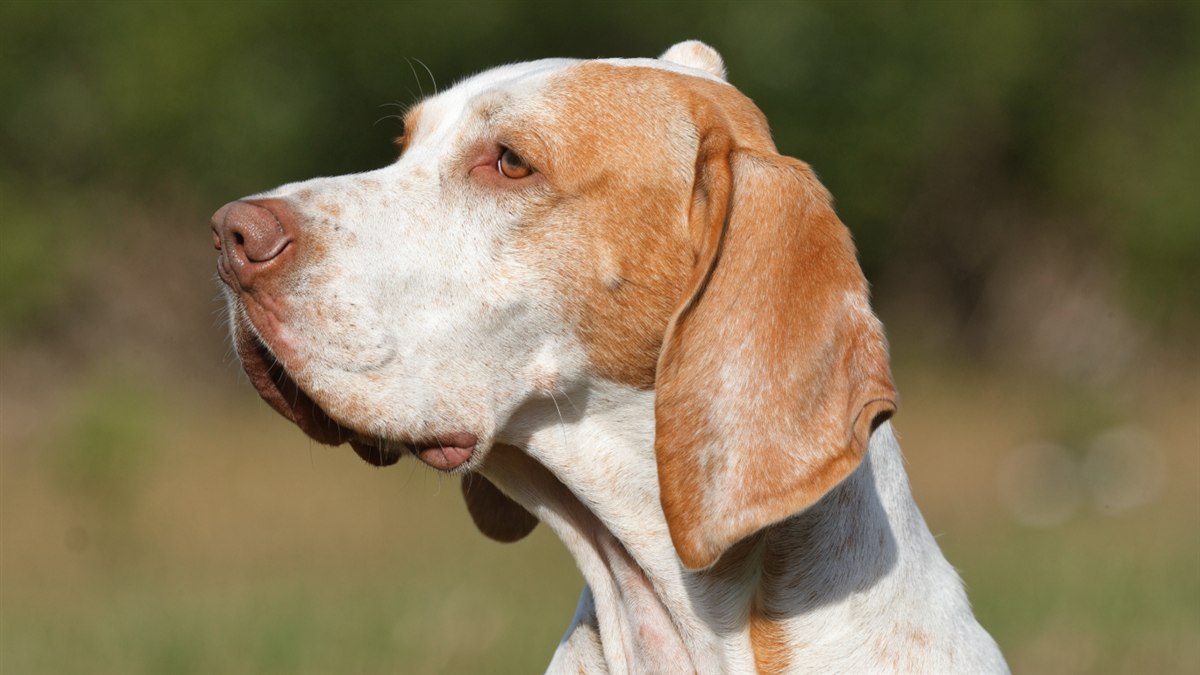
A Bracco Italiano is a large Italian pointing dog, 55 to 67 cm at the withers and 25 to 40 kg, with a short dense coat, a long sculpted head whose skull and muzzle planes point away from each other, ears that reach the tip of the nose, and a soft double dewlap at the throat. It is a working gun dog first and a house dog second, and four separate registries describe it in almost identical words.
The controlling document is FCI-Standard No. 202, published in its currently valid form on 13 November 2015 and issued in English on 17 December 2015. It places the breed in Group 7 (Pointing Dogs), Section 1 (Continental pointing dogs), Type Braque, with a working trial. The Italian original from ENCI carries the same date and the same text in the language it was drafted in, which matters because several of the load-bearing clauses read differently in translation.
The breed is old and the paperwork is not. ENCI records that the first dog entered in the Libro delle Origini of the Kennel Club Italiano, founded in 1882, was a Bracco Italiano. Two regional types existed then. The Piedmont dog was lighter, shorter and usually orange and white, bred for mountain ground and often working at a gallop. The Lombardy dog was heavier boned, larger and darker roan, built for swampy lowland and moving at a trot Purina UK, Bracco Italiano breed…. The parent club's own account dates the merger of the two types to 1923 and the unifying written standard to 1949, and the Societa Amatori Bracco Italiano has held the breed since 1949.
The measurements, from the standards rather than from a blog
| Registry | Height | Weight | Coat |
|---|---|---|---|
| FCI-202 (2015) | 55-67 cm; males 58-67, females 55-62 | 25-40 kg | Short, dense and glossy |
| ENCI (Italian original) | 55-67 cm; maschi 58-67, femmine 55-62 | 25-40 kg | Corto, fitto e lucente |
| AKC (approved Oct 2018, effective Jul 2019) | 21-27 in; males 23-27, females 21-25 | 55-90 lb | Smooth coated |
| Kennel Club UK (updated Apr 2025) | dogs 58-67 cm, bitches 55-62 cm | 25-40 kg | Short, dense and glossy |
| UKC (2006, revised 2013) | males 22.75-26.25 in, females 21.75-24.5 in | 55-88 lb | Short, dense and glossy |
Colour is narrow and the registries agree. ENCI recognises exactly two varieties for CACIB purposes, bianco arancio (white and orange) and roano marrone (chestnut roan). Black in any form is a disqualifying fault, on the coat, on the skin and on the mucous membranes United Kennel Club. If an Indian seller shows you a black and white pointing dog and calls it a Bracco, the standard has already answered.
The gait is the breed's signature and the reason its build is what it is. Every standard describes an extended, fast trot with the head carried high and the nose above the topline, and the UKC calls the 'Bracco trot' the breed hallmark, 'with the dog appearing to float on a cloud'; Federation Cynologique Internationale. A dog selected for hours of that trot is a dog that needs hours of movement, which is the single most important fact on this page for an Indian flat owner.
No lawful route exists for a commercial Bracco Italiano puppy trade in India. The breed has no Kennel Club of India presence we could evidence, and DGFT Trade Notice 22/2022-23 makes dogs a Restricted import and states that applications for trading or breeding purposes 'shall be duly rejected';. The price section starts from that fact rather than from a number.
Two recognition dates, 66 years apart, and what each document says
The Bracco Italiano was accepted by the FCI on a definitive basis on 7 June 1956 and became eligible to compete in the AKC Sporting Group on 29 June 2022, a gap of 66 years. Both dates come from the registries' own records, not from a breed blog, and the gap explains why almost every English page about this dog was written after 2022.
The FCI nomenclature entry for BRACCO ITALIANO (202) prints 'Date of acceptance on a definitive basis by the FCI 6/7/1956' and 'Breed status: Recognized on a definitive basis';. That page writes dates month first, which is confirmable on the page itself: the English standard row reads 12/17/2015 against the PDF's own printed 17.12.2015 Federation Cynologique Internationale. So 6/7/1956 is 7 June 1956, and the older secondary claim of simply '1956'; is right but imprecise.
The American date is more recent and more precisely documented. The AKC Board of Directors Minutes for 9 and 10 August 2021 record, under the heading 'Bracco Italiano Eligibility to Compete in the Sporting Group', that 'The Board Voted that the Bracco Italiano will be eligible to compete in the Sporting Group on June 29, 2022. Further, the Board approved the breed standard as submitted. See Appendix A. The breed will be moved from the Foundation Stock Service into the Stud Book of the American Kennel Club on June 29, 2022. The Stud Book will remain open until July 1, 2026.';
Three details in that minute are worth pulling out. The vote happened in August 2021, ten months before the effective date, so a page that says the AKC recognised the breed 'in 2022' is describing the effective date and not the decision. The stud book stays open until 1 July 2026, which means the American population is still absorbing imported foundation stock. And Appendix A is the standard itself, approved October 2018 and effective 3 July 2019, printed in full inside the minutes.
| Registry | Status and date | Document |
|---|---|---|
| FCI | Definitive basis, 7 June 1956; breed number 202 | FCI nomenclature entry, retrieved 23 Aug 2026 |
| ENCI (Italy) | National register; standard published 13 Nov 2015 | ENCI Libro genealogico breed record |
| UKC (USA) | Recognised 2006; standard revised 1 July 2013 | UKC Official Breed Standard |
| AKC (USA) | Sporting Group, effective 29 June 2022; voted 9-10 Aug 2021 | AKC Board Minutes, August 2021 |
| Kennel Club (UK) | Gundog Group; standard last updated 1 April 2025 | Kennel Club breed standard page |
| Kennel Club of India | No breed-specific record found; see the import-law section | FCI statistics return for KCI |
The AKC counts the Bracco Italiano as its 200th fully recognised breed. The route there was long: the breed reached the United States around 1994, entered the Foundation Stock Service in 2001, and the Bracco Italiano Club of America was founded in 2007 with 124 members at the time of recognition.
Recognition has not made the breed common. In the AKC's 2024 registration ranking the Bracco Italiano sits at No. 132 of 201 breeds counted, having climbed 20 places from No. 152 in 2023. For scale, the Spinone Italiano, Italy's other native gun dog, sat at No. 120 in the same list. A breed in the bottom third of the American register after four years of full recognition is not a breed with a spare puppy supply for export.
Sixty-six years of FCI recognition produced the health data on this page. Four years of AKC recognition produced most of the English-language marketing. When those two disagree, the older registry and the screening registers win.
The head: divergent axes, a pronounced occiput, and what the standard does not say
The Bracco Italiano's head is defined by two features that all four registries agree on, divergent cranio-facial axes and a pronounced occiput, and by a third that only the American standard spells out, a deliberate fold of loose skin below the eye. Read the documents in order and a widely repeated claim about this breed falls apart.
Start with the axes. FCI-202 says the head is 'angular and narrow at the level of the zygomatic arches; the length of the skull equals the length of the muzzle. The upper longitudinal axes of the skull and muzzle are divergent, i.e. if extending the top line of the muzzle the latter must emerge in front of the occipital protuberance, ideally at mid-length of the skull'. The Italian original uses the phrase this page will keep using: 'Gli assi cranio-facciali sono tra di loro divergenti'. Convergence of the cranio-facial axes is a disqualifying fault in the FCI standard, and the UKC disqualifies 'Parallel head planes' outright.
The occiput follows from the same geometry. FCI-202: 'The occipital protuberance is pronounced.' The Kennel Club: 'Pronounced occiput and slight stop.' The UKC: 'Occiput is prominent.'; The Kennel Club (Royal Kennel Club) United Kennel Club These are three registries describing the same bone, and none of them treats it as a defect.
Flews and facial skin, which is where the standards start to differ
The lips are described restrictively, not generously. FCI-202: 'Upper lips well developed, thin and floppy without being flaccid, covering the jaw... the corner of the lips must be marked without being droopy.' The Kennel Club puts it even more tightly: 'Corners of lips marked but not pendulous.'; A page that calls the Bracco a heavy-flewed breed is describing what many individuals look like, not what any standard asks for.
The neck carries a double dewlap by design. FCI-202: 'The throat shows a soft double dewlap.' The UKC agrees. The Kennel Club, alone, softens it to 'unexaggerated dewlap'; United Kennel Club The Kennel Club (Royal Kennel Club). And every standard penalises excess: the FCI lists as a severe fault 'excessive amount of skin causing an exaggerated dewlap or an un-divided dewlap and too many wrinkles on the head', while the AKC faults 'Excessive skin with exaggerated wrinkling or single dewlap';.
Only the AKC standard positively asks for facial skin, and it is specific about how much: 'The head and neck are moderate in skin. The head should have a soft fold of skin from the outer corner of the eye, falling down the cheek. When the head is down and relaxed, there is a skin fold across the skull from ear to ear.' That is the conformation an Indian reader should picture. It is a fold, not a curtain, and the same paragraph faults the curtain.
No registry standard for this breed asks for a visible haw. The FCI, ENCI, AKC and UKC all describe close-fitting or tight-fitting eyelids, and the FCI and AKC add the parenthesis '(no entropion or ectropion)' in the same sentence Ente Nazionale della Cinofilia Italiana American Kennel Club United Kennel Club. The Kennel Club says 'close fitting eyelids' without the parenthesis. Four documents, one answer. The next section asks whether the dogs match the paper.
Entropion and ectropion: the denominators, and the Indian law that names them
Entropion is documented in this breed at 17 of 310 OFA eye examinations, 5.5 percent, and ectropion is not, at 1 of 310, 0.3 percent. Both figures clear OFA's own reporting threshold of 50 evaluations for a non-hip database, so both are population rates rather than anecdotes, and they point in opposite directions.
Divide them out yourself. 17 divided by 310 is 5.48 percent, which OFA prints as 5.5. One divided by 310 is 0.32 percent, printed as 0.3. The whole eye panel rests on the same 310 examinations, so the two conditions are directly comparable within the breed.
| Breed | Eye exams | Entropion | Entropion % | Ectropion | Ectropion % |
|---|---|---|---|---|---|
| Chinese Shar-Pei | 307 | 111 | 36.2 | 3 | 1.0 |
| Neapolitan Mastiff | 98 | 35 | 35.7 | 45 | 45.9 |
| St. Bernard | 415 | 92 | 22.2 | 98 | 23.6 |
| Bloodhound | 232 | 33 | 14.2 | 38 | 16.4 |
| Basset Hound | 468 | 16 | 3.4 | 43 | 9.2 |
| Bracco Italiano | 310 | 17 | 5.5 | 1 | 0.3 |
| Spinone Italiano | 1,051 | 8 | 0.8 | 10 | 1.0 |
| Labrador Retriever | 101,122 | 477 | 0.5 | 158 | 0.2 |
| German Shorthaired Pointer | 5,844 | 12 | 0.2 | 2 | 0.0 |
Read across the row. The Bracco's entropion rate is roughly seven times the Spinone Italiano's, eleven times the Labrador's and twenty-seven times the German Shorthaired Pointer's, which is a real and unflattering signal for a pointing breed. It is also about a seventh of the Chinese Shar-Pei's and well under half the Bloodhound's, so it is not a droopy-face breed in the Bloodhound sense. Ectropion is the striking one: one affected dog in 310 examinations puts the Bracco below the Labrador and level with breeds nobody associates with sagging eyelids.
The parent club's own language is looser than its own register. The Bracco Italiano Club of America says 'The most common issues seen in the Bracco Italiano include entropion, ectropion, and cataracts', and the AKC breed page repeats 'eye anomalies such as entropion, ectropion, and cataracts'; American Kennel Club. Both are true as a list of what shows up. Neither carries the numbers that show one of the three is a hundredth as common as another. The most frequent coded finding in the breed is not on that list at all: distichiasis, 30 of 310, 9.7 percent.
Indian law names both conditions by name
The Prevention of Cruelty to Animals (Dog Breeding and Marketing) Rules, 2017, notified as G.S.R. 496(E) on 23 May 2017, put the requirement in the Second Schedule, PART III, HEALTH RELATED REQUIREMENTS, at paragraph 8 (Veterinary care), sub-paragraph (10). The clause reads, verbatim from the machine-readable gazette text: 'The dogs shall have been tested for genetic defects, including hip dysplasia, progressive retinal atrophy, night blindness, hypothyroidism, entropion, ectropion, overshot, undershot jaw (when incisors do not touch or mesh), wry mouth, two or more missing teeth, unilateral cryptorchid or full cryptorchid males.'
That is a real seam and worth stating plainly. The breed standards describe as correct a head whose skin folds toward the eye, and then exclude the two eyelid diseases that conformation is associated with. Indian law, independently, requires a registered breeder to test for exactly those two before breeding. An Indian buyer therefore has a statutory question to ask, not a polite one: show me the eye examination. The breed's own register says entropion will be found in about one dog in eighteen and ectropion in about one in three hundred.
The Kennel Club places the Bracco Italiano in Breed Watch Category 1: 'Currently no points of concern specific to this breed have been identified for special attention by judges.' Its pre-breeding screening list names only genetic diversity as Good Practice and hips and elbows as Best Practice. Eye screening does not appear at all. The American parent club recommends eye testing; the British registry does not require it. Publish the disagreement rather than picking one.
Bracco Italiano price in india: there is no Indian price, and that is the answer
No published Indian price for a Bracco Italiano exists that we could find and verify, and the reason is structural rather than accidental. The breed has no Indian breeding population, no lawful import route for one, and no Kennel Club of India breed record we could evidence. Any rupee figure you are shown for this breed is a template, a conversion or a different dog.
We ran the search properly before saying that. A Firecrawl query for the head term restricted to India returned ten organic results, of which exactly one is India-hosted, petindiaonline.com, and that page publishes no price at all. A second query, '"Bracco Italiano" puppy price India rupees Delhi Mumbai for sale', returned ten results with no Indian rupee price for the breed on any of them.
The control, because a zero is only evidence if the search works
In the same tool and the same session we ran 'labrador retriever puppy price in india'. It returned ten India-hosted pages carrying concrete rupee figures, including bands of INR 30,000 to 1,20,000 and INR 15,000 to 45,000 on separate commercial sites. The search instrument works in the India locale and returns Indian prices when Indian prices exist. Its silence on the Bracco Italiano is therefore a finding rather than a broken query.
What the Indian results actually contain is worth naming, because it is the more useful answer. A cat-listing page whose sidebar carries 'Bracco Italiano' inside an alphabetical breed list. A Justdial page titled 'Popular Pet Shops For Bracco Dog in Rohini Sector 8, Delhi' that is a directory template. Golden Retriever listing pages whose 'Dog Breeds Available Near You' widget links the words Bracco Italiano to nothing. Those are auto-generated shells that exist identically for every breed name, and they are what an Indian search for a rare breed returns instead of a market.
Run the 84.38 test on anything you are shown
Indian pages routinely publish a 'price' that is a dollar figure run through one exchange rate. Divide any suspicious rupee number by 84.38 and see whether a round dollar amount falls out. Applied here, the arithmetic is instructive in both directions.
| Figure | Source | Divided by 84.38 | Verdict |
|---|---|---|---|
| USD 2,500 | Good Dog, US screened-breeder marketplace, low end | INR 2,10,950 equivalent | Real US price, not an Indian price |
| USD 3,000 | Good Dog, US screened-breeder marketplace, high end | INR 2,53,140 equivalent | Real US price, not an Indian price |
| INR 98,999 | House price point seen across unrelated Indian breed pages | USD 1,173.25 | Not a round dollar figure, so not even a conversion. A template number. Refuse it |
| Any INR figure | An Indian page for a breed with no Indian population | n/a | Ask which dog is actually being offered |
That INR 98,999 line deserves its own sentence. It is a recurring Indian retail price point that appears on page after page for unrelated breeds, and it has been caught on nine separate pages during work on this encyclopedia. It is not the Bracco Italiano's price, and it is not even a currency conversion, because 98,999 divided by 84.38 gives 1,173.25 dollars, which is not a round amount anybody would have quoted. It is a number chosen to sit just under a lakh.
The honest international benchmark is narrow. Good Dog, a screened United States marketplace, states 'Nationally, prices usually range from $2,500 to $3,000' and lists eleven American breeders. That is one source, and this page will not manufacture a spread by adding blogs it did not open. There is no equivalent Indian figure to place beside it, and no honest way to invent one.
We do not link puppy listings, recommend breeders or quote a live price as an offer. Where a breed has no Indian market, the useful thing a directory can publish is the reason, the law and the alternatives, which is what the next two sections and the adoption section do.
Why no lawful Indian supply chain for this breed can form
Two documents close the question. DGFT Trade Notice 22/2022-23 makes dogs a Restricted import and rejects commercial applications outright, and the Kennel Club of India's own FCI statistics return shows a national register far too small to have absorbed a breed at No. 132 in the American ranking. Together they mean an Indian Bracco Italiano can only arrive as one person's relocated pet.
DGFT Trade Notice No. 22/2022-23, dated 19 December 2022, is the operative instrument. It classifies ITC (HS) 01061900, 'Mammals: Other', as Restricted. Policy Condition (7) permits import of dogs only for three purposes: 'i. Pet dog with valid pet book and relevant records/documents in the name of importer. ii. Dogs imported by the R&D Organisations for conducting research with the recommendation of CPCSEA. iii. For the internal security by the Defence and Police Force.' Policy Condition (8) bars import of commercial dogs for breeding or any other commercial activity.
Paragraph 6 of the same notice removes the discretion: 'any applications for trading/breeding purposes, or applications made on behalf of some another person/ entity shall be duly rejected.' Paragraph 7 limits entry to six places: 'Import of pet animals is allowed only through airports and seaports of Delhi, Mumbai, Chennai, Hyderabad, Bangalore and Kolkata', with quarantine at the government station where required. DAHD added a seventh port, Cochin International Airport at Kochi, for pets arriving under the baggage rules in October 2024. The full route is set out in how to import a dog to India.
The baggage route is narrow too. Import as passenger baggage without DGFT authorisation is available only to a person transferring residence to India after two years of continuous stay abroad, for no more than two pets, with a vaccination book or pet passport, a certificate for emotional support and the pet's passport. Anything else needs a DGFT authorisation applied for around two months ahead, plus an advance No Objection Certificate from the Animal Quarantine and Certification Service obtained seven days before travel.
The registry side of the same fact
The FCI publishes each member body's own returns. For the Kennel Club of India in 2025 they read: 32,219 puppies registered, 7,412 litters, 33,880 pure-bred dogs registered with the studbook, 342 individual members, 80 member clubs, 126 CAC all-breed shows and 2 CACIB all-breed shows. The cumulative total since the studbook was created is 1,425,001 dogs. Registrations peaked in 2021 at 88,261 puppies and have fallen every year since.
| Year | Puppies registered | Litters | CACIB all-breed shows |
|---|---|---|---|
| 2019 | 43,651 | 6,320 | 2 |
| 2021 | 88,261 | 8,500 | 0 |
| 2023 | 46,466 | 6,850 | 2 |
| 2024 | 36,616 | 7,828 | 2 |
| 2025 | 32,219 | 7,412 | 2 |
Put the two together. A national register turning over about 32,000 puppies a year across every breed, with 80 member clubs and two international shows, has no room for a breed that ranks 132nd of 201 in the far larger American register Federation Cynologique Internationale. And even if demand appeared, the import notice rejects the applications that would supply it. No lawful commercial route exists, which is why the honest price is not a number.
One further legal point applies before anyone imports. Both the FCI and the AKC standards contemplate a docked tail, the FCI at 15 to 25 cm from the root and the AKC at 6 to 10 inches American Kennel Club. In India that is prohibited. Second Schedule Part II paragraph 6(8) of the 2017 Rules states 'There shall be no tail docking, ear cropping de-barking, de-clawing, branding, dyeing... and any change of appearance by artificial means is strictly forbidden';. A Bracco Italiano kept in India carries a natural tail, and the Kennel Club's own standard already describes the undocked version.
We could not reach petzlover.com's Bracco Italiano listing page: it returned HTTP 403 behind a CAPTCHA wall reading 'Verify You Are Human'. We draw no conclusion from that page in either direction. The absence claim in this section rests on the DGFT notice and the KCI register, both of which we read in full.
What a Bracco Italiano costs to keep in India each month
Recurring cost of ownership for a 25 to 40 kg working gun dog in an Indian city is dominated by three lines: food, the ear and eye routine this breed specifically needs, and the annual kidney screen its parent clubs insist on. We give the structure and the clinical items honestly, and we do not invent rupee figures we could not source. Total cost of ownership is driven by the veterinary lines, not by the food bill.
Start with the honest disclaimer. This page found no verifiable Indian cost data specific to the Bracco Italiano, because there is no Indian population to survey. What follows is a cost structure derived from the breed's own documented requirements, with each requirement cited. Treat the shape as reliable and get the rupee amounts from your own vet.
The lines that are bigger for this breed than for a generic large dog
- Feed an adult of 25 to 40 kg on a diet appropriate to its life stage, with weight watched closely, because the AKC notes that 'Some dogs are prone to getting overweight' in this breed.
- Clean the ears once or twice weekly with a veterinarian-recommended cleaner. That is not general advice, it is the AKC's breed-specific instruction: 'Check the Bracco's long, pendulous ears for ear infections, and use a veterinarian-recommended ear cleaner once or twice weekly to keep the ear clean and dry'.
- Screen the kidneys yearly from one year of age with a serum chemistry panel, urinalysis and a urine protein creatinine ratio, moving to every six months where the family history is unknown.
- Wipe the flews after meals and water. The breed drools, and Indian retail copy notes it plainly.
- Screen hips and elbows once, at two years for OFA or from 16 weeks for PennHIP, if the dog will ever be bred.
The kidney line is the one Indian owners will not have budgeted for, and it is the one that matters most. A yearly chemistry panel plus urinalysis plus UP/C ratio is three tests, not one, and the breed's own advice is that any abnormality in kidney values or urine protein 'should be considered significant';. Costed over a 13-year life, that is thirteen or twenty-six screening rounds. Price it before you commit.
| Line | Frequency | Why this breed specifically |
|---|---|---|
| Large-breed complete diet | Monthly | 25-40 kg adult; obesity risk flagged by the AKC |
| Ear cleaner and cotton | Weekly, once or twice | Ears reach the nose tip; AKC gives a breed-specific instruction |
| Kidney screen (chemistry, urinalysis, UP/C) | Yearly from age 1, or 6-monthly | Renal amyloidosis; parent-club protocol |
| Ophthalmic examination | Yearly for breeding stock | Entropion at 5.5 percent of 310 OFA exams |
| Tick and flea control | Monthly, year-round in most of India | Short coat gives no barrier; Indian tick pressure |
| Hip and elbow radiographs | Once, at maturity | 11.0 percent dysplastic hips, 12.6 percent abnormal elbows in OFA data |
| Boarding or a run | Ongoing | More than two hours of exercise per day per the Kennel Club |
Two structural costs are easy to miss. The Kennel Club files this breed under 'Exercise: More than 2 hours per day', 'Size of home: Large house', 'Size of garden: Large garden' and 'Town or country: Country'. In an Indian metro that translates into either a large private space you already own or a daily paid arrangement, and the second one is a monthly line item. The AKC adds that puppies 'should not be run on hard surfaces such as on concrete or perform repeated high-impact exercises until at least one year of age';, which in a city means the cost is not a pavement walk but transport to soft ground.
Treating clinical renal amyloidosis is expensive and the outcome is poor. Seven of eight dogs in the published case series were euthanised a median of 75 days after diagnosis. We give no rupee estimate for that, because the range would be meaningless. Budget for the screening instead, which is the part that changes outcomes.
Heat and humidity: rated 2 out of 5, argued from the coat, the skull and the origin climate
The Bracco Italiano rates 2 out of 5 for Indian heat tolerance. The coat and skull are in its favour, the body mass and the working style are against it, and the decisive factor is humidity, because the breed's origin climate never pairs heat with wet air and most of urban India does so for five or six months a year.
Take the anatomy first, because the argument has to start from what the standard describes. The coat is 'short, dense and glossy, finer and shorter on the head, the ears, front part of the legs and feet', with no undercoat described anywhere in any of the four standards. That is better than a double coat and worse than a true single-layer sighthound coat. The skull is long: the 2024 Royal Veterinary College dataset classifies the Bracco Italiano as dolichocephalic, unlike the Spinone Italiano and Weimaraner, which it classes mesocephalic. A long nasal chamber is an advantage, because evaporative cooling in a dog happens across the nasal turbinates during panting. The body is Large, 25 to 40 kg, which is a poor surface-area-to-mass ratio, and the working gait is an extended fast trot sustained for hours McMillan et al. 2024.
One source, one methodology, explicit coordinates
Every climate figure on this page comes from NASA POWER, queried by latitude and longitude on 23 August 2026, for the parameters T2M (mean air temperature at 2 m), T2M_MAX and RH2M (relative humidity at 2 m). We used coordinates rather than place slugs deliberately: a coordinate query cannot silently return a different city, and the API echoes the requested point back in its response, which we checked each time NASA POWER monthly climatology at latitude… NASA POWER monthly climatology at latitude… NASA POWER monthly climatology at latitude….
The origin is two places, matching the two historic types. Piedmont is represented by Turin at 45.07 N, 7.69 E, elevation 705.88 m: annual mean 11.20 C, annual mean humidity 67.5 percent, hottest month August at 37.76 C with 60.6 percent humidity. Lombardy is represented by Pavia at 45.19 N, 9.16 E, elevation 288.19 m: annual mean 13.02 C, annual mean humidity 74.8 percent, August maximum 39.04 C at 61.4 percent.
Pavia's annual humidity of 74.8 percent looks Indian until you look at when it happens. Its wettest air, 85 percent, arrives in January, November and December, when the monthly maximum is 21.0, 21.4 and 14.7 C. Its hottest month is its driest. That inversion is the whole argument.
The metric: months where the maximum reaches 30 C at 75 percent humidity or more
Define a warm-humid month as one where NASA POWER's monthly T2M_MAX is at least 30 C and RH2M is at least 75 percent. That is the combination in which a panting dog's evaporative cooling starts to fail, and it is reproducible from the printed monthly values.
| Place | Coordinates | Annual mean T2M | Peak T2M_MAX | Warm-humid months |
|---|---|---|---|---|
| Turin, Piedmont | 45.07 N, 7.69 E | 11.20 C | 37.76 C (Aug) | 0 |
| Pavia, Lombardy | 45.19 N, 9.16 E | 13.02 C | 39.04 C (Aug) | 0 |
| Delhi | 28.61 N, 77.21 E | 25.60 C | 48.79 C (Jun) | 0 |
| Palampur, Himachal | 32.11 N, 76.54 E | 20.11 C | 41.65 C (Jun) | 1 (Aug) |
| Chennai | 13.08 N, 80.27 E | 27.95 C | 42.70 C (May) | 5 (Jan, Sep-Dec) |
| Mumbai | 19.08 N, 72.88 E | 26.77 C | 44.91 C (Apr) | 5 (Jun-Oct) |
| Pune | 18.52 N, 73.86 E | 23.86 C | 43.20 C (Apr) | 5 (Jun-Oct) |
| Bengaluru | 12.97 N, 77.59 E | 23.74 C | 40.38 C (Apr) | 5 (Jul-Nov) |
| Kolkata | 22.57 N, 88.36 E | 25.81 C | 46.81 C (May) | 6 (Jun-Nov) |
Two results are worth arguing with. Delhi scores zero, the same as Turin and Pavia, because its 48.79 C June is bone dry at 36.4 percent humidity. Delhi's heat is a real danger to this dog but it is the manageable kind, defeated by walking at 05:30 and staying indoors until dusk. Kolkata scores six and Chennai, Mumbai, Pune and Bengaluru score five, and that is the version no schedule fixes, because there is no cool dry hour to move the walk into. Chennai is the extreme case: its humidity never drops below 64 percent in any month, and it sits at 77 to 82 percent from September to December while the maximum is still 30.7 to 36.8 C.
Chennai's annual mean is 16.75 C warmer than Turin's, and Bengaluru's, the mildest big Indian city here, is still 12.54 C warmer NASA POWER, Prediction Of Worldwide Energy…. A short-coated, dolichocephalic 35 kg dog will cope with the temperature. What it will not cope with is five months in which the air cannot take up any more water, and that is where the ears and the skin folds stop being cosmetic.
Delhi, Pune interior and Bengaluru in the dry half: workable with a dawn schedule. Mumbai, Chennai, Kolkata and coastal Kerala: five to six months a year in which this breed's ear and skin architecture is under continuous load. Hill stations such as Palampur, one warm-humid month a year: the closest India comes to the origin climate.
The ears in Indian monsoon humidity, and an arithmetic error we had to correct first
Ears that reach the tip of the nose, carried close to the cheek, are the single riskiest thing about keeping this breed in coastal India. The UK evidence puts pendulous ear carriage at 1.76 times the odds of otitis externa, and the best Indian series available peaks in the monsoon, but that Indian paper contains an internal contradiction we had to resolve before quoting it.
The standard describes the risk without meaning to. FCI-202: ears 'Long, they should reach the tip of the nose without being stretched... a supple ear with a front rim well turned inwards and really close to the cheek is appreciated';. A long leather sealed against the cheek is a lid on a warm, dark, unventilated canal. Purina's UK breed page lists 'Ear infections due to long hanging ears' among the breed's conditions, and the AKC gives the only weekly maintenance instruction on its whole breed page to the ears American Kennel Club.
The UK denominator
The largest primary-care study of this question followed 22,333 UK dogs through 2016 and found 1,631 with otitis externa, a one-year period prevalence of 7.30 percent (95 percent CI 6.97 to 7.65). Divide it: 1,631 of 22,333 is 7.30 percent, which checks. Compared with erect-eared breeds, 'breeds with pendulous ear carriage had 1.76 times the odds (95% CI 1.48 to 2.10) and breeds with V-shaped drop ear carriage had 1.84 times the odds (95% CI 1.53 to 2.21) of otitis externa';. The Bracco Italiano itself is not in that study; the authors state plainly that 'there were insufficient numbers for many of these rarer breeds in the current study for reliable assessment';. What transfers is the conformation, not the breed name.
The Indian series, and the number in it that is wrong
The most usable Indian data comes from Palam valley, Himachal Pradesh, where 2,476 dogs presented to the CSK HPKV veterinary clinics between June 2022 and July 2023 and 81 were diagnosed with otitis externa, a hospital prevalence of 3.27 percent. Cases peaked in the rainy season: 48 of 81, 59.25 percent, in July and August alone.
Its Table 5 gives predisposing factors as 'Pendulous ear breed 53, 69.13%' and 'Erect ear breed 25, 30.86%'. Divide the first one out and it fails. 53 divided by 81 is 65.43 percent, not 69.13. The percentage that does produce 69.13 is 56: 56 divided by 81 is 69.14 percent, and 56 plus 25 is exactly 81, the study's own total. 53 plus 25 is 78, which is not the total of anything in the paper.
The stray 53 is traceable to a different line in the same paper. The results text reads 'Bacterial infections were present in 65.43%, with cocci-shaped bacteria in 37.03% (30/81) and rod-shaped bacteria in 28.39% (23/81)';. Thirty plus twenty-three is 53, and 53 of 81 is 65.43 percent. The bacterial count has been copied into the predisposing-factor cell. The correct pendulous-ear count is 56 of 81, 69.14 percent, and that is the figure this page uses.
| Figure as printed | Count | Our division | Verdict |
|---|---|---|---|
| Hospital prevalence 3.27% | 81 of 2,476 | 3.2714% | Correct |
| Pendulous ear breed 69.13% | printed 53 | 53/81 = 65.43% | WRONG. Count should be 56 (69.14%) |
| Erect ear breed 30.86% | 25 | 30.864% | Correct, and 56 + 25 = 81 |
| Rainy season 59.25% | 48 | 59.259% | Correct |
| Male 80.25% | 65 | 80.247% | Correct |
| Age 1-5 years 41.97% | 34 | 41.975% | Correct |
| Pomeranian 12.43% (Table 1) | 10 | 10/81 = 12.35% | WRONG. Table 4 prints 12.34% for the same count |
| Pug 9.80% (Table 1) | 8 | 8/81 = 9.88% | WRONG. Table 4 prints 9.87% for the same count |
| Hypersensitivity 45.67% | 37 | 45.679% | Correct |
| Yeast 16.04% | 13 | 16.049% | Correct |
| Ulceration 16.8% | not tabulated | no integer over 81 gives 16.8% | Unverifiable; not used on this page |
Two of those errors are self-diagnosing, which is why we are confident about the third. The same counts of 10 and 8 appear in both Table 1 and Table 4. Table 4 prints them correctly as 12.34 and 9.87 percent. Table 1 prints them as 12.43 and 9.80. Digits have been transposed inside one table while the other table gets them right, and that is the same class of copying failure that put the bacterial 53 into the ear-conformation cell.
What survives the audit is the finding that matters. Corrected, 56 of 81 Indian otitis cases in that series were in pendulous-eared breeds, 69.14 percent, against 30.86 percent in erect-eared breeds, and 59.25 percent of all cases arrived in July and August. Overlay that on the Bracco's own architecture and on the five to six warm-humid months Mumbai, Chennai, Pune, Bengaluru and Kolkata record, and the AKC's weekly ear-cleaning instruction stops being general advice and becomes the minimum.
Grooming guidance written for temperate clubs assumes ears dry on their own. In an Indian monsoon they do not. Plug the ears before any bath, dry the canal actively afterwards with a veterinary drying solution rather than cotton buds pushed down, and lift and air the leather daily during the monsoon. Clean the ends of the ears too: the AKC notes they 'often get wet when the dog drinks';.
Temperament and household fit: docile in the house, independent in the field
The Bracco Italiano is described by every standard in the same three words, tough, docile and easy to train, and by every owner-facing source as affectionate to the point of clinginess. It suits an active household with space and time. It does not suit a first-time owner in a small flat, and the breed's own UK club says so more bluntly than any marketing page.
The standards are unusually behavioural for gun-dog documents. FCI-202: 'Tough and adapted to all types of hunting, reliable, endowed with an excellent ability to understand, docile and easy to train'. The AKC standard adds: 'Friendly, not shy, never aggressive, and readily makes eye contact. Extreme shyness is a fault. Aggressiveness is a disqualification';. The Kennel Club sums the character as 'Hardy and adaptable, gentle and even tempered';.
Google's own knowledge panel for the breed, pulled from the India locale on 23 August 2026, lists the temperament tags as Affectionate, Loyal, Stubborn, Trainable, Companionable and Playful. Indian retail copy uses the same six words. The stubborn tag is not a contradiction of docile. A dog bred to quarter ground independently at distance and make its own decisions about scent will also decide, occasionally, that your recall is a suggestion.
Who should buy one, stated as conditions
- Households with more than two hours a day of real exercise available, which is the Kennel Club's own figure for this breed.
- Households with a large house and a large garden, again the Kennel Club's classification, and rated for country rather than town.
- Households where somebody is home most of the day, because the breed bonds hard and is described as wanting constant human company.
- Households willing to run a weekly ear routine and an annual kidney screen for thirteen years.
- Households in a dry-heat or hill climate rather than five months of coastal humidity.
Who should not: anyone in a one or two bedroom Indian flat with a balcony; anyone who works ten-hour days away from home; anyone buying a first dog; anyone who wants a low-maintenance short-coated dog because the coat looks easy. The coat is easy. Nothing else about the breed is.
The breed is reported as good with children and generally sociable with other dogs, and Indian retail copy notes it 'may chase cats and other critters if not trained to leave them alone' and that 'Pocket pets and birds may always be viewed as prey';. That is a pointing dog's prey drive stated accurately. In an Indian context it also means street cats, chickens and pigeons, so a secure garden matters more here than the same sentence implies in Europe.
Drool is the household fact nobody puts in the headline. Google's PAA box for this breed carries the question 'Do Braccos Italians drool?' verbatim, which tells you what buyers actually want to know. The answer follows from the flews: the lips overlap the lower jaw and the breed is a moderate drooler, less than a Mastiff but enough that a hand towel near the water bowl is standard equipment Federation Cynologique Internationale.
A short coat is not a low-allergen coat. Vredegoor and colleagues measured Can f 1 across 196 dogs of so-called hypoallergenic breeds and 160 controls and found the hypoallergenic group higher, at 2.26 against 0.77 micrograms per gram in hair and 27.04 against 12.98 in coat, with no difference in airborne allergen. Their conclusion: 'There is no evidence for the classification of certain dog breeds as being hypoallergenic';. The Bracco Italiano sheds, the Kennel Club records 'Sheds: Yes';, and Google's own panel prints 'Hypoallergenic: No'.
Training: gentle, firm and early, because harshness closes this breed down
Train a Bracco Italiano with calm, consistent, reward-based handling started in the first sixteen weeks, and expect a dog that learns quickly but tests recall for its whole first two years. The AKC's own guidance is explicit that this breed needs 'a calm, patient trainer who is gentle but firm', and heavy-handed correction is the fastest way to produce a sensitive, shut-down adult.
The AKC's breed page states the approach directly: 'A Bracco needs a calm, patient trainer who is gentle but firm. This breed may be slightly independent, but for the most part, they are eager to please and are thrilled when they see they've made you happy. They are most suited to a home that will use their hunting ability and give them a job to do';. Where hunting is not available, and in India it generally is not, the AKC recommends agility, obedience and rally as substitutes.
The socialisation window, and why Indian law affects it
Socialise hard between roughly three and sixteen weeks, which means the puppy must already be with you for most of it. Indian law sets the floor: Rule 8(1)(a) of the Prevention of Cruelty to Animals (Dog Breeding and Marketing) Rules, 2017 requires that 'pups less than eight weeks in age are not sold';. So a lawfully acquired Indian puppy arrives at eight weeks with eight weeks of the window already spent at the breeder's, and the remaining eight are yours. Waste them and you get an adult that is reactive to Indian street noise, autos, cattle and crowds.
Vaccination timing constrains where you can socialise. The same Rules note that pup vaccination 'can start at the age of seven-eight weeks, and are usually completed at the age of eighteen weeks';. That leaves a real gap between the end of the socialisation window and the end of the vaccine course. Fill it with carried exposure, controlled meetings with vaccinated adult dogs and car travel, not with unsupervised ground in a public park.
What this breed resists
- Recall under scent. A dog selected to quest at distance with its nose above its topline will follow scent over a call. Build recall on a long line for the first eighteen months and never call a Bracco off a point you cannot win.
- Repetition drills. Bright, sensitive and quick to learn means quick to switch off. Keep sessions short and end on a success.
- Harsh correction. The standard rewards a 'soft and submissive expression' and disqualifies aggression. Physical correction on a sensitive gun dog produces avoidance, not compliance.
- Being left. A breed that wants to lie under your desk all day is a breed that practises separation distress if you do not train alone-time deliberately from week one.
| Age | Priority | Indian-specific note |
|---|---|---|
| 8-16 weeks | Socialisation, name, handling, crate, ear handling | Handle the ears daily now so weekly cleaning is not a fight later |
| 4-6 months | Loose lead, recall on a long line, settle on a mat | Train indoors or on grass; no concrete road work yet |
| 6-12 months | Impulse control, stay, place, car travel | Add heat-avoidance habit: all work before 07:00 or after 19:00 |
| 12-18 months | Off-lead recall under distraction, scent games | Only now begin sustained road exercise on hard surfaces |
| 18-24 months | Nose work, rally or agility as a job substitute | Give the dog a task; a bored Bracco redecorates |
One instruction from the AKC is a training constraint as much as a health one: puppies 'should not be run on hard surfaces such as on concrete or perform repeated high-impact exercises until at least one year of age';. In an Indian city that rules out the default puppy activity, which is a long walk on the road. Plan for grass, sand or soft ground and accept that you will be driving to it.
Before repeating a breeding recommendation from an overseas club, check it against the 2017 Rules. Second Schedule Part II paragraph 6(3) permits only out breeding and line breeding and prohibits in breeding and incest breeding, defining in breeding as relatives of the second to fourth grade within the first four generations. A rare-breed club managing a small gene pool may recommend matings that Indian law forbids.
Exercise: two hours minimum, and what happens in an Indian flat without it
The Kennel Club classifies the Bracco Italiano as needing more than two hours of exercise per day, in a large house with a large garden, in the country rather than town. The AKC's floor is lower at 30 minutes but says plainly that 'more is preferred';. Take the higher figure, because the higher figure comes from the registry that has lived with the breed longer.
The requirement follows from the gait. This is a dog selected across centuries for an 'extended and fast trot, with powerful propulsion from the hindquarters, head raised and nose held high' sustained across ground for hours. ENCI's own breed essay says a healthy, well-fed Bracco 'puo cacciare giorni e giorni senza tregua', can hunt for days on end without respite. Nothing in a metro flat substitutes for that.
Two hours, split for the Indian day
- Move the bulk of it to first light. In Chennai, Mumbai and Kolkata the only hour with tolerable heat load is before 06:30 for five to six months of the year NASA POWER monthly climatology at latitude….
- Split the requirement: 60 to 75 minutes at dawn, 45 to 60 after dusk, plus indoor scent work at midday.
- Cool the dog actively after exercise with water on the belly, groin and paws rather than a wet towel over the back, which traps heat.
- Point the dog's brain at something: hidden-treat searches, a scent trail down a corridor, a food puzzle. A gun dog with no job invents one.
- Screen the surface before any sustained running under twelve months, per the AKC's hard-surface instruction.
Under-exercised, this breed does not become calm. It becomes destructive, vocal and clingy, and the drool and shedding that were tolerable become the reason it is rehomed. Indian owner-facing copy already flags high exercise needs, an independent streak and a strong nose as the three reasons the breed goes wrong in a pet home.
| City type | Dawn session | Evening session | The hard part |
|---|---|---|---|
| Coastal humid (Mumbai, Chennai, Kochi) | 60-75 min before 06:30 | 45 min after 19:30 | Five to six months with no dry hour at all |
| Dry inland (Delhi, Jaipur, Ahmedabad) | 75-90 min before 06:30 | 60 min after 19:30 | May and June surface temperature on paws |
| Plateau (Bengaluru, Pune) | 60-75 min | 60 min | Monsoon humidity from July to October |
| Hill (Palampur, Shillong, Ooty) | 90 min any time | 60 min | Only one warm-humid month; the closest fit in India |
| Flat with no garden, any city | Not viable | Not viable | The Kennel Club rates this breed for a large garden and country living |
A note on heat-stroke risk during exercise, because it is the failure mode that kills. A 35 kg dog running in 33 C at 89 percent humidity is losing very little heat to evaporation, whatever its nose length. Watch for a widened tongue, a change in the pitch of the panting, and a dog that stops leading and starts trailing. Stop before any of those, not after.
The coat is short, dense and glossy and it is the dog's protection against solar load and abrasion, not an insulating layer to remove. Shaving a short-coated dog for the Indian summer increases sunburn and skin infection risk without improving cooling, because dogs do not sweat meaningfully through the skin.
Grooming in Indian humidity: the coat is the easy part, the folds are not
Grooming a Bracco Italiano takes a few minutes twice a week for the coat and a disciplined routine every week for the ears, flews and skin folds. The coat is genuinely low-maintenance. The face is not, and in an Indian monsoon the face is where problems start.
The coat is short, dense and glossy, finer and shorter on the head, ears, front of the legs and feet, with skin described as 'tough but elastic';. The AKC's grooming guidance is two sentences long: 'Their short coats require minimal care and their long ears require routine cleaning to minimize the risk of ear infections';. Indian retail copy adds a hound glove once or twice a week. That is the whole coat routine.
The weekly face routine, which is the real work
- Clean the ear canal once or twice weekly with a veterinarian-recommended cleaner, exactly as the AKC specifies for this breed, and dry it afterwards rather than leaving it damp.
- Wipe the inner face of the ear leather and the ends of the ears, which get wet at the water bowl.
- Wipe the flews and the lip corners after meals. The lips overlap the lower jaw, so food and water sit in the fold.
- Clean and dry the skin fold that runs from the outer corner of the eye down the cheek, which the AKC standard positively asks for.
- Clean and dry inside the double dewlap at the throat, where a wet collar keeps the skin macerated all monsoon.
Two of those five would be optional on a smooth-coated pointer without folds. On this breed they are the routine. A fold that stays wet in 89 percent humidity for weeks is a pyoderma waiting to happen, and Indian owners tend to discover it as a smell rather than as a lesion.
The overseas instruction to ignore
European and American grooming guidance assumes a bathed dog dries by itself. In Mumbai and Pune the monthly humidity reaches 90 and 91 percent in July and August, and in Chennai it never drops below 64 percent in any month of the year NASA POWER monthly climatology at latitude…. Under that, a towel-dried dog is still a wet dog three hours later. Plug the ears before every bath, dry the ear canal actively with a veterinary drying agent, and dry the dewlap and cheek fold with a cloth and then with air. The Indian series in Palam valley put 59.25 percent of its 81 otitis cases into July and August alone, and Indian veterinary comment routinely names bathing without plugging the ears as a common precipitant.
| Task | Dry months | Monsoon and coastal humid months |
|---|---|---|
| Hound glove over the coat | Twice weekly | Twice weekly, plus a check for hot spots |
| Ear clean and dry | Once weekly | Twice weekly, and after every swim or bath |
| Cheek fold and dewlap | Weekly | Every two to three days |
| Flews after meals | Daily wipe | Daily wipe |
| Full bath | As needed | As needed, ears plugged, active drying afterwards |
| Nails | Every one to two weeks | Every one to two weeks |
| Tick and flea check | Weekly | Daily during monsoon |
A short coat gives no barrier against Indian tick pressure, and the same folds that trap moisture also hide attached ticks. Run the tick check with your fingers over the ear base, the dewlap, between the toes and under the flews, which are the four places a short-coated dog will not show you a tick by sight.
The Kennel Club records 'Sheds: Yes' and 'Coat length: Short' for this breed. Short hair sheds into fabric more stubbornly than long hair, not less. A short-coated dog is a low-grooming dog, not a low-shedding one.
Health: the OFA numbers, with their denominators
The Bracco Italiano clears OFA's reporting thresholds in three databases, which makes its hip, elbow and eye figures real population rates rather than anecdotes. Hips are better than the all-breed average, elbows sit exactly on it, and eyes are slightly worse. The breed's headline health issues are hip dysplasia, elbow dysplasia, eyelid disease and renal amyloidosis.
OFA requires 100 hip evaluations, or 50 for its other databases, before a breed appears in a statistics table at all. The Bracco Italiano is above both floors: 362 hip evaluations, 340 elbow evaluations and 310 eye examinations as at 23 August 2026. These are live registers, so publish the sample size next to the percentage, as this page does, and expect both to drift.
| Database | Bracco Italiano | All breeds | Spinone Italiano | German Shorthaired Pointer |
|---|---|---|---|---|
| Hip evaluations | 362 | 1,711,996 | 1,964 | 23,615 |
| Hips normal % | 88.1 | 84.3 | 83.5 | 95.9 |
| Hips dysplastic % | 11.0 | 14.6 | 15.1 | 3.7 |
| Elbow evaluations | 340 | 649,720 | 1,227 | 7,783 |
| Elbows abnormal % | 12.6 | 12.0 | 5.9 | 1.4 |
| Eye examinations | 310 | 885,999 | 1,051 | 5,849 |
| Eyes abnormal % | 8.7 | 6.6 | 2.9 | 3.6 |
Read it honestly in both directions. Hips are a strength: 88.1 percent normal against an all-breed 84.3, and better than the Spinone Italiano's 83.5. The dysplastic breakdown is 6.4 percent mild, 4.4 moderate and 0.3 severe. Elbows are the weak joint: 12.6 percent abnormal, essentially the all-breed figure of 12.0, but more than double the Spinone's 5.9 and nine times the German Shorthaired Pointer's 1.4. Eyes are slightly worse than average at 8.7 percent abnormal against 6.6, driven by distichiasis at 9.7 percent and entropion at 5.5 percent of 310.
Italy screens against a harder line than most owners realise. ENCI's Riproduzione Selezionata register, the Italian selected-breeding scheme, admits a Bracco Italiano only at 18 months or older, with a morphological grade of Eccellente in a breed specialty or raduno, an Eccellente in a special working trial, and screening results of HD grade A or B and ED grade 0. Grade C hips are not enough for the Italian scheme.
Purina UK adds osteochondrosis dissecans to the joint list. Indian retail copy adds that 'Because of his deep chest, the Bracco is among the breeds that can be prone to bloat and gastric torsion' and that the breed 'may also be sensitive to certain types of anesthesia';. Neither claim carries a denominator anywhere we could find, so treat them as clinical caution rather than as measured risk, and raise both with your vet before any elective procedure.
Life expectancy: six published figures, four years apart
Six credible sources give this breed six different life expectancy figures, from the Kennel Club's 'Under 10 years' to a 2024 Royal Veterinary College median of 13.8 years. Only one of them publishes a sample size, and once you read that sample size the disagreement stops being surprising.
The best evidence is a UK life-table study of 584,734 dogs, of which 284,734 were deceased, covering 155 breeds. Its supplementary Table S3 gives the Bracco Italiano a median lifespan of 13.8 years on n = 106 with 22 deaths, with a lower confidence bound of 11.8 and an upper bound that is not estimable, and a hazard ratio against crossbreds of 0.95 (0.63 to 1.44) at p = 0.81. Table S6 gives the underlying counts as 95 alive and 22 deceased, 117 in total.
That p value is the honest caveat. The breed's hazard ratio is not statistically distinguishable from a crossbred dog's, because 22 deaths is a thin basis, and the upper confidence bound could not be calculated at all. Print 13.8 with its sample size or do not print it.
Every popular source prints a life expectancy for this breed and none of them publishes a basis. The AKC breed page gives a life expectancy of 10 to 14 years, Purina UK gives 12 to 13, and Google's India knowledge panel gives 12 to 13 Purina UK, Bracco Italiano breed…. The only Indian page in the top ten manages to print two different life expectancy figures on one page, 12 to 13 years in its specification block and 10 to 12 years in its health section.
| Source | Figure | Basis |
|---|---|---|
| RVC / Dogs Trust life tables, 2024 | 13.8 years median | n = 106, 22 deaths, upper CI not estimable |
| American Kennel Club breed page | 10-14 years | No basis published |
| Purina UK breed guide | 12-13 years | No basis published |
| Google knowledge panel, India locale | 12-13 years | No basis published |
| petindiaonline.com spec block | 12-13 years | No basis published |
| petindiaonline.com health section, same page | 10-12 years | Contradicts its own spec block |
| The Kennel Club breeds A-Z | Under 10 years | Banded classification, no basis published |
The Kennel Club's 'Under 10 years' is the outlier and it is a registry, not a blog. It sits four years below the RVC study's point estimate on the same national population. This page publishes both rather than averaging them. For context, the same RVC study gives an all-breed median of 12.5 years, purebreds 12.7, large breeds 11.9 and dolichocephalic purebreds 12.1, and the Bracco Italiano is classified Large and dolichocephalic in the study's own table.
Renal amyloidosis: the breed's defining disease, and the screen that changes the outcome
Renal amyloidosis is the condition that separates the Bracco Italiano from every other pointing breed, and it is the reason the breed has a dedicated kidney website and a parent-club testing protocol. It is fatal once symptomatic, the published case series records euthanasia a median of 75 days after diagnosis, and the only lever an owner has is screening before symptoms appear.
The peer-reviewed evidence is one case series and it is small but unambiguous. Inman, Allen-Durrance, Cianciolo and Harris reviewed records submitted to the Bracco Italiano Health Foundation and the Bracco Italiano Club of America between 2012 and 2019 and characterised eight related Bracchi Italiani with proteinuric kidney disease. Their results, verbatim: 'All dogs were proteinuric, and 4 dogs were azotemic. Seven dogs developed clinical signs of kidney disease and were euthanized a median of 75 days postdiagnosis. Six dogs had glomerular amyloidosis, and 1 dog each had nephrosclerosis and nonamyloidotic fibrillar glomerulopathy.'
Six plus one plus one is eight, so the histology accounts for every dog. Seven of eight were euthanised. The authors conclude that 'proteinuria in young or middle-aged Bracchi Italiani should raise the concern for hereditary nephropathy' and that 'Prognosis is likely poor once clinical signs are noted';.
How common, and the denominator that is missing
The breed's dedicated education site states that 'In preliminary research, more than 1 in 10 apparently healthy Bracchi have evidence of kidney disease on routine screening'. That is a striking figure and this page will flag what it lacks: no denominator is published for it. Unlike the OFA numbers elsewhere on this page, which come with 310, 340 and 362 attached, the one-in-ten figure has no n. Treat it as a research signal, not as a measured prevalence, and note that the same page says 'all purebred Bracco Italiano dogs should be considered at risk of this disease until a genetic marker can be identified'.
The clinical shape is documented more firmly. Dogs are affected 'as early as one year to 12 years of age', most commonly diagnosed at five to seven years, with males and females equally affected and many bloodlines involved worldwide. Presenting signs are variable: loss of appetite, increased thirst and increased urination most often, but also limping or joint swelling, cough, facial swelling and collapse. The published case series names inappetence as the commonest sign.
The screen, which is three tests and not one
- Screen every dog yearly from one year of age with bloodwork (a serum chemistry panel) and a urinalysis including a urine protein creatinine ratio.
- Screen every six months where there is a family history of kidney disease in a sibling, parent or grandparent, or where the family history is unknown.
- Screen any sick Bracco with bloodwork and a UP/C regardless of the presenting complaint, including limping, coughing and facial swelling.
- Screen before breeding, within six months, against the club's thresholds of blood creatinine below 1.4 mg/dL and a UP/C below 0.5.
- Point your vet at the diagnostic path if values move: urinalysis, UP/C, and where indicated a kidney biopsy with Congo red staining.
The advice from the veterinarian who runs the research is blunt about thresholds: 'Any abnormality in kidney values or urine protein should be considered significant. EVERY SINGLE dog I've seen with minimal changes have progressed (usually rapidly) if not treated';. That is one clinician's experience, presented as such, and it lines up with the case series.
What this means specifically in India
Three things. First, a urine protein creatinine ratio is not a routine test in most Indian small-animal practice and you will have to ask for it by name and probably send it out. Second, the presenting signs overlap almost exactly with Indian tick-borne disease and with heat stress, so an inappetent, lethargic Bracco in June will be worked up for ehrlichiosis first, and the UP/C has to be added rather than substituted. Third, Indian law already puts kidney-adjacent screening on a breeder's shoulders in a general way, but it names entropion, ectropion, hip dysplasia, progressive retinal atrophy, night blindness and hypothyroidism, and does not name renal amyloidosis. The statutory list is not a substitute for the breed protocol.
Median survival after clinical signs appear was 75 days in the published series, and the education site records the same 75 days against a historic published survival for amyloidosis of less than one week The Bracco Italiano Kidney Page. Newer treatment and earlier diagnosis extend that for some dogs into months or years. The whole value of the screening protocol is that it moves diagnosis before the 75-day clock starts.
Feeding: life-stage diets, a deep chest, and Indian availability
Feed a Bracco Italiano a complete diet matched to its life stage, keep it lean, split adult meals into two, and avoid feeding immediately before or after hard exercise. Weight control and meal structure matter more in this breed than food brand, because it is a large, deep-chested dog that the AKC flags as prone to putting on weight.
The AKC's nutrition guidance is generic but two clauses in it are breed-relevant: 'Any diet should be appropriate to the dog's age (puppy, adult, or senior)' and 'Some dogs are prone to getting overweight, so watch your dog's calorie consumption and weight level';. An overweight Bracco puts extra load on the joint that its own OFA data shows is the weaker one, with 12.6 percent of 340 elbow evaluations abnormal.
The growth phase, tied to the hard-surface rule
Large-breed puppies grow for a long time and the AKC ties feeding directly to orthopaedic risk: 'To avoid orthopedic stresses on their fast-growing bodies, Bracco puppies should be fed a balanced food and should not be run on hard surfaces such as on concrete or perform repeated high-impact exercises until at least one year of age';. In practice that means a large-breed puppy formulation with controlled calcium and energy density rather than an all-breed puppy food, and it means resisting the Indian habit of adding milk, ghee or calcium powder to a complete diet.
| Stage | Meals per day | Priority |
|---|---|---|
| 8-16 weeks | 4 | Large-breed puppy formulation; no supplementary calcium |
| 4-6 months | 3 | Body condition over growth rate; keep ribs easily felt |
| 6-12 months | 3 | Still large-breed puppy; still no hard-surface running |
| 12-18 months | 2 | Transition to adult; recheck weight monthly |
| Adult | 2 | Lean condition; no meal within an hour either side of hard exercise |
| Senior, from about 8 years | 2 | Senior formulation, and keep the annual kidney screen running |
Split the adult ration into two meals rather than one. Indian retail copy notes that this breed's deep chest places it among those 'prone to bloat and gastric torsion';, and while we found no denominator for that claim in the breed, the mitigation costs nothing: two smaller meals, a settled hour before and after exercise, and no gulping from a raised bowl at speed.
Water, salt and the Indian summer
A 35 kg dog exercising at dawn in Chennai in October, where the monthly maximum is 35.0 C at 80 percent humidity, loses a great deal of water to panting and almost none to evaporation from the skin. Keep clean water available at all times, as the AKC's guidance says, and carry water on every walk from March to November in most of the country. Do not add electrolyte powders intended for humans without veterinary advice.
Diet interacts with the breed's signature disease. Where a dog has been found proteinuric, diet becomes a clinical matter and is managed by the vet, not by the owner reading a bag. Renal diets are prescription products in India and are available in most metros through veterinary channels. The parent clubs make no dietary recommendation for healthy dogs beyond a complete, life-stage-appropriate food American Kennel Club.
Large-breed puppy and adult complete diets from the major international manufacturers are widely available in Indian metros and online, and there is nothing breed-specific to source. What is harder to source is the veterinary drying agent for the ears and the prescription renal diet, so identify a clinic that stocks both before you need them.
Month by month through the first year, written for an Indian household
The first year of a Bracco Italiano splits into three jobs: finish socialisation before sixteen weeks, protect the growing joints until twelve months, and build the ear and eye handling habits that this breed needs for the next twelve years. Indian law sets the start line at eight weeks and Indian heat sets the daily schedule.
Two constraints frame the whole year. Rule 8(1)(a) of the 2017 Rules means no lawfully sold pup arrives before eight weeks. The AKC's orthopaedic instruction means no running on hard surfaces and no repeated high-impact exercise before twelve months. Everything below sits between those two.
| Age | Physical | Behaviour | Health and the Indian job |
|---|---|---|---|
| 8-10 weeks | Four meals of large-breed puppy food; short garden play only | Name, crate, handling, alone-time from day one | Vaccination course under way; start daily ear handling so cleaning is never a fight |
| 10-12 weeks | Carried exposure to traffic, autos, cattle, crowds | Socialisation is the whole job now | Vaccines incomplete: controlled meetings with vaccinated adults, not public ground |
| 3-4 months | Three meals; five minutes of lead work at a time | Loose lead, settle on a mat, sit and down | Vaccination usually completed around 18 weeks; begin monthly tick and flea cover |
| 4-6 months | Grass or sand only; no road running | Recall on a long line begins | First deciduous teeth going; check the flews and lip fold daily |
| 6-8 months | Growth spurt; watch condition rather than weight alone | Adolescent recall collapse is normal; keep the long line | Heat routine locked in: all work before 07:00 or after 19:00 |
| 8-10 months | Still no sustained hard-surface work | Impulse control, place, car travel | Book the first ophthalmic look if the dog may ever be bred |
| 10-12 months | Transition toward two adult meals | Scent games as a job substitute | First annual kidney screen due at twelve months: chemistry, urinalysis, UP/C |
| 12-18 months | Begin sustained road exercise; build to two hours a day | Off-lead recall under distraction | OFA hips and elbows possible from 24 months; PennHIP from 16 weeks |
Two milestones are non-negotiable in this breed and are easy to forget because they are not painful and the dog looks fine. The first kidney screen at twelve months, because the parent-club protocol starts at one year of age and the disease can present as early as one year. And eye examination at one year or older, which is the minimum age OFA accepts.
The Indian monsoon lands somewhere inside the first year for almost every puppy, and it is the moment the ear routine either becomes a habit or does not. If your puppy's first July and August fall between four and eight months, that is when a pendulous-eared dog learns whether having its ears lifted, wiped and dried is normal. The Palam valley series put 59.25 percent of its 81 otitis cases into exactly those two months.
A Bracco Italiano finishes tall before it finishes broad. An eight-month-old will look leggy and light and that is correct: the AKC standard says a dog 'in hard and lean field condition is not to be penalized';. Resist the Indian instinct to feed a growing large-breed puppy up. Ribs easily felt, waist visible from above.
Head to head against the breeds an Indian buyer actually cross-shops
An Indian buyer looking at a Bracco Italiano is realistically choosing between it and four other gun dogs that are available here, and on the two measures that matter most in India, availability and screening data, the Bracco loses to all four. Where it wins is hips and, on thin evidence, lifespan.
Every figure in the table below comes from the same OFA capture on 23 August 2026, so the comparison is like for like, and the lifespan column comes from one study's supplementary table rather than from five different breed pages.
Cross-shopping on health issues alone, the ranking is clear: elbow dysplasia is roughly twice as common in this breed as in the Spinone Italiano and nine times as common as in the German Shorthaired Pointer.
| Breed | OFA hips normal % | OFA elbows abnormal % | OFA eyes abnormal % | Median lifespan (n, deaths) | Available in India |
|---|---|---|---|---|---|
| Bracco Italiano | 88.1 (n=362) | 12.6 (n=340) | 8.7 (n=310) | 13.8 (106, 22) | No lawful route |
| Spinone Italiano | 83.5 (n=1,964) | 5.9 (n=1,227) | 2.9 (n=1,051) | 11.9 (693, 215) | Very rare |
| German Shorthaired Pointer | 95.9 (n=23,615) | 1.4 (n=7,783) | 3.6 (n=5,849) | not extracted | Occasionally |
| Weimaraner | 90.5 (n=14,677) | 2.1 (n=3,166) | 5.0 (n=1,310) | 12.8 (2,990, 1,229) | Yes |
| Vizsla | 92.6 (n=20,243) | 2.5 (n=5,530) | 2.8 (n=3,796) | 13.5 (2,965, 503) | Yes |
| Labrador Retriever | 87.5 (n=324,662) | 9.9 (n=148,542) | 4.3 (n=101,233) | 13.1 (43,428, 16,155) | Everywhere |
Read the sample-size column, not just the percentage. The Bracco's 13.8 years rests on 22 deaths; the Labrador's 13.1 rests on 16,155. A three-tenths-of-a-year advantage built on 22 events against one built on sixteen thousand is not the same claim, and the Bracco's hazard ratio against crossbreds was not statistically significant at p = 0.81.
Where each rival beats the Bracco in India
- The German Shorthaired Pointer beats it on every joint and eye measure, at 95.9 percent normal hips and 1.4 percent abnormal elbows against 88.1 and 12.6, and it is occasionally available here through legitimate channels.
- The Vizsla is Medium rather than Large in the RVC classification, which matters in heat, and it screens better on elbows and eyes.
- The Labrador Retriever has an Indian market, an Indian price band and Indian veterinary familiarity, none of which the Bracco has.
- The Spinone Italiano is the closest relative and the direct comparison for eyelid disease: 8 of 1,051 with entropion, 0.8 percent, against the Bracco's 17 of 310, 5.5 percent.
Where the Bracco genuinely wins is hips, at 88.1 percent normal against the Spinone's 83.5, the Labrador's 87.5 and the all-breed 84.3. That is a real result for a breed of this size and it deserves saying. It does not offset an elbow figure double the Spinone's, an eye figure three times the Spinone's, a breed-specific fatal kidney disease with no genetic test, and no lawful way to buy one in India.
For an Indian household that wants an Italian pointing dog specifically, the honest advice is that the Spinone Italiano is the more findable of the two and screens better on elbows and eyes, while the German Shorthaired Pointer is the better-screened dog outright. For a household that wants the temperament rather than the pedigree, an adult from an Indian rescue will give you the same soft, people-focused gun-dog character without the import problem.
The German Shorthaired Pointer's median lifespan was not extracted from the 2024 supplementary table during this build, so the cell says so rather than carrying a figure from a breed page. An empty cell honestly labelled is better than a borrowed number.
What Indian owners get wrong with this breed
Six mistakes recur, and five of them are the same mistake: treating a short coat as though it meant a low-maintenance dog. The sixth is buying something that is not a Bracco Italiano at all, which in India is the likeliest outcome of trying to buy one.
1. Buying a dog that is not this breed
There is no lawful commercial supply of Bracco Italiano puppies in India. Anything advertised as one is a different breed, a crossbreed, or a listing page that exists identically for every breed name. Check the standard before you check the price: two colours only, bianco arancio and roano marrone; any trace of black on coat, skin or mucous membranes is a disqualifying fault; and the skull and muzzle planes must diverge, with parallel head planes a UKC disqualification.
2. Treating the short coat as low maintenance overall
The coat needs a hound glove twice a week. The ears need cleaning once or twice weekly, by the AKC's own breed-specific instruction, and the cheek fold and double dewlap need drying every few days through the monsoon American Kennel Club. Owners who read 'short coat, minimal care' and stop there produce the otitis and the fold pyoderma that this breed is prone to.
3. Bathing without plugging the ears
In Mumbai and Pune the air reaches 90 and 91 percent humidity in July and August. A towel-dried ear canal does not dry. Plug before the bath, dry actively after it, and never push cotton buds into the canal. The Indian series put 59.25 percent of its otitis cases into those two months.
4. Skipping the kidney screen because the dog looks well
The whole point of the protocol is that it runs on apparently healthy dogs. Yearly bloodwork, urinalysis and a urine protein creatinine ratio from twelve months, six-monthly where the family history is unknown. Seven of the eight dogs in the published series were euthanised a median of 75 days after diagnosis, and diagnosis in that series came after signs appeared.
5. Walking at the wrong hour, or shaving the coat
Coastal Indian cities record five or six months a year in which the monthly maximum reaches 30 C at 75 percent humidity or more, and Kolkata records six. Move the work to first light. Do not shave a short dense coat that is protecting the skin from solar load, and cool a hot dog on the belly and paws rather than under a wet towel.
6. Running a puppy on Indian roads
The default Indian puppy activity is a long walk on tarmac or concrete. The AKC tells you not to: no hard surfaces and no repeated high-impact exercise before twelve months, because of orthopaedic stress on a fast-growing body. This is the mistake that shows up years later as the elbow figure, and OFA already records 12.6 percent of 340 Bracco elbow evaluations as abnormal.
If a breeder offers you a docked Bracco Italiano puppy, that procedure is prohibited in India. Second Schedule Part II paragraph 6(8) of the 2017 Rules forbids tail docking, ear cropping, de-barking, de-clawing and 'any change of appearance by artificial means'. The FCI standard contemplates a 15 to 25 cm docked tail and the AKC standard 6 to 10 inches American Kennel Club. Indian law overrides both.
Adoption and responsible sourcing: the realistic Indian route
Adopt rather than import. For this breed in India that is not a moral preference, it is the only route that is both lawful and likely, because the import notice rejects commercial applications and the temperament people want from a Bracco Italiano is available from adult dogs already here.
Start with what a lawful arrival looks like. A Bracco Italiano can enter India as one person's pet, with a valid pet book in the importer's own name, on a permanent transfer of residence after two years of continuous stay abroad, through one of seven ports, with quarantine where required Department of Animal Husbandry…. That is the whole legal pathway for a companion animal of this breed. Applications made on behalf of another person or entity 'shall be duly rejected', and so are applications for trading or breeding.
Where a Bracco Italiano in India actually comes from
- Adopt a returning family's dog. A relocated pet whose owners leave India again is the commonest way this breed changes hands here. Ask expat community groups and vets in Delhi, Mumbai, Bengaluru and Chennai, which are four of the seven permitted ports.
- Adopt through the breed's own rescue network. The AKC links a rescue page maintained by the Bracco Italiano Club of America, and a Bracco Italiano Rescue Organisation operates internationally.
- Adopt a gun-dog type from an Indian shelter. Pointer and Labrador crosses with the same soft, people-focused temperament are surrendered constantly and are already acclimatised.
- Screen any dog you are offered against the standard before you pay anything, using the colour and head-plane checks in the mistakes section above.
- Import it yourself only if you are genuinely relocating and can meet the DGFT and AQCS conditions in full.
If you are offered a puppy in India, the verification list
- Screen the seller against Rule 8(1)(a): a pup below eight weeks cannot lawfully be sold.
- Screen the paperwork against Second Schedule Part III paragraph 8(10), which requires testing for genetic defects including hip dysplasia, progressive retinal atrophy, night blindness, hypothyroidism, entropion and ectropion. Ask to see the entropion and ectropion results by name.
- Screen for the kidney work the statute does not require: a UP/C ratio below 0.5 and creatinine below 1.4 mg/dL on both parents within six months of the mating.
- Screen the hips and elbows: Italy's own selected-breeding register accepts only HD grade A or B and ED grade 0.
- Screen the breeding itself: in breeding and incest breeding are prohibited under Second Schedule Part II paragraph 6(3), and a rare breed with a tiny gene pool is exactly where that rule gets broken.
Adoption of an adult also solves the two hardest problems on this page. You can see the eyelids, so entropion and ectropion are observable rather than probabilistic. And you can run a kidney screen on the actual dog on day one rather than inheriting an unknown pedigree, which for a disease with no genetic marker is the only real information available.
Related reading on this site: the Spinone Italiano as the other Italian gun dog, the German Shorthaired Pointer as the better-screened alternative, the Labrador Retriever as the breed whose Indian market this page used as a search control, and the Indian Pariah Dog as the animal best suited to every climate discussed above.
We do not broker sales, recommend breeders or link puppy listings. Where a breed has no lawful Indian supply, the useful service a directory can perform is to say so, cite the statute, and point at the dogs that are actually available. Adoption is the answer here on the evidence, not as a disclaimer.
Bracco Italiano questions, answered from the standards and the registers
Is a Bracco Italiano a good family dog?
Yes, in the right household. The breed standards describe it as docile, reliable and easy to train, and the AKC standard adds that it is friendly, never aggressive and readily makes eye contact. The conditions are real though: more than two hours of exercise a day, a large house and garden, somebody home most of the day, and a weekly ear routine. In an Indian flat it is not a good family dog.
What does Bracco mean in Italian?
Bracco is the Italian word for a braccoid or scenting pointer type of hunting dog, and the FCI classifies this breed under Group 7, Section 1, sub-section 'Braque' type. ENCI's own Italian standard calls it a cane da ferma, a pointing dog. In English the breed's official FCI name is the Italian Pointing Dog.
How long do Bracco Italians live?
The best evidence is a 2024 UK life-table study of 584,734 dogs, whose supplementary table gives the Bracco Italiano a median of 13.8 years. Read the sample size before you trust it: that median rests on 106 dogs and only 22 deaths, the upper confidence bound could not be estimated, and the hazard ratio against crossbreds was not significant at p equals 0.81. The Kennel Club's own breed page files the breed under 'Under 10 years'.
Do Braccos Italians drool?
Yes, moderately. The standard describes upper lips that are well developed and floppy and that overlap the lower jaw, so water and food collect in the fold and are then shaken out. It is less than a Mastiff or a Saint Bernard and more than any other pointing breed. Keep a hand towel near the water bowl and wipe the flews after meals.
What is the Bracco Italiano price in India?
There is no published Indian price, because there is no Indian breeding population and no lawful commercial import route. DGFT Trade Notice 22/2022-23 makes dogs a Restricted import and states that applications for trading or breeding purposes shall be duly rejected. The only verified market figure we found anywhere is a United States range of 2,500 to 3,000 dollars. Any rupee figure you are shown for this breed is a template, a conversion, or a different dog.
Is the Bracco Italiano prone to entropion and ectropion?
Entropion yes, ectropion essentially no, and the denominators settle it. OFA's tables record entropion in 17 of 310 eye examinations, 5.5 percent, which is about seven times the Spinone Italiano's rate, and ectropion in 1 of 310, 0.3 percent, which is lower than the Labrador Retriever's. Every registry standard for this breed asks for close-fitting eyelids and explicitly excludes both conditions.
When did the AKC recognise the Bracco Italiano?
The AKC Board voted at its meeting of 9 and 10 August 2021 that the Bracco Italiano would be eligible to compete in the Sporting Group on 29 June 2022, and that the breed would move from the Foundation Stock Service into the AKC Stud Book on the same date, with the stud book remaining open until 1 July 2026. It is the AKC's 200th breed. The FCI had already accepted it on a definitive basis on 7 June 1956.
Can a Bracco Italiano handle Indian heat?
Only in the dry half of the country and only on a dawn schedule. NASA POWER climatology at explicit coordinates shows Turin and Pavia, the breed's two origin regions, with zero months in which the monthly maximum reaches 30 C at 75 percent humidity or more. Kolkata records six such months, and Chennai, Mumbai, Pune and Bengaluru record five. Delhi records zero, because its extreme June heat is dry. We rate heat tolerance 2 out of 5.
What is renal amyloidosis in the Bracco Italiano?
It is an inherited kidney disease in which abnormal protein fibrils are deposited in the kidney, causing protein loss in the urine. It is the breed's defining health problem. In the published case series of eight related dogs, all were proteinuric and seven were euthanised a median of 75 days after diagnosis. Dogs are most often diagnosed between five and seven years old, and there is no genetic test, so annual screening from twelve months is the only lever an owner has.
How often should I clean a Bracco Italiano's ears in India?
Once or twice weekly in the dry months, which is the AKC's own breed-specific instruction, and every two to three days through the monsoon and in coastal cities. Plug the ears before any bath and dry the canal actively afterwards rather than letting it air dry, because in Mumbai and Pune the July and August air reaches 90 and 91 percent humidity and nothing dries on its own.
Is the Bracco Italiano hypoallergenic?
No. Google's own knowledge panel prints Hypoallergenic No, and the Kennel Club records that the breed sheds. The underlying science is settled: Vredegoor and colleagues measured Can f 1 across 196 dogs of so-called hypoallergenic breeds and 160 controls and found the hypoallergenic group higher, not lower, concluding that there is no evidence for the classification of certain dog breeds as being hypoallergenic.
Is tail docking allowed for a Bracco Italiano in India?
No. The FCI standard contemplates a tail docked to 15 to 25 cm and the AKC standard 6 to 10 inches, but Indian law overrides both. Second Schedule Part II paragraph 6(8) of the Prevention of Cruelty to Animals (Dog Breeding and Marketing) Rules, 2017 states that there shall be no tail docking, ear cropping, de-barking, de-clawing, branding, dyeing or any change of appearance by artificial means. A Bracco Italiano in India carries a natural tail.
What health tests does Indian law require before breeding a dog?
Second Schedule Part III paragraph 8(10) of the 2017 Rules states that dogs shall have been tested for genetic defects including hip dysplasia, progressive retinal atrophy, night blindness, hypothyroidism, entropion, ectropion, overshot and undershot jaw, wry mouth, two or more missing teeth and cryptorchidism. Note what the list does not contain: renal amyloidosis, the disease that matters most in this breed, is not named anywhere in the Rules.
Which breed should I buy instead of a Bracco Italiano in India?
On the screening registers the German Shorthaired Pointer is the better-screened dog outright, at 95.9 percent normal hips of 23,615 evaluations and 1.4 percent abnormal elbows, against the Bracco's 88.1 and 12.6. The Vizsla is Medium rather than Large, which matters in heat. If you want the temperament rather than the pedigree, an adult gun-dog type from an Indian shelter gives you the same character with no import problem.
Is the Bracco Italiano recognised by the Kennel Club of India?
We found no Kennel Club of India breed-specific record for the Bracco Italiano. What we can evidence is the scale of the register it would sit in: the KCI's own FCI statistics return for 2025 shows 32,219 puppies and 33,880 pure-bred dogs registered across all breeds, with 80 member clubs and two CACIB all-breed shows. A breed ranked 132nd of 201 in the far larger American register has no realistic footprint there.
How much exercise does a Bracco Italiano need?
More than two hours a day, which is the Kennel Club's own classification for this breed, split into a long session at first light and a shorter one after dusk in most Indian cities. The AKC gives a lower floor of 30 minutes but says plainly that more is preferred. No sustained running on concrete or other hard surfaces before twelve months of age.
Compare with similar breeds
Bracco Italiano sits in 2 Bonbeno groups. Each one compares it directly against the breeds it is genuinely an alternative to, on the same figures.