
Breed profile
Cesky Fousek Price in India, Heat, Law and Health
What FCI Standard 245 says in the German that governs it, why the register and the Czech club disagree by a year, and why the standard's docking clause is illegal in India.
Quick answer
No verifiable cesky fousek price in india exists, and no page ranking for that query in India quotes a rupee figure. The Cesky Fousek is FCI breed 245, a 28 to 34 kg Czech pointing dog rebuilt from near-extinction after the First World War. Its standard requires a docked tail, which Indian law forbids, and no lawful import route for breeding exists.
This page reports registry documents, published veterinary research and Indian statutory text for general information. It is not veterinary advice and it cannot replace examining your own dog. Heat-related illness, hip dysplasia, recurrent flank alopecia and shoulder osteochondrosis all need a veterinarian who has seen the animal. If your dog is panting hard, staggering or collapsing in Indian heat, treat it as an emergency and get to a veterinary surgeon immediately.
Cesky Fousek at a glance
What the Cesky Fousek is, and what it is not
The Cesky Fousek is FCI breed 245, a Czech wire-haired pointing dog of Group 7, Section 1.3, Continental Pointing Dogs of Griffon type, registered subject to a working trial.
Read that classification slowly, because every practical thing about the breed follows from it. Group 7 means a pointer. Section 1.3 means a griffon-type continental pointer, so a harsh coat rather than a smooth one. Subject to a working trial means the FCI will not award the breed's international title on looks alone. This is not a companion breed that happens to hunt. It is a hunting breed that happens to live with you.
The number was read off the FCI's own letter index rather than assembled from the name, which matters on this site because fci.be resolves a breed URL on its trailing number and discards the words before it. On the letter C index the entry CESKY FOUSEK links to breed 245, with CESKY TERIER at 246, CESKOSLOVENSKY VLCIAK at 332 and CHODSKY PES at 364 sitting on the same page as controls.
The breed's own club states its position more simply. The Klub chovatelu ceskych fousku opens its dated history by calling the Cesky Fousek the only original national dog breed of the Czech Republic that the FCI recognises. Chodsky pes, the Bohemian Shepherd Dog, holds only provisional recognition, at 4/29/2019 on the FCI's provisional register.
What the dog physically is
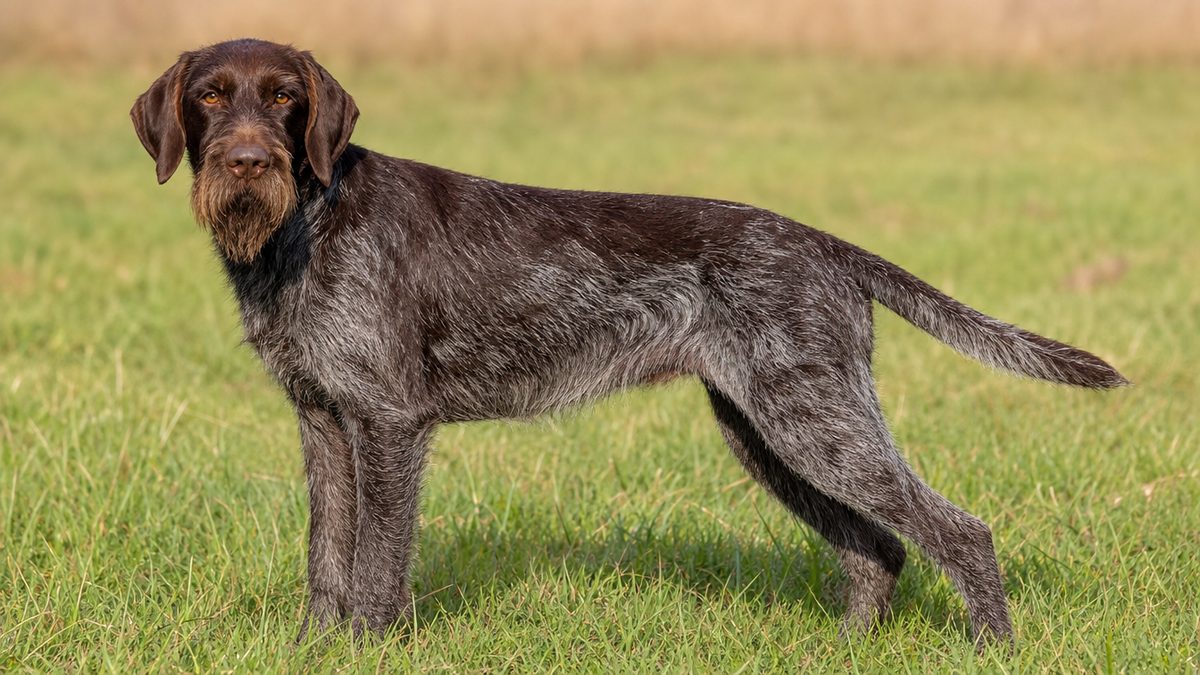
The standard's own opening line is the best one-sentence description anyone has written: the Cesky Fousek is a medium sized, wirehaired, noble pointer whose general appearance shows strength and endurance, a versatile hunting dog with inherent qualities for field and water as well as for work in woodland. It is a muscular dog without being heavy, and a US gundog magazine ranking in India describes it as standing roughly two feet at the shoulder with males topping out around 60 to 70 pounds, which sits below both registries' ceilings.
A Cesky Fousek is a medium to large pointing dog with a lean, somewhat narrow and long head set high on the neck, a moderately arched nasal bridge the standard calls a ram's nose, and a heavy beard on the lower jaw and lips that gives the breed its name. Fousek derives from the Czech fousy, meaning whiskers. The eyes are almond-shaped and dark amber to deep chestnut, the nose leather must always be dark brown, and the high-set ear leathers narrow markedly towards the tips and lie close to the head.
The size and weight figures are where most ranking pages start and stop, so here they are from the document that governs them, with the two registries side by side.
| Measure | FCI Standard 245 | United Kennel Club | Do they agree? |
|---|---|---|---|
| Height, dogs | 60 to 66 cm | 23.5 to 26 in, which is 59.7 to 66.0 cm | Yes, to rounding |
| Height, bitches | 58 to 62 cm | 23 to 24.5 in, which is 58.4 to 62.2 cm | Yes, to rounding |
| Weight, dogs | 28 to 34 kg | 62 to 80 lb, which is 28.1 to 36.3 kg | No. The UKC ceiling is 2.3 kg higher |
| Weight, bitches | 22 to 28 kg | 48 to 62 lb, which is 21.8 to 28.1 kg | Yes, to rounding |
| Tail | Docked by three fifths | Generally docked to three fifths, but a full tail is not penalised | No |
That weight disagreement is not trivia. A male Cesky Fousek registered at the UKC ceiling weighs 36.3 kg and is over the FCI maximum by more than two kilograms, and heat-related illness in dogs is associated with bodyweight at or above the breed and sex mean at an odds ratio of 1.42. In India, the heavier reading of the breed is the more dangerous one.
The coat is three coats
The standard does not describe one coat. It describes three layers and gives each a length: a soft dense undercoat of 1.5 cm which is almost completely shed in the summer, a topcoat of 3 to 4 cm that is suitably harsh and coarse and close fitting, and guard hair of 5 to 7 cm that is especially harsh and straight and most noticeable on the forechest, topline, flanks and shoulders. Permitted colours are dark roan with or without brown patches, brown with ticked markings on forechest and lower limbs, or brown without any markings.
The German text, which is the authentic one, gives the identical figures: Unterwolle 1.5 cm, Deckhaar 3 to 4 cm, Grannen 5 to 7 cm. That agreement is worth stating, because FCI standards do drift between languages on numbers, and on this one they do not.
The undercoat is described as almost completely shed in the summer. That is a dog whose thermal regulation assumes a summer where an undercoat is worth shedding and a winter where it is worth growing. Bohemia's January mean is minus 2.6 C. Chennai's coldest month averages 24.1 C. The shedding cue this coat evolved around does not exist in most of India.
Reading the standard in the language that actually governs it
German is the authentic language of FCI Standard 245, so the German text governs and the English is a translation, and the English document says so on its own second page.
The English PDF carries the line TRANSLATION: Mrs. C. Seidler. Official language (DE) directly under its header. The FCI's breed record says the same thing in its own field, Official authentic language: German. On this site that check is mandatory, because two FCI standards have already been caught disagreeing between languages on a measurement, with the translation quietly inventing a symmetric tolerance the authentic text never granted.
So the German was extracted and compared clause by clause. On this breed there is no drift. Widerristhoehe 60 to 66 cm and 58 to 62 cm, Gewicht 28 to 34 kg and 22 to 28 kg, and the same three coat lengths. Publishing a negative result is worth as much as publishing a positive one, and this one means an Indian reader can use the English text without fear.
Where the two texts do differ, and it is history rather than measurement
The history sections are not identical. The English says the World War and its consequences were responsible for the breed nearly dying out in the twenties. The German says Mitte der zwanziger Jahre, the middle of the 1920s, which is tighter. The German also places the breed's pre-war population auf dem Gebiete der damaligen CSSR, in the territory of the then Czechoslovak Socialist Republic, a state that did not exist before the First World War; the English translation quietly rewrites this as the region of the present day Czech and Slovakian Republics.
That is the pattern this site has recorded before. Measurements in an FCI standard survive translation. History and rationale passages do not, and they should be checked against a national source rather than trusted.
The two clauses that collide with Indian law
The standard contains two instructions that an Indian breeder cannot lawfully follow.
- Tail. The English reads that the tail is medium strong and docked by 3/5 of its length. The German says the same, um drei Fuenftel ihrer Laenge gekuerzt, and so does the French, ecourtee des trois cinquiemes de sa longueur. All three agree.
- Dewclaws. Under hind feet, the English reads Dewclaws are removed. The German reads vorkommende Afterkrallen werden entfernt, any dewclaws present are removed.
Second Schedule Part II paragraph 6(8) of the Prevention of Cruelty to Animals (Dog Breeding and Marketing) Rules 2017 reads, verbatim from the gazette: *There shall be no tail docking, ear cropping, de-barking, de-clawing, branding, dyeing, injecting substances to enhance visual appeal, performing a surgery or procedure to camouflage or hide any defect or infirmity or any other kind of mutilation of any body part of the pup and any change of appearance by artificial means is strictly forbidden*. Tail docking and de-clawing are both named. There is no breed exemption.
The United Kennel Club, which is the breed's other registry, has already dealt with this collision in its own text. Its standard says the tail is generally docked to three fifths of its natural length, then adds that because docking and cropping have been forbidden in some countries, no dog in any UKC event, including conformation, shall be penalised for a full tail or natural ears. The FCI standard contains no such clause.
A Cesky Fousek born in India must keep its tail. It will then not match the FCI standard's tail clause, which is a show problem and not a welfare one. A breeder who docks it to satisfy the standard has broken Indian law. The correct reading is that the standard describes a lawful dog in Prague and an unlawful procedure in Pune, and that the dog is the same dog either way.
One further detail is worth knowing before anyone reads a docked photograph as the breed's normal state. The 2019 genetics paper's own Figure 1 caption notes that tail docking is allowed for hunting breeds in the countries of origin of the animals photographed, which it lists as the Czech Republic, Germany and the USA. Even the scientific literature on this breed flags the convention. Indian pages reproducing those images do not.
Two official documents, two recognition dates, and how to read an FCI date
The FCI's register gives definitive acceptance as 21 May 1963 while the Czech breed club's own dated history says the FCI recognised the breed in 1964, and both documents are current and official.
The FCI's breed record for 245 prints, in its classification block, Date of acceptance on a definitive basis by the FCI: 5/21/1963, alongside Date of publication of the official valid standard: 5/21/1963.
The Klub chovatelu ceskych fousku's history in dates says something different under the year 1964: the FCI recognised the Cesky Fousek on the documentation of MVDr Josef Kuhn and with the support of Ing Vaclav Ruzicka, FCI president in 1964 and 1965, and the FCI breed standard adopted on 21 May 1963 came into force. Then, at 2023, the same timeline records sixty years of FCI recognition of the breed, which counts from 1963 and not from its own 1964 entry.
So the club's own page holds both readings. That is not a defect to sneer at; it is the ordinary shape of a two-stage process where a standard is adopted in one year and the breed is entered under it in the next. But it means a page that flatly asserts either date without the other is hiding something a reader can check in two clicks.
| Document | What it states | Date it implies |
|---|---|---|
| FCI breed record 245, classification block | Date of acceptance on a definitive basis by the FCI: 5/21/1963 | 21 May 1963 |
| FCI Standard 245, all three languages | Date of publication of the official valid standard: 21.05.1963 | 21 May 1963 |
| Czech club history, entry for 1964 | The FCI recognised the breed; the standard adopted 21 May 1963 came into force | 1964 |
| Czech club history, entry for 2023 | Sixty years of FCI recognition of the breed | 1963 |
| A US retail page ranking in India | Recognised by the UKC and by the FCI in 1963 | 1963 |
The date-format trap, and how this page proved its way out of it
An FCI date is unreadable until you establish which field is the month, and the FCI writes the same date two ways across its own documents. Guessing gets the month wrong; on one breed this site published 2 November 2026 for a date that was 11 February 2026.
The rule is to prove the format from the document you are actually holding, by finding a date whose fields cannot both be months. Both proofs were available here.
- The FCI web record proves itself M/D/YYYY. It prints 5/21/1963. The second field is 21, and there is no twenty-first month, so the first field must be the month. The date is 21 May 1963, not 5 September.
- The FCI standard PDF proves itself D.M.YYYY. It prints 21.05.1963 as the date of publication of the official valid standard. Here the first field is 21, which cannot be a month, so the first field is the day. Same date, opposite field order.
- The provisional register confirms the web format independently. Its date column carries 9/17/2024, 6/21/2022, 2/26/2020, 3/30/2022 and 4/29/2019. Five second fields exceed twelve, so the whole column is M/D/YYYY.
Apply that to the standard's own publication date and the pay-off is visible. The FCI record lists the English standard as published 8/7/2013, which in M/D is 7 August 2013. The PDF header reads 07.08.2013/EN, which in D.M is also 7 August 2013. The two documents agree perfectly, and reading either in the other's format gives 8 July 2013, which is wrong by a month in both directions.
On some breeds the FCI's register and its own standard genuinely contradict each other on a date. On breed 245 they do not: the record and all three language versions of the standard give 21 May 1963 for the standard's publication. The disagreement here is between the FCI and the national club, and it is about the year of entry rather than the date of the standard.
The second registry, and the one that does not exist
The United Kennel Club recognised the Cesky Fousek on 1 January 1996 and files it in the Gun Dog Group. That is the breed's only other registry of consequence.
For India the question resolves through the FCI. The Kennel Club of India is India's FCI member body, so the KCI issues pedigrees against FCI nomenclature, and a breed the FCI holds definitively is a breed the KCI can in principle paper. The KCI publishes no browsable breed list at all, so a search there returns nothing for this breed and nothing for a common control either, which is a limit of the instrument rather than a finding about the dog. The honest statement is that FCI recognition answers the India recognition question and that the KCI's own site cannot be used to confirm or deny it.
Near-extinction after the First World War, and a reconstruction you can check
The Cesky Fousek nearly disappeared during and after the First World War, and the Czech club rebuilt it from descendants of Czech dogs that had been exported to Germany and registered there under German breed names.
Three independent documents agree that the breed almost went, and they date it slightly differently, which is worth showing rather than smoothing over.
| Source | What it says | Period implied |
|---|---|---|
| FCI Standard 245, English | The World War and its consequences were responsible for the breed nearly dying out in the twenties | 1920s |
| FCI Standard 245, authentic German | fast vor dem Aussterben stand, Mitte der zwanziger Jahre | Mid 1920s |
| Klub chovatelu ceskych fousku | During the First World War the club's activity stagnated and the Cesky Fousek almost died out | 1914 to 1918 |
| United Kennel Club | During the First World War, the breed was nearly eradicated | 1914 to 1918 |
| Neradilova and colleagues, 2019 | The World Wars pushed the CF breed to the edge of extinction in the Czech regions | Both wars |
Why the breed drained away, and where it went
The mechanism is the interesting part, and only the peer-reviewed account states it plainly. Litters of Cesky Fouseks born in different parts of what is now the Czech Republic were exported to what is now Germany and Austria and registered in local studbooks as different breeds, specifically Deutsch Drahthaar and Deutsch Stichelhaar. The dogs did not die out so much as get renamed across a border.
The club's own timeline supports this from the political side. In 1896 Prof Ing Ferdinand Sekyrka founded the first club at Pisek and the breed took its present name, but the Czech dog could not be entered in Austrian studbooks, and because the club refused to adopt German as its language of proceedings it was dissolved by official authority. A dog with no studbook of its own is a dog that gets written into someone else's.
The rebuild, dated
- 1912. Sekyrka formally revives the club. During the First World War its activity stagnates and the breed almost dies out, with breeding maintained by a handful of people, above all Frantisek Hosticka.
- 1924. At Karel Podhajsky's instigation the present club is founded in Prague. The decisive figure becomes Frantisek Houska, to whom the club credits the greatest share of the rescue.
- 1931. The first modern standard is issued, replacing Josef Vilem Cerny's 1882 description. Houska's dog Recek Divaky becomes the first champion of the regeneration era, and the club holds its first trials.
- 1944. The breed begins to be registered in the studbook of Czech hunting dogs.
- 1945. Houska dies. A breeding council is formed, regional advisers are appointed, breeding becomes strictly directed, and MVDr Josef Kuhn begins founding inbred lines.
- 1957. Czechoslovakia joins the FCI and the breed is shown as an FCI member state's breed at Vienna.
- 1958. The club is renamed and, in its own words, the breed is closed to the influx of foreign blood while Kuhn prepares the FCI documentation.
- 1972. The inbred lines are published. Seven original lines exist, founded on notable individuals of the 1940s after the blood was refreshed with six individuals of a foreign breed. By 2007 the club records ten lines.
One date in that list is contested. The club says the studbook was closed in 1958; the 2019 genetics paper says the Cesky Fousek studbook was closed in 1960, in the same sentence that dates the Deutsch Drahthaar's closure to 1924Klub chovatelu ceskych fousku. Two years apart, both sources credible, and nothing on the English-language web mentions either figure. This page publishes the disagreement rather than picking the more convenient number.
What the genetics says the rebuild used
The 2019 paper's abstract puts it in one line: because it faced extinction in the past, the Cesky Fousek was restored from German Wirehaired and Shorthaired Pointers, and its discussion names the recent outcrossing as being with the German Shorthaired Pointer and the Deutsch Drahthaar. Note that the paper is careful about a name collision the English-language web is not: although Deutsch Drahthaar translates as German Wirehaired Pointer, it states that the two are no longer the same breed, with separate clubs, separate registrations and diverging phenotypes.
In 1985 the Wirehaired Pointing Griffon Club of America decided its own breed needed help, citing loss of hunting ability, an increased occurrence of recessive genetic diseases and diminishing coat quality. The breed it chose for the restoration was the Cesky Fousek. The paper records that the improvement was immediate, that the club renamed itself the Bohemian Wirehaired Pointing Griffon Club of America and switched to breeding Cesky Fouseks, and that it continues to import Czech dogs, with backcrosses to two Griffon males in 2013 and 2014. The paper's title calls the breed both survivor and rescuer, and it earned both halves.
Cesky Fousek price in India: no figure exists, and here is what an Indian search actually returns
No verifiable cesky fousek price in india exists, because no Cesky Fousek is offered for sale anywhere in India, and every price published for the breed anywhere in the world is in US dollars.
That is the first sentence of this section deliberately, because it is the answer, and burying it at the end of a price page would be the same trick the ranking pages play. Bonbeno reports published price ranges as editorial content. It does not broker sales, and it will not quote a rupee figure it cannot trace to a real listing for a real animal.
The search, and the control that makes it evidence
An absence is a claim about the world, so it needs a working instrument. A commerce-shaped search for this breed restricted to India returned ten results, and here is what they actually were.
| Result | What it actually is | Live dog? |
|---|---|---|
| Amazon.in, top result | A print-on-demand training book, ISBN 1526911000 | No |
| desertcart.in | A second book, an owners' guide | No |
| ThePetNest rehoming page | The breed name inside a dropdown, listed beside the extinct Kuri | No |
| easydna.in | The breed name in a DNA panel's list of breeds it can detect | No |
| pinkpaws.co.in, Kolkata grooming | The breed name in a service-booking dropdown on a teeth-cleaning page | No |
| gooddog.com | A US marketplace's breed filter | No |
| fairvet.com | A Rottweiler puppy for sale in Enugu, Nigeria, whose page carries a breed dropdown | No |
| kukrejasupermart.in | A Nerf blaster listing whose page text carries the breed name and a 42 dollar price | No |
Look at what those Indian domains are actually doing with the name. An Indian DNA-testing company lists the Cesky Fousek among the breeds its panel can detect, which is a list of possible answers rather than a list of dogs in the country. A Kolkata grooming service carries it in a booking dropdown. Neither is evidence that a single Cesky Fousek exists in India; both are evidence that breed dropdowns are generated from international lists.
Run the identical query shape on the Labrador Retriever in the same session and the instrument proves itself immediately. It returns Supertails quoting Rs 8,000 to Rs 70,000, a marketplace publishing a city-by-city rupee table at INR 30,000 to 1,20,000 and above across Hyderabad, Bangalore, Delhi, Chennai, Lucknow, Mumbai, Jaipur and Pune, TradeIndia suppliers and Quora threads full of rupee figures. The search finds Indian dog commerce when Indian dog commerce exists. For this breed it does not exist.
The same control was run on the search engine itself, not just the marketplaces. A Labrador Retriever query with the identical Indian geo settings, in the same session, returned Supertails, Heads Up For Tails, TradeIndia and gettyimages.in in an en-IN page timestamped to Asia/Kolkata, along with its own four-question People also ask box. So both instruments used on this page were demonstrated working before either was used to claim an absence.
The kukrejasupermart.in result is worth naming, because it is exactly the contamination mechanism that produces fake Indian breed prices. An Indian domain, the breed's name in the page text, and a dollar figure, all attached to a plastic dart blaster. A scraper harvesting Indian pages for a price would find it. So would an answer engine. Before quoting any figure for this breed, confirm the listing is for a live animal.
The three dollar bands that do exist, and how to test any rupee figure against them
Three published price ranges for the breed were found, all in US dollars and none Indian.
| Source | Published band | At 84.38 | At 80 | At 74 |
|---|---|---|---|---|
| Dog Breeds List | USD 800 to 1,500 | Rs 67,504 to 1,26,570 | Rs 64,000 to 1,20,000 | Rs 59,200 to 1,11,000 |
| A-Z Animals | USD 800 to 2,200 | Rs 67,504 to 1,85,636 | Rs 64,000 to 1,76,000 | Rs 59,200 to 1,62,800 |
| A YouTube breed video | USD 1,200 to 2,500 | Rs 1,01,256 to 2,10,950 | Rs 96,000 to 2,00,000 | Rs 88,800 to 1,85,000 |
That table is not a price for this breed in India. It is a detector. This site has repeatedly caught Indian breed pages publishing a rupee band that is a US dollar band run through one exchange rate, and the tell is always the same: the rupee figures divide cleanly into a number a seller would actually print. If anyone ever quotes you a Cesky Fousek at Rs 64,000 to Rs 1,20,000, divide by 80 and you get 800 and 1,500, which is the Dog Breeds List band exactly. That is not a market. That is arithmetic wearing a rupee sign.
Why no Indian supply can lawfully form
The absence is not an accident of demand. It is structural, and two instruments hold it in place.
- Import. DGFT Trade Notice 22/2022-23 classifies dogs under ITC(HS) 01061900 as Restricted. Policy Condition 7 allows import only as a pet with a valid pet book in the importer's own name, by an R&D organisation with CPCSEA recommendation, or for internal security by the Defence and Police Force. Policy Condition 8 says import of commercial dogs for breeding or any other commercial activity is not permitted, and paragraph 6 says applications for trading or breeding purposes shall be duly rejected.
- Route. Even a lawful personal import runs only through the airports and seaports of Delhi, Mumbai, Chennai, Hyderabad, Bengaluru and Kolkata and, since October 2024, Kochi airport, needs an advance No Objection Certificate from the quarantine officer seven days before travel, and for a permanent baggage import requires the owner to be transferring residence after two years of continuous stay abroad Department of Animal Husbandry…. The full route is set out in how to import a dog to India.
- Breeding. Even if a pair arrived lawfully as pets, breeding them to the standard requires docking the tails, which paragraph 6(8) forbids.
Put those together and the conclusion writes itself: there is no lawful commercial supply chain for the Cesky Fousek in India, which is why there is no price in india to report and why anyone offering you one should be asked, in writing, which of the three DGFT routes their dog came in on.
What a 30 kg Cesky Fousek would actually cost to keep in India each month
A 30 kg working gundog costs roughly Rs 8,600 to Rs 13,700 a month to keep properly in an Indian metro, and every line below comes from a named Indian price rather than a template.
There is no Indian purchase price for this breed, but the cost of ownership is entirely real, because it is the cost of keeping any 30 kg dog in India. Those figures are published, sourceable and far more useful to a reader than an invented puppy price.
One warning before the table. Indian breed sites publish running-cost rows as shared constants across groups of unrelated breeds, so the same rupee figures appear on a Pug page and a wire-haired terrier page with the identical grooming line. Nothing below is taken from that kind of row. Each line names the clinic, retailer or municipality that published it.
| Line | Low | High | Source and basis |
|---|---|---|---|
| Food, premium large-breed dry | Rs 5,700 | Rs 7,450 | Arithmetic at about 300 to 390 g a day for a 20 to 30 kg dog on published Indian kibble pricing. Verify grams per day against the pack you buy |
| Tick, flea and worm cover | Rs 1,103 | Rs 1,103 | NexGard Spectra 15 to 30 kg, three tablets Rs 3,308 on Supertails, dosed monthly |
| Deworming, when not on a combination product | Rs 251 | Rs 377 | Drontal Plus at Rs 125.67 a tablet, one tablet per 10 kg |
| Vaccination, annualised | Rs 267 | Rs 275 | Vetic annual booster from Rs 3,199 a year, divided by twelve |
| Consultation, annualised at two visits | Rs 83 | Rs 167 | VOSD's published Rs 500 to 1,000 a consultation |
| Grooming, one professional bath a month | Rs 934 | Rs 1,869 | Vetic Delhi: bathing from Rs 934, complete bath and styling from Rs 1,869 |
| Municipal registration, annualised | Rs 4 | Rs 42 | Chennai Rs 50 a year, Delhi Rs 500 a year |
| Contingency at ten percent | Rs 258 | Rs 419 | Bonbeno's own allowance, not a quoted figure |
| Monthly total | Rs 8,600 | Rs 13,702 | Sum of the rows above |
The three lines that move most in India, and why
Grooming is the line this breed inflates. A three-layer harsh coat with a heavy beard is not a bath-and-go dog in Indian humidity. The Vetic Delhi list runs a haircut from Rs 1,359, bathing from Rs 934 and a complete bath and styling from Rs 1,869, with add-ons from Rs 99. VOSD's wider survey gives Rs 300 to Rs 2,000, which is a useful sanity range. Budget the higher end and expect to do most of the work yourself between visits.
Vaccination pricing depends on the delivery model, not the drug. At a private clinic chain the 9-in-1 DHPPiL starts at Rs 899, anti-rabies at Rs 699, kennel cough at Rs 1,349, and the whole puppy course at Rs 6,499 against a struck-through Rs 8,111. A dog charity's published survey gives core vaccination as Rs 1,500 to Rs 3,000 for the first year, which does not overlap the clinic's package price at the top end. Greater Chennai Corporation goes to the other extreme and provides all treatment and anti-rabies vaccination free of cost at its six municipal pet clinics. Publish the spread rather than picking one figure, because the spread is what an Indian reader can act on.
Boarding is the line a hunting breed's owner underestimates. PawSpace Bengaluru charges Rs 599 for up to four hours, Rs 799 for daycare to ten hours and Rs 899 for an overnight stay to 24 hours. A dog with this exercise requirement cannot be parked at home for a fortnight, so a two-week trip adds roughly Rs 12,600 at that rate.
Municipal registration is small but real and it is not the same everywhere: Delhi charges Rs 500 for a new pet dog registration and Rs 500 to renew, with a late fee of Rs 100 a month, while Greater Chennai Corporation licenses pet animals at Rs 50 and issued 9,115 licences in 2024Greater Chennai Corporation. And boarding is priced per night rather than per month, so a fortnight away at Bengaluru overnight rates adds about Rs 12,600 in one go. For a heat-sensitive northern coat, ask any boarding kennel what happens to the air conditioning during a power cut before you leave the dog there.
Heat tolerance in India, measured against Bohemia rather than guessed
The Cesky Fousek has low heat tolerance in India, and the size of the problem is measurable: its Bohemian homeland runs an annual mean of 8.32 C against 25.60 C in Delhi, with a peak wet-bulb gap of twelve degrees.
Climate is one of the few things on a breed page that can be worked out rather than borrowed, so this section was built from NASA POWER queried by explicit latitude and longitude, with the grid-cell elevation echoed on every point. POWER returns a cell and not a point, and in hill country the cell can miss the town by more than a kilometre, so the elevation check is not optional.
The homeland point is Pisek in South Bohemia, at 49.3088 N and 14.1475 E, chosen because it is where the breed's first club was founded in 1896 and where its 1964 special show was held. POWER returns a cell at 486.02 m against a town near 370 m, an error of plus 116 m, which is small enough to use directly. Prague comes back at 353.91 m against roughly 200 m.
| Place | Cell elevation | Annual mean T2M | Hottest month mean daily max | Annual RH2M | Peak wet bulb |
|---|---|---|---|---|---|
| Pisek, South Bohemia | 486.02 m | 8.32 C | 25.6 C | 80.05% | 15.1 C |
| Prague | 353.91 m | 8.92 C | 26.3 C | 78.74% | 15.6 C |
| Delhi | 206.37 m | 25.60 C | 41.9 C | 45.56% | 26.5 C |
| Mumbai | 97.15 m | 26.77 C | 39.5 C | 67.39% | 25.8 C |
| Chennai | 48.95 m | 27.95 C | 36.6 C | 72.39% | 26.1 C |
| Kolkata | 7.35 m | 25.81 C | 39.1 C | 73.93% | 27.1 C |
| Pune | 635.99 m | 23.86 C | 38.6 C | 66.80% | 23.0 C |
| Bengaluru | 841.72 m | 23.74 C | 36.3 C | 67.94% | 21.9 C |
Two notes on how those numbers were produced, because both matter and both are places this site has previously got it wrong. The mean daily maximum column was computed by pulling the daily T2M_MAX series for 2015 to 2024 and averaging it per month. The climatology and monthly endpoints return period extremes rather than means and overstate a routine afternoon by several degrees. And the wet-bulb column uses mean T2M with RH2M, never T2M_MAX, because feeding a period extreme into a wet-bulb formula produces figures higher than anything ever recorded on Earth.
The humidity assumption is wrong, and it is the useful part
Here is the finding that reverses the obvious argument. Pisek runs 80.05 percent annual relative humidity. Prague runs 78.74. Every Indian city in the table is drier on an annual basis: Chennai 72.39, Kolkata 73.93, Bengaluru 67.94, Mumbai 67.39, Pune 66.80 and Delhi 45.56.
So the sentence every imported-breed page reaches for, that Indian humidity will finish this dog, is simply false here. Bohemia is a damp country. Its January relative humidity at Pisek is 93.4 percent. What this coat has never met is heat, or heat and moisture together. That is why the honest measure is wet-bulb load rather than humidity, and why the wet-bulb column is the one to read.
The gap is large. Pisek peaks at 15.1 C wet bulb in July. Kolkata peaks at 27.1 C, Delhi at 26.5 C and Chennai at 26.1 C. That is a twelve-degree step for Kolkata, and even Bengaluru at 21.9 C is 6.8 C above anything the breed's homeland produces.
The temperature step, stated plainly
Delhi's hottest month averages a daily maximum of 41.9 C. The hottest month at Pisek averages 25.6 C. That is a 16.3 degree difference in the routine afternoon a dog will actually be asked to walk through, and it is not a heatwave figure, it is the normal May.
For the other direction, Pisek's January mean is minus 2.6 C and its mean daily maximum is 1.7 C. Chennai's coolest month, January, has a mean of 24.1 C. The two climates do not overlap anywhere in the year.
The obvious suggestion is a hill station, and this page will not give you numbers for one, because the instrument fails there. POWER's cell for Manali sits at 3,984.73 m against a town near 2,050 m and reports an annual mean of minus 0.56 C, which is absurd for Manali. Ooty's cell is 784.64 m against roughly 2,240 m, an error of minus 1,455 m, so it comes back far too warm. Shimla is 1,302 m too low, Darjeeling 731 m too low. Every one of those towns is misrepresented, in both directions, so quoting a wet-bulb figure for them would be publishing a cell rather than a place.
The lawful hook matters too, and it is specific. Second Schedule Part IV paragraph 21(1) of the 2017 Rules bars keeping in outdoor facilities, without the attending veterinary practitioner's written approval, dogs not accustomed to the temperatures prevalent in the area and breeds that cannot tolerate them, such as long-haired breeds in high temperature locations. A three-layer wire-haired gundog in a Chennai yard is squarely what that clause was written about.
Managing a three-layer coat through an Indian summer
Manage this breed's heat load by protecting the coat rather than removing it, moving all work to the two coolest hours of the day, and treating exertion as the real risk.
The single most important number for a working gundog in India comes from the larger of the two 2020 UK heat studies. Of 1,259 heat-related illness events from 1,222 dogs, 879 had a recorded trigger, and 652 of those 879, which is 74.2 percent, were exertional rather than environmental or from confinement in a vehicle. Dogs overwhelmingly overheat because of what they were doing, not because of where they were parked.
For a breed registered subject to a working trial, that reframes the whole problem. The danger is not a hot afternoon. It is a hot afternoon with a retrieve in it.
Six rules that follow from the evidence
- Move exercise to before sunrise and after dark. Delhi's May afternoon averages 41.9 C. Its May mean across the whole day is 35.0 C, which tells you the mornings carry most of the relief.
- Never clip the harsh coat back to the skin. The topcoat and guard hair are the layer that keeps sun off the skin. The standard already lists a coat that is too fine, too short or too long as a fault, and a clipped wire coat frequently grows back soft.
- Let the undercoat go. The standard says it is almost completely shed in the summer. Brush it out rather than trapping it, because a dead undercoat under a harsh topcoat in monsoon humidity is a hot, wet mat.
- Watch the weight. Bodyweight at or above the breed and sex mean carries an odds ratio of 1.42 for heat-related illness. Keeping a Fousek at the lower end of 28 to 34 kg is a heat intervention, not a cosmetic one.
- Wet the dog, do not wet the coat and stop. A three-layer coat holds water against the skin. Soak to the skin on the belly, groin and feet, where the vessels are, and let air move.
- Treat staggering, hard panting or collapse as an emergency. The smaller 2020 study puts case fatality for heat-related illness at 14.18 percent. This is not a wait-and-see condition.
Which Indian city is least bad
On the wet-bulb column, the ranking is unambiguous and it is not the one people expect.
| City | Peak wet bulb | Gap over Pisek | Verdict for this breed |
|---|---|---|---|
| Bengaluru | 21.9 C | +6.8 C | Least bad. Indoor cooling still needed in April |
| Pune | 23.0 C | +7.9 C | Workable with shade and a hard summer routine |
| Mumbai | 25.8 C | +10.7 C | Difficult. June to September is a continuous load |
| Chennai | 26.1 C | +11.0 C | Difficult, and there is no cool season to recover in |
| Delhi | 26.5 C | +11.4 C | Extreme in May and June, easier in winter |
| Kolkata | 27.1 C | +12.0 C | The hardest of the six on this measure |
Delhi is the interesting case, because its annual relative humidity of 45.56 percent is far below the rest and its winter is genuinely cool, with a January mean of 13.6 C. A Cesky Fousek in Delhi would have four comfortable months and two that are close to unmanageable. Kolkata offers no such trade: its wet bulb sits above 26 C from May through September.
No Indian prevalence figure for canine heat stroke exists in the indexed veterinary literature, so every heat statement here rests on UK data applied to a measured Indian climate rather than on an Indian study. That is a limit worth stating rather than papering over, and it is why the wet-bulb table matters: it is a physical measure of the place, not a borrowed rate from another country's clinics.
Temperament and household fit, starting from what the standard actually says
The Cesky Fousek is described by its own standard as easily trained and very devoted to its master in spite of innate sharpness to vermin, which is a working temperament rather than a companion one.
Take the standard's sentence apart, because each clause is a household consequence. Innate sharpness to vermin means a dog with genuine prey drive, in a country with monkeys, cats, poultry and free-roaming dogs on most streets. Easily trained means it will take direction, which is the saving grace. Very devoted to his master means it bonds hard to one household and does not do well parked outside it.
The standard also does something many do not: it lists aggressive or overly shy dogs as a disqualifying fault, alongside any dog clearly showing physical or behavioural abnormalities. A Cesky Fousek that is either nervy or hard with people is failing its own standard, not expressing it.
The North American club's framing is the most practical description in print: a cooperative dog that hunts for you and with you, and the club structures its whole testing ladder around that, from Natural Ability through Intermediate Hunting Dog to Utility. A dog bred to keep checking in with a handler is a dog that suffers when nobody is checking back.
Who this breed suits in India
- A household with ground floor access and a genuinely secure yard. Not a balcony. A dog with this exercise requirement and this prey drive needs somewhere to be a dog before six in the morning.
- An owner who trains as a routine, not a phase. The trainability rating here is 4 out of 5 because it is real, and it is also conditional. This is a dog that gets worse quickly when the training stops.
- A family that is home. The devotion clause cuts both ways. Ten hours alone in an Indian flat is how a versatile gundog becomes a destructive one.
- Somebody who has kept a large working dog before. A breed database ranking on page one in India rates the breed one star out of five for apartment living, and nothing in the registry documents contradicts that.
Who it does not suit
It does not suit a first-time owner, a working couple out of the house all day, an apartment without lift access for a 30 kg dog, or anyone who wants a dog that will settle for two twenty-minute walks. It also does not suit a household with small free-ranging pets, because sharpness to vermin is in the standard rather than in the marketing.
One of the four People Also Ask questions Google attaches to this breed is Which is the most aggressive dog in India, which is a generic Indian query rather than a question about the Fousek. It deserves a straight answer anyway. No Indian dataset ranks breeds by aggression. The 2024 central circular that named a list of breeds was quashed by the Karnataka High Court on 10 April 2024 and set aside by the Delhi High Court on 16 April 2024, so no Indian law in force today bans owning any breed. The number of breeds that circular listed is itself disputed between reproductions, and Bonbeno has not seen the circular.
Training approach, and the two things this breed resists
Train a Cesky Fousek by giving it a job with a beginning and an end, because the standard's easily trained clause describes a dog that cooperates on task and not a dog that tolerates repetition for its own sake.
This is a highly trainable dog and a genuinely hardy one, and both words need qualifying before an Indian buyer relies on them. Trainable means it will take direction from a handler it trusts, not that it will train itself. Hardy describes a constitution built for cold, wet Bohemian fieldwork, and a dog can be hardy in that sense and still be one of the least heat-tolerant animals in an Indian summer.
The breed's registration status is the training brief. The FCI holds the Cesky Fousek with working trial, which means the international title is not available on conformation alone. The North American club runs three progressive tests, Natural Ability, Intermediate Hunting Dog and Utility, and publishes progeny testing alongside them. Nothing about the breed's institutional life assumes a pet that never works.
What works
- Give the dog a retrieve. The standard names field, water and woodland work as inherent qualities. A retrieve up a stairwell at five in the morning is a legitimate substitute for a marsh.
- Train the recall before the prey drive develops. Sharpness to vermin is in the standard. In an Indian street context, an unreliable recall on a 30 kg pointing dog is a serious problem, not a training niggle.
- Use the nose. Scent games cost nothing, work indoors during the hours when going outside is unsafe, and tire a pointing dog faster than distance walking.
- Keep sessions short and finish on a win. Devotion to a handler is the lever; boredom is what breaks it.
- Socialise early and widely, inside the socialisation window. The standard disqualifies overly shy dogs, and an Indian city gives a puppy more novel stimuli in a week than a Bohemian village gives in a season. The socialisation window closes long before the vaccination course finishes, so carry the puppy out rather than waiting.
The two things it resists
Repetition without purpose. This is a dog selected to solve a problem in the field with what the standard calls perspicacity. Drilling a sit fifty times produces compliance and then switch-off.
Being handled roughly. The whole modern breed was rebuilt on cooperation, and its testing culture is about a dog that works with a handler. Heavy correction on a devoted, sensitive gundog buys avoidance rather than obedience.
Realistic Indian timelines
| Age | What should be in place | The Indian complication |
|---|---|---|
| 8 to 16 weeks | Name, crate, house training, first socialisation, handling for grooming and the beard | Vaccination gaps limit ground contact; use carried outings |
| 4 to 6 months | Reliable recall in a fenced space, lead manners, first retrieves | Summer heat forces training into two narrow windows a day |
| 6 to 12 months | Recall under mild distraction, settled alone-time, basic scent work | Growth-plate caution: no forced running or stairs repetition |
| 12 to 24 months | Real recall around street dogs and cats, water confidence, stamina work | Monsoon skin care becomes a daily habit, not a seasonal one |
| 2 years and beyond | A dog that can work an hour and settle for the rest of the day | Boarding and travel need planning because no vet nearby knows the breed |
There is no Cesky Fousek club, no breed-specific trainer and almost certainly no veterinarian in India who has treated one. Every training and health decision falls back on general large-gundog practice plus the documents on this page. That is not a reason not to keep one well. It is a reason to write things down and to build a relationship with one veterinary practice rather than shopping around.
The actual daily exercise requirement, and what happens without it
A healthy adult Cesky Fousek needs one to two hours of real work a day, split across the two coolest parts of an Indian day, and it deteriorates fast without it.
The standard's own words set the bar: a multipurpose dog with inherent qualities for field and water, as well as for work in woodland, whose general appearance shows strength and endurance. The gait clause asks for movement that is completely regular at walk and trot with the footprints virtually covering each other. That is a dog described by how far it can go.
In Indian conditions the requirement does not shrink, but the window does. Between March and June in most of the country there are perhaps three usable hours in twenty-four, and they are before sunrise and well after dark.
| Slot | Winter, Nov to Feb | Summer, Mar to Jun | Monsoon, Jul to Sep |
|---|---|---|---|
| Early morning | 45 to 60 min walk plus retrieves | 45 min before sunrise, on grass not tar | 40 min, dry the coat and ears afterwards |
| Midday | Free play in shade | Indoors only. Scent games and chew work | Indoors. Skin and beard check |
| Evening | 45 to 60 min including training | 30 to 40 min after dark, water available | 30 min between showers |
| Weekly extra | One long outing of two hours or more | One pre-dawn long outing | Swim if clean water is available, then rinse |
What under-exercise looks like in this breed
- Destruction with purpose. A bored pointing dog does not chew randomly. It dismantles.
- Escaping. Prey drive plus boredom plus an Indian street full of cats is a bad combination.
- Vocalising at movement. Not a bay, but persistent alerting at everything past the gate.
- Weight gain, which then compounds the heat risk. Bodyweight at or above the breed and sex mean carries an odds ratio of 1.42 for heat-related illness.
The last one is the trap. An under-exercised Fousek gains weight, the extra weight raises its heat risk, the heat risk shortens the safe exercise window further, and the loop tightens. Breaking it means keeping the dog lean deliberately rather than hoping the walks will do it.
Exertional heat-related illness accounted for 652 of the 879 UK cases with a recorded trigger, or 74.2 percent, against 46 from confinement in a vehicle. The image of the dog in the hot car is the one everyone carries, and it is the rarest of the three. What kills working dogs is being worked.
Grooming a three-layer wire coat in Indian humidity
Groom a Cesky Fousek by stripping and brushing rather than clipping, and treat the beard and the ear leathers as daily jobs during the monsoon.
The coat is the thing most Indian owners will get wrong, because the instinct in a hot country is to cut it off. The standard describes three layers with three jobs: a soft dense undercoat of 1.5 cm that prevents dampness penetrating to the skin, a harsh close-fitting topcoat of 3 to 4 cm, and guard hair of 5 to 7 cm that is especially harsh and straight. Remove the harsh outer layers and you remove the sun barrier and the water shed, and you are left with the soft layer that holds moisture against the skin.
The standard already treats coat quality as a fault line. A coat that is too fine, too short or too long is listed as a fault, as is an insufficiently defined beard or eyebrows. A clipped wire coat commonly regrows soft, which is a fault the standard names and a functional loss in an Indian monsoon.
The routine
- Brush twice a week, daily in shedding season. The standard says the undercoat is almost completely shed in the summer. Getting it out is the single highest-value grooming act of the year.
- Hand-strip the topcoat two or three times a year, or ask a groomer to. This maintains the harsh texture that clipping destroys.
- Wash and dry the beard after every meal and every drink. A wet beard in 90 percent August humidity is a permanent damp pocket against the chin.
- Dry the ears properly after every bath and every swim. The leathers lie close to the head, which is exactly the shape that traps moisture.
- Check the feet. The standard describes a noticeable atrophied remnant of webbing between the toes, which holds water and grit.
- Never shave down for summer. If a professional groomer in India offers this, decline it.
The ear problem, and an Indian disagreement worth knowing
Overseas breed clubs routinely tell owners to towel a working dog off and let it air dry. In a Bohemian autumn that is sensible advice. In an Indian monsoon, on a dog whose ear leathers lie flat against the head and whose undercoat is built to stop water reaching the skin, it is how a damp ear becomes an infected one. This is the most transferable error on any imported-breed page: care guidance written for one climate, copied verbatim for another.
Bonbeno looked for an Indian prevalence figure to attach to that and could not find a citable one. A PubMed search for canine otitis externa seasonality in India returns a handful of records, most of them from the late 1960s and 1970s and several not about canine otitis at all. So the honest statement is that the mechanism is obvious and the Indian rate is unpublished, and this page will not invent a percentage to fill the gap.
The practical rule does not depend on the missing number. Dry the ear canal after every swim and every bath, do not leave cotton plugged in the canal, keep the beard from wicking water back along the jaw, and get a smell or a persistent head-shake looked at by a veterinarian rather than treated from a shelf.
Indian grooming costs, from named price lists
| Service | Published Indian price | How often for this breed |
|---|---|---|
| Bathing | From Rs 934 (Vetic, Delhi) | Monthly, more in monsoon |
| Complete bath and styling | From Rs 1,869 (Vetic, Delhi) | Quarterly |
| Haircut | From Rs 1,359 (Vetic, Delhi) | Not for this coat. Ask for hand-stripping instead |
| Add-ons, nails and ears | From Rs 99 (Vetic, Delhi) | Every visit |
| Wider Indian grooming range | Rs 300 to Rs 2,000 (VOSD survey) | Sanity check on any quote you are given |
The FCI standard says dewclaws are removed. Second Schedule Part II paragraph 6(8) of the 2017 Rules names de-clawing in the same breath as tail docking and de-barking and calls the whole list strictly forbidden. If an Indian breeder or groomer offers to remove a dewclaw to bring a puppy in line with the standard, that is a prohibited procedure and not a grooming service.
Health: one real breed-specific disease, and a screening gap the club admits to
The Cesky Fousek's documented breed-specific problem is atypical recurrent flank alopecia, which a 2022 study says the breed shows at high frequency, while its hip status is genuinely unknown because screening is voluntary and no OFA statistics row exists.
Two peer-reviewed papers name this breed. Both are by Neradilova and colleagues, and between them they give the page more real health evidence than most rare-breed guides ever have.
Atypical recurrent flank alopecia, the one that is actually studied
The 2022 paper in *Genes* opens by stating that the Cesky Fousek displays atypical recurrent flank alopecia at a high frequency, and describes it as seasonal episodes of well demarcated alopecic areas without hyperpigmentation, which can be quite severe.
| Element | Figure |
|---|---|
| Dogs phenotyped for the genome-wide association study | 216 |
| Chromosomes carrying associations | 19, 8, 30, 36 and 21 |
| Candidate genes highlighted | 144 |
| Dogs in the transcriptomic comparison | 6 affected against 5 controls |
| Strongly differentially expressed genes found | 236 |
| Metabolic pathways implicated | Collagen formation, muscle structure and contraction, lipid metabolism, immune system |
| Genetic basis | Polygenic. No single-gene test exists |
Histologically the study found a lack of anagen hair follicles and severely shortened telogen or kenogen follicles, which is the same picture as ordinary recurrent flank alopecia. The practical consequence for a buyer is blunt: there is no DNA test to ask a breeder for, because the paper's own conclusion is that the basis is polygenic.
The condition matters differently in India, and this is honest speculation rather than a finding, so it is labelled as such. Recurrent flank alopecia in dogs is classically described as seasonal. The breed's home latitude near 49 N gives a day-length swing that most of India, between roughly 8 and 34 N, does not have. Whether that changes how the condition presents in an Indian-kept dog has not been studied, and no page should claim it either way. What an owner can do is photograph any bald flank patch with a date on it, because a seasonal pattern is only visible over a year.
Hips, and a breed club being unusually honest
The Klub chovatelu ceskych fousku's own hip page is the most useful health document about this breed in existence, and nothing in English quotes it.
- The committee states it is not currently considering adding hip screening as a condition of breeding approval for Cesky Fousek dogs and bitches.
- Screening for hips, elbows and shoulder osteochondrosis is entirely voluntary for owners of breeding dogs.
- Assessment costs 550 CZK for hips and 450 CZK each for elbows and shoulder OCD, with prices amended on 28 January 2025 and again on 11 August 2025.
- From 1 September 2018 a single named assessor holds the exclusive contract, and no other assessor's evaluation is accepted onto a breeding card.
- Examination is possible from twelve months and cannot be repeated, and grading follows the FCI A to E scheme.
Then the club says the part that no marketing page would ever print. It asks members to submit the image for assessment even when their own vet has warned that some degree of dysplasia is probably present, because the assessor compiles an anonymous annual statistic, and warns that otherwise *we will all keep thinking that dysplasia does not concern the Cesky Fousek, but results from abroad and the experience of some owners in the Czech Republic indicate otherwise*.
A voluntary scheme where owners can decline to submit a bad radiograph produces an optimistic number by construction, and the club says so in writing. So any hip figure you are ever quoted for this breed should be read as the rate among dogs whose owners chose to report. Bonbeno publishes no hip percentage for the Cesky Fousek, because an honest one does not exist.
The OFA absence, proved with controls
The Orthopedic Foundation for Animals holds a breed code for the Cesky Fousek but publishes no statistics row at all. Its breed-selection markup carries the code CF, with the attribute data-name reading CESKY FOUSECK and the neighbouring data-groups attribute on the same element reading UKC Gun Dog Group (CESKY FOUSEK), so OFA's own two fields disagree on the spelling and the misspelled one is the searchable field.
The published statistics dump was then searched in full. The string FOUSE appears zero times in 2,231,936 characters, while LABRADOR appears 109 times and CESKY TERRIER, a comparably rare breed, appears 18 times. The controls passed, so the absence is real. OFA requires 100 hip evaluations before publishing a breed, so this is best described as no row in OFA's published statistics rather than absence from the database.
What can be quoted is the comparison set, which is the closest thing to a benchmark an owner has.
| Breed | Evaluations | Normal % | Dysplastic % |
|---|---|---|---|
| Cesky Fousek | No published row | Not available | Not available |
| German Wirehaired Pointer | 5,906 | 90.0 | 8.9 |
| Wirehaired Pointing Griffon | 3,919 | 90.8 | 8.5 |
| Pudelpointer | 1,040 | 88.9 | 10.1 |
| Wirehaired Vizsla | 407 | 89.2 | 10.3 |
| Labrador Retriever, as a scale check | 324,860 | 87.5 | 11.3 |
Two more things the Czech club's own material shows
The club's health index records a veterinarian's February 2022 article reporting that she has seen more shoulder osteochondrosis cases in the breed in recent years, written by a vet who has kept Fouseks for ten years. That is a clinical impression rather than a prevalence figure, and it should be read as one, but it is the reason OCD appears in the club's own screening fee list at all.
And the 2019 spring gatherings give a rare population snapshot. Across the whole Czech Republic, 181 young dogs from 70 litters by 42 sires were assessed. Ten had incomplete dentition, one was overshot and one undershot, five had an irregular bite, and no case of alopecia was recorded in any of them. That last fact is consistent with a condition that appears seasonally in adults rather than in young dogs at a spring assessment.
One arithmetic note, because this site checks: the temperament row in that report reads 2 shy, 64 temperamental, none aggressive, 114 calm and 2 not assessed, which sums to 182 against 181 dogs presented. One dog is counted twice or a figure is a typo. The rest of the report's rows reconcile exactly, so the discrepancy is noted rather than used.
Feeding a 30 kg working gundog in an Indian kitchen
Feed a Cesky Fousek to a lean body condition on a large-breed diet split into two meals, and treat weight control as a heat-safety measure rather than a cosmetic one.
The reason to keep this dog lean is not vanity. Bodyweight at or above the breed and sex mean carries an odds ratio of 1.42 for heat-related illness in UK dogs. In a country where the routine May afternoon in Delhi averages 41.9 C, that odds ratio is the difference between a manageable summer and an emergency one.
The breed's target range gives you room. A male has a 6 kg span between 28 and 34 kg, a female a 6 kg span between 22 and 28 kg. Aim at the lower half of the range for a dog kept in Chennai, Kolkata or Mumbai, and the middle for one in Bengaluru or a Delhi winter.
Life-stage feeding
| Stage | Approach | Indian note |
|---|---|---|
| 8 weeks to 4 months | Large-breed puppy food, three or four meals a day | Sale under eight weeks is unlawful in India under Rule 8(1)(a), so a younger pup is a red flag before it is a feeding question |
| 4 to 12 months | Large-breed puppy food, two or three meals | Do not push growth. Fast growth on a big-boned gundog loads the joints the club's own OCD article is worried about |
| 12 to 24 months | Transition to adult, two meals | Summer appetite drops. Move the main meal to the cool part of the day rather than forcing it |
| Adult | Two meals, portioned by body condition not by the bag chart | About 300 to 390 g a day of dry food for a 20 to 30 kg dog, which is roughly Rs 5,700 to Rs 7,450 a month on Indian premium pricing |
| Senior | Two meals, reduced calories, joints monitored | No breed lifespan study exists, so senior onset is judged on the dog, not on a published median |
The dentition clause that changes how you feed
The standard requires a full complement of teeth, and lists jaws that are strong, clearly defined and well muscled with a scissor bite. The Czech club's 2019 assessment found 10 of 181 young dogs with incomplete dentition, plus one overshot, one undershot and five with an irregular bite. If you acquire an adult of this breed in India, count the teeth, because a missing-tooth dog eats differently and the standard treats it as a fault.
Indian law has a hook here too, and it is more specific than most owners realise. Second Schedule Part III paragraph 8(10) requires that breeding dogs shall have been tested for genetic defects, including hip dysplasia, progressive retinal atrophy, night blindness, hypothyroidism, entropion, ectropion, overshot, undershot jaw when the incisors do not touch or mesh, wry mouth, two or more missing teeth, and unilateral or full cryptorchid males. The word is including, so the list is illustrative rather than closed.
The standard's typical beard on the lower jaw and lips is charming and it is also a food trap. Wet food and gravy collect in it, and in 90 percent August humidity in Mumbai that becomes a smell and then a skin problem. Feed dry or wipe the beard after every meal. A stainless bowl with a narrow rim helps more than any grooming product.
Parasite control, which is a feeding-adjacent monthly cost in India
For a 30 kg dog the single most efficient product on Indian shelves is a combination that covers ticks, fleas, roundworm and hookworm in one monthly tablet: NexGard Spectra for the 15 to 30 kg band, three tablets at Rs 3,308 against an MRP of Rs 3,375, which is Rs 1,103 a month. If you deworm separately instead, Drontal Plus runs Rs 125.67 a tablet at one tablet per 10 kg, so Rs 251 to Rs 377 per treatment for a dog this size.
Tick pressure is the reason this line is not optional in India. A 2024 Odisha study screened 178 dogs and found *Ehrlichia canis* in 56 of them, 31.46 percent, with incidence higher among dogs over 20 kg body weight at 75 percent and in the summer months at 55 percent. A 2026 West Bengal study of 584 client-owned dogs at a Kolkata animal health centre found molecular prevalence of *Babesia gibsoni* at 76.54 percent.
Read both correctly. These sampled dogs presented at veterinary clinics, not a random population, so they describe the burden among animals someone already thought were sick. Quoted any other way, 76.54 percent is materially misleading. What they do support is that a 30 kg outdoor-working dog in eastern India sits in the highest-risk weight band of the one study that reported by weight, which is a reason to keep monthly cover on all year rather than seasonally.
Month by month through the first year, for an Indian household
A Cesky Fousek's first year in India is governed by three clocks at once: vaccination, growth plates and the summer heat window, and the third is the one nobody plans for.
Before any of it, the legal floor. Rule 8(1)(a) of the Prevention of Cruelty to Animals (Dog Breeding and Marketing) Rules 2017 requires that pups less than eight weeks in age are not sold, and Rule 8(1)(b) requires that dogs over six months are not sold without first being sterilised unless they go to another licensed breeder. Both are Rules rather than Second Schedule paragraphs, and both are enforceable.
| Age | Health and care | Training and socialisation | Heat and season |
|---|---|---|---|
| 8 to 10 weeks | Core vaccination begins. A puppy DP starts at Rs 849 and the 9-in-1 at Rs 899 at one clinic chain | Name, crate, handling of feet, ears and beard from day one | Indoors during the day. Floor temperature matters more than air temperature |
| 10 to 14 weeks | Vaccination course continues. Anti-rabies from Rs 699 | Carried socialisation outings. New surfaces, sounds, people | Avoid tar and concrete entirely between 9am and 6pm |
| 3 to 4 months | Course completes. First deworming cycle established | Recall foundation in a fenced space. First short retrieves | Two short outings a day, both outside daylight peak |
| 4 to 6 months | Teething. Count the adult teeth as they come in | Lead manners, settle training, alone-time in short doses | Summer arrival: shift everything before sunrise |
| 6 to 9 months | Sterilisation discussion with your vet. Municipal registration due | Recall under distraction. Water introduction if clean water exists | Monsoon: daily ear and beard drying becomes routine |
| 9 to 12 months | Hip and elbow radiographs possible from 12 months, and worth doing | Stamina building on soft ground, not roads | Post-monsoon is the best training window of the Indian year |
| 12 months | First annual booster, from Rs 3,199. Adult body condition set | Real work begins: scent, retrieve, distance | A full Indian year now observed. Photograph any flank hair loss with a date |
Three things specific to this breed in the first year
- Do not force exercise before the growth plates close. The club's own health section carries a veterinarian's article on rising shoulder osteochondrosis in the breed, and OCD is a young, growing, large-breed joint disease. Stairs, long road runs and repetitive jumping before twelve months are the wrong risk to take on this particular breed.
- Radiograph at twelve months and submit it. The Czech club's scheme allows assessment from twelve months and does not allow it to be repeated. Whatever the result, it is the only hip datum this breed will ever have from an Indian dog.
- Start a dated photo log of the flanks. Atypical recurrent flank alopecia is seasonal, so it is invisible in a single consultation and obvious across twelve monthly photographs.
Municipal registration is cheap and it is the paperwork that makes a dog findable if it is lost. Delhi charges Rs 500 for a new pet dog registration, renewable at Rs 500 with a Rs 100 monthly late fee. Greater Chennai Corporation licenses pet animals at Rs 50 and issued 9,115 licences in 2024. For a breed nobody in your city can identify on sight, a registration number is worth more than usual.
Compare with the breeds it is cross-shopped against, and the ones it is confused with
Against every breed an Indian buyer might cross-shop it with, the Cesky Fousek loses on availability and screening data and wins only on genetic diversity, which is not something you can buy.
Google's own People also search for panel on this breed lists four neighbours: the Slovak Rough-haired Pointer, the Wirehaired Pointing Griffon, the Deutsch Stichelhaar and the Cesky Terrier. Three of those are wire-haired continental pointers with tangled shared history; the fourth is a 20 cm-tall terrier that shares only the word Cesky. That confusion is why one of the four People Also Ask questions is about Cesky Terriers rather than this breed at all.
| Breed | Registry status | OFA hip evaluations | Available in India | What you gain | What you give up |
|---|---|---|---|---|---|
| Cesky Fousek | FCI 245 definitive, UKC since 1996 | No published row | No verified supply | Documented genetic diversity, a real working temperament | Screening data, veterinary familiarity, any lawful supply |
| German Wirehaired Pointer | FCI 98, AKC, UKC | 5,906, 8.9% dysplastic | Occasionally, via KCI-papered lines | The largest hip dataset of any wire-haired pointer | A harder, more independent dog for many households |
| German Shorthaired Pointer | FCI 119, AKC, UKC | Large dataset | Yes, with real Indian prices | A smooth coat, which is a genuine Indian advantage | Even higher exercise need, thinner coat in cold |
| Wirehaired Pointing Griffon | FCI 107, AKC, UKC | 3,919, 8.5% dysplastic | Rarely | A well-documented breed with a closed French studbook | Higher recorded inbreeding, F IS 0.061 against 0.005 |
| Bracco Italiano | FCI 202 | Small dataset | Rarely | A calmer continental pointer | Heavier build, more skin folds in humidity |
| Labrador Retriever | FCI 122, everywhere | 324,860, 11.3% dysplastic | Yes, everywhere | Supply, price transparency, every vet knows it | A less driven working dog and a very common one |
The one column where the Cesky Fousek wins outright
The 2019 study compared six pointing breeds on 405 samples and 18 microsatellite markers, and the rebuilt breed came out on top of the diversity measures rather than the bottom.
| Breed | Observed heterozygosity | Allelic richness | Inbreeding coefficient F IS |
|---|---|---|---|
| Cesky Fousek | 0.669, the highest of the six | 5.245 | 0.005 |
| German Shorthaired Pointer | Not the highest | 5.304, the highest | -0.004, the lowest |
| Bohemian Wirehaired Pointing Griffon Club of America stock | 0.639, the lowest | 4.723, the lowest | Not reported here |
| Wirehaired Pointing Griffon | Not reported here | Not reported here | 0.061, the highest |
| Deutsch Drahthaar | Not reported here | Highest allele count per locus | Significant heterozygote deficiency |
Read that against the breed's own history and it is remarkable. A population that went to the edge of extinction and was rebuilt from a handful of imported animals now shows the highest observed heterozygosity and near-zero inbreeding of six pointing breeds, several of them far more numerous. The paper attributes it to two things: the recent outcrossing with German Shorthaired Pointers and Deutsch Drahthaars, and good management of breeding lines.
That 0.005 inbreeding coefficient describes the Czech population, kept under a national club with regional breeding advisers and a line-breeding scheme running since 1945. It says nothing about a dog offered to you in India by someone who cannot show you which of the three DGFT import routes it arrived on. The genetic health of this breed is a property of a system, not of the label on a puppy.
One further comparison is worth making, because it is the one Indian buyers actually face. The Deutsch Drahthaar and the German Wirehaired Pointer look nearly identical to a non-specialist, and the 2019 paper says outright that the Cesky Fousek and the Deutsch Drahthaar are phenotypically very similar and that for an unskilled person it is often impossible to discriminate between these breeds. If a seller in India shows you a bearded, wire-coated brown roan pointer and calls it a Cesky Fousek, that sentence is your starting assumption.
What the ranking pages get wrong about this breed, checked one by one
The pages ranking for this breed in India carry a five-year lifespan, a 34 pound weight, a wild-animal breeding profile and a recognition year that contradicts the FCI's own register, and every one of those errors is checkable in a minute.
This is not a general complaint about content farms. Each item below was opened, read and compared against a primary document.
1. A page-one encyclopedia prints a five-year lifespan and a 34 pound weight
A-Z Animals ranks on page one in India for this breed. Its At a Glance card prints Lifespan 5 years and Weight 34 lbs. Its Life Cycle block goes further and prints Lifespan In the Wild 3-8 years, In Captivity 11-15 years, Mating System Polygyny and a Conservation Status of Not Evaluated, for a domestic dog breed. Its own prose, two screens down the same page, says the lifespan is between 12 and 15 years.
The weight error has an obvious mechanism and it is worth naming, because this site has caught it elsewhere. The FCI standard's maximum for a male is 34 kg. The page prints 34 lbs. That is 15.4 kg, less than half the standard's minimum for a male. A unit label has been swapped, not a number invented, and the same page's Also Known As field lists dog, domestic dog, pooch, pup, mutt and man's best friend, which are species-level synonyms rather than breed names. This is a wild-animal template with a dog dropped into it.
2. A Google snippet turns a sex difference into the breed's weight
Search this breed in India and the Wikipedia snippet reads that it weighs up to 11 kilograms (24 lb). Open the article and the sentence is about something else entirely: there is a large difference in size between females and males of this breed, with the weight difference being up to 11 kilograms. The snippet dropped the subject of the sentence.
Worth noting in passing, because arithmetic is cheap: the article's own size section gives males 28 to 34 kg and females 22 to 28 kg, so the largest possible difference between a male and a female is 12 kg, not 11. The 11 kg figure reproduces from nothing else on the page.
3. An answer engine attributes a puppy figure to a page that does not contain it
Google's AI panel on this breed states that roughly 500 to 600 puppies are born each year in the Czech Republic and Slovakia and attributes it, among others, to the United Kennel Club. The UKC's Cesky Fousek page was opened and read in full. It contains no puppy count of any kind. The figure circulates on a blog post; the attribution is to a page that does not carry it.
4. Retail pages state a recognition year without noticing the conflict
A US retail page ranking in India says the breed was recognised by the UKC and by the FCI in 1963. The FCI's register agrees. But the breed's own national club dates FCI recognition to 1964, and Google's AI panel repeats 1964 citing Wikipedia. Nobody on either side notices the other. A page that states one year flatly is picking a side in a disagreement it has not read.
5. Nobody mentions that the standard's tail clause is illegal here
Not one page ranking in India for this breed mentions that FCI Standard 245 requires the tail docked by three fifths of its length and the dewclaws removed, or that Second Schedule Part II paragraph 6(8) of the 2017 Rules names tail docking and de-clawing among procedures that are strictly forbidden. For an Indian reader, that is the single most consequential fact about the breed's standard and it is absent from the entire ranking set.
6. Everybody quotes a lifespan; nobody has a source for it
Twelve to fifteen years appears on almost every page. No breed-specific longevity study exists. The two large UK datasets this site normally uses cover breeds registered in the UK in numbers, and this breed is not among them. The Czech club, which holds the studbook and would know, publishes no lifespan figure at all. Bonbeno publishes no lifespan for the Cesky Fousek, because the honest answer is that the figure circulating is unsourced.
Shaving the coat for summer, which removes the sun barrier and often ruins the texture permanently. Walking the dog at the wrong hour, when 74.2 percent of UK heat-illness cases with a recorded trigger were exertional. Letting the beard stay wet through the monsoon. Buying a bearded wire-coated pointer on a seller's word when the literature says the breed is often indistinguishable from a Deutsch Drahthaar to a non-specialist. And accepting a puppy with a docked tail, which in India means the breeder has already broken the law.
Adoption, and the only honest sourcing advice for this breed in India
Adopt rather than import, because there is no lawful commercial route to a Cesky Fousek in India and any seller offering one is either mistaken about the breed or operating outside the Rules.
How to get a puppy is the wrong first question for this breed in India, and the breed's own institutions effectively say so. The North American club routes every enquiry through membership, planned litters and its testing programme rather than through a marketplace, and the Czech club's structure runs on regional breeding advisers and covering permits rather than on retail.
What Indian law permits, precisely
- Bringing your own dog with you is lawful. Under DGFT Trade Notice 22/2022-23, up to two pets may come as passenger baggage without DGFT authorisation, but only for a person transferring residence to India after two years of continuous stay abroad, and only cats and dogs may come under the baggage rules.
- Importing with an authorisation is possible for shorter stays or larger numbers, through the DGFT's Import Management System, with an application recommended at least two months before travel and an advance No Objection Certificate from the quarantine officer seven days before it.
- Importing to breed or sell is not permitted. Policy Condition 8 bars commercial import for breeding, and paragraph 6 states that applications for trading or breeding purposes shall be duly rejected.
- Entry runs through seven named places only: the airports and seaports of Delhi, Mumbai, Chennai, Hyderabad, Bengaluru and Kolkata and, since October 2024, Kochi airport Department of Animal Husbandry….
Read those together and the conclusion is not a matter of opinion. No lawful supply chain for this breed can form in India, so a domestic advertisement for Cesky Fousek puppies describes either a different breed or an unlawful operation.
Adoption is the affordable and lawful route, and it is a real one
Adoption in India will not produce a Cesky Fousek, and that is the point. What it produces is a dog that already lives in your climate, whose parasite exposure your vet understands, and whose acquisition breaks no rule. For a household drawn to this breed, the honest translation of what it wants is a medium-large, biddable, high-energy working dog with a weather-resistant coat and a strong handler bond. Indian shelters and rescues hold that dog constantly.
- Ask for a temperament assessment, not a breed guess. Drive, biddability and noise sensitivity matter far more than a coat type.
- Take an adult rather than a puppy if you want a working dog. Adult drive is visible; puppy drive is a bet.
- Budget the same monthly cost. A 30 kg adopted dog costs the same Rs 8,600 to Rs 13,700 a month as an imported one.
- Register it. Rs 500 in Delhi, Rs 50 in ChennaiGreater Chennai Corporation.
If you are offered a Cesky Fousek in India anyway
| Check | A genuine answer | A red flag |
|---|---|---|
| Import route | A named DGFT route under Policy Condition 7, with paperwork | A vague reference to an import, or none at all |
| Port of entry | One of Delhi, Mumbai, Chennai, Hyderabad, Bengaluru, Kolkata and, since October 2024, Kochi | Any other port, or an unwillingness to say |
| Pedigree | A Czech studbook entry traceable through the KCI against FCI nomenclature | A claim of a certificate no body actually issues |
| Tail | Full and natural, as Indian law requires | Docked, which means paragraph 6(8) was already broken |
| Dewclaws | Present | Removed, which is de-clawing under paragraph 6(8) |
| Age at sale | Eight weeks or older, per Rule 8(1)(a) | A pup offered younger than eight weeks |
| Hip screening | An assessment done from twelve months, whatever it says | A claim of a clear hip score with no document |
| Price | There is no established Indian price to check against | A rupee band that divides cleanly by 84.38, 80 or 74 into a round dollar figure |
Take whatever rupee figure you are quoted and divide it by 84.38, then by 80, then by 74. If any of those produces a number a shop would print, such as 800, 1,500 or 2,500, the price was a US dollar band converted rather than an Indian market observation. This page's own price table shows exactly what those conversions look like, which is why it is there.
One closing point about the breed itself, because it deserves it. The Cesky Fousek is a genuine conservation success. A population that was renamed across a border, nearly lost to a war, and rebuilt from imported descendants of its own exiles now carries the highest measured heterozygosity of six pointing breeds and has, in turn, been used to rescue another breed on a different continent. Admiring that does not require owning one, and in India, admiring it is the only option the law leaves open.
Cesky Fousek questions Indian buyers actually ask
How rare is the Cesky Fousek breed?
Rare outside the Czech Republic and absent from India. The breed's own club calls it the only national Czech dog breed the FCI recognises, and its 2019 spring gatherings across the whole country assessed 181 young dogs from 70 litters by 42 sires. The Orthopedic Foundation for Animals holds a breed code for it but publishes no statistics row at all, and a controlled Indian commerce search returns no live dog and no rupee figure.
What is the temperament of a Cesky Fousek?
The FCI standard puts it in one sentence: in spite of his innate sharpness to vermin, he is easily trained and very devoted to his master. That is a working temperament, not a companion one. The same standard lists aggressive or overly shy dogs as a disqualifying fault, and the North American club describes a cooperative dog that hunts for you and with you rather than independently.
Are cesky terriers rare?
Google asks this inside the Cesky Fousek's own results box, which is entity confusion rather than a question about this breed. The Cesky Terrier is a different Czech dog, FCI 246 rather than 245, and unlike the Fousek it does appear in the Orthopedic Foundation for Animals statistics, in one table on only 60 evaluations and in another on 70. Both breeds are genuinely uncommon; only one of them is a 30 kg pointing dog.
Which is the most aggressive dog in India?
No Indian dataset ranks breeds by aggression, and Bonbeno will not invent one. What Indian law actually says is narrower and more useful: the 2024 central circular that named a list of breeds was quashed by the Karnataka High Court on 10 April 2024 and set aside by the Delhi High Court on 16 April 2024, so no Indian law in force today bans owning any breed. Aggression is a function of socialising, handling and pain, not of a breed label.
What is the Cesky Fousek price in India?
There is no Cesky Fousek price in India, because there is no Cesky Fousek market in India. A controlled search of Indian commerce returned a print-on-demand training book on Amazon.in, a DNA-test breed list, two grooming service dropdowns and a toy blaster listing, with the same query shape returning a full city-by-city rupee table for the Labrador Retriever in the same session. Every price published anywhere for this breed is in US dollars.
Is it legal to keep a Cesky Fousek in India?
Yes, keeping one is lawful. Breeding one to its own standard is not. The standard requires the tail docked by three fifths of its length and the dewclaws removed, and Second Schedule Part II paragraph 6(8) of the Prevention of Cruelty to Animals (Dog Breeding and Marketing) Rules 2017 forbids tail docking and de-clawing outright. Importing one for breeding is also barred, because DGFT Trade Notice 22/2022-23 says such applications shall be duly rejected.
Can a Cesky Fousek handle Indian heat?
Not without serious management, and the numbers say why. The NASA POWER cell over the breed's Bohemian homeland at Pisek returns an annual mean of 8.32 C and a hottest-month mean daily maximum of 25.6 C, against 25.60 C and 41.9 C for Delhi. Peak wet-bulb load runs 15.1 C at Pisek against 27.1 C in Kolkata, a gap of 12 degrees. Bengaluru and Pune are the least punishing Indian options and are still far outside anything this coat evolved for.
Does the Cesky Fousek have hip dysplasia?
Nobody can say, and the breed club says so itself. Its hip page states that screening is entirely voluntary, that the committee is not considering making it a condition of breeding approval, and warns members that without full reporting everyone will keep believing dysplasia does not concern the breed while results from abroad suggest otherwise. The Orthopedic Foundation for Animals publishes no row for the breed at all, so no percentage exists to quote.
What health problem is the Cesky Fousek actually known for?
Atypical recurrent flank alopecia, which a 2022 paper says the breed displays at high frequency. The study phenotyped 216 dogs, found genome-wide associations on chromosomes 19, 8, 30, 36 and 21 across 144 candidate genes, and compared skin transcription in six affected against five control dogs to find 236 strongly differentially expressed genes. The cause is polygenic, the episodes are seasonal, and no screening test exists.
Was the Cesky Fousek really nearly extinct?
Yes, and the reconstruction is documented rather than folkloric. The FCI standard states the World War and its consequences were responsible for the breed nearly dying out in the twenties, and a 2019 genetics paper shows the Czech club rebuilt it from descendants of Czech dogs that had been exported and registered in Germany as Deutsch Drahthaar and Deutsch Stichelhaar. The Deutsch Drahthaar studbook closed in 1924; the Cesky Fousek's closed in 1960.
Why do sources disagree on whether the FCI recognised the breed in 1963 or 1964?
Because two official documents say different things. The FCI's own breed record gives definitive acceptance as 5/21/1963, which is 21 May 1963 because the 21 in the second field cannot be a month. The Czech breed club's dated history instead records that the FCI recognised the breed in 1964 on Josef Kuhn's documentation, with the standard adopted 21 May 1963 entering into force that year. The club's own anniversary entry then counts sixty years in 2023, from 1963.
How big does a Cesky Fousek get, and why do registries disagree?
The FCI gives dogs 60 to 66 cm and 28 to 34 kg, bitches 58 to 62 cm and 22 to 28 kg. The United Kennel Club gives the same heights in inches but allows males up to 80 pounds, which is 36.3 kg and sits 2.3 kg above the FCI ceiling. A male at the UKC maximum is therefore over the FCI maximum, which matters in India because bodyweight at or above the breed and sex mean carries an odds ratio of 1.42 for heat-related illness.
What does a Cesky Fousek cost to keep in India each month?
Between roughly Rs 8,600 and Rs 13,700 a month for a 30 kg dog, on published Indian figures rather than a template. Food dominates, monthly parasite cover runs Rs 1,103 for NexGard Spectra in the 15 to 30 kg band, deworming costs Rs 251 to Rs 377 a time at Drontal Plus prices, and the annual booster starts at Rs 3,199 at one clinic chain. Municipal registration is Rs 500 in Delhi and Rs 50 in Chennai.
Is the Cesky Fousek a good first dog?
No. A ranking breed database rates it one star out of five for apartment life, the FCI registers it subject to a working trial, and the standard describes innate sharpness to vermin. This is a dog bred to work field, water and woodland for hours. In an Indian flat, with no lawful supply and no local veterinary familiarity with the breed, a first-time owner has stacked four hard problems on top of each other.
Compare with similar breeds
Cesky Fousek sits in 2 Bonbeno groups. Each one compares it directly against the breeds it is genuinely an alternative to, on the same figures.