
Breed profile
Wirehaired Pointing Griffon (Korthals Griffon): The India Guide
A French wire-coated gundog with no Indian price, no McMillan lifespan row, a named recessive cataract gene, and a breed standard that asks for a tail Indian law forbids you to cut.
Quick answer
No Indian source publishes a Wirehaired Pointing Griffon price in India, and the absence is the finding rather than a gap. India's largest breed-listing platform enumerates more than 250 breeds in its own dropdown and this is not one of them, while it does list the Vizsla and the Weimaraner. The only rupee figures the breed attracts on an Indian page belong to a metal wall sign. The dog is a French wire-coated gundog needing two hours of work a day.
This guide summarises breed-standard documents, kennel-club register data, peer-reviewed veterinary research, Indian breeding law and satellite climate data as general information for Indian pet owners. It is not a diagnosis and it is not a treatment plan. Screening decisions, drug choices, anaesthetic planning and any judgement about heat stress belong with a veterinarian who has examined your dog. Consult your nearby vet before acting on anything here, and treat any sudden collapse, laboured breathing or change in vision as an emergency.
Wirehaired Pointing Griffon at a glance
What the Wirehaired Pointing Griffon actually is
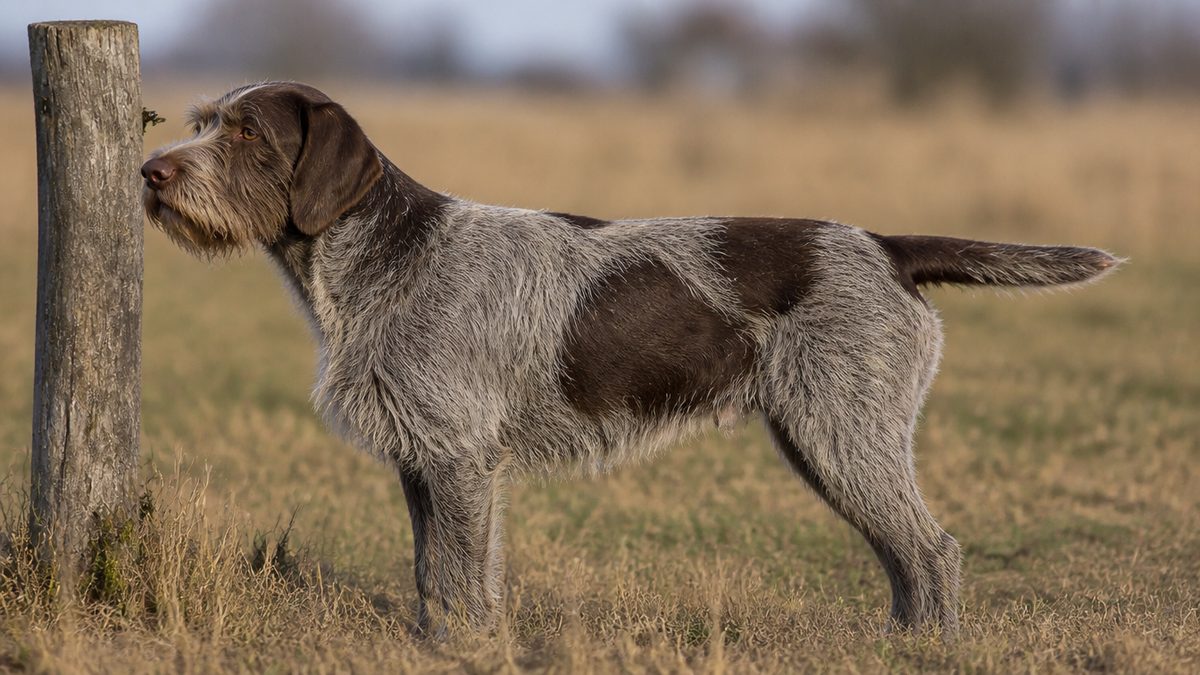
The Wirehaired Pointing Griffon is a French versatile gundog, held by the Federation Cynologique Internationale as standard 107 under the name Griffon d'arret a poil dur Korthals, standing about 55 to 60 cm at the withers in males and 50 to 55 cm in females, with a harsh wire top coat over a fine dense undercoat.
Four facts fix the breed before any opinion enters. The FCI holds it on a definitive basis in Group 7 Pointing Dogs, Section 1.3 Continental Pointing Dogs, subsection Griffon type, with a working trial attached, and gives its country of origin as France with French as the authentic language of the standard. Its definitive acceptance date reads 12/7/1954 on the register, which is 7 December 1954: the same register prints 7/13/1955 and 3/30/2009 elsewhere, and 13 and 30 cannot be months, so the first field is the month throughout.
The standard gives a height and no weight at all, in any language edition. That is worth knowing before you read a spec card anywhere else, because every weight figure circulating for this breed comes from somewhere other than the FCI, and a page that presents one as the standard's is misrepresenting the document.
| Attribute | Value | Source document |
|---|---|---|
| FCI standard number | 107, Group 7, Section 1.3, Griffon type | FCI breed record 107 |
| Country of origin | France | FCI breed record 107 |
| Authentic language | French | FCI breed record 107 |
| Definitive acceptance | 7 December 1954 | FCI breed record 107 |
| Height, males | About 55 to 60 cm | FCI Standard 107, English text 05.09.2023 |
| Height, females | About 50 to 55 cm | FCI Standard 107, English text 05.09.2023 |
| Weight | Not stated anywhere in the standard | FCI Standard 107 |
| Nose | Always brown | FCI Standard 107 |
| Working trial | Required | FCI breed record 107 |
The coat is the breed, and it is a double coat
The standard describes hair that is harsh and coarse, reminding of the touch of a wild boar's bristles, never curly or woolly, and states plainly that under the harsh top coat is a fine dense undercoat. Indian buyers read the word wiry and assume a single, air-permeable jacket. It is not. This is a rustic, double-coated northern working dog whose outer layer happens to be harsh rather than soft, and the undercoat is the part that matters when the wet bulb climbs.
The colours are equally specific and equally useful for spotting a mislabelled dog. The standard asks preferably for a steel grey shade with brown liver patches, or a self-coloured brown liver coat, frequently liver-roan or a close mixture of brown and white hairs, and permits white and brown and white and orange. It does not permit black, and the nose is always brown. A black-nosed dog offered as this breed is not this breed.
That roan coat has been mapped to a gene
Roaning in dogs is an 11-kilobase tandem duplication inside an intron of the usherin gene USH2A, at chromosome 38 positions 11,131,835 to 11,143,237, and the Wirehaired Pointing Griffon is one of the two breeds the mapping paper used to demonstrate selection at the locus. The authors found reduced nucleotide diversity, extended haplotype homozygosity and elevated genetic differentiation between this breed as a roaned population and the Labrador Retriever as a non-roaned one.
Coding mutations in human USH2A cause Usher syndrome, which combines deafness with retinitis pigmentosa, and it is tempting to read a health story into a duplication in the same gene. Do not. The variant reported in dogs is intronic, the paper reports no disease association with it in dogs at all, and the same duplication sits in every Dalmatian the study genotyped. State what the paper states and no more.
The FCI classifies the breed as essentially a versatile pointing dog also used for tracking wounded large game, and describes temperament as gentle and proud, an excellent hunter, very attached to his master and his territory which he guards with vigilance, and very gentle with children. Read the whole sentence rather than its warm half. A medium-sized dog that guards territory with vigilance is a dog that will announce every delivery in a Mumbai apartment block.
Korthals Griffon, Griffon d'arret, Wirehaired Pointing Griffon: one dog, and why the name decides what you find
The Wirehaired Pointing Griffon and the Korthals Griffon are one breed under two names, and which name a database uses decides whether you find anything at all in it.
The synonymy is not folklore. A peer-reviewed population-genetics paper states in its own text that the Wirehaired Pointing Griffon is synonymous with the Korthals Griffon, and the FCI's record for number 107 prints GRIFFON A POIL DUR KORTHALS as its heading while giving WIRE-HAIRED POINTING GRIFFON KORTHALS as the English name on the same page. Federation Cynologique Internationale German uses a third name again, Franzosischer Rauhhaariger Vorstehhund. The FCI's crossing register, the document that names every case where two coats or two sizes are one breed, contains no Griffon Korthals entry at all, while it lists 99 WEIMARANER short and 99 WEIMARANER long as two crossable varieties of a single number. So the Griffon's several names are translations of one breed rather than varieties of one number, which is a different thing entirely.
That matters more than a naming footnote usually does, because two of the three most important datasets for this breed file it under different names.
| Where | Filed as | What you get if you search the other name |
|---|---|---|
| FCI register | Griffon a poil dur Korthals (107) | The English name is on the same page, so nothing is lost |
| McMillan 2024 Table S5 | Korthals Griffon | Zero rows, which reads as absence from the study |
| OFA statistics | WIREHAIRED POINTING GRIFFON, code WG | Zero rows for Korthals Griffon |
| PubMed | Both, and neither is complete | Four records for one name, two for the other, six for the union |
The literature really does split across the names
Searching PubMed for the phrase Wirehaired Pointing Griffon in title or abstract returns four records. Searching Korthals Griffon returns two, one of which is not in the first set. Searching the broader phrase pointing griffon returns six, adding two more again. The Labrador Retriever control returned 1,109 records with a clean translation line in the same session, so the instrument was working and the split is real. A page that searched one name and reported the breed's entire literature would have understated it by a third.
The trap runs the other way too. Searching the bare surname Korthals returns seven records, and one of them is a chloroplast genome of a Japanese shrub, because Korthals is a Dutch surname that also appears in botanical authority citations. A count is not a reading, and a non-zero result is not coverage.
There is a fourth Griffon in the story and it is a different breed
The Cesky Fousek, the Bohemian wirehaired pointing griffon, is a separate FCI breed with its own number, and the two have a documented modern connection. A club in the United States used Cesky Fousek stock with the initial intent of improving the Wirehaired Pointing Griffon, which is why an American reader will meet the name Bohemian Wirehaired Pointing Griffon Club of America attached to what is not the FCI's Griffon Korthals at all. The same study, on 405 dogs and 18 microsatellite markers, concludes that separate pointing breeds constitute genetically differentiated units despite historical admixture, so the two are related and are not interchangeable.
If you are cross-shopping, read the German Wirehaired Pointer, the Cesky Fousek and the Pudelpointer pages beside this one. All four are 19th-century wire-coated versatile gundog projects, all four are routinely conflated, and only one of them has a lifespan median in the largest longevity study ever run.
Wirehaired Pointing Griffon price in India
There is no Wirehaired Pointing Griffon price in India, because there is no Indian market for the breed to price. That absence is checkable, and checking it is more useful than any number this page could print.
Start with the strongest single piece of evidence. Mr n Mrs Pet, India's most prominent breed-listing platform, publishes a dog-breed selector in its own page markup that enumerates more than 250 breeds. It carries Vizsla, Weimaraner, Pointer, German Shorthaired Pointer, Petit Basset Griffon Vendeen, Brussels Griffon and Miniature Schnauzer, which are the in-document controls that prove the list is complete and legible. It contains no Wirehaired Pointing Griffon entry and no Korthals Griffon entry.
That is not a search returning zero. It is a published list of the breeds an Indian marketplace believes it can sell, and this breed is not on it.
What an Indian search for the breed actually returns
Three search engines were tested against a Labrador Retriever control in the same session before any conclusion was drawn from a result set, because a search that returns nothing because it was never run is not evidence of anything. Google returned no document at all through the retrieval path available here. Bing India returned HTTP 200, the correct page title and a substituted result set in both directions, the breed query returning ten French AI love-poem generator pages and the Labrador control returning ten Google Translate landing pages, which is a broken instrument rather than a thin market. DuckDuckGo India was the one engine whose control passed. Ten organic results were pulled for the breed in an India-located search on 9 September 2026. Five were United States breeder or listing sites. One was a YouTube training video. One was a name generator. One was a life-expectancy aggregator. One was the single Indian-facing breed page, whose cost row is a template. And one was an Etsy listing for a 40.6 by 58.4 cm metal wall sign captioned Wirehaired Pointing Griffon (Korthals Griffon), sold as custom dog kennel decor.
This is a documented contamination mechanism rather than bad luck. A scraper, an answer engine and a hurried reader all treat a rupee figure on a breed-named page as a breed price, and a print, a mug, a metal sign or a scale model will happily present itself that way. Before quoting any rupee figure for a rare breed, confirm the listing is for a live animal. On this breed, in India, none of them is.
The United States figure exists, and this page will not convert it
A United States listing index states that the average cost of a purebred Wirehaired Pointing Griffon puppy in the United States is approximately 1,861 dollars, and other US sources give bands from 1,000 to 2,500 dollars. Multiply any of those by a plausible rate and you get a confident-looking rupee band that describes nothing: 1,861 at 84.38 is Rs 1,57,031, at 80 it is Rs 1,48,880, at 74 it is Rs 1,37,714. Three rates, three answers, none of them an observation of anything happening in India.
Converting a foreign asking price into rupees and publishing it as an Indian price is the single most common fabrication in Indian breed content, and it is detectable precisely because the arithmetic is reversible. If a page gives you an Indian band for this breed, divide it by 84.38, by 80 and by 74 and see whether any quotient lands on a round dollar figure a real seller would print. If one does, you are reading a conversion.
What you can and cannot lawfully do about the absence
Importing a dog into India for trading or breeding purposes is not available. Dogs are a restricted import, and applications for trading or breeding purposes are rejected; the personal pet route, under separate baggage-rule machinery, permits entry only for a genuine pet accompanying its owner with a valid pet book in the importer's name. So the absence of a market is not a temporary gap that a keen buyer can fill with a purchase order. There is no lawful supply chain for this breed in India, and the honest advice is to read the adoption section rather than to keep hunting for a price.
Monthly cost of ownership in India, built from named rate cards
A 25 kg Wirehaired Pointing Griffon costs between about Rs 8,000 and Rs 14,000 a month to keep in an Indian metro, and every line below comes from a named Indian rate card rather than from a breed page's cost widget.
The cost of ownership question has a right answer for this breed even though the purchase price does not, because running costs are a function of the dog's weight and your city, not of its rarity. A 25 kg gundog eats, is dewormed and is vaccinated exactly like any other 25 kg dog in the same city.
| Line | Figure | Basis |
|---|---|---|
| Tick, flea and worm control | Rs 1,103 per month | NexGard Spectra 15 to 30 kg, 3 tablets at Rs 3,308 |
| Deworming, if dosed separately | Rs 251 to Rs 377 per treatment | Drontal Plus at Rs 125.67 a tablet, one per 10 kg |
| Annual booster, amortised | About Rs 267 per month | Vetic annual booster from Rs 3,199 |
| Anti-rabies, amortised | About Rs 58 per month | Vetic anti-rabies Rs 699 |
| Bath, if outsourced | Rs 934 upward per visit | Vetic grooming, Delhi |
| Hand-strip, twice a year | Rs 1,359 upward per visit | Vetic haircut price as the nearest published proxy |
| Boarding, when you travel | Rs 899 per 24 hours | PawSpace Bengaluru overnight rate |
| Municipal registration, Delhi | Rs 500 a year | MCD Delhi pet dog registration |
| Municipal licence, Chennai | Rs 50 | Greater Chennai Corporation |
The delivery model sets the price, not the drug
One identical nine-in-one vaccine costs Rs 600 at a Goa government veterinary hospital inclusive of the certificate, from Rs 899 at a Vetic clinic, and from Rs 1,999 through a vet-at-home service that also charges a Rs 699 visit fee. That is a 3.3-fold spread on one product, and anti-rabies spans Rs 100 to Rs 1,199 across the same three routes. The spread, not any single figure, is the actionable fact: you are choosing a delivery model, and you can halve this line without changing the medicine.
Boarding is the line that moves most with your city and your operator. A Bengaluru facility publishes hourly rates to four hours at Rs 599, daycare to ten hours at Rs 799 and overnight to 24 hours at Rs 899. A widely-cited Indian welfare source gives a broader Rs 500 to Rs 2,000 per day, along with consultation at Rs 500 to Rs 1,000 and grooming at Rs 300 to Rs 2,000; treat that as one data point rather than two, because a large general insurer publishes byte-identical ranges for two separate quantities, which is evidence that one copied the other rather than evidence of corroboration. Greater Chennai Corporation goes further and runs six municipal pet clinics that provide all treatment and anti-rabies vaccination free of cost, alongside a Rs 50 pet licence. Delhi's Municipal Corporation charges Rs 500 to register a pet dog and Rs 500 to renew, with a Rs 100 per month late fee, and its own counters record 18,958 certificates issued since 2021. Two large Indian cities, an order of magnitude apart on the same line.
Why the one Indian-facing figure for this breed is not a figure
Happy Pet, the only Indian-facing page in the breed's result set, prints a monthly upkeep row of Rs 4,650 to Rs 6,600. The same site prints Rs 3,550 to Rs 5,400 for the Portuguese Pointer and for the Vizsla, both also labelled Medium, and Rs 5,700 to Rs 8,550 for the German Wirehaired Pointer and for the Giant Schnauzer, a 35 to 47 kg dog. Three medium-labelled continental pointing breeds, two different monthly totals, on one site, on one day.
Pull one unrelated breed from the same site and compare the lines to the rupee. If they match, the figure is a template constant assigned to your breed from a small preset table, not an observation anyone made about the dog. On the site above, the rows are assembled from independent preset lines for food, health and grooming, which is why breeds of different sizes share totals and why a Giant Schnauzer and a German Wirehaired Pointer land on the same number.
Build your own figure instead. Take the weight band, price the parasite product for that band, add your city's food price for the daily grams the pack actually specifies, amortise the booster, and add grooming at your own frequency. It takes ten minutes and it will not be wrong by a factor of two.
Heat tolerance: what a French gundog's homeland climate says about India
The Wirehaired Pointing Griffon has poor heat tolerance for the Indian plains, and the cleanest way to see why is to put its homeland's satellite climate beside an Indian city's rather than to argue about coat length.
The breed's country of origin is France, and its development ran through the Rhine plain of Germany as well, so two homeland points are worth pulling. Every figure below was queried from NASA POWER by explicit latitude and longitude, and every one echoes the elevation POWER reports for its grid cell against the town's real elevation, because a cell that has flattened the terrain gives a right answer for the wrong place.
| Point | Cell elevation vs real | Annual mean C | Annual RH % | Hottest month |
|---|---|---|---|---|
| Rouen, France | 118.53 m vs 20 m, +98.5 m | 10.44 | 84.79 | July, 17.71 C |
| Biebesheim am Rhein, Germany | 171.61 m vs 88 m, +83.6 m | 10.29 | 78.25 | July, 20.91 C |
| Delhi | 206.37 m vs 216 m, -9.6 m | 25.60 | 45.56 | June, 35.88 C |
| Chennai | 48.95 m vs 6 m, +43.0 m | 27.95 | 72.39 | May, 31.51 C |
| Mumbai | 97.15 m vs 14 m, +83.2 m | 26.77 | 67.39 | May, 31.19 C |
| Bengaluru | 841.72 m vs 920 m, -78.3 m | 23.74 | 67.94 | April, 28.37 C |
| Pune | 635.99 m vs 560 m, +76.0 m | 23.86 | 66.80 | April, 28.93 C |
| Kolkata | 7.35 m vs 9 m, -1.7 m | 25.81 | 73.93 | May, 31.53 C |
Every cell above sits within about 100 m of its town's real elevation, which is what a usable plains reading looks like. The gap that matters is the temperature one. Rouen's annual mean is 10.44 C and its hottest month averages 17.71 C. Chennai's annual mean is 27.95 C. This breed was selected to work through a summer that averages roughly what a Bengaluru December morning does.
Humidity is not the problem, and asserting that it is gets the breed wrong
Rouen runs 84.79 percent annual relative humidity, which is higher than Chennai's 72.39, Kolkata's 73.93, Mumbai's 67.39, Bengaluru's 67.94 and Pune's 66.80. A Norman gundog comes from genuinely damp air, and Rouen is more humid year-round than any Indian city on that table. What it does not come from is humid air at thirty degrees. Frame the risk as combined heat and humidity load, not as a humidity shock, and you will give an owner advice that actually helps.
Weight is the risk factor this breed's owners can control
In a cohort of 905,543 UK dogs, bodyweight at or above the breed and sex mean carried odds of heat-related illness of 1.42 (1.12 to 1.80), and dogs over 50 kg carried 3.42 (1.54 to 7.57). The Wirehaired Pointing Griffon is not in that paper's modelled breed list at all, and the study's inclusion rule is a disjunction, five or more cases and/or 5,000 or more dogs, so this breed simply had neither. The transferable finding is the bodyweight one, which applies to any dog, and this page claims nothing else from that study.
The companion paper is where the trigger split lives, and it is worth getting the denominator right. Of 1,259 heat-related illness events from 1,222 dogs, 380 had no recorded trigger, leaving 879 with one. Of those 879, 652 were exertional, which is 74.2 percent, against 113 environmental at 12.9 percent and 46 vehicular confinement at 5.2 percent. Nearly three quarters of recorded heat emergencies happened because the dog was doing something, not because it was shut in a car. For a breed that needs two hours of work a day, that is the whole warning.
Heat stress in a working dog escalates from panting to collapse faster than an owner expects, and the early signs are behavioural rather than dramatic. If a dog stops responding to recall, wanders off line, or lies down mid-work, stop the session, cool the dog with room-temperature water over the neck, groin and paws, and call a veterinarian. Do not wait to see whether it settles.
City by city: where this breed can be kept in India and where it cannot
Bengaluru and Pune are the only two large Indian cities where a Wirehaired Pointing Griffon can be worked outdoors for most of the year, and the wet-bulb column is what separates them from the rest.
Wet-bulb temperature is the number that decides whether a panting dog can still shed heat, because panting is evaporative cooling and evaporative cooling fails as the air approaches saturation. The column below is Stull 2011 computed from NASA POWER's T2M and RH2M for the 2001 to 2020 window, and it is labelled as such because a second method exists and the two disagree by up to about 1.5 degrees.
| City | Peak wet bulb C | Month | Coolest month mean C | Working verdict |
|---|---|---|---|---|
| Kolkata | 27.09 | June | 17.31 (January) | Hardest of the six. Monsoon work is unsafe |
| Chennai | 26.11 | May | 24.09 (January) | No cool season at all. Indoor cooling is mandatory |
| Mumbai | 25.77 | June | 23.19 (January) | Never cools. Same verdict as Chennai |
| Hyderabad | 23.35 | June | 20.76 (December) | Workable in winter, not from March to June |
| Pune | 22.97 | June | 19.62 (December) | Best mainland option after Bengaluru |
| Bengaluru | 21.86 | May | 20.22 (December) | The one Indian metro where this breed is reasonable |
| Delhi | 26.50 | July | 13.61 (January) | Real winter, brutal June. Seasonal, not year-round |
Three of those months surprise people and they are worth stating plainly, because getting them wrong quietly corrupts every seasonal recommendation on a page. Delhi peaks in June, not May, at a mean of 35.88 C. Bengaluru peaks in April at 28.37 C and is coolest in December, not January. Pune peaks in April at 28.93 C and is likewise coolest in December. Chennai, Mumbai and Kolkata do genuinely peak in May.
Delhi is the interesting case, and it cuts both ways
Delhi has the widest annual swing of the six, from a January mean of 13.61 C to a June mean of 35.88 C, and the lowest annual humidity at 45.56 percent. For four months a year it is the best working climate in mainland India for a double-coated gundog. For three months it is the worst. An owner who plans around that, working the dog hard from November to February and dropping to pre-dawn maintenance walks from April to July, has a manageable year. An owner who expects a constant routine does not.
The hill stations are not the answer you think
Manali, Shimla, Ooty, Darjeeling and Gangtok are the towns Indian readers reach for when a breed needs cool air, and satellite climatology cannot describe them. The grid cell covering Manali sits at 3,984.73 m against a real town elevation near 2,050 m, an error of nearly two kilometres, and the Ooty cell sits at 784.64 m against a real 2,240 m, wrong by 1,455 m in the other direction. Temperature falls at roughly 6.5 C per 1,000 m, so a cell that is two kilometres out is wrong by about thirteen degrees. This page therefore publishes no hill-station figure for this breed and says why, rather than printing a number that is right for a grid square and wrong for the town.
Second Schedule Part IV paragraph 21(1) of the Dog Breeding and Marketing Rules 2017 bars keeping in outdoor facilities, without the attending veterinary practitioner's written approval, dogs not accustomed to local temperatures, breeds that cannot tolerate them, naming long-haired breeds in high temperature locations, and sick, infirm, aged or young animals. A double-coated French gundog in a Chennai summer sits squarely inside the first two limbs of that clause. Note the citation form: this is a Second Schedule paragraph, not a Rule, because the Rules themselves stop at 13.
Temperament and household fit
The Wirehaired Pointing Griffon is an affectionate, biddable, handler-focused gundog that suits an active household with outdoor space and suits an apartment badly, and the FCI standard says so more precisely than most breed pages do.
The standard's own words are gentle and proud, excellent hunter, very attached to his master and his territory which he guards with vigilance, very gentle with children. Four claims, and Indian breed pages routinely quote the first, third and fourth while dropping the second one about territory. That omission is what produces a surprised owner in a high-rise.
Who this breed suits in India
- Households with a securable outdoor run or a garden, in Bengaluru, Pune or Delhi's winter belt.
- Owners who already walk or run at 5.30 in the morning and will keep doing it in May.
- Families with children old enough to respect a dog that is working rather than playing.
- Handlers willing to learn reward-based gundog work rather than obedience-class drills.
- Buyers prepared to screen for a named recessive eye variant before breeding anything.
Who this breed does not suit
- Apartment households without a lift-free route to open ground twice a day.
- Owners away from home for nine hours, because a handler-attached breed does not settle alone.
- First-time dog owners, because the coat, the drive and the screening are all unfamiliar work.
- Anyone in Chennai or Mumbai without reliable indoor cooling through the summer.
- Buyers who want a guard dog, because the standard describes vigilance and not defence.
The territory line has a practical Indian consequence that no overseas source will mention. Indian apartment corridors carry constant footfall from domestic staff, delivery riders, security rounds and neighbours, and a dog selected to guard its territory with vigilance will mark each of those as an event. That is not aggression and it does not need correcting out of the dog; it needs a household that can absorb it, or a ground-floor home with a boundary the dog can see.
Socialise early, and socialise to India specifically
The window that matters closes early, so the socialisation plan has to be booked before the puppy arrives rather than after. In India the list is specific: two-wheelers at close range, cattle on the road, festival fireworks, monsoon thunder, street dogs behind gates, lift doors, and the sheer number of unfamiliar adults a dog meets in a dense city in a week. A gundog that has met all of that by sixteen weeks is a different animal at two years from one that met a quiet park.
Training approach and what this breed resists
To train a Wirehaired Pointing Griffon, work short reward-based sessions built around the dog's attachment to its handler, and expect it to resist repetition, harsh correction and any drill that has no purpose it can see.
This is a trainable breed in the specific sense that it wants to work with you, which is not the same as being easy. The standard's phrase, very attached to his master, is the whole training strategy in four words. A Griffon that trusts its handler will work hard and take direction at distance. The same dog under pressure will slow down, look away and disengage, and an owner who reads that as stubbornness and escalates gets a dog that avoids training.
A realistic first-year timetable for an Indian household
| Age | Priority | Indian-specific note |
|---|---|---|
| 8 to 16 weeks | Socialisation, name response, crate | Book the socialisation list before arrival; the window will not wait for a free weekend |
| 16 to 24 weeks | Recall on a long line, place, loose lead | Train recall at dawn only; a hot puppy learns that coming back ends the fun |
| 6 to 9 months | Whistle recall, retrieve, settle on cue | Add monsoon noise work; thunder-phobic gundogs are made in this window |
| 9 to 14 months | Distance direction, steadiness, water work | Growth plates close late in a 25 kg dog, so no repetitive jumping yet |
| 14 to 24 months | Real quartering, endurance, staying steady near game | In India this is usually scent games and tracking, since field work is rarely available |
What it resists, specifically
- Repetition without purpose, because a versatile gundog is bred to solve rather than to drill.
- Harsh handling, which produces avoidance in a soft, handler-focused breed rather than compliance.
- Long static obedience, which is the format most Indian group classes are built around.
- Being left to entertain itself, which turns into digging, barking and destroying furniture.
- Working in heat, which looks like disobedience and is physiology.
The Indian gap is real and worth naming. Formal gundog training with access to game is close to unavailable here, and the FCI attaches a working trial to this breed for a reason. The substitute that works is scent and tracking sport: hide a scented article, build a search cue, extend the distance and the age of the track. It uses the same nose, the same handler partnership and the same problem-solving, and it can be done in a Pune housing-society garden at six in the morning.
Teach an explicit settle on a mat, on cue, from twelve weeks. A working breed with no off switch is the commonest reason gundogs are rehomed from Indian apartments, and an off switch is a trained behaviour rather than a temperament. Five minutes a day for a month buys you a dog that can lie down in a busy room for an hour.
Daily exercise requirement, and what happens without it
A Wirehaired Pointing Griffon needs about two hours of real work a day, split around the Indian heat, and a dog that does not get it becomes destructive, vocal and hard to live with rather than merely restless.
The FCI classifies the breed with a working trial and describes it as essentially a versatile pointing dog, also used for tracking wounded large game. That is a specification, not a compliment. A versatile pointing dog is selected to quarter ground ahead of a walking handler for hours, hold a point, and then track and retrieve. Two twenty-minute lead walks do not touch it.
What two hours actually looks like in an Indian city
- Forty-five minutes at first light, off lead where lawful, including recall and quartering.
- Fifteen to twenty minutes of scent or retrieve work indoors during the day, which tires the dog more per minute than walking.
- Forty-five minutes after dark, on a long line if the area is not secure.
- One longer session a week, ninety minutes or more, somewhere the dog can range.
The middle item is the one Indian owners underuse. Nose work is the cheapest form of exercise available in a hot country, because it costs the dog real energy and costs the handler no daylight. Ten minutes of searching for a hidden article in a flat will settle a gundog more reliably than a thirty-minute pavement walk in 34 C.
The heat rule, stated as a rule
Exertional heat illness accounted for 652 of the 879 heat-related illness events with a recorded trigger in a UK cohort of 905,543 dogs, which is 74.2 percent, against 46 events from vehicular confinement at 5.2 percent. Dogs are overwhelmingly harmed by being worked, not by being shut in cars. In India that means the exercise plan and the heat plan are the same plan.
- Work before sunrise and after full dark, and treat the hours between as maintenance only.
- Check the surface with the back of your hand; if you cannot hold it for five seconds the dog should not walk on it.
- Carry water for the dog on every session over twenty minutes, and offer it every ten.
- Stop on behaviour, not on temperature: a dog that drifts off line or slows without cue is already too hot.
- Cool with room-temperature water over the neck, groin and paws, and move air across the dog.
The sequence is predictable. First the dog stops settling in the evening. Then it starts patrolling and barking at corridor noise. Then it digs, chews skirting boards or shreds soft furnishings. Owners usually present the third stage to a trainer as aggression or anxiety when the cause was the first stage. If a Griffon has stopped settling, add work before you add training.
Grooming a wire coat in Indian humidity
Grooming a Wirehaired Pointing Griffon means stripping the coat two or three times a year rather than clipping it, combing the beard and eyebrows weekly, and drying the ears properly after every bath, because the monsoon turns a wet beard and a damp ear canal into a veterinary problem.
The standard asks for hair that is harsh and coarse, reminding of the touch of a wild boar's bristles, never curly or woolly, with a fine dense undercoat beneath it. That texture is what a wire coat is for, and it is the first thing lost to a clipper. Clipping cuts the harsh outer hairs without removing the dead undercoat, and the coat regrows softer, paler and denser each time. A softer coat traps more moisture, which in an Indian monsoon is the opposite of what you want.
The routine, and what it costs in India
| Task | Frequency | Indian cost basis |
|---|---|---|
| Comb through beard, eyebrows and legs | Weekly, more in the monsoon | Free, ten minutes |
| Hand-strip the body coat | Two or three times a year | Vetic haircut from Rs 1,359 as the nearest published rate |
| Bath | Every six to eight weeks, or after mud | Vetic bathing from Rs 934 |
| Full bath and styling | Optional, before a show | Vetic complete bath and styling from Rs 1,869 |
| Ear check and dry | After every bath and every swim | Free, and the most important line here |
| Nails | Monthly | Vetic add-ons from Rs 99 |
The Indian problem overseas grooming advice gets wrong
Breed-club grooming guidance is written for the climate the club sits in, and the standing instruction to towel a wire-coated gundog and let it air dry is sound in Normandy and wrong in a Kerala July. Indian veterinary series report otitis externa concentrating heavily in the monsoon months, and bathing without protecting the ears is named among the commonest causes. A breed with hanging ears, a heavy beard that stays wet, and an undercoat that holds water is exposed on all three counts.
- Plug the ears before a bath, with cotton wool, and remove it immediately afterwards.
- Dry the ear canal entrance with dry cotton wool, never with a cotton bud pushed inward.
- Dry the beard fully rather than letting it drip, because a wet beard keeps the chin and neck damp for hours.
- Blow the undercoat dry on a cool setting if you own a dryer, working against the lie of the coat.
- Check the ears weekly through the monsoon and see a veterinarian at the first head shake or smell.
Most Indian grooming salons clip. Hand-stripping is a technique rather than a tool, and salons that offer it are concentrated in a handful of cities. Before you commit to a wire-coated breed here, phone two salons in your city and ask specifically whether they hand-strip terrier and gundog coats. If neither does, either learn to strip the dog yourself with a stripping knife, which is entirely doable, or accept that the coat texture will soften over the years. Both are honest choices. Being surprised by it in year two is not.
One thing this coat does buy you: it sheds far less into the house than a smooth double coat, and it carries mud out in clumps that fall away when dry rather than smearing. Against an Indian monsoon that is a genuine advantage, and it is the reason the AKC describes the harsh coat as excellent protection in swampy country. Low shedding is where the benefit stops, and one widely-seen claim needs correcting. Google's own knowledge panel for this breed answers Hypoallergenic with Yes, and the AKC describes the coat as low-shedding. Shedding volume and allergen load are different quantities. A controlled study measured Can f 1 across 196 dogs of so-called hypoallergenic breeds against 160 control dogs and found the hypoallergenic group higher rather than lower, at 2.26 against 0.77 micrograms per gram on hair and 27.04 against 12.98 on coat, with no difference in airborne allergen, concluding that there is no evidence for the classification of certain dog breeds as being hypoallergenic. This page makes no allergy claim for this breed, and an Indian buyer paying a premium for an allergy-safe dog is buying a claim no measurement supports.
Health issues, screening and what the lifespan figures rest on
The Wirehaired Pointing Griffon has three health issues an Indian buyer should ask about by name, and one crucial absence: no population study has ever produced a life expectancy figure for the breed, so every lifespan number circulating for it rests on nothing measurable.
Take the absence first, because it changes how you read everything else. McMillan 2024 analysed UK companion-dog longevity at a scale nothing else approaches, and its Supplementary Table S5 lists every breed considered, flagged Y for included in the survival analysis or N for not. This breed appears in that table under the name Korthals Griffon, flagged N. The paper itself is McMillan and colleagues in Scientific Reports, and it carries an Author Correction that changes only a Miniature Dachshund figure in a figure legend, so nothing in the correction touches this breed either way. Table S3, which carries the 155 purebred medians, has no row for it under either name.
Search Table S5 for Wirehaired Pointing Griffon and you get nothing, which reads exactly like absence from the study. Search it for Korthals Griffon and the row is there, flagged N. Those are different claims: one says the researchers never considered the breed, the other says they considered it and excluded it. This page makes the second claim, because that is what the document says.
What the comparable breeds do get, and how to use it
| Breed | Deaths | Median years | 95% CI | HR vs crossbreds |
|---|---|---|---|---|
| Bracco Italiano | 22 | 13.8 | 11.8 to NA | 0.95, p = 0.81 |
| Vizsla | 503 | 13.5 | 13.2 to 13.9 | 0.67, p < 0.001 |
| German Shorthaired Pointer | 947 | 13.4 | 13.3 to 13.6 | 0.67, p < 0.001 |
| German Wirehaired Pointer | 138 | 13.0 | 12.5 to 13.6 | 0.75, p < 0.001 |
| Weimaraner | 1,229 | 12.8 | 12.6 to 13.0 | 0.80, p < 0.001 |
| Spinone Italiano | 215 | 11.9 | 11.6 to 12.4 | 1.00, p = 0.97 |
| Korthals Griffon | Not measured | None | None | Excluded, flag N |
For a wider anchor, the companion UK life-table study by a different research team gives the all-dogs baseline against which any breed without a median of its own has to be read. The pointing breeds that were measured span 11.9 to 13.8 years, which is a range and not a substitute. Do not hand this breed the German Wirehaired Pointer's 13.0 because the two look alike. The honest statement is that the range exists, this breed sits somewhere in it, and nobody has narrowed it. Note also that the hazard ratios in that table are against the crossbred group, not against all dogs and not against a breed average.
The three screening tests to ask a breeder for
OFA publishes real numbers for this breed, on samples large enough to mean something, and the fact that it publishes any is itself informative. OFA's own FAQ states the bar verbatim: Breeds are not included in the OFA statistics tables until a minimum number of individuals have been evaluated. For hips, each breed must have at least 100 evaluations in the database. For all other databases, there must be at least 50. Plenty of rare breeds hold an OFA code and have no published row, which is a different statement from being absent from the database. Its breed code is WG, read out of OFA's own advanced-search markup rather than guessed, and each figure below was matched both on the printed breed label and on the disease marker row above it.
| Screen | Evaluations | Normal % | Abnormal % | OFA rank |
|---|---|---|---|---|
| Hips | 3,919 | 90.8 | 8.5 dysplastic | 148 |
| Elbows | 1,774 | 94.6 | 5.2 | 81 |
| Eyes, summary line | 1,199 | 98.4 | 1.6 | 223 |
| Thyroid | 816 | 86.9 | 13.1 non-normal | 30 |
| Congenital cardiac | 155 | 99.4 | 0.0 | 145 |
| Basic cardiac | 150 | 100.0 | 0.0 | 47 |
The hip and elbow figures check out arithmetically, which is worth doing before quoting any table. Hips: 23.7 excellent plus 59.3 good plus 7.8 fair is 90.8 normal, and 5.3 mild plus 2.8 moderate plus 0.4 severe is 8.5 dysplastic. Elbows: 4.7 grade 1 plus 0.5 grade 2 plus 0.0 grade 3 is 5.2 abnormal. For scale on the same tables, the Labrador Retriever's hip row runs to 324,934 evaluations at 11.3 percent dysplastic, so this breed screens better than the most-screened gundog there is.
Ask for hips, elbows and a current eye certificate, in that order, and read the next section before you accept the eye one at face value. Consult your nearby vet about which of these are practically obtainable in India, because OFA is a United States registry and an Indian buyer will usually be reading a European or American breeder's certificates rather than commissioning their own.
The eye story: a named recessive gene, and a summary line that contradicts its own detail rows
The Wirehaired Pointing Griffon carries a named autosomal recessive juvenile cataract variant with a published test, FYCO1:c.2024delG, and OFA's own eye tables report 98.4 percent normal in the summary against 80.4 percent in the detail rows on almost the same denominator.
The genetics came first. Investigating an inbred family in which three offspring were affected by juvenile cataract, with a pedigree consistent with monogenic autosomal recessive inheritance, researchers sequenced an affected dog's whole genome against 566 control genomes. Twelve protein-changing variants were private to it, two of them in functional candidate genes. Targeted genotyping excluded CRYGB and showed perfect co-segregation of the FYCO1 variant with the phenotype.
The variant is FYCO1:c.2024delG, a one-base-pair frameshift deletion predicted to truncate about half the open reading frame, p.(Ser675Thrfs*5). FYCO1 encodes an autophagy adaptor that regulates lens autophagy. At least 37 pathogenic FYCO1 variants cause autosomal recessive cataract in humans, and Fyco1 knockout mice develop cataract. The authors describe it as the first report of a FYCO1-related cataract in domestic animals.
An autosomal recessive variant with a known sequence is testable, which means the disease is avoidable by not mating two carriers, which means a breeder who cannot tell you the parents' FYCO1 status has not done the one piece of screening that is uniquely available for this breed.
And now the registry data, which does not say what its headline says
OFA's eye summary row for this breed reads 1,199 examinations, 98.4 percent normal, 1.6 percent abnormal. Its per-diagnosis detail rows for the same breed sit on a denominator of 1,197 and record NORMAL (OTHER .000) in 962 dogs. Divide it out: 962 of 1,197 is 80.4 percent. The two figures differ by 18.0 percentage points on denominators two apart.
| Finding | Dogs | Percent |
|---|---|---|
| Normal (other .000) | 962 | 80.4 |
| Cataract, significance unknown (lens 100.210) | 95 | 7.9 |
| Other, suspected as not inherited (other 900.110) | 45 | 3.8 |
| Punctate, anterior cortex (lens 100.301) | 31 | 2.6 |
| Persistent pupillary membranes, iris to iris (uvea 93.710) | 30 | 2.5 |
| Y-suture tip opacities (lens 100.328) | 26 | 2.2 |
| Punctate, nucleus (lens 100.306) | 22 | 1.8 |
| Distichiasis (eyelids 25.110) | 16 | 1.3 |
| Punctate, capsular (lens 100.307) | 12 | 1.0 |
| Persistent hyaloid artery (vitreous 110.120) | 10 | 0.8 |
This gap is a property of OFA's eye tables rather than a fact about this breed. It has been recorded on more than a dozen breeds, on denominators from 69 to 21,532, and it always runs the same way: a high summary normal percentage against a much lower detail one. The widest instance recorded on this site is 65.3 points, on the Neapolitan Mastiff, so 18.0 points is unremarkable in that company and is emphatically not a record.
Neither one alone. Publish both with the arithmetic shown, as this page does, and never write that 98.4 percent of this breed has normal eyes. The detail rows are the ones that name actual diagnoses, and the most common one on them is cataract of unknown significance in 95 of 1,197 examinations. On a breed with a published recessive cataract gene, that is the number a buyer should be looking at.
One coincidence worth defusing before someone reports it as evidence of copying. The Standard Schnauzer's OFA eye detail rows also record exactly 95 dogs with cataract of unknown significance, on a denominator of 2,055 rather than 1,197, giving 4.6 percent rather than 7.9 percent. Identical counts on different denominators are arithmetic coincidence, not a conflation, and both were read from the same feed in the same pull.
Steroid-responsive meningitis-arteritis: the finding no Indian page carries
The Wirehaired Pointing Griffon is over-represented among dogs with acute steroid-responsive meningitis-arteritis, accounting for 9 of 61 dogs in the largest North American series to count breeds, and it suffered corticosteroid side effects more often than the other breeds in that study.
Steroid-responsive meningitis-arteritis, usually shortened to SRMA, is an immune-mediated inflammation of the meninges and their arteries that typically hits young dogs, presenting as neck pain, fever and reluctance to move. It responds to corticosteroids, which is where its name comes from, and it relapses often.
In a retrospective series of 61 client-owned North American dogs with acute SRMA, drawn from an American Kennel Club Canine Health Foundation survey and a university teaching hospital, the breeds represented most often were the Golden Retriever with 12 dogs, the Bernese Mountain Dog with 10, the Wirehaired Pointing Griffon with 9, the Boxer with 9 and the Beagle with 6.
The Wirehaired Pointing Griffon is a numerically small breed in North America, sitting far below the Golden Retriever and the Boxer in registrations. Contributing the third-largest breed group to a 61-dog series is therefore a much stronger signal than the raw count suggests, and the authors say so in their conclusion: Golden Retrievers and Wirehaired Pointing Griffons should be considered among the breeds recognised to develop SRMA.
Three further findings from the same paper matter to an owner. Twenty-nine of the 61 dogs, 48 percent, had at least one relapse. Cerebrospinal fluid nucleated cell count had a significant effect on relapse frequency, p = 0.003, while treatment protocol did not. And quality of life was associated with the severity of corticosteroid-related adverse effects, which were dose-related and were more prevalent in Wirehaired Pointing Griffons than in other breeds, p = 0.04.
The authors' conclusion is the practical one and it is worth quoting in substance: treatment with higher corticosteroid dosages correlated with more severe adverse effects and worse quality of life, but may not improve clinical outcome. For a breed that appears both to get this disease more often and to tolerate its treatment worse, that is a conversation to have with a neurologist rather than a fact to file away.
What to do with this in India
- Learn the presentation: a young dog with neck pain, fever, a hunched posture and reluctance to lower its head is a same-day veterinary visit, not a wait-and-see.
- Say the breed name to the vet, because SRMA is uncommon enough that a breed predisposition is genuinely useful clinical information.
- Expect relapse to be discussed as normal rather than as failure, given that 48 percent of dogs in the series relapsed.
- Ask specifically about steroid side-effect management, since this breed fared worse on that axis than the others studied.
- Consult your nearby vet before changing any steroid dose, because tapering schedules for this disease are not something to improvise.
No Indian breed page for this dog carries any of the above. It is the clearest single example of what this guide is for: a documented, breed-specific, peer-reviewed clinical finding that an Indian owner would otherwise meet for the first time in an emergency room.
Indian law and this breed: two direct collisions with the breed standard
Two clauses of Indian breeding law collide directly with the FCI standard for this breed: the standard says the tail generally should be docked, and Indian law forbids docking outright, and the standard's own history credits the breed's renewal to inbreeding, which Indian law prohibits within four generations.
This is not a technicality. An Indian reader following overseas breed guidance for this dog would be following instructions that Indian law prohibits, and no page ranking for the breed says so.
Collision one: the tail
FCI Standard 107 says of the tail that it is carried horizontally or with the tip slightly raised, covered with thick hair but without fringing, and that it generally should be docked by a third or a quarter. It then adds, usefully, that if it were not shortened it would be carried horizontally with its tip slightly raised.
Second Schedule Part II paragraph 6(8) of the Prevention of Cruelty to Animals (Dog Breeding and Marketing) Rules, 2017 reads, verbatim: there shall be no tail docking, ear cropping, de-barking, de-clawing, branding, dyeing, injecting substances to enhance visual appeal, performing a surgery or procedure to camouflage or hide any defect or infirmity or any other kind of mutilation of any body part of the pup and any change of appearance by artificial means is strictly forbidden.
Unlike some breeds where a docking instruction leaves an Indian owner with no described alternative, FCI 107 tells you exactly what an undocked tail on this breed looks like: carried horizontally with the tip slightly raised. So the lawful Indian dog is fully described in the standard, and a full natural tail is not a fault to be apologised for. It is what the same document says the tail does when it is left alone.
Note the citation form, because it is routinely got wrong. This is a Second Schedule paragraph, not a Rule. The Rules themselves run 1 to 13 with no Rule 14, and everything numbered above 13 is a Second Schedule paragraph. A citation reading Rule 6(8) or Rule 21 is wrong on its face.
Collision two: the founding method
The standard's brief historical summary states that the breed was renewed and improved by inbreeding, selection and training without any addition of foreign blood by E.K. Korthals during the second half of the 19th century, and that the different national clubs have since remained faithful to its precepts.
Second Schedule Part II paragraph 6(3) prohibits two named mating techniques. In-breeding is defined there as breeding between relatives of the second to fourth grade in straight or side line within the first four generations, giving uncle to niece, nephew to aunt, cousin to cousin and grandparents to grandchildren as its examples. Incest breeding is defined as mating between parents and children or between brother and sister, first-grade relatives.
So a breed whose own standard names inbreeding as its founding method, and whose national clubs are said to remain faithful to those precepts, sits awkwardly with Indian law the moment anyone breeds it here. The 19th-century programme is history and nothing in Indian law reaches backwards. What the law reaches is any Indian breeder who repeats the method today.
What the Rules do and do not require
Second Schedule Part III paragraph 8(10) requires that breeding dogs have been tested for genetic defects, including hip dysplasia, progressive retinal atrophy, night blindness, hypothyroidism, entropion, ectropion, overshot, undershot jaw, wry mouth, two or more missing teeth and cryptorchidism. The operative word is including, so the list is illustrative rather than closed, and the FYCO1 cataract test for this breed is well within its spirit even though cataract is not named.
Two absences are citable rather than inferred. The Rules never mention patella or luxation, so there is no Indian patellar-grading requirement for any breed. And they never mention deafness or BAER testing at all: hearing appears once in the whole gazette and it is an appeal hearing before the Secretary, Animal Husbandry.
Rule 8(1)(a) is a genuine Rule rather than a Schedule paragraph, and it prohibits the sale of pups less than eight weeks of age. That one is worth knowing because it is the single most commonly broken provision in Indian puppy sales, and it is checkable by any buyer with a calendar.
Feeding a working gundog in India
Feed a Wirehaired Pointing Griffon to body condition rather than to a chart, because bodyweight at or above the breed mean is the one heat-illness risk factor an Indian owner controls, and a chart written for a dog working in 17 C will overfeed a dog resting through 34 C.
Start from the risk. In a cohort of 905,543 UK dogs, dogs at or above their breed and sex mean bodyweight carried odds of heat-related illness of 1.42, with a confidence interval of 1.12 to 1.80. That is not a large effect on its own, and it is the single most controllable one on a list that otherwise contains coat, muzzle shape and age. For a heat-sensitive working breed in an Indian city, keeping the dog lean is a heat intervention, not a vanity one.
Body condition, checked weekly, in ten seconds
- Run both hands along the ribs with light pressure. You should feel each rib clearly under a thin fat cover, without pressing.
- Look down at the standing dog from above. There should be a visible waist behind the ribs.
- Look from the side. The abdomen should tuck up from the ribcage to the groin.
- If you cannot feel ribs without pressing, cut the daily ration by ten percent and re-check in two weeks.
- Weigh the dog monthly on the same scale, because a five percent drift is invisible by eye and obvious on a number.
What to feed, and the arithmetic behind a monthly figure
A monthly food figure is arithmetic, not a quoted price, and any page that gives you one without showing the grams has skipped a step. Take the daily grams the pack itself specifies for your dog's weight and activity, multiply by 30, and divide the bag price by the bag weight. A 25 kg active dog on a large-breed adult kibble typically eats 300 to 390 grams a day, which at Indian premium kibble prices lands between roughly Rs 5,000 and Rs 8,000 a month. Verify the grams against the pack you actually buy rather than against this paragraph.
| Stage | Meals per day | Focus | Indian note |
|---|---|---|---|
| 8 to 16 weeks | 4 | Large-breed puppy formula, controlled growth | Do not free-feed in summer; split meals to the cool ends of the day |
| 4 to 9 months | 3 | Steady growth, no supplements without a vet | Growth-plate closure is late in this size; over-supplementing calcium harms it |
| 9 to 18 months | 2 | Transition to adult formula | Deworm on schedule; Drontal Plus is dosed one tablet per 10 kg |
| 18 months to 7 years | 2 | Maintain lean body condition | Cut the ration in the hot months when work drops, not when appetite drops |
| 7 years and older | 2 | Joint support, protein maintained | Re-check weight monthly; a stiff dog moves less and gains quietly |
Water, and the thing Indian owners get wrong
A working dog in an Indian summer needs water available at all times and offered actively during work, not just left in a bowl at home. Carry water on every session over twenty minutes and offer it every ten. The common error is the opposite of what people expect: owners restrict water during exercise to avoid an upset stomach, which is a real concern for a different problem and a bad trade against heat load in a country where the ground is hot enough to matter.
Deep-chested breeds are commonly advised to avoid exercise around meals because of gastric dilatation-volvulus. This breed has no published incidence figure of its own, so this page gives none. The general precaution costs nothing and is worth taking: leave an hour between a full meal and hard work in either direction, and treat unproductive retching with a distended abdomen as an emergency. Consult your nearby vet about whether prophylactic gastropexy is worth discussing at neutering.
The first year, month by month
A Wirehaired Pointing Griffon puppy's first year has four decision points that matter more than the rest, and three of them fall before six months.
The timeline below assumes an Indian household and an Indian calendar, which changes the ordering. A puppy arriving in March faces its first summer before its socialisation window closes, and a puppy arriving in September faces its first monsoon at four months. Both are manageable and neither is the same plan.
| Age | What happens | What you must do |
|---|---|---|
| Before arrival | Nothing yet, and this is the decision point | Verify the parents' hip, elbow and eye status and ask for FYCO1 cataract results in writing |
| 8 weeks | Legal minimum sale age under Rule 8(1)(a) | Refuse any puppy offered younger; the rule is checkable with a calendar |
| 8 to 10 weeks | Core vaccination course begins | Vetic prices a puppy core course from Rs 6,499; per-vaccine, nine-in-one is from Rs 899 |
| 10 to 16 weeks | Socialisation window, the one that does not reopen | Two-wheelers, cattle, thunder, lifts, crowds, other dogs behind gates |
| 12 to 16 weeks | Anti-rabies | Rs 699 at a clinic, Rs 100 at a Goa government hospital, free at Chennai's municipal clinics |
| 4 months | Registration becomes relevant | Delhi MCD Rs 500; Chennai GCC Rs 50; both are annual obligations, so register early |
| 4 to 6 months | Coat begins changing from puppy fluff to wire | Start combing weekly now so stripping at ten months is not the dog's first experience of it |
| 6 months | Adult drive appears, and so does the first real test | Move to whistle recall and long-line work; do not switch to harsh correction |
| 6 to 9 months | Neutering conversation | Discuss timing with a vet; late neutering is often preferred in large working breeds |
| 9 to 12 months | Growth plates closing | No repetitive jumping or forced running on hard surfaces yet |
| 10 to 14 months | First hand-strip | Book a groomer who strips rather than clips, or learn to strip the dog yourself |
| 12 months | Annual booster and first adult health check | Vetic annual booster from Rs 3,199; ask for a baseline thyroid panel given the OFA rank |
The four decisions that actually matter
- Screening before purchase. Once the puppy is home, the parents' hip, elbow, eye and FYCO1 status is no longer a choice you can make.
- Socialisation between ten and sixteen weeks. Everything else on this list can be caught up later; this cannot.
- The first hot season. A puppy that learns that the world outside is unpleasant at midday will still believe it at three years old.
- The first strip. A coat clipped once at ten months will never carry the harsh texture the breed standard describes.
A puppy going through its socialisation window in an Indian monsoon needs deliberate thunder and rain work, because thunder phobia established at twelve weeks is close to permanent. Play recorded thunder quietly during meals, raise the volume across weeks, and never comfort a startled puppy in a way that confirms the fear was justified. Do the same with festival fireworks if the timing lands in October.
Wirehaired Pointing Griffon compared with the breeds Indian buyers actually cross-shop
Against the four breeds an Indian buyer realistically cross-shops it with, the Wirehaired Pointing Griffon loses on availability and screening data and wins on nothing that matters to most Indian households, which is a finding rather than a criticism of the dog.
The comparison below is restricted to breeds that genuinely exist in India, because comparing two unobtainable dogs helps nobody. Every figure comes from a primary document named in the citations rather than from a breed-page spec card.
| WPG | German Wirehaired Pointer | Vizsla | Weimaraner | Labrador Retriever | |
|---|---|---|---|---|---|
| FCI number | 107 | 98 | 57 | 99 | 122 |
| Height, males (cm) | 55 to 60 | 60 to 67 | 58 to 64 | 59 to 70 | 56 to 57 |
| Coat | Harsh wire over dense undercoat | Harsh wire over dense undercoat | Short single, no undercoat | Short, or long variety | Short dense double |
| McMillan median (years) | None, excluded | 13.0 on 138 deaths | 13.5 on 503 deaths | 12.8 on 1,229 deaths | 13.1 on 16,155 deaths |
| OFA hips, % dysplastic | 8.5 of 3,919 | 8.9 of 5,907 | See breed page | See breed page | 11.3 of 324,934 |
| OFA elbows, % abnormal | 5.2 of 1,774 | 2.9 of 2,047 | See breed page | See breed page | 9.9 of 148,803 |
| Named breed-specific gene test | FYCO1 juvenile cataract | None equivalent | See breed page | See breed page | Multiple, widely offered |
| Listed on India's largest platform | No | No | Yes | Yes | Yes, 454 listings |
| Docking in the standard | Generally by a third or a quarter | Yes | No | No | No |
Reading that table honestly
Three things stand out and none of them is about the dog's quality. First, the Wirehaired Pointing Griffon screens well: 8.5 percent dysplastic hips on 3,919 evaluations is better than the Labrador's 11.3 percent on 324,934, and its elbow rate of 5.2 percent sits between the German Wirehaired Pointer's 2.9 and the Labrador's 9.9. This is a soundly bred breed by the numbers that exist.
Second, it is the only breed in that row with no lifespan median at all, and the only one with a named breed-specific recessive gene test. Those two facts pull in opposite directions for a buyer: less population evidence, more actionable individual evidence.
Third, and decisively for India, it is not on the platform. The Vizsla and the Weimaraner are, with published price bands and findable litters, and the Labrador Retriever has 454 listings on one site alone. An expensive imported dog you cannot find is not a comparison, it is a different decision.
The closest available substitute in India is the German Wirehaired Pointer, which shares the wire coat, the versatile gundog job description, the heat sensitivity and much of the temperament, and which does have a McMillan median of 13.0 years on 138 deaths. It is not common here either, but it is closer to obtainable. The German Wirehaired Pointer page carries its own Indian price evidence.
What Indian owners get wrong with this breed
Six mistakes account for almost everything that goes wrong with a Wirehaired Pointing Griffon in India, and five of them are made before the dog arrives.
1. Believing an Indian price they read somewhere
There is no published Indian price for this breed from any seller of live animals, and every rupee band you will find attached to the name is either a template constant, a merchandise listing or a converted foreign figure. If a page gives you a number, divide it by 84.38, 80 and 74 and see whether a round dollar figure falls out. If one does, the number was never an Indian observation.
2. Reading wiry as light-coated
The FCI standard describes a fine dense undercoat beneath the harsh top coat. This is a double-coated dog from a 10 C climate, and treating it as a low-coat breed produces an owner who is surprised in April. Heat tolerance here is poor, and it is poor for reasons the coat description states plainly.
3. Clipping the coat because a groomer offered to
Clipping removes the harsh outer hairs without stripping the dead undercoat, and the coat regrows softer and denser every time. Softer means wetter for longer in a monsoon, which is precisely the wrong direction. Find a groomer who strips, or learn to strip the dog yourself.
4. Docking the tail because the standard says so
It is unlawful in India. Second Schedule Part II paragraph 6(8) forbids tail docking outright, and the same FCI standard that recommends docking also describes exactly what the undocked tail does. A breeder who offers you a docked puppy has broken the law in front of you, and that tells you what else to expect.
5. Not asking about the eyes by name
Hips and elbows are the questions every buyer knows to ask. The one that is specific to this breed is FYCO1:c.2024delG, an autosomal recessive juvenile cataract variant that can be tested for. A breeder who has not heard of it has not read the literature on their own breed.
6. Exercising at the wrong time of day
Exertional heat illness accounted for 74.2 percent of the heat emergencies with a recorded trigger in a UK cohort of 905,543 dogs, against 5.2 percent from being shut in a vehicle. The dog is far more likely to be harmed by your training plan than by anything else you do. Work before sunrise and after dark, and treat the middle of an Indian day as unavailable rather than as inconvenient.
Anaesthetic risk for this breed is not elevated by anything anybody has measured. In 54,542 anaesthetics with mixed-breed dogs as the benchmark and adjustment for ASA physical status, only the Chihuahua at RR 1.80 and the Spanish Water Dog at RR 2.72 retained excess mortality, and the German Shepherd Dog and Bulldog did not. Brachycephalic dogs' higher crude rate attenuated to RR 1.19 with a confidence interval of 0.96 to 1.47, which does not reach significance. Overall anaesthetic mortality was 0.69 percent. Discuss ASA status with your vet rather than breed.
Adoption, and the honest route for an Indian reader
You will not adopt a Wirehaired Pointing Griffon in India, because there is no population here to surrender one, and the useful version of this section is what to do instead.
Adoption sections on rare-breed pages are usually a disclaimer. This one is a real recommendation, because the evidence that there is no Indian population is the same evidence that there is no Indian rescue pipeline. A breed absent from a 250-breed marketplace dropdown, absent from every Indian listing in its own search results, and present in India only as a metal wall sign is a breed with no surrender stream. Etsy India storefront listing
What an Indian reader drawn to this breed should actually do
- Name what attracted you. Usually it is the versatile working temperament, the beard and eyebrows, or the idea of a rustic dog that is athletic without being enormous.
- Adopt an Indian dog that carries those traits. Shelters in every metro hold medium-sized, high-drive, biddable dogs, and a working temperament is far more common in Indian shelter dogs than a wire coat is.
- If the coat is the attraction, look at breeds that exist here. The wire-coated group in India is thin but not empty.
- If the job is the attraction, take up scent work with the dog you can get. The training is identical and the dog does not need a pedigree to be good at it.
- If you still want this specific breed, accept that you will be importing under the personal pet route with a valid pet book in your name, and that no trading or breeding import is available.
Verifying any dog offered to you as this breed
If someone in India does offer you a Wirehaired Pointing Griffon, four checks cost nothing and will settle it quickly.
- Check the nose. The standard says it is always brown. A black nose disqualifies the identification immediately.
- Check the coat texture by hand. It should feel harsh and coarse, like boar bristle, never soft, curly or woolly.
- Check the height. About 55 to 60 cm for a male and 50 to 55 cm for a female; the standard gives no weight, so a seller quoting the standard's weight is quoting something that does not exist.
- Ask for the pedigree and check it against FCI nomenclature through the Kennel Club of India, since India is a full FCI member and the KCI issues pedigrees against FCI numbers. The breed's AKC parent club, the American Wirehaired Pointing Griffon Association, is the body most overseas pedigrees will trace back to.
An Indian shelter dog of similar size comes with a known temperament, a local veterinary history, no import paperwork, no shipping stress and no risk of a recessive cataract variant that nobody in the supply chain has tested for. On this particular breed, in this particular country, the adoption route is genuinely the better dog as well as the better decision. Consult your nearby vet or a local shelter's veterinary team about matching a dog's energy level to the exercise you can realistically provide in an Indian summer.
Whatever route you take, register the dog with your municipal corporation. Delhi charges Rs 500 to register a pet dog and Rs 500 to renew, with a Rs 100 per month late fee, and has issued 18,958 certificates since 2021. Greater Chennai Corporation charges Rs 50 for a pet licence, issued 9,115 in 2024, and runs six municipal pet clinics that provide all treatment and anti-rabies vaccination free of cost. For an owner of any breed, that second fact is worth more than any price band on this page.
Wirehaired Pointing Griffon questions Indian buyers actually ask
What is the Wirehaired Pointing Griffon price in India?
No Indian source publishes one. India's largest breed-listing platform carries more than 250 breeds in its own dropdown, including the Vizsla, the Weimaraner, the Pointer and the German Shorthaired Pointer as controls, and it has no Wirehaired Pointing Griffon entry and no Korthals Griffon entry. Because no Indian seller publishes a figure, this page quotes none rather than converting a foreign one.
Is the Wirehaired Pointing Griffon recognised in India?
Yes, by inheritance rather than by a separate Indian decision. India is a full FCI member represented by the Kennel Club of India, so the KCI issues pedigrees against FCI nomenclature, and the FCI holds this breed on a definitive basis as standard 107 in Group 7. The KCI publishes no breed list of its own, so an absence from any KCI page is a limit of that instrument rather than evidence of non-recognition.
How long does a Wirehaired Pointing Griffon live?
Nobody has measured it in a population study, and the pages that quote a figure are not resting on one. McMillan 2024, the largest study of companion-dog longevity ever run, lists the breed in Table S5 under the name Korthals Griffon with an N flag, meaning excluded from the survival analysis. There is no median for this breed in that study, and this page publishes none.
Can you dock a Wirehaired Pointing Griffon's tail in India?
No. The FCI standard says the tail generally should be docked by a third or a quarter, and Second Schedule Part II paragraph 6(8) of the Prevention of Cruelty to Animals (Dog Breeding and Marketing) Rules, 2017 states that there shall be no tail docking and that any change of appearance by artificial means is strictly forbidden. The standard itself supplies the lawful alternative, describing an undocked tail carried horizontally with its tip slightly raised.
Does the Wirehaired Pointing Griffon have an eye problem?
It has a named one with a published test. Rudd Garces and colleagues identified FYCO1:c.2024delG, a one-base-pair frameshift deletion, co-segregating perfectly with juvenile cataract in an inbred family of Wirehaired Pointing Griffons, with inheritance consistent with a monogenic autosomal recessive pattern. OFA's own eye detail rows record cataract of unknown significance in 95 of 1,197 examinations, which is 7.9 percent.
How much exercise does a Wirehaired Pointing Griffon need?
Two hours a day of real work, and in India that work has to be split around the heat. The FCI classifies the breed with a working trial and describes it as essentially a versatile pointing dog also used for tracking wounded large game, which is a job description rather than a temperament note. A dog bred to quarter ground for a morning does not settle on two twenty-minute walks.
Is the Wirehaired Pointing Griffon good in Indian heat?
Less than most buyers assume, because it is a double-coated dog rather than a wire-coated one. The FCI standard describes a harsh top coat over a fine dense undercoat. The homeland baseline sharpens it: the NASA POWER cell covering Rouen returns an annual mean of 10.44 C and a July mean of 17.71 C, against an annual 27.95 C in Chennai, so the breed was selected for a summer roughly thirteen degrees cooler than an Indian one.
What does a Wirehaired Pointing Griffon cost per month in India?
Between about Rs 8,000 and Rs 14,000 for a 25 kg dog if you build the figure from named Indian rate cards rather than copying a template. That is Rs 1,103 a month for NexGard Spectra at the 15 to 30 kg weight, roughly Rs 5,000 to Rs 8,000 of food, an amortised Rs 3,199 annual booster and grooming from Rs 934 a bath. The Rs 4,650 to Rs 6,600 figure the one Indian-facing page prints is a template row it also prints for four unrelated breeds.
Is the Wirehaired Pointing Griffon the same as the Korthals Griffon?
Yes, and the synonymy is stated in the peer-reviewed literature rather than only in breed folklore. Neradilova and colleagues write that the Wirehaired Pointing Griffon is synonymous with the Korthals Griffon, and the FCI's own record for number 107 prints GRIFFON A POIL DUR KORTHALS as its heading with WIRE-HAIRED POINTING GRIFFON KORTHALS as the English name on the same page.
Should I adopt a Wirehaired Pointing Griffon instead of buying one?
In India the question rarely arises, because there is no measurable population to surrender. The honest route for an Indian reader drawn to this breed is to adopt a local dog of similar build and drive from a shelter, or to look at a versatile gundog that genuinely exists here. Importing one is possible in principle under the personal pet route and is not possible for trade, since applications to import dogs for trading or breeding purposes are rejected.
Does the Wirehaired Pointing Griffon have hip dysplasia?
At about the rate of a well-screened gundog, and the sample is large enough to trust. OFA's published statistics give 3,919 hip evaluations with 90.8 percent normal and 8.5 percent dysplastic, and 1,774 elbow evaluations with 5.2 percent abnormal. For scale, the Labrador Retriever's OFA hip row runs to 324,934 evaluations at 11.3 percent dysplastic on the same tables.
Why do Wirehaired Pointing Griffons keep appearing in studies of steroid-responsive meningitis-arteritis?
Because they are genuinely over-represented in the one North American series that counted breeds. In 61 dogs with acute steroid-responsive meningitis-arteritis, nine were Wirehaired Pointing Griffons, behind only the Golden Retriever at twelve and the Bernese Mountain Dog at ten, and level with the Boxer. The same paper found corticosteroid side effects more prevalent in this breed than in others at p = 0.04.
How much does a Wirehaired Pointing Griffon cost?
In the United States, between about 1,000 and 2,500 dollars, with published listing indexes giving an average near 1,861 dollars. In India there is no price at all, because there is no Indian market: the largest breed-listing platform carries more than 250 breeds and not this one, and the only rupee figures on an Indian search page for the breed belong to a metal wall sign. This page deliberately publishes no rupee conversion of the American figure.
Is the Wirehaired Pointing Griffon a rare breed?
Rare enough that three separate datasets cannot describe it. McMillan 2024 lists it in Table S5 as Korthals Griffon with an N flag, meaning considered and excluded, so no lifespan median exists. It appears in no Indian marketplace listing. Its entire PubMed literature is six records across three name forms. It is not rare in one place though: OFA holds 3,919 hip evaluations for it, which is a well-screened population by any standard.
How much does a Griffon dog cost?
The question does not have one answer, because Griffon names at least four unrelated breeds. The Wirehaired Pointing Griffon is FCI 107, a 55 to 60 cm gundog. The Brussels Griffon is FCI 80, a toy dog under 5 kg. The Grand and Petit Basset Griffon Vendeen are scenthounds. Prices for these differ by multiples, and an Indian search for Griffon price returns figures for whichever of them the page happens to be about.
Do Wirehaired Pointing Griffons bark a lot?
The FCI standard describes a dog very attached to his master and his territory, which he guards with vigilance, so alerting is selected for rather than accidental. Indian breed pages routinely quote the affectionate half of that sentence and drop the territory half. In an apartment corridor with constant delivery and staff footfall, expect a dog that announces arrivals, and train an alert-and-stop response rather than trying to suppress the behaviour entirely.
Compare with similar breeds
Wirehaired Pointing Griffon sits in 2 Bonbeno groups. Each one compares it directly against the breeds it is genuinely an alternative to, on the same figures.