
Breed profile
Pudelpointer: the full India guide
A Poodle crossed to a Pointer in 1881, to a specification written down first. One of the clearest documented cases of a breed designed rather than discovered.
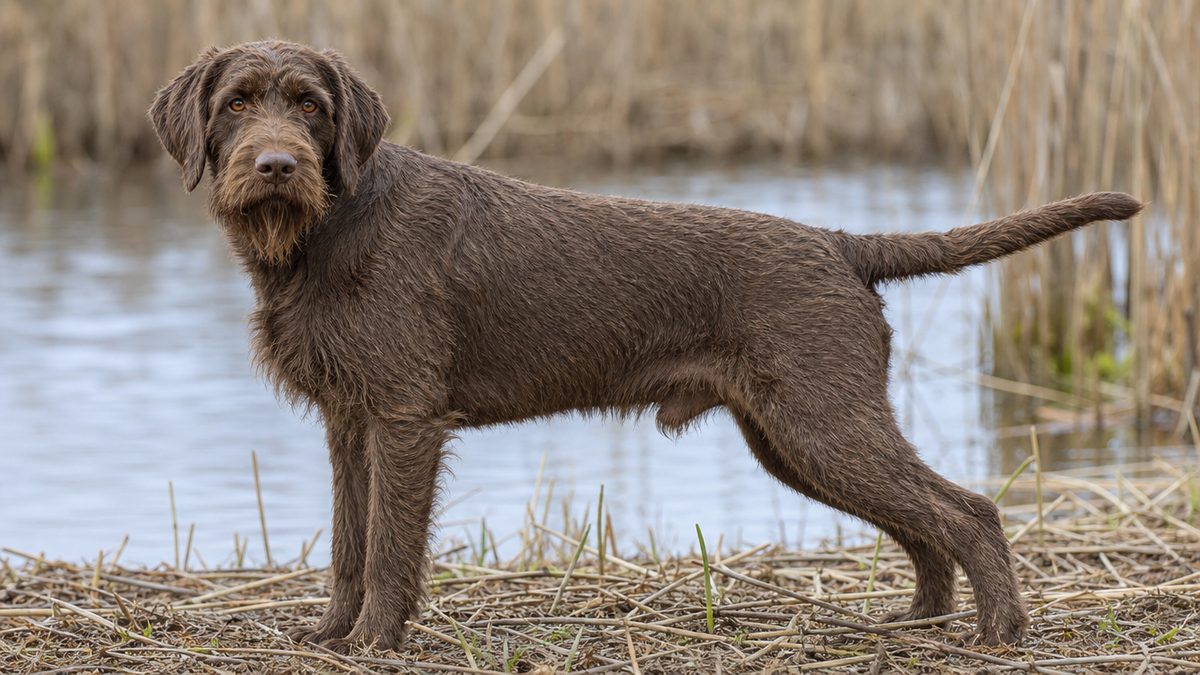
Quick answer
The pudelpointer is a German versatile gun dog created from 1881 by crossing a Poodle with an English Pointer, to a plan its founder published first. It stands 60 to 68 cm, carries a harsh 4 to 6 cm rough coat with a dense undercoat, and its German club restricts it to hunters. No Indian market exists, and no verified Indian price does either.
This page reports registry documents, breeding regulations, legal instruments and the single published case report that exists on this breed. It is not veterinary advice, and no Bonbeno page can diagnose or treat an animal. Hip and elbow disease, epilepsy, heat stress and tick-borne infection all need a qualified veterinarian who has examined your dog, and any screening or breeding decision belongs with your own veterinary surgeon.
Pudelpointer at a glance
What the Pudelpointer is
The pudelpointer is a rough-coated German versatile gun dog, FCI standard number 216, made from 1881 by crossing the Poodle with the English Pointer and then bred pure ever since. It is one of the very few breeds whose specification was published before its first litter existed.
The FCI files the breed as PUDELPOINTER, number 216, Group 7 Pointing Dogs, Section 1.1 Continental Pointing Dogs, with working trial. Country of origin Germany, official language German, English translation by Elke Peper. The standard's own brief historical summary is unusually candid about what the dog is: a rough coated pointing dog that originates genetically from two breeds, the Poodle and the Pointer, and that has come into being completely isolated from other pointing breeds.
The general appearance clause is the whole design in one sentence: ideally the conformation displays a Pointer of heavy type with a not too long rough coat of dead leaf or black colour protecting the whole body. A Pointer wearing the Poodle's coat, in other words. The standard then adds the sentence that should govern how anyone reads this breed's health section: the country of origin attaches special significance to the state of health of the Pudelpointer with special emphasis on the prevention of hip dysplasia and epilepsy.
| Body | Males | Females | Weight | Coat |
|---|---|---|---|---|
| FCI Standard 216 | 60 to 68 cm | 55 to 63 cm | Not stated | Hard rough coat, 4 to 6 cm at the withers, dense undercoat |
| United Kennel Club | 23.5 to 27 in (59.7 to 68.6 cm) | 21.5 to 25 in (54.6 to 63.5 cm) | Not stated | Close, flat lying, hard rough, medium length, dense undercoat |
| American Kennel Club | 22 to 26 in (55.9 to 66.0 cm) | 22 to 26 in (55.9 to 66.0 cm) | 45 to 70 lb (20.4 to 31.8 kg) | Wire-haired, smooth or short, or rough |
| English Wikipedia | 21 to 26 in (53 to 66 cm) | 21 to 26 in (53 to 66 cm) | 44 to 66 lb (20 to 30 kg) | Harsh, wiry and dense |
The AKC describes the coat as able to be wire-haired, smooth or short, or rough. The FCI standard for the same breed makes a short coat a DISQUALIFYING fault, and makes lack of a beard a disqualifying fault as well. The UKC agrees with the FCI and disqualifies a dog with no beard. Wikipedia links the FCI standard in its own infobox while giving a height range whose floor of 53 cm is 2 cm below the standard's bitch minimum. Read the FCI text, not the summaries of it.
Colour, and a shade with no English name
The FCI permits three whole colours: brown, dead leaf and black, with small white markings allowed and any other colour or marking disqualifying. Dead leaf is a translation of the German *dürrlaubfarben*, and it is the shade the German club names as the breeding ideal alongside dark brown. The AKC's registration codes carry only Black at 007 and Liver at 123, with White Markings at 014. So the colour the breed's home country treats as its ideal has no separate code in the American register at all, which is a small thing that tells you how differently the two systems treat this dog.
The beard is not decoration
The head shows a beard and a wood-shaving forelock, and the coat should be harsh and dense enough to give the best possible protection against weather and injuries. Both the FCI and the UKC make lack of a beard a disqualification. That matters in India for a reason nobody writing about this dog in a temperate country needs to think about: a permanently damp beard on a dog in 80 percent humidity at 28 C is a skin problem waiting to happen, and the grooming section below deals with it.
The dog that results is genuinely versatile rather than rhetorically so. The FCI's utilization line reads: versatile working gundog with all the aptitudes required for the breed, for all kinds of work in the fields, in the woods and in the water. It is a description of a job, and everything difficult about owning one outside a hunting country follows from it.
The 1881 written plan, from the German sources
The Pudelpointer was specified in writing before it existed, and the documents survive in the German club's own archive. That makes it one of the clearest recorded cases of a dog breed designed to a brief rather than named after the fact.
In 1881 Sigismund Freiherr von Zedlitz und Neukirch, writing under the pen name Hegewald, published a call for a new gundog. The German breed club quotes his words verbatim from its own archive: *"wir müssen dahin trachten, aus Pointer- und Pudelblut vorzügliche konstant sich gleichmäßig brillant vererbende Gebrauchshunde zu schaffen... man wird einen hochläufigen, eleganten, rauhaarigen Pointer schweren Schlages erhalten, aus dem der Pudel in äußerer Figur herausgezüchtet ist, so das nur das rauhe Gewandt von ihm übrig bleibt, innen aber die kluge, verständige Seele des Pudels waltet."*
In plain English: we must strive to create, from Pointer and Poodle blood, excellent working dogs that breed on consistently and brilliantly; what will be obtained is a high-legged, elegant, rough-coated Pointer of heavy type, out of which the Poodle has been bred away in outward form, so that only its rough coat remains, while inside the clever, sensible soul of the Poodle prevails. That is a specification. The dog was built to match it afterwards.
The founding mating, with the detail the English chain drops
The first deliberately bred litter fell at the house of Stiftsförster Walter in Wolfsdorf near Goldberg in Silesia, from the black Poodle bitch Molly, covered by the Pointer Tell. The German club records Tell as coming from the kennel of the Prince of Wales and being owned by *des späteren Kaisers Friedrichs III*, the later Kaiser Friedrich III. English-language pages, Wikipedia included, drop that one word and write that Tell belonged to Kaiser Frederick III. Frederick III acceded on 9 March 1888 and died on 15 June 1888, reigning for 99 days, seven years after the mating. The German source hedges correctly and the English version hardens the hedge into an anachronism.
From that litter came Cora von Wolfsdorf, whelped 1882, dead-leaf coloured, 65 cm at the withers, and her litter brother Castro. Cora was the breed's model for decades, and Hegewald wrote her an obituary in 1894 praising the combination of Poodle biddability, retrieving drive and obedience with the Pointer's known good nose, tireless stamina and temperament. Nine foundation lines were bred between 1885 and 1895, and in 1892 the first Pudelpointers were entered in the Deutsches Gebrauchshunde Stammbuch under numbers 6 and 7, after passing a working test.
The club, the statute and the studbook foreword
The Verein der Pudelpointerzüchter was founded in Darmstadt on 17 July 1897 after a call by Carl Rehfus, who wrote as Oberländer. Hegewald was made honorary president and Oberländer second chairman. Its founding statute, paragraph 2, states the purpose in terms no modern breed club would write: rational breeding, directed by fixed breed characteristics, of the pointing dogs produced according to Hegewald's idea by crossing full-blood Poodle and full-blood Pointer, with the tendency that hunting qualities for versatile use shall determine the type.
Ten years later Oberländer opened volume 1 of the Pudelpointer studbook with the test the breed set itself: the Pudelpointer *only has a right to exist* if it does not merely equal the German pointing dog but surpasses it in the most important working disciplines, and he named those as trainability, versatility, early maturity and above all resourcefulness in the retrieve, reliability on the track and the aptitude to bay at a dead animal. He noted that he had judged around 100 Pudelpointers at working tests and trained and handled a large number himself.
Most breed origin stories are reconstructions, assembled decades later from what a population already looked like. This one runs in the opposite direction: the written aim in 1881, the first litter, the studbook entries in 1892, the club and its statute in 1897, the studbook foreword in 1907. A page that quotes only the founding mating is quoting the least interesting part of the record.
Two loose threads worth naming
The German club's own site contains a 1987 founding date for the Verein in one reprinted magazine feature, against 17 July 1897 in its own history article, which also names the founding board and records Edgar Heyne taking the chair on 11 September 1899 and holding it for 50 years. Verein Pudelpointer e.V. The 1897 date is the one supported by the surrounding detail; the 1987 is almost certainly a transposed typo, and it is worth flagging rather than silently choosing.
The club also records that the breed came close to disappearing. Without Heyne's work, it writes, there would probably be no Pudelpointers today, because during the National Socialist period interested parties would have merged them into a general German wirehaired breed. And the breeding programme has never fully closed: since 1990 the club has run a renewed, supervised crossing experiment with Pointer and Poodle to widen the base, now at the F3 generation. A breed created to a plan is still being managed to one.
How each body files this breed, and the state it is not in
Four registries hold the Pudelpointer and they disagree about almost everything except the name. The FCI granted it definitive status in 1959, the UKC in 2006, and the AKC still has it in the Foundation Stock Service.
The FCI's record gives definitive acceptance on 13 November 1959 and publication of the currently valid standard on 9 November 2004. That is worth pausing on next to the Pointer, which is FCI number 1 but was accepted definitively only on 5 March 1963. A higher breed number with an earlier acceptance date is a reminder that FCI numbers are filing positions, not chronology.
| Body | Status | Date | What it means in practice |
|---|---|---|---|
| FCI | Definitive, standard 216 | 13 November 1959 | Full recognition, with working trial. Reaches India through the Kennel Club of India as the FCI member |
| Verein Pudelpointer, via the VDH | Breed club and studbook holder | Club founded 17 July 1897 | Sets the breeding rules that actually govern the German population |
| United Kennel Club | Recognised, Gun Dog group | 2006 | Full standard, conformation eligible |
| American Kennel Club | Foundation Stock Service | July 2016 | Recorded, not registered. Sporting Group designation, eligible for Pointing Breed Hunt Tests since 11 July 2016 |
| NAVHDA | Recognised, code PP | One of 35 breeds | Testing rather than registration, and the gate most North American breeders use |
The fourth state, checked and found not to apply
There is a recognition state between recognised and unrecognised: a registry that will enter a dog in its books while stating that no breed standard exists for it. The UKC operates exactly that, and reading all nine of its groups in one fetch shows it as the ninth, the UKC Bloodlines Listing Service group, holding ten breeds: the Alapaha Blue Blood Bulldog, American Exhibition Bully, Armenian Gampr, Duitsch Herder, Hollandse Herder, Mechelse Herder, Phu Quoc Ridgeback, Russian Salon Dog, Russian Tsvetnaya Bolonka and Yakutian Laika.
The Pudelpointer is not among them. It sits in the Gun Dog group with a full standard, recognised in 2006, and so does the English Pointer. That is a negative result from a check that was actually run rather than an assumption, and it is worth recording because the same index is where a rarer breed would have shown up.
Proving the date format from each document
The FCI writes the same date two ways across its own files, and the only safe method is to prove the format from whichever document you are holding. The web record proves itself: it prints 11/13/1959, and 13 cannot be a month, so the first field is the month and the record is M/D/YYYY. Acceptance is therefore 13 November 1959, and the standard publication date printed as 11/9/2004 is 9 November 2004.
The English standard prints 06.12.2004 and 09.11.2004; the German original prints 06. 12. 2004 and 9. 11. 2004. No field in either document exceeds twelve, so the usual in-document test fails outright. The resolution comes from the pair: the record's 11/9/2004 and the PDF's 09.11.2004 are the same date with the fields reversed, which proves the PDF is D.M.YYYY given that the record has already proved itself M/D/YYYY. For comparison, FCI Standard 1 does prove its own format, printing 28.10.2009, and FCI Standard 98 prints 23.10.2002. This breed is simply unlucky in its dates.
There is no disagreement between the register and the standard here once each is read correctly, which is worth saying because the FCI has been caught contradicting itself elsewhere on exactly this point. Both ends were checked, and both agree.
One further corroboration is available from a neighbouring FCI document. Standard 98, the Deutsch Drahthaar, credits its systematic breeding to the ideas of Hegewald, names him as Sigismund Freiherr von Zedlitz and Neukirch, states the principle as by working ability to type, and lists the rough-coated types the Drahthaar was developed from, with the Pudelpointer first among them. So the FCI's own register corroborates the German club's claim that this breed contributed materially to a larger one.
Pudelpointer price in india: there is not one
No verifiable Pudelpointer price in india exists, because no Pudelpointer market exists here. The only rupee figures the search returns for this breed are a hat, an embroidery file and a book, and the one Indian site that prints a puppy price prints it from a shared template.
Start with what the search actually returns. On an Indian commercial query for this breed the shopping results are an Etsy embroidered hunting cap at Rs 2,011 reduced from Rs 2,682, a Pudelpointer embroidery design at Rs 469, an Amazon.in care book at Rs 449 for the digital edition and Rs 1,511 in paperback, and a Desertcart listing at about Rs 1,200. Every one of those is merchandise. A scraper reading that page, and a reader skimming it, would take away a rupee figure attached to the breed name. None of it is a dog.
The one Indian puppy figure, and what it is made of
Happy Pet Care prints a Pudelpointer buying price of Rs 70,000 to 1,20,000 and monthly costs of Rs 3,550 to 5,400. The monthly figure is a template constant, and the proof is straightforward: pulling three other breeds from the same site in the same session returns the identical row and identical component lines for the Pointer and the Whippet, food Rs 2,250 to 3,000, health Rs 600 to 1,200 and grooming Rs 700 to 1,200, while the Labrador Retriever control prints a different row entirely at Rs 4,900 to 7,650.
A 12 kg sighthound, a 30 kg short-coated bird dog and a 30 kg bearded wirehaired gundog do not share one grooming line. The site is assigning each breed a tier from a small preset table, and the arithmetic confirms it: 2,250 plus 700 plus 600 is exactly 3,550, and 3,000 plus 1,200 plus 1,200 is exactly 5,400. Quote the number if you wish, but quote it as a shared template value.
| Figure | Source | What it actually is |
|---|---|---|
| Rs 2,011 | Etsy | An embroidered hunting cap |
| Rs 469 / Rs 248 on sale | Etsy | A downloadable embroidery design file |
| Rs 449 / Rs 1,511 | Amazon.in | A care and training book, digital and paperback |
| Rs 70,000 to 1,20,000 | Happy Pet Care | A published buying band on a site whose monthly cost row is shared with unrelated breeds |
| Rs 3,550 to 5,400 a month | Happy Pet Care | A preset row identical to the Pointer's and the Whippet's, component line by component line |
| Rs 1,65,000 to 2,10,000 | Google AI Mode | A conversion of a US dollar band, produced immediately after the same answer said no Indian price exists |
| Rs 3,00,000 to 5,00,000+ | Google AI Mode | An unsourced total landed cost |
Asked what a Pudelpointer costs in India, Google's AI Mode states that the breed is extremely rare in India, that there are no established commercial breeders and that there is no standardised Indian market price. It then prints 2,000 to 2,500 US dollars as approximately Rs 1,65,000 to 2,10,000. Divide those out: 1,65,000 over 2,000 is exactly 82.50, and 2,10,000 over 2,500 is exactly 84.00. Two different exchange rates inside one bracket. Neither figure is an Indian observation, and the sequence, no Indian price exists followed by a confident rupee band, is the tell.
Running the division tests honestly
The Happy Pet Care buying band does not divide cleanly at 84.38 (70,000 gives 829.58) and does not divide at 74 (945.95). It divides at a flat 80 to give 875 and 1,500. But both figures end in at least three zeros, and 1,000 divided by 80 is 12.5, so a match at 80 is arithmetic rather than evidence. The honest verdict is that no Indian figure for this breed survives the strong test, and that the flat-80 reading is plausible without being provable.
The North American prices are real and worth naming as the comparator, precisely so that nobody converts them. Breeders operating under the North American Pudelpointer Society and the Alliance sell in the region of 2,000 to 2,500 US dollars, with one aggregator quoting 800 to 1,800 and another 1,200 to 1,500. That spread is what a genuinely small, test-gated market looks like. Multiplying any of it by an exchange rate would produce a confident rupee number describing nothing at all, and this page does not do that.
Monthly cost, built from figures that are real
Budget roughly Rs 6,500 to 12,000 a month for a 25 to 32 kg Pudelpointer in an Indian metro, and build the number from published Indian prices rather than from the one template row that exists for this breed. Grooming is the line that goes up compared with a short-coated gundog.
The only published Indian monthly cost for this breed is the shared preset row already dismantled in the price section: Rs 3,550 to 5,400, identical to the Pointer's and the Whippet's on the same site. What follows instead is assembled from Indian prices with sources attached.
| Item | Published figure | Monthly equivalent |
|---|---|---|
| Anti-rabies vaccine, single | Rs 699 | About Rs 58 |
| 9-in-1 DHPPiL | Rs 899 | About Rs 75 |
| Kennel cough | Rs 1,349 | About Rs 112 |
| NexGard Spectra 15-30 kg, 3 tablets | Rs 3,308 (MRP Rs 3,375) | Rs 1,103 a month |
| Grooming, bath and styling, Delhi | From Rs 1,869 | Rs 900 to 1,900 a month if used monthly |
| Delhi MCD pet dog registration | Rs 500 new, Rs 500 renewal | About Rs 42 |
| Chennai GCC pet licence | Rs 50 | Negligible |
Two lines dominate, and they are different from the short-coated case. Parasite control at about Rs 1,103 a month is the same for any 15 to 30 kg dog, and for a breed whose whole purpose puts it in water and long grass it is not optional. Grooming is where this breed costs more than its Pointer half: a harsh coat with a dense undercoat and a beard needs real attention in Indian humidity, and a Delhi salon's full bath and styling package starts at Rs 1,869. Many owners will do it at home, which is the right answer, but budget for the equipment and the time either way.
The costs an Indian Pudelpointer owner would face that nobody prices
- Import. There is no lawful commercial route, so any dog here arrived as an accompanied pet. Air freight, an IATA crate, blood titres and quarantine paperwork run into six figures in rupees and are not a purchase price.
- Veterinary unfamiliarity. An Indian vet will have seen hundreds of Labradors and no Pudelpointers. That is not a criticism; it means longer diagnostics and more referral, and it is a real cost.
- Cooling. A dense undercoat in Delhi in June at a 35.88 C mean means air conditioning is a welfare requirement rather than a luxury, and that is an electricity bill nobody includes in a monthly estimate.
- Boarding. A large working-coated dog is priced at the top of every Indian boarding tariff, and many facilities will decline an unfamiliar breed outright.
Greater Chennai Corporation charges Rs 50 for a pet licence, issued 9,115 in 2024, and runs six municipal pet clinics that provide treatment and anti-rabies vaccination free of cost. Delhi's MCD charges Rs 500 to register a pet dog and Rs 500 to renew, with a Rs 100 a month late fee. Both are trivial next to any part of the rest of this budget.
Heat tolerance: the coat is the problem
The Pudelpointer is one of the harder gundogs to keep in Indian heat, and the reason is written into its standard. A harsh 4 to 6 cm top coat over a dense undercoat is insulation designed for a Silesian winter, and it does not stop working when the weather changes.
Start with the homeland, queried by explicit coordinates with the grid-cell elevation echoed. Zlotoryja, the modern name of Goldberg where the founding litter was whelped, returns a NASA POWER cell at 360.48 m against a real elevation near 220 m, an annual mean of 8.01 C, annual relative humidity of 82.01 percent, a hottest month of July at 18.55 C and a coolest month of January at minus 2.75 C. Darmstadt, where the breed club was founded, returns a 171.61 m cell and a July mean of 20.91 C.
NASA POWER returns a grid cell, not a point, and the Silesian cell overshoots the real town by about 140 m. That is a modest error in foothill country and it makes the cell slightly cooler than the town, so the gap to Indian conditions below is if anything understated. It is printed rather than hidden because the same query over hill terrain can be out by more than a kilometre.
| Place | Cell elevation | Annual mean | Hottest month | Coolest month | Peak wet bulb |
|---|---|---|---|---|---|
| Zlotoryja, Silesia | 360.48 m | 8.01 C | 18.55 C (July) | minus 2.75 C (January) | 15.16 C (July) |
| Darmstadt, Germany | 171.61 m | 10.25 C | 20.91 C (July) | 0.29 C (January) | 16.02 C (July) |
| Delhi | 206.37 m | 25.57 C | 35.88 C (June) | 13.61 C (January) | 26.50 C (July) |
| Kolkata | 7.35 m | 25.80 C | 31.53 C (May) | 17.31 C (January) | 27.09 C (June) |
| Chennai | 48.95 m | 27.94 C | 31.51 C (May) | 24.09 C (January) | 26.11 C (May) |
| Mumbai | 97.15 m | 26.77 C | 31.19 C (May) | 23.19 C (January) | 25.77 C (June) |
| Pune | 635.99 m | 23.86 C | 28.93 C (April) | 19.62 C (December) | 22.97 C (June) |
| Bengaluru | 841.72 m | 23.74 C | 28.37 C (April) | 20.22 C (December) | 21.86 C (May) |
Delhi's hottest month runs 17.33 C above the homeland's, and Chennai's coolest month, at 24.09 C, is warmer than the Silesian summer peak. There is no Indian city and no Indian season in which this dog's own climate is reproduced. Bengaluru and Pune come closest, at April means of 28.37 C and 28.93 C and peak wet bulbs of 21.86 C and 22.97 C, and even there the gap is about ten degrees.
Humidity is not the distinguishing problem. Silesia already runs 82.01 percent annual relative humidity, above Chennai's 72.39 and far above Delhi's 45.51. What is new to the breed is heat, and heat combined with damp: the wet-bulb column, computed from the monthly mean temperature with the monthly mean humidity, goes from 15.16 C in Silesia to 27.09 C in Kolkata in June. That is the number to act on.
Exertion, not ambient heat, is what actually injures dogs
In a study of 905,543 UK dogs under primary veterinary care, 1,259 heat-related illness events were recorded in 1,222 dogs, and of the 879 events with a recorded trigger 652, or 74.2 percent, were exertional, against 113 environmental and 46 from confinement in a vehicle. The companion paper on the same cohort found that a dog at or above the mean bodyweight for its breed and sex carried an odds ratio of 1.42, with a confidence interval of 1.12 to 1.80. Both findings were made in Britain, at British temperatures.
Apply that to a breed whose standard describes far-reaching strides, good reach and drive, and work in fields, woods and water. The dog most likely to overheat is the dog doing its job, and this breed has no other setting.
- Work before sunrise and after dark, for most of the Indian year, and treat any afternoon above about 28 C as off limits for a coated dog.
- Never shave the coat. A dense double coat that is clipped loses its insulating and reflective function and exposes skin that has never seen sun. It also does not always grow back correctly.
- Use water deliberately. This is a breed whose own club calls its water passion proverbial. Swimming is the single best Indian exercise option for it, where the water is clean.
- Air conditioning is welfare, not luxury, in a Delhi or Chennai summer for a dog carrying this coat.
- Watch the beard and the undercoat after every wet session, because a dog that stays damp at 28 C is a skin case waiting to happen.
Indian law reaches this directly, and unusually for a coated breed the wording fits. Second Schedule Part IV paragraph 21(1) of the 2017 Rules bars keeping in outdoor facilities, without written veterinary approval, dogs not accustomed to local temperatures and breeds that cannot tolerate them, such as long-haired breeds in high temperature locations. A Pudelpointer is not long-haired in the Afghan Hound sense, but a 4 to 6 cm top coat over a dense undercoat is precisely the kind of coat the clause is aimed at.
Temperament, and the club's own placement rule
The Pudelpointer's temperament is written into its standard as a requirement rather than described as a tendency: calm, self-controlled, even, with a distinct hunting instinct and no game or gun shyness. The breed's German club then adds a rule that decides the whole question for an Indian buyer.
The FCI standard requires the behaviour it wants, and disqualifies what it does not: aggressive or overly shy dogs are excluded, and so is any kind of weak temperament, especially gun or game shyness, nervousness, aggressiveness or a fear biter. Very few standards spell out a temperament disqualification at that length. It is a breed that was assembled around a working head, and the standard protects it accordingly.
The German club's description adds what the standard cannot. It calls the proverbial intelligence of the Pudelpointer the Poodle inheritance, and says that this makes the dog the ideal dog specifically for first-time handlers, easy to handle and willing to learn. Coming from a working gundog club about its own breed, that is a strong claim, and it is consistent with the Poodle half of the design brief that Hegewald wrote in 1881.
The Verein Pudelpointer states plainly that every Pudelpointer belongs exclusively in a hunter's hands. That is a placement policy, not a temperament observation, and it means a serious German breeder will not knowingly place a puppy in a non-hunting home. Combined with the Indian import position, it is the practical reason there is no Indian Pudelpointer population and no honest route to acquiring one here.
What the dog is actually like to live with
- Calm indoors, once worked. The standard's calm and self-controlled clause describes a dog with an off switch, which is not universal among versatile gundogs.
- Strongly handler-focused. The club uses the word Führerbezogenheit, orientation to the handler, and it is what makes the breed trainable for a novice.
- High prey drive, dosed rather than absent. The club describes the breed's sharpness as measured rather than reckless, which in Indian terms means a dog that will chase but can be called off if the recall was built properly.
- Water obsessive. The club quotes its own founders: a Pudelpointer with only a moderate inclination for the wet element does not deserve the breed name.
- Vocal on a track. Great breeding emphasis was placed from the start on Spurlaut and Sichtlaut, giving tongue on a track and on sight. That is a virtue in a German forest and a complaint from an Indian neighbour.
Who should not have one is easy to state and covers almost every Indian household. Anyone without daily access to secure open ground and water; anyone who cannot air-condition the dog through a metro summer; anyone who wants a companion rather than a working partner; and anyone who is not, in the German club's own framing, a hunter. That is not snobbery on this page's part. It is the breed club's stated policy, printed on its own site.
For an Indian reader wanting the temperament without the obstacles, the honest redirect is the German Shorthaired Pointer, which is genuinely available here, does a similar job, and carries a short coat that suits the climate far better. The comparison section sets the two side by side.
Training, and the tests the breed is actually judged by
To train a Pudelpointer, work with the two halves the breed was designed from: build the retrieve and the water work the Poodle contributed, and build distance control for the Pointer's search. The German and North American clubs both gate breeding on working tests rather than on shows, which tells you what training success looks like for this breed.
The German club's calendar is the training programme. The year opens with Bringtreueprüfungen, retrieving-reliability tests, in March. The VJP, the natural-ability youth search, follows at the end of April and assesses the yearling's aptitude on a hare track, its search and pointing, its nose and its contact with the handler, deliberately without judging obedience. Between May and September come the handler courses, water-work days and puppy days. The HZP, the autumn breeding test, starts in mid-September, and the club's own national HZP is named for Edgar Heyne. The VGP, the full utility test, follows in October and adds forest work and obedience in sight of live game.
The order of work, adapted for an Indian owner
- Weeks 8 to 16, socialisation only. Traffic, lifts, tiled floors, monsoon rain, cattle, other dogs. No formal obedience, and no water in the first year on the German club's own advice about a young dog's health.
- Months 4 to 6, retrieve and contact. Start with a gloved hand on the word for retrieve, then a light dummy. The club's own 1958 training article describes exactly this progression, and it works because the retrieve is the Poodle half of the dog.
- Months 6 to 9, the halt. The German material is emphatic that halt is the most important thing in the whole of training, because a dog that stops on command can be worked at any distance. Build it on a lead first, then a long line, then free.
- Months 9 to 12, distance search. Let the dog quarter, and use the halt to set the width rather than calling the dog in.
- Year two, water and cold work. Swimming, retrieves from water, and the settling of a rock-solid recall around live game before any off-lead work in open Indian ground.
Two cautions come from the club's own century-old advice and both still hold. First, train the weakness, not the strength: the club distinguishes the careful dog that works cautiously into scent and freezes, from the grabber that rushes everything, and warns against repeatedly setting each dog the task it already enjoys. Second, patience beats severity: the material is explicit that treats as reward matter more than punishment, that the handler must not break the dog's spirit, and that self-control on the handler's part is the foundation of the whole thing.
Very little, which is the point of it. The recorded complaint in the club's own test reports is the opposite problem: a very high-spirited dog needing a firm handler, with better performance promised under a more experienced one. This is a breed that will do more than a novice asks of it, which is why the club can recommend it to first-time handlers and still gate breeding on a utility test.
For an Indian owner who will never hunt
If a Pudelpointer somehow reaches an Indian home, the training problem is finding substitutes for four jobs the dog expects: searching, pointing, retrieving and water work. Scent games and formal nose work cover the first two honestly. Retrieving is easy to build and easy to keep. Water work needs clean water, which in most Indian cities means a pool rather than a lake, and that is a real constraint. None of this replaces hunting, and the breed club's position is that it should not have to.
Daily exercise, and why water is the Indian answer
A Pudelpointer needs 90 minutes or more of real work a day, and in India the coat means most of it has to happen in the dark or in water. This is the breed on this site with the widest gap between what it needs and what an Indian city can supply.
The requirement is not an estimate; it is the breed's stated purpose. The FCI's utilization line calls it a versatile working gundog with all the aptitudes required for work in fields, woods and water, and the gait clause describes harmonious, springy movement with good reach and drive and far-reaching strides. The AKC's own care note is blunter about the alternative: the breed needs regular exercise, and it absolutely loves the water.
| Session | Duration | When | What it delivers |
|---|---|---|---|
| Morning free run | 40 to 50 minutes | Before sunrise, all year | Cardiovascular work and search behaviour |
| Evening run or swim | 30 to 40 minutes | After dark, or in a pool | The water work the breed is built for |
| Scent work indoors | 10 to 15 minutes, twice | Any time | The mental load a walk does not provide |
| Retrieve practice | 10 minutes | With either outdoor session | The Poodle half of the design brief |
| Rest day | One a week | Any | Recovery, which coated dogs need more of in heat |
Timing is not a preference here. Delhi's hottest month averages 35.88 C in June and Chennai's coolest month still averages 24.09 C, against a Silesian July mean of 18.55 C. A dog carrying a 4 to 6 cm harsh top coat over a dense undercoat cannot dump heat quickly, and the largest study of canine heat-related illness found that 74.2 percent of the 879 events with a recorded trigger were exertional. The two facts together mean that in India the exercise itself is the hazard, and moving it to the cool hours is the entire mitigation.
The German club quotes its founders on this: the water passion of the Pudelpointer is proverbial, and the Poodle inheritance has survived from the foundation lines to the present day. Water removes the heat problem, uses the breed's strongest instinct and loads the joints less than road work. Where clean water is available, swimming should be the backbone of an Indian Pudelpointer's week rather than an occasional treat.
Joints, and the reason to be careful
This is a breed with a 10.1 percent hip dysplasia rate across 1,040 published OFA evaluations, which is higher than its own Pointer ancestor's 6.9 percent across 2,369. That is a population figure rather than a prediction about any individual dog, and it is exactly why the German club refuses breeding approval to anything worse than an A or B hip grade and why its radiographs cannot be taken before 12 months. For an owner it argues for the ordinary large-breed discipline: no forced road running before about 12 months, controlled stairs, a lean puppy, and free play on soft ground for as long as the dog chooses.
The one published clinical case in this breed is also a musculoskeletal one, and it is worth knowing about even though a single case proves nothing about prevalence. A 17-month-old Pudelpointer presented with recurring left foreleg lameness and pre-scapular swelling; imaging found a bony structure beside the fifth cervical vertebra impinging a spinal nerve, and histology confirmed heterotopic ossification in paravertebral muscle. The authors report it as the first such case in a dog. It is not a breed problem; it is the sum total of this breed's clinical literature.
Grooming a harsh double coat in Indian humidity
Grooming a Pudelpointer takes 15 to 20 minutes twice a week, and the beard is the part that needs daily attention in India. The one instruction to ignore completely is any suggestion to clip the coat for summer.
The coat is defined tightly. The FCI standard specifies close, flat-lying, hard rough hair of medium length with a dense undercoat, a top coat 4 to 6 cm long at the withers, a beard and a wood-shaving forelock on the head, and dense close hair on the belly, all chosen so the coat gives the best possible protection against weather and injuries. Coat too long, too thin or lacking undercoat are named faults, a short coat is a disqualification and lack of a beard is a disqualification. The UKC agrees on every point.
So this is a functional coat with a specified length, and it is the single biggest reason the breed is difficult in India. The AKC's own note confirms the practical consequence: the dog sheds seasonally, and beyond regular weekly grooming an occasional bath keeps him clean. That regime is written for a temperate climate.
The Indian routine
- Brush twice a week with a slicker and a stripping comb, working down to the undercoat rather than over the top of it. A dense undercoat that is never reached becomes a mat that traps heat.
- Dry the beard after every drink, every swim and every wet walk. A permanently damp beard at 28 C and 80 percent humidity is the commonest skin complaint this coat type produces in a monsoon climate.
- Dry the ear canals after water work. The standard gives medium ears, set on high, flat lying and well covered with hair, which is a warm closed canal in Indian conditions.
- Check between the toes after every session in wet grass, because a coated foot holds moisture and grass seed.
- Bath rarely, dry completely. The overseas advice to towel a dog and let it air dry does not survive an Indian July, and this is a coat that stays wet for hours.
A dense double coat regulates temperature in both directions and reflects radiant heat. Clipping it removes that function, exposes skin that has never been sunburnt, and on harsh-coated breeds frequently grows back soft and thin rather than as it was. Every Indian grooming salon offering a summer shave is offering to make a coated dog hotter. The standard also makes a short coat a disqualifying fault, so a clipped Pudelpointer is outside its own breed standard as well.
The Poodle in the coat does not make it hypoallergenic
The breed's Poodle ancestry attracts the allergy claim, and English pages reinforce it by saying the dogs shed very little. The evidence is settled and it points the other way. Can f 1 was measured in the hair and homes of 196 dogs of so-called hypoallergenic breeds against 160 control dogs, and the hypoallergenic group came back higher, at 2.26 against 0.77 micrograms per gram on hair and 27.04 against 12.98 on coat, with no difference in airborne allergen. The authors conclude there is no evidence for classifying any dog breed as hypoallergenic.
For this breed the claim is weaker still, because the FCI standard requires a dense undercoat and the AKC states the dog sheds seasonally. An Indian buyer paying a premium on the strength of Poodle ancestry and an allergy claim is paying for something the breed's own standard contradicts.
Health: two named conditions, one case report, and no lifespan study
The Pudelpointer's own FCI standard names the two conditions its country of origin worries about, hip dysplasia and epilepsy, and the published data reaches only the first of them. Beyond that the entire clinical literature on this breed is a single case report.
The standard is unusually explicit. Its historical summary ends with the sentence that the country of origin attaches special significance to the state of health of the Pudelpointer with special emphasis on the prevention of hip dysplasia (HD) and epilepsy in the breed. The AKC repeats it almost verbatim on its own page. Very few breed standards name a specific disease at all, and this one names two.
| Database | Evaluations | Normal | Abnormal | Detail |
|---|---|---|---|---|
| Hips | 1,040 | 88.9% | 10.1% dysplastic | Excellent 17.0, Good 61.1, Fair 10.9; Mild 6.3, Moderate 3.4, Severe 0.5 |
| Elbows | 231 | 94.8% | 5.2% | Grade 1 5.2, Grade 2 0.0, Grade 3 0.0 |
| Eyes | No published row | OFA needs 50 evaluations before publishing a non-hip table | ||
| Thyroid | No published row | |||
| Cardiac | No published row |
A breed whose standard says its country of origin places special emphasis on preventing hip dysplasia records 10.1 percent dysplastic across 1,040 OFA evaluations. Its Pointer ancestor records 6.9 percent across 2,369. The Pudelpointer's rate is roughly half as high again as the breed it was built from. That is a North American population figure and the German population is governed by different and stricter breeding rules, but it is the only published screening data that exists for this dog and it does not flatter it.
The arithmetic checks out on both rows, which is the first thing to test on any OFA table. Excellent 17.0 plus Good 61.1 plus Fair 10.9 is 89.0 against a printed 88.9, and mild 6.3 plus moderate 3.4 plus severe 0.5 is 10.2 against a printed 10.1, both differences being rounding. The elbow row is cleaner still: 5.2 percent abnormal, every case Grade 1, with no Grade 2 or Grade 3 recorded across 231 dogs.
The absence of eye, thyroid and cardiac rows is a fact about sample size, not about the breed. OFA requires 100 hip evaluations, or 50 in its other databases, before publishing a breed at all, so the right form of words is that there is no published OFA row for those, not that the breed is absent from the database.
Epilepsy, which is named and unmeasured
The standard names epilepsy and no published dataset quantifies it in this breed. That is worth stating plainly rather than filling with a figure borrowed from another breed. Ranking pages routinely list epilepsy and hip dysplasia as the Pudelpointer's two health issues, and they are simply repeating the standard's own sentence back. The honest position is that the German club's breeding programme was built around both, that its breeding approval requires HD and ED gradings but names no epilepsy test, and that no prevalence figure for epilepsy in this breed could be verified for this page.
The literature, all of it
A PubMed search for this breed returns exactly one record, and the same result comes back from an all-fields search. Searching for the breed name split as two words returns zero with a quotedphrasesnotfound warning. Controls run in the same session returned 1,109 records for the quoted Labrador Retriever and 126 for the classic Labrador hip dysplasia query, so the instrument was working.
That one record is a 2024 case report in Frontiers in Veterinary Science: a 17-month-old Pudelpointer with recurring left thoracic limb lameness and pre-scapular swelling, in which imaging and surgery found an osseous structure near the fifth cervical vertebra impinging a cervical spinal nerve, and histology confirmed heterotopic ossification in paravertebral muscle. Mild bone re-formation was seen at two years and the dog was asymptomatic. The authors present it as the first reported case of heterotopic ossification with spinal nerve entrapment in a dog.
Lifespan, and why there is not one
The AKC gives 14 years. That is a breed-club estimate and no study supports or contradicts it, because no study includes the breed. McMillan 2024 lists the Pudelpointer in its supplementary Table S5 with an inclusion flag of N, meaning the breed was in the naming table but did not enter the survival analysis. Teng 2022's breed life tables cover 18 breeds and the Pudelpointer is not one of them. The nearest defensible figure is the group table: Kennel Club Gundog life expectancy at age 0 is 11.67 years, 95 percent confidence interval 11.59 to 11.76, from 5,354 gundogs in a 30,563-dog deceased cohort.
Use the group figure and say which it is. An unqualified 14 years for this breed is a claim nobody has tested.
How Germany, North America and India each police the breed
Three bodies control who may breed a Pudelpointer, and they set completely different bars. The German club runs the strictest regime, the North American society runs a working-test one, and Indian law contains a clause that describes how the breed was invented.
The Verein Pudelpointer grants breeding approval only against a written list. A dog must be at least 18 months old at first use, hold a form and coat rating of at least good, have a scissor or level bite with no tooth faults beyond P1, and carry an HD finding of A1-A2 or B1-B2 with one parent preferably graded A, an ED finding of ED-0 and an OCD finding of OCD-0, with radiographs taken no earlier than 12 months. Proof of voice on the track or on sight is required, delivered at a VJP, HZP or VGP or in a separate test on the JGHV's own forms. Bitches may normally be bred only to the completion of their eighth year, and temperament defects exclude a dog from breeding entirely.
The North American Pudelpointer Society gates on work. Males must prize in a NAVHDA Utility test; females must score 105 or higher and prize in a NAVHDA Natural Ability test, with Gun Dog or Utility prizes as alternatives, and foreign equivalents accepted. Dogs must be certified free of hip dysplasia, free of temperament disorders such as gun shyness or aggression, and must comply with the standard's disqualifications. There is no elbow and no eye requirement in that list, and no OCD requirement.
| Requirement | Verein Pudelpointer (Germany) | NAPS (North America) | Indian law |
|---|---|---|---|
| Hips | A1-A2 or B1-B2, one parent preferably A | Certified free of hip dysplasia | Testing required under Second Schedule Part III para 8(10), no grade specified |
| Elbows | ED-0 required | Not listed | Not named |
| OCD | OCD-0 required | Not listed | Not named |
| Minimum radiograph age | 12 months | Not stated | Not stated |
| Working test | VJP, HZP with blood tracking, or VGP; plus proof of voice | NAVHDA Utility (males) or Natural Ability 105+ (females) | None |
| Conformation | Form and coat at least good | Comply with standard disqualifications | None |
| Minimum breeding age | 18 months | Not stated | Not stated |
| Maximum age for a bitch | To the completion of the eighth year | Not stated | Shall not be mated after eight years, para 6(4) |
| Tail docking | Club issues the certificate a German vet needs | UKC will not penalise a full tail | Forbidden outright, para 6(8) |
Second Schedule Part II paragraph 6(9) of the Prevention of Cruelty to Animals (Dog Breeding and Marketing) Rules, 2017 reads, in full: "Breeding to create new breeds of dogs or unusual looks shall be strictly prohibited." That single sentence describes exactly what Hegewald set out to do in 1881 and what the Verein was founded in 1897 to continue. Nothing about this is retrospective, and the Pudelpointer is a recognised breed rather than a project. But the method that produced it could not lawfully be repeated in India today, and the club's own renewed Pointer and Poodle crossing programme, running since 1990, would sit squarely inside the prohibition.
The docking collision, which is real and current
The German club states that because Pudelpointers are worked exclusively for hunting, the tail may be docked, and its Zuchtordnung sets out the administrative step: the breed warden issues the breeder a confirmation, with a certified mating certificate attached, to present to the vet, that the conditions of the animal protection act for docking tails are met. Verein Pudelpointer e.V., Zuchtordnung The FCI standard carries the same clause and adds that where docking is prohibited by law the tail may be left natural. The UKC says the tail is generally docked, then adds that no dog in any UKC event shall be penalised for a full tail.
Indian law admits none of that. Paragraph 6(8) forbids tail docking, ear cropping, de-barking, de-clawing, branding, dyeing, injecting substances to enhance visual appeal, and any other kind of mutilation, and states that any change of appearance by artificial means is strictly forbidden. There is no hunting exemption and no veterinary-certificate route.
The contrast with this breed's own ancestor is the neatest illustration on the page. At the United Kennel Club, a docked tail is a disqualification for the English Pointer and the Pudelpointer's tail is generally docked. One registry, two breeds, opposite rules, and Indian law overriding both in the same direction.
Where Indian law and the German club agree
Two clauses line up exactly, which is worth recording because the collisions get all the attention. Indian paragraph 6(4) states that female dogs shall not be mated after the age of eight years, and the German club's Zuchtordnung independently limits bitches to the completion of their eighth year. Verein Pudelpointer e.V., Zuchtordnung And Indian paragraph 8(10) requires breeding dogs to have been tested for genetic defects including hip dysplasia, entropion and ectropion, all three of which the FCI standard for this breed either emphasises or disqualifies outright. On those points the Indian rule and the breed's own regime want the same thing.
Feeding a working gundog that is not working
Feed a Pudelpointer twice a day, match the ration to the work actually done rather than to the breed's reputation, and keep it lean. In India the two things that change are water intake and the risk of feeding a hunting dog like a hunting dog when it has nowhere to hunt.
There is no breed-specific dietary requirement. The AKC's guidance is the standard one: a high-quality food appropriate to the dog's age, watched calorie intake because some dogs run to overweight, treats counted as food, and clean fresh water available at all times. What this breed does have is a working metabolism written into its design brief and, outside a hunting country, nothing to spend it on.
| Age | Meals a day | Focus | Watch for |
|---|---|---|---|
| 8 to 16 weeks | 4 then 3 | Large-breed growth food, controlled calcium | Loose stools after any change; do not free-feed |
| 4 to 12 months | 3 then 2 | Steady growth, not fast growth | Weight, because hip radiographs come at 12 months |
| 12 to 18 months | 2 | Transition to adult food as growth plates close | The drop in energy need once growth stops |
| Adult | 2 | Match to the week's real work, not the breed's reputation | Weight gain in a dog that is exercised less than it was designed for |
| Senior, 8 years on | 2 | Joint support, protein maintained | Muscle loss over the hindquarters |
Water, and the coat
A coated dog in Delhi in June, at a 35.88 C monthly mean, loses water far faster than the same dog in Silesia at a July mean of 18.55 C. Working dogs in drive frequently will not stop to drink, and the heat-illness literature identifies exertion as the trigger in 652 of 879 events with a recorded cause. Carry water on every session, offer it at fixed intervals rather than waiting for the dog to ask, and stop when the dog stops taking it.
Body condition, and the beard
You should be able to feel the ribs through the coat without pressing hard, which takes practice on a harsh double coat because the coat itself disguises condition. Check with your hands weekly rather than judging by eye. A Pudelpointer at or above the mean bodyweight for its breed and sex carries an odds ratio of 1.42 for heat-related illness, and in an Indian summer that is not a cosmetic consideration.
One small practical point that only applies to bearded breeds: a wet beard after every meal is a fact of life, and in Indian humidity it needs wiping rather than leaving. Raised bowls are not required, and a dog that eats from the floor keeps less food in the beard than one eating out of a deep bowl at chest height.
Month by month through the first year
A Pudelpointer's first year is organised around three things: socialisation before 16 weeks, joint protection until the growth plates close, and, on the German club's own advice, keeping a young dog out of the water in its first year for health reasons.
| Age | What matters most | Health and legal |
|---|---|---|
| Before 8 weeks | The puppy stays with the litter. Indian law bars sale below eight weeks under Rule 8(1)(a), and Rule 8(1)(e) requires every pup sold to be microchipped | Ask to see the dam and the working papers of both parents |
| 8 to 10 weeks | Home, crate, name, house training. Carried outings for sound and sight before the vaccination course finishes | Core vaccination begins. Anti-rabies Rs 699 and 9-in-1 from Rs 899 at a national clinic chain |
| 10 to 16 weeks | The socialisation window: traffic, lifts, tiled floors, cattle, monsoon rain, other dogs | Finish the core course and start monthly parasite prevention |
| 4 to 6 months | Retrieve from a gloved hand, then a light dummy. Begin the halt on lead | Teething. Delhi MCD registration Rs 500, or a Chennai GCC licence Rs 50 |
| 6 to 9 months | The halt on a long line, then free. Coat starts to come through harsh | Adolescence; recall degrades and has to be rebuilt |
| 9 to 12 months | Distance search on a long line. Still no forced road work | First hip, elbow and OCD radiographs are taken from 12 months under the German club's rules |
| 12 to 18 months | Water work begins in earnest. Free galloping distance builds | Adult food. Screening radiographs if the dog may ever be bred |
The socialisation window in an Indian city
Between roughly four and sixteen weeks a puppy sets its default response to novelty, and India offers far more novelty per minute than the German forest this breed was designed for. Horns, construction, temple loudspeakers, free-ranging dogs, cattle, monsoon thunder, lift doors and tiled floors all need to be met before 16 weeks, at a distance the puppy can handle, with calm paid for rather than exposure forced.
The breed's own standard makes this more important than usual, because any kind of weak temperament, especially gun or game shyness, nervousness or fear biting, is a disqualifying fault. A Pudelpointer that has been under-socialised is not simply a nervous pet; it is a dog outside its own breed standard.
Water, joints and the club's own advice
- No water in the first year, on the German club's own published training advice, which withholds a young dog from water for health reasons and only opens water work in the second year.
- No forced road running, cycling alongside or repetitive fetch on hard ground before about 12 months, and build slowly to 18.
- Free play on soft ground at any age, for as long as the puppy chooses to keep going.
- Keep the puppy lean, because the breed already carries a 10.1 percent published hip dysplasia rate and a heavy puppy loads immature joints every step.
- Radiograph at 12 months if the dog may ever be bred, which is the minimum age the German club accepts.
Two legal points close the year for any Indian buyer. Indian law bars mating a bitch after eight years and prohibits in-breeding and incest breeding as the gazette defines them, which reaches uncle to niece, cousin to cousin and grandparent to grandchild within four generations. Those are questions to ask before a deposit, not after.
Tick-borne disease and the Indian working environment
A versatile gundog in India spends its life in exactly the habitat that carries the country's tick-borne disease burden, and the published Indian numbers are large enough that year-round prevention is the single cheapest thing an owner can do.
Three Indian studies give the shape of it, and all three sampled clinically suspected dogs or clinic caseloads rather than random populations, so the percentages describe the dogs a vet sees rather than the whole country. That caveat is mandatory and it does not make the figures small.
| Study | Place | Dogs tested | Finding |
|---|---|---|---|
| PMID 39338994 | Odisha | 178 | Ehrlichia canis in 56 of 178 (31.46%); 75% of infected dogs weighed over 20 kg; 79% had a tick history |
| PMID 41651622 | Kerala | 120 | Babesia in 80 of 120 (66.7%), peaking pre-monsoon in March to May |
| PMID 42276665 | West Bengal | 584 | Babesia gibsoni 76.54%, Anaplasma 55.75%, and 72.9% of the 584 screened carrying two or more pathogens |
The Odisha figures speak directly to this breed: 75 percent of the infected dogs weighed more than 20 kg and 79 percent had a tick history. A Pudelpointer is a 20 to 32 kg dog with a dense coat that a tick can shelter in, doing the one job that puts it in long grass every day. Kerala's series found Babesia in two thirds of 120 dogs with a pre-monsoon peak. In West Bengal nearly three quarters of 584 dogs screened carried more than one pathogen at once.
A short-coated dog can be checked visually in a minute. A harsh double coat with a beard, a forelock and dense belly hair cannot. That is a real practical difference, and it argues for a systemic monthly preventive rather than relying on inspection. NexGard Spectra at Rs 3,308 for three tablets in the 15 to 30 kg band covers ticks and fleas alongside roundworm and hookworm at about Rs 1,103 a month.
Water work and the second Indian risk
This breed's greatest strength in India, its water passion, carries its own hazard. Indian urban and peri-urban water bodies are not the clean German forest ponds the breed's tests are run on, and leptospirosis, blue-green algae and simple bacterial contamination are all real. A pool is the safer option; a lake needs local knowledge. This is one of the few places where the honest Indian advice diverges sharply from the breed's own literature.
What none of this changes
It does not make the breed unsuitable in a way that a different management plan could fix. The climate section already established that no Indian city reproduces this dog's own conditions and that the coat is the limiting factor. Tick-borne disease is the same problem every large outdoor dog in India faces, and it is solvable with a monthly tablet. The coat is not solvable, and it should not be solved by clipping.
How North America keeps the breed, and what it changed
North America holds the largest Pudelpointer population outside Germany, and it keeps the breed through testing rather than through shows. That is why almost every published health number for this athletic versatile hunting dog is American, and why those numbers do not describe the German population.
The North American Versatile Hunting Dog Association recognises 35 versatile breeds and codes the Pudelpointer PP, alongside the Pointer at PT. North American Versatile Hunting Dog… NAVHDA is a testing body rather than a registry in the kennel-club sense, and its Natural Ability and Utility tests are the gate almost every North American breeder actually uses. The North American Pudelpointer Society builds its breeding requirements directly on them: males must prize in a Utility test and females must score 105 or higher and prize in a Natural Ability test.
The page's own prose says 35 breeds and its picture gallery shows 35, but the abbreviation table beneath the prose lists only 30, omitting the Braque St Germain, three Epagneul breeds and the Stabyhoun. The Pudelpointer and the Pointer are in both, so nothing here is at risk, but a breed checked only against that table could be reported absent when it is not.
The Orthopedic Foundation for Animals is where the numbers come from, and reading its registry codes out of the raw markup rather than guessing them matters. The Pudelpointer is PP, the Pointer is EPT, and the Labrador Retriever control is LR. None of those is derivable from the breed name, and OFA's own group field for the Pudelpointer records AKC Sporting, CKC Sporting and UKC Gun Dog, which is a fair summary of where the breed sits in North America.
What the American population is, and is not
- It is the measured population. Every OFA hip and elbow figure on this page comes from it, and there is no comparable published German dataset.
- It is not the German population. The Verein Pudelpointer requires ED-0 and OCD-0 alongside an A or B hip grade before breeding approval, and the North American society requires only certification free of hip dysplasia. Different gates produce different populations.
- It is not standard-governed in the same way. The AKC records the breed in the Foundation Stock Service, with a Sporting Group designation and eligibility for Pointing Breed Hunt Tests since 11 July 2016, but it publishes no breed standard of its own for it.
- It is where the wire coat description drifted. The AKC's page describes the coat as able to be wire-haired, smooth or short, or rough, which is a description of what the North American population looks like rather than of what the FCI standard permits.
Checking the standard against its own authentic language
The English FCI standard for this breed is a translation, and the document says so on its face: TRANSLATION: Elke Peper. Official language (DE). Where an FCI standard has an authentic language, figures and reasons can drift between versions, so the German original was pulled and compared for this page. The size, colour and coat clauses agree exactly: Rüden 60 bis 68 cm and Hündinnen 55 bis 63 cm, the same three colours with small white markings permitted, and the same coat length at the withers. That is a negative result and it is worth recording rather than leaving unsaid, because the same check on other FCI standards has found real discrepancies.
The German text also confirms the publication dates that this page's recognition section reads from the record: 06. 12. 2004 for the German edition and 9. 11. 2004 for the official valid standard. Neither field exceeds twelve in either document, which is exactly why the format had to be proved from the FCI's own web record instead.
The practical consequence for an Indian reader
Everything on this page's puppy timeline and health sections rests on North American data because nothing else is published, and it should be read with that label attached. A hardy working population tested through NAVHDA in Wisconsin is not the same population as one governed by the German club's ED-0 and OCD-0 requirements, and neither is a population living in Chennai. The common mistakes section deals with what happens when those distinctions are dropped, and the short version is that a figure without its population attached is not a figure.
Pudelpointer against the breeds it is cross-shopped with
For an Indian reader the Pudelpointer is really being compared against three things: the two breeds it was made from, and the versatile German gundog that is actually available here. On availability alone the comparison is short.
| Pudelpointer | English Pointer | German Shorthaired Pointer | Poodle | |
|---|---|---|---|---|
| FCI number | 216, Section 1.1 Continental | 1, Section 2.1 British and Irish | 119, Section 1.1 Continental | 172, Group 9 |
| Coat | Harsh rough, 4 to 6 cm, dense undercoat, beard | Fine, short, hard, single, no undercoat | Short, dense, harsh | Curly or corded, single, no undercoat |
| Grooming in Indian humidity | Moderate to high; the beard is the work | Lowest | Low | High; clipping required |
| Heat suitability in India | Poor; the undercoat is the limit | Moderate; short coat helps, exertion does not | Moderate to good among gundogs | Poor to moderate, and coat-dependent |
| Published OFA hip dysplasia | 10.1% of 1,040 | 6.9% of 2,369 | Not compared on this page | Not compared on this page |
| Docked tail at the UKC | Generally docked | Disqualification | Permitted | Traditionally docked |
| Availability in India | None found | Effectively none; adverts are usually the German breed | Real but limited | Widely available |
| Realistic Indian verdict | Not obtainable, and the coat is wrong for the climate | Not obtainable in practice | The workable choice for a pointing breed here | Available, but a very different dog |
Against the Pointer half of itself
The two breeds share half an ancestry and almost nothing else in practical terms. The Pointer carries a single short coat with no undercoat and the lowest grooming load of any gundog; the Pudelpointer carries a 4 to 6 cm harsh coat over a dense undercoat and a beard. On published screening the Pointer does better on hips, 6.9 percent of 2,369 against 10.1 percent of 1,040. And at the same registry a docked tail disqualifies one and is normal on the other.
What the Pudelpointer gained from the cross is the part Hegewald wanted: retrieving, water work and biddability, together with a coat that protects in cover. What it gave up is the Pointer's suitability for hot weather, which nobody in 1881 Silesia had any reason to weigh.
Against the German Shorthaired Pointer, which is the real Indian choice
If the attraction is a versatile pointing and retrieving gundog, the German Shorthaired Pointer answers it and is genuinely obtainable in India through KCI-registered litters. It sits in the same FCI section as the Pudelpointer, does the same job, and carries a short coat that suits Indian heat far better. The Pudelpointer's advantages over it, a rough coat for thorny cover and a slightly calmer written temperament, are advantages in Germany and disadvantages or irrelevances here.
There is one more comparison worth making because the FCI itself makes it. Standard 98, the Deutsch Drahthaar, lists the rough-coated types it was built from and names the Pudelpointer first, alongside the Griffon Korthals and the German Broken Coated Pointing Dog. So the breed that is hardest to obtain contributed to one of the most successful working gundogs in the world. That is the Pudelpointer's real legacy, and it is a better reason to read about the breed than to try to own one in Chennai.
What goes wrong, and it starts before the dog arrives
Almost every mistake around this breed in India is a sourcing mistake rather than a husbandry one, because the honest answer to the sourcing question is that there is no dog to source. The five below are the ones the search results actively encourage.
- Believing a rupee price exists. The only figures the Indian search returns for this breed are an Etsy hat at Rs 2,011, an embroidery file at Rs 469, a book at Rs 449 and a template buying band on a site whose monthly cost row is shared with the Whippet. Merchandise is not a market, and a template is not an observation.
- Trusting an answer engine that converts. Google's AI Mode says there is no standardised Indian market price for this breed and then prints Rs 1,65,000 to 2,10,000, using 82.50 to the dollar at one end of the range and 84.00 at the other. A rupee figure produced by dividing a US price is not an Indian price whatever confidence it is stated with.
- Reading the AKC coat description as the standard. The AKC says the coat can be wire-haired, smooth or short, or rough. The FCI standard makes a short coat a disqualification and lack of a beard a disqualification, and the UKC agrees. United Kennel Club A short-coated dog offered as a Pudelpointer is outside its own breed standard.
- Repeating the Kaiser Frederick III line. Every English page says Tell belonged to Kaiser Frederick III. The German club says he belonged to the *later* Kaiser Friedrich III, who acceded in March 1888 and died 99 days later, seven years after the 1881 mating. Frederick III, German Emperor The hedge is in the German and gets lost in translation.
- Buying the Poodle ancestry as an allergy claim. The evidence is settled and runs the other way, and this breed's own standard requires a dense undercoat while the AKC says it sheds seasonally.
Three smaller ones
- Clipping the coat for an Indian summer, which removes the layer that reflects radiant heat, exposes unsunned skin, and on a harsh coat frequently grows back wrong.
- Leaving the beard wet. The single most predictable Indian problem with this coat type, and the easiest to prevent.
- Quoting 14 years as a researched lifespan. It is the AKC's estimate, and the only large study that names the breed lists it with an inclusion flag of N, meaning it never entered the analysis.
Searching the Deutsch Drahthaar standard for the string Pudelpointer returns nothing, which reads like an absence. The extraction actually renders the word as "Pud elpointer", split across a line break, and the breed is plainly there in the list of rough-coated types the Drahthaar was developed from. Any absence read off a single exact-phrase search of an extracted PDF is worth re-testing with a whitespace-tolerant pattern before it is published.
Adoption, import law and the honest conclusion
There is no route to acquiring a Pudelpointer in India that this page could verify, and two separate barriers explain why. Indian law bars importing dogs to breed or sell, and the breed's own German club places puppies only with hunters.
India makes dogs a Restricted import. DGFT Trade Notice No. 22/2022-23 of 19 December 2022 places ITC(HS) 01061900, Mammals: Other, under Restricted, and its Policy Condition (7) permits the import of dogs only for a pet dog with a valid pet book and records in the importer's own name, for R&D organisations with a CPCSEA recommendation, or for internal security by the Defence and Police Force. Policy Condition (8) adds that the import of commercial dogs for breeding or any other commercial activity is not permitted, and paragraph 6 states that any applications for trading or breeding purposes, or made on behalf of another person or entity, shall be duly rejected. Entry is limited to the airports and seaports of Delhi, Mumbai, Chennai, Hyderabad, Bengaluru and Kolkata and, since October 2024, Kochi airport. A separate personal-pet route runs under the Livestock Importation Act and is a different instrument, not an amendment to this one. The full route is set out in how to import a dog to India.
That closes the commercial route entirely. The second barrier closes the private one. The Verein Pudelpointer states that every Pudelpointer belongs exclusively in a hunter's hands, and its own breeding rules require working-test qualifications from both parents. Verein Pudelpointer e.V., Zuchtordnung The North American society applies the same logic through NAVHDA test results. Neither body is set up to place a dog with an urban Indian pet owner, and neither would regard doing so as a success.
What to do instead
- Adopt. Indian shelters rehome large active dogs continuously, and an Indian dog is already adapted to the heat this breed cannot manage. Greater Chennai Corporation's six municipal pet clinics provide treatment and anti-rabies vaccination free of cost and issued 9,115 pet licences in 2024.
- If you want the job rather than the name, look at the German Shorthaired Pointer, which is available here through KCI-registered litters and does the same work in a coat that suits the climate.
- If you want the coat and the water work, consider that the Poodle itself is widely available in India and is the source of both.
- Register whatever dog you do get. Delhi's MCD charges Rs 500 to register and Rs 500 to renew. It is cheap, required, and proof of ownership.
- Budget the recurring cost honestly. Roughly Rs 6,500 to 12,000 a month for a large dog in an Indian metro, once real vaccination, parasite and food prices are used rather than a shared template row.
The FCI number on the pedigree, which is 216 and not 119 or 1. A coat with a beard and a dense undercoat, because a short coat and a missing beard are both disqualifying faults. Hip and elbow gradings on both parents, since the breed's published OFA dysplasia rate is 10.1 percent. A natural undocked tail, because docking is forbidden outright in India. And the import paperwork, because a lawfully present Pudelpointer in India arrived as somebody's accompanied pet and there is a document that says so.
The conclusion this page is willing to state
The Pudelpointer is one of the most interesting dogs in the FCI register and one of the least suitable for India. It is interesting because the documentary record is unusually complete: a specification published in 1881, a founding litter, studbook entries at numbers 6 and 7 in 1892, a club and a statute in 1897, a studbook foreword in 1907 that sets the breed a test it had to pass to deserve existing. Almost no other breed can show that chain.
It is unsuitable because everything that made it work in Silesia works against it in Chennai. A 4 to 6 cm harsh coat over a dense undercoat, in a country whose coolest coastal month is warmer than the breed's hottest homeland month. A club that places dogs only with hunters, in a country whose import rules bar commercial supply. And a founding method that Indian law now describes, in paragraph 6(9), as strictly prohibited. Reading about this breed is worthwhile. Importing one is not.
Common questions
What is the average lifespan of a Pudelpointer?
No study gives one. The AKC's breed page states 14 years, which is a breed-club estimate rather than a measurement, and McMillan 2024 lists the Pudelpointer in its breed table with an inclusion flag of N, meaning the breed was named but never entered the survival analysis. The nearest defensible figure is the UK Gundog group life expectancy of 11.67 years.
What is the personality of a Pudelpointer?
Calm, self-controlled and even-tempered with a distinct hunting instinct and no game or gun shyness, in the words of the FCI standard itself. The German breed club adds that the dog is easy to handle and willing to learn, and recommends it for first-time handlers, which is an unusual thing for a working gundog club to say about its own breed.
What is the #1 best family dog?
There is no single answer, and Google returned this same filler question on both the Pudelpointer and the English Pointer queries in one session, which says more about how thin these searches are than about any breed. For an Indian family the practical answer is an adopted Indian dog, which is already heat-adapted and costs nothing to acquire.
Which Pointer is the calmest?
Of the pointing breeds, the Pudelpointer has the strongest claim on paper, because calm and self-controlled are written into its FCI standard as required temperament rather than offered as a description. In practice the line matters more than the breed, and a Pudelpointer from working stock is a high-drive dog whatever the standard says.
How much is a pudelpointer?
In North America, roughly 2,000 to 2,500 US dollars from breeders operating under the North American Pudelpointer Society or the Alliance, with some sources quoting 800 to 1,800. In India there is no price at all, because the breed is not here and cannot lawfully be imported to sell. Any rupee figure you are shown is either a template value or a converted foreign one.
Which dog is 20 crore price in India?
None, and this question is part of a generic Indian dog-price cluster Google injects across breed queries rather than anything about this breed. It returned on the Pudelpointer commercial search alongside two other budget questions, and it is worth naming as noise rather than answering as if it were a real market fact.
Which dog is under 4000?
An adopted Indian dog, and nothing that is genuinely a Pudelpointer. Greater Chennai Corporation charges Rs 50 for a pet licence and runs six municipal clinics that give treatment and anti-rabies vaccination free, so the acquisition cost of a healthy Indian dog can be close to zero.
How much does a Pointer dog cost in India?
The site that ranks for it publishes INR 40,000 to 1,40,000, and publishes exactly the same figures for India, Bangalore and Delhi while describing the dog as a Poodle blend in two of its three price tiers. That is a template rather than a market, and the same caution applies to any Pudelpointer figure you find here.
Was the Pudelpointer really created to a written plan?
Yes, and the documents survive. Hegewald published his specification in 1881 before the first litter existed, the club's 1897 founding statute defines its purpose as rational breeding to fixed breed characteristics of the pointing dogs produced from Hegewald's idea, and Oberländer's 1907 studbook foreword states the breed only has a right to exist if it surpasses the German pointing dog in the most important working disciplines.
Can you buy a Pudelpointer in India?
Not through any route this page could verify. India makes dogs a Restricted import and states that applications for trading or breeding purposes shall be duly rejected, so no lawful supply chain can form. The only rupee figures attached to the breed on Indian search results are a hat, an embroidery file and a book.
Is the Pudelpointer hypoallergenic because of the Poodle in it?
No. The evidence against any breed being hypoallergenic is settled: Can f 1 was measured across 196 dogs of so-called hypoallergenic breeds against 160 controls, and the hypoallergenic group came back higher on hair and on coat with no difference in airborne allergen. The Pudelpointer also carries a dense undercoat and sheds seasonally, so the Poodle ancestry does not help here at all.
Why does Indian law matter to this breed specifically?
Because two Indian rules describe how this breed is made. Second Schedule Part II paragraph 6(9) prohibits breeding to create new breeds of dogs, which is exactly what Hegewald did in 1881, and paragraph 6(8) forbids tail docking outright while the German club runs an administrative process to authorise it. Neither rule is retrospective, but both mean the breed's founding method could not lawfully be repeated in India today.
How does the Pudelpointer's hip screening compare with other gundogs?
Slightly worse than its Pointer ancestor on the published North American figures, which is the opposite of what the standard's own emphasis would predict. OFA records 10.1 percent dysplastic across 1,040 Pudelpointer evaluations against 6.9 percent across 2,369 Pointer evaluations, while the FCI standard for the breed says the country of origin attaches special significance to preventing hip dysplasia.
What coat colours are correct for a Pudelpointer?
Whole-coloured brown, dead leaf or black under the FCI standard, with small white markings permitted and any other colour disqualifying. The AKC's registration codes list only Black and Liver with white markings, so the dead leaf shade the German club treats as the breeding ideal has no separate AKC code at all.
Compare with similar breeds
Pudelpointer sits in 2 Bonbeno groups. Each one compares it directly against the breeds it is genuinely an alternative to, on the same figures.