
Breed profile
Weimaraner (Braque de Weimar): The India Guide
A German gundog whose own FCI standard permits a docked tail where the law allows it, sold in India by a page whose eight Available Weimaraner listings contain two Maltipoos, two Poodles and no Weimaraner.
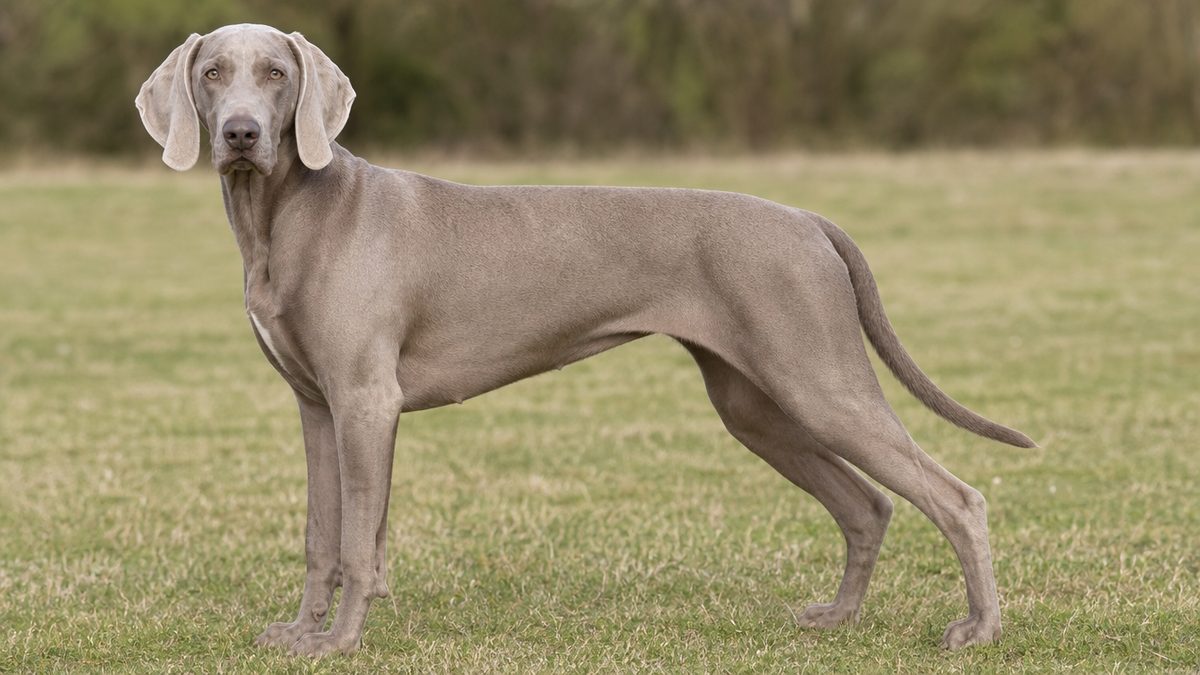
Quick answer
Weimaraner price in India runs from about Rs 30,000 to over Rs 1 lakh across the published Indian sources, and the top-ranking seller page offers eight animals under the heading Available Weimaraner of which none is a Weimaraner. The breed is a large, grey, working German gundog with almost no undercoat, needing two hours a day, and it is not an easy dog for an Indian metro flat.
This guide summarises breed-standard documents, kennel-club register data, peer-reviewed veterinary research, Indian breeding law and satellite climate data as general information for Indian pet owners. It is not a diagnosis and it is not a treatment plan. Vaccination timing, screening schedules, growth management and heat-emergency care must be decided for your individual dog by a qualified veterinarian, so consult your nearby vet before acting on anything here, and never delay or alter a vaccination schedule on the strength of a web page.
Weimaraner at a glance
What the Weimaraner actually is
The Weimaraner is a medium to large German pointing dog held by the Federation Cynologique Internationale as standard number 99, in Group 7, Section 1.1, Continental Pointing Dogs, Type Braque, with a working trial attached and with two coat varieties inside the one breed.
Every breed number quoted on this page was read out of the FCI's own Group 7 index rather than assembled from a name, because an fci.be URL resolves on its trailing number and will serve another breed's document at HTTP 200 without erroring.
The FCI accepted the breed on a definitive basis on 27 November 1954, names German as the official authentic language, and publishes the current English text under 26 May 2015 against a valid standard date of 19 March 2015. Federation Cynologique Internationale The German edition was extracted and compared field by field, and its heights and weights are identical to the English, so there is no measurement drift between the two editions of this standard. That negative result is worth recording, because on several other FCI standards the two editions do disagree.
Three registries, three different dogs on paper
| Registry | Males | Females | Weight given |
|---|---|---|---|
| FCI Standard 99 | 59 to 70 cm | 57 to 65 cm | About 30 to 40 kg and 25 to 35 kg |
| The Kennel Club | 61 to 69 cm | 56 to 64 cm | None at all |
| American Kennel Club | 25 to 27 in, about 63.5 to 68.6 cm | 23 to 25 in, about 58.4 to 63.5 cm | 70 to 90 lb and 55 to 75 lb |
The male floor is where these three part company. A 59 cm male Weimaraner sits exactly on the FCI minimum, two centimetres below the Kennel Club's, and about four and a half centimetres below the American minimum. American Kennel Club A dog can therefore be correct in Europe and undersized in the United States without changing shape.
FCI 99 also does something the Vizsla standard does not. It gives a hard numeric limit in its disqualifying faults: size more than 2 cm outside the standard is a disqualification, so the range is not advisory. And unlike FCI 57, it does print weights, which is why an Indian page quoting a Weimaraner weight can legitimately point at a standard while a page quoting a Vizsla weight cannot.
Where the grey dog came from
The FCI's own history is unusually cautious. It says there are numerous theories about the origin and that only one thing is certain, namely that the Weimaraner, which at that time still contained a great deal of liam hound blood, was already kept at the Weimar court in the first third of the nineteenth century. Planned breeding and studbook registration begin from about 1890, and the long-haired variety is recorded as occurring, if only singly, since the turn of the twentieth century.
The temperament clause is the one to hold on to before reading anything else on this page. Versatile, easily trained, steady and passionate; persevering in systematic search, yet not too lively; remarkable ability to pick up scent; ready to seize game and other prey; and he is a good watchdog, without aggressiveness however. A watchdog instinct in a 38 kg dog is a fact about your neighbours as much as about your dog.
Every Indian page ranking for this breed quotes a price. This one opens the FCI standard in both languages, the Kennel Club standard, the AKC record, the OFA statistics tables, nine peer-reviewed papers on this breed specifically, and the Indian breeding gazette, and it checks what the top-ranking seller page is actually offering.
Two coats, one breed, and why that matters here
The FCI holds the short-haired and long-haired Weimaraner as two varieties of a single breed and permits crossing between them, which is precisely the treatment it refuses to the smooth and wirehaired Vizslas.
The FCI publishes a register whose whole purpose is to name the cases where two coats or two sizes are one breed. Its alphabetical list carries 99 WEIMARANER short and 99 WEIMARANER long, side by side, under one number. It also carries 182 SCHNAUZER with two colour varieties, 181 RIESENSCHNAUZER with three and 183 ZWERGSCHNAUZER with four, so the document does discriminate carefully. What it does not carry anywhere is FCI 57 or FCI 239, the two Vizslas.
| Case | FCI numbers | In the crossing register? | Verdict |
|---|---|---|---|
| Weimaraner short and long | One number, 99 | Yes, both listed | Two varieties of one breed |
| Vizsla smooth and wirehaired | Two numbers, 57 and 239 | Neither listed | Two separate breeds |
| Schnauzer black and pepper and salt | One number, 182 | Yes, both listed | Two colour varieties of one breed |
So the coat variety question has a documented answer for this breed and a different documented answer for its Hungarian neighbour, and the difference is not a matter of opinion. The standard backs the register. FCI 99's severe-fault list penalises a widely spread woolly coat in the shorthaired variety and eminently curly or sparse feathering in the longhaired variety, which is a single document grading two coats against each other. The Kennel Club does the same, writing one coat clause that reads short, smooth and sleek, then adding that in the long-haired variety the coat runs 2.5 to 5 cm on the body with feathering on the tail and back of the limbs.
What the two coats actually are
The short-haired coat is not as short as it sounds. FCI 99 describes a topcoat that is short but longer and thicker than with most comparable breeds, strong, very dense and smooth lying, without or with only very sparse undercoat. The long-haired coat is soft, smooth or slightly wavy, 3 to 5 cm on the flanks and longer on the underside of the neck, forechest and belly, with or without undercoat.
For an Indian buyer that difference is not cosmetic. A long-haired Weimaraner in Chennai is a materially harder proposition than a short-haired one, and the long coat is rare enough in India that most buyers will never be offered the choice. If you are offered one, price the grooming and the heat tolerance separately rather than assuming the breed profile transfers.
A long-haired Weimaraner is a recognised variety. A blue Weimaraner is not. The Kennel Club standard names blue and any other colour or combination of colours as unacceptable, and the molecular work on it is discussed in the health section below. Do not let a seller present the two as equivalent, because one is in the standard and the other is excluded by name.
Weimaraner price in India, and what the top result is actually selling
Weimaraner price in India runs from Rs 30,000 to over Rs 1 lakh across the pages that publish a figure, and the marketplace page that ranks highest for the term has no Weimaraners in stock at all.
| Source | Figure printed | What the page is |
|---|---|---|
| Happy Pet | Rs 30,000 to Rs 80,000 | Breed guide with a templated cost card, dated 16 May 2025 |
| Top Pet Products | Rs 50,000 to Rs 80,000, over Rs 1 lakh for show quality | Article dated 2023 in its own heading |
| Puppiezo | Rs 76,499 to Rs 1,20,000, none of them a Weimaraner | Marketplace page, examined below |
| Asia Pets | No rupee figure of any kind | Listing shell returning HTTP 200 with a breed title |
The Available Weimaraner heading with no Weimaraners under it
Puppiezo's Weimaraner page carries a heading that reads Available Weimaraner. Under it are eight animals, and this is the complete list as the page prints it.
| Name | Breed as the page states it | Price | Age |
|---|---|---|---|
| Fizey | Maltipoo | Rs 98,999 | 8 weeks |
| Kuzo | Poodle | Rs 92,599 | 8 weeks |
| Dugu | Poodle | Rs 92,599 | 8 weeks |
| Kazuka | Cane Corso | Rs 94,999 | 8 weeks |
| Doir | Goldendoodle | Rs 1,20,000 | 8 weeks |
| Samy | Maltipoo | Rs 98,999 | 8 weeks |
| Tugi | Rottweiler | Rs 76,499 | 8 weeks |
| Yoki | Doxiepoo | Rs 98,999 | 8 weeks |
Two other Indian sources behave differently and both are worth naming. Top Pet Products writes in its own prose that the price usually ranges from Rs 50,000 to Rs 80,000 depending on age and pedigree, and that show quality specimens may even exceed Rs 1 lakh, which is at least a stated claim about the breed. Asia Pets returns HTTP 200 for a Weimaraner puppy for sale page with a breed-specific title and H1 and contains zero rupee figures in its raw markup, so any search summary attributing a Weimaraner price to it has invented the number and attached a working link to it. A muscular working breed is genuinely expensive to keep well, and none of these figures tells you anything about that.
Not one of the eight is a Weimaraner. The same eight animals with the same names and the same prices have now been recorded on this site's breed pages for the Keeshond, the Komondor, the Basenji, the Rat Terrier, the Great Dane and the Shetland Sheepdog, which is what a carousel of site furniture looks like rather than a stock list. Rs 98,999 appears three times on this one page, attached to two Maltipoos and a Doxiepoo.
So the honest reading of the highest-converting Indian result for this breed is that it is not offering the breed. Anyone quoting a Weimaraner price from a Puppiezo figure is quoting the price of a Maltipoo.
Running the division tests
Every figure above was tested against 84.38, 80, 74, 75, 91 and 92.5 to check whether it is a foreign price wearing a rupee sign. None of the Weimaraner figures resolves to a plausible dollar or euro price. Rs 30,000 gives 355.53 at 84.38 and 405.41 at 74. Rs 80,000 gives 948.09 and 1,081.08. Rs 98,999 gives 1,173.25 and 1,337.82, which is not a number any seller prints in any currency.
The one thing that does divide cleanly is arithmetic noise rather than evidence. Rs 30,000 and Rs 80,000 divide exactly by 80 to give 375 and 1,000, because any figure ending in three zeros does. A match at 80 alone proves nothing, and these are rupee-native round numbers rather than a converted list.
The figures above are reported from published pages as editorial content. They are not offers, we do not sell animals, and we do not recommend breeders. Adoption is covered as a real route further down this page.
Monthly cost of ownership, and the row it shares with the Labrador
The monthly cost of ownership for a Weimaraner in India is not the Rs 4,900 the top-ranking page prints, because that entire row is byte-identical to the same site's Labrador Retriever row on every component line.
| Line | Weimaraner | Labrador Retriever |
|---|---|---|
| Monthly food | Rs 3,000 to Rs 4,500 | Rs 3,000 to Rs 4,500 |
| Monthly health | Rs 1,200 to Rs 1,950 | Rs 1,200 to Rs 1,950 |
| Monthly grooming | Rs 700 to Rs 1,200 | Rs 700 to Rs 1,200 |
| Monthly total printed | Rs 4,900 to Rs 7,650 | Rs 4,900 to Rs 7,650 |
| Buying price printed | Rs 30,000 to Rs 80,000 | Rs 10,000 to Rs 80,000 |
| Ideal weather printed | 15 to 24 C | 10 to 25 C |
Three cost lines match to the rupee and the total is their sum. Happy Pet, Labrador Retriever breed guide Three thousand plus twelve hundred plus seven hundred is four thousand nine hundred, and four thousand five hundred plus nineteen fifty plus twelve hundred is seven thousand six hundred and fifty. The total is a consequence of three preset lines rather than an observation of either dog.
What does vary between the two rows is the buying band and the ideal weather band, so those two fields are populated per breed on this site while the cost lines are not. Note the direction of the weather field though. The Weimaraner is given 15 to 24 C and the Labrador 10 to 25 C, and no Indian city on this page has an annual mean inside the Weimaraner's stated band.
What the same month costs from published Indian rate cards
| Item | Price | Source |
|---|---|---|
| Anti-rabies, single dose | Rs 699 | Vetic clinic list |
| 9-in-1 DHPPiL | Rs 899 | Vetic clinic list |
| Kennel cough | Rs 1,349 | Vetic clinic list |
| Complete bath and styling | from Rs 1,869 | Vetic Delhi |
| Plain bath | from Rs 934 | Vetic Delhi |
| NexGard Spectra 15 to 30 kg, per month | Rs 1,103 | Supertails listing |
| Delhi pet dog registration | Rs 500 | Municipal Corporation of Delhi |
| Chennai pet licence | Rs 50 | Greater Chennai Corporation |
One correction applies to a 35 kg Weimaraner that does not apply to a Vizsla. The NexGard Spectra figure above is for the 15 to 30 kg band, so a male Weimaraner at the top of the FCI's 30 to 40 kg range needs the next pack size up and the monthly parasite line rises accordingly. Federation Cynologique Internationale Price it against your dog's actual weight rather than against the breed.
The single most useful Indian cost fact is the spread rather than any figure. The same 9-in-1 vaccine is Rs 899 at a private clinic chain and Rs 600 inclusive of certificate at a Goa government veterinary hospital, and anti-rabies runs from Rs 100 there to Rs 699 at the clinic. In Chennai the Greater Chennai Corporation runs six pet clinics giving treatment and anti-rabies vaccination free of cost, against a Rs 50 licence fee. Delhi charges Rs 500 to register a pet dog, with a Rs 100 monthly late fee.
- Food. A 35 kg working-line dog eats roughly 400 to 500 g a day of a complete maintenance dry food, which is above the band the template row assumes.
- Parasite control. Rs 1,103 a month at the 15 to 30 kg pack size, more above it, and not optional in a tick-heavy Indian city.
- Grooming. The cheapest line for a short-coated dog, since a Rs 1,869 salon visit is what you avoid paying twelve times a year.
- Air conditioning. The line nobody prints, and the largest real cost of keeping this particular breed in most of India.
Clinic and retail prices move within weeks and one large-bag food price this site tracked went stale in days. Municipal fees are the durable half. Treat the table above as a dated reading rather than a current quote.
Suitability for the Indian climate, homeland numbers first
The Weimaraner comes from central Germany, where the annual mean is about 8.9 C and the hottest month averages 19.24 C, so an Indian summer is not a variation on its homeland climate but a different environment entirely.
Every figure below was pulled from NASA POWER by explicit latitude and longitude over the 2001 to 2020 climatology window, and every grid cell's reported elevation was checked against an SRTM90 ground elevation for the same point before the figure was used.
One homeland caveat has to be stated before the table. Weimar and Erfurt return a byte-identical NASA POWER cell at 290.96 m, so the two towns cannot be told apart with this instrument. Weimar's real ground is 220 m and Erfurt's is 196 m, so the shared cell sits about 71 m above the first and 95 m above the second. Those errors are small enough that the temperature is usable and large enough that the two places must not be presented as two independent readings.
| Point | Cell elevation minus real | Annual mean C | Annual mean RH percent | Hottest month | Peak wet bulb C |
|---|---|---|---|---|---|
| Weimar and Erfurt, one shared cell | plus 70.96 m and plus 94.96 m | 8.88 | 80.68 | July, 19.24 | 15.26 in July |
| Munich | plus 99.07 m | 8.43 | 83.22 | July, 18.32 | 15.54 in July |
| Delhi | minus 6.63 m | 25.57 | 45.51 | June, 35.88 | 26.50 in July |
| Chennai | plus 39.95 m | 27.94 | 72.39 | May, 31.51 | 26.11 in May |
| Kolkata | minus 6.65 m | 25.80 | 73.84 | May, 31.53 | 27.09 in June |
| Mumbai | plus 92.15 m | 26.77 | 67.28 | May, 31.19 | 25.77 in June |
| Bengaluru | minus 70.28 m | 23.74 | 67.84 | April, 28.37 | 21.86 in May |
| Pune | plus 75.99 m | 23.86 | 66.68 | April, 28.93 | 22.97 in June |
The gap is the largest of any breed in this cluster. Central Germany's July peak wet-bulb load is 15.26 C. Kolkata's June figure is 27.09 C, which is nearly twelve degrees more evaporative load than anything in this breed's history. Delhi's July peak of 26.50 C and Chennai's May peak of 26.11 C are barely better.
Humidity is not the surprise here
Central Germany is a humid place. Weimar's shared cell runs 80.68 percent annual relative humidity and Munich 83.22, against Chennai's 72.39 and Kolkata's 73.84. So a Weimaraner arriving in Chennai meets drier air than its homeland on an annual mean and roughly nineteen degrees more heat. The thing that hurts this dog in India is heat, or heat combined with humidity, and never damp air on its own.
That distinction changes the advice. Do not buy a dehumidifier for a Weimaraner. Buy shade, water, an air-conditioned room and a timetable, and read the wet-bulb column rather than the humidity column when deciding whether a given month is workable.
Where in India this breed is reasonable
Bengaluru at a 21.86 C peak wet bulb and Pune at 22.97 C are the two mainstream Indian cities where the gap narrows to about seven degrees, and they are the two where a Weimaraner is a defensible choice for a committed owner. Both peak in April rather than May and both are coolest in December, so a summer plan built for Chennai will be a month out of step. Delhi and Ahmedabad have a real winter to build fitness in and a June to avoid outright. Chennai, Kochi and Kolkata have neither.
NASA POWER's grid cells for Indian hill towns are wrong by hundreds to nearly two thousand metres in both directions, which would make a hill station look habitable for a heat-sensitive dog when it is not, or the reverse. This page therefore quotes no Shimla, Ooty, Manali or Darjeeling figure at all. If you are considering a hill posting for this breed, get local measured data rather than a satellite grid cell.
Managing heat, and the 41 degree line
To keep a Weimaraner safe in an Indian summer, move all work to the ends of the day, hold the dog at a lean bodyweight, and treat a rectal temperature of 41.0 C or above as an emergency in its own right.
Two findings from a UK cohort of 905,543 dogs transfer to India directly and both are unusually relevant to this breed. Heat-related illness carried an event fatality rate of 14.18 percent, and bodyweight at or above the breed and sex mean was an independent risk factor at an odds ratio of 1.42. Dogs weighing over 50 kg carried an odds ratio of 3.42, and while an FCI-standard Weimaraner tops out around 40 kg, an overweight one in an Indian city is closer to that band than its owner thinks.
The companion paper settles what triggers these events. Of 1,259 heat-related illness events from 1,222 dogs, 879 had a recorded trigger, and 652 of those 879, being 74.2 percent, were exertional. For a breed asked for two hours a day, the risk is the walk and not the parked car.
The number to write on the fridge
A 2026 revision of the VetCompass heat-related illness grading tool added critical temperature criteria of 41.0 C or above to both the Moderate and Severe grades, moved dyspnoea up from Mild to Moderate and moved episodic collapse down from Moderate to Mild. It was evaluated on 364 emergency cases from 2022, validated on 422 from 2023, and discriminated fatal outcomes at an area under the curve of 0.79 against the original tool's 0.72.
So laboured breathing in a Weimaraner after exercise is now graded a moderate event rather than a mild one. Neither that nor a rectal temperature at or above 41.0 C is a reason to wait and see. Get the dog cool and get it to a vet.
- Chennai, Kochi and Kolkata. Work before 6:30 am and after 8:00 pm from March to October, and use water where it is clean, because the standard describes a reliable worker in water.
- Delhi and Ahmedabad. Build fitness from November to February, and treat June as a month with no outdoor work in it at all.
- Bengaluru and Pune. The two workable cities. Plan around an April peak rather than a May one, and remember that Bengaluru load shedding between March and May can take out a boarding kennel's air conditioning.
- Mumbai and Hyderabad. Manageable with air conditioning and discipline, and Mumbai's wet-bulb peak of 25.77 C is below Chennai's despite the reputation.
One breed-specific reason to build exercise gradually
A frameshift variant in the TNR gene has been associated with an exercise-induced paroxysmal dystonia-ataxia syndrome in this breed. Four Weimaraners presented with episodes of abnormal gait after exercise, whole-genome sequencing against 921 control genomes found a private frameshift predicted to truncate more than 75 percent of the open reading frame, and genotypes across four affected and seventy unaffected dogs showed perfect association with the phenotype.
That is a rare condition and it is not a reason to under-exercise a healthy dog. It is a reason to take an episode of wobbliness after exertion in a young Weimaraner to a vet rather than putting it down to the heat, because in this breed there is a documented alternative explanation that heat alone does not cover.
One risk that gets over-claimed should also be corrected. Across 54,542 canine anaesthetics, overall mortality was 0.69 percent, and after adjustment for the dog's ASA physical status only the Chihuahua and the Spanish Water Dog retained an excess, with the German Shepherd Dog and the Bulldog specifically not retaining one. Between-breed differences in that study largely reflected case severity. Nobody should tell you a Weimaraner carries a special anaesthetic risk on breed grounds.
Temperament, and who should not buy this dog
The Weimaraner is a versatile, steady, passionate hunting dog that its own standard calls a good watchdog without aggressiveness, and in an Indian metro flat that combination produces noise complaints and destroyed doors rather than a guard dog.
The FCI's temperament clause is short and every phrase in it matters. Versatile, easily trained, steady and passionate. Persevering in systematic search, yet not too lively. Remarkable ability to pick up scent. Ready to seize game and other prey. A good watchdog, without aggressiveness however. A reliable pointing dog and worker in water, with a remarkable inclination to work after the shot. The Kennel Club puts it in five words: fearless, friendly, protective, obedient and alert.
Read protective and watchdog together and you have the difference between this breed and the Vizsla. A Vizsla wants to be with you. A Weimaraner wants to be with you and has opinions about who else is at the gate. In an Indian apartment block with shared corridors, delivery riders and building staff, that is a management problem from about ten months of age.
Who this breed suits
- Households with a person home most of the day, because separation anxiety in this breed is well documented and severe.
- Owners with a fenced outdoor space, which in India usually means an independent house rather than a flat.
- People who run, cycle or swim, since the exercise requirement is met most easily by folding the dog into an existing habit.
- Experienced owners of large working breeds, who already know what a 38 kg adolescent with a prey drive costs in time.
Who should buy something else
- Anyone in a one or two-bedroom flat who works nine hours, which describes most of the Indian buyers this breed attracts.
- Anyone with cats, rabbits or small pets, because ready to seize game and other prey is the standard's own phrase and not a rumour.
- Anyone buying a first dog, since size, drive, watchfulness and separation distress all mature at once around ten months.
- Anyone in Chennai, Kochi or Kolkata without air conditioning, where the climate section above stops being a planning problem and becomes a welfare one.
One thing this breed is not is nervous. The standard's disqualifying faults include aggressive or overly shy, so a Weimaraner that cowers or snaps is outside its own standard, and an Indian buyer meeting a fearful litter should treat that as information about the breeding rather than about the breed.
Training a strong, independent gundog
To train a Weimaraner, start structured socialisation before sixteen weeks, use reward-based methods, and expect a more independent and more stubborn dog than the Vizsla it is usually compared with.
The standard calls the breed easily trained and steady, and adds persevering in systematic search yet not too lively. In practice that means a dog that learns quickly, works methodically, and will make its own decisions once the nose engages. It is trainable rather than biddable, and the difference shows up on recall.
What works
- Mark and reward. Short sessions of five to ten minutes several times a day, with food, and a marker word or clicker.
- Socialise before sixteen weeks. Lifts, traffic, tiled floors, autorickshaws, monsoon rain, building staff, delivery riders and other dogs, all at the puppy's pace, and all of it doubly important in a protective breed living in a shared Indian building.
- Build the recall on a long line first. A pointing breed with an adult nose and no recall is an escaped dog on an Indian road, and this one is fast enough to be out of sight in seconds.
- Feed the brain. Scent games, retrieves and find-it work substitute for fieldwork and can be done indoors in the middle of a hot afternoon.
What this breed resists
It resists repetition and it resists unfairness. A Weimaraner drilled through the same exercise twenty times will start offering variations, and one corrected harshly will remember the equipment rather than the lesson. Slip chains and prong collars are still sold as default kit in Indian pet shops and they are a poor match for a large, strong, opinionated dog, because the failure mode is a stronger dog pulling harder rather than a compliant one.
Timelines are longer than most Indian owners expect. Reliable house-training by four months, a solid sit and recall in low distraction by five, an adolescent regression from about eight to fourteen months, and a settled adult at two and a half to three years. The watchdog behaviour typically arrives with sexual maturity, so a friendly nine-month-old that begins barking at the lift at eleven months has not changed temperament, it has grown up.
This breed is vocal, and an Indian apartment association is a faster source of trouble than any behavioural problem. Teach a quiet cue and a settle on a mat during the socialisation window rather than after the first complaint. Take persistent barking, pacing or self-injury when left alone to a veterinarian, because in this breed separation distress can be a clinical problem rather than a training gap.
The daily exercise requirement, and what happens without it
An adult Weimaraner needs about two hours of real work a day, and in most Indian cities that has to be delivered at the two cool ends of the day rather than in one block.
The requirement is written into the breed's own classification. FCI Group 7 Section 1.1 attaches a working trial, and the standard's utilisation clause says the Weimaraner must possess all the talents required of a versatile hunting dog and be usable for all work in field, wood and water, in a performance-oriented manner, before and after the shot. Even the marketplace page selling the breed in India prints an exercise routine of one to two hours daily.
| Season | Morning | Evening | Indoor substitute |
|---|---|---|---|
| Cool season, December to February | 60 min off-lead or running | 45 to 60 min | Not usually needed |
| Pre-monsoon, March to May | 45 min before 6:30 am | 45 min after 8:00 pm | 30 min scent work at midday |
| Monsoon, June to September | 40 min between showers | 40 min | 30 min indoor retrieves and puzzle feeding |
| Post-monsoon, October to November | 60 min | 45 min | Optional |
Swimming is the best Indian exercise for this breed where clean water exists, because it delivers the workload without the wet-bulb load, and the standard describes a reliable worker in water with a remarkable inclination to work after the shot. Where water is not available, scent work is what actually tires a pointing breed, and it can be done on a tiled floor in an air-conditioned room in the middle of a Chennai afternoon.
What under-exercise looks like in this breed
It looks like an escape artist. The under-worked Weimaraner opens doors, empties bins, chews furniture, digs, paces and barks, and it is large enough to do all of that at scale. Owners then describe an anxious dog and treat the anxiety, and in a proportion of cases the anxiety is genuine separation distress rather than boredom, which needs a veterinary behavioural assessment rather than a longer walk.
Do not solve a missed week by walking a hot dog. Exertional heat-related illness accounted for 652 of 879 triggered events in the largest study of the problem, and a Weimaraner whose owner is catching up in a Delhi June is precisely the dog that study describes.
None of the adult figures above applies to a puppy. Forced running, stairs and long walks on hard surfaces load the growth plates of a fast-growing large breed, and this breed has a specific growth-phase disease discussed in the health section. Ask your nearby vet what is safe for your individual puppy before starting any running programme.
Grooming a sleek coat in Indian humidity
To groom a short-haired Weimaraner in India, spend five minutes twice a week with a rubber mitt and considerably longer on the ears, because the coat is the easiest part and the ears are the part that fails in the monsoon.
The short coat is short, smooth and sleek, and the FCI adds a detail worth knowing: it is short but longer and thicker than with most comparable breeds, strong, very dense, and without or with only very sparse undercoat. The whole coat gives an appearance of metallic sheen, in the Kennel Club's phrase. That sheen is the natural oil, and stripping it out with frequent detergent shampoo is the commonest grooming mistake Indian owners make with a grey dog whose coat shows every mark.
- Brush twice a week with a rubber curry mitt, which lifts more dead hair from a short-coated dog than any bristle brush.
- Bathe roughly once every six to eight weeks, or after swimming in dirty water, with a mild dog shampoo rather than a degreasing one.
- Dry the ear leathers every time. The ears are long, lobular and set high, and they cover the canal.
- Trim nails fortnightly, because a dog exercised on grass rather than pavement does not wear them down.
- Watch the elbows and hocks, since a heavy dog on a hard Indian floor develops pressure calluses that a short coat does not hide.
The ears are the real grooming job
The Kennel Club describes ears long, lobular, slightly folded, set high, and long enough that when drawn alongside the jaw they end about 2.5 cm from the point of the nose. That is a warm, dark, poorly ventilated canal in a country with a monsoon. Overseas gundog-club guidance routinely says to towel a dog off and let it air dry, and that instruction was written for a temperate climate rather than for Kochi in July.
Indian veterinary work on canine otitis seasonality is poorly indexed internationally, so this page puts no prevalence number on it. The practical rule stands anyway. Dry inside the ear leather after every swim and every bath, do not flush the canal with water at home, and take an ear that smells or that the dog scratches to a vet rather than treating it yourself.
Shedding, honestly
The Weimaraner sheds moderately and constantly, and the marketplace page selling the breed in India prints Shedding Yes on its own spec card. With almost no undercoat there is no seasonal blow, so instead of two heavy moults you get short stiff grey hairs distributed year-round. The grooming workload is genuinely low; the hair volume is not.
One last note on colour, because Indian sellers charge for it. The only correct colour is grey, with silver grey preferable and shades of mouse or roe grey acceptable, blending lighter on the head and ears, with a dark eel stripe frequently occurring along the back and a small white mark permissible on the chest. The FCI says the same and permits small white markings on chest and toes only. Anything else is outside both standards.
Health issues, lifespan and the screening registers
The Weimaraner is a moderately long-lived large breed whose distinctive risks are neurological, immunological and growth-related rather than orthopaedic, and it ranks first of all breeds in two OFA tables.
Start with life expectancy. McMillan 2024 gives the Weimaraner a median survival of 12.8 years, with a 95 percent confidence interval of 12.6 to 13.0, computed on 1,229 deaths and a hazard ratio of 0.80 against the crossbred comparison group. Table S5 records the breed with a reclassification of NA, so unlike the Vizsla row no other breed was folded into it and the figure is the Weimaraner's own. A separate VetCompass life-table analysis is the companion source for anyone wanting a population-level comparison.
The paper's supplementary tables disagree about sample size in the way that dataset is known to. Table S3's first column gives 2,990 and Table S6 gives a total of 3,112 for the same breed, while the death count is 1,229 in both. McMillan 2024 Supplementary Table S6 Quote the deaths and the median with its interval, and do not silently pick a denominator.
Hips and elbows
| Breed | Hip evaluations | Hips normal percent | Hips dysplastic percent | Elbow evaluations | Elbows abnormal percent |
|---|---|---|---|---|---|
| Weimaraner | 14,546 | 90.4 | 8.5 | 3,068 | 2.1 |
| Vizsla | 19,841 | 92.6 | 6.7 | 5,235 | 2.3 |
| Standard Schnauzer | 5,464 | 90.5 | 8.5 | 722 | 7.2 |
| Labrador Retriever | 319,018 | 87.5 | 11.4 | 143,182 | 9.9 |
The Weimaraner's hip dysplasia rate of 8.5 percent across 14,546 evaluations sits between the Vizsla and the Labrador, and its elbow figure of 2.1 percent abnormal across 3,068 evaluations is very low for a large breed. The components reconcile: 22.7 excellent plus 56.5 good plus 11.2 fair is 90.4 percent normal, and 5.7 mild plus 2.4 moderate plus 0.4 severe is 8.5 percent dysplastic.
Two tables the breed tops outright
OFA publishes DNA-test tables as well as radiographic ones, and the Weimaraner ranks first of all breeds in two of them. Hypomyelination: 349 dogs tested, 97.7 percent normal, 2.3 percent carriers. Spinal dysraphism: 331 dogs tested, 93.7 percent normal, 6.0 percent carriers and 0.3 percent affected. It also ranks third for hyperuricosuria, behind the Dalmatian and the Wirehaired Vizsla, with 22.3 percent carriers of 367 tested.
The spinal dysraphism figure has a published gene behind it. A genome-wide association study using 4 affected and 96 unaffected Weimaraners mapped the condition to canine chromosome 8 at a permuted genome-wide p of 3.0 by ten to the minus five, and sequencing found a G to AA frameshift in exon 2 of NKX2-8 producing a premature stop codon. Rare variants in the same gene were then found over-represented in human spina bifida patients.
Every OFA figure on this page describes dogs whose owners chose to submit a result, overwhelmingly in North America. There is no Indian hip register for this breed and no Indian prevalence figure of any kind, so these numbers describe a screening population rather than an Indian litter. Ask an Indian breeder for the parents' actual certificates and take them to your nearby vet to read with you.
Hypertrophic osteodystrophy, and the vaccination question
Hypertrophic osteodystrophy is the Weimaraner disease most likely to send an Indian owner to an emergency clinic in the puppy's first six months, and there is a documented temporal association with recent vaccination that has to be reported carefully rather than sensationally.
The disease, also called metaphyseal osteopathy, is a developmental disorder of unexplained cause affecting dogs during rapid growth, producing relapsing episodes of lytic and sclerotic lesions at the growth plates together with systemic inflammation. It is rare in the general dog population, and one paper names the Weimaraner, Great Dane and Irish Setter as the breeds with much higher incidence, which the authors read as supporting a hereditary basis.
Its immune character is now measured rather than assumed. Serum inflammatory markers in 26 affected and 102 control dogs were significantly higher for interleukin-1 beta, IL-18, IL-6, GM-CSF, CXCL10, tumour necrosis factor and IL-10, and, crucially, recovered dogs were not different from dogs in active disease, which the authors describe as a suggestive mechanism for predisposition. It looks like an autoinflammatory disease of the kind seen in children with chronic recurrent multifocal osteomyelitis.
What the vaccination study actually says
A study of 33 unrelated Weimaraners typed at the DLA-DQA1 locus set out to find whether an immune-response gene explains the pattern. It found no association between DQA1 alleles and the disease. Along the way it recorded something more useful: clinical signs developed within six weeks of vaccination in all 12 dogs for which information was available, and the authors concluded that while recent vaccination may be a trigger, no specific vaccine is most responsible for the disease.
A temporal association in twelve dogs is not a reason to skip or delay core vaccination, and an unvaccinated puppy in India faces parvovirus, distemper and rabies, which kill far more dogs than this condition does. The Indian gazette itself records that vaccination can start at seven to eight weeks and is usually completed by about eighteen weeks. What the finding is good for is a conversation: tell your veterinarian that your puppy is a Weimaraner, ask about spacing and timing, and take a limping, feverish, off-food puppy in on the same day rather than waiting to see. Never change a vaccination schedule on the strength of a web page, including this one.
What it looks like at home
- Age. Typically three to six months, during the fastest growth.
- Signs. Swollen, hot, painful areas just above the wrist and hock, reluctance to stand, fever, and refusal of food.
- Course. Relapsing rather than single-episode, which is why owners describe a puppy that got better and then did not.
- Action. Same-day veterinary assessment. Radiographs are how it is distinguished from panosteitis and from an injury.
One related immune finding belongs beside it. A UK case series described a young Weimaraner followed over 229 days from 15 weeks of age with chronic recurrent disease of the gut, joints, skin, lymph nodes, central nervous system and conjunctivae, and persistently subnormal serum IgG at 2.8 to 9.2 mg/ml and IgA below 0.1 to 0.26 mg/ml. One littermate died suddenly at 27 weeks, a second had pyoderma, and the dam plus three related dogs also showed reduced IgA. The authors called an inability to synthesise adequate immunoglobulin a primary defect in this disorder.
For an Indian buyer the practical consequence is narrow and worth knowing. A Weimaraner puppy with repeated infections across multiple body systems is not simply an unlucky puppy, and asking a vet to measure serum immunoglobulins is a reasonable request rather than an exotic one.
Four more mapped genes, and the blue-coat question
Four conditions and one coat colour have been mapped in the Weimaraner specifically, and the coat one is the finding an Indian buyer is most likely to be charged extra for not knowing.
The blue Weimaraner is not a variant of grey
Grey coat in this breed results from two non-functional copies of TYRP1, including the b(s), b(d) and b(c) alleles. A molecular study compared grey dogs with so-called blue Weimaraners and found that every blue dog carried at least one functional TYRP1 allele, in a Bb or BB genotype. Defined microsatellite alleles in TYRP1 intron 4 linked to that functional allele were present in several other breeds and absent in grey Weimaraners, and a unique Y-chromosomal haplotype appeared in a male descendant of the supposed founder of the blue population.
The authors' conclusion is that blue coat is not the result of a spontaneous back-mutation within grey Weimaraners. Put beside the Kennel Club's colour clause, which names blue and any other colour or combination of colours as unacceptable, an Indian seller marketing a blue Weimaraner at a premium is charging extra for a colour the standard excludes by name and the genetics place outside the grey population.
Progressive retinal atrophy, and why it matters under Indian law
Whole exome sequencing in two affected dogs from a litter of German short-haired Weimaraners identified a large deletion covering the first four exons of RPGR, causing X-linked progressive retinal atrophy. Screening 16 individuals in the pedigree by qPCR verified the deletion in one male and six females, it was absent in 88 additional unrelated Weimaraners, and it was absent in the parents of one transmitting female, indicating a recent de novo mutation in the German population.
That finding intersects directly with Indian law. Second Schedule Part III paragraph 8(10) requires that breeding dogs have been tested for genetic defects including progressive retinal atrophy, and this breed has a named, testable variant with a diagnostic test developed off the back of that paper. An Indian breeder who cannot say whether the line has been tested is not meeting the clause.
Two movement disorders and a late-onset neurodegeneration
| Condition | Gene and variant | Study size | Onset |
|---|---|---|---|
| Congenital mirror movement disorder 1 | EFNB3, 2 bp duplication, autosomal recessive | 3 affected of an 11-puppy litter, 1,489 control genomes | From birth |
| Exercise-induced paroxysmal dystonia-ataxia | TNR, frameshift truncating over 75 percent of the reading frame | 4 affected and 70 unaffected, 921 control genomes | Episodic, after exercise |
| Late-onset neurodegeneration with myelin abnormality | CNP, Thr42Met homozygous missense | 2 homozygotes among 304 Weimaraners and over 4,000 other dogs | About 4 years 10 months |
| Spinal dysraphism | NKX2-8, exon 2 frameshift | 4 affected and 96 unaffected | From birth |
The EFNB3 finding is the newest and the most striking. Three of eleven puppies in a single Weimaraner litter showed an abnormal gait described as synchronised saltatorial locomotion, and whole-genome sequencing of three affected dogs against 1,489 control dogs identified a two-base-pair duplication in EFNB3, a gene involved in axon guidance and spinal midline barrier formation. No human patients with EFNB3-related mirror movement disorders have been reported, so the dogs are currently the only naturally occurring model.
The CNP finding is the one that matters most to an owner of a middle-aged dog. Signs began at about four years and ten months with faecal incontinence, lethargy, hind-limb weakness, cognitive decline and episodes of trance-like behaviour, and the dog was euthanised at six years and seven months. Only two homozygotes were found among 304 Weimaraners and over 4,000 dogs of other breeds, so it is rare. It is still worth naming, because a Weimaraner developing progressive neurological signs in middle age is not simply an old dog.
Ask for the sire and dam's hip and elbow numbers, a current eye certificate that names distichiasis and progressive retinal atrophy specifically, and whether either parent or any full sibling has had hypertrophic osteodystrophy. If the line has recent German ancestry, ask about RPGR. A breeder who has never heard of any of this has not read the literature on the breed they are selling. Take every certificate to your nearby vet before you commit.
Indian law, and the docking clause the FCI standard itself flags
FCI Standard 99 is unusual in that it expressly conditions tail docking on local law, and India is a country where that law says no.
The gazette was extracted directly for this page rather than summarised. It runs to 14 pages and 51,953 extractable characters with a real text layer on every page, and every clause below was located with a whitespace-tolerant search and read in context.
| Provision | Correct citation | What it says |
|---|---|---|
| Minimum age at sale | Rule 8(1)(a) | Pups less than eight weeks in age are not sold |
| Docking and cropping | Second Schedule Part II paragraph 6(8) | No tail docking, ear cropping, de-barking, de-clawing, branding or dyeing, and any change of appearance by artificial means is strictly forbidden |
| Close breeding | Second Schedule Part II paragraph 6(3) | In breeding and incest breeding prohibited; in breeding covers relatives of the second to fourth grade within the first four generations |
| Vaccination timing | Second Schedule Part III paragraph 8(9) | Pups shall be vaccinated, which can start at seven to eight weeks and is usually completed at eighteen weeks |
| Genetic-defect testing | Second Schedule Part III paragraph 8(10) | Dogs shall have been tested for genetic defects including hip dysplasia, progressive retinal atrophy, night blindness, hypothyroidism, entropion and ectropion |
| Outdoor housing | Second Schedule Part IV paragraph 21(1) | Dogs not accustomed to local temperatures, and breeds that cannot tolerate them, are not to be kept outdoors without the attending veterinary practitioner's written approval |
The docking clause, and why this breed is the clearest case
Most breed standards that describe a docked tail simply describe one. FCI 99 goes further and writes the condition into the text: in countries where it is allowed by law, appropriate tail docking is permissible for shorthaired Weimaraner used for hunting. That sentence hands an Indian reader a straightforward test, and the Indian answer is no.
Paragraph 6(8) of the Second Schedule forbids tail docking outright, in the same sentence as ear cropping, de-barking and de-clawing, and closes with the words that any change of appearance by artificial means is strictly forbidden. So a docked Weimaraner in an Indian photograph could not lawfully have been docked in India. Cite the number carefully as well: this is a Second Schedule paragraph, not a Rule, and the Rules themselves stop at 13.
The testing clause names something this breed genuinely has
Paragraph 8(10) requires testing for genetic defects including hip dysplasia, progressive retinal atrophy, night blindness, hypothyroidism, entropion and ectropion, and the word including makes the list illustrative rather than closed. Three of those are directly measurable for a Weimaraner. OFA holds 14,546 hip evaluations and 1,259 thyroid evaluations for the breed, the latter at 88.8 percent normal, and the breed carries a published RPGR deletion causing X-linked progressive retinal atrophy with a diagnostic test available.
What the Rules do not contain is also citable. Across the whole gazette the words patella, luxation, BAER and deaf each return zero occurrences, so there is no Indian patellar-grading requirement and no Indian hearing-test requirement for any breed. Anyone telling an Indian buyer that the law mandates a patella grade is inventing it.
Second Schedule Part IV paragraph 21(1) bars keeping in outdoor facilities, without the attending veterinary practitioner's written approval, dogs that are not accustomed to the temperatures prevalent in the area and breeds that cannot tolerate them, giving long-haired breeds in high temperature locations as its example. A short-haired Weimaraner is not that example, and a Weimaraner imported from a climate whose hottest month averages 19.24 C plainly falls under the first limb. Enforcement is a separate question from what the text says.
Feeding a large gundog in an Indian summer
To feed a Weimaraner in India, split the ration into two or three meals, hold the dog visibly lean, and keep hard exercise away from mealtimes because this is a deep-chested breed.
Bodyweight is the most consequential feeding decision an Indian owner of this breed makes, and the reason is not orthopaedic. In a cohort of 905,543 dogs, bodyweight at or above the breed and sex mean carried an odds ratio of 1.42 for heat-related illness, and dogs over 50 kg carried an odds ratio of 3.42. An FCI-standard male tops out about 40 kg, so an overweight Weimaraner in Chennai is moving toward a band with more than three times the baseline risk.
- Feed an adult roughly 400 to 500 g a day of a complete maintenance dry food for a 35 kg dog, adjusted to the dog rather than to the bag.
- Split the ration into two meals for an adult and three for a puppy under six months, which lowers stomach volume at any one time.
- Rest around meals. Leave an hour before and after with no hard exercise, because a deep-chested athletic breed carries gastric dilatation-volvulus risk and mealtime exercise is one of the modifiable parts.
- Check body condition weekly by feeling the ribs rather than reading a scale, aiming for ribs easy to feel and a waist visible from above.
- Add water to dry food in summer, which raises total fluid intake in a dog losing water by panting.
Growth is where this breed is different
A fast-growing large breed with a documented growth-phase bone disease should not be fed to grow as fast as possible. Feed to a steady curve, keep the puppy lean, and use a large-breed puppy formulation rather than an adult food or a small-breed puppy food. If a puppy of three to six months limps, runs a fever or refuses food, treat it as a same-day veterinary problem rather than a feeding problem, because hypertrophic osteodystrophy presents exactly that way.
The Indian supply constraint is real and it is the practical limit on all of this. Large-breed formulations from the international brands are stocked reliably in the metros and inconsistently elsewhere, and a 15 kg bag price this site tracked moved materially inside one week. Build the budget on the bag you can actually buy in your city and re-price it quarterly.
One caution about supplements. Joint supplements are marketed hard for large gundogs in India, and this breed's elbow figure is 2.1 percent abnormal across 3,068 evaluations, which is low. Spend the money on the parents' certificates before spending it on a tub, and ask your nearby vet whether any supplement is indicated for your individual dog.
The first year, month by month
A Weimaraner puppy's first year has three fixed deadlines and one breed-specific danger window, and the danger window sits inside the growth phase rather than at the end of it.
| Age | What is happening | What you do |
|---|---|---|
| Before 8 weeks | Legally still with the litter. Rule 8(1)(a) bars sale under eight weeks | Visit, meet the dam, read the parents' certificates rather than the summary line |
| 8 to 12 weeks | Core vaccination begins; the gazette records that it can start at seven to eight weeks | Structured socialisation indoors and in carried outings, house training, name and marker |
| 12 to 16 weeks | Socialisation window closes; vaccination usually completes by about eighteen weeks | Lifts, traffic, tiled floors, monsoon rain, building staff and delivery riders, all at the puppy's pace |
| 3 to 6 months | The hypertrophic osteodystrophy window. Teething and rapid growth | Short lead walks only. Any limp, fever or food refusal is a same-day vet visit |
| 6 to 9 months | Growth plates still open; recall erodes as the nose matures | Rebuild recall on a long line, add scent games, keep the dog lean |
| 9 to 12 months | Adolescent regression peaks and watchdog behaviour appears with sexual maturity | Hold reward-based handling, teach a quiet cue, expect setbacks |
| 12 months and beyond | Physically adult, mentally not. Settled behaviour at two and a half to three years | Build to the full two-hour adult workload, and only then consider running |
Two Indian details reshape that table. First, a puppy arriving between March and June has its socialisation window inside the hottest part of the year, so the outings that build a confident adult have to happen at six in the morning or after dark. Plan for that rather than skipping the window, because in a protective breed living in a shared Indian building the socialisation is what prevents a management problem at eleven months.
Second, tick exposure begins the day the puppy goes outdoors. Indian clinic-based surveys report heavy tick-borne disease burdens among dogs presented for testing, including two or more pathogens in 72.9 percent of 584 dogs screened in West Bengal. That is a clinic caseload rather than a random population, so it describes the dogs vets see and not the dog population, and it is still why monthly parasite control starts early here.
Ask the breeder what the litter has already met by eight weeks, and ask specifically whether any puppy in the litter or in the previous litter had a limping and fever episode. A litter raised in a quiet outdoor kennel and a litter raised in a working household produce measurably different adults in a watchful breed, and a breeder who volunteers a hypertrophic osteodystrophy history is a breeder paying attention.
Head to head against the breeds Indian buyers cross-shop
Indian buyers looking at a Weimaraner usually have a Vizsla and a Labrador open in other tabs, and the differences that matter are size, watchfulness and how much of the health data exists.
| Breed | McMillan median years | Deaths in study | OFA hips normal percent | FCI male height | Indian price band published |
|---|---|---|---|---|---|
| Weimaraner | 12.8 (12.6 to 13.0) | 1,229 | 90.4 of 14,546 | 59 to 70 cm | Rs 30,000 to over Rs 1 lakh |
| Vizsla | 13.5 (13.2 to 13.9) | 503 | 92.6 of 19,841 | 58 to 64 cm | Rs 50,000 to Rs 1,00,000 |
| German Shorthaired Pointer | 13.4 (13.3 to 13.6) | 947 | Not quoted here | Not quoted here | Not quoted here |
| Standard Schnauzer | 13.0 (12.7 to 13.2) | 435 | 90.5 of 5,464 | Not quoted here | Not quoted here |
| Labrador Retriever | 13.1 (13.0 to 13.1) | 16,155 | 87.5 of 319,018 | Not quoted here | Rs 10,000 to Rs 80,000 |
Weimaraner against Vizsla
This is the choice most Indian buyers are actually making. The Vizsla lives about 0.7 years longer on McMillan's medians and screens better on hips at 92.6 percent normal against 90.4. Orthopedic Foundation for Animals The Weimaraner is the larger, more independent, more protective dog, and the one that will bark at the lift. Both are poor choices for a nine-hour workday and the Weimaraner is the worse of the two, because it is bigger and louder.
The registry difference is the interesting one. The FCI holds the Weimaraner's two coats as two crossable varieties of one breed and gives the two Vizslas two separate numbers, which means a long-haired Weimaraner and a short-haired one share a studbook while a wirehaired Vizsla and a smooth one do not.
Weimaraner against Labrador Retriever
The Labrador is the more sensible Indian dog and the Weimaraner the better one for a very specific household. The Labrador tolerates being alone, tolerates being under-exercised, and carries a dense double coat that makes it worse in heat than its reputation implies. On OFA figures the Labrador's hip dysplasia rate is 11.4 percent against the Weimaraner's 8.5, and its elbow abnormality rate is 9.9 percent against 2.1. The Weimaraner is the structurally sounder dog with the far harder lifestyle requirement, and the same Indian site gives them an identical monthly cost row.
Weimaraner against Standard Schnauzer
Both are German, both are watchful and both are wrongly sold as low-maintenance. The Standard Schnauzer is smaller, lives 0.2 years longer on the medians, and carries a much higher elbow abnormality rate at 7.2 percent of 722 against 2.1 percent of 3,068. Orthopedic Foundation for Animals The Weimaraner needs more space and more exercise; the Schnauzer needs more coat work and more grooming money.
What Indian owners actually get wrong with this breed
Six mistakes account for most of the Weimaraners that end up rehomed in India, and the first one happens before the dog arrives.
- Buying from a marketplace page that has no Weimaraners. The highest-ranking Indian seller result lists eight animals under a heading reading Available Weimaraner, and every one of them is a Maltipoo, a Poodle, a Cane Corso, a Goldendoodle, a Rottweiler or a Doxiepoo.
- Treating a flat and a nine-hour workday as compatible. This is a large, vocal, watchful breed with well documented separation distress, and the Indian apartment block is the environment in which that costs the most.
- Paying a premium for a blue coat. The Kennel Club standard names blue as unacceptable and molecular work found every blue dog carrying a functional TYRP1 allele that grey dogs do not carry.
- Missing hypertrophic osteodystrophy in the growth phase. A three-to-six-month-old Weimaraner that limps, runs a fever and goes off food needs a vet the same day, not a wait-and-see.
- Letting the dog carry extra weight. Bodyweight at or above the breed and sex mean carried an odds ratio of 1.42 for heat-related illness, which is a bigger lever than almost anything else an owner controls in an Indian summer.
- Cutting walks in May and replacing them with nothing. Exertional heat-related illness accounted for 74.2 percent of the 879 triggered events in the largest study, so the answer is indoor scent work at midday, not a hot walk at four.
A seventh mistake belongs to the sellers, and buyers should know it. The Indian pages that rank for this breed publish a cost of ownership figure that is identical to the same site's Labrador Retriever row on every component line. A cost table that cannot tell a 35 kg grey gundog from a Labrador is not describing your dog, and the physical measurements on such a page deserve the same suspicion as the money.
The last one is about coat and climate together. Buyers hear short coat and assume heat tolerance, then meet the FCI's own description of a topcoat that is short but longer and thicker than most comparable breeds, on a dog that has to work two hours a day in a country where the homeland's hottest month averages 19.24 C. NASA POWER climatology API Short is not the same thing as cool.
Adoption and responsible sourcing in India
To adopt a Weimaraner in India, work through general shelters and breed-aware rescues rather than marketplaces, and expect most available dogs to be adolescents surrendered between ten and twenty months.
That age profile is not a coincidence. Size, watchfulness, separation distress and the first Indian summer all arrive in the same year, and the dog that results is usually physically mature with an unfinished education rather than a damaged one.
The route that works
- Contact general shelters in your metro first, because a grey gundog surrendered by a family rarely reaches a breed-specific list in India.
- Ask what the dog was surrendered for, and treat barking, destruction and separation distress as expected rather than disqualifying in this breed.
- Budget for a full veterinary workup on intake, including an eye examination that names distichiasis, because an adult with no history has no screening record.
- Plan the first fortnight around a cool room and a settled routine, not around outings, if you adopt between March and June.
If you buy instead
Verify three things at the source rather than accepting a claim. Ask to see the sire and dam's screening certificates and read the numbers rather than a summary line. Ask which registry the pedigree is issued against, since India is an FCI member through the Kennel Club of India and a KCI pedigree runs on FCI nomenclature, which for this breed means one breed with two coat varieties. And ask to see the litter with the dam, in person, after eight weeks, which Rule 8(1)(a) requires in any case.
Refuse a docked puppy. Docking is prohibited under Second Schedule Part II paragraph 6(8), and FCI 99 itself conditions docking on local law, so a breeder who has docked an Indian litter has both broken the gazette and misread the standard they are quoting.
Refuse a blue puppy sold as a rare Weimaraner, and ask what the seller thinks blue is. The honest sellers will tell you it is outside the standard. The rest will tell you it is rare, which is a price argument rather than an answer.
This page names no breeder, links no listing and treats no published price as an offer. What it gives you instead is the list of documents to ask for and the arithmetic to check them with. If a seller cannot produce a hip number, an eye certificate and a straight answer about hypertrophic osteodystrophy in the line, that is the answer.
Weimaraner questions Indian buyers actually ask
What is the Weimaraner price in India?
Published Indian sources give Rs 30,000 to over Rs 1 lakh and they do not agree. Happy Pet prints Rs 30,000 to Rs 80,000, Top Pet Products prints Rs 50,000 to Rs 80,000 with show-quality dogs exceeding Rs 1 lakh, and the top marketplace result prints no Weimaraner price at all because it has no Weimaraners.
Is a blue Weimaraner a real Weimaraner?
The Kennel Club standard names blue and any other colour as unacceptable, and molecular work found that every blue Weimaraner tested carried at least one functional TYRP1 allele while grey Weimaraners carry two non-functional copies. Blue therefore is not a spontaneous back-mutation within the grey population.
Is the long-haired Weimaraner a separate breed?
No. The FCI holds the short-haired and long-haired Weimaraner as two varieties of one breed, number 99, and lists them both in its register of breed varieties that may be crossed. That is the opposite of how the same body treats the smooth and wirehaired Vizslas, which carry two separate numbers.
How long do Weimaraners live?
McMillan 2024 gives a median of 12.8 years with a 95 percent confidence interval of 12.6 to 13.0, computed on 1,229 deaths, and a hazard ratio of 0.80 against crossbred dogs. That is about 0.7 years shorter than the Vizsla's median in the same study.
Can a Weimaraner handle the Indian climate?
Only with air conditioning, disciplined timing and a lean bodyweight. Its Thuringian homeland runs an annual mean near 8.9 C with a July peak wet-bulb load of 15.26 C, while Kolkata reaches 27.09 C in June, so an Indian summer presents this dog with roughly twelve degrees more evaporative load than anything in its history.
Why does my Weimaraner puppy limp and run a fever after vaccination?
That pattern is hypertrophic osteodystrophy, also called metaphyseal osteopathy, and it is over-represented in this breed. In one study of 33 unrelated Weimaraners, all 12 dogs for which information was available developed clinical signs within six weeks of vaccination, and no single vaccine was implicated. Take a limping, feverish Weimaraner puppy to a vet the same day.
Is it legal to dock a Weimaraner's tail in India?
No. FCI Standard 99 permits appropriate tail docking for short-haired Weimaraners used for hunting only in countries where the law allows it, and India is not one. Second Schedule Part II paragraph 6(8) of the 2017 breeding rules prohibits tail docking, ear cropping, de-barking and de-clawing outright.
Do Weimaraners get hip dysplasia?
Some do. The Orthopedic Foundation for Animals has evaluated 14,546 Weimaraner hips and reports 90.4 percent normal against 8.5 percent dysplastic, which sits between the Vizsla at 6.7 percent and the Labrador Retriever at 11.4 percent in the same table.
What is the commonest eye finding in the breed?
Distichiasis, by a wide margin. OFA's eye detail rows record it in 329 of 1,245 Weimaraner examinations, which is 26.4 percent, making it the dominant abnormal finding for the breed and one that an Indian buyer should specifically ask about before purchase.
How much exercise does a Weimaraner need in an Indian city?
Two hours a day for an adult, split across the cool ends of the day. There is a breed-specific reason to build that gradually: a frameshift variant in the TNR gene has been associated with an exercise-induced paroxysmal dystonia-ataxia syndrome in this breed, with perfect genotype association across four affected and seventy unaffected dogs.
Are Weimaraners good with children?
With older children and with supervision, usually yes. The standard calls the breed a good watchdog without aggressiveness, and the practical risk to a small child is not temperament but mass. A 38 kg dog that has not been exercised will knock over a five-year-old without any intent at all.
What should I ask an Indian Weimaraner breeder for?
Hip and elbow numbers, a current eye certificate that names distichiasis specifically, and a straight answer about whether either parent has had hypertrophic osteodystrophy. Indian law separately requires that breeding dogs have been tested for genetic defects including hip dysplasia and progressive retinal atrophy, and the breed has a documented RPGR deletion causing X-linked PRA.
Is a Weimaraner a good family dog?
For a household with a person home most of the day, a fenced outdoor space and older children, yes. The FCI standard calls the breed versatile, easily trained, steady and passionate, and a good watchdog without aggressiveness, and the Kennel Club adds fearless, friendly, protective, obedient and alert. Separation anxiety in this breed is well documented and severe, the standard's own phrase ready to seize game and other prey rules out homes with cats or small pets, and a 38 kg dog that has not been exercised knocks over a five-year-old without any intent at all.
Is a Weimaraner an expensive dog?
To buy in India, the published figures run from Rs 30,000 to over Rs 1 lakh and they do not agree: Happy Pet prints Rs 30,000 to Rs 80,000, Top Pet Products prints Rs 50,000 to Rs 80,000 with show-quality dogs exceeding Rs 1 lakh, and the top marketplace result prints no Weimaraner price at all because it has no Weimaraners. The larger cost is in keeping it well, with two hours of exercise a day and air conditioning through an Indian summer for a 30 to 40 kg dog.
Why are Weimaraners so special?
Three things the record supports. The FCI's own history says the only certain fact about its origin is that the breed, then carrying a great deal of liam hound blood, was already kept at the Weimar court in the first third of the nineteenth century, with studbook breeding from about 1890. It is one breed with two coat varieties inside a single FCI number, 99. And its temperament clause is unusually complete: versatile, easily trained, steady and passionate, a remarkable ability to pick up scent, and a good watchdog without aggressiveness.
Compare with similar breeds
Weimaraner sits in 3 Bonbeno groups. Each one compares it directly against the breeds it is genuinely an alternative to, on the same figures.