
Historic type
Sleuth Hound: The Scots Word That Became a Breed
It has no standard, no studbook and no separate existence, and the Royal Kennel Club says so on its own Bloodhound page. Here is what Barbour wrote in about 1375, what Bellenden described in 1536, the border law that gave this dog a right of entry, and what an Indian reader should do with the interest instead.
Quick answer
The sleuth hound was never a breed. It was the Scots name for a tracking dog used on the Anglo-Scottish border, and the Royal Kennel Club says on its own Bloodhound page that 'in Scotland he was known as the sleuth-hound', used up to about 1600. Sleuth means the track: Barbour's poem of about 1375 says a hound 'the sleuth had lorn'. No registry has ever held the name. The living dog an Indian buyer is actually looking for is the Bloodhound.
This guide summarises fourteenth to sixteenth century Scottish and English sources, kennel club and registry documents, peer-reviewed veterinary research, Indian import and breeding law, published Indian care costs and satellite climate data as general information for Indian pet owners. It is not a diagnosis and it is not treatment advice. Consult a registered veterinarian near you before acting on anything you read here, and treat laboured panting that will not settle in shade, a distended abdomen, pale gums or dark urine as reasons to call a clinic rather than to read more.
Sleuth hound trait ratings, and what each one actually rests on
What a sleuth hound was, and why it was never a breed
The sleuth hound was the Scots name for a tracking dog used on the Anglo-Scottish border to follow stolen goods and the people who took them, and the word describes a job rather than a bloodline. England called the same animal the Bloodhound, and the Royal Kennel Club still says so on its own Bloodhound page today.
The Kennel Club's Bloodhound history reads, word for word, 'In Scotland he was known as the sleuth-hound, and was used up to about 1600 on both sides of the Scottish border in pursuit of raiders and cattle thieves';. That is a registry stating, in the present tense of its own breed record, that this page's subject and its Bloodhound are the same dog under two national names. It is the cleanest answer any extinct-breed question on this site has ever had.
The word itself gives the game away, and the earliest source proves it. In Barbour's poem of about 1375, when Robert the Bruce wades down a stream to break his trail, the text says the pursuing dog 'the sleuth had lorn', meaning it had lost the SLEUTH. Sleuth is the track. A sleuth hound is a track hound, in exactly the way a sheepdog is a sheep dog, and nobody has ever thought sheepdog was a breed name.
Two conditions, and it meets neither
To count as a breed on this site an animal needs a written breed standard and a studbook. The sleuth hound has never had either, in Scotland or anywhere, and no register on earth has ever held the name. The Royal Kennel Club's Breeds A to Z returns zero for it against ten in-document controls, and so do the American Kennel Club index, the FCI letter S index and the FCI provisional register American Kennel Club. That is not an oversight. There was never a separate animal to register.
Why this page exists at all, for an Indian reader
You cannot buy a sleuth hound, and the honest answer to anyone searching the term is that they are looking for a Bloodhound. That matters in India because the Bloodhound is available here and it carries the shortest median lifespan of any hound in the largest UK longevity study, at 9.3 years against the Beagle's 12.5. A romantic Scottish name attached to a genuine welfare question is exactly the situation this site exists to sort out.
Sleuth-Hound is also the title of a 2026 book by Lindsey Fitzharris about Joseph Bell, the Edinburgh surgeon who was Arthur Conan Doyle's model for Sherlock Holmes, and Penguin and Macmillan both rank on page one in India for this term. Searching the name will hand you a history of detective fiction long before it hands you a dog.
Sleuth means track, and the same word means sloth, which breaks a naive search
Sleuth in Older Scots is two different words spelled identically. One means the track or trail of an animal or person, from Old Norse, and gives sleuth-hound. The other means sloth or idleness. In the earliest chronicle that describes the dog, the idleness sense outnumbers the tracking sense many times over.
This is measurable and it was measured for this page. Across both volumes of the 1821 edition of Bellenden's Croniklis, about 1.96 million characters, the string 'sleuth' occurs 47 times, and every occurrence inspected outside the dog chapter is the idleness sense: 'our awin sleuth', 'gif we suffer the samin to dul in sleuth', 'Devoid yow of sleuth', 'dehting ay mair in sleuth than ony exercitioun', and 'be sleuth and necligence of uncrafty peple';. The same trap sits in Barbour, where alongside the hound passages the poem carries 'Of sleuth at morow and slummeryng Idilnes';.
Why that matters to anyone checking this page's work
A researcher who counts the word 'sleuth' in the primary Scottish sources and reports the total has measured almost nothing about dogs. This is the mirror image of the false-zero problem that usually bites historical breed research: here the count comes back reassuringly high and is mostly a different word. The only safe method is to read the passages, which is what was done here, and it is why the quotations on this page are long rather than clipped.
| Sense | Origin | Example from the primary texts | Gives us |
|---|---|---|---|
| Track, trail, the line of scent | Old Norse slod | Barbour: 'Persauit the hund the sleuth had lorn', the hound had lost the track | sleuth-hound, and eventually the English word sleuth for a detective |
| Sloth, idleness, negligence | Old English slaewth | Bellenden: 'Devoid yow of sleuth, and belt yow with gud hoip' | The modern word sloth. Nothing to do with dogs |
The other spellings, which are where the sources actually live
The dog is also written slough dog, slewe dogge and slow hound, and the last of those is a trap of its own: it looks like a comment on the animal's pace and it is not. Wikipedia's article records that the first word in these forms likely represents a mispronunciation of 'slough' rather than a reference to speed. Bellenden prints the compound as one word, 'Sleuthoundis', and Barbour uses sluth-hund, sleuthhund and slowth-hund within a few hundred lines of each other Barbour J. The Bruce.
A name that is spelled five ways across two centuries, means two different things in its own language, and describes what the dog does rather than what it is, is not a breed name. It is a job title, and job titles do not get studbooks.
The four documents that matter, and what each one settles
Four documents carry the whole evidential weight of this subject, and they were all opened for this page rather than quoted from a summary. Two are Scottish and medieval, one is English and Elizabethan, and one is a kennel club page published today.
| Document | Date | What it settles |
|---|---|---|
| Barbour, The Bruce | c.1375, narrating 1307 | The earliest use of the word. Two separate hunts, in Books VI and VII, both using a sluth-hund to pursue a man. Establishes the dogs existed in Scotland by about 1300 and that the word meant a track |
| Boece, translated by Bellenden, The History and Croniklis of Scotland | 1526 and 1536 | The earliest description. Names them Sleuthoundis, gives their colour, size relative to a rache, working method and the Border law about them |
| Caius, Of Englishe Dogges | 1576 | The decisive negative. Describes the identical job in the identical place and calls the dog a Bloudhounde. The word sleuth appears zero times in the whole book |
| The Royal Kennel Club, Bloodhound breed record | read 2026 | The modern registry position, stated in its own words: 'In Scotland he was known as the sleuth-hound' |
Caius is the most useful of the four, because of what is missing from it
John Caius wrote the first systematic English taxonomy of dogs, at the request of Conrad Gesner, and he covers the Border tracking dog at length. His Bloodhound chapter reads: 'In the borders of England and Scotland (the often and accustomed stealing of cattell so procuring) these kinde of Dogges are very much vsed and they are taught and trayned up first of all to hunt cattell as well of the smaller as of the greater grouth, and afterwardes (that qualitie relinquished and lefte) they are learned to pursue such pestilent persons as plant theyr pleasure in such practises of purloyning';.
That is the sleuth hound's job description, written in 1576, in the sleuth hound's own country. And the word sleuth does not appear anywhere in the book. Caius knows the dog, knows the work, knows the border, and files all of it under Bloudhounde. An English authority describing a Scottish practice without reaching for the Scottish word is about as strong as evidence gets that the two names denote one animal.
Conrad Gesner's Historiae Animalium of 1554 is said to call the dog 'blüthund' and 'canis Scoticus furum deprehensor', a Scottish dog that detects thieves. That volume was not opened for this page and the two Latin phrases are recorded here as reported at second hand rather than verified. An unread source is not a source, and saying so is cheaper than pretending otherwise.
Bonbeno's two-condition test: a real dog, a real job, and no breed at all
The sleuth hound fails both conditions and it fails them in an unusual way. Most animals on this site that fail did so by running out of time. This one never was a separate thing to register: it is a regional name for a working role, and the animal doing the work already had an English name that still holds a standard and a studbook today.
| Condition | Verdict | Evidence |
|---|---|---|
| A written breed standard | Never existed under this name | No registry or author has published points for a sleuth hound. The dog it denotes does have one: the Bloodhound holds standards at the Royal Kennel Club, the American Kennel Club and the FCI |
| A studbook | Never existed under this name | Absent from the Royal Kennel Club Breeds A to Z with ten in-document controls returning, from the AKC index with eight controls, from the FCI letter S index and from the FCI provisional register |
| What the name denotes | A function | Sleuth is the track. Barbour c.1375 uses it that way directly: 'the hund the sleuth had lorn' |
| What the earliest description calls it | A colour variant of a rache | Bellenden 1536: the third kind is 'na mair than ony rache; reid hewit, or ellis blak, with small spraingis of spottis; and ar callit be the peple, Sleuthoundis' |
| What the registry says today | A Scottish name for the Bloodhound | The Royal Kennel Club's Bloodhound record: 'In Scotland he was known as the sleuth-hound' |
The verdict, and the word that fits it
The sleuth hound is a name for a working role, not a breed and not even really a type. The underlying animal is the Bloodhound, which is recognised everywhere and available in India, and the distinctive thing about the sleuth hound is not its blood but its legal position: it was a dog with a statutory right of entry, which is a status no other dog in these islands has ever held.
One nuance cuts the other way and it is worth keeping. Wikipedia's article hedges that the sleuth hound was 'a Scottish term for what in England was called the Bloodhound, although it seems that there were slight differences between them';. That hedge is fair. Bellenden describes a red or black dog with small spots, no bigger than a rache, and that is not obviously the heavy black-and-tan animal the modern Bloodhound standard describes. Regional working populations differ. What none of that produces is a second breed.
No pedigree can exist under this name, in India or anywhere. A seller using it is either being romantic about a Bloodhound or selling something else entirely. Ask which breed is on the paperwork, because there is no paperwork with the words sleuth hound on it.
The earliest description, read in the original Scots rather than in summary
Boece's account of 1526, in Bellenden's Scots translation of 1536, is the first description of this dog anywhere, and it gives colour, size, method, reputation and the law in a single paragraph. It is quoted at length here because every secondary account of this animal compresses it, and one of those compressions is wrong.
Bellenden files the sleuth hound as the third of three kinds of dog he says are unique to Scotland. The first is a hound 'baith wicht, hardy, and swift', fierce on wild beasts and on 'thevis and ennimes to thair maister'. The second is 'ane rache, that sekis thair pray, baith of fowlis, beistis, and fische, be sent and smell of thair neis'. And then: 'The thrid kind is na mair than ony rache; reid hewit, or ellis blak, with small spraingis of spottis; and ar callit be the peple, Sleuthoundis';.
What the passage actually says about the dog
- Size: no bigger than a rache, which is an ordinary pack hound. Not a giant.
- Colour: red, or else black, with small streaks of spots. Note that this is not the modern Bloodhound's black and tan.
- Method: it tracks the goods rather than the man, 'followis on thaim allanerlie be sent of the guddis that ar tane away', and then finds the thief as a consequence.
- Foot scent: 'be his fut, he findis baith the trace of the theif and the guddis'.
- Behaviour on contact: 'nocht allanerlie findis the theif, bot invadis him with gret cruelte'. This was not a gentle dog at the end of a trail.
- Water: thieves crossed water to break the scent and the dog worked around it, 'thoucht the thevis oftimes cors the watter, quhair thay pas, to caus the hound to tine the sent... yit he serchis heir and thair with sic deligence'.
The water detail is the one that ties the sources together
Bellenden in 1536 says thieves crossed water to break the scent. Barbour, writing about 160 years earlier and narrating events of 1307, has Robert the Bruce do exactly that: the king wades down a stream, the marginal heading reads 'Here the slowth-hund tynt his sent', and John of Lorn 'Persauit the hund the sleuth had lorn' and gave up the pursuit Boece H (Boethius). Two Scottish sources, a century and a half apart, one a romance and one a chronicle, describing the same counter-measure. That is real corroboration rather than one copying the other.
English Wikipedia states that 'Bellenden's translation says that the sleuth hound is larger than a rache (pack hound); Boece's Latin original says it is not larger';. The Bellenden edition read for this page says the opposite. It prints 'The thrid kind is na mair than ony rache', which is no bigger than any rache. The edition read here is the 1821 Edinburgh printing of the 1536 translation, so a different setting of the text could conceivably differ, and that limit is stated rather than hidden. On the text actually read, Bellenden and Boece agree. Wikipedia's own quotation of the Scots reads 'The thrid kynd is mair than ony rache', so the two pages are quoting two different settings of Bellenden, and which setting is faithful to the 1536 printing is not settled here.
The one genuinely unusual thing about this dog: it had a right of entry
The sleuth hound is the only dog in these islands known to have had a statutory right of entry to private property. Under the laws of the Borders, refusing to let a sleuth hound in during a pursuit made you an accomplice to the theft it was pursuing.
Bellenden states it directly, in the same paragraph as the description: 'attour it is statute, be the lawis of the Bordouris, he that denyis entres to the sleuthound, in time of chace and serching of guddis, sal be haldin participant with the crime and thift committit';. Refuse the dog and you are held party to the crime. That is a legal presumption of guilt triggered by an animal's nose, and it is the most remarkable fact about this subject.
Why a legal instrument, rather than a pedigree, is what defined it
The Anglo-Scottish border in the fifteenth and sixteenth centuries had a cattle-raiding economy and a special body of cross-border law to police it. The sleuth hound was an instrument of that law. It was defined by what it was entitled to do rather than by what it looked like, which is precisely why no standard was ever written: the thing being regulated was the tracking, not the dog.
That also dates its disappearance without needing a studbook. The Kennel Club puts the use at 'up to about 1600';, and the Union of the Crowns in 1603 removed the border as a jurisdictional line, after which the reiving economy the dog existed to police was systematically suppressed. The job ended. The dogs did not die; they went on being Bloodhounds.
Indian law, for the reader who is actually going to buy something
Three Indian instruments apply to anyone acting on this page, and none of them concerns the sleuth hound. Import is Restricted under ITC(HS) 01061900, and DGFT Trade Notice 22/2022-23 states that applications for trading or breeding purposes shall be duly rejected, with entry limited to six ports. DAHD added a seventh port, Cochin International Airport at Kochi, for pets arriving under the baggage rules in October 2024. Rule 8(1)(a) of the 2017 Rules requires that pups under eight weeks are not sold, and Second Schedule Part II paragraph 6(3) prohibits in breeding within four generations. There is no import authorisation available for a dog under this name because there is no such dog to import. The full route is set out in how to import a dog to India.
The 2017 Rules run 1 to 13 and the string 'Rule 21' returns zero across the whole gazette. The outdoor-housing heat clause is Second Schedule Part IV paragraph 21(1), and it is the clause to reach for on any heavy northern-climate dog kept in an Indian summer.
The Bruce and the hound, told from the poem rather than from the legend
Barbour's poem stages two separate pursuits of Robert the Bruce by tracking dogs, and it is the earliest surviving use of the word sleuth hound in any language. The famous version, in which the hound had been Bruce's own dog and refused to hunt anyone else, is in the poem too, and Barbour flags it as hearsay.
The first pursuit is in Book VI. The Galloway men learn that Bruce is travelling with fewer than sixty men, assemble 'Weill twa hundreth men & ma' and take a dog: 'Ane sluth-hund vith thaim can thai ta; For thai thoucht him for to supprise; And gif he fled on ony vis, To follow him vith the hunde swa, That he suld nocht eschape thaim fra';. The dog is brought specifically because a man on the run cannot be caught without one.
The second is Book VII, headed 'How lohn of lorne socht the gud kyng robert bruce vyth the sleuth-hund'. John of Lorn brings eight hundred men and 'A sleuthhund had he thar alsua Sa gude, that change vald for na thing';. The escape is the water trick: the king enters the stream, wades down it, and comes out elsewhere, and the poem's own margin says 'Here the slowth-hund tynt his sent'.
The detail Barbour marks as rumour, and most retellings do not
Immediately after introducing the hound, Barbour adds 'And sum men sais yeit that the kyng As a strecour hym norist had... that with his hand he yald hym feyd; He followit hym quhar euer he yeid; Swa that the hund hym lufit swa, That he vald part na vith hym fra';. The story that the hound had been Bruce's own, hand-fed by him and devoted to him, is introduced with 'and some men say', which is Barbour explicitly marking it as report rather than fact. Modern retellings drop the hedge and present it as history.
Carrying a hedge across is a small discipline with a large effect. This project has repeatedly found that a source's own qualifier gets stripped in translation or retelling and hardens into a settled claim a generation later. Barbour hedged. So does this page.
Barbour's poem is a romance written about seventy years after the events, and it is not a history. What it does establish is linguistic and cultural: the word and the practice were familiar enough to a Scottish audience by about 1375 that a poet could use them without explanation, and the events narrated sit in 1307. That is why the dogs are taken to have existed in Scotland by about 1300 rather than because the poem says so.
Registry recognition today: none under this name, and a standard under the other one
No registry holds a sleuth hound and every registry holds a Bloodhound. That pairing is the whole recognition story, and each absence below was checked with controls inside the same document.
| Register | Sleuth hound | Bloodhound | In-document controls that returned |
|---|---|---|---|
| Royal Kennel Club, Breeds A to Z | Zero hits across about 75,500 characters | Present, Hound group, with a full breed standard | Labrador 1, Beagle 1, Foxhound 1, Bloodhound 3, Otterhound 1, Harrier 1, Greyhound 2, Terrier 62 |
| American Kennel Club, breeds index | Zero hits across about 16,800 characters | Present, Hound group. The AKC's own Bloodhound page markets it as 'the world famous Sleuth Hound' | Labrador 2, Beagle 2, Foxhound 6, Bloodhound 2, Otterhound 2, Greyhound 7, Terrier 93 |
| FCI letter S index | Not present | Held as Chien de Saint-Hubert, record 84, filed under C in the nomenclature | Sloughi returned on the same fetch |
| FCI provisional register | Not among the twenty entries | Not applicable, the Bloodhound is definitive | The list rendered with its twenty rows intact |
The AKC detail is the most telling one
The American Kennel Club sells the Bloodhound with the phrase 'the world famous Sleuth Hound'; while carrying no sleuth hound in its breed index. A national registry using the term as a marketing epithet for a different entry is as clear a demonstration as could be asked for that the name is a nickname rather than a breed. It also explains why the term keeps surfacing in search results: it is being actively promoted, attached to the right dog.
The India position, answered properly
India's recognition position follows the FCI's. The FCI members register lists India as a full member represented by the Kennel Club of India in Chennai, so the KCI issues pedigrees against FCI nomenclature. The FCI holds the Bloodhound as the Chien de Saint-Hubert, so a Bloodhound pedigree route exists in India, and no sleuth hound route exists anywhere Federation Cynologique Internationale. Note that the KCI publishes no breed list of its own, so querying it directly returns zero for every breed and is a broken instrument rather than a finding.
Nothing was overlooked here. A working nickname in one language for a dog that is fully recognised under another name is not a candidate for recognition, and no registry has ever been asked to consider it.
Appearance: the one description, and why it does not match a modern Bloodhound
The sleuth hound's appearance rests on a single surviving description, and it does not obviously describe the dog the modern Bloodhound standard describes. Bellenden gives a dog no bigger than a pack hound, red or black with small spots. The modern Bloodhound is large and typically black and tan.
The description is short enough to quote whole: 'The thrid kind is na mair than ony rache; reid hewit, or ellis blak, with small spraingis of spottis';. Three attributes, and two of them sit awkwardly beside the animal the name is now attached to. The modern figures are the FCI's: an ideal 68 cm for males and 62 cm for females with a tolerance of 4 cm either way, and weights of about 46 to 54 kg and 40 to 48 kg.
| Attribute | Bellenden, 1536 | Modern Bloodhound | Reading |
|---|---|---|---|
| Size | 'na mair than ony rache', no bigger than a pack hound | One of the largest scent hounds: FCI Standard 84 gives males about 46 to 54 kg and females about 40 to 48 kg | A real divergence, and the strongest support for Wikipedia's hedge about 'slight differences' |
| Colour | 'reid hewit, or ellis blak, with small spraingis of spottis' | Black and tan, liver and tan, or red | Red is shared. The small spotting is not a modern Bloodhound marking |
| Head and ears | Not described | Very heavy head, extreme flews, long low-set ears, pronounced haw | The single most distinctive feature of the modern breed is simply absent from the earliest description |
| Working method | Tracks the stolen goods first, finds the thief as a consequence | Trails human scent | Effectively the same job |
| Behaviour at the end of a trail | 'invadis him with gret cruelte' | Bred and shown as a gentle, non-aggressive breed | A genuine and important difference, and the one that says most about what these dogs were for |
What to make of that mismatch
Four and a half centuries of separate development is the honest explanation, and it does not resurrect the sleuth hound as a breed. A regional working population in 1536 that was smaller, spottier and considerably more aggressive than a modern show Bloodhound is exactly what you would expect, because the modern breed was reconstructed and refined in the nineteenth century, partly from continental Saint-Hubert stock, and was selected hard for temperament along the way.
There is also no separate gene pool here to appeal to, which is the same point from the breeding side. Border working dogs were bred by the people who needed tracking done, from whatever hounds tracked well, and nobody kept a register of where they came from. Whatever those animals contributed went into the closed gene pool the modern Bloodhound studbook now describes, where it cannot be separated out again. That is why no revival project is possible even in principle.
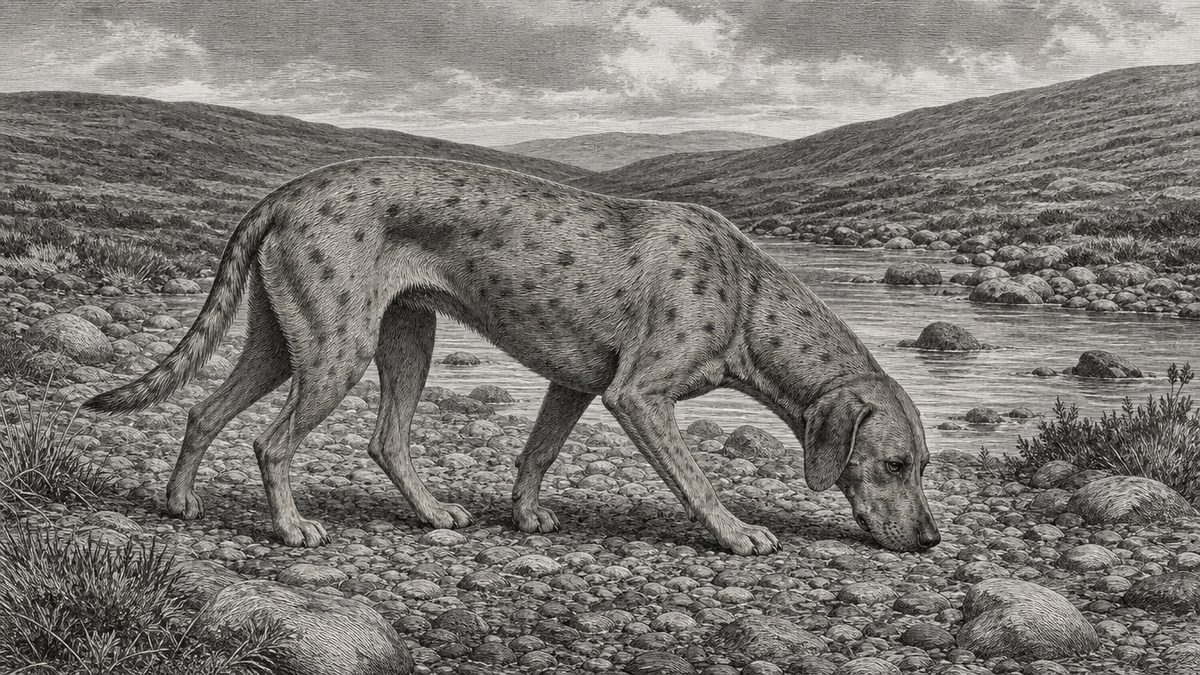
No image of a sleuth hound from its own period was located for this page, and the modern Bloodhound does not match the one surviving description on two of its three attributes. The image at the top is built from Bellenden's three attributes and is labelled a reconstruction. Using a photograph of a modern Bloodhound would assert an identity this page has spent two sections carefully qualifying.
Sleuth hound price in India: there is none, and the search returns a book
No sleuth hound has a price anywhere, because the name has not denoted a separate animal for over four centuries. The Indian search for the term returns the Bloodhound, three dictionaries and a 2026 book about Sherlock Holmes's real-life model.
The Indian result set for 'sleuth hound dog breed' is unusually honest by the standards of this site. Wikipedia's sleuth hound article ranks, the Bloodhound ranks from Wikipedia, the AKC, Britannica and the Kennel Club, and Merriam-Webster and Collins rank with dictionary definitions. Nothing is trying to sell a sleuth hound, because there is nothing to sell.
| Result | What it is | What a buyer should conclude |
|---|---|---|
| Wikipedia, sleuth hound | The article, correctly identifying it as a Scottish term for the Bloodhound | Accurate |
| Penguin Books UK and Macmillan | Sleuth-Hound, Lindsey Fitzharris's 2026 book on Joseph Bell and Conan Doyle | A book, not a dog. Two publishers on page one |
| Merriam-Webster and Collins | Dictionary entries: archaic for a bloodhound, informal for a detective | The word is a dictionary headword, which is what a job title looks like |
| AKC and The Kennel Club | Bloodhound breed pages, one of which markets the breed as 'the world famous Sleuth Hound' | This is the dog. Go and read about the Bloodhound |
| Adobe Stock | Royalty-free 'Sleuth-Hound' stock images | Stock libraries index the phrase, which is not evidence of a breed |
The absence of a scam here is itself the finding
Most extinct or non-existent breed names on this site attract Indian listing shells, generic price lists and carousels of unrelated puppies. This one does not, and the reason is instructive: the term is transparently a word rather than a product. Nobody has built a fake market around it because there is no consumer demand to capture. That makes this page unusual, and it is worth saying rather than manufacturing an alarm.
Bonbeno reports published price ranges as editorial content. For this name there is nothing to report. Where a figure appears below it belongs to the Bloodhound or to another living breed and is attributed to the Indian page it was read from.
What a Bloodhound and its alternatives actually cost in India
The Bloodhound is the dog behind this name and it is available in India, though not commonly. The Beagle is the scent hound Indian buyers actually reach, and two Indian price lists read on the same day disagree about its ceiling by Rs 50,000.
PawSpace gives the Beagle at Rs 25,000 to Rs 90,000 and above. Wrapinfur, read the same day, gives Rs 15,000 to Rs 40,000. Publishing that spread is more useful than averaging it, because it tells an Indian buyer that the category price is a function of seller rather than of dog.
| Breed | PawSpace | Wrapinfur | Note |
|---|---|---|---|
| Bloodhound | Not listed | Not listed | Rare enough in India that the general price lists do not carry it. Treat any quoted figure with suspicion and ask for the pedigree |
| Beagle | Rs 25,000 to Rs 90,000+ | Rs 15,000 to Rs 40,000 | A Rs 50,000 disagreement on the ceiling, on the same day |
| Labrador Retriever | Rs 20,000 to Rs 70,000 | Not compared here | The reference point most Indian buyers already hold |
| Rajapalayam | Rs 8,000 to Rs 30,000 | Not compared here | An Indian hound, heat-adapted, at a third of the Beagle ceiling |
| Mudhol Hound | Rs 8,000 to Rs 30,000 | Not compared here | Same band |
| Chippiparai | Rs 8,000 to Rs 30,000 | Not compared here | Same band |
| Kanni | Rs 8,000 to Rs 30,000 | Not compared here | Same band. Four Indian breeds sharing one band is a template signature, not four observations |
| Indian pariah dog | Rs 0 to Rs 5,000 | Not compared here | Free from a shelter this week |
These are rupee-native prices, and that is worth stating
Every distinct rupee figure between Rs 1,000 and Rs 5,00,000 in the raw markup of both lists was tested against 84.38, 80.00 and 74.00. Not one divides cleanly at 84.38 and not one at 74.00. The apparent matches are all at 80.00, which proves nothing because any figure ending in three zeros divides cleanly at that rate by construction. This project has repeatedly caught Indian breed pages publishing a converted American price list. These two are not doing that, and reporting the negative result is as much a duty as reporting the positive one.
A rare large breed with no published Indian price band is exactly the situation in which a seller can quote any number at all. Ask for the parents' registration, the date of birth, and what the breeder does about the breed's 9.3 year median lifespan. The third question is the one that separates a serious breeder from a shop.
Monthly cost of ownership in India for a large scent hound
Budget roughly Rs 8,000 to Rs 15,000 a month for a large scent hound in an Indian metro, built from named line items rather than lifted as a single total. A Bloodhound is a big dog and the parasite, food and veterinary lines scale with it.
| Line | Figure | Source and caveat |
|---|---|---|
| Tick, flea and worm cover | About Rs 1,103 a month at the 15 to 30 kg size | NexGard Spectra, 3 tablets at Rs 3,308 against an MRP of Rs 3,375. A 40 kg Bloodhound needs the larger size, so treat this as a floor |
| Separate deworming, if used instead | Rs 125.67 a tablet, one per 10 kg | Drontal Plus, 6 tablets at Rs 754. A 40 kg dog takes four tablets a dose |
| Vaccination, spread monthly | Rs 699 anti-rabies, Rs 899 for the 9-in-1 DHPPiL | Vetic's national page, one chain's promotional floors. Chennai's municipal clinics give anti-rabies free |
| Grooming | Rs 934 bathing, Rs 99 add-ons | Vetic Delhi list. A short-coated hound needs the low end. The Rs 1,359 haircut line does not apply |
| Ear care | Not a line item, but the recurring one | A heavy drop-eared hound in Indian humidity is an otitis risk. Budget for more vet visits than the coat suggests |
| Municipal registration | Rs 500 in Delhi, Rs 50 in Chennai | Delhi MCD charges Rs 500 new and Rs 500 renewal with a Rs 100 a month late fee. Greater Chennai Corporation licences a pet animal at Rs 50 |
| Food | Not quoted here | No current Indian retail figure was re-priced for this page, and a stale food price is worse than none. A 40 kg dog is the single largest line in this table |
The line nobody costs, and it is the one that bites
Drool and skin are the hidden costs of a heavy-flewed hound in a humid country. The loose lip and the facial folds that make the breed recognisable also hold moisture, and in a Chennai or Kolkata summer that is a chronic dermatitis risk rather than an occasional one. No Indian price list carries a line for it and every owner of one pays it.
The municipal line is small and almost universally skipped. Delhi's Municipal Corporation's live counter read 18,958 pet dog certificates issued since 2021 on 9 September 2026, and 19,022 on 17 September, and Greater Chennai Corporation issued 9,115 licences in 2024 and runs six municipal pet clinics providing treatment and anti-rabies vaccination free of cost. For a large dog needing annual rabies cover, that Chennai facility is the best-value item available anywhere in this table.
This project has repeatedly found Indian breed sites publishing identical monthly totals across unrelated breeds, because the totals are the sum of a few preset lines rather than a costing of any actual animal. A figure assembled from named, separately sourced components can be checked line by line. A round total cannot.
Could a sleuth hound have handled the Indian climate? The heat tolerance answer
No, and the Scottish Borders produce the widest gap in this whole comparison. The single NASA POWER cell covering Hawick and Jedburgh returns an annual mean of 7.81 C and a warmest month of 14.13 C. Chennai's coolest month averages 24.09 C, which is about 10 degrees hotter than the hottest month the Borders manage.
One methodological point has to come first, because it affects how the homeland figure should be read. Hawick and Jedburgh are 20 km apart and they return a byte-identical series from a single grid cell whose elevation is 215.94 m. Against real town elevations near 120 m and 70 m that is an error of about +96 m and +146 m. Because both points resolve to one cell they cannot corroborate each other, and this page reports them as one reading of Border upland climate rather than as two independent measurements.
| Place | Annual mean T2M | Hottest month | Coolest month | Annual RH |
|---|---|---|---|---|
| Scottish Borders, single cell at 215.94 m | 7.81 C | July, 14.13 C | January, 2.51 C | 89.88 percent |
| Chennai | 27.95 C | May, 31.51 C | January, 24.09 C | 72.39 percent |
| Kolkata | 25.81 C | May, 31.53 C | January, 17.31 C | 73.93 percent |
| Mumbai | 26.77 C | May, 31.19 C | January, 23.19 C | 67.39 percent |
| Delhi | 25.60 C | June, 35.88 C | January, 13.61 C | 45.56 percent |
| Pune | 23.86 C | April, 28.93 C | December, 19.62 C | 66.80 percent |
| Bengaluru | 23.74 C | April, 28.37 C | December, 20.22 C | 67.94 percent |
Three of those hottest-month cells surprise people
Delhi peaks in June rather than May, at 35.88 C. Bengaluru and Pune both peak in April, and both are coolest in December rather than January. Chennai, Mumbai and Kolkata genuinely do peak in May. Those distinctions matter for scheduling a big dog's outings and they are wrong on a large number of Indian breed pages, which apply May to every city.
What the gap means for the living breed
Delhi's hottest month is 21.75 degrees above the Borders' hottest month. Even Bengaluru, the most forgiving city in the table, sits 14 degrees above it. A large, heavy, deep-chested scent hound carrying the bodyweight the modern Bloodhound standard describes has a poor surface-to-mass ratio and a large heat load, and bodyweight at or above the breed mean carried odds of 1.42 for heat-related illness in the 905,543-dog UK cohort, with dogs over 50 kg at 3.42. A Bloodhound is close to that second band.
Nobody measured the sleuth hound's heat tolerance. The trait rating of 1 is derived from origin climate and from the size and coat of the animal the name denotes, and it is stated as an inference rather than as data. For the Bloodhound there is real evidence and it is in the health section.
Humidity, wet bulb, and why the damp-air argument is the wrong one
The Scottish Borders run 89.88 percent annual relative humidity, which is higher than every Indian city in this comparison. So humidity by itself is not what would hurt this dog in India. What hurts it is heat, or heat combined with humidity, measured as wet-bulb load.
This correction matters because damp air is the argument most breed pages reach for when a northern dog meets a tropical country. The Border cell returns 89.88 percent annual relative humidity against Chennai's 72.39, Kolkata's 73.93, Mumbai's 67.39 and Delhi's 45.56 NASA POWER climatology 2001-2020…. A hound bred on that ground is thoroughly adapted to wet air. It is not adapted to wet air at 31 degrees.
| Place | Peak wet-bulb month | Peak wet-bulb | Gap from the homeland |
|---|---|---|---|
| Scottish Borders | July | 12.43 C | The baseline |
| Bengaluru | May | 21.86 C | +9.43 C, and this is the best Indian case |
| Pune | June | 22.97 C | +10.54 C |
| Mumbai | June | 25.77 C | +13.34 C |
| Chennai | May | 26.11 C | +13.68 C |
| Delhi | July | 26.50 C | +14.07 C |
| Kolkata | June | 27.09 C | +14.66 C, the highest in this comparison |
How to read a wet-bulb figure without overstating it
Wet bulb has a hard physical sanity check, which is why it is used here. Readings above about 35 C sit at the outer edge of anything ever observed on earth, so a table topping out at 27.09 C is inside the plausible range. Every figure was computed from the mean temperature and mean relative humidity, never from a period maximum, because a period maximum is an extreme rather than an average and feeding one into a wet-bulb calculation produces figures higher than any ever recorded.
The practical translation is that a heavy hound in Kolkata in June has very little evaporative margin, and that a long low-intensity working session uses that margin up slowly and without obvious warning. That is a worse risk profile for a scent hound than for a sighthound, because a sighthound sprints and stops while a scent hound keeps going.
Bengaluru's 21.86 C peak wet bulb is the most forgiving in the table and it is still 9.43 degrees above the Border baseline. A reader planning to keep a Bloodhound in India should read that as the best case rather than as permission, and should read the exercise section first.
Temperament: the one period description is not the one the breed is sold on today
Bellenden describes a dog that finds the thief and then 'invadis him with gret cruelte'. The modern Bloodhound is bred, shown and marketed as one of the gentlest breeds there is. Both statements are true, four and a half centuries apart, and the gap between them is the most interesting thing about this animal's temperament.
The 1536 description is unambiguous: the dog 'nocht allanerlie findis the theif, bot invadis him with gret cruelte';. This was a law-enforcement animal in a violent border economy and it was expected to close with the person it caught. Nothing in the passage describes a companion.
What changed, and why it matters to a buyer
The modern Bloodhound was substantially reconstructed in the nineteenth century, and temperament was selected for hard. The Kennel Club's own history records the breed being used in that century to rescue the French Chien de St Hubert from extinction, which tells you the population was being deliberately managed rather than simply persisting. A buyer today is getting the product of that selection, not the animal Bellenden described.
So the honest transfer from the historical record to a modern purchase is almost nothing. What does transfer is the nose and the persistence, which were never bred out because they are the point of the breed. A Bloodhound on a scent is still a dog that has stopped listening, and that is a management fact rather than a training failure.
The three qualities that actually transfer
- An overriding nose. Bellenden's dog worked around a water crossing rather than giving up. That persistence is intact.
- Independence on a line. The dog was expected to work out the problem itself, and it still is.
- Physical determination. A large hound that has decided where it is going is a strength problem for the person on the other end of the lead, and this is the practical reason a Bloodhound is a poor first dog.
No aggregate temperament score exists for a sleuth hound and none can. Every friendliness, trainability and child-suitability rating printed for this name on a profile site was generated by a template. The one period description says the dog attacked people, and quoting that as a temperament rating for a modern pet would be just as dishonest in the other direction.
Training a tracking hound: what the record shows, and what an Indian owner can use
To train a tracking hound, give the nose a legal job and accept that recall off a live scent is the one thing the animal was selected not to do. The sleuth hound record shows these dogs were trained to a very high standard for a very narrow task, which is the opposite of general obedience.
Barbour's John of Lorn had a hound 'Sa gude, that change vald for na thing', meaning it would not change from the line it was on for anything. That is the trained quality being praised: not obedience, but refusal to be distracted. A dog selected for four centuries on that criterion is not going to come back because you called it.
The five things that work on a scent hound in India
- Start before the heat. Train at 6 to 8 in the morning and after dusk. Of the 879 UK heat-related illness events with a recorded trigger, 652 were exertional, which is 74.2 percent, and a training session is an exertion.
- Pay with food, every time. A tracking hound works for its own reasons. Food is the only currency that competes with a smell.
- Use a long line rather than a better cue. Fifteen metres of line makes an uncontrollable dog controllable, and costs less than one grooming session.
- Give the nose a job you choose. Scatter feeding and find-it games spend the drive that otherwise gets spent on your furniture, at no thermal cost.
- Wait for eight weeks. Rule 8(1)(a) of the 2017 Rules requires that pups under eight weeks are not sold, so a lawfully obtained puppy starts here.
What this kind of dog resists
It resists being called off a track, and that resistance was the entire selection criterion. An owner who understands that stops treating recall failure as defiance and starts managing the environment, which is both kinder and much more effective. In an Indian city with unfenced parks and heavy traffic, that means the long line is not a training aid but a permanent piece of equipment.
No eight-week-old dog is trained, and a tracking hound least of all. The claim usually travels with other claims, including about age and parentage, and the age claim is the one Indian law actually regulates.
Exercise: what tracking work actually demanded, and what that means in an Indian city
A large scent hound in India needs two real outings a day, roughly 60 to 90 minutes of activity split across early morning and after dusk, with the middle of the day indoors. The requirement is not negotiable and the timing is what makes it survivable.
The historical working profile was long-distance and slow. A dog tracking stolen cattle across Border country covered ground for hours at walking and trotting pace, which is a sustained aerobic load rather than a burst. Bellenden's dog kept searching 'heir and thair with sic deligence' after losing a line at water, and that persistence has a metabolic cost.
Why timing matters more than distance in India
Heat-related illness in dogs is overwhelmingly exertional rather than environmental: 652 of the 879 UK events with a recorded trigger, against 113 environmental and 46 from vehicular confinement. That is a British cohort in a British climate, so read it as a floor rather than an estimate for India. The dog is not at risk because it is outside. It is at risk because it is working.
Size compounds it sharply for this breed. Bodyweight at or above the breed and sex mean carried odds of 1.42, and dogs over 50 kg carried odds of 3.42 with a confidence interval of 1.54 to 7.57. A large male Bloodhound sits at or near that upper band, which makes it one of the worst-suited hounds in this comparison for an Indian summer.
| Slot | What it is | Why |
|---|---|---|
| 5:30 to 7:00 | Main walk, 40 to 60 minutes, sniffing allowed and encouraged | Coolest ground temperature of the day |
| Mid-morning | Ten minutes of scent work indoors | Spends drive at no thermal cost |
| Middle of the day | Indoors, fan or cooler, water always available | The window in which exertional heat illness happens |
| After dusk | Second walk, 25 to 35 minutes | Air has cooled, but check the pavement first |
| Weekly | One long tracking game in a fenced space, on a long line | Replaces the work the breed was built for |
Put the back of your hand on the pavement and hold it there for five seconds. If you cannot, the dog cannot stand on it. Indian tarmac holds heat for hours after the air has cooled, and paw burns are the commonest avoidable summer injury in a city dog.
Grooming: a short coat, and folds that are the entire job
Groom a heavy-flewed drop-eared hound in India by ignoring the coat and attending to the ears, the facial folds and the lips. A weekly brush handles the coat. Everything else is moisture management.
The coat itself is trivial. Bellenden's description of a red or black dog with small spots says nothing about coat care, and nothing needed saying. A short hound coat needs a rubber mitt once a week and no haircut at all, which is why the Rs 1,359 haircut line on an Indian grooming list does not apply to this dog.
The three places moisture collects, in order of trouble
- The ears. A long low-set pendulous ear is a lid over the canal. In Indian humidity a canal that does not dry is a canal that gets infected. Check every three days, dry after every wetting.
- The facial folds and flews. The loose lip that defines the breed traps saliva and food. Wipe and dry daily, and look for redness where skin meets skin.
- The neck and dewlap. Drool runs down and sits there. This is the commonest site of low-grade dermatitis on a heavy hound in a humid country.
This is the point at which overseas breed-club care advice stops transferring cleanly. Guidance written for a British climate routinely says to towel a hound and let it air dry, which is fine at 14 degrees in the Borders and wrong in Kochi in August. Dry actively, with a towel and then a cool-setting dryer or a fan, and pay particular attention to the three sites above.
The Indian cost is small. Vetic's Delhi list gives bathing from Rs 934 and add-ons from Rs 99. A short-coated hound is one of the cheapest dogs in India to keep clean, and essentially all of that budget should go on ears and folds rather than on coat.
Ear and skin-fold disease can be bacterial, yeast, mite or foreign body, and the treatments differ. Over-the-counter drops used on the wrong cause make the next problem harder to treat. Consult a registered veterinarian near you rather than acting on anything on this page.
Health issues and life expectancy: nothing under this name, and a hard number under the other one
No health data exists for a sleuth hound, because no such population has been separately identified for four centuries. The dog the name denotes has a hard number, and it is the worst on this site's hound pages: a median survival of 9.3 years.
The literature absence under this name is controlled and it is worth setting out, because the way it fails is instructive. The exact-phrase queries return zero with PubMed's quotedphrasesnotfound warning, so the unquoted form was retried as this project's rules require. 'sleuth[tiab]' returns 107 records with a clean translation line, and the titles were opened rather than counted: they are research-integrity 'science sleuth' news items, the SLEUTH urban-growth model and the Sleuth RNA-seq software. Not one of the 107 concerns a dog. Controls in the same session returned 30 for Bloodhound, 128 for Foxhound and 3,977 for Beagle with dog.
The Bloodhound's number, which is real and which should change decisions
McMillan and colleagues' 2024 study puts the Bloodhound's median survival at 9.3 years, with a 95 percent confidence interval of 8.6 to 11, on 71 recorded deaths from 134 dogs, and a hazard ratio of 1.68 against the crossbred group with an interval of 1.33 to 2.12 and p<0.001. The Bloodhound is present in Table S5 with the flag Y, so this is a genuine measurement rather than an imputation for a breed that was excluded.
| Breed | Median survival | 95 percent CI | Deaths | HR against crossbreds |
|---|---|---|---|---|
| Bloodhound | 9.3 years | 8.6 to 11 | 71 | 1.68 (1.33 to 2.12), p<0.001 |
| Beagle | 12.5 years | 12.3 to 12.7 | 1,552 | 0.95 (0.91 to 1), p=0.07 |
| English Foxhound | 13.0 years | 11.4 to 16.9 | 31 | 0.67 (0.47 to 0.95), p=0.02 |
| Labrador Retriever, as a familiar reference | 13.1 years | 13.0 to 13.1 | 16,155 | 0.80 (0.78 to 0.81) |
That is a difference of 3.2 years against the Beagle and 3.8 against the Labrador. It is the single most important number on this page and it belongs in front of anyone who has arrived here because the name sounded romantic.
The Bloodhound's screening data, which is where the real risk sits
The Orthopedic Foundation for Animals holds a large hip dataset for the Bloodhound and it is not reassuring. On 3,752 evaluations the breed is 71.4 percent normal and 26.4 percent dysplastic, ranking 28th. The figures were read from OFA's own statistics dump with the table's header read rather than assumed, and the row was checked so that excellent plus good plus fair reproduces the printed normal figure and mild plus moderate plus severe reproduces the printed dysplastic figure. Both closed.
| Breed | Evaluations | Normal | Dysplastic | Reading |
|---|---|---|---|---|
| Bloodhound | 3,752 | 71.4 percent | 26.4 percent | More than one in four evaluated dogs, on a large sample. This is the dog the name means |
| Basset Hound | 286 | 57.7 percent | 39.5 percent | Worse, on a much smaller denominator |
| Beagle | 1,783 | 79.2 percent | 18.6 percent | The reachable alternative in India |
| Labrador Retriever, as a familiar reference | 324,934 | 87.5 percent | 11.3 percent | The largest dataset OFA holds for any breed |
| English Foxhound | No row at all | n/a | n/a | OFA requires 100 hip evaluations before it publishes a breed, so this is missing data rather than a good result |
Put that beside the lifespan figure and the picture is consistent. A median of 9.3 years and 26.4 percent dysplastic hips on 3,752 evaluations are two independent datasets pointing the same way. This is the breed anyone searching sleuth hound is actually searching for, and these are the two numbers that should sit in front of the decision.
OFA's eye summary reports 88.9 percent normal of 234 evaluations, while its own detail rows report NORMAL as 125 of 233, which is 53.6 percent. A part cannot exceed its whole and a summary cannot outrun its own details by 35 points, so neither figure should be quoted as 'the' rate. This project has recorded the same contradiction on more than a dozen breeds, so it is a property of the tables rather than a finding about the Bloodhound, and both numbers are printed here with the arithmetic shown.
What Indian law requires of a breeder, which is a question you can ask
Second Schedule Part III paragraph 8(10) of the 2017 Rules requires that breeding dogs have been tested for genetic defects 'including hip dysplasia, progressive retinal atrophy, night blindness, hypothyroidism, entropion, ectropion, overshot, undershot jaw (when incisors do not touch or mesh), wry mouth, two or more missing teeth' and cryptorchidism. Two of those, entropion and ectropion, are eyelid conditions that matter specifically for a heavy-headed hound with loose facial skin, so this clause is unusually on point for this breed. The word is 'including', so the list is illustrative rather than closed.
Every figure above is a population statistic from a British dataset. It says nothing about any individual dog and it is not a diagnosis. Consult a registered veterinarian near you before acting on anything here, and treat laboured panting that will not settle in shade, a distended abdomen, pale gums or dark urine as reasons to call a clinic the same day.
The Indian health risk no British source will mention: tick-borne disease
Tick-borne disease is the risk that decides a scent hound's life in India, and it appears in no British or American breed health survey. Indian clinic surveys report very high pathogen burdens, and a long-eared nose-down hound working in undergrowth is the most exposed body plan there is.
The Indian numbers are large and their denominators must travel with them. A survey of 584 dogs in West Bengal found Babesia gibsoni in 76.54 percent of the 584 dogs screened (447 of 584) and Anaplasma in 55.75 percent (325 of the 583 tested for it), with 72.9 percent of the dogs carrying two or more pathogens. A Kerala survey of 120 dogs found Babesia in 80 of the 120 screened, which is 66.7 percent, and Ehrlichia canis in 5.0 percent, with a pre-monsoon March to May peak.
The caveat that must travel with those figures
Both studies sampled dogs presenting at veterinary clinics rather than a random population, so they describe the burden among dogs tested at clinics rather than a national prevalence. Writing '76.54 percent of Indian dogs' would be materially misleading. Writing '76.54 percent of 584 dogs screened at clinics in West Bengal' is what the papers support, and it is still a large number.
| Finding | Figure | What to do about it |
|---|---|---|
| Babesia gibsoni, West Bengal | 76.54 percent of 584 screened | Monthly acaricide cover, year round, not seasonal |
| Two or more pathogens together | 72.9 percent of 584 screened | Assume co-infection is normal, not exceptional |
| Babesia, Kerala | 80 of 120 screened, 66.7 percent | The same conclusion from a second state |
| Ehrlichia canis, Kerala | 5.0 percent | Lower, but this is the one that goes chronic quietly |
| Seasonal peak, Kerala | Pre-monsoon, March to May | Tighten checking in exactly the months the heat is worst |
The routine, which costs about Rs 1,103 a month at 15 to 30 kg
NexGard Spectra for a 15 to 30 kg dog runs about Rs 1,103 a month at Supertails' listed price of Rs 3,308 for three tablets, covering the tick and flea role and the roundworm and hookworm role in one tablet. A 40 kg hound needs the larger size, so treat that as a floor. Drontal Plus is the separate deworming route at Rs 125.67 a tablet, one per 10 kg. Add a physical check after every walk in grass, concentrating on the ear folds, between the toes and under the collar, which on this breed means working through a lot of loose skin.
Pale gums, dark or coffee-coloured urine, a fever that comes and goes, or sudden lethargy after a tick season send a dog to a clinic the same day. Babesiosis and ehrlichiosis are treatable and both get worse quickly. Consult a registered veterinarian near you rather than acting on any figure on this page.
Feeding a large scent hound in India, and the risk that comes with the chest
Feed a large deep-chested hound measured meals twice a day, never one large meal, and never immediately before or after hard exercise. The reason is bloat, and on a dog with this body shape it is the emergency most likely to kill it suddenly.
Nothing is known about what a sleuth hound ate. The dogs belonged to border landholders and law officers in the fifteenth and sixteenth centuries and no feeding account survives. What is worth saying about the historical animal is that a dog tracking for hours across upland country had an energy budget nothing about Indian city life reproduces.
The three rules for a deep-chested hound
- Split the ration across two or three meals. A deep-chested large breed fed one large meal is the classic gastric dilatation and volvulus presentation, and Indian households that eat late often feed the dog late with them.
- Leave an hour either side of exercise. Not a walk to the corner, but any real exertion.
- Measure, and check the ribs weekly. You want to feel them easily under a thin cover without seeing them. A heavy hound in India has less thermal margin, and bodyweight at or above the breed mean carried odds of 1.42 for heat-related illness.
What it costs, and why no monthly food figure appears here
This page quotes no monthly food figure, deliberately. Indian retail food prices move within weeks, this project has already caught one large-bag price going stale within days of being recorded, and a stale figure presented confidently is worse than an acknowledged gap. For a 40 kg hound the food line is the largest single item in the cost table, so build it yourself from the food you can actually buy in your city and re-check it every few months.
A nose-led hound in an Indian street will eat what it finds, and what it finds includes bones, packaging and poisoned bait laid for rodents. This is the practical reason the long line in the training section matters, and on a large fast-eating hound it is a bigger day-to-day risk than any inherited condition on this page.
The first year month by month, and why this timeline is not about a sleuth hound
This timeline describes a large scent hound puppy in an Indian city, because no sleuth hound puppy has been identified as such since about 1600. It is printed here because it is what a reader searching this term is actually about to need.
The legal start point is eight weeks. Rule 8(1)(a) of the 2017 Rules requires that pups less than eight weeks in age are not sold, so month two is where a lawfully obtained puppy joins the household.
| Age | What happens | The Indian constraint |
|---|---|---|
| 8 to 10 weeks | Puppy legally leaves the breeder. Core vaccination course begins | Anti-rabies Rs 699 and the 9-in-1 DHPPiL Rs 899 at one national chain's listed floors. Chennai's six municipal clinics give treatment and anti-rabies free |
| 10 to 16 weeks | Socialisation window. People, surfaces, traffic noise, other vaccinated dogs | Do it at 7am and after dusk. A socialisation walk at noon in April is a heat exposure |
| 4 to 6 months | Lead manners and the beginning of recall, while the puppy is still small enough to hold | This is the only window in which you outweigh the dog. Use it. Drontal Plus at Rs 125.67 a tablet, one per 10 kg |
| 6 to 9 months | Fastest skeletal growth, and the nose switches on | Keep it lean and off hard-surface running. Recall will appear to break; it has not, the drive has arrived |
| 9 to 12 months | Switch toward adult food. Adult size approaching | The first full Indian summer, on a dog now heavy enough for the over-50 kg heat band to start mattering |
| 12 months | Municipal registration and the first annual booster | Delhi MCD registration Rs 500 with a Rs 100 a month late fee. Greater Chennai Corporation licences a pet at Rs 50 |
The window that decides everything else
Months four to six are the only period in which an average adult can physically manage this dog without technique. A Bloodhound at nine months outweighs a lot of owners and out-pulls almost all of them. Everything about lead manners has to be installed before the strength arrives, because afterwards you are negotiating rather than teaching.
None of it is a sleuth hound timeline. If you came here for the historical animal, the honest answer is that no growth data, no litter record and no puppy account of any kind survives under that name. This page prints a living hound's timeline and labels it as one.
Head to head: what an Indian buyer is actually being offered instead
Nobody can sell you a sleuth hound, so the useful comparison is between the dog the name denotes, the scent hounds an Indian buyer actually reaches, and the Indian breeds built for this climate.
| Dog | Available in India? | Registry standard? | Link to the sleuth hound | The question that should decide it |
|---|---|---|---|---|
| Sleuth hound | No. The name has not denoted a separate animal since about 1600 | None, ever, under this name | It is the sleuth hound | There is nothing to decide. Read the Bloodhound row |
| Bloodhound | Yes, but rare and rarely price-listed | FCI, RKC and AKC standards | The Royal Kennel Club states it directly: 'In Scotland he was known as the sleuth-hound' | 9.3 year median, HR 1.68 against crossbreds. The shortest-lived hound on this site |
| Beagle | Yes, very widely, Rs 25,000 to Rs 90,000+ | FCI, RKC and AKC standards | None. A different English hound line entirely | Whether your building tolerates the voice, and 12.5 years against the Bloodhound's 9.3 |
| Basset Hound | Yes, less commonly | FCI, RKC and AKC standards | Shares the heavy long-eared build without the size | Ear and spine care in humidity |
| English Foxhound | Very rare, and a pack hound rather than a pet | FCI, RKC and AKC standards | None claimed | Whether you can give a pack animal a pack. Usually you cannot |
| Rajapalayam or Chippiparai | Yes, Rs 8,000 to Rs 30,000 | ICAR-NBAGR registered Indian breeds | None. A different tradition entirely | Heat-adapted, short-coated, and built for this climate rather than despite it |
| Indian pariah dog | Yes, free, this week, in every Indian city | ICAR-NBAGR registered breed | None claimed | Nothing in this page's climate section applies to it |
How to read that table
The first row exists to be crossed out and the second row is the actual decision. Anyone searching sleuth hound is searching for a Bloodhound, and the Bloodhound carries a measured 3.2 year lifespan penalty against the Beagle in the largest UK dataset available. That is not a reason never to buy one. It is a reason to know it before you do, and to ask the breeder what they are doing about it.
The last two rows are the ones an Indian household should look at hardest. A short-coated heat-adapted Indian hound at Rs 8,000 to Rs 30,000, or a free pariah dog, solves every climate problem this page has described.
Ask the puppy's date of birth and how the parents are related. Indian law regulates both, at Rule 8(1)(a) and Second Schedule Part II paragraph 6(3), and a seller who cannot answer either has told you what you needed to know without discussing history at all.
What readers get wrong about the sleuth hound, in order of cost
Eight mistakes recur on this subject, ordered here by what each one costs the person making it rather than by how often it appears.
- Treating it as a lost breed to be revived. It is a Scots name for the Bloodhound, and the Royal Kennel Club says so on its own Bloodhound page. There is nothing to revive.
- Buying a Bloodhound without reading its lifespan. A median of 9.3 years, with a hazard ratio of 1.68 against crossbreds, is the shortest of any hound on this site. This is the mistake with the highest emotional cost on the page.
- Reading 'slow hound' as a comment on speed. The form is recorded, and the first word likely represents a mispronunciation of 'slough' rather than a reference to pace.
- Counting the word sleuth in the Scottish sources. It occurs 47 times across Bellenden's two volumes and almost every occurrence is a different word meaning sloth.
- Repeating that Bellenden says the dog was larger than a rache. The edition read for this page says 'na mair than ony rache', which is the opposite.
- Presenting the Bruce hand-fed hound story as history. Barbour introduces it with 'and sum men sais', which is the poet marking it as report.
- Quoting the 1536 temperament as though it described a pet. Bellenden's dog 'invadis him with gret cruelte'. That is a law-enforcement animal in a violent economy, not a family dog.
- Searching the name and stopping at the first result. Two of the page-one results in India are a 2026 book about Arthur Conan Doyle's medical school teacher, and two of the four questions Google attaches to the query are not about this animal at all.
Caius's 1576 index carries a line reading 'Bloodhoundes called Brache in Scottishe', which looks like a Scottish breed synonym and would have been an attractive finding. His body text says something quite different: 'albeit some of this sort in English be called Brache, in Scottishe Rache, the cause hereof resteth in the shee sex and not in the generall kinde, for we English men call bytches belonging to the hunting kinde of Dogges, by the tearme aboue mencioned';. Brache and rache are words for a female hound, not breed names, and the index compressed that into something misleading. Read the body, never the index.
Adoption and responsible sourcing: what to do instead
You cannot adopt a sleuth hound and you cannot import one. Adopt an Indian pariah dog or a surrendered hound from a rescue, and buy a Bloodhound from a breeder only after the checks below and only with the lifespan figure in front of you.
Indian rescues carry surrendered scent hounds constantly, and the reason is directly relevant. A loud, powerful, nose-led dog bought on an image and kept in a flat is one of the commonest surrenders in Indian metros. An adult dog from a rescue also removes the growth and socialisation gamble entirely, because what you can see is what the dog is.
Why importing is not an option, stated from the instrument
No import authorisation exists for this purpose. Dogs enter India under ITC(HS) 01061900, classified Restricted, and DGFT Trade Notice 22/2022-23 states that applications for trading or breeding purposes shall be duly rejected, with entry limited to six ports at Delhi, Mumbai, Chennai, Hyderabad, Bangalore and Kolkata. DAHD added a seventh port, Cochin International Airport at Kochi, for pets arriving under the baggage rules in October 2024. For a name that denotes no separate animal the question is doubly closed, but the notice is the document to cite rather than the absence of listings.
The two checks to run on any Indian breeder
- Confirm the puppy is at least eight weeks old. Rule 8(1)(a) requires that pups less than eight weeks in age are not sold, and a seller offering younger is breaking the rule in front of you.
- Ask how the parents are related. Second Schedule Part II paragraph 6(3) prohibits in breeding within the first four generations and prohibits incest breeding. A breeder who cannot answer does not have the pedigree to answer with.
Register the dog once it is home. Delhi's Municipal Corporation charges Rs 500 for a new pet dog registration, and Greater Chennai Corporation licences a pet at Rs 50 and runs six municipal clinics giving treatment and anti-rabies vaccination free of cost. For a large dog needing annual rabies cover, that Chennai facility is the best-value item on this page.
What this name is actually for
The sleuth hound is worth a page because it shows how a working nickname hardens into an apparent breed. A Scots word for a track, attached to a dog doing a job that a specific body of border law recognised, survived four centuries of retelling and now sits in breed databases with a spec card and a temperament score. Tracing it back to Barbour, Bellenden and Caius takes an afternoon and dissolves the whole thing Caius J. Of Englishe Dogges. That is a useful habit to have before spending Rs 90,000 on any dog with a romantic origin story.
If the sleuth hound brought you here, read the Bloodhound page and then read its lifespan figure twice. If what appealed was the tracking, an Indian pariah dog with a nose and a long line will give you most of it for nothing. Neither answer is what you searched for, and one of them is right for almost every Indian household reading this.
Sleuth hound: the questions people actually ask
What is the sleuth hound dog?
The sleuth hound is the old Scots name for a tracking dog used on the Anglo-Scottish border to follow stolen goods and cattle thieves, and it is the same animal England called the Bloodhound. The Royal Kennel Club states it on its own Bloodhound page: 'In Scotland he was known as the sleuth-hound, and was used up to about 1600 on both sides of the Scottish border'. It was never a separate breed and no registry has ever held the name.
What does "sleuthhound" mean?
Sleuthhound means track hound. Sleuth in Older Scots is the track or trail of an animal or person, from Old Norse, so a sleuth hound is a dog that follows a track. Barbour's poem of about 1375 uses the word in exactly that sense when the pursuing hound loses Robert the Bruce: the text says the hound 'the sleuth had lorn', the track was lost. The modern English word sleuth for a detective comes from the dog, not the other way round.
What kind of breed is a hound dog?
Hound is a working category rather than a breed, and it splits into two kinds. Scent hounds such as the Bloodhound, Beagle and Foxhound hunt by nose and are built for stamina. Sight hounds such as the Greyhound, Whippet and India's own Rajapalayam and Chippiparai hunt by eye and are built for speed. The sleuth hound belongs to the first group, and the distinction matters in India because sight hounds are far better adapted to the heat.
What are the top 5 rarest dogs?
No fixed list exists, and rarity claims are usually marketing. What can be said precisely is that this page's subject is not rare, it is non-existent as a separate breed, which is a different thing. Genuinely small British hound populations include the Otterhound and the Harrier, both of which appear in McMillan's 2024 breed list flagged as excluded from the survival analysis. Treat any seller using the word rare as a price argument rather than a fact.
Was the sleuth hound a real breed?
No. It fails both conditions of the two-condition test: no registry, club or author ever published a written standard for a sleuth hound, and no studbook ever held the name. The word describes what the dog did rather than what it was, the earliest description files it as a colour variant of an ordinary pack hound, and the Royal Kennel Club identifies it as the Scottish name for the Bloodhound.
Is the sleuth hound the same dog as the Bloodhound?
Essentially yes, with one honest caveat. The Royal Kennel Club, the American Kennel Club and Britannica all treat sleuth hound as a Scottish or former name for the Bloodhound. The caveat is that the only surviving physical description, from 1536, gives a dog no bigger than a pack hound, red or black with small spots, which does not match the large black-and-tan animal the modern standard describes. Regional working populations differ; that does not make a second breed.
Did a sleuth hound really hunt Robert the Bruce?
Barbour's poem of about 1375 says so twice, and it is a romance rather than a history. In Book VI the Galloway men take a sluth-hund after Bruce with over two hundred men, and in Book VII John of Lorn brings eight hundred men and a sleuth hound. Bruce escapes by wading down a stream to break the scent. The story that the hound had been Bruce's own dog is in the poem too, introduced with 'and sum men sais', which is Barbour marking it as hearsay.
When did the sleuth hound disappear?
The name stopped denoting a distinct working dog around 1600, according to the Royal Kennel Club, which dates its use to 'up to about 1600 on both sides of the Scottish border'. The Union of the Crowns in 1603 removed the border as a jurisdictional line and the cattle-raiding economy the dog policed was suppressed. The dogs did not die out; the job did, and the animals continued as Bloodhounds.
Can you buy a sleuth hound in India?
No, because no such separate animal exists to buy. An Indian search for the term returns Wikipedia, the Bloodhound from four sources, two dictionaries and a 2026 book about Sherlock Holmes's real-life model. If what you want is the dog behind the name, that is the Bloodhound, which is available in India but rare enough that the general Indian price lists do not carry it.
What is the life expectancy of a sleuth hound?
There is no figure under that name and a hard figure under the other one. McMillan and colleagues' 2024 study puts the Bloodhound's median survival at 9.3 years, with a confidence interval of 8.6 to 11, on 71 deaths, and a hazard ratio of 1.68 against crossbred dogs. That is 3.2 years shorter than the Beagle's 12.5 and it is the shortest median of any hound covered on this site.
Would a sleuth hound have coped with the Indian climate?
No, and this is the widest climate gap on any page in this batch. The NASA POWER cell covering the Scottish Borders returns an annual mean of 7.81 C and a warmest month of 14.13 C. Chennai's coolest month averages 24.09 C, so India's mildest coastal month is about 10 degrees hotter than the hottest month the Borders manage. Bengaluru is the most forgiving Indian city and is still 14 degrees warmer in its hottest month.
Why is a detective called a sleuth?
Because of this dog. Sleuth meant the track, a sleuthhound was the dog that followed it, and the name transferred first to a person who follows a trail and then shortened to sleuth. Collins and Merriam-Webster both carry the two senses side by side, archaic for a bloodhound and informal for a keen detective. The word survived the working animal by four centuries.
How much does a Bloodhound cost in India?
No reliable Indian band exists, and that is itself worth knowing. Neither of the two Indian price lists checked for this page carries the Bloodhound at all, while both carry the Beagle, at Rs 25,000 to Rs 90,000 and above on one and Rs 15,000 to Rs 40,000 on the other. A rare large breed with no published band is exactly the situation in which a seller can quote any number, so ask for registration papers, the date of birth and what the breeder does about the breed's 9.3 year median lifespan.
Compare with similar breeds
Sleuth Hound sits in 2 Bonbeno groups. Each one compares it directly against the breeds it is genuinely an alternative to, on the same figures.