
Working breed
Welsh Hound: The Breed Whose Own Association Says It Is Not a Pet
It has a United Kennel Club standard, a studbook kept in Powys since 1922 and closed since 1928, and a sentence from its own association telling a government inquiry that it is totally unsuitable as a pet. Here is what that submission actually says, why three different origin stories circulate, and what an Indian household should look at instead.
Quick answer
The welsh hound is a rough-coated Welsh pack hound and it is a genuine breed on both tests: it has a written standard from the United Kennel Club, adopted 1 January 2006, and a studbook kept by the Welsh Hound Association since 1922 and closed since 1928. Its own association told a UK government inquiry that the breed is totally unsuitable as a pet and that it knew of none in private ownership. It cannot be bought in India, and the reachable scent hound here is the Beagle.
This guide summarises a government inquiry submission, kennel club and registry documents, nineteenth and twentieth century sporting literature, peer-reviewed veterinary research, Indian import and breeding law, published Indian care costs and satellite climate data as general information for Indian pet owners. It is not a diagnosis and it is not treatment advice. Consult a registered veterinarian near you before acting on anything you read here, and treat laboured panting that will not settle in shade, a distended abdomen, pale gums or dark urine as reasons to call a clinic rather than to read more.
Welsh Hound trait ratings, and what each one actually rests on
What a Welsh Hound is, and the one sentence that should decide everything
The Welsh Hound is a rough-coated foxhound-type pack hound of Wales, and it is the only breed in this batch that satisfies both conditions of Bonbeno's breed test. It has a written standard, published by the United Kennel Club in 2006, and a studbook, kept by the Welsh Hound Association since 1922. It also has a sentence from its own governing body that no Indian buyer should read past.
In February 2000 the Welsh Hound Association made a submission to the United Kingdom's Committee of Inquiry into Hunting with Dogs. In it the Association wrote: 'Its irrepressible hunting instincts make the Welsh Hound totally unsuitable as a pet and the Association is unaware of any Welsh Hounds in private ownership'. That is the body that keeps the studbook, telling a government inquiry, in writing, that the breed should not be a pet and that it knows of none being kept as one.
Google's own generated answer for this breed says something close to the opposite. Asked 'Are Welsh Hounds good family dogs?', it replies that they are 'generally gentle and friendly with children'. Both statements can be partly true, because a pack hound raised among people is not aggressive. But 'not aggressive' and 'suitable as a pet' are different claims, and the people who breed these hounds have made the second one in the negative, on the record.
The two documents that settle the breed question
This breed's standard and its studbook come from two different organisations on two different continents, and neither knows much about the other. The written standard is the United Kennel Club's, in Michigan, which recognised the breed on 1 January 2006 and publishes a full standard with height, weight, coat, colour, gait and a disqualification list. The studbook is the Welsh Hound Association's, in Powys, kept since 1922 and closed since 1928 Wikipedia, 'Welsh Hound'. Neither the Kennel Club nor the FCI holds the breed at all.
What that means for an Indian reader
You cannot buy one here and you probably should not want to. No Welsh Hound appears on either of the two large Indian price lists checked for this page, across more than fifty breeds between them Wrapinfur, Dog Price List in India 2026, there is no FCI number and therefore no Kennel Club of India pedigree route, and Indian import law closes the commercial route outright. The useful part of this page is what the breed's own institutions reveal about how a working population is kept, and what an Indian household should look at instead.
The Association's 1997 studbook edition recorded 975 hounds registered by twenty four packs over 1992 to 1997, with a similar number believed unregistered, giving the Association's own estimate of 'two thousand odd Welsh Hounds'. No more recent count was located for this page, and that limit is stated rather than papered over with a guess.
Bonbeno's two-condition test: both conditions met, by two bodies on two continents
To count as a breed on this site an animal needs a written breed standard and a studbook. The Welsh Hound has both. What is unusual is that no single organisation supplies both, and the two that do are four thousand miles apart.
| Condition | Verdict | Which body, and the evidence |
|---|---|---|
| A written breed standard | YES | United Kennel Club, USA. Recognised 1 January 2006, marked 'Official UKC Breed Standard' and copyright 2006, with General Appearance, Characteristics, Head, Neck, Forequarters, Body, Hindquarters, Feet, Tail, Coat, Color, Height 24 inches, Weight 70 to 75 pounds, Gait and a Disqualifications list |
| A studbook | YES, and a closed one | The Welsh Hound Association, Wales. Kept since 1922, closed since 1928. Its 1997 edition recorded 975 hounds registered by 24 packs over 1992 to 1997 |
| Is the studbook genuinely closed? | Yes, and the Association explains how | 'Some generations previously an unregistered hound may have been mated to a registered hound and the resulting progeny would not have been eligible for entry into the StudBook' |
| Kennel Club recognition | None in Britain | Absent from the Royal Kennel Club Breeds A to Z, which holds four other Welsh breeds and four hound breeds, and absent from the FCI letter W index and provisional register |
| AKC recognition | None | Zero hits in the AKC index, which is a separate American registry from the UKC |
The verdict, and why it is the interesting one in this batch
The Welsh Hound is a breed, on this site's own test, and it is the only one of the four hounds covered in this batch that is. The Southern Hound had neither document and is extinct. The sleuth hound was a name for a working role. The West Country Harrier has a studbook and no standard. This one has both, and it is worth naming the pattern: the two conditions can be met by different organisations that have no relationship with each other, and insisting that one body supply both would have produced the wrong answer here.
It is also worth being precise about what the UKC standard is and is not. It is a real standard written for conformation judging in the United States, and the page carries no language of the kind the UKC uses for breeds it will register without a standard. What it is not is the document the Welsh packs breed to. They breed to work, and the ear test at Builth Wells, where huntsmen tug a hound's ears to show they meet in front of the nose, is closer to how purity is actually demonstrated in Wales.
How an open studbook becomes a closed one, from a primary source
The mechanism the Welsh Hound Association used in 1922 to 1928 is documented for a sister organisation thirty years earlier, and reading it makes the Welsh case legible. Bryden preserves the 1891 harrier committee's account: it found 'twelve or fifteen different kinds of hounds hunting the hare', including 'the Welsh', judged that 'if any one type had been selected there would have been few to adopt it', and therefore recommended 'that all hounds, however bred... should be admitted to the Stud-book, and then the book be closed, leaving the future to develop a type'. Open the book, admit what exists, close it, and let selection do the rest. That is exactly the shape of 1922 and 1928.
The consequence is that this breed has a genuinely bounded gene pool with a known closing date, which very few working populations do. Everything descending from the hounds admitted before 1928 is inside it and everything else is outside, and the Association's own explanation of why hounds go unregistered is that rule operating down the generations. Whether a gene pool closed on roughly two thousand animals stays healthy is a fair question nobody has published on, and this page does not pretend otherwise. The FCI holds no Welsh Hound in its letter W index and none in its twenty-entry provisional register Federation Cynologique Internationale, so no continental register exists to widen it.
There is no Indian route. The breed holds no FCI number, so no Kennel Club of India pedigree route exists, and DGFT Trade Notice 22/2022-23 states that applications to import a dog for trading or breeding purposes shall be duly rejected. A UKC registration certificate is a real document, but it is an American one and it does not create an Indian import route.
The documents that describe it, and what each one is worth
Six sources carry this page and the best of them is a government inquiry submission written by the breed's own governing body. That is a better class of source than this site usually gets for a rare breed, and it is why this page can be specific where others hedge.
| Source | Date | What it settles |
|---|---|---|
| Welsh Hound Association submission to the Committee of Inquiry into Hunting with Dogs | February 2000 | The studbook, the population, the closed register, the Hywel Dda valuation, and the flat statement that the breed is unsuitable as a pet |
| United Kennel Club breed standard | 2006 | The written standard. Height 24 inches, weight 70 to 75 pounds, rough dense medium-length coat, and a disqualification list |
| The Field, 'Welsh Hounds' | read 2026 | The show, the ear test, the Saint-Hubert and Margam Abbey origin account, and the WHA's founding under Sir Edward Curre |
| Bryden, Hare-hunting and Harriers | 1903 | A dated outside view of the rough Welsh hound, and the open-then-closed studbook mechanism from a sister body |
| Gilbey, Hounds in Old Days | 1913 | A dedicated Welsh Hound chapter, independent corroboration of the Hywel Dda material, and a COMPETING French origin account |
| Wikipedia | read 2026 | Accurate on the studbook dates and the UKC recognition, and it correctly flags the Hywel Dda claim as needing a better source, which is why this page went to the submission itself |
Why the inquiry submission outranks everything else
It is a primary document written by the people who keep the register, addressed to a body with the power to legislate against them, at a moment when they had every incentive to present the breed favourably. And in that context they wrote that the hound is 'totally unsuitable as a pet'. A statement against interest, made under those conditions, is about as reliable as breed-club evidence ever gets.
It is also specific in a way breed-club material almost never is. It gives a studbook edition, a date range, a hound count, a pack count and a mechanism for non-registration, all in a few paragraphs. Most rare-breed pages on this site would trade a dozen secondary sources for one document like it.
It carries no health data, no lifespan figure and no measurements. It is an argument about hunting policy, not a breed survey, and this page does not stretch it beyond what it says. Where a health or size figure appears below, it comes from the UKC standard or from a study, and is attributed accordingly.
History: three competing origin accounts, and the one document all three rest on
Three different origins are published for the Welsh Hound's rough coat, and this page prints all three rather than choosing. What is better established than any of them is that Welsh hounds were valuable enough to be priced in law in the tenth century.
The valuation, which two independent sources support
The Welsh Hound Association states that 'The ancient laws of Wales codified during the region of Hywel Dda (942 - 948AD) gives the value of the Welsh Hound as 240 pence trained, 120 pence untrained. By comparison a sound pack horse was valued at the same time as 120 pence'. Gilbey, writing independently in 1913, records that 'The earliest particulars of hounds in our records occur in the Ancient Laws of Wales, which were codified by Howel Dda (the Good), a prince who reigned from A.D. 942 to 948', and that these contain 'statutes laying down the values set upon' hounds.
A trained hound worth twice a sound pack horse is the fact worth carrying away. It is also worth noting what has been verified and what has not: two sources agree that the laws value hounds, and the specific figures of 240 and 120 pence come from the Association. Wikipedia flags that claim as needing a better source, and this page has traced it to the Association's own submission rather than to the legal text itself, which was not read here.
| Account | Source | What it claims | Status |
|---|---|---|---|
| Segusii | Welsh Hound Association, 2000 | Descent from 'the Segusii breed of rough coated hound which existed in northern Europe in roman times and before' | The Association's own position, and the one the BBC repeats |
| Saint-Hubert via Margam Abbey | The Field | Hounds donated by the Abbey of Saint-Hubert in the Ardennes to the monks at Margam Abbey in Glamorganshire, moved after the abbey's closure in 1536 to Gelli Farm in the Afan valley and kept by the Jenkins family for about 200 years | Specific, datable and checkable, and the most circumstantial of the three |
| Bresse hound | Gilbey 1913, reporting the Count de Canteleu | 'The Bresse hound of the eastern provinces of France was brought to this country and formed the basis of the breed of Welsh hounds. The Bresse breed were shaggy of coat and yellowish or sandy red in colour' | A century-old attribution to a named French authority, and the least repeated today |
| Celtic Hound and old Staghound | United Kennel Club standard, 2006 | 'An ancient breed, thought to be descended from the extinct Celtic Hound and the old Staghound' | The registry's own wording, hedged with 'thought to be' |
What the three accounts have in common
All three explain the same thing, which is the coat. Segusii, Bresse and Saint-Hubert are all rough or shaggy-coated continental hounds, and the Welsh Hound's defining feature is that it is rough-coated where the English foxhound is smooth. So the accounts disagree about which continental hound and when, and agree about what is being explained. That is a more honest summary than picking one and presenting it as settled.
What the outside world thought of it in 1903
Bryden quotes a contemporary assessment that is unflattering and useful: 'The rough Welsh hound, however, makes no headway outside this particular district, probably because this class of hound cannot be bred to the levelness of pace which is necessary to make hounds pack together when going at top speed'. That is a specific technical criticism, that the hounds do not run at a uniform speed, and it explains both why the breed stayed Welsh and why the Association later described it as 'slightly slower than the English Hound' with 'a tendency to dwell on the line'.
The Field's standfirst records that the Welsh foxhound's 'nose, voice and drive' were 'qualities that progressive breeders seized upon to reinvigorate its English counterpart'. A hound dismissed in 1903 as unable to keep pace was later used to put nose and voice back into the English foxhound. Both things are true and the sequence matters.
Appearance: a rough coat, a domed head, and ears that meet in front of the nose
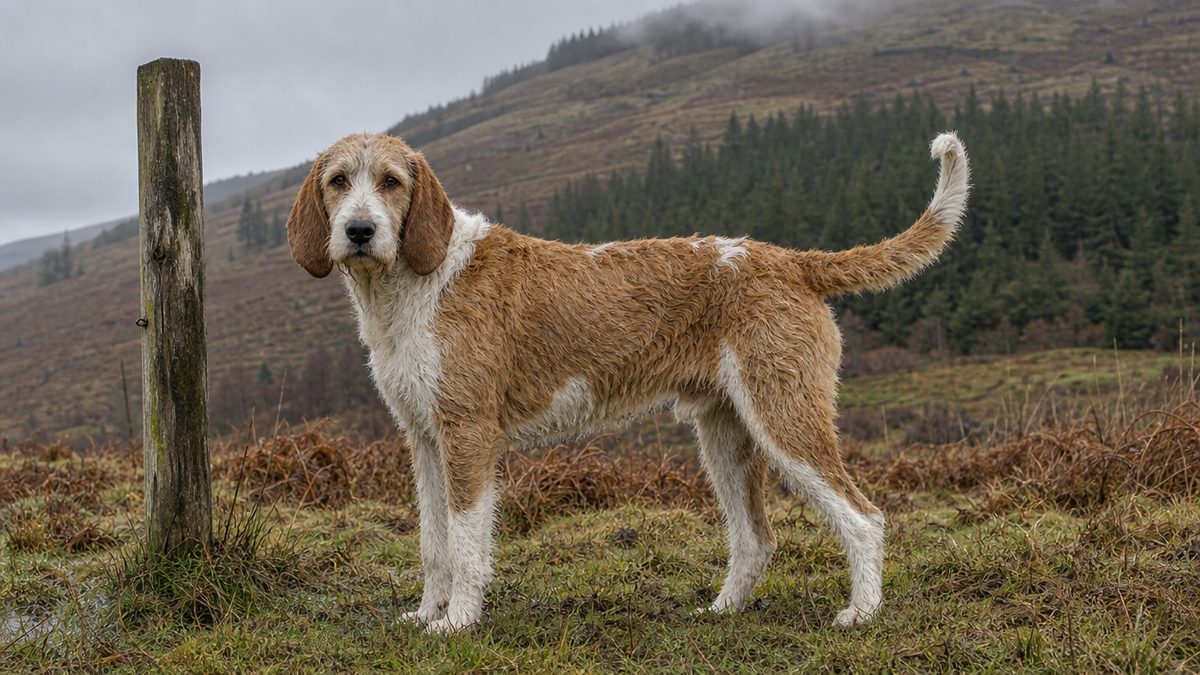
A Welsh Hound looks like a foxhound with a wiry, broken, almost woolly coat. The United Kennel Club standard gives 24 inches and 70 to 75 pounds. The identifying test used in the show ring at Builth Wells is the ear length, and it is unusually easy to check.
The written standard is the place to start because it exists. The UKC gives Height 24 inches and Weight 70 to 75 pounds; Coat 'Rough and dense; of medium length. Occasionally smooth'; Color 'Black, fawn, red, tan, white and mixed'; ears 'long, set on moderately low, almost absent of any erectile power, and set close to the head'; skull 'slightly domed at the occiput' with a 'broad and full' cranium; tail 'well set on high, carried gaily but never curled over the back'.
| Feature | UKC standard, 2006 | The Field and the Foxhound Club | Note |
|---|---|---|---|
| Height | 24 inches | Not given | Google's knowledge panel prints 61 cm, which is 24 inches |
| Weight | 70 to 75 pounds | Not given | Google's panel prints 34 kg, which is 75 pounds |
| Coat | 'Rough and dense; of medium length. Occasionally smooth' | 'A thick, broken coat is the hallmark'; 'more wire like coat giving a fluffy appearance' | The single defining feature against an English foxhound |
| Head | 'Slightly domed at the occiput', cranium 'broad and full' | 'A dome head' | The two agree |
| Ears | 'Long, set on moderately low, almost absent of any erectile power' | 'Ears long enough to meet in front of the nose'; 'a lower set ear that should cover the muzzle when head down hunting' | The field description is the practical test |
| Colour | 'Black, fawn, red, tan, white and mixed' | Sir Edward Curre 'bred white hounds on the edge of Wales that became infamous for their cry' | Wikipedia gives 'red with white patches' |
| Voice | 'A talkative, loud bark, being a prerequisite of hunting in the windy Welsh hillsides' | Curre's white hounds 'infamous for their cry' | Voice is a working requirement, not a nuisance |
The ear test, which is the best accuracy check anyone has
The Field records that 'Close observation of the Welsh ring at Builth Wells will reveal huntsmen gently tugging the ears of their charges to demonstrate purity of Welsh blood', because the ears should be long enough to meet in front of the nose. The Foxhound Club gives the working version of the same point: 'a lower set ear that should cover the muzzle when head down hunting'. An ear that is functional when the head is down and provable when the head is up is a neat piece of breed definition, and it is the detail this page would use to judge any picture claiming to show the breed.
How they are shown, which says something about the breed
Welsh hounds are not shown like English hounds. The Field records that 'Pure-bred Welsh hounds are not shown off the lead in the English style but exhibited by their huntsman kneeling down to support the hound's chin and stern with each hand, possibly to compensate for the breed's aversion to anything as pretentious as showing'. A breed that has to be physically held in position to be judged is telling you something about its independence, and the UKC standard says the same thing in registry language: 'Sturdy, independent hunters, self-reliant in the rugged and rocky Welsh hills'.
The breed is alive and photographs exist, but none was licensed for this page. The image at the top is rendered from the UKC standard and the field descriptions and is labelled as such. The single accuracy check to apply to it is the ears: they should be long enough to meet in front of the nose.
Registry recognition: a standard in America, a studbook in Wales, nothing from the Kennel Club
The Welsh Hound is recognised by the United Kennel Club and by nobody else, and its studbook is kept by a body that is not a kennel club at all. Each absence below was checked with controls inside the same document.
| Body | Status | Evidence and controls |
|---|---|---|
| United Kennel Club, USA | RECOGNISED, 1 January 2006 | A full written standard marked 'Official UKC Breed Standard', with height, weight, coat, colour, gait and disqualifications, and no Bloodlines Listing language |
| Welsh Hound Association, Wales | STUDBOOK since 1922, closed since 1928 | The Association's own 2000 inquiry submission, and The Field: 'A dedicated stud book has been maintained ever since' |
| The Royal Kennel Club | Not recognised | Zero hits for 'welsh hound' across about 75,500 characters, while 'welsh' returns 4 and ten hound and terrier controls returned |
| American Kennel Club | Not recognised | Zero hits for 'welsh hound', while 'welsh' returns 8 and eight controls returned |
| Federation Cynologique Internationale | Not recognised | Absent from the letter W index, which returns 4 for 'welsh', and absent from the twenty-entry provisional register |
| Kennel Club of India | No route | The KCI issues pedigrees against FCI nomenclature, and the FCI does not hold the breed |
Two American registries, one answer each
The most useful detail in that table is that the United Kennel Club and the American Kennel Club disagree. The UKC has held the breed since 2006 with a full standard; the AKC index returns zero American Kennel Club. Anyone writing that the breed is 'not recognised in America' would be wrong, and anyone writing that it is 'AKC recognised' would be wrong too. Name the registry.
Why the British absence is the more surprising one
The Royal Kennel Club holds four Welsh breeds, being the Welsh Springer Spaniel, the Welsh Terrier and both Welsh Corgis, and it holds four hound breeds including the Foxhound and the Harrier. It does not hold the native Welsh hound. That is not an oversight and it is not a judgement on the dogs: pack hounds in Britain have historically been governed by the masters' associations rather than by the Kennel Club, which is the same reason the Harrier's West Country variety has a studbook and no standard.
All three of those statements are true at once, which is why this page names the body every time it uses the word recognised. A breed's status is a property of a relationship between a population and a named organisation, not a fact about the dogs.
Welsh Hound price in India: there is none, and there is no market anywhere
No Welsh Hound has an Indian price, and the breed is barely traded anywhere. The Association told a government inquiry in 2000 that it was 'unaware of any Welsh Hounds in private ownership', which is a stronger statement about the market than any price list could be.
No Welsh Hound appears on either of the two large Indian price lists checked for this page, which cover more than fifty breeds between them and which do carry the Beagle, four Indian sighthounds and the Indian pariah dog Wrapinfur, Dog Price List in India 2026. That is a controlled absence rather than a failed search.
| Result | What it is | What a buyer should conclude |
|---|---|---|
| Wikipedia, position 1 | Accurate on the studbook dates and the UKC recognition | Read it |
| ukcdogs.com | The actual breed standard, which is the primary document | The best thing on the result set |
| Wag!, DogZone, petinnate.com, wikiHow Pet | Pet-care aggregator profiles of a hound that its own association says is not a pet | Template content. Treat their care advice with caution |
| BBC | A 2014 feature giving the Segusii descent | Reputable, and one of three competing origin accounts |
| thefield.co.uk | The Welsh Hounds feature with the show, the ear test and the Saint-Hubert account | The best British source |
| Indian commercial results | None at all on page one | There is no Indian market for this dog |
The aggregator problem on this particular breed
Several page-one results are pet-care aggregators giving grooming schedules, apartment suitability notes and family-friendliness ratings for a hound whose own governing body says it is unsuitable as a pet and that it knows of none in private ownership The Welsh Hound Association. Those pages are not fabricating a breed; they are applying a companion-dog template to a working pack animal. The template is the problem, and it is exactly the problem an Indian reader is most likely to be misled by.
There is also no lawful import route. Dogs enter India under ITC(HS) 01061900, classified Restricted, and DGFT Trade Notice 22/2022-23 states that applications for trading or breeding purposes shall be duly rejected, with entry limited to six ports. DAHD added a seventh port, Cochin International Airport at Kochi, for pets arriving under the baggage rules in October 2024. No import authorisation exists for bringing in a pack hound to breed from. The full route is set out in how to import a dog to India.
Bonbeno reports published price ranges as editorial content. For this breed there is nothing Indian to report and very little to report anywhere. Where a figure appears below it belongs to a breed an Indian buyer can actually reach.
What the reachable alternatives cost in India, and where the sources disagree
The Beagle is the scent hound an Indian buyer actually reaches, and two Indian price lists read on the same day disagree about its ceiling by Rs 50,000. Publishing that spread is more useful than averaging it.
| Breed | PawSpace | Wrapinfur | Note |
|---|---|---|---|
| Welsh Hound | Not listed | Not listed | No Welsh Hound and no foxhound of any kind on either list |
| Beagle | Rs 25,000 to Rs 90,000+ | Rs 15,000 to Rs 40,000 | A Rs 50,000 disagreement on the ceiling, same day |
| Labrador Retriever | Rs 20,000 to Rs 70,000 | Not compared here | The reference point most Indian buyers already hold |
| Rajapalayam | Rs 8,000 to Rs 30,000 | Not compared here | An Indian hound, heat-adapted, at a third of the Beagle ceiling |
| Mudhol Hound | Rs 8,000 to Rs 30,000 | Not compared here | Same band |
| Chippiparai | Rs 8,000 to Rs 30,000 | Not compared here | Same band |
| Kanni | Rs 8,000 to Rs 30,000 | Not compared here | Same band. Four Indian breeds sharing one band is a template signature, not four observations |
| Kombai | Rs 10,000 to Rs 35,000 | Not compared here | Slightly above the sighthound band |
| Indian pariah dog | Rs 0 to Rs 5,000 | Not compared here | Free from a shelter this week |
These are rupee-native prices, and the negative result matters
Every distinct rupee figure between Rs 1,000 and Rs 5,00,000 in the raw markup of both lists was tested against 84.38, 80.00 and 74.00. Not one divides cleanly at 84.38 and not one at 74.00. The apparent matches are all at 80.00, which proves nothing because 1,000 divided by 80 is 12.5, so any figure ending in three zeros divides cleanly at that rate by construction, producing quotients like 15, 25 and 125 that no seller would print for a dog. This project has repeatedly caught Indian breed pages publishing a converted American price list. These two are not, and reporting the negative is as much a duty as reporting the positive.
The Indian breeds in that table deserve the second look
Four Indian sighthounds share an identical Rs 8,000 to Rs 30,000 band on one list. Identical bands across several breeds are a template signature rather than four independent observations, and this project has documented Indian sites assembling rows from a small set of presets. Treat that band as one data point about how the site prices Indian breeds, and check a local breeder or a rescue before acting on it.
A published range tells you what a category costs, not what a specific dog is worth. What decides value on a hound is whether the seller will show you the parents, the date of birth and a health record. All three are free to ask for and none appears in any table on this page.
Monthly cost of ownership in India for a 34 kg rough-coated hound
Budget roughly Rs 8,000 to Rs 15,000 a month for a hound of this size in an Indian metro, built from named line items rather than lifted as a single total. At 70 to 75 pounds this is a large dog and every consumable line scales with it.
| Line | Figure | Source and caveat |
|---|---|---|
| Tick, flea and worm cover | About Rs 1,103 a month at the 15 to 30 kg size | NexGard Spectra, 3 tablets at Rs 3,308 against an MRP of Rs 3,375. A 34 kg hound needs the larger size, so treat this as a floor |
| Separate deworming, if used instead | Rs 125.67 a tablet, one per 10 kg | Drontal Plus, 6 tablets at Rs 754. A 34 kg dog takes three to four tablets a dose |
| Vaccination, spread monthly | Rs 699 anti-rabies, Rs 899 for the 9-in-1 DHPPiL | Vetic's national page, one chain's promotional floors. Chennai's municipal clinics give anti-rabies free |
| Grooming | Rs 934 bathing, Rs 99 add-ons | Vetic Delhi list. A rough broken coat needs hand work rather than clipping, and most Indian groomers will not know this coat |
| Municipal registration | Rs 500 in Delhi, Rs 50 in Chennai | Delhi MCD charges Rs 500 new and Rs 500 renewal with a Rs 100 a month late fee. Greater Chennai Corporation licences a pet animal at Rs 50 |
| Food | Not quoted here | No current Indian retail figure was re-priced for this page, and a stale food price is worse than none. On a 34 kg dog this is the largest line in the table |
The coat is the line an Indian groomer will get wrong
A rough, broken, wiry coat is not a clip-off coat. The UKC describes it as 'Rough and dense; of medium length' and The Field calls a 'thick, broken coat' the hallmark of the breed. Indian grooming salons are set up for double coats, silky coats and short coats, and the default response to a wiry coat in a hot country is to clip it, which removes the layer that reflects sun and frequently grows back soft and patchy. That is a Rs 1,359 mistake with a two-year consequence.
The municipal line is small and almost universally skipped. Delhi's Municipal Corporation records 18,958 pet dog certificates issued since 2021, and Greater Chennai Corporation issued 9,115 licences in 2024 and runs six municipal pet clinics providing treatment and anti-rabies vaccination free of cost. For a large dog needing annual rabies cover, that Chennai facility is the best-value item on this page.
This project has repeatedly found Indian breed sites publishing identical monthly totals across unrelated breeds, because the totals are the sum of a few preset lines rather than a costing of any actual animal. A figure assembled from named, separately sourced components can be checked line by line. A round total cannot.
Could a Welsh Hound handle the Indian climate? The heat tolerance answer
No, and the coat makes it worse than the temperature gap alone suggests. The single NASA POWER cell covering Builth Wells and Brecon returns an annual mean of 8.77 C and a warmest month of 15.06 C. Chennai's coolest month averages 24.09 C, so India's mildest coastal month is about 9 degrees hotter than the hottest month mid-Wales manages.
One methodological point comes first because it affects how the homeland figure should be read. Builth Wells, where the Association holds its annual show, and Brecon, 22 km away, return a byte-identical series from a single grid cell whose elevation is 255.48 m. Against real town elevations near 150 m that is an error of about +105 m for each. Because both points resolve to one cell they cannot corroborate each other, and this page reports them as one reading of mid-Wales upland climate rather than as two independent measurements.
| Place | Annual mean T2M | Hottest month | Coolest month | Annual RH |
|---|---|---|---|---|
| Mid-Wales, single cell at 255.48 m | 8.77 C | July, 15.06 C | February, 3.28 C | 89.58 percent |
| Chennai | 27.95 C | May, 31.51 C | January, 24.09 C | 72.39 percent |
| Mumbai | 26.77 C | May, 31.19 C | January, 23.19 C | 67.39 percent |
| Kolkata | 25.81 C | May, 31.53 C | January, 17.31 C | 73.93 percent |
| Delhi | 25.60 C | June, 35.88 C | January, 13.61 C | 45.56 percent |
| Hyderabad | 26.10 C | May, 33.30 C | December, 20.76 C | 60.30 percent |
| Pune | 23.86 C | April, 28.93 C | December, 19.62 C | 66.80 percent |
| Bengaluru | 23.74 C | April, 28.37 C | December, 20.22 C | 67.94 percent |
Three of those hottest-month cells surprise people
Delhi peaks in June rather than May, at 35.88 C. Bengaluru and Pune both peak in April, and both are coolest in December rather than January. Chennai, Mumbai and Kolkata genuinely do peak in May. Those distinctions matter for scheduling a large hound's outings and they are wrong on a large number of Indian breed pages, which apply May to every city.
Why the coat compounds the temperature gap
The breed's defining feature is a rough, dense, medium-length coat developed for wet, windy Welsh hillsides. That is insulation, and insulation works in both directions but not equally: a coat that keeps cold rain off a working hound at 8 C is a coat that slows heat loss at 31 C. Combine that with a 34 kg bodyweight and the odds of 1.42 that Hall and colleagues found for dogs at or above the breed mean, and this is among the worst-suited hounds on this site for Indian conditions.
Nobody has measured this breed's heat tolerance and no study models it. The trait rating of 1 is derived from origin climate, coat type, bodyweight and the working profile the Association describes, and it is stated as an inference rather than as data.
Humidity, wet bulb, and why the damp-air argument is the wrong one
Mid-Wales runs 89.58 percent annual relative humidity, higher than every Indian city in this comparison. So humidity by itself is not what would hurt this hound in India. What hurts it is heat, or heat combined with humidity, measured as wet-bulb load, and a rough coat on top of it.
This correction matters because damp air is the argument most breed pages reach for when a British dog meets a tropical country. The mid-Wales cell returns 89.58 percent annual relative humidity against Chennai's 72.39, Kolkata's 73.93, Mumbai's 67.39 and Delhi's 45.56 NASA POWER climatology 2001-2020…. A hound bred on the Welsh hills is thoroughly adapted to wet air. It is not adapted to wet air at 31 degrees.
| Place | Peak wet-bulb month | Peak wet-bulb | Gap from the homeland |
|---|---|---|---|
| Mid-Wales | July | 13.24 C | The baseline |
| Bengaluru | May | 21.86 C | +8.6 C, and this is the best Indian case |
| Pune | June | 22.97 C | +9.7 C |
| Hyderabad | June | 23.35 C | +10.1 C |
| Mumbai | June | 25.77 C | +12.5 C |
| Chennai | May | 26.11 C | +12.9 C |
| Delhi | July | 26.50 C | +13.3 C |
| Kolkata | June | 27.09 C | +13.9 C, the highest in this comparison |
How to read a wet-bulb figure without overstating it
Wet bulb has a hard physical sanity check, which is why it is used here. Readings above about 35 C sit at the outer edge of anything ever observed on earth, so a table topping out at 27.09 C is inside the plausible range. Every figure was computed from the mean temperature and mean relative humidity, never from a period maximum, because a period maximum is an extreme rather than an average and feeding one into a wet-bulb calculation produces figures higher than any ever recorded.
The practical translation is that a rough-coated 34 kg hound in Kolkata in June has almost no evaporative margin, and that the long low-intensity work this breed was built for uses that margin up slowly and without obvious warning. Indian law reaches this situation directly: Second Schedule Part IV paragraph 21(1) of the 2017 Rules bars outdoor housing, without the attending veterinary practitioner's written approval, for dogs not accustomed to local temperatures.
Bengaluru's 21.86 C peak wet bulb is the most forgiving in the table and it is still 8.6 degrees above the mid-Wales baseline. A reader who has got this far wanting a rough-coated Welsh pack hound should read the adoption section rather than looking for a workaround.
Temperament: independent by design, and its own association says not a pet
The Welsh Hound is independent, persistent, loud and bred to work away from people in hill country. Its own governing body told a government inquiry that its 'irrepressible hunting instincts make the Welsh Hound totally unsuitable as a pet'. That is the temperament section in one sentence.
The Association's full statement is worth quoting because it goes further than most people expect: 'Its irrepressible hunting instincts make the Welsh Hound totally unsuitable as a pet and the Association is unaware of any Welsh Hounds in private ownership'. It elaborates elsewhere that 'its independent traits and its persistence make it the ideal hound to hunt amongst hills and forestries', and that these same traits 'make it unsuitable to hunt other parts of the United Kingdom, where due to the proximity of the main road, railway line, etc. Hounds must be extremely biddable and immediately responsive to the Huntsman commands'.
Read that second quotation again, because it is the one that matters in a city
The Association is saying that these hounds are not biddable enough to work near roads and railways in England. An Indian metro is roads and railways with more traffic and no fields. A breed whose own association considers it unsuitable for the English countryside on grounds of road proximity is not a candidate for Bengaluru or Delhi, and no amount of training changes what has been selected for over centuries.
What the registry standard says, and it does not contradict this
The UKC standard describes the breed as 'Sturdy, independent hunters, self-reliant in the rugged and rocky Welsh hills. Intelligent, loyal and happy', and as 'a low-scenting dog, with good shoulders, and a talkative, loud bark, being a prerequisite of hunting in the windy Welsh hillsides'. Intelligent, loyal and happy is genuine and it sits perfectly comfortably beside independent, self-reliant and loud. The conflict is not in the dog's character. It is between that character and a flat.
One detail from the submission that shows what these dogs actually are
The Association records that before the Forestry Commission restricted hunting on its land, 'certain hunts in Mid Wales in order to reduce costs through the summer months used to disperse their hounds to various farms, where they are individually cared for. Invariably the hounds join forces with their comrades from neighbouring farms and disappear on hunting expeditions of their own'. Hounds boarded out on separate farms found each other and went hunting together, unsupervised. That is the temperament, described by the people who own them.
Google's generated answer for 'Are Welsh Hounds good family dogs?' says they are 'generally gentle and friendly with children'. Pack hounds handled by many people from puppyhood generally are gentle. The answer is incomplete rather than false, and the missing half is the Association's own sentence, which no aggregator quotes.
Training: what the Association says is possible, and what is not
To train a Welsh Hound, accept that recall in open country is not achievable and build the environment around that. The Association describes the breed as less biddable than the English hound and as tending to dwell on the line, which are working virtues and household problems.
The Association's own comparison is the most useful training statement available: the Welsh Hound is 'slightly slower than the English Hound' and 'sometimes has a tendency to dwell on the line', and for those reasons, plus its independence, 'Welsh Hounds are not used for drag hunting'. A hound that will not reliably follow an artificial line laid by a person is a hound that is following its own nose instead. That is the trait.
The five things that work on a hound like this in India
- Start before the heat. Train at 6 to 8 in the morning and after dusk. Of the 879 UK heat-related illness events with a recorded trigger, 652 were exertional, which is 74.2 percent, and a training session is an exertion.
- Pay with food, every time. An independent hound works for its own reasons and food is the only currency that competes with a scent.
- Use a long line permanently, not as a training phase. For this breed it is equipment rather than a stage, and the Association's own comment about road proximity is why.
- Give the nose a job you choose. Scatter feeding and find-it games spend the drive at no thermal cost, which matters in an Indian summer.
- Wait for eight weeks. Rule 8(1)(a) of the 2017 Rules requires that pups less than eight weeks in age are not sold.
What this breed resists, in the Association's own framing
It resists being called off, and it resists working close to a person. Those are the same trait seen from two directions, and they were selected for deliberately because a hound working forestry and hillside has to make its own decisions. The UKC's word for it is 'self-reliant'. An owner who understands that stops treating recall failure as defiance and starts managing the environment, which is kinder and much more effective.
No amount of training makes a Welsh Hound safe off lead near traffic. The Association says as much about the English countryside. Anyone who cannot accept a permanently lined dog in open space should read the comparison section and choose differently.
Exercise: hill hunting, and what that becomes in an Indian city
A Welsh Hound's working profile is hours of hill and forestry work at its own pace, and no Indian city can reproduce it. The realistic Indian version is two long outings at either end of the day plus deliberate scent work indoors, and it will still be less than the dog was built for.
The Association describes the breed's country directly: 'its independent traits and its persistence make it the ideal hound to hunt amongst hills and forestries'. Hills and forestries, at a hound's own pace, for as long as the day lasts. The UKC standard's Gait section asks for 'free striding and tireless, with the ability to gallop'.
Why timing matters more than distance in India
Heat-related illness in dogs is overwhelmingly exertional rather than environmental: 652 of the 879 UK events with a recorded trigger, against 113 environmental and 46 from vehicular confinement. That is a British cohort in a British climate, so read it as a floor rather than an estimate for India. The dog is not at risk because it is outside. It is at risk because it is working.
Size and coat compound it. Bodyweight at or above the breed and sex mean carried odds of 1.42, with a confidence interval of 1.12 to 1.80. At 70 to 75 pounds with a rough dense coat, this breed starts from a poor position on both counts.
| Slot | What it is | Why |
|---|---|---|
| 5:30 to 7:00 | Main walk, 45 to 60 minutes, sniffing allowed and encouraged | Coolest ground temperature of the day |
| Mid-morning | Ten minutes of scent work indoors | Spends drive at no thermal cost |
| Middle of the day | Indoors, fan or cooler, water always available | The window in which exertional heat illness happens |
| After dusk | Second walk, 30 to 40 minutes | Air has cooled, but check the pavement first |
| Weekly | One long outing in a fenced space, on a long line | Replaces the hill work the breed was built for, imperfectly |
Put the back of your hand on the pavement and hold it there for five seconds. If you cannot, the dog cannot stand on it. Indian tarmac holds heat for hours after the air has cooled, and paw burns are the commonest avoidable summer injury in a city dog.
Grooming a rough broken coat in Indian humidity, and the clipper mistake
Groom a rough-coated hound by hand-stripping or raking the dead coat out, never by clipping it. The coat is the breed's defining feature and it is also the feature an Indian grooming salon is most likely to destroy.
The coat is described consistently across three sources. The UKC standard gives 'Rough and dense; of medium length. Occasionally smooth'. The Field calls 'a thick, broken coat' the hallmark of the breed. The Foxhound Club describes it as 'a more wire like coat giving a fluffy appearance'. Wikipedia gives it as 'hard and wiry'.
Why clipping is the mistake, and it is an easy one to make in India
A wiry broken coat is made of harsh outer hairs over a softer undercoat, and the harsh outer layer is what reflects sun and sheds rain. Clipping removes it, and on wire coats it frequently grows back soft, dark and dense, which is worse in heat rather than better. Indian salons are set up for double coats, silky coats and short coats, and the default answer to a hot country is the clipper. For this coat the correct handling is to rake out the dead undercoat and leave the harsh outer hairs alone.
- Rake weekly with a slicker or undercoat rake. The aim is to remove dead hair, not to shorten the coat.
- Hand-strip or have it stripped if the coat is genuinely wiry. Ask the groomer whether they strip. If they only clip, find another.
- Never clip for the heat. It removes the sun-reflecting layer and often changes the coat permanently.
- Dry the ears every time. Long low-set ears that cover the muzzle when the head is down are ears that get no airflow, and in Indian humidity that is where otitis starts.
- Dry the dog actively rather than letting it air dry. British guidance says towel and air dry, which is fine at 15 C in Powys and wrong in Kochi in August.
The Indian cost is modest. Vetic's Delhi list gives bathing from Rs 934 and add-ons from Rs 99, against Rs 1,359 for a haircut this dog must not have. The money is not the problem here. Finding a groomer who understands a broken coat is.
Ear disease in a drop-eared hound can be bacterial, yeast, mite or foreign body, and the treatments differ. Over-the-counter drops used on the wrong cause make the next problem harder to treat. Consult a registered veterinarian near you rather than acting on anything on this page.
Health issues and life expectancy: a genuine, controlled zero
No veterinary literature exists for this breed, and the zero is a real one rather than a search failure. Every query was controlled, every returned record was read, and no lifespan study includes the breed under any name.
The audit went as follows. '"Welsh Hound"[tiab]' returns 0 and '"Welsh Foxhound"[tiab]' returns 0, both with PubMed's quotedphrasesnotfound warning, so the unquoted form was retried as this project's rules require. 'welsh[tiab] AND hound[tiab]' returns 6 with a clean translation line, and all six titles were read: a Newfoundland dog with Lafora disease, bycatch of dogfish in English and Welsh commercial fisheries, two urolith analyses, severe combined immunodeficiency in mice horses and dogs, and echocardiographic values in four breeds. Not one concerns this breed. Controls in the same session returned 128 for Foxhound, 30 for Bloodhound and 3,977 for Beagle with dog.
The lifespan absence is also controlled, and it is a stronger absence than the Harrier's
McMillan and colleagues' 2024 study has no Welsh Hound row in its survival table, and Table S5, which is where absences are adjudicated, has no Welsh Hound row either across its 344 breeds McMillan et al 2024. That is different from the Harrier, which IS listed in S5 with the flag N, meaning present in the breed list and excluded from the analysis. The Welsh Hound is not in the list at all.
The control is easy to state: four Welsh breeds are present in S5 with the flag Y, being both Welsh Corgis, the Welsh Springer Spaniel and the Welsh Terrier, so the string 'Welsh' demonstrably returns rows in that document. The absence is about this breed, not about the search.
| Breed | Median survival | 95 percent CI | Deaths | HR against crossbreds |
|---|---|---|---|---|
| Welsh Hound | No figure exists | n/a | n/a | Not in the 344-breed list at all |
| English Foxhound | 13.0 years | 11.4 to 16.9 | 31 | 0.67 (0.47 to 0.95), p=0.02 |
| Beagle | 12.5 years | 12.3 to 12.7 | 1,552 | 0.95 (0.91 to 1), p=0.07 |
| Welsh Springer Spaniel | 14.0 years | 13.3 to 14.3 | 162 | 0.60 (0.51 to 0.70) |
| Welsh Terrier | 13.8 years | 13.5 to 14.6 | 146 | 0.54 (0.46 to 0.64) |
The screening absence is controlled too, and the controls are Welsh
The Orthopedic Foundation for Animals publishes no Welsh Hound row of any kind, and the control that makes that readable is that it publishes two other Welsh breeds on the same table. The Welsh Terrier appears at rank 99 with 184 hip evaluations, 86.4 percent normal and 13.0 percent dysplastic, and the Welsh Springer Spaniel at rank 125 with 3,045 evaluations, 88.3 percent normal and 10.7 percent dysplastic. There is also no English Foxhound row, which is a reminder that OFA requires 100 hip evaluations before it publishes a breed at all.
| Breed | Rank | Evaluations | Normal | Dysplastic |
|---|---|---|---|---|
| Welsh Hound | No row | No row | n/a | n/a |
| English Foxhound | No row | No row | n/a | n/a |
| Welsh Terrier | 99 | 184 | 86.4 percent | 13.0 percent |
| Welsh Springer Spaniel | 125 | 3,045 | 88.3 percent | 10.7 percent |
| Harrier, the other pack hound in this batch | 88 | 416 | 84.4 percent | 14.7 percent |
| Labrador Retriever, as a familiar reference | 121 | 324,934 | 87.5 percent | 11.3 percent |
The Harrier row is the interesting comparison, because it shows that a pack hound CAN reach OFA's publication threshold. Harriers are screened enough to produce 416 evaluations and Welsh Hounds are not screened at all. That is a difference in what the two communities do, not a difference in the dogs, and it is consistent with the Association's statement that it knows of no Welsh Hounds in private ownership: dogs that never see a first-opinion practice never get radiographed for a voluntary scheme either.
The Welsh Springer Spaniel has 3,045 hip evaluations at 10.7 percent dysplastic and a measured median survival of 14.0 years McMillan KM, Bielby J, Williams CL. It is a Welsh breed, it is available in India, it is registrable here, and it is one of the better-documented gundogs there is. Note the caveat that applies to its eye data: OFA's eye summary reports 97.6 percent normal of 1,683 while its own detail rows report NORMAL as 873 of 1,681, which is 51.9 percent, a gap of 45.7 points, so neither figure should be quoted as 'the' rate.
Why pack hounds are structurally missing from these datasets
There is a sampling reason and it is worth naming rather than treating the absence as mysterious. The McMillan data comes from dogs under primary veterinary care in the United Kingdom. Pack hounds are kennel-managed, attended under a hunt's own veterinary arrangements, and are typically not registered with a first-opinion practice. The Association's statement that it is 'unaware of any Welsh Hounds in private ownership' is the same fact from the other side. A breed with almost no pet population will not appear in a pet dataset.
What Indian law would require of a breeder, which is a question you can ask
Second Schedule Part III paragraph 8(10) of the 2017 Rules requires that breeding dogs have been tested for genetic defects 'including hip dysplasia, progressive retinal atrophy, night blindness, hypothyroidism, entropion, ectropion, overshot, undershot jaw, wry mouth, two or more missing teeth' and cryptorchidism. The word is 'including', so the list is illustrative rather than closed. Note that the UKC standard independently disqualifies undershot and overshot bites and cryptorchidism, so on those three points the American standard and Indian law happen to align.
There is no breed-specific health evidence here to give, and that is the finding. Nothing above is a diagnosis. Consult a registered veterinarian near you before acting on anything on this page, and treat laboured panting that will not settle in shade, pale gums or dark urine as reasons to call a clinic the same day rather than to read further.
The Indian health risk no British source will mention: tick-borne disease
Tick-borne disease is the risk that decides a working hound's life in India, and it appears in no British breed health survey. Indian clinic surveys report very high pathogen burdens, and a rough-coated hound working in undergrowth is the hardest body type to check.
The Indian numbers are large and their denominators must travel with them. A survey of 584 dogs in West Bengal found Babesia gibsoni in 76.54 percent and Anaplasma in 55.75 percent of the 584 dogs screened, with 72.9 percent of those 584 screened carrying two or more pathogens. A Kerala survey of 120 dogs found Babesia in 80 of the 120 screened, which is 66.7 percent, and Ehrlichia canis in 5.0 percent, with a pre-monsoon March to May peak.
The caveat that must travel with those figures
Both studies sampled dogs presenting at veterinary clinics rather than a random population, so they describe the burden among dogs tested at clinics rather than a national prevalence. Writing '76.54 percent of Indian dogs' would be materially misleading. Writing '76.54 percent of 584 dogs screened at clinics in West Bengal' is what the papers support, and it is still a large number.
Why a rough coat makes this worse
A tick check on a smooth-coated hound is a five-minute job done by hand and eye. On a rough, dense, medium-length broken coat it is considerably harder, because the coat hides both the tick and the attachment site. That is a genuine practical disadvantage of this coat type in an Indian tick environment and no British source has any reason to mention it.
| Finding | Figure | What to do about it |
|---|---|---|
| Babesia gibsoni, West Bengal | 76.54 percent of 584 screened | Monthly acaricide cover, year round, not seasonal |
| Two or more pathogens together | 72.9 percent of 584 screened | Assume co-infection is normal, not exceptional |
| Babesia, Kerala | 80 of 120 screened, 66.7 percent | The same conclusion from a second state |
| Ehrlichia canis, Kerala | 5.0 percent | Lower, but this is the one that goes chronic quietly |
| Seasonal peak, Kerala | Pre-monsoon, March to May | Tighten checking in exactly the months the heat is worst |
The routine costs about Rs 1,103 a month at the 15 to 30 kg size and more for a 34 kg hound. NexGard Spectra covers the tick and flea role and the roundworm and hookworm role in one tablet at Supertails' listed price of Rs 3,308 for three, and Drontal Plus is the separate deworming route at Rs 125.67 a tablet, one per 10 kg. On this coat, chemical cover matters more than usual precisely because the physical check is less reliable.
Pale gums, dark or coffee-coloured urine, a fever that comes and goes, or sudden lethargy after a tick season send a dog to a clinic the same day. Babesiosis and ehrlichiosis are treatable and both get worse quickly. Consult a registered veterinarian near you rather than acting on any figure on this page.
Feeding a 34 kg working-bred hound in India
Feed a large working-bred hound measured meals twice a day, never one large meal, and keep it lean. The Association's own description of hounds dispersed to farms and going off hunting on their own tells you what appetite and initiative you are managing.
No published feeding figure exists for this breed, because pack hounds are fed as a group on a working ration rather than individually on a retail food. What is worth saying is that the working energy budget behind the breed is large, and none of it transfers to a dog in an Indian flat.
The three rules
- Split the ration across two meals. A large deep-chested hound fed one large meal is the classic gastric dilatation and volvulus presentation, and Indian households that eat late often feed the dog late with them.
- Measure, and check the ribs weekly. You want to feel them easily under a thin cover without seeing them, which on a rough coat means using your hands rather than your eyes.
- Leave an hour either side of real exercise. Not a walk to the corner, but any sustained work.
Weight control is the intervention with the clearest evidence behind it. Bodyweight at or above the breed and sex mean carried odds of 1.42 for heat-related illness in the 905,543-dog cohort, with a confidence interval of 1.12 to 1.80. In an Indian climate that is not cosmetic. A lean hound has a thermal margin and a heavy one does not, and a rough coat already costs this breed some of that margin.
What it costs, and why no monthly food figure appears here
This page quotes no monthly food figure, deliberately. Indian retail food prices move within weeks, this project has already caught one large-bag price going stale within days of being recorded, and a stale figure presented confidently is worse than an acknowledged gap. On a 34 kg dog the food line is the largest single item in the cost table, so build it yourself from what you can actually buy in your city.
An independent, food-motivated hound in an Indian street will eat what it finds, and what it finds includes bones, packaging and poisoned bait laid for rodents. This is the practical reason the long line in the training section is equipment rather than a phase.
The first year month by month, for a large scent hound puppy in India
This timeline describes a large scent hound puppy in an Indian city, because no Welsh Hound is obtainable here and the reader arriving needs the reachable version. The breed-specific addition is that alone-time training starts in week one.
The legal start point is eight weeks. Rule 8(1)(a) of the 2017 Rules requires that pups less than eight weeks in age are not sold, so month two is where a lawfully obtained puppy joins the household.
| Age | What happens | The Indian constraint |
|---|---|---|
| 8 to 10 weeks | Puppy legally leaves the breeder. Core vaccination course begins | Anti-rabies Rs 699 and the 9-in-1 DHPPiL Rs 899 at one national chain's listed floors. Chennai's six municipal clinics give treatment and anti-rabies free |
| 10 to 16 weeks | Socialisation window, and alone-time training from day one | Do the outings at 7am and after dusk. A pack-bred hound has never been alone, so this is the training that cannot wait |
| 4 to 6 months | Lead manners while you still outweigh the dog. Deworming continues | Drontal Plus at Rs 125.67 a tablet, one per 10 kg. Start monthly tick and flea cover before the first monsoon |
| 6 to 9 months | Fastest skeletal growth, and the nose switches on | Keep it lean and off hard-surface running. Recall will appear to break; the drive has arrived |
| 9 to 12 months | Adult coat comes through. Switch toward adult food | On a rough coat, find a groomer who strips rather than clips before the first summer, not during it |
| 12 months | Municipal registration and the first annual booster | Delhi MCD registration Rs 500 with a Rs 100 a month late fee. Greater Chennai Corporation licences a pet at Rs 50 |
The window that decides everything else
Months four to six are the only period in which an average adult physically outmatches this kind of dog. A 34 kg hound at nine months out-pulls most owners. Everything about lead manners has to be installed before the strength arrives, because afterwards you are negotiating rather than teaching.
None of it is a Welsh Hound timeline. No growth data, no litter records and no published puppy account exist for the breed, because it is a pack hound maintained by an association rather than a pet breed studied by anyone. This page prints a reachable hound's timeline and labels it as one.
Head to head: what an Indian buyer is actually being offered instead
Nobody can sell you a Welsh Hound in India, so the useful comparison is between the scent hounds an Indian buyer can reach and the Indian breeds built for this climate. The studbook column is the one this page has been about.
| Dog | Available in India? | Written standard? | Studbook? | The question that should decide it |
|---|---|---|---|---|
| Welsh Hound | No. Not on any Indian price list, no FCI number, no import route | Yes, the United Kennel Club, 2006 | Yes, the Welsh Hound Association since 1922, closed 1928 | Its own association says it is totally unsuitable as a pet. That is the answer |
| English Foxhound | Very rare, and a pack hound rather than a pet | Kennel Club, AKC and FCI standards | Yes | Whether you can give a pack animal a pack. Usually you cannot. Median 13.0 years |
| Beagle | Yes, very widely, Rs 25,000 to Rs 90,000+ | FCI, RKC and AKC standards | Yes | Whether your building tolerates the voice. Median 12.5 years on 1,552 deaths |
| Basset Hound | Yes, less commonly | FCI, RKC and AKC standards | Yes | Ear and spine care in humidity, at a median of 12.5 years |
| Welsh Springer Spaniel | Rare in India | FCI, RKC and AKC standards | Yes | A Welsh breed you can actually register here, and a median of 14.0 years |
| Rajapalayam or Chippiparai | Yes, Rs 8,000 to Rs 30,000 | ICAR-NBAGR registered Indian breeds | Yes, national | Heat-adapted, short-coated, and built for this climate rather than despite it |
| Indian pariah dog | Yes, free, this week, in every Indian city | ICAR-NBAGR registered breed | Not individually | Nothing in this page's climate or coat section applies to it |
How to read that table
The first row exists to be crossed out and the last two exist to be taken seriously. If what appealed was Welshness, the Welsh Springer Spaniel is a Welsh breed you can actually register in India and it has the longest measured median in this table at 14.0 years. If what appealed was the hound, a Beagle is reachable and an Indian sighthound is better suited to the heat.
The studbook column repays a second look, because it is what this page has been about. Every row says yes except the last, and that last one is a fact about Indian record-keeping rather than about Indian dogs. A country with recognised native breeds and no individual register for its commonest dog is in roughly the position Wales was in before 1922.
Ask the puppy's date of birth and how the parents are related. Indian law regulates both, at Rule 8(1)(a) and Second Schedule Part II paragraph 6(3), and a seller who cannot answer either has told you what you needed to know.
What readers get wrong about the Welsh Hound, in order of cost
Eight mistakes recur on this breed, ordered here by what each one costs the person making it rather than by how often it appears.
- Treating it as a family dog. The Association told a government inquiry that its 'irrepressible hunting instincts make the Welsh Hound totally unsuitable as a pet' and that it was 'unaware of any Welsh Hounds in private ownership'. This is the mistake with the highest welfare cost on the page.
- Believing an aggregator's care profile over the breed's own association. Several page-one results give grooming schedules and family ratings for this hound. They are applying a companion-dog template to a working pack animal.
- Clipping the coat for the Indian heat. A rough broken coat is the breed's defining feature and clipping removes the sun-reflecting outer layer, often permanently.
- Saying it is unrecognised. It has held a full United Kennel Club standard since 1 January 2006. What it lacks is Kennel Club, AKC and FCI recognition, and naming the registry is the whole of the accuracy here.
- Saying the AKC recognises it. It does not. The UKC and the AKC are different American registries and they disagree about this breed.
- Quoting a lifespan. None exists. McMillan's 344-breed list has no Welsh Hound row at all, while carrying four other Welsh breeds.
- Presenting one origin account as settled. Three circulate, being Segusii, Saint-Hubert via Margam Abbey, and the Bresse hound, and they are attributed to different authorities.
- Assuming the 1997 population figure is current. 975 hounds registered by 24 packs covers 1992 to 1997, and no more recent count was found for this page.
The Hywel Dda valuation of 240 pence trained and 120 pence untrained is repeated everywhere, and English Wikipedia flags it as needing a better source. It would have been easy to print it as settled fact. What this page did instead was trace it to the Association's own inquiry submission, find independent corroboration in Gilbey 1913 that the Welsh laws do value hounds, and then say plainly that the tenth-century legal text itself was not read here Gilbey W. Hounds in Old Days. London. Two sources agreeing that a document exists is not the same as having read the document.
Adoption and responsible sourcing: what to do instead
You cannot adopt a Welsh Hound in India, you cannot import one, and its own association would rather you did not keep one as a pet anywhere. Adopt an Indian pariah dog or a surrendered scent hound from a rescue, and buy from a breeder only after the two legal checks below.
Indian rescues carry surrendered scent hounds constantly, and the reason is directly relevant to this page. A loud, independent, nose-led dog bought on an image and kept in a flat is one of the commonest surrenders in Indian metros, and every one of those adjectives is in the UKC's own description of this breed. An adult dog from a rescue removes the socialisation gamble entirely, because what you can see is what the dog is.
Why importing is not an option, stated from the instrument
No import authorisation exists for this purpose. Dogs enter India under ITC(HS) 01061900, classified Restricted, and DGFT Trade Notice 22/2022-23 states that applications for trading or breeding purposes shall be duly rejected, with entry limited to six ports at Delhi, Mumbai, Chennai, Hyderabad, Bangalore and Kolkata. DAHD added a seventh port, Cochin International Airport at Kochi, for pets arriving under the baggage rules in October 2024. A United Kennel Club registration is a real document and it does not create an Indian import route.
The two checks to run on any Indian breeder
- Confirm the puppy is at least eight weeks old. Rule 8(1)(a) of the 2017 Rules requires that pups less than eight weeks in age are not sold, and a seller offering younger is breaking the rule in front of you.
- Ask how the parents are related. Second Schedule Part II paragraph 6(3) prohibits in breeding within the first four generations and prohibits incest breeding. A breeder who cannot answer does not have the pedigree to answer with.
Register the dog once it is home. Delhi's Municipal Corporation charges Rs 500 for a new pet dog registration, and Greater Chennai Corporation licences a pet at Rs 50 and runs six municipal clinics giving treatment and anti-rabies vaccination free of cost. In Chennai that is the cheapest legitimate route to rabies cover in the country, and almost no breed page mentions it.
What this breed is actually for, on a site written for India
The Welsh Hound is the answer to a question this site keeps asking, which is what it takes to keep a regional working population alive as a breed. The answer here is an association founded in 1922, a studbook opened then and closed in 1928, an annual show at Builth Wells, a bardic tradition that recited pedigrees back eight centuries, and enough people who cared to keep doing all of it for a hundred years. Three of the four hounds in this batch had none of that and are gone. India has recognised native breeds and, for most of them, no comparable register. That is the argument for writing them down now.
If the Welsh Hound brought you here, the dogs to look at in India are an Indian pariah dog first, a rescue scent hound second, and a Welsh Springer Spaniel third if it was the Welshness that appealed. None of those is what you searched for, and one of them is the right answer for almost every Indian household reading this.
Welsh Hound: the questions people actually ask
Are Welsh Hounds good family dogs?
No, according to the body that keeps the breed's studbook. The Welsh Hound Association told the United Kingdom's Committee of Inquiry into Hunting with Dogs in February 2000 that 'Its irrepressible hunting instincts make the Welsh Hound totally unsuitable as a pet and the Association is unaware of any Welsh Hounds in private ownership.' Pack hounds handled by many people are gentle, so the friendliness some sources report is real, but gentle and suitable are different claims.
Is a hound a good family dog?
Some hounds are and this one is not, and the difference is worth understanding. Beagles and Basset Hounds are widely kept as pets and have measured median lifespans of 12.5 years. Pack hounds such as the Welsh Hound and the English Foxhound are bred to live in kennels with twenty other dogs and to work independently of people. The temperament is similar; the upbringing and the tolerance of solitude are not.
Is a Welsh Terrier a good pet?
Yes, and it is a far better answer than the Welsh Hound for anyone who wants a Welsh breed as a companion. The Welsh Terrier is recognised by the Kennel Club, the AKC and the FCI, is available in India, and has a measured median survival of 13.8 years on 146 deaths in McMillan's 2024 study, with a hazard ratio of 0.54 against crossbreds. It is a terrier, so expect digging and a strong prey drive.
What is the no. 1 lazy dog?
No such ranking exists, and the Welsh Hound is at the opposite end of whatever scale is imagined. Its standard describes a gait that is 'free striding and tireless, with the ability to gallop', and its association describes hounds boarded out to separate farms in summer who found each other and went hunting on their own. If low exercise needs are the requirement, this page's comparison section is the part to read.
Is the Welsh Hound a recognised breed?
Yes by the United Kennel Club and no by everyone else, and naming the registry is the whole of the accuracy here. The UKC recognised the breed on 1 January 2006 and publishes a full written standard. The Royal Kennel Club, the American Kennel Club and the FCI do not hold it, each checked with in-document controls. Separately it has a studbook, kept by the Welsh Hound Association since 1922 and closed since 1928.
Can you keep a Welsh Hound as a pet?
Its own association says no. The Welsh Hound Association wrote in 2000 that the breed is 'totally unsuitable as a pet' and that it was 'unaware of any Welsh Hounds in private ownership'. It adds that the breed's independence makes it unsuitable even for hunting in parts of Britain near main roads and railways, because hounds there must be 'extremely biddable and immediately responsive'. An Indian city is roads and railways with more traffic.
How many Welsh Hounds are there?
The most recent hard figure is from 1997 and it is 975. The Association's studbook edition published that year, covering 1992 to 1997, recorded 975 hounds registered by twenty four packs, and the Association estimated a similar number of unregistered hounds, giving a total it described as 'two thousand odd'. No more recent count was located for this page, and that limit is stated rather than filled with a guess.
What is the difference between a Welsh Hound and an English Foxhound?
The coat, first and most obviously. A Welsh Hound is rough, dense and wiry where an English Foxhound is smooth, which is why The Field calls a 'thick, broken coat' the breed's hallmark. The Welsh Hound also has a more domed head and longer, lower-set ears, long enough to meet in front of the nose. In work it is slightly slower, more independent and more inclined to dwell on the line.
Can you buy a Welsh Hound in India?
No. No Welsh Hound appears on either of the two large Indian price lists checked for this page, which cover more than fifty breeds between them, and the Indian result set carries no commercial results at all. There is no FCI number and therefore no Kennel Club of India pedigree route, and DGFT Trade Notice 22/2022-23 makes dogs a Restricted import and states that applications for trading or breeding purposes shall be duly rejected.
What is the life expectancy of a Welsh Hound?
No figure exists and the absence is controlled. McMillan and colleagues' 2024 study has no Welsh Hound row in its survival table and no Welsh Hound row in its 344-breed inclusion table either, while carrying four other Welsh breeds with data. For comparison the English Foxhound's median is 13.0 years on 31 deaths and the Welsh Springer Spaniel's is 14.0 years on 162.
What health problems do Welsh Hounds have?
None are documented, and the zero is genuine rather than a search failure. Exact-phrase PubMed queries return nothing with the quotedphrasesnotfound warning, the unquoted retry returns six records, and all six were read and all six are about other things entirely. Controls in the same session returned 128 for Foxhound and 30 for Bloodhound. The honest statement is that nobody has published on this breed's health.
Would a Welsh Hound cope with the Indian climate?
No, and the coat makes it worse than the temperature alone. The NASA POWER cell covering Builth Wells and Brecon returns an annual mean of 8.77 C and a warmest month of 15.06 C, against Chennai's coolest month at 24.09 C. On top of that gap the breed carries a rough, dense, medium-length coat developed for wet windy hillsides, which is insulation, and a bodyweight of 70 to 75 pounds.
Where does the Welsh Hound come from?
Wales, and three different continental origins are published for its rough coat. The Welsh Hound Association gives descent from the Segusii, a rough-coated hound of northern Europe in Roman times. The Field gives hounds donated by the Abbey of Saint-Hubert to Margam Abbey in Glamorganshire and moved to Gelli Farm after 1536. Gilbey in 1913 reports the Count de Canteleu attributing the breed to the Bresse hound of eastern France. All three explain the same coat.
Compare with similar breeds
Welsh Hound sits in 1 Bonbeno group. Each one compares it directly against the breeds it is genuinely an alternative to, on the same figures.