
Dog breed profile
Welsh Terrier Price in India, Health and Full Breed Guide
A 9 kg black-and-tan Welsh working terrier that has lost more than half its British registrations in a decade, whose own registry page contradicts its own vulnerable-breeds table, and in which an owner survey found a previously unreported movement disorder in 22.8 percent of respondents.
Quick answer
No verified welsh terrier price in india exists, and the three Indian figures in circulation disagree. PetBuy prints 6,000 to 25,000 rupees, a template row it repeats for eight small terriers with zero listings each; happypet.care prints 30,000 to 70,000; and Supertails' 40-breed Indian price table omits the breed entirely. The Welsh Terrier is a vulnerable native breed at 190 UK registrations in 2025.
This guide summarises published registry data, breed standards, peer-reviewed veterinary literature and Indian government texts as general information for Indian pet owners. It is not a diagnosis and it is not treatment advice. Consult your nearby veterinarian before acting on anything you read here, and treat a sudden painful or cloudy eye, or any episode of abnormal movement or muscle tone, as something to be seen the same day.
Welsh Terrier at a glance
What a Welsh Terrier actually is
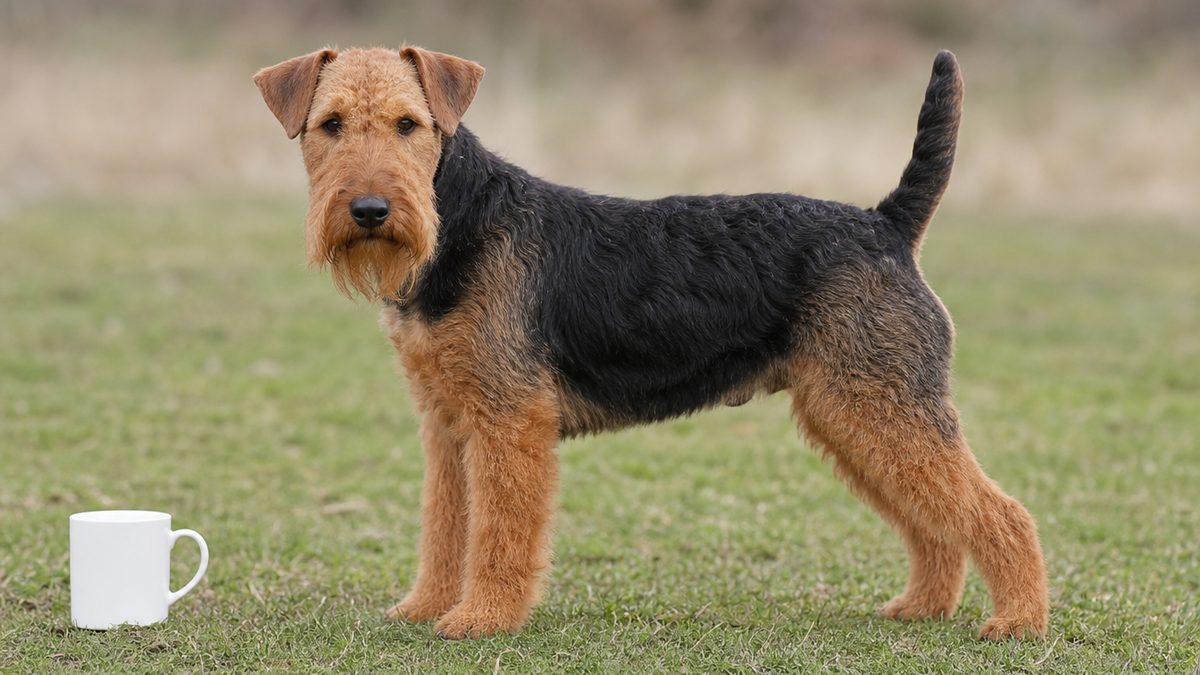
A Welsh Terrier is a compact, leggy, black-and-tan Welsh working terrier standing no more than 39 cm at the shoulder and weighing 9 to 9.5 kg, with a wiry, hard, very close and abundant coat and small V-shaped ears folded forward against the cheek.
The Royal Kennel Club's standard opens with four words: "Smart, workmanlike, well balanced and compact". What that describes is a square dog, and it is the first thing that separates the Welsh Terrier from the other five British terriers on this site. This is the tallest of the six and one of the lightest, at up to 39 cm and 9 to 9.5 kg, which makes it leggy where the Scottish, Sealyham, Skye and Cairn are all short-legged earth dogs.
The second separator is the colour. The standard asks for black and tan for preference, or black grizzle and tan, free from black pencilling on toes, and calls black below the hocks highly undesirable. The Royal Kennel Club's own colour register lists exactly one accepted entry for the breed: Black and Tan.
The measurable facts, in one place
| Attribute | Royal Kennel Club standard | Other sources | Measured or observed |
|---|---|---|---|
| Height | Not exceeding 39 cm (15 and a half ins) at shoulder | not stated by Google's panel | The tallest of the six British terriers here |
| Weight | 9 to 9.5 kg (20 to 21 lbs) | Google panel gives 9.1 to 10 kg | Close agreement |
| Coat | Wiry, hard, very close and abundant. Single coat undesirable | Registry prints Sheds: Yes, Coat length Medium | happypet.care prints Low Shedding, which contradicts the registry |
| Colour | Black and tan, or black grizzle and tan | Same | One accepted colour on the registry's own list |
| Ears | V-shaped, small, carried forward and close to cheek | Same | Folded drop ears, never erect |
| Characteristics | Affectionate, obedient and easily controlled | Royal Canin India paraphrases this exactly | Unusual language for a terrier standard |
| Life expectancy | Over 12 years (breed page) | Google panel gives 12 to 15 years | Median 13.8 years, 146 deaths |
| UK status | Vulnerable native breed: No (breed page) | The same club's table says otherwise | 190 registrations in 2025, below the 300 threshold |
Two rows deserve a second look. The characteristics row is genuinely unusual: most terrier standards use words like game, fearless and independent, and this one leads with affectionate, obedient and easily controlled. Royal Canin India's breed page paraphrases it almost word for word, calling the breed affectionate, obedient and easy to control. That is a real temperament difference and it shows in the trainability rating on this page.
The UK status row is a contradiction inside one organisation, and it is dealt with in full below.
A hardy, affectionate, obedient 9 kg black-and-tan working terrier with a harsh abundant coat that has to be hand stripped, the best measured lifespan of the six British terriers on this site after the Cairn, a very high prey drive, a movement disorder found in nearly a quarter of surveyed owners, and no Indian market.
The Welsh Terrier is a vulnerable native breed, and its own registry page says it is not
The Royal Kennel Club lists the Welsh Terrier in the VULNERABLE block of its ten-year native-breeds table at 190 registrations for 2025, and the same club's breed page prints Vulnerable native breed: No.
Take the definitions first, because most confusion here is a band error rather than a real contradiction. The Royal Kennel Club counts a native British or Irish breed as Vulnerable below 300 annual registrations and At Watch between 300 and 450. A breed at 365 is At Watch, and a registry saying Vulnerable: No about such a breed is simply correct.
That is not what is happening here. The Welsh Terrier recorded 190 registrations in 2025, which is 110 below the vulnerable threshold, and it appears in the VULNERABLE block of the club's own ten-year sheet, above the separate AT WATCH sub-heading rather than under it. Its breed page nonetheless prints Vulnerable native breed: No The Royal Kennel Club, Breeds A to Z.
| Year | Welsh Terrier | Scottish Terrier | Sealyham | Soft Coated Wheaten | Lakeland |
|---|---|---|---|---|---|
| 2016 | 401 | 454 | 113 | 326 | 220 |
| 2017 | 388 | 453 | 167 | 369 | 196 |
| 2018 | 325 | 438 | 107 | 307 | 139 |
| 2019 | 376 | 468 | 131 | 291 | 94 |
| 2020 | 412 | 466 | 153 | 243 | 145 |
| 2021 | 417 | 656 | 184 | 277 | 174 |
| 2022 | 397 | 584 | 138 | 168 | 135 |
| 2023 | 331 | 406 | 136 | 156 | 109 |
| 2024 | 218 | 387 | 100 | 130 | 86 |
| 2025 | 190 | 312 | 111 | 92 | 93 |
Read the Welsh Terrier column and the shape those registration figures make is unusually abrupt. The breed sat between 325 and 417 for eight straight years, which is At Watch territory, and then fell to 218 in 2024 and 190 in 2025. It has lost 52.6 percent of its annual registrations across the decade, and almost all of that fall happened in the last two years.
The Royal Kennel Club's per-breed Vulnerable native breed field is known to be unreliable, and it has been wrongly accused before. The test is the number. At 312 the Scottish Terrier is At Watch and its Vulnerable: No is correct. At 365 the Norfolk Terrier is At Watch and its Vulnerable: No is correct. At 190 the Welsh Terrier is squarely Vulnerable and appears in the vulnerable table itself, so its Vulnerable: No is wrong. Read the table, not the field.
The quarterly sheet gives a third independent document and it reconciles exactly: 43, 46, 64 and 37 across the four quarters of 2025, summing to 190. It also carries 2026 to date, and there the news is better: 61 in the first quarter and 48 in the second, or 109 across the half year against 89 in the same half of 2025. One half year is not a trend, and the direction is worth watching.
Where the Welsh Terrier came from, and what it was built out of
The Welsh Terrier was originally called the Welsh Black and Tan Rough Coated Terrier, and its own registry says Irish Terrier, Airedale and later Lakeland blood was used to reduce its size and refine its type.
The Royal Kennel Club's account is short and unusually specific about construction rather than legend. "An early name for the breed was the Welsh Black and Tan Rough Coated Terrier, and that is a very accurate description, now compressed into its present title".
It then names the ingredients: "The broken coated black and tan terriers of the 18th century were influential behind many terrier breeds and the huntsmen of Wales stayed true to this colour, adding Irish Terrier and Airedale and later the Lakeland to reduce size and add some refinement in the development of breed type". That is a registry describing its own breed as an engineered composite rather than an ancient landrace.
The work was pack work rather than solitary earth work: "The breed was used on fox, otter and badger and was often used by hunts, running alongside hounds". That matters for temperament, because a terrier that worked in company with a hound pack could not be as reflexively dog-aggressive as one sent alone down a hole, and it shows in the standard's line about being definitely not aggressive.
The first breed club formed in 1885 in Pwllheli, where the first breed show was held.
The age claim, and what the sources actually support
The Welsh Terrier attracts a claim about extreme antiquity. Royal Canin India's page puts it carefully: "In their homeland, Welsh Terriers are regarded as members of one of the oldest terrier breeds". Regarded as is doing the work in that sentence, and it is the honest formulation.
The registry's own account supports something narrower. It dates the influential black and tan broken-coated terriers to the eighteenth century, names three nineteenth-century breeds used in the modern dog's construction, and puts the first breed club at 1885. A type with eighteenth-century roots that was deliberately reshaped in the nineteenth is a real and interesting history. Claims of medieval records are not supported by anything on this page, and this guide does not repeat them.
Welsh Terrier price in India, and why the three figures do not agree
No verified welsh terrier price in india exists. Three Indian rupee figures circulate, they disagree by a factor of eleven at the floor, and each one turns out on inspection to be a template rather than an observation.
Page one of an India-located search for this breed's price is unusual in that it is mostly Indian. That does not make it more informative.
| Source | Figure printed | What it actually is |
|---|---|---|
| PetBuy.in | Rs 6,000 to Rs 25,000 | A template row shared with 7 other terriers, Listings 0 |
| happypet.care | Rs 30,000 to Rs 70,000 | A buying figure beside a monthly cost that is the sum of three preset lines |
| Supertails top-40 table | no entry | A 40-breed Indian price table that omits this breed entirely |
| Puppiezo (rank 5) | Rs 92,599 in the listing preview | The house carousel price, attached to a puppy named Dugu, which the same site lists as a Poodle |
| Mr n Mrs Pet (rank 2) | behind a sign-up wall | Zero Welsh Terriers. Its own counter shows 274 Beagles and 134 Cane Corsos |
| Royal Canin India (rank 7) | no figure | A manufacturer's breed page with no price at all |
| Dog Breeds List (rank 3) | USD 1,500 to 3,000 | A United States breeder price on an Indian query |
The two Indian bands disagree by a factor of five at the top and eleven at the floor, and they cannot both describe the same market. Publish the disagreement rather than averaging it, and then test each figure separately, which the next section does.
The carousel price, which is not a price
Puppiezo's Welsh Terrier product page ranks fifth, and the figure visible against it in search is Rs 92,599 attached to a puppy named Dugu. Dugu appears on the same site's other breed pages as a Poodle. That figure belongs to a carousel of whatever puppies the site currently has, and it has been recorded on this site attached to Maltipoos, Rottweilers, Doxiepoos, Cane Corsos and Goldendoodles. It is not any breed's price.
We will not average Rs 6,000 to Rs 25,000 against Rs 30,000 to Rs 70,000 and print a midpoint, and we will not convert the American dollar figures into rupees. An averaged template is still a template, and a converted foreign price is a foreign price with the units changed.
Testing both Indian price figures, and what each one turns out to be
PetBuy's band is a template row shared with seven other terriers, and happypet.care's monthly cost is the exact arithmetic sum of three preset component lines that the same site reuses across unrelated breeds. Neither is an observation of this breed.
PetBuy: one row, eight breeds
Thirteen PetBuy breed pages were pulled in one session, six of them breeds this guide covers and the rest controls.
| Breed page | Price band printed | Weight | Height | Live listings |
|---|---|---|---|---|
| Welsh Terrier | Rs 6,000 to Rs 25,000 | 4 to 10 kg | 20 to 35 cm | 0 |
| Scottish Terrier | Rs 6,000 to Rs 25,000 | 4 to 10 kg | 20 to 35 cm | 0 |
| Skye Terrier | Rs 6,000 to Rs 25,000 | 4 to 10 kg | 20 to 35 cm | 0 |
| West Highland White Terrier | Rs 6,000 to Rs 25,000 | 4 to 10 kg | 20 to 35 cm | 0 |
| Soft Coated Wheaten Terrier | Rs 6,000 to Rs 25,000 | 4 to 10 kg | 20 to 35 cm | 0 |
| Cairn Terrier | Rs 6,000 to Rs 25,000 | 4 to 10 kg | 20 to 35 cm | 0 |
| Norwich Terrier | Rs 6,000 to Rs 25,000 | 4 to 10 kg | 20 to 35 cm | 0 |
| Border Terrier | Rs 6,000 to Rs 25,000 | 4 to 10 kg | 20 to 35 cm | 0 |
| Golden Retriever (control) | Rs 15,000 to Rs 45,000 | 25 to 34 kg | 51 to 61 cm | 30 |
| Beagle (control) | Rs 10,000 to Rs 28,000 | 9 to 14 kg | 33 to 41 cm | 30 |
| Shih Tzu (control) | Rs 15,000 to Rs 45,000 | 4 to 8 kg | 20 to 28 cm | 30 |
Every breed the site stocks gets a distinct band, a distinct weight and thirty live listings. Every breed it does not stock gets the same band, the same weight and zero. Run the division tests on the band and none lands: Rs 6,000 divided by 84.38 is 71.11, at 74 it is 81.08, and at a flat 80 it is 75 against a Rs 25,000 quotient of 312.50, which no seller anywhere prints. The figures are rupee-native and arbitrary rather than converted.
happypet.care: the total is the sum of three preset lines
The second Indian figure is more interesting, because the site publishes its own working. Its Welsh Terrier page gives average monthly expenses of Rs 4,650 basic and Rs 6,600 premium, and further down the same page it gives the three components: monthly food Rs 2,250 to Rs 3,000, monthly health Rs 1,200 to Rs 1,800, and monthly grooming Rs 1,200 to Rs 1,800.
Do the arithmetic. 2,250 plus 1,200 plus 1,200 is 4,650. 3,000 plus 1,800 plus 1,800 is 6,600. The headline monthly cost is not an estimate of anything; it is the sum of three preset lines, printed to the rupee.
| Breed | Size label on the page | Monthly total, basic to premium | Food line |
|---|---|---|---|
| Welsh Terrier | Medium | Rs 4,650 to Rs 6,600 | Rs 2,250 to Rs 3,000 |
| Soft Coated Wheaten Terrier | Medium | Rs 4,650 to Rs 6,600 | Rs 2,250 to Rs 3,000 |
| Scottish Terrier | Small | Rs 3,300 to Rs 5,400 | Rs 1,200 to Rs 1,800 |
| Skye Terrier | Small | Rs 3,300 to Rs 5,400 | Rs 1,200 to Rs 1,800 |
| West Highland White Terrier | Small | Rs 3,300 to Rs 5,400 | Rs 1,200 to Rs 1,800 |
| Beagle (control) | Small | Rs 2,200 to Rs 3,750 | Rs 1,200 to Rs 1,800 |
| Labrador Retriever (control) | Large | Rs 4,900 to Rs 7,650 | Rs 3,000 to Rs 4,500 |
| Sealyham Terrier | no page | HTTP 404 | - |
Two things fall out of that table. The Beagle carries the identical Rs 1,200 to Rs 1,800 food line as the Scottish, Skye and West Highland White Terriers while sitting in a completely different total, which proves the rows are assembled from independent preset lines rather than copied whole. And the size label does not determine the row: the Beagle is labelled Small and gets Rs 2,200 to Rs 3,750 while the Scottish Terrier is labelled Small and gets Rs 3,300 to Rs 5,400.
Not necessarily. Rs 4,650 to Rs 6,600 a month is a plausible figure for a 9 kg dog in an Indian metro, and it is close to the independently built estimate later on this page. The point is that it is not a measurement of THIS breed. Nobody costed a Welsh Terrier; a template assigned it a tier. Treat it as a tier and check it against real Indian prices, which is what the cost section does.
Importing a Welsh Terrier into India, and what KCI papers do and do not prove
You can import a Welsh Terrier into India as your own pet and you cannot import one to breed from or to sell, because the Directorate General of Foreign Trade rejects those applications on their face.
Dogs enter India under ITC(HS) 01061900 as a Restricted import. Trade Notice 22/2022-23 of 19 December 2022 permits three routes only: a pet accompanying its owner with a valid pet book in the importer's name, research with a CPCSEA recommendation, and Defence or Police use. It states that applications for trading or breeding purposes shall be duly rejected, and limits entry to a short list of named ports.
That is the structural reason there is no Indian supply chain and no Indian price to quote. A commercial importer cannot bring in breeding stock, so any Welsh Terrier legally in India arrived as somebody's pet or descends from one that did.
KCI registration, and the one test to demand
India is a full member of the Federation Cynologique Internationale, represented by the Kennel Club of India in Chennai, so a KCI registration is a real pedigree document issued against international nomenclature. Two Indian sellers on page one advertise KCI papers for Welsh Terrier puppies they do not appear to haveMr n Mrs Pet, Welsh Terrier Puppies….
A KCI certificate proves parentage was recorded. It does not prove a single health test was done. For this breed there is one test the registry actually names, and it is cheap and definitive.
- Ask for the ADAMTS17 DNA result on both parents. The Royal Kennel Club lists a DNA test for primary lens luxation as Good Practice for this breed.
- Ask for hip scores. OFA records 13.0 percent dysplastic across 184 Welsh Terrier evaluations, which is not trivial for a 9 kg dog.
- Ask whether any dog in the line has had episodes of abnormal movement or muscle tone, because 22.8 percent of surveyed owners reported them and there is no test.
- Ask the age. Rule 8(1)(a) of the 2017 Rules requires that pups less than eight weeks in age are not sold.
- Verify the papers with the Kennel Club of India directly, not against a photograph of a certificate.
Rule 8(1)(a) of the Prevention of Cruelty to Animals (Dog Breeding and Marketing) Rules 2017 states that a breeder shall ensure that pups less than eight weeks in age are not sold. Several Indian sellers advertise 45-plus days old puppies, which is under seven weeks. Walk away from any seller offering a puppy under eight weeks, whatever the breed.
What a Welsh Terrier costs every month in India
Budget Rs 5,000 to Rs 9,000 a month for a 9 kg Welsh Terrier in an Indian metro, with grooming the line that decides where in that range you land and the line India is least equipped to supply.
Every figure below was read live from an Indian provider's own page on 8 September 2026. None is converted from a foreign currency and none is a template tier.
| Line | Basis | Per month |
|---|---|---|
| Dry food | Royal Canin Mini Adult, stated for dogs up to 10 kg, roughly 140 to 170 g a day | Rs 2,300 to Rs 3,200 |
| Tick and flea control | One monthly chewable in the small-dog weight band | Rs 700 to Rs 1,100 |
| Deworming | Drontal Plus at Rs 754 for 6 tablets, 1 tablet per 10 kg, quarterly | Rs 42 |
| Vaccination, amortised | Vetic annual booster from Rs 3,199 spread over 12 months | Rs 267 |
| Grooming | Vetic haircut from Rs 1,359 every 6 to 8 weeks, plus home brushing | Rs 900 to Rs 2,300 |
| Consultation and contingency | Two routine visits a year plus a reserve | Rs 600 to Rs 1,600 |
| Total | Rs 4,809 to Rs 8,509 |
Compare that with happypet.care's Rs 4,650 to Rs 6,600 and the two are close at the floor and apart at the ceiling. The difference is grooming. The template row allots Rs 1,200 to Rs 1,800 a month for grooming a wire-coated terrier; a single Vetic haircut is Rs 1,359 and this coat needs one every six to eight weeks plus home work in between.
The three-way vaccination spread, which is a delivery-model problem
- Government route. Greater Chennai Corporation's pet clinics provide all treatment and anti-rabies vaccination free of cost, and it issued 9,115 pet animal licences during 2024 at Rs 50 each.
- Private clinic route. Vetic lists anti-rabies from Rs 699, the 9-in-1 DHPPiL from Rs 899 and the full puppy course from Rs 6,499 against a struck-through Rs 8,111.
- Registration. Rs 500 for a new Municipal Corporation of Delhi pet dog registration and Rs 500 to renew, with a Rs 100 a month late fee.
- Microchipping. Rs 1,250 as a Chennai clinic's own transacted price.
The price of an identical vaccine in India is a function of the delivery model, not the drug, and a first-time owner budgeting from a national average will be wrong in both directions depending on city and route.
Can a Welsh Terrier handle the Indian climate?
A Welsh Terrier manages the Indian climate in Bengaluru and Pune and struggles everywhere hotter, because its home country's warmest month averages 15.52 degrees C and Chennai's May mean is six degrees above the hottest hour north Wales has recorded this century.
Every figure below comes from NASA POWER's 2001 to 2020 climatology, queried by explicit latitude and longitude, with the grid-cell elevation echoed back and checked. One divergence is worth naming rather than hiding: the Betws-y-Coed cell reads 251.15 m against a real elevation near 65 m, an error of 186 m, so the coastal Caernarfon cell at 68.13 m against a real 10 m is used as the north Wales baseline instead.
| Place | Cell elevation | Warmest month mean | Coolest month mean | Annual RH2M | Peak wet bulb |
|---|---|---|---|---|---|
| Caernarfon, north Wales | 68.13 m | 15.52 C (Aug) | 5.93 C (Feb) | 85.37 percent | 13.82 C (Aug) |
| Betws-y-Coed (upland, cell +186 m) | 251.15 m | 14.51 C (Jul) | 3.71 C (Feb) | 89.10 percent | 12.83 C (Aug) |
| Bengaluru | 841.72 m | 28.37 C (Apr) | 20.22 C (Dec) | 67.84 percent | 21.86 C (May) |
| Pune | 635.99 m | 28.93 C (Apr) | 19.62 C (Dec) | 66.68 percent | 22.97 C (Jun) |
| Mumbai | 97.15 m | 31.19 C (May) | 23.19 C (Jan) | 67.28 percent | 25.77 C (Jun) |
| Chennai | 48.95 m | 31.51 C (May) | 24.09 C (Jan) | 72.39 percent | 26.11 C (May) |
| Kolkata | 7.35 m | 31.53 C (May) | 17.31 C (Jan) | 73.84 percent | 27.09 C (Jun) |
| Delhi | 206.37 m | 35.88 C (Jun) | 13.61 C (Jan) | 45.51 percent | 26.50 C (Jul) |
The comparison that settles it: the hottest single value NASA POWER recorded at Caernarfon across twenty years is 25.52 degrees C, in July. Chennai's May mean is 31.51 degrees C. A typical Chennai May afternoon runs six degrees above the hottest hour this breed's homeland has produced this century.
Humidity is not the problem
The reflex claim about a Welsh breed in India is that the humidity will finish it. The measurement says otherwise. Caernarfon runs 85.37 percent annual relative humidity and Betws-y-Coed 89.10, both higher than Chennai's 72.39, Kolkata's 73.84, Mumbai's 67.28 and far higher than Delhi's 45.51. North Wales is genuinely wet and this dog is built for wet air.
What is new is heat, and heat plus humidity together, which is what the wet-bulb column measures because it is what limits a panting animal. Humid air does not stop a dog panting; humid air at 31 degrees does. Caernarfon peaks at 13.82 degrees C wet bulb. Kolkata peaks at 27.09.
The 25.52 C figure for Caernarfon is a PERIOD MAXIMUM, the single hottest value in the twenty-year record, not an average summer afternoon. A typical north Wales August day peaks in the high teens. That makes the comparison with Chennai stronger, not weaker.
City by city: Bengaluru and Pune are workable at April means near 28 to 29 degrees C and peak wet bulbs of 21.9 and 23.0. Mumbai, Chennai and Kolkata are hard, with wet bulbs between 25.8 and 27.1 for months. Delhi splits, brutal from May to July and genuinely comfortable in January at a 13.61 degrees C mean, which is close to a Welsh summer.
Managing a wiry coat through an Indian summer
Manage the heat by moving both walks outside the heat window, wetting the belly rather than clipping the jacket, and treating exertion as the real risk, because exertional cases were 652 of the 879 UK events with a recorded trigger.
The largest study available followed 905,543 UK dogs in primary veterinary care during 2016 and recorded 1,259 heat-related illness events from 1,222 dogs. Of the 879 events with a recorded trigger, 652, or 74.2 percent, were exertional, 113 environmental and 46 vehicular. The companion paper puts fatality among confirmed events at 14.18 percent.
Read that as an Indian owner should. The dog in the parked car is the story everyone tells and the smallest of the three categories. The dog that overheats is usually the one that went for a walk. For this breed there is a second reason to care, covered below: exercise is a documented trigger for its own movement disorder.
- Move both walks outside the heat window. Before 06:30 and after 20:00 from March to June in Chennai, Mumbai and Kolkata, and April to June in Delhi. Test the pavement with the back of your hand for five seconds first.
- Wet the belly, groin and feet, not the back. A wiry, hard, very close coat sheds water, so pouring it over the jacket does very little.
- Never clip the jacket to cool the dog. Clipping leaves the dead outer coat in place, exposes the undercoat, and grows the jacket back soft and open, so the next summer is worse.
- Keep sessions short and repeated. Two twenty-minute outings beat one forty-minute one in an Indian April, and the registry rates the requirement at up to an hour a day in total.
- Keep the dog lean. Bodyweight at or above the breed and sex mean carried an odds ratio of 1.42 for heat-related illness.
Second Schedule Part IV paragraph 21(1) of the Prevention of Cruelty to Animals (Dog Breeding and Marketing) Rules 2017 bars keeping in outdoor facilities, without the attending veterinary practitioner's written approval, dogs not accustomed to local temperatures and, in the gazette's own words, dog breeds that cannot tolerate the temperatures prevalent in the area or region in question, such as long-haired breeds in high temperature locations. A double-coated Welsh Terrier in an outdoor run through a Nagpur May is exactly the case described.
One thing the heat rating is not is a verdict on toughness. This is a hardy working dog that ran with hound packs after otter. It is heat-sensitive for the same reason it is weatherproof: the coat that made it useful in a Welsh winter is the coat it cannot take off in a Chennai May.
Temperament, and who should not buy this breed
The Welsh Terrier is the most biddable of the six British terriers on this site, and its own standard says so, calling it affectionate, obedient and easily controlled with a temperament that is happy and volatile.
The breed standard's characteristics clause is three words that no other terrier standard on this site uses: "Affectionate, obedient and easily controlled". Its temperament clause adds the balance: "Happy and volatile, rarely of shy nature. Game and fearless but definitely not aggressive although at all times able to hold his own when necessary."
Royal Canin India's breed page paraphrases the same thing for an Indian audience: affectionate, obedient and easy to control, naturally cheerful, full of life and rarely timid. Two independent sources describing the same dog the same way is worth more than either alone.
Volatile is the word to plan around
Volatile does not mean unstable. It means quick. A Welsh Terrier goes from asleep to fully committed in about a second, and back again almost as fast. It is an alert dog rather than an anxious one, and it is stubborn only in the narrow sense that a terrier watching a squirrel has stopped listening rather than decided to disobey. In a shared-wall Indian flat that shows up as a dog that reacts to the lift door, the delivery rider and the neighbour's cat at full volume, and then settles.
The registry's history explains why the aggression clause reads as it does. This breed ran with hound packs rather than working alone underground, and a terrier that had to tolerate a pack of hounds could not be reflexively dog-aggressive. That makes it easier with other dogs than most of its cousins, and no easier at all with squirrels.
Prey drive, in an Indian street
The Royal Kennel Club's own account says the breed was used on fox, otter and badger. An Indian city offers street cats, rats, squirrels and mongoose at a density no Welsh valley ever did, and a leggy 9 kg terrier is fast enough to catch several of them.
A Welsh Terrier does not go off lead in any unfenced Indian space, at any age, however good the recall looks at home. Use a long line if you want the dog to range.
An active household or a family with children over about six, in Bengaluru, Pune or a Delhi winter, that wants a small trainable dog with a large personality, is prepared to walk at dawn, will learn to strip a coat at home, and can tolerate a burst of barking at the lift door. Of the six British terriers on this site, this is the one most likely to suit a first-time terrier owner.
Training a Welsh Terrier, and the three things it will resist
To train a Welsh Terrier, take the standard at its word and expect a dog that genuinely works with you, then plan separately for the three situations in which the terrier overrides the training.
This is the one breed on this site whose standard promises obedience. Affectionate, obedient and easily controlled is the registry's own phrasing, and the training rating on this page reflects it. A Welsh Terrier learns quickly, holds behaviour under mild distraction, and enjoys the work.
None of that survives contact with a squirrel.
The three things it will resist, and what to do instead
- Recall away from prey. Do not train against a chase; you will lose. Train a stop-and-look on a long line, pay heavily at distance, and manage the environment so the chase never starts.
- Standing still to be groomed. A dog that will not stand for twenty minutes at eight months will never be hand stripped, and an unstripped Welsh Terrier becomes a clipped one for life. Handle the beard, legs and feet daily from week one.
- Quiet on arrival. The volatile temperament means the doorbell gets a response. Teach a go-to-mat that pays better than barking does, rather than trying to suppress the bark.
What to socialise, on an Indian timetable
Use the socialisation window deliberately. Between about three and sixteen weeks, and continuing well past it, arrange short calm positive exposures to auto-rickshaw horns, temple bells, firecrackers at low volume, lift doors, marble floors, monsoon rain on a tin roof, cattle, street dogs seen at a distance, and men in helmets. Feed through each one.
Add the grooming table as a deliberate exposure, because for this breed it is a health item rather than a cosmetic one. A stripped coat is a weatherproof coat, and a dog that fights the knife will not get one.
Teach a reliable leave it before anything else. In an Indian street the objects this dog wants include chicken bones, discarded food and a dead rat, and a terrier that will trade an object for a treat is far safer than one that guards it. This breed's biddability makes that easier to teach than in most terriers, so use the advantage.
How much exercise a Welsh Terrier actually needs
A Welsh Terrier needs up to an hour of exercise a day, split across two or three outings, and in an Indian summer that hour has to be taken before dawn and after dusk, with one extra reason specific to this breed.
The Royal Kennel Club rates the requirement at up to 1 hour per day and the home size need at a small house. That is a genuine hour for a leggy working terrier, and more than the Skye Terrier needs.
The extra reason to control intensity is the breed's own movement disorder. In the published case report, the trigger was exercise, and episodes arose 2.5 to 8 hours after exercise rather than during it. An owner running a Welsh Terrier hard in an Indian April and finding it rigid that evening will reasonably assume heatstroke. It may not be.
What the hour should contain
- Two walks of 20 to 25 minutes, on lead, at a pace the dog sets rather than one you set.
- Ten minutes of scent work indoors, which tires a terrier more than distance does. Hide food in a rolled towel or scatter it in a cardboard box.
- A sanctioned place to dig. A tray of sand or loose earth with a buried toy redirects a drive that cannot be trained away.
- Short bursts rather than sustained running, both for heat and because sustained exertion is the documented trigger for this breed's dyskinesia.
- No forced running on hot pavement. A 9 kg terrier beside a jogging owner in an Indian April is the exertional heat case the literature describes.
A wiry, very close, abundant coat holds water at the skin. After a wet walk, towel to the skin and use moving air, because a Welsh Terrier left to dry naturally in Mumbai in July stays damp under the jacket for hours, and that is where hot spots start.
Grooming a Welsh Terrier: strip the jacket, never clip it
Groom a Welsh Terrier by hand stripping the harsh jacket every six to ten weeks and brushing the furnishings to the skin two or three times a week, because clipping permanently softens a coat the standard requires to be wiry, hard and very close.
The Royal Kennel Club's breed page prints Grooming: More than once a week, Coat length: Medium and Sheds: Yes. The standard's coat clause is four adjectives and one warning: "Wiry, hard, very close and abundant. Single coat undesirable".
That last phrase is the one to hold on to, because it is what clipping destroys. A correct Welsh Terrier has a harsh outer jacket over a softer undercoat. A clipper cuts every hair at one length, leaves the dead outer coat in place and grows the jacket back soft, open and pale, which is a permanent change rather than a seasonal one.
An Indian page that disagrees with the registry
happypet.care's Welsh Terrier page prints Shedding Level: Low Shedding. The Royal Kennel Club prints Sheds: Yes. On the same breed, on the same day. The registry maintains the standard; the aggregator maintains a template.
| Task | Frequency | Why |
|---|---|---|
| Brush furnishings to the skin | 2 to 3 times a week | Beard, leg and skirt hair mats within days in humid air |
| Comb out the beard after every meal | Daily | Food and water sit in it and ferment in Indian heat |
| Hand strip or roll the jacket | Every 6 to 10 weeks | The only way to keep the coat wiry, hard and very close as the standard asks |
| Full bath | Every 6 to 8 weeks | More often strips coat oils and softens the jacket |
| Dry actively after any wet walk | Every time | A damp undercoat in a Mumbai July is where hot spots start |
| Check ears | Weekly | V-shaped ears folded against the cheek trap warm damp air |
| Nails | Every 3 to 4 weeks | Even a leggy terrier does not wear them down on Indian pavements |
Shaving to the skin removes the sun barrier, exposes pale skin under a black saddle to Indian UV, does not lower the dog's core temperature, and grows back soft and open so the following summer is worse. Clip the furnishings short if you must. Leave the jacket alone.
Can you get a Welsh Terrier hand stripped in India?
Almost certainly not. The mainstream Indian grooming chains sell haircuts, baths and styling, and hand stripping does not appear on their menus at any price, so plan to learn to roll the coat yourself.
Vetic operates one of the largest clinic-grooming networks in urban India. Its Delhi and Bengaluru grooming menus, read live on the same day, are identical: haircut from Rs 1,359 against a struck-through Rs 1,599, pet bathing from Rs 934 against Rs 1,099, and complete bath and styling from Rs 1,869 against Rs 2,199, with add-ons from Rs 99Vetic, Pet Grooming In Bengaluru. Hand stripping is not a line item on either.
That is a market fact rather than a criticism, and it has a direct consequence. The default outcome for a Welsh Terrier in India is a clipped dog, because a clip is what is on sale. Most Indian Welsh Terriers will therefore carry a softer, paler, more open coat than the standard describes, and their owners will never be told why.
What to do instead
- Learn to roll the coat yourself. Rolling means pulling a few dead hairs weekly rather than stripping the whole jacket twice a year. It needs a stripping knife, a rubber thumb and about fifteen minutes a week.
- Ask a groomer for furnishings only. Beard, legs and skirt tidied; jacket untouched. Most Indian groomers will do this if you ask specifically and show them the line.
- Accept a clipped dog if you must, and adjust the heat plan. A clipped Welsh Terrier needs stricter shade discipline, because you have removed part of its sun protection.
- Budget the two paths separately. A salon haircut every six to eight weeks runs Rs 900 to Rs 2,300 a month. Rolling at home costs a knife once and nothing after.
The saddle is black and the furnishings are tan, which is close to the ideal colouring for an Indian dust season. A Welsh Terrier hides mud and dust in a way a white Sealyham or West Highland White never will, and that is a real daily saving in laundry and bathing through an eight-month dry season.
Welsh Terrier health: what the screening registries actually show
The Welsh Terrier screens better than most terriers on eyes and worse than expected on hips, and its distinctive health problem, a paroxysmal dyskinesia found in nearly a quarter of surveyed owners, was only described in 2022.
Start with the registry data, because for once there is a reasonable amount of it.
| Database | Rank | Evaluations | Normal or clear | Carrier | Affected or abnormal |
|---|---|---|---|---|---|
| Primary lens luxation (DNA) | 12 of 22 | 511 | 78.7 percent | 20.7 percent | 0.6 percent |
| Degenerative myelopathy (DNA) | 25 | 149 | 70.5 percent | 22.1 percent | 7.4 percent at risk |
| Hips | 99 | 184 | 86.4 percent | 13.0 percent dysplastic | |
| Patella | 129 | 136 | 99.3 percent | 0.7 percent | |
| Eyes (summary line) | 199 | 174 | 97.7 percent | 2.3 percent | |
| Thyroid | 126 | 52 | 98.1 percent | 1.9 percent | |
| Congenital cardiac | 155 | 97 | 100.0 percent | 0.0 percent | |
| Dentition | 72 | 64 | 100.0 percent | 0.0 percent |
The hip row is the surprise. 13.0 percent dysplastic across 184 evaluations is a real figure for a 9 kg dog, broken down as 10.9 percent mild, 2.2 moderate and 0.0 severe, against 86.4 percent normal made up of 8.2 excellent, 59.2 good and 19.0 fair. The arithmetic checks: 8.2 plus 59.2 plus 19.0 is 86.4, and 10.9 plus 2.2 plus 0.0 is 13.1, which rounds to the 13.0 printed.
The eye numbers contradict each other, and both are printed
OFA's eye summary line says 97.7 percent of 174 evaluations were normal. Its own detail rows, on a denominator of 174, record NORMAL (OTHER .000) in 110 dogs, which is 63.2 percent, alongside distichiasis in 6 (3.4 percent) and persistent pupillary membrane findings in 28 and 26 dogs (16.1 and 14.9 percent).
A summary of 97.7 percent and a detail row of 63.2 percent on the same denominator cannot both be the rate of anything simple. Part of the gap is explicable, because the detail codes are not mutually exclusive and a breeder-option finding does not necessarily make a dog abnormal overall. The 34.5-point spread is still too wide to be rounding. Publish both, quote neither as the rate, and do the division yourself when a breeder shows you a certificate.
Everything in this health block is general information drawn from registry data and published studies. It is not a diagnosis. Take any Welsh Terrier with a suddenly painful or cloudy eye, a limp that does not resolve, or any episode of abnormal muscle tone or posture to your nearby veterinarian the same day.
The Welsh Terrier dyskinesia: common, recent, and almost unknown in India
A movement disorder specific to this breed was first characterised in 2022, and an owner survey found episodes consistent with it in 41 of 177 respondents, or 22.8 percent, with a median onset at just under five years.
Breed-specific paroxysmal dyskinesias are increasingly recognised in veterinary medicine, and the Welsh Terrier joined the list only in 2022. The study reviewed the clinical records of five affected Welsh Terriers and then surveyed owners of the wider breed population.
The numbers, in the authors' own figures:
- 41 of 177 survey respondents, or 22.8 percent, reported episodes consistent with a paroxysmal dyskinesia.
- Median age of onset was 59 months, which is just under five years, so this is a middle-aged-onset problem rather than a puppy one.
- Episodes were predominantly sustained hypertonicity with periods of limb flexion and abnormal head and body posture, with consciousness preserved.
- Episode duration ranged from 30 seconds to 30 minutes, with a median of 3 minutes 30 seconds, and frequency varied widely between dogs.
- Affected dogs showed a stable to improving clinical course in most cases.
- Clinical examinations and diagnostic investigations were within normal limits apart from mild to moderate ventriculomegaly on MRI in three dogs.
- The authors concluded that similar clinical signs within the breed were potentially consistent with an inherited cause, worthy of further investigation.
Why preserved consciousness is the fact that matters most
A dog having a seizure loses awareness. A dog having a paroxysmal dyskinesia does not. That single distinction is what tells an owner and a vet which of the two they are watching, and it is the reason this section exists on an Indian breed page.
An Indian owner whose five-year-old Welsh Terrier goes rigid on a hot evening has two plausible wrong conclusions available: heatstroke, because it is April, or epilepsy, because the dog is stiff and shaking. If the dog is responsive throughout, it is neither. Film it on a phone. A video is the single most useful thing you can bring to the consultation, and it is exactly what the 2022 study used.
The exercise trigger, and what worked in the published case
A separate 2021 case report describes a five-and-a-half-year-old, 9 kg spayed female Welsh Terrier with a twelve-month history of paroxysmal exertion-induced dyskinesia. Episodes were triggered by exercise, initially arising within two hours and lasting seven to ten minutes, later lasting twenty to thirty minutes and arising as long as 2.5 to 8 hours after exercise.
Treatment is the encouraging part. Intranasal diazepam at the start of an episode promptly alleviated the signs. Maintenance levetiracetam proved effective, and the dog was gradually returned to exercise. Attempts to wean the drug caused recurrence.
If you own a Welsh Terrier in India and it has episodes of stiffness or abnormal posture with preserved awareness, bring your nearby vet a phone video, the age of onset, the duration, and this reference: Whittaker DE, Volk HA, De Decker S, Fenn J, The Veterinary Journal 281, 105801, 2022. The disorder was described in 2022 and most clinicians anywhere will not have met it. The outlook in most reported dogs was stable to improving.
Primary lens luxation: real, well controlled, and settled by one swab
Between 18 and 21 percent of DNA-tested Welsh Terriers carry the ADAMTS17 mutation for primary lens luxation on two independent registries, and two clear-tested parents make an affected puppy impossible.
Primary lens luxation is an inherited failure of the ligaments that hold the lens in place. When the lens slips it causes a painful and potentially blinding emergency, and the gene was identified in 2010: a GT to AT splice donor site mutation at the 5 prime end of intron 10 of ADAMTS17, mapped to a 664-kilobase region of canine chromosome 3.
A multi-breed study the following year screened affected dogs from 30 breeds and found the same mutation in 14 additional breeds, most of them terriers or breeds with terrier co-ancestry.
| Register | Results published | Clear | Carrier | Affected |
|---|---|---|---|---|
| Royal Kennel Club, UK | 309 | 248 (80.3 percent) | 57 (18.4 percent) | 4 (1.3 percent) |
| Orthopedic Foundation for Animals, USA | 511 | 78.7 percent | 20.7 percent | 0.6 percent |
| OFA all-breed comparison | 17,639 | 70.2 percent | 27.9 percent | 1.9 percent |
| Sealyham Terrier, for contrast (OFA) | 634 | 58.2 percent | 40.1 percent | 1.7 percent |
The Royal Kennel Club figures were counted page by page out of the club's own 12-page per-dog register, and 248 plus 57 plus 4 sums exactly to 309, which is what makes them safe to publish. The two registers were compiled independently, in different countries, from different dogs, and they agree within 2.3 percentage points, which puts the carrier frequency in this breed genuinely between 18 and 21 percent.
Read the last two rows together. The Welsh Terrier's carrier rate is below the all-breed average of 27.9 percent, and less than half the Sealyham Terrier's 40.1 percent. This is a breed that has the mutation and has managed it well.
The usual rule is that a carrier of a recessive mutation is healthy. For this gene that is not quite true. The 2011 multi-breed study reported an increased risk of primary lens luxation associated with heterozygosity at ADAMTS17, concluding that carriers carry a low risk of developing the disease themselves. So a carrier Welsh Terrier is a dog whose eyes your nearby vet should look at annually, not one you can forget about.
The practical instruction is short. The Royal Kennel Club lists the DNA test as Good Practice for this breed, the test costs a fraction of one emergency lens removal, and two clear-tested parents make an affected puppy impossible. Ask for both results in writing before money changes hands.
How long a Welsh Terrier lives, measured rather than claimed
A Welsh Terrier's measured median lifespan is 13.8 years, with a 95 percent confidence interval of 13.5 to 14.6, from 146 recorded deaths among 570 UK dogs. That is sixth of the 23 Kennel Club terrier breeds in the same study.
The figure comes from the Dogs Trust life-table study, the largest breed-level survival dataset published. The Welsh Terrier's row in Supplementary Table S3 reads 570 dogs, 146 deaths, median 13.8, lower 95 percent CI 13.5, upper 14.6, hazard ratio 0.54 (0.46, 0.64), p less than 0.001 against a crossbred median of 12.0. Table S5 confirms the breed was analysed in its own right, so this is a Welsh Terrier figure and not a merged one.
The hazard ratio is the part most pages omit and the part that carries the meaning. A ratio of 0.54 means the risk of death at any point is about 46 percent lower than a crossbred dog's, and among the 23 Kennel Club terriers only the Border Terrier at 0.53 is lower. This is a genuinely long-lived dog.
| Rank | Breed | Median | 95 percent CI | Hazard ratio | Deaths |
|---|---|---|---|---|---|
| 1 | Border Terrier | 14.2 | 14.1 to 14.3 | 0.53 | 2,427 |
| 2 | Lakeland Terrier | 14.2 | 13.9 to 14.5 | 0.66 | 601 |
| 3 | Cairn Terrier | 14.0 | 13.8 to 14.3 | 0.60 | 1,139 |
| 4 | Norwich Terrier | 14.0 | 13.5 to 15.1 | 0.56 | 45 |
| 5 | Parson Russell Terrier | 13.8 | 13.5 to 14.0 | 0.68 | 1,176 |
| 6 | Welsh Terrier | 13.8 | 13.5 to 14.6 | 0.54 | 146 |
| 7 | Bedlington Terrier | 13.7 | 13.4 to 14.0 | 0.67 | 549 |
| 8 | Soft Coated Wheaten Terrier | 13.7 | 13.2 to 14.4 | 0.61 | 173 |
| 12 | West Highland White Terrier | 13.4 | 13.3 to 13.5 | 0.73 | 6,730 |
| 17 | Scottish Terrier | 12.7 | 12.5 to 12.9 | 0.84 | 869 |
| 19 | Skye Terrier | 12.4 | 11.6 to 13.9 | 0.93 | 39 |
The Welsh Terrier outlives the Scottish Terrier by 1.1 years and the Skye by 1.4, on samples large enough that the confidence intervals do not overlap. Against the Lakeland Terrier, which the Kennel Club says contributed to its development, it is 0.4 years behind on median but has the lower hazard ratio, at 0.54 against 0.66.
The two tables of the same paper disagree on cohort size
Table S3 gives 570 dogs. Table S6 of the same paper gives 430 alive plus 146 deceased, a total of 576. That six-dog discrepancy appears across many breeds in this study and has no published explanation. The death count is identical in both tables, which is why every claim here is built on 146 deaths and the median with its interval rather than on either cohort figure.
A median is not a promise. Half of the Welsh Terriers in that dataset died before 13.8 years and half after. The interventions on this page, the ADAMTS17 test, an Indian heat routine, keeping the dog lean, and recognising a dyskinesia rather than treating it as a seizure, are aimed squarely at the left half of that distribution.
The Indian health problems this breed will actually meet
In India a Welsh Terrier's day-to-day risks are tick-borne disease, heat, and skin trouble under a damp wiry coat, none of which appears on a British breed page.
The inherited conditions above are what the breed brings. These are what India adds.
Tick-borne disease, with the denominators stated
Indian surveys of dogs presented to veterinary clinics find tick-borne infection at rates a British owner would not recognise. A West Bengal study screened 584 dogs and reported *Babesia gibsoni* in 76.54 percent, *Anaplasma* in 55.75 percent, and two or more pathogens in 72.9 percent of the 584 dogs screened. A Kerala study of 120 dogs found *Babesia* in 66.7 percent, or 80 of 120, with a pre-monsoon peak from March to May.
Both studies sampled dogs brought to veterinary clinics, which are sicker on average than the general dog population. Say among dogs tested at veterinary clinics, never among Indian dogs. The figures still make the point: a monthly tick preventive is not optional in India, and the 72.9 percent co-infection figure is of the 584 screened, not of the infected.
A Welsh Terrier's dense abundant coat hides attachment sites and its black saddle hides engorged ticks. Use a monthly systemic preventive year-round rather than seasonally, and run your fingers to the skin after every walk in vegetation rather than looking.
An Indian page's health list, and what is missing from it
happypet.care's Common Health Issues for this breed reads: Hip Dysplasia, Kennel Cough, Lyme disease, Parasites, Rabies, Canine distemper, Canine Influenza, Leptospirosis. Seven of those eight are infectious diseases any dog of any breed can get, and two of them, Lyme disease and canine influenza, are not meaningful Indian risks at all.
What the list omits is everything this page has spent two sections on: primary lens luxation, which the Royal Kennel Club names as the breed's one recommended test, and the paroxysmal dyskinesia found in 22.8 percent of surveyed owners. A breed-specific health list that contains nothing breed-specific is a template, and an Indian buyer reading it learns nothing.
Skin and heat
The wiry undercoat stays damp for hours after a monsoon walk, and a damp warm layer against skin is where hot spots begin. Towel to the skin and use a fan. The V-shaped ears fold forward against the cheek, so check and dry them weekly through the monsoon.
On heat, exertional illness accounted for 652 of the 879 UK events with a recorded trigger, and 14.18 percent of confirmed heat events in the companion study were fatal. Neither study modelled Indian conditions, and both were run in a country whose peak wet bulb is 13 degrees below Kolkata's.
Feeding a Welsh Terrier in India
Feed a 9 kg Welsh Terrier roughly 140 to 170 g a day of a small-breed adult dry food, split into two meals, and weigh the dog monthly, because an abundant coat on a leggy frame hides weight change completely.
The breed sits at the top of the small-dog feeding band. Royal Canin Mini Adult, one of the most widely stocked options in Indian retail, is stated on its own product page as being for dogs up to 10 kg, which covers the standard's 9 to 9.5 kg exactlyThe Royal Kennel Club, Breed Standards.
For a cross-check, happypet.care's Indian page gives adult calories of 700 kcal a day and a monthly food cost of Rs 2,250 to Rs 3,000. That calorie figure is plausible for an active 9 kg dog, and the cost figure sits inside the range built independently from Indian retail prices in the cost section.
Life stage by life stage
- 8 to 16 weeks. Four meals a day of a small-breed puppy food. Do not free feed; a terrier puppy will eat until it stops.
- 4 to 6 months. Three meals a day. This is when Indian owners most often over-supplement calcium, which a small breed does not need and can be harmed by.
- 6 to 12 months. Two meals a day, moving onto adult food at around ten to twelve months for a small breed.
- Adult. Two meals a day, roughly 140 to 170 g of a small-breed dry food, adjusted to the dog rather than to the bag.
- Senior, from about 8 years. Keep the protein, cut the calories, and weigh monthly. This is also the age band in which the breed's dyskinesia typically appears, at a median onset of 59 months.
Body condition under an abundant coat
The standard's own word for the coat is abundant, and abundant hair on a leggy frame hides a waistline completely. You cannot assess this dog's weight by looking at it. Run your hands along the ribs: each rib should be findable under light pressure, like your own knuckles through the back of your hand. If you have to press, the dog is overweight.
Weight matters here for two reasons. Bodyweight at or above the breed and sex mean carried an odds ratio of 1.42 for heat-related illness in the UK cohort study, and OFA records 13.0 percent of tested Welsh Terriers as hip dysplastic, which extra weight makes worse.
Feed the second meal after the evening walk rather than before, so the dog is not exercising on a full stomach in heat. Change the water twice a day in summer, because a bowl standing in a Chennai flat is warm by afternoon and dogs drink less warm water. Skip milk entirely; adult dogs handle it poorly and Indian households offer it reflexively.
Indian law on buying, breeding and keeping this dog
Five provisions of the Prevention of Cruelty to Animals (Dog Breeding and Marketing) Rules 2017 apply directly to a Welsh Terrier in India, and the tail clause is the one that collides with the breed standard.
The Rules run 1 to 13 and are followed by a Second Schedule whose paragraphs are numbered continuously 1 to 30 across four Parts. Anything numbered above 13 that people call a Rule is a Second Schedule paragraph, which matters because a reader who looks up the wrong number finds nothing. Every clause below was read from the gazette itself.
| Provision | What it says | Why it applies here |
|---|---|---|
| Rule 8(1)(a) | Every breeder shall ensure that pups less than eight weeks in age are not sold | The floor under any purchase, and law rather than etiquette |
| Rule 8(1)(b) | Dogs over six months in age are not sold without first being sterilised, unless sold to another licensed breeder | Rarely quoted, and directly relevant to a rehomed adult |
| Second Schedule Part II para 6(3) | In breeding and incest breeding are prohibited, naming uncle to niece, nephew to aunt, cousin to cousin, grandparents to grandchildren, parents to children and brother to sister | A breed registering 190 dogs a year has a small gene pool, and this is the clause that limits how a breeder may manage it |
| Second Schedule Part II para 6(8) | There shall be no tail docking, ear cropping, de-barking, de-clawing, branding, dyeing, injecting substances to enhance visual appeal, and any change of appearance by artificial means is strictly forbidden | The breed standard still prints a Docked tail description. In India only the Undocked one is lawful |
| Second Schedule Part IV para 21(1) | Dogs not accustomed to local temperatures, and breeds that cannot tolerate them such as long-haired breeds in high temperature locations, shall not be kept in outdoor facilities without the attending veterinary practitioner's written approval | A double-coated Welsh Terrier in an outdoor run through an Indian summer is exactly the case described |
Two more clauses are worth knowing and are rarely quoted. Second Schedule Part II paragraph 6(4) states that female dogs shall not be mated after the age of eight years. And paragraph 8(10) requires that dogs have been tested for genetic defects including hip dysplasia, progressive retinal atrophy, night blindness, hypothyroidism, entropion, ectropion, overshot and undershot jaw, wry mouth, two or more missing teeth and cryptorchidism.
The hip clause bites here
Paragraph 8(10) names hip dysplasia explicitly, and OFA records 13.0 percent of 184 tested Welsh Terriers as dysplastic. That is one of the few places where Indian law and a breed's actual screening data line up, so ask for the hip score rather than a verbal assurance, and ask for the grade rather than a pass.
What the Rules do not contain
Searching the whole 51,953-character gazette with a whitespace-tolerant pattern returns zero occurrences of patella, zero of BAER and zero of deaf, and no mention of lens luxation or any DNA test. Indian law does not mandate the one test the Royal Kennel Club names for this breed. Do it anyway.
The first year with a Welsh Terrier puppy, month by month
Plan the first year around three fixed points: the socialisation window closing at about sixteen weeks, the grooming-table habit that has to be built before the dog is strong enough to argue, and the adolescent prey drive that arrives around six months.
| Age | What is happening | What you do |
|---|---|---|
| Before 8 weeks | Legally not for sale in India under Rule 8(1)(a) | Walk away from any seller offering a younger puppy |
| 8 to 10 weeks | Puppy comes home; vaccination course starts or continues | Four meals a day. Start the Vetic course or its equivalent, from Rs 6,499. Begin daily handling of beard, legs and feet |
| 10 to 16 weeks | The socialisation window is open and closing | Short calm exposures to horns, lifts, marble, monsoon rain on tin, cattle and helmets. Feed through each. Highest-value month of the year |
| 4 to 5 months | Teething; digging drive appears | Provide a sand tray. Teach leave it. Three meals a day |
| 5 to 6 months | Prey drive switches on properly | The long line goes on and never comes off in an unfenced space |
| 6 to 8 months | First real coat change; adolescent independence | Start rolling the jacket with a stripping knife, a few hairs at a time. Expect the recall to get worse before it gets better |
| 8 to 10 months | Adult jacket coming in harsh; sexual maturity | First proper hand strip or roll. Discuss neutering timing with your nearby vet rather than defaulting to six months |
| 10 to 12 months | Adult food; adult coat | Two meals a day. Establish the 6 to 10 week stripping cycle now, because a blown coat is far harder to recover than a maintained one |
The two mistakes that happen in month four
The first is stopping socialisation once the vaccination course finishes, because the window has effectively closed by then. Carry the puppy through busy places before it can walk them, which is safe and is what the window is for.
The second is skipping the grooming table until the coat needs stripping. A nine-month-old Welsh Terrier that has never been asked to stand still for twenty minutes will not start then, and an unstripped Welsh Terrier becomes a clipped one for life. One breeding fact belongs here too, if you are choosing a breeder rather than a puppy: the UK survey of caesarean rates across purebred litters shows how much intervention a breed's whelping normally needs, and small working terriers sit at the low end rather than among the breeds where surgical delivery is close to routine.
See the ADAMTS17 result for both parents in writing before money changes hands. Two clear parents make an affected puppy impossible. One untested parent means you are buying a dog that may need an emergency lens removal, and this is the one risk on the whole page that a swab removes entirely.
Welsh Terrier against the breeds Indian buyers actually choose between
An Indian buyer drawn to a Welsh Terrier is usually also looking at an Airedale, a Lakeland, a Scottish Terrier or a Beagle, and the four differ most on size, availability and measured lifespan.
| Welsh Terrier | Lakeland Terrier | Scottish Terrier | Beagle | |
|---|---|---|---|---|
| Height | Not exceeding 39 cm | Not exceeding 37 cm | 25 to 28 cm | 33 to 41 cm |
| Weight, home standard | 9 to 9.5 kg | About 7.7 kg | 8.5 to 10.5 kg | 9 to 14 kg |
| Median lifespan measured | 13.8 years | 14.2 years | 12.7 years | 12.5 years |
| 95 percent CI | 13.5 to 14.6 | 13.9 to 14.5 | 12.5 to 12.9 | 12.4 to 12.6 |
| Hazard ratio vs crossbred | 0.54 | 0.66 | 0.84 | 0.95 |
| Deaths behind the figure | 146 | 601 | 869 | 1,552 |
| UK registrations 2025 | 190 (Vulnerable) | 93 (Vulnerable) | 312 (At Watch) | not on either list |
| Coat work | Hand strip every 6 to 10 weeks | Hand strip | Hand strip | Weekly brush |
| Recommended pre-breeding test | PLL DNA test | none | none | not applicable here |
| Live Indian listings on the largest marketplace | 0 | 0 | 0 | 274 |
| Signature health risk | Paroxysmal dyskinesia, 22.8 percent of surveyed owners | Lens luxation | Bladder cancer, about 20x | Obesity and ear disease |
Read that as a buyer. On measured survival the Welsh Terrier is very strong. Its hazard ratio of 0.54 is the second lowest of all 23 Kennel Club terriers, and its median of 13.8 years beats the Scottish Terrier by 1.1 years on samples where the intervals do not overlap.
On screening it is the better of the Scottish-terrier alternatives, because it has a recommended pre-breeding test and the Scottish Terrier's row is blank in both columns of the same health standard.
On availability the comparison is not close. India's largest puppy marketplace lists 274 Beagles and zero Welsh, Lakeland or Scottish Terriers. If you want a small terrier in India within a month, none of the British breeds is the answer.
If your requirement is a small, trainable, long-lived terrier and you can wait, the Welsh Terrier is the pick of the six British breeds on this site: the best combination of measured lifespan, a named health test, and a standard that promises obedience. If you want a dog this year, the Beagle is the one actually for sale, and an adopted Indian dog is already adapted to the climate.
Eight mistakes Indian owners make with this breed
Eight mistakes come up repeatedly with wire-coated terriers in India, and seven of them are avoidable with information that is not on any page currently ranking for this breed.
- Averaging two template prices. Rs 6,000 to Rs 25,000 is one row printed for eight breeds with zero listings each, and Rs 4,650 to Rs 6,600 is the arithmetic sum of three preset lines. Neither is a measurement of this breedhappypet.care breed page for the Welsh….
- Mistaking a dyskinesia for a seizure or heatstroke. Consciousness is preserved throughout, the trigger can be exercise, and episodes can arise up to eight hours later.
- Buying without the ADAMTS17 result. One in five tested Welsh Terriers is a carrier, and carriers themselves carry a low but real risk of the disease.
- Skipping the hip score because the dog is small. OFA records 13.0 percent dysplastic across 184 evaluations, and Indian law names hip dysplasia in its pre-breeding testing clause.
- Shaving the dog for the summer. It removes the sun barrier, exposes pale skin under a black saddle, does not lower core temperature, and grows the jacket back soft so the next summer is worse.
- Believing the hypoallergenic label. Google's own panel prints Hypoallergenic: Yes while the breed's home registry prints Sheds: Yes, and the measured evidence found more Can f 1 in the so-called hypoallergenic group, not less.
- Trusting an Indian health list that names Lyme disease and canine influenza. Neither is a meaningful Indian risk, and the list omits both conditions the registries actually name for this breed.
- Walking at 5 pm in April because it looks cloudy. Exertional cases were 652 of 879 UK events with a recorded trigger, and Indian wet bulbs run 13 degrees above the ones in that study.
Most Indian Welsh Terriers will end up clipped rather than stripped, and their owners will never be told that this permanently changes the coat. The mainstream Indian grooming menus sell haircuts, baths and styling, and not one lists hand stripping. That is a market gap, not negligence, and the fix is to learn to roll the jacket at home.
Adoption and responsible sourcing
Adopt a Welsh Terrier if you can find one, and if you cannot, buy from a Kennel Club of India registered breeder you have verified with the club and who can show you an ADAMTS17 result for both parents.
This breed reaches Indian rescue rarely, because there are very few of them in the country to surrender. What does turn up regularly is a black-and-tan wire-coated terrier of uncertain parentage in a metro shelter, often described as a Welsh Terrier because of the colour and the beard. Those dogs are usually excellent pets and are almost never Welsh Terriers.
The adoption route, in order
- Ask the breed community first. A breed with 190 UK registrations a year and no Indian listings has a small owner network, and rehomed adults move inside it rather than through public listings.
- Register with metro shelters in Bengaluru, Pune, Delhi, Mumbai and Chennai, and describe the dog by coat type and colour rather than by breed name.
- Consider the adult rather than the puppy. An adult Welsh Terrier is past the median onset of nothing important, but its temperament, coat quality and gait are all already visible.
- Take the mixed-breed terrier seriously. A shelter dog with a harsh black-and-tan coat and a terrier temperament gives you the same personality, the same digging and the same alertness, at a fraction of the cost and already adapted to the Indian climate.
If you buy, verify these five things
- The puppy is at least eight weeks old, which is Rule 8(1)(a) of the 2017 Rules and not a preference.
- You have seen the dam with the litter, in the place the litter was raised.
- ADAMTS17 DNA results for both parents, in writing.
- Hip scores for both parents with the grade, not a pass.
- KCI papers verified with the club, not a photograph of a certificate, and an undocked tail, because docking is unlawful in India.
Every Indian seller on page one advertises Welsh Terrier puppies and shows none. PetBuy prints Listings 0. Puppiezo's visible price belongs to a Poodle named Dugu. Mr n Mrs Pet's own counter shows 274 Beagles and zero Welsh Terriers. A page that ranks for a breed it does not stock is an advertisement for a lead form, and the honest reading is that nobody visible in India has this dog for sale today.
Bonbeno does not broker puppy sales, does not recommend individual breeders and does not link to listings. Everything above is reported from published sources as editorial content. Adoption is the first route on this page because for this breed in this country it is genuinely the most likely one to work.
Welsh Terrier questions Indian buyers actually ask
Is a Welsh Terrier a good family dog?
A Welsh Terrier suits an active family with older children. Its own breed standard is unusually warm for a terrier, calling the breed affectionate, obedient and easily controlled, and describing a temperament that is happy and volatile, rarely of shy nature, game and fearless but definitely not aggressive. Volatile is the word to plan around in a household with a toddler.
Is a Welsh Terrier a good dog?
By the measured evidence, yes. Its median lifespan of 13.8 years is sixth of the 23 Kennel Club terrier breeds studied, and its hazard ratio against crossbred dogs is 0.54, among the three lowest of any terrier. It is the most trainable of the six British terriers on this site and its registry describes it as easily controlled.
Are Welsh Terriers high maintenance?
On grooming yes, on everything else no. The Royal Kennel Club prints Grooming: More than once a week, Sheds: Yes and Exercise: Up to 1 hour per day. The harsh jacket is hand stripped every six to ten weeks by someone who knows how, and no mainstream Indian grooming chain lists that service at any price, which is the real difficulty here.
How much do Welsh Terriers cost?
In India nobody can tell you, and the three published rupee figures disagree. PetBuy prints Rs 6,000 to Rs 25,000, a template row it gives eight small terriers with zero listings each. happypet.care prints Rs 30,000 to Rs 70,000. Supertails' 40-breed Indian price table omits the breed entirely. The American figure is 1,500 to 3,000 US dollars from a United States breeder, and India's most comprehensive published dog price table, covering 40 breeds and claiming to draw on Kennel Club of India registration data, does not list this breed at all.
Is the Welsh Terrier a vulnerable native breed?
Yes, and its own registry page says otherwise. The Royal Kennel Club counts a native breed as vulnerable below 300 annual registrations, the Welsh Terrier recorded 190 in 2025, and it appears in the VULNERABLE block of the club's own ten-year table. The same club's breed page prints Vulnerable native breed: No, which is a genuine contradiction rather than a band misreading.
How long does a Welsh Terrier live?
The measured median is 13.8 years, with a 95 percent confidence interval of 13.5 to 14.6, from 146 recorded deaths among 570 UK Welsh Terriers. That is above the Scottish Terrier at 12.7 and the West Highland White at 13.4, and slightly below Google's knowledge panel figure of 12 to 15 years.
What is the biggest health risk in a Welsh Terrier?
A breed-specific paroxysmal dyskinesia first characterised in 2022. An owner survey found episodes consistent with it in 41 of 177 respondents, or 22.8 percent, with a median onset at 59 months. Episodes are sustained hypertonicity with abnormal posture and preserved consciousness, lasting a median of three and a half minutes, and the course is stable to improving in most dogs.
Is the Welsh Terrier hypoallergenic?
No. Google's knowledge panel prints Hypoallergenic: Yes for this breed while the Royal Kennel Club's own page prints Sheds: Yes on the same day. The measured evidence sides with the registry: across 196 dogs of so-called hypoallergenic breeds against 160 controls, the hypoallergenic group carried more Can f 1 in hair and coat, not less.
Can a Welsh Terrier live in Chennai or Mumbai?
A Welsh Terrier can live in Chennai or Mumbai on a strict dawn-and-dusk routine, and it will never be comfortable there. Chennai's May mean of 31.51 degrees C is six degrees above the hottest single value recorded at Caernarfon in north Wales across twenty years. Bengaluru and Pune, peaking in April at 28.37 and 28.93 degrees C, are the realistic Indian cities.
How much does a Welsh Terrier cost per month in India?
Budget roughly Rs 5,000 to Rs 9,000 a month for a 9 kg dog in an Indian metro. The one Indian page that publishes a breakdown gives Rs 4,650 to Rs 6,600, but its figure is the arithmetic sum of three preset lines it reuses across unrelated breeds, so treat it as a template rather than a measurement.
What health tests should a Welsh Terrier breeder have done?
One is named by the registry and two more are worth asking for. The Royal Kennel Club lists a DNA test for primary lens luxation as Good Practice for this breed. Beyond that, ask for hip scores, because OFA records 13.0 percent dysplastic of 184 evaluations, and ask directly whether any dog in the line has had episodes of abnormal movement.
Can you import a Welsh Terrier into India?
Only as your own pet. Dogs sit under ITC(HS) 01061900 as a Restricted import, and the Directorate General of Foreign Trade's Trade Notice 22/2022-23 states that applications for trading or breeding purposes shall be duly rejected. A pet moving with its owner needs a valid pet book in the importer's name and entry through a named port.
Should a Welsh Terrier be clipped or hand stripped?
Hand stripped, and in India you will probably have to learn it yourself. The standard asks for a coat that is wiry, hard, very close and abundant, and adds that a single coat is undesirable. A clipper cuts every hair at one length, leaves the dead outer coat in place and grows the jacket back soft, open and pale, which is permanent rather than seasonal.
Is a Welsh Terrier or a Lakeland Terrier better for an Indian home?
The Lakeland Terrier lives longer on the measured evidence, at 14.2 years against 13.8, on 601 recorded deaths against 146. The two are closely related, since the Kennel Club credits Lakeland blood in the Welsh Terrier's development, and they present the same problem in India: a harsh coat that needs stripping in a country that does not sell the service.
Compare with similar breeds
Welsh Terrier sits in 1 Bonbeno group. Each one compares it directly against the breeds it is genuinely an alternative to, on the same figures.