
Dog breed profile
Soft Coated Wheaten Terrier Price in India, Health and Full Guide
A 46 to 49 cm Irish farm terrier in a soft silky coat that never changes with the season, whose own breed club ranks protein-losing kidney and gut disease as its number one health priority, and which India's largest breed directory lists as a small dog of 4 to 10 kg.
Quick answer
The published Soft Coated Wheaten Terrier price in India runs from Rs 6,000 to Rs 1,20,000, a spread of 20 times, and the cheapest of those figures sits on a page that also calls this 16 to 20.5 kg dog small and gives its weight as 4 to 10 kg. Two of the ten results for the Indian price query are books, one is a Persian cosmetics shop, and India's largest dog price table omits the breed entirely.
This guide summarises published registry data, breed standards, peer-reviewed veterinary literature and Indian government texts as general information for Indian pet owners. It is not a diagnosis and it is not treatment advice. Consult your nearby veterinarian before acting on anything you read here, and treat unexplained weight loss, chronic diarrhoea, swelling of the abdomen or limbs, excessive drinking and urination, or repeated collapse in this breed as something to be seen promptly, because those are the signs of the conditions this breed is genuinely predisposed to.
Soft Coated Wheaten Terrier at a glance
What a Soft Coated Wheaten Terrier actually is
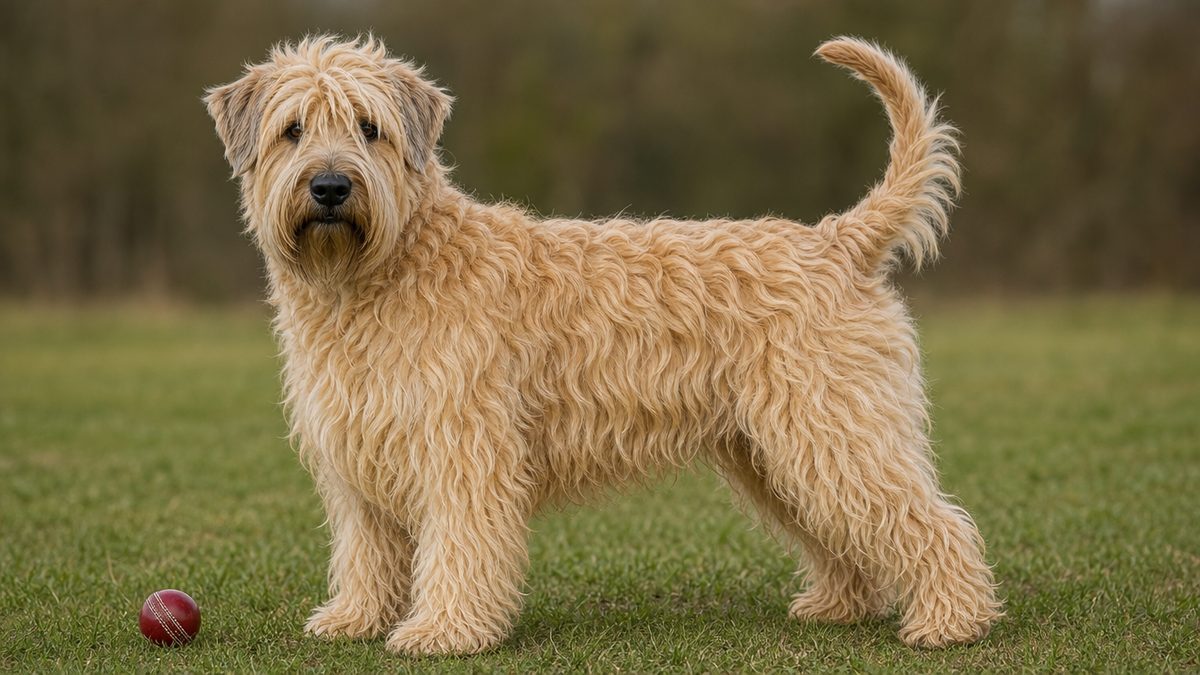
A Soft Coated Wheaten Terrier is a medium-sized Irish farm terrier standing approximately 46 to 49 cm at the withers and weighing 16 to 20.5 kg, covered in an abundant soft, silky, wheaten-coloured coat that falls in loose curls or waves and shows no seasonal change. It was used for hunting badger and otter, was recognised by the Irish Kennel Club in 1937 and by the Kennel Club in 1943, and is a Royal Kennel Club Vulnerable native breed.
The Royal Kennel Club's standard opens with one sentence that does most of the work: "Medium-sized, compact, upstanding terrier well covered with a soft, wheaten-coloured, natural coat that falls in loose curls or waves";. Two words in that sentence are load-bearing. Medium-sized, because India's largest breed directory files this dog as small. And natural, because the standard goes on to say that over-trimming or stylising should be penalised.
The characteristics clause is one line and it is worth quoting too: "A natural terrier with strong sporting instincts, hardy and of strong constitution";. Hardy is a working word rather than a marketing one, and it is the reason this breed survived four decades of rising registrations before the recent fall. The temperament clause is warmer than almost any other terrier standard in the book. It reads: "Good tempered, spirited and game. Full of confidence and humour; a delightful, affectionate, intelligent companion";. Humour is not a word the Scottish Terrier standard uses. It is the reason this breed is sold as the family terrier.
What the breed standard measures, and where India's pages disagree
| Attribute | Royal Kennel Club standard | Independent confirmation | What Indian pages print |
|---|---|---|---|
| Height | Approximately 46 to 49 cms (18 to 19 and a half ins), bitches slightly less | PDSA gives 46 to 49 cm; Google's India panel gives 46 to 48 cm for a male | PetBuy prints 20 to 35 cm. AsiaPets prints 43 to 51 cm |
| Weight | Approximately 16 to 20.5 kgs (35 to 45 lbs), bitches somewhat less | PDSA gives 16 to 20.5 kg; Google's panel gives 16 to 18 kg male, 14 to 16 female | PetBuy prints 4 to 10 kg. AsiaPets prints 14 to 20 kg |
| Size class | Medium | PDSA files it under Medium Dogs; the registry prints Size: Medium | PetBuy prints Small. happypet.care correctly prints Medium Breed |
| Coat | Soft and silky, neither woolly nor wiry, loosely waved or curly, no seasonal change in the mature coat | Wikipedia records two types, Irish and Heavy, the Irish being silkier and wavier | Not described in texture by any Indian page |
| Colour | A good clear wheaten, any shade of ripening wheat. A white coat and a red coat equally undesirable | Registry colour list: Blonde, Brown, Wheaten. Colour Watch Category 0 | AsiaPets says any shade from pale gold to warm honey, which is close |
| Grooming | Over-trimming or stylising should be penalised | Registry prints Grooming: Every day | happypet.care says brushing daily, professional grooming every 6 to 8 weeks |
| Life expectancy | Over 12 years on the breed page | Measured median 13.7 years; the breed club says 13 to 14 | PetBuy prints 10 to 13. AsiaPets prints 12 to 14 |
| UK status | Vulnerable native breed: Yes | 92 registrations in 2025, against a 300 threshold | No Indian page mentions it |
The weight row is not a rounding difference. It is a different animal. PetBuy's page for this breed prints Small, 4 to 10 kg and 20 to 35 cm, against a registry standard of 16 to 20.5 kg and 46 to 49 cm that PDSA reproduces to the decimal. A 7 kg dog and a 19 kg dog do not eat the same food, take the same drug dose, need the same crate, cost the same to groom or sell for the same money. Every downstream number on that page inherits the error.
For fairness, one Indian page gets it right. AsiaPets prints 14 to 20 kg and 43 to 51 cm, which is within a whisker of the standard. It is also the page that quotes the middle of the three Indian prices, which is not a coincidence: getting the dog right and getting the price plausible tend to travel together.
Where it came from, and what that still means
The Royal Kennel Club's own history is short and useful. The Wheaten was used for hunting badger and otter, some claim it to be an ancestor of the Irish Terrier and the Kerry Blue, and it was recognised by the Irish Kennel Club in 1937 and by the Kennel Club in 1943. Purina's Indian breed page dates the type to more than 200 years ago in Ireland as an all-purpose farm dog. All-purpose is the operative phrase: this was the dog that herded, guarded, killed vermin and lived in the kitchen, which is why it is more biddable than a specialist earth terrier.
A confident, funny, 46 to 49 cm Irish farm terrier in a soft silky coat that never sheds out for summer, with the best temperament clause of any terrier standard, a measured median lifespan of 13.7 years, a serious familial kidney and gut disease its own breed club ranks first, only 92 UK registrations in 2025, and no Indian market at all.
Lifespan, and the three sources that agree for once
The measured median lifespan of a Soft Coated Wheaten Terrier is 13.7 years, with a 95 percent confidence interval of 13.2 to 14.4 years, from 173 recorded deaths among 620 UK dogs. The hazard ratio against crossbred dogs is 0.61, a 39 percent lower hazard of death at any age. The breed's own club independently puts the average at 13 to 14 years.
The primary figure comes from the 2024 Dogs Trust and Royal Veterinary College analysis of 584,734 UK dogs published in Scientific Reports. Its Supplementary Table S3 gives the Soft Coated Wheaten Terrier 620 dogs, 173 deaths, a median of 13.7 years, bounds of 13.2 and 14.4, a hazard ratio of 0.61 with an interval of 0.53 to 0.71, and a p value below 0.001.
The first two columns of Supplementary Table S3 have blank headers. Column one is the total number of dogs and column two is the number of deaths. Reading column one as deaths overstates every sample by two to four times. For this breed the difference is 620 against 173, and quoting 620 deaths would make the median look far better evidenced than it is.
Three independent sources agree here, which is rare on this site. The study says 13.7 with a range of 13.2 to 14.4. The Soft-Coated Wheaten Terrier Club of Great Britain says the average lifespan is 13 to 14 years. Google's India panel says 12 to 15. Where the Westie page has to correct a marketing range and the Skye page has to hedge a 2.3-year confidence interval, this one can simply state the number.
How the six British and Irish terriers compare, on the same table
| Breed | Dogs in cohort | Recorded deaths | Median lifespan | 95 percent CI | Hazard ratio |
|---|---|---|---|---|---|
| Welsh Terrier | 570 | 146 | 13.8 years | 13.5 to 14.6 | 0.54 |
| Soft Coated Wheaten Terrier | 620 | 173 | 13.7 years | 13.2 to 14.4 | 0.61 |
| West Highland White Terrier | 11,932 | 6,730 | 13.4 years | 13.3 to 13.5 | 0.73 |
| Sealyham Terrier | 125 | 33 | 13.1 years | 12.3 to 16.0 | 0.58 |
| Scottish Terrier | 1,747 | 869 | 12.7 years | 12.5 to 12.9 | 0.84 |
| Skye Terrier | 91 | 39 | 12.4 years | 11.6 to 13.9 | 0.93 |
| Crossbred dogs, for reference | 111,053 | 72,445 | 12.0 years | 12.0 to 12.1 | 1.00 |
Second of six on the median and second on the hazard ratio. A 1.7 year advantage over a crossbred dog, measured on 173 deaths. The 1.2-year confidence interval is wider than the Westie's 0.2 years because the sample is nineteen times smaller, so treat 13.7 as a good central estimate rather than a precision figure.
The study's supplementary file also records how the breed was handled. Table S5 flags it Y for inclusion in the survival analysis, leaves the phylogeny reclassification column as NA so it was not merged into a related breed, and files it as Kennel Club group Terrier, body size Medium, cephalic index Mesocephalic. Two of those matter later: Medium contradicts India's largest breed page, and Mesocephalic means the airway is normal, which is good news for the heat section.
An older and independent mortality picture exists in the breed's Kennel Club health plan. The 2004 Kennel Club health survey recorded 111 deaths in the breed with a median age at death of 12 years and 6 months, a minimum of 6 months and a maximum of 17 years, and the most frequently reported causes were cancer at 26.1 percent of 111 deaths, old age at 20.7 percent, uncodeable other at 9 percent and urologic causes at 8.1 percent. Urologic causes appearing in the top five of a breed's death list is the signal this whole page is built around.
Soft Coated Wheaten Terrier price in India, and the five results Google can find
Published Indian prices for a Soft Coated Wheaten Terrier run from Rs 6,000 to Rs 1,20,000, a spread of 20 times. The cheapest figure sits on a page that describes the wrong animal. Google can find only five results for the query at all, and two of them are books. Budget Rs 80,000 to Rs 1,50,000 if you genuinely intend to source one, and expect to import.
Start with the result page itself, because on this breed the SERP is the finding. Fetched live on 8 September 2026 with a Labrador control in the same session, Google India returned five web results for the price query and then printed, verbatim, that in order to show the most relevant results it had omitted some entries very similar to the five already displayed, and separately that in response to a legal request it had removed one result.
| Position | Domain | What it actually is | Price shown |
|---|---|---|---|
| 1 | asiapets.in | A classifieds page for Dharmanagar, Tripura | None in the snippet |
| 2 | amazon.in | A book, The Soft Coated Wheaten Terrier: Coat of Honey | Rs 3,215.98 |
| 3 | flipkart.com | A second book, The Soft Coated Wheaten Terrier Dog Journal | Not shown |
| 4 | etsy.com | Merchandise: a mug and a shirt | Rs 1,358 mug, Rs 1,300 shirt |
| 5 | bayunstore.com | A Persian-language cosmetics and clothing shop, og:locale fa_IR | US$ 36 |
Two of five results are books and one is a mug. The fifth deserves its own sentence: bayunstore.com carries a Google snippet reading Puppies For Sale In India At Best Prices with a price of US$ 36, and when fetched live the domain serves a Persian-language cosmetics and women's clothing storefront priced in Iranian toman, with no dog content of any kind. At roughly Rs 3,200, that dollar figure is also less than Amazon.in charges for the book about the breed.
The three Indian rupee figures, and what is wrong with each
| Source | Printed price | Weight it states | Why it is not a price |
|---|---|---|---|
| PetBuy.in | Rs 6,000 to Rs 25,000 | 4 to 10 kg, Small | A template row. The identical band, weight and height appear on its Scottish, Skye, Welsh, West Highland White, Cairn, Norwich and Border Terrier pages, all with Listings 0. The weight is wrong by a factor of two to four |
| AsiaPets.in | Rs 35,000 to Rs 70,000 | 14 to 20 kg | The only Indian page with roughly correct size figures, and therefore the most credible band. Still no method, no date and no sample |
| happypet.care | Rs 80,000 to Rs 1,20,000 | Medium Breed | No method, no date, no sample. Its monthly figure on the same page is the arithmetic sum of three preset lines it reuses on the Welsh Terrier page |
| Supertails 40-breed table | not listed | not listed | Claims to draw on breeder networks and Kennel Club of India registration data across 40 breeds. It does not contain this breed |
| PDSA, United Kingdom | GBP 80 a month minimum | 16 to 20.5 kg | A running cost rather than a purchase price, from a veterinary charity with nothing to sell. The most trustworthy number on the list |
The PetBuy band deserves the same treatment we gave it on the other terriers. We pulled thirteen of the site's breed pages in one session: eight small terriers share the identical Rs 6,000 to Rs 25,000 band, the identical 4 to 10 kg and the identical 20 to 35 cm, all with Listings 0, while the Golden Retriever, which the site actually stocks, gets Rs 15,000 to Rs 45,000, 25 to 34 kg and 30 live listings. On this breed the template does extra damage, because the Wheaten is not a small terrier and the row is describing a dog that does not exist.
What the AsiaPets listing pages actually contain
AsiaPets is the only Indian domain on the price result set that sells dogs, so it is worth checking whether it sells this one. A site-restricted search found the breed's name in the filter list on city and state pages across at least eight regions, from Mizoram and Uttarakhand to Nalgonda, Pithoragarh, Bharatpur, Hassan, Hisar and Jammu and Kashmir. Every one of those pages shows Yorkshire Terriers in its actual listing cards. The breed exists in the site's dropdown, not in its inventory.
A genuine Soft Coated Wheaten Terrier in India means an import, because 92 dogs were registered in the whole of Britain in 2025 and no Indian breeding base exists. That means an export pedigree naming both parents, a rabies titre, health certification and a DGFT-compliant consignment. Priced honestly, that lands above happypet.care's Rs 1,20,000, not below PetBuy's Rs 25,000. Anyone offering this breed for Rs 25,000 in India is offering something else.
For a benchmark that does exist, India's 40-breed price table prices the Scottish Terrier, the nearest comparable rare terrier, at Rs 30,000 to Rs 80,000, and prices an Indie or street dog, adopted, at Rs 0 to Rs 3,000 with the highest popularity rating of all forty entries. Those two numbers bracket the honest range of what an Indian household actually pays for a dog.
Monthly cost of owning a Wheaten in India
Budget Rs 8,000 to Rs 14,000 a month for a Soft Coated Wheaten Terrier in an Indian metro. Food for an 18 kg dog runs Rs 3,500 to Rs 6,000, professional grooming at Vetic's published Rs 1,869 is needed every six to eight weeks on top of daily combing at home, and the annual vaccination booster is Rs 3,199. The grooming line is what makes this breed dearer to run than any other terrier on this site.
Every rupee figure below was read off a live Indian price page on 8 September 2026 rather than estimated, and each is attributed.
| Item | Published price | Source | Frequency for this breed |
|---|---|---|---|
| Puppy vaccination course | From Rs 6,499 (listed Rs 8,111) | Vetic, national | Once, in the first four months |
| Annual booster | Rs 3,199 (listed Rs 3,806) | Vetic, national | Yearly |
| Anti-rabies, single | Rs 699 | Vetic, national | Yearly, or free at a Greater Chennai Corporation clinic |
| 9-in-1 DHPPiL | Rs 899 | Vetic, national | As per the schedule |
| Kennel cough | Rs 1,349 | Vetic, national | Yearly if the dog boards or meets other dogs |
| Full bath and styling | Rs 1,869 (listed Rs 2,199) | Vetic Delhi and Bengaluru, identical | Every 6 to 8 weeks. The largest single line for this breed |
| Haircut only | Rs 1,359 (listed Rs 1,599) | Vetic Delhi and Bengaluru | Between full grooms if the coat mats |
| Bathing only | Rs 934 (listed Rs 1,099) | Vetic Delhi and Bengaluru | Monthly. A soft coat needs drying to the skin every time |
| Deworming, Drontal Plus | Rs 754 a strip of 6, MRP Rs 838 | Supertails | Quarterly. At one tablet per 10 kg an 18 kg dog takes TWO tablets a dose |
| Microchipping | Rs 1,250 | SKS Veterinary Hospital, Chennai | Once |
| Municipal licence, Delhi | Rs 500 new and Rs 500 renewal | MCD portal | Yearly, Rs 100 a month late fee |
| Municipal licence, Chennai | Rs 50 | Greater Chennai Corporation | Yearly |
Two of those rows behave differently on this breed. The deworming line doubles, because Drontal Plus is dosed at one tablet per 10 kg and an 18 kg Wheaten takes two tablets a dose where an 8 kg Westie takes one. And the grooming line is not optional, because the registry prints Grooming: Every day for this breed and the coat mats if it is left.
Vetic's grooming prices are identical in Delhi and Bengaluru, down to the rupee and down to the struck-through list price Vetic, Pet Grooming In Bengaluru. That is a national rate card, so a page telling you grooming costs more in Mumbai than in Pune is guessing. Municipal veterinary care is cheaper than most owners assume: Chennai charges Rs 50 for a licence, states that its pet clinics provide all treatment and anti-rabies vaccination free of cost, and issued 9,115 pet animal licences during 2024, while Delhi charges Rs 500 to register and Rs 500 to renew with a Rs 100 a month late fee.
Why we do not use happypet.care's Rs 4,650 to Rs 6,600
happypet.care publishes a monthly cost of Rs 4,650 basic and Rs 6,600 premium for this breed, built from food at Rs 2,250 to Rs 3,000, veterinary at Rs 1,200 to Rs 1,800 and grooming at Rs 1,200 to Rs 1,800. Those three lines sum exactly to the printed totals, which is the giveaway: the total is arithmetic on presets, not an observation. The identical three lines and the identical totals appear on its Welsh Terrier page, a breed 9 kg lighter with a completely different coat.
The grooming preset is the one that fails hardest here. Rs 1,200 a month does not buy a Wheaten's grooming in India. One full bath and styling at Vetic's own published Rs 1,869 already exceeds it, and this breed needs one every six to eight weeks plus a bath in between. A realistic Indian grooming line for this coat is Rs 1,500 to Rs 2,500 a month once you average the visits, before you buy a single comb.
Owner combs daily at home, professional groom every eight weeks: about Rs 8,000 to Rs 10,000 a month. Professional groom every six weeks with monthly baths: Rs 11,000 to Rs 14,000. Add a diagnosed protein-losing condition, with prescription diet, repeat urine protein-to-creatinine testing and medication, and the figure moves past Rs 20,000. PDSA's British minimum of 80 pounds a month for this breed is roughly Rs 8,800 at the time of writing, which lines up with our lower tier.
One saving is real. The breed's caesarean rate is genuinely low, at 5.13 percent of 39 registered litters in 2019 against an all-breed Kennel Club figure of 15.70 percent in the same year, and it has been below the all-breed rate every year since reporting improved in 2012. That matters to a breeder rather than a pet owner, but it is one of the few places where this breed's numbers are unambiguously good.
Heat tolerance and the Indian climate
A Soft Coated Wheaten Terrier tolerates Indian heat poorly, and the coat is the reason rather than the airway. Its breed standard states there is no seasonal change in the length or texture of the mature coat, so this dog never thins out for summer. Ireland's warmest month averages 15.1 degrees C. Bengaluru and Pune are workable on dawn and dusk walks; Chennai, Mumbai and Kolkata are hard.
The figures below come from NASA's POWER climatology dataset, queried point by point for 2001 to 2020 monthly means, with the grid-cell elevation echoed back and compared against each place's real elevation so a hill cell cannot masquerade as a city. The wet-bulb column is the one that matters for a dog, because a dog cools by evaporating water from its airway and a high wet-bulb temperature is exactly the condition where that stops working.
| Place | Grid-cell elevation | Warmest month mean | Coolest month mean | Mean relative humidity | Peak wet-bulb |
|---|---|---|---|---|---|
| Dublin, Ireland | 46.03 m | 15.11 degrees C in July | 5.62 degrees C in February | 87.64 percent | 13.42 degrees C |
| Killarney, Ireland | 142.94 m | 14.73 degrees C in July | 5.58 degrees C in February | 88.99 percent | 13.14 degrees C |
| Bengaluru | 841.72 m | 28.37 degrees C in April | 20.22 degrees C in December | 67.84 percent | 21.86 degrees C |
| Pune | 635.99 m | 28.93 degrees C in April | 19.62 degrees C in December | 66.68 percent | 22.97 degrees C |
| Mumbai | 97.15 m | 31.19 degrees C in May | 23.19 degrees C in January | 67.28 percent | 25.77 degrees C |
| Delhi | 206.37 m | 35.88 degrees C in June | 13.61 degrees C in January | 45.51 percent | 26.50 degrees C |
| Chennai | 48.95 m | 31.51 degrees C in May | 24.09 degrees C in January | 72.39 percent | 26.11 degrees C |
| Kolkata | 7.35 m | 31.53 degrees C in May | 17.31 degrees C in January | 73.84 percent | 27.09 degrees C |
The POWER grid cell covering Killarney reports an elevation of 142.94 m against a real town elevation nearer 30 m, an overshoot of 113 m that pulls its temperatures slightly cool. We report it rather than hide it. Dublin's cell is only 26 m high, so the Dublin row is the one to lean on, and it still sits 16.4 degrees C below Chennai's warmest month.
The coat is what separates this breed from every other terrier on this site. The standard states, in the coat clause, that there is no seasonal change in the length or texture of the mature coat. A double-coated dog such as the West Highland White or the Scottish Terrier drops its undercoat as the weather warms, which is a crude but real seasonal adjustment. A Wheaten does not. The abundant soft coat it wears in a Dublin February is the same coat it wears in a Chennai May.
happypet.care, to its credit, prints an ideal weather range of 15 to 24 degrees C for this breed. That range is met in Bengaluru only in December and January and is never met in Chennai in any month of the year, since Chennai's coolest month averages 24.09 degrees C. It is the most useful sentence on any Indian page about this dog and nobody follows it to its conclusion.
What works in the breed's favour
Three things. It is mesocephalic, filed that way in the study's own supplementary table, so it has a normal muzzle and a normal airway rather than the compressed one that makes a Pug a genuine heatstroke case. It is moderate in mass at 16 to 20.5 kg, and bodyweight at or above the breed and sex mean carried an odds ratio of 1.42 for heat-related illness in a study of 905,543 UK dogs. And its exercise requirement is genuinely modest at up to an hour a day, so the walking can be moved entirely into the cool hours without shortchanging the dog.
The same UK research corrects the assumption most Indian owners start from. Of 1,259 heat-related illness events with a recorded trigger, 652 of 879, or 74.2 percent, were exertional rather than environmental. Dogs do not mostly overheat in parked cars. They overheat on walks, and a happy, confident, game farm terrier will not tell you when to stop.
Walk before 6.30 am and after 7.30 pm from March to October. Keep the dog indoors with a fan or air conditioning through the afternoon. Comb the coat every day, because a matted soft coat traps heat and moisture against the skin far worse than a clean one. Never shave the coat to cool the dog: the standard penalises over-trimming and a shaved Wheaten loses its sun barrier without gaining cooling. And treat heavy panting at rest indoors as a reason to call your nearby veterinarian.
One Indian factor has nothing to do with temperature. Tick-borne disease is heavy in the humid states: a West Bengal survey of 584 dogs screened at veterinary clinics reported Babesia gibsoni in 76.54 percent and two or more pathogens in 72.9 percent, and a Kerala survey of 120 dogs found Babesia in 66.7 percent with a pre-monsoon March to May peak. An abundant wavy coat hides ticks better than any other coat on this site, so a daily comb is a tick check as much as a grooming session.
Temperament and household fit
A Soft Coated Wheaten Terrier is good tempered, spirited and game, full of confidence and humour, in the words of its own breed standard. It is the most family-friendly terrier on this site and the least suited to a small flat, because the registry asks for a small house and a small or medium garden rather than an apartment.
The standard's temperament clause is worth reading whole, because it is unusually generous: "Good tempered, spirited and game. Full of confidence and humour; a delightful, affectionate, intelligent companion";. PDSA independently describes the breed as affectionate, gentle and playful, generally keen to please, but occasionally a little stubborn and headstrong. Google's India panel lists intelligent, energetic, affectionate, spirited, playful and faithful. Four independent descriptions and no contradiction between them.
The Wheaten greeting, and why it matters in an Indian home
AsiaPets describes a breed characteristic that nobody else on the Indian result set names: the Wheaten greeting, an enthusiastic jump to face level. On a 20 kg dog that is a genuine hazard with a toddler or an elderly relative, and it is the first behaviour to train rather than an endearing quirk to film. AsiaPets also, unusually honestly, lists jumpiness, stubbornness, separation anxiety, prey drive and grooming among the breed's considerations.
| Situation | Fit | Why |
|---|---|---|
| Family with children over about six | Excellent | The best-tempered terrier standard in the book, and a robust 16 to 20.5 kg dog that plays hard |
| Family with a toddler | Fair | Temperament is fine. The face-level greeting on a 20 kg dog is not |
| Working couple, both out nine hours | Poor | Separation anxiety is a listed consideration and the coat needs daily attention |
| Retired owner at home | Excellent | Modest exercise need, up to an hour a day, and a dog that wants company |
| Compact 2 BHK flat | Difficult | The registry asks for a small house and a small or medium garden, not a flat. You also need somewhere to comb and dry a large coat |
| Home with a resident cat | Case by case | Prey drive is high but this is a farm terrier rather than a specialist earth dog, so introductions succeed more often than with a Scottie |
| Home in a locality with heavy Diwali fireworks | Needs a plan | The breed vocalised 2.9 times more often than Standard Poodles during noise stimulus, with 42 percent pacing |
| First dog for a patient, consistent owner | Good | Trainable, forgiving and genuinely affectionate. The grooming, not the temperament, is what beats first-time owners |
The registry's own housing line is the one Indian buyers should read twice. The Royal Kennel Club prints Size of home: Small house and Size of garden: Small or medium for this breed. Compare that with the West Highland White Terrier, where the same registry prints Flat/Apartment. This is not a flat dog, and happypet.care agrees, printing Ideal Space: Independent House.
If you want a terrier that is genuinely good with a family, this is the one. If you live in a 2 BHK, work full time, and have never combed a dog every day of its life, it is the wrong one. Nothing about the temperament will defeat you. The coat and the kidneys might.
Fireworks, Diwali and a measured noise problem
A Norwegian study reported in this breed's own Kennel Club health plan found Soft Coated Wheaten Terriers vocalised during noise stimulus 2.9 times more often than Standard Poodles, in 37 percent of 99 dogs of the breed, with 42 percent pacing and 33 percent shivering during fireworks. In India that finding lands on Diwali, and no page selling this dog here mentions it.
The finding comes from a comparison of Standard Poodles and Irish Soft Coated Wheaten Terriers, summarised in the Kennel Club and breed club's Breed Health and Conservation Plan for the breed. The numbers are specific enough to plan around.
- 37 percent of 99 dogs of the breed vocalised during noise stimulus, a rate 2.9 times higher than in Standard Poodles.
- 42 percent exhibited pacing during fireworks.
- 33 percent exhibited shivering during fireworks.
- Dogs that were more fearful in general were more likely to show severe fear behaviours during noise, at an odds ratio of 7.8 with a 95 percent confidence interval of 2.85 to 21.77.
- Older dogs were more likely to be afraid, with 25.3 percent of owners reporting their dogs had become more fearful over time.
- Single dogs were more fearful than dogs in multi-dog households, at an odds ratio of 2.1 with a confidence interval of 1.27 to 3.50.
Read the last two together and the Indian implication is uncomfortable. The fear gets worse with age rather than better, and a Wheaten kept as an only dog is roughly twice as likely to be fearful as one kept with another dog. India runs a multi-day fireworks festival every autumn, in dense residential neighbourhoods, at close range, for hours. This is not a breed you acclimatise once and forget.
What to actually do in the fortnight around Diwali
- Start two weeks early, not on the night. Desensitisation needs repetition at low volume before it needs the real thing.
- Build one interior room with no external wall if possible, curtains drawn, a fan or air conditioner running for masking sound, and the dog's own bed in it.
- Feed the evening meal early and put a long-lasting chew in the safe room, because chewing lowers arousal and an anxious dog will not eat later.
- Keep the dog on a lead for every toilet trip during the festival week. A panicked 20 kg terrier through an open gate is the commonest Diwali loss story in Indian cities.
- Check the microchip and the licence tag before the week starts. A Chennai chip costs Rs 1,250 and a Delhi licence Rs 500.
- Ask your nearby veterinarian about medication in advance, not at 9 pm on the night. Anything genuinely useful needs to be prescribed, trialled and timed.
Owners are sometimes told that Wheatens need special care under anaesthesia. The breed club's own health notice board addresses it directly: although extra care was true in the past, with modern anaesthetics there is no more risk to Wheatens than to any other breed. Discuss any procedure with your vet on its merits, not on a rumour about the breed.
Training a confident, funny terrier
Train a Soft Coated Wheaten Terrier with food, short sessions and an early, deliberate campaign against jumping up. It is more biddable than any other terrier on this site because it was a general farm dog rather than a specialist earth dog, and its two real training problems are exuberance and grooming tolerance rather than defiance.
Start with the socialisation window, because in India it collides with the vaccination schedule. The window in which a puppy accepts novelty without fear closes at roughly sixteen weeks, and Vetic's puppy vaccination course runs to about that point at a published Rs 6,499. Carry the puppy through a market, sit with it on a balcony above traffic, and socialise it with vaccinated adult dogs at home. Waiting for the last shot before the dog meets anything costs the whole window, and in this breed the cost is measurable: fear of noise gets worse with age rather than better, with 25.3 percent of owners in the Norwegian study reporting their dogs had become more fearful over time.
Six things that work, in order
- Pay in food. The standard calls the breed intelligent and full of confidence, and a confident dog works for a payoff rather than for approval.
- Train four feet on the floor from week one. The Wheaten greeting, an enthusiastic jump to face level, is a breed characteristic, and 20 kg of it will knock somebody over.
- Teach grooming as a trained behaviour, not a struggle. Comb for thirty seconds, feed, stop. Build to twenty minutes over two months. This single decision determines whether daily grooming is possible.
- Keep sessions under five minutes and end while the dog still wants more.
- Use a long line outdoors for six months. Prey drive is high enough that a squirrel wins an argument with a recall.
- Run noise desensitisation twice a year, before Diwali and before any local festival with fireworks, at low volume, paired with food.
PDSA's phrasing is the fairest description of the failure mode: they generally like to please their owners, but can occasionally be a little stubborn and headstrong. That is a different problem from the West Highland White Terrier's self-reliance. A Wheaten wants to work with you and gets overexcited. A Westie decides. The Wheaten problem is easier to fix and it needs fixing earlier, because the dog is twice the weight.
By twelve months a well-raised Wheaten should stand still to be combed for fifteen minutes, greet a visitor with all four feet on the floor, and settle in its safe room with a chew when the door closes. Those three, rather than off-lead recall, are the honest benchmark, and the first one is worth more than the other two combined.
Daily exercise, and how to split it around the Indian sun
A Soft Coated Wheaten Terrier needs up to one hour of exercise a day, which the Royal Kennel Club and PDSA both state directly. In India that hour has to be split into a pre-dawn walk and a post-sunset walk for eight months of the year, with indoor scent and puzzle work filling the middle of the day.
The registry prints Exercise: Up to 1 hour per day, PDSA prints a minimum of 1 hour, and happypet.care's Indian page prints an exercise routine of 30 to 60 minutes with a Medium energy level. Three sources, one answer: about an hour, and not more.
| City | Morning window | Evening window | Midday plan | Months that need care |
|---|---|---|---|---|
| Bengaluru | 6.00 to 7.30 am | 6.30 to 8.00 pm | Indoor puzzle work and a comb | March to May |
| Pune | 5.45 to 7.15 am | 6.45 to 8.15 pm | Indoor puzzle work and a comb | March to May |
| Delhi | 5.30 to 6.45 am | 7.30 to 9.00 pm | Air-conditioned room, no exceptions | April to July |
| Mumbai | 5.30 to 6.45 am | 7.30 to 9.00 pm | Indoors, dehumidified if possible | March to October |
| Chennai | 5.15 to 6.30 am | 7.30 to 9.00 pm | Indoors, air conditioned | All twelve months |
| Kolkata | 5.15 to 6.30 am | 7.30 to 9.00 pm | Indoors, air conditioned | March to October |
Chennai gets all twelve months for a reason. Its coolest month averages 24.09 degrees C, which is already at the top of happypet.care's own stated ideal weather band of 15 to 24 degrees C for this breed happypet.care breed page for the Soft…. There is no cool season there for this coat.
What to do with the middle of the day
- Comb. Twenty minutes of grooming is the single most useful indoor activity for this breed and it is not optional.
- Scatter feed part of the ration across a mat. Ten minutes of sniffing tires a farm terrier more than a kilometre of pavement.
- Rotate three chew types so none becomes furniture.
- Teach a trick a fortnight. Confident, intelligent dogs learn tricks fast, and it costs nothing in heat.
- Practise the safe room on ordinary days so it is not new on Diwali night.
Exercise has a joint dimension in this breed worth naming. The BVA and Kennel Club hip scheme recorded 570 dogs of the breed hip scored over twenty years to August 2020, with a fifteen-year median hip score of 11 on a range of 0 to 48 and a five-year median also of 11 on a range of 5 to 30. The American OFA record is larger and reassuring: 7,803 evaluations at 94.6 percent normal and 5.0 percent dysplastic, which is rank 180 among all breeds. Neither number argues against exercise; both argue for keeping a growing puppy lean and off hard repeated jumps.
Grooming: the daily job that decides whether this breed works for you
The Royal Kennel Club prints Grooming: Every day for the Soft Coated Wheaten Terrier, the only one of the six British and Irish terriers on this site with a daily requirement. The coat is soft, silky and abundant, it does not shed itself out, and the breed standard penalises over-trimming, so the work is combing rather than sculpting.
The standard defines the job precisely. The coat is "Soft and silky. Neither woolly nor wiry. Loosely waved or curly, but if curly, curls large, light and loose." It should not stand off but flow and fall naturally, it is abundant all over the body and especially profuse on head and legs, there is no seasonal change in the mature coat, and over-trimming or stylising should be penalised.
Read those clauses together and the maintenance problem is obvious. An abundant soft coat that never sheds out, on a dog that is not supposed to be clipped into shape, has to be combed through to the skin or it mats. The registry's Grooming: Every day is not an aspiration.
The coat changes twice before it settles
Two facts catch new owners. The standard notes that coat colour and texture do not stabilise until about 24 months and should be given some latitude in young dogs, and that the dark overall colour and darker markings often present in the immature coat should clear by about 18 to 24 months. The puppy coat you learn to comb is not the adult coat you will comb. Wikipedia records a second variable: two recognised coat types, the Irish and the Heavy, also called American, the Irish being silkier and wavier and the Heavy thicker and fuller. A Heavy coat in Chennai is a materially harder job than an Irish one.
| Route | Indian availability | Published price | Effect on the coat | Verdict |
|---|---|---|---|---|
| Owner combs daily, professional groom every 6 to 8 weeks | Achievable anywhere | Rs 1,869 a visit at Vetic, plus a Rs 600 to Rs 1,500 comb | Correct. Coat stays open, mat-free and cool | The only route that works |
| Salon only, every 6 weeks, no daily combing | Common | Rs 1,869 a visit and rising with dematting charges | Mats form between visits and get cut out | Fails within two visits |
| Short pet clip all over | Universally offered | Rs 1,359 a haircut | Removes the standard's coat entirely; grows back but stylising is penalised in the ring | Acceptable for a pet in a hot city, if you accept the look |
| Shaving to the skin for summer | Commonly requested | Same as a clip | Exposes thin skin to Indian sun and does not cool the dog | Do not |
For a pet Wheaten living in Chennai, Mumbai or Kolkata, a short all-over pet clip every six to eight weeks is a defensible welfare decision even though the standard penalises stylising, because a clipped coat is far easier to keep dry, mat-free and tick-free in humidity. It is a decision to make with your groomer and your nearby veterinarian, and it means the dog will never be shown. Shaving to the skin is a different thing and is not defensible.
The daily routine, in five minutes plus fifteen
- Comb the friction points first: behind the ears, in the armpits, at the groin, between the toes, and under the collar. Mats start there.
- Line comb the body, lifting the coat and working from the skin outward, not skating over the top.
- Check the beard and the hair falling over the eyes daily. The standard requires that forward fall of coat, and it collects food and dust.
- Bathe monthly and dry all the way to the skin. A damp soft coat in Indian humidity mats overnight and smells within two days.
- Check for ticks while you comb, especially March to May, because this coat hides them better than any other on this site.
- Trim the feet and the hygiene areas only. Leave the outline alone.
Shedding, and what low shedding does not mean
A Soft Coated Wheaten Terrier genuinely sheds very little. The Royal Kennel Club prints Sheds: No for this breed, the only one of the six British and Irish terriers on this site where the registry says so. Low shedding is not the same as hypoallergenic, and the controlled measurement of dog allergen found so-called hypoallergenic breeds carried more allergen on their hair, not less.
The registry is unambiguous: Sheds: No, Coat length: Medium, Grooming: Every day. happypet.care's Indian page agrees, printing Shedding Level: Low Shedding. Google's India panel prints Hypoallergenic: Yes and AsiaPets lists Hypoallergenic as the first of the breed's advantages. Three of those four statements are about hair. The fourth is about allergy, and it is a different claim.
The measurement that settles it sampled 196 dogs of breeds marketed as hypoallergenic against 160 control dogs and measured Can f 1, the major dog allergen. The hypoallergenic group carried more allergen on their hair, 2.26 against 0.77 micrograms per gram, and more on their coat, 27.04 against 12.98, with no difference in airborne allergen in the home. The paper's title is the conclusion: lack of evidence to describe any dog breed as hypoallergenic.
happypet.care's own FAQ answers this honestly, saying the breed is low shedding and allergy friendly although there is no breed that can be hypoallergenic. That is a more accurate sentence than the one in Google's knowledge panel sitting above it, and it deserves saying, because this site spends most of its time disagreeing with that page.
The practical consequence of a non-shedding coat is not less work. It is different work. Hair that would otherwise fall onto the floor stays in the coat, which is precisely why the registry asks for daily grooming. A Wheaten does not shed on your sofa; it stores the shed hair on the dog, and you have to take it out. An owner who wanted a low-maintenance dog and chose this breed because it does not shed has misread the trade.
If someone in the household has a dog allergy, spend several hours with an adult Wheaten in someone's home before committing, more than once, and preferably at different times of year. Allergy is individual and the only useful test is exposure to a real dog rather than a label on a search result.
Protein losing nephropathy and protein losing enteropathy
Protein losing nephropathy and protein losing enteropathy are the diseases this breed is defined by, and its own breed health co-ordinator ranks them the number one priority for the breed. In the largest case series, 222 dogs collected over fourteen years, the median age of onset was 6.3 years for the kidney form and 4.7 years for the gut form, and the prognosis after diagnosis was poor.
Protein-losing nephropathy is the loss of blood protein through damaged kidney filters. Protein-losing enteropathy is the equivalent loss through the intestinal wall. In this breed they run in families and they often run together, which is why the breed literature usually names them as a pair.
The Kennel Club and breed club's own Breed Health and Conservation Plan puts them first. Asked to list and rank the three health and welfare conditions the breed considers most important, the breed health co-ordinator answered, in both 2017 and 2018: protein losing diseases first, renal dysplasia second, degenerative myelopathy third. The agreed 2020 priorities were protein-losing nephropathy and renal dysplasia, with protein-losing enteropathy and degenerative myelopathy placed at watch.
What the 222-case series found
| Measure | Value | What it means |
|---|---|---|
| Median age of onset, enteropathy | 4.7 plus or minus 2.6 years | The gut form arrives in early middle age |
| Median age of onset, nephropathy | 6.3 plus or minus 2.0 years | The kidney form arrives about eighteen months later |
| Sex ratio | Females to males 1 to 1.6, with females affected more often | Sex is a real risk factor in this breed |
| Intestinal lesions with inflammatory bowel disease | 56 percent of enteropathy dogs, 78 percent of dogs with both | The gut damage is inflammatory, not mechanical |
| Glomerular disease lesions | 80 percent of enteropathy dogs, 87 percent of dogs with both | Even dogs presenting with gut signs often had kidney lesions |
| Prognosis | Affected dogs survived only several months after diagnosis | This is the reason the breed club ranks it first |
| Pedigree analysis | A common male ancestor identified | The familial pattern is documented, not assumed |
Set the ages against the lifespan. The measured median for the breed is 13.7 years, and the kidney form typically declares itself at about 6.3 years, which is the middle of a dog's life rather than its end. This is not an old-age disease.
The genetics, and the test that exists
A genome-wide association study of 62 dogs of the breed found candidate variant alleles in two closely linked genes, NPHS1 and KIRREL2, and dogs homozygous for both mutations were at significantly higher risk of protein-losing nephropathy. A DNA test is available for those variants. A later review confirmed a complex mode of inheritance, with homozygous dogs at highest risk, then heterozygous carriers, then homozygous wild-type, and noted it is still unknown whether food allergies play a primary or secondary role in the enteropathy.
The breed clubs act on that. Their published breeding recommendations state that it is recommended that both the dog and the bitch have the Genetic PLN-Associated Variant Gene Test, and that this need only be done once in a dog's lifetime. That single sentence is the most actionable thing on this page for anyone buying a puppy.
Early detection, and how uncertain it still is
Perinuclear anti-neutrophilic cytoplasmic autoantibodies, or pANCA, have been investigated as an early marker. Twenty of twenty-one affected colony dogs in an American study tested positive, and a UK sample of 188 dogs found 20.7 percent positive, with dogs having at least one affected sibling carrying an odds ratio of 12.1, though on a very wide confidence interval of 1.2 to 120.4. A follow-up found 5.8 percent of 103 dogs reverted from positive to negative and another 5.8 percent changed status more than once, so a single pANCA result is not a verdict. Assay methods have continued to develop since.
The UK study group estimated the prevalence of protein-losing disease in British Wheatens at 2.0 percent, with a 95 percent confidence interval of 0.2 to 6.8 percent, against roughly 10 percent in United States estimates. That is a fivefold difference between two populations of the same breed. Nobody has measured it in India at all, and we are not going to invent a figure. What is safe to say is that the disease is real, familial, testable in part, and worth asking a breeder about directly.
The signs to act on
- Unexplained weight loss in a dog that is still eating.
- Chronic or intermittent diarrhoea, sometimes with vomiting.
- Swelling of the abdomen or the limbs, which is fluid moving out of blood that has lost its protein.
- Increased drinking and urination, the classic kidney sign.
- Poor coat and lethargy in a dog under seven.
- Any of the above in a dog whose parents or siblings had kidney or gut disease.
Any of those in a Wheaten is a same-week appointment with your nearby veterinarian, and the two tests that matter first are a urine protein-to-creatinine ratio and a serum albumin. Both are ordinary tests available in Indian metros. Two other things are worth knowing: a UK case report documented protein-losing enteropathy in a Wheaten in Britain outside the American colonies where most of the work was done, and a Canadian case documented protein-losing nephropathy in a Wheaten alongside Borrelia seropositivity that responded to therapy, which is a useful reminder that not every case in this breed is purely genetic.
Diet is part of the picture and remains unsettled. Studies have looked at gastroscopic food sensitivity testing in affected dogs and at intestinal permeability and gluten sensitivity in Wheatens with familial protein-losing disease, and the current review still says it is not known whether food allergy is a cause or a consequence. Take the diet plan from the vet managing the case, not from a forum.
Renal dysplasia, the young dog's version
Renal dysplasia is abnormal development of kidney tissue, and in this breed it kills young: affected dogs are generally affected and die between 1 and 30 months of age. The breed's health co-ordinator ranks it the second priority after the protein-losing diseases, and the breed club publishes a list of the parents of dogs proven by post mortem to have had it.
Progressive renal disease with a familial component has been recognised in this breed since the 1980s, in work from both Britain and Norway. Renal dysplasia is a developmental fault rather than a degenerative one: the kidney tissue forms abnormally, the structure is deformed and the function is reduced from the start.
The age range is what separates it from the protein-losing diseases. Where protein-losing nephropathy typically declares itself at about 6.3 years, dogs affected by renal dysplasia are generally affected and die between 1 and 30 months of age. A Wheaten puppy that drinks and urinates excessively, eats poorly, is lethargic and vomits is not necessarily a fussy puppy.
The Soft-Coated Wheaten Terrier Club of Great Britain publishes, annually in its bulletin and yearbook and permanently on its website, a list of the parents of Wheatens proven by post mortem to have had renal dysplasia. Very few breeds maintain anything like it. If you are buying from British lines, that list is a real, checkable thing, and a breeder who has never heard of it is telling you how connected they are to the breed's health work.
There is no DNA test for renal dysplasia in this breed. The Assured Breeder Scheme recommendation is a kidney function test on breeding stock alongside hip scoring and eye testing, and that is what a serious breeder will have done. The Royal Kennel Club's own Best Practice list for the breed names the eye and hip schemes and links out to the breed club's health scheme for the rest.
One correction to a claim we have seen repeated, including in our own earlier notes. The Royal Kennel Club's Health Standard row for this breed does not name a kidney scheme by name; it carries the generic genetic-diversity entry under Good Practice and the eye and hip schemes under Best Practice, and points to the breed club. The kidney function test is a breed club and Assured Breeder Scheme recommendation, not a named Kennel Club scheme. The distinction matters when you are asking a breeder what they have actually done.
Paroxysmal dyskinesia, and an OFA table nobody else is in
Paroxysmal dyskinesia is an episodic movement disorder in which a conscious dog loses control of its movements without seizing. In this breed it is caused by a homozygous PIGN mutation, the median age of onset is 2.25 years, and 13.1 percent of 107 dogs screened by the OFA carried the affected genotype.
The condition is characterised by abnormal episodes of involuntary movement, often triggered by a specific stimulus such as excitement. Twenty-five affected Wheatens were reviewed in the defining study, with episodes lasting from several minutes to more than four hours and some dogs having more than ten bouts a day. The median age of onset was 2.25 years and signs worsened with age. Two affected dogs were genome sequenced against 1,053 controls and a homozygous PIGN missense mutation was identified, with an autosomal recessive mode proposed.
Why it is not a seizure, and why that matters in a consulting room
The dog stays conscious. There is no loss of awareness, no loss of bladder control, no post-episode confusion, and the dog can often respond to its name mid-episode. That distinction is the whole of the diagnosis, because a dyskinesia treated as epilepsy gets anticonvulsants it does not need. Filming an episode on a phone is genuinely the single most useful thing an owner can bring to a veterinary appointment.
| Screen | Evaluations | Normal | Carrier | Affected | Rank |
|---|---|---|---|---|---|
| Protein-losing nephropathy | 68 | 92.6 percent | 7.4 percent | 0.0 percent | 1, and the only breed in the table |
| Paroxysmal dyskinesia | 107 | 82.2 percent | 4.7 percent | 13.1 percent | 1 |
| Degenerative myelopathy | 480 | 44.2 percent | 37.3 percent | 18.5 percent | 11 |
Two of those rows are startling. The Soft Coated Wheaten Terrier is the only breed with a published row in the OFA's protein-losing nephropathy table at all, which is what happens when a disease is so breed-specific that only one breed's owners test for it. And the paroxysmal dyskinesia row shows 13.1 percent affected among 107 dogs, which is an unusually high affected fraction for a screened population, because owners of affected dogs are exactly the people who pay for the test.
OFA figures come from dogs whose owners chose to test them, which biases the sample in two opposite directions. Breeders test healthy breeding stock, which pushes normal rates up. Owners of sick dogs test to get a diagnosis, which pushes affected rates up. A 13.1 percent affected rate among 107 tested dogs is therefore not a population prevalence and we do not present it as one. It is still the largest published number that exists for this condition in this breed.
The degenerative myelopathy row deserves its own note. At 480 evaluations with 37.3 percent carriers and 18.5 percent carrying the affected genotype, and with the breed's health co-ordinator ranking it the third priority and arranging discounted DNA testing for members, this is a real thing to ask about. The affected genotype is not the disease: many dogs carrying two copies never develop clinical signs, and the disease itself is a slowly progressive, painless weakness of the hind limbs in older dogs.
Addison's disease in a young Wheaten
Hypoadrenocorticism, or Addison's disease, is a deficiency of adrenal hormones that produces vague, intermittent illness and can end in collapse. In a series of 82 Soft Coated Wheaten Terriers the median age of onset was 3.5 years, and 26 percent of affected dogs were also diagnosed with protein-losing nephropathy or presumed nephropathy-induced renal failure.
The defining series reviewed 82 American Soft Coated Wheaten Terriers diagnosed between 1979 and 2013. The median age of onset was 3.5 years, which was not affected by sex or by concurrent conditions, and the presentation resembled that seen in other predisposed breeds. The authors noted that further research is needed to determine associated genes and mode of inheritance.
The 26 percent overlap with protein-losing nephropathy is the finding to carry away. Roughly a quarter of the Addison's dogs in that series also had kidney protein loss, which the authors suggested could reflect a link between the genetic traits for the two conditions. For an owner, it means a Wheaten diagnosed with one of them deserves screening for the other.
Why Addison's is missed, and what to watch for
Addison's is called the great pretender for a reason. Its signs are lethargy, vomiting, diarrhoea and loss of appetite, which describe half the dogs presented to a clinic in India in any given week. What makes it distinctive is the pattern: episodes that come and go, a dog that seems to recover on fluids and then relapses weeks later, and poor tolerance of stress such as boarding, travel or a festival.
- Waxing and waning illness in a young adult dog, typically around three to four years old in this breed.
- Vomiting and diarrhoea that respond to supportive care and then return.
- Marked lethargy and weakness, sometimes with shaking.
- Collapse under stress, which is the crisis presentation and is a medical emergency.
- Poor appetite and weight loss without an obvious cause.
PDSA lists Addison's disease among the five breed-related health problems for this breed, alongside hip dysplasia, progressive retinal atrophy, protein-losing diseases and atopy. It is the only competitor page on either Indian result set that names it. India's leading breed page for the Wheaten instead lists Bloat-adjacent generics: skin allergies, progressive retinal atrophy, patellar luxation, hip dysplasia, thyroid disease, ear infections, allergies and cancer. Two of the four conditions this breed is genuinely known for are absent from that list.
If you own a Wheaten in India and your dog has had two or more unexplained bouts of vomiting, diarrhoea or collapse before the age of six, ask your nearby veterinarian specifically about hypoadrenocorticism and about a urine protein-to-creatinine ratio. Both are inexpensive to rule out and both are conditions this breed is documented to carry.
Health issues, screening and what the databases record
The Royal Kennel Club's Best Practice screening for a Soft Coated Wheaten Terrier is eye testing under the BVA/KC/ISDS Eye Scheme and hip testing under the BVA/KC Hip Dysplasia Scheme, with the breed clubs adding a kidney function test and the genetic PLN-associated variant test. That is more screening than the registry recommends for the Scottish, Skye or West Highland White Terrier, all of which have blank rows.
The registry position is specific, so quote it back to a breeder. The breed's page lists Good Practice as prioritising genetic diversity only, with no named test, and Best Practice as eye testing under the BVA/KC/ISDS Eye Scheme and hip testing under the BVA/KC Hip Dysplasia Scheme, and links out to the breed club's own health scheme. It also states there is no breed-specific DNA testing package offered for the breed. The February 2026 Health Standard PDF carries the same row.
The Assured Breeder Scheme recommendation in the breed's health plan is a three-item list: hip scoring under the BVA/KC scheme, a kidney function test, and eye testing under the BVA/KC/ISDS scheme. Add the breed clubs' own recommendation that both parents have the genetic PLN-associated variant gene test, and you have the full set of four.
What the screening databases actually contain
| Screen | Source | Sample | Result | Reading |
|---|---|---|---|---|
| Hips | OFA | 7,803 evaluations | 94.6 percent normal, 5.0 percent dysplastic, rank 180 | Genuinely good for a medium breed, on a large sample |
| Hips | BVA/KC scheme to Aug 2020 | 570 dogs over 20 years | Median hip score 11, range 0 to 48; five-year median also 11 | Stable over twenty years, no drift |
| Elbows | OFA | 1,005 evaluations | 91.5 percent normal, rank 58 | A middling result on a decent sample |
| Elbows | BVA/KC scheme | 3 dogs, ever | Scored 0, 1 and 2 | Three dogs is not a dataset, and we say so |
| Patellas | OFA | 917 evaluations | 98.5 percent normal, rank 101 | Reassuring |
| Eyes | OFA | 2,860 evaluations | 97.2 percent normal in the summary row, rank 185 | See the caveat below |
| Eyes | ACVO 2015 to 2019 | 1,256 examined | 965, or 76.8 percent, unaffected by any eye condition | The honest version of the same population |
| Eyes | BVA/KC/ISDS scheme | Not on the Known Inherited Ocular Disease list for any condition | Club states there are no significant eye problems in the breed | Testing here is surveillance, not screening for a known fault |
The eye rows need reading together. The OFA's summary line says 97.2 percent normal, while its own detail row records normal with no observed finding in 2,152 of 2,858 dogs, which is 75.3 percent. The American College of Veterinary Ophthalmologists examined 1,256 dogs of the breed between 2015 and 2019 and found 965, or 76.8 percent, unaffected by any condition. Two independent datasets landing within 1.5 points of each other at about 76 percent is a much better answer than a 97 percent headline.
What the ACVO found in the rest is mostly minor. Over 2015 to 2019 distichiasis appeared in 3.1 percent, persistent pupillary membranes iris to iris in 4.3 percent, persistent pupillary membranes with lens pigment foci in 4.5 percent, significant cataract in 4.1 percent and retinal dysplasia folds in 0.4 percent. The breed club's own line is that there are no significant eye problems in Soft-Coated Wheaten Terriers and testing is aimed at keeping it that way.
Hip dysplasia, in context
The OFA record for hips is 7,803 evaluations at 94.6 percent normal and 5.0 percent dysplastic, rank 180 among all breeds. That is a genuinely good result and it rests on the fourth largest sample of any screen on this page. The British record agrees in a different currency: 570 dogs hip scored over twenty years with a median total score of 11, and a five-year median also of 11, meaning the breed has not drifted. PDSA nonetheless lists hip dysplasia first among the breed's health problems, which is fair, because 5 percent of a 20 kg dog is not nothing.
What the two big Kennel Club surveys found
The 2004 Kennel Club health survey collected information on 505 live Soft-Coated Wheaten Terriers, of which 330, or 65 percent, were healthy and 175, or 35 percent, had at least one reported condition. The top categories were dermatological at 14.9 percent of 262 reported conditions, aural at 13.0 percent, gastrointestinal at 11.5 percent, musculoskeletal at 8 percent and cancer at 6.9 percent, with dermatitis, otitis externa, colitis, arthritis and unspecified cancers the most frequent named conditions.
The 2014 survey covered 147 live dogs, of which 83, or 56.46 percent, had no reported conditions. The most frequently reported were skin cyst at 10.88 percent, lipoma at 7.48 percent, and hypersensitivity skin disorder, otitis externa and urinary incontinence at 3.40 percent each. Skin and ears lead both surveys, ten years apart, which is a coherent signal even though neither is what the breed is famous for.
Have both parents had the genetic PLN-associated variant gene test, and may I see the certificates? Do you have hip scores under the BVA/KC scheme? Has either parent had a kidney function test? Has any dog in this line died young of kidney disease? Has any dog in this line had episodes of abnormal movement while fully conscious? And has any dog in this line been diagnosed with Addison's disease? A breeder who can answer all six is doing everything the breed's own club asks for.
One Indian-specific item belongs here. Tick-borne disease is heavy in the humid states, with a West Bengal clinic survey of 584 dogs reporting Babesia gibsoni in 76.54 percent and a Kerala survey of 120 dogs reporting Babesia in 66.7 percent with a March to May peak. Those are clinic populations rather than the general dog population, so they overstate the risk to a house dog, but in a breed already prone to kidney protein loss, an additional insult to the kidneys is worth preventing. Year-round tick control is not optional here.
Feeding an 18 kg terrier in India
Feed a Soft Coated Wheaten Terrier a medium-breed complete food at roughly 2 to 2.5 percent of bodyweight a day, split into two meals, and keep it lean. The small-breed food most Indian retailers push at terrier owners is the wrong size band: Royal Canin's Mini line is stated for dogs up to 10 kg, and this dog is 16 to 20.5 kg.
Portion size follows the standard, not the category. An 18 kg Wheaten on a mainstream medium-breed kibble eats roughly 250 to 350 grams a day depending on the food's energy density and the dog's activity. happypet.care's own Indian page gives 900 kcal a day for an adult and 1,200 kcal for a puppy, which is a reasonable range for a moderately active dog of this weight.
Do not buy this dog small-breed food because it is a terrier. Royal Canin's Mini Adult line is stated on its Indian retail listing as being for dogs up to 10 kg, and India's largest breed directory files this breed at 4 to 10 kg, which is exactly the error that leads an owner to the wrong bag. The dog in front of you is 16 to 20.5 kg.
| Stage | Meals a day | Approximate daily amount | What to watch |
|---|---|---|---|
| 8 to 16 weeks | 4 | As per the bag for a medium-breed puppy | Excessive drinking and urination, poor growth, vomiting. Renal dysplasia shows between 1 and 30 months |
| 4 to 6 months | 3 | Growth ration, do not restrict | Rate of growth. Keep a growing 20 kg dog lean rather than fast |
| 6 to 12 months | 2 | Taper toward the adult ration | Coat texture beginning to change; colour will not settle until about 24 months |
| Adult, 1 to 7 years | 2 | About 250 to 350 g, roughly 900 kcal | Waist visible from above, ribs easily felt. Chronic diarrhoea is not normal in this breed |
| Adult with diagnosed protein loss | 2 to 3 | As prescribed | Diet becomes a prescription item. Take it from the vet managing the case |
| Senior, 8 years and up | 2 | Reduce about 10 percent if activity drops | Weight loss despite a good appetite, and any limb or abdominal swelling |
The one dietary question this breed raises that others do not
Food and the gut disease are entangled and the science is genuinely unsettled. Researchers have tested gastroscopic food sensitivity in affected Wheatens and examined intestinal permeability and gluten sensitivity in dogs with familial protein-losing enteropathy or nephropathy, and the current review still states that it is not known whether food allergies play a primary or a secondary role in the disease. That is a reason to work with a vet rather than to self-prescribe a grain-free bag off a shelf.
The existence of gluten-sensitivity research in this breed is not evidence that every Wheaten should eat a grain-free diet. Nobody has shown that a preventive diet stops a healthy dog developing protein-losing disease. Feed a good complete food, keep the dog lean, and get a urine protein-to-creatinine ratio checked if anything changes. Your nearby veterinarian decides the therapeutic diet, if one is ever needed.
In the UK study of 905,543 dogs, a bodyweight at or above the breed and sex mean carried an odds ratio of 1.42 for heat-related illness. In an Indian climate, keeping a Wheaten at the lean end of 16 to 20.5 kg measurably lowers the risk on a May evening walk, and it takes load off hips that are dysplastic in 5 percent of the breed.
The first year with a Wheaten puppy, month by month
Bring a Soft Coated Wheaten Terrier puppy home at eight weeks, which is the minimum age Indian law allows, and spend the first year on three things: the socialisation window, grooming tolerance, and four feet on the floor. Watch for excessive drinking and urination at any point, because renal dysplasia shows between 1 and 30 months.
Rule 8(1)(a) of the Prevention of Cruelty to Animals (Dog Breeding and Marketing) Rules, 2017 sets eight weeks as the minimum age at which a puppy may be sold or otherwise transferred. A seller offering a six-week-old Wheaten is breaking Indian law.
| Age | Focus | Breed-specific watch item |
|---|---|---|
| 8 to 10 weeks | Settling, house training, crate as a good place | Start comb-and-treat sessions on day two. Thirty seconds is enough |
| 10 to 16 weeks | Socialisation, the window that does not reopen | Include recorded low-volume firework sound, paired with food. This breed's noise fear worsens with age |
| 16 to 20 weeks | First real lead walks, cool hours only | Drinking and urination. Renal dysplasia presents between 1 and 30 months |
| 4 to 6 months | Adolescence, and the jumping starts | Four feet on the floor, every greeting, from every person in the house |
| 6 to 9 months | Prey drive comes online | Long line outdoors. Coat begins its long change toward the adult texture |
| 9 to 12 months | Adult grooming routine established | Book the first full professional groom. Rs 1,869 at Vetic in Delhi or Bengaluru |
| 12 to 24 months | Adult food, adult exercise | Coat colour and texture will not stabilise until about 24 months, so expect it to change again |
The vaccination question has two legitimate answers in India. Vetic's published puppy course starts at Rs 6,499 against a listed Rs 8,111, with individual components at Rs 849 for the puppy DP, Rs 899 for the 9-in-1 and Rs 699 for anti-rabies. Greater Chennai Corporation's veterinary clinics provide treatment and anti-rabies vaccination free of cost and issued 9,115 pet animal licences during 2024. Both routes are real; the municipal one is simply less advertised.
Skipping the grooming-tolerance training because the puppy coat is easy. A twelve-week-old Wheaten has a short, soft, forgiving coat that barely needs a comb, and an eighteen-month-old Wheaten has an abundant adult coat that mats in a week. Owners who wait until the coat becomes a problem are teaching a 20 kg adolescent to accept twenty minutes of combing for the first time, and that is a fight nobody wins. Start at week two, when there is nothing to comb.
Wheaten against the terriers Indian buyers cross-shop
Compare the Soft Coated Wheaten Terrier with the breeds Indian buyers actually consider alongside it and two differences dominate: it is twice the weight of the small terriers it gets filed with, and it is the only one whose defining disease is a kidney and gut disease rather than a skin, eye or joint one.
The registry names the comparison itself. Some claim the Wheaten to be an ancestor of the Irish Terrier and the Kerry Blue, and all three are Irish. In India the cross-shop is rarely Irish, though: it is against whatever small terrier a directory has grouped it with, and that grouping is where the trouble starts.
| Breed | Weight in the standard | Median lifespan | Deaths in the study | UK registrations 2025 | Signature health problem |
|---|---|---|---|---|---|
| Soft Coated Wheaten Terrier | 16 to 20.5 kg | 13.7 years | 173 | 92, Vulnerable | Protein losing nephropathy and enteropathy |
| Welsh Terrier | 9 to 9.5 kg | 13.8 years | 146 | 190, Vulnerable | Paroxysmal dyskinesia and primary lens luxation |
| West Highland White Terrier | no weight given, about 7 to 10 kg | 13.4 years | 6,730 | 1,083, neither list | Atopic dermatitis and pulmonary fibrosis |
| Scottish Terrier | 8.6 to 10.4 kg | 12.7 years | 869 | 312, At Watch | Cancer and craniomandibular osteopathy |
| Skye Terrier | about 11.5 kg | 12.4 years | 39 | 45, Vulnerable | Patellar and elbow disease, and extreme rarity |
| Sealyham Terrier | 8.2 to 9.1 kg | 13.1 years | 33 | 111, Vulnerable | Primary lens luxation |
The weight column is the whole argument. The Wheaten is roughly twice the mass of every other terrier in that table, and PetBuy files it with them at 4 to 10 kg. Every consequence of that error is practical: the wrong food bag, half the deworming dose, a crate that does not fit, a grooming quote that is too low, and a price band built for a lapdog.
Which of the six to choose, honestly
- Choose the Wheaten if you want the best-tempered terrier of the six, you have a house rather than a flat, and you will comb a dog every day for fourteen years.
- Choose the West Highland White Terrier if you want the same era of dog at half the size and with the largest evidence base, and you can manage skin.
- Choose the Welsh Terrier if you want the longest measured median of the six and a harsh coat you can strip rather than comb.
- Choose the Scottish Terrier if you want a quieter, more reserved dog and a price benchmark that actually exists in India at Rs 30,000 to Rs 80,000.
- Choose the Sealyham or the Skye only if you can source one, at 111 and 45 UK registrations respectively.
- Choose an Indie dog if what you want is a healthy medium dog suited to the Indian climate, at Rs 0 to Rs 3,000 adopted.
One comparison from outside the terrier group is worth making, because the fireworks study made it for us. The Wheaten was compared against Standard Poodles and vocalised during noise stimulus 2.9 times more often. The Poodle is the other dog commonly sold in India on a low-shedding coat, and on noise it is the calmer of the two.
UK registration figures, and a contradiction inside the registry
The Soft Coated Wheaten Terrier registered 92 dogs with the Royal Kennel Club in 2025, down from 326 in 2016, a fall of 72 percent and the steepest of the six British and Irish terriers on this site. It is a Vulnerable native breed. Two Royal Kennel Club documents disagree about its 2021 figure, and we publish both.
The Royal Kennel Club's comparative table for the Terrier group covers 2016 to 2025 in 27 breed rows. Read across the Soft Coated Wheaten Terrier row and it goes 326, 369, 307, 291, 243, 277, 168, 156, 130 and 92. The breed peaked in 2017 at 369, fell below the 300-registration Vulnerable threshold in 2019 at 291, and has not been back.
The club's separate vulnerable-breeds sheet prints the same row as 326, 369, 307, 291, 243, 227, 168, 156, 130 and 92. Nine of the ten cells match the Terrier group table to the dog. The 2021 cell does not: one document says 277 and the other says 227. Both come from the same organisation. We report the disagreement rather than pick a side, and it does not change the conclusion, because the breed is deep inside the Vulnerable band on either figure.
The quarterly file confirms the recent figures independently. The breed's 2025 quarters read 25, 13, 21 and 33, which sum to exactly the 92 the ten-year document prints, and its 2026 first and second quarters read 20 and 21, a first half of 41. Two separate registry documents agreeing to the dog on 2025 is exactly the check that exposed the 2021 disagreement.
| Breed | 2016 | 2025 | Change | Royal Kennel Club status in 2026 |
|---|---|---|---|---|
| West Highland White Terrier | 2,414 | 1,083 | down 55 percent | Neither list |
| Scottish Terrier | 454 | 312 | down 31 percent | At Watch, 300 to 450 |
| Welsh Terrier | 401 | 190 | down 53 percent | Vulnerable, under 300 |
| Sealyham Terrier | 113 | 111 | down 2 percent | Vulnerable, under 300 |
| Soft Coated Wheaten Terrier | 326 | 92 | down 72 percent | Vulnerable, under 300 |
| Skye Terrier | 28 | 45 | up 61 percent | Vulnerable, under 300 |
The Royal Kennel Club uses two separate thresholds and they are frequently conflated. Under 300 annual registrations is Vulnerable. Between 300 and 450 is At Watch. A breed sitting at 365 registrations is At Watch, not Vulnerable, and a page calling that a contradiction is itself wrong. The Soft Coated Wheaten Terrier at 92 is unambiguously Vulnerable, and its own registry page prints Vulnerable native breed: Yes.
The genetics behind the decline are better than the headline
A falling registration count does not automatically mean a collapsing gene pool, and in this breed it does not. The Kennel Club's 2020 population analysis estimated an effective population size of 419.3 for the breed over 1980 to 2019, against a threshold of 100 below which loss of genetic diversity accelerates dramatically. The observed inbreeding coefficient peaked in 2001 and has fallen since, and popular-sire use is described as only mild and markedly reduced since the early 2000s.
The same document records that registrations were rising over the longer window it studied, with a trend of plus 9.12 dogs per year over 1980 to 2019 on a 95 percent confidence interval of plus 7.71 to plus 10.53. Set that against the 2016 to 2025 column and the picture is a breed that grew for four decades and then fell off a cliff in the last five years. Whatever is happening to this breed started recently.
For an Indian buyer, 92 registrations a year is the entire British supply, and Britain plus Ireland is where the breeding stock for an import realistically comes from. Anyone promising an immediate Wheaten puppy in an Indian city is either selling a crossbred dog or selling one from an operation that did not wait for a good pairing.
Import rules and KCI registration for a breed India does not breed
Import a Soft Coated Wheaten Terrier under the Directorate General of Foreign Trade's 2022 pet import guidelines, and register it with the Kennel Club of India using the exporting registry's export pedigree. For a breed with 92 UK registrations a year and no Indian breeding base, an import is the only route to a dog whose parents you can verify.
The Directorate General of Foreign Trade's Trade Notice 22/2022-23, dated 19 December 2022, sets the current guidelines for importing pet animals into India. In practice that means a limited number of pets per passenger under transfer of residence or on a valid import sanction, veterinary health certification from the exporting country, a current rabies vaccination and, in most cases, a rabies antibody titre from an approved laboratory.
The Kennel Club of India is India's Federation Cynologique Internationale member and the body that will register the dog here. Registration of an imported dog runs off the export pedigree issued by the origin registry. For this breed that document does more work than for any other terrier on this site, because the health questions that matter, the PLN variant test and the renal dysplasia family history, are questions about named parents.
The paperwork checklist, in order
- Export pedigree from the origin registry, naming sire and dam. Not a photocopy, not a WhatsApp image.
- Genetic PLN-associated variant gene test certificates for both parents, which the breed clubs recommend and which need only be done once in a dog's lifetime.
- Hip scores under the BVA/KC scheme for both parents, and a kidney function test result if the breeder followed the Assured Breeder Scheme recommendation.
- Rabies vaccination certificate with batch number and date, plus a rabies antibody titre from an approved laboratory where required.
- Veterinary health certificate from the exporting country's competent authority, dated close to travel.
- Microchip number recorded on every document and matching the dog. A Chennai clinic publishes a transacted price of Rs 1,250 under the Greater Chennai Corporation microchipping mandate.
- DGFT import sanction or transfer-of-residence documentation, prepared before the dog flies.
- KCI registration application once the dog is in India, submitted with the export pedigree.
In a breed whose number one health priority is a familial protein-losing kidney and gut disease with a median onset at 6.3 years, and whose second is a renal dysplasia that kills between 1 and 30 months, the parents are the health information. A Wheaten sold in India with no export pedigree and no traceable dam is a dog whose two most likely serious diseases you cannot assess at all.
One honest caveat about cost. Once airfreight, an approved crate, titre testing, health certification and the DGFT process are counted, a legitimately imported Wheaten will cost well above happypet.care's Rs 80,000 to Rs 1,20,000. The difference is that the number would then correspond to something. It is also why we say plainly that most Indian buyers should look first at a dog that is actually available here.
What Indian law says about breeding and selling this dog
The Prevention of Cruelty to Animals (Dog Breeding and Marketing) Rules, 2017 set eight weeks as the minimum sale age, forbid in-breeding and incestuous mating, bar mating a bitch after eight years of age, and strictly forbid tail docking and any change of appearance by artificial means. The docking clause matters here, because this breed's own standard still describes a docked tail.
We read the gazette notification ourselves rather than quoting a summary of it. The Animal Welfare Board of India copy of G.S.R. 496(E) runs to fourteen pages with a real text layer on every page, and the clauses below were located with a whitespace-tolerant search of the extracted text.
| Clause | What it says | What it means for this breed |
|---|---|---|
| Rule 8(1)(a) | A puppy may not be sold or transferred below eight weeks of age | A six-week Wheaten puppy is an illegal sale |
| Rule 8(1)(b) | Sterilisation requirements for dogs over six months | Relevant if you buy an older dog rather than a puppy |
| Sch. II Pt. II 6(3) | In-breeding and incestuous mating are forbidden | In a breed with a documented common male ancestor behind its protein-losing disease, this is a health clause |
| Sch. II Pt. II 6(4) | No mating of a bitch after eight years of age | The breed clubs independently recommend no whelping after the eighth birthday, and no more than four litters |
| Sch. II Pt. II 6(8) | Docking, cropping, de-barking, de-clawing and dyeing are forbidden, and any change of appearance by artificial means is strictly forbidden | The breed standard still carries a Docked description. In India only the undocked description is lawful |
| Sch. II Pt. III 8(10) | Breeders must disclose known genetic defects | The clause that entitles you to ask about PLN, renal dysplasia, dyskinesia and Addison's in the line |
| Sch. II Pt. IV 21(1) | Housing standards, including outdoor housing and long-haired breeds in high temperature locations | An abundant-coated Irish terrier kept outdoors in an Indian summer is a welfare question the rules already anticipate |
The docking clause needs stating plainly for this breed. The Royal Kennel Club standard opens its tail section with "Previously customarily docked" and then gives two descriptions, one for docked dogs and one for undocked. In India, Schedule II Part II paragraph 6(8) forbids docking outright alongside cropping and de-barking, and adds that any change of appearance by artificial means is strictly forbidden. A docked Wheaten in India is evidence of an illegal practice, not of a show trim. The breed's own health plan records that one of only four permission-to-show applications granted in five years was for a dog docked overseas, which shows how carefully the origin registry itself now handles this.
Two absences in the gazette text are worth reporting, because a page that only lists hits is not telling you what it checked. The word patella appears zero times and BAER appears zero times. Indian breeding rules mandate no specific health screen by name. The genetic-defect disclosure clause at 8(10) is the hook you have, and it works only if you ask a specific question. For this breed the specific question is the PLN variant test.
Mistakes Indian Wheaten owners actually make
Six mistakes account for most of the trouble Indian owners have with this breed, and five of them are set in the first year. Buying on a wrong size figure, skipping grooming-tolerance training, feeding small-breed food, shaving the coat for summer, treating chronic diarrhoea as a food issue, and having no plan for Diwali.
- Buying on a size figure that is wrong by a factor of three. India's largest breed directory files this dog as Small at 4 to 10 kg; the standard says 16 to 20.5 kg and PDSA agrees. Owners plan a flat, a crate and a budget around the wrong animal.
- Skipping grooming-tolerance training in the easy months. The registry prints Grooming: Every day, and the adult coat arrives long after the puppy stops finding a comb interesting.
- Feeding small-breed food because it is a terrier. The Mini line most Indian retailers push is stated for dogs up to 10 kg. Deworming has the same problem: at one tablet per 10 kg this dog takes two, not one.
- Shaving the coat to beat the summer. A shaved coat exposes skin to Indian sun and does not cool the dog, and the standard penalises stylising. A short pet clip is a defensible compromise; a shave is not.
- Treating chronic diarrhoea as a food fad. In this breed, persistent diarrhoea with weight loss is the presenting sign of protein-losing enteropathy, whose median onset is 4.7 years. It is a urine protein-to-creatinine ratio and a serum albumin, not a change of kibble.
- Having no plan for Diwali. The breed vocalised 2.9 times more often than Standard Poodles during noise stimulus, with 42 percent pacing and 33 percent shivering, and the fear worsens with age.
Paying an Indian price for a dog nobody in India breeds. Google can find five results for the query, of which two are books, one is a mug and one is a Persian cosmetics shop. The only Indian domain selling dogs on that page lists this breed in its filters across eight states while showing Yorkshire Terriers in every listing card. Ask to see the dam, in the place the puppies were raised, before any money moves.
One mistake belongs to the Indian pages rather than to owners, and it is the reason this page is long. Every Indian breed page for this dog lists generic health problems, and not one names protein-losing nephropathy or protein-losing enteropathy. The breed's own health co-ordinator ranks those two first, above everything else, in two consecutive annual reports. A British veterinary charity gets it right and names protein-losing diseases and Addison's. India's pages do not.
Adoption and responsible sourcing in India
Try adoption first and expect it to fail for this specific breed, because there are effectively no Soft Coated Wheaten Terriers in India to rehome. Widen the search to any medium terrier, then to an Indie dog, and if you still want this breed, buy only from a breeder who will show you the dam and the parents' PLN test certificates.
The honest order of operations is adoption, then a verifiable breeder, then an import, and then nothing. Breed-specific rescue for a Wheaten in India does not exist because the population that would supply it does not exist either. What does exist is a large, well-documented population of Indian dogs: the country's most comprehensive published price table lists Indie or street dog, adopted, at Rs 0 to Rs 3,000, with the highest popularity rating of all 40 entries.
If you are buying, these are the non-negotiables
- Meet the dam, in the place the puppies were raised. Not at a cafe, not at a handover point, not on a video call.
- Ask for the genetic PLN-associated variant gene test on both parents, which the breed clubs recommend and which is done once in a dog's lifetime.
- Ask whether any dog in the line died young of kidney disease, because renal dysplasia kills between 1 and 30 months and the British breed club publishes a list of proven producers.
- Ask about episodes of abnormal movement while fully conscious, because paroxysmal dyskinesia is autosomal recessive here with a median onset at 2.25 years.
- Ask for hip scores under the BVA/KC scheme, since 570 British dogs have been scored and the OFA holds 7,803 evaluations.
- Check the puppy is at least eight weeks old, which Indian law requires.
- Verify the pedigree with the Kennel Club of India or with the exporting registry directly.
Tell them where you live, how hot it gets, and how you will manage a coat the registry says needs daily grooming through a Chennai monsoon. A breeder who asks those questions back, and who says no to homes that cannot answer, is the breeder you want. One who does not ask has told you what they are selling.
The last word belongs to the climate and the coat together. This is a dog built in Ireland, where the warmest month averages 15.1 degrees C at 88 percent humidity, wearing an abundant soft coat that its own breed standard says shows no seasonal change at all. It can live very happily in Bengaluru or Pune with an owner who is home and who combs. It can live acceptably in Chennai or Kolkata in an air-conditioned house with a short clip and disciplined walk timing. Deciding honestly which of those you are offering, before you go looking for a dog that India does not breed, is the single most responsible thing a prospective owner can do.
Soft Coated Wheaten Terrier questions Indian buyers actually ask
How expensive are wheaten terriers?
In India the published figures are Rs 6,000 to Rs 25,000 from PetBuy, Rs 35,000 to Rs 70,000 from AsiaPets and Rs 80,000 to Rs 1,20,000 from happypet.care, while India's 40-breed price table does not list the breed at all. That is a 20-fold spread and none of it is an observation of a completed sale. The PetBuy figure sits on a page that also calls this 16 to 20.5 kg dog small and gives its weight as 4 to 10 kg, so treat that band as attached to the wrong animal.
Is a Soft Coated Wheaten Terrier a good family dog?
A Soft Coated Wheaten Terrier is one of the better family terriers, and its own breed standard is unusually warm about it: good tempered, spirited and game, full of confidence and humour, a delightful, affectionate, intelligent companion. PDSA calls the breed affectionate, gentle and playful. The practical caveat is size and enthusiasm together: a 20 kg dog that greets people by jumping to face level will knock over a small child, so the Wheaten greeting is the first thing to train.
What are the downsides of having a wheaten terrier?
Three downsides are documented rather than anecdotal. The first is health: the breed's own health co-ordinator ranks protein-losing enteropathy and nephropathy as the number one priority, renal dysplasia second and degenerative myelopathy third, and the OFA lists this breed as the only one in its protein-losing nephropathy table. The second is grooming: the registry prints Grooming: Every day. The third is noise sensitivity, with the breed vocalising 2.9 times more often than Standard Poodles during fireworks, which matters in a country with Diwali.
Do Wheatens bark a lot?
Wheatens bark moderately for a terrier and disproportionately under loud noise. happypet.care describes them as moderate barkers, vocal when excited or alert and controllable with training. The measured picture is sharper: a Norwegian fireworks study reported in the breed's own Kennel Club health plan found 37 percent of 99 Wheatens vocalised during noise stimulus, 2.9 times the rate in Standard Poodles, with 42 percent pacing and 33 percent shivering. Doorbell barking is trainable. Diwali is a management problem.
Are wheaten Terriers high maintenance?
Yes, in grooming specifically. The Royal Kennel Club prints Grooming: Every day for this breed, the only one of the six British and Irish terriers on this site with a daily requirement, and the breed standard penalises over-trimming, so the work is combing an abundant soft coat rather than shaping it. Exercise is modest at up to an hour a day. Budget twenty minutes of combing daily and a professional groom every six to eight weeks.
How long do Soft Coated Wheaten Terriers live?
The measured median is 13.7 years, with a 95 percent confidence interval of 13.2 to 14.4 years, from 173 recorded deaths among 620 UK dogs in the 2024 Dogs Trust study. The hazard ratio against crossbred dogs is 0.61, a 39 percent lower hazard of death at any age. The breed's own club independently puts the average at 13 to 14 years, and Google's India panel gives 12 to 15, so all three sources agree closely for once.
What is protein-losing nephropathy in a Wheaten Terrier?
Protein-losing nephropathy is the loss of blood proteins through damaged kidney filters, and in this breed it runs in families alongside protein-losing enteropathy, the equivalent loss through the gut. In the largest case series, 222 dogs collected over fourteen years, the median age of onset was 6.3 years for the kidney form and 4.7 years for the gut form, females were affected more often than males at a ratio of 1 to 1.6, and prognosis was poor. Signs include weight loss, diarrhoea, vomiting, swelling of the abdomen or limbs, and increased drinking and urination.
Can a Soft Coated Wheaten Terrier live in Chennai or Mumbai?
A Soft Coated Wheaten Terrier can live in Chennai or Mumbai only indoors with air conditioning and walks confined to dawn and dusk. Chennai's warmest month averages 31.5 degrees C against 15.1 degrees C in Dublin, and its peak wet-bulb temperature reaches 26.1 degrees C. The coat is the specific problem: the breed standard states there is no seasonal change in the length or texture of the mature coat, so this dog does not thin out for summer. Bengaluru at 28.4 degrees C in April and Pune at 28.9 are materially easier.
How much does a Wheaten Terrier cost per month in India?
Budget Rs 8,000 to Rs 14,000 a month in an Indian metro. Food for an 18 kg dog on a mainstream medium-breed kibble runs Rs 3,500 to Rs 6,000, professional grooming at Vetic's published Rs 1,869 for a full bath and styling is needed every six to eight weeks, deworming takes two Drontal tablets per dose from a Rs 754 strip, and the annual vaccination booster is Rs 3,199. happypet.care's published Rs 4,650 to Rs 6,600 is the exact arithmetic sum of three preset component lines the site reuses on unrelated breeds, so it is not an observation.
What health tests should a Wheaten Terrier breeder have done?
Ask for four things. The Royal Kennel Club's Best Practice for this breed is eye testing under the BVA/KC/ISDS Eye Scheme and hip testing under the BVA/KC Hip Dysplasia Scheme. The Assured Breeder Scheme recommendation in the breed's health plan adds a kidney function test. The breed clubs additionally recommend that both the dog and the bitch have the genetic PLN-associated variant gene test, which need only be done once in a dog's lifetime. A breeder who has done all four has done everything currently available.
Is the Soft Coated Wheaten Terrier a vulnerable native breed?
Yes. The Royal Kennel Club counts a British or Irish breed as Vulnerable below 300 annual registrations and At Watch between 300 and 450. The Soft Coated Wheaten Terrier registered 92 dogs in 2025, down from 326 in 2016, and its own registry page prints Vulnerable native breed: Yes. It first fell below the 300 line in 2019 at 291 and has not recovered since. Its 2026 first half stands at 41.
Should I adopt a Soft Coated Wheaten Terrier in India instead of buying one?
Adoption is the honest first option and it will almost certainly fail for this breed in India, because there are effectively none here to rehome. Google returned only five results for the Indian price query, of which two are books, one is a mug and one is a Persian cosmetics shop. The single dog-related result is a classifieds page for Dharmanagar in Tripura. Check breed rescue and Indian rehoming groups first, then widen to any medium terrier, then to an Indie dog, which the country's largest price table lists at Rs 0 to Rs 3,000 with its highest popularity rating.
Compare with similar breeds
Soft Coated Wheaten Terrier sits in 1 Bonbeno group. Each one compares it directly against the breeds it is genuinely an alternative to, on the same figures.