
Dog breed profile
West Highland White Terrier Price in India, Health and Full Guide
A 28 cm white Argyll terrier whose own breed standard ends its coat clause with the words free from obvious skin problems, whose registry tells show judges to look for scarring from previous dermatitis, and in which 29.7 percent of 542 surveyed dogs were reported to have a fatal lung disease.
Quick answer
The published West Highland White Terrier price in India runs from Rs 6,000 to Rs 4,00,000, a spread of 66 times, and not one of those figures is an observation of a sale. PetBuy's Rs 6,000 to Rs 25,000 is a template row shared with seven other terriers, and Puppiezo calls its own Rs 4,00,000 dogs affordable in the next sentence. The breed's real story is its skin and its lungs.
This guide summarises published registry data, breed standards, peer-reviewed veterinary literature and Indian government texts as general information for Indian pet owners. It is not a diagnosis and it is not treatment advice. Consult your nearby veterinarian before acting on anything you read here, and treat persistent coughing, laboured breathing, exercise intolerance, jaw pain in a puppy, or a hot painful ear as something to be seen the same day.
West Highland White Terrier at a glance
What a West Highland White Terrier actually is
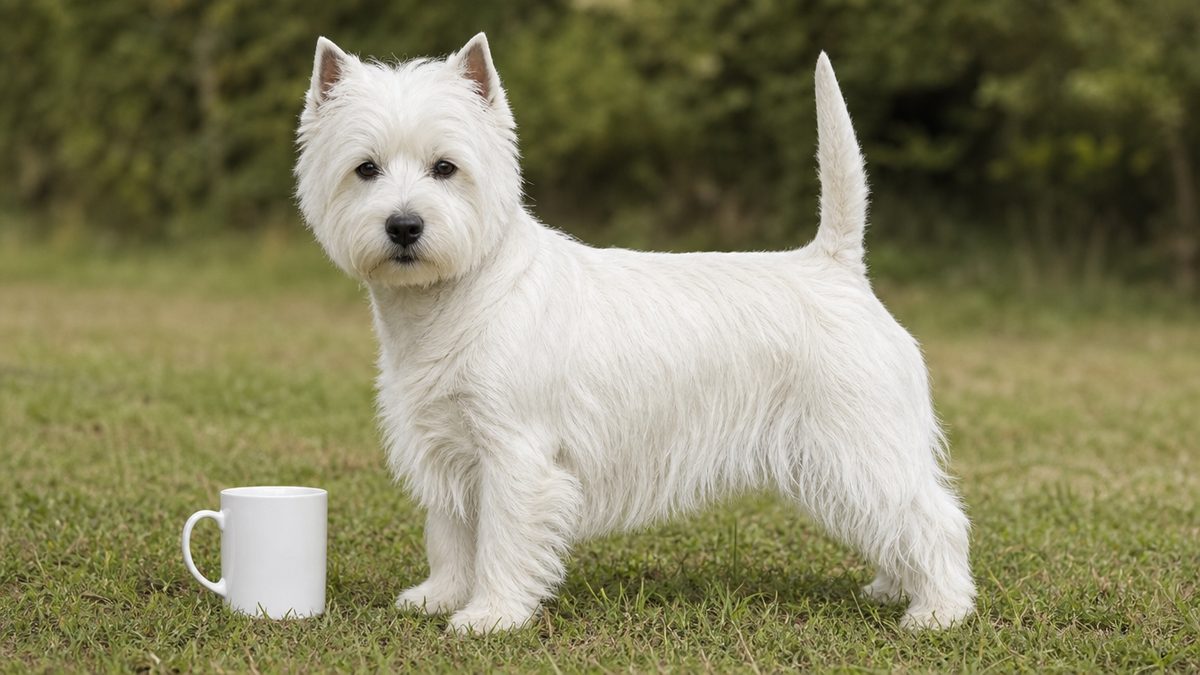
A West Highland White Terrier is a small, compact, all-white Scottish earth terrier standing approximately 28 cm at the withers, double coated with a harsh 5 cm outer jacket over a fur-like undercoat, with small sharply pointed erect ears and a natural carrot-shaped tail. It was developed from Cairn Terrier stock by the Malcolms of Poltalloch in Argyllshire in the mid nineteenth century and recognised by the Kennel Club in 1907.
The Royal Kennel Club's standard describes the breed in eight words: "Small, active, game, hardy, possessed of no small amount of self-esteem with a varminty appearance". Self-esteem is not a word that appears in many breed standards, and it is the most useful thing on the page. This is a small dog that does not know it is small.
The second most useful line in the standard is easy to miss. The coat clause runs through the double coat, the harsh outer hair about 5 cm long free from any curl, the undercoat that resembles fur, and the note that open coats are highly undesirable, and then it closes with five words that appear in no other British terrier standard: free from obvious skin problems. A registry does not write that into a description of what a dog should look like unless the opposite is common.
What the breed standard measures, and what it leaves out
| Attribute | Royal Kennel Club standard | Other published sources | Measured or observed |
|---|---|---|---|
| Height | Approximately 28 cms (11 ins) at withers | Puppiezo gives 10 to 11 inches | Close agreement, unusually |
| Weight | Not stated at all | Google India panel gives 6 to 7 kg female, 7 to 10 kg male; happypet gives Small Breed | The standard declines to set one |
| Coat | Double coated, harsh outer hair about 5 cms long, undercoat resembling fur | Registry prints Sheds: Yes, Coat length Medium | Google's panel prints Hypoallergenic: Yes, which the registry contradicts |
| Colour | White. Any other colour or combination unacceptable | Same everywhere | One accepted colour, no variants |
| Ears | Small, erect, carried firmly, terminating in a sharp point. Hair short and smooth, should not be cut | Same | The quickest way to tell this dog from a Sealyham, which has drop ears |
| Skin | Coat clause ends free from obvious skin problems | No Indian page repeats this | Breed Watch adds scarring from previous dermatitis as a judging concern |
| Life expectancy | Over 12 years on the breed page | Google panel gives 12 to 16 years | Median 13.4 years from 6,730 deaths |
| UK status | Vulnerable native breed: No | Consistent with the registration table | 1,083 registrations in 2025, well above both thresholds |
Two rows are worth pausing on. The weight row is blank in the standard, which is rare and deliberate: a judge is asked for a dog of approximately 28 cm and correct proportion, not a dog of a stated mass. In practice a fit adult is 7 to 10 kg for a male and 6 to 7 kg for a female by Google's own panel figures, and the honest planning number for food, drug dosing and airline crates in India is 8 kg.
The UK status row is the one place where this breed differs from almost every other British terrier on this site. The Royal Kennel Club treats a British or Irish breed as Vulnerable below 300 annual registrations and At Watch between 300 and 450. At 1,083 registrations in 2025 the West Highland White Terrier is comfortably above both lines. It is the popular one. That matters for an Indian buyer, because popularity is what produced the research base this page rests on.
A hardy, self-assured, very loud 8 kg white earth terrier with a hand-stripped double coat, the largest evidence base of any small terrier, a measured median lifespan of 13.4 years, a documented worldwide predisposition to itchy inflamed skin, a fatal lung disease reported in nearly a third of surveyed dogs, and no reliable Indian price.
One more thing separates this dog from the five other British terriers covered here. It has a real research literature. Because 11,932 West Highland White Terriers appear in a single UK lifespan study, because 305 have been screened for one bone disease and 1,398 for eye disease at the OFA, and because a 2026 survey reached 542 owners in one questionnaire, the claims on this page are measurements rather than impressions. On the Skye Terrier page, by contrast, the entire OFA database holds a single row of 70 dogs.
Lifespan: what 6,730 recorded deaths actually show
The measured median lifespan of a West Highland White Terrier is 13.4 years, with a 95 percent confidence interval of 13.3 to 13.5 years, from 6,730 recorded deaths among 11,932 UK dogs. The hazard ratio against crossbred dogs is 0.73, meaning a 27 percent lower hazard of death at any age.
Those numbers come from the 2024 Dogs Trust and Royal Veterinary College analysis of 584,734 UK dogs, published in Scientific Reports. Its Supplementary Table S3 holds one row per breed, and the West Highland White Terrier row reads 11,932 dogs, 6,730 deaths, a median of 13.4 years, a lower confidence bound of 13.3, an upper bound of 13.5, a hazard ratio of 0.73 with an interval of 0.72 to 0.75, and a p value below 0.001.
Read the confidence interval before the median. A 0.2 year interval is the narrowest of any breed on this site's British terrier set, and it is narrow because the sample is enormous. For comparison, the Skye Terrier's interval in the same table spans 2.3 years off 39 deaths and the Sealyham's spans 3.7 years off 33. When a Westie page says 13.4 years, that is a number you can plan around. When a Skye page says 12.4, it is a number with a wide shrug attached.
How the six British terriers compare, on the same table
| Breed | Dogs in cohort | Recorded deaths | Median lifespan | 95 percent CI | Hazard ratio |
|---|---|---|---|---|---|
| Welsh Terrier | 570 | 146 | 13.8 years | 13.5 to 14.6 | 0.54 |
| Soft Coated Wheaten Terrier | 620 | 173 | 13.7 years | 13.2 to 14.4 | 0.61 |
| West Highland White Terrier | 11,932 | 6,730 | 13.4 years | 13.3 to 13.5 | 0.73 |
| Sealyham Terrier | 125 | 33 | 13.1 years | 12.3 to 16.0 | 0.58 |
| Scottish Terrier | 1,747 | 869 | 12.7 years | 12.5 to 12.9 | 0.84 |
| Skye Terrier | 91 | 39 | 12.4 years | 11.6 to 13.9 | 0.93 |
| Crossbred dogs, for reference | 111,053 | 72,445 | 12.0 years | 12.0 to 12.1 | 1.00 |
Third of six on the median, and first of six on certainty. The Westie's advantage over a crossbred dog is 1.4 years and it is measured, not estimated. Its hazard ratio of 0.73 is not the lowest in the group, because the Welsh Terrier at 0.54 and the Wheaten at 0.61 are lower, but those two rest on 146 and 173 deaths respectively while this one rests on 6,730.
The first two columns of Supplementary Table S3 have blank headers. Column one is the total number of dogs and column two is the number of deaths. Reading column one as deaths overstates every sample by two to three times. For this breed the difference is 11,932 against 6,730. We publish both.
There is a second discrepancy inside the paper that we report rather than hide. Supplementary Table S6 gives the West Highland White Terrier 5,365 alive and 6,730 deceased for a total of 12,095, while Table S3's first column reads 11,932. The death counts match exactly in both tables; the cohort totals do not, and the same mismatch appears for every breed we have checked. The death count is the load-bearing number, so we quote it.
The study's own supplementary file also records how the breed was handled. Table S5 flags it Y for inclusion in the survival analysis, leaves the phylogeny reclassification column as NA so it was not merged into a related breed, and files it as Kennel Club group Terrier, body size Small, cephalic index Mesocephalic. Mesocephalic matters for the heat section below: this is not a flat-faced dog, and its airway is not the limiting factor.
Google's India panel gives a life expectancy of 12 to 16 years for the breed. The upper end of that range is 2.5 years above the measured 95 percent upper bound of 13.5. Sixteen-year-old Westies exist, in the same way that hundred-year-old people exist, but planning a family's next decade around the top of a marketing range is a different thing from planning around a median.
West Highland White Terrier price in India, and why the published figures cannot all be true
Published Indian prices for a West Highland White Terrier run from Rs 6,000 to Rs 4,00,000, a spread of 66 times on one small white terrier. Not one of those figures is an observation of a completed sale, and India's most comprehensive dog price table omits the breed entirely. Budget Rs 60,000 to Rs 1,20,000 as a realistic import-adjacent figure and verify every claim before paying.
Start with what the four Indian sources actually print, because the disagreement is the finding.
| Source | Printed price | Position on Google India | Why it is not a price |
|---|---|---|---|
| PetBuy.in | Rs 6,000 to Rs 25,000 | 3 | A template row. The identical band, the identical 4 to 10 kg and the identical 20 to 35 cm appear on its Scottish, Skye, Welsh, Soft Coated Wheaten, Cairn, Norwich and Border Terrier pages, all showing Listings 0 and a blank Live Avg |
| happypet.care | Rs 40,000 to Rs 80,000 | 2 | No stated method, no date, no sample. Its monthly cost on the same page is the arithmetic sum of three preset component lines the site reuses across unrelated breeds |
| Puppiezo | Rs 4,00,000 or more | 1 | States the figure and then calls its own puppies affordable two sentences later. A Rs 1,20,000 carousel figure sits on the same page, contradicting the sentence above it |
| Supertails 40-breed table | not listed | 10 | Claims to draw on breeder networks and Kennel Club of India registration data across 40 breeds. Searched on 8 September 2026 it contains no West Highland White Terrier |
| Mr n Mrs Pet | no price | 4 | A page headed West Highland White Terrier Puppies For Sale whose own listing cards are an English Bulldog, a French Bulldog and a Goldendoodle |
| dogbreedslist.info | USD 1,500 to 3,000 | 5 | A United States page ranking on Google India. Not an Indian price at all |
| Westie Rescue UK | GBP 631 registered, GBP 476 unregistered | 9 | A British rescue with no dog to sell, and therefore the only disinterested price on the result set |
Two of the ten results on that page are not dogs at all. Position 7 is a Flipkart listing for a book about the breed at Rs 2,745 and position 8 is an Amazon.in listing for West Highland White Terrier: Best of Breed at Rs 1,990, while position 5 is a United States page quoting 1,500 to 3,000 US dollars. When a fifth of a commercial result set is books and another tenth is a foreign market, the query has more demand than the country has supply.
The 66-fold spread is the widest of the six British terriers on this site, and it is wider than the spread on genuinely rare breeds such as the Skye, which almost nobody prices at all. That is counter-intuitive until you look at the mechanism: the Westie is famous enough that every content farm needs a page about it, and rare enough in India that no page has a transaction to describe. Fame without supply produces confident numbers with nothing behind them.
How to read PetBuy's Rs 6,000 to Rs 25,000
PetBuy prints Rs 6,000 to Rs 25,000 for this breed with Listings 0. We checked whether that band is breed-specific by pulling thirteen of the site's pages in one session. Eight small terriers share the identical band, the identical 4 to 10 kg weight and the identical 20 to 35 cm height. Meanwhile the Golden Retriever, which the site actually stocks, gets Rs 15,000 to Rs 45,000, a 25 to 34 kg weight, 30 live listings and a breed-specific history paragraph. The band is a default for breeds the site has never handled.
We also tested whether the figures were converted from dollars, since a converted price would explain the roundness. Rs 6,000 divided by an exchange rate near 84 gives 71.11, by 74 gives 81.08 and by 80 gives 75, and Rs 25,000 divided by 80 gives 312.50. None of those lands on a round dollar figure, so the numbers were typed in rupees. They are Indian, they are just not measurements.
How to read Puppiezo's Rs 4,00,000
The page ranking first on Google India for the price query states, verbatim, that West Highland White Terrier prices in India can range from Rs 4,00,000 or more depending on factors like a record of a dog family history and breed, and then in the following sentence describes its own puppies as affordable. A carousel on the same page shows Rs 1,20,000. A single page carrying Rs 4,00,000 and Rs 1,20,000 without acknowledging the gap is not reporting a market, it is anchoring one.
Rs 4,00,000 is roughly six times the British average of GBP 631 for a Kennel Club registered Westie. A price that high can only be justified by a genuine import, which means an export pedigree, a rabies titre, an EU or UK health certificate and a DGFT-compliant consignment. Ask to see all four. If the seller cannot produce them, the number is decoration.
What we would actually budget
There is no honest single number, so here is the reasoning instead. A locally bred Westie from an established Indian kennel with verifiable parents will realistically sit between Rs 60,000 and Rs 1,20,000, which is where scarce, non-mainstream small breeds land in Indian metros. A genuine import with full paperwork will run well past that once airfreight, quarantine documentation and the DGFT process are counted. Anything advertised below Rs 30,000 for a breed with no Indian breeding base deserves a demand to see the dam.
For scale, the Supertails table that omits this breed prices the Scottish Terrier, its closest Scottish relative, at Rs 30,000 to Rs 80,000. That is the nearest thing to an Indian benchmark that exists for a small Scottish earth terrier, and it sits an order of magnitude below Puppiezo's figure.
Monthly cost of owning a Westie in India
Budget Rs 6,000 to Rs 11,000 a month for a West Highland White Terrier in an Indian metro, and Rs 9,000 to Rs 16,000 if the dog turns out to be atopic. Food for an 8 kg dog is Rs 2,000 to Rs 3,500, professional grooming at Vetic's published Rs 1,869 for a full bath and styling is roughly six visits a year, and the annual vaccination booster is Rs 3,199.
Every rupee figure below was read off a live Indian price page on 8 September 2026 rather than estimated, and each is attributed.
| Item | Published price | Source | Frequency for this breed |
|---|---|---|---|
| Puppy vaccination course | From Rs 6,499 (listed Rs 8,111) | Vetic, national | Once, in the first four months |
| Annual booster | Rs 3,199 (listed Rs 3,806) | Vetic, national | Yearly |
| Anti-rabies, single | Rs 699 | Vetic, national | Yearly, or free at a Greater Chennai Corporation clinic |
| 9-in-1 DHPPiL | Rs 899 | Vetic, national | As per the schedule |
| Kennel cough | Rs 1,349 | Vetic, national | Yearly, and worth it for a breed with lung risk |
| Full bath and styling | Rs 1,869 (listed Rs 2,199) | Vetic Delhi and Bengaluru, identical | Every 8 to 10 weeks |
| Haircut only | Rs 1,359 (listed Rs 1,599) | Vetic Delhi and Bengaluru | Not recommended for this coat, see grooming |
| Bathing only | Rs 934 (listed Rs 1,099) | Vetic Delhi and Bengaluru | Weekly to fortnightly if the skin is medicated |
| Deworming, Drontal Plus | Rs 754 a strip of 6, MRP Rs 838 | Supertails | Quarterly, one tablet per 10 kg |
| Microchipping | Rs 1,250 | SKS Veterinary Hospital, Chennai | Once |
| Municipal licence, Delhi | Rs 500 new and Rs 500 renewal | MCD portal | Yearly, Rs 100 a month late fee |
| Municipal licence, Chennai | Rs 50 | Greater Chennai Corporation | Yearly |
Two of those rows deserve comment. Vetic's grooming prices are identical in Delhi and Bengaluru, down to the rupee and down to the struck-through list price. That is a national rate card rather than a city market rate, so a page telling you grooming costs more in Mumbai than in Pune is guessing. And the Chennai licence at Rs 50 sits alongside a corporation statement that its pet clinics provide all treatment and anti-rabies vaccination free of cost, and that 9,115 pet animal licences were issued during 2024. Municipal veterinary care in India is cheaper than most owners assume. Delhi is dearer but still small: the Municipal Corporation of Delhi charges Rs 500 for a new pet registration and Rs 500 to renew, with a Rs 100 a month late fee, and a Chennai clinic publishes a transacted microchipping price of Rs 1,250 under the corporation's microchipping mandate.
Why we do not use happypet.care's Rs 3,300 to Rs 5,400
happypet.care publishes a monthly cost of Rs 3,300 basic and Rs 5,400 premium for this breed. We pulled seven of its breed pages in one session to see how that number is produced. The Welsh Terrier page prints food Rs 2,250 to Rs 3,000, health Rs 1,200 to Rs 1,800 and grooming Rs 1,200 to Rs 1,800, and those three lines sum exactly to its printed totals of Rs 4,650 and Rs 6,600. The totals are arithmetic on presets, not observations.
The presets then repeat where they should not. The Scottish Terrier, Skye Terrier and West Highland White Terrier all get Rs 3,300 to Rs 5,400, and the food line of Rs 1,200 to Rs 1,800 appears on the Beagle page too, even though the Beagle's total is a different Rs 2,200 to Rs 3,750. A 12 kg scent hound and an 8 kg terrier do not eat the same rupee value of food, and a site that says they do has not weighed anything.
The line item nobody budgets
The cost that separates this breed from the other small terriers is skin. An atopic Westie is a chronic veterinary patient, not an occasional one. A medicated shampoo course, a hydrolysed or novel-protein diet trial, cytology on a recurring ear, and in bad cases a modern anti-itch drug given long term, together move the monthly figure from around Rs 7,000 to somewhere between Rs 12,000 and Rs 16,000. Nothing about that is exotic. It is simply what managing a diagnosed atopic dog costs, and roughly a quarter to a third of the breed's dogs will need some of it.
Baseline healthy dog, metro, professional grooming every ten weeks: about Rs 6,000 to Rs 8,000 a month. Same dog with seasonal skin flares: Rs 9,000 to Rs 11,000. Diagnosed atopic dog on long-term management: Rs 12,000 to Rs 16,000. Decide which of those three you can sustain for thirteen years before you buy, because the median lifespan here is 13.4 years.
One saving is real and worth naming. This breed is small, so drug and parasiticide costs are at the bottom of every band. Drontal Plus is dosed at one tablet per 10 kg, so an 8 kg Westie takes a single tablet and a strip of six covers eighteen months of quarterly worming at Rs 754. A Rs 754 strip on a Great Dane covers about six weeks.
Heat tolerance and the Indian climate
A West Highland White Terrier tolerates Indian heat poorly but not dangerously, and its skin is the reason rather than its airway. The breed was made in Argyll, where the warmest month averages 13.9 degrees C. Bengaluru and Pune, at 28.4 and 28.9 degrees C in their warmest months, are workable on dawn and dusk walks. Chennai, Mumbai and Kolkata are hard, and hardest of all for a dog with active dermatitis.
The figures below come from NASA's POWER climatology dataset, queried point by point for 2001 to 2020 monthly means, with the grid-cell elevation echoed back and compared against each place's real elevation so a mountain cell cannot masquerade as a city. The wet-bulb column is the one that matters for a dog, because a dog cools by evaporating water from its airway and a high wet-bulb temperature is exactly the condition where that stops working.
| Place | Grid-cell elevation | Warmest month mean | Coolest month mean | Mean relative humidity | Peak wet-bulb |
|---|---|---|---|---|---|
| Kilmartin, Argyll (the breed's home district) | 97.58 m | 13.92 degrees C in July | not queried | 87.17 percent | not queried |
| Bengaluru | 841.72 m | 28.37 degrees C in April | 20.22 degrees C in December | 67.84 percent | 21.86 degrees C |
| Pune | 635.99 m | 28.93 degrees C in April | 19.62 degrees C in December | 66.68 percent | 22.97 degrees C |
| Mumbai | 97.15 m | 31.19 degrees C in May | 23.19 degrees C in January | 67.28 percent | 25.77 degrees C |
| Delhi | 206.37 m | 35.88 degrees C in June | 13.61 degrees C in January | 45.51 percent | 26.50 degrees C |
| Chennai | 48.95 m | 31.51 degrees C in May | 24.09 degrees C in January | 72.39 percent | 26.11 degrees C |
| Kolkata | 7.35 m | 31.53 degrees C in May | 17.31 degrees C in January | 73.84 percent | 27.09 degrees C |
The POWER grid cell covering Kilmartin reports an elevation of 97.58 m against a real village elevation nearer 25 m, so its temperature runs slightly cool. We report the discrepancy rather than hide it. Even allowing several degrees, the gap to Chennai is roughly 17 degrees C.
The arithmetic is the argument. Chennai's warmest month runs about 17.6 degrees C above Argyll's, and Chennai holds 24 degrees C even in January, which is above anything Argyll sees in an average month of the year. There is no Indian season in which a coastal metro resembles the climate this dog was built for.
Why the anatomy is better news than the numbers
Three things work in the Westie's favour. It is mesocephalic, filed that way in the study's own supplementary table, so it has a normal muzzle and a normal airway rather than the compressed one that makes a Pug or a Bulldog a genuine heatstroke case. It is light, at 7 to 10 kg for a male, and body mass at or above the breed and sex mean carried an odds ratio of 1.42 for heat-related illness in a study of 905,543 UK dogs. And it is white, so its coat reflects rather than absorbs solar radiation, which is a real advantage the black Scottish Terrier does not have.
The same UK research corrects the assumption most Indian owners start from. Of 1,259 heat-related illness events with a recorded trigger, 652 of 879, or 74.2 percent, were exertional rather than environmental. Dogs do not mostly overheat in parked cars. They overheat on walks, and a terrier that will chase a squirrel at 2 pm in May is exactly the dog that does it.
The complication other pages miss
A double-coated dog in humid heat has a second problem beyond temperature. The standard describes a harsh outer coat over an undercoat that resembles fur, short, soft and close. That undercoat holds moisture against the skin. In Chennai at 72 percent mean humidity or Kolkata at 74 percent, a coat that stays damp between a bath and the next walk is a warm wet surface pressed against skin that this breed is already predisposed to inflame.
That is why the practical heat rating on this page is 2 out of 5 rather than 3. The airway is fine. The skin is not. A Westie with clear skin in Bengaluru is a comfortable dog. The same dog with atopic dermatitis in Kolkata is miserable in a way no amount of air conditioning entirely fixes.
Walk before 6.30 am and after 7.30 pm from March to October. Keep the dog indoors with a fan or air conditioning through the afternoon. Dry the coat all the way to the skin after every bath and after every wet-season walk, because half-dry undercoat is the enemy here. Test the pavement with the back of your hand before you step onto it. And treat a Westie panting hard at rest, indoors, as a reason to call your nearby vet the same day, because in this breed a persistent cough or laboured breathing is not always about the weather.
There is one more Indian factor that has nothing to do with temperature. Tick-borne disease is heavy in the humid states: a West Bengal survey of 584 dogs screened at veterinary clinics reported Babesia gibsoni in 76.54 percent and two or more pathogens in 72.9 percent of them, and a Kerala survey of 120 dogs found Babesia in 66.7 percent with a pre-monsoon March to May peak. A white coat makes ticks easy to see, which is the one grooming advantage this breed has. Use it.
Temperament and household fit
A West Highland White Terrier is alert, gay, courageous, self reliant but friendly in the words of its own breed standard, and self reliant is the word to plan around. It is affectionate without being subordinate, extremely vocal, and it does not consider a squirrel negotiable. It suits a family with school-age children, an owner who is home, and neighbours who are tolerant.
The Royal Kennel Club standard splits the description in two. Its characteristics clause reads "Small, active, game, hardy, possessed of no small amount of self-esteem with a varminty appearance", and its temperament clause reads "Alert, gay, courageous, self reliant but friendly". Varminty is an old British working word meaning sharp, keen and rat-like in intent. It is not a compliment about looks. It describes a dog that is always slightly on duty.
What self reliant means in a flat
Self reliant is not the same as independent, and it is certainly not the same as low maintenance. It means the dog forms its own opinion of a situation before it looks at you. Called away from a fence line with a cat behind it, a retriever checks in and a Westie decides. That single difference is the whole of Westie ownership, and it drives the training approach, the recall policy and the fence height. Owners call it stubborn, which is the wrong word for it: a stubborn dog has heard you and refused, while this one has assessed the situation and reached a different conclusion.
The Royal Kennel Club rates this breed's size of home as Flat/Apartment, the only one of the six British terriers on this site with that rating. Physically that is correct. Acoustically it is the hardest breed here to live with in a shared-wall Indian building, because an earth terrier was bred to bark continuously underground so the handler could dig down to it. A Westie in a 2 BHK in Powai will alert on the lift, the corridor, the delivery rider and the neighbour's door.
| Situation | Fit | Why |
|---|---|---|
| Family with children over about seven | Good | Affectionate, robust, genuinely playful, and old enough children read a dog that has had enough |
| Family with a toddler | Poor | Self reliant means it will not simply absorb rough handling the way a Labrador often does |
| Working couple, both out nine hours | Poor | Bored terriers dig, chew skirting and bark. This is the commonest rehoming story for the breed |
| Retired owner at home | Excellent | Modest exercise need, up to an hour a day, and constant company |
| Ground-floor flat with shared walls | Difficult | The barking, not the space, is the constraint |
| Home with a resident cat | Case by case | Prey drive is very high. A cat raised with the puppy usually works. An adult cat introduced later often does not |
| Home with chickens or small pets | Unsuitable | This dog was made to go to ground after fox and otter in Argyll |
| First dog for a calm, consistent owner | Workable | Trainable and forgiving, provided the owner accepts they will never own a dog with perfect recall |
Google's India panel adds a household detail that is worth correcting. It prints Hypoallergenic: Yes for this breed on the same screen as the search results, while the Royal Kennel Club's own page for the same dog prints Sheds: Yes. A family choosing this breed because someone in the house has allergies is choosing on a claim its own registry contradicts, and the measured evidence sides with the registry.
If a barking dog would cost you your tenancy or your relationship with the flat below, do not buy this breed. Everything else about a Westie can be managed. The voice is what it was bred for.
Training a self reliant terrier, and what it resists
Train a West Highland White Terrier with food, short sessions and a long line, and accept from the start that off-lead recall near live prey is not achievable in this breed. It learns faster than most terriers because it is genuinely biddable indoors, and it fails at distance because it was bred to work out of sight of its handler.
Start with the socialisation window, because in India it collides with the vaccination schedule. The window in which a puppy accepts novelty without fear closes at roughly sixteen weeks, and Vetic's puppy vaccination course runs to about that point at a published Rs 6,499. Waiting for the last shot before the dog meets anything costs the whole window. Carry the puppy through a market, sit with it on a balcony above traffic, invite vaccinated adult dogs home. The socialisation window does not extend on request.
Five things that work, in order
- Pay in food, every time. Terriers were selected to keep working without praise. A Westie will repeat a behaviour for chicken and will not repeat it for approval.
- Keep sessions under four minutes. Three short sessions a day beat one long one, and a bored terrier invents its own game inside two minutes.
- Teach a hand target before a recall. A dog that will touch your palm has a portable, high-value behaviour you can use to move it off a fence line without a confrontation.
- Use a long line for six months, not a week. Fifteen metres of light line lets the dog be wrong safely, which is the only way it learns that coming back pays.
- Give the digging a legal address. A sand tray on a balcony with buried treats absorbs the instinct. Forbidding digging outright just relocates it to your planter.
The one thing not to attempt is a reliable off-lead recall in an open Indian park. This dog was made to pursue fox and otter to ground in Argyll and its prey drive scores at the top of the range on this page. A Westie that has locked onto a street cat has functionally stopped hearing you, and no amount of obedience work changes the wiring. Manage it with a lead and a fence and stop treating it as a training failure.
Two behaviours need early, deliberate work in an Indian home. Barking is first: reward silence rather than punishing noise, because a punished terrier barks more and adds anxiety to it. Resource guarding is second: a self-assured small dog with a chew under a sofa is a bite risk with a child, and the fix is trading up from puppyhood rather than removing things by hand.
By twelve months a well-socialised Westie should walk past a street dog on a loose lead without lunging, settle on a mat for twenty minutes while you eat, and come back to a hand target in the flat every single time. Those three, not off-lead recall, are the honest benchmark.
Daily exercise, and how to split it around the Indian sun
A West Highland White Terrier needs up to one hour of exercise a day, which the Royal Kennel Club states directly on the breed's own page. In India that hour has to be split into a pre-dawn walk and a post-sunset walk for eight months of the year, with indoor scent and puzzle work filling the middle of the day.
The registry prints Exercise: Up to 1 hour per day for this breed, and Puppiezo's Indian spec card gives 30 minutes daily. Both are defensible for a small terrier and both understate what the dog actually needs, because a Westie's requirement is more mental than cardiovascular. An hour of lead walking leaves a bored dog. Forty minutes of walking plus twenty minutes of sniffing, digging and problem solving leaves a settled one.
| City | Morning window | Evening window | Midday plan | Months that need care |
|---|---|---|---|---|
| Bengaluru | 6.00 to 7.30 am | 6.30 to 8.00 pm | Indoor puzzle work | March to May |
| Pune | 5.45 to 7.15 am | 6.45 to 8.15 pm | Indoor puzzle work | March to May |
| Delhi | 5.30 to 6.45 am | 7.30 to 9.00 pm | Air-conditioned room, no exceptions | April to July |
| Mumbai | 5.30 to 6.45 am | 7.30 to 9.00 pm | Indoors, dehumidified if possible | March to October |
| Chennai | 5.15 to 6.30 am | 7.30 to 9.00 pm | Indoors, air conditioned | March to October |
| Kolkata | 5.15 to 6.30 am | 7.30 to 9.00 pm | Indoors, air conditioned | March to October |
Those windows are drawn from the same NASA POWER climatology used in the heat section, where Chennai's warmest month averages 31.51 degrees C and Kolkata's peak wet-bulb reaches 27.09 degrees C. The reason to be strict about them is that three quarters of recorded canine heat-related illness with a known trigger was exertional. The dog will not stop. You have to.
What to do with the middle of the day
- Scatter feed the morning meal across a mat or a towel. Ten minutes of sniffing tires a terrier more than a kilometre of pavement.
- Rotate three chew types so none becomes furniture. A Westie ignores yesterday's toy.
- Hide and seek with a person, not an object. It uses the nose, the recall and the relationship at once.
- Teach a trick a fortnight. Spin, bow, paw, chin rest. Trick training is the cheapest mental exercise there is and it costs nothing in heat.
Exercise also has a health dimension specific to this breed. Legg-Calve-Perthes disease and patellar luxation both appear in small terriers, and the OFA's patella table records 1,149 evaluations for the West Highland White Terrier at 96.5 percent normal, which is reassuring. Repeated jumping down from a high Indian bed onto a hard floor is still worth avoiding in the first year, and a ramp costs less than an orthopaedic consultation.
Grooming, hand stripping, and why clipping matters more in this breed
Groom a West Highland White Terrier more than once a week and hand strip the harsh outer coat every eight to twelve weeks. Clipping is the default in Indian salons and it permanently softens the jacket, which matters here more than on any other terrier because a soft coat holds humidity against skin already predisposed to inflammation.
The Royal Kennel Club prints Grooming: More than once a week, Coat length: Medium and Sheds: Yes on the breed's own page. The standard defines what is being groomed: a double coat with harsh outer hair about 5 cm long, free from any curl, over an undercoat resembling fur that is short, soft and close, with open coats highly undesirable.
Hand stripping against clipping, stated plainly
Hand stripping pulls the dead outer hairs out at the root so a new harsh coat grows in. Clipping cuts them off partway, leaving the dead root in place, and after two or three clips the jacket comes back soft, pale and slightly woolly. On a Welsh or a Border Terrier that is a cosmetic loss. On a Westie it is a functional one, because the harsh outer coat is the layer that sheds water and keeps the fur-like undercoat from staying wet.
| Route | Indian availability | Published price | Effect on the coat | Effect on the skin |
|---|---|---|---|---|
| Hand stripping by a trained groomer | Very rare outside a few metro salons | Not published by any national chain | Correct harsh jacket maintained | Best case, coat dries fast |
| Owner stripping with a stripping knife | Achievable after one lesson | Knife about Rs 600 to Rs 1,500, one time | Correct, if done every 8 to 12 weeks | Best case, and cheapest |
| Salon clip | Available everywhere | Rs 1,359 haircut, Rs 1,869 full bath and styling at Vetic | Coat permanently softened after 2 to 3 clips | Holds moisture, worse in humid cities |
| Shaving in summer | Commonly offered and commonly requested | Same as a clip | Destroys the double coat structure | Removes sun protection from white skin, raises sunburn risk |
A shaved double coat does not cool a dog. It removes the insulating layer that slows heat gain and exposes thin, unpigmented, white skin to direct sun. happypet.care's own resource list carries an article titled Should You Shave Your Dog in Summer, and the answer for this breed is no. If the heat is the problem, change the walk times, not the coat.
The weekly routine in an Indian climate
- Brush twice a week with a slicker and follow with a comb through the leg furnishings and the beard, where knots start.
- Check the ears every week. The standard says the short velvety ear hair should not be cut, so the ear canal here is open and easy to inspect, which is an advantage over drop-eared terriers.
- Bathe every three to four weeks with a plain dog shampoo, or as often as your vet directs if the skin is medicated, and dry all the way to the skin every time.
- Wipe the feet and belly after every monsoon walk. Wet undercoat plus warm skin is where most Indian skin trouble on this breed starts.
- Strip or book a strip every 8 to 12 weeks, and keep the same groomer so the coat stays on one cycle.
- Look for ticks daily from March to May. A white coat is the easiest surface in dogdom to spot a tick on, and Indian tick-borne disease rates are high.
One cosmetic point that Indian owners raise constantly. Tear staining and beard staining show badly on a white dog and look like a health problem. Usually they are not: they are saliva and tears oxidising on light hair. Persistent redness, hair loss, scratching or a yeasty smell is different, and that belongs in the skin section below rather than in the grooming routine.
Skin: atopic dermatitis, the condition this breed is defined by
Atopic dermatitis is the West Highland White Terrier's signature health problem, and it is documented in three independent ways: the breed's own standard closes its coat clause with the words free from obvious skin problems, its registry tells show judges to look for scarring from previous dermatitis, and a Swiss birth cohort measured a direct heritability of 0.31. Expect itching to start between six months and three years, and expect an Indian humid summer to make it worse.
Very few breed standards mention disease. This one does. After describing the double coat, the harsh 5 cm outer hair and the fur-like undercoat, the Royal Kennel Club's coat clause ends with the sentence free from obvious skin problems. A registry writes that into a description of correct type only when incorrect type is common enough to need naming.
The same registry then says it a second way. The West Highland White Terrier sits in Breed Watch Category 2, the only one of the six British terriers on this site above Category 1, and its two published points of concern for special attention by judges are, verbatim, misplaced canine teeth, and signs of dermatitis irritation and/or hair loss or scarring from previous dermatitis. A show judge in Britain is instructed to look at this breed's skin.
What the measurements say
| Study | Sample | Finding | What it means for a buyer |
|---|---|---|---|
| Rostaher 2020, Switzerland | Birth cohort of 107 Westies followed to three years | Direct heritability 0.31 on the observed scale | About a third of the variation in who gets it is genetic. Parents matter |
| Rostaher 2020, Switzerland | Same cohort | Maternal allergic status odds ratio 3.3, p equals 0.013 | An itchy dam is the single strongest published warning sign |
| Rostaher 2020, Switzerland | Same cohort | Male sex odds ratio 2.4, p equals 0.03 | Males were affected significantly more often in multivariate analysis |
| Mazrier 2016, Australia | 23,000 case records, 722 with atopic dermatitis | One of five breeds recognised as predisposed worldwide | Not a local quirk. The predisposition travels with the breed |
| Salzmann 2011, United States | Genome-wide linkage study in Westies | The breed is used as the model population for the disease | Researchers pick this breed precisely because it is so consistently affected |
The choice of study population is itself evidence. When a research group set out to run a genome-wide linkage study of canine atopic dermatitis, the breed they built the study around was this one. A model population is chosen for a disease because the disease is reliably present in it.
Ask the breeder about the mother's skin before you ask about anything else. An odds ratio of 3.3 attached to maternal allergic status is the most actionable number on this page. It is also the question a breeder selling a dog on looks will least want to answer, which is exactly why it is worth asking.
What it looks like, and when
Canine atopic dermatitis usually declares itself between six months and three years. It starts as licking and chewing at the front feet, rubbing the face, scratching the armpits and groin, and recurring ear inflammation, and only later produces the visible redness and hair loss that owners photograph. On a white dog the earliest reliable sign is often rust-coloured saliva staining between the toes, which shows up on this coat colour before any redness does.
Itching in an Indian dog can be fleas, sarcoptic mange, demodex, a food reaction, a yeast overgrowth, or atopic dermatitis, and several of them coexist. The list above is a reason to see your nearby veterinarian with a scraping and a cytology, not a reason to start an over-the-counter shampoo. Getting the diagnosis right in the first three months of itching changes the next ten years.
The Indian complication is climate. Atopic disease is driven by environmental allergens, and a country with year-round dust mite pressure in coastal humidity, a long pollen season and heavy indoor mould in the monsoon offers more of them than Argyll does. Kolkata sits at 73.84 percent mean relative humidity and Chennai at 72.39 percent. Nobody has measured Westie atopy rates in India, and we will not invent a figure, but the direction of the effect is not in doubt.
What is worth saying plainly is that this is manageable. Modern management, meaning a correct diagnosis, allergen control, medicated washing, a proper diet trial where indicated and a long-term anti-itch drug where needed, turns most atopic Westies into comfortable dogs. It costs money every month for the life of the dog, which the cost section prices, and it is the single thing most likely to make or break the experience of owning this breed in India.
Pulmonary fibrosis: the lung disease named after this breed
Canine idiopathic pulmonary fibrosis was reported in 29.7 percent of 542 West Highland White Terriers in a 2026 owner survey, at a median age at diagnosis of 11.6 years and with a median survival of one year afterwards. It is the reason a persistent cough or exercise intolerance in an older Westie is an urgent veterinary visit rather than a wait-and-see.
Canine idiopathic pulmonary fibrosis is so strongly associated with this breed that veterinary literature has informally called it Westie lung disease. The most recent and largest owner-facing dataset is a 2026 questionnaire study published in The Veterinary Journal, which collected 457 responses covering 542 West Highland White Terriers.
| Measure | Value | Reading |
|---|---|---|
| Dogs reported affected | 29.7 percent of 542 | Owner-reported, so the true clinical rate may differ, but the scale is not in doubt |
| Median age at diagnosis | 11.6 years | Interquartile range 9.1 to 13.3 years. This is a disease of the second half of life |
| Lung crackles reported | 87 percent of affected dogs | The classic examination finding, and the reason a stethoscope matters at every senior check |
| Affected dogs deceased at survey close | 54.9 percent | More than half |
| Median survival after diagnosis | 1 year | Interquartile range 0.32 to 2 years |
| Deaths that were fibrosis-related | 77 percent | In affected dogs, this is usually what ends up killing them |
Set that against the breed's median lifespan of 13.4 years. A median diagnosis at 11.6 years followed by a median survival of one year means this disease, when it appears, tends to arrive right at the point where an owner is expecting two or three more good years and takes them away.
The 2026 survey also reported an environmental association worth naming carefully: the presence of asbestos in the home increased the odds of death among affected dogs. That is an association from an owner questionnaire, not a demonstrated cause, and we are not going to overstate it. It is still a reasonable prompt to think about what an old Indian building's air actually contains, alongside cooking smoke, incense, mosquito coils and construction dust, none of which any study has yet tested in this breed.
A dry, harsh, repetitive cough in a Westie over eight. Getting winded on a walk the dog used to manage easily. Rapid shallow breathing at rest. Gums or tongue going dusky after exertion. Fainting or near-fainting. Any one of those in this breed is a same-day call to your nearby veterinarian, because early imaging and a proper workup change what can be offered.
There is no cure and there is no screening test, which is why this section exists on a breed page rather than a health page. What helps is early recognition, keeping the dog lean, avoiding smoke and dust indoors, and treating the kennel cough vaccination at a published Rs 1,349 as sensible rather than optional in a breed whose lungs have less reserve than average.
It is worth noting how completely this is missing from the Indian pages. happypet.care's Common Health Issues list for the breed reads Bloat, Hip Dysplasia, Canine Influenza, Parasites, Heartworm, Skin Allergies, Patellar Luxation and Canine distemper. Skin Allergies is there in a generic form. Pulmonary fibrosis, the condition that kills nearly a third of the breed's dogs in the largest survey ever taken of them, is not on the list at all.
Craniomandibular osteopathy in a Westie puppy
Craniomandibular osteopathy is a painful proliferation of bone on the jaw and the tympanic bulla of puppies between roughly four and eight months, inherited as an autosomal recessive trait in this breed. The West Highland White Terrier holds rank 1 in the OFA's table for the disease, and only three breeds appear in that table at all.
The OFA's disease statistics record 305 West Highland White Terrier evaluations for craniomandibular osteopathy, of which 82.3 percent were normal, 16.7 percent carrier and 1.0 percent affected. That places the breed at rank 1. The whole table holds three breeds: this one, the Scottish Terrier at rank 2 with 573 evaluations, and the Cairn Terrier at rank 3 with 52, against an ALL BREEDS row of 1,038 evaluations at 92.8 percent normal. Three Scottish terriers, one disease, and the Westie at the top of it.
The inheritance is settled. A 1986 pedigree analysis in the American Journal of Medical Genetics concluded that in West Highland White terriers the condition is an autosomal recessive trait, and described it as a non-neoplastic proliferation of bone on the ramus of the mandible and the tympanic bulla that resembles Paget's disease and infantile cortical hyperostosis in humans. Autosomal recessive means two carrier parents can produce an affected puppy while showing nothing themselves, and 16.7 percent of screened dogs are carriers.
What an owner sees, and when
- Between about four and eight months, not later. This is a growth-phase disease.
- Pain on opening the mouth. The puppy cries when yawning or when a toy is pulled.
- Drooling and reluctance to eat, especially anything that needs chewing.
- A firm, symmetrical swelling along the lower jaw that an owner can feel.
- Intermittent fever in some puppies, which sends owners down the infection route first.
The usual course is that the bony proliferation stops when growth stops and much of it then remodels, leaving a dog that is comfortable in adulthood. Pain relief through the active phase is the mainstay, and the decision belongs with your nearby veterinarian rather than with a breed page. A small number of dogs are affected badly enough that the jaw cannot open sufficiently to eat, and those cases are serious.
A 2019 case series in the Journal of Small Animal Practice described three West Highland White Terriers in which craniomandibular osteopathy engulfed the external ear canal, producing chronic otitis media and para-aural abscessation that required total ear canal ablation with lateral bulla osteotomy. Its authors describe it as the first report of the disease involving the ear canal in this way. A Westie with a chronically painful, non-resolving ear and a history of jaw disease as a puppy deserves imaging rather than another course of drops.
For an Indian buyer the practical consequence is simple and specific. Ask whether either parent has produced a puppy with jaw disease. There is no DNA test offered for this in the breed, the Royal Kennel Club recommends no screening scheme at all for the West Highland White Terrier, and a breeder's own litter history is therefore the only information available. A breeder who does not know what the question means is telling you something.
Health issues, screening, and what the OFA database actually records
No pre-breeding health test is officially recommended for the West Highland White Terrier anywhere. The Royal Kennel Club leaves both columns of its February 2026 Health Standard blank for this breed and its own breed page says so in words. What exists instead is a large voluntary OFA screening record covering hips, patellas, elbows, eyes and three genetic diseases, and a buyer should read it before accepting that no news is good news.
The registry position is unambiguous. The Royal Kennel Club Health Standard of February 2026, read in layout-preserving mode so the Good Practice and Best Practice columns stay separated, carries a blank in both columns on the West Highland White Terrier row. The breed's own A to Z page states it in a sentence: at this time this breed does not have any recommended pre-breeding health screening in place.
That is an absence of a scheme, not an absence of disease. The same registry places this breed in Breed Watch Category 2 and asks judges to look at its skin, and the same breed accounts for 6,730 deaths in the largest UK lifespan study. Two of the three conditions this page spends most time on, atopic dermatitis and pulmonary fibrosis, have no screening test to recommend, which is precisely why no scheme exists.
The OFA record, with a control so the numbers mean something
| Screen | Evaluations | Result | Rank | Reading |
|---|---|---|---|---|
| Craniomandibular osteopathy | 305 | 82.3 percent normal, 16.7 percent carrier, 1.0 percent affected | 1 of 3 breeds | The breed the disease is named around |
| Hips | 979 | 86.3 percent normal, 12.8 percent dysplastic | 101 | Higher than most owners expect for a small dog |
| Patellas | 1,149 | 96.5 percent normal | 57 | Reassuring, and a large sample |
| Elbows | 163 | 96.3 percent normal | 100 | Small sample, unremarkable result |
| Eyes | 1,398 | 93.3 percent normal in the summary row | 62 | The detail row is materially worse, see below |
| Globoid cell leukodystrophy | 115 | 100 percent normal | 3 | Krabbe disease. Screened because the related Cairn Terrier carries it |
| Pyruvate kinase deficiency | 119 | 100 percent normal | 5 | A DNA test exists and the screened population is clear |
| Von Willebrand disease | 75 | 100 percent normal | 6 | Small but clean |
| Cardiac, basic and congenital | 97 and 205 | 100 percent normal in both | not ranked here | No cardiac signal in the screened population |
Two rows need honest handling. The eye row looks fine at 93.3 percent normal in the OFA's summary line, but the underlying detail row records NORMAL with no observed finding in only 991 of 1,395 dogs, which is 71.0 percent. That is a 22 point gap between the headline and the detail, and the same pattern appears on every breed we have checked, so it is a property of how the OFA summarises eye results rather than something specific to this breed. We quote both numbers because quoting only the first would flatter the breed.
Hip dysplasia in a 8 kg dog
The hip row is the surprising one. Of 979 West Highland White Terriers evaluated, 86.3 percent were normal, made up of 6.8 percent excellent, 58.0 percent good and 21.5 percent fair, while 12.8 percent were dysplastic, made up of 11.2 percent mild, 1.2 percent moderate and 0.3 percent severe. A 12.8 percent dysplasia rate is not trivial. What softens it is the distribution: nearly all of it is mild, and severe dysplasia sits at three dogs in a thousand.
Small dogs are also less disabled by the same radiographic grade than large ones, because there is less mass loading the joint. A mildly dysplastic 8 kg terrier often lives a normal life; a mildly dysplastic 40 kg dog frequently does not. Ask a breeder for hip scores anyway, since 979 owners have voluntarily paid for the film and the information exists.
Has the mother ever been itchy, and what was she diagnosed with? Has either parent produced a puppy with jaw disease between four and eight months? Do you have hip scores, and may I see them? Has any dog in this line coughed or been diagnosed with lung disease? And may I meet the dam, in the place the puppies were raised? A breeder who can answer all five is worth waiting for.
For completeness, the conditions Indian pages list for this breed are mostly generic. happypet.care names Bloat, Hip Dysplasia, Canine Influenza, Parasites, Heartworm, Skin Allergies, Patellar Luxation and Canine distemper. Bloat is a deep-chested large-breed problem and is not a West Highland White Terrier concern in any published dataset. Heartworm and parasites are real Indian risks for every dog, not this breed in particular. The list is a template, and it omits the two diseases that actually define the breed.
The one Indian-specific health item that belongs here is tick-borne disease. Surveys of dogs presented to veterinary clinics found Babesia gibsoni in 76.54 percent of 584 dogs in West Bengal and Babesia in 66.7 percent of 120 dogs in Kerala with a pre-monsoon peak. Those are clinic populations rather than the general dog population, so they overstate the risk to a house dog, but the direction is clear enough to make year-round tick prevention non-negotiable.
Shedding and the hypoallergenic claim
A West Highland White Terrier sheds. The Royal Kennel Club prints Sheds: Yes on the breed's own registry page, while Google's India knowledge panel prints Hypoallergenic: Yes on the same screen as the search result. The registry is right, and the only controlled measurement of the question found more allergen on so-called hypoallergenic breeds than on control dogs.
The contradiction is easy to reproduce. Search the breed on Google India and the knowledge panel prints Hypoallergenic: Yes alongside a life expectancy of 12 to 16 years and a mass of 6 to 7 kg for a female. Click through to the Royal Kennel Club result on the same page and the breed characteristics panel prints Sheds: Yes, Coat length: Medium and Grooming: More than once a week. Puppiezo's Indian spec card, on the page ranking first, also prints Shedding: Yes.
The measurement settles it. A 2012 study in the Journal of Allergy and Clinical Immunology sampled 196 dogs of breeds marketed as hypoallergenic against 160 control dogs and measured Can f 1, the major dog allergen. The hypoallergenic group carried more allergen on their hair, 2.26 against 0.77 micrograms per gram, and more on their coat, 27.04 against 12.98, with no difference in airborne allergen in the home. The paper's title says the rest: lack of evidence to describe any dog breed as hypoallergenic.
Do not choose this breed on the basis of Google's panel. Spend several hours with an adult Westie in someone's home before committing, ideally more than once. Allergy is individual, and the only useful test is exposure to a real dog rather than a label on a search result.
In practice a Westie's shedding is moderate and continuous rather than seasonal and dramatic. White hairs show on dark furniture and are invisible on light floors, which is why owner reports vary so much. Regular brushing and a correct stripped coat both reduce what ends up on the sofa, and clipping increases it, because a soft clipped jacket releases the dead undercoat that stripping would have removed at the root.
Feeding an 8 kg terrier in India
Feed a West Highland White Terrier a small-breed complete food at roughly 2 to 3 percent of bodyweight a day, split into two meals, and keep it lean. Royal Canin's Mini Adult line is formulated for dogs up to 10 kg, which covers this breed exactly. Budget Rs 2,000 to Rs 3,500 a month for food, and be prepared to run a diet trial if the skin becomes a problem.
Portion size for a small dog is unforgiving, because the whole daily ration is small enough that a few extra treats can be a fifth of it. An 8 kg Westie on a mainstream small-breed kibble eats roughly 130 to 180 grams a day depending on the food's energy density and the dog's activity. Weigh it once with a kitchen scale and use a marked cup afterwards.
Royal Canin's Mini Adult is stated on its Indian retail listing as being for dogs up to 10 kg, which makes it a straightforward size match for this breed. There is nothing magical about that specific brand; what matters is a complete food formulated for small breeds, because kibble size and calorie density both change what a small mouth and a small stomach handle well.
How much India's own pages disagree about the calories
happypet.care prints 400 kcal a day for an adult West Highland White Terrier, which is in a reasonable range for an 8 kg dog with moderate activity. A Google snippet attributed a figure of 1,800 calories to the same page. We checked the live page and 1,800 is not there; that figure belongs to the site's Labrador Retriever page. Do not feed a Westie from a search snippet. Eight kilograms of terrier eating a Labrador's ration becomes an obese terrier inside a year.
| Stage | Meals a day | Approximate daily amount for this breed | What to watch |
|---|---|---|---|
| 8 to 16 weeks | 4 | As per the bag, split evenly | Weight gain every week, and loose stool after any change |
| 4 to 6 months | 3 | Growth ration, do not restrict | Jaw pain or reluctance to chew, which can mean craniomandibular osteopathy |
| 6 to 12 months | 2 | Taper toward the adult ration | Rate of growth, not final size. Keep the puppy lean |
| Adult, 1 to 8 years | 2 | About 130 to 180 g of small-breed kibble | Waist visible from above, ribs easily felt |
| Senior, 8 years and up | 2 | Reduce about 10 percent if activity drops | Cough, breathlessness, and any change in exercise tolerance |
In the UK study of 905,543 dogs, a bodyweight at or above the breed and sex mean carried an odds ratio of 1.42 for heat-related illness. In an Indian climate, keeping a Westie at the lean end of its range is not cosmetic. It measurably lowers the risk on a May evening walk.
One dietary point is specific to this breed. If a Westie develops atopic dermatitis, your veterinarian may want to rule out a food-responsive component with an elimination diet, usually a hydrolysed or novel-protein food fed exclusively for eight to twelve weeks. That trial fails if anyone in the household gives a biscuit, and Indian households are generous with biscuits. Agree the rule with everyone in the family before the trial starts, and take the plan from your nearby veterinarian rather than from a forum.
The first year with a Westie puppy, month by month
Bring a West Highland White Terrier puppy home at eight weeks, which is the minimum age Indian law allows, and treat the window to sixteen weeks as the most important eight weeks of its life. Watch for jaw pain between four and eight months, start the coat routine at four months, and settle into an adult stripping cycle by ten.
Rule 8(1)(a) of the Prevention of Cruelty to Animals (Dog Breeding and Marketing) Rules, 2017 sets eight weeks as the minimum age at which a puppy may be sold or otherwise transferred. A seller offering a six-week-old Westie is breaking Indian law, and is also handing you a dog that missed the litter's bite-inhibition lessons.
| Age | Focus | Breed-specific watch item |
|---|---|---|
| 8 to 10 weeks | Settling, house training, crate as a good place | Note the coat texture. A soft, cotton-wool puppy coat is normal and should harden |
| 10 to 16 weeks | Socialisation, the window that does not reopen | Carry the puppy out before vaccination finishes. Vetic's course starts at Rs 6,499 |
| 16 to 20 weeks | First real lead walks, in cool hours only | Feet. Licking or rust-coloured staining between the toes is the earliest atopy sign on a white dog |
| 4 to 6 months | Adolescence begins, recall degrades | Jaw. Pain on yawning, drooling or a firm swelling along the mandible means see a vet promptly |
| 6 to 9 months | Prey drive comes online properly | Move to a long line outdoors. This is when off-lead recall stops working |
| 9 to 12 months | First proper strip, adult routine | Book a groomer who strips, or learn it. The first clip sets the coat's future |
| 12 months | Adult food, adult exercise | Weigh the dog. Keep it lean, because bodyweight above the breed mean raises heat risk |
The vaccination question deserves a note because Indian owners are told two contradictory things. Vetic's published puppy course starts at Rs 6,499 against a listed Rs 8,111, with individual components at Rs 849 for the puppy DP, Rs 899 for the 9-in-1 and Rs 699 for anti-rabies. Greater Chennai Corporation's veterinary clinics provide treatment and anti-rabies vaccination free of cost, and issued 9,115 pet animal licences during 2024. Both routes are legitimate; the municipal one is simply less advertised.
Keeping the puppy indoors until every shot is done. The socialisation window closes at about sixteen weeks whatever the vaccination schedule says. A Westie that met nothing until five months is the dog that lunges at every street dog in Mumbai for the next decade, and no amount of adult training fully undoes it.
Westie against the Cairn, the Scottie and the Sealyham
Compare the West Highland White Terrier with the three breeds Indian buyers actually cross-shop it against, and the differences are supply, coat colour and the specific diseases each carries. The Westie is the only one of the four with a large enough population to have real evidence behind its claims.
The Cairn is the parent stock. The Royal Kennel Club's own history for this breed credits the Malcolms of Poltalloch in Argyllshire with developing a white strain from Cairn Terriers in the mid nineteenth century, records Poltalloch terrier and Roseneath terrier as early names, and dates recognition to 1907. Elsewhere white Cairn puppies were culled; in Argyll they were bred for.
| Breed | Median lifespan | Deaths in the study | UK registrations 2025 | Signature health problem | Ears |
|---|---|---|---|---|---|
| West Highland White Terrier | 13.4 years | 6,730 | 1,083 | Atopic dermatitis and pulmonary fibrosis | Small, erect, sharply pointed |
| Cairn Terrier | not compared here | see the Cairn page | see the Cairn page | Globoid cell leukodystrophy, or Krabbe disease | Small, pointed, erect |
| Scottish Terrier | 12.7 years | 869 | 312, At Watch | Cancer, and craniomandibular osteopathy at rank 2 | Erect, pointed, black dog |
| Sealyham Terrier | 13.1 years | 33 | 111, Vulnerable | Primary lens luxation, 40.1 percent carriers on the OFA DNA test | Drop ears, folded |
The single most useful line in that table is the deaths column. The Westie's median rests on 6,730 recorded deaths, the Scottish Terrier's on 869, and the Sealyham's on 33. When a Sealyham page and a Westie page both state a median lifespan, they are not statements of the same quality, and the Sealyham's 95 percent confidence interval spans 3.7 years to prove it.
For an Indian buyer choosing among them, the practical decision tree is short. Choose the Westie if you want the best-evidenced of the four and can commit to skin care. Choose the Scottish Terrier if you want a quieter, more reserved dog and can accept a black coat in Indian sun. Choose the Sealyham only if you can source one, since 111 dogs were registered in Britain in 2025 and its Indian pages return HTTP 404. Choose the Cairn if you want the original, in a coat colour that hides dirt.
One difference is worth stating for anyone comparing photographs. The Westie and the Sealyham are both small white terriers and the ears tell them apart instantly. The Westie's standard asks for small, erect ears terminating in a sharp point, with short smooth velvety hair that should not be cut. The Sealyham's fold over. Any Indian listing showing a white terrier with drop ears and calling it a Westie is either mislabelled or crossbred.
UK registration figures, and what they say about supply
The West Highland White Terrier registered 1,083 dogs with the Royal Kennel Club in 2025, down from 2,414 in 2016, a fall of 55 percent in ten years. It remains far above the Vulnerable threshold of 300 and the At Watch band of 300 to 450, and it is the only one of the six British terriers on this site on neither list.
The Royal Kennel Club's comparative table for the Terrier group covers 2016 to 2025 in 27 breed rows. Read across the West Highland White Terrier row and it goes 2,414, 2,143, 1,958, 1,556, 1,460, 1,445, 1,403, 1,183, 1,087 and 1,083. Every year is lower than the one before it. There is no rebound anywhere in the decade.
The quarterly file confirms the annual figure independently. The breed's 2025 quarters read 297, 241, 300 and 245, which sum to exactly the 1,083 the ten-year document prints, and its 2026 first and second quarters read 260 and 266. Two separate registry documents agreeing to the dog is the kind of check worth doing, because on the Soft Coated Wheaten Terrier we found two registry PDFs disagreeing about 2021.
| Breed | 2016 | 2025 | Change | Royal Kennel Club status in 2026 |
|---|---|---|---|---|
| West Highland White Terrier | 2,414 | 1,083 | down 55 percent | Neither list |
| Scottish Terrier | 454 | 312 | down 31 percent | At Watch, 300 to 450 |
| Welsh Terrier | 401 | 190 | down 53 percent | Vulnerable, under 300 |
| Sealyham Terrier | 113 | 111 | down 2 percent | Vulnerable, under 300 |
| Soft Coated Wheaten Terrier | 326 | 92 | down 72 percent | Vulnerable, under 300 |
| Skye Terrier | 28 | 45 | up 61 percent | Vulnerable, under 300 |
The Royal Kennel Club uses two separate thresholds and they are frequently conflated. Under 300 annual registrations is Vulnerable. Between 300 and 450 is At Watch. A breed sitting at 365 registrations is At Watch, not Vulnerable, and a page calling that a contradiction is itself wrong. The West Highland White Terrier at 1,083 is on neither list and its own registry page correctly prints Vulnerable native breed: No The Royal Kennel Club, Breeds A to Z.
Why this matters to an Indian buyer at all: 1,083 registrations a year is the entire British supply, and Britain is where the breeding stock for an Indian import realistically comes from. A 55 percent decline over a decade is not a rarity crisis, but it does mean a queue. Anyone promising an immediate Westie puppy in an Indian city, at any price, is either selling a crossbred dog or selling one from a breeding operation that did not have to wait for a good pairing.
Import rules and KCI registration for a breed India barely breeds
Import a West Highland White Terrier under the Directorate General of Foreign Trade's 2022 pet import guidelines, and register it with the Kennel Club of India using the exporting registry's export pedigree. For a breed with no meaningful Indian breeding base, an import is often the only route to a dog whose parents you can verify.
The Directorate General of Foreign Trade's Trade Notice 22/2022-23, dated 19 December 2022, sets the current guidelines for importing pet animals into India. The practical shape of it is a limited number of pets per passenger under transfer of residence or on a valid import sanction, with veterinary health certification from the exporting country, a current rabies vaccination and, in most cases, a rabies antibody titre from an approved laboratory.
The Kennel Club of India is India's Federation Cynologique Internationale member and the body that will register the dog here. Registration of an imported dog runs off the export pedigree issued by the origin registry, which for a British Westie means a Royal Kennel Club export pedigree naming both parents. That document is the point of the whole exercise, because it is the only thing that converts a seller's claim about parentage into a verifiable fact.
The paperwork checklist, in order
- Export pedigree from the origin registry, naming sire and dam. Not a photocopy, not a WhatsApp image.
- Rabies vaccination certificate with batch number and date, plus a rabies antibody titre from an approved laboratory where required.
- Veterinary health certificate from the exporting country's competent authority, dated close to travel.
- Microchip number recorded on every document and matching the dog. Chennai owners can have one placed for about Rs 1,250.
- DGFT import sanction or transfer-of-residence documentation, prepared before the dog flies rather than after.
- KCI registration application once the dog is in India, submitted with the export pedigree.
For a breed with atopic dermatitis at a direct heritability of 0.31 and craniomandibular osteopathy inherited as an autosomal recessive, the parents are the health information. A Westie sold in India with no export pedigree and no traceable dam is a dog whose two most likely diseases you cannot assess at all. That is what you are paying Rs 4,00,000 for, if you pay it.
One honest caveat about the price of doing this properly. Once airfreight, an approved crate, titre testing, health certification and the DGFT process are counted, a legitimately imported Westie will cost well above any figure on the Indian result set, including Puppiezo's Rs 4,00,000. The difference is that the number would then correspond to something. It is also the reason we say plainly that most Indian buyers should look at a well-bred Indian small terrier or an Indie dog first.
What Indian law says about breeding and selling this dog
The Prevention of Cruelty to Animals (Dog Breeding and Marketing) Rules, 2017 set eight weeks as the minimum sale age, forbid in-breeding and incestuous mating, bar mating a bitch after eight years of age, and strictly forbid tail docking, ear cropping and any change of appearance by artificial means. Every one of those clauses bears on how a Westie is sold in India.
We read the gazette notification ourselves rather than quoting a summary of it. The Animal Welfare Board of India copy of G.S.R. 496(E) runs to fourteen pages with a real text layer on every page, and the clauses below were located with a whitespace-tolerant search of the extracted text.
| Clause | What it says | What it means for this breed |
|---|---|---|
| Rule 8(1)(a) | A puppy may not be sold or transferred below eight weeks of age | A six-week Westie puppy is an illegal sale, whatever the seller claims about socialisation |
| Rule 8(1)(b) | Sterilisation requirements for dogs over six months | Relevant if you buy an older dog rather than a puppy |
| Sch. II Pt. II 6(3) | In-breeding and incestuous mating are forbidden | In a breed with a recessive bone disease and heritable skin disease, this is a health clause, not a formality |
| Sch. II Pt. II 6(4) | No mating of a bitch after eight years of age | Ask the dam's date of birth and check it against the litter date |
| Sch. II Pt. II 6(8) | Docking, cropping, de-barking, de-clawing and dyeing are forbidden, and any change of appearance by artificial means is strictly forbidden | De-barking is explicitly illegal. For the loudest breed on this site, that needs saying |
| Sch. II Pt. III 8(10) | Breeders must disclose known genetic defects | The clause that entitles you to ask about jaw disease and skin in the line |
| Sch. II Pt. IV 21(1) | Housing standards, including outdoor housing and long-haired breeds in high temperature locations | A double-coated Scottish terrier kept outdoors in an Indian summer is a welfare question the rules already anticipate |
Two absences in the text are worth reporting, because a page that only lists hits is not telling you what it checked. The word patella appears zero times in the gazette, and BAER appears zero times. Indian breeding rules do not mandate any specific health screen by name. The genetic-defect disclosure clause at 8(10) is the hook you have, and it works only if you ask a specific question.
The de-barking clause deserves its own sentence. Schedule II Part II paragraph 6(8) forbids de-barking outright alongside docking and cropping. The West Highland White Terrier is the most vocal breed covered on this site, and de-barking surgery is occasionally suggested to owners of loud small dogs. It is illegal in India. Manage the noise with training, enrichment and honest expectations, or choose a different breed.
One more clause is relevant to the tail. The standard describes a carrot-shaped tail carried jauntily and upright, and it is a natural tail. Any change of appearance by artificial means is strictly forbidden under 6(8), so a docked Westie in India is evidence of an illegal practice rather than a styling preference.
Mistakes Indian Westie owners actually make
Six mistakes account for most of the trouble Indian owners have with this breed, and five of them are avoidable in the first year. Clipping the coat, treating early itching as a grooming problem, buying on a search-panel hypoallergenic claim, walking at the wrong hour, ignoring an old dog's cough, and underestimating the noise.
- Clipping the coat instead of stripping it. Two or three clips permanently soften the harsh jacket the standard describes. On a humid Indian coast a soft coat holds moisture against skin that is already predisposed to inflame. Learn to strip or find the one salon in your city that does.
- Treating early itching as a grooming issue. Licking the front feet and rust staining between the toes is where atopic dermatitis starts on a white dog. Six months of shampoo experiments is six months of a dog scratching, and the fix begins with a diagnosis from your nearby veterinarian.
- Buying the breed because Google says hypoallergenic. The panel prints Hypoallergenic: Yes; the Royal Kennel Club prints Sheds: Yes for the same dog; and the controlled measurement found more allergen on hypoallergenic breeds than on controls. A family that buys on this claim usually rehomes within a year.
- Walking in the middle of the day. Three quarters of recorded canine heat-related illness with a known trigger was exertional rather than environmental. A terrier will not self-regulate. Fix the schedule, not the dog.
- Dismissing an old dog's cough. Pulmonary fibrosis was reported in 29.7 percent of 542 surveyed Westies at a median diagnosis age of 11.6 years, with a median survival of one year afterwards. A dry repetitive cough in a nine-year-old Westie is not old age.
- Underestimating the barking. The registry rates this breed flat-suitable, and it is, until the neighbours object. Plan for enrichment, not for silence.
Paying an anchored price. The first Google result for the Indian price query prints Rs 4,00,000 and a Rs 1,20,000 carousel on the same page, while a British rescue with nothing to sell reports an average of GBP 631 for a registered dog. Ask what the number is based on. If the answer is not a pedigree, a health record and a dam you can meet, it is not based on anything.
One mistake belongs to the sellers rather than the buyers, and it is worth naming because it tells you how thin this market is. The Indian page ranking as a Westie puppy seller shows an English Bulldog, a French Bulldog and a Goldendoodle in its own listing cards, and its Most Popular Breeds counter runs from Shih Tzu at 650 live listings down to Cane Corso at 134 without a single terrier in it. That is what a breed with no Indian market looks like from the inside.
Adoption and responsible sourcing in India
Try adoption first and expect it to fail for this specific breed, because there are almost no West Highland White Terriers in India to rehome. Widen the search to any small terrier, then to an Indie dog, and if you still want this breed, buy only from a breeder who will show you the dam in the place the puppies were raised.
The honest order of operations is adoption, then a verifiable breeder, then an import, and then nothing. Breed-specific rescue for a Westie in India is effectively non-existent, because the population that would supply it does not exist either. What does exist is a large, well-documented population of Indian dogs: the country's most comprehensive published price table lists Indie or street dog, adopted, at Rs 0 to Rs 3,000, with the highest popularity rating of all 40 entries in the table.
If you are buying, these are the non-negotiables
- Meet the dam, in the place the puppies were raised. Not at a cafe, not at a handover point, not on a video call.
- Ask about the mother's skin, because maternal allergic status carried an odds ratio of 3.3 in the only birth-cohort study of the question.
- Ask whether the line has produced jaw disease, since craniomandibular osteopathy is autosomal recessive here and 16.7 percent of screened dogs are carriers.
- Ask about coughing in the older relatives. No screening test exists for pulmonary fibrosis, so family history is the only signal available.
- Ask for hip scores. 979 owners have voluntarily paid for the radiograph, so the information exists in this breed.
- Check the puppy is at least eight weeks old, which Indian law requires.
- Verify the pedigree with the Kennel Club of India or with the exporting registry directly.
Tell them where you live and how hot it gets. A breeder who asks how you will manage a double-coated Scottish terrier through a Chennai May, and who says no to homes that cannot answer, is the breeder you want. One who does not ask has told you what they are selling.
The last word belongs to the climate rather than the paperwork. This is a dog built in a district whose warmest month averages 13.92 degrees C, with a double coat, a strong voice, a high prey drive and a documented tendency to itch. It can live very happily in Bengaluru or Pune with an owner who is home, and it can live acceptably in Chennai or Kolkata in an air-conditioned flat with disciplined walk timing. Deciding honestly which of those you are offering is the single most responsible thing a prospective Indian owner can do.
West Highland White Terrier questions Indian buyers actually ask
What is the price of a West Highland White Terrier in India?
No Indian source publishes a verifiable West Highland White Terrier price. The four figures in circulation are 6,000 to 25,000 rupees from PetBuy, 40,000 to 80,000 from happypet.care, 4,00,000 or more from Puppiezo, and nothing at all from Supertails' 40-breed Indian price table. Low to high that is a 66-fold spread, and the Puppiezo page calls its own 4,00,000 rupee dogs affordable two sentences later. Treat every one of those numbers as marketing copy rather than a price.
What are the disadvantages of a Westie?
Three disadvantages are documented rather than anecdotal. Skin comes first: the breed's own standard closes its coat clause with the words free from obvious skin problems and Breed Watch tells judges to look for scarring from previous dermatitis, because atopic dermatitis is common enough in this breed to be written into show guidance. Lungs come second: a 2026 survey of 542 dogs reported canine idiopathic pulmonary fibrosis in 29.7 percent of them, with a median survival of one year after diagnosis. Noise comes third, because this is an earth terrier bred to bark underground.
Is a West Highland Terrier a good family dog?
A West Highland White Terrier suits a family with school-age children rather than toddlers. Its standard describes a small, active, game, hardy dog possessed of no small amount of self-esteem, and a temperament that is alert, gay, courageous, self reliant but friendly. Self reliant is the phrase to plan around: this is an affectionate dog that does not consider itself subordinate, and it will not tolerate being mauled by a two-year-old the way a retriever might.
Are Westies high maintenance?
Westies are high maintenance in grooming skill and in skin care, not in hours or space. The Royal Kennel Club prints Grooming: More than once a week, Exercise: Up to 1 hour a day and Size of home: Flat/Apartment, which is a modest list. What raises the workload is the coat, which is hand stripped every eight to twelve weeks and permanently softened by clipping, and the skin, which in an atopic dog means medicated baths, diet trials and a veterinary relationship rather than a grooming appointment.
How long do West Highland White Terriers live?
The measured median is 13.4 years, with a 95 percent confidence interval of 13.3 to 13.5 years. That figure comes from 6,730 recorded deaths among 11,932 UK dogs in the 2024 Dogs Trust study, which is the ninth largest death count among the 155 purebred rows in the paper and gives this breed the tightest confidence interval of any terrier on this site. The hazard ratio against crossbred dogs is 0.73.
Do West Highland White Terriers shed?
Yes. The Royal Kennel Club prints Sheds: Yes on the breed's own registry page, while Google's India knowledge panel prints Hypoallergenic: Yes on the same screen. The registry is right and the panel is wrong. The controlled study of the question measured Can f 1 allergen on 196 dogs of so-called hypoallergenic breeds against 160 control dogs and found more allergen on the hypoallergenic dogs' hair, 2.26 against 0.77 micrograms per gram, with no difference in airborne allergen.
Can a West Highland White Terrier live in Chennai or Mumbai?
A West Highland White Terrier can live in Chennai or Mumbai only with an air-conditioned indoor life and walks confined to dawn and dusk. Chennai's warmest month averages 31.5 degrees C against 13.9 degrees C in Argyll where the breed was made, and Chennai's peak wet-bulb temperature reaches 26.1 degrees C. Bengaluru at 28.4 degrees C in April and Pune at 28.9 degrees C in April are materially easier. A dog with active atopic dermatitis does worse in humid heat than a dog with clear skin, so the skin history changes the answer.
How much does a West Highland White Terrier cost per month in India?
Budget 6,000 to 11,000 rupees a month in a metro once grooming and skin care are included. Food for a 7 to 10 kg dog on a mainstream small-breed kibble runs 2,000 to 3,500 rupees, Vetic's full bath and styling is 1,869 rupees at roughly six visits a year, deworming is about 754 rupees a strip, and the annual vaccination booster is 3,199. happypet.care's published 3,300 to 5,400 figure is the arithmetic sum of three preset component lines the site reuses across unrelated breeds, so it is not an observation of Indian spending.
What health tests should a West Highland White Terrier breeder have done?
No pre-breeding health test is officially recommended for this breed anywhere. The Royal Kennel Club's February 2026 Health Standard leaves both the Good Practice and Best Practice columns blank for the West Highland White Terrier, and the breed's own registry page states that at this time this breed does not have any recommended pre-breeding health screening in place. That absence is not reassurance. Ask instead for hip scores, an eye examination, and a frank conversation about skin and about coughing in the parents' relatives.
Is the West Highland White Terrier a vulnerable native breed?
No. The Royal Kennel Club counts a British or Irish breed as Vulnerable below 300 annual registrations and At Watch between 300 and 450. The West Highland White Terrier registered 1,083 dogs in 2025, so it sits on neither list, and its own registry page prints Vulnerable native breed: No. It is nonetheless in steep decline, down from 2,414 in 2016, a fall of 55 percent in ten years, and it is the only one of the six British terriers on this site that is not on one of the two lists.
What is craniomandibular osteopathy and how likely is it?
Craniomandibular osteopathy is a non-neoplastic proliferation of bone on the jaw and the tympanic bulla in young puppies, which a 1986 pedigree study concluded is inherited as an autosomal recessive trait in this breed. It shows between about four and eight months as jaw pain, drooling and reluctance to eat, and it usually stabilises as the dog matures. The West Highland White Terrier holds rank 1 in the OFA's table for the disease, with 16.7 percent carriers and 1.0 percent affected among 305 evaluations, and only three breeds appear in that table at all.
Should I adopt a West Highland White Terrier in India instead of buying one?
Adoption is the honest first option and it will usually fail for this breed in India, because there are almost no West Highland White Terriers here to rehome. The Indian page ranking as a Westie puppy seller shows an English Bulldog, a French Bulldog and a Goldendoodle in its own listing cards, and its Most Popular Breeds counter contains no terrier at all. Check breed-specific rescue and the Indian pet-rehoming groups first, then widen to any small terrier, then to an Indie dog, which the country's largest price table lists at 0 to 3,000 rupees with its highest popularity rating.
Compare with similar breeds
West Highland White Terrier sits in 2 Bonbeno groups. Each one compares it directly against the breeds it is genuinely an alternative to, on the same figures.