
Extinct type
Southern Hound: The Slow English Hound Inside the Beagle
It has no standard, no studbook, no photograph and no measurements, and it was declared extinct five years after the Kennel Club was founded. Here is what the five surviving documents actually say, the Devon village where the last of them were recorded, and what an Indian buyer should do with the interest instead.
Quick answer
The southern hound is extinct and cannot be bought in India or anywhere else. It was a slow, heavy, deep-voiced English scent hound used south of the River Trent, and it was never a registered breed. No kennel club wrote a standard for it and no studbook held it. Beckford records one working in 1781, Youatt records several at Aveton Gifford in Devon in 1845, and Stonehenge declared it extinct in 1878. The living dog an Indian buyer can get instead is the Beagle.
This guide summarises sixteenth to nineteenth century English sporting literature, kennel club and registry documents, peer-reviewed veterinary research, Indian import and breeding law, published Indian care costs and satellite climate data as general information for Indian pet owners. It is not a diagnosis and it is not treatment advice. Consult a registered veterinarian near you before acting on anything you read here, and treat laboured panting that will not settle in shade, pale gums, dark urine or a sudden collapse in heat as reasons to call a clinic rather than to read more.
Southern Hound trait ratings, and what each one actually rests on
What the Southern Hound was, and why it is not a breed
The Southern Hound was a slow, heavy, deep-mouthed English scent hound kept south of the Trent for hunting on foot, and it died out before any kennel club existed to write it down. It never had a breed standard and it never had a studbook, so the honest verdict on this page is that it was a type rather than a breed.
Five English books describe this animal and they were all written before dog registration existed. The oldest systematic English book on dogs, John Caius's of 1576, does not contain it at all: the word Southern occurs exactly once in the whole volume, inside the gazehound chapter, and it is a compass direction rather than a name. Peter Beckford has one working in a pack in 1781. William Daniel in 1801 describes its whole method as belonging to 'two Centuries past'. William Youatt in 1845 writes that there 'used to be' such a pack in south Devon. And by 1878 Stonehenge excludes it from a book about existing varieties because it is extinct.
The Kennel Club was founded on 4 April 1873. Stonehenge declared this animal gone five years later. That single fact settles the whole recognition question and it is the thing every aggregator page about the Southern Hound leaves out: there was never a moment at which a registry could have written a breed standard for it, because by the time British registries existed the dogs were already described in the past tense.
What it actually did, and why that made it slow
It hunted a cold scent on foot, for hours. Daniel records that Southern Hounds were used by hunters who went on foot and 'hunted, as it was termed, under the Pole', meaning the pack was disciplined enough that when the hunting pole was thrown before them they stopped in an instant even on the hottest scent, and this 'much lengthened the Chase, which sometimes lasted five or six hours'. A five-hour hunt on foot is the entire design brief. The dog was built for nose and voice and stamina, not speed, and when fox hunting moved to horseback the whole point of it disappeared.
Beckford, writing in 1781 for people who actually hunted behind these dogs, says the thing plainly from the other direction. Describing a huntsman unsuited to fox hounds, he writes that the man 'has enjoyed a cold scent, like a southern hound; and has sitten patiently upon his horse, to see his hounds hunt'. A cold scent is an old scent. The whole value of the animal was that it could work a trail long after a faster hound had lost it.
Why an Indian reader should care about a dog that has been gone since the 1870s
You cannot buy this dog, so the page's job is to tell you what it left behind. The Southern Hound's inheritance sits inside three breeds an Indian buyer can genuinely reach, and one of them, the Beagle, is among the most widely sold dogs in the country at Rs 25,000 to Rs 90,000 and above. Youatt derives the Otter Hound directly from 'a mingled breed, between the southern hound and the rough terrier'. Everything below is written to make that inheritance useful rather than decorative.
No source anywhere gives this animal a height, a weight or a life expectancy, because no standard was ever written and no studbook ever counted it. Where an aggregator profile prints those fields, they were generated by a template that expects a living breed in the row. This page prints the measurements that do exist, which are Youatt's descriptive characters and Daniel's, and nothing more.
The name is a compass direction, and the search results prove it
Southern Hound is a geographic label rather than a proper name, and that is why searching it in India returns the American South. The word describes hounds used south of the River Trent, in opposition to the fleet northern hounds, and it was never anybody's registered trade mark.
The Indian result set for this term is contaminated on page one. A Google India pull on 9 September 2026 returned 'Do You Know These Truly Southern Dog Breeds?' from StyleBlueprint and 'Southern dog breeds' from LOCAL Life SC among the top ten organic results, both of them articles about the American South listing the Carolina Dog, the Plott Hound, the Catahoula Leopard Dog and the Boykin Spaniel. Not one of those has any connection to the English hound. The control query passed in the same session, so this is genuine homonym capture rather than a broken instrument.
Daniel's 1801 text shows the opposition the name was built on. He sets 'the Southern' against 'the fleet' northern hounds, and describes a third, intermediate sort 'excellent in mixed countries' and 'capable of running through thick and thin, and not requiring the Huntsman's Aid to help them over Ditches'. Three regional kinds, described by where they worked and how fast they went, with no register behind any of them.
What that means when you meet a spec card for this breed
A page that prints a height range for an animal named after a compass direction has invented it. This matters more than it sounds, because an aggregator template will happily attach a lifespan, a weight class and a grooming score to a name, and an answer engine will then read those fields back as fact. The correct handling is the one this page takes: quote the period descriptions, name the book and the page, and leave the fields that were never filled empty.
Bonbeno's own earlier work on the Dumfriesshire Hound recorded a profile site publishing a description of the Southern Hound, correctly identified as a Talbot-descended hound of southern England extinct in the nineteenth century, under the Dumfriesshire Hound's name, complete with a lifespan and three health screens. The lesson generalises: on an obscure or extinct breed, template sites publish a different real breed under the target name, with care advice attached.
The five documents that describe it, and what each one is worth
Everything reliably known about the Southern Hound comes from five English sporting books published between 1576 and 1882, and their value differs sharply. Two are eyewitness, two are compilations, and one matters precisely because the animal is absent from it.
| Document | Date | What it says about this animal | Evidential weight |
|---|---|---|---|
| Caius, Of Englishe Dogges (Fleming's translation) | 1576 | Nothing. The word Southern appears once, as a compass direction in the gazehound chapter. The eight hunting kinds it does name are Hariers, Terrars, Bloudhounds, Gasehounds, Grehounds, Leuiners, Tumblers and Stealers | High as a controlled absence. The first systematic English dog book has no such breed |
| Beckford, Thoughts upon Hunting | 1781 | Two mentions, both incidental and both from practice. An 'old southern hound' hitting off faults in a mixed pack, and a huntsman enjoying 'a cold scent, like a southern hound' | Highest. A working master writing about dogs he saw, not a compiler |
| Daniel, Rural Sports | 1801 | A full description of the method, under the Pole, five to six hour chases, and a shape description. Explicitly framed as 'that of two Centuries past' | High for method, but Daniel is describing a past system rather than a present one |
| Youatt, The Dog | 1845 | A chapter headed THE SOUTHERN HOUND at pages 88 to 89, with characters, a Shakespeare quotation, the reason for its disuse, and a named village where several remained | Highest for the ending. It is the only source that names a place |
| Walsh (Stonehenge), The Dogs of the British Islands | 1878 and 1882 | Excludes it by name from a book confined to existing varieties, because it is extinct | Decisive for the extinction date, and repeated across two editions |
Why the absence from Caius is the most useful of the five
Caius wrote a complete taxonomy and this animal is not in it. His book sorts English dogs into named kinds and prints a diagram of them, and the hunting branch holds eight: Hariers, Terrars, Bloudhounds, Gasehounds, Grehounds, Leuiners or Lyemmers, Tumblers and Stealers. A slow southern hound would have belonged among the Hariers, which is precisely the category Caius describes as knowable 'by their long, large, and bagging lippes, by their hanging eares, reachyng downe both sydes of their chappes'. The description fits. The name does not exist yet.
So the Southern Hound is not an ancient named breed that faded. It is a regional label that appears in English sporting writing after Caius, describes a kind of hound rather than a bloodline, and drops out again within about two centuries. That is what a type looks like in the documentary record.
Sydenham Edwards's Cynographia Britannica of 1800 carries a plate that later writers reproduce for this animal. The Internet Archive copy has no machine-readable text layer available at its download path, which returned 404 on 9 September 2026, so it was not read and nothing on this page rests on it. An unread source is not a source.
Bonbeno's two-condition test: a real dog that was never a registered breed
To count as a breed on this site an animal needs two documents, a written breed standard and a studbook. The Southern Hound has neither and never did, and the reason is chronological rather than administrative: it was gone before British dog registration existed.
The dates do the work here. The Kennel Club was founded in 1873. Stonehenge, editing the standard British reference work on dogs, excluded the old Southern hound from his 1878 edition on the ground that the book covered existing varieties and this one was extinct, and he printed the same exclusion again in 1882 Walsh JH ('Stonehenge'). The Dogs…. There is no window in which a registry could have held it.
| Condition | Verdict | Evidence |
|---|---|---|
| A written breed standard | Never existed | No registry, breed club or author has ever published points, a height range or a weight range. Youatt gives descriptive characters at page 88 and Daniel a shape description at page 59, and neither is a standard |
| A studbook | Never existed | Absent from the Royal Kennel Club Breeds A to Z with ten in-document controls returning, from the American Kennel Club index with nine controls, from the FCI letter S index and from the FCI provisional register |
| Timing | Extinct before registration | The Kennel Club was founded in 1873; Stonehenge recorded the breed as extinct in 1878 and again in 1882 |
| Contemporary classification | A regional kind, not a bloodline | Daniel sets 'the Southern' against 'the fleet' northern hounds and a third intermediate sort, sorting hounds by country and pace rather than by descent |
| What the name denotes | A direction | Hounds used south of the Trent. Caius uses the word once and means the southern parts of England |
The verdict, and the word that fits it
The Southern Hound was a type, and specifically a regional working kind that predates breed registration by centuries. There was never a closed gene pool here either, which is the same point from the breeding side: a master who needed nose and voice bred from whatever hounds in his country had nose and voice, and nobody kept a register of where they came from. Calling it a breed imports a late nineteenth-century idea into an eighteenth-century document.
One nuance cuts the other way and it is worth holding. Youatt does call it a breed, writes that 'It was the slowness of the breed which occasioned its disuse', and suggests 'there is some reason to believe that this was the original stock of the island, or of this part of the island'. Youatt was writing in 1845, before the vocabulary hardened, and 'breed' in his usage means roughly what 'strain' means now. Quoting him is fair; reading his word as a registry claim is not.
No pedigree can exist under this name, in India or anywhere, so any paperwork offered with a Southern Hound is either empty or for a different dog. That is not a comment about the animals. It means only that there is no document to check, in a market where the document is usually the pitch.
When it actually disappeared, dated from the documents rather than asserted
No single year can be given, and the honest answer is a range: working dogs existed in 1781, the method was described as historical by 1801, several animals survived in one named Devon village into living memory as of 1845, and the standard reference work declared the type extinct in 1878. Every one of those four points is a dated printed source.
| Date | Source | What it establishes |
|---|---|---|
| 1576 | Caius, Of Englishe Dogges | The name does not exist yet in English dog taxonomy |
| 1781 | Beckford, Thoughts upon Hunting | An 'old southern hound' is working in a mixed pack in Beckford's own neighbourhood. This is the firmest evidence of live animals |
| 1801 | Daniel, Rural Sports | The Southern Hound method is introduced as 'that of two Centuries past, as a contrast to what will... be stated as the present system'. Historical, but the dogs are not said to be gone |
| 1845 | Youatt, The Dog, pp. 88 to 89 | 'There used to be in the south of Devon a pack or cry of the genuine old English or southern hounds', and 'Several of them, however, remained not long ago at a village called Aveton Gifford, in Devonshire' |
| 1878 and 1882 | Walsh, The Dogs of the British Islands | Excluded by name from a book 'confined to the description of existing varieties' because it is 'now extinct'. Printed identically in two editions |
Aveton Gifford is the single most useful fact on this page
Youatt names a village, and no ranking page repeats it. He writes that several of the genuine old English or southern hounds 'remained not long ago at a village called Aveton Gifford, in Devonshire, in the neighbourhood of which some of the most opulent of the farmers used to keep two or three dogs each'. That is a place, a social class of keeper and a rough number of animals per household, written in 1845 by a compiler drawing on contemporary accounts. It is the closest thing to a last-sighting record this animal has.
The string 'Aveton' appears zero times in the Wikipedia article that ranks first for this breed in India. Every aggregator profile on the result set derives from that article, so the one named place has been dropped from the entire searchable record of the breed.
Why nobody can give you a year, and why the honest answer is a range
The type was absorbed rather than lost. A slow hound that could hold a cold scent kept being bred into faster packs precisely because that quality was useful, so the animals did not die out so much as stop being a separate thing. Youatt says the cause outright: 'It was the slowness of the breed which occasioned its disuse'. A breed that ends leaves a last registration. A regional kind that is bred into other packs leaves an argument about dates, which is exactly what the sources give us.
The commonly repeated dates for this animal trace to Wikipedia's hedge that it existed 'probably until sometime in the 19th century' and that 'The exact date of its extinction is not known'. That hedge is correct and it is more honest than the confident years printed downstream of it. The firmest dated statement available is Stonehenge's, and it is 1878.
What it looked like, from two descriptions written seventy years apart
Two period descriptions survive and they agree: a big, heavy, long-bodied hound with a deep chest, very large pendulous ears, heavy flews and a notably deep voice. Neither gives a measurement, so this page gives none either.
Youatt's characters are the clearest. He gives 'its size and general heavy appearance; its great length of body, deep chest, and ears remarkably large and pendulous', and says 'The tones of its voice were peculiarly deep'. He then quotes Shakespeare's description of Theseus's hounds as fitting it, the lines about heads 'hung With ears that sweep away the morning dew', 'Crook-knee'd, and dew-lapp'd, like Thessalian bulls', and 'Slow in pursuit, but match'd in mouth like bells'.
| Feature | Daniel 1801, p.59 | Youatt 1845, p.88 |
|---|---|---|
| Head | 'a round thick head, with nostrils open and rising upwards' | Not described separately |
| Ears | 'his ears large and thin, hanging lower than his chaps' | 'ears remarkably large and pendulous' |
| Flews | 'the flews of his upper lip should be longer than those of his nether chaps' | Implied by the Shakespeare quotation, 'So flewed, so sanded' |
| Body | 'the chine of his back great and thick, straight and strong' | 'its great length of body, deep chest' |
| Quarters | 'his thighs well trussed, his haunches large' | Not described separately |
| Voice | 'deep-mouthed' | 'The tones of its voice were peculiarly deep' |
| Size | No figure given | No figure given, only 'size and general heavy appearance' |
The detail that is the real accuracy test
Daniel calls the ideal 'a true, right-shaped, deep-mouthed Hound', and the word deep-mouthed is about sound rather than jaw. Voice was a working requirement, not an aesthetic one: a foot follower behind a slow pack in woodland cannot see the hounds and navigates by hearing them. Any reconstruction of this animal that gets the ears and flews right and treats the voice as incidental has missed what the dog was for.
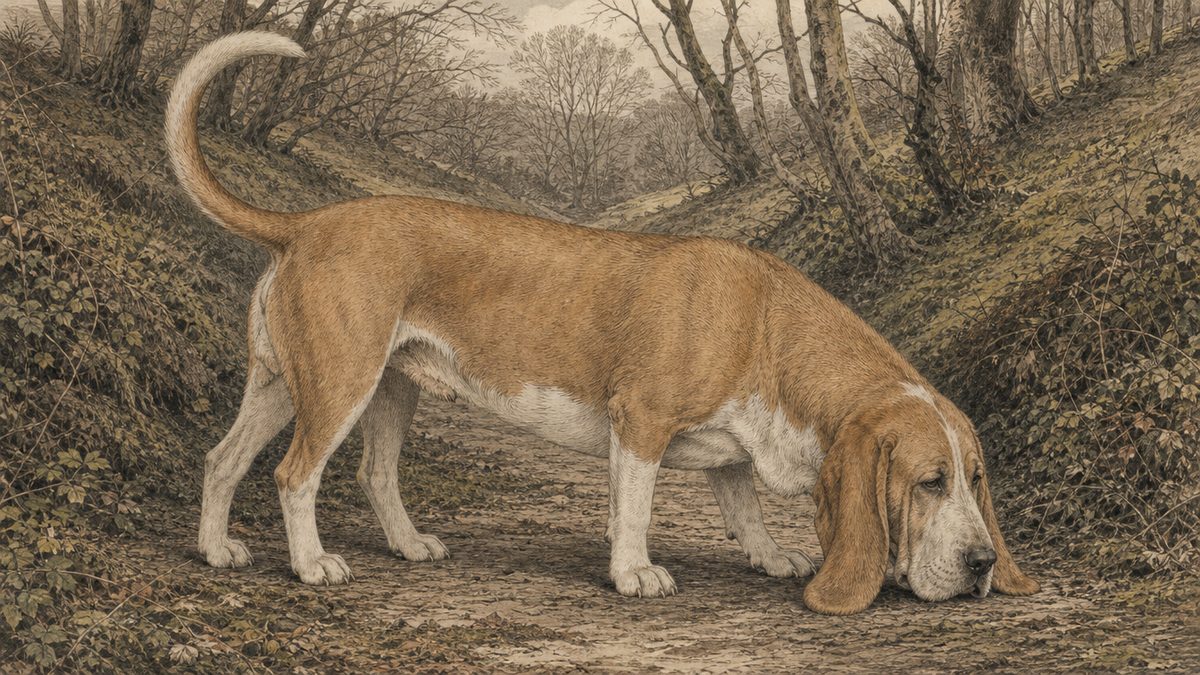
No photograph of this animal exists and no undisputed contemporary likeness has been read for this page. The image at the top is built from the two written descriptions above and is labelled as a reconstruction. A confident portrait would assert a settled appearance that two sources seventy years apart do not quite give.
What it left behind, and which of those an Indian buyer can actually get
The Southern Hound's inheritance survives inside the Beagle, the Otterhound and the English Foxhound, and only one of those three is genuinely available in India. That is the practical point of this whole page.
Youatt makes the Otterhound derivation explicitly. He writes that the Otter Hound 'used to be of a mingled breed, between the southern hound and the rough terrier, and in size between the harrier and the fox-hound'. That is a direct descent claim from a source writing while the parent type still had survivors in Devon, which makes it much stronger than the descent claims that circulate for most extinct breeds.
The Beagle claim runs through the same book from the other end. Youatt opens his Beagle section by saying 'There is evidently much of the harrier and of the old southern, connected with a considerable decrease of size and speed, the possession of an exceedingly musical voice, and very great power of scent'. Musical voice and great power of scent are precisely the two Southern Hound qualities, carried into a small dog.
| Breed | The Southern Hound link | Available in India? | Median survival, McMillan 2024 |
|---|---|---|---|
| Beagle | Youatt: 'much of the harrier and of the old southern', with the voice and the nose | Yes, very widely, Rs 25,000 to Rs 90,000 and above | 12.5 years (12.3 to 12.7), 1,552 deaths, HR 0.95 against crossbreds, p=0.07 |
| Otterhound | Youatt: 'a mingled breed, between the southern hound and the rough terrier' | No. One of the rarest breeds in Britain and effectively unobtainable here | No median. Listed in Table S5 with the flag N, so present in the breed list and excluded from the survival analysis |
| English Foxhound | The faster packs the Southern was bred into | Very rare in India, and a pack hound rather than a pet | 13.0 years (11.4 to 16.9), 31 deaths, HR 0.67, p=0.02 |
| Bloodhound | Shares the heavy head, flews and ears, but a separate line in Caius from 1576 | Rare in India | 9.3 years (8.6 to 11), 71 deaths, HR 1.68 (1.33 to 2.12), p<0.001, the shortest-lived hound in the table |
| Harrier and West Country Harrier | Beckford's 'large slow hunting harrier' sits beside it in the same 1781 letter | No. Pack hounds under the AMHB, not sold as pets | No median. Harrier is listed in Table S5 with the flag N |
Two rows in that table are absences rather than figures, and Table S5 is what makes them readable. A breed missing from McMillan's survival table may have been excluded, merged into another row or filed under a different name, and only S5 tells those apart. It lists both the Otterhound and the Harrier with the flag N, meaning present in the breed list and excluded from the survival analysis, so 'no median exists' is the correct statement and 'absent from the study' would be wrong. The Harrier's own governing body, the Association of Masters of Harriers and Beagles, has run a stud book since 1891 and registered 107 packs of Harriers in that first year, so these are documented dogs that simply do not reach a companion-animal dataset.
Read the last column before the second
The Bloodhound row is the one that should change a decision. At a median of 9.3 years against the Beagle's 12.5, with a hazard ratio of 1.68 against crossbreds and a confidence interval of 1.33 to 2.12 that clears one comfortably, it is the shortest-lived hound in this comparison. A buyer drawn to the heavy head and long ears of the old Southern Hound is being drawn toward the Bloodhound's shape, and that shape carries a measured cost in years.
McMillan's hazard ratios compare each purebred against the crossbred group, not against all dogs and not against a breed average. So the Bloodhound's 1.68 says it dies earlier than crossbred dogs in the same dataset, and the Foxhound's 0.67 says it outlives them. Reading either number as a comparison between two purebreds is a misuse of the table.
Registry recognition today: none anywhere, checked with in-document controls
No registry on earth holds the Southern Hound, and each absence below was checked with controls inside the same document so that a failed fetch could not be mistaken for a finding.
| Register | Result | In-document controls that returned |
|---|---|---|
| Royal Kennel Club, Breeds A to Z | Zero hits for 'southern' across about 75,500 characters | Labrador 1, Beagle 1, Foxhound 1, Bloodhound 3, Otterhound 1, Harrier 1, Whippet 1, Greyhound 2, Corgi 2, Terrier 62 |
| American Kennel Club, complete breeds index | Zero hits across about 16,800 characters | Labrador 2, Beagle 2, Foxhound 6, Bloodhound 2, Otterhound 2, Harrier 2, Greyhound 7, Terrier 93 |
| FCI letter S index | Not present | Sloughi returned on the same fetch |
| FCI provisional register | Not among the twenty entries | The list rendered with its twenty rows intact |
Why the controls matter more than the zeros
A zero from a page that did not load looks exactly like a zero from a page that did. Every row above carries breeds that are genuinely present in that same document, so the search string and the fetch are both demonstrably working American Kennel Club. Without that, a reader has no way to tell a finding from a broken query, and this project has recorded plenty of the latter.
One further caution about the FCI specifically. Its letter indexes have been observed serving different languages on different fetches of the same URL, and a breed can file under a different letter in a different language, so an absence read off one letter index is weaker than it looks. In this case the point is moot, because the animal has been extinct since before the FCI was founded in 1911, but the reasoning is worth stating rather than hiding.
The Kennel Club of India question, answered properly
India's recognition position follows the FCI's. The FCI members register lists India as a full member represented by the Kennel Club of India in Chennai, so the KCI issues pedigrees against FCI nomenclature. Since the FCI holds no Southern Hound in either its definitive or its provisional register, no KCI pedigree route exists either. Note that the KCI publishes no breed list of its own, so querying it directly returns zero for every breed and is a broken instrument rather than a finding.
Unlisted implies an oversight. This animal was never eligible for a list, because it stopped existing before the lists were made. The distinction matters when a seller uses the word 'rare' to mean 'not yet recognised', which invites a buyer to imagine recognition is coming.
Southern Hound price in India: there is none, and the search result is the proof
No Southern Hound has a price in India or anywhere else, because none has existed for about 150 years. The Indian search for this term does not return an empty page, which would at least be honest. It returns articles about the American South.
The Indian result set for 'southern hound dog' carries two page-one results about dogs of the American South, listing the Carolina Dog, the Plott Hound, the Catahoula Leopard Dog, the Redbone Coonhound, the Boykin Spaniel and the Mountain Cur. Those are real breeds and the articles are not dishonest. They simply answer a different query, and an Indian buyer who lands on one has been silently moved from an extinct English hound to a living American one.
| Result type | What it is | What a buyer should conclude |
|---|---|---|
| Wikipedia, position 1 | The article every other result paraphrases, correctly stating extinction | Accurate. Read it and stop |
| American South listicles | StyleBlueprint and LOCAL Life SC, about Carolina Dogs and Plott Hounds | Homonym capture. A different continent's dogs |
| Aggregator breed profiles | dogbreedinfo and kiddle, spec-card templates applied to an extinct type | Generated fields. No standard exists to fill them from |
| Stock image libraries | Pixabay results for the phrase | Not evidence of a dog |
| Indian hound listicles | Heads Up For Tails, 'top 15 popular hound dog breeds in India' | The only genuinely Indian result, and it is about Beagles and Rajapalayams |
The one Indian result is the useful one
Heads Up For Tails ranks on page one with an article about popular hound breeds in India, naming Beagles and the Rajapalayam. That is what the query is actually reaching for, and it points at the two honest answers for an Indian reader: a Beagle if you want the Southern Hound's nose and voice in a dog you can buy, or an Indian sighthound if you want a hound adapted to the climate you actually live in.
Bonbeno reports published price ranges as editorial content. For this breed there is nothing to report, and inventing a plausible band would be the single easiest lie to tell on a page like this. Where a figure appears below, it belongs to a living breed and is attributed to the Indian page it was read from.
What the living descendants actually cost in India, and where the sources disagree
Two Indian price lists read on the same day disagree about the Beagle's ceiling by Rs 50,000, and publishing that spread is more useful than picking one. PawSpace gives Rs 25,000 to Rs 90,000 and above; Wrapinfur gives Rs 15,000 to Rs 40,000.
| Breed | PawSpace | Wrapinfur | What the gap tells you |
|---|---|---|---|
| Beagle | Rs 25,000 to Rs 90,000+ | Rs 15,000 to Rs 40,000 | A Rs 50,000 disagreement on the ceiling. Neither is wrong; they are sampling different sellers |
| Labrador Retriever | Rs 20,000 to Rs 70,000 | Not compared here | The reference point most Indian buyers already have |
| Rajapalayam | Rs 8,000 to Rs 30,000 | Not compared here | An Indian sighthound at a third of the Beagle's ceiling |
| Mudhol Hound | Rs 8,000 to Rs 30,000 | Not compared here | Same band as the Rajapalayam |
| Chippiparai | Rs 8,000 to Rs 30,000 | Not compared here | Same band again |
| Kanni | Rs 8,000 to Rs 30,000 | Not compared here | Same band again |
| Kombai | Rs 10,000 to Rs 35,000 | Not compared here | Slightly above the sighthound band |
| Indian pariah dog | Rs 0 to Rs 5,000 | Not compared here | Free from a shelter this week, in every city named on this page |
These figures are rupee-native, and that is worth stating
Every distinct rupee figure between Rs 1,000 and Rs 5,00,000 in the raw markup of both price lists was tested against 84.38, 80.00 and 74.00. Not one divides cleanly at 84.38 and not one at 74.00. The apparent matches are all at 80.00, which proves nothing, because 1,000 divided by 80 is 12.5 and so any figure ending in three zeros divides cleanly at that rate by construction. The quotients it produces, 15 and 25 and 50 and 125, are not prices a seller would print for a dog.
That is a negative result and it is reported as one. This project has repeatedly caught Indian breed pages publishing a US dollar list run through a single exchange rate. These two are not doing that. The spread between them is ordinary commercial variation, and the honest reading is that the Indian Beagle market genuinely runs from about Rs 15,000 to about Rs 90,000 depending on seller, city and what the buyer is willing to check.
The four Indian breeds in that table deserve a second look
Four Indian sighthounds share an identical Rs 8,000 to Rs 30,000 band on one list. Identical bands across several breeds are a template signature rather than four independent observations, and this project has documented Indian sites assembling cost rows from a small set of preset lines. Treat that band as one data point about how the site prices Indian breeds, not as four.
A published range tells you what a category costs, not what a specific dog is worth. What decides value on a hound is whether the seller will show you the parents, the date of birth and a health record. All three are free to ask for and none of them appears in any table on this page.
Monthly cost of ownership in India for a hound of this size
Budget roughly Rs 6,000 to Rs 12,000 a month for a 12 to 20 kg scent hound in an Indian metro, built from named line items rather than taken from a single quoted total. The lines below are each sourced separately, because the round monthly totals Indian breed pages publish are frequently assembled from preset components rather than costed per breed.
| Line | Figure | Source and caveat |
|---|---|---|
| Tick, flea and worm cover | About Rs 1,103 a month | NexGard Spectra for 15 to 30 kg, 3 tablets at Rs 3,308 against an MRP of Rs 3,375. Covers the tick and flea role and the roundworm and hookworm role in one tablet |
| Separate deworming, if used instead | Rs 125.67 a tablet, one per 10 kg | Drontal Plus, 6 tablets at Rs 754 against an MRP of Rs 838 |
| Vaccination, spread monthly | Rs 699 anti-rabies, Rs 899 for the 9-in-1 DHPPiL | Vetic's national page. These are one chain's promotional floors, and the same chain quotes different course prices on different city pages on the same day |
| Grooming | Rs 934 bathing, Rs 1,359 haircut, Rs 99 add-ons | Vetic Delhi price list. A short-coated hound needs the low end of this, and mostly needs ears rather than coat |
| Municipal registration | Rs 500 in Delhi, Rs 50 in Chennai | Delhi MCD new registration and renewal both Rs 500 with a Rs 100 a month late fee. Greater Chennai Corporation licences a pet animal at Rs 50 |
| Food | Not quoted here | No current Indian retail figure was re-priced for this page, and a stale food price is worse than none |
The two lines Indian buyers routinely underestimate
Parasite cover and ear care are the recurring costs on a scent hound, and neither appears on a typical Indian breed page's monthly total. A drop-eared hound working nose-down in Indian undergrowth collects ticks, and the Indian tick-borne disease burden measured in clinic caseloads is large enough that monthly cover is a fixed line rather than a seasonal one Tick-borne pathogen survey of 584 dogs….
The municipal line is small and almost universally skipped. Delhi's Municipal Corporation charges Rs 500 to register a pet dog and Rs 500 to renew, with a late fee of Rs 100 a month, and its own live counter read 18,958 certificates issued since 2021 on 9 September 2026, and 19,022 on 17 September. Greater Chennai Corporation licences a pet animal at Rs 50, issued 9,115 licences in 2024, and runs six municipal pet clinics that provide treatment and anti-rabies vaccination free of cost. That last item is the best-value line available to an Indian dog owner and almost no breed page mentions it.
This project has repeatedly found Indian breed sites publishing identical monthly totals across unrelated breeds, because the totals are the sum of three preset lines rather than a costing of any actual animal. A figure assembled from named, separately sourced components can be checked line by line. A round total cannot.
Could a Southern Hound have handled the Indian climate? The heat tolerance answer
No, and the gap is not marginal. The Southern Hound's country ran an annual mean near 11 C with a warmest month around 17 C. Chennai's coolest month averages 24.09 C, so India's mildest coastal month is about 7 degrees hotter than the hottest month this animal's home country produces.
The homeland figures come from NASA POWER points queried by explicit coordinates, with the grid-cell elevation echoed back and checked against the real town elevation, because this project has measured POWER cells wrong by more than a kilometre in hill country. Dorchester in Dorset returns a cell at 17.48 m against a real elevation near 60 m, an error of about 43 m, and an annual mean of 11.86 C with a warmest month of 17.03 C in August. Salisbury returns 10.43 C annual and 17.33 C in July. Exeter, which is the Devon end where Youatt places the last of them, returns 10.92 C annual and 16.20 C in July.
| Place | Annual mean T2M | Hottest month | Coolest month | Annual RH |
|---|---|---|---|---|
| Exeter, Devon | 10.92 C | July, 16.20 C | February, 6.08 C | 87.13 percent |
| Dorchester, Dorset | 11.86 C | August, 17.03 C | February, 7.12 C | 84.67 percent |
| Chennai | 27.95 C | May, 31.51 C | January, 24.09 C | 72.39 percent |
| Mumbai | 26.77 C | May, 31.19 C | January, 23.19 C | 67.39 percent |
| Kolkata | 25.81 C | May, 31.53 C | January, 17.31 C | 73.93 percent |
| Delhi | 25.60 C | June, 35.88 C | January, 13.61 C | 45.56 percent |
| Pune | 23.86 C | April, 28.93 C | December, 19.62 C | 66.80 percent |
| Bengaluru | 23.74 C | April, 28.37 C | December, 20.22 C | 67.94 percent |
Three of those hottest-month cells surprise people
Delhi peaks in June rather than May, at 35.88 C. Bengaluru and Pune both peak in April, at 28.37 C and 28.93 C, and both are coolest in December rather than January. Chennai, Mumbai and Kolkata genuinely do peak in May. Those distinctions matter for scheduling a hound's working hours and they are wrong on a large number of Indian breed pages, which blanket-apply May to every city.
What the gap means in practice
Bengaluru is the only Indian city in that table whose hottest month, at 28.37 C, sits within about 11 degrees of the English figure, and it is still 11 degrees hotter. There is no Indian plains city in which this animal's thermal environment could be reproduced. A slow hound working a cold scent for five or six hours, which is what Daniel describes, is a sustained exertion profile, and sustained exertion is the specific thing that kills dogs in heat.
Nobody measured this animal's heat tolerance, because it died before anybody was measuring such things. The trait rating of 1 above is derived from origin climate and from the working profile the sources describe, and it is stated as an inference rather than as data. For the living breeds this page routes to, the Beagle and the Foxhound, there is real evidence and it is in the health section.
Humidity, wet bulb, and why the damp-air argument is the wrong one here
Devon and Dorset are wetter than most of India, so humidity by itself is not what would have hurt this dog. Exeter runs 87.13 percent annual relative humidity against Chennai's 72.39 and Delhi's 45.56. What kills a northern hound in India is heat, or heat combined with humidity, measured as wet-bulb load rather than as damp air.
This correction matters because the damp-air argument is the one most breed pages reach for. The English south-west is genuinely humid: Exeter 87.13 percent, Dorchester 84.67 percent, both higher than every Indian city in the comparison except none of them. A hound bred in that country is thoroughly adapted to wet air. It is not adapted to wet air at 31 degrees.
| Place | Peak wet-bulb month | Peak wet-bulb | Reading |
|---|---|---|---|
| Exeter, Devon | August | 14.38 C | The homeland baseline |
| Dorchester, Dorset | August | 15.08 C | The warmer English point |
| Chennai | May | 26.11 C | About 11 degrees above the homeland peak |
| Kolkata | June | 27.09 C | The highest in this comparison |
| Delhi | July | 26.50 C | Monsoon humidity on top of residual heat |
| Mumbai | June | 25.77 C | Coastal, high and sustained |
| Pune | June | 22.97 C | The mildest mainland point here |
| Bengaluru | May | 21.86 C | The best Indian city for this body plan, and still 7 degrees up |
How to read a wet-bulb figure without overstating it
Wet bulb has a hard physical sanity check, which is why it is used here. Readings above about 35 C are at the outer edge of anything ever observed on earth, so a table like this one that tops out at 27.09 C is inside the plausible range. Every figure above was computed from the mean temperature and the mean relative humidity, not from the period maximum, because the period maximum is an extreme rather than an average and feeding it into a wet-bulb calculation produces impossible numbers.
The practical translation is simple. At a wet-bulb temperature in the middle twenties a dog's evaporative cooling still works but its margin is thin, and a long low-intensity working session, which is exactly what this hound was for, uses that margin up slowly and without obvious warning. That is a different risk profile from a sprint, and it is worse for a scent hound than for a sighthound.
Bengaluru's 21.86 C peak wet bulb is the most forgiving in this table and it still sits about seven degrees above the English peak. A reader planning to keep a heavy long-eared scent hound in India should read that as the best case rather than as a green light, and should read the exercise section before anything else.
Temperament: three qualities are recorded, and all three are about work
The sources describe nose, voice and steadiness, and they describe nothing else. There is no record of how a Southern Hound behaved in a house, because nobody kept one in a house.
Steadiness is the quality Daniel emphasises and it is remarkable. He records that the discipline was such that 'in the hottest Scent, if the hunting Pole was thrown before them, they stopped in an instant, and followed the Huntsman's heels in full Cry, till he again permitted their going forward'. A pack of scent hounds stopping dead on a hot line and walking to heel while still giving tongue is an extraordinary piece of training, and it says the animals were biddable in a way modern scent hound owners would not expect.
Voice was a feature, and in an Indian flat it is the problem
Deep-mouthed is Daniel's word and Youatt calls the tones 'peculiarly deep'. Voice was selected for, deliberately, because a foot follower in woodland navigates by ear. Every living descendant carries it. The Beagle's musical voice is the specific quality Youatt traces back to this animal, and it is the single commonest reason Beagles are surrendered in Indian apartment buildings.
What cannot be said, and is said anyway on other pages
No period source describes this animal with children, with other dogs in a house, or alone. Every temperament score printed for it on an aggregator page has been generated. The honest transfer to a living dog is narrow: expect a strong nose, a loud and carrying voice, and an independence that reads as stubbornness indoors because it was selected as initiative in the field.
A hound bred to follow a trail for five hours without direction will follow a trail in a Delhi park for as long as it takes, and will not hear you. Recall on a working scent hound is a management problem rather than a training failure, and the honest answer is a long line and a fenced space rather than a better command.
Training a scent hound: what the record shows, and what an Indian owner can use
To train a scent hound of this type, work with the nose rather than against it, and accept that recall off a live scent is the one thing the breed was selected not to do. The 1801 record shows these dogs were trained to an extremely high standard, which is worth knowing before anyone calls a Beagle untrainable.
Daniel's stopping-on-the-pole description is the counterargument to the whole modern folklore about scent hounds being untrainable. Those packs were trained to break off a hot line on a visual signal and walk to heel in full cry. What has changed is not the dogs but the amount of daily contact: a pack hound worked several days a week under a professional huntsman is in a training relationship an Indian flat cannot reproduce.
The five things that work on this kind of hound in India
- Start before the heat. Train at 6 to 8 in the morning and after dusk. A session that runs into a Chennai afternoon is a heat exposure rather than a training session, and 652 of the 879 UK heat-related illness events with a recorded trigger were exertional.
- Pay with food, every time. A scent hound works for its own reasons and needs a reason to work for yours. Food is the only currency that reliably competes with a smell.
- Use a long line, not a better recall cue. Fifteen metres of line turns an uncontrollable dog into a controllable one on the day you need it, and costs less than one grooming session.
- Give the nose a legal job. Scatter feeding and simple find-it games spend the drive that otherwise gets spent on your shoes. This is the single highest-value habit for an Indian apartment household.
- Wait for eight weeks. Rule 8(1)(a) of the Prevention of Cruelty to Animals (Dog Breeding and Marketing) Rules, 2017 requires that pups less than eight weeks in age are not sold, so a lawfully obtained puppy starts here rather than at six.
What this breed resists, stated honestly
It resists being called off once it has begun to track. That is not stubbornness in the ordinary sense; it is the specific quality that made a five-hour chase possible, and it was bred in on purpose over centuries. An owner who understands that stops treating recall failure as disobedience and starts managing the environment instead, which is both kinder and considerably more effective.
No eight-week-old dog of any breed is trained, and a scent hound least of all. The claim is worth noticing because it usually travels with other claims, including about age and about parentage, and the age claim is the one Indian law actually regulates.
Exercise: the real daily requirement, and the hours it has to happen in
A medium scent hound in India needs two real outings a day, roughly 45 to 75 minutes of activity split across early morning and after dusk, with the middle of the day spent indoors. The requirement is not negotiable; the timing is what makes it survivable.
The working ancestor sets the scale. Daniel's chases 'sometimes lasted five or six hours' on foot, and Beckford's harriers were expected to hunt through a winter day. Nothing about that transfers directly to an Indian city, but it tells you the animal was built with a very large aerobic budget and that its living descendants still carry a share of it.
Why the timing matters more than the distance
Heat-related illness in dogs is overwhelmingly exertional rather than environmental. Of the 879 UK events with a recorded trigger in Hall and colleagues' 2020 Animals paper, 652 were exertional, which is 74.2 percent, against 113 environmental and 46 from vehicular confinement. That is a British cohort in a British climate, so read it as a floor rather than as an estimate for India. The dog is not at risk because it is outside. It is at risk because it is working.
Bodyweight compounds it. In the companion Scientific Reports paper, bodyweight at or above the breed and sex mean carried odds of 1.42 for heat-related illness, with a confidence interval of 1.12 to 1.80, and dogs over 50 kg carried odds of 3.42. A Beagle is nowhere near 50 kg, but the first finding applies directly: the exercise a household skips in April is paid for in May, through a heavier dog with a worse thermal margin.
| Slot | What it is | Why |
|---|---|---|
| 6:00 to 7:00 | Main walk, 30 to 45 minutes, sniffing allowed | Coolest ground temperature of the day |
| Mid-morning | Five minutes of find-it indoors | Spends drive at no thermal cost |
| Middle of the day | Indoors, fan or cooler, water available | The window in which exertional heat illness happens |
| After dusk | Second walk, 20 to 30 minutes | Air has cooled, but check the pavement first |
| Weekly | One longer outing in a fenced space, on a long line | Replaces the trail work the breed was built for |
Put the back of your hand on the pavement and hold it there for five seconds. If you cannot, the dog cannot stand on it. Indian tarmac holds heat for hours after the air has cooled, and paw burns are the commonest avoidable summer injury in a city dog.
Grooming: the coat is easy, and the ears are the entire job
Groom a short-coated drop-eared hound in India by ignoring the coat and attending to the ears. A weekly brush handles the coat completely. The ears need checking every few days, and drying every single time the dog gets wet.
The period sources describe a short-coated animal and say almost nothing about its care, which is itself informative: nobody wrote grooming advice for a hound because there was nothing to write. Youatt's characters are about size, body length, chest and ears, with no mention of coat maintenance at all.
Why the ears are the whole problem in an Indian climate
A large pendulous ear over a canal is a lid. Youatt's 'ears remarkably large and pendulous' is the exact anatomy that stops air moving into the ear canal, and in Indian humidity and monsoon a canal that does not dry is a canal that gets infected. This is the point at which overseas breed-club care advice stops transferring: guidance written for an English autumn routinely says to towel a hound and let it air dry, which is fine in Devon at 16 degrees and wrong in Kochi in August.
- Check the ears every three days. Look and smell. A yeasty smell precedes visible trouble by days.
- Dry the ears after every wetting. After a bath, after rain, after a swim. Cotton wool at the opening, never down the canal.
- Brush weekly, not daily. A short hound coat needs a rubber mitt once a week and nothing else.
- Trim nails monthly. A hound bred for distance on soft ground does not wear its nails down on an Indian tile floor.
- Skip the haircut entirely. There is no coat to cut, and a groomer who suggests one on a short-coated hound is selling a service the dog does not need.
The Indian cost of this is small and worth stating. Vetic's Delhi list gives bathing from Rs 934 and add-ons from Rs 99, against Rs 1,359 for a haircut this dog does not need. A short-coated hound is one of the cheapest dogs in India to keep clean, and almost all of that budget should go on ears rather than on coat.
Ear disease in a drop-eared hound can be bacterial, yeast, mite or foreign body, and the treatments differ. Over-the-counter drops used on the wrong cause make the next problem harder to treat. Consult a registered veterinarian near you rather than acting on anything on this page.
Health issues and life expectancy: nothing is known for this animal, and here is what replaced it
No health data exists for the Southern Hound in any form, and that has to be said rather than filled in. There is no studbook to count deaths in, no screening scheme, no health survey and no lifespan study. Every figure below belongs to a living descendant.
The literature absence is controlled. The exact-phrase query returns nothing and PubMed says so explicitly with its quotedphrasesnotfound warning, so the unquoted form was retried as this project's own rules require: 'Southern[tiab] AND hound[tiab]' returns 15 records with a clean translation line, and reading them shows they are smooth-hound sharks and geographic uses of the word southern rather than papers about this animal. Controls in the same session returned 128 for Foxhound, 30 for Bloodhound and 3,977 for Beagle with dog, so the instrument was working.
There is no gene pool left to study, and that is the actual finding
The type was absorbed rather than lost, which is why no separate health record can exist. Its gene pool went into the packs that outpaced it, and the Beagle and the Otterhound carry the inheritance inside their own studbooks where it can no longer be measured separately. A closed population that ends leaves records. A regional kind bred into other packs leaves an argument about dates and nothing to screen.
The living descendants' numbers, which are real
| Breed | Median survival | 95 percent CI | Deaths in sample | HR against crossbreds |
|---|---|---|---|---|
| Beagle | 12.5 years | 12.3 to 12.7 | 1,552 | 0.95 (0.91 to 1), p=0.07, not significant |
| Basset Hound | 12.5 years | 12.2 to 12.7 | 883 | 0.90 (0.84 to 0.96), p<0.01 |
| English Foxhound | 13.0 years | 11.4 to 16.9 | 31 | 0.67 (0.47 to 0.95), p=0.02 |
| Bloodhound | 9.3 years | 8.6 to 11 | 71 | 1.68 (1.33 to 2.12), p<0.001 |
| Labrador Retriever, as a familiar reference | 13.1 years | 13.0 to 13.1 | 16,155 | 0.80 (0.78 to 0.81), p<0.001 |
The Bloodhound row is the one that should change a decision, and it is the breed whose head and ears most resemble the descriptions of this animal. A median of 9.3 years against the Beagle's 12.5 is more than three years, on 71 recorded deaths, with a hazard ratio whose interval sits comfortably above one. A buyer attracted by the old heavy hound look is being pointed at the shortest-lived option in the table.
The screening data that does exist, for the breeds that inherited from it
The Orthopedic Foundation for Animals publishes hip screening statistics for three of the four breeds this page routes to, and the spread is wide enough to change a decision. The figures were read from OFA's own statistics dump with the table's header read rather than assumed, and every row was checked so that excellent plus good plus fair reproduces the printed normal figure and mild plus moderate plus severe reproduces the printed dysplastic figure. All of them closed.
| Breed | Evaluations | Normal | Dysplastic | Reading |
|---|---|---|---|---|
| Otterhound | 649 | 49.9 percent | 47.1 percent | The worst in this table by a distance, and Youatt derives the breed from the southern hound crossed with the rough terrier |
| Basset Hound | 286 | 57.7 percent | 39.5 percent | Second worst, on a small denominator |
| Bloodhound | 3,752 | 71.4 percent | 26.4 percent | A large sample and a poor result |
| Beagle | 1,783 | 79.2 percent | 18.6 percent | The breed most Indian buyers will actually get |
| Labrador Retriever, as a familiar reference | 324,934 | 87.5 percent | 11.3 percent | The largest dataset OFA holds for any breed |
| English Foxhound | No row at all | n/a | n/a | OFA requires 100 hip evaluations before publishing a breed, so this is an absence of data rather than a good result |
The Otterhound row deserves a second look, because it is the breed Youatt ties most directly to this page's subject. Nearly half of all Otterhounds evaluated by OFA are dysplastic, at 47.1 percent of 649 Youatt W. The Dog. London. A reader drawn to the old heavy hound type should know that the surviving breed closest to it carries the worst hip statistics on this table.
For the Beagle, OFA's eye summary reports 97.5 percent normal of 1,423 evaluations, while its own detail rows report NORMAL as 1,002 of 1,421, which is 70.5 percent, a gap of 27.0 percentage points. The same shape appears on the Basset Hound at 21.2 points and the Bloodhound at 35.3. This project has recorded this contradiction on more than a dozen breeds and it is a property of the tables rather than a finding about any breed, so neither figure should be quoted as 'the' rate.
What screening actually exists, and what Indian law does and does not require
Indian law names a list of genetic defects a breeding dog must have been tested for, and it is worth reading rather than paraphrasing. Second Schedule Part III paragraph 8(10) of the 2017 Rules requires testing for defects 'including hip dysplasia, progressive retinal atrophy, night blindness, hypothyroidism, entropion, ectropion, overshot, undershot jaw (when incisors do not touch or mesh), wry mouth, two or more missing teeth' and cryptorchidism. The word is including, so the list is illustrative rather than closed. Note also what is absent: across the whole gazette there is no patella requirement and no dental requirement, so nobody should tell you Indian law mandates a patella grade.
Every figure above is a population statistic from a British dataset. It says nothing about any individual dog and it is not a diagnosis. Consult a registered veterinarian near you before acting on anything here, and treat laboured panting that will not settle in shade, pale gums or dark urine as reasons to call a clinic the same day rather than to read further.
The Indian health risk no British source will mention: tick-borne disease
Tick-borne disease is the health risk that decides a scent hound's life in India, and it appears in no British or American breed health survey. Indian clinic surveys report very high pathogen burdens, and a long-eared nose-down hound working in undergrowth is the body plan most exposed to it.
The Indian numbers are large and they need their denominators stated correctly. A survey of 584 dogs in West Bengal found Babesia gibsoni in 76.54 percent of the 584 dogs screened (447 of 584) and Anaplasma in 55.75 percent (325 of the 583 tested for it), with 72.9 percent of the dogs carrying two or more pathogens. A Kerala survey of 120 dogs found Babesia in 80 of the 120 screened, which is 66.7 percent, and Ehrlichia canis in 5.0 percent, with a pre-monsoon March to May peak.
The caveat that must travel with those figures
Both studies sampled dogs presenting at veterinary clinics rather than a random population, so they describe the burden among dogs tested at clinics and not a national prevalence. Writing '76.54 percent of Indian dogs' would be materially misleading. Writing '76.54 percent of 584 dogs screened at clinics in West Bengal' is what the papers support, and it is still an alarming number.
| Finding | Figure | What to do about it |
|---|---|---|
| Babesia gibsoni, West Bengal | 76.54 percent of 584 screened | Monthly acaricide cover, year round, not seasonal |
| Two or more pathogens together | 72.9 percent of 584 screened | Assume co-infection is normal, not exceptional |
| Babesia, Kerala | 80 of 120 screened, 66.7 percent | Same conclusion from a second state |
| Ehrlichia canis, Kerala | 5.0 percent | Lower, but it is the one that goes chronic quietly |
| Seasonal peak, Kerala | Pre-monsoon, March to May | Tighten checking in exactly the months the heat is worst |
The practical routine, which costs about Rs 1,103 a month
NexGard Spectra for a 15 to 30 kg dog runs about Rs 1,103 a month at Supertails' listed price of Rs 3,308 for three tablets, and covers the tick and flea role and the roundworm and hookworm role in one tablet. Drontal Plus is the separate deworming route at Rs 125.67 a tablet, dosed one per 10 kg. Add a physical tick check after every walk in grass, concentrating on the ear folds, between the toes and under the collar.
Pale gums, dark or coffee-coloured urine, a fever that comes and goes, or sudden lethargy after a tick season send a dog to a clinic the same day. Babesiosis and ehrlichiosis are both treatable and both get worse quickly. Consult a registered veterinarian near you rather than acting on any figure on this page.
Feeding a medium scent hound in India, and the one number that matters
Feed a scent hound measured meals twice a day and keep it lean, because a hound that is allowed to free-feed will eat anything it can reach and will get fat doing it. Body condition, not the number on the pack, is the instrument.
Nothing is known about what a Southern Hound ate. The dogs belonged to foot-hunting establishments and later to Devon farmers keeping two or three each, and no feeding account survives. What is worth saying about the historical animal is that a five-hour working day is an enormous energy budget and that none of it transfers to a dog lying under a fan in Hyderabad.
The three rules for the living descendants
- Measure every meal. Weigh it if you can. A scent hound's appetite is not a guide to its needs, and the Beagle in particular is among the easiest breeds in the world to overfeed.
- Split the ration across two meals. Morning and evening, matching the two walk slots, so the dog is not working on a full stomach or an empty one.
- Check the ribs weekly. You want to feel them easily under a thin cover without seeing them. This takes ten seconds and is worth more than any feeding chart.
Weight control is the intervention with the clearest evidence behind it on this page. Bodyweight at or above the breed and sex mean carried odds of 1.42 for heat-related illness in the 905,543-dog cohort, with a confidence interval of 1.12 to 1.80. In an Indian climate that is not a cosmetic finding. A lean hound has a thermal margin and a heavy one does not.
What it costs, and why no monthly food figure appears here
This page quotes no monthly food figure, deliberately. Indian retail food prices move within weeks, this project has already caught one large-bag price going stale within days of being recorded, and a stale figure presented confidently is worse than an acknowledged gap. Build your own from the food you can actually buy in your city, at the grams per day the pack specifies for your dog's weight, and re-check it every few months.
A nose-down hound in an Indian street will eat what it finds, and what it finds includes bones, packaging and poisoned bait laid for rodents. This is the practical reason the long line in the training section matters, and it is a bigger day-to-day risk than any inherited condition on this page.
The first year month by month, and why this timeline is not about a Southern Hound
This timeline describes a Beagle or Beagle-type puppy in an Indian city, because no Southern Hound puppy has been born for about 150 years and no account of one survives. It is printed here because it is what a reader searching this breed name is actually about to need.
The legal start point is eight weeks. Rule 8(1)(a) of the 2017 Rules requires that pups less than eight weeks in age are not sold, so month two is where a lawfully obtained puppy joins the household.
| Age | What happens | The Indian constraint |
|---|---|---|
| 8 to 10 weeks | Puppy legally leaves the breeder. Core vaccination course begins | Anti-rabies Rs 699 and the 9-in-1 DHPPiL Rs 899 at one national chain's listed floors. Chennai's six municipal clinics give treatment and anti-rabies free |
| 10 to 16 weeks | Socialisation window. People, surfaces, traffic noise, other vaccinated dogs | Do it at 7am and after dusk. A socialisation walk at noon in April is a heat exposure |
| 4 to 6 months | Lead manners, name response, the beginning of recall. Deworming continues | Drontal Plus at Rs 125.67 a tablet, one per 10 kg. Start monthly tick and flea cover before the first monsoon |
| 6 to 9 months | Adolescence. The nose starts overriding everything you taught | This is when recall appears to break. It has not broken; the drive has switched on. Long line, not louder commands |
| 9 to 12 months | Switch toward adult food. Full working nose | The first full Indian summer. Expect to need a shorter schedule than any British book assumes |
| 12 months | Municipal registration and the first annual booster | Delhi MCD registration Rs 500 with a Rs 100 a month late fee. Greater Chennai Corporation licences a pet at Rs 50 |
The three months that decide the next ten years
Months six to nine are where owners of scent hounds give up. The puppy that came when called at four months stops coming at seven, and the usual response is more shouting and less freedom, which teaches the dog that coming back ends the fun. The alternative is a long line, food that outcompetes the smell, and the acceptance that this is a breed built to work away from you.
None of it is a Southern Hound timeline. If you came here for the extinct type, the honest answer is that no growth data, no litter record and no puppy account of any kind survives. This page prints a living hound's timeline and labels it as one rather than generating a plausible-looking table for an animal nobody has raised since the 1870s.
Indian law: what actually applies, and what does not
Three Indian instruments matter to anyone reading this page, and none of them concerns the Southern Hound itself. Import is Restricted and closed for trade, breeding practice is regulated, and outdoor housing in heat is specifically constrained.
Import: no import authorisation exists for this purpose
Dogs enter India under ITC(HS) 01061900, classified Restricted. DGFT Trade Notice 22/2022-23 states that applications for trading or breeding purposes shall be duly rejected, and limits entry to six ports at Delhi, Mumbai, Chennai, Hyderabad, Bangalore and Kolkata. DAHD added a seventh port, Cochin International Airport at Kochi, for pets arriving under the baggage rules in October 2024. The document was downloaded live at 226,361 bytes with a real text layer and read directly rather than summarised. For an extinct animal the question is doubly closed, since no exporting population exists, but the notice is the instrument to cite rather than the absence of listings. The full route is set out in how to import a dog to India.
Breeding: two clauses that a buyer can use as questions
- Rule 8(1)(a) requires that pups less than eight weeks in age are not sold. Ask the date of birth.
- Second Schedule Part II paragraph 6(3) prohibits in breeding, defined as breeding between relatives of the second to fourth grade within the first four generations, and prohibits incest breeding between parents and children or brother and sister. Ask how the parents are related.
Housing in heat, which is the clause nobody cites
Second Schedule Part IV paragraph 21(1) bars keeping dogs in outdoor housing facilities, without the attending veterinary practitioner's written approval, where the dogs are not accustomed to local temperatures, where the breed cannot tolerate them, and where the animals are sick, infirm, aged or young. For a heavy northern-climate hound in an Indian summer that clause is directly on point, and it is the statutory hook this project reaches for because no Indian canine heat-stroke prevalence figure could be sourced.
The 2017 Rules run 1 to 13 and there is no Rule 21; the string 'Rule 21' returns zero across the whole gazette. Everything numbered above 13 is a Second Schedule paragraph. This matters because a reader who looks up 'Rule 21' will find nothing and conclude the page invented it.
Head to head: what an Indian buyer is actually being offered instead
Nobody can sell you a Southern Hound, so the useful comparison is between the living hounds an Indian buyer can reach and the Indian breeds that are better adapted to the climate they will actually live in.
| Dog | Available in India? | Registry standard? | Link to the Southern Hound | The question that should decide it |
|---|---|---|---|---|
| Southern Hound | No. Extinct since the 1870s, no population anywhere | None, ever, in any register | It is the Southern Hound | Unanswerable. Zero papers, no studbook, no measurements |
| Beagle | Yes, very widely, Rs 25,000 to Rs 90,000+ | FCI, RKC and AKC standards | Youatt: 'much of the harrier and of the old southern', with the voice and the nose | Whether your building tolerates the voice. That is the real constraint, not the price |
| Basset Hound | Yes, less commonly | FCI, RKC and AKC standards | Shares the heavy long-eared low-set build | Ear and spine care in humidity, and a median of 12.5 years |
| Bloodhound | Rare in India | FCI, RKC and AKC standards | The nearest living thing to the descriptions, and a separate line in Caius from 1576 | 9.3 year median, HR 1.68 against crossbreds. The shortest-lived option here |
| English Foxhound | Very rare, and a pack hound rather than a pet | FCI, RKC and AKC standards | The faster packs the Southern was bred into | Whether you can give a pack animal a pack. Usually you cannot |
| Rajapalayam or Chippiparai | Yes, Rs 8,000 to Rs 30,000 | ICAR-NBAGR registered Indian breeds | None. A different hunting tradition entirely | Heat-adapted, short-coated, and built for this climate rather than despite it |
| Indian pariah dog | Yes, free, this week, in every Indian city | ICAR-NBAGR registered breed | None claimed | Nothing on this page's climate section applies to it |
How to read that table
The first row exists to be crossed out and the last two exist to be taken seriously. An Indian buyer drawn to a slow, deep-voiced, long-eared scent hound has three honest options: a Beagle, which carries the inheritance and is genuinely available; an Indian sighthound at a third of the price, which is adapted to the heat; or a pariah dog, which is free and outside this entire problem. The fourth option, importing something, is closed by law.
The column that should drive the decision is the last one rather than the fourth. A link to an extinct type is a story. A median survival figure and a hazard ratio are measured properties of the population you are buying into.
Ask the puppy's date of birth and how the parents are related. Indian law regulates both, at Rule 8(1)(a) and Second Schedule Part II paragraph 6(3), and a seller who cannot answer either has told you what you needed to know without discussing bloodlines at all.
What Indian readers get wrong about the Southern Hound, in order of cost
Eight mistakes recur on this breed, ordered here by what each one costs the person making it rather than by how often it appears.
- Paying for one. There is no Southern Hound at any price, anywhere. The Indian search for the term returns Wikipedia, two articles about the American South, aggregator templates and a stock image library. Any seller quoting a rupee figure under this name is selling a different animal.
- Confusing it with the American South. Two page-one Indian results are about the Carolina Dog and the Plott Hound. The name is a compass direction meaning south of the Trent, in England.
- Quoting a lifespan, height or weight for it. None was ever published, because no standard was ever written. Every spec card carrying those fields generated them.
- Calling it a breed without qualification. It failed both conditions of the two-condition test and it was extinct five years after the Kennel Club was founded. Youatt does use the word, in 1845, meaning roughly what 'strain' means now.
- Dating the extinction confidently. Wikipedia's own hedge, that the exact date is not known, is more honest than the years printed downstream of it. The firmest dated statement is Stonehenge's, in 1878.
- Buying a Bloodhound for the look. It is the nearest living thing to the descriptions and it is the shortest-lived hound in the comparison, at a median of 9.3 years with a hazard ratio of 1.68 against crossbreds.
- Treating a Beagle's voice as a training problem. Deep, carrying voice was selected for over centuries because foot followers navigated by ear. In a flat it is a neighbour problem, and it is not going to be trained out.
- Following an overseas breed club's ear advice. Guidance written for an English autumn says to towel a hound and let it air dry. In an Indian monsoon that is how a drop-eared dog gets otitis.
A plain-text search for 'southern hound' inside Youatt's 1847 scan returns zero, which would have supported a confident finding that the standard Victorian reference does not discuss the animal. It does: there is a chapter headed THE SOUTHERN HOUND at page 88, and the scan simply breaks the two words across a line. A whitespace-tolerant search returns six hits. When a search inside a primary document returns zero for a word that must be there, suspect the encoding before concluding anything.
Adoption and responsible sourcing: what to do instead
You cannot adopt a Southern Hound and you cannot import one, so the practical question is what an Indian household should do with the interest that brought it here. Adopt an Indian pariah dog or a surrendered hound from a rescue, and buy from a breeder only after the two legal checks below.
Indian rescues carry surrendered Beagles constantly, and the reason is directly relevant to this page. A loud, food-driven, nose-led hound bought on impulse into a small flat is one of the commonest surrenders in Indian metros, so the exact breed this page routes readers toward is already sitting in shelters in every city named on it. An adult dog from a rescue also removes the growth and socialisation gamble entirely, because what you see is what the dog is.
The two checks to run on any Indian breeder
- Confirm the puppy is at least eight weeks old. Rule 8(1)(a) of the 2017 Rules requires that pups less than eight weeks in age are not sold, and a seller offering younger is breaking the rule in front of you.
- Ask how the parents are related. Second Schedule Part II paragraph 6(3) prohibits in breeding within the first four generations and prohibits incest breeding. A breeder who cannot answer does not have the pedigree to answer with.
Register the dog once it is home. Delhi's Municipal Corporation charges Rs 500 for a new pet dog registration, and Greater Chennai Corporation licences a pet at Rs 50 and runs six municipal clinics that give treatment and anti-rabies vaccination free of cost. In Chennai that is the cheapest legitimate route to rabies cover in the country, and almost no breed page mentions it.
What this type's ending is actually for
The Southern Hound is worth a page because of how completely and how quietly it went. A working hound described by Beckford in 1781, still surviving in one named Devon village within living memory in 1845, was excluded from the standard reference book as extinct by 1878 Youatt W. The Dog. London Walsh JH ('Stonehenge'). The Dogs…. Nobody wrote a standard, nobody kept a register, and what survived is inside other breeds' studbooks. That is the argument for taking India's own regional dogs seriously as breeds now, while there is still something to write down.
If the Southern Hound brought you here, the dogs to look at are an Indian pariah dog first, a rescue Beagle second, and a Beagle from a breeder who will show you the parents third. None of those is what you searched for, and one of them is the right answer for almost every Indian household reading this.
Southern Hound: the questions people actually ask
Is a hound a good family dog?
Yes for temperament and no for practicality, and the split matters more than the headline. Scent hounds are famously tolerant, social and unaggressive, which is why they read well in family listicles. What those listicles leave out is the voice, the scavenging and the recall. A Beagle in an Indian flat is a loud dog with a nose that overrides you, and that is the actual decision, not the temperament.
What is the no. 1 aggressive dog breed?
No breed holds that title, and the question is worth answering because Google asks it beside an extinct hound. Aggression is poorly predicted by breed and better predicted by individual history, socialisation and whether the animal is entire. Nothing in the sources for the Southern Hound describes aggression at all; the three qualities recorded are nose, voice and steadiness on a line.
What is the lowest IQ dog breed?
There is no such ranking, and scent hounds are the breeds most often unfairly placed on one. Daniel records in 1801 that Southern Hound packs would stop dead on the hottest scent when the hunting pole was thrown before them and walk to heel in full cry, which is an extraordinarily high standard of training. A dog that ignores you on a scent is following its design, not failing an intelligence test.
Which dog is best for hunting in India?
India's own sighthounds are the honest answer, and they cost a fraction of an imported scent hound. The Rajapalayam, Chippiparai, Kanni and Mudhol Hound each run about Rs 8,000 to Rs 30,000 on Indian price lists, are short-coated and heat-adapted, and are recognised Indian breeds. Note that hunting itself is tightly restricted under Indian wildlife law, so the practical use of these dogs today is coursing-type sport, guarding and companionship. Google asked this question beside an extinct English hound, which is the most Indian thing on the whole result set.
Was the Southern Hound a real breed or a type?
A type. It fails both conditions of the two-condition test: no registry, breed club or author ever published a written standard for it, and no studbook ever held it. It is also chronologically impossible for a registry to have held it, because the Kennel Club was founded in 1873 and Stonehenge excluded the type from his 1878 edition as extinct. Youatt does call it a breed in 1845, using the word to mean roughly what strain means now.
When did the Southern Hound become extinct?
No single year can be given and no source gives one. Beckford has one working in a pack in 1781, Daniel in 1801 describes the whole method as belonging to two centuries earlier, Youatt in 1845 records several still surviving at Aveton Gifford in Devon, and Stonehenge excluded the type as extinct in both his 1878 and 1882 editions. The honest answer is a range that closes in the 1870s.
Is the Beagle descended from the Southern Hound?
Yes, according to the standard Victorian reference, and specifically for two qualities. Youatt opens his Beagle section by saying there is 'evidently much of the harrier and of the old southern' in it, 'connected with a considerable decrease of size and speed, the possession of an exceedingly musical voice, and very great power of scent'. The voice and the nose are the inheritance, and both are still the Beagle's defining features.
Where were the last Southern Hounds recorded?
At Aveton Gifford in Devonshire, according to Youatt in 1845. He writes that several 'remained not long ago' there, 'in the neighbourhood of which some of the most opulent of the farmers used to keep two or three dogs each'. That is the only named place in the entire record for this animal, and it appears nowhere in the Wikipedia article that ranks first for the breed.
What did a Southern Hound look like?
Large, heavy and long-bodied, with a deep chest, a round thick head, very large thin pendulous ears hanging below the jaw, heavy flews and a notably deep voice. Daniel gives the shape in 1801 and Youatt the characters in 1845, and the two agree. Neither gives a height or a weight, so any page printing those figures has generated them.
Can you buy a Southern Hound in India?
No, and the Indian search result is itself the proof. The type has been extinct since about the 1870s, and the Indian result set for the term returns Wikipedia, two articles about dog breeds of the American South, aggregator spec-card templates and a stock image library. There is also no lawful import route: DGFT Trade Notice 22/2022-23 makes dogs a Restricted import and states that applications for trading or breeding purposes shall be duly rejected.
What is the life expectancy of a Southern Hound?
Unknown and unknowable. There is no studbook to count deaths in, no health survey and no lifespan study, and PubMed returns zero papers about it against working controls of 128, 30 and 3,977 in the same session. For the living descendants there are real figures: McMillan 2024 gives the Beagle a median of 12.5 years and the Bloodhound 9.3 years.
Would a Southern Hound have coped with the Indian climate?
No, and the numbers are decisive. Exeter in Devon, where the last of them were recorded, has a warmest month averaging 16.20 C. Chennai's coolest month averages 24.09 C, so India's mildest coastal month is about 8 degrees hotter than the hottest month this dog's home country produces. Bengaluru is the most forgiving Indian city in the comparison and it is still about 12 degrees warmer in its hottest month.
How much does a Beagle cost in India?
Two Indian price lists read on the same day give Rs 25,000 to Rs 90,000 and above, and Rs 15,000 to Rs 40,000. That is a Rs 50,000 disagreement about the ceiling and it is published here rather than averaged, because the spread is the honest finding. Every figure on both lists was tested for a disguised dollar conversion at 84.38, 80 and 74, and none divides cleanly except at 80, which is arithmetic noise.
Did the Southern Hound help create the Otterhound?
Yes, according to Youatt, who states it directly. He writes that the Otter Hound 'used to be of a mingled breed, between the southern hound and the rough terrier, and in size between the harrier and the fox-hound'. That is a descent claim made while the parent type still had survivors in Devon, which makes it stronger than most extinct-breed ancestry claims.
Compare with similar breeds
Southern Hound sits in 3 Bonbeno groups. Each one compares it directly against the breeds it is genuinely an alternative to, on the same figures.