
Breed profile
Grand Bleu de Gascogne in India: Price, Bloat Risk and the Four Blue Breeds
One of four Bleu de Gascogne breeds, and the one with the best-evidenced bloat risk of any dog in Britain. No Indian market exists.
Quick answer
No verified Grand Bleu de Gascogne price in India exists, because there is no Indian market for the breed. India's most-cited dog price list contains zero occurrences of Gascogne against ten of Labrador. FCI-Standard No. 22 sets the breed at 65 to 72 cm with no weight clause at all, UK survey data ranks it first of all pedigree breeds for gastric dilatation-volvulus at 21.4 percent, and Bonbeno rates it 2 of 5 for heat tolerance in India.
This guide is general information for Indian pet owners and is not a diagnosis. Consult a registered veterinarian before acting on anything you read here. Gastric dilatation-volvulus, which this page covers at length, kills within hours, so treat a bloated abdomen with unproductive retching as an emergency and go to a vet immediately rather than waiting.
Bonbeno trait ratings for Indian conditions
What a Grand Bleu de Gascogne actually is
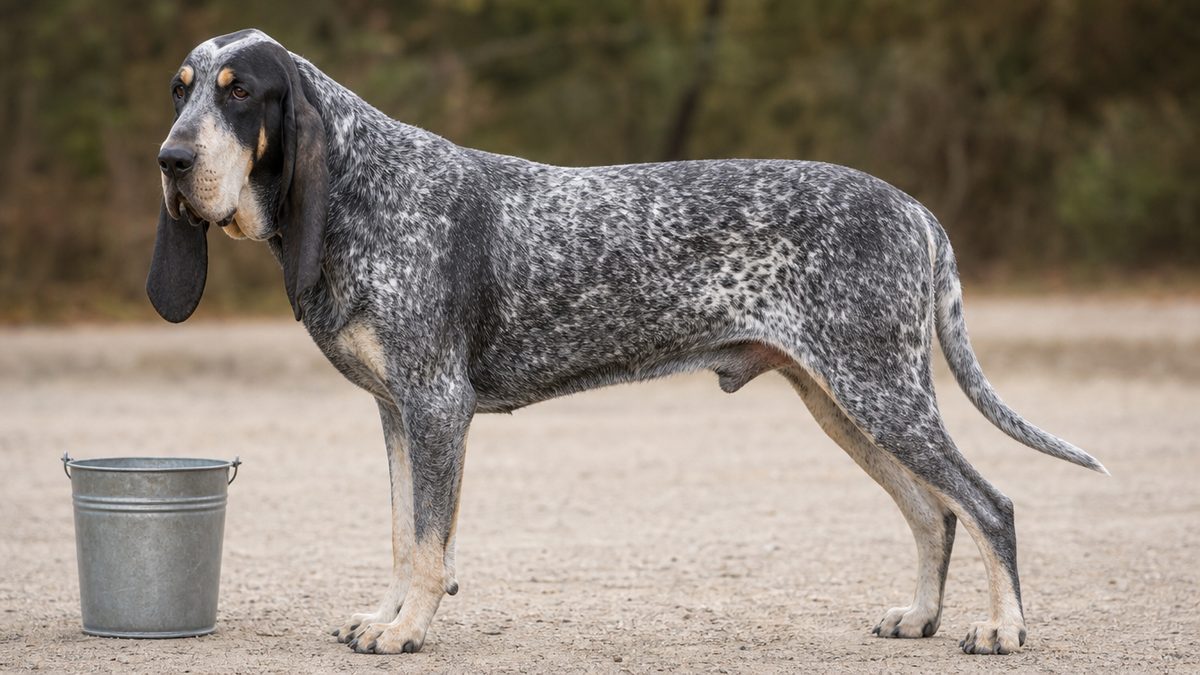
The Grand Bleu de Gascogne is a large-sized French pack scent hound of 65 to 72 cm for males and 62 to 68 cm for females, short-coated, mottled black and white so densely that it reads slate blue, and recognised by the FCI on a definitive basis on 10 August 1963 as Standard No. 22.
Its breed standard is unusually old. FCI-Standard No. 22 was published on 24 January 1996 with the English translation dated 18 February 1997, and it has not been reissued since. That matters because the FCI reissued the other three Bleu de Gascogne standards on 1 August 2023, so this breed's text is the one still written in the older house style, and every figure on this page comes from that 1996 document rather than a modern rewrite of it.
The measurements, and the one the standard refuses to give
The Size clause of FCI-Standard 22 contains height and nothing else: males 65 to 72 cm at the withers, females 62 to 68 cm. There is no weight clause anywhere in the seven-page document. That absence is load-bearing, because every weight you will read for this breed was supplied by somebody other than the registry. Wikipedia prints 80 to 120 lb and a US classifieds site prints 70 to 86 lb, which is 31.8 to 39.0 kg, and the two ranges do not overlap at the top.
What the dog looks like, clause by clause
The colour clause is the family signature and it is nearly identical across all four Bleu de Gascogne standards: entirely mottled black and white giving a slate blue colouring effect, with two black patches covering the ear leathers and surrounding the eyes, stopping at the cheeks and not meeting on top of the skull, leaving a white interval that often carries a small black oval spot. Two tan markings sit above the superciliary arches, giving the quatreoeille or four-eyed look. Because that description fits four separate breeds, colour alone can never identify this one.
What does identify it is size plus ears. The leathers are fine, curled inward, ending in a point, and must reach beyond the extremity of the nose, set well below the eyeline. The head is elongated with a marked occipital protuberance and a slightly accentuated stop, the lips are quite drooping and give the muzzle a square profile, and the lower eyelid shows a certain looseness. The coat is short, quite thick and very dense. The tail is carried sabre fashion and reaches the point of the hock.
A very old breed with a datable history
The standard calls it a very old breed and a contemporary of the St Hubert hounds, and places it in the 14th century packs of Gaston Febus, Comte de Foix, who used it on wolf, bear and boar. It then makes the claim that explains why so many other hounds look like this one: the Grand Bleu is at the origin of all the scenthounds named from the South, or du midi. Wikipedia adds that Henry IV of France kept a pack in the late 16th and early 17th centuries, that General Lafayette presented a pack of seven to George Washington in 1785, and that the breed was used after the French Revolution to rebuild the old Saintongeois into what is now the Gascon Saintongeois.
The American Bluetick Coonhound is considered a direct descendant, which is worth holding on to: a mottled blue hound in a photograph may be a Grand Bleu, one of its three French relatives, or an American breed derived from it.
The job it was selected for
The standard describes a dog used for hunting with the gun and sometimes for coursing big game, but also for hare, generally in a pack or individually as a tracking hound. Its temperament clause reads very fine nose, endowed with a sonorous howling voice with deep tones, very intent in his way of hunting, instinctively a pack hound, temperament calm, obeys orders easily. The FCI also makes the breed subject to a working trial. Every one of those phrases is a description of a working animal, and none of them describes a dog that sits quietly in a flat.
The standard's General Appearance clause calls the breed imposing, giving an impression of calm strength and of great nobleness, and of outstanding French type in the head, the coat and the expression. That is unusually florid language for a registry document, and it is the reason so much writing about this breed is about how it looks rather than what is known about it.
Four breeds share this name, and English sources mix them up constantly
The Bleu de Gascogne family has four members, the FCI numbers them 22, 31, 32 and 35, and the confusion between them is measurable rather than anecdotal.
Read them off the FCI's own Group 6 register and the structure is unambiguous. Grand Bleu de Gascogne is 22, filed under subsection 1.1 Large-sized Hounds. Petit Bleu de Gascogne is 31 and Griffon Bleu de Gascogne is 32, both filed under 1.2 Medium-sized Hounds. Basset Bleu de Gascogne is 35, filed under 1.3 Small-sized Hounds. Four numbers, three subsections, one colour. The United Kennel Club's standard for this breed is the only page-one result on an India-region search that even mentions the number four, and it does so in passing, noting that the Grand is probably the closest of the four Bleu de Gascogne breeds to the ancient hounds in size and build.
Petit does not mean small, and that is where most readers go wrong
The Petit Bleu de Gascogne stands 52 to 58 cm at the withers for males and the FCI files it under Medium-sized Hounds. It is a knee-high working hound, not a lap dog. The genuinely small member of the family is the Basset Bleu at 34 to 38 cm. An English reader who assumes Petit means small will pick the wrong breed by roughly eighteen centimetres, and an Indian buyer who assumes it means apartment-sized will be badly surprised. The same trap runs in reverse on this page's own breed: Grand in most cases labelled a pack used for larger game rather than the size of the dog.
Four documented examples of sources getting it wrong
- The conflation is inside the peer-reviewed literature. Miglio 2020 published new haematology and biochemistry reference intervals for nine analytes from 52 dogs it names only as Bleu de Gascogne. Across the full text the word Gascogne appears twelve times and is never qualified, while the same paper names the Ariegeois and the Briquet Griffon Vendeen precisely. A vet cannot tell whether those intervals came from a 70 cm hound or a 36 cm basset.
- It is in the ranking set for this very query. On an India-region search for grand bleu de gascogne price in india, the seventh organic result is a DogBreedsList page about the BASSET Bleu de Gascogne.
- Wikipedia's Griffon article cites the wrong standard. The Griffon Bleu de Gascogne article links its FCI breed standard as file 031gb96_en.doc, in both the infobox and its first reference. 031 is the Petit Bleu de Gascogne's FCI number; the Griffon is 032. Bonbeno did not open the archived .doc itself and reports only what the link points at.
- An Indian marketplace invents a fifth breed and drops a real one. Pupps and Stud's breed picker lists Grand Bleu de Gascogne, Griffon Bleu de Gascogne and Basset Bleu de Gascogne as separate entries, adds a fourth reading simply Blue de Gascogne that matches no recognised breed, and omits the Petit Bleu de Gascogne entirely.
The test that tells the four apart, from the standards themselves
Ask coat first, height second, ears third. Coat: only the Griffon Bleu is hard, rough and shaggy with bushy eyebrows, and its standard disqualifies a woolly or curly coat; the other three are smooth. Height: a smooth blue Gascony hound at 34 to 38 cm is a Basset, at 52 to 58 cm a Petit, at 65 to 72 cm a Grand. Ears: the Grand's must reach beyond the end of the nose, the Petit's should at least reach it, and the Griffon's must reach the beginning of the nose without going beyond its extremity. Three questions, and any correct dog answers all three consistently.
It changes what a vet does. If the only published haematology and biochemistry reference intervals for a Bleu de Gascogne cannot be attributed to one of the four breeds, then a clinician comparing a patient's platelet count or urea against them does not know whether the reference population weighed thirty kilos more or less than the dog on the table. Body size drives several of those analytes. An unqualified breed name in a reference-interval paper is a clinical problem, not a taxonomic one.
Registry recognition, and where the registries disagree
The FCI recognises this breed definitively as Standard No. 22 and the UKC recognised it in January 1991, and the two registries do not agree on how tall it is.
Take the dates from the FCI's own record, reading its date format carefully. The record gives acceptance on a definitive basis as 8/10/1963 and the official valid standard as 1/24/1996. The FCI prints month/day/year, and this family's own records prove it: the Griffon Bleu reads 9/30/1963, the Petit Bleu 10/23/1963 and the Basset Bleu 10/30/1963, and 30, 23 and 30 cannot be months. So the Grand Bleu was recognised on 10 August 1963, and all four breeds were accepted within 81 days of one another in the autumn of that year.
The FCI contradicts its own record on this family
One of the four records does not add up. The nomenclature record for the Griffon Bleu de Gascogne dates its official valid standard to 1/24/1996, that is 24 January 1996, while the standard PDF that same record links states, in its own header, that the official valid standard was published 01.08.2023. The Petit Bleu's record, whose standards were reissued in the same 2023 wave, correctly reads 8/1/2023, and so does the Basset's. So the FCI updated three records and missed one. Bonbeno reports the disagreement rather than picking the convenient value, and notes that for the Grand Bleu itself the record and the PDF agree at 24 January 1996.
The UKC and the FCI disagree about this breed's height by up to 3.23 cm
| Sex | FCI | UKC, as printed | UKC in cm | Floor gap | Ceiling gap |
|---|---|---|---|---|---|
| Males | 65 to 72 cm | 25.5 to 27.5 in | 64.77 to 69.85 cm | -0.23 cm | -2.15 cm |
| Females | 62 to 68 cm | 23.5 to 25.5 in | 59.69 to 64.77 cm | -2.31 cm | -3.23 cm |
Read the bottom row. A bitch of 60 cm is below the FCI's floor of 62 cm and comfortably inside the UKC's range, and a male of 71 cm is correct under the FCI and oversize under the UKC. This is not a rounding artefact, and the proof is the Griffon Bleu: the UKC gives it 19.5 to 22.5 inches for males and 19 to 21.5 for females, which converts to 49.53 to 57.15 cm and 48.26 to 54.61 cm against the FCI's 50 to 57 and 48 to 55, agreeing at every bound to within half a centimetre. The same two registries agree almost exactly on one breed in this family and differ by up to 3.23 cm on the other.
A third set exists. Lancaster Puppies prints males at 25 to 28 inches and females at 24 to 26, which is 63.50 to 71.12 cm and 60.96 to 66.04 cm, matching neither registry. Three sources, three answers, and none of them says the others exist.
How rare the breed is, from the French studbook
The Societe Centrale Canine's Statistiques LOF 2025 settles the rarity question with numbers rather than adjectives. The Grand Bleu de Gascogne recorded 103 studbook registrations in 2025, down from 122 in 2024, a fall of 16 percent against a Group VI total that fell 9 percent. That is 0.88 percent of France's 11,720 scenthound registrations, and it makes the Grand the rarest of the four Bleu de Gascogne breeds in their own country. The Griffon Bleu recorded 529, the Petit 234 and the Basset 176. The Griffon alone outnumbers the other three combined, 529 against 513, and outnumbers this breed by 5.14 to one.
Set against that, 42 of the 103 Grand Bleu registrations were confirmed at 41 percent, the highest confirmation rate of the four and above the Group VI average of 34 percent. Confirmation is the French adult conformation assessment, so a small population is being taken seriously by the people who register it. Rare and neglected are not the same thing.
The Kennel Club of India is the FCI's member organisation for India, so the KCI registers against FCI nomenclature and FCI recognition is the operative answer to whether this breed is recognised here. The KCI itself publishes no breed list at all, which means a search of its site returns nothing for this breed and nothing for the Labrador either. That is a broken instrument, not a finding, and Bonbeno states the limit rather than drawing a conclusion from it.
Grand Bleu de Gascogne price in India
No verified Grand Bleu de Gascogne price in India exists, because there is no Indian market for the breed to price.
Bonbeno ran two India-region searches for this breed on 31 August 2026 and neither returned a single Indian seller, breeder, rescue or price. The price query returned the UKC standard, the Royal Kennel Club, an Irish retail blog, Wikipedia, an Adobe Stock image search, an aggregator, a page about a different Bleu de Gascogne breed, Purina UK, a US classifieds site and a US insurance content site. A stock-photography search page ranking on page one of a commercial query is the clearest single signal that no commercial market exists behind the term.
The control, because an absence without one is not evidence
The same search tool, in the same session, was given labrador retriever price in india puppy. It returned Supertails quoting 8,000 to 70,000 rupees, Mr n Mrs Pet with a full eight-city rupee table running 30,000 to 1,20,000 rupees, PetsWorld quoting 8,000 to 65,000 rupees, a Facebook listing at 8,999 rupees and TradeIndia breeder listings. The instrument was working for Indian commercial intent. So the absence of Indian Grand Bleu de Gascogne listings is a property of the breed, not of the query.
India's most-cited price list does not contain this breed
Supertails publishes the dog price list most widely quoted in India. Bonbeno fetched it directly and searched all 43,045 characters of its text case-insensitively. It contains zero occurrences of Gascogne, zero of Gascon, zero of Bleu and zero of Basset, against thirteen occurrences of Beagle and ten of Labrador. The page is not withholding a price for this breed. The breed is not in the Indian market it describes.
The foreign figures, and what they are worth
| Source | As published | At 84.38 | At 74.00 | At 66.67 |
|---|---|---|---|---|
| Lancaster Puppies, US classifieds, low | USD 1,000 | Rs 84,380 | Rs 74,000 | Rs 66,670 |
| Lancaster Puppies, US classifieds, high | USD 2,500 | Rs 2,10,950 | Rs 1,85,000 | Rs 1,66,675 |
| DogBreedsList, Griffon Bleu, for comparison | USD 1,000 to 1,500 | Rs 84,380 to 1,26,570 | Rs 74,000 to 1,11,000 | Rs 66,670 to 1,00,005 |
Bonbeno is not converting those into an Indian price and neither should anyone else. The table exists so that you can recognise a converted figure if an Indian page ever prints one. If you see Rs 84,380 or Rs 74,000 attached to this breed, you are looking at a dollar figure run through a spreadsheet, not at anything an Indian seller quoted.
The Griffon row is in the table for a reason. DogBreedsList publishes 1,000 to 1,500 US dollars for the Griffon Bleu de Gascogne and 1,300 to 1,600 for the Basset Bleu, so the three family members that carry any published price at all carry overlapping American ones. A rupee figure quoted for any of them, without a named Indian seller behind it, is almost certainly one of those dollar bands in disguise.
The two rupee figures that do exist, tested
An India-region search for this breed's name returns exactly two rupee amounts, both from an Etsy India listing for Bleu de Gascogne posters: a sale price of Rs 454 and an original price of Rs 827. Divided by 84.38 they give 5.3804 and 9.8009. Divided by 74 they give 6.1351 and 11.1757. Divided by 66.67 they give 6.8097 and 12.4044. None is a clean conversion, because neither is a converted dog price. They are poster prices, and they are the only rupee figures the Indian internet attaches to this breed's name.
Note the structural weakness in the third test while you are here. 66.67 is 200 divided by 3, so 1,000 divided by 66.67 is 14.9993 and 20,000 divided by 66.67 is 299.9850. Any rupee figure ending in three zeros passes a 66.67 test by construction, which makes a pass at that rate worth nothing on its own. 84.38 is the strong test, and nothing here passes it.
If somebody quotes you a rupee price for a Grand Bleu de Gascogne in India, the likeliest explanations are that the dog is a mislabelled Bluetick Coonhound, a mislabelled Petit, Griffon or Basset Bleu, or a mottled crossbreed. Indian import policy separately makes a lawful commercial supply chain impossible, which the next section sets out. Ask for the FCI number on the pedigree before you discuss money.
What Indian search results actually offer you instead
Indian results for this breed offer posters, a generated directory page and a dropdown menu, and no dog, which makes the breed effectively unavailable here.
Naming what is actually on offer is more useful than any price, so here is the whole of it.
A Justdial page for a city it does not cover
Justdial publishes a category page headed Popular Pet Shops For Grand Bleu De Gascogne Dog in Chennai. Bonbeno fetched it live. Its five listed businesses are in Jhansi, Kota, Delhi, Dehradun and Surat, and not one is in Chennai. None lists this breed among its own categories; their categories are Pet Shops For Dog, Pet Shops, Pet Shops For Birds, Dog Trainers, Dog Kennel Dealers and Pet Shops For Labrador Dog. The page's lead photograph is served from a file named for a psittacula parrot listing. Its meta description advertises Pet Shops For German Shepherd Dog and Pet Shops For Labrador Dog. Its body copy is generic filler that recommends grooming tools for their short coat and ear cleaning for breeds with floppy ears, advice that would fit almost any dog.
That page is generated, and Bonbeno proved it with a control rather than asserting it. The identical template, carrying four of the same five businesses and the same three customer reviews word for word, is published for the Dandie Dinmont Terrier in Balasore. One of those reviews, filed under a Delhi shop called Pupp Shup, praises a business named Tarun Pet Villa. Search results in the same session show the same template running for the Brussels Griffon in Udhna, the St Bernard, the Bohemian Shepherd, the Campeiro Bulldog and the Great Dane in Balasore, and for a category called Pet Shops For Shih Inu Dog, which is not a breed.
A marketplace that lists the breed and stocks none
Pupps and Stud is an Indian marketplace whose stated policy is to support purebred, vaccinated and KCI registered puppies from verified breeders. Its breed picker lists Grand Bleu de Gascogne, Griffon Bleu de Gascogne and Basset Bleu de Gascogne, plus an entry reading simply Blue de Gascogne that corresponds to no recognised breed, plus Grand Gascon-Saintongeois and Bluetick Coonhound. It does not list the Petit Bleu de Gascogne at all. Against that picker, the actual Bangalore inventory shown on the page is twelve puppies: three German Shepherds, four Cane Corsos, two English Cocker Spaniels, one Doberman Pinscher and two German Shepherd Working Line, located in Pune, Mysore, Hooghly and North 24 Parganas. Not one Bleu de Gascogne of any kind.
The same pattern on the foreign sites that rank here
Lancaster Puppies, the ninth result on the India-region price query, publishes an Average Price of 1,000 to 2,500 US dollars. Its Grand Bleu De Gascogne Puppies module, which the page repeats three times, offers two Mini Bernedoodles at 2,000 dollars each and four German Shepherds at 500 dollars each. Zero Grand Bleus. Its buying advice then sends readers to a United Kingdom marketplace. A breed page with a price, no stock and an outbound link to another country is describing a market that does not transact.
The one India-facing page with a real record, and its sourcing problem
Royal Canin India publishes a genuine breed record at an Indian URL, titled Great Gascony Blue with a breadcrumb reading Great Bleu de Gascogne. It gives Country France, Size category Large, and an average life expectancy of 10 to 12 years, and states explicitly that its key facts and characteristics are sourced from the Federation Cynologique Internationale. FCI-Standard No. 22 contains no life expectancy figure at all. So the one Indian-facing page carrying a number for this breed attributes it to a document that does not contain it. Lancaster Puppies separately prints 12 to 14 years. Two sources, two lifespans, neither traceable to a study.
Every Indian result above is a page that exists because a template crossed a breed name with a place name or a dropdown, not because a dog was ever offered. Before treating any Indian breed page as evidence of availability, check whether the same page exists for a breed nobody in India keeps. If it does, the page is generated.
Indian import rules close the only route a market could form through
Indian import policy permits a Grand Bleu de Gascogne to enter only as an individual's own pet, and bars every commercial route, so no lawful supply chain can form.
DGFT Trade Notice No. 22/2022-23, Guidelines for import of Pet Animals, dated 19 December 2022, is the operative instrument. Bonbeno downloaded the five-page PDF and extracted it with pypdf, which returned a real text layer of 6,639 characters, so the document was read rather than summarised. It records ITC (HS) 01061900 as Restricted, which means an import licence is required and is granted only on the stated conditions.
The three permitted routes, and none of them is a business
- A pet dog accompanying its owner, with a valid pet book in the importer's name.
- Research organisations holding a recommendation from the Committee for the Purpose of Control and Supervision of Experiments on Animals.
- The Defence and Police forces, for internal security.
The notice then closes the gap explicitly: applications for trading or breeding purposes shall be duly rejected. Read that alongside the market findings above and the conclusion is not a matter of opinion. Nobody can lawfully import this breed to breed it or sell it in India, so the only Grand Bleu de Gascogne who can legally arrive is one already owned abroad by someone moving here.
The notice permits entry through Delhi, Mumbai, Chennai, Hyderabad, Bangalore and Kolkata. A separate 2024 notification under the Livestock Importation Act 1898, S.O. 4396(E) of 10 October 2024, added Cochin International Airport, Kochi, for a pet dog or cat arriving under the baggage rules. The DGFT notice still names six ports for its own licence route, so a pet arriving under the baggage rules can land at seven ports today and a licence-route import plans on the DGFT's six. Both lists are right for their own route, as how to import a dog to India sets out.
What the breeding rules would require of anyone who tried
The Prevention of Cruelty to Animals (Dog Breeding and Marketing) Rules 2017 govern anyone breeding dogs in India. Bonbeno extracted the 14-page gazette text directly, to 51,953 characters. Rule 8, Conditions for sale, sub-rule (1)(a) requires that pups less than eight weeks in age are not sold, and (1)(b) that dogs over six months are not sold without first being sterilised unless sold to another licensed breeder. Second Schedule Part II paragraph 6(8) prohibits tail docking, ear cropping, de-barking, de-clawing, branding, dyeing and any other mutilation, which matters for any imported dog presented with altered ears. Paragraph 6(9) prohibits breeding to create new breeds or unusual looks.
The genetic-defect clause, and the condition it does not name
Second Schedule Part III paragraph 8(10) requires that breeding dogs shall have been tested for genetic defects, including hip dysplasia, progressive retinal atrophy, night blindness, hypothyroidism, entropion, ectropion, overshot, undershot jaw, wry mouth, two or more missing teeth and cryptorchidism. The word including makes the list illustrative rather than closed. Note what is absent: searched across all fourteen gazette pages, the words gastric, dilatation, volvulus, bloat and gastropexy each appear zero times, and so do BAER, deaf, patella and luxation. So Indian law mandates testing for eleven named defects and says nothing at all about the one condition this breed leads the published tables on.
The heat clause, and a disagreement with a sibling page, now settled
Second Schedule Part IV paragraph 21(1), headed Outdoor housing facilities, provides that dogs which are not accustomed to the temperatures prevalent in the area or region in question, and dog breeds that cannot tolerate them such as long-haired breeds in high temperature locations, shall not be kept in outdoor facilities unless that practice is specifically approved by the attending veterinary practitioner in writing. Bonbeno's own Gascon Saintongeois guide cited this provision as Rule 21, and this page disagreed. The disagreement was settled on 31 August 2026 by reading the numbering in the gazette directly, and the sibling page has been corrected. Two facts decide it. The gazette's Part IV heading, Housing facilities and manner of housing dogs, opens at paragraph 10 and runs to paragraph 30, so paragraph 21 sits inside it. And the Rules themselves stop at Rule 13, No licence without registration, so there is no Rule 21 anywhere in the instrument to cite. The correct citation is Second Schedule Part IV paragraph 21(1).
Import policy and quarantine practice change, and the ports and conditions above are quoted from a 2022 notice as Bonbeno read it on 31 August 2026. Anyone relocating to India with a dog should check the current DGFT notice and the Animal Quarantine and Certification Station requirements directly before booking anything.
Monthly cost of keeping one in India, if one is here
Budget by size and by risk rather than by breed, because no Indian cost figure exists for a Grand Bleu de Gascogne and the honest starting point is India's published large-dog range.
India's most-cited price list puts monthly upkeep at 3,000 to 18,000 rupees depending on breed size and grooming needs, reports that urban Indian households now spend 5,000 rupees or more every month, and puts a first year at 80,000 to 2,00,000 rupees. A 65 to 72 cm hound sits at the upper end of that food range and the bottom of the grooming range, because the coat is short-coated and needs nothing beyond a brush.
Where this breed's monthly cost differs from a Labrador's
- Grooming: near zero. The coat clause is six words and there is no salon appointment, no stripping and no clipping. Budget for a brush and nothing else.
- Ears: a recurring line item. Leathers long enough to reach past the nose sweep the ground and trap moisture, and pendulous ear carriage carries 1.76 times the odds of otitis externa against erect ears. Assume ear cleaner as a monthly consumable, not an occasional purchase.
- Parasite prevention: non-negotiable in India. A survey of 525 dogs across four Indian cities found 261, or 49.7 percent, carrying at least one tick-borne pathogen. A hound that works through undergrowth is not the dog to economise on here.
- Emergency provision: the big one. This breed's published bloat prevalence is the highest of any pedigree breed in the 2004 UK survey, and roughly half the recorded deaths in that table were attributed to it. Surgery for gastric dilatation-volvulus is an out-of-hours abdominal procedure. Insurance or a dedicated fund is not optional for this breed in the way it might be for a Beagle.
The only itemised figures that exist, and their currency
Lancaster Puppies publishes an itemised US budget: initial setup 200 to 500 dollars, monthly food 40 to 50 dollars, monthly running costs about 110 to 150 dollars, annual veterinary costs that can exceed 1,200 dollars, and insurance from about 77 dollars a month for basic cover to about 140 for lifetime cover. Those are American prices for American veterinary care and Bonbeno is not converting them. They are reproduced here only so that a reader who finds them elsewhere knows what they are and does not mistake a converted version for an Indian estimate.
How to build a realistic Indian monthly cost yourself
Take the published Indian large-dog band of 3,000 to 18,000 rupees a month as the frame, then adjust on four axes: food volume scales with bodyweight, and this breed has no published weight so use the dog in front of you; grooming sits at the bottom of the band; ear and skin care sits above the band's midpoint because of the ear carriage and Indian humidity; and emergency provision sits well above it because of the bloat risk. Anybody quoting you a precise monthly rupee figure for this specific breed is estimating, because there is no Indian population to have measured.
Bonbeno will not publish a rupee purchase price for this breed, because inventing one is the single most common failure on Indian breed pages and the arithmetic in the price section shows how easily a dollar figure becomes a plausible-looking rupee one. No verified Indian purchase price exists. That is the answer, and a made-up number would be worse than no number.
Heat tolerance in India: Bonbeno rates this breed 2 of 5
Bonbeno rates the Grand Bleu de Gascogne 2 of 5 for Indian heat, because the breed was fixed in a climate roughly fourteen degrees cooler in wet-bulb terms than Chennai and its own standard publishes no weight to check it against the one heat risk factor that would apply.
Start with where the breed comes from. Bonbeno queried NASA POWER by explicit latitude and longitude, checking the geometry the API returned against the coordinates sent, so no place name could resolve to the wrong location. Auch in the Gers, in Gascony, at 43.6465 N and 0.5860 E, records an annual mean air temperature of 13.61 C, annual mean relative humidity of 75.08 percent, and an annual mean wet-bulb temperature of 11.08 C, peaking at 18.35 C in July.
The gap, stated three ways
| Place | Annual mean air temp | Annual mean wet bulb | Peak-month wet bulb |
|---|---|---|---|
| Auch, Gascony (origin) | 13.61 C | 11.08 C | 18.35 C in July |
| Chennai | 27.95 C | 24.94 C | 27.36 C in May |
| Kolkata | 25.81 C | 22.85 C | 27.86 C in June |
| Mumbai | 26.77 C | 22.73 C | 26.55 C in June |
| Delhi | 25.60 C | 18.03 C | 27.74 C in July |
| Bengaluru | 23.74 C | 19.80 C | 22.66 C in May |
| Pune | 23.86 C | 19.66 C | 23.56 C in June |
Three comparisons make the gap concrete. Chennai's annual mean wet bulb is 13.86 C above Auch's. Chennai's coolest month, December at 22.54 C wet bulb, is still 4.19 C above Auch's hottest month. And Bengaluru, the mildest big Indian city in this set, has an annual average wet bulb of 19.80 C, which exceeds Auch's July peak by 1.45 C. NASA Langley Research Center There is no Indian city where this breed's origin summer is a normal year.
Why wet bulb rather than air temperature
A dog cools by panting, which is evaporative, and evaporation is limited by humidity rather than by heat alone. Wet-bulb temperature combines both into one number, which is why Delhi and Chennai swap places depending on which column you read: Delhi is hotter in air temperature at its peak but drier, so its annual mean wet bulb of 18.03 C is nearly seven degrees below Chennai's. A dog that copes in Delhi in April may not cope in Chennai in May.
What the heat literature actually supports for this breed
Two Hall 2020 papers are routinely confused, so name the journal every time. Hall 2020 in Scientific Reports 10:9128 studied 905,543 UK dogs under primary veterinary care in 2016, identified 395 confirmed heat-related illness events, and reported an incidence of 0.04 percent with an event fatality rate of 14.18 percent. Its significant risk factors included breed, higher bodyweight relative to the breed and sex mean, being over two years of age, a brachycephalic skull shape, and bodyweight over 50 kg. Hall 2020 in Animals 10(8):1324 is a separate paper on the same cohort with a different case definition, identifying 1,259 events from 1,222 dogs, and found exertional heat-related illness to be the predominant trigger at 74.2 percent of events, ahead of environmental at 12.9 percent and vehicular confinement at 5.2 percent.
Neither paper models this breed, so neither odds ratio can be imported onto it. What transfers is the class finding and the mechanism. The Grand Bleu is not brachycephalic, which helps. It is a large dog whose standard gives no weight at all, so an Indian owner cannot tell from the standard whether their dog falls in the over-50 kg band that carried greater risk. And the exertional finding is the one that matters most here, because this is a hound bred to work for hours: the danger in India is not a hot car, it is a long walk at four in the afternoon.
How to cool a working hound in an Indian summer
- Move all exercise to before sunrise and after dark, and treat midday walks as off the table from March to June.
- Weigh the dog and record it, because the standard will not give you a target and bodyweight relative to the breed mean is a documented risk factor.
- Watch for exertional signs on the walk itself rather than at home afterwards, since exertional cases outnumber every other trigger.
- Keep the dog indoors in the heat. Second Schedule Part IV paragraph 21(1) of the 2017 Rules already bars keeping a dog unaccustomed to local temperatures in outdoor facilities without a veterinary practitioner's written approval.
Bonbeno rates this breed 2 rather than 1 because the coat is short and the muzzle is normal, both of which genuinely help, and because Bengaluru and Pune sit several degrees below Chennai and Kolkata in wet-bulb terms. A Grand Bleu de Gascogne in Bengaluru with dawn exercise is a manageable proposition. The same dog in coastal Chennai, walked in the afternoon, is not.
Temperament, and who should not buy this breed
The Grand Bleu de Gascogne is calm, affectionate towards people and instinctively a pack hound, and it is loudly, structurally unsuited to apartment living.
Both registries describe the same dog in similar words. FCI-Standard 22's temperament clause reads: very fine nose, endowed with a sonorous howling voice with deep tones, very intent in his way of hunting, instinctively a pack hound, temperament calm, obeys orders easily. The UKC adds that the breed is of even temperament and essentially friendly, that some individuals are very outgoing while others are somewhat reserved but never shy or vicious, and that because the breed works in close proximity with other hounds and their handlers, aggression towards other dogs and people is a fault, with extreme shyness or viciousness a disqualification.
Both standards fault a timid subject. That is worth noticing: the temperament these registries guard against is fearfulness, not aggression, which tells you what problem breeders of a pack hound actually encounter.
The voice is the deciding factor for most Indian homes
The standard does not describe a dog that barks. It describes a sonorous howling voice with deep tones, and a registry that writes voice into a breed standard is selecting for it. A vocal pack hound in a Bengaluru flat is not a training problem waiting to be solved, it is the animal working as designed. Indian apartment living puts that voice through a shared wall, and an Indian residents' association will hear it before you have finished unpacking. If you cannot house this dog where a long, carrying howl at four in the morning is nobody else's problem, choose another breed.
Independent, not disobedient
The FCI says the breed obeys orders easily and the Royal Canin India record lists the character words Obedient, Determined and Calm. Both are true in the house and misleading on a scent. A hound selected for centuries to hold a line ahead of its handler is independent by design, and the same dog that settles beautifully on a veranda will keep going when a trail crosses the road. Treat recall as a management problem rather than an obedience one.
With children, other dogs and small animals
Royal Canin India records the breed as patient with children and other animals. The FCI's instinctively a pack hound clause is the strongest signal for dog-to-dog tolerance in the whole document, because a hound that could not work in company would never have been kept. The caution with children is size rather than temper: a 70 cm hound moving at speed knocks a small child over without any intent at all. With cats and small pets, assume a working prey drive and manage the household accordingly. Note that no behaviour study of this breed exists, so every statement in this paragraph rests on registry and club text rather than on measured data.
Who should not buy one
- Anyone in a flat, a gated tower or any home with a shared wall.
- Anyone who wants a dog that can be exercised entirely on a lead in a park.
- First-time owners who have not lived with a scent hound before.
- Anyone in coastal Chennai, Kolkata or Mumbai who cannot commit to dawn and after-dark exercise for four months of the year.
- Anyone who cannot fund emergency abdominal surgery at short notice, for reasons the health section sets out.
This is a noble, gentle, sociable dog with an enormous voice and an enormous engine, bred for a job that does not exist in India. Its problems here are not temperament problems. They are housing, climate and availability problems, and no amount of good nature solves any of them.
Training a hound bred to work ahead of you
To train a Grand Bleu de Gascogne, build recall before the nose comes online and accept that scent will outrank you outdoors for the dog's whole life.
The standard gives you the two facts training has to work around. The breed has a very fine nose and is very intent in its way of hunting, and it obeys orders easily. Those are not in tension. Indoors and on lead, this is a cooperative dog. On a fresh line, the same dog is doing the thing five hundred years of selection built it to do, and a recall cue competes against that rather than overriding it.
What actually works
- Start recall indoors and in a fenced space, long before the dog has ever followed a serious scent outdoors.
- Pay recall with food, every time, for years. A hound that has learned recall predicts something better than the trail will come back more often than one that has learned it predicts the end of the walk.
- Give the nose a legitimate job. Scent games, tracking and find-it work channel the drive instead of suppressing it, and a hound that has worked its nose for twenty minutes is easier to live with than one that has walked for an hour.
- Socialise early and widely, to traffic, to Indian street sounds, to other dogs and to being handled by a vet, because a large hound that panics is a large problem.
- Train the ears from puppyhood. A dog that accepts ear handling calmly makes the single most important care routine of its life easy, and this breed's ear leathers reach past the end of its nose.
What does not work
Harsh correction is the classic error with a sensitive scent hound, and it produces exactly the timid subject both standards fault. Off-lead freedom in unfenced Indian ground is the second error, and it is a safety issue rather than a training one, because a hound that commits to a line does not hear traffic. The third is expecting adult judgement early: the breed is slow to mature, and Bonbeno found no registry figure for when it does, so plan on patience rather than a published milestone.
A timeline that is honest about what is not known
No kennel club publishes a training timeline for this breed, and Bonbeno will not invent one. What can be said from documents is that the FCI subjects the breed to a working trial, which means the recognising registry expects a demonstrable working aptitude rather than conformation alone. In France the same parent-club culture produces dogs assessed as adults: 42 of the 103 Grand Bleus registered in 2025 were confirmed, a 41 percent rate that is the highest of the four Bleu de Gascogne breeds and above the Group VI average of 34 percent. Confirmation is a conformation assessment rather than a training one, but it tells you the population is being examined rather than merely bred.
The Indian-specific training constraint nobody writes about
Heat sets your training window before behaviour does. Exertional heat-related illness was the predominant trigger in the largest UK study of the subject, at 74.2 percent of events. In an Indian summer that means the productive training hours are the same hours that are safe: before sunrise and after dark. Plan sessions into those windows from the start rather than discovering in April that your only free hour is the one you cannot use.
Do not let this breed off lead in unfenced ground in India, however good the recall looks in a garden. A pack hound following a line is not being disobedient and is not going to stop, and Indian roads, street dog territories and unmarked drains are not survivable distractions. A long line gives most of the freedom and removes most of the risk.
How much exercise this breed actually needs
Plan on 90 to 120 minutes of daily exercise in cool hours as a working floor, and understand that no registry publishes a minute figure for this breed.
Be clear about what is documented and what is Bonbeno's own judgement. Documented: the FCI subjects the breed to a working trial, and the standard describes a dog used with the gun and sometimes for coursing big game, generally in a pack or individually as a tracking hound, with gait regular and easy. Royal Canin India's record for the breed lists Needs a lot of exercise as a key fact. Not documented: any daily minute count from any kennel club. The 90 to 120 minute floor below is Bonbeno's own, set from the breed's job description rather than quoted from a registry.
What under-exercise looks like in this breed
It does not look like a hyperactive dog bouncing off furniture. It looks like the voice, and it looks like roaming. A hound with an unemployed nose gives that sonorous howling voice a reason to work, and a hound with unspent energy tests fences. In an Indian housing society, those two failure modes arrive as complaints and as a missing dog respectively, and both are usually solved by an hour of scent work rather than by more walking.
Splitting the requirement for Indian conditions
| Season | Morning | Evening | Notes |
|---|---|---|---|
| Winter, Nov to Feb | 45 to 60 min walk plus scent work | 45 to 60 min walk | The only season with usable daylight hours in most Indian cities |
| Pre-monsoon, Mar to Jun | Before sunrise only, 45 min | After full dark, 45 min | Chennai's May wet bulb is 27.36 C and Delhi's July wet bulb is 27.74 C |
| Monsoon, Jul to Sep | 45 min plus indoor scent games | 45 min, dry the ears after | Humidity limits evaporative cooling even when air temperature falls |
| Post-monsoon, Oct | 45 to 60 min | 45 to 60 min | Kolkata still records a 24.44 C wet bulb in October |
The seasonal table matters more here than the total. Chennai's peak-month wet bulb is 27.36 C and Kolkata's is 27.86 C, and at those figures a dog's evaporative cooling is badly impaired regardless of how fit it is. Bengaluru and Pune, at 22.66 C and 23.56 C peak wet bulb, give you a genuinely wider window.
Scent work is the substitute Indian owners under-use
Twenty minutes of tracking or a scattered-food search in a hallway tires this dog more than twenty minutes of walking, and it can be done indoors at any hour. That is not a compromise for an Indian owner, it is the closest available version of the job the breed was selected for, and it is the single most effective way to keep a hound's exercise requirement met through a hot season without walking it in dangerous conditions.
Puppies and older dogs
Do not extrapolate the adult figure downwards proportionally. A large, slow-maturing hound's growth plates are the constraint in the first year, and controlled play plus short lead walks does more good than distance. At the other end, no published median life expectancy exists for this breed for Bonbeno to hang a senior threshold on, so use the dog: reduce intensity when gait changes, keep the frequency, and keep the scent work going, because it is the part an old hound can still do.
Not because the breed is frantic, but because the requirement is genuinely large and genuinely difficult to meet in an Indian city for four months of the year. A rating of 5 here means the demand will shape your day, not that the dog is hard to live with once it is met.
Grooming a short coat and two very long ears in Indian humidity
Grooming a Grand Bleu de Gascogne is almost entirely ear care, because the coat clause runs to six words and the ear leathers reach past the end of the nose.
FCI-Standard 22's coat clause reads, in full: short, quite thick, very dense. That is the whole grooming brief for the body. Brush twice a week with a rubber mitt or bristle brush, bath rarely, and never book a salon appointment. There is no stripping, no clipping, no scissoring and no seasonal blow-out to manage. Bonbeno rates grooming needs 1 of 5 and the rating is not close.
The ears are the job
The standard requires leathers that are fine, curled inward, ending in a point, and which must reach beyond the extremity of the nose, set well below the eyeline. The UKC puts it the same way: the length must reach at least to the tip of the nose and is often longer. An ear that long, hanging over a canal, does two things. It sweeps ground debris on every cast, and it seals warm air and moisture into the canal.
The measured consequence is a class finding rather than a breed one, because no Bleu de Gascogne appears in the otitis literature. In a random sample of 22,333 UK dogs, the one-year period prevalence of otitis externa was 7.30 percent, and breeds with pendulous ear carriage carried 1.76 times the odds of it against breeds with erect ears, 95 percent CI 1.48 to 2.10. The Basset Hound, the extreme case of the same architecture, carried the highest breed odds of any dog measured at 5.87.
What Indian conditions add
Indian humidity is the aggravating factor, and there is Indian evidence about when it bites. A series at Durg in Chhattisgarh examined 281 dogs, found 51 with otitis externa for a prevalence of 18.14 percent, and recorded the seasonal peak in summer at 41.18 percent of cases, that is 21 of 51, against 33.33 percent in the rainy season. The paper also states plainly that dogs with long ears are more susceptible.
That summer peak is worth flagging because it disagrees with other Indian otitis work this site cites, which found a monsoon peak. Bonbeno publishes the disagreement rather than choosing: the honest position is that Indian otitis pressure is high across both the hot and the wet season, and an owner of a long-eared hound should be checking ears year round rather than only in the rains.
A working ear routine
- Look inside both ears once a week, in daylight, and learn what normal smells like for your dog.
- Dry the ears after every wet walk, every bath and every swim, rather than letting them air dry, which is the advice overseas breed clubs give for cooler climates and which does not transfer to a humid Indian summer.
- Use a vet-recommended cleaner rather than water, and never push cotton buds into the canal.
- Treat head shaking, a new smell, brown discharge or scratching as a reason to see a vet the same week, not to buy a stronger cleaner.
- Check for ticks at the same time. A survey of 525 Indian dogs found potential tick vectors on 278 of them, 53 percent.
Skin, and the tan markings that are not a rash
The standard describes skin that is quite thick and supple, black or strongly mottled with black patches and never entirely white, with black mucous membranes, plus tan markings above the superciliary arches, on the cheeks, lips, inner ear, legs and under the tail. Those tan areas are breed colour, not inflammation, and a new Indian owner unfamiliar with the breed sometimes presents them to a vet as a skin problem. What genuinely does need watching in a humid climate is the skin under the ear flap and in the folds of the neck dewlap, which the standard describes as developed.
Breed-club and kennel-club care guides for European and North American conditions routinely say to towel a hound and let it air dry. In a Chennai or Kochi monsoon, an ear left to air dry inside a leather that reaches past the nose stays damp for hours. Dry the ear canal deliberately, every time.
Health problems: the bloat finding nobody quotes
The Grand Bleu de Gascogne carries the highest published gastric dilatation-volvulus prevalence of any pedigree breed in the largest UK survey of the condition, at 21.4 percent, and the encyclopedia entry most Indian readers will find says the breed has no unusual health problems.
Start with the study. Evans and Adams, working at the Animal Health Trust, analysed the 2004 purebred dog health survey and published the result in the Journal of Small Animal Practice in July 2010. A total of 15,881 dogs of 165 breeds had died in the previous ten years and gastric dilatation-volvulus was the cause of death in 65 breeds; there were 36,006 live dogs of 169 breeds, of which 48 breeds had experienced at least one GDV episode. GDV caused 389 deaths, 2.5 percent of all deaths reported, 95 percent CI 2.2 to 2.7, at a median age at death of 7.92 years, and there were 253 episodes in 238 live dogs at a median age at first diagnosis of five years.
The abstract names this breed twice. Breeds at greatest risk of GDV mortality were the bloodhound, Grand Bleu de Gascogne, German longhaired pointer and Neapolitan mastiff. Breeds at greatest risk of GDV morbidity were the Grand Bleu de Gascogne, bloodhound, otterhound, Irish setter and Weimaraner. The breed is first on the morbidity list and second on the mortality list, out of 169.
The numbers behind the ranking
| Breed | GDV prevalence | Prevalence of death due to GDV |
|---|---|---|
| Grand Bleu de Gascogne | 21.4 percent | 50 percent |
| Bloodhound | 14.3 percent | 30.5 percent |
| Otterhound | 9 percent | 7.4 percent |
| Irish Setter | 7.2 percent | 5.3 percent |
| Weimaraner | 5 percent | 11.6 percent |
| Saint Bernard | 4.6 percent | 15.1 percent |
| Italian Spinone | 3.6 percent | 6.4 percent |
| Akita | 3.5 percent | 10.7 percent |
This breed's prevalence is 1.5 times the Bloodhound's and 3.0 times the Irish Setter's. That is the strongest single health finding for the Grand Bleu de Gascogne anywhere in the literature, and it is the reason Bonbeno rates health robustness 2 of 5 on one study rather than 4 on an absence of studies.
The caveat that every page quoting 21.4 percent leaves out
Nobody publishes how many Grand Bleus were in that survey. Do the arithmetic on the figures themselves: 21.4 percent is 3 of 14 to one decimal place, since 3 divided by 14 is 21.4286 percent, and 50 percent is one of two, or two of four. The Bloodhound's 14.3 percent is 1 of 7. Those are the fingerprints of small denominators, and the Grand Bleu is by far the rarest breed in the table. Bonbeno could not obtain the paper's own tables, which are paywalled, and reports what it read: the abstract, and a 2024 open-access reproduction of the breed rows. Federico Massari and Gary Matthew Martin…
So treat the ranking as directional and real, but not precise. The breed genuinely sat at the top of that table. The percentage should not be quoted as though it were measured on hundreds of dogs, and this page does not do so.
What a modern dataset shows, and does not
A 2017 VetCompass study of 77,088 dogs at 50 UK emergency clinics found 492 presumptive GDV diagnoses, a prevalence of 0.64 percent overall, and gave the highest breed odds ratios against crossbred dogs to the Great Dane at 114.3, the Akita at 84.4 and the Dogue de Bordeaux at 82.9. No Bleu de Gascogne appears in it at all, which is what you would expect of a breed with 103 annual registrations in its own country. The same study's outcome figures are the ones to plan around: of cases presented alive, 49.7 percent survived to discharge overall, but 79.3 percent of surgical cases survived. Getting to surgery is the variable an owner controls.
What this means for an owner in India
This is a deep-chested large breed with a documented family history of a condition that kills in hours. Practical consequences, in order of importance:
- Know the signs before you need them. A distended abdomen, unproductive retching, restlessness, drooling and collapse. Any of those in a large deep-chested dog is a same-hour emergency.
- Identify a 24-hour surgical facility now and know how long it takes to reach at night. Survival is a function of time.
- Ask your vet about prophylactic gastropexy. A 2024 review records that recurrence without gastropexy has been reported as high as 80 percent against 5 percent with it.
- Feed to reduce risk, which the feeding section sets out.
- Fund it. Emergency abdominal surgery at an Indian referral hospital is not a small bill, and India's published monthly dog budgets of 3,000 to 18,000 rupees do not contemplate it.
The English Wikipedia article's Health and temperament section reads, in full, that no unusual health problems or claims of extraordinary health have been documented for this breed. It was last edited on 28 August 2026. The Evans and Adams finding has been published since 2010. If you read one thing about this breed's health, do not let it be that sentence.
What is not known about this breed's health, and why
Beyond the bloat finding, almost nothing about this breed's health has been measured, and the honest response is to say so rather than to borrow another breed's numbers.
There are four separate gaps, and each one is worth stating precisely because a page that quietly fills them with a relative's data would look better and be worse.
Gap 1: no OFA rows, and the Otterhound proves it is not just rarity
Bonbeno retrieved the Orthopedic Foundation for Animals disease-statistics tables in full on 31 August 2026, as a 2,226,110-character document, and searched it case-insensitively. It returns zero occurrences of GASCOGNE, zero of GASCONY, zero of GASCON and zero of BLEU, against 109 occurrences of LABRADOR, 132 of BASSET, 61 of BEAGLE and 41 of BLOODHOUND. The control that matters is the Otterhound, which returns 3: a comparably rare breed does hold rows, so the absence of every Bleu de Gascogne breed is specific rather than a general consequence of rarity. The correct wording is that this breed has no row in OFA's published statistics tables, not that it is absent from the OFA database.
Note one methodological point, because it has misled others. The string Searching Database, Please wait appears once in that document even though the tables had loaded. Its presence is not evidence of a failed retrieval.
Gap 2: no published median life expectancy
No study Bonbeno could verify publishes a median lifespan for the Grand Bleu de Gascogne. The largest UK longevity dataset covers 584,734 dogs including 284,734 deceased and partitions estimates across 155 breeds, which are the breeds Britain keeps in numbers. Bonbeno read that paper's abstract and its Author Correction record but did not obtain its supplementary breed tables, so this page claims nothing from it either way and publishes no lifespan.
What circulates instead is two unsourced ranges that disagree. Royal Canin India prints 10 to 12 years and attributes its key facts to the FCI, whose Standard 22 contains no life expectancy at all; Lancaster Puppies prints 12 to 14 years. Lancaster Puppies Bonbeno prints neither as fact.
Gap 3: the only clinical dataset does not say which breed it measured
This is the most consequential gap and it is unique to this family. Miglio and colleagues published haematology and biochemistry reference intervals for five hunting breeds from 445 healthy adult blood donors at the University of Perugia, including 52 dogs recorded simply as Bleu de Gascogne, and established new reference intervals for that group for nine analytes: MCH, MCHC, platelets, monocytes, eosinophils, albumin, urea, AST and ALT. Across the whole full text the word Gascogne appears twelve times and is never qualified. The strings Grand Bleu, Petit Bleu, Griffon Bleu and Basset Bleu each appear zero times, in a paper that names the Ariegeois and the Briquet Griffon Vendeen precisely.
So a vet in Chennai comparing a patient's urea or platelet count against published Bleu de Gascogne reference intervals cannot tell whether the reference population was a 70 cm hound or a 36 cm basset, and body size influences several of those analytes. Those 52 dogs are 11.69 percent of the study population. This is the clearest practical cost of the naming confusion this page documents.
Gap 4: no breed-club screening scheme Bonbeno could verify
The UK owner-survey series that produced the bloat figure is the obvious place a screening prevalence would live, and it is worth knowing its scale: the 2014 iteration covered 43,005 live Kennel Club registered dogs across 192 breeds. Bonbeno read that paper's abstract and did not obtain its per-breed table, so this page makes no claim about how many Grand Bleus appear in it, and reports no prevalence from it.
Bonbeno found no published health-screening requirement or prevalence estimate from any Grand Bleu de Gascogne breed club. A US classifieds site lists hip dysplasia scoring and elbow dysplasia testing as health tests available and recommends genetic testing for hyperuricosuria, degenerative myelopathy and progressive rod-cone degeneration, but publishes no prevalence figure and cites no source for any of it. A recommendation to screen is not evidence that a condition is present in a breed.
The literature, counted
PubMed holds exactly four records mentioning any Bleu de Gascogne breed, and Bonbeno opened every one. One names the Grand Bleu de Gascogne, the 2010 GDV mortality survey. One names an unqualified Bleu de Gascogne, the Perugia reference-interval study. One uses five Griffon Bleu de Gascogne puppies in a parasitology trial. One reports a neuronal ceroid lipofuscinosis-like disorder in a Petit Bleu de Gascogne, published in November 2025, associated with homozygous variants in AP3B1 and TRAPPC9. That last finding belongs to the Petit and is not transferable to this breed, and this page does not transfer it. Controls run in the same session returned 126, 122 and 11 records, so the search instrument was working.
It would be easy to fill this section with Bloodhound and Otterhound data on the grounds that they are related large hounds. That would produce a longer page and a worse one. What an owner needs to know is which claims about their dog rest on measurement and which do not, and for this breed the answer is that one does and the rest do not.
Feeding, with bloat risk driving every decision
Feed a Grand Bleu de Gascogne in small frequent meals, to a body condition score rather than a bowl size, because this breed's published bloat prevalence makes feeding management a health intervention rather than a routine.
Take the constraint first. The standard gives no weight, so there is no target number to feed towards and no way to check whether your dog sits in the over-50 kg band that Hall 2020 in Scientific Reports associated with greater heat-related illness risk. The same paper found higher bodyweight relative to the breed and sex mean to be a risk factor, and for a breed with no published mean that comparison cannot be made at all. So use a body condition score, assessed by your vet, as the only workable target.
Feeding rules that follow from the bloat evidence
- Split the daily ration across at least two meals, and three for a young or fast-eating dog.
- Do not exercise for an hour either side of a meal. A hound that runs on a full stomach is the classic presentation.
- Slow the eating. A slow-feeder bowl or a scattered ration does more than any supplement.
- Keep water available but discourage gulping a large volume immediately after a meal.
- Watch weight gain in the hot months, when the dog is exercising less because you have correctly moved walks to dawn and dusk.
Bonbeno is deliberately not quoting a gram figure. A US classifieds page suggests adult protein of 18 to 25 percent and fat around 8 to 15 percent and cites nothing for either, and no registry or study publishes a feeding specification for this breed. Feed a complete large-breed food at the manufacturer's stated rate for the dog's actual weight, then adjust on body condition.
Life stages
Puppy. Large slow-growing breeds are harmed by fast growth, so a large-breed puppy food fed to condition beats a rich food fed to appetite. Split into three or four meals a day.
Adult. Two meals, timed away from exercise. This is the stage where the bloat rules matter most, because the median age at first GDV diagnosis in the UK survey was five years.
Senior. No published median lifespan exists for this breed to define senior against, so let the dog define it. Reduce calories as activity falls, keep protein up, and keep meals split rather than consolidating them into one larger feed.
Indian availability, honestly
Large-breed complete diets are widely sold in India and this breed has no special dietary requirement that would need an imported product. What it does have is a volume requirement: India's published dog budgets put monthly upkeep at 3,000 to 18,000 rupees depending on size, and a 65 to 72 cm hound sits near the top of the food component of that range while sitting at the bottom of the grooming component. The dog is cheap to groom and expensive to feed.
What not to change on the strength of a breed page
Raised bowls, specific ingredient avoidance and anti-bloat supplements all circulate as bloat prevention, and Bonbeno found no evidence in the sources it read to support recommending any of them for this breed. What the sources do support is meal splitting, exercise timing, slowing the eating, and discussing prophylactic gastropexy with a vet, which a 2024 review associates with a fall in recurrence from as high as 80 percent to about 5 percent. Take feeding advice for a high-risk breed from your own vet rather than from a comparison table.
Of GDV cases presented alive in a UK emergency-care study, 49.7 percent survived to discharge overall, but 79.3 percent of surgical cases survived. Feeding management lowers the chance of the event. Knowing where to drive at 2 a.m. changes the outcome once it happens.
The first year, month by month
Plan a Grand Bleu de Gascogne's first year around three things: legal minimum age at sale, slow skeletal growth, and building ear tolerance and recall before the nose takes over.
Bonbeno found no registry or breed-club developmental timeline for this breed, so what follows is built from the documents that do exist plus general large-breed practice, and it is labelled as such rather than presented as breed-specific data.
Before eight weeks
The puppy stays with its litter. Rule 8(1)(a) of the Prevention of Cruelty to Animals (Dog Breeding and Marketing) Rules 2017 requires that pups less than eight weeks in age are not sold, and any Indian seller offering a younger puppy is breaking that rule. The same Rules at sub-rule 8(1)(b) require dogs over six months to be sterilised before sale unless sold to another licensed breeder.
Two to four months
Socialisation is the whole job. Traffic, autos, cattle, street dogs, monsoon rain on a roof, being handled by strangers and by a vet. Start ear handling in week one of ownership and make it boring, because ear care is this breed's lifelong routine and a dog that resists it will get infections that a compliant dog would not. Start recall indoors, paid every time. Vaccination and deworming schedules follow your vet, and the 2017 Rules record that pups can start vaccination at seven to eight weeks with courses usually completed by eighteen weeks.
Four to six months
Growth is fast and joints are soft. Keep exercise to short lead walks and free play on soft ground, and avoid stairs, repeated jumping and forced running. Introduce scent games now: this is the point where the nose comes online and giving it a legitimate outlet early sets the pattern for the next decade. Begin lead work seriously, because a hound that pulls at 20 kg will pull at 35.
Six to twelve months
The dog looks adult and is not. Recall reliability typically falls in this window as the drive to follow a scent matures, and this is when Indian owners lose dogs off lead. Keep a long line. Continue two to three meals a day and start applying the adult bloat rules on timing and speed of eating. If you are considering prophylactic gastropexy, this is the window in which to discuss it with your vet, since the elective procedure is often combined with neutering.
The first Indian summer
Whenever it falls, treat it as the most dangerous period of the first year. A young dog will keep working past the point where it should stop, and exertional heat-related illness was the predominant trigger in the largest study of the subject at 74.2 percent of events. Move everything to before sunrise and after dark, use indoor scent work as the substitute, and keep the dog inside during the day, which Second Schedule Part IV paragraph 21(1) of the 2017 Rules already requires for a dog unaccustomed to local temperatures unless a veterinary practitioner approves otherwise in writing.
What Bonbeno cannot tell you
No source Bonbeno read gives an age of full maturity for this breed, a growth chart, an adult weight, or a litter size. A US classifieds site asserts maturity at around two years and cites nothing. Treat that as a plausible large-breed generalisation rather than a breed figure, and let your vet assess skeletal maturity before you increase the workload.
Teach the puppy that having its ears opened, wiped and dried is dull and predictable. It takes ten seconds a day for a year and it prevents the most likely recurring health problem of this dog's life, in a country where a long-eared breed faces high otitis pressure in both the hot season and the wet one.
The four blue Gascony breeds, head to head
Four breeds carry the Bleu de Gascogne name, the FCI numbers them separately as 22, 31, 32 and 35, and the fastest way to tell them apart is coat first, then height.
Read the table by asking two questions in order. Is the coat rough or smooth? Only the Griffon Bleu is rough, hard and shaggy with bushy eyebrows, so a rough coat identifies it on sight regardless of size. Then, how tall is the dog? A smooth-coated blue Gascony hound at 34 to 38 cm is a Basset, at 52 to 58 cm a Petit, and at 65 to 72 cm a Grand.
| Breed | FCI No. | FCI subsection | Height, males | Coat | Ears must reach | French registrations 2025 |
|---|---|---|---|---|---|---|
| Grand Bleu de Gascogne | 22 | 1.1 Large-sized | 65 to 72 cm | Short, thick, very dense | Beyond the end of the nose | 103 |
| Petit Bleu de Gascogne | 31 | 1.2 Medium-sized | 52 to 58 cm | Smooth | At least the end of the nose | 234 |
| Griffon Bleu de Gascogne | 32 | 1.2 Medium-sized | 50 to 57 cm | Hard, rough and shaggy | The beginning of the nose, no further | 529 |
| Basset Bleu de Gascogne | 35 | 1.3 Small-sized | 34 to 38 cm | Short, semi-thick, dense | Beyond the end of the nose | 176 |
The Petit is not the small one. That is the single most useful sentence on this page. The FCI files the Petit Bleu de Gascogne under Medium-sized Hounds at 52 to 58 cm for males, in the same subsection as the Griffon Bleu, and files the Basset alone under Small-sized Hounds. Petit describes a reduction from the Grand and the smaller game it was fixed for, not a small dog. The same logic runs the other way for this breed: Wikipedia notes that Grand in most cases labels a pack used for larger game rather than the dog's own size.
The Petit and the Griffon overlap almost exactly, and only the coat separates them
Compare the two middle rows and the problem becomes obvious. The Petit stands 52 to 58 cm and the Griffon 50 to 57 cm, so their male ranges overlap across five of the eight centimetres their two ranges span between them. Height cannot separate them. Coat texture can, and it is absolute: the Griffon's clause reads hard, rough and shaggy, and its standard disqualifies a woolly or curly coat, while every other breed in the family is smooth. If a seller offers a Petit Bleu and the dog is shaggy, the seller has the breed wrong.
The ear test settles the Grand against the Griffon
The two standards state opposite requirements for the same feature. FCI-Standard 22 requires the Grand's ears to reach beyond the extremity of the nose. FCI-Standard 32 requires the Griffon's ears to reach the beginning of the nose without going beyond its extremity. So on a correct dog of each breed, one has ear leather to spare past the nose tip and the other does not, and you can check it in a photograph without a measuring tape. The Basset's ears also pass the nose, which is why the ear test is a second question and the height question is the first.
How this breed compares to hounds an Indian buyer can actually get
| Breed | Height, males | Otitis externa odds vs crossbred | Available in India | Published Indian price |
|---|---|---|---|---|
| Grand Bleu de Gascogne | 65 to 72 cm | No breed figure; 1.76 as a pendulous-eared class | No | None exists |
| Beagle | 33 to 40 cm | 2.54 | Yes, widely | Published in rupees by Indian marketplaces |
| Basset Hound | 33 to 38 cm | 5.87, the highest of any breed measured | Yes | Published in rupees |
| Indian Pariah Dog | Varies | Not separately modelled | Yes, free to adopt | Adoption fee only |
Four separate breeds share this coat pattern and three of them share the family name. A photograph of a mottled blue hound tells you almost nothing on its own, because the colour clause is nearly word for word identical across all four standards. Ask for the FCI number on the pedigree: 22, 31, 32 or 35. Those four digits are the only reliable identifier, and they are printed on the paperwork.
Mistakes Indian readers make with this breed
The commonest mistake is assuming the dog in the photograph is the breed in the caption, and the Bleu de Gascogne family punishes that assumption four different ways.
Mistake 1: treating any blue mottled hound as a Grand Bleu
Three FCI breeds and one basset share this coat, and the American Bluetick Coonhound descends directly from this one and looks like it. An Indian marketplace picker Bonbeno checked lists Grand Bleu de Gascogne, Griffon Bleu de Gascogne, Basset Bleu de Gascogne, Bluetick Coonhound and a phantom entry reading simply Blue de Gascogne, while omitting the Petit Bleu entirely. A dropdown that invents a fifth breed and drops a real one is not a source you can identify a dog against.
Mistake 2: believing the Wikipedia health section
English Wikipedia's health section for this breed reads, in full, that no unusual health problems have been documented for it. The 2004 UK purebred dog health survey put the Grand Bleu de Gascogne first of all pedigree breeds for gastric dilatation-volvulus, at 21.4 percent prevalence, ahead of the Bloodhound at 14.3 percent. That is the opposite of no unusual health problems, it has been in the peer-reviewed literature since 2010, and the Wikipedia page was last edited three days before this guide was written. Read the health section here and on the studies, not there.
Mistake 3: quoting a weight for this breed
FCI-Standard 22's Size clause contains height and nothing else, and the word weight does not appear in the document. Yet Wikipedia prints 80 to 120 lb and a US classifieds site prints 70 to 86 lb, which is 31.8 to 39.0 kg, and neither cites a standard. Those two ranges do not even overlap at the top. If you need a target weight for feeding, use a body condition score on the dog in front of you, not a number off a breed page.
Mistake 4: reading an Indian directory page as evidence of supply
A Justdial page titled Popular Pet Shops For Grand Bleu De Gascogne Dog in Chennai lists five businesses, in Jhansi, Kota, Delhi, Dehradun and Surat. Not one is in Chennai and not one lists this breed among its categories. Bonbeno ran a control: the same template, with four of the same five businesses and the same three customer reviews word for word, is published for the Dandie Dinmont Terrier in Balasore, and for a category called Pet Shops For Shih Inu Dog, a breed that does not exist. These pages are generated per breed and per city whether or not anything matches.
Mistake 5: assuming a rupee figure somewhere must be real
There is no rupee figure to assess, which is itself the finding. Run the standard tests on the two rupee amounts an India-region search does return for this breed's name, both from an Etsy poster listing: 454 divided by 84.38 is 5.3804, by 74 is 6.1351 and by 66.67 is 6.8097; 827 divided by 84.38 is 9.8009, by 74 is 11.1757 and by 66.67 is 12.4044. None is a clean conversion because neither is a converted dog price. Note too that 66.67 is 200 divided by 3, so 1,000 divided by 66.67 is 14.9993 and any rupee figure ending in three zeros passes that test by construction. A pass at 66.67 proves nothing on its own.
Mistake 6: planning for a hound and getting a housemate complaint
The standard credits this breed with a sonorous howling voice with deep tones, and lists a timid subject as a fault. A registry that selects for voice has told you what you are buying. In an Indian apartment block that voice travels through walls at three in the morning, and no training removes it. Plan for a house with a yard, or choose a different breed.
Before you believe anything about a Bleu de Gascogne, find the FCI standard number the claim rests on and open that standard. All four are free PDFs on the FCI's own site, numbered 22, 31, 32 and 35, and each runs to about six pages. Most of the errors on this page's ranking competitors would not survive one reading of the primary document.
Adoption, and the honest sourcing route in India
Adopt an Indian dog instead, because no lawful route to a Grand Bleu de Gascogne puppy in India exists and nothing on this page changes that.
Start from what the law permits. Indian import policy classifies live dogs as Restricted and allows entry only for a pet dog travelling with a valid pet book in the importer's name, for research organisations holding a CPCSEA recommendation, or for the Defence and Police forces, and states that applications for trading or breeding purposes shall be duly rejected. So the only person who can lawfully bring this breed into India is someone already living abroad who owns one and is relocating. There is no importer, no dealer and no legal path for anyone else.
What you would actually be offered
Bonbeno searched India-region results for this breed twice and found no Indian seller, breeder or rescue offering one. What the searches did return was Etsy posters and greeting cards, a stock-photography search page ranking on page one of a price query, a generated Justdial directory page, and a Bangalore marketplace listing the breed in a dropdown while stocking German Shepherds, Cane Corsos, English Cocker Spaniels and a Doberman. If somebody in India does offer you a Grand Bleu de Gascogne puppy, the most likely explanations are a mislabelled Bluetick Coonhound, a mislabelled member of one of the other three Bleu de Gascogne breeds, or a crossbreed with mottled colour.
How to verify a dog that is offered to you as this breed
- Ask for the pedigree and read the FCI breed number on it. Grand Bleu de Gascogne is 22. Petit Bleu is 31, Griffon Bleu is 32 and Basset Bleu is 35, and all four are separate breeds.
- Measure the dog at the withers. Under 60 cm, it is not a correct adult Grand Bleu under either the FCI or the UKC standard.
- Feel the coat. Rough, hard or shaggy means Griffon Bleu, not Grand.
- Check the ear length against the nose. The Grand's leathers must reach beyond the end of the nose.
- Ask which registry issued the paper. The Kennel Club of India registers against FCI nomenclature as the FCI's Indian member, so an FCI-format pedigree is the document to ask for.
- Walk away from any seller who cannot produce all of the above, and report a breeder selling pups under eight weeks old, which Rule 8(1)(a) of the 2017 Rules prohibits.
The adoption case, made plainly
An Indian shelter dog is already adapted to the climate this page keeps warning about, costs an adoption fee rather than a purchase price, and needs a home now. India's most-cited dog price list puts an indie at about 2,000 rupees against over 1,50,000 rupees for a registered pedigree dog. The Indian Pariah Dog carries no import problem, no 21.4 percent bloat figure and no wet-bulb mismatch, and every Indian city has rescues placing them. If what draws you to this breed is the scent work and the voice, a pariah dog will trail with you and a Beagle will bay at you, and both are obtainable here.
If you already own one in India
Two things matter more than everything else on this page. Learn the signs of gastric dilatation-volvulus and treat them as a same-night emergency, because it is the one condition this breed leads the published tables on and roughly half the dogs recorded with it in that survey died. And keep the dog indoors in the heat, because Second Schedule Part IV paragraph 21(1) of the 2017 Rules already says that dogs not accustomed to local temperatures shall not be kept in outdoor facilities without an attending veterinary practitioner's written approval. Register with a vet who has an out-of-hours number before you need one.
Bonbeno found no Grand Bleu de Gascogne rescue operating in India, no Indian breed club, and no record of the breed in Kennel Club of India material. That is an absence rather than a proven zero: the KCI publishes no breed list at all, so its site returns nothing for this breed and nothing for common breeds either, which makes it a broken instrument rather than a source. Bonbeno reports the limit instead of the conclusion.
Grand Bleu de Gascogne questions Indian buyers actually ask
What is the price of a Grand Bleu de Gascogne in India?
No verified Indian price exists, because no Indian breeder, seller or rescue offers the breed. An India-region search for the price returns Etsy posters, a Justdial page listing pet shops in five cities other than the one in its own title, and overseas breed encyclopedias. The same search tool in the same session returned real eight-city rupee tables for the Labrador Retriever, so the instrument was working.
How much does a Grand Bleu de Gascogne cost?
The only published purchase figure Bonbeno could verify is a United States classifieds site quoting 1,000 to 2,500 US dollars, and that page's own puppy module offered Mini Bernedoodles and German Shepherds rather than a single Grand Bleu. No rupee figure exists to test, and Bonbeno will not convert a dollar price and present it as an Indian one.
How big does a Grand Bleu de Gascogne get?
FCI-Standard No. 22 gives males 65 to 72 cm at the withers and females 62 to 68 cm, and gives no weight at all. The United Kennel Club's standard for the same breed is roughly two centimetres shorter at both ends, so the answer genuinely depends on which registry you ask.
How much does a Grand Bleu de Gascogne weigh?
No kennel club publishes a weight for this breed. FCI-Standard No. 22 has a Size clause containing only height, and the figures circulating online, such as 70 to 86 pounds or 80 to 120 pounds, appear in no standard and carry no source. Treat every published weight for this breed as unsourced.
What is the difference between the Grand Bleu de Gascogne and the Basset Bleu de Gascogne?
Height, and it is not subtle. The Grand stands 65 to 72 cm at the withers for males and the Basset stands 34 to 38 cm for both sexes, so the Grand is roughly twice the Basset's height. They are separate FCI breeds, numbered 22 and 35, in different subsections of the same group.
Is the Petit Bleu de Gascogne a small dog?
No, and the name is the single most misleading thing about this family. The Petit Bleu stands 52 to 58 cm for males, which the FCI files under Medium-sized Hounds, not small. The small one is the Basset Bleu at 34 to 38 cm. Petit describes the game hunted and the reduction from the Grand, not a small dog.
Do Grand Bleu de Gascognes get bloat?
Yes, and on the published evidence more than any other pedigree breed in Britain. The 2004 UK purebred dog health survey put the Grand Bleu de Gascogne first for gastric dilatation-volvulus prevalence at 21.4 percent and at 50 percent for deaths due to it, ahead of the Bloodhound at 14.3 and 30.5 percent. Wikipedia's page for the breed states the opposite, that no unusual health problems have been documented.
What is the life expectancy of a Grand Bleu de Gascogne?
No study Bonbeno could verify publishes a median life expectancy for this breed. Royal Canin India prints 10 to 12 years and attributes its key facts to the FCI, while a US classifieds site prints 12 to 14 years. FCI-Standard No. 22 contains no life expectancy figure at all, so at least one of those attributions is wrong.
Is the Grand Bleu de Gascogne recognised in India?
Indirectly. The Kennel Club of India is the FCI's full member for India and issues pedigrees against FCI nomenclature, and the FCI recognises this breed definitively as Standard No. 22. The KCI publishes no breed list at all, so a search of its own site returns nothing for this breed and nothing for common breeds either, which makes that route a broken instrument rather than evidence.
Can I import a Grand Bleu de Gascogne to India?
Only as your own pet, and never to breed or sell. DGFT Trade Notice 22/2022-23 classifies live dogs as Restricted, permits import only for a pet dog with a valid pet book in the importer's name, for research organisations with a CPCSEA recommendation, or for the Defence and Police forces, and states that applications for trading or breeding purposes shall be duly rejected.
Is the Grand Bleu de Gascogne good in Indian heat?
Bonbeno rates it 2 of 5. The breed was fixed in Gascony, where Auch records an annual mean wet-bulb temperature of 11.08 C, while Chennai records 24.94 C. Chennai's coolest month is still 4.19 C wetter-bulb than Auch's hottest, and Bengaluru's annual average alone exceeds Auch's July peak by 1.45 C.
Is the Grand Bleu de Gascogne a good apartment dog?
No. It stands up to 72 cm, was bred to work in a pack across country, and its standard specifically credits it with a sonorous howling voice with deep tones. Indian flats put that voice inside a shared wall, and no amount of training removes a trait a registry selects for.
Are Grand Bleu de Gascogne puppies available in India?
Bonbeno found none. One Indian KCI-registered puppy marketplace lists Grand Bleu de Gascogne in its breed picker, alongside a phantom entry simply called Blue de Gascogne, while its actual Bangalore inventory of twelve puppies was German Shepherds, Cane Corsos, English Cocker Spaniels and a Doberman. A breed appearing in a dropdown is not a breed being sold.
Are Grand Bleu de Gascogne good pets?
Good-natured, and loudly unsuited to a flat. FCI-Standard 22's temperament clause reads calm, obeys orders easily, instinctively a pack hound, endowed with a sonorous howling voice with deep tones, and the UKC adds that the breed is of even temperament and essentially friendly, never shy or vicious, with aggression towards other dogs and people a fault because it works in close proximity to other hounds and handlers. Both standards fault a timid subject, not an aggressive one. The voice is the deciding factor: a registry that writes a howl into the standard is selecting for it, and an Indian residents' association will hear it before you have finished unpacking.
Compare with similar breeds
Grand Bleu de Gascogne sits in 1 Bonbeno group. Each one compares it directly against the breeds it is genuinely an alternative to, on the same figures.