
Dog breed profile
Basset Bleu de Gascogne in India: Price, FGF4 and the Real Numbers
No Basset Bleu de Gascogne market exists in India, and this page proves it with FCI-Standard No. 35, the French studbook and the import law. It also settles whether the breed was ever genotyped for the FGF4 retrogene behind its short legs. It was not.
Quick answer
No verified Basset Bleu de Gascogne price in India exists, because there is no Indian market for the breed to price. Nine of the ten India-market search results for the term are Basset Hound pages. FCI-Standard No. 35 sets the breed at 34 to 38 cm with short legs and no weight clause at all, its FGF4 genotype has never been published by anyone, and Bonbeno rates it 2 of 5 for heat tolerance in India.
This guide is general information for Indian pet owners and is not a diagnosis. Consult your nearby vet, a registered veterinarian who has examined the dog, before acting on anything you read here, and treat sudden back pain, dragging hind limbs, collapse in heat or any rapid change in your dog's condition as an emergency.
Basset Bleu de Gascogne at a glance
What the Basset Bleu de Gascogne actually is
The Basset Bleu de Gascogne is a French short-legged scent hound registered as FCI-Standard No. 35, placed in Group 6 Scenthounds, Section 1.3 Small sized Scenthounds, and subject to a working trial. It stands 34 to 38 cm at the withers, males and females alike, and its standard gives no weight clause of any kind. The FCI accepted it on a definitive basis on 30 October 1963 and published the current valid standard on 1 August 2023.
Read the standard rather than a directory page and the breed becomes specific fast. The FCI describes a really typical Basset, denoting the great breed he comes from; quite substantial but yet not too heavy, and fixes two proportions: size to body length at about 5/8, and depth of chest to size at about 2/3. Those two ratios do more work on this page than any adjective, because the second one sets how far the dog's chest sits above the ground, and that number decides how this breed copes with an Indian summer.
The job is stated plainly. This is a hound used to hunt with the gun, sometimes for coursing, as much on his own as in a pack, and its preferred quarries are the rabbit and the hare. The behaviour clause reads: very fine nose, active, agile and lively, intent in his way of hunting, endowed with a beautiful howling voice, works perfectly in a pack, affectionate and happy dog, needs to frisk about. A dog selected on those terms does not become a quiet flat dog because it is short.
The blue is a pattern, not a colour
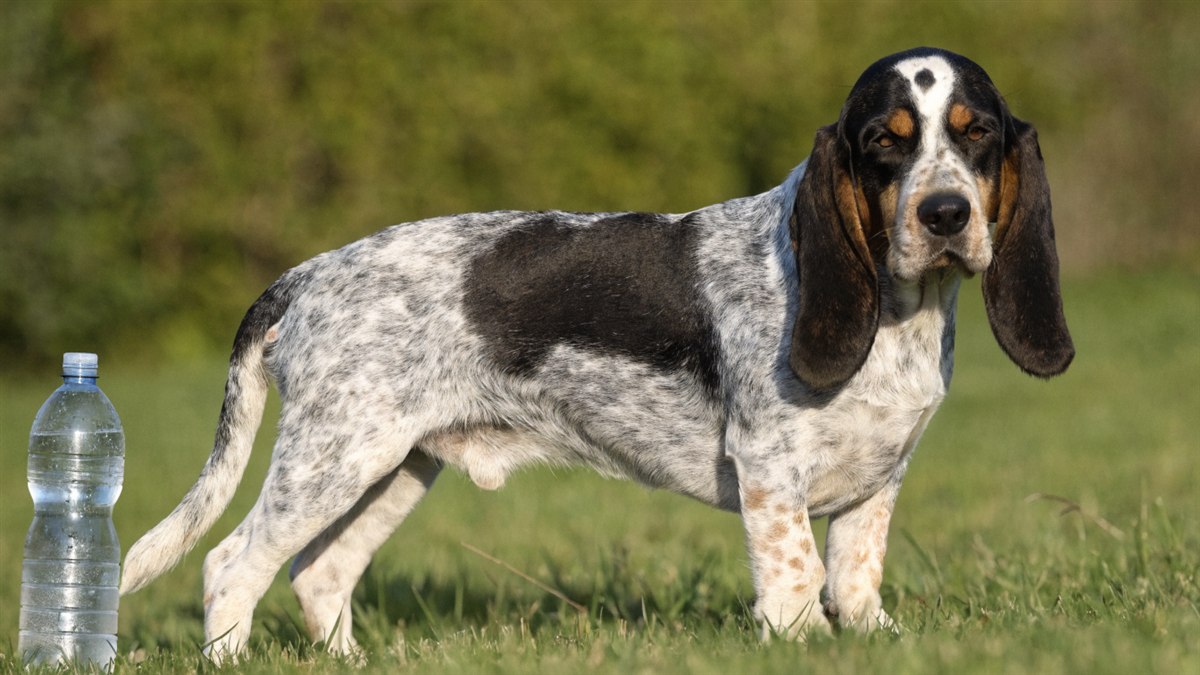
The slate blue of the name is an optical effect, not pigment. The standard specifies a coat that is entirely mottled black and white, giving a slate blue effect, marked or not with more or less extended black patches. The hair is short, semi-thick and dense. The skin underneath is black or strongly mottled with black patches and never entirely white, and the hairless mucous membranes are black.
Two head markings identify the breed at a glance. Two black patches usually sit on either side of the head, covering the ear leathers, surrounding the eyes and stopping at the cheeks; they do not meet on top of the skull but leave a white interval in the middle of which a small oval black spot is frequently found, which the standard calls typical of the breed. Above that, two tan markings sit over the superciliary arches and give the quatreoeuille four-eyed effect that runs through the whole Gascony group.
Ears that must pass the end of the nose
The ear clause is a hard measurement and it separates this breed from the two it is confused with. The standard requires leathers that are fine, curled in, ending in a point, and that must at least go beyond the extremity of the nose, narrow at a set-on that is well below the eyeline. The Basset Hound standard, by contrast, asks for ears reaching only slightly beyond end of muzzle of correct length, but not excessively so. The Basset Artesien Normand asks for leathers reaching at least the length of the muzzle. Three bassets, three different ear rules, and only one of them makes long ears compulsory.
| Clause | Basset Bleu de Gascogne (No. 35) | Basset Artesien Normand (No. 34) | Basset Hound (No. 163) |
|---|---|---|---|
| Country of origin | France | France | Great Britain |
| Height at withers | 34 to 38 cm, both sexes | 30 to 36 cm, tolerance plus or minus 1 cm | 33 to 38 cm |
| Weight in the standard | None given | 15 to 20 kg | None given |
| Forelegs | Strong, slight torsion tolerated up to semi-torsion | Half-crooked or a little less, a crook must be visible | Upper forearm inclined slightly inwards |
| Ears | Must at least go beyond the extremity of the nose | Reaching at least the length of the muzzle | Only slightly beyond end of muzzle, not excessively |
| Colour | Entirely mottled black and white, slate blue effect | Fawn tricolour or fawn and white | Any recognised hound colour |
| Skin folds | Cheeks may show one or two folds; skin not too fine | Folds on the pasterns are a quality | Wrinkle at brow, beside eyes and on lower legs |
Notice what the table does not contain. The Basset Bleu de Gascogne standard prints no weight at all, while the Basset Artesien Normand standard prints 15 to 20 kg Federation Cynologique Internationale. Every weight you will read for this breed therefore comes from somewhere other than its breed standard. DogBreedsList publishes 35 to 40 pounds, 16 to 18 kg, and Wikipedia's article repeats 16 to 18 kilograms Wikipedia, Basset Bleu de Gascogne.…. Neither cites the FCI for it, because the FCI does not say it.
Wikipedia's own article contradicts itself on this breed. Its infobox gives 34 to 38 cm, matching the FCI, while the body text says height is usually between 34 and 42 centimetres although the Kennel Club standard specifies 30 to 38 centimetres. The FCI standard, read in full, gives one figure and one only: 34 to 38 cm for males and females.
The forelegs are the fault line
This breed's front legs sit in a narrow window that the standard polices from both sides. Forelegs are to be strong, and a slight torsion may be tolerated up to semi-torsion, but more than semi-torsion in the front legs is a disqualifying fault. So a visible crook is permitted here and disqualified beyond a point. Compare the Basset Artesien Normand, where the crook is not merely tolerated but required, the standard asking for legs half-crooked or a little less than half-crooked provided there is a sufficient principle of crook visible. One breed tolerates the bend. The other insists on it.
That difference matters more than it looks, and the health section returns to it, because a tolerated foreleg deviation is exactly the trait that drifted in the Havanese while the genotype behind it went from variable to nearly fixed.
Where the breed sits among the six Gascony hounds
One French club covers six breeds, and this is the smallest of them. The Club du Bleu de Gascogne, Gascon Saintongeois, Ariegeois publishes standards for the Grand Bleu de Gascogne, Petit Bleu de Gascogne, Basset Bleu de Gascogne, Griffon Bleu de Gascogne, Gascon Saintongeois and Ariegeois. The FCI numbers and heights line up as a ladder: Grand Bleu at No. 22 and 65 to 72 cm for males, Petit Bleu at No. 31 and 52 to 58 cm, Griffon Bleu at No. 32 and 50 to 57 cm, and this breed at No. 35 and 34 to 38 cm Federation Cynologique Internationale Federation Cynologique Internationale Federation Cynologique Internationale.
Read the family's histories together and a pattern appears. The Petit Bleu's standard says outright that it is a voluntary reduction in size of the Great Gascony Blue. The Griffon Bleu's says it came from crossing a medium sized Gascony Blue with a Griffon and that, after practically disappearing from the official dog fancy, the breed is experiencing an important revival. This breed's own summary is the shortest of the three and the most quoted secondhand, so the history section takes it apart line by line.
Was the breed really recreated in the twentieth century
The FCI standard dates the rebirth to the end of the nineteenth century and names nobody. Its entire Brief Historical Summary reads: The breed was reborn at the end of the 19th century, under the instigation of some huntsmen from the West. Since then its evolution has been constant as much in the plan of necessary morphological improvement as in the preservation of the qualities of the dog from the South (Midi). That is the whole of it. No twentieth century, no named breeder, no rescue narrative.
The French original on the national breed club's own page says the same thing in the same length: La race renait a la fin du 19eme siecle, sous l'impulsion de quelques veneurs de l'Ouest. Two documents, two languages, one claim, and it is a nineteenth-century claim.
Set that against what the popular sources say. Wikipedia's article states that during the early nineteenth century the breed nearly became extinct as hunting declined in popularity, and that it was saved and revived by the work of Alain Bourbon, citing an archived 2009 United Kennel Club breed standard. Those two accounts are not the same story. One places the low point in the early 1800s and the recovery at the close of that century under unnamed hunters from western France. The other credits one named man.
We could not open the source Wikipedia rests on. The United Kennel Club's Basset Bleu de Gascogne page returned HTTP 403 to every request we made, and the Internet Archive was returning its Temporarily Offline page on the day of research, so the 2009 UKC standard could not be read either live or archived. We therefore report the Alain Bourbon attribution as a claim we found but did not verify at source, and we take no figure from it. What we did read in full is FCI-Standard No. 35, and it does not name him.
Compare a standard that does document a reconstruction
The FCI is perfectly willing to narrate a rebuild when one happened, which is why this standard's silence is informative. FCI-Standard No. 28 for the Chien d'Artois spends most of its historical summary on exactly that: it names Le Couteulx de Canteleu and his Manuel de Venerie Francaise of 1890, records that the artesien breed of his time was crossbred and difficult to find pure, then names M. Levoir in Picardy attempting the re-establishment of the old Artois type without really succeeding, and M. Mallard dominating the breed until the First World War while producing dogs not always in the type conformed with the description given by the old authors.
That is what a documented reconstruction reads like in an FCI standard: names, dates, a frank admission of failure. Bonbeno's Artois Hound guide works through the rest of that narrative. The Basset Bleu de Gascogne standard contains nothing of the kind. Nor does it use the language the Griffon Bleu de Gascogne standard uses, which says the breed had practically disappeared from the official dog fancy and is now experiencing an important revival.
| Breed and standard | What the standard's own history clause says |
|---|---|
| Basset Bleu de Gascogne, No. 35 | Reborn at the end of the 19th century under the instigation of some huntsmen from the West. No person named. |
| Grand Bleu de Gascogne, No. 22 | A very old breed, contemporary of the St Hubert hounds, composing the 14th century packs of Gaston Febus, Comte de Foix, used on wolf, bear and boar. |
| Petit Bleu de Gascogne, No. 31 | A voluntary reduction in size of the Great Gascony Blue, going back to the origin of that breed and linked directly to the utilization. |
| Chien d'Artois, No. 28 | Names Le Couteulx de Canteleu (1890), M. Levoir attempting re-establishment without really succeeding, and M. Mallard dominating the breed until the First World War. |
What can be said with confidence
Three statements survive the check. First, the breed descends from the Grand Bleu de Gascogne, which the FCI places in the fourteenth-century packs of Gaston Febus, Comte de Foix, hunting wolf, bear and boar. Second, its own standard dates the modern breed's rebirth to the end of the nineteenth century and attributes it to hunters from western France rather than the Gascony south it is named after. Third, the FCI accepted it on a definitive basis on 30 October 1963, which is a hard registry date rather than a narrative one.
The detail worth keeping is the geography. A breed named for Gascony, in the far southwest, was rebuilt by veneurs de l'Ouest, huntsmen of the west. That is the same corner of France, Mayenne and its neighbours, that the popular accounts associate with the breed's twentieth-century revival, which is probably why the two stories have been folded together over time. Folding them together is still a mistake, because they carry different dates and only one of them is in the standard.
One more thing the standard does preserve, and it is not a historical footnote. It insists the breed's evolution has protected the qualities of the dog from the South, the Midi. In French hound language that is a claim about voice, nose and style of work, and the national club's working standard spells out what those qualities are graded as. That document is the subject of the next section.
The breed club grades this dog's voice as a scored aptitude
One French club covers this breed, and it publishes two documents rather than one. The Club du Bleu de Gascogne, Gascon Saintongeois, Ariegeois runs the standards for all six Gascony hound breeds, and its Basset Bleu de Gascogne page carries the conformation standard followed by a separate STANDARD DE TRAVAIL, a working standard that grades four aptitudes by name. Bonbeno found the same club and the same document structure when building the Ariegeois guide, so this is the club's house method rather than a one-off.
The four graded aptitudes are printed in the club's own words. Read them before deciding this is a placid short dog.
| Graded aptitude | The club's French wording | What it means in plain English |
|---|---|---|
| Nez, the nose | Puissant et fin | Powerful and fine |
| Voix, the voice | Sonore, abondante, de tonalite profonde et grave, bien timbree avec des modulations tres caracteristiques, hurleur | Sonorous, abundant, of deep and low tonality, well timbred with very characteristic modulations, a howler |
| Physique | De train peu rapide mais soutenu | Of a pace that is not fast but is sustained |
| Psychique | Tres chasseur. Discipline mais d'une bonne vivacite | Very much a hunter. Disciplined but with good liveliness |
Take the voice line seriously, because it is the single most important sentence on this page for anyone in an Indian flat. The club does not describe a dog that sometimes barks. It grades the voice as sonore, abondante and hurleur, a howler, and the FCI standard independently says the dog is endowed with a beautiful howling voice Federation Cynologique Internationale. Two separate breed documents, written for different purposes, both single out the voice as a defining and desirable trait.
The club's behaviour clause then explains when the voice happens. The dog searches night scent lines on the ground, which the club says makes it an excellent rapprocheur, the hound that works out where the quarry went; it gives voice from the first indices it finds and continues through the launch and right through the drive; and it rallies instinctively onto the lead hounds. In other words the voice is the working output, not a side effect. A dog bred to announce a scent line will announce a scent line, and a stairwell in Mumbai holds a great many scent lines.
There is no surgical way out of this. The Prevention of Cruelty to Animals (Dog Breeding and Marketing) Rules 2017, Second Schedule Part II paragraph 6(8), states that there shall be no tail docking, ear cropping, de-barking, de-clawing, branding, dyeing, injecting substances to enhance visual appeal, performing a surgery or procedure to camouflage or hide any defect or infirmity, or any other kind of mutilation. If the voice is a problem for your building, this is the wrong breed, and that is the end of the discussion.
The pace clause separates this breed from its own relatives
The club uses one grading form across the group and fills it in differently for each breed, which turns the working standards into a comparison tool. For the Basset Bleu de Gascogne the physique line reads de train peu rapide mais soutenu, a pace that is not fast but is sustained. Bonbeno's Ariegeois page records the same club grading that breed de train assez rapide et soutenu, endurant, a fairly fast and sustained pace, enduring. Same club, same field on the form, deliberately different answers.
That is the honest way to describe this dog's exercise need, and the exercise section builds on it. The Basset Bleu is not a fast dog and its own club says so. It is a dog with sustain, which is a different and more demanding thing: a hound that keeps going at a moderate speed for a long time, on its nose, over difficult ground. The club calls it a specialiste de la difficulte, a specialist of difficulty, and singles out the roncier, the bramble patch, as where it must show initiative.
What the club does not publish
Neither club document lists a health test. There is no screening panel, no recommended DNA test, no prevalence estimate and no breeding health protocol on the breed's club page, and the FCI standard confines itself to conformation faults plus the general note that only functionally and clinically healthy dogs with breed typical conformation should be used for breeding Federation Cynologique Internationale. So an Indian owner cannot hand a vet a parent-club panel for this breed, because none exists to hand over.
That absence is worth naming rather than glossing, and the health section returns to it with the one test that would actually be informative here.
Real registration numbers, not the word rare
France registered 176 Basset Bleu de Gascogne in its studbook in 2025, up from 144 in 2024, a rise of 22 percent. That is the number every page describing this breed as rare should be printing instead. The Societe Centrale Canine publishes the whole Livre des Origines Francais by breed each January, and the breed's row is right there in the Group VI table.
Put the figure in its own group and it stops being abstract. French scenthound registrations totalled 11,720 in 2025 across the whole of Group VI, down 9 percent on the 12,894 recorded in 2024. This breed's 176 dogs are therefore about 1.5 percent of French scenthound registrations. The Beagle took 3,089 of that total, seventeen times as many.
| Breed | Registered 2024 | Registered 2025 | Confirmed 2025 | Confirmation rate | Change |
|---|---|---|---|---|---|
| Beagle | 3,514 | 3,089 | 822 | 27% | -12% |
| Basset Hound | 798 | 703 | 125 | 18% | -12% |
| Basset Fauve de Bretagne | 800 | 690 | 226 | 33% | -14% |
| Gascon Saintongeois | 602 | 664 | 275 | 41% | +10% |
| Griffon Bleu de Gascogne | 453 | 529 | 190 | 36% | +17% |
| Petit Bleu de Gascogne | 250 | 234 | 75 | 32% | -6% |
| Ariegeois | 242 | 227 | 131 | 58% | -6% |
| Basset Bleu de Gascogne | 144 | 176 | 50 | 28% | +22% |
| Basset Artesien Normand | 79 | 158 | 31 | 20% | +100% |
| Grand Bleu de Gascogne | 122 | 103 | 42 | 41% | -16% |
| Petit Basset Griffon Vendeen | 134 | 127 | 59 | 46% | -5% |
| Whole of Group VI | 12,894 | 11,720 | 3,989 | 34% | -9% |
Three readings come out of that table and none of them is the word rare. First, the breed grew while its own group shrank: up 22 percent against a group down 9 percent. Second, it is the second-smallest of the four Bleu de Gascogne breeds by registration, ahead of the Grand Bleu on 103 and well behind the Griffon Bleu on 529. Third, it now sits just above the Basset Artesien Normand, which doubled from 79 to 158 in a single year, so the two French bassets a buyer confuses are currently registering at almost the same rate.
The confirmation column is the one most pages never mention. In France a puppy is entered in the LOF at birth but only becomes definitively registered after a conformation assessment at adulthood, and the club records how many of each year's entries cleared it. Fifty of this breed's 176 entries were confirmed in 2025, 28 percent, against 58 percent for the Ariegeois and 41 percent for the Grand Bleu. The number is a snapshot taken before that year's puppies were old enough to be assessed, so it is not a pass rate, but it does show a breed whose owners are hunters registering litters rather than exhibitors chasing titles.
Where the breed is and is not recognised
The FCI recognises it fully. Breed number 35, Group 6 Scent hounds and related breeds, subsection Small-sized Hounds, accepted on a definitive basis on 30 October 1963, country of origin France, official authentic language French, and subject to a working trial. That last clause matters: the FCI classes this as a breed whose championship requires proof of work, not just of looks.
Outside the FCI the picture thins. The breed is recognised by The Kennel Club in the United Kingdom, where Wikipedia records it on the imported breed register within the Hound Group, and by the United Kennel Club in the United States, which DogBreedsList and Wikipedia both date to January 1991 DogBreedsList, Basset Bleu de Gascogne -…. It is not recognised by the American Kennel Club or the Canadian Kennel Club. That is why the AKC page ranking at position four on the Indian SERP is a Basset Hound page: the AKC has no Basset Bleu de Gascogne page to serve.
The Kennel Club of India position
There is no Kennel Club of India route for this breed, and the Indian registry's own trend explains why nobody is building one. FCI statistics for the Kennel Club of India record pure-bred registrations falling from a peak of 89,571 in 2021 to 47,679 in 2023, 38,592 in 2024 and 33,880 in 2025, with 32,219 puppies registered in 2025 across 80 member clubs. A registry registering a third fewer dogs than four years ago is not the environment in which a breed with 176 French registrations acquires an Indian foothold.
Bonbeno makes no claim that the KCI has formally excluded the breed. What we can say is what we verified: no KCI breed club exists for it, no Indian page we found publishes a KCI registration for it, and the import law in the next section closes the only route by which breeding stock could lawfully arrive.
The Orthopedic Foundation for Animals states that breeds are not included in its statistics tables until a minimum number of individuals have been evaluated: at least 100 evaluations for hips, and at least 50 for every other database. We attempted to check whether the Basset Bleu de Gascogne appears at all, and OFA's breed lists would not load for us; a control search for a common breed returned nothing either, so our OFA query was broken rather than our breed absent. Bonbeno therefore publishes no OFA figure for this breed and makes no claim that it is missing from OFA.
Basset Bleu de Gascogne price in India
There is no verified Basset Bleu de Gascogne price in India, because there is no Indian market for the breed to price. Bonbeno searched for one, found none, and this section shows the searches rather than asserting the conclusion. If a page quotes you a rupee figure for this breed, the last part of this section gives you a two-second arithmetic check that usually explains where the number came from.
What the Indian search results actually contain
Search the exact term in an Indian market and the search engine changes the breed. Bing's en-IN results for basset bleu de gascogne price in india return ten organic results, and nine of them are about the Basset Hound: the Wikipedia Basset Hound article at one, Dogster at three, the American Kennel Club at four, Britannica at five, The Spruce Pets at six, Dogster again at seven, YouTube at eight, dogexpress.in at nine and 101dogbreeds at ten. The one exception, at position two, is Wikipedia's article on the basset type, which mentions this breed only inside a list of six.
The bare breed name returns the identical ten results in the identical order. That is the finding. The search engine holds no Indian intent for this breed at all, so it substitutes the nearest breed it does hold intent for, and the nearest breed is a different one from a different country with a different standard.
India's most-cited dog price list does not contain a single basset
The clearest negative evidence comes from the page most Indian buyers land on. Supertails publishes the Dog Price List in India covering the top 40 breeds, compiled from breeder networks, KCI registration data and marketplace surveys in the first quarter of 2026. A full-text search of that page returns zero occurrences of the word Basset, against ten for Golden Retriever and thirteen for Beagle. Not the Basset Bleu de Gascogne, not the Basset Hound, not any basset. India's benchmark price list does not price this shape of dog at all.
For scale, the same page puts the Indian market at roughly Rs 2,000 for an indie up to over Rs 1,00,000 for a documented pedigree puppy, with a Beagle band of Rs 15,000 to Rs 60,000 and a Golden Retriever band of Rs 25,000 to Rs 1,00,000. Those are labelled contrasts for other breeds. None of them is a Basset Bleu de Gascogne price and none should be reused as one.
The only published purchase price we could find anywhere
One directory does print a figure and it is in dollars. DogBreedsList states Average $1300 - $1600 USD, adding that the breed is going to be a tough one to find. That page is not an Indian source, quotes no Indian seller and describes a market on another continent. Bonbeno reports it as the only published purchase price we located, not as a price you can pay here.
Divide any rupee figure you are shown by 84.38
Indian breed pages routinely publish a price that is a United States dollar figure run through one exchange rate, and Bonbeno has caught this at exactly 84.38 on three separate breeds. Run the check on the only dollar band that exists for this breed and you get the numbers to watch for.
| Published USD figure | Multiplied by 84.38 | Rounded as an Indian page would print it |
|---|---|---|
| $1,300 | Rs 1,09,694 | Rs 1,10,000 |
| $1,600 | Rs 1,35,008 | Rs 1,35,000 |
| $1,450 midpoint | Rs 1,22,351 | Rs 1,20,000 to Rs 1,25,000 |
So if you are ever quoted Rs 1,10,000 to Rs 1,35,000 for a Basset Bleu de Gascogne in India, divide it by 84.38 before you do anything else. If it resolves to a round dollar figure, you are not looking at an Indian price. You are looking at an American one, converted, with no Indian dog behind it. As of August 2026 we found no Indian page publishing any rupee figure for this breed at all, which means this test is a precaution rather than a correction.
When an Indian listing or article responds to this breed name, check which dog it is describing. On the evidence of the search results, the substitute is almost always the Basset Hound, which is a British breed of 33 to 38 cm whose FCI standard permits facial and lower-leg wrinkling and asks for ears reaching only slightly beyond the muzzle. A slate blue mottled coat, ears past the end of the nose and a disqualification for more than semi-torsion in the forelegs are Basset Bleu de Gascogne clauses, and none of them appears in the Basset Hound standard.
Bonbeno does not broker puppy sales, does not recommend breeders and does not link listings. Everything in this section is reported from published sources as editorial content, and nothing here is an offer.
Indian import rules close the only route a market could form through
Indian law makes it impossible to lawfully import this breed to breed or sell it. DGFT Trade Notice No. 22/2022-23, dated 19 December 2022, sets the import policy for ITC (HS) 01061900, Mammals: Other, as Restricted, and its Policy Condition (8) states that import of commercial dogs for breeding or any other commercial activities other than the purposes mentioned above is not permitted.
Policy Condition (7) lists those permitted purposes in full, and there are exactly three.
- A pet dog with valid pet book and relevant records or documents in the name of importer.
- Dogs imported by R and D Organisations for conducting research with the recommendation of CPCSEA.
- Dogs for the internal security by the Defence and Police Force.
A breeder is not on that list and neither is a pet shop. Paragraph 6 of the same trade notice removes any ambiguity: any applications for trading or breeding purposes, or applications made on behalf of some another person or entity shall be duly rejected. Read those clauses together and the arithmetic of a market is settled. Founding stock cannot lawfully enter for breeding, so no lawful Indian breeding population of Basset Bleu de Gascogne can form, so no lawful Indian price for the breed can exist.
What an individual moving to India may still do
The pet route stays open and it is narrow. Up to two pets may be imported as passenger baggage without a DGFT authorisation, but only by persons transferring their residence to India after two years of continuous stay abroad, and only cats and dogs may come under the baggage rules. If the stay abroad was under two years, if the animal is not travelling as passenger baggage, or if there are more than two animals, a DGFT import authorisation is required and applications go to DAH and D for examination.
The rest of the procedure is specific enough to plan around. Applicants apply on the DGFT portal under Import Authorisation of Restricted Items, using their own Importer Exporter Code or the permanent IEC number IIHIE0153E for persons importing goods for personal use not connected with trade. DGFT advises starting the process at least 2 months in advance of travel. An Advance No Objection Certificate must then be obtained from the Regional or Quarantine Officer of the Animal Quarantine and Certification Service seven days before travel, relaxable to three days in specific circumstances, and disease testing named in the health certificate must be done in the exporting country with the reports travelling with the animal.
Entry is limited to seven places. Import of pet animals is allowed only through airports and seaports of Delhi, Mumbai, Chennai, Hyderabad, Bengaluru and Kolkata and, since October 2024, Kochi airport, and where required the animal is quarantined at the government quarantine station of that port. If you live in Pune, Ahmedabad or Kochi, your dog lands somewhere else and travels the last leg by road. The full route is set out in how to import a dog to India.
The breeding rules that would apply if a breeder ever existed
Assume for a moment that stock did arrive lawfully as pets and someone bred from it. The Prevention of Cruelty to Animals (Dog Breeding and Marketing) Rules 2017, notified as G.S.R.496(E) on 23 May 2017, would govern what happened next, and four of its provisions bite hardest on a breed this small.
| Provision | What it says | Why it matters for this breed |
|---|---|---|
| Rule 8(1)(a), Conditions for sale | Pups less than eight weeks in age are not sold | Fixes the earliest lawful handover date, whatever a seller offers |
| Second Schedule Part II, para 6(3) | In breeding and incest breeding are prohibited; only out breeding and line breeding are permitted. In breeding is defined as relatives of the 2nd to 4th grade in straight or side line within the first four generations, including uncle to niece, cousin to cousin and grandparent to grandchild | A founder population small enough to import as pets could not be bred on without breaking this rule within a generation or two |
| Second Schedule Part II, para 6(8) | No tail docking, ear cropping, de-barking, de-clawing, branding, dyeing or any other kind of mutilation, and any change of appearance by artificial means is strictly forbidden | De-barking a graded howler is not a lawful option in India |
| Second Schedule Part III, para 8(10) | Dogs shall have been tested for genetic defects including hip dysplasia, progressive retinal atrophy, night blindness, hypothyroidism, entropion, ectropion, overshot and undershot jaw, wry mouth, two or more missing teeth and cryptorchidism | The mandated panel names no spinal or disc condition, which is the one this breed's body shape is actually associated with |
That last row is the important one and the health section develops it. Indian law mandates a genetic-defect panel and the panel was written for the breeds India actually keeps. It names progressive retinal atrophy and hypothyroidism; it does not name intervertebral disc disease, disc calcification or the FGF4 retrogenes. For a chondrodystrophic breed that is a real gap, and no Indian breeder could close it by following the Rules alone.
We are not saying a Basset Bleu de Gascogne has never set foot in India. Somebody's imported pet, moved under Policy Condition (7)(i) with a valid pet book, is entirely lawful and entirely possible. We are saying that no lawful commercial supply exists, that no Indian registry or price list records the breed, and that both of those follow directly from documents you can read yourself.
What this dog would cost to run in India
No Indian cost figure exists for the Basset Bleu de Gascogne specifically, so this section builds one from the general Indian cost structure and adjusts it for the two things that are breed-specific: no professional grooming, and a real chance of spinal veterinary costs. India's most-cited price guide puts monthly upkeep at Rs 3,000 to Rs 18,000 depending on size and grooming need, with an average of Rs 3,000 to Rs 11,000, and a first-year budget of Rs 80,000 to Rs 2,00,000 including purchase, vaccinations, food, training and supplies.
Two adjustments move a 16 to 18 kg short-coated hound within that range. Downward, because the coat needs a brush and nothing else, which removes the Rs 1,200 to Rs 2,500 a month a long-coated breed spends on professional grooming. Upward, because a chondrodystrophic breed is the wrong dog to own without a plan for an unscheduled spinal event, and because two long ears in an Indian summer generate more vet visits than a prick-eared dog does O'Neill DG, Volk AV, Soares T, Church DB.
| Line item | Typical monthly range | Note for this breed |
|---|---|---|
| Food | Rs 2,000 to Rs 5,000 | Mid-tier dry food plus fresh toppers for a 16 to 18 kg adult |
| Tick and flea prevention | Rs 400 to Rs 1,200 | Year-round, not seasonal, given 53 percent tick carriage in the Indian survey |
| Ear care consumables | Rs 150 to Rs 400 | Vet-recommended cleaner and cotton wool, used routinely |
| Routine vet, amortised | Rs 500 to Rs 1,500 | Annual vaccination, deworming, one or two consultations |
| Grooming | Rs 0 | A rubber mitt at home. No professional appointment needed |
| Insurance or a spinal contingency fund | Rs 1,000 to Rs 3,000 | The line item most owners of a chondrodystrophic breed skip and regret |
| Realistic monthly total | Rs 4,050 to Rs 11,100 | Sits inside the Indian average band of Rs 3,000 to Rs 11,000 |
The cost nobody budgets for
Surgical intervertebral disc disease is the risk that reshapes the budget, and the reason to name it here rather than only in the health section is that it is unpredictable and expensive. In Batcher's surgical series the median age at surgery across all breeds was 6.4 years, and among dogs carrying two copies of the chromosome 12 retrogene the odds of having at least one radiographically calcified disc at surgery were 24.64 times those of dogs with no copies. Nobody knows this breed's copy number, so nobody can quote its risk. What an owner can do is fund the possibility rather than discover it.
Set aside the insurance or contingency line from month one. A dog that never needs it has cost you a modest amount over a decade. A dog that does need it, at seven years old, on a weekday night, is the reason the line exists.
These are Indian market cost structures applied to a dog of this size and coat. They are not observed costs for a Basset Bleu de Gascogne in India, because we found no Indian owner data for the breed at all. Treat the table as a planning frame, and expect real numbers to differ by city, since Indian pricing varies 15 to 30 percent between metros with Mumbai and Delhi the dearest.
Heat tolerance in India, and the ground clearance nobody mentions
Bonbeno rates the Basset Bleu de Gascogne 2 out of 5 for heat tolerance in Indian conditions. The short coat and the normal-length muzzle are why it is not a 1. A chest that hangs eleven to thirteen centimetres off the ground, and a hunting drive that does not switch itself off, are why it is not a 3. This section derives that clearance figure from the breed's own standard so you can check the arithmetic.
Work out the ground clearance from the standard itself
The FCI standard fixes two proportions and one of them decides this. Height at the withers is 34 to 38 cm for both sexes, and the important proportions clause sets depth of chest to size at about 2/3. If the chest is two thirds of the dog's height, the remaining third is the gap between the bottom of the chest and the ground.
| Measure | Smallest dog in standard | Largest dog in standard |
|---|---|---|
| Height at withers | 34 cm | 38 cm |
| Depth of chest at about 2/3 of height | 22.7 cm | 25.3 cm |
| Clearance under the chest, the remaining 1/3 | 11.3 cm | 12.7 cm |
| The same clearance in inches | 4.5 in | 5.0 in |
That is the number the ranking pages never print, and it is the difference between this breed and every tall hound. A Grand Bleu de Gascogne stands 65 to 72 cm and carries its chest at roughly twice the height above the same road surface. An Ariegeois at 52 to 58 cm sits between the two. When tarmac and concrete radiate heat upward through an Indian afternoon, the tall dog's body is in air and this dog's body is in the layer just above the surface, for the whole length of the walk.
It is worth noting what the standards do and do not require here. The Basset Hound's FCI standard has an explicit welfare clause on this point, asking for adequate clearance between the lowest part of the chest and the ground to allow the hound to move freely over all types of terrain, with no number attached. The Basset Bleu de Gascogne's standard has no clearance clause at all; its clearance falls out of the 2/3 chest-depth ratio instead, and the chest is required to come down below elbow level. One breed protects clearance with a functional rule, the other with an unstated consequence of a proportion.
No study has measured ground-level temperature at a dog's chest height in India, and none has measured heat illness by ground clearance in any country. The clearance figure above is arithmetic from a breed standard, not a thermal measurement, and we present it as a mechanism to plan around rather than as a risk statistic. Where a real number exists we cite it. Where it does not, we say so.
What the heat evidence does say
The largest primary-care study of canine heat illness looked at 905,543 UK dogs in a single year and identified 395 confirmed heat-related illness events, an incidence of 0.04 percent with an event fatality rate of 14.18 percent (95 percent CI 11.08 to 17.96). One in seven dogs that developed heat illness died of it. The significant risk factors were breed, higher bodyweight relative to the breed and sex mean, age over two years, a brachycephalic skull shape and bodyweight over 50 kg.
Two of those five put this breed in a better position than a buyer might assume. It is not brachycephalic; the McMillan dataset classifies the Basset Bleu de Gascogne as dolichocephalic, a long-skulled dog, in the same row that excludes it from the survival analysis. And it is nowhere near 50 kg. The standard sets no weight at all, and the directory figures that exist put it around 16 to 18 kg DogBreedsList, Basset Bleu de Gascogne -….
The risk factor that does apply, and that you control, is bodyweight relative to the breed mean. A heavy Basset Bleu de Gascogne is carrying insulation it did not evolve, over a spine that is already the breed's weak point. That single number, kept honest with a monthly weigh-in, does more for this dog in an Indian summer than any cooling product.
The Indian numbers you are planning against
India's heat wave thresholds are formal and they tell you which months are off. The India Meteorological Department declares a heat wave at 40 C for the plains, 37 C for the coast and 30 C for hilly regions, sustained for more than three consecutive days, and historical heat wave intensity across Indian smart cities peaks between 40 and 43 C. The projections are worse rather than better: heat wave intensity is modelled to rise 11.48 percent under SSP 245 and 17.95 percent under SSP 585 in the North Central zone, and 10.15 and 11.23 percent in the Coastal zone, with a nearly two-fold increase in mean heat wave duration across the Interior Peninsular, Coastal and North Central zones.
| Location type | The problem | Bonbeno's read |
|---|---|---|
| Hill stations, Shimla, Ooty, Munnar, Darjeeling | The IMD hill threshold is 30 C, and summers stay mild | The only Indian settings where this dog's schedule is not dominated by heat |
| Bengaluru, Pune | Milder than the plains but 30 C-plus afternoons for months | Workable with dawn and night walks and an indoor midday |
| Delhi NCR, Jaipur, Ahmedabad, Nagpur, Lucknow | Plains heat wave threshold of 40 C, historical peaks of 40 to 43 C | Four to five months a year when outdoor exercise is dawn-only |
| Mumbai, Chennai, Kolkata, Kochi | Coastal threshold of 37 C plus humidity that blocks evaporative cooling | Heat plus humidity plus long ears is the worst combination for this breed |
The practical rules that follow
- Walk on grass or mud, not tarmac. A road surface radiates upward into a chest that is 12 cm above it, so surface choice matters more for this breed than for a tall one.
- Move exercise to dawn and after dark from March to June in the plains, and treat the midday walk as cancelled rather than shortened.
- Weigh the dog monthly and keep it lean, because bodyweight relative to the breed mean is a measured heat risk factor.
- Dry the ears after every bath and every swim, because an Indian series found otitis externa peaking in summer at 41.18 percent rather than in the rains.
- Never shave the coat. It is short, semi-thick and dense and it is the dog's barrier against direct sun on black-mottled skin.
- Carry water and stop early. A hound on a scent line will not tell you it is overheating, because the club's own working standard selects for a dog that keeps going at a sustained pace.
The overall verdict is that this is a cool-season and hill-station dog in India, kept alive in a plains city only by a schedule that never bends. That is not a claim about hardiness. It is arithmetic from a chest that sits five inches off ground which, in a Delhi May, is the hottest surface the dog will meet all day.
Temperament and who should not buy this breed
The Basset Bleu de Gascogne is an affectionate, happy, active pack hound with a graded howling voice, and the voice is the deciding fact for most Indian households. Its FCI standard describes a dog that is active, agile and lively, intent in his way of hunting, endowed with a beautiful howling voice, works perfectly in a pack, affectionate and happy, needs to frisk about. Every clause in that sentence is a household consequence.
What the standard promises, clause by clause
| Standard clause | What it means in a flat |
|---|---|
| Very fine nose | The dog navigates by smell first. A kitchen bin, a neighbour's cooking or a lift shaft is a lead to be followed |
| Active, agile and lively | Not a low-energy dog. Short legs limit speed, not appetite for work |
| Intent in his way of hunting | Persistence. Once a line is picked up, recall competes with a selected trait and loses |
| A beautiful howling voice | Howling is praised in the breed's own documents, not tolerated |
| Works perfectly in a pack | Genuinely sociable with other dogs, and poor at being left alone |
| Affectionate and happy, needs to frisk about | Warm with its people, and it needs daily physical release to stay that way |
The club's working standard adds the psychological grading: tres chasseur, very much a hunter, and discipline mais d'une bonne vivacite, disciplined but with good liveliness. Notice that the club rates it as disciplined. This is not a wilful dog. It is a dog with a job it takes seriously, which reads as stubborn only when you ask it to abandon the job halfway through.
Who this breed suits in India
- Ground-floor or independent-house owners with a shaded garden and neighbours far enough away that a howl is not a dispute.
- Hill-station households where the outdoor hours are not compressed into two windows a day.
- Homes with another dog, because a pack hound left alone gets loud and this one is loud to begin with.
- Owners who like tracking, mantrailing or scentwork and will actually do it two or three times a week.
Who should not buy one
- Apartment owners in a shared-wall building. The voice is a graded aptitude, de-barking is prohibited under the 2017 Rules, and there is no third option Ministry of Environment.
- Anyone out ten hours a day. A pack breed alone all day gives voice, and neighbours in Indian cities complain fast.
- First-time owners who want an off-lead dog. A hound working a line does not come back because you called, and this one is graded for persistence on the quest.
- Households in a plains city with no morning routine. Four to five months a year the walks have to happen before dawn.
- Anyone buying it because it looks calm. Every photograph of a basset misrepresents the drive. The FCI describes a dog that needs to frisk about.
Pack tolerance is real and rare. A dog bred to hunt in a group and graded as easy to put into a pack is usually excellent with other dogs, which makes multi-dog Indian households and dog-park life much simpler than they are with a guarding breed. Combine that with an affectionate, undemanding attitude to family and you get a dog that is easy to live with in every respect except sound and heat.
One caution about sources on temperament. Marketing pages sell the breed on the voice, with headings like They sing appearing among ten reasons to buy one. Singing and howling at 2 am in a Bengaluru apartment block are the same behaviour described by two different words.
Training a scenthound that was selected for persistence
Train this breed for a reliable lead walk and a solid recall in a fenced space, and stop expecting off-lead reliability in the open. The national club grades the psyche as tres chasseur but also as discipline, so the dog will learn; what it will not do is abandon a scent line because you asked. Work with the nose and training gets easy. Work against it and nothing sticks.
The three things that actually work
- Pay with food, every session. A hound that navigates by smell is trivially easy to motivate with smell. Use strong-smelling Indian staples such as boiled chicken or paneer cubes rather than dry biscuit.
- Give the nose a legal outlet first. A ten-minute scatter feed or a short tracking exercise before an obedience session buys you a dog that can concentrate.
- Train the exchange, not the ban. Teach a swap for something better rather than a prohibition, because a dog graded for initiative at the bramble patch will out-persist a prohibition.
Realistic timelines for an Indian household
| Skill | Realistic timeline | What decides it |
|---|---|---|
| Name response indoors | 1 to 2 weeks | Food value and no competing scent |
| Sit, down, settle on a mat | 3 to 6 weeks | Short sessions; the breed is disciplined when engaged |
| Loose-lead walking on a quiet street | 2 to 4 months | Consistency, and a harness rather than a collar |
| Recall in a fenced space with no scent | 2 to 3 months | Reward history and a whistle cue |
| Recall in the open with a live scent line | Not reliably achievable | The club grades voice and persistence on the line as selected aptitudes |
| Quiet on cue in a flat | Partial at best | Howling is a graded aptitude, not a habit |
The harness rule for a chondrodystrophic dog
Use a well-fitted Y-front harness and never a slip lead or a choke chain on this breed. That is not a general welfare preference here; it follows from the mechanism. Chondrodystrophy in dogs is defined by premature degeneration and calcification of the intervertebral discs, and Hansen type I disease affects all discs in young dogs, cervical discs included. Anything that loads the neck loads a structure that is already the breed's documented weak point across the chondrodystrophic group.
Socialisation in Indian conditions
Socialise deliberately and early, and plan it around the heat. In a plains city the socialisation window falls in whatever months allow safe outdoor time, so an autumn or winter puppy has an easier first year than a March puppy. Take the dog to see traffic, lifts, watchmen, street dogs behind a barrier, temple bells, firecrackers recorded at low volume, and the surfaces it will actually walk on. A pack breed handles other dogs well without help; it is the non-dog world that needs the work.
The Prevention of Cruelty to Animals (Dog Breeding and Marketing) Rules 2017 prohibit de-barking outright in Second Schedule Part II paragraph 6(8), together with docking, cropping, de-clawing and any other mutilation. If a trainer or a breeder in India offers a surgical fix for the voice, they are proposing something the Rules forbid.
How much exercise this breed actually needs
Plan on 60 to 90 minutes a day split across two or three outings, at a walking pace, with at least one of them a scent-led wander rather than a route march. The breed's own club grades the physique as de train peu rapide mais soutenu, a pace that is not fast but is sustained. That phrase is the whole exercise prescription: this dog does not need speed, it needs duration.
The distinction is not decorative. The same club, using the same form, grades the Ariegeois as de train assez rapide et soutenu, endurant, a fairly fast and sustained pace, enduring. Bonbeno's Ariegeois guide treats that as a running dog. This one is not. Asking a 34 to 38 cm chondrodystrophic hound to jog beside a bicycle is asking the wrong dog for the wrong thing.
A workable Indian week
| Slot | What it is | Duration |
|---|---|---|
| Pre-dawn, 5.15 to 6.00 am | Main walk on grass or mud, lead on, allowed to sniff | 30 to 40 minutes |
| Midday | Indoors. No walk between roughly 10 am and 6 pm from March to June | 0 minutes |
| After dark, 8.30 to 9.15 pm | Second walk, plus a scatter feed in the garden or on a mat | 20 to 30 minutes |
| Twice a week | Tracking or mantrailing on a long line in a quiet space | 20 minutes |
| Daily indoors | Nosework games, a snuffle mat, a frozen stuffed toy | 10 to 15 minutes |
The nosework is not enrichment padding. A dog whose nose is graded puissant et fin and which gives voice from the first indices of a line is being asked, in a flat, to do nothing with the sense it was built around. Give it fifteen minutes of legitimate scent work and the howling, the counter-surfing and the bin raids drop, because the drive has somewhere to go.
What to avoid, and why
- No repeated stair climbing, and lift the puppy on and off furniture, because chondrodystrophic breeds carry premature disc degeneration in young dogs as a defining feature.
- No forced running or road work. Sustained is not the same as fast, and the club's own grading says so.
- No high-impact jumping off beds, sofas or car boots. Use a ramp or lift the dog.
- No tarmac between 10 am and 6 pm in the hot months, because a chest sitting 12 cm off a road surface has nowhere to escape the radiant heat.
What happens without the exercise is predictable and it is not naughtiness. An under-exercised pack hound gains weight, and higher bodyweight relative to the breed mean is one of the measured risk factors for heat-related illness. It also gets louder, which in an Indian apartment is the problem that ends the placement.
Grooming a short coat and two very long ears in Indian humidity
The coat takes ten minutes a week and the ears take five minutes every few days, and the ears are the part that matters. The FCI specifies hair that is short, semi-thick and dense, which is close to the easiest coat a dog can have. The ear leathers, which must at least go beyond the extremity of the nose and are curled in and set well below the eyeline, are the opposite.
The coat
Groom the body with a rubber curry mitt or a bristle brush once or twice a week and that is genuinely the whole job. There is no undercoat to strip and no furnishings to mat. Shedding is moderate and constant rather than seasonal in Indian conditions, where a year-round warm climate blunts the spring and autumn moult most northern breeds have.
Never shave this coat. The skin under it is black or strongly mottled with black patches, and the mucous membranes are black, which is a lot of dark pigment to expose to direct Indian sun. The short dense coat is the barrier. Removing it does not cool the dog, it removes the shade the dog carries.
The ears, which are the real work
This breed's ear requirement is longer than the Basset Hound's. The FCI asks the Basset Hound for ears reaching only slightly beyond end of muzzle of correct length, but not excessively so, while this standard requires leathers that must at least pass the end of the nose. In UK primary care the Basset Hound holds the highest breed odds ratio for otitis externa of any breed, 5.87 against crossbred dogs, and pendulous ear carriage alone carried 1.76 times the odds of erect ears. Nobody has measured this breed, but its ear clause is not a reason for optimism.
- Lift and look inside both ears every two to three days. You are checking for redness, a yeasty or sour smell, dark waxy discharge and head-shaking.
- Dry the ears after every bath and every swim, and after monsoon walks. Dry the outside of the leather too, since a wet ear lying against a wet neck stays wet.
- Bathe only when the dog is dirty, roughly every four to six weeks, using a plain dog shampoo. Plug the ears with cotton wool first and remove it immediately after.
- Do not flush the ear canal with anything without veterinary instruction. An Indian series named excessive moisture from swimming or bathing as a predisposing factor and it also named over-cleaning as a route to trouble.
Northern-hemisphere hound guidance routinely says to towel a dog off and let it air dry. In Chennai in July, air drying means a long pendulous ear stays damp for hours. The Indian evidence points the other way: a Durg series recorded otitis externa in 18.14 percent of 281 dogs with a summer peak of 41.18 percent, and named moisture from swimming and bathing as a cause. Dry the ears actively, every time.
One more Indian-specific job. Check the whole underside of the dog after any walk in vegetation, because a survey of 525 Indian dogs found ticks on 53 percent of the animals examined and 49.7 percent PCR-positive for at least one tick-borne pathogen. On a dog with this ground clearance the belly and the inner ear leathers are the first places to look.
Health, FGF4 and the honest answer on lifespan
Nobody has genotyped this breed. The Basset Bleu de Gascogne has never been tested for the FGF4 retrogenes that make a dog short-legged and calcify its discs early, and Bonbeno can show you the table it is missing from rather than asserting it. Everything below separates what is known about the mechanism, which is a great deal, from what is known about this breed, which is almost nothing. Consult your nearby vet, a registered veterinarian who has examined the dog, before acting on anything in this section.
The three positions a short-legged breed can be in
Bonbeno's short-legged cluster has established that there are exactly three positions, and which one a breed occupies changes the advice completely.
- Genotyped and fixed. Every dog carries two copies, so no breeding decision can change it. The Beagle sits here for the chromosome 12 retrogene at an allele frequency of 1.00, and the Dachshund at 0.98.
- Genotyped and still segregating. Dogs in the breed carry zero, one or two copies, so a parental DNA test is genuinely informative. The Alpine Dachsbracke sits here at 0.59 across 174 genotyped dogs.
- Never tested. Nobody has published a genotype for the breed at all, so any statement about its allele frequency is invention. This is where the Basset Bleu de Gascogne is.
Bonbeno's Alpine Dachsbracke guide, Dachshund guide and Basset Hound guide work through the first two positions with each breed's own numbers. The Austrian Black and Tan Hound guide reached the third and published the absence rather than inferring a figure from the dog's shape. This page does the same.
How we know, and how we checked that the search worked
The reference dataset is Batcher and colleagues, published in Genes in 2019, which genotyped 3,223 additional dogs from 75 different breeds for both FGF4 retrogenes and published every breed by name in Supplementary Table S1. Bonbeno downloaded that supplementary file through the Europe PMC supplementary-files service, extracted the table and read all 75 rows. There is no Basset Bleu de Gascogne row. There is no Petit Bleu, Grand Bleu or Griffon Bleu row either. The string Gascogne does not appear anywhere in the paper or the table.
An absence is only evidence if the search works, so we proved it does. The same search of the same document returns Dachshund 49 times and Beagle 5 times in the paper's own text, and the table itself contains two rare French bassets that were sampled: Basset Hound at 32 dogs and Basset Griffon Vendeen Petit at 10 dogs Batcher et al., Supplementary Table S1. The table is perfectly capable of listing a small French basset. It simply has no Gascogne line.
We repeated the check on the companion morphology study. Bannasch and colleagues, Genes 2022, measured the retrogenes against body shape directly and mentions Alpine Dachsbracke seven times, Basset twice and Dachshund three times, while Gascogne and Bleu return zero hits each. Two studies, two searches, two controls that passed, one breed that is not there.
| Breed | Dogs genotyped | 12-FGF4RG (CDDY) frequency | 18-FGF4RG (CDPA) frequency | Position |
|---|---|---|---|---|
| Beagle | 12 | 1.00 | 0.00 | Fixed for CDDY |
| Dachshund (US/UK) | 257 | 0.98 | 0.99 | Effectively fixed for both |
| Dachshund (Swiss) | 136 | 0.94 | 0.98 | Effectively fixed for both |
| Welsh Corgi, Pembroke | 51 | 0.81 | 0.98 | High for both |
| Basset Hound | 32 | 0.63 | 0.91 | High, still segregating for CDDY |
| Alpine Dachsbracke | 174 | 0.59 | 0.67 | Segregating for both |
| Basset Griffon Vendeen Petit | 10 | 0.00 | 1.00 | Fixed for CDPA, absent for CDDY |
| Mixed breed | 572 | 0.10 | 0.12 | Mostly absent |
| All 75 breeds, 3,223 dogs | 3,223 | 0.36 | 0.41 | Study total |
| Basset Bleu de Gascogne | 0 | No data | No data | Never tested |
That Petit Basset Griffon Vendeen row deserves a second look, because it is the row that stops anyone guessing this breed from its silhouette. Ten PBGV were genotyped, and every one of them carried zero copies of the chromosome 12 retrogene while all ten carried two copies of the chromosome 18 one. A French basset can therefore be short-legged through one retrogene and carry none of the other. Anyone who looks at a Basset Bleu de Gascogne and concludes it must be like a Basset Hound has already been proved wrong by a different French basset in the same table.
The arithmetic in that table checks out, which is worth confirming before leaning on it. The Alpine Dachsbracke row records 25 dogs with no copies, 93 with one and 56 with two, so the allele count is (93 + 112) of 348, which is 0.589 and rounds to the printed 0.59. The Basset Hound row records 3, 18 and 11 dogs, giving 40 of 64, which is 0.625 and rounds to the printed 0.63.
Batcher's supplementary table gives the Basset Hound a 12-FGF4RG frequency of 0.63 and an 18-FGF4RG frequency of 0.91 across 32 genotyped dogs. The main paper's Table 1, drawn from a different sample of 36 Basset Hounds in the DNA repository, gives 0.83 and 1.00 for the same breed. Both numbers are in the same publication. They are different samples of the same breed, and the honest reading is that the Basset Hound's true frequency is high and imprecisely known, not that one of the two figures is the answer.
What the retrogenes actually do, which is not what the ranking pages say
Chondrodystrophy is defined by two things at once, not by a long back. Brown and colleagues define it as dysplastic, shortened long bones and premature degeneration and calcification of intervertebral discs, and identify a highly expressed FGF4 retrogene on chromosome 12 as the cause. The same retrogene segregated with limb length and carried an odds ratio of 51.23 (95 percent confidence interval 46.69 to 56.20) for intervertebral disc disease.
The disc damage is not wear from a long spine. It is Hansen type I disease, which Brown's paper states occurs exclusively in chondrodystrophic breeds and is characterized by premature degeneration of all discs in young dogs, where a calcified nucleus pulposus can herniate explosively into the vertebral canal. Batcher's follow-up quantified the dose effect: against dogs with no copies, dogs with one copy had 7.75 times the odds (4.04 to 14.84) of having at least one radiographically calcified disc at surgery, and dogs with two copies had 24.64 times the odds (13.67 to 44.42).
For scale, and as an explicitly labelled contrast rather than a figure for this breed, pet insurance data put a conservative lifetime IVDD prevalence across the whole dog population at 3.5 percent, against 20 to 62 percent in the Dachshund. No equivalent figure exists for the Basset Bleu de Gascogne and none should be borrowed for it.
Why the forelegs clause is the interesting one here
Bannasch's morphology study reports a specific split. Breeds carrying only the chromosome 12 retrogene, such as the Beagle and the American Cocker Spaniel, do not typically have carpal valgus as a breed-related phenotype, while Basset Hounds and Dachshunds, which carry both, do. Carpal valgus is the outward deviation at the wrist that a hound person calls a crooked or turned front.
Now read this breed's standard again. Forelegs are strong, slight torsion may be tolerated up to semi-torsion, and more than semi-torsion is a disqualifying fault. Its close French relative the Basset Artesien Normand goes further and requires a crook, asking for legs half-crooked or a little less provided there is a sufficient principle of crook visible.
A tolerated foreleg torsion looks like the phenotype associated with carrying both retrogenes. It is not evidence that this breed carries both, and Bonbeno does not claim that it does. Shape is what a genotype produces, not a substitute for measuring one. The correct sentence is the boring one: nobody has genotyped a Basset Bleu de Gascogne, so nobody knows, and the shape does not tell you.
The Havanese show why the question is not academic. In that breed the retrogene was still segregating, and Bellamy and Lingaas genotyped 355 dogs to find the wild type allele at just 0.025 against 0.975 for the mutant. Wild type carriers stood 31.3 cm at the shoulder against 26.4 cm for mutant homozygotes, they had been born on average 4.7 years earlier than the homozygotes, and the wild type frequency declined steadily across two decades. A breed that tolerates a shorter, more bent front quietly loses the healthier allele, one litter at a time, and nobody notices until somebody counts.
That is the practical case for genotyping this breed. If it turns out to be fixed, breeders stop worrying about a decision they cannot make and focus on weight and management. If it turns out to be segregating, a parental DNA test becomes the single most useful thing anyone can do for it. Right now neither sentence can be written, because the count has never been done.
Lifespan: the breed was considered and then excluded
No published median lifespan exists for the Basset Bleu de Gascogne, and we can be precise about why. McMillan and colleagues built the largest UK longevity dataset available, 584,734 unique dogs including 284,734 deceased, covering 155 breeds. Their own breed reference list contains the row Basset Bleu De Gascogne (Blue Gascony Basset) with the column Included in Survival Analysis marked N McMillan KM, Bielby J, Williams CL. The breed was on the list. It did not have the numbers to be analysed.
| Breed | Dogs | Deaths | Median survival, years | 95% CI |
|---|---|---|---|---|
| Crossbreed | 111,053 | 72,445 | 12.0 | 12.0 to 12.1 |
| Basset Hound | 2,013 | 883 | 12.5 | 12.2 to 12.7 |
| Beagle | 4,678 | 1,552 | 12.5 | 12.3 to 12.7 |
| Petit Basset Griffon Vendeen | 496 | 148 | 13.7 | 13.2 to 14.0 |
| Basset Bleu de Gascogne | Not included | Not included | No figure exists | None |
One directory does publish 11-13 years for the breed, and Bonbeno reports it as what it is: a directory figure with no study behind it, on a page whose only listed reference is a kennel club breed standard that contains no lifespan clause. Use it as a rough expectation for a medium hound if you like. Do not treat it as evidence.
Disorder prevalence: zero dogs out of 43,005
The largest owner survey of Kennel Club registered breeds returned no dogs at all for this one. Wiles and colleagues gathered morbidity data on 43,005 live dogs across 192 Kennel Club registered breeds, and Table 1 records the Basset Bleu de Gascogne at 0 survey dogs, 0.00 percent. For comparison in the same table, the Basset Hound returned 120 dogs, the Beagle 504, the Basset Fauve de Bretagne 49, the Petit Basset Griffon Vendeen 48 and the Grand Bleu de Gascogne, like this breed, zero.
So there is no breed-specific disorder prevalence for the Basset Bleu de Gascogne from the survey most likely to have produced one. That is the third separate dataset on this page in which the breed appears as a name with no numbers behind it.
Ears: the clause that should worry an Indian owner most
Ear disease is the risk this breed's own standard argues for, even without breed-specific data. O'Neill and colleagues sampled 22,333 dogs from 905,554 under UK primary veterinary care and found a one-year period prevalence of otitis externa of 7.30 percent (95 percent CI 6.97 to 7.65). Breed and ear carriage were the two highest-ranked risk factors. The Basset Hound carried the highest breed odds ratio of any breed at 5.87 against crossbred dogs, with the Beagle at 2.54. Pendulous ears carried 1.76 times the odds of erect ears and V-shaped drop ears 1.84 times.
No Bleu de Gascogne breed appears anywhere in that paper, so this is not a figure for this breed. What can be said from the standards is a comparison of ear length requirements. The Basset Hound's standard asks for ears reaching only slightly beyond end of muzzle of correct length, but not excessively so. The Basset Bleu de Gascogne's standard requires leathers that must at least go beyond the extremity of the nose, set on well below the eyeline and curled in. The breed with the highest published otitis odds ratio in Britain has the shorter ear requirement of the two.
Indian data adds a second, less expected finding. A series in and around Durg, Chhattisgarh examined 281 dogs and found 51 positive for otitis externa, an overall prevalence of 18.14 percent, and its seasonal peak was in summer, March to June, at 41.18 percent, not in the rains. Bonbeno's gundog pages report an Indian series peaking in the monsoon, and this one does not. We publish the disagreement rather than picking the convenient number: on the Indian evidence available, an owner of a long-eared hound should be checking ears through the hot months as well as the wet ones.
Ticks, and a mechanism argument flagged as one
Indian tick pressure is severe and measured. A survey of 525 dogs across four Indian cities found 261 of 525, 49.7 percent (95 percent CI 45.4 to 54.1), infected with at least one tick-borne pathogen by PCR: Hepatozoon canis 30 percent, Ehrlichia canis 20.6 percent, Mycoplasma haemocanis 12.2 percent, Anaplasma platys 6.5 percent, Babesia vogeli 5.5 percent and Babesia gibsoni 0.2 percent, with co-infection in 39 percent of cases and ticks found on 53 percent of the dogs examined.
The mechanism part, and it is a mechanism argument rather than a measured one, is that questing ticks sit low on vegetation. A dog whose chest hangs eleven to thirteen centimetres above the ground moves through that layer with its whole underside rather than just its legs. No study has measured tick burden by ground clearance in India, so Bonbeno makes no numeric claim. The practical instruction stands regardless: a year-round tick programme agreed with your nearby vet, and a hands-on check of belly, armpits, groin and the inside of those long ears after every walk in vegetation.
Sudden back or neck pain, a reluctance to jump or climb stairs that appears overnight, a hunched or trembling posture, weakness or dragging in the hind limbs, loss of hind-limb coordination, or an inability to urinate. In a chondrodystrophic breed these are the presentation of acute disc herniation and the window for treatment is measured in hours. Go to a veterinarian immediately rather than waiting to see whether it settles.
Bonbeno publishes no screening panel for this breed because no breed club publishes one. What we would put to a vet instead is the short list that follows from the evidence above: keep the dog lean and weigh it monthly, examine both ears weekly, run a year-round tick programme, and if you are ever in a position to breed, genotype the parents for the FGF4 retrogenes so that this breed stops being a blank row in the next table somebody publishes.
Feeding to a body condition score, not to a bowl size
Feed this breed to keep its ribs easily felt, and re-weigh monthly, because weight is the one health variable an owner of a chondrodystrophic dog fully controls. The FCI standard prints no weight clause at all, so there is no official target to feed towards; the only published figures, 16 to 18 kg, come from directories rather than the standard DogBreedsList, Basset Bleu de Gascogne -… Wikipedia, Basset Bleu de Gascogne.….
That absence changes the method. With no breed weight to aim at, body condition scoring replaces the scale as the primary tool and the scale becomes the trend line. You should be able to feel the ribs under a thin layer with flat palm pressure, see a waist from above and see an abdominal tuck from the side. On a dog whose chest already comes below elbow level, the tuck is the harder of the two to read, so use the ribs.
Why leanness is not cosmetic here
Two separate findings converge on it. Higher bodyweight relative to the breed and sex mean is a significant risk factor for heat-related illness, in a study where the event fatality rate was 14.18 percent. And chondrodystrophy is defined by premature degeneration and calcification of every disc in young dogs, so anything adding load to a spine that is already compromised is working against the dog. Weight is where those two risks meet.
Life-stage feeding
| Stage | Meals per day | What to watch |
|---|---|---|
| 8 weeks to 4 months | 4 | Steady growth, no forced weight gain. Rapid growth is not the goal in a short-legged breed |
| 4 to 8 months | 3 | Ribs stay easy to feel through the growth spurt |
| 8 to 14 months | 2 | This is where weight creeps on as growth slows and appetite does not |
| Adult | 2 | Monthly weigh-in and a body condition check. Adjust portions by 10 percent, not by halves |
| Senior, from about 8 years | 2 | Muscle loss over the topline matters more than the number on the scale |
Split the daily ration into two meals rather than one for an adult, and put part of it into a snuffle mat or a scatter feed rather than a bowl. That serves the nose, which is graded puissant et fin, and it slows a hound that would otherwise eat in ninety seconds.
Indian availability and cost
Any complete life-stage diet for a medium adult dog works; there is no breed-specific food and no breed formula for a breed with 176 French registrations. Indian pet food is widely available in the metros and by delivery elsewhere, and Supertails puts monthly upkeep for a dog in India at Rs 3,000 to Rs 18,000 depending on size and grooming need, with an average band of Rs 3,000 to Rs 11,000. A 16 to 18 kg dog on a mid-tier dry food with fresh toppers sits toward the lower half of that range because there is no professional grooming line item.
Nothing here is a prescription. A dog with a spinal history, a skin condition or a chronic ear problem needs a plan from a registered veterinarian who has examined it, and a growth diet for a short-legged breed is a conversation worth having in the first month rather than the sixth.
The first year, month by month
Plan the first year around three things: the eight-week legal floor on handover, a socialisation window that has to dodge the Indian hot season, and a spine that should never be asked to jump. Rule 8(1)(a) of the Prevention of Cruelty to Animals (Dog Breeding and Marketing) Rules 2017 states that pups less than eight weeks in age are not sold, which fixes the earliest lawful start date whatever anyone offers you.
| Age | Focus | The thing people get wrong |
|---|---|---|
| 8 to 10 weeks | Settle in, crate and toilet routine, four meals a day, first vet visit | Taking a pup home earlier than eight weeks, which the Rules prohibit |
| 10 to 14 weeks | Core socialisation: surfaces, traffic, lifts, watchmen, other vaccinated dogs | Keeping the pup indoors until vaccinations finish and losing the window |
| 3 to 4 months | Lead and harness introduction, name response, handling the ears daily | Using a collar and lead instead of a Y-front harness |
| 4 to 6 months | Three meals a day, first scentwork games, short lead walks only | Long walks. Little and often beats one long outing at this age |
| 6 to 8 months | Adolescent recall work in a fenced space, whistle conditioning | Testing off-lead recall in the open, which this breed will fail on a scent line |
| 8 to 12 months | Two meals a day, monthly weigh-in, structured tracking twice a week | Weight gain as growth slows and appetite does not |
| Through the first hot season | Dawn and post-sunset walking only, in the plains from March to June | Midday walks on tarmac with a chest 12 cm off the surface |
The jumping rule, from the first week
Do not let a puppy of this breed jump down from a bed, a sofa or a car boot, and do not let it run stairs repeatedly. The reason is specific rather than generic caution: in chondrodystrophic breeds, disc degeneration is present early and affects all discs rather than one, and Hansen type I disease occurs exclusively in chondrodystrophic breeds. Buy a ramp or lift the dog. Establish the habit before the dog is heavy enough to make lifting awkward.
Ear handling as a training exercise
Start ear handling in week one, not at the first infection. Lift both leathers, look inside, touch the base of the ear and pay the dog, every single day. A hound whose ears must at least go beyond the extremity of the nose will need those ears examined for fifteen years, and a dog that objects to it at four years old makes every subsequent vet visit harder.
Eight weeks minimum under Rule 8(1)(a). A breeder registered under the 2017 Rules with a certificate of registration displayed. Individual health records, which Second Schedule Part III paragraph 8(3) requires for every animal above eight weeks. Vaccination started, which paragraph 8(9) puts at seven to eight weeks and completing at about eighteen weeks. If a seller cannot produce those, the problem is not the price.
Head to head against the breeds it is confused with
Three dogs get mistaken for this one and each is separated by a specific clause in a specific standard, not by a feeling. The Basset Artesien Normand is a shorter French basset that requires a crooked front. The Basset Hound is a British breed with a wrinkle clause and a shorter ear requirement. The Petit Bleu de Gascogne is this breed's own long-legged relative, carrying the identical coat clause on a body twenty centimetres taller. Read the clauses side by side and they stop blurring.
| Basset Bleu de Gascogne | Basset Artesien Normand | Basset Hound | Petit Bleu de Gascogne | |
|---|---|---|---|---|
| FCI standard | No. 35 | No. 34 | No. 163 | No. 31 |
| Origin | France | France | Great Britain | France |
| Group and section | 6, Section 1.3 Small sized | 6, Section 1.3 Small-sized | 6, Section 1.3 Small-sized | 6, Section 1.2 Medium sized |
| Height | 34 to 38 cm, both sexes | 30 to 36 cm, plus or minus 1 cm | 33 to 38 cm | Males 52 to 58 cm, females 50 to 56 cm |
| Weight in the standard | None given | 15 to 20 kg | None given | None given |
| Forelegs | Semi-torsion tolerated, more disqualifies | Half-crooked, a crook must be visible | Upper forearm inclined slightly inwards | Quite powerful, with no torsion clause at all |
| Ears | Must at least pass the end of the nose | At least the length of the muzzle | Only slightly beyond the muzzle | Should at least reach the extremity of the nose |
| Coat and colour | Short, semi-thick, dense; mottled black and white, slate blue effect | Close, short and smooth; fawn tricolour or fawn and white | Any recognised hound colour | Short, semi-thick, dense; mottled black and white, slate blue effect |
| French registrations, 2025 | 176 | 158 | 703 | 234 |
| FGF4 genotype published | None, never tested | None found | 0.63 and 0.91 in 32 dogs | None found |
| Median survival in the UK study | Not included | Not included | 12.5 years from 2,013 dogs | Not included |
| Bonbeno heat rating for India | 2 of 5 | See that breed's own guide | See that breed's own guide | Not yet rated |
The heights are the trap. This breed at 34 to 38 cm and the Basset Hound at 33 to 38 cm overlap almost completely, so height will not tell them apart. The Basset Artesien Normand at 30 to 36 cm is the shortest of the three and the only one whose standard carries a weight, 15 to 20 kg. Bonbeno's Basset Artesien Normand guide and Basset Hound guide cover those breeds in their own right; this page describes only its own.
The Petit Bleu comparison is the one that teaches something
Put FCI-Standard No. 31 next to No. 35 and the two documents are nearly the same text with the legs changed. The Petit Bleu's coat clause reads short, semi-thick, dense, and its colour clause reads entirely mottled (black and white) giving a slate blue colouring effect, marked or not with more or less extended black patches, with the same two black head patches leaving a white interval. That is the Basset Bleu's coat clause almost word for word.
The ears are nearly identical too: the Petit Bleu's leathers should, at least, reach the extremity of the nose, against the Basset Bleu's must at least go beyond the extremity of the nose Federation Cynologique Internationale. What separates them is height, 52 to 58 cm against 34 to 38 cm, and the fact that the Petit Bleu standard contains no foreleg torsion clause whatsoever while the Basset Bleu tolerates semi-torsion and disqualifies more.
That is the family relationship stated precisely. The Basset Bleu de Gascogne is not a separate line of dog from the Petit Bleu; it is, on the evidence of the two standards, the same hound with the legs shortened and a torsion allowance written in to accommodate the consequence. The Petit Bleu's own standard describes it as a voluntary reduction in size of the Grand Bleu de Gascogne, and this breed is a further reduction again Federation Cynologique Internationale.
The three clauses that settle any argument
- Colour. Entirely mottled black and white giving a slate blue effect, with two black head patches leaving a white interval containing a small oval black spot. Shared with the Petit Bleu, absent from both other bassets.
- Ears. Must at least go beyond the extremity of the nose. The Basset Hound's must not go excessively beyond the muzzle. Those are opposite instructions.
- Forelegs. Semi-torsion tolerated and more than semi-torsion disqualified, against a Basset Artesien Normand standard that requires a visible principle of crook.
For registration reality, the breeds sit closer together than their reputations suggest. In 2025 France registered 703 Basset Hounds, 234 Petit Bleu de Gascogne, 227 Ariegeois, 176 Basset Bleu de Gascogne and 158 Basset Artesien Normand. The Basset Hound is four times as common as this breed in France; in India, on the search evidence, it is effectively the only one of them that exists. Bonbeno's Ariegeois guide covers the Gascony-descended pack hound in the same club.
Mistakes Indian readers make with this breed
Six mistakes account for almost everything that goes wrong with this breed in India, and five of them happen before the dog arrives. Each one below is corrected against a document rather than an opinion.
- Buying a Basset Hound believing it is a Basset Bleu de Gascogne. Nine of the ten India-market results for this breed name are Basset Hound pages, including the only Indian domain on page one. Check the coat for a mottled slate blue effect and the ears for length past the nose before anything else.
- Accepting a rupee price without dividing it by 84.38. The only published price anywhere for this breed is a United States band of $1,300 to $1,600, which converts to roughly Rs 1,10,000 to Rs 1,35,000. A quoted Indian price landing in that window is an American price wearing a rupee sign.
- Treating the howl as a training problem. The national club grades the voice as sonorous, abundant, of deep and low tonality and howling, and the FCI calls it a beautiful howling voice. You cannot train out a selected and graded aptitude, and the 2017 Rules prohibit de-barking outright.
- Assuming a short dog is a low-energy dog. The standard says active, agile and lively, intent in his way of hunting, and needing to frisk about, and the club grades the physique as sustained rather than slow.
- Repeating the long-back explanation for back trouble. Chondrodystrophy is defined by shortened dysplastic long bones plus premature disc degeneration and calcification, caused by an FGF4 retrogene, with an odds ratio of 51.23 for disc disease. It is not a consequence of spine length, and the management that follows is different: weight control, no jumping and a harness rather than a collar.
- Quoting an FGF4 frequency for this breed. There is not one. The breed does not appear in the 75-breed, 3,223-dog table that carries every published frequency, and any number you are shown for it has been borrowed from another breed.
Two smaller errors worth naming
Trusting a height figure from a directory. Wikipedia's own article gives 34 to 38 cm in its infobox and then says height is usually between 34 and 42 cm while the Kennel Club standard specifies 30 to 38 cm, three different ranges on one page. The FCI standard gives one: 34 to 38 cm for both sexes.
Quoting a weight as though the standard set it. It does not. FCI-Standard No. 35 has no weight clause at all, which is unusual and worth knowing, since the sister Basset Artesien Normand standard does carry one at 15 to 20 kg Federation Cynologique Internationale. Every published weight for this breed comes from a secondary source.
Being rare is not the same as being untested, and it is not the same as being unknown. This breed has a full FCI standard, a national club that publishes a graded working standard, and 176 registrations in a studbook you can download. What it does not have is a genotype, a lifespan figure or a disorder prevalence, and saying so is more useful than filling those gaps with a neighbour's numbers.
Adoption, and the honest sourcing route in India
You will not adopt a Basset Bleu de Gascogne in India, and the useful version of this section says so and then tells you what is actually available. No Indian shelter network lists the breed, no Indian registry records it, and the import law forbids the commercial route through which a population could form Federation Cynologique Internationale.
What is available instead, and it is not a consolation prize
India's own dogs are the better answer for almost every household reading this page. Indian pariah dogs and shelter crossbreeds are affordable to acquire, at Rs 0 to Rs 3,000 in adoption fees typically covering vaccination, deworming and microchipping, and they arrive adapted to the climate this whole page has been warning you about. Bonbeno's Indian Pariah Dog guide covers that route properly.
There is a genetic argument too, and it is not sentimental. In the UK longevity dataset, crossbred dogs recorded a median survival of 12.0 years across 111,053 animals, which sits within half a year of the Basset Hound's 12.5 and the Beagle's 12.5, both purpose-bred pedigree breeds with far smaller samples. Pedigree status is not, by itself, buying longevity.
If you are determined to have this breed
There is one lawful route and it is a relocation route, not a purchase route. A person transferring residence to India after two years of continuous stay abroad may bring up to two pets as passenger baggage without a DGFT authorisation, with a valid pet book in the importer's own name; anything else needs an import authorisation, and applications made for trading or breeding purposes, or on behalf of some another person or entity, shall be duly rejected. Entry is limited to Delhi, Mumbai, Chennai, Hyderabad, Bengaluru, Kolkata and, since October 2024, Kochi, with an Advance No Objection Certificate from the quarantine officer seven days before travel Department of Animal Husbandry….
In practice that means the only Basset Bleu de Gascogne likely to live in India is a dog already owned by somebody moving here. If that is you, the climate, exercise and grooming sections above are the parts of this page written for you.
How to verify any seller who claims to have one
- Ask for the FCI or foreign registry pedigree naming the breed as Basset Bleu de Gascogne or Blue Gascony Basset, breed number 35.
- Ask for the import authorisation or the pet book under which the parents entered India, since no other lawful route exists.
- Ask for the registration certificate the 2017 Rules require every breeder to hold and display, and for the individual health records the Rules require for every animal above eight weeks.
- Check the dog against the standard, in this order: mottled slate blue coat, ears past the end of the nose, no more than semi-torsion in the forelegs, 34 to 38 cm at the withers.
- Walk away from a pup under eight weeks. Rule 8(1)(a) prohibits the sale outright.
We do not recommend breeders, link puppy listings or quote live prices as offers. Everything on this page is reported from primary documents as editorial content. If you want a dog now, the shelter route is open today and the import route is not.
One last honest note about the wider Indian market. Kennel Club of India pure-bred registrations have fallen from 89,571 in 2021 to 33,880 in 2025. A shrinking pedigree registry, a Restricted import policy and a breed with 176 registrations in its home country do not add up to an Indian supply chain arriving soon Directorate General of Foreign Trade.
Basset Bleu de Gascogne questions Indian readers ask
What is the Basset Bleu de Gascogne price in India?
No verified price exists, because no Indian market exists. India's most-cited dog price list covers the top 40 breeds and contains zero occurrences of the word Basset, and no Indian domain publishes a rupee figure for this breed at all. The only published price anywhere is a United States band of 1,300 to 1,600 dollars.
Is the Basset Bleu de Gascogne the same as a Basset Hound?
No. They are separate FCI breeds from different countries. The Basset Bleu de Gascogne is French, standard No. 35, with a mottled slate blue coat and ears that must pass the end of the nose. The Basset Hound is British, standard No. 163, with a wrinkle clause and ears that should reach only slightly beyond the muzzle.
How big does a Basset Bleu de Gascogne get?
The FCI standard gives 34 to 38 cm at the withers for males and females alike, and prints no weight clause at all. Directory pages publish 16 to 18 kg, but that figure comes from secondary sources rather than from the breed standard, which is worth knowing before anyone quotes it at you.
Can a Basset Bleu de Gascogne survive Indian summer?
It can survive with a schedule that never bends, and Bonbeno rates it 2 of 5 for heat tolerance. The short coat and normal muzzle help, but the chest sits only 11 to 13 cm above the ground, so the dog walks in the hottest layer of air above tarmac. Dawn and post-sunset walking only, from March to June in the plains.
Does the Basset Bleu de Gascogne have back problems?
Nobody has measured this breed, so no prevalence figure exists for it. What is established for chondrodystrophic breeds generally is that an FGF4 retrogene causes premature degeneration and calcification of every disc in young dogs, carrying an odds ratio of 51.23 for intervertebral disc disease. Manage weight, avoid jumping and use a harness.
Do Basset Bleu de Gascogne dogs bark a lot?
They howl, and their own national breed club grades the voice as a scored working aptitude: sonorous, abundant, of deep and low tonality, well timbred with very characteristic modulations, and howling. The FCI standard independently calls it a beautiful howling voice. This is not trainable out, and de-barking is prohibited in India.
Is the Basset Bleu de Gascogne recognised by the Kennel Club of India?
We found no Kennel Club of India recognition, no Indian breed club and no Indian registration for this breed. It is fully recognised by the FCI as breed 35 and by the Kennel Club in the United Kingdom and the United Kennel Club in the United States, and it is not recognised by the American or Canadian Kennel Clubs.
What is the average lifespan of a Basset Bleu de Gascogne?
No study-backed figure exists. The largest UK longevity study covered 584,734 dogs and 155 breeds, and its own breed list records this breed with Included in Survival Analysis marked N. For labelled contrast, the same study gives the Basset Hound 12.5 years from 2,013 dogs and crossbreeds 12.0 years from 111,053.
Can I import a Basset Bleu de Gascogne to India?
Only as your own pet, and only under narrow conditions. DGFT Trade Notice 22/2022-23 makes dogs a Restricted import allowed for a pet dog with a valid pet book in the importer's name, for CPCSEA-backed research, or for Defence and Police use. Applications for trading or breeding purposes shall be duly rejected.
How much exercise does a Basset Bleu de Gascogne need daily?
Sixty to ninety minutes a day, split across two or three outings, at walking pace rather than running pace. The breed club grades the physique as a pace that is not fast but is sustained, so this dog needs duration and scent work rather than speed. Add fifteen minutes of nosework indoors.
Was the Basset Bleu de Gascogne recreated by Alain Bourbon?
The FCI standard does not say so. Its entire historical summary states that the breed was reborn at the end of the 19th century under the instigation of some huntsmen from the West, and it names nobody. The Alain Bourbon attribution comes from Wikipedia citing an archived 2009 United Kennel Club standard that we could not open to verify.
Is the Basset Bleu de Gascogne good for apartments in India?
No, and this is the clearest verdict on the page. A pack hound whose voice is a graded howling aptitude, in a building with shared walls, in a country where de-barking is prohibited under the Dog Breeding and Marketing Rules 2017, is a placement that fails. Bonbeno rates apartment suitability 1 of 5.
Are blue Basset Hounds rare?
A blue Basset Hound is usually a different breed. The slate blue coat belongs to the Basset Bleu de Gascogne, FCI-Standard No. 35, a French hound whose coat is entirely mottled black and white giving a slate blue effect, while the British Basset Hound, No. 163, may be any recognised hound colour. The blue breed is the rarer one: in 2025 France registered 703 Basset Hounds against 176 Basset Bleu de Gascogne, and on the search evidence only the Basset Hound exists in India.
Compare with similar breeds
Basset Bleu de Gascogne sits in 1 Bonbeno group. Each one compares it directly against the breeds it is genuinely an alternative to, on the same figures.