
Breed profile
Black Mouth Cur in India: Price, Registries, Heat and Health
Five registries define this breed and contradict each other, OFA holds zero records across all 1,287 of its tables, PubMed holds none either, and the origin climate was checked against nine Indian cities on NASA POWER coordinates rather than place names.
Quick answer
No black mouth cur price in india can be verified from any source. The only Indian page publishing a rupee band prints Rs 8,000 to Rs 35,000 directly beside its own counters reading 'Listings 0', and the top-ranked result shows three dogs of other breeds instead. UKC recognised the breed in 1998, FCI never has, so no KCI pedigree route exists, and OFA holds zero records for it across all 1,287 of its statistics tables.
This guide is general information for Indian pet owners and is not a diagnosis. Consult a registered veterinarian near you before acting on anything you read here, and treat collapse, disorientation or laboured breathing after exercise in hot weather as an emergency rather than something to observe.
Black Mouth Cur at a glance
What a Black Mouth Cur actually is
A Black Mouth Cur is a short-coated American working cur of medium size, recognised by the United Kennel Club on 1 November 1998 and placed in the Scenthound Group. It is a landrace rather than a closed-studbook breed, which is why five different bodies describe it five different ways.
The UKC breed standard opens by admitting the problem. It states that the origin of the Black Mouth Cur is uncertain, that some writers claim the mountains of Tennessee and others believe Mississippi, and it settles nothing between them. That is unusual. Most standards assert a history. This one records a dispute, and the dispute is the honest starting point for anyone reading a breed history for this dog.
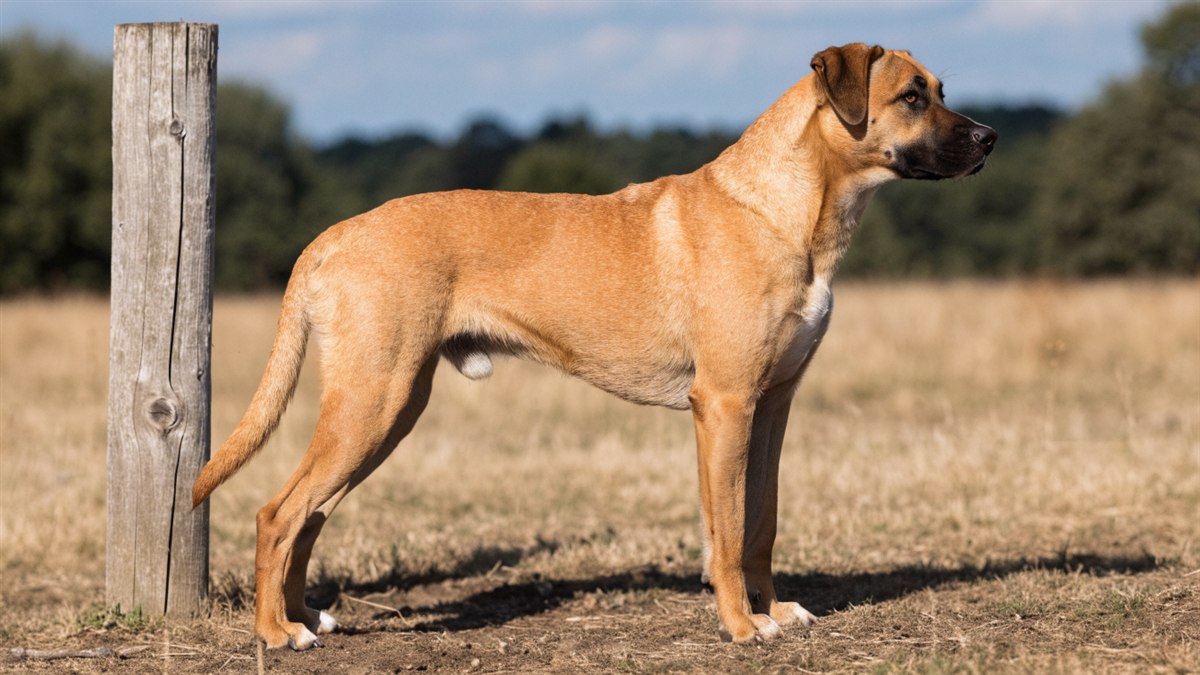
The physical description is clear enough. UKC calls it a powerful, agile tree dog of medium size, square or just slightly longer than tall, with a broad head, a moderate stop, high-set drop ears and a coat that is short, dense and close lying. The tail is set low and, in UKC's words, may be any length. Colour runs across all shades of red, yellow and fawn, plus black, brown, buckskin or brindle, with or without a black muzzle, and white is capped at ten percent of the body.
The name has two competing explanations and neither registry picks a winner. The Continental Kennel Club records both, that the name comes from the melanistic mask many of these dogs carry on the muzzle, and that it instead refers to the pigment of the lips and gums, which run brownish pink to dark grey rather than the usual pink. UKC's standard supports the second reading indirectly, because it requires that the lip pigment and the inside of the mouth, excluding the tongue, are darkly pigmented, except in dilute-coloured dogs.
A working dog first, described as one
UKC describes function before appearance in a way most standards do not. It calls the breed a fast, hard hunter that finds game using its eyes, ears and nose, states that silent trailers are preferred, allows a dog to be slightly semi-open on a very hot track, and forbids it to be open like a hound. A loud deep chop on bay or tree is allowed. A full-blown bawl mouth is not. That is a hunting specification written by people who hunt, not a show description.
It also tells you what the dog is for around the house. The same standard says the breed combines tenacity and courage with a strong desire to work, and that these dogs are very loyal and protective of their owner and family. Wikipedia's summary adds, from the published breed literature, that the Black Mouth Cur is wary of strangers and protective of children, sometimes to the point of objecting when a parent disciplines a child.
UKC sets a minimum height of 18 inches for a mature male and 16 inches for a mature female, and a minimum weight of 40 pounds for a male and 35 pounds for a female. It sets no maximum for either. A 45 kg dog and a 16 kg dog can both meet this breed standard, and both can be registered. That single drafting choice explains most of the size confusion on every other page about this dog.
Deafness is worth flagging early, because it sits in an unusual place. UKC lists deafness as an outright disqualification alongside blindness, albinism, cryptorchidism, viciousness and extreme shyness. A breed standard that disqualifies deafness is telling you deafness occurs. What no source provides is any figure for how often, and this guide will not supply one, because none exists that can be verified.
For an Indian reader the practical summary is short. This is a 16 to 45 kg athletic working dog with a short coat, a strong treeing instinct, a guarding temperament and no verifiable health register anywhere in the world. Whether that is a good fit is covered in the temperament and climate sections below, and the answer is genuinely mixed rather than a straight no.
Five bodies define this breed, and they contradict each other
Five organisations have a position on the Black Mouth Cur and no two of them agree. Reporting that disagreement matters more than resolving it, because a buyer who is handed papers needs to know which document the papers refer to.
The United Kennel Club recognises the breed and publishes a full standard, dated to a 1998 recognition and a 2000 copyright. The National Kennel Club publishes a separate, older, points-scored standard that credits Mr L.H. Ladner and others. The Continental Kennel Club publishes a third standard, far longer than either, and files the breed under Group 10, Pastoral and Stock Dog Breeds. The Federation Cynologique Internationale does not list it at all. The American Kennel Club does not recognise it and has not admitted it to the Foundation Stock Service.
Start with the classification, because it is the cleanest illustration. UKC files this dog in the Scenthound Group. CKC files the same dog in Group 10, Pastoral and Stock Dog Breeds. One registry says scenthound, the other says stock dog. Both are defensible for a cur, and that is exactly the point.
| Point | United Kennel Club | National Kennel Club | Continental Kennel Club |
|---|---|---|---|
| Group | Scenthound | Not grouped; points-scored standard | Group 10, Pastoral and Stock Dog Breeds |
| Male weight | Minimum 40 lb, no maximum stated | 40 to 50 lb | 40 to 60 lb |
| Female weight | Minimum 35 lb, no maximum stated | About 10 lb lighter than males | 35 to 55 lb |
| Male height | Minimum 18 in, no maximum stated | 20 to 26 in | 18 to 26 in |
| Tail | Set low, may be any length | Medium length, carried well up, no bob tails | Naturally long to bobbed, never surgically docked short |
| Bite | Scissors; overshot and undershot are disqualifications | Overbite and underbite are faults | Level, scissor or reverse-scissor all acceptable |
| Eyes | Green, yellow or brown; blue eye a serious fault | Dark eyes very desirable | Green or amber to dark brown; mismatched eyes not uncommon |
| Deafness | Disqualification | Not mentioned | Not mentioned |
Two rows in that table are outright contradictions rather than differences of emphasis. On the tail, UKC permits any length, NKC forbids bob tails, and CKC permits a natural bobtail while forbidding surgical dockingNational Kennel ClubContinental Kennel Club. On the bite, CKC accepts a reverse-scissor mouth as correct, while UKC treats an undershot bite as a disqualification that must be reported to the registryUnited Kennel Club. A dog can therefore be a correct Continental Kennel Club Black Mouth Cur and a disqualified United Kennel Club one at the same time.
The National Kennel Club lists it twice
The clearest single piece of evidence that these bodies do not agree on what the breed is comes from one registry disagreeing with itself. The National Kennel Club maintains a page headed Black Mouth Cur, carrying a full points-scored standard, and a second, separate page headed Ladner Blackmouth CurNational Kennel Club. The Ladner entry carries photographs and no standard text at all. Two entries, one registry, and the Black Mouth Cur standard on the first page explicitly says it hopes to keep the original lines as developed by Mr L.H. Ladner.
The Continental Kennel Club takes the opposite view in print. Its standard lists the breed's accepted aliases, and that list includes Ladner Cur and Ladner BlackMouth Cur alongside American BlackMouth Cur, Southern Cur, Yellow Black Mouth Cur and BMC. So one registry treats Ladner as a separate entry and another treats it as an alias for the same dog. Nobody has reconciled this, and this guide is not going to pretend it has been reconciled.
The AKC's position, and the control that makes it a finding
The American Kennel Club does not recognise the Black Mouth Cur and has never admitted it to the Foundation Stock Service, the holding programme it uses for rare breeds working toward recognition. That absence is properly controlled rather than assumed.
A request for akc.org/dog-breeds/black-mouth-cur/ returns HTTP 404 and AKC's page-not-found template. On its own that would be weak evidence, because a 404 is exactly what a wrongly guessed URL slug also produces, and this project has been caught before by treating a failed lookup as a finding.
So the same URL pattern was tried on a closely comparable breed in the same session. akc.org/dog-breeds/mountain-cur/ returns HTTP 200 and serves a full breed page stating that the Mountain Cur has been assigned the Hound Group designation and has been recorded in the Foundation Stock Service since May 2017. The URL pattern works. The slug convention is right. AKC simply has no page for this breed.
AKC's own breed selector on the Foundation Stock Service page confirms it from the other direction. That selector lists Mountain Cur, Catahoula Leopard Dog, Treeing Tennessee Brindle, Carolina Dog, Plott Hound, Rat Terrier and Teddy Roosevelt Terrier, and does not list the Black Mouth Cur anywhere in it. AKC plainly recognises American curs and feists, plainly has a route for them, plainly uses it, and has never applied it to this one.
UKC will register a Black Mouth Cur on the strength of a certificate from a registry it acknowledges, and the American Kennel Club is named on that list. Since AKC does not recognise the breed at all, that entire branch of the acceptance list is unusable, exactly as the FCI branch is. Two of the seven routes UKC names are dead letters for this specific breed.
There is a live debate inside the breed community about whether AKC recognition would be a good thing, and it is worth knowing that it exists rather than assuming everyone wants it. The argument against, made by owners themselves, is that show recognition tends to select for appearance over working ability, and that a hunting landrace loses what makes it useful when a conformation ring starts defining it. Bonbeno takes no position on that, and notes only that it is a reason the absence may persist.
For an Indian reader the practical consequence is narrow and worth stating plainly. AKC recognition is often used in Indian marketing as shorthand for legitimacy, so a seller invoking American Kennel Club standards for a Black Mouth Cur is describing something that does not exist. The registries that do define this breed are UKC, the National Kennel Club and the Continental Kennel Club, and they contradict each other on classification, size, tail and bite.
The named strains, and why they are not obviously one breed
At least five named strains carry the Black Mouth Cur name, each traced to a family or a region rather than to a founding studbook. The Continental Kennel Club puts it plainly, that there are as many highly regarded bloodlines of the breed as there are origin stories.
CKC names Ladner, Southern, Weatherford's Ben Texas, Foundation and Howard, and adds that many families have kept these dogs for well over 150 years. A Canadian breed club working with the same dogs lists a partly different set, naming the Ladner Yellow Blackmouth Cur from Mississippi, the Red Blackmouth Cur from Alabama, Weatherford's Ben Blackmouth Cur from Texas, and the Florida Blackmouth Cur. The two lists overlap without matching, which is what a landrace looks like when several people try to write it down.
| Strain | Region attributed | Recorded by | What the source says it was used for |
|---|---|---|---|
| Ladner Yellow Blackmouth Cur | South Mississippi | CKC, Northern BMC, the Ladner family site | Treeing squirrel, raccoon, bobcat, mountain lion and bear; hunting hogs and feral cattle; search and rescue |
| Weatherford's Ben Blackmouth Cur | Texas, Big Thicket country | CKC, Northern BMC | Primarily herding cattle |
| Red Blackmouth Cur | Alabama, around Howardtown and Tibbie | Northern BMC | Multipurpose pioneer dog: hunting, guarding the home, gathering cattle and pigs |
| Florida Blackmouth Cur | Florida | Northern BMC | Herding cattle |
| Howard | Not stated | CKC | Not stated |
| Foundation | Not stated | CKC | Not stated |
| Southern | Southern United States | CKC, Wikipedia (as Southern Cur) | General cur-type hunting dog |
The Ladner line is the one with paperwork
One strain has a documented registration date and the rest do not. The first Black Mouth Curs ever registered were Ladner Blackmouth Curs, entered with the National Kennel Club in April 1964, and the reason given is that Mr L.H. Ladner held such extensive written documentation of his family's breeding that NKC recognised the breed on the strength of it. The family's own kennel site describes LH Ladner as a south Mississippi man who propagated and hunted these dogs all his life, and states the dogs have been in the family over 200 years.
Treat the 200-year claim as a family tradition rather than a verified pedigree, because that is what it is. The site offers no documents to support it and no independent source corroborates it. What is verifiable is narrower and more useful: a specific family in a specific county kept a specific line of dogs, wrote it down, and got a registry to accept the records in 1964.
The UKC connection runs through a different strain again. Through the efforts of several Blackmouth Cur breeders, UKC later recognised the breed, and the dog featured in UKC's standard photograph was Howard Carnathan's Bruno, a Red Blackmouth Cur. So the registry that most Indian and international pages cite as the authority illustrated its standard with an Alabama red dog, while the first registered dogs of the breed were Mississippi yellow dogs from a different family.
Where the breed shades into its neighbours
The edges are genuinely soft. Wikipedia records that the Black Mouth Cur is a known genetic contributor to the Florida brown dog, also called the Florida Cur or Florida Cracker Cur, and that most Florida brown dogs carry a mix of Labrador Retriever, some Black Mouth Cur and a small amount of hound. It adds that the Florida Cracker Cur is often confused with the Black Mouth Cur. The Northern club says the closely related Mountain Cur is itself slowly being sorted into individual types.
One conjecture about ancestry recurs often enough to need addressing. Wikipedia reports the most common claim, that the breed descends from dogs brought to southern Mississippi by European settlers, among them some Belgian Malinois. No genetic study supports that, none is cited, and no registry standard repeats it. Treat it as folklore that has been printed many times rather than as a finding.
How a dog becomes a registered Black Mouth Cur
UKC will register a Black Mouth Cur it has never seen on the strength of another registry's certificate, a pedigree marked 'if available', and three photographs. Reading that requirement is the fastest way to understand what the name guarantees.
UKC's single registration page for this breed asks for four things. A completed Cur Single Registration application. A copy of the dog's registration certificate from a registry UKC acknowledges for this breed. The dog's complete three generation pedigree, and the page adds the words 'if available'. And three colour photographs, one of each side and one from the front, with the dog standing in all of them.
The acknowledged registries for this breed are the American Kennel Club, the Canadian Kennel Club, the Kennel Club of Great Britain, the National Kennel Club, the Independent Kennel Club, the Continental Kennel Club, and any FCI affiliated registry. Two entries on that list are dead letters for this breed. AKC does not recognise the Black Mouth Cur, and no FCI affiliate can issue a pedigree for a breed FCI has never listed, which is the point that decides the Indian question later on this page.
UKC's registration page closes with one sentence that does more work than the entire breed standard: 'If dog does not meet the requirements above, the registration can be submitted as Treeing Cur.' The same animal is a Black Mouth Cur with paperwork and a Treeing Cur without it. The boundary between the two breeds is documentary, not biological.
That sentence is not a criticism of UKC. A working-dog registry has to have some route for dogs whose breeders never kept records, and the alternative is that a genuine cur line dies out unregistered. But it does mean the name on the certificate reports a paper trail rather than a verified genotype, and an Indian buyer being offered a pedigree should understand which of those two things they are being sold.
Three photographs are part of the evidence
The photograph requirement is the practical admission that this is a landrace. UKC asks for three standing photographs precisely because the pedigree may be absent and somebody has to look at the dog and decide whether it is the right sort of animal. That is a reasonable procedure for a working breed. It is also, unavoidably, a judgement call, and judgement calls made against a standard with minimum heights and weights but no maximums will admit a very wide range of dogs.
Set that against how the breed's own community describes the variation. The Canadian club states that adult weight ranges from 50 to 100 pounds and height from 16 to 25 inches, and gives the reason directly, that the wide range in size is due to different types within the breed. A registry that cannot exclude on size and a community that reports a spread of that width are describing the same situation from two directions.
None of this makes the Black Mouth Cur a bad dog. It makes it a dog you evaluate individually rather than by name. If you are looking at one, the parents in front of you tell you far more than the certificate does, and that is the opposite of the advice that applies to a closed-studbook breed such as the Labrador Retriever or the Rottweiler.
Size and weight, where seven sources give seven answers
No reliable adult size exists for the Black Mouth Cur. Published figures for the top of the weight range run from 40 pounds to 100 pounds, a difference of two and a half times, and the sources spreading them include two registries and the breed's own clubs.
This is not a case of rounding. It is a case of a landrace being measured by people looking at different dogs. Below are the figures exactly as each source prints them, converted to metric for an Indian reader.
| Source | Height | Weight | Note |
|---|---|---|---|
| UKC breed standard | Male min 18 in (45.7 cm), female min 16 in (40.6 cm) | Male min 40 lb (18.1 kg), female min 35 lb (15.9 kg) | Minimums only. No maximum is stated for either measure. |
| National Kennel Club | Male 20 to 26 in (50.8 to 66.0 cm) | Male 40 to 50 lb (18.1 to 22.7 kg) | Females about 2 in shorter and 10 lb lighter. Over or under size is not a fault if the dog is balanced. |
| Continental Kennel Club | Male 18 to 26 in, female 16 to 24 in | Male 40 to 60 lb (18.1 to 27.2 kg), female 35 to 55 lb (15.9 to 24.9 kg) | The only source giving separate sexed ranges with both ends stated. |
| Wikipedia, from the breed literature | 16 to 25 in, individuals to 28 in (71.1 cm) | 45 to 100 lb (20.4 to 45.4 kg) | Weight sourced to two general breed encyclopaedias, not to a registry. |
| Northern Black Mouth Curs | 16 to 25 in (40.6 to 63.5 cm) | 50 to 100 lb (22.7 to 45.4 kg) | States the reason directly: the wide range is due to different types within the breed. |
| BARK breed guide | 16 to 25 in | 35 to 40 lb (15.9 to 18.1 kg) | Its stated maximum equals the UKC minimum for a male. |
| PetBuy.in, ranking 7th in India | 35 to 55 cm | 10 to 25 kg | Its stated minimum of 10 kg is 8 kg below the lightest figure any registry allows. |
Two rows deserve to be called out because an Indian buyer will meet them first. BARK's guide gives a weight of 35 to 40 pounds, and 40 pounds is precisely the UKC minimum for a mature male. Read literally, BARK is describing a breed in which no male exceeds the minimum. PetBuy's Indian page gives 10 to 25 kg, and 10 kg is 5.9 kg below the 15.9 kg that UKC sets as the floor for the smallest permitted female. Neither figure can be right if the standards are right.
What to plan for if you actually have one
Plan for a dog somewhere between 18 and 30 kg and treat anything outside that as possible rather than expected. That range is not a compromise average, which the sourcing rules on this site forbid. It is the overlap where every registry standard agrees a Black Mouth Cur can lawfully sit: above the UKC and CKC minimum of 40 pounds for a male, and at or below the CKC maximum of 60 pounds, with the NKC band of 40 to 50 pounds falling entirely inside itNational Kennel Club.
The 45 kg figure at the top of the Wikipedia and Northern club ranges is real and is reported by people who keep these dogs, so do not dismiss itNorthern Black Mouth Curs, About BMCs. It simply is not what any registry standard describes, and a dog that size changes the practical arithmetic on this page considerably. It costs more to feed, it is harder to cool, and it needs a stronger recall before it goes anywhere off a lead.
For an Indian household the honest planning advice is to buy the dog in front of you rather than the number on a website. Weigh both parents. A 20 kg bitch and a 22 kg dog will not produce a 45 kg animal, and a pair at 35 kg each will not produce a 20 kg one. On a breed with no maximum in its own standard, the parents are the only size prediction worth anything.
The working function, and what it means in a flat
The Black Mouth Cur was built to do two different jobs, herding cattle and hunting game, and every registry that describes it describes it working. That history is the single most decision-relevant fact for anyone considering one as a companion in an Indian city.
UKC's standard calls it a fast, hard hunter that finds game using its eyes, ears and nose, and specifies how it should give tongue while doing so. The breed is expected to hunt largely silent on the trail, then bay loudly at the tree. That is a specification for a dog running out of sight, thinking for itself, and telling you where it is only once it has finished the job.
The Continental Kennel Club is blunter about what that means for a pet home. Its standard states that these dogs are bred to be exceptional hunters and catch dogs, that they tend to be highly driven to perform these duties, and that this can become problematic if matched to non-working or non-hunting families that do not allow the breed to exercise its natural instincts, drives and energy. It goes on to require early obedience training, socialisation and a regular job, and warns that behavioural problems could arise without them.
The game list is not a small-animal list
The quarry these dogs were kept for tells you about their prey drive more clearly than any temperament adjective. UKC's registry siblings aside, the sources agree on the list. Wikipedia records extensive use across the southern United States on bear, feral pig, raccoon, deer and squirrel, with a reputation as a voracious hunter that usually catches and kills game on the ground, although it may also tree and bay. The Ladner family's own site names squirrel, coon, bobcat, penning cattle and hogs, and adds use on bear and mountain lion in New Mexico, Washington, Oregon and Montana.
The herding half is equally real and is sometimes the primary job. The Northern club describes the breed as primarily herding dogs able to hunt big or small game, states that all Blackmouth Curs excel at baying and herding, and records that the Weatherford's Ben Texas line and the Florida line were both used primarily for herding cattle. CKC's classification of the breed under Pastoral and Stock Dog Breeds follows the same reading.
A dog selected for two centuries to chase, catch and hold large animals, and to work cattle by baying at them, is carrying instincts that a third-floor flat in Pune cannot discharge. That is not a reason nobody should own one. It is a reason that anyone who does owns a training and exercise commitment, every day, for twelve to sixteen years, and it is why this breed sits badly with the common Indian pattern of a dog that gets one evening walk.
There is a genuine upside, and it is worth stating rather than burying. The same sources describe a dog that is intelligent, eager to please and highly trainable when given something to do. CKC records that Black Mouth Curs are finding a following in agility, search and rescue and obedience, and attributes that to their eagerness to please their owners and their high intelligence. The Northern club lists herding, tracking, weight pulling, coursing and search and rescue as things a well-guided Blackmouth Cur can excel at.
So the working history cuts both ways. It rules the breed out for an owner who wants a low-input companion, and it makes the breed unusually rewarding for an owner who wants a training project and can supply two hours of structured activity a day. The exercise and training sections put numbers on what that actually requires in Indian conditions.
Black Mouth Cur price in India, checked page by page
No verifiable black mouth cur price in India exists. Bonbeno opened every Indian page ranking for the term on 21 August 2026, and not one of them showed a single Black Mouth Cur for sale with a rupee figure attached to it.
That is the finding, and it is more useful than a number would be. Below is what each ranking page actually contains, read from the page rather than from its search snippet.
| Page | Rank | Price claimed | What the page actually shows |
|---|---|---|---|
| mrnmrspet.com | 1 | None printed | Header reads '3 Result Found'. The three cards rendered are a Bernese Mountain Dog in Jaipur, a Border Collie in Jaipur and a French Bulldog in Chennai. Prices sit behind a sign-up wall. |
| mrnmrspet.com, Chennai | 3 | None printed | The same listing template filtered to one city. |
| breednbreeder.com | 5 | None printed | Returns HTTP 200 and renders a logo and a WhatsApp button. No listings, no prices, no breed text on the page at all. |
| petzlover.com | 6 | Not established | Could not be opened. A stealth-proxy request returned a CAPTCHA page headed 'PetzLover, Verify You Are Human' at HTTP 403, and a second attempt failed on a proxy tunnel error. No figure from this host is used on this page. |
| petbuy.in | 7 | Rs 8,000 to Rs 35,000 | Prints that band directly above its own counters reading 'Live Avg (PetBuy) dash' and 'Listings 0'. Hero image is the site's default-pet-image placeholder. |
| dogell.com | 9 | 300 to 500 US dollars | A comparison page serving a dollar band to an Indian search. |
The top result offers you three other breeds
The page ranking first in India for this exact query is the clearest case. Mr n Mrs Pet advertises Black Mouth Cur puppies for sale in India, states in its own copy that it provides healthy, purebred KCI-certified Black Mouth Cur Puppies, and then renders three dogs, none of which is a Black Mouth Cur. A buyer arriving from Google is not being shown the breed they searched for. They are being shown a Bernese Mountain Dog, a Border Collie and a French Bulldog, and asked to sign up to see prices.
The same page carries its own control, which is what makes this conclusive rather than suggestive. Its sidebar lists the site's most popular breeds with live counts: Shih Tzu 650, Siberian Husky 549, Golden Retriever 487, Labrador Retriever 454, German Shepherd 412, Beagle 274, Poodle 263, Rottweiler 162, Pomeranian 136 and Cane Corso 134. The site can plainly count and display real inventory. It has 650 Shih Tzus and it does not have one Black Mouth Cur.
A price band beside a zero
PetBuy's page is the only Indian source printing a rupee range, and it refutes itself in the same block. Under the heading 'Black Mouth Cur Price in India' it gives Typical Low Rs 8,000 and Typical High Rs 35,000, and immediately beside those it prints 'Live Avg (PetBuy)' as a dash and 'Listings' as 0. A typical price computed from zero transactions is not a price. It is a placeholder in the shape of one.
Three further tells confirm the page is generated rather than researched. Its hero image is the file default-pet-image.jpg, the site's generic placeholder rather than a photograph of the breed. Its history section reads that the Black Mouth Cur developed over generations to fill a specific working or companion role, a sentence that names nothing and would serve any breed on the site. And its 'Explore Similar Breeds' row offers a Brussels Griffon, a Cane Corso, a Toy Australian Shepherd, a Pomsky, a Wire Hair Fox Terrier and a German Shorthaired Pointer, with not one cur among them.
Breed n Breeder completes the picture. Its page returns HTTP 200 and its meta description advertises Black Mouth Cur puppies with health certificates and KCI papers, but the rendered page contains a logo and a WhatsApp link and nothing else. There is no puppy price on it because there is no puppy on it.
Running the currency test on every figure that exists
Divide any suspicious Indian rupee figure by 84.38 and see whether a round dollar amount falls out. Run on this breed, that test clears the Indian pages and catches something worse on the search results page itself.
Start with PetBuy's band, the only rupee figures published anywhere for this breed in India. Rs 8,000 divided by 84.38 is 94.81 US dollars. Rs 35,000 divided by 84.38 is 414.79 US dollars. Neither is a round dollar figure, so this particular band is not a dollar price wearing a rupee sign, and Bonbeno reports that honestly rather than forcing the test to fire. The problem with those numbers is the 'Listings 0' counter beside them, not their currency.
The search engine's own answer fails the test badly
The figure most Indian searchers will actually see is not on any of those pages. It sits at the top of the results. Bing's AI-generated summary for this exact query, region set to India, answers in a box above everything else that the price of a Black Mouth Cur in India typically ranges from 575 to 1,000 US dollars, approximately Rs 4,000 to Rs 7,500.
Both halves of that sentence are wrong, and the second half is checkable on a phone.
| Dollar figure Bing used | Rupees at 84.38 | Rupees Bing printed | Understated by |
|---|---|---|---|
| 575 | Rs 48,519 | Rs 4,000 | 12.13 times |
| 1,000 | Rs 84,380 | Rs 7,500 | 11.25 times |
Work backwards and the implied exchange rate is Rs 6.96 to the dollar at the bottom of the band and Rs 7.50 at the top. No such rate exists or has existed in the lifetime of anyone reading this. An Indian buyer who trusts that box walks into a conversation expecting to pay about Rs 6,000 for a dog whose cited US price is nearer Rs 50,000 to Rs 84,000, and that gap is exactly the sort of expectation gap a seller can work with.
The first half of the sentence is a different error. The 575 to 1,000 dollar band is not an Indian figure at all. Bing attributes it to GoodDog, a US puppy marketplace, and the snippet Bing itself displays reads 'Nationally, prices usually range from 575 dollars to 1,0' before truncating. That is a United States national range, relabelled as an Indian one. Bonbeno could not open the GoodDog page directly to confirm the dollar figure, so the only thing established here is that the answer served to Indian searchers is internally inconsistent, which is enough.
The query itself is contaminated
The SERP has a stranger problem underneath all of this, and it explains a lot about why the results are so poor. Bing's organic results for this breed's price query include three pages about the black pepper commodity market, at positions five, nine and eleven, from Agriwatch, BankBazaar and AroWest. Two of the four questions in Bing's People Also Ask box are also about pepper: 'How much does black pepper cost in India?' and 'What influences the black pepper market price in India?'
The search engine has partially collapsed 'black mouth cur price in india' onto 'black pepper price in india'. That is not a curiosity. It means roughly a quarter of the answer surface a buyer sees for this breed is about a spice, which in turn means the remaining slots are contested by fewer genuine pages, which is how a placeholder band beside a zero listing count ends up ranking seventh in the first place.
Google could not be checked for the same contamination. A request for the identical query with the region set to India returned HTTP 429 and a reCAPTCHA interstitial reading that its systems had detected unusual traffic, timestamped 2026-08-21T18:52:44Z. That is recorded here rather than glossed over, because a blocked search that returns nothing is not evidence of anything, and nothing on this page rests on a Google result.
Bing also flags its own US results honestly, printing 'Missing: india' with a 'Must include: india' link under both the GoodDog and LancasterPuppies entries. The search engine is telling the reader those pages do not mention India. Its AI summary at the top of the same page ignores that warning and converts one of them into an Indian price anyway.
Why no lawful supply chain can form in India
Two independent facts close the Indian supply question, and neither is a matter of opinion. Indian law forbids importing a dog to breed from, and the Black Mouth Cur has no FCI standard, so no FCI-affiliated pedigree route exists for it anywhere.
Take the law first, read from the government's own file. DGFT Trade Notice No. 22/2022-23, dated 19 December 2022, sets the import policy for dogs under ITC(HS) 01061900, which is classified Restricted. Policy Condition 7 permits import of dogs for exactly three purposes: a pet dog with a valid pet book and relevant records in the name of the importer, dogs imported by R&D organisations for research on the recommendation of CPCSEA, and dogs for internal security by the Defence and Police Force.
Policy Condition 8 then closes the commercial door explicitly, stating that import of commercial dogs for breeding or any other commercial activities other than the purposes mentioned above is not permitted. Paragraph 6 of the same notice removes any ambiguity about how such an application is handled, in one sentence: any applications for trading or breeding purposes, or applications made on behalf of some another person or entity, shall be duly rejected.
| Provision | What it says |
|---|---|
| Policy Condition 7(i) | A pet dog with a valid pet book and relevant records or documents in the name of the importer |
| Policy Condition 7(ii) | Dogs imported by R&D organisations for research, on the recommendation of CPCSEA |
| Policy Condition 7(iii) | Dogs for internal security by the Defence and Police Force |
| Policy Condition 8 | Import of commercial dogs for breeding or any other commercial activity is not permitted |
| Paragraph 6 | Applications for trading or breeding purposes, or made on behalf of another person or entity, shall be duly rejected |
| Paragraph 7 | Import allowed only through the airports and seaports of Delhi, Mumbai, Chennai, Hyderabad, Bangalore and Kolkata, with quarantine where required; DAHD added Kochi for pets arriving under the baggage rules in October 2024 |
| Paragraph 5 | Owners are advised to start the authorisation process at least two months before travel |
The seven-port restriction matters practically as well as legally. Import of pet animals is allowed only through the airports and seaports of Delhi, Mumbai, Chennai, Hyderabad, Bengaluru and Kolkata and, since October 2024, Kochi airport, and the Department of Animal Husbandry and Dairying gives the first six of those cities as the places where animal quarantine and certification services existDepartment of Animal Husbandry… Department of Animal Husbandry…. A returning resident bringing one dog can use that route. A breeder cannot, because paragraph 6 rejects the application on its face. The full route is set out in how to import a dog to India.
The documentary burden on the lawful route is real but modest. A permanent import needs a vaccination book, pet passport or pet book, a certificate for emotional support and the pet's passport, filed as an application under ANF-2M, and applicants without their own Importer Exporter Code may apply against the permanent IEC number IIHIE0153E. DGFT advises starting at least two months before travel. None of that helps a person who wants to buy a Black Mouth Cur puppy in India, because it describes moving your own dog, not acquiring one.
No FCI standard means no KCI pedigree, and two sites sell one anyway
The Federation Cynologique Internationale has never written a standard for the Black Mouth Cur, so no FCI-affiliated registry can issue a pedigree for it. That single fact decides what any Indian paperwork offered with this breed is worth.
Bonbeno checked FCI's own nomenclature rather than a summary of it, because a wrong document at HTTP 200 is the commonest failure mode on this kind of question. Two lists were opened: the breeds beginning with B, and the list of breeds recognised on a provisional basisFederation Cynologique Internationale. Neither contains the Black Mouth Cur, and neither contains a cur of any kind.
An absence is only worth as much as its control, so here is the control. The B list carries 42 breeds and it does include the Black and Tan Coonhound at FCI number 300, an American scenthound whose name starts with the same word as the breed being looked for. The provisional list carries 21 breeds and includes the Miniature American Shepherd at number 367. FCI plainly does recognise American breeds and plainly does list breeds beginning with 'Black'. It has simply never listed this one.
What that means for Indian paperwork
The Kennel Club of India is FCI's member body for India, and FCI publishes its registration figures directly: 32,219 puppies registered with the studbook and appendix in 2025, against 88,261 in 2021, and 33,880 pure-bred dogs in the studbook in 2025. That is a working national registry inside the FCI system, and it is a shrinking one, down 63.5 percent on puppies in four years. What it has no mechanism for is a breed FCI has never written a standard against.
Mr n Mrs Pet states it provides 'purebred KCI-certified Black Mouth Cur Puppies in India'. Breed n Breeder's page advertises 'Kci & Home Breeding Black Mouth Cur Puppies'. FCI holds no standard for this breed, so the international system KCI belongs to has no category for such a certificate. Treat offered KCI paperwork for a Black Mouth Cur as the strongest single reason to end the conversation, and ask to see the dog's parents instead.
Note the second-order effect, because it is the one that actually costs Indian buyers money. UKC will register a Black Mouth Cur on the strength of a certificate from any FCI affiliated registry. Since no FCI affiliate can issue one, that entire branch of UKC's acceptance list is unusable for this breed, as is the American Kennel Club branch, because AKC does not recognise it either. The practical routes into UKC registration run through the National Kennel Club, the Continental Kennel Club, the Canadian Kennel Club, the Kennel Club of Great Britain or the Independent Kennel Club, and none of those has an Indian presence a buyer in Pune can walk into.
Put the law and the paperwork together and the conclusion is structural rather than temporary. Breeding stock cannot lawfully be imported, so no founding population can form. No FCI standard exists, so no pedigree can be issued through the route Indian buyers recognise. Whatever is offered in India under this name arrived by some other path, and the adoption section sets out how to work out what the animal in front of you actually is.
One claim about India circulates and it deserves recording rather than repeating. A Canadian breed club states that Ladner Blackmouth Curs are known to be in Mexico, Argentina, Haiti, Russia, India and throughout Europe. No evidence is offered for the Indian part of that list, Bonbeno found none, and a club page is not a register. Treat it as an unevidenced claim rather than as proof the breed is here.
The real cost of ownership for this dog in India
Budget Rs 8,000 to Rs 14,000 a month for a Black Mouth Cur in an Indian city, using the large-breed band from the most detailed Indian cost breakdown published. The purchase price, if one ever existed, would be the smallest number in this section.
Supertails publishes a component-level monthly cost table for India by breed size, and a 18 to 30 kg working dog sits in its large-breed column alongside the Labrador, German Shepherd and Golden Retriever. Its total for that column is Rs 8,000 to Rs 14,000 a month, and its own headline figure for dogs generally is Rs 3,000 to Rs 18,000 depending on breed size and grooming needs. A Black Mouth Cur at the lighter end of the size range moves toward its medium column at Rs 6,000 to Rs 10,000.
| Component | Large-breed band, India | How this breed differs |
|---|---|---|
| Dry or wet food | Rs 4,000 to Rs 6,000 | At the top of the band, because this is a lean working dog carrying real muscle and burning it |
| Routine vet visits | Rs 1,000 to Rs 2,000 | No breed-specific screening exists to add, which lowers cost and is not good news |
| Vaccinations | Rs 1,800 a year | Unchanged. Tick and flea prevention matters more than the average, see the health sections |
| Grooming | Rs 500 to Rs 1,200 | Below the band. A short, close-lying coat needs brushing, not a groomer |
| Training, first six months | Rs 3,000 to Rs 8,000 | Above the band, and the one line not to trim. CKC's standard makes early obedience training a requirement, not an option |
| Treats and toys | Rs 600 to Rs 1,200 | At the top. A high-drive dog destroys soft toys and needs work-shaped enrichment |
| Flea, tick, deworming | Rs 500 to Rs 800 | Above the band in most Indian cities, given the tick-borne disease figures in the health section |
| Monthly total | Rs 8,000 to Rs 14,000 | Realistically Rs 9,000 to Rs 15,000, because grooming savings do not cover the training and parasite costs |
Two lines in that table move in opposite directions and it is worth understanding why, because it changes the shape of the budget rather than just the total. The short coat genuinely saves money. This breed does not need a professional groom every six weeks the way a heavily coated dog does, and Supertails' own table shows large breeds paying less for grooming than small ones for exactly that reason.
The training line goes the other way and it is not optional. CKC's standard states that early obedience training, socialisation and a regular job are a must for this breed, or else behavioural problems could arise. On a 25 kg dog bred to catch and hold large animals, a behavioural problem is not an inconvenience. Budgeting Rs 3,000 to Rs 8,000 for six months of professional training is the cheapest insurance on the page.
The cost nobody prices, which is time
Two hours a day of real exercise and mental work, split across cool hours, is the actual price of this breed in India. That has a rupee value if you cannot supply it yourself, because a daily walker in a metro is a recurring cost on top of everything above, and a dog of this drive needs more than the twenty-minute round most walkers provide.
Air conditioning belongs in the honest budget too, though less of it than a heavily coated breed needs. A short-coated, mesocephalic dog copes with Indian heat better than a Black Russian Terrier or a Siberian Husky does, and the climate sections argue that in detail. What it still needs is shade, unlimited water, a cool floor and a fan through the worst four to seven months, and in Chennai or Ahmedabad that is seven months of the year rather than two.
Set against all of this, note what is missing. There is no purchase price in this budget, because no verifiable one exists, and there is no screening cost, because no screening scheme exists for this breed. A prospective owner should read both absences as risk moved into the future rather than money saved today.
Heat tolerance, argued from the coat and the origin
The Black Mouth Cur is one of the few imported breeds where the heat answer is genuinely favourable, because it comes from a hot humid place and wears a short coat. That advantage is real, and it is narrower than it first looks.
Three physical facts drive the rating, and all three come from breed standards rather than from opinion. The coat is short, dense and close lying, with texture running from coarse to very fine, and both a wiry coat and a long coat are serious faults. The skull is flat and broad with a muzzle only slightly shorter than the skull and parallel planes, which makes this a mesocephalic dog rather than a brachycephalic one. And the breed is built lean, described as bred for stamina and required to be presented in hard, muscular condition.
The skull point is the one that carries the most weight in the veterinary literature. In a VetCompass study of 905,543 UK dogs that identified 1,259 heat-related illness events, brachycephalic dogs had greater odds of all three types of heat-related illness compared with mesocephalic dogs. A Black Mouth Cur can pant efficiently. A Pug or a Bulldog cannot, and that difference is the single largest anatomical factor separating breeds that cope with Indian summers from breeds that do not.
The coat description is disputed, and it matters here
Two registries describe this coat differently and the difference bears directly on heat. UKC's standard says only that the coat is short, dense and close lying, and never mentions an undercoat. The Continental Kennel Club describes the same breed's coat type as 'Close coat, Short double-coat' and states in its standard that the undercoat is dense and soft. A single-coated short dog and a short double coat behave differently in a Chennai May.
Bonbeno cannot resolve that and will not average it. The practical reading for an owner is to check the dog in front of you, part the coat over the shoulder and see whether there is a soft layer under the guard hairs. If there is, the dog sheds seasonally and needs more brushing through the pre-monsoon months than the UKC description would suggest. Either way the rule that follows is the same one that applies to every double coat, which is that you never shave it.
The number that reframes the whole question
Heat illness in dogs is not mainly caused by hot weather. It is mainly caused by exercise. In the same VetCompass dataset, exertional heat-related illness was the predominant trigger at 74.2 percent of events, followed by environmental heat at 12.9 percent and vehicular confinement at 5.2 percent. Young male dogs had greater odds of exertional heat-related illness than others.
Now put that next to what this breed is. A fast, hard hunter with a strong desire to work, that CKC says becomes problematic without a job, is precisely the dog that generates exertional heat loadContinental Kennel Club. The short coat and the long muzzle are genuine advantages, and they are advantages in the 12.9 percent category rather than the 74.2 percent one.
A follow-up VetCompass study found the median ambient temperature on days of heat-related illness events was 16.9 degrees Celsius. That is not a heatwave. It is a mild spring day, and dogs were being presented to primary care with heat illness on it. Every Indian city in the table below has an annual mean above 16.9 degrees, and so does the breed's own place of origin.
So the honest framing for an Indian owner is not whether the breed can survive the climate, because it plainly can. It is whether you will manage the exercise, which is the thing that actually causes the harm, in a country where the ambient baseline sits above the temperature at which UK dogs were already being hospitalised. The exercise section turns that into a timetable.
The American South against nine Indian cities, on one dataset
South Mississippi is more humid all year than any major Indian city, and 8.15 degrees Celsius cooler in annual mean than Chennai. That pair of facts is the whole heat argument for this breed, and it is why the rating is favourable without being top marks.
Every figure below comes from one source on one methodology, NASA POWER's 20-year monthly and annual climatologies covering January 2001 to December 2020, queried by explicit latitude and longitude rather than by place name. Querying by coordinates matters: a place-name lookup can silently return the wrong city, and a heat rating built on the wrong city would discredit the most original argument this page makes. The two origin points are Hancock County in south Mississippi, the Ladner range, and the Big Thicket country of southeast Texas, where the Weatherford's Ben line was kept.
| Place | Annual mean temp | Annual mean humidity | Hottest month | Peak heat index | Months averaging 28 C or above |
|---|---|---|---|---|---|
| South Mississippi (origin) | 19.80 C | 81.6 percent | July, 27.77 C | 31.5 C | 0 |
| Big Thicket, SE Texas (origin) | 20.06 C | 77.9 percent | August, 28.88 C | 32.9 C | 2 |
| Bengaluru | 23.74 C | 67.9 percent | April, 28.37 C | 28.8 C | 1 |
| Pune | 23.86 C | 66.8 percent | April, 28.93 C | 30.2 C | 2 |
| Delhi | 25.60 C | 45.6 percent | June, 35.88 C | 38.6 C | 6 |
| Kolkata | 25.81 C | 73.9 percent | May, 31.53 C | 38.2 C | 5 |
| Hyderabad | 26.10 C | 60.3 percent | May, 33.30 C | 33.8 C | 4 |
| Mumbai | 26.77 C | 67.4 percent | May, 31.19 C | 35.3 C | 4 |
| Nagpur | 26.91 C | 55.8 percent | May, 36.73 C | 36.4 C | 4 |
| Ahmedabad | 27.57 C | 48.3 percent | May, 35.06 C | 38.8 C | 7 |
| Chennai | 27.95 C | 72.4 percent | May, 31.51 C | 37.3 C | 7 |
The humidity column is the good news, and it is real
Read the humidity column first, because it is the one that surprises people and it favours the breed. South Mississippi averages 81.6 percent relative humidity across the year. The most humid Indian city in this set is Kolkata at 73.9 percent, then Chennai at 72.4 percent. The breed's home range is 7.7 percentage points more humid year-round than the wettest major Indian city on the list.
That is not a trivial point. Humidity is what defeats panting, because a dog cools by evaporation and evaporation slows as the air saturates. A breed developed in the American Gulf South spent two centuries working in air more saturated than Kolkata's, and a great many imported breeds cannot say anything like that. The Black Mouth Cur is genuinely a humid-climate dog.
The temperature column is the bad news
Now read the temperature column, and the picture inverts. South Mississippi's hottest month, July, averages 27.77 C. Chennai's annual mean is 27.95 C. Chennai's entire year, monsoon and winter included, runs marginally hotter than the hottest month the breed's home range ever sees.
The duration column makes the same point without any arithmetic. The Ladner range has zero months averaging 28 C or above. Chennai and Ahmedabad have seven each, Delhi six, Kolkata five. The breed evolved to handle a hot humid summer, then a long recovery. Chennai does not offer the recovery.
Two Indian cities sit much closer to the origin than the rest. Bengaluru at 23.74 C with one month at or above 28 C, and Pune at 23.86 C with two, are the only places in this set where the annual pattern loosely resembles what this dog was bred for. If you are choosing between Indian cities for this breed, that gap is larger than any other factor on this page.
How the heat tolerance rating of 4 is built
Bonbeno rates the Black Mouth Cur 4 out of 5 for heat tolerance, which is the highest score any imported working breed has earned on this site. Here is exactly what lifts it and exactly what stops it reaching 5.
Ratings on this site are built from evidence rather than asserted, so that a reader can disagree with the score by disagreeing with a specific line rather than with a feeling.
| Factor | Direction | Evidence |
|---|---|---|
| Coat length | Raises | Short, dense, close lying; long and wiry coats are serious faults under the UKC standard |
| Skull shape | Raises | Mesocephalic. Brachycephalic dogs had greater odds of all three types of heat-related illness in a study of 905,543 dogs |
| Origin humidity | Raises | 81.6 percent annual mean in south Mississippi, higher than any of nine Indian cities checked |
| Body mass | Raises | 18 to 30 kg working build, well below the giant breeds where bodyweight is a named risk factor for severe disease |
| Origin temperature | Lowers | 19.80 C annual mean at origin against 27.95 C in Chennai, a gap of 8.15 C |
| Heat duration | Lowers | Zero months at or above 28 C at origin, against seven in Chennai and Ahmedabad |
| Exertional drive | Lowers | Exertion triggered 74.2 percent of heat-related illness events, and this is a breed CKC says needs a job |
| Coat disagreement | Lowers | CKC describes a short double coat with a dense soft undercoat; UKC describes no undercoat at all |
The score lands at 4 because the first four rows are strong and specific, and the last four are real rather than theoretical. A 5 would say this dog is as well suited to an Indian summer as an Indian Pariah Dog, and it is not, because the Pariah has been selected in this exact climate for far longer and does not carry a working drive that pulls it into midday exertion.
What a 4 means in practice
A 4 means the climate is a manageable constraint rather than a disqualifying one, and that the owner rather than the weather decides the outcome. Concretely, in Bengaluru or Pune this breed can live a normal life with sensible timing. In Chennai, Ahmedabad or Nagpur it needs the same care an owner would give a Labrador, which is to say real care, applied for seven months a year rather than two.
It also means the failure mode is specific and predictable. This dog will not quietly overheat lying on a balcony the way a heavy-coated northern breed does. It will overheat because somebody let it work, chase, or play fetch at four in the afternoon in May, and it kept going because that is what it was bred to do. The breed's own literature warns about this indirectly, describing a dog with tenacity, courage and a strong desire to work.
Most imported breeds on this site are rated 1 or 2 for heat tolerance because they were developed somewhere cold and dry and wear a coat built for it. This breed was developed somewhere hot and wet, in air more humid than Kolkata's, and wears a short coat. It is a genuinely heat-tolerant dog by the standards of an imported breed, and that deserves to be stated plainly rather than buried under caveats.
One caution about the origin data itself. The two origin points are ranges rather than addresses, because a landrace does not have a single home town, and the Ladner and Weatherford's Ben lines were kept several hundred kilometres apart. The Texas point runs 0.26 C warmer in annual mean and 3.7 percentage points drier than the Mississippi one, which is small enough not to change the argument and large enough to be worth printing rather than smoothing away.
Temperament, and who should not buy one
Every standard describes the same dog: intensely bonded to its own family, protective of its property, and reserved to the point of suspicion with strangers. That combination suits some Indian households very well and suits the most common Indian household very badly.
The registries are unusually consistent here, which is worth noting on a breed where they agree about almost nothing else. UKC says the dogs are very loyal and protective of their owner and family. The National Kennel Club asks for a dog that is bold, confident, trusting and loving with its master, but not too friendly with strangers, and adds that they are possessive of property rights and good guard dogs. CKC records that they bond strongly with their families, become especially fond of 'their' children, can be aloof toward strangers, and have a tendency to become territorial and protective of property.
The breed community goes further and describes the mechanism. A Canadian club explains that a well-bred Blackmouth Cur is territorial because it was bred as a homestead dog to protect its family and home against intruders, and that most work well with other dogs off their own turf while chasing the same dog away on family property. It then defines turf in a way that should give an apartment owner pause, as the family's home, land, truck, or sometimes proximity to their person.
Two traits the marketing pages leave out
The published breed literature records a protectiveness toward children that can misfire. Wikipedia, drawing on the standard reference works, states that the breed is wary of strangers and known to be protective of children, sometimes to the point of objecting to parents disciplining their children. The same sources note that many respond better to female handlers. Neither observation appears on any Indian page selling the breed, and the first is a genuine management issue in a joint-family household where several adults correct the same child.
UKC handles the other end of the temperament range through its disqualification list. Both viciousness and extreme shyness are disqualifications, alongside deafness and blindness. CKC states the same principle positively, that any unprovoked aggressive or fearful behaviour toward people is incorrect for this breed. A nervy or a sharp Black Mouth Cur is a badly bred one, not a typical one, and on a breed with no health register the parents' temperament is one of the few things you can actually assess.
Who should not buy one
- First-time dog owners. Choose a breed with a closed studbook, published health data and a forgiving temperament instead.
- Households where the dog will get one evening walk. CKC warns directly that a home which does not let the breed use its drives produces behavioural problems.
- Flats with heavy visitor traffic. A territorial guarding dog that treats the doorway as turf makes deliveries, domestic help and guests a daily negotiation.
- Homes with cats, rabbits or small pets already established. This is a breed that catches and kills game on the ground.
- Anyone buying on looks. The melanistic mask is handsome and it tells you nothing about whether this dog fits your life.
Who it does suit is a shorter list and a real one. An owner with a house, a yard, time for daily structured work, previous experience of a driven working breed, and a preference for a dog that is deeply attached to its own people rather than friendly with everyone. Mother Earth News, writing from a homestead rather than a marketing brief, describes exactly that fit and reports a curious, smart dog that settles into family life given the work it needs.
One more thing to expect, from the people who keep them. The Canadian club notes that as they grow older they become very laid back. The first two to three years are the demanding ones, and an owner who gets through them with the training done tends to end up with an easy adult dog.
Training a dog bred to work out of sight
Train recall before anything else, because the UKC standard describes a dog that hunts silently and out of contact. Everything else in this breed's training programme is ordinary; the recall is the part that is genuinely safety-critical in an Indian city.
Start from what the standard specifies. UKC says silent trailers are preferred, allows a dog to be only slightly semi-open on a very hot track, and forbids it to be open like a hound. Read that as a job description and it says: this dog was selected to leave you, follow a line without telling you where it is going, and only make noise once it has treed or bayed something. A dog engineered to that specification, off-lead beside a Bengaluru arterial road, is a road-traffic accident waiting for a squirrel.
The breed's own people describe an unusual first step. A Canadian club states that the Blackmouth Cur is a very smart breed who by nature need to bond a few weeks with their owner or trainer before training can begin. That is not a claim Bonbeno can verify against a study, and it is consistent with what the registries say about how strongly these dogs attach. Practically, it means the first fortnight after a puppy arrives is for relationship and household routine rather than for formal obedience.
A realistic Indian timeline
| Age | Priority | Why this order |
|---|---|---|
| 8 to 10 weeks | Bonding, house routine, name response, handling | Indian law forbids sale below eight weeks, so this is the earliest a puppy should legally arrive |
| 10 to 16 weeks | Socialisation to people, traffic, lifts, domestic help, other dogs | The window closes early, and this is a breed that defaults to suspicion of strangers without it |
| 4 to 6 months | Recall on a long line, in low distraction, then rising | Never off a long line outdoors until the recall is proven. The standard describes a silent independent hunter |
| 6 to 12 months | Loose-lead walking, impulse control, settle on a mat | Adolescence, and the point at which a 20 kg dog stops being manageable by strength |
| 12 to 24 months | A regular job: scentwork, tracking, canine sport, structured retrieves | CKC states a regular job is a must for this breed, not an enrichment extra |
The socialisation row carries the awkward Indian conflict, and it is worth naming rather than glossing. The behavioural window for socialising a puppy runs earlier than the vaccination course finishes, so the temptation is to keep the dog indoors until it is fully covered. On a breed whose registries describe it as aloof and territorial, an unsocialised adult is the predictable outcome of that choice. Carry the puppy, use safe controlled meetings, and do not simply wait.
What this breed resists
Nothing in the sources describes a stubborn or slow dog. CKC records high intelligence and an eagerness to please, and lists agility, search-and-rescue and obedience as sports the breed is doing well in. The Northern club says a well-guided Blackmouth Cur can herd, track or trail game, pull weight, run a coursing event or work in search and rescue. This is a trainable dog by every account.
What it resists is being left with nothing to do, and being handled harshly. A dog described as bold, confident and loving with its master, and simultaneously as courageous and tenacious, is not a candidate for confrontational methodsUnited Kennel Club. Build the recall with food and a long line, keep sessions short, and give the dog a job. Owners who report problems with this breed almost always report a dog with an empty day.
One Indian-specific point on where to train. Book indoor or early-morning classes. A high-drive dog working hard in a Chennai or Hyderabad afternoon is generating exactly the exertional heat load that accounted for 74.2 percent of heat-related illness events in the largest study of the question.
Exercise needs, and what the Indian clock does to them
Plan on two hours of real activity a day, split into a pre-dawn session and a post-sunset one. The exercise needs of this breed are not negotiable, and in most Indian cities the constraint is not the dog's stamina but the number of usable hours in the day.
No source rates this breed as low-maintenance on exercise, with one exception that is worth examining. UKC calls it a fast, hard hunter bred for stamina. CKC warns that a home not allowing the breed to exercise its natural instincts, drives and energy produces behavioural problems. The Northern club describes a dog that can herd stock, trail game, pull weight, run a coursing event or work search and rescue. Mother Earth News, writing from a working homestead, pairs regular exercise with obedience training and weight monitoring as the three things the breed needed.
The exception is the Indian page. PetBuy rates this breed's exercise needs as 'Moderate' and its trainability as 'Moderate' on the same card. Both ratings are wrong against every registry description of the breed, and the exercise one is the more dangerous of the two, because a buyer who plans for a moderate dog and receives a hard hunting cur has a problem in about six months.
The Indian timetable, city by city
The binding constraint is the heat window rather than the dog. Using the NASA POWER figures from the climate section, the number of months averaging 28 C or above runs from one in Bengaluru to seven in Chennai and Ahmedabad. In a seven-month city the working assumption for more than half the year is that the middle of the day is unusable, which means the day has to be built around two edges rather than one long walk.
- Split the two hours. One session before sunrise, one after dark, never a single long block in daylight during the hot months.
- Carry water on every outing, and stop for it rather than waiting for the dog to ask.
- Test the pavement with the back of your hand. A short-coated dog still has unprotected pads, and Indian tarmac holds heat long after sunset.
- Replace distance with scentwork on the worst days. A twenty-minute nosework session in an air-conditioned room tires this breed more than a slow walk does.
- Watch the dog rather than the clock. A breed selected for tenacity will keep working past the point where it should have stopped.
That last line is the one that matters most, and it is evidence-based rather than cautionary boilerplate. Exertion triggered 74.2 percent of heat-related illness events in a study of 905,543 dogs, environmental heat only 12.9 percent. The follow-up study found the median ambient temperature on the days those events happened was 16.9 C, a figure below the annual mean of every Indian city on this page. Indian owners are operating permanently above the conditions in which UK dogs were already collapsing, and the trigger is what the owner asks the dog to do.
What happens without it
The failure pattern for an under-exercised Black Mouth Cur is predictable from what the breed was selected to do. A dog bred to hunt and to herd, with nothing to hunt or herd, redirects. That shows up as destructive chewing, as barking at every sound on the landing, as an intensifying territoriality about the doorway, and as an inability to settle indoors. CKC names the outcome without listing the symptoms, stating simply that behavioural problems could arise.
None of that is a training failure in the ordinary sense, and it will not be fixed by more obedience. It is a dog with a job specification and no job. The fix is to supply one, which is why the training section puts scentwork, tracking and structured retrieves on the twelve-month list rather than treating them as optional enrichment.
Grooming a short coat in Indian humidity
Brush weekly, check the ears every week, and never shave the coat. Grooming is the cheapest and simplest part of owning this breed, and the ears are the one part of it that Indian conditions genuinely change.
The coat itself asks for very little. UKC describes it as short, dense and close lying, with texture that may run coarse to rough to very fine, and marks both a wiry coat and a long coat as serious faults. There is no trimming requirement anywhere in any of the three standards, no furnishing to maintain, and no professional groom in the schedule. Supertails' Indian cost table shows large breeds paying less for grooming than small ones for exactly this reason.
The one open question is whether there is an undercoat, and the registries disagree. UKC never mentions one. CKC lists the coat type as 'Close coat, Short double-coat' and states that the undercoat is dense and softContinental Kennel Club. If the dog in front of you has one, expect a seasonal shed and step the brushing up to two or three times a week through the pre-monsoon weeks. If it does not, weekly is enough all year.
A short double coat insulates against heat as well as cold, and shaving it removes the dog's own shade while exposing thin, unpigmented skin to Indian sun. On a coat this short there is nothing to gain even if it were safe. Brush the dead undercoat out instead, which is what actually reduces the insulating mat.
The ears are the Indian problem
Every standard describes drop ears. UKC calls for ears that are drop, short to medium in length, wide at the base and set high. CKC asks for drop ears with an inner edge lying close to the head. A hanging ear that sits flat against the skull holds warmth and moisture in the canal, and a hot humid Indian monsoon supplies both.
Bonbeno looked for an Indian prevalence series on canine otitis externa to put a number on that risk and could not find one, so no number is offered here. The search is worth describing, because an unproven absence is not evidence. PubMed returned 669 records for 'otitis externa dogs' and 703 for 'dogs India prevalence', so the database and the query shape both work. 'Otitis externa dogs India' returned three records, and the top result is a cat ear-mite drug trial run in South Africa and Germany. There is no Indian canine otitis prevalence series indexed there to cite.
So the ear advice is anatomical rather than statistical, which is the honest way to give it. Look in both ears weekly. Dry the ears after every bath and after any swim, because a drop-eared dog does not drain on its own. Do not flush a canal with water as routine maintenance, and take head-shaking, an odour, or a dog rubbing an ear along the floor to a veterinarian rather than treating it from a shop counter.
The hypoallergenic question, which has a settled answer
'Are black mouth cur hypoallergenic' appears in Bing's related searches for this breed, so it is worth answering flatly. No. No dog breed is. Vredegoor and colleagues measured the major dog allergen Can f 1 in the hair and homes of 196 dogs of so-called hypoallergenic breeds against 160 control dogs and titled the paper on the result, that there is a lack of evidence to describe any dog breed as hypoallergenic.
Note also that no Black Mouth Cur standard makes the claim in the first place. None of the three registry documents says anything about low shedding or allergy suitability, and the Northern club describes a coat that comes coarse or fine and may vary within a single litter. If an Indian seller tells you this breed is safe for an allergic child, they have invented it, and that tells you something useful about the rest of what they are saying.
Health issues, and the register that holds nothing
The Orthopedic Foundation for Animals holds no data on the Black Mouth Cur at all. Bonbeno parsed all 1,287 of OFA's statistics tables on 21 August 2026 and this breed appears in none of them, twenty-eight years after UKC recognised it.
An absence that large has to be earned rather than asserted, so here is how it was established and what proves the search worked. The full OFA disease-statistics page was retrieved and saved, 2,226,750 characters covering every breed and every database, and parsed into 1,287 tables with each row matched to its own column header rather than to a position. A case-insensitive search for 'BLACK MOUTH' returns zero rows. So does 'BLACKMOUTH'. So does the word 'cur' on its own.
Three controls, because a zero can be a broken search
- OFA prints breed names in capitals. A case-insensitive search for 'LABRADOR' returns 109 rows. A case-sensitive search for 'Labrador Retriever' returns zero. The dump is loaded and the second zero is manufactured by the query, not by the source.
- The parser was checked against a row whose values were already known independently. It returns BERGAMASCO in the hip table as rank 35, 105 evaluations, 75.2 percent normal and 24.8 percent dysplastic, and 14.3 plus 7.6 plus 2.9 equals 24.8 exactly.
- A comparable American cur landrace is present. The Louisiana Catahoula Leopard Dog appears in 37 rows across the same dump, including hips, elbows, eyes and BAER hearing.
So the search finds curs, finds landraces, finds this dump's own arithmetic, and does not find the Black Mouth Cur. That is a real absence rather than a failed lookup.
What the comparator looks like, so you can see what is missing
| Database | Catahoula evaluations | Catahoula result | Black Mouth Cur |
|---|---|---|---|
| Hips | 970 | 81.1 percent normal, 18.0 percent dysplastic (10.8 mild, 6.7 moderate, 0.5 severe) | No entry |
| Elbows | 237 | 96.2 percent normal, 3.8 percent abnormal | No entry |
| Eyes | 244 | 91.8 percent normal, 8.2 percent abnormal | No entry |
| BAER hearing | 51 | 98.0 percent normal, 2.0 percent abnormal | No entry |
Two honest cautions about that table. The Catahoula's BAER figure of 2.0 percent abnormal is one dog out of 51, so it is a count rather than a population rate, and nobody should quote it as though it were one. And the Catahoula is not a substitute for the Black Mouth Cur. It is printed here to show the shape of the data this breed does not have, not to lend it numbers, because borrowing a related breed's figures is the exact error this page exists to avoid.
Why the breed is absent, derived from the data itself
OFA lists a breed only once enough dogs have been screened, and the threshold can be read straight out of the dump rather than taken on trust. The hip table carries 221 breeds and its smallest entry is 100 evaluations, the Alapaha Bulldog, with the next smallest at 101. The elbow table carries 167 breeds and its smallest is also exactly 100. The BAER table carries 32 breeds and its smallest is 51, the eye table 238 breeds with a smallest of 51, and the thyroid table 129 breeds with a smallest of 50.
The thresholds are therefore 100 evaluations for hips and elbows and roughly 50 for everything else, observed rather than asserted. The Black Mouth Cur appearing in none of them means fewer than 100 hips have ever been screened and submitted, and fewer than 50 in every other database, since UKC recognition on 1 November 1998Orthopedic Foundation for Animals.
There is too little data to be a population rate for anything. No hip dysplasia figure, no elbow figure, no eye figure and no deafness figure exists for this breed. Any Indian page that gives you one has taken it from a different breed or invented it. Bonbeno publishes no figure here, and that is the correct outcome rather than a gap.
Deafness, the one risk the standard itself points at
UKC disqualifies deafness in the Black Mouth Cur, which tells you it occurs. No prevalence figure exists anywhere, but the standard's colour and eye rules line up unusually well with what the deafness literature says about pigment.
Start with what the standard does. Deafness is listed as an outright disqualification, alongside blindness, albinism, cryptorchidism, viciousness and extreme shyness, and a disqualified dog must be reported to UKC. Breed standards do not disqualify conditions that never occur. What UKC does not do, and no other body does either, is publish how often it occurs.
Now look at the colour clause in the same document. UKC permits all shades of red, yellow and fawn, plus black, brown, buckskin and brindle, caps white at ten percent of the body, and then forbids four things specifically: never spotted, never mottled, never merle, and never with a white collar. Blue eye and wall eye are listed as serious faults, and albinism is a disqualification.
That list is close to a catalogue of the pigment patterns associated with congenital deafness. Strain's study of breeds at risk for pigment-associated congenital sensorineural deafness covered the Dalmatian, English setter, English cocker spaniel, bull terrier, Australian cattle dog, whippet, Catahoula leopard dog and Jack Russell terrier, and found blue eyes positively associated with deafness in the Dalmatian, the English setter and the English cocker spaniel, with white bull terriers more likely to be deaf than coloured ones.
Bonbeno is not claiming the UKC colour rule was written to reduce deafness, and no study has tested whether it does. What can be said is that a standard which bans merle, spotted and mottled coats, caps white at ten percent, penalises blue eyes and disqualifies deafness is internally consistent with the pigment-deafness literature. An Indian buyer offered a merle or heavily white 'Black Mouth Cur' is being offered a dog that is outside the standard on colour and inside the risk group on pigment.
The Catahoula comparison is instructive again here and again limited. OFA's BAER table shows the Louisiana Catahoula Leopard Dog at 98.0 percent normal on 51 evaluations, which is 1 abnormal dog, while the table is topped by the Dalmatian at 10.1 percent abnormal on 13,868 evaluations. The Catahoula is a merle breed and a named at-risk breed in Strain's work. The Black Mouth Cur standard forbids merle. Those facts sit next to each other and nobody has done the study that would connect them.
What to actually do about it
Two practical steps follow, and neither depends on a prevalence figure. First, ask whether the litter has been BAER tested, and understand that on this breed the answer will usually be no, because fewer than 50 BAER results exist in OFA for the entire breed worldwide. An honest breeder saying 'no, we have not' is more trustworthy than one producing a certificate.
Second, test the puppy yourself before you commit, in the crude way that catches bilateral deafness. Wait until the puppy is settled and facing away, then make a sharp sound out of its line of sight and away from any surface that will transmit vibration. A puppy with normal hearing orients. This will not detect unilateral deafness, which needs BAER, and it is far better than nothing on a breed where BAER is effectively unavailable in India.
How little research exists, and the two traps in counting it
PubMed indexes no veterinary literature on the Black Mouth Cur. Establishing that took more care than it sounds, because the obvious search returns a misleading zero and an adjacent search returns a misleading 82.
Controls first, run in the same session so the database is known to be working. 'Golden retriever' returned 1,232 records. 'Canine hip dysplasia' returned 780. 'Catahoula' returned 15. PubMed answers, so a zero from it means something.
Trap one, a zero that proves nothing
Search PubMed for 'black mouth cur' and it returns zero, which looks like the answer. It is not, and the reason is printed in PubMed's own query translation. The phrase is rewritten into a translation built around the MeSH term 'black or african american', which has no relationship to the dog whatsoever. That zero is an artefact of a query that was never really run against the breed.
Four spellings do translate cleanly, and all four also return zero. 'Blackmouth cur' translates to 'blackmouth'[All Fields] AND 'cur'[All Fields] and returns 0. 'Black-mouth cur' returns 0. 'Ladner cur' returns 0. 'Southern cur dog' returns 0. Those zeros are real, because the translation is legible and correct.
Trap two, a count that proves nothing either
The opposite mistake is easier to make and worse. Search 'cur[Title]' and PubMed returns 82 records, a number a careless writer could present as this breed's literature. Open them and the first twenty are about curcumin formulations and CUR matrix decomposition in machine learning. Not one is about a dog. A non-zero count is not evidence that the search found your subject.
The same trap applies at smaller scale to the comparator. 'Catahoula' returns 15 records, but Catahoula is also a Louisiana parish and a lake, and opening all 15 shows 9 are about dogs while 6 are about salamander taxonomy, dissolved carbon in a watershed, methane in aquifers, canvasback ducks twice, and the timing of estrus odours in cows. The real veterinary literature on the Catahoula is 9 papers, not 15.
| Query | Count | Verdict |
|---|---|---|
| golden retriever | 1,232 | Control. Database works. |
| canine hip dysplasia | 780 | Control. Database works. |
| Catahoula | 15 | Comparator. Only 9 are about the dog once opened. |
| "black mouth cur" | 0 | Unusable. Translated via a 'black or african american' MeSH term. |
| blackmouth cur | 0 | Genuine zero. Clean translation. |
| black-mouth cur | 0 | Genuine zero. Clean translation. |
| Ladner cur | 0 | Genuine zero. Clean translation. |
| southern cur dog | 0 | Genuine zero. Clean translation. |
| cur[Title] | 82 | Unusable. Every opened record is curcumin or CUR matrix decomposition. |
So the honest statement is narrow and firm. There is no indexed veterinary literature on the Black Mouth Cur in PubMed, established across four clean-translating spellings, with three passing controls and a comparator breed that returns real papers in the same session. That is not a claim that no Black Mouth Cur has ever been written about. It is a claim that the peer-reviewed base other breed pages draw on does not exist for this one.
Read that alongside the OFA result and the picture is coherent rather than surprising. A landrace whose owners hunt with their dogs rather than show them, spread across several strains, with no closed studbook and no single parent club, generates neither screening submissions nor research subjects. The dogs may well be healthy. Nobody has measured whether they are.
The Indian health picture, where the real numbers are
The measurable risks to a Black Mouth Cur in India are not breed-specific at all. They are tick-borne disease and heat, and unlike everything else in this guide, both have real Indian figures with real denominators attached.
Life expectancy first, because it is the figure buyers look for and it is the weakest one on this page. Four sources publish a number and none cites a study. Continental Kennel Club gives 12 to 16 years. The Northern club gives 12 to 16. Mother Earth News gives 12 to 15. PetBuy's Indian page gives 10 to 13. The spread is 10 to 16 years and there is no lifespan study behind any of it, so treat the range as folklore with a consistent centre rather than as data.
Ticks, with two Indian series that disagree
A short-coated dog that works outdoors in India is a tick collector, and two recent Indian studies put usefully different numbers on the exposure. A survey across eight districts of Odisha screened 320 dogs by a hexaplex PCR assay for five pathogens and found 31.56 percent carrying a tick-borne infection. A Haryana study screened 120 dogs by PCR and confirmed 24 positive for Hepatozoon canis alone, which is 20.0 percent for one pathogen out of the five.
Those figures are not really in conflict once you read the methods, and saying so is more useful than presenting them as a contradiction. Odisha counted any of five pathogens across a general population. Haryana counted one pathogen and then studied only dogs positive for it and negative for the other three. What the two agree on is the order of magnitude, which is that a fifth to a third of Indian dogs sampled are carrying something a tick gave them.
The Haryana study also records what the illness looks like, which is more practically useful to an owner than a prevalence figure. Among its 24 confirmed cases, common clinical signs were pyrexia in 83.33 percent, inappetence to anorexia in 75.00 percent, pale mucous membranes in 58.33 percent and congested in 41.66 percent, lethargy in 37.50 percent and weight loss in 25.00 percent. On 24 dogs those percentages resolve to 20, 18, 14, 10, 9 and 6 animals, which is worth noting so the reader can see how small the denominators are.
The Odisha study found the incidence of Hepatozoon canis and Babesia gibsoni was high in the summer season and Anaplasma platys in the rainy season. An Indian owner who steps up tick prevention only during the monsoon is covering one pathogen and missing two. On a working breed that spends its exercise hours outdoors, tick prevention is a twelve-month programme.
Heat, which is the other real number
The heat evidence has already been set out in the climate sections and it belongs in the health summary too. Exertion triggered 74.2 percent of heat-related illness events across 905,543 dogs, and the median ambient temperature on the days those events occurred was 16.9 degrees CelsiusHall EJ, Carter AJ, Chico G, Bradbury J. Every Indian city checked on this page runs above that as an annual mean. The breed's short coat and mesocephalic skull help; its working drive does not.
What an owner should actually screen for, given all of the above, is short and slightly unusual. There is no breed panel to run, because none exists. So screen the parents by looking at them, keep the dog on year-round tick prevention, keep it lean, and keep a thermometer in the house. On a breed with no register, an attentive owner is the health programme.
Feeding to body condition, because you cannot feed to a chart
Feed this breed to the ribs rather than to a table on a bag. On a dog whose own standard sets no maximum weight and whose published adult range runs from 16 kg to 45 kg, a breed-based feeding chart has nothing meaningful to say.
The standards are unusually explicit about the target physique, which helps. UKC states that Black Mouth Curs are working dogs and should be presented in hard, muscular condition, and separately that this is a dog bred for stamina. CKC adds that the weight of males or females is always in proportion to height, that a large heavy giant-sized dog lacks agility and stamina, and that a light and weedy dog lacks power. Both are describing a lean, muscled animal rather than a heavy one.
Keeping the dog lean is also a heat intervention, which is the point most feeding advice misses. In the VetCompass study of severe and fatal heat-related illness, bodyweight was one of the risk factors associated with severe disease in dogs that developed it. On a breed already carrying an exertional risk profile in an Indian climate, an extra three kilograms is not cosmetic.
Life stages, adapted for an unpredictable adult size
| Stage | Approach | The breed-specific adjustment |
|---|---|---|
| 8 to 16 weeks | Four meals a day of a large-breed puppy food, on the breeder's diet at first | Do not switch food and home in the same week. Change one thing at a time |
| 4 to 6 months | Three meals a day | Weigh weekly and plot it. On a breed with no growth chart, the dog's own curve is the only reference |
| 6 to 12 months | Two meals a day | Adolescent appetite spikes are normal. Judge by ribs and waist, not by whether the bowl empties |
| 12 to 18 months | Two meals, moving to adult food | A dog heading for 30 kg needs longer on puppy food than one heading for 20 kg, and you will not know which until it happens |
| Adult | Two meals a day, portioned by condition | Ribs easily felt but not seen, visible waist from above, tuck-up from the side |
The large-breed puppy food point is worth being precise about rather than hand-waving. It matters because controlled growth reduces orthopaedic strain in dogs that will finish large, and this breed has no hip screening data at all to reassure anyone on that front. Where the adult size is genuinely unknown, erring toward controlled growth costs nothing and removes a risk you cannot otherwise measure.
Indian practicalities
Food is the largest line in the Indian monthly budget for a dog this size, at Rs 4,000 to Rs 6,000 in the large-breed column. That is the honest planning figure, and it will sit at the upper end for this breed because a lean, hard-working dog eats more per kilogram than a sedentary one of the same weight.
Three Indian habits are worth naming as things to avoid. Do not feed a working-bred dog immediately before its exercise session or immediately after a hard one in the heat. Do not use roti and milk as the base of the diet, which remains common and does not supply what a 25 kg athletic dog needs. And do not free-feed a breed you cannot weight-predict, because a bowl left down all day removes the only control you have over a dog whose adult size is genuinely unknown.
Water is the part that changes most with the season. A short-coated dog in Chennai or Ahmedabad, where seven months average 28 C or above, needs water available at all times and offered at every stop on a walk. Panting is evaporative, so a dog cooling itself is losing water fast, and a dog that stops drinking on a hot day is showing you an early sign rather than a preference.
The first year, month by month, with the Indian law on it
Indian law sets the start date. Rule 8(1)(a) of the Prevention of Cruelty to Animals (Dog Breeding and Marketing) Rules, 2017 requires that pups less than eight weeks in age are not sold, so no lawful Indian puppy arrives before then.
Bonbeno read that clause in the machine-readable gazette text of notification G.S.R. 496(E), dated 23 May 2017, rather than in a summary of it, and the wording under Rule 8, headed Conditions for sale, is exact: every breeder shall ensure that pups less than eight weeks in age are not sold. The same rule adds at 8(1)(b) that dogs over six months in age are not sold without first being sterilised, unless they are being sold to another licensed breeder.
| Age | What happens | What the owner does |
|---|---|---|
| 0 to 8 weeks | With the breeder. Vaccination can start at seven to eight weeks under the 2017 Rules | Visit. See both parents, weigh them, and watch the litter respond to sound |
| 8 to 10 weeks | The earliest lawful arrival date in India | Bonding and household routine only. The breed's own clubs say formal training waits for the bond |
| 10 to 16 weeks | The socialisation window, closing fast | People, traffic, lifts, domestic help, other dogs. Carry the puppy where vaccination is incomplete |
| 4 to 6 months | Rapid growth, adult teeth, first real prey drive | Recall on a long line. Never off-lead outdoors yet |
| 6 to 9 months | Adolescence. Territoriality starts to show at the door | Manage the doorway deliberately now, before it becomes a habit |
| 9 to 12 months | Physically capable, mentally unfinished | Introduce a job: scentwork, tracking, structured retrieves |
| 12 to 18 months | Growth completes; the adult size finally becomes known | Move to adult food. Reassess exercise load for the actual dog you have |
A Canadian breed club records that the rarer dogs of hunting bloodlines tend to have the ears cropped soon after birth, and that the tail may also be docked. Second Schedule Part II, paragraph 6(8) of the 2017 Rules states that there shall be no tail docking, ear cropping, de-barking, de-clawing, branding, dyeing, injecting substances to enhance visual appeal, or any other kind of mutilation of any body part of the pup, and that any change of appearance by artificial means is strictly forbidden. Overseas breed practice does not transfer here. A cropped Black Mouth Cur puppy offered in India is evidence of an offence, not of a better bloodline.
That clause is a good example of why overseas breed guidance has to be checked against Indian law rather than copied. The UKC standard permits a tail of any length, so a docked dog can be registered abroad without difficulty. CKC goes the other way and requires that tails are never surgically docked short. Indian law is stricter than either and admits no exception for working dogs.
One more provision from the same Second Schedule is worth knowing before you buy. Paragraph 6(9) prohibits breeding to create new breeds of dogs or unusual looks, and the in-breeding definitions at 6(3) prohibit mating between relatives of the second to fourth grade within the first four generations, naming uncle to niece, nephew to aunt, cousin to cousin and grandparent to grandchild, with parent-to-child and sibling matings barred as incest breeding. On a breed with a small and undocumented Indian presence, ask to see the pedigree specifically to check for those pairings.
Set a realistic expectation for the end of the year. This breed is not finished at twelve months. The Canadian club's observation that they become very laid back as they grow older is describing something that happens well after the first birthday, and owners who expect a settled adult at one year are the ones who report the breed as difficult.
Against the breeds Indian buyers actually cross-shop
Compared on evidence rather than description, the Black Mouth Cur loses on every measurable axis to the breeds an Indian buyer would otherwise consider, for one reason: there is nothing to measure. Every cell in the table below is sourced, and the breed's own column is empty.
The hip figures come from OFA's live register read on 21 August 2026, with each row matched to its own column header, and the listing counts come from the Indian site that ranks first for this breed's price query, read the same day.
| Breed | OFA hip evaluations | Graded dysplastic | Listings on India's top-ranking site | FCI standard exists |
|---|---|---|---|---|
| Black Mouth Cur | None. Below OFA's 100-evaluation threshold | No figure exists | 0 shown; 3 other breeds displayed instead | No |
| Labrador Retriever | 324,642 | 11.3 percent | 454 | Yes |
| German Shepherd Dog | See note below | See note below | 412 | Yes |
| Rottweiler | 108,931 | 21.1 percent | 162 | Yes |
| Belgian Malinois | 6,823 | 5.0 percent | Not listed in the site's top ten | Yes |
| Louisiana Catahoula Leopard Dog | 970 | 18.0 percent | Listed as a breed option, no count published | No |
One row is deliberately incomplete rather than filled in. The German Shepherd hip row was not extracted with its header matched in this session, so no figure is printed for it, because a number taken off the wrong column of a near-identical table is exactly the error that has caught other writers on OFA data. The listing count of 412 is verified.
Reading the table honestly
The dysplasia percentages are not a ranking of breed quality and should not be read as one. A high figure on a large denominator means a breed has been screened intensively for decades, which is a sign of a functioning health culture rather than a sick breed. The Rottweiler's 21.1 percent rests on 108,931 evaluations, so the number is trustworthy. The Black Mouth Cur's blank rests on nothing, which is worse in every way that matters to a buyer.
The Belgian Malinois row is worth a second look for a different reason. It is the breed named in the commonest folk story about the Black Mouth Cur's ancestry, and it posts 5.0 percent dysplastic on 6,823 evaluations, the best figure in this table. An Indian buyer attracted to the Black Mouth Cur for its supposed Malinois heritage can simply buy a Malinois, with a standard, a register and real numbers attached.
The one comparison that favours the breed
There is a genuine argument for the Black Mouth Cur over most of this table, and it is the climate one. Against a Rottweiler or a German Shepherd, a short-coated mesocephalic dog of 18 to 30 kg from a hot humid origin is better equipped for an Indian summer, and this guide rates its heat tolerance 4 out of 5 on that basis. Against a Labrador it is roughly comparable and lighter.
The honest comparison, though, is not against any of these. It is against the Indian Pariah Dog, which does everything the Black Mouth Cur does in an Indian climate, has been selected in that climate for millennia rather than imported into it, is freely and lawfully available, and costs nothing to acquire. A buyer drawn to a hardy, athletic, alert, moderately sized short-coated dog that handles heat has that dog available in every Indian city, today, without a supply chain that cannot lawfully exist.
What Indian buyers get wrong about this breed
Six mistakes account for almost every bad outcome with a Black Mouth Cur in India, and five of them happen before the dog arrives. Each one below is tied to something on this page rather than to general advice.
1. Believing the KCI paperwork
FCI holds no standard for this breed, so the international system the Kennel Club of India works within has no category for a Black Mouth Cur pedigreeFederation Cynologique Internationale. Two of the sites ranking for this breed in India nonetheless advertise KCI-certified or KCI Black Mouth Cur puppiesBreed n Breeder, Black Mouth Cur puppies…. Offered papers are the reddest flag in the transaction, not reassurance.
2. Trusting the price in the search result
Bing's AI answer for this query converts a US dollar band into rupees at an implied rate of about seven rupees to the dollar, understating it by more than eleven times. The only Indian page publishing a rupee band prints 'Listings 0' beside it. Nobody should walk into a negotiation with either number in their head.
3. Assuming a short coat means an easy dog in the heat
The coat helps and the drive does not. Exertion triggered 74.2 percent of heat-related illness events in a study of 905,543 dogs, against 12.9 percent for environmental heat. A short-coated dog that will chase until it drops is not protected by its coat from the thing that actually causes the injury.
4. Buying a cropped or docked puppy as the 'working' type
A Canadian breed club records that hunting bloodlines tend to have ears cropped soon after birth and that the tail may be docked. Second Schedule Part II paragraph 6(8) of the 2017 Rules forbids tail docking, ear cropping and any other mutilation of any body part of the pup in India, and calls change of appearance by artificial means strictly forbidden. Overseas practice is not a defence.
5. Planning for the wrong size dog
Published adult weights for this breed run from 35 pounds to 100 pounds across seven sources, and the UKC standard sets a minimum with no maximum at allBARK, Black Mouth Cur Breed Information…. Buyers who plan a flat, a crate, a car and a budget around one end of that range and receive the other end are the ones who rehome at eighteen months.
6. Rating the exercise requirement from an Indian breed page
PetBuy rates this breed's exercise needs as Moderate. Every registry describes a fast hard hunter bred for stamina that CKC says develops behavioural problems without a jobContinental Kennel Club. Two hours a day split across the cool hours is the real requirement, and an owner who budgeted for thirty minutes has bought a problem rather than a dog.
Every one of these comes from treating the Black Mouth Cur as a known quantity because it has a name and a photograph. It is a landrace with five contested definitions, no health register, no research literature, no FCI standard and no verifiable Indian market. Anyone buying one is buying an individual animal on the evidence in front of them, and the sources that would normally do that work do not exist for this breed.
Adoption, and how to verify what you are actually being offered
Adopt rather than buy, and if you are offered a Black Mouth Cur in India, start from the assumption that it is something else. On a breed with no lawful import route for breeding stock and no pedigree system, identification is the first question rather than the last.
The supply position is settled by two documents. DGFT Trade Notice 22/2022-23 permits dog imports only for a pet with a valid pet book in the importer's name, for CPCSEA-recommended research, or for Defence and Police use, states that commercial import for breeding is not permitted, and directs that applications for trading or breeding purposes shall be duly rejected. FCI has never written a standard for the breed, so no FCI-affiliated registry can paper one. No lawful founding population can form from those two facts.
What you are probably looking at
A yellow or fawn short-coated Indian dog with a dark muzzle is one of the commonest appearances in the country, and it describes the Indian Pariah Dog as accurately as it describes the Black Mouth Cur. That resemblance is the whole business model of a listing that uses the name. Before any money moves, work through the checks below.
- Ask to see both parents, in person, at the place the puppies were born. On a breed with no register this is not a formality, it is the entire due diligence.
- Weigh both parents. The adult size of this breed is genuinely unpredictable and the parents are the only prediction worth anything.
- Refuse any KCI certificate offered for this breed, and treat its appearance as a reason to leave rather than a reason to pay more.
- Check the ears and tail are natural. Cropping and docking are strictly forbidden under the 2017 Rules and an altered puppy is evidence of an offence.
- Test the puppy's hearing crudely yourself, because deafness is a UKC disqualification for this breed and fewer than 50 BAER results exist for it worldwide.
- Ask which strain and watch what happens. An honest seller will say they do not know. A seller who names Ladner, Weatherford's Ben or Foundation should be asked for the pedigree that supports it.
The adoption route, which is the better one
India's shelters are full of medium-sized, short-coated, heat-adapted dogs with exactly the physical profile people find attractive in this breed, and they cost a nominal adoption fee rather than a disputed price. Adopting one removes the identification problem completely, because nobody is claiming the dog is anything other than what it is.
It also removes the health problem in a useful way. A Black Mouth Cur bought in India comes with no screening data, no breed literature and no register, so the buyer carries all the risk with none of the informationUS National Library of Medicine. An adopted adult dog comes with something better than a pedigree, which is an observable temperament, a known adult size and usually a veterinary history.
If you are set on this specific breed and live outside India, the ordinary route applies: go to a working breeder, watch the parents work, and accept that a registry certificate on this breed records a paper trail rather than a tested genotype. If you are in India, the honest advice on this page is that the breed you are looking for is not lawfully available here, and the dog you actually want probably is, at a shelter, in your own city.
Black Mouth Cur questions Indian buyers actually ask
What is the price of a Black Mouth Cur in India?
No verifiable price exists. The only Indian page publishing a rupee band gives Rs 8,000 to Rs 35,000 and prints 'Listings 0' beside it, meaning the figure is computed from zero transactions. The page ranking first for this query shows three dogs of entirely different breeds instead.
Are Black Mouth Curs good dogs?
They are good working dogs and a poor default choice. Every registry describes an intelligent, loyal, protective animal that needs a job, two hours of daily exercise and early socialisation, and warns that a home which cannot supply those produces behavioural problems.
How do I get the Black Mouth Cur app?
There is no Black Mouth Cur app. This question appears in Bing's People Also Ask box for this breed's price query, which is itself evidence of how thin the genuine content is: the search engine generated a question from pages that have almost nothing to say about the breed.
How much does black pepper cost in India?
That question has nothing to do with this dog, and it appears here because Bing's results for 'black mouth cur price in india' are partly contaminated by the black pepper commodity market. Three organic results and two of the four People Also Ask questions are about pepper rather than the breed.
What influences the black pepper market price in India?
Nothing about the Black Mouth Cur does. This is the second pepper question Bing surfaces for this breed's price query, and the pair of them show that roughly a quarter of the answer surface an Indian buyer sees for this dog is about a spice.
Is the Black Mouth Cur a good family dog?
It bonds intensely with its own family and is wary of everyone else. The published breed literature records protectiveness toward children that can extend to objecting when a parent disciplines a child, which is a real management issue in a joint-family household.
How do I buy a healthy Black Mouth Cur in India?
Start by assuming it is not one. There is no lawful route to import breeding stock, no FCI standard and therefore no KCI pedigree, so ask to see both parents in person, weigh them, refuse any offered KCI certificate, and check the ears and tail are natural.
Are black mouth cur hypoallergenic?
No, and no breed is. Vredegoor and colleagues measured the major dog allergen Can f 1 across 196 dogs of so-called hypoallergenic breeds against 160 control dogs and found a lack of evidence for describing any dog breed as hypoallergenic. No Black Mouth Cur standard makes the claim anyway.
What is the life expectancy of a Black Mouth Cur?
Four sources publish a figure and none cites a study. Continental Kennel Club and the Northern club both give 12 to 16 years, Mother Earth News gives 12 to 15, and an Indian page gives 10 to 13. Treat the 10 to 16 range as folklore with a consistent centre rather than as data.
Do Black Mouth Curs have health issues?
Nobody knows, and that is the honest answer. OFA holds zero records for this breed across all 1,287 of its statistics tables, so fewer than 100 hips have ever been screened worldwide. UKC does disqualify deafness, which tells you it occurs, but no prevalence figure exists.
How big do Black Mouth Curs get?
Published adult weights run from 35 to 100 pounds across seven sources, and the UKC standard sets a minimum of 40 pounds for a male with no maximum at all. Plan for 18 to 30 kg, and weigh both parents, because on this breed they are the only size prediction worth anything.
Can a Black Mouth Cur handle Indian heat?
Better than most imported breeds, which is unusual. Its origin range in south Mississippi averages 81.6 percent humidity, more humid year-round than any of nine Indian cities checked, and the short coat and long muzzle both help. The limit is duration: the origin has zero months averaging 28 degrees, Chennai has seven.
Is the Black Mouth Cur recognised by the AKC?
No, and not even in the Foundation Stock Service. The AKC returns a 404 for this breed while serving a full page for the Mountain Cur, which it records as being in the Foundation Stock Service since May 2017. UKC recognised the Black Mouth Cur in 1998; FCI never has.
Compare with similar breeds
Black Mouth Cur sits in 3 Bonbeno groups. Each one compares it directly against the breeds it is genuinely an alternative to, on the same figures.