
Breed profile
North Country Beagle: The India Guide
An extinct English hound whose whole modern description descends from one sentence Gervase Markham wrote about choosing a swift light hound, and whose name no writer used until Richard Blome, decades after Markham was dead.
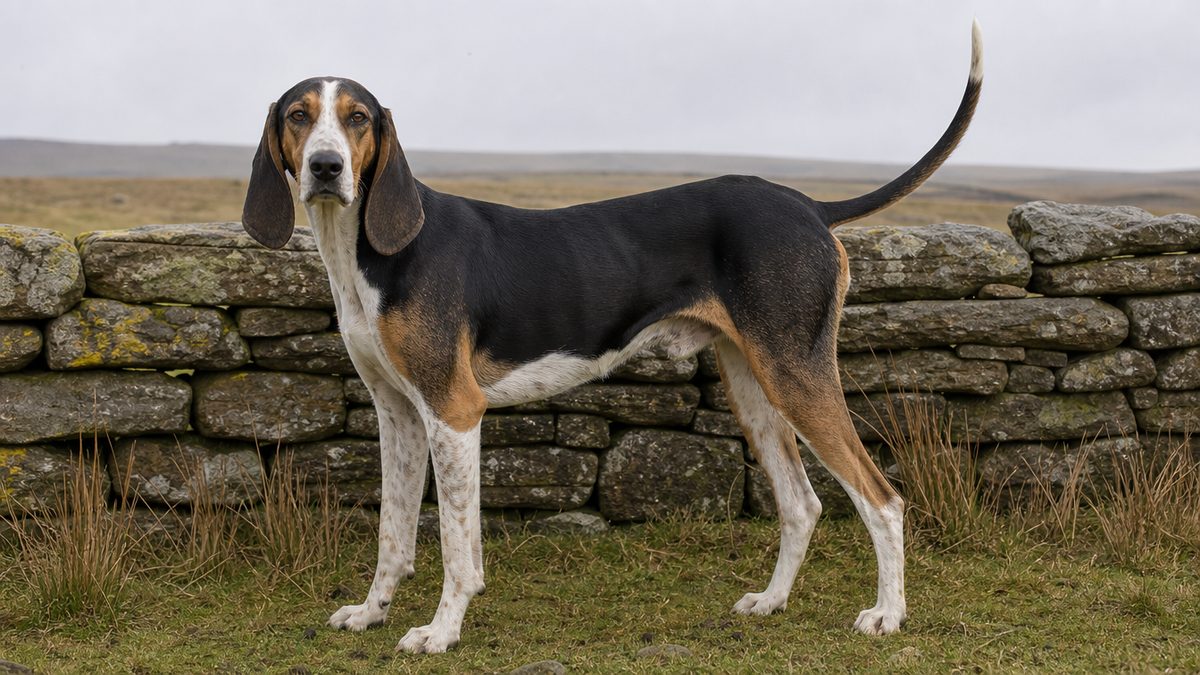
Quick answer
The north country beagle is extinct and was gone as a distinct pack hound by the early nineteenth century. It was the northern English hound, kept chiefly in Yorkshire, and the name fuses two separate categories from Gervase Markham's own 1633 list. No kennel club ever registered it and no breed standard was ever written, so on Bonbeno's two-condition test it was never a breed. If you searched this name, read the Beagle instead. Heat tolerance 2 of 5.
This page summarises historical sporting literature, published veterinary research and Indian legal and climate data for general information. It is not a diagnosis and it is not treatment advice. Consult a registered veterinarian who has examined your own animal before acting on anything here. No clinical health record of any kind was ever made for the North Country Beagle, so nothing on this page should be read as a clinical description of it.
North Country Beagle traits, rated for Indian conditions
What the North Country Beagle was, and what the name actually joins together
The North Country Beagle was the hound of northern England, kept chiefly in Yorkshire, and it is extinct. The name is a nineteenth-century compound that fuses two separate things: the northern regional hound, and the little beagle, which the earliest writer to describe both treated as different animals on the same page.
Three names describe the same dog in the older literature. Northern Hound, Northern Beagle and North Country Beagle all point at the fast, light, open-country hound bred above the River Trent, and the modern encyclopedia entry lists all three together. What the modern entry does not say is that the earliest of those names is the last one to appear. Gervase Markham, writing the description everything else descends from, uses none of them.
The animal itself is described consistently enough to be worth stating. It was a scent hound, not a sighthound: a pack hound worked in kennels of ten to twenty by seventeenth-century farmers and in larger establishments by the gentry. It was fast for its day, worked open champion country rather than thick covert, and was criticised by every writer who mentions it for the pitch of its voice rather than for its nose.
The description, and where each part of it comes from
Wikipedia gives it as a large, bony hound with a square head and long trailing ears, chiefly bred in Yorkshire and common in the north, with the similar Southern Hound more abundant below the Trent. That paragraph is the whole modern picture, and a children's rewrite of it ranks fourth in India for the term, repeating the large-and-bony line and dropping the article's own hedges.
Its size and weight are where the record and the ranking pages part company hardest. Stonehenge, writing in 1859 with the old hounds in living memory, calls both the southern and northern hounds 'large, bony hounds, with long falling ears';. A breed site currently ranking second in India instead publishes two size bands, small at about 13 inches and 35 to 55 pounds and large at about 15 inches and 55 to 90 pounds, on the same page where it says there are few records of the breed's appearance at all. A 33 cm dog weighing 25 kg is not a hound. It is not any shape of dog.
We publish no height, no weight, no lifespan and no litter figure for this animal, because no source we could open records one. Where a number exists on another page, we say where it came from instead of repeating it.
The one thing the record is unambiguous about is that this was a working animal with a job, and that the job ended. Both old English hound types fell out of favour during the eighteenth century as shorter, faster hunts made the Foxhound the animal everyone wanted. What survived was blood, not a population.
The sentence everyone quotes, read in Markham's own book
Every modern description of this breed rests on one sentence by Gervase Markham, and read in the original that sentence is not describing this breed. It is a rule for choosing an individual dog, and the generalisation about Yorkshire hounds comes afterwards.
We downloaded the fifth edition of Markham's Country Contentments: Or, The Husbandmans Recreations, printed in London in 1633, and read the hunting book directly rather than quoting a summary. The scan uses the seventeenth-century long s, so 'slender' comes out as 'flender' and 'shallow' as 'fhallow', and a plain search for the modern spelling returns nothing. Searching with a long-s-tolerant pattern finds the passage immediately.
Here is what Markham wrote, with the long s restored:
"but if you will choose a swift light hound, then must his head be more slender, and his nose more long, his ears and flews more shallow, his back broad, his belly gaunt, his tail small, his joints long, his foot round, and his general composure much more slender, and Grayhound-like: and thus in the generality for the most part, and all your Yorkshire hounds, whose virtues I can praise no further then for scent and swiftness, for to speak of their mouths, they have only a little sharp sweetness like a Jig, but no depth or ground like more solemn music."
Read that against the version in circulation and three differences appear at once. Markham's construction is conditional, if you will choose a swift light hound, which makes it a selection instruction rather than a breed description. He names no breed at all, and reaches the Yorkshire hounds only as a generalisation afterwards. And two of his phrases have been rewritten in transmission.
| Markham 1633 | Stonehenge 1859 | Wikipedia and its copies |
|---|---|---|
| "a little sharp sweetness like a Jig" | "only a little shrill sweetness" | "only a little shrill sweetness" |
| "no depth or ground like more solemn music" | "no depth of tone or music" | "no depth of tone" |
| "his foot round" included in the list | dropped | dropped |
| "all your Yorkshire hounds" | "these Yorkshire hounds" | quotation ends before this |
| a rule for choosing a swift light hound | "comparing the two kinds of hound" | "described the North Country Beagle as having" |
The simile is the loss that matters. Like a Jig is a musical comparison, and it sits against 'more solemn music' at the end of the same sentence: Markham is saying the northern hounds sing a dance tune where a southern pack sings a hymn. 'Shrill' is a flatter word and it turns an aesthetic judgement into a defect.
None of this makes Stonehenge dishonest. He was quoting from memory or from an intermediate edition, three hundred years after the fact, and he says so loosely: 'Markham, who lived three hundred years ago';. What it does mean is that a reader who wants Markham should read Markham. The book is free, it is 214,020 characters, and the passage takes a minute to find.
Where the name North Country Beagle comes from, and why it fuses two of Markham's categories
The name North Country Beagle joins two things Markham himself kept apart. On the same page where he describes the northern hounds, he lists the little beagle as a separate fourth category, bred for delight rather than for the chase.
Markham's classification of English hounds has four members, not two, and it is organised by size and county rather than by breed.
- The slow hound, large, heavy and tall, bred in the West Countries, Cheshire, Lancashire and most woodland and mountainous countries.
- The middle-sized dog, more fit for the chase and of nimbler frame, bred in Worcestershire, Bedfordshire and other well-mixed soils.
- The light, nimble, swift, slender dog, bred in the North parts of the kingdom, in Yorkshire, Cumberland and Northumberland and other plain champion countries.
- The little Beagle, 'which may be carried in a man's glove', bred in many counties for delight only, of curious scent and passing cunning in hunting.
Category three is the northern hound. Category four is the beagle, and Markham gives it a separate paragraph, a separate purpose and a memorable size cue. The compound name North Country Beagle takes the region from one and the noun from the other, and nothing in Markham licenses the join.
Who did use the name, and when
The earliest use we could trace in a source we read ourselves is Richard Blome, quoted at length by Sir Walter Gilbey. Blome, writing in the 1680s, recommends 'the Northern Hounds which are fleet of foot and being thin skinned are not so proper for thick coverts and bushy enclosures as the Southern Hounds, which are thick skinned and slow footed', and then concludes that 'the Northern Beagle and Southern hound make a good strain for this sport';. That is the first written attempt anyone had made to breed a fox-hunting hound by crossing two types, and Blome also describes the Northern Beagle as 'framed after the mould of a greyhound', which is Markham's own comparison surviving fifty years later.
Gilbey, who had read both, draws the conclusion carefully: 'From Markham's account it is safe to assume that when the "Northern Hound" or "Northern Beagle" is referred to by later writers, the Yorkshire breed is meant';. He files it in his own index as 'Northern Hound or Beagle'. He never once writes North Country Beagle.
A HathiTrust full-text search of the three-word phrase across everything available in full view returns seventy-two volumes, and the sporting literature in that list is nineteenth and twentieth-century: Bryden on hare hunting in 1903, Paget on hunting in 1900, the Sportsman’s Repository in 1820 and 1845, Prentice on the Beagle in 1920. Neither does Stonehenge use it, in 669,890 characters. Neither does Youatt, in 903,470, where a search for the string returns zero while 'southern hound' returns four and 'beagle' fifteen, so the search itself is demonstrably working. The three-word form belongs to later writers, and the reader should know that the name they searched is younger than the animal it names.
Was it ever a separate animal from the Southern Hound? The authorities disagreed in print
Nineteenth-century writers did not agree that the North Country Beagle was a distinct breed, and the most careful of them declined to say so. Stonehenge grouped it with the Southern Hound and the Talbot under one heading and attributed the distinction to other people.
Stonehenge's chapter three does not have a section on the northern hound. It has a section headed 'The Southern Hound, Northern Hound, and Talbot';, treating all three together, and it opens by saying there is 'some difficulty in getting any reliable account of the original stock from which our modern hounds are descended'.
His sentence about the distinction is the one to read closely. 'Various writers describe the southern hound and northern hound as different dogs';, he writes, the former met with in the South of England and Wales and particularly Devonshire, the latter confined to the north. That is a report of what other writers say, not a claim of his own. He then immediately levels the two: 'Both, however, were large, bony hounds, with long falling ears, but the southern hounds had absolute dewlaps'.
So the single physical character separating them, in the source every modern page relies on, is the dewlap and the throatiness that goes with it. And Stonehenge undermines even that in the next sentence, admitting that the portrait heading his own article 'does not represent this peculiarity sufficiently, and the dog there drawn would pass muster in this point among modern foxhounds'. Wikipedia's Southern Hound article records the same problem.
Three writers, three positions
| Writer | Position on a separate northern breed | What they had in front of them |
|---|---|---|
| Stonehenge, 1859 | Reports the distinction as other writers' view, groups all three types under one heading, and says he had never seen pure-bred varieties | Portraits he distrusted, and packs he doubted |
| Youatt, 1852 | Describes only the southern hound, in south Devon, and argues it may be native to Britain rather than Norman. The northern hound does not appear | Field reports and a frontispiece |
| Gilbey, 1913 | Treats Northern and Southern as two working types that were deliberately crossed, and says a marked difference between them persisted | Markham, Blome, Beckford, and kennel pedigrees |
Gilbey's version is the most concrete, because he is arguing from breeding practice rather than appearance. Northern masters used northern hounds, southern masters southern ones, and the pedigree of a hound named Luther, sent in 1733 from the Badsworth in Yorkshire to the Duke of Richmond in Sussex, mixes both. Beckford, in 1779, noticed the same split from the inside: 'Those who have been used to the sharp-nosed foxhound will hardly allow a large headed hound to be a foxhound; yet they both equally are.'
Our own reading is that the honest answer is the uncomfortable one. There were two working kinds, north and south, that a hunting man could tell apart and would argue about. There is no evidence that either was a closed population, no breed standard for either, and the writer closest to them in time refused to say they were separate breeds. That is a real disagreement in the sources, and averaging it into 'the North Country Beagle was a breed' loses the only interesting thing about the question.
Is the North Country Beagle a breed? Tested against Bonbeno's own rule
The North Country Beagle fails both conditions of Bonbeno's two-condition test, and it fails them more cleanly than most names we have measured. Bonbeno maintains a page for dog types that are not breeds, and the rule that page applies is that a breed has a written standard and a studbook behind it, so a puppy can be measured against something.
Condition one, a written standard. No breed standard for this animal was ever written by anyone. What exists instead is a rule of selection: Markham telling a reader how to pick a swift light hound, and then observing that the Yorkshire hounds generally look like that. A selection rule and a standard are not the same document. A standard describes what a breed must be; Markham describes what a buyer should look for, which is the opposite direction of travel.
Condition two, a studbook. No register ever recorded this animal. The oldest hound pedigrees Gilbey could find are individual kennel records, such as Luther's descent in 1733, and they cross the two types freely rather than keeping either closed. There is no studbook, no registry and no register of any kind, and the first English studbooks postdate the animal's disappearance.
The North Country Beagle fails both conditions and belongs on /dogs/dog-types-not-breeds/. It is a regional working type, described by county rather than by pedigree, and no document ever existed against which a puppy could have been checked.
That verdict is not a criticism of the animal, and it is not the same as saying it did not exist. Something real was being described. Markham could tell a Yorkshire hound from a Cheshire one, Blome could tell a thin-skinned northern hound from a thick-skinned southern one, and both were making practical judgements about dogs they had seen work. What is missing is the paperwork, and the paperwork is what the word breed means.
Why this matters more than it sounds
It changes what a reader should expect to find. A breed leaves a register you can search, and the register survives the animal: the Southern Hound has a named individual on record, a pure-bred bitch called Clara that Edwin Brough used as an outcross to his bloodhounds in 1881. The North Country Beagle has no named individual anywhere in the sources we read. There is nothing to look up.
It also explains why the modern breed-site template produces nonsense here. Fields designed for a registered breed, a height, a weight, a life expectancy, a litter size, have no possible source for an animal that was never registered, so they get filled with something. The section on the aggregators below shows exactly what.
The **extinction date**, which nobody recorded, and one number that is a publication date
No extinction date for the North Country Beagle exists, because no writer recorded a last animal. The bracket the sources allow runs from the late eighteenth century to somewhere in the early nineteenth, and at least one figure in circulation is not a date of death at all.
Wikipedia hedges correctly: the breed existed 'probably until early in the 19th century', the exact date is not known, and it was likely interbred gradually with other breeds until the genuine bloodline ceased to exist. That is the right shape of answer for an animal absorbed rather than killed off.
A breed site ranking second in India offers three competing answers on one page: some say extinct in the early 1800s, others say gone by the 1820s, and 'some say they were around as long as 1859';. The third of those is worth pulling apart, because 1859 is the publication year of Stonehenge's book, and what Stonehenge actually says is close to the opposite of a sighting.
Stonehenge reports that packs resembling the description still existed in Wales, Devon, Yorkshire and Sussex in his own century, and then says he was doubtful how far any of them truly represented any of the three early hound types, and that he had never seen pure-bred varieties of them. A doubt about survivors has become a date of survival.
So the honest reading of Stonehenge is that by 1859 there were hounds a hunting man might point at and call northern, and no way to tell whether they were. That is a statement about the limits of evidence, and turning it into an extinction year inverts it.
What actually ended it
The mechanism is agreed even where the date is not. Both old types fell out of favour during the eighteenth century as the fashion moved to shorter hunts and faster hounds, and the Foxhound is what the crossing produced. Gilbey describes the transition from inside the kennels: masters were conservative, a man who got sport with his northern hounds kept them, and only those seeking improvement crossed the two, until the cross-bred 'middle sort of dog' had gone so far in that direction that it simply was a foxhound.
There is a second, quieter cause worth naming because it is physical rather than fashionable. Gilbey points out that the large heavy hounds needed men to lift them over fences, and that enclosure of the open waste and common turned that from an inconvenience into a disqualification. The northern hounds could jump. The country changed under both of them, and the animal that fitted the new country was neither.
Bonbeno publishes no extinction year for this animal. The defensible statement is that it had ceased to exist as a distinct population by the early nineteenth century, that nobody recorded the end, and that the last writer close enough to have seen one said he had not.
**Kennel club recognition**: none anywhere, and the checks take five minutes
No kennel club has ever recognised the North Country Beagle, and no registry anywhere holds the name. We checked the two registers that would hold it if anyone did, each with a control that returned results on the same document.
The Federation Cynologique Internationale nomenclature for the letter N, read live on 2 September 2026, returned thirteen breeds: Nederlandse Kooikerhondje 314, Nederlandse Schapendoes 313, Newfoundland 50, Nihon Supittsu 262, Nihon Teria 259, Norfolk Terrier 272, Norrbottenspets 276, Norsk Buhund 237, Norsk Elghund Gra 242, Norsk Elghund Sort 268, Norsk Lundehund 265, Norwich Terrier 72 and Nova Scotia Duck Tolling Retriever 312. The list loaded correctly, which the presence of Newfoundland and Norwich Terrier proves. North Country Beagle, Northern Hound and Northern Beagle are not on it.
The American Kennel Club full breed listing and its Foundation Stock Service listing were retrieved as raw HTML of 791,559 and 779,443 characters and searched as text, with each page's own title read back. 'North Country' returns zero on both. In-document controls returned Beagle twelve times, Harrier twelve, Chinook twelve, English Foxhound six and Labrador Retriever six on each page, so the searches were working.
| Register | Result for this breed | Control on the same document |
|---|---|---|
| FCI nomenclature, letter N | Absent | Newfoundland 50 and Norwich Terrier 72 present, 13 breeds returned |
| AKC full breed list | Zero occurrences | Beagle 12, Harrier 12, Labrador Retriever 6 |
| AKC Foundation Stock Service | Zero occurrences | Beagle 12, Chinook 12, English Foxhound 6 |
| PubMed, quoted phrase | Rewritten by the engine, so no real records | Labrador Retriever with hip dysplasia, 47 records |
What this means for an Indian buyer specifically
India is a full member of the FCI, represented by the Kennel Club of India in Chennai, so the KCI issues pedigrees against FCI nomenclature. A breed absent from FCI nomenclature therefore cannot carry a KCI pedigree either, and that is the practical answer to the recognition question here. Any document offered with this breed's name on it is for a different dog or for nothing at all.
The absence is not surprising and it is not a slight. Kennel clubs began registering breeds from the 1870s, decades after this animal stopped existing as a distinct population, so there was never anything to register. The Southern Hound is in the same position, and both sit in Wikipedia's list of extinct dog breeds alongside the Talbot, the Limer and the Rache.
What the ranking pages publish about a dog nobody has seen in two centuries
The pages ranking for this term in India publish heights, weights, temperaments and exercise requirements for an animal whose own sources record none of them. The pattern is the modern breed template running on empty, and the template's own fields are the tell.
The second result in our India-located pull carries a complete breed profile. It gives two height and weight bands, a temperament, living conditions, an exercise requirement and a grooming note. It also states, in its own Description field, that 'there are few records left describing the appearance of the North Country Beagle'. Both statements are on the same page.
| Field | What the page prints | What the period sources record |
|---|---|---|
| Height and weight | 13 in / 35-55 lb and 15 in / 55-90 lb | Nothing. Stonehenge says only 'large, bony hounds' |
| Temperament | Strong willed, extremely fast, determined, good with other dogs | Nothing on temperament. Markham rates scent, swiftness and voice |
| Living conditions | Probably needed a large open space | Marked 'probably' by the page itself, so inference not record |
| Life expectancy | 'There are no records' | Correct, and the only honest field on the page |
| Litter size | 'There are no records' | Correct |
| Dewlap | Did not have one, but had loose skin without wrinkles | Stonehenge uses the dewlap as the one distinguishing feature |
The height figures are the ones to look at, because they are internally impossible rather than merely unsourced. A hound standing 33 cm at the shoulder and weighing 25 kg does not exist; that is a Beagle's height carrying a Labrador's mass. The larger band, 38 cm and up to 41 kg, is worse. And both contradict the page's own sources, which describe a large bony hound, not a small heavy one.
The third result runs the error in the opposite direction, describing the animal as 'smaller and lighter than its southern counterpart' and 'built for speed and agility' with a lean frame. Stonehenge says both were large and bony and that the difference was throat skin, not size.
The children's version, where the hedges disappear
The fourth result is a children's encyclopedia rewrite of Wikipedia, and it is instructive because you can watch the qualifiers being deleted. Wikipedia says Markham 'described the North Country Beagle as having' the quoted features; the children's version says 'A writer named Gervase Markham... described the North Country Beagle'. Wikipedia records that Stonehenge had never seen pure-bred varieties; the children's version says only that 'experts weren't sure'. Wikipedia's 'dashing class of sportsman' becomes 'dashing sportsmen (people who liked fast hunting)', and the link on the word brace, which should explain a brace of hare, points at the number 2.
None of these sites is doing anything unusual. They are filling a template that assumes a living, registered breed, for a name that has neither, and the fields do not have an empty state. That is why a page like this one is worth writing.
North Country Beagle **price in india**: nine of ten results are a different dog
No price in India exists for the North Country Beagle, because the animal has been gone for around two centuries and was never here. An India-located price search on 2 September 2026 returned ten results, of which nine describe the living Beagle and the tenth sells merchandise.
The search itself is the finding. Firecrawl's India-located organic pull for 'north country beagle price in india' returned Supertails on Beagle puppy cost, a Reddit thread in Hindi on Beagle prices, three YouTube videos on Beagle prices, Boggos, Mr n Mrs Pet, Doggywala and a Quora answer on the cost of a Beagle puppy in Delhi. Not one described this animal. The tenth result was an Etsy India category page for 'north country beagle' merchandise Etsy India, the 'north country beagle'….
That is a specific and useful thing to tell an Indian reader. The market does not contain this dog, it contains the Beagle, and the search engine has quietly performed that substitution on the buyer's behalf.
The price the search is actually answering
Since nine of ten results answer the Beagle question, here is what they answer it with. Supertails publishes three tiers for a Beagle puppy in India: Rs 35,000 to Rs 50,000 for pet quality without registration papers, Rs 50,000 to Rs 75,000 for a Kennel Club of India registered puppy with pedigree documentation, and Rs 75,000 to Rs 1,20,000 and above for show and championship lines. The same page adds hip and elbow scoring at Rs 8,000 to Rs 12,000 as an optional cost.
| Source | Band published | What it is |
|---|---|---|
| Supertails, April 2026 | Rs 35,000 to Rs 1,20,000+ | Editorial page by a pet retailer, split into three quality tiers |
| Mr n Mrs Pet | INR 30,000 to INR 90,000+ | Seller listing page |
| Doggywala | Rs 30,000 to Rs 60,000 | Seller listing page |
| Boggos | Rs 15,000 to Rs 50,000+ | Retailer blog |
| Reddit r/IndianPets | Rs 15,000 to Rs 40,000 | User post warning that the bottom of that band is puppy-mill stock |
| Quora | Rs 12,000 to Rs 35,000 | Single user answer for Delhi |
The spread is real and it is worth reading as a warning rather than as a range. The gap between the cheapest and dearest figure on that table is more than a lakh for the same breed, and the Reddit post naming the bottom of the band as puppy-mill stock is doing more for a buyer than any of the seller pages.
Bonbeno publishes no price for the North Country Beagle and would not publish one if a seller offered it. Any Indian listing using this name is selling a Beagle, a hound-marked mixed dog, or nothing. Ask which, in writing, before any money moves.
One thing we did not find, and it is worth recording because this site has caught it repeatedly elsewhere: no converted dollar figure appears anywhere in this result set. There is no rupee band here that divides cleanly by 84.38 or 74, because nobody has bothered to invent a price for a dog nobody is pretending to sell.
**Cost of ownership**: zero for this animal, and what the nearest living equivalent costs in India
There is no cost of ownership for a North Country Beagle, because there is no North Country Beagle. The useful figure for a reader who arrived here is what a medium hound of that build actually costs to keep in an Indian city, and that figure is published.
Supertails' Beagle costing gives Rs 4,700 to Rs 7,200 a month for food, grooming, ear care and healthcare, and a first-year total of Rs 78,400 to Rs 1,85,100 including the purchase price. That is a retailer's editorial estimate rather than a survey, and we label it as one, but it is a real published Indian figure for a real living dog rather than a number invented for an extinct one.
| Item | Published Indian figure | Note |
|---|---|---|
| Purchase, pet quality | Rs 35,000 to Rs 50,000 | No registration papers |
| Purchase, KCI registered | Rs 50,000 to Rs 75,000 | Three-generation pedigree, breeding rights |
| Monthly running cost | Rs 4,700 to Rs 7,200 | Food, grooming, ear care, healthcare |
| Hip and elbow scoring | Rs 8,000 to Rs 12,000 | Described as optional on that page |
| First-year total | Rs 78,400 to Rs 1,85,100 | Purchase plus twelve months |
Two of those lines deserve a comment for anyone using them as a planning figure. The monthly band assumes commercial food and routine care in a metro; it does not carry emergency surgery, a tick-borne disease workup or boarding. And the hip and elbow line is described as optional, which is a commercial framing rather than a veterinary one.
The cost line this breed's build would have driven
If you are costing a large drop-eared hound in India rather than a Beagle specifically, the line that moves is ears. Supertails names ear infections in humid Indian weather as a recurring Beagle cost and builds ear care into its monthly band. A hound with the long trailing ears every source gives this animal would carry the same load, and in a monsoon city that is a monthly cost rather than an occasional one.
The second line is parasite control, and it is the one Indian owners under-budget. A Punjab study of 719 dogs found Babesia gibsoni in 8.9 percent by multiplex PCR against only 5.0 percent by microscopy, which means the cheap in-clinic smear misses a substantial share of real infections. A pack hound working long grass is exactly the animal that meets ticks, and the diagnostic that finds the infection is not the cheap one.
Bonbeno publishes no monthly rupee figure for the North Country Beagle itself. Every rupee number on this page belongs to a living breed, a published retailer estimate or an Indian study, and each says which it is.
Yorkshire against six Indian cities, and the thirteen wet-bulb points in between
York's peak monthly wet-bulb temperature is 13.74C, and Kolkata's is 27.09C. That gap of 13.35 points is the whole answer to whether this northern English hound would have coped with India, and it is larger than for almost any breed this site has measured.
We queried NASA POWER by explicit latitude and longitude for 2001 to 2020, so no place name could be substituted for another, and echoed back the returned coordinates and the returned grid-cell elevation for every point. York came back at 53.9600 N, 1.0800 W with a cell elevation of 74.81 m against a real elevation near 17 m, a difference of about 58 m, which is normal for lowland terrain and does not distort the figures.
| Place | Annual mean C | Warmest month C | Peak monthly wet-bulb C | Cell elevation m |
|---|---|---|---|---|
| York, Yorkshire | 9.19 | 15.92 (July) | 13.74 (July) | 74.81 |
| Bengaluru | 23.74 | 28.37 (April) | 21.86 (May) | 841.72 |
| Pune | 23.86 | 28.93 (April) | 22.97 (June) | 635.99 |
| Delhi | 25.60 | 35.88 (June) | 26.50 (July) | 206.37 |
| Mumbai | 26.77 | 31.19 (May) | 25.77 (June) | 97.15 |
| Kolkata | 25.81 | 31.53 (May) | 27.09 (June) | 7.35 |
| Chennai | 27.95 | 31.51 (May) | 26.11 (May) | 48.95 |
Read the first column and the second row together. York's annual mean is 9.19C. Chennai's is 27.95C, which is 18.76 degrees warmer for the whole year, not for a season. Even Bengaluru, the mildest large Indian city on the list, runs 14.55 degrees above York on the annual mean.
Why wet-bulb is the column that matters
A dog cools by panting, which is evaporative, so the ceiling on its cooling is set by humidity as much as by heat. Wet-bulb temperature combines both into one number. York peaks at 13.74C in July, a figure every Indian city on this table exceeds in every month of the year. Bengaluru's coolest month, December, sits at 16.9C, still over three points above York's annual peak.
There is no honest way to call this animal heat-tolerant for India. Its heat tolerance rating here is 2 of 5, and it is inference rather than measurement, because no heat observation of this dog exists. The transferable evidence is Hall 2020 in Scientific Reports, which studied 905,543 United Kingdom dogs under primary veterinary care in 2016 and found 395 confirmed heat-related illness events, with dogs at or above their breed and sex mean bodyweight carrying an odds ratio of 1.42, 95 percent confidence interval 1.12 to 1.80, and dogs over 50 kg at 3.42, 1.54 to 7.57.
The companion paper, Hall 2020 in Animals, is a different study on the same cohort with different case definitions, giving 1,259 events from 1,222 dogs, of which 879 had a recorded trigger, and 652 of those 879, or 74.2 percent, were exertional. That is the finding that bites hardest for a hound: most heat illness in dogs comes from exercise, not from parked cars, and this animal's entire purpose was exercise.
Neither Hall paper modelled this breed, because it did not exist in 2016. We claim only the transferable bodyweight factor and say plainly that the animal itself was never studied. An odds ratio imported onto a breed the authors never saw is fabrication with a citation attached.
One methodological note for anyone repeating this work. NASA POWER returns a grid cell, not a point, and in hills the cell can be more than a kilometre out. Our Shimla query returned a cell elevation of 897.65 m against a real town elevation near 2,200 m, an error of about 1,302 m. Every city in the table above is a plains or plateau city where the cell and the town agree closely, which is why we use them and why we would not use a hill-station figure without saying so.
**Temperament**: three working judgements, and nothing about living with one
No account of the North Country Beagle's temperament as a companion survives, and the pages that publish one are inventing it. What the record contains is three working assessments by men judging hounds for a job, and they do not agree.
Markham's judgement is the earliest and it is narrow. He praises the Yorkshire hounds for exactly two qualities, scent and swiftness, and criticises exactly one, the pitch of their voice. He says nothing about biddability, nothing about children, nothing about other dogs, and nothing about what one was like in a house, because none of that was his subject.
Blome, half a century later, adds a working caution rather than a temperament note: the northern hounds are fleet of foot but thin-skinned, and therefore wrong for thick coverts and bushy enclosures. Thin-skinned there means literally thin-skinned, a dog that gets torn in brambles, not a dog with hurt feelings.
Beckford, writing in 1779, gives the most human observation in the whole record, and it is about hunting men rather than hounds: 'Men are too apt to be prejudiced by the sort of hound they have been accustomed to. Those who have been used to the sharp-nosed foxhound will hardly allow a large headed hound to be a foxhound; yet they both equally are';. That sentence is worth more than any of the temperament fields on the ranking pages, because it tells you the sources were partisan.
What the ranking pages fill the gap with
One page gives 'strong willed, extremely fast, and determined when hunting', known to get along with other dogs but not trusted around other animals, and 'probably friendly towards humans as well';. Read the qualifiers: 'probably' is doing the work, and the page has already told the reader there are only few records stating the temperament of the animal.
The one behavioural fact that is genuinely on the record is the voice, and it is the opposite of what a family buyer would want. Markham's complaint that the Yorkshire hounds have 'only a little sharp sweetness like a Jig, but no depth or ground like more solemn music' is a complaint about a light, quick, repetitive cry. Stonehenge describes the slow southern hounds by contrast as sitting down and throwing their tongues 'in the most melodious tone for half a minute' when they met a strong scent. Neither dog was quiet.
If a hound's voice is what brought you here, the honest translation of the record is that this was a loud dog with a high, insistent cry, bred to be heard across open country. Every Indian city has noise rules and every apartment association has neighbours. Read the Beagle page, which is the same voice in a smaller dog, before deciding that is charming.
**Train**ing: no account of training one exists, and the record explains why
No account of training a North Country Beagle survives. Pack hounds of this period were not trained as individuals in any sense a modern owner would recognise, which is why the sources describe entering and drafting rather than obedience.
The working vocabulary of the period is the evidence. Hounds were entered to a quarry, meaning introduced to it young in company with older hounds, and Gilbey notes that the young entry in Beckford's day received a more careful education than modern foxhounds do, precisely because they were recently descended from hare and deer-hunting ancestors and had to be taught what not to run. Some masters taught young hounds by working them with a made pack; nobody taught them to sit.
That is a different activity from training a companion dog, and it is worth saying plainly because a reader arriving from a breed template will read the word training and expect house manners. The historical record has nothing on house manners for this animal because it was not a house animal.
What can honestly be inferred, and what cannot
- Infer a strong independent nose-driven working pattern, because that is what every source rates the animal on and it is the trait selection acted on.
- Infer high sensitivity to a pack, because the whole management system assumed hounds worked in company and learned from older hounds.
- Do not infer biddability, because no source assesses it in either direction.
- Do not infer a recall, because a hound bred to run a line ahead of mounted followers was not asked for one.
- Do not repeat the 'strong willed' line the aggregators print, because it appears in no period source we could open.
The one prediction the record does support is uncomfortable and specific. A scent hound running a line will keep running it, and in Indian conditions the limit on that is not obedience, it is heat. Hall 2020 in Animals found that of the 879 heat-related illness events with a recorded trigger, 652 were exertional, against 113 environmental and 46 from vehicular confinement. A dog that will not stop working is a dog whose handler has to stop it.
For anyone applying this to a living hound in an Indian city, the practical version is that recall training on a scent breed is a heat-safety measure and not a convenience. Train it in the cool hours, in a fenced space, before you need it in July.
**Exercise**: the one requirement every source agrees on
This animal had a very high exercise requirement, and it is the single trait the sources are unanimous about. It was bred to gallop open country, and every writer who assesses it rates swiftness first.
Markham's northern dog is 'light, nimble, swift, slender', bred for the plain champion countries of Yorkshire, Cumberland and Northumberland. Blome recommends the northern hounds for fox rather than hare on the ground that 'the fox will exercise them better and longer';. And the most-quoted line in the whole subject, William Nicholson's, is about pace: the dog was kept by a dashing class of sportsmen because it could run down a brace of hare before dinner.
Gilbey adds the detail that settles it against the southern hounds. The heavy western hounds needed men to help them over every hedge, which Markham had complained about; the northern hounds could jump, and Gilbey argues that this is why the heavy type died out once the open waste and common were enclosed. A dog that clears its own fences is a dog with a serious daily requirement.
What a comparable requirement means in an Indian city
There is no way to give this animal an honest daily figure in minutes, because none was ever recorded, and we will not invent one. What can be given is the constraint any hound of that build faces in India, which is the hour rather than the duration.
| City | Warmest month mean C | Peak monthly wet-bulb C | Practical reading |
|---|---|---|---|
| Delhi | 35.88 (June) | 26.50 (July) | Middle of the day unusable for four to five months |
| Chennai | 31.51 (May) | 26.11 (May) | Humid year round, so early morning only for most of the year |
| Kolkata | 31.53 (May) | 27.09 (June) | The highest wet-bulb on our table, so the hardest city on this list |
| Mumbai | 31.19 (May) | 25.77 (June) | Narrow annual range of 8.00C, so no genuine cool season |
| Bengaluru | 28.37 (April) | 21.86 (May) | The widest usable window of any large Indian city here |
| Pune | 28.93 (April) | 22.97 (June) | Similar to Bengaluru, with a hotter April peak |
The rule that follows is simple and it applies to any large working dog in India, not just to this one. Work it at dawn, before the wet-bulb climbs, and treat the afternoon as unavailable rather than as a compromise. Exertional heat illness is the commonest recorded trigger by a wide margin, and it happens to fit dogs, not to unfit ones.
Nothing about living conditions in the historical record suggests this animal was ever kept as a single house dog. It lived in kennels, in packs of ten to twenty on a farm and larger in a gentleman's establishment, and its exercise came from a day's hunting rather than from a walk. That is why the apartment rating on this page is 1 of 5.
**Groom**ing: a short coat, long ears, and an Indian **humid** season
The North Country Beagle carried a short coat, which is the one physical trait that would have transferred to India well. Its long trailing ears are the trait that would not, and in Indian humidity ears are the recurring grooming cost for any drop-eared hound.
No grooming instruction for this animal exists in any period source we could open, so everything below is reasoning from coat type and from what Indian veterinary practice records about drop-eared dogs. We say that rather than presenting inference as record.
The coat is described as short in the modern accounts, and nothing in the period sources contradicts it: Markham's northern dog is 'slender' and greyhound-like in general composure, which is not a description of a heavy or rough coat. A short single coat is the right coat for India. It dries in a fraction of the time a woolly undercoat needs, which matters directly in a monsoon city where a dog that stays damp develops skin trouble.
The ears are the real cost line
Every description gives this animal long, low-set, trailing ears. A drop ear over a warm humid canal is the standard setup for otitis externa, and Indian retail guidance for the living Beagle already treats it as a routine budget line rather than an occasional problem, naming ear infections in humid weather and building ear care into the monthly cost band.
- Check the ear canal weekly through the monsoon, and look for smell before you look for discharge.
- Dry the ears deliberately after any bath or swim rather than letting the dog air dry, which is the standard advice in a northern European climate and is wrong in an Indian July.
- Avoid cotton buds inside the canal, and clean only what you can see.
- Treat a head shake that lasts more than a day as a veterinary matter, not a grooming one.
That third and fourth point are where overseas breed-club advice fails an Indian reader. Care guidance written for Yorkshire assumes a coat and a canal that dry on their own, and in Chennai, where the peak monthly wet-bulb is 26.11C and the annual mean humidity sits above 70 percent, they do not.
The parasite half of grooming
For any hound working grass in India, grooming and parasite control are the same job. A Punjab survey of 719 dogs found Babesia gibsoni in 8.9 percent by multiplex PCR against 5.0 percent by microscopy, so a routine blood smear misses a meaningful share of real infections. The grooming implication is direct: run your hands over the dog after every walk in long grass, because you will find the tick before the smear finds the parasite.
Bonbeno publishes no brushing schedule and no bathing frequency for this animal, because none was recorded. What we publish is the reasoning, the coat type it rests on, and the Indian evidence for the one problem its ear shape would have created.
**Health problems** and **life expectancy**: no clinical record of any kind exists
No lifespan, disease prevalence, screening result, post-mortem series or litter record was ever made for the North Country Beagle. This section says what that means, and what the nearest real evidence covers, rather than borrowing another breed's numbers.
The literature check is quick and its result is unambiguous. PubMed, searched through the E-utilities endpoint on 2 September 2026, could not match the phrase 'North Country Beagle' at all and reported it as quotedphrasesnotfound, rewriting it into an AND of 'north', 'country' and 'beagle' across all fields. The 16 records that returns describe the rewrite, not the breed. The same happened to 'Northern Hound', 'Northern Beagle' and 'Southern Hound'. Controls in the same session worked: Labrador Retriever with hip dysplasia in title or abstract returned 47 records, Beagle with hip dysplasia returned 4.
So the honest count of peer-reviewed papers about this animal is zero, and that zero was tested against a working instrument rather than assumed.
We publish no lifespan for this breed. Where a page gives one, ask it where the figure came from: the animal predates every longevity dataset in existence, and no veterinary record of it was ever kept.
What the real longevity work actually covers
Two large United Kingdom studies define what is known about companion dog life expectancy, and neither includes any extinct breed. Teng and colleagues built life tables for companion dogs in the United Kingdom, published in Scientific Reports in 2022. McMillan and colleagues at Dogs Trust published a separate analysis of breed longevity and early death risk in the same journal in 2024, and it carries an Author Correction that changes exactly one value in one figure legend.
Those are different papers by different teams and they should never be conflated. Teng is a Royal Veterinary College VetCompass study; McMillan is a Dogs Trust study. Both are the right sources for a living breed's expected lifespan and neither says anything at all about this one.
The risks an Indian owner of a comparable hound faces
Since nothing breed-specific exists, the useful content is what a hound of that build actually meets in India.
| Risk | Evidence | What it means practically |
|---|---|---|
| Tick-borne haemoparasites | Babesia gibsoni in 8.9 percent of 719 Punjab dogs by multiplex PCR, against 5.0 percent by microscopy | The cheap smear under-detects; ask for PCR when a working dog is unwell |
| Exertional heat illness | 652 of 879 triggered heat-illness events in a United Kingdom cohort were exertional, 74.2 percent | The commonest trigger by far, and it targets working dogs |
| Bodyweight and heat risk | Odds ratio 1.42, 95 percent CI 1.12 to 1.80, at or above breed and sex mean weight | Keeping a large hound lean is a heat-safety intervention |
| Ear disease in humidity | Indian retail guidance treats Beagle ear infection as a monthly cost line | Not a study, and labelled as such, but it matches the ear shape |
Indian law adds one requirement that would have applied to any breeder of such a hound here. Second Schedule Part III paragraph 8(10) of the Prevention of Cruelty to Animals (Dog Breeding and Marketing) Rules 2017 requires that breeding dogs 'shall have been tested for genetic defects, including hip dysplasia, progressive retinal atrophy, night blindness, hypothyroidism, entropion, ectropion, overshot, undershot jaw (when incisors do not touch or mesh), wry mouth, two or more missing teeth, unilateral cryptorchid or full cryptorchid males';. The word is including, so the list is illustrative rather than closed.
**Feed**ing: what a seventeenth-century kennel fed, and why it is not a diet plan
No feeding regime for the North Country Beagle was ever recorded in a form a modern owner could use, and the period kennel practice that does survive is a food-safety problem rather than a model. This section gives the Indian feeding rules that apply to any large working hound instead.
What the sources actually record about kennel management is care of hounds in bulk, not nutrition of an individual. Gilbey's chapters describe feeding, entering, drafting and rewarding a pack, and his authorities are Cockaine, Markham and Beckford writing about establishments of dozens of animals. None of it converts into a bowl.
That gap is honest rather than awkward. A modern feeding section for a living breed is built from body-condition scoring, life-stage energy requirements and commercial food availability, and every one of those inputs postdates this animal by a century or more.
The Indian rules that would apply to a hound of this build
- Feed to body condition rather than to a chart, because keeping a large hound lean is a direct heat-safety measure: at or above the breed and sex mean bodyweight the odds ratio for heat-related illness is 1.42.
- Split the daily ration across two or three meals for any deep-chested hound rather than feeding one large meal.
- Separate feeding from work by a clear margin in Indian summer, because the commonest recorded heat-illness trigger is exertional, not environmental.
- Increase water availability rather than food in hot months, and check that a working dog is drinking rather than assuming it.
- Ask a veterinarian before changing a diet, because a page cannot see your dog.
The one period detail worth carrying forward is negative. Seventeenth and eighteenth-century kennels fed on whatever the establishment could spare, which is why the literature spends more words on preventing disease in kennels than on nutrition. Nothing about it should be reproduced.
For an Indian reader planning around the living Beagle instead, the published monthly band of Rs 4,700 to Rs 7,200 already folds food in with grooming, ear care and healthcare, so it is a planning figure rather than a food budget.
The first year: nothing recorded, and the Indian law that would apply anyway
No month-by-month developmental account of a North Country Beagle puppy exists, and no litter size, birth weight or whelping record was ever made. What can be given honestly is the Indian legal timetable that would govern any litter bred here today.
The litter size question has a clean answer and it is the same on the aggregator pages as it is here: there are no records. That is one of the few fields those pages leave honestly empty, and we agree with them.
The nearest thing to a developmental note in the whole record is about education rather than growth. Gilbey observes that the young entry in Beckford's day received a more careful education than modern foxhounds do, because the hounds were recently descended from hare and deer-hunting ancestors and had to be taught what not to run. That tells you the first year was about the pack, not about the individual.
What Indian law would require of any litter
| Stage | What the Rules require | Where it is |
|---|---|---|
| Before mating | The breeding female must be up to date with vaccination boosters and de-worming | Second Schedule Part II paragraph 6(7) |
| Breeding pair | In-breeding within the first four generations and incest breeding are both prohibited | Second Schedule Part II paragraph 6(3) |
| Any litter | No tail docking, ear cropping, de-barking, de-clawing or any change of appearance by artificial means | Second Schedule Part II paragraph 6(8) |
| Seven to eight weeks | Vaccination may start, and is usually completed at eighteen weeks | Second Schedule Part III paragraph 8(9) |
| Eight weeks | Individual health records must be kept for all animals above this age, or once weaned | Second Schedule Part III paragraph 8(3) |
| Eight weeks | Pups less than eight weeks in age are not to be sold | Rule 8(1)(a), Conditions for sale |
Two of those need care in the citing, because this site has corrected the same mistake before. Rule 8(1)(a) is a genuine Rule and reads 'pups less than eight weeks in age are not sold'. The docking, in-breeding and genetic-testing provisions are not Rules; they are Second Schedule paragraphs, and the Rules themselves stop at Rule 13. A citation reading 'Rule 21' or 'Rule 8(10)' is wrong on its face.
One clause would have bitten this breed's reconstruction directly. Second Schedule Part II paragraph 6(9) reads, in full, 'Breeding to create new breeds of dogs or unusual looks shall be strictly prohibited';. Anyone in India attempting to breed back a hound to a two-hundred-year-old description would be creating a breed, which is exactly what that sentence forbids.
Ask for the parents' registration numbers and the registering body. There is no register anywhere that can produce one for this breed, so the answer will name a different breed, or nothing. Either answer tells you what you are being sold.
Indian law: nothing to **import**, and the clauses a reconstruction would hit
No North Country Beagle can be brought into India, because none exists anywhere to bring. The law is still worth reading, because it tells you what would happen if somebody offered you one and because two clauses would stop any attempt to recreate the animal here.
The import route is governed by DGFT Trade Notice 22/2022-23, which we downloaded and extracted ourselves with pypdf, giving five pages and 6,639 characters. Under ITC(HS) 01061900, other mammals are Restricted, and Policy Condition 7 permits the import of dogs only for three purposes: a pet dog with a valid pet book and relevant records in the name of the importer, dogs imported by research organisations with the recommendation of CPCSEA, and dogs for internal security by the Defence and Police Force.
Policy Condition 8 closes the commercial door: 'Import of commercial dogs for breeding or any other commercial activities other than the purposes mentioned above is not permitted.' Paragraph 6 of the notice repeats it in the operational voice, stating that any applications for trading or breeding purposes, or made on behalf of another person or entity, 'shall be duly rejected';.
Paragraph 7 limits entry to six named points: the airports and seaports of Delhi, Mumbai, Chennai, Hyderabad, Bangalore and Kolkata, with quarantine at the government station of that port where required. DAHD added a seventh port, Cochin International Airport at Kochi, for pets arriving under the baggage rules in October 2024. An import licence from DGFT is needed for more than two animals, for a stay abroad of under two years, or where the pet is not travelling as passenger baggage. The full route is set out in how to import a dog to India.
There is no lawful supply chain for this breed and there cannot be one, because there is no population and no registry. A seller quoting an import route for it is describing a transaction that could not clear paragraph 6 even if the dog existed.
The two clauses a revival project would hit
Suppose somebody in India set out to breed the animal back from Foxhound and Beagle stock, which is roughly what a modern reconstruction would look like. Two provisions of the Prevention of Cruelty to Animals (Dog Breeding and Marketing) Rules 2017 apply immediately, and we quote them from our own pypdf extraction of the gazette, fourteen pages and 51,953 characters.
Second Schedule Part II paragraph 6(9) reads in full: 'Breeding to create new breeds of dogs or unusual looks shall be strictly prohibited.' A recreated breed is a new breed under any ordinary reading of that sentence.
Second Schedule Part II paragraph 6(3) prohibits two named mating techniques: in breeding, defined as breeding between relatives of the second to fourth grade in straight or side line within the first four generations, with uncle to niece, nephew to aunt, cousin to cousin and grandparents to grandchildren given as examples; and incest breeding, mating between parents and children or between brother and sister. Any reconstruction from a narrow founding pool runs into that within a few generations, and it is a prohibition rather than a guideline.
One further clause matters for any hound kept outdoors in an Indian summer. Second Schedule Part IV paragraph 21(1), Outdoor housing facilities, bars keeping in outdoor facilities, without the attending veterinary practitioner's written approval, dogs not accustomed to the temperatures prevalent in the area, breeds that cannot tolerate them 'such as long-haired breeds in high temperature locations', and sick, infirm, aged or young animals. The string 'Rule 21' appears zero times in the gazette.
The North Country Beagle against the four dogs it is confused with
Four animals get set against this one, and separating them is the most useful thing this page can do for a reader. Two are its historical neighbours, one is the living dog that shares its name, and one is the dog a hunting man would actually have compared it with.
| Animal | Status | What separates it | What you can look up |
|---|---|---|---|
| North Country Beagle | Extinct type, never a registered breed | The northern regional hound: faster, thin-skinned, light of voice, no dewlap | Nothing. No standard, no studbook, no named individual |
| Southern Hound | Extinct type, never a registered breed | Larger dewlap and heavier throat, slower, deeper and more melodious voice | One named animal: a pure-bred bitch, Clara, used as an outcross in 1881 |
| Talbot | Extinct, and the most doubtful of the three | Predominantly white, heavier than the northern hound, likely the white Saint-Hubert preserved in England | A French cynological account of the white Saint-Hubert surviving in England as the Talbot |
| Beagle | Living, FCI and AKC recognised | Small, standardised, registered, and the dog nine of ten Indian search results actually describe | A full standard, a studbook, Indian price data and veterinary literature |
| English Foxhound | Living, FCI and AKC recognised | The animal both old types were crossed into and largely became | A full standard and registration statistics |
The Talbot row rests on a French source worth naming, because it is the only place we found a mechanism rather than an assertion. Le Couteulx de Canteleu records that the Saint-Hubert breed came in two varieties identical in type and wholly different in colour, one black and one white, that the white variety disappeared in France, and that it was preserved longest in England under the name Talbot while the black survived there as the Bloodhound. That is a specific claim about where the Talbot came from, made by a French authority writing in 1890, and it is more than the English sources offer.
The comparison a hunting man would actually have made
The historically live question was never North Country Beagle against Beagle. It was northern against southern, and it was a question about hare hunting and later about fox. Blome's summary is the clearest: the northern hounds are fleet of foot and thin-skinned, so wrong for thick coverts and bushy enclosures; the southern hounds are thick-skinned and slow-footed, so wrong for the long chases open country affords. Each was right for its own country and wrong for the other's, which is why crossing them produced the Foxhound.
For an Indian reader the practical comparison is the last row of the table. If you want the history, read this page and the Southern Hound. If you want a dog, the Beagle is the living animal with a standard, a registry, published Indian prices and a real veterinary literature behind it, and everything the North Country Beagle cannot give you.
Seven things people get wrong about the North Country Beagle
The commonest mistake is treating a quotation about how to choose a hound as a description of a breed. Every error below appears on a page currently ranking for this term in India, and each has a check that takes under two minutes.
- Markham described this breed. He did not. He wrote a conditional rule, 'if you will choose a swift light hound', and generalised afterwards to 'all your Yorkshire hounds'. He never uses the name North Country Beagle, or Northern Hound, or Northern Beagle. Read the 1633 text.
- Markham said the voice had 'a little shrill sweetness'. He wrote 'a little sharp sweetness like a Jig', against 'more solemn music'. Shrill is Stonehenge's word in 1859, and every modern page has inherited it.
- The name is old. It is the youngest of the three names. Markham has no name for the dog, Blome in the 1680s writes Northern Beagle, Gilbey in 1913 indexes it as Northern Hound or Beagle, and the three-word compound appears in none of them.
- It was a small dog. Stonehenge, the source of the modern description, calls both northern and southern hounds 'large, bony hounds, with long falling ears'. A ranking page publishing 13 inches and 55 pounds is describing an animal that could not exist.
- It was smaller and lighter than the Southern Hound. The third result in our India-located pull says exactly that, and it inverts the sources: the difference Stonehenge names is the dewlap and the throatiness, not the size.
- Some say it survived to 1859. That figure is the publication year of Stonehenge's book, whose actual content is a doubt that any surviving pack represented the old types at all. A description of uncertainty has become a date.
- Nicholson's 'dashing class of sportsmen' comes from an 1833 sporting magazine. Wikipedia's inline citation for that sentence points at The New Sporting Magazine, volume 4, 1833. A HathiTrust full-text search for the phrase returns exactly nine volumes and every one is Nicholson's own British encyclopedia, the earliest being volume 6 of the 1809 edition. We located the phrase in that index and did not obtain the page text, so we report where it lives rather than quoting a page we did not read Wikipedia, North Country Beagle.
Two errors this page could have made and did not
The first is treating a bad search result as evidence. Our India-located Bing pull for this breed returned ten pages about medical devices, and adding the words 'extinct dog breed' returned ten Spanish Adobe Acrobat support threads instead. Neither is a finding about the breed. The control query in the same session returned real Indian price pages, so the tool was healthy and the query was being substituted.
The second is treating a rewritten database query as literature. PubMed reported every quoted phrase we tried as unfound and rewrote it, so the counts of 16 and 19 and 28 records describe an AND of common words rather than a body of work on old English hounds. Reading the query-translation line is what separates those two readings, and it takes one glance.
The origin question is where the remaining honest uncertainty sits. Whether the northern hound descends from Talbots the Normans brought after 1066, or from a native British stock, is genuinely unsettled: Wikipedia gives the Talbot route, while Youatt argued in 1852 that the southern hound may have existed in Britain since ancient times rather than being brought from France. We do not resolve it, and neither should anyone else without new evidence.
**Adopt**ion: there is no animal, so here is what to do instead
You cannot adopt a North Country Beagle. It has been gone for around two centuries, no register anywhere holds the name, and nothing in India or elsewhere is offered under it. What you can do depends on which of three things brought you here.
Say it plainly first, because the rest of this section depends on it. This breed is extinct, there is no living population, no rescue holds one, no breeder can supply one, and any listing using the name is describing a different dog. That is not a caveat at the end of a sales page. It is the answer.
If you came looking for a dog to bring home
Adopt an Indian dog. India's own free-ranging landrace, the Indian Pariah Dog, is short-coated, genuinely heat-tolerant in a way no northern English hound ever was, and available at every municipal shelter and rescue in the country for an adoption fee rather than a purchase price. It is also the only dog on this page whose climate suitability needs no argument.
If it is specifically the hound shape and the nose you want, read the Beagle. It is the living breed nine of ten Indian search results for this term actually describe, it carries a real standard and a real registry, and its published Indian price runs from Rs 35,000 for pet quality to Rs 1,20,000 and above for show lines. Beagle rescues exist in the Indian metros, largely because the breed is over-bought by families who did not budget for the voice and the nose.
If you were sent here by a seller
- Verify the breed name against a register before anything else. The FCI letter N list has thirteen breeds and this is not one of them.
- Ask which registry issued the parents' papers, in writing. There is no correct answer to that question for this name.
- Check the seller against Rule 8(1)(a), which bars the sale of pups under eight weeks, and against Rule 8(1)(b), which bars the sale of dogs over six months without prior sterilisation unless the buyer is another licensed breeder.
- Walk away from any listing that quotes an import route, because paragraph 6 of the DGFT notice says applications for trading or breeding shall be duly rejected.
- Report a breeder operating without registration, which Rule 3 of the 2017 Rules prohibits outright.
If you came for the history
Then this page has given you the primary sources and you should read them yourself, because all three are free. Markham's Country Contentments is on the Internet Archive in the 1633 edition. Stonehenge's The Dog, in Health and Disease is there in the 1859 first edition, and the passage you want is pages 47 to 50. Gilbey's Hounds in Old Days, which quotes Blome and Beckford at length, is there too.
Read them and you will find something the ranking pages do not carry: three careful men, none of whom had seen the animal, all saying so.
North Country Beagle: the questions worth asking
Is the north country beagle extinct?
Yes, the north country beagle is extinct. No pack of them survived as a distinct population past the early nineteenth century, and writers by 1859 said plainly that they had never seen a pure-bred specimen of any of the three old English hound types. Nothing since has changed that.
What did the north country beagle look like?
The modern description says a large, bony hound with a square head and long trailing ears, and it descends from one sentence. Gervase Markham described a swift light hound with a slender head, longer nose, shallow ears and flews, broad back, gaunt belly, long joints, round foot and small tail, generally slender and greyhound-like.
Was the north country beagle a real breed?
No breed standard for it was ever written and no studbook ever recorded it, so on Bonbeno's two-condition test it was a type rather than a breed. Nineteenth-century writers disagreed in print about whether it was even distinct from the Southern Hound, and one of them grouped all three old hounds together.
How much does a north country beagle cost in India?
Nothing, because none exists to sell. An India-located price search on 2 September 2026 returned ten results of which nine were about the living Beagle and the tenth was a merchandise category. No live animal of this breed was offered anywhere in that result set.
What is the difference between the north country beagle and the southern hound?
Stonehenge said in 1859 that the two could be told apart by the large dewlap the southern hound carried, and that the northern dog was faster with a shriller voice. He also said various writers described them as different dogs, which is an attribution rather than his own finding, and he classified all three types together.
When did the north country beagle go extinct?
No extinction date was ever recorded, because nobody recorded a last animal. Wikipedia says probably early in the nineteenth century. One breed site instead offers the early 1800s, the 1820s and 1859 as three competing answers, and the 1859 figure is the publication date of a book, not a sighting.
Is the north country beagle recognised by any kennel club?
No kennel club has ever registered it. The FCI nomenclature for the letter N returned thirteen breeds on 2 September 2026 and this is not among them, and the name returns zero on both the American Kennel Club full breed list and its Foundation Stock Service list, with controls passing on each document.
Did the north country beagle become the modern Beagle?
It contributed, but the modern Beagle is not a continuation of it. Wikipedia's account is that the north country beagle may have formed part of the farmers' rabbit-hunting packs that later became the nucleus of the Beagle, and that Harriers and Foxhounds also carry its blood. No genetic study tests any of that.
What was the north country beagle's life expectancy?
No lifespan was ever recorded for it, and no page that publishes one can say where the figure came from. For comparison, the two large United Kingdom studies of companion dog longevity are Teng 2022 in Scientific Reports and McMillan 2024 in the same journal, and neither includes any extinct breed.
Would a north country beagle have coped with the Indian climate?
Almost certainly not without serious management. York's peak monthly wet-bulb temperature is 13.74C, computed from NASA POWER by explicit latitude and longitude, against 27.09C for Kolkata and 26.11C for Chennai. That is a gap of over thirteen points, and no dog adapts to that in a generation.
Can I import a north country beagle into India?
No, because none exists to import. The rule still matters: under DGFT Trade Notice 22/2022-23 a dog may enter India only as a pet with a valid pet book in the importer's name, for research with CPCSEA recommendation, or for Defence and Police use, and applications for trading or breeding shall be duly rejected.
What should I read instead of the north country beagle?
Read the Beagle if you want a living dog of that shape, and read the Southern Hound if you want the other half of this history. The Beagle is sold across India with a published price spread and real veterinary data behind it, which is everything this animal lacks.
What is the cost of a beagle dog?
In India, Rs 35,000 to Rs 50,000 for a pet-quality Beagle puppy without registration papers, Rs 50,000 to Rs 75,000 for a Kennel Club of India registered puppy with pedigree documentation, and Rs 75,000 to Rs 1,20,000 and above for show and championship lines, according to Supertails' three-tier costing, with optional hip and elbow scoring at Rs 8,000 to Rs 12,000. The same page puts running costs at Rs 4,700 to Rs 7,200 a month and the first year at Rs 78,400 to Rs 1,85,100 including the purchase. It is a retailer's editorial estimate, not a survey.
Which country is the beagle dog originally from?
England. The North Country Beagle on this page was the hound of northern England, kept chiefly in Yorkshire, and Wikipedia's account is that it may have formed part of the farmers' rabbit-hunting packs that later became the nucleus of the modern Beagle, with Harriers and Foxhounds also carrying its blood. The modern Beagle is not a continuation of it, and no genetic study tests any of that ancestry, but every source places the whole line in England.
Compare with similar breeds
North Country Beagle sits in 3 Bonbeno groups. Each one compares it directly against the breeds it is genuinely an alternative to, on the same figures.