
Breed profile
English Toy Terrier in India: Price, Registers and Teeth
One dog by American registry arithmetic and two by British. The split runs through the breed's name, its group, its ears and its health data.
Quick answer
No verified English Toy Terrier price in India exists, and the top India result for the query sells a Toy Fox Terrier instead. The breed is a UK Kennel Club vulnerable native breed at 52 registrations in 2025, its lowest in a decade. Two registries call it a breed and one calls it a variety of the Manchester Terrier. Bonbeno rates it 2 of 5 for heat tolerance in Indian conditions.
This page summarises published breed-standard text, registry statistics, government notifications and peer-reviewed veterinary research for general information. It is not a diagnosis and it is not treatment advice. Consult a registered veterinarian near you about your own dog before acting on anything here. Two things deserve a same-week appointment rather than a wait: a small dog that skips on a hind leg, even briefly and even while apparently happy, needs its knees examined, and bad breath in a dog under 5 kg is periodontal disease until a veterinarian says otherwise, because the largest UK study found that the odds of periodontal disease rise steadily as adult bodyweight falls.
English Toy Terrier (Black & Tan) at a glance
What an English Toy Terrier actually is
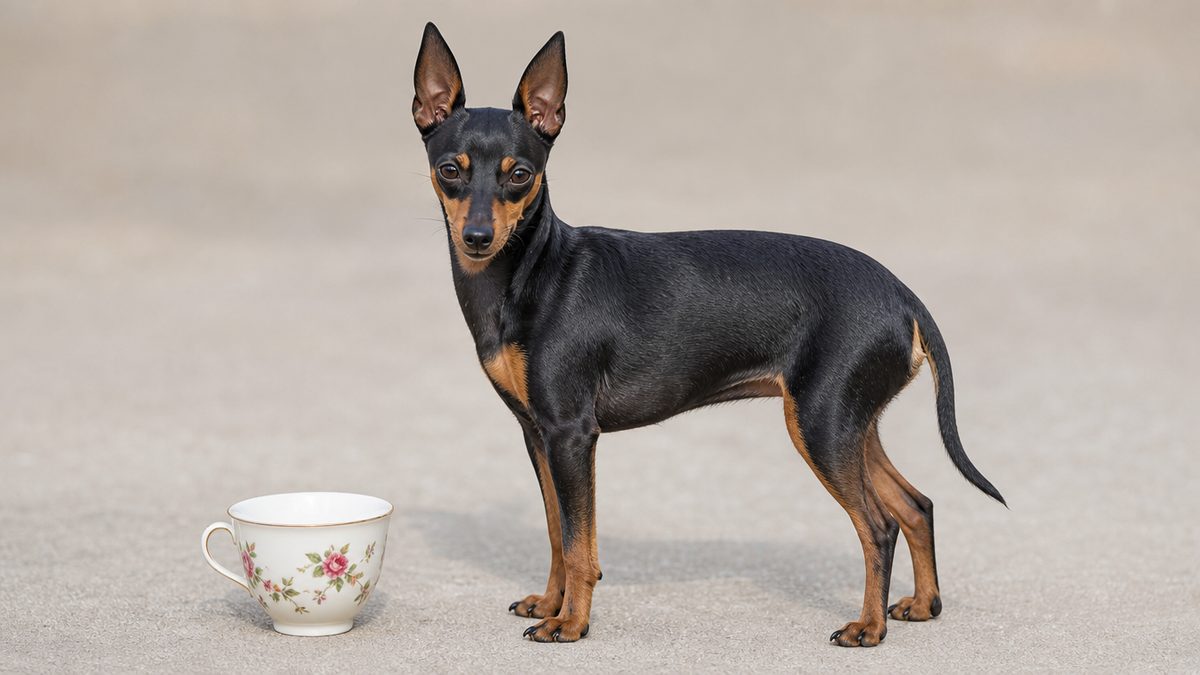
An English Toy Terrier (Black & Tan) is a British toy breed of ideally 2.7 to 3.6 kg and 25 to 30 cm at the shoulder, with erect candle-flame ears and a hard black and tan coat, bred down from the rat-pit terriers of industrial England. Both the Royal Kennel Club and the Federation Cynologique Internationale print exactly those two size figures, which is unusually good agreement for a rare breed.
The FCI classifies it as Group 3 Terriers, Section 4 Toy Terriers, without working trial, with the origin given as Great Britain and the current standard valid from 26 March 2009. The Royal Kennel Club places it in the Toy group and last updated its own text on 1 August 2025. The two documents are close to word-for-word identical, so a buyer reading either breed standard is reading effectively the same description.
| Item | FCI Standard 13 | Royal Kennel Club |
|---|---|---|
| Document date | English text 19.05.2009, valid standard 26.03.2009 | Last updated 1 August 2025 |
| Group and section | Group 3 Terriers, Section 4 Toy Terriers | Toy group |
| Ideal weight | 2.7 to 3.6 kg | 2.7 to 3.6 kg (6 to 8 lb) |
| Ideal height | 25 to 30 cm at the shoulder | 25 to 30 cm (10 to 12 in) at the shoulder |
| Ears | Candle-flame shape, erect from nine months of age | Candle-flame shape, erect from nine months of age |
| Bone | Fine bone eminently desirable | Fine bone highly desirable |
| Bite | Perfect, regular and complete scissors bite; teeth level and strong | Perfect, regular and complete scissor bite; teeth level and strong |
| Colour permitted | Black and tan only | Black and Tan only, any other colour unacceptable |
| Working trial | Without working trial | Not applicable |
The ear is the breed, not a detail
Read the ear clause carefully, because it separates this breed from every dog it will be confused with. The ears are candle-flame shaped with slightly pointed tips, placed high on the back of the skull and proportionately close together, and from nine months of age ear carriage must be erect The Royal Kennel Club. A guide to size given by both standards is that bending the ear forward should not reach the eye.
That erect ear is natural, not surgical, and the distinction matters more in India than anywhere else. It means this breed's correct head can be produced without cutting anything, which is not true of every prick-eared breed sold here.
The colour clause is a checklist, not an adjective
Black and tan on this breed is specified to a level of detail most standards reserve for structure. The black must be ebony and the tan likened to a new chestnut deeply rich, the two must meet abruptly with clear and well defined lines rather than blending, and the standard then names each marking: forelegs tanned to the knees in front, a thin black line up each toe called pencilling, a clearly defined black thumb mark on the centre of each pastern, a tan spot above each eye, a small tan spot on each cheek, and tan hair inside the ears The Royal Kennel Club. A white patch anywhere is unacceptable.
That list is a buyer's tool. A dog offered as an English Toy Terrier in India that has smudged colour boundaries, no pencilling and no thumb marks is not failing a show standard, it is probably not the breed.
Both standards give an ideal weight of 2.7 to 3.6 kg The Royal Kennel Club. Pets4Homes, which ranks in India for this breed, prints 3 to 4 kg. The American Kennel Club's equivalent, the Toy variety of the Manchester Terrier, is capped at 12 pounds, which is 5.4 kg. That is not a rounding difference. The top of the American range is half as much dog again as the top of the British one, and the next section explains why.
The Manchester Terrier question, answered by the registers
The English Toy Terrier and the Manchester Terrier are the same ancestral stock, and whether they are one breed or two depends entirely on which register you open. Two registries say two breeds. One says one breed with two varieties. That is the whole naming question, and it is settled by reading the registers rather than by argument.
The Royal Kennel Club states the ancestry plainly on its own breed page. The English Toy Terrier has had a variety of names, the miniature Black and Tan and in the USA the Toy Manchester Terrier, all pointing to his ancestry in the Manchester Terrier, the rat killer developed in the industrial Revolution, and the miniaturisation of the breed, perhaps with some input of Italian Greyhound, resulted in the fine boned black and tan breed with candle flame ears.
What each register actually does
| Register or product | Treatment | Where it puts each dog |
|---|---|---|
| FCI nomenclature | Two breeds | Manchester Terrier (71) in Group 3 Section 1; English Toy Terrier (13) in Group 3 Section 4 |
| Royal Kennel Club breed list The Royal Kennel Club | Two breeds | Manchester Terrier in the Terrier group; English Toy Terrier (Black & Tan) in the Toy group |
| AKC official standard | One breed, two varieties | One document covering the Standard and Toy varieties of the Manchester Terrier |
| AKC breed pages American Kennel Club | Two pages | Manchester Terrier (Standard) and Manchester Terrier (Toy) |
| AKC popularity table 2025 | One undivided row | Manchester Terrier at 131 of 201, with no English Toy Terrier entry anywhere |
| OFA breed selector | Two codes | MT/STD under Terrier, MT/TOY under Toy, and no English Toy Terrier in the 474-row list |
| OFA published statistics | One undivided label | MANCHESTER TERRIER, with the two varieties reported together |
The American standard says it in one sentence
The AKC's Official Standard of the Manchester Terrier opens its size section with a sentence that resolves the American position entirely: except for size and ear options, there are no differences between the Standard and Toy varieties of the Manchester Terrier, and the Toy variety is a diminutive version of the Standard variety. The split is by weight, with the Toy capped at 12 pounds and the Standard running over 12 and not exceeding 22, above which a dog is disqualified.
So on the American account this is one breed cut in half at a number. On the British and international account it is two breeds, and the FCI puts them not merely in different sections but in sections named for size, Large and medium sized Terriers against Toy Terriers.
The evidence that they are genuinely different dogs, not just different sizes
One clause settles whether the two-breed view has anything physical behind it, and it is not the weight. The ears differ. FCI Standard 13 requires the English Toy Terrier's candle-flame ears to be erect from nine months of age. FCI Standard 71 requires the Manchester Terrier's ears to be small and V-shaped, carried well above the top line of the head and hanging close to the head above the eyes. Erect against dropped is not a size difference.
The heights are also further apart than the shared ancestry suggests. FCI 71 gives an ideal height at the withers of 41 cm for Manchester Terrier males and 38 cm for females. FCI 13 gives 25 to 30 cm for the English Toy Terrier. At the extremes that is a dog roughly a third shorter.
It matters because the Indian search results mix them. On an India-located search for this breed's price, the second result is a Manchester Terrier sales category and the largest Indian breed price table carries a Manchester Terrier row and no English Toy Terrier row at all. If you buy on the American view that these are one breed, you will accept a 5 kg drop-eared dog as an English Toy Terrier. On the standard that actually defines the breed, it is not one.
A vulnerable native breed, with the actual registration numbers
The Royal Kennel Club registered 52 English Toy Terrier puppies in 2025, the breed's lowest figure in a decade and half its 2018 peak of 126. The breed sits on the club's vulnerable native breeds list, and unlike some breeds on that list it has no second register propping it up.
The scheme's thresholds are the Royal Kennel Club's own words rather than a summary of them. It states that in order to protect breeds of British and Irish origin considered at risk of disappearing, it created the vulnerable native British and Irish breeds list, breeds with fewer than 300 registrations a year, and the at watch list, breeds with between 300 and 450 registrations a year, so that it can monitor them. Bonbeno counted the current sheet's rows at 39 vulnerable breeds and 8 at watch.
| Year | Registrations | Against the 300 threshold |
|---|---|---|
| 2016 | 102 | 66 percent below |
| 2017 | 84 | 72 percent below |
| 2018 | 126 | 58 percent below, the ten-year peak |
| 2019 | 98 | 67 percent below |
| 2020 | 75 | 75 percent below |
| 2021 | 101 | 66 percent below |
| 2022 | 64 | 79 percent below |
| 2023 | 93 | 69 percent below |
| 2024 | 66 | 78 percent below |
| 2025 | 52 | 83 percent below, the ten-year low |
Across the decade the Royal Kennel Club registered 861 English Toy Terriers in total, which is fewer than it registered Cavalier King Charles Spaniels in any three months of 2025. Every one of those ten years is identical on the vulnerable native breeds web page and in the Toy group comparative table, which is worth saying because the next section shows that is not true of every breed on the list The Royal Kennel Club.
Where it sits inside the Toy group
Rank it against its own group and the picture is stark. Of the 24 toy breeds in the Royal Kennel Club's ten-year comparative table, the English Toy Terrier's 2025 figure of 52 is the fourth lowest, above only the Australian Silky Terrier at 4, the Lowchen at 19 and the Bolognese at 36. The Cavalier King Charles Spaniel recorded 3,224 in the same year and the Pomeranian 1,541. Against the group's printed 2025 total of 10,500, this breed accounted for roughly one registration in every 202.
The breed club counts its own puppies, and 2026 is up
The English Toy Terrier Club publishes its own running count, which no ranking page uses and which is more current than any kennel club table. On 13 August 2026 it reported that between January and June 2026, 41 ETT pups were either born or registered from 14 litters, being 14 born in late 2025 and registered in early 2026 plus 27 actually born in the first half of 2026.
The club's own reading of that is measured rather than triumphant. It calls the figure a big improvement on the first half of 2025, expects registrations to continue picking up, and says plainly that the year is still likely to be well below the long term average of 100. That long-term average of 100 is itself a useful number, because it puts the 2025 low of 52 at roughly half the breed's own historic norm.
Bonbeno also built the English Foxhound, which sits on the same vulnerable native breeds list at 20 registrations across the whole decade. The two breeds are opposite cases. The Foxhound's row carries an asterisk saying the breed is numerous outside the Royal Kennel Club on an alternate specialist register. The English Toy Terrier's row carries no asterisk, and there is no second studbook. Its 52 is the whole number.
We checked the Kennel Club's tables against each other, cell by cell
Checking a registry's figures against the same registry's other figures is cheap, and on the Royal Kennel Club's vulnerable-breeds data it turns up nine disagreements. This breed's own row is clean in all ten years. The Manchester Terrier's is not, and the gap on its worst year is 110 dogs.
The method is deliberately boring. Every vulnerable breed's ten-year run is published twice by the same organisation, once on the vulnerable native breeds web page and once inside that breed's own group comparative-registrations PDF The Royal Kennel Club. Bonbeno parsed the web table's 47 rows and the six relevant group PDFs, matched them by breed name, and compared every cell.
| Breed | Year | Web page | Group PDF | Group |
|---|---|---|---|---|
| Manchester Terrier | 2019 | 243 | 133 | Terrier |
| Bull Terrier (Miniature) | 2016 | 493 | 172 | Terrier |
| Bull Terrier (Miniature) | 2025 | 143 | 185 | Terrier |
| Bullmastiff | 2016 | 172 | 493 | Working |
| Bullmastiff | 2025 | 185 | 143 | Working |
| Dandie Dinmont Terrier | 2021 | 124 | 123 | Terrier |
| Irish Wolfhound | 2019 | 225 | 229 | Hound |
| King Charles Spaniel | 2023 | 36 | 39 | Toy |
| Soft Coated Wheaten Terrier | 2021 | 227 | 277 | Terrier |
| English Toy Terrier (Black & Tan) | all ten years | matches | matches | Toy |
The Manchester Terrier gap is the one that matters here
Put the two Manchester Terrier rows side by side. The vulnerable native breeds page gives 191, 160, 172, 243, 155, 155, 153, 110, 89, 74. The Terrier group PDF gives 191, 160, 172, 133, 155, 155, 153, 110, 89, 74 The Royal Kennel Club. Nine of ten years agree exactly and 2019 differs by 110 dogs, on a breed that never exceeded 243 in the decade.
That is not a trivial discrepancy for anyone comparing the two sibling breeds. On the web page's figure the Manchester Terrier's 2019 was its best year of the decade. On the PDF's figure 2019 was an ordinary year and the decade has no peak at all. We do not know which is right, and neither does any page that quotes one of them without checking.
Four of the nine are one clean transposition
The Bullmastiff and the Bull Terrier (Miniature) sit next to each other on the web page, and their 2016 and 2025 figures are swapped between the two documents. The web page gives the Bull Terrier 493 in 2016 and the Bullmastiff 172; the group PDFs give the Bull Terrier 172 and the Bullmastiff 493, and the same swap repeats in 2025 at 143 and 185 The Royal Kennel Club. Two adjacent rows, two columns, one transposition.
Then we added the Toy group's own columns up
Both PDFs print an annual group total, so those can be checked against the rows above them. The Toy group's 2025 column does not balance. Its 24 breed rows sum to 10,503 against a printed total of 10,500, a shortfall of three dogs, while its other nine annual columns balance exactly. For comparison, the Hound group table Bonbeno checked for the English Foxhound balances in all ten of its columns.
None of these nine cells changes any breed's vulnerable status, and none touches the English Toy Terrier. We publish them because a registry figure quoted as a bare number, with no sample size and no cross-check, is how a soft number hardens into a fact. Anyone can repeat this in about ten minutes offline: download the group PDF, extract its text, and diff it against the web table.
English Toy Terrier price in India: the top result sells a different breed
No verified English Toy Terrier price in India exists, and the first result an India-located search returns for the query is a Toy Fox Terrier sales page, which is a different breed from a different country. Bonbeno ran that search on 27 August 2026, opened every result that would load, and found not one English Toy Terrier offered for sale in India.
This is the section where a directory is most tempted to invent something. A band like Rs 60,000 to Rs 1,50,000 would look plausible beside the Yorkshire Terrier, would rank, and would be entirely made up. So here is what the search actually returns, result by result.
| Result | What it actually is | A real Indian English Toy Terrier for sale? |
|---|---|---|
| mrnmrspet.com, position 1 | A Toy Fox Terrier sales page. Different breed, American origin | No |
| puppiezo.com, position 2 | A Manchester Terrier sales category. The sibling breed, not this one | No |
| supertails.com, position 3 | A 40-breed Indian price list that does not include this breed | No |
| royalkennelclub.com, position 4 | The breed's UK kennel club page. Accurate, and priced in nothing | No |
| english-toy-terrier-club.com, position 5 | The UK breed club's own guidance. The best source on the page one, and British | No |
| asiapets.in, position 6 | A generic Indian puppy marketplace index | No |
| pethouse.co.in, position 7 | A 155-breed Indian price table with no English Toy Terrier row | No |
| pets4homes.co.uk, position 8 | A United Kingdom breed page priced in pounds sterling | No |
| englishtoyterrier.dog, position 9 | A European breeder's litter page | No |
| mrnmrspet.com, position 11 | A Yorkshire Terrier sales page. A third different breed | No |
Three of the top eleven results are three different breeds
Look at what the query is being answered with. Position 1 is a Toy Fox Terrier, position 2 is a Manchester Terrier and position 11 is a Yorkshire Terrier Puppiezo, Manchester Terrier Puppies…. All three are small black-and-tan-adjacent terriers, none of them is this breed, and the substitution is not random. It is what happens when a search engine has no matching Indian inventory and fills the gap with the nearest thing somebody is selling.
The Toy Fox Terrier substitution is the one to watch. It is an American breed, it is genuinely stocked in India, and it is close enough in size and colour that a buyer who has only seen photographs will accept it. If somebody offers you an English Toy Terrier in Delhi, the single most likely thing they actually have is a Toy Fox Terrier.
One search engine could not be used at all
Bing India returned HTTP 200 for this exact query, with the correct page title, and then served ten organic results about Herman Miller office furniture, including the manufacturer's own site, its store, its Wikipedia article and two furniture retailers. A control query for labrador retriever price in india, run in the same session on the same engine, returned ten correct Labrador results. So the substitution is specific to this query rather than a broken engine, and Bonbeno drew no conclusion about Indian availability from it.
Ask two questions before you ask the price. Are the ears erect and uncut? The standard requires natural erect candle-flame ears from nine months, and a drop-eared black and tan terrier is a Manchester Terrier or something else. What airway bill did the dog or its parents arrive on? There is no lawful route to import founding stock of any breed into India for breeding or sale, and the Kennel Club of India's own imported-dog checklist requires that document in original.
The Indian price table that ranks for this query is a converted dollar list
The largest Indian dog-price table in these results is not a record of Indian prices at all. Bonbeno tested every figure in it and 453 of its 462 rupee values divide to an exact whole number of US dollars at a rate of 74.00, while not one of the 462 divides cleanly at 84.38. The nine that fail at 74 are all four Indian breeds, which is what gives the mechanism away.
The table is Pet House NCR's Dog Price List In India, which ranks seventh on an India-located search for this breed's price query and carries 155 breed rows with an average price and a price range for each. Bonbeno downloaded the raw table, extracted all 462 numeric values, and divided every one of them by five candidate exchange rates.
| Rate tested | Values dividing to a whole US dollar | Verdict |
|---|---|---|
| 74.00 | 453 of 462 | The rate the list was converted at |
| 84.38 | 0 of 462 | Rules out the rate this site has caught three times elsewhere |
| 80.00 | 206 of 462 | Arithmetic noise. Any figure ending in three zeros passes at 80 by construction |
| 83.00 | 1 of 462 | Coincidence |
| 66.67 | 0 of 462 | Not this list |
The nine failures name the mechanism
A conversion leaves a quotient, and the rows that refuse to divide are the rows a human typed. All nine values that fail at 74.00 belong to just four breeds, and every one of those four is Indian: the Indian Pariah Dog, the Rajapayam Dog, the Indian Spitz and the Carvan Hound. Every imported breed on the list divides. Every local breed does not.
One of those four rows carries the clinching detail. The Carvan Hound's price range is printed as Rs 8,ooo to Rs 12,000, with two letter o's where the zeros should be. A script converting dollars does not typo. A person typing local breeds into a converted list does.
What the quotients look like, and why that confirms it
The 453 values that divide at 74.00 resolve to just 92 distinct dollar figures, and they are the numbers a real American seller would print: 250, 300, 500, 800, 1,000, 1,500, 2,000, 2,500, 3,000, 4,500. Twenty-eight separate values across the table are exactly Rs 74,000, which is USD 1,000. Unrelated breeds sharing an identical rupee price is not what a market looks like. It is what a lookup table looks like.
And it does not contain this breed
After all that, the table has no English Toy Terrier row. What it does have is an English Toy Spaniel at Rs 1,85,000, a Manchester Terrier at Rs 1,18,400 with a range of Rs 74,000 to Rs 1,85,000, and a Toy Fox Terrier at Rs 59,200 with a range of Rs 37,000 to Rs 1,11,000. Divide those at 74.00 and they are USD 2,500, USD 1,600 with a USD 1,000 to 2,500 range, and USD 800 with a USD 500 to 1,500 range. Not one of them is an Indian price and not one of them is this breed.
Pets4Homes, ranking eighth on the same search, gives GBP 800 to GBP 1,500 for a well-bred Kennel Club registered puppy, GBP 50 to GBP 80 a month in upkeep, and GBP 8,000 to GBP 13,000 over a 12-year lifetime. Bonbeno does not convert those into rupees. Converting a British purchase price into rupees produces a number that describes a transaction which cannot lawfully happen in India, and this page has just spent 462 divisions showing what that practice looks like at scale.
Why no lawful Indian supply chain can form for this breed
Importing an English Toy Terrier into India to breed or sell is barred by name. DGFT Trade Notice 22/2022-23 classifies dogs under ITC(HS) 01061900 as Restricted, and paragraph 6 states that any applications for trading or breeding purposes, or applications made on behalf of some another person or entity, shall be duly rejected.
Bonbeno extracted the notice's own text rather than relying on a summary of it, because summaries of Indian pet-import rules have repeatedly been generated rather than read. The provisions that matter read as follows.
- Policy Condition 7 allows import of dogs only for three purposes: a pet dog with a valid pet book and relevant records, research and development with the recommendation of CPCSEA, and internal security by the Defence and Police Force.
- Policy Condition 8 states that import of commercial dogs for breeding or any other commercial activities other than the purposes mentioned above is not permitted.
- Paragraph 6 states that applications for trading or breeding purposes shall be duly rejected.
- Paragraph 7 allows import of pet animals only through the airports and seaports of Delhi, Mumbai, Chennai, Hyderabad, Bangalore and Kolkata. DAHD added a seventh port, Cochin International Airport at Kochi, for pets arriving under the baggage rules in October 2024.
- Baggage route permits import as passenger baggage without DGFT authorisation only to a person transferring residence to India after two years of continuous stay abroad, and only for up to two animals.
Now put that against the supply side
The arithmetic is unusually simple on this breed. Britain produced 52 registered puppies in 2025 and the breed club's own count for the first half of 2026 is 41 from 14 litters The English Toy Terrier (Black & Tan) Club. Prospective British owners routinely join waiting lists because supply is that tight. A breed producing roughly one litter a fortnight in its home country does not have export stock available for a market where importing it for sale is illegal.
The Kennel Club of India route, and what it demands
The Kennel Club of India is the FCI's national member for India, and the English Toy Terrier is FCI standard 13, so an Indian pedigree is possible in principle. In practice the KCI's own checklist for an imported dog demands the single-dog registration form, the export pedigree in original, the airway bill in original, the air ticket in original from the country of import to the final destination, the boarding pass with payment, the DGFT licence, customs clearance, quarantine clearance, a pet passport and a notarised affidavit.
Read that as a description of a person rather than a form. It describes somebody who flew into India on a specific flight with a specific dog. It does not describe a breeder importing a brood bitch, and paragraph 6 of the trade notice is why.
Ask for the airway bill number. There is no other lawful route by which this breed could be in India in saleable quantity, and the Kennel Club of India requires that document in original before it will register an imported dog. A seller who cannot produce it has not imported anything, which means the small black and tan dog in front of you is something else, most likely the Toy Fox Terrier that ranks first for this query.
What Indian law does and does not say about a toy breed
Indian law mandates no patella test and no dental requirement for any breed, and Bonbeno verified that by extracting the gazette text and counting. Across the whole 14-page Prevention of Cruelty to Animals (Dog Breeding and Marketing) Rules 2017, the word patella appears zero times and the word dental appears zero times. That absence matters on a breed sold on exactly those two concerns.
One dentition hook does exist, and it is worth quoting exactly. Second Schedule Part III paragraph 8(10) requires that dogs shall have been tested for genetic defects, including hip dysplasia, progressive retinal atrophy, night blindness, hypothyroidism, entropion, ectropion, overshot, undershot jaw (when incisors do not touch or mesh), wry mouth, two or more missing teeth, unilateral cryptorchid or full cryptorchid males.
Note the clause number carefully. It is Second Schedule Part III paragraph 8(10), not Rule 8(10). The Rules' own Rule 8 is a different provision headed Conditions for sale, and its sub-clause 8(1)(a) is the genuine Rule that says pups less than eight weeks in age are not sold. Two clauses, both numbered 8, in the same document.
Note also the word including. The list is illustrative rather than closed, so it would be wrong to write that a defect falls outside the clause merely because it is unlisted. What is right to say is narrower and still useful: the clause names a dentition item and names no kneecap, and nothing else in the Rules does either.
| Body | Patella test required? | Dental requirement? | What it does ask for |
|---|---|---|---|
| Prevention of Cruelty to Animals (Dog Breeding and Marketing) Rules 2017 | No, zero mentions | No, zero mentions | 8(10) genetic-defect testing including two or more missing teeth |
| Royal Kennel Club, this breed | No | No | Good Practice: prioritising genetic diversity. Best Practice: eye testing on the BVA/RKC/ISDS scheme, the JDCM DNA test and the xanthinuria type II DNA test |
| Pets4Homes, ranking in India | Says yes | No | Claims the Kennel Club and breed clubs recommend patellar luxation screening, BAER testing and von Willebrand DNA testing |
A page ranking in India contradicts the kennel club it names
That third row is a checkable error rather than a difference of opinion. Pets4Homes states that the Kennel Club and breed clubs recommend screening for patellar luxation, BAER testing for hereditary deafness, and DNA tests for von Willebrand's disease. Open the Royal Kennel Club's own page for this breed and its recommended list is eye testing, JDCM and xanthinuria type II. No patella scheme. No BAER. No von Willebrand.
Both were read on 27 August 2026 and Bonbeno is not guessing which is right, because the kennel club is the body being cited and it is available to check in one click. A buyer who asks an Indian seller for the patella certificate that Pets4Homes says the Kennel Club requires will be asking for a document the Kennel Club does not ask for.
The ear-cropping clause, and where it bites on this breed's American cousin
Second Schedule Part II paragraph 6(8) reads that there shall be no tail docking, ear cropping, de-barking, de-clawing, branding, dyeing, injecting substances to enhance visual appeal, performing a surgery or procedure to camouflage or hide any defect or infirmity or any other kind of mutilation of any body part of the pup and any change of appearance by artificial means is strictly forbidden.
For the English Toy Terrier itself that clause is easy, because the standard's erect candle-flame ear is natural and no cutting is involved. It bites on the American cousin. The AKC's Manchester Terrier standard lists the cropped ear as one of three correct ear types for the Standard variety, giving no preference among them, while disqualifying cropped or button ears in the Toy variety. So Indian law aligns exactly with the AKC's Toy variety and collides with its Standard variety, on the same page of the same document.
Never write, and never accept, that Indian law mandates a patella grade for a toy breed. It does not, and neither does the Royal Kennel Club for this breed The Royal Kennel Club. What both do give you is a real list to ask a breeder for, and on the kennel club's side that list is eyes, JDCM and xanthinuria.
Monthly cost of ownership, bounded honestly
Food is the cheapest line on this breed and dentistry is the one nobody budgets for. A 3 to 4 kg dog eats 55 to 75 grams of dry food a day, which at the Indian unit prices Bonbeno read on 27 August 2026 works out at roughly Rs 1,020 to Rs 2,340 a month. A single scale and polish under general anaesthetic costs many times that, and this breed's size is precisely what raises the odds of needing one.
Take the food first because it can be checked. Pets4Homes gives adult portions of around 55 g to 75 g daily for dogs of 3 to 4 kg, fed twice. On an Indian retailer's page for a premium dry food, the unit price ran from Rs 62 per 100 g on the largest pack to Rs 104 per 100 g on the smallest. Multiply the two and you get Rs 34 to Rs 78 a day.
| Daily portion | At Rs 62 per 100 g | At Rs 104 per 100 g |
|---|---|---|
| 55 g | Rs 1,023 a month | Rs 1,716 a month |
| 65 g | Rs 1,209 a month | Rs 2,028 a month |
| 75 g | Rs 1,395 a month | Rs 2,340 a month |
The grams are Pets4Homes', the unit prices are the Indian retailer's, and the multiplication is ours. Note which column a toy-dog owner actually lives in: a 3 kg dog takes months to finish a large pack, so most owners buy small and pay the right-hand column. At a 65 g portion the two columns differ by Rs 819 a month, so on this breed buying the biggest bag you can keep genuinely dry through an Indian monsoon is worth more than the food itself costs some owners.
What the breed's own club says the real cost is
The English Toy Terrier Club is unusually direct about money, and it does not talk about food. Citing Battersea Dogs Home's 2023 estimate of around GBP 2,000 a year to keep a dog, it puts the lifetime figure for this breed at GBP 24,000 to GBP 30,000, because ETTs can live to around 15 years. Pets4Homes, working from a 12-year life, reaches GBP 8,000 to GBP 13,000. Bonbeno prints both rather than averaging them, and notes that the gap is mostly the assumed lifespan.
The club then names the line that catches people. Pet insurance for a puppy runs around GBP 30 a month, but for a dog over the age of eight it can be several hundred pounds each month, and an overnight stay at an emergency vet costs GBP 400 to GBP 800 per night before any treatment, so a five-night hospital stay is GBP 4,000 before anything is done. Owners who drop insurance when premiums jump are the ones exposed to exactly that.
The Indian line item this page exists to flag
Bonbeno prints no Indian rupee figure for a dental scale and polish, because we could not open a published Indian price we were willing to stand behind. What we can tell you is why to ask for one before you buy. Periodontal disease was diagnosed in 12.52 percent of 22,333 UK dogs in a single year, and the study found that increasing adult bodyweight was associated with progressively decreasing odds. A 3 kg dog sits at the wrong end of that gradient for its whole life, and dental work needs a general anaesthetic every time.
There is no Indian purchase price for this breed, so we print none. We also print no Indian veterinary consultation or vaccination figure specific to this breed, because those do not vary by breed and quoting a number as though they did would be false precision. The two costs that genuinely are breed-specific here are dentistry and insurance after age eight, and both are worth pricing locally before you commit.
A fine-coated 3 kg dog in Indian heat, and in Indian cold
The English Toy Terrier handles Indian heat better than most imported breeds and worse than any Indian one, and its real climate problem is that a 3 kg dog with a thin coat has trouble at both ends. Bonbeno queried NASA POWER by explicit latitude and longitude, checking in every response that the returned coordinates matched those requested, so no substitute location could be served.
Manchester is the honest English anchor, because the breed is named for the city its larger relative came from and both were bred in the same industrial north. At 53.481 north and 2.243 west, Manchester's annual mean temperature is 9.12 C, its July mean is 15.43 C, its January mean is 3.62 C and its annual mean wet bulb is 8.16 C, peaking at 13.97 C in July.
| Place | Annual mean | Hottest month mean | Coldest month mean | Hottest month wet bulb |
|---|---|---|---|---|
| Manchester, England | 9.12 C | 15.43 C (Jul) | 3.62 C (Jan) | 13.97 C (Jul) |
| London, England | 10.39 C | 17.63 C (Jul) | 4.14 C (Jan) | 15.24 C (Jul) |
| Bengaluru | 23.74 C | 28.37 C (Apr) | 20.22 C (Dec) | 22.66 C (May) |
| Pune | 23.86 C | 28.93 C (Apr) | 19.62 C (Dec) | 23.56 C (Jun) |
| Delhi | 25.60 C | 35.88 C (Jun) | 13.61 C (Jan) | 27.74 C (Jul) |
| Kolkata | 25.81 C | 31.53 C (May) | 17.31 C (Jan) | 27.86 C (Jun) |
| Mumbai | 26.77 C | 31.19 C (May) | 23.19 C (Jan) | 26.55 C (Jun) |
| Chennai | 27.95 C | 31.51 C (May) | 24.09 C (Jan) | 27.36 C (May) |
Why this breed scores better than the big imports
Two things work in its favour and both are structural. It is small, and the largest UK heat-illness study found that dogs under 10 kg were the base category against which every heavier band carried roughly double the odds of exertional heat illness. And its exercise requirement is genuinely modest: the Royal Kennel Club prescribes up to 30 minutes per day and the breed club a minimum 30-minute walk. Thirty minutes can be taken before sunrise in any Indian city. Two hours cannot.
That is why Bonbeno rates this breed 2 of 5 for heat tolerance rather than 1. It is not heat-adapted, it has a thin coat with little insulation either way, and Pets4Homes names heat stress among its concerns. But its workload fits inside the safe window, which is more than can be said for most imported breeds in India.
The cold half, which Indian pages never mention
A 3 kg dog with a short fine coat and almost no body fat loses heat fast, and parts of India get cold enough for that to matter. Delhi's January mean is 13.61 C, which is cooler than Manchester's warmest month, and NASA POWER's record minimum for the Delhi cell is -1.36 C. Pune's coldest recorded minimum is 6.56 C and Bengaluru's is 8.6 C.
Pets4Homes' guidance is right for this and transfers cleanly: the short fine coat offers minimal insulation, so in cold weather owners should provide coats or sweaters to prevent chill. A north Indian winter is a real reason to dress this breed, not an affectation.
Where in India this breed does best
Bengaluru and Pune are the two cities in this table where an English Toy Terrier is genuinely comfortable most of the year. Bengaluru's annual mean of 23.74 C at 842 m and a peak wet bulb of 22.66 C, and Pune's 23.86 C at 636 m with a peak wet bulb of 23.56 C, are both about 4 to 5 wet-bulb degrees easier than Chennai or Kolkata. Chennai is the hardest of the six, with an annual mean wet bulb of 24.94 C that is 10.97 degrees above Manchester's hottest month, every month of the year.
A 3 kg dog is closer to hot pavement than you are, and its whole body is inside the layer of air that a Chennai road heats in the afternoon. Check the surface with the back of your hand for five seconds before every walk between March and June, and if you cannot hold it there, neither can the dog. That is worth more on this breed than any wet-bulb table, because a 30-minute walk taken at the wrong hour is still 30 minutes at ground level.
Temperament: a rat-pit terrier in a 3 kg body
The FCI's temperament clause for this breed is five words and it is the whole personality: Toy with Terrier characteristics. The full clause adds that the dog is alert, remembering that historically he could acquit himself satisfactorily in the rat pit, and never unduly nervous. Buy this expecting a lap dog and you have misread the standard.
The Royal Kennel Club's own account keeps the working history in the foreground. It describes the breed as still able to acquit themselves as a dispatcher of vermin, which they did in the 19th century when they were used in the rat pits, and calls them a delightfully intelligent breed with a stylish extended trotting action. Nothing in either document describes a decorative animal.
What that looks like in an Indian flat
- Prey drive is live, not vestigial. Pets4Homes describes a strong prey drive and hunting instinct, quick and agile, delighting in chasing small moving objects, and warns that smaller pets should be supervised or avoided. In an Indian building with squirrels, lizards and community cats, that is a daily fact.
- Separation is the main failure mode. The breed club states plainly that ETTs need human company, thrive with it, and do not do well if left alone for long periods, developing behavioural issues when they are.
- Barking is the second one. Pets4Homes names excessive barking as a boredom behaviour and recommends training to moderate it early. A vocal terrier in an Indian apartment block is a neighbour problem before it is a dog problem.
- Better with older children than toddlers. Both sources agree: this is a 3 kg dog that a small child can injure by accident, and it does best with children old enough to be gentle.
- Reserved rather than nervous with strangers. The standard's phrase is never unduly nervous, and the practical version is a dog that watches a new person carefully and then decides.
The home safety list, from the breed's own club
The English Toy Terrier Club publishes an ETT-proofing checklist that reads oddly until you remember how small the dog is. It asks whether your staircase has spindles an ETT could fall through, whether you have assessed which furniture is a risk to a dog that can jump surprisingly high and might not remember it cannot fly, and whether your garden is fully secure, because English Toy Terriers can fit through tiny gaps.
Translate that to an Indian home and the list gets longer rather than shorter. Balcony railings, grilles, the gap under a gate and the space beside a stairwell are all sized for a larger animal. This is the one breed on this site where the balcony is the first thing to check.
It suits somebody at home most of the day, in a flat or a house, who wants an alert, funny, physically undemanding dog and is willing to brush its teeth. It does not suit a household out for ten hours, a home with hamsters or rabbits, or anybody who wants a dog that will tolerate rough handling from small children. None of that is a criticism of the breed. It is the breed's own club and a UK breed profile saying the same thing.
Training an English Toy Terrier, and the one mistake that creates the problem
Train an English Toy Terrier with short, reward-based sessions and firm boundaries, because the breed is genuinely trainable and the thing that ruins it is indulgence rather than difficulty. Pets4Homes describes it as highly trainable, intelligent and eager to bond, excelling under positive reinforcement and responding poorly to harsh corrections or dominance techniques.
The failure mode has a name in the literature this breed attracts, and it is worth stating rather than laughing at. Pets4Homes warns about the breed's capacity for cunning manipulation, requiring consistent and patient leadership to establish clear boundaries and prevent what it calls small dog syndrome. That is a description of an owner problem, not a dog problem: behaviour that would be corrected in a 25 kg dog gets permitted in a 3 kg one.
What works
- Keep sessions brief and frequent. Short, engaging sessions suit the breed's attention span better than long ones.
- Start socialisation the week the puppy arrives. Early socialisation is described as critical to a balanced temperament, and a poorly socialised ETT becomes cautious around strangers.
- Train a reliable quiet cue before you need it. Barking is a documented boredom behaviour here, and it is far easier to shape at four months than at four years.
- Use puzzle toys and scent games as training, not as extras. The breed club puts canine enrichment on the same footing as the daily walk.
- Handle the mouth daily from week nine. A dog that accepts toothbrushing is a dog that avoids anaesthetics later, and the breed club asks for teeth brushed at least twice a week for life.
What does not work
Two things fail predictably. Harsh correction damages trust with a sensitive small terrier and produces avoidance rather than learning. And off-lead freedom in an unfenced Indian space collides with the prey drive: a dog that has locked onto a squirrel is not being disobedient, and at 3 kg it loses every argument with a scooter.
There is a third that is specific to this breed's size. Over-exercising a puppy. Pets4Homes warns that young puppies should avoid excessive running, jumping and stair climbing to protect growing joints and bones, and that overexercising risks joint damage. On a fine-boned breed whose adult weight is 3 kg, that window is longer than owners expect.
Teach a settled down-stay on a mat, indoors, on cue. An Indian flat with a doorbell, a delivery, a lift and a stairwell of neighbours is a barking environment, and a dog with a trained alternative is a dog that stays welcome in the building. It also gives you somewhere to put the dog during the hours when the pavement is too hot to walk on.
The real daily requirement, and why it fits India
Thirty minutes a day is the floor and both the kennel club and the breed club agree on it. The Royal Kennel Club lists exercise for this breed as up to 30 minutes per day with a size of home given as flat or apartment, and the English Toy Terrier Club says the breed needs a minimum of a 30 minute walk each day but appreciates longer and is happy on a big hike.
Those two figures are not in conflict, they are a floor and a ceiling, and the gap between them is the most useful thing on this page for an Indian owner. Thirty minutes is what the dog must have. More is welcome when the weather allows. That structure fits an Indian year far better than a fixed number would.
| Source | Stated requirement | Type of source |
|---|---|---|
| Royal Kennel Club | Up to 30 minutes per day | The breed's national kennel club |
| English Toy Terrier Club | A minimum of a 30 minute walk each day, more appreciated | The breed's own UK club |
| Pets4Homes | Approximately 30 to 60 minutes daily, divided into multiple sessions | A consumer breed profile |
| FCI Standard 13 | No exercise clause. Utilisation not stated; without working trial | The international standard |
Thirty minutes in an Indian city, worked out
In Chennai, where the annual mean wet bulb is 24.94 C and May peaks at 27.36 C, the safe window is roughly 05:30 to 07:00. Thirty minutes fits inside it comfortably, which is why this breed scores 2 of 5 for heat rather than 1. In Bengaluru and Pune, with peak wet bulbs of 22.66 C and 23.56 C, the window is wider and an evening walk is genuinely available for much of the year.
Delhi is the split case. Its January mean of 13.61 C is cooler than Manchester in July, so winter is easy and the dog will want a coat Pets4Homes, English Toy Terrier breed page. Its June mean of 35.88 C and July wet bulb of 27.74 C make the pre-monsoon and monsoon months a strict pre-sunrise operation.
Mental work is not optional on a terrier
Half of this breed's exercise requirement is not physical. The breed club puts psychological exercise and canine enrichment alongside the daily walk and asks whether the owner has quality time for both, and Pets4Homes lists interactive food puzzles, obedience training, hide and seek and varied scent walks as the way to prevent boredom-related barking and destructiveness.
That is genuinely good news for an Indian flat. Fifteen minutes of scatter-feeding or a puzzle toy costs nothing, needs no pavement, and can be done at 3 pm in May when a walk cannot.
Not a calm dog. Pets4Homes names the outcomes directly: boredom-induced excessive barking, destructive tendencies, restlessness and hyperactivity, and the breed club adds behavioural issues from being left alone. In a flat, with neighbours, those are the two complaints that end an ownership.
Ten minutes a week on the coat, and the ears are the easy part
Grooming this breed is a rubber mitt once a week and nothing else on the coat. What the routine actually turns on is teeth, and the breed's own club puts it in the grooming section rather than the health section: English Toy Terriers need to have their teeth brushed at least twice a week.
The coat is a thick, close, glossy density of short hair with no undercoat to strip and no furnishings to trim. The Royal Kennel Club lists grooming as once a week and sheds as yes, and Pets4Homes adds that professional grooming is generally unnecessary, with weekly brushing using a soft bristle brush or grooming glove and more during spring and autumn sheds.
The erect ear is a genuine advantage, and it is measurable
This is the rare case where a breed's conformation lowers a risk rather than raising it. In a UK study of 22,333 dogs, erect ear carriage was the base category against which breeds with pendulous ears carried 1.76 times the odds of otitis externa (95 percent CI 1.48 to 2.10) and breeds with V-shaped drop ears 1.84 times the odds (1.53 to 2.21). The one-year period prevalence of otitis externa across all dogs was 7.30 percent.
The English Toy Terrier's ears are required to be erect from nine months of age The Royal Kennel Club. Its sibling the Manchester Terrier's are required to be small and V-shaped and hanging close to the head, which is the 1.84 category. In an Indian August, with relative humidity averaging 90.8 percent in Pune and 90.4 percent in Mumbai, that difference is worth real money and real discomfort over a lifetime.
It is not a licence to ignore the ears. Pets4Homes still recommends regular ear checks for excess wax and watching for foul odours or discharge. An open erect ear dries far better than a closed one even in a humid month; it does not clean itself.
| Task | How often | Why, on this breed |
|---|---|---|
| Toothbrush, dog paste, both sides | At least twice a week, daily is better | The breed club's own instruction, and the odds of periodontal disease rise as bodyweight falls O'Neill DG, Mitchell CE, Humphrey J |
| Rubber glove or soft bristle brush over the coat | Weekly | Short dense coat, moderate shedding |
| Nails | Weekly | The breed club specifies weekly nail trimming, which is more often than most breeds |
| Look inside both ears | Weekly | Erect ears dry well but still collect wax |
| Home health check, nose to tail | Weekly | Recommended by the breed club, and on a 3 kg dog a lump is easy to find early |
| Bath | As needed only | A hard glossy coat is stripped by frequent washing |
One Indian adjustment to the overseas routine
British grooming advice for this breed assumes a house that is cool and dry for most of the year. India adds two things it does not plan for. Ticks, which need a physical daily check on a black dog where they are hard to see, particularly in the ears, armpits and between the toes. And heat rash and sun on a thin coat, which on a black dog absorbing an Indian afternoon is a real skin concern rather than a theoretical one.
A dog that learns to accept a toothbrush as a puppy will accept it at ten. A dog that meets one for the first time at four, with sore gums, will not, and every subsequent cleaning is a general anaesthetic. This is the single highest-return grooming habit on this breed and it costs about ninety seconds twice a week.
Health: the patella question, and why the obvious answer is wrong
Patellar luxation is the condition most often attached to this breed, and the evidence does not support treating it as a near-certainty. The nearest relative with published screening data, the Manchester Terrier, sits at 99.0 percent normal across 299 evaluations, which is better than the all-breeds average and ranks it 113th out of 177 breeds on the same table.
Start with what is actually measured, because this breed itself is not. The Orthopedic Foundation for Animals has no English Toy Terrier entry at all in its 474-row breed selector, which is unsurprising for a US body and a British breed. What it does carry is MANCHESTER TERRIER, reported as one undivided label covering both the Standard and Toy varieties.
| Breed | Rank | Evaluations | Normal % | Abnormal % |
|---|---|---|---|---|
| Pomeranian | 1 | 3,503 | 70.9 | 29.1 |
| Yorkshire Terrier | 4 | 3,178 | 83.0 | 17.0 |
| Russian Toy | 12 | 133 | 91.0 | 9.0 |
| Chihuahua | 22 | 5,500 | 93.6 | 6.4 |
| Toy Fox Terrier | 31 | 346 | 94.5 | 5.5 |
| Maltese | 33 | 1,903 | 94.6 | 5.4 |
| Papillon | 63 | 3,256 | 96.7 | 3.3 |
| ALL BREEDS | 225,604 | 96.5 | 3.5 | |
| Miniature Pinscher | 73 | 814 | 97.3 | 2.7 |
| Italian Greyhound | 80 | 1,357 | 97.7 | 2.3 |
| Manchester Terrier | 113 | 299 | 99.0 | 1.0 |
Read the Manchester Terrier row against the Pomeranian row
The table is ranked worst first, so rank 1 is the breed with the lowest proportion of normal knees. The Pomeranian sits there at 29.1 percent abnormal. The Manchester Terrier sits at 113 of 177, with 1.0 percent abnormal split as 0.7 percent Grade 1 and 0.3 percent Grade 2, and zero Grade 3. Against an all-breeds average of 3.5 percent abnormal across 225,604 evaluations, this family is well below the mean rather than above it.
Two honest caveats belong with that. 299 evaluations is a small sample, so the figure will move. And OFA screening is voluntary, so a breed whose owners test are not a random sample of the breed. Neither caveat turns 1.0 percent into a high number.
What the UK primary-care data adds
The largest primary-care study of the condition covered 210,824 dogs attending 119 English clinics and found an overall patellar luxation diagnosis prevalence of 1.30 percent (95 percent CI 1.21 to 1.39). Of its 751 incident cases, 293 (39.0 percent) received medical management, 99 (13.2 percent) surgical intervention and 28 (3.7 percent) were referred.
Eleven breeds showed increased odds against crossbreds, headed by the Pomeranian at 6.5 (95 percent CI 4.0 to 10.7), the Chihuahua at 5.9 (4.4 to 7.9), the Yorkshire Terrier at 5.5 (4.3 to 7.1) and the French Bulldog at 5.4 (3.1 to 9.3). Neither the English Toy Terrier nor the Manchester Terrier is among them. The transferable finding is the body-condition one: dogs with a bodyweight below their mean for breed and sex had 1.4 times the odds of diagnosis (1.2 to 1.6).
Toy size does not automatically mean bad knees, and on the only measurable relative of this breed it means the opposite. Bonbeno finds no evidence that the English Toy Terrier carries elevated patellar luxation risk, and finds that the Royal Kennel Club recommends no patella scheme for the breed at all while Indian law mentions the patella zero times. What the evidence does support is keeping the dog off the low end of its weight range, because underweight for breed is the factor that moved the odds.
The health problem this breed genuinely has is its teeth
Periodontal disease is where a 3 kg dog is actually exposed, and the number is not small. In a random sample of 22,333 UK dogs under primary veterinary care, the one-year period prevalence of periodontal disease was 12.52 percent (95 percent CI 12.09 to 12.97), and increasing adult bodyweight was associated with progressively decreasing odds.
That last clause is the whole argument. It is not a breed effect, it is a size effect, and this breed sits at the extreme end of it for its entire life. A dog of 2.7 to 3.6 kg carries a full set of teeth in a long narrow wedge-shaped jaw, and the standard asks explicitly for teeth level and strong with a perfect, regular and complete scissor bite.
| Factor or breed | Odds ratio | 95% CI |
|---|---|---|
| Toy Poodle | 3.97 | 2.21 to 7.13 |
| King Charles Spaniel | 2.63 | 1.50 to 4.61 |
| Greyhound | 2.58 | 1.75 to 3.80 |
| Cavalier King Charles Spaniel | 2.39 | 1.85 to 3.09 |
| Spaniel types versus non-spaniel types | 1.63 | 1.42 to 1.87 |
| Brachycephalic versus mesocephalic | 1.25 | 1.11 to 1.42 |
| Increasing adult bodyweight | Progressively decreasing odds | Direction reported, not a single ratio |
The English Toy Terrier is not among the 18 breeds the study named with raised odds, because a breed registering 52 puppies a year does not appear in a random UK sample in usable numbers The Royal Kennel Club. So Bonbeno claims no breed-specific odds ratio for it. What transfers is the bodyweight gradient, which the study measured on characteristics rather than breed identity.
Where Indian law meets a toy dog's mouth
The Prevention of Cruelty to Animals (Dog Breeding and Marketing) Rules 2017 contain the word dental zero times across all 14 pages. The only dentition hook in the whole instrument is Second Schedule Part III paragraph 8(10), which requires that dogs shall have been tested for genetic defects including overshot, undershot jaw (when incisors do not touch or mesh), wry mouth and two or more missing teeth.
That clause was written for breeding stock rather than for pet dental care, and it lands oddly on a toy breed. The dog most likely to be missing two or more teeth in India is not a badly bred one, it is an eight-year-old whose periodontal disease was never treated. The law's only tooth-related provision does nothing for that animal, and neither does the Royal Kennel Club, whose recommended tests for this breed are eyes, JDCM and xanthinuria with nothing dental at all.
What actually protects the teeth
The breed club gives the answer and it is unglamorous. Teeth brushed at least twice a week, for life, alongside weekly nail trimming and a weekly home health check. Pets4Homes puts it at gentle toothbrushing two to three times weekly and states that dental issues are common in this breed.
Every dental treatment on a 3 kg dog needs a general anaesthetic, and the cost and the risk both rise as the dog ages, which is exactly when the disease arrives. The breed club notes that insurance for a dog over eight can run to several hundred pounds a month and that owners often drop cover at that point. Brushing twice a week from week nine is the cheapest veterinary intervention available on this breed, and it is the one an owner controls entirely.
The three tests the Kennel Club actually asks for
The Royal Kennel Club recommends exactly three named tests for this breed and none of them is a patella grade. Under Best Practice it lists eye testing on the BVA, RKC and ISDS Eye Scheme, a DNA test for juvenile dilated cardiomyopathy, and a DNA test for xanthinuria type II, with prioritising genetic diversity as the single Good Practice item.
Those are the questions to put to any breeder, in the kennel club's own words, and two of the three are DNA tests that produce a certificate rather than a subjective grade. The club also notes that this breed has a breed club health scheme with further information available from the English Toy Terrier Club, and offers no breed-specific DNA testing package of its own.
| Body | What it asks for | Category |
|---|---|---|
| Royal Kennel Club | Prioritising genetic diversity | Good Practice |
| Royal Kennel Club | Eye testing, BVA/RKC/ISDS Eye Scheme | Best Practice |
| Royal Kennel Club | Juvenile dilated cardiomyopathy (JDCM) DNA test | Best Practice |
| Royal Kennel Club | Xanthinuria (type II) DNA test | Best Practice |
| Royal Kennel Club, Breed Watch | Category 1, no points of concern identified for judges | Show ring |
| Indian Rules 2017 | Second Schedule Part III para 8(10) genetic-defect testing, including two or more missing teeth | Law |
Why the two DNA tests matter to a buyer, briefly
Juvenile dilated cardiomyopathy is the one that kills young. The name says what it is: a heart-muscle disease that shows in young dogs rather than old ones, and a DNA test lets a breeder avoid producing affected puppies entirely rather than detecting them afterwards. Xanthinuria type II is a metabolic condition affecting purine handling, and again the value of a DNA test is that it is done once, on the parents, before the litter exists.
Bonbeno is not going to describe either condition's prevalence in this breed, because no published prevalence figure for either exists that we could open. The honest statement is that the kennel club considers both significant enough to name under Best Practice for this breed and for very few others, and that a breeder who has done neither has not met the club's own guidance.
Where the health registers are simply empty
There is no OFA data for this breed because OFA does not list it, and Bonbeno confirmed that by reading the 474-row breed selector rather than assuming it. There is no Kennel Club DNA package. The breed's Breed Watch category is 1, meaning no points of concern specific to this breed have been identified for special attention by judges.
None of that is evidence the breed is healthy. On 52 registrations a year it is evidence that nobody has enough dogs to measure. That is why this page leans on studies of characteristics, such as bodyweight and ear carriage, rather than on breed-specific figures that do not exist.
Pets4Homes, which ranks in India for this breed, lists a longer set of conditions including von Willebrand's disease, congenital deafness requiring BAER testing, Legg-Calve-Perthes disease, glaucoma, cataracts and lens luxation, and states that the Kennel Club and breed clubs recommend patella screening, BAER testing and von Willebrand DNA testing. Open the Royal Kennel Club's page and none of those three appears. Ask a breeder for the three the club does name.
Lifespan: four sources, four answers, one study
Published lifespans for this breed run from 12 years at the bottom to around 15 at the top, and only one figure comes from research. That study reports a median survival of 13.0 years for the Toy Manchester Terrier, from 138 recorded deaths, with a hazard ratio of 0.86 against crossbred dogs.
| Source | Figure | Evidence behind it |
|---|---|---|
| Royal Kennel Club | Over 12 years | A breed-page category, no study cited |
| Pets4Homes | 12 to 14 years | No study cited |
| English Toy Terrier Club | Around 15 years, some even longer | The breed's own club, from its members' dogs |
| McMillan et al. 2024, Toy Manchester Terrier | Median 13.0 years, 95% CI 12.0 to 13.6 | Kaplan-Meier estimate from 138 recorded deaths |
Note which breed name the study uses
McMillan and colleagues analysed 155 recognised purebred breeds against a crossbred group, and this dog's name appears in the study exactly once, in a place that complicates the figure above. Supplementary Table S5 carries a Toy Fox Terrier row whose phylogeny reclassification column reads English Toy Terrier, and that column is defined in the table's own caption as the Kennel Club and FCI breeds included in each Breed category. Toy Manchester Terrier is a separate row in the same table, with no reclassification against it at all. So the paper assigns this breed's British dogs to the Toy Fox Terrier row, whose own figures are a median of 12.9 years, 95 per cent CI 12.3 to 13.8, on 52 recorded deaths and a hazard ratio of 0.83 (0.63 to 1.09).
Bonbeno prints both rows rather than choosing one, because the paper is not consistent with itself here. The Toy Manchester Terrier is the American name for this same dog, the Toy Fox Terrier is a different American breed, and the study treats all three names as though only two dogs existed. The 13.0-year figure quoted above is the Toy Manchester Terrier row; the 12.9-year figure is the row the paper actually maps the English Toy Terrier onto. They agree to within a tenth of a year, so the practical answer does not move, but neither number should be presented as this breed measured on its own. The naming split from earlier in this page reaches all the way into the longevity literature, and it reaches into it twice.
The figures are a median survival of 13.0 years with a 95 percent confidence interval of 12.0 to 13.6 and a hazard ratio of 0.86 (95 percent CI 0.73 to 1.02, p = 0.08) against the crossbred reference, whose own median is 12.0. That hazard ratio does not clear statistical significance, so the honest reading is that this breed lives about as long as a crossbred dog and probably slightly longer.
The study's own two tables disagree on sample size
Bonbeno prints the disagreement rather than choosing. Supplementary Table S3 gives 339 dogs; Supplementary Table S6 gives 332, as 194 alive plus 138 deceased. The death count is identical in both at 138, which is why the sentence above is built on deaths and on the median rather than on N. The same discrepancy appears across other breeds in the same tables, so it is a property of the supplementary data rather than of this breed.
Why the club's 15 years is not necessarily wrong
A breed club's figure and a study's figure measure different populations, and both can be true. The English Toy Terrier Club's members' dogs are owned by people engaged enough to join a club, brush teeth twice a week and insure the animal. A median from a national dataset includes every dog. If the club's dogs live to 15 and the median is 13, the gap is a description of care rather than a contradiction.
Set the 13.0-year median beside the same table's other toy breeds and the breed holds up well. The Italian Greyhound's median is 14.0 years, the Miniature Pinscher's 13.7 and the Papillon's 14.5, while the Chihuahua's is 11.8 with a hazard ratio of 1.17 and the Pomeranian's 12.2. This is a long-lived small dog. Its problems are dental and behavioural, not constitutional.
Feeding a 3 kg dog, and the two ways owners get it wrong
Feed an English Toy Terrier measured portions twice a day to a visible waist, because on a 3 kg frame a 300 gram gain is a tenth of the dog. Pets4Homes gives adult portions of around 55 g to 75 g daily for dogs of 3 to 4 kg, on a premium small-breed formula, split into two meals.
- Eight weeks to four months. Three to four small meals a day on a small-breed puppy formula. Rule 8(1)(a) of the Indian 2017 Rules means no lawfully sold puppy reaches you younger than eight weeks.
- Four to ten months. Three meals a day, reducing toward two. Weigh the food rather than eyeballing it, because a tablespoon of error is a meaningful fraction of this dog's day.
- Ten to twelve months. Transition to two meals a day, which Pets4Homes puts at 10 to 12 months old.
- Adult. Two measured meals daily, adjusted monthly against body condition rather than against the bag.
- Senior. Two meals, reduced volume as activity drops, with softer options if dental disease has already cost teeth.
Mistake one: free-feeding a dog this size
Obesity on a toy breed is not cosmetic. Pets4Homes puts it directly: maintaining an ideal body condition is crucial to avoid obesity, which strains internal organs and reduces lifespan, and recommends regular exercise with controlled portions and minimal treats. On a 3 kg dog the margin between lean and overweight is a few hundred grams, which a bowl left down all day will cross inside a month.
Mistake two: keeping the dog too light
The opposite error has evidence behind it and almost nobody mentions it. In the largest primary-care study of patellar luxation, dogs with a bodyweight below their mean for breed and sex had 1.4 times the odds of diagnosis (95 percent CI 1.2 to 1.6). Owners who read that toy breeds have bad knees and respond by keeping the dog very slim are moving it toward the wrong side of that finding, not away from it.
The target is the middle of the breed's own range: 2.7 to 3.6 kg with a visible waist from above and ribs you can feel under a thin covering. Not the bottom of it.
Two Indian adjustments
Store small. A 3 kg dog eating 65 g a day takes over two months to finish a 4 kg bag, and two months of Indian monsoon humidity in an opened bag produces food the dog refuses. Buy the pack you will finish in six weeks even though the unit price is worse.
Count the treats as food. Training a terrier means treats, and this breed's daily ration is small enough that a handful of biscuits is a second meal. Take training treats out of the measured portion rather than adding them to it.
Fresh water always, in a shallow bowl a small dog can reach without stretching. And if you are following the kennel club's Best Practice list, note that xanthinuria type II is a purine-handling condition and that any dog with a known urinary-stone history needs a diet chosen by a veterinarian rather than by a website.
The first year, month by month, for an Indian household
Plan an English Toy Terrier's first year around three things a generic puppy timeline will not tell you: the ears do not finish going up until nine months, the joints are not ready for stairs and jumping for most of the year, and the toothbrush has to become normal before the adult teeth arrive. Everything below assumes a lawfully acquired puppy of at least eight weeks, which Rule 8(1)(a) of the 2017 Rules requires.
| Age | Exercise | The thing most owners get wrong |
|---|---|---|
| 8 to 12 weeks | House and secure garden only, carried outings for exposure | Leaving the balcony and stair-spindle gaps unblocked |
| 3 to 4 months | Two short lead walks, pre-sunrise in a hot month | Walking on afternoon pavement, which is hotter at 20 cm than at head height |
| 4 to 6 months | Short walks plus indoor scent and puzzle games | Letting the puppy do stairs and sofa jumps freely |
| 6 to 9 months | Approaching 30 minutes across the day | Panicking about ear carriage. The standard allows until nine months |
| 9 to 12 months | 30 minutes, more when the weather allows | Adding running distance because the dog looks adult at 3 kg |
| 12 months onward | 30 minutes minimum, plus daily enrichment | Dropping the mental work once the walks are established |
The ear timetable, which causes needless worry
Both standards say the same thing and Indian buyers rarely know it. Ear carriage must be erect from nine months of age The Royal Kennel Club. Before nine months an ear that is up, down, one of each or changing week to week is inside the standard. Nobody should be taping, gluing or operating on a puppy's ears, and in India anything surgical would collide with Second Schedule Part II paragraph 6(8), which forbids ear cropping and any change of appearance by artificial means.
Socialisation, with two India-specific items
Start the moment the puppy arrives, because Pets4Homes describes early socialisation as critical to a balanced temperament. Two items matter more here than in Britain. Community cats and squirrels, because the prey drive is live and a stairwell full of cats is a daily test. And being carried through crowds, because a 3 kg dog at ankle height in an Indian market is at genuine risk of being stepped on, and a dog that panics when lifted is a dog you cannot rescue quickly.
Health checkpoints in year one
Two are worth booking. The eye examination on the BVA, RKC and ISDS scheme, which the kennel club lists under Best Practice for this breed, if a scheme examiner is reachable. And a baseline dental photograph and gum check at twelve months, kept on file, because periodontal disease is the condition the size of this dog actually predicts.
Ask the breeder for the two DNA certificates rather than testing yourself: JDCM and xanthinuria type II are parent tests, and a puppy from two clear parents does not need retesting.
A puppy that learns the toothbrush as a game will accept it at twelve. Start before the adult teeth erupt. And start tick prevention immediately and never pause it: in a Tamil Nadu series, 229 of 230 dogs were carrying ticks at a mean intensity of 5.65 per dog, and a black 3 kg dog is where a tick is hardest to see and easiest to miss.
English Toy Terrier against the small black and tan dogs India actually offers
Nobody in India chooses between an English Toy Terrier and a Manchester Terrier, because neither is stocked. What happens is that somebody searches for one and is offered a Toy Fox Terrier, a Miniature Pinscher or a Yorkshire Terrier. So the useful comparison is against the dogs that are genuinely available here.
| Breed | OFA patella evaluations | Patella abnormal % | Median lifespan | Available in India? |
|---|---|---|---|---|
| English Toy Terrier | None. OFA does not list the breed | Not measured | 13.0 yrs, as Toy Manchester Terrier | No |
| Manchester Terrier | 299 | 1.0 | Not quoted here | Rarely, and it is a different breed |
| Italian Greyhound | 1,357 | 2.3 | 14.0 yrs | Occasionally |
| Miniature Pinscher | 814 | 2.7 | 13.7 yrs | Yes |
| ALL BREEDS average | 225,604 | 3.5 | Crossbred median 12.0 yrs | Not applicable |
| Toy Fox Terrier | 346 | 5.5 | Not in the study | Yes, and it is what you will be offered |
| Chihuahua | 5,500 | 6.4 | 11.8 yrs | Yes, widely |
| Yorkshire Terrier | 3,178 | 17.0 | Not quoted here | Yes, widely |
| Pomeranian | 3,503 | 29.1 | 12.2 yrs | Yes, widely |
Against the Miniature Pinscher, which is the real decision
The Miniature Pinscher is what an English Toy Terrier buyer usually ends up with, and it is a defensible outcome. Both are small, short-coated, black and tan, alert and busy. Both are available in India in the Min Pin's case and not in the ETT's. The Min Pin's OFA patella figure of 2.7 percent abnormal across 814 evaluations is good, its median lifespan of 13.7 years is excellent, and it is genuinely obtainable.
One caution belongs with that swap, and it is legal rather than aesthetic. The Miniature Pinscher is a breed whose ears are traditionally cropped in some countries, and Second Schedule Part II paragraph 6(8) forbids ear cropping in India by name. A Min Pin offered with sharply pointed upright ears that look surgical is a dog to walk away from.
Against the Toy Fox Terrier, which is what you will actually be shown
The Toy Fox Terrier ranks first on an India-located search for this breed's price and is stocked here. It is an American breed, not a British one, and it is not a variety or a synonym of the English Toy Terrier. Its OFA patella figure is 5.5 percent abnormal across 346 evaluations, which is above the all-breeds average of 3.5. Buying one knowingly is fine. Buying one believing it is an English Toy Terrier is not.
Against the Pomeranian, for scale
One row on that table exists to give the patella discussion perspective. The Pomeranian is the worst breed on OFA's patella table at 29.1 percent abnormal across 3,503 evaluations, and carries an odds ratio of 6.5 against crossbred dogs in UK primary care O'Neill DG, Meeson RL, Sheridan. It is also one of the most commonly sold small breeds in India. If patellar luxation is your reason for avoiding a toy breed, the breed to avoid is not this one.
The Manchester Terrier is the same ancestral stock at roughly double the weight, with drop ears instead of erect ones and a genuinely good OFA patella record Orthopedic Foundation for Animals. It is also a Royal Kennel Club vulnerable native breed in its own right, at 74 registrations in 2025. Neither is available in India, and anybody offering you either should be asked for the airway bill.
What Indian buyers get wrong about this breed, in order
Six mistakes account for almost everything that goes wrong, and the first happens before any dog changes hands. They are listed in the order they occur rather than by severity.
1. Accepting a different breed
The top India result for this breed's price query is a Toy Fox Terrier and the second is a Manchester Terrier Puppiezo, Manchester Terrier Puppies…. The largest Indian price table has no English Toy Terrier row at all. Check the ears, check the colour markings, and ask for the import paperwork.
2. Taking a converted dollar list as an Indian price
The Indian price index that ranks for this query has 453 of its 462 rupee values dividing to exact whole US dollars at 74.00. Any rupee figure quoted for a breed with no Indian market should be divided by 74 and by 84.38 before it is believed, and the quotient checked against what a seller would actually print.
3. Buying on the patella scare and skipping the dental one
The nearest measurable relative of this breed sits at 1.0 percent abnormal on OFA's patella table, better than the all-breeds average of 3.5. Meanwhile periodontal disease was diagnosed in 12.52 percent of UK dogs in a single year, with odds rising as bodyweight falls. The scare and the risk are the wrong way round.
4. Keeping the dog too light
Owners who have heard that toy breeds have bad knees often keep the dog very slim. The evidence points the other way: bodyweight below the breed and sex mean carried 1.4 times the odds of patellar luxation diagnosis. Aim for the middle of 2.7 to 3.6 kg, not the bottom.
5. Treating 30 minutes as the whole job
The physical requirement is genuinely modest, and that is what misleads people. The breed club puts psychological exercise and enrichment on the same footing as the walk, and Pets4Homes lists boredom-induced barking and destructiveness as the consequence of skipping it. In an Indian flat those are the two behaviours that end an ownership.
6. Not proofing the home for a 3 kg dog
The breed club's own checklist asks whether a staircase has spindles an ETT could fall through, whether furniture poses a jumping risk, and whether the garden has gaps a dog that fits through tiny spaces could use. Indian balconies, grilles and stairwells are built for larger animals and none of them was designed with a 3 kg terrier in mind.
| Mistake | The one thing to do instead |
|---|---|
| Accepting a different small black and tan dog | Check the ears are naturally erect and ask for the airway bill in original |
| Believing a rupee price index | Divide every figure by 74.00 and by 84.38 before you believe it |
| Fixating on the patella | Ask instead for the three tests the kennel club actually names |
| Keeping the dog underweight | Aim for the middle of 2.7 to 3.6 kg with a visible waist |
| Doing only the 30-minute walk | Add fifteen minutes of scent or puzzle work daily |
| Leaving the flat unproofed | Block the balcony gaps and stair spindles before the puppy arrives |
Bonbeno will not tell you the mistake is overpaying, because there is no Indian price to overpay. Every rupee figure in circulation for this breed either belongs to a different breed or is a converted dollar amount Mr n Mrs Pet, Toy Fox Terrier Puppies…, and every genuine figure is in pounds and describes a transaction in another country.
Adoption, and the honest route into this breed in India
Adopt rather than buy, and expect the dog you adopt not to be an English Toy Terrier. India has no English Toy Terrier rescue because India has no English Toy Terrier population, and the traits that make the breed appealing are all available in dogs that need homes here.
Start with the evidence for the absence rather than asserting it. An India-located search on 27 August 2026 returned no Indian seller, no Indian rescue and no Indian listing for this breed, and the largest Indian breed-price table does not carry the breed at all. Even in Britain, supply is tight enough that Pets4Homes describes joining waiting lists as normal and the breed club counted 41 puppies in the first half of 2026.
What to look for instead, and why it works
If what you want is a small, short-coated, alert, funny, physically undemanding dog that suits a flat, several routes deliver it and one of them is free.
- A small Indian street dog or pariah cross. Heat-adapted, hardy, and available in every Indian city. A crossbred dog also carried lower odds than a purebred in the largest UK heat-illness study, at 1.84 times the odds for purebreds.
- A Miniature Pinscher from rescue. Closest in look and temperament, genuinely present in India, with a 13.7-year median lifespan and a good OFA patella record Orthopedic Foundation for Animals. Insist on uncropped ears.
- A small terrier cross from a metro shelter. Indian shelters are full of dogs with exactly this breed's energy and none of its supply problem.
- An older small dog. A seven-year-old in a shelter still has years, and on this size of dog those are usually the healthiest years before dental disease arrives.
If you are determined to have this breed
There is one lawful route and it is narrow. A person relocating to India after two years of continuous residence abroad may bring up to two pet animals as passenger baggage without DGFT authorisation, entering through one of the seven named ports Department of Animal Husbandry…. Any other route needs an import authorisation, and applications for trading or breeding purposes are rejected by name. Registration with the Kennel Club of India then requires the export pedigree, airway bill and air ticket in original, plus the DGFT licence. The full route is set out in how to import a dog to India.
Before you take that route, weigh what this page has established. A breed producing 52 registered puppies a year in its home country, with a home country whose hottest month runs 11 wet-bulb degrees cooler than Chennai's annual average, and a dental risk profile that follows it for fifteen years. The paperwork is the easy part.
Three questions, and this page has given you the documents behind all three. Which register issued the papers, and what breed name is printed on them? May I see the import authorisation and airway bill in original? May I see the two DNA certificates the kennel club names, JDCM and xanthinuria type II? Bonbeno does not sell dogs, recommend breeders or link puppy listings, and no answer to those three turns an unavailable breed into an available one.
Common questions
What is the English Toy Terrier price in India?
No verified English Toy Terrier price in India exists. Bonbeno opened every India result for that exact query on 27 August 2026 and found no Indian seller, no Indian rescue and no Indian listing. The first result sells a Toy Fox Terrier and the second a Manchester Terrier, and the largest Indian breed price table has no row for this breed at all.
Is an English Toy Terrier the same as a Manchester Terrier?
It depends entirely on which register you open, and both answers are defensible. The FCI and the Royal Kennel Club treat them as two separate breeds in two different groups. The American Kennel Club treats them as the Standard and Toy varieties of one breed, split at 12 pounds. The physical difference that survives the argument is the ear: erect on the English Toy Terrier, V-shaped and dropped on the Manchester Terrier.
How big is an English Toy Terrier?
Both published standards give an ideal weight of 2.7 to 3.6 kg and an ideal height of 25 to 30 cm at the shoulder. Pets4Homes prints 3 to 4 kg, and the American Kennel Club's Toy variety of the Manchester Terrier is capped at 12 pounds, which is 5.4 kg. Bonbeno prints all three rather than averaging them.
Do English Toy Terriers have patella problems?
Less than their size suggests. The breed itself has never been measured, but the nearest relative with published data, the Manchester Terrier, sits at 1.0 percent abnormal across 299 OFA patella evaluations, better than the all-breeds average of 3.5 percent. Neither breed appears among the eleven with raised odds in the largest UK primary-care study, and the Royal Kennel Club recommends no patella scheme for this breed.
What health tests should an English Toy Terrier breeder have done?
The Royal Kennel Club names exactly three under Best Practice: eye testing on the BVA, RKC and ISDS Eye Scheme, a DNA test for juvenile dilated cardiomyopathy, and a DNA test for xanthinuria type II, with prioritising genetic diversity as the single Good Practice item. It recommends no patella scheme, no BAER test and no von Willebrand test for this breed.
Do English Toy Terriers have bad teeth?
Their size puts them at the wrong end of the gradient. In a UK study of 22,333 dogs, periodontal disease was diagnosed in 12.52 percent in a single year, and increasing adult bodyweight was associated with progressively decreasing odds. The breed's own club tells owners to brush the dog's teeth at least twice a week, and puts that instruction in the grooming section rather than the health section.
How long do English Toy Terriers live?
The only research figure gives a median survival of 13.0 years with a 95 percent confidence interval of 12.0 to 13.6, from 138 recorded deaths, under the breed name Toy Manchester Terrier. The breed's own UK club says English Toy Terriers can live to around 15 years and some even longer. The Royal Kennel Club prints over 12 years and Pets4Homes 12 to 14.
How much exercise does an English Toy Terrier need?
The Royal Kennel Club lists up to 30 minutes per day and the breed club a minimum 30 minute walk each day, with longer welcome. That is a floor and a ceiling rather than a contradiction, and it is what makes this breed workable in an Indian city, because 30 minutes fits inside the safe pre-sunrise window that two hours does not.
Can an English Toy Terrier live in an apartment in India?
Yes, and the Royal Kennel Club's own suitability panel says so, listing size of home as flat or apartment with a small to medium garden and town or country as either. The constraints are behavioural rather than spatial: this breed does badly left alone all day, barks when bored, and needs the balcony gaps and stair spindles blocked before it arrives.
Why is the English Toy Terrier a vulnerable native breed?
Because the Royal Kennel Club classifies breeds of British and Irish origin with fewer than 300 registrations a year as vulnerable, and this breed recorded 52 in 2025, its lowest in a decade. Unlike some breeds on that list it has no second studbook holding a larger population, so 52 is the whole number. The breed club counted 41 puppies from 14 litters in the first half of 2026.
Can I import an English Toy Terrier to India?
Only as a personal pet, and only in narrow circumstances. DGFT Trade Notice 22/2022-23 classifies dogs as Restricted and states that applications for trading or breeding purposes shall be duly rejected. Import as passenger baggage without DGFT authorisation is allowed only to a person transferring residence to India after two years of continuous stay abroad, for up to two animals, through seven named ports.
Are English Toy Terrier ears cropped?
No. The standard requires natural candle-flame ears carried erect from nine months of age, and nothing is cut to achieve that. Ear cropping is forbidden in India by Second Schedule Part II paragraph 6(8) of the 2017 Rules. The American Kennel Club's Manchester Terrier standard permits a cropped ear in the Standard variety and disqualifies it in the Toy variety, so Indian law aligns with the Toy side of that document.
What is the difference between an English Toy Terrier and a Toy Fox Terrier?
They are different breeds from different countries, and the Toy Fox Terrier is the one actually sold in India. The English Toy Terrier is British, black and tan only, and ideally 2.7 to 3.6 kg. The Toy Fox Terrier is American and sits at 5.5 percent abnormal on OFA's patella table against the Manchester Terrier's 1.0 percent. Buying one knowingly is fine, buying one believing it is the other is not.
How much does it cost to keep an English Toy Terrier?
Food is cheap and everything else is not. A 3 to 4 kg dog eats 55 to 75 grams a day, which at Indian premium dry-food unit prices of Rs 62 to Rs 104 per 100 grams is roughly Rs 1,020 to Rs 2,340 a month. The breed's own club, citing Battersea's 2023 estimate of around GBP 2,000 a year, puts the lifetime figure at GBP 24,000 to GBP 30,000 because the breed can reach 15 years.
Are English toy terriers good pets?
Yes, for the right household, and the FCI's five-word temperament clause tells you which: Toy with Terrier characteristics, alert and never unduly nervous. It suits somebody at home most of the day, in a flat or a house, who wants an alert, funny, physically undemanding dog and is willing to brush its teeth. Its own club and a UK breed profile agree it does not suit a household out for ten hours, a home with hamsters or rabbits, or anyone expecting a lap dog.
What is the English Toy Terrier breed?
A British toy breed of ideally 2.7 to 3.6 kg and 25 to 30 cm at the shoulder, with erect candle-flame ears and a hard black and tan coat, bred down from the rat-pit terriers of industrial England. The FCI files it as standard 13 in Group 3, Section 4, Toy Terriers, with Great Britain as origin, and the Royal Kennel Club places it in the Toy group and lists it as a vulnerable native breed at 52 registrations in 2025, its lowest in a decade.
How much is an English Toy Terrier?
No verified Indian price exists, because no Indian seller, rescue or listing offers the breed and the top India result sells a Toy Fox Terrier instead. In Britain, Pets4Homes gives GBP 800 to GBP 1,500 for a well-bred Kennel Club registered puppy and GBP 50 to GBP 80 a month in upkeep, and the breed's own club puts the lifetime cost at GBP 24,000 to GBP 30,000. Bonbeno does not convert those into rupees, because that describes a transaction which cannot lawfully happen in India.
Are English terriers good family dogs?
The English Toy Terrier is, with older children rather than toddlers. Both its club and a UK breed profile agree that a 3 kg dog can be injured by accident by a small child and does best with children old enough to be gentle, and that it should not live with hamsters or rabbits, because the standard itself recalls that it could acquit itself satisfactorily in the rat pit. It needs only up to 30 minutes of exercise a day and suits a flat.
Compare with similar breeds
English Toy Terrier (Black & Tan) sits in 2 Bonbeno groups. Each one compares it directly against the breeds it is genuinely an alternative to, on the same figures.