
Breed profile
Hygen Hound in India: Rarity, Crossbreeding and Real Data
Royal Canin's Indian page says Norwegians protect the purity of this breed. Norway has crossed seven documented litters of other breeds into it since the 1970s, on purpose, to keep it alive.
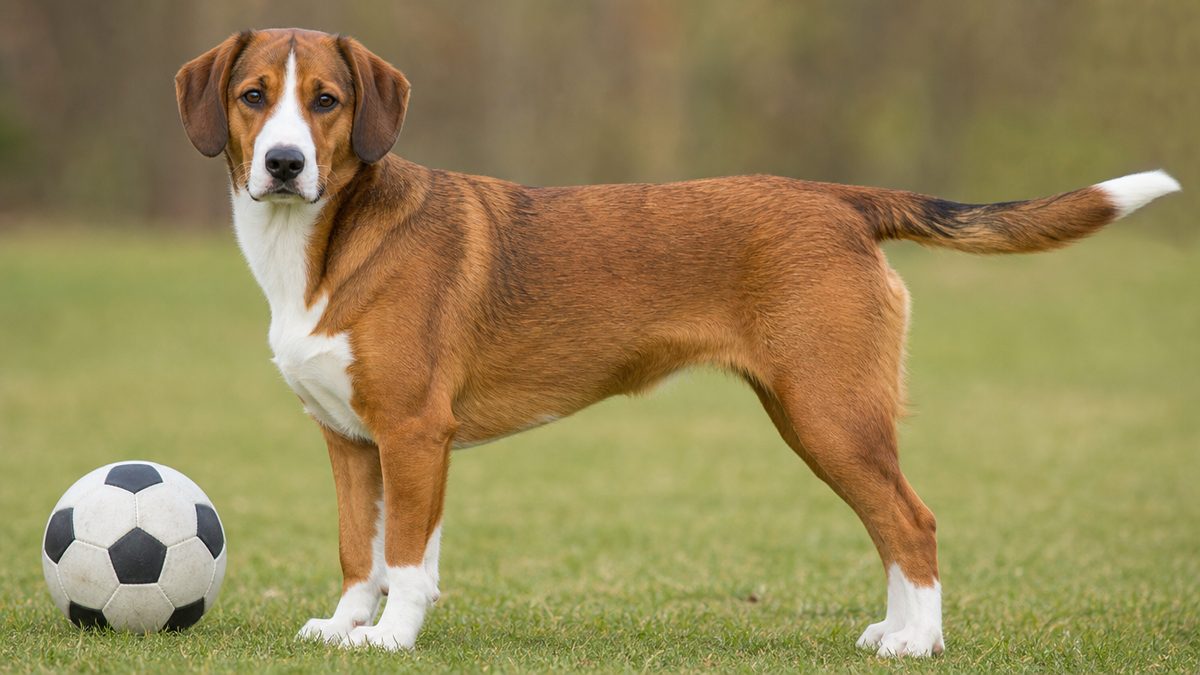
Quick answer
The Hygen Hound, or Hygenhund, is a medium-sized Norwegian hare hound recognised as FCI standard 266, standing 50 to 58 cm at the withers for males and 47 to 55 cm for females. Norsk Kennel Klub registered 14 puppies in 2025, down from 45 in 2023, and the breed has survived only through deliberate crossbreeding with the Dunker, the Finnish Hound and the Hamilton Hound. No Hygen Hound market exists in India.
This page is a research summary and is not veterinary advice. A case series describes the dogs in it, not a rate in the breed, and screening percentages describe populations rather than your dog. A puppy that limps or stiffens between five and eight months of age, a dog that pants without settling in Indian heat, and any change in the eyelids or eyes all need a registered veterinarian in person rather than a web page.
Hygen Hound at a glance
What the Hygen Hound is, and what its two standards actually say
The Hygen Hound is a Norwegian scent hound recognised by the FCI as standard 266 in Group 6, Section 1.2 Medium-sized Hounds, with a working trial attached to its entry. The FCI accepted it on a definitive basis on 6 October 1965, one day before the Halden Hound.
Two documents govern the breed and they are not identical, so this page names which one it is quoting. The international one is the FCI standard, English text dated 09.08.1999, translated by Norsk Kennel Klub, with English as the authentic language. The Norwegian one is the Rasebeskrivelse for Hygenhund issued under the Nordisk Kennel Union by Dansk Kennel Klub, Hundaræktarfélag Íslands, Norsk Kennel Klub and Svenska Kennelklubben, dated 25.03.2021 and printing an FCI date of 9.8.1999 on its cover.
The FCI register prints dates in month-day-year order, which is easy to misread. The proof sits inside these two documents rather than in any house style guide. The FCI's web page gives the standard's publication date as 8/9/1999; the standard PDF prints 09.08.1999 in European day-month order; and the Norwegian description prints the same date as 9.8.1999. All three are 9 August 1999, so on the FCI page the first field is the month. Applying that to the acceptance row, 10/6/1965 is 6 October 1965.
Size and weight, where one is specified and the other is not
Both texts agree on height and neither gives a weight. Males stand 50 to 58 cm at the withers with an ideal of 54 cm, and females 47 to 55 cm with an ideal of 51 cm Norsk Kennel Klub and Nordisk Kennel Union. The Norwegian heading literally reads STØRRELSE OG VEKT, size and weight, and then prints only height. So every weight figure you will read for this breed was supplied by a writer rather than by a breed standard.
| Source | Males, height | Females, height | Weight |
|---|---|---|---|
| FCI-Standard 266, 09.08.1999 | 50 to 58 cm, ideal 54 | 47 to 55 cm, ideal 51 | Not stated |
| Norsk Kennel Klub and NKU, 25.03.2021 | 50 to 58 cm, ideal 54 | 47 to 55 cm, ideal 51 | Not stated |
| Brit breed catalogue | 50 to 58 cm, ideal 54 | 47 to 55 cm, ideal 51 | Not stated |
| United Kennel Club, 2006 | Ideal 21 in only, that is 53.3 cm, no range | Ideal 20 in only, that is 50.8 cm, no range | Not stated |
| English Wikipedia | 48 to 61 cm, both sexes | 48 to 61 cm, both sexes | 20 to 25 kg |
| Animalia | 48 to 61 cm, and a second field reading 47 | 48 to 61 cm | 20 to 25 kg |
| Look4dog | 50 to 60 cm, both sexes | 50 to 60 cm, both sexes | 25 to 30 kg |
Three of the seven agree because they are reproducing the same document. Wikipedia's combined-sex range of 48 to 61 cm has a floor a centimetre below the female minimum and a ceiling three centimetres above the male maximum, and Animalia contradicts itself inside one page by printing both 48 to 61 and 47 Animalia.bio, Hygen Hound.
Appearance, in the words of the documents
The FCI calls the general appearance "Medium-sized, solid and compact, rectangular with strong topline", and the Norwegian text sharpens that to compact, short rectangular, and adds that the dog should not appear especially long in the body. The head is medium-sized, moderately broad and never heavy, wedge-shaped seen from both the front and the side but never pointed, and the stop is distinct. The muzzle is broad and deep, rather short than long, and rounded rather than square when seen from the side.
Colour comes in three families and the standard requires clear separation between them. Red-brown or yellow-red, often with black shading on head, back and tail set, with or without white markings. Black and tan, usually with white markings. Or white with red-brown or yellow-red patches and ticks, or with black and tan markings. The coat is straight, preferably somewhat rough to the touch, dense, shiny and not too short, with somewhat heavier hair permitted on the back of the thighs and the tail.
Telling the Hygen Hound from the Dunker and the Halden Hound
Tell the Hygen Hound from its two relatives on head shape first, colour second and eye colour third. The wedge-shaped head with a distinct stop belongs to this breed alone among Norway's three hare hounds.
The Nordic Kennel Union states the comparison directly, and it is the clearest sentence written on the subject anywhere: "The Hygen Hound has a lot in common with the Norwegian Hound, both with regard to breed origin and characteristics, however, some important exterior traits are different", and "Head and muzzle are somewhat shorter and broader than the Norwegian Hound's, and the head should be moderately wedge-shaped";. Norwegian Hound is the FCI's English name for the Dunker.
- Head first. The Hygen's head is wedge-shaped from front and side with a distinct stop. The Dunker's standard says explicitly that its head is not wedge-shaped, and the Halden Hound's stop is not abrupt.
- Body proportion second. The Hygen is short rectangular and must not look long in the body; the Dunker is distinctly rectangular and long by design. A long, rectangular body is a named fault in the Hygen's Norwegian description.
- Colour third. A red-brown or yellow-red base with white markings is the commonest Hygen. A predominantly white dog with black patches and tan on head and legs is a Halden Hound.
- Eyes fourth. The Hygen must not have glass eyes and its standard requires dark brown. The Dunker is the one Norwegian hare hound whose standard permits merle and the blue eye that goes with it.
- Ears fifth. Pulled forward, a Hygen's ear reaches hardly half way to the nose. A Halden Hound's reaches the middle of the muzzle, so the Hygen's ear is the shorter of the two.
Among the Hygen Hound's listed faults in the Norwegian description is "Tegninger med utpreget sadel (Finsk stover farger)", markings with a pronounced saddle, in Finnish Hound colours. A standard that writes a fault specifically to keep another breed's colouring out is telling you which dog it is being mixed with. That is not academic here: Norway registered 4,117 Finnish Hounds across the 2002 to 2023 birth years against 743 Hygenhunds, and the Finnish Hound has twice been crossed into this breed on purpose.
The trap that makes online identification worse
On the FCI's own site the trailing number in a URL decides which document you get, and the breed name in the slug is ignored entirely. The Hygen Hound is 266 and the Halden Hound is 267, a single digit apart, which is exactly the situation in which a mistyped URL returns a complete, correct, plausible standard for the wrong dog. This page therefore read both numbers off the register's own Group 6 breed list rather than assembling a URL, and confirmed the breed name printed inside each returned PDF before taking a figure from it.
The names multiply the same risk. The Nordic Kennel Union records Hygenhund, Chien courant de Hygen, Hygen Bracke, Sabueso Hygen, Hygenstövare and Hygeninajokoira as recognised equivalents. A search on any of them should return this dog. If it returns a predominantly white hound with black patches, it has returned the Halden Hound; if it returns a marbled blue-grey dog, it has returned the Dunker.
History: one lawyer, two breeds merged and separated, and seven deliberate outcrosses
The Hygen Hound was created by the attorney Hans Fredrik Hygen, who from 1830 lived at Ringerike and began breeding a red-yellow variant of the local hare hounds. The breed was recognised in 1902, merged into the Dunker by Norsk Kennel Klub from 1925 to 1934, then separated again.
Norway's own account is the fullest published anywhere and no English page reproduces it in detail. Hygen lived at Ringerike from 1830 onward and began breeding local hare hounds; in 1839 he moved to Romerike and brought that district's dogs into the programme. His sons carried the work on, especially A. B. Hygen, who helped found the Specialklub for Norske Harehunde in 1902 and was central in drafting the new breed standard published the same year. That same year, 1902, the Hygenhund and the Dunker were defined as two separate breeds.
The merger nobody in the English-language sources mentions
The years before and after the First World War were hard for both breeds. "I årene 1925-1934 ble rasene slått sammen av Norsk Kennelklubb (NKK), selv om Norsk Harehundklub var sterkt imot denne sammenslåingen": in the years 1925 to 1934 the breeds were merged by Norsk Kennel Klub, even though the Norwegian hare hound club was strongly against it. After breeding recovered between the wars the two were separated again, and by the end of the Second World War the breed was in good shape, though some lines were troubled with aggressive dogs.
| Date | Event |
|---|---|
| From 1830 | Hans Fredrik Hygen breeds a red-yellow variant of the local hounds at Ringerike |
| 1839 | Hygen moves to Romerike and brings that district's dogs into the programme |
| 1902 | A. B. Hygen co-founds the Specialklub for Norske Harehunde; the breed is recognised and the Hygenhund and Dunker are defined as separate breeds |
| 1925 to 1934 | Norsk Kennel Klub merges the two breeds into one, against the hare hound club's objection |
| Mid 1930s | The breeds are separated again as Hygenhund numbers rise |
| 1945 | The breed comes out of the war in good shape, though some lines carry aggression |
| 1970s | An infusion of Dunker blood, plus a search for additional breeding males |
| 1993 to 1996 | Four further Dunker crossings |
| 2000 and 2002 | Two litters permitted with the Finnish Hound |
| 2006 | One litter permitted with the Hamilton Hound |
| 6 October 1965 | The FCI accepts the breed on a definitive basis as standard 266 |
| 9 August 1999 | The current FCI standard is published, English being the authentic language |
| 25 March 2021 | Norsk Kennel Klub and the Nordic Kennel Union issue the current Norwegian description |
Seven outcrosses, and why they are the most important fact about this breed
Count them: one Dunker infusion in the 1970s, four more between 1993 and 1996, two Finnish Hound litters in 2000 and 2002, and one Hamilton Hound litter in 2006 Svenska Kennelklubben for the Nordic Kennel…. NIBIO says plainly that this is how the breeding base was widened, and the Nordic Kennel Union agrees that "These measures have helped to enlarge the breeding basis of the Hygen Hound". The Norwegian description's own disqualifying faults include "Utypiskhet, gjelder også innkrysingshunder", atypicality, applying also to crossed-in dogs, which is a clause that only makes sense in a breed that is still actively absorbing outside blood.
That history is why the purity framing on the ranking pages is not merely inaccurate, it is backwards. The Norwegian standard's own short history concludes that the breed today presents with good genetic variation, good health and good temperament, and is right at the top in hunting terms. Whatever genetic variation the breed has was deliberately put there, and the paperwork saying so is public.
Registration numbers, conservation status and three published figures that disagree
Norsk Kennel Klub registered 14 Hygen Hound puppies in 2025, 16 in 2024 and 45 in 2023. Those are the real numbers, read from NKK's own spreadsheet, and they contradict every published description of them, including NKK's own breed page.
No page ranking for this breed publishes a registration numbers table. What they publish is the word uncommon. Below are the counts, read directly from the per-breed spreadsheet NKK links from its statistics page, cross-checked against a second NKK workbook that agrees with it cell for cell on every year both cover Norsk Kennel Klub, Statistikk.
| Year | Hygen Hound | Halden Hound | Dunker |
|---|---|---|---|
| 2010 | 37 | 20 | 124 |
| 2015 | 23 | 14 | 174 |
| 2018 | 32 | 4 | 152 |
| 2019 | 43 | 33 | 139 |
| 2020 | 42 | 38 | 112 |
| 2022 | 29 | 28 | 141 |
| 2023 | 45 | 15 | 92 |
| 2024 | 16 | 7 | 87 |
| 2025 | 14 | 14 | 67 |
Three published bands, none of which fits the last two years
Norway's genetic resource centre says recent years have run at 27 to 44 puppies a year. The Nordic Kennel Union repeats 27 to 44 in English. Norsk Kennel Klub's own consumer breed page, last modified on 23 August 2026, says between 30 and 40. NKK's own spreadsheet records 16 in 2024 and 14 in 2025, which is less than half the bottom of every one of those bands. The most recent published description of this breed's numbers is wrong by a factor of more than two, and the organisation publishing it also publishes the data that disproves it.
Norsk Kennel Klub estimates that about 585,000 dogs live in Norway, that 18 percent of Norwegian households have one, and that it registers 50 to 60 percent of them, roughly 25,000 to 30,000 puppies a year. Fourteen Hygen Hounds is about five hundredths of one percent of a year's registrations. In the same file the Golden Retriever appears 1,274 times. NKK also warns that its figures count the date of registration rather than the date of birth, so a litter born late in one year lands in the next year's count, which is one reason a single year should never be read alone.
Conservation status, and the gene bank behind it
Norway's genetic resource centre at NIBIO treats the country's dogs as livestock genetic resources. It counts seven national breeds, four spitz types and three hare hounds, the hare hounds being the Dunker, the Haldenstøver and the Hygenhund, and states that every Norwegian breed except the grey Norwegian Elkhound is so few in number that it counts as threatened. That is a national register calling this breed endangered.
The practical measure is a semen bank covering all seven Norwegian breeds, built jointly by the individual breed clubs, Norsk Kennel Klub and the genetic resource centre, aiming to hold frozen semen from ten dogs of each breed, stored preferably for ten years and released in an acute crisis or where old genetic material is needed. NIBIO also names the breed club: Norske Harehundklubbers Forbund, the federation of Norwegian hare hound clubs, which is the body NKK's breed page links as well Norsk Kennel Klub.
Where India stands in the same registers
India is a member of the FCI, listed in the federation's own members and contract partners register. Because the Kennel Club of India issues pedigrees against FCI nomenclature, a definitively recognised FCI breed is in principle registrable in India, and this breed is definitively recognised as standard 266. The obstacle is not recognition. It is that no Hygen Hound appears to exist in India for anyone to register, which is a different problem with a different answer.
One more registry fact belongs here because English pages get it wrong. The United Kennel Club recognised the breed in 2006 and publishes its own standard. That is a second, independent recognition and it is worth knowing, but a UKC standard is not an FCI standard: the UKC prints only ideal heights and no range, so a reader working from it alone cannot judge whether a dog is over or under size.
Hygen Hound price in India: there is none, and here is the proof with a control
No Hygen Hound price exists in India because no Indian seller offers the breed. The single Indian page carrying its name prints Contact for pricing, files it under the wrong breed group and records its country of origin as FCI.
State the negative properly, with a control that worked in the same session. India-located searches for this breed's name plus price were run on 31 August 2026 in both spellings. They returned a United Kingdom breed page, an Irish blog, an Afghan Hound seller, a Mudhol Hound price article, two Wikipedia and Animalia entries and a Norwegian-breed video, and not one Indian seller of the breed. The control query, labrador retriever price in india, was run on the same tool immediately before and after and returned genuine Indian commerce both times. The instrument worked, so the absence is real.
The one Indian page, read closely
One Indian domain does carry the breed name, and reading it is more useful than any price would be. It files the Hygenhund under Non-Sporting Dogs, which is wrong for an FCI Group 6 scent hound and wrong on that site's own terms, because it maintains a separate hound category containing the Ibizan Hound, the Harrier, the Afghan Hound and the Beagle. It records the origin as "FCI" rather than Norway. Its price field reads "Contact for pricing". Its body copy is a placeholder: "Hygenhund is an FCI-recognized dog breed. A detailed profile for temperament, care, and suitability will be expanded in upcoming updates."
That placeholder sentence appears word for word on the same site's Aidi, Alpine Dachsbracke and American Akita pages, which is one page generated per FCI breed name. Its generic ranges are lifespan 10 to 14 years, height 15 to 24 inches and weight 20 to 60 lb, none of which is this breed's. It carries a string-concatenation bug reading "Homes that can provideprovide regular daily exercise". And its social title is the site-wide default rather than the breed. A page like this is evidence about the site, not about the dog.
The supply-side control, which is what makes the absence mean something
An absence only counts if the sellers would have listed the breed had they had it. They would. One Indian puppy retailer's own index carries the Azawakh, the Barbet, the Basset Fauve de Bretagne, the Bergamasco, the Cirneco dell'Etna, the Glen of Imaal Terrier, the Komondor, the Pharaoh Hound and the Plott Hound, and markets several on rarity. It has no page for either Norwegian hare hound. India's largest breed-by-city puppy generator runs live pages for the Afghan Hound, the Basset Hound, the Mudhol Hound and the Rampur Hound down to small towns, and none for this breed. The same Indian site that stubbed the Hygenhund does carry another rare Norwegian breed, the Norwegian Lundehund.
A search snippet advertises a rupee band for this breed on an Indian listing site. The page itself returns HTTP 403 behind a human-verification wall on both a normal and a stealth retrieval, so nobody here has seen the page body, and a snippet is not a page. That figure is therefore unverified and this page does not reproduce it. A price you cannot open is not a price you can publish, and the failure mode this protects against is a number that circulates for years because one page quoted a snippet.
Why no supply chain can form
Two facts close the route. DGFT Trade Notice 22/2022-23 places live dogs under ITC(HS) 01061900 as Restricted, permits entry only for a pet dog with a valid pet book in the importer's name, for research with CPCSEA recommendation or for internal security, and states that applications for trading or breeding purposes shall be duly rejected. And Norway registered 14 puppies in 2025 under conservation management. There is no lawful commercial way to import the breed, and nothing to import if there were.
Monthly cost of ownership in India for a hound this size
A hound of this size costs roughly ₹4,000 to ₹8,000 a month in India in food, parasite control and routine veterinary care. This section shows the arithmetic rather than asserting a total, and every rupee figure was read off a live Indian page on 31 August 2026.
The cost of ownership question is worth answering even for a breed nobody in India can buy, because the arithmetic is what a reader needs when comparing any medium hound. One input could not be sourced and is marked as a gap rather than filled.
Food, priced per kilogram from Indian retail
| Pack | Price as printed | MRP as printed | ₹ per kg |
|---|---|---|---|
| 20 kg | ₹3300 | ₹3900 | 165.00 |
| 15 kg | ₹2584 | ₹3400 | 172.27 |
| 10 kg | ₹2016 | ₹2390 | 201.60 |
| 5.5 kg | ₹1251 | ₹1390 | 227.45 |
| 2.8 kg | ₹603 | ₹655 | 215.36 |
| 1 kg | ₹229 | ₹249 | 229.00 |
The 20 kg pack costs 28 percent less per kilogram than the 1 kg pack and 18 percent less than the 10 kg. That one decision moves the monthly food bill more than any brand choice.
Neither the Indian retailer nor the brand publishes a grams-per-day feeding chart in text; the chart exists only inside product photographs. This page therefore prints a cost per kilogram and refuses to print a monthly food total, because doing so would require inventing the ration. Multiply the per-kilogram figure by a daily ration your own veterinarian sets against the dog's body condition, which matters more here than usual because no breed standard gives this dog a target weight.
Parasite control, the one Indian cost that is not optional
For a dog in the 20 to 40 kg band there is a clean published price. One Bravecto 1000 mg fluralaner tablet covering 20 to 40 kg costs ₹1805 against an MRP of ₹2063, and the page states that it requires a prescription. That page prints no dosing interval, so this page prints none either. A strip of six Drontal Plus Tasty deworming tablets costs ₹813, with the dose given as one tablet per 10 kg of body weight, so a 25 kg hound takes three tablets a treatment, about ₹407 a dose.
The exposure behind that cost is measured. A 2025 ICMR study examined 2,877 domestic animals across 28 villages at the forest fringes of the Western Ghats in five states and found tick prevalence in dogs of 42.60 percent, 95 percent confidence interval 30.33 to 55.84, from 23 infested dogs out of 54 examined. Quote that only with its interval and its denominator, because a 25-point interval on 54 dogs is wide.
Veterinary care, where public and private prices differ by more than twenty times
| Item | Government, Chandigarh | Private, Vetic Delhi |
|---|---|---|
| Out-door ticket for pet animals | ₹30 | No rupee figure published |
| Anti-rabies vaccination | ₹30 | Starts at ₹699 |
| Puppy DP | Not listed | Starts at ₹849 |
| Nine-in-one DHPPiL | Not listed | Starts at ₹899 |
| Canine corona | Not listed | Starts at ₹899 |
| Kennel cough | Not listed | Starts at ₹1,349 |
| Adult annual vaccination plan | Not listed | Starts at ₹3,199 |
| Stool test | ₹10 | Not listed |
| Minor operation | ₹50 | Not listed |
| Major operation | ₹100 | Not listed |
The government anti-rabies fee of ₹30 and the private from-₹699 price are both real and both current, and the gap is the single most useful cost fact on this page for an Indian owner. Two cautions on the government schedule: it has no sterilisation row, the nearest item being a castration fee of ₹20, and its X-ray fee of ₹30 per film carries the printed note that the radiology wing is not functioning, which matters for a breed whose only useful screening test is a radiograph.
Grooming and boarding
A full grooming session in Delhi runs ₹1,500 to ₹2,500 for a large breed and ₹1,200 to ₹2,000 for a medium one, with a complete bath and haircut package starting at ₹1,869. Boarding in Bengaluru is published by size band at ₹750 per 24 hours for a large dog, ₹650 for a medium one and ₹550 for a dog under 5 kg. A Hygen Hound sits in the medium band, so budget ₹650 a night.
Heat tolerance in India, measured against Ringerike
The Hygen Hound was formed at Ringerike, where the annual mean wet-bulb temperature is 2.89 degrees C and January runs to minus 6.74. Chennai's annual mean wet-bulb is 24.94, and its coolest month is more than nine degrees hotter than the hottest month in the breed's homeland.
Air temperature misleads in India because a dog cools by evaporating water from its airways, and evaporation stalls as humidity rises. Wet-bulb temperature folds heat and humidity into one number, which is why this page uses it. All figures come from NASA POWER's twenty-year climatology for January 2001 to December 2020, queried by explicit latitude and longitude so that no place name can be substituted for another.
| Place | Annual mean wet-bulb | Warmest month | Coolest month | Annual mean air temp |
|---|---|---|---|---|
| Honefoss, Ringerike | 2.89 | 13.66 in July | -6.74 in January | 3.95 |
| Pune | 19.66 | 23.56 in June | 14.28 in January | 23.86 |
| Bengaluru | 19.80 | 22.66 in May | 16.43 in January | 23.74 |
| Delhi | 18.03 | 27.74 in July | 6.86 in January | 25.60 |
| Guwahati | 20.54 | 26.18 in July | 12.27 in January | 22.94 |
| Mumbai | 22.73 | 26.55 in June | 17.06 in January | 26.77 |
| Kolkata | 22.85 | 27.86 in June | 13.64 in January | 25.81 |
| Chennai | 24.94 | 27.36 in May | 21.77 in January | 27.95 |
Three comparisons carry the argument. Chennai in May reaches 27.36 degrees wet-bulb against Ringerike's July peak of 13.66, a gap of 13.7 degrees. Chennai's coolest month, January at 21.77, is 8.1 degrees hotter on wet-bulb than the hottest month the breed's ancestors ever met. On annual mean, Chennai sits 22.1 degrees above the homeland, and even Pune, the mildest large city here, runs 16.8 degrees above it.
NASA POWER returns a grid cell rather than a point, and the cell has its own elevation. For Honefoss the model reports the cell at 362.1 metres against a town at 96 metres, an overstatement of 266 metres. At roughly 6.5 degrees C per 1,000 metres that is about 1.7 degrees C, so the homeland figures above are if anything about 1.7 degrees too cold and the true gap to Chennai is correspondingly smaller. Bonbeno publishes the divergence rather than quietly correcting it, because a corrected number nobody can check is worse than a raw one everybody can. Even at 4.6 degrees rather than 2.89, the homeland is 20 degrees below Chennai.
The coat is what turns that gap into a welfare problem. Both standards call for a straight, somewhat harsh, dense and glossy coat that is expressly not too short, and the Norwegian description lists a thin, short coat as a fault. That is insulation selected for a Norwegian winter, and a breed standard that penalises thinness is a standard nobody wrote with Chennai in mind. This is a heat-sensitive breed by construction rather than by reputation.
One note on the reference point. Honefoss is the town at the centre of Ringerike, where Hygen began the breeding programme in 1830, and its published elevation is 96 metres. That is the figure the grid-cell comparison above is measured against, and it is why the divergence can be stated as a number rather than as a suspicion.
Hill stations, satellite error and what the heat-illness evidence can prove
Two things decide whether a northern hound can live anywhere in India, and both are commonly got wrong. One is whether a hill town is genuinely cooler than the satellite says. The other is what the best heat-illness study can honestly prove about a breed it never included.
The hill stations are not the answer they look like
Indian pages routinely send a cold-climate breed to a hill station, and the satellite data has to be checked before you agree. NASA POWER's grid cell for Manali sits at 3,984.7 metres against a town at 2,050 metres, so the model is standing 1,935 metres too high and its figures are far too cold; that is the largest divergence Bonbeno has measured anywhere. Its cell for Leh sits at 4,532.6 metres against a town at 3,500, 1,033 metres too high. Its cell for Darjeeling sits at 1,313.5 metres against a town at 2,045, 731 metres too low and therefore too warm.
| Town | Cell elevation reported | Town elevation published | Error |
|---|---|---|---|
| Manali | 3,985 m | 2,050 m | 1,935 m too high |
| Leh | 4,533 m | 3,500 m | 1,033 m too high |
| Darjeeling | 1,314 m | 2,045 m | 731 m too low |
| Honefoss, Ringerike | 362 m | 96 m | 266 m too high |
Bonbeno publishes the divergence rather than the cell. A hill town between 2,000 and 3,500 metres is genuinely cooler than the plains, and Manali, Darjeeling and Leh all sit in that band, so a dense northern coat is less punishing there than in Chennai. What this page will not do is print a wet-bulb figure for those towns as though it described the town, because on our own measurement the model is standing between 731 and 1,935 metres away from them vertically. If you need a number for a hill station, take it from a weather station at the town's own altitude.
What the best heat-illness dataset can and cannot say here
The strongest evidence on canine heat illness comes from a UK VetCompass study of 905,543 dogs under primary veterinary care in 2016, which identified 1,259 heat-related illness events from 1,222 dogs. Of those, 380 had no trigger recorded, leaving 879 with a recorded trigger, and among those 879 exertional heat illness accounted for 652 events, or 74.2 percent, environmental for 113, or 12.9 percent, and vehicular confinement for 46, or 5.2 percent. The 74.2 percent is 652 of 879, not of 1,259, which would be 934 and appears nowhere in the paper.
Now the limit. The Hygen Hound appears nowhere in that study, so the breed was not modelled and no breed-specific odds ratio exists for it. The companion paper from the same cohort reports that dogs at or above their breed and sex mean bodyweight had 1.42 times the odds of heat-related illness, confidence interval 1.12 to 1.80. That is a transferable bodyweight finding rather than a breed finding, and this page treats it as one. Keeping the dog lean is the one control an Indian owner has that costs nothing.
Temperament and household fit, and the trait that decides it
Every Norwegian source describes the Hygen Hound as a capable hare hound with a friendly temperament, easy to teach, quick to start hunting and usually calm in the house. The trait that decides whether it fits an Indian household is none of those. It is the voice.
Take the description from the sources. NIBIO calls the breed "en dyktig harehund med et vennlig gemytt", a capable hare hound with a friendly disposition, easy to train, starting to chase early and with strong hunting desire, and usually calm and pleasant to have in the house. The Nordic Kennel Union renders that as eager to learn, hunting from an early age, suitable as a family dog because it is usually calm around people and easy to train. Royal Canin's own key facts add that training should start early.
The voice is the breed's selling point, and the reason it fails in a flat
Norsk Kennel Klub's breed page leads on it: the Hygenhund "er kjent for sin karakteristiske klang i røsten", is known for the characteristic ring of its voice, "og hunden bruker røsten på ulike måter for å signalisere til jegeren hvor langt unna den er sitt bytte", and uses that voice in different ways to signal to the hunter how far it is from its quarry. The Norwegian standard's history calls the breed well known for its bright, characteristic call. Volume and carrying power have been selected for deliberately, for over a century.
A vocal trait fixed by a century of selection is not a training problem. It is the breed. Indian law closes the shortcut some owners reach for: Second Schedule Part II paragraph 6(8) of the 2017 Rules lists de-barking alongside tail docking and ear cropping among procedures that are strictly forbidden, and the breed's own Norwegian standard prints the equivalent Norwegian prohibition on its face. If a carrying bay several times a day would end your tenancy, this is not your breed, and no legal intervention changes that.
What the temperament does not mean
- Friendly is not the same as recall-proof. This is a driving hare hound that works at distance on a scent, and sociability towards people has no bearing on whether it returns when it is 400 metres away on a line.
- Calm indoors is not low-energy. Norsk Kennel Klub rates this breed's activity level Middels, medium, which is one step below the High it gives the Halden Hound but is still a working hound's rating.
- One Norwegian source records a caveat. The Nordic Kennel Union says that after the Second World War the dogs had good hunting abilities "although some breeding lines were troubled with aggressive dogs". That is historical rather than current, and no source claims it of the breed today, but it is in the official record and this page reports it rather than tidying it away.
- Good with children is a description, not a study. No behavioural research on this breed has been published, and the sources above are register and club text rather than measurement.
Who it suits: a household with daily access to open ground, tolerance for noise and a climate that does not punish a dense coat. Who it does not: a first-time owner in a Mumbai or Chennai flat. If the friendliness is the attraction, the Beagle is a smaller scent hound of the same working type, and the Indian Pariah Dog offers the same open nature in a body that suits the climate.
Training a scent hound, and the one thing this breed resists
To train a Hygen Hound, build the recall before anything else and accept that a nose on a line outranks a voice. Every source calls the breed easy to teach, and every one of them means obedience rather than recall off a scent.
Start with what the sources claim. NIBIO says the breed is easy to teach and starts to chase early, and the Nordic Kennel Union calls it eager to learn with a strong hunting desire Svenska Kennelklubben for the Nordic Kennel…. Neither is describing the moment the dog picks up a hare line. That distinction is the training problem, and it is structural: the Norwegian description defines the breed's use as a driving hare hound and adds that it is also a very good predator dog, which means working at distance and out of contact.
The order to work in
- Socialise on a schedule through the first four months, because Indian streets present traffic, cattle, free-ranging dogs and crowds a Norwegian forest does not.
- Train the recall on a long line for months before testing it loose, and pay it every time regardless of how long the dog took to come back.
- Screen the environment before unclipping, since a hound 400 metres away on a scent cannot hear you and is not being disobedient.
- Feed the recall from the highest-value food you have rather than from praise, because you are competing with a hardwired drive.
- Exercise the nose deliberately with scent games so the drive has an outlet indoors and in a small garden.
- Test progress one distraction at a time rather than jumping from a corridor to open ground.
In Norway this breed carries a working trial as part of its FCI classification, and the whole club culture is built around field trials rather than obedience competition. An Indian owner has access to none of that, so the equivalent has to be built at home: tracking games, scent discrimination, search work, done daily. The drive is going somewhere whether you direct it or not, and in a breed selected to announce its position by voice, an undirected drive announces itself.
Two Indian realities that change the plan
The first is heat. A scent-work session that is routine at 14 degrees is dangerous at a 24 degree wet-bulb, so training moves to first light and after dark, and water is offered rather than rationed. The second is legal. Second Schedule Part IV paragraph 21(1) of the 2017 Rules bars keeping in outdoor facilities, without the attending veterinary practitioner's written approval, dogs not accustomed to local temperatures and breeds that cannot tolerate them, giving long-haired breeds in high temperature locations as its example. A dense-coated Norwegian hound in an Indian yard is the case that clause describes.
One further point of law belongs in a training section because it governs what may be done to the dog. Paragraph 6(8) forbids tail docking, ear cropping, de-barking, de-clawing, branding, dyeing and any other mutilation, and states that any change of appearance by artificial means is strictly forbidden. The breed's own Norwegian description carries the matching Norwegian rule in its NB note: according to Norwegian law, cropping of ears and tail and removal of dewclaws is forbidden. On this the two countries agree, and a breed standard printing the prohibition on its own face is unusual enough to be worth knowing.
Daily exercise, and the job India cannot supply
A Hygen Hound needs about two hours a day of real work, and in India it needs that work before sunrise and after dark. Norsk Kennel Klub rates the breed's activity level Medium, which is a step below the Halden Hound's High but is still a working hound's requirement.
Understand what the exercise replaces. The Norwegian description defines the breed's use as a driving hare hound and a very good predator dog, and NIBIO records that it starts to chase early and has strong hunting desire Norsk genressurssenter at NIBIO. A hare hunt is hours of continuous scent work over rough ground in cold air. A twenty-minute lead walk on a Bengaluru pavement replaces none of it, and the deficit shows up as noise and destructiveness rather than as visible restlessness.
A workable Indian week
- Two sessions daily, 45 to 60 minutes each, the first finishing before the sun is properly up and the second starting after it has gone.
- Scent work three times a week, hiding food or a scented article, because the nose tires the dog faster than the legs.
- One long outing a week on open ground with a long line, with cover and varied terrain rather than a lawn.
- Rest through the middle of the day indoors on a cool floor, with water constantly available rather than rationed.
- Nothing at all above about 22 degrees wet-bulb, which on the climate table means most of the day in most Indian cities for most of the year.
In the UK VetCompass study of 905,543 dogs, exertional heat illness accounted for 652 of the 879 events with a recorded trigger, 74.2 percent, far ahead of environmental at 113 and vehicular confinement at 46. Those dogs were not left in cars. They were exercised. A hound that has picked up a line will work past the point where it should stop, because that is what it was bred to do, and it will do it out of sight. High drive plus high wet-bulb plus a weak recall is exactly the combination that study describes.
What under-exercise looks like in this breed specifically is voice. A hound selected to signal its distance from the quarry by the sound it makes has a ready outlet for frustration, and an under-worked one uses it. That is the same trait the temperament section calls the breed's defining feature, and it is why exercise here is not optional maintenance but the thing that keeps a household intact.
Grooming and coat care in Indian humidity
Norsk Kennel Klub's coat-care advice for the Hygen Hound is two words long, Minimalt med Pelsstell, minimal grooming. That advice was written for Norway. In India the brushing is still minimal and the drying is not.
Take the coat from the documents first. The FCI standard calls the hair straight and preferably somewhat rough to the touch, dense, shiny and not too short, with somewhat heavier hair permitted on the back of the thighs and on the tail but not too much. The Norwegian description repeats it and adds a thin, short coat to its list of faults. The Nordic Kennel Union summarises it as dense and smooth. Note the direction of the standard: it penalises a coat for being too thin, never for being too thick.
The United Kennel Club version is worth flagging because it contradicts itself inside one document. Its General Appearance calls the breed "A medium sized, short coated hound", while its own Coat section, three screens further down, says the coat is "Straight, dense, shiny and somewhat rough to the touch, not too short". A reader who stops at the summary will believe this is a short-coated dog. It is not, and the difference matters most in exactly the climate where people most want it to be true.
The monsoon rule that overseas advice leaves out
- Groom with a slicker or rubber curry twice a week in the dry months and every second day through shedding, working down to the skin rather than skating over the top.
- Dry to the skin after every bath and every soaking, with a towel and then moving air, and check with your fingers rather than trusting the surface.
- Screen the ears weekly, because these are hanging ears of medium length and the canal underneath stays warm and damp.
- Check between the toes, since the standard specifies good hair growth between the toes and pads, which traps water and grit.
- Compare the dog's skin against its own weekly baseline rather than against a photograph, so a hot spot is caught while it is small.
The standard's own wording is the risk. Ears thin and soft, hanging not close to the cheeks but somewhat away from them, is better ventilated than a flat drop ear, which is a genuine small advantage this breed has over its Halden relative. It is still a hanging ear over a warm canal in a humid country. Plug the ears before a bath, dry them afterwards, and treat a head shake or a smell as a reason to see a veterinarian rather than to buy a cleaner off a shelf.
On cost, a full grooming session in Delhi runs ₹1,500 to ₹2,500 for a large breed and ₹1,200 to ₹2,000 for a medium one. For a short-coated hound most of a grooming package is unnecessary, because there is no haircut to give. The part worth paying for is a proper forced-air dry after a monsoon soaking, which an owner with a towel cannot reproduce and which is the difference between a dry undercoat and a week of damp skin.
Health: the best hips of Norway's three hare hounds, and one finding nobody quotes
The Hygen Hound has the best hip record of Norway's three hare hounds, at 15.1 percent showing any degree of dysplasia across 139 radiographs. It also supplies 11 of the 19 dogs in the only published case series of multiple epiphyseal dysplasia in dogs, and no English page mentions it.
Start with what is missing. The Orthopedic Foundation for Animals holds no published row for this breed: the string Hygen appears zero times across its full disease-statistics dump of roughly 5,400 rows. That is a proved absence rather than a failed search, because controls run against the same dump in the same session returned 109 mentions of the Labrador, 61 of the Beagle, 47 of the Elkhound and 39 of the Buhund. So Norwegian data has to do the work.
Hips, computed from Norsk Kennel Klub's own data sheet
NKK publishes a spreadsheet of registrations for every breed since 2001 whose underlying sheet carries, per birth year, the number of dogs radiographed and the grade each received. Aggregating the 2002 to 2015 birth cohorts, which are old enough to have been screened, gives the following. Every year's four grades sum exactly to that year's radiograph count, which is the arithmetic check confirming the columns were read correctly.
| Measure | Dogs | Share of those radiographed |
|---|---|---|
| Puppies registered in those cohorts | 459 | - |
| Hip-radiographed | 139 | 30.3 percent of those registered |
| Graded free | 118 | 84.9 percent |
| Graded mild | 15 | 10.8 percent |
| Graded moderate | 6 | 4.3 percent |
| Graded severe | 0 | 0.0 percent |
| Any degree of hip dysplasia | 21 | 15.1 percent |
Put that beside its relatives on the same sheet, the same window and the same method. The Halden Hound comes in at 18.0 percent of 100 radiographs, the Dunker at 29.7 percent of 784, the Finnish Hound at 15.8 percent of 795, the grey Norwegian Elkhound at 16.4 percent of 4,494 and the Beagle at 24.3 percent of 605. So this breed has the lowest rate of the three Norwegian hare hounds and roughly half the Dunker's, which is notable given that the Dunker has been crossed into it five times.
Only 30.3 percent of registered dogs were radiographed, and owners who screen are not a random sample. Norwegian and American grading schemes differ, so 15.1 percent is not comparable with an OFA percentage. And the cut-off at 2015 is deliberate: on the same sheet this breed's 2016 to 2023 cohorts show just 8 radiographs from 284 registrations, 2.8 percent, which cannot support any percentage at all. The control that proves the point is the Beagle, whose recent window reads 64.4 percent dysplastic on 45 radiographs against 24.3 percent on 605 earlier. A common breed's hips did not collapse; its screening volume did.
Elbows, where there is almost nothing to report
The same sheet carries elbow columns and the result is stark. Across all twenty-two birth cohorts from 2002 to 2023, covering 743 registered Hygen Hounds, exactly 9 dogs were elbow-radiographed. Eight were recorded free and one was recorded in the most severe grade. That is 1.2 percent of the breed ever screened. The honest reading is not that the breed has no elbow problem, and it is certainly not that one dog in nine has a severe one. It is that nobody has looked, and nine dogs cannot answer the question in either direction.
Life expectancy, which nobody has measured
No life expectancy study of the Hygen Hound exists, and the figure in circulation has no denominator behind it. Royal Canin prints "Avg life expectancy: 10-12 years" on both its Indian and its Maltese breed pages, and Animalia, Zoomalia and the tenth-ranked result all give 10 to 12 as well, none of them citing a source Royal Canin Malta Animalia.bio, Hygen Hound. Norsk Kennel Klub settles what is actually knowable: no collected statistics are kept in Norway on how many dogs are alive at any time or when dogs die, so the available figures describe new registrations rather than the total population or actual longevity. It points instead to a general Norwegian figure of around 12 years for dogs of all breeds, which is a national average and not a Hygen Hound number.
The same gap applies to the sibling breeds, and it is worth saying so rather than implying this breed is unusually undocumented. Neither the Norwegian description of the Haldenstover nor Norsk Kennel Klub's own breed page for it gives a lifespan either, and the Nordic Kennel Union's English page for that breed is silent on the question as well Norsk Kennel Klub Svenska Kennelklubben for the Nordic Kennel…. Norway publishes registration counts and hip grades for its national breeds, and it publishes nothing at all about how long they live. Any page that prints a lifespan for one of these three dogs is repeating an aggregator, not a measurement.
The condition that names this breed, and what it does and does not mean
One peer-reviewed paper names the Hygen Hound, and it is the only one. Rorvik and colleagues described 19 dogs with multiple epiphyseal dysplasia from 10 litters seen in Norway between 1991 and 2005, and reported that 11 of them were Hygenhunds.
The finding, quoted exactly: "There were 11 Hygenhund, 6 Dunker, 1 Golden Retriever, and 1 English Pointer";. The paper is a retrospective case series published in the Journal of the American Veterinary Medical Association, with diagnosis made on radiographs of the shoulder region and vertebral column, and ten of the nineteen dogs going to necropsy. The condition is a deficiency in ossification of the epiphyses of the long bones and vertebrae, the cuboidal bones and the apophyses, with the metaphyses and diaphyses typically normal.
Eleven of nineteen tells you the breed composition of the dogs referred to one Norwegian institution with this condition over fourteen years. It does not tell you what fraction of Hygen Hounds are affected, and nobody has published that figure. Bonbeno will not divide 11 by any denominator to manufacture one. What the series does establish is that two of Norway's three hare hounds accounted for 17 of the 19 cases, 89.5 percent, that the Halden Hound was not among them, and that a condition this concentrated in two closely related breeds is very unlikely to be coincidence.
What it means for a buyer, in practical terms
- Watch the age window. Most dogs in the series were examined because of lameness that developed at 5 to 8 months of age, and radiographic abnormalities were evident in dogs examined as young as 8 weeks.
- Ask about littermates. Disease severity was consistent among littermates but varied between litters, so a breeder who has seen it in one litter has seen it in most of that litter.
- Understand the inheritance. The authors concluded the condition most likely has an autosomal recessive mode of inheritance, while stating plainly that genetic studies of the mode of inheritance could not be performed.
- Do not expect a test. No commercial genetic test for this condition in this breed is published, and none of the sources here claims one exists.
- Take a limp seriously. In a five to eight month old puppy of this breed, lameness or stiffness after rest is a veterinary appointment, not a wait-and-see.
What Indian law requires of a breeding dog
Second Schedule Part III paragraph 8(10) of the 2017 Rules requires that dogs "shall have been tested for genetic defects, including hip dysplasia, progressive retinal atrophy, night blindness, hypothyroidism, entropion, ectropion, overshot, undershot jaw (when incisors do not touch or mesh), wry mouth, two or more missing teeth, unilateral cryptorchid or full cryptorchid males". The word is including, so the list is illustrative rather than closed, and multiple epiphyseal dysplasia is not excluded merely by being unlisted.
Two items on that list land squarely on this breed's own standard. The Norwegian description requires a complete set of teeth and lists untidy tooth placement and a level bite as faults, which meets the two-or-more-missing-teeth item, and it disqualifies an overshot or undershot bite outright, which is stricter than Indian law asks. It also specifies tight-fitting eyelid rims, which is the trait that guards against the entropion and ectropion the same clause names. On these points the breed standard and Indian law point the same way, which is not always the case.
Two absences are worth stating because people assume otherwise. Across all fourteen pages of the 2017 Rules the words patella and luxation appear zero times, and so do BAER and deaf. There is no Indian patella-testing requirement and no Indian hearing-test requirement for any breed.
Feeding in India, and the ration nobody publishes
Feed a Hygen Hound to body condition rather than to a chart, because no breed standard gives this dog a weight and no Indian retailer publishes a machine-readable feeding table. What can be priced exactly is the food, at ₹165 to ₹229 per kilogram depending on pack size.
Start with the honest gap. Neither the FCI standard nor the Norwegian description states a weight, under a Norwegian heading that literally reads size and weight Norsk Kennel Klub and Nordisk Kennel Union. The published figures range from 20 to 25 kg on Wikipedia, Animalia and Zoomalia to 25 to 30 kg on the tenth-ranked result, a 10 kg spread on a medium dog Zoomalia, Hygen Hound Look4dog, Hygen Hound buy a puppy page. There is no published target weight to feed towards, so body condition scoring by hand is the primary method here rather than a fallback.
Life-stage feeding, in the order it matters
- Feed a growth diet in three or four meals a day to about six months, then two, keeping the puppy lean rather than round while the growth plates are open.
- Screen body condition weekly by hand: ribs easily felt under a thin fat cover, a visible waist from above, a tucked abdomen from the side.
- Adopt an adult ration at about twelve months and hold the dog at the lower end of its natural range rather than the upper one.
- Compare intake against actual work rather than against a bag chart, because a dog exercising at first light in Chennai is doing far less work than a hound driving hare in Ringerike.
- Verify with your veterinarian before adding any joint supplement, since no evidence exists for this breed either way.
The UK VetCompass study of 905,543 dogs found that dogs at or above their breed and sex mean bodyweight had 1.42 times the odds of heat-related illness, confidence interval 1.12 to 1.80. Being at or above the breed mean is not obesity, it is the middle of the range, and that is what makes the finding useful: it is a risk an Indian owner controls completely, it costs nothing, and it is one of the few interventions that works on a breed nobody has studied directly.
What Indian food actually costs
Price per kilogram falls sharply with pack size. On 31 August 2026 a mainstream Indian adult dry food printed ₹3300 for 20 kg, ₹2584 for 15 kg, ₹2016 for 10 kg, ₹1251 for 5.5 kg and ₹229 for 1 kg, working out at ₹165.00, ₹172.27, ₹201.60, ₹227.45 and ₹229.00 per kilogram. For a medium hound eating in the region of 300 to 400 grams a day, the pack-size decision alone is worth several hundred rupees a month.
Two Indian practicalities close the section. Store a large bag sealed and off the floor, because Indian humidity spoils kibble faster than a Norwegian pantry does. And separate the main meal from exercise in hot weather, since a full stomach and a hot afternoon are a poor combination in any deep-chested hound, and this breed's chest is long, deep and spacious by standard, with a depth of about half the height at the withers.
The first year, month by month, under Indian conditions
Plan a Hygen Hound puppy's first year around three fixed points: vaccination from seven to eight weeks, the recall built on a long line from four months, and the five to eight month window in which the breed's one documented orthopaedic condition presents. Indian law sets the earliest of them.
Two clauses of the 2017 Rules govern the start. Rule 8(1)(a) requires that pups less than eight weeks in age are not sold, and Second Schedule Part III paragraph 8(9) states that all pups shall be vaccinated, which can start at the age of seven to eight weeks and is usually completed at eighteen weeks. Those are Indian legal minimums, and a seller offering a six-week puppy is breaking the first of them.
| Age | What happens | The Indian complication |
|---|---|---|
| 8 weeks | Earliest lawful transfer under Rule 8(1)(a); core vaccination begins | Parvovirus is endemic in India, so the schedule is not optional |
| 8 weeks | Radiographic signs of epiphyseal dysplasia were visible this early in the Norwegian series | Ask the breeder whether the litter was radiographed and what was seen |
| 8 to 16 weeks | The socialisation window; short controlled exposures daily | Traffic, cattle, free-ranging dogs and firecrackers, none of which Ringerike presents |
| 18 weeks | Vaccination course usually complete | A Delhi chain prints a puppy schedule from ₹6,499 |
| 4 to 6 months | Long-line recall work begins in earnest; nose games daily | All of it before sunrise or after dark from March onward |
| 5 to 8 months | The age at which lameness presented in most dogs in the Norwegian series | Any limp or stiffness after rest is a veterinary visit, not a wait-and-see |
| 6 months | Meals drop from three or four a day to two | Rule 8(1)(b) requires sterilisation before sale for dogs over six months |
| 9 to 12 months | Growth plates close; controlled exercise only until then | No forced running on hard Indian pavement in the interim |
| 12 months | Adult ration; hip radiography becomes possible | Norway has published hip data for this breed, so a grade is obtainable and expected |
Parvovirus, and why the Indian schedule is stricter than the Norwegian one
A 2024 Indian review reports that canine parvovirus spread worldwide in 1978 and analyses Indian outbreaks from 2010 to 2023, finding seroprevalence differences across variants of 7 percent for CPV-2, 45 percent for CPV-2a, 12 percent for CPV-2b and 36 percent for CPV-2c, with CPV-2a the most prevalent. An Indian puppy meets a live, circulating and genetically diverse pathogen that a Norwegian puppy largely does not. Complete the course before the puppy meets unknown dogs, and treat the eighteen-week endpoint in paragraph 8(9) as the target.
Two-wheelers and horns. Cattle and goats on the road. Free-ranging dogs at a distance, on lead, never nose to nose at first. Wet floors and monsoon rain. Children moving fast. Being handled all over, ears and feet especially, because a hanging-eared dog in this climate needs its ears checked weekly for life. Firecrackers, at a recorded low volume months before a festival. A breed described as calm around people still has to meet the specific things this country contains, and the earlier it does the better.
One hazard that belongs to hare hounds specifically
This is not an Indian risk but it is a breed one, and it belongs on any hare hound's page. Norwegian researchers described the first case report of clinical Francisella tularensis subspecies holarctica infection in a European dog: a Hamilton Hound and its owner both developed tularaemia after hunting an infected mountain hare, the dog showing lethargy, anorexia and fever two to four days later before recovering fully, with antibody titres rising 32-fold. The paper is about a Hamilton Hound, which is one of the breeds crossed into this one, and this page says so rather than borrowing the finding. The transferable point is that the quarry these dogs are built for carries a zoonosis.
Hygen Hound against the Dunker, the Halden Hound and the hounds India sells
The Hygen Hound sits between its two Norwegian relatives on almost every measure: taller than nothing, shorter than the Halden Hound, and roughly twice as numerous as it but a quarter as numerous as the Dunker. Against the hounds an Indian buyer can obtain, it is not a live option at all.
Read the three Norwegian breeds against their own standards rather than against prose, because the prose is where the mistakes are. Every figure below was taken only after checking that the breed name printed inside the returned document matched the breed being described.
| Hygen Hound, FCI 266 | Halden Hound, FCI 267 | Dunker, FCI 203 | |
|---|---|---|---|
| Males, height at withers | 50 to 58 cm, ideal 54 | 52 to 60 cm, ideal 56 | 50 to 58 cm, ideal 52 to 54 |
| Females, height at withers | 47 to 55 cm, ideal 51 | 50 to 58 cm, ideal 54 | 47 to 54 cm, ideal 49 to 51 |
| Weight in the standard | Not stated | Not stated | Not stated |
| Stop | Distinct and well marked | Not abrupt | Defined, neither deep nor abrupt |
| Head shape | Wedge-shaped from front and side | Clean, well balanced, expressly not wedge-shaped | Expressly not wedge-shaped |
| Colour | Red-brown or yellow-red, or black and tan, or white with patches | White with black patches and tan on head and legs | Merle permitted, glass eyes permitted |
| Glass eyes | Must not have them | A disqualifying fault in the Norwegian text | Permitted |
| Puppies registered in Norway, 2025 | 14 | 14 | 67 |
| Registered 2002 to 2023 birth years | 743 | 434 | 3,123 |
| Hip dysplasia, 2002 to 2015 cohorts | 15.1 percent of 139 | 18.0 percent of 100 | 29.7 percent of 784 |
Three readings follow and none appears on a ranking page. The Hygen has the best hips of the three, at 15.1 percent showing any degree of dysplasia against 18.0 for the Halden Hound and 29.7 for the Dunker, all on the same Norwegian sheet and the same window. It is the middle breed by numbers, at 743 registrations across twenty-two birth years. And it is the only one of the three whose head the standard calls wedge-shaped, which is the single most reliable structural difference between it and its two relatives FCI-Standard N 203.
The two field marks that actually work
Colour first. The Nordic Kennel Union states that all colour combinations are acceptable for this breed but that a reddish base colour with white markings is most common. The Halden Hound is the opposite, a predominantly white dog with black patches and tan on head and legs. So a red-brown dog with white markings is almost certainly a Hygen and a mostly white dog with black patches is almost certainly a Halden.
Eyes second, and this one is decisive against the third breed. The Nordic Kennel Union says plainly that "The Hygen Hound should not have glass eyes", and the FCI standard specifies dark brown eyes FCI-Standard N 266. The Dunker is the Norwegian hare hound whose standard permits merle and the blue or marbled eye that comes with it. A blue eye rules this breed out.
Against the hounds an Indian buyer can actually get
| Breed | Available in India | Why it matters here |
|---|---|---|
| Hygen Hound | No. The one Indian page bearing its name prints Contact for pricing and files it under the wrong breed group | No lawful commercial import route and 14 puppies a year in the homeland |
| Beagle | Yes, widely | A scent hound with the same nose and voice at half the size, with real Indian veterinary familiarity |
| Finnish Hound | No, but it is the breed crossed into this one twice | Outnumbers the Hygen more than five to one even inside Norway |
| Indian Pariah Dog | Yes, free from any shelter | Selected in the wet-bulb conditions this page measures, which the Hygen was not |
The honest recommendation is the plain one. If the attraction is a friendly, willing scent hound, the Beagle delivers it in a body an Indian city can support. If the attraction is a hound that nobody else has, the Mudhol Hound and the Rampur Greyhound are Indian breeds with falling numbers and real supply chains, so owning one helps rather than merely being unusual.
Six things the internet gets wrong about this breed
The commonest error about the Hygen Hound is that Norway has kept it pure. Norway has done the opposite, deliberately and on the record, crossing three other breeds into it across seven documented litters since the 1970s in order to keep it alive.
1. Purity is the opposite of what the breed's managers have done
Royal Canin's Indian page opens "The Norwegians take great care to protect the purity of the breed and breeding conditions are very rigorous";. Norway's own genetic resource centre records a crossbreeding programme instead: an infusion of Dunker blood in the 1970s, four further Dunker crossings between 1993 and 1996, permission for two litters with the Finnish Hound in 2000 and 2002, and one litter with the Hamilton Hound in 2006, all of it done to widen the breeding base. The Nordic Kennel Union says the same in English.
Royal Canin also says the breed was "First produced in the 19th century from various hounds, including German ones", and credits the FCI as its source. FCI-Standard 266 contains no history section at all, so the FCI cannot be the source of that claim. Norway's own account names local scent hounds at Ringerike and Romerike and nothing German. This matters because the page is served on the Indian country path, in English, and is exactly the kind of text an answer engine summarises for an Indian reader.
2. Wikipedia contradicts the only source it cites
The English Wikipedia article carries a banner saying it relies on a single source, and that source is the United Kennel Club page. It then disagrees with it three times. Wikipedia says "The ears are wide"; the UKC standard says ears "Medium high set, thin and soft" that "taper towards rounded tips", and the FCI text says ears "neither broad nor long"; FCI-Standard N 266. Wikipedia says "the neck long and clean"; the UKC says "Medium length and strong". Wikipedia says "The tail is carried high"; the UKC says "carried straight or in saber fashion" and the FCI says set level with the topline.
3. Ringerike is not the Arctic
Wikipedia calls the breed "an endurance hunter who can traverse Arctic terrain for long periods of time without fatigue";. The breed was made at Ringerike and Romerike in eastern Norway, around 60 degrees north. The Arctic Circle sits at about 66.5 degrees north, roughly 700 km further up the country. The dog is a cold-climate breed, which is the point this page cares about, but calling it Arctic overstates a real fact into a false one.
4. The Nordic Kennel Union's own history has a typo that moves a century
The English page says Hans Fredrik Hygen "began breeding local scent hounds in eastern Norway around 1930" and then, two sentences later, that "He moved to the region of Romerike in 1839";. A man cannot move house ninety-one years before he starts. The Norwegian source has it right: from 1830 onwards he lived at Ringerike and began breeding local hounds, and in 1839 he moved to Romerike. Read 1930 as 1830.
5. There is no published weight, and the figures disagree by 10 kg
Neither the FCI standard nor the Norwegian description gives a weight, under a heading that in the Norwegian text literally reads size and weight Norsk Kennel Klub and Nordisk Kennel Union. What circulates is 20 to 25 kg on Wikipedia, Animalia and Zoomalia, and 25 to 30 kg on the tenth-ranked result Look4dog, Hygen Hound buy a puppy page. The UKC publishes only ideal heights, 21 inches for males and 20 for females, and no range at all, so a reader working from the UKC alone cannot tell whether a dog is oversized.
6. The tenth result is an empty shell with confident copy
One page ranking for this breed offers to sell you a puppy. Its title reads "Hygen Hound - buy a puppy" and its first navigation item is Breeders; the linked breeder page returns "Unfortunately there are no breeders that meet your criteria yet" and is tagged noindex. Its body copy claims Bloodhound and Swiss Hound ancestry that no Norwegian source records, describes "long, droopy ears that hang close to their face" where the standard says ears neither long nor broad hanging away from the cheek, and says the most common colour is black and tan where the Nordic Kennel Union says a reddish base with white markings is most common.
Adoption, sourcing and what to do if you genuinely want this breed
You cannot adopt a Hygen Hound in India, because none are here. What you can do is adopt an Indian hound today, or understand precisely why a lawful route into India almost certainly does not exist for a breed producing 14 puppies a year.
Begin with the number that settles it. Norsk Kennel Klub registered 14 Hygen Hound puppies in the whole of 2025 and 16 in 2024, against 45 in 2023. A breed producing single-digit litters a year under active conservation management by a national genetic resource centre has no surplus to export. On 31 August 2026 NKK's breed page listed two registered litters for the year, of seven and five puppies.
What a lawful import would require
DGFT Trade Notice 22/2022-23 places live dogs under ITC(HS) 01061900 as Restricted and permits entry only for a pet dog with a valid pet book in the importer's name, for research with a CPCSEA recommendation, or for internal security by the Defence and Police Force, and states that applications for trading or breeding purposes shall be duly rejected. No Indian business can lawfully import this breed to sell it. The personal-pet route survives and means relocating with a dog you already own abroad.
- Verify the pedigree with Norsk Kennel Klub first, since NKK registers only breeds approved by the FCI, provisionally approved by it or nationally approved, and this breed is definitively recognised as standard 266 Federation Cynologique Internationale.
- Screen the parents' hip grades, because Norway has published hip data on this breed for twenty-two birth cohorts and there is no excuse for a breeder who cannot produce a grade.
- Test and ask about the outcross history, because a dog descended from the Finnish Hound or Hamilton Hound litters is entirely legitimate in Norway and its pedigree will say so.
- Compare the pedigree against Indian law before breeding anything, since Second Schedule Part II paragraph 6(3) prohibits in-breeding between relatives of the second to fourth grade within four generations.
- Confirm the pup is at least eight weeks old, which Rule 8(1)(a) requires for any sale in India.
There is exactly one Indian web page carrying this breed's name, and it is not a seller. It files the Hygenhund under Non-Sporting Dogs, which is wrong for an FCI Group 6 scent hound, records the origin as FCI rather than Norway, prints Contact for pricing where a price would go, and carries a placeholder sentence about the profile being expanded in future updates that appears word for word on its Aidi, Alpine Dachsbracke and American Akita pages. A page minted once per FCI breed name is not an animal. Ask for the Norwegian registration numbers of both parents, their hip grades, and the import authorisation, before you discuss money.
Adopt instead, and the case is not close
The Indian Pariah Dog is the honest recommendation for almost every reader. It is free from a shelter, it is the only dog on this page whose ancestors were selected in an Indian summer, and no inherited condition has had to be measured in it. If a hound is the point, the Mudhol Hound and the Rampur Greyhound are Indian breeds with real supply chains and falling numbers.
If the Norwegian connection is what draws you, the Black Norwegian Elkhound is one of the same seven national breeds on Norway's conservation list, and unlike the three hare hounds it appears in international screening data, so a buyer has something to check Orthopedic Foundation for Animals.
Norway's genetic resource centre is direct about it: the most important safeguard is a larger and viable population, and the way to contribute is to acquire a Hygenhund if you were going to get a hare hound anyway. For an Indian reader that is not available, so the useful contribution is different. It is refusing to repeat the purity claim, refusing to repeat the Arctic claim, and knowing that a breed kept alive by seven documented outcrosses has a more interesting story than the one being told about it.
What the veterinary literature holds, and how the search was proved
PubMed holds exactly one record naming the Hygen Hound, and it is the multiple epiphyseal dysplasia case series. That single record is a real finding rather than a failed search, and proving it took controls in both directions.
Run the search and read the query translation rather than the count. A PubMed search for Hygenhund returns 1 record, with the translation line showing the phrase preserved intact as a single all-fields term, so the engine looked for the word, found it indexed and returned what it had. Adding dog to the query returns the same single record. Searching the two-word form, Hygen hound, returns zero, because the engine splits it into Hygen AND hound or hounds and nothing matches both.
The sibling breed shows the failure mode plainly. A PubMed search for Haldenstover dog returns 404,477 records, because the engine reports the breed name as not found, discards it, and searches dogs as a MeSH term on its own. The number is real, the records are real, and not one is about the breed. A writer taking the total at face value would report a substantial literature where there is none. Read the translation line, every time, before you read the count.
The controls confirm the instrument was working in the same session. Labrador Retriever plus hip dysplasia returned 126 records, Norwegian Elkhound 30, Norwegian Buhund 7 and Finnish Hound dog 4. So PubMed was answering normally, two of Norway's seven national breeds do have small literatures, and one genuine record for this scent hound is the honest count rather than an artefact.
What one paper means for a buyer
It means almost every health claim about this breed rests on registry data and breed-club text rather than on research. The hip figures in the health section come from Norway's registration sheet, not from a study. The temperament description comes from three official bodies repeating one another. And the one peer-reviewed paper is a nineteen-dog case series from 1991 to 2005 that reports breed composition rather than incidence. That is thin, and a page pretending otherwise would be inventing depth it does not have.
It also means the public interest in this breed is small enough to measure. Three India-region searches for the breed name returned a correct, on-topic results page with about 30,500 results and no People Also Ask module at all, while the same instrument produced a People Also Ask block for the sibling Halden Hound and for the Labrador control in the same session. Bonbeno records that as an absence of search demand rather than inventing questions to fill the gap, and accepts the two points it costs on our own scorecard.
One more absence worth stating plainly
No study of hare hunting performance, working ability or field-trial results has been published for this breed either. What exists instead is Norway's club structure, which is a real dataset of a different kind: the breed is subject to a working trial as part of its FCI classification, and the Norske Harehundklubbers Forbund runs the trials. Those are field results rather than research, and this page treats them as such.
Hygen Hound questions an Indian reader would actually ask
What is the Hygen Hound price in India?
There is no Indian price, because no Indian seller offers the breed. The only Indian page carrying its name prints Contact for pricing, files the breed under Non-Sporting Dogs and records its country of origin as FCI rather than Norway. India-located searches return Afghan Hound and Mudhol Hound sellers instead, with a working control in the same session.
How rare is the Hygen Hound?
Norsk Kennel Klub registered 14 Hygen Hound puppies in 2025 and 16 in 2024, against 45 in 2023, from a national total of roughly 25,000 to 30,000 puppies a year. Across the 2002 to 2023 birth years the breed totals 743 dogs, more than the Halden Hound's 434 but under a quarter of the Dunker's 3,123.
Is the Hygen Hound a healthy breed?
On hips it is the best of Norway's three hare hounds, with 118 of 139 radiographed dogs graded free and 15.1 percent showing any dysplasia. Against that, 11 of the 19 dogs in the only published multiple epiphyseal dysplasia case series were Hygenhunds. That is a case series and not a prevalence, and nobody has published a rate.
What is multiple epiphyseal dysplasia in the Hygen Hound?
It is a deficiency in ossification of the epiphyses of the long bones and vertebrae, the cuboidal bones and the apophyses. In a Norwegian series of 19 dogs from 10 litters seen between 1991 and 2005, 11 were Hygenhunds and 6 were Dunkers. Most were examined for lameness developing at 5 to 8 months, and the authors judged the inheritance most likely autosomal recessive.
Has the Hygen Hound been crossed with other breeds?
Yes, seven documented litters since the 1970s, deliberately and to widen the breeding base. Norway records an infusion of Dunker blood in the 1970s, four further Dunker crossings between 1993 and 1996, two Finnish Hound litters in 2000 and 2002, and one Hamilton Hound litter in 2006. Claims that Norwegians protect the purity of this breed have it backwards.
How long does a Hygen Hound live?
Nobody has measured it. The 10 to 12 year figure on aggregator and brand pages carries no study behind it, and Norsk Kennel Klub states plainly that no collected statistics exist in Norway for when dogs die, so available figures describe new registrations rather than actual longevity. It points instead to a general Norwegian figure of around 12 years for all dogs.
What is the difference between a Hygen Hound and a Dunker?
Head shape, body length and eyes. The Hygen's head is wedge-shaped from front and side with a distinct stop; the Dunker's standard says explicitly that its head is not wedge-shaped. The Hygen is short rectangular and must not look long in the body. And the Hygen must not have glass eyes, while the Dunker is the one Norwegian hare hound whose standard permits merle.
What is the difference between a Hygen Hound and a Halden Hound?
Colour and height, mainly. The Hygen is normally red-brown or yellow-red with white markings; the Halden is predominantly white with black patches and tan on head and legs. Halden males stand 52 to 60 cm and Hygen males 50 to 58. The Hygen's stop is distinct and the Halden's is not abrupt. Norway registered exactly 14 of each in 2025.
Can a Hygen Hound live in Indian heat?
Only with real management, and never comfortably. The breed was formed at Ringerike, where the annual mean wet-bulb temperature is 2.89 degrees C, and its standard calls for a dense coat that must not be too short, listing a thin short coat as a fault. Chennai's annual mean wet-bulb is 24.94, and its coolest month is hotter than Ringerike's hottest.
Is the Hygen Hound recognised by the Kennel Club of India?
In principle yes, because India is an FCI member represented by the Kennel Club of India, which issues pedigrees against FCI nomenclature, and this breed is definitively recognised as FCI standard 266 since 6 October 1965. The obstacle is not recognition. It is that no Hygen Hound appears to exist in India for anyone to register.
Do Hygen Hounds bark a lot?
Yes, and it is the breed's defining trait rather than a fault. Norsk Kennel Klub says the Hygenhund is known for the characteristic ring of its voice and uses that voice in different ways to signal to the hunter how far it is from its quarry. A century of selection put that there, no training removes it, and Indian law forbids de-barking.
How much does a Hygen Hound cost per month in India?
Budget roughly ₹4,000 to ₹8,000 a month for a hound of this size. Food runs ₹165 per kilogram in a 20 kg pack, a Bravecto tick tablet for a 20 to 40 kg dog is ₹1,805, a six-tablet deworming strip is ₹813, a government anti-rabies shot is ₹30 against ₹699 privately, and boarding in Bengaluru is ₹650 a night for a medium dog.
How big does a Hygen Hound get?
Males stand 50 to 58 cm at the withers with an ideal of 54 cm, and females 47 to 55 cm with an ideal of 51 cm, under both the FCI standard and the Norwegian description. Neither document states a weight, under a heading that in Norwegian literally reads size and weight, so every published weight figure was supplied by a writer rather than a standard.
Are scent hounds good pets?
For the right household, yes, and the Hygen Hound is a fair test case. NIBIO calls it a capable hare hound with a friendly disposition, easy to train, usually calm and pleasant to have in the house, and the Nordic Kennel Union renders that as suitable as a family dog because it is usually calm around people. The catch is that friendly is not the same as recall-proof: this is a driving hare hound that works at distance on a scent, and a hound 400 metres away on a line cannot hear you. It suits a household with daily access to open ground and tolerance for noise, and not a first-time owner in a Mumbai or Chennai flat.
Compare with similar breeds
Hygen Hound sits in 1 Bonbeno group. Each one compares it directly against the breeds it is genuinely an alternative to, on the same figures.