
Breed profile
Swedish Lapphund: Price in India, Health and Care
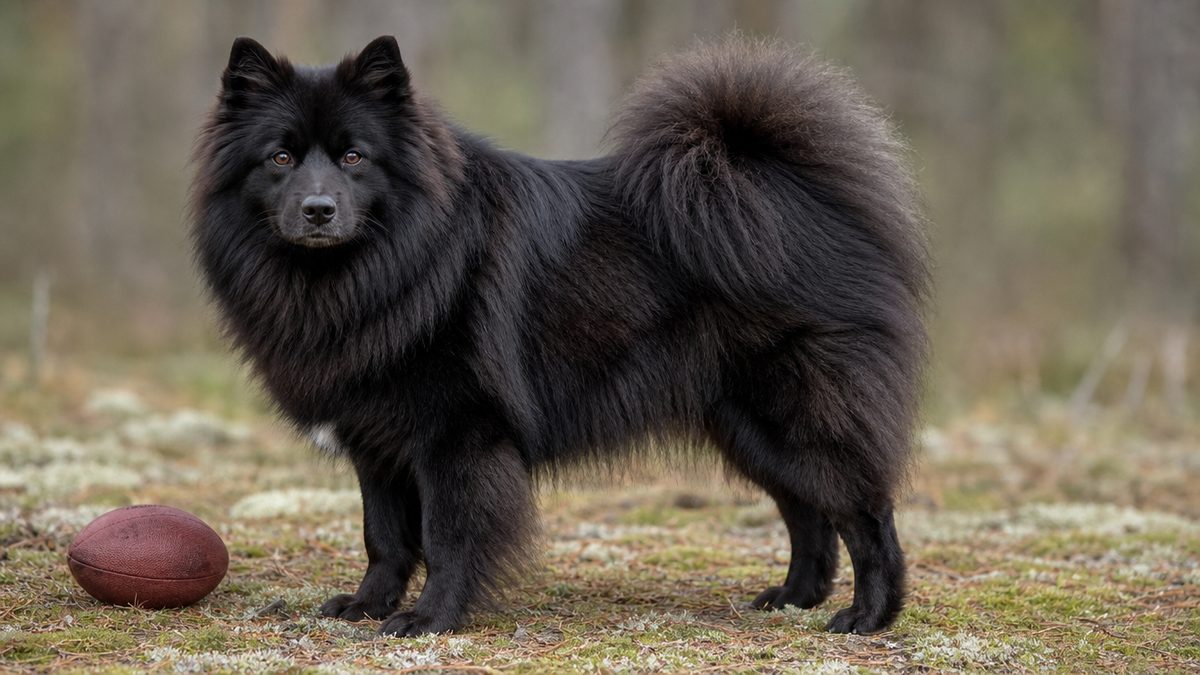
A solid black, profusely coated Sami reindeer dog from the Arctic Circle, about 1,200 of them alive worldwide, carrying wolf ancestry, a lethal Pompe mutation with a DNA test, and the second-highest diabetes risk of any breed measured in Norway.
Quick answer
The Swedish Lapphund has no Indian price, because the breed is not bred in India and the Indian search result for it is a Finnish Lapphund listing. Budget roughly Rs 6,500 to Rs 10,000 a month to keep one. Ask for the Pompe disease and prcd-PRA DNA results before anything else.
This page reports published veterinary research and registry data for general information. It is not a diagnosis and it is not a treatment plan. Screening decisions, vaccination timing, feeding amounts, diabetes monitoring and any genetic testing question for your own dog must be settled with a qualified veterinarian who has examined the animal. Consult your nearby vet before acting on anything here, and seek immediate veterinary attention for collapse in heat, sudden weakness, excessive thirst or unexplained weight loss.
Swedish Lapphund at a glance
What the Swedish Lapphund is, and what its standard says
The Swedish Lapphund is a medium-sized black Nordic spitz recognised by the FCI as standard 135, in Group 5 Spitz and primitive types, Section 3 Nordic Watchdogs and Herders, accepted on a definitive basis on 19 January 1955.
Sweden is the country of origin and English is the authentic language of the standard, whose current text is dated 22 February 2012 against an official valid standard published on 10 November 2011. The FCI states the breed's utilization in one line: reindeer herding dog, nowadays mainly kept as an all-round companion dog. It is not subject to a working trial.
Size, and the number the standard again refuses to give
The ideal height is 48 cm for males and 43 cm for females, with an allowance of plus or minus 3 cm, so a male runs 45 to 51 cm and a female 40 to 46 cm. Note the symmetry: unlike the Swedish Vallhund's standard, which allows 2 cm above and only 1 cm below, this one is even in both directions.
As with the Vallhund, the FCI gives no weight. The section is headed size and weight and only heights follow. Weigh the dog rather than taking a kilogram figure off a listing page, particularly when you are dosing a parasiticide.
Coat colour is the fastest way to tell it from a Finnish Lapphund
The coat is a profuse double coat, with the hair standing straight out from the body over a dense, finely frizzy undercoat, short on the head and the front of the legs, longer on the brisket, the backs of the legs and the tail, bushy and dense on the tail, forming a ruff round the neck, and described by the standard as weather resistant.
The colour is usually solid black, with bronzing typical as more or less bear-brown shades, and white permitted on the chest, the feet and the tip of the tail. The breed club records that the number of accepted colours was cut back from a long and imaginatively described list in the first studbooks to solid black and bear-brown with those white markings from the 1990s. A multicoloured Lapphund is a Finnish Lapphund, not a Swedish one.
| Feature | What the standard requires |
|---|---|
| Ears | Triangular, broad at base, small, pricked, tips slightly rounded, set well apart and very mobile |
| Tipped ears | Undesirable, but explicitly NOT a disqualifying fault |
| Stop | Very well marked |
| Eyes | Round, fairly big, not protruding, brown and preferably dark brown |
| Nose | Preferably charcoal black, very dark, or in harmony with coat colour |
| Tail | Rather high set, reaching the hock when extended, carried curled over the back on the move |
| Body | Rectangular, slightly longer than the height at withers |
| Dewclaws | Permissible on the rear pasterns |
| Disqualifying faults | Aggressive or overly shy dogs, clear physical or behavioural abnormality, and untypical |
The FCI's disqualifying list for this breed ends with a single word, untypical. That is unusually broad wording for a standard and it tells you something about how the breed is judged: the Swedish Lapphund is defended as a type rather than as a checklist of measurements. It is also why an Indian buyer should judge a puppy against the coat, ears, tail carriage and colour described above rather than against a number.
One document-level caution for anyone checking this standard themselves. The German edition renders the sharp s as a Greek small beta 11 times against 12 correct occurrences, so a plain text search inside it for a German word containing that letter will miss roughly half the hits. Normalise the text before searching, or read the English, which is the authentic version anyway.
The wolf in the mitochondria, and what it does not mean
The Swedish Lapphund carries a wolf-derived mitochondrial lineage that entered northern Scandinavian spitzes at most 480 to 3,000 years ago. That is ancient introgression in a fully domestic breed, not a wolfdog.
Klutsch and colleagues sequenced 582 base pairs of the mitochondrial control region in 514 dogs from breeds known to carry mtDNA subclade d1 and related northern spitzes. Subclade d1 occurred almost exclusively among Swedish and Finnish Sami reindeer-herding spitzes and some Swedish and Norwegian hunting spitzes, at frequencies of mostly 60 to 100 percent, and its diversity was very low, with only four haplotypes.
The conclusion is specific. Subclade d1 originated in northern Scandinavia, at most 480 to 3,000 years ago, through dog-wolf crossbreeding rather than a separate domestication event, and its high frequency suggests the hybrid phenotype carried a selective advantage. The Swedish breed club reports the same finding in its own strategy document and notes the introgression is shared with the Finnish Lapphund, the Lapponian Herder, the grahund and the jamthund.
Why an Indian reader should care about the wording
India's much-reported March 2024 breed circular listed Wolf dogs as one of its entries without ever defining the term, and Bonbeno has had to correct pages that cleared a breed because its proper name was absent from such a list. So the distinction matters. A mitochondrial haplogroup that entered a landrace population up to three thousand years ago does not make a modern registered breed a wolf hybrid, and the Swedish Lapphund has been studbook-registered since nordisk spets typ A was entered in the Swedish Kennel Club's first studbook in 1889.
The legal position is settled in any case, and every page should say so. That circular was quashed by the Karnataka High Court on 10 April 2024 and set aside by the Delhi High Court, and the Centre told the Bombay High Court in January 2025 that it is not acting on it. No Indian law in force today bans owning, breeding or selling any dog breed, although the door was expressly left open to a properly consulted amendment of the Rules.
The breed club states that the type has not changed much since studbook registration began around 140 years ago, with size, coat quantity and proportions much the same in both the written standards and the dogs themselves. For a buyer, that is a genuinely useful signal: this is a breed defined by a working job rather than by a show fashion, which is unusual and is part of why it remains a hardy animal.
Swedish Lapphund price in India: the search does not even reach the breed
No Swedish Lapphund price exists in India. The single Indian listing result for the query is a Finnish Lapphund page, and the one Indian care page carrying the right breed name prints a template cost row shared with an Italian water dog.
The Indian listing result is a different breed
Searching for this breed's Indian price returns Petfinder, a European puppy marketplace, Vetstreet, two American puppy marketplaces, a US insurance blog, the AKC marketplace, Wikipedia and an aggregator. The only Indian commercial result is puppiezo.com's Finnish Lapphund page. That page carries the same five rupee figures Bonbeno has recorded across that site's breed pages, Rs 76,499, Rs 92,599, Rs 94,999, Rs 98,999 and Rs 1,20,000, none of which is a Lapphund price of either nationality.
That substitution is itself the most useful thing an Indian buyer can know. If the search engines cannot distinguish the two Lapphunds, a seller has little incentive to, and a buyer who does not know the difference will be shown a multicoloured dog and told it is a Swedish Lapphund.
The template cost row, verified against a control
poodles.in does carry a Swedish Lapphund page and prints a monthly cost band of Rs 4,650 to Rs 6,600, built from food Rs 2,250 to Rs 3,000, health Rs 1,200 to Rs 1,800 and grooming Rs 1,200 to Rs 1,800. Those sum exactly: 2,250 plus 1,200 plus 1,200 gives 4,650, and 3,000 plus 1,800 plus 1,800 gives 6,600.
We pulled a control from the same site. Its Lagotto Romagnolo page prints all six of those figures identically, to the rupee. A truffle-hunting Italian water dog and an Arctic reindeer spitz do not share a grooming cost. And the food line, Rs 2,250 to Rs 3,000, is the same food line that site gives the Swedish Vallhund, a 33 cm dog sitting in a different total band altogether. So the rows are assembled from independent preset lines, and a matching total tells you nothing about the breed.
| Figure | Where it appears | What it really is |
|---|---|---|
| Rs 60,000 to Rs 90,000 | poodles.in buying price | Round rupee-native band on a page whose cost row is a template |
| Rs 4,650 to Rs 6,600 a month | poodles.in running cost | Identical to the same site's Lagotto Romagnolo row |
| Rs 2,250 to Rs 3,000 food line | poodles.in | Also given to the Swedish Vallhund, a much smaller dog |
| Rs 76,499 to Rs 1,20,000 | puppiezo.com | House carousel figures on a FINNISH Lapphund page |
| No rupee figure at all | Petfinder, Vetstreet, AKC marketplace | US and European pages ranking on an India query |
The division tests come out the same way as they did for the Vallhund. Rs 60,000 and Rs 90,000 divide cleanly at a flat 80 to 750 and 1,125, which proves nothing because any figure ending in three zeros divides cleanly at 80 by construction, and USD 1,125 is not a price a seller would print. Rs 6,600 divides at 88 to exactly 75, which is arithmetic noise on a figure that is demonstrably the sum of three preset rupee lines.
Dogs are a Restricted import into India and applications to import for trading or breeding purposes are rejected outright, which is why no Indian breeding population exists for a breed with roughly 1,200 dogs in the whole world. If you are offered one, ask which studbook the litter is in, whether both parents have prcd-PRA and Pompe disease results, and whether the dog is actually solid black. A multicoloured puppy sold as a Swedish Lapphund is a different breed or a cross.
Monthly cost of ownership in an Indian city
Keeping a 19 to 21 kg Arctic double-coated dog in an Indian metro costs roughly Rs 6,500 to Rs 10,000 a month, and the line that separates this breed from a similar-sized short-coated dog is cooling, not grooming.
The cost of ownership here is driven by three things: year-round parasite control, food for a genuinely active medium dog, and the electricity to keep an animal built for minus 11 C in January comfortable in an Indian summer. Every price below is from a named Indian seller's own page, read on 9 September 2026.
| Item | Price | Source and note |
|---|---|---|
| NexGard Spectra, 15 to 30 kg, 3 tablets | Rs 3,308, MRP Rs 3,375 | Supertails, about Rs 1,103 a month, the correct band for this breed |
| Anti-rabies, single dose | Rs 699 | Vetic national page |
| 9-in-1 DHPPiL | Rs 899 | Vetic national page |
| Kennel cough | Rs 1,349 | Vetic national page |
| Adult annual booster course | From Rs 3,199 | Vetic, struck-through list price Rs 3,806 |
| Puppy course, first year | From Rs 6,499 | Vetic, struck-through list price Rs 8,111 |
| Bathing, salon | From Rs 934 | Vetic Delhi grooming list |
| Home boarding, Bengaluru | Rs 499 to Rs 899 per tier | PawSpace published plans |
| Delhi MCD pet dog registration | Rs 500, renewal Rs 500 | Municipal Corporation of Delhi |
| Chennai GCC pet licence | Rs 50 | Greater Chennai Corporation |
| Microchipping, Chennai | Rs 1,250 | SKS Veterinary Hospital's own transacted price |
Three lines in that table come from sources Indian cost articles usually omit, and each is the seller's or the authority's own published figure: PawSpace publishes its Bengaluru home-boarding tiers openly, the Municipal Corporation of Delhi publishes the Rs 500 pet dog registration fee and its Rs 100 per month late fee, and the Rs 1,250 Chennai microchipping figure is a clinic's own transacted price rather than a general range. Buy the 15 to 30 kg parasite pack for this breed, not the 7.5 to 15 kg one, because a 48 cm Lapphund in condition sits in that band. Neither the Rs 3,308 selling price nor the Rs 3,375 MRP is a converted dollar figure in any meaningful sense: the MRP divides at 84.38 to exactly 40, but Rs 1,125 per tablet is a clean Indian unit price and the product has no directly matching US SKU, so treat the quotient as coincidence rather than evidence.
Parasite control earns its place. A West Bengal study of 584 dogs screened at veterinary clinics reported that 72.9 percent of the 584 dogs screened carried two or more pathogens, with Babesia gibsoni in 76.54 percent, and a southern Indian study of 120 dogs found Babesia in 66.7 percent with a pre-monsoon peak from March to May. Both sampled clinic caseloads rather than random populations, so read them as the burden among dogs presented to a vet.
- Budget Rs 1,103 a month for combined tick, flea and worm cover.
- Budget Rs 270 a month as the amortised share of a Rs 3,199 annual booster.
- Budget for food for a 19 to 21 kg working-type dog, which is the largest line.
- Budget for cooling, which for this breed is a real recurring cost rather than a comfort.
- Budget Rs 42 a month for a Delhi registration renewal, or Rs 4 in Chennai.
Greater Chennai Corporation licenses pet animals at Rs 50 and runs six municipal veterinary clinics that provide treatment and anti-rabies vaccination free of cost. For a Chennai owner that removes the vaccination line from the budget entirely, which is worth more to a real household than any breed price.
One more line most Indian cost articles omit. This is a heavy shedder with a dense undercoat, so you will replace a vacuum cleaner sooner than a short-coated dog's owner will, and you will pay for more frequent bedding washing during the two annual coat drops. That is not a large sum, but it is a real one and it is not in anyone's template row.
Heat tolerance: the hardest case in this whole cluster
The Swedish Lapphund is the least heat-tolerant breed on this site's Nordic list. Its homeland averages 0.64 C across the year and 14.53 C in the warmest month, and it wears a solid black profuse double coat, so it gains radiant heat faster than a pale dog and sheds it more slowly.
We queried NASA POWER by explicit latitude and longitude at Arvidsjaur in Swedish Lapland, 65.5928 N and 19.1667 E. The model returned a cell elevation of 351.39 m against a real elevation near 375 m, an error of about 24 m, so the cell describes the town and the figures are usable.
We rejected a second point. Jokkmokk returned a cell at 372.76 m against a real elevation near 260 m, an error of about 113 m, which is enough to shift a temperature series by most of a degree, so it is not published here. Naming the rejected cell matters, because the two cells are different squares rather than one flattened one, and a reader can check the choice.
| Place | Annual mean C | Warmest month | Coldest month | Annual humidity percent | Peak wet bulb C |
|---|---|---|---|---|---|
| Arvidsjaur, Swedish Lapland | 0.64 | July, 14.53 | January, -11.32 | 91.98 | July, 12.41 |
| Delhi | 25.60 | June, 35.88 | January, 13.61 | 45.56 | July, 26.50 |
| Chennai | 27.95 | May, 31.51 | January, 24.09 | 72.39 | May, 26.11 |
| Mumbai | 26.77 | May, 31.19 | January, 23.19 | 67.39 | June, 25.77 |
| Bengaluru | 23.74 | April, 28.37 | December, 20.22 | 67.94 | May, 21.86 |
| Kolkata | 25.81 | May, 31.53 | January, 17.31 | 73.93 | June, 27.09 |
The number that should decide the purchase
Chennai's coldest month, at 24.09 C, is nearly ten degrees warmer than Arvidsjaur's hottest. There is no month of the Indian coastal year in which this dog experiences a temperature its homeland reaches even at midsummer. Delhi's peak wet-bulb load of 26.50 C in July is more than fourteen degrees above Arvidsjaur's 12.41 C, and wet bulb is what limits a panting dog's ability to lose heat.
The humidity story runs the other way, and this is where most breed pages mislead. Arvidsjaur runs 91.98 percent annual relative humidity, far above Chennai's 72.39, Kolkata's 73.93, Mumbai's 67.39 and Delhi's 45.56. A Lapland winter is a wet place. So the risk to this heat-sensitive breed in India is heat, and heat combined with moisture, not damp air by itself.
Two things that make this breed worse off than the others here
- The coat is solid black, so it absorbs across the whole visible spectrum and heats faster in direct sun than the sable or pale coats of the other breeds in this cluster.
- The coat is described by its own standard as profuse and stand-off with a dense undercoat, which is superb insulation against Arctic cold and a genuine liability at 35 C.
Indian law reaches this directly. Second Schedule Part IV paragraph 21(1) of the 2017 Rules bars keeping in outdoor facilities, without the attending veterinary practitioner's written approval, dogs not accustomed to local temperatures, breeds that cannot tolerate them such as long-haired breeds in high temperature locations, and sick, infirm, aged or young animals. A profusely coated black Arctic spitz in an Indian city is the clearest example of the second category this site has written about.
Hall 2020 found that 652 of 879 heat-related illness events with a recorded trigger, 74.2 percent, were exertional rather than environmental or from a hot car. This breed's own standard calls it full of endurance and toughness and very willing to work, which is exactly the temperament that keeps going past the point where it should stop. The breed was not separately modelled in that study, so no breed-specific odds ratio is claimed here. Walk it before dawn and after dark, and discuss any heat episode with your nearby vet immediately.
Temperament and household fit
The Swedish Lapphund is lively, alert, kind and affectionate by its standard, and its own breed club's behaviour data describes a confident dog with little fear, good energy and low aggression.
The FCI text is unusually warm for a standard. It calls the breed lively, alert, kind and affectionate, very receptive, attentive and willing to work, very versatile, and easy to train, full of endurance and toughness. Historically the breed club describes it as a watchful, intelligent one-man dog; today it describes a social, accessible, family-loving animal with a good deal of guarding, hunting and herding instinct retained.
What the behaviour testing actually shows, and its limits
Of Swedish-born Swedish Lapphunds born between 2010 and 2020, 26 started and 25 completed the MH mental description, 2.9 percent of the population, and 98 started with 93 completing the newer BPH behaviour and personality description, 10.8 percent, giving 13.8 percent described in total. The club states plainly that this is still too small a sample to give a secure picture and that about 85 percent of living dogs have never been described.
What the described dogs show is a fairly secure dog without marked fear reactions, relatively happy with strange people, relatively playful, quite curious, and showing little insecurity or threatening behaviour. Behaviour variation within the breed is low for fear and larger for sociability, play interest and curiosity. With few exceptions the club describes a dog with a good positive attitude and good energy.
Who this breed suits in India
- Suits a household in a cooler Indian city or hill town that can genuinely manage an Arctic coat.
- Suits an owner who wants a highly trainable dog for sport rather than an ornament.
- Suits a family, since the breed club describes it as social and family-loving.
- Suits someone prepared to groom seriously and to live with heavy shedding.
- Does not suit a hot coastal flat with no reliable cooling.
- Does not suit an owner who will leave a working spitz alone all day.
- Does not suit anyone who wants a low-shedding dog, because this is among the heaviest shedders on this site.
- Does not suit a buyer who cannot verify the parents' health results, given what this breed carries.
This is a guarding breed by history, so it will bark at the door and at the stairwell, but it is not the relentless stock-driving barker the Swedish Vallhund is. The club's behaviour data shows low aggression and little threatening behaviour. In an Indian apartment, expect an alert dog that announces visitors rather than one that argues with the neighbours all day.
Training a highly receptive working spitz
Train a Swedish Lapphund with short, varied, reward-based sessions and give it a sport, because its standard calls it easy to train and its problem in a pet home is boredom rather than resistance.
The FCI standard names obedience training, agility, herding and tracking as suitable activities and describes a dog that is very receptive, attentive and willing to work. The breed club adds that many Swedish owners compete with it across most modern dog sports from the lowest class to the highest, and that its versatility is one of its signatures.
What it does not have, which is a working test
There are no breed-specific official herding trials and no hunting tests the breed may enter except blood tracking, and its main function today is as an active companion dog. That is worth knowing before you buy one expecting a formally assessed working line. Where the Swedish Vallhund's club runs its own herding aptitude tests and can tell you what a parent scored, this breed's club cannot offer an equivalent for herding.
A first-year plan for an Indian household
- Socialise widely in the first four months, since a guarding breed forms its view of strangers early.
- Train indoors on cool floors from March to June, and treat heat as the limit on session length rather than attention span.
- Teach a settle on a mat, because an alert spitz with nothing to do appoints itself doorkeeper.
- Add a sport by six months, with scent work suiting Indian conditions best because it can be done indoors.
- Handle the coat daily from week one so that grooming is never a fight later.
- Build a calm response to the doorbell before the dog decides what the doorbell means.
Keep sessions short. This is a trainable dog that learns fast and then gets bored faster, and repetition without purpose is what produces the invented jobs. Reward-based work suits it, and the club's own behaviour data showing low fear and high curiosity means it will offer behaviour readily if you pay for it.
A dog that will not stop is not a dog that is coping. Plan every session around temperature rather than around the dog's willingness, and move training indoors when the floor outside is too hot for a bare hand. That single habit prevents most of the trouble an Arctic breed gets into in an Indian summer.
Daily exercise needs for a reindeer dog in the tropics
Plan an hour of activity a day for an adult Swedish Lapphund, taken almost entirely in the cool hours, with a substantial share of it as indoor scent and problem-solving work rather than distance.
This is a dog bred to move reindeer across open Arctic country, and the FCI describes it as full of endurance and toughness with light, springy, ground-covering movement. In Sweden an hour of varied work is unremarkable. In Chennai in May, an hour of outdoor work is dangerous, and the whole exercise plan has to be rebuilt around that.
The Indian split that works
- Take 35 to 40 minutes before sunrise, which is the only genuinely safe outdoor window for most of the Indian year.
- Take 15 to 20 minutes after dark, on surfaces you have tested with the back of your hand.
- Add 15 to 20 minutes of indoor scent work, food puzzles or trick chains during the day.
- Swap distance for difficulty in the hot months, because mental work tires this breed without heating it.
- Skip outdoor work entirely on the worst days rather than shortening it.
Under-exercised, this breed does what alert working spitzes do: it barks more, it guards more, and it finds something to dismantle. Over-exercised in Indian heat, it does something far worse, because a willing dog with a heavy black coat will keep working past its own safe limit.
Even the Indian care page that carries this breed's template cost row gets one thing right, recommending cooling mats or vests for any outdoor time in high temperatures and regular brushing to prevent heat-trapping mats. For a solid black profusely coated Arctic dog those are reasonable measures rather than luxuries, and they are cheaper than a heat emergency.
Grooming a profuse double coat in Indian humidity
Brush a Swedish Lapphund two or three times a week and daily through its coat drops, work the undercoat out rather than the topcoat down, and never clip or shave it.
The coat is profuse, standing straight out from the body, over an undercoat the FCI describes as dense and finely frizzy, with a ruff round the neck and a bushy, long, dense tail. That construction is what makes it weather resistant and it is also what makes it the heaviest grooming job in this cluster of six breeds.
Why not to shave it, restated for a black dog
The undercoat is insulation in both directions. It slows radiant heat reaching the skin and holds the still-air layer the dog uses to manage its own temperature. Removing it on a black dog is worse than on a pale one, because the skin underneath then takes the full radiant load in a country where the sun is close to overhead. Brush the dead undercoat out instead, which is what actually reduces heat trapping.
A realistic Indian routine
- Brush two or three times a week with an undercoat rake and a slicker, and daily during a coat drop.
- Work in sections down to the skin, because a profuse coat mats at the base long before the surface looks untidy.
- Check the ruff, the trousers and behind the ears weekly, since those are where mats start.
- Bathe rarely and dry completely, because a dense undercoat that stays damp in monsoon air is a skin problem waiting to happen.
- Never let a groomer scissor or clip the coat into shape.
Drying is the Indian-specific step that overseas advice skips. Breed clubs in Sweden can reasonably tell an owner to towel a dog and let it air dry. In a Mumbai or Kolkata monsoon, a dense frizzy undercoat holds water for hours, and that is how a healthy skin becomes a hot spot. Dry to the skin, not to the surface.
Salon cost is not where the money goes for this breed. A bath in Delhi starts at Rs 934, but the work that keeps this coat healthy is done at home with a rake, several times a week, and no salon visit substitutes for it. Budget for tools and time rather than appointments.
In a temperate climate this breed drops its undercoat twice a year. In an air-conditioned Indian flat the seasonal light and temperature cues blur, and many northern breeds shed moderately all year round instead of clearing the coat cleanly twice. Plan for continuous shedding rather than being surprised by it, and keep the grooming session on a balcony or outdoors.
Health risks, screening and life expectancy
The Swedish Lapphund is a healthy breed carrying two specific and very different genetic problems: a fatal Pompe disease mutation with a DNA test, and the second-highest measured diabetes mellitus risk of any breed in a Norwegian study.
Pompe disease, the one that kills puppies
Pompe disease is glycogen storage disease type II, a recessively inherited and often fatal deficiency of acid alpha-glucosidase, the enzyme encoded by GAA that breaks glycogen down in lysosomes. Seppala and colleagues identified the canine defect and showed that three related Scandinavian breeds carry the same mutation, with affected dogs homozygous for GAA c.2237G>A, which creates a premature stop codon at amino acid position 746.
Two things about that finding matter to a buyer. The corresponding mutation in humans causes infantile Pompe disease, and the affected dogs mimic infantile-onset human disease both genetically and clinico-pathologically. And because it is recessive, a carrier is healthy and invisible, so the only protection is a DNA result on both parents.
Diabetes mellitus, where this breed is an outlier
Ringstad and colleagues analysed canine serum samples submitted between 2001 and 2018 to the veterinary clinical pathology laboratory at the Norwegian University of Life Sciences, using two separate comparator groups. The Swedish Lapphund ranked second of all breeds for diabetes mellitus on both comparators, with 37 cases and odds ratios of 8.2 (5.5 to 11.8) against the laboratory comparator and 7.7 (5.3 to 10.7) against Norwegian Kennel Club registrations. Only the Australian Terrier ranked higher, at 11.4 and 11.0.
| Breed | Cases | OR vs laboratory group | OR vs kennel club group | Mean age at diagnosis |
|---|---|---|---|---|
| Australian Terrier | 54 | 11.4 (8.2 to 15.6) | 11.0 (8.1 to 14.6) | 8.6 years |
| Swedish Lapphund | 37 | 8.2 (5.5 to 11.8) | 7.7 (5.3 to 10.7) | 8.9 years |
| Samoyed | 63 | 4.5 (3.4 to 5.9) | 3.2 (2.5 to 4.2) | 9.1 years |
| Schipperke | 10 | 3.6 (1.7 to 6.9) | 3.5 (1.6 to 6.5) | 9.9 years |
Read the denominators carefully. These are odds ratios from laboratory submissions in Norway, not an Indian prevalence, and breeds with fewer than 10 recorded cases were excluded from the ranking entirely. What the figure does support is a clear instruction: watch for increased thirst, increased urination and weight loss in a middle-aged Swedish Lapphund, and raise diabetes with your nearby vet early rather than late.
prcd-PRA, an inherited disease that has been beaten
prcd-PRA is a progressive retinal atrophy that can end in blindness as the retina breaks down, and it has a gene test. Since a 2008 health programme requiring known genetic status before breeding, with carriers mated only to clear or hereditarily clear partners, the breed club states that no Swedish Lapphunds with prcd-PRA are born any more. Most Swedish-bred puppies are tested by the breeder before they leave.
The related mapping work is worth knowing because it explains why the Finnish and Swedish breeds are handled together. Aguirre-Hernandez and colleagues mapped the Finnish Lapphund's retinal atrophy locus to chromosome 9 near GALK1, and reported that Swedish Lapphund cases, but not Lapponian Herder cases, carried the same GALK1 microsatellite genotype, suggesting the disease in both Lapphunds corresponds to progressive rod-cone degeneration. That paper's title places the locus in the centromeric region of CFA9 while its abstract describes the nearby prcd locus as telomeric, so quote the finding rather than the region.
Hips, elbows and the rest of the health issues
Hip screening is required before a litter can be registered in Sweden. Across 2010 to 2020 the recorded results were grade A 214, B 161, C 120, D 32 and E 7, so 495 of 534 dogs, or 92.7 percent, sit at A, B or C. Two small internal inconsistencies are worth flagging rather than smoothing over: the document's prose says 535 results while its own table totals 534, and it prints the A-to-C share as 92.3 percent, which does not reproduce from either total. The counts themselves reconcile perfectly by column and by row, so we quote those.
Clinical hip trouble is reported as very rare on the basis of an earlier health survey and Agria insurance data. Elbow radiography is not required before breeding, and 164 elbows were recorded between 2010 and 2020 with the great majority without remark, although the club notes four dogs graded 3 in the last five years and says the sample is too small to draw conclusions.
- Cancer: some over-representation of tumours against the average breed in insurance data, with familial occurrence seen, so heredity cannot be excluded.
- Addison's disease: two cases reported in ten years, with some familial occurrence and a real risk of under-diagnosis because symptoms are vague.
- Epilepsy: three cases reported in ten years, occurring sporadically with familial occurrence seen.
- Juvenile muscle atrophy: the club applied in autumn 2021 to leave the health programme because no affected dog had been born in 30 years.
Life expectancy, and why no median is published
No published median lifespan exists for this breed, and the English Wikipedia article does not help, because it carries no health section at all: its five content headings are Lineage, Appearance, Temperament, See also and References. McMillan 2024 lists the Swedish Lapphund in its supplementary Table S5 and flags it N, meaning it was excluded from the survival analysis, so the study produced no median, no confidence interval and no hazard ratio for it. That is different from the breed being absent from the paper, and it is different again from a figure existing that we have not found. The 12 to 14 years printed on the one Indian care page carrying this breed's name is a plausible band for a medium spitz and is not a sourced figure.
Ask for the Pompe disease GAA result first, because it is the one that kills, then the prcd-PRA result, then hips. Sweden requires known prcd-PRA and hip status before a litter is registered, so a breeder working within the breed's own system will already hold both. Indian law separately requires breeding dogs to have been tested for genetic defects including progressive retinal atrophy and hip dysplasia. Discuss any of these results, and any sign of thirst or weight loss in an older dog, with your nearby vet.
Feeding and nutrition, with one breed-specific reason to be careful
Feed a Swedish Lapphund to a lean body condition and keep the diet consistent, because this is a breed with a strongly raised measured risk of diabetes mellitus in middle age.
The general rule for any medium working spitz applies: feed to the pack's chart for the dog's measured weight, split into two meals, and adjust by body condition rather than by the scoop. You should feel the ribs easily and see a waist from above. The FCI gives no weight for the breed, so a gram figure derived from a breed weight is derived from a number the standard declines to state.
Why obesity matters more in this breed than in most
Obesity is a recognised risk factor for canine diabetes, and this breed already carries an odds ratio of 8.2 and 7.7 for diabetes mellitus against two separate comparator groups, ranked second of all breeds, with a mean age at diagnosis of 8.9 years. That does not mean a lean Lapphund will not develop diabetes, because the study measured breed and not body condition. It does mean that the one modifiable factor available to an owner is worth taking seriously from puppyhood rather than from the first blood test.
- Weigh the dog monthly and record it, so a drift is visible before it is a problem.
- Feed measured meals rather than free feeding, which also makes an appetite change detectable.
- Keep treats inside the daily budget, and use part of the meal ration for training instead.
- Feed the larger meal in the cool of the evening, since a heat-stressed dog eats badly and then overeats.
- Store kibble airtight, because Indian monsoon humidity spoils an open bag faster than most owners expect.
There is no Indian feeding literature for this breed and we are not going to invent one. Puppy feeding follows the standard medium-breed pattern of four meals a day to about four months, three to six months, then two. Any growth plan, and any decision about diet in a dog with a family history of diabetes, belongs with your nearby vet, who can weigh the animal and score its condition properly.
The breed club describes the Swedish Lapphund as a tough, sound, enduring dog without exaggerations, well adapted to the Nordic climate, and that reputation is deserved. It is not a reason to feed casually. The two conditions that most often shorten this breed's life in the data available, diabetes and cancer, are both middle-aged diseases, which is exactly the stage at which a well-fed dog looks fine and an owner stops paying attention.
Month by month through the first year in India
Plan the first year around the eight-week legal floor on sale, the vaccination course, the coat's first shed, and the arrival of the first hot season.
| Age | What matters most | India-specific note |
|---|---|---|
| Before 8 weeks | The puppy stays with its litter | Rule 8(1)(a) forbids selling a pup under eight weeks |
| 8 to 10 weeks | Settling, crate, handling the coat daily | Vaccination course starts; Vetic prices a puppy course from Rs 6,499 |
| 10 to 14 weeks | Socialisation window with people and surfaces | Introduce the brush before the coat needs it, not after |
| 3 to 4 months | Settle on a mat, doorbell manners, recall | Train indoors on cool floors if this falls in March to June |
| 4 to 6 months | First real coat change, sport introduction | Register with the municipality: Delhi Rs 500, Chennai Rs 50 |
| 6 months | Sterilisation discussion with your vet | Rule 8(1)(b) bars sale of an unsterilised dog over six months |
| 6 to 9 months | Adult coat coming in, watch body condition | Do not add distance work in the hot months |
| 9 to 12 months | Adult exercise pattern settled | Confirm you hold the parents' prcd-PRA and Pompe results |
The two habits that pay off for a decade
Handle the coat from the first week. A profuse stand-off double coat is easy to maintain on a dog that was groomed as a puppy and a genuine fight on one that was not, and in India the consequence of skipped grooming is a matted undercoat that traps heat against the skin.
Start the weight record early. The breed's raised diabetes risk shows up in middle age with a mean diagnosis at 8.9 years, so a monthly weight from puppyhood gives your vet nine years of baseline instead of a guess.
A breeder who cannot produce the parents' prcd-PRA and Pompe disease results has not done the testing the breed's own registry requires, and a Pompe carrier looks exactly like a healthy dog. Buying at six or seven weeks is separately unlawful in India under Rule 8(1)(a), and the same Rules require breeding dogs to have been tested for genetic defects including progressive retinal atrophy and hip dysplasia.
Swedish Lapphund against the breeds it is confused with
The Swedish Lapphund is cross-shopped against the Finnish Lapphund, the Lapponian Herder and the Samoyed, and the differences that matter are colour, disease burden and how much coat you are signing up for.
| Breed | Coat colour | Shares the GAA Pompe mutation | Retinal atrophy genotype | Diabetes rank in Norway |
|---|---|---|---|---|
| Swedish Lapphund | Usually solid black, bear-brown bronzing | Yes | Same GALK1 genotype as Finnish Lapphund | 2nd of all breeds |
| Finnish Lapphund | Many colours | Yes | Mapped to CFA9 near GALK1 | Not among the highest ranked |
| Lapponian Herder | Usually dark with lighter markings | Reported in three related Scandinavian breeds | Did NOT share the genotype | Not among the highest ranked |
| Samoyed | White or cream | Not reported | Not applicable | 3rd and 7th on the two comparators |
The Pompe row deserves a careful reading. Seppala reports that three related breeds from Scandinavia carry the same GAA mutation and names Finnish and Swedish Lapphunds explicitly in the title. We do not name the third breed here from that source alone, because the abstract does not, and guessing at it would be exactly the kind of plausible filling-in this site refuses.
Choosing between them for an Indian home
- Choose the Finnish Lapphund if availability decides it, because it is the one that actually appears on Indian listing sites, and accept that it carries the same Pompe mutation.
- Choose the Samoyed only with eyes open, because it ranked third and seventh for diabetes on the same two comparators and carries an even heavier white coat.
- Choose a smaller northern spitz such as the Norrbottenspets if the appeal is the type rather than this specific dog.
- Choose an Indian Spitz or an adopted local dog if the appeal is a bright, alert, prick-eared companion that can live in the climate you actually have.
Against the Swedish Vallhund, the other Swedish herding spitz on this site, the trade is straightforward. The Vallhund is smaller, lighter-coated, longer-lived on the published evidence, and noisier. The Lapphund is calmer, far heavier to groom, harder to keep cool, and carries a lethal recessive with a test. Neither is available in India, and both should be judged on the parents' paperwork rather than on a photograph.
Mistakes Indian owners actually make with this breed
Six mistakes account for most Swedish Lapphund trouble in India, and the first is buying a different breed by accident.
- Buying a Finnish Lapphund believing it is a Swedish one. The Indian search result for this breed is literally a Finnish Lapphund page, and colour is the fastest check: the Swedish breed is usually solid black.
- Accepting a quoted Indian price. The one Indian care page with the right name prints a cost row identical to its Lagotto Romagnolo page, and the listing page prints a house carousel.
- Skipping the Pompe disease question. It is recessive and fatal, carriers look healthy, and a DNA test exists.
- Ignoring diabetes risk in middle age. This breed ranked second of all breeds in a Norwegian study, with a mean diagnosis age of 8.9 years.
- Shaving the coat in summer. On a black dog that removes the only barrier between Indian sun and skin.
- Exercising on willingness rather than on temperature, in a breed whose standard boasts of its endurance.
The mistake that is really a reading error
Do not conclude from the wolf ancestry that this is a wolfdog or that it is legally exposed in India. The mitochondrial evidence describes dog-wolf crossbreeding in northern Scandinavia at most 480 to 3,000 years ago in a population that has been studbook-registered since 1889. The 2024 Indian circular that listed an undefined Wolf dogs category was quashed by the Karnataka High Court and set aside by the Delhi High Court, and no Indian law in force today bans any breed. Both halves of that need saying, because Bonbeno has previously had to correct pages that cleared a breed by checking proper names against a list containing undefined category words.
The mistake that no gate would catch
Do not accept a rupee band from an AI summary. Answer engines have repeatedly been recorded stating that no Indian price exists for a rare breed and then printing a confident rupee band derived by dividing a foreign asking price, in one case showing their own conversion code. For this breed the figures in circulation are a preset template sum and a carousel attached to a different breed. Trace any number to the page it came from, then look at what that page is selling.
Ask for the studbook registration, both parents' prcd-PRA and Pompe disease DNA results, both parents' hip grades, and the import paperwork for whichever parent came from abroad. Dogs are a Restricted import into India and applications to import for trading or breeding purposes are rejected, so a commercially bred Indian line of a breed with 1,200 dogs worldwide has no lawful origin story. Check the colour too.
Adoption and responsible sourcing
Adopt rather than import, because there is no lawful commercial route to a Swedish Lapphund in India and this is the least climate-suitable breed in the batch.
Start from the legal position. Dogs enter India as a Restricted import and applications to import for trading or breeding purposes are rejected, leaving a genuine relocating owner's pet and the narrow research and defence categories. With roughly 1,200 Swedish Lapphunds alive worldwide and a breed club that considers too few puppies are being born even in Sweden, the realistic Indian answer is that there is nothing to buy.
What the breed club is actually doing about its numbers
This is one of the more striking things in the breed's own paperwork, and no ranking page mentions it. Only 5.9 unrelated founder equivalents survive from the original 75 founders, and the club's response has been to set up a project group, created by a 2018 annual meeting decision, to prepare a strategy for a controlled outcross to another breed in order to add genetic variation. As a first step it has gene-variation tested about 50 Swedish Lapphunds to establish a baseline against which any outcross can be measured.
That tells a buyer two things. The breed is being managed seriously and openly, which is a good sign. And the population is narrow enough that its own custodians are considering a step most breed clubs refuse to discuss.
What to look for in India instead
- Contact your city's established shelters and rescue networks, and ask for an alert, biddable, medium dog that likes work.
- Consider a short-coated dog if you live anywhere on the coast, because coat is the constraint that does not negotiate.
- Register the adopted dog with your municipality, at Rs 500 in Delhi or Rs 50 in Chennai.
- Budget the same Rs 1,103 a month for parasite control, because tick-borne disease does not care about pedigree.
- Use the free municipal veterinary clinics if you are in Chennai, which provide treatment and anti-rabies vaccination at no cost.
If you are determined to have this specific breed, work through its own institutions. The Swedish club publishes its breeding strategy openly, requires known prcd-PRA and hip status before a litter can be registered, targets an inbreeding coefficient under 2.25 percent per combination, and applies a registration ban after a breeding animal has 25 offspring while recommending a maximum of 16. Those are checkable rules, and a breeder who works to them is worth waiting for.
It is not sentiment and it is not law. It is that a solid black, profusely coated Arctic reindeer dog is the single worst coat and colour combination on this site for Indian conditions, and that the breed's own numbers, 1,200 dogs and 5.9 founder equivalents, mean every individual matters to the population it came from. An Indian buyer who wants this temperament can have it in a dog that is already here, already acclimatised, and already needs a home.
Swedish Lapphund questions Indian buyers ask
How much is a Swedish Lapphund?
No verifiable Swedish Lapphund price exists in India, because the breed is not bred here. The only Indian listing page the query reaches is for the Finnish Lapphund, a different breed, and the one Indian care page carrying the right name prints a monthly cost row identical to its Lagotto Romagnolo page. Treat any rupee figure as unsourced.
Is the Swedish Lapphund the same as the Finnish Lapphund?
No. They are separate FCI breeds, 135 and 189, though they are closely related and share both a wolf-derived mitochondrial lineage and the same GAA Pompe disease mutation. The clearest visible difference is coat colour: the Swedish Lapphund is usually solid black with bear-brown bronzing, while the Finnish Lapphund comes in many colours.
What is Pompe disease in Swedish Lapphunds?
Pompe disease is glycogen storage disease type II, a recessively inherited and often fatal deficiency of acid alpha-glucosidase. Affected Swedish and Finnish Lapphunds are homozygous for the GAA c.2237G>A mutation, which creates a premature stop codon at amino acid 746, and the dogs mimic human infantile-onset Pompe disease both genetically and clinico-pathologically.
Do Swedish Lapphunds get diabetes?
Yes, and more than almost any other breed. In a Norwegian study of laboratory submissions from 2001 to 2018, the Swedish Lapphund ranked second of all breeds for diabetes mellitus on both comparator groups, with odds ratios of 8.2 and 7.7 across 37 cases, behind only the Australian Terrier. The mean age at diagnosis was 8.9 years.
Can a Swedish Lapphund live in India?
It is the hardest case of any breed in this cluster. Its Lapland homeland averages 0.64 C across the year with a warmest month of 14.53 C, and this is a solid black dog under a profuse double coat, so it gains radiant heat faster than a pale dog and sheds it more slowly. It can be kept in an Indian city only indoors, with cooling, and never worked in the heat.
Are Swedish Lapphunds part wolf?
They carry a wolf-derived mitochondrial lineage, which is not the same as being a wolfdog. Subclade d1 occurs at 60 to 100 percent in Swedish and Finnish Sami reindeer-herding spitzes and arose through dog-wolf crossbreeding in northern Scandinavia at most 480 to 3,000 years ago. That is ancient introgression in a fully domestic breed.
How rare is the Swedish Lapphund?
There are roughly 1,200 Swedish Lapphunds in the whole world, of which about 800 are in Sweden. Its breed club considers too few puppies are born, wants registrations above 100 a year and ideally 150, and has a working group preparing a controlled outcross to another breed to add genetic variation.
Do Swedish Lapphunds still go blind from PRA?
Not in Sweden. prcd-PRA has a DNA test, and since a 2008 health programme requiring known genetic status before breeding, with carriers only mated to clear or hereditarily clear partners, the breed club states that no Swedish Lapphunds with prcd-PRA are born any more. Outside that programme the guarantee does not apply, so ask for the parents' results.
How much does a Swedish Lapphund cost per month in India?
Budget roughly Rs 6,500 to Rs 10,000 a month in a metro. That covers a 15 to 30 kg parasite dose at about Rs 1,103 a month, food for a 19 to 21 kg dog, an annual booster from Rs 3,199 spread across the year, a municipal licence, and the electricity to keep an Arctic dog cool, which is the line most Indian cost articles omit entirely.
How long do Swedish Lapphunds live?
No published median exists for this breed. McMillan 2024 lists the Swedish Lapphund in its supplementary Table S5 but flags it N, meaning it was excluded from the survival analysis, so the study produced no median for it. Its own Indian care page prints 12 to 14 years, which is a plausible band for a medium spitz but is not a sourced figure.
Is the Swedish Lapphund a good first dog?
It is easy to train and genuinely affectionate, which suits a beginner, but the coat, the shedding and the heat make it a demanding first dog in India specifically. The FCI standard describes a lively, alert, kind and affectionate dog that is very receptive and willing to work, and a dog like that needs a job rather than a sofa.
What health tests should a Swedish Lapphund breeder show me?
Ask for the prcd-PRA DNA result and the Pompe disease GAA result for both parents, then a hip score. Sweden requires known prcd-PRA status and known hip status before a litter can be registered, so a breeder working to the breed's own rules will already have both, and Indian law separately requires breeding dogs to have been tested for progressive retinal atrophy and hip dysplasia.
Are Lapphunds intelligent dogs?
By the standard and by the club's own behaviour data, yes. FCI 135 calls the Swedish Lapphund very receptive, attentive and willing to work, very versatile and easy to train, full of endurance and toughness, and the breed club historically described it as a watchful, intelligent one-man dog. The practical translation is a dog that learns fast and then gets bored faster, so short, varied, reward-based sessions and a sport matter more than drilling, and the club's data showing low fear and high curiosity means it offers behaviour readily if you pay for it. There are no breed-specific herding trials it can enter, and its main function today is as an active companion dog.
Is a Swedish Vallhund a good family dog?
This page profiles the Lapphund and compares the two Swedish herding spitzes, so the honest answer here is the trade between them. On the published evidence the Vallhund is smaller, lighter-coated, longer-lived and noisier: it is the relentless stock-driving barker where the Lapphund is a guarding breed that announces visitors rather than arguing with the neighbours all day. The Vallhund's club runs its own herding aptitude tests and can tell you what a parent scored, which the Lapphund's club cannot. Neither breed is available in India, and both should be judged on the parents' paperwork rather than on a photograph; the Vallhund's own page on this site carries its full profile.
Compare with similar breeds
Swedish Lapphund sits in 2 Bonbeno groups. Each one compares it directly against the breeds it is genuinely an alternative to, on the same figures.