
Breed profile
Canadian Eskimo Dog: The Complete India Guide
Canada's own Arctic sled dog, called qimmiq by Inuit, whose registry recorded six puppies in a year and whose home town is colder in its warmest month than any Indian city is in its coldest.
Quick answer
The Canadian Eskimo Dog is an Arctic sled dog from Canada, called qimmiq in Inuktitut and registered as FCI standard 211. It is not sold in India and no Indian price exists. Heat tolerance rates 1 out of 5, the lowest rating this site gives, because Iqaluit averages 7.5 degrees Celsius in its warmest month, and no Indian city outside Ladakh has a single month averaging below 10.8 degrees Celsius.
This page summarises published veterinary research, registry screening data and official inquiry reports for general information. It is not a diagnosis and it is not treatment advice. Consult a registered veterinarian about your own dog before acting on anything here, and treat a rectal temperature at or above 41.0 degrees Celsius, collapse, or bloody diarrhoea after heat exposure in a double-coated northern dog as an emergency.
Canadian Eskimo Dog at a glance
What the Canadian Eskimo Dog is, and what FCI-211 actually says
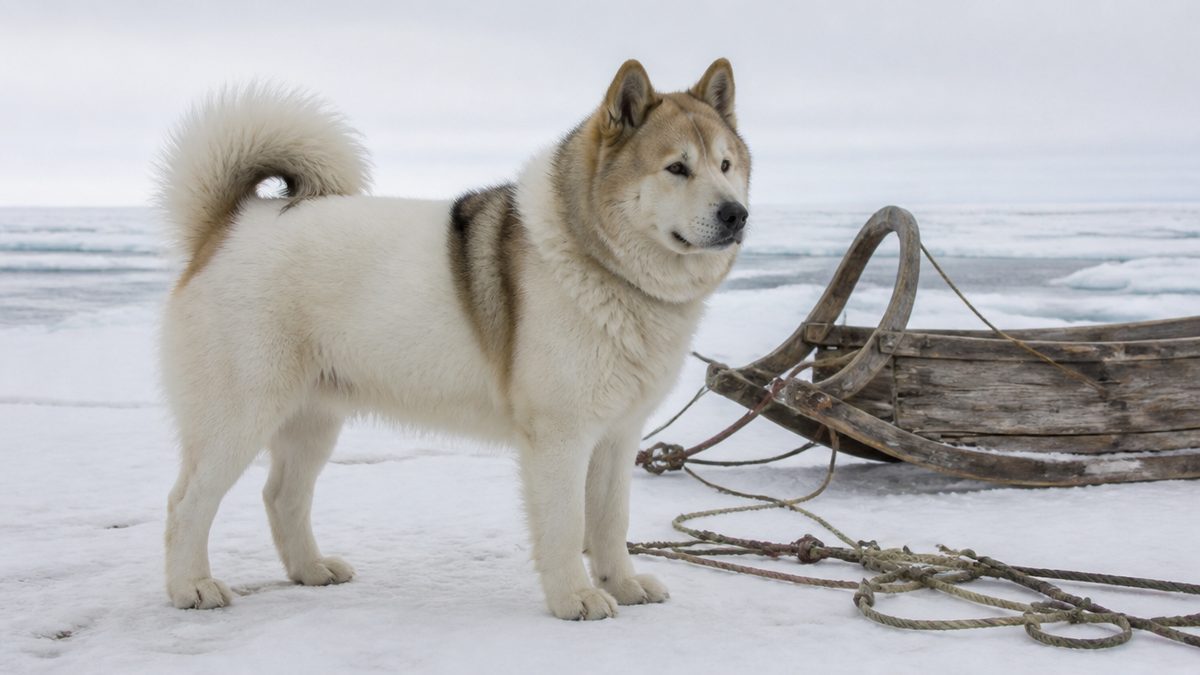
The Canadian Eskimo Dog is a powerfully built Arctic sled dog of moderate size, standing 58 to 70 cm at the withers and weighing 30 to 40 kg as a male, recognised by the Fédération Cynologique Internationale as standard number 211 in Group 5, Section 1, Nordic Sledge Dogs.
Start with the outline, because it is the one thing that separates this dog from the two breeds it is confused with. FCI-211 describes a dog of almost equal height at the hips as at the withers, with a thick neck and chest, medium length legs, medium to large bone and a heavily muscular body, giving "the impression that he is not built for speed but rather for hard work". That level croup is unusual. A Siberian Husky is lighter and racier, and an American Eskimo Dog is a small white companion spitz that has nothing to do with the Arctic. If you are shown a leggy dog with a narrow chest, or a fluffy white dog that would fit on a lap, you are not being shown this breed.
The head is wedge-shaped and massive but well proportioned, often called wolf-like, with a more elevated forehead than a wolf. The ears are short, thick, slightly rounded at the tips, carried erect and turned forwards, and covered with dense short hair. The eyes are small, wide spaced and set obliquely, generally dark but sometimes hazel or yellow. Blue eyes are a disqualifying fault in the FCI, Canadian Kennel Club and United Kennel Club standards alike Canadian Kennel Club United Kennel Club. The tail is large and bushy, carried up or curled over the back, and a male showing no evidence at all of a curled or upright tail is disqualified.
Size and weight, from the two standards that publish it
| Registry | Male height | Male weight | Female height | Female weight |
|---|---|---|---|---|
| FCI Standard 211 (2018) | 58-70 cm | 30-40 kg | 50-60 cm | 18-30 kg |
| Canadian Kennel Club (2014) | 58.5-69.75 cm | 30-40 kg | 49.5-59.75 cm | 18.25-30 kg |
| United Kennel Club (1996) | 23-27 in | 66-88 lb | 19-23 in | 40-66 lb |
| American Kennel Club (FSS) | 23-27.5 in | 66-88 lb | 19.5-23.5 in | 40-66 lb |
The four registries agree to within a centimetre, which is worth noticing because they disagree about almost everything else on this breed. The Canadian Kennel Club gives its weights "in working condition" rather than as a show weight, and that phrasing is deliberate. Every standard also insists the body "should be muscled and not fat", and lists excess fat among the faults.
Coat and colour
The coat is the reason this page exists. It is thick and dense with hard, stiff guard hairs measuring 7.5 to 15 cm, over an undercoat the standard calls "very dense to give excellent protection during the most extreme winter conditions". Males carry a mane-like growth over the neck and shoulders that makes them look taller than they are. This is a double coat built for a place where the January mean is minus 26 degrees Celsius, and it is subject to an annual moult usually in August or September, during which the underfur comes loose in clumps over a few days.
Colour is unusually open. The standard states plainly that "no one colour or colour pattern should dominate the breed", then lists eight acceptable patterns, from an all-white body with pigment around the eyes, nose and lips, through white bodies with red, buff, cinnamon, grey or black head marks, to sable, black or dark grey bodies with white on chest and legs, to silver grey or greyish white, to a buff-to-brown undercoat carrying black guard hairs. The Royal Kennel Club records nine breed standard colours for registration, including Grey Sable and White & Red. Nose pigment ranges from black to light brown, and butterfly noses occasionally appear on the lighter dogs.
Clipping or altering the coat by scissoring is a disqualifying fault in the Canadian Kennel Club standard, the FCI standard and the United Kennel Club standard Fédération Cynologique Internationale United Kennel Club. Indian groomers routinely shave northern breeds in April. On this breed that is not a grooming choice, it is a written disqualification, and it removes the insulation that keeps solar radiation off the skin.
One more detail from the Canadian Kennel Club standard that no other page quotes: the scale of points allots 20 marks to feet, the same as coat condition and texture, and more than head and teeth combined. The feet are large, nearly round, well arched, with thick pads and fur growing between the toes so long in extreme cold that it covers the bottom of the pads. A breed judged that heavily on its feet is a working dog first.
Eskimo, Inuit, qimmiq: what each body calls this dog today
Four registries still call this breed the Canadian Eskimo Dog, the Government of Nunavut calls it the Canadian Inuit Dog and made it the territory's official animal, and Inuit call it qimmiq, plural qimmiit. All three names are in current official use, and the difference between them is not cosmetic.
Take the registry names first, because they are checkable. The Fédération Cynologique Internationale lists CANADIAN ESKIMO DOG (211) under Group 5, Section 1, with Canada as country of origin and a validity date of 28 February 2018. The Canadian Kennel Club lists Canadian Eskimo Dog in its Working Dogs group and publishes the standard under that name. The United Kennel Club recognised the breed on 1 January 1996 as the Canadian Eskimo Dog in its Northern Breed Group. The American Kennel Club lists it under the same name in its Foundation Stock Service, which records rare breeds but does not make them eligible for full AKC registration. The Royal Kennel Club in the United Kingdom uses the same name in its Working group.
Now the other side. The Government of Canada's own symbols page states that "the Canadian Inuit dog (Canis familiaris borealis) is the official animal of Nunavut", that it is "called Qimmiq in Inuktitut", and that it has been resident in the Arctic for at least 4,000 years. The Canadian Encyclopedia puts the split plainly: "While the Canadian Kennel Club refers to this breed as the 'Canadian Eskimo dog,' the Government of Nunavut calls it the Canadian Inuit dog and made it the territory's official animal";.
Why the registry name is a problem in Canada
Inuit is the correct term for the Inuit of Canada, and the older word is not used by Inuit organisations about themselves. Read the Qikiqtani Truth Commission report and the pattern is unmistakable: it is published by the Qikiqtani Inuit Association, its title is Qimmiliriniq: Inuit Sled Dogs in the Qikiqtani Region, and across forty pages of narrative it uses Inuit, Inuk and qimmiit throughout, reserving the older term for direct quotations from mid-century government records. Bonbeno uses the registry name where a registry document is being cited, because that is what the document says, and uses Inuit and qimmiit everywhere else.
The Canadian Kennel Club's own standard concedes the point in its first line, without drawing the conclusion. It opens: "The Canadian Eskimo Dog is an aboriginal breed of dog that has gone through many name changes. As a breed, The Canadian Kennel Club has, in the past, referred to the dog as the 'Eskimo,' 'Exquimaux Husky,' 'Esquimaux Dog' and 'Husky.' The Inuit of Arctic Canada called this dog 'Qimmiq'";. So the registry has already renamed this breed four times and records that Inuit have one name for it.
Qimmiq and qimmiit, and how to use them
Qimmiq is the singular and qimmiit is the plural. The Qikiqtani Truth Commission states it in terms: "Qimmiit, the plural form of the word qimmiq, are Inuit sled dogs";. The Canadian Encyclopedia adds that qimmiq is the Eastern Baffin dialect form and that other dialects spell it Kimmik. Inuktitut is written in syllabics as well as roman orthography, and the word appears as ᕿᒻᒥᖅ.
| Body | Name it uses | Status recorded |
|---|---|---|
| Fédération Cynologique Internationale | Canadian Eskimo Dog | Standard 211, Group 5 Section 1, valid from 28.02.2018 |
| Canadian Kennel Club | Canadian Eskimo Dog | Working Dogs group, recognized 1889 |
| United Kennel Club | Canadian Eskimo Dog | Northern Breed Group, recognised 1 January 1996 |
| American Kennel Club | Canadian Eskimo Dog | Foundation Stock Service, not eligible for AKC registration |
| The Royal Kennel Club | Canadian Eskimo Dog | Working group, not a vulnerable native breed |
| Government of Canada | Canadian Inuit dog | Official animal of Nunavut, Canis familiaris borealis |
| Qikiqtani Inuit Association | qimmiq, plural qimmiit | Inuit sled dog, subject of the Truth Commission report |
The vocabulary that goes with the dog is worth learning too, because it tells you what the animal actually did. Inuit harnessed qimmiit to a qammutiik, the sledge, through a fan hitch, in which each dog runs on its own trace rather than in a tandem line. The lead dog of a team is the isuraqtujuq and the dominant dog in a pack is the angajuqqaaqtaq. The seal breathing holes the dogs found in the sea ice are agluit, singular aglu, and the American Kennel Club still uses that word on its own page. The polar bear is nanuq.
This page keeps the registry name in the title and in every sentence that reports what a registry document says, because a reader searching the registry name has to be able to find the page and check it. Everywhere else it uses qimmiq and qimmiit, and Inuit rather than the older word. Where an Indian seller uses 'Eskimo dog' it almost always means the American Eskimo Dog, which is a different breed entirely.
History: a Thule working dog, and what the sources disagree about
The Canadian Eskimo Dog descends from dogs the Thule brought with them across the North American Arctic roughly a thousand years ago, and the three most authoritative sources on its antiquity give three different numbers, so the honest answer is a range rather than a figure.
Take the disagreement first, because every ranking page picks one number and states it as fact. The FCI and Canadian Kennel Club standards say the breed "has an 1100 to 2000 year history of being interdependent with the Thule culture of Inuit" who followed the Dorset culture Canadian Kennel Club. The Qikiqtani Truth Commission says qimmiit are "documented through archaeology as first appearing in Alaska among the Thule, ancestors of the Inuit, who migrated towards Arctic Canada around one thousand years ago";. The Government of Canada's symbols page says the dog "is known to have been resident in the Arctic for at least 4,000 years";.
The genetics resolve it, and they favour the shorter figure. Brown and colleagues used autosomal, paternal and maternal markers on North American Arctic dogs and concluded that Inuit dogs "have maintained their indigenous nature, and that they likely derive from Thule dogs", who relied on them for transportation around a thousand years ago. The same paper states the open question directly: "Whether Thule dogs reflected an earlier colonization by Paleoeskimo dogs ca. 4500 years ago is unknown";. So the 4,000-year figure describes human settlement of the Canadian Arctic, not this dog's lineage, and repeating it as the breed's age is an error the Government of Canada page has propagated.
What the dog was actually for
The FCI standard's utilisation clause is the most useful paragraph on any registry page for this breed. "For centuries this breed was used as a draught animal and was capable of pulling between 45 and 80 kg per dog, covering distances from 15 to 70 miles per day. He was also used as a hunting dog, to locate seal breathing holes for the Inuit hunters. As a hunting dog he would also attack and hold at bay musk ox and polar bear for the Inuit hunters. In the summer the dog was used as a pack dog carrying up to 15 kg";. The Canadian Kennel Club gives the same distances in metric, 24 to 113 km per day.
Read those numbers against an Indian buyer's expectations. A dog bred to move 45 to 80 kg for up to 113 km in a day is not a dog whose exercise need is met by two walks around a Bengaluru apartment block. The Canadian Kennel Club summarises the working temperament in one line: "These powerful dogs were born to pull and will go all day in harness. They need lots of outdoor exercise and revel in sub-freezing temperatures";.
What Inuit sources say the dog did, which registries do not record
The Qikiqtani Truth Commission's account is more specific than any breed standard, because it comes from the people who used the dogs. Qimmiit "pulled sleds in winter, carried packs in summer, sniffed out seal holes, avoided ice cracks in fog and darkness, and warded off polar bears or surrounded them and held them for the hunter's harpoon or rifle";. Isaac Shooyook of Arctic Bay told the Commission that during blizzards his qimmiit "could lead [him] home without giving commands". Peter Akpalialuk of Pangnirtung described the seal hunt: "The dogs can sense seal holes even when they are covered in snow and not visible at all, due to thick ice";.
The same report records something no breed page mentions: "Qimmiit were the only animals given individual names by Inuit and were constant companions, even in childhood. Children raised puppies, and being able to take care of a team of qimmiit helped signal the beginning of adulthood";. A qimmiq was not a pet and it was not livestock. It was infrastructure with a name.
The revival, and whether this is one breed or two
The existing strain descends from stock the Eskimo Dog Research Foundation bought from remnant Inuit-kept populations on the Boothia Peninsula, the Melville Peninsula and parts of Baffin Island, and the genetics of that stock say the Canadian Eskimo Dog and the Greenland Dog are one breed rather than two.
One recovery effort is documented on both sides. The Canadian Kennel Club records that "in the 1970s, a project headed by William Carpenter and funded by The Canadian Kennel Club, the Canada Council and private individuals saved the breed from extinction";. The National Film Board of Canada's documentary Qimmiq: Canada's Arctic Dog covers the same work, describing a breed that "by 1975 ... decimated by a changing northern lifestyle, was all but extinct" and following the biologist's breeding project with support from local Inuit societies. The FCI and Canadian Kennel Club standards describe the institutional version of the same effort, crediting the Eskimo Dog Research Foundation in the Northwest Territories, funded over six years by the Governments of Canada and the Northwest Territories, with purchasing stock from the remnant population kept by Inuit of the Boothia Peninsula, Melville Peninsula and parts of Baffin Island Canadian Kennel Club.
Two dates mark the recovery's public side. On 1 May 2000 the territory of Nunavut adopted the "Canadian Inuit Dog" as its official animal symbol, which is the status the Government of Canada still records Government of Canada, Canadian Heritage. In 2001 the Ivakkak long-distance race was launched in Nunavik to promote traditional dogsledding and revive the breed, open only to Inuit mushers running purebred Canadian Inuit Dogs. Justice Croteau's 2010 redress recommendation later directed part of any compensation to the organisation that runs it.
The Greenland Dog question
Brown and colleagues concluded in 2015 that the Canadian Eskimo Dog and the Greenland Dog are one dog, and two registries list them as two breeds anyway. Brown and colleagues state that their results "provide support for previous research that the Inuit dogs from Canada and Greenland dog should not be distinguished as two breeds";. The FCI nonetheless lists GRØNLANDSHUND (274) separately from CANADIAN ESKIMO DOG (211) in the same section, and the Canadian Kennel Club lists both in its Working Dogs group. That 2015 finding is not the last word. Bonbeno's Greenland Dog page sets out the newer genomic work published in 2025 on ancient and modern Greenland sled dogs, and this site does not treat the question as closed. The practical consequence shows up in the stud books: the Canadian Kennel Club registered no Greenland Dog litters and no Greenland Dogs at all in either 2023 or 2024 The Canadian Kennel Club, Stud Book.
One further detail matters for anyone reading the older literature. Explorers on the Coppermine Expedition of 1819 to 1822 repeatedly described these dogs as wolf-like, and Charles Darwin took them for tamed wolves. Genetic testing has since shown no recent wolf ancestry. The Royal Kennel Club records a different and better-evidenced cause of decline: "The introduction of the faster Siberian Husky into Canada for the popular sport of sledding led to a decline in the popularity of the Canadian Eskimo Dog";.
The mid-century collapse: what the record shows, with dates and denominators
Between 1950 and 1975 the number of qimmiit in Qikiqtaaluk fell from three or four thousand to a few dozen, and the Qikiqtani Truth Commission attributes that fall to a combination of settlement policy, canine epidemics, snowmobiles and the shooting of loose dogs by police and other officials under dog ordinances.
That denominator is the one figure everything else has to be read against, and it comes from the Qikiqtani Inuit Association's own report: "Between 1950 and 1975, the number of qimmiit in Qikiqtaaluk fell from three or four thousand to a few dozen". Qikiqtaaluk is the Baffin region. It is not all of Arctic Canada, and it is not Nunavik in northern Quebec, which was investigated separately. Any figure quoted without saying which region and which years it covers is not usable.
The Commission is explicit that the cause was plural, not single. It names government policy, the movement of Inuit off the land into settlements, the arrival of large numbers of Qallunaat unfamiliar with dogs, the sending of children to schools where "centuries of knowledge concerning the management of qimmiit were not taught and were not needed", and, once in the settlements, the shooting of "thousands of qimmiit" by the RCMP, other government agents, military personnel, Inuit special constables and hired dogcatchers acting under what they claimed to be the authority of the Ordinance Respecting Dogs.
The Commission's own summary of its findings warns against reading any of this as a simple story. "Our interviews and research have shown us that no single truth will explain the changes Qikiqtani Inuit experienced from 1950 to 1975: nor are there easily identified villains and victims", it says, listing displaced families, inadequate housing, coercive government relations, tuberculosis epidemics, residential schools and the killing of qimmiit together. The structural fact underneath all of them is that after 1950 the Canadian government created 13 permanent settlements in the Baffin region, and the dogs followed the families into them.
Disease, which the record documents as heavily as the shootings
Canine epidemics account for a large share of the decline and the report gives dated, local figures. In 1957 the Northern Service Officer at Kinngait reported that more than 100 qimmiit had died in the area from an unknown disease thought to be distemper. In December 1959 a severe dog disease appeared at Kimmirut and "to date approximately fifty per cent of the total dog population has died". On 23 March 1960 at Aberdeen Bay, halfway between Kimmirut and Amadjuak, "only seven dogs were noted, two of these animals being sick. Approximately eighty percent of the total dog population of this camp have died";.
| Date | Place | What the record says |
|---|---|---|
| 1950 to 1975 | Qikiqtaaluk (Baffin region) | Number of qimmiit falls from three or four thousand to a few dozen |
| After 1956 | Iqaluit | First systematic killing of loose qimmiit, alongside airport and radar station employment |
| 1957 | Kinngait | More than 100 qimmiit die of an unknown disease thought to be distemper |
| December 1959 | Kimmirut | Approximately 50 per cent of the total dog population dies of disease |
| 23 March 1960 | Aberdeen Bay | Only seven dogs remain; about 80 per cent of the camp's dogs have died |
| 1962 | Cumberland Sound | Second major episode of killings, responding to canine distemper or hepatitis |
| 1966 | Pangnirtung | One constable reports killing 250 qimmiit in the year and plans the same for 1967 |
| After about 1966 | Region-wide | Snowmobiles become reliable, though expensive to buy, run and maintain |
The Pangnirtung entry is the single most specific killing figure in the report and it is worth quoting in full, because it shows both the scale and the internal reaction. Following amendments to the Ordinance that gave police a freer hand against loose dogs, a constable "reported to Ottawa that he had killed two hundred and fifty qimmiit in 1966 belonging to hunters who had left the land to live in the settlement, and that he planned to do the same thing in 1967. Although he was criticized by his superiors for overreacting, the number of qimmiit dropped dramatically";.
The report also records that not every dog shot was loose. Adamie Veevee told the Commission in 2008: "When we were here in Pangnirtung, they didn't want the dogs to be alive. There used to be a dog pound over there. When they were inside the cage, they were shot inside the cage. My father's dogs were shot inside the cage. They were used for transportation. We had no Ski-Doo";.
The RCMP's own review, and the Inuit reply to it
The RCMP reviewed its own conduct in 2005 and 2006 and found no evidence of an organised slaughter, while finding that its members had destroyed sled dogs lawfully; the Qikiqtani Inuit Association published a formal analysis rejecting the review's method rather than its arithmetic.
The sequence matters. Makivvik Corporation's annual general meeting adopted a resolution on the subject in March 1999. On 11 March 2005 the House of Commons Standing Committee on Aboriginal Affairs and Northern Development reported a motion calling on the federal government to inquire into the alleged slaughtering of Inuit sled dogs between 1950 and 1970. The government did not appoint the judge the Committee asked for. Instead the Minister responsible for the RCMP wrote to the Commissioner on 28 April 2005 asking the force to review its own actions.
What the review did
The RCMP's Final Report is dated 30 May 2006 and was submitted to the Minister of Public Safety and Emergency Preparedness. It states that it was derived from an internal report 735 pages long, that approximately 42,000 pages of historical documents from the RCMP and other departments were obtained and reviewed, and that more than 120 former RCMP members and over 60 other witnesses were contacted, including nurses, clergy, teachers, Hudson's Bay Company employees, Inuit and government officials. The Igloolik Research Centre's oral history database of over 500 statements was searched and yielded three statements relevant to the allegations, none implicating RCMP members.
Its conclusion is precise about what it did and did not find. "The review team did not uncover any evidence to support the allegations... of an organized mass slaughter of Inuit sled dogs by RCMP members in Nunavik and Nunavut between 1950 and 1970... The review team did find evidence that Inuit sled dogs were destroyed by members of the RCMP, as authorized by law. The destruction of Inuit sled dogs, and other dogs, was undertaken by RCMP members for public health and safety reasons, in accordance with the law, to contain canine epidemics, and at times, at the request of the dogs' owners";.
It attributes the population fall to several causes at once: "canine epidemics, the collapse of the fox fur trade in the late 1940s, the introduction of the snowmobile in the 1960s, the migration of the Inuit people into settlements, and the participation in the market economy rather than living on the land". The report also records a limitation that shaped it. The review team met executives of Makivvik Corporation and the Qikiqtani Inuit Association to obtain access to their statements. "A meeting was held, but the statements were not provided", so the team could not review them.
What the Qikiqtani Inuit Association said in reply
The Association published a formal Analysis of the RCMP Sled Dog Report, which groups the 2006 conclusions into five claims and answers each. Its own conclusion is that the report "was not a conventional work of history", that it "has methodological and interpretive flaws" including a failure to document cases where police or other dog officers may have killed dogs without complying with the letter of the Dog Ordinance "especially regarding warnings, seizure, and impoundment", and that it was "cursory and dismissive" about evidence after forty years, "denying the validity of most Inuit oral evidence yet presenting the views of non-Inuit with little negative comment";.
The Association's fifth objection is the sharpest. It records that the RCMP report "denied the truth of the current disclosures and complaints and blamed them on Inuit elected leaders, arguing that those leaders had silenced Elders and other Inuit who could have given a different version of events", and "suggested that Elders were manipulated or motivated to fabricate or exaggerate these events in order to obtain compensation";. The Association created the Qikiqtani Truth Commission in 2007 as a more open process, and its final judgement on the 2006 review is that it "significantly delayed the process of seeking a balanced history".
The RCMP's own final report says its internal report ran to 735 pages and is dated 30 May 2006. Makivvik states it received a 775-page internal report in December 2006. Croteau describes the RCMP as having submitted its final report "the following year, in December 2006";. Bonbeno reports each figure beside the document it came from rather than averaging them, because a history where the parties do not agree on the page count of a report is not a history to flatten into one sentence.
The judge in Quebec, and what redress followed
Justice Jean-Jacques Croteau reported on 3 March 2010 that agents of the Government of Quebec deliberately killed more than 1,000 dogs in Nunavik without investigation, that both governments were liable, and that compensation and apologies were owed; a redress agreement followed in 2011 and a federal apology in 2019.
Quebec and Makivvik took the route Ottawa declined. In November 2007 the Quebec Minister responsible for Native Affairs and the President of Makivvik Corporation jointly mandated the Honourable Jean-Jacques Croteau, a retired Justice of the Superior Court of Quebec, to review the Inuit allegations concerning the slaughter of sled dogs in Nunavik. His interim report went to the parties on 15 April 2009, and neither party asked to be heard afterwards. His final report is dated 3 March 2010 in Montreal.
The legal question turned on one statute. Police in Nunavik relied on the Act Respecting Certain Abuses Injurious to Agriculture (R.S.Q. 1941, Ch. 139), whose section 11 forbade an owner from letting a dog wander in unorganized territory between 1 May and 15 December, and whose section 12 provided that "any person may destroy a dog found wandering" in violation of section 11. An Order-in-Council of 23 February 1965 went further, prohibiting owners from letting dogs roam at any time and allowing anyone to kill them without incurring liability.
Croteau concluded that the statute was inapplicable in Nunavik on three grounds: the Act applied in agricultural areas not organised into municipalities, which Nunavik is not; the southern notion of a stray dog could not be applied in Arctic Quebec; and when the legislature adopted the statute in April 1941 it did not intend it to apply there. He recorded a 1959 memo in which a sergeant of the Provincial Police warned "the Eskimos that all dogs not tied within 24 hours would be shot", beyond the periods the statute itself set.
The findings
On liability the report is unambiguous. "Without investigation, arbitrarily and without meeting or speaking with dog-owners or members of their families, agents of the Government of Quebec deliberately killed more than 1,000 dogs", engaging Quebec's liability, and the same agents failed in a duty of protection and assistance owed to "at least 75 owners and their families";. Federal agents failed to intervene on behalf of Canada in its capacity as fiduciary, engaging Canada's liability as well.
Croteau also identified the mechanism that created the problem in the first place, and it was not the police. Mandatory schooling and residential schools drew families into villages, families brought their dogs with them because their livelihood depended on them, the canine population in each community rose, and "government authorities tried to solve the problem they had created by failing to consult the Inuit";. Several owners told him they could not buy adequate chains or collars at the trading post without furs to trade for them.
What happened next
Makivvik Corporation and the province of Quebec signed a redress agreement on 8 August 2011. Croteau's recommendation had been that once fair compensation was agreed and paid it should be divided equally among Inuit non-profit organisations whose objectives are to organise the Ivakkak sled dog races in Nunavik, to promote the sale and distribution of Inuit art and sculpture, and to promote the teaching and use of Inuktitut and syllabics. In August 2019 the federal Minister of Crown-Indigenous Relations apologised to the Inuit of Baffin Island, the third in a series of apologies, with a CA$20 million donation to the Qikiqtani Inuit Association of which CA$700,000 was directed to the Nunavut Quest dog sled race over seven years.
| Document | Commissioned by | Reported | Core finding |
|---|---|---|---|
| RCMP Review of Allegations Concerning Inuit Sled Dogs | Minister responsible for the RCMP, April 2005 | 30 May 2006 | No evidence of organised mass slaughter; dogs destroyed lawfully for health and safety and to contain epidemics |
| Qimmiliriniq: Inuit Sled Dogs in the Qikiqtani Region | Qikiqtani Inuit Association | 2013, revised 2024 | Qimmiit fell from three or four thousand to a few dozen; the killings sit inside settlement policy |
| Analysis of the RCMP Sled Dog Report | Qikiqtani Inuit Association | 2013 | The 2006 review is methodologically flawed and dismissive of Inuit oral evidence |
| Croteau Final Report (Nunavik) | Quebec and Makivvik Corporation, November 2007 | 3 March 2010 | More than 1,000 dogs killed by Quebec agents; both governments liable; compensation and apologies owed |
For an Indian reader the useful takeaway is narrow and factual. This breed's near-disappearance is documented in government and Inuit records rather than inferred, the causes were plural and included disease and mechanisation as well as shooting, the numbers differ by region and by inquiry, and no page selling you a puppy should be summarising it in a sentence. The relevance to a buying decision is simply that the founding population was tiny, which is what the next section measures.
How many are left: the registry numbers, year by year
The Canadian Kennel Club registered 20 Canadian Eskimo Dogs in 2022, none in 2023 and 6 in 2024, from 8, 1 and 3 litters respectively, and no foreign dogs of the breed were registered in any of those three years. Those are the only hard population figures published anywhere, and no ranking page quotes them.
Every page on this breed repeats "about 300 left in the world". The Canadian Kennel Club publishes a per-breed stud book every year that settles the question far more precisely, and it is a public document. Here is what it records for the Canadian Eskimo Dog across the three most recent volumes available.
| Stud book year | Litters recorded | Puppies born in those litters | Individual dogs registered | Foreign dogs registered |
|---|---|---|---|---|
| 2022 | 8 | 43 | 20 | None |
| 2023 | 1 | 7 | 0 | None |
| 2024 | 3 | 12 | 6 | None |
| Three-year total | 12 | 62 | 26 | None |
Those are counted directly from the stud books, not estimated The Canadian Kennel Club, Stud Book The Canadian Kennel Club, Stud Book. The 2022 volume lists eight litters whose litters total 43 puppies born, of which 20 were individually registered. The 2023 volume contains a single litter, born 20 April 2022, and its "Individual Registered Dog" block is blank, meaning no dog from it was individually registered that year. The 2024 volume lists three litters and six Canadian-born dogs. Each volume's cover page prints the line "FOREIGN DOGS REGISTERED (no registrations)", so in three consecutive years nobody imported a Canadian Eskimo Dog into Canada either.
How small that is, measured against its neighbours
The comparison is what makes the number land. In the same 2024 stud book, and using the same counting method, the Canadian Kennel Club registered 323 Siberian Huskies from 71 litters and 274 Samoyeds from 67 litters The Canadian Kennel Club, Stud Book. Canada's own aboriginal Arctic breed recorded six. The Greenland Dog, which Brown and colleagues concluded is the same dog under another name, recorded nothing at all: the 2023 and 2024 volumes both print "LITTERS REGISTERED (no registrations)" and "CANADIAN BORN DOGS REGISTERED (no registrations)"; The Canadian Kennel Club, Stud Book Brown SK, Darwent CM, Wictum EJ.
The national breed club describes its own subject in one line on its home page: "HELPING KEEP AN ENDANGERED BREED ALIVE", adding that with fewer than 500 of these dogs worldwide it exists to educate people and to sponsor races and mushers rather than to place pets. An enthusiast register run from Italy makes a related point about why the numbers stayed low: unlike the Siberian Husky, the Alaskan Malamute, the Samoyed and the Greenland Dog, this breed was never exported in any quantity, so no second population ever formed outside Canada to buffer the collapse at home.
Read the stud book itself and the concentration is starker than the totals. The 2022 volume's eight litters were bred by six owner households in three provinces, Alberta, Ontario and Saskatchewan. The 2024 volume's three litters were bred by two households. One sire appears behind two separate litters in the 2022 book and again in the 2023 book. Almost every registered name in all three volumes contains the word Qimmiq, which tells you the breeders themselves use the Inuktitut word even where the registry does not.
Where the '300 left' figure actually comes from
Follow the citation back and it closes on a single source. The Canadian Eskimo Dog Foundation of Churchill, Manitoba, wrote on its own home page that the breed "is on the verge of extinction with estimates of (300) three hundred or less pure CKC registered dogs left in the World", and on the same page that the Foundation was "the largest and one of the oldest CED breeding kennels in the World, accounting for approximately 1/3 (one third) of the World's population";. That page is only reachable through the Internet Archive, which holds 34 captures between 14 March 2010 and 12 October 2017. The domain canadianeskimodogfoundation.ca no longer resolves at all, while canadianeskimodogclub.ca, ckc.ca and qtcommission.ca resolve normally from the same machine.
So the number that every page repeats is a breeding kennel's own estimate of CKC-registered dogs, published by an organisation that claimed to hold a third of them, last visible in 2017. The Canadian Encyclopedia states it more carefully: "As of 2018, there are approximately 300 Canadian Inuit dogs registered with the Canadian Kennel Club". The current national breed club gives a different figure again, "With less than 500 of these dogs worldwide".
A registry count measures dogs whose papers were filed, not dogs that exist. Working teams in Nunavut and Nunavik include qimmiit that were never registered with the Canadian Kennel Club and never will be, and only Inuit mushers with purebred Canadian Inuit Dogs may enter the Ivakkak race. Treat 300 as a registry figure with a date on it, treat under 500 as a breed club's estimate, and treat 12 litters in three years as the only number anyone has actually counted.
Canadian Eskimo Dog price in India: there is no Indian price, and here is what the rupee figures actually are
No Canadian Eskimo Dog price in India exists, because no Canadian Eskimo Dog is sold in India. Two Indian pages print a rupee band and both top out at Rs 7 lakh, which is exactly the USD 8,750 that a United States pet-insurance listicle prints, converted at Rs 80 to the dollar.
Start with the two Indian figures, because they are the only ones a search will surface. Moneycontrol, in a listicle dated 4 February 2026, writes of this breed: "This breed is a rarity now, with just about 300 Canadian Eskimo dogs left in the world... They can cost up to Rs 7 lakh";. Bajaj General Insurance, in a piece dated 16 July 2025, lists "Canadian Eskimo Dog - Rs 2.5-7 Lakhs" and adds "Almost extinct, this arctic working dog is among the rarest breeds. Bred for endurance and sled pulling, it is not suitable for tropical climates, further limiting availability and raising prices";. Neither page names a breeder, a marketplace, a registry or a single Indian transaction.
Divide the rupee figure and watch what it turns into
Bonbeno divides every suspicious rupee figure by two exchange rates that have caught converted lists before, and this one fails both and then lands exactly on a third.
| Divisor | Result | Does it match a published figure? |
|---|---|---|
| 84.38 | USD 8,295.80 | No. Not a round number and matches nothing in print |
| 74 | USD 9,459.46 | No. Not a round number and matches nothing in print |
| 80 | USD 8,750.00 | Yes, exactly. Prudent Pet Insurance ranks the Canadian Eskimo Dog seventh at USD 8,750 |
That is not a near miss. Rs 7,00,000 divided by 8,750 is 80.00 with nothing left over, and USD 8,750 is the headline figure a United States pet-insurance page attaches to this exact breed. Check the same page's neighbours and the pattern partly repeats. Prudent Pet gives the Tibetan Mastiff USD 10,000; Moneycontrol gives it "up to Rs 8 lakh", which is 10,000 times 80 exactly. Prudent Pet gives the Samoyed USD 14,000, which at 80 is Rs 11.2 lakh, and Moneycontrol says "up to Rs 11 lakh". Prudent Pet gives the Löwchen USD 12,000, which at 80 is Rs 9.6 lakh, and Moneycontrol says "up to Rs 10 lakh"; Prudent Pet Insurance.
Be precise about the limits of that finding. Four of Moneycontrol's ten rows land on the Prudent Pet list at Rs 80 within rounding, and six do not: its Afghan Hound at Rs 1.5 to 4 lakh, its Chow Chow at Rs 1.5 to 4 lakh, its Pharaoh Hound at Rs 6.5 lakh and its Dogo Argentino at Rs 7.4 lakh do not resolve to Prudent Pet's USD 7,000, 11,000, 7,500 and 8,000 at any single rate. So this is not a wholesale converted list. It is a rupee band whose top number for this breed is a foreign dollar figure in disguise.
The foreign figures the rupee band came from, and how far apart they are
| Source | Figure quoted | What the page bases it on |
|---|---|---|
| Prudent Pet Insurance (United States) | USD 8,750 | A ranked listicle with no source and a garbled account of the breed's history |
| Dogbreedslist.info | USD 3,500 to 8,000 | States there are 'not more than 500 dogs in the US' and that waiting lists exist |
| Marketing91 | USD 7,200 | A general listicle, no source |
| Moneycontrol (India) | Up to Rs 7 lakh | Equal to USD 8,750 at Rs 80 |
| Bajaj General Insurance (India) | Rs 2.5 to 7 lakh | Round lakh figures across all ten of its rows, no source |
The spread between the lowest and highest foreign figure is USD 3,500 to 8,750, a factor of two and a half, and no page in that set names a breeder or a completed sale. When five published prices for one breed disagree by that much and none is sourced, the correct conclusion is not to average them. It is that nobody quoting them has priced an actual dog.
Search results for the Bajaj page attach the sentence "It is rare in India, with high import and maintenance expenses" to the Canadian Eskimo Dog entry. Open the page and that sentence belongs to the Pharaoh Hound entry two rows below. The Canadian Eskimo Dog entry says only that the breed "is not suitable for tropical climates";. Search snippets stitch adjacent rows together, and a puppy price copied out of one is a figure nobody has read in context.
What an Indian seller actually shows you when you search this breed
Search for an Eskimo dog in India and you are offered the American Eskimo Dog, a small white companion spitz developed in the United States from German Spitz stock, at Rs 25,000 to Rs 60,000. It is a different breed from the 40 kg Arctic sled dog on this page, and no Indian marketplace lists the Canadian one at all.
Run the searches and the substitution is visible in the URLs. Mr n Mrs Pet, one of the larger Indian puppy marketplaces, serves a full page at /dogs/american-eskimo-puppies-for-sale and states "The average price of a American Eskimo puppy in India ranges between INR 25,000 to INR 60,000+";. The same site's canadian-eskimo-dog-puppies-for-sale path redirects to its 404 page. That is a clean control pair on one site: the American breed has a live listing page, the Canadian one does not exist.
Asia Pets ranks in India for eskimo dog puppies for sale with city landing pages for Kolkata, Yanam, Kadapa, Silvassa, Parbhani and Tripura, all of which promise "Vaccinated, KCI registered Eskimo Dog dogs with home delivery". Open the breed page those city pages sit under and the first line reads: "The American Eskimo Dog is a beautiful, fluffy white breed known for its intelligence and stunning appearance. Despite its name, the breed was developed in the United States from German Spitz dogs";. Puppiezo sells the same breed under the same short name.
How different those two dogs actually are
| Canadian Eskimo Dog | American Eskimo Dog (standard size) | |
|---|---|---|
| Origin | Arctic Canada, Thule Inuit dogs | United States, developed from German Spitz |
| Male weight | 30 to 40 kg | Considerably lighter; a companion spitz |
| Coat | Guard hairs 7.5 to 15 cm over a very dense undercoat, mane on males | Thick white double coat |
| Group | FCI Group 5 Section 1 Nordic Sledge Dogs | Canadian Kennel Club lists it in Non-Sporting Dogs, in three sizes |
| Purpose in the standard | Draught animal pulling 45 to 80 kg, hunting seal and holding polar bear at bay | Companion |
| Available in India | No listing found on any Indian marketplace | Listed nationwide from Rs 25,000 |
The Canadian Kennel Club lists American Eskimo Dog (Miniature), (Standard) and (Toy) across its Non-Sporting and Toy groups, and lists the Canadian Eskimo Dog in Working Dogs, so the two are separated by group as well as by size in the same registry. Anyone selling you an "Eskimo dog" in Chennai is not selling you a sled dog.
The absence, and the control that proves it is real
Bonbeno does not report an absence without proving the search worked. Three checks were run on 24 August 2026. First, a search for canadian eskimo dog price in india returned ten results of which none was an Indian for-sale listing: an American adoption site, two Indian listicles, two United States listicles, an Instagram reel, a Canadian breeder site, a Hill's page and the Mr n Mrs Pet American Eskimo page. Second, the Mr n Mrs Pet URL pair above returned 200 for the American breed and a 404 for the Canadian one on the same domain in the same minute.
Third, and most usefully, Bing India was queried directly. For canadian eskimo dog with cc=IN it reported "About 6,800 results" and returned ten on-topic breed pages, so the engine works for this subject. For canadian eskimo dog price in india it reported "About 221,000 results" and returned Canada the country, Canadians, canada.ca, Canadian Tire, Britannica's Canada entry, the Canadian Encyclopedia home page, an Indian-rupee-to-Canadian-dollar currency converter, and Canadian Solar. Ten results, not one about a dog. A search engine given a real breed name and the words price in india could find nothing to return, which is a stronger negative than any absence of listings.
DuckDuckGo was tried as a fourth check and returned an anti-bot challenge reading "Select all squares containing a duck" for the target query and for the control query labrador retriever price in india alike. A search that was never run is not evidence of anything, so nothing on this page rests on it. Bonbeno reports the failed tool rather than quietly counting its zero.
One last thing to watch on Indian listing pages generally. A recurring charm price of Rs 98,999 has been caught on ten separate pages of one Indian puppy site, attached to whichever puppy is in stock and appearing on pages for breeds the site does not stock at all. It divides to USD 1,173.25, so it is not even a conversion. If a seller quotes you Rs 98,999 for anything, treat it as a shop-wide price point rather than a breed valuation.
Why no lawful supply chain for this breed can form in India
Indian law permits a Canadian Eskimo Dog to enter the country only as your own pet, with a valid pet book in your name, through one of seven ports. Any application made for trading or breeding purposes must be rejected, so the breed cannot lawfully become a commodity here even if the demand existed. The full route is set out in how to import a dog to India.
Read the trade notice itself rather than a summary of it. Live dogs sit at ITC(HS) 01061900, described as "Mammals: -- Other", with an import policy of Restricted. Policy Condition (7) is the operative one: "Import of dogs is allowed only for the following specific purposes: - i. Pet dog with valid pet book and relevant records/documents in the name of importer. ii. Dogs imported by the R&D Organisations for conducting research with the recommendation of CPCSEA. iii. For the internal security by the Defence and Police Force";. Policy Condition (8) closes the gap: "Import of commercial dogs for breeding or any other commercial activities other than the purposes mentioned above is not permitted."
Paragraph 6 of the same notice removes any doubt about how applications are handled: "It may be noted that any applications for trading/breeding purposes, or applications made on behalf of some another person/entity shall be duly rejected";. So there is no route by which an Indian breeder can lawfully import foundation stock, and therefore no route by which a domestic breeding population can start.
What a genuine pet import looks like, step by step
- Establish eligibility. Import as passenger baggage without a DGFT authorisation is allowed only to a person transferring residence to India after two years of continuous stay abroad, for up to two pets, and only cats and dogs qualify under the baggage rules.
- Apply for an authorisation where that does not apply. A DGFT import authorisation is required if the stay abroad was under two years, or the pet is not travelling as passenger baggage, or more than two pets are involved, or the import is temporary.
- Submit the documents named in the notice: vaccination book, pet passport or pet book, a certificate for emotional support, and the pet's passport, plus for a temporary import a copy of the return ticket and an undertaking from the local host.
- File the application as ANF-2M against your Importer Exporter Code, or against the permanent IEC number IIHIE0153E for persons importing for personal use.
- Start at least two months before travel, which the notice advises in terms.
- Obtain an Advance No Objection Certificate from the Regional or Quarantine Officer of the port, seven days before travel, relaxable to three days, after submitting the DGFT licence and a health certificate from a veterinarian in the exporting country.
- Arrive at one of seven ports only: Delhi, Mumbai, Chennai, Hyderabad, Bengaluru, Kolkata or, since October 2024, Kochi, where quarantine may apply.
Those seven steps are the entire lawful route. Notice what is missing from it: there is no category for a breeder, an importer of breeding stock, a dealer, or an agent acting for someone else. The notice does not merely discourage those; it says applications of that kind shall be duly rejected.
The second lock, which is on the Canadian side
Even a person legitimately relocating to India would have to acquire the dog first, and the registry numbers make that difficult on their own terms. Twelve litters were recorded in the Canadian Kennel Club stud book across 2022, 2023 and 2024, producing 62 puppies, of which 26 were individually registered The Canadian Kennel Club, Stud Book. The national breed club describes its purpose as helping "bring this breed back from extinction" and sponsors races and mushers rather than pet placements. A breed producing single-figure registrations in a year does not have puppies spare for a tropical country.
And a third lock, on the Kennel Club of India side
The Kennel Club of India's published tariff sheet, effective 1 April 2024, prices Registration of Import Dog at Rs 2,500 and litter registration of an imported whelp at Rs 1,500 within 60 days. Those fees exist and they are cheap, which tells you the mechanism to register an imported dog is routine. What the tariff sheet cannot supply is a dog to register. The KCI publishes forms and fees rather than a breed roster, so there is no published evidence of any Canadian Eskimo Dog registered in India, and Bonbeno makes no claim either way about whether a single individual has ever been brought here privately.
If an Indian seller offers you a Canadian Eskimo Dog puppy, ask for the import authorisation number, the port of entry, the AQCS No Objection Certificate and the foreign registration papers naming the sire and dam. Those documents exist for every lawful import and are impossible to fabricate convincingly. A seller who cannot produce them is either selling you a different breed, most likely an American Eskimo Dog or a husky cross, or is describing an import that could not lawfully have happened Asia Pets, Eskimo Dog breed information.
Cost of ownership in India: the structure, and the one number nobody can give you
No published monthly cost of ownership exists for a Canadian Eskimo Dog in India, because no documented Indian owner exists to cost. What can be stated is the shape of the bill, which for this breed is dominated by year-round cooling rather than by food, and the two rupee figures that are actually published.
Bonbeno will not print a monthly rupee total here. Every figure of that kind on the internet for a rare breed is either a general large-dog average relabelled, or a foreign figure converted, and this page has already shown one Indian rupee band that turned out to be USD 8,750 at Rs 80 Prudent Pet Insurance. What follows instead is the cost structure, with each line anchored to something checkable, so you can price it against your own city and your own electricity tariff.
The line items, and which of them are breed-specific
| Line item | Driven by | Breed-specific? |
|---|---|---|
| Cooling | Indoor temperature has to be held at a level suitable for a dog carrying guard hairs 7.5 to 15 cm long over a very dense undercoat, for most of the year in most Indian cities | Yes, and it is the largest single item |
| Food | Adult male weight of 30 to 40 kg, with a standard that insists the dog be muscled and not fat | No, this is ordinary large-dog cost |
| Grooming tools and time | An annual moult in August or September plus year-round shedding in a warm climate, needing an undercoat rake rather than a clipper | Partly |
| Veterinary baseline | Vaccination, deworming, tick and flea control at the intensity Indian conditions require | No |
| Heat-emergency contingency | A 14.18 percent event fatality rate for heat-related illness in a temperate country, and higher rates reported in hotter ones | Yes |
| Registration | Kennel Club of India, Registration of Import Dog Rs 2,500 as of 1 April 2024 | No |
Two of those six lines are genuinely about this breed and not about large dogs generally. The cooling line is the one that decides whether ownership is affordable at all, and it is not a summer cost in India. The section below on climate sets out why: in Chennai the monthly mean air temperature never falls below 24.09 degrees Celsius in any month of the year, so there is no season during which the air conditioning can simply be switched off for a dog built for an Arctic winter.
The heat-emergency line is the second. A VetCompass study of 905,543 United Kingdom dogs under primary veterinary care found 395 heat-related illness events in 2016 with an event fatality rate of 14.18 percent, and its authors noted that studies in hotter countries such as Israel have reported case fatality rates of 36 to 50 percent. Budgeting for a northern breed in a tropical country means budgeting for an emergency admission that a Labrador owner in the same city is much less likely to need.
The two rupee figures that are actually published
The Kennel Club of India's tariff sheet, effective 1 April 2024, is the only Indian document with hard numbers attached to this scenario. Registration of an Import Dog costs Rs 2,500. Litter registration of a puppy as an imported whelp costs Rs 1,500 within 60 days, Rs 2,000 within 61 to 120 days and Rs 3,000 within 121 to 180 days. An export pedigree costs Rs 2,000 and a prefix or affix registration for life costs Rs 10,000. Note the deliberate contrast built into that same sheet: litter registration for an Indian breed costs Rs 375 per puppy within 60 days against Rs 750 for an imported breed, which is the Kennel Club of India pricing the choice you are making.
The cost most owners forget
Housing is the hidden line. The Royal Kennel Club records this breed as needing a large house, a large garden, more than two hours of exercise a day, and rates it for country rather than town living. In Indian cities that combination is expensive before a single bag of food is bought. Apartment living is not a discount option for this breed; it is a different and worse problem, because a dog that must stay indoors for thermal reasons still needs its two hours somewhere.
The cheapest large dog to run in India is one whose thermoregulation matches the climate. An Indian Pariah Dog costs nothing to acquire, carries a single coat, and needs no cooling budget at all. Every rupee in the cooling and emergency lines above exists only because the dog in question was built for a place where the coldest month averages minus 26 degrees Celsius.
Heat tolerance: Iqaluit's warmest month is colder than any Indian city's coldest
The Canadian Eskimo Dog rates 1 out of 5 for heat tolerance, the lowest rating this site gives, because Iqaluit averages 7.5 degrees Celsius in July and the coolest month recorded at any Indian point in this comparison outside Ladakh is 10.78 degrees Celsius. There is no month anywhere in mainland India as cool as the origin climate at its warmest.
The Canadian Kennel Club settles the argument in its own words before any climate data is needed. Its breed page states flatly that "the breed does not adapt well to temperate climates" and that these dogs "revel in sub-freezing temperatures";. Temperate. Not tropical, not subtropical, temperate. A registry warning that its own breed struggles in England or southern Ontario is a registry telling you what it thinks of Chennai without having to say so.
Now the numbers. NASA POWER was queried by explicit latitude and longitude for every point below, and each query's returned coordinates were checked against the coordinates asked for, so no wrong-place document is being read here. Iqaluit was queried at 63.7467 and minus 68.5170; the service returned coordinates minus 68.517, 63.747 at 276.63 m elevation. That point gives an annual mean of minus 9.1 degrees Celsius, a January mean of minus 25.86 degrees Celsius, and a warmest month, July, at 7.5 degrees Celsius.
The single comparison that decides it
Bengaluru, queried at 12.9716 and 77.5946 and returning 77.595, 12.972 at 841.72 m, has the lowest peak wet-bulb temperature of any Indian city in this comparison outside Ladakh. Its coldest month, December, averages 20.22 degrees Celsius. Bengaluru in December is 12.7 degrees warmer than Iqaluit in July. For a dog carrying guard hairs 7.5 to 15 cm long over a very dense undercoat, the coolest month of that city is already 12 degrees outside the warmest conditions the breed evolved in.
Widen it and the gap grows. Chennai's annual mean is 27.95 degrees Celsius against Iqaluit's minus 9.1, a difference of 37.05 degrees. Chennai's coldest month, January, averages 24.09 degrees Celsius, which is 16.6 degrees above Iqaluit's July.
| Place | Annual mean air temp, C | Warmest month mean, C | Coldest month mean, C | Peak monthly wet bulb, C |
|---|---|---|---|---|
| Resolute / Qausuittuq, NU (origin) | -12.84 | 3.61 (Jul) | -27.84 (Feb) | 2.93 (Jul) |
| Pond Inlet / Mittimatalik, NU (origin) | -13.26 | 5.51 (Jul) | -29.51 (Feb) | 4.22 (Jul) |
| Pangnirtung, NU (origin) | -9.38 | 6.00 (Jul) | -24.96 (Feb) | 4.92 (Jul) |
| Iqaluit, NU (origin) | -9.10 | 7.50 (Jul) | -25.86 (Jan) | 6.29 (Jul) |
| Churchill, MB (breed stronghold) | -6.33 | 11.06 (Aug) | -24.67 (Jan) | 9.98 (Aug) |
| Leh, Ladakh | -2.75 | 10.18 (Jul) | -16.01 (Jan) | 4.03 (Aug) |
| Shimla grid cell | 21.15 | 30.25 (Jun) | 10.78 (Jan) | 24.16 (Jul) |
| Guwahati | 22.94 | 27.89 (Jul) | 14.61 (Jan) | 26.18 (Jul) |
| Bengaluru | 23.74 | 28.37 (Apr) | 20.22 (Dec) | 22.66 (May) |
| Pune | 23.86 | 28.93 (Apr) | 19.62 (Dec) | 23.56 (Jun) |
| Delhi | 25.60 | 35.88 (Jun) | 13.61 (Jan) | 27.74 (Jul) |
| Kolkata | 25.81 | 31.53 (May) | 17.31 (Jan) | 27.86 (Jun) |
| Hyderabad | 26.10 | 33.30 (May) | 20.76 (Dec) | 24.44 (Jun) |
| Mumbai | 26.77 | 31.19 (May) | 23.19 (Jan) | 26.55 (Jun) |
| Ahmedabad | 27.57 | 35.06 (May) | 19.93 (Jan) | 27.62 (Jun) |
| Chennai | 27.95 | 31.51 (May) | 24.09 (Jan) | 27.36 (May) |
State the rating rule plainly so a reader can apply it to any other breed on this site. A heat-tolerant dog is one whose origin climate overlaps the destination climate for part of the year, so that the animal gets a recovery season. On that test the Canadian Eskimo Dog scores 1 rather than 2, because no Indian city outside Ladakh has a single month as cool as Iqaluit's warmest, and the Canadian Kennel Club has already said the breed struggles in merely temperate conditions.
Wet bulb, humidity and the official Indian heat thresholds
Wet-bulb temperature is the number that decides whether a panting dog can still cool itself, and Iqaluit's peak of 6.29 degrees Celsius sits 21.6 degrees below Kolkata's 27.86. Every Indian city in this comparison exceeds the origin climate's peak wet bulb by a wide margin.
A dog sheds heat by panting, which is evaporative, so monsoon humidity decides whether panting still works. Wet-bulb temperature captures heat and humidity in one figure. Iqaluit's wet-bulb climatology peaks at 6.29 degrees Celsius in July and its annual mean wet bulb is minus 9.63 degrees Celsius. Kolkata peaks at 27.86 degrees Celsius in June, Delhi at 27.74 in July, Ahmedabad at 27.62 in June, Chennai at 27.36 in May, Mumbai at 26.55 in June, Guwahati at 26.18 in July, Hyderabad at 24.44, Pune at 23.56 and Bengaluru at 22.66. Every one of those is above Iqaluit's peak, and Kolkata's is 21.6 degrees higher.
The Indian Meteorological Department's own thresholds put the mismatch in official terms. A heat wave is declared when a plains station reaches at least 40 degrees Celsius, or 30 degrees for hilly regions, or 37 degrees at a coastal station with a departure of 4.5 degrees or more from normal; severe heat wave is a departure above 6.4 degrees. The peak month for heat waves over India is May, and northern India sees five to six heat wave events in an average year. NASA POWER records a maximum 2-metre temperature of 48.79 degrees Celsius in the Delhi grid cell against 22.44 degrees Celsius in the Iqaluit cell.
A breed earns 2 out of 5 when its origin climate overlaps the Indian climate somewhere in the year, so that a genuinely cool season exists. For this breed there is no overlap anywhere in mainland India, in any month. The nearest thing to an exception is Ladakh, and even there the July mean of 10.18 degrees Celsius is 2.7 degrees above Iqaluit's July.
Ladakh is the only Indian answer, and it is a partial one
Leh in Ladakh is the single Indian location whose climate resembles the Arctic, with a NASA POWER annual mean of minus 2.75 degrees Celsius and a January mean of minus 16.01 degrees Celsius. Every other Indian point on our list is warmer in every month than the origin climate is at its warmest.
Leh was queried at 34.1526 and 77.5771 and NASA POWER returned coordinates 77.577, 34.153 at an elevation of 4,532.61 m. State the caveat before the finding: that returned elevation is roughly a kilometre above Leh town, because the grid cell averages the surrounding Ladakh ranges. The cell is therefore colder than the town, and these figures describe a high Ladakhi plateau rather than the bazaar at 3,500 m. With that stated, the cell gives an annual mean of minus 2.75 degrees Celsius, a January mean of minus 16.01 degrees Celsius, a July mean of 10.18 degrees Celsius, and a peak monthly wet bulb of 4.03 degrees Celsius in August.
That is the only Indian point in this comparison with a negative annual mean, and its peak wet bulb of 4.03 degrees Celsius is lower than Iqaluit's 6.29. In winter, Ladakh is genuinely comparable to the Canadian Arctic. In summer it is warmer: Leh's July mean of 10.18 degrees Celsius sits 2.68 degrees above Iqaluit's July mean of 7.5 degrees, and the cell's maximum recorded 2-metre temperature is 24.7 degrees Celsius.
The city ranking, worst to least bad
| City | Annual mean vs Iqaluit's -9.10 C | Coldest month, C | Verdict for this breed |
|---|---|---|---|
| Leh, Ladakh | +6.35 warmer | -16.01 (Jan) | The only Indian climate this dog could work in, and only outside the summer |
| Shimla grid cell | +30.25 warmer | 10.78 (Jan) | Cooler air than the plains, but a July wet bulb of 24.16 C because the cell averages the valleys |
| Guwahati | +32.04 warmer | 14.61 (Jan) | Unsuitable. Humid year-round, July wet bulb 26.18 C |
| Bengaluru | +32.84 warmer | 20.22 (Dec) | Lowest peak wet bulb in India outside Ladakh, still 12.7 C above Iqaluit's warmest month |
| Pune | +32.96 warmer | 19.62 (Dec) | Second-lowest peak wet bulb in the set, indoors most of the day |
| Delhi | +34.70 warmer | 13.61 (Jan) | Unsuitable April to September; grid-cell maximum of 48.79 C |
| Kolkata | +34.91 warmer | 17.31 (Jan) | Worst wet bulb of the set at 27.86 C |
| Hyderabad | +35.20 warmer | 20.76 (Dec) | Unsuitable, hot and dry then hot and humid |
| Mumbai | +35.87 warmer | 23.19 (Jan) | Unsuitable, humid year-round with no cool season at all |
| Ahmedabad | +36.67 warmer | 19.93 (Jan) | Unsuitable, extreme dry heat, grid-cell maximum of 48.58 C |
| Chennai | +37.05 warmer | 24.09 (Jan) | Furthest from the origin climate of any city here |
Read the coldest-month column rather than the annual mean if you are deciding anything. Mumbai's coldest month averages 23.19 degrees Celsius and Chennai's 24.09, which means neither city offers this dog a recovery season at any point in the year. Delhi and Kolkata at least drop to 13.61 and 17.31 degrees in January, which is why a northern breed in Delhi is often visibly better in winter and visibly worse from April.
A caveat on the Shimla row that applies to every hill station
The Shimla query returned coordinates 77.173, 31.105 at an elevation of 897.65 m. Shimla town sits above 2,000 m, so this grid cell is describing the valleys below it, not the ridge. The same distortion runs the other way in Ladakh. NASA POWER's resolution cannot see a hill station, so treat both hill rows as directional and not as a measurement of the town you are thinking of. What the two rows do establish honestly is the direction of travel: altitude is the only lever India has, and on the plains there is no lever at all.
If someone tells you a Canadian Eskimo Dog can live in Bengaluru because Bengaluru is cool, the answer is arithmetic rather than opinion. Bengaluru is genuinely the best wet-bulb city in India outside Ladakh, at a 22.66 degree Celsius peak, and it is still not close. Bengaluru's coldest month is 12.7 degrees Celsius warmer than the warmest month in the region this breed comes from. That is not a marginal call and no amount of shade or fans closes a 12-degree gap.
If a northern dog already lives with you in India, run this heat protocol
Move every walk to before sunrise and after full dark, keep the dog indoors at a controlled temperature through the middle of the day, never shave the coat, and treat a rectal temperature at or above 41.0 degrees Celsius as an emergency that starts with cooling on the way to the clinic rather than after arrival.
This section is written for anyone already living with a Canadian Eskimo Dog, a husky, a Malamute, a Samoyed or any other double-coated northern breed in India. It is not an argument that the arrangement is a good one. It is what to do about the arrangement you have.
The daily schedule
- Walk before sunrise and after full dark, and judge by surface temperature rather than air temperature. Press the back of your hand to the pavement for five seconds; if you cannot hold it there, the dog cannot stand on it.
- Cancel the walk entirely on any day your city meets the India Meteorological Department heat wave criterion of 40 degrees Celsius on the plains, 37 at a coastal station, or 30 in a hilly region.
- Keep the dog indoors between 10am and 5pm from March to October in every Indian city except Ladakh, and year-round in Mumbai and Chennai, whose coldest months average 23.19 and 24.09 degrees Celsius.
- Provide constant shade and water outdoors, which Indian law already requires of a breeding establishment: outdoor facilities must include shelters with a roof, four sides and a floor providing protection from heat and cold, plus separate areas of shade large enough for all the animals at once, protecting them from the direct rays of the sun.
- Split exercise into short sessions and stop at the first sign of the dog slowing, seeking shade or lying down, rather than at a distance target.
- Never leave the dog in a parked car, a balcony, a terrace or a closed room without ventilation, even briefly.
The India Meteorological Department criteria are worth knowing precisely because they give you a decision rule rather than a feeling. Heat wave is declared when a plains station reaches at least 40 degrees Celsius or a departure from normal of 4.5 to 6.4 degrees; severe heat wave is a departure above 6.4 degrees; and the peak month over India is May.
Why the coat stays on
Shaving a double-coated dog to cool it is the commonest mistake made with northern breeds in India, and on this breed it is also a written disqualification: "Clipping or altering the coat by scissoring" is a disqualifying fault in the FCI, Canadian Kennel Club and United Kennel Club standards Canadian Kennel Club United Kennel Club. The functional reason is that the outer coat of hard, stiff guard hairs is the layer that keeps solar radiation off the skin, while the undercoat is what traps air. Remove both and you expose bare skin to Indian sun and remove the dog's ability to regulate at all. Groom the undercoat out with a rake instead, which is what the Canadian Kennel Club advises when the dog drops its coat.
Recognising heat-related illness early
The VetCompass work behind the largest primary-care study of this condition makes one point that changes how owners should watch for it: the study included "all stages of HRI presentation, including early stages which may be managed without hospitalisation", which earlier referral-based studies did not, and that is why its fatality rate of 14.18 percent is lower than the 36 to 50 percent those studies reported Hall E, Carter. In other words, most heat-related illness is caught early, and catching it early is what the difference between those two numbers is made of.
- Watch for heavy or noisy panting that does not settle within a few minutes of rest in shade.
- Watch for a dog that lies down and will not get up, or that becomes unsteady on its feet.
- Watch for bright red or very pale gums, drooling, vomiting or diarrhoea, especially bloody diarrhoea.
- Watch for collapse, seizures or unresponsiveness, which are late signs and are emergencies.
If you suspect heat-related illness, start cooling immediately rather than driving first. Move the dog into shade or air conditioning, pour or spray cool, not iced, water over the body, and get air moving across the wet coat with a fan or an open car window. Then go to the veterinarian. Take a rectal temperature if you can do so safely, and treat 41.0 degrees Celsius or above as an emergency.
In the VetCompass multivariable model, dogs over 50 kg had 3.42 times the odds of heat-related illness compared with dogs under 10 kg, and every weight band above 10 kg carried significantly higher odds than the lightest one, so a 30 to 40 kg dog is already well up that gradient. Separately, the two thickest-coated breeds in the study were the two most affected: the Chow Chow had the highest incidence of any breed at 0.50 percent and the highest odds ratio in the model, and the authors attributed the Golden Retriever's higher risk than the Labrador to its thicker coat.
Temperament and household fit: three standards say this is not a child's pet
The FCI, Canadian Kennel Club and United Kennel Club standards all describe a gentle, affectionate dog with an almost over-response to any stimulus, and all three conclude in near-identical words that it should be a companion for adults and is not to be considered a child's pet.
Quote the standard rather than paraphrasing it, because the paraphrases on ranking pages have drifted a long way. FCI-211 reads: "The temperament of the Canadian Eskimo Dog should reflect the tough, hard-working breed that he is. He is not to be viewed as a domestic pet but rather as a primitive dog originally domesticated by Inuit for specific tasks in a harsh arctic environment. In general disposition, the mature Canadian Eskimo Dog is gentle and affectionate with the average individual, enjoying attention. Even with total strangers the dogs are rarely standoffish".
Then the qualifier the pages leave out. "Compared to modern domestic breeds, the Canadian Eskimo Dog has an almost over response to any stimulus whether it be food, work, defense or play. For this reason, the dog should be a companion for adults and is not to be considered a child's pet";. The Canadian Kennel Club standard says the same in the same order, substituting "fighting" for "defense";. The United Kennel Club says the breed "seems to be over stimulated by things such as food, work, fighting or play, and for this reason they should be the companions of adults, not a childs pet";.
Dogbreedslist.info rates this breed four stars out of five for Child Friendly and writes "Good with Kids: This is a suitable breed for kids and is known to be playful, energetic, and affectionate around them";. Three registry standards say the opposite in near-identical words. Where a content page and three breed standards disagree about whether a 40 kg dog is suitable for children, the standards are the source that was written by the people who bred it Canadian Kennel Club United Kennel Club.
Pack behaviour, which is the defining trait
This is a pack animal in a stronger sense than most breeds. The standard states the dog "is very pack oriented and if raised as a group, dominant and subordinate roles will be acted out under the leadership of a totally dominant or boss dog", that behaviour within a pack is "usually well structured and controlled", and that "it is not uncommon to see battle scars or torn ears on dogs originating from kennel areas where the dogs are raised in groups or packs";. The United Kennel Club goes further and exempts battle-torn ears from the floppy-ear disqualification, which tells you how routine the injury is.
The Qikiqtani Truth Commission describes the same pack behaviour from the Inuit side and adds the vocabulary: qimmiit "often fight to establish the status of each qimmiq within a pack", especially when new animals are introduced, and "once the status of each qimmiq is set, however, fights are rare, except when the status of one is challenged or when a female is in heat". The alpha dog is the angajuqqaaqtaq and is usually, but not always, also the team leader, the isuraqtujuq.
What Inuit practice tells you about socialisation
The most transferable piece of husbandry knowledge on this breed comes from the Commission's report, not from any kennel club. Inuit "socialized qimmiit at an early age by putting puppies in the care of children", and Kananginaaq Pootoogook of Kinngait told the Commission, "when we were children we used to ride around with small dogs or puppies as soon as they were weaned". Qimmiit were also "allowed to move freely around camps to conform to pack behaviour. This made them less aggressive than qimmiit tied up in settlements";.
That last sentence is the important one, and it is a direct observation about confinement. The Commission's account of the settlement period is that a dog population moved from open camps into tethered life near unfamiliar people, and that the behaviour problems followed the confinement rather than preceding it. An Indian apartment is confinement of exactly that kind, only warmer.
Who this dog suits, and who it does not
- Suits an adult household with no young children, because three standards say so in the same words.
- Suits an owner who can supply more than two hours of exercise a day, which is what the Royal Kennel Club records for the breed.
- Suits a large house with a large garden in a country rather than a town setting, again the Royal Kennel Club's own classification.
- Does not suit a first-time owner, because a primitive pack breed with strong prey response is not a training-optional dog.
- Does not suit a household with resident small pets, given a breed whose standard describes an over response to food and to defence.
- Does not suit any Indian city outside Ladakh on climate grounds alone, before temperament is even considered.
One point in the breed's favour, from the standard itself: it is not a guarding breed and is not suspicious of visitors. "Even with total strangers the dogs are rarely standoffish. Usually they will exhibit a rather quiet friendliness and harmless curiosity or become completely distant";. If you want a dog that dislikes strangers, this is not it.
Training: a working contract, not obedience, and one clause Indian law changes
Train this breed by giving it work rather than commands, start harness conditioning young but load nothing heavy before twelve months, and expect a primitive pack dog to negotiate rather than comply. The traditional Inuit method included beatings and Indian law now forbids the mutilations that some breed cultures still practise, so two parts of the historical playbook do not transfer.
The American Kennel Club states the working half in one line: "The Inuit people train their dogs to pull from the time they are puppies, albeit with very light objects. CEDs should not handle heavy loads until they are at least twelve-months-old". That is the single most useful training instruction on the breed and it contains a growth-plate limit that applies to any large dog. Light, early, frequent conditioning; nothing heavy before a year.
The AKC also lists what the drive is for: "CEDs have an innate instinct to pull. Activities like dog sledding, bikejoring, skijoring, backpacking, and canicrossing are ideal";. Read that list against an Indian city and the problem is obvious. Four of the five require either snow or sustained running in cool air, and the fifth, backpacking, requires terrain. A breed whose training programme is a list of cold-weather sports has no substitute programme in Chennai.
What the standards tell you about method
Three things in the standard change how you handle this dog. First, the over-response. A breed with "an almost over response to any stimulus whether it be food, work, defense or play" is one where arousal, not stubbornness, is the training problem. Keep sessions short, keep arousal low, and end before the dog peaks rather than after. Second, the pack orientation: a dog that reads relationships in terms of status will test a handler who is inconsistent, and will settle quickly with one who is not. Third, the growth curve. Both sexes reach "working size around seven months", but "the maturing process extends to at least three years of age";. You will have a physically adult dog with a juvenile brain for two and a half years.
The historical method, quoted so you do not repeat it
Older accounts of Inuit training are explicit and should be read as history rather than instruction. One nineteenth-century source records that pups were put to the harness as soon as they could walk, and that at two months they would be placed with adult dogs, sometimes ten pups under an older animal, "coupled with frequent beatings from their masters, which would educate the pups";. Nothing in that paragraph is a method to copy. The parts that do transfer are the two that the Qikiqtani Truth Commission emphasises instead: early socialise-by-children handling from weaning, and free movement in the group rather than tethering.
Where Indian law overrides breed culture
Two clauses of the Prevention of Cruelty to Animals (Dog Breeding and Marketing) Rules, 2017 bear on anyone raising a working northern dog in India. Second Schedule Part II paragraph 6(8) provides that "There shall be no tail docking, ear cropping, de-barking, de-clawing, branding, dyeing, injecting substances to enhance visual appeal, performing a surgery or procedure to camouflage or hide any defect or infirmity or any other kind of mutilation of any body part of the pup and any change of appearance by artificial means is strictly forbidden";. De-barking is on that list, and it is worth naming because the obvious response to a vocal northern breed in a dense Indian neighbourhood is the one Indian law prohibits outright.
The second is Rule 8(1)(a), in the Rules proper rather than the Second Schedule, which requires every breeder to ensure "pups less than eight weeks in age are not sold";. The Rules number clauses twice, so be precise when you quote them: there is a Rule 8 headed Conditions for sale and a separate Second Schedule Part III paragraph 8 headed Veterinary care, and they are different provisions.
| Age | What to work on | What to avoid |
|---|---|---|
| 8 to 16 weeks | Handling, novel surfaces, other dogs, recall in a safe space, name response | Any load, any distance work, any hot-weather outing |
| 4 to 7 months | Loose-lead walking, harness worn empty, short drags of very light objects | Weight, stairs, jumping, repetitive impact |
| 7 to 12 months | The dog reaches working size; build fitness and duration, not load | Heavy loads, which the AKC says wait until at least twelve months |
| 12 to 24 months | Introduce real pulling work in cool conditions only, build gradually | Anything in Indian daytime heat between March and October |
| 2 to 3 years | Maturity completes; expect judgement to improve steadily | Assuming the dog is finished at 12 months because it looks finished |
One last practical note. This breed's natural voice is a howl rather than a bark, and the Canadian Kennel Club describes a group giving voice "in a chorus of strangely woven tones" that builds to a mass crescendo and then stops abruptly as if cued. You cannot train that out, you can only manage when it happens. In a Canadian kennel that is atmosphere. In an Indian apartment block at 2am it is a complaint to the resident welfare association.
Exercise: more than two hours a day, and India can only supply it at night
The Royal Kennel Club records this breed's exercise requirement as more than two hours per day, the highest band it publishes, and the Canadian Kennel Club says these dogs "were born to pull and will go all day in harness". In India that requirement collides directly with the heat protocol, because the hours the dog needs are the hours the climate forbids.
Start with the published requirement. The Royal Kennel Club's breed characteristics for the Canadian Eskimo Dog list Exercise as "More than 2 hours per day", Size of home as "Large house", Size of garden as "Large garden" and Town or country as "Country";. Those four entries together describe a dog that needs land and time, and the Canadian Kennel Club adds the intensity: "These powerful dogs were born to pull and will go all day in harness. They need lots of outdoor exercise and revel in sub-freezing temperatures".
The historical figure puts a ceiling on how much work the breed can absorb. The FCI standard records that the dog was "capable of pulling between 45 and 80 kg per dog, covering distances from 15 to 70 miles per day", which the Canadian Kennel Club gives as 24 to 113 km Canadian Kennel Club. A pet dog is obviously not doing 113 km, but an animal selected for that capacity does not stop needing output because it moved to a flat.
The Indian scheduling problem, stated as arithmetic
Two hours of outdoor exercise a day, in a city where the middle of the day is unusable for a double-coated Arctic dog for most of the year, has to come out of the hours before sunrise and after dark. In Delhi the monthly mean air temperature is at or above 25 degrees Celsius from April through October, peaking at 35.88 degrees in June, and the grid cell records a maximum of 48.79 degrees. In Chennai no month averages below 24.09 degrees at all. The available window in the plains is roughly 4:30am to 6:30am and 8:30pm to 10:30pm from March to October, and it narrows further on heat wave days, which northern India sees five or six times in an average year.
That is a genuine, workable schedule for a committed owner in Bengaluru or Pune. It is not a workable schedule in Chennai or Mumbai, where the night-time low is not low enough to give a dog with this coat a recovery period. The distinction is not fussiness. Heat-related illness accumulates when the animal cannot dump heat overnight.
What to do with a working breed that cannot work
- Substitute load for distance. A weighted pack on a cool-hour walk gives a pulling breed something to push against without adding heat-generating speed; the standard notes the dog was used as a summer pack animal carrying up to 15 kg.
- Substitute scent for movement. This is a dog bred to find seal breathing holes under snow from a distance, so indoor and shaded scent games use the aptitude the breed actually has.
- Substitute problem-solving for exercise. Feed part of the daily ration through puzzle feeders and search games rather than a bowl.
- Use water where it is clean and safe, which lets a dog work without accumulating heat.
- Split the requirement into three or four shorter sessions instead of two long ones, so the dog never runs its temperature up far in a single block.
- Track effort rather than time. Two hours of ambling in 30 degrees Celsius is more thermally costly than forty minutes of brisk work at 22.
None of that closes the gap. It manages it. An honest reading of the Royal Kennel Club's own classification is that this dog is a country dog in a temperate country, and that Indian ownership means accepting a permanent deficit between what the breed needs and what the climate allows.
What happens without it
A pack-oriented working breed with unmet output does the things such breeds do: digging, chewing, escaping, and howling. Dogbreedslist.info notes the escape behaviour specifically, recommending burying the wire at the base of a fence "because they are likely to dig their way out and go off hunting", and its own entry adds that these dogs "should not be excessively exercised in warm weather". That page rates exercise needs five stars out of five, which is one of the few things on it that matches the registries.
The exercise requirement is more than two hours a day and the safe outdoor window in most Indian cities is under four hours a day, split across dawn and late night, for seven months of the year NASA POWER, Climatology Resource…. Anyone selling this dog to an Indian family has to explain how those two facts are reconciled. There is no answer that does not involve either a hill station or a very disciplined household.
Grooming in Indian humidity: the once-a-year moult advice is written for Canada
Rake the undercoat out weekly year-round in India rather than only at the annual moult, dry the coat thoroughly after every bath, check the skin under the mane and behind the ears through the monsoon, and never clip or scissor the coat, which all three breed standards make a disqualifying fault.
The registry advice is short and it assumes a Canadian year. The Canadian Kennel Club writes: "Normal brushing may suffice most of the year but when the Canadian Eskimo Dog drops his dense undercoat with the approach of warmer weather, it's imperative to use a coat rake to keep him clear of mats that can quickly form";. The Royal Kennel Club records grooming as "Once a week" and coat length, curiously, as "Short";. Wikipedia's uncited care section says the coat needs brushing "only one or two times a week" and daily grooming during the single annual shed.
The standard describes the moult precisely: "Subject to an annual moult usually in August or September, the coat is thick and dense with guard hairs being hard and stiff... During the moult this underfur will come loose in clumps over a period of a few days", and females carry a shorter coat overall partly because of an additional moult after whelping. A dog that drops its undercoat in clumps over a few days is a dog whose shedding is triggered by photoperiod and temperature in a place with a real winter.
Why that advice does not transfer
India does not supply the cue. In Chennai the monthly mean never drops below 24.09 degrees Celsius and in Mumbai it never drops below 23.19, so a coat cycle tuned to a Canadian autumn has nothing to synchronise to. The predictable result on double-coated northern breeds kept in the tropics is shedding spread across the year at lower intensity rather than one clean moult, which means the undercoat rake becomes a weekly tool rather than a seasonal one. Bonbeno states that as a mechanism and a management recommendation, not as a measured finding, because no study of coat cycling in Arctic breeds in Indian conditions exists.
The rule that is not negotiable
Clipping or altering the coat by scissoring is a disqualifying fault in the Canadian Kennel Club standard, in FCI-211 and in the United Kennel Club standard, which words it as "Any clipping, scissoring or altering of coat"; Fédération Cynologique Internationale United Kennel Club. Three registries independently writing the same disqualification is unusual and it tells you the practice is common enough to need banning. The functional case is the same as the show case: the hard, stiff guard hairs are the layer that keeps sun off the skin, and stripping them exposes a dog with Arctic-adapted skin to Indian ultraviolet.
- Rake the undercoat weekly with an undercoat rake, working in sections down to the skin, and daily during any heavy shed.
- Line-brush the mane over the neck and shoulders separately, because that is where the coat is longest on a male and where mats form first.
- Bathe rarely and dry completely, forcing air right down to the skin, because a dense undercoat left damp in Indian humidity is a fungal and bacterial problem waiting to happen.
- Dry the ears specifically after every bath and after any swim, and never let water sit in the ear canal.
- Check the skin under the mane, in the armpits, in the groin and between the toes weekly through the monsoon.
- Check between the toes for grass seed, ticks and matted fur, because the standard describes fur growing between the pads that will trap debris in a way it never did on snow.
- Trim nothing except the fur between the pads if it is collecting matter, and never take a clipper to the body coat.
Monsoon skin, which is the Indian-specific risk
The season that punishes a double coat in India is not summer, it is the monsoon, when ambient humidity keeps a dense undercoat damp for hours after a walk. The mechanism is straightforward: a coat that stays wet against the skin raises local temperature and moisture, which is the environment skin and ear infections need. The Indian Rules for breeding establishments recognise the same problem from the other direction, requiring that air be circulated "by fans, blowers or air conditioning so as to minimise drafts, odors and moisture condensation".
Two practical consequences follow. First, air movement matters as much as temperature; a ceiling fan over a dry lying area does real work here. Second, the mane is the highest-risk site because it is the thickest part of the coat and the slowest to dry, and it sits directly over the neck skin.
A correctly maintained coat is a thermal asset, not a liability. The undercoat traps a layer of still air and the guard hairs reflect and block radiation, which is why the standard says the undercoat gives "excellent protection during the most extreme winter conditions" and the same structure slows heat gain in the other direction. Rake it out so air can move through it. Do not remove it.
Health: the one screening database this breed appears in, and the eight it does not
The Canadian Eskimo Dog appears in exactly one Orthopedic Foundation for Animals database, eyes, with 70 evaluations, 92.9 percent normal and 7.1 percent abnormal, ranking 51st. It has no rows at all in the hip, elbow, thyroid, patella, cardiac, shoulder, dentition or hearing tables, and that absence was checked against controls before being reported.
Take the data that exists first. In the Orthopedic Foundation for Animals eye database the Canadian Eskimo Dog is ranked 51, with 70 evaluations, 92.9 percent normal, 0.0 percent breeder option and 7.1 percent abnormal. Seventy is a small denominator and OFA counts move as evaluations are added, so read the percentage and the sample size together and expect both to drift.
Below that headline the same page breaks the 70 tested dogs down by finding, and one line dominates. Nineteen of the 70, or 27.1 percent, carried persistent pupillary membranes running iris to iris. Forty-four of 70, or 62.9 percent, were recorded with no finding at all. The remaining entries are single dogs or pairs.
| Finding as OFA labels it | Dogs | Percent of 70 tested |
|---|---|---|
| Normal (Other .000) | 44 | 62.9 |
| Persistent pupillary membranes, iris to iris (Uvea 93.710) | 19 | 27.1 |
| Other, suspected as not inherited (Other 900.110) | 4 | 5.7 |
| Dystrophy, epithelial or stromal (Cornea 70.700) | 2 | 2.9 |
| Punctate, capsular (Lens 100.307) | 2 | 2.9 |
| Cataract, significance unknown (Lens 100.210) | 1 | 1.4 |
| Punctate, posterior cortex (Lens 100.302) | 1 | 1.4 |
| Punctate, posterior sutures (Lens 100.305) | 1 | 1.4 |
| Incipient, anterior cortex (Lens 100.311) | 1 | 1.4 |
| Persistent hyaloid artery (Vitreous 110.120) | 1 | 1.4 |
| Retinal dysplasia, geographic (Fundus 120.180) | 1 | 1.4 |
| Retinal detachment (Fundus 120.920) | 1 | 1.4 |
Two things about that table need saying rather than smoothing over. First, the counts sum to 78 against 70 dogs examined, so some dogs carry more than one finding and the rows are not mutually exclusive. Second, 7.1 percent of 70 is about five dogs graded abnormal, while 19 dogs carry a persistent pupillary membrane finding, so most of those membrane findings did not by themselves make a dog abnormal. Bonbeno reports that tension as OFA prints it rather than reconciling it, because reconciling it would mean inventing a grading rule.
Persistent pupillary membranes are strands of foetal tissue that fail to regress, and iris-to-iris strands are the mildest and commonest form. A 27.1 percent rate in a small, closely bred population is the kind of eye disease finding that a breed with 12 litters recorded in three years would be expected to show, and it is exactly what a screening programme is for.
The absences, and the controls that make them real
This site does not report a breed as missing from a database without proving the search worked. The full OFA statistics page was retrieved and parsed, all 2.2 million characters of it, and searched case-insensitively, because breed names are printed in capitals there and a case-sensitive search manufactures its own zeros. The result: the Canadian Eskimo Dog has rows only in the eye tables.
| OFA database | Rows in the table | Canadian Eskimo Dog present? | Controls found in the same table |
|---|---|---|---|
| Hips | 223 | No | Siberian Husky 22,665 evaluations, Alaskan Malamute 16,162, Samoyed 20,357, Akita 18,630, Chinook 1,198, Labrador Retriever 324,662 |
| Elbow | 171 | No | Labrador Retriever 148,542, Alaskan Malamute 2,068 |
| Patella | 178 | No | Labrador Retriever 4,772, Alaskan Malamute 173 |
| Thyroid | 133 | No | Labrador Retriever 1,453, Alaskan Malamute 373 |
| Advanced cardiac | 118 | No | Labrador Retriever 9,653, Alaskan Malamute 98 |
| Congenital cardiac | 162 | No | Labrador Retriever 12,754, Alaskan Malamute 364 |
| Shoulder | 30 | No | Labrador Retriever 1,009 |
| Dentition | 78 | No | Labrador Retriever 2,042 |
| BAER hearing | 36 | No | Labrador Retriever 54 |
| Eyes | 242 | Yes, 70 evaluations | Labrador Retriever 101,233, Alaskan Malamute 2,910 |
Every control returned, in every table, in the same retrieval. So the absence is a property of the breed's data and not of the query. The Greenland Dog, which Brown and colleagues concluded is the same animal, returns zero rows in any OFA table at all Brown SK, Darwent CM, Wictum EJ. The reason is thresholds and numbers: a breed needs enough evaluations to be published, and a breed producing 12 litters in three years does not generate them The Canadian Kennel Club, Stud Book The Canadian Kennel Club, Stud Book.
A blank hip row does not mean this breed has good hips. It means nobody has screened enough of them to publish a figure. For contrast, the same table shows the Siberian Husky at 97.3 percent normal across 22,665 evaluations and the Alaskan Malamute at 87.2 percent normal across 16,162, which is what a real answer to the hip dysplasia question looks like.
What the registries tell breeders to screen, and what Indian law would require
The Royal Kennel Club's first health recommendation for this breed is not a disease test at all; it is prioritising genetic diversity, with hip testing under the BVA and Kennel Club scheme listed as a second-tier best practice. Indian law, by contrast, would require a fixed list of genetic-defect tests before any dog here could lawfully be bred.
Read the Royal Kennel Club's health block for this breed and the ordering is the finding. Under Good Practice, the tier it describes as covering "conditions [that] are a significant concern in the breed", the entry is "Prioritising genetic diversity". Under Best Practice, the second tier, the entry is "Hip testing (for hip dysplasia) using the BVA/KC Hip Dysplasia Scheme". A national kennel club that puts the gene pool above every named disease is telling you what it thinks the breed's principal health problem is.
It also records that the club offers no breed-specific DNA testing package for the Canadian Eskimo Dog, and directs owners to its Health Test Results Finder and to the inbreeding coefficient calculation for a prospective puppy's parents. The Royal Kennel Club classifies the breed as not a vulnerable native breed, which is a British administrative category about British breeds rather than a comment on global numbers.
The Indian legal requirement, which is stricter and specific
Anyone breeding a registered dog in India is bound by the Prevention of Cruelty to Animals (Dog Breeding and Marketing) Rules, 2017. Second Schedule Part III paragraph 8(10) provides: "The dogs shall have been tested for genetic defects, including hip dysplasia, progressive retinal atrophy, night blindness, hypothyroidism, entropion, ectropion, overshot, undershot jaw (when incisors do not touch or mesh), wry mouth, two or more missing teeth, unilateral cryptorchid or full cryptorchid males";.
Read that list against this breed and two items line up with the standards rather than with a vet's default panel. Overshot and undershot jaw, and cryptorchidism, are disqualifying or noted faults in the FCI and United Kennel Club standards already, and the United Kennel Club disqualifies unilateral or bilateral cryptorchid dogs outright United Kennel Club. So an Indian breeder complying with paragraph 8(10) would be testing for several things the breed standard also polices.
| Body | Requirement | Status |
|---|---|---|
| The Royal Kennel Club, Good Practice | Prioritising genetic diversity | Recommended, first tier |
| The Royal Kennel Club, Best Practice | Hip testing under the BVA/KC Hip Dysplasia Scheme | Recommended, second tier |
| Orthopedic Foundation for Animals | Nothing published for this breed except eyes | 70 eye evaluations recorded, no other database |
| India, Second Schedule Part III para 8(10) | Testing for hip dysplasia, progressive retinal atrophy, night blindness, hypothyroidism, entropion, ectropion, jaw alignment, wry mouth, missing teeth and cryptorchidism | Legally required of a registered breeder |
| India, Second Schedule Part II para 5(2) | Only healthy mature females that have reached their eighteenth month may be bred, certified healthy by a veterinary practitioner at least ten days before mating | Legally required |
| India, Second Schedule Part II para 6(4) | Female dogs shall not be mated after the age of eight years | Legally required |
The eye finding, read against the legal list
One entry deserves attention. Indian law mandates testing for progressive retinal atrophy and night blindness. The only OFA data this breed has is eye data, and it shows a 27.1 percent rate of persistent pupillary membranes iris to iris, plus single dogs recorded with retinal dysplasia and retinal detachment, across 70 examinations. Nobody should read one dog in a small sample as a breed predisposition, and Bonbeno does not. What the combination does establish is that an eye examination is the one screening test for which this breed has any published baseline at all to compare a result against.
The Rules also require a quarantine and reporting regime around sick dogs, and that all pups be vaccinated "which can start at the age of seven-eight weeks, and are usually completed at the age of eighteen weeks";. That vaccination window is ordinary good practice, and it is worth noting that the same document sets the minimum sale age at eight weeks under Rule 8(1)(a), which is a different clause in a different part of the instrument.
For a breed this rare the useful question is not "what does it die of" but "what can be checked". Ask for an eye certificate, because that is the one test with a published breed baseline. Ask for hip scores under whatever scheme the country of origin uses, because the Royal Kennel Club asks for them. Ask for the inbreeding coefficient of the proposed mating, because the Royal Kennel Club's first-tier recommendation is genetic diversity Orthopedic Foundation for Animals.
Heat-related illness: what the biggest study can and cannot tell you about this breed
No study has measured heat-related illness in Canadian Eskimo Dogs, and the largest study of the condition says so about double-coated breeds in general. What it does establish is the mechanism, through the two thickest-coated breeds it was able to measure, and a body-weight gradient that a 30 to 40 kg dog sits well up.
Start with the scale. A VetCompass study examined the clinical records of 905,543 United Kingdom dogs under primary veterinary care in 2016 and identified 395 confirmed heat-related illness events, an incidence of 0.04 percent with a 95 percent confidence interval of 0.04 to 0.05 percent, and an event fatality rate of 14.18 percent with a confidence interval of 11.08 to 17.96 percent. Fifty-six of the 395 affected dogs died. That is in a temperate country, and 40 percent of the incident cases fell in a single month, July, corresponding to a European heat wave.
The same paper warns explicitly about hotter climates. Its 14.18 percent is lower than earlier reports of 36 to 50 percent, and the authors attribute the difference partly to their inclusion of early-stage cases and partly to climate, writing that "as previous studies have primarily been conducted in countries with hotter climates such as Israel, the comparatively higher fatality rates reported in hotter countries should serve as a warning";.
The risk factors, which read like a description of this dog
| Factor | Odds ratio | Comparison group |
|---|---|---|
| Bodyweight over 50 kg | 3.42 (95% CI 1.54 to 7.57) | Dogs under 10 kg |
| At or above breed and sex mean bodyweight | 1.42 (95% CI 1.12 to 1.80) | Below the breed and sex mean |
| Purebred | 1.86 (95% CI 1.39 to 2.49) | Crossbred |
| Brachycephalic skull shape | 2.10 (95% CI 1.68 to 2.64) | Mesocephalic |
| Age 12 years and over | 1.75 (95% CI 1.14 to 2.70) | Under 2 years |
| Chow Chow | 16.17, with a wide confidence interval flagged by the authors | Labrador Retriever |
| Golden Retriever | 2.67 | Labrador Retriever |
Two of those rows apply directly. This breed is purebred, which carried 1.86 times the odds, and the authors' explanation for that finding is that purebred dogs "are more likely to have exaggerated features such as thick coats, extreme body size and skull shapes";. And every weight band above 10 kg carried significantly raised odds against the lightest band, so a 30 to 40 kg dog sits well up the gradient even though it does not reach the 50 kg row.
The breed is mesocephalic rather than brachycephalic, and that is a genuine point in its favour. It is not a Pug and it does not carry an airway that fails under heat load. Its problem is insulation, not obstruction.
What the study says about coat, and the limitation it states
The evidence on coat runs through the two thickest-coated breeds in the sample. The Chow Chow had the highest incidence of any breed at 0.50 percent, with a 95 percent confidence interval of 0.21 to 1.16 percent, and the highest odds ratio in the multivariable model at 16.17, which the authors flag as carrying a very wide confidence interval because of a small sample. The Golden Retriever had 2.67 times the odds of the Labrador Retriever "despite being of similar size, temperament and purpose", and the paper says "the Golden Retriever does, however, have a thicker coat than the Labrador which may be the tipping factor for HRI between these two breeds";.
Then the limitation, which this page quotes rather than skipping: "Coat type is potentially an important risk factor for HRI in dogs, but may instead be a complicating factor for dogs with a behavioural or anatomical (e.g. brachycephaly) predisposition to overheating. Other double coated breeds may also have increased risk, however the current study was under-powered to fully explore these pre-dispositions due to low numbers of these breeds";.
That is the honest state of the evidence. Researchers identified coat thickness as a candidate mechanism, found the highest risk in the two thickest-coated breeds they could measure, and said in terms that they could not test the northern breeds. Anyone claiming a measured heat-illness rate for the Canadian Eskimo Dog is inventing it, and anyone claiming the breed is fine because no study found a problem is misreading an under-powered analysis as a null result.
The right conclusion is not that the risk is unproven and therefore absent. It is that the direct measurement does not exist, that the mechanism does, that the two breeds nearest this one on coat thickness came out worst in the only large study available, and that the origin-climate gap here is larger than for any of them NASA POWER, Climatology Resource….
Ticks and monsoon skin: the two Indian risks the breed standard never anticipated
Indian studies find canine tick-borne pathogens in 52 to 64 percent of sampled dogs, and one Haryana study found 12.5 percent by blood smear and 64.16 percent by PCR in the same 120 animals. For a dog under a dense undercoat in monsoon humidity, ticks and skin are the two ordinary Indian problems that a Canadian breed profile never mentions.
Take tick-borne disease first, because the numbers are large and the diagnostic method changes the answer. A study of 130 dogs in Mizoram and Tripura detected vector-borne pathogens in 52 percent, 68 of 130. Babesia gibsoni was found in 56 of 130 dogs, 43 percent, and Hepatozoon canis in 50 of 130, 38 percent, with Anaplasma platys and Babesia vogeli in 4 dogs each. Forty-four dogs, 34 percent, carried two or more pathogens, and the rate was higher in Mizoram at 58 percent than in Tripura at 44 percent.
A study of 120 suspected dogs around Hisar in Haryana ran two tests on the same animals and produced the finding that matters most to an owner. Giemsa-stained blood smears found canine tick-borne disease in 15 of 120 dogs, 12.5 percent. PCR on the same 120 dogs found it in 77, 64.16 percent. Hepatozoon canis was most abundant at 35 percent, followed by Ehrlichia canis at 25.8 percent, Babesia vogeli at 20 percent and Babesia gibsoni at 2.5 percent; of the 77 positive dogs, 56 carried a single pathogen and 21 carried two or more.
| Study | Dogs | Method | Positive |
|---|---|---|---|
| Northeast India (Mizoram and Tripura) | 130 | PCR | 52 percent (68 of 130) |
| Hisar, Haryana | 120 | Blood smear microscopy | 12.5 percent (15 of 120) |
| Hisar, Haryana, same 120 dogs | 120 | PCR | 64.16 percent (77 of 120) |
The five-fold gap between smear and PCR in the same animals is the single most useful thing an Indian owner can take from this literature. A negative blood smear is weak evidence of absence. The Haryana authors' own recommendation is to use "PCR-based molecular tests in addition to conventional microscopic examination";. If your dog has a fever of unknown origin, low platelets, lethargy or a tick history, ask whether the practice can send a PCR panel rather than accepting a clear smear.
Why a dense coat makes tick control harder, not easier
The mechanism is mechanical. Guard hairs 7.5 to 15 cm long over a very dense undercoat, plus a mane over the neck and shoulders on a male, plus fur growing between the pads, produce a dog on which a feeding tick is genuinely difficult to see or feel. On a short-coated Indian dog a tick is visible. On this coat it is not, which shifts the burden from spotting ticks to preventing them and to systematic weekly checks down to the skin.
- Check weekly with your fingers rather than your eyes, working down to the skin in sections, concentrating on the neck under the mane, behind and inside the ears, the armpits, the groin and between the toes.
- Keep a veterinarian-prescribed acaricide programme running year-round rather than seasonally, because Indian tick pressure does not have an off-season the way a Canadian one does.
- Treat the environment as well as the dog, because a dog resting on an untreated floor or bedding is being reinfested.
- Ask for PCR rather than a smear alone when clinical signs suggest a tick-borne infection.
- Keep a record of every tick found, because a rising count is the earliest signal that the control programme has stopped working.
Monsoon skin and ears
The third Indian risk follows from the same coat. Under monsoon humidity a dense undercoat stays damp for hours after a walk or a bath, and damp fur held against skin is the environment that skin and ear infections need. Bonbeno has no Indian study measuring this in Arctic breeds and will not invent one, so this is stated as a mechanism and a management recommendation, not as a measured prevalence.
What can be sourced is that Indian law already treats moisture control as a welfare requirement in kennels. Second Schedule paragraph 16 requires adequate ventilation "by means of windows, doors, vents or air conditioning" and that air be circulated "by fans, blowers or air conditioning so as to minimise drafts, odors and moisture condensation";. Apply the same logic at home: constant airflow across a dry lying area, and a coat dried to the skin after every bath and every soaking.
Second Schedule paragraph 15 of the 2017 Rules is headed Ambient and comfortable temperature and reads: "The temperature within indoor housing facilities for animals shall be ambient and comfortable, depending on the breeds of dogs that are housed insides" and "shall be such as provides for their health and well-being";. Note the words depending on the breeds. Indian law already accepts that different breeds need different indoor temperatures, and the reference climate for this one is Arctic.
Life expectancy: three numbers in print, none of them measured
Nobody has measured how long a Canadian Eskimo Dog lives. The American Kennel Club prints 10 to 15 years, dogbreedslist.info prints 12 to 14, and the Royal Kennel Club prints only "over 10 years", and the breed is absent from the 155-breed United Kingdom longevity dataset that would settle it.
Set the three published figures beside each other and none of them cites a source. The American Kennel Club gives life expectancy as 10 to 15 years. Dogbreedslist.info gives 12 to 14 years. The Royal Kennel Club's breed characteristics list Lifespan as "Over 10 years", which is the least specific band it publishes. A five-year spread between the widest and narrowest is not a small disagreement on a dog whose whole adult life is at stake.
The study that would have answered it, and what it says instead
McMillan and colleagues published the largest analysis of companion dog longevity in the United Kingdom, using 584,734 unique dogs of which 284,734 were deceased, and producing Kaplan-Meier survival estimates for 155 recognised purebreds plus a crossbred group. That is exactly the dataset that would settle this question. The Canadian Eskimo Dog is not in it.
Bonbeno checked that absence in the published supplementary tables rather than inferring it. Supplementary Table S6 lists every breed by name with its alive, deceased and total counts, and it runs "Cairn Terrier, Canaan Dog, Cane Corso" with no Canadian entry between them. The threshold was not the barrier: the American Eskimo Dog is in the analysis with 38 dogs and the Canaan Dog with 46, so tiny samples were included where they existed.
The breed's name appears exactly once across the whole supplementary set, and not as a breed. Supplementary Table S5 lists which breeds were included in the survival analysis and how each was mapped onto an existing canine phylogeny, and its row for the American Eskimo Dog reads: American Eskimo Dog, included Y, phylogeny reclassification Canadian Eskimo Dog, abbreviation AESK. So in the largest longevity study of dogs ever run in the United Kingdom, this breed exists only as a label on a phylogenetic tree, standing in for a different dog. The Greenland Sledge Dog is listed in the same table with an explicit N, meaning present in the breed list and absent from the data.
What measured lifespans look like, for scale
| Breed | Deceased in dataset | Median lifespan, years | 95% confidence interval |
|---|---|---|---|
| Canadian Eskimo Dog | Absent from the dataset | Not measured | None |
| Greenland Sledge Dog | Absent from the dataset | Not measured | None |
| Samoyed | 336 | 13.1 | 12.7 to 13.5 |
| Chow Chow | 395 | 12.1 | 11.7 to 12.5 |
| Siberian Husky | 1,947 | 11.9 | 11.7 to 12.0 |
| Akita | 2,358 | 11.4 | 11.1 to 11.6 |
| Alaskan Malamute | 842 | 11.3 | 11.1 to 11.8 |
| German Shepherd Dog | 10,773 | 11.3 | 11.3 to 11.4 |
| Labrador Retriever | 16,155 | 13.1 | 13.0 to 13.1 |
| Golden Retriever | 4,252 | 13.2 | 13.1 to 13.2 |
| Crossbred group | 72,445 | 12.0 | Reference group |
Read the Arctic rows and a pattern appears that no breed page mentions. Of the four northern spitz breeds with real data, three sit below the crossbred median of 12.0 years: the Siberian Husky at 11.9, the Akita at 11.4 and the Alaskan Malamute at 11.3. Only the Samoyed, at 13.1, is above it. Against that spread, the American Kennel Club's 10 to 15 years for this breed is a band wide enough to contain every one of them and to tell you nothing.
The same study found that median lifespan carries a strong phylogenetic signal, reporting a Pagel's lambda of 0.808 and concluding that "distribution of median lifespan was strongly related to evolutionary history", with breeds inside a clade showing closer lifespans than breeds outside it. That is a reason to expect the Canadian Eskimo Dog to sit somewhere near its Arctic relatives rather than at either extreme, and it is an expectation rather than a measurement.
No figure. The three published ranges disagree by five years, none of them cites a source, and the dataset that would settle it does not contain the breed The Royal Kennel Club, Canadian Eskimo Dog McMillan et al. 2024. A page that prints a confident number here would be manufacturing one. What can be said is that its measured Arctic relatives cluster between 11.3 and 13.1 years, which is a reasonable expectation to plan around and not a fact about this dog.
Feeding: a carnivorous working diet, and why the AKC's advice does not transfer
Feed this breed as a large working dog with a lean body condition, split across two meals, and ignore the American Kennel Club's suggestion of raw meat with ground bones and a high-fat Arctic kibble, because the fat load exists to fuel work in sub-freezing air that an Indian dog is never going to do.
The standards agree on what the dog evolved to eat. The FCI describes it as "primarily a carnivorous breed, whose natural diet consisted of seal, walrus, fish, or caribou";, and the Canadian Kennel Club adds that the teeth are "perfectly adapted for the dog's instinctive approach to ripping and tearing his meat or fish";. The historical reputation was for efficiency: the Canadian Kennel Club's own breed page says this dog "earned a reputation as a sled dog that could pull the heaviest loads over the greatest distances on the least amount of food";.
The American Kennel Club's current nutrition note is the part to handle carefully. It says a Canadian Eskimo Dog's "diet should include raw meat with ground bones and veggies and kibble especially made for Artic dogs that has a high fat content", with portions depending on age and whether the dog eats once or twice a day. That is written for a dog working in cold air. A high-fat ration exists to supply the calories a sled dog burns generating heat and hauling load, and an Indian pet doing neither will simply gain weight on it.
Why weight gain is a heat problem, not a cosmetic one
Every standard on this breed says the same thing about condition: "Above all, the body should be muscled and not fat", and excess fat is listed among the faults Canadian Kennel Club United Kennel Club. That is a working requirement in Canada. In India it becomes a safety requirement, because the VetCompass study found that dogs at or above the mean adult bodyweight for their breed and sex had 1.42 times the odds of heat-related illness compared with lighter dogs of the same breed. A fat Arctic dog in Chennai is carrying insulation on the inside as well as the outside.
The practical test is the standard's own. The Canadian Kennel Club notes that on a correct dog "the spinal column, when felt through the furred body, is well pronounced" and that the hips "may appear as pronounced and bony as the spine";. A dog whose spine and hip bones cannot be felt through the coat is over-conditioned by the breed's own definition, which is a more useful test than a bathroom scale on a dog this hairy.
A life-stage feeding plan for Indian conditions
| Stage | Approach | Why |
|---|---|---|
| 8 weeks to 4 months | Three to four meals a day of a large-breed puppy food, measured rather than free-fed | Rapid growth phase in a breed that reaches working size by seven months |
| 4 to 7 months | Three meals, then two; keep growth steady rather than fast | The breed reaches working size around seven months, so this is where over-feeding does joint damage |
| 7 to 12 months | Two meals; adult volume, still on a growth formulation | Physically adult but not skeletally finished |
| 1 to 3 years | Two meals of an adult ration; adjust to keep spine and hips just palpable | Maturing continues to at least three years of age |
| Adult in India | Two meals, feed the larger one after the evening walk when the dog has cooled | Digestion generates heat, so a large meal before the hottest part of the day adds load |
| Senior | Two meals, watch for weight gain as activity drops | Dogs aged 12 and over had 1.75 times the odds of heat-related illness in the VetCompass model |
Two Indian-specific adjustments sit inside that table. First, timing: feed the larger meal in the evening after exercise, once the dog has stopped panting, because the heat increment of digestion is real and a full stomach in a 35 degree afternoon is avoidable load. Second, water: a dog cooling by panting loses water fast, so free access to clean water at all times matters more here than the same instruction does in Canada. Indian law makes the same point for breeding establishments, requiring "adequate supply of fresh, clean drinking water in a safe receptacle, dish or container and available at all times";.
Raw feeding, and the honest position
The American Kennel Club recommends raw meat with ground bones for this breed. Bonbeno does not take a position for or against raw diets in general, and there is no evidence specific to this breed either way. What is worth saying is that a raw diet in Indian conditions carries a cold-chain problem that the same diet in Canada does not, and that the pathogens of concern multiply faster at Indian ambient temperatures. If you choose a raw diet, the handling discipline has to be stricter here, and that is a practical judgement rather than a cited finding.
Run your hands, not your eyes, down the dog. The spinal column should be well pronounced through the fur and the hip bones should feel as prominent as the spine, which is how the Canadian Kennel Club describes a correct dog. On a breed carrying guard hairs up to 15 cm long, sight is useless and touch is the only honest assessment.
This breed could not be rebuilt in India, and here is the rule that says so
Indian law prohibits in-breeding within the first four generations and incest breeding outright, so a population descended from twelve litters in three years could not lawfully be propagated here. The same Rules also forbid de-barking, which is the obvious response to a howling northern breed in a dense Indian neighbourhood.
The relevant provision is Second Schedule Part II paragraph 6 of the Prevention of Cruelty to Animals (Dog Breeding and Marketing) Rules, 2017, headed Common breeding techniques. Paragraph 6(2) permits two techniques: "out breeding, the mating of dogs, which are not at all related to one another", and "line breeding, mating between dogs that are marginally related to each other";.
Paragraph 6(3) prohibits the other two, and its definition is unusually specific. "In breeding, mating between dogs that are related, which means that at least one ancestor of either is present on the side of both sire and dam, and in breeding is breeding between relatives of the 2nd to 4th grade in straight or side line within the first four generations e.g. uncle to niece, nephew to aunt, cousin to cousin, grandparents to grandchildren" is prohibited, as is "incest breeding, mating between parents and children or between brother and sister, i.e. 1st grade relatives";.
Cite that as a Second Schedule paragraph and not as a Rule. The Rules' own Rule 6 is a different provision, headed Requirements to be met by breeders and establishments, whose function is to make the Second Schedule binding by providing that "every breeder shall comply with the standards and requirements set out in the Second Schedule";. The paragraph therefore has legal force but is not itself a Rule, and citing it as one sends a reader to the wrong text.
Why that clause closes the door on this breed specifically
Look at what the Canadian registry actually recorded. Twelve litters across 2022, 2023 and 2024, 62 puppies born and 26 individually registered, from six owner households in 2022 falling to two in 2024, with the same sire appearing behind more than one litter The Canadian Kennel Club, Stud Book. A population of that size cannot avoid cousin-to-cousin and grandparent-to-grandchild matings within four generations, which is precisely what paragraph 6(3) prohibits.
The Royal Kennel Club reaches the same conclusion from the health side without mentioning Indian law at all. Its first-tier Good Practice recommendation for this breed is "prioritising genetic diversity", ahead of any named disease test, and it directs breeders to the inbreeding coefficient calculation for a proposed mating. A breed whose principal published health recommendation is the gene pool is a breed whose lawful breeding options in India are narrow to the point of vanishing.
The other clauses a would-be Indian breeder would meet
| Provision | What it requires or prohibits |
|---|---|
| Rule 8(1)(a), Conditions for sale | Pups less than eight weeks in age are not sold |
| Rule 8(1)(b) | Dogs over six months are not sold without first being sterilised, unless sold to another licensed breeder |
| Second Schedule Part II para 5(2) | Only healthy mature females that have reached their eighteenth month may be bred, certified healthy at least ten days before mating |
| Second Schedule Part II para 5(6) | No female dog shall give birth to more than five litters in her lifetime |
| Second Schedule Part II para 6(3) | In breeding within four generations and incest breeding are prohibited |
| Second Schedule Part II para 6(4) | Female dogs shall not be mated after the age of eight years |
| Second Schedule Part II para 6(8) | Tail docking, ear cropping, de-barking, de-clawing and any other mutilation or change of appearance by artificial means are strictly forbidden |
| Second Schedule Part II para 6(9) | Breeding to create new breeds of dogs or unusual looks is strictly prohibited |
| Second Schedule Part III para 8(10) | Dogs shall have been tested for genetic defects including hip dysplasia, progressive retinal atrophy, night blindness and hypothyroidism |
Paragraph 6(8) deserves a second look for this breed in particular. De-barking sits on the prohibited list alongside docking and cropping. This is a breed whose "natural voice is a howl, not a bark", which a group performs "in a chorus of strangely woven tones" building to a mass crescendo. The obvious response to that in a dense Indian residential building is the surgery Indian law prohibits outright, and an owner should know that before acquiring the dog rather than afterwards.
Paragraph 6(9) matters too, in a quieter way. Breeding to create unusual looks is prohibited, and a rare breed with an exotic reputation in a market that has never seen one is exactly the setting in which a seller starts calling a husky cross by an Arctic name Asia Pets, Eskimo Dog breed information.
This instrument numbers clauses twice. There is a Rule 8 headed Conditions for sale and a separate Second Schedule Part III paragraph 8 headed Veterinary care, and both have a sub-clause 10. Bonbeno quotes the clause it actually read and names which of the two it came from, and any page quoting "Rule 6(3)" for the in-breeding prohibition has sent you to the wrong provision.
Month by month through the first year of a northern puppy in India
Expect erect ears from three to five weeks rather than four months, working size by seven months, and full maturity only at three years. In India the first year is dominated by one question that has nothing to do with development: which months the puppy can safely be outside at all.
This breed's growth curve is unusual in two ways the standards spell out. First, the ears. "Puppies have often been described as miniature adults, with erect ears and a curly tail at the young ages between three to five weeks. There may be occasional periods during adolescent growth stages when the ears may not be fully erect, but it is important to note that the ears of the Canadian Eskimo Dog do not have the same gradual growth of becoming erect around four months of age as is seen in some other breeds". A puppy sold to you at eight weeks with drop ears is not this breed, or is not typical of it.
Second, the split between size and maturity. "Both males and females of the breed are known to have a rapid growth rate reaching working size around seven months. However, the maturing process extends to at least three years of age";. You will be living with a full-sized dog and a juvenile mind for well over two years.
| Age | What is happening | What you do in India |
|---|---|---|
| 0 to 8 weeks | With the dam. Ears erect and tail curling by three to five weeks | Nothing. Indian law forbids the sale of pups under eight weeks under Rule 8(1)(a) |
| 8 to 12 weeks | Socialisation window. Vaccination course begins | Indoor socialising only outside the cool months; carry the puppy to new places rather than walking it in heat |
| 3 to 4 months | Fast skeletal growth. Vaccination usually completed around eighteen weeks | Short dawn and post-dusk outings only; establish the surface-temperature habit now |
| 4 to 6 months | Adolescent phase; ears may briefly lose full carriage | Introduce an empty harness. No load, no stairs, no repetitive impact |
| 7 months | Reaches working size | Do not read adult size as adult capability. Build duration, not weight |
| 8 to 12 months | Continued muscle and coat development | The American Kennel Club says no heavy loads before twelve months, which is the clearest limit published for the breed |
| 12 months | First adult coat cycle; expect the first real shed | Buy an undercoat rake before you need it, not after the mats form |
| 1 to 3 years | Maturity completes | Expect judgement, recall and settling to improve steadily and slowly |
The Indian calendar, which decides the plan more than the puppy does
A puppy born in, say, October in Bengaluru gets a genuine socialisation window: December averages 20.22 degrees Celsius and the worst month, April, is still only 28.37. The same puppy born in Chennai gets no such window in any month, because the coldest month averages 24.09 degrees. Work out the calendar before the puppy arrives, because socialisation has a deadline and heat does not negotiate with it.
- In Bengaluru, Pune and Hyderabad, the usable months are roughly November to February; plan the socialisation programme inside them and carry the puppy in a bag or in your arms outside them.
- In Delhi and Kolkata, December and January are usable and March to October are not, so a spring-born puppy loses its window entirely.
- In Mumbai and Chennai, no month is cool, so every outing is a dawn or a late-night outing from the first week.
- In Ladakh the constraint reverses: winter is the easy season and the short summer is the one to plan around.
- Everywhere, judge by the surface rather than the air, and cancel outright on any day meeting the India Meteorological Department heat wave criterion.
What to watch for in the first year
Three things specific to this breed. First, the pack response: a puppy from a group-raised litter arrives already reading status, so consistency from every adult in the household matters more than technique. Second, the over-response to stimulus that all three standards describe, which shows up in a young dog as arousal that runs away from it; end games before the peak rather than after. Third, the digging and escaping that an under-exercised working breed develops, which one ranking page describes specifically as a reason to bury the wire at the base of a fence.
Somewhere between eight and twelve months this dog will drop its puppy undercoat for the first time. In Canada that happens in August or September and it takes a few days. In an Indian city there is no seasonal trigger, so expect it to arrive without warning, take longer and mat faster in humidity. Have the rake, and the time, ready before it starts.
Against the northern breeds India actually sells
An Indian buyer drawn to the Canadian Eskimo Dog is almost always choosing between a Siberian Husky, an Alaskan Malamute, a Samoyed and an American Eskimo Dog, and on the two measures that decide the outcome here, availability and heat, the Canadian Eskimo Dog loses to all four before temperament is even discussed.
Take availability first, because it settles the question before anything else matters. The Siberian Husky and the Samoyed are sold across India and the American Eskimo Dog is listed nationwide from Rs 25,000. The Canadian Eskimo Dog has no Indian listing, no Indian price that is not a converted foreign figure, and no lawful breeding import route. A buyer comparing the two is not comparing two purchases; one of them is not a purchase.
| Breed | Male weight | UK median lifespan | OFA hip evaluations | CKC registrations, 2024 | Available in India |
|---|---|---|---|---|---|
| Canadian Eskimo Dog | 30 to 40 kg | Not measured, absent from the 155-breed set | Zero rows | 6 | No |
| Siberian Husky | Lighter, racier build | 11.9 years | 22,665, 97.3 percent normal | 323 | Yes, widely |
| Alaskan Malamute | Comparable to heavier | 11.3 years | 16,162, 87.2 percent normal | Not counted here | Yes |
| Samoyed | Lighter | 13.1 years | 20,357, 87.8 percent normal | 274 | Yes |
| Akita | Comparable | 11.4 years | 18,630, 85.0 percent normal | Not counted here | Yes |
| Chinook | Comparable | Not in the dataset | 1,198, 83.1 percent normal | Not a CKC breed | No |
| American Eskimo Dog | Much lighter, a companion spitz | Included in the UK dataset with 38 dogs | Not compared here | Not counted here | Yes, from Rs 25,000 |
| Labrador Retriever | 25 to 36 kg | 13.1 years | 324,662, 87.5 percent normal | Not counted here | Yes, everywhere |
The OFA column is worth reading twice. The Canadian Eskimo Dog's zero is not a good score; it means no data, verified against controls of 22,665 Siberian Husky rows, 16,162 Alaskan Malamute rows, 20,357 Samoyed rows and 324,662 Labrador Retriever rows in the same retrieval. The Siberian Husky's 97.3 percent normal across 22,665 evaluations is the best hip figure of any breed in this table and one of the best in the whole database, which is a real and checkable advantage that the Canadian breed simply cannot demonstrate either way.
Against the Siberian Husky, which is the real cross-shop
The Royal Kennel Club records the historical relationship directly: "The introduction of the faster Siberian Husky into Canada for the popular sport of sledding led to a decline in the popularity of the Canadian Eskimo Dog";. The two are built for different jobs. FCI-211 describes a dog "not built for speed but rather for hard work", capable of hauling 45 to 80 kg per dog, with a body of almost equal height at hips and withers. A Husky is lighter, racier and faster, which is why it won the sport.
For an Indian buyer neither is a good heat proposition, and it is worth being clear that this page's 1 out of 5 rating is not a claim that a Husky is fine here. Both carry a double coat built for sub-freezing air. The difference is that a Husky owner in India can get hip scores, a measured median lifespan of 11.9 years, a veterinarian who has seen the breed before, and a rescue network if it goes wrong Orthopedic Foundation for Animals.
Against the American Eskimo Dog, which is the accidental cross-shop
Most Indian searches for an Eskimo dog end at the American Eskimo Dog whether the searcher meant to or not. That is not a scandal; it is simply a different animal. The American breed was developed in the United States from German Spitz stock, is a companion rather than a draught dog, and the Canadian Kennel Club lists it in Non-Sporting and Toy groups in three sizes while listing the Canadian Eskimo Dog in Working Dogs. It is still a thick-coated northern-type dog in a hot country, so the coat argument applies to it too, but the mass, the drive and the exercise requirement do not.
Against the Indian alternatives
If what you want is a hardy, independent, powerful dog that can actually live in this climate, the honest comparison is not with another northern import. An Indian Pariah Dog is locally adapted, free to adopt, single-coated and the lowest-risk dog anyone in India can own. A Rajapalayam or a Kanni is a large sighthound built for South Indian heat. A Himalayan Sheepdog carries the coat and the size for a hill posting without any of the import problem. None of them looks like a qimmiq. All of them will outlive one here.
It is the official animal of a Canadian territory and the surviving working dog of the Thule Inuit, and it is still used where the job requires it. That is a real and specific distinction, and it belongs to Nunavut and Nunavik rather than to a buyer in Gurugram Qikiqtani Inuit Association.
Nine mistakes Indian buyers make with this breed, and how to catch each one
The commonest mistake is buying a different dog under this name, and the most damaging is shaving the coat in April. Each of the nine below has a specific check that takes under a minute and settles it.
1. Buying an American Eskimo Dog by accident
Search Indian marketplaces for an Eskimo dog and you are offered a small white companion spitz developed in the United States from German Spitz stock, not a 40 kg Arctic sled dog. The check: ask the seller which kennel club group the breed sits in. The Canadian Kennel Club lists the Canadian Eskimo Dog in Working Dogs and the American Eskimo Dog in Non-Sporting and Toy, in three sizes.
2. Shaving the coat to cool the dog
Clipping or altering the coat by scissoring is a disqualifying fault in the FCI, Canadian Kennel Club and United Kennel Club standards, and the guard hairs are the layer keeping sun off the skin Canadian Kennel Club United Kennel Club. The check: if a groomer reaches for a clipper on the body coat, stop. Rake the undercoat out instead.
3. Believing the 300 figure without asking what it counts
The number traces to a single breeding kennel's own website, last archived in 2014, whose domain no longer resolves and which claimed to hold a third of the world population itself. The check: ask whether the figure counts living dogs or Canadian Kennel Club registrations. The Canadian Encyclopedia says registrations, as of 2018.
4. Treating a rupee price as an Indian price
Rs 7 lakh divided by 8,750 is exactly 80.00, and USD 8,750 is a published United States figure for this breed. The check: divide any rupee figure by 84.38, by 80 and by 74. If any division yields a round dollar amount that appears on a foreign page, you are reading a conversion.
5. Buying on the assumption that a big calm dog will cope with heat
It will not, and the arithmetic is not close. Bengaluru's coldest month averages 20.22 degrees Celsius against Iqaluit's warmest at 7.5. The check: look up your city's coldest monthly mean. If it is above 7.5 degrees Celsius, and it is everywhere in India outside Ladakh, the dog has no cool season at all.
6. Assuming the dog is good with children because a website says so
One ranking page rates it four stars out of five for child friendliness. Three breed standards say in near-identical words that it "should be a companion for adults and is not to be considered a child's pet"; Canadian Kennel Club United Kennel Club. The check: read the standard, not the star rating.
7. Under-exercising a working breed and calling it a calm dog
The Royal Kennel Club records more than two hours a day, a large house, a large garden and a country rather than town setting. The check: count the hours in your actual week that are both free and cool enough. If the answer is under fourteen, the requirement is not met.
8. Reaching for de-barking when the howling starts
The natural voice is a howl, not a bark, and a group builds a chorus that stops as abruptly as it starts. De-barking is on the list of mutilations that Second Schedule Part II paragraph 6(8) declares strictly forbidden. The check: know before you buy that the noise is a permanent feature and the surgical fix is illegal.
9. Reading a blank OFA row as a clean bill of health
The breed has zero rows in the OFA hip, elbow, thyroid, cardiac, patella, shoulder, dentition and hearing tables, while controls returned in every one of them. The check: absence of data is not absence of disease. Ask for the actual screening certificates of the sire and dam, which is what the Royal Kennel Club's health guidance points you at.
Nothing here is a mistake of care. An Indian owner who does every one of these things right still owns a dog whose origin climate does not overlap this one in any month of the year. The decision that matters is the one taken before the dog arrives, and no amount of diligence afterwards substitutes for it.
Adoption and responsible sourcing: what to do instead
No Canadian Eskimo Dog rescue exists in India because no Canadian Eskimo Dog population exists in India. What does exist is a large population of northern-type dogs already surrendered here, and an Indian street dog population that is better adapted to this climate than any imported breed will ever be.
Start with the honest position on this breed. If you want a qimmiq, the places to work with are the ones that have them and the jobs they do. The Canadian Eskimo Dog National Club of Canada exists to "bring this breed back from extinction" and sponsors races and mushers rather than pet placements. The Ivakkak race in Nunavik admits only Inuit mushers with purebred Canadian Inuit Dogs, and Croteau's redress recommendation directed compensation partly to the organisation that runs it. Supporting that work from India is possible. Owning one of the dogs here is a different question and this page has already answered it.
The adoption route that actually exists in India
- Look for surrendered northern-type dogs first. Huskies and husky crosses are surrendered in Indian cities in numbers, and a dog already here needs a home whatever its coat.
- Consider an Indian Pariah Dog, which is single-coated, locally adapted, free to adopt and the lowest-risk large dog anyone in India can own.
- Consider a large Indian breed if you want size and presence. A Rajapalayam or a Kanni is built for South Indian heat and a Himalayan Sheepdog carries a working coat in a climate that suits it.
- Ask any rescue what the dog's heat history is, because a northern-type dog that has already had a heat episode needs a cooler home rather than a keener one.
- Foster before you commit, so the household discovers what a high-drive northern dog actually costs in time before an adoption becomes permanent.
If you are buying rather than adopting, verify these six things
Bonbeno does not recommend breeders and does not link listings. What it can do is give you the document checklist that separates a genuine import from a story.
| Document | Who issues it | What it proves |
|---|---|---|
| DGFT import authorisation, or evidence of transfer of residence | Directorate General of Foreign Trade | That the import was lawful; applications for trading or breeding purposes must be rejected |
| Advance No Objection Certificate | Regional or Quarantine Officer, AQCS, at the port of entry | That the animal cleared quarantine at Delhi, Mumbai, Chennai, Hyderabad, Bengaluru, Kolkata or, since October 2024, Kochi |
| Veterinary health certificate from the exporting country | A veterinarian in the country of origin | That the tests prescribed in the health certificate were done before travel |
| Foreign registration papers naming sire and dam | Canadian Kennel Club or another recognised registry | That the dog is the breed it is sold as, and which litter it came from |
| Microchip number matching the papers | The registry and the implanting veterinarian | That the papers belong to this dog; CKC stud book entries print the microchip number |
| Kennel Club of India Registration of Import Dog | Kennel Club of India, Rs 2,500 as of 1 April 2024 | That the dog has been entered on the Indian register |
The microchip line is the one that does the most work. Canadian Kennel Club stud book entries print each registered dog's registration number, name, gender, colour and microchip number, so a claimed import can be checked against the published record rather than against a certificate you are shown. A seller who cannot produce a microchip number that matches a registry entry has not imported anything.
What Indian law requires of whoever sells you a dog
Any breeder operating in India must be registered with a State Animal Welfare Board, and the Rules make several of the conditions checkable by a buyer. Pups under eight weeks may not be sold, under Rule 8(1)(a). Dogs over six months may not be sold without first being sterilised, unless sold to another licensed breeder, under Rule 8(1)(b). Breeding females must be at least eighteen months old and certified healthy by a veterinary practitioner at least ten days before mating, and may not produce more than five litters in a lifetime.
Ask to see the State Animal Welfare Board registration certificate. A seller who does not have one is operating outside the Rules regardless of what breed is in the crate, and the same instrument gives the State Board power to inspect the establishment and to revoke a registration where the Rules are contravened.
Not buy this breed, and understand precisely why rather than being told to trust someone. The qimmiq is a real working dog with a documented history, an official status in Nunavut and a population small enough to count in a stud book The Canadian Kennel Club, Stud Book. What it is not is a dog that belongs in an Indian city, and the honest version of respecting a breed is sometimes declining to own one.
Canadian Eskimo Dog questions people actually ask
What is the Canadian Eskimo Dog price in India?
No Canadian Eskimo Dog price in India exists, because no Indian marketplace lists the breed. Two Indian pages print a rupee band topping out at Rs 7 lakh, and Rs 7,00,000 divided by 8,750 is exactly 80.00, while USD 8,750 is the figure a United States pet-insurance listicle attaches to this breed. Divide any rupee figure a seller quotes by 84.38, by 80 and by 74 before believing it.
Is the Canadian Eskimo Dog the same as the Canadian Inuit Dog?
Yes, they are the same breed under two names. Four registries, the FCI, the Canadian Kennel Club, the United Kennel Club and the Royal Kennel Club, use Canadian Eskimo Dog. The Government of Canada calls it the Canadian Inuit dog and records it as the official animal of Nunavut. Inuit call it qimmiq, plural qimmiit.
How many Canadian Eskimo Dogs are left?
Nobody knows the living population, but the registry numbers are exact. The Canadian Kennel Club recorded 8 litters and 20 registered dogs in 2022, 1 litter and none in 2023, and 3 litters and 6 dogs in 2024. The widely repeated figure of about 300 counts CKC registrations as of 2018, and the national breed club currently says fewer than 500 worldwide.
Can I import a Canadian Eskimo Dog into India?
You can import one only as your own pet. Live dogs sit at ITC(HS) 01061900 as a Restricted import, and DGFT Trade Notice 22/2022-23 permits dogs only as a pet with a valid pet book in the importer's name, for research with a CPCSEA recommendation, or for Defence and Police use. Applications for trading or breeding purposes shall be duly rejected, and entry is limited to seven ports.
Can a Canadian Eskimo Dog survive in India?
Not comfortably anywhere outside Ladakh. Iqaluit averages 7.5 degrees Celsius in its warmest month while Bengaluru averages 20.2 degrees Celsius in its coldest, and the coolest month at any Indian point in this comparison outside Ladakh is 10.78 degrees Celsius, so no Indian city offers a month as cool as the origin climate at its warmest. The Canadian Kennel Club states that the breed does not adapt well even to temperate climates.
Is the Canadian Eskimo Dog good with kids?
Three breed standards say no in almost identical words. The FCI, Canadian Kennel Club and United Kennel Club all describe an almost over response to any stimulus and conclude that the dog should be a companion for adults and is not to be considered a child's pet. One popular ranking page rates it four stars out of five for child friendliness, which contradicts all three.
How long do Canadian Eskimo dogs live?
Nobody has measured it. The American Kennel Club prints 10 to 15 years, dogbreedslist.info prints 12 to 14 and the Royal Kennel Club prints only over 10 years, and none cites a source. The breed is absent from the 155-breed United Kingdom longevity study of 584,734 dogs, where its Arctic relatives measure between 11.3 and 13.1 years.
Why is the breed called Eskimo Dog if that word is offensive?
Because the registries have not renamed it. Inuit is the correct term in Canada and Inuit organisations use qimmiq and qimmiit, while the FCI, Canadian Kennel Club, United Kennel Club, American Kennel Club and Royal Kennel Club all still use Canadian Eskimo Dog. The Canadian Kennel Club's own standard notes that it has already changed the name four times.
Did the RCMP kill Inuit sled dogs?
Yes, and three official inquiries reached different conclusions about why. The RCMP's own 2006 review found no organised slaughter but confirmed that its members destroyed dogs lawfully for public health and to contain epidemics. Justice Croteau found in 2010 that Quebec agents killed more than 1,000 dogs and that both governments were liable. The Qikiqtani Truth Commission records qimmiit falling from three or four thousand to a few dozen.
Is the Canadian Eskimo Dog the same as an American Eskimo Dog?
No, they are unrelated breeds. The American Eskimo Dog is a companion spitz developed in the United States from German Spitz stock, which the Canadian Kennel Club lists in its Non-Sporting and Toy groups in three sizes. The Canadian Eskimo Dog is a 30 to 40 kg Arctic draught animal listed in Working Dogs. Indian sellers advertising an Eskimo dog almost always mean the American one.
Should I shave my Canadian Eskimo Dog in summer?
No, and three breed standards make it a disqualifying fault. The FCI, Canadian Kennel Club and United Kennel Club all disqualify clipping or altering the coat by scissoring. The hard, stiff guard hairs are the layer keeping solar radiation off the skin, so removing them exposes Arctic-adapted skin to Indian sun. Rake the undercoat out weekly instead.
How much exercise does a Canadian Eskimo Dog need?
More than two hours a day, which is the highest band the Royal Kennel Club publishes, alongside a large house, a large garden and a country rather than town setting. The FCI standard describes a dog that hauled 45 to 80 kg over 24 to 113 km in a working day, and the Canadian Kennel Club says these dogs will go all day in harness.
What health problems does the Canadian Eskimo Dog have?
Very little has been screened. The breed appears in exactly one Orthopedic Foundation for Animals database, eyes, with 70 evaluations, 92.9 percent normal and 27.1 percent carrying iris-to-iris persistent pupillary membranes. It has no rows in the hip, elbow, thyroid, cardiac, patella, shoulder, dentition or hearing tables, while control breeds returned in every one of those tables.
Is the Canadian Eskimo Dog recognised by the AKC?
Only through the Foundation Stock Service, which records rare breeds but does not make them eligible for AKC registration. The breed appears on the AKC's own Foundation Stock Service listing, and its breed page carries that designation where a fully recognised breed would carry a group name. The FCI, Canadian Kennel Club, United Kennel Club and Royal Kennel Club all recognise it fully.
Where can I adopt a Canadian Eskimo Dog in India?
Nowhere, because no Indian population exists to rescue from. What does exist is a large number of surrendered huskies and husky crosses in Indian cities, and an Indian street dog population that is single-coated and locally adapted. A Rajapalayam, a Kanni or an Indian Pariah Dog gives you a hardy large dog without the import problem or the heat problem.
Are Canadian Eskimo dogs good pets?
Not by their own standard. FCI-211 states that the breed is not to be viewed as a domestic pet but as a primitive dog domesticated by Inuit for specific tasks, and adds that it has an almost over response to any stimulus, whether food, work, defence or play, so it should be a companion for adults and is not to be considered a child's pet; the Canadian Kennel Club and United Kennel Club standards say the same. It is gentle and affectionate with people and rarely standoffish with strangers, needs more than two hours of exercise a day, and suits no Indian city outside Ladakh on climate alone.
Is Canadian Eskimo Dog a husky?
No. They are separate breeds built for different jobs. FCI-211 describes the Canadian Eskimo Dog as not built for speed but for hard work, hauling 45 to 80 kg per dog with a body of almost equal height at hips and withers, while the Siberian Husky is lighter, racier and faster, and the Royal Kennel Club records that the Husky's introduction into Canada for sledding sport caused the Canadian breed's decline. In 2024 the Canadian Kennel Club registered 6 Canadian Eskimo Dogs and 323 Siberian Huskies.
How much does a Canadian Eskimo Dog cost?
Nobody quoting a price has priced an actual dog. The published foreign figures run from USD 3,500 to USD 8,750, a spread of two and a half times, and no page in that set names a breeder or a completed sale; Prudent Pet Insurance's USD 8,750 is the source of the Indian figure of up to Rs 7 lakh, which divides to exactly 8,750 at Rs 80 to the dollar. No Indian marketplace lists the breed and the only lawful import is your own pet, so there is no purchase to price.
Compare with similar breeds
Canadian Eskimo Dog sits in 1 Bonbeno group. Each one compares it directly against the breeds it is genuinely an alternative to, on the same figures.