
Breed profile
Kamchatka Sled Dog: a standard without a studbook, and what that means
The aboriginal sled dog of the Itelmen and Koryak peoples, tested here against Bonbeno's own two-condition rule and against the Russian register that does hold its Chukotkan neighbour.
Quick answer
No Kamchatka sled dog price in India exists, and the India-restricted result page for that query sells wall art, a sticker and a 4,200 euro tour rather than a dog. A breed standard was approved in February 1992, but no register anywhere holds a studbook against it, so on Bonbeno's two-condition test this is a type rather than a breed. Heat tolerance 1 of 5.
This page reports published research, registry documents and primary Russian sources for general information. It is not a diagnosis and it is not a treatment plan. No veterinary health survey, screening database entry or lifespan study exists for this dog, so nothing here is breed-specific medical guidance, and heat stress in a thick northern coat can become an emergency within hours in Indian conditions. Consult a qualified veterinarian in your own city before acting on anything here, and treat any collapsed, distressed or non-responsive dog as an emergency rather than looking anything up.
Kamchatka Sled Dog at a glance
What the Kamchatka Sled Dog is, and the one document that exists for it
The Kamchatka Sled Dog is an aboriginal sled laika of the Kamchatka Peninsula, developed by the Itelmen and Koryak peoples, and it is the rare case on this site of a dog that has a written standard and no studbook. Almost every English page repeats the standard and none of them checks whether anybody registered a dog against it. Bonbeno checked.
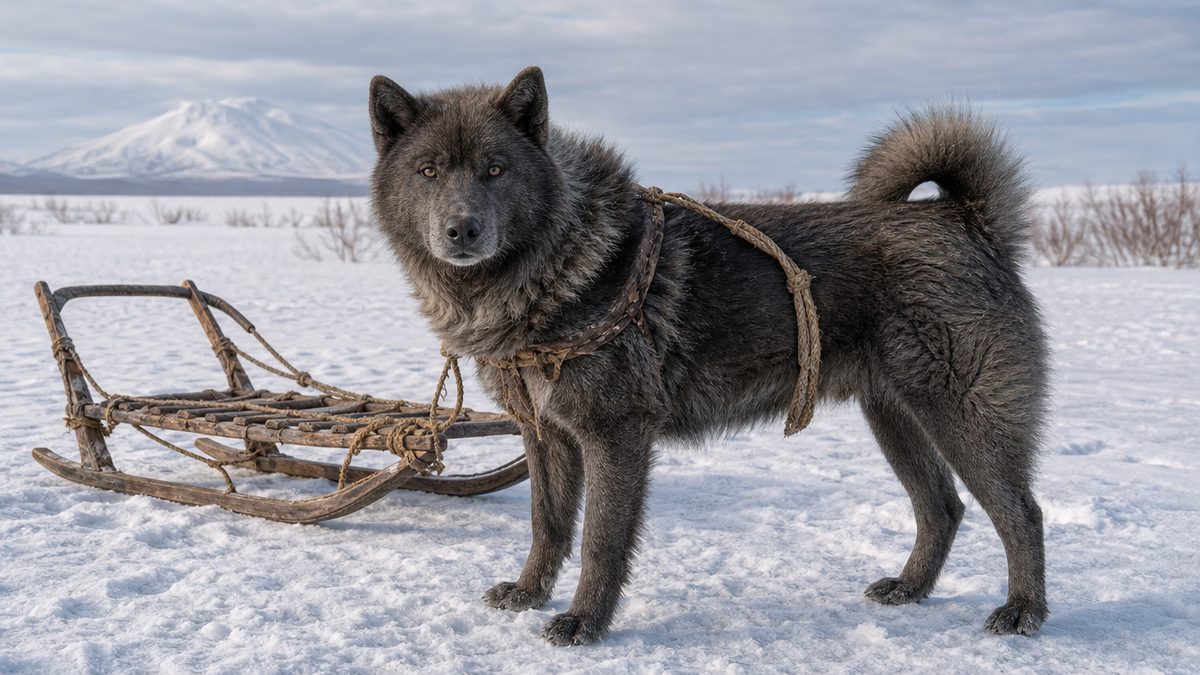
Start with what the sources agree on. This is a large, hardy, cold-adapted dog with a thick double coat capable of withstanding high winds and extreme temperatures, with a strong elongated frame and long-legged build, able to haul heavy loads over long distances in deep snow on minimal care. A Russian breed database calls it an aboriginal breed used for centuries in Kamchatka to move goods and people, and notes that it played a significant part in the First Kamchatka Expedition. It is also heat-sensitive by construction, which the climate section quantifies. Colour is most often black, dark or light grey, with prick ears and oblique yellow, brown or blue eyes. The dogs are described as loyal, intelligent and friendly to people, generally silent, and too friendly to be used as guard dogs.
Traditionally they were fed salmon, often every other day, supplemented with human scraps, seal blubber or bought food, and they carry a high prey drive that has them attacking reindeer, the region's staple livestock.
The measurements, which do not agree
No two Russian sources give the same figures, and there is no register to arbitrate. Bonbeno prints them side by side rather than averaging, because averaging unsourced numbers produces one more unsourced number.
| Source | Height | Weight | What kind of document |
|---|---|---|---|
| Dog Museum, Russia | 54-68 cm | 25-35 kg | A breed database entry |
| NatsAktsent | 54-86 cm | up to 30 kg | A Russian ethnic-affairs outlet's five-breed feature |
| Revival kennel, individual dog | 67 cm | never above 25 kg | A recorded wolf-cross male named Abram, brought from Ust-Khairyuzovo in late 1992 |
Look at the second row. A 32 cm spread from 54 to 86 cm is not a breed range; it is the range of a regional population that includes at least three distinct types. The kennel that rebuilt the population says exactly that: the Kamchatka peninsula stretches 1,200 km north to south across several climate zones, so sled dogs in the north and the south differ greatly, and only the central and southern dogs match the adopted standard.
In the northern settlements the widespread dog is what locals call the polar dog, described by the same kennel as also a Kamchatka sled dog but not officially recognised. It is taller than average, longer in body, with a fuller and denser coat, especially at the neck, lower chest and tail, dark in colour with no white dogs, and a powerful but not coarse head. Northerners call these dogs lokhmashki, the shaggies, and the commonest name for one is Kalekli, meaning fluffy. So one of the peninsula's three types sits outside the only document that exists.
That is the shape of the problem this page is about. A standard covering part of a population is not a boundary, and a boundary is half of what a breed is. The rest of this guide establishes what the document says, who approved it, whether any register ever used it, what the dog's history actually was, and what an Indian reader is looking at when the name appears in a search box.
Names: Kamchatskaya ezdovaya, the Koryak dog, and the peoples behind both
The dog carries a Russian administrative name and at least three older descriptive ones. English sources give Kamchatka Husky, Kamchatka Sled Laika and Koryak Dog as alternatives to Kamchatka Sled Dog, and the Russian is Камчатская ездовая собака, literally the Kamchatka riding dog.
The Koryak name is the oldest of the modern set and it is a cynologist's coinage rather than a Koryak one. Writing in the last century, Prince A. Shirinsky-Shikhmatov and M. Dmitrieva-Sulima recorded two types in Kamchatka teams, laika-like and wolf-like, and it was the second and commoner type that cynologists named the Koryak dog. Dmitrieva-Sulima described them as a Koryak Laika in her 1911 book on the laika and hunting with it.
The peoples, in their own terms
Bonbeno names the peoples the way they name themselves, because a dog page that treats them as scenery has failed at the first step.
- Itelmen, self-designated Итәнмән, romanised Itenmen. Some 3,193 Itelmen people live in Kamchatka Krai, speaking Itelmen and Russian.
- Koryak, some 7,485 of whom live in Koryakia within Kamchatka Krai on the 2021 census. The Koryak divide into two: the coastal people called Nemelan or Nymylan, meaning village dwellers, who fish and hunt marine mammals, and the inland reindeer herders called Chaucu or Chauchuven, meaning rich in reindeer.
- Even, a Tungusic people living across Sakha, Chukotka, Magadan, Kamchatka Krai and Khabarovsk Krai, and named on the Kamchatka museum's own record of the peninsula's dog-driving communities.
All three peoples are living peoples, and this matters on a page about a dog whose Russian encyclopedias call it extinct. A breed can be described as vanished. The people who bred it have not vanished, they are counted in a national census, and the villages the revival kennel bought its foundation dogs from in 1992, Voyampolka, Lesnaya, Palana and Karaga, are inhabited today.
The revival kennel is called Inglyau, which in Koryak means pale-faced, after its first lead dog, a white male brought from the village of Karaga. That is a small thing and it is the right kind of small thing: the Russian breeding programme took the name of its own foundation animal from the language of the people whose dogs it was rebuilding.
Two further naming points matter for anyone researching this dog. First, the Russian sources use ездовая, riding or draught, where English uses sled, so the term to search is Камчатская ездовая rather than any transliteration of husky. Second, the word laika in Russian usage is a type label covering hunting spitzes and sled dogs together, which is why the same animal is variously the Kamchatka sled dog, the Kamchatka sled laika and the Koryak dog depending on which decade and which cynologist you are reading.
Is the Kamchatka Sled Dog a breed? Tested against Bonbeno's own rule
The Kamchatka Sled Dog passes the first of Bonbeno's two conditions and fails the second, so this site treats it as a type rather than a breed. A written standard exists and its content is reported in detail. No studbook has ever been kept against it, and the Russian register that would keep one holds four other Russian laikas and not this dog.
The rule is published on Bonbeno's own page for names used like breeds that are not breeds, and it is short: a breed has a written standard and a studbook behind it, so a puppy can be measured against something. Bonbeno applied the same rule to the Koolie, an Australian working dog no national kennel club recognises, and concluded the Koolie is a breed because both documents exist. The test is not a way of dismissing unrecognised dogs, and this is the first breed on the site to split the two conditions.
Condition one: is there a written standard? Yes
The breed standard for the Kamchatka sled dog was approved by the Russian Federation of Service Dog Breeding on 26 February 1992. English Wikipedia reports the same approval, dating it to February 1992 and citing the same Russian expert. The RFSS is a real and continuing organisation, and its own site shows it operating as a route through which RKF documents are obtained, so this was not a private club inventing paperwork.
The standard's content is reported rather than reproduced, and two clauses are quoted in the literature. It permits all colour variants from black through to white. And it treats light eye colour and odd eyes as a fault, which is a specific, checkable, disqualifying-style provision of exactly the kind a standard contains. A Russian veterinary encyclopedia describes the same 1992 document as a standard developed and adopted by dog breeders and recognised in Russia, and says it is what allowed kennels to be opened.
So condition one is satisfied. Bonbeno records one honest limit: the full text of the 1992 standard could not be retrieved, and everything above is reported by named Russian sources rather than read off the document itself. That is a weaker evidential position than this site prefers, and it is stated rather than hidden.
Condition two: is there a studbook? No, and the control is decisive
Russia keeps a register for exactly this situation. The Russian Cynological Federation maintains the ВЕРК, its All-Russian Unified Pedigree Book, and its Appendix 1 to the Breeding Regulations is the nomenclature of breeds recognised by the FCI and the RKF, with FCI-unrecognised but RKF-recognised breeds carrying no FCI number. Bonbeno read Group V of that appendix in full.
| Breed | FCI number | Held by the RKF |
|---|---|---|
| East Siberian Laika | 305 | Yes |
| West Siberian Laika | 306 | Yes |
| Russo-European Laika | 304 | Yes |
| Yakutian Laika | 365, provisional | Yes |
| Chukotka Sled Laika | None | Yes, RKF-recognised and FCI-unrecognised |
| Karelian Laika | None | Yes, RKF-recognised and FCI-unrecognised |
| Nenets Reindeer Herding Laika | None | Yes, RKF-recognised and FCI-unrecognised |
| Kamchatka sled dog | None | Absent |
That is the finding of this page. The RKF's list of FCI-unrecognised breeds it nonetheless recognises exists, is current, and holds three Russian laikas that the FCI has never touched. The Kamchatka sled dog is not one of them. The same absence repeats in Appendix 5, the list of breeds whose dogs may receive ВЕРК РКФ R pedigrees with breeding rights and title rights, approved by RKF Presidium decision of 18 June 2025: its Group V line reads East Siberian Laika, West Siberian Laika, Reindeer-herding Spitz, Russo-European Laika, Cirneco dell'Etna, Chukotka Sled Laika and Yakutian Laika.
The Chukotka Sled Laika is the perfect control and Bonbeno did not have to construct it. It is an aboriginal Russian sled dog from the neighbouring region, described in the same decades by the same researcher, whose standard was assembled from measurements of 2,500 dogs between 1987 and 1992 and approved by the RKF in 1999, with a corrected version published in the RKF's own newsletter in 2005. A 2024 peer-reviewed genomics paper records the same recognition. The two projects ran in parallel, one produced an RKF-registered breed and the other produced a standard nobody registered against. The instrument works. The absence is real.
Four Western registers were checked as well, each with controls confirmed on the same returned document. The FCI's Group 5 Section 1, Nordic Sledge Dogs, holds five breeds from four countries: Canadian Eskimo Dog 211, Greenland Dog 274, Samoyed 212, Alaskan Malamute 243 and Siberian Husky 270, and no Russian sled dog except the Samoyed. The FCI provisional register holds 21 breeds including the Yakutian Laika 365. The AKC Foundation Stock Service holds 88 breeds including the Yakutian Laika and the Canadian Eskimo Dog. The UKC holds over 300 breeds with 35 in its Northern group, plus a lower Bloodlines tier that itself carries the Yakutian Laika. The Canadian Kennel Club holds 225 breeds, its Working group carrying the Yakutian Laika among 36. Five registers, five Yakutian or northern controls present, and this dog absent from all five.
| Condition | Koolie | Kamchatka Sled Dog |
|---|---|---|
| A written standard | Yes, an unofficial club conformation document | Yes, approved by the RFSS on 26 February 1992 |
| A studbook | Yes, three Australian registers issuing five-generation certificates | No. Absent from the RKF nomenclature that holds its Chukotkan neighbour |
| National kennel club recognition | No | No |
| Verdict on Bonbeno's rule | A breed | A type, not a breed |
One sibling page makes the contrast sharper. Bonbeno assessed the Mackenzie River Husky against the same rule in the same week, and it fails both conditions: a peer-reviewed genetics paper states in print that no club with defined standards exists for it, and no register anywhere holds it either. The Kamchatka dog fails only the second. That difference is exactly why this site publishes a two-condition test rather than a verdict, because the two dogs are unrecognised for different reasons and a reader deserves to know which.
Landrace status is not the reason, and this is where most writers go wrong. English Wikipedia calls this dog a rare landrace of sled laika, and being a landrace does not put an animal on Bonbeno's types-not-breeds page. The English Shepherd is a landrace with United Kennel Club registration since 1927, and the Africanis is a landrace with a published Kennel Union of Southern Africa emerging-breed standard. What puts a dog on that page is a missing document, and here the missing document is the register.
Why a standard without a studbook does not add up to a breed
A standard describes the ideal dog and a studbook records which actual dogs were bred from. Without the second, the first cannot do its job, because nothing connects the description to a lineage. That is not Bonbeno's opinion; it is how a peer-reviewed genomics paper defines kennel-club recognition.
Smith, Srikanth and Huson put it in one sentence in 2024: the recognition of a breed by a kennel club primarily serves two purposes, gene pool isolation and pedigree record keeping. By prohibiting crossbreeding between recognised breeds, kennel clubs establish breed barriers that ensure gene-pool isolation and provide a detailed record of ancestry for registered dogs. Read against Bonbeno's two conditions, the match is exact: a standard is the boundary, a studbook is the record.
The Kamchatka dog has the boundary drawn and nobody keeping the record. Three consequences follow and each is visible in the sources.
- No dog can be shown to descend from the described animal. The 1992 standard says light eyes and odd eyes are a fault. Without a register, a puppy with correct dark eyes proves nothing about its parents, because there is no document naming them.
- The population cannot be isolated from imports. The kennel account records Kamchatka bitches producing puppies by household pets brought into the villages, for want of local sires, and calls that the mechanism of the breed's degeneration. A studbook is what stops that from being invisible.
- Wolf crossing continues, openly. The same source states that crossings with wolves are still practised in folk selection, less actively than before, with one or two of the calmest pups kept from a first litter and the second generation working in harness almost entirely. Wikipedia records the same practice, saying many populations are still maintained as a landrace using traditional methods including occasional outcrossing to produce wolfdogs. No recognised breed's studbook would permit that.
Bonbeno's page on the Karelo-Finnish Laika shows what an RKF register entry actually looks like when one exists: a numbered registration order approved by the Presidium, a named register for unrecognised breeds, rules on which dogs may enter it, a prohibition on crossing with the FCI-recognised relative, and a ten-year window with a closing date. That is a studbook with machinery around it. For the Kamchatka sled dog there is a standard, a kennel, and nothing in between.
One qualification, because this site would rather be precise than tidy. A dog can fail the test and still be a real, distinct, valuable population, and this one plainly is: it has an archaeological record going back thousands of years, a documented working role across the peninsula, a named type structure of at least three regional forms, and a revival programme run by people who can name their foundation animals. The test measures paperwork, not worth. What it tells an Indian buyer is narrow and practical: there is no document to check.
History: a dog burial, Atlasov's reports, and 50,700 working animals
Kamchatka has one of the oldest documented human relationships with dogs anywhere, and the Kamchatka Regional United Museum keeps the record. The peninsula was settled about 15,000 years ago, and in one of roughly 40 dwellings excavated at the Ushkovskoye lake site archaeologists found a dog burial, which the museum presents as evidence of early dog domestication in north-east Asia.
Sledging arrives later in the record. Fragments of sledge runners and bone sub-runners were recovered from layer I of the Zhupanovo site, dating to the first millennium BC. The revival kennel's own account dates the Ushkovskoye burial to about 12,000 years ago and puts harnessing at 1,500 to 2,000 years ago, which is a different set of figures for the same two events and is reported here as such.
The written record begins with Vladimir Atlasov's seventeenth-century reports, the first accounts of Kamchatka's indigenous people using dogs for transport, and continues through every later scientific traveller. Stepan Krasheninnikov devoted a whole chapter of his Description of the Land of Kamchatka to dog teams, calling driving by dog a unique invention of Kamchatka's inhabitants and recording in detail how dogs were harnessed, driven and fed three hundred years ago.
| Period | Recorded value | Compared against |
|---|---|---|
| Eighteenth century, Krasheninnikov | Up to 60 roubles for four dogs | Comparable to and sometimes exceeding a Cossack's annual salary |
| Early twentieth century, Metropolitan Nestor | 50 to 150 roubles per working dog | Nestor, then a hieromonk, earned 40 roubles a month |
| Same period, passenger travel | 6 kopecks per verst | A published fare for travelling by sledge |
| Kamchatka teams bought by Chukotkan drivers | A lead dog could cost more than a milking cow | Chukotkan kayurs rated Kamchatka dogs above their own |
The scale of the working population, and the figure that anchors it
In 1937 Kamchatka alone worked 50,700 dogs, which is over 4,500 complete teams. That figure comes from L. S. Bogoslovskaya of the Institute of Heritage in Moscow, the researcher who led the Chukotka surveys, and it is quoted in a 2024 peer-reviewed genomics paper as the benchmark against which Chukotka's own collapse is measured. Two independent Russian accounts put the mid-century population at about 50,000, which is consistent Панюхина Е, эксперт-кинолог. Камчатская….
The administrative record is just as concrete. In 1934 dog transport carried the postal service between 100 settlements, three state farms and 30 settled collective farms, with the postal routes running to thousands of kilometres and about 1,200 dogs, more than 100 teams, working the mail. The revival kennel's account puts the mid-century link at 150 settlements. Bonbeno prints both figures rather than choosing, since they describe slightly different things at slightly different dates.
Itelmen myths hold that mountains and valleys formed when the god Kutkh travelled by dog, and that earthquakes happen when Kozei, a dog from the team of the mountain spirit Tuila, shakes itself. Koryak belief holds that the door to the afterlife is guarded by dogs that have to be bribed to let the newly dead through. Dogs were also sacrificed in ritual and their blood used in treating skin disease. This is not decoration around a breed page. It is why the destruction described in the next section was experienced the way it was.
One international footnote belongs here, because it explains why an Indian reader has heard of the Siberian Husky and not this dog. During the 1890s Kamchatka sled dogs were actively exported to Alaska to move gold miners to the Yukon during the Klondike rush. The Russian account goes further, claiming American cynologists crossed Kamchatkan, Chukotkan and Kolyma dogs and selected deliberately to produce the Siberian Husky, and attributing the husky's blue eyes to Kamchatka stock. Wikipedia reports the same theory more cautiously, noting that the Chukotka sled dog is generally considered the husky's progenitor and that the Kamchatka contribution is a hypothesis about the blue eye colour. Bonbeno reports it as the contested claim it is.
The decline: a state decision, a bounty, and 300 dogs in one village
The Kamchatka sled dog did not fade out. It was destroyed by policy, and the Kamchatka Regional United Museum states it in four words: the dog was declared an enemy. What follows is drawn from Russian sources including a state museum and a first-person account by a named cynologist who watched it happen as a child.
The mechanism was administrative before it was violent. From the late 1960s, decrees and regulations forbade keeping dogs in settlements and forbade preparing the quantity of fish they needed. A 2024 genomics paper records the same policy across Russia, noting that by the mid-twentieth century dog sledging had been decreed economically inefficient and damaging to the fisheries.
The fisheries argument was contested at the time by the people who kept the dogs. They pointed out that sled dogs were fed dried capelin, marine mammal meat, reindeer slaughter waste and yukola made from fish backbones left after salting rather than from flesh, and that even in the eighteenth century Krasheninnikov recorded dogs being fed fish unfit for people.
What the bounty actually paid
Dog fur was declared valuable and village sewing workshops began producing coats, hats and unty from dog skins. The cruelty of the selection is worth stating precisely, because it is a genetic fact as well as a moral one. The Kamchatka sled dog's fur quality tracks its working quality, so the more beautiful the coat and the more even the colour, the better the dog. Within a few years the best sledge dogs in Kamchatka's villages had been destroyed, the lead dogs first.
| What was paid or done | Figure or event |
|---|---|
| Paid at the municipal office for a dog's ears and head | 8 roubles |
| What the shooter could sell the skin for | 15 roubles, or a bottle of vodka |
| Dogs killed in the village of Lesnaya, winter 1987 | 300 |
| Monthly pension of one pensioner whose lead dog was shot | 24 roubles |
| What she used her team for | Fetching supplies and water, checking snares for hares and ermine |
The record of protest survives in the letters. Residents wrote to the district prosecutor, the Koryak district committee, central newspapers and the state northern committee. One writes that Koryaks need sled dogs even in an age of machinery and that she is outraged that the first secretary of the Koryak district party committee believes all dogs should be destroyed. A reindeer herder writes that for pensioners in the village it is the best transport, needing no fuel and no spare parts. Another writes that in small villages dogs are the only transport for the indigenous population, without which you cannot leave the settlement, reach hunting grounds, or bring back firewood and the fish put by in summer.
The same account records what protection looked like: announcing publicly that traps had been set in the yard where a team was kept, and cutting or dyeing a dog's coat with scissors and paint in the hope that a ruined skin would not be worth shooting. Read the second one twice. People deliberately spoiled the coat that made the dog valuable, because the coat was what got it killed.
The outcome was the opposite of the stated public-health goal. Sled dogs were destroyed and the number of dogs on village rubbish tips did not fall, because nobody buys the skin of a mangy stray, so the streets filled with unowned crossbred dogs while the working teams disappeared. By 1970 sled teams had been replaced by vehicles across the Russian north. Bogoslovskaya lists the wider causes as snowmobiles, the decline of fur trapping and local fishing, mass epizootics brought in with imported dogs, and the hunger of the 1990s when people could no longer feed a team.
Bonbeno draws one deliberate comparison and one deliberate limit. The comparison: Canada's Inuit lost their qimmiit in the same decades under an ordinance enacted in 1929, the population fell from an estimated 10,000 to 20,000 in the 1920s to a single registered dog by 1963, and in 2019 the Canadian government apologised and funded a revitalisation programme. The limit: Bonbeno found no equivalent Russian apology, commission of inquiry or compensation programme for Kamchatka, and reports that as something it could not find rather than as something that does not exist.
The revival: 12 dogs out of 76, and a kennel called Inglyau
The revival began in 1990 with a sled race, and the race is what revealed how far the damage had gone. Beringia was organised on the initiative of the magazine Severnye Prostory with support from the Russian Fund of the Peoples of the North, Siberia and the Far East, running between the villages of Esso and Milkovo.
Three sources describe that first race and they do not agree on its size, which is worth printing rather than smoothing.
| Source | Route length | Entry |
|---|---|---|
| Kamchatka Regional United Museum | 250 km, Esso to Milkovo | 8 teams |
| Kamchatkaland, tour operator | 260 km | 8 sleds, April 1990 |
| Panyukhina, sports director of the Kamchatka sled sport centre | 250 km | 9 kayurs from Karaga, Ossora and Esso, with 76 dogs |
What the race established is what everyone had feared. A Moscow veterinary encyclopedia summarises it in one line: it was in 1990, with the sled races starting on Kamchatka, that people realised practically no purebred Kamchatka sled dogs remained.
The 76-dog figure is the important one, because an expert counted them. The cynologist Boris Shirokiy, inspecting the dogs that arrived for the race, reported that of 76 animals only 12 fitted the Kamchatka sled dog standard even loosely. The remaining 64 carried the marks of numerous cultured breeds: shepherds, terriers and setters. That is 15.8 percent of the entry. Worse, half of those 12 were castrated.
The castration finding is the most revealing detail in the whole revival story, because it records a management tradition that survived its own purpose. Males were traditionally castrated in the national villages as a form of selection: a few of the best sires were left entire, castration never happened until a dog had proved itself in work, and dogs with outstanding working qualities were never castrated at all. By 1990 the memory that the operation existed had outlived the memory of why, so young dogs were being castrated simply to make them more obedient and less inclined to fight or wander.
What the race also measured, and it was not encouraging
Speed told its own story. The winner of the first Beringia covered the last 50 km at 7 km per hour. Even allowing for an unpacked trail that is extraordinarily slow, and the same account reads it as evidence that the teams were made up of poorly fed, exhausted crossbred dogs with no wish to run. Cynologists at Beringia-91 and Beringia-92 recorded further deterioration in the dogs' breed type.
Then the numbers moved the other way. The 1991 race ran 1,980 km and entered the Guinness World Records as the longest sled dog race in the world, and the 1992 edition exceeded 2,000 km. Beringia became an official Kamchatka Krai holiday in 2010 and entered the sports ministry's plan, so kayurs can now earn sporting titles and judges can hold categories. The largest field was 2019, with 19 teams at the start.
| Year | Entry | Source |
|---|---|---|
| 1990 | 8 teams, or 9 kayurs and 76 dogs | Museum and Panyukhina disagree |
| 2001 | 15 teams at the Esso start | Panyukhina, eleven years on |
| 2019 | 19 teams, the largest field | Kamchatka Regional United Museum |
The kennel, and what it actually collected
In 1992 the Panyukhin family bought eight sled dogs in the villages of Voyampolka, Lesnaya, Palana and Karaga and brought them to Petropavlovsk, founding the Inglyau kennel with the support of Anatoly Kovalenkov. The kennel has since held 20 to 25 laikas at a time, selecting for working quality and conformation together, and choosing silvery grey from the full range of colours the standard permits. The same people later founded the Kamchatka Centre of Sled Sport.
A Petropavlovsk tour operator advertises a visit to the Snow Dogs kennel, home to 130 dogs including animals that have run Beringia and covered more than 2,100 km. The dogs it names are Siberian huskies, Alaskan malamutes, Samoyeds and sled crossbreeds. The Kamchatka sled dog is not among them. The tour operator's own long article on the history of Beringia likewise never names the breed once, mentioning Alaskan malamutes and huskies instead. Thirty-six years after a race was founded partly to revive this dog, the peninsula's visitor-facing sled tourism runs on imported breeds.
That is the honest state of the revival. There is a standard, a small kennel line, a race, a state holiday and a genuine living aboriginal population in northern villages. There is no register, no published count, no health data and no visible presence in the peninsula's own sled tourism. A revival programme is not the same thing as a breed programme, and this one has been the first without ever becoming the second.
Kamchatka sled dog price in India: the first page sells posters and a tour
No Kamchatka sled dog price in India exists, and the India-restricted first page for that query is unusually clear about why. Bonbeno pulled it and read what was there: a Wikipedia article, a wall-art print listing, a ten-day dog-sledding tour, a template cost page, a sticker, two tourism sites, a Facebook post, a genomics paper and a stock-photography index.
Not one of those ten results is an Indian seller, and not one of them prices a dog. The only fully-priced item on the page is a holiday: a ten-day Kamchatka dog-sledding tour to the Nalycheva Valley, running 1 February to 30 April for groups of three to eight people, at EUR 4,200 per person including full board, accommodation, transfers, a city tour and museum fees. That page never uses the word husky or the word breed.
| Position | Domain | What it actually is | Price for a dog |
|---|---|---|---|
| 1 | en.wikipedia.org | The breed article | None |
| 2 | etsy.com | A wall-art print listing | None. It prices a poster |
| 3 | kamchatkalostworld.com | A ten-day sledding tour | EUR 4,200 per person, for a holiday |
| 4 | petsconnected.com | A costs-and-preparation template page | None. See below |
| 5 | ebay.com | A sticker decal | None |
| 6-7 | kamchatkaland.com, visitkamchatka.ru | Tourism pages about Beringia and dog sledding | None |
| 8 | facebook.com | A museum post about ancient sled dogs | None |
| 9 | pmc.ncbi.nlm.nih.gov | The 2024 Arctic sled dog genomics paper | None |
| 10 | alamy.com | Stock photography | None |
The one page that looks like a cost guide is a template
Position four is a page headed Kamchatka Sled Dog Costs and Preparation, and it reads like exactly what an Indian buyer is looking for. It is not written about this dog. Bonbeno applied the template-seam test: fetch the same page for two other breeds on the same site and compare the headings.
All three pages carry 21 byte-identical H2 headings. Key takeaways, Who this guide is for, Costs and Preparation for this breed, 10 helpful care tips, Rehoming or selling dogs?, 10 truthful online selling tips, Buyer questions to ask before replying, Seller details that make a listing useful, Welfare and safety red flags, How this links to the marketplace, What a good outcome looks like, Useful Marketplace Next Steps, and so on. The only difference across the Kamchatka Sled Dog, the Labrador Retriever and the Greenland Dog versions is the breed name inserted into the second heading. The rest is the software.
Read the headings again and the page's actual purpose is visible in them. Rehoming or selling dogs, truthful online selling tips, how this links to the marketplace, useful marketplace next steps. It is a classified-listings funnel wearing a breed guide's clothes, generated once per breed name, including for breeds nobody sells.
The multi-breed Indian price lists do not carry it either
India's fullest published price lists name 40 to 50 breeds with a rupee band each. Bonbeno opened one that prints 222 separate rupee figures across 40 breeds. Kamchatka appears zero times, as does Greenland and Samoyed, while Labrador appears ten times and Husky six. That is the useful evidence: not a low price or a high one, but an absence from the document where an Indian price would live.
The only ways to produce an Indian price for this dog would be to convert a foreign figure or to quote an unsourced one. This site has caught Indian pages converting dollar lists at 84.38, 80, 74 and 66.67, and has caught an answer engine inventing a rupee band from a page containing no numbers at all. There is no foreign price for this dog to convert and no Indian listing to quote, so there is no figure. An absent price honestly reported is worth more than a plausible one.
One last observation about the demand side. The India-restricted result set for this term returns the Kamchatka Peninsula rather than a dog, and includes an Indian civil-services current-affairs page about the peninsula. That is not a dog market being served badly. It is a query that Indian search treats, correctly, as a geography question.
Cost of ownership in India for a 25 to 35 kg northern dog
Budget Rs 5,000 to Rs 9,000 a month to keep a dog of this size properly in an Indian metro, before the cooling bill. There is no purchase price to quote, but the recurring cost of ownership is real, published and sourceable, because every line applies to any medium-large thick-coated dog living here.
The Indian baseline comes from VOSD, which prices each line separately. Across all dogs it puts the total monthly cost at Rs 3,000 to Rs 10,000 and beyond, and the annual cost at Rs 25,000 to Rs 80,000 or more, varying by breed, city and standard of care. A 30 kg working-coated dog sits in the upper half of every one of those ranges.
| Line | Published Indian figure | Where this dog lands |
|---|---|---|
| Food, per month | Rs 1,500-4,000 for a medium dog; large working breeds push to Rs 5,000 or more | Upper half, and higher again if it is actually working |
| Vet consultation | Rs 500-1,000 at a good clinic | Same, with more visits through the monsoon |
| Annual vaccination | Rs 1,500-3,000 | Same, and non-negotiable |
| Preventive care, per year | Rs 5,000-8,000 done properly | Same. There is no breed screening panel to add, because none exists |
| Grooming, per session | Rs 300 basic wash to Rs 2,000 for a large long-haired breed | Upper half. The ruff and undercoat are the expensive part |
| Boarding, per day | Rs 500-2,000 | Mid to upper, and many facilities will decline an undeclarable dog |
| Emergency hospitalisation | Rs 8,000-30,000 for one to three days | Mid to upper, scaling with body weight |
| Cooling | Not costed by any Indian guide | The line that decides everything. See the climate section |
Two lines behave differently on this page than on a recognised breed's. Screening costs less, because there is no breed-specific panel to run: no registry holds hip or elbow data for this dog, so a result would have nothing to be compared against. Insurance is harder, because Indian pet insurers underwrite by breed and a dog no register recognises cannot be declared accurately on a proposal form.
The Indian registration line that does exist
You cannot register this dog as a breed in India, because the Kennel Club of India issues pedigrees against FCI nomenclature and this dog is not in it. The KCI does publish a line for a dog without papers. Its tariff effective 1 April 2024 prices registration with unknown pedigree at Rs 1,000, import dog registration at Rs 2,500, a four-generation certified pedigree at Rs 1,000 and a five-generation one at Rs 1,500. The first is the only one a dog of this description could ever use, and it records an individual animal rather than a breed.
VOSD's own comparison is the useful one: a dog costing Rs 4,000 a month to maintain in Pune may cost Rs 7,000 a month in South Delhi, with grooming, boarding and training following the same pattern. For a thick-coated northern dog the metro premium bites hardest on grooming and boarding, and in a plains city the electricity bill for keeping one room cool through summer is larger than every other line on this table combined.
First-year setup follows the same source. VOSD budgets Rs 2,000 to 5,000 for a starter kit and another Rs 2,000 to 5,000 for first vaccinations, deworming and a health check, putting the first month at Rs 15,000 to 25,000 before anything unexpected. For this dog, spend the discretionary part on airflow, shade and a reliable drying setup rather than on bedding.
Can a Kamchatka Sled Dog live in the Indian climate
No Indian city can supply this dog's thermal environment, and the reason is humidity as much as temperature. Bonbeno queried NASA POWER by explicit latitude and longitude for four Kamchatka points and eight Indian ones, and echoed the elevation each cell reports so a reader can check the model was standing in the right place.
The homeland points chosen are the peninsula's administrative centre, the Beringia start village in the interior mountains, and two northern coastal settlements the revival kennel bought its foundation dogs from.
| Place | Cell elevation | Annual mean | Coldest month | Warmest month | Annual humidity |
|---|---|---|---|---|---|
| Petropavlovsk-Kamchatsky | 140.19 m | 1.82 C | -8.26 C (Feb) | 13.87 C (Aug) | 87.8% |
| Esso, interior Kamchatka | 797.75 m | -4.18 C | -17.53 C (Jan) | 12.18 C (Jul) | 92.2% |
| Palana, north-west coast | 161.44 m | -1.35 C | -14.52 C (Feb) | 11.94 C (Jul) | 89.5% |
| Ossora, north-east coast | 41.06 m | -0.17 C | -12.45 C (Feb) | 12.97 C (Aug) | 88.7% |
| Delhi | 206.37 m | 25.60 C | 13.61 C (Jan) | 35.88 C (Jun) | 45.6% |
| Chennai | 48.95 m | 27.95 C | 24.09 C (Jan) | 31.51 C (May) | 72.4% |
| Mumbai | 97.15 m | 26.77 C | 23.19 C (Jan) | 31.19 C (May) | 67.4% |
| Bengaluru | 841.72 m | 23.74 C | 20.22 C (Dec) | 28.37 C (Apr) | 67.9% |
| Kolkata | 7.35 m | 25.81 C | 17.31 C (Jan) | 31.53 C (May) | 73.9% |
The warmest month anywhere in Kamchatka on this table is 13.87 degrees Celsius. Chennai's coolest month is 24.09, which is more than ten degrees above the homeland's summer peak, and Chennai's annual mean of 27.95 sits 26.13 degrees above Petropavlovsk's. Delhi's January, at 13.61, is the only Indian figure on the table that comes close to a Kamchatka summer, and it lasts four weeks.
The humidity twist, which is the part other pages miss
Most northern-breed pages argue that a cold-climate dog cannot handle Indian humidity because it is used to dry cold. That argument does not apply here. Kamchatka is a maritime peninsula between the Sea of Okhotsk and the Pacific, and its annual relative humidity across all four points runs from 87.8 to 92.2 percent, which is well above Chennai's 72.4 and far above Delhi's 45.6.
So this dog is already humidity-adapted. That sounds like good news and is the opposite. A dog from a dry cold climate at least gains something from India's dry heat season; this one is adapted to shed heat in air that is already saturated, which is the hardest condition for evaporative cooling, and it evolved that adaptation at temperatures near freezing. It has no dry-heat reserve to fall back on, and India's most humid months are also its hottest.
The elevation check, and where it changes the reading
NASA POWER returns a grid cell rather than a point, so Bonbeno echoed the elevation with every query. The coastal Kamchatka cells are honest: Ossora returns 41.06 m for a settlement near sea level and Palana 161.44 m for a river-mouth village, which are usable offsets. Esso is the one to flag: the cell reports 797.75 m for a village nearer 490 m, so its series runs roughly 300 m too high and therefore around two degrees too cold at the standard lapse rate. Petropavlovsk's 140.19 m sits above a city centre closer to 30 m, which pushes its figures marginally cold as well.
The Indian cells behave as this site has recorded before. Delhi comes back 10 m below its real elevation, Chennai 43 m above, Mumbai 83 m above and Bengaluru 78 m below, all within noise. Ladakh is the large exception: the Leh cell reports 4,532.61 m for a town near 3,500 m, so POWER's Leh series runs about 1,033 m too high and therefore too cold. Corrected at about 6.5 degrees per 1,000 m, Leh's annual mean of minus 2.75 becomes roughly plus 3.9 and its July 10.18 becomes roughly 16.9.
Corrected for the elevation error, Leh's winter is close: an estimated minus 9.3 C in January against Petropavlovsk's minus 8.26 C in February. Its summer is not: an estimated 16.9 C in July against Kamchatka's 13.87 C peak, so Ladakh runs about three degrees warm at the top of the year. The bigger difference is water. Leh sits at 52.2 percent annual humidity against Kamchatka's 87.8 percent, so a Ladakhi summer is warmer but far easier to shed heat in. On balance Ladakh is the only Indian region where this dog could live outdoors, and even there it would be living in the wrong kind of air.
One figure sets the scale of the mismatch for the rest of the country. The World Health Organization's India page reproduces the India Meteorological Department criteria, under which a heat wave is declared when the actual maximum temperature reaches 45 degrees Celsius and a severe heat wave at 47. Delhi's cell records a maximum of 48.79 and Kolkata's 46.81. A dog whose homeland has never recorded 28 degrees is being asked to live through 48.
What the heat evidence supports for a dog of this size
The largest study of heat-related illness in dogs did not include this breed, so Bonbeno claims only the factors that genuinely transfer. Hall, Carter and O'Neill reviewed 905,543 UK dogs under primary veterinary care in 2016, identified 395 confirmed heat-related illness events, and reported an incidence of 0.04 percent with an event fatality rate of 14.18 percent.
That paper's risk factors are the reason to read it here. Its multivariable analysis identified breed, higher bodyweight relative to the breed and sex mean, being over two years of age, brachycephalic skull shape and weighing over 50 kg as significant. Bonbeno applies two of those and rejects three, and says which is which.
- Not brachycephalic, so that factor does not apply. This is a long-muzzled northern dog.
- Not over 50 kg at any published figure, since the reported range tops out at 35 kg. That band does not apply either, which is a genuine point in this dog's favour against, say, a Malamute.
- Bodyweight relative to the breed mean cannot be applied, because there is no register to establish a breed mean. There is no number to be above, which is a direct practical consequence of the studbook finding.
- The breed was not modelled. It does not appear in the UK cohort, so no odds ratio published in that paper belongs to it. Bonbeno names the transferable factors and stops.
The companion paper matters more for how an Indian owner would actually lose this dog. Reviewing the same 905,543-dog cohort, Hall and colleagues identified 1,259 heat-related illness events from 1,222 dogs and found exertional heat-related illness was the predominant trigger at 74.2 percent of events, ahead of environmental at 12.9 percent and vehicular confinement at 5.2 percent Royal Veterinary College VetCompass. Their own conclusion is the paper's title: in the UK, exertional heat illness affects more dogs and kills more dogs than confinement in a hot vehicle.
This animal's entire selection history is exertion, and its own kennel account says two days without training leaves the dogs restless and watching for the harness. The predominant trigger of fatal heat illness in the largest cohort ever studied is exercise. Every hour of work you give a Kamchatka sled dog in Indian daylight increases the exact risk the exercise is meant to relieve. That is a reason not to bring one here, not a scheduling problem to solve.
One structural point about the coat, from the neighbouring breed rather than this one. A 2016 Russian study examined the architectonics of the hair of Chukotka sled dogs, which is the nearest published coat science to this animal. Bonbeno cites it to make a limit visible rather than to borrow a finding: the Chukotka dog has coat research, a standard and an RKF register entry, and the Kamchatka dog has none of the three. Do not read Chukotka coat measurements onto a Kamchatka dog.
Indian law and this dog: import, housing, and one clause that names the case
Indian law makes it impossible to build a lawful supply of this dog and, separately, restricts how one already here may be kept. Both provisions were read from the primary documents rather than from summaries, because both are misquoted routinely.
Start with import. Indian policy files dogs under ITC(HS) 01061900, Mammals: Other, as a Restricted item subject to Policy Condition 6, and Policy Condition 7 permits import only for three purposes: a pet dog with a valid pet book and relevant records in the importer's name, dogs imported by research organisations with a CPCSEA recommendation, and internal security by the Defence and Police Force. Policy Condition 8 states that import of commercial dogs for breeding or any other commercial activity outside those purposes is not permitted.
The operative sentence is blunter. Any applications for trading or breeding purposes, or applications made on behalf of some other person or entity, shall be duly rejected. Import of pet animals is allowed only through the airports and seaports of Delhi, Mumbai, Chennai, Hyderabad, Bengaluru and Kolkata and, since October 2024, Kochi airport, with quarantine at the government station of those ports where required, and owners are advised to begin the authorisation process at least two months before travel and to obtain an advance No Objection Certificate from the AQCS Regional or Quarantine Officer. The full route is set out in how to import a dog to India.
This dog is absent from the FCI nomenclature, so the Kennel Club of India cannot issue a pedigree for it. And no dog of any breed may be imported into India to breed or sell. Between them, those two facts mean no lawful Indian supply chain for this animal can form. Not that it is difficult. That there is no route.
The housing clause, quoted from the gazette
One clause of Indian law names this exact case. It sits in the Second Schedule, Part IV, paragraph 21(1) of the Prevention of Cruelty to Animals (Dog Breeding and Marketing) Rules 2017, headed Outdoor housing facilities, and Bonbeno quotes it from its own extraction of the 14-page gazette rather than from any secondary source:
> "(1) The following categories of dogs shall not be kept in outdoor facilities, unless that practice is specifically approved by the attending veterinary practitioner in writing:- (i) dogs that are not accustomed to the temperatures prevalent in the area or region in question; (ii) dog breeds that cannot tolerate the temperatures prevalent in the area or region in question, such as long-haired breeds in high temperature locations; and (iii) sick, infirm, aged or young animals."
Limbs (i) and (ii) both fit a thick-coated Kamchatka dog in an Indian city, and limb (ii) names the case in terms. The Rules also require outdoor facilities to include roofed shelters accessible to each animal and separate shaded areas large enough to hold all the animals at once.
This provision circulates as "Rule 21". The string Rule 21 appears zero times in the gazette, which Bonbeno confirmed by extracting all 14 pages and searching them. The 2017 Rules themselves stop at Rule 13, No licence without registration, and everything numbered above that is a Second Schedule paragraph. Cite it as Second Schedule Part IV paragraph 21(1).
Two things Indian law would require of a breeder here, and one it would forbid
If anyone ever did register as a breeder of this dog in India, three clauses would bite immediately. Rule 8(1)(a) requires that pups less than eight weeks in age are not sold. Second Schedule Part III paragraph 8(10) requires that breeding dogs have been tested for genetic defects, listing hip dysplasia, progressive retinal atrophy, night blindness, hypothyroidism, entropion, ectropion, overshot and undershot jaw, wry mouth, two or more missing teeth and cryptorchidism, which is an obligation no Kamchatka breeder anywhere could currently discharge because no screening data or reference population exists.
And Second Schedule Part II paragraph 6(3) prohibits two named mating techniques: in-breeding, defined as breeding between relatives of the second to fourth grade in straight or side line within the first four generations, and incest breeding, mating between parents and children or between brother and sister. That clause is not academic for a population rebuilt from eight founder animals bought in four villages. Any Indian attempt to rebuild this dog from a small founder base would run into Indian breeding law almost immediately, which is one more reason the honest answer to an Indian reader is that this dog belongs where it is.
Temperament: the friendliest rating on this site, and why it was selected for
This dog is friendly to people to a degree that is unusual even among sled breeds, and the reason is a selection pressure applied by people rather than by climate. English sources say it plainly: Kamchatka sled dogs are loyal and intelligent, friendly to people, generally silent and too friendly to be used as guard dogs.
The Russian kennel account explains where that came from, and the explanation is bleak and effective. Local people simply killed a dog that showed aggression to its driver, which removed those lines from the population within a generation. The same account records that even during painful veterinary procedures the kennel does not muzzle its dogs, because in every case the owner is inviolable.
The rest of the description is consistent. The dogs are cheerful, playful, hard to offend, very well disposed to people, and they idolise and completely trust their handler. They adore harness work: two days without training and they begin to fret, watching whether the owner is heading for the sledge and listening for the carabiner on the harness.
| What a household wants | What this dog offers | Verdict |
|---|---|---|
| A guard dog | Too friendly to guard, by its own description | Wrong dog |
| A quiet dog | Generally does not bark | Good, though northern dogs vocalise other ways |
| A dog safe with people | Aggression toward handlers was actively culled out | The strongest thing about it |
| A dog safe around livestock or small pets | High prey drive, documented as attacking reindeer | Wrong dog |
| A dog that settles indoors | Frets after two days without harness work | Wrong dog |
| A dog for a hot city | Adapted to a 13.87 C summer at 88 percent humidity | Wrong country |
Wikipedia records that these dogs have a high prey drive and are noted to attack reindeer, the region's staple livestock. Transpose that to an Indian street and the equivalent targets are goats, poultry, cats and free-roaming dogs. A friendly-to-humans dog with a working prey drive is a specific and manageable risk, but only if the owner knows it is there before the first incident.
One documented ability deserves recording because it is what people valued. Teams of Kamchatka sled dogs saved their owners repeatedly: finding the way home through a blizzard, digging out a driver caught in an avalanche, and turning back on a steep descent when they noticed the person had fallen from the sledge. Like other sled dogs they navigate the trail in blizzard conditions. That is a dog making independent decisions, which is a different thing from an obedient one, and the training section takes it from there.
Training a dog selected to obey a person and to think for itself
Train this dog through harness work and consistency, because that is what the record shows it responds to. The population was selected on two traits at once: total deference to the handler, enforced by removing dogs that showed aggression, and independent judgement in an emergency, rewarded by survival.
There is no published training protocol for this animal, no breed club to publish one and no trial system to test one against, so what follows is drawn from what the sources support and is labelled as inference where it is inference.
- Use the harness as the reward. The kennel account describes dogs shrieking and barking to be chosen for a run, and howling mournfully when left behind. A dog that badly wants to work does not need much else.
- Do not expect obedience-style compliance. This is a dog that was valued for turning a team around when the driver fell off, which is disobedience by any conventional definition.
- Socialise to other animals early and thoroughly, because the prey drive is documented and Indian streets are full of targets.
- Keep recall on a long line. Nothing in a freighting history rewards returning, and there is no published recall behaviour for this population to rely on.
- Train only in the dark half of the day. The largest study of the subject found exertion to be the predominant trigger of heat-related illness, and this is the section where that finding turns into a schedule.
One traditional practice that Indian law would not permit
The northern management tradition described in the revival section, castrating most males and leaving a few proven sires entire, was a real breeding system with a real purpose. Bonbeno mentions it only to be clear that nothing in it resembles the cosmetic surgery Indian law forbids. Second Schedule Part II paragraph 6(8) of the 2017 Rules strictly forbids tail docking, ear cropping, de-barking, de-clawing, branding, dyeing, injecting substances to enhance visual appeal and any change of appearance by artificial means. De-barking is the shortcut some owners of vocal northern dogs reach for, and it is prohibited.
Judge progress by whether the dog will work willingly beside you, tolerate handling without restraint and settle afterwards, not by whether it heels in a park. The kennel's own benchmark is that the handler needs no muzzle even for painful treatment. That is a relationship measure rather than a command measure, and it is the right one here.
Exercise: a harness requirement India can meet only in darkness
Plan on two or more hours a day of real work, and accept that India can supply it only before dawn and after dark for most of the year. No club has ever set a figure for this dog, so Bonbeno derives the requirement from the documented job rather than inventing a number.
The job is well recorded. These are dogs of a strong elongated frame with long legs, able to haul heavy loads with minimal care over long distances in deep snow. The scale is documented too: the Chukotkan dogs of the same region and era pulled a load of up to 1,000 kg on a good road with a team of 12 to 14 dogs, and covered 400 km and more at 6 to 12 km per hour depending on terrain and snow. Bonbeno cites those figures as regional context for what a northern freight team does, not as measurements of this breed.
| Season | Window that works | What to do | What to avoid |
|---|---|---|---|
| November to February | Before 07:00 and after 19:00 | Long walks, harness or cart work on cool mornings | Midday sun even in winter |
| March to May | Before 05:30 and after 21:00 | Short brisk work only, on grass rather than tar | Any exertion above 25 C |
| June to September | Before 05:30 and after 21:30 | Shade, indoor enrichment, scent games | Monsoon humidity plus exertion, the worst pairing for this dog |
| Any heat-wave day | None | Rest indoors with airflow and cool water | Everything |
Tar surface is not a detail. An Indian road holds heat long after sunset, and a dog running on it is loading its feet and its core at once. Test the surface with the back of your hand for five seconds before every session.
What happens without the work, honestly bounded
The only behavioural evidence is the kennel's: two days without training and the dogs begin to fret and watch for the harness. That is a description of frustration in working animals kept in a working kennel, not a study of what an under-exercised Kamchatka dog does in a flat. Bonbeno will not manufacture the second from the first. Read it as a strong signal about drive and as no evidence at all about destructiveness.
This is the central practical contradiction of keeping a northern sled dog in India and it has no clean solution. The dog needs hours of exertion. Exertion is the predominant trigger of fatal heat illness in the largest cohort ever studied. In a country whose heat-wave threshold is 45 degrees Celsius, the honest advice is not a better schedule. It is a different dog.
Grooming a Kamchatka coat in Indian humidity
Brush this dog two or three times a week, never clip it, and dry it to the skin after every soaking. The coat is a thick double coat built to withstand high winds and extreme temperatures, and the Russian account describes exactly how it was made: frost and cold winds produced hair that is harsh and dense over a soft, thick undercoat Панюхина Е, эксперт-кинолог. Камчатская….
Two coat details from the sources shape the routine. The northern polar type carries a fuller and denser coat than the central and southern dogs, longest on the neck, lower chest and tail. And the standard permits every colour from black to white, which means coat colour tells you nothing about coat management on an individual dog.
| Task | Frequency | Why it changes in India |
|---|---|---|
| Line brushing to the skin | 2-3 times a week, daily in shedding phases | No seasonal cue, so the dog will shed across the year rather than moult once |
| Undercoat rake through ruff and trousers | Weekly | Trapped undercoat holds heat and moisture against the skin |
| Bathing | Only when genuinely dirty | Over-bathing strips the coat that shades the skin as well as insulating it |
| Drying after any wash or rain | Every time, to the skin | A dense undercoat will not air dry in Indian humidity |
| Ear check | Weekly, and after every soaking | Monsoon humidity plus a damp coat is the standard Indian otitis setup |
| Clipping | Never | Removing the coat removes the sun barrier and gives no thermal gain |
Northern-breed care written for Russia, Canada or Alaska routinely says to towel a dog off and let it air dry. That instruction assumes dry cold air. In an Indian monsoon a dense undercoat left damp becomes a fungal and bacterial incubator against the skin, and a dog washed without its ears being dried afterwards is a standard Indian ear-clinic presentation through the wet months. Dry to the skin every time, whatever the overseas guide says.
The commonest Indian mistake with any northern dog belongs here. Shaving the coat to cool the dog makes it hotter. A double coat insulates in both directions and shades the skin from direct sun, and a clipped northern dog in Indian daylight is a sunburn risk with no thermal advantage. If the dog is overheating, the answer is airflow, shade, cool water and a changed schedule, not a clipper. That is worth repeating on a page about a dog whose own history includes people deliberately ruining its coat to save its life.
Health: every database checked, and every one of them empty
No health survey, no screening database entry and no lifespan study exists for the Kamchatka Sled Dog. Bonbeno checked the databases that would hold each, with controls, and reports the absences as absences rather than substituting a related breed's numbers.
Start with screening. The Orthopedic Foundation for Animals publishes statistics for around 300 breeds, and Bonbeno retrieved the complete dump, 2,232,741 characters, and searched it case-insensitively. Kamchatka returns zero. In the same file Labrador returns 109 hits, Siberian Husky 87, Samoyed 76, Alaskan Malamute 65 and Yakut 15. OFA does not hold a breed code for it either, read from OFA's own raw markup rather than from an extraction. Chukotka returns zero in both, so the neighbouring breed is absent from OFA as well, which is a fair contrast rather than an indictment.
| Question | Where the answer would live | What was found |
|---|---|---|
| Hip dysplasia rate | OFA statistics tables | No row. Zero hits against 109 for the Labrador |
| OFA breed code | OFA breed filter markup | None |
| Inherited disease survey | A breed club health survey | No breed club exists |
| Median lifespan | A mortality cohort study | None published. No cohort has included the breed |
| Coat and skin research | Peer-reviewed veterinary literature | None for this dog. The nearest is a Chukotka hair study |
| Population genetics | Peer-reviewed literature | None for this dog. The 2024 Arctic paper covers Chukotka and Siberian stock |
The literature search, and the controls that make the zero mean something
Bonbeno searched PubMed across five name forms in one session: the quoted phrase Kamchatka sled dog, Kamchatkan sled dog, Kamchatka husky, Koryak dog, and Kamchatka combined with dog in title or abstract plus a sled wildcard. Every one returned zero. The Koryak query is the strongest of the five, because PubMed broadened it on its own, expanding Koryak to the Koryak people supplementary concept and still finding nothing. A broadened query that returns zero is a stronger negative than a narrow one.
The controls passed in the same session: Labrador Retriever with hip dysplasia returned 126 records, Greenland dog 3 and Chukotka sled dog 1. So the instrument worked and the absence is real. The Kamchatka Sled Dog has no veterinary literature at all, in any of the five names it goes by.
A recognised breed with a high hip dysplasia rate is a breed you can screen for, breed away from and insure against. A dog with no data at all offers none of those. You cannot compare a radiograph to a population, cannot know whether a condition in your dog is familial, and cannot warn the next owner. The saving on screening described in the cost section is real, and this is exactly what it buys you.
Two conditions are worth naming on general grounds, clearly labelled as inference rather than as breed findings. Any medium-large working dog is a candidate for hip dysplasia, which is why that condition heads the list Indian law requires registered breeders to test for. And any thick-coated dog in Indian monsoon conditions is a candidate for otitis externa and moisture-related skin disease, which is why the grooming section is as insistent as it is about drying. Neither is a documented breed risk for this animal, and this page will not pretend otherwise.
One life-expectancy note, because a number is circulating. A Russian veterinary encyclopedia carries a health and life expectancy heading for this dog, and Bonbeno could find no cohort, survey or registry data underlying anything published under it. Bonbeno therefore publishes no life expectancy for this breed. That is the honest outcome and it matches what the site has done for other dogs whose only lifespan figures trace back to nothing.
Feeding: the salmon tradition, and why it does not transfer
Feed a complete diet to body condition, and treat the traditional fish ration as history rather than as a plan. The documented feeding pattern is specific: Kamchatka sled dogs were traditionally fed salmon, often every other day, supplemented with human food scraps, seal blubber or bought dog food.
The detail behind that is what makes it untransferable. The fish used was not table fish. Dogs were fed dried capelin, marine mammal meat, reindeer slaughter waste, and yukola made from the fish backbones left after balyk was salted rather than from the flesh, a practice Krasheninnikov already recorded in the eighteenth century. That is a by-product economy attached to a fishery, and no Indian household has one.
The Indian cost baseline sets the practical frame. VOSD prices food at Rs 1,500 to 4,000 a month for a medium dog, with large working breeds pushing to Rs 5,000 or more, and notes that homemade food still costs real money in ingredients and time. A 30 kg dog with a working coat sits in the upper half of that band even when it is not working.
- Split the ration into two or three meals, and feed the coolest part of the day. A dog thermoregulating on a full stomach in an Indian afternoon is being asked to do two hard things at once.
- Do not free-feed. Bodyweight above the breed and sex mean was a significant heat-illness risk factor in the largest study of the subject, and on a dog with no breed mean the only defence is a lean body condition score.
- Feed for the work actually being done, not for the work the breed was built for. A Kamchatka dog in a Bengaluru flat is a pet, and a freighting ration will make it heavier, which is the one risk factor you control.
- Water first, always. Cool water in more than one place, refreshed rather than left standing.
- Ignore the romance of the fish diet. It was a salmon-run by-product fed every other day to hauling dogs in near-freezing conditions, not a nutrition philosophy.
Life stage, without a breed timetable to follow
There is no breed-specific growth chart, because there is no register keeping one. Feed a large-breed puppy formulation to control growth rate, transition to adult food when growth plateaus rather than on a fixed date, and let a veterinarian set the schedule from the individual animal. Any page giving month-by-month gram figures for this dog has invented them.
You cannot screen this dog, cannot insure it accurately and cannot compare it to a population. You can keep it lean. Ribs easily felt under a thin fat cover, a visible waist from above and a tucked abdomen from the side. On a dog whose only quantified heat-illness risk factors are about weight, body condition is most of the preventive medicine actually available to you.
Month by month through the first year, if one ever arrived in India
This timeline is a planning tool rather than a purchase guide, because Bonbeno could find no lawful route by which such a puppy reaches India. Read it as what would have to be managed, and notice how much of it is climate management rather than dog raising.
Every month below assumes the animal is here as an accompanied pet under Policy Condition 7, since import for breeding or sale shall be duly rejected.
| Age | What matters most | The Indian complication |
|---|---|---|
| 8-12 weeks | Vaccination course, which Indian law notes can start at seven to eight weeks and usually completes by eighteen | Sale below eight weeks is prohibited under Rule 8(1)(a), and no Indian breeder should exist for this dog at all |
| 3-4 months | Socialisation to people, traffic, surfaces, and above all to other animals | The documented prey drive makes the animal half of that non-optional |
| 4-6 months | Long-line recall, harness introduction, handling for grooming | Every session before dawn or after dark from March onward |
| 6-9 months | Growth control on a large-breed diet, no loads | First full Indian summer. Cooling is the priority, not training |
| 9-12 months | Adult coat comes in; establish the twice-weekly brushing routine | No seasonal moult cue, so shedding is continuous rather than a single blow |
| 12 months | Light harness work may begin under veterinary guidance | There is no breed maturity guideline to follow, because no register publishes one |
Three rows there have no breed-specific source, and Bonbeno says so rather than dressing them up. The maturity age, the load-bearing age and the coat timetable are inferred from comparable northern working dogs, because this animal has no register, no published developmental data and no health survey. A page that gives you confident month-by-month numbers for this dog is giving you another breed's.
A northern puppy will come through an Indian winter looking fine and will convince its owner the warnings were overblown. The test is the following May and June, when a growing dog with a thickening double coat meets 35 degrees and rising humidity while still needing exercise to develop properly. Plan the cooling before the puppy arrives, not when the dog starts panting.
Against the northern dogs an Indian buyer can actually get
Compare this dog with the northern breeds India does sell and the difference is documents rather than dogs. Three of the four alternatives below carry an FCI standard and a Kennel Club of India pedigree route; this one carries a standard nobody registers against.
| Kamchatka Sled Dog | Siberian Husky | Alaskan Malamute | Chukotka Sled Laika | Indian Pariah Dog | |
|---|---|---|---|---|---|
| Written standard | Yes, RFSS 1992 | Yes, FCI 270 | Yes, FCI 243 | Yes, RKF 1999 | No |
| Studbook | None | Worldwide | Worldwide | RKF ВЕРК | None needed |
| KCI pedigree possible | No | Yes | Yes | No | Not applicable |
| Available in India | No | Yes, widely | Yes | No | Free from any shelter |
| Heat tolerance | 1 of 5 | 1 of 5 | 1 of 5 | Unrated here | 5 of 5 |
| Health screening data | None | Extensive | Extensive | None | None, and none is sold to you |
Read the Chukotka column and the Kamchatka column together. These two dogs are the closest comparison anywhere, both aboriginal Russian sled populations from adjacent regions, both surveyed in the same period, both described by the same researcher, and both absent from the FCI. One has an RKF-approved standard from 1999, a corrected version published in the RKF's own newsletter in 2005, a place in the RKF nomenclature and a place on the RKF breeding list Российская кинологическая федерация Российская кинологическая федерация. The other has a 1992 standard and nothing built on it.
What an Indian search for this dog actually returns instead
Nothing canine. The India-restricted result set for the price query is dominated by the Kamchatka Peninsula rather than the Kamchatka dog: Wikipedia's peninsula and krai articles, Britannica, tourism sites and an Indian civil-services current-affairs page. A search engine that treats this term as geography is reading Indian intent correctly.
Ask which register issued the pedigree and then open that register yourself. Six were opened for this page with working controls: the RKF nomenclature and breeding list, the FCI definitive and provisional registers, the AKC Foundation Stock Service, the UKC standards index, the Canadian Kennel Club index and OFA Federation Cynologique Internationale American Kennel Club United Kennel Club, Breed Standards index Canadian Kennel Club, Choosing a Breed Orthopedic Foundation for Animals. None holds the name. Whatever is standing in front of you, it is being sold under a name no document can confirm.
Nine mistakes about this dog, and the check that catches each
Most errors about the Kamchatka Sled Dog come from stopping at the 1992 standard. The list below is drawn from what the ranking pages actually print against what the primary sources actually say, and each entry names the check that catches it.
- Treating the 1992 standard as recognition. A standard is a description; recognition needs a register too. Catch it by opening the RKF's own nomenclature, which holds the Chukotka Sled Laika and not this dog.
- Assuming the standard covers the whole population. It does not. The northern polar type is described by the revival kennel itself as a Kamchatka sled dog that is not officially recognised. Catch it by asking which of the peninsula's three types a given dog is.
- Reading Chukotka data onto this dog. The Chukotka Sled Laika has a standard, a register entry and published coat research; this one has none of the three. Catch it by checking which breed a Russian figure is actually about.
- Believing a single height range. One Russian source gives 54 to 68 cm and another 54 to 86 cm В одной упряжке: 5 российских пород ездовых…. Catch it by noticing that no register arbitrates, so both stand.
- Quoting a price from a page about a peninsula. The India-restricted first page for the price query sells posters, a sticker and a 4,200 euro tour. Catch it by opening each result and asking what it actually prices.
- Trusting a costs-and-preparation page. The one on the first page carries 21 headings byte-identical to the same site's Labrador and Greenland Dog pages. Catch it by loading the same page for a common breed and comparing the headings.
- Assuming Beringia revived the breed. The race revived the tradition; the peninsula's best-known kennel advertises huskies, malamutes, Samoyeds and crossbreeds among its 130 dogs. Catch it by reading what the kennels actually keep.
- Treating the breed and the people as equally extinct. Russian encyclopedias call the dog an extinct breed. The Itelmen and Koryak peoples are counted in the national census and their villages are inhabited Koryaks, English Wikipedia. Catch it by never extending extinct from a dog to a people.
- Shaving the coat for the Indian summer. Catch it by treating heat as an airflow, shade and schedule problem instead.
Bonbeno's first attempt at a People Also Ask harvest returned identical ten-result sets and an identical count of 40,200 for two genuinely different questions about this dog, with every result about the Kamchatka Peninsula. A third phrasing returned obituaries and court notices, and the same query returned 554 results on one run and 978 on the next. The Labrador control passed in the same session with 46,600 results and ten genuine Indian pages. That means the instrument was healthy and the name was captured by the place, so nothing at all can be concluded from those result sets, in either direction. This page therefore claims no absence from them and answers no invented questions.
Adoption and responsible sourcing: what to do instead
Adopt an Indian dog, and do it on the climate argument rather than out of resignation. There is no lawful Indian source for a Kamchatka Sled Dog, no register to verify one against, and a homeland whose warmest month is 13.87 degrees Celsius NASA POWER climatology API.
Bonbeno does not broker sales and does not link listings. What follows is a sequence of checks in the order they save you the most.
- Ask which register issued the pedigree, then open it. Six were opened for this page with controls, and none holds the name.
- Ask to see the import authorisation. A dog lawfully in India from abroad came in as an accompanied pet with a pet book in the importer's name, through one of seven named ports.
- Ask what the dog actually is. An honest seller of a northern crossbreed can say so. A seller insisting on a breed name no register holds is telling you something either way.
- Ask where the dog will live in May. If the answer does not include a cooled room, the conversation is over regardless of the paperwork.
- Then consider not buying at all, and read the next paragraph.
The Indian alternative, argued rather than assumed
The Indian Pariah Dog is the dog this climate produced, and Bonbeno rates it 5 of 5 for heat tolerance against this breed's 1. It is free from any Indian shelter, needs no import authorisation, no pedigree and no register, and its lack of documentation is not a defect because nobody is charging you for documents. That last clause is the whole difference between an honest unregistered dog and a sold one.
| A dog sold as a Kamchatka Sled Dog in India | An adopted Indian dog | |
|---|---|---|
| Purchase | A price for a name no register holds | Rs 500 or free, per the published Indian cost guide |
| Pedigree | None can exist | None needed |
| Heat tolerance | 1 of 5 | 5 of 5 |
| Monthly cost | Rs 5,000-9,000 plus cooling | Rs 3,000-10,000 per the same guide |
| Screening data available | None anywhere | None, and none is being sold to you |
| What you actually get | Most likely a husky or a northern cross | The dog you met |
Nothing on this page argues for giving up a dog you have. Move exercise to darkness, keep the animal lean, brush to the skin twice a week, dry it properly after every soaking, keep one cooled room available through the hot months, and learn what early heat distress looks like before you need to recognise it. Consult a veterinarian in your own city on a heat plan specific to your dog, because the largest study of the subject found that exertion rather than a parked car is what most often kills Royal Veterinary College VetCompass.
Where support for this dog actually belongs
The useful thing an outsider can do for the Kamchatka Sled Dog is not to buy one. It is to be accurate about it. The animal survives in northern Kamchatkan villages, in a small kennel line at Petropavlovsk, and in a race that has become a regional holiday. What it does not have is a register, and that is the thing an Indian buyer should understand before any money moves.
One closing note on the animals themselves. None of this is a criticism of the dog. A Kamchatka sled dog hauls, digs a buried driver out of an avalanche, finds the way home in a blizzard and does not bite the hand treating it. An unregistered dog is not an inferior one. What this page establishes is narrower and more useful: there is a standard and no studbook, in a market where the document is usually the pitch, and the country where these dogs still work has never recorded a summer month above 14 degrees.
Kamchatka Sled Dog: common questions
Is the Kamchatka Sled Dog a recognised breed?
No. A breed standard was approved by the Russian Federation of Service Dog Breeding on 26 February 1992, but no register anywhere keeps a studbook against it. The Russian Cynological Federation's own nomenclature lists the Chukotka Sled Laika, the Karelian Laika, the Nenets Herding Laika and the Yakutian Laika, and does not list this dog.
What is the Kamchatka sled dog price in India?
There is none. No Indian seller lists the breed, it appears zero times on India's fullest published 40-breed price list, and the India-restricted first page for that query returns a Wikipedia article, a poster listing, a sticker, stock photography and a 4,200 euro tour of the Kamchatka Peninsula. Bonbeno publishes no rupee figure because none exists.
Is the Kamchatka sled dog extinct?
Not extinct, but close to it and disputed. A Moscow veterinary encyclopedia calls it an extinct breed that enthusiasts are trying to revive. The people who ran the revival kennel describe a living population of aboriginal dogs in northern villages, with a separate northern type they call the polar dog that the 1992 standard does not officially recognise.
How many Kamchatka sled dogs were there before the decline?
In 1937 Kamchatka alone worked 50,700 dogs, which is over 4,500 complete teams, a figure repeated in a 2024 peer-reviewed genomics paper. By 1990 an expert inspecting the first Beringia race found only 12 of the 76 dogs entered fitted the breed standard at all.
What is the difference between a Kamchatka sled dog and a Siberian Husky?
The Siberian Husky is an American breed built from Russian imports and holds FCI standard 270 and a worldwide studbook. The Kamchatka dog has a standard and no studbook. The Russian account claims the Siberian Husky was created by crossing Kamchatkan, Chukotkan and Kolyma dogs taken to Alaska during the gold rush, and attributes the husky's blue eyes to Kamchatka stock.
Can a Kamchatka sled dog live in India?
Not in any plains city without permanent cooling. The homeland at Petropavlovsk-Kamchatsky averages 1.82 degrees Celsius across the year and its warmest month reaches only 13.87, while Chennai's coolest month is 24.09. The homeland is also already humid at 87.8 percent, so this dog has no dry-heat tolerance to fall back on.
Can I import a Kamchatka sled dog into India?
Only as your own accompanied pet, and never to breed or sell. Indian policy files dogs as a restricted item and permits import for a pet dog with a valid pet book in the importer's name, for research with a CPCSEA recommendation, or for Defence and Police use. Applications made for trading or breeding purposes shall be duly rejected.
How big is a Kamchatka sled dog?
Sources disagree and Bonbeno prints both. A Russian breed database gives 54 to 68 cm and 25 to 35 kg, while a Russian ethnic-affairs outlet gives 54 to 86 cm and up to 30 kg. The revival kennel separately recorded a wolf-cross male at 67 cm that never exceeded 25 kg, which shows how wide the real range runs.
Does the Kamchatka sled dog have health screening data?
None. The Orthopedic Foundation for Animals statistics dump of 2.2 million characters returns zero hits for Kamchatka, against 109 for the Labrador Retriever and 76 for the Samoyed in the same file, and OFA holds no breed code for it. No health survey, mortality study or life expectancy figure exists for the breed anywhere.
What happened to the Kamchatka sled dogs in the Soviet period?
They were deliberately destroyed. From the late 1960s decrees banned keeping dogs in settlements and preparing fish for them, dog fur was declared valuable, and hunters were paid for the ears and head of a dog. The Kamchatka Regional United Museum records that the dog was declared an enemy and that the breed degenerated as a result.
Is the Beringia race reviving the breed?
It revived the tradition more successfully than the dog. Beringia began in 1990, set a Guinness World Record in 1991 at 1,980 km and became an official Kamchatka Krai holiday in 2010. But the tour operator's own race page never names this breed, and the best-known Kamchatka kennel advertises Siberian huskies, Alaskan malamutes, Samoyeds and sled crossbreeds among its 130 dogs.
Which dog should an Indian reader consider instead?
An Indian shelter dog, and the reasoning is climate rather than resignation. This animal is built for an annual mean near freezing at nearly 90 percent humidity, which no Indian city offers. An adopted Indian dog costs a fraction as much to keep, needs no import authorisation and no pedigree, and is already adapted to the weather you actually have.
Compare with similar breeds
Kamchatka Sled Dog sits in 2 Bonbeno groups. Each one compares it directly against the breeds it is genuinely an alternative to, on the same figures.