
Breed profile
Chinook Dog: The Complete India Guide
America's rarest working sled dog, rebuilt in 1981 from eleven breedable dogs, and the breed that retains less genetic diversity than any other tested by the UC Davis Veterinary Genetics Laboratory.
Quick answer
The Chinook dog is a rare American sled breed from Wonalancet, New Hampshire, descended from one sire born in 1917 and rebuilt in 1981 from eleven breedable dogs. It is not sold in India and no genuine Indian price exists. Heat tolerance rates 2 out of 5, because its origin averages 19.06 degrees Celsius in July while every Indian plains city is warmer than that all year.
This page summarises published veterinary research, laboratory genetics reports, registry screening data and gazette texts for general information. It is not a diagnosis and it is not treatment advice. Consult a registered veterinarian about your own dog before acting on anything here, and treat collapse, a rectal temperature at or above 41.0 degrees Celsius, or an episode of limb rigidity or inability to stand in a double-coated working dog as an emergency.
Chinook at a glance
What the Chinook is, and what the two breed standards actually say
The Chinook is an American sled dog developed at Wonalancet, New Hampshire, standing 24 to 27 inches at the withers as a male, carrying a tawny close-fitting double coat and a low-set saber tail, and descended from a single foundation sire born on 17 January 1917.
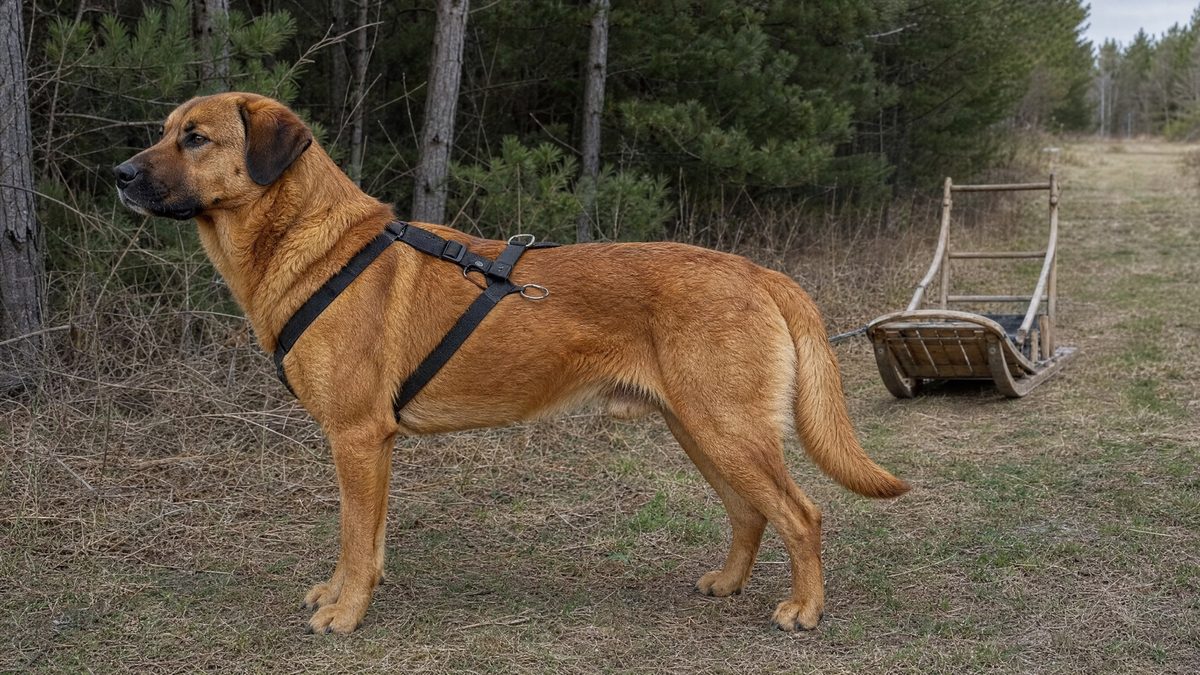
Start with colour, because it is the one thing that separates this breed from every other northern dog at a glance. The tawny coat is the breed's defining feature, running from light honey to a deep reddish-gold, with the ears and muzzle desirably darker than the body and a black apostrophe-shaped mark above the inner corner of each eye. Any colour other than tawny as described is a disqualification in the American Kennel Club standard, and the United Kennel Club standard faults any colour other than tawny and disqualifies white dogs and albinism outright United Kennel Club. If you are shown a black-and-tan dog, a grey dog or a white dog and told it is a Chinook, you are not being shown this breed.
The second identification point is the tail. The Chinook has a saber tail set just below the topline, broad at the base and tapering, reaching to the hock, hanging downward with a slight upward curve at the tip when the dog is standing and carried in a graceful sickle curve when it is alert. It never curls over the back and never touches it. That single line rules out the Siberian Husky, the Alaskan Malamute and the Samoyed, all of which carry the tail over the back. The UKC standard adds the flat instruction that the Chinook tail is never docked.
Size and weight, and where the AKC contradicts itself
| Source | Male height | Female height | Male weight | Female weight |
|---|---|---|---|---|
| AKC Official Standard, approved 11 May 2021 | 24 to 27 in | 22 to 25 in | not stated | not stated |
| AKC breed page | 24 to 26 in | 22 to 24 in | 55 to 90 lb | 50 to 65 lb |
| UKC standard, revised 1 January 1998 | 23 to 27 in | 21 to 25 in | 70 lb average | 55 lb average |
| Puppiezo, Indian retail listing | 21 to 25 in (no sex given) | 21 to 25 in | 25 to 40 kg | 25 to 40 kg |
| Call4Dog, Indian retail listing | 58 to 69 cm | 53 to 64 cm | 25 to 41 kg | 25 to 41 kg |
Three things fall out of that table. The AKC's own breed page disagrees with the AKC's own standard by one inch at the top of both sexes, which is a small error but a checkable one American Kennel Club. The AKC standard publishes no weight at all, so every weight you will read for this breed comes from the UKC, from the AKC's editorial page, or from a seller. And the Indian listings quote a single weight band for both sexes, which contradicts the standard's requirement that a gender difference be easily discernible, with males appearing unquestionably masculine and females having a distinctly feminine look Call4Dog, Chinook Puppy page.
Head, ears and feet
The head is broad and wedge-shaped with a moderate stop and a central furrow, and the muzzle is aquiline, dipping slightly just before the nose leather, measuring roughly two to three in ratio against the topskull. Eyes are almond-shaped and medium, and any eye colour other than brown is an AKC disqualification, so the ice-blue eye Indian buyers associate with northern dogs is disqualifying here. Ears may be dropped, pricked or propeller, matched ears are preferred, and dropped ears are desirable for historical reasons. The UKC standard uses the older word for the same carriage, helicopter ears, and records that mismatched ears are acceptable.
The feet carry a detail no ranking page mentions. They are tight and oval with arched toes and webbed skin between them, thick darkly pigmented pads, and fur growing between the toes. Webbing plus a close coat is a freight dog's compromise: enough foot for snow, not enough coat to overheat on a working day. This is a working dog built to combine the power of freighting breeds with the speed of the lighter racing sled dogs, and the standard says so in its first line.
A Delhi retail page advertising KCI-registered Chinook puppies lists the breed's colours as White, Fawn, Tawny, Black and Tan, Grey and Tan, and Buff. White dogs are a disqualification in the UKC standard and any colour other than tawny is a disqualification in the AKC standard, so four of the six colours on that list would put the dog outside the breed American Kennel Club. A seller who has the colour section of the standard wrong has not seen the standard.
History: one man, one litter of three, and one dog born on 17 January 1917
The Chinook descends from a single dog, born in a litter of three on 17 January 1917 on Arthur Treadwell Walden's farm at Wonalancet, New Hampshire, whose sire was a large tawny farm dog and whose dam was a granddaughter of Polaris, Admiral Robert Peary's lead dog from the 1908 to 1909 Arctic expedition.
Walden is the reason the breed exists and the reason it nearly did not. He was a sled-dog driver, author, explorer and innkeeper from Wonalancet, a village in north central New Hampshire at the foot of the White Mountains, and the AKC records that in 1896, aged 24, his wanderlust took him to Alaska at the height of the Gold Rush, where he worked his way across the territory for six years. He came back wanting an American sled dog that combined power, endurance and speed with a friendly, gentle nature.
The founding litter is documented on both sides. The AKC parent club records that Walden's foundation dogs were descendants of Admiral Peary's Greenland husky lead dog Polaris, and a mastiff-type farm dog, who together produced a litter of three pups on 17 January 1917 in New Hampshire, named Rikki, Tikki and Tavi after the mongoose in Rudyard Kipling's The Jungle Book. The UC Davis report names the parents as Kim and Ningo and describes the sire as a large, tawny, thick-coated farm dog likely from Canada and the dam as a black and white Husky bitch, the granddaughter of Polaris. One of those three pups was later renamed Chinook, after a sled dog Walden had used while freighting supplies for gold miners in the Yukon.
What the foundation dog actually looked like
Walden described him in his own book, Harness and Pack, and the parent club quotes it: a large tawny yellow dog, a half-bred Eskimo, with dark ears and muzzle. He grew to 100 pounds. The UKC standard calls him a sport, a phenomenon of nature not resembling either of his parents, and records that his offspring inherited his colouring, size and general characteristics and were bred to combine the strength of the large freight dog with the speed of the smaller racing sled dogs. That is the whole breeding programme in one sentence, and it is why the modern standard still opens by naming drafting and sled dog racing as the dual function.
| Date | Event |
|---|---|
| 17 January 1917 | Litter of three born at Wonalancet; one pup is renamed Chinook |
| 1922 | Arthur Walden photographed with Chinook, the image reproduced in the 2022 genetics paper |
| 1924 | Walden founds the New England Sled Dog Club, the oldest club of its kind still operating |
| 1925 | Walden's team becomes the first dog team to summit Mount Washington |
| 1927 | Walden is appointed to head the Dog Department for Admiral Byrd's first Antarctic Expedition |
| 1929 | Chinook, nearing his twelfth birthday, wanders from camp in Antarctica and is never found |
| 1931 | Walden receives the Congressional Medal for his part in the Byrd expedition |
| 1931 | A Chinook named Paugus and his young owner win a photo contest as America's Most Typical Boy and Dog, the prize being $250 and a handshake from President Hoover |
| 30 August 1933 | The full inventory at Seeley's Chinook Kennels lists just one Chinook, a Chinook cross named Smokey |
The Antarctic expedition is where the breed's fame and its first collapse both begin. Walden, with Chinook and fifteen of Chinook's sons, joined Byrd's first expedition, and Byrd described Walden and his sixteen Chinooks as the backbone of the expedition transport Veterinary Genetics Laboratory. Reports of Chinook's death made news around the world. At Walden's request, Route 113A from Tamworth to Wonalancet still carries the name Chinook Trail. The AKC parent club also maintains a separate archive, the Chinook History Project, which publishes primary documents and photographs from the breed's origins rather than retellings of them.
The three dogs the modern breed may actually rest on
Here is the detail that reframes everything the ranking pages say about a hundred-year-old breed. When Walden came back from Antarctica he had fallen on hard times and transferred full interest in his Chinook Kennels to Milton and Eva Seeley, who moved the kennel a short way down the road. The Seeleys bred Malamutes and Siberians, and the complete inventory at their Chinook Kennels on 30 August 1933 listed an assortment of breeds with an emphasis on Labrador Huskies and exactly one Chinook, a Chinook crossed with a Labrador Husky named Smokey.
The line survived elsewhere. The AKC parent club states that from the historic pedigrees that remain, the modern Chinook breed may be descended from Walden's breedings through just three dogs, Jock, Hootchinoo and Zembla, sold by Walden to his kennel partner Julia Lombard before he left for Antarctica. A breed founded on one sire and funnelled through three of his descendants is not a hundred-year-old gene pool. It is a very narrow one with a hundred-year-old date on it.
The collapse: a single breeder, a Guinness listing, and 28 dogs in a Maine kennel
Perry Greene bought the surviving Chinooks in 1940, became the breed's only breeder, sold nothing but males and spayed females, and died in 1963, after which the Guinness Book of World Records listed the Chinook in 1965 as the rarest dog in the world with 125 alive, and by 1981 the count at the last kennel was 28 dogs of which eleven could breed.
The mechanism here is not disease or war. It is a business model. In 1940 Perry Greene and his wife Honey purchased the Chinooks from Julia Lombard and moved them to the Perry Greene Kennel in Waldoboro, Maine. The Greenes promoted the breed hard, and in 1941 Greene and his Chinook team made a 502-mile journey in 90 hours, the longest sled dog trek made within the United States at that time. They also sold only males or spayed females, and became the breed's sole breeder, creating a great deal of mystique and legend about the dog and its history.
That policy is the whole story. A breed with one breeder who never sells an intact female has no second population anywhere in the world. When Perry Greene died in 1963 there was nobody else holding breeding stock, and Honey Greene tried to continue alone.
The Guinness listing, dated properly
By 1965 the Guinness Book of World Records recorded the Chinook, for the first of three times, as the rarest dog in the world, with only 125 dogs alive and the number dropping rapidly. The UC Davis report gives the same year and the same count independently: in 1965 the Guinness Book of World Records recorded the Chinook for the first of three times as the rarest dog, with just 125 Chinook dogs alive.
Almost every page that mentions the Guinness listing gives no year and no number. Both exist, both are in the parent club's own history and in a laboratory report, and they agree with each other. 1965 and 125 dogs is the figure, and it is a count of a whole breed rather than an estimate of a population.
| Date | What was counted | Figure |
|---|---|---|
| 1929 | Chinooks on the Byrd expedition with Walden | 16 |
| 30 August 1933 | Chinooks in the Seeley kennel inventory | 1 (a cross) |
| 1965 | Chinooks alive, per the Guinness Book of World Records | 125 |
| 1981 | Chinooks remaining at Sukee Kennels, most elderly or neutered | 28 |
| 1981 | Of those, dogs useful for breeding | 11 |
| January 2013 | Chinooks registered at the point of full AKC recognition | 813 |
| 2023 | Living Chinooks worldwide, per the UKC parent club's assessment | likely under 1,000 |
Read that table downward and the shape of the breed is obvious. It has been small its entire existence, it has twice been reduced to a number you could fit in one building, and it has never had a second national population to fall back on. The 2013 figure of 813 registered dogs, published by the AKC parent club at the moment of full recognition, is the highest properly documented number in the breed's history.
One dog from the collapse years worth knowing
In 1966 Boeing's Vertol helicopter division obtained a Chinook named Charger as a mascot and sent him to the 228th at An Khe in South Vietnam, to serve as mascot for the first operational Chinook helicopter unit there Veterinary Genetics Laboratory. Charger had the ear carriage the breed calls helicopters, which is the historic term for the fold the AKC standard now calls propeller ears. He never made it back. It is a small story and it sits inside the years when the breed's total population was falling through 125 toward 28.
The rebuild: eleven dogs, three households, and a registry that allows outcrossing
In 1981 Neil and Marra Wollpert found Kathy Adams working at Sukee Kennels in Warren, Maine, trying to save the breed, with 28 dogs left of which most were elderly or neutered, and the eleven breedable Chinooks were divided between three households in Ohio, Maine and California.
Two independent documents give the same eleven. The AKC parent club's history states that in 1981 the Wollperts went looking for the Chinook and found Kathy Adams at Sukee Kennels trying to save the breed from extinction, that only twenty-eight dogs remained and most were elderly or neutered, and that the remaining eleven breedable Chinook dogs were divided between the Wollperts of Ohio, running Singing Woods Chinooks, Kathy Adams of Maine, running Alder Patch Chinooks, and Peter Abrahams of California, running Yokayo Chinooks. The UC Davis Veterinary Genetics Laboratory report states independently that in 1981 only 11 Chinooks useful for breeding were housed at Maine's Sukee Kennel and were subsequently dispersed to breeding homes in California, Ohio and Maine.
Wikipedia gives the same figure and attributes it to Jerold Bell's chapter on American breed clubs and health initiatives in The Dog and Its Genome, a Cold Spring Harbor Laboratory Press volume. Bonbeno did not open that chapter and does not cite it, but three routes converging on eleven is as close to settled as a rare-breed number gets.
The two decades after
From 1984 to 1994 Harry Gray's Northdown Kennel was also influential in preserving breeding stock, and the parent club records that Chinooks who passed through Northdown are found in all of today's pedigrees. In February 1990 Gray completed a 325-mile Trek for Life with a team of Chinooks from Greenville, Maine to Wonalancet, New Hampshire, raising money for the organ donor programmes of the Maine and New Hampshire Kidney Foundations. A breed rebuilt by three households in 1981 was, nine years later, running a fundraising expedition across two states.
The registry that lets you outcross
The rebuilding is not finished and the registries know it. The United Kennel Club operates a cross-breeding programme under which Chinooks are bred to individuals of other breeds thought to have contributed to Chinook development, and fourth-generation backcross descendants of such crosses may be accepted as UKC purebred Chinooks if they meet the parent club's requirements. In 2017 the Chinook Owners Association instituted the Chinook Breed Conservation Program, a second crossbreeding programme, and as of August 2023 purebred Chinooks had been bred to a Tamaskan Dog, a Bernese Mountain Dog, a Labrador Retriever and a Seppala Siberian dog, with those new lines being bred back to purebreds.
That is what a serious conservation programme looks like, and it is worth being precise about the arithmetic behind it. The parent club's own 2023 assessment reports that Chinook Breed Conservation Program puppies remain around 17.5 percent of the population, that average litter size in the programme is notably larger than in the purebred population, and that the programme to date is reducing the average inbreeding coefficient in the breed but slowly. Breeders outcross because the alternative is worse, not because it is easy.
| Mechanism | What it asks for |
|---|---|
| Litter diversity badge, silver or gold | Five-generation coefficient of inbreeding at or below both parents, or at or below 5 percent |
| Litter diversity badge, alternative route | At least one parent is a New Founder or an F1, F2 or F3 descendant of the Chinook Breed Conservation Program |
| Litter badging form | The thirty-generation coefficient of inbreeding of the litter, and how many offspring the stud already has |
| Litter health badge | Sire and dam hip and eye clearances available on the OFA website, and public DNA profiles |
| New Founder application | Full details of a non-Chinook sire or dam proposed as a new founder, with temperament described |
Read that table beside an ordinary pedigree registry and the difference is stark. Most breed clubs ask for a five-generation pedigree. This one asks for a thirty-generation coefficient of inbreeding and for the stud's total offspring count, because in a population under a thousand a popular sire can absorb the breed inside two generations.
The parent club's 2024 guidance states that the programme was open to New Founder applications in that year with a preference for female candidates. In a population maintained largely by shipped semen, one male can father many litters while one female can produce very few, so a new female founder adds far more to the gene pool than a new male. That is population genetics, not politics.
Recognition, established from the registers rather than assumed
The United Kennel Club recognised the Chinook in March 1991, the American Kennel Club recognised it fully in January 2013 after a spell in the Foundation Stock Service and the Miscellaneous Class, and the Fédération Cynologique Internationale and The Kennel Club do not list it at all, which is checked here against each register with a control.
Take the two recognitions that exist. The UKC breed standard page states in its own History section that the Chinook was recognised by the United Kennel Club in March 1991, and the standard carries a 1991 copyright with a revision dated 1 January 1998, placing the breed in the Northern Breed Group. The AKC breed page states that the Chinook was recognised as a breed by the AKC in 2013 and lists it in the Working Group, and the AKC's Official Standard of the Chinook was approved on 11 May 2021 and took effect on 4 August 2021 American Kennel Club. The AKC parent club adds the number: as of January 2013, when Chinooks were fully recognised, there were 813 Chinooks registered.
The Foundation Stock Service date is contested
Two sources give two years and neither explains itself. The AKC parent club states that in 2001 the Chinook was added to the AKC's Foundation Stock Service, and Wikipedia says the same, adding that the breed was later moved into the Miscellaneous Class in 2010 Wikipedia, Chinook (dog breed). The UC Davis Veterinary Genetics Laboratory report states that the American Kennel Club accepted the Chinook in their Foundation Stock Service in 2003. Bonbeno reports the disagreement rather than picking the more common figure, because a laboratory report and a parent club are both plausible sources and neither cites the AKC record itself.
The FCI does not list it, and here is the control
The Fédération Cynologique Internationale's Group 5, Section 1, Nordic Sledge Dogs was retrieved on 26 August 2026 and lists exactly five breeds: the Canadian Eskimo Dog at 211 with a validity date of 28 February 2018, the Grønlandshund at 274, the Samoyed at 212, the Alaskan Malamute at 243 and the Siberian Husky at 270. The Chinook is not among them. The control is built into the document: if the retrieval had failed, those five would not be there either, and they are.
The provisional register was checked separately, because a breed missing from a definitive list can mean it is waiting rather than absent. The FCI page headed Breeds recognised on a provisional basis lists thirteen breeds numbered 366 to 378, including the Macedonian Shepherd Dog Karaman at 378, the Kazakh Tazy at 372 and the Miniature American Shepherd at 367. The Chinook is not there either. The Miniature American Shepherd is the useful control: an American breed sits on that provisional list, so American origin is not what keeps the Chinook off it.
| Body | Status | Control used |
|---|---|---|
| United Kennel Club | Recognised March 1991, Northern Breed Group | The standard page names the breed and the date in its own History section |
| American Kennel Club | Fully recognised January 2013, Working Group; standard effective 4 August 2021 | The AKC standard PDF names the breed and carries approval and effective dates |
| Fédération Cynologique Internationale | Not listed, definitively or provisionally | Group 5 Section 1 returned five sledge breeds; the provisional list returned thirteen breeds including an American one |
| The Kennel Club (United Kingdom) | Not listed | The same A to Z page returned the Siberian Husky, Alaskan Malamute, Canadian Eskimo Dog, Greenland Dog and Samoyed |
| Kennel Club of India | No breed register can exist, because there is no FCI standard number | The FCI publishes the KCI's own annual registration statistics as a member national canine organisation |
The Kennel Club of India row deserves its caveat stated rather than buried. Bonbeno could not read a KCI breed list from the KCI itself, because kennelclubofindia.org was serving a temporary arrangement page on 26 August 2026 containing downloadable forms, a tariff sheet and a Chennai address, with no breed register published. What is checkable is that the FCI publishes the KCI's registration statistics year by year as one of its member national canine organisations, recording 32,219 puppies registered in 2025. A member registry works to FCI nomenclature, and FCI nomenclature has no Chinook.
Three different AKC popularity ranks are in print for this breed and all three are correct for their year. A 2022 genetics paper cites 2020 registrations placing the Chinook 186th of 195 breeds. The UC Davis report gives 180 out of 200 in the AKC's 2023 ranking. The AKC's own breed page currently prints 198 of 210. The breed is not collapsing again; the denominator is growing as the AKC recognises more breeds, and a small stable population slides down a lengthening list.
New Hampshire's state dog: a statute, not a resolution, and the section number is 3:25
The Chinook is the official state dog of New Hampshire by statute. The instrument is RSA 3:25, a section of the New Hampshire Revised Statutes Annotated inside Title I, The State and its Government, Chapter 3, State Emblems, Flag, Etc., and its source note reads 2009, 62:1, effective 7 August 2009.
The operative text is one sentence and it is worth quoting exactly as it stands in the Revised Statutes Annotated. Section 3:25, headed State Dog, reads: 'The chinook is hereby designated as the official state dog of New Hampshire.' Its source note reads: '2009, 62:1, eff. Aug. 7, 2009';.
That source note is what settles the question the ranking pages leave open. A New Hampshire RSA source note gives the year of the session law, the chapter number, the section within that chapter, and the effective date. So the designation arrived as chapter 62 of the laws of 2009, section 1, and it took effect on 7 August 2009. It is codified statute, sitting in the same chapter as the state flag, the state bird and the state flower, and it is not a house resolution, a proclamation or a ceremonial citation.
Why the distinction matters
It matters because state-symbol designations are made three different ways in the United States and the three have different weight. A resolution expresses the sense of a chamber and does not amend the statute book. A governor's proclamation is an executive act with no permanent codification. A statute is enacted by both chambers, signed, and codified into the revised statutes where it stays until repealed. The Chinook has the third of those, which is the strongest form.
Bonbeno has drawn the same distinction for two other American breeds on this site, the Blue Lacy in Texas and the Catahoula Leopard Dog in Louisiana, and the practical value is identical: it tells a reader which document to look up, and it stops the page repeating a club's phrasing when a statute is available. The document to look up here is the New Hampshire General Court's own RSA text at Title I, Chapter 3, Section 3:25.
| Element | Value |
|---|---|
| Instrument type | Statute, codified |
| Title | Title I, The State and its Government |
| Chapter | Chapter 3, State Emblems, Flag, Etc. |
| Section | 3:25, State Dog |
| Operative words | The chinook is hereby designated as the official state dog of New Hampshire |
| Session law | 2009, chapter 62, section 1 |
| Effective date | 7 August 2009 |
How it got there
The AKC parent club records the political history: in June 2009, after lobbying by the students of Lurgio Middle School, Governor John Lynch signed a bill making the Chinook the state dog of New Hampshire. Those two dates are consistent rather than contradictory. A bill signed in June with a sixty-day delay before it takes effect lands in early August, which is exactly what the statute's own effective date of 7 August 2009 records.
The bill number was not verified. The New Hampshire General Court's legislation pages returned HTTP 403 and a closed connection to two direct retrievals on 26 August 2026, so this page cites the session law reference printed in the statute's own source note, 2009 chapter 62 section 1, rather than a bill number taken from a secondary source.
How many Chinooks exist now, and the stud book that cannot be read
The UKC parent club's own 2023 population assessment puts the breed at likely under 1,000 dogs worldwide, the AKC parent club recorded 813 registered at full recognition in January 2013, and the AKC stud book extract the parent club publishes for the breed is an image scan with no text layer, so nobody can count it.
Start with the club's own words, because they are more careful than the internet's. The Chinook Owners Association Health and Genetics Committee completed its 2023 annual population assessment and published the highlights in May 2024. The first bullet reads that overall the Chinook population is stabilising from drops in annual puppy rates in the mid 2010s, but is likely overall under 1,000 dogs. That is a national parent club describing its own breed, with a direction of travel and a caveat attached.
| Measure | 2023 figure |
|---|---|
| Overall population | Likely under 1,000 dogs |
| Puppy production | A strong year, roughly in line with the new average |
| Sex ratio of puppies | Notably more male than female |
| Litters bred by first-time breeders | 43 percent, described as satellite litters |
| Neonate fatalities | 1 percent, down |
| Caesarean sections | About 20 percent, down |
| Litters by artificial insemination | 71 percent |
| Conservation programme puppies | Around 17.5 percent of the population |
Three of those rows change how you should read the breed. The 43 percent of litters bred by first-time breeders tells you the population is being carried by new entrants rather than by established kennels, which is fragile but also broadening. The 71 percent artificial insemination rate tells you the dogs are too scattered to meet, which is the practical shape of a population under a thousand spread across a continent. And the 17.5 percent conservation-programme share tells you roughly one Chinook puppy in six now descends from a planned outcross.
The attempt to count the stud book directly, and why it failed
Bonbeno's practice on rare breeds is to count a registry stud book rather than repeat a club's estimate, as this site did for the Canadian Eskimo Dog using the Canadian Kennel Club's published per-breed stud books. The AKC parent club does publish an AKC stud book extract for the Chinook, under a notice stating that the AKC Stud Book may be used for noncommercial research or scholarship purposes only. That is exactly the document a count would need.
It cannot be counted. The file was downloaded and examined directly rather than through any extraction tool. It is five pages long, 552,500 bytes, and its first page carries a content stream of 2,377,412 bytes consisting of inline RGB image tiles. Across all five pages there are no font resources at all, no XObjects, and a total of four extractable characters. It is a photograph of a document, not a document. Any figure attributed to it by any page on the internet was not read from it, because nobody can read it.
The file is named in a way that implies a count and a date. Bonbeno does not report that number as the breed's stud book total, because a filename is not a document and because deriving a population figure from one would be exactly the fabrication this site refuses. The honest statement is that the AKC parent club publishes the breed's stud book extract as an unreadable image scan, and that the only machine-readable population figure available anywhere is the UKC parent club's 'likely overall under 1,000 dogs'; Chinook Owners Association Health….
The three figures that can be verified
Three population numbers survive the check. 813 Chinooks were registered as of January 2013, when the AKC granted full recognition, published by the AKC parent club. Around 800 animals were registered with the UKC and about 100 puppies were born annually worldwide, per the encyclopaedia entry that ranks first for the breed. And the breed's OFA record now stands at 2,217 evaluations across hips, elbows, eyes and patellae, accumulated over decades rather than held by living dogs. Nothing in that set supports a claim that the population has grown materially since 2013.
The genetics: 3.9 percent, the lowest figure the UC Davis laboratory has recorded
The Chinook retains 3.9 percent of the genetic diversity that still exists among randomly breeding village dogs, which the University of California Davis Veterinary Genetics Laboratory states is the lowest amount of available genetic diversity found in any breed it has tested, against 7 percent for the second lowest and a 30 percent average across all canids it has assessed.
That single figure is the most important thing on this page and no ranking page carries it. It comes from a preliminary report dated August 2023, produced by the Veterinary Genetics Laboratory in collaboration with Dr Niels C. Pedersen, based on 33 registered Chinooks, 31 from the United States and 2 from Switzerland, typed at 33 short tandem repeat loci across 25 canine chromosomes plus seven loci in the dog leukocyte antigen region.
The method behind the 3.9 percent is worth understanding because it is not an inbreeding coefficient. Village dogs in South East Asia, the Middle East and the Island Pacific are randomly breeding descendants of the population from which most modern breeds came. Comparing a breed's known alleles and their frequencies against the same loci in modern village dogs yields an adjusted internal relatedness score, and the overlap between the two curves estimates how much of that ancestral diversity the breed still holds. For the Chinook that overlap is 3.9 percent. For the Swedish Vallhund, the next lowest breed the laboratory had tested, it is 7 percent. The average across all canids tested at the laboratory is 30 percent.
| Measure | Chinook value | What it means |
|---|---|---|
| Mean alleles per locus (Na) | 3.76 | Against 15.4 across breeds tested at the laboratory, so about 75 percent of the diversity at these loci is gone |
| Mean effective alleles per locus (Ne) | 2.21 | Most heterozygosity is carried by a little over half the alleles present |
| Observed heterozygosity (Ho) | 0.48 | Equal to the expected value |
| Expected heterozygosity (He) | 0.48 | Equal to the observed value |
| Inbreeding coefficient (F) | 0 | The cohort as a whole was a product of random breeding |
| Allele count range | 2 to 7 | Two alleles at INU005, INU030 and REN169D01; seven at VGL1165 |
| Loci with one allele in half the cohort | 24 of 33 | Alleles inherited from one or few founding dogs and positively selected since |
| Loci with high inbreeding (F above 0.1) | 9 of 33, or 27 percent | Strong positive selection since breed development at those loci |
Read the F value of zero carefully, because it is the number a careless writer would use to say the breed is fine. The report itself refuses that reading. It states that the standard genetic assessments indicated a randomly breeding population, but that internal relatedness values suggest this assumption is misleading because more outbred dogs are cancelling out more inbred dogs, and that in truth close to one fourth of Chinooks tested were products of closely related parents. Individual internal relatedness ran from minus 0.29 for the most outbred dog to plus 0.22 for the most inbred, with a mean of 0.002.
The immune region, where the loss shows most
Only 6 dog leukocyte antigen class I haplotypes and 7 class II haplotypes were identified in the 33 dogs, which the laboratory describes as among the lowest number it has ever reported. For comparison in the same report, the English Mastiff carries 6 and 6, and the Golden Retriever carries 24 and 19. Two class I haplotypes, 1045 at 36 percent and 1160 at 30 percent, account for 66 percent of the dogs between them, and two class II haplotypes, 2012 and 2024 at 30 percent each, account for 60 percent.
This matters clinically rather than academically. That region regulates cell-mediated and antibody-mediated immunity, and the laboratory notes that breeds lacking diversity there are often more prone to autoimmune disorders. It also holds one genuinely Chinook-only marker: class I haplotype 1291, at 12 percent frequency, was found exclusively in this breed.
The report's own conclusion is that despite the low amount of genetic diversity, Chinook breeders have done a good job of choosing sires and dams that are as unrelated as possible, redistributing what diversity exists and keeping overall inbreeding levels close to zero. The breed has very little left. What it has, its breeders are spreading competently.
Where the Chinook actually came from, according to two independent studies
The peer-reviewed genetic analysis of the breed found Alaskan Malamute and modern Greenland sled dog contributions as expected, plus unexpected contributions from the German Shepherd Dog and the Collie, and the UC Davis laboratory report reached the Collie link separately through the immune-region haplotypes.
The peer-reviewed work is a 2022 paper in the Journal of Heredity from the National Human Genome Research Institute and collaborators, which took the Mackenzie River Husky and the Chinook as two freight dog populations of complex history and analysed both. It genotyped ten Chinooks and compared them against a dataset of 1,346 dogs representing 161 breeds using identity by descent haplotype sharing, principal component analysis and admixture analysis.
Its central finding for this breed is one sentence: the primary differences between the Chinook and the Mackenzie River Husky are the inclusion of the Husky in the development of the Mackenzie River Husky, and a greater or more recent contribution of the German Shepherd Dog and the Collie to the Chinook. Alaskan Malamute and modern Greenland sled dog contributed to both populations. That is not the ancestry the breed's own history describes, which names a Peary lead dog and a mastiff-type farm dog.
Two studies, one unexpected answer
The convergence is what makes this credible. The UC Davis report, working from immune-region haplotypes rather than from genome-wide haplotype sharing, notes that the most predominant class I haplotypes in Chinooks, 1045 and 1160, were also found in relatively high frequency in Collie breeds including the Collie, the Border Collie and the Scottish Collie. Two laboratories, two methods, one unexpected shepherd-and-collie signal.
A third and older study points the same way. In 2007 the Chinook Club of America and the Chinook Owners Association jointly commissioned a diversity study from Mars Veterinary, and the update Dr Paul Jones sent the clubs on 5 September 2008 reported that the Chinooks were most like Alaskan Malamutes, Siberian Huskies and German Shepherd Dogs, and that the Chinook crosses were genetically very similar to the Chinook pures. Up to 321 DNA measurements per dog were used.
| Study | Year | Dogs tested | Contributors identified |
|---|---|---|---|
| Mars Veterinary, for the two parent clubs | 2007 to 2008 | Not stated; up to 321 markers per dog | Alaskan Malamute, Siberian Husky, German Shepherd Dog |
| Ali et al., Journal of Heredity | 2022 | 10 Chinooks against 1,346 dogs of 161 breeds | Alaskan Malamute, modern Greenland sled dog, German Shepherd Dog, Collie |
| UC Davis Veterinary Genetics Laboratory | 2023 | 33 Chinooks | Immune-region haplotypes shared with Collie breeds; haplotypes shared with 54 breeds in total |
The two regions that are fixed in every Chinook tested
The 2022 paper also looked for regions of homozygosity, meaning stretches of the genome identical on both chromosomes in every dog, which is what a hard bottleneck leaves behind. Two such regions were present in all ten Chinooks. One spans over 326 kilobases on canine chromosome 5, carrying a fixed haplotype, of which a 128 kilobase section is also homozygous for the same haplotype in the Alaskan Malamute, the Greenland dog, the Siberian Husky and the German Shepherd, and that region contains the gene Sorting Nexin 19.
One further result is worth noting for a working breed. The authors examined eight genes involved in dietary lipid metabolism, because recent work has suggested these matter in Arctic dogs, and found reduced nucleotide diversity over the region containing MLXIPL in the Chinook compared with a village dog control group, at a delta of 1.23 times ten to the minus five against a 95 percent threshold value of 1.18 times ten to the minus five. Selection on fat metabolism is the signature you would expect in a dog bred to haul freight on a high-fat working diet.
Because it changes what the dog is. A breed that carries a recent German Shepherd and Collie contribution is not the pure Arctic import Indian sellers imply, and the MDR1 mutation, which the parent club treats as a mandatory test, is a herding-breed mutation. The genetics and the health testing tell the same story, and an Indian owner needs both to brief a veterinarian properly.
Effective population size: no published figure exists, and the number being quoted is not one
No effective population size and no pedigree analysis has been published for the Chinook. The figure most often mistaken for one, 2.21, is the mean number of effective ALLELES per locus in the UC Davis report, which is a different quantity measuring a different thing.
State the absence and then prove the search worked, because an unproven absence is a broken query rather than a finding. Three checks were run on 26 August 2026 and all three are reported here with their controls.
- PubMed, queried through NCBI's own Entrez utilities, returned 8 records for 'Chinook dog'. Opening every one showed three genuinely about this breed: the 2010 paroxysmal dyskinesia paper, the 2022 freight dog genetics paper, and the 2016 genetic panel screening study. The other five were about killer whales, pufferfish zinc transporters, lens phospholipids, palaeofaeces proteomics and falls among older adults. None reports an effective population size.
- The control for that query, run in the same session, was 'Labrador Retriever hip dysplasia', which returned 126 records, and 'paroxysmal dyskinesia dog', which returned 65. PubMed was working.
- Europe PMC for 'Chinook AND effective population size' returned 156 hits and every one of the first twelve was about Chinook salmon, Oncorhynchus tshawytscha. A non-zero count is not coverage, and this is a textbook case of it. The control, 'Bullmastiff AND effective population size' in the same session, returned the Comparative Analysis of Genome Diversity in Bullmastiff Dogs paper and a pedigree-diversity study of the South African Boerboel.
So the search instrument is sound and the answer is genuinely zero. The two pieces of Chinook genetics that do exist report other quantities entirely. The 2022 Journal of Heredity paper reports haplotype sharing, admixture proportions, runs of homozygosity and nucleotide diversity, and its only mention of the phrase effective population size is inside a cited reference title. The UC Davis report reports alleles, effective alleles, observed and expected heterozygosity, an inbreeding coefficient derived from those, internal relatedness and DLA haplotypes.
The UC Davis table prints a column headed Ne and gives a Chinook mean of 2.21. That column is defined in the report's own text as the number of effective alleles per locus, meaning the number of alleles that contribute most to heterozygosity. It is a per-locus allele count. An effective population size is a count of breeding individuals, or in Jerold Bell's formulation the minimum number of ancestors explaining the complete genetic diversity of a population. Anyone reporting 2.21 as this breed's effective population size has copied a column header. Bonbeno has caught the same class of error before, on the Broholmer, where a widely repeated effective population size of 29.1 turned out to belong to the Bullmastiff study sitting next to it on an aggregator page.
| Quantity | Published for the Chinook? | Value |
|---|---|---|
| Effective population size | No | No study reports one |
| Pedigree-based inbreeding analysis of the whole breed | No | No published analysis exists |
| Mean effective alleles per locus | Yes | 2.21 across 33 STR loci in 33 dogs |
| Observed and expected heterozygosity | Yes | 0.48 and 0.48 |
| Cohort inbreeding coefficient from Ho and He | Yes | 0 |
| Internal relatedness range across individuals | Yes | Minus 0.29 to plus 0.22, mean 0.002 |
| Retained village-dog diversity | Yes | 3.9 percent, the lowest the laboratory has recorded |
| Runs of homozygosity fixed across the sample | Yes | Two regions present in all 10 dogs in the 2022 study |
If you want a single number for how narrow this breed is, take the 3.9 percent rather than inventing an effective population size. It is measured, it is published, it is compared against a stated benchmark of 30 percent, and the laboratory that produced it says in terms that it is the lowest it has found.
What the breed uses instead of an effective population size
Without a published effective population size, the parent clubs manage the gene pool with arithmetic they control directly: a five-generation coefficient of inbreeding, a thirty-generation coefficient of inbreeding, and a count of how many offspring a stud already has.
The Chinook Owners Association's litter badging scheme asks for the five-generation inbreeding coefficient and awards a diversity badge when it is at or below both parents' figures or at or below 5 percent, asks for the thirty-generation coefficient of inbreeding of the litter, and asks how many offspring the stud already has. The last question is a popular-sire control, and it is the right one.
Bell's 2017 paper for the AKC Canine Health Foundation explains why that focus is correct even for a tiny breed. Analysing entire breed population databases back to founders, he writes, every dog breed regardless of population size shows the same findings, high homozygosity and low effective population size, and these are necessary and expected consequences of breed formation. As a gene pool expands the average recent relationship between mates can fall, but the average total relationship back to founders does not. Breeds with small populations look like breeds with large populations did much earlier in their development.
His practical warning applies to this breed with unusual force. Genetic diversity is lost, in large and small populations alike, when breeders do not use dogs from the breadth of the gene pool, and this shows up as popular sire syndrome, compounded when a popular sire is replaced by a popular son and then a popular grandson until the breed truncates on a single male line. In a population under a thousand where 71 percent of litters are by artificial insemination, one heavily used male can do that in a decade.
Bell adds a second warning that matters more here than in a large breed. A popular sire's genetic contribution can only be evaluated after his prolific breeding period is over and his genes are already spread through the gene pool, and many recently identified genetic disorders that rise in frequency in a breed are caused by genes carried by popular sires. The next section shows exactly that happening in this breed, in a documented pedigree.
If you are ever offered a Chinook anywhere, ask for the litter's thirty-generation coefficient of inbreeding and the sire's total offspring count, which are the two figures the breed's own parent club asks its breeders to declare. A breeder who can answer both is inside the conservation system. A breeder who has not heard of either is not.
The dwarfism pedigree: one brother-sister mating, one popular sire, and a whole breed's carriers
Every known case of chondrodysplastic dwarfism in the Chinook traces back to a single brother-sister mating, and the responsible variant, ITGA10 c.2083C>T, was already known as the cause of dwarfism in the Norwegian Elkhound and the Karelian Bear Dog.
This is the clearest documented example of what a narrow gene pool does, and it comes from a 2016 study in PLOS ONE that screened nearly 100 mutations across breeds. The authors state that breeders first documented chondrodysplastic Chinooks in the 1990s, and that all known cases in the breed can be traced back to a brother-sister mating producing the first known case.
The molecular explanation was an accident. Panel screening turned up an ITGA10 variant, c.2083C>T, in Chinooks, a variant already known to cause disproportionate short-stature dwarfism of varying severity in the Norwegian Elkhound and Karelian Bear Dog breeds. Working with breeders, the authors confirmed at least one chondrodysplastic Chinook homozygous for the variant, with a veterinary clinician-confirmed dwarf phenotype, early-onset hip problems and osteoarthritis, plus several carriers all related to the original 1990s cases.
The pedigree figure is the part worth carrying. The mutation, the authors write, was likely propagated in the population through the sire of that brother-sister mating, who was further bred to several other females. That is popular sire syndrome, documented in a peer-reviewed pedigree, in a breed of a few hundred dogs, arising from exactly the mating Indian law defines as incest breeding and prohibits under Second Schedule Part II paragraph 6(3).
The same paper first documented MDR1 in the breed
The MDR1 variant c.295_298delAGAT was observed in two previously undocumented breeds in that study, the Chinook and the Danish-Swedish Farmdog. That is the origin of the parent club's mandatory MDR1 test, and it explains why a mutation associated with herding breeds turns up in a sled dog: the authors describe their own findings as illustrating how inadvertent recent transfer of mutations between breeds breaks perceived patterns of breed-specificity.
The practical route for an owner runs through Washington State University, which identified the MDR1 mutation and developed and licensed the test, and which still offers a standalone MDR1 test with sampling instructions and breeding guidelines Chinook Club of America. Inheritance is incompletely dominant, so a dog with a single copy can react, and the drugs at issue include ivermectin, milbemycin, loperamide, vincristine and doxorubicin.
| Variant | Effect | Origin in this breed |
|---|---|---|
| ITGA10 c.2083C>T | Disproportionate short-stature dwarfism, with early-onset hip problems and osteoarthritis in the confirmed case | All known cases trace to one brother-sister mating in the 1990s, propagated through that mating's sire |
| MDR1 c.295_298delAGAT | Multidrug sensitivity, incompletely dominant, dangerous with ivermectin, milbemycin, loperamide, vincristine and doxorubicin | First documented in the Chinook by this study, alongside the Danish-Swedish Farmdog |
The AKC breed page lists the parent club's recommended DNA tests as chondrodysplasia, described there as the Karelian Bear Dog and Norwegian Elkhound type, and MDR1. Read against the 2016 paper, both entries make sense: the chondrodysplasia test is for the ITGA10 variant those two breeds carry, and the MDR1 test exists because a screening study found the mutation here first.
Chinook price in India: there isn't one, and here is the arithmetic that proves it
No genuine Chinook price in India exists, because no Indian marketplace was found holding an actual Chinook. The one Indian retail page that ranks for the breed shows eight puppies and none of them is a Chinook, and the rupee figures on it fail every conversion test, so they are not even a converted American price list.
Say the conclusion first and then show the working. Bonbeno searched the Indian first page for both 'chinook dog' and 'chinook dog price in india' on 26 August 2026. Four of the ten results for the price query sell books, art prints or nothing at all: an Etsy craft category, an Amazon India paperback about the breed, a Flipkart listing of the same paperback, and a JustDial pet-shop category page. Two are American price articles. Two are Indian sellers. Neither Indian seller had a Chinook. The Flipkart listing is worth naming precisely, because its own product title is Chinook (Dog) (English, Paperback, unknown), so a top-ten Indian result for a dog price query is a book whose author the retailer records as unknown.
What the Indian carousel actually contains
The page that ranks first is headed Chinook Puppies For Sale and carries a strip labelled Available Chinook Puppies For Sale. Read in full, that strip contained eight animals and their breeds: Fizey, a Maltipoo; Kuzo, a Poodle; Dugu, a Poodle; Kazuka, a Cane Corso; Doir, a Goldendoodle; Samy, a Maltipoo; Tugi, a Rottweiler; and Yoki, a Doxiepoo. Zero of eight are Chinooks. The prices attached run Rs 98,999, Rs 92,599, Rs 92,599, Rs 94,999, Rs 1,20,000, Rs 98,999, Rs 76,499 and Rs 98,999.
| Rupee figure | At Rs 84.38 | At Rs 80 | At Rs 74 | Clean dollar price? |
|---|---|---|---|---|
| Rs 98,999 | 1,173.25 | 1,237.49 | 1,337.82 | No, at any rate |
| Rs 94,999 | 1,125.85 | 1,187.49 | 1,283.77 | No, at any rate |
| Rs 92,599 | 1,097.41 | 1,157.49 | 1,251.34 | No, at any rate |
| Rs 76,499 | 906.60 | 956.24 | 1,033.77 | No, at any rate |
| Rs 1,20,000 | 1,422.14 | 1,500.00 | 1,621.62 | Only at 80, and only because it ends in four zeros |
That table is the whole argument. Four of the five distinct figures refuse every rate, and the fifth divides cleanly only at Rs 80, which proves nothing: 1,000 divided by 80 is 12.5, so any rupee figure ending in three or more zeros divides cleanly at 80 by construction. The flat 80 test is structurally weak and must never be run alone. Rs 84.38 is the strong test and nothing here passes it. So this is not a converted American price list. It is a set of rupee-native charm prices ending in 99 and 599, and Rs 98,999 in particular appears three times on one page attached to two Maltipoos and a Doxiepoo.
Bonbeno has now recorded this exact figure on eleven separate pages of one Indian listing site, three times on this single Chinook page, attached to whichever puppy happens to be in stock. Never report Rs 98,999 as any breed's price. If a seller quotes it to you for a Chinook, they are quoting you the site's default, not a valuation of the dog in front of you.
The only published prices are American
One of the two American pages on the Indian first page publishes a band. PetWorks gives an average breeder cost of USD 1,500 to USD 2,500 for a Chinook puppy, including initial vaccinations, a health guarantee and pedigree certification, and USD 300 to USD 700 for a rescue placement, adding that because the breed is uncommon Chinooks are rarely available for adoption. Converted at Rs 84.38 that is roughly Rs 1,26,600 to Rs 2,10,950 for a puppy and Rs 25,300 to Rs 59,100 for a rescue. Those are American numbers in Indian money, not an Indian price in india, and this page will not pretend otherwise.
The transport line is larger than most buyers expect and PetWorks publishes it too: USD 300 to USD 1,000 for ground transport within the United States, and USD 500 to USD 1,500 to fly a Chinook puppy as cargo or in cabin with a pet nanny. Those figures are for domestic American movement. An India-bound journey is longer, and it is also the point at which Indian law becomes the binding constraint rather than the budget.
Why the price question has no Indian answer
Import of dogs into India is Restricted under ITC (HS) 01061900, and Policy Condition 7 permits only three purposes: a pet dog with a valid pet book and records in the importer's name, research imports with a CPCSEA recommendation, and Defence or Police use. Policy Condition 8 states that import of commercial dogs for breeding or any other commercial activity is not permitted. Between that and the absence of any FCI standard number for the breed, no lawful commercial supply route into India can form. A price forms where a market forms, and no market can form here.
Cost of ownership in India: the structure, not a fake monthly total
No published monthly cost of ownership exists for a Chinook in India, because no documented Indian owner exists to cost. What can be published is the shape of the bill, which for this breed is dominated by cooling and by a heat-emergency contingency rather than by food, plus the Indian registry figures that are actually printed.
Bonbeno will not print a monthly rupee total here. Every such figure on the internet for a rare breed is either a general large-dog average relabelled or a foreign figure converted, and the price section above has already shown this breed's Indian rupee figures failing all three conversion tests. What follows is the cost structure, each line anchored to something checkable, so you can price it against your own city and your own electricity tariff.
| Line item | Driven by | Breed-specific? |
|---|---|---|
| Cooling | Holding an indoor temperature suitable for a dog carrying a thick double coat with a short dense downy undercoat, for most of the year in most Indian cities | Yes, and it is the largest single item |
| Food | An adult weight the AKC breed page puts at 55 to 90 lb for males, on a frame the standard requires to be muscular and hard | No, this is ordinary large-dog cost |
| Grooming | Weekly brushing, daily during the two annual sheds, with no clipping permitted | Partly |
| Heat-emergency contingency | A working breed whose exercise cannot be skipped, in a country warmer than the origin climate all year | Yes |
| Screening | Hips, eyes, MDR1 and chondrodysplasia are the four tests the parent club recommends, and none is routine at an Indian clinic | Yes |
| Registration | Kennel Club of India, Registration of Import Dog Rs 2,500 with effect from 1 April 2024 | No |
Three of those six lines are genuinely about this breed rather than about large dogs generally. Cooling is the first, and it is not a summer cost in India: NASA POWER gives Chennai a monthly mean that never falls below 24.09 degrees Celsius in any month, so there is no season in which the cooling can simply be switched off for a dog whose origin climate averages 5.38 degrees Celsius across the year.
Screening is the second, and it is the one Indian owners underestimate. The Chinook Club of America's health statement, effective 1 September 2022, names four recommended tests: an OFA or PennHIP hip evaluation, an eye examination by a board-certified ACVO ophthalmologist, a DNA test for MDR1, and a DNA test for chondrodysplasia. Board-certified veterinary ophthalmologists exist in India but are concentrated in a handful of metros, and an ACVO examination is not a service most Indian clinics offer at all. Budget travel, not just a fee.
The Indian figures that are actually published
The Kennel Club of India's tariff sheet, effective 1 April 2024, is the only Indian document with hard numbers attached to this scenario, and it prices the choice you are making. Registration of an Import Dog costs Rs 2,500. Litter registration of a puppy as an imported whelp costs Rs 1,500 within 60 days, Rs 2,000 within 61 to 120 days and Rs 3,000 within 121 to 180 days. An ordinary litter registration is Rs 750 per puppy within 60 days, and the same registration for an Indian breed is Rs 375. A certified five-generation pedigree costs Rs 1,500 and a prefix or affix for life costs Rs 10,000.
Set those against the scale of the registry. The Kennel Club of India registered 32,219 puppies and 33,880 pure-bred dogs in 2025, from 7,412 litters, with 342 individual members and 80 member clubs, against a cumulative stud book total of 1,425,001 dogs since its creation. A registry that processes about 33,000 dogs a year has no line for a breed with fewer than a thousand animals worldwide and no FCI standard number.
Two Indian retail listings quote an exercise routine of 60 minutes per day for this breed. In Delhi, Chennai, Mumbai, Kolkata or Pune those 60 minutes have to happen before sunrise or after dark for most of the year, which is a cost in your time rather than in money, and it is the cost people quietly stop paying in month four. A dog that stops being exercised is not a cheaper dog. It is a heavier, stiffer, more destructive one.
Indian law and a breed rebuilt from eleven dogs: two clauses that collide
Two provisions of the Prevention of Cruelty to Animals (Dog Breeding and Marketing) Rules 2017 prohibit the exact practices that keep this breed alive in the United States: in-breeding within four generations, and artificial insemination.
Read the gazette text rather than a summary of it, because this document numbers its clauses twice and summaries of it have been wrong before. There is a Rule 8 headed Conditions for sale, and a separate Second Schedule paragraph 8 headed health related requirements, and they say different things. Every clause below is quoted from the machine-readable gazette text of G.S.R. 496(E) dated 23 May 2017, and each is labelled with which of the two numbering systems it belongs to.
Clause one: in-breeding within four generations is prohibited
Second Schedule Part II paragraph 6 lists four common breeding techniques and then permits two of them. Paragraph 6(2) permits out breeding, the mating of dogs not at all related to one another, and line breeding, mating between dogs that are marginally related. Paragraph 6(3) prohibits the other two. In breeding is defined there as mating between dogs that are related, meaning at least one ancestor of either is present on the side of both sire and dam, and is specified as breeding between relatives of the second to fourth grade in straight or side line within the first four generations, with the examples uncle to niece, nephew to aunt, cousin to cousin and grandparents to grandchildren. Incest breeding, meaning parents to children or brother to sister, is prohibited alongside it.
Note the citation form. This is Second Schedule Part II paragraph 6(3), not Rule 6(3). The Rules' own Rule 6 is a different provision headed requirements to be met by breeders and establishments, and what it does is make the Second Schedule binding. Citing the paragraph as a Rule misdirects anyone who looks it up.
Now set that against the breed. Every living Chinook descends from one sire born in 1917, the population passed through a single-breeder monopoly, and in 1981 the breedable population was eleven dogs. The UKC parent club's own litter badging form asks breeders for the five-generation coefficient of inbreeding and the thirty-generation coefficient of inbreeding of a litter, and awards a diversity badge when the five-generation figure is at or below 5 percent. A breed that has to measure relatedness across thirty generations is a breed for which the Indian four-generation test is a low bar that is nonetheless easy to fail by accident.
Clause two: artificial insemination is prohibited, and it is how this breed reproduces
Second Schedule Part II paragraph 5(5) states that only one litter shall be produced in one year and that artificial or unnatural techniques such as artificial insemination and rape stands shall not be used to impregnate dogs. That is an unqualified prohibition on artificial insemination in dog breeding in India.
The Chinook Owners Association's own 2023 population assessment, published in May 2024, reports that 71 percent of litters were artificial insemination. In a population scattered across a continent with under a thousand dogs, shipped semen is how unrelated pairings actually happen. The technique that lets American breeders avoid in-breeding is the technique Indian law forbids. An Indian breeder of this breed would have to choose which of the two paragraphs to break.
It matters because overseas breed clubs publish breeding guidance written for their own jurisdictions, and Indian readers copy it. The Chinook's conservation machinery, shipped semen and planned outcrosses, is good breeding practice in the United States and unlawful or arguable in India. Check any club's breeding advice against the 2017 Rules before repeating it here, and cite the paragraph you actually read.
The rest of the 2017 Rules: mutilation, new breeds, mandatory testing and sale
Four further provisions of the same Rules bear on this breed, and one of them mandates a test for the breed's single largest health-survey finding: Second Schedule Part III paragraph 8(10) requires testing for unilateral or full cryptorchid males.
| Provision | What it says | How it meets the Chinook |
|---|---|---|
| Second Schedule Part II para 6(3) | In-breeding within the first four generations, and incest breeding, are prohibited | A breed descended from one 1917 sire and rebuilt from 11 dogs, whose club tracks a 30-generation coefficient of inbreeding |
| Second Schedule Part II para 5(5) | Only one litter a year, and artificial insemination shall not be used | 71 percent of the breed's 2023 litters were by artificial insemination |
| Second Schedule Part II para 5(6) | No female shall give birth to more than five litters in her lifespan | Compatible with the breed's practice |
| Second Schedule Part II para 6(8) | No tail docking, ear cropping, de-barking, de-clawing, branding, dyeing or other mutilation, strictly forbidden | Compatible; both standards forbid docking and require a natural presentation |
| Second Schedule Part II para 6(9) | Breeding to create new breeds of dogs or unusual looks is strictly prohibited | Sits uneasily with a conservation programme that crosses Chinooks to four other breeds and back |
| Second Schedule Part III para 8(10) | Dogs shall have been tested for genetic defects, including hip dysplasia and unilateral or full cryptorchid males | Mandates a test for the breed's single largest survey finding |
| Rule 8(1)(a) | Pups less than eight weeks in age are not sold | Compatible; both parent clubs place later than this |
| Rule 8(1)(b) | Dogs over six months are not sold without first being sterilised, unless sold to another licensed breeder | Relevant to any Indian resale of an imported adult |
The mutilation clause, and what it means for a natural breed
Second Schedule Part II paragraph 6(8) states that there shall be no tail docking, ear cropping, de-barking, de-clawing, branding, dyeing, injecting substances to enhance visual appeal, performing a surgery or procedure to camouflage or hide any defect or infirmity, or any other kind of mutilation of any body part of the pup, and that any change of appearance by artificial means is strictly forbidden. For this breed the clause is easy to comply with, because the UKC standard already says the Chinook tail is never docked and both standards require a completely natural presentation with no trimming, even of whiskers American Kennel Club.
The clause that is genuinely arguable
Second Schedule Part II paragraph 6(9) states that breeding to create new breeds of dogs or unusual looks shall be strictly prohibited. The Chinook Breed Conservation Program crosses purebred Chinooks to dogs of other breeds and breeds the descendants back until they are registrable as Chinooks. Whether that is creating a new breed or conserving an existing one is a genuine question and Bonbeno does not pretend to answer it. What can be said is that an Indian breeder running such a programme would have to make that argument to a State Board, and that no such programme currently exists in India to test it.
Mandatory genetic-defect testing, and the breed's worst number
Second Schedule Part III paragraph 8(10) requires that dogs shall have been tested for genetic defects, including hip dysplasia, progressive retinal atrophy, night blindness, hypothyroidism, entropion, ectropion, overshot and undershot jaw where the incisors do not touch or mesh, wry mouth, two or more missing teeth, and unilateral cryptorchid or full cryptorchid males. Two items on that list are the Chinook's two largest documented problems: hip dysplasia, running 15.1 percent dysplastic across 1,198 OFA evaluations, and cryptorchidism, which topped the breed's own health survey at 14.63 percent of 123 male dogs Bell JS, Tufts 1997-1998 Chinook Breed….
The same paragraph is worth reading for what it does not name. It does not name the MDR1 mutation, chondrodysplasia or paroxysmal dyskinesia, which are three of the four things the breed's own parent club asks for. Indian law and the parent club overlap on hips and eyes and diverge on everything genuinely breed-specific, which is what you would expect from a 2017 general rule meeting a breed nobody in India has.
The New Hampshire statutes on dogs are consolidated in one place by the Animal Legal and Historical Center at Michigan State University College of Law, which reproduces RSA 3:25 alongside the licensing, fish and game, motor vehicle and animal population control provisions. The Indian Rules are best read from the machine-readable gazette text of G.S.R. 496(E) hosted by the Animal Welfare Board of India rather than from the image scan that circulates elsewhere.
Indian climate: the origin numbers, and why this breed rates 2 rather than 1
Wonalancet, New Hampshire averages 19.06 degrees Celsius in its warmest month and 5.38 degrees Celsius across the year, so every Indian plains city is warmer than the Chinook's origin summer for most of the year, but four of the eight Indian points measured here still have at least one month cooler than that origin summer, which is why this page rates heat tolerance 2 out of 5 and not 1.
Take the origin first, by explicit coordinates so no other place can be served by accident. NASA POWER was queried at longitude minus 71.35 and latitude 43.91, and returned those exact coordinates at an elevation of 423.34 metres, which is Wonalancet in the town of Tamworth, New Hampshire, where Arthur Walden's farm stood. The monthly means run minus 9.27 degrees Celsius in January, 4.01 in April, 19.06 in July, 14.20 in September and minus 5.48 in December, for an annual mean of 5.38 degrees Celsius. Relative humidity averages 86.24 percent across the year and 83.16 percent in July.
That humidity figure matters and no ranking page has noticed it. The Chinook did not evolve in a dry cold. Its origin is a humid place, wetter on average than Chennai's 72.39 percent annual relative humidity. What the breed has never met is warm humidity. A July afternoon at Wonalancet is 19 degrees at 83 percent humidity; an August afternoon in Mumbai is 26.05 degrees at 90.36 percent. The humidity is familiar and the heat carried in it is not.
| Point | Returned lat, lon | Annual mean | Coolest month | Warmest month |
|---|---|---|---|---|
| Wonalancet, New Hampshire | 43.91, -71.35 | 5.38 C | -9.27 C (Jan) | 19.06 C (Jul) |
| Leh | 34.153, 77.577 | -2.75 C | -16.01 C (Jan) | 10.18 C (Jul) |
| Shimla grid point | 31.105, 77.173 | 21.15 C | 10.78 C (Jan) | 30.25 C (Jun) |
| Delhi | 28.61, 77.21 | 25.60 C | 13.61 C (Jan) | 35.88 C (Jun) |
| Kolkata | 22.573, 88.364 | 25.81 C | 17.31 C (Jan) | 31.53 C (May) |
| Pune | 18.52, 73.857 | 23.86 C | 19.62 C (Dec) | 28.93 C (Apr) |
| Bengaluru | 12.972, 77.595 | 23.74 C | 20.22 C (Dec) | 28.37 C (Apr) |
| Mumbai | 19.076, 72.877 | 26.77 C | 23.19 C (Jan) | 31.19 C (May) |
| Chennai | 13.083, 80.271 | 27.95 C | 24.09 C (Jan) | 31.51 C (May) |
Read that table against the 19.06 figure and the picture separates into three groups. Leh is genuinely colder than the origin all year, with a July mean of 10.18 degrees Celsius. Delhi, Kolkata and the Shimla grid point each have a winter month cooler than Wonalancet's July, at 13.61, 17.31 and 10.78 degrees Celsius respectively. Pune at 19.62 and Bengaluru at 20.22 sit within a degree and a half of it. Mumbai and Chennai never come close: their coolest months, 23.19 and 24.09 degrees Celsius, are more than four degrees above the hottest month the breed's home town ever sees.
NASA POWER returned an elevation of 897.65 metres for the Shimla coordinates, and the town itself sits above 2,000 metres. The POWER grid cell is coarse, so that row describes the valley around Shimla rather than the ridge the town is built on, and the real hill-station figures will be cooler than the row shows. Bonbeno publishes the returned elevation so you can see the limitation instead of taking the number on trust.
Why the standard itself supports a 2 and not a 1
The United Kennel Club standard contains a sentence that appears in almost no other northern breed standard, and it decides this rating. Under Coat it states plainly that less dense coats are normal in very warm climates, and it lists as a fault only the lack of a double coat in a cold climate. The fault is climate-conditional. Compare a true Arctic standard, which describes a coat built for extreme winter and treats any thinning as a defect. The Chinook's own registry has written warm-climate adaptation into the breed description.
That is a real difference and it should not be overstated. The double coat is still a double coat, the AKC standard describes an undercoat that is short, dense and downy in texture and provides insulation, and the dog is still a freight breed whose energy has to go somewhere. What the standard's warm-climate clause buys you is that a Chinook in Pune or Bengaluru is not fighting its own coat the way a Samoyed is. It does not buy you a dog that can be run at noon in Chennai.
The heat protocol: what the UK data says about exercising a working dog in warmth
Exercise is the trigger behind most canine heat-related illness, and in the largest UK study the median wet bulb globe temperature on the day of an exertional heat event was 16.5 degrees Celsius, which is below the coolest month of every Indian city on this page except Leh.
Get the units right first, because almost every page that quotes this study gets them wrong. A VetCompass study of 905,543 dogs under primary veterinary care in the United Kingdom reports in its abstract that the median ambient temperature on days of heat-related illness events was 16.9 degrees Celsius. Its Results section is more precise: the maximum daily wet bulb globe temperature recorded on days of heat-related illness events ranged from 3.3 to 23.1 degrees Celsius, with a median of 16.9 and an interquartile range of 14.8 to 18.9. Wet bulb globe temperature is not air temperature. It bundles heat, humidity, wind and radiation into one figure, and it is lower than the shade air temperature on a humid day.
The trigger breakdown is what matters for a sled breed. The distribution of wet bulb globe temperature differed significantly across outdoor triggers, and post hoc analysis found that environmental events occurred at a median of 17.8 degrees Celsius while exertional events occurred at a median of 16.5, the difference being significant at p below 0.001. In plain terms, dogs that were being exercised collapsed at conditions cooler than dogs that were simply outdoors. The majority of heat-related illness events in that dataset were triggered by exertion.
Now put an Indian number beside it. Bengaluru's coolest month averages 20.22 degrees Celsius of air temperature and Chennai's coolest averages 24.09. Those are monthly means, not afternoon peaks, and they are air temperatures rather than wet bulb globe temperatures, so they are not directly comparable. The direction of the comparison is still unmistakable: British dogs were suffering exertional heat illness in conditions an Indian city does not see even in its coolest month.
The practical rules, in order of how much they matter
- Move the work. Exercise before sunrise and after full dark from March to October in every Indian plains city, and treat midday walks as off-limits rather than shortened.
- Watch bodyweight, not just the thermometer. Bodyweight and bodyweight relative to the breed and sex mean were both associated with severe disease in the UK data, and this breed's standard requires it to be muscular and hard rather than heavy.
- Treat a vehicle as the worst case. Severe disease risk was greatest where the dog could not escape the heat source, which in the UK dataset meant vehicular confinement.
- Age up your caution. Age was associated with both severe disease and a fatal outcome, so an eight-year-old Chinook needs a shorter, cooler routine than a three-year-old.
- Never shave the coat to cope. Both standards forbid trimming, and the undercoat is the layer keeping solar load off the skin.
Those five rules come from the study's own findings and from the two breed standards, not from general advice American Kennel Club United Kennel Club. The one that owners break first is the third, because a car journey feels like transport rather than exposure.
Stop the exercise, get the dog into shade or air conditioning, wet the coat through to the skin with cool water rather than ice, and go to a veterinarian. A rectal temperature at or above 41.0 degrees Celsius, collapse, or an inability to stand is an emergency. One further complication is specific to this breed: an episode of inability to stand with head tremors and limb flexion, in a Chinook, may be a paroxysmal dyskinesia rather than heat stroke. Tell the vet both possibilities and let them decide, rather than assuming either.
City by city: where in India a Chinook would actually be viable
Leh is the only Indian point measured here that is cooler year-round than the Chinook's origin, Delhi and Kolkata offer a genuine three-month winter window, Pune and Bengaluru sit within two degrees of the origin summer in December, and Mumbai and Chennai never fall within four degrees of it at any point in the year.
This is the section that would decide the answer if the dog were obtainable, and the answer differs sharply by city rather than being a single national verdict. Every figure below is a NASA POWER monthly mean queried by explicit coordinates, with the returned coordinates echoed in the climate table above.
| City | Months at or below 19.06 C | Which months | Practical verdict |
|---|---|---|---|
| Leh | 12 | All year, July peaks at 10.18 C | The only genuinely suitable Indian climate |
| Shimla grid point | 3 | Dec, Jan, Feb | Workable in winter, hard from April to September |
| Delhi | 3 | Dec, Jan, Feb | A real winter window, then a 35.88 C June |
| Kolkata | 2 | Jan, Dec | A short window inside very high humidity |
| Pune | 0 | Closest is Dec at 19.62 C | Marginal, and the best of the southern options |
| Bengaluru | 0 | Closest is Dec at 20.22 C | Marginal, helped by 841 m of elevation |
| Mumbai | 0 | Closest is Jan at 23.19 C | Not viable |
| Chennai | 0 | Closest is Jan at 24.09 C | Not viable |
Delhi is the interesting case and it is the one the national verdict flattens. Its January mean of 13.61 degrees Celsius is five and a half degrees cooler than Wonalancet's July, and its January relative humidity of 44.2 percent is half the origin's. A Chinook in Delhi in January is a comfortable dog. The same dog in the same city in June faces a monthly mean of 35.88 degrees Celsius and a maximum in the POWER record of 48.79. There is no single Delhi answer; there are two Delhis.
Kolkata is the opposite trap. Its January mean of 17.31 degrees Celsius looks better than Delhi's summer, but its September relative humidity is 89.34 percent and its May mean is 31.53 degrees Celsius. Humidity is the variable that decides whether panting works, and panting is the only cooling mechanism a dog has that scales.
The hill-station question
Readers ask whether a hill station solves the problem, and the honest answer is that it depends entirely on which hill station and at what altitude. The POWER grid cell around Shimla returned an elevation of 897.65 metres and a June mean of 30.25 degrees Celsius, which is not a solution. The town itself sits far higher and will be materially cooler. Ladakh is the only Indian region on this list where the numbers say yes without qualification, and Leh's July mean of 10.18 degrees Celsius is nine degrees cooler than the breed's origin in the same month.
If you live in Chennai or Mumbai, the climate answer is no and it is not close. If you live in Delhi, Shimla or Ladakh, the climate answer is workable to good, and the binding constraint stops being the weather and becomes the law: import is Restricted, applications for trading or breeding purposes shall be duly rejected, and no FCI or Kennel Club of India register exists for the breed Fédération Cynologique Internationale. A viable climate does not create a lawful dog.
Temperament: the one thing every source agrees on, and the one caveat they bury
The Chinook is an affectionate, dignified, non-aggressive family dog with a documented special devotion toward children, and the caveat every page omits is that shyness was the fifth most frequent finding in the breed's own health survey, recorded in 19 of 239 dogs.
Take the agreement first, because it is unusually complete. The AKC standard says the Chinook is an affectionate and playful family companion with a special devotion toward children, dignified, sometimes reserved with strangers but never shy or aggressive, gregarious with other dogs and able to work well in teams and within family packs. The UKC standard puts it as a calm, non-aggressive, willing and friendly disposition, and adds that Chinooks are bred to work in teams and do not exhibit dog aggression. The UC Davis genetics report, describing the breed for a laboratory audience with no marketing interest, says Chinooks are affectionate, playful and easy to train and tend to be reliable off lead unlike some other sledding breeds.
Two of those claims are unusual enough to be worth stopping on. Reliability off lead is not something you can say about a Siberian Husky, and the lack of dog aggression in a sled breed is a real selection outcome: a dog that fought in harness could not work. If you have been put off northern breeds by recall and dog-to-dog problems, this is the breed that was bred out of both.
What the breed is not
The UC Davis report is blunt about the limits, and this is the paragraph Indian buyers most need. Chinooks are not good watchdogs and are poor protection dogs, they are inside dogs who crave the company of their family, and if left alone some develop separation anxiety. They are not big barkers but may be vocal, often talking, howling or whining when excited. A household buying a large northern-looking dog for security in an Indian city would be buying exactly the wrong animal.
The shyness finding nobody quotes
Jerold Bell's Tufts breed health survey of 1997 to 1998 recorded shyness as the fifth most frequent diagnosis in the breed at 7.95 percent, from 19 dogs in a purebred sample of 239. The owners' own words are recorded in the report: shy with strangers, timid of men, afraid of visitors, panics at loud noises, terrified of strangers, hates strange places, hides, frightens easily. Bell notes that this was one of the few findings where the frequency in Chinook crosses significantly exceeded that in purebred Chinooks, and that owners felt it mattered enough to write in extra comments on the form.
His explanation is the useful part. The Chinook, he writes, was not originally bred to be a social dog but a working dog, and if the breed wishes to establish itself as a family dog without losing working ability it should recommend selecting against this temperament. That survey is now over twenty-five years old and both standards have since been written to demand that a Chinook never appear shy. The practical point stands: socialise hard and early, because the breed carries a documented shy line and an Indian city is a far noisier environment than rural New Hampshire.
A household with children, another dog, someone home for most of the day, a cool-season city or a hill posting, and the time to exercise a working dog before dawn. That is a narrow specification, and it is the honest one. A gentle, dignified, affectionate dog that cannot be left alone and cannot be run at noon is not a low-maintenance pet.
Training: a highly trainable northern breed, and the four-year maturity clause
Train a Chinook the way you would train a biddable working dog rather than a primitive northern one, because both standards describe willing workers who are eager to please and highly trainable, and plan for a dog that is not mentally mature until four or five years old.
The maturity clause is the single most practical line in either standard and no Indian page mentions it. The AKC standard opens its size section by stating that the Chinook is a slow maturing breed, often not reaching maturity before 4 to 5 years of age, and the UKC standard says the breed matures slowly and individual dogs may not reach their prime until as late as four years. The UC Davis report adds that young Chinooks may appear gangly and may not show the muscle, chest and weight they will carry when mature.
Two consequences follow directly. First, judge nothing at eighteen months, because the dog in front of you is not the finished animal, in body or in mind. Second, do not load a young Chinook. A freight breed's structure is the product it sells, and hip dysplasia sits at 15.1 percent of 1,198 OFA evaluations, so weight-pulling, carting and long-distance work belong after the growth plates close rather than before.
What works
- Food. The UC Davis report records that some Chinooks are highly food motivated, which makes training easy, so mark and reward rather than correct.
- Jobs. The breed still competes in sledding, carting, skijoring, bikejoring, scootering, agility, obedience, rally, tracking and lure coursing, and a Chinook given a task settles indoors.
- Teams. Chinooks are bred to work in harness with other dogs, so group classes suit them and are not the risk they would be with a dog-aggressive breed.
- Early exposure. Socialise to traffic, crowds, festival noise and strangers before sixteen weeks, because the breed's own survey recorded shyness at 7.95 percent.
- Off-lead recall. Unlike most sledding breeds, Chinooks are described as tending to be reliable off lead, so recall work is worth investing in rather than abandoning.
Those five come from the AKC's own care guidance, the two standards and the UC Davis report American Kennel Club United Kennel Club Veterinary Genetics Laboratory. The AKC's line on mental work is worth quoting for any Indian owner with a small flat: purpose-bred dogs need brain exercise, and without it they will create their own projects, which will not be the projects you would like.
What to avoid
Avoid heavy-handed correction, because this is a soft, willing breed rather than a stubborn one, and a dog already carrying a shy line is easy to make worse. Avoid isolation as a management tool, because separation anxiety is a documented breed problem. And avoid training in the heat of the Indian day, because a food-motivated dog will keep working past the point where it should have stopped, which is exactly the mechanism behind exertional heat illness in the UK dataset.
De-barking is a surgical shortcut some Indian owners are still offered for vocal breeds, and it is strictly forbidden alongside tail docking, ear cropping, de-clawing, branding and dyeing under Second Schedule Part II paragraph 6(8) of the Prevention of Cruelty to Animals (Dog Breeding and Marketing) Rules 2017. The same paragraph forbids any other kind of mutilation and any change of appearance by artificial means. Neither is a training method, and neither is legal.
Exercise: what a freight breed actually needs, and what India lets you give it
Plan for 60 to 90 minutes of real work a day split into two sessions, because the AKC describes a dog that looks relaxed at home while carrying a tremendous amount of energy, and the only Indian retail listing that quotes a figure prints 60 minutes per day as the requirement rather than the floor.
The AKC's own care guidance sets the level. Chinooks often appear relaxed and mellow around the house but have a tremendous amount of energy and thrive on exercise and play, bond strongly with their owners, and make good companions on long walks, hikes, bicycle rides and camping trips, with many enjoying swimming and boating. The same page describes them as not particularly busy dogs that nonetheless need consistent exercise to stay in proper hard condition. Both halves of that are true and Indian owners tend to hear only the first.
The UC Davis report puts it more directly: Chinooks have energy to burn and thrive with exercise, training and play. And the breed still competes in the working disciplines it was made for, including sledding, carting, skijoring, bikejoring and scootering, alongside agility, obedience, rally, tracking and lure coursing. Only one of those is available in most of India, and it is obedience.
The Indian version of the requirement
| Session | When | What | Why |
|---|---|---|---|
| Morning | Before sunrise, 45 to 60 min | Brisk lead walk or off-lead run in a safe space | Lowest wet bulb globe temperature of the day |
| Evening | After full dark, 20 to 30 min | Second walk plus scent or trick work | Ground has cooled, and the dog gets a second outlet |
| Indoor daily | Any time | 10 to 15 min of nose work, food puzzles or obedience | Purpose-bred dogs need brain exercise or they invent their own |
| Weekend | Coolest window | Longer hike, swim or drag work in a harness | Preserves the working outlet the breed was selected for |
| April to June, plains cities | Reduce, do not relocate to midday | Shorten sessions and add indoor work | Exertional heat illness in the UK data had a median wet bulb globe temperature of 16.5 C |
That last row is the one that saves dogs. In the VetCompass study of 905,543 UK dogs, exertional heat-related illness events occurred at a median maximum daily wet bulb globe temperature of 16.5 degrees Celsius, significantly lower than the 17.8 degrees at which environmental events occurred. Exercise is not a neutral activity in heat. It is the commonest trigger.
What happens without it
An under-exercised Chinook does not become calm. The AKC states the failure mode plainly: without the brain exercise they need, purpose-bred dogs create their own projects, and those will not be the projects you would like. In practice that means chewing, digging, door scratching and vocalising, layered on top of the separation anxiety the breed already carries. Weight gain follows, and the AKC's nutrition guidance warns that some Chinooks are prone to getting overweight, which matters more here than for most breeds because bodyweight was associated with severe heat-related illness in the UK data.
Drag work in a properly fitted harness on cool ground, at a walk, over 20 minutes, gives a freight breed the resistance it was selected for without the speed that generates heat. Start after the growth plates close, keep the load light, and stop at the first change in gait. It is the closest thing to sledding an Indian city can offer, and it exercises the dog's mind as well as its shoulders.
Grooming a close-lying double coat in Indian humidity
Brush a Chinook once a week and daily through each shed, never clip it, and expect the two clean annual sheds described for a temperate climate to smear into year-round shedding in India, because a coat that drops on daylight and temperature cues loses both cues here.
Start with what the coat is, because it is not the coat Indian buyers assume. The AKC standard describes a thick double coat lying close to the body, with a straight, strong, coarse outer coat, longer only over the ruff, shoulder blades, withers, breeches, the underline and the underside of the tail, and never so long as to obscure the outline of the dog. The undercoat is short, dense and downy. This is not the standing-off coat of an Alaskan Malamute or the profuse coat of a Samoyed. It is a working freight coat that hugs the body.
The AKC's care guidance calls that coat fairly easy to look after: weekly brushing to remove dirt and loose hair, with longer daily brushing sessions required during shedding season, which generally occurs twice a year but happens more often with spayed or neutered animals. That last clause is the one that bites in India, where most pet dogs are neutered and the seasonal daylight swing is far smaller than in New Hampshire. Expect a dog that sheds something every week of the year rather than twice a year in a clean blow.
The rule that Indian groomers break every April
Never clip a Chinook. The AKC standard states that the breed is shown naturally, that trimming is not acceptable, and that trimming of the coat including the whiskers is to be severely penalised. The UKC standard requires presentation in a completely natural condition with no trimming, even of whiskers. Those are show rules, but the physiology behind them is not: the undercoat is insulation in both directions and the outer coat carries the solar load. A shaved double coat regrows patchy, and it exposes skin that has never been exposed.
The humidity adjustments the American guidance does not make
- Dry the dog properly after every bath and every swim. American grooming guidance for northern breeds routinely says to towel off and let the dog air dry, which is written for a dry continental summer, not for a Mumbai August at 90.36 percent relative humidity.
- Plug or protect the ears before bathing, and dry the ear canal afterwards. The Chinook's ears are thick-leathered and often dropped, which traps moisture.
- Check the groin and the inside of the rear legs, which the standard notes are protected by coat, because that is where trapped damp shows first.
- Rake the undercoat rather than scissoring it, using an undercoat rake or a de-shedding tool rather than a clipper.
- Check the webbing between the toes after monsoon walks, since the standard describes moderately webbed feet that are well furred even between the toes.
Those adjustments follow from the standards' own coat description read against Indian humidity data rather than from any American club guidance, and Bonbeno states that plainly rather than dressing them as sourced advice NASA POWER, Prediction of Worldwide Energy…. The one American instruction that transfers unchanged is nail care: the AKC notes that overly long nails can be painful and cause problems walking and running, which for a freight breed with a specific foot shape matters more than it does for a pet-bred dog.
The UKC standard's coat section contains the line that less dense coats are normal in very warm climates, and its coat faults list the lack of a double coat only in a cold climate. If a Chinook living in India carries a thinner coat than its American relatives, that is the breed's own registry telling you it is normal, not a sign of poor condition. It is still not permission to clip.
Health: what 2,217 OFA evaluations and one breed survey actually show
The Chinook's screening record is unusually good for a breed of under a thousand dogs, with 1,198 hip evaluations showing 83.1 percent normal and 15.1 percent dysplastic, 193 elbow evaluations showing 100.0 percent normal, and 769 eye examinations showing 95.6 percent normal, all read from the Orthopedic Foundation for Animals tables on 26 August 2026.
Publish the sample size next to every percentage, because a live register moves. These are the four Chinook rows in the OFA breed statistics tables, each read with the breed name printed on the row rather than taken from a guessed breed code.
| Database | Evaluations | Normal | Abnormal | Breakdown |
|---|---|---|---|---|
| Hips | 1,198 | 83.1 percent | 15.1 percent dysplastic | 12.2 excellent, 56.8 good, 14.2 fair; 8.8 mild, 5.4 moderate, 0.8 severe |
| Elbows | 193 | 100.0 percent | 0.0 percent | No grade 1, 2 or 3 recorded at all |
| Eyes | 769 | 95.6 percent | 4.4 percent | Breeder option 0.0 percent |
| Patella | 57 | 89.5 percent | 10.5 percent | 8.8 percent grade 1, no grade 2 or 3 |
Three things in that table deserve comment. The hip normal and dysplastic figures sum to 98.2 rather than 100, and the missing 1.8 percent is the borderline category the summary row does not print. The elbow row is genuinely remarkable: 193 evaluations and not one abnormal grade, which for a heavy working breed is a better result than most retriever breeds achieve. And the patella row rests on only 57 dogs, which is too small to build an argument on, so treat 10.5 percent as a signal to screen rather than as a prevalence.
Add the four databases together and the breed has 2,217 OFA evaluations on record. The Chinook Club of America's own health page claims over 1,900, which is consistent and slightly conservative, and that consistency is itself a small check that both numbers are real Orthopedic Foundation for Animals. For a population the UKC parent club puts at likely under a thousand living dogs, 2,217 evaluations across the breed's history is a high screen rate.
The four tests the parent club actually asks for
The Chinook Club of America's health statement, effective 1 September 2022 and approved by the AKC, names hip dysplasia, eye issues, the MDR1 mutation and chondrodysplasia as the disorders identified in the breed, and requires an OFA or PennHIP hip evaluation, an eye examination by a board-certified ACVO ophthalmologist, a DNA test for MDR1 and a DNA test for chondrodysplasia, with both normal and abnormal results recorded. Additional suggested testing covers elbows, patellae, cardiac evaluation, degenerative myelopathy, CDDY and IVDD, and autoimmune thyroiditis.
The statement ends with a line that tells you where the breed's uncertainty still sits. Anecdotal data with a signed veterinary diagnosis is being solicited at OFA for epilepsy and Chinook seizures, cryptorchidism and allergies. Those are precisely the three findings that topped the breed's 1998 health survey, and a quarter of a century later the club is still collecting rather than reporting on them.
Where the eye findings actually are
The 4.4 percent abnormal rate on 769 eye examinations breaks down into small, mostly minor findings, and the OFA publishes each one against the same denominator. Cataract of unknown significance appears in 37 of 769 dogs, 4.8 percent. Persistent pupillary membranes running iris to iris appear in 19 of 769, 2.5 percent. Y-suture tip opacities appear in 15 of 769, 2.0 percent, punctate capsular cataract in 13 of 769, 1.7 percent, and retinal dysplasia folds and vitreous degeneration in 8 of 769 each, 1.0 percent. Distichiasis, the finding that dominates many breeds, appears in just 2 of 769.
The individual eye findings above sum to well over 4.4 percent because one dog can carry several, and because the OFA's own normal row for eyes reads 631 of 769, which is 82.1 percent rather than 95.6 percent. The two figures measure different things: 95.6 percent is the proportion of examinations returning a normal certification, while 82.1 percent is the proportion recorded under the specific normal code in the findings table. Bonbeno prints both rather than choosing the flattering one.
Chinook seizures: a movement disorder that is not a seizure, and why that matters in India
Some Chinooks have episodes of being unable to stand or walk, with head tremors and involuntary flexion of one or several limbs, lasting minutes to an hour, without autonomic signs or loss of consciousness, and the study that characterised them found normal inter-ictal EEGs and a segregation pattern consistent with an autosomal recessive trait.
The primary source is a 2010 paper in the Journal of Veterinary Internal Medicine from the University of Missouri and collaborators. Packer and colleagues reviewed pedigrees and medical histories for 299 Chinook dogs and used a family of 51 for analysis, classifying episodes as seizures, paroxysmal dyskinesia, or unknown, then performing a segregation analysis.
| Phenotype | Dogs | Share of 51 |
|---|---|---|
| Paroxysmal dyskinesia | 16 | 31.4 percent |
| Unaffected | 28 | 54.9 percent |
| Phenotype unknown | 6 | 11.8 percent |
| Episodes of undetermined type | 1 | 2.0 percent |
| Total | 51 | 100 percent |
Those four categories sum to 51, which is the arithmetic check worth running on any paper that hands you a set of counts. Three of the 16 dogs with dyskinesia also had generalised tonic-clonic seizures, so the two syndromes overlap in a minority of animals.
What the authors concluded, in their own terms
The conclusion is careful and Bonbeno reports the caution rather than flattening it. The paper states that the movement disorder is prevalent in the Chinook breed and is consistent with a partially penetrant autosomal recessive or polygenic trait, that insufficient evidence exists for definitive localisation, that episodes may be of basal nuclear origin but atypical seizures and muscle membrane disorders remain possible, and that the generalised seizures may be a variant phenotype of the same mutation or the two syndromes may be independent. Nobody has identified the gene.
The AKC's own health section says the same thing in one sentence: some Chinooks suffer from a condition called Chinook seizures, although it is generally thought to be a movement disorder and not true seizures. PetMD carries it as a named heading, Paroxysmal Dystonia, alongside hip dysplasia and cryptorchidism.
The older survey said the same thing louder
Bell's Tufts breed health survey had already flagged this in 1998, before the term paroxysmal dyskinesia was applied to it. All seizure disorders came joint third in the breed at 8.37 percent, 20 dogs from a purebred sample of 239, split evenly into 10 recorded as epilepsy and 10 as non-epileptic seizures whose clinical descriptions overlapped and could not be differentiated. Onset ranged from 9 weeks to six years, with most between 9 months and four years. Four of the 20 had a single episode and never another; three had recurrent episodes over at least a year and then stopped.
Bell's judgement on those numbers is the part worth carrying to an Indian vet. Some genetic mechanism, he wrote, is causing Chinooks and Chinook crosses to have seizures at a much higher rate than the general canine population, and the data warrants a genetic study including pedigree analysis. Chinook crosses recorded three affected dogs, 4.23 percent, so the trait travelled with the outcross programme.
An Indian small-animal practice will almost certainly never have seen this breed. If your Chinook has an episode of collapse with head tremors and limb flexion, say three things: that it stayed conscious, that there were no autonomic signs, and that a 2010 Journal of Veterinary Internal Medicine paper describes this presentation in the breed with normal inter-ictal EEGs. The differential in an Indian summer also includes heat stroke, so temperature comes first and the paper comes second.
Cryptorchidism, chondrodystrophy and MDR1: the three DNA-level problems
Cryptorchidism topped the breed's own health survey at 14.63 percent of male dogs against roughly 0.8 percent reported for dogs generally, about 26 percent of the modern population carries the chondrodystrophy mutation, and the MDR1 mutation is present in the breed at a level the parent club considers worth a mandatory test.
Cryptorchidism, the breed's largest single finding
Bell's Tufts survey found total cryptorchidism at the top of the diagnosis list with 14.63 percent of all male dogs affected, from 11 unilateral cases at 8.94 percent and 7 bilateral cases at 5.69 percent, which resolves to 18 affected dogs in a male sample of 123. The litter forms recorded 9.7 percent of male puppies with retained testicles, including litters in which every male was affected. Against a reported incidence of approximately 0.8 percent in the general canine population, Bell called it an alarmingly high number of diagnoses for a rare breed.
He is careful about mechanism and so is this page. The mode of inheritance has not been established. Bell notes that Chinook crosses also showed a significantly high percentage of diagnoses, which may suggest a major dominant influence, while many experts regard the trait as polygenic with a threshold. Females cannot express it but transmit it at the same frequency as affected males, so removing affected males alone does not fix it.
Both registries treat it as disqualifying rather than cosmetic. The UKC standard lists unilateral or bilateral cryptorchid among its disqualifications outright. And this is the point where Indian law joins in: Second Schedule Part III paragraph 8(10) of the Prevention of Cruelty to Animals (Dog Breeding and Marketing) Rules 2017 requires that dogs shall have been tested for genetic defects including hip dysplasia, progressive retinal atrophy, night blindness, hypothyroidism, entropion, ectropion, overshot and undershot jaw, wry mouth, two or more missing teeth, and unilateral cryptorchid or full cryptorchid males. An Indian breeder of this breed would be testing for the breed's own worst finding by statute.
Chondrodystrophy, and the study that softened the alarm
Researchers at the University of Pennsylvania ran the first exploratory study of the chondrodystrophy mutation, FGF4 on chromosome 12, in Chinooks. The Chinook Club of America reports that the mutation has been present in the breed for at least twenty years, that about 26 percent of the modern population carries it, and that it is associated with reduced stature. Crucially, and against expectation, the researchers concluded from DNA results and survey data that Chinooks carrying the CDDY mutation have a low risk of developing premature intervertebral disc disease of type I, and that the mutation does not reliably predict early-onset disc disease in young Chinooks.
That is a genuinely useful negative result and almost no page carries it. In many chondrodystrophic breeds the same mutation is a strong predictor of disc disease. In this one, on the evidence so far, it is not. Chondrodysplasia testing remains one of the four tests the parent club requires, and the club is running a follow-up survey on CDDY and IVDD through 2025 and 2026 Chinook Club of America, Health Statement.
MDR1, the one that can kill at the clinic
Some Chinooks carry the multidrug resistance mutation, more commonly associated with herding breeds, and the parent club treats it as a mandatory test Chinook Club of America, Health Statement. Inheritance is incompletely dominant, so results come back normal/normal, normal/mutant or mutant/mutant, and a dog with only one copy may still react. The drugs at issue are the antiparasitic agents ivermectin and milbemycin and related compounds, the antidiarrhoeal loperamide, and several anticancer drugs including vincristine and doxorubicin.
Ivermectin is cheap, widely stocked and freely used in Indian veterinary practice for mange and for parasite control, and loperamide is in every household medicine cabinet. A Chinook with one or two copies of the MDR1 mutation given a routine ivermectin dose can develop serious neurological illness or die. Test before any of those drugs is given, carry the result, and put it on the dog's file at your clinic. This is the single highest-value test on the list for an Indian owner.
The Indian layer: parasite pressure, humidity and a vet who has never seen the breed
Three Indian risks sit on top of the breed's inherited ones: tick-borne haemoparasites at a level Indian studies measure but do not measure well, moisture-driven skin and ear disease in a coat that traps damp, and a veterinary profession with no clinical experience of this breed at all.
Start with the honest gap. Indian prevalence data for canine tick-borne disease exists, but the most recent regional series Bonbeno could open publishes confidence intervals that are arithmetically impossible: a canine prevalence of 18.18 percent with a 95 percent confidence interval given as 9.11 to 169.27, and a female-dog prevalence of 16.28 percent with an interval given as 8.36 to 218.7. A proportion cannot exceed 100 percent. This page therefore quotes no Indian prevalence figure for tick-borne disease, because the nearest one available fails its own arithmetic, and a number you cannot check is not evidence.
What can be said without a number is the mechanism, and it is not breed-specific. Ticks in India carry Babesia, Ehrlichia, Anaplasma and Hepatozoon species, tick control is a year-round job in most of the country rather than a summer one, and a large dog exercised outdoors before dawn on grass is exposed daily. Any imported breed with no local co-evolutionary history meets that pressure with nothing extra in its favour.
Moisture, and where a close coat traps it
The Chinook's coat lies close to the body and the standard specifically notes that the groin and the inside of the rear legs are protected by coat, that the neck carries a ruff blending into an apron, and that the feet are well furred even between the toes. Every one of those is a place damp sits. NASA POWER gives Mumbai a relative humidity of 90.36 percent in August, Kolkata 89.34 percent in September and Pune 90.8 percent in August. American grooming advice written for a dry continental summer does not transfer to those numbers, which is why the grooming section above asks for active drying rather than air drying.
The clinical unfamiliarity problem
This is the risk Indian owners of any rare breed underestimate. There is no Indian Chinook population, so there is no Indian clinical experience of the breed, and three of its documented problems present in ways a vet would reasonably misread. A paroxysmal dyskinesia episode looks like a seizure and is not. An MDR1-positive dog looks like any other dog until it is given ivermectin. And a chondrodystrophic Chinook is shorter than the standard expects, which reads as poor growth rather than as a genotype.
- Carry printed copies of the parent club health statement and the 2010 dyskinesia paper in the dog's file.
- Get the MDR1 result before any parasite treatment, not after a reaction.
- Ask for the hip evaluation to be done under the OFA or PennHIP protocol rather than a plain radiograph, so the result is comparable to the breed's 1,198 recorded evaluations.
- Find a board-certified ophthalmologist before you need one, because the eye examination the club requires is not a service most Indian clinics offer.
- Record every finding, normal or abnormal, with the OFA, because a breed of under a thousand dogs gains more from one Indian data point than from any show result.
Those five steps come from the club's own requirements read against Indian veterinary reality Orthopedic Foundation for Animals. None of them is expensive. The first one is free.
Life expectancy: 12 to 15 years is what everyone prints, and nobody has measured it
Every published Chinook life expectancy traces to the same unsourced 12 to 15 year band, no cohort study of the breed exists, and the largest longevity dataset available could never have included the breed because its inclusion rule was recognition by The Kennel Club or the FCI, and the Chinook is in neither register.
Three sources give the same figure and none of them says where it came from. The AKC breed page prints a life expectancy of 12 to 15 years. The UC Davis Veterinary Genetics Laboratory report repeats the breed's average lifespan as 12 to 15 years of age and adds that some Chinooks have lived over 17 years. The Indian retail listing that ranks for the breed prints 12 to 15 years, and a second Indian seller prints 13 to 15 Call4Dog, Chinook Puppy page. A figure that is repeated identically by a registry, a laboratory and two sellers, with no cited study behind any of them, is a convention rather than a measurement.
Why the big UK dataset cannot settle it
The largest recent longevity study of companion dogs merged, cleaned and deduplicated data on 584,734 individual dogs located in the United Kingdom, including 284,734 deceased, from 18 sources. It reports breed-level life expectancy for 155 breeds. Its Methods section states the inclusion rule: data cleaning classified individuals into breeds recognised as purebred by The UK Kennel Club and/or the Fédération Cynologique Internationale.
That rule excludes this breed by construction, and both halves are checkable. The Kennel Club's breeds A to Z register was searched on 26 August 2026 and returned no Chinook, while the same page returned the Siberian Husky, the Alaskan Malamute, the Canadian Eskimo Dog, the Greenland Dog and the Samoyed, so the search was working. The FCI's Group 5 Section 1 Nordic Sledge Dogs lists exactly five breeds, the Canadian Eskimo Dog at 211, the Grønlandshund at 274, the Samoyed at 212, the Alaskan Malamute at 243 and the Siberian Husky at 270, and the Chinook is not among them.
The breed-by-breed table in that study lives in a supplementary file, and Bonbeno could not open it. Springer's static content server returned HTTP 403 to two direct retrievals and the scraping route failed repeatedly on 26 August 2026. The full text retrieved from Europe PMC contains the 584,734 figure seven times but contains no breed names at all, and a control search of that same text for Siberian Husky and Samoyed returned zero, proving the breed list is not in the document searched. This page therefore makes no claim about whether the Chinook appears in that supplementary table, and rests the argument on the study's stated inclusion rule instead.
The one longevity observation that is actually about Chinooks
Bell's 1997 to 1998 breed survey is the only document that looked at Chinook lifespans as data rather than as a claim, and its finding was cautious and structural. Chinooks appear to live a normal lifespan, and based on the age distribution the population was increasing at the time. He also recorded that a smaller population of Chinook crosses was similarly long lived with a young breeding population. That is not a median with a confidence interval. It is a competent geneticist saying the age structure looked ordinary.
The survey's method also tells you why nobody has done better since. Its response rate was 49.04 percent, which Bell calls good against registration figures, and he warns in the same breath that healthy dogs are under-reported in most surveys, so the frequency of disorders tends to be overestimated while their relative ranking stays informative. A breed of under a thousand dogs cannot produce a cohort large enough to give a real median lifespan, and pretending otherwise would be the fabrication this page exists to avoid.
Use it as a planning horizon and not as a fact. Budget for a dog that may live fifteen years, screen its hips and eyes early so you know what you are managing, and understand that no published cohort supports the number. If you own a Chinook anywhere, including in India, report its date of birth and date of death to the parent club, because that is how a breed this small eventually gets a real figure.
Feeding a Chinook in India: life stages, body condition and what is actually on the shelf
Feed to body condition rather than to a chart, because the AKC warns that some Chinooks are prone to getting overweight, both standards demand a muscular and hard body with moderate bone, and bodyweight was one of the risk factors associated with severe heat-related illness in the largest UK study.
The AKC's nutrition guidance for this breed is short and it says three things worth acting on: feed a high-quality food appropriate to the dog's life stage of puppy, adult or senior; watch calorie consumption and weight level because some dogs are prone to getting overweight; and give table scraps sparingly if at all, avoiding cooked bones entirely. That last point matters more in Indian households than in American ones, where sharing from the family plate is normal.
Body condition, not weight, is the target the standards describe. The AKC standard calls for a muscular body with moderate bone, a definite tuck-up, a clearly defined waist at the flank, well sprung ribs flattening toward the lower end, and a dog that exemplifies a sound athlete in grace, muscle tone, movement and carriage. The UKC standard says at all weights the appearance is lean and muscular with moderate bone. If you cannot feel ribs under a thin layer and see a waist from above, the dog is heavy regardless of the number on the scale.
| Stage | Age | Priority | The breed-specific reason |
|---|---|---|---|
| Puppy | 8 weeks to 6 months | Large-breed puppy formulation, measured meals, no free feeding | A dog that will reach 24 to 27 inches should not be grown fast, and hips run 15.1 percent dysplastic on 1,198 OFA evaluations |
| Adolescent | 6 to 18 months | Steady growth, no supplements without veterinary advice, no weight work | The breed is not mature before 4 to 5 years and looks gangly through this period |
| Young adult | 18 months to 4 years | Adult food, calories matched to real workload | This is when the muscle and chest arrive; feeding for the finished dog too early creates fat, not frame |
| Adult | 4 to 8 years | Hold body condition through the Indian summer when exercise drops | Bodyweight was associated with severe heat-related illness in the VetCompass data |
| Senior | 8 years and older | Senior formulation, joint monitoring, shorter cooler sessions | Age was associated with both severe disease and fatal outcome in the same dataset |
The Indian summer creates the trap in row four. Exercise falls in April, food does not, and the dog gains through exactly the months when extra bodyweight is most dangerous. Cut the ration when you cut the walks, and put the difference back in September.
The drug interaction that belongs in the feeding section
One food-adjacent risk is specific to this breed. Loperamide, sold in India as an over-the-counter antidiarrhoeal, is one of the drugs an MDR1-positive dog reacts badly to, alongside ivermectin, milbemycin, vincristine and doxorubicin. Indian owners reach for it when a dog has loose stools after a diet change. In a Chinook, do not, until the MDR1 result is on file.
Large-breed puppy and adult formulations from the major international brands are stocked across Indian metros, and that is all this breed needs. There is no Chinook-specific diet, no northern-breed diet, and nothing on an Indian shelf that this dog requires and a Labrador does not. Spend the money on the MDR1 test and the hip evaluation instead.
The first year, month by month, for a slow-maturing freight breed
Plan the first year around three facts that separate this breed from a Labrador: it is not mature before four or five years, it must not carry load while growing, and in India the socialisation window falls inside months when a puppy cannot safely be outdoors in the middle of the day.
| Age | What is happening | What you do | Indian adjustment |
|---|---|---|---|
| 0 to 8 weeks | With the litter. Vaccination can start at seven to eight weeks | Nothing yet. Rule 8(1)(a) prohibits sale below eight weeks | Ask for the litter's health records; the Rules require individual health records above eight weeks |
| 8 to 12 weeks | Primary socialisation window opens | Handling, surfaces, sounds, strangers, other dogs | Do all of it in the first two hours after sunrise and after dark from March onward |
| 12 to 16 weeks | Socialisation window closing; vaccination course continuing to about eighteen weeks | Traffic, festival noise, lifts, tiled floors, car travel | Indian streets are louder than anything the breed's origin offers, and the breed carries a documented shy line |
| 4 to 6 months | Fast skeletal growth | Measured meals, no forced exercise, no stairs work | Hip dysplasia runs 15.1 percent of 1,198 OFA evaluations; do not add load to a growing joint |
| 6 to 9 months | Adolescence; the dog looks gangly | Obedience, recall, harness introduced without load | Dogs over six months are not sold without sterilisation under Rule 8(1)(b) unless to a licensed breeder |
| 9 to 12 months | Growth plates closing | First hip and eye screening discussion with the vet | Book an ACVO ophthalmologist visit early; the service is metro-only in India |
| 12 to 18 months | Muscle beginning to arrive | Light drag work, longer hikes in cool weather | Neither sex may be bred before the eighteenth month under Second Schedule Part II paras 5(2) and 5(7) |
| 18 months to 4 years | Still filling out; not yet mature | Full working load, real distance, formal titles | Reassess summer routine every year; bodyweight is a heat-illness risk factor |
Two rows carry the whole plan. The 4 to 6 month row exists because this is a freight breed whose hips run 15.1 percent dysplastic across 1,198 evaluations, and a growing large-breed joint is the one thing an owner can genuinely damage by good intentions. The 12 to 18 month row exists because the AKC standard is explicit that the Chinook is a slow maturing breed often not reaching maturity before four to five years of age, so a dog that looks finished at eighteen months is not.
The Indian legal markers inside the first year
Three dates in that table are set by statute rather than by preference. Rule 8(1)(a) of the 2017 Rules prohibits the sale of pups less than eight weeks in age. Rule 8(1)(b) prohibits the sale of dogs over six months in age without first being sterilised, unless they are being sold to another licensed breeder. And Second Schedule Part III paragraph 8(9) records that all pups shall be vaccinated, which can start at the age of seven to eight weeks and is usually completed at the age of eighteen weeks.
A fourth marker sits just outside the first year and it is worth knowing now. Neither sex may be used for breeding before the eighteenth month under Second Schedule Part II paragraphs 5(2) and 5(7), and each dog must be certified healthy by a veterinary practitioner at least ten days before mating. For a breed that is not physically mature until four, waiting to at least three is the better practice anyway.
Run the MDR1 DNA test. It is the cheapest test on the parent club's list, it is available from approved laboratories, and it is the only one whose result changes what a veterinarian may safely put into your dog in an emergency Chinook Club of America. Do it before the first routine deworming rather than after.
Chinook against the northern breeds an Indian buyer actually cross-shops
An Indian buyer who has heard of the Chinook is almost always choosing between it and a Siberian Husky, an Alaskan Malamute, a Samoyed or a German Shepherd, and on availability, price and legality the Chinook loses to all four before temperament is even discussed.
Run the comparison on the things that decide the purchase rather than on personality bars. Availability, a lawful supply route, screening data you can check, and a heat rating are what separate these five breeds for an Indian household. The Chinook wins on temperament and on child friendliness, and loses on everything a buyer can actually act on.
| Breed | OFA eye examinations on record | FCI recognised | Available in India |
|---|---|---|---|
| Chinook | 769 | No | No genuine listing found |
| Siberian Husky | 15,291 | Yes, standard 270 | Widely |
| Samoyed | 14,292 | Yes, standard 212 | Occasionally |
| Alaskan Malamute | 2,908 | Yes, standard 243 | Occasionally |
| German Shepherd Dog | 2,740 | Yes | Very widely |
Read that table for what it is. Every number in the second column is taken from the same OFA eye-examination denominator, so the five breeds are being compared like with like rather than one breed's hips against another's elbows. On that measure the Chinook has 769 examinations against the Siberian Husky's 15,291, which is the twenty-fold difference in scale an Indian buyer is really choosing between. Separately, the Chinook carries 1,198 OFA hip evaluations at 15.1 percent dysplastic, a real dataset for a breed of under a thousand living dogs, which tells you the owners screen. What none of it tells you is anything about an Indian-bred animal, because there are none.
Where the Chinook genuinely wins
- Children. The AKC standard names a special devotion toward children, which no Arctic breed standard does.
- Dogs. Chinooks are gregarious with other dogs and are bred to work in teams, so multi-dog households are the norm rather than the exception.
- Trainability. The standard describes willing workers who are eager to please, highly trainable, adaptable and versatile.
- Voice. This is not a howling breed the way the Canadian Eskimo Dog is, and it is described as not a big barker.
- Coat load. The close-lying medium coat is a lighter grooming job than a Samoyed's or a Malamute's.
Every one of those five points comes from the breed standards and the parent clubs, and every one is real United Kennel Club Veterinary Genetics Laboratory. They are also worth nothing to a buyer who cannot lawfully obtain the dog.
Where it loses
Against a Siberian Husky the Chinook loses on supply and on price transparency, because Husky puppies are listed openly across Indian marketplaces and Chinooks are not. Against a German Shepherd it loses on veterinary familiarity: every Indian small-animal practice has seen a thousand Shepherds and none has seen a Chinook, which matters when the presenting complaint is an episode of limb rigidity that could be a paroxysmal dyskinesia or could be a seizure. Against an Indian breed it loses on climate, on cost and on the entire question of whether the animal should have been moved 12,000 km at all.
If what you liked about the Chinook was a calm, child-safe, team-oriented, trainable medium-large dog that is not a barker, then the honest recommendation is an adopted Indian pariah dog or a Himalayan Sheepdog, both of which are locally adapted, lawfully available and free or near-free to acquire. Neither carries an 11-dog founder base, a 3.9 percent diversity figure, or a 14.63 percent breed-survey cryptorchidism rate.
What the pages currently ranking for this breed get right, and where they stop
The ten pages that rank for the Chinook in India are accurate about temperament and silent about everything an Indian reader needs, and the pattern is consistent: they copy the standard, they copy each other, and not one of them opens a registry, a laboratory report or a statute.
Give the ranking set its due first. The encyclopaedia entry at position one carries the 1981 figure of eleven breedable dogs, the UKC recognition year, the AKC recognition month and the existence of the cross-breeding programme, all correctly. PetMD structures its page around hip dysplasia, cryptorchidism and paroxysmal dystonia, which are exactly the three problems the breed's own health survey and the 2010 study identify, and it answers three real questions in its own FAQ block. The Spruce Pets separates pros from cons and tells readers where to adopt or buy. These are competent pages.
Where every one of them stops
| Fact | On any ranking page? | Where it actually is |
|---|---|---|
| 3.9 percent retained village-dog diversity, the lowest the laboratory has recorded | No | UC Davis Veterinary Genetics Laboratory report, August 2023 |
| Population likely under 1,000 dogs | No | Chinook Owners Association 2023 population assessment |
| 71 percent of litters by artificial insemination | No | The same assessment |
| Only 6 class I and 7 class II DLA haplotypes | No | UC Davis report |
| Unexpected German Shepherd and Collie contribution | No | Ali et al. 2022, Journal of Heredity |
| RSA 3:25 and its 2009 chapter 62 source note | No | New Hampshire Revised Statutes Annotated |
| Absence from the FCI nomenclature and The Kennel Club register | No | The two registers themselves |
| 1,198 OFA hip evaluations at 15.1 percent dysplastic | No | OFA breed statistics tables |
| Cryptorchidism at 14.63 percent of 123 male dogs | No | Tufts 1997 to 1998 breed health survey |
| Any Indian climate, price or legal position | No | Nowhere until this page |
The omission that matters most for an Indian reader is climate. Not one ranking page rates this breed as heat-tolerant or heat-sensitive against any number, because they are all written for readers in temperate countries where the question does not arise. Omlet's breed page lists history, behaviour, temperament, health problems and breed details, and gives no climate guidance at all. A page that cannot tell a reader in Chennai from a reader in Vermont has not answered the question either of them asked.
The word everyone uses and nobody defines
The Chinook is routinely described as endangered, and no registry actually applies that label to it. What is documented is narrower and more useful: a population the parent club puts at likely under 1,000 dogs, a 1965 Guinness listing as the world's rarest dog with 125 alive, a 1981 breedable count of eleven, and a laboratory finding that the breed retains 3.9 percent of village-dog diversity against a 30 percent average Chinook Club of America Veterinary Genetics Laboratory. Those four facts do more work than the adjective.
One place a ranking page was ahead of the field
The AKC parent club's own site is the exception and deserves the credit. It publishes the 2007 Mars Veterinary diversity study update, the 2023 UC Davis diversity study, the 1997 to 1998 Tufts health survey, its own AKC-approved health statement, and the University of Pennsylvania chondrodystrophy summary, all in one place Bell JS, Tufts 1997-1998 Chinook Breed… Chinook Club of America, Health Statement Chinook Club of America. It is not a page that ranks in India, and almost nothing on it has been read by the pages that do.
The wider veterinary literature is thinner than the club's own archive. A 2016 study screening nearly 100 mutations across breeds is one of only three PubMed-indexed papers genuinely about this dog, alongside the 2010 dyskinesia study and the 2022 freight dog genetics paper Ali MB, Dreger DL, Buckley RM, Mansoor S. Three papers is the entire peer-reviewed literature on a hundred-year-old recognised breed, and it is why the parent clubs' own documents carry so much of this page.
What Indian buyers get wrong about the Chinook
The commonest Chinook mistake in India is believing you have found one, because the pages that rank for the breed here sell books, art prints and other breeds' puppies rather than Chinooks, and the one figure most often attached to the name is a house price point that belongs to no breed at all.
Mistake 1: treating a listing as evidence the dog exists here
One Indian retail page ranks first for the Chinook price query and is headed Chinook Puppies For Sale. Its carousel, read in full on 26 August 2026, contained eight animals: Fizey a Maltipoo at Rs 98,999, Kuzo a Poodle at Rs 92,599, Dugu a Poodle at Rs 92,599, Kazuka a Cane Corso at Rs 94,999, Doir a Goldendoodle at Rs 1,20,000, Samy a Maltipoo at Rs 98,999, Tugi a Rottweiler at Rs 76,499 and Yoki a Doxiepoo at Rs 98,999. Not one Chinook. The page is a shell that exists for the search term, and the carousel beneath it is the site's general stock.
Mistake 2: believing Rs 98,999 is a Chinook price
Rs 98,999 is a house charm price, not a breed price, and it appears three times in a single carousel on that page attached to two different Maltipoos and a Doxiepoo. It is not a converted dollar figure either: divided by 84.38 it gives 1,173.25 dollars, divided by 80 it gives 1,237.49, and divided by 74 it gives 1,337.82, none of which is a number a seller would print. Treat it as a rupee-native price point the site attaches to whichever puppy is in stock, and never report it as this breed's price.
Mistake 3: assuming a KCI pedigree is available
A Delhi shop advertises 100 percent KCI-registered Chinook puppies. The Kennel Club of India is the Fédération Cynologique Internationale's member national canine organisation for India, and the FCI publishes its registration statistics year by year. The FCI's Group 5 Section 1 Nordic Sledge Dogs contains five breeds and the Chinook is not among them, and the FCI's provisional register does not contain it either Fédération Cynologique Internationale. There is no FCI standard number for this breed, so there is no KCI breed register for it. A KCI paper for a Chinook would have to describe the dog as something else.
Mistake 4: shaving the coat in April
Indian groomers shave northern breeds every summer and the Chinook standards forbid it in unusually strong terms. The AKC standard says the Chinook is shown naturally, that trimming is not acceptable, and that trimming of the coat including the whiskers is to be severely penalised. The UKC standard requires the breed to be presented in a completely natural condition with no trimming, even of whiskers. Beyond the show ring, the undercoat is what keeps solar radiation off the skin, and a shaved double coat regrows unevenly.
Mistake 5: reading an episode as a seizure
Some Chinooks have episodes of an inability to stand or walk, head tremors and involuntary flexion of one or several limbs, lasting from minutes to an hour, with no autonomic signs and no loss of consciousness. That is a paroxysmal dyskinesia, a movement disorder, and inter-ictal EEGs recorded on two affected dogs were normal. The AKC's own health section says the same thing in plainer words, that Chinook seizures are generally thought to be a movement disorder and not true seizures. An Indian vet who has never seen the breed will reach for an anticonvulsant. Bring the paper.
Mistake 6: buying on a replacement guarantee
The Indian page that ranks first for this breed offers a Replacement Guarantee whose own text reads that if your pet perishes because of a health concern within the guarantee period and a licensed vet confirms it, the seller will offer a replacement, with the window running one week on the Gold tier and two weeks on the Platinum tier. A living animal that can be exchanged inside fourteen days is being sold as stock. Read that clause as a description of how the supply chain treats the puppy, not as reassurance.
The last mistake is subtler and it is the one this whole page exists to correct. Buyers assume that a breed with an AKC standard, a state-dog designation and a hundred-year history must be obtainable somewhere. It is obtainable, in the United States, from a population the parent club itself puts at under a thousand dogs. It is not obtainable in India, and Indian law is the reason as much as arithmetic is.
Adoption, verification and the honest route for an Indian household
No Chinook rescue route exists in India, so the honest options are three: adopt a locally adapted dog instead, verify any claimed Chinook against four checkable points before money moves, or accept that lawful import is limited to a dog you already owned abroad.
Take the verification test first, because it costs nothing and settles most cases in a minute. A dog offered to you as a Chinook has to pass all four of these, and every one comes from a published standard rather than from opinion.
- Colour. The coat is tawny, from light honey to deep reddish-gold, with darker ear and muzzle shading. Any other colour disqualifies under the AKC standard, and white disqualifies under the UKC standard.
- Tail. The saber tail hangs to the hock with an upward flick at the tip and is carried in a sickle curve when alert. A tail curled over the back is a different breed.
- Eyes. Brown, any shade, with black rims and a preferred black apostrophe mark at the inner corner. Any other eye colour is an AKC disqualification.
- Paperwork. Ask which registry issued the pedigree. The answer can only be the AKC or the UKC, because no FCI standard number exists, and therefore no Kennel Club of India register exists for this breed.
A seller who cannot produce a UKC or AKC registration number, or who offers a Kennel Club of India certificate instead, is not selling you a Chinook United Kennel Club Fédération Cynologique Internationale. Ask for the OFA record too. Both parent clubs push owners to publish hip, eye, MDR1 and chondrodysplasia results in the OFA database, and the Chinook Club of America's health statement, effective 1 September 2022, lists exactly those four as the recommended tests with both normal and abnormal results recorded. A dog with real American breeding behind it will usually have an OFA number you can look up.
The lawful import route, and what it does not allow
Import of dogs into India is Restricted, and the Directorate General of Foreign Trade permits it for exactly three purposes: a pet dog with a valid pet book and relevant records in the importer's name, dogs imported by research organisations with a CPCSEA recommendation, and dogs for internal security by the Defence and Police Force. Policy Condition 8 adds that import of commercial dogs for breeding or any other commercial activity is not permitted, and paragraph 6 of the trade notice states that any applications for trading or breeding purposes, or made on behalf of another person or entity, shall be duly rejected. So you cannot import a Chinook to found a line here, and you cannot ask someone else to import one for you.
What adoption looks like instead
Adopt an Indian dog, and treat the Chinook's own traits as a specification rather than a brand. The traits that draw people to this breed are a calm indoor temperament, safety around children, tolerance of other dogs and high trainability. Indian street-descended dogs deliver the first three at a rate no imported northern breed can match in this climate, cost nothing to acquire, and arrive already adapted to 40 degree summers. Every large Indian city has shelters placing medium and large dogs, and the Kennel Club of India registered 32,219 puppies in 2025 against an approximate national dog population the same source puts at 17.1 million, which is the scale of the gap between pedigree buying and the dogs actually needing homes.
| Route | Lawful in India | Realistic cost | What you get |
|---|---|---|---|
| Adopt an Indian dog | Yes | Rs 0 to Rs 2,000 for vaccination and sterilisation | A heat-adapted dog with a known local vet route |
| Bring your own dog on transfer of residence | Yes, with two years continuous stay abroad | Airline crate and freight, plus quarantine at one of seven ports | The dog you already own, legally |
| Buy a claimed Chinook from an Indian seller | The sale is not the offence; the misdescription is the risk | Unknown, because no genuine listing was found | Most likely a different breed or a crossbreed |
| Import to breed or trade | No | Not applicable | An application that shall be duly rejected |
Register the dog with whichever registry issued its paperwork, publish its hip, eye, MDR1 and chondrodysplasia results to the OFA even from India, and tell your veterinarian about the MDR1 mutation before any ivermectin, milbemycin, loperamide, vincristine or doxorubicin is given Chinook Club of America, Health Statement. Those four data points are worth more to a breed of under a thousand dogs than any show result, and an Indian-resident Chinook is a genuinely rare data point.
Chinook dog questions Indian buyers actually ask
What is the Chinook dog price in India?
No genuine Chinook price in India exists, because no Indian marketplace was found holding an actual Chinook. The page that ranks first for the query shows eight puppies and none of them is a Chinook. Its rupee figures fail division by 84.38, by 80 and by 74, so they are not even a converted American price list.
How rare is a Chinook dog?
Very. The United Kennel Club parent club's own 2023 population assessment states the breed is likely overall under 1,000 dogs worldwide. The AKC parent club recorded 813 registered at full recognition in January 2013, and the Guinness Book of World Records listed the breed as the world's rarest dog in 1965 with 125 alive.
Do Chinook dogs bark a lot?
No. The UC Davis laboratory report describes a breed that is not a big barker but may be vocal, often talking, howling or whining when excited. The bigger noise risk in an Indian apartment is separation distress, because some Chinooks develop separation anxiety when left alone.
Are Chinook dogs good family dogs?
Yes, and unusually so. The AKC breed standard describes an affectionate and playful family companion with a special devotion toward children, dignified and never aggressive, gregarious with other dogs and able to work in teams. The caveat is that the breed's own health survey recorded shyness in 19 of 239 dogs, so early socialisation matters.
Can a Chinook survive in India?
In Ladakh yes, in Delhi or Shimla in winter yes, in Chennai or Mumbai no. Wonalancet, the breed's origin, averages 19.06 degrees Celsius in its warmest month, while Chennai's coolest month averages 24.09 and Mumbai's 23.19. Heat tolerance rates 2 out of 5 on this site.
Is the Chinook recognised by the Kennel Club of India?
No, and it cannot be. The Kennel Club of India is a member national canine organisation of the Fédération Cynologique Internationale, and the FCI does not list the Chinook either definitively or provisionally. Group 5 Section 1 Nordic Sledge Dogs contains five breeds and the Chinook is not one of them.
How many Chinook dogs are left in the world?
Likely fewer than a thousand, on the parent club's own 2023 assessment. Around 800 were registered with the United Kennel Club according to the encyclopaedia entry that ranks first for the breed, and only about 100 puppies are born annually worldwide.
What is the effective population size of the Chinook?
Nobody knows, because no study has published one. The figure sometimes quoted, 2.21, is the mean number of effective alleles per locus in the UC Davis report, which is a per-locus allele count and not a count of breeding animals. The measured figure that does exist is 3.9 percent retained village-dog diversity.
Why is the Chinook the New Hampshire state dog?
Because the legislature enacted it. RSA 3:25, inside Title I Chapter 3 State Emblems, Flag, Etc., reads that the chinook is hereby designated as the official state dog of New Hampshire, sourced to 2009 chapter 62 section 1 and effective 7 August 2009. It is a codified statute, not a resolution.
What are Chinook seizures?
They are episodes of an inability to stand or walk, with head tremors and involuntary flexion of one or several limbs, lasting minutes to an hour, without autonomic signs or loss of consciousness. The 2010 study that characterised them found normal inter-ictal EEGs and called them a paroxysmal dyskinesia, a movement disorder rather than a true seizure.
How long do Chinook dogs live?
Every published source gives 12 to 15 years and none of them cites a study. The largest recent longevity dataset covers 584,734 UK dogs but includes only breeds recognised by The Kennel Club or the FCI, and the Chinook is in neither register, so it could not have been included.
Can I import a Chinook to India?
Only as a pet you already own. Import of dogs is Restricted, and the Directorate General of Foreign Trade permits it for a pet dog with a valid pet book in the importer's name, for research with a CPCSEA recommendation, or for Defence and Police use. Applications for trading or breeding purposes shall be duly rejected.
Do Chinooks shed a lot?
Moderately, and in India probably all year. The AKC calls the plush double coat fairly easy to care for with weekly brushing, and daily brushing during a shedding season that generally occurs twice a year but happens more often in spayed or neutered animals. Indian daylight and temperature cues are weaker, so expect continuous shedding.
Is the Chinook a good guard dog?
No. The UC Davis report states plainly that Chinooks are not good watchdogs and are poor protection dogs, and both breed standards describe a calm, non-aggressive dog that works in teams. A household buying a large northern-looking dog for security in an Indian city would be buying exactly the wrong animal.
What is the difference between a Chinook and a Siberian Husky?
Colour and tail settle it in one look. The Chinook is tawny, from honey to reddish-gold, with a low-set saber tail that hangs to the hock and never curls over the back. The Husky carries a curled tail, comes in many colours, and may have blue eyes, which are a disqualification in the Chinook standard.
Which health tests does a Chinook need?
Four, per the parent club's health statement effective 1 September 2022: an OFA or PennHIP hip evaluation, an eye examination by a board-certified ACVO ophthalmologist, a DNA test for the MDR1 mutation and a DNA test for chondrodysplasia. In India the MDR1 test matters most, because ivermectin is used routinely here.
How expensive is a Chinook dog?
In the United States, USD 1,500 to USD 2,500 for a breeder puppy including initial vaccinations, a health guarantee and pedigree certification, and USD 300 to USD 700 for a rescue placement, which PetWorks notes is rarely available because the breed is uncommon. At Rs 84.38 that is roughly Rs 1,26,600 to Rs 2,10,950 for a puppy, but those are American numbers in Indian money; no Indian marketplace holds an actual Chinook, and transport alone runs USD 500 to USD 1,500 to fly one within the United States.
Where did the Chinook dog come from?
From Wonalancet, a village in north central New Hampshire, and from one man, the sled-dog driver and explorer Arthur Walden. His foundation dogs, descendants of Admiral Peary's Greenland husky lead dog Polaris and a mastiff-type farm dog, produced a litter of three on 17 January 1917, and one of those pups, renamed Chinook after a Yukon sled dog, became the sire every living Chinook descends from. The modern breed traces back through just three of his descendants, Jock, Hootchinoo and Zembla, and was rebuilt in 1981 from eleven breedable dogs.
Compare with similar breeds
Chinook sits in 1 Bonbeno group. Each one compares it directly against the breeds it is genuinely an alternative to, on the same figures.