
Breed profile
American Eskimo Dog in India: Price, Size Bands and Breed ID
The fourth white spitz in India's white spitz problem. What the American Eskimo Dog actually is, the three registry size bands that separate it from an Indian Spitz, a Japanese Spitz, a Pomeranian and a Samoyed, and why almost no Indian price figure for it survives checking.
Quick answer
No reliable American Eskimo Dog price in India exists. The only Indian figures Bonbeno could verify come from puppy-listing pages, they run from Rs 20,000 to Rs 60,000, they contradict each other on the same page, and several describe a curly coat the breed standard forbids. The American Eskimo Dog is a German Spitz descendant recognised in three size bands, 9 to 19 inches.
This page reports published veterinary and registry data for general information. It is not a diagnosis and it is not a treatment plan. Screening results, prevalence figures and lifespan estimates describe populations, not your dog. Consult your nearby vet before acting on anything here, and see a veterinarian immediately if your dog shows signs of heat stress, collapse, vision loss, or lameness.
American Eskimo Dog at a glance
What the American Eskimo Dog actually is
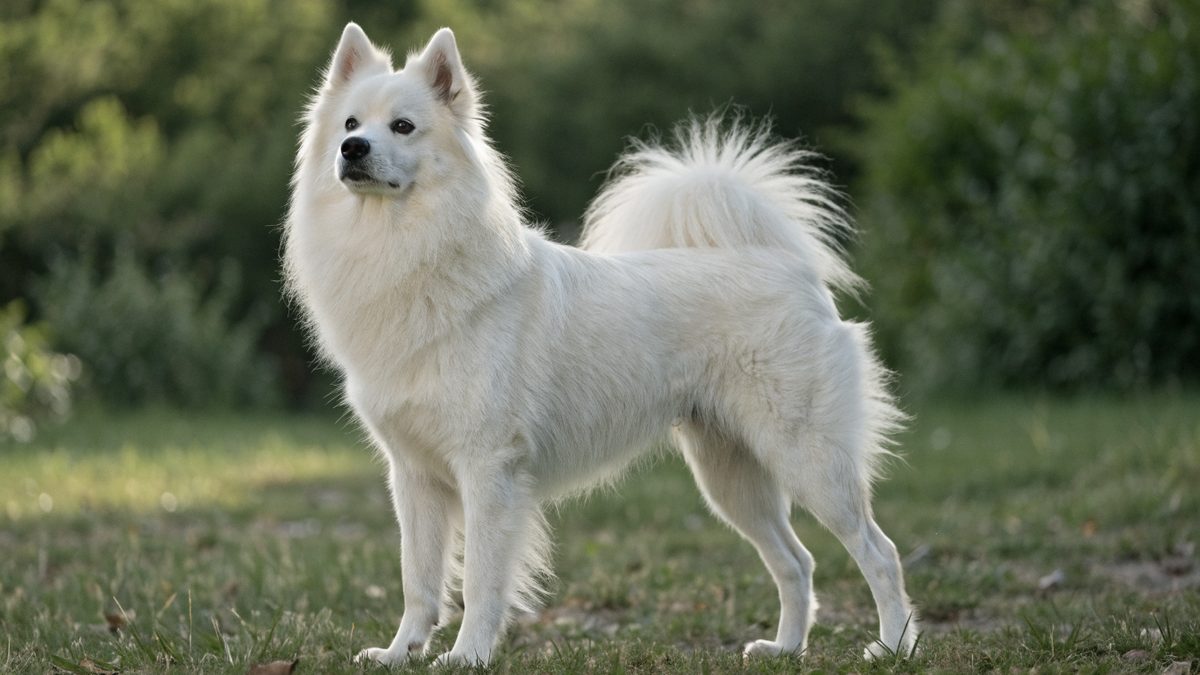
The American Eskimo Dog is a white German Spitz descendant recognised by the American Kennel Club in three size varieties, toy at 9 to 12 inches, miniature at over 12 to 15 inches, and standard at over 15 to 19 inches at the withers. Nothing about the breed is Arctic and nothing about its origin is American.
Three facts settle most of what an Indian buyer needs. The breed comes from German Spitz stock, it was renamed during the First World War, and it is defined by a height band rather than by a look. That last point is what makes it useful to you, because a look can be faked and a measuring tape cannot.
The AKC standard is precise. It sets the toy division at 9 inches to and including 12 inches, the miniature at over 12 inches to and including 15 inches, and the standard at over 15 inches to and including 19 inches, and it disqualifies any dog under 9 inches or over 19 inches. In metric that is 22.9 to 30.5 cm, 30.5 to 38.1 cm, and 38.1 to 48.3 cm. There is no preference for size within a division, so a 10-inch toy and a 12-inch toy are equally correct.
The renaming, and why the name is misleading
The breed was renamed twice, and neither name describes where it came from. The United Kennel Club's own standard states that the breed was known as the German Spitz in its homeland and was renamed the American Eskimo in 1917, probably as a reaction to the unpopularity of anything German during the First World War. The AKC puts the same event slightly differently, saying the breed was known as the American Spitz until 1917, when the name was changed to American Eskimo, and adding plainly that the breed does not have any traceable origin or connection to indigenous cultures.
So the two registries agree on the year and disagree on what the dog was called immediately before it. Bonbeno prints both rather than picking one. The underlying history is not in dispute: European immigrants brought white German Spitz dogs to the United States in the early 1900s, descended from the larger German Spitz, the Keeshond, the white Pomeranian and the Volpino Italiano, and white was the preferred colour in America even though it was not always recognised in the German breeds.
The measurements make that ancestry visible. Compare the AKC's three American divisions against FCI-Standard No. 97 for the Deutsche Spitze, which sets the German Miniature Spitz at 27 cm plus or minus 3 cm, the German Medium Size Spitz at 35 cm plus or minus 5 cm, and the German Giant Spitz at 45 cm plus or minus 5 cm. The American toy band of 22.9 to 30.5 cm sits almost exactly over the German miniature. The American miniature band of 30.5 to 38.1 cm sits inside the German medium. The American standard band of 38.1 to 48.3 cm overlaps the German giant. Wikipedia records that modern American Eskimo Dogs have been exported as German Spitz Gross or Mittel depending on the dog's height, while noting that the breeds have since diverged and the standards are now significantly different.
The registries do not agree on how many sizes there are
Two size systems exist for one breed, and an Indian seller can quote whichever suits the dog in front of you. The AKC recognises three divisions. The UKC recognises two, splits them by sex, and shows them in the ring in the order miniature then standard: miniature males from 9 inches up to and including 15 inches, miniature females from 9 up to and including 14 inches, standard males over 15 up to and including 19 inches, and standard females over 14 up to and including 18 inches. A 14-inch male is a UKC miniature and an AKC miniature. A 14.5-inch female is a UKC standard and an AKC miniature. Neither registry is wrong; they are answering different questions.
| Source | Toy | Miniature | Standard | Hard limits |
|---|---|---|---|---|
| AKC breed standard | 9 to 12 in (22.9 to 30.5 cm) | over 12 to 15 in (30.5 to 38.1 cm) | over 15 to 19 in (38.1 to 48.3 cm) | Under 9 in or over 19 in disqualifies |
| AKC breed page, weight | 6 to 10 lb (2.7 to 4.5 kg) | 10 to 20 lb (4.5 to 9.1 kg) | 25 to 35 lb (11.3 to 15.9 kg) | Life expectancy 13 to 15 years |
| UKC breed standard | No toy division | Males 9 to 15 in, females 9 to 14 in | Males over 15 to 19 in, females over 14 to 18 in | Two divisions only |
| Wikipedia | 9 to 12 in, 5 to 10 lb | 12 to 15 in, 10 to 20 lb | 15 to 20 in, 15 to 40 lb | Standard band exceeds the AKC disqualification |
| iHeartDogs, US market guide | up to 10 lb, 9 to 12 in | 10 to 20 lb, 12 to 15 in | 18 to 35 lb, 15 to 19 in | Same page also says toy is 9 to 12 lb |
| Mr n Mrs Pet, Indian listing | Not listed | Not listed | Not listed | Males 12 to 19 in, females 11 to 18 in, no toy at all |
Read that table as a warning, not as a reference. Two of the six sources publish a standard height that exceeds the AKC's own disqualification of 19 inches, and one Indian listing erases the toy division entirely while inventing an 11-inch floor for females. The only figures that carry authority are the two breed standards, because a standard is the document a judge measures against.
Appearance, in the terms the standard uses
The coat is the single most misdescribed feature of this breed in Indian listings. The AKC standard calls for a stand-off double coat, a dense undercoat with a longer guard hair growing through it, straight with no curl or wave, forming a lion-like ruff around the neck and chest and breeches down the hind legs, with a richly plumed tail carried loosely on the back. Colour is pure white or white with biscuit cream, and any other colour disqualifies. The face carries distinctive black points, meaning black lips, nose and eye rims, and blue eyes disqualify.
Body proportion is slightly rectangular. The AKC puts the length of back from point of shoulder to point of buttocks at an approximate 1.1 to 1 ratio against height at withers, while the UKC describes the same dog as presenting an overall square appearance United Kennel Club. Feet are oval, compact and well padded with hair, not the round cat feet of the German Spitz.
The AKC standard states there is to be no trimming of the whiskers or body coat and that such trimming will be severely penalised, with the only permissible trimming being to neaten the feet and the backs of the rear pasterns. Indian grooming advice for this breed routinely recommends trimming every four to six weeks. That advice is written for a different kind of coat.
How the breed reached the registries
Recognition came late and in stages, which explains why paperwork for this breed is patchy. The UKC's own page says the American Eskimo was recognised by the United Kennel Club in 1913, while Wikipedia dates the first official UKC recognition to 1919. The Canadian Kennel Club's breed page sides with 1913, stating that the Eskie was first registered with the United Kennel Club in 1913 and underwent a name change to American Eskimo Dog in 1917. Two of the three sources say 1913, and Bonbeno prints the third rather than quietly dropping it. What follows is not disputed: the National American Eskimo Dog Association was founded in 1970 and single-dog registrations stopped, the American Eskimo Dog Club of America formed in 1985, the AEDCA collected pedigree information from 1,750 dogs to form the AKC foundation stock, AKC recognition came in 1995, the stud book was reopened from 2000 to 2003, and the Canadian Kennel Club recognised the breed in 2006.
The breed is not recognised internationally, and that matters in India
Three registries recognise this breed and the world's largest federation does not. The Federation Cynologique Internationale publishes a complete nomenclature of every breed it recognises, and its Group 5 list, covering spitz and primitive types, contains the German Spitz as standard 97 with its five varieties, the Volpino Italiano as 195, the Japanese Spitz as 262, the Samoyed as 212 and the Canadian Eskimo Dog as 211. The American Eskimo Dog is not on that list in any section. Neither is the Indian Spitz.
Two consequences follow for an Indian buyer. There is no FCI breed standard for the American Eskimo Dog, so any pedigree issued in the FCI system cannot describe a dog of this breed, and the only registry standards that exist are the American, Canadian and United Kennel Club documents cited on this page United Kennel Club Canadian Kennel Club. And the FCI does recognise a breed called the Canadian Eskimo Dog, number 211, which is a large Arctic sledge dog and a completely different animal. A seller using the word Eskimo is not necessarily naming the breed you think.
The Canadian Kennel Club adds a third classification system on top of the American two. It recognises the same three divisions, standard, miniature and toy, gives the standard as 15 to 19 inches or 38 to 48 cm at the withers, and files the toy variety in its Toy group while the miniature and standard sit in Non-Sporting. So the same breed is a Non-Sporting dog in one country, a Northern Breed in another, and split across two groups in a third.
The breed's American fame came from performing. Beginning in the late nineteenth century the small white spitz was a mainstay of trained-dog acts in travelling circuses, the Cooper Brothers' Railroad Circus featured them in 1917, and a dog called Stout's Pal Pierre walked a tightrope with the Barnum and Bailey Circus in the 1930s American Kennel Club. That is not decoration. A breed selected for a century to learn tricks in front of noise and crowds is an intelligent, trainable, highly vocal dog, and every behaviour section below follows from it.
The breed remains uncommon even at home. In AKC registration statistics the American Eskimo Dog moved from number 129 to number 116 out of 201 breeds counted, a rise of 13 places in a single year but still well inside the bottom half. A breed that is mid-rare in the country that named it does not have a large, stable population anywhere else, and that is the fact underneath the price section.
American Eskimo Dog price in India, and why no figure survives checking
No reliable American Eskimo Dog price in India exists. Bonbeno found four published Indian figures, all from puppy-listing pages, none from a breed club, a registry or a veterinary source, and two of the four contradict themselves on their own page Happy Pet, American Eskimo Dog Breed Guide.
Here is every Indian figure Bonbeno could retrieve for this breed, printed with what it is and what is wrong with it. Nothing has been averaged, and nothing has been smoothed into a tidy range.
| Source | Type of page | Figure published | What survives checking |
|---|---|---|---|
| Happy Pet | Breed guide with a listings funnel | Rs 20,000 to Rs 50,000 cost of buying | A single band with no city split, no sample, and no size variety named |
| Mr n Mrs Pet, Bengaluru | Puppy sales listing | Rs 25,000 to Rs 60,000 and above | Split into basic Rs 25,000 to 35,000, pet Rs 35,000 to 45,000, standard Rs 45,000 to 60,000 |
| Mr n Mrs Pet, city table | Same page, lower down | Rs 75,000 to Rs 60,000 for Hyderabad, Bengaluru and Chennai | A backwards range that cannot be read, and it contradicts the same page's own Rs 25,000 figure |
| Poddar Kennel | Puppy sales listing, position 7 on the query | No price published anywhere on the page | Publishes only a phone number, a WhatsApp link and a KCI paper claim |
| DogExpress price list | India-wide price list, position 10 on the query | The breed is absent from the list | The list carries over 100 breeds including Finnish Spitz, Indian Spitz and Samoyed, and no American Eskimo Dog |
| iHeartDogs, United States | US market guide, position 4 on an India-restricted search | USD 1,000 to 2,500 breeder, USD 100 to 400 rescue | A real US figure on a page that has nothing to do with India |
Why the Indian figures fail
The strongest single piece of evidence is a page that says three American Eskimo puppies are available in Bengaluru and then lists dogs in Kolhapur, Kolhapur and Ludhiana. The Mr n Mrs Pet Bengaluru page reports "3 Result Found" under the heading American Eskimo Puppies For Sale In Bengaluru, and the three listing cards that follow are captioned as being in Kolhapur, Kolhapur and Ludhiana. A city price for a city with no dogs in it is not a price.
The same page describes the breed wrongly in ways that can be checked against the standard. It says American Eskimos have dense, curly coats that need trimming every four to six weeks, that white with biscuit marking is the most common colour "reflecting Maltese influence", and that a standard-quality dog is a "good representation of the Poodle blend";. The AKC standard says the coat is straight with no curl or wave, that trimming the body coat will be severely penalised, and that any colour other than white or biscuit cream disqualifies. Maltese and Poodle have no part in the breed's recorded ancestry, which runs to German Spitz, Keeshond, white Pomeranian and Volpino Italiano. Text describing a Maltese-Poodle cross with a curly coat is template copy that was written for another breed and had this breed's name pasted into it.
Poddar Kennel is the second-most prominent Indian result for the query and it publishes no price at all. Its spec block lists only Group Toy Eskimo Dogs, weight 2.4 to 4.5 kg and height 9 to 12 inches, which is the AKC toy band and nothing else, with the price replaced by a call and WhatsApp button. Its descriptive copy has been run through a synonym spinner: the coat is described as "twofold", "candid with no twist or wave" and "unadulterated white", which are machine substitutions for double, straight with no curl or wave, and pure white American Kennel Club. A seller who cannot describe the coat in its own words has not seen many of these dogs.
DogExpress is the clearest negative evidence. Its India price list is one of the most-cited price references in the Indian market, it carries well over a hundred breeds from the Indian Pariah at Rs 5,000 to Rs 10,000 through Finnish Spitz at Rs 15,000 to Rs 30,000 and Samoyed at Rs 2,50,000 to Rs 6,80,000, and it ranks on page one for this query. The American Eskimo Dog is not on it. A breed that had a functioning Indian market would be.
There is no lawful route for a commercial supply chain
Import law closes the obvious explanation. Under DGFT Trade Notice No. 22/2022-23, dogs fall under ITC(HS) 01061900 with an import policy of Restricted, and Policy Condition 7 allows import only for a pet dog with a valid pet book and records in the importer's name, for R&D organisations with a CPCSEA recommendation, or for internal security by the Defence and Police Force. Policy Condition 8 states that import of commercial dogs for breeding or any other commercial activity is not permitted, and paragraph 6 of the same notice says applications for trading or breeding purposes shall be duly rejected. Entry is limited to the airports and seaports of Delhi, Mumbai, Chennai, Hyderabad, Bengaluru and Kolkata, and a permanent import as passenger baggage is open only to a person transferring residence to India after two years of continuous stay abroad.
Put that beside the American figure. A US breeder charges USD 1,000 to 2,500 for a pet-quality puppy and USD 2,000 to 3,500 or more for show quality. At any exchange rate seen this decade, Rs 25,000 is a small fraction of the lower US figure, and the dogs cannot lawfully have been imported for sale. Something else is being sold.
What you are most likely being offered instead
Four white spitz breeds circulate in India and only one of them is common here. The Indian Spitz is the cheap, locally bred white spitz, and DogExpress prices it at Rs 7,000 to Rs 14,000. A Rs 25,000 to Rs 60,000 quote for a "pure American Eskimo" is therefore a two to eight times premium over the breed most likely to be standing in front of you. The Indian Spitz, the Japanese Spitz and the Pomeranian each have their own Bonbeno page, and the comparison section below gives the measurements that tell them apart.
Bonbeno will not publish an American Eskimo Dog price in India band, because no figure we found is supported by a verifiable population of dogs. Four listing pages that disagree with each other, one of which prints a backwards range and describes a curly coat, do not become a range by being averaged. If you see a confident Rs figure for this breed on any Indian site, ask what dogs it was measured from.
The honest position is short. If the breed you want is the American Eskimo Dog specifically, price is not your first problem. Identity is. Settle the measurement first and treat any quoted price as unverified until the dog in front of you is inside a registry band with paperwork that names the breed.
Monthly cost of ownership in India
Published monthly cost figures for this breed in India run from Rs 3,000 to Rs 7,000, and they come from the same listing pages that could not get the coat right. Treat the structure as useful and the totals as indicative.
Happy Pet publishes the more detailed breakdown, splitting a basic lifestyle at Rs 3,300 a month from a premium lifestyle at Rs 5,400, with food at Rs 1,200 to Rs 1,800, veterinary care at Rs 900 to Rs 1,800, and grooming at Rs 1,200 to Rs 1,800. Mr n Mrs Pet gives a wider Rs 3,000 to Rs 7,000 covering premium food, vet visits, grooming and basic care. The two overlap in the middle, which is the most that can be said for them.
| Line | Published figure | Assumption underneath it |
|---|---|---|
| Food | Rs 1,200 to Rs 1,800 | A single figure across a breed whose adults range from 2.7 kg to 15.9 kg |
| Veterinary | Rs 900 to Rs 1,800 | Routine care only, no screening, no emergency |
| Grooming | Rs 1,200 to Rs 1,800 | Salon visits, which for a correct double coat are brush-outs, not clipping |
| Basic total | Rs 3,300 per month | Excludes cooling, insurance and screening |
| Premium total | Rs 5,400 per month | Excludes cooling, insurance and screening |
| Alternative total | Rs 3,000 to Rs 7,000 per month | Same page recommends trimming every four to six weeks, which the standard forbids |
The grooming line is the one that is wrong
A double coat costs time, not salon money. Both Indian sources treat grooming as a paid service on a four to six week clock, and Mr n Mrs Pet explicitly recommends trimming every four to six weeks to prevent matting. The AKC standard forbids trimming the body coat and severely penalises it, permitting only the neatening of feet and the backs of the rear pasterns. What this coat actually needs is frequent brushing, which is your own labour, plus a proper de-shedding blow-out during the twice-yearly coat blow. Budget for a good undercoat rake and a slicker brush once, not a clipper appointment every month.
The line nobody publishes
Cooling is the largest missing number and Bonbeno will not invent one. None of the Indian sources for this breed price the electricity of running a fan, cooler or air conditioner through an Indian summer for a double-coated dog, and the figure depends on your city, your tariff slab, your appliance and how many hours you run it. Happy Pet does publish an ideal weather band of 15 to 25 degrees Celsius for the breed, and the India Meteorological Department treats 40 degrees Celsius as the plains threshold at which a day becomes a heatwave candidate. The gap between those two numbers is the cost line that no Indian page for this breed prices.
Screening is the second missing line. The three tests the breed's own parent club requires for a CHIC number are an OFA hip evaluation, an eye examination by a board-certified ACVO ophthalmologist, and a prcd-PRA DNA test. Two of those need equipment and specialists that are concentrated in a handful of Indian cities, and Bonbeno could not find published Indian pricing for OFA submission or an ACVO exam. Say so rather than guess.
Take the published Rs 3,300 to Rs 5,400 as the routine floor, add your own cooling and electricity, add one emergency reserve, and add nothing for a groomer's clipper because this coat should never meet one. The number you land on will be higher than any Indian page for this breed prints.
One comparison keeps the total honest. In the United States, where a real population of this breed exists, first-year cost is put at USD 2,300 to USD 6,050 and ongoing annual cost at USD 1,000 to USD 2,000, with grooming the single largest recurring variable at USD 400 to USD 1,200 a year. Indian salon rates are lower, Indian cooling costs are higher, and no published Indian figure has tried to net those against each other.
Heat tolerance in India, rated 2 out of 5 and reasoned from the evidence
Bonbeno rates the American Eskimo Dog 2 out of 5 for heat tolerance in India, and the rating changes by size variety: a toy sits closer to 2.5 and a standard closer to 1.5 Hall EJ, Carter AJ, O'Neill DG. The coat argues for a low rating and the body mass of the two smaller varieties argues it back up, so the number is built rather than assumed.
Three things decide how a dog handles Indian heat: what it is wearing, how big it is, and what shape its head is. This breed loses on the first, wins on the third, and splits on the second.
The coat argues for a low rating
The coat is built for a German winter and cannot lawfully be removed. The AKC standard describes a stand-off double coat, a dense undercoat with a longer guard hair growing through it to form the outer coat, thicker and longer around the neck and chest as a lion-like ruff, with breeches on the hind legs and a profusely covered tail. The same standard forbids trimming the body coat and severely penalises it. So the insulation stays on through a Chennai May, and the only levers you have are shade, water, timing and airflow.
Happy Pet publishes an ideal weather band of 15 to 25 degrees Celsius for the breed. That band is not a comfort suggestion in India, it is a description of a climate most of the country does not have for most of the year. The India Meteorological Department treats a day as a heatwave candidate when a station's maximum reaches at least 40 degrees Celsius in the plains or 30 degrees in hilly regions, declares a heatwave when the maximum runs more than 4.5 degrees above the 30-year average, and declares one regardless of the historical normal once the actual maximum passes 45 degrees. The published comfort ceiling for this breed sits 15 degrees below the plains heatwave threshold.
Body mass argues the rating back up, and this is where the varieties split
The largest published study of heat-related illness in dogs found bodyweight to be a strong, graded risk factor, and the American Eskimo Dog straddles its most important boundary. Hall, Carter and O'Neill analysed heat-related illness in UK dogs under primary veterinary care and reported that dogs over 50 kg had 3.42 times the odds of heat-related illness (95 percent CI 1.54 to 7.57) compared with dogs under 10 kg, and that all bodyweight groups over 10 kg carried significantly higher odds than the under-10 kg group. Their companion paper gives the step sizes: against a base of dogs under 10 kg, dogs of 10 to under 20 kg had 2.52 times the odds of exertional heat-related illness (95 percent CI 1.97 to 3.22), and 1.82 times the odds of environmental heat-related illness (95 percent CI 1.07 to 3.08).
Now map the breed onto that. The AKC gives adult weights of 6 to 10 pounds for the toy, 10 to 20 pounds for the miniature and 25 to 35 pounds for the standard, which is 2.7 to 4.5 kg, 4.5 to 9.1 kg and 11.3 to 15.9 kg.
| Variety | Adult weight | Study bodyweight band | Odds of exertional HRI vs under 10 kg | Bonbeno heat rating |
|---|---|---|---|---|
| Toy | 2.7 to 4.5 kg | Under 10 kg (the base group) | Baseline | Nearer 2.5 |
| Miniature | 4.5 to 9.1 kg | Under 10 kg (the base group) | Baseline | 2 |
| Standard | 11.3 to 15.9 kg | 10 to under 20 kg | 2.52 (95 percent CI 1.97 to 3.22) | Nearer 1.5 |
Read that carefully, because it is the most useful thing on this page for anyone already committed to the breed. A toy or miniature American Eskimo Dog sits inside the lowest-risk bodyweight category the evidence recognises. A standard crosses the line into the band where the odds of exertional heat-related illness roughly double. Two dogs of the same breed, on the same street, in the same Hyderabad summer, are not carrying the same risk.
The head shape is the breed's one clear advantage
This is not a flat-faced dog, and that matters more than the coat does in the published data. The AKC standard requires a muzzle whose length does not exceed the length of the skull, which places the breed firmly in the mesocephalic group. Brachycephalic dogs carried 2.36 times the odds of environmental heat-related illness compared with mesocephalic dogs in the same analysis, and brachycephaly was one of only three risk factors retained in the final multivariable model of the larger study. An American Eskimo Dog can pant properly. A Pug cannot. On this axis the Eskie is not in the high-risk group at all.
One more finding pulls the rating down again. Purebred dogs had 1.84 times the odds of exertional heat-related illness (95 percent CI 1.47 to 2.31) and 1.97 times the odds of environmental heat-related illness (95 percent CI 1.12 to 3.47) compared with crossbred dogs. And within breeds, dogs at or above the mean adult bodyweight for their breed and sex had 1.42 times the odds of heat-related illness (95 percent CI 1.12 to 1.80) compared with dogs below it. A fat Eskie is a materially more heat-sensitive Eskie, and that is the one variable an owner fully controls.
Both studies are UK primary-care data from a temperate climate, and neither model included coat type as a variable Hall EJ, Carter AJ, O'Neill DG. No study of heat-related illness in this breed, or in double-coated dogs in India, exists that Bonbeno could open. The rating of 2 is a mechanical inference from bodyweight, skull shape and coat description, not a measured breed figure. Consult your nearby vet before making a heat plan for an individual dog, especially an older one, since age was a retained risk factor in both models.
City by city
Where you live changes the answer more than which variety you buy.
- Bengaluru and Pune. The two mainland Indian cities where a double-coated white spitz is a reasonable proposition. Both sit on a plateau, both have long stretches inside or near the published 15 to 25 degree comfort band, and both still need a hot-season plan for April and May.
- Delhi and the northern plains. The summer is the problem and the winter is not. A dog in this coat is genuinely comfortable in a Delhi January and genuinely at risk in a Delhi June, when the plains heatwave threshold of 40 degrees is crossed routinely. Plan for a fully indoor summer.
- Chennai, Hyderabad and Kolkata. Sustained heat with high humidity is the worst combination for a panting dog, because evaporative cooling from the airway loses efficiency as humidity rises. Air conditioning stops being a comfort and starts being the containment measure.
- Mumbai. Less extreme peak heat than Delhi, far more humidity for far longer, and a monsoon that keeps a heavy undercoat damp for weeks. The coat problem here is skin, not heatstroke.
- Hill stations and the north-east. Shimla, Darjeeling, Ooty, Gangtok and Shillong are where this breed's coat makes sense. The IMD's own hill-region heatwave threshold of 30 degrees tells you how different the baseline is.
The practical protocol is short and it is not breed-specific. Walk before sunrise and after full dark, never on hot tarmac, keep drinking water in front of the dog at all times, use a fan or cooler in the room the dog sleeps in, keep bodyweight at or below the breed mean, and treat panting that does not settle within a few minutes of rest as an emergency rather than a quirk. Never shave the coat to cool the dog, because that removes the insulating layer and makes heat stroke more likely, not less.
Temperament and household fit
The American Eskimo Dog is intelligent, alert and friendly but slightly conservative, an excellent watchdog that sounds a warning bark at any stranger, and protective of its home and family without threatening to bite or attack people. That description is from the breed standard, and every word of it has a consequence in an Indian flat.
Both registries describe the same dog in the same terms, which is unusual and useful. The AKC standard calls the breed intelligent, alert and friendly although slightly conservative, never overly shy nor aggressive, with such dogs to be severely penalised in the show ring, and says it learns new tasks quickly and is eager to please. The UKC standard calls it intelligent, alert and energetic, loyal and friendly but conservative with strangers, and penalises overly aggressive or overly shy dogs, disqualifying viciousness or extreme shyness outright.
The warning bark is the defining household issue
The breed standard treats barking as correct behaviour, and your neighbours will not. The AKC standard says that at home the American Eskimo Dog is an excellent watchdog, sounding a warning bark to announce the arrival of any stranger. In a detached house on an acre that is a feature. In a Mumbai or Bengaluru apartment block with a shared corridor, a lift that opens six feet from your door, a doorbell that rings for deliveries several times a day and a security guard on rounds, that same instinct fires perhaps thirty times between morning and night. A vocal dog in a vertical Indian building is the single most common reason a small spitz gets rehomed.
The FCI description of the German Spitz group, from which this breed descends, says the same thing from another angle: a natural distrust of strangers and a lack of hunting instinct make it an ideal companion, family dog and watch dog for home and farm. Distrust of strangers is not a defect being reported, it is the working trait being praised.
Separation is the second issue
This is a dog bred to be with people and it does badly without them. Indian listing pages for the breed, unreliable as they are on measurements, converge on this point and are worth reading on it: the Eskie should be with its family and should not be left alone for long stretches, or it may develop separation anxiety, and boredom leads to excessive barking, inappropriate chewing and other unwanted behaviours. That is consistent with a breed whose recorded history is a century of performing beside handlers in travelling circuses.
Who this breed suits, and who it does not
- Suits a household with someone home most of the day. Work-from-home, a joint family, a retired parent at home, or a genuinely flexible schedule. This is the strongest single predictor of whether it works.
- Suits an owner who wants to train. The breed learns fast and is eager to please, and it will use that intelligence on you if you do not use it first.
- Suits a family with older children. Small enough not to knock a child over, sturdy enough to play, and friendly by standard. Supervise anyway, and never with a toy variety weighing 2.7 kg.
- Does not suit a first-floor flat with thin walls. The warning bark is the breed, and training reduces it rather than removing it.
- Does not suit a household away twelve hours a day. Separation distress and destructive boredom follow.
- Does not suit a home with small caged pets. Indian sources for the breed advise not trusting even a well-trained Eskie with birds, hamsters and gerbils. Treat that as a management rule, not a character flaw.
- Does not suit a buyer who wants a low-maintenance dog. A double coat, a vocal temperament and a heat-sensitive constitution is a three-way maintenance load in India.
One honest note on where this description comes from. There is no published temperament survey of American Eskimo Dogs in Indian homes, because there is no measurable Indian population to survey. Everything above is the two breed standards plus the behavioural notes on Indian seller pages, and Bonbeno has flagged which is which.
Training, and what this breed resists
To train an American Eskimo Dog, use short, varied, reward-based sessions and give the dog a job, because the breed learns new tasks quickly and is eager to please. What it resists is not commands but repetition, isolation and boredom.
Start from the historical evidence rather than from adjectives. This breed spent the late nineteenth and early twentieth centuries as a trained-dog act, appearing with the Cooper Brothers' Railroad Circus in 1917, and a dog called Stout's Pal Pierre walked a tightrope with the Barnum and Bailey Circus in the 1930s. The AKC notes that Eskies were mainstays of trained-dog acts in travelling circuses, vaudeville troupes and Wild West shows, and describes the breed as among the most trainable of all breeds, learning new commands quickly and sometimes just by watching. A dog selected for that will pick up whatever you teach it, including the things you did not mean to teach it.
A realistic first-year timeline
- Weeks 8 to 12, name and handling. Under Indian law a pup cannot lawfully be sold before eight weeks of age, so week eight is the earliest a puppy is legitimately in your home. Spend it on name response, gentle full-body handling for later grooming, and the first brush sessions with no brushing pressure.
- Weeks 8 to 16, socialise deliberately. Every stranger, lift, doorbell, delivery rider, cooker whistle and security guard the puppy meets calmly now is one it does not bark at for the next twelve years. This window closes and does not reopen.
- Months 3 to 5, the quiet cue. Teach the interrupt before the barking becomes self-rewarding. Mark and reward the pause after one or two barks rather than trying to suppress the first one, because the standard's warning bark is hardwired.
- Months 4 to 8, alone-time in graded doses. Build from two minutes to two hours. This breed suffers when left, so the skill has to be taught rather than assumed.
- Months 6 to 12, give it a job. Obedience, trick training, scent games, an agility class if your city has one. The AKC ranks the breed as highly intelligent and eager to please, and an unemployed intelligent dog invents work.
- Month 12 onward, maintain. Five minutes twice a day of something new beats an hour on Sunday.
The barking protocol, written out
Barking is the behaviour that decides whether this dog stays in the home, so treat it as a training project rather than a nuisance. Do four things and do them consistently. Manage the trigger first, by keeping the dog away from the front door sightline and covering the gap under it. Teach an incompatible behaviour, such as going to a mat when the bell rings, because a dog on a mat with a chew is not a dog at the door. Reward silence rather than punishing noise, since punishment adds arousal to an already aroused dog. And exercise the brain before the day starts, because a bored Eskie barks more than a tired one.
Anti-bark collars, shouting, and leaving the dog outside are the three responses Indian owners reach for first and all three make an intelligent, people-oriented, heat-sensitive breed worse. Shouting reads as joining in. Isolation feeds the separation problem. And leaving a double-coated dog outdoors in an Indian summer is a heat risk before it is a training failure.
What the breed resists
It resists being managed rather than led. Indian sources for the breed warn that without a consistent, confident handler the dog will take charge, and that small dogs in particular slip into that role because owners find it charming. It also resists drilling. A dog that learns commands by watching gets bored of the fifteenth repetition of sit, and a bored Eskie stops offering behaviour. Keep sessions to five minutes, change the exercise before the dog wants you to, and finish while it still wants more.
Daily exercise, and how to fit it around Indian heat
Plan 30 to 45 minutes of daily exercise for an American Eskimo Dog, split across two sessions, both of them outside the hottest part of the day. The published figure is for the breed as a whole, and a standard needs the upper end while a toy manages on the lower.
Happy Pet rates the breed medium energy with a 30 to 45 minute exercise routine. That is a reasonable floor for a companion spitz and it is not the whole requirement, because the UKC standard calls the breed energetic and the AKC calls it highly intelligent and eager to please American Kennel Club. Physical distance is the easy half. Mental work is the half that decides whether your evening is quiet.
What the three varieties actually need
| Variety | Adult weight | Daily walking | Notes |
|---|---|---|---|
| Toy | 2.7 to 4.5 kg | Two sessions of 15 minutes | Short legs, low heat load, tires on stairs before it tires on flat ground |
| Miniature | 4.5 to 9.1 kg | Two sessions of 15 to 20 minutes | The variety most Indian apartments can actually service |
| Standard | 11.3 to 15.9 kg | Two sessions of 20 to 25 minutes | Needs the most and tolerates heat the least, because it sits in the 10 to 20 kg band |
Timing beats duration in India
Move the walk, not the dog. Exertional heat-related illness, meaning heat illness triggered by activity rather than by a hot car or a hot room, was the largest category in the UK study and it is triggered by exercise in any environment. In a country where the IMD counts 40 degrees Celsius as the plains heatwave threshold, the difference between a 6 am walk and a 10 am walk is the difference between exercise and risk. Walk before sunrise, walk after full dark, and check the tarmac with the back of your hand before you step onto it.
During April, May and June in most of the plains, the honest answer is that the outdoor walk shrinks and the indoor work expands. That is not a failure of ownership, it is the correct adaptation for a double-coated dog in a tropical summer.
Indoor substitutes that genuinely work
- Scatter feeding. Throw the meal across a room instead of putting it in a bowl. Twenty minutes of sniffing tires a dog more than twenty minutes of walking.
- Trick training in five-minute blocks. This is the breed's heritage and it costs you nothing but attention.
- Stair recalls inside the flat. Only for adults, never for a puppy under a year, and never for a dog with an unscreened hip or knee.
- Food puzzles and frozen stuffed toys. The frozen version doubles as a cooling activity.
- Hallway fetch on a non-slip runner. Bare tile is how a small dog injures a knee.
An under-exercised Eskie does not sulk, it escalates. Indian breed pages describe the same pattern the standards imply: hyperactivity, spinning in circles, excessive barking, chewing and destructiveness. If your dog is doing three of those, the problem is almost never obedience and almost always an empty day.
One last constraint. Under the Prevention of Cruelty to Animals (Dog Breeding and Marketing) Rules 2017, a registered breeding establishment must provide a fenced area for adequate exercise or provision for exercising the dog on a leash. If you are visiting a seller and there is no such area anywhere on the premises, you are looking at an establishment that does not meet the minimum standard in Indian law, whatever the dogs cost.
Grooming a double coat in Indian humidity
To groom an American Eskimo Dog in India, brush the coat out thoroughly two or three times a week, daily during a coat blow, and never shave it American Kennel Club. The breed standard permits trimming only to neaten the feet and the backs of the rear pasterns, and severely penalises any trimming of the whiskers or body coat.
Bonbeno's standing rule on every double-coated breed is that you never shave a double coat, and on this breed the rule is reinforced by the breed standard itself. The AKC standard is unusually blunt: there is to be no trimming of the whiskers or body coat and such trimming will be severely penalised, with the only permissible trimming being to neaten the feet and the backs of the rear pasterns. A groomer who reaches for clippers on this dog is not styling it, they are damaging it.
Why shaving makes an Indian summer worse, not better
The undercoat is a cooling layer as well as a warming one. Dr Jerry Klein, Chief Veterinary Officer for the American Kennel Club, states that a dog's coat acts as an insulator, and that shaving it to reduce shedding or supposedly to keep the dog cool eliminates that insulating layer of fur, makes the dog susceptible to heat stroke, and can result in improper hair growth and possible follicle damage. The AKC adds that as a double-coated dog sheds its undercoat in warm weather, the remaining coat captures air between the two layers and helps regulate body temperature, while the outer coat protects against sunburn and insect bites.
There is a second, permanent cost. When a double coat is shaved to the skin the undercoat grows back faster and can crowd out the slower-growing guard hairs, changing the texture and colour of the coat and leaving it patchy. On a breed whose standard requires a straight outer coat with no curl or wave and pure white or biscuit cream colour, that is not a cosmetic issue.
Mr n Mrs Pet's page for this breed states that American Eskimos have dense, curly coats that need trimming every four to six weeks to prevent matting and skin issues, especially in Indian climates. The AKC standard says the coat is straight with no curl or wave, and that trimming the body coat will be severely penalised. Both halves of that advice are contradicted by the breed's own standard. If a groomer quotes you that schedule, they are grooming a different breed.
The actual routine, week by week
- Two to three full brush-outs a week, normally. Happy Pet's own guidance for the breed is brushing two to three times a week and daily during shedding. Work in sections down to the skin with an undercoat rake, then finish with a slicker. A surface brush over the guard hair leaves the undercoat matting underneath it.
- Daily during the coat blow. The breed sheds its undercoat twice a year in bulk. Ten minutes a day for three weeks is less work than one matted coat.
- Bathe rarely and dry completely. A damp undercoat in Mumbai or Kolkata humidity is where hot spots start. If the dog cannot be blown fully dry, do not bathe it that day.
- Check the ruff, breeches and behind the ears weekly. The standard describes the thickest hair around the neck and chest and on the rump and hind legs down to the hocks, and those are exactly the three places mats form first.
- Neaten the feet only. The one permissible trim, plus the backs of the rear pasterns. Long foot hair collects grit on Indian pavements.
- Nails, teeth and ears on the same weekly slot. Happy Pet lists bathing, brushing, ear cleaning, eye care, nail trimming and teeth care as the hygiene set.
Tear staining on a white face
Tear staining is normal in this breed and the standard says so. The AKC standard states that tear stain, unless severe, is not to be faulted, and that its presence should not outweigh consideration of type, structure or temperament. On a pure white dog it is simply visible in a way it would not be on a coloured coat. Wipe the area daily with plain water and a soft cloth, and treat a sudden increase, a change in discharge colour, or squinting as a veterinary problem rather than a grooming one, because the breed's eye statistics are not trivial.
Monsoon and dust, the two Indian variables
Indian grooming has two seasons that temperate advice does not cover. The monsoon keeps a dense undercoat damp for weeks, and damp plus warmth plus friction is the recipe for acute moist dermatitis. Dry the dog after every wet walk, pay attention to the armpits and the base of the tail, and part the coat to look at the skin rather than judging by the surface. The dry season brings the opposite problem: a white coat in Delhi or Ahmedabad dust turns grey within days, and the temptation is to bathe more often. Brush more often instead. Mechanical removal of dust is safer for the skin barrier than repeated shampooing.
Happy Pet rates the breed a moderate shedder, which is a generous reading of a stand-off double coat with a dense undercoat. Assume white hair on dark furniture year-round, and heavy volume twice a year.
Health risks, screening and lifespan
The American Eskimo Dog's most striking published health figure is degenerative myelopathy: of 121 dogs DNA-tested and recorded by the Orthopedic Foundation for Animals, 19.8 percent tested at risk and 23.1 percent tested carrier, placing the breed 8th of all breeds ranked for that test. Hip dysplasia, progressive retinal atrophy carrier status and eye findings are the other three numbers that matter.
Every figure in this section was read out of the Orthopedic Foundation for Animals' own breed rows on 19 August 2026, matching each value to its column heading and confirming the breed name printed in the row. OFA is a live register that grows as evaluations are submitted, so each figure is published here with the sample size beside it and both will have moved by the time you read this.
| Screen | Evaluations | Result | Breed rank |
|---|---|---|---|
| Degenerative myelopathy, DNA | 121 | 57.0 percent normal, 23.1 percent carrier, 19.8 percent at risk | 8 |
| Progressive retinal atrophy, DNA | 215 | 80.9 percent normal, 19.1 percent carrier, 0.0 percent affected | 45 |
| Hips | 1,469 | 89.4 percent normal, 9.9 percent dysplastic | 134 |
| Eyes, CAER examination | 668 | 93.6 percent normal, 6.4 percent abnormal | 64 |
| Patella | 277 | 97.1 percent normal, 2.9 percent abnormal | 68 |
| Elbows | 282 | 98.6 percent normal, 1.4 percent abnormal, all grade 1 | 137 |
| Primary lens luxation, DNA | 69 | 98.6 percent normal, 1.4 percent carrier, 0.0 percent affected | 17 |
| Congenital cardiac | 70 | 100 percent normal | 81 |
| Thrombopathia, DNA | 53 | 100 percent normal | 1 |
Degenerative myelopathy is the finding no other page carries
Two facts have to be read together. The first is the OFA number above: 19.8 percent of 121 tested American Eskimo Dogs carry two copies of the mutation and are recorded as at risk, with a further 23.1 percent carriers. The second is that the American Eskimo Dog appears on OFA's own list of breeds in which the association between the SOD1 mutation and actual degenerative myelopathy has been proven, through microscopic examination of spinal cords from deceased dogs that showed symptoms. OFA is explicit that it is reluctant to recommend testing in breeds where that proof does not exist. For this breed it does.
Degenerative myelopathy causes gradual paralysis through degeneration of the spinal cord, typically starting between 8 and 14 years of age. It presents first as loss of coordination in the hind legs, worsens over six months to a year to hind-leg paralysis, and may progress to loss of urinary and faecal continence and eventual weakness in the front limbs. OFA states clearly that it is not a painful disease.
An at-risk (A/A) result means two mutated copies, not a diagnosis. OFA states that not all dogs testing A/A have shown clinical signs, that some A/A dogs did not begin to show signs until they were 15 years old, and that research is still ongoing to estimate what percentage of A/A dogs will develop the disease within their lifespan. Carriers are far less likely to develop it, although a few carrier dogs have been confirmed with the disease. If your dog tests at risk, discuss it with your nearby vet rather than acting on the result alone.
The practical consequence for an Indian buyer is simple and cheap. The DM test is a buccal swab, it can be done at any age, and it does not need a radiograph or a specialist. It is on the AEDCA's list of optional tests, not its required three. Ask for it anyway.
Progressive retinal atrophy, the breed's required DNA test
Nearly one in five tested American Eskimo Dogs carries the prcd mutation. OFA records 19.1 percent of 215 tested dogs as carriers with no affected dogs in the dataset, which is what successful carrier management looks like: the mutation is still circulating but two carriers are not being bred together. The AEDCA explains the mechanism, that the progressive rod-cone dysplasia form of progressive retinal atrophy is caused by an autosomal recessive mutation, so a DNA test separates normals (Pattern A) from carriers (Pattern B) and affecteds (Pattern C), allowing breeders to avoid producing affected dogs.
This is why a carrier result on a parent is not automatically a reason to walk away, and why an untested pair is. A carrier bred to a tested normal produces no affected puppies. Two untested dogs bred together produce whatever they produce.
Hips, knees and elbows
Hip dysplasia is the breed's oldest recorded concern and the numbers are moderate. OFA records 9.9 percent of 1,469 evaluated American Eskimo Dogs as dysplastic, with 89.4 percent normal, broken down as 10.9 percent excellent, 61.0 percent good and 17.5 percent fair, and the dysplastic fraction split as 6.9 percent mild, 2.5 percent moderate and 0.3 percent severe. The AEDCA records that hip dysplasia was the major health concern across all breeds when its Health Committee formed in the late 1980s, and that the committee spent years educating breeders to screen and select against it. The 1,469-dog sample is the largest OFA dataset the breed has, which is why the hip figure is the most trustworthy number on this page.
Read those grades with OFA's own definitions beside them. Excellent, good and fair are all within normal limits and all receive OFA numbers, borderline means the three independent radiologists reached no clear consensus, and over half of borderline dogs show no change on a repeat radiograph and end up with a normal rating. One clause in that page matters more to an Indian buyer than any percentage: excellent, good and fair results are in the public domain automatically, while borderline and dysplastic grades are not released unless the owner chose the open database. A parent with no visible hip result is therefore not proof of anything either way, and the question to ask is whether the dog was submitted at all.
Knees are better than a small spitz owner might expect. Patellar luxation shows 2.9 percent abnormal of 277 evaluated dogs, of which 2.5 percent were grade 1 and 0.4 percent grade 2, with no grade 3 recorded. That is a materially different picture from the Pomeranian, and it is one of the few places where the American Eskimo Dog compares well against the small white spitz it is confused with. Elbows are near-clean at 1.4 percent abnormal of 282, all grade 1.
Two details from OFA's patella page change how that figure should be used. The database issues numbers only from 12 months of age, animals can be affected by the time they are eight weeks old, and patellar luxation should be considered an inherited disease. And in toy and miniature breeds, lateral luxation is most often seen late in life, from five to eight years of age. A clear knee at two years is genuinely good news and it is not a guarantee for the following decade, which is why OFA recommends periodic re-examination.
Legg-Calve-Perthes disease deserves a mention and an honest qualification. It is a disorder of hip joint conformation in which the blood supply to the femoral head is interrupted, causing avascular necrosis, and it is most often seen in miniature and toy breeds between four months and a year of age. The AEDCA lists it among the optional tests owners may elect. But the American Eskimo Dog does not appear on OFA's own published list of breeds at risk for Legg-Calve-Perthes, which names the Pomeranian, Yorkshire Terrier, Cairn Terrier, Chihuahua and around twenty others. Bonbeno reports both facts rather than resolving them.
Eyes, in detail
The CAER summary of 93.6 percent normal across 668 examinations hides a more informative breakdown. Within that same dataset, 529 of the 668 dogs, or 79.2 percent, were recorded under the strictly normal code, and the individual findings recorded most often were cataract of unknown significance in 47 dogs (7.0 percent), Y-suture tip opacities in 22 (3.3 percent), punctate anterior cortex opacity in 20 (3.0 percent), incipient anterior cortex opacity in 19 (2.8 percent), generalised retinal atrophy in 9 (1.3 percent) and distichiasis in 4 (0.6 percent). Most of those are minor lens opacities, not blindness. The 1.3 percent generalised retinal atrophy figure is the one that matters, because it is the clinical expression of what the prcd DNA test is trying to prevent.
The three tests to ask for by name
The breed's parent club has already written your checklist. To earn a CHIC number, an American Eskimo Dog needs exactly three tests: an OFA hip dysplasia evaluation at a minimum of 24 months of age, an eye examination by a board-certified ACVO ophthalmologist at a minimum of 24 months certified with the OFA, and a prcd-PRA DNA test performed by a licensed laboratory and registered with the OFA. The dog must also carry permanent identification by microchip or tattoo, verified by the attending veterinarian at the time of each test.
The AEDCA states it in capitals in its own guidance: having a CHIC number does NOT mean an Eskie is normal for all tests, it means the screening was done and all results are in the public domain. So do not accept the number. Ask for the individual results, which are searchable on the OFA site by the dog's registered name.
Lifespan, and what is not known
The published life expectancy figures agree with each other and none of them is a study. The AKC gives 13 to 15 years, Happy Pet gives 12 to 15, and the US market guide gives 12 to 15 with some dogs reaching 15 to 17. Bonbeno could not find a breed-specific life table for the American Eskimo Dog in the veterinary literature. Teng and colleagues published life tables for 18 individual breeds and crossbred dogs from UK primary-care records, and the breeds they name in their results are common UK breeds such as the Jack Russell Terrier at 12.72 years and the French Bulldog at 4.53 years. The American Eskimo Dog is not among them, and Bonbeno will not borrow another spitz breed's number in its place.
What the population-level evidence does support is a favourable prior. McMillan and colleagues analysed 584,734 UK dogs including 284,734 deceased across 155 recognised purebreds, and reported median survival of 12.7 years for small breeds, 12.5 for medium and 11.9 for large, with mesocephalic purebreds at 12.8 years against 11.2 for brachycephalic and 12.1 for dolichocephalic. A small-to-medium, mesocephalic purebred sits in the two most favourable categories that study measured. That is a structural argument for longevity, not a breed figure, and it should be labelled as such.
There is no Indian health data for this breed at all. No Indian veterinary survey, insurance dataset or breed-club register that Bonbeno could open reports outcomes for American Eskimo Dogs in India, and the reason is the same reason the price section failed: there is no measurable population here. Bonbeno has deliberately not substituted Indian Spitz or Japanese Spitz figures, because those are different breeds with different founder populations. Consult your nearby vet for anything specific to your own dog, and see a veterinarian immediately for collapse, sudden vision change, or hind-limb weakness in an older dog.
Feeding and body condition
Feed an American Eskimo Dog to a lean body condition rather than to a published calorie number, because the breed spans 2.7 kg to 15.9 kg across its three size varieties and no single figure can serve all of them. Body condition is also the one heat-risk variable an owner fully controls.
The only Indian calorie figures Bonbeno found for this breed are Happy Pet's, which give puppies 1,200 kcal per day and adults 900 kcal per day, with a macronutrient split of 25 percent protein, 15 percent fats, 40 percent carbohydrates, 5 percent fibre and 7 percent each of vitamins and minerals. Those figures are unverified against any veterinary nutrition source and they cannot be right across the breed. A 2.7 kg toy and a 15.9 kg standard differ by nearly six times in bodyweight, and a single 900 kcal adult figure would overfeed one badly and underfeed the other.
Use the number as a ceiling for a standard-sized adult and work down. Better still, ignore it and use the dog.
Body condition beats arithmetic, and here is the evidence
Weight relative to breed mean is a measured heat-illness risk factor. Dogs whose adult bodyweight was equal to or above the mean for their breed and sex had 1.42 times the odds of heat-related illness (95 percent CI 1.12 to 1.80) compared with dogs below that mean. The same authors note that obesity limits heat conduction and radiation from the skin and can limit effective cooling through respiration, and that overweight animals overheat faster and take longer to cool. In an Indian summer that is not a cosmetic argument.
Assess the dog by hand rather than by eye, because a stand-off double coat hides a waistline completely. You should feel the ribs easily under a thin layer of fat with light pressure, feel a tuck-up behind the ribs, and see a waist from above when the coat is wet and flat. If you have to press to find ribs, the dog is overweight, whatever the bathroom scale says.
Life-stage feeding
- 8 to 16 weeks. Four meals a day of a complete puppy food. The breeder must furnish feeding details in writing at the point of sale, along with dates of inoculations and de-worming and the name and address of the attending veterinary practitioner, under Indian law. Ask for that document and follow it for the first fortnight before changing anything.
- 4 to 6 months. Three meals a day. This is the fastest growth phase and also when a toy or miniature is most vulnerable to hypoglycaemia if meals are skipped.
- 6 to 12 months. Two meals a day. Transition to adult food at the small-breed end of the range for toys and miniatures, later for standards.
- Adult. Two meals a day, measured, not free-fed. Free feeding a food-motivated, boredom-prone breed in an apartment is how it puts on the weight the heat evidence penalises.
- Senior, from roughly 9 years. Keep the protein, cut the calories, and watch for hind-limb weakness that could be the earliest sign of degenerative myelopathy rather than age.
Indian availability and practical notes
Nothing about this breed's diet is exotic and everything it needs is sold in India. Small and medium-breed complete kibbles from the mainstream brands are widely available in every metro and online everywhere else. Happy Pet's list of foods to avoid for this breed is the standard canine toxic list and is worth repeating because Indian kitchens contain most of it: chocolate, onions and garlic, grapes and raisins, cooked bones, alcohol, xylitol and greasy processed food.
Two Indian-specific habits are worth naming. Feeding rice with milk and biscuits is still common and it is a poor base diet for a small dog with a coat to maintain. And feeding a dog outdoor scraps in the summer is how you get a heat-stressed dog with gastroenteritis on the same day. Keep fresh, clean drinking water available at all times, which is also a requirement placed on registered breeding establishments under the Prevention of Cruelty to Animals (Dog Breeding and Marketing) Rules 2017.
A dull, brittle or thinning white coat is often the first visible sign of an inadequate diet in this breed, because the coat is metabolically expensive to maintain. Before you buy a supplement, check the food's protein level and the dog's body condition, and ask your nearby vet whether a skin or thyroid problem should be ruled out first. Thyroid screening is on the AEDCA's optional test list for the breed.
The first year, month by month
An American Eskimo Dog puppy cannot lawfully be sold in India before eight weeks of age, must be micro-chipped at sale, and cannot have an OFA hip or eye clearance of its own until 24 months American Eskimo Dog Club of America. Those three dates anchor the whole first year.
Most breed timelines are generic. This one is pinned to hard rules, because the useful thing about a rare breed with a thin market is that the legal and screening dates are the parts nobody can fudge.
- Before week 8, at the breeder. Under rule 8 of the Prevention of Cruelty to Animals (Dog Breeding and Marketing) Rules 2017, pups less than eight weeks in age are not to be sold, each pup sold must be micro-chipped with a complete record of treatment and vaccination maintained, and pups must not be displayed in public places for immediate sale. A puppy offered at six weeks, or offered from a display counter, is being sold in breach of those rules.
- Week 8, coming home. Collect the paperwork the law requires: a sale receipt carrying the micro-chip number and your details, and a written note of feeding, dates of inoculations and de-worming, and the name and address of the veterinary practitioner who attended the litter. Keep the food unchanged for the first fortnight.
- Weeks 8 to 16, the socialisation window. The single highest-value period in this breed's life, because the warning bark the standard describes is going to be aimed at whatever the dog did not meet now. Lifts, doorbells, delivery riders, security guards, autos, cookers, other dogs, children, and being handled all over for grooming.
- Months 2 to 4, brush before you need to. Two short brush sessions a week with the puppy coat, which barely needs it, so that the adult coat blow at 10 to 14 months is not the dog's first experience of an undercoat rake.
- Months 3 to 6, the first Indian summer. If your puppy's first April to June falls here, treat it as an indoor season. Walk before sunrise and after dark, and remember the breed's published comfort band tops out at 25 degrees Celsius while the IMD plains heatwave threshold is 40 Impact of heatwaves on all-cause mortality….
- Month 6, the sterilisation line in Indian law. Under the same rules, a breeder may not sell a dog over six months of age without first sterilising it, unless the sale is to another licensed breeder. If you are being offered an eight-month-old entire dog by a seller, ask how that is lawful.
- Months 6 to 10, adolescence and barking. The vocal behaviour consolidates here. Reward the pause, teach a mat, and manage the door.
- Month 10 to 14, the first full coat blow. Daily brushing for two to three weeks. Do not shave it, no matter how much hair comes out.
- Month 12, Legg-Calve-Perthes radiograph if you want it. OFA will not issue an LCP number before 12 months of age, and the same hip-extended view can be read for both LCP and hip dysplasia.
- Month 24, the real screening date. OFA will not issue a hip number to an American Eskimo Dog evaluated before 24 months, and will not issue a CHIC number where the eye examination was certified before 24 months either. Any hip or eye clearance a seller waves at you for a puppy is a preliminary, not a final.
The prcd-PRA and degenerative myelopathy DNA tests are buccal swabs with no minimum age, so a responsible seller can already have both on the parents before the litter is born Orthopedic Foundation for Animals. That is the cheapest and most decisive question you can ask, and it does not depend on the puppy's age at all.
One realistic caution. Almost none of this infrastructure exists for this breed in India. There is no Indian OFA submission pathway most owners can access easily, board-certified ACVO ophthalmologists are concentrated in a handful of cities, and Bonbeno found no Indian seller of this breed publishing any screening result. Knowing the schedule still helps, because it tells you exactly what a seller cannot possibly have.
American Eskimo Dog vs Indian Spitz, Japanese Spitz, Pomeranian and Samoyed
Height at the withers separates the American Eskimo Dog from three of the four white spitz breeds it is confused with in India, and colour separates it from the fourth. Take one measurement and read one coat, and most mis-sold dogs identify themselves Federation Cynologique Internationale American Kennel Club American Kennel Club.
India has a white spitz problem. Four breeds circulate under overlapping names, one of them is cheap and locally bred, and the other three carry a premium. This section gives the registry measurements that settle it, because a measuring tape is the one tool a seller cannot argue with.
| Breed | Height at withers, by standard | Adult weight | Colours permitted | Feet |
|---|---|---|---|---|
| American Eskimo Dog, toy | 9 to 12 in, 22.9 to 30.5 cm | 6 to 10 lb, 2.7 to 4.5 kg | White or white with biscuit cream only, anything else disqualifies | Oval, compact |
| American Eskimo Dog, miniature | over 12 to 15 in, 30.5 to 38.1 cm | 10 to 20 lb, 4.5 to 9.1 kg | White or white with biscuit cream only | Oval, compact |
| American Eskimo Dog, standard | over 15 to 19 in, 38.1 to 48.3 cm | 25 to 35 lb, 11.3 to 15.9 kg | White or white with biscuit cream only | Oval, compact |
| Japanese Spitz | 30 to 38 cm for dogs, bitches slightly smaller | Not specified in the FCI standard | Pure white only | Cat feet |
| Pomeranian Federation Cynologique Internationale | 21 cm plus or minus 3 cm under FCI, no height in the AKC standard | 3 to 7 lb, 1.4 to 3.2 kg, ideal 4 to 6 lb | All colours, patterns and variations allowed | Round, cat-like |
| Samoyed | males 21 to 23.5 in, 53.3 to 59.7 cm; females 19 to 21 in, 48.3 to 53.3 cm | Not specified in the AKC standard's height clause | Pure white, white and biscuit, cream or all biscuit; anything else disqualifies | Large, long, flattish hare foot |
| Indian Spitz | No AKC or FCI breed standard exists, so no registry height band exists | See the Bonbeno breed page | Not defined by a standard | Not defined by a standard |
The four cuts that decide it
- Over 19 inches, 48.3 cm, at the withers means it is not an American Eskimo Dog. The AKC standard disqualifies any dog over 19 inches. A male Samoyed starts at 21 inches, 53.3 cm, so the two bands do not even touch. Any large white spitz that reaches your hip is not an Eskie.
- Under 9 inches, 22.9 cm, means it is not an American Eskimo Dog either. The same disqualification runs downward. FCI puts the Pomeranian at 21 cm plus or minus 3 cm, so 18 to 24 cm, which is almost entirely below the American toy floor. A 2 kg dog is a Pomeranian, not a toy Eskie, whatever the receipt says.
- Any colour other than white or biscuit cream means it is not an American Eskimo Dog. Colour is a disqualification in the AKC standard. The Pomeranian standard permits all colours, patterns and variations, including orange, sable, black, parti and tan points, and those are exactly the Pomeranian colours common in India. An orange or cream fluffy dog is not a mis-marked Eskie.
- Blue eyes mean it is neither an Eskie nor a Samoyed. Blue eyes are a disqualification in both standards.
The overlap zone, 30 to 38 cm, where height cannot decide
One band is genuinely ambiguous and you should know it before you pay. The Japanese Spitz standard gives 30 to 38 cm for dogs and the American Eskimo Dog's miniature division is 30.5 to 38.1 cm. Those are the same dog by height. Body proportion does not help either: FCI puts the Japanese Spitz at a height-to-length ratio of 10 to 11, and the AKC puts the American Eskimo Dog at approximately 1.1 to 1 length to height American Kennel Club. That is the same number written two ways.
The two breeds look alike for a documented reason. Postwar contact with Japan led to Japanese Spitz being imported into the United States, and they may have been crossed into the American breed at that time. Inside the overlap, use these four separators instead of height.
| Feature | American Eskimo Dog | Japanese Spitz |
|---|---|---|
| Colour | White or white with biscuit cream | Pure white only, no biscuit permitted |
| Feet | Oval, compact, tightly knit | Cat feet |
| Eyes | Slightly oval, set well apart, not slanted | Moderately large, almond-shaped, set slightly oblique |
| Muzzle | Broad, length not exceeding the length of the skull | Pointed, the tip slightly round |
| Tail at rest | Carried loosely on the back, may be dropped at rest | Tail not carried on back is a disqualifying fault |
The practical rule that follows: a biscuit-cream dog in the 30 to 38 cm band is an American Eskimo Dog and cannot be a Japanese Spitz, while a pure white dog in the same band needs the eye, muzzle and foot check before anyone should call it either.
Where the Indian Spitz sits, and why it matters most
The Indian Spitz is the reason this page exists. It is the locally bred white spitz that most Indian households have actually kept, it is priced by DogExpress at Rs 7,000 to Rs 14,000, and it is not on the American Kennel Club's list of recognised breeds, which does list the American Eskimo Dog, the Japanese Spitz, the German Spitz, the Finnish Spitz and the Volpino Italiano. No AKC standard means no AKC height band, which means the Indian Spitz cannot be excluded by measurement the way the others can.
The same absence runs through the international register. The FCI Group 5 nomenclature lists the German Spitz, the Volpino Italiano, the Japanese Spitz, the Samoyed and the Canadian Eskimo Dog, and contains neither the American Eskimo Dog nor the Indian Spitz. Of the five white spitz breeds in the table above, only three carry an FCI standard, which is the single quickest way to understand why paperwork in this corner of the Indian market is so weak.
So run the logic in the other direction. If a dog measures inside an American Eskimo Dog band, is white or biscuit cream, has black points and a straight uncurled coat, and comes with individual OFA results for hips, eyes and prcd-PRA on both parents, it may be what the seller says. If any one of those fails, the most likely animal in front of you is an Indian Spitz being sold at three to eight times its published price. Read the Indian Spitz, Japanese Spitz, Pomeranian and Samoyed pages before you go and look at a litter.
Measure at the withers, the highest point of the shoulder blades, with the dog standing square on a hard flat floor, not on a sofa and not being held. Do it yourself. A seller who will not let you measure a dog you are about to pay Rs 40,000 for has told you the answer.
Mistakes Indian owners make with this breed
The most expensive mistake with an American Eskimo Dog in India is buying the name instead of the dog, and the second is shaving the coat in summer American Kennel Club. Both are avoidable in one afternoon.
1. Paying a premium for a name with no dog behind it
Four Indian pages quote a price for this breed and none can show you the population it was measured from Mr n Mrs Pet, American Eskimo Puppies… Poddar Kennel, American Eskimo Dog Puppy… DogExpress, Dog Price List in India. Meanwhile the most-cited Indian price list, which carries over a hundred breeds, does not list the American Eskimo Dog at all. Before you pay a premium over an Indian Spitz, ask what specifically makes this dog the premium breed, and expect an answer in centimetres and OFA numbers rather than adjectives.
2. Shaving the coat when the heat arrives
This is the mistake that can kill the dog. Shaving eliminates the insulating layer, makes the dog susceptible to heat stroke, and can cause improper hair regrowth and follicle damage, in the words of the AKC's own Chief Veterinary Officer. It also destroys the coat the standard describes, permanently, because the undercoat regrows faster and crowds out the guard hair. Never shave a double coat. Brush it out instead, and cool the room rather than the dog's skin.
3. Believing the listing copy about a curly coat
Indian listing pages for this breed describe a dense curly coat needing trimming every four to six weeks, and attribute the breed's colours to Maltese influence and its quality grades to a Poodle blend. The AKC standard says the coat is straight with no curl or wave and that trimming the body coat will be severely penalised, and the breed's recorded ancestry is German Spitz, Keeshond, white Pomeranian and Volpino Italiano. Copy that describes a different dog is not a typo, it is a signal about how much the seller knows.
4. Not asking to see the Form II certificate
Indian law gives you a verification lever almost nobody uses. Under the Prevention of Cruelty to Animals (Dog Breeding and Marketing) Rules 2017, no breeder may carry on breeding without a certificate of registration from the State Animal Welfare Board, the certificate must be prominently displayed at the establishment, and the Form II certificate itself names the breeds the centre is permitted to deal in. So ask to see it, and check whether American Eskimo Dog is written on it. A registration is valid two years, costs a non-refundable five thousand rupees to obtain and the same to renew, is non-transferable, and the establishment must be inspected at least once a year.
5. Assuming three sizes means three price tiers
The three size varieties are one breed. There is no preference for size within a division in the AKC standard, and the US market guide records that all three sizes are priced similarly, with only a small urban premium sometimes attached to toys. Indian listings instead sell three quality grades at Rs 25,000, Rs 35,000 and Rs 45,000 and upward, described as basic, pet and standard, which correspond to nothing in either registry's vocabulary. A price ladder built on invented grades is a sales structure, not a breed fact.
6. Assuming a white spitz is heat-proof because the Indian Spitz manages
The Indian Spitz is a locally adapted dog with generations behind it in this climate. The American Eskimo Dog is a German-descended breed whose published comfort band tops out at 25 degrees Celsius, while the IMD's plains heatwave threshold is 40. They look similar and they are not equivalent, and a standard-sized Eskie sits in the bodyweight band where the odds of exertional heat-related illness roughly double against dogs under 10 kg.
7. Treating a KCI paper as a health guarantee
A pedigree certificate records ancestry, not soundness, and the breed's own parent club says the equivalent about its health programme in capital letters: having a CHIC number does not mean the dog is normal for all tests, only that the screening was done and the results are public. If a pedigree is not even a screening record, it is certainly not a health record. Ask for the individual OFA results on both parents, by name, and look them up yourself.
8. Leaving a vocal dog alone all day in a flat
The breed standard describes a dog that sounds a warning bark at any stranger and is protective of its home. Combine that with a documented tendency to separation distress and boredom-driven barking and chewing, put it in an apartment corridor with a lift and a doorbell, and leave for eleven hours. That is not a training problem you can fix afterwards, it is a housing decision made in advance.
Adoption and responsible sourcing
Adopt rather than buy, and if you buy, verify the dog with a measuring tape and the seller with a State Animal Welfare Board registration certificate. For this breed in India, adoption is realistically the route to a white spitz rather than to an American Eskimo Dog specifically.
Be honest about what adoption can deliver here. India has no measurable American Eskimo Dog population, no Indian breed club, no breed rescue and no listing in the country's most-cited price reference. What Indian shelters do have, in quantity, are white and cream spitz-type dogs surrendered because they barked too much, shed too much or were bought in a city too hot for them. If what you actually want is a small, alert, intelligent white companion dog, that dog is already in a shelter near you.
Where to look
- Municipal and NGO shelters in your own city. Small white spitz-type dogs turn up regularly, most often as adults between one and six years old, which is the same pattern the US rescue data shows for this breed.
- Breed-agnostic rescue networks. Ask for a spitz-type rather than for a named breed, because the name is exactly the thing that cannot be verified on a surrendered dog.
- Owner-surrender listings. The vocal, high-maintenance dog that a family could not keep in a flat is the dog most likely to be listed, and it is often a good match for a household that is genuinely home during the day.
- The Indian Spitz, considered on its own merits. It is India's own white spitz, it is priced at Rs 7,000 to Rs 14,000 rather than Rs 25,000 to Rs 60,000 Mr n Mrs Pet, American Eskimo Puppies…, and it has a full Indian Spitz page on Bonbeno.
If you are buying, the verification sequence
- Ask for the State Board certificate of registration and read the breeds on it. Rule 3 requires every breeder to hold one and to display it prominently at the establishment, and the Form II certificate names the breeds the centre may deal in.
- Measure the dog at the withers yourself. Inside 22.9 to 48.3 cm or it is not the breed, whatever the paperwork says.
- Read the coat and the colour. Straight with no curl or wave, white or white with biscuit cream, black nose, lips and eye rims, no blue eyes.
- Ask for the parents' OFA hip, CAER eye and prcd-PRA results individually, not a CHIC number. Then verify them by searching the dogs' registered names on the OFA site.
- Ask for the degenerative myelopathy DNA result too. It is optional under the club protocol but it is the breed's most striking published figure.
- Check the puppy's age and micro-chip. Under eight weeks is an unlawful sale, and the sale receipt must carry the micro-chip number.
- Ask to see where the dogs are kept. Inspectors have a statutory right of entry to all areas and all records; a buyer who is refused the same access is being told something.
- Walk away from an import claim. Commercial import of dogs for breeding or trading is not permitted and such applications are duly rejected, so an imported-for-sale story is either false or describes something unlawful.
The 2017 rules require that only healthy mature females that have reached their eighteenth month are bred, certified healthy by a veterinary practitioner at least ten days beforehand, with no litters in two consecutive breeding seasons, only one litter a year, no more than five litters in a lifetime, and no artificial insemination. Ask a seller how many litters the dam has had. The answer tells you more than any certificate.
One closing thought on the ethics of the choice. This breed's own standard describes an intelligent, alert, eager-to-please companion that was built for cold and selected for performing beside people. India can give it the people. India cannot give most of it the climate, and there is no verified supply chain, no Indian health data and no reliable price. If you have read this far and still want one, the right move is to find a rescued spitz-type dog that is already here, rather than to create demand for a breed that nobody in this country can currently document.
American Eskimo Dog in India, the questions buyers actually ask
What is the American Eskimo Dog price in India?
No reliable figure exists. Published Indian numbers run from Rs 20,000 to Rs 60,000, all of them from puppy-listing pages, and one of those pages prints a backwards range of Rs 75,000 to Rs 60,000 while another publishes no price at all. India's most-cited dog price list does not carry the breed.
Is the American Eskimo Dog the same as the Indian Spitz?
No. They are different breeds and the Indian Spitz is far more common here, priced at Rs 7,000 to Rs 14,000 against Rs 25,000 to Rs 60,000 for a claimed American Eskimo Dog. Neither breed appears in the FCI nomenclature, so neither can be settled by an FCI pedigree.
How do I tell an American Eskimo Dog from a Japanese Spitz?
Height will not settle it inside 30 to 38 cm, because the Japanese Spitz band is 30 to 38 cm and the American miniature is 30.5 to 38.1 cm. Use colour, feet and eyes instead: biscuit cream is permitted in the American breed and forbidden in the Japanese, the feet are oval rather than cat feet, and the eyes are not slanted.
Can an American Eskimo Dog survive in Indian heat?
It can be kept in most Indian cities with air conditioning, dawn and night walks and strict weight control, and it will not be comfortable. The published ideal weather band for the breed tops out at 25 degrees Celsius while the IMD calls a heatwave in the plains at 40 degrees. Bonbeno rates heat tolerance 2 out of 5.
How many sizes of American Eskimo Dog are there?
Three under the American Kennel Club, which sets toy at 9 to 12 inches, miniature at over 12 to 15 inches and standard at over 15 to 19 inches. The United Kennel Club recognises only two divisions and splits them by sex instead, so the same dog can be a miniature under one registry and a standard under the other.
Is the American Eskimo Dog recognised by the FCI?
No. The Federation Cynologique Internationale's Group 5 nomenclature lists the German Spitz, Volpino Italiano, Japanese Spitz, Samoyed and Canadian Eskimo Dog, and does not contain the American Eskimo Dog anywhere. Only the American, United and Canadian Kennel Clubs publish a standard for the breed.
Why is it called Eskimo if it is a German breed?
Because of the First World War. The United Kennel Club records that the breed was known as the German Spitz in its homeland and was renamed the American Eskimo in 1917, probably reacting to the unpopularity of anything German. The AKC adds that the breed has no traceable connection to indigenous cultures.
Should I shave my American Eskimo Dog in summer?
Never. The AKC's Chief Veterinary Officer states that shaving eliminates the insulating layer of fur, makes the dog susceptible to heat stroke, and can cause improper hair regrowth and follicle damage. The breed standard separately says that trimming the body coat will be severely penalised. Brush the coat out instead and cool the room.
Do American Eskimo Dogs bark a lot?
Yes, and the breed standard treats it as correct. The AKC standard describes an excellent watchdog that sounds a warning bark to announce the arrival of any stranger. In an Indian apartment with a shared corridor, a lift and frequent deliveries, that instinct fires many times a day and has to be trained around rather than out.
What health tests should the parents have?
Three, by name. The breed's parent club requires an OFA hip evaluation at 24 months or older, an eye examination by a board-certified ACVO ophthalmologist at 24 months or older, and a prcd-PRA DNA test registered with the OFA. Ask for the individual results rather than a Canine Health Information Center number, and add the degenerative myelopathy DNA test.
How long do American Eskimo Dogs live?
The AKC publishes 13 to 15 years and two other sources give 12 to 15. No breed-specific life table exists in the veterinary literature that Bonbeno could open, so those are catalogue figures rather than study results. A small-to-medium mesocephalic purebred does sit in the two most favourable categories in the largest UK longevity study.
Are American Eskimo Dogs good for apartments in India?
The size works and the voice does not. A toy or miniature is compact enough for any Indian flat and needs only 30 to 45 minutes of walking, but the warning bark, the separation distress and the double coat in a hot building are three real constraints. It suits a home where someone is present most of the day.
How much does it cost per month to keep an American Eskimo Dog in India?
Published figures run from Rs 3,300 to Rs 7,000 a month, covering food, veterinary care and grooming. None of them prices cooling through an Indian summer, and none prices the parent-club screening tests, so treat the published monthly cost as a floor rather than a total.
Can you import an American Eskimo Dog into India?
Only as your own pet, not for sale. The Directorate General of Foreign Trade classifies dogs as Restricted and permits import only for a pet dog with a valid pet book in the importer's name, for research with a CPCSEA recommendation, or for Defence and Police use. Applications for trading or breeding purposes are duly rejected.
Is an American Eskimo Dog a small Samoyed?
No, and the measurements make it easy to check. A male Samoyed stands 21 to 23.5 inches at the withers, and the American Eskimo Dog is disqualified above 19 inches, so the two height bands do not overlap at all. Any large white spitz that reaches your hip is not an Eskie.
Is an American Eskimo a good family dog?
Yes, by both breed standards, with one condition about company. The AKC standard describes a dog that is intelligent, alert and friendly but slightly conservative, an excellent watchdog that sounds a warning bark at any stranger, and protective of its home and family without threatening to bite. The FCI description of the German Spitz group it descends from calls it an ideal companion, family dog and watch dog. The condition is that it should not be left alone for long stretches, because boredom produces excessive barking and chewing, so it suits a household with someone home most of the day and older children.
Is American Eskimo Dog available in India?
Advertised, yes; verifiably, no. Bonbeno found four Indian figures, all from puppy-listing pages and none from a breed club, registry or veterinary source. The strongest evidence is a Bengaluru page reporting three puppies available whose three listing cards are captioned Kolhapur, Kolhapur and Ludhiana, and the same page describes a curly, trimmed coat that the AKC standard penalises. India's most-cited price list carries over 100 breeds and no American Eskimo Dog, and commercial import for breeding or trading is not permitted under DGFT policy, so no lawful supply chain can form.
Is American Eskimo a husky?
No. It is a German Spitz by descent, and the United Kennel Club records that the breed was known as the German Spitz in its homeland and was renamed during the First World War. The FCI describes the German Spitz group as companion, family and watch dogs with a natural distrust of strangers and no hunting instinct, and the AKC standard sets three sizes from 9 inches to 19 inches at the withers and disqualifies anything taller. The Siberian Husky is a separate breed with its own Bonbeno guide, and the Samoyed, the white spitz it is most often confused with, starts at 21 inches for males.
Compare with similar breeds
American Eskimo Dog sits in 2 Bonbeno groups. Each one compares it directly against the breeds it is genuinely an alternative to, on the same figures.