
Breed profile
Hare Indian Dog: The India Guide
A small hunting dog kept by the K'ahsho Got'ine and neighbouring Dene of the Mackenzie River, described in detail exactly once, by a naval surgeon in 1829, and gone as a distinct animal within two generations of his writing it down.
Quick answer
The Hare Indian dog is extinct, and whether it was ever a separate breed was never settled. John Richardson described it in 1829 as a domestic dog that he could not tell apart from a coyote except by its smaller skull. No specimen has been genetically tested, no bones have been published, and it disappeared into the general dog population of the Mackenzie during the nineteenth century.
This page summarises historical zoology, published veterinary research and Indian legal texts for general information. It is not a diagnosis and it is not treatment advice. Consult a registered veterinarian who has examined your own animal before acting on anything here. No health data of any kind was ever recorded for the Hare Indian dog, so nothing on this page should be read as a clinical description of it.
Hare Indian dog traits, rated for India, and what each rating rests on
What the Hare Indian dog was, and who actually named it
The Hare Indian dog was a small hunting dog kept in the Mackenzie River and Great Bear Lake country of what is now the Northwest Territories, and almost everything written about it descends from a single source. John Richardson, surgeon and naturalist to the Franklin land expeditions, described it in 1829, and no comparably detailed account has been published since.
Start with the name, because it is not the animal's and it is not the people's. Richardson filed the dog under the peoples he saw keeping it, writing that this variety is cultivated at present, so far as I know, only by the Hare Indians, and other tribes that frequent the borders of Great Bear Lake and the banks of the Mackenzie. The Hare people call themselves K'ahsho Got'ine, and they are centred today in Fort Good Hope and Colville Lake, in the Sahtu region of the Northwest Territories. Two other names circulate in English, Mackenzie River dog and Trap line dog. The first is geographic. The second comes from a kennel website Song Dog Kennels, 'Hare Indian Dogs'.
One source, and a history of copying
The scale of the dependence is easy to measure and worth stating plainly. English Wikipedia's article on this animal cites Richardson's 1829 volume, an 1830 Zoological Society menagerie book, an 1836 discovery history, an 1801 English sporting book, an 1875 Encyclopaedia Britannica article in an 1891 reprint, and one kennel website. That is the entire reference list. Nothing published in the twentieth or twenty-first century supports a single sentence of it.
So the honest way to read this page, or any other page about this dog, is as a reading of Richardson. We downloaded the Internet Archive's scan of Fauna Boreali-Americana Part First, about 501,600 characters of text, and searched it ourselves rather than quoting anybody's summary of it.
What the dog was for
It was a hunting dog and nothing else, and Richardson says so in his second sentence: it is used by them solely in the chase, being too small to be useful as a beast of burthen or draught. That single line disposes of the sled-dog framing that several pages apply to it. It was not big enough to pull anything, and the larger mongrel dogs kept for draught at Fort Franklin used to pursue the Hare Indian dogs for the purpose of devouring them, though the smaller dogs far outstripped them in speed and easily made their escape.
The work it did was course, in the old sense: running game down and holding it. Wikipedia describes the animal as bred for coursing, and while that word is not Richardson's, the mechanism he gives is exactly that, a dog light enough and broad enough in the paw to travel on snow that a moose or caribou breaks through.
This animal was never in India and never could be. It earns a page here for one reason. It is the clearest example anywhere of how a breed profile gets built out of nothing: one honest nineteenth-century paragraph, a century of retelling, and then a set of modern numbers with no source at all, which is exactly the process an Indian buyer meets when a seller describes an imported breed they have never seen.
Richardson's 1829 account, read as a document rather than a fact
Richardson's account is evidence of what Richardson wrote, which is not the same as evidence that it is true. Read it that way and it splits cleanly into what he saw with his own eyes and what he reasoned from it, and the two halves have very different weight.
The document is Fauna Boreali-Americana, Part First: The Quadrupeds, published in London by John Murray in 1829, under the authority of the Secretary of State for Colonial Affairs, from the collections of the Franklin land expeditions. The dog occupies pages 79 and 80 and is illustrated as Plate V.
What he observed
- Appearance and colour, described in a full paragraph, down to the black roof of the mouth and the naked callous protuberances at the root of the toes and on the soles, present even in winter.
- Behaviour, at length: playful, affectionate and soon gained by kindness, not very docile, disliking confinement of every kind, fond of being caressed, rubbing its back against the hand like a cat.
- Voice: a howl like a wolf's when hurt or afraid, and on seeing an unusual object a singular attempt at barking, commencing by a kind of growl and ending in a prolonged howl.
- One animal in detail: a puppy he bought from the Hare Indians which at about seven months old ran on the snow beside his sledge for nine hundred miles without suffering from fatigue, frequently carrying a twig or one of his mittens for a mile or two of its own accord, and showing little aptitude for fetching and carrying on command.
All of that is first-hand and all of it is quotable. The nine hundred miles is his own figure for his own journey, not a breed claim, and it describes one dog.
What he inferred
Two of his most-quoted sentences are conclusions rather than observations, and he flags both. On origin he wrote that the animal in fact bears the same relation to the prairie wolf that the Esquimaux Dog does to the great gray wolf. On its former range he wrote that a dog so well calculated by the lightness of its body and the breadth of its paws for passing over the snow must have been invaluable for running down game before firearms arrived, and that it is reasonable to conclude that it was then generally spread amongst the Indian tribes north of the Great Lakes.
The second of those is the origin of every map you will see of this dog's former range. It is a reasonable inference from 1829. It is not a record of anything.
The sentence Wikipedia adds to his quotation
English Wikipedia prints a long blockquote attributed to Sir John Richardson, Fauna Boreali-Americana, 1829, p. 79. Richardson's paragraph ends with the puppy being killed and eaten by a man on the Saskatchewan who pretended that he mistook it for a fox. Wikipedia's version continues for two more sentences, calling the endurance the most extraordinary circumstance in this relation and adding that even the oldest and strongest dogs are generally incapable of so long a journey.
Neither sentence appears anywhere in Richardson's book. We searched the full scan text for the distinctive phrases and both return zero, while the phrase Hare Indian itself returns nine matches in the same file. A phrase search of the open web returns those sentences only on Wikipedia, on social-media posts copied from it, and inside one ebook on dog domestication. Somebody's editorial comment has been absorbed into a quotation and is now circulating as a naturalist's own words.
The book is a free scan with a working text layer at the Internet Archive. Download it and search. One warning from our own run: the optical character recognition renders the phrase with two spaces, as 'Hare Indian', so an exact-string search returns zero and a whitespace-tolerant search returns nine. Our first search reported zero, and that was our query failing rather than the book lacking the entry.
Dog, coyote or coydog: what the evidence actually supports
Nobody knows, and the reason nobody knows is that the question was never taken past one man's visual comparison. Richardson said he could see no marked difference in form between this dog and a coyote except the smallness of its cranium, and no laboratory has ever tested that claim on a specimen.
Here is his sentence in full, because the hedges in it matter. The size of the Hare Indian Dog is inferior to that of the prairie wolf, but rather exceeds that of the red American fox. Its resemblance, however, to the former is so great, that, on comparing live specimens, I could detect no marked difference in form, except the smallness of its cranium, nor in the fineness of the fur, and arrangement of its spots of colour.
Two things about that are easy to miss. He is describing a comparison of living animals, which is a real observation. And what he actually asserts is the absence of a difference he could see, which is a much weaker claim than descent.
Three positions, and who holds each
Note what the domesticated-coyote reading would actually require. Somebody would have had to tame coyote pups and then breed from them across generations until the population bred true, which is a large claim to rest on the absence of a visible difference. Richardson never says anyone tamed one, and no account of the Sahtu Dene taking coyote pups appears in his book.
| Account | Where it comes from | Status of the evidence |
|---|---|---|
| A variety of the domestic dog | Richardson's own filing, Canis f. var. B. lagopus, alongside the Esquimaux, North American and Carrier Indian dogs | The primary source's own classification |
| A domesticated coyote | Richardson's inference from the visual comparison, restated by the 1875 Encyclopaedia Britannica | One man's eye, never tested |
| A coydog, a dog and coyote cross | Wikipedia's lead sentence, offered as one of three possibilities | No cited evidence either way |
| A Norse-descended dog crossed with Tahltan bear dogs | A kennel website's stated opinion, reported by Wikipedia as 'one writer' | Offered as an opinion by a business selling the modern breed |
What the continental genomics says, and what it does not
The largest study of the question sequenced 71 mitochondrial and 7 nuclear genomes from ancient North American and Siberian dogs spanning about 9,000 years, and concluded that American dogs were not derived from North American wolves; instead they form a monophyletic lineage that likely originated in Siberia and dispersed into the Americas alongside people. It says nothing about the Hare Indian dog, which was not sampled, and coyotes are a separate question from wolves.
That is the honest position. The continental evidence makes a wolf origin for American dogs unlikely, leaves the coyote hypothesis untested for this animal specifically, and offers no sample from the Mackenzie that would settle it.
The best-supported statement is that Richardson, who saw the animal alive, classified it as a variety of domestic dog and separately remarked that he could not distinguish it from a coyote by eye. Both halves are his. We will not write that it was a domesticated coyote, because no specimen has been tested, and we will not write that the question is closed in the other direction either.
What modern archaeology and genetics have said about this dog: nothing
No genome, no mitochondrial sequence, no dated bone assemblage and no museum specimen for the Hare Indian dog could be found in any of the four sources we searched. That is an unusual claim, so every search below was run with a control in the same session that returned results.
The archaeological record and the ancient DNA literature both exist in abundance for northern North American dogs. Neither has been pointed at this animal.
| Where we looked | Result for this dog | Control run in the same session |
|---|---|---|
| PubMed, via the E-utilities endpoint | 2 records, neither about a dog of this name | Labrador retriever hip dysplasia, 126 records; Bergamasco dog, 13 |
| Natural History Museum, London, specimen data | 0 records for 'Hare Indian dog' and 0 for 'Canis familiaris lagopus' | Canis latrans, 14 records with real catalogue numbers |
| FCI definitive nomenclature, letter H | Absent from a 21-entry list | The same page returned Harrier, Hamiltonstovare and Hannoverscher Schweisshund |
| AKC breed list and Foundation Stock Service | 'Hare Indian' absent from both documents | Labrador Retriever, Chinook, Peruvian Inca Orchid and Kai Ken all present |
Read the PubMed result properly, because the count is misleading
PubMed reports two records for the quoted phrase, and both are noise. The warning line says the quoted phrase was not found, and the query translation shows it was broken into hare AND indian AND dog across all fields. The two hits are a 2024 study of prey selection by leopards in Nepal and a 2008 faunal survey of Savar Upazila in Bangladesh. The genuine count is zero, and zero is publishable.
The specimen question, which is the one that could still be answered
Richardson's expedition sent the first pair of these dogs to Europe, to the Zoological Society of London. If either animal survives as a skin or a skull, it is a testable specimen. A search of the Natural History Museum's public collection data on 31 August 2026 returned zero records for the dog's English name and zero for the Latin varietal name, against fourteen records for the coyote control with catalogue numbers such as NHMUK ZD 1976.328. We could not find it. We are not able to say it does not exist, only that it is not in the public data we searched.
Contrast that with the Coast Salish woolly dog, where exactly this work was done. A preserved pelt from a dog called Mutton, collected in 1859, was sequenced and reported in 2023, and is described by the authors as the only known example of an Indigenous North American dog with dominant precolonial ancestry postdating the onset of settler colonialism. One specimen, correctly curated, answered a question that had been open for a century and a half.
Every zero on this page was earned. A search that returns nothing proves nothing unless the same tool returns something for a query you know should work, and in each of the four searches above the control came back with results in the same session. Where a source refused us outright, as the United Kennel Club's standards index did with an HTTP 403, we draw no conclusion from it at all.
Two housekeeping notes on how those checks were run. The AKC figures are two separate documents, the full breed list and the Foundation Stock Service list, and we searched each as raw text rather than trusting a site search American Kennel Club. And every study cited on this page was confirmed through Crossref rather than by pattern-matching an identifier, after a control query returned its own exact target first.
Size and weight, coat colours, and the numbers that were invented
Only one weight figure for the Hare Indian dog appears in any historical source, 15 to 20 pounds, and a modern breed-comparison site publishes a weight roughly twice that. No height in inches appears in any nineteenth-century source we could find; the 17 to 19 inches now printed everywhere traces to a living kennel.
Richardson gives no measurements at all. He gives a relative size: the size of the Hare Indian Dog is inferior to that of the prairie wolf, but rather exceeds that of the red American fox. That is a real datum and it is the only one he offers.
Coat colours and markings, from the man who saw them
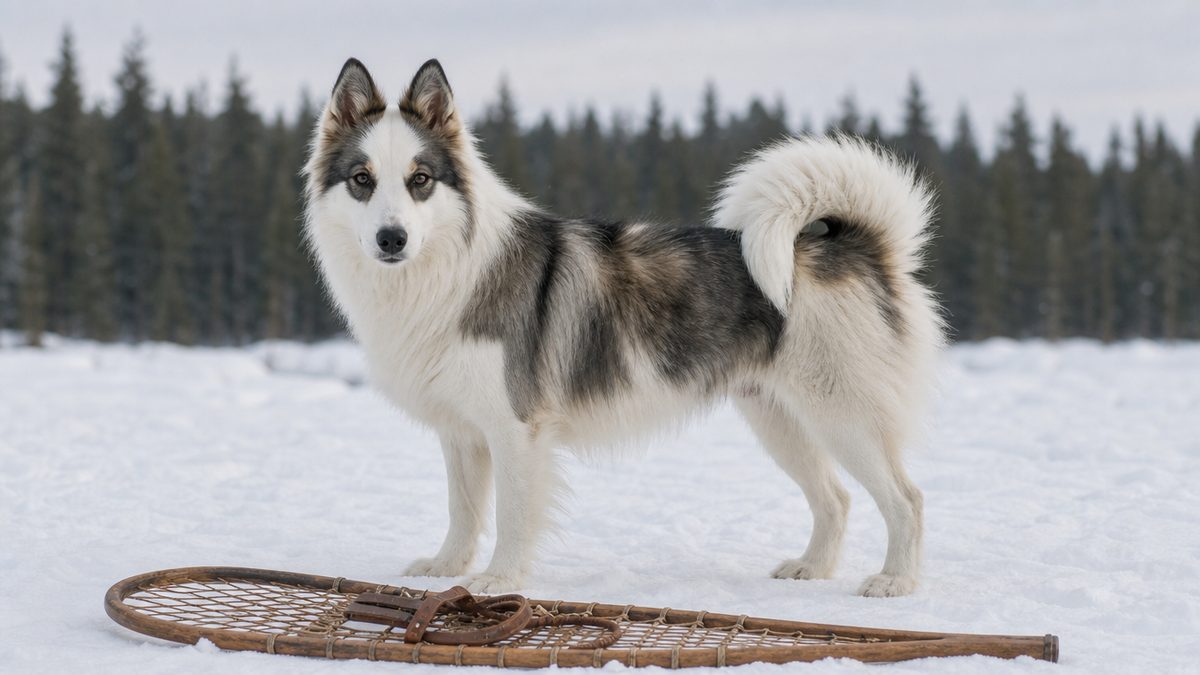
Two features are unambiguous in his text and worth holding on to, because the later sources disagree about both. The dog had prick ears, erect and thickish and broad at the base, set closer together than those of the Canadian Eskimo Dog, and it had a bushy tail carried curled over its right hip.
His colour paragraph is precise. The face, muzzle, belly and legs are pure white, with a white central line passing over the crown of the head. The front of the ear is white and the back yellowish-grey or fawn. The end of the nose, the eyelashes, the roof of the mouth and part of the gums are black. There is a dark patch over the eye. On the back and sides are larger patches of dark blackish-grey or lead colour mixed with fawn and white, not definite in form but running into each other. The tail is bushy, white beneath and at the tip.
That is a piebald dog, and the Dictionary of Canadianisms records the word, defining the entry as a breed of small dog weighing 15 to 20 pounds and piebald in black and white or brown.
Three historical sources, three different animals
| Source and date | Tail | Coat | Compared to |
|---|---|---|---|
| Richardson, 1829, from live animals | Bushy, usually carried curled over its right hip | Long hair over thick wool, ruff round the neck | The prairie wolf, the coyote |
| Quotation dated 1861 in the DCHP entry | Bushy, not carried erect but only slightly curved upwards | Fine silky hair mixed with thick under fur | No comparison given |
| Quotation dated 1949 in the DCHP entry | Not described | Not described | Much like the Collie in appearance |
| Song Dog Kennels, a live kennel page | Carried down and usually very humbly under the rear | Longer hair around the shoulders, ruff and britches | The Icelandic dogs of today |
Three of those four disagree with Richardson about the tail, which is one of the few features he described unambiguously. We are not able to reconcile them and we do not think anybody can. Publish the disagreement and let the reader see that the animal's appearance was never fixed.
Where the modern numbers come from
A breed-comparison site publishes males at 43 to 51 cm and 14 to 20 kg, females at 43 to 48 cm and 12 to 19 kg, and classifies the animal as large. Run the arithmetic against the only historical weight. Fifteen to twenty pounds is 6.8 to 9.1 kg. The site's average male, 17 kg, is about twice the midpoint of that range. Its height, meanwhile, is 43 to 51 cm, which is 17 to 20 inches, and a kennel page selling living American Indian Dogs describes the old Hare dogs as a smaller 17 to 19 inch longer haired dog. An aggregator repeats 17 to 19 inches without a source.
So the modern height traces to a kennel's description of its own bloodlines, and the modern weight matches nothing at all. A dog of 43 cm at the shoulder weighing 17 kg is a stocky animal. Richardson's dog was slender in the legs, with a small head, and smaller than a coyote.
An aggregator describes the feet as hairy, wide and webbed. Richardson describes a broad hairy foot with long hairs between the toes projecting over the soles, and naked callous protuberances at the root of the toes even in winter. He never says webbed. Snowshoe feet and webbed feet are different things, and only one of them is in the record.
The **extinction date**, which does not exist, and the bracket that does
No extinction date for the Hare Indian dog has ever been recorded, because nobody recorded a last animal. What the documents allow is a bracket. A source dated 1861 describes the dog in the present tense and a source dated 1949 describes it in the past, and nothing in between marks the change.
The Dictionary of Canadianisms prints its quotations with dates, which makes the bracket readable. The 1861 quotation states that the Hare Indian dog is the race domesticated among the Indians of the Mackenzie River District. The 1949 quotation states that it was found only with the Indian tribes which lived along the borders of Great Bear Lake and the Mackenzie. Between those two sentences the animal stopped existing, and no source we found says when.
The mechanism is better documented than the date
Richardson had already written the first half of it in 1829, before anyone thought the dog was in danger. He noted that it was by then confined to the northern tribes, who have been taught the use of fire-arms within a very few years, and reasoned that before that weapon was introduced by the fur-traders such a dog must have been invaluable for running down game. A dog whose entire job is to run game down in deep snow becomes optional the year the rifle arrives.
The second half is the one Wikipedia gives, without a citation: the breed fell into decline after the movement of First Nations onto reserves and the decline of available wild game limited the ability of First Nations to hunt, and it gradually intermingled with other breeds including the Newfoundland dog and the Canadian Eskimo Dog. We could not source that sentence to any of the works the article cites, so treat it as the article's own summary.
Extinct, or absorbed?
The two are not the same and the distinction is the honest one here. Wikipedia's own lead hedges it: the animal became extinct or lost its separate identity through interbreeding with dogs in the nineteenth century, though some claim the breed still exists in modified form. The people making that last claim are a kennel, which says its modern American Indian Dogs carry old Hare bloodlines, and a 1963 writer quoted in the DCHP entry who states that Richardson's Hare Indian Dog is undoubtedly of the same breed as those we find in B.C. and the Yukon.
Neither claim is testable, because neither side has a sequence from a nineteenth-century animal to compare against.
What happened to Indigenous North American dogs generally
The population-level answer is documented even though this dog's is not. Sequencing 71 mitochondrial and 7 nuclear genomes of ancient North American and Siberian dogs across about 9,000 years, Ni Leathlobhair and colleagues found that after the arrival of Europeans, native American dogs almost completely disappeared, leaving a minimal genetic legacy in modern dog populations. The Coast Salish study puts a cause on its own case in plain words, concluding that colonial policies led directly to the woolly dogs' disappearance.
We will write that the Hare Indian dog was gone as a distinct animal by the middle of the twentieth century, because the sources shift from present to past tense between 1861 and 1949. We will not give a year, name a last individual, or repeat the tidy 1870s and 1880s dates that circulate without a source. An honest bracket is more useful than a confident date nobody can support.
The Hare people are not an extinct people, and Canadian law says so
The dog is extinct. The people it is named after are not, and the distinction has to be made explicitly because the English name collapses them. The K'ahsho Got'ine are centred today in Fort Good Hope and Colville Lake, and their neighbours at Deline hold a self-government treaty given force by an Act of the Parliament of Canada.
Start with the names, from the Sahtu Renewable Resources Board, whose own name is Ɂehdzo Got'ı̨nę Gots'ę́ Nákedı. The K'ahsho Got'ine, the Hare people, are now centred in Fort Good Hope and Colville Lake. The Shita Got'ine, the Mountain people, have joined the K'áálǫ Got'ine, the Willow Lake people, at Tulit'a. The Sahtuot'ine are named after Sahtu, Great Bear Lake, and are based in Deline.
Read that against Richardson and the geography lines up exactly. The dog was kept, he wrote, by the tribes that frequent the borders of Great Bear Lake and the banks of the Mackenzie. Those are the Sahtu communities. His own winter base, Fort Franklin, is Deline.
The documents that make this present tense
- The Sahtu Dene and Metis Comprehensive Land Claim Agreement, signed 6 September 1993. Title to 41,437 square kilometres of settlement lands, of which 1,838 square kilometres carry subsurface rights, plus a federal payment of 75 million dollars to designated organisations accountable to beneficiaries.
- The Deline Final Self-Government Agreement, signed 18 February 2015, approved by a community vote held on 10, 11 and 12 March 2014.
- The Deline Final Self-Government Agreement Act, S.C. 2015, c. 24, assented to on 18 June 2015, with most of its sections brought into force on 1 September 2016 by SI/2016-22.
- Section 3 of that Act, which declares the Agreement a treaty within the meaning of sections 25 and 35 of the Constitution Act, 1982, and section 11, under which the Indian Act ceases to apply to the Deline Got'ine Government and to Deline First Nation Citizens.
Why the wording matters more than usual here
Because the dog carries an exonym, a page that says the Hare Indian dog is extinct is one careless clause away from implying something about the people. Chief Frank T'Seleie put the point at the Mackenzie Valley Pipeline Inquiry when it sat at Fort Good Hope on 5 August 1975: this is Dene land and we the Dene people intend to decide what happens on our land. That is a statement about a future, made fifty-one years ago, in the community the dog is named after.
Write that the Hare Indian dog is extinct and that the K'ahsho Got'ine and the other Sahtu Dene and Metis are here, hold title to 41,437 square kilometres under a 1993 agreement, and at Deline govern under a treaty given force by a federal statute in 2016 Deline Final Self-Government Agreement Act. Both halves are documented. Collapsing them is the error, and the English breed name invites it.
**Kennel club recognition**: none, anywhere, ever
No kennel club has ever registered the Hare Indian dog and no breed standard for it was ever written. That is not a gap in the record; it is the record. The animal was gone before organised dog registration reached the Mackenzie, and it was never bred to a written description by anybody.
We checked rather than assumed, and every check carried a control.
| Register | Result | Proof the check worked |
|---|---|---|
| FCI definitive nomenclature, letter H | Absent from 21 entries | The same page returned Haldenstover, Hamiltonstovare, Hannoverscher Schweisshund and Harrier |
| AKC full breed list | 'Hare Indian' absent from 791,000 characters | Labrador Retriever and Chinook both present in the same document |
| AKC Foundation Stock Service | 'Hare Indian' absent from 779,000 characters | Peruvian Inca Orchid and Kai Ken both present |
| United Kennel Club standards index | No result. The server returned HTTP 403 to us | None possible, so we draw no conclusion from it |
What that means for an Indian reader
The Kennel Club of India issues pedigrees against FCI nomenclature, so a breed absent from the FCI register has no route to a KCI pedigree either. In this case the question does not really arise, because there is no living population for any registry to record. If a seller ever shows you a pedigree naming this animal, the document is describing something else.
A small piece of evidence about how generated data works
The breed-comparison site that publishes the fullest profile of this animal cannot hold one answer across its own table. Against the Fuegian dog it prints 'Not recognized by any clubs', with a tick; against the Hare Indian dog, in the same row of the same table, it prints 'Not available';. Two different answers to the same question about two animals with the same status, side by side. A table that cannot be internally consistent was assembled rather than researched.
Wikipedia's infobox lists *C. familiaris lagopus* as an obsolete name. It comes from Richardson, who filed the dog as Canis f. var. B. lagopus. Four pages later, at entry 25 on page 83 of the same book, he uses *Canis (Vulpes) lagopus* for the Arctic Fox. The epithet is doing double duty inside one volume, which is one more reason the name should never be treated as a species identifier for this animal.
What the breed sites publish about a dog nobody has seen since the 1800s
Two of the ranking pages fill in the blanks and one refuses to, and the difference between them is the most instructive thing on this subject. Dogbreedinfo prints 'no records' three times. A breed-comparison site prints a lifespan, a bite force, a litter size, a gestation length, a feeding quantity and twenty-eight trait ratings.
Credit where it is due first. Dogbreedinfo's page answers three of its own template fields honestly: under Health problems it says the dog is now extinct and there were no records of health problems, under Life expectancy it says there were no records, and under Litter size it says the same. That is exactly right, and it is rarer than it should be.
The same page then fills in the rest. It gives a height of 17 to 19 inches, a temperament, Living conditions, an exercise requirement, and grooming advice ending with the observation that the dog probably only needed a bath when necessary.
The generated profile, item by item
| Field | What the site publishes | What the record actually contains |
|---|---|---|
| Weight | Male 14 to 20 kg, female 12 to 19 kg | One figure exists: 15 to 20 pounds, or 6.8 to 9.1 kg |
| Height | Male 43 to 51 cm, female 43 to 48 cm | No historical height in inches or centimetres |
| Size class | Large | Smaller than a coyote, larger than a red fox |
| Average lifespan | 10 to 12 years | Nothing. No lifespan was ever recorded |
| Bite force | Between 200 and 400 PSI | Nothing. No bite was ever measured |
| Litter size | 4 to 6 puppies | Nothing |
| Pregnancy duration | 60 to 64 days | A species-level figure, not a finding about this dog |
| Food consumption | 2 to 2.5 cups of high-quality dry food a day | Richardson records that the dogs subsisted on the produce of the hunt |
| Bathing needs | Every 6 to 8 weeks | Nothing |
| Good for first-time owners | Yes | Nothing. The animal has not existed for over a century |
| Senior citizens friendly | Highly recommended | Nothing |
| Popularity rank | Number 217, with one user review at 5.0 out of 5 | Somebody rated an extinct animal five stars |
The one line it gets right, and why that is not reassuring
The same site records the dog's climate tolerance as preferring average to cold weather conditions, which is directionally correct and matches everything Richardson describes. On the neighbouring page in the same comparison it records the Fuegian dog, an animal from Tierra del Fuego, as preferring warm weather. A generator that gets one right and one absurd is not a source that got one right. It is a generator.
The sixth-ranking result in India is a fiction wiki
Novum Terram Wiki is a Fandom worldbuilding project. Its own categories for this page include Non-Sapient Species, and its text refers to many sapient species, not just humans. It ranked sixth in our India-located search for this animal, and it is written entirely in the present tense: the Hare Indian dog is a diminutive, slenderly built domesticated canid, its pointed ears are erect, and today it is among the most popular dog breeds in the United States.
Two of its inventions are worth naming, because both are exactly the shape of a real fact. It gives the animal a scientific name, Canis Luprans Domesticus, which exists in no taxonomy. And it reports that on 4 July 1984 researchers sequenced the Hare Indian dog's genes and DNA, confirming it to be mostly coyote with some wolf and a little domestic dog. A dated genome study is the single thing this subject most lacks, and a fiction wiki has supplied one, on a specific day, ranking on page one.
It also reproduces the Richardson blockquote in full, including the two sentences that are not in Richardson, under the same attribution to page 79 Wikipedia, Hare Indian Dog. That is the interpolation moving one step further from its source.
And the eighth-ranking result is Wikipedia with two words changed
Europetnet is a European pet-registration portal. Its entire page on this animal is Wikipedia's lead paragraph, with 'aboriginal hunting methods' rewritten as 'Indigenous peoples hunting methods' and the final clause about the breed possibly surviving in modified form dropped Wikipedia, Hare Indian Dog. Nothing else. Two of the ten results in an India-located search for this dog are therefore the same paragraph.
Wikipedia's own list of extinct dog breeds carries this animal directly above the Hawaiian Poi Dog, summarising it in one line as possibly a dog breed, coydog, or domesticated coyote, formerly found and originally bred in northern Canada by the Hare Indians for coursing. That single sentence, hedged three ways, is the most accurate summary in the entire result set.
How a claim launders itself in three steps
Follow the tree-climbing claim. A kennel page says that like the Tahltans, the Hare dogs climbed trees like cats and would often pull birds and game from trees. An aggregator then prints that they could climb trees, silent hunting game and pulling birds from trees. Richardson, who watched them work, says nothing of the kind. One business's description of its living dogs becomes an aggregator's historical fact in a single hop.
An aggregator states that the dogs were kept at trading posts for fur as sled dogs. Richardson writes that the animal was too small to be useful as a beast of burthen or draught, and that the larger mongrel dogs kept for draught at the trading posts used to pursue the Hare Indian dogs for the purpose of devouring them. The aggregator has not merely added a detail. It has reversed the relationship.
Hare Indian dog **price in india**: there is nothing to price
No price in India exists for the Hare Indian dog, because the animal has been gone for well over a century and was never in India before that. An India-located search on 31 August 2026 returned no Indian listing, no Indian breeder and no rupee figure for it, and the control query in the same session returned real Indian price pages.
The absence is earned rather than assumed. A search that returns nothing proves nothing unless you can show the search works, so we ran labrador retriever price in india in the same tool and the same session. It returned genuine Indian price pages, including one carrying a city-by-city table that quotes Rs 30,000 to Rs 1,20,000 across Hyderabad, Bangalore, Delhi, Chennai, Lucknow, Mumbai, Jaipur and Pune, with bands of Rs 30,000 to Rs 60,000 for basic quality, Rs 60,000 to Rs 90,000 for KCI-registered and Rs 90,000 to Rs 1,20,000 for champion bloodline. The instrument works. The zero for this animal is real.
| Result | What it is |
|---|---|
| YouTube, Indian Dog Breeds Price List | A video about budget-friendly Indian breeds |
| Quora thread | Popular dog breeds in India and roughly what they cost |
| HubPages, Top 20 Indian Dog Breeds | A price list for Indian breeds, none of them this one |
| indiadogs.com | A puppy listing site's home page |
| Rolling Rotts Kennel | A top-five Indian breeds post |
| YouTube, monthly cost video | Dogs you can afford in India |
| Mr n Mrs Pet | Twelve budget-friendly dog breeds in India |
| Etsy | A hand-drawn storybook hare and Indian dog ceramic ornament |
| YouTube, puppy price list | India's four most popular breeds and their prices |
| Supertails | A Chihuahua price guide |
Read the Etsy row. The search engine has split the breed name into two animals, a hare and an Indian dog, and matched a Christmas ornament. That is what a query looks like when the thing it names does not exist in the market it is being asked about.
There is no lawful route either
Even if somebody claimed to have one, nothing could be brought here. DGFT Trade Notice 22/2022-23 sets live animals under ITC(HS) 01061900 as Restricted. Its Policy Condition 7 permits import only of a pet dog with a valid pet book in the importer's name, or for research with a CPCSEA recommendation, or for Defence and Police use, and Policy Condition 8 states that import of commercial dogs for breeding or any other commercial activities is not permitted in any case. There is no import licence available for a dog that does not exist, and no register anywhere would issue a pedigree for one.
Nobody can sell you a Hare Indian dog. If a seller uses the name, they are selling you a different animal under a label that has been unavailable since at least the 1940s. The nearest thing that genuinely exists is a modern breed sold as the American Indian Dog by a kennel that describes some of its foundation stock as carrying old Hare bloodlines. That is a living dog with an origin story, not a rare extinct one.
**Cost of ownership**: the honest number is zero, and here is what to budget instead
There is no cost of ownership for a Hare Indian dog, because there is no Hare Indian dog. Bonbeno publishes no monthly rupee figure for this animal, because any figure would have to be invented, and the audit section above shows a ranking site inventing a feeding quantity and a bathing interval for exactly this reason.
What can be said is what the historical record contains about keeping one, which is one sentence and it is not a budget. The dogs subsisted almost entirely on the produce of each hunt, and Richardson's own puppy travelled nine hundred miles beside a sledge on, in his phrase, probably but little food.
Where the generated cost lines come from
- A feeding quantity of 2 to 2.5 cups of dry food a day. No commercial food existed when this animal did, and nobody weighed one.
- A bath every 6 to 8 weeks. Nobody bathed a hunting dog in the Mackenzie in January.
- Average veterinary care frequency. There was no veterinary care to have a frequency.
- Grooming advice. An aggregator suggests the dog probably only needed a bath when necessary, which is the site filling a template field rather than reporting anything.
What to price instead
If the appeal is a small, hardy, prick-eared dog that costs little to keep and suits a hot country, price an Indian Pariah Dog with your own vet and groomer. That dog exists, is legal, is adapted to the climate measured in the next section, and costs an adoption fee rather than an import permit. Bonbeno's Indian Pariah Dog page carries the real Indian cost structure with sourced figures.
A rupee figure here would raise this page's India-specificity score and lower its truthfulness, and we would rather have the lower score. The only rupee figures on this page belong to the Labrador Retriever control search that proves our zero is real, and they are labelled as such.
Fort Good Hope against India: a 14-point wet-bulb gap
The Hare Indian dog's homeland has an annual mean air temperature of minus 6.96 degrees and a peak monthly mean wet-bulb temperature of 12.7 degrees. Kolkata's peak wet-bulb is 27.1. That 14.4-point gap is what a long-haired dog over a thick wool undercoat would have had to cross, and no shade or timing closes it.
Heat tolerance is the trait an Indian reader most needs and the one no global breed source rates, so we compute it rather than quoting it. We queried NASA POWER by explicit latitude and longitude for 2001 to 2020, checked that the coordinates returned matched those requested for every location, and derived wet-bulb temperature from the returned monthly mean air temperature and relative humidity using the Stull formula.
| Place | Annual mean air temp | Coldest month | Warmest month | Peak monthly wet-bulb |
|---|---|---|---|---|
| Fort Good Hope, NWT | -6.96C | January, -28.32C | July, 15.99C | 12.7C in July |
| Deline, Great Bear Lake | -6.85C | January, -28.27C | July, 15.81C | 12.8C in July |
| Norman Wells, NWT | -5.94C | January, -25.60C | July, 15.53C | 12.6C in July |
| Leh, Ladakh | -2.75C | January, -16.01C | July, 10.18C | 5.0C in July |
| Bengaluru | 23.74C | December, 20.22C | April, 28.37C | 21.9C in May |
| Mumbai | 26.77C | January, 23.19C | May, 31.19C | 25.8C in June |
| Delhi | 25.60C | January, 13.61C | June, 35.88C | 26.5C in July |
| Chennai | 27.95C | January, 24.09C | May, 31.51C | 26.1C in May |
| Kolkata | 25.81C | January, 17.31C | May, 31.53C | 27.1C in June |
The comparison that surprises people
Fort Good Hope is not cold all year, and the honest version of this section has to say so. Its July average of daily maximum air temperature is 31.70 degrees, which is within two-tenths of a degree of Chennai's May round-the-clock average of 31.51. Subarctic July afternoons get genuinely hot.
What differs is everything else. That heat lasts a few weeks, the night falls away from it, and January averages minus 28.32 degrees. Chennai's coldest month averages 24.09, which is 52.4 degrees warmer than Fort Good Hope's coldest month. A dog carrying long hair over a thick wool undercoat, described by Richardson as lying out on snow, has one summer's worth of adaptation to heat and eleven months of adaptation to the opposite.
The nearest Indian analogue is Ladakh, and it is drier than the original
Leh is the closest we found and the fit is imperfect in an interesting direction. Leh's annual mean of minus 2.75 degrees is four points warmer than Fort Good Hope's, but its peak wet-bulb of 5.0 degrees is well below Fort Good Hope's 12.7, because Leh is high and dry at 52.2 percent annual mean humidity while Fort Good Hope sits at 86.5 percent. So the Mackenzie is colder and much wetter; Ladakh is milder and much drier. Neither is anywhere most Indian readers live.
What that would mean in practice for a coated dog
The evidence base for heat risk in dogs is British rather than Indian, and it points one way. Hall and colleagues, working from 905,543 UK dogs under primary veterinary care in 2016, found that dogs at or above their breed and sex mean bodyweight had higher odds of heat-related illness, at an odds ratio of 1.42 with a confidence interval of 1.12 to 1.80. Their companion paper on the same cohort reports 1,259 heat-related illness events from 1,222 dogs, of which 879 had a recorded trigger, and 652 of those 879, or 74.2 percent, were exertional rather than caused by a hot car. Exercise in heat, not a parked vehicle, is the main mechanism, and that is the mechanism an Indian owner of any thick-coated dog controls.
Because the method is the point. Look up any breed's origin town by latitude and longitude, compute the wet-bulb, and set it against your own city. It takes two minutes, it cannot be sold to you, and it answers the single question that matters most for a coated dog in India. We publish the coordinates and the formula so you can repeat ours.
**Temperament**: what the eyewitness actually wrote, and what got added later
Richardson's temperament paragraph is the best material on this animal and the most misquoted. He described a dog that was playful and affectionate, soon gained by kindness, not very docile, and hostile to confinement of any kind, and he watched one animal closely for months.
His sentences, in order. The Hare Indian Dog is very playful, has an affectionate disposition, and is soon gained by kindness. It is not, however, very docile, and dislikes confinement of every kind. It is very fond of being caressed, rubs its back against the hand like a cat, and soon makes an acquaintance with a stranger.
Then the sentence that is worth more than the rest of the page put together. Like a wild animal, it is very mindful of an injury, nor does it, like a spaniel, crouch under the lash; but if it is conscious of having deserved punishment, it will hover round the tent of its master the whole day, without coming within his reach, even when he calls it.
Read that punishment sentence again
Richardson is describing, in 1829, an animal that responds to correction by staying out of reach all day while remaining nearby. He frames it as a defect against the spaniel standard of his time. A modern reader sees something else in it: a dog whose recall was destroyed by punishment for the rest of the day. The observation is his; the reading is ours, and we flag it as a reading rather than a finding.
Voice, and the barking claim
On voice he is precise. Its howl, when hurt or afraid, is that of the wolf; but when it sees any unusual object, it makes a singular attempt at barking, commencing by a kind of growl, which is not, however, unpleasant, and ending in a prolonged howl. Its voice is very much like that of the prairie wolf.
An aggregator reverses that sequence, saying the dogs would howl after barking once or twice and growl at the unfamiliar object. Richardson has growl first, then howl, and the whole point of his phrase 'a singular attempt at barking' is that the sound was not a bark.
Wikipedia adds that in its native homeland it was not known to bark, though puppies born in Europe learned how to imitate the barking of other dogs. That detail is not in Richardson's entry, and the word 'Zoological Society' does not occur anywhere in his volume, so the European-puppy observation must come from one of the London menagerie books the article also cites. It may well be true. It is not Richardson's.
Who these dogs actually lived with
- Not confined. Richardson twice notes the dislike of restraint, and the animals ranged with hunting parties rather than being kennelled.
- Not fed by their owners in the modern sense. They subsisted almost entirely on the produce of each hunt.
- Not safe around the post dogs. The larger mongrels kept for draught at Fort Franklin pursued them to eat them, and the smaller dogs simply outran them.
- Friendly to strangers on first meeting, which Richardson states plainly and which the aggregators, unusually, get right.
The nine-hundred-mile run is real and it is Richardson's own account of his own journey. It describes one puppy, bought from the Hare Indians, about seven months old, running on snow beside a sledge, frequently carrying a twig or one of his mittens for a mile or two of its own accord. It is a remarkable animal in a remarkable circumstance, not a breed specification, and it should never be quoted as one.
**Train**ing: what one naturalist recorded about teaching this dog anything
To train a Hare Indian dog, according to the only person who wrote about trying, you would have got nowhere with retrieving and everywhere with kindness. Richardson says the animal showed little aptitude in learning any of the arts which the Newfoundland dogs so speedily acquire, of fetching and carrying when ordered.
The full observation is more interesting than the summary, because the same puppy that would not fetch on command frequently, of its own accord, carried a small twig or one of my mittens for a mile or two. It was not that the dog could not carry things. It was that it would not do it when told.
Three training-relevant observations, all first-hand
- Kindness worked. Soon gained by kindness, very fond of being caressed, and quick to make an acquaintance with a stranger.
- Punishment did not. Very mindful of an injury, and after a correction it kept out of the handler's reach for the whole day even when called.
- Confinement was resented. Dislikes confinement of every kind, which is stated as flatly as anything in the passage.
A breed-comparison site rates this animal 3 out of 5 for training difficulty, 5 out of 5 for social needs and 1 out of 5 for impulse to roam, and marks it as good for first-time owners and office friendly. Set the roaming rating against a dog that ran free with hunting parties across the Mackenzie basin and the rating collapses on contact with the source.
Nothing about this dog transfers to a dog you can own, because you cannot own one. What does transfer is the 1829 observation itself. A handler who punishes gets an animal that avoids them and stays just out of reach, and a naturalist wrote that down two hundred years ago while watching an animal nobody had trained with a clicker. If a trainer in your city tells you a hard correction builds respect, Richardson's puppy is a two-century-old counter-example.
**Exercise**: the requirement was a hunting season, not a walk
The Hare Indian dog's exercise requirement was whatever a subarctic hunt demanded, and the one measurement in the record is nine hundred miles on snow beside a sledge by a dog roughly seven months old. Nobody has ever recorded a daily figure, and the daily figures published today are generated.
Richardson explains what the animal was built to do. A dog so well calculated by the lightness of its body and the breadth of its paws for passing over the snow must have been invaluable for running down game. The mechanism is a light dog travelling on a crust that a moose or caribou breaks through, holding the animal until the hunters arrive.
That is not an exercise requirement in the sense a city owner means. It is a job with a season.
The one number, in context
The puppy ran nine hundred miles without suffering from fatigue, at about seven months old, on snow, beside a moving sledge, on probably but little food. Nine hundred miles is roughly 1,450 kilometres, about the road distance from Delhi to Kolkata. Treat it as one dog's recorded journey rather than a breed capability, because that is exactly what Richardson presents it as.
A breed-comparison site rates the animal 4 out of 5 for energy and 4 out of 5 for activity requirement, and 2 out of 5 for sleeping need. Those numbers have no source, and the site applies the identical four-four-two set to the Fuegian dog on the same page.
The trait Richardson describes, an endurance animal light on its feet with a job to do, is common in Indian village dogs and in the working sighthound types of the south and west. Bonbeno's Indian Pariah Dog page covers what an Indian city actually allows a high-endurance dog in June, which is early mornings and shade, whatever the dog's ancestry.
**Groom**ing: a double coat built for minus 28 degrees, and what India does to one
The Hare Indian dog carried long straight hair over a thick wool undercoat, with a ruff at the neck, and that coat was evolved for a place whose January averages minus 28.32 degrees at 95.1 percent humidity. Nothing about it was designed for an Indian monsoon, and the grooming advice published for it today was written by a template.
Richardson's coat description is unusually specific. It is covered with long hair, particularly about the shoulders, and at the roots of the hair, both on the body and tail, there is a thick wool. The hair on the top of the head is long, and on the posterior part of the cheek it is not only long but directed backwards, giving the animal, when the fur is in prime order, the appearance of having a ruff round the neck. The 1861 quotation in the Dictionary of Canadianisms describes the same thing differently, as fine silky hair mixed with thick under fur.
The humidity comparison that surprises people
Its homeland is wetter than Mumbai. Fort Good Hope's December mean relative humidity is 95.3 percent and its January 95.1, against Mumbai's August peak of 90.4 percent and Kolkata's September peak of 89.3. Humidity by itself is not the problem for a double-coated dog. Heat plus humidity is, because panting cools by evaporation and saturated warm air will not accept the water. Fort Good Hope is saturated at minus 28 degrees, which is a different physical situation entirely.
What that means for any double-coated dog in India
- Dry to the skin, not to the touch. A thick wool undercoat holds water at the skin for hours after a soaking, and that is the condition hot spots need. Towel and force-dry to the skin rather than letting a coat air dry in a humid room.
- Never shave a double coat to cool a dog. The undercoat is insulation in both directions and removing it exposes skin rather than cooling the animal.
- Move exercise off the middle of the day, because the UK evidence shows exertion, not vehicles, is the main heat-illness trigger.
- Check ears and skin folds weekly in the monsoon, when a wet undercoat and warm air do most of the damage.
- Treat for ticks year-round, because Indian tick-borne disease pressure does not have an off season.
An aggregator's grooming entry for this dog reads that it had a long, thick, wooly coat that may have needed grooming although since they lived in the cold climate of Northern Canada, they naturally grew these coats as protection, and that they probably only needed a bath when necessary. A comparison site prints a bathing interval of every 6 to 8 weeks and a shedding rating of 4 out of 5. Neither is sourced to anything.
Any advice you read about grooming an imported coated breed was almost certainly written for a temperate climate. Ask what climate it assumes before you follow it. 'Let him air dry' is sound in Yellowknife and wrong in a Mumbai August at 90.4 percent humidity.
**Health problems** and **life expectancy**: nothing was ever recorded
No health data of any kind exists for the Hare Indian dog. No lifespan, no disease, no screening result, no post-mortem, no skeletal series. The 10 to 12 years published by a breed-comparison site is generated, and one aggregator says so plainly and correctly.
Dogbreedinfo answers this field honestly: the dog is now extinct and there were no records of health problems, and there were no records of its life expectancy. A comparison site fills the same fields with 10 to 12 years, a health-concerns rating of 3 out of 5, an obesity tendency of 2 out of 5 and a veterinary care frequency of Average. Only one of those two pages is describing the state of the evidence.
The one health-adjacent fact in the historical record
It is not a disease. Richardson records that the larger mongrel draught dogs at Fort Franklin used to pursue the Hare Indian dogs for the purpose of devouring them, and that his own puppy was killed and eaten by a man on the Saskatchewan who pretended that he mistook it for a fox. The recorded causes of death for individual animals of this type are predation by other dogs and being eaten by people. That is the whole clinical record.
What an Indian owner of any hardy northern-type dog actually faces
Since no breed-specific risk can be stated, here is the Indian evidence that applies to any dog kept here, which is more useful than an invented screening list. A molecular survey of 719 dogs in Punjab, using multiplex PCR, found *Babesia gibsoni* in 8.9 percent, *Hepatozoon canis* in 5.1 percent, *Ehrlichia canis* in 2.6 percent and *Babesia vogeli* in 1.1 percent, against microscopy figures of 5.0, 1.0, 1.4 and 0.1 percent respectively for the same samples. Breed, sex and location were significantly associated with *B. gibsoni* infection.
Read the two columns against each other. Microscopy found *B. gibsoni* in 5.0 percent and PCR in 8.9 percent of the same 719 dogs, so a clinic relying on a blood smear alone missed roughly four in nine of the infections the PCR detected. That is a practical thing to ask your own vet about.
And the heat evidence, which is the other half
Hall and colleagues, working from 905,543 UK dogs under primary veterinary care in 2016, recorded 1,259 heat-related illness events from 1,222 dogs. Of the 879 events with a recorded trigger, 652, or 74.2 percent, were exertional. In the companion paper on the same cohort, dogs at or above their breed and sex mean bodyweight carried an odds ratio of 1.42 for heat-related illness, with a confidence interval of 1.12 to 1.80. Neither paper studied this animal, which is why we quote only the transferable factor and say so.
The Prevention of Cruelty to Animals (Dog Breeding and Marketing) Rules 2017 require, at Second Schedule Part III paragraph 8(10), that dogs shall have been tested for genetic defects, including hip dysplasia, progressive retinal atrophy, night blindness, hypothyroidism, entropion, ectropion, overshot, undershot jaw when incisors do not touch or mesh, wry mouth, two or more missing teeth, and unilateral or full cryptorchid males. The word is 'including', so the list is illustrative rather than closed. We extracted the gazette PDF ourselves and searched it: across all fourteen pages, 'patella' appears zero times, 'luxation' zero, 'BAER' zero and 'deaf' zero. There is no Indian patella-testing requirement and no hearing test in these Rules.
**Feed**ing: a diet of whatever the hunt produced
The Hare Indian dog ate what the hunt produced and nothing else is recorded. Wikipedia's account is that the dogs subsisted almost entirely on the produce of each hunt, and Richardson's own travelling puppy managed nine hundred miles on, in his words, probably but little food.
That is the whole feeding record Richardson J. Fauna Boreali-Americana. A comparison site nonetheless prescribes 2 to 2.5 cups of high-quality dry food a day, divided into two meals, for an animal that predates commercial dog food by a century.
The part of the record that needs care
Richardson's puppy was killed and eaten. He is explicit about where and by whom: on the Saskatchewan, by a man who pretended that he mistook it for a fox. In his entry on the North American dog a few pages later he sets out the regional pattern as it was reported to him, writing that the flesh of those dogs was esteemed by the Canadian voyageurs and eaten by some of the tribes on the Saskatchewan and the shores of the Great Lakes, but that the Chepewyan tribes held the practice in abhorrence because they considered themselves to be descendants of a dog.
That distinction matters and no ranking page makes it. The Chepewyan are Dene, the same broad grouping as the Sahtu peoples who kept this dog. Richardson's account places dog-eating outside the dog's home country and records the Dene position as opposition to it. Treat all of that as evidence of what a British naval surgeon was told in the 1820s, which is what it is, and do not generalise it in either direction.
If you keep a hardy dog in India
Feed to body condition rather than to a cup measurement on a packet, weigh the dog monthly on the same scale, and cut portions in the hot months when activity drops. That advice is not derived from this animal. Nothing about feeding a modern dog can be, because the record contains one phrase about the produce of the hunt and nothing else.
Every other page on this site carries life-stage feeding guidance because the evidence supports it. This one does not, because inventing a chart for an animal with no recorded body weight, no recorded lifespan and no recorded diet beyond a single phrase would be exactly the failure the audit section above documents in somebody else's page.
The first year: one recorded data point, and what Indian law requires anyway
The Hare Indian dog's first year contains exactly one recorded milestone. At about seven months old, a puppy Richardson bought ran nine hundred miles on snow beside his sledge. Everything else that gets published as a month-by-month timeline for this animal is generated, including the litter size.
| Stage | What the historical record contains | What Indian law would require of any puppy today |
|---|---|---|
| Birth to 8 weeks | Nothing. No litter size, no birth weight, no whelping account | Rule 8(1)(a): pups less than eight weeks in age are not sold |
| 7 to 18 weeks | Nothing | Second Schedule Part III para 8(9): all pups shall be vaccinated, which can start at seven to eight weeks and is usually completed at eighteen weeks |
| 3 to 6 months | Nothing | Second Schedule Part II para 6(8): no docking, cropping, de-barking, de-clawing or any change of appearance by artificial means |
| About 7 months | A purchased puppy ran nine hundred miles beside a sledge without suffering from fatigue, carrying a twig or a mitten of its own accord | Rule 8(1)(b): dogs over six months in age are not sold without first being sterilised, unless sold to another licensed breeder |
| Adulthood | Nothing about maturity, size at maturity, or breeding age | Second Schedule Part II para 6(3): in breeding and incest breeding are prohibited |
A comparison site fills the same year with a litter size of 4 to 6 puppies, a pregnancy duration of 60 to 64 days and a breeding frequency of once a year. The gestation figure is a species-level number that would be true of any dog; the litter size is not recorded anywhere for this animal.
The clause most Indian buyers have never heard of
Rule 8(1)(b) is worth knowing whatever dog you are buying. It provides that dogs over six months in age are not sold without first being sterilised, unless they are being sold to another licensed breeder. An unsterilised eight-month-old offered to a pet buyer by a registered breeder is a breach of the Rules on its face, and almost nobody asks.
As one dog's journey, recorded by the man who made the journey with it. It is not a developmental milestone for a breed, and it should not be turned into one. What it does establish is that a subarctic hunting dog of this type could travel at seven months old, which is a fact about that animal and a striking one.
Indian law: nothing to import, and the clauses that would apply if there were
No Hare Indian dog can be brought into India, because none exists. The law is still worth setting out, because the same clauses apply to every imported dog an Indian buyer is actually offered, and most sellers will not mention them.
Import
DGFT Trade Notice 22/2022-23, dated 19 December 2022, governs the import of pet animals. Live animals under ITC(HS) 01061900 are Restricted. Policy Condition 7 permits entry of a pet dog only where the importer holds a valid pet book in their own name, or for research with a recommendation from the Committee for the Purpose of Control and Supervision of Experiments on Animals, or for Defence and Police use. Policy Condition 8 states that import of commercial dogs for breeding or any other commercial activities is not permitted in any case. There is no import licence category that fits an extinct animal, and no exporting country could certify one.
Breeding and sale
- Rule 8(1)(a): every breeder shall ensure that pups less than eight weeks in age are not sold.
- Rule 8(1)(b): dogs over six months in age are not sold without first being sterilised, unless sold to another licensed breeder.
- Second Schedule Part II paragraph 6(3): of the four common breeding techniques the Rules name, out breeding and line breeding are permitted, while in breeding and incest breeding are prohibited.
- Second Schedule Part II paragraph 6(8): no tail docking, ear cropping, de-barking, de-clawing, branding, dyeing, injecting substances to enhance visual appeal, or any change of appearance by artificial means.
- Second Schedule Part II paragraph 6(9): breeding to create new breeds of dogs or unusual looks shall be strictly prohibited.
The clause that would bite hardest here
Paragraph 6(9) is the one that touches this page directly. A living kennel breeds a modern dog and describes some of its foundation animals as carrying old Hare bloodlines, selected partly because they rub their backs against people the way Richardson's dog did. Whatever the merits of that programme in its own country, an Indian breeder attempting to recreate an extinct type by selecting for a historical description would be doing precisely what 6(9) prohibits, which is breeding to create new breeds of dogs. Recreation projects and new-breed projects are the same activity under these Rules.
Note also which words are absent. We extracted the gazette ourselves and searched all fourteen pages: 'patella' appears zero times, 'luxation' zero, 'BAER' zero and 'deaf' zero, and the only occurrence of 'hearing' is an appeal hearing before the Secretary, Animal Husbandry. Anyone telling you Indian law mandates a patella grade or a hearing test is wrong.
Rule 8(1)(a) is a Rule in the main body of the 2017 Rules. Paragraphs 6(3), 6(8), 6(9), 8(9) and 8(10) are paragraphs of the Second Schedule, which the Rules make binding, and they are not Rules. Writing 'Rule 6(8)' sends any reader who checks to a different provision headed Requirements to be met by breeders and establishments. We cite the form we actually read in the gazette.
The Hare Indian dog compared with the animals it is confused with
Four animals get set against the Hare Indian dog, and separating them is the fastest way to see what the evidence actually supports. One is the wild canid Richardson said he could not tell it apart from, one is the northern working dog he explicitly contrasted it with, one is a second Indigenous North American dog whose genome has been sequenced, and one is a living Indian dog you can meet this week.
Every cell below is checked against a register, a paper, a primary text or a climate query rather than against a breed standard, because no breed standard for this animal was ever written.
| Animal | Species status | Living or extinct | Genome published? | Available in India |
|---|---|---|---|---|
| Hare Indian dog | Filed by Richardson 1829 as Canis f. var. B. lagopus, a variety of the domestic dog | Extinct or absorbed, nineteenth century | No. No specimen located, no sequence published | No |
| Coyote | Canis latrans (Say, 1823), ACCEPTED in GBIF, family Canidae | Living and expanding across North America | Yes, repeatedly | No, and not a pet species |
| Canadian Eskimo Dog | Canis lupus familiaris, a recognised breed | Living, and very rare | Yes, within wider Arctic dog studies | No |
| Coast Salish woolly dog | Canis lupus familiaris | Lost as a population in the nineteenth century | Yes. One 1859 pelt, Mutton, sequenced in 2023 | No |
| Indian Pariah Dog | Canis lupus familiaris, a landrace | Living and everywhere | Yes, within Indian village-dog studies | Yes, at any shelter, for an adoption fee |
Why the coyote row matters most
Richardson set the comparison himself and it has never been tested. He wrote that on comparing live specimens he could detect no marked difference in form from the prairie wolf, the coyote, except the smallness of its cranium, nor in the fineness of the fur and the arrangement of its spots of colour. GBIF records *Canis latrans* as an accepted species in family Canidae, order Carnivora, and the domestic dog as *Canis lupus familiaris* in the same family. Those are two different animals, and one man's eye in 1826 is not a method for telling them apart.
Why the woolly dog row is the useful one
The Coast Salish woolly dog shows what settling this question looks like when the work gets done. Lin and colleagues analysed genomic and isotopic data from a preserved pelt from a dog called Mutton, collected in 1859, and reported that Mutton is the only known example of an Indigenous North American dog with dominant precolonial ancestry postdating the onset of settler colonialism. They integrated that with interviews with Coast Salish Elders, Knowledge Keepers and weavers, and concluded that colonial policies led directly to the dogs' disappearance.
Read the two rows together and the shape of this page becomes clear. One Indigenous North American dog has a sequenced genome, a named specimen, a date, a museum and a co-authored account from the people who kept it. The other has a naturalist's paragraph and a hundred and ninety-seven years of copying.
Set the Hare Indian dog against the Indian Pariah Dog and the useful contrast appears. Both are landrace animals shaped by the work people needed from them rather than by a breed club. Both are small, lean, prick-eared and self-sufficient. One evolved where the January mean is minus 28.3 degrees and one where Chennai's coolest month averages 24.1. If what draws you to this animal is the idea of a functional dog that fits its own landscape, the Indian version of that is at your nearest shelter.
Eight things people get wrong about the Hare Indian dog
The commonest mistake is treating one man's 1829 paragraph as a settled breed description. Every error below appears on a page currently ranking for this animal in India, and each has a check that takes under a minute.
- Quoting two sentences Richardson never wrote. English Wikipedia's blockquote, attributed to Fauna Boreali-Americana 1829 page 79, closes with a comment on the puppy's endurance deserving special notice. Neither sentence occurs anywhere in the 501,600 characters of that book, and a phrase search returns them only on Wikipedia, on pages copied from it, and in one ebook Wikipedia, Hare Indian Dog.
- Printing a height of 17 to 19 inches as though it were historical. That range comes from a kennel page about living American Indian Dogs, not from any nineteenth-century source, and it is repeated verbatim by an aggregator.
- Reporting the tail as carried low. The same kennel page says the tail was carried down and humbly under the rear. Richardson says it was bushy and usually carried curled over the right hip. Both cannot be right, and only one of them saw the animal.
- Treating the Viking-descent story as a competing theory. Wikipedia says one writer thinks the breed came from Tahltan bear dogs crossed with dogs brought by Norse explorers. That writer is a kennel describing its own foundation bloodlines, and its page frames it as an opinion.
- Calling it a sled dog. Richardson is explicit that it was used solely in the chase, being too small to be useful as a beast of burthen or draught, and that the larger mongrel dogs kept for draught at Fort Franklin used to pursue and eat them.
- Giving it a life expectancy. A breed-comparison site prints 10 to 12 years. No lifespan was ever recorded for this animal by anyone.
- Assuming the coyote question was answered. It was raised in 1829 and never resolved. No specimen of this dog has been genetically tested, and a search of the Natural History Museum's public specimen data returns zero records for it against fourteen for the coyote control Richardson J. Fauna Boreali-Americana.
- Using the word Hare as though it were the people's own name. The K'ahsho Got'ine are the Hare people, and they are centred today in Fort Good Hope and Colville Lake.
The check that catches most of them
Open the primary source and search it. The whole of Richardson 1829 is a free scan with a text layer, it takes under a minute to download, and searching it settles four of the eight errors above outright. The one trap in doing so is that the scan's optical character recognition puts two spaces inside 'Hare Indian', so an exact-string search returns zero and a whitespace-tolerant one returns nine. Our own first search reported zero, which was our query failing rather than the book lacking the entry.
We also guessed a PubMed identifier while looking for the Coast Salish woolly dog paper, and the identifier we guessed returned a real 2023 paper on cortical effects of wrist tendon vibration in stroke survivors. It was caught only because we read the returned title. We found the right record by searching instead, and the correct identifier is PMID 38096292. A guessed identifier does not fail loudly. It hands you somebody else's study.
Adoption: what to do with the interest that brought you here
You cannot adopt a Hare Indian dog, because none has existed for well over a century. If what drew you is a small, light-framed, prick-eared, self-reliant dog that was shaped by a job rather than by a show ring, that animal is waiting at every shelter in India and the paperwork takes an afternoon.
There is no Hare Indian dog rescue, no breed club and no responsible breeder, because there is no animal and no registry. That is not a gap in this page. It is the finding, and it is why the page exists.
One live business does sell dogs under a name connected to this one. Song Dog Kennels breeds the modern American Indian Dog and describes some of its foundation animals as carrying old Hare bloodlines, identified partly because they rub their backs against people the way Richardson's dog did. Bonbeno does not recommend breeders and takes no view on that kennel's dogs, but it should be plain to a reader that a behavioural resemblance recorded in 1829 is not a pedigree, and that a living dog is not a rare extinct one.
Where to look in India
- Municipal and NGO shelters in your own city, which will let you meet an animal several times before you commit.
- Foster-to-adopt arrangements, which tell you in three weeks whether your flat and your routine actually suit the dog.
- Veterinary clinics, which often know of an animal being rehomed by a client and can hand over its real medical history.
- Breed-type rescue groups run through city messaging groups, which is where surrendered northern-coated dogs surface in Indian metros in June.
If you buy rather than adopt, five checks
Ask to see the dam on the premises with the litter. Ask for the breeder's registration under the Prevention of Cruelty to Animals (Dog Breeding and Marketing) Rules 2017, which requires registration with the State Animal Welfare Board. Ask which register the pedigree is issued by, then check that register yourself rather than taking a certificate at face value. Ask for the microchip number and verify it at a clinic. And confirm the pup is at least eight weeks old, because Rule 8(1)(a) requires every breeder to ensure that pups less than eight weeks in age are not sold.
Refuse any animal whose ears have been cropped or tail docked. Both are forbidden in India under Second Schedule Part II paragraph 6(8), which bans tail docking, ear cropping, de-barking, de-clawing, branding, dyeing and any change of appearance by artificial means, and a seller who has done one of those has told you what else they will do.
Bonbeno does not recommend breeders, link listings or quote a live price as an offer. For this animal there is nothing to recommend. What the page gives you instead is a method. Download the primary source, search it yourself, check who the secondary source is selling something to, run the climate query by latitude and longitude, and prove any absence with a control before you believe it. That method works on the next unfamiliar dog somebody offers you, which is the one that will actually cost you money.
Hare Indian dog: the questions worth asking
Is the hare indian dog extinct?
Yes. No living Hare Indian dog has been recorded for well over a century, and no source gives a date for the last one. Sources describe it in the present tense in 1861 and in the past tense by 1949, which is the tightest bracket the documents allow.
Was the hare indian dog a coyote?
Nobody knows. John Richardson wrote in 1829 that on comparing live specimens he could detect no marked difference in form from the prairie wolf, the coyote, except the smallness of its cranium. That is one man's visual comparison, no specimen has ever been genetically tested, and the question has stayed open for 197 years.
How much does a hare indian dog cost in India?
Nothing, because there is nothing to buy. An India-located search on 31 August 2026 returned no Indian listing, no Indian breeder and no rupee figure for this animal, while the control query for Labrador prices in the same session returned real Indian price pages with a city-by-city table.
What did the hare indian dog look like?
Small and slender, with a small head, a narrow pointed muzzle, erect thickish ears set close together, and long straight hair over a thick wool undercoat forming a ruff. It was white on the face, belly and legs with large irregular blackish-grey and fawn patches on the back, a dark patch over each eye, and a bushy tail carried curled over the right hip.
How big was the hare indian dog?
Smaller than a coyote and a little larger than a red fox, which is Richardson's own comparison and the only size statement he gives. The single historical weight on record is 15 to 20 pounds, or 6.8 to 9.1 kg. The heights and weights published on breed sites today are not from any nineteenth-century source.
What was the hare indian dog's life expectancy?
Unknown, and no source has ever recorded one. One aggregator states plainly that the dog is extinct and there were no records of its life expectancy, which is correct. A breed-comparison site publishes 10 to 12 years, which is generated rather than reported.
Was the hare indian dog a sled dog?
No. Richardson states that it was used solely in the chase, being too small to be useful as a beast of burthen or draught, and that the larger mongrel draught dogs kept at Fort Franklin used to pursue the Hare Indian dogs in order to eat them, though the smaller dogs outran them easily.
Are the Hare Indians still around?
Yes. The Hare people are the K'ahsho Got'ine, and they are centred today in Fort Good Hope and Colville Lake in the Sahtu region of the Northwest Territories. The Sahtu Dene and Metis hold title to 41,437 square kilometres under an agreement signed on 6 September 1993, and their neighbours at Deline govern under a self-government treaty given force by a federal Act in 2016.
Is the hare indian dog recognised by any kennel club?
No, and it never was. It is absent from the FCI's definitive nomenclature for the letter H, which returned Harrier and three other H breeds in the same query, and from both the American Kennel Club's full breed list and its Foundation Stock Service, each of which returned working controls in the same documents.
Can I still get a hare indian dog today?
No. One kennel breeds a modern dog called the American Indian Dog and describes some of its foundation animals as carrying old Hare bloodlines, identified partly by behaviour. That is a living dog with an origin story rather than a surviving extinct breed, and no genetic comparison to a nineteenth-century animal has ever been possible.
Has anyone sequenced the hare indian dog's DNA?
No. No sequence for this animal has been published and we could not locate a specimen. By contrast the Coast Salish woolly dog was settled in 2023 from a single 1859 pelt, which the authors describe as the only known Indigenous North American dog with dominant precolonial ancestry postdating the onset of settler colonialism.
Why does an Indian pet encyclopedia cover an extinct Canadian dog?
Because it is the clearest example anywhere of how a breed profile is assembled out of almost nothing. One honest paragraph from 1829, a century of copying, then a set of modern measurements traceable to a kennel and a data generator. That is the same process an Indian buyer meets when a seller describes an imported breed nobody in the country has seen.
What happened to the Hare Indian dog?
It became extinct or lost its separate identity through interbreeding with other dogs during the nineteenth century, which is how Wikipedia's own lead hedges it. Nobody recorded a last animal, so no extinction date exists. The documents allow only a bracket: a source dated 1861 describes the dog in the present tense and a source dated 1949 describes it in the past. The tidy 1870s and 1880s dates that circulate online have no source behind them.
Compare with similar breeds
Hare Indian Dog sits in 2 Bonbeno groups. Each one compares it directly against the breeds it is genuinely an alternative to, on the same figures.