
Breed profile
Fuegian Dog: The India Guide
An animal kept by the Selk'nam and Yahgan peoples of Tierra del Fuego, described by every European who saw it as fox-like, genetically tested exactly once, and now missing from an island where archaeologists have never found a single domestic dog bone.
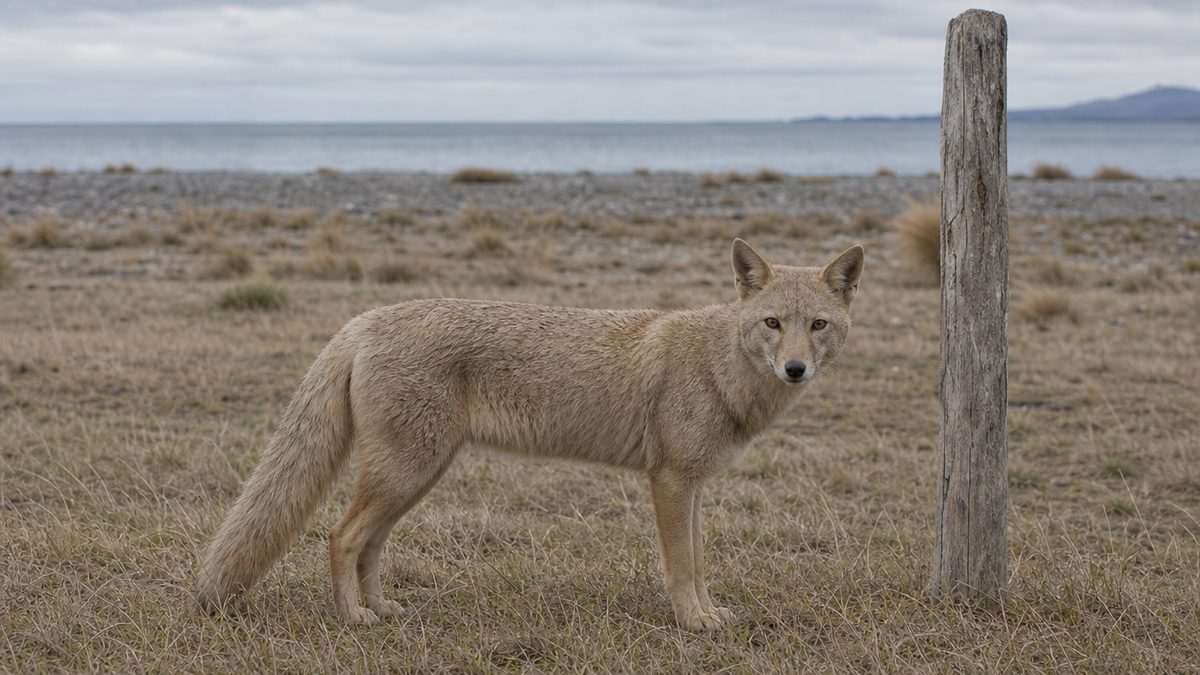
Quick answer
The Fuegian dog was almost certainly not a dog. The only specimen ever genetically tested came back 97.57 percent identical to the culpeo, a South American canid, against 88.93 percent for the domestic dog, and no domestic dog bones have ever been excavated in Tierra del Fuego. It was kept by the Selk'nam and Yahgan peoples, and it disappeared between the 1880s and 1919.
This page summarises peer-reviewed zoology, archaeology and history for general information, alongside veterinary research on conditions that affect dogs kept in India. It is not a diagnosis and it is not treatment advice. Consult a registered veterinarian who has examined your own animal before acting on anything here. No health data exists for the Fuegian dog itself, so nothing on this page should be read as a clinical description of it.
Fuegian dog traits, rated for India, and what each rating rests on
What the Fuegian dog was, and why the name is misleading
The Fuegian dog was an animal kept by the Selk'nam, Yahgan and neighbouring peoples of Tierra del Fuego, and the current scientific position is that it was not a dog. Two peer-reviewed papers published in 2023 and 2025 both conclude that the animal English speakers call the Fuegian dog was a culpeo, a South American canid, tamed rather than domesticated.
The names alone tell you the record is confused. English sources call it the Fuegian dog, the Yahgan dog and the Patagonian dog; the Selk'nam word recorded by the missionary lexicographer Beauvoir in 1901 is *wuisn*. Spanish sources use perro fueguino, perro yagan and perro patagonico. A fan wiki ranking seventh in India adds Maned Dog. None of those names is a breed name in the kennel-club sense, because no kennel club ever registered this animal and no breed standard was ever written for it.
The one thing everyone who saw it agreed on
European observers who saw the animal alive described it as fox-like, consistently, across more than a century and several languages. The French navigator Louis-Ferdinand Martial, who led the 1883 Cape Horn expedition, wrote that it was ugly, with long tawny hair and a sharp snout, and that it looks quite like a fox. William Webster, a ship's surgeon writing in 1834, said the Fuegian dog bears a considerable resemblance to a fox in his general appearance and is very ferocious. The naturalist Ian Strange, in 1972, called it a partially domesticated culpeo.
That matters because the observers were not naive. Franklin's 2025 review makes the point directly: the authors of the historical records from the 1700s and 1800s were European-educated in countries where red foxes occur, so it is reasonable to assume they knew the difference between a dog and a fox.
The culpeo is not actually a fox either
Here is where the popular story goes wrong in the other direction. The second-ranking page in an India-located search for this animal is a Reddit thread headed the only dog naturally domesticated not from the wolf, but from the fox. The culpeo, *Lycalopex culpaeus*, is a member of the family Canidae in the order Carnivora, and the opening line of the 2023 review states flatly that evolutionarily and systematically speaking there are no foxes in all of South America, and that the southern ones are more closely related to wolves than to true foxes in the genus *Vulpes*.
So the sentence a reader most often meets, that this was a dog domesticated from a fox instead of a wolf, is wrong twice over. The animal was probably not a domesticated dog, and the ancestor was not a fox.
| Account | Held by | Status of the evidence |
|---|---|---|
| A domestic dog descended from the wolf, brought across the Bering Strait | Jaksic and Castro 2023, for the canoe peoples only | No supporting archaeology in the region |
| A tamed or semi-domesticated culpeo | Franklin 2025, and Jaksic and Castro for the foot peoples | One genetic specimen, plus the whole iconographic record |
| A hybrid of domestic dog and culpeo | Senoret 1896, and revived by Mayorga et al. 2024 | Chromosome counts differ; no fertile hybrid documented |
| A tamed Dusicyon avus, a different extinct canid | Raised as a possibility in Jaksic et al. 2024 | Bones present in the region, no genetic link established |
This animal was never kept in India and never could be. It earns a page here for two reasons. It is the clearest case anywhere of a breed name attached to an animal that was probably a different species, which is exactly the failure mode Indian buyers meet with imported breeds. And the reason it is gone is documented, in a settler's own words, in a way that almost nothing else in the extinct-breed literature is.
What the genetic evidence actually supports, and how thin it is
The entire genetic case rests on one taxidermied skin and one mitochondrial fragment. Petrigh and Fugassa reported in 2013 that DNA from a Fuegian dog specimen in the Fagnano Regional Museum matched the culpeo at 97.57 percent identity against 88.93 percent for the domestic dog, and no second specimen has been tested since.
Take the finding seriously and take its limits seriously, in that order. The 2013 study is real, published in Quaternary International volume 317, pages 14 to 18, and we confirmed that bibliographic record independently through Crossref rather than trusting a citation. The publisher's full text is behind a paywall that returned HTTP 403 to us, so the figures quoted here come from the verbatim quotations of the paper printed in two later peer-reviewed reviews, and we say so rather than implying we read the original.
What was tested
One animal. Jaksic and Castro describe it as one taxidermized Fuegian dog belonging to a Selk'nam and donated to the Fagnano Regional Museum collection in Rio Grande, Argentine Tierra del Fuego, and they quote the authors' own description of it: a canid with a short light ocher coat, a height of about 40 cm, a lean, small head, and reminiscent of a greyhound. Franklin calls it the only Fuegian Dog specimen genetically analyzed to date. English Wikipedia's taxonomy section says hair samples from taxidermized specimens, plural, which the two reviews do not support.
The comparison set was three Patagonian wild canids, *Lycalopex culpaeus*, *Lycalopex griseus* and *Lycalopex gymnocercus*, plus the domestic dog. The marker was a fragment of the mitochondrial control region, amplified by PCR from hair. The same laboratory published its hair-DNA method in detail two years later, working from 5 mm hair strands digested in a PCR-compatible lysis buffer, with the sequences compared against NCBI GenBank.
Three limits that matter, and none of them is a reason to dismiss the result
- Mitochondrial DNA follows the mother only. A single control-region fragment tells you the maternal line. It cannot by itself exclude a domestic dog father, which is precisely the hybrid hypothesis this evidence is often used to close.
- The provenance is unverified, and the reviewing authors say so. Jaksic and Castro write that we do not know the origin of the gift to the museum in the early 1900s, ask whether it was really a Selk'nam's tame companion or simply a wild-caught or caged fox, and note that none of the witnesses of that transaction survive.
- One specimen is one specimen. The same authors call for a genetic analysis of the Selk'nam dog held at the Museo Salesiano Maggiorino Borgatello in Punta Arenas, Chile, which has never been tested.
The coat argument that cuts the other way
One piece of evidence points away from a pure culpeo and it comes from the same review. Historical sources record overo Fuegian dogs, pied animals with black or tan patches on a white coat, and the Punta Arenas museum specimen shows white patches on brown. Jaksic and Castro observe that this pattern does not exist among wild culpeos, which are reddish with a blackish upperpart and a black-tipped bushy tail, and they treat the pied coat as an indicator of domestication and artificial selection. Franklin's reading of the artwork points the opposite way, finding a consistently monochrome coat that Orquera and Piana described as uniform greyish tan.
The best-supported single statement is that the one animal ever tested was genetically a culpeo. The best-supported general statement is that the Fuegian dog is more likely to have been a tamed native canid than a domestic dog, and that this rests as much on the absence of dog bones as on the DNA. We will not write that the question is settled, because two peer-reviewed papers published two years apart disagree about it in print.
The archaeological record, which is the strongest evidence there is
No domestic dog bones have ever been excavated in Tierra del Fuego or far southern Patagonia. That absence, across dozens of sites reaching back 10,500 years, is a stronger argument than the single DNA result, and it is the argument almost no popular page mentions.
Franklin states it plainly in his 2025 review. After the multi-dozens of archaeological sites studied in Tierra del Fuego and far southern Patagonia, dating as far back as 10,500 years, no remains of domestic dogs have been found in southern Patagonia nor Tierra del Fuego. The canid bones that are there belong to *Lycalopex culpaeus* and especially to *Dusicyon avus*, a native canid now extinct.
The archaeological record to the north is what makes that absence meaningful rather than merely unexplained. The nearest pre-Columbian domestic dog site, which Franklin calls the Los Chonos Dog, is roughly 1,000 km north of Tierra del Fuego and is the southernmost pre-Columbian record of domestic dogs in South America. Dogs did reach South America; they did not reach this island before Europeans did.
The dating, and what the oldest bones cannot tell you
The oldest canid remains on the island come from Tres Arroyos 1 and are dated to about 10,500 years ago, and Jaksic and colleagues note that those remains are not able to distinguish between the extant *Lycalopex culpaeus* and the recently extinct *Dusicyon avus*. Two native canids were present in the Late Pleistocene. Neither was a dog.
The colonisation sequence is unusually well constrained for a place this remote. Franklin proposes that the major eruption of the Hudson volcano about 7,750 years before present eradicated Indigenous peoples and most terrestrial vertebrates from the island, that neither humans nor vertebrates returned for roughly a thousand years because the Strait of Magellan had become a biogeographical barrier, and that when people recolonised by canoe between 7,440 and 6,700 years ago they deliberately brought two utility species with them: the guanaco for meat and hides, and the canid for companionship and hunting Franklin WL. Foxes as pets.
| Taxon | Present in the archaeology? | Note |
|---|---|---|
| Dusicyon avus | Yes, and especially common | A native canid, now extinct |
| Lycalopex culpaeus | Yes | Still living on the island today |
| Canis lupus familiaris | No, across dozens of sites | Nearest pre-Columbian record is 1,000 km north |
| Undetermined canid, Tres Arroyos 1 | Yes, about 10,500 years old | Cannot be assigned between culpaeus and avus |
Where the two reviews part company
Jaksic and Castro argue that there were two animals: a smaller domestic dog kept by the canoe peoples, the Chonos, Kawesqar and Yahgan, brought along after the Bering crossing, and a larger tamed culpeo kept by the foot peoples, the Aonikenk, Manek'enk and Selk'nam. They propose keeping the name Fuegian dog for the first and Patagonian dog for the second. Franklin's response is that the statements do not match the evidence, on the ground that no domestic dog remains exist on the island or the adjacent mainland to support the first half of the model.
An absence of evidence is weak when nobody has looked and strong when many people have looked in the right places with the right methods. Dozens of excavated sites spanning 10,500 years, in a region where two other canids are routinely recovered, is the second kind. It is still not proof, and Franklin does not present it as proof; he presents it as the reason the dog hypothesis is highly problematic.
Could it have been a dog and culpeo cross?
A dog and culpeo cross is very unlikely and no fertile one has ever been documented. The two animals carry different chromosome numbers, 74 in *Lycalopex* against 78 in the domestic dog, and the lineages separated 7 to 12 million years ago.
The hybrid idea is the oldest of the three explanations. Franklin traces it to Senoret in 1896, who proposed that the Selk'nam's dog was a mixed breed of *Canis lupus familiaris* and *Lycalopex culpaeus*, and it has been revived repeatedly since.
The genetics against it
South American canids diverged from the wolf-like canids that later invaded the continent between 7 and 12 million years ago. Today the chromosome counts differ, *Lycalopex* at 2n equals 74 and the domestic dog at 2n equals 78, and with postzygotic barriers on top of that, any hybrid offspring are most likely sterile.
There is one recent exception and it proves the rule rather than breaking it. Szynwelski and colleagues reported in 2023 a rare first-generation hybrid between a Pampas fox, *Lycalopex gymnocercus* at 2n equals 74, and a domestic dog at 2n equals 78, from southeastern Brazil. The hybrid's chromosome number was intermediate at 2n equals 76, and it was suspected to be sterile for exactly that reason. One individual, in a different *Lycalopex* species, presumed sterile, is not a mechanism by which a hybrid population could establish itself and persist for millennia in Tierra del Fuego.
A citation that contradicts the paper citing it
The 2024 iconographic study by Mayorga and colleagues argued for an extended process of mixing between aboriginal fox-like canids and European dogs. Franklin points out that the paper supports its hybrid classification by citing Abbona and colleagues 2024, who wrote that the possibility of such hybridization remains to be confirmed, that their genetic divergence analysis suggests this is unlikely, and that the divergence values between *Canis* and *Dusicyon* species fall into a category suggesting a low probability of producing viable and fertile hybrid offspring. Following a footnote to the source it rests on is the cheapest check in research, and here it reverses the claim.
What the 2024 study does establish
The same iconographic work is genuinely useful on a different question. Mayorga and colleagues examined 61 canids in 26 illustrations published between 1699 and 1894 and found that before 1833 the canids shown with Indigenous people were homogeneous in appearance: a solid coat, a pointed snout, small erect ears set high, and a fallen bushy tail. After 1833 the frequency of European dogs in the images rises. That is a dated inflection point derived from a countable sample, and Franklin reports that it agrees with his own independent reading of the same period.
A fox-keeping advocacy site in the Indian result set publishes a chromosome-count table and states that the South American Culpeo Fox was once domesticated into the Fuegian dog, though this breed went extinct during the early twentieth century, while also noting there has not been enough research to conclusively state what chromosome counts permit viable offspring. The caution is right. The domestication claim is stated as settled when it is not.
Size, weight and coat: what the record supports and what it does not
The Fuegian dog was small, roughly 40 cm at the withers and in the culpeo's weight range of 5 to 13.5 kg. Beyond that the size and weight figures in circulation conflict badly, because they come from observers who were estimating, and because at least one widely quoted range is a broken unit conversion on Wikipedia.
Four sources give four accounts. Samuel Kirkland Lothrop reported a height range of 11 to 20 inches, roughly 28 to 51 cm. The museum specimen Petrigh and Fugassa tested stood about 40 cm. Wikipedia notes that surviving images show an animal similar in size to the wild culpeo, which weighs 5 to 13.5 kg, or about the size of a Shetland Sheepdog. And the same Wikipedia sentence renders Ricardo Latcham's figure through a mangled conversion template that prints over 60 to 23.6 cm, which is not a range at all; 60 cm and 23.6 inches are the same measurement.
| Figure | Source | What it is |
|---|---|---|
| About 40 cm at the withers | Petrigh and Fugassa 2013, quoted in Jaksic and Castro 2023 | A direct measurement of the one tested specimen |
| 11 to 20 inches, 28 to 51 cm | Lothrop 1928 | An ethnographer's range across many animals |
| 5 to 13.5 kg | The culpeo's own weight range | Inferred from images, not weighed |
| Over 60 to 23.6 cm | Latcham, via Wikipedia | A broken conversion template, not a real range |
| 33 to 41 cm, 5 to 13.5 kg, average 9.5 kg | Dogell.com | The culpeo's weight range presented as breed data |
The coat, and the four-feature description that holds up
Strip out the modern retellings and four features recur in every first-hand account and every contemporary drawing: a solid, uniform coat, a pointed snout, small erect ears set high on the skull, and a bushy tail carried low or fallen. On coat colours, the animals were described as tawny or entirely white, with longer straight fur. Orquera and Piana characterised the drawn coat as uniform greyish tan.
Notice what is missing from that list. No curled tail over the back. No drop ears. No broad muzzle. No breed-typical markings. The prick ears that modern breed pages give it are real, but small and high-set rather than the large upright ears of a spitz, and the tail is the feature that separates the two most cleanly.
The 1833 line, and why old pictures are evidence
Franklin's central methodological move is to treat the artwork as data. Professional artists on the exploratory voyages worked in a Realist tradition that valued accurate depiction, and the same fox-like animal appears in work by three different artists across a century: Sydney Parkinson on Cook's voyage in 1769, Conrad Martens and Robert FitzRoy on the Beagle in 1831 and 1832. Pre-photographic drawings from the mid-1700s to the mid-1800s show the fox-like animal. The late 1800s show a mixture. By the early 1900s essentially every photograph published as a Fuegian dog is a domestic dog.
This is the single most useful practical finding on the page. If you search for a photograph of a Fuegian dog you will find early twentieth-century pictures of Indigenous families with dogs, and those dogs are European. Franklin calls this the source of the common misidentification of the original endemic canid. A drawing from 1769 or 1831 is better evidence than a photograph from 1910.
The extinction date, as tightly as the record allows
The Fuegian dog disappeared between the 1880s and 1919. Those two dates are not a century-wide shrug; each is anchored to a document. Thomas Bridges was still complaining about the animals attacking his mission's goats in the 1880s, and when Martin Gusinde asked the Yahgan about them in 1919 he was told that the entire known population had been destroyed.
The extinction date is where extinct-animal pages usually go soft, so here is every anchor we could fix, in order.
| Date | Event | Source |
|---|---|---|
| 1769, 1831, 1832 | Fox-like canids drawn with Indigenous people by Parkinson, Martens and FitzRoy | Franklin 2025, reading the original artwork |
| Before 1833 | Canids shown with Indigenous people are homogeneous and fox-like in 26 published illustrations | Mayorga et al. 2024, via Franklin 2025 |
| After 1833 | European dogs rise in frequency in the same image series | Mayorga et al. 2024, via Franklin 2025 |
| 1885 | Sheep introduced to Tierra del Fuego; persecution of their putative predators begins | Jaksic et al. 2024 |
| 1880s | Thomas Bridges reports the animals attacking his mission's goats | Orquera and Piana 1999, via Wikipedia and Franklin |
| 1887 | Julius Popper describes them alive and in numbers | Popper 1887, via Wikipedia |
| Early 1900s | Essentially all photographs published as Fuegian dogs show domestic dogs | Franklin 2025 |
| 1919 | Gusinde finds none and is told all were exterminated | Gusinde 1920 and 1931, via Wikipedia and Franklin |
| 1950s | Martinic lists the Ona's wild dog among probably extinct species | Jaksic and Castro 2023 |
The 1919 conversation, and what was said
Gusinde noticed the absence himself before anyone told him about it. Visiting the Yahgan in 1919 he found that all of the dogs seemed to be missing, which struck him as odd given how thoroughly the relationship between the animals and the people had been documented by earlier missionaries and explorers. When he asked, he was told that the entire known population had been destroyed, and the reason given was that they were dangerous to men and cattle Franklin WL. Foxes as pets.
Take the reported reason at face value and it is still a colonial reason. Cattle and sheep were not there before 1885, and an animal that had lived alongside these communities for thousands of years became dangerous only once somebody else's livestock arrived on the same ground.
Five competing mechanisms, none of them exclusive
- Replacement. Smith and Jardine wrote in 1840 that wherever Europeans have penetrated, dogs introduced by them have multiplied, and the wild aborigines have adopted them in preference to their own.
- Deliberate killing as a colonial tactic, which is documented in a settler's own written order and is covered in the next section.
- Organised hunting. Soluri documented in 2024 that Gusinde's final explanation was the deliberate importation of hounds, including Irish Wolfhounds, that hunted down hundreds of native canids said to be raising havoc among the island's sheep flocks.
- Introduced disease and competition from European dogs, plus a food base changed by livestock.
- Absorption into the wild population. Jaksic and Castro raise the possibility that the animal did not become fully extinct but regressed from a tamed culpeo back into its wild form, which still lives on Tierra del Fuego Island as *Lycalopex culpaeus lycoides*.
There is no living Fuegian dog and no population to visit, buy from or conserve. The culpeo still exists as a wild species and is the southernmost canid in the world, but a wild culpeo is not a Fuegian dog, and any page offering you a living one is describing something else.
The Selk'nam genocide, and where the dogs come into it
The animal disappeared during, and partly because of, the killing of the Selk'nam people between the 1880s and the 1920s. Chile's own Historical Truth and New Deal Commission concluded in 2003 that what happened was an extermination process and that it was genocide, and the destruction of the dogs is documented as a deliberate tactic within it.
The history here is well documented and it does not need dramatising, so this section sticks to what is on the record and stops there.
The sequence, and the numbers
European and South American livestock companies established sheep estancias on Isla Grande de Tierra del Fuego from the 1880s, with sheep introduced in 1885. Companies were founded in quick succession, among them the Tierra del Fuego Sheep Farming Company from 1891, the Philip's Bay Sheep Farming Company from 1892, the Sociedad Explotadora de Tierra del Fuego from 1893 and the Sociedad Ganadera Gente Grande from 1905. Mateo Martinic calculates that around 2,000 Selk'nam were living on the Chilean side of the island in 1881. By 1920, no more than twenty could be found in Chilean territory.
Gigoux's account of the mechanism is measured and worth quoting for what it includes: the complicity of authorities, outright killings, intertribal warfare as a consequence of forced displacements, and epidemics, together producing a sustained demographic decline. Men were hired to protect the sheep and pursue the Selk'nam, and they acted with impunity because the authorities remained indifferent.
The order to shoot the dogs
One document ties the animal directly to the campaign, and it is an instruction written by the man who gave it. Reproduced in Gigoux's paper, it describes sending two men out mounted, with three days' provisions, to clear the camp around of man, woman and child but not to shed human blood except in self-defence, and records that Indian dogs was very numerous both wild and tame and these they were to destroy without reserve. The account closes by reporting that the two men returned to say they had carried out the orders, and that the shooting of the Indians dogs had the desired effect of clearing out the Indians.
That is the whole of the connection, stated by the perpetrator: killing the animals was a method of removing the people. It is worth reading twice, because it explains why the Fuegian dog vanished on a timescale that no disease or dietary change would produce.
English Wikipedia cites Gigoux 2022 at page 13 for the sentence that the settlers' hunting of the dogs was the main cause of their extinction. We read the whole paper. The word dog appears in it four times, in two passages, and neither makes any claim about when or why the animal became extinct. The killing is documented. The claim that it was the main cause is Wikipedia's inference, not the cited source's finding, and Franklin's review lists it as one of five competing mechanisms rather than the leading one.
The Selk'nam and Yahgan are not extinct peoples, and the law says so
A 2025 peer-reviewed paper in the Journal of Zoology describes the Yamana and Selk'nam as extinct Indigenous cultures. Chilean law, amended on 19 October 2023, names both among the recognised Indigenous peoples of Chile. Where a scientific paper and a national statute disagree about whether a people exists, the statute is the better source.
This page relies heavily on Franklin 2025, which is the most thorough treatment of the animal in print, and on that one point it is wrong. Its title is Foxes as pets: Case study of the Fuegian Dog and its relationship to extinct Indigenous cultures, and its abstract says this is a rare glimpse into the historical past, especially because both the dog and people are extinct.
What Chilean law says
Ley 21.606, promulgated by the Ministerio de Desarrollo Social y Familia and published in the Diario Oficial on 19 October 2023, is a single article. It replaces the second paragraph of article 1 of Ley 19.253, the Indigenous Law, so that the recognised principal Indigenous peoples of Chile now read: Mapuche, Aimara, Rapa Nui or Pascuense, Atacameno, Quechua, Colla, Diaguita, Chango of the north of the country, Kawashkar or Alacalufe and Yamana or Yagan of the southern channels, and Selk'nam.
The Yamana or Yagan had been named in that article since 1993. The Selk'nam were added in 2023, after a bill first tabled on 5 August 2019. There is also a Comunidad Selk'nam Rafaela Ishton in Argentina pursuing recognition of collective rights there.
Why the wording matters more than usual here
Gigoux records that the Selk'nam community Covadonga Ona initially resisted formal recognition of the genocide because they equated it with official recognition of their own extinction as a people, and that the legislative motion recognising the Selk'nam was approved by the Chamber of Deputies on 27 June 2020 partly to resolve that. He describes the result in one sentence: suddenly, the Selk'nam came back from extinction.
So a page that writes about extinct peoples is not making a neutral historical statement. It is repeating the administrative erasure the community spent two decades reversing. We name the animal as extinct because it is, and we do not extend that word to the people who kept it.
Write that the Fuegian dog is extinct and that the Selk'nam and Yahgan peoples survived a genocide and are legally recognised today in Chile. Both halves of that sentence are documented. Collapsing them into extinct peoples is the error, and it currently sits in the abstract of the best paper on the subject.
Kennel club recognition: none, and why the question is the wrong one
No kennel club recognition has ever existed for the Fuegian dog, and checking the registers takes two minutes. The FCI definitive nomenclature for the letter F returns eight breeds and none is this one, the American Kennel Club's breed selector does not carry it, and the United Kennel Club publishes no standard for it.
The FCI list for the letter F, read live on 31 August 2026, contains Field Spaniel 123, Fila Brasileiro 225, Flat-Coated Retriever 121, Fox Terrier Smooth 12, Fox Terrier Wire 169, French Tricolour Hound 219, French White and Orange Hound 316 and French White and Black Hound 220. The AKC's Foundation Stock Service page carries a breed selector enumerating every AKC and FSS name; Chow Chow, Chinese Shar-Pei, Chinook and Taiwan Dog are all present and the Fuegian dog is not. A site-restricted search of the UKC returned nothing for it, while the same query pattern run against Chow Chow returned that breed's UKC standard, so the search worked.
Why the answer does not tell you much
Recognition is a poor instrument here, because it was never available. Every breed the FCI recognises was registered by a national kennel club that existed at the time; the Selk'nam and Yahgan kept this animal in a place that had no such institution, and by the time one might have looked, the animal was gone. Absence from a register is therefore not evidence that the animal was insignificant. It is evidence that nobody with a studbook ever reached Tierra del Fuego before 1919.
The question the registers do settle is a narrower one. Any page presenting this animal as a breed, with a group, a standard, a purebred classification or a popularity rank, is describing something that no registry ever constituted. Those fields are unsourced by construction, because there is no source they could come from.
What the animal was actually classified as, and by whom
The mainstream scientific classification today is not a breed at all. Science News, reporting Franklin's 2025 paper, headlines it as a semi-tame fox and describes the culpeo as the probable biological identity of the animal. Wikipedia's List of domesticated animals enters it as a domesticated animal with the culpeo as its wild ancestor and its date of domestication marked uncertain. Those two are compatible: a tamed wild species can appear on a domestication list and still not be a dog.
Its recorded working use was as a hunting dog in the loose sense, taking otters and assisting on the hunt, plus shellfish gathering and driving fish into nets. None of that maps onto a kennel-club working group, which is another way of saying the classification systems we have were not built for this animal.
What the breed sites publish about an animal nobody has seen since 1919
A breed-comparison tool ranking in India for this term publishes a lifespan, a litter size, a bite force, a bathing schedule and a climate preference for the Fuegian dog. Every one of those numbers is generated, and one of them is checkable against real climate data and wrong by about twenty degrees.
Dogell.com serves a page comparing the Fuegian dog with the Hare Indian dog, which is also extinct, and declares a winner. Reading it is the fastest way to understand how breed data is manufactured when no data exists.
| Field | What the site publishes | What is actually known |
|---|---|---|
| Climate tolerance | Prefers warm weather | Ushuaia's warmest month averages 7.34C and its annual mean is 3.52C |
| Average lifespan | 9 to 13 years | No lifespan has ever been recorded for this animal |
| Bite strength | Between 200 and 400 PSI | No bite force was ever measured; the animal has been gone since 1919 |
| Puppy litter size | 5 to 8 puppies | No litter was ever recorded |
| Pregnancy duration | 60 to 64 days | The dog figure, applied to a canid nobody bred |
| Food consumption | 0.5 to 1.5 cups of high-quality dry food a day | Its recorded diet included marine shellfish and driving fish into nets |
| Bathing needs | Every 3 to 4 weeks | Generated by template |
| Weight | 5 to 13.5 kg, average 9.5 kg | The culpeo's published weight range, relabelled as breed data |
| Breed classification | Purebred | No studbook, no standard, no registry, ever |
| Popularity rank | Number 455 | A rank in the site's own index, not a measure of anything |
The climate line is the one to check
Prefers warm weather is falsifiable, and it is false. We queried NASA POWER by explicit latitude and longitude for Ushuaia at 54.8019 south, 68.3030 west, and confirmed the coordinates it returned matched the ones we asked for. The annual mean air temperature is 3.52 degrees, the warmest month is January at 7.34 degrees and the coldest is July at minus 0.68. Rio Grande, where the tested museum specimen is held, runs warmer at 5.39 degrees annually and still tops out at 9.61 in January. This is not a warm-weather animal by any definition.
The comparison itself is the tell
The page's Quick Verdict declares the Hare Indian dog the overall winner at five categories to three, calls it good for first-time owners and office friendly, and rates its apartment adaptability as acceptable. The Hare Indian dog has not existed since the nineteenth century. A tool that recommends one extinct animal over another as a first pet is not making an error about one breed; it is applying a template that has no idea what it is describing.
Credit where it is due. The same page prints Price Range as Unavailable for both animals, availability as 1 out of 5, and health problems as Not available. Wikipedia's List of domesticated animals enters the Fuegian dog with a dagger for extinct, names the culpeo as the wild ancestor and gives the date of domestication as uncertain, which is a fair summary of the state of knowledge. The failure is not universal, and it clusters in the fields a template can autofill.
Fuegian dog price in India: there is no animal to price
No price in india exists for the Fuegian dog because the animal has been gone for over a century and was never in India at any point before that. An India-located search on 31 August 2026 returned no Indian listing, no Indian breeder and no rupee figure, and the control query in the same session returned four genuine Indian price pages.
The absence is earned rather than assumed. A search returning nothing proves nothing unless the search is shown to work, so we ran labrador retriever price in india in the same tool and session. It returned four real Indian price pages, including one with a city-by-city table quoting Rs 30,000 to Rs 1,20,000 across Hyderabad, Bangalore, Delhi, Chennai, Lucknow, Mumbai, Jaipur and Pune. The instrument works. The zero is real.
| Result | What it is |
|---|---|
| Reddit r/dogs thread | A discussion of fascinating extinct breeds |
| Etsy listing | A novelty Beware of Culpeo warning sign |
| TikTok video | A short explainer on the extinct breed |
| Quora thread | A question about the most disobedient dog breed |
| Dogell comparison page | The generated data audited in the section above |
| Scribd document | Somebody's saved Google search results for wolf-like breeds |
| Wikipedia list | List of domesticated animals, where it appears with an extinct dagger |
| Faithful Foxes | A fox-keeping advocacy page with a chromosome table |
| DeviantArt | A fan-fiction chapter |
| Facebook group post | A culpeo species post giving an extinction window of 1880 to 1919 |
There is no lawful route either, and it is not the dog route
If the Fuegian dog was a tamed culpeo, then the relevant Indian rule is not the pet-dog rule. DGFT Trade Notice 22/2022-23 sets mammals under ITC(HS) 01061900 as Restricted, and its Policy Condition 6 reads that import of wild animals, including their parts and products, as defined in the Wild Life (Protection) Act 1972, is prohibited, and that those species which are listed in CITES are subject to the provisions of CITES. *Lycalopex culpaeus* has been listed on CITES Appendix II since 28 June 1979, originally under the synonym *Dusicyon culpaeus*, per the UNEP-WCMC Species+ database.
So a living culpeo brought to India would be a CITES-regulated wild carnivore, not a pet dog with a pet book. The import licence route in Policy Condition 7, which covers a pet dog with a valid pet book in the importer's name, does not apply to it, and Policy Condition 8 states that import of commercial dogs for breeding or any other commercial activities is not permitted in any case.
Nobody can sell you a Fuegian dog. If a seller uses the name, they are selling you a different animal under a label that has been unavailable since 1919, and if they are genuinely offering a live South American canid then you are being offered a CITES Appendix II wild species. Neither transaction is one Bonbeno would have you complete.
Cost of ownership: the honest number is zero, and here is what to budget instead
There is no cost of ownership for a Fuegian dog, because there is no Fuegian dog. The useful version of this section is what a South American canid would actually cost you in India if one could be kept here legally, which it cannot, and why every line of that budget is worse than for a dog.
Bonbeno publishes no rupee figures on this page. Any monthly cost quoted for this animal has been generated, and the audit section above shows a ranking site doing exactly that with a feeding line, a bathing schedule and a vet-care frequency.
Why a wild canid is not a cheaper dog
- Licensing, not purchase. A CITES Appendix II species requires permits rather than a receipt, and India's import policy routes wild animals through the Wild Life (Protection) Act rather than the pet-dog conditions.
- Veterinary care with no reference range. Indian small-animal practice is built around dogs and cats. There is no published haematology reference interval, no vaccination schedule and no drug dosing table for a culpeo that an Indian clinic would hold.
- Containment. Franklin's review notes that foxes make poor pets and that there is a fine line between tameness and wildness in them, which in practical terms is a containment cost rather than a training cost.
- Diet. The recorded diet of the animal Indigenous people kept included marine shellfish, and it was used to drive fish into trap nets. Nothing on an Indian pet-food shelf is formulated for that.
What to price instead
If the appeal is a lean, alert, independent, prick-eared canid that suits a hot country, price an Indian Pariah Dog with your own vet and groomer. That animal is available, legal, adapted to the climate this page measures below, and costs an adoption fee rather than a permit. Bonbeno's Indian Pariah Dog page carries the real Indian cost structure.
Tierra del Fuego against India: a 20-degree wet-bulb gap
Tierra del Fuego is the coldest inhabited place any breed on this site comes from. Ushuaia's peak monthly mean wet-bulb temperature is 5.4 degrees. Kolkata's is 27.1. That gap of 21.7 points is the largest on this encyclopedia, and it means no Indian city outside Ladakh resembles this animal's home climate at all.
Heat tolerance is the trait Indian buyers most need and the one no global source rates, so we compute it rather than quoting it. We queried NASA POWER by explicit latitude and longitude for 2001 to 2020, verified that the coordinates returned matched those requested, and derived wet-bulb temperature from monthly mean air temperature and relative humidity using the Stull formula.
| Place | Annual mean air temp | Warmest month | Annual mean RH | Peak monthly wet-bulb |
|---|---|---|---|---|
| Ushuaia, Tierra del Fuego | 3.52C | January, 7.34C | 85.5% | 5.4C in February |
| Rio Grande, Tierra del Fuego | 5.39C | January, 9.61C | 83.9% | 7.2C in January |
| Punta Arenas | 6.32C | February, 9.89C | 82.1% | 7.6C in February |
| Leh, Ladakh | -2.75C | July, 10.18C | 52.2% | 5.0C in July |
| Bengaluru | 23.74C | April, 28.37C | 67.9% | 21.9C in May |
| Mumbai | 26.77C | May, 31.19C | 67.4% | 25.8C in June |
| Chennai | 27.95C | May, 31.51C | 72.4% | 26.1C in May |
| Delhi | 25.60C | June, 35.88C | 45.6% | 26.5C in July |
| Kolkata | 25.81C | May, 31.53C | 73.9% | 27.1C in June |
Read the first two rows against the last five
Ushuaia's warmest month, January at 7.34 degrees, is colder than Delhi's coldest month, January at 13.61 degrees, by more than six points. It is nearly seventeen degrees colder than Chennai's coldest month, which averages 24.09. There is no season anywhere on the Indian plains that this animal would recognise.
Humidity does not rescue it. Ushuaia's annual mean relative humidity of 85.5 percent is higher than Chennai's 72.4, but at four degrees that humidity is simply cold damp air. The combination that matters for a canid is heat plus moisture, because panting cools by evaporation and saturated warm air will not take the water. That combination is what wet-bulb measures, and on that measure Ushuaia's worst month is milder than Bengaluru's best.
The only Indian comparison that works, and it is not a city most people live in
Leh is the one place we tested that comes close. Its annual mean air temperature is minus 2.75 degrees, colder than Ushuaia, and its peak monthly wet-bulb is 5.0 degrees in July against Ushuaia's 5.4 in February. If you want an intuition for where in India this animal's thermal world existed, it is Ladakh, at 4,500 metres, and not anywhere at sea level.
Because a ranking site tells Indian readers this animal prefers warm weather, and one query to a public climate API disproves it. The same method works on any imported breed you are considering. Look up the origin city by latitude and longitude, compute the wet-bulb, and compare it to your own.
Temperament: what the eyewitnesses actually wrote
Every first-hand account describes an animal that behaved like a semi-tame wild canid rather than a dog. Observers called it ill-natured, ferocious, half-wild and extremely sly, and Julius Popper, who saw large numbers of them, wrote that he never saw them take an aggressive attitude or defend their masters when these were in danger.
The temperament record here is unusually good for an extinct animal, because so many literate visitors met it. It is also unusually unflattering, and the unflattering parts are the most diagnostic.
- William Webster, 1834, ship's surgeon, wrote that the Fuegian dog bears a considerable resemblance to a fox in his general appearance and is very ferocious.
- Louis-Ferdinand Martial, 1883, observed that they were not loyal to their human masters.
- Julius Popper, 1887, wrote that he never saw them, no matter how large their number, take an aggressive attitude or defend their masters when these were in danger.
- Lucas Bridges, who grew up among the Selk'nam, described the animals as like a stunted cross between an Alsatian police dog and a wolf.
- Ian Strange, 1972, summarising the record, called it a partially domesticated culpeo.
Franklin's conclusion from the whole set is one sentence: the Fuegian Dog did not act like a domesticated dog, but more like a semi-tame fox, and foxes make poor pets resulting in a fine line between tameness and wildness.
The behaviour that does not fit a guard dog
Popper's observation is the one that should stop a modern writer describing this animal as a guard dog. He was hostile to the Selk'nam and had every reason to portray their animals as dangerous, and instead he recorded that the animals did not defend their owners. Whatever the relationship was, it was not the protective one that breed pages routinely assign to it.
What the animal actually did
The recorded uses are specific and none of them is guarding. Darwin was told by a Selk'nam child that the animals caught otters, and Martial's account supports it. Antonio Coiazzi recorded their use in hunting. Franklin adds shellfish gathering and driving fish into trap nets, which he treats as evidence against a canine identity because those are not dog behaviours.
All sources agree on one further use, and it is the most human detail in the record. The animals arranged themselves to sleep pressed against and around the people. Popper wrote that the dogs placed themselves in a group around the small Onas, taking the shape of a kind of wrapping, and concluded that they served to complete the defective garment of the Indian. In a place whose annual mean temperature is 3.52 degrees, a living blanket is not a sentimental use.
These are impressions recorded by hostile or curious outsiders about individual animals of varying tameness, not a temperament assessment of a population. Franklin says as much: impressions and descriptive characteristics varied between chroniclers, dog individuality and the degree of tameness. Any site giving you a five-point sociability score for this animal has invented it.
Training: what taming a wild canid actually takes
Nobody can train a Fuegian dog, and the historical record suggests nobody fully trained one when they existed either. The useful lesson for an Indian reader is what the difference between taming and domesticating costs, because it is the difference between one animal's lifetime and roughly a hundred years of controlled breeding.
Franklin sets out the distinction with the one worked example science has. Efforts to domesticate silver foxes in Russia required a century of controlled selection: captive breeding for fifty years with unconscious selection for behaviour, then fifty more years of strict selection at about ten percent. That is what turning a wild canid into a reliably handleable animal has actually cost, once, under laboratory conditions.
Why the culpeo was a poor candidate
Stahl observed that the genus *Lycalopex* has a broad dietary range, opportunistic behaviour and tolerance of wide-ranging habitats, all of which give it an underlying tendency to habituate to human conditions. What blocked full domestication was its wild and solitary social system, because a species needs a non-solitary social structure for the process to work. That is the biological reason the relationship stayed at taming.
The transferable lesson for an Indian household
Two things follow that apply to any wild or part-wild animal offered as a pet in India, and they get offered often.
- Tameness does not inherit reliably. A hand-raised individual can be handleable and its offspring can be entirely wild, which is why the Russian programme needed generations rather than good handling.
- A solitary species does not read your signals. Training a dog works because dogs evolved in a group-living lineage that attends to conspecific and human cues. A solitary canid has no such history, and no amount of reward-based work substitutes for it.
So when a seller in an Indian city offers a fox, a jackal cub or a wolf-cross as a manageable pet, the honest answer is the one Franklin gives about this animal: foxes make poor pets, and the line between tameness and wildness is fine. The right dog for that buyer is a dog.
Exercise: the requirement nobody recorded
No exercise requirement was ever recorded for the Fuegian dog, and the animals lived as free-ranging companions rather than as leashed pets, so the question as a modern owner would ask it never arose. What can be said is what a canid of that size and habit would need, and why the Indian answer is dominated by timing rather than duration.
The animals moved with the people. The Selk'nam were terrestrial hunter-gatherers who ranged the interior of Isla Grande on foot, and the canids accompanied them, hunted with them and slept against them Franklin WL. Foxes as pets. That is a life of continuous low-intensity movement in cold air, which is close to the opposite of two structured walks a day in a hot city.
If you keep any medium canid in India, timing is the whole game
The wet-bulb table above gives the operating window. Kolkata's June monthly mean wet-bulb is 27.1 degrees and Chennai's May is 26.1, and those are averages across day and night, so the afternoon is worse. Exercise before sunrise and after dark for most of the year in coastal cities, and treat the middle of the day as unavailable rather than as a compromise.
The reason to be strict is that exertion, not ambient weather, is what fills the clinics. In a cohort of 905,543 UK dogs under primary veterinary care in 2016, 652 of the 879 heat-related illness events with a recorded trigger, or 74.2 percent, were exertional; 113 were environmental and 46 involved confinement in a vehicle. A 2022 UK emergency-care study of 167,751 dogs recorded an event fatality rate of 26.56 percent, and found brachycephalic dogs at 4.21 times the odds of mesocephalic ones.
Press the back of your hand to the pavement and hold it for five seconds. If you cannot, neither can the animal. In a Delhi May, when the monthly mean air temperature is 35.05 degrees and the hottest May reading in the twenty-year record is 48.08, that test fails through most of the daylight hours.
Grooming: a cold-climate coat, and what India does to one
The Fuegian dog carried a long, straight, dense coat built for a place with an annual mean temperature of 3.52 degrees and 85.5 percent humidity. You cannot groom an animal that no longer exists, but the coat type is common enough among imported breeds in India that what would have happened to this one is worth spelling out.
The recorded coat is longer straight fur, tawny or entirely white, and the drawn coat is uniform greyish tan Franklin WL. Foxes as pets. That is a cold-wet coat: long guard hair over dense underfur, designed to shed rain and hold warm air against skin in a place where the sea never warms.
Why a cold-wet coat fails in a hot-wet climate
The physics is different in the two places even though both are humid. In Ushuaia the coat traps a layer of warm air next to the skin and the ambient wet-bulb of 5.4 degrees at its summer peak pulls heat away steadily. In Mumbai in August, mean relative humidity is 90.4 percent and the monthly mean wet-bulb is 24.8 degrees, so the same coat traps heat the animal cannot shed, and the skin beneath it stays damp for hours after any soaking.
- Dry to the skin, always. The overseas advice to towel a dog and let it air dry is written for dry air. In an Indian monsoon it leaves a double coat damp at the skin, which is the condition hot spots and yeast overgrowth need.
- Check for ticks by hand, daily. A dense undercoat hides them from sight, and Indian tick pressure is high.
- Never shave a double coat to cool the animal. Guard hairs block radiant heat and regrow more slowly than undercoat, so a shaved animal sunburns and gets hotter.
- Expect a smeared moult. India gives a cold-climate coat no seasonal trigger, so two clean moults become a year-round low-grade shed.
The tick numbers, which are the part with evidence
A Punjab survey of 719 dogs found *Babesia gibsoni* in 8.9 percent of samples by multiplex PCR against 5.0 percent by microscopy, *Hepatozoon canis* in 5.1 percent against 1.0 percent, *Ehrlichia canis* in 2.6 percent against 1.4 percent and *Babesia vogeli* in 1.1 percent against 0.1 percent, with concurrent infections recorded including *B. gibsoni* with *H. canis* in 0.4 percent of dogs. Every PCR figure exceeds the microscopy figure, which means slide reading at a clinic under-detects the problem, and breed, sex and location were all significantly associated with *B. gibsoni* infection.
Second Schedule Part II paragraph 6(8) of the Prevention of Cruelty to Animals (Dog Breeding and Marketing) Rules 2017 states that there shall be no tail docking, ear cropping, de-barking, de-clawing, branding, dyeing, injecting substances to enhance visual appeal, performing a surgery or procedure to camouflage or hide any defect or infirmity or any other kind of mutilation of any body part of the pup, and any change of appearance by artificial means is strictly forbidden. That is a Second Schedule paragraph, not Rule 6(8); Rule 6 is a separate provision that gives the Schedule its force.
Health problems and life expectancy: nothing was recorded
No life expectancy, no disease list and no screening data exist for the Fuegian dog, and the health problems attributed to it on breed sites are generated. PubMed returns zero records for the term, with the query translation unchanged and two controls returning 47 and 98 records in the same session.
We searched properly so the zero means something. A phrase search for Fuegian dog in title or abstract returned zero, and the translation line came back identical to the query, so nothing was silently rewritten. Broadening it to Fuegian AND (dog OR canid) also returned zero, translation unchanged, and a broadened query that still finds nothing is a stronger negative than a narrow one. Two controls run in the same session returned sane, on-topic results: Labrador Retriever with hip dysplasia returned 47 and dog domestication returned 98.
One thing that zero does not mean
It does not mean nothing has been published about this animal. The primary literature exists and this page rests on it; it simply sits in journals PubMed does not index for this subject, in Quaternary International, the Journal of Zoology and the Revista Chilena de Historia Natural, all of which we retrieved directly Jaksic FM, Castro SA. The identity… Crossref REST API. The same PubMed session returned 49 records for culpeo or *Lycalopex culpaeus*, so the animal's own species does have a biomedical literature under its wild name.
That is worth stating because it is a general lesson about proving absences. PubMed is one instrument, not the literature, and an honest report of a zero says which instrument produced it.
What the ranking pages publish anyway
A breed-comparison site gives the Fuegian dog an average lifespan of 9 to 13 years, a health-concerns rating of 5 out of 5, a vet-care frequency of Rare and a bite strength between 200 and 400 PSI, while simultaneously printing Health Problems as Not available. The last field is the honest one. The first four are what a template produces when the honest field is empty.
This page carries no lifespan, no litter size, no bite force and no inherited-condition list for the Fuegian dog. Every one of those would have to be borrowed from the domestic dog or from the wild culpeo and relabelled, and relabelling a related animal's numbers is the single commonest way a false figure enters a breed encyclopedia.
Feeding: a diet no pet-food shelf matches
The Fuegian dog's recorded diet included marine shellfish, and the animals were used to drive fish into trap nets. Franklin lists those highly unusual food habits among the reasons to conclude the animal was not a domesticated dog, and no commercial food would feed it correctly.
The evidence for the diet is behavioural rather than analytical. Franklin's summary names the gathering of marine shellfish and the driving of fish into trap nets among the traits that separate this canid from a dog. Darwin was told the animals caught otters, and Martial's account supports it. That is a coastal, marine-weighted diet in a cold climate, which is a metabolic profile no Indian pet-food formulation targets.
The transferable rule: feed to body condition, not to a chart
This applies to any animal for which no breed chart exists, which is most of the world's dogs. Score the body rather than reading a bag.
- Feel the ribs with a flat palm under light pressure. They should be easy to find under a thin covering.
- Look from above for a waist behind the ribcage. Straight sides from shoulder to hip means overweight.
- Look from the side for an abdominal tuck rising from the last rib.
- Weigh monthly on the same scale and write it down, because 1 kg on a 22 kg animal is invisible by eye and is 4.5 percent of bodyweight.
Condition is not cosmetic in a hot country. In 905,543 UK dogs under primary veterinary care, animals at or above the mean bodyweight for their breed and sex carried an odds ratio of 1.42 for heat-related illness, and dogs over 50 kg an odds ratio of 3.42. Bodyweight is one of the few heat-risk factors an owner controls directly.
The first year: what was never recorded, and what Indian law requires anyway
No litter, no whelping and no first-year record exists for the Fuegian dog. The reproductive figures on breed sites are the domestic dog's, relabelled. What can be given honestly is the timeline that applies to any young canid in an Indian home, and the two dates Indian law fixes.
The gazette fixes both. Rule 8(1)(a) of the Prevention of Cruelty to Animals (Dog Breeding and Marketing) Rules 2017 requires every breeder to ensure that pups less than eight weeks in age are not sold. Second Schedule Part III paragraph 8(9) of the same instrument states that all pups shall be vaccinated, which can start at the age of seven to eight weeks, and are usually completed at the age of eighteen weeks.
| Age | What matters most | What to have done |
|---|---|---|
| 0 to 8 weeks | With the dam. Lawful sale is not possible before 8 weeks | Nothing. Refuse any animal offered younger |
| 8 to 10 weeks | Home settling, crate, mat, daily handling | First vaccination started, first vet exam, weight logged |
| 10 to 16 weeks | The socialisation window, which does not reopen | Traffic, lifts, street noise, calm strangers, all at a distance |
| 16 to 18 weeks | Vaccination course completed | Full course finished, deworming schedule running |
| 4 to 6 months | Teething, bite inhibition, recall on a long line | Tick prevention running year-round, monthly weight log |
| 6 to 9 months | Adolescent testing of every boundary | Settle on a mat and quiet on cue rehearsed against real triggers |
| 9 to 12 months | Adult coat coming in, first full moult | Drying routine established, groomer identified |
The reproductive numbers on the breed sites
A comparison site publishes a puppy litter size of 5 to 8, a pregnancy duration of 60 to 64 days and a breeding frequency of once a year for the Fuegian dog. The gestation figure is the domestic dog's. The litter size is a plausible canid range. Neither was observed in this animal, and the site gives no source for either, which is the pattern the audit section documents across ten fields.
For any animal you are actually offered in India, ask for the microchip number and the vaccination record in the seller's name, and verify the chip yourself at a clinic before money moves. That is worth more than any pedigree certificate you cannot check against a register you can read.
Indian law: this is a wildlife question, not a pet question
If the Fuegian dog was a tamed culpeo, Indian import law routes it through the wildlife conditions rather than the pet-dog conditions, and the difference is decisive. The culpeo has been on CITES Appendix II since 28 June 1979, and DGFT policy prohibits the import of wild animals as defined in the Wild Life (Protection) Act 1972.
The two routes sit side by side in one document and it is worth reading them in order.
Policy Condition 6, the wildlife route
DGFT Trade Notice 22/2022-23 of 19 December 2022 places mammals under ITC(HS) 01061900 as Restricted and reproduces the policy conditions. Condition 6 reads that import of Wild Animals, including their parts and products, as defined in the Wild Life (Protection) Act 1972 as amended from time to time, is prohibited, and that those species which are listed in CITES are subject to the provisions of CITES.
*Lycalopex culpaeus* (Molina, 1782), family Canidae, order Carnivora, is listed on CITES Appendix II with effect from 28 June 1979, originally under the synonym *Dusicyon culpaeus*, according to the UNEP-WCMC Species+ database that CITES and the CMS maintain. So a living animal of this species is squarely inside Condition 6 and nowhere near Condition 7.
Policy Conditions 7 and 8, the dog route that does not apply
Condition 7 permits import of dogs only for a pet dog with a valid pet book and relevant records in the name of the importer, for dogs imported by R and D organisations with the recommendation of CPCSEA, or for internal security by the Defence and Police Force. Condition 8 states that import of commercial dogs for breeding or any other commercial activities other than those purposes is not permitted, and paragraph 6 of the notice adds that any applications for trading or breeding purposes, or applications made on behalf of some other person or entity, shall be duly rejected. The notice also limits pet-animal import to the airports and seaports of Delhi, Mumbai, Chennai, Hyderabad, Bangalore and Kolkata. DAHD added a seventh port, Cochin International Airport at Kochi, for pets arriving under the baggage rules in October 2024. The full route is set out in how to import a dog to India.
The breeding rules, and why they close the last door
Even if an animal reached India, Second Schedule Part II paragraph 6(9) of the Dog Breeding and Marketing Rules 2017 is a single sentence: breeding to create new breeds of dogs or unusual looks shall be strictly prohibited. And paragraph 6(3) of the same Part prohibits two named mating techniques, defining in breeding as mating between relatives of the second to fourth grade in straight or side line within the first four generations, for example uncle to niece, nephew to aunt, cousin to cousin and grandparents to grandchildren, and incest breeding as mating between parents and children or between brother and sister. Any attempt to found a population from a handful of animals would breach that clause inside two generations.
These are Second Schedule paragraphs and not Rules. The Rules' own Rule 6 exists separately, headed Requirements to be met by breeders and establishments used for breeding or housing dogs for breeding, and its job is to make the Second Schedule binding. Writing Rule 6(9) sends a reader who looks it up to the wrong provision, and Indian pet sites do it constantly.
Fuegian dog compared with the animals it gets confused with
The Fuegian dog is compared with four quite different animals on different pages, and separating them is the fastest way to see what it was. Two are wild South American canids, one is an extinct North American dog and one is a living Indian dog you can actually meet.
Every cell below is checked against a register, a paper or a climate query rather than against a breed page.
| Animal | Species | Status | Kennel club recognition | Available in India |
|---|---|---|---|---|
| Fuegian dog | Probably Lycalopex culpaeus, tamed | Extinct since about 1919 | None, ever | No |
| Culpeo | Lycalopex culpaeus | Living, southernmost canid in the world | Not a dog; CITES Appendix II | No, and a CITES species |
| Dusicyon avus | Dusicyon avus | Extinct native canid, common in the archaeology | Not a dog | No |
| Hare Indian dog | Filed as Canis lupus familiaris, never tested | Extinct, North America | None | No |
| Indian Pariah Dog | Canis lupus familiaris | Living and widespread | Type recognised in India | Yes, through any shelter |
Why the Hare Indian dog comparison keeps appearing
It appears because a comparison tool generated it, not because anyone drew the parallel. Dogell serves a Fuegian Dog vs Hare Indian Dog page and declares the Hare Indian dog the winner five categories to three, marking it good for first-time owners and office friendly. Both animals are extinct. The two share nothing but a category label in that site's database, and neither animal's taxonomy was ever settled. Richardson filed the Hare Indian dog as a variety of domestic dog while saying he could not distinguish it from a coyote, and no specimen has been tested since.
The comparison that would actually help an Indian reader
Set the Fuegian dog against the Indian Pariah Dog and the useful contrast appears. Both are landrace animals shaped by their environment rather than by breeders. Both are lean, alert, independent and small enough to live simply. One evolved in a place whose annual mean temperature is 3.52 degrees, and one in a country whose coolest large city month is Bengaluru's December at 20.22. If what draws you to the Fuegian dog is the idea of a functional, unmanufactured animal that fits its landscape, the Indian version of that is at your nearest shelter.
The wild animal at the centre of this story is alive. The Fuegian fox, *Lycalopex culpaeus lycoides*, is the southernmost canid in the world and the second largest, heaviest and tallest native canid in South America. Sheep arrived in 1885 and the persecution of their putative predators pushed it out of the northern half of Isla Grande; the introduction of the continental chilla fox *Lycalopex griseus* in 1951 pressed it further, and it is now concentrated in the southern half of the island.
Seven things people get wrong about the Fuegian dog
The commonest mistake is the one in the headline of the second-ranking search result. Every error below appears on a page currently ranking in India, and each has a check that takes under a minute.
- Calling it a dog domesticated from a fox. Both halves are shaky. The best evidence says it was probably not a domesticated dog, and the culpeo is not a fox: it sits closer to wolves and jackals than to *Vulpes*.
- Treating the DNA result as settled. It is one specimen, one mitochondrial fragment, and a museum donation whose provenance the reviewing authors themselves question.
- Missing the archaeology, which is the stronger argument. No domestic dog bones have been excavated anywhere in Tierra del Fuego or far southern Patagonia across dozens of sites going back 10,500 years, and the nearest pre-Columbian dog site is 1,000 km north.
- Using early twentieth-century photographs. By the early 1900s essentially every photograph published as a Fuegian dog shows a European domestic dog. The 1769 to 1832 drawings are the better evidence.
- Repeating breed-site vital statistics. A lifespan of 9 to 13 years, a bite force of 200 to 400 PSI and a climate preference for warm weather are all generated, and the last is disproved by one climate query.
- Saying the settlers' dog-killing was the main cause of extinction. The killing is documented in a perpetrator's own order. The claim that it was the leading cause is an inference layered onto a source that makes no such finding.
- Calling the Selk'nam and Yahgan extinct peoples. Chilean law names both among the recognised Indigenous peoples of Chile, the Yamana or Yagan since 1993 and the Selk'nam since 19 October 2023.
The check that catches most of them
Open the footnote. On this subject the ranking pages are unusually well cited, which makes following the citation unusually productive: the Gigoux paper does not say what it is cited for, the Mayorga hybrid claim cites a paper that contradicts it, and the Wikipedia infobox contains a broken conversion that prints a range of over 60 to 23.6 cm, which is one measurement in two units.
Our first query to the CITES Species+ database used a plus sign where a space belonged, and it returned zero results for *Lycalopex culpaeus*. Re-run with the space encoded properly it returned the Appendix II listing dated 28 June 1979. A zero produced by your own query is not a finding, and the only defence is to re-run it a second way before you write it down.
Adoption: what to do with the interest that brought you here
You cannot adopt a Fuegian dog. If what drew you is a small, self-sufficient, alert canid that belongs to its landscape rather than to a breeder, that animal is available at every shelter in India, and the paperwork takes an afternoon rather than a CITES permit.
There is no Fuegian dog rescue, no breed club and no responsible breeder, because there is no animal and no registry. That is not a gap in this page. It is the finding, and it is why the page exists.
Where to look in India
- Municipal and NGO shelters in your own city, which will let you meet an animal several times before you commit.
- Foster-to-adopt arrangements, which tell you in three weeks whether your flat and your routine actually suit the animal.
- Veterinary clinics, which often know of an animal being rehomed by a client and can give you its real medical history.
- Breed-type rescue groups run through city messaging groups, which is where surrendered coated dogs surface in Indian metros.
If you buy rather than adopt, five checks
Ask to see the dam on the premises with the litter. Ask for the breeder's registration under the Prevention of Cruelty to Animals (Dog Breeding and Marketing) Rules 2017, which requires registration with the State Animal Welfare Board. Ask which register the pedigree is issued by, then check that register yourself. Ask for the microchip number and verify it at a clinic. And confirm the animal is at least eight weeks old, because Rule 8(1)(a) requires every breeder to ensure that pups less than eight weeks in age are not sold.
Refuse any animal whose ears have been cropped or tail docked. Both are forbidden in India under Second Schedule Part II paragraph 6(8), and a seller who has done either has told you what else they will do. And refuse any wild or part-wild canid offered as a pet, whatever it is called, for the reasons the training section sets out.
Bonbeno does not recommend breeders, link listings or quote a live price as an offer. For this animal there is nothing to recommend. What the page can give you instead is a method: open the footnote, check the register, run the climate query by latitude and longitude, and prove any absence with a control before you believe it. That method works on the next unfamiliar animal you are offered, which is the one that will actually cost you money.
Fuegian dog: the questions worth asking
Was the Fuegian dog really a fox?
It was probably a tamed culpeo, which is a South American canid rather than a true fox. The distinction matters: evolutionarily there are no foxes in South America, and the culpeo sits closer to wolves and jackals than to the genus Vulpes that contains the red fox.
Is the Fuegian dog extinct?
Yes. The last first-hand accounts of the living animal date to the 1880s, and when the ethnologist Martin Gusinde asked the Yahgan about them in 1919 he was told the entire known population had been destroyed. No population survives anywhere.
What killed the Fuegian dog?
Several things at once, and the record supports no single cause. European dogs replaced them from about 1833, sheep arrived in 1885 and their putative predators were persecuted, imported hounds hunted native canids, and settlers shot the Selk'nam's animals deliberately as a way of clearing the people off the land.
How do we know it was a culpeo and not a dog?
Two independent lines. One taxidermied specimen tested in 2013 came back 97.57 percent identical to the culpeo against 88.93 percent for the domestic dog. Separately, no domestic dog bones have ever been excavated in Tierra del Fuego or far southern Patagonia across dozens of sites going back 10,500 years.
How many Fuegian dogs were tested genetically?
One. A single taxidermy skin held at the Fagnano Regional Museum in Rio Grande, Argentina, donated in the early 1900s. The reviewing authors note that its provenance is unverified and have called for the Punta Arenas specimen to be tested as well.
Could it have been a dog and fox hybrid?
Very unlikely. Lycalopex carries 74 chromosomes and the domestic dog 78, the lineages diverged 7 to 12 million years ago, and the one recorded first-generation cross with a related species produced an animal with 76 chromosomes that was suspected to be sterile.
What is the price of a Fuegian dog in India?
There is none, and there never was. The animal has been gone for over a century and was never kept in India. An India-located search returned no Indian listing and no rupee figure, while the control query in the same session returned four genuine Indian price pages.
How long did a Fuegian dog live?
Nobody recorded it. This page publishes no lifespan. The 9 to 13 years that appears on breed-comparison sites is generated by a template, on a page that simultaneously prints its health problems field as Not available.
Are the Selk'nam people extinct?
No. Chilean law recognises them. Ley 21.606, published in the Diario Oficial on 19 October 2023, added the Selk'nam to the list of principal Indigenous peoples of Chile in article 1 of the Indigenous Law, alongside the Yamana or Yagan who have been named there since 1993.
Could a Fuegian dog have survived in India?
No climate in India resembles its home. Ushuaia's warmest month averages 7.34C, which is more than six degrees colder than Delhi's coldest month and nearly seventeen colder than Chennai's, and its peak monthly wet-bulb of 5.4C is below Bengaluru's mildest month.
Is the Fuegian dog recognised by any kennel club?
No, and it never was. The FCI definitive register for the letter F returns eight breeds and none is this one, the AKC breed selector including Foundation Stock Service does not list it, and the United Kennel Club publishes no standard for it.
Can I keep a culpeo as a pet?
Not in India. The culpeo has been on CITES Appendix II since 28 June 1979, and India's import policy prohibits import of wild animals as defined in the Wild Life (Protection) Act 1972 while making CITES-listed species subject to CITES provisions. The pet-dog import route does not apply to a wild carnivore.
Are any dogs descended from foxes?
Not the Fuegian dog, which is the usual example, and the genetics argue against it anywhere. The Fuegian dog was probably a tamed culpeo, a South American canid that sits closer to wolves and jackals than to the genus Vulpes that holds the red fox; evolutionarily there are no foxes in South America. Lycalopex carries 74 chromosomes and the domestic dog 78, the two lineages diverged 7 to 12 million years ago, and the one recorded first-generation cross with a related species produced an animal with 76 chromosomes that was suspected to be sterile.
What breed of dog went extinct?
The Fuegian dog of Tierra del Fuego is one, and it was probably not a dog at all but a tamed culpeo. The last first-hand accounts of the living animal date to the 1880s, and when the ethnologist Martin Gusinde asked the Yahgan about them in 1919 he was told the entire known population had been destroyed. No single cause is supported: European dogs replaced them from about 1833, sheep arrived in 1885 and their putative predators were persecuted, imported hounds hunted native canids, and settlers shot the Selk'nam's animals deliberately as a way of clearing the people off the land.
Compare with similar breeds
Fuegian Dog sits in 2 Bonbeno groups. Each one compares it directly against the breeds it is genuinely an alternative to, on the same figures.