
Dog breed profile
Carolina Dog in India: Price, Heat Tolerance and Full Breed Guide
The American Dingo, trapped out of the South Carolina swamps in the 1970s and sold ever since as a surviving pre-Columbian dog. The genetics has been done twice. It supports far less than the story does, and no Indian seller has the dog at any price.
Quick answer
No verified carolina dog price in india exists. Not one Indian marketplace stocks the breed, six of Google India's ten results for the query are not about this breed, and the fifth is about Indiana rather than India. The Carolina Dog itself is an American free-ranging pariah landrace of 18 to 24 inches, UKC-recognised since 1995, whose pre-Columbian ancestry rests on the mitochondrial DNA of 19 captive dogs.
This guide summarises breed standards, registry records, peer-reviewed veterinary literature, climate data and Indian government texts as general information for Indian pet owners. It is not a diagnosis and it is not treatment advice. Consult a registered veterinarian near you before acting on anything you read here, and treat collapse, laboured panting that will not settle, sudden hind-limb weakness or any suspected drug reaction as an emergency.
Carolina Dog at a glance, for an Indian household
What a Carolina Dog actually is
A Carolina Dog is a free-ranging pariah landrace from the swamps and pine savannahs of the southeastern United States, trapped and named in the 1970s by Dr I. Lehr Brisbin of the Savannah River Ecology Laboratory in Aiken, South Carolina Brisbin IL Jr, Risch TS. Primitive dogs. It is also called the American Dingo, the Dixie Dingo, the yaller dog and, confusingly for readers here, the Indian Dog.
That last name is about Native Americans, not about India, and it is the first thing an Indian reader needs to strip out. The breed has no Indian history, no Indian population and no Indian registry status. What it does have is a genuine claim to be the closest living thing in the western hemisphere to a free-ranging village dog, which makes it the natural counterpart to the dog outside your gate.
The shape, from the standard that governs it
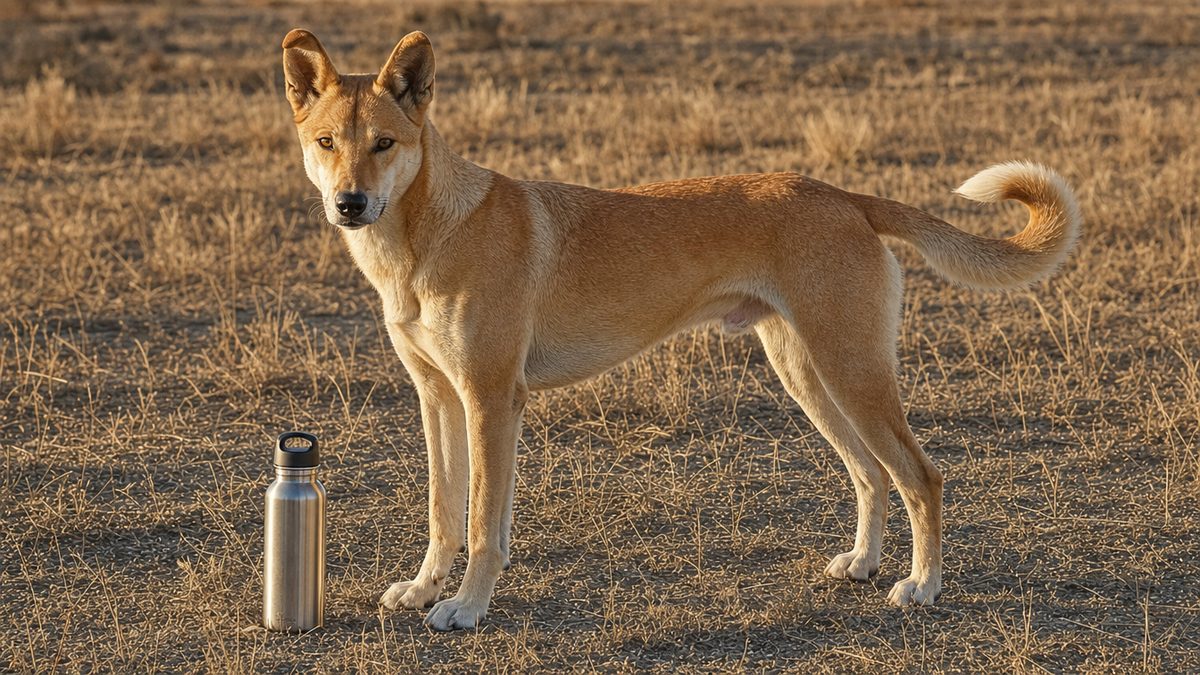
The United Kennel Club standard, revised 1 January 2023, describes a medium, light to medium boned dog with the appearance of a small jackal or a medium-sized sighthound, a rectangular body, a deep brisket, a hard tuck-up and a long, graceful neck. Height runs 18 to 24 inches at the withers, weight approximately 35 to 50 pounds, which is 45.7 to 61 cm and 15.9 to 22.7 kg.
Two features identify it and both are worth memorising, because they are what separate it from every other pariah-type dog on this site.
- The fishhook tail. The tail is set horizontally as a continuation of the spine, and roughly the last third bends back over itself toward the dog's head. The standard is explicit that it "should never completely curl over the back of the dog, as to touch the dog's back". A straight tail is a serious fault and a full curl is a fault.
- Hooded ears. The ears are erect, slightly ROUNDED at the tip, triangular with a wide base, and lean slightly forward and outward rather than standing straight up. The standard notes that on light-eyed dogs those elongated hooded ears help shade the eyes from full sun.
Colour runs to ginger in every shade from reddish to pale straw, usually with pale buff markings behind the shoulders that the standard calls angel wings, plus permitted solid black, black and tan, and piebald. The tongue may be fully pink, black-spotted or fully black, and the parent club's own standard adds purple to that list.
| Attribute | Detail |
|---|---|
| Type | Free-ranging pariah landrace, southeastern United States |
| UKC group | Sighthound & Pariah Dog Group |
| UKC recognition | 1 January 1995 |
| Height | 18 to 24 inches (45.7 to 61 cm) |
| Weight | Approximately 35 to 50 pounds (15.9 to 22.7 kg) |
| Body | Rectangular, sighthound-like, obvious waist |
| Ears | Erect, rounded tips, wide base, hooded |
| Tail | Fishhook, never fully curled over the back |
| Coat | Close-lying, seasonal, coarse guard hairs over the neck and back |
| Temperament | Generally shy and suspicious of strangers |
The parent club's standard states its purpose as maintaining the breed "to enable it to still survive and reproduce on its own, without human assistance in the wild habitat to which it has been adapted by natural selection for thousands of years", and it says a fault's seriousness should be weighed by its effect on "the dog's ability to survive and reproduce in its original free-ranging state under natural conditions";. Nothing else on Bonbeno is written that way. It is the only breed standard we have read that treats the show ring as a proxy for the swamp.
Everything below tests that romance against records. The genetics has been done, the registries can be checked, the climate can be measured, and the Indian market can be probed URL by URL. Where the evidence supports the story this page says so. Where it does not, it says that too.
Google's Indian results for this breed are mostly a different dog, and one is a different country
Search carolina dog price in india from India and six of the ten organic results are not about this breed at all. Two are Cane Corso pages, two are the same affordable-dogs video shown twice, one is a forty-breed Indian price list that never names it, one is a Petit Basset Griffon Vendeen, and the fifth result is a United States marketplace page whose URL means Indiana Good Dog, Carolina Dog puppies at the URL…. We checked the whole set on 25 August 2026 and this section shows the working, because a reader who understands why the results are wrong will stop trusting the prices in them.
The number one result contains the word Carolina zero times
Supertails holds position one with an article headed "Cane Corso Price in India 2026: What You'll Actually Pay". We retrieved the complete document, all 1.5 MB of it, and searched it case-insensitively. The string Carolina appears zero times. Google is reading this query as a near miss for cane corso price in india, which is the same failure Bonbeno recorded on the Canaan Dog query, and it is why an Indian searcher lands on a 45 kg Italian guarding mastiff when looking for a 20 kg pariah dog.
The /in in the URL is Indiana
Position five is gooddog.com/carolina-dog/in. That two-letter code is the United States postal abbreviation for Indiana, not the ISO code for India, and the page removes all doubt about it on its own face. It prints "Your location Indiana", it links onward to Indianapolis, Fort Wayne, Evansville and South Bend, and the two breeders it shows are 191 and 217 miles away in Michigan.
The page is also internally inconsistent in two ways worth naming, because both are the kind of thing that should stop you trusting a marketplace's numbers.
- Its title tag says 25 puppies and its H1 says 40+, on the same page load.
- Its buyer's guide answers the price question with "prices usually range from $2,000 to $2,000";, a range whose two ends are the same number. That is a template filling a missing value, not a market rate.
The price Google quotes belongs to a different question
Position two is a Quora thread titled "How much is a Carolina dog worth?". Google's own snippet for it in India reads "At a dog pound charges $160 to $300. A well-bred puppy costs $1,000 to $3000." Read the page and those figures sit under a completely different question on the same thread page, "How much does a dog dog cost?", answered in general terms about American shelters and puppy mills.
The one answer actually addressed to the Carolina Dog question says, in full, "You can adopt a dog at the local pound for $40";. The rest of the page prices German Shepherds, Cardigan Welsh Corgis, Bernedoodles, blue-nose pit bulls and Jack Russells, and carries car-insurance and real-estate advertising between the answers.
| Position | Domain | Is it this breed? |
|---|---|---|
| 1 | supertails.com | No. Cane Corso. Zero occurrences of Carolina in the full document |
| 2 | quora.com | Partly. One on-topic answer, quoting a $40 pound fee |
| 3 | supertails.com | No. A 40-breed price list with zero occurrences of Carolina |
| 4 | youtube.com | No. Cane Corso pricing video |
| 5 | gooddog.com | Yes, but for Indiana, not India |
| 6 | dogbreedslist.info | Yes. The only on-topic page carrying figures |
| 7 | youtube.com | No. Affordable Indian dogs |
| 8 | happypet.care | No. Petit Basset Griffon Vendeen |
| 9 | amazon.in | A book about the breed, not a dog |
| 10 | youtube.com | No. The same video again |
One item, and it is not a dog. Position nine in the same result set is an Amazon India listing for a print-on-demand Carolina Dog owner's manual. Bonbeno did not open that listing and quotes no price from it, so it is recorded here as a result and nothing more. Every Indian seller page we did probe is covered in the price section below, and not one of them has the dog.
Three published size ranges for one dog, and only one of them is a breed standard
Three organisations publish a size for the Carolina Dog and they do not agree, so a buyer comparing a dog against the wrong one will reject a correct animal. The UKC and the parent club both give 18 to 24 inches and roughly 35 to 50 pounds; the American Kennel Club's breed page gives 17.75 to 19.5 inches and 30 to 55 pounds; a widely-copied breed database gives 17 to 24 inches and 30 to 44 pounds Carolina Dog Fanciers of America American Kennel Club DogBreedsList, Carolina Dog: Price.
The AKC figure is the odd one and it matters most, because the AKC page is the one a nervous buyer reads. Its ceiling of 19.5 inches sits 4.5 inches below the ceiling in the standard the breed is actually judged against. A correct 23-inch Carolina Dog would look oversized to anyone using the AKC page as a ruler, and would be entirely within the standard.
| Source | Height | Weight | Is it a breed standard? |
|---|---|---|---|
| UKC, revised 1 January 2023 | 18 to 24 in (45.7 to 61 cm) | 35 to 50 lb (15.9 to 22.7 kg) | Yes, and it governs the show ring |
| Carolina Dog Fanciers of America | 18 to 24 in | 35 to 50 lb | Yes, the parent club's own |
| AKC breed page | 17.75 to 19.5 in | 30 to 55 lb | No. The AKC has no approved standard for an FSS breed |
| DogBreedsList | 17 to 24 in (45 to 61 cm) | 30 to 44 lb (15 to 20 kg) | No. A database entry |
The AKC's narrow range then propagates. English Wikipedia's Carolina dog infobox reproduces 17.75 to 19.5 inches and 30 to 55 pounds, the AKC's figures rather than the standard's, which is how a range that governs nothing becomes the one most readers meet.
Where the two real standards differ from each other
The UKC standard and the parent club standard read as the same document with edits, which is expected, since the UKC text follows the club's. Four differences survive and one of them changes what disqualifies a dog.
- Solid white. The UKC lists "Solid white coat color" in its Disqualifications. The parent club's disqualifying faults name albinism, white collars, white eye patches, merle, roan, mottling, dappling, blue or grey, brown or liver, diluted colours and body ticking, but they do not name solid white.
- Tongue colour. The parent club permits fully pink, black-spotted, fully black or purple. The UKC omits purple.
- Ear set. The parent club says the ears are "set well on top of the head". The UKC says they "are offset slightly on the head";.
- Cryptorchidism. The UKC disqualifies a unilateral or bilateral cryptorchid dog outright. The parent club standard does not list it.
Both agree on everything that identifies the breed: the rectangular sighthound outline, the hooded ears, the fishhook tail, blue eyes as a disqualifying fault, and a straight tail as the most serious structural fault after build Carolina Dog Fanciers of America.
The AKC records seven registrable colours for this breed, one of which is White, registration code 199, plus the markings White Markings, Irish Marked and Piebald. The UKC standard disqualifies a solid white coat, a white collar and white eye patches. Both are internally consistent, because an AKC colour code records what a dog is, not whether it is correct, and the AKC's own table leaves the Breed Standard Color column blank for every single colour. That blank column is the honest signal: an FSS breed has no AKC-approved standard yet, so nothing can be marked as standard.
For an Indian reader the practical instruction is short. Judge any dog claimed to be this breed against the UKC text, ignore the AKC height range, and treat a curled-over-the-back tail as the single fastest disqualifier.
Where the breed came from, and the one man the whole story runs through
The Carolina Dog was created by a single ecologist noticing something in the field. In the 1970s Dr I. Lehr Brisbin trapped free-ranging dogs in natural habitats of the southeastern United States and named them Carolina Dogs, and both governing standards open with that sentence almost word for word Carolina Dog Fanciers of America.
Brisbin worked at the Savannah River Ecology Laboratory of the University of Georgia in Aiken, South Carolina, the address PubMed still records against his 1997 paper in the Journal of the American Veterinary Medical Association, titled "Primitive dogs, their ecology and behavior: unique opportunities to study the early development of the human-canine bond";. That paper is the reason this page's climate figures are anchored on Aiken County rather than on a guess.
What he thought he had found
Where he was working matters, because it explains how a free-ranging dog population survived into the 1970s next to a modern American city. The Savannah River Ecology Laboratory "operates on the Savannah River Site, a Department of Energy facility renowned as the first National Environmental Research Park (NERP) in the USA", situated near Aiken, South Carolina. A large, restricted, continuously studied federal landscape is exactly the kind of place a pariah population persists in, and it is also why the dogs were noticed by an ecologist rather than by a breeder.
One historical caveat is worth carrying. The dogs were not discovered from nothing. English Wikipedia records the population as "rediscovered living as a free-roaming population by I. Lehr Brisbin Jr.", though "originally documented in American dog-related publications in the 1920s";. Bonbeno could not verify that 1920s documentation at source and reports it as Wikipedia's claim rather than as established fact.
The hypothesis, stated in both standards, is that these dogs descend from the primitive dogs that accompanied the first humans across the Bering land bridge from Asia. The parent club's version adds the archaeology it rests on: skeletal remains, prehistoric pictorial representations and mummified bodies found with Native American artefacts, and documented ceremonial dog burials showing that dogs were valued companions long before Europeans arrived.
Note what the standards do next, because it is unusually careful for a breed document. Both say: "Additional studies support this hypothesis although additional ancestry and genetic studies are needed to reach a fully definitive conclusion about their origins";. The registry and the parent club are both declining to make the strong claim that the marketing makes for them.
What the dogs were selected on
The distinctive features of the breed are described as those conferring survival advantages in free-ranging conditions in the tall grasslands, bottomland swamps, deserts and forest habitats of the southern United States. That is a functional description, not an aesthetic one, and it explains the outline: a light-boned, deep-chested, hard-waisted dog built to cover ground and to eat irregularly.
- Ears that shade the eyes. The standard states outright that on light-eyed dogs, elongated or hooded ears help shade the eyes from full sun.
- A tail built to be seen in cover. The fishhook tail exists so that it "should be able to be hoisted and waived vigorously in the tall weedy cover".
- A neck built for a hunting movement. The standard describes a swanlike, well-arched neck giving "a means of making rapid and effective downward stabbing movements with the head when hunting in tall grass".
- Rear dewclaws that may be doubled, explicitly permitted rather than removed.
The AKC's own breed page notes that Carolina Dogs dig snout pits, small conical depressions in the dirt that exactly fit the dog's muzzle, and that most are dug by females between September and January. It also notes that Carolina Dogs often have extra heat cycles in the first two years. Both are the sort of thing a laboratory recorded and a breeder would not have invented, and the second is a real, practical warning for anyone bringing an unspayed bitch into an Indian household.
Everything above is the story as its own institutions tell it. The next two sections put it against the published genetics, which is where the page earns its keep.
The pre-Columbian survivor claim, and the nineteen dogs it rests on
The claim that the Carolina Dog is a surviving pre-Columbian American dog has been tested, and the study everyone cites examined 19 dogs. Van Asch and colleagues published it in Proceedings of the Royal Society B in 2013, and their own description of the sample is "the pariah-like Carolina dog (n = 19; captive dogs descending from free-ranging dogs)";.
Read the result as the authors wrote it, because the wording is doing careful work. "Among the 'free-ranging' Carolina dogs of southern USA, the most frequent haplotype was A184, which was unique to these dogs (it is a novel haplotype not previously reported in GenBank) and belongs to the East Asian-specific phylogenetic subclade a5. One individual had haplotype A39, otherwise found only among Chinese non-breed dogs and the Japanese breed shiba inu. The remaining dogs had universal haplotypes";.
The paper's abstract puts its own conclusion at the weakest end of the available language: it provides "the first DNA-based evidence that the Carolina dog, a free-ranging population in the USA, may have an ancient Asian origin".
Four limits the popular version drops
- It is mitochondrial DNA, so it traces only the maternal line. One haplotype tells you about a dog's mother's mother's mother. It says nothing about the other side of the pedigree or about the rest of the genome.
- The denominator is 19, and they were captive. The paper describes them as captive dogs descending from free-ranging dogs, not as wild-caught animals. Nineteen related captive dogs are not a random sample of a free-ranging population.
- The paper never prints how many of the 19 carried A184. It says only that A184 was the most frequent, that one dog carried A39, and that the rest carried universal haplotypes. "Most frequent" in a sample of 19 could be seven dogs or seventeen. Bonbeno publishes no percentage here because the paper publishes none.
- Half of a genuinely indigenous population would look European anyway. The authors state the arithmetic themselves: only about 50 percent of pre-European American dogs are expected to have carried haplotypes absent in Europe, so uninformative haplotypes are the expected background, not a finding.
What the same paper found about the wider population
The Carolina Dog result sits inside a study whose broader message runs the other way. Across free-ranging American dogs, van Asch and colleagues found that indigenous haplotypes were carried by 7.8 percent of all dogs, and they note that a previous study of 400 rural and street dogs across America had put the pre-European share of the maternal lineages at less than 10 percent. Only in pockets did the proportion rise: 9.8 percent of Mexican dogs and 14.8 percent of Bolivian dogs, against 2.3 percent in Argentina.
So the honest reading of the 2013 paper is that free-ranging American dogs are overwhelmingly of European descent, and the Carolina Dog is offered as one of the pockets that is not. That is an interesting and defensible claim. It is not the same claim as "this dog is a surviving Native American dog".
A184 had never been reported in GenBank before, and it sits inside an East Asian-specific subclade. That is not nothing. A lineage that is unique to one southeastern American dog population and whose nearest relatives are East Asian is exactly the pattern an ancient Bering-route arrival would leave. The problem is not that the signal is uninteresting. The problem is that a single maternal marker in 19 captive dogs is a hypothesis, and five years later somebody ran the test that could settle it.
What the genome-wide study found in 2018, and what it could not rule out
The genome-wide test came in 2018 and it did not confirm the pre-Columbian story. Ni Leathlobhair and colleagues sequenced 71 ancient mitogenomes from North American and Siberian dogs spanning about 9,000 years and analysed nuclear data from more than 5,000 modern dogs genotyped on a 180,000-marker SNP array, and concluded that after Europeans arrived, "native American dogs almost completely disappeared, leaving a minimal genetic legacy in modern dog populations";.
Their finding on this breed specifically is one sentence long and it is the most important sentence on this page. "Our ADMIXTURE analysis detected varying degrees of PCD/Arctic ancestry in three individual Carolina dogs (0-33%). This analysis, however, could not distinguish between PCD and Arctic ancestry, and we cannot rule out that this was result of admixture from modern Arctic dogs and not from PCD". PCD is their abbreviation for pre-contact dogs.
Three dogs. A range starting at zero. And an explicit statement by the authors that the signal they did see might be modern husky rather than ancient anything.
| van Asch 2013 | Ni Leathlobhair 2018 | |
|---|---|---|
| What was read | Mitochondrial control region, maternal line only | Nuclear genome, 180K SNP array, plus 71 ancient mitogenomes |
| Carolina Dogs examined | 19 captive dogs | 3 individuals in the ADMIXTURE analysis |
| Comparison set | 984 East Asian and 639 European dogs | More than 5,000 modern dogs |
| Result for this breed | Novel East Asian-clade haplotype A184, most frequent in the sample | 0 to 33 percent pre-contact or Arctic ancestry, the two not separable |
| Authors' own wording | "may have an ancient Asian origin" | "we cannot rule out that this was result of admixture from modern Arctic dogs" |
The wider 2018 result is harsher still
- No significant admixture into European-descended American dogs. "Our f4 ratio analysis did not detect a significant admixture signal from PCD into any modern American dogs of European ancestry".
- Two dogs out of hundreds carried a pre-contact maternal haplotype. Among 590 additional modern mitogenomes including 169 village and breed dogs sampled in North and South America, exactly two modern American dogs carried one, a chihuahua and a mixed-breed dog from Nicaragua, "consistent with a limited degree of PCD ancestry (<2%) in modern American dogs";.
- Other American native breeds show nothing. "The majority of modern American dog populations, including 138 village dogs from South America and multiple 'native' breeds (e.g., hairless dogs and Catahoulas), possess no detectable traces of PCD ancestry";.
- The closest surviving relative is not a dog at all. The paper's headline finding is that the nearest detectable extant lineage to pre-contact American dogs is the canine transmissible venereal tumour, a contagious cancer clone derived from a dog that lived up to 8,000 years ago.
The popular claim is that the Carolina Dog is a surviving pre-Columbian American dog. The evidence supports something much narrower: one novel maternal haplotype in an East Asian clade, found in a captive sample of 19, and a nuclear signal of 0 to 33 percent in three dogs that the authors themselves could not separate from modern Arctic admixture. Neither team claims more than that. Anyone selling you this dog as an American aboriginal survivor is stating as fact something two research groups deliberately declined to state. Buy it because it is a good pariah dog, if you can find one, and not because of the DNA.
The 2018 authors leave one door open and it should be recorded: "greater degrees of PCD ancestry may remain in American dogs which have not yet been sampled", and they note their own analysis may suffer from ascertainment bias. The question is not closed. It is simply not yet answered in the breed's favour.
How much veterinary literature exists on this breed, and the counting trap inside the question
PubMed holds no paper with this breed's name in its title, and proving that took more care than the answer suggests. Searching "Carolina dog"[Title] as a quoted phrase returns 0 records, with PubMed's own warning flag quotedphrasesnotfound, meaning the phrase is absent from its title and abstract index altogether.
The trap is what happens if you drop the quotation marks. The unquoted query Carolina dog[Title] returns 479 records, which looks like a substantial literature. It is not. PubMed prints its own query translation and it reads ("carolina"[All Fields] OR "carolina s"[All Fields] OR "carolinas"[All Fields]) AND "dog"[Title]. That is every dog paper ever written by anyone affiliated with North or South Carolina. An agent quoting 479 as this breed's research output would have published a fabrication with a number attached to it.
"Labrador retriever"[Title] returns 229 records with a clean translation, "Labrador retriever"[Title], and no warning. So the phrase index works and it does hold two-word breed names. The Carolina Dog's zero is a real absence, not a broken query. An absence is only evidence when the control passes, and this one did.
What does exist, and what it is about
The breed's founder published once in the veterinary literature. Brisbin and Risch, in the Journal of the American Veterinary Medical Association in 1997, wrote "Primitive dogs, their ecology and behavior: unique opportunities to study the early development of the human-canine bond", from the Savannah River Ecology Laboratory at Aiken. PubMed holds no abstract for it, so Bonbeno quotes nothing from it beyond its title and affiliation.
Beyond that, this breed appears in the literature as a row in somebody else's table. It is one line in van Asch's 2013 mtDNA survey, three individuals in Ni Leathlobhair's 2018 genome-wide analysis, and one entry in Mealey's 2023 review of P-glycoprotein deficiency Mealey KL, Owens JG. There is no cohort study, no lifespan study, no disease-prevalence survey and no Indian record of any kind.
| Question | What exists | Sample size |
|---|---|---|
| Papers with the breed in the title | None in PubMed | 0 |
| Origin, maternal line | van Asch 2013 | 19 captive dogs |
| Origin, nuclear genome | Ni Leathlobhair 2018 | 3 individuals |
| Drug sensitivity | Mealey 2023, Table 1 | 13 dogs tested |
| Registry health screening | None. OFA prints "No testing statistics found"; | 0 |
| Parent-club health survey | None. OFA: "The parent club has not initiated a health survey for this breed"; | 0 |
| Measured lifespan cohort | None found | 0 |
One laboratory at IISER Kolkata has run a sustained experimental programme on Indian free-ranging dogs for over a decade. A 2026 study ran field trials on 61 adult free-ranging dogs and reported that they preferred a food provider on day one but that from day two onward the preference was no different from chance. A 2020 study observed twelve groups across zones of differing human traffic and found dog-human interactions outnumbering dog-dog interactions, with humans initiating both the positive and the negative ones significantly more often than the dogs did. India's unrecognised landrace has more experimental science behind it than America's recognised one.
Recognition status, registry by registry, each one checked
One registry fully recognises the Carolina Dog, one records it provisionally, and the two that matter most to an Indian buyer do not list it at all. The United Kennel Club recognised it on 1 January 1995 in its Sighthound & Pariah Dog Group; the American Kennel Club has recorded it in the Foundation Stock Service since July 2017; the FCI and therefore the Kennel Club of India have no entry for it American Kennel Club Federation Cynologique Internationale.
Each absence below was proved with a live control in the same session, because an absence read off a page that failed to load is worth nothing.
| Registry | Status | The control we ran |
|---|---|---|
| United Kennel Club | Fully recognised, 1 January 1995, Sighthound & Pariah Dog Group | Not needed. The standard is published on UKC's own site |
| American Kennel Club | Foundation Stock Service since July 2017, assigned the Hound Group | The AKC's own breed page states it |
| FCI, definitive register | Absent | The FCI's own letter-C listing returns 44 breeds including CANAAN DOG (273), CHIHUAHUA (218) and CIRNECO DELL'ETNA (199). No Carolina Dog |
| FCI, provisional register | Absent | The page titled "Breeds recognised on a provisonal basis" lists 20 breeds including the Kazakh Tazy and the Kintamani Bali Dog. No Carolina Dog |
| Kennel Club of India | No route, because the KCI is an FCI full member and the FCI has no standard | Follows from the two FCI checks above |
| The Royal Kennel Club, UK | Absent | Its Breeds A to Z carries the Canaan Dog and the Basenji as live controls and no Carolina Dog |
| Orthopedic Foundation for Animals | Listed as a breed under code CAR but not in the CHIC programme Orthopedic Foundation for Animals | Code CA returns the Canaan Dog's full statistics table from the same URL pattern |
The UKC is the only registry that calls it what it is
The UKC files this breed in the Sighthound & Pariah Dog Group, the same group in which it files the Canaan Dog. The AKC has assigned it the Hound Group. OFA's own markup records both placements in a single attribute, data-groups="AKC Hound Group;UKC Sighthound and Pariah Dog Group";.
Two registries, two answers about what kind of dog this is. The UKC's is the honest one: the standard's own history section calls these animals pariah dogs and notes that pariah dogs, also known as village dogs, "exist all over the world living on the fringe of human civilization" and "commonly have upright ears, pointed snouts, lean bodies and fish-hook tails";.
The Indian end of that chain is currently a placeholder
An Indian buyer told to check the Kennel Club of India cannot. As retrieved on 25 August 2026 the KCI's own website carries downloadable registration forms, a tariff sheet and a Chennai contact address, under a line reading "Temporary Arrangement as the new website is being deployed". It publishes no breed list of any kind: the words breed, group, FCI, Canaan and Carolina each appear zero times on it.
So the practical answer to "is this breed KCI registered" has to be reasoned from the FCI's registers rather than looked up at the KCI, which is why this page checked both the definitive and the provisional FCI lists rather than one Federation Cynologique Internationale.
The American Rare Breed Association is widely reported to publish a Carolina Dog standard and to file the breed in a group alongside the Canaan Dog and the New Guinea Singing Dog. Bonbeno could not confirm this. arba.org returned HTTP 503 to a direct request and to a stealth-proxied retrieval on 25 August 2026, and the Internet Archive holds no snapshot of a Carolina Dog page on that domain. We therefore report the ARBA standard as a claim made elsewhere rather than as a verified fact, and no figure on this page rests on it.
For an Indian reader the practical consequence of that table is short and it is the whole of the price section: no FCI standard means no KCI registration, and no KCI registration means no pedigree an Indian buyer can check.
The AKC route, and the 150-dog gate this breed has not passed in nine years
Foundation Stock Service recording is not AKC recognition, and the AKC says so on the register's own page: "FSS breeds are not eligible for AKC registration";. The Carolina Dog entered FSS in July 2017 and, as of August 2026, is still there Carolina Dog Fanciers of America.
The AKC created FSS in October 1995 for the rare breed community, nine months after the UKC had already fully recognised this breed. What FSS buys a breed is a stud book, pedigree and ownership records kept by AKC staff, and eligibility to compete in Open Shows, Companion Events and Performance Events, provided the breed has a written standard.
What the next step actually requires
To move from FSS into the Miscellaneous Class, the AKC's own published criteria require a minimum of 150 to 200 dogs with complete three-generation pedigrees, owned by many different individuals residing in various parts of the nation. A separate list of eligibility conditions repeats the figure as "a minimum of 150 dogs with three generation pedigrees", alongside a club that has balloted its membership, an AKC-reviewed breed standard, a quarterly newsletter and Open shows.
Set that against what the parent club publishes. Its breeders directory names seven approved kennels worldwide, every one of them in the United States, and states that a breeder not on that list "is NOT an approved breeder by this club".
- Admission criterion. A breed must be recognised by an acceptable foreign or domestic registry for 40 years with three-generation dogs, or, if developed in the United States, have a documented 40-year registry history of three-generation dogs.
- Time elapsed. Nine years and one month between July 2017 and August 2026, with no move to the Miscellaneous Class.
- Approved breeders. Seven, all American.
- Guarantee of progress. None. The AKC states that recording a dog in FSS "does not guarantee eventual full AKC registration".
The pedigree problem this breed cannot design away
The parent club's own announcement is candid about it. Dogs with known or approved parentage go into the registry; altered dogs get a Purebred Alternative Listing; and "others with undetermined or unconfirmed genetics may be listed with an Indefinite Listing Privilege". That is the correct approach for a landrace still being drawn out of a wild population, and it is also the opposite of the three-generation pedigree the next AKC gate demands.
The club's home page says Dr Brisbin organised breeders and owners through the AKC "to maintain the integrity of the breed and to help people discern fact from fiction", and that the ability to connect electronically "has revealed quite a lot of new information about these dogs and has spurred those in the scientific community towards additional research". That is the breed's founder naming the problem this page has spent three sections on. He is not the one overselling it.
The Carolina Dog Fanciers of America titles its own website "The AKC Parent Club for Carolina Dogs" and records that it "became the 'Parent Club' for Carolina Dog in the American Kennel Club in April 2022";. The AKC's Foundation Stock Service landing page carries a blanket sentence reading "None of the clubs are affiliated with the AKC at this time (except for the Coonhound national breed clubs)";. Bonbeno reports both rather than picking one. The likeliest explanation is that the AKC's sentence is a stale generalisation about FSS clubs and the club's is specific, but we could not confirm that and we do not guess.
How many Carolina Dogs there are, counted rather than claimed
Nobody publishes a population figure for this breed, so the only honest approach is to count what can be counted. Three numbers are checkable and all three are small: seven approved breeders worldwide, zero dogs offered for sale anywhere in India, and nine years inside a register whose next gate asks for 150 to 200 pedigreed dogs Puppiezo, /product/carolina-dog/ returns… American Kennel Club.
The parent club's breeders directory is the sharpest of the three because the club states its own scope: a breeder not listed "is NOT an approved breeder by this club";. Seven kennels, all American, is the entire approved supply of this breed on earth. Bonbeno does not name or link them, because we report on breeders as editorial content and never refer readers to one.
| Indicator | Figure | Source |
|---|---|---|
| Approved breeders worldwide | 7 | The parent club's own directory |
| Dogs on offer across the Indian marketplaces we probed | 0 | Four sites, each with a live control Mr n Mrs Pet, /dogs/carolina-dog-puppies-for… Dogs India, India's oldest breeder… Asia Pets, breed URL pattern tested… |
| Years in the AKC Foundation Stock Service without promotion | 9 | Recorded since July 2017 |
| Pedigreed dogs needed for the next AKC step | 150 to 200 | AKC's published criteria |
| Occurrences of the breed name in India's largest published dog price list | 0 | Supertails 2026, whole document searched |
| Rows in the largest UK longevity study | 0 | McMillan 2024 Table S3, 155 breeds |
| Registry health screening records | 0 | OFA under code CAR |
Why a free-ranging population is not a breed population
The two are routinely conflated and they should not be. Free-ranging dogs still exist across the southeastern United States, and the standards describe them as living in the tall grasslands, bottomland swamps, deserts and forest habitats of the southern United States. Those animals are not registered, not pedigreed and, by the 2018 genome-wide analysis, not demonstrably distinct from other American dogs of European ancestry.
So a claim like "there are thousands of Carolina Dogs" and a claim like "there are seven approved breeders" can both be true, because they are counting different things. The first counts a look. The second counts a stud book.
A breed whose approved supply is seven American kennels, whose export to India is barred for breeding purposes and which has no FCI or KCI route is not a breed an Indian household can acquire Directorate General of Foreign Trade Federation Cynologique Internationale. That is not a temporary shortage that better searching will fix. It is a structural absence, and the adoption section explains what to do with the interest that brought you here.
The Carolina Dog against the Indian pariah dog: the same animal, two continents apart
The most useful thing this page can tell an Indian reader is that the Carolina Dog is, functionally, the dog outside their gate. Both are pariah-type landraces shaped by survival rather than by breeders, both have erect ears, a pointed muzzle, a lean body and a hooked tail, and the UKC standard says so itself when it notes that pariah dogs "exist all over the world living on the fringe of human civilization";.
The difference is not the dog. The difference is the paperwork. One landrace was trapped by an ecologist, written into a standard and given a stud book. The other was never registered by anybody and India has, on the best available estimate, millions of them, since free-ranging dogs make up approximately 80 percent of the global dog population.
| Carolina Dog | Indian pariah dog | |
|---|---|---|
| Written breed standard | Two, the UKC's and the parent club's Carolina Dog Fanciers of America | One, published by the INDog Project, not by a kennel club |
| Kennel club recognition | UKC since 1 January 1995; AKC FSS since July 2017 American Kennel Club | None anywhere |
| FCI standard | None Federation Cynologique Internationale | None |
| Registry screening data | None. OFA prints "No testing statistics found" under code CAR | None |
| Peer-reviewed papers with the breed in the title | None in PubMed | One, an anatomical study |
| Largest experimental sample found | 19 dogs, mtDNA | 61 dogs in reward trials |
| Approved breeders worldwide | Seven, all in the United States | Not applicable. Nobody breeds them |
| Available in India | Zero, at any price Dogs India, India's oldest breeder… | Free to adopt, in every city |
What the stud book actually bought
Less than the Canaan Dog got, and that comparison is instructive. Israel's pariah landrace was accepted by the FCI on a definitive basis and is FCI-273 today, which is why a stranger can read a published height of 50 to 60 cm and a weight of 18 to 25 kg for it, and why the Orthopedic Foundation for Animals holds 616 hip evaluations under registry code CA Orthopedic Foundation for Animals. Under the Carolina Dog's own code, CAR, OFA holds nothing at all Orthopedic Foundation for Animals.
So the ladder has three rungs and this breed is on the middle one. The Canaan Dog got an international standard and a screening database. The Carolina Dog got a national standard and a stud book, but no health data and no research programme. The Indian pariah dog got a written standard from conservationists, no registry, and, oddly, more experimental science than either of the other two Nandi S, Lahiri A, Pal TS, Roy Bhattacharjee D, Bhadra A. Humans Dominate….
Anyone arguing that India's street dogs should be registered in order to save them should look hard at what registration delivered here. Nine years inside the AKC's Foundation Stock Service has produced seven approved breeders, no CHIC programme, no health survey and no lifespan study Orthopedic Foundation for Animals. The parts of the Carolina Dog project that did work are the parts India already has: a written standard, careful field observation, and a laboratory recording what it finds. Read our Indian Pariah Dog guide for what that dog is actually like to live with.
Three landraces, three continents, three written standards read against each other
Read the Carolina Dog's standard, the Canaan Dog's FCI standard and the INDog Project's standard for the Indian native dog side by side and they describe recognisably the same animal, differing in about six points. The tail is the cleanest discriminator, the ear tip is the second, and colour is the third Federation Cynologique Internationale Aditya Panda, Breed Standard of the Indian….
The INDog standard opens by refusing the framing the other two accept. The Indian Native Dog, it says, is "commonly referred to as the 'pariah' dog, and erroneously referred to as 'mongrel', 'mutt' or 'stray'", and is "the naturally evolved and perfected prototype of the domestic dog";. It then does something no kennel club would: it states that the standard "deliberately remains flexible to make room for natural variations in size, colour, etc. observed among individuals, depending on various factors, mostly geographical";.
| Point | Carolina Dog, UKC 2023 | Canaan Dog, FCI-273 | Indian Native Dog, INDog |
|---|---|---|---|
| Build | RECTANGULAR | SQUARE | Square to slightly rectangular |
| Tail | FISHHOOK, never fully curled over the back; full curl is a fault | Set high, thick brush, CURLED OVER THE BACK | CURLED and held high when excited |
| Ear tips | Slightly ROUNDED | Slightly ROUNDED | POINTED |
| Ear set | Offset slightly on the head, hooded | Set LOW, making the head look broader | Set LOW, broad base |
| Eyes | Almond; brown, amber or YELLOW; blue disqualifies | Dark brown, almond, slightly slanted | Almond, dark brown |
| Coat | Close-lying, seasonal, coarse guard hairs over neck and back | Dense harsh straight outer, close profuse undercoat | Double coat, coarse upper, soft undercoat |
| White | Solid white DISQUALIFIES; white collar and white eye patches disqualify | A standard COLOUR, often with a symmetrical mask | A FAULT |
| Brindle | Not among the permitted colours | Unacceptable | A fault |
| Dogs' size | 18 to 24 in, 35 to 50 lb, sexes overlap broadly | 50 to 60 cm, 18 to 25 kg, both sexes | 20 to 25 in, 20 to 30 kg |
| Bitches' size | Same range, lighter build | Same range as dogs | 18 to 23 in, 15 to 25 kg |
Look at the tail, then the ear tip. A tail that hooks but does not touch the back is a Carolina Dog. A tail curled flat over the back is a Canaan Dog. A curled tail carried high on a dog with sharply POINTED ear tips is an Indian native dog Federation Cynologique Internationale Aditya Panda, Breed Standard of the Indian…. Colour settles the rest: a predominantly white dog with a symmetrical dark mask is a correct Canaan Dog, a disqualified Carolina Dog and a faulty INDog.
The temperament clauses disagree, and the disagreement is real
The Carolina Dog's standard says "A generally shy and suspicious nature is characteristic of this breed" and that "No individual should be expected to be friendly and outgoing, or to enjoy physical contact with strangers";. FCI-273 lists "Aggressive or overly shy dogs" among the Canaan Dog's disqualifying faults. The INDog standard takes a third position, calling the Indian dog "an extremely alert, very social dog" whose rural evolution near tigers and leopards made it "extremely cautious", and warning that "this caution is not to be mistaken for a lack of courage";.
So the same behaviour is a breed characteristic in America, a disqualification in Israel and a survival adaptation in India. For a buyer that matters: a Carolina Dog that hides from your guests is behaving correctly, and a judge would not mark it down for it.
Carolina Dog price in India, and what the sellers are actually offering
There is no carolina dog price in india, because no Indian seller has the dog. Bonbeno probed every Indian marketplace in the ranking set on 25 August 2026, each time with a live control on the same site, and every single one came back empty Dogs India, India's oldest breeder… Asia Pets, breed URL pattern tested….
That is a strong claim, so here is the evidence in the form a reader can repeat with a browser. Each row pairs the Carolina Dog URL with a breed the same site definitely stocks, because a site that is simply down returns nothing for both.
| Seller | Carolina Dog URL | The control on the same site |
|---|---|---|
| Puppiezo | HTTP 404, "Page not found"; | Canaan Dog and Labrador Retriever both return HTTP 200 with real breed pages |
| Mr n Mrs Pet | Redirects to /404-page-not-found | Cane Corso returns HTTP 200 with a real listing page |
| Dogs India | HTTP 404 | Beagle returns HTTP 200 |
| Asia Pets | HTTP 200, but serves the generic catch-all | Canaan Dog and Labrador Retriever both return real breed pages |
The Asia Pets result is the interesting one
Asia Pets does not 404. It returns HTTP 200 and a page headed "Puppies for Sale in India" showing 263 results, none of them Carolina Dogs. That looks like a listing until you run the control we ran: we requested a deliberately invented breed slug and got the same generic page, showing the same 263 results, within 154 bytes of the same length.
So the Carolina Dog URL on India's most visible puppy marketplace behaves exactly like a breed that does not exist. Meanwhile the same site's Canaan Dog URL returns a genuine breed page reading "Showing 0 results", and its Labrador Retriever URL returns a genuine breed page showing one. The site knows what a Canaan Dog is. It has never heard of a Carolina Dog.
The one place the breed name does appear in an Indian price list
Indian directories do the same thing in a different way
Ask Justdial for pet shops stocking this breed in Chennai and you do not get an empty result. The request to /Chennai/Pet-Shops-For-Carolina-Dog returns HTTP 200 and lands on /Delhi/Pet-Shops-For-Dog--Delhi, a generic Delhi dog pet-shop category, losing both the breed and the city. The control resolves correctly: /Chennai/Pet-Shops-For-Labrador-Dog lands on a real Chennai Labrador category page.
That pattern is now the signature of this breed in the Indian market. Every platform returns something rather than nothing, and the something is always a different breed, a different city or a generic list.
It does not. Supertails publishes a 2026 price list covering forty breeds and city-wise costs, and the whole retrieved document contains zero occurrences of Carolina, zero of Dingo and zero of Canaan. The control is the same document: Labrador appears ten times and Indie eleven, so the page loaded and the search worked.
What that list does carry is the alternative. Section 14 of it prices an adopted Indian Pariah, the streetie, at Rs 0 to Rs 3,000, covering vaccinations. That is the only figure on this whole page an Indian reader can actually act on.
Ask two questions before you ask the price. First, which registry issued its papers, given that the FCI has no standard for the breed and the Kennel Club of India follows the FCI Federation Cynologique Internationale. Second, under which of the three DGFT-permitted routes it entered the country, because Trade Notice 22/2022-23 permits a dog in only as a personal pet with a pet book in the importer's name, for R&D with a CPCSEA recommendation, or for Defence and Police internal security. Neither question has a good answer, which is why the honest reading is that you are being offered a ginger Indian dog with an American name.
Running the currency test when there are no rupee figures to test
Bonbeno divides suspicious Indian prices by 84.38, by 74 and by 80, the three exchange rates that have exposed converted price lists on this site before. On this breed the test cannot run, for the cleanest possible reason: not one rupee figure is attached to a Carolina Dog anywhere in the Indian result set Asia Pets, breed URL pattern tested…. What follows is the arithmetic in the other direction, plus one finding about the method itself.
What the American bands would come to, as arithmetic only
Two American sources price this breed. A breed database quotes an average of $800 to $1,500, with a range running from $800 to $1,000 with most breeders and as high as $1,200 to $2,000. A United States marketplace answers the same question with "prices usually range from $2,000 to $2,000", which is a template failing rather than a price.
| US figure | At 84.38 | At 74 | At 80 |
|---|---|---|---|
| $800 | Rs 67,504 | Rs 59,200 | Rs 64,000 |
| $1,000 | Rs 84,380 | Rs 74,000 | Rs 80,000 |
| $1,500 | Rs 1,26,570 | Rs 1,11,000 | Rs 1,20,000 |
| $2,000 | Rs 1,68,760 | Rs 1,48,000 | Rs 1,60,000 |
| $40, the pound fee quoted on Quora | Rs 3,375 | Rs 2,960 | Rs 3,200 |
They are printed so that a reader who meets a converted figure quoted somewhere recognises where it came from. No Indian seller has this breed, no lawful import route exists for breeding stock, and a converted American price describes a transaction that cannot legally happen here. Note also that the bottom row and the top row differ by a factor of fifty, and both come from the same country in the same year.
A refinement to the method, found on this page
The only Indian rupee band in this ranking set belongs to a different breed. A pet-care site holding position eight prints a cost of buying of Rs 50,000 to Rs 1,00,000 for the Petit Basset Griffon Vendeen, plus a reputed-breeder band of Rs 28,000 to Rs 34,000. Run the three tests on it and something instructive happens.
| Rupee figure | Divided by 84.38 | Divided by 74 | Divided by 80 |
|---|---|---|---|
| Rs 28,000 | $331.83 | $378.38 | $350.00 |
| Rs 34,000 | $402.94 | $459.46 | $425.00 |
| Rs 50,000 | $592.56 | $675.68 | $625.00 |
| Rs 1,00,000 | $1,185.11 | $1,351.35 | $1,250.00 |
Every one of those four figures divides to an exact dollar amount at 80, and none does at 84.38 or 74. That looks like a wholesale conversion until you notice why it happened: 1,000 divided by 80 is 12.5, so any round rupee figure ending in three zeros divides by 80 to a clean .00 or .50 result by construction. The flat-80 test cannot distinguish a converted price list from an ordinary round Indian price.
Treat 84.38 as the strong test and 80 as the weak one. A figure that divides to a round dollar amount at 84.38 almost certainly was a dollar amount, because 84.38 is not a round number and the odds of a coincidence are tiny. A figure that divides cleanly at 80 has told you only that it ends in zeros. Bonbeno therefore draws no conclusion about the Petit Basset Griffon Vendeen band above, and records it here only to show the method's limit.
Importing a Carolina Dog into India, and the door that is closed
You cannot lawfully import a Carolina Dog into India to breed from, and the relevant text says so in one sentence. DGFT Trade Notice No. 22/2022-23, dated 19 December 2022, states at paragraph 6 that "any applications for trading/breeding purposes, or applications made on behalf of some another person/entity shall be duly rejected".
Dogs enter India under ITC(HS) heading 01061900, Mammals: Other, which the notice records as Restricted. Policy Condition (7) then limits the permitted purposes to three, and Policy Condition (8) closes the rest: "Import of commercial dogs for breeding or any other commercial activities other than the purposes mentioned above is not permitted";.
- A pet dog with a valid pet book and relevant records in the name of the importer.
- Dogs imported by R&D organisations for conducting research with the recommendation of CPCSEA.
- Dogs for internal security by the Defence and Police Force.
That is the complete list. A Carolina Dog can therefore arrive in India in exactly one realistic way: in the hands of somebody who already owned it abroad and is moving here.
What that route actually requires
| Requirement | What the notice says |
|---|---|
| Without DGFT authorisation | Up to two pets, as passenger baggage, only for persons transferring residence to India after two years of continuous stay abroad |
| Import authorisation needed if | The stay abroad was under two years, or the pet is not travelling as baggage, or it cannot come under baggage rules |
| More than two pets | Import authorisation from DGFT is required in every case, with justifications submitted to DAH&D |
| Documents | Vaccination book, pet passport or pet book; certificate for emotional support; passport of the pet |
| Lead time | Start the import authorisation application at least two months before travel |
| Ports | Only Delhi, Mumbai, Chennai, Hyderabad, Bangalore and Kolkata, with quarantine where required; DAHD added Kochi for pets arriving under the baggage rules in October 2024 |
| Advance NOC | From the Regional or Quarantine Officer (AQCS), seven days before travel, relaxable to three |
Read the two facts together and the market question answers itself. There is no FCI standard, so there is no Kennel Club of India registration to be had Federation Cynologique Internationale. And there is no lawful route to import breeding stock, so no Indian breeding population can form legally. Between them, those two facts mean a supply chain cannot exist, which is exactly what every probe in the price section found.
If you are moving to India with a Carolina Dog you already own, the paperwork is workable but the acclimatisation is the harder problem, and it is covered in the three climate sections below. Book the AQCS advance NOC on time, plan the arrival outside April to June, and expect to spend the first Indian summer managing a dog whose thermoregulation was calibrated in a place where January averages 6.69 degrees C.
Indian law on this dog, including the clause a landrace project runs into
Indian breeding law is the Prevention of Cruelty to Animals (Dog Breeding and Marketing) Rules 2017, notified as G.S.R. 496(E) on 23 May 2017, and Bonbeno reads it from the machine-readable gazette rather than from a summary. Three of its provisions bear directly on this breed, and one of them cuts against the whole idea of taking a wild population into a stud book.
Eight weeks, and which numbering to quote
The Rules number their clauses twice, which trips people up, so say which you mean. Rule 8, headed "Conditions for sale", at sub-rule (1)(a), states that "pups less than eight weeks in age are not sold". There is a separate paragraph 8 in the Second Schedule about veterinary care, and it is not the same provision. Quote Rule 8(1)(a) and you will be understood.
Rule 8 also requires that dogs over six months are not sold without first being sterilised unless the buyer is another licensed breeder, and that dogs and pups are not sold for use in experiments unless the purchaser is registered with CPCSEA.
The mutilation clause, and why this breed is unusually clean on it
Second Schedule Part II paragraph 6(8) reads: "There shall be no tail docking, ear cropping de-barking, de-clawing, branding, dyeing, injecting substances to enhance visual appeal, performing a surgery or procedure to camouflage or hide any defect or infirmity or any other kind of mutilation of any body part of the pup and any change of appearance by artificial means is strictly forbidden".
Most breed standards on this site collide with that clause somewhere. This one does not. The UKC standard requires natural erect ears, a natural undocked fishhook tail, and states plainly that "Rear dewclaws may be present and may be doubled";. It also insists the dog be shown "in a natural condition, with little or no evidence of grooming or scissoring" and that "Whiskers are not to be removed";.
A breed standard that positively permits doubled rear dewclaws, forbids scissoring and protects the whiskers is asking for exactly what paragraph 6(8) protects. Compare the other pariah landrace on the American register: the AKC's Canaan Dog standard says under Hindquarters that "Dewclaws must be removed";, which is a requirement an Indian breeder could not lawfully follow. On the Carolina Dog there is no conflict at all, and that is worth saying, because a foreign standard coming out clean on the mutilation clause is rare on this site.
The genetic-testing clause, and the problem it creates here
Second Schedule Part III paragraph 8(10) requires that "The dogs shall have been tested for genetic defects, including hip dysplasia, progressive retinal atrophy, night blindness, hypothyroidism, entropion, ectropion, overshot, undershot jaw (when incisors do not touch or mesh), wry mouth, two or more missing teeth, unilateral cryptorchid or full cryptorchid males".
An Indian breeder of this breed would be legally required to screen for hip dysplasia in a breed for which the Orthopedic Foundation for Animals holds no hip evaluations at all, printing "No testing statistics found" under the breed's own registry code CAR. The test can be performed. The population reference against which to interpret the result does not exist, which is a real limitation and not a technicality: a hip score means little without a breed distribution to place it in.
Paragraph 8(9) is more practical for an ordinary owner. It records that "All pups shall be vaccinated which can start at the age of seven-eight weeks, and are usually completed at the age of eighteen weeks";. That is the schedule any Indian vet will follow, and it is the one to hold a seller to.
Why an Indian breeding programme for this breed would be unlawful before it started
India's Rules prohibit exactly the mating pattern a seven-kennel breed depends on. Second Schedule Part II paragraph 6(3) prohibits in breeding, defined as "mating between dogs that are related, which means that at least one ancestor of either is present on the side of both sire and dam" and covering "relatives of the 2nd to 4th grade in straight or side line within the first four generations e.g. uncle to niece, nephew to aunt, cousin to cousin, grandparents to grandchildren", and incest breeding between parents and children or brother and sister.
Cite it as Second Schedule Part II paragraph 6(3), not as "Rule 6(3)". Rule 6 of the Rules themselves is a different provision, headed Requirements to be met by breeders and establishments; what it does is make the Second Schedule binding, which is why the paragraph has force but is not itself a Rule. Getting that wrong misdirects anyone who looks it up.
Paragraph 6(2) permits only two techniques: out breeding, "the mating of dogs, which are not at all related to one another", and line breeding, "mating between dogs that are marginally related to each other" where dogs are chosen for special attributes.
Now count the founder pool
The parent club's approved breeders directory names seven kennels worldwide, all of them in the United States, and states that anyone not on the list "is NOT an approved breeder by this club". The breed's registered population has never been large enough to move it out of the AKC's Foundation Stock Service, whose next gate asks for a minimum of 150 to 200 dogs with complete three-generation pedigrees owned by many different individuals across a country of 340 million people.
An Indian programme starting from an imported pair, in a breed with that founder base, would run into paragraph 6(3) within two or three generations as a matter of arithmetic rather than of intent. And it cannot start anyway, because DGFT paragraph 6 directs that applications for breeding purposes shall be duly rejected.
| Provision | What it requires |
|---|---|
| Second Schedule Part II para 5(2) | Only normal, healthy, mature female dogs that have reached their eighteenth month shall be bred, certified healthy by a veterinary practitioner at least ten days before mating |
| Para 5(5) | Only one litter in one year, and artificial insemination and rape stands shall not be used |
| Para 5(6) | No female dog shall give birth to more than five litters in her lifespan |
| Para 5(7) | No male dog used for breeding before his eighteenth month, certified healthy ten days before mating |
| Para 6(4) | Female dogs shall not be mated after the age of eight years |
| Para 6(9) | Breeding to create new breeds of dogs or unusual looks shall be strictly prohibited |
Paragraph 6(9) reads, in full, "Breeding to create new breeds of dogs or unusual looks shall be strictly prohibited";. The Carolina Dog project is, by its own account, an attempt to establish a breed out of a free-ranging population and carry it toward full AKC recognition. Bonbeno is a pet reference and not a law firm, and we take no view on how a court would read that sentence. We do say that anyone planning to do in India what the Carolina Dog Fanciers of America are doing in the United States should read paragraph 6(9) first and take advice, because on its face it points the other way.
Paragraph 5(5)'s one-litter-a-year limit deserves a footnote here, because it happens to match the breed it is not about. The INDog Project's standard records that the pariah group "breeds only once a year", with bitches coming into season around July to October and pups whelped from October to December. Indian law asks of every breeder what the Indian landrace already does by itself.
What a dog this size costs every month in India
Budget a Carolina Dog as an Indian medium breed, because at 35 to 50 pounds it sits exactly where a Beagle or a Cocker sits. The best-sourced Indian benchmark for that bracket puts the monthly total at Rs 6,000 to Rs 10,000, before any breed-specific extras.
No monthly cost has ever been published for this breed in India, for the reason the price section gave: nobody keeps one here. What follows is the cost structure for a medium short-coated dog, which is knowable, plus the three lines where this breed differs.
| Line | Medium breed, per month |
|---|---|
| Dry and wet food | Rs 2,500 to Rs 4,000 |
| Routine veterinary visits | Rs 800 to Rs 1,500 |
| Vaccinations | Rs 1,500 a year |
| Grooming | Rs 800 to Rs 1,500 |
| Training, over six months | Rs 2,000 to Rs 5,000 |
| Treats and toys | Rs 500 to Rs 1,000 |
| Flea, tick and deworming | Rs 400 to Rs 700 |
| Monthly total | Rs 6,000 to Rs 10,000 |
Three lines that move for this breed
- Grooming falls to almost nothing. The coat is close-lying with coarse guard hairs and needs brushing, not styling, and the standard requires the dog to be shown "in a natural condition, with little or no evidence of grooming or scissoring". Budget for a brush and a towel, not for a salon.
- Parasite control rises, and it must be the right product. Tick pressure in India is the real recurring veterinary risk, and this breed carries a documented drug-sensitivity risk that changes which parasiticide is safe. That is covered in full in the health sections and it is the one line where economising is dangerous.
- Training and containment rise. A dog with high prey drive and a documented reputation as an escape artist needs secure fencing and real training hours, and that is a capital cost before it is a monthly one.
For comparison, an Indian pet-care site prices a similar-sized European hound at average monthly expenses of Rs 4,650 on a basic lifestyle and Rs 6,600 on a premium one. Bonbeno does not average those against the Supertails band. Both are published estimates without a stated method, they differ by roughly a third, and showing the spread is more honest than picking one.
A dog kept in India for 12 to 15 years will meet at least one expensive event, and the two most likely for a medium active dog are a cruciate ligament injury and a tick-borne infection needing hospitalisation. Neither is in the table above. Bonbeno's verified owner cost survey across eight metros is still in progress, so we publish the structure and the cited benchmark rather than a total we cannot defend.
One more Indian cost fact is worth knowing even though it cannot apply here. Indian breed pricing runs in three tiers, pet quality, KCI registered and show quality, and the same published guide notes that KCI registration does not guarantee freedom from genetic disease. For this breed the tier system is irrelevant, because there is no KCI registration to buy, and that removes the single largest price variable in the Indian market.
Can a Carolina Dog handle the Indian climate? Better than almost any imported breed
Yes, on heat, and the numbers are unusually favourable. The Carolina Dog's home range at the Savannah River Site in Aiken County, South Carolina records a climatological maximum air temperature of 43.04 degrees C, against Chennai's 42.70, Bengaluru's 40.38 and Pune's 43.20 NASA Langley Research Center NASA Langley Research Center NASA Langley Research Center. This dog's summer is an Indian summer.
Bonbeno queries NASA's POWER climatology by explicit latitude and longitude rather than by place name, because a place-name lookup can silently serve you a different city. We asked for latitude 33.3423 and longitude -81.7376 and the API returned longitude -81.738, latitude 33.342, elevation 111.69 m, which is Aiken County, the address PubMed records for Dr Brisbin's laboratory. Every Indian figure below was pulled the same way and every returned coordinate is echoed in the citation.
Where it wins and where it does not
- Peak heat: a genuine match. 43.04 degrees C at home, 42.70 in Chennai, a gap of 0.34 degrees NASA Langley Research Center. This is a heat-tolerant landrace by measurement rather than by marketing.
- Peak heat in the north: not a match. New Delhi reaches 48.79 and Jodhpur 48.11, which are 5.75 and 5.07 degrees above anything the breed's home range records.
- The annual mean is the honest counterweight. Aiken averages 17.96 degrees C across the year against Chennai's 27.95, a gap of 9.99 degrees NASA Langley Research Center. The breed knows Indian afternoons. It does not know an Indian year.
The physical package supports the reading. A close-lying seasonal coat, a light to medium bone, a deep chest with plenty of lung room and an obvious waist are the build of an animal that sheds heat and runs on little, and the standard says its features exist to confer "survival advantages under free-ranging conditions in the remaining remote areas of tall grasslands, bottomland swamps, deserts, and forest habitats of the southern United States";.
Heat stroke stays a veterinary emergency in any dog. Purina India lists a raised temperature of 40.5 degrees C or above among the warning signs, alongside severe panting, difficulty breathing, severe salivating, vomiting, diarrhoea and collapse, and instructs owners to stop active cooling once the temperature returns to 39.4 degrees C so the dog is not chilled into hypothermia. Walk early and late through April to June, keep water constantly available, and watch the paws on midday tarmac.
The humidity match nobody has checked, and why it matters more than the heat
Humidity is the constraint that usually sinks an imported breed in India, and on this one it does the opposite. The Savannah River Site records an annual mean relative humidity of 73.38 percent. Chennai records 72.39 and Kolkata 73.93 NASA Langley Research Center NASA Langley Research Center. The gap between this dog's home air and Chennai's is 0.99 percentage points.
That single line is the strongest climate result Bonbeno has published for any imported breed, and it is worth explaining why it matters. A dog cools by evaporating water off its tongue and airways. Wet air carries less additional water, so panting loses efficiency as humidity rises, which is why a desert breed and a swamp breed behave completely differently at the same air temperature.
| Place | Annual mean RH, percent | July RH | August RH | Annual rain, mm/day |
|---|---|---|---|---|
| Savannah River Site | 73.38 | 67.60 | 70.40 | 3.13 |
| Chennai | 72.39 | 67.47 | 72.41 | 3.43 |
| Kolkata | 73.93 | 86.95 | 89.07 | 4.29 |
| Bengaluru | 67.94 | 76.76 | 78.69 | 2.31 |
| Mumbai | 67.39 | 89.56 | 90.36 | 6.87 |
| Pune | 66.80 | 89.09 | 90.80 | 4.74 |
| Beersheba, Canaan Dog home range | 63.16 | 58.93 | 62.40 | 0.66 |
Chennai in July is this dog's own July
Look at the July column. The Savannah River Site sits at 67.60 percent relative humidity in July and Chennai at 67.47 NASA Langley Research Center. In August the two are 70.40 and 72.41. Rainfall intensity tracks it: 3.80 mm a day at home in July against Chennai's 3.49, and 3.71 against Chennai's 4.27 in August NASA Langley Research Center.
A Carolina Dog moved to Chennai would be walking into weather its ancestors were selected in. Bonbeno has never been able to write that sentence about an imported breed before, and it is the single reason this page rates the breed's heat tolerance at four rather than three.
The other pariah landrace on a Western register comes from the northern Negev, and its home range at Beersheba records 0.02 mm of rain a day in July, effectively zero, at 58.93 percent humidity. The Carolina Dog's July is 190 times wetter than the Canaan Dog's. Two dogs described in almost identical language by two standards, and one of them has never met wet heat in its evolutionary history while the other was made by it.
Where the humidity argument stops working
- Mumbai and Pune in the monsoon. Both cross 89 percent in July and 90 percent in August, roughly 20 percentage points above what the home range records in the same two months NASA Langley Research Center. Panting fails in that air whatever the dog's ancestry.
- Kolkata. Its annual mean matches at 73.93 percent, but the monsoon months hit 86.95 and 89.07, so the average conceals the problem rather than describing it.
- Delhi and Jodhpur in reverse. Both are far drier than the home range, at 45.56 and 40.11 percent annual mean, which is easier on panting but pairs with 48.79 and 48.11 degree peaks NASA Langley Research Center.
The short version for a reader placing this dog on an Indian map: Chennai, Bengaluru and Hyderabad are the good fits, Mumbai and Pune are the hard ones, and Delhi is a heat problem rather than a humidity one.
The monsoon it can nearly handle, and the winter it will never get
The monsoon is the one Indian season this breed part-knows, which is unusual, and the Indian winter is the one it will miss. Its home range takes real summer rain, 4.07 mm a day in June, 3.80 in July and 3.71 in August, so a wet hot season is not new to it. What is new is the intensity in the west, where Mumbai's July averages 26.90 mm a day.
Twenty-six point nine against three point eight is a factor of just over seven NASA Langley Research Center. A coat that dries between showers in South Carolina does not dry at all in a Mumbai July, and a coat that never dries is where Indian skin disease starts.
Read that column and the map redraws itself. Chennai and Bengaluru are within this dog's experience. Hyderabad and Delhi are close. Kolkata, Pune and Mumbai are not. A Carolina Dog in Chennai is meeting a monsoon its ancestors would recognise; the same dog in Mumbai is meeting seven times the water.
The winter that will not arrive
The standard says something most breed documents do not, and it is the give-away. "The length of the close-lying coat may be affected by the seasons. The winter coat and those of dogs living in colder climates may be distinctively heavier than the summer coat";. That is a seasonal coat, and it is triggered by cold.
The home range provides that trigger emphatically. Aiken averages 6.69 degrees C in January and its climatological minimum is minus 9.62 degrees C. Chennai's January mean is 24.09 degrees C and its coldest recorded value in the same dataset is 17.24. In Chennai the winter signal never fires at all.
- Expect a permanently summer coat in the south. That is fine, and it is the coat you want here. Do not read a thin coat as poor condition.
- Expect a real seasonal drop in the north. New Delhi's climatological minimum is minus 1.36 degrees C and its January mean 13.61, which is enough to trigger a heavier winter coat and then a heavy spring shed.
- Never clip it. The standard requires the dog to be shown in natural condition and forbids scissoring, and a clipped double-layered coat loses its insulation against solar gain as well as against cold.
Towel the dog down properly after every wet walk, dry inside the hooded ears rather than around them, and check between the toes daily from June to September. The ear shape that shades this breed's eyes in the sun also traps water against the canal in the rain, and the standard's own disqualification for ears that fold over and occlude the ear canal tells you how much airflow that canal is supposed to get. Damp plus warmth plus a covered canal is the standing recipe for otitis in an Indian monsoon.
Temperament, and the sentence every buyer should read before anything else
The UKC standard tells you what this dog is in two sentences, and they are unusually blunt: "A generally shy and suspicious nature is characteristic of this breed, but excessive fear and resistance to examination is not desirable. No individual should be expected to be friendly and outgoing, or to enjoy physical contact with strangers".
Read that again, because it is a registry writing down that reserve is correct rather than a fault to be trained out. Most breed standards ask for a confident dog that tolerates a judge's hands. This one asks for a suspicious one and only draws the line at excess.
The American Kennel Club's description fills in the other half. Carolina Dogs "are generally shy and suspicious in nature, but once a dog accepts a human into its pack, those behaviors disappear toward that human", and they have "an extreme pack mentality, as this was a necessity for survival in the wild";. Hesitant with strangers, they sound the alarm at the door, "but once they see their people, they are ecstatic";.
Who this breed suits in an Indian household
- Good fit. An independent house with a secure compound wall, an owner who has kept a primitive or free-ranging dog before, a household with a stable and small set of regular visitors, and somebody who reads a dog's body language rather than expecting it to greet everyone.
- Poor fit. A high-footfall flat, a home with constant deliveries and domestic help changing weekly, a first-time owner who wants an affectionate dog immediately, and any household with resident cats, poultry or rabbits.
- Watch item. The pack mentality that makes the breed devoted at home is the same trait that makes it read a stranger in the corridor as an intruder. Socialisation in the first sixteen weeks is not optional here, it is the whole intervention.
| Breed | What the standard says about strangers | Status of shyness |
|---|---|---|
| Carolina Dog, UKC | "No individual should be expected to be friendly and outgoing" | A breed characteristic. Extreme shyness is a disqualification |
| Canaan Dog, FCI-273 | "Distrustful of strangers, strongly defensive but not naturally aggressive" | "Aggressive or overly shy dogs" is a disqualifying fault |
| Canaan Dog, AKC | "Reserved and aloof with strangers. Highly territorial" | "Shyness or dominance toward people" is a fault |
| Indian native dog, INDog | "Not comfortable around strangers and can get defensive" | Treated as an adaptation, "not to be mistaken for a lack of courage" |
Only the Carolina Dog's standard writes shyness in as normal. That is a real difference between three otherwise similar dogs, and it should change what an Indian buyer expects on week one.
Reserve is correct. Aggression is not. The UKC lists "Outward aggression toward humans"; as a Very Serious Fault and disqualifies "Viciousness or extreme shyness" outright. Anyone marketing this breed to you as a guard dog is selling a temperament its own registry penalises. It alerts. It is not a protection breed, and FCI-273's watch-and-security utilisation for the Canaan Dog has no counterpart in the Carolina Dog's standard at all United Kennel Club.
Training a Carolina Dog, and the trait every source agrees on
Train this breed with reward and repetition-free variety, because every source that describes it agrees on one thing: it is an independent thinker with a functional prey drive that will not work for pressure. The parent club's own guidance to buyers is genetic testing first and honest expectations second, and the standard's temperament clause tells you why a heavy-handed approach fails United Kennel Club.
Start from what the standard is actually describing. A dog selected to survive free-ranging has to make its own decisions about danger, food and escape, and a landrace that could not do that left no descendants. Biddability is a trait humans installed in retrievers over two centuries. Nobody installed it here.
The five rules that follow from that
- Reward what you want rather than correcting what you do not. A suspicious dog that gets corrected by a stranger learns that strangers are dangerous, which is the exact outcome the standard's reserve makes likely anyway.
- Keep sessions short and varied. The INDog standard says of the same kind of dog that it is "highly intelligent and easily trainable, but can get bored equally easily" and will "not want to play typical, repetitive dog games like 'fetch'". Expect that here.
- Build the recall on a long line and never off it near livestock. The breed is described as a resourceful predator of small game, with a gait built for a double-suspension gallop. A dog built to catch things will catch things.
- Socialise inside the window. The socialisation window is the first sixteen weeks, and for a breed whose standard writes suspicion in as normal, that window is doing more work than it does for a Labrador.
- Fence properly before the dog arrives. The INDog standard describes owners of the equivalent Indian dog as "frequently outsmarted by this expert of escape", and that is the single most common way a primitive dog is lost.
What a ranking page says, and how much weight to give it
The Quora thread that Google India ranks second for this query carries a professional trainer's answer opening "Positive Reinforcement is always", and a separate answer describing the breed as forming very strong connections with owners and being reserved and cautious around strangers until a bond forms. That is consistent with the standards and with the AKC's description American Kennel Club.
It is also unsourced user commentary on a page whose other answers are about German Shepherds and car insurance. Bonbeno reports it as what the ranking page says, not as evidence. Where the standards and the club say something, we cite them instead.
The AKC says the shyness "disappears toward that human" once the dog accepts somebody into its pack. That is a process with a timeline, and in a primitive dog it is measured in weeks rather than days. An owner who concludes in week one that the dog is unfriendly is reading a normal settling period as a temperament problem. Set your expectations to week eight and the breed becomes far easier to live with.
One legal point belongs in a training section rather than a legal one. De-barking is a prohibited mutilation in India under Second Schedule Part II paragraph 6(8), so if a dog's alerting becomes a problem in a shared building, the only lawful answers are training, management and moving.
What Indian free-ranging dog research adds to training a primitive breed
India has the best experimental evidence in the world on how a free-ranging dog decides to trust a human, and it applies directly here. A 2026 study at IISER Kolkata ran field trials on 61 adult free-ranging dogs, offering each a choice between an unfamiliar person who gave food and one who gave petting, over ten days.
The result is the useful part. On day one the dogs significantly preferred the food provider. From day two onward the preference was no different from chance. The authors conclude that food is a stronger short-term motivator, but that repeated interactions involving either food or petting contribute equally to forming positive social associations over time.
Translate that into a training plan for a suspicious primitive dog and you get something specific. Food buys you the first session. It does not buy you the relationship. What builds the relationship is showing up repeatedly and predictably, which is exactly what an owner of a reserved breed most needs to hear in week one.
The second finding is about you, not the dog
A 2020 study from the same laboratory observed twelve groups of urban free-ranging dogs across zones of different human traffic and analysed the social interaction networks. Interactions between dogs and humans outnumbered interactions between dogs, and humans initiated both the positive and the negative behaviours significantly more often than the dogs did.
For a breed whose own standard says no individual should be expected to enjoy physical contact with strangers, that is a direct instruction. Most of what a reserved dog learns about strangers, it learns from what strangers do to it first. Control the approach and you control the outcome.
- Ask visitors to ignore the dog completely on a first meeting. No reaching, no eye contact, no calling it over.
- Let the dog choose the distance. A dog that approaches on its own terms is forming the association the IISER trials describe. A dog that is reached for is having one initiated on it.
- Use food on day one and routine after that, in line with what the reward trials actually found.
- Repeat the same people. Twelve different friendly strangers is twelve first meetings. The same three visitors weekly is a relationship.
Almost all dog-training evidence comes from pet dogs in Western homes, which are the least primitive dogs on earth. Free-ranging dogs make up approximately 80 percent of the global dog population and they are the population a landrace actually resembles. An Indian owner training a Carolina Dog is better served by work done on Kolkata street dogs than by anything written about a Labrador in Ohio, and it is a genuine oddity of this subject that the Indian evidence base is stronger than the American one.
One caution before anyone over-reads this. The IISER work is on Indian free-ranging dogs, not on Carolina Dogs, and Bonbeno is applying it by analogy because both are pariah-type landraces. That analogy is reasonable and it is stated openly rather than hidden. No study of Carolina Dog behaviour exists to check it against.
How much exercise a Carolina Dog actually needs in India, and where the sources disagree
Plan on two real walks a day plus mental work, and know that the published sources contradict each other on how demanding this breed is. The AKC says "These are not high-energy dogs, but should have some form of daily exercise". The breed database that Google ranks sixth rates exercise needs at four stars out of five and says the dog "should be taken for a daily, long walk";.
Bonbeno publishes the disagreement rather than averaging it, and notes which side the structure supports. The standard describes a dog with a long, low, free-moving gait, "a suggestion of flexibility in the back, as would be expected for a medium-sized sighthound capable of a double suspension gallop", and hindquarters "well angulated for speed with agility". That is not the anatomy of a low-energy dog. It is the anatomy of a coursing animal.
| Source | What it says |
|---|---|
| American Kennel Club | "Not high-energy dogs". Suggests backyard play, several walks a day, indoor games, swimming, hiking, agility, obedience and rally |
| DogBreedsList | Exercise needs 4 of 5. A daily long walk, with the dog kept to heel |
| UKC standard, indirectly | A sighthound capable of a double suspension gallop, built for speed with agility |
| INDog standard, on the equivalent Indian dog | "A very active breed" that thrives with "very long walks, several times a day" |
The Indian version of that plan
- Two walks, one long, split around the heat. Out before 07:00 and after 19:00 from March to June. Peak air temperature in the breed's home range is 43.04 degrees C, but that is a climatological extreme, not a working condition.
- Check the tarmac with the back of your hand. Five seconds is the test. A dog bred to cross grassland has pads for grass, not for a Chennai road at three in the afternoon.
- Scent games count toward the total. A dog that hunted small game will work a scent puzzle happily and it tires the animal far faster than distance in Indian heat.
- Never off lead in an unfenced space. A resourceful predator with a functional prey drive and a documented escape talent is not a candidate for an open Indian park.
- Build fitness slowly in the first monsoon. A dog acclimatised to a place averaging 17.96 degrees C across the year needs a season to adjust to one averaging 27.95 NASA Langley Research Center.
A landrace that fed itself was selected for efficiency, not for stamina on demand. Dogs like this are often genuinely calm indoors and explosive outdoors, which is exactly how a low-energy rating and a four-star exercise rating end up describing the same animal DogBreedsList, Carolina Dog: Price. Plan for the outdoor version, and you will be pleasantly surprised by the indoor one.
Grooming and coat care in Indian humidity: brush it, dry it, never clip it
Grooming a Carolina Dog costs almost nothing in money and matters mostly in the monsoon. The AKC's own guidance is that "Minimal grooming is needed", that these dogs "tend to keep themselves clean much like a cat", and that no special technique is required beyond brushing and nail trimming. In India the work is drying, not styling.
The coat has two layers and the standard is precise about them. Short smooth hair on the head, ears and front legs; coarse guard hairs longer than the undercoat extending over the neck, withers and back, standing erect when the dog is aroused and often slightly darker, giving the appearance of a ridge. The AKC adds that in cooler months "there should be a very pronounced undercoat" and that density is heavier in the cooler months and lighter in the warmer ones.
The weekly routine, and the monsoon routine
- Brush weekly through to the undercoat, more during a seasonal drop. A rubber curry or a hound glove is enough on a coat this close-lying.
- Bathe rarely and dry completely. Over-bathing strips protective oils and causes more Indian skin trouble than it prevents. What matters is that the dog is dry afterwards, not that it is clean.
- Dry inside the hooded ears after every wet walk, June to September. Those ears exist to shade the eyes and they also roof the ear canal.
- Check for ticks at every brush. This is the real maintenance task in India, and the health section explains why the choice of tick product matters more for this breed than for most.
- Clip nails and check the pads fortnightly. Nails are described as strong and pads as hard, which means they wear on grass and not on tile.
Summer clipping is routinely offered in Indian metros and it is wrong on a double-layered coat. The standard requires the dog to be shown "in a natural condition, with little or no evidence of grooming or scissoring" and states that "Whiskers are not to be removed";. A clipped coat loses its shield against direct solar gain, which in Chennai in May is the problem you were trying to solve. It also grows back unevenly. Brush more and clip never.
Two things Indian owners get wrong on a coat like this
The first is reading a thin southern coat as poor condition. A dog living where the January mean is 24.09 degrees C will never grow the pronounced winter undercoat the AKC describes, because nothing triggers it. That is correct adaptation, not a nutritional problem.
The second is the reverse in the north. New Delhi's January mean is 13.61 degrees C and its climatological minimum is minus 1.36, which is enough to grow a real undercoat and then shed it heavily in February and March. Owners who have kept the same breed in Chennai and then in Delhi will see two different dogs.
For comparison, the INDog Project's standard says of India's own landrace that "the skin needs very little grooming, and the dogs themselves are relatively clean" with "almost no body odour";. The two coats behave the same way in Indian air, which is another point where the Carolina Dog's practical care in India looks like a desi dog's rather than an import's.
Carolina Dog health: what the screening registry actually shows, which is nothing
No health screening data exists for this breed, and that is a finding rather than a gap. Under the breed's own registry code CAR, read off the Orthopedic Foundation for Animals' own markup as value="CAR" data-name="CAROLINA DOG", OFA returns a page titled CAROLINA DOG which prints three sentences: "Your breed is not yet part of the CHIC program", "No testing statistics found" and "The parent club has not initiated a health survey for this breed";.
We never guess an OFA code, because a guessed code returns a real and plausible table for a different breed. This one was read out of OFA's filter markup, and the returned page names the breed in its own title Orthopedic Foundation for Animals.
The same URL pattern with code CA returns a page titled CANAAN carrying a full statistics table: 616 hip evaluations, 350 degenerative myelopathy tests, 301 elbow, 273 thyroid, 252 eye and 243 patella, plus a complete parent-club health survey. So the mechanism works and the tables render. The Carolina Dog's blank is real.
What that means for a buyer, in plain terms
- No breed prevalence figure exists for anything. Not hips, not elbows, not eyes, not thyroid, not patellas.
- No CHIC number can be issued, because the breed is not in the CHIC programme, so there is no single certificate that tells you a dog was screened across a defined panel.
- No parent-club health survey has been run, so even self-reported owner data does not exist.
- No lifespan cohort exists, which the next section covers separately.
- One drug-sensitivity figure does exist, and it is the most India-relevant number on this page.
What the club and the AKC actually recommend
The parent club's breeders directory carries the only screening guidance published for this breed. It recommends that before you breed or buy, at a minimum, genetic testing is conducted, starting with a breed-identification and health-condition DNA panel and moving on to eyes, heart, hips, shoulders, elbows, and patellas.
The AKC's own page says "In general, Carolina Dogs enjoy good health" and then adds the one specific warning it carries: "Recent studies have shown that some are ivermectin sensitive, so discuss this with your veterinarian before administering any antiparasitic medications". That sentence deserves its own section in an Indian guide and gets one below.
Second Schedule Part III paragraph 8(10) of the Dog Breeding and Marketing Rules 2017 requires that dogs "shall have been tested for genetic defects, including hip dysplasia, progressive retinal atrophy, night blindness, hypothyroidism, entropion, ectropion, overshot, undershot jaw..., wry mouth, two or more missing teeth, unilateral cryptorchid or full cryptorchid males". An Indian breeder of this breed could perform every one of those tests and still not be able to interpret the hip result, because OFA holds no hip distribution for the breed to place a score against. A number without a population is a number, not information.
Absence of data is not evidence of health. A breed with no registry statistics has not been shown to be free of anything; it has simply never been counted. Treat any claim that this breed is exceptionally hardy the same way this page treated the claim that it is a pre-Columbian survivor: ask for the denominator.
Ivermectin sensitivity: the one health number that exists, and it matters most in India
Four of thirteen tested Carolina Dogs carry the MDR1 mutation, and in India that is the single most consequential fact on this page. Mealey, Owens and Freeman's 2023 review of canine and feline P-glycoprotein deficiency lists the Carolina Dog as new to the breed-frequency table at 4 out of 13 dogs tested. The AKC's own breed page carries the same warning in plainer words.
MDR1, also written ABCB1-1delta, disables the pump that keeps certain drugs out of the brain. A dog carrying two copies can be severely poisoned by a normal dose of a drug that is safe in other dogs, and ivermectin is the classic example.
| Breed | Approximate frequency |
|---|---|
| Collie | 70 percent |
| Longhaired whippet | 65 percent |
| Australian shepherd dog | 50 percent |
| McNab | 30 percent |
| Shetland sheepdog | 15 percent |
| German shepherd dog | 10 percent |
| Mixed breed | 5 percent |
| Border collie | under 5 percent |
| Black Mouth Cur, new to the list | 8 of 26 dogs tested |
| Chinook, new to the list | 4 of 13 dogs tested |
| Carolina Dog, new to the list | 4 of 13 dogs tested |
Read the denominator honestly. Thirteen dogs is a very small sample and the true breed frequency could be well above or well below what four of thirteen suggests. What the figure does establish is that the variant is present in this breed rather than absent, which is the fact that changes clinical practice. The paper itself prints the Carolina Dog row as a count rather than as a percentage, and Bonbeno reports it the same way rather than converting it into a false precision.
Why this lands harder in India than anywhere else
Ivermectin is the workhorse of Indian small-animal parasite practice. It is used against sarcoptic mange and demodicosis, it is inside a great many heartworm preventives, and it is cheap and widely available. A short-coated dog living in Indian tick and mite pressure is going to meet an antiparasitic prescription early and often.
How the test works, and what it costs
The University of California Davis Veterinary Genetics Laboratory lists the Carolina Dog by name among the breeds appropriate for MDR1 testing, alongside the Collie, Australian Shepherd, Border Collie, German Shepherd and mixed-breed dogs. It is a cheek-swab test, priced at $58 as a single test and $27 as an additional health test on the same animal, with a turnaround of at least 15 business days, and puppies should be at least three weeks old before sampling.
Two clinical details from that page change how the result should be read.
- One copy is not safe. The mode of inheritance is autosomal incomplete dominance with incomplete penetrance, and dogs with a single copy "may exhibit multidrug sensitivity but with milder clinical signs". The older understanding, that only two copies mattered, has been revised.
- The drug list is longer than the ivermectin headline suggests. Beyond ivermectin it includes moxidectin, selamectin, erythromycin, ketoconazole, levofloxacin, acepromazine, morphine, loperamide, digoxin, cortisol and cimetidine, several of which sit inside routine flea and heartworm preventives.
The signs to recognise are specific: tremors, ataxia, excess salivation, seizures, bradycardia, dilated pupils and respiratory arrest. In an Indian clinic those can be mistaken for organophosphate poisoning or for tick fever with neurological involvement, so a written MDR1 result in the dog's file is worth more than a verbal history.
The same table lists the other drugs affected, and several of them are routine in Indian clinics: milbemycin oxime, moxidectin, selamectin, loperamide, acepromazine, butorphanol, maropitant, grapiprant, cyclosporine, doxorubicin, emodepside, apomorphine and vincristine. Loperamide is worth naming separately because it is sold over the counter for human diarrhoea and reaches dogs through owners rather than through vets.
Test before you dose. A cheek-swab MDR1 test is inexpensive and it converts an unknown into a known for the life of the dog. The parent club already recommends starting with a breed-identification and health-condition DNA panel before anything else, which is exactly the right instinct. Tell your Indian vet the result in writing, keep it in the dog's file, and never accept an ivermectin injection for mange in an untested dog of this type. This applies to Indian street dogs and their crosses too, because the same review lists mixed breeds at around 5 percent, and no Indian pariah population has ever been surveyed for it.
That last point is the useful generalisation. A page about a dog nobody in India owns has just produced a piece of advice that applies to millions of dogs Indians do own.
The Indian health problems this breed would actually meet
Tick-borne disease is the realistic threat to a short-coated active dog in India, and the published Indian prevalence figures are high enough to plan around. A 2026 survey of 320 dogs across eight districts of Odisha found 31.56 percent carrying a tick-borne pathogen, with Hepatozoon canis and Babesia gibsoni peaking in summer and Anaplasma platys in the rains.
A separate Punjab study screened 719 blood samples by microscopy and multiplex PCR and gives the pathogen-by-pathogen picture, which is the more useful form for an owner deciding what to test for.
| Pathogen | By microscopy | By multiplex PCR |
|---|---|---|
| Babesia gibsoni | 5.0 percent | 8.9 percent |
| Hepatozoon canis | 1.0 percent | 5.1 percent |
| Ehrlichia canis | 1.4 percent | 2.6 percent |
| Babesia vogeli | 0.1 percent | 1.1 percent |
Two things follow from that table. Multiplex PCR found roughly five times as much Hepatozoon canis as microscopy did and nearly twice as much Babesia gibsoni, so a negative blood smear at an Indian clinic is much weaker evidence than owners assume. And the study reports that breed, sex and location were all significantly associated with Babesia gibsoni infection, so where you live changes your risk.
The seasonal pattern, and how it collides with the drug problem
The Odisha survey found Hepatozoon canis and Babesia gibsoni high in the summer and Anaplasma platys high in the rainy season, so there is no safe quarter. That means year-round tick prevention, which means choosing a product, which is exactly where this breed's MDR1 status becomes a practical decision rather than an academic one.
- Test MDR1 first, then choose the parasiticide. Several macrocyclic lactones are P-glycoprotein substrates, so the test result narrows the shelf before your vet reaches for it.
- Prevent the tick rather than treat the infection. A 31.56 percent regional infection rate is what happens downstream of poor tick control.
- Ask for PCR when a smear is negative and the dog is still sick. The gap between the two methods in the Punjab data is the whole argument.
- Check the dog daily in the monsoon, and check the hooded ears and between the toes, which is where an Indian tick is easiest to miss on a ginger coat.
Orthopaedics, and the one Indian dataset that exists
India does have breed-specific orthopaedic reference data, and it does not cover this breed. A 2026 study at the ICAR-Indian Veterinary Research Institute in Bareilly measured 72 cadaveric specimens, 24 each of German Shepherd Dog, Labrador Retriever and Indian Pariah Dog, across fourteen coxofemoral parameters by both radiography and CT, with inter-observer agreement of 0.96 to 1.00. That is a government institute publishing hip reference values for India's own landrace.
An Indian vet planning hip surgery today has published morphometric reference values for the Indian pariah dog and none at all for the Carolina Dog Orthopedic Foundation for Animals. The recognised American landrace has a stud book and no numbers. The unrecognised Indian one has no stud book and a peer-reviewed anatomical dataset from a national research institute. If you are choosing which of the two dogs an Indian veterinary system is better equipped to treat, the answer is not the one with the pedigree.
How long a Carolina Dog lives, claimed rather than measured
Two published life expectancy figures exist for this breed and neither rests on a cohort. The AKC gives 12 to 15 years and the breed database Google ranks sixth gives 12 to 14 DogBreedsList, Carolina Dog: Price. Neither states a sample, a denominator or a source, and the largest dog-longevity study ever published does not contain the breed at all.
That study is worth naming because it is the benchmark. McMillan and colleagues at Dogs Trust analysed 584,734 unique UK dogs including 284,734 deceased, across 155 recognised breeds plus a crossbred group. Bonbeno downloaded its Supplementary Table S3 and read the breed rows out of the document XML rather than trusting a summary.
The table contains no Carolina Dog row. It does contain a Canaan Dog row, a Basenji row, a Labrador Retriever row and the crossbred reference group, all read from the same file in the same pass. So the file parsed and the search worked. The reason for the absence is structural rather than mysterious: the study covers UK Kennel Club recognised breeds, and the Royal Kennel Club's Breeds A to Z carries the Canaan Dog and the Basenji but not the Carolina Dog.
What a measured figure looks like, using the nearest comparable breed
The Canaan Dog gives an idea of what this breed's number would probably look like if anyone measured it, because it is the same kind of dog in the same registry position, only recognised for longer.
| Breed | Alive | Deaths | Median survival | Hazard ratio vs crossbred |
|---|---|---|---|---|
| Crossbred reference group | 111,053 | 72,445 | 12.0 years | reference |
| Canaan Dog | 45 | 28 | 12.0 years (CI 9.5 to 14.7) | 1.07 (0.74 to 1.54), p = 0.74 |
| Basenji | 92 | 30 | 12.1 years (CI 11.3 to 15.8) | 0.88 (0.61 to 1.25), p = 0.47 |
| Labrador Retriever | 43,428 | 16,155 | 13.1 years | 0.80, p under 0.001 |
| Carolina Dog | not in the study | not in the study | no measured figure exists | none |
Read the Canaan Dog row carefully because it is the cautionary one. Its measured median of 12.0 years is identical to the crossbred median, and its hazard ratio of 1.07 with a p-value of 0.74 means it is statistically indistinguishable from a mixed-breed dog. Sixty years of stud book did not buy the Israeli landrace extra years. There is no reason to assume nine years of Foundation Stock Service will buy this one any either.
The same trap on the Indian side
The INDog Project's standard states that the Indian native dog is "generally very healthy and average life expectancy is over 15 years under good care" and that genetic ailments like hip dysplasia are "extremely rare". No denominator, no cohort and no study is offered for either claim, and no Indian longevity study exists to test them against.
We report 12 to 15 years as the AKC's claim and 12 to 14 as the database's claim, and we attach no confidence to either. We do not average them, we do not borrow the Canaan Dog's measured 12.0 years and relabel it, and we do not repeat the INDog standard's over-15 assertion as a fact Aditya Panda, Breed Standard of the Indian…. A landrace guide that borrows another breed's number to fill a blank is doing the thing this whole page was written to catch.
Feeding a Carolina Dog in India, and the body condition its own standard demands
Feed this breed lean, because both of its standards say so in writing. "In ideal conditions, a Carolina Dog should appear thin and tight. It is not inappropriate, for example, for the ribs to show slightly as in a well-conditioned racing sighthound. Individuals that are greatly overweight or which have a thick stocky build should be penalized";. On height and weight the standard adds that "Overfed dogs may exceed this range and are to be penalized";.
That is a rare instruction and it cuts directly against Indian habit. A dog with slightly visible ribs is routinely read here as underfed, and owners, relatives and neighbours all apply pressure to fix it. On this breed, visible ribs on a working-fit dog are the target condition, not a failure.
The practical plan
- Feed a complete balanced diet appropriate to age. The AKC's guidance is a high-quality food, commercially manufactured or home-prepared with veterinary supervision, matched to puppy, adult or senior.
- Feed to body condition, not to a chart. The chart does not know that your dog is built like a sighthound. The standard does.
- Split into two meals for a deep-chested dog and avoid hard exercise around either meal.
- Count the treats. The AKC notes explicitly that treats matter in training but that too many cause obesity, and a food-motivated primitive dog will accept every one offered.
- Keep clean fresh water available at all times, which in an Indian summer is a heat-management measure as much as a nutritional one.
What the equivalent Indian landrace tells you to expect
The INDog Project's standard says of India's own pariah dog that they "are very modest eaters and will rarely overeat";. That is a landrace trait rather than a national one, and an owner of a primitive dog should expect appetite to track need rather than opportunity. A dog of this type that suddenly eats far more or far less is telling you something, which is more diagnostically useful than it is in a Labrador.
Do not feed a primitive dog on household scraps because it looks like a street dog. A free-ranging dog survived scavenging despite that diet, not because of it, and the visible cost is carried by every under-conditioned street dog in the country. The counterpart myth is just as expensive: a rescued or primitive dog does not need a premium corrective diet either. Feed an ordinary complete food to an honest body condition and spend the difference on tick prevention, which is where the actual Indian risk is.
One drug note belongs here rather than in the health section, because it reaches dogs through kitchens. Loperamide, the over-the-counter anti-diarrhoeal in most Indian medicine cabinets, is a P-glycoprotein substrate, and this breed carries a documented MDR1 risk at 4 of 13 tested dogs. Never give a human anti-diarrhoeal to a dog of this type on your own judgement. Ring the vet.
The first year, month by month, for a primitive puppy in India
Front-load everything into the first sixteen weeks, because on a breed whose own standard writes suspicion in as normal, the socialisation window is the whole intervention. The American Veterinary Society of Animal Behavior states that "the primary and most important time for puppy socialization is the first three months of life" and that behavioural issues, not infectious diseases, are the number one cause of death for dogs under three years old.
| Stage | What to do |
|---|---|
| Before 8 weeks | The puppy should still be with its litter. Rule 8(1)(a) of the Dog Breeding and Marketing Rules 2017 requires that "pups less than eight weeks in age are not sold" |
| 8 to 12 weeks | Start vaccination, which Second Schedule Part III paragraph 8(9) says can begin at seven to eight weeks. Begin socialisation at once, after one set of vaccines and at least seven days later. Meet calm adults, children, autos, lifts and building staff |
| 12 to 16 weeks | The window is closing. Keep meeting new people and surfaces weekly. Complete the vaccination course, usually finished at eighteen weeks. Start MDR1 testing conversations with your vet before any parasiticide |
| 4 to 6 months | Lead work and recall on a long line. Never off lead in an unfenced Indian park. Establish the early-morning and late-evening walk pattern before the first hot season |
| 6 to 12 months | Reserve toward strangers becomes more marked. Keep socialising rather than stopping. Sterilisation timing is a conversation with your vet, and Rule 8(1)(b) requires dogs over six months to be sterilised before sale unless the buyer is another licensed breeder |
| 12 months onward | Adult routine: two walks, scent work, secure fencing, year-round tick control |
Two breed-specific things to expect in year one
- Extra seasons. The AKC records that "Carolina Dogs often have extra heat cycles in the first two years". Plan for that with an unspayed bitch in an Indian apartment building, where a season is a management problem as much as a veterinary one.
- Digging. The AKC also records that Carolina Dogs dig snout pits, small conical depressions in the dirt that exactly fit the dog's muzzle, mostly dug by females between September and January. Give the dog somewhere it is allowed to dig, because it is not a behaviour you will train out of a landrace.
Indian owners are routinely told to keep a puppy indoors until every shot is done, which puts the dog past the sixteen-week window with no social experience. AVSAB's position is the opposite and it is explicit: socialisation "should be the standard of care for puppies before they are fully vaccinated", with classes starting as early as 7 to 8 weeks after one set of vaccines given at least 7 days before. On a breed selected for suspicion, following the cautious Indian advice produces a fearful adult, and fear in a 20 kg dog with prey drive is a far larger risk than the one it was avoiding.
One more note for an owner arriving from abroad with an adult. A dog acclimatised where the annual mean is 17.96 degrees C needs a full season to adjust to one averaging 27.95, so plan the move outside April to June and treat the first Indian summer as a conditioning period rather than a normal year NASA Langley Research Center.
Carolina Dog against the dogs an Indian buyer can actually get
Choose the Indian pariah dog, and it is not close. It is the same kind of animal, it is free, it is available in every Indian city, it has more peer-reviewed science behind it than the Carolina Dog does, and it is the only one of the three primitive landraces on this page that you can legally acquire in India today Nandi S, Lahiri A, Pal TS, Roy Directorate General of Foreign Trade.
| Factor | Carolina Dog | Indian pariah dog | Canaan Dog |
|---|---|---|---|
| Available in India | No. Zero across four probed marketplaces Asia Pets, breed URL pattern tested… | Yes, in every city | No |
| Cost | No Indian price exists | Rs 0 to Rs 3,000 adoption fee, covering vaccinations | No Indian price exists |
| KCI registration possible | No, the FCI has no standard Federation Cynologique Internationale | No | Yes, FCI-273 |
| Measured lifespan | None exists | None exists | 12.0 years, CI 9.5 to 14.7 |
| Registry screening data | None | None | 616 hip evaluations and five other panels |
| Heat tolerance evidence | Home range peaks at 43.04 C, annual mean RH 73.38 percent | Evolved in Indian conditions | Home range peaks at 44.9 C but at 0.02 mm rain a day in July |
| Grooming load in India | Low. Brush and dry, never clip | Low | Moderate. A close profuse undercoat in a monsoon |
| Experimental science behind it | 19 dogs, mtDNA | An active programme, 61 dogs in the latest trial | Registry data but little behavioural work |
The honest case for wanting a Carolina Dog anyway
There is one, and it is narrow. If you specifically want a written breed standard, a defined type and a dog whose adult size and outline you can predict, the Carolina Dog offers that and a street-adopted Indian dog does not. Predictability is a real benefit for a household that needs to know what it is taking on, and the INDog Project's own standard concedes the point by saying it "deliberately remains flexible to make room for natural variations in size, colour, etc.";.
That benefit does not survive contact with the availability problem. A predictable dog you cannot lawfully obtain is not an option, it is a preference.
Nothing. Bonbeno does not broker sales, take breeder listings or run affiliate links on breed pages, and we would say the same if we did. For an Indian household drawn to a primitive, heat-adapted, low-grooming, independent dog with a hooked tail and erect ears, the answer is the dog already living on your street. Read our Indian Pariah Dog guide next, and if it is specifically the recognised-landrace idea that appeals, our Canaan Dog guide covers the only one of the three with an FCI standard.
One cross-shop worth naming for completeness. Readers who reach this page because they want an alert, medium, short-coated Indian dog with predictable size often end up looking at the Indian Spitz or the Rajapalayam, both of which have real Indian markets and real Indian prices. Neither is a pariah landrace, and both are covered separately.
Ten mistakes Indian buyers make with this breed
Almost every mistake on this page starts with believing a claim that has a checkable answer. These are the ten that cost the most, in the order an Indian buyer meets them.
- Trusting the price Google shows. The figures in the snippet for this query come from an answer to a different question on a Quora page, and the first result contains the word Carolina zero times.
- Reading /in as India. The fifth result is a United States marketplace page for Indiana that prints "Your location Indiana" and lists breeders in Michigan.
- Believing the pre-Columbian survivor story as fact. The mtDNA study rested on 19 captive dogs and said the breed "may have" an ancient Asian origin; the genome-wide follow-up examined three individuals and could not separate the signal from modern Arctic admixture Ni Leathlobhair M, Perri AR.
- Assuming no health data means good health. OFA holds nothing at all for this breed under its own code CAR, and an uncounted breed has not been shown to be free of anything.
- Giving ivermectin without testing. Four of thirteen tested Carolina Dogs carry the MDR1 variant, and ivermectin is the backbone of Indian mange and parasite treatment.
- Judging size against the AKC page. Its 17.75 to 19.5 inch range stops 4.5 inches below the ceiling in the standard the breed is actually judged against.
- Buying a curled-tail dog as a Carolina Dog. The tail should hook, not curl over the back, and a full curl is a fault while a straight tail is a serious one.
- Clipping the coat for the Indian summer. The standard requires natural condition with no scissoring, and a clipped double-layered coat loses its shield against direct sun.
- Keeping the puppy indoors until every vaccine is done. AVSAB's position is that socialisation should be standard of care before full vaccination, starting as early as 7 to 8 weeks, because behavioural problems kill more young dogs than infection does.
- Expecting an affectionate dog in week one. The standard says no individual should be expected to be friendly and outgoing, and the AKC says the reserve disappears only after the dog accepts you into its pack.
First, any Indian rupee price quoted for this breed is invented, because no Indian marketplace stocks it and India's largest published dog price list does not name it. Second, any offer of an imported breeding pair is describing an unlawful transaction, because DGFT Trade Notice 22/2022-23 directs that applications for breeding purposes shall be duly rejected. Both are enough on their own to end the conversation.
The one mistake this page might tempt you into
Do not swing from believing the marketing to dismissing the dog. The 2013 finding of a novel East Asian-clade haplotype unique to this population is genuinely interesting, and the 2018 authors themselves note that "greater degrees of PCD ancestry may remain in American dogs which have not yet been sampled"; Ni Leathlobhair M, Perri AR. The question is open. What is closed is whether the current evidence supports selling the dog as a proven pre-Columbian survivor, and it does not.
Adoption and responsible sourcing: what to do instead
Adopt an Indian pariah dog, because it is the same animal without the paperwork problem, and because it is the only pariah landrace an Indian household can lawfully and immediately obtain Shama Hiregange, Dog Price List in India…. India's shelters and municipal animal birth control programmes place dogs that match this breed's description on almost every point except the tail.
That is not a consolation prize and this page has spent thirty sections earning the right to say so. On availability, cost, veterinary support, published anatomical reference data and behavioural science, the Indian pariah dog is ahead Nandi S, Lahiri A, Pal TS, Roy Shama Hiregange, Dog Price List in India…. On stud books it is behind, and a stud book is the one thing that has not been shown to buy a landrace either health or years.
The adoption checklist for a primitive dog
- Go through a registered shelter or rescue, which handles vaccination, sterilisation and a basic temperament assessment before placement.
- Ask exactly what has been done. Vaccination status, sterilisation, deworming and tick treatment vary between shelters, and the vaccination course normally runs from seven or eight weeks to eighteen.
- Meet the dog more than once. A first meeting shows you a stressed animal, and on a reserved landrace type that is doubly misleading.
- Book your own veterinary intake examination in the first week, whatever the shelter says, and ask for a tick-borne disease screen given regional prevalence around 31.56 percent in one recent Indian survey.
- Ask about MDR1 before any antiparasitic. Mixed-breed frequency sits around 5 percent and no Indian pariah population has ever been surveyed, so the honest answer for a street-origin dog is that nobody knows.
- Plan the settling period. Judge the match at week eight rather than week one, which is what the AKC's own description of pack acceptance implies.
If you are set on this specific breed
Two honest routes exist and neither of them ends with an Indian purchase. The first is to acquire the dog abroad, legitimately, and bring it in as a personal pet under DGFT's transfer-of-residence provisions, which need a pet book in your name, at least two years of continuous stay abroad for the no-authorisation route, entry through one of seven ports and an advance AQCS NOC seven days before travel Department of Animal Husbandry…. The full route is set out in how to import a dog to India.
The second is to stop looking for the breed and look for the type. A ginger, erect-eared, hook-tailed, lean Indian dog with a wedge head is available free within a few kilometres of wherever you are reading this, and the INDog Project's written standard describes it in almost the same words the UKC uses for the American one United Kennel Club.
We do not broker sales and we earn nothing from this recommendation. The specific case here is stronger than usual: the breed has no Indian supply, no Indian registration route, no lawful breeding import, no measured lifespan and no registry health data, while the dog it most resembles is free, adapted, and better served by Indian veterinary research than it is McMillan KM et al. Kumar KSK, Kumar R, Kumar TS, Saxena AC. Start at our Indian Pariah Dog guide, and read the Canaan Dog guide if you want to see what sixty years of formal recognition actually delivered to the one landrace that got it.
A final word on verification, because it is the habit this whole page is arguing for. Every absence above was tested with a control on the same instrument in the same session, and where a source could not be reached we said so rather than filling the gap. Apply the same discipline to whatever you are told about the next dog you are offered, and ask for the denominator before you ask for the price.
Carolina Dog questions people actually ask
How much is a Carolina dog worth?
No Indian price exists, because no Indian marketplace stocks the breed. American sources quote $800 to $1,500 from a breed database and $2,000 from a marketplace whose range prints identical endpoints. The only on-topic answer on the Quora thread Google ranks second says you can adopt a dog at the local pound for $40.
What's the expected price for a Carolina Dog?
The United States marketplace that Google India ranks fifth answers this with prices usually ranging from $2,000 to $2,000, a range whose two ends are the same number. That is a template filling a missing value rather than a market rate, and the same page is about Indiana rather than India.
What kind of dog is a Carolina dog?
A free-ranging pariah landrace from the southeastern United States, trapped and named in the 1970s by Dr I. Lehr Brisbin. The United Kennel Club files it in its Sighthound and Pariah Dog Group and describes a medium, light-boned, rectangular dog with the look of a small jackal or a medium-sized sighthound.
Are Carolina Dogs part of the dingo?
No. It is nicknamed the American Dingo and the Dixie Dingo because it resembles one, but it is a domestic dog, Canis familiaris, and not a dingo. The resemblance comes from filling the same free-ranging niche on the edge of human settlement, which produces the same erect ears, pointed muzzle, lean body and hooked tail worldwide.
Is the Carolina Dog a rare breed?
Yes, by any countable measure. The parent club's approved breeders directory lists seven kennels worldwide, all in the United States. The breed has spent nine years in the AKC Foundation Stock Service without moving to the Miscellaneous Class, whose entry criterion is 150 to 200 dogs with complete three-generation pedigrees.
How do you tell if your dog is a Carolina dog?
Look at the tail first. It should be set horizontally and hook back on itself over roughly its last third, never curling flat onto the back. Then check the ears, which should be erect with slightly rounded tips and a wide base, leaning forward and outward. Blue eyes and a solid white coat are disqualifications.
Is the Carolina Dog a non-domesticated dog?
It is a domestic dog that lives free-ranging in parts of the southeastern United States. The parent club's standard is written to preserve its ability to survive and reproduce on its own in the wild habitat it adapted to, which is unusual for a breed document, but the animal itself is Canis familiaris throughout.
Is a Carolina Dog a good pet?
For an experienced owner with a secure compound and few changing visitors, yes. The standard says a generally shy and suspicious nature is characteristic and that no individual should be expected to be friendly and outgoing or to enjoy physical contact with strangers. It is devoted once it accepts you into its pack.
What is the best way to train a Carolina dog?
Reward-based training in short varied sessions, with heavy socialisation inside the first three months. Indian free-ranging dog research is directly relevant here: in field trials on 61 dogs, food won on day one but from day two onward preference was no different from chance, so routine builds the relationship rather than treats.
What is the loyalty of Carolina dogs towards humans?
Very high once earned, and almost absent before that. The American Kennel Club describes an extreme pack mentality, a necessity for survival in the wild, and says the shyness and suspicion disappear toward a human the dog has accepted into its pack. Judge the relationship at week eight, not week one.
Can I import a Carolina Dog into India?
Only as your own personal pet. DGFT Trade Notice 22/2022-23 permits dog imports for a pet with a valid pet book in the importer's name, for R&D with a CPCSEA recommendation, or for Defence and Police internal security, and directs that applications for trading or breeding purposes shall be duly rejected.
Is the Carolina Dog registered with the Kennel Club of India?
No, and there is no route to it. The FCI's own alphabetical register for the letter C returns 44 breeds including the Canaan Dog and contains no Carolina Dog, and the FCI's provisional register lists 20 breeds and does not contain it either. The Kennel Club of India follows the FCI nomenclature.
Do Carolina Dogs handle Indian heat well?
Better than almost any imported breed. NASA POWER climatology for the breed's home range at the Savannah River Site gives a climatological maximum of 43.04 degrees C and an annual mean relative humidity of 73.38 percent, against Chennai's 42.70 and 72.39. Delhi at 48.79 degrees is beyond its experience.
How long do Carolina Dogs live?
Nobody has measured it. The AKC claims 12 to 15 years and a breed database claims 12 to 14, neither with a sample or a source, and the largest published dog longevity study, covering 584,734 UK dogs across 155 breeds, contains no Carolina Dog row at all.
Are Carolina Dogs healthy?
Unknown, which is not the same as healthy. Under the breed's own OFA registry code CAR, the returned page prints no testing statistics found and records that the parent club has not initiated a health survey. The one documented risk is drug sensitivity: 4 of 13 tested dogs carried the MDR1 variant.
Can a Carolina Dog live in an Indian apartment?
Poorly. The constraint is behaviour rather than size. A suspicious, high-prey-drive landrace that alerts at unfamiliar people is a difficult fit for a corridor of constantly changing visitors, and the breed database that ranks for this query says outright that it is not recommended for apartment life.
What are Carolina Dogs mixed with?
Nobody has documented a deliberate mix; what exists is ancestry the researchers could not fully separate. The 2013 mitochondrial study of 19 captive dogs found a novel maternal haplotype, A184, in an East Asian subclade, with the remaining dogs carrying universal haplotypes, and the 2018 genome-wide study found 0 to 33 percent pre-contact or Arctic ancestry in three individuals, which its authors could not distinguish from admixture with modern Arctic dogs. Free-ranging American dogs as a whole are overwhelmingly of European descent.
Compare with similar breeds
Carolina Dog sits in 1 Bonbeno group. Each one compares it directly against the breeds it is genuinely an alternative to, on the same figures.