
Population term, not a breed
Rez Dog: What the Term Actually Means, and What It Does Not
It names where a dog lives and how it lives, not what it descends from. Here is the peer-reviewed record, two tribal statutes read from the enacted text, why the pre-contact ancestry claim has never been tested, and what an Indian reader can take from all of it.
Quick answer
Rez dog is short for reservation dog and it is NOT a breed. It names free-roaming dogs on Native American reservations and First Nations reserves, defined by geography, politics and relationship rather than descent. An Oglala Lakota researcher states they are not differentiated biologically from other free-roaming dogs. No registry holds the name, checked across five with controls. No genetic study has sampled these dogs, so the pre-contact ancestry claim is untested rather than proven. India's own free-roaming dogs are the closest equivalent.
Nothing on this page is veterinary advice. There is no breed here, so there is no inherited-disease profile and no life expectancy, and this page gives neither. The health figures here describe disease burden in particular places and populations, and a prevalence measured in one population does not transfer to the animal in front of you. For any decision about a real dog in front of you, consult your nearby vet, who can examine the animal and knows local disease pressure.
Rez dog trait ratings, and why most of them carry a caveat
What a rez dog actually is, and why this page is not a breed page
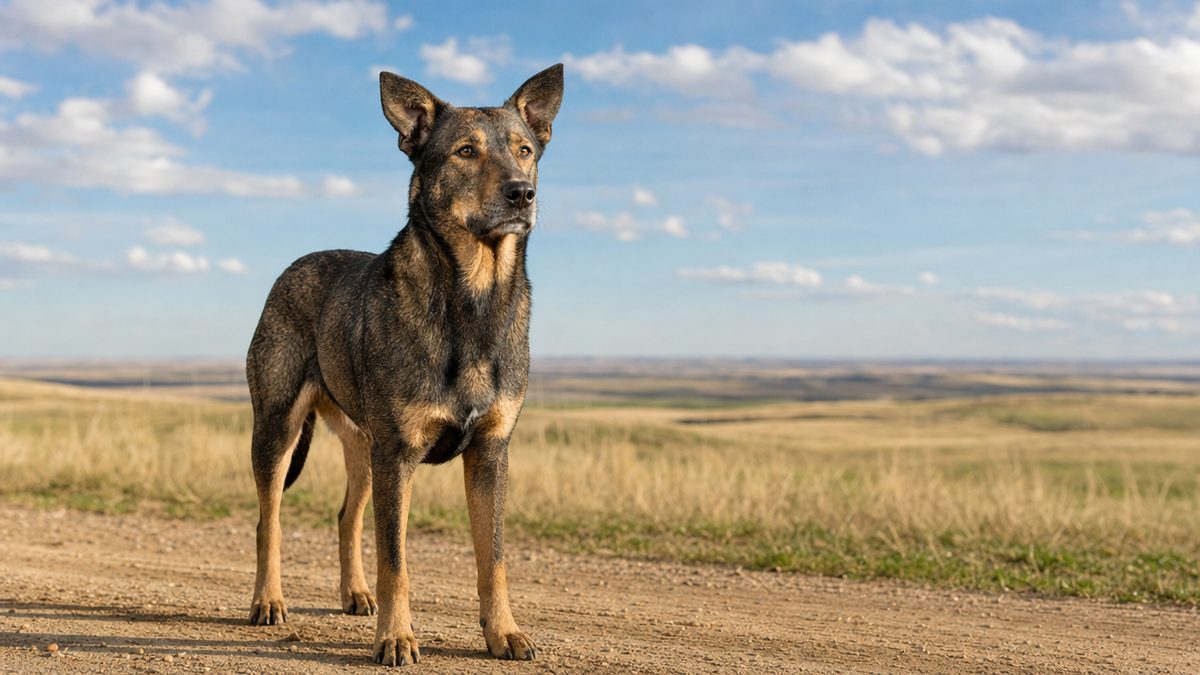
A rez dog is a free-roaming dog living on a Native American reservation in the United States or a First Nations reserve in Canada, and the term names where a dog lives and how it lives rather than what it is descended from. It is not a breed, and it is not one kind of animal.
The most precise definition available comes from a doctoral thesis written by an Oglala Lakota scholar who lives on the reservation she studied. Camille Griffith puts it in one sentence: rez dogs "are not differentiated biologically from other populations of free-roaming dogs but rather by political, socio-economic, and cultural differences";. That is the deciding statement on this page, and everything else follows from it.
Read what it rules out. It rules out a breed. It rules out a type in the usual sense of a regional physical form. What it names is a category defined by history and politics, and Griffith says that too, directly: "The 'rez dog problem' is also a construct of settler colonialism."
The term also describes a relationship, not just a location
Two Oglala Sioux writers describe what that relationship looks like from inside it, and it does not map onto the ownership model most readers will bring. Richard Meyers and Ernest Weston Jr write: "In our culture, people traditionally don't own animals the way other cultures have pets; the animals are left wild, and may choose to go to a home to offer protection, companionship, or even to become a part of a community. People feed the dogs and care for them, but the dogs remain living outside and are free to be their own beings";. They add that this "differs from one where the human is the master or owner of an animal who is considered property", and describe it as "a mutual relationship of reciprocity and respect".
That is why calling these animals "strays" as a blanket term is inaccurate rather than merely unkind. A dog that is fed, named and watched over but not confined is not a stray, and the word imports an ownership frame the community may not use.
A caution this page takes from the researchers themselves
Every cultural statement below is attached to a named nation, because the researchers insist on it. The MHA Nation study states plainly that "Indigeneity is not a monolithic cultural identity, and all tribal communities have distinct cultural values and traditions";, and warns that animal service providers should not extrapolate community-specific programmes to other communities. Where this page says Lakota, it means Lakota. Where it says MHA Nation, Navajo Nation, Siksika or Ermineskin Cree, it means those.
Indian readers search this term because of a television series, and land on pages that treat the animals as a curiosity or as a rescue appeal. India has its own very large free-roaming dog population and its own vocabulary for it, so an Indian reader is unusually well placed to understand what the term actually describes. The last section is about that.
Bonbeno's two-condition test, applied to a term that is not about descent
To count as a breed on this site an animal needs two documents: a written breed standard and a studbook. No rez dog has either, no registry holds the name, and the deeper point is that the term was never making a claim about ancestry in the first place.
The registry half was checked rather than assumed, in six indexes, each with a control breed that returned on the same fetch.
| Condition | Verdict | Evidence |
|---|---|---|
| A written breed standard | None, and none possible | No registry, club or author publishes points, a height range or a weight range, because the term does not describe a physical form. Griffith's thesis states that these dogs are not biologically differentiated from other free-roaming dog populations |
| A studbook | None | Absent from the AKC's 298-name index, the UKC's 387 entries across all nine groups including its Bloodlines Listing Service, the FCI letter R index and provisional register, the Royal Kennel Club's 227-breed A to Z and the Canadian Kennel Club's 231 breeds, each read with controls that returned |
| Is the name a bloodline name? | No. It is a place-and-relationship word | Rez is short for reservation. The term names where and how a dog lives. Wikipedia's own infobox for it sets species Dog and leaves the breed field completely blank, and files it under Feral dogs and Native American slang rather than any dog-breed category |
| Is there a closed population? | No, and deliberately not | Free breeding is the defining condition. Griffith's camera-trap work at Pine Ridge measured rez dog occupancy at 0.83 per site and abundance at 8.18 dogs per site across 73 sites, with the best occupancy predictor being distance to the nearest residence |
| Does the term describe people too? | Yes, and that matters | Meyers and Weston record that rez dog is also applied to people, and Wikipedia notes it has become a metaphor for reservation life itself. A word that names both a dog and a person is not a breed name |
| Formal verdict | Type, and barely that | It fails both documentary conditions, and it fails the prior question too, because it was never a claim about descent. The precise description is a population category defined by geography, politics and a particular human relationship |
What the term is confused with, and the contrast that clarifies it
The Carolina Dog is the useful comparison, because it is what happens when somebody does try to make a breed out of free-ranging North American dogs. The UKC recognised it on 1 January 1995 and files it in the Sighthound and Pariah Dog group, and its standard records that Dr I. Lehr Brisbin trapped free-ranging dogs in the southeastern United States in the 1970s. Note how the standard phrases the origin claim: it was "hypothesised that these dogs could be descendants of the canines that originally crossed the Bering Land Bridge". Hypothesised, in the registry's own document.
Two further details are worth having. The AKC records the Carolina Dog in its Foundation Stock Service since July 2017, and the AKC states in writing that "Recording of a dog in the Foundation Stock Service does not constitute AKC recognition";. And the AKC's own page lists "Indian Dog" among the Carolina Dog's alternate names, which is worth knowing because an Indian reader meeting that phrase online is meeting an American breed's nickname, not anything to do with India.
Two private bodies register dogs under the names American Indian Dog and Native American Indian Dog. One is a single kennel operating its own copyrighted registry and reporting about 450 dogs in its studbook; the other is a preservation project reporting over 900 documented dogs and tracing to its own foundation lines. Both figures are self-reported and unaudited, and neither body is equivalent to the AKC, UKC or FCI. A dog sold under those names is not a rez dog either.
Do rez dogs carry pre-contact American dog ancestry? The honest answer is that nobody has tested them
No published genetic study has sampled rez dogs from United States reservations or Canadian reserves as such, and the wider literature on American dogs points away from the romantic answer rather than towards it.
This section exists because the claim is everywhere and the evidence is not.
The largest study of dogs in the Americas found that "the majority of modern American dog populations, including 138 village dogs from South America and multiple 'native' breeds (e.g., hairless dogs and Catahoulas), possess no detectable traces of"; pre-contact dog ancestry. It identified two modern American dogs carrying pre-contact mitochondrial haplotypes, consistent with a limited degree of that ancestry, under 2 percent, in modern American dogs. Its conclusion is blunt: "our results suggest that European dogs almost completely replaced native American dog lineages", a near-disappearance the authors link to the arrival of Europeans and to "the persecution of indigenous dogs".
On the Carolina Dog specifically, the same paper is careful in a way its downstream citations are not. It detected varying pre-contact or Arctic ancestry in three individual Carolina Dogs, and then says the analysis "could not distinguish between PCD and Arctic ancestry, and we cannot rule out that this was result of admixture from modern Arctic dogs";.
The one clear exception, and why it is an exception
There is a single documented case of an Indigenous North American dog with dominant pre-colonial ancestry surviving into the colonial period, and it is not a rez dog. Mutton, a Coast Salish woolly dog pelt collected in 1859, is described as "the only known example of an Indigenous North American dog with dominant pre-colonial ancestry postdating the onset of settler colonialism", in a study that integrates genomics with interviews with Coast Salish Elders, Knowledge Keepers and weavers. Bonbeno's page on the Salish Wool Dog: The Extinct Coast Salish Woolly Dog covers that animal in full.
Targeted searches for genetic work sampling reservation or reserve dogs as a population returned nothing, against a control of 5,150 for dog and breed in title or abstract in the same session. So it is accurate to say that pre-contact American dogs left a minimal genetic legacy in modern American dogs generally, and inaccurate to say that rez dogs specifically carry documented pre-contact ancestry. Nobody has looked.
Say what that means plainly. The dogs are almost certainly of mixed ancestry of ordinary modern origin, which is what Meyers and Weston imply when they write that at Pine Ridge "it doesn't seem to be a particular breed (or hybrid mix) that is the issue but more the phenomenon of the animals organizing into packs". Their significance is cultural and historical, and it does not depend on a genetic claim that has not been made.
One footnote on how thin the indexed literature is, and how easily a searcher could miss it. PubMed returns exactly two records for the phrase in title or abstract, and one of them is a media-studies paper about the television series rather than about dogs at all. So half of this subject's indexed presence in the biomedical literature is about a comedy-drama, which is worth knowing before you verify any claim against a result count.
What rez dogs mean in the communities they live in, nation by nation
The cultural place of these dogs is documented in peer-reviewed work and in Indigenous-authored writing, and it differs between nations, so every statement below is attached to the nation that made it.
Start with the MHA Nation study, because it is the one that asked and recorded systematically. Fourteen one-hour interviews with Mandan, Hidatsa and Arikara Nation members on the Fort Berthold Reservation, conducted in 2016, with recruitment directed by Dr Michael Yellow Bird, an MHA Nation member.
Its central finding, verbatim: "For many members of the MHA Nation who participated in this study, rez dogs are more than companion animals; they are spiritual allies and protectors of the land and people." One participant said simply, "We have origins that include the dog. There were songs for it." Another framed it as a health indicator: "You can gauge the health of the community by the health of their animals and vice versa."
Yellow Bird has written the same thought elsewhere in the first person: "Whenever I visit tribal communities, I am always on the lookout for my relatives, the rez dogs... The condition of dogs in our communities is a reflection of us. If they are sick, it is because we are also sick";.
The Lakota material, attached to the Lakota
Meyers and Weston, both Oglala Sioux, record several things specific to Lakota thought.
- In the Lakota language there is no hierarchy of animals. All animals, including people, horses and dogs, belong to *oyate*, and none holds dominion over others. The authors describe the idea of humans at the top of a chain as a colonial one.
- **A dog, *sunka*, was seen as a sacred being** that protects camps and provides various sacred rites.
- The word for dog was extended to the horse, which became *sunka wakan*, another kind of sacred dog.
- The term is applied to people too, and the authors note it can be used of a younger person in a tribal community who seems to outsiders to be walking through life without purpose, which they present as an area of misunderstanding between cultures.
The disagreement inside the evidence, which is itself the finding
Communities do not agree, and one study found the disagreement inside a single nation. The MHA Nation researchers report that "there was disagreement on how many there are and if they pose a negative issue for the community. While some tribal members felt strongly that the dogs were an issue for their community, others felt that the dogs were not an issue at all". Griffith's survey at Pine Ridge found something closer to consensus, with 88 percent of 107 respondents saying dog overpopulation is a problem.
Those are two different nations and the difference between them is the point. Neither result generalises to the other, and a page that picks one has flattened the thing the research was designed to show.
How tribal nations actually govern these dogs, from their own enacted law
Tribal nations legislate on dogs, and their laws are public, specific and considerably more interesting than the coverage suggests. Two are quoted below from the enacted text rather than from reporting about it.
The Oglala Sioux Tribe's Animal Control Code contains one clause that expresses the whole reciprocity idea in legal language, and it is worth reading twice.
"Harboring or feeding an animal for twenty-four (24) hours or more shall constitute ownership by the person feeding the animal." A community where people feed dogs they do not confine needed a rule about what feeding means, and this is it: care creates responsibility, at twenty-four hours.
The rest of that Code is ordinary animal-control law: a 5 dollar registration fee, a 25 dollar adoption fee, impoundment at 20 dollars plus 3 dollars a day, mandatory rabies vaccination at six months with boosters every three years, and a prohibition on abandonment. It regulates vicious animals behaviourally and contains no breed-specific ban.
The Ermineskin Cree Nation law, and its preamble
Ermineskin Cree Nation in Alberta enacted its Animal Control Law under section 81 of the Indian Act, and published it in the First Nations Gazette. Its preamble grounds the law in "a long-standing traditional and spiritual relationship with domesticated animals, in particular dogs (atimwak)", and in the Ermineskin Tribal System Constitution, the United Nations Declaration on the Rights of Indigenous Peoples, section 35 of the Constitution Act 1982 and Treaty No. 6 of 1876.
Its operative provisions are specific. Dog licences cost zero dollars, for intact and neutered dogs alike, with a 100 dollar fee only for a Dangerous Dog, which must carry liability insurance of not less than one million dollars. Section 23.02 prohibits punishing or abusing a dog in a manner that is cruel, unnecessary or likely to cause negative psychological consequences. Section 26.04 prohibits abandonment.
And section 26.05 speaks directly to the outside-rescue problem, providing that any person purporting to exercise authority under Alberta's Animal Protection Act on the reserve must notify the Nation's Animal Control Officer before attending.
The scale problem, in one nation's own numbers
The Navajo Nation Council published figures in 2021 that show what enforcement capacity actually looks like.
| Measure | Figure |
|---|---|
| Estimated dogs on the Nation | Approximately 500,000 feral and domestic, per Senior Animal Control Officer Joe Begay |
| Animal control officers patrolling | Seven |
| Dogs captured in 2020 | 8,000, against up to 30,000 in previous years |
| Cost to reach five officers per agency | 3.1 million dollars |
| Dogs permitted per household | Up to four, under Council Resolution No. CJY-64-18 amending Title 13 |
That 500,000 figure is disputed and this page prints the disagreement. Other sources attribute an estimate of 250,000 to Navajo Nation animal control. The denominators differ, since 500,000 is given as feral and domestic together while 250,000 is usually framed as strays, which may partly but not wholly explain the gap. Both are officer estimates and neither is a census.
One figure in that release should not be repeated as fact. The claim that one mating pair can produce up to 5,700 dogs in five years belongs to a family of advocacy arithmetic whose variants contradict each other, and it is attributed in the release to an officer's estimate rather than to a study. Quote it as an official statement if at all.
The history that explains the mistrust
Dog control on reservations has a documented history that is not neutral. In the 1950s the Bureau of Indian Affairs managed the Navajo Reservation's free-ranging dog population by scheduling semi-annual "dog shoots";, and after one such shoot killed seventeen dogs in Chinle, Arizona, community members pressed local BIA authorities to reform reservation dog control. The MHA Nation study records the legacy directly, with one participant explaining that animal control "is perceived as dog catchers, or dog killers even";.
The rescue question, and why Indigenous writers are critical of it
Outside rescue organisations remove dogs from reservations and reserves, and Indigenous scholars, journalists and dog owners have documented serious problems with how that is done. A page that presented rescue as an unambiguous good would be taking one side of a live argument.
Start with the peer-reviewed statement, because it is the least contestable. The MHA Nation study records that non-profit sheltering and rescue organisations have been the primary providers of animal services in Indigenous communities globally, and then says: "the literature indicates that this approach is ineffective, resource intensive, and unsustainable as a long-term strategy";.
Griffith is sharper, and writes as someone from the community being rescued from. She notes that "there is no protocol for determining ownership" when outside groups remove dogs, and describes a "'saviorism' mentality in which colonial aristocracy 'save' dogs from the lower classes", adding that "the dog overpopulation problem currently recognized within Native American communities did not originate within these communities";. She also observes that most reservation animal welfare programmes are initiated and controlled by off-reservation organisations that may have limited knowledge of cultural norms.
Meyers and Weston put it in one sentence: "There is something awkward, however, about outside groups swooping into the reservation to save dogs, extracting them from their native culture to live healthy, happy lives in mainstream America";.
A documented case, with a named person
APTN's investigation supplies a first-hand account. Amber Twoyoungmen of Morley, Alberta, a Stoney Nakoda community, found her missing dog Marley listed by a rescue group online. In her words: "I was hearing about people getting their animals taken so curiosity led let me to this rescue group online. I look through all their posts, I saw a picture of Marley there and I was thinking why is he on here." The rescue had described Marley as unloved and abandoned, and as a teenager she felt unable to challenge the commenters and never tried to get him back.
The same investigation records that rescues can make upwards of 600 dollars per adopted dog, and journalist Kathleen Martens makes a comparison worth sitting with: this "happens with farm dogs too yet rescue organizations haven't turned stealing them into a profitable market";.
How the coverage itself is part of the problem
A peer-reviewed analysis of Canadian national broadcaster coverage found that it portrayed dogs as "strays", focused mainly on removal whether by rehoming or culling, portrayed rescue groups as "animal lovers", and "did not highlight systemic injustices" affecting dog health and welfare in Indigenous communities. That is a finding about the genre this page belongs to, and it is the reason this page does not open with dog attacks or lead with a call to donate.
What Indigenous-led work looks like instead
Several organisations are run by people from the communities they serve, and their framing differs.
- Diana Webster, White Earth Band of Ojibwe, founded the Native American Humane Society in 2014, and describes the shift in her own thinking: "We were going into communities and finding that people really love their animals, but they don't have the resources or access to the services that their animals need."
- Leah Arcand, Muskeg Lake Cree Nation, founded Save Rez Dogs, with co-lead Craig Edes, Gitxsan.
- Vernan Kee and Chantal Wadsworth, Navajo Nation, run Rez Road Adventures.
- Dorothea Stevens, a public health nurse with San Carlos Indian Health Service, runs the Geronimo Animal Rescue Team, and frames it as recovery of a norm: "As Apaches we respect all animals and we were raised that way a long time ago, but we don't see this happening anymore."
- Shellee Green, Swan Lake First Nation, describes her role differently again: "I'm more just an animal guardian watching over, asking people if they need to surrender their animals, if they need help with these animals".
Michael Yellow Bird names the distinction that runs through all of this: the difference between being "a rescuer and a supporter";, and adds that central to it is not making assumptions. A Nakoda documentary offers the word *Ahomapeni*, which its director describes as "a Nakoda word acknowledging a being's right to exist in its own way, similar to the English concept of respect".
Health and welfare, with the figures that exist and the framing they need
The documented health issues of free-roaming dogs in these communities are dominated by parasites, tick-borne disease and lack of veterinary access rather than by inherited disease, and the strongest figures concern Rocky Mountain spotted fever in Arizona and Brucella canis in South Dakota.
There is no breed here, so there is no inherited-disease profile and no life expectancy figure, and this page prints neither. What exists is population health data, and it is good data.
Rocky Mountain spotted fever, and the vector Indian readers will recognise
An ongoing epidemic of Rocky Mountain spotted fever has affected tribal communities in Arizona, with nearly 500 cases and 28 deaths since 2003. An earlier study recorded more than 250 cases and 19 deaths among Arizona's American Indian population between 2003 and 2012.
**The vector is *Rhipicephalus sanguineus*, the brown dog tick**, which is the same species that dominates tick-borne disease in India. That makes this the one section of this page with direct technical relevance to an Indian reader, and it also supplies the clearest evidence anywhere that community-level intervention works.
The intervention study is worth the detail. In a community-based tick-control programme, fewer than 1 percent of dogs in the intervention community had visible tick infestations five months in, against 64 percent of dogs in comparison communities. The San Carlos Apache Tribe has run prevention work for nearly a decade using tick collars on dogs, pesticide treatment around homes and education.
Brucella canis, and how to read its two numbers
A study of 3,898 dogs rescued from South Dakota Indian reservations between 2015 and 2019 found an overall apparent *Brucella canis* seroprevalence of 6.8 percent, with an adjusted estimated true prevalence of 29.4 percent, and rates declining over time.
Those two figures are not a contradiction and neither is 'the' rate. The apparent figure is what the screening test showed; the adjusted figure corrects for test performance. Quote both with their labels, and note the denominator: these were dogs already entering a rescue pipeline, not a random sample of dogs on those reservations.
Two figures that push back on the alarm framing
The MHA Nation study contains two findings that rarely survive into coverage. Animal control officers who participated estimated that they see only 10 to 20 cases of dog bites per year, and, notably, "the participants did not describe rabies as an issue in their community";. Griffith's Pine Ridge survey found a different picture on bites, with 36 percent of 107 respondents reporting having been bitten by a dog. Two nations, two pictures, and both are in the record.
The literature also cuts both ways on whether roaming itself is bad for dogs. The MHA Nation paper cites work finding people more likely to be attacked when approaching dogs that are chained up, fenced, or owned, work in Bali finding free-roaming dogs calmer and less likely to attack than owned and kept dogs, and states that there are "clear benefits to the dogs themselves in allowing them to roam freely";.
Griffith's Pine Ridge survey found 74 percent of respondents believed all dogs should be spayed and neutered, 76 percent believed travelling spay-and-neuter clinics could effectively control populations, and 60 percent did NOT believe lethal control would be effective against 25 percent who did. The community's own view is veterinary access, not removal. Consult your nearby vet for any decision about a real dog in front of you.
Temperament, and why a single profile would be dishonest
No temperament profile can be valid for rez dogs as a category, because they are not one population and no standard defines them, and the traits most often attributed to them are consequences of how they live rather than of what they are.
What can be said honestly is behavioural rather than dispositional. A dog that has grown up navigating land, weather, traffic and other dogs without confinement becomes resourceful in ways a dog raised in a flat does not, and those competencies are situational rather than genetic.
The pack observation is the one that recurs in the sources, and it is specific. Meyers and Weston, writing about Pine Ridge, say "it doesn't seem to be a particular breed (or hybrid mix) that is the issue but more the phenomenon of the animals organizing into packs";. That is a statement about group behaviour under particular conditions, not about individual temperament, and it is the correct level at which to make the point.
A columnist writing in an Indigenous newspaper draws the practical distinction most usefully: there are "two types of rez dogs", those that run in packs as wild dogs and cause issues, "thereby giving all rez dogs a bad name", and "the ones that are owned by folks living on whatever reservation and who take care of their animals as well as they can". His own two dogs were a Belgian Shepherd found on Rosebud and a husky mix from Kyle, which is itself useful evidence against reading the term as a breed.
If you are considering a specific dog from a reservation or reserve rescue, no category-level claim will tell you anything useful about it. Ask the foster carer what this animal does around children, other dogs, traffic and confinement. An individual assessment is the only valid one here, and that is true of any dog whose background is unknown.
Training a dog that grew up free-roaming
To train a formerly free-roaming dog, build confinement tolerance gradually, reward recall heavily from the first day, and expect the animal to have real problem-solving ability and no reason yet to defer to you.
The training task is not remedial. It is a transition from one competent life to a different one, and the dog is starting with a skill set most pet dogs never develop.
- Introduce confinement in short, rewarded steps. A dog that has never been shut in may find a closed door genuinely alarming, and forcing it produces exactly the escape behaviour you are trying to prevent.
- Reward recall more than anything else. It is the single skill that keeps a formerly roaming dog alive in a city, and it competes against a lifetime of self-directed movement.
- Expect resourcefulness around food, bins and gates. These are learned competencies rather than faults, and management works better than correction.
- Build handling tolerance deliberately, since a dog with limited veterinary history may never have been restrained, examined or groomed.
- Give the dog a decompression period before judging anything about it. Assessments made in the first fortnight describe a dog in transit.
That approach transfers almost exactly to an Indian street dog moving into a home, which is why the last section of this page is worth reading even if North America is not.
Daily exercise for a dog used to covering ground
A formerly free-roaming dog needs at least an hour of real activity a day plus mental work, because it is used to setting its own route and pace across a large area.
Griffith's camera-trap work gives a sense of the scale these dogs operate at: occupancy of 0.83 per site with abundance averaging 8.18 dogs per site across 73 trail-camera sites, with the strongest predictor of occupancy being distance to the nearest residence. These are animals moving purposefully through a landscape, not sitting still.
- Two walks daily, totalling an hour or more, on a secure harness rather than a collar during the first months.
- Scent work indoors, which does a disproportionate amount of the mental load for a dog used to reading an environment.
- Long-line work in an open space, so the dog gets to make choices without the risk of losing it.
- In India, the cool hours only, early morning and after dark, with the ground temperature checked by hand before you walk.
Grooming, and what a coat tells you about where a dog came from
Grooming needs for these dogs vary completely, because coat type varies completely, and that variation is itself the clearest visible evidence that the term names no single population.
A short-coated dog from the Arizona plateau and a heavy-coated dog from northern Manitoba have nothing in common groom-wise, and both are rez dogs. Assess the animal in front of you.
- Short single coat, weekly brushing and little else, with sun protection considered for thin-coated dogs in Indian summers.
- Double coat, two to three brushings a week with an undercoat rake and daily during a moult, and complete drying to the skin after any bath in humid weather.
- All coats, a weekly skin and tick check down to the skin, which matters more for a dog with an outdoor history than for one raised indoors.
- First grooming sessions, kept short and rewarded, since a dog with no handling history may find them genuinely novel.
Budget realistically if you cannot dry a heavy coat at home. A full bath and styling in Delhi starts at Rs 1,869 and a bath alone from Rs 934.
Rez dog price, and why the only figures attached to these dogs are adoption fees
Rez dogs are not sold as a breed and no purchase price exists for them, and the only money documented in the literature moves in the other direction, as adoption fees charged by rescue organisations.
This is the rare page on this site where the price question has a clean answer: there is no price, because there is no product. The term names free-roaming dogs living in communities, and nobody breeds them to sell.
What the record does document is adoption revenue. APTN's investigation reports rescue organisations making upwards of 600 dollars per adopted dog, in the context of a segment about groups removing dogs without establishing ownership. The Oglala Sioux Tribe's own Code sets an adoption fee of 25 dollars, which is a useful comparison: a tribal government's fee and an outside rescue's fee differ by more than twenty times.
For an Indian reader, the equivalent question
No rez dog is available in India and none can lawfully be imported to sell. Dogs are a Restricted import under ITC(HS) 01061900, and applications to import for trading or breeding purposes are to be duly rejected. There is also no reason to want one imported, since India's own free-roaming dog population is enormous and the equivalent dog is on your street.
It is not one. The likeliest possibilities are a local dog relabelled with a term the seller found online, or a listing shell that exists identically for every breed name. Ask which register holds the dog and what its number is, and note that no register anywhere holds this name.
Monthly cost of keeping a medium mixed-breed dog in India
A medium mixed-breed dog costs roughly Rs 4,000 to Rs 9,000 a month to keep properly in an Indian metro, and the figures below are published Indian rates rather than estimates.
Since the North American animal is unavailable and unnecessary, these are the costs for the equivalent Indian dog: a medium, short-to-medium-coated, mixed-ancestry, climate-adapted animal.
| Item | Published rate | Source and caveat |
|---|---|---|
| Puppy core vaccination course | From Rs 6,499 | Vetic national page, a promotional floor from one chain; the same chain quotes Rs 7,199 on its Mumbai page the same day |
| Annual booster | From Rs 3,199 | Same chain, same caveat |
| Anti-rabies, single | Rs 699 | Against which Greater Chennai Corporation's six municipal clinics give anti-rabies vaccination FREE |
| Consultation | Rs 500 to Rs 1,000 | ONE data point, not two: a stray-dog charity and a general insurer publish byte-identical ranges, so one copied the other |
| Tick and flea control, monthly | Rs 1,103 | NexGard Spectra 15-30 kg. For a dog with an outdoor history this is the least optional line on the table |
| Grooming | Bath from Rs 934 | Vetic Delhi. A short-coated Indian dog needs far less of this than an imported double coat |
| Municipal registration | Rs 500 in Delhi, Rs 50 in Chennai | Delhi registers pet dogs only; Chennai licenses pet animals generally and issued 9,115 licences in 2024 |
The cheapest dog to keep well in India is one adapted to India, which is the practical conclusion this page shares with every Bonbeno page about an imported breed, reached from the opposite direction.
The climates these dogs actually live in, and one striking parallel with Delhi
Reservation and reserve lands span climates from the northern Great Plains to the Colorado Plateau, and one of them turns out to run almost exactly Delhi's annual mean relative humidity, which is worth an Indian reader's attention.
Three points were measured, chosen because they are named in the sources: Pine Ridge in South Dakota, where Griffith worked; Window Rock in Arizona, the Navajo Nation's seat of government; and New Town in North Dakota, on the Fort Berthold Reservation where the MHA Nation study was conducted.
The cell check, done before any figure was used
NASA POWER returns a grid cell, not a point, and its cells are wrong by hundreds of metres in mountains. All three points here are on plains or plateau and all three cells are usable: Pine Ridge is 34.7 m out, Window Rock 59.4 m and New Town 50.6 m. That is consistent with the general pattern that POWER fails in mountains and is reliable on flat ground.
| Place | Cell elevation vs real | Annual mean | Warmest month | Coolest month | Annual mean RH |
|---|---|---|---|---|---|
| Pine Ridge, South Dakota | 1,064.69 m vs ~1,030 m (+35) | 9.78 C | 25.45 C (Jul) | -2.71 C (Jan) | 58.4% |
| Window Rock, Arizona | 2,119.42 m vs ~2,060 m (+59) | 10.72 C | 23.20 C (Jul) | -0.50 C (Jan) | 46.1% |
| New Town, North Dakota | 650.63 m vs ~600 m (+51) | 5.86 C | 22.38 C (Jul) | -10.09 C (Jan) | 68.9% |
| Delhi | 206.37 m vs 216 m (-10) | 25.57 C | 35.88 C (Jun) | 13.61 C (Jan) | 45.5% |
| Chennai | 48.95 m vs 6 m (+43) | 27.94 C | 31.51 C (May) | 24.09 C (Jan) | 72.4% |
| Bengaluru | 841.72 m vs 920 m (-78) | 23.74 C | 28.37 C (Apr) | 20.22 C (Dec) | 67.8% |
| Pune | 635.99 m vs 560 m (+76) | 23.86 C | 28.93 C (Apr) | 19.62 C (Dec) | 66.7% |
| Kolkata | 7.35 m vs 9 m (-2) | 25.80 C | 31.53 C (May) | 17.31 C (Jan) | 73.8% |
| Hyderabad | 494.59 m vs 505 m (-10) | 26.09 C | 33.30 C (May) | 20.76 C (Dec) | 60.2% |
The parallel worth noticing
Window Rock, Arizona runs an annual mean relative humidity of 46.1 percent. Delhi runs 45.5 percent. Two places about 12,000 km apart, on different continents, with essentially the same annual humidity. What separates them is heat: Window Rock averages 10.72 C across the year against Delhi's 25.57 C, a gap of nearly fifteen degrees.
So a dog from the Navajo Nation would find Delhi's dryness ordinary and Delhi's heat extreme, while a dog from Fort Berthold, at 68.9 percent annual humidity, would find Kolkata's 73.8 percent unremarkable and its winters startlingly mild. Neither is a dog you should import, and the comparison is here because it shows how badly "adapted to a harsh climate" travels as a claim. Harsh in which direction is the question that matters.
Note also the warmest-month column, which catches people out. Delhi peaks in June, not May, and Bengaluru and Pune both peak in April and are coolest in December. Chennai, Mumbai and Kolkata do peak in May.
Feeding a dog with an unpredictable nutritional history
Feed a formerly free-roaming dog a complete commercial diet in measured meals, start conservatively, and expect to correct either underweight or a scavenging habit rather than to follow a breed chart.
There is no breed here and therefore no breed feeding guidance, which is a relief rather than a gap: feed to body condition, which is what every breed chart is a proxy for anyway.
- Start with small, frequent meals if the dog arrives underweight, because refeeding too fast causes its own problems.
- Measure portions rather than free-feeding, since a dog with a scavenging history will usually eat everything available.
- Deworm and treat for parasites on arrival, on a vet's schedule, because weight gain will not happen while a parasite burden persists.
- Manage bins, counters and gates, since resourcefulness around food is a learned competence and management beats correction.
- Adjust for the Indian climate, with water available continuously and intake watched in summer.
Month by month with a puppy of unknown ancestry
The first year with a puppy of unknown ancestry follows the ordinary veterinary schedule, with one difference: you cannot predict adult size, so every size-dependent decision has to be deferred or made generously.
- Months 0 to 2. The puppy stays with its dam. Indian law is explicit that pups under eight weeks are not to be sold, at Rule 8(1)(a) of the Dog Breeding and Marketing Rules 2017.
- Month 2 to 4. Core vaccination course, from about Rs 6,499 at one national chain. Socialisation to traffic, crowds and handling, which matters more for a dog that may already have formed opinions about people.
- Month 4 to 6. Monthly parasite control begins, about Rs 1,103 for a 15 to 30 kg dog. Municipal registration, Rs 500 in Delhi or Rs 50 in Chennai. Buy the crate one size up, because you do not know how big this dog will get.
- Month 6 to 9. First hot season. Move exercise to the cool hours regardless of coat.
- Month 9 to 12. Adult size becomes apparent. Revisit food quantity, harness size and any size-dependent medication dosing with your vet.
Rez dog against the categories it is confused with
Four things get confused with each other under this term, and separating them is most of what a reader needs.
| The thing | What it actually is | Registry position |
|---|---|---|
| Rez dog | Free-roaming dogs on reservations and reserves, defined by geography, politics and relationship rather than by descent | None, and none possible |
| Carolina Dog Price in India, Heat and Health Guide | A specific breed developed from free-ranging dogs of the southeastern United States, with a written standard | UKC recognised 1 January 1995; AKC Foundation Stock Service since July 2017, which is not recognition |
| Reservation Dogs | A television series created by Sterlin Harjo and Taika Waititi for FX Productions, 2021 to 2023, three seasons, 28 episodes | Not a dog |
| Indie Dog: Indian Pariah Dog Breed and Care Guide 2026 | India's own free-roaming population, the closest real-world analogue to what the rez dog term describes | See that page for the Kennel Club of India position |
The television series, since it dominates the search
Reservation Dogs is an FX production that premiered on Hulu on 9 August 2021, the International Day of the World's Indigenous Peoples, and ended on 27 September 2023 after three seasons and 28 episodes. It is described as the first American series to feature all-Native American writers and directors along with an almost entirely Indigenous North American cast and crew.
Two details matter for anyone using it as a way in. It is set in rural Oklahoma rather than on a reservation in the technical sense, a point Wikipedia footnotes with reference to the 2020 Supreme Court decision in McGirt v. Oklahoma. And its title uses the slang-for-people sense, not the canine one: the teenagers call themselves the Reservation Dogs. That is the same usage Meyers and Weston document.
Streaming availability varies by country and changes over time, so check a current listing for India rather than trusting any page's claim about it, including this one.
Mistakes to avoid when writing or reading about these dogs
The six mistakes below are the ones that make otherwise careful writing about rez dogs wrong or disrespectful, and most of them appear in sources a reader would reasonably trust.
- Treating it as a breed. No registry holds the name, no standard exists, and the scholar closest to the subject states that these dogs are not biologically differentiated from other free-roaming dog populations.
- Calling them strays as a blanket term. That is the exact framing a peer-reviewed media analysis criticised in national broadcaster coverage, and it is contradicted by a tribal law that makes twenty-four hours of feeding into ownership.
- Generalising across nations. The MHA Nation study says Indigeneity is not a monolithic cultural identity and warns against extrapolating between communities. Two nations in this page's own evidence disagree about whether the dogs are a problem at all.
- Claiming pre-contact ancestry. Nobody has sampled these dogs, and the largest study of American dogs found European lineages almost completely replaced native ones.
- Leading with attacks and child deaths. Those events are real and documented, and leading with them reproduces the media pattern the research identifies. This page reports the bite and mortality figures in the health section, in context.
- Presenting rescue as an unambiguous good. Indigenous scholars, journalists and dog owners have documented removal without establishing ownership, a saviourism framing, and adoption fees of several hundred dollars.
Searching PubMed for the singular 'reservation dog' in title or abstract returns ZERO. The plural returns 2, which is the entire indexed literature under that name, and one of the two is the MHA Nation study. A search running only the singular would have reported no literature at all and been flatly wrong. Controls in the same session returned 5,150 and 126.
Adoption, done in a way the communities themselves endorse
Adopting a dog from a reservation or reserve is a reasonable thing to do, and the sources are clear about what separates a good process from a bad one: ownership established first, community leadership, and support rather than extraction.
The questions below come from the criticisms documented above, turned around.
- Ask how the organisation establishes that a dog is unowned. Griffith's central procedural criticism is that there is no protocol for determining ownership, and the Marley case shows what that failure looks like for a family.
- Ask who leads the work. Griffith's recommendation is direct: let a community member lead the effort and give the resources gained to the community.
- Ask whether the organisation works with the nation on the nation's terms, which is how APTN characterises the groups doing this well.
- Ask what the adoption fee funds, given the documented figures of upwards of 600 dollars per dog against a tribal government's 25 dollar fee.
- Support veterinary access rather than removal, which is what the community surveys actually ask for: 76 percent of Griffith's respondents thought travelling spay-and-neuter clinics would work, and 60 percent rejected lethal control.
For an Indian reader, none of this is actionable directly, and the equivalent is. Adopt from an Indian shelter, and read the Indie Dog: Indian Pariah Dog Breed and Care Guide 2026 guide first. The animal it describes is India's own free-roaming dog, already adapted to your climate, and every argument on this page about relationship, resourcefulness and unfair framing applies to it.
What an Indian reader can actually take from this
India has the closest thing in the world to what the rez dog term describes: a very large free-roaming dog population living in reciprocal, unconfined relationships with the people who feed it, governed by a national legal framework rather than by removal.
The parallel is not decorative. The MHA Nation study itself reaches for India, citing work in which "unrestricted movement (the capability to move freely about a neighborhood regardless of human control) was identified as the most important factor in upholding good welfare for free-roaming dogs", and noting that community feeding and sheltering practices at Fort Berthold "are similar to those documented through research conducted in India".
India's own legal instrument, and the correction most pages have not made
The Animal Birth Control (Dogs) Rules, 2001 have been superseded by the ABC Rules, 2023, and the Animal Welfare Board of India says so in its own handbook: the 2001 Rules were notified "and superseded by ABC Rules, 2023", with the Supreme Court and several High Courts having emphasised the need for their implementation. Any Indian page still citing the 2001 Rules as current is out of date.
That framework is a sterilise-vaccinate-return model rather than a removal model, which is precisely the approach Griffith's Pine Ridge respondents said they wanted and did not have. India's problem is implementation; the North American communities' problem is often that the model itself is not on offer.
The health parallel, which is technical and real
The tick-borne disease burden documented on Arizona tribal lands is driven by *Rhipicephalus sanguineus*, the brown dog tick, and it is the same vector that dominates Indian canine tick-borne disease. Indian surveys of dogs presented at veterinary clinics report high burdens: a West Bengal survey of 584 dogs screened found *Babesia gibsoni* in 76.54 percent and reported that 72.9 percent of the 584 dogs screened carried two or more pathogens.
Say the denominator out loud when using figures like that, because "of the 584 screened" and "of infected dogs" are different claims, and these were clinic caseloads rather than random samples. The transferable finding is the intervention one: community-level tick control took visible infestation from 64 percent to under 1 percent in five months. That is a result an Indian residents' association could act on.
A dog that is fed, known and cared for without being confined is a recognised category of animal in several human societies, including India's, and it is not the same thing as an abandoned dog. Both the Lakota writers and the Oglala Sioux Tribe's own law say so, one in cultural terms and one in legal ones.
Rez dogs: the questions people actually ask
What does "rez dog" mean?
Rez dog is short for reservation dog, and it means a free-roaming dog living on a Native American reservation in the United States or a First Nations reserve in Canada. It names where and how a dog lives rather than what it is descended from. An Oglala Lakota researcher who studied these dogs at Pine Ridge puts it precisely: they are not differentiated biologically from other populations of free-roaming dogs, but by political, socio-economic and cultural differences. The term is also applied to people, and has become a metaphor for reservation life itself.
What breed are Rez dogs?
No breed, and that is not a gap in the record but the answer. No registry anywhere holds rez dog or reservation dog as a breed, checked across the AKC, UKC, FCI, Royal Kennel Club and Canadian Kennel Club with control breeds that returned on the same fetch. Wikipedia's own infobox for the term leaves the breed field completely blank and files it under feral dogs and Native American slang. The dogs are of mixed and varied ancestry, and their coats, sizes and builds vary as widely as their climates do.
Is Rez dogs on Netflix?
The show you are thinking of is Reservation Dogs, and it is an FX production that premiered on Hulu on 9 August 2021 and ended on 27 September 2023 after three seasons and 28 episodes. It was created by Sterlin Harjo and Taika Waititi and is described as the first American series with all-Native American writers and directors and an almost entirely Indigenous cast and crew. Streaming rights differ by country and change over time, so check a current listing for India rather than any article's claim. Note that the series is about Indigenous teenagers in rural Oklahoma who call themselves the Reservation Dogs, and is not about dogs.
Why are there so many Rez dogs?
Because free breeding meets very limited veterinary access, and because the underlying situation is a historical one rather than a local failing. The Navajo Nation Council reported approximately 500,000 feral and domestic dogs with just seven animal control officers patrolling, and costed adequate staffing at 3.1 million dollars. Researchers place the cause in structural terms: an Oglala Lakota scholar writes that the dog overpopulation problem did not originate within these communities and describes it as a construct of settler colonialism. Community surveys ask consistently for spay-and-neuter access, with 76 percent at Pine Ridge saying travelling clinics would work.
Are rez dogs strays?
Usually not, in the sense that word implies. Many are fed, named and watched over without being confined, which is a recognised relationship rather than abandonment. The Oglala Sioux Tribe's own Animal Control Code makes the point legally: harbouring or feeding an animal for twenty-four hours or more constitutes ownership by the person feeding it. Two Oglala Sioux writers describe a relationship of reciprocity in which dogs remain living outside and free to be their own beings. A peer-reviewed analysis criticised Canadian national broadcaster coverage specifically for portraying these dogs as strays.
Do rez dogs have Native American dog ancestry?
Nobody has tested them, so no honest page can say yes. The largest study of dogs in the Americas found that European dogs almost completely replaced native American dog lineages, with under 2 percent pre-contact ancestry detected in modern American dogs, and it explicitly could not distinguish pre-contact from Arctic ancestry in the Carolina Dogs it examined. Targeted searches found no genetic study sampling reservation or reserve dogs as a population, against a control of 5,150 in the same session. The one documented Indigenous North American dog with dominant pre-colonial ancestry is a Coast Salish woolly dog pelt collected in 1859.
Are rez dogs dangerous?
The evidence is mixed and differs between communities, so a single answer would be misleading. Animal control officers in one Mandan, Hidatsa and Arikara Nation study estimated seeing only 10 to 20 dog bite cases a year, and participants did not describe rabies as an issue there. At Pine Ridge, 36 percent of 107 survey respondents reported having been bitten by a dog. The literature also records that people are more likely to be attacked when approaching dogs that are chained or fenced, and one Bali study found free-roaming dogs calmer than owned kept dogs. Where problems occur they are usually associated with dogs organising into packs rather than with any breed. Consult your nearby vet about any specific animal.
Can you adopt a rez dog?
Yes, and the sources are clear about what separates a good process from a bad one. Ask how the organisation establishes that a dog is unowned, because the central documented criticism is that there is no protocol for determining ownership, and one named owner found her missing dog listed by a rescue that described him as unloved and abandoned. Ask who leads the work, since the recommendation from within the community is that a community member should lead and the resources should go to the community. Ask what the adoption fee funds, given documented fees of upwards of 600 dollars per dog against a tribal government's own 25 dollar fee.
Is a rez dog the same as a Carolina Dog?
No. The Carolina Dog is an actual breed with a written standard, developed from free-ranging dogs trapped in the southeastern United States in the 1970s, recognised by the United Kennel Club on 1 January 1995 and recorded in the AKC's Foundation Stock Service since July 2017. Rez dog is not a breed and no registry holds the name. Note two things about the Carolina Dog's own standard: it describes the Bering Land Bridge origin as a hypothesis, and the AKC states in writing that recording in the Foundation Stock Service does not constitute AKC recognition.
What is the Indian equivalent of a rez dog?
The Indian free-roaming or community dog, often called the Indie or Indian pariah dog, is the closest real-world equivalent, and the parallel is drawn by the researchers themselves. The Mandan, Hidatsa and Arikara Nation study cites Indian research finding unrestricted movement to be the most important factor in upholding good welfare for free-roaming dogs, and notes that community feeding and sheltering practices there resemble those documented in India. India also has the legal framework those communities have asked for: the Animal Birth Control (Dogs) Rules, 2001 were superseded by the ABC Rules, 2023, which run on sterilise-vaccinate-return rather than removal.
How long do rez dogs live?
No life expectancy figure exists for rez dogs as a category, and this page prints none, because they are not one population and no study has followed them. What the health literature documents instead is population burden: Rocky Mountain spotted fever with nearly 500 cases and 28 deaths in Arizona tribal communities since 2003, and Brucella canis at 6.8 percent apparent seroprevalence among 3,898 dogs screened from South Dakota reservations. Those describe risk in an environment, not the lifespan of an animal.
Why do people say rez dogs are smart?
Because dogs that navigate land, weather, traffic and other dogs without confinement develop real problem-solving ability, and that is a consequence of how they live rather than of what they are. It is worth being careful with the claim: it is an observation about environment, not a measured cognitive difference, and no study has compared these dogs with any other population on that. The same resourcefulness shows up in a home as skill with bins, gates and counters, which is best handled by management rather than correction.
Compare with similar breeds
Rez dog sits in 1 Bonbeno group. Each one compares it directly against the breeds it is genuinely an alternative to, on the same figures.