
Breed profile
Donggyeongi: Korea's Bobtailed Natural Monument, Explained for India
Gyeongju's naturally bobtailed dog, protected by the South Korean state as Natural Monument No. 540 since 6 November 2012, when roughly 300 animals were being kept. Here is what the tail genetics actually show, and why a naturally bobtailed dog sits on the right side of Indian law where a docked one does not.
Quick answer
The Donggyeongi is a naturally bobtailed Korean spitz from Gyeongju, protected by the South Korean state as Natural Monument No. 540 since 2012, with about 600 animals alive. It is not sold in India and cannot be, because a state-protected Natural Monument is not a commercial animal. Its bobtail is inherited rather than cut, which matters in India, where docking a tail is forbidden but being born without one is not.
This guide is general information for Indian pet owners and is not a diagnosis. Always consult a registered veterinarian near you before acting on anything you read here, and treat any sudden change in your dog's condition as urgent.
Donggyeongi at a glance
What the Donggyeongi is, and where its name comes from
The Donggyeongi is a naturally bobtailed spitz-type dog native to Gyeongju in North Gyeongsang Province, South Korea, and it is the only Korean breed with a short tail. It is also called daeng gyeon or Donggyeong gae, and the state has protected it as a Natural Monument since 2012.
The name records a vanished capital. Donggyeong, written 東京, was the name of the capital of Silla, the medieval Korean dynasty, and that city is now Gyeongju. So the breed's name means, roughly, the dog of the eastern capital, and every Korean source treats the animal and the city as one subject rather than two.
Size and weight, from the country that keeps the records
| Measure | Encyclopedia of Korean Culture | A Western DNA company |
|---|---|---|
| Male weight | 16 to 18 kg | 31 to 55 lb, about 14 to 25 kg, sexes combined |
| Female weight | 14 to 16 kg | not separated |
| Male body length | 52 to 55 cm | not given |
| Female body length | 49 to 52 cm | not given |
| Male shoulder height | 47 to 49 cm | 17 to 22 in, about 43 to 56 cm |
| Life expectancy | not given | 12 to 14 years |
The Korean entry is more specific and more conservative, and it is written by Ha Ji-hong, Professor Emeritus of animal genetics at Kyungpook National University, for the Academy of Korean Studies. The Western figure's upper bound of about 25 kg sits seven kilos above the Korean maximum. Bonbeno prints both because they genuinely disagree, and treats the Korean figures as the better guide.
Appearance
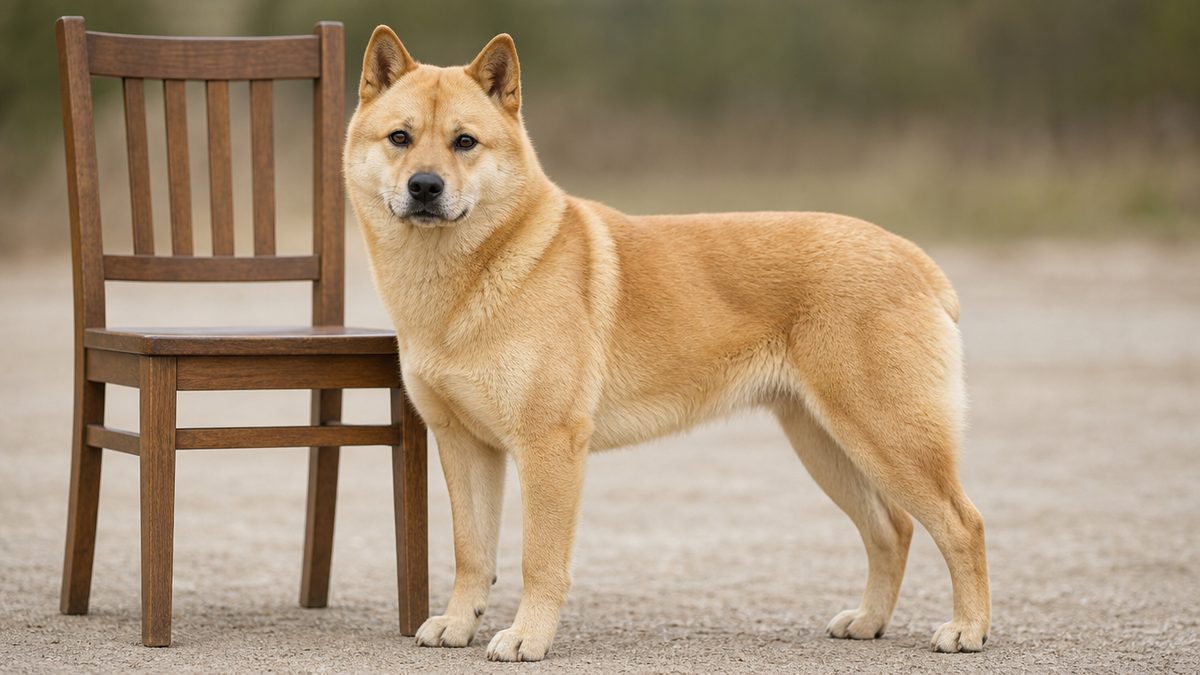
Picture a compact Jindo with the tail missing. Body length exceeds shoulder height slightly, males and females are clearly distinguishable, the muzzle and skull are close to equal in length, the ears prick forward, the nose is black, and the head is carried up at roughly 45 degrees. The back runs level from withers to loin, the chest is deep at about half the height at the withers, and the feet are round with tightly arched toes. Coat colours are recorded as baekgu (white), hwanggu (yellow), heukgu (black) and hogu, the tiger or brindle pattern.
The coat itself is the part that matters for India and it is not in dispute. This is a thick double coat, the standard northern spitz arrangement of a dense insulating undercoat beneath a harsher outer coat. The Akita page covers what that costs an owner in an Indian summer, and everything said there applies here.
Two behavioural details in the Korean entry are worth repeating because no English page carries them. The breed is described as innately fond of people, without aggressive barking, threat, fear or avoidance towards them, and as not attacking unless it senses genuine danger. And because it has no tail to signal with, it expresses pleasure and greeting by wagging its rump and by licking. That is a small observation with real consequences for how a bobtailed dog is read by other dogs and by people.
Two threads run through everything below, its history and its origin, and they are the same thread. The origin is Gyeongju, and the history is that city's: Korean-language sources place the dog in the old records of the region and in clay figures recovered from Silla tombs, and treat that continuity as the reason for its heritage status. Korea's own recognised native breeds number four, the Donggyeongi, the Sapsaree, the Jindo and the Pungsan, with the Bulgae and the Jeju dog unrecognised.
Natural Monument No. 540, verified from Korean government sources
The Donggyeongi is South Korean Natural Monument No. 540, and the designation can be confirmed on a Korean government page rather than taken from an encyclopaedia. The Korea Heritage Service's own notice board publishes a management directive naming the breed by that number.
Go to the designating body. The Korea Heritage Service, which was the Cultural Heritage Administration until its 2024 renaming, carries on its official notice board a directives-and-regulations entry titled Natural Monument Gyeongju-gae Donggyeongi Management Guideline, posted 22 April 2013, with an attached document headed Directive No. 292, Management Guideline for Natural Monument No. 540 Gyeongju-gae Donggyeongi. That page returns HTTP 200 and is live.
A search for the original 2012 designation press release returns a Korean government result whose snippet reads that the Cultural Heritage Administration designated the native Korean dog Gyeongju-gae Donggyeongi as State-designated Cultural Heritage, Natural Monument No. 540. Fetching that URL returns a page-not-found notice. The text is real and the address is dead, which is exactly why a search snippet is not a citation. The directive page above was used instead, because it serves the claim on a page that actually loads.
What the directive actually does
- Preserve through a committee: the guideline establishes and operates a management committee for the Natural Monument Gyeongju-gae Donggyeongi.
- Screen registrations: it sets out provisions on the examination of dogs for registration.
- Protect individual animals from casual movement: it sets out provisions on the removal of dogs from the programme.
- Verify the term: its stated period of effect ran from 16 April 2013 to 15 April 2016, so a reader citing it should describe it as the guideline as issued rather than as necessarily the current text.
The designation date is disputed inside a single Korean source
Two dates circulate and one authoritative article carries both. The Encyclopedia of Korean Culture's structured record gives the designation as Natural Monument, designated 6 November 2012, listing the designating body as the Korea Heritage Service and the classification as natural heritage, natural monument, biological and scientific monument, special category. Its own body text, in the same article, says the breed was designated as a Natural Monument in June 2012.
English Wikipedia says only 2012, without a month, which is the one formulation that is certainly right. The 2017 genome paper likewise says protected as a natural monument in Korea since 2012, Cultural Heritage Administration of Korea number 540. Bonbeno therefore states the year with confidence, notes 6 November 2012 as the date the structured Korean record gives, and flags that the same article contradicts itself rather than picking the more convenient version.
The location on the record is the Donggyeongi facility at 138-14 Yongmyeong Gongdan-gil, Geoncheon-eup, Gyeongju, North Gyeongsang Province. The national heritage portal's own entry page for the record could not be retrieved during this build, so nothing on this page rests on it.
Korean Wikipedia's structured record agrees with the Korean encyclopaedia's infobox: Natural Monument No. 540, designated 6 November 2012, covering the Gyeongju City area, and it cites a news report filed on that same date. Its second reference, to the Cultural Heritage Administration's own announcement, is flagged on the page as a broken link, which is the same dead government URL this build hit independently. Two sources, two encounters with the same missing page, and the designation still verifiable from the directive that replaced it.
Korean Wikipedia states that the Donggyeongi is the only congenitally short-tailed dog in the world, and uses that to argue a Samguk Sagi mention of a short-tailed dog in the Baekje annals must refer to this breed. The premise is wrong. A single study tested 23 other breeds in which naturally bobtailed dogs occur, 360 dogs in all, and found the C189G mutation in 17 of them. Being a Korean-language source does not make a claim right, and this page checks Korean sources the same way it checks English ones.
The bobtail genotype: what has been established for this breed
The Donggyeongi carries a T-gene bobtail variant that is specific to it among Korean breeds, at an allele frequency of 0.20. That is a measured result for this population, not an assumption imported from the Pembroke Welsh Corgi, and the picture inside the breed turns out to be more complicated than one gene.
Start with what the classic bobtail mutation is, because it is the yardstick. The T gene encodes a T-box transcription factor important for normal posterior mesoderm development, and it was mapped to canine chromosome 1q23. A unique missense mutation in a bob-tailed dog and its bob-tailed descendants sits in a highly conserved region of the T-box domain and alters the ability of the T protein to bind its consensus DNA target, and offspring from several independent bobtail by bobtail crosses showed the homozygous phenotype to be embryonic lethal.
C189G is common but it is not universal
The decisive survey is explicit in its title. Hytonen and colleagues noted that the causative mutation, C189G in the T gene, had only been described in bobtailed Pembroke Welsh Corgis, and tested 23 other breeds, 360 dogs including 156 naturally short-tailed animals. In the 17 breeds where C189G was observed there was a perfect correlation with the short-tail phenotype. Six breeds carried neither that substitution nor any other mutation in the T gene coding regions. No dog anywhere in the study was homozygous, which the authors read as confirming that the homozygous condition is lethal.
So the correct starting position for any bobtailed breed is agnostic. The paper's own closing sentence says that because the T gene mutation is not present in all short-tailed breeds, there must be other genetic factors affecting tail phenotypes still to be discovered.
What was actually found in the Donggyeongi
| Study | Samples | Finding |
|---|---|---|
| Yoo et al. 2017 | 22 Donggyeongi whole genomes against 10 other breeds | Separate candidate variants for the no-tailed and short-tailed groups: a non-synonymous SNV in the T gene coding region for no-tail, and a CpG island SNV near SFRP2 for short-tail |
| Yoo et al. 2017 | same | No short-tail-specific variant was observed in any coding region at all |
| Yoo et al. 2017 | same | Selective sweep genes ANKRD11 and ACVR2B proposed as contributors to reduced tail length |
| Kang et al. 2025 | 32 whole genomes across Donggyeongi, Sapsaree and Jindo | A T-gene C-to-G variant associated with the bobtail phenotype, specific to the Donggyeongi at allele frequency 0.20 |
Read the two rows about Yoo 2017 together, because they are the finding. The study divided its own samples into long-tailed, short-tailed and no-tailed groups and looked for causal variants separately in each, and it reports that none of the short-tail-specific variants was observed in the coding region; the short-tail candidates were regulatory, four SNVs and three indels in CpG islands plus one intronic SNV. A single coding T-gene change explains the no-tailed dogs, and something else appears to be shaping the merely short-tailed ones.
The 2025 result then supplies the population-level number nobody else has quoted. Screening 32 native Korean genomes, it identified a T-gene variant associated with the bobtail phenotype and found the mutant allele specific to the Donggyeongi at a frequency of 0.20, present in neither the Sapsaree nor the Jindo, and developed an allele-specific PCR typing method for it.
A T-gene bobtail variant is present in the Donggyeongi and is unique to it among Korean breeds, so this is a T-box bobtail breed in the broad sense. Whether that variant is precisely the C189G substitution described in Pembroke Welsh Corgis is not something either Korean paper states in the material read here, and the 2017 study points to at least one additional, regulatory mechanism inside the same breed. Reporting it as simply the Corgi mutation would be tidier than the evidence.
Born short is not the same as cut short, and Indian law knows the difference
Indian law prohibits the act of docking a tail, not the condition of having a short one. A naturally bobtailed dog has had nothing done to it, so it sits on the right side of a rule that a docked dog breaks, and that distinction is worth making explicitly because almost nobody does.
Quote the clause rather than paraphrasing it. Second Schedule Part II paragraph 6(8) of the Prevention of Cruelty to Animals (Dog Breeding and Marketing) Rules 2017 reads, verbatim: There shall be no tail docking, ear cropping de-barking, de-clawing, branding, dyeing, injecting substances to enhance visual appeal, performing a surgery or procedure to camouflage or hide any defect or infirmity or any other kind of mutilation of any body part of the pup and any change of appearance by artificial means is strictly forbidden.
Every prohibited item in that sentence is an action. Docking, cropping, de-barking, de-clawing, branding, dyeing, injecting, performing a surgery, mutilating, changing appearance by artificial means. A dog born without a tail has undergone none of them, and no reading of the clause reaches an inherited phenotype.
Where the distinction actually bites
| Naturally bobtailed dog | Docked dog | |
|---|---|---|
| How the tail got short | Inherited, present at birth | Cut, usually in the first days of life |
| Second Schedule Part II para 6(8) | Not engaged; nothing was done | Engaged; the docking is strictly forbidden |
| What a buyer should ask for | The parents and their tails | Nothing, because the breeder has already broken the rule |
| What a photograph shows | A natural stump or nothing, no surgical line | Often a straight edge, a scar or a uniform length across a litter |
| Litter pattern | Mixed tails within one litter | Uniformly short, because a person made them so |
That last row is the practical test and it comes straight from the biology. In a breed where the bobtail allele sits at 0.20 and heterozygotes are the only surviving carriers, a litter will contain a mixture of tail lengths, which is exactly what the Korean population shows: long-tailed, short-tailed and no-tailed dogs all within one breed registry. A litter where every puppy has an identical short tail was not born that way.
The rule that does not exist, and one that does
There is no Indian requirement to test for a tail phenotype. Second Schedule Part III paragraph 8(10) lists the genetic defects a breeding dog shall have been tested for, verbatim: hip dysplasia, progressive retinal atrophy, night blindness, hypothyroidism, entropion, ectropion, overshot, undershot jaw (when incisors do not touch or mesh), wry mouth, two or more missing teeth, unilateral cryptorchid or full cryptorchid males. No tail item appears. The clause's word is including, so the list is illustrative rather than closed, but nothing in the Rules directs a breeder towards the T gene.
Because natural bobtails are legal and docking is not, a docked puppy is easiest to sell in India by calling it a naturally bobtailed breed. That is the practical reason to care about the distinction: it is not a technicality, it is the cover story. Ask to see the parents, ask to see the whole litter, and treat a uniformly short-tailed litter of a breed with no bobtail allele as what it looks like.
How many are left, and what the number does and does not tell you
About 600 Donggyeongi are alive, of which roughly 200 are the fully tailless type. That figure has been repeated without visible change since at least 2017, which is itself worth noticing on an endangered population.
Three sources agree on the headline and one adds the useful breakdown. The 2017 genome paper states that about 600 Donggyeongi are currently being protected in Korea and that among the current population the number reduces further to approximately 200 for the no-tailed type. English Wikipedia gives some 600 dogs in total. The Encyclopedia of Korean Culture, updated in 2025, gives about 600 nationwide with roughly 500 of them managed by the Donggyeongi Preservation Association.
A number that has not moved in eight years
| Source | Year | Total | Detail |
|---|---|---|---|
| Yoo et al., Scientific Reports | 2017 | about 600 | about 200 fully tailless |
| English Wikipedia | 2025 revision | some 600 | no breakdown |
| Encyclopedia of Korean Culture | 2024, revised 2025 | about 600 | about 500 held by the Preservation Association |
Two readings are possible and the page will not pick between them. Either the programme has held the population stable at roughly 600 for eight years, which for an endangered breed is a real achievement, or the figure is being repeated from source to source without fresh counting. Nothing found in this build settles which, and a reader should treat 600 as an order of magnitude rather than a census.
Why the tailless subset matters more than the total
Two hundred is the number to worry about. If the bobtail allele is lethal when homozygous, as it is in every T-gene bobtail breed studied, then tailless dogs can only ever be heterozygotes and every tailless-to-tailless mating loses a quarter of the litter before birth. Hytonen and colleagues measured the practical cost in another breed: in the Swedish Vallhund, litters were 29 percent smaller when both parents were short-tailed. A conservation programme selecting for the trait that defines the breed is therefore selecting against its own reproductive rate.
There is a genetic diversity consideration underneath that, and the 2017 authors raise it themselves. They argue that sequencing 22 dogs represents a significant proportion of the entire population's genetic pool and will prevent complete loss of the breed's genetic information. Sequencing 22 animals as insurance is a sensible thing to do; needing to is a statement about how small the population is.
The history explains the size. There was once a large population around Gyeongju, and the dogs were slaughtered during the Japanese colonial period from 1910 to 1945, in part, by one account, because of their resemblance to the komainu figures kept at Japanese shrines, and along with the Jindo and Sapsali for their skins for winter coats. After liberation the breed was despised, its taillessness read as bad luck or deformity, and hybridisation worsened the position. The Korean encyclopaedia dates the disappearance precisely: a photograph taken in front of the Hakseonggwan in Ulsan in the 1930s is the last trace before the breed vanished from around Gyeongju.
Korea's other restored native breed shows what the number means. The Sapsaree came perilously close to extinction in the mid-1980s and was rescued by systematic genetic conservation, yet a genome-wide study concluded that its effective population size has contracted dramatically over past generations and is currently insufficient to maintain long-term viability of the breed's genetic diversity. If that is the verdict on the better-recovered of the two, a Donggyeongi census of about 600 with roughly 200 in the tailless subset deserves the same caution rather than reassurance.
Price in India: none, and the reason is legal rather than commercial
There is no Donggyeongi price in India because a state-protected Natural Monument is not merchandise. A search restricted to India returns no listing from any Indian seller, and the control run in the same session shows the Indian marketplaces are working and simply do not carry this dog or any other Korean breed.
Run the control before believing the zero. A search of Indian results for this breed returns no Indian seller at all: the result set is Wikipedia, two American DNA-testing companies, a Reddit thread from 2014, an aggregator, a Lonely Planet post, the South Korean government's culture portal, a machine-translated Korean wiki, and one aggregator returned twice. The control, run on the same tool with the same India setting in the same session, opens a live Indian puppy marketplace whose breed dropdown carries roughly 180 entries including Chippiparai, Rajapalayam, Mudhol Hound and Mexican Hairless, and contains no Korean breed of any kind.
A second control was attempted using Shiba Inu price in India, on the reasoning that a rare Japanese spitz would be the closest match. Its result set came back contaminated with cryptocurrency pages for the SHIB token, including two exchange price pages, so it proves nothing in either direction and is not used here. Recording a control that did not work is part of the method, because a poisoned result set that goes unnoticed is how a confident wrong answer gets published.
Why no price will appear later either
The Korean side is not a market. Management of the breed sits with Gyeongju City, is entrusted to a preservation association holding roughly 500 of the 600 animals, and operates under a government management guideline that specifically covers registration screening and the removal of individual dogs. A protected population governed by a removal clause is the opposite of an export supply, and the encyclopaedia records the breed's current working roles as hunting dog and fire-alarm dog rather than as pet stock.
What you are being offered if someone quotes you a price
- Verify the tail's origin first, because the likeliest actual animal is a docked spitz cross rather than an indigenous Korean dog.
- Screen the pedigree claim, since the breed has no FCI standard and no Indian kennel club can therefore issue a pedigree against it.
- Import paperwork is the fastest test: ask for the DGFT import authorisation number, which cannot exist for a commercial transaction.
- Protect your money by treating any Donggyeongi offer in India as a mislabelled dog until all three of those check out.
One aggregator in the Indian result set publishes a page whose title promises breed facts, prices and breeders for this dog. There are no prices and there are no breeders outside a Korean government conservation programme, and a page title is not a market. This is the same pattern documented on Bonbeno's Ecuadorian Hairless Dog page, where an Indian directory generated a pet-shop category for a breed nobody in India has ever stocked.
Two closed doors: Indian import rules and Korean heritage law
Importing a Donggyeongi into India to buy, breed or sell is not permitted, and the Korean side would not release one in the first place. Both barriers are documented, and either one alone would be sufficient.
Take the Indian door first. Dogs sit under ITC(HS) 01061900 as a Restricted import. Policy Condition 7 permits import only for a pet dog with a valid pet book and relevant records in the name of the importer, for research organisations with the recommendation of CPCSEA, or for internal security by the Defence and Police Force. Policy Condition 8 states that import of commercial dogs for breeding or any other commercial activity beyond those purposes is not permitted, and the notice adds directly that any applications for trading or breeding purposes, or applications made on behalf of some another person or entity, shall be duly rejected.
- Import as passenger baggage is confined to people transferring residence to India after two years of continuous stay abroad, and only cats and dogs qualify.
- Verify the entry point early, because import is allowed only through the airports and seaports of Delhi, Mumbai, Chennai, Hyderabad, Bengaluru and Kolkata and, since October 2024, Kochi airport Department of Animal Husbandry…. The full route is set out in how to import a dog to India.
- Screen the documentation list before booking anything: a vaccination book or pet passport, and the animal's own passport, are named requirements.
- Protect the timeline by beginning at least two months before travel, which is the notice's own advice.
The Korean door, which is the firmer of the two
A Natural Monument is not stock. The Korea Heritage Service's management guideline for Natural Monument No. 540 specifically includes provisions on the removal of individual Donggyeongi and on registration screening, operated through a management committee. Day-to-day management sits with Gyeongju City, entrusted to a preservation association that holds roughly 500 of the country's 600 dogs. That is a conservation register with an exit clause, not a breeder's waiting list.
Even if an animal reached India, no Indian pedigree could be issued for it. The FCI recognises 364 breeds and this is not among them, and the Kennel Club of India issues pedigrees against FCI nomenclature. The dog would be, in registry terms, an unregistrable import of a breed that does not exist on paper outside Korea.
There is an ethical layer as well, and it is not rhetorical. Moving a dog from a place whose annual mean is 13.5 C and whose winters reach minus fourteen to an Indian metro is a large physiological ask. Indian law gestures at exactly this: Second Schedule Part IV paragraph 21(1) bars keeping in outdoor facilities dogs that are not accustomed to the temperatures prevalent in the area or region, and specifically names dog breeds that cannot tolerate the temperatures prevalent in the area or region in question, such as long-haired breeds in high temperature locations, unless the attending veterinary practitioner approves in writing.
What a heavy-coated northern spitz costs to keep in India
Bonbeno publishes no rupee total for this breed, because no Indian owner base exists to derive one from. What can be said is where a double-coated northern dog's costs diverge from a local dog's, and those four lines hold for any breed in this category.
The honest position is that the ordinary costs are ordinary. Food, vaccination, deworming, sterilisation and boarding for a 15 kg dog in India are covered on breeds where Bonbeno has actual Indian figures, such as the Indian Spitz and the Indian Pariah Dog. What changes with a heavy northern coat is a short and predictable list.
| Cost line | Local short-coated dog | Northern double-coated dog | Why |
|---|---|---|---|
| Grooming | Occasional | Weekly, and heavier in shed season | A dense undercoat must be moved out or it mats and traps heat |
| Cooling | Fan and shade | Air conditioning through summer | Peak wet-bulb in four Indian metros exceeds anything the homeland reaches |
| Skin and ear consults | Baseline | Budget for them | Trapped moisture under an undercoat in an Indian monsoon is a dermatology problem waiting |
| Emergency cover | Baseline | Higher | Heat-related illness is the risk that turns into an emergency without warning |
| Boarding | Standard | Restricted | Not every Indian facility can offer a genuinely cool room in May |
The cooling line is the one people underestimate and it is the one with a number behind it. Gyeongju's hottest monthly mean is 25.4 C in August; the same month in Chennai averages 29.0 C, and Chennai's hottest month reaches 31.5 C. Running a cool room through an Indian summer is not a luxury for this coat, it is the thing that makes the dog viable, and it is a recurring electricity cost rather than a one-time purchase.
The cost that is genuinely lower
Two things get cheaper and both are small. There is no tail to injure, which removes a real and surprisingly common minor-surgery line for long-tailed dogs in small Indian flats. And the breed's Korean description is of a dog that does not bark aggressively at people, does not threaten and does not avoid them, which if it holds outside Korea means fewer behaviour consults than an equally rare guarding breed would need.
Bonbeno prints Indian rupee cost tables on breeds where Indian owners, Indian sellers and Indian clinics generate real figures. For this breed none of that exists, and a converted Korean or American number dressed up in rupees would be a fabrication with a currency symbol on it. The Akita page carries the closest usable Indian figures for a heavy double coat.
Gyeongju against India, measured by coordinate
Gyeongju's annual mean temperature is 13.5 C, which is 14.4 degrees below Chennai's, and its climatological minimum reaches minus 14.1 C. This is a four-season northern dog, and the gap between its homeland and Indian conditions is the largest on any breed page Bonbeno has built.
Every figure below was pulled from NASA POWER's 2001 to 2020 climatology by explicit latitude and longitude, and the service returned the exact coordinates requested in each case, so no wrong-place substitution is possible. That precaution matters because slug-based climate sites have repeatedly served the wrong location at HTTP 200.
| Place | Annual mean C | Coldest month C | Hottest month C | Climatological min C | Peak wet-bulb C |
|---|---|---|---|---|---|
| Gyeongju, South Korea | 13.5 | 1.2 (Jan) | 25.4 (Aug) | -14.1 | 23.0 |
| Jindo Island, South Korea | 14.2 | 3.8 (Jan) | 25.7 (Aug) | -5.0 | 24.0 |
| Shimla | 21.2 | 10.8 (Jan) | 30.3 (Jun) | -0.5 | 23.3 |
| Bengaluru | 23.7 | 20.2 (Dec) | 28.4 (Apr) | 8.6 | 21.9 |
| New Delhi | 25.6 | 13.6 (Jan) | 35.9 (Jun) | -1.4 | 26.5 |
| Kolkata | 25.8 | 17.3 (Jan) | 31.5 (May) | 3.4 | 27.1 |
| Mumbai | 26.8 | 23.2 (Jan) | 31.2 (May) | 10.4 | 25.8 |
| Chennai | 28.0 | 24.1 (Jan) | 31.5 (May) | 17.2 | 26.1 |
The three numbers that decide it
First, the annual mean. Gyeongju sits at 13.5 C against Chennai's 28.0 C, a gap of 14.4 degrees, and against Bengaluru's 23.7 C, still a gap of 10.2. Second, the swing: Gyeongju runs from a January mean of 1.2 C to an August mean of 25.4 C, an annual range of 24.2 degrees, so this is a dog whose coat is designed to work at both ends of a genuine four-season year rather than at one steady temperature.
Third, and most decisive for welfare, the humid-heat ceiling. Gyeongju's peak wet-bulb is 23.0 C in August. Bengaluru, at 21.9 C, is the only Indian metro that stays below it. Shimla comes within a quarter of a degree at 23.3, while Mumbai exceeds it by 2.8, Chennai by 3.1, Delhi by 3.5 and Kolkata by 4.1. Wet-bulb is the number that matters because a dog cools by evaporation, and evaporation is what a high wet-bulb removes.
The largest study of its kind reviewed 905,543 UK dogs under primary veterinary care in 2016 and identified 1,259 heat-related illness events from 1,222 dogs. Of the 879 events with a recorded trigger, 652, or 74.2 percent, were exertional, against 113 environmental and 46 from vehicular confinement. For a double-coated dog in India that is an instruction rather than a statistic: the walk time is the intervention, and it is entirely under your control.
One counter-intuitive figure is worth stating because it points the other way from the temperature. Gyeongju's annual ultraviolet index in this dataset is 0.96, while Bengaluru's is 2.08 and Chennai's 1.95. India's sun is more than twice as strong on that measure, which for a heavily coated dog is far less consequential than the heat, but it does mean a pale-skinned dog with a thin belly coat would need shade discipline it never needed at home. Bonbeno's Ecuadorian Hairless Dog page works through what high Indian ultraviolet does to a dog with no coat at all.
Temperament, and the one description written by someone who knows the dogs
The Donggyeongi is described in Korean sources as innately fond of people, neither aggressive nor fearful towards them, and expressive despite having no tail. That description comes from a professor of animal genetics writing for a Korean state-funded encyclopaedia, which makes it the best temperament evidence available for any breed this rare.
Read the Korean description in full, because it is unusually specific. The breed is recorded as having an innate affinity for people; as expressing pleasure and greeting by wagging its rump or licking, because it has no tail; and as having no tendency to bark aggressively at people, to threaten them, to fear them or to avoid them, and as not attacking unless it perceives particular danger. That is a sociability profile, and it is signed.
The Western description says something noticeably different
Set the two side by side. A vet-reviewed Western breed page describes the Donggyeongi as alert, active, intelligent but strong-willed, best suited to experienced owners, potentially unmanageable without adequate training, and needing a fenced yard with space to run. That is the standard primitive-spitz template, and it is not obviously wrong, but it is also not what the Korean source describes.
| Trait | Encyclopedia of Korean Culture | Western breed page |
|---|---|---|
| Towards people | Innately friendly, no fear, no avoidance | Alert and active, not characterised |
| Aggression | Does not bark aggressively or threaten; attacks only under real danger | Not addressed |
| Biddability | Not addressed | Strong-willed, may become unmanageable without training |
| Owner suitability | Not addressed | Best for experienced pet parents |
| Signalling | Wags rump and licks, having no tail | Not addressed |
| Working roles today | Hunting dog and fire-alarm dog | Strong hunting skills |
The two agree on the hunting drive and disagree on nothing directly, which is the point: they are answering different questions. Bonbeno's reading is that the Korean entry is describing dogs its author has handled inside a small national programme, and the Western entry is describing the category the breed belongs to. Where they diverge, prefer the one written from the population.
The signalling problem, which is real and under-discussed
A dog with no tail has lost a channel. Dogs read tail carriage constantly, and a bobtailed dog cannot produce those signals, which is why the Korean description notes the substitute behaviours of rump-wagging and licking. In practice this means owners of naturally bobtailed breeds report more misread greetings at dog parks, and it is a reason to socialise a bobtailed puppy more deliberately rather than less. The same consideration applies to any docked dog, which is one of the quieter arguments against docking.
Not much, and saying so is the correct answer. There is no temperament survey, no breed-club assessment and no behavioural study of this population. What exists is one signed encyclopaedia description of a friendly, non-aggressive dog and one commercial page describing a strong-willed primitive spitz. A reader who needs a documented temperament before committing should be looking at a breed with a parent club and decades of records, not at a national monument with 600 animals.
Training: what the sources support, and what they do not
Train a Donggyeongi as you would any primitive-type spitz, with early socialisation and short, motivating sessions. No breed-specific training evidence exists, so anything more precise than that would be borrowed from a category rather than measured on this dog.
One published description addresses training directly and it is worth quoting rather than paraphrasing. The breed is characterised as alert and intelligent with a stubborn streak, and the recommendation given is early socialisation and basic obedience using a firm, confident approach. That page is vet-reviewed, which is more than most rare-breed pages can say, and it is still a category description rather than a study.
Where the Korean description changes the advice
If the Korean account is right, the usual primitive-spitz caution about people is misplaced here. The Encyclopedia of Korean Culture records a dog with no tendency to bark aggressively at people, to threaten them, to fear them or to avoid them. A dog like that needs less remedial work around strangers than a guarding spitz and roughly the same work around other dogs, which is the opposite of how most rare Asian breeds are pitched.
- Socialise early and to dogs specifically, because a bobtailed dog's greeting signals are hard for other dogs to read.
- Train a solid recall before anything else, since the breed's recorded working roles are hunting and alerting, both of which involve moving away from the handler.
- Screen every session against the clock in summer, because the heat risk in India is created by activity rather than by weather.
- Protect motivation by keeping sessions short, which suits a strong-willed spitz far better than long drilling.
The one genuinely breed-specific training note
You will be training a dog you cannot read by its tail. Tail carriage is the signal handlers use most to judge arousal, and on a fully tailless dog it is simply absent, so the rump-wagging and licking the Korean source describes become the substitute cues. Learn those early. This is also the practical reason a naturally bobtailed dog and a docked one end up in the same behavioural situation, and the honest observation is that the naturally bobtailed dog at least did not have the channel taken from it surgically.
Whether this breed is easy or hard to train is unknown. No trainability study, no breed-club assessment and no working-trial record exists for a population of 600 dogs managed as a heritage programme. Treat the strong-willed label as a reasonable prior for a primitive spitz and not as a finding about the Donggyeongi.
Exercise: high need, and the timing is the whole problem in India
The Donggyeongi is described as a high-energy dog needing daily exercise and mental stimulation, which in India collides directly with the coat. When you walk matters more than how far, and the collision is worst in exactly the months when a family has most time.
The requirement itself is not unusual. Leashed walks, play sessions, hikes and dog sports such as agility are the recommended outlets, and the breed is characterised as needing daily exercise and mental stimulation to stay well. For a 15 to 18 kg working spitz that is a normal ask, and in Gyeongju's climate it is easy to meet.
| Window | Activity | Why |
|---|---|---|
| Before 6:30 am | The main walk, 30 to 40 minutes | Lowest surface temperature and lowest wet-bulb of the day |
| Mid-morning | Indoor scentwork, training games, chew work | Meets the mental need with no heat load |
| Afternoon | Rest in the coolest room available | Peak wet-bulb hours; this is when exertional heat illness happens |
| After 7 pm | Second walk, 20 to 30 minutes | Surfaces have released most of the day's heat |
| April to June | Halve outdoor time, double indoor work | Four Indian metros exceed the homeland's peak wet-bulb in these months |
The evidence behind that afternoon row is the strongest number available on dog heat welfare. Exertional heat-related illness accounted for 652 of the 879 events with a recorded trigger, 74.2 percent, ahead of environmental at 113 and vehicular confinement at 46. That is a UK dataset, so it understates rather than overstates the Indian problem, and the lesson transfers cleanly: what harms dogs is the activity, and the activity is entirely under the owner's control.
The fenced-yard recommendation, translated for India
A fenced yard with space to run is the published recommendation, and most Indian buyers of a rare imported breed live in flats. The honest translation is not that a flat disqualifies the dog but that a flat plus an Indian summer plus a double coat is three constraints at once, and the third is the one that cannot be negotiated. A dog that cannot be exercised outdoors for four months and has no cool space indoors will find its own outlets, and none of them will be convenient.
Bengaluru's peak wet-bulb of 21.9 C sits below Gyeongju's 23.0 C, which makes it the one Indian metro where a northern double coat faces a summer no worse than the one it evolved for. That is a real finding rather than a nicety, and it holds for every heavy-coated breed on this site. It does not make the dog available, but it does change which city a reader with an Akita or a Malamute should think hardest about.
Grooming a double coat in Indian humidity
The Donggyeongi's thick double coat needs weekly brushing and considerably more during heavy shedding, and Indian humidity turns that from a chore into the main daily job. The coat is the single biggest practical objection to keeping this breed here.
Start with the published requirement. The breed's thick coat needs weekly brushing to remove loose fur, with more frequent brushing during periods of heavy shedding, alongside nail trims and a home dental-care programme. In a temperate climate with two clear shedding seasons that is a manageable schedule.
Why India breaks that schedule
Indian conditions blur the shed cycle and add moisture. A double-coated dog in a place with no real winter tends to shed continuously rather than twice a year, so weekly becomes near-daily, and a dense undercoat that stays damp in a monsoon is the standard setup for hot spots and skin infection. Annual relative humidity is 72 percent in Chennai and 74 percent in Kolkata, and Mumbai reaches 90 percent in July and August.
| Condition | Typical setting | What the coat does | What to do |
|---|---|---|---|
| Hot and humid | Mumbai and Kolkata, June to September | Undercoat holds moisture against skin | Dry to the skin with a dryer, never air-dry, and check hot spots daily |
| Hot and dry | Delhi, April to June | Sheds heavily, coat lifts and mats | Daily undercoat rake, more water, no clipping to the skin |
| Warm and steady | Chennai, most of the year | No clear shed cycle, continuous drop | Near-daily brushing, accept that it never stops |
| Mild | Bengaluru and Pune | Closest to a normal two-season cycle | Weekly brushing as published, heavier in shed season |
The clipping question, answered plainly
Do not shave a double coat to keep the dog cool. The undercoat that traps warm air in winter also holds a layer of still air that slows heat gain in summer, and removing it exposes skin that has never seen sun to an ultraviolet load more than twice the homeland's, since Bengaluru's annual index is 2.08 against Gyeongju's 0.96. Groom the coat out rather than off: rake the dead undercoat, keep the guard coat, and let air move through it.
One thing this breed does not need is tail grooming, and it is not a trivial saving on a double-coated dog. The plumed tail of a normal spitz is the part that mats worst, collects debris and needs the most attention after a monsoon walk, and a naturally bobtailed dog simply does not have it.
An undercoat rake, a slicker brush, a high-velocity dryer, a mild shampoo and a nail grinder. The dryer is the item Indian owners skip and the one that matters most, because getting a dense undercoat dry to the skin after a monsoon bath is not something a towel can do.
Health issues: two breed-specific alleles and one open question
The most useful health finding for this breed is a 2025 Korean study that identified a urolithiasis-associated variant specific to the Donggyeongi at an allele frequency of 0.18. A separate 2026 study raises a structural question about naturally bobtailed dogs that this breed has never been screened for.
The 2025 screen is the one no English page carries. Working from whole-genome data on 32 Donggyeongi, Sapsaree and Jindo dogs, it identified four disease-associated variants and built PCR typing methods for them.
| Gene | Variant | Associated with | Frequency |
|---|---|---|---|
| T | NC_006583.3:g.54192143C>G | Bobtail phenotype | Donggyeongi only, 0.20 |
| SLC2A9 | NC_006585.3:g.69456869G>T | Urolithiasis | Donggyeongi only, 0.18 |
| BTBD17 | NC_006591.3:g.6048201_6048202insG | Abortion | All three breeds, 0.33 |
| MLPH | NC_006607.3:g.48121642G>A | Coat colour dilution | Donggyeongi 0.18, Sapsaree 0.20 |
The SLC2A9 row is the actionable one for an owner. Urolithiasis means urinary stones, and a variant carried at 0.18 in a population of 600 is a real breeding consideration and a real reason to watch water intake and urination in an individual dog. The authors' stated purpose was to give Korean breeders typing methods that improve the genetic robustness of these breeds, which is exactly the right use of a finding like this.
The bobtail question raised in 2026, and why this breed cannot answer it yet
A study published in 2026 asked whether natural bobtail phenotypes come with structural changes in the lumbosacral spine. It examined 1,679 dogs screened through the Norwegian Kennel Club's hip dysplasia programme, 744 Brittany dogs and 935 Danish-Swedish Farmdogs, and found lumbosacral transitional vertebra in 47.8 percent of Brittanys and 14.9 percent of Danish-Swedish Farmdogs. In Brittanys, bobtailed dogs had roughly double the odds of being positive, at an odds ratio of 2.04 with a 95 percent confidence interval of 1.47 to 2.85, strongest in stump-tailed individuals. In Danish-Swedish Farmdogs the association was weaker and did not reach significance, at 1.66 with an interval of 0.99 to 2.76.
The Donggyeongi was not in that study, and its authors make no claim about it. What transfers is the question, not the number: naturally bobtailed phenotypes are generally considered benign, and this is the first substantial evidence that reduced tail length may co-occur with lumbosacral changes that raise welfare concerns. Nobody has radiographed a Korean bobtail population to find out, and that is a gap worth naming rather than filling with a borrowed figure.
What else is and is not known
- Life expectancy rests on one commercial estimate of 12 to 14 years, with no cohort study behind it.
- Screen any breeding pair for the homozygous-lethal problem, because in every T-gene bobtail breed studied no homozygote has ever been found alive.
- Verify litter-size expectations before a bobtail-to-bobtail mating, since the measured cost in another breed was a 29 percent reduction.
- No hip, elbow, eye or cardiac screening scheme exists for this breed, because there is no international breed registry to run one.
The literature is small but it is real, which distinguishes this breed sharply from most rare dogs. PubMed returns three records for the breed name, against 42 for Jindo dog, 11 for Korean native dog genetic diversity and 126 for a Labrador control run in the same session. Three papers is not much, but all three are whole-genome studies published in indexed journals, which is more than almost any breed of this rarity can show.
Feeding a medium working spitz
Feed a Donggyeongi as a 14 to 18 kg active working dog, to body condition rather than to a printed gram figure. One breed-specific consideration exists and it concerns water rather than food.
The general guidance is unremarkable and that is the honest report. A high-quality diet formulated for the life stage, measured portions to avoid overfeeding, and treats held to no more than 10 percent of daily calories is the published advice and it is sound. Korean sources give males 16 to 18 kg and females 14 to 16 kg, so portioning should follow that band rather than the wider Western range.
The one breed-specific point: water and urinary stones
Take the urolithiasis finding into the feeding plan. An SLC2A9 variant associated with urinary stones is carried at an allele frequency of 0.18 in this breed and in neither of the other two Korean breeds screened. For an owner that translates into ordinary, cheap precautions rather than a prescription diet by default.
- Feed at least part of the ration wet, or add water to dry food, to raise total water intake.
- Screen urination habits: straining, frequency changes or any blood is a same-day veterinary matter, not a wait-and-see.
- Verify with your veterinarian before choosing any urinary-specific diet, because the right diet depends on the stone type and guessing it wrong makes things worse.
- Protect water access in Indian summers, when a double-coated dog's losses are higher than an owner expects.
Indian availability
Nothing breed-specific is needed and nothing breed-specific exists. Any complete and balanced medium-breed diet sold in India works, and the choice should be driven by body condition, water intake and your veterinarian's findings rather than by a rare-breed label. Bonbeno's position on premium claims is unchanged: pay for a formulation that suits the individual dog, not for a marketing category.
A dog that stops exercising outdoors for four months does not need the same calories it needed in February. Indian owners of heavy-coated breeds routinely keep summer portions at winter levels and then treat the resulting weight gain as a separate problem. Weigh monthly through the hot season and adjust down, because carrying extra weight into an Indian May is itself a heat-risk factor.
The first year, month by month
The first year of a naturally bobtailed northern puppy has two priorities a local dog's does not: socialisation that compensates for missing tail signals, and habits that make an Indian summer survivable before the puppy is strong enough to argue.
| Age | Priority | Why it sits here |
|---|---|---|
| 0 to 8 weeks | Breeder records the whole litter's tail lengths | A mixed litter is the signature of an inherited bobtail; a uniform one is not |
| 8 to 12 weeks | Dog-to-dog socialisation, deliberately and often | A bobtailed puppy cannot signal with its tail and gets misread |
| 3 to 4 months | Walk times fixed at dawn and dusk, permanently | Habits set in mild months survive the first hot season |
| 4 to 6 months | Grooming conditioning: rake, dryer, nail grinder | The adult double coat arrives before the tolerance for handling does |
| 6 to 9 months | Baseline urinalysis and water-intake habits established | The breed carries a urolithiasis-associated allele at 0.18 |
| 9 to 12 months | Full skeletal check if any gait or posture concern appears | The lumbosacral question raised for other bobtail breeds is unanswered here |
| 12 months | Decide on breeding, and if yes, type both parents first | No homozygote for the bobtail allele has ever been found alive |
Two rows carry the real weight. The socialisation row matters because the deficit is permanent: a dog without a tail will be misread by other dogs for its whole life, and the compensation has to be built during the socialisation window rather than retrofitted. The urinalysis row matters because a breed-specific stone allele at 0.18 is high enough that a baseline is worth having before there is a problem to compare it against.
What the first Indian summer tests
It tests the schedule you set in March, not the dog. A puppy walked at 6 am since its third month will accept it in May; a puppy walked at 9 am will not, and the owner will be negotiating with an adolescent spitz in 40-degree heat. The heat data says the trigger that matters is exertion, with 652 of 879 recorded-trigger events exertional, so the schedule is the intervention and it has to be in place before it is needed.
You will not reach month one, because there is no lawful route to a Donggyeongi puppy in India and no verified animal to buy. This timeline is written for the reader who owns an Akita, a Jindo, a Malamute or any other heavy-coated northern dog in India, and for anyone with a genuinely bobtailed puppy of any breed, because both halves of it apply to them.
Donggyeongi against the dogs Indian buyers actually cross-shop
Nobody in India chooses between a Donggyeongi and anything, because the Donggyeongi is not available. The comparison below is therefore aimed at the reader who saw a photograph, liked the look, and wants to know what is obtainable and what it would cost them in Indian conditions.
| Breed | Coat | Homeland annual mean | Available in India | Registry status |
|---|---|---|---|---|
| Donggyeongi | Thick double coat | 13.5 C, Gyeongju | No | Korean Natural Monument No. 540, not FCI |
| Korean Jindo | Thick double coat | 14.2 C, Jindo Island | Rare, occasional | FCI standard 334 |
| Akita | Thick double coat | Cold-temperate Japan | Yes, widely | FCI recognised |
| Indian Spitz | Moderate double coat | Indian, developed here | Yes, cheaply | Indian, no FCI standard |
| Indian Pariah Dog | Short single coat | Indian, all of it | Free to adopt | Landrace, no standard needed |
Read the coat column and the temperature column together. Gyeongju's annual mean is 13.5 C and Jindo Island's is 14.2 C, so both Korean breeds carry a coat built for a place roughly 14 degrees cooler on average than Chennai. The Akita is the honest proxy available here, and Indian owners of that breed already know what a heavy double coat costs in May.
Against the Jindo, which is the comparison Korea itself makes
The two breeds are close and the difference is mostly the tail. Facial features of the Donggyeongi are similar to the Jindo's, which is also a Korean natural heritage dog, and genomic work places both in the same East Asian ancestry grouping alongside the Shiba, while the Sapsaree groups instead with West Eurasian ancestry. The 2017 tail study found the population structure of the 22 Donggyeongi and a Jindo sample similar to each other and clearly distinguishable from the other breeds it tested.
The Jindo has an FCI standard, number 334, and can therefore be bred, registered and shown internationally. The Donggyeongi has a government directive instead, which is a preservation instrument rather than a breeding permission. That single difference is why one of these dogs turns up outside Korea occasionally and the other does not.
If the bobtail is what appealed to you
- Verify that any short tail you are shown is inherited, by asking for the parents and their tails, not the puppy alone.
- Screen the seller's story against the law, because a docked litter and a bobtailed litter are different offences and different animals in India.
- Protect yourself from the Pembroke Welsh Corgi trap, since C189G was first described in that breed and short-tailed Corgis in India are usually docked rather than born short.
- Adopt instead if what you liked was the shape rather than the paperwork, because Indian shelters place short-coated dogs of every conformation.
One caution about the numbers themselves. Korean and Western sources disagree on size: the Encyclopedia of Korean Culture gives males 16 to 18 kg and females 14 to 16 kg, while a major Western DNA company prints 31 to 55 lb, whose top end of about 25 kg is seven kilos above the Korean maximum. Bonbeno reports both rather than averaging them, because the Korean figure comes from the country that keeps the studbook.
Five mistakes made about this breed, four of them by English-language pages
Most errors about the Donggyeongi come from the same root cause: the English internet has read one Korean source between all of it. Each mistake below is repeated across the ranking set and each is checkable in about a minute.
1. Treating the breed as uniformly tailless
It is not, and its own genome paper says so on the first page of results. The study split its 22 samples into long-tailed, short-tailed and no-tailed groups, ran the variant analysis separately for the last two, and reported that of roughly 600 dogs under protection only about 200 are the no-tailed type. A page that describes the Donggyeongi as the tailless Korean dog has flattened a three-way phenotype into a slogan.
2. Quoting 900 years as though it were measured
It is an estimate with an enormous confidence interval. English pages say DNA analysis indicates the Donggyeongi and the Jindo separated from a common ancestor about 900 years ago. The underlying paper's demographic table gives the divergence parameter as 923 with a 95 percent confidence interval running from 0 to 1,933. An interval that includes zero is not a date, and a separate study of 205 genomes puts East Asian dog populations diverging from their common ancestor somewhere between 2,000 and 11,000 years ago.
3. Getting the historical records wrong, in both directions
| Text | English Wikipedia | The 2017 genome paper |
|---|---|---|
| Donggyeong Jabgi | 1845 | AD 1669 |
| Jeungbomunhyeonbigo | 1770 | not cited |
| Sungho Sasul | not cited | AD 1740 |
| Clay dog figures near Gyeongju | sixth century | remains of the Silla kingdom, undated |
Neither source is obviously wrong, because Korean classical texts were often compiled, expanded and reissued over centuries, so a work can honestly carry more than one date. What is wrong is printing one of them as settled. The Korean encyclopaedia takes a third route and simply names the texts without dating them, adding that this is the Korean native dog with the oldest specifically named record in the written literature.
4. Missing the 2025 paper entirely
The most recent and most useful genetic work on this breed appears on none of the ranking pages. A 2025 study screened whole genomes of 32 Donggyeongi, Sapsaree and Jindo dogs, identified four disease-associated variants, and built PCR typing methods for them. Two of the four turned out to be Donggyeongi-specific: the T-gene bobtail allele at a frequency of 0.20, and an SLC2A9 variant associated with urolithiasis at 0.18. The second of those is a health finding no breed page anywhere is telling owners about.
5. Assuming rarity means it can be bought
One aggregator in the Indian result set advertises Prices and Breeders for this breed in its page title. There are no prices and there are no breeders outside the Korean preservation system, because the animal is state-protected heritage managed by a city government under a published directive. A search restricted to India returns no listing from any Indian seller, and the control run in the same session shows the Indian marketplaces index around 180 breeds without a single Korean one among them.
Open the source underneath the sentence. Four of these five errors survive only because nobody clicked through from a Wikipedia claim to the paper it cites, and the fifth survives because nobody searched PubMed. Both checks are free and both took under ten minutes on this page.
Adoption and what to do instead
No Donggyeongi is available for adoption in India, and none is likely to become available, because the breed is a protected Natural Monument rather than a pet population. The useful question is what an Indian reader who was drawn to this dog should do next.
Understand the Korean position first, because it is the reason nothing is coming. Management of the breed sits with Gyeongju City and is entrusted to the Donggyeongi Preservation Association, which holds roughly 500 of the approximately 600 animals in the country. The state's own instrument is a management guideline, Cultural Heritage Administration Directive No. 292, whose stated contents are the establishment of a management committee, provisions on the removal of individual dogs, and provisions on registration screening. That is a conservation programme, and its purpose is to preserve a population rather than to distribute it.
The Preservation Association's own website carries a notice about distribution of dogs, and it could not be retrieved during this build; the connection failed rather than returning a page. Bonbeno therefore makes no claim about its current contents. The government directive and the Korean encyclopaedia are sufficient for the point being made, and quoting a page we could not open would not be.
The Indian route, stated plainly
- Import for trade or breeding is closed: dogs are a Restricted import and applications for trading or breeding purposes shall be duly rejected.
- Verify any offer against the registry position, since the breed is absent from the FCI's 364 recognised breeds and there is therefore no pedigree an Indian kennel club could issue against it.
- Screen the claim itself, because a dog offered in India as a Donggyeongi is far more likely to be a docked spitz cross than a Korean Natural Monument.
- Adopt a dog that exists near you, which is the recommendation this page ends on and means every time.
If what you wanted was a hardy, people-friendly medium dog
Say what actually appealed and match it locally. The Korean encyclopaedia describes a dog that is innately fond of people, does not bark aggressively at them or threaten them, is not fearful or avoidant, and does not attack unless it senses real danger, and which wags its rump and licks because it has no tail to signal with. That description fits a great many Indian dogs waiting in shelters, and none of them needs an import authorisation.
- Adopt an Indian Pariah Dog if the appeal was an alert, friendly, low-maintenance dog that handles the climate by default.
- Feed and keep an Indian Spitz instead if the appeal was the spitz look, because it was developed here for here.
- Train an Akita only if you have already solved the summer coat problem, and read that page before you commit.
- Protect yourself from the rarity trap by reading the Ecuadorian Hairless Dog page, which is the same lesson with none of the evidence.
What Korea's approach is worth to an Indian reader
There is something genuinely useful to take from this breed even though you cannot own one. Korea took a landrace dog that had almost vanished, restored it through a college research institute from 2005, standardised the breed in 2008, and had the state designate it in 2012. India has its own protected native breeds and its own state-backed programmes, and the Rajapalayam page covers what that looks like here. The comparison is the reason this page exists: what an Indian reader can actually use from the Donggyeongi is the model, not the dog.
Donggyeongi: the questions worth asking
What is the Donggyeongi price in India?
There is no Donggyeongi price in India, and there is unlikely ever to be one. The breed is a South Korean state-protected Natural Monument managed by Gyeongju City under a published government directive that regulates the removal of individual animals, which is not a framework that produces exports for sale.
Is the Donggyeongi really a natural monument?
Yes, and it can be checked on a Korean government page rather than taken from Wikipedia. The Korea Heritage Service's own notice board carries Cultural Heritage Administration Directive No. 292, a management guideline for Natural Monument No. 540, the Gyeongju-gae Donggyeongi, posted in April 2013.
Does the Donggyeongi have the C189G bobtail mutation?
A T-gene bobtail variant is present and it is specific to this breed among Korean dogs. A 2025 study of 32 whole genomes from Donggyeongi, Sapsaree and Jindo found a T-gene C-to-G change associated with the bobtail phenotype at an allele frequency of 0.20 in the Donggyeongi and absent from the other two breeds.
Are all Donggyeongi born without a tail?
No, and this is the detail every English page misses. The 2017 genome study divided its own 22 samples into long-tailed, short-tailed and no-tailed groups, and estimated that of roughly 600 dogs alive, only about 200 are fully tailless. Long-tailed Donggyeongi exist and are part of the registered population.
Is a bobtailed dog legal in India when docking is banned?
Yes. Indian law forbids the act of docking, not the state of being short-tailed. Second Schedule Part II para 6(8) of the Dog Breeding and Marketing Rules 2017 prohibits tail docking, ear cropping and other mutilation, and a dog born without a tail has had nothing done to it.
How big is a Donggyeongi?
Korean and Western sources disagree and the gap is worth seeing. The Encyclopedia of Korean Culture gives males 16 to 18 kg and females 14 to 16 kg, with a male body length of 52 to 55 cm and shoulder height of 47 to 49 cm. A leading Western DNA company prints 31 to 55 lb, which reaches 25 kg at the top.
What is the Donggyeongi life expectancy?
The only figure in circulation is 12 to 14 years, from a commercial breed page rather than from a cohort study. No lifespan study of this breed has been published, so treat that range as an estimate for a medium spitz rather than as a measured result for this population.
Would a Donggyeongi cope with Indian heat?
Poorly, and the numbers are stark. Gyeongju's annual mean is 13.5 C against Chennai's 28.0 C, and its peak wet-bulb of 23.0 C in August is exceeded by Mumbai, Chennai, Delhi and Kolkata. Bengaluru, at 21.9 C, is the only Indian metro that stays below the homeland.
Is the Donggyeongi recognised by the FCI?
No. The FCI recognises 364 breeds and its index of names beginning with D lists twenty-five, none of them this dog. The same register does include Korea Jindo Dog at standard 334, so the route exists and Korea has used it, for a different Korean breed.
Are there health problems linked to the bobtail?
One has just been raised and this breed has never been checked for it. A 2026 study of 1,679 dogs found naturally bobtailed Brittany dogs had roughly double the odds of a lumbosacral transitional vertebra compared with normal-tailed dogs. The Donggyeongi was not in that study.
How closely related is the Donggyeongi to the Jindo?
Very closely, and both sit in an East Asian rather than a West Eurasian grouping. A study of 205 canid genomes placed Jindo, Donggyeongi and Shiba with Southeast and East Asian ancestry, while the Sapsaree grouped with West Eurasian ancestry and shared the most haplotypes with German Shepherds.
Can I import a Donggyeongi to India?
Not to buy, breed or sell one. Indian rules make dogs a Restricted import and direct that applications for trading or breeding purposes shall be duly rejected, and separately the Korean side treats this breed as protected heritage rather than as livestock available for export.
What is the national dog of Korea?
Korea recognises four native breeds, the Donggyeongi, Sapsaree, Jindo and Pungsan. The Donggyeongi is state-protected Natural Monument No. 540 since 2012, and the Jindo is the FCI-recognised one, standard 334.
What is the price of Korean dogs in India?
None exists, because no Korean breed is sold in India. An Indian puppy marketplace's 180-breed dropdown carries no Korean breed, and Indian rules reject dog imports for trading or breeding.
Compare with similar breeds
Donggyeongi sits in 1 Bonbeno group. Each one compares it directly against the breeds it is genuinely an alternative to, on the same figures.