
Breed profile
King Charles Spaniel: the breed that keeps being answered as a different dog
Two breeds, two FCI numbers, one name that the whole internet collapses into the other. Here is how to tell a King Charles Spaniel from a Cavalier by looking at it, and why almost nothing published about the Cavalier's health applies.
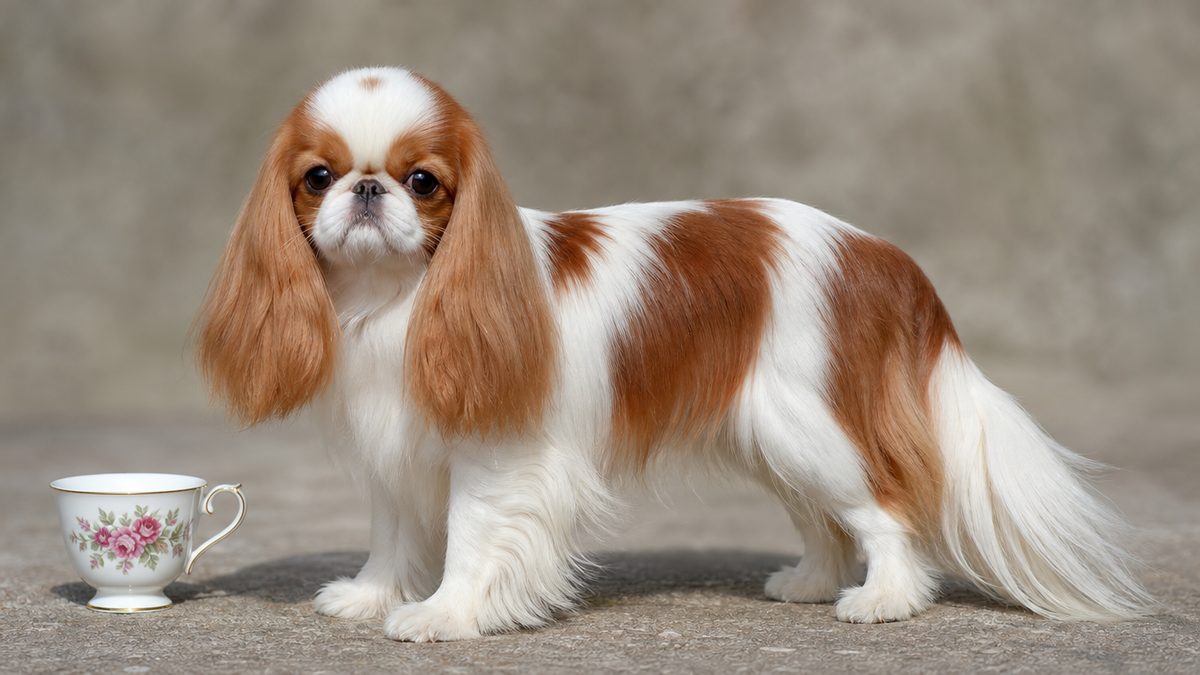
Quick answer
The King Charles Spaniel is FCI breed 128 and the Cavalier King Charles Spaniel is FCI breed 136, so they are two separate breeds that share a section, a country and most of a name. The American Kennel Club calls this one the English Toy Spaniel. Tell them apart by the head: this breed has a domed skull, a short turned-up nose and a slightly undershot bite, while the Cavalier has an almost flat skull, a 3.8 cm muzzle and a scissor bite.
This page reports published veterinary research and registry screening data for general information. It is not a diagnosis and it is not treatment advice. This breed's flat, shortened face makes breathing difficulty, heat collapse and eye injury genuine emergencies rather than quirks, and any snoring that worsens, any blue-tinged gum, any eye held shut and any collapse needs an in-person veterinarian the same day. No figure on this page substitutes for that examination.
King Charles Spaniel at a glance
What the King Charles Spaniel actually is
The King Charles Spaniel is a British toy spaniel with a domed skull, a short turned-up nose and a slightly undershot bite, carried by the FCI as breed 128. It is not the Cavalier, which is breed 136, and almost everything published in India under this name is about that other dog.
The registry position is unambiguous once you read the register rather than a breed blog. FCI-Standard N 128 is titled KING CHARLES SPANIEL, was published on 24 August 2021 against an official valid standard of 27 July 2021, gives the country of origin as Great Britain, and places the breed in Group 9, Companion and Toy Dogs, Section 7, English Toy Spaniels, without working trial. The FCI's own record page adds that the breed was accepted on a definitive basis on 3 January 1955 and recognises four varieties, Black and Tan, Ruby, Blenheim and Tricolour. The Cavalier King Charles Spaniel sits in the same section under a separate number, 136, with its own standard published on 12 January 2009 Federation Cynologique Internationale.
The FCI prints dates as month, day, year, and the record page proves its own format: the standard's publication date reads 8/24/2021 and 24 cannot be a month, so the acceptance date printed as 1/3/1955 is 3 January 1955 and not 1 March. Whenever a date on that site is ambiguous, look down the column for a value above 12 and let it settle the format.
One breed, four registry names
The breed answers to more names than most, and each belongs to a different body. The FCI and the Kennel Club call it the King Charles Spaniel. The American Kennel Club calls it the English Toy Spaniel and places it in the Toy Group, having recognised it in 1886. The FCI's own standard text acknowledges the overlap, opening its history with the line that this is an obvious relative of the Cavalier King Charles Spaniel, known in some countries as the English Toy Spaniel, and named after a dog that was a great favourite of King Charles II. Older names in circulation include Toy Spaniel, Charlies, Prince Charles Spaniel, Ruby Spaniel and Blenheim Spaniel.
Appearance, in the standard's own words
The general appearance is refined, compact and cobby, and the head does the identifying work. The standard specifies a skull moderately large in comparison to size, well domed and full over the eyes, a well defined stop, a black nose with large wide-open nostrils that is short and turned up, and a square, wide, deep, well turned up muzzle with a wide lower jaw. The eyes are relatively large and dark, set wide apart, with the eyelids block square to the face line. The ears are set on low, hang quite flat to the cheeks, and are very long and well feathered. The coat is long, silky and straight with a slight wave allowed but never curly, and the legs, ears and tail are profusely feathered.
Coat colour, and why the four varieties matter
Four colours are permitted and any other colour or combination is unacceptable. Black and Tan is a rich glossy black with bright mahogany-tan markings on muzzle, legs, chest, ear linings, under the tail and as spots over the eyes. Tricolour is a pearly white ground with well distributed black patches, tan markings and a wide white blaze. Blenheim is a pearly white ground with chestnut-red patches and a clear blaze carrying the spot, a chestnut mark about the size of a penny in the centre of the skull. Ruby is whole-coloured rich chestnut red. Those four names are also the AKC's show varieties, paired as King Charles and Ruby, and Blenheim and Prince Charles.
One measurement is missing and its absence explains a lot of the wrong numbers online. Neither the FCI nor the Kennel Club gives a height for this breed at all. Both give only a weight, 3.6-6.3 kg, or 8-14 lbs The Kennel Club, Breed Standard. Every height range you will read for the King Charles Spaniel therefore comes from somewhere other than a breed standard, and the sources publishing them do not agree: the AKC gives 9-10 inches, Wikipedia's infobox gives 9-11 inches, and neither figure appears in any governing document.
Three tests that tell a King Charles Spaniel from a Cavalier
Check the skull, the muzzle and the bite, in that order, and you can separate these two breeds from a photograph and a lifted lip. Both standards specify each of the three, and they specify them as opposites.
| Feature | King Charles Spaniel, FCI 128 | Cavalier King Charles Spaniel, FCI 136 |
|---|---|---|
| Skull | Moderately large in comparison to size, well domed, full over eyes | Almost flat between ears |
| Stop | Between skull and nose well defined | Shallow |
| Muzzle | Square, wide and deep, well turned up. No length given | Length from base of stop to tip of nose about 1 1/2 ins. (3,8 cm). Well tapered |
| Nose | Black, with large, wide-open nostrils, short and turned-up | Nostrils black and well developed without flesh marks |
| Bite | Bite should be slightly undershot | Perfect, regular and complete scissor bite |
| Weight | 3.6-6.3 kgs | 5,4 - 8 kg (12 - 18 lbs) |
| Temperament line | Reserved, gentle and affectionate | Sporting, affectionate, absolutely fearless. Gay, friendly |
| Standard published | 24.08.2021 | 12.01.2009 |
Run the three tests in order and the answer is usually obvious by the second one.
- Look at the top of the skull in profile. A King Charles Spaniel's skull is well domed, so the line from the stop up over the head is a curve. A Cavalier's is almost flat between the ears, so the same line is nearly straight.
- Measure the muzzle from the stop to the tip of the nose. The Cavalier's standard names a number, about 1 1/2 inches or 3.8 cm, and calls for a well tapered muzzle. This breed's standard names no length at all and asks instead for short, turned up and square. A ruler settles it.
- Lift the lip and look at the incisors. This breed's standard says the bite should be slightly undershot, meaning the lower jaw sits forward. The Cavalier's standard requires a perfect, regular and complete scissor bite, with the upper teeth closely overlapping the lower. That is the cleanest single test on the list, because it is a yes or no.
The weight bands overlap only narrowly. The King Charles Spaniel is 3.6 to 6.3 kg and the Cavalier is 5.4 to 8 kg, so the two standards share just the 5.4 to 6.3 kg window Federation Cynologique Internationale. A 7 kg adult is outside this breed's standard entirely, and a 4 kg adult is outside the Cavalier's.
Why the two breeds diverged, and when
The Cavalier was made deliberately, out of this breed, in living memory. The Kennel Club's own account records that special prizes were offered at Crufts between 1926 and 1930 for Blenheim spaniels of the old type, and that the word Cavalier was chosen to distinguish that older type from the flatter-faced dog then known as the King Charles. Wikipedia's account adds that the new variety was first listed by the Kennel Club as King Charles Spaniels, Cavalier type, with a separate breed club formed in 1928. So the Cavalier is the reconstruction and this breed is the one that was already there, which is the reverse of what most Indian buyers assume.
The naming history in America ran the other way and produced the second name. Before 1903 the AKC treated all four colours as separate breeds for show purposes while permitting them to interbreed, and in 1904 it ruled that they should be combined into one breed, the English Toy Spaniel, shown in two colour varieties. That is why an American pedigree, an Indian KCI pedigree written against FCI nomenclature, and a British one can describe the same dog with three different names on the paper.
One name is worth avoiding entirely. The FCI itself notes the breed is called the English Toy Spaniel in some countries, and OFA files it under exactly that name, so searching Indian listings for King Charles Spaniel and searching registry data for English Toy Spaniel are two halves of the same job Orthopedic Foundation for Animals. Search both.
Club recognition, registry by registry
- FCI: breed 128, Group 9 Companion and Toy Dogs, Section 7 English Toy Spaniels, definitive acceptance 3 January 1955, four varieties.
- The Kennel Club: King Charles Spaniel in the Toy group, with its own standard last updated April 2025, and listed as a vulnerable native breed since 2003 Wikipedia, King Charles Spaniel.
- AKC: English Toy Spaniel in the Toy Group, recognised 1886, ranked 134 of 210 for popularity, shown in two colour pairings.
- OFA: filed as ENGLISH TOY SPANIEL under code ET, with AKC, CKC and UKC groups recorded and no Kennel Club group at all.
- KCI: India is a full FCI member represented by the Kennel Club of India in Chennai, so an Indian pedigree runs on FCI nomenclature and should cite standard 128.
King Charles Spaniel price in india, and why every figure you will find belongs to another breed
There is no verified Indian price for the King Charles Spaniel, because every Indian listing returned under that name is selling the Cavalier. That is not a gap in this page's research. It is the finding, and it survives a search-engine control.
Start with what the search actually returns. Querying king charles spaniel price in india on Google India on 31 August 2026 gives About 161 results, and the panel at the top opens with the sentence A Cavalier King Charles Spaniel puppy costs between INR 1,50,000 and INR 3,50,000 in India. The reader asked about one breed and the engine answered about another without flagging the swap. All eight web results beneath it are Cavalier pages, and the People also search for row underneath offers Cavalier King Charles Spaniel price in Delhi, Kerala, Bangalore, Kolkata, Mumbai, Hyderabad and Chennai.
The substitution runs through the listings themselves. One result carries the title Adopt King Charles Spaniel Puppies - Buy/Sell Puppy In India and its price line reads Cavalier King Charles spaniel cost varies from Rs 20,000-Rs 50,000. Another, Mr n Mrs Pet, quotes an average of INR 90,000 to INR 3,50,000 and above for the same Cavalier. Those two Indian sources describe the same breed and their floors differ by a factor of 4.5, their ceilings by a factor of 7.
| Rupee figure | Breed it actually prices | Divided by 84.38 | Divided by 74.00 | Divided by 80.00 | Divided by 66.67 |
|---|---|---|---|---|---|
| Rs 20,000 | Cavalier, on a page titled for the King Charles Spaniel | 237.02 | 270.27 | 250.00 | 299.99 |
| Rs 50,000 | Cavalier, same page | 592.56 | 675.68 | 625.00 | 749.96 |
| Rs 90,000 | Cavalier, Mr n Mrs Pet floor | 1066.60 | 1216.22 | 1125.00 | 1349.93 |
| Rs 1,50,000 | Cavalier, AI Mode KCI-registered floor | 1777.67 | 2027.03 | 1875.00 | 2249.89 |
| Rs 2,50,000 | Cavalier, AI Mode champion-bloodline floor | 2962.79 | 3378.38 | 3125.00 | 3749.81 |
| Rs 3,50,000 | Cavalier, AI Mode ceiling | 4147.90 | 4729.73 | 4375.00 | 5249.74 |
Read the quotients rather than the tidiness of the division. Nothing resolves to a whole number of US dollars at 84.38 or at 74. At a flat 80 every row divides cleanly, which proves nothing, because a figure ending in four zeros clears that test by construction. Look instead at what the quotients would mean: 3,125 dollars and 4,375 dollars are not prices any seller anywhere prints. These are rupee-native, hand-typed numbers, not a converted American price list. What is wrong with them is not arithmetic. It is that they price a different dog.
Assume it is a Cavalier and check the head before you check the price. Run the three tests from the section above: a domed skull, a short turned-up muzzle with no measurable length, and a slightly undershot bite. Then ask which registry issued the pedigree and what breed name is printed on it. India is an FCI full member through the Kennel Club of India in Chennai, so a genuine KCI pedigree for this breed should name it King Charles Spaniel against FCI standard 128, not 136.
What the monthly numbers in that answer are worth
The AI Mode panel also publishes Indian running costs, and those are more usable than its purchase price, because they describe keeping a small toy dog in India rather than identifying a breed. It gives food and nutrition at INR 5,000 to INR 8,000 a month, grooming and care at INR 2,000 to INR 4,000 a month, and veterinary visits at INR 3,000 to INR 6,000 annually for routine check-ups and vaccinations. Treat those as marketplace estimates rather than survey data, note that the food figure looks high for a 6 kg dog, and ring three local suppliers before you plan around any of them.
For scale on how thin this breed's real presence is, the British registry is the only place it can be counted. The Kennel Club registered 56 King Charles Spaniels in 2025 against 3,224 Cavaliers, a ratio of about 58 to 1. If Britain, the country of origin, registers one of these for every fifty-eight Cavaliers, the probability that an Indian listing has a genuine one is not a probability worth betting Rs 2,50,000 on.
How rare this breed really is, checked in three documents
The Kennel Club registered 56 King Charles Spaniels in 2025, and three separate Kennel Club documents agree on that number and on the nine years before it. That agreement is worth reporting, because this site has found the Kennel Club's tables disagreeing elsewhere.
| Year | Ten-yearly Toy PDF | Vulnerable native breeds PDF | Quarterly Toy PDF | Cavalier, for comparison |
|---|---|---|---|---|
| 2016 | 84 | 84 | not covered | 4,114 |
| 2017 | 112 | 112 | not covered | 3,588 |
| 2018 | 106 | 106 | not covered | 3,701 |
| 2019 | 93 | 93 | not covered | 3,252 |
| 2020 | 56 | 56 | not covered | 2,979 |
| 2021 | 91 | 91 | not covered | 3,772 |
| 2022 | 68 | 68 | not covered | 3,478 |
| 2023 | 39 | 39 | not covered | 3,528 |
| 2024 | 45 | 45 | not covered | 3,132 |
| 2025 | 56 | 56 | 56 | 3,224 |
All three documents agree on every cell they share. The ten-yearly Toy table and the vulnerable-native-breeds table print an identical ten-year row, and the quarterly table's 2025 total of 56 matches both. The quarterly figure is also self-corroborating, because its own four quarters read 21, 8, 14 and 13, which sum to exactly 56 The Royal Kennel Club The Royal Kennel Club. Bonbeno reports that agreement plainly, because it is not guaranteed.
Checked independently here. The ten-yearly Toy table's 24 breed rows reconcile exactly against its own printed column totals in nine of the ten years, once the Russian Toy's late-starting nine-value row is aligned to the last nine years rather than the first nine. The tenth column overshoots by exactly three, 10,503 from the rows against a printed 10,500. The whole discrepancy sits in one cell: Yorkshire Terrier 2025 reads 385 in the ten-yearly table and 382 in the quarterly one, and 385 minus 382 is 3. The quarterly figure is self-corroborating, its four quarters reading 85, 112, 111 and 74 for a total of 382. So prefer the quarterly table for that cell, and note that the King Charles Spaniel's own cells are untouched by it.
What vulnerable native breed status means, and does not
The Kennel Club listed the King Charles Spaniel as a Vulnerable Native Breed in 2003 because of low registration numbers. The list is a promotional and monitoring device rather than a legal category: it does not restrict breeding, does not confer protection, and does not change what a buyer is entitled to. What it does tell an Indian reader is that even in the breed's country of origin the annual population entering the register is smaller than a single Indian city's Labrador intake, which is the practical fact behind everything else on this page.
The trend is also worth reading honestly rather than dramatically. The ten-year run is 84, 112, 106, 93, 56, 91, 68, 39, 45, 56. That is a decline of about a third across the decade, but it is not a straight line, and the two lowest years are 2023 at 39 and 2020 at 56, with 2025 recovering to 56. A breed registering between 39 and 112 dogs a year for a decade is small and stable-ish rather than disappearing, and the Cavalier's own numbers fell over the same period too, from 4,114 to 3,224.
Monthly cost of ownership, honestly bounded
Budget for cooling, for eye care and for a cardiac examination, because those are the three lines this breed adds over an average toy dog in India. Bonbeno publishes no single monthly rupee total for it, because no Indian cost figure published under this breed's name actually describes this breed.
The one thing that cannot be estimated is the purchase price, and this page will not invent one. Every Indian figure returned for this breed name prices the Cavalier, and those figures disagree with each other from Rs 20,000 to Rs 3,50,000 Mr n Mrs Pet, Cavalier King Charles Spaniel…. Converting a British or American price into rupees would be the exact fabrication this site documents elsewhere, so it is not done here.
Where this breed costs more than an average small dog in India
- Cooling, which is a dog cost here rather than a comfort. In Delhi the June mean is 35.88 C with a twenty-year maximum of 48.79 C, and a flat-faced dog cannot pant efficiently enough to cope. This is the largest recurring cost and the one most often left out.
- Eye examinations, more often than for a normal-faced breed. OFA ranks this breed 10th of all breeds on eyes, with 12.3 percent abnormal across 1,296 evaluations, and its single largest recorded finding is corneal epithelial or stromal dystrophy at 209 dogs, 16.1 percent. Large prominent eyes in a shallow socket also mean a higher risk of ordinary injury.
- A cardiac examination, annually from middle age. OFA places the breed 2nd of all breeds on congenital cardiac at 4.5 percent abnormal of 470, and 9th on advanced cardiac at 12.4 percent abnormal of 113. Both are this breed's own data, not the Cavalier's.
- Ear care through the monsoon. Very long ears set on low and hanging quite flat to the cheeks are the classic geometry for a wet, warm, unventilated canal in an Indian July.
- Nothing extra for a DNA test, because none exists. The Cavalier holds three breed-specific DNA registries at OFA, for episodic falling, dry eye and curly coat syndrome, and degenerative myelopathy. The English Toy Spaniel holds none. That is a saving and a problem at the same time.
Google India's AI Mode panel gives Indian monthly costs for the Cavalier at INR 5,000 to INR 8,000 for food, INR 2,000 to INR 4,000 for grooming and care, and INR 3,000 to INR 6,000 annually for routine veterinary visits. Those describe keeping a small British toy spaniel in India, which is close enough to be useful, but they are marketplace estimates with no methodology attached and the food figure is high for a dog of 3.6 to 6.3 kg. Use the component list, build your own numbers from three local quotes, and treat the totals as a starting sanity check rather than a budget.
One cost comparison is worth making explicitly. The purchase price, whatever it turns out to be, is spread across a life that the best available evidence puts at roughly eleven to twelve years. The cooling, the eye care and the cardiac monitoring are not spread across anything. They recur every year, they rise with the dog's age, and in a hot country they are the difference between this breed being a reasonable choice and a cruel one.
Suitability for the Indian climate, reasoned from skull shape rather than borrowed
The King Charles Spaniel is heat-sensitive across the whole of urban India, and the reason is the face rather than the coat. Chennai's coolest month runs 6.46 C warmer than London's hottest, and this breed has less airway to cool itself with than the Cavalier that the heat research did measure.
| Location | Cell elevation | Annual mean | Hottest month | Coolest month | 20-year maximum | Annual mean humidity |
|---|---|---|---|---|---|---|
| London, the breed's home range | 73.15 m | 10.39 C | 17.63 C in July | 4.14 C in January | 33.96 C | 84.59 percent |
| Chennai, Tamil Nadu | 48.95 m | 27.95 C | 31.51 C in May | 24.09 C in January | 42.70 C | 72.39 percent |
| Mumbai | 97.15 m | 26.77 C | 31.19 C in May | 23.19 C in January | 44.91 C | 67.39 percent |
| Delhi | 206.37 m | 25.60 C | 35.88 C in June | 13.61 C in January | 48.79 C | 45.56 percent |
| Bengaluru | 841.72 m | 23.74 C | 28.37 C in April | 20.22 C in December | 40.38 C | 67.94 percent |
NASA POWER returns a grid cell rather than a point, and in hilly terrain the cell's mean elevation can miss the town beneath it by more than a kilometre, which shifts the temperature by roughly 6.5 C per 1,000 m. Every cell above was checked against its real place, homeland included: London came back at 73.15 m for a city in the tens of metres, and the four Indian cells are plains cells within about 80 m of their towns NASA POWER, 20-year climatology. No lapse-rate correction was needed for any figure on this page.
The comparison that matters is the floor, not the peak. Chennai's coolest month, January, averages 24.09 C, which is 6.46 C warmer than London's hottest month at 17.63 C NASA POWER, 20-year climatology. A King Charles Spaniel in Chennai never experiences a single month as cool as the warmest month of the climate it was selected in. Mumbai adds humidity that blunts evaporative cooling, and Delhi supplies the raw peak, with a June mean of 35.88 C and a twenty-year maximum of 48.79 C NASA POWER, 20-year climatology.
The study everyone quotes did not include this breed
The UK VetCompass heat-illness analysis covered 905,543 dogs under primary veterinary care in 2016, identified 395 confirmed heat-related illness events, an incidence of 0.04 percent and an event fatality rate of 14.18 percent, and named nine breeds with higher odds than the Labrador Retriever: the Chow Chow, Bulldog, French Bulldog, Dogue de Bordeaux, Greyhound, Cavalier King Charles Spaniel, Pug, English Springer Spaniel and Golden Retriever. The King Charles Spaniel is not among them and does not appear anywhere in the paper. Quoting the Cavalier's odds ratio for this breed would be fabrication wearing a citation, and this page does not do it.
What does transfer is the mechanism, because the paper measures the brachycephalic skull separately from breed. Brachycephalic dogs carried 2.10 times the odds of heat-related illness compared with mesocephalic dogs, 95 percent CI 1.68 to 2.64, and the authors note that five of the nine raised-odds breeds were brachycephalic, the Cavalier among them. The King Charles Spaniel's standard specifies a well domed skull, a short turned-up nose, a square well turned up muzzle with no length given at all, and a slightly undershot bite, where the Cavalier's specifies a 3.8 cm well tapered muzzle and a scissor bite. On the standards' own descriptions this breed sits further along the brachycephalic axis than the one that was measured, so the transferable inference is that the skull-shape factor applies at least as strongly here. Bonbeno rates heat tolerance at 1 out of 5 on that reasoning, and states plainly that no breed-specific figure exists.
For context and not for transfer: the Cavalier King Charles Spaniel had a heat-related illness incidence of 0.12 percent, 95 percent CI 0.08 to 0.18 percent, the sixth highest of any breed in that study. That is the closest measured relative this breed has. It is not this breed's number, it is a related breed's number, and it is printed here so a reader understands the neighbourhood rather than so anyone can quote it as a prevalence.
The trigger, and the Indian version of it
Most heat collapse is a walk rather than a parked car. Of the 879 heat-related illness events with a recorded trigger in the companion study, 652, or 74.2 percent, were exertional, against 113 environmental and 46 from vehicular confinement. For a flat-faced toy dog in Hyderabad or Ahmedabad, that means the dangerous moment is an ordinary evening walk in April, and the honest instruction is short, pre-dawn and post-dusk only, with the walk abandoned entirely on the worst days. Bengaluru at a 23.74 C annual mean is the least punishing Indian metro for this breed and still 10.74 C above London's warmest month NASA POWER, 20-year climatology.
Temperament and household fit
The King Charles Spaniel is a reserved, gentle, affectionate lapdog that is not a watchdog and does not pretend to be. It suits a quiet household with someone home, and it suits almost nothing else.
Both governing standards describe the same dog in almost the same words. The Kennel Club gives the characteristics as a happy, intelligent toy spaniel with a distinctive domed head, and the temperament as reserved, gentle and affectionate. The FCI's standard for breed 128 repeats that line exactly. Note how different that is from the Cavalier's standard, which calls for a sporting, affectionate, absolutely fearless, gay and friendly dog with no tendency towards nervousness. Reserved and fearless are not the same brief, and a buyer who wants the second one is describing the other breed.
What reserved means in practice in an Indian home
Reserved here means slow to approach strangers rather than fearful of them. In a flat with a doorbell, house help arriving daily, delivery riders and a watchman, a reserved toy dog that has not been socialised properly becomes a dog that hides or snaps rather than one that barks. That is the failure mode to plan against, and it is the opposite of the failure mode for a spitz. The breed is described as friendly to the point of not being a suitable watchdog, though it may still bark to warn of an approaching visitor, and as not a high energy breed, enjoying the company of family members and being primarily a lapdog.
The compensating strength is real. The same account records that the breed is intelligent enough to be used for obedience work and that its stable temperament makes it a successful therapy dog in hospitals and nursing homes. A dog steady enough for a hospital ward is steady enough for a household with children who have been taught how to behave around a 5 kg animal.
Who should buy one
- Households in Bengaluru, Pune or a hill station with someone at home most of the day and a room that stays cool.
- Older owners and quiet flats, because the exercise requirement is genuinely low and the noise level is genuinely low.
- Families with older children who can be taught not to pick the dog up by the ribs and not to chase it.
- Buyers who want a lapdog and mean it, since this is a companion breed with no working brief at all.
Who should not
- Anyone in coastal Tamil Nadu, Kerala or Mumbai without reliable cooling, on the climate arithmetic in the section above.
- Anyone wanting a guard dog or an alarm dog, because breed literature says explicitly that it does not make a good watchdog.
- Anyone who is out of the house all day, since a companion breed with no job becomes an anxious one.
- Anyone who cannot verify the breed, because in India the overwhelming likelihood is that the dog on offer is a Cavalier under this breed's name.
A soft, reserved, flat-faced dog will not tell you loudly that it is overheating or in pain. It will go quiet, which in a breed described as reserved reads as normal. In an Indian summer, watch the respiratory rate at rest and the colour of the gums rather than waiting for a behavioural signal, because this breed's temperament actively hides the warning that a more vocal dog would give you.
Training a King Charles Spaniel, and the window you cannot redo
Train this breed with food and patience, never with correction, and spend the socialisation window before sixteen weeks making strangers ordinary. A reserved dog that misses that window does not become bold later.
The breed is willing rather than driven, and genuinely trainable within that limit. It is described as intelligent enough for obedience work and stable enough for therapy work, and the standards describe a happy, intelligent, gentle animal. What it lacks is the spitz-type resilience to a heavy hand: a reserved dog that is startled or corrected during a fearful moment learns that the moment was worth being afraid of. Everything below follows from that.
The socialisation window in Indian conditions
Use the window between roughly three and sixteen weeks to make ordinary Indian household traffic boring. In practice that means food-paired, controlled, brief exposure to the doorbell, the lift, the watchman, house help arriving daily, delivery riders in helmets, a pressure cooker and calm adult dogs on lead. The Indian complication is vaccination timing: the Dog Breeding and Marketing Rules 2017 note that puppy vaccination can start at seven to eight weeks and is usually completed at the age of eighteen weeks, which lands after the window shuts. Carry the puppy, use clean surfaces and low-density settings, and do not wait for the last shot, because the window does not wait.
A four-step protocol for a reserved toy dog
- Let the dog approach, never the stranger. Ask visitors to sit down, look away and drop food on the floor. A reserved breed that is reached for learns to avoid hands.
- Pay bravery, ignore hiding. Mark and feed the moment the dog steps toward something new. Do not soothe or lift it when it retreats, because both reward the retreat.
- Teach a chin rest and a hold-still early. This is the highest-value trick for this breed specifically, because a lifetime of eye examinations, ear cleaning and cardiac auscultation is easier on a dog that has been paid to keep its head still.
- Train in the cool hours only. A flat-faced dog that gets warm during a session will stop learning and start panting, and you will have taught it that training is uncomfortable.
What this breed resists, and realistic timelines
It resists pressure and it resists repetition without reward. Expect reliable house training by twelve to sixteen weeks with a strict schedule, a solid indoor recall by four months, comfortable handling of the face and ears by six months if you started at eight weeks, and a settled adult by about a year. Lead work takes longer than for a working breed, not because the dog is slow but because a small soft dog on a collar in Indian street traffic is easy to frighten permanently. Use a harness, use quiet routes, and accept that this is not a dog you will walk through a market.
Do not let anyone dock the tail. The FCI standard for this breed still carries the line Docking previously optional and gives both docked and undocked descriptions, which reflects British history rather than Indian law. Second Schedule Part II paragraph 6(8) of the Dog Breeding and Marketing Rules 2017 states that there shall be no tail docking, ear cropping, de-barking, de-clawing, branding, dyeing, injecting substances to enhance visual appeal, performing a surgery or procedure to camouflage or hide any defect or infirmity or any other kind of mutilation of any body part of the pup. An Indian King Charles Spaniel is undocked, and a breeder offering a docked puppy has broken that rule.
Daily exercise needs, and why less is genuinely correct here
Give an adult King Charles Spaniel about 30 minutes of walking a day, split into two short cool-hour sessions, plus indoor play. This is one of the few breeds on this site where a low exercise figure is not a compromise but the right answer.
The breed is not a high energy breed and is primarily a lapdog, and neither governing standard asks for stamina or working ability. The gait requirement is free, active and elegant, driving from behind, with sound movement highly desirable, which is a description of quality of movement rather than quantity of it. So the honest number is small, and an owner who pushes past it in an Indian summer is not being conscientious, they are creating risk.
How to split the day in an Indian city
- Before sunrise, 15 to 20 minutes. The main walk, on the coolest surface available. In Chennai in May this is the only usable hour of the day.
- After dark, 10 to 15 minutes. Short, flat, mostly sniffing. Test the pavement with the back of your hand for five seconds before setting off, because tarmac holds heat long after sunset.
- Indoors, 10 minutes, twice. A snuffle mat, a food puzzle, a short trick session or gentle fetch down a corridor. For this breed indoor work is not a substitute for exercise so much as the main event.
- Never between 10 am and 6 pm from March to October anywhere with a Delhi, Chennai, Mumbai or Ahmedabad summer, and abandon the walk entirely rather than shortening it on the worst days.
What happens without it, and what happens with too much
Both failure modes are real for this breed, which is unusual. Too little exercise produces the ordinary small-dog problems: weight gain, demand behaviour and a stiffer, less confident dog. Too much, or exercise at the wrong hour, produces the specific one: 652 of the 879 UK heat-illness events with a recorded trigger were exertional, 74.2 percent, against only 46 from vehicular confinement, and brachycephalic dogs carried 2.10 times the odds overall. For a flat-faced 5 kg dog in an Indian April, the second failure is the one that kills.
Weight is the link between the two. Dogs at or above their breed and sex mean bodyweight carried 1.42 times the odds of heat-related illness, 95 percent CI 1.12 to 1.80, so keeping a King Charles Spaniel lean is a heat intervention. It is also a joint one: OFA ranks this breed 5th of all breeds for patellar luxation, with 13.3 percent abnormal across 338 evaluations, and a heavier small dog is harder on a shallow trochlear groove.
For eight months of the year, most Indian city dogs are under-exercised because the weather does not allow otherwise, and their owners feel guilty about it. This is a breed where 30 minutes split across two cool sessions genuinely meets the requirement rather than falling short of it. That is a real fit with Indian conditions, and it is one of the few things this breed has going for it here.
Grooming a silky coat and, more importantly, the ears and the face
Brush a King Charles Spaniel three times a week and clean the face folds and ears far more often than that. The coat is the easy part of this breed's grooming, and the ears are where Indian owners lose dogs to infection.
The coat itself is undemanding by breed-page standards. The standard specifies long, silky and straight hair with a slight wave allowed and never curly, with the legs, ears and tail profusely feathered. There is no undercoat to strip, no seasonal blow to survive and no clipping instruction to argue about. Three sessions a week with a pin brush and a comb through the feathering keeps it right, with extra attention behind the ears and in the armpits where a silky coat mats first.
The ears are the real job in an Indian climate
This breed's ears are set on low, hang quite flat to the cheeks, and are very long and well feathered. That is a description of a sealed, warm, unventilated canal, and it is the single worst ear geometry a dog can have in a Mumbai August at 90.36 percent relative humidity. Check inside both ears weekly with a torch, dry them completely after any bath or any wet walk, plug them before bathing, and treat a head-shake or a smell as a same-week veterinary problem rather than a wait-and-see one.
The face needs a routine too
A short turned-up nose with a well defined stop means the skin around the muzzle and under the eyes folds and stays damp. Wipe under the eyes daily with plain water and a soft cloth, dry the fold rather than leaving it, and keep the hair around the eyes trimmed clear of the eyeball. That last point is not cosmetic: OFA records distichiasis, where extra lashes grow toward the cornea, in 137 of 1,296 English Toy Spaniels examined, or 10.6 percent, and corneal epithelial or stromal dystrophy in 209, or 16.1 percent. A prominent eye with hair or lashes touching it is how a small irritation becomes an ulcer.
A working routine for an Indian household
- Three times a week, 10 minutes, brush and comb. Pin brush through the body coat, then a comb through the ear feathering, the trousers and behind the elbows to find mats before they set.
- Weekly, ears and feet. Torch inside both ears, check between the pads for grit and monsoon debris, and trim the hair between the pads.
- Daily, the face. Wipe under the eyes, dry the folds, and look at both corneas in good light. Ten seconds a day catches most of what costs money later.
- Bath monthly or when dirty, and dry completely. Plug the ears first. A silky coat left damp at the skin in 28 C is a hot spot forming.
- Nails every three to four weeks. A low-exercise indoor dog on tiled floors does not wear its nails down at all.
This breed carries none of the grooming controversies that dominate double-coated pages. There is no shaving debate, because there is no undercoat to destroy; the standard imposes no trimming prohibition; and shedding is moderate rather than seasonal and catastrophic. If you are choosing between this breed and a spitz-type dog on grooming load alone, this one is meaningfully less work, and the difference is entirely in the ears and eyes rather than the coat.
Health issues, screening and life expectancy
Screen a King Charles Spaniel for cardiac disease, patellar luxation and eye disease, using this breed's own registry data rather than the Cavalier's. That distinction is the whole of this section, because almost everything published about the famous cousin has never been measured in this dog.
Start with what actually exists. OFA files the breed under the code ET as ENGLISH TOY SPANIEL, read from OFA's own raw markup rather than guessed, and publishes five statistics rows for it. There is no hip row, no elbow row and no thyroid row, because OFA publishes a breed only once it reaches 100 hip evaluations or 50 in its other databases, so their absence is a statement about how little screening has been done rather than about the breed being healthy in those areas.
| Registry | This breed, rank | This breed, evaluations | This breed, result | Cavalier, for scale |
|---|---|---|---|---|
| Congenital cardiac | 2 of all breeds | 470 | 92.6 percent normal, 4.5 percent abnormal | 18,287 evaluated, 1.6 percent abnormal, rank 13 |
| Advanced cardiac | 9 | 113 | 83.2 percent normal, 12.4 percent abnormal | 9,834 evaluated, 13.4 percent abnormal, rank 5 |
| Basic cardiac | 8 | 211 | 98.6 percent normal, 0.9 percent abnormal | 12,279 evaluated, 0.7 percent abnormal, rank 10 |
| Patella | 5 | 338 | 86.7 percent normal, 13.3 percent abnormal (9.5 gr1, 3.0 gr2, 0.9 gr3) | no published patella row |
| Eyes | 10 | 1,296 | 87.6 percent normal, 12.3 percent abnormal | no published eye summary row |
Two of those rows deserve reading twice. The breed sits 2nd of all breeds on congenital cardiac, with 4.5 percent abnormal across 470 evaluations, nearly three times the Cavalier's 1.6 percent on a far larger denominator. And it sits 5th of all breeds on patellas, with 13.3 percent abnormal across 338 evaluations. Both figures reconcile against their own components, the patella grades summing 9.5 plus 3.0 plus 0.9 to 13.4 against a printed 13.3, which is rounding. These are this breed's numbers, and they are the ones to plan around.
The eye summary line reports 87.6 percent normal across 1,296 evaluations. The detail row labelled NORMAL (OTHER .000), on the same 1,296 denominator, reports 579 dogs, which is 44.7 percent. That is a gap of 42.9 percentage points, far beyond rounding, and larger than any of the six breeds where this site has previously recorded the same contradiction. The largest named findings in the detail rows are corneal epithelial or stromal dystrophy at 209 of 1,296, or 16.1 percent, distichiasis at 137, or 10.6 percent, persistent pupillary membranes iris to iris at 25, or 1.9 percent, and entropion and exposure keratopathy syndrome at 15 each, or 1.2 percent. Bonbeno publishes both figures with the arithmetic and quotes neither as the breed's eye disease rate.
A secondary source's OFA figure that time has overtaken
Wikipedia reports that in an OFA study the King Charles Spaniel was the 38th worst of 99 breeds for patella luxation, with 4 percent of 75 animals tested affected. Read against the live register today that figure is badly out of date in every dimension: 338 evaluations rather than 75, 13.3 percent abnormal rather than 4 percent, and rank 5 rather than 38. The Wikipedia sentence is not fabricated, it is simply frozen. This is why this site publishes the sample size beside every percentage taken from a live register, so a later reader can see when a figure has moved.
Life expectancy, and why no breed-specific figure exists
The largest UK longevity analysis covers 584,734 dogs, of which 284,734 were deceased, and gives 12.5 years median survival across all dogs, 12.7 for purebreds and 12.0 for crossbreds. It publishes no King Charles Spaniel row, and the reason is not exclusion. Its supplementary Table S5 records the breed in the Phylogeny Reclassification column of the Cavalier King Charles Spaniel's row, which is the mechanism that paper uses to fold one breed into another. So the widely quoted Cavalier median of 11.8 years, on 6,879 deaths, covers both breeds pooled, and there is no separate King Charles Spaniel estimate anywhere in the paper.
A merged breed gets no row of its own, so its absence looks exactly like simple exclusion, and every page that writes no data available for the King Charles Spaniel is describing the symptom rather than the cause. The same table folds the Irish Red and White Setter into the Irish Setter and both Fox Terrier varieties into the Wire Fox Terrier, so this is a documented pattern rather than a one-off. The paper also carries an Author Correction, which changes only a Miniature Dachshund figure in a figure legend and does not touch the supplementary tables. The honest position for this breed is that its lifespan has not been measured, and the AKC's published 10-12 years cites no study. A UK life-table analysis puts life expectancy at age zero across all UK companion dogs at 11.23 years.
What the veterinary literature actually says about this breed, which is almost nothing
Two published papers name the King Charles Spaniel without naming the Cavalier, against 219 for the Cavalier itself. That ratio is the reason this page refuses to import mitral valve disease and syringomyelia figures, and it is checkable in one query.
The search has to be done carefully, because the obvious version of it fails in two different ways. Searching the unquoted phrase King Charles Spaniel in PubMed returns zero records, because the engine translates it into an author search for a person named Charles King, and the same rewrite returns zero for Cavalier King Charles Spaniel, which is one of the most-studied breeds in small-animal medicine. A zero from that query is an artefact, not a finding.
Quoting the phrase produces the opposite artefact. A title and abstract search for the exact phrase King Charles Spaniel returns 223 records, and a search for Cavalier King Charles Spaniel returns 219, because the shorter phrase is contained inside the longer one. Reading the first sixty identifiers of each result set side by side shows them to be very nearly the same papers. So the 223 is the Cavalier literature wearing this breed's name.
| Query | Records | What it actually measures |
|---|---|---|
| king charles spaniel (unquoted) | 0 | Artefact. Translated into an author search for Charles King |
| Cavalier King Charles Spaniel (unquoted) | 0 | Artefact. Same author-name rewrite, on a heavily studied breed |
| "King Charles Spaniel"[Title/Abstract] | 223 | Mostly Cavalier papers, because the phrase is a substring |
| "Cavalier King Charles Spaniel"[Title/Abstract] | 219 | The Cavalier literature |
| "Cavalier King Charles Spaniels"[Title/Abstract] | 301 | The plural finds more again |
| king charles spaniel[tiab] NOT cavalier[tiab] | 2 | This breed, isolated |
| "English Toy Spaniel"[Title/Abstract] | 1 | This breed under its American name |
| "Labrador Retriever"[Title/Abstract] (control) | 1,106 | Instrument working |
| "Japanese Chin"[Title/Abstract] (control) | 11 | Instrument working on a rare toy breed |
The three papers, read in full
- Syringomyelia, one case, 2000. A 9-year-old King Charles Spaniel in New South Wales presented with two years of progressive forelimb weakness and paroxysmal involuntary flank scratching. Imaging showed hydrocephalus, caudal herniation of part of the caudal cerebellar lobe through the foramen magnum, and marked syrinx formation to the level of the caudal thoracic spine. Response to diuretic therapy was moderate. That is the entire published record of Chiari-like malformation in this breed.
- A congenital heart defect, one case, 2012. A 7-month-old sexually intact male English Toy Spaniel weighing 4 kg was referred for a subclinical murmur, and echocardiography showed fixed left ventricular outflow tract obstruction caused by a cleft anterior mitral valve leaflet attached to the interventricular septum, a lesion the authors state had not previously been reported in the dog. Note that this is mitral valve dysplasia, a malformation present from birth, and not the acquired degenerative mitral valve disease the Cavalier is famous for.
- Tetanus, one case, 2021. A 2-year-old neutered male King Charles Spaniel and a mongrel were treated for generalised tetanus, with magnesium added to the standard protocol; the paper notes canine tetanus mortality of 8 to 50 percent and both dogs recovered. This is a breed appearing incidentally rather than a breed-associated disease.
The prevalence figures attached to this breed name across the internet are Cavalier figures. Google India's own answer for what are the negatives of the cavalier king charles spaniel, offered as the first question when you search for the King Charles Spaniel, states that most Cavaliers develop mitral valve disease by age 10 and describes syringomyelia, sourcing both to Instagram and YouTube. Whatever the truth of those claims for the Cavalier, none of them has been measured in the King Charles Spaniel, and a page that reprints them under this breed's name is telling an Indian buyer something nobody knows.
The conflation reaches inside the registries too
This is not only a content-farm problem. OFA's own cross-registry mapping records the Cavalier King Charles Spaniel, code KCS, with the group string TKC Toy Group (KING CHARLES SPANIEL), while the English Toy Spaniel, code ET, carries no Kennel Club group at all. The Kennel Club registers both breeds separately in its Toy group, so a reader following OFA's map from the British name lands on the Cavalier's statistics and never sees this breed's. Bonbeno read both codes from the raw markup and reports the mismatch rather than working around it.
The honest summary is short. Three case reports, no cohort study, no prevalence figure, no DNA test, and a longevity dataset that folded the breed into its cousin. Anyone who tells you what percentage of King Charles Spaniels get a given disease is either quoting the Cavalier or making it up.
Feeding and body condition
Feed a King Charles Spaniel by weekly rib check rather than by cup, and keep it at the lean end of 3.6 to 6.3 kg. On a flat-faced toy dog in India, half a kilogram of extra weight is a breathing problem before it is a waistline problem.
The target is written into the standard, which is unusual and useful. Both the FCI and the Kennel Club give a weight of 3.6-6.3 kg and no height at all The Kennel Club, Breed Standard, so unlike most breeds on this site you have a governing number to aim at. Weigh the dog monthly on the same scale, write it down, and treat any figure above 6.3 kg as outside the standard rather than as a personality.
Run your hands over the ribs weekly. You should feel them easily under a thin fat cover, see a waist behind the ribs from above, and see an abdominal tuck from the side. On a long silky coat the visual check is unreliable, and on a lapdog that is carried and fed from the table the drift is fast.
Life-stage feeding
- 8 to 16 weeks: four small meals a day of a complete small-breed puppy food. Toy puppies have very little glycogen reserve, so long gaps between meals genuinely risk hypoglycaemia.
- 4 to 8 months: three meals a day. Watch the bite as the adult teeth come through, because a shortened jaw crowds teeth and this is when crowding becomes visible.
- 8 months to adult: two meals a day, and begin monthly weighing against the 3.6-6.3 kg band.
- Adult: two meals a day, portioned to hold condition. Indian summers cut activity sharply for this breed in particular, so the January portion is usually too much by May.
- Senior, from about eight years: two meals, and pair the annual weigh-in with a cardiac auscultation, because the breed's own OFA cardiac numbers are the strongest signal it has.
Why weight matters more for this breed than for most toys
Three published risks stack on the same dog. Dogs at or above their breed and sex mean bodyweight carried 1.42 times the odds of heat-related illness, 95 percent CI 1.12 to 1.80, and brachycephalic dogs carried 2.10 times the odds of mesocephalic ones, 95 percent CI 1.68 to 2.64. Underneath both sits the patella: OFA ranks the breed 5th of all breeds with 13.3 percent abnormal across 338 evaluations. A flat-faced dog that is heavy in an Indian April is carrying all three at once.
What is actually available in India, and the eating mechanics
Small-breed complete diets from the major brands are stocked widely across Indian metros, and kibble size matters here more than brand. A short, wide, undershot jaw picks up food awkwardly, so a small kibble or a shallow wide bowl genuinely helps, and dogs of this face shape swallow more air while eating than a normal-muzzled dog does. Feed from a shallow dish, not a deep one, and do not raise the bowl unless a vet has told you to. Home cooking can work for an adult but not for a growing toy puppy, where an unbalanced diet meets a very small skeleton.
Fresh cool water constantly available matters more for this breed than for most, because a dog that cannot pant efficiently relies more on drinking and on lying against a cool surface. A tiled floor, a cooled room and a wide shallow water bowl refilled four times a day are cheap interventions with real effect. Watch intake in May and June: a King Charles Spaniel that suddenly drinks much less on a hot day is often already in trouble.
The first year, month by month
Get the identity check, the socialisation and the first hot season right, and the rest of the year is routine. The first of those three has to happen before you pay anybody.
| Age | What is happening | What you do |
|---|---|---|
| Before you buy | Nine of ten Indian results under this breed name sell the Cavalier | Run the three head tests on both parents: domed skull, short turned-up muzzle, slightly undershot bite. Ask which FCI number the pedigree is written against, 128 or 136 |
| Under 8 weeks | Still with the litter. Selling below this age is prohibited by Rule 8(1)(a) of the 2017 Rules | Visit, weigh both parents against the 3.6-6.3 kg band, ask for cardiac, patella and eye results. Refuse a docked tail. Do not take the puppy home |
| 8 to 12 weeks | Vaccination usually starts at seven to eight weeks. The socialisation window is open and closing | Carried outings daily, food-paired, brief. Begin the chin-rest and hold-still training that a lifetime of eye and ear checks will need |
| 12 to 16 weeks | The window shuts near sixteen weeks. Adult teeth begin | The highest-value weeks of the dog's life for a reserved breed. Let it approach, never reach for it. House training on a strict schedule |
| 4 to 6 months | Vaccination usually completes near eighteen weeks. The bite sets | First veterinary look at the bite and the crowding. Establish the daily eye wipe and weekly ear torch as habits, not events |
| 6 to 9 months | Adolescence, and often the first full Indian summer | Move the walking to pre-dawn and post-dusk before the heat arrives. Book the patella check. Weigh monthly and write it down |
| 9 to 12 months | Approaching adult weight and coat | Two meals a day. Baseline cardiac auscultation and a first full eye examination, so later changes have something to be compared against |
The three moments that cannot be redone
The identity check is the first and the only one that happens before money changes hands. Once the puppy is home, the difference between a King Charles Spaniel and a Cavalier stops being a purchasing decision and becomes a health-planning one, because the two breeds' registry data and published literature are entirely separate NCBI PubMed E-utilities esearch. Check the skull, the muzzle and the bite on the parents, in person, in daylight.
Twelve to sixteen weeks is the second. The socialisation window shuts near sixteen weeks while the Indian vaccination schedule, which the 2017 Rules describe as usually completed at the age of eighteen weeks, finishes after it. On a breed whose standard specifies a reserved temperament, an owner who waits for the last shot produces a permanently wary adult rather than a merely under-exposed one.
The first hot season is the third and it is the dangerous one. A puppy that arrives in Delhi in December meets a June mean of 35.88 C and a twenty-year maximum of 48.79 C with a flat face and no experience of either. Move the routine indoors and into the cool hours in February, not in May, and treat the first genuinely hot day as a day to skip the walk entirely.
Compared with the breeds it is confused with, and one that is actually available
Compare the King Charles Spaniel against the Cavalier and its two other flat-faced neighbours and the differences are documented in the standards. The table uses each breed's governing text rather than a retail description.
| Breed | Registry position | Size in the standard | Head, in the standard's words | Realistic Indian availability |
|---|---|---|---|---|
| King Charles Spaniel | FCI 128; AKC as English Toy Spaniel; Kennel Club Toy, vulnerable native breed | 3.6-6.3 kg, no height given | Well domed skull, well defined stop, short turned-up nose, slightly undershot bite | Effectively nil. Every listing found was the Cavalier |
| Cavalier King Charles Spaniel | FCI 136; same Group 9 Section 7; separate AKC and Kennel Club breed | 5.4-8 kg, no height given | Almost flat skull, shallow stop, 3.8 cm tapered muzzle, scissor bite | Wide. Rs 20,000 to Rs 3,50,000 depending on which Indian source you read |
| Japanese Chin | A separate FCI breed, also Group 9 | Not covered by Standard 128 | Flat-faced Asian toy, one of the breeds crossed into the toy spaniels | Uncommon but present in Indian metros |
| Pug | A separate FCI breed | Not covered by Standard 128 | The brachycephalic benchmark, and in the UK heat model at raised odds | Very wide and cheap in India |
| Indian Spitz | Not an FCI breed; locally established | Not covered by Standard 128 | Normal muzzle, erect ears, no brachycephalic risk | Wide, affordable and climate-adapted |
The head column is the one that does the work, and it is the only column where the first two rows are opposites rather than variations. Every other difference between a King Charles Spaniel and a Cavalier is a matter of degree; the skull, the stop, the muzzle and the bite are specified in contradictory terms by the two standards Federation Cynologique Internationale. That is why this page leads with them.
Why the two breeds share a section but not a number
The FCI places both in Group 9, Companion and Toy Dogs, Section 7, English Toy Spaniels, and gives them separate breed numbers, 128 and 136 Federation Cynologique Internationale. That arrangement is the FCI saying two things at once: these dogs are closely enough related to share a section, and different enough to need separate standards. Compare that with the Keeshond, which the FCI does not give a number to at all and files instead as a size variety inside another breed's standard. Same organisation, two different answers to the same kind of question, and the difference is worth a buyer's attention.
The honest recommendation for an Indian buyer
If what you want is this specific dog, understand that you are almost certainly not going to find it in India and that a listing offering it is offering something else. If what you want is a gentle small spaniel-type companion and you can supply reliable cooling, the Cavalier is the obtainable version and its heat risk is at least measured: an incidence of 0.12 percent in the UK study, the sixth highest of any breed. And if what you want is a small, affectionate, low-maintenance house dog that copes with an Indian summer without an air conditioner running, neither of these breeds is the answer and an Indian Spitz or an indie dog from a shelter is.
Two things, and they are real. The temperament is exceptional for a quiet home: reserved, gentle and affectionate by the standard's own words, steady enough for therapy work, and quiet enough for a housing society. And the exercise requirement is genuinely low, which fits Indian conditions better than almost any of the working breeds this site covers. The problem is never the dog's character. It is the face, the climate and the fact that you probably cannot buy one here.
Mistakes Indian buyers actually make with this breed
Buying a Cavalier believing it is a King Charles Spaniel is the mistake that everything else follows from. Five more follow, in the order they cost money.
- Not checking the head before paying. Nine of the ten Google India organic results for king charles spaniel are Cavalier pages, and every Indian listing found under this breed's name was selling the Cavalier. Check the skull, the muzzle and the bite on both parents in daylight before any money moves.
- Importing the Cavalier's health figures. Mitral valve disease and syringomyelia are documented in the Cavalier and have never been measured in this breed, where a phrase search excluding the cousin returns two records against 219. Planning around a prevalence figure that was never measured in your dog's breed is worse than planning around nothing.
- Asking about hips instead of the heart and the kneecaps. OFA publishes no hip row for this breed at all, but ranks it 2nd of all breeds on congenital cardiac at 4.5 percent of 470, and 5th on patellas at 13.3 percent of 338. Ask for a cardiac certificate and a patella grade by name.
- Treating the ears as cosmetic. Very long ears set on low and hanging quite flat to the cheeks in a Mumbai August at 90.36 percent humidity is the worst ear geometry in this country. Weekly checks, complete drying, plugged ears at bath time.
- Walking at the wrong hour. Brachycephalic dogs carried 2.10 times the odds of heat-related illness, and 652 of the 879 UK events with a recorded trigger, 74.2 percent, were exertional rather than caused by a hot car. Delhi's June mean is 35.88 C.
- Accepting a docked tail. The FCI standard still records that docking was previously optional and describes both docked and undocked tails, but Second Schedule Part II paragraph 6(8) of the 2017 Rules forbids tail docking outright in India. A docked puppy is evidence about the breeder, not about the breed.
Where the breed standard and Indian law collide
One collision is specific to this breed and worth stating precisely, because the detail matters. The standard requires that the bite should be slightly undershot The Kennel Club, Breed Standard. Second Schedule Part III paragraph 8(10) of the Dog Breeding and Marketing Rules 2017 states that dogs shall have been tested for genetic defects, including hip dysplasia, progressive retinal atrophy, night blindness, hypothyroidism, entropion, ectropion, overshot, undershot jaw (when incisors do not touch or mesh), wry mouth, two or more missing teeth, unilateral cryptorchid or full cryptorchid males.
The clause does not name every undershot jaw. It names undershot jaw when incisors do not touch or mesh, and that parenthesis is in the gazette text itself. So an Indian breeder of this breed is required to test for a jaw conformation that the breed standard requires them to produce, and whether the clause bites in an individual dog turns on how far undershot the bite is, which the standard describes only as slightly and never quantifies. That is a real ambiguity rather than a settled prohibition, and a breeder in India should be able to say which side of it their dogs fall on. Bonbeno reports the collision and does not resolve it, because the documents do not.
The mistake that is the publisher's
Wikipedia's infobox for this breed gives a height of 9 to 11 inches, or 23 to 28 cm, and neither the FCI standard nor the Kennel Club standard gives any height for this breed at all The Kennel Club, Breed Standard. The AKC gives 9 to 10 inches, which is a third figure again. A measurement that appears in no governing document, published in an infobox beside real ones, is exactly how a number nobody can source ends up quoted back as the breed standard. Weigh the dog instead, against 3.6 to 6.3 kg, which is the number the standards actually give.
Adoption, and how to verify what you are being offered in India
Adoption of a King Charles Spaniel in India is not a realistic plan, because the breed is barely present here at all. The verification checklist below is what matters, and it applies whether you buy, adopt or inherit.
Start from the supply position. The Kennel Club registered 56 of these dogs in Britain in 2025, the AKC ranks the breed 134 of 210, and in India every listing returned under the name is selling the Cavalier. There is no Indian population large enough to produce a rescue stream for this breed, and adoption here therefore means adopting something else, which is worth saying plainly rather than dressing up.
What Indian shelters and metro rescue groups do carry is small companion dogs in volume, including Indian Spitz, indie dogs and the occasional surrendered Cavalier or spaniel cross. A buyer whose actual want is a gentle small lapdog rather than this specific pedigree will find one far faster and far more cheaply that way, and will get a dog better suited to the climate into the bargain.
Six checks before money changes hands
- Run the three head tests on both parents. A well domed skull, a short turned-up muzzle with no measurable length, and a slightly undershot bite. If the skull is flat and the bite is scissor, you are looking at a Cavalier.
- Ask which FCI number the pedigree is written against. India is an FCI full member through the Kennel Club of India in Chennai, so a genuine KCI paper runs on FCI nomenclature. 128 is this breed. 136 is the Cavalier. A seller who cannot answer that question has answered it.
- Weigh both parents. The standards give 3.6-6.3 kg for this breed and 5.4-8 kg for the Cavalier, overlapping only between 5.4 and 6.3 kg Federation Cynologique Internationale. A 7 kg parent is outside this breed entirely.
- Ask for a cardiac certificate. This is the breed's strongest registry signal, at 2nd of all breeds on congenital cardiac and 9th on advanced cardiac.
- Ask for a patella grade and a dated eye examination. 5th and 10th of all breeds respectively, and both are cheap to check on a puppy you are about to buy.
- Refuse a puppy under eight weeks, and refuse a docked tail. Rule 8(1)(a) of the 2017 Rules requires that pups less than eight weeks in age are not sold, and Second Schedule Part II paragraph 6(8) forbids docking.
How to read an Indian listing for this breed name
Three tells appeared repeatedly in this research. First, read the body text rather than the title: one page titled Adopt King Charles Spaniel Puppies opens its price line with Cavalier King Charles spaniel cost varies from Rs 20,000-Rs 50,000. Second, compare the price against other Indian sources for the same breed: the same Cavalier is quoted at INR 90,000 to INR 3,50,000 and above elsewhere, and a seventeen-fold spread means at least one of them is not describing a real market. Third, look at whether the photographs show a domed or a flat skull, because a listing that cannot get the head right is not sourcing from anyone who knows the difference.
None of the Indian rupee figures returned for this breed name is a converted foreign price list. Rs 20,000 divides to 237.02 dollars at 84.38, 270.27 at 74 and 299.99 at 66.67; Rs 2,50,000 divides to 2,962.79, 3,378.38 and 3,749.81. No seller prints 237 dollars or 3,378 dollars. These are rupee-native numbers typed by Indian sellers, which is worth saying because this site regularly finds the opposite. The problem with them is not that they were converted. It is that they price a different breed.
A closing word on the ethics of this purchase. This is a flat-faced toy dog with essentially no published health data of its own, being offered into a country where the summer is hostile to its face and where the dog on offer is probably not even the breed you asked for. If you want it, verify the head, verify the pedigree number, budget for cooling, and understand that you are taking on a dog nobody has studied. If those conditions cannot be met, the kindest version of this page's advice is to adopt a small dog that was bred for this climate instead.
King Charles Spaniel questions Indian buyers actually ask
Is a King Charles Spaniel a good pet?
Yes for a quiet indoor household, and poorly for an Indian one without cooling. The Kennel Club standard describes a happy, intelligent toy spaniel that is reserved, gentle and affectionate, and breed literature notes it is friendly enough that it does not make much of a watchdog. The problem is not temperament. It is a flat, shortened face in a climate where Chennai's coolest month is warmer than London's hottest.
How much does a King Charles Spaniel cost?
No Indian price for this breed survives checking, because every Indian listing returned under this name is selling the Cavalier. Google India's own AI answer for king charles spaniel price in india opens by quoting a Cavalier price of INR 1,50,000 to INR 3,50,000. One result titled Adopt King Charles Spaniel Puppies prices the Cavalier at Rs 20,000 to Rs 50,000, and Mr n Mrs Pet quotes INR 90,000 to INR 3,50,000 and above for the same breed, a seventeen-fold spread.
What are the negatives of the cavalier king charles spaniel?
That is the question Google offers first when you search for the King Charles Spaniel, and it is about a different breed. The Cavalier's documented problems are mitral valve disease and syringomyelia, and the UK heat-illness study places it among the nine breeds with the highest odds, at an incidence of 0.12 percent. None of those figures has been measured in the King Charles Spaniel, and this page does not transfer them.
Can a Cavalier King Charles Spaniel live in India?
It can be kept in India, and it carries measured heat risk that an Indian owner must plan around. The Cavalier is one of six breeds with the highest heat-related illness incidence in the UK study, at 0.12 percent with a confidence interval of 0.08 to 0.18 percent, and it is one of the five brachycephalic breeds driving that finding. In a country where Delhi's June mean is 35.88 C, that means cool-hour walking, a cool room and no exertion in the afternoon.
Which dog's price is 1 crore?
No dog has a defensible price of one crore, and Bonbeno publishes no such figure. This question sits in Google India's People Also Ask box beside genuine breed queries and is answered by pages recycling unverifiable claims. The real Indian numbers attached to this breed name are all Cavalier prices, and they disagree with each other by a factor of seventeen.
Which dog is best under 20,000?
Not this one, and not the Cavalier either. The cheapest Indian figure anyone publishes under this breed's name is Rs 20,000, and it belongs to the Cavalier on a page titled for the King Charles Spaniel. A buyer with that budget in India is realistically looking at an Indian Spitz, an indie dog from a shelter, or a local Pomeranian, and Google's own answer to this question says the same thing.
What is the difference between a King Charles Spaniel and a Cavalier?
Three things you can check on a dog in front of you. The skull: this breed's is well domed and full over the eyes, the Cavalier's is almost flat between the ears. The muzzle: this breed's is short and turned up with no length given, the Cavalier's is specified at about 3.8 cm from stop to nose tip. The bite: this breed's should be slightly undershot, the Cavalier's must be a perfect scissor bite. Weight helps too, at 3.6-6.3 kg against 5.4-8 kg.
Is the King Charles Spaniel the same as the English Toy Spaniel?
Yes. They are one breed under two registry names. The FCI's own standard for breed 128 says so in its history section, describing the dog as known in some countries as the English Toy Spaniel, and the American Kennel Club registers it under that name in the Toy Group, having combined four previously separate colour breeds into one in 1904. The four colours survive as varieties: Black and Tan, Ruby, Blenheim and Tricolour.
How long does a King Charles Spaniel live?
No breed-specific measured figure exists, and the reason is worth knowing. The largest UK longevity study folded the King Charles Spaniel into the Cavalier King Charles Spaniel in its reclassification table, so the widely quoted 11.8-year median covers both breeds pooled and there is no separate row for this one. The AKC publishes 10-12 years and cites no study. A UK life-table analysis puts life expectancy at age zero across all companion dogs at 11.23 years.
Does the King Charles Spaniel get syringomyelia?
One published case exists, and that is the entire evidence base. A 9-year-old King Charles Spaniel in New South Wales presented with two years of progressive forelimb weakness and paroxysmal flank scratching, and imaging showed hydrocephalus, caudal cerebellar herniation through the foramen magnum and a syrinx reaching the caudal thoracic spine. The large syringomyelia literature is about the Cavalier, and none of its prevalence figures has been measured in this breed.
Is the King Charles Spaniel rare?
Yes, and it is formally recognised as such in Britain. The Kennel Club registered 56 King Charles Spaniels in 2025 against 3,224 Cavaliers, a ratio of about 58 to 1, and listed the breed as a Vulnerable Native Breed in 2003 because of low registrations. The AKC ranks it 134 of 210. In India it is not rare so much as absent, since every listing under this name sells the other breed.
What health tests should this breed have?
A cardiac examination, a patella grade and an eye examination, and there is no DNA test to ask for. OFA's published statistics for the English Toy Spaniel put it 2nd of all breeds on congenital cardiac at 4.5 percent abnormal of 470 evaluations, 5th on patellas at 13.3 percent abnormal of 338, and 10th on eyes at 12.3 percent abnormal of 1,296. The Cavalier holds three breed-specific DNA registries; this breed holds none.
Compare with similar breeds
King Charles Spaniel sits in 2 Bonbeno groups. Each one compares it directly against the breeds it is genuinely an alternative to, on the same figures.