
Dog care guide
Heat safety for dogs in India: when to walk, what heat illness looks like, city by city
Exercise triggers three heat-illness events in four, and one event in seven kills the dog. This guide gives the hour to walk in nine cities, the IMD alert to watch, the breeds that carry the risk, and the first aid that works.
Quick answer
How to keep dog cool in summer in India comes down to three rules: walk only in the pre-dawn hour, 04:30 to 05:30 IST in nine cities, treat an IMD orange or red alert as a no-walk day, and cool first, transport second when a dog overheats. Exercise triggered 74.2 percent of 1,259 heat-illness events, 14.18 percent of events killed the dog, and flat-faced and heavy-coated breeds carry 3 to 17 times a Labrador's odds. Your nearby vet decides for your dog.
This guide is general information for Indian pet owners and is not a diagnosis. Always consult a registered veterinarian near you before acting on anything you read here, and treat any sudden change in your pet's condition as urgent.
How common heat illness is, and what kills
Heat-related illness reached 0.04 percent of 905,543 dogs under UK primary veterinary care in 2016, and 14.18 percent of the 395 recorded events ended in the dog's death.
Hall, Carter and O'Neill read the records of 905,543 dogs at 886 clinics and confirmed 395 events, with 56 deaths; 40 percent of them (158 of 395) fell in July 2016, the month that carried a heatwave, so heat illness is rare on an ordinary day and clustered on the hot ones.
Exercise, not hot cars, is the main trigger. The same team's study of 1,259 events in 1,222 dogs found 74.2 percent exertional, 12.9 percent environmental (a hot room or terrace) and 5.2 percent vehicular.
Alert days concentrate the risk. Across 167,751 UK emergency-care records from 2022, 59.64 percent of the year's 384 heatstroke cases fell inside the 40 days of five heat-alert periods, five times the daily rate of an ordinary summer day, and 26.56 percent of those dogs died. That is why this guide treats an IMD alert as a dog owner's alert.
Every rate above is British. A PubMed search on 18 September 2026 for heat stroke, heatstroke or heat-related illness in dogs returned 86 records; the same search restricted to India returned 0. What transfers is the shape of the risk (exertion, alert days, flat faces, heavy coats, bodyweight), not the 0.04 percent.
The IMD heat wave alert is your dog's alert
An IMD heat wave is declared when a plains station reaches at least 40 C (30 C in the hills) and runs 4.5 to 6.4 C above its normal maximum, or reaches 45 C outright, at two stations for two consecutive days; severe means above 6.4 C or 47 C actual, and a coastal station qualifies at 37 C with a 4.5 C departure.
The season runs March to June, with May the peak, and WHO India counts five to six events over northern India in an average year. Two government pages disagree on the departure figures: the NDMA page still prints 5 to 6 C (severe 7 C or more) where the normal maximum is 40 C or below, under a last-updated stamp of 13 December 2025. IMD is the declaring authority, so its 4.5 to 6.4 C governs today; both agree on the 40 C floor and the 45 C trigger. The warning is colour coded and refreshed four times a day, with a morning heat bulletin at 0800 IST and the five-day warning at 1600; the third column below is this guide's translation, built on the five-times-per-day finding.
| Colour | IMD definition | The dog |
|---|---|---|
| Green | Maximum near normal | Normal walk windows from the city table |
| Yellow | Heat wave at isolated pockets for 2 days | Coolest hour only, short, water carried; no walk for flat-faced, heavy-coated, overweight or senior dogs |
| Orange | Severe heat wave for 2 days, or heat wave for 4 or more | No walks; toilet breaks on grass, in shade, under ten minutes, before 06:00 IST |
| Red | Severe heat wave beyond 2 days, or 6 or more heat wave days | No walks, no car, no terrace; fans on, water refilled, dog watched for the signs below |
IMD's own do's and don'ts already cover animals: avoid the sun between 12 noon and 3 pm, keep animals in shade with plenty of water, and never leave pets in parked vehicles; the same document explains that high humidity slows evaporation and blunts cooling, the route a dog depends on when it pants.
How to read a local forecast for a dog walk
To read a forecast for a dog walk, take the district colour and the forecast maximum from mausam.imd.gov.in and apply the table; treat a maximum of 40 C or more, the plains floor, as an orange day whatever the colour says, because the colour is a sub-division call and your street is not, and cancel the evening walk past 37 C, the coastal line.
City-by-city walk windows for nine Indian cities
The coolest hour of the hottest month is 04:30 to 05:30 IST in all nine cities below, and the block to avoid, where the five-year mean air temperature sits at or above 35 C, begins between 08:30 and 12:30 IST and ends between 14:30 and 19:30 IST. Every ranking page says to walk at cooler times of day; the table says which times those are.
The method is the breed pages' own: NASA POWER's hourly API, queried on 18 September 2026 for each city-centre point, T2M and RH2M for every hour of 2019 to 2023 in UTC, averaged by month and hour of day, with wet-bulb temperature computed from the hourly means by Stull's formula, never from a period maximum. POWER returns a grid cell; all nine cells sit within 83 m of their city's elevation, but hill stations fail the check (Ooty's cell came back at 785 m against a real 2,240 m, Manali's at 3,985 m against 2,050 m), so a hill reader should rely on the local IMD forecast alone. Hours are IST, UTC plus 5:30, hence the HH:30 labels.
| City | Hottest month, mean daily max | Coolest hour, mean | Avoid (mean 35 C or more) | Months with mean daily max 35 C or more | Peak wet-bulb (Stull) |
|---|---|---|---|---|---|
| Delhi | Jun, 41.3 C | 04:30, 29.1 C | 08:30 to 18:30 | Apr-May-Jun-Jul | Jul, 26.7 C |
| Jaipur | May, 40.3 C | 05:30, 26.2 C | 09:30 to 17:30 | Apr-May-Jun-Jul | Jul, 25.8 C |
| Ahmedabad | May, 42.7 C | 05:30, 26.9 C | 09:30 to 19:30 | Mar-Apr-May-Jun | Jul, 26.2 C |
| Hyderabad | May, 39.2 C | 05:30, 26.4 C | 09:30 to 17:30 | Mar-Apr-May | Jun, 23.3 C |
| Kolkata | Apr, 39.1 C | 04:30, 25.0 C | 09:30 to 16:30 | Apr-May | Jun, 27.0 C |
| Mumbai | Apr, 39.7 C | 05:30, 24.7 C | 10:30 to 16:30 | Mar-Apr-May | Jun, 25.7 C |
| Chennai | Apr, 36.2 C | 05:30, 26.4 C | 11:30 to 14:30 | Apr-May-Jun | May, 26.1 C |
| Pune | Apr, 38.2 C | 05:30, 21.3 C | 10:30 to 16:30 | Mar-Apr-May | Jun, 22.9 C |
| Bengaluru | Apr, 35.8 C | 05:30, 21.1 C | 12:30 to 14:30 | Mar-Apr | May, 21.7 C |
What the table says about your city
Delhi averages 35 C by 08:30 IST in June, so the 8 am walk already sits inside the block to avoid. Delhi, Ahmedabad and Jaipur are dry-heat cities: a 40 to 43 C mean afternoon, 9 to 11 hours above 35 C, a pre-dawn hour of 26 to 29 C. Chennai, Mumbai and Kolkata are the humid wet-bulb cities: cooler afternoons but a peak wet-bulb of 25.7 to 27.0 C, where panting stops working, because IMD's point about humidity applies to a tongue as much as to sweat. Bengaluru and Pune are the exceptions, with a 21 C pre-dawn hour and only 3 to 7 hours above 35 C.
The coolest hour in May is still 25 to 29 C
By the British and Australian thresholds, no Indian metro has a safe walking hour from April to June: Blue Cross puts dogs at higher risk above 20 C, the veterinarian-written Petbarn page calls 28 to 31 C high risk, and the coolest hour above is 24.7 to 29.1 C in seven of the nine cities NASA POWER, Hourly API documentation. The honest instruction is a routine, not a temperature: the pre-dawn hour, the shortest route, water carried, a slow pace, and no walk on an alert day, in a listed city or any other.
How hot is too hot for a dog
No Indian body publishes a walking temperature for dogs; the two numbers the ranking pages give, 20 C and 28 C, are British and Australian, and the only temperature lines in Indian animal law, 30 C and 37 C, are written for animals that work or travel on foot Petbarn (Australia) Animal Welfare Board of India.
| Source | Figure | Applies to |
|---|---|---|
| Blue Cross, UK charity | Above 20 C, higher risk of heatstroke | UK pet dogs |
| Petbarn, BVSc-written | Under 23 C safest; 24 to 27 moderate; 28 to 31 high risk | Australian pet dogs |
| IMD do's and don'ts | Avoid the sun 12 noon to 3 pm; animals in shade with water | People and the animals in their care |
| Draught and Pack Animals Rules 1965, Rule 6(3) | No work above 37 C between 12 noon and 3 pm | Working animals; statute, cited by AWBI |
| Transport of Animals on Foot Rules 2001, Rule 12 | No movement on foot above 30 C or outside sunrise to sunset | Animals moved on foot; statute, cited by AWBI |
Which governs? None is a dog-walking law, so the answer is a ceiling: above 30 C, the on-foot transport line, a walk is a toilet break; above 37 C, the draught-work line, the dog stays in; between them the RVC rule of early morning or later evening applies and the city table names the hour Royal Veterinary College. The duty behind the ceiling is Section 3 of the Prevention of Cruelty to Animals Act, 1960, and the AWBI's 18 April 2024 advisory, addressed to animal owners as well as Chief Secretaries, reminds them that failure is punishable cruelty under Section 11(1). The dog's body temperature is the other number: ASPCA lists a reading over 104 F, which is 40 C, among the symptoms of overheating.
The pavement hand test, with the measured figure behind it
Asphalt in direct sun reaches 52 C (125 F) when the air is 25 C (77 F), 57 C at 30 C of air and 62 C at 30.6 C, per the Washington State University College of Veterinary Medicine, quoting Berens's 1970 study of thermal contact burns in the Journal of the American Medical Association; skin is destroyed in 60 seconds at 52 C. The paw test the college gives is the seven-second one: press the back of your hand to the pavement, and if you cannot hold it for seven seconds it is too hot for the dog's paws. The RVC gives the same test without a count, and the AWBI names burns from hot surfaces among the injuries to prevent Animal Welfare Board of India. Delhi's air is 35 C by 08:30 IST in June, so hot pavement is off limits once the sun is up.
Which breeds are most at risk, and which Indian breeds are built for heat
Chow Chows carried 16.61 times the odds of heat-related illness of a Labrador Retriever in the 2016 study, Bulldogs 13.95, French Bulldogs 6.49 and Pugs 3.24; brachycephalic dogs as a group had 2.10 times the odds of mesocephalic dogs, and any dog over 50 kg 3.42 times the odds of one under 10 kg.
| Breed on this site | Odds ratio (95 percent CI) | Per the authors |
|---|---|---|
| Chow Chow | 16.61 (6.21 to 44.44) | Very thick coat; incidence 0.50 percent, the highest |
| Bulldog | 13.95 (8.01 to 24.29) | Extreme brachycephaly; incidence 0.42 percent |
| French Bulldog | 6.49 (3.62 to 11.63) | Brachycephaly; incidence 0.18 percent |
| Greyhound | 4.26 (1.88 to 9.70) | Lean muscle and post-exercise hyperthermia |
| Pug | 3.24 (1.67 to 6.29) | Brachycephalic |
| Golden Retriever | 2.65 (1.40 to 5.01) | Thicker coat than the Labrador at the same size |
| Siberian Husky | 1.18 (0.28 to 5.06), not significant | Too few in the UK sample to say |
| St. Bernard | Not listed; over-50 kg group 3.42 (1.54 to 7.57) | Bodyweight |
Which dogs are more at risk beyond the breed? A dog at or above its breed and sex mean weight had 1.42 times the odds of one below it, and a dog of 12 years or more 1.75 times one under two; no breed had significantly lower odds than the Labrador, and a breed missing from the table is unmeasured, not safe. The 2022 emergency data agree: 48.7 percent of the 384 dogs were flat-faced breeds, at four times the odds, with the Newfoundland, Pomeranian and Staffordshire Bull Terrier joining the Chow Chow, English Bulldog, French Bulldog and Pug at raised risk. Indian law names the coat: the 2017 Rules bar a breeder from keeping outdoors, without the vet's written approval, breeds that cannot tolerate the local temperatures, 'such as long-haired breeds in high temperature locations' (Second Schedule Part IV paragraph 21(1)).
The Indian native breeds
No study has measured heat illness in the Indian Pariah Dog, Rajapalayam, Chippiparai, Mudhol Hound or Kanni, so this page claims no odds ratio for them. The model's lowest-risk categories were long-nosed skulls, short coats and moderate bodyweight, and every native breed is short-coated and long-nosed, a structural advantage but not immunity: the Greyhound, built the same way, carried 4.26 times the Labrador's odds through exertion, and 74.2 percent of events are exertional, so a heat-adapted coat does not cancel a hot run.
Signs of heatstroke, and the first aid: cool first, transport second
Early signs of heatstroke are heavy panting that turns noisy, a restless dog, drooling, red gums or tongue, a fast heart rate, and vomiting or diarrhoea; advanced signs are a lethargic or confused dog, weakness or collapse, and seizures. The AWBI advisory lists the same five to monitor in India.
Heat exhaustion and heatstroke are not stages to wait between: the RVC's first-aid response is 'cool first, transport second', the RSPCA's is STOP, COOL, TRANSPORT, and the steps below are theirs RSPCA, Heatstroke in dogs: signs.
- Stop the heating. End the walk, get the dog out of the sun and any hot vehicle or room, and into shade.
- Cool with water and moving air. Pour water cooler than the dog over the neck, belly and thighs, not the head, and add a breeze or fan; immerse a young, healthy dog in cool water, but an old, sick or unconscious dog gets room-temperature water and air.
- No ice-cold water. It narrows the skin's blood vessels and can start shivering, which makes heat.
- Offer small sips, never forced.
- Call your nearby vet while cooling, then transport in a cooled, ventilated car, still cooling on the way.
- Have the dog examined even if it looks recovered.
A damp towel over an overheated dog traps heat; under the dog, re-wetted often, it is fine. Of 341 UK clinic records with cooling details from 2016 to 2018, wet towels were the most common method at 51.31 percent, only 23.97 percent of dogs got one of the two recommended methods, and only 21.70 percent (74 of 341) were cooled at all before transport; delays to temperature reduction worsen outcomes.
The condition itself belongs on the health page heatstroke in your dog; the veterinarian who sees your dog decides what it needs.
How to reduce body heat for dogs at home through an Indian summer
To reduce body heat for a dog at home, give it shade all day, water it cannot tip over, moving air and a cool floor, and take away the two things that add heat, midday exercise and the hot car India Meteorological Department.
- Shade through the whole day, as the AWBI asks; a balcony shaded at 7 am and in full sun at 2 pm is not shade.
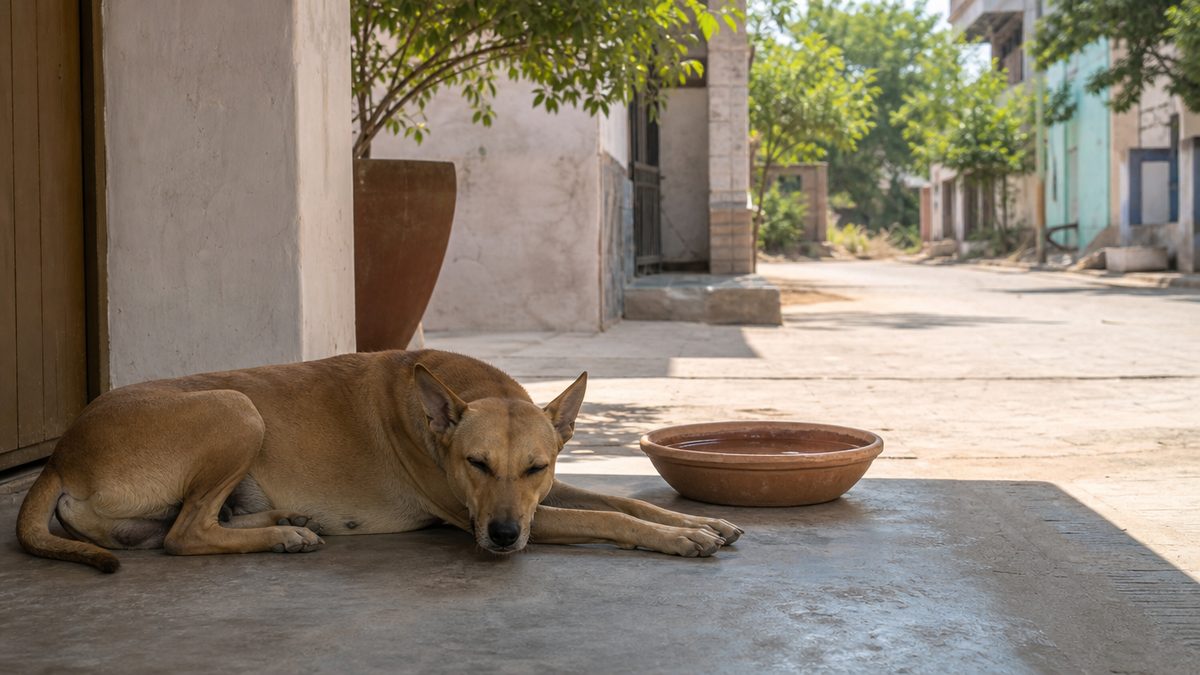
- Water in a wide earthen pot, shaded, refilled, the advisory's own wording, in a container the dog cannot tip over.
- Moving air by fan or air conditioning. The 2017 Rules require a breeder's kennel to circulate air by fans, blowers or air conditioning (Second Schedule Part IV paragraphs 15 and 16); in the humid cities the fan is the lever, because a dog cools by evaporation India Meteorological Department.
- A cool floor, and cooling mats under the dog, never a towel over it. Blue Cross lists cooling mats among its tips, and the mat has been measured. Nine conditioned working dogs ran at 10 kph for 15 minutes in a 30 C chamber and were then cooled three ways on three separate days: a 4 C cooling mat took 36 minutes to bring gastrointestinal temperature down to 39 C, against 48 minutes for natural cooling and 16 minutes for five minutes of partial immersion in a 30 C water bath. A mat helps a warm dog. It is not first aid for a hot one, and the water is.
- Trim, never shave. The coat's layers protect against overheating and sunburn. Groom the heavy-coated breeds so the undercoat is not matted.
- No hot car, not for five minutes. IMD's don'ts forbid it, ASPCA calls it a route to fatal heat stroke, and vehicles triggered 12.41 percent of the 2022 emergency cases ASPCA, Hot Weather Safety Tips (trim Royal Veterinary College.
- Move the exercise, do not cancel the dog's day. The fix for a 74.2 percent exertional trigger is the hour, not the amount: pre-dawn, slow, short, with water, nothing between 12 noon and 3 pm India Meteorological Department.
Hydration comes before the walk, not only after it, so hydrate the dog at the bowl before you pick up the leash; the RVC's prevention list says the same, with a water bottle packed for the walk. Two dogs need it most: the overweight dog, at 1.42 times the odds of one below its breed mean, and the senior dog of 12 or more, at 1.75.
Seven mistakes that put dogs in the clinic
The seven mistakes below each match a documented trigger or wrong first-aid step; the first is the commonest in an Indian city, the 8 am walk in May, when Delhi already averages 35 C at 08:30 IST.
- The 8 am walk. Exertion triggers 74.2 percent of events, and the 35 C block begins by 08:30 or 09:30 IST in Delhi, Ahmedabad and Jaipur.
- The wet towel over the dog. Used in 51.31 percent of UK clinic records; it traps heat.
- Driving before cooling. Only 21.70 percent of dogs were cooled before transport.
- Ice-cold water on the skin. It narrows blood flow and can trigger shivering.
- Shaving the double coat.
- Five minutes in the parked car. 5.2 percent of primary-care events and 12.41 percent of emergency cases Royal Veterinary College.
- Trusting the breed. The short-coated Greyhound carried 4.26 times the Labrador's odds through exertion.
Every mistake has a cheap fix: the pre-dawn hour, the IMD colour, shade, water, moving air, and cool first, transport second.
Common questions
How do I keep my dog cool in extreme hot weather?
Shade all day, water in a wide earthen pot it cannot tip, a fan or the air conditioning, a walk only in the pre-dawn hour, and never a parked vehicle: those are the AWBI's and IMD's own instructions, and on an orange or red alert day the walk is cancelled.
What temperature is considered too hot for a dog?
No Indian body sets one. The only statutory lines are 30 C, above which animals may not be moved on foot, and 37 C between noon and 3 pm for working animals; British and Australian pages say 20 C and 28 C, both below an Indian metro's coolest May hour.
Is it okay to spray your dog with water when it's hot?
Yes. Water cooler than the dog, poured or sprayed over its body but not its head and paired with a fan or breeze, is the evaporative cooling the Royal Veterinary College recommends for prevention and first aid; not ice-cold, and never a wet towel over the dog.
How hot is too hot for dogs in summer?
The most detailed published bands, on a veterinarian-written page, are under 23 C safest, 24 to 27 C moderate and 28 to 31 C high risk; every Indian city here passes 28 C by 08:30 IST in its hottest month, so the hour matters more than the number.
How to reduce body heat for dogs?
Shade or a fan, water cooler than the dog over the neck, belly and thighs with moving air so it evaporates, small sips offered, then the vet; immersion in cool water suits a young healthy dog, room-temperature water and air an old or sick one.
How do I tell if my dog is dangerously hot?
Heavy panting that becomes noisy, restlessness, drooling, red gums or tongue, a racing heart and vomiting or diarrhoea are the early signs; lethargy, confusion, collapse or a seizure is the advanced stage, and a body temperature over 40 C (104 F) is heat illness.
Do dog cooling mats work?
Yes, as a way to cool a warm dog, and no as first aid for a hot one. In nine working dogs cooled after treadmill exercise at 30 C, a 4 C cooling mat took 36 minutes to bring core temperature down to 39 C, against 48 minutes for natural cooling and 16 minutes for five minutes of partial immersion in a 30 C water bath. The mat beat doing nothing and lost to water by more than two to one, and the authors recommend water troughs in working-dog training areas.