
Breed profile
Braque Francais Pyrenean: The Complete India Guide
The smaller and far commoner of the two Braque Francais breeds, read from FCI standard 134 as the list of ten departures it actually is, with the French studbook, the four genuine research papers, and what all of it means in an Indian climate.
Quick answer
The Braque Francais Pyrenean is the smaller of two separate French pointing breeds sharing one name, recognised as FCI standard 134 on 18 January 1955. Males stand 51 to 58 cm and females 49 to 56 cm, and the standard states no weight. France registered 623 in 2025 against the Gascogne's 35. It has no lawful supply route into India, and its long low ear is the main welfare risk in Indian humidity.
This guide is general information for Indian dog owners and is not veterinary advice. It cannot diagnose or treat any individual animal. Ear disease in particular needs cytology before medication, because treating blind accounted for 11.11 percent of cases in the Indian series cited here. Consult a registered veterinary practitioner for your own dog.
Braque Francais type Pyrenees at a glance
What the Braque Francais Pyrenean actually is
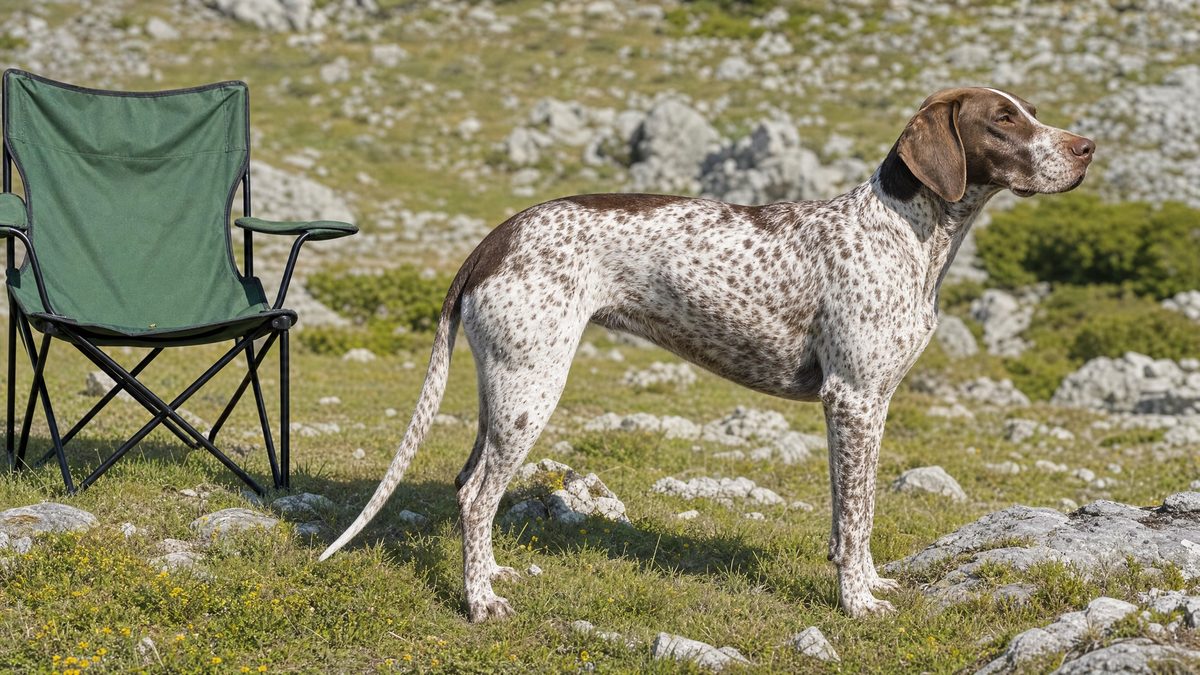
The Braque Francais Pyrenean is the smaller of two separate French pointing breeds that share one name, recognised by the FCI as standard 134 and by the French studbook as Braque francais, type pyrenees. It stands 51 to 58 cm at the shoulder for a male and 49 to 56 cm for a female, carries a short chestnut-brown and white coat, and was bred to hunt and point feathered game in the Central Pyrenees.
The FCI recognised it on a definitive basis on 18 January 1955, one day after it recognised its larger sibling the Gascogne as standard 133 FCI breeds nomenclature entry 133. Both are French in origin, both sit in Group 7 Pointing Dogs, Section 1.1 Continental Pointing Dogs of the «Braque» type, and both are subject to a working trial, meaning a dog cannot take a full international show title without proving it can do the job. The current standard for each was published on 1 August 2023 and issued on 22 September 2023 FCI-Standard N° 133, Braque Français.
One number is missing from the standard and it explains a great deal of the nonsense written about this breed. Neither FCI standard states a weight. Standard 134 runs through general appearance, head, ears, neck, body, tail, limbs, coat and size, then stops. There is no weight rubric. The Societe Centrale Canine's own breed page is candid about it and prints "Poids: NP", not specified FCI-Standard N° 134, Braque Français. Any page that tells you this dog weighs 40 to 80 pounds is not quoting the standard, because the standard says nothing at all.
The dog the standard describes
Standard 134 opens by calling it a rustic dog, "not heavy but sufficiently muscled", with skin tighter than the Gascogne's. The French original reads "Chien rustique, sans lourdeur mais suffisamment musclé. Peau plus tendue que celle du Gascogne";. The nose is chestnut-brown with well-opened nostrils. The coat is finer and shorter than the Gascogne's. The ears are long, set above the eye line and barely folded, with tips that must stop 2 cm short of the nose leather.
That last clause matters more than any other and the rest of this guide keeps returning to it. A dog whose ear tips reach to within 2 cm of its own nose has a long, low-hanging, canal-covering ear. In the Pyrenees that costs nothing. In Pune, where the July and August mean relative humidity is 89.1 and 90.8 percent, it is the single most consequential thing about the breed.
History: where it comes from
The Societe Centrale Canine traces the type directly to the oldest known pointing breed, already described by Gaston Phebus, Count of Foix, in the fourteenth century, and credits it with preserving its rusticity from the period when dogs were bred only for the service they gave. Standard 133's historical summary puts both types in the South-West of France and the Central Pyrenees, "where they stayed in pure state";.
The most useful single sentence written in English about the breed's proportions is one Wikipedia carries, quoting Gun Dog Magazine: a German Shorthaired Pointer shrunk down to Brittany size. We cite Wikipedia rather than the magazine because we could not open the magazine article itself.
"Braque Francais" covers two FCI breeds, not one. If a source gives you a single height range spanning 47 to 69 cm, or a single weight, it has merged the two. Read our Braque Francais hub for how the pair split, and the Braque Francais type Gascogne guide for the larger one.
This is by far the commoner of the two. France registered 623 Pyrenean puppies in 2025 against 35 Gascognes, a ratio of nearly 18 to 1. It is also the only one of the pair with a real scientific literature: every genuine PubMed record for "Braque Francais" studies this type and none studies the Gascogne. When you read about the genetics of the Braque Francais, you are reading about this dog.
The ten departures: how standard 134 is actually written
Standard 134 is not a description of a dog. It is a list of the ways one dog differs from another, and it says so in its own classification clause. Read it as a standalone breed description and you will misread it, which is what every page currently ranking for this term does.
The clause is in the FCI-CLASSIFICATION block, before the standard proper begins. In English it reads that the small size French Pointing Dogs of Pyrenean type show, "while keeping all proportions, with more reduced dimensions and lighter shapes, the same general characteristics as those of the « Gascogne type ». They only differ on the following points". The French original, which is the official authentic language for both standards, is flatter still: "Il n'en diffère que sur les points suivants"; FCI breeds nomenclature entry 134.
Everything after that sentence is a departure from standard 133. Nine rubrics carry those departures, and the limbs rubric is split into separately labelled forequarters and hindquarters entries, giving ten distinct points of difference. Here they are, all of them, against the 133 text they replace.
| # | Rubric | Standard 133, Gascogne | Standard 134, Pyrenean |
|---|---|---|---|
| 1 | General appearance | Powerful without excessive heaviness, robust with strong bone; skin supple, quite loose | Rustic, not heavy but sufficiently muscled; skin tighter than the Gascogne's |
| 2 | Head, nose and lips | Nose broad and brown; lips pendent, labial commissure quite folded | Nose chestnut-brown, nostrils well opened; lips less pendent or less convex |
| 3 | Ears | Leathers of medium length, set at eye level, slightly folded, tips must reach the rear rim of the nose leather | Leathers set on above eye line, barely folded, tips must end 2 cm from the nose leather |
| 4 | Neck | Of good length, always with a slight dewlap | Slight or no dewlap |
| 5 | Body, underline and belly | Underline flat, belly only slightly tucked up | Belly less let down than in the Gascogne |
| 6 | Tail | Generally docked; long tail if well carried is not a fault, nor is the naturally short tail | Fine; can be docked or naturally short |
| 7 | Forequarters | Legs vertical, straight, muscular; shoulder very muscular and moderately oblique; forefeet tight and well arched, nearly round | Lighter than the Gascogne; shoulder muscular and moderately sloping; forefeet tight |
| 8 | Hindquarters | Really vertical and straight; hind feet compact, almost round | Hind feet tight |
| 9 | Coat | Hair rather thick and well furnished, finer on head and ears | Hair finer and shorter than the Gascogne's |
| 10 | Size | Male 60 to 69 cm, female 58 to 68 cm | Male 51 to 58 cm, female 49 to 56 cm |
Read the list as a whole and a consistent animal emerges. Every departure runs the same direction: lighter, tighter, drier, shorter. Tighter skin, less dewlap, less pendent lip, less let-down belly, lighter forequarters, finer and shorter coat, smaller frame. Standard 134 is describing the same dog with the loose tissue taken off it.
Nine of the ten departures reduce loose skin, coat bulk or body mass. Every one of those changes helps a dog shed heat. The Pyrenean is the drier, lighter-coated, less dewlapped member of the pair, and on paper that makes it the better of the two for an Indian climate. The tenth departure, the ear, runs the other way.
The ear the Gascogne must have is a fault in this breed
The sharpest single difference between the two Braque Francais breeds is the ear, and it is a straight reversal. The exact ear conformation that standard 133 requires of the Gascogne is printed as a listed fault in standard 134. Both documents say so in their own text, in both languages.
Standard 133 requires of the Gascogne: "Leathers of medium length, set at eye level, not too broad at their set on, framing the head well, slightly folded and rounded at their tip... The tip of the leathers must reach the rear rim of the nose leather". Reaching the nose is not tolerated in the Gascogne. It is mandatory.
Standard 134 requires the opposite of the Pyrenean: "Leathers set on above eye line, barely folded. The tips of the leathers must end at 2 cm from the nose leather". Then, in its FAULTS list, it penalises the Gascogne pattern by name: "Leathers set at eye level, too long (touching the nose)".
The French text removes any chance that this is a translation artefact. Standard 134's fault reads "Oreilles attachées au niveau de l'œil, trop longues (atteignant la truffe)", and its requirement reads "Insérées au-dessus de la ligne de l'œil, à peine plissées. Les pointes des oreilles doivent s'arrêter à 2 cm de la truffe";. Set at eye level and reaching the nose is the Gascogne's breed type and the Pyrenean's fault, in the official authentic language of both standards.
| Ear feature | Standard 133, Gascogne | Standard 134, Pyrenean |
|---|---|---|
| Set on | At eye level, required | Above the eye line, required; at eye level is a listed fault |
| Length | Tip must reach the rear rim of the nose leather | Tip must stop 2 cm from the nose leather; touching the nose is a listed fault |
| Fold | Slightly folded, rounded at the tip | Barely folded |
What this is worth to a buyer
This gives you a free, physical breed test that needs no pedigree and no measuring stick. Lift the ear and lay the tip forward along the muzzle. If it reaches the nose, you are looking at Gascogne ear type. If it stops short of the nose by roughly a finger's width, you are looking at Pyrenean ear type. Combined with height, which no longer overlaps between the two breeds after the 2022 revision, that settles which of the two breeds is in front of you.
It is also the one point where the smaller breed is not the lighter-built one. On nine of the ten departures the Pyrenean has less tissue than the Gascogne. On the ear it has a proportionally similar leather on a much smaller head, which is why the standard has to specify a 2 cm gap rather than a proportion. A 51 cm dog carrying an ear that reaches nearly to its nose has a long ear by any measure.
A long, low, barely-folded ear leather lying flat over the canal is the classic predisposing conformation for otitis externa, and Indian series find it heavily over-represented. Read the [ear care section](#ears) before you buy. The ear is the reason this breed needs an India-specific management plan rather than a translated European one.
One registry rounds the 2 cm into an inch
The United Kennel Club recognised this breed in 2006 under the name Braque Francais de Petite Taille, and its standard renders the ear clause as "Medium length, set on above the eye line, and not too broad at the base. Barely folded and rounded at the tips. Must end one inch short of the nose leather". One inch is 2.54 cm against the FCI's 2 cm, so the UKC tolerates an ear 27 percent further from the nose than the FCI does. It is a small divergence and it is the sort that accumulates: the same UKC standard still gives height as 18.5 to 23 inches for males, which is the pre-2023 FCI range of 47 to 58 cm converted, so a dog can be within the UKC standard and outside the current FCI one.
The reversal is not an FCI quirk either. The UKC reproduces it in its own words across its two standards, which is independent corroboration from a third registry. Its Grande Taille standard requires ears "Medium length, set at eye level ... Must reach to the rear edge of the nose leather", while its Petite Taille standard requires them "set on above the eye line ... Must end one inch short of the nose leather";. Three registries, two languages, one consistent reversal.
Why the 2022 revision moved the size limits, in the breed club's own words
The FCI raised the Pyrenean's minimum height from 47 cm to 51 cm in the standard published on 16 June 2022, not in the 2023 reissue that most pages credit, and the reason is documented rather than mysterious. The Club du Braque Francais asked for it, because under the old numbers the minimum height of a Gascogne was identical to the maximum height of a Pyrenean and the two breeds overlapped exactly where a buyer needs them not to.
The evidence is in the FCI's own breed-specific education document for these two standards, a nineteen-page illustrated guide titled "The French Pointing Dog, Standard and comments", published jointly by the Centrale Canine and the FCI with running commentary from the judge A. Franchi. It is written against the pre-2022 text, which makes it a useful record of the moment before the change.
The change is dated 2022, not 2023, and the FCI's own typography proves it. The English text dated 11 August 2022, translating the official valid standard published on 16 June 2022, already prints the size clause as male 51 to 58 cm and female 49 to 56 cm, and it prints the 51 and the 49 in bold immediately above the line "The latest amendments are in bold characters". That bolding is the FCI marking which figures it had just changed, and it marks only the two minima, leaving the 58 cm and 56 cm ceilings untouched. The standard published on 1 August 2023 carries the identical figures and simply drops that sentence, so a page that credits the 2023 reissue with moving the limits is a year late.
It prints the old figures for both breeds. Gascogne male 58 to 69 cm and female 56 to 68 cm, with a preferred size of 61 to 63 cm. Pyrenean male 47 to 58 cm and female 47 to 56 cm, with 50 to 55 cm given as "the one to aim for which covers the most numerous utilizations".
Then it records the request. On the Gascogne page: "the CBF requested that the minimum authorized size be reviewed, with 60 cm for males, 58 cm for females. The fact that the minimum size of a Gascogne is equal to the maximum size of a Pyrenean does indeed seem undesirable: the Gascogne must be by definition taller". On the Pyrenean page: "as with the Gascogne, the CBF is in favor of increasing the minimum size: in this case, 51 cm for the male, 49 cm for the female; 47 cm is indeed a bit too small";.
| Breed and sex | Pre-2022 minimum | CBF request | In force from 16.06.2022 |
|---|---|---|---|
| Gascogne male | 58 cm | 60 cm | 60 cm |
| Gascogne female | 56 cm | 58 cm | 58 cm |
| Pyrenean male | 47 cm | 51 cm | 51 cm |
| Pyrenean female | 47 cm | 49 cm | 49 cm |
All four requested figures were adopted unchanged. Standard 133 now gives the Gascogne male 60 to 69 cm and the female 58 to 68 cm, and standard 134 gives the Pyrenean male 51 to 58 cm and the female 49 to 56 cm FCI-Standard N° 134, Braque Français. The revision closed the overlap and opened a 2 cm gap between the two breeds, so a male between 58 and 60 cm now falls outside both standards.
If a page gives the Pyrenean male as starting at 47 cm, or 18.5 inches, it is quoting the 1998 text that stood until 1 August 2023. If it says 51 cm, the writer opened the current document. That single number sorts the sourced pages from the copied ones, and the FCI's own education PDF is itself on the old figures, so even primary sources need dating.
What the judge's commentary adds
A. Franchi's notes give a working judge's summary that the standard's clipped clauses do not. On the breed as a whole: "the Pyrenean is globally drier than the Gascogne. The lips should be less let down but the muzzle should not appear pinched". That is the nine-departures pattern in one sentence.
On the ears, the comment is more specific than standard 134 itself: "compared to the Gascogne, the ears are shorter, flatter, more triangular in shape". Flatter is the word that matters in an Indian monsoon, because a flat leather seals the canal more completely than a folded one.
On the neck: "ideally, it is better if there is no dewlap";. On the tail: "in the Pyrenean, the short tail is not uncommon, but it should still measure a few centimeters; anuria is not accepted";. And on size tolerance, a dog up to 2 cm over the maximum may be tolerated if it is a typical subject, but without being eligible for the qualifier "Excellent" or the CACS.
The same document's historical summary describes the French Pointing Dog as the distant successor of dogs used in the Middle Ages in falconry and for netting birds, pushed into competition by imported English breeds from the eighteenth century, and "long renowned for its docility and trainability".
One registry never made the change and still carries the overlap the FCI removed. The UKC gives its Grande Taille 23 to 27 inches for males and its Petite Taille 18.5 to 23 inches, so the two breeds meet at exactly 23 inches with no gap between them United Kennel Club. A 23-inch male satisfies both UKC standards at once, which is precisely the situation the Club du Braque Francais described as undesirable and the FCI fixed in 2022.
How many there are, from the French studbook
France registered 623 Braque Francais type Pyrenees puppies in 2025, up from 606 in 2024. That makes it the ninth most registered pointing breed in France and roughly eighteen times commoner than its Gascogne sibling, which managed 35. These are the only reliable population figures that exist for this breed anywhere.
The numbers come from the Societe Centrale Canine's published LOF statistics, the French national studbook. We extracted the table ourselves with pypdf rather than trusting a summary, and checked the arithmetic: the 32 breed rows in the Group VII table sum to exactly the printed totals of 18,073 registrations for 2024, 17,777 for 2025 and 5,476 confirmations, so no row was dropped in extraction.
| Rank | Breed | Registered 2024 | Registered 2025 | Confirmed 2025 | Confirmed share |
|---|---|---|---|---|---|
| 1 | Setter Anglais | 4,900 | 5,086 | 1,828 | 35.9% |
| 2 | Epagneul Breton | 3,953 | 3,793 | 1,036 | 27.3% |
| 3 | Petit Epagneul de Munster | 1,892 | 1,823 | 517 | 28.4% |
| 4 | Braque Allemand a poil court (GSP) | 1,138 | 1,287 | 343 | 26.7% |
| 5 | Braque de Weimar (Weimaraner) | 801 | 829 | 171 | 20.6% |
| 8 | Pointer Anglais | 637 | 671 | 237 | 35.3% |
| 9 | Braque Francais, type Pyrenees | 606 | 623 | 176 | 28.3% |
| 13 | Braque d'Auvergne | 203 | 159 | 73 | 45.9% |
| 16 | Braque du Bourbonnais | 51 | 61 | 23 | 37.7% |
| 18 | Braque Francais, type Gascogne | 14 | 35 | 8 | 22.9% |
| 21 | Braque Saint-Germain | 44 | 16 | 10 | 62.5% |
| Whole of Group VII | 18,073 | 17,777 | 5,476 | 30.8% |
A correction to our own hub page
We cross-checked the 2024 column against the separately published 2024 statistics, which is worth doing because a single mis-parsed row would change the trend. The 2024 table gives BRAQUE FRANCAIS, TYPE PYRENEES as 609 in 2023, 606 in 2024 and 170 confirmations, at 28 percent. The 606 matches the 2025 document exactly, and the three-year run of 609, 606 and 623 shows a breed that is flat to very slightly rising rather than declining. The confirmation share is stable too, at 170 of 606 in 2024 and 176 of 623 in 2025, both 28 percent.
Our Braque Francais hub calls this breed the eleventh most registered pointing breed in France. That is wrong and the correct figure is ninth. The error is worth explaining because it is easy to repeat. The SCC table indents two colour varieties of the Epagneul Breton, Blanc et Orange at 1,946 and Autres Couleurs at 1,847, as separate rows beneath their parent breed. They are varieties, not breeds, and they sum exactly to the Epagneul Breton line: 1,946 plus 1,847 is 3,793, and their confirmations of 545 plus 491 give 1,036, matching the parent row to the unit. Count them as breeds and the Pyrenean drops two places to eleventh. Count breeds only and it is ninth. We have republished the corrected rank here rather than staying consistent with our own earlier page.
What 623 means in proportion
The Pyrenean accounts for 3.5 percent of all French pointing-dog registrations, dividing 623 by 17,777. The Gascogne accounts for 0.20 percent, dividing 35 by 17,777. France registers eight Setter Anglais for every Pyrenean, and it registers 145 Setter Anglais for every Gascogne.
So this is a rare breed by world standards and an ordinary one inside France. It is not endangered and it is not fashionable. It sits in the band of French gundogs that working hunters keep buying and nobody else has heard of, alongside the Pointer Anglais at 671 and the Setter Gordon at 541. That is a healthier position than the Gascogne, the Braque Saint-Germain at 16 or the Braque de l'Ariege at 6, and it is the reason this breed has a genuine literature while its sibling has none.
Why three quarters of registered puppies never breed
Only 176 of the 623 Pyrenean puppies France registered in 2025 were confirmed that year, which is 28.3 percent. The other 447, or 71.7 percent, are registered dogs that cannot pass their own pedigree on. Confirmation, not registration, is the number that governs the breed's genetics.
France does not simply record a birth and stop. A puppy enters the Livre des Origines Francais on a litter declaration at birth, and it must later pass the examen de confirmation, the confirmation exam, before its own offspring can be registered. At the exam a judge checks that the dog carries no eliminating faults of morphology, colour or character, examines it standing and in movement, and verifies its identification.
For Group VII, the pointing dogs, the minimum age to present a dog is 12 months. So a Pyrenean puppy born in 2025 could be confirmed in 2026, which means the yearly figures are not a clean cohort. The 176 confirmations recorded in 2025 largely belong to dogs born in 2024 or earlier. That caveat cuts both ways and does not rescue the ratio, because the 2024 registration figure of 606 is almost identical to 2025's 623: whichever birth year you attribute the 176 confirmations to, the denominator is about the same and the share stays near 28 percent.
176 of 623 is 28.25 percent, and the SCC prints 28 percent. Across the whole pointing group it is 5,476 of 17,777, or 30.8 percent, printed as 31 percent. For the Gascogne it is 8 of 35, or 22.9 percent. The Pyrenean is slightly below its group average and well below the Setter Anglais at 35.9 percent. Roughly three registered puppies in four never enter the breeding pool.
This is a different mechanism from the pack hounds
Our French pack-hound guides report a superficially similar gap, and the cause there is not the same. A pack-hound kennel that never shows simply keeps its dogs outside the studbook altogether, so the loss happens before registration and the registration count itself understates the population.
That is not what happens here. The Pyrenean is an individually owned gundog, bought one at a time by a hunter who wants papers, so the puppies do get registered at birth. The filter falls one step later, at confirmation. The count of puppies is honest. The count of breeding animals is 28 percent of it. For this breed the registration figure is a real census and the confirmation figure is the genetic one, whereas for the pack hounds neither figure is a census at all.
Why a dog fails or never turns up
The SCC does not publish reasons, so we will not invent a breakdown. What the process itself tells you is that failure is not the only route to a low ratio. A dog is only counted as confirmed if its owner presents it, pays, and sends the completed file back to the SCC. A hunter who wants a shooting dog and never intends to breed has no reason to do any of that. Non-presentation and failure are both inside the 71.7 percent and the published data cannot separate them.
The appeal machinery shows how seriously the French take the judgement. A breed club that disagrees with a confirming judge has two months to appeal under article D.214-12 of the code rural, and an owner refused confirmation can appeal within the same two months by paying 110 euros, refunded only if the appeal succeeds, to be heard by a jury of three judges.
For an Indian buyer the practical consequence is narrow and worth knowing. An imported Pyrenean with French papers may hold a birth certificate without ever having been confirmed. Those are different documents and only one of them means a judge has assessed the dog against the breed standard.
Effective population size: 51, or 27, depending who you ask
The Braque Francais type Pyrenees has an estimated effective population size of 51 by one 2018 method and 27 by another, published by overlapping author teams in the same year on the same 48 dogs. Both numbers are far below the 623 puppies France registers annually, and the gap between them is the most useful thing on this page for anyone thinking about breeding.
Effective population size, written Ne, is not a headcount. It is the size of an idealised population that would lose genetic diversity at the rate the real one is losing it. A breed can register hundreds of puppies a year and still behave genetically like a few dozen animals, because a small number of popular sires do most of the breeding.
Mastrangelo and colleagues, PLoS ONE 2018, report a recent Ne of 51. Their abstract states that "The estimated effective population size (recent Ne = 51) shows a similar declining pattern over generations as all other dog breeds";. They used the SNeP tool on a filtered dataset of 534 animals across 33 breeds and 132,281 SNPs, with the Braque Francais placed against the LUPA project reference breeds.
Mastrangelo and colleagues, BMC Research Notes 2018, report a contemporary Ne of 27. Their text reads that "The estimated contemporary effective population size (Ne) in Braque Francais, type Pyrenees dogs was 27; this value indicates a potential risk of inbreeding and reduction in genetic diversity", and notes that a Bullmastiff study using the same method returned a similar 29.1. That paper used NeEstimator v2 on the linkage-disequilibrium method, with 48 dogs, 27 females and 21 males, genotyped on the Illumina CanineHD BeadChip carrying 173,662 SNPs, of which 94,065 survived filtering.
SNeP estimates Ne across historical generations and reports the most recent point on that curve. NeEstimator measures contemporary Ne from linkage disequilibrium in the present sample. They are answering slightly different questions, so 51 and 27 are not a dispute about facts. We publish both rather than averaging them, because the honest range for this breed is 27 to 51 and any single figure hides half the evidence.
| Measure | Value | Source |
|---|---|---|
| Recent effective population size (SNeP) | 51 | PLoS ONE 2018 |
| Contemporary effective population size (NeEstimator v2) | 27 | BMC Res Notes 2018 |
| Dogs genotyped | 48 (27 female, 21 male) | BMC Res Notes 2018 |
| SNPs on array / retained | 173,662 / 94,065 | BMC Res Notes 2018 |
| Observed heterozygosity | 0.371 (SD 0.142) | BMC Res Notes 2018 |
| Expected heterozygosity | 0.359 (SD 0.124) | BMC Res Notes 2018 |
| Runs of homozygosity detected | 5,635, average length 2.16 Mb | BMC Res Notes 2018 |
| Mean inbreeding from ROH (F-ROH) | 0.112 | BMC Res Notes 2018 |
| Mean pedigree inbreeding | 0.049 (4.9%), SD 0.051 | PLoS ONE 2018 |
| Pedigree size and depth | 333 dogs, 3.6 generations average | PLoS ONE 2018 |
One finding in the BMC paper is worth singling out. A run of homozygosity shared by 75 percent of the dogs was detected at the beginning of chromosome 22. Three quarters of a 48-dog sample carrying the same homozygous stretch in the same place is a founder signature, not a coincidence.
The pedigree data tells the same story from the other direction. Mean pedigree inbreeding was 0.049, and 41 of the 48 dogs had an inbreeding coefficient above zero, running from 0.036 to a maximum of 0.25. An F of 0.25 is the coefficient of a full-sibling mating. The correlation between pedigree inbreeding and molecular inbreeding from ROH was only 0.48, which the authors attribute partly to the shallow 3.6-generation pedigree. In plain terms, the paperwork understates the relatedness.
An Ne of 51 against 623 registrations, and what Indian law then demands
Divide the registrations by the effective population size and the scale of the problem becomes visible: 623 puppies a year rest on a gene pool behaving like 51 animals, a ratio of 12 to 1. Against the contemporary estimate of 27 it is 23 to 1. Anyone planning to breed this dog in India has to reconcile that with a rule in Indian law that the breed's own published pedigrees are too shallow to satisfy.
Work the arithmetic in both directions. Against the census of 623 registered puppies, an Ne of 51 is 8.2 percent and an Ne of 27 is 4.3 percent Mastrangelo S, Biscarini F, Tolone M Mastrangelo S, Biscarini F, Auzino B. Against the 176 dogs actually confirmed and therefore eligible to breed, an Ne of 51 is 29 percent and an Ne of 27 is 15 percent. The confirmed count is the fairer comparison and it still shows the gene pool behaving like a third of the eligible animals or less.
| Measure | Count | Ratio to Ne 51 | Ratio to Ne 27 |
|---|---|---|---|
| Puppies registered in France, 2025 | 623 | 12.2 to 1 | 23.1 to 1 |
| Puppies confirmed in France, 2025 | 176 | 3.5 to 1 | 6.5 to 1 |
| Unconfirmed, cannot pass on pedigree | 447 | 8.8 to 1 | 16.6 to 1 |
None of that makes the breed unhealthy today. An Ne in the 27 to 51 band is unremarkable among pedigree dogs, and the BMC authors say so directly, comparing their 27 to a Bullmastiff figure of 29.1 obtained by the same method. Their own conclusion is that the breed is "a relatively inbred population, but with still sufficient genetic variability for conservation and genetic improvement";. What it does mean is that the margin is thin and the breed cannot absorb a popular-sire episode.
The clause that catches an Indian breeder
The Prevention of Cruelty to Animals (Dog Breeding and Marketing) Rules 2017 prohibit in-breeding outright. The Second Schedule, paragraph 6(3), states that two mating techniques "are not permitted and are prohibited under these rules", the first being "in breeding ... breeding between relatives of the 2nd to 4th grade in straight or side line within the first four generations e.g. uncle to niece, nephew to aunt, cousin to cousin, grandparents to grandchildren", and the second being incest breeding between parents and children or brother and sister. Only out breeding and line breeding are permitted, under paragraph 6(2).
Indian law bans in-breeding within four generations by name, including cousin to cousin. An official French pedigree does carry five generations, so on paper it spans the window. The catch is what those generations actually contain: the pedigree data published for this breed averaged only 3.6 generations of real depth, and the correlation between pedigree inbreeding and genomic inbreeding was just 0.48. A five-generation form with three and a half generations of content cannot demonstrate compliance. Verify relatedness genomically rather than trusting the document.
This is not a theoretical worry for a breed in which 41 of 48 sampled dogs carried a non-zero inbreeding coefficient and one carried an F of 0.25, the value of a full-sibling mating. It is also why the correlation of only 0.48 between pedigree inbreeding and genomic inbreeding matters practically rather than academically. A French pedigree that looks clean over three generations may conceal relatedness that a genomic test would find. Where the numbers permit it, verify relatedness genomically rather than trusting the document.
Three further clauses of the same Rules bind anyone breeding here. Paragraph 6(4) forbids mating a female after the age of eight years. Paragraph 5(7) forbids using a male until he has reached his eighteenth month, and requires a veterinary practitioner to certify him healthy at least ten days before mating. And Rule 8(1)(a), in the body of the Rules rather than the Schedule, requires every breeder to ensure that "pups less than eight weeks in age are not sold";.
The 2017 Rules number clauses twice. There is a Rule 8 (Conditions for sale) in the body and a separate paragraph 8 in the Second Schedule (Veterinary care). We name which of the two we are quoting every time, because reading only one of them has caused people to report real provisions as absent.
The whole scientific literature, four papers, all on this type
PubMed holds exactly five records matching the exact phrase "Braque Francais". Four are genuine studies of the breed and every one of them is on the Pyrenean type. None is on the Gascogne. For a breed most Indian readers have never heard of, that is an unusually complete and unusually citable evidence base.
We queried the NCBI E-utilities directly with the quoted phrase and read the raw JSON. The response gives a count of 5 and, critically, a query translation of `"Braque Francais"[All Fields]`. That matters because PubMed silently rewrites queries it cannot match, and a rewrite can inflate a count with irrelevant records without flagging it. Here the phrase was searched as a phrase, so the count of 5 is real and small rather than large and contaminated.
| PMID | Title | Journal, year | About this breed? |
|---|---|---|---|
| 29316964 | Genome-wide diversity and runs of homozygosity in the "Braque Français, type Pyrénées" dog breed | BMC Res Notes, 2018 | Yes, Pyrenean type |
| 30517199 | Genomic characterization of the Braque Français type Pyrénées dog and relationship with other breeds | PLoS One, 2018 | Yes, Pyrenean type |
| 30832273 | A Genome-Wide Detection of Copy Number Variations Using SNP Genotyping Arrays in Braque Français Type Pyrénées Dogs | Animals (Basel), 2019 | Yes, Pyrenean type |
| 38945428 | Genome-wide association study for morphological and hunting-behavior traits in Braque Français Type Pyrénées dogs: A preliminary study | Vet J, 2024 | Yes, Pyrenean type |
| 30763509 | Symptoms of Canine Leishmaniosis in Tunisian Dogs | Bull Soc Pathol Exot, 2018 | No. The breed name appears incidentally in a Tunisian leishmaniosis case series |
Normally an absence needs a control query to prove the search works. This one carries its own control. Both FCI breeds share the string "Braque Francais", so a phrase search on it would return Gascogne papers if any existed, and it demonstrably returns Pyrenean ones. The search that found four Pyrenean studies found zero Gascogne studies using the identical string. All the science on the Braque Francais is science about this dog.
What the two later papers add
Copy number variation, 2019. Di Gerlando and colleagues used a 170 K SNP array to detect 45 stringent copy number variant regions in 26 dogs, of which 16 were novel, and annotated 159 genes within them. The gene ontology enrichment pointed to "muscle structure development and muscle cell differentiation", and the authors hypothesise that selection for speed, retrieval and pointing behaviour drove those genes into the variant regions.
The abstract states the 45 regions ranged "from 3.5 kb to 458,716 kb in length". As printed, the upper bound is 458.7 megabases. A single copy number variant region of that size is not biologically plausible, and the figure is almost certainly 458,716 base pairs. We record the number exactly as the paper prints it, we flag it, and we do not use it anywhere in this guide.
Genome-wide association, 2024. Mastrangelo and colleagues analysed 44 unrelated dogs with evaluation scores for 12 traits related to morphology and hunting performance, retaining 95,859 SNPs on the 38 dog autosomes after filtering. They detected 378 SNP-phenotype associations with posterior odds of association above 1, with the strongest involving eye conformation, the skull to muzzle ratio, and "hunting connection". Six of the significant markers mapped within SETDB2, a gene already known to relate to pointing behaviour in dogs.
Two things follow for a buyer. First, the trait that makes this a pointing dog has a partial genetic address, and it is one the breed shares with other pointing breeds rather than something unique to it. Second, all four studies are small: 48, 48, 26 and 44 dogs, with substantial overlap in the sampled population. They tell you about the breed's structure, not about disease risk in your individual puppy. Nobody has published a health survey on this breed at all, and OFA records that the parent club has not initiated one.
Price in India: there is no market, and here is the proof
No Braque Francais Pyrenean is offered for sale in India at any price. Every Indian search result for the breed is a dropdown option, a sidebar link or an auto-generated category page, and not one of them is a listing for an actual dog. Any rupee figure you are shown for this breed has been made up or borrowed from another animal.
We say that with a control, because a zero result proves nothing on its own. Searching for this breed's price in India, geo-set to India, returned ten results: a Justdial page for Shih Tzus in Dehradun, a Maltese page on an American site, an Etsy pack of 655 breed silhouettes, two dog-training pages listing the breed in a dropdown, a Czech university thesis citing the genetics paper, a Mumbai English Cocker Spaniel listing, a Justdial Pug page in Surat, a Dutch puppy site, and an Etsy towel. In every single case the breed name appears in a menu, a filter or a footer. The control query, labrador retriever price in india, returned five genuine Indian price pages with real figures in the same session. The search works. The dogs are not there.
What an auto-generated shell page looks like
Justdial publishes a page titled "Popular Pet Shops For Braque Francais Dog in Kosamba". Open it and the pattern is unmistakable. The three businesses listed are The Golden Pet Shop in Jhansi, Uttar Pradesh; Doon Pets World in Dehradun, Uttarakhand; and Singh Pet Shop in Surat, Gujarat. Kosamba is in Gujarat, so two of the three are over a thousand kilometres away. The lead photograph for the Jhansi shop is filed in the site's own image path under the category "pet-shops-for-psittacula-parrot". And the listed categories for all three shops are Pet Shops For Dog, Pet Shops, Pet Shops For Birds, Dog Kennel Dealers and Pet Shops For Labrador Dog. Not one of them is listed under a Braque Francais category at all.
The page then prints several hundred words of generic advice about choosing a shop with knowledgeable staff and durable toys, without ever claiming that any shop stocks the breed. It contains no price. It is a template with a breed name substituted in, and an identical page exists for every breed in the site's taxonomy.
The Rs 98,999 that is not a breed price
One rupee figure recurs across Indian puppy retail and it needs naming, because it will eventually be attached to this breed. Rs 98,999 is a house price point, not a breed price. On a single Puppiezo product page for German Shepherd Double Coat puppies, the "Other Available Pets" carousel prints Rs 98,999 three times, attached to Fizey, a Maltipoo; Samy, another Maltipoo; and Yoki, a Doxiepoo. Beside them the same carousel prints Rs 92,599 twice for two Poodles, Rs 94,999 for a Cane Corso, Rs 76,499 for a Rottweiler and Rs 1,20,000 for a Goldendoodle. The German Shepherds the page is actually about are priced from Rs 47,999 to Rs 94,999, and none of them is Rs 98,999. The same product template, down to the "Replacement Guarantee" panel and the "Never feed these foods" block, is reproduced for breeds with no connection to those animals, including an Anatolian Shepherd page on the same site. It is one template with a breed name and a photograph swapped in, which is exactly why a price printed on it tells you about the site rather than about the breed.
Indian pages routinely publish a dollar list run through one exchange rate. Rs 98,999 divided by 84.38 is 1,173.25 and divided by 74 is 1,337.82, neither of them a round dollar figure. Nor is any other price on that page: the full set of sixteen figures produced no clean conversion at either rate. This particular site is not a converted American price list. It is rupee-native charm pricing, and every figure ends in 999, 599, 499, 400 or 000. Both findings are worth having, because they call for different scepticism.
So we publish no price band for this breed, and we will not borrow the Gascogne's or a German Shorthaired Pointer's. For calibration only, and explicitly not as this breed's price, Indian Labrador bands published by one retailer run Rs 30,000 to 60,000 for basic quality, Rs 60,000 to 90,000 for KCI registered and Rs 90,000 to 1,20,000 for champion bloodline. That is what a common breed with a real Indian supply chain costs, and at the bottom of that band it is genuinely affordable. This breed has no supply chain at all.
What the Indian registry numbers say about why it never arrives
The Kennel Club of India registered 32,219 puppies with its studbook in 2025, down 63.5 percent from its 2021 peak of 88,261. A registry that reaches roughly one Indian dog in 530 has no room for a French breed that registers 623 puppies a year in its own country.
The scale of Indian pedigree registration is worth knowing, because it explains why a breed like this never arrives. The Kennel Club of India registered 32,219 puppies with its studbook in 2025, down from a 2021 peak of 88,261, a fall of 63.5 percent. Against the approximate national dog population the FCI records for India in 2025, 17,111,342, that is 0.19 percent of dogs. A registry covering one dog in 530 has no room for a French breed registering 623 puppies a year in its own country.
The FCI's own India table contains a discontinuity we cannot explain and will not paper over. Its "Approximate TOTAL number of DOGS" row reads 157,500,000 for 2017 and then 15,794,584 for 2018, a tenfold drop from one year to the next, and its dog-owner row falls from 68,628,500 in 2024 to 38,128,500 in 2025. We use the 2025 figure of 17,111,342 because it is internally consistent with the 2018 to 2024 run, but a national dog population is not known to that precision and the 0.19 percent should be read as an order of magnitude, not a measurement.
Import rules: what the law allows and what it forbids
You cannot lawfully import a Braque Francais Pyrenean into India to breed from or to sell. Dogs are a Restricted import, and the DGFT permits entry only for a personal pet with a valid pet book in the importer's name, for research with a CPCSEA recommendation, or for Defence and Police use.
DGFT Trade Notice No. 22/2022-23, dated 19 December 2022, sets the policy. Under ITC (HS) 01061900, mammals other than those separately listed are Restricted. Policy Condition (7) allows the import of dogs only for three purposes: "i. Pet dog with valid pet book and relevant records/documents in the name of importer. ii. Dogs imported by the R&D Organisations for conducting research with the recommendation of CPCSEA. iii. For the internal security by the Defence and Police Force". Policy Condition (8) closes the commercial door: "Import of commercial dogs for breeding or any other commercial activities other than the purposes mentioned above is not permitted";.
| Situation | Up to two pets | More than two pets |
|---|---|---|
| Permanent import | Allowed as passenger baggage without DGFT authorisation, only for a person transferring residence to India after two years of continuous stay abroad. Only cats and dogs qualify under baggage rules. | DGFT import authorisation required, with applications examined by DAH&D |
| Permanent import, stay abroad under 2 years | DGFT import authorisation required | DGFT import authorisation required |
| Temporary import | DGFT import authorisation required, examined by DAH&D | DGFT import authorisation required, examined by DAH&D |
The mandatory documents for a permanent import are a Vaccination Book, Pet Passport or Pet Book, a Certificate for Emotional Support, and a Passport of the Pet. A temporary import additionally needs a copy of the return ticket or an expected date of return.
Read those two rules together with the absence of any Indian supply and the position is clear. The only lawful route by which this breed enters India is in the baggage of someone moving home from abroad who already owns the dog. No breeding import is permitted, so no domestic supply chain can lawfully form, which is exactly what the empty search results show.
The standard permits a docked tail. Indian law forbids docking.
Standard 134 describes the tail as "Fine; can be docked or naturally short". The French reads "peut être écourtée ou courte de naissance";. That is a direct conflict with Indian law and it needs stating plainly.
The Dog Breeding and Marketing Rules 2017, Second Schedule paragraph 6(8), provides that "There shall be no tail docking, ear cropping, de-barking, de-clawing, branding, dyeing, injecting substances to enhance visual appeal, performing a surgery or procedure to camouflage or hide any defect or infirmity or any other kind of mutilation of any body part of the pup and any change of appearance by artificial means is strictly forbidden". There is no breed-standard exemption.
Standard 133 explicitly protects the long tail on the Gascogne: "although the long tail, if well carried, is not a fault, no more than the naturally short tail";. Standard 134's tail clause is one of the ten listed departures, so it replaces that text, and it mentions only docked or naturally short. Whether 133's long-tail tolerance carries over is genuinely unclear from the documents. What is not unclear is the law: in India the dog keeps its natural tail, and anyone who tells you the standard requires otherwise is describing a procedure that is strictly forbidden here.
Note also that standard 134 lists "No tail (anury)" among its disqualifying faults, so a dog born without a tail is excluded from the ring regardless.
One registry has already faced this conflict and resolved it in the owner's favour, which is useful precedent to quote. The UKC standard for this breed describes the tail as "Docked or natural or a natural bob", then adds a policy note: docking and cropping remain legal and a personal choice in America, but "as an international registry, the United Kennel Club is aware that the practices of cropping and docking have been forbidden in some countries", and accordingly "no dog in any UKC event, including conformation, shall be penalized for a full tail or natural ears";. An Indian owner showing a naturally-tailed dog is not showing a faulty one.
Cost of ownership: what it costs to keep, once you already have one
Cost of ownership divides cleanly here. Budget roughly Rs 64,000 to Rs 1,46,000 for the first year and Rs 45,000 to Rs 1,00,000 a year after that, excluding purchase, because no purchase price for this breed exists in India. Those are medium-dog Indian figures, and only two lines on the list are genuinely breed-specific.
We build this from published Indian costs for a medium-sized short-coated gundog, because no Braque Francais cost data exists for India and inventing one would be worse than borrowing a comparable. One Indian retailer's first-year breakdown for a Labrador totals Rs 79,000 to Rs 1,76,000, and the nine line items sum exactly to those totals at both ends, which is more internal consistency than most Indian cost pages manage.
| Line item | Low | High | Applies to this breed? |
|---|---|---|---|
| Vaccinations, first year | Rs 5,000 | Rs 8,000 | Yes, unchanged |
| Spaying or neutering | Rs 8,000 | Rs 18,000 | Yes, unchanged |
| Microchipping | Rs 1,000 | Rs 2,000 | Yes, and legally expected for records |
| Supplies: bed, crate, bowls, leash | Rs 5,000 | Rs 10,000 | Yes, unchanged |
| Food, 12 months | Rs 30,000 | Rs 60,000 | Yes, at the lower half for a 49 to 58 cm dog |
| Grooming, 12 months | Rs 6,000 | Rs 18,000 | Lower: short fine coat needs little grooming |
| Training | Rs 5,000 | Rs 20,000 | Yes, and do not economise here |
| Routine vet care | Rs 4,000 | Rs 10,000 | Higher: add ear checks |
| First-year total, no purchase price | Rs 64,000 | Rs 1,46,000 |
The two lines that move for this breed
Grooming moves down. Standard 134 specifies hair "finer and shorter than that of the Gascogne Type", and Royal Canin's India page lists the breed as requiring minimal grooming Royal Canin India. The Indian benchmark assumes a double-coated shedder needing quarterly professional sessions at Rs 500 to Rs 1,500 a month. A short single coat does not need that. Budget the bottom of the range and spend the difference on ears.
Routine veterinary care moves up, and specifically ear care. This is the one recurring cost a generic Indian budget will not have priced, and it is the direct consequence of the ear clause in standard 134. Weekly ear checks cost nothing. A neglected otitis externa that becomes a chronic, stenotic ear costs a great deal, and the Palampur series recorded canal stenosis in 12.34 percent of its cases and ulceration in 16.8 percent.
We publish no purchase price, no Indian breeder fee and no shipping estimate, because none of them exists for this breed. Import costs vary with the DGFT route, airline and quarantine and we have no published figure we could verify. If a page quotes you a precise all-in Indian import cost for a Braque Francais Pyrenean, ask which document it came from.
One further recurring item applies only if you keep a working relationship with the French registry. Confirming a dog in France requires the completed form, the original birth certificate and a fee stated on the form, and appealing a refusal costs 110 euros, refunded only if the appeal is upheld. For an Indian pet owner none of that arises. For anyone importing a dog intended to remain in the French studbook it does.
Insurance is worth a separate thought here. The breed is unlisted by every Indian pet insurer we are aware of, and an unlisted breed is usually underwritten as a generic medium dog. Ask specifically whether recurrent otitis externa is excluded as a pre-existing or chronic condition, because in this breed it is the claim most likely to recur.
Heat tolerance, argued from the origin climate outwards
The Braque Francais Pyrenean comes from a place whose annual mean air temperature is 9.7 degrees Celsius. Chennai's is 27.9. That gap of 18.2 degrees, not any opinion about the breed's hardiness, is the honest starting point for judging whether this dog belongs in an Indian city.
We use one climate source and one method throughout, so the comparison is like for like. Every figure below comes from the NASA POWER climatology API, which serves long-term monthly climatology derived from the MERRA-2 reanalysis, queried by explicit latitude and longitude rather than by place name. That choice is deliberate: a coordinate query cannot silently return a different city, which slug-based climate sites do. In each case the API echoed back the coordinates we sent, and we report the grid-cell elevation it returned alongside them, because elevation drives a lot of what follows.
| Location | Lat, Lon | Grid elev (m) | Annual mean T2M (C) | Hottest month, max T2M (C) | RH July (%) | RH August (%) |
|---|---|---|---|---|---|---|
| Central Pyrenees, Hautes-Pyrenees FR (origin) | 43.2328, 0.0781 | 981 | 9.7 | 35.8 (Aug) | 71.0 | 68.6 |
| Chennai, Tamil Nadu | 13.0827, 80.2707 | 49 | 27.9 | 42.7 (May) | 67.5 | 72.4 |
| Delhi | 28.6139, 77.2090 | 206 | 25.6 | 48.8 (Jun) | 62.7 | 74.9 |
| Pune, Maharashtra | 18.5204, 73.8567 | 636 | 23.9 | 43.2 (Apr) | 89.1 | 90.8 |
| Bengaluru, Karnataka | 12.9716, 77.5946 | 842 | 23.7 | 40.4 (Apr) | 76.8 | 78.7 |
T2M_MAX in the POWER climatology is the maximum 2 metre air temperature the reanalysis records for that month, not an average daily high. It is an extreme, which is why the origin shows 35.8 C in August despite an annual mean of 9.7 C. Compare the extremes with the extremes and the means with the means, never one against the other. The annual mean column is the one that carries the argument.
The mechanism, not the adjective
A dog sheds heat by panting, by conduction through skin, and hardly at all by sweating. Three clauses of standard 134 bear directly on that budget, and two of them help.
The coat helps. Standard 134 specifies hair "finer and shorter" than the Gascogne's, and standard 133 gives the Gascogne hair "rather thick and well furnished"; FCI-Standard N° 133, Braque Français. A finer, shorter single coat presents less insulation between skin and air. Of the two Braque Francais breeds, this is the one built for warmth.
The build helps. Standard 134 requires skin "tighter than that of the Gascogne type", slight or no dewlap where the Gascogne "always" has one, lips less pendent, belly less let down, and forequarters lighter FCI-Standard N° 133, Braque Français. Less loose tissue and less body mass mean less heat generated and less insulating bulk to shed it through. A 51 to 58 cm dog also carries a better surface-area-to-mass ratio than a 60 to 69 cm one.
The size of the gap does not help. None of that closes 18.2 degrees of annual mean. This is a rustic, hardy, muscled working animal that is not heat-tolerant bred for cold mountain country at nearly a thousand metres, and no conformation detail turns it into a tropical breed. Standard 134 also insists on a functional dog: only "functionally and clinically healthy dogs" should be bred from, and the breed is subject to a working trial FCI breeds nomenclature entry 134. A dog selected for stamina in cool air is a dog that will try to work through heat it cannot handle.
Ranked by the annual mean gap, Bengaluru at plus 14.0 degrees and Pune at plus 14.2 are the least bad, Delhi at plus 15.9 is worse, and Chennai at plus 18.2 is worst. Bengaluru's advantage is real and comes from elevation: its grid cell sits at 842 m and its hottest recorded maximum, 40.4 C, is the lowest of the four.
A workable Indian heat routine for this breed
Walk this dog before sunrise and after dark, and treat the middle of the day as indoor time from March to June in every Indian city. The breed's exercise requirement does not shrink in an Indian summer, so it has to move to the hours when the air can take it.
The scheduling problem is specific. Royal Canin's India page lists this breed as needing a lot of exercise, and the Societe Centrale Canine warns in plain French that it is a sportif who needs to let off steam regularly Société Centrale Canine. Meanwhile Delhi's hottest recorded month maximum is 48.8 C and Chennai's is 42.7 C. Those two facts have to be reconciled by the clock, because neither of them is negotiable.
| City | Hardest months | Main session | Second session | Watch for |
|---|---|---|---|---|
| Delhi | April to June, max 48.8 C in June | Before 06:00 | After 20:00 | Dry pre-monsoon heat, then 74.9% humidity in August |
| Chennai | March to June, max 42.7 C in May | Before 06:00 | After 20:00 | Heat and humidity together all year, annual mean 27.9 C |
| Pune | March to May, max 43.2 C in April | Before 06:30 | After 19:30 | Monsoon humidity of 89.1% and 90.8% in July and August |
| Bengaluru | March to May, max 40.4 C in April | Before 06:30 | After 19:30 | Mildest of the four, still 14.0 C above origin annual mean |
Practical rules that follow from the standard
- Test the pavement with the back of your hand for five seconds before every walk. A short-coated dog gives you no visual warning of a burnt pad.
- Carry water on every outing over fifteen minutes, and offer it before the dog asks.
- Shorten, do not skip. Three short outings beat one long one in April. A dog that is never exercised becomes a destructive dog indoors, which is how heat problems turn into behaviour problems.
- Watch the panting change, not the panting itself. Wide, noisy, tongue-curled panting with a dog that will not settle is early heat stress. Move indoors and cool the paws and belly with tepid water, never ice.
- Skip the midday car entirely from March to June. A parked car in Chennai in May sits above the 42.7 C the reanalysis records as the month's outdoor maximum.
Of the two Braque Francais breeds, this is the better one for India, and the standard says why in nine of its ten departure clauses. Finer and shorter hair, tighter skin, little or no dewlap, less pendent lips, a less let-down belly, lighter forequarters and a frame 9 cm shorter at the withers all reduce heat load. If you were going to keep one of the pair in Pune, keep this one.
Do not over-read that advantage. A short coat is not sun protection, and a fine short coat over tight skin means less between the sun and the dog. On white and speckled areas, which this breed has in quantity, sunburn is a real risk on long midday exposure. The answer is shade and timing rather than sunscreen.
Finally, acclimatise slowly. A dog arriving from Europe should not be walked on an Indian April afternoon in its first month at any hour, and an Indian-born puppy should build tolerance across a cool season before meeting its first summer. The breed is hardy, but hardiness is a description of what it can be conditioned to, not a starting condition.
Long ears in Indian humidity: the one thing to get right
Standard 134 requires an ear leather long enough to stop just 2 cm short of the nose, lying barely folded over the canal. An Indian hospital series found that 69.1 percent of canine otitis externa cases occurred in pendulous-eared breeds, and that 59.25 percent of all cases presented in July and August.
The conformation is not incidental, it is required. "Leathers set on above eye line, barely folded. The tips of the leathers must end at 2 cm from the nose leather";. A barely folded leather is one that lies flat, and a leather reaching almost to the nose is a long one on a dog only 51 to 58 cm tall. Flat and long together means the ear canal is covered, unventilated and slow to dry. That is the classic predisposing conformation for otitis externa.
The Indian evidence, checked line by line
A cross-sectional study at the Department of Veterinary Medicine, Dr. G.C. Negi College of Veterinary and Animal Sciences, CSKHPKV Palampur, screened 2,476 dogs between June 2022 and July 2023 and diagnosed otitis externa in 81, a hospital prevalence of 3.27 percent. Dividing 81 by 2,476 gives 3.271 percent, so that headline checks out. The authors compare it with O'Neill and colleagues' UK primary-care estimate of 7.3 percent.
| Finding | Cases | Printed % | Our check |
|---|---|---|---|
| Rainy season, July to August | 48 | 59.25 | 48/81 = 59.26%, agrees |
| Summer, April to June | 15 | 18.51 | 15/81 = 18.52%, agrees |
| Winter, December to March | 10 | 12.34 | 10/81 = 12.35%, agrees |
| Autumn, September to November | 8 | 9.87 | 8/81 = 9.88%, agrees |
| Pendulous-ear breeds | 53 as printed | 69.13 | 53/81 = 65.43%. Does NOT agree. See below. |
| Erect-ear breeds | 25 | 30.86 | 25/81 = 30.86%, agrees |
| Excessive moisture in canal | 17 | 20.98 | 17/81 = 20.98%, agrees |
| Treatment error | 9 | 11.11 | 9/81 = 11.11%, agrees |
| Aural polyps | 6 | 7.40 | 6/81 = 7.41%, agrees |
Table 5 prints "Pendulous ear breed | 53 | 69.13%", and 53 of 81 is 65.43 percent, not 69.13. Three independent checks all give 56. First, 56/81 is 69.14 percent, matching the printed figure to the rounding. Second, the two ear categories are exhaustive, and 56 plus the correctly-printed 25 erect-ear cases equals exactly 81, the study total, whereas 53 plus 25 leaves 78 and three dogs unaccounted for. Third, the two printed percentages sum to 99.99 percent, so the counts must sum to the whole series. The percentage is right and the count is a typo. We use 56 of 81, 69.1 percent.
The other number that looks wrong and is not
The same section opens "In a study of 50 cases of Otitis externa, the primary cause was identified in 45.67% (37/81) as hypersensitivity", which reads like a contradiction against a series of 81. It is not an error. Table 5's five primary causes are hypersensitivity 37, parasitism 5, immune-mediated 4, hypothyroidism 2 and viral disease 2, and 37 plus 5 plus 4 plus 2 plus 2 is exactly 50. The 50 is the number of cases in which a primary cause was identified at all. The denominators beside each percentage remain the full 81 and each divides correctly: 37/81 is 45.68 percent, 5/81 is 6.17, 4/81 is 4.94, 2/81 is 2.47. The paper is internally consistent, and in 31 of the 81 cases no primary cause was established.
Two smaller slips are worth flagging so nobody quotes them. Table 1 prints 12.43 percent for the Pomeranian and Mongrel rows, both at 10 cases, where 10 of 81 is 12.35 percent. Table 4 prints 12.34 percent for a winter count of 10 in the same paper, which shows the 12.43 is a digit transposition. Table 1 also prints 9.80 percent for the Pug at 8 cases, where 8 of 81 is 9.88 percent.
A far larger UK cohort quantifies the ear-shape effect directly, and it is the strongest single piece of evidence on this page. O'Neill and colleagues sampled 22,333 dogs at random from 905,554 under UK primary veterinary care in 2016 and found a one-year period prevalence of otitis externa of 7.30 percent, with a 95 percent confidence interval of 6.97 to 7.65. Breed and ear carriage were the two highest-ranked risk factors. Breeds with pendulous ear carriage had 1.76 times the odds of otitis externa compared with breeds with erect ear carriage, with a confidence interval of 1.48 to 2.10, and breeds with V-shaped drop ears had 1.84 times the odds. For scale at the extreme, the Basset Hound carried an odds ratio of 5.87 against crossbred dogs, while the erect-eared Chihuahua came in at 0.20.
The weekly ear routine, and the European advice to ignore
Check this dog's ears every week and every single time it gets wet. Every risk factor the Palampur series identified lands on a breed whose standard requires a long, flat, canal-covering ear leather.
Every one of the study's findings points at this conformation. All 81 cases showed secondary bacterial or fungal overgrowth on cytology, with cocci in 37.03 percent, rods in 28.39 percent, yeast in 16.04 percent and mixed infections in 18.51 percent. Excessive moisture in the canal featured in 20.98 percent of cases and water entry in 33.33 percent. Canal stenosis appeared in 12.34 percent and ulceration in 16.8 percent, and otoscopy found erythematous canals in 88.8 percent.
And 59.25 percent of the year's cases arrived in a two-month monsoon window, in a Himachal district far cooler and drier than most of India. Pune's July and August relative humidity reaches 89.1 and 90.8 percent, well above anything Palam Valley sees. The seasonal signal the study found should be stronger, not weaker, in peninsular India.
- Lift and look weekly. Turn the leather back, look at the canal opening, and smell it. A yeasty or sour smell precedes visible disease.
- Dry after every wetting. Not the coat, the ear. Pat inside the pinna dry with cotton wool, then let the ear hang open for a few minutes.
- Plug before bathing. A third of cases in the series were linked to water entry, and this is the cheapest intervention available.
- Do not treat blind. Treatment error accounted for 11.11 percent of cases. Cytology before medication, every time.
- Escalate in July and August. Move from weekly to twice-weekly checks through the monsoon and take any head-shaking straight to a vet.
- Never cut or fold the ear. Any surgical alteration of the ear is strictly forbidden under Indian law, and cropping is named explicitly.
Overseas gundog guidance routinely says to towel a wet dog off and let it air dry. That is sound in a Pyrenean autumn. In an Indian monsoon, with a flat leather lying over a damp canal at 90 percent ambient humidity, air drying is precisely the condition the Palampur data describes. Dry the ear actively, every time.
What the seasons ask of you
Treat the monsoon as the season this breed is managed around. June to September is when the ear risk peaks, and it is also when Indian tick-borne disease pressure is significant: a multi-city Indian survey of canine tick-borne disease found infection widespread across the surveyed populations, which is a separate reason for a hands-on weekly check of a dog that works in cover.
Combine the two into one routine. Once a week, in good light, run your hands over the whole dog, lift both ears, check between the toes, and look at the skin under the elbows and in the groin. On a short-coated dog this takes three minutes and finds both problems early. That single habit is worth more to a Braque Francais Pyrenean in India than any product you can buy.
One piece of the UK study's own advice is worth repeating verbatim, because it cuts against what most owners do. Its plain-language summary recommends "ear cleaning with a dry paper cloth, judicious use of ear cleaners with antimicrobial properties and avoidance of overzealous ear-cleaning". Checking weekly is not the same as scrubbing weekly. Look often, clean rarely, and dry always.
Temperament and who should not buy one
The Braque Francais Pyrenean is a gentle, biddable, strongly owner-attached gundog that suits an active household and punishes a sedentary one. The French registry describes it as intelligent, obedient and very attached to its owner, and warns that an undeserved punishment can put it off for a long time.
The Societe Centrale Canine's own breed page is the most useful temperament source in existence for this dog, because it is written by the national registry rather than by a content farm. It calls the type "puissant et élégant, actif et obéissant, vif et doux", a marvel of balance so easy to educate that its followers say it is born trained. It adds that the dog will meet every request of an owner who can make himself understood, and that punishment is usually useless.
Royal Canin's India page describes the breed as Loving, Intelligent, Quiet and Even-tempered, and adds that Pyrenean types are "more spirited, impetuous and faster on the ground than Gascogne-types";. Those two descriptions are not in conflict. Calm in the house and fast in the field is the classic continental pointing-dog profile.
Who this breed suits
- Households with an hour and a half a day, split across the cool ends of the day, every day, in every season.
- Families with children. The SCC records that the breed lives with its owner and is devoted to children.
- Owners who want an energetic dog in the room. This is a companion breed as well as a working one, and it does badly kept outside or kennelled away from the family.
- People who will train with rewards rather than corrections, because the registry itself says corrections do not work on this dog.
Who should not buy one
- Anyone wanting a guard dog. Nothing in standard 134 or the registry description suggests suspicion of strangers, and aggression is a disqualifying fault.
- Anyone who is out twelve hours a day. A sensitive, owner-attached, high-energy gundog left alone all day is a destructive and vocal dog.
- Anyone who plans to correct their way through adolescence. The SCC's warning about undeserved punishment is the strongest single caution on its page.
- Anyone in a top-floor Chennai flat with no early-morning routine. The climate section explains why the schedule, not the square footage, is the binding constraint.
The SCC states the breed adapts very well to the city, "à condition d'y être habitué jeune", on condition of being accustomed to it young. That is a conditional yes, and the condition is the whole sentence. A Pyrenean raised in a Mumbai flat from eight weeks, exercised properly and socialised through the first year, does well. One brought into a flat at two years old from a rural kennel usually does not.
Temperament is also a registry matter rather than only an opinion. Character faults are among the eliminating faults a French confirmation judge checks for, and standard 134 disqualifies any dog that is "Aggressive or overly shy"; FCI-Standard N° 134, Braque Français. A shy, shut-down Braque Francais is not showing breed type; it is outside the standard.
Training: the registry says punishment does not work
Train this breed with rewards, short sessions and clear signals, and skip corrections entirely. The Societe Centrale Canine states that punishment will usually prove useless with this dog and that an undeserved punishment risks putting it off for a long time, which is an unusually direct warning from a national registry.
The French text is worth quoting because English pages soften it. "Intelligent, obéissant et très attaché à son maître, le Braque français type pyrénées répondra à toutes ses demandes dès lors que celui-ci saura se faire comprendre. Par ailleurs, tout châtiment s'avèrera le plus souvent inutile. Attention! Une punition imméritée risquerait de le rebuter pour longtemps";. The dog will answer every request from an owner who can make himself understood; punishment is mostly useless; and an unfair punishment can sour it for a long time.
The claim that the breed is "born trained" is a French enthusiast's phrase, recorded by the registry as what its followers say rather than as a fact. Treat it as a statement about biddability, not about effortlessness. A biddable dog learns your mistakes as readily as your intentions.
A realistic Indian timeline
| Age | Priority | Why now |
|---|---|---|
| 8 to 16 weeks | Handling, ear handling above all, name, recall game, crate | The socialisation window is open and ear tolerance built now saves a decade of struggle |
| 16 weeks to 6 months | Lead manners, sit and down, settle on a mat, traffic and lift habituation | City habituation must happen young or it does not happen |
| 6 to 12 months | Reliable recall off lead in safe ground, impulse control around birds and squirrels | The pointing instinct switches on and recall must beat it |
| 12 to 18 months | Consolidation, distance work, calm greetings | Adolescent testing peaks; corrections here are what the SCC warns against |
| 18 months on | Maintenance, scent games, field work if available | The dog is mature and needs a job, not just a walk |
Two breed-specific training jobs nobody mentions
Teach ear handling as a trained behaviour, not a restraint. This is the highest-value thing you will train, and almost no guide lists it. From eight weeks, lift the leather, look inside, touch the canal opening, and pay the dog for holding still. A dog that volunteers its ears turns a weekly check into ten seconds. A dog that fights them turns every monsoon otitis into a sedation.
Train a heat recall. In Indian summer you need a recall that works when the dog is hot, over-aroused and pointing at something. Practise recall specifically in the last ten minutes of a morning walk, when the dog is tiring and the air is warming, because that is the state you will need it in.
This breed is subject to an FCI working trial, so European training literature aimed at it often assumes field-trial goals and the pressure that comes with them. An Indian pet home has no trial to prepare for. Take the breed's biddability and its need for a job, and leave the trial-preparation intensity where it came from.
Standard 134 gives one more reason to keep training low-pressure. "Aggressive or overly shy" is a disqualifying fault, and character defects are checked at confirmation Société Centrale Canine. Both failure modes, the defensive dog and the shut-down dog, are produced by the same handling error the registry is warning about.
Exercise: about 90 minutes, split around the heat
Plan on 75 to 120 minutes of real activity a day, in two or three sessions, for the dog's whole adult life. Royal Canin's India page lists this breed under "Needs a lot of exercise", and the French registry warns that it is a sportif that must be allowed to let off steam regularly.
We give a range rather than a single figure because no study establishes an exercise requirement for this breed and we will not invent one. The range comes from two sources that agree in direction. Royal Canin India's key facts list "Needs a lot of exercise" alongside "Requires minimal grooming" and "Makes a great family dog";. The Societe Centrale Canine adds "N'oublions pas que c'est un sportif et qu'il a besoin de se défouler régulièrement", do not forget he is an athlete who needs to let off steam regularly.
The breed is also subject to an FCI working trial, meaning it cannot take a full international show title on looks alone. That is a structural guarantee that the population is still being selected for stamina in the field, unlike many breeds where the show and working lines have separated. You are buying an animal whose registry still tests whether it can work.
What the day looks like
| Session | Timing | Duration | Content |
|---|---|---|---|
| Morning | Before sunrise, cool season permitting later | 40 to 60 min | Brisk walk plus off-lead running in safe ground |
| Midday | Indoors | 10 to 15 min | Scent games, food puzzles, training reps |
| Evening | After dark | 30 to 45 min | Walk, recall practice, sniffing time |
| Weekly | Cool morning | 2 hours or more | A longer outing on varied ground |
Sniffing counts and most owners undercount it. This is a pointing dog selected to quarter ground and locate birds by scent, and twenty minutes of unhurried nose work tires it more thoroughly than forty minutes of heeling on a pavement. In an Indian summer that is doubly useful, because scent work can be done at low intensity indoors or in shade when running cannot.
An under-exercised gundog does not become calm. It becomes destructive, vocal and hard to settle, and in a sensitive owner-attached breed those behaviours often get met with the corrections the SCC specifically warns against. The commonest route to a difficult Braque Francais is a skipped morning walk in April repeated for a month.
Two constraints belong here. Do not force-exercise a growing puppy. No published growth-plate guidance exists for this breed specifically, so apply the general principle: free running and play as much as the puppy chooses, no enforced distance work or repetitive jumping until the dog is structurally mature. And never make up a missed cool-hour session in the heat. A dog selected for stamina will keep going past the point where it should stop, which is exactly why the owner has to make that decision instead.
Grooming a short fine coat in Indian humidity
Brush once or twice a week, bathe rarely, and spend the time you save on ears and skin. Standard 134 specifies hair finer and shorter than the Gascogne's, and Royal Canin's India page lists the breed as requiring minimal grooming, so coat care is genuinely the easy part of this dog.
The standard's coat clause is one line, because the coat is one of the ten departures from the Gascogne rather than a full description: "Hair: Finer and shorter than that of the Gascogne Type";. Standard 133 gives the Gascogne hair "rather thick and well furnished; finer on the head and ears";. So the Pyrenean carries a short, fine, close single coat.
Colour comes from standard 133 and applies to both, since 134 does not list colour among its departures. The permitted colours are chestnut brown; chestnut brown and white; chestnut brown and white strongly speckled; and chestnut brown marked with tan above the eyes, at the lips and on the legs. The registry notes that the Pyrenean's coat is typically spotted or flecked brown and white.
The routine
- Brush once or twice weekly with a rubber curry or a soft bristle brush. It removes dead hair and, more usefully, forces a weekly hands-on inspection.
- Bathe only when dirty, not on a schedule. Over-bathing a short single coat strips it and does nothing for odour.
- Plug the ears before every bath, without exception, for the reasons set out in the [ear care section](#ear-care).
- Dry actively in the monsoon. Coat, feet, ears and skin folds. Do not leave a damp dog to air dry indoors in July.
- Check feet after every off-lead outing. Grass seeds and thorns lodge between the toes of a working dog and Indian scrub is full of both.
Neither FCI standard says anything about how much this breed sheds, and no allergy or hypoallergenic claim attaches to it in either document FCI-Standard N° 133, Braque Français. Treat any page describing it as low-shedding or allergy-friendly as marketing. A short fine coat sheds; it simply sheds hair that is less visible on furniture than a long one.
Skin in an Indian climate
Short coats create a specific Indian problem: they hide nothing but they also protect nothing. Tight skin, fine hair and white or lightly speckled areas mean sun exposure reaches the skin readily, so midday sun in April is a burn risk on the muzzle, ear tips and any thinly-haired belly. Shade and timing solve it; the climate section sets out the hours.
The monsoon brings the opposite problem. Persistent damp against skin produces the moist dermatitis every Indian vet sees between June and September, and a dog worked in wet cover is at more risk than a dog walked on pavements. Groom it dry rather than letting it dry itself, and pay attention to the axillae, the groin and under the ear leather, which are the three places that stay wet longest.
Ticks deserve the same weekly attention, and the Indian numbers justify it. A survey of 525 dogs across four Indian cities found that 261 of them, 49.7 percent, carried at least one tick-borne pathogen by PCR, with a confidence interval of 45.4 to 54.1. Dividing 261 by 525 gives 49.71 percent, so the headline checks out. Hepatozoon canis was commonest at 30 percent, followed by Ehrlichia canis at 20.6 percent, Mycoplasma haemocanis at 12.2 percent, Anaplasma platys at 6.5 percent and Babesia vogeli at 5.5 percent, and 39 percent of infected dogs carried more than one pathogen. Ticks were found on 278 dogs, 53 percent of those examined. A short-coated dog makes ticks easy to find provided somebody actually looks, and that is the practical upside of this coat: five minutes of brushing is also a full-body tick check.
Health: what is known, and why none of it is about this type alone
No published health figure exists for the Braque Francais type Pyrenees specifically. The Orthopedic Foundation for Animals holds 135 hip evaluations and 139 eye evaluations under a single undifferentiated BRAQUE FRANCAIS code, while its separate BRAQUE FRANCAIS PYRENEES entry returns no testing statistics at all. Anyone quoting you a Pyrenean-specific screening percentage is quoting the mixed pool.
We read the registry code out of OFA's own markup rather than guessing it, because a guessed OFA code returns a complete and plausible table for a different breed. The advanced-search checkboxes carry the breed names as attributes, and they show two separate entries: `value="BDF"` with `data-name="BRAQUE FRANCAIS"`, and `value="BP"` with `data-name="BRAQUE FRANCAIS PYRENEES"` Orthopedic Foundation for Animals. We then confirmed the breed name printed on each returned page before taking a single number.
| Test | Evaluated | Normal | Normal % | Abnormal | Abnormal % |
|---|---|---|---|---|---|
| Hips | 135 | 131 | 97.0 | 4 | 3.0 |
| Hips, Excellent | 33 | 24.4 | |||
| Hips, Good | 91 | 67.4 | |||
| Hips, Fair | 7 | 5.2 | |||
| Hips, Mild dysplasia | 3 | 2.2 | |||
| Hips, Moderate dysplasia | 1 | 0.7 | |||
| Hips, Severe dysplasia | 0 | 0.0 | |||
| Eyes | 139 | 128 | 92.1 | 11 | 7.9 |
The arithmetic is internally consistent, which is worth checking on any live register. Excellent 33 plus Good 91 plus Fair 7 equals 131, the normal total. Mild 3 plus Moderate 1 plus Severe 0 equals 4, the dysplastic total. 131 plus 4 equals 135, the evaluated total. Dividing, 131 of 135 is 97.04 percent and 4 of 135 is 2.96 percent, matching the printed 97.0 and 3.0. For eyes, 128 of 139 is 92.09 percent and 11 of 139 is 7.91 percent.
The page heading reads BRAQUE FRANCAIS, not BRAQUE FRANCAIS PYRENEES, and OFA's own markup maps that BDF entry to the CKC group as "GASCOGNE BRAQUE FRANCAIS";. Meanwhile the dedicated BP entry, whose page heading does read BRAQUE FRANCAIS PYRENEES, prints "No testing statistics found";. So the 135 hips and 139 eyes sit in a pool that is undifferentiated at best and Gascogne-labelled at worst. No OFA figure is attributable to this type alone.
The zero for BP is a real absence rather than a failed fetch, and we have the control to say so: the identical URL pattern, the same tool, the same stealth proxy and the same session returned a full set of tables for BDF minutes earlier Orthopedic Foundation for Animals. Both pages also state that the breed is not yet part of the CHIC programme and that "The parent club has not initiated a health survey for this breed"; Orthopedic Foundation for Animals.
Lifespan, screening and the faults that double as health checkpoints
No sourced lifespan exists for this breed, and the figure in circulation is attributed to a document that does not contain it. What does exist is a French screening pathway and a list of disqualifying faults that function as a health checklist.
Royal Canin's India page gives an average life expectancy of 12 to 15 years and states that its "key facts and characteristics sourced from Fédération Cynologique Internationale (FCI)". FCI standard 134 contains no lifespan at all. We read the whole document, in English and in French; it runs from classification to disqualifying faults without mentioning longevity. Nor do any of the four genuine PubMed records for this breed report a lifespan, since all four are genomic studies. Treat 12 to 15 years as a reasonable expectation for a medium gundog and not as a sourced figure for this breed.
What the standard does give you is a list of faults that are effectively health checkpoints. Entropion, ectropion and pink spots at the base of the eyelids are disqualifying faults, as are a split nose, pronounced depigmentation of the nose leather, anury, and syndactyly, surplus toes or absent toes. Two of those, entropion and ectropion, are named in the Indian Dog Breeding and Marketing Rules 2017 among the genetic defects for which dogs "shall have been tested", a list that also includes hip dysplasia, progressive retinal atrophy, night blindness and hypothyroidism.
A French screening route does exist, even though no figures are published
The Club du Braque Francais is the official breed club for both types, affiliated to the Societe Centrale Canine, and its site shows more health and selection machinery than the absence of published statistics suggests. It publishes a feuille pour lecture dysplasie, a dysplasia reading form, which means a hip-screening pathway exists in France for this breed even though no aggregate results are published anywhere we could find. It also runs a calendar of TAN natural-aptitude tests, maintains work and conformation value scales, and homologates working and morphology titles.
One detail on that site is quietly significant for everything on this page. The club maintains separate lists of recommended studs and dams for each type, published as four distinct pages for recommended Gascogne males, Gascogne females, Pyrenees males and Pyrenees females, and it lists litters under two separate headings, one per breed. The breed club that owns both breeds manages them as two populations, not one. Any page treating the Braque Francais as a single breed is out of step with the club that actually runs it.
Feeding: what the French registry says, and what to do in India
Feed a good commercial diet split across two meals a day for an adult, and ignore the one-meal-a-day advice on the French registry's own page. The Societe Centrale Canine recommends feeding this breed once daily in the evening, which is a working-kennel convention that does not transfer well to an Indian pet household.
The registry's advice is specific and worth reading before you decide against it. "Le Braque français type pyrénées doit être nourri une seule fois par jour, le soir: viande crue sans excès et riz avec quelques légumes. Les aliments industriels lui conviennent aussi. La quantité sera fonction de son activité";. Fed once a day in the evening, raw meat without excess and rice with a few vegetables; industrial foods suit him too; quantity according to activity.
Once-daily evening feeding is a French hunting-kennel convention: the dog works hungry through the day and eats after. An Indian pet Braque Francais Pyrenean is not working all day, and a deep-chested medium dog fed one large meal has a larger post-prandial stomach load than one fed two smaller ones. Split the ration. The registry itself makes quantity conditional on activity, and Indian pet activity is not French field activity.
The rice element does transfer, and pleasantly so. A diet built around meat and rice with some vegetables is straightforwardly available in every Indian city, which is not true of many European breed-club feeding recommendations. If you feed home-prepared food, have the ration balanced by a veterinarian rather than following the registry's one-line sketch, because "viande crue sans excès et riz" is a description, not a formulation.
Life-stage guidance
| Age | Meals per day | Focus |
|---|---|---|
| 8 to 16 weeks | 4 | Growth food, small frequent meals, free water always |
| 4 to 6 months | 3 | Steady growth, avoid over-supplementation of calcium |
| 6 to 12 months | 2 to 3 | Transition toward adult food late in this window |
| 12 months and over | 2 | Adult maintenance, quantity tracked to actual activity |
| 8 years and over | 2 | Reassess for weight and joint support with your vet |
Body condition matters more than the number on the bag
The standard gives you a built-in body-condition target and a built-in warning. It requires a dog "not heavy but sufficiently muscled", faults a dog that is "too heavy or hyperlight", and separately faults a belly "too tucked up (whippety)";. So both directions are wrong: this is not a breed to keep lean like a sighthound, nor one to let run heavy. Run your hands over the ribs weekly during the grooming check and aim to feel them easily under a thin covering.
Two Indian adjustments apply. Water first, always, and more of it than you think in April and May, with a second bowl if the dog is left alone during the day. And feed the main meal at the cooler end of the day, which happens to align with the registry's evening recommendation even though we are splitting the ration. Digestion generates heat, and a large meal before a hot afternoon is worse than the same food after dark.
Royal Canin sells in India and lists this breed on its Indian site, so a size-appropriate medium-breed commercial diet is easy to source here. That is a genuinely low-friction part of keeping this breed in India, in contrast to almost everything else about acquiring one.
The first year, month by month
Front-load handling and socialisation in the first four months, get the dog through its first Indian summer conservatively, and expect adolescence to test you between twelve and eighteen months. The one date fixed by an external authority is twelve months, the minimum age at which a French Group VII dog can be presented for confirmation.
| Age | Development | What you do |
|---|---|---|
| 8 to 10 weeks | Home, first vaccinations under way | Ear handling daily. Crate, name, house routine. Vaccination can start at seven to eight weeks under the 2017 Rules |
| 10 to 16 weeks | Socialisation window open | Traffic, lifts, tiled floors, other dogs, monsoon rain. Short and positive, never overwhelming |
| 4 to 6 months | Rapid growth, teething | Free play only, no forced distance work. Lead manners. First full summer, keep it indoors and early |
| 6 to 9 months | Pointing instinct emerges | Recall becomes the priority. Expect the dog to lock up on birds and lose its ears |
| 9 to 12 months | Near adult height | Build stamina gradually in cool hours. Introduce longer weekend outings |
| 12 months | Eligible for French confirmation in Group VII | If the dog is French-registered and you intend to breed, this is the earliest presentation date |
| 12 to 18 months | Adolescence, testing | Hold the line with rewards. This is where corrections do the damage the registry warns about |
| 18 months | Males eligible to breed under Indian law | Rule requires eighteenth month reached and a vet health certificate ten days before mating |
Two of those rows come from documents rather than from custom. The French confirmation minimum for Group VII, the pointing dogs, is 12 months, set out in the SCC's own confirmation guidance. The Indian breeding minimum for a male is the eighteenth month, with certification by a veterinary practitioner at least ten days before mating, under the Second Schedule of the 2017 Rules.
The eight-week rule, and why it is worth citing correctly
Rule 8(1)(a) of the 2017 Rules requires every breeder to ensure that "pups less than eight weeks in age are not sold". That clause sits in the body of the Rules, under "8. Conditions for sale", and not in the Second Schedule, which has its own separate paragraph 8 on veterinary care. The same Rule also provides at 8(1)(b) that dogs over six months are not sold without first being sterilised, unless sold to another licensed breeder.
The vaccination timetable in the Rules is worth knowing as a floor: "All pups shall be vaccinated which can start at the age of seven-eight weeks, and are usually completed at the age of eighteen weeks";. Your veterinarian will set the actual protocol for your city and its disease pressure.
Between ten and sixteen weeks you can permanently settle two things that this breed will otherwise fight you on for a decade: tolerance of ear handling, and calmness in Indian urban noise. Both are cheap now and expensive later. Everything else on this timeline can be caught up. These two cannot.
One caution about the timeline's realism in India. Almost nobody in India will run it, because there is no lawful route to buying a puppy of this breed here. The realistic Indian owner of a Braque Francais Pyrenean is someone who moved home from Europe with an adult dog. If that is you, the socialisation section still applies, compressed: the dog has to learn Indian noise, Indian surfaces, Indian heat and an Indian routine from whatever age it arrives, and the [heat management section](#heat-management) matters more for an adult arriving cold than for a puppy raised here.
How it compares with the breeds buyers cross-shop
Against its own sibling the Pyrenean is 9 cm shorter, finer-coated and eighteen times commoner. Against the German Shorthaired Pointer and the Brittany, the two continental pointing breeds an Indian buyer can actually obtain, it is rarer, smaller than the GSP and slightly larger than the Brittany, and the only one of the three with a required near-nose ear length.
| Breed | FCI std | Male height (cm) | Ear requirement | France 2025 registrations | Realistically obtainable in India? |
|---|---|---|---|---|---|
| Braque Francais type Pyrenees | 134 | 51 to 58 | Above eye line, tip stops 2 cm from the nose | 623 | No lawful supply |
| Braque Francais type Gascogne | 133 | 60 to 69 | At eye level, tip must reach the nose leather | 35 | No lawful supply |
| Braque Allemand a poil court (GSP) | 119 | Not compared here | Not compared here | 1,287 | Yes, a real Indian market exists |
| Epagneul Breton (Brittany) | 95 | Not compared here | Not compared here | 3,793 | Occasionally |
| Braque d'Auvergne | 180 | Not compared here | Not compared here | 159 | No |
| Braque du Bourbonnais | 179 | Not compared here | Not compared here | 61 | No |
| Braque Saint-Germain | 20 | Not compared here | Not compared here | 16 | No |
We give heights and ear clauses only for the two breeds whose standards we read in full for this guide, 133 and 134. Filling the other rows would mean quoting standards we did not open, which is how wrong numbers enter a comparison table. The registration column is complete because all seven rows come from one document we extracted and checked ourselves.
Pyrenean or Gascogne
For an Indian household, if the choice were real, take the Pyrenean. Nine of the ten departures in standard 134 reduce heat load: finer and shorter hair, tighter skin, slight or no dewlap against the Gascogne's obligatory one, less pendent lips, a less let-down belly, lighter forequarters, and a frame 9 cm shorter at the withers for a male FCI-Standard N° 133, Braque Français. It is also eighteen times easier to find, and it is the only one of the two with any published genetics NCBI PubMed E-utilities esearch.
The Gascogne wins on exactly one point that matters in India, and it is a small one. Both breeds have long ears, but the Gascogne's clause at least describes a leather "slightly folded and rounded at their tip", where the Pyrenean's is "barely folded" and therefore flatter over the canal FCI-Standard N° 134, Braque Français. Neither is a dry-ear breed. Read the Gascogne guide if you want the comparison in the other direction.
Against the pointing breeds you can actually buy here
The German Shorthaired Pointer is the honest recommendation for most Indian buyers who like this dog. France registered 1,287 of them in 2025 against 623 Pyreneans, it has a genuine Indian presence, and Wikipedia's own summary of the Braque Francais Pyrenean describes it as a German Shorthaired Pointer shrunk to Brittany size, which is a fair statement of how close the two are functionally.
The Brittany is the alternative if size is the attraction. At 3,793 French registrations it is the second most registered pointing breed in the country, and its colour varieties Blanc et Orange and Autres Couleurs are large enough to be tabulated separately.
Among the other French Braques, all of them are rarer than this one and none has a lawful Indian supply route. In descending French registrations they run Braque d'Auvergne at 159, Braque du Bourbonnais at 61, Braque Saint-Germain at 16, and the Braque Dupuy, which does not appear in the 2025 Group VII table at all.
What Indian owners and Indian pages get wrong
The commonest mistake is buying a dog described as a Braque Francais without asking which of the two breeds it is. The second is copying European ear-care advice into a monsoon climate. The third is believing a rupee price for a breed that has no Indian market.
Reading a merged breed description as one dog
Aggregator pages routinely print the union of both standards as though it described a single animal. A height range spanning 47 to 69 cm and a weight of 40 to 80 pounds is not a breed, it is two breeds added together, and it spans more than 20 cm of height. Check the height first: after the 2022 revision the ranges no longer overlap, with the Gascogne starting at 60 cm for a male and the Pyrenean topping out at 58 FCI-Standard N° 134, Braque Français.
Quoting the 1998 numbers
If a page gives the Pyrenean male as starting at 47 cm, or 18.5 inches, it is quoting a standard superseded on 16 June 2022. The current minimum is 51 cm. Wikipedia still gives the Pyrenean as 47 to 58 cm, or 19 to 23 inches. The AKC holds position 1 on this SERP and its listing carries a last-modified date of 2022, but we could not read its body through two attempts and make no claim about what figures it prints. That single number tells you whether a writer opened the current document.
Believing any weight figure at all
Neither standard states a weight. The Societe Centrale Canine's own breed page prints "Poids: NP". Every weight you see for this breed has been estimated by somebody, and the numbers in circulation are wide enough to prove it.
Treating an FCI attribution as a source
Royal Canin's India page gives a life expectancy of 12 to 15 years under a note saying key facts are "sourced from Fédération Cynologique Internationale (FCI)". Standard 134 contains no lifespan. An attribution is not a citation, and checking the cited document takes two minutes.
Assuming registration equals a breeding population
France registered 623 Pyreneans in 2025 and confirmed 176. Quoting 623 as the breed's breeding strength overstates it by a factor of 3.5, and the genetic measure is smaller again, at an effective population size of 51 or 27 depending on method Mastrangelo S, Biscarini F, Auzino B.
Copying an overseas ear routine
European gundog guidance says towel the dog and let it air dry. In a climate where Pune sits at 90.8 percent relative humidity in August, and where an Indian series put 59.25 percent of the year's otitis cases in July and August, that instruction is actively harmful for a breed whose standard requires a flat leather stopping 2 cm from the nose Nainika and Sharma P. Otitis externa… FCI-Standard N° 134, Braque Français.
Repeating a rupee figure without dividing it
No Indian price exists for this breed. Where a figure does appear on Indian puppy sites, run both tests before believing it: divide by 84.38 and by 74 to check for a converted dollar list, and check whether the same number is attached to unrelated animals. Rs 98,999 fails the second test badly, appearing three times in one carousel on two Maltipoos and a Doxiepoo.
Anyone offering to import this breed for you to breed from, or offering an Indian-bred litter, is describing something the law does not permit. DGFT Policy Condition (8) states that "Import of commercial dogs for breeding or any other commercial activities other than the purposes mentioned above is not permitted";. If a seller cannot explain which of the three permitted import purposes their dog entered under, walk away.
One more pattern is worth naming because it is now the dominant format. The page at position 8 on this SERP is structured almost entirely as question headings, running from "What is the purchase price?" to "What are some name ideas for a French Braque, Pyrénées type?";. That shape is built to match question queries rather than to answer them from documents, and it is why so many pages on this breed agree with each other while none of them agrees with standard 134.
Adoption, and the honest answer about sourcing one
You will not adopt a Braque Francais Pyrenean in India, because there are effectively none here to surrender. The useful advice is therefore about what to do instead, and about how to verify the one legitimate route that does exist.
Start with the position honestly. The breed has no Indian supply chain, no lawful breeding import route, no import licence available for the purpose,, and no Indian rescue presence. Indian shelters and breed-rescue networks handle Indian pariah dogs, Labradors, German Shepherds, Pugs, Beagles and Golden Retrievers in volume, because those are the breeds India actually keeps. The Palampur hospital series is a fair snapshot of the local population mix: of 81 dogs, the commonest were Labrador Retriever, German Shepherd, Pomeranian, Mongrel, Pug and Beagle.
What to do instead, in order of sense
- Adopt an Indian dog that needs a home. The Indian pariah dog is heat-adapted by several thousand years of selection that no European gundog can match, and it is available in every city for nothing.
- Adopt or rehome a gundog that is already here. German Shorthaired Pointers, Labradors and Beagles come into Indian rescue regularly, and an adult gundog whose temperament you can assess in person beats a puppy you cannot.
- If you genuinely want this breed, move to it rather than importing it. The only clean route is owning the dog abroad before you relocate, which is the one case the DGFT baggage provision contemplates.
- Do not commission an import. A breeding or commercial import is not permitted, and asking somebody to arrange one asks them to misdescribe the purpose.
Verifying the one legitimate route
If you are relocating to India with a Braque Francais Pyrenean you already own, the documentation is defined rather than discretionary. A permanent import as passenger baggage without DGFT authorisation is available only for up to two pets, and only to a person transferring residence to India after two years of continuous stay abroad. The mandatory documents are a Vaccination Book, Pet Passport or Pet Book, a Certificate for Emotional Support, and a Passport of the Pet. Anything else, including a stay abroad shorter than two years, requires a DGFT import authorisation with the application examined by DAH&D.
On the French side, check which documents your dog actually holds. A birth certificate from the SCC and a confirmed pedigree are different things, and only confirmation means a judge has assessed the dog against standard 134. For an imported dog the SCC works from the pedigree of the country of origin rather than a French birth certificate.
One Indian puppy retailer publishes a "Replacement Guarantee" stating that if your pet "perishes because of any health concern (covered under our vet-approved conditions)" within the guarantee period, it will "happily offer a replacement", with the period running from one to two weeks by tier. A living animal offered with a replacement window is being sold as stock. Whatever breed you end up with, that framing tells you what kind of operation you are dealing with.
Finally, if you adopt rather than buy, everything else on this page still earns its keep. The ear routine applies to any pendulous-eared dog in an Indian monsoon, the heat schedule applies to any active dog in an Indian summer, and the weekly hands-on check applies to every dog in a country with the tick-borne disease pressure an Indian survey has documented.
Braque Francais Pyrenean: common questions
Is the Braque Français recognised?
Yes, and as two separate breeds rather than one. The FCI recognised the Braque Français type Gascogne as standard 133 on 17 January 1955 and the Braque Français type Pyrénées as standard 134 on 18 January 1955, both on a definitive basis, both in Group 7 Pointing Dogs, and both subject to a working trial.
What are its height and weight?
Males stand 51 to 58 cm at the withers and females 49 to 56 cm under the standard published on 1 August 2023. There is no weight. Neither FCI standard states one, and the Société Centrale Canine's own breed page prints "Poids: NP", not specified, so every weight figure in circulation has been estimated by somebody.
What does it cost to buy and maintain a French Braque, Pyrénées type?
No purchase price exists in India, because no Braque Français Pyrenean is lawfully offered for sale here and dogs are a Restricted import that cannot be brought in for breeding or commerce. For upkeep, budget roughly Rs 64,000 to Rs 1,46,000 in the first year and less thereafter, using published Indian costs for a medium short-coated dog with the purchase line removed.
Is he suitable for an apartment?
Yes, conditionally. The Société Centrale Canine states the breed adapts very well to city life on condition of being accustomed to it young. The real constraint is time rather than space: it needs 75 to 120 minutes of activity a day, and in an Indian summer that has to happen before sunrise and after dark.
What health issues are common in this breed?
Nobody knows, and that is the honest answer. No health survey has been published, OFA records that the parent club has not initiated one, and all four peer-reviewed studies of the breed are genomic rather than clinical. The predictable risk is otitis externa, because the standard requires a long flat ear leather stopping 2 cm from the nose.
What is the average lifespan of a French Braque, Pyrénées type?
No sourced figure exists. Royal Canin's India page gives 12 to 15 years and attributes its key facts to the FCI, but FCI standard 134 contains no lifespan in either its English or French version, and none of the four PubMed studies of the breed reports one. Treat 12 to 15 years as a reasonable medium-gundog expectation, not as evidence.
How do you care for the coat and hygiene of a French Braque, Pyrénées type?
Brush the short fine coat once or twice a week, bathe only when the dog is actually dirty, and plug the ears before every bath. In the monsoon, dry the dog actively rather than letting it air dry, paying particular attention to under the ear leather, the armpits and the groin.
How do you train a French Braque, Pyrénées type (small)?
Train with rewards and short sessions, and use no corrections at all. The French registry states that the dog will answer every request from an owner who can make himself understood, that punishment usually proves useless, and that an undeserved punishment risks putting the dog off for a long time.
How much exercise and training does this breed need?
Plan on 75 to 120 minutes of real activity daily across two or three sessions, for life. Royal Canin India lists the breed under "Needs a lot of exercise" and the French registry calls it a sportif that must let off steam regularly. Sniffing and scent work count, and tire the dog more efficiently than pavement walking.
What is the difference between the Pyrénées and Gascogne types?
Standard 134 lists exactly the points of difference, because it is written as departures from standard 133 and says the two "only differ on the following points". The sharpest is the ear: the leather set at eye level and reaching the nose leather is required in the Gascogne and is a listed fault in the Pyrenean. The Pyrenean is also 9 cm shorter at the minimum and finer-coated.
How rare is the Braque Francais Pyrenean?
France registered 623 in 2025, making it the ninth most registered pointing breed in the country and 3.5 percent of all French pointing-dog registrations. That is rare by world standards and ordinary inside France. Its Gascogne sibling managed 35 in the same year, so the Pyrenean is nearly eighteen times commoner.
Can I import a Braque Francais Pyrenean into India?
Only as your own pet when you relocate. DGFT Trade Notice 22/2022-23 makes dogs a Restricted import and permits entry only for a pet dog with a valid pet book in the importer's name, for research with a CPCSEA recommendation, or for Defence and Police use. Import for breeding or any other commercial activity is not permitted.
Can this breed have a docked tail in India?
No. Standard 134 says the tail "can be docked or naturally short", but the Prevention of Cruelty to Animals (Dog Breeding and Marketing) Rules 2017 state at Second Schedule paragraph 6(8) that tail docking, ear cropping and any other mutilation are strictly forbidden. There is no breed-standard exemption in Indian law.
Is Rs 98,999 a fair price for this breed in India?
It is not a price for this breed at all. Rs 98,999 is a recurring house price point on Indian puppy retail: on a single German Shepherd product page it appears three times in the cross-sell carousel, attached to two Maltipoos named Fizey and Samy and a Doxiepoo named Yoki. It divides to neither a round dollar figure at 84.38 nor at 74, so it is rupee-native charm pricing.
Compare with similar breeds
Braque Francais type Pyrenees sits in 2 Bonbeno groups. Each one compares it directly against the breeds it is genuinely an alternative to, on the same figures.