
Breed profile
Brittany (Epagneul Breton): The Complete India Guide
A 14 to 18 kg French pointing dog whose standard still prescribes a docked tail India outlaws, whose home region is cooler than Bengaluru in December, and which no Indian seller actually stocks.
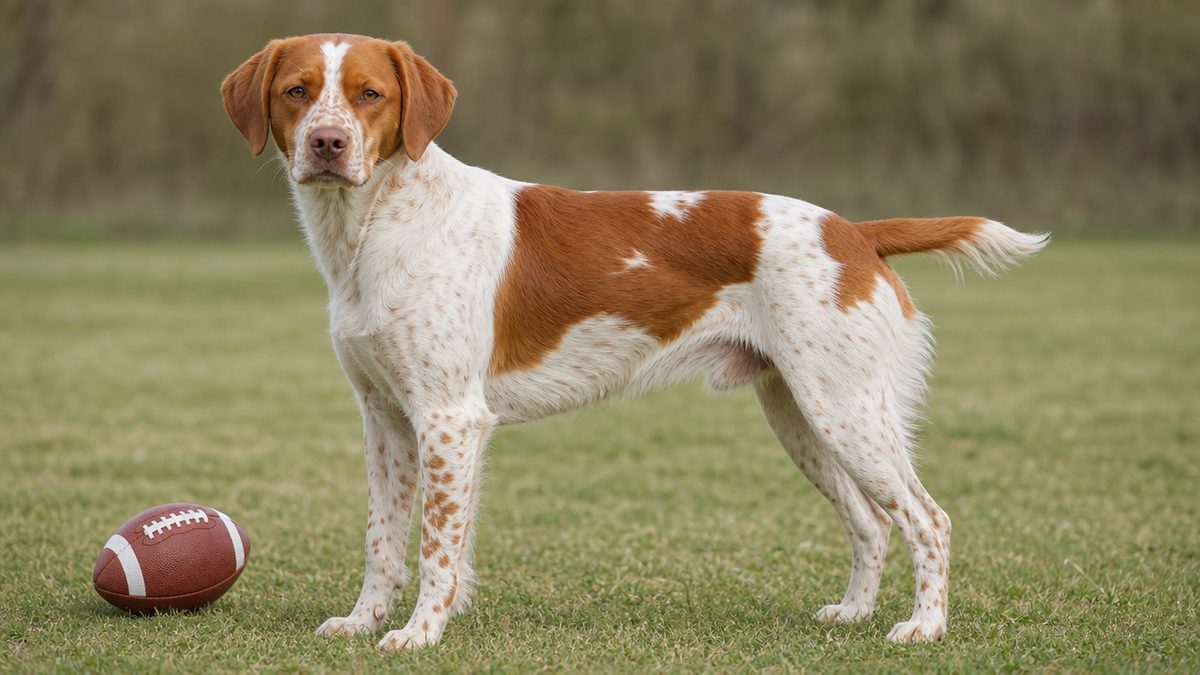
Quick answer
The brittany spaniel is a 14 to 18 kg French pointing dog, FCI standard 95, whose home region averages 11.6 °C a year against Bengaluru's 23.7 °C, which is why its heat tolerance rates 2 out of 5 in India. No Indian seller stocks it and no lawful breeding import exists. Its standard still describes a docked tail that Indian law forbids.
This page summarises published veterinary research, registry screening data and breed-standard documents for general information. It is not a diagnosis and it is not treatment advice. Consult a registered veterinarian about your own dog before acting on anything here, and treat a rectal temperature at or above 41.0 °C in a working dog as an emergency.
Brittany at a glance
What the Brittany spaniel is, and what FCI-95 actually says
The Brittany spaniel is a 14 to 18 kg French pointing dog, recognised by the Fédération Cynologique Internationale as breed number 95 under its French name Epagneul Breton, placed in Group 7 Pointing Dogs, Section 1.2 Continental Pointing Dogs of spaniel type, and subject to a working trial.
FCI-95 opens by calling it the smallest of the pointing breeds, a dog with a Continental spaniel-type head and a short or non-existent tail, built on a solid but not weighty frame. The word the standard uses for the overall shape is cobby, which it glosses in brackets as brachymorphic, meaning short-coupled rather than flat-faced. The FCI accepted the breed on a definitive basis on 19 November 1954, the official authentic language of the standard is French, and the currently valid text was published on 25 March 2003.
Size is where the arguments start. FCI-95 gives males a minimum of 48 cm with a tolerance of 1 cm and a maximum of 51 cm with the same tolerance, and an ideal of 49 to 50 cm; females run 47 cm minimum and 50 cm maximum on the same tolerances, ideal 48 to 49 cm. Google's own knowledge panel for this breed prints 47 to 52 cm for males and 46 to 51 cm for females. Those are not different measurements. They are the FCI figures with the tolerance already added at both ends, which is why no source ever explains where they came from.
The head is the recognisable part. The skull is longer than the muzzle in a ratio of 3 to 2, the top lines of skull and muzzle are parallel, the stop is moderate, and the ears are set high, triangular, relatively large and rather short, reaching the stop when drawn forward. The standard names the combination of eye expression and the upward movement of the ear bases as the true Brittany expression, which is the only piece of poetry in an otherwise clinical document.
A square dog, and why that matters in a flat
The Brittany is built square. FCI-95 states that the scapulo-ischial length, from the point of the shoulder to the point of the buttock, equals the height at the withers, so the dog fits in a square, with the chest let down to elbow level and its depth slightly less than half the height. The result takes up far more room than 14 to 18 kg suggests once it is moving, because the canter is its usual gait in the field.
Coat is short on the head and the front of the limbs, fine but not silky, lying flat or with a hint of a wave, never curly, with abundant feathering on the rear of the limbs diminishing down to the carpus or the tarsus. There is no undercoat in the description. That single omission is the most India-relevant line in the whole standard, and the climate section returns to it.
The American standard opens on the same shape in different words, calling the Brittany a compact, closely knit dog of medium size, a leggy dog having the appearance as well as the agility of a great ground coverer, strong, vigorous, energetic and quick of movement, with ruggedness but without clumsiness. The AKC's own prose puts the contrast usefully: Brittanys are smaller than setters but leggier than spaniels, standing about 20 inches at the shoulder.
The coat colours, including the one America will not accept
FCI-95 permits white and orange, white and black, and white and liver, in piebald or roan, sometimes with ticking, plus tricolour coats carrying tan spotting from orange to dark tan over the eyes, on the muzzle, limbs, chest and base of the tail. A narrow blaze is desirable in any colour and a self-coloured coat is not allowed. The Royal Kennel Club lists four breed-standard colours for the Brittany in Britain: Black and White Roan, Black Tricolour, Liver Tricolour, and Orange and White Roan.
Both of those registries accept black. The American standard does not, and that disagreement gets its own section below.
| Item | What FCI-95 states |
|---|---|
| Breed number and group | 95, Group 7 Pointing Dogs, Section 1.2 Continental Pointing Dogs Spaniel type, with working trial |
| Country of origin | France |
| Official authentic language | French |
| Definitive FCI recognition | 19 November 1954 |
| Valid standard published | 25 March 2003, English text dated 5 May 2003 |
| Height, males | 48 cm minimum to 51 cm maximum, each with 1 cm tolerance, ideal 49 to 50 cm |
| Height, females | 47 cm minimum to 50 cm maximum, each with 1 cm tolerance, ideal 48 to 49 cm |
| Weight | Not stated anywhere in the standard |
| Tail | May be born tailless or very short; where docked, ideal 3 to 6 cm and never over 10 cm |
| Coat | Fine but not silky, flat or slightly wavy, never curly, no undercoat described |
| Disqualifying faults | Aggression or extreme shyness, lack of type, height outside limits, marked convergence of head planes, very light eyes, entropion, ectropion, overshot or undershot mouth, unpigmented areas on nose or eyelids, presence of dewclaws even if rudimentary |
FCI-95 gives no weight at all. The 14 to 18 kg that Google, Purina India and every Indian listing page prints is the American Kennel Club's 30 to 40 pounds converted, which is 13.6 to 18.1 kg. So the height on those pages comes from France and the weight comes from the United States, and nobody says so.
Why is a Brittany no longer a spaniel, and when did the name change
The Brittany stopped being a spaniel in America on 1 September 1982, when the American Kennel Club changed its official breed name from Spaniel, Brittany to simply Brittany; the Fédération Cynologique Internationale never made any equivalent change, and its English translation of the French standard is still headed BRITTANY SPANIEL today.
The AKC states the sequence plainly on its own breed page. The Brittany was introduced to the United States in 1931 and recognised as a breed by the AKC in 1934; from 1934 to 1982 it was registered as Spaniel, Brittany, and on 1 September 1982 its official name was changed to Brittany. The reason is functional rather than cosmetic. A spaniel flushes game; the Brittany points it, and it sits in the FCI's pointing-dog group, not with the spaniels. The American fancy concluded that the label described the wrong job.
The FCI did not follow. Its nomenclature entry for breed 95 lists the English name of the standard as BRITTANY SPANIEL, dated 5 May 2003, alongside EPAGNEUL BRETON in French, BRETONISCHER SPANIEL in German and SPANIEL BRETON in Spanish. So a dog registered in Delhi under an FCI-derived pedigree is a Brittany Spaniel, and the same dog registered in Dallas is a Brittany. Both are correct in their own systems, and search behaviour has never caught up: Google India's People Also Ask box for this breed still asks Why is a Brittany no longer a spaniel?
1907 or 1908, and who says which
Three authorities give three different founding dates, and the difference is not sloppiness. FCI-95 says a draft standard was drawn up in Nantes in 1907, then presented and adopted at the first General Assembly held at Loudeac, in the former Cotes du Nord department, on 7 June 1908, and that this was the first standard of the Naturally Short-Tailed Brittany Spaniel Club. The Royal Kennel Club says the first breed club in France was founded in 1907 and was named the Club of the Naturally Short-Tailed Brittany. The AKC records that the first Brittany standard was outlined in 1907. Wikipedia adds a specific animal, saying the Breton was first recognised as a breed in 1907 when an orange-and-white dog named Boy was registered in France.
The clean reading is that a text existed in 1907 and became official in June 1908. Anyone writing 1907 is describing the draft; anyone writing 1908 is describing its adoption. Both dates are defensible and neither is wrong, which is why the disagreement has survived a century.
What the breed was built from
The Royal Kennel Club gives the most concrete account of the mix. The breed was founded on a spaniel found in northern France known locally as Le Fougere, to which English Setter and Pointer blood was added to give scenting and pointing qualities, producing a short-backed, cobby dog capable of flushing, pointing and retrieving, which is to say a true hunt-point-retrieve breed. Purina's account adds the mechanism: British landed gentry came to Brittany for the snipe and partridge season and left their dogs in the care of French kennels from one season to the next, where they crossed with the local gundog types.
FCI-95 is more cautious and simply says the breed is probably one of the oldest of the spaniel types, improved at the beginning of the twentieth century by diverse outcrosses and selections. Purina also repeats that the breed was first shown in 1896, and that paintings by Jean-Baptiste Oudry from the early 1700s show a liver-and-white dog believed to be a Brittany pointing partridge. Treat the paintings as decoration rather than evidence; Wikipedia's own version of the same claim carries a citation-needed tag.
- 1896. First shown, according to Purina's breed library.
- 1907. Draft standard written at Nantes; the AKC and the Royal Kennel Club both date the breed's first standard and first club to this year.
- 7 June 1908. Standard adopted at Loudeac by the Naturally Short-Tailed Brittany Spaniel Club, per FCI-95 itself.
- 1931. Introduced to the United States.
- 1934. Recognised by the AKC as Spaniel, Brittany.
- 19 November 1954. Accepted by the FCI on a definitive basis.
- 1 September 1982. AKC name changed to Brittany.
- 9 April 1990. Current American standard approved, effective 29 May 1990.
- 25 March 2003. Current FCI standard published, still headed Brittany Spaniel in English.
Use Brittany spaniel when you are searching, because that is the term Indian search traffic and the FCI's own English text both use. Use Brittany when you are talking to an American breeder or reading AKC paperwork. Use Epagneul Breton when you are reading a French pedigree, a Societe Centrale Canine studbook line or an FCI export certificate.
Three registries, three different dogs: where FCI, AKC and the Royal Kennel Club disagree
The same Brittany can be a champion in France and disqualified in America, because FCI-95 permits a black-and-white coat and the American standard makes black in the coat and a black nose two of its three disqualifications.
Read the two documents side by side and the gaps are specific, not stylistic. The American standard, approved by the AKC on 9 April 1990 and effective from 29 May 1990, lists exactly three disqualifications: any Brittany measuring under 17 and a half inches or over 20 and a half inches, black in the coat, and a black nose. It allows nose colour of fawn, tan, shades of brown or deep pink, and it permits orange and white or liver and white in clear or roan patterns, with tri-colours allowed but not preferred.
FCI-95 permits white and black outright as one of three base colour combinations. Its nose is required simply to be of a colour in harmony with the coat, so a black-coated Breton has a black nose and is correct. The Royal Kennel Club goes further still and lists Black and White Roan and Black Tricolour among its four registrable breed-standard colours, in a breed it categorises as having no non-breed-standard colour registration options at all.
The AKC nevertheless issues registration codes for Black and White (019), Black White and Orange (314), White Black and Orange (315) and Blue Roan (053). So an American black-and-white Brittany can be registered and cannot be shown. That is not a contradiction in the paperwork; it is the difference between a studbook and a ring, and it catches out buyers who assume a registration certificate implies show eligibility.
Height: a 2.5 cm band where the dog is legal in one country and not the other
The American floor is 17.5 inches, which is 44.45 cm. The FCI floor for a male is 48 cm less the 1 cm tolerance, so 47 cm, and height outside the standard's limits is a disqualifying fault. Between 44.45 cm and 47 cm there is a band roughly 2.5 cm wide in which a male Brittany is showable in America and disqualified in France. At the top the two systems nearly agree: the American ceiling of 20.5 inches is 52.07 cm and the FCI male ceiling with tolerance is 52 cm.
Purina's Indian breed library prints 44.5 to 52 centimetres, which is the American inch range converted and rounded. Asia Pets prints 46 to 52 cm, which is the tolerance-inclusive FCI range for both sexes merged into one band. Neither page says which standard it is quoting, so an Indian buyer measuring a puppy against them has no idea which rulebook the number came from.
Dewclaws: required absent in France, optional in America, unlawful to remove in India
This is the sharpest of the three conflicts. FCI-95 lists presence of dewclaws, even if rudimentary among its disqualifying faults, in the same list as aggression and an undershot mouth. The American standard says only that dewclaws may be removed. The American Brittany Club's own Code of Ethics is more directive than that, and instructs breeders to have tails docked and dewclaws removed soon after birth.
India's position is the opposite of both. The Prevention of Cruelty to Animals (Dog Breeding and Marketing) Rules 2017, notified as G.S.R. 496(E) on 23 May 2017, state at Second Schedule Part II paragraph 6(8) that there shall be no tail docking, ear cropping, de-barking, de-clawing, branding, dyeing, injecting substances to enhance visual appeal, surgery to camouflage a defect, or any other kind of mutilation of any body part of the pup, and that any change of appearance by artificial means is strictly forbidden. Removing a dewclaw to satisfy a foreign show standard is squarely inside that wording. The law section below sets out what that means in practice.
| Point | FCI-95 (France) | AKC / American Brittany Club | Royal Kennel Club (UK) |
|---|---|---|---|
| Black in the coat | Permitted, white and black is a listed colour | Disqualification | Permitted, Black and White Roan and Black Tricolour are breed-standard colours |
| Black nose | Permitted where it harmonises with the coat | Disqualification | Not listed as a fault |
| Height, male | 48 to 51 cm, 1 cm tolerance each way, ideal 49 to 50 cm | 17.5 to 20.5 inches, that is 44.45 to 52.07 cm, for both sexes | Follows the FCI-derived breed standard |
| Docked tail | Ideal 3 to 6 cm, never over 10 cm | Tailless to approximately four inches, natural or docked | Only a naturally bobbed tail is recorded on the certificate |
| Dewclaws | Presence, even rudimentary, is a disqualifying fault | May be removed; the parent club's code of ethics says remove them | Not addressed on the breed page |
| Named health screen | Working trial required for the title, no test named in the standard | Hip evaluation and ophthalmologist evaluation | Hip testing under the BVA/KC Hip Dysplasia Scheme |
A Brittany offered in India will trace to one of these three systems, and the differences are visible on the dog. A black-and-white Breton is an ordinary French dog and an American show disqualification. A 45 cm male is an ordinary American dog and a French disqualification. Ask which studbook the parents sit in before you argue about whether a puppy is typey.
The fourth registry, and the only one that writes for countries like India
The United Kennel Club is the only registry of the four that explicitly protects an undocked Brittany, stating that no dog in any UKC event shall be penalised for a full tail or natural ears because cropping and docking are forbidden in some countries.
The UKC recognised the Brittany in 1948 and last revised its standard on 1 July 2013. Most of the document reads like the American Kennel Club's, because it grew from the same stock: a square, compact dog rather leggy for a spaniel, quick in movement, strong, vigorous and energetic, rugged without being clumsy, at 17 and a half to 20 and a half inches.
Then it diverges in three ways that matter, and every one of them favours a buyer outside America.
One, black is allowed
The UKC's colour clause reads orange and white, liver and white, and black and white, in clear or roan patterns, with some ticking desirable and tri-colours allowed but not desirable. Its nose clause accepts black, brown, fawn, tan and deep pink, matching in tone the darkest body colour. Its only colour-related disqualification is albinism.
So of the four registries, three accept a black Brittany and one does not. FCI-95 permits white and black, the Royal Kennel Club registers Black and White Roan and Black Tricolour as breed-standard colours, the UKC lists black and white among its three colour patterns, and only the American Brittany Club's standard makes black in the coat and a black nose two of its three disqualifications The Royal Kennel Club, Brittany United Kennel Club The American Brittany Club.
Two, the disqualification list is about the dog, not the paint
The UKC disqualifies only three things: unilateral or bilateral cryptorchidism, viciousness or extreme shyness, and albinism. Height outside 17 and a half to 20 and a half inches is an eliminating fault rather than a disqualification. Its preferred weight range is 30 to 45 pounds, five pounds broader at the top than the AKC's 30 to 40 The American Brittany Club.
It also treats the ear the way the working dog demands. Ears reach approximately one half the length of the muzzle, are short and triangular, set high above the level of the eyes, with dense relatively short hair and little fringe, and pendulous ears are a serious fault. For an Indian reader, a standard that actively penalises a long ear is a standard that is quietly selecting against monsoon otitis.
Three, the paragraph that no other registry writes
At the foot of the standard, after the disqualifications, the UKC prints this: the docking of tails and cropping of ears in America is legal and remains a personal choice; however, as an international registry, the United Kennel Club is aware that the practices of cropping and docking have been forbidden in some countries; in light of these developments, the United Kennel Club feels that no dog in any UKC event, including conformation, shall be penalised for a full tail or natural ears.
India is one of those countries. Second Schedule Part II paragraph 6(8) of the Dog Breeding and Marketing Rules 2017 forbids tail docking and ear cropping outright. An Indian-bred Brittany with a full tail is therefore penalised by nobody under the UKC standard, described but not required by the FCI standard, and severely penalised under the American standard, which says any tail substantially more than four inches shall be severely penalised.
| Registry | Black coat and nose | Full undocked tail | Recognition date |
|---|---|---|---|
| FCI, standard 95 | Permitted; nose in harmony with the coat | Described as possible; a docked tail is described at 3 to 6 cm ideal | Definitive, 19 November 1954 |
| American Kennel Club and the American Brittany Club | Both disqualified | Severely penalised above approximately four inches | 1934, renamed 1 September 1982 |
| The Royal Kennel Club | Black and White Roan and Black Tricolour are breed-standard colours | Only a naturally bobbed tail is recorded, with veterinary certification | Board policy on bobtails from October 2008 |
| United Kennel Club | Black and white permitted; black nose accepted | Explicitly not penalised, because docking is forbidden in some countries | 1948, standard revised 1 July 2013 |
The UKC's one closing paragraph is the only sentence in any Brittany breed standard written with a jurisdiction like India in mind. It costs the reader nothing to know that an entire international registry has already resolved the question that the American standard leaves an Indian owner stuck with.
The LOF colour split: two rows, one breed, and the sum that proves it
The Societe Centrale Canine splits the Epagneul Breton into two colour varieties in its annual studbook table, Blanc et Orange and Autres Couleurs, and the two sub-rows add up exactly to the parent breed line, which is how you can prove they are one breed and not two.
Here is the 2025 Group VII table as the SCC prints it. The parent line reads EPAGNEUL BRETON with 3,953 registrations in 2024 and 3,793 in 2025, then two indented rows follow: BLANC ET ORANGE at 2,101 and 1,946, and AUTRES COULEURS at 1,852 and 1,847.
Do the arithmetic yourself, because it settles the question in three lines. For 2024, 2,101 plus 1,852 equals 3,953, which is the parent line exactly. For 2025, 1,946 plus 1,847 equals 3,793, again exact. The confirmations column behaves the same way: 545 plus 491 equals 1,036, the parent figure to the dog. Three independent columns reconciling to the unit is not a coincidence. The sub-rows are a breakdown, not an addition.
That matters because the mistake is easy and common. A writer skimming the PDF sees three lines beginning with a breed-like label, reports the Epagneul Breton at 3,793 and then treats Blanc et Orange and Autres Couleurs as separate French breeds, or worse, adds all three and reports 7,586 Brittanys born in France in 2025. The correct statement is that France registered 3,793 Epagneuls Bretons in 2025, of which 1,946 were white and orange and 1,847 were of other colours.
What Autres Couleurs actually contains
Autres Couleurs is everything FCI-95 permits that is not white and orange, which means white and black, white and liver, the roans of each, and the tricolours. In other words the variety label covers four of the five coat colours the standard allows, and only the commonest one sits outside it. In 2025 those dogs were 48.7 percent of all Epagneul Breton registrations in France, computed as 1,847 divided by 3,793. In other words the colour that the American standard disqualifies outright sits inside a variety group that accounts for close to half the breed in its own country.
The split is also moving. White and orange fell 7 percent between 2024 and 2025 while the other colours were flat at 0 percent, which the SCC prints in its own percentage column. Confirmation rates, the share of registered dogs later confirmed as conforming to the standard, were 28 percent for white and orange and 27 percent for the other colours, effectively identical, so the shift is a matter of what breeders are producing rather than of one variety failing assessment more often.
| Row as printed | Registered 2024 | Registered 2025 | Confirmed 2025 | Confirmation rate |
|---|---|---|---|---|
| EPAGNEUL BRETON (parent line) | 3,953 | 3,793 | 1,036 | 27% |
| BLANC ET ORANGE | 2,101 | 1,946 | 545 | 28% |
| AUTRES COULEURS | 1,852 | 1,847 | 491 | 27% |
| Sum of the two sub-rows | 3,953 | 3,793 | 1,036 | matches the parent line exactly |
Why an Indian buyer should care about a French colour column
Colour is the single most negotiated feature of an imported puppy, and it is the one an Indian buyer is most likely to be charged extra for. Knowing that just under half of all French-bred Brittanys are not white and orange removes the premium argument entirely. A black tricolour or a liver roan is not rare, not a fault under the standard that governs the breed in its own country, and not a reason for a higher price.
It cuts the other way too. If a seller in India tells you a black-and-white Brittany is a mismark or a crossbreed, they are quoting the American rulebook at you without saying so, and they are wrong about the breed everywhere except an AKC ring.
Look for indentation and then add. If the indented rows sum to the line above them, they are varieties of one breed. If they do not sum, you are looking at separate breeds that happen to be listed together. The same test works on the SCC's Cocker Spaniel Anglais line in the same document, where Noir, Rouge et Dore and Autres Couleurs sum to the parent figure as well.
How many Brittanys there actually are, in four countries
France registered 3,793 Epagneuls Bretons in 2025, the American Kennel Club ranks the Brittany 31st of 210 breeds, the Royal Kennel Club recorded 35 Brittany registrations in the whole of 2025, and India has no registry figure at all because the breed is not present here.
Start with the claim everyone repeats. FCI-95 states that the breed is at present in first place numerically among French sporting breeds. That sentence was written for a standard published in 2003, and English-language pages have copied it forward for twenty years as though it were still a live measurement. The Societe Centrale Canine's own 2025 table says otherwise: in Group VII, the pointing dogs, the SETTER ANGLAIS leads on 5,086 registrations and the EPAGNEUL BRETON is second on 3,793, out of a group total of 17,777.
This is not a new reversal. In the 2005 studbook the Epagneul Breton stood at 5,494 and the Setter Anglais at 5,746. By 2010 it was 5,361 against 6,095. The 2015 studbook, which is laid out differently, gives the Epagneul Breton a breed total of 4,804. In 2020 the Breton had 5,198 registrations against the Setter's 6,046, with 2019 figures of 4,562 and 5,334 respectively. The English Setter has been ahead in France for at least two decades.
The defensible version of the FCI's sentence is narrower and still impressive. Among French pointing breeds the Epagneul Breton is first by a very wide margin: the next French-origin breed in the 2025 table is the Braque Francais type Pyrenees on 623, then the Epagneul Francais on 236, the Epagneul Picard on 168 and the Braque d'Auvergne on 159. The Breton outnumbers the second French pointing breed six to one. It is the biggest French pointing dog in France, and it is not the biggest pointing dog in France.
Britain, where the breed is almost gone
The Royal Kennel Club's ten-year comparative table gives the Brittany 114 registrations in 2016, then 73, 67, 80, 65, 123, 61, 106, 22 in 2024, and 35 in 2025. The quarterly table for 2025 reads 6, 13, 10 and 6, which sums to exactly the 35 in the annual column, so the two documents reconcile. For scale, the Hungarian Vizsla took 1,636 registrations in the same year and the German Shorthaired Pointer 947.
Thirty-five dogs a year is a very small British population, and the practical consequence for an Indian reader is that Britain is not a realistic source country. There is no surplus.
America, where the breed is genuinely popular
The AKC prints a breed popularity ranking of 31 of 210 on the Brittany page, which is the highest standing of any of the four countries here. That ranking is why almost every English-language Brittany article on the internet is written from an American point of view, why the 30 to 40 pound weight figure travels further than the French height figure, and why the black disqualification is treated as though it were the breed's universal rule.
| Country | Registry | Most recent figure | Source year |
|---|---|---|---|
| France | Livre des Origines Francais, Societe Centrale Canine | 3,793 registrations, second in Group VII behind the English Setter on 5,086 | 2025 |
| France, by colour | LOF variety sub-rows | 1,946 Blanc et Orange and 1,847 Autres Couleurs, summing exactly to 3,793 | 2025 |
| United States | American Kennel Club | Popularity rank 31 of 210 breeds | 2026 page |
| United Kingdom | The Royal Kennel Club | 35 registrations in the year, down from 114 in 2016 | 2025 |
| India | No published registry figure located | No Indian studbook count for this breed was found | 2026 |
What the confirmation rate tells you about French breeding
The SCC prints a confirmation column, which counts dogs later assessed as conforming to the standard, and for the Epagneul Breton in 2025 it reads 1,036 confirmations against 3,793 registrations, or 27 percent. The Group VII average that year was 31 percent, and the English Setter managed 36 percent. A confirmation rate is not a health measure, but it does tell you what fraction of a breed's puppies pass through a formal assessment at all, and for the Brittany roughly three in four never do. This is a working breed whose owners mostly hunt with it rather than show it.
AKC popularity is a rank among breeds; LOF and RKC figures are counts of dogs. A page that puts 31 of 210 next to 3,793 and 35 as though they measured the same thing is comparing a position to a population. They are listed together above because the reader benefits from all three, not because they are the same unit.
Brittany spaniel price in India: there is no market, and here is the proof
No Indian seller has a Brittany spaniel in stock, so no Indian puppy price exists, and every rupee figure currently printed against this breed on an Indian page is either a house price attached to a different dog or a band with no animal behind it.
Start with the page that ranks first in India for Brittany Spaniel puppies for sale. Puppiezo's Brittany Spaniel page carries a strip headed Available Brittany Spaniel, and the animals actually listed under it are a Maltipoo called Fizey at Rs 98,999, a puppy called Kuzo at Rs 92,599, a Goldendoodle called Doir at Rs 1,20,000, a second Maltipoo called Samy at Rs 98,999, a Rottweiler called Tugi at Rs 76,499, and a Doxiepoo called Yoki at Rs 98,999. Six listings, three of them at the identical figure of Rs 98,999, and not one of them a Brittany.
Rs 98,999 is a house price point, not a breed price. It appears three times on this single page, attached to two Maltipoos and a Doxiepoo, and the same carousel prints Rs 92,599, Rs 94,999, Rs 76,499 and Rs 1,20,000 beside it. Divide it and the arithmetic confirms it is not a converted dollar figure either: 98,999 divided by 84.38 is 1,173.25 and divided by 74 is 1,337.82, neither of which is a round dollar amount. It is a rupee-native charm price, ending in 999, applied to whichever puppy is in stock.
The second site has three results and none of them is this breed
Mr n Mrs Pet's page for Brittany Spaniel Puppies For Sale In Bangalore prints 3 Result Found and then lists a French Bulldog in Visakhapatnam, a Border Collie in Hyderabad and a Border Collie in Jaipur, under a subheading reading Similar puppies at other locations. The count is real; the breed is not. This is the standard behaviour of an auto-generated breed-plus-city page, which exists for every breed in a dropdown list whether or not the site has ever handled one.
You can see the dropdown itself on the same page: Brittany Spaniel sits between Briard and Brussels Griffon in an alphabetical list of roughly 300 breeds, next to Bully Kutta, Chippiparai, Kombai, Mudhol hound, Pashmi Hound, Rajapalayam and Rampur Hound. Being in that list is a database entry, not an inventory.
The one Indian band that exists, and what it is worth
Asia Pets publishes a figure of Rs 30,000 to Rs 60,000 in India on its Brittany breed page, alongside a size of 14 to 18 kg, a lifespan of 12 to 14 years and a height of 46 to 52 cm. Its companion listings page for Brittany puppies for sale in India carries no prices and no animals at all.
Run the two standard checks on that band. Rs 30,000 divided by 84.38 is 355.53 dollars and divided by 74 is 405.41; Rs 60,000 divided by 84.38 is 711.07 and divided by 74 is 810.81. None of the four quotients is a round dollar figure, so this band is not a converted American price list, unlike several other Indian breed pages this site has audited. It appears to be typed by hand. That makes it honest in origin and still useless in practice, because there is no dog behind it.
For comparison, the international band published by Dog Breeds List is USD 700 to USD 1,100 for an average Brittany puppy. At 84.38 that is Rs 59,066 to Rs 92,818, and at 74 it is Rs 51,800 to Rs 81,400. So the Asia Pets floor of Rs 30,000 sits roughly Rs 29,000 below what the cheapest end of the international market converts to. A rupee figure that undercuts the world price by half, for a breed nobody stocks, is not a bargain signal.
| Source | Figure printed | Divided by 84.38 | Divided by 74 | What it really is |
|---|---|---|---|---|
| Puppiezo, Brittany Spaniel page | Rs 98,999, three times | 1,173.25 | 1,337.82 | House charm price on two Maltipoos and a Doxiepoo, not a Brittany |
| Puppiezo, same carousel | Rs 92,599 / Rs 1,20,000 / Rs 76,499 | 1,097.40 / 1,422.14 / 906.60 | 1,251.34 / 1,621.62 / 1,033.77 | Kuzo, breed not stated; Doir the Goldendoodle; Tugi the Rottweiler |
| Mr n Mrs Pet, Bangalore | No price shown | n/a | n/a | Three results, all of them other breeds in other cities |
| Asia Pets, breed page | Rs 30,000 to Rs 60,000 | 355.53 to 711.07 | 405.41 to 810.81 | Rupee-native band with no listings behind it |
| Dog Breeds List, international | USD 700 to USD 1,100 | Rs 59,066 to Rs 92,818 | Rs 51,800 to Rs 81,400 | The only band tied to a real market, and it is not the Indian one |
Ask three questions before anything else. Which studbook are the parents registered in, and can you see the pedigree. Which of the seven permitted ports did the founding stock enter through, and on whose import authorisation. And is the tail natural or docked, with the veterinary record to show which. A seller who cannot answer all three is not selling you this breed.
The only lawful route into India, read from the trade notice itself
A Brittany spaniel can lawfully reach India only as a returning owner's own pet, because dogs sit under ITC(HS) 01061900 as a Restricted import and the Directorate General of Foreign Trade states that any application made for trading or breeding purposes shall be duly rejected.
DGFT Trade Notice No. 22/2022-23, dated 19 December 2022 and addressed to all international airlines, all Indian embassies and consulates abroad, and pet owners, sets out the whole framework in one page. It records the tariff line as ITC (HS) 01061900, Mammals: Other, with an import policy of Restricted, subject to Policy Condition 6 of the chapter.
Policy Condition (7) then lists the only three purposes for which importing a dog is allowed. A pet dog with a valid pet book and relevant records or documents in the name of the importer. Dogs imported by research and development organisations for research, with the recommendation of the Committee for the Purpose of Control and Supervision of Experiments on Animals. And dogs for internal security by the Defence and Police Force. Policy Condition (8) closes the remaining door: import of commercial dogs for breeding or any other commercial activities other than the purposes mentioned above is not permitted.
Paragraph 6 of the notice repeats the point in operational language. Any applications for trading or breeding purposes, or applications made on behalf of some other person or entity, shall be duly rejected.
The narrow gate that does exist
Up to two pets may come in as passenger baggage without a DGFT authorisation, and only for a person transferring their residence to India after two years of continuous stay abroad; only cats and dogs may be imported under the baggage rules. Authorisation from DGFT is required if the stay abroad was under two years, or if the pet is not travelling as passenger baggage, or if the pet cannot be imported under the baggage rules. For more than two animals, or for any temporary import, DGFT authorisation is required in every case, with the application examined by the Department of Animal Husbandry and Dairying beforehand.
DGFT is not the only authority in the chain. The Department of Animal Husbandry and Dairying publishes the orders that govern the animal itself under the Live-stock Importation Act 1898, including a July 2024 order on facilitation for final quarantine clearance of imported pet dogs and cats, and a March 2021 set of standard operating procedures for import clearance of live animals including pets by the Animal Quarantine and Certification Service. Read both alongside the trade notice, because one governs the licence and the other governs the arrival.
The documents named are a Vaccination Book, Pet Passport or Pet Book, a Certificate for Emotional Support, and the Passport of the Pet, with a temporary import adding a return ticket and an undertaking from a local host. Applications go in under form ANF-2M against the importer's own Importer Exporter Code, or the permanent IEC number IIHIE0153E for personal-use imports.
Seven ports, and a seven-day NOC
Import of pet animals is allowed only through the airports and seaports of Delhi, Mumbai, Chennai, Hyderabad, Bengaluru and Kolkata and, since October 2024, Kochi airport, with quarantine at the government station of that port where required. The applicant must additionally obtain an Advance No Objection Certificate from the Regional Officer or Quarantine Officer of the Animal Quarantine and Certification Service at the port of entry, after submitting the DGFT import licence and a health certificate issued by a veterinarian in the exporting country. The disease testing prescribed in that health certificate must be done in the exporting country and the reports must travel with the animal. The NOC is obtained seven days before travel, relaxable to three days depending on circumstances. The full route is set out in how to import a dog to India.
- Confirm the purpose. Only a personal pet, a CPCSEA-recommended research animal or a Defence or Police dog qualifies.
- Confirm the two-year residence rule if you intend to bring the dog in as baggage without authorisation.
- Assemble the pet book in the importer's own name, since a document in someone else's name defeats Policy Condition 7.
- Apply at least two months ahead through the DGFT Import Management System, under ANF-2M.
- Route the animal through one of the seven permitted ports, and nowhere else.
- Obtain the AQCS advance NOC seven days before travel, with the exporting country's health certificate and test reports attached.
The practical consequence is the one the price section already showed. No lawful supply chain can form for a breed in India when breeding imports are refused outright, because the only dogs that can arrive are single family pets accompanying their owners home. That is why the Indian listings for this breed contain Maltipoos and Border Collies rather than Brittanys Mr n Mrs Pet, Brittany Spaniel Puppies….
Indian listing pages describe their stock as KCI-registered as a matter of routine template text, including on pages that hold no animals of the advertised breed at all. A kennel-club paper says a dog was entered in a studbook. It says nothing about whether its ancestors entered the country lawfully. Those are different documents and only one of them is issued by the Government of India.
The tail, the dewclaws, and the parent club's advice that is illegal in India
The American Brittany Club's own Code of Ethics instructs breeders to have tails docked and dewclaws removed soon after birth, and both procedures are strictly forbidden in India under the Prevention of Cruelty to Animals (Dog Breeding and Marketing) Rules 2017.
Item 9 of the club's Code of Ethics, printed in its Policy Notebook, reads: Have tails docked and dew claws removed soon after birth. That is not a description of custom. It is an instruction to members, in a numbered list of breeding obligations that also covers health screening and refusing sales to commercial wholesalers.
India's rule is in the Second Schedule, Part II, paragraph 6(8) of the Rules notified as G.S.R. 496(E) on 23 May 2017. The clause reads that there shall be no tail docking, ear cropping, de-barking, de-clawing, branding, dyeing, injecting substances to enhance visual appeal, performing a surgery or procedure to camouflage or hide any defect or infirmity or any other kind of mutilation of any body part of the pup, and that any change of appearance by artificial means is strictly forbidden. Paragraph 6(9) adds that breeding to create new breeds of dogs or unusual looks shall be strictly prohibited.
An Indian breeder who followed the American club's code of ethics to the letter would therefore commit two prohibited acts on every litter. This is worth stating plainly because the code is a good document in most other respects, and because the reflex on Indian breed pages is to import foreign club guidance whole.
What the standards actually require of the tail
FCI-95 says the Brittany can be born tailless or with a very short tail, and that when the tail is docked the ideal length is from 3 to 6 cm, the docked tail should not exceed 10 cm. The American standard says tailless to approximately four inches, natural or docked, and that any tail substantially more than four inches shall be severely penalised. Four inches is 10.16 cm, so the American target sits at the outer limit that the French standard tolerates, and above the French ideal.
Neither standard requires docking. Both simply describe what a docked tail should look like where it happens. That distinction matters in India, where the procedure is forbidden and a natural undocked tail, or a genuine natural bobtail, is the only lawful outcome for a home-bred puppy.
Correcting the most-read page on this breed
Wikipedia, which holds position one in Google India for this term, states that the Epagneul Breton is not on the list of breeds that may participate in FCI shows with a docked tail. The FCI's own notice says the reverse. Following its General Committee meeting of 24 November 2021, the FCI announced that from 1 January 2025 dogs with cropped ears or a docked tail belonging to breeds for which no reference is made to the cropped ears or docked tail in the FCI breed standards would no longer be allowed in conformation events using FCI standards, and printed the list of breeds concerned.
That list has exactly eleven entries: 143 Dobermann, 144 Deutscher Boxer, 147 Rottweiler, 181 Riesenschnauzer, 182 Schnauzer, 183 Zwergschnauzer, 184 Deutscher Pinscher, 185 Zwergpinscher, 197 Mastino Napoletano, 235 Deutsche Dogge and 343 Cane Corso Italiano. It is a list of breeds that may not be shown docked. The Epagneul Breton is absent from it because FCI-95 does make reference to a docked tail, at an ideal of 3 to 6 cm. Its absence therefore means the opposite of what the Wikipedia sentence implies.
How Britain solved the problem India has not
The Royal Kennel Club records naturally bobbed tails on registration certificates, a decision its Board took in October 2008 specifically to help breeders identify which dogs and lines carry the tailless gene. The word bobtail is the only tail description it accepts; any other tail length, including one that was legally docked, is not recorded. Confirmation of tail status must be accompanied by veterinary certification on practice headed paper, sent with the litter registration form, and because a vet's signature is required the service cannot be done online.
That is a workable model and India has no equivalent. Until one exists, the burden falls on the buyer, and there is a simple way to carry it: ask for the puppy's own veterinary record from the first week of life, and read what it says about the tail. A dock leaves a surgical note. A natural bobtail does not.
The Royal Kennel Club's stated reason for recording bobtails is precisely so that breeders can tell which dogs and lines carry the tailless gene, and the first French club was named for the naturally short-tailed dog rather than the docked one. Take genetic advice from a veterinarian before mating two bobtailed dogs, and do not let anyone in India present a docked puppy as a natural bobtail to justify a price.
What a Brittany costs to keep in India each month, bounded honestly
Budget for a 14 to 18 kg active dog rather than for a breed, because no Indian price exists for a Brittany and the recurring costs that do exist are set by body weight, exercise need and vet frequency, all of which can be priced from published Indian sources.
Food is the biggest line and it scales with the dog, not the pedigree. At 14 to 18 kg the Brittany sits in the medium band of every Indian range. Heads Up For Tails lists Royal Canin Medium Adult in 1 kg, 4 kg, 10 kg and 14 kg packs, with the 1 kg pack shown at Rs 1,021, and Farmina Team Breeder Top Adult in a 20 kg bag at Rs 10,350. That is Rs 1,021 per kilogram at the small end and Rs 517.50 per kilogram at the large end, a factor of almost exactly two for buying in bulk.
Do the monthly arithmetic with your own vet's ration rather than a number off a website. If your veterinarian sets 300 g a day on a body-condition assessment, the 20 kg bag costs you about Rs 4,658 a month and the 1 kg packs cost about Rs 9,189 a month for identical feeding. Pack size, not brand loyalty, is where an Indian owner of a working-line dog saves real money.
Vaccination, where three Indian sources disagree by a factor of 2.4
There is no national price list, and the published Indian figures for a single combination dose run from Rs 500 to Rs 1,800. Dog With Blog gives DHPPi or 7-in-1 at Rs 500 to Rs 1,200 per dose, 9-in-1 at Rs 800 to Rs 1,500, anti-rabies at Rs 300 to Rs 600, kennel cough at Rs 500 to Rs 900, and a full puppy course across the first sixteen weeks at Rs 3,000 to Rs 6,000. Supertails puts a single DHPPi plus Lepto4 dose at Rs 1,200 to Rs 1,800, anti-rabies at Rs 400 to Rs 700, kennel cough at Rs 1,000 to Rs 1,500, and the full primary series at Rs 5,500 to Rs 8,000. Heads Up For Tails prints DHPP at Rs 800 a dose, rabies at Rs 350, leptospirosis at Rs 150 and Bordetella at Rs 200.
Check that third page against itself before you use it. Its summary table gives Bordetella at Rs 200 per dose while its own body text gives Rs 600, and the table gives canine influenza at Rs 800 while the body text gives Rs 220. Two internal contradictions on one page is a reason to treat the whole table as indicative rather than quotable.
The honest reading across all three is a first-year vaccine bill somewhere between Rs 3,000 and Rs 8,000 depending on city and clinic, and an annual booster of one DHPPi plus one rabies at roughly Rs 1,000 to Rs 2,000 thereafter. Set that against a parvovirus hospital stay, which the same source puts at Rs 15,000 to Rs 50,000.
| Line | Published Indian figure | Source | What drives it |
|---|---|---|---|
| Dry food, per kg | Rs 517.50 in a 20 kg bag, Rs 1,021 in a 1 kg pack | Heads Up For Tails listings | Pack size, then brand |
| Food, monthly at 300 g a day | About Rs 4,658 to Rs 9,189 | Arithmetic on the two prices above | Your vet's ration, not the breed |
| Single DHPPi-type dose | Rs 500 to Rs 1,200 / Rs 800 / Rs 1,200 to Rs 1,800 | Dog With Blog / Heads Up For Tails / Supertails | City and clinic tier |
| Anti-rabies, single dose | Rs 300 to Rs 600 / Rs 350 / Rs 400 to Rs 700 | Dog With Blog / Heads Up For Tails / Supertails | Same |
| Full puppy course | Rs 3,000 to Rs 6,000 / Rs 5,500 to Rs 8,000 | Dog With Blog / Supertails | Number of doses charged separately |
| Annual booster | Rs 1,000 to Rs 2,000 | Dog With Blog | One DHPPi plus one rabies |
| Parvo hospitalisation, if it happens | Rs 15,000 to Rs 50,000 | Dog With Blog | The reason the course above is cheap |
The line item nobody budgets for
The Royal Kennel Club rates this breed's exercise need at more than two hours per day and its grooming need at more than once a week. Purina India repeats the two-hour figure and adds that the Brittany needs walking, running, retrieving and finding hidden toys, and is unlikely to do well in a busy city or town environment. In a Delhi or Mumbai flat that requirement converts directly into money: either a car and fuel to reach open ground twice a day, or a paid walker for the session you cannot cover, or a boarding bill every time you travel because a bored Brittany is not a dog you leave with a neighbour.
Cost that requirement honestly before you cost the food. It is the reason most Brittanys that fail in cities fail.
Bonbeno publishes no purchase price for a Brittany in India, because there is no Indian market and quoting a number would invent one. The recurring figures above are real published Indian prices for food and vaccination that apply to any 14 to 18 kg dog, and they are the only part of the budget that can be evidenced.
Heat tolerance: Bengaluru's coolest month is warmer than Brittany's warmest
Rate the Brittany 2 out of 5 for heat tolerance in India, because the region it is named after averages 11.6 °C across the year and 18.7 °C in its warmest month, while Bengaluru, the mildest large Indian city, averages 20.2 °C in its coolest month.
Those figures come from NASA POWER's native-resolution climatology for 2001 to 2020, queried by explicit latitude and longitude so that no place name can be substituted by accident. For Rennes, the capital of Brittany, the query at 48.1173 N, 1.6778 W returned coordinates of 48.117 N, 1.678 W at 70.5 m elevation, an annual mean 2 m air temperature of 11.6 °C, a July mean of 18.7 °C, and an annual mean relative humidity of 82.5 percent. Loudeac, where the first breed standard was adopted in June 1908, sits at 48.178 N, 2.754 W and 94 m, and returns an almost identical 11.6 °C annual mean with a July mean of 18.4 °C NASA POWER Source Native Resolution….
Now put the Indian cities beside it. Delhi's annual mean is 25.6 °C and its warmest month, June, averages 35.9 °C. Ahmedabad runs 27.6 °C annually with a May mean of 35.1 °C. Chennai is 27.9 °C annually and peaks at 31.5 °C in May. Mumbai is 26.8 °C and peaks at 31.2 °C. Kolkata is 25.8 °C and peaks at 31.5 °C. Pune is 23.9 °C and peaks at 28.9 °C in April. Bengaluru is the mildest at 23.7 °C annually with an April peak of 28.4 °C.
The comparison that settles it is not the peak. It is the floor. Bengaluru's coolest month, December, averages 20.2 °C, which is 1.5 °C warmer than the warmest month this breed's home region has ever had to offer. There is no season anywhere in urban India that reproduces a Breton summer. Delhi in June sits 17.2 °C above Rennes in July.
| Place | Annual mean T2M | Warmest month | Coolest month | Annual mean RH |
|---|---|---|---|---|
| Rennes, Brittany | 11.6 °C | 18.7 °C (July) | 5.2 °C (January) | 82.5% |
| Loudeac, Cotes-d'Armor | 11.6 °C | 18.4 °C (July) | 5.5 °C (January) | 82.9% |
| Bengaluru | 23.7 °C | 28.4 °C (April) | 20.2 °C (December) | 67.9% |
| Pune | 23.9 °C | 28.9 °C (April) | 19.6 °C (December) | 66.8% |
| Delhi | 25.6 °C | 35.9 °C (June) | 13.6 °C (January) | 45.6% |
| Kolkata | 25.8 °C | 31.5 °C (May) | 17.3 °C (January) | 73.9% |
| Mumbai | 26.8 °C | 31.2 °C (May) | 23.2 °C (January) | 67.4% |
| Ahmedabad | 27.6 °C | 35.1 °C (May) | 19.9 °C (January) | 48.3% |
| Chennai | 27.9 °C | 31.5 °C (May) | 24.1 °C (January) | 72.4% |
The coat is the one thing in the breed's favour
FCI-95 describes a coat that is fine but not silky, lying flat on the body or with a hint of a wave, never curly, short on the head and the front of the limbs, with feathering only on the rear of the limbs. It describes no undercoat at all. That matters enormously in India, because the dense woolly undercoat is what makes a Siberian Husky or a Saint Bernard genuinely unmanageable here, and the Brittany does not have one. It is a single-coated, short-haired, mesocephalic dog with a broad open nose, well-open nostrils and no brachycephalic airway compromise.
That combination is why the rating is 2 and not 1. The Brittany is not built wrong for heat. It is built for a workload that heat makes impossible.
Why the overseas pages are no help here
Royal Canin's breed page carries an explicit rating strip that includes a Warm weather? line and a Suited to apartment living line, and its accompanying text says the breed is far too high-energy for a flat. Purina's Indian breed library goes further and states the Brittany is not suitable for apartment living, needs a rural or suburban home with a large secure garden, and is unlikely to do well in a busy city or town environment.
Read that last sentence again and notice what it does not say. It is published on purina.in, for Indian readers, and it says nothing whatsoever about heat, monsoon, wet-season skin disease or the times of day an Indian owner can safely exercise a gundog. It is British copy served to an Indian audience unchanged, and it will tell a buyer in Chennai to walk this dog for more than two hours a day without once mentioning that the safe window for doing so is roughly two hours long and starts before sunrise.
Dry summer heat is the hard limit, and Delhi and Ahmedabad are the two cities on this list where the warmest month averages above 35 °C. A dog whose published requirement is more than two hours of running a day cannot meet that requirement in a Delhi June without a treadmill, an air-conditioned room and a re-planned schedule. If you cannot commit to pre-dawn work for four months of the year, this is not the breed.
The exercise-and-heat collision, and the routine that prevents it
Exercise is the thing that kills gundogs in hot countries, not sunbathing, so the Brittany's published requirement of more than two hours a day is exactly what makes it a heat-risk breed in India rather than a heat-tolerant one.
The largest primary-care study of the problem examined 905,543 UK dogs under veterinary care in 2016 and identified 395 confirmed heat-related illness events, an incidence of 0.04 percent with a 95 percent confidence interval of 0.04 to 0.05 percent, and an event fatality rate of 14.18 percent, confidence interval 11.08 to 17.96. Multivariable analysis found breed, higher bodyweight relative to the breed and sex mean, and being over two years of age all raised the risk, alongside brachycephalic skull shape and weight over 50 kg.
A follow-up in UK emergency practice in 2022 found the same disease looking far worse at the sharp end. From 167,751 dogs under care at Vets Now emergency clinics, 384 heat-related illness events were identified, an incidence risk of 0.23 percent and an event fatality rate of 26.56 percent, confidence interval 21.66 to 32.25. Brachycephalic dogs carried 4.21 times the odds of the mesocephalic reference group.
Read those two numbers together and the message for an Indian owner is blunt. Roughly one in seven heat-illness events was fatal in ordinary practice, and better than one in four was fatal among the cases severe enough to reach an emergency clinic, in a country whose hottest month in Rennes averages 18.7 °C. Neither study was done in a climate resembling Chennai in May.
Why the Brittany specifically is exposed
The breed is mesocephalic and single-coated, so it does not carry the two biggest structural risk factors those studies identified. What it carries instead is drive. FCI-95 describes a dog precocious in revealing its hunting passion and remarkable in its ranging in the field, whose usual gait in the field is the canter. Purina India describes enormous stamina and says the adult needs two hours or more a day of walking, running, retrieving and finding hidden toys. The Royal Kennel Club rates the requirement at more than two hours per day.
A dog with that much drive does not self-limit. It will keep quartering ground in 34 °C because the job is more interesting than the discomfort, and exertional heat illness in dogs is overwhelmingly a disease of dogs who were doing something.
The schedule that actually works
- Split the requirement into two sessions, one before sunrise and one after full dark, and stop pretending an evening walk at 18:00 in May counts.
- Use the ground, not the air. Press the back of your hand to the pavement for five seconds; if you cannot hold it, the dog cannot walk on it.
- Carry water on every session and offer it every fifteen minutes rather than at the end.
- Move the mental half indoors from March to June. Scent games, a hidden-toy search and retrieve drills in a cool room satisfy the same drive without the thermal load, and Purina lists exactly those activities as the ones this breed wants.
- Watch weight, because higher bodyweight relative to the breed mean was an independent risk factor in the largest study of the problem.
- Treat panting that does not settle within ten minutes of stopping as an emergency, and get to a veterinarian rather than waiting to see.
City by city, what is realistic
| City | Warmest month mean | Practical verdict |
|---|---|---|
| Bengaluru | 28.4 °C (April) | The best mainland option. Two sessions a day are feasible year round with a pre-dawn start in April and May. |
| Pune | 28.9 °C (April) | Workable, with the caveat that August humidity reaches 91 percent and shifts the risk from heat to skin and ears. |
| Mumbai | 31.2 °C (May) | Hard. Little diurnal relief, and July to September humidity of 89 to 90 percent means the dog never dries. |
| Kolkata | 31.5 °C (May) | Hard. May and June are the constraint, then the monsoon takes over. |
| Chennai | 31.5 °C (May) | Hard. The coolest month still averages 24.1 °C, so there is no recovery season at all. |
| Delhi | 35.9 °C (June) | Not realistic without indoor substitution for roughly four months. |
| Ahmedabad | 35.1 °C (May) | Not realistic without indoor substitution for roughly four months. |
A rectal temperature at or above 41.0 °C in a dog that has been exercising is an emergency, not a wait-and-see. Cool the dog with cool, not iced, water while you travel, and telephone the clinic before you arrive. The event fatality rate for heat-related illness reaching emergency care was 26.56 percent in the 2022 UK series, and that was in Britain.
Temperament, and the household that should not buy one
FCI-95 describes a dog that adapts itself to any environment, is sociable, mentally balanced and carries an intelligent and attentive expression, and the honest Indian gloss on that sentence is that the adaptability is real and conditional on the dog getting its work.
The standard's behaviour clause is short and specific. It calls the Brittany a versatile pointing dog for any game on any terrain, precocious in revealing its hunting passion, and remarkable in its searching for game, its gaits, its scenting ability, its ranging in the field, its spontaneity and duration of pointing, its retrieving and its aptitude for training. Seven of those nine attributes are about work. One is about trainability. None is about being a companion.
The companion qualities are real and they are documented elsewhere. Google's own knowledge panel lists the temperament as attentive, intelligent, agile, happy, quick and adaptable. The AKC describes a breed bright and eager at home and tireless afield, with the softness prized by bird-dog lovers, and a nice fit for an upbeat, outdoorsy family. The American standard's own temperament clause is six words long: a happy, alert dog, neither mean nor shy.
The velcro problem, and why it matters more in India
Purina's breed library states that Brittanys become very attached to their owners and are prone to developing separation anxiety, so the breed is not suitable if you spend a lot of time out of the house. Its need-to-know list also flags the dog as chatty and vocal and not a guard dog.
Those two lines together describe a specific failure mode in an Indian apartment. A vocal, socially dependent dog left alone through a nine-hour working day in a building where a stranger passes the door every few minutes will bark, and barking is what gets a dog surrendered in Indian housing societies. It is also the answer to one of the four questions Google India prints for this breed, Do Brittany spaniels bark a lot?, and the answer nobody wants to give is that it depends almost entirely on whether the dog was left alone.
Children, other dogs and small pets
Purina rates the Brittany good with children and a great family dog, while warning it will struggle with a very busy or loud family of small children because that can over-stimulate its sensitive personality, and suggesting older children and teenagers as the better match. It also notes the dog may require training to live with other pets. Royal Canin's rating strip separately scores compatibility with other pets and whether the dog can stay alone, which is a tacit admission that both are live questions in this breed.
The bird-dog instinct is the constraint that does not train away. This is a pointing breed selected for centuries to locate and freeze on small feathered animals, and an Indian household with budgerigars, love birds, a rabbit or free-ranging chickens is asking a dog to ignore the one thing it was built to notice.
- Buy one if you run, cycle, trek or shoot, and you can put two hours a day into the dog outside peak heat.
- Buy one if somebody is home for most of the day, or the dog travels with you.
- Buy one if you want a dog that will learn quickly and want to work with you rather than for you.
- Do not buy one if you live in a lift-access flat with no reachable open ground.
- Do not buy one if the household is out from nine to seven and nobody can break the day.
- Do not buy one if you keep birds or small mammals loose in the house.
- Do not buy one if a barking complaint would end the dog's tenancy.
- Do not buy one if the summer plan is a shorter walk rather than a different schedule.
Showsight's Brittany article, written from inside the breed, opens on choosing the right companion for you and spends its length on general characteristics and the breed's purpose through history rather than on how easy the dog is to live with. When a breed's own exhibitors lead with purpose rather than convenience, believe them.
Training: highly trainable, genuinely sensitive, and one method that breaks this dog
Train a Brittany with reward-based methods and short sessions, because the standard itself names aptitude for training as a breed characteristic while every practical source warns that the dog is sensitive enough to be damaged by heavy handling.
FCI-95 lists aptitude for training among the qualities in which the breed is remarkable, alongside its scenting and pointing. That is unusual: most standards describe conformation and leave temperament to the club. This one puts trainability in the same sentence as the nose.
Purina's guidance is the most specific published method for the breed. It says the Brittany responds to reward-based training and that it is not hard to find things to reward it with, listing food, retrieval games, scent-based games involving finding hidden toys, and even hidden people in the form of man-trailing, because the dog will be happy as long as it is engaged with its person in some task. It also flags extra training required and dog suitable for experienced owners in its need-to-know summary, which is a stronger warning than it looks.
The method that fails
Compulsion fails, and it fails faster in this breed than in a retriever. Purina characterises the Brittany's personality as sensitive and warns that a loud, chaotic household over-stimulates it. The American standard's own list of faults includes timidity and a mean look, and shyness severe enough to be classed with aggression is a disqualification in both the American and the French standards Fédération Cynologique Internationale. A breed whose standards treat shyness as a disqualifying defect is a breed you do not intimidate.
The second failure mode is boredom rather than force. Purina states plainly that the Brittany does not fare well left bored, and Royal Canin's own subheading for the breed is Highly task-oriented. An under-employed Brittany invents work, and the work it invents is digging, chewing and barking.
A realistic Indian timeline
| Age | What to work on | What is realistic |
|---|---|---|
| 8 to 12 weeks | Name, recall on a long line indoors, crate as a rest place, handling for ears and feet | Reliable name response indoors. Nothing reliable outdoors. |
| 3 to 5 months | Socialisation to traffic, lifts, autos, building staff, monsoon rain, other dogs | A dog that is curious rather than startled. Recall still unreliable off-line. |
| 5 to 8 months | Loose-lead walking, sit and down under mild distraction, first scent games | Loose lead in a quiet lane. Not on a market road. |
| 8 to 12 months | Recall away from birds, place training, settling alone for short periods | Recall away from a pigeon is the hardest single thing you will teach. |
| 12 to 24 months | Formal retrieve, longer scent work, tolerance of being left | Adult reliability arrives late in this breed because the drive matures before the judgement. |
Two Indian-specific pieces of training
Teach a shade default before summer arrives. Reward the dog for lying in shade on command, so that when it is quartering a park at 07:00 in April you have a cue that stops the work without a fight. This is not a standard obedience exercise anywhere in the world, and it is the single most useful thing an Indian owner of a gundog can install.
Teach ear handling early and hard. The Brittany's ear lies flat and close to the head, the Indian monsoon fills those canals, and a dog that will not let you look inside one is a dog you will end up sedating. Pair the ear touch with food from week nine, before there is ever anything wrong.
Twenty minutes of scent work tires this dog more than an hour of walking, and it can be done indoors in air conditioning during the four months when outdoor work is unsafe. Hide a toy, let the dog find it, repeat. Purina lists exactly this as the activity the breed asks for, and it is the only substitution that genuinely works when the temperature closes the park.
Daily exercise requirement, and what happens when it is not met
Give a Brittany more than two hours of exercise a day, because that is the figure both the Royal Kennel Club and Purina publish for the breed, and it is a requirement rather than an aspiration.
The Royal Kennel Club's breed characteristics block sets exercise at more than 2 hours per day and puts the breed in the town-or-country category for suitability. Purina's Indian breed library says the adult Brittany will need two hours or more per day, to include walking, running, retrieving and finding hidden toys, and describes a versatile and clever dog with enormous stamina that needs gainful employment in the form of training, games, puzzle solving and plenty of varied and amusing walks. Royal Canin's own summary of the breed says it is far too high-energy for a flat.
Two hours is not two hours of lead walking. FCI-95 says the canter is the breed's most common gait in the field, with rapid strides of medium length and little rear extension, which is a collected working canter rather than a sprint. A dog built to hold that gait across a morning is not satisfied by a slow circuit of a colony park, however long it lasts.
What the requirement looks like in an Indian week
- Morning, 60 to 75 minutes, starting before sunrise from March to June, on open ground where the dog can range rather than heel.
- Evening, 45 to 60 minutes, after full dark in summer, with at least twenty minutes of it off-lead or on a long line.
- Scent work, 15 to 20 minutes, indoors, on days when the outdoor sessions have to be cut.
- One longer outing a week, ninety minutes or more, somewhere the dog has not been before.
- Rest days are not zero days. A Brittany that gets nothing for two days in a row starts inventing work on the third.
Without that, the failure is predictable and it is documented rather than folkloric. Purina states the Brittany does not fare well left bored. Royal Canin heads its behaviour section Highly task-oriented. The observable results in an apartment are chewing, digging at floors and door frames, barking at corridor noise, and the escalating attention-seeking that owners describe as clinginess and that is usually just an unemployed dog.
The space question, answered properly
Purina's living-considerations block is unambiguous: not suitable for apartment living, with a rural or suburban home and a large secure garden named as important, plus access to a variety of interesting walks and secure locations to run, quarter and play, and the conclusion that the breed is unlikely to do well in a busy city or town environment.
Bonbeno's position is narrower than a flat no. A Brittany can live in an Indian apartment if, and only if, three conditions hold together: there is reachable open ground within a short drive or walk, somebody can cover the morning session before the heat, and the household accepts that summer means a rebuilt schedule rather than a shorter one. Where those three do not hold, the breed does not fit, and no amount of enthusiasm substitutes for the ground.
There is one benefit to the size. At 14 to 18 kg the Brittany is small enough to fit in an autorickshaw, a car footwell and most Indian lifts, which a German Shorthaired Pointer or an English Setter is not. The logistics of getting the dog to the ground are easier than for any comparable pointing breed.
A ranging pointing dog off-lead in an Indian park will meet free-ranging community dogs, cattle, and birds, in that order of likelihood. Fit a long line and use it for the first year, and do the off-lead work in a fenced space or in genuinely open country. The breed's own standard describes ranging in the field as one of its remarkable qualities, which is exactly the quality that takes a young Brittany over a horizon.
Grooming a feathered single coat in Indian humidity
Brush a Brittany at least once a week and go through the feathering by hand after every wet walk, because the coat itself is low-maintenance and the feathering on the rear of the limbs is where an Indian monsoon does its damage.
The coat is undemanding by design. FCI-95 describes hair that is fine but not silky, lying flat on the body or with a hint of a wave, never curly, short on the head and the front of the limbs, with abundant feathering on the hind part of the limbs that diminishes down to the carpus or the tarsus, or even lower. The American standard adds that the ears should carry little fringe, that the front and hind legs should have some feathering but too little is definitely preferable to too much, and that dogs with long or profuse feathering shall be so severely penalised as to effectively eliminate them from competition.
That last clause is a gift to Indian owners. The breed standard itself pushes against the heavy furnishings that make a Setter or a Cocker miserable in a wet season, so a correctly bred Brittany carries less coat to dry than almost any other feathered gundog.
Published grooming frequencies still disagree. The Royal Kennel Club puts grooming at more than once a week. Purina India says the breed requires grooming every other day and describes the coat as dense and feathered. Chewy's page treats the coat as a straightforward weekly job. Take the Royal Kennel Club figure as the floor and the Purina figure as what a monsoon actually demands, because both are right in their own season.
The monsoon routine
Monsoon humidity is the variable that changes the job. Mumbai runs 90 percent mean relative humidity in July and August, Pune reaches 91 percent in August, Kolkata 89 percent and Bengaluru 81 percent in October, against 74 to 75 percent in a Breton summer. At those levels a wet coat does not air-dry, it stays wet, and the feathering behind the hocks is where that matters.
- Towel the feathering first, not the body. The body coat sheds water; the feathering behind the elbows and hocks holds it.
- Run your fingers to the skin under the feathering on both hind legs and the chest, every wet day, feeling for the warm damp mat that becomes a hot spot in forty-eight hours.
- Dry the ear canal opening with dry cotton wool, never a cotton bud pushed inside.
- Check between the toes, which stay wet longest and are where the dog will start licking first.
- Brush weekly minimum in dry months and every other day through the monsoon, which reconciles the two published frequencies.
- Never shave a Brittany. The standard describes a single flat coat with no undercoat, so there is no dead undercoat to remove and clipping only exposes skin to sun and insects.
Shedding, and the hypoallergenic question nobody should be asking
The Brittany sheds, and every source agrees. Google's knowledge panel prints Hypoallergenic: No American Kennel Club. Purina India lists the breed as a non-hypoallergenic breed in its need-to-know block. Royal Canin's rating strip carries a Shedding Level line, and Chewy's own FAQ asks Do Brittany dogs shed?.
There is no such thing as a hypoallergenic dog in any breed, and the evidence is settled rather than contested. Vredegoor and colleagues measured Can f 1 in the hair and coat of 196 dogs of so-called hypoallergenic breeds against 160 control dogs and found the hypoallergenic group higher, not lower: 2.26 micrograms per gram in hair against 0.77, and 27.04 in coat samples against 12.98, with no difference in airborne allergen between groups. Their conclusion is that there is no evidence for the classification of certain dog breeds as being hypoallergenic. Nobody markets the Brittany on that claim, and if an Indian seller ever does, that study is the answer.
Nails, feet and the thing the standards fight about
FCI-95 wants forefeet rather round with tight toes, firm pads and short toenails, and hind feet longer than the forefeet with the same characteristics. The American standard wants a foot halfway between the hare and the cat foot, with toes not heavily feathered, and heavily penalises flat, splayed or paper feet. Both want short nails, and on Indian tile floors nails grow faster than they wear, so budget a trim every three weeks.
The one thing you must not do is remove a dewclaw to satisfy the French standard's disqualification, because that is a mutilation strictly forbidden under Second Schedule Part II paragraph 6(8) of the 2017 Rules. Keep the dewclaw nails short instead, since an unworn dewclaw nail curls back into the pad.
The Brittany's grooming load is genuinely light for a feathered breed, and the failure is never the brushing. It is the wet feathering nobody checked. Two minutes running your hands through the hind-leg furnishings after every damp walk prevents almost everything an Indian monsoon does to this coat.
Ears in the Indian monsoon, and an arithmetic error in the Indian evidence
Check a Brittany's ears every day from June to September, because the breed carries a drop ear that lies flat against the head and the largest recent Himachal otitis series found 59.25 percent of all its cases presenting in July and August.
Start with the ear itself, because the Brittany's is not the worst case. FCI-95 describes ears set high, triangular, relatively large and rather short, reaching the stop when drawn forward, partially covered with wavy hair especially in the upper part, and always quite mobile when the dog is attentive or in action. The American standard is more explicit still: short and triangular rather than pendulous, reaching about half the length of the muzzle, lying flat and close to the head, well covered with dense but relatively short hair and with little fringe. The United Kennel Club goes furthest and makes pendulous ears a serious fault.
So this is a short, mobile, lightly furnished drop ear rather than the long pendulous leather of a Cocker or a Basset. It still covers the canal, and covering the canal is what matters in a wet season.
The Himachal numbers, and a figure that does not add up
A cross-sectional study at Palampur in Himachal Pradesh, running from June 2022 to July 2023, screened 2,476 dogs presented to the veterinary clinics and diagnosed 81 with otitis externa, a hospital prevalence of 3.27 percent. Its season table is internally consistent and worth quoting in full: rainy season, July and August, 48 cases or 59.25 percent; summer, April to June, 15 cases or 18.51 percent; winter, December to March, 10 cases or 12.34 percent; autumn, September to November, 8 cases or 9.87 percent. Those four counts sum to 81 exactly.
The paper's ear-type figure does not survive the same check. Its Table 5 records 53 cases in pendulous-eared breeds at 69.13 percent and 25 in erect-eared breeds at 30.86 percent. Divide it out: 53 of 81 is 65.43 percent, not 69.13, and 69.13 percent of 81 would be 56 dogs. The erect-ear figure checks out at 25 of 81 equals 30.86 percent, and 30.86 plus 69.14 equals 100, so the percentage column is internally consistent while the count column is not. Either the pendulous count should read 56 or the percentage should read 65.43. The next section gives a sounder number for the same question.
| Season | Months | Cases | Share |
|---|---|---|---|
| Rainy | July to August | 48 | 59.25% |
| Summer | April to June | 15 | 18.51% |
| Winter | December to March | 10 | 12.34% |
| Autumn | September to November | 8 | 9.87% |
| Total | 81 | 100% |
What causes it, according to the same series
Hypersensitivity was the primary cause in 37 of 81 cases, or 45.67 percent, with demodicosis in 5 cases, immune-mediated juvenile cellulitis in 4, and hypothyroidism and canine distemper in 2 each. Among predisposing factors, excessive moisture accounted for 17 cases at 20.98 percent, treatment error for 9 at 11.11 percent and aural polyps for 6 at 7.40 percent. Moisture accumulation in the ear canal was noted in 33.33 percent of cases and water entry in 20.98 percent. Every one of the 81 dogs showed secondary bacterial or fungal overgrowth on cytology, and otoscopy found erythematous canals in 88.8 percent.
The Palampur breed table names Labrador Retrievers as the most affected at 19 cases of 81, then German Shepherds at 12, Pomeranians and mongrels at 10 each, Pugs at 8 and Beagles at 5. No Brittany appears anywhere in it, which is the expected result for a breed that is not present in Indian clinics.
One in nine of those cases had a treatment error among its predisposing factors. Do not put leftover drops from a previous infection into a Brittany's ear. Ear disease in a drop-eared gundog needs cytology to tell yeast from cocci from rods, because all 81 dogs in that series had secondary overgrowth and the three need different drugs.
A larger Indian series, a drop-ear figure that holds, and two studies that disagree
Use the Bengaluru figure rather than the Himachal one for ear type, because a series of 1,008 cases drawn from 76,161 dogs found drop ears in 47.72 percent of otitis externa cases with a p value below 0.00001, and its arithmetic closes to the dog.
Chaudhary and Mirakhur at the Veterinary College, Hebbal, Bengaluru, analysed dogs presented to the college hospital across a retrospective and a current study period and diagnosed 1,008 with otitis externa out of 76,161 dogs, a prevalence of 1.33 percent of all dogs presented and 52.47 percent of dogs presenting with any ear disease. That is a denominator more than thirty times the Palampur one.
Its ear-type table is the sound answer to the question Palampur's table fumbled. Drop ears accounted for 481 of the 1,008 cases at 47.72 percent, intermediate or semi-erect ears for 244 at 24.21 percent and prick or erect ears for 283 at 28.07 percent, with a chi-square of 26.44 and a p value below 0.00001. The three counts sum exactly to 1,008, and each percentage divides out correctly. Drop ears are the single largest category and the difference is statistically robust.
The Brittany sits in that largest category, which is the practical point. It is at the mildest end of it, because its leather is short, mobile and lightly furnished rather than long and heavy United Kennel Club, but it is in it.
Where the two Indian series disagree, and why
| Palampur, Himachal Pradesh | Hebbal, Bengaluru | |
|---|---|---|
| Dogs screened | 2,476 | 76,161 |
| Otitis externa cases | 81 | 1,008 |
| Prevalence of all dogs presented | 3.27% | 1.33% |
| Season with the highest share | Rainy, July to August, 59.25% | Rainy, July to October, 41.87% |
| Second-highest season | Summer, April to June, 18.51% | Winter, November to February, 32.83% |
| Lowest season | Autumn, September to November, 9.87% | Summer, March to June, 25.30% |
| Drop-ear share of cases | Reported as 69.13% but the count does not divide out | 47.72%, chi-square 26.44, p below 0.00001 |
| Commonest breed | Labrador Retriever, 19 of 81 | Non-descript at 20.03%, then Labrador Retriever at 18.35% |
Both series put the rainy season first, so the direction is not in dispute. The size is. Palampur's monsoon peak is 17.4 percentage points higher than Bengaluru's, and the two papers rank the remaining seasons in opposite orders Chaudhary M, Mirakhur KK. Non-descript….
Two things explain most of that. Geography, because Himachal's monsoon is compressed and its winter is genuinely cold while Karnataka's rain runs from June to October and its winter is mild. And definition, because Palampur cuts the year into four seasons with a two-month rainy season, while Bengaluru cuts it into three with a four-month one Chaudhary M, Mirakhur KK. Non-descript…. A four-month monsoon window that captures 41.87 percent of cases and a two-month window that captures 59.25 percent are not necessarily describing different weather.
The prevalence figures are not comparable at all
Look at what the published Indian numbers span. Bengaluru reports 1.33 percent, Palampur 3.27 percent, a Guwahati study 2.11 percent, an Odisha thesis 0.62 percent, and a Gujarat series 57.76 percent, against 7.3 percent in UK primary care Nainika and Sharma P. Otitis externa…. That is a spread approaching a hundredfold.
Those are clinic caseload figures, not population prevalences, and they move with what walks through the door. A referral dermatology caseload will report a high number and a general hospital a low one. Treat any single Indian percentage as local, and do not let a seller or a blog quote one at you as the Indian rate.
What the AKC tells you to do, and what to do instead
The AKC's advice for this breed is that ears should be checked regularly to remove foreign matter and avoid a buildup of wax. That is written for a country whose wettest month is a European autumn. In India, add three things to it. Check daily, not regularly, from the onset of the monsoon. Dry the canal opening after every swim, bath and wet walk, because water entry and moisture accumulation between them accounted for a fifth and a third of the Palampur cases respectively. And treat a head shake that repeats through a single evening as a reason to see a vet the next morning, not to wait a week.
Dry the ear opening with dry cotton wool after every wet walk, every bath and every swim, and never push a cotton bud into the canal. Moisture accumulation in the ear canal was recorded in a third of Palampur's cases and water entry in a fifth, and drop-eared dogs carried the largest share of a 1,008-case Bengaluru series. Thirty seconds after each wet outing removes most of that risk.
Health: what 23,789 hip evaluations actually show
The Brittany is a moderately healthy breed with excellent elbows, excellent kneecaps and unremarkable hips, and the hip figure specifically does not support the American Kennel Club's description of a very healthy breed with few genetic health issues.
The Orthopedic Foundation for Animals publishes breed rows for the Brittany in eight of its phenotypic registries, and the denominators are large enough to mean something. Read them with the sample size attached, because a live register moves as evaluations are added.
Hips. 23,789 evaluations, 85.1 percent normal, made up of 10.9 percent excellent, 59.6 percent good and 14.6 percent fair, against 13.8 percent dysplastic, made up of 8.2 percent mild, 5.0 percent moderate and 0.6 percent severe. Check the arithmetic: 10.9 plus 59.6 plus 14.6 is 85.1, and 8.2 plus 5.0 plus 0.6 is 13.8. Both columns close. The all-breed line in the same table is 1,711,996 evaluations at 84.3 percent normal and 14.2 percent dysplastic.
So the Brittany's hips are 0.4 percentage points better than the all-breed average, on a very large sample, and the breed ranks 94th of 220 breeds in that table. That is average. The AKC's own breed page says the Brittany is a very healthy breed with few genetic health issues, and on hips the largest dataset available disagrees with that sentence.
Elbows. 3,314 evaluations, 97.6 percent normal and 2.2 percent abnormal, of which 1.8 percent grade 1, 0.3 percent grade 2 and 0.1 percent grade 3, against an all-breed abnormal rate of 12.0 percent across 649,720 evaluations. Here the breed is genuinely excellent, at roughly one fifth of the all-breed rate.
Patellas. 757 evaluations, 99.5 percent normal and 0.5 percent abnormal, against 3.5 percent abnormal across 225,384 all-breed evaluations. Luxating patella is not a Brittany problem.
Eyes. 2,124 CAER evaluations, 95.2 percent normal and 4.8 percent abnormal, against an all-breed 6.6 percent abnormal across 885,999 evaluations. Better than average, and the sub-tables below explain what the 4.8 percent contains.
Thyroid. Only 154 evaluations, 87.0 percent normal, with 3.2 percent compensative autoimmune thyroiditis, 9.7 percent equivocal and zero percent each for autoimmune thyroiditis and idiopathic hypothyroidism. A denominator of 154 is too small to settle anything, and it is worth noting because Indian law names hypothyroidism specifically.
Heart. Three separate cardiac registries: basic cardiac at 403 evaluations and 99.8 percent normal, congenital cardiac at 377 evaluations and 99.5 percent normal, and advanced cardiac at 126 evaluations and 98.4 percent normal with 1.6 percent abnormal. All three sit at or above the all-breed line.
| Registry | Brittany evaluations | Brittany result | All-breed comparison |
|---|---|---|---|
| Hips | 23,789 | 85.1% normal, 13.8% dysplastic, rank 94 of 220 | 1,711,996 evaluations, 84.3% normal, 14.2% dysplastic |
| Elbows | 3,314 | 97.6% normal, 2.2% abnormal | 649,720 evaluations, 12.0% abnormal |
| Eyes, CAER | 2,124 | 95.2% normal, 4.8% abnormal | 885,999 evaluations, 6.6% abnormal |
| Patella | 757 | 99.5% normal, 0.5% abnormal | 225,384 evaluations, 3.5% abnormal |
| Cardiac, basic | 403 | 99.8% normal | 120,641 evaluations, 99.7% normal |
| Cardiac, congenital | 377 | 99.5% normal | 209,851 evaluations, 98.9% normal |
| Thyroid | 154 | 87.0% normal, 3.2% compensative autoimmune thyroiditis | 121,377 evaluations, 84.8% normal |
| Cardiac, advanced | 126 | 98.4% normal, 1.6% abnormal | 93,323 evaluations, 91.2% normal |
A second registry, from France, that agrees on the direction
The Societe Centrale Canine has recorded hip dysplasia results systematically since 2009 and follows the disease across 231 breeds. Its all-breed figures show radiographic screenings rising above 15,000 a year by 2018 and settling near 13,000 in 2019 and 2020, with the share of tested dogs found affected stable since 2011 at between 10 and 15 percent, more than 85 percent of results grading A or B, and severe D and E cases remaining a small minority.
The French all-breed band of 10 to 15 percent brackets the OFA all-breed figure of 14.2 percent and the Brittany's own 13.8 percent, which is a useful independent check on the American data. The SCC publishes its per-breed tables as images rather than text, so an Epagneul Breton row could not be read from that page and no French breed-specific figure is quoted here.
The AKC's national breed club recommends exactly two tests: a hip evaluation and an ophthalmologist evaluation. The Royal Kennel Club names one, hip testing under the BVA/KC Hip Dysplasia Scheme, and says it offers no breed-specific DNA testing package for this breed. The American Brittany Club's code of ethics goes further and asks for hip clearances preferably across three generations on both sides of the pedigree, with eye, elbow and brucellosis testing agreed between the owners of the sire and dam.
Auditing the standard Brittany health list against the big datasets
Four conditions dominate every Brittany health article, hip dysplasia, epilepsy, hypothyroidism and cataracts, and only two of the four are supported by a dataset large enough to check.
PetMD's Brittany page, which Google's AI Overview cites for this breed, organises its health section around exactly those four headings: Hip Dysplasia, Epilepsy, Hypothyroidism and Cataracts. Royal Canin gives epilepsy its own subheading, Watch out for epilepsy. Purina India names hereditary eye disorders, hip dysplasia and occasional epilepsy. The American Brittany Club's code of ethics names canine hip and elbow dysplasia, primary epilepsy, eye disorders including retinal atrophy, undescended testicles and heart defects.
Take them one at a time against the registries.
Hip dysplasia: supported, and about average
The OFA holds 23,789 Brittany hip evaluations at 13.8 percent dysplastic against an all-breed 14.2 percent. Two other large datasets frame that figure. Witsberger and colleagues examined 1,243,681 dogs reported to the Veterinary Medical Database between 1964 and 2003 and found that large and giant breeds were generally more likely than others to have hip dysplasia or cranial cruciate ligament deficiency, that dogs up to four years old were more likely to have hip dysplasia, and that prevalence of both conditions rose significantly across the four decades studied.
Oberbauer and colleagues then interrogated the OFA's complete database from 1970 to 2015 for the 60 breeds with more than 1,000 hip and 500 elbow evaluations, a total of 1,056,852 hip and 275,129 elbow records, and found overall improvement in both joints under phenotypic selection, with breeds differing substantially in how strongly they responded and in the heritability of the traits. Their conclusion is the one an Indian buyer should carry: in the absence of a direct genetic test for either disease, phenotypic screening works, and selection schemes have to be breed-specific.
That is exactly what the Brittany's numbers reflect. Hips have been screened in volume and sit at the all-breed line; elbows have been screened less and sit at a fifth of it.
Cataracts: supported, and mostly minor
The OFA eye sub-tables give a Brittany denominator of 2,123 dogs, with cataract of unknown significance in 109 of them at 5.1 percent, punctate anterior cortical opacity in 49, punctate posterior cortical in 25, punctate capsular in 33 and punctate nuclear in 21. Those are lens opacities recorded on examination, not blindness, and the main CAER table still puts the breed at 95.2 percent normal against an all-breed 93.4 percent.
Hypothyroidism: not supported by any adequate dataset
The OFA thyroid registry holds only 154 Brittany evaluations, and within them idiopathic hypothyroidism and autoimmune thyroiditis each register at 0.0 percent, with 3.2 percent compensative autoimmune thyroiditis and 9.7 percent equivocal. A denominator of 154 against 23,789 hips tells you the breed's owners are not testing thyroids, not that the breed is clear. Indian law names hypothyroidism in its mandatory genetic-defect list, so an Indian breeder is asked to test for something the international registry has almost no breed data on.
Epilepsy: named everywhere, quantified nowhere
Epilepsy appears in PetMD's list, Royal Canin's subheading, Purina's health notes and the American Brittany Club's breeding ethics Royal Canin, Brittany Spaniel breed facts… Purina India, Brittany The American Brittany Club, and the OFA runs no epilepsy registry for any breed, so there is no denominator anywhere. Bonbeno therefore publishes no prevalence figure for epilepsy in the Brittany. What can be said is that the parent club treats primary epilepsy as a bar to breeding, which is the practical instruction a buyer needs.
How the French club actually screens
The Club de l'Epagneul Breton runs hip screening through the Societe Centrale Canine's standardised form, which the owner must complete and present to the veterinarian of their choice before the radiograph is taken; a second document is completed partly by the practitioner and partly by the owner, downloaded by the veterinarian and signed at the time of radiography, and it must accompany the film to the official reader. The club additionally operates its own second-reading procedure for disputed results.
There is no Indian equivalent for this breed and there does not need to be one yet, but the model is worth knowing: a standard form, an official reader rather than the treating vet, and an appeal route.
A breed list where two conditions have million-record datasets behind them and two do not is normal, not scandalous. The useful discipline is to say which is which, so that a buyer paying for a hip radiograph knows it means something and a buyer paying for a thyroid panel on a healthy dog knows what it does not.
The two diseases that made this breed a laboratory animal
The Brittany is the dog in which hereditary canine spinal muscular atrophy and complete complement C3 deficiency were both first described, and neither condition appears on any breed page, any kennel-club health list or any Indian listing.
Take spinal muscular atrophy first. In 1979 Lorenz and colleagues at Johns Hopkins reported a progressive neurological disease in a family of closely related Brittany Spaniels: it developed in dogs under a year old and characteristically produced paraspinal and proximal pelvic-limb muscular atrophy, with neurological examination, electrodiagnostic testing and histology all pointing to degeneration of the motor horn cells. A colony of affected dogs was established and breeding studies confirmed an inherited basis.
Five years later Sack and colleagues established the genetics. Breeding studies within a kindred of more than 125 dogs, Brittany spaniels and beagle-Brittany outcrosses, showed autosomal dominant inheritance, with three recognised phenotypes distinguished by rate of progression and age at onset: accelerated, intermediate and chronic. Puppies homozygous for the trait had accelerated disease; heterozygotes had the intermediate or chronic forms.
That inheritance pattern is the part an owner needs. An autosomal dominant disease cannot hide in a carrier. If a Brittany line carries hereditary canine spinal muscular atrophy, affected dogs appear in every generation, which is precisely why a pedigree matters more in this breed than a laboratory test does.
Complement C3 deficiency, first found in a Brittany colony
In 1981 Winkelstein and colleagues reported in Science that a genetically determined deficiency of the third component of complement had been identified in a colony of Brittany spaniels, with no detectable C3 in the serum of affected dogs, no evidence of a serum inhibitor, and transmission apparently as an autosomal recessive trait. C3 sits at the convergence point of the complement cascade, so a dog with none of it has a fundamental hole in its innate immunity.
Johnson and colleagues took the genetics further in 1986, using allotype analysis of canine C3 to show that the gene for C3 deficiency in these dogs is a null gene allelic to the structural gene for C3, and that preliminary pedigree analysis suggested it is not closely linked to the canine major histocompatibility complex. Their point was that the canine disease shares biochemical, clinical and genetic features with the human disorder, which is why the colony existed.
The two conditions have opposite inheritance patterns and therefore opposite implications for a buyer. The dominant one shows itself; the recessive one does not.
| Condition | First described | Inheritance | What it means for a buyer |
|---|---|---|---|
| Hereditary canine spinal muscular atrophy | Lorenz et al., JAVMA, 1979 | Autosomal dominant, three phenotypes | Affected dogs appear in every generation, so ask about siblings and parents, not just about a test |
| Complement C3 deficiency | Winkelstein et al., Science, 1981 | Autosomal recessive, a null allele of the C3 gene | Carriers are silent, so pedigree depth is the only protection available |
Neither condition is on any list you will be shown
Check what the registries actually ask for. The AKC's national breed club recommends a hip evaluation and an ophthalmologist evaluation. The Royal Kennel Club names hip testing under the BVA scheme and states it offers no breed-specific DNA testing package for the Brittany. The American Brittany Club's code of ethics names canine hip and elbow dysplasia, primary epilepsy, eye disorders including retinal atrophy, undescended testicles, heart defects and extreme shyness or viciousness. Neither spinal muscular atrophy nor C3 deficiency appears in any of the three.
The OFA is the same. Across its 207 DNA-test registry tables there is no Brittany row at all, despite 23,789 hip evaluations for the breed in the phenotypic tables of the same database. The screening infrastructure for this breed is entirely radiographic and ophthalmic, and there is no genetic-testing layer behind it.
Both conditions were described in research colonies established for the purpose, and neither paper reports a population prevalence in pet Brittanys. Bonbeno publishes no prevalence figure for either, because none was found in a source that could be opened. What the literature does establish is the inheritance pattern of each, and that is the part a buyer can act on.
The elbow that breaks, and the eye test that will not work
The Brittany carries the fourth-highest breed odds ratio for humeral condylar fracture in a ten-year American teaching-hospital series, at 21.5 times the comparison group, and that risk appears on no breed page anywhere.
Schettler and colleagues reviewed every canine admission to the Kansas State University veterinary teaching hospital from January 2010 to October 2020, a population of 44,952 dogs, and found a period prevalence of humeral condylar fracture of 0.26 percent, 95 percent confidence interval 0.22 to 0.31. After adjustment for age and neuter status, French Bulldogs carried 49.0 times the odds of the comparison breed group, Cocker Spaniels 42.8, Boston Terriers 22.9, and Brittany Spaniels 21.5, with a 95 percent confidence interval of 7.3 to 63.1.
The confidence interval is wide, which means the true figure is uncertain, and its lower bound is still 7.3. A breed whose worst-case estimate is seven times the reference group has a real predisposition, and it is a mechanically important one: a humeral condylar fracture in a young dog typically follows a jump from a modest height onto a hard surface, which is exactly what an athletic 15 kg gundog does off a sofa, a car boot or a compound wall a dozen times a day.
The practical Indian instruction is unglamorous. Do not let a Brittany under twelve months jump down from height onto tile or concrete. Lift the puppy out of the car. Put a ramp or a step at the sofa. If a young Brittany goes suddenly and severely lame on a forelimb after a jump, ask specifically for radiographs of the humeral condyle rather than accepting a soft-tissue diagnosis.
Note also where the Brittany sits in that list. Two of the three breeds above it, the French Bulldog and the Boston Terrier, are brachycephalic, and the third is the Cocker Spaniel, which the Brittany is routinely confused with. This is not a general small-dog effect and it is not shared with the retrievers.
The eye test you should not pay for
Primary lens luxation is a painful and potentially blinding inherited condition, and a commercial DNA test exists for the ADAMTS17 c.1473+1 G to A mutation that causes it in several breeds. Gould and colleagues screened affected dogs of 30 breeds and found the mutation in 14 breeds beyond the three originally described, but reported that PLL-affected dogs of some breeds, most notably the Shar Pei and the Brittany spaniel, did not carry the mutation, indicating they suffer from a genetically distinct form of the condition.
So an ADAMTS17 test on a Brittany answers a question about a different disease mechanism. If a seller in India offers a PLL-clear certificate for a Brittany based on that test, it is not evidence of anything about this breed, and it is not worth the money. The OFA's eye sub-tables record 2 Brittanys with lens subluxation or luxation out of 2,123 tested, or 0.1 percent, so the condition is uncommon in the screened population anyway.
What the CAER eye data actually contains
The OFA's disease-level eye tables run against a Brittany denominator of 2,123 dogs, and the findings are mostly minor and mostly lens-related. Cataract of unknown significance was the commonest at 109 dogs, or 5.1 percent. Persistent pupillary membranes in the form of lens pigment foci without strands accounted for 69 dogs, or 3.3 percent. Punctate anterior cortical opacity accounted for 49 dogs, distichiasis for 29, and persistent pupillary membranes iris to iris for 27. Generalised retinal atrophy, the progressive retinal atrophy that Indian law names, was found in 3 dogs of 2,123, or 0.1 percent.
Entropion appeared in exactly one dog of 2,123, and both entropion and ectropion are disqualifying faults under FCI-95 anyway Fédération Cynologique Internationale. Keratoconjunctivitis sicca and glaucoma have no Brittany row in those sub-tables at all.
Glaucoma is worth one more line because it is often listed loosely as a spaniel problem. Gelatt and MacKay tracked primary breed-related glaucoma through the Veterinary Medical Data Base from 1964 to 2002 and found all-breed prevalence rising from 0.29 percent to 0.89 percent across four periods, with 22 breeds at 1 percent or higher in 1994 to 2002. The ten highest were the American Cocker Spaniel at 5.52 percent, Basset Hound at 5.44, Chow Chow at 4.70, Shar-Pei at 4.40, Boston Terrier at 2.88, Wire Fox Terrier at 2.28, Norwegian Elkhound at 1.98, Siberian Husky at 1.88, Cairn Terrier at 1.82 and Miniature Poodle at 1.68. The Brittany is in neither list.
Buy the hip radiograph and the CAER eye examination, which are the two tests both parent clubs name and the two with real Brittany denominators behind them The Royal Kennel Club, Brittany. Skip the ADAMTS17 primary lens luxation panel, which does not describe this breed's form of the disease. Spend the difference on getting the puppy through its first year without a jump onto tile.
Two conditions the Brittany is over-represented in, and neither is on any list
The Brittany is the ninth commonest breed in the largest published series of sudden acquired retinal degeneration and one of five breeds significantly over-represented in a twenty-two-year series of canine sterile nodular panniculitis, and no breed page, kennel club or Indian listing mentions either.
Sudden acquired retinal degeneration, or SARDS, causes rapid and permanent blindness in an otherwise well dog, usually over days to weeks, and it is diagnosed by electroretinogram. Heller and colleagues assembled 495 confirmed cases, 302 from six ophthalmology practices and 193 from the published literature, across 60 breeds.
Mixed-breed dogs led at 108 cases or 21.8 percent, followed by the Dachshund at 68, the Chinese Pug at 44, the Miniature Schnauzer at 39, the Maltese at 23, the Cocker Spaniel at 22, the Bichon Frise at 18, the Beagle at 16, the Brittany at 15 or 3.0 percent, and the Pomeranian at 10. The median age was 9 years, with a range from 10 months to 16 years.
The reason the Brittany's place in that table is interesting is the study's own conclusion. About 60.9 percent of the dogs with a recorded weight were under 25 pounds and only 7.6 percent were over 50 pounds, and the authors concluded that smaller dogs appear over-represented while large and giant breeds are infrequently diagnosed. A 30 to 40 pound Brittany making the top ten runs against that gradient.
The practical instruction is short. Sudden blindness in a middle-aged Brittany is an ophthalmological emergency and needs an electroretinogram to distinguish SARDS from other causes, not a wait-and-watch week. In India that usually means a referral, so ask for it on day one rather than day ten.
The lump that is not an abscess
Canine sterile nodular panniculitis is an inflammatory disease of the fat layer under the skin that presents as subcutaneous nodules, which may ulcerate and drain, and it is diagnosed on histopathology with negative special stains for infectious organisms.
Contreary and colleagues reviewed 39 histologically confirmed cases presented to the University of California Davis veterinary teaching hospital between 1990 and 2012, comparing the breed distribution of affected dogs with all other dogs seen there over the same period. Australian Shepherds, Brittany spaniels, Dalmatians, Pomeranians and Chihuahuas were significantly over-represented. Thirty-two of the 39 dogs, 82.1 percent, had no concurrent systemic disease identified; four had concurrent polyarthritis, which the authors suggested may be related through unknown mechanisms.
In India this matters because the default reading of a draining nodule is infection, and the default treatment is a long antibiotic course. In a breed that is over-represented for a sterile inflammatory disease, that default will sometimes be wrong, and the sterile version does not respond to antibiotics. Ask for histopathology with special stains before committing to weeks of drugs.
| Series | Total cases | Brittany cases | Brittany share | Rank in the series |
|---|---|---|---|---|
| Sudden acquired retinal degeneration, Heller et al. 2017 | 495 | 15 | 3.0% | 9th of 60 breeds |
| Sterile nodular panniculitis, Contreary et al. 2015 | 39 | not separately stated | significantly over-represented | one of five over-represented breeds |
Why neither appears on a Brittany page
Both findings sit in specialist journals rather than in registry tables, and neither has a screening test, so neither reaches a kennel club's recommended-test list. The AKC's national breed club recommends a hip evaluation and an ophthalmologist evaluation; the Royal Kennel Club names hip testing only The Royal Kennel Club, Brittany. A routine CAER eye examination would not predict SARDS, and nothing predicts panniculitis.
That is not a reason to ignore them. It is a reason to know the two presentations by sight, because in both conditions the delay between the first sign and the right diagnosis is where the damage happens.
A Brittany that starts bumping into furniture, hesitating on stairs or showing widely dilated pupils in daylight needs an ophthalmologist, not a fortnight of observation. A Brittany with one or more firm subcutaneous nodules, especially over the trunk, needs a biopsy rather than an antibiotic course.
The heart measurement your Indian vet is probably reading wrong
A normal Brittany's vertebral heart scale is 10.6 vertebrae, not the 9.7 that the standard reference gives for dogs in general, so a Brittany measured against the usual cut-off will look like it has an enlarged heart when it does not.
The vertebral heart scale is the everyday radiographic method for judging heart size in dogs, and it works by measuring the cardiac silhouette against the thoracic vertebrae on a lateral chest film. The original reference by Buchanan and Bucheler, derived from dogs of various breeds, gives a mean of 9.7 vertebrae with a standard deviation of 0.5, and most clinics use a cut-off near 10.5 as the threshold for cardiomegaly.
Kallassy and colleagues at the National Veterinary School of Nantes measured the VHS on right lateral views in 28 normal Brittany Spaniels and 15 with myxomatous mitral valve disease. The mean in the normal dogs was 10.6 vertebrae with a standard deviation of 0.2, which the authors report as significantly different from Buchanan's 9.7 plus or minus 0.5. The dogs with mitral valve disease measured 11.9 plus or minus 1.1.
Do the subtraction. A healthy Brittany sits 0.9 vertebrae above the all-breed mean, which is nearly two of Buchanan's standard deviations. Measured against the usual 10.5 threshold, the average perfectly normal Brittany is already over the line.
The number to give your veterinarian
The Nantes group proposed a breed-specific threshold and reported its performance. At 11.1 vertebrae, sensitivity for diagnosing cardiomegaly was 90 percent, specificity 72 percent, positive predictive value 53 percent and negative predictive value 96 percent.
Read those four numbers properly, because they do different jobs. A negative predictive value of 96 percent means a Brittany measuring under 11.1 almost certainly does not have an enlarged heart, so the threshold is very good at ruling the problem out. A positive predictive value of 53 percent means that a Brittany measuring over 11.1 has roughly a coin-flip chance of genuinely having cardiomegaly, so a high reading is a reason for echocardiography rather than a diagnosis.
| Group | Number of dogs | Mean VHS | Standard deviation |
|---|---|---|---|
| Buchanan's original all-breed reference | not stated in this paper | 9.7 v | 0.5 |
| Normal Brittany Spaniels, Nantes | 28 | 10.6 v | 0.2 |
| Brittany Spaniels with myxomatous mitral valve disease | 15 | 11.9 v | 1.1 |
| Proposed Brittany threshold for cardiomegaly | - | 11.1 v | sensitivity 90%, specificity 72%, PPV 53%, NPV 96% |
Why this matters more in India than in France
Echocardiography is available in a limited number of Indian cities and it is not cheap, while a lateral chest radiograph is available almost everywhere and costs a fraction as much. That makes the VHS the screening tool an Indian owner will actually be offered, and it makes a breed-specific threshold worth carrying to the appointment.
The risk runs in both directions. A Brittany wrongly called cardiomegalic at 10.7 vertebrae may be started on cardiac medication it does not need, or refused an anaesthetic it does need. A Brittany with genuine mitral disease measuring 11.5 may be dismissed as within normal limits by a clinician who remembers the breed as sitting high. Print the paper's abstract and take it with you.
The wider heart picture for the breed is reassuring. OFA's three cardiac registries put the Brittany at 99.8 percent normal on 403 basic cardiac evaluations, 99.5 percent normal on 377 congenital cardiac evaluations, and 98.4 percent normal on 126 advanced cardiac evaluations, all at or above the corresponding all-breed lines. This is not a cardiac breed. It is a breed with an unusual normal.
Ask your veterinarian to record in the dog's file that the breed-specific VHS reference for the Brittany Spaniel is 10.6 plus or minus 0.2 vertebrae, with a cardiomegaly threshold of 11.1, published from Oniris Nantes in 2021. It takes one line and it will change how every future chest film on that dog is read.
Life expectancy: four published figures, and none of them checks out
Expect roughly 12 to 14 years, and know that this is a registry estimate rather than a measured one, because every specific lifespan figure published for the Brittany either has no study behind it or cannot be reproduced from the study it cites.
The AKC prints a life expectancy of 12 to 14 years on its breed page, with no reference. Google's knowledge panel for the same search prints 12 to 15 years. Asia Pets, writing for Indian readers, prints 12 to 14 years. None of the three names a study.
Wikipedia, which ranks first in India for this term, does name studies, and that is where it becomes checkable. It attributes a median longevity of 12.6 years to a 2015 French study and a median longevity of 11.1 years to a 2024 UK study, adding that the UK figure is below the 12.5-year average for all dogs.
The 12.6-year figure falls outside its own source's range
The 2015 paper is Leroy and colleagues in The Veterinary Journal, using data from the French Kennel Club and the Fichier National Canin to estimate the effect of inbreeding on litter size and survival in seven French breeds. Its abstract states that, depending on the breed, litter sizes were 3.5 to 6.3 puppies and longevities were 7.7 to 12.2 years.
A median longevity of 12.6 years for one of those seven breeds cannot sit inside a range whose upper bound is 12.2. Either the figure comes from a table using a different measure than the abstract's range, or it is wrong. Bonbeno does not publish it, because the paper's own summary contradicts it and the full tables are behind a paywall.
The 11.1-year figure could not be verified at all
The 2024 paper is McMillan and colleagues in Scientific Reports, an open-access study of 584,734 UK dogs including 284,734 deceased, reporting longevity estimates for 155 recognised purebreds against a crossbred group. The article body names eight breeds in its survival-curve figure, giving medians of 13.1 years for the Border Collie and the Labrador Retriever, 14.2 for the Border Terrier, 14.0 for the Miniature Dachshund, 11.6 for the Pug, 9.8 for the Bulldog and the French Bulldog, and 9.0 for the Mastiff, with 12.0 for crossbreds, and it states that the estimates for all 155 purebreds are presented in Supplementary Table 3.
The word Brittany does not appear anywhere in the article text, and a Labrador control confirms the retrieval worked. The four supplementary files served from the article's own media URLs were downloaded and searched, and none contains a breed name at all; a Labrador control returned zero in every one of them. So the 11.1-year figure sits in a table that is cited but was not publicly retrievable at the time of writing, and this page does not repeat it as fact.
| Figure | Where it is printed | Named source | Verdict |
|---|---|---|---|
| 12 to 14 years | American Kennel Club breed page | None | Registry estimate, no study behind it |
| 12 to 15 years | Google knowledge panel, India | None | Unsourced aggregation |
| 12 to 14 years | Asia Pets, India | None | Repeats the AKC band |
| 12.6 years, median | Wikipedia | Leroy et al. 2015, Vet J | Falls above the 7.7 to 12.2 year range the paper's own abstract reports |
| 11.1 years, median | Wikipedia | McMillan et al. 2024, Sci Rep | Breed table not present in the article text or in any of the four supplementary files retrieved |
What is known about the gene pool behind that lifespan
One French figure is solid and it is worth having. Leroy and colleagues analysed pedigree data for nine French breeds and reported that, for Epagneuls Bretons born from 1997 to 2001, the effective number of ancestors was 33.3 and the average coefficient of inbreeding among dogs with both parents known was 4.5 percent. They also noted that the expected contributions of the major ancestors were highly unbalanced in this breed, and that inbreeding coefficients across the set were significantly higher than the average kinship between the parents, revealing a common practice of mating related animals.
An inbreeding coefficient of 4.5 percent is modest by pedigree-dog standards. It sits mid-table among the nine breeds studied, below the Barbet at 12.4 percent, the Berger des Pyrenees at 7.2, the Braque Saint-Germain at 6.0 and the Beauceron at 5.4, and above the Bouledogue Francais at 3.3, the Basset fauve de Bretagne at 3.9, the Montagne des Pyrenees at 4.0 and the Dogue de Bordeaux at 4.1. The unbalanced ancestor contribution is the part to watch, because it means a small number of dogs are over-represented behind a large population. The later 2015 paper by the same lead author found that inbreeding has a negative effect on both individual survival and litter size, and concluded that improper mating of close relatives reduces biological fitness through significant reduction of litter size and longevity.
Google India's People Also Search For strip for this breed includes What do Brittany Spaniels usually die from. There is no published cause-of-death breakdown for the Brittany that could be opened for this page, so Bonbeno gives none. Anyone who answers that question with a confident list is guessing.
What Indian law makes a breeder test for, and what it misses in this breed
Indian law names eleven genetic defects a breeding dog must be tested for, and the two conditions that made the Brittany a landmark research breed are not among them.
Second Schedule Part III paragraph 8(10) of the Prevention of Cruelty to Animals (Dog Breeding and Marketing) Rules 2017 states that dogs shall have been tested for genetic defects, including hip dysplasia, progressive retinal atrophy, night blindness, hypothyroidism, entropion, ectropion, overshot and undershot jaw where the incisors do not touch or mesh, wry mouth, two or more missing teeth, unilateral cryptorchid or full cryptorchid males. That list is a legal obligation on any registered breeder in India, and it applies to this breed as to every other.
Score the Brittany against it, item by item, using the largest available screening dataset.
| Defect named by Indian law | What the Brittany data shows | Denominator |
|---|---|---|
| Hip dysplasia | 13.8% dysplastic, against an all-breed 14.2% | 23,789 OFA hip evaluations |
| Progressive retinal atrophy | Generalised retinal atrophy in 3 dogs, 0.1% | 2,123 OFA eye examinations |
| Night blindness | No separate Brittany row in the OFA eye sub-tables | n/a |
| Hypothyroidism | 0.0% idiopathic hypothyroidism, 3.2% compensative autoimmune thyroiditis, 9.7% equivocal | 154 OFA thyroid evaluations, too few to be conclusive |
| Entropion | 1 dog, 0.0%; also a disqualifying fault under FCI-95 | 2,123 OFA eye examinations |
| Ectropion | No Brittany row; also a disqualifying fault under FCI-95 | n/a |
| Overshot or undershot jaw | A disqualifying fault under FCI-95 and heavily penalised in the American standard | Judged, not registered |
| Two or more missing teeth | FCI-95 permits only the absence of 2 PM2, or 1 PM2 and 1 PM3, and eliminates contiguous absence | Judged, not registered |
| Cryptorchidism | FCI-95 requires two apparently normal descended testicles | Judged, not registered |
Two observations follow. First, on the two items where a real dataset exists, the Brittany's hips are average and its eyes are better than average. Second, and more usefully, the law's list and the breed's actual literature barely overlap. Nothing in paragraph 8(10) would catch hereditary canine spinal muscular atrophy, complement C3 deficiency, humeral condylar fracture predisposition or sterile nodular panniculitis Winkelstein JA, Cork LC, Griffin DE Schettler M, Cassel N, Elliot RC Contreary CL, Outerbridge CA, Affolter VK.
That is not a criticism of the Rules, which were written to cover every breed in a country where breeders were testing for nothing. The Ministry said as much when it published the draft: until then there were no rules in the country on the breeding, sale and purchase of dogs, the trade had mushroomed, and the objective was to make breeders and marketers accountable, with registration mandatory with the State Animal Welfare Board and non-compliance leading to cancellation of that registration. It is a warning against treating a compliance list as a health plan.
The rest of the Rules that bear on a Brittany litter
Rule 8(1)(a) states that every breeder shall ensure that pups less than eight weeks in age are not sold, and 8(1)(b) that dogs over six months are not sold without first being sterilised unless they go to another licensed breeder. Rule 8(1)(e) requires each pup sold to be micro-chipped with a complete record of treatment and vaccination maintained, and 8(1)(f) prohibits displaying pups in public places for immediate sale.
Second Schedule Part II paragraph 6(3) prohibits in-breeding, defined as mating between relatives of the second to fourth grade in straight or side line within the first four generations, giving uncle to niece, nephew to aunt, cousin to cousin and grandparent to grandchild as examples, and separately prohibits incest breeding between parents and children or between brother and sister. Given that the French pedigree analysis found the practice of mating related animals to be usual in the Epagneul Breton and the contribution of major ancestors to be highly unbalanced, an Indian breeder importing French lines needs to read a four-generation pedigree before planning a mating, not after.
Second Schedule Part III paragraph 8(9) sets the vaccination frame: all pups shall be vaccinated, which can start at the age of seven to eight weeks and is usually completed at the age of eighteen weeks. That matches the Indian clinical schedules almost exactly, which put core puppy vaccination at six to eight weeks repeating every three to four weeks until at least sixteen weeks, with anti-rabies from around twelve weeks.
This document numbers its clauses twice. Rule 8 is Conditions for sale, and Rule 8(1)(a) is the eight-week bar. Second Schedule Part III paragraph 8 is Veterinary care, and paragraph 8(10) is the genetic-testing list. They are separate provisions with the same number, and quoting one while meaning the other is the commonest error in Indian pet-law writing.
Feeding a 14 to 18 kg working gundog in India
Feed a Brittany at least twice a day on a complete diet sized to body condition rather than to a bag chart, because this is a working-metabolism dog in a country where the workload it was built for is only safely available for part of the day.
Purina's guidance is the plainest published statement of the principle: the diet needs the right balance of all the main nutrient groups plus a constant supply of fresh water, it is important to conduct regular body condition scores to keep the dog in ideal shape, and the dog should be fed at least twice daily in accordance with the feeding guidelines of the particular food. Twice daily is not a convenience. It is the standard advice for a deep-chested dog and it also flattens the energy curve for a dog that works morning and evening.
Body condition scoring matters more in this breed than the label figure does, for one specific reason. The largest study of canine heat-related illness found that higher bodyweight relative to the breed and sex mean was an independent risk factor, alongside breed and age over two years. In an Indian summer, an overweight Brittany is not just a fat dog; it is a dog with a measurably raised chance of a condition that killed 14.18 percent of affected animals in ordinary UK practice and 26.56 percent of those reaching emergency care.
Life stage, in an Indian calendar
| Stage | Meals a day | What changes | The Indian adjustment |
|---|---|---|---|
| 8 weeks to 4 months | 4 | Growth food, small volumes, constant water | Keep the water bowl in shade and refill twice a day in summer; puppies drink far more here than the bag assumes |
| 4 to 8 months | 3 | Growth continues, appetite is large and erratic | Shift the largest meal to after the evening walk, once the dog has cooled |
| 8 to 14 months | 2 to 3 | Transition to adult food on veterinary advice | Do not increase food in summer when exercise has been cut; increase it in winter when it has not |
| Adult, 14 months to 7 years | 2 | Ration set by body condition, not by weight on a chart | Expect a genuine seasonal swing; the same dog needs less in May than in January |
| Senior, 7 years plus | 2 | Watch for weight gain as activity falls | Heat tolerance falls with age, so the summer restriction gets longer, not shorter |
What is available in India, and what it costs per kilogram
Every major international brand sold in India stocks a medium-breed adult formulation covering the 11 to 25 kg band the Brittany sits in. Heads Up For Tails lists Royal Canin Medium Adult in 1 kg, 4 kg, 10 kg and 14 kg packs, Royal Canin Medium Puppy in 1 kg, 4 kg, 10 kg and 14 kg, and Farmina Team Breeder Top Adult in a 20 kg bag at Rs 10,350. There is no Brittany-specific formulation anywhere, and there does not need to be one; breed-specific bags exist for the Golden Retriever and the Cocker Spaniel because those breeds sell in volume, not because their nutrition differs.
Buy the largest pack the household can finish in six weeks. The per-kilogram difference between a 1 kg pack at Rs 1,021 and a 20 kg bag at Rs 517.50 is close to a factor of two, and a 14 to 18 kg dog gets through enough food for that to matter every month.
Three feeding mistakes specific to this breed in India
- Feeding to the bag's activity column. The high-activity column on an imported bag assumes a dog working a European field season. A Brittany in Chennai in May is doing a fraction of that, and the ration should follow the actual work, not the label's assumption.
- Feeding immediately before or after hard exercise. Split the meal well away from the session in a deep-chested dog, and let a hot dog cool and drink before it eats.
- Free-feeding to compensate for guilt. A dog whose walk was cut short because of heat is bored, not hungry, and the answer is twenty minutes of indoor scent work rather than a larger bowl.
Water is the other half of the diet here and it is the half that gets forgotten. Purina's guidance names a constant supply of fresh water in the same sentence as the nutrient groups, and in a city where the warmest month averages above 30 °C that means two bowls in different rooms, refilled rather than topped up, and a bottle on every walk from March to October.
Run both hands flat along the dog's ribs. You should feel each rib easily under a thin covering, without pressing. Look from above for a visible waist behind the ribs, and from the side for an abdomen that tucks up. A Brittany that passes all three is at the right weight regardless of what the bag or the breed page says, and it is the single cheapest thing you can do to lower its heat risk.
The first year, month by month, in an Indian household
Bring a Brittany puppy home no earlier than eight weeks, because Rule 8(1)(a) of the Dog Breeding and Marketing Rules 2017 makes selling a pup under eight weeks unlawful in India, and plan the rest of the year around two things: the vaccination course and the summer.
Rule 8(1)(a) states that every breeder shall ensure that pups less than eight weeks in age are not sold. Rule 8(1)(e) requires each pup sold to be micro-chipped, with a complete record of treatment and vaccination maintained, and Rule 8(1)(g) requires a receipt for the sale. Ask for all three at handover. A breeder who cannot produce a microchip number and a vaccination record is not compliant, whatever the pedigree says.
| Age | Health and legal | Training and socialisation | Heat and monsoon |
|---|---|---|---|
| Weeks 0 to 8 | With the breeder by law. First deworming from 2 to 3 weeks, first DHPPi from 6 to 8 weeks | Handling by the breeder, litter play | No tail docking and no dewclaw removal, both strictly forbidden under paragraph 6(8) |
| Week 8, homecoming | Microchip number, vaccination record and receipt handed over | Name, crate as a rest place, daily ear and foot handling | Keep the puppy indoors between 11:00 and 17:00 from March to June |
| Months 2 to 3 | Second and third DHPPi at 3 to 4 week intervals; anti-rabies from around 12 weeks | Carry the puppy to see traffic, lifts, autos and building staff before the course finishes | First monsoon: dry the feathering and the ear openings after every wet trip |
| Month 4 | Vaccination usually completed by 16 to 18 weeks per Indian schedules and paragraph 8(9) | Loose-lead work begins; first scent games indoors | Free ground work only before 07:30 and after dark |
| Months 5 to 6 | Adult tooth eruption; discuss neutering timing with your veterinarian | Recall on a long line in an enclosed space | Do not let the puppy jump down from height onto tile or concrete |
| Months 7 to 9 | Growth plates still open; keep forced running and stair repetition low | Settling alone in short, increasing intervals | Watch for the first hot spot under the hind-leg feathering |
| Months 10 to 12 | First adult booster around 12 months; baseline body-condition score recorded | Recall away from birds; formal retrieve introduced | The dog's first full summer as a near-adult: rebuild the schedule, do not shorten it |
| Months 13 to 18 | Discuss hip radiographs with your veterinarian; in France the club sends the film to an official reader on a standard SCC form | Adult reliability starts arriving | Second monsoon: the ear routine becomes daily |
Vaccination, in the Indian sequence
Core puppy vaccination in India starts at six to eight weeks, repeats every three to four weeks until at least sixteen weeks, and includes an anti-rabies dose from around twelve weeks, with a yearly booster afterwards. Indian law frames the same thing from the breeder's side: all pups shall be vaccinated, which can start at seven to eight weeks and is usually completed at eighteen weeks.
Budget Rs 3,000 to Rs 8,000 for the full course depending on city and clinic, using the spread published by three Indian sources, and Rs 1,000 to Rs 2,000 a year for boosters thereafter Heads Up For Tails.
The two windows that close
The window in which you can socialise a puppy closes long before the vaccination course finishes, and in India that clash is worse than in Europe because parvovirus is genuinely endemic. Carry the puppy. A Brittany at ten weeks weighs about the same as a bag of rice and can be taken to see a market road, a lift, a building gate and an autorickshaw from your arms, which costs nothing and cannot be recovered later.
The second window is the growth plates. A humeral condylar fracture predisposition of 21.5 times the comparison group is an argument for controlling jumps and stair repetitions through the first year specifically, and for lifting the puppy in and out of vehicles rather than letting it leap down onto a paved compound.
Rule 8(1)(f) prohibits displaying pups in public places for the purpose of immediate sale. A puppy offered from a car boot, a pavement stall or a weekly market is being sold in breach of the Rules regardless of what breed the seller calls it, and in the case of a Brittany it will not be one anyway.
Brittany against the dogs an Indian buyer can actually get
Compare the Brittany with the Labrador, the Golden Retriever, the English Cocker Spaniel and the Indian Pariah rather than with other pointing breeds, because those four are the dogs an Indian household is realistically choosing between and the Brittany is not available at all.
Google's own People Also Search For strip for this term suggests Brittany Spaniel vs Springer Spaniel and Dogs similar to Brittany Spaniel, which tells you what buyers want to know and also that nobody is asking the Indian question. The Indian question is not which pointing dog is best. It is whether a pointing dog is the right call at all.
| Breed | Adult weight | Published exercise need | Coat in a monsoon | Available in India |
|---|---|---|---|---|
| Brittany | 14 to 18 kg | More than 2 hours a day | Single flat coat, feathering on the rear limbs only, no undercoat | No. No Indian listing holds one |
| Labrador Retriever | Larger, and the commonest breed in Indian clinics | High, and usually under-delivered | Dense double coat that holds water | Yes, and it was the most affected breed in the Palampur otitis series at 19 of 81 cases |
| Golden Retriever | Large, long-coated | High | Long double coat, the hardest of these four to dry | Yes, with breed-specific food sold in India |
| English Cocker Spaniel | Smaller, pendulous-eared | Moderate | Long ear leather and heavy feathering, the worst ear risk of the five | Yes, with breed-specific food sold in India |
| Indian Pariah | Variable, typically 15 to 25 kg | Moderate to high | Short single coat adapted to this climate | Yes, free, from any shelter |
Where the Brittany genuinely wins
Three things put the Brittany ahead of the retrievers for Indian conditions on paper. It has no undercoat, which the FCI standard makes clear by describing a single flat or slightly wavy coat with feathering only on the rear of the limbs. It is mesocephalic with a large, well-open nose, so it carries none of the brachycephalic airway risk that dominated both UK heat-illness studies Beard S, Hall EJ, Bradbury J, Carter AJ. And at 14 to 18 kg it is small enough for Indian lifts, cars and autorickshaws, which a Golden Retriever is not.
Its ear is also the better design of the drop ears here. FCI-95 calls it relatively large and rather short, always quite mobile, and the American standard specifies short and triangular rather than pendulous, lying flat and close to the head with little fringe The American Brittany Club. Set that against a Cocker's long pendulous leather in a country where 59.25 percent of one clinic's otitis cases arrived in July and August.
Where it loses, and loses decisively
Availability. There is no lawful commercial supply chain, because DGFT rejects import applications made for breeding or trading purposes outright, and no Indian seller stocks the breed Mr n Mrs Pet, Brittany Spaniel Puppies…. The Labrador, the Golden, the Cocker and the Pariah are all obtainable this week.
Workload. Two hours a day is the published figure from two independent sources Purina India, Brittany, and the Indian summer removes most of the day in which to deliver it. A Labrador that is under-exercised gets fat. A Brittany that is under-exercised redecorates the flat.
Support. There is breed-specific food for the Golden Retriever and the Cocker Spaniel on Indian shelves, breed clubs, and thousands of Indian vets who see those breeds weekly. There is none of that for the Brittany, and the Palampur breed table, which lists eleven breeds by name across 81 cases, does not contain it.
The honest recommendation
If the appeal is the temperament, an English Springer Spaniel or an English Cocker Spaniel gives you a biddable, work-hungry gundog that India actually sells, at the cost of a heavier ear and a heavier coat. If the appeal is the athleticism and the size, an Indian Pariah gives you a 15 to 25 kg dog that evolved in this climate, costs nothing, and needs no import authorisation. If the appeal is the breed itself, the only lawful route is to acquire the dog abroad, live with it there, and bring it in as your own pet when you move.
Two of the five dogs in the table above have breed-specific food, breed clubs and a documented presence in Indian veterinary caseloads. The Brittany has none of the three. That gap is worth more to an Indian owner than any difference in temperament, because it decides who you call at 22:00 when something is wrong.
Ten mistakes Indian buyers make with this breed
Most Brittany mistakes in India happen before the dog arrives, because the breed is not here and almost every rupee figure, size chart and health list an Indian buyer will read has been copied from a country with a different climate and a different law.
- Paying a rupee price for a dog that is not in stock. The highest-ranking Indian page for Brittany puppies lists two Maltipoos, a Goldendoodle, a Rottweiler and a Doxiepoo under a Brittany heading, and three of those six listings carry the identical figure of Rs 98,999. The second lists three results in Bangalore and all three are other breeds in other cities.
- Treating Rs 98,999 as a breed price. It divides to 1,173.25 dollars at 84.38 and 1,337.82 at 74, neither of them round, so it is not even a converted figure. It is a rupee-native charm price attached to whichever puppy is in stock.
- Assuming a black Brittany is a crossbreed. FCI-95 lists white and black as a permitted colour and the Royal Kennel Club registers Black and White Roan and Black Tricolour as breed-standard colours The Royal Kennel Club, Brittany. Only the American standard disqualifies black, and just under half of all French registrations in 2025 fell in the Autres Couleurs variety.
- Docking the tail or removing the dewclaws because a foreign standard or the American Brittany Club's code of ethics says to. Both are strictly forbidden under Second Schedule Part II paragraph 6(8) of the 2017 Rules.
- Measuring a puppy against the wrong rulebook. Indian pages print 44.5 to 52 cm and 46 to 52 cm without saying which standard they took it from, and there is a 2.5 cm band in which a male is showable in America and disqualified in France Fédération Cynologique Internationale.
- Walking the dog at 18:00 in May and calling it the second session. The safe window in Delhi, whose June mean is 35.9 °C, opens before sunrise and closes after dark, and exertional heat illness killed 26.56 percent of the dogs that reached UK emergency care with it.
- Shaving the coat for summer. FCI-95 describes a fine, flat, single coat with no undercoat, so there is nothing to strip out and clipping only exposes skin.
- Letting a puppy jump down onto tile. The Brittany carried 21.5 times the comparison group's odds of humeral condylar fracture in a ten-year American teaching-hospital series, with a lower confidence bound of 7.3.
- Paying for an ADAMTS17 primary lens luxation test. Brittanys affected by PLL did not carry that mutation, so the breed has a genetically distinct form and the commercial test answers nothing.
- Accepting a chest radiograph read against the all-breed cut-off. A normal Brittany measures 10.6 vertebrae against an all-breed 9.7, and the breed-specific cardiomegaly threshold is 11.1.
Three more that come from trusting a familiar name
The first is trusting a global brand's Indian page to be about India. Purina publishes a Brittany entry on purina.in that tells Indian readers the dog needs walking more than two hours a day, grooming every other day, and a rural or suburban home with a large secure garden, and says nothing at all about heat, monsoon or the times of day any of that is possible here. It is good British advice served unchanged to a country where it is partly unusable.
The second is trusting the first search result. Wikipedia holds position one in India for this term and its health section attributes a median longevity of 12.6 years to a paper whose own abstract reports longevities of 7.7 to 12.2 years, and states that the Epagneul Breton is not on the FCI's list of breeds that may be shown with a docked tail when the FCI's list is of breeds that may not be, and the Breton is absent from it Fédération Cynologique Internationale….
The third is trusting an Indian price table that contradicts itself. One widely-read Indian vaccination cost page prints Bordetella at Rs 200 a dose in its summary table and Rs 600 in its own body text, and canine influenza at Rs 800 in the table and Rs 220 in the text. Cross-check any Indian price against a second source before you budget from it.
Ask the seller for a photograph of the puppy's dam, the four-generation pedigree, the microchip number, and the veterinary record from the first week of life. Rules 8(1)(e) and 8(1)(g) require the microchip and the receipt anyway. If any of the four is missing, walk away, and if all four exist, ask which of the seven permitted ports the founding stock entered through Department of Animal Husbandry….
Adoption, and the only honest sourcing answer for India
Adopt rather than import, because there is no lawful commercial route to a Brittany in India, the breed does not appear in Indian rescue, and the dogs that are actually available here need homes now.
Start with what the law leaves open. DGFT Trade Notice 22/2022-23 permits a dog to enter India as a pet with a valid pet book in the importer's own name, for research with a CPCSEA recommendation, or for Defence and Police use, and states that applications for trading or breeding purposes shall be duly rejected. That means exactly one lawful route to a pet Brittany in India: you acquire the dog abroad, it lives with you there, and it accompanies you when you transfer residence.
Everything else on offer is something other than what it says. The top-ranked Indian page for this breed lists Maltipoos and a Doxiepoo under a Brittany heading, and the second lists Border Collies and a French Bulldog under a Bangalore Brittany heading. Those are not near misses; they are different dogs.
Brittany rescue exists, and not here
Google's advertiser suggestion strip for this term carries Brittany Spaniel adoption and Brittany Spaniel rescue near me, and the American Kennel Club links a national breed club and points to more than 450 AKC Rescue Network groups across the United States. The Royal Kennel Club offers a rescue-dog search alongside its puppy search. Both networks are real and both are thousands of kilometres away, and neither will rehome across an international border into a country whose import rules restrict the movement.
That is the whole answer to the adoption question for this breed in India, and it is worth stating plainly rather than burying: you cannot adopt a Brittany in India, because there are none to adopt.
What to do with the impulse instead
The things that draw people to a Brittany are a medium size, a short single coat, high intelligence, a strong nose and a dog that wants a job. Every one of those is available in India today, from a shelter, for nothing.
- The Indian Pariah is a 15 to 25 kg short-coated dog evolved in this climate, with the nose and the problem-solving intelligence that make a gundog fun to train and none of the heat penalty.
- A young ex-street dog with drive is the closest functional match to a working gundog that an Indian shelter can offer, and scent work suits it just as well.
- A surrendered Labrador or Golden Retriever covers the biddable-family-gundog brief, and both turn up in Indian shelters regularly because owners underestimated the exercise the same way a Brittany owner would.
- Foster before you adopt if the household has never lived with a high-drive dog. Two weeks tells you more about whether you can deliver two hours a day than any breed page can.
If you are genuinely importing your own dog
Do it in the order the trade notice sets out, and start early. Apply at least two months before travel, under form ANF-2M, against your own Importer Exporter Code or the permanent IEC number IIHIE0153E for personal use. Route the animal through one of the seven permitted ports, Delhi, Mumbai, Chennai, Hyderabad, Bengaluru, Kolkata or, since October 2024, Kochi. Obtain the advance NOC from the AQCS Regional or Quarantine Officer seven days before travel, with the exporting country's veterinary health certificate and the test reports named in it.
Then plan the arrival for the right month. Landing a dog acclimatised to an 11.6 °C annual mean into Delhi in June, where the monthly mean is 35.9 °C, is the worst possible introduction. Arrive between November and February if you have any control over the date, and give the dog a full cool season to acclimatise before its first Indian summer.
This site does not broker sales, recommend breeders, take payment for placement or link puppy listings. It reports published registry data, breed standards, peer-reviewed studies and government texts as editorial content. On this breed the reporting leads to one conclusion: there is no Indian market for a Brittany spaniel, and the pages that say otherwise are selling a different dog.
Brittany spaniel questions Indian buyers actually ask
Is a Brittany Spaniel a good house dog?
Yes in a house with reachable open ground, and no in a lift-access flat. Purina's own breed library says the Brittany is not suitable for apartment living, needs a rural or suburban home with a large secure garden, and is unlikely to do well in a busy city or town environment. Indoors it is clean, short-coated and affectionate, and it becomes destructive when its two hours a day are not delivered.
Is the Brittany Spaniel a good family dog?
Yes for an active family with older children, and poorly for a loud household with toddlers. Purina rates it good with children and a great family dog while warning that a very busy or loud family of small children over-stimulates its sensitive personality, and suggests older children and teenagers as the better match. It may also need training to live with other pets.
Why is a Brittany no longer a spaniel?
Because it points rather than flushes, and the American Kennel Club changed the official name from Spaniel, Brittany to simply Brittany on 1 September 1982, after registering it under the older name from 1934. The Fédération Cynologique Internationale never followed, and its English translation of standard 95 is still headed Brittany Spaniel today.
Do Brittany spaniels bark a lot?
They are vocal, and how much they bark depends almost entirely on whether they are left alone. Purina's need-to-know summary describes the breed as chatty and vocal, not a guard dog, and prone to developing separation anxiety, so it is not suitable if you spend a lot of time out of the house. In an Indian apartment corridor that combination produces a barking complaint.
What is the Brittany Spaniel price in India?
There is no Indian price, because no Indian seller stocks the breed. The top-ranking Indian page for Brittany puppies lists two Maltipoos, a Goldendoodle, a Rottweiler and a Doxiepoo, three of them at Rs 98,999, which is a house charm price rather than a breed price. The only band tied to a real market is USD 700 to USD 1,100 internationally.
Can a Brittany handle Indian heat?
Only on a rebuilt schedule. Rennes, in the breed's home region, averages 11.6 °C across the year and 18.7 °C in July, while Bengaluru's coolest month averages 20.2 °C and Delhi's warmest averages 35.9 °C. The dog has no undercoat and is not brachycephalic, so the anatomy is fine; the two-hour daily workload is what heat makes impossible.
Is tail docking allowed for a Brittany in India?
No. Second Schedule Part II paragraph 6(8) of the Prevention of Cruelty to Animals (Dog Breeding and Marketing) Rules 2017 states there shall be no tail docking, ear cropping, de-clawing or any other kind of mutilation, and that any change of appearance by artificial means is strictly forbidden. That applies even though FCI-95 describes an ideal docked length of 3 to 6 cm.
Can a black and white Brittany be a purebred?
Yes. FCI-95 lists white and black among the permitted colours, and the Royal Kennel Club registers Black and White Roan and Black Tricolour as breed-standard colours. Only the American standard disqualifies black in the coat and a black nose, and just under half of all French registrations in 2025 fell into the Autres Couleurs variety rather than Blanc et Orange.
How much exercise does a Brittany need every day?
More than two hours, published independently by the Royal Kennel Club and by Purina India, and it has to include running and scenting rather than lead walking alone. Split it into a pre-dawn session and one after dark through the Indian summer, and substitute twenty minutes of indoor scent work on days when the outdoor sessions have to be cut short.
What health tests should a Brittany have?
Hips and eyes are the two the parent clubs name. The AKC's national breed club recommends a hip evaluation and an ophthalmologist evaluation, and the Royal Kennel Club names hip testing under the BVA scheme while stating it offers no breed-specific DNA package. OFA data covers 23,789 hips at 13.8 percent dysplastic and 2,124 eye examinations at 4.8 percent abnormal.
Is the Brittany hypoallergenic?
No, and no breed is. Google's own knowledge panel prints Hypoallergenic: No, and Purina India lists the Brittany as a non-hypoallergenic breed. Vredegoor and colleagues measured Can f 1 across 196 dogs of so-called hypoallergenic breeds against 160 controls and found the hypoallergenic group higher rather than lower, concluding there is no evidence for the classification at all.
How long do Brittany dogs live?
Registries publish 12 to 14 years, and no study behind that figure could be verified. Wikipedia attributes 12.6 years to a 2015 French paper whose own abstract reports longevities of 7.7 to 12.2 years, and 11.1 years to a 2024 UK paper whose breed table sits in a supplementary file that was not retrievable, so this page repeats neither as fact.
Can I import a Brittany Spaniel to India to breed from?
No. DGFT Trade Notice 22/2022-23 puts dogs under ITC(HS) 01061900 as a Restricted import and states that any applications for trading or breeding purposes shall be duly rejected. The only permitted purposes are a pet dog with a valid pet book in the importer's own name, CPCSEA-recommended research, and Defence or Police use, through seven named ports.
Does a Brittany need a special heart check?
It needs the ordinary check read against a breed-specific number. Nantes researchers measured a mean vertebral heart scale of 10.6 vertebrae in 28 normal Brittany Spaniels against Buchanan's all-breed 9.7, and proposed a cardiomegaly threshold of 11.1 with 90 percent sensitivity and 96 percent negative predictive value. Measured against the usual cut-off, a healthy Brittany looks enlarged.
Compare with similar breeds
Brittany sits in 3 Bonbeno groups. Each one compares it directly against the breeds it is genuinely an alternative to, on the same figures.