
Breed profile
Smaland Hound: Price in India, Heat Tolerance and Real Care Costs
A Swedish scent hound whose standard permits a naturally born stumpy tail, whose home registry calls it rare even in Sweden, and which produced 592 puppies in a decade.
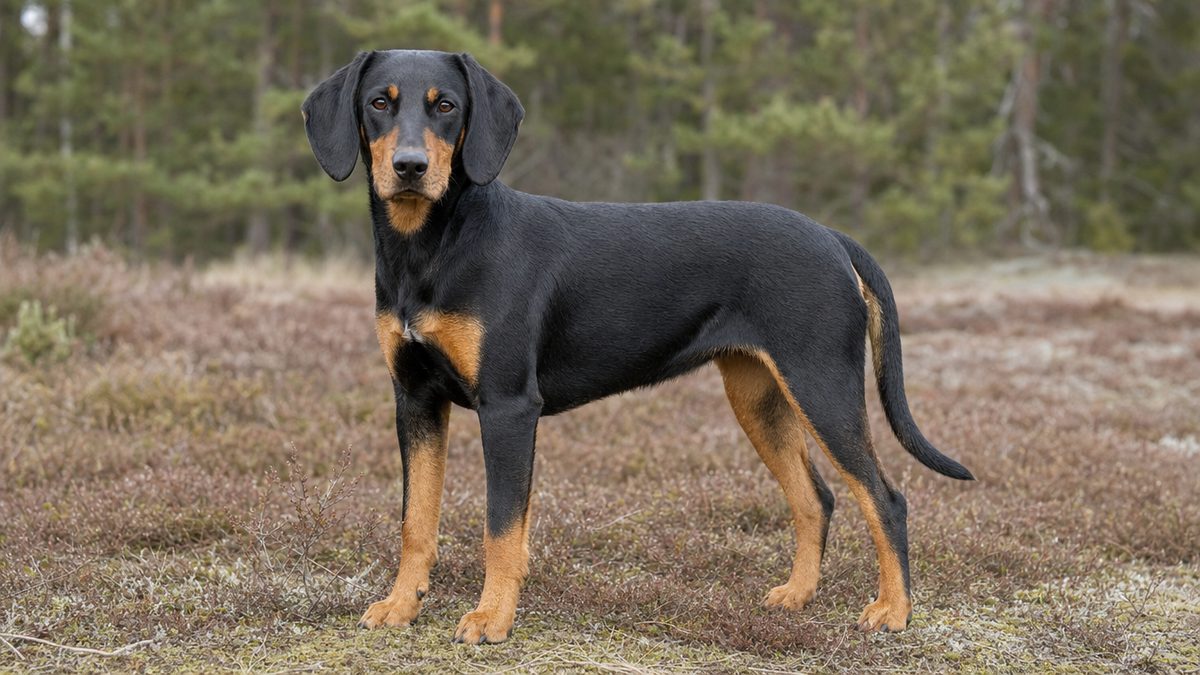
Quick answer
The smaland hound is FCI standard 129, a Swedish scent hound accepted on a definitive basis on 12 January 1955 and called rare even in Sweden by its own kennel club. Males stand 46 to 54 cm and females 42 to 50 cm, and the standard states no weight. Sweden registered 592 of them in ten years. No Indian price exists because no Indian seller offers the breed, and its homeland in Smaland averages 6.65 degrees Celsius against Delhi's 25.60.
This page reports published veterinary and registry evidence. It is not veterinary advice and it cannot examine your dog. Discuss vaccination, parasite control, heat risk, tail phenotype and any breeding decision with your nearby vet, who can see the animal in front of them and knows the disease pressure in your city.
Smaland Hound at a glance
What the Smaland Hound is, and what FCI standard 129 actually says
The smaland hound is a Swedish scent hound governed by FCI standard 129, whose official valid text is dated 22 August 2017 and whose English edition, the authentic one, was published on 2 October 2017.
English is the standard's official authentic language, so the English text governs. The FCI accepted the breed on a definitive basis on 12 January 1955, files it in Group 6 Scent hounds and related breeds, Section 1 Scent hounds, Subsection 1.2 Medium-sized Hounds, records the origin as Sweden, and marks it subject to a working trial. The date format is proven from the same page rather than assumed: other rows there read 8/22/2017 and 9/26/2018, and 22 and 26 cannot be months, so the first field is the month. The breed number was read off the FCI's own Group 6 index of 70 breeds before any standard was opened.
| What | The standard's own words |
|---|---|
| Utilization | Scenthound that give tongue used for hunting the hare and fox. It is not a pack hound and is not used for hunting deer |
| General appearance | Robust dog with a somewhat elegant look. It should be strong but not heavy in built. Coat should be harsh. Tail to be naturally short or long |
| Proportions | Almost square in body. Depth of body should be nearly equal to half of the height at withers |
| Behaviour | Calm, friendly dog with a faithful and keen temperament |
| Height, males | 46 to 54 cm, ideal size 50 cm |
| Height, females | 42 to 50 cm, ideal size 46 cm |
| Weight | No weight clause exists |
| Ears | Set fairly high and slightly raised above line of skull when the dog is attentive. Hanging flat, tips rounded |
| Colour | Black or liver-brown with tan-markings, in any shade from amber to a warm auburn |
| Coat | Medium length, harsh, close fitting, coarser on back and neck. Undercoat short, dense and soft |
| Disqualifying | Aggressive or overly shy dogs, aloofness, pronounced over- or undershot bite, blue eyes, height outside the limits |
Two rows there repay a second look. The first is the weight one, because there is nothing in it: the standard has a heading reading SIZE AND WEIGHT and gives only heights underneath. That matters practically rather than pedantically, because food quantity, most drug doses and crate sizing are all keyed to bodyweight. The second is the utilization clause, which forbids two things as well as naming one: this is not a pack hound and is not used for hunting deer, so a page describing a pack of them running deer is describing a different dog. Coat colour is worth reading in full rather than as a two-word summary: the tan markings must sit over the eyes, on the sides of the muzzle, on the throat, chest, legs and feet, under the brisket and belly, on the inner thighs, under the tail and around the anus, and being overly marked with black so the tan is lost is a listed fault. The body underneath is muscular rather than heavy, with a muscular slightly arched loin and broad well-muscled thighs.
The FCI defines this dog's job as a scenthound that gives tongue. Giving tongue means baying continuously on a line so the hunter can follow by ear, and it is the trait every generation of breeders deliberately kept. The Swedish breed strategy currently wants the audibility of the bark improved at trials, not reduced. In an Indian apartment that is a noise complaint with a shared wall attached, and no amount of training removes it, because you would be training against the breed's whole purpose.
History: soldiers' dogs, a royal hunting monopoly and a 1921 standard
The Smaland Hound descends from hounds that Swedish soldiers brought home from wars in the Baltic provinces between 1611 and 1718, crossed with local farm dogs of spitz type and later with English hounds.
The FCI's historical summary is unusually concrete about the mixture. It records that a great variety of scent hounds existed in the county of Smaland during the nineteenth century, some descended from German, Polish and Baltic hounds carried home by soldiers returning from the great wars of 1611 to 1718, and that those hounds together with local farm dogs of spitz type, with an addition of English hounds, became the foundation of the breed. Size, colour and the length of the tail all varied: some were black and tan, others red or yellow, white markings were common, and some dogs were born with short tails.
The breed's own strategy document adds the piece of social history that explains why any of this happened. When the common people gained access to hunting in 1789, a privilege that had previously belonged to the royal house and the nobility, hound hunting took off. A breed of working scent hounds spreading through a rural county is a consequence of that legal change rather than of any breeder's plan.
The re-establishment, and the choice that defines the breed today
In the early twentieth century great efforts were made to re-establish the old Smalandsstovare, mainly the bobtailed variety, and the first standard, drawn in 1921, allowed both the natural short and the long tail. The Swedish Kennel Club recognised the breed the same year. So the tail question is not a modern curiosity; it is the thing the breed's revivers were most interested in preserving, and the standard has carried both forms for more than a century.
Almost every page for this breed opens by calling it a sixteenth-century breed and the oldest scent hound native to Sweden. FCI 129's own history begins in the nineteenth century and dates the founding material to soldiers returning between 1611 and 1718, which is the seventeenth and early eighteenth. The breed's Swedish strategy says only that pictures and manuscripts suggest part of the breed's origin was in the country as early as the Middle Ages, which is a claim about ancestors rather than about a breed. Neither document supports a sixteenth-century breed.
The stumpy tail: what the genetics says, and what has never been tested in this breed
The Smaland Hound's naturally born short tail has never been genotyped, so the mutation behind it is unknown, and the two candidate answers have very different consequences for anyone breeding the dog.
The known cause of a natural bobtail in dogs is a single mutation, C189G in the T-box transcription factor T gene, first described in the bobtailed Pembroke Welsh Corgi. In 2009 a twelve-author team tested it in 23 other breeds, 360 dogs, of which 156 were naturally short-tailed, and reported that in the 17 breeds where C189G was observed there was a perfect correlation between the mutation and the short-tail phenotype, while 6 breeds carried neither that substitution nor any other mutation in the T gene coding regions.
The Smaland Hound was not one of the 23. It appears nowhere in that study, so the breed sits in neither column, and nobody has since filled the gap. That is the honest position, and it is more useful than assuming the Corgi's answer transfers.
Why it matters, and it is not cosmetic
The same paper found that no dog anywhere in the study was homozygous for C189G, which suggests the homozygous condition is lethal, and then measured the consequence rather than asserting it. In the Swedish Vallhund, comparing puppies born to short-tailed parents against those born to long-tailed parents, it observed a 29 percent decrease in litter size when both parents were short-tailed. A quarter of the puppies in such a mating would inherit the allele from both parents, so a roughly 25 percent reduction is exactly what an in-utero lethal predicts.
| Question | Answer | Consequence |
|---|---|---|
| Is the Smaland Hound's bobtail caused by C189G? | Unknown. The breed was not among the 23 tested | No DNA test can be recommended for it with confidence |
| Are C189G homozygotes viable? | None found in 360 dogs, so presumed lethal | Short by short matings lose part of the litter before birth |
| How large is the effect where it was measured? | A 29 percent fall in Swedish Vallhund litter size | In a breed averaging 4.1 to 6.3 puppies, that is a puppy or two per litter |
| Does every bobtail come from this gene? | No. Six of the 23 breeds carried no T-gene mutation at all | A short tail is not proof of the allele |
| Is there a documented health association? | In two other bobtail breeds, yes | Worth asking about, not worth panicking over |
The health association is recent and worth reporting precisely. A 2026 study of 1,679 dogs found that bobtailed Brittany dogs had 2.04 times the odds of a lumbosacral transitional vertebra (95 percent confidence interval 1.47 to 2.85), while in Danish-Swedish Farmdogs the same comparison gave 1.66 (0.99 to 2.76) and did not reach significance. Neither breed is this one, so no rate is claimed here. It is a question to raise with a breeder, not a diagnosis.
A naturally bobtailed dog in India is indistinguishable, on sight, from an illegally docked one. Second Schedule Part II paragraph 6(8) of the 2017 Rules forbids tail docking outright, so a short-tailed puppy needs documentation of its parents rather than a seller's word. Ask which parent was bobtailed and ask for photographs of the litter at birth. If you are breeding, avoid mating two short-tailed dogs together: on the only measured evidence available it costs part of the litter, and discuss the mating with your nearby vet before it happens rather than after.
How rare it is, in the breed's own numbers rather than in adjectives
Sweden registered 592 Smaland Hounds across the ten years to 2022, a mean of 59.2 a year, and Norway registered three litters in the decade to 2023.
The Swedish Kennel Club describes the breed as one of the Swedish national breeds and rare even in Sweden, and records that it recognised the breed in 1921. The breed strategy then puts figures behind the adjective, and the figures are more interesting than the word.
| Year | Registered | Mean litter size | Mean inbreeding percent | Litters |
|---|---|---|---|---|
| 2013 | 40 | 4.3 | 1.8 | 9 |
| 2014 | 70 | 4.8 | 1.6 | 14 |
| 2015 | 31 | 5.0 | 1.8 | 6 |
| 2016 | 97 | 5.7 | 3.0 | 17 |
| 2017 | 79 | 6.0 | 3.8 | 13 |
| 2018 | 61 | 5.5 | 2.5 | 11 |
| 2019 | 54 | 5.6 | 2.9 | 9 |
| 2020 | 59 | 5.4 | 1.9 | 11 |
| 2021 | 71 | 6.3 | 2.0 | 11 |
| 2022 | 30 | 4.1 | 1.6 | 7 |
Those ten registration figures sum to 592 and the litter column sums to 108, from 108 dams and 99 sires. A breed that produced 108 litters in a decade is not a breed with a deep gene pool, and 2022's 30 registrations is the second-lowest year in the series and less than a third of 2016's peak.
The inbreeding column, and the ceiling it breached twice
The strategy sets the breed's own limit plainly: the rate of inbreeding, calculated per annual cohort, is not permitted to exceed 2.5 percent, and outcrossing is to be sought given the genetic situation the Swedish hound breeds are in. The column above breaches that ceiling twice, at 3.0 percent in 2016 and 3.8 percent in 2017. The document explains it rather than hiding it, attributing the spike to unwanted matings, and adds that given the narrow breeding base the breeding advisers have done a very good job.
Two other lines in the same document say how tight the base is. Only 30 percent of approved breeding animals are males, and the shortage of well-merited stud dogs is described as very great. And the action plan proposes, in as many words, increasing the genetic variation in the breed by crossing in another stovare breed. A breed club planning an outcross is a breed club that has read its own numbers.
This page treats the Swedish breed strategy as the best available source and says what is odd about it. Its ratification line reads Faststalld av SKK ar with the year left blank, and its table of contents carries Word's unresolved bookmark error against five section headings. So the Swedish Kennel Club is hosting a document that has not been finalised. The tables are internally consistent and the registration column sums correctly, which is why they are used here, but the reader deserves to know the state of the file they came from.
Field trials: what Sweden tests this hound on, and what it wants improved
The Smaland Hound is tested in Sweden on hare and fox over a season of trial days, and its breed strategy explicitly wants better scores for the audibility of the bark.
The FCI marks this breed with working trial, so the register itself expects the dog to be tested on the job. The Swedish figures show a testing programme that is growing rather than fading, which is unusual for a breed this small.
| Season | Trial days | First prize | Second prize | Third prize | Percent scoring drives |
|---|---|---|---|---|---|
| 2018/2019 | 57 | 10 | 13 | 14 | 65 |
| 2019/2020 | 69 | 16 | 6 | 17 | 57 |
| 2020/2021 | 69 | 14 | 13 | 15 | 61 |
| 2021/2022 | 75 | 17 | 6 | 23 | 62 |
| 2022/2023 | 102 | 26 | 24 | 24 | 73 |
Trial days rose from 57 to 102 across five seasons and the share of scoring drives rose from 65 to 73 percent. For a breed registering fewer than sixty puppies a year, that is a high proportion of the population being worked and assessed, and it is the strongest evidence available that this is still a hunting dog rather than a show breed with a hunting past.
The strategy's stated wish list is the part that matters to a prospective owner anywhere. It wants to increase the share of dogs started at hunting trials, and says it is desirable that the points for the audibility of the bark, the recovery work after losing a line, and the driving style should improve. Read that as a breed being deliberately selected to be louder and more persistent, and then decide whether that is a dog for your building. One word to be careful with when reading English pages about this breed is alert. FCI 129 uses it once and not as a temperament trait: the ears are "set fairly high and slightly raised above line of skull when the dog is attentive";. The behaviour clause says calm and friendly, not alert, so an English page selling this hound as an alert watchdog has added a quality the standard declined to write.
Heat tolerance: a highland homeland at 6.65 degrees, and an endurance job
The Smaland Hound's homeland averages 6.65 degrees Celsius across the year against Delhi's 25.60, and the coat is the easy part of the problem while the endurance work is the dangerous part.
Every figure below came from NASA POWER queried by explicit latitude and longitude on 9 September 2026, with each cell's reported elevation checked against the real elevation first. Smaland is a highland plateau rather than a plain, so the check mattered. Vaxjo at 56.8790 N 14.8059 E returned a cell elevation of 201.84 m against a real 166 m, an error of 35.84 m, and Eksjo returned 233.66 m against a real 230 m, an error of 3.66 m, which is as accurate as this project has measured anywhere in Europe. Jonkoping came back 89.48 m high. The three cells return different values, so no two of them are the same cell queried twice.
| Place | Annual mean C | Warmest month | Coldest month | Annual humidity percent | Peak wet bulb C |
|---|---|---|---|---|---|
| Vaxjo, Smaland | 6.65 | July, 16.74 | January, -2.69 | 88.30 | July, 14.51 |
| Eksjo, Smaland | 6.28 | July, 16.49 | January, -3.13 | 88.63 | July, 14.33 |
| Jonkoping, Smaland | 6.54 | July, 17.17 | January, -3.48 | 87.17 | July, 14.64 |
| Delhi | 25.60 | June, 35.88 | January, 13.61 | 45.56 | July, 26.50 |
| Chennai | 27.95 | May, 31.51 | January, 24.09 | 72.39 | May, 26.11 |
| Mumbai | 26.77 | May, 31.19 | January, 23.19 | 67.39 | June, 25.77 |
| Kolkata | 25.81 | May, 31.53 | January, 17.31 | 73.93 | June, 27.09 |
| Bengaluru | 23.74 | April, 28.37 | December, 20.22 | 67.94 | May, 21.86 |
| Pune | 23.86 | April, 28.93 | December, 19.62 | 66.80 | June, 22.97 |
Two of those warmest-month cells surprise people and both are worth checking against your own city. Delhi peaks in June at 35.88, not May, and Bengaluru peaks in April at 28.37 and is coolest in December, so a summer routine planned around May gets the hardest month wrong in both.
The humidity warning is the wrong warning again
Smaland runs 87 to 89 percent annual relative humidity across all three points, higher than Kolkata's 73.93, Chennai's 72.39, Mumbai's 67.39 and Delhi's 45.56. The heath and forest this dog was bred on is a damp place. So a heat-sensitive northern breed is not undone here by damp air; it is undone by wet-bulb load. Vaxjo's worst wet-bulb month is 14.51 degrees Celsius and Kolkata's is 27.09, a gap of 12.58 degrees, and that is the number to act on.
Why the easy coat does not solve it
This is the lightest coat of the three Swedish stovare: medium length, harsh, close fitting, with a short dense undercoat and short smooth hair on the head, ears and front of the legs. That genuinely helps compared with a spitz jacket. The problem is the job rather than the coat. In the largest study of canine heat illness, 652 of the 879 events with a recorded trigger, 74.2 percent, were exertional, against 113 environmental and 46 from confinement in a vehicle. This breed was not modelled in that study and no breed-specific odds ratio is claimed, but a hound bred to run a line for hours sits squarely in the category it identifies.
Never let this breed run itself out in the heat. A scent hound on a line does not self-regulate, does not respond to recall and will keep going past its own safe limit, because that is exactly what it was selected to do. Exercise before dawn and after dark from March to June, keep it on a long line rather than loose, carry water, and treat staggering, bright red gums, thick ropey drool or collapse as an emergency. Cool with room-temperature water and get to your nearby vet immediately.
Smaland Hound price in India: none exists, and here is what the search returns instead
There is no smaland hound price in india, because no Indian breeder or seller offers the breed and Indian import policy forbids bringing a dog in to breed from or to sell.
The India-located ranking set carries no rupee figure for a live animal anywhere in it. Its results are English Wikipedia, a YouTube video, a dog-identification app, a European breed directory, a stock photo library, the United Kennel Club, Pinterest, the Swedish Kennel Club, a breed-standard aggregator and Royal Canin. Not one of them is an Indian seller or classified listing, and the only genuinely Indian-domain page for the breed is Royal Canin's editorial profile, which carries no price, no breeder and no availability.
Four things that look like an Indian price and are not
| What you find | What it actually is | How to check it yourself |
|---|---|---|
| A rupee price on a marketplace, for example Rs 2,953 reduced from Rs 3,691 | Merchandise. That Etsy market page returns 583 results and they are mugs, tumblers, posters and tote bags | Confirm the listing is for a live animal. Rs 2,953 divided by 84.38 is 35 dollars, which is a mug |
| A breed page on an Indian puppy site with a price band | A soft 404. One Indian site returns HTTP 200 with an empty title tag and all fields blank; another 404s outright | Request a nonsense slug on the same site. If it renders the same shell, the page is a template |
| A dollar figure of 700 to 800 on a breed directory | A foreign asking price on a non-Indian site, on a page that also wrongly says the breed is not FCI recognised | Check the page's other claims. FCI 129 has existed since 1955 |
| A rupee figure on an Indian dog show's schedule | An entry fee. A Madras Canine Club schedule lists the breed only inside a reference FCI classification table | Read what the rupee figure is attached to before quoting it |
Run the division test on anything you do find. Divide the rupee figure by 84.38, by 80 and by 74. If any gives a round dollar or euro number you are reading arithmetic rather than an Indian market. For future reference, the circulating 700 to 800 dollars converts to roughly Rs 59,000 to 67,500 at 84.38, Rs 56,000 to 64,000 at 80 and Rs 51,800 to 59,200 at 74, so any Indian page later quoting a band near Rs 52,000 to 68,000 for this breed is almost certainly that dollar figure converted.
A result count is not evidence. Search engines print wildly different totals for the same query minutes apart, so nothing here rests on how many results came back. What evidences an absent market is composition: zero listings against a control query that returns dozens of real rupee-priced Indian ads, template shells, converted foreign figures, and merchandise where a dog should be. All of those turned up; none of them is a price for this breed.
Importing one: the seven ports, the two-year rule and the clause that closes the trade
To bring a Smaland Hound into India lawfully, import it as your own pet through one of seven named cities with a pet book in your own name, because import for breeding or sale is refused outright.
DGFT Trade Notice No. 22/2022-23 of 19 December 2022 sets out the whole policy. Dogs sit under ITC(HS) 01061900 as a Restricted import, and Policy Condition (7) permits import only for a pet dog with a valid pet book and records in the importer's name, for research by an R&D organisation with CPCSEA recommendation, or for internal security by the defence and police forces. Policy Condition (8) states that "Import of commercial dogs for breeding or any other commercial activities other than the purposes mentioned above is not permitted", and paragraph 6 adds that any application for trading or breeding purposes, or made on behalf of another person, "shall be duly rejected".
| Situation | Up to two pets | More than two pets |
|---|---|---|
| Permanent import, transferring residence after two or more continuous years abroad | Allowed as passenger baggage without DGFT authorisation | DGFT authorisation required |
| Permanent import, less than two years abroad, or not travelling as baggage | DGFT authorisation required | DGFT authorisation required |
| Temporary import | DGFT authorisation required | DGFT authorisation required |
Paragraph 7 names the entry points: import of pet animals is allowed only through the airports and seaports of Delhi, Mumbai, Chennai, Hyderabad, Bangalore and Kolkata, with quarantine at the government station of that port where required. DAHD added a seventh port, Cochin International Airport at Kochi, for pets arriving under the baggage rules in October 2024. Two details save money and are rarely repeated correctly: only cats and dogs may enter under the baggage rules at all, and an applicant without an Importer Exporter Code may apply against the permanent IEC number IIHIE0153E. Start at least two months before travel and obtain the Advance No Objection Certificate from the Animal Quarantine and Certification Service officer at your port seven days before travelling. The full route is set out in how to import a dog to India.
This notice has been reported unreachable at its published address as recently as this month. It was fetched again on 9 September 2026 and returned HTTP 200 with 226,361 bytes of real PDF carrying a genuine text layer, and every clause quoted here was read from that extraction rather than from any summary of it. A source that failed once is not a source that is gone.
Cost of ownership in India: a borrowed structure, every line priced today
No cost of ownership figure exists for a Smaland Hound in India because no Indian owner base exists to survey, so the honest guide is the published Indian cost structure for a dog of the same size, with every line read from a named seller on 9 September 2026.
| Line | Price | Source and note |
|---|---|---|
| Puppy vaccination course | From Rs 6,499 | Vetic national page, listed against Rs 8,111, seven visits from day 30 |
| Annual booster course | From Rs 3,199 | Vetic national page, listed against Rs 3,806 |
| Anti-rabies, single | Rs 699 | Vetic national page |
| 9-in-1 DHPPiL, single | Rs 899 | Vetic national page |
| Kennel cough, single | Rs 1,349 | Vetic national page |
| Tick, flea and worm control | Rs 3,308 for 3 months | Supertails, NexGard Spectra 15-30 kg, MRP Rs 3,375, about Rs 1,103 a month |
| Grooming, bath only | From Rs 934 | Vetic Delhi, listed against Rs 1,099. A harsh short coat needs little more |
| Grooming, full bath and styling | From Rs 1,869 | Vetic Delhi, listed against Rs 2,199 |
| Boarding, 24 hours | Rs 899 | PawSpace Bengaluru, overnight plan |
| Delhi registration | Rs 500 | Municipal Corporation of Delhi, same for renewal, Rs 100 a month late fee |
| Chennai licence | Rs 50 | Greater Chennai Corporation |
| Microchipping, Chennai | Rs 1,250 | SKS Veterinary Hospital's own transacted price |
Every figure was divided by 84.38, 80 and 74 before it went on this page and none is a foreign price wearing a rupee sign: the Rs 6,499 vaccination course gives 77.02, 81.24 and 87.82, and nobody prices a vaccine course at 77 dollars and two cents Supertails product page Vetic Pet Clinic PawSpace, home pet boarding price plans… Municipal Corporation of Delhi Greater Chennai Corporation SKS Veterinary Hospital, Chennai. Read the vaccination numbers as one chain's promotional floors rather than a national average, because the same chain quotes different course prices on different city pages on the same day while keeping its per-vaccine prices identical.
Where this breed is cheaper than most imported dogs, and where it is not
Grooming is the genuinely cheap line. A harsh, close-fitting medium coat needs a weekly brush and an occasional bath, so the Rs 934 bath is the realistic figure rather than the Rs 1,869 styling package. What this breed adds instead is space and time: an endurance hound that cannot be worked in daylight for four months a year needs somewhere to run before dawn, and in most Indian cities that means either a car journey or a compromise.
Greater Chennai Corporation licenses a pet dog for Rs 50 and its municipal pet clinics provide treatment and anti-rabies vaccination free of cost. That is a tenth of Delhi's fee with a free rabies shot attached, and for most Indian owners it is worth more than any discount a private chain advertises.
Temperament: calm and friendly in the house, and a different animal on a line
FCI 129 describes a calm, friendly dog with a faithful and keen temperament, and disqualifies aggression, excessive shyness and aloofness alike.
The behaviour clause runs to nine words and every one of them is chosen: "Calm, friendly dog with a faithful and keen temperament";. Its disqualifying faults then rule out three different failures of that description, naming aggressive or overly shy dogs and, separately, aloofness. A standard that disqualifies a dog for being standoffish is describing a breed expected to engage with people.
That is the house dog. The working dog is the same animal with the nose switched on, and the two share very little. A scent hound in full cry is not disobedient, it is occupied, and the recall you built on a quiet morning does not reach it. Plan the fencing and the long line around the second dog rather than the first.
- Suits a rural or semi-rural Indian home with secure fencing, shade and ground to run before dawn.
- Suits an owner who wants a calm, hardy, low-grooming house dog and can supply two hours of daily work.
- Suits a household that genuinely does not mind a loud dog and has no shared wall.
- Does not suit an apartment, on noise before heat and heat before anything else.
- Does not suit an owner who wants off-lead freedom, because a hound on a scent stops listening.
- Does not suit a first-time owner, since no Indian vet, trainer or boarder has met the breed.
- Does not suit a home with free-roaming cats, poultry or small pets, given what the standard says it hunts.
There is no published behaviour-test dataset for this breed, no mentality description of the kind Sweden runs for some of its breeds, and no owner survey in the breed strategy. The picture above rests on nine words of a breed standard, three disqualifying faults and what the working use requires. That is thin, and saying so is better than dressing it up as a personality profile.
Training a scent hound that was bred to work a line without you
To train a Smaland Hound, build a stop and a recall on a long line before the nose matures, because a hound selected to follow a scent for hours will not be recalled off one later.
Work with what the standard describes. A faithful and keen temperament means a dog that wants to be with you and wants a job, which is a good starting position. What it does not mean is a dog that will check in while running a hare. Train the behaviours that make an independent worker safe and stop expecting the ones that make a biddable dog convenient.
- Teach a stop and a recall on a 10 metre long line, and give no off-lead freedom until both are boring.
- Pay the recall with something better than whatever the dog left, every time, for the first full year.
- Build a settle on a mat indoors, because a hound that cannot switch off will bay at everything it hears.
- Introduce muzzle training early and calmly, since an Indian vet visit for an unfamiliar breed goes better with it.
- Socialise the puppy to traffic, autos, lifts, crowds and monsoon noise inside the first sixteen weeks.
The voice is trainable in timing, not in existence
You can teach a hound when to stop baying; you cannot teach it not to bay. Reward silence on a cue, name the behaviour, and use the cue before the dog has wound itself up rather than after. Punishing the voice does not work, because in this breed the voice is the trait Sweden is currently trying to improve at trials, not suppress, and suppressing it tends to produce a dog that is anxious as well as loud.
De-barking is not available, and neither is sedating a dog to manage its behaviour. Second Schedule Part II paragraph 6(8) of the 2017 Rules names de-barking in its list of prohibited procedures alongside tail docking and ear cropping, and Part IV of the same Schedule forbids using sedation to control a dog's behaviour. If the noise is the problem, the answer is a different breed rather than a quieter dog.
Exercise: an endurance hound in cities with four usable hours a day
An adult Smaland Hound needs at least two hours of real ground work a day plus deliberate scent work, and most Indian cities supply that time only before sunrise and after dark for half the year.
The FCI marks the breed with working trial and its Swedish population is tested across 57 to 102 trial days a season Svenska Smalandsstovareforeningen. A dog built and assessed to that specification does not settle on two twenty-minute walks, and an under-exercised one becomes destructive and extremely vocal, in that order.
| When | What | Why |
|---|---|---|
| Before sunrise, daily | 45 to 75 minutes of long-line walking over varied ground | The only reliably cool window from March to June in Delhi, Chennai, Mumbai and Kolkata |
| Mid-morning, indoors | 15 minutes of scent games, hidden food, a snuffle mat | Nose work tires a scent hound faster than distance does |
| Afternoon | Nothing outdoors | Delhi's June mean is 35.88 C and Kolkata's June wet bulb is 27.09 C |
| After dark, daily | 45 to 60 minutes, including free running in a genuinely secure space | The second usable window, and the one most owners skip |
| Weekly | One longer outing outside the city, on a long line | A trailing breed needs new ground rather than more laps of the same ground |
Bengaluru and Pune are the two Indian metros where this is genuinely easier. Both peak in April rather than May, at 28.37 and 28.93 degrees Celsius, and both are coolest in December rather than January. That is roughly seven degrees below Delhi's June and it widens the usable window by more than an hour at each end of the day.
Grooming: the genuinely easy part of this breed
Brush a Smaland Hound once a week with a bristle brush and dry it properly after rain, and that is most of the coat care this breed needs.
The standard describes a medium length, harsh, close fitting coat that is coarser on back and neck, over a short, dense and soft undercoat, with short smooth hair on the head, ears and front of the legs, slightly longer hair under the tail and on the back of the thighs, and dense coat between the toes and pads. That is a low-maintenance jacket by any standard, and it is the lightest of the three Swedish stovare coats.
- Brush weekly with a firm bristle brush, and twice weekly through the two seasonal sheds.
- Check between the toes weekly in the monsoon, because the standard's dense hair there holds water.
- Dry the dog fully after any bath or rain with a towel and a cool dryer, never by letting it air dry.
- Clean and dry the ears after every swim or bath, since they hang flat against the cheeks.
- Run your hands over the whole dog daily in tick season, feeling for ticks rather than looking for them.
The one piece of imported advice to ignore
Overseas guidance for harsh-coated hounds routinely says to towel the dog and let it air dry, which is sound in a cold dry climate and wrong here. In Indian humidity a damp undercoat under a close-fitting outer coat stays wet for hours and becomes a warm wet layer against the skin. Drying properly costs ten minutes and prevents a skin problem rather than treating one.
The ears are the part that needs the attention
This is a drop-eared breed, and that is the trade for an easy coat. The standard requires ears hanging flat, with the fore edge lying close to the cheeks, which is a design that keeps the canal warm and poorly ventilated. In an Indian monsoon that is exactly the environment an ear infection wants. Check and dry the ears weekly, and take any head-shaking, odour or scratching to your nearby vet rather than treating it from a shelf.
A dense undercoat and a low-slung working dog are a tick combination. In one Kerala series of 120 dogs presented at veterinary clinics, Babesia was detected in 80 of them, with a pre-monsoon peak from March to May, and Ehrlichia canis in 5.0 percent. Those are clinic caseloads rather than a random population, so read them as evidence of pressure rather than as a prevalence rate. Keep a year-round acaricide going, and take any lethargy, pale gums or dark urine to your nearby vet the same day.
Health: a four-condition breed programme, and one requirement that was withdrawn
The Swedish breed association runs a written programme covering epilepsy, heart disease, cryptorchidism and hip dysplasia, and it removed the hip requirement in 2020.
The programme is unusual in publishing the reasoning as carrier probabilities rather than as rules, which makes it possible to check. Its own summary of the breed's current state is that the Smaland Hound is generally a healthy breed with isolated cases of epilepsy, cryptorchidism and patent ductus arteriosus.
| Condition | What the programme requires | The stated reasoning |
|---|---|---|
| Epilepsy | A dog with seizures is excluded from breeding, as is one that has produced an affected offspring. A dog with one or both parents affected is excluded | Such a dog is 100 percent a carrier |
| Epilepsy, littermates | Littermates of an affected dog are excluded; half-siblings are avoided where possible | Littermates are 75 percent carriers, half-siblings 50 percent |
| Patent ductus arteriosus or other heart disease | If more than one offspring is affected, neither parent is used again | Each parent is 50 percent a carrier |
| Cryptorchidism | If more than one male in a litter is affected, sire, dam and littermates are excluded | A single affected male allows the rest of the litter and the parents to be used with great care |
| Hip dysplasia | Known hip status was required at mating for many years. From 2020 the requirement was removed | The strategy states the removal without giving a reason |
The hip line is the one to think about. A breed association that drops a screening requirement is making a judgement, and the strategy records the change without explaining it. The sibling Schillerstovare's association removed its own hip programme too, and in that case the strategy says plainly that hips are no longer a problem in the breed. This document does not say that, so a buyer should ask a breeder for hip scores anyway rather than reading the withdrawal as an all-clear.
Three registries, three different kinds of nothing
The breed has no screening statistics anywhere outside Sweden, and each absence has a different cause worth distinguishing. OFA holds no breed code for it at all: a parse of 462 breed names from OFA's own markup runs SLOVENSKY KOPOV straight to SMALL MUNSTERLANDER, and a case-insensitive search of the whole list for smal, stova or stoeva returns only HAMILTONSTOVARE and SMALL MUNSTERLANDER. That is not a threshold problem, because OFA's threshold only applies once a breed has a code: its own FAQ says a breed needs at least 100 hip evaluations, or 50 for other databases, before it appears in the statistics tables. This breed never got that far.
McMillan 2024 names the breed and excludes it. Its Table S5, the list that adjudicates every breed the study considered, carries a row reading *Smalandsstovare, N, NA, NA, NA, Scent hounds and related breeds, Medium, Mesocephalic*, meaning not included in the survival analysis, no phylogeny reclassification, no phylogeny abbreviation and no Kennel Club group. So the breed has no median lifespan, no hazard ratio and no sample size there, and "named in the nomenclature but excluded for absence of data" is a more accurate description than "absent from the study".
PubMed holds nothing under any name form, and that zero was earned rather than assumed. Every spelling returned zero with its query translation read, while controls in the same session returned 26 for Norwegian Elkhound, 7 for Swedish Vallhund, 3 for Jamthund and 1 for Hamiltonstovare. The Hamiltonstovare control is the important one: it proves PubMed does index rare Swedish stovare names when papers exist. One query needs a warning, because it looks like a finding and is not. The phrase "Smalands Hound" returns over a thousand records, because PubMed silently discards the word Smalands and searches hound alone. That number is a rewrite artefact and must never be reported as this breed's literature.
Three exposures sit outside anything the Swedish association ever addressed. Heat, covered above, and it is the one that kills. Tick-borne disease, because a low-slung working dog with a dense undercoat collects ticks in a country with real pressure. And ear disease, because this is a drop-eared breed in a monsoon climate. None of these appears in the breed's health programme because none of them is a Swedish problem. Keep the rabies vaccination current, keep an acaricide going year-round, dry the ears after every wetting, and take anything that persists more than a day to your nearby vet.
Feeding: no target weight exists, so feed to body condition
Feed a Smaland Hound to visible body condition rather than to a number, because FCI 129 states no weight at all under a heading that promises one.
The standard's heading reads SIZE AND WEIGHT and only heights follow it. What it does give you instead is a shape rule that works better than a number: the body should be almost square, with the depth of body nearly equal to half the height at the withers, and the dog should be strong but not heavy in built. A Smaland Hound that has thickened out of that square is carrying weight the standard does not want.
- Feel for the last two ribs under light pressure and adjust the ration rather than the schedule.
- Split the daily ration into two meals for an adult and three or four for a puppy.
- Feed the smaller meal in the heat of the day and the larger one after the evening exercise.
- Weigh the food rather than scooping it, because a working hound's appetite outruns a household eye.
- Cut the ration through the hot months, when a dog that cannot be worked is burning far less than its label assumes.
The Indian summer adjustment nobody writes down
A Swedish hound's ration assumes a dog running a line through a cold day. An Indian summer removes the work and leaves the appetite, so the same bowl becomes a weight problem within a season. That matters more here than for most breeds, because bodyweight at or above the breed and sex mean was associated with higher odds of heat-related illness in the largest UK study of the condition. A heavier hound in an Indian May carries two risks at once.
A trustworthy feeding chart needs a target weight, and this breed has none in its standard, no OFA population to survey and no longevity study to draw on. Any number printed here would be a guess wearing a decimal point. Use body condition instead, weigh the dog monthly on the same scale, and take the trend to your nearby vet if it moves in either direction faster than half a kilogram a month.
What Indian law requires, quoted from the gazette
Three provisions of the Prevention of Cruelty to Animals (Dog Breeding and Marketing) Rules, 2017 bear on anyone breeding, selling or housing this dog in India, and the tail clause matters more here than for almost any other breed.
The Rules run 1 to 13 and stop there, so a citation reading Rule 14 or higher is wrong by construction. Everything numbered above 13 is a Second Schedule paragraph, numbered continuously from 1 to 30 across the Schedule's four Parts.
| Provision | What it says | Why it reaches this breed |
|---|---|---|
| Rule 8(1)(a) | Pups less than eight weeks in age are not sold | A hard floor on the age of any puppy offered to you, whatever schedule the seller quotes |
| Second Schedule Part II paragraph 6(8) | No tail docking, ear cropping, de-barking, de-clawing, branding, dyeing, injecting substances to enhance visual appeal, or any other kind of mutilation, and any change of appearance by artificial means is strictly forbidden | This breed's standard permits a naturally born stumpy tail, and a naturally short tail is indistinguishable on sight from an illegally docked one |
| Second Schedule Part IV paragraph 21(1) | Bars keeping in outdoor facilities, without the attending veterinary practitioner's written approval, dogs not accustomed to local temperatures and breeds that cannot tolerate them | A Swedish hound kennelled outdoors through an Indian summer is the first category named |
The tail row is the one that is specific to this breed and it cuts both ways. A genuinely bobtailed Smaland Hound is entirely lawful in India, because it was born that way. A docked one is not, and the prohibition in paragraph 6(8) is absolute rather than conditional. Since no inspection can tell the two apart on a grown dog, the burden falls on documentation: ask which parent was short-tailed and ask for photographs of the litter at birth.
The 2024 breed circular does not name this breed, and no longer has effect
The Union circular of 12 March 2024 that asked states to stop licensing certain breeds names no Swedish hound of any kind. It also no longer has effect: the Karnataka High Court quashed it on 10 April 2024 and the Delhi High Court set it aside later that month. No Indian law in force today bans owning, breeding or selling this breed. Ordinary municipal registration still applies, at Rs 500 in Delhi and Rs 50 in Chennai Greater Chennai Corporation.
Month by month through the first year in India
Plan a Smaland Hound's first year around three collisions: the eight-week legal floor, a socialisation window that falls inside the monsoon for most litters, and a nose that matures during the hottest months.
| Age | What matters | The Indian complication |
|---|---|---|
| 0 to 8 weeks | With the litter. Rule 8(1)(a) forbids sale below eight weeks | Any seller offering a six-week puppy is breaking the Rules, whatever reason is given. Photograph the litter's tails now |
| 8 to 16 weeks | The socialisation window. Traffic, autos, lifts, crowds, handling, monsoon noise | Roughly half of Indian litters meet this window in the rains, so plan indoor exposure rather than losing it |
| 3 to 5 months | Core vaccination course, then the rabies dose | A seven-visit course from day 30 starting at Rs 6,499 with a chain, or free anti-rabies at a Chennai corporation clinic |
| 4 to 6 months | Long-line recall built daily, before the nose takes over | Start before the scenting drive matures, because the window closes quietly |
| 6 to 9 months | Trailing drive matures. Cats, poultry and street animals become interesting | This usually lands in March to June, when the dog cannot be worked off its energy in daylight |
| 9 to 12 months | Adult coat arrives. Ear checks become a weekly habit rather than an afterthought | First full Indian monsoon with drop ears. Dry them after every wetting |
| 12 months | Growth plates closing, real endurance work can begin | Time the start for October rather than April |
The most avoidable mistake on that table is the recall one. An owner of a biddable breed can start recall late and get away with it. An owner of a scent hound cannot, because by the time the nose matures the dog has already learned that leaving pays. Build it on a long line from four months, pay it every time for a year, and never use the recall to end something the dog is enjoying.
Head to head against the hounds an Indian buyer is actually choosing between
Anyone considering a Smaland Hound in India is realistically choosing between it, a Beagle and an Indian pariah dog, and the deciding row is availability rather than looks.
| Smaland Hound | Schillerstovare | Hamiltonstovare | Beagle | |
|---|---|---|---|---|
| Height, males | 46 to 54 cm | 53 to 61 cm | 53 to 61 cm | 33 to 40 cm |
| Colour | Black or liver-brown with tan | Tan with a black mantle | Tricolour | Usually tricolour |
| Tail | Long, half-length or naturally stumpy | Long | Long | Long |
| Available in India | No breeder, no listing | No breeder, no listing | No Indian breeder | Widely, at every price point |
| OFA breed code | None at all | None | HAM | Yes |
| In the AKC Foundation Stock Service | No | No | Yes | Fully recognised |
| Heat tolerance | Low | Low | Low | Moderate, and long established here |
| Vet familiarity in India | None | None | None | High |
Availability is not a detail on that table, it is the answer. A breed with no Indian population has no Indian vet who has treated one, no boarding kennel that has taken one, no rescue that knows what to do with one, and no route to obtain one that does not run through DGFT Trade Notice 22/2022-23 and a pet book in your own name. Every other row is secondary to that.
The Hamiltonstovare row is the useful comparison
Two Swedish stovare, one country, one century, and only one of them travelled. The Hamiltonstovare holds an OFA breed code and a place in the American Kennel Club's Foundation Stock Service alongside the Drever and the Norrbottenspets; the Smaland Hound holds neither American Kennel Club. That is the cleanest single measure of how little this breed has left Sweden, and it explains every other absence on this page.
If what you want is a scent hound you can actually keep here
The Beagle is the honest answer for most Indian households wanting a hound: available, priced, vet-familiar, boardable and small enough to manage. An Indian pariah dog is the better answer for anyone who wants the working temperament rather than the pedigree, and it comes with a coat that evolved here.
Eight mistakes buyers make with this breed, and the check that catches each
Every mistake below appears on a page currently ranking for this breed or on an Indian listing site, which is why each names the specific check that catches it.
| The mistake | The check that catches it |
|---|---|
| Repeating that this is a sixteenth-century breed | Read FCI 129's own history. It dates the founding material to soldiers returning between 1611 and 1718 and describes a nineteenth-century variety of hounds |
| Assuming a short-tailed puppy was docked | The standard permits a naturally born stumpy tail and a bear-tail. Ask which parent was short-tailed and ask for litter photographs |
| Mating two short-tailed dogs together | The only measured evidence, in another breed, is a 29 percent fall in litter size. No homozygote was found in 360 dogs |
| Taking a published weight range as the standard's | FCI 129 has a SIZE AND WEIGHT heading with no weight under it. Ask which document any quoted weight came from |
| Reading the withdrawn hip requirement as an all-clear | The Swedish strategy records the 2020 removal without stating a reason. Ask a breeder for hip scores anyway |
| Quoting a PubMed count for this breed | The phrase Smalands Hound returns over a thousand records because PubMed discards the first word and searches hound alone. Read the query translation |
| Believing an Indian price you found online | Divide it by 84.38, 80 and 74, and confirm the listing is for a live animal rather than a mug or a poster |
| Assuming Indian humidity is the problem | Smaland runs 87 to 89 percent annual humidity, wetter than Kolkata. The problem is heat and wet-bulb load |
The tail one is the mistake with legal consequences, and it is unique to this breed among the hounds on this site. A naturally bobtailed dog is lawful in India and a docked one is not, and nobody can tell them apart on a grown animal. Documentation at eight weeks is the only thing that settles it later.
Adoption and responsible sourcing: what to do instead
No Smaland Hound is available for adoption in India, so the honest options are an Indian landrace, a rescued hound-type crossbreed, or a genuine personal import through the one narrow route the law allows.
Adopt an Indian dog and you get most of what people want from this breed. Indian shelters and municipal pounds hold large numbers of pariah dogs and hound-type crossbreeds with real stamina, a working nose and a coat that evolved in this climate rather than fighting it. Greater Chennai Corporation's six pet clinics provide treatment and anti-rabies vaccination free of cost, which makes a rescued dog's first year cheaper than most people expect.
If you are set on the breed, the only lawful route runs through you
There is one legal path and it is personal rather than commercial. You import the dog as your own pet, with a valid pet book and records in your own name, through the airport or seaport of Delhi, Mumbai, Chennai, Hyderabad, Bengaluru, Kolkata or, since October 2024, Kochi, with quarantine where required and an advance No Objection Certificate from the Animal Quarantine and Certification Service officer at that port seven days before travel Department of Animal Husbandry…. An application made on behalf of someone else, or for trading or breeding, is rejected by the notice's own paragraph 6.
One practical note specific to this breed. The Swedish and Norwegian populations are managed jointly, and Norsk Kennel Klub states that all the Swedish hound breeds are numerically small in Norway and must therefore be managed in cooperation with Sweden, adding that the schillerstover and smalandsstover have an open studbook at the Swedish Kennel Club. An open studbook is a real finding rather than a technicality: it means the breed is small enough that its home registry has left the door open to bringing new blood in, which is the same conclusion the breed's own action plan reaches when it proposes crossing in another stovare breed.
- Verify the kennel in the Swedish Kennel Club's own register, and read the dog's pedigree yourself.
- Ask for the litter's inbreeding coefficient, and compare it against the breed's own 2.5 percent ceiling.
- Ask how many litters the sire has produced, because only 30 percent of approved breeding animals are males.
- Ask which parent was short-tailed, and get photographs of the litter at birth for the tail record.
- Confirm the pet book is in your name before any money moves, because the whole import turns on that fact.
Ask for the litter's inbreeding coefficient, the number of litters the sire has already produced, and the hunting trial and conformation grades both parents hold. A serious breeder of this particular breed has all three to hand, because the Swedish strategy is built around exactly those numbers. A broker offers photographs instead. This works in Sweden and it works in India, and it does not require you to know anything about the breed.
Smaland Hound: the questions the ranking pages raise, answered
How big is a Smaland Hound?
FCI 129 gives males 46 to 54 cm at the withers with an ideal of 50 cm, and females 42 to 50 cm with an ideal of 46 cm. The heading reads SIZE AND WEIGHT and no weight follows it, so every weight figure published for this breed comes from somewhere the FCI did not write.
What colour is a Smaland Hound?
Black or liver-brown with tan markings in any shade from amber to a warm auburn, over the eyes, on the sides of the muzzle, throat, chest, legs and feet, under the brisket and belly, on the inner thighs and around the anus. Small white markings are permissible on chest and toes only.
Does the Smaland Hound have a naturally short tail?
Some do, and the standard permits it. The tail may be long, half-length, or a naturally born short tail, described as a stumpy tail, with a bear-tail also permissible. The standard's own history says that early twentieth-century efforts to re-establish the breed focused mainly on the bobtailed type.
Smalandsstovare: purchase price in India
There is no smaland hound price in india. No Indian breeder or seller offers the breed, and Indian import policy makes dogs a Restricted import that may not be brought in for breeding or any other commercial activity, so no supply chain can lawfully form here.
Is the Smaland Hound rare?
Yes, and its own kennel club says so. The Swedish Kennel Club describes it as one of the Swedish national breeds and rare even in Sweden. Its breed strategy records 592 registrations across ten years, and Norsk Kennel Klub registered three litters of the breed in the decade to 2023.
How long does a Smaland Hound live?
No measured life expectancy exists. The breed appears in the largest UK longevity study's own breed list, flagged as not included in the survival analysis, so it has no median, no hazard ratio and no sample size there. Any lifespan figure you read for this breed rests on no dataset at all.
Does the Smaland Hound have hip dysplasia?
Nobody screens for it any more. The Swedish breed association required known hip status at mating for many years and removed that requirement in 2020, so known status is no longer needed. OFA holds no breed code for the dog at all, so it publishes no hip figure either.
Can a Smaland Hound live in Indian heat?
Not comfortably, and not without changing when it exercises. Its homeland at Vaxjo averages 6.65 degrees Celsius across the year and 16.74 in its warmest month, while Delhi averages 25.60 and peaks at 35.88. The coat is the easy part; the endurance work is what makes heat dangerous.
Is the Smaland Hound good with children?
Its standard describes a calm, friendly dog with a faithful and keen temperament, and disqualifies aggressive, overly shy or aloof dogs. The real caution for an Indian household is prey drive around cats, poultry and small pets rather than behaviour towards people.
Do Smaland Hounds bark a lot?
Yes, and it is the job. The FCI defines the breed's utilization as a scenthound that gives tongue, used for hunting hare and fox, and the Swedish breed strategy asks for better scores on the audibility of the bark at hunting trials. That is a breed being selected to be louder, not quieter.
What is the difference between a Smaland Hound and a Hamiltonstovare?
Size, colour and availability. The Smaland Hound is smaller at 46 to 54 cm for males and is black or liver-brown with tan; the Hamiltonstovare is larger and tricolour. More practically, the Hamiltonstovare holds an OFA breed code and a place in the AKC's Foundation Stock Service, and the Smaland Hound holds neither.
Is the Smaland Hound recognised outside Sweden?
Yes, by the FCI on a definitive basis since 12 January 1955 and by the United Kennel Club since 2006, which files it in its Scenthound Group. It is not on the American Kennel Club's Foundation Stock Service list and not on the Royal Kennel Club's breeds index.
What is the national dog of Sweden?
Sweden has several national breeds rather than one national dog, and the Smaland Hound is one of them. The Swedish Kennel Club describes the breed as one of the Swedish national breeds and rare even in Sweden, and records that it recognised the breed in 1921; the FCI accepted it on a definitive basis on 12 January 1955 as standard 129. The rarity is measurable: the breed strategy records 592 registrations across ten years, and Norsk Kennel Klub registered three litters of the breed in the decade to 2023. It shares that national-breed status with the other Swedish hounds, including the larger tricolour Hamiltonstovare.
What is the calmest hound?
No published ranking of hound calmness exists and this page does not invent one, but the word is the first thing FCI 129 says about the Smaland Hound: the behaviour clause runs to nine words, calm, friendly dog with a faithful and keen temperament, and the standard disqualifies aggressive, overly shy and aloof dogs alike. Calm in the house is only half the animal. The FCI defines its job as a scenthound that gives tongue, baying continuously on a line, and the Swedish breed strategy wants the audibility of the bark improved at trials, so this is a dog selected to be quiet at home and loud at work, and an English page selling it as an alert watchdog has added a quality the standard declined to write.
Are hound dogs a good pet?
This one is, for the right house. FCI 129 describes a calm, friendly dog with a faithful and keen temperament and disqualifies aggressive, overly shy or aloof dogs, so the standard expects a hound that engages with people. Three things decide whether it suits an Indian home. Prey drive around cats, poultry and small pets is the real caution rather than behaviour towards people. Noise is the job, because the breed is a scenthound that gives tongue and is being selected to be louder, which no training removes. And heat: its homeland at Vaxjo averages 6.65 degrees Celsius across the year and 16.74 in its warmest month against Delhi's 25.60 and 35.88, and endurance work in that gap is what makes heat dangerous.
Compare with similar breeds
Smaland Hound sits in 1 Bonbeno group. Each one compares it directly against the breeds it is genuinely an alternative to, on the same figures.