
Breed profile
Picardy Spaniel (Epagneul Picard): The India Guide
A French pointing dog held by the FCI as Standard No. 108, accepted on a definitive basis on 8 December 1954, with 168 French studbook registrations in 2025. It is the only one of the three breeds its parent club holds whose numbers went up, and the older of the two Picardy spaniels. Its standard says the coat often carries an undercoat, which is the clause that matters most in India.
Quick answer
The picardy spaniel is a French pointing dog held by the FCI as Standard No. 108, standing 57 to 62 cm for males and 55 to 60 cm for females, with a grey-mottled coat marked with dark brown patches and tan. The French studbook recorded 168 registrations in 2025, up 16 percent, against 84 Blue Picardy Spaniels. It has no verifiable Indian price and no lawful commercial route into India.
This guide is general information for Indian pet owners and is not a diagnosis. Consult your nearby vet, a registered veterinary practitioner, before acting on anything here. There is no published veterinary literature on this breed at all, so nothing on this page is a breed-specific prevalence figure, and any health claim you meet elsewhere that cites one should be checked against its source. Treat collapse, laboured breathing after exercise in the heat, or a painful ear as urgent rather than as something to manage at home.
Picardy Spaniel at a glance
What a Picardy Spaniel is, according to its own breed standard
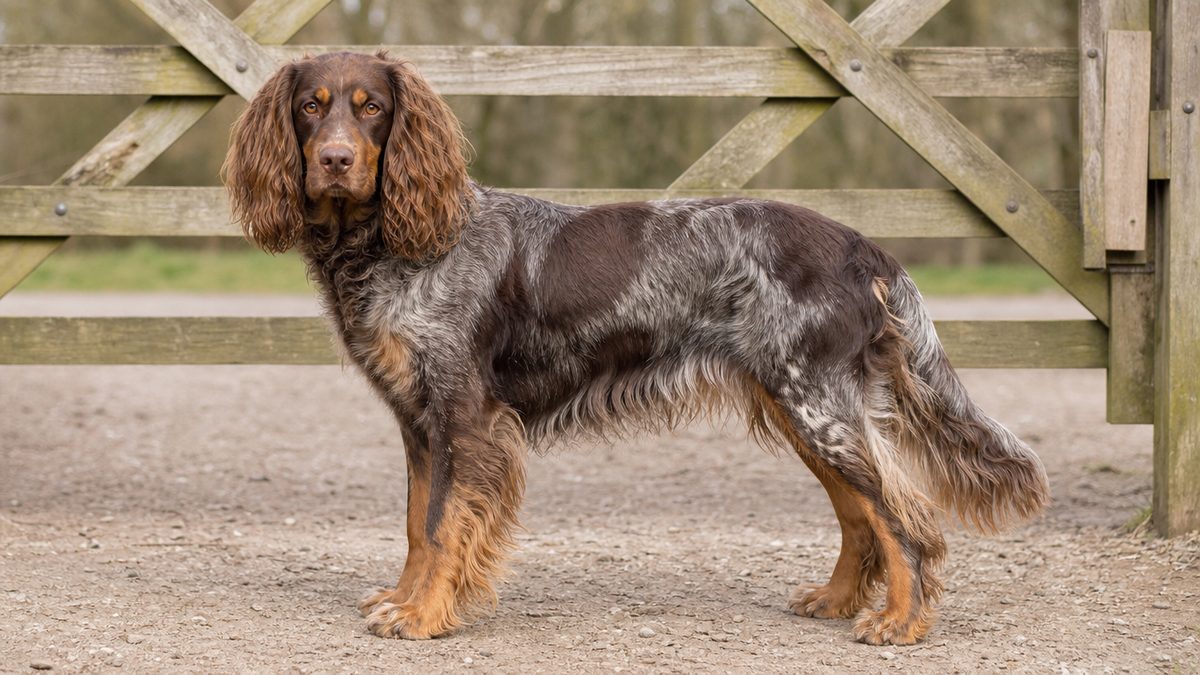
A Picardy Spaniel is a medium-sized French pointing dog of Continental spaniel type, 57 to 62 cm at the withers for males and 55 to 60 cm for females, with a grey-mottled coat carrying dark brown patches and tan markings on head and limbs. The FCI holds it as Standard No. 108 and accepted it on a definitive basis on 8 December 1954.
The standard is short, specific and worth reading before any breed page. FCI Standard 108's general appearance is a dog of medium size and a Continental spaniel-type, well boned with strong limbs; gentle expression; head carriage gay and striking. Its important-proportions clause is a number rather than an adjective: the length from the point of the shoulder to the ischium exceeds the height at the withers by roughly one tenth.
| Point | What the standard says |
|---|---|
| Height, males | 57 to 62 cm, tolerance plus or minus 2 cm, permitted yet undesirable |
| Height, females | 55 to 60 cm, same tolerance |
| Weight | Not specified at all |
| Nose | Brown. Any colour other than brown is a severe fault |
| Eyes | Dark amber, well opened, expression frank and friendly |
| Ears | Set approximately at eye level, rather thick, framing the skull, wavy silky hair; leather must reach the tip of the muzzle |
| Coat | Dense and not too silky, fine on head, slightly wavy on the body. Often with undercoat |
| Colour | Grey mottling with dark brown patches, most often marked with tan on head and limbs, traditionally called autumn leaves |
| Tail | Set on not too high, hanging in two slight curves, convex and concave, silky feathering |
| Utilisation | Pointing dog, subject to a working trial |
| Disqualifying coat | Atypical coat with white or black patches |
The one clause that decides the Indian question
Under Coat, the standard says the hair is often with undercoat. That is four words and it does more work on this page than anything else in the document, because an undercoat is insulation and India is hot. The authoritative French text agrees: *souvent accompagné d'un sous poil*.
It also separates this breed from its closest relative. The Blue Picardy Spaniel's standard mentions no undercoat anywhere, so on the registry's own wording the Picardy Spaniel carries a little more coat than the Blue. That is a small difference and it points in the wrong direction for an Indian buyer.
Colour is the breed's identity, and the standard is blunt about it
The FCI's historical summary contains a sentence that settles the question every reader arrives with. In the authoritative French: Des deux chiens de PICARDIE, ce qui différencie le Picard, du Bleu de Picardie, c'est avant tout la couleur de la robe. Of the two Picardy dogs, what distinguishes the Picard from the Blue de Picardie is above all the colour of the coat.
The colour itself is described in traditional language: grey mottling with dark brown patches on different parts of the body and at the root of the tail, most often marked with tan on the head and limbs, producing the effect the old nomenclature called autumn leaves. A white or black patch is a disqualifying fault, and a nose that is not brown is a severe one.
FCI 108 describes a natural tail hanging in two slight curves with silky feathering, and nothing in it contemplates docking. That matters here because Second Schedule Part II paragraph 6(8) of the Prevention of Cruelty to Animals (Dog Breeding and Marketing) Rules 2017 states that there shall be no tail docking, ear cropping, de-barking, de-clawing, branding, dyeing or any other kind of mutilation of any body part of the pup, and that any change of appearance by artificial means is strictly forbidden. A docked Picardy Spaniel is neither standard nor lawful in India.
Three registries, three standards, and where they disagree
Three bodies publish a standard for this breed and they do not agree. The FCI gives males 57 to 62 cm and says the coat is often with undercoat; the United Kennel Club gives a single 21.5 to 23.5 inch range and omits the undercoat entirely; Google's own knowledge panel prints a male floor two centimetres below the FCI's.
This is the kind of thing that gets flattened everywhere else and it matters, because the differences are exactly the clauses an Indian buyer needs.
| Point | FCI Standard 108 | United Kennel Club | Google knowledge panel |
|---|---|---|---|
| Height, males | 57 to 62 cm, tolerance plus or minus 2 cm | 54.6 to 59.7 cm (21.5 to 23.5 in), tolerance to 62.2 cm | 55 to 62 cm |
| Height, females | 55 to 60 cm | Same single range as males | 55 to 60 cm |
| Weight | Not given | Not given | Not given |
| Base colour | Grey mottling with dark brown patches | Brown roan with brown patches | Not stated |
| Undercoat | Often with undercoat | No mention at all | Not stated |
| Ear set | Approximately at eye level | Set on rather low | Not stated |
| Disqualifications | Atypical coat, missing teeth, bite, size outside tolerance | Cryptorchidism, viciousness or extreme shyness, albinism | Not applicable |
| Recognised | Definitive basis 8 December 1954 | 1 January 1996 | Not applicable |
What each disagreement actually costs a reader
- The undercoat. A reader who finds the UKC standard first will conclude this is a single-coated dog and will underestimate its Indian heat load. The FCI text, in both the English and the authoritative French, says otherwise United Kennel Club.
- The height. A 60 cm male is comfortably inside the FCI's range and above the UKC's stated 23.5 inch ceiling, sitting only inside its male tolerance. A judge in one system and a judge in the other are not measuring the same dog.
- The colour. Grey mottling and brown roan are different descriptions of the same coat, and a reader trying to identify a puppy from a photograph is being given two different targets.
- The ear set. Eye level against rather low is a real anatomical difference, and it is the feature this page later argues carries the breed's biggest Indian risk.
Note which document governs. The FCI record names French as the official authentic language for Standard 108, so where the English translation and the French original differ, the French wins. On the two clauses that matter here they do not differ: the size clause and the undercoat clause are identical in both, which is a negative result worth recording because it is not always true of FCI standards.
The date format, proved rather than assumed
The FCI's nomenclature record prints acceptance as 12/8/1954 and the current standard's publication as 6/8/2023. Those are ambiguous on their face. The same record also prints 8/24/2023, and 24 cannot be a month, which proves the first field is the month for this table. So the dates are 8 December 1954 and 8 June 2023, and the second reconciles exactly with the 08.06.2023 printed on the standard PDF in day-month-year form.
Registries maintain their own texts and revise them on their own schedules; the FCI's current standard dates from 2023 and the UKC's copyright line reads 1996. Neither is lying. What is worth objecting to is the dozens of pages that pick one silently, publish it as the breed's specification, and never mention that another registry says something else.
History, and three different years for the same club merger
The Picardy Spaniel is the older of the two Picardy breeds, separated from the French Spaniel as regional varieties divided in the early twentieth century. Its parent club was founded at Amiens in 1921 by the breeder Léon Flandre, and three sources give three different years for when that club absorbed the Blue Picardy club.
The club's own account is the one to start with, because it is the club that did the merging. CEPPA states that the Club des Épagneuls de Picardie was founded at Amiens in 1921 by the breeder Léon Flandre, that it merged with the Club de l'Épagneul Bleu de Picardie in 1937, that it annexed the Club de l'Épagneul de Pont-Audemer in 1980, and that it has been officially named the Club des Épagneuls de Picardie et Pont-Audemer since 2015. The Société Centrale Canine's own directory confirms that one affiliated club holds all three breeds.
| Source | Club founded | Blue Picardy club merged | Pont-Audemer club joined |
|---|---|---|---|
| CEPPA, the French parent club | 1921, at Amiens | 1937 | 1980 |
| NAPSA, the North American alliance | 1921 | 1938 | 1980 |
| United Kennel Club | 1921, already combined | Not stated separately | Not stated |
All three agree on 1921 and on 1980. They disagree in the middle. The United Kennel Club's history says that in 1921 the Picard Spaniel and Blue Picardy Spaniel Club was formed, which if read literally would mean the two breeds shared a club from the start. NAPSA says the amalgamation happened in 1938. The French club says 1937.
Bonbeno does not resolve this. The French club is the body that holds the records and its own page is the strongest of the three, so 1937 is the figure this page leads with, but a one-year gap between a national parent club and a national alliance is exactly the sort of detail that gets copied silently everywhere else.
The separation from the French Spaniel
NAPSA dates the breed's recognition as distinct to 1907, as the French Spaniel began to subdivide into separate regional varieties, and says the standard was drawn up in 1908 and has remained largely unchanged since. The FCI's own historical summary does not give dates; it says instead that the diverse biotope of the Picardy region led local hunters to look for a sturdy, versatile and generous dog, and that this ancient breed has mainly been used locally, which explains why it has never quite expanded outside of Picardy.
The United Kennel Club adds an ancestry claim the FCI does not make: that the Picardy Spaniel descends from old French spaniels crossed with English Setters and Gordon Setters. The FCI standard's history section says nothing about setters at all. Treat the setter cross as the UKC's account rather than as a settled fact.
Two wars, and a region that was the front line
The First World War made Picardy ground zero for some of the conflict's most intense fighting, and the Second was worse for the breed still: NAPSA records that when it was over, the Picardy Spaniel had almost disappeared. That is a familiar shape for a European regional gundog and it is why the modern population is small.
It is also why the 2025 studbook figure in the next section is worth reading twice. A breed that almost disappeared in 1945 registered 168 puppies in France last year and was the only one of its club's three breeds to grow.
The breed is virtually unknown outside France, and the FCI's own standard explains why in a sentence: this ancient breed has mainly been used locally. That is not a marketing weakness. It is the reason the French studbook is the only place a real number about this dog exists.
How rare the Picardy Spaniel is, in real French studbook numbers
The French studbook registered 168 Picardy Spaniels in 2025, up from 145 in 2024, a rise of 16 percent. That makes it the only one of the three breeds its parent club holds whose numbers went up, against a Blue Picardy Spaniel down 41 percent to 84 and a Pont-Audemer Spaniel down to eight.
Rarity is asserted on every page about this breed and counted on none of them. The number exists, in the Société Centrale Canine's Statistiques LOF 2025, a PDF whose Groupe VII table carries every French pointing breed with its 2024 and 2025 registrations, its confirmations and its year-on-year change.
| Breed | 2024 | 2025 | Confirmations 2025 | Change |
|---|---|---|---|---|
| Setter Anglais | 4,900 | 5,086 | 1,828 | plus 4 percent |
| Epagneul Breton | 3,953 | 3,793 | 1,036 | minus 4 percent |
| Epagneul Francais | 344 | 236 | 125 | minus 31 percent |
| Epagneul Picard | 145 | 168 | 41 | plus 16 percent |
| Epagneul Bleu de Picardie | 142 | 84 | 39 | minus 41 percent |
| Epagneul de Saint Usuge | 117 | 58 | 42 | not printed |
| Epagneul de Pont Audemer | 19 | 8 | 9 | not printed |
| Groupe VII total | 18,073 | 17,777 | 5,476 | minus 2 percent |
What those numbers mean in proportion
One hundred and sixty-eight registrations is 0.94 percent of the French pointing-dog group. Set beside the Epagneul Breton at 3,793, the Picardy Spaniel is outnumbered roughly 23 to one by the Brittany in its own country and in its own FCI section.
It is nonetheless the healthy one of the three breeds its club holds. In a single year the Blue Picardy Spaniel lost 41 percent of its registrations while the Picardy gained 16 percent, and the Pont-Audemer Spaniel fell from 19 births to 8. One club, three breeds, three completely different trajectories.
The confirmation column, which nobody quotes
The SCC table's Conf column counts dogs that passed confirmation, the French adult examination against the breed standard that a dog must pass to be fully entered in the studbook. The Picardy Spaniel recorded 41 confirmations in 2025 against 168 registrations, which the table prints as 24 percent.
Read that carefully rather than as a failure rate. Confirmation happens at about a year old, so a given year's confirmations largely describe the previous year's puppies, and many pet-homed dogs are never presented. What it does show is the size of the actively bred, standard-assessed population, and 41 dogs is small.
The Pont-Audemer row makes the lag visible: 9 confirmations against 8 registrations, more dogs confirmed in the year than were born in it.
How this compares with the British rare spaniels
For scale against the other breeds in this batch: the Kennel Club registered 15 Sussex Spaniels and 213 Welsh Springer Spaniels in Britain in 2025. The Picardy Spaniel's 168 French registrations put it in the same band as the Welsh Springer, and roughly eleven times the Sussex.
France operates a single national studbook, the Livre des Origines Français, and the SCC publishes its yearly totals per breed as a public PDF. For a breed that is virtually unknown outside France, that document is the entire population record. No page ranking for this breed in India quotes it, and every rarity claim you meet elsewhere is an adjective standing where a number could have gone.
Picardy Spaniel price in india, and the four Indian sites that do not carry it
No Picardy Spaniel price in India exists, and the absence is unusually clean. Four Indian listing routes that do serve other spaniels return a 404 or a Dog Breed Not Found title for this one, and not a single Indian domain appears in the top ten of the India-restricted price search.
Most rare-breed price sections have to unpick a fabricated rupee figure. This one does not, because nobody in India has bothered to fabricate one. Petbuy.in returns a clean HTTP 404 for the breed, and Mr n Mrs Pet answers HTTP 200 before landing on a page whose own title reads 404 Page Not Found, which is why a status check alone is not evidence that a listing exists.
| Route | Response | What the page actually contains |
|---|---|---|
| puppiezo.com | HTTP 404 | Title: Page not found. The same site generates pages for the Sussex and Welsh Springer |
| poodles.in | HTTP 200 | Title: Dog Breed Not Found. A soft 404 that a status check passes |
| petbuy.in | HTTP 404 | No page for the breed |
| mrnmrspet.com | HTTP 200, then redirected | Lands on /404-page-not-found |
| goofytails.com | HTTP 200 | A real Indian breed guide from a Delhi retailer, with no price |
| royalcanin.com/in | HTTP 200 | A genuine India-localised breed page carrying no rupee figure |
| gooddog.com | HTTP 200 | USD 3,000 to 3,500, read from the raw page rather than a snippet |
| lancasterpuppies.com | HTTP 403 | Ranked position 1 in India and would not open to this session |
Not one Indian domain in the top ten
The India-restricted search for this breed's price returns no Indian pages at all. The first ten results are a United States marketplace, a United States breed-list site whose page is for the Blue Picardy rather than the Picardy, a Pinterest board, Good Dog, a Facebook group, Wikipedia, Wamiz in Britain, the United Kennel Club and Basepaws. That is what a genuinely absent market looks like from a search engine's point of view.
The highest-placed Indian domain for the breed on the informational query is GoofyTails, a Delhi pet-products retailer running the breed page as content marketing, and it quotes no puppy price at all. Royal Canin's India-localised page does the same. Both are the correct behaviour and both are the tell: Indian businesses that actually sell to Indian dog owners have nothing to sell here.
The soft 404 worth naming
Poodles.in answers HTTP 200 for this breed with the title Dog Breed Not Found, 32,904 bytes of page, and the breed name nowhere in the body. A tool that checks status codes records that as a live page. It is the same site that publishes a full monthly cost table for the Sussex Spaniel and the Welsh Springer Spaniel, so the absence here is a genuine gap in its data rather than a site-wide failure.
The only real published prices are foreign, and they disagree
| Source | Published price | At 84.38 to the US dollar |
|---|---|---|
| Good Dog, buyers guide range | USD 3,000 to 3,500 | Rs 2,53,140 to Rs 2,95,330 |
| Lancaster Puppies | Not verifiable; page returned HTTP 403 | Not applicable |
| Any Indian source | None published | Not applicable |
The Good Dog figure was read out of the raw page source as a `buyersGuidePriceRange` object with `low_price` 3,000 and `high_price` 3,500, rather than from a search snippet. That matters because the same marketplace's Welsh Springer Spaniel entry prints a range whose two endpoints are both USD 2,500, which is what a template does with a single data point.
The conversion above is arithmetic performed here and labelled as such. It is not an Indian price and nobody in India is offering it. Any rupee figure that appears for this breed in future should be divided by 84.38 first, because a clean quotient would mean somebody converted a dollar band rather than observing an Indian market.
France registered 168 of these dogs in 2025, and Indian import law states that any application made for trading or breeding purposes shall be duly rejected. A market cannot form between a global supply of 168 puppies and a legal route that excludes commerce. A rupee price for a Picardy Spaniel is not hard to find; it does not exist.
Monthly cost of ownership in India, built from figures you can check
No Indian site publishes a monthly cost for this breed, which is unusual and useful: the template site that costs other spaniels serves a Dog Breed Not Found page for this one. What is real is the component cost of keeping a 20 to 25 kg working gundog in an Indian city, and each line below was read live on 8 September 2026.
On the Sussex Spaniel and the Welsh Springer Spaniel, the Indian monthly figure that ranks is a preset row shared with unrelated breeds. Here there is no row at all. That removes the usual trap and leaves the honest question: what does a dog of this size actually cost to keep in India?
| Line | Figure | Source and caveat |
|---|---|---|
| Puppy vaccination course | From Rs 6,499 | Vetic national page, against a struck-through Rs 8,111 |
| Annual booster | From Rs 3,199 | Vetic, against a struck-through Rs 3,806 |
| Anti-rabies, single | Rs 699 | Vetic |
| 9-in-1 (DHPPiL), single | Rs 899 | Vetic |
| Kennel cough | Rs 1,349 | Vetic. Relevant if the dog boards |
| Tick and flea plus worming | Rs 1,103 a month | NexGard Spectra 15-30 kg, 3 tablets Rs 3,308, MRP Rs 3,375 |
| Bath, 60 minutes | From Rs 934 | Vetic Delhi, list price Rs 1,099 |
| Full groom and styling | From Rs 1,869 | Vetic Delhi, list price Rs 2,199 |
| Boarding, 24 hours | Rs 899 | PawSpace Bengaluru, plus 25 to 30 percent in festive season |
| Daycare, up to 10 hours | Rs 799 | PawSpace Bengaluru |
Two caveats belong with that table. Vetic quotes different course prices on different city pages on the same day, so these are its national figures and a Mumbai reader should expect more. And Supertails' own unit label on the NexGard listing reads Rs 3,308 per 100 g for a pack of three tablets, which is a broken template field rather than a price.
What this breed adds on top
- Ear care as a standing line. The standard requires an ear leather that reaches the tip of the muzzle, which is the conformation associated with otitis externa across spaniels. Budget a veterinary ear consultation rather than a shop product the first time an ear smells.
- Air conditioning treated as a running cost, because the standard says the coat is often with undercoat and India is 18 degrees warmer on the annual mean than the breed's homeland NASA POWER climatology endpoint queried….
- Daycare or a walker. A pointing dog the FCI files as subject to a working trial does not sit at home for ten hours, and PawSpace's Bengaluru daycare line is Rs 799 for up to ten hours.
- Screening you will have to arrange yourself. There is no breed screening scheme for this dog anywhere, no OFA statistics row and no published prevalence data, so hips, elbows and eyes are a conversation with your own vet rather than a certificate you can ask a breeder for.
Because no Indian page publishes a cost table for this breed, there is nothing here to be misled by. On two other spaniels in this batch the ranking Indian monthly figure turned out to be a preset shared with a terrier eating 300 to 600 fewer calories a day. When a template site tells you it has no data, that is more honest than the number it would otherwise have printed.
Heat tolerance in India, argued from the coat clause the registries disagree about
A Picardy Spaniel can live in India and cannot be worked here in summer. Amiens returns an annual mean of 10.09 C and a hottest month of 17.66 C against Chennai's 27.95 C, and the FCI standard says the coat is often with undercoat while the United Kennel Club's version of the same clause does not mention an undercoat at all.
Start with the clause, because this is the one place where which registry you read changes the practical answer. FCI Standard 108: Hair: dense and not too silky; fine on head, slightly wavy on the body. Often with undercoat. The authoritative French agrees. The United Kennel Club's coat clause reads dense and not too silky, fine on the head, and slightly wavy on the body, and stops.
Bonbeno follows the FCI text, because the FCI holds the breed on a definitive basis, the standard is the current 2023 revision, and the French original carries the same sentence. Assume an undercoat and plan for it.
The homeland, by explicit latitude and longitude
Amiens, the city where the breed club was founded, queried at 49.8941 N, 2.2957 E for the 2001 to 2020 climatology, returns a grid cell at 107.60 m against a real elevation near 34 m, an error of about 74 m. That overstates the altitude and therefore very slightly understates the temperature, and it is small enough to use on flat ground. Abbeville, where the club is registered, returns a separate cell at 102.45 m and an annual mean 0.13 C warmer, so the two Picardy points agree.
| Place | Annual mean T2M | Hottest month | Coldest month | Annual relative humidity | Peak wet bulb |
|---|---|---|---|---|---|
| Amiens, Picardy | 10.09 C | 17.66 C (July) | 2.89 C (January) | 85.54 percent | 15.23 C (July) |
| Bengaluru | 23.74 C | 28.37 C (April) | 20.22 C (December) | 67.94 percent | 21.86 C (May) |
| Pune | 23.86 C | 28.93 C (April) | 19.62 C (December) | 66.80 percent | 22.97 C (June) |
| Delhi | 25.60 C | 35.88 C (June) | 13.61 C (January) | 45.56 percent | 26.50 C (July) |
| Kolkata | 25.81 C | 31.53 C (May) | 17.31 C (January) | 73.93 percent | 27.09 C (June) |
| Mumbai | 26.77 C | 31.19 C (May) | 23.19 C (January) | 67.39 percent | 25.77 C (June) |
| Chennai | 27.95 C | 31.51 C (May) | 24.09 C (January) | 72.39 percent | 26.11 C (May) |
The humidity argument is backwards, and the numbers say so
Picardy is more humid than any Indian city on this page. Amiens runs 85.54 percent annual relative humidity; Chennai runs 72.39, Kolkata 73.93, Mumbai 67.39 and Delhi 45.56. A page warning that Indian humidity will finish a northern French gundog has the reasoning inverted. Northern France is genuinely damp.
What this dog has never met is heat. Amiens's hottest month averages 17.66 C and its coldest 2.89 C, so Chennai's coolest month is 6.4 degrees warmer than Picardy's hottest. Peak wet bulb runs 15.23 C at home against 27.09 C in Kolkata, a gap of nearly 12 degrees.
What the heat-illness evidence supports, and what it does not
Of the 1,259 heat-related illness events recorded across 905,543 UK dogs in 2016, 879 had a recorded trigger, and 652 of those 879, or 74.2 percent, were exertional rather than a hot car or a hot day alone. Environmental heat accounted for 113 and vehicular confinement for 46. The companion paper puts case fatality at 14.18 percent and gives an odds ratio of 1.42 for dogs at or above their breed and sex mean bodyweight.
Neither paper models the Picardy Spaniel, and it is nowhere near the over-50 kg band that carries an odds ratio of 3.42. What transfers honestly is the bodyweight factor and the exertional finding. Since the FCI classifies this breed as subject to a working trial, the exertional category is the one that applies.
Second Schedule Part IV paragraph 21(1) of the Dog Breeding and Marketing Rules 2017 bars keeping certain dogs in outdoor facilities without the attending veterinary practitioner's written approval, and names dogs not accustomed to the temperatures prevalent in the area and dog breeds that cannot tolerate them, such as long-haired breeds in high temperature locations. Note the citation form: the Rules stop at Rule 13 and the string Rule 21 appears nowhere in the gazette.
The practical schedule
- Bengaluru and Pune are the two workable cities, at peak wet bulbs of 21.86 and 22.97 C and hottest months in April rather than May.
- Mumbai and Chennai need air conditioning and a hard rule, because the coastal night never gets cool enough for a working dog to recover in.
- Delhi is the hardest, at 35.88 C in June and a July wet bulb of 26.50 C once the monsoon lands on top of the heat.
- Kolkata carries the heaviest wet-bulb load measured here at 27.09 C in June. Treat summer exertion as a veterinary risk rather than a fitness question.
The ear leather in Indian humidity, and what the standard specifies
Ear infections are the most likely thing to go wrong with a Picardy Spaniel in India, and the reason is written into the standard as a measurement. The ear must be long enough that when gently extended forward, the leather reaches the tip of the muzzle, and it is rather thick and covered in wavy silky hair.
The FCI's ear clause is unusually testable: should be set approximately at eye level. Rather thick, framing the skull and covered with beautiful wavy, silky hair. When gently extended forward, the leather must reach the tip of the muzzle. An ear too short or triangular is a severe fault. Every element of that description reduces airflow over the canal.
The United Kennel Club describes the same ear as set on rather low rather than at eye level, and does not give the muzzle-tip test. Either way it is a long, thick, hairy leather lying against the head.
There is no Picardy Spaniel otitis figure, and inventing one would be easy
No published prevalence data exists for this breed. PubMed returns zero records across three name forms, against controls returning 1,109 and 369 in the same session. So the honest thing this section can do is give you the closest measured evidence and label it clearly as being about other dogs.
Kaimio and colleagues reviewed the 2010 medical records of 55 private veterinary clinics in Finland, covering 98,736 dogs, comparing otitis externa across four spaniels.
| Breed | Affected of total | Prevalence | 95 percent CI |
|---|---|---|---|
| Welsh Springer Spaniel | 149 of 468 | 31.8 percent | 27.6 to 36.0 |
| American Cocker Spaniel | 89 of 329 | 27.0 percent | 22.2 to 31.7 |
| English Springer Spaniel | 96 of 491 | 19.6 percent | 16.1 to 23.1 |
| English Cocker Spaniel | 231 of 1,467 | 15.7 percent | 13.8 to 17.6 |
Every percentage reproduces from its own counts. The Picardy Spaniel is not in that study and none of those four numbers is its number. They are quoted because a range of 15.7 to 31.8 percent across four spaniels in a cool, dry, well-served European country is the right order of magnitude to plan against, and because India will not improve on those conditions.
The study's most transferable finding is about timing rather than breed: among the American Cockers surveyed, 46 percent of 72 showed their first signs before one year of age, and early onset raised the odds of end-stage disease by 3.8 times.
What to actually do, in an Indian monsoon
- Dry the ears actively after every bath, swim and wet walk. Overseas gundog guidance saying to towel a dog and let it air dry is written for a cool dry climate and does not transfer to a Mumbai August.
- Clean weekly with a veterinary ear cleaner, before there is a smell rather than after.
- Lift and check both leathers daily from June to September. A thick leather framing the skull hides an early infection completely.
- Treat a first-year ear infection as urgent, because the Finnish data ties early onset to end-stage disease.
- Check the ear leather and between the toes for ticks at every brush, given Indian tick-borne disease pressure.
Indian clinic studies find heavy burdens: Ehrlichia canis in 56 of 178 dogs tested in Odisha, 31.46 percent, with 79 percent of infected dogs having a tick history; Babesia in 80 of 120 dogs tested in Kerala, 66.7 percent, peaking pre-monsoon in March to May; and in West Bengal, 72.9 percent of the 584 dogs screened carrying two or more pathogens. These sampled clinically suspected dogs at veterinary clinics, not random populations, so read them as pressure rather than as a population rate.
Health issues, and the honest answer about how little is known
Nothing has been published about this breed's health. PubMed returns zero records on three name forms, the breed holds an OFA code but has no published statistics row, and the largest UK longevity study considered it and excluded it. Saying so is more useful than any figure a page could offer instead.
Three independent instruments were run and all three came back empty, each with a control that passed in the same session. That is what makes the absence a finding rather than a gap in the research.
| Instrument | Result for this breed | Control in the same session |
|---|---|---|
| PubMed, Picardy Spaniel[tiab] | 0 records | Labrador Retriever[tiab] returned 1,109 |
| PubMed, Epagneul Picard[tiab] and [All Fields] | 0 records each | Cocker Spaniel[tiab] returned 369 |
| OFA statistics tables | No row, though the breed holds code PIC | LABRADOR RETRIEVER returned 109 rows, BERGAMASCO 1 |
| McMillan 2024 survival analysis | Listed in Table S5 and flagged N, so excluded | 155 breeds flagged Y in the same table |
Read the McMillan exclusion carefully, because it is not an oversight
The Picardy Spaniel appears in the study's breed list and is flagged N, with phylogeny reclassification NA, FCI group Pointing Dogs, body size Medium, cephalic index Mesocephalic. That table holds 344 breeds, of which 155 are flagged Y for inclusion and 189 N. So the researchers considered the breed and had too few UK dogs to analyse, rather than never having heard of it.
The practical consequence is precise: no breed-specific median survival exists for the Picardy Spaniel anywhere, and any lifespan figure you meet is an estimate carried over from a related breed or invented. The companion UK life-table work covers the national dog population rather than any single breed and cannot fill the gap either.
What the standard itself tells you about risk
In the absence of prevalence data, the breed standard is the honest evidence, because it describes the conformation.
- A long, thick, hairy ear leather reaching the tip of the muzzle, which is the conformation associated with otitis externa across every spaniel that has been studied.
- A coat often carrying an undercoat, which is an Indian heat liability rather than a disease.
- A medium-sized, well boned working dog with no exaggeration anywhere in the standard. There is no brachycephaly, no skin folds, no dwarfism, no mandated malocclusion and no extreme angulation. That is a genuinely good structural report and it deserves saying.
- Feathering between tightly closed toes, which in Indian conditions means interdigital checking after every walk.
What Indian law requires anyway
Whatever the breed literature says, Indian breeding law sets its own list. Second Schedule Part III paragraph 8(10) of the Dog Breeding and Marketing Rules 2017 states that dogs shall have been tested for genetic defects, including hip dysplasia, progressive retinal atrophy, night blindness, hypothyroidism, entropion, ectropion, overshot, undershot jaw, wry mouth, two or more missing teeth and cryptorchidism. The word including makes that list illustrative rather than closed.
Two of those items intersect with the FCI standard's own disqualifying faults: an overshot or undershot bite disqualifies under Standard 108, and so does the loss of one canine, two incisors or more than two other teeth. A breeder meeting the Indian requirement is also meeting part of the FCI's.
Nothing here is a diagnosis, and on this breed there is unusually little to go on. Because no prevalence data exists, screening decisions are a conversation with a registered veterinary practitioner rather than a checklist from a breed club. Hips, elbows and a full eye examination are the sensible baseline for a medium working gundog, and a painful ear or a dog that tires abnormally in the heat should be seen the same day rather than managed at home.
Temperament and household fit, and who should not buy one
The Picardy Spaniel is gentle, even-tempered and unusually good with children, and every source says so including the breed standard itself. FCI Standard 108 calls it flexible and gentle with an even temperament, well adapted to family life, and its historical summary describes a real kid lover.
It is rare for a breed standard to make a claim about children, and this one does. FCI 108's brief historical summary ends: His kindness also makes him an ideal companion at home. A real kid lover, he will happily join in their games without ever outplaying them. The behaviour clause is separate and reads flexible and gentle dog, with an even temperament, well adapted to family life.
The other registries agree without hedging. The United Kennel Club: gentle, intelligent and willing to please, very adaptable and possessing a strong natural hunting instinct. English Wikipedia describes a docile breed fond of playing with children. The North American alliance calls it an excellent breed for beginners.
The one thing the standard understates
FCI 108's temperament clause says the Picardy Spaniel enjoys a daily walk in order to work off his energy. That is a remarkably modest sentence for a breed the same organisation simultaneously classifies as subject to a working trial, and for a dog its own North American alliance describes as having a high degree of prey drive.
Take the working-trial classification as the honest signal. A daily walk is what the dog will accept without complaint; it is not what the dog was built for, and in India the difference shows up as a bored, vocal, heavy dog by year two.
Who this breed genuinely suits in India
- A ground-floor or independent house with outdoor space, and an owner who will use it twice a day.
- Families with children, on the standard's own claim and on every other source's agreement.
- A first-time owner who is honest about exercise. The alliance calls it an excellent breed for beginners because a cooperative temperament makes it easy to train, and that is a genuine recommendation with one condition attached.
- A household that is home. This is a companion gundog, not a kennel dog.
- Not for a high-floor flat with a ten-hour empty day.
- Not for a home with pet birds or small caged animals, given the documented prey drive.
- Not for anyone who cannot commit to a dawn-and-dusk schedule for eight months of an Indian year.
- Not for anyone buying on looks. At 168 puppies a year in the world's main population, the dog you are shown in India is far more likely to be something else.
Four independent bodies describe this breed's temperament and none of them hedges: gentle, even-tempered, adaptable, willing to please, docile, good with children United Kennel Club English Wikipedia North American Picardy Spaniel Alliance. On a site that mostly exists to publish disagreements between sources, that unanimity is worth pointing at.
Training approach, and what this breed resists
Train a Picardy Spaniel with cooperation rather than pressure, and start recall before the prey drive switches on. Its own North American alliance calls it an excellent breed for beginners, on the reasoning that a high degree of prey drive combined with a naturally cooperative temperament makes it easy to train.
The claim is specific enough to act on. NAPSA's wording is that a high degree of prey drive and a naturally cooperative temperament combine to make them easy dogs to train. That is a description of a dog that wants to work with you and already wants to chase, which is the ideal raw material for a gundog and a manageable problem for a pet home.
The United Kennel Club's characteristics clause says the same thing in registry language: gentle, intelligent and willing to please, very adaptable, possessing a strong natural hunting instinct.
Three priorities, in order
- Recall on a long line, before six months. The prey drive is documented and the breed is a pointing dog. Build the behaviour while the chase is still weaker than the food.
- Socialise the puppy to Indian street life early. Traffic, delivery riders, building staff, cattle, other dogs. A gentle, adaptable dog is easy to socialise and still has to be socialised.
- Settle and alone-time training from week eight, because this is a companion gundog that bonds hard.
The Indian schedule problem
Most Indian training classes and most owner free time fall between 10 am and 6 pm. For eight months of the year that window is the wrong one for a working gundog, because exertion accounted for 652 of the 879 UK heat-illness events with a recorded trigger. Do the physical work at dawn and after dark, and use the middle of the day for scent games and food puzzles on a cool floor.
That split suits this breed particularly well. The FCI standard credits it with a keen sense of smell that leaves no chance to his prey, so nose work is not a consolation prize here; it is the thing the dog is best at, and it can be done indoors in a Chennai May.
What to avoid
- Heavy-handed correction. Every source describes a gentle, cooperative dog. Nothing in the literature suggests it needs pressure, and pressure is what breaks a soft gundog.
- Off-lead freedom before recall is proofed, on a breed with a documented prey drive.
- Training in the heat. See above.
- Believing the daily-walk sentence. The FCI files this breed as subject to a working trial. Its exercise clause is the understatement, not the classification.
You do not have to unlearn a reputation. There is no folklore about this breed being stubborn, aggressive, snappy or difficult, because there is barely any English-language folklore about it at all. Four sources describe an adaptable, willing dog and none of them contradicts the others United Kennel Club North American Picardy Spaniel Alliance English Wikipedia.
Daily exercise requirement, and what happens without it
Plan for a working gundog rather than for the daily walk its standard mentions. The FCI classifies the Picardy Spaniel as subject to a working trial, describes it as athletic with a legendary ability at work, and its North American alliance records a high degree of prey drive.
The standard contains both halves of the answer and they point in different directions. Its behaviour clause says an athletic dog, the Picardy Spaniel enjoys a daily walk in order to work off his energy. Its historical summary says his ability at work is legendary, both firm and cheerful while pointing, with a keen sense of smell. And the FCI's nomenclature record files the breed as subject to a working trial.
Take the classification. A working trial is a field test, not a walk, and a breed the FCI expects to pass one is not satisfied by twenty minutes on a lead.
What the exercise should be
- Long steady off-lead work in a secure space, which is what a pointing dog's build and gait clause describe: easy, supple, even and strong, yet elegant.
- Nose and tracking games, which use the faculty the standard singles out and which work indoors in the heat.
- Swimming where the water is clean and safe, because it is the only high-intensity option that does not raise core temperature. Dry the ears afterwards without exception.
- Two sessions rather than one, split across dawn and after dark for most of the Indian year.
The Indian timetable, written out
| Season | Morning | Evening | Middle of the day |
|---|---|---|---|
| November to February | 60 minutes from 6.30 am | 45 to 60 minutes from 6 pm | Largely free in most cities |
| March to May | 60 to 75 minutes, finished by 7.30 am | 45 minutes, after 7.30 pm | Indoors only: scent work |
| June to September | 60 minutes, watching wet-bulb load | 45 minutes after dark | Indoors, and dry the ears |
| October | 60 to 75 minutes from 6.30 am | 60 minutes from 6.30 pm | Restriction shortening |
Wet bulb is the monsoon number to watch, not the thermometer. Kolkata peaks at 27.09 C wet bulb in June and Delhi at 26.50 C in July, against 15.23 C in Picardy. A 30 C afternoon in a Kolkata July is a harder workload for a coated dog than a 35 C afternoon in a dry Delhi May.
What happens without it
An under-exercised Picardy Spaniel gets heavy and gets loud. Weight is the one heat-illness risk factor from the UK data that transfers cleanly to this breed: dogs at or above their breed and sex mean bodyweight carried an odds ratio of 1.42. Since no breed-specific mean weight exists (the FCI standard gives no weight at all), the practical test is body condition by hand rather than a number on a scale.
Grooming and coat care in Indian humidity
Brush a Picardy Spaniel two or three times a week to the skin in the monsoon and weekly the rest of the year, keep the interdigital hair trimmed, and dry the ears and feathering actively. There is no clipping pattern, so the Indian job is moisture management rather than styling.
The standard tells you exactly what you are working with: dense and not too silky; fine on head, slightly wavy on the body. Often with undercoat. It also specifies where the feathering sits: wavy medium-long feathers on the rear of the forearm above the elbow and distinctly longer feathers down to the metacarpus, profuse fringes on the lower thigh, hindlegs feathered to the hock, and hair between tightly closed toes.
That last clause is the one Indian owners underestimate. Feathering between the toes holds water and grit, and on Indian streets it also holds ticks.
An Indian routine that reflects the monsoon
- Brush to the skin two or three times a week from June to September, weekly otherwise. A coat that often carries an undercoat and stays damp under a wavy topcoat is where hot spots begin.
- Dry the ears, the forearm feathering and the lower-thigh fringes actively after every wash and every wet walk. Not towel-and-air-dry.
- Trim the hair on the underside of the feet and check between the toes after every walk.
- Do not shave the coat for summer. There is no evidence that clipping a working gundog's coat helps in heat, and a coat with an undercoat regrows unevenly. Manage heat with the clock and with air conditioning.
- Bathe roughly monthly, or sooner after a muddy monsoon walk, plugging the ears first.
What professional grooming costs in India
Read live on 8 September 2026 from Vetic's Delhi page: Pet Bathing, 60 minutes, from Rs 934 against a list price of Rs 1,099, and Complete Bath and Hair Styling, 120 minutes, from Rs 1,869 against Rs 2,199. The 120-minute Haircut for Pets tier at Rs 1,359 is not something this breed needs.
A monthly bath and blow-dry plus home brushing is the honest requirement, which puts grooming near the bottom of this breed's Indian cost stack.
European and North American gundog guidance routinely says to towel a spaniel and let it air dry. That is sound in Picardy, where the annual mean is 10.09 C, and wrong in an Indian monsoon, where a thick ear leather over a wet canal at high ambient humidity does not dry on its own. Dry actively, every time.
Feeding, body condition and what is actually available in India
Feed a Picardy Spaniel to a lean body condition on a complete diet appropriate to its life stage, and judge the amount by hand rather than by a chart. The FCI standard gives no weight for this breed at all, so there is no published target to feed towards.
The absence of a weight figure is the starting point. FCI Standard 108 specifies heights and no weight, and the United Kennel Club's standard does the same. Google's knowledge panel, which prints weights for most breeds, prints none for this one. So any feeding chart keyed to a breed weight is keyed to a number nobody published.
That makes body condition the only honest measure, which is true for every dog and unavoidable for this one.
What governs the amount
- Life stage. Puppy, adult or senior, on a complete diet.
- Actual workload. A dog getting real off-lead work eats meaningfully more than one getting two lead walks, and in an Indian summer the workload legitimately falls. Adjust the food when the exercise drops, not a month later.
- Body condition by hand. Run both hands flat down the ribcage; you should feel the ribs easily under a thin layer without pressing. On a dense-coated dog this beats looking.
- Weight relative to the dog's own history, since no breed mean exists. Weigh monthly and track the trend rather than comparing against a chart.
Why keeping it lean matters more than usual here
Two reasons, both evidenced. Bodyweight at or above the breed and sex mean carried an odds ratio of 1.42 for heat-related illness in the UK data, and this is a working gundog living in a country roughly 18 degrees warmer on the annual mean than its homeland. And because no screening data exists for this breed's joints, there is no reassurance available that its hips can carry extra weight.
Ears and the food bowl
A small point that saves real money. The standard requires an ear leather long enough to reach the tip of the muzzle, which is long enough to trail in a bowl twice a day. A narrow or raised bowl, or a snood at feeding time, removes one controllable input to this breed's highest-risk problem.
What an Indian owner can actually buy
This is a medium breed at roughly 20 to 25 kg by build, served by the ordinary medium-adult and medium-puppy lines every Indian retailer stocks. Bonbeno publishes no monthly kibble figure, because Indian retail prices move fast enough that a figure quoted today misleads within weeks, and because for once no Indian site publishes one to check it against.
Life expectancy, and why this page publishes no figure
Bonbeno publishes no life expectancy for the Picardy Spaniel, because none has been measured. The largest UK longevity study lists the breed and flags it for exclusion from its survival analysis, PubMed carries zero records on it, and no national registry publishes mortality data for the breed.
This is a short section on purpose. The honest answer to how long this dog lives is that nobody knows, and the useful part is showing exactly how that was established rather than asserting it.
McMillan and colleagues' 2024 study is the strongest longevity instrument available for dogs, covering 155 purebred breeds in the United Kingdom. Its Supplementary Table S5 lists 344 breeds and flags each one Y or N for inclusion in the survival analysis: 155 Y and 189 N. The Picardy Spaniel is present, flagged N, with reclassification NA, FCI group Pointing Dogs, body size Medium, cephalic index Mesocephalic.
That is a considered exclusion rather than an oversight, and it means something precise: there were too few Picardy Spaniels in UK primary veterinary care to compute a median. No figure exists to quote, and the sibling breeds' figures are not substitutes.
What the other instruments say
- PubMed: zero records across Picardy Spaniel[tiab], Epagneul Picard[tiab] and Epagneul picard[All Fields], with controls returning 1,109 and 369 in the same session.
- OFA: no published statistics row, though the breed holds code PIC. OFA publishes a breed only at 100 hip evaluations, or 50 for its other databases Orthopedic Foundation for Animals.
- The French studbook publishes births and confirmations, not deaths. It is a population record, not a mortality one.
- The UK life-table work covers the national dog population rather than any single breed, so it cannot supply a breed figure either.
Ask where it came from. For this breed the honest possibilities are that somebody carried it across from the French Spaniel or the Blue Picardy Spaniel, that a template filled a required field, or that it was invented. None of those is a measurement of this dog. A page that tells you a Picardy Spaniel lives 13 to 14 years is telling you what a medium gundog usually lives, which may well be right and is not evidence.
Month by month through the first year in India
Indian law sets the earliest lawful sale at eight weeks and expects the vaccination course to complete around eighteen weeks. For this breed the two things to build early are recall, before the prey drive matures, and an ear-drying routine, before the first monsoon.
Two of those dates come from the gazette rather than from a breeder. Rule 8(1)(a) of the Prevention of Cruelty to Animals (Dog Breeding and Marketing) Rules 2017 states that pups less than eight weeks in age are not sold, and Second Schedule Part III paragraph 8(9) states that all pups shall be vaccinated, which can start at seven to eight weeks and is usually completed at eighteen weeks.
| Age | What happens | The Indian specific |
|---|---|---|
| Under 8 weeks | Stays with the litter. Sale before this is unlawful in India | Ask to see the dam and the LOF pedigree, since this is a French studbook breed |
| 8 to 10 weeks | Home. Core vaccination begins | Vetic prices a puppy course from Rs 6,499 nationally |
| 10 to 14 weeks | Socialisation window. Traffic, people, other dogs, cattle | Do it at 6.30 am and after dark from March to October |
| 14 to 18 weeks | Vaccination course completes | Start weekly ear cleaning now, before the first monsoon |
| 4 to 6 months | Teething, lead manners, long-line recall begins | Trim the interdigital hair early; Indian tile is slippery |
| 6 to 9 months | Prey drive matures. Recall gets worse before it gets better | Long line only near crows, cats and cattle |
| 9 to 12 months | Adult coat comes in, undercoat thickens | First full Indian summer. Watch weight and watch the ears |
| 12 months onward | Full working exercise load builds | Two sessions a day, both in the dark half of the day for most of the year |
The three habits to build in the first six months
- Ear handling, daily. Lift both leathers, look, reward. A leather that reaches the tip of the muzzle hides an early infection completely, and early onset is tied to end-stage disease in the closest comparable data.
- Dry after water, every time. Build it into bathing from week one so it is not a fight later.
- Recall on a long line, before the chase matures. The breed's own alliance records a high degree of prey drive.
What to screen and when
There is no breed screening scheme for this dog anywhere, no OFA statistics row and no published prevalence data PubMed searches run 8 September 2026…. That does not mean skip screening; it means arrange it yourself. Hips, elbows and a full eye examination once the dog is skeletally mature are the sensible baseline for a medium working gundog, and Indian law's own genetic-defect list under Second Schedule Part III paragraph 8(10) is a reasonable starting checklist.
A docked Picardy Spaniel puppy offered in India is evidence that Second Schedule Part II paragraph 6(8) has been broken, which forbids tail docking, ear cropping, de-barking, de-clawing, branding, dyeing and any other mutilation of any body part of the pup. FCI Standard 108 describes a natural tail hanging in two slight curves with silky feathering and contemplates no docked alternative at all.
Head to head against the breeds an Indian buyer actually cross-shops
Nobody in India chooses between a Picardy Spaniel and another Picardy Spaniel. The realistic set is the two breeds its own club holds, the French Spaniel it separated from, and the English Cocker Spaniel that is actually available here. On population the Picardy is the healthiest of the French four; on availability all four lose.
Every registration figure below comes from one document, the Société Centrale Canine's Statistiques LOF 2025, so the columns are comparable rather than assembled from different sources.
| Breed | 2024 | 2025 | Change | Distinguishing feature |
|---|---|---|---|---|
| Epagneul Picard | 145 | 168 | plus 16 percent | Grey-mottled with brown patches and tan, brown nose |
| Epagneul Francais | 344 | 236 | minus 31 percent | White ground with chestnut patches, larger |
| Epagneul Bleu de Picardie | 142 | 84 | minus 41 percent | Blue roan, black nose, no tan |
| Epagneul de Saint Usuge | 117 | 58 | not printed | Black and white or black roan, from Burgundy |
| Epagneul de Pont Audemer | 19 | 8 | not printed | Curly coat with a curly topknot |
| Epagneul Breton, for scale | 3,953 | 3,793 | minus 4 percent | The French spaniel that actually exists in numbers |
What that table says
The Picardy Spaniel is the only French spaniel in that group whose registrations rose in 2025. Every other breed on the list fell, two of them steeply. For a breed that almost disappeared after the Second World War, a 16 percent rise from 145 to 168 is the most encouraging number on this page.
It is still outnumbered by the Brittany roughly 23 to one inside its own FCI section and its own country.
Picardy or Blue Picardy, which is the question Google actually asks
Google's own People Also Ask box for this breed asks how much a Blue Picardy Spaniel costs, which tells you how routinely the two are conflated. The FCI settles it in a sentence in the authoritative French text: what distinguishes the Picard from the Bleu de Picardie is above all the colour of the coat.
- Nose colour is the fastest test. Brown on the Picardy, and any other colour is a severe fault. Black on the Blue.
- Tan markings. The Picardy is most often marked with tan on head and limbs; the Blue is not.
- Base coat. Grey mottling with dark brown patches against silver-grey and black speckling.
- Population. 168 against 84 in 2025, so the Picardy is now twice as numerous as the Blue.
Against the spaniel an Indian buyer can actually get
The English Cocker Spaniel is smaller, available in India at a verifiable price, and carries a far larger evidence base: a measured otitis prevalence of 15.7 percent of 1,467 dogs in the Finnish survey and a real position in the UK longevity study, against a Picardy Spaniel that has no published health data of any kind.
If you want a gentle, child-friendly, moderately sized gundog in an Indian city, the English Cocker Spaniel gives you the temperament, a real supply chain, a verifiable price and a body of evidence about what goes wrong. The reason to want a Picardy Spaniel specifically is that you want a Picardy Spaniel. That is legitimate, and it is the only recommendation this page can support.
Mistakes Indian buyers and owners actually make with this breed
Six mistakes account for most of what goes wrong, and the first three happen before the dog arrives. The commonest is buying the wrong Picardy: Google's own question box asks about the Blue rather than this breed.
Before you buy
- Confusing the Picardy with the Blue Picardy. Check the nose. Brown is the Picardy, and any other nose colour is a severe fault in Standard 108; black is the Blue Fédération Cynologique Internationale.
- Believing the dog on offer is a Picardy Spaniel at all. France registered 168 in 2025 and Indian law rejects any import application made for trading or breeding. Four Indian listing routes do not carry the breed at all Puppiezo, probed….
- Reading the United Kennel Club standard and stopping there. It omits the undercoat clause that the FCI's authoritative French text contains, which is the clause that decides how the dog copes with an Indian summer.
- Accepting a docked puppy, which is evidence of an offence under Second Schedule Part II paragraph 6(8).
After the dog arrives
- Believing the daily-walk sentence in the standard. The same organisation classifies this breed as subject to a working trial, and its alliance records a high degree of prey drive. Plan for a gundog.
- Letting the ears air dry. The standard specifies a leather that reaches the tip of the muzzle, rather thick and covered in wavy silky hair. In an Indian monsoon that does not dry on its own.
- Exercising in the middle of an Indian day. Exertion accounted for 652 of the 879 UK heat-illness events with a recorded trigger.
- Shaving the coat for summer. A coat that often carries an undercoat regrows unevenly, and heat is managed with the clock rather than with clippers.
- Trusting a lifespan or health figure you find online. Nothing has been published about this breed's health at all, so any prevalence or longevity number you meet came from somewhere else.
- Feeding to a chart. No registry publishes a weight for this breed, so body condition by hand is the only honest measure.
Assuming the pages that rank are describing the same dog. Three registries publish three standards for this breed and they differ on height, base colour, ear set and undercoat United Kennel Club. Three sources give three years for the same club merger North American Picardy Spaniel Alliance United Kennel Club. And the top ten Indian results for the price query contain no Indian page at all, with several of them describing the Blue Picardy instead.
Adoption, import law and responsible sourcing
Adopting a Picardy Spaniel in India is not realistically possible, and importing one is lawful only as your own pet. The honest route for an Indian reader who wants this kind of dog is a spaniel or spaniel cross from an Indian shelter, and this section sets out both paths with the law that governs them.
What the law permits, precisely
Dogs enter India under ITC(HS) 01061900 as a Restricted import. Policy Condition 7 allows three purposes only: a pet dog with a valid pet book and records in the importer's own name, dogs imported by research organisations with a CPCSEA recommendation, and dogs for internal security by the Defence and Police Force. Policy Condition 8 states that import of commercial dogs for breeding or any other commercial activity other than those purposes is not permitted.
Paragraph 6 of the same trade notice states that any applications for trading or breeding purposes, or applications made on behalf of some other person or entity, shall be duly rejected, and paragraph 7 limits entry to the airports and seaports of Delhi, Mumbai, Chennai, Hyderabad, Bangalore and Kolkata, with quarantine at the government station where required. DAHD added a seventh port, Cochin International Airport at Kochi, for pets arriving under the baggage rules in October 2024. The full route is set out in how to import a dog to India.
Put that beside 168 French registrations in 2025 and four Indian listing routes that do not carry the breed Poodles.in, probed…. There is no lawful commercial supply chain into India for this dog and nothing to supply it with.
Where the breed is registered, and what that means for an Indian buyer
The Picardy Spaniel is held by the FCI on a definitive basis as Standard 108, and India is a full FCI member represented by the Kennel Club of India, so the KCI issues pedigrees against FCI nomenclature. That answers the India recognition question without needing a KCI breed list, which is useful because the KCI publishes no breed list at all and an absence from its site is a limit of the instrument rather than a statement about the breed.
The dog's actual paperwork will come from France. The Livre des Origines Français is the studbook, the Société Centrale Canine publishes it, and the Club des Épagneuls de Picardie et Pont-Audemer is the affiliated breed club for this breed and the two others it shares a club with Club des Épagneuls de Picardie et….
The adoption route that actually exists
- Indian shelters and spaniel-adjacent rescue. Cockers and Cocker crosses reach Indian shelters regularly, usually surrendered when the grooming and ear care turned out to be real work. A liver or roan Cocker cross gives an Indian household much of what draws people to this breed.
- Breed rescue abroad, understood honestly. The French club and the North American alliance both exist. Neither will place a dog into India, and an adoption is not a route around Policy Condition 8.
- Never a broker. Bonbeno does not recommend breeders and does not link puppy listings. A seller who can produce a Picardy Spaniel in India on demand is telling you something about the dog.
If you are genuinely importing your own dog
- Start the import authorisation at least two months before travel, which is the trade notice's own advice.
- Register the dog in your own name on the pet book, because an application made on behalf of somebody else is refused.
- Plan around the seven permitted ports and the quarantine station attached to them.
- Ask for the LOF pedigree and the confirmation result. Only 41 of the 168 dogs registered in 2025 were confirmed against the standard, so a confirmed dog is a meaningfully documented one.
- Arrange your own screening. No breed scheme exists, so hips, elbows and eyes are a conversation with your vet.
You will not get a Picardy Spaniel, and that is not a failure of your search. One hundred and sixty-eight puppies were registered in France in 2025, the breed is virtually unknown outside France, and not one Indian domain ranks in the top ten for its price. If what drew you here was a gentle, child-friendly, tan-marked gundog with a superb nose, an English Cocker Spaniel from an Indian shelter delivers most of it and none of the legal problem.
Picardy Spaniel questions Indian readers actually ask
Are Picardy Spaniels good family dogs?
Yes, and unusually for a working gundog the breed standard itself says so. FCI Standard 108 calls the Picardy Spaniel flexible and gentle with an even temperament, well adapted to family life, and its historical summary describes a real kid lover who will happily join in children's games without ever outplaying them. The constraint is not temperament but exercise: this is a pointing dog the FCI files as subject to a working trial.
Are picardy spaniels rare?
Yes, though less so than the two breeds it shares a club with. The French studbook registered 168 Picardy Spaniels in 2025, which is 0.94 percent of the 17,777 registrations in the whole French pointing-dog group. In the same table the Blue Picardy Spaniel recorded 84 and the Pont-Audemer Spaniel 8. Outside France the North American alliance says the breed remains virtually unknown.
How much is a Blue Picardy Spaniel?
Google asks about the Blue rather than the Picardy, which is the confusion this page exists to settle. They are separate FCI breeds separated on coat colour. For the Picardy Spaniel, Good Dog's own buyers guide range read from its raw page is USD 3,000 to 3,500. No Indian rupee price exists for either breed, and Bonbeno publishes no conversion as if it were one.
How big is a Picardy Spaniel?
FCI Standard 108 gives 57 to 62 cm at the withers for males and 55 to 60 cm for females, with a tolerance of plus or minus 2 cm that it describes as permitted yet undesirable, and no weight at all. The United Kennel Club gives a single range of 21.5 to 23.5 inches with tolerance to 24.5 for males, and Google's knowledge panel gives a male floor of 55 cm, two centimetres below the FCI's.
What is the price of a Picardy Spaniel in India?
No verifiable Indian price exists, and the absence is unusually complete. Puppiezo returns HTTP 404 for the breed even though it generates pages for the Sussex and Welsh Springer, Poodles.in answers 200 with the title Dog Breed Not Found, Petbuy.in returns 404 and Mr n Mrs Pet lands on a 404 page. Not one Indian domain appears in the top ten of the India-restricted price search.
What is the difference between a Picardy Spaniel and a Blue Picardy Spaniel?
Coat colour, and the FCI says so in the standard itself. The authoritative French text of Standard 108 reads that of the two Picardy dogs, what distinguishes the Picard from the Blue de Picardie is above all the colour of the coat. The Picardy is grey-mottled with dark brown patches and tan markings on head and limbs, with a brown nose; a nose colour other than brown is a severe fault. The Blue Picardy is black-nosed and blue roan.
How long does a Picardy Spaniel live?
No reliable figure exists and Bonbeno publishes none. The breed was considered by the largest UK longevity study and excluded from its survival analysis, appearing in Supplementary Table S5 flagged N, so there is no breed-specific median. PubMed carries zero records on any of three name forms. Any lifespan figure you meet for this breed is an estimate, and the honest answer is that nobody has measured it.
Does the Picardy Spaniel have an undercoat?
The FCI says often, and the United Kennel Club does not say at all. FCI Standard 108's coat clause reads dense and not too silky, fine on head, slightly wavy on the body, often with undercoat, and the authoritative French text agrees. The UKC's version of the same clause reads dense and not too silky, fine on the head, and slightly wavy on the body, and stops there. For an Indian buyer that omission changes the heat answer.
Can a Picardy Spaniel handle the Indian climate?
It can be kept alive here and it cannot be worked here in summer. Amiens returns an annual mean of 10.09 C and a hottest month of 17.66 C against Chennai's 27.95 C, and the coat often carries an undercoat. Because exertion caused 652 of the 879 UK heat-illness events with a recorded trigger, the practical rule for a working pointing dog is that all real exercise happens before 8 am and after 7 pm.
Is the Picardy Spaniel recognised in India?
Effectively yes, through the FCI, though no Indian dog exists to register. India is a full FCI member represented by the Kennel Club of India, so the KCI issues pedigrees against FCI nomenclature and the Picardy Spaniel's Standard 108 is part of that nomenclature. The KCI publishes no breed list of its own, so an absence from its site is a limit of the instrument rather than a statement about the breed.
Can I legally import a Picardy Spaniel into India?
Only as your own pet, never to sell or breed. Dogs sit at ITC(HS) 01061900 as a Restricted import, Policy Condition 8 bars import of commercial dogs for breeding or any other commercial activity, and paragraph 6 states that any application made for trading or breeding purposes shall be duly rejected. Entry is limited to the airports and seaports of Delhi, Mumbai, Chennai, Hyderabad, Bengaluru and Kolkata and, since October 2024, Kochi airport.
When did the Picardy and Blue Picardy clubs merge?
Three sources give three answers and Bonbeno publishes all of them. The French parent club says its own club, founded at Amiens in 1921, merged with the Club de l'Épagneul Bleu de Picardie in 1937. The North American alliance says 1938. The United Kennel Club says a combined Picard Spaniel and Blue Picardy Spaniel Club was formed in 1921. All three agree that the Pont-Audemer club joined in 1980.
How much does it cost to keep a Picardy Spaniel in India each month?
Bonbeno publishes no monthly figure for this breed, and for once no Indian site publishes one either, because the template site that costs other spaniels serves a Dog Breed Not Found page for this one. What is real is the component cost of keeping a 20 to 25 kg dog here: a Vetic puppy vaccination course from Rs 6,499, an annual booster from Rs 3,199, parasite cover around Rs 1,103 a month, and Bengaluru boarding at Rs 899 for 24 hours.
What health problems does the Picardy Spaniel have?
Nobody has published prevalence data on this breed, and saying so is more useful than guessing. PubMed returns zero records on three name forms against working controls, the breed has no OFA statistics row despite holding OFA code PIC, and it was excluded from the largest UK longevity study. What can be said from the standard is structural: an ear leather reaching the tip of the muzzle is a conformation associated with otitis externa across spaniels.
Do I need to worry about ticks with a Picardy Spaniel in India?
Yes, and the ear leather makes checking harder. Indian clinic studies find heavy tick-borne disease pressure: Ehrlichia canis in 56 of 178 dogs tested in Odisha, 31.46 percent, with 79 percent of infected dogs having a tick history, and Babesia in 80 of 120 dogs tested in Kerala, 66.7 percent. Those sampled clinically suspected dogs at veterinary clinics rather than random populations, so read them as pressure rather than a population rate.
Compare with similar breeds
Picardy Spaniel sits in 2 Bonbeno groups. Each one compares it directly against the breeds it is genuinely an alternative to, on the same figures.