
Breed profile
Berger Picard (Picardy Sheepdog): The India Guide
A French herding breed rebuilt after the world wars from a single recorded 1950 mating, with 240 French studbook registrations in 2025 and no lawful commercial route into India. Its own standard mandates a 5 to 6 cm harsh coat over a dense undercoat.
Quick answer
The berger picard, or Berger de Picardie, is a rare French herding dog held by the FCI as Standard No. 176 in Group 1, standing 60 to 65 cm for males and 55 to 60 cm for females. Its French studbook recorded 240 registrations in 2025 against 15,062 golden retrievers. Its standard mandates a harsh 5 to 6 cm coat over a dense undercoat, which rates 2 of 5 for Indian heat, and Indian law bars commercial and breeding imports outright.
This guide is general information for Indian pet owners and is not a diagnosis. Consult your nearby vet, a registered veterinarian, before acting on anything you read here, and treat any sudden change in a dog's condition, especially collapse, laboured breathing after exercise in the heat, a painful eye or sudden loss of night vision, as urgent.
Berger Picard at a glance
What a Berger Picard is, according to its own breed standard
The berger picard is a French herding dog held by the FCI as Standard No. 176 under the name Berger de Picardie, in Group 1, Section 1 Sheepdogs, with a working trial. The FCI accepted it on a definitive basis on 27 June 1955, and the standard in force was published on 4 November 2008.
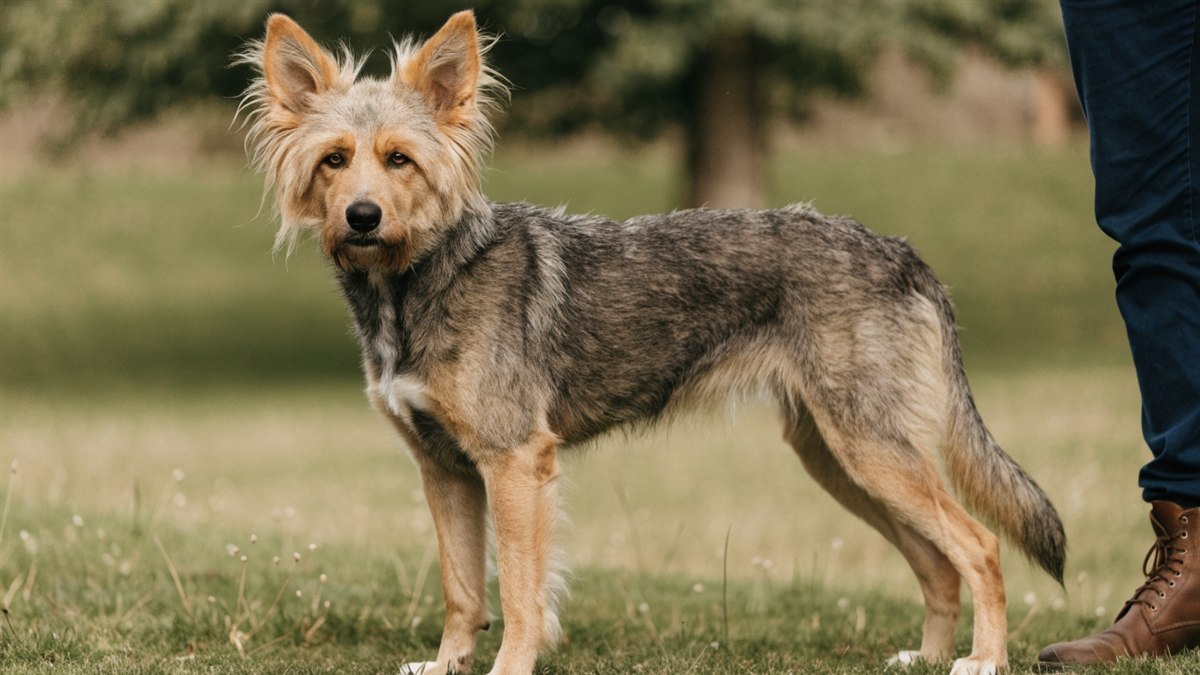
Read the standard itself and the dog it describes is specific. It asks for a medium-sized, solid, hardy, well-muscled dog, built without heaviness and elegant standing or moving, whose lively and alert expression is characterised by its rugged appearance. Ears are of moderate size, wide at the set-on, high set and always carried naturally erect. The tail is naturally long, reaching the point of the hock, with a slight curve at the tip. The nose is always black. Eyebrows are distinct, roughly 4 cm long, and must not veil the eyes.
The coat clause is the one that matters most to an Indian reader, so it is worth quoting exactly. The hair is harsh and semi-long, it should feel crisp when touched, it should measure 5 to 6 cm over the entire body including the tail, and beneath it sits a fine, dense undercoat. A coat shorter than 4 cm or longer than 7 cm is a severe fault, as is a limp or woolly coat. You cannot legitimately own a short-coated Berger Picard. The standard forbids one.
Size, and the numbers that do not agree
The FCI gives males 60 to 65 cm at the withers and females 55 to 60 cm, with a tolerance of plus or minus 1 cm, and heights of 67 cm for a male or 62 cm for a female tolerated only in subjects of exceptional quality. The AKC gives 23.5 to 25.5 inches for males and 21.5 to 23.5 inches for females, which is 59.7 to 64.8 cm and 54.6 to 59.7 cm, so the two registries agree closely.
Wikipedia does not agree with either. Its infobox gives males 24 to 26 inches, or 61 to 66 cm, and females 22 to 24 inches, or 56 to 61 cm, and Dogbreedslist.info repeats the same 24 to 26 inches. That upper figure sits above the FCI maximum including tolerance. Where a ranking page and a kennel club disagree, take the club.
| Source | Male height | Female height | Weight |
|---|---|---|---|
| FCI Standard No. 176 | 60 to 65 cm (+/- 1 cm) | 55 to 60 cm (+/- 1 cm) | Not stated |
| American Kennel Club | 59.7 to 64.8 cm | 54.6 to 59.7 cm | 50 to 70 lb (22.7 to 31.8 kg) |
| Societe Centrale Canine | 55 to 65 cm, both sexes | 55 to 65 cm, both sexes | NP (not stated) |
| Wikipedia and Dogbreedslist | 61 to 66 cm | 56 to 61 cm | 51 to 71 lb (23 to 32 kg) |
Notice the weight column. The FCI standard states no weight for this breed at all, and the Societe Centrale Canine's own breed record prints the weight field as NP, meaning not specified. Every kilogram figure you will read for a Berger Picard comes from somewhere other than the standard. The AKC's 50 to 70 pounds is the most defensible of them because the AKC is a recognising registry; the 23 to 32 kg that circulates on Indian listing pages traces to Wikipedia.
Colour, and what disqualifies
Four colours are permitted: fawn, fawn with dark overlay, fawn brindle, and grey, which generally stays dark. Large white patches are not allowed, though a slight white mark on the forechest and the ends of the feet is tolerated. Black, white, harlequin and pied are disqualifying, as are ears not naturally erect, a rudimentary or absent tail, and a wall eye or a light eye tending to yellow.
The standard's hindquarters section says of the hind feet: no dewclaws or supernumerary digits. In India, rule 6(8) of the Second Schedule Part II to the Prevention of Cruelty to Animals (Dog Breeding and Marketing) Rules, 2017 forbids de-clawing and any other kind of mutilation of any body part of the pup and any change of appearance by artificial means. An Indian breeder cannot lawfully remove a hind dewclaw to satisfy the standard. The dog is simply faulted.
The SCC's own summary is a fair one-line description of what you are getting. It calls the coat sec et demi-long, dry and semi-long, easy to maintain, and the dog itself rustic, sporty, spontaneous and pleasant, very attached to its owners and very protective of children.
The near extinction, and which parts of it are actually documented
Three sources tell the war story three ways, and the difference is not cosmetic. The parent club says trench warfare in the Somme reduced the Picard to near extinction. The FCI's own standard says the breed stagnated somewhat until the second world war. No source anywhere gives a number for how few dogs were left, and the club itself explains why one cannot exist.
Start with what the recognising body puts in writing. The historical summary inside FCI Standard No. 176 records that the first Picardies were judged in 1863 at a show in the same class as Beaucerons and Briards, that by 1898 it had become evident that the Picardy was a breed, that Paul Megnin drafted the first standard in 1922, and that the breed obtained definitive recognition in 1925. Then comes the sentence the ranking pages skip. "The breed stagnated somewhat until the second world war and it was only afterwards that fanciers, who wanted to revive interest in the breed, began searching in Picardie, at the source, for the most typical subjects for breeding."
Stagnated somewhat is not near extinction. The FCI text does not mention the First World War at all, and it does not mention the Somme. To get the near-extinction account you have to go to the breed clubs, and it is worth saying plainly that this is a club account rather than a registry one.
What the club says, and why no number survives
The Berger Picard Club of America's history page states that the breeding stock suffered from the ravages of both wars, that with the population concentrated on the farms of northeastern France trench warfare in the Somme reduced the Picard to near extinction, that wartime food rations made large dogs very difficult to feed, and, crucially, that dogs produced by peasants were not registered.
That last clause answers the question everyone asks. A farm breed kept off the studbook has no denominator, so nobody counted the survivors and nobody could have. Any page handing you a wartime population figure for this breed invented it.
The rebuild traces to one mating in 1950
The club's Rebuilding the Breed page names the founders. According to early registration records, Radjah de la Boheme was bred to Wax de la Boheme in early 1950, producing a fawn male, Yucca des Hauts-Chesnaux, and a brindle female, Yasmina des Hauts-Chesnaux, and the club describes those two as the foundation pair of the Berger Picard breed. Robert Montenot created the Club Les Amis du Berger Picard in 1955, the club obtained definitive recognition in 1959, and a new breed standard was approved by the Societe Centrale Canine in 1964 Berger Picard Club of America.
Jacques Senecat then led the breed for three decades as club president and published Le Berger Picard d'hier et d'aujourd'hui in 1979. That book is the source Wikipedia leans on for its near-extinction sentence, and it is a printed French volume no reader can check.
The BPCA's Rebuilding the Breed page opens: "After WWII, breeders of the Bouvier des Flanders wishing to rebuild the breed, began, at the source, searching Picardy for the most typical subjects for breeding";. The FCI standard carries the same sentence about the Picard's own fanciers, not about Bouvier des Flandres breeders. One of the two is wrong, the FCI text is the older and the official one, and no reader should build anything on that sentence as the club currently prints it.
The Celtic origin story, and the tense it is told in
The BPCA states flatly that the breed was brought to northern France and the Pas de Calais during the second Celtic invasion of Gaul around 400 BC. The Societe Centrale Canine says the same thing in the French conditional, that the berger picard aurait pour ancetres les chiens celtes, would have had Celtic dogs as ancestors. The FCI hedges the geography itself, saying it is not certain that the Picardy Shepherd originates strictly from the Picardie region, and that it is possible, even probable, that harsh coated sheep and cattle dogs were typical throughout north west Europe.
Read the three together and one pattern shows up. The further a source sits from the registry, the more certain the ancient history becomes.
| Year | Event | Documented by |
|---|---|---|
| 1863 | First Picardies judged, in the same class as Beaucerons and Briards | FCI Standard No. 176 |
| 1898 | It becomes evident that the Picardy is a breed | FCI Standard No. 176 |
| 1922 | Paul Megnin drafts the first standard | FCI Standard No. 176 |
| 1925 | Definitive recognition of the breed in France | FCI Standard No. 176 |
| Early 1950 | Radjah x Wax mating produces the foundation pair | Berger Picard Club of America |
| 1955 | Robert Montenot founds Les Amis du Berger Picard | FCI Standard No. 176 |
| 27 June 1955 | FCI accepts the breed on a definitive basis | FCI Breeds Nomenclature |
| 1959 | The French breed club obtains definitive recognition | FCI Standard No. 176 |
| 1964 | New standard approved by the Societe Centrale Canine | FCI Standard No. 176 |
| 4 November 2008 | The standard now in force is published | FCI Breeds Nomenclature |
| 1 July 2015 | Full AKC recognition in the Herding Group | Wikipedia, citing AKC board minutes |
How rare it is now, in real registration numbers
The Berger Picard is a rare breed by a published, checkable measure. The Societe Centrale Canine registered 240 Bergers de Picardie in the French studbook in 2025, in the same Group I table in which the berger australien has 14,609. Across the whole LOF that year the golden retriever took first place with 15,062, which is 62.8 times the Picard's number.
Every English-language page on this breed repeats a figure of approximately 3,500 dogs in France, and every one of them takes it from Wikipedia, where it carries no citation at all. The real numbers are published annually as PDFs by the French kennel club, they are free, and nobody in the ranking set opens them.
French studbook registrations, year by year
| Year | LOF registrations | Source PDF |
|---|---|---|
| 2016 | 174 | Statistiques LOF 2016 |
| 2019 | 153 (152 French-bred, 1 import) | Statistiques LOF 2019 |
| 2020 | 213 | Statistiques LOF 2021 |
| 2021 | 212 | Statistiques LOF 2021 |
| 2022 | 177 | Statistiques LOF 2023 |
| 2023 | 184 | Statistiques LOF 2023 |
| 2024 | 136 | Statistiques LOF 2024 |
| 2025 | 240 | Statistiques LOF 2025 |
Each row above was taken from its own PDF rather than from a secondary summary. The 174 for 2016 comes from Statistiques LOF 2016, the 213 and 212 for 2020 and 2021 from Statistiques LOF 2021, and the 177 and 184 for 2022 and 2023 from Statistiques LOF 2023, which also records 47 breed confirmations that year. Every one of those files was downloaded and its text extracted, so the figures are read rather than reported.
Two things stand out. The 2024 figure of 136 was the lowest in the decade, a fall of 26 percent on 2023, and 2025 reversed it with a rise of 76 percent, because 240 divided by 136 is 1.76. The other is 2019, where the SCC breaks the total down and shows that of 153 dogs, 152 were French-bred and exactly one was an import. A breed that adds one imported dog a year to its home studbook is not a breed with an export market.
The club's own count, and a one-dog discrepancy
The Club Les Amis du Berger Picard published its own 2025 figures in January 2026. It reports 239 puppies registered from 34 litters, the best score in five years, against a record 38 litters producing 184 births in 2023, which lifts the litter average from 4.84 to 7.02. Divide it out and the club's arithmetic holds: 184 divided by 38 is 4.84, and 239 divided by 34 is 7.03.
The club says 239 and the SCC table says 240. The club explains the gap in advance, noting that puppies born in November and December are not always registered immediately and that the total could still climb. Use 240 as the studbook figure and treat the club's 239 as the same event counted a fortnight earlier.
Calibrate it against a breed you know
| Breed | 2025 LOF registrations | Times the Berger Picard |
|---|---|---|
| Golden retriever | 15,062 | 62.8x |
| Berger australien | 14,609 | 60.9x |
| Retriever du Labrador | 6,531 | 27.2x |
| Berger allemand (German Shepherd) | 5,614 | 23.4x |
| Berger de Beauce (Beauceron) | 2,486 | 10.4x |
| Epagneul picard (Picardy Spaniel) | 168 | 0.7x |
| Berger de Brie (Briard) | 201 | 0.8x |
| Berger de Picardie (Berger Picard) | 240 | 1.0x |
The Briard line is the surprise. In its own country in 2025 the far better known Briard registered 201 dogs against the Picard's 240, having fallen 36 percent in a year. Rarity is not a fixed ranking, and this particular rare breed is currently outbreeding one of France's famous ones.
The same 2025 LOF tables list the Epagneul picard at 168 registrations and the Epagneul bleu de Picardie at 84. Those are gundogs in FCI Group 7. The Berger Picard is a herding dog in Group 1. If a listing, an article or an answer engine slides between Picardy Shepherd and Picardy Spaniel, it is describing a different animal with a different job, a different coat and a different standard.
Does the 3,500 figure survive a sanity check?
Take the eight LOF years above and the mean is 186 registrations a year, since 1,489 divided by 8 is 186.1. At a life expectancy in the 12 to 14 year band, a steady flow of 186 a year supports a living registered population of roughly 2,400 dogs. So Wikipedia's 3,500 is the right order of magnitude and about 45 percent above what the studbook flow implies. That is a sanity check done here with the SCC's numbers, not a verification. The 3,500 figure still has no source attached to it, and the same sentence's 500 dogs in Germany and 400 in the United States and Canada have none either.
For India there is no breed-level figure to give. The FCI publishes Kennel Club of India totals, 32,219 puppies registered in 2025 and 1,425,001 pure-bred dogs since the studbook began, but it publishes no per-breed split, so no honest Indian Berger Picard count exists in either direction.
Berger Picard price in India, and why every rupee figure you find is fake
No verifiable Berger Picard price in India exists. Four Indian pages rank for the query and not one of them shows a real dog, a real rupee figure or a real listing. The only genuine published prices for this breed are American, USD 3,000 to USD 4,000 on Good Dog and USD 2,000 to USD 2,500 on Dogbreedslist.
That claim is only worth making if the search that produced it works, so it was controlled. The query labrador retriever price in india, run in the same tool in the same session, returned rupee bands immediately, INR 30,000 to INR 1,20,000 from Mr n Mrs Pet. The Indian pet-price web is fully indexed and perfectly findable. It simply has nothing to say about this breed.
The one rupee figure on the internet, and the test that kills it
PetBuy.in publishes a Typical Price in India of Rs 8,000 to Rs 35,000 for the Berger Picard. On the same page it prints Live Avg (PetBuy) as a dash and Listings as 0. A price with zero listings behind it is not a price.
It gets worse when you open a second breed. PetBuy's Australian Kelpie page prints the identical Rs 8,000 to Rs 35,000 band, the identical weight of 10 to 25 kg, the identical height of 35 to 55 cm, the identical Listings 0 and the identical default placeholder image. The number is a template, filled for every medium-sized breed on the site. Its weight and height are wrong for the Berger Picard too, since the FCI puts males at 60 to 65 cm and no standard states a weight.
Running the 84.38 test on it
Indian pages routinely publish a dollar figure run through one exchange rate and call it a rupee price, so any suspicious rupee number gets divided by 84.38 before it is believed. Do it here and Rs 8,000 becomes USD 94.81, and Rs 35,000 becomes USD 414.79. Neither is a round dollar amount, so this particular figure is not a disguised currency conversion. It is something simpler, a default band printed identically on every page of the site.
The test is still worth running in the other direction, because it tells you what a real import would cost. Good Dog's USD 3,000 to USD 4,000 converts at 84.38 to Rs 2,53,140 to Rs 3,37,520 for the puppy alone, before air freight, crate, quarantine and the DGFT paperwork. Dogbreedslist's USD 2,000 to USD 2,500 converts to Rs 1,68,760 to Rs 2,10,950. Nothing about this breed is affordable at an Indian price point. Any Indian seller quoting Rs 35,000 for one is quoting a number 4.8 times below the cheapest published figure anywhere, since Rs 1,68,760 divided by Rs 35,000 is 4.8, and 7.2 times below the Good Dog low end of Rs 2,53,140.
| Page | Price shown | Berger Picards shown |
|---|---|---|
| PetBuy.in breed page | Rs 8,000 to Rs 35,000, template default | Listings: 0 |
| Mr n Mrs Pet, Pune | None anywhere on the page | 0. It renders a French Bulldog, a Bernese Mountain Dog and a Cavalier King Charles Spaniel |
| Call 4 Dog, Janakpuri | None. A Pay Now button and a WhatsApp link reading Please Share Best Price | 0. A stock photo and a spec table |
| Breed n Breeder, Goa | None | 0. A breed dropdown, a state dropdown and a phone number |
Name what you are actually being offered
The Mr n Mrs Pet page for Pune is the clearest case. It declares 3 Result Found and states that all Berger Picard puppies are available from KCI-registered breeders. The only three puppy cards it renders sit under the heading Similar puppies at other locations, and they are a French Bulldog in Chennai, a Bernese Mountain Dog in Mumbai and a Cavalier King Charles Spaniel in Kochi. Nobody is selling you a Berger Picard. Somebody is selling you a French Bulldog while you search for one.
Call 4 Dog's Janakpuri page carries a meta description promising 100 percent KCI Registered Berger Picard Puppies and a Pay Now button, with no price on the page and no dog either. Breed n Breeder's Goa page is a dropdown of roughly 250 breed names attached to an enquiry form. Both exist identically for every breed in their lists.
Open any Indian page quoting a Berger Picard price and look for three things. Look for a listing count, because PetBuy prints Listings 0 next to its own price. Look for the same figure on an unrelated breed, because PetBuy's Australian Kelpie carries the identical band. And divide the rupee number by 84.38, because a round dollar amount on the other side means somebody converted a foreign price and called it Indian. A page that fails any one of those is not reporting a market.
Before any of this matters, read the import law. DGFT Trade Notice 22/2022-23 places dogs under ITC(HS) 01061900 as Restricted and states at paragraph 6 that any applications for trading or breeding purposes shall be duly rejected. There is no lawful commercial route by which a Berger Picard breeding population could be established in India, which is covered in full in the adoption section below.
Monthly cost of ownership, honestly bounded
Bonbeno publishes no monthly rupee figure for keeping a Berger Picard in India, because no Indian population exists to survey and any number would be invented. What can be given honestly is the cost structure, which is the structure of a 23 to 32 kg working herding dog carrying a mandatory undercoat in a hot country, plus a one-off import bill that is the largest number on the page.
Start with the one-off, because it dwarfs everything recurring. The only real published purchase prices for this breed are American, and Good Dog puts them at USD 3,000 to USD 4,000. Converted at 84.38 that is Rs 2,53,140 to Rs 3,37,520 for the puppy alone. On top sits international air freight for a crate sized to a 60 to 65 cm dog, an import authorisation application to DGFT that should be started at least two months before travel, an Advance No Objection Certificate from the Animal Quarantine and Certification Service seven days before the flight, and quarantine at the port where required.
The recurring cost drivers, and what sets each one
| Cost driver | What sets it | Why it is not optional |
|---|---|---|
| Food volume | A 23 to 32 kg dog with a working herding energy level | Body size and daily workload, not brand choice |
| Year-round ectoparasite control | Tick pressure, not season | 261 of 525 Indian dogs surveyed were PCR-positive for at least one tick-borne pathogen |
| Coat maintenance | A 5 to 6 cm harsh outer coat over a fine dense undercoat | The standard mandates the undercoat, so it cannot be bred or clipped away |
| Skin and ear checks in the monsoon | Humidity, not the dog | Canine dermatoses in Kolkata peaked at 9.32 percent of clinic caseload in the rainy season |
| Eye examination | An ACVO or ECVO ophthalmologist, annually for breeding stock | There is no DNA test for this breed's PRA, so the clinical exam is the only screen |
| Advanced cardiac examination | An ACVIM board-certified cardiologist, from 24 months | It is a CHIC requirement for this breed, not an optional extra |
| Air conditioning or a genuinely cool room | Indian summer maxima against a Picardy-built coat | Discussed in full in the climate section below |
Two of those lines are Indian, not imported
The tick line is the one Indian owners of any breed underestimate. Abd Rani and colleagues sampled 525 dogs across Delhi, Mumbai, Sikkim and Ladakh and found 261 of them, 49.7 percent, PCR-positive for at least one tick-borne pathogen, with Hepatozoon canis in 157 of 525 dogs, or 30 percent, and Ehrlichia canis in 108 of 525, or 20.6 percent. Roughly one dog in two. For a dog whose coat is 5 to 6 cm deep with a dense undercoat beneath it, tick checks are slower and preventive cover is not a seasonal purchase.
The skin line is the second. Roy and colleagues looked at 19,668 dogs presented to the Belgachia Veterinary Clinics in Kolkata across a full year and diagnosed dermatoses in 1,420 of them, 7.22 percent. The rate peaked at 418 of 4,487 dogs, 9.32 percent, in the rainy season, and at 176 of 1,569, 11.21 percent, in July alone, against 99 of 1,990, 4.97 percent, in March. A monsoon budget line for medicated shampoo, ear cleaner and one or two vet visits is realistic planning, not pessimism.
The costs this breed does not have
Three things keep the bill lower than a comparable large breed. The coat needs no professional trimming at all, because the parent club states plainly that no trimming is necessary and that the rough double coat does not mat or require special care. Bathing is rare rather than fortnightly. And the elbow and thyroid screens sit in the CHIC health elective rather than the required list, so an owner who is not breeding needs one of them rather than both.
Every Indian cost-of-ownership figure published for this breed would have to be transplanted from a different breed or converted from a foreign one. The site that publishes an Indian price for it prints Listings 0 on the same page and the identical band on an unrelated breed. A reader is better served by the drivers above, which are real, than by a monthly total that is not.
Heat tolerance, argued from the coat the standard actually mandates
Bonbeno rates the Berger Picard 2 out of 5 for heat tolerance. This is not a heat-tolerant breed, and the rating comes from three things that can each be checked: what FCI Standard No. 176 requires the coat to be, what the parent club says that coat is for, and how far Picardy's climate sits from the Indian cities people actually live in.
The standard leaves no room to breed the problem away. It requires hair that is harsh and semi-long, feeling crisp to the touch, measuring 5 to 6 cm over the entire body including the tail, over a fine, dense undercoat. A coat under 4 cm or over 7 cm is a severe fault, and so is a limp or woolly one. Colour runs fawn, fawn with dark overlay, fawn brindle or grey that generally stays dark, and white spreading over the forechest or fully white feet are disqualifying. You cannot legitimately have a short Picard, a pale Picard, or a Picard without an undercoat.
The Berger Picard Club of America explains what that double coat is doing, in its own words. The bottom layer is soft, dense and keeps the dog warm; the top layer is harsh and longer to help water roll off and not soak through the bottom layer; the result is a well-insulated dog that sheds only twice a year. That is a description of a garment built for a cold, wet place. The question for an Indian buyer is simply how cold and how wet.
Picardy against six Indian cities, one source, one methodology
The figures below all come from NASA's POWER climatology service, MERRA-2 reanalysis, 2001 to 2020, queried by latitude and longitude so that the location cannot be mistaken. Amiens, the principal city of Picardy, sits at 49.8942 north, 2.2957 east.
| Location | Annual mean temp | Hottest monthly max | Coolest monthly max | Annual mean RH |
|---|---|---|---|---|
| Amiens, Picardy | 10.1 C | 35.4 C (July) | 13.3 C (January) | 85.5% |
| Chennai | 27.9 C | 42.7 C (May) | 30.7 C (December) | 72.4% |
| Mumbai | 26.8 C | 44.9 C (April, May) | 31.6 C (August) | 67.4% |
| Kolkata | 25.8 C | 46.8 C (May) | 29.2 C (December) | 73.9% |
| Delhi | 25.6 C | 48.8 C (June) | 29.8 C (December) | 45.6% |
| Pune | 23.9 C | 43.2 C (April) | 30.2 C (August) | 66.8% |
| Bengaluru | 23.7 C | 40.4 C (April) | 33.0 C (December) | 67.9% |
Three readings from that table carry the argument. Chennai's annual mean of 27.9 C sits 17.8 C above Amiens at 10.1 C. Every one of the six Indian cities has a hottest monthly maximum above the 35.4 C that Amiens reaches in its hottest month, and Delhi's 48.8 C exceeds it by 13.4 C. And Bengaluru, the mildest Indian city here, has a coolest month whose maximum is 33.0 C, which is 19.7 C above the 13.3 C peak of the coldest month in Amiens and only 2.4 C below the hottest reading Amiens records all year.
The humidity finding is not the one you expect
Amiens is wetter than any of these Indian cities on annual mean relative humidity, 85.5 percent against Kolkata's 73.9 percent. Humidity alone therefore proves nothing, and a page that argued the Picard cannot cope with Indian damp would be arguing against its own data.
The pairing is what matters, because a dog cools by panting and panting is evaporative. Amiens's most humid month is December at 94.2 percent, and December's maximum temperature there is 14.1 C. Mumbai's most humid month is August at 90.4 percent, with a maximum of 31.6 C, and Pune's is August at 90.8 percent with 30.2 C. Near-saturated air at 14 C asks nothing of a dog. Near-saturated air at 31.6 C leaves it with a large heat load and the one cooling route it has running at its least effective.
What the heat-illness evidence supports, and how to run the dog
Exercise, not weather, causes most canine heat illness. In the largest UK primary-care study of the question, 652 of the 879 heat-related illness events with a known trigger were exertional, which is 74.2 percent. For a herding breed that has to be worked hard, that single figure matters more than any temperature in the table above.
What the heat-illness literature does and does not support
Two UK VetCompass papers are the best population evidence available, and neither of them lets this page claim a coat effect. Hall, Carter and O'Neill found 395 heat-related illness events among 905,543 dogs in 2016, an incidence of 0.04 percent, with dogs over 50 kg carrying 3.42 times the odds of dogs under 10 kg (95 percent CI 1.54 to 7.57). The authors state explicitly that coat type could not be accurately retrieved from the records. A Berger Picard at 23 to 32 kg does not sit in that top weight stratum anyway.
The companion paper is the one that bites. Of 879 heat-related illness events with a known trigger, 652, or 74.2 percent, were exertional rather than environmental or vehicular. Exercise causes most canine heat illness, and this is a herding breed the AKC calls an ideal companion for athletic owners with boundless energy. Anyone reading that Indian heat is only a problem in parked cars has the risk pointed in the wrong direction.
Two UK VetCompass papers are the best population evidence available, and neither of them lets this page claim a coat effect. Hall, Carter and O'Neill found 395 heat-related illness events among 905,543 dogs in 2016, an incidence of 0.04 percent, with dogs over 50 kg carrying 3.42 times the odds of dogs under 10 kg (95 percent CI 1.54 to 7.57). The authors state explicitly that coat type could not be accurately retrieved from the records. A Berger Picard at 23 to 32 kg does not sit in that top weight stratum anyway.
The companion paper is the one that bites. Of 879 heat-related illness events with a known trigger, 652, or 74.2 percent, were exertional rather than environmental or vehicular. Exercise causes most canine heat illness, and this is a herding breed the AKC calls an ideal companion for athletic owners with boundless energy. The coat and the job point the same way.
The rating is 2 rather than 1 for real reasons. The Picard is not brachycephalic, so the airway that does the panting is a normal one. Its ears are naturally erect and high set, which ventilates the canal instead of trapping it. It has no skin folds. Its nose is always black, so the muzzle carries full pigment against sun. And the outer coat is harsh and open rather than woolly, which moves air better than a plush coat of the same length.
City by city, the practical reading is straightforward. Bengaluru and Pune are the least hostile of the six on annual mean, at 23.7 C and 23.9 C. Chennai is the hardest because its coolest month still maxes at 30.7 C, so there is no recovery season at all. Mumbai and Pune are hardest in August, when high heat and 90 percent humidity arrive together. Delhi is the only city here that offers a genuine cool season, with a December maximum of 29.8 C and annual humidity of 45.6 percent, and also the only one that reaches 48.8 C.
Three rules that fall straight out of the numbers
- Move the work to the coolest hour. Delhi's hottest month peaks at 48.8 C and its coolest at 29.8 C, so the difference between a good and a bad walk time is larger than the difference between Delhi and Amiens in January.
- Treat August as the risk month on the west coast. Mumbai and Pune pair their highest humidity, 90.4 and 90.8 percent, with maxima of 31.6 C and 30.2 C in the same month. Panting works least well exactly when the walk feels survivable.
- Cut duration before you cut the dog's coat. The exertional share of heat illness is 74.2 percent, so shortening the session addresses the documented cause. Clipping addresses a cause nobody has measured.
Never clip the coat to cool the dog
The parent club describes the two layers precisely. The top layer is harsh and longer and keeps water from soaking through; the bottom layer is soft, dense and keeps the dog warm. Clippers take the top layer off first and leave the insulating one behind, which is the reverse of what the owner intended. The club states that no trimming is necessary and that the ears alone may be tidied, by plucking rather than cutting, and the standard severe-faults any coat shorter than 4 cm.
The right lever is the undercoat, not the guard coat. A coat rake pulls dead undercoat out and leaves the weatherproof outer layer intact, which is the club's own recommendation for the shedding season. In India that season is not two tidy weeks, which the grooming section below deals with in full.
Heat illness in a dog is a medical emergency and it moves fast. Nothing here replaces a veterinarian. If a dog collapses, breathes with obvious difficulty, or cannot settle after exercise in the heat, treat it as urgent and get to a clinic rather than searching for a threshold temperature.
Temperament and household fit, and who should not buy one
The FCI describes the Berger Picard's temperament in one tight paragraph. It is even tempered, neither aggressive, shy nor nervous, and should be both obedient and fearless, qualities that let it drive and protect flocks of sheep, while also making it a very good guard for the home and an excellent family dog that enjoys close contact with children. Aggression and excessive shyness are both disqualifying faults.
The Societe Centrale Canine adds the sentence that tells you how to live with one. It calls the breed very balanced, calm and ardent at the same time, without deceit or untimely aggression, says its ease of adaptation is one of its great qualities, and instructs the owner to be firm without brutality, adding that speaking loudly should be enough. That is a sensitivity warning written as a compliment.
The English-language sources fill in the awkward parts. The AKC calls Picards take-charge independent problem-solvers with a stubborn streak that early socialisation and positive training are needed to cope with. Wikipedia's description, which traces to the French club, adds that they are easygoing and mellow but reserved towards strangers, that they need a great deal of socialisation during the first two years of life, that they are not excessive barkers, and that some are notoriously picky eaters.
What that adds up to in an Indian flat
Reserved towards strangers plus a very good guard for the home is a specific combination in a country where the doorbell rings for the maid, the cook, the courier, the gas cylinder, the plumber and the housekeeping staff, often several times a day. A herding dog bred to protect a flock and given no structured introduction to that stream of people will start making its own decisions about them, and the SCC's ease-of-adaptation line only holds if you socialise the dog against that traffic deliberately, every week, for the first two years.
The SCC's city-living note is practical and specific. It says the berger picard must be taken out on a lead from the age of four to five months, that it adores regular walks and finds them indispensable, and that it equally likes to stay quietly with its owner. The second half of that sentence is the useful part for apartment owners. This is not a dog that paces the flat if its exercise need has genuinely been met.
Who this breed suits
- Households with an adult who exercises the dog daily, at dawn or after dark, every day of the Indian year
- Owners who enjoy training as an activity rather than a chore, because this dog negotiates
- Families with children, which both the FCI standard and the SCC record positively Société Centrale Canine
- Anyone prepared to run a two-year socialisation programme against Indian doorbell traffic
- Owners with a genuinely cool room, since the coat is built for a place averaging 10.1 C
Who should not buy one
- First-time dog owners, because a sensitive, stubborn, high-drive herder is a hard first dog anywhere
- Anyone who wants a guard dog with an edge, since aggression is a disqualifying fault in the standard
- Households that cannot commit to daily exercise in the heat, which is the documented cause of most canine heat illness
- Buyers who need a local breed community, a local breed club or a vet who has seen the breed before, none of which exists in India
- Anyone hoping to buy one cheaply in India, because no Indian page quoting a price has a dog behind it
Some Picards are notoriously picky eaters and it can be hard to settle on a diet the owner and the dog both accept Dogbreedslist.info, Berger Picard: Price. In Indian conditions that turns into a food-safety question rather than a fussiness question, because a dog that leaves a bowl standing in 30 C heat and humidity for two hours is being offered something different from what was served. The feeding section below deals with it.
Training approach, and what this breed resists
Train a Berger Picard with short sessions, reward and a quiet voice, because every source that describes the breed says the same two things. It is trainable and responsive, and it is sensitive to how you sound. The Societe Centrale Canine puts the whole method in one instruction, firm without brutality, speaking loudly should suffice.
What the breed resists is not commands. It is repetition without purpose. The AKC's own summary is that Picards spent centuries as take-charge independent problem-solvers, which is why early socialisation and positive training are necessary to cope with the stubborn streak. A dog selected to make decisions about livestock several hundred metres away will disengage from a drill that has no result attached to it.
Wikipedia's description, sourced from the French club material, calls the disposition sensitive and assertive and says it responds quickly to obedience training, while stressing that Picards need a lot of socialisation during their first two years. Sensitive and assertive together is the part owners misread. The dog will push, and it will also fold if the correction is heavy.
A realistic timeline for an Indian household
| Age | Work on this | Do not do this |
|---|---|---|
| 8 to 16 weeks | Handling of ears, feet, mouth and coat daily. Name response. Crate and fan or air-conditioner comfort | Do not skip the doorbell. Every visitor is a training repetition you cannot get back |
| 4 to 5 months | Lead walking, which the SCC says should begin at this age | Do not walk in afternoon heat to get the lead work done |
| 5 to 8 months | Recall on a long line, settle on a mat, tolerance of grooming and a coat rake | Do not use aversive corrections on a sensitive breed |
| 8 to 14 months | Impulse control around cyclists, scooters and street dogs. Structured problem-solving games | Do not begin hard road running before growth plates close |
| 14 to 24 months | Consolidate socialisation. The breed needs the full two years | Do not assume the dog is finished at one year because it looks adult |
| 2 years on | Herding-style work, scent games, agility where the surface and hour allow | Do not train in Indian midday heat at any age |
Are Berger Picards easy to train for first-time owners?
Easy to train and easy for a beginner are different questions and the answer splits. The obedience is easy, because the dog is biddable and wants to work with a person. The management is not. A first-time Indian owner would be taking on a 60 to 65 cm herding dog with hours of daily exercise demand in a climate 17.8 C warmer than its origin on annual mean, a two-year socialisation programme, no local breed community, and no Indian veterinarian who has examined one before. None of those are training problems and training will not solve them.
Plenty of Indian board-and-train operations still work through aversive correction and prong or e-collars. On a breed whose national kennel club instructs owners to be firm without brutality and says that raising your voice should be enough, and whose standard disqualifies both aggression and excessive shyness, handing the dog to a stranger for three weeks of compulsion is the fastest available route to the temperament the standard exists to prevent.
Herding instinct is worth naming even in a city. The breed continues to be used effectively on both sheep and cattle in its native country, and instinct that has nowhere to go finds children, cyclists and the household cat. Give it a job. Scent work, a flirt pole, structured search games and formal obedience all count.
Daily exercise requirement, and what happens without it
Give a Berger Picard at least two substantial sessions a day plus mental work, and put both of them outside the heat. The FCI lists the breed with a working trial and defines its job as driving and protecting flocks of sheep Fédération Cynologique Internationale. The AKC calls its rugged constitution, agility and boundless energy the reason it suits athletic owners.
The range of work the breed is used for tells you the size of the appetite. Berger Picards compete in agility, tracking, obedience, showmanship, Schutzhund, flyball, lure coursing, French ring sport and herding events, and herding instinct can be measured at non-competitive tests before a dog goes to trials. That is not a list you can satisfy with a lift-lobby walk.
A workable Indian day
- Dawn session, 45 to 60 minutes. Lead walking plus off-lead running where it is safe and lawful. This is the only hour in a Chennai year when the maximum is not above 30 C.
- Midday, nothing outdoors. Delhi's hottest month peaks at 48.8 C and Kolkata's at 46.8 C, and 74.2 percent of heat-related illness with a known trigger is exertional.
- Indoor mental work, 15 to 20 minutes. Scent games, a food puzzle, a short obedience set. A herding brain that gets no problem to solve invents one.
- Evening session, 45 to 60 minutes. After dark rather than at sunset, because road and pavement surfaces hold heat after the air has dropped.
- One long weekly outing. Somewhere the dog can move freely for an hour or more, in the coolest part of the day.
The Societe Centrale Canine's own note is that the berger picard adores regular walks and finds them indispensable, and that it equally likes to stay calmly with its owner. Read that as conditional. The calm indoors is what you get after the requirement has been met, not instead of meeting it.
A claim on the ranking set that does not survive contact
Dogbreedslist gives the breed five stars for exercise needs and then says Picards do not do well in competition because they find it almost impossible to perform consistently. That sits directly against the sports list above and against the parent club, which runs a National Specialty and maintains standing pages for herding, rally, agility, obedience, tracking, scent work, fast CAT and therapy work Wikipedia, Berger Picard. The page's only listed reference is a YouTube video. Where a ranking page and a parent club disagree about what a breed can do, follow the club.
What under-exercise actually looks like
A herding dog short of work does not simply become restless. It starts herding. In an Indian household the available livestock is children, the household cat, cyclists and the delivery rider at the gate, and the behaviour arrives as chasing, nipping at heels and barking at movement rather than as obvious frustration. The breed is described as not an excessive barker at baseline, so a Picard that has started barking at movement is telling you something specific.
Grooming the rough coat, and where overseas advice stops working in India
Do not strip the body coat of a Berger Picard, and never clip it. The parent club states that no trimming is necessary, that the rough double coat does not mat or require special care to yield its rustic, tousled appearance, and that the only hair to be removed is the long fringe on the ears, by hand plucking or hand stripping, never by shaving or cutting.
The standard is the reason. It requires hair that is harsh and semi-long, crisp under the fingers, 5 to 6 cm over the entire body including the tail, over a fine dense undercoat, and it severe-faults any coat under 4 cm or over 7 cm as well as any coat that is limp or woolly. For the show ring the club adds that the French do not allow trimming or alteration of the coat at all, with the single exception of the ear fringe, and that dogs should never be presented blown out, sculpted or scissored.
So the answer to the stripping question is narrower than it looks. This is not a wire-coated terrier that gets rolled or stripped down twice a year. The body coat is left entirely alone, and hand stripping applies to the ear fringe only.
Three club instructions, tested against Indian conditions
| Club instruction | Does it transfer? | Why |
|---|---|---|
| Brushing about once a month | No | Kolkata clinic dermatoses peaked at 9.32 percent of caseload in the rainy season and 11.21 percent in July alone. Monthly is too slow to find what is starting under a 5 to 6 cm coat |
| Bathing is rarely done | Yes, but for a different reason | The Kolkata authors attribute thick-coat cases to moisture retained after a bath. The problem is drying, not frequency |
| Avoid conditioners, they soften the coat | Yes | A softened coat also holds water longer against the skin, which is the wrong property in an Indian August |
| No trimming, ears plucked not cut | Yes | The standard severe-faults a coat under 4 cm, and clipping removes the outer layer while leaving the insulating one |
| A coat rake for the undercoat in spring and summer | Yes, and more often | This is the one tool that reduces the insulating layer without touching the weatherproof one |
What the Indian evidence actually says
Roy and colleagues examined a full year of caseload at the Belgachia Veterinary Clinics in Kolkata. Of 19,668 dogs presented, 1,420 were diagnosed with dermatoses, which is 7.22 percent, and the seasonal split was 418 of 4,487 in the rainy season, 9.32 percent, against 309 of 5,812 in winter, 5.31 percent. July alone ran at 176 of 1,569, or 11.21 percent, and March at 99 of 1,990, or 4.97 percent.
The authors' own explanation is the part that matters for this breed. They attribute the Labrador's leading share of cases, 29.9 percent, to a thick hair coat that holds optimum moisture in the rainy season after a bath, which favours growth and multiplication of organisms on the skin surface. The Berger Picard's standard mandates exactly that architecture, a dense undercoat under a 5 to 6 cm harsh outer layer.
Brushing about once a month is written for a farm dog in northern France. In an Indian monsoon, brush and part the coat to the skin at least twice a week, daily through July and August, and dry the dog to the skin after any bath or any soaking. That is an inference from the Kolkata caseload rather than a published breed protocol, and it is labelled as one, because no Indian study of this breed exists to cite.
Two other Indian jobs come with the coat. Ticks have to be found by hand through 5 to 6 cm of harsh hair in a country where 261 of 525 surveyed dogs were PCR-positive for at least one tick-borne pathogen. And the club's own low-oil, dirt-shedding claim, that Picards have little doggie odour and that dirt does not stick to them, is a genuine advantage in dusty Indian cities and one of the few places where this coat is easier than a plush one.
Shedding, and the hypoallergenic question answered properly
The Berger Picard is not hypoallergenic, no dog breed is, and the evidence for that is settled rather than arguable. The breed's own standard says nothing about allergy or shedding at all, Dogbreedslist prints Hypoallergenic: No on its spec card, and Vredegoor and colleagues measured the question directly.
That study sampled 196 dogs of breeds sold as hypoallergenic against 160 control dogs and found the hypoallergenic group higher, not lower, on the major dog allergen Can f 1, at 2.26 against 0.77 micrograms per gram in hair and 27.04 against 12.98 in coat, with no difference in airborne allergen. The authors conclude that there is no evidence for the classification of certain dog breeds as being hypoallergenic. Orvis publishes the question as a standing FAQ heading on its Berger Picard page. This is the answer.
How much does it actually shed? Three sources, three answers
| Source | Claim |
|---|---|
| Berger Picard Club of America | A well-insulated dog that sheds only twice a year |
| Dogbreedslist.info | Moderate shedding, if possible only during the shedding season, spring and autumn, for a couple of days |
| Good Dog | High shedding |
Those cannot all be right, and the difference is not a matter of opinion. A twice-yearly moult is a photoperiod and temperature response, and it needs a real winter to be a response to. Amiens has one, with a January whose average maximum is 13.3 C. Chennai's coolest month has an average maximum of 30.7 C and Bengaluru's is 33.0 C. An Indian owner should plan for a coat that sheds across the year at a lower rate rather than dumping twice and stopping, and should treat any page promising two tidy weeks of shedding as untested in this climate. That inference is labelled as one, because no study of Picard coat cycling in the tropics exists.
If someone in the household is allergic, the useful test is exposure to the individual dog, not the breed name. Can f 1 varies between dogs of the same breed far more than it varies between breeds. Anyone paying an import premium for a supposedly allergy-safe rare breed is paying for a claim the literature rejects.
Health risks and lifespan, with the evaluation counts attached
Every health figure on this page carries its denominator and the date it was read, because a breed with no published population study has nothing else to anchor it. The parent club is unusually honest about that, saying that as a relatively new and rare breed it is just beginning to collect data and anecdotal histories to piece together a clear picture of health issues.
There is no peer-reviewed literature on this breed to fall back on either. A PubMed search for "Berger Picard", run on 21 August 2026, returns a count of 1 with a clean query translation, and the single record, PMID 36367009, is a randomised double-blind trial of facial skincare on the human facial microbiome in the International Journal of Cosmetic Science. It matched because two of the authors are named Berger and Picard. Controls run in the same session returned 276 records for "Border Collie" and 187 for progressive retinal atrophy in dogs, so the database was working. The honest count of PubMed papers about this dog is zero.
Europe PMC, which searches full text, returns 22 documents mentioning the breed against a control of 2,560 for Border Collie, and the relevant ones are multi-breed genomics datasets in which the Picard is one row among hundreds.
What OFA holds, read on 21 August 2026
| Screen | Evaluations | Normal | Notable |
|---|---|---|---|
| Hips | 562 | 83.6% | 15.3% dysplastic: 11.7% mild, 3.4% moderate, 0.2% severe |
| Elbows | 488 | 94.7% | 5.1% abnormal: 2.7% grade 1, 1.8% grade 2, 0.6% grade 3 |
| Eyes | 1,937 | 93.1% | 6.9% abnormal, breeder option 0.0% |
| Thyroid | 194 | 88.7% | 3.6% compensative autoimmune thyroiditis, 7.7% equivocal |
| Advanced cardiac | 319 | 76.8% | 10.7% abnormal and 12.5% equivocal, ranked 13th of all listed breeds |
| Congenital cardiac | 152 | 80.9% | 3.3% abnormal and 15.8% equivocal, ranked 6th of all listed breeds |
The hip dysplasia line is unremarkable and that is worth saying plainly, because a rebuilt breed from a narrow base could easily have been worse. At 15.3 percent dysplastic of 562 evaluations the Picard sits 83rd in OFA's hip table. Elbows are better still, 5.1 percent abnormal of 488.
The cardiac rows are the ones to look at twice
OFA sorts these tables by abnormal rate, so a low rank number means a high abnormal rate. The Berger Picard is 13th on advanced cardiac, with 10.7 percent abnormal and a further 12.5 percent equivocal out of 319 evaluations, which leaves only 76.8 percent normal, and it is 6th on congenital cardiac with 3.3 percent abnormal of 152. Nearly a quarter of advanced cardiac examinations on this breed have come back as something other than normal.
That aligns with what the club already names. Its health page lists heart disease including dilated cardiomyopathy, described as often treatable, among the breed's serious issues, alongside cancer, particularly squamous cell carcinoma, and PRA, with joint issues, seizures and other neurological problems, and low thyroid levels listed below them. It also explains why the cardiac database is comparatively well populated: an advanced cardiac examination by an ACVIM board-certified cardiologist from 24 months of age is a required CHIC test for this breed, not an optional one.
CHIC, and what a real health-tested Picard carries
- Hip evaluation, either OFA radiographic or PennHIP with results registered to OFA
- ACVO eye examination by a board-certified ophthalmologist, once the dog is 24 months old
- Advanced cardiac examination by an ACVIM board-certified cardiologist, once the dog is 24 months old
- Participation in the OFA and CHIC DNA repository, which needs a blood sample
- One health elective, either an OFA elbow evaluation or an autoimmune thyroiditis panel from an approved laboratory
All five are listed on OFA's CHIC page for the breed, whose breed code is BEP, taken from the parent club's own link rather than guessed. A dog with a CHIC number has all of those in the public domain; results do not have to be normal, they have to be published.
Life expectancy, where five sources give five answers
| Source | Life expectancy |
|---|---|
| Berger Picard Club of America | 13 to 14 years |
| Wikipedia, citing the same club | 12 to 14 years |
| Dogbreedslist.info | 12 to 15 years |
| Call 4 Dog, Delhi | 12 to 13 years |
| PetBuy.in | 10 to 13 years |
Wikipedia cites the parent club for 12 to 14 years, and the parent club's own site currently prints 13 to 14 Berger Picard Club of America. No lifespan study of this breed exists, in PubMed or anywhere else this page could reach. The defensible statement is that the club, which knows the dogs, says 13 to 14, and that nobody has measured it.
OFA counts move as evaluations are added, so the percentages above are paired with the sample they were computed on and the date they were read, 21 August 2026. A later editor should re-pull them rather than trusting the decimals here, and no reader should quote a bare percentage from a live register as though it were fixed.
The eye problem, with populations and years attached
Eyes are the best-documented part of Berger Picard health and the least resolved. OFA holds 1,937 eye evaluations on the breed, more than three times its hip file, of which 93.1 percent were normal and 6.9 percent abnormal, read on 21 August 2026. Behind that summary sit per-condition tables that are far more informative, and a parent club that says openly it cannot yet test for the disease it worries about most.
Start with progressive retinal atrophy, because it is the one every page names and none quantifies. OFA's generalised retinal atrophy row for the Berger Picard shows 35 affected of 1,937 tested, 1.8 percent. Divide it out and 35 divided by 1,937 is 1.807 percent, so the printed figure holds. That is the only population rate for PRA in this breed that exists anywhere.
What the parent club knows and cannot yet test for
The Berger Picard Club of America states that PRA is present in the breed and that there are probably at least two forms, an earlier-onset one with clinical signs appearing at about three to four years of age and a late-onset form appearing at eight to nine years. Researchers at the University of Missouri have checked several known PRA mutations against Picards diagnosed with the disease, and the affected dogs do not carry any of them. The club states plainly that at present there are no DNA tests to determine genetic status for eye diseases in Picards.
It says the same about canine multifocal retinopathy. CMR is present, it does not appear to progress to complete blindness in Picards as it does in Great Pyrenees and Coton de Tulear, and Picards do not carry the mutation responsible for CMR in those breeds. OFA's retinopathy CMR or CMR-like row gives 41 of 1,937, which is 2.1 percent.
The per-condition table, all against the same 1,937 dogs
| Finding | Affected | Rate |
|---|---|---|
| Normal, no other finding coded | 1,003 | 51.8% |
| Persistent pupillary membranes, iris to iris | 225 | 11.6% |
| Retinal dysplasia, folds | 216 | 11.2% |
| Y-suture tip opacities | 186 | 9.6% |
| Cataract, significance unknown | 185 | 9.6% |
| Punctate opacity, posterior sutures | 129 | 6.7% |
| Distichiasis | 126 | 6.5% |
| Retinopathy | 71 | 3.7% |
| Corneal dystrophy, epithelial or stromal | 46 | 2.4% |
| Retinopathy, CMR or CMR-like | 41 | 2.1% |
| Nictitans cartilage anomaly or eversion | 37 | 1.9% |
| Retinal atrophy, generalised (PRA) | 35 | 1.8% |
| Keratoconjunctivitis sicca (dry eye) | 3 | 0.2% |
The summary table says 93.1 percent of eye examinations were normal. The per-condition table says only 1,003 of 1,937 dogs, 51.8 percent, carry the plain normal code. They are not the same measure. The first is an examination outcome, the second counts how many tested dogs have any finding recorded against them, and most of the common findings here, such as persistent pupillary membranes and retinal folds, are minor and do not fail an examination. This page prints both rather than choosing the flattering one, and does not attempt to reconcile them, because OFA does not publish the rule that would let anyone do so honestly.
What the club asks owners to do
- Yearly eye examinations for all breeding stock, with results sent in to OFA
- Baseline eye examinations on every puppy before it goes to a new owner
- Eye examinations every two to three years on companion dogs not used for breeding
- Seeing the same ophthalmologist where possible, carrying copies of previous examinations
The club adds a buying rule that transfers to India unchanged. Do not buy a puppy whose parents are not on a verifiable public database, and treat a breeder unwilling to spend the small fee to publish a result as one who either has not tested or does not want the result seen.
Paragraph 8(10) of the Second Schedule Part III to the Prevention of Cruelty to Animals (Dog Breeding and Marketing) Rules, 2017 requires that dogs shall have been tested for genetic defects, including hip dysplasia, progressive retinal atrophy, night blindness, hypothyroidism, entropion, ectropion and several others. For the Berger Picard there is no DNA test for PRA to run, because the affected dogs do not carry the known mutations. The only available screen is a clinical ophthalmic examination, and the club states that a clinical examination cannot tell whether a dog is an asymptomatic carrier. An Indian breeder of this breed cannot comply with 8(10) in the way the rule imagines, and any Indian seller claiming a PRA-clear Berger Picard should be asked which test produced that result.
Feeding, and the ration the French club actually recommends
Feed a Berger Picard to its workload rather than to its size, because its own national kennel club says so. The Societe Centrale Canine's feeding note states that the quantity varies with the dog's temperament and its physical expenditure, and that the base diet can be raw animal products, meat, fats and offal, completed with rice, pasta, cereals and fresh vegetables, while industrially prepared foods also supply balanced rations.
Read that list again, because it is unusually convenient for an Indian kitchen. Meat with rice and vegetables is a mainstream Indian home-cooked pattern, and the recognising kennel club of the breed's own country names it as acceptable rather than as a compromise. Very few imported breeds arrive with that endorsement from their own registry.
Two things to carry across carefully
The raw component is written for a French kitchen with a French cold chain, and the SCC gives no handling protocol with it. Anyone feeding raw meat in an Indian summer is running a food-safety problem that the source did not consider, and that is a conversation with a veterinarian rather than something a breed page should settle. The cooked half of the same sentence, meat with rice, cereals and fresh vegetables, transfers without that caveat.
The second is bowl standing time. This breed produces notoriously picky eaters, and it can be genuinely hard to settle on a diet the owner and the dog both accept Dogbreedslist.info, Berger Picard: Price. The usual owner response is to leave food down until the dog changes its mind. In a Mumbai August that means leaving food in 31.6 C air at 90.4 percent humidity, which is a different proposition from leaving it down in Picardy. Offer, wait fifteen minutes, lift, repeat at the next meal.
Life-stage shape
- Puppy to about six months. Frequent small meals, and no free feeding, which is where picky habits are learned
- Six to eighteen months. A dog heading for 60 to 65 cm at the withers is still building frame, so growth is the priority rather than condition
- Adult, working. Ration follows expenditure, exactly as the SCC frames it. An Indian summer where outdoor work is halved is a summer where the ration is reviewed
- Senior, from around ten. The club's own life expectancy for the breed is 13 to 14 years, so the senior window is long and worth planning for
FCI Standard No. 176 states no weight for this breed at all, and the SCC prints the weight field as NP, not specified Société Centrale Canine. The AKC's 50 to 70 pounds is the most authoritative figure in circulation. Feed to the ribs and waist you can feel and see rather than to a number, since the breed's own registry declines to publish one.
Month by month through the first year
The first year of a Berger Picard has four fixed points and everything else hangs off them. A puppy cannot lawfully be sold in India under eight weeks, lead walking starts at four to five months, socialisation runs for two full years, and the CHIC screening tests do not begin until 24 months.
| Age | What happens | Anchored by |
|---|---|---|
| Under 8 weeks | The puppy stays with its litter. Rule 8(1)(a) of the 2017 Rules requires that pups less than eight weeks in age are not sold | Dog Breeding and Marketing Rules 2017 |
| 7 to 18 weeks | Vaccination course. The 2017 Rules record that it can start at seven to eight weeks and is usually completed at eighteen weeks | Dog Breeding and Marketing Rules 2017, Second Schedule Part III |
| 8 to 12 weeks | A baseline eye examination should already have been done before the puppy left the breeder | Berger Picard Club of America |
| 8 to 16 weeks | Daily handling of ears, feet, mouth and coat. Doorbell and visitor exposure. Fan and air-conditioner acclimatisation | Practical, derived from the two-year socialisation window |
| 4 to 5 months | Lead walking begins. The SCC names this age explicitly | Societe Centrale Canine |
| 4 to 7 months | Ears may fall while the puppy is teething, because the jaw muscles are overused. They should be upright again once teething finishes | Berger Picard Club of America |
| 6 to 12 months | Recall, impulse control around traffic and street dogs, tolerance of a coat rake and a bath followed by full drying | Practical |
| 12 to 24 months | Socialisation continues. Picards require a lot of it during the first two years of their lives | Wikipedia, from French club material |
| 24 months | ACVO eye examination and ACVIM advanced cardiac examination become possible. Both are CHIC requirements | OFA CHIC, breed code BEP |
The ear-drop moment, and why it panics new owners
Naturally erect ears are required by the standard and ears that are not naturally erect are a disqualifying fault, so an owner who watches a four-month-old Picard's ears fold over reasonably assumes the worst. The parent club addresses it directly. Ears on a puppy may fall while the pup is teething because of the overused jaw muscles, and once teething is completed the ears should be upright again.
The temptation at that point is to tape or brace the ears. In India, rule 6(8) of the Second Schedule Part II to the 2017 Rules forbids ear cropping, de-clawing, de-barking, tail docking and any other kind of mutilation of any body part of the pup, along with any change of appearance by artificial means. The Berger Picard's ears are naturally erect anyway. There has never been a cropped version of this breed to imitate, and a puppy whose ears do not come back up is a dog that will be faulted in a ring, not a dog with a problem to fix surgically.
What the Indian first year adds that a French one does not
Three items belong on an Indian puppy schedule that no overseas source will give you. Ectoparasite prevention starts as soon as the vet allows it rather than at the first tick, because 261 of 525 dogs surveyed across Delhi, Mumbai, Sikkim and Ladakh were PCR-positive for at least one tick-borne pathogen. Skin and ear checks step up before the monsoon rather than during it, since the Kolkata caseload peaked at 11.21 percent of dogs presented in July. And heat conditioning is not a thing to build, so the summer plan is shorter sessions at cooler hours rather than a puppy learning to tolerate 42 C.
Head to head against the breeds an Indian buyer actually cross-shops
Nobody in India chooses between a Berger Picard and another rare French herder, because neither is available. The real comparison is between a Berger Picard you would have to import and the herding breeds already here, so the table below uses the one axis that is measured identically for all of them, French studbook registrations in 2025.
| Breed | LOF 2025 | Published Indian rupee price? | Bonbeno guide |
|---|---|---|---|
| Berger Picard | 240 | No. Every India page quoting one shows zero listings | This page |
| Berger de Brie (Briard) | 201 | No | Not yet built |
| Berger de Beauce (Beauceron) | 2,486 | No | /dogs/beauceron/ |
| Border Collie | 2,820 | Yes, widely | /dogs/border-collie/ |
| Berger allemand (German Shepherd) | 5,614 | Yes, widely | /dogs/german-shepherd/ |
| Berger australien (Australian Shepherd) | 14,609 | Yes | /dogs/australian-shepherd/ |
| Indian Pariah Dog | Not applicable, not an FCI breed | Free to adopt | /dogs/indian-pariah-dog/ |
Berger Picard against the Beauceron and the Briard
These three have been compared since the beginning, literally. FCI Standard No. 176 records that in 1863 the first Picardies were judged at a show in the same class as Beaucerons and Briards. The parent club explains why the Picard came last of the three to be recognised. French herding dogs were initially sorted into two types, long-haired, which became the Briard, and short-haired, which became the Beauceron, and the mid-length coat was ignored for some time before it was finally recognised as the Berger de Picardie.
That history is also the practical answer for India. The Picard is the mid-length one, and mid-length here means 5 to 6 cm of harsh outer coat over a mandatory fine dense undercoat. Against a Beauceron, whose short coat carries less insulation, the Picard gives away thermal margin in an Indian summer for no compensating advantage.
Berger Picard against the German Shepherd
A 2018 genetic study found that, just before 1859, a broadly distributed European herding dog gave rise to the Berger Picard, the German Shepherd Dog and five Italian herding breeds. They are close cousins. In India the German Shepherd registered 5,614 dogs in France in 2025 against the Picard's 240, and, more to the point, it is genuinely available here with real rupee prices attached, which the Picard is not Mr n Mrs Pet, Berger Picard Puppies…. A buyer drawn to the Picard's look and drive is describing a dog they can already meet.
The comparison nobody makes, and should
Set the Berger Picard against the Indian Pariah Dog on climate alone and the argument is over before it starts. One breed's coat is defined by a standard written for a place whose annual mean temperature is 10.1 C; the other evolved in the place the buyer lives. If the appeal of the Picard is the rustic, tousled, non-designer look, an Indian shelter has that look in quantity, at no cost, with no import authorisation and no heat penalty.
Three Picardy breeds appear in the same French studbook tables. The Epagneul picard registered 168 dogs in 2025 and the Epagneul bleu de Picardie 84. Both are gundogs in FCI Group 7. The Berger Picard is a herding dog in Group 1 with a different coat, a different job and a different standard. Any source that treats Picardy Shepherd and Picardy Spaniel as the same animal has already stopped being useful.
Mistakes Indian buyers actually make with this breed
Nine mistakes account for almost everything that goes wrong with a Berger Picard in India, and the first three happen before the dog arrives. Each one below is paired with the source that settles it, so a reader can check rather than take it on trust.
Before you buy
- Believing an Indian price page. PetBuy prints Rs 8,000 to Rs 35,000 and Listings 0 on the same page, and the identical band on an unrelated breed. Check the listing count before the price.
- Accepting a KCI-registered claim without asking for the number. Two Indian pages advertise KCI-registered Berger Picard puppies while showing no Picard at all, one of them rendering a French Bulldog, a Bernese Mountain Dog and a Cavalier King Charles Spaniel instead. Ask to verify the registration number against the registry before any money moves.
- Assuming a commercial import is possible. DGFT Trade Notice 22/2022-23 states that applications for trading or breeding purposes shall be duly rejected, and permits entry only through six named ports. DAHD added a seventh port, Cochin International Airport at Kochi, for pets arriving under the baggage rules in October 2024. The full route is set out in how to import a dog to India.
After it arrives
- Clipping the coat to cool the dog. Clippers take off the harsh outer layer that keeps water out and leave the soft dense one that keeps the dog warm, and the standard severe-faults any coat under 4 cm. Rake the undercoat instead.
- Brushing once a month, as the parent club's page says. That instruction is written for northern France. Kolkata clinic dermatoses ran at 176 of 1,569 dogs, 11.21 percent, in July against 99 of 1,990, 4.97 percent, in March, and the authors attribute the leading breed's share to a thick coat holding moisture after a bath.
- Walking at sunset and calling it cool. Most canine heat-related illness with a known trigger is exertional, 652 of 879 events, or 74.2 percent, and Indian road surfaces hold heat after the air drops.
- Buying the allergy story. No breed is hypoallergenic. Dogs of so-called hypoallergenic breeds carried more Can f 1 in hair and coat than controls, not less.
- Treating rare as healthy. OFA ranks this breed 13th of all listed breeds for abnormal advanced cardiac results, at 10.7 percent abnormal and 12.5 percent equivocal of 319 evaluations, and its own club names dilated cardiomyopathy among the serious issues.
- Sending a sensitive herder to an aversive board-and-train. The breed's own national kennel club instructs owners to be firm without brutality and says raising the voice should suffice, and the standard disqualifies both aggression and excessive shyness.
While researching the climate section, a Climate-Data.org URL whose path reads europe/france/hauts-de-france/amiens-6046 returned HTTP 200 and served a complete, well-formatted climate page for Lokory, in East Nusa Tenggara, Indonesia, classified tropical Aw with an annual mean of 26.4 C. Nothing failed. The page was simply about somewhere else. Every climate figure on this page therefore comes from NASA POWER queried by explicit latitude and longitude, and the coordinates are printed so a reader can check them.
Adoption, import law and responsible sourcing
One lawful route brings a Berger Picard into India and it is not a purchase. DGFT Trade Notice 22/2022-23 places dogs under ITC(HS) 01061900 as Restricted and permits import only for a pet dog with a valid pet book and relevant records in the name of the importer, for an R&D organisation with a CPCSEA recommendation, or for internal security by the Defence and Police forces.
Policy Condition 8 of the same notice states that import of commercial dogs for breeding or any other commercial activity, other than those purposes, is not permitted, and paragraph 6 adds that any applications for trading or breeding purposes, or applications made on behalf of some other person or entity, shall be duly rejected. That is the sentence that ends the idea of an Indian Berger Picard breeder.
What the trade notice requires, in order
- Permanent import as passenger baggage without DGFT authorisation is available only to a person transferring residence to India after two years of continuous stay abroad, and only for cats and dogs, up to two pets
- Anything else needs an import authorisation from DGFT, applied for on ANF-2M against an IEC or the permanent personal-use IEC IIHIE0153E
- Applications should start at least two months before the travel date
- Documents required are a vaccination book, pet passport or pet book, a certificate for emotional support, and the pet's passport
- Entry is allowed only through the airports and seaports of Delhi, Mumbai, Chennai, Hyderabad, Bengaluru and Kolkata and, since October 2024, Kochi airport, with quarantine at the port where required
- An Advance No Objection Certificate must be obtained from the Regional or Quarantine Officer, AQCS, seven days before travel, relaxable to three days
Put the two halves together and the position is unambiguous. No commercial import, no Indian breeding population, and therefore no Indian Berger Picards to rescue. Anyone advertising one is advertising something else Call 4 Dog, Berger Picard, Janakpuri Breed n Breeder, Berger Picard Puppy Price….
Indian law also blocks the rebuild strategy
Suppose someone did import two dogs lawfully and tried to found a line. The Prevention of Cruelty to Animals (Dog Breeding and Marketing) Rules, 2017 permit only out breeding, the mating of dogs not at all related, and line breeding, between dogs marginally related. Second Schedule Part II paragraph 6(3) prohibits in breeding, defined as breeding between relatives of the 2nd to 4th grade within the first four generations, giving uncle to niece, cousin to cousin and grandparent to grandchild as examples, and prohibits incest breeding between parents and children or brother and sister.
The Berger Picard's own recorded rebuild ran on exactly the technique Indian law forbids. The parent club names a single 1950 mating, Radjah de la Boheme to Wax de la Boheme, as producing the foundation pair of the breed. A modern Indian attempt to repeat that from two imported dogs would be unlawful from the second generation onward.
If you are buying abroad, the sourcing rules that still apply
- No pup under eight weeks. Rule 8(1)(a) requires that pups less than eight weeks in age are not sold
- Breeding females not mated after eight years, no more than one litter a year, no more than five litters in a lifetime, and no artificial insemination or rape stands
- Males not used for breeding before eighteen months, and certified healthy at least ten days before mating
- No docking, cropping, de-barking, de-clawing, branding, dyeing or any other mutilation, under Second Schedule Part II para 6(8)
- Parents' hip, eye and advanced cardiac results published on OFA, which is what a CHIC number means
- A baseline eye examination on the puppy itself before it leaves the breeder
The rehoming route that does exist
The Berger Picard Club of America runs a Rehome function, which appears among the categories the club accepts donations for alongside Education, Elevage, Health and Research and Performance. Anyone genuinely committed to this breed and living where it exists should start there rather than with a breeder waiting list. It is also the only place an adult Picard needing a home is likely to surface.
The honest Indian recommendation
Adopt an Indian dog. The look most people are chasing here, the shaggy, rustic, unmanufactured herding dog, is common in Indian shelters and free, and the Indian Pariah Dog carries none of the thermal debt this breed's standard mandates NASA Prediction Of Worldwide Energy…. If the pull is specifically the herding brain, a Border Collie or an Australian Shepherd is genuinely available here with a real price and a real local community behind it.
Bonbeno does not broker puppy sales and does not recommend breeders. The point of this section is that a reader searching for a Berger Picard in India can stop searching with a clear reason rather than a vague one, and can recognise the four page types that will keep appearing in the results Directorate General of Foreign Trade.
Berger Picard questions Indian readers actually ask
What is the price of a Berger Picard in India?
No verifiable Indian price exists. The one site publishing a rupee band, PetBuy.in, prints Rs 8,000 to Rs 35,000 while showing Listings 0 on the same page, and prints the identical band on its unrelated Australian Kelpie page, so the number is a template default. The only genuine published prices are American, USD 3,000 to USD 4,000, which converts at 84.38 to roughly Rs 2,53,140 to Rs 3,37,520.
What's the expected price for a Berger Picard?
Good Dog states that prices in the United States usually range from USD 3,000 to USD 4,000, while Dogbreedslist gives USD 2,000 to USD 2,500. Those are the only two published purchase-price figures this page could verify, and both are American. Neither applies in India, where commercial import of dogs for breeding or trading is not permitted.
How do I buy a healthy Berger Picard in India?
You cannot buy one lawfully in India. Dogs are Restricted under ITC(HS) 01061900 and DGFT Trade Notice 22/2022-23 states that any applications for trading or breeding purposes shall be duly rejected. The single lawful route is a person transferring residence to India after two years of continuous stay abroad, bringing their own dog on a valid pet book in their own name.
Are Berger Picards hypoallergenic?
No, and no dog breed is. Vredegoor and colleagues measured Can f 1 across 196 dogs of so-called hypoallergenic breeds against 160 control dogs and found the hypoallergenic group higher, not lower, at 2.26 against 0.77 micrograms per gram in hair and 27.04 against 12.98 in coat, concluding there is no evidence for classifying any breed as hypoallergenic. The Berger Picard's own standard says nothing about allergy or shedding.
Do Berger Picards make eye contact?
Yes, and the breed standard is built around it. FCI Standard No. 176 requires horizontal, medium-sized, oval, dark eyes that are not prominent, and it specifically requires the eyebrows, at roughly 4 cm, not to veil the eyes. The standard calls the expression lively and alert. A Picard whose hair covers its eyes is faulted, unlike a Briard.
Can Berger Picards swim?
Yes. Dogbreedslist notes that the breed enjoys swimming and running beside a bicycle, and Wikipedia lists it competing in agility, tracking, obedience, Schutzhund, flyball, lure coursing and French ring sport. In India the practical caution is not the water but the drying, because a 5 to 6 cm coat over a dense undercoat holds moisture, and Indian clinic data links thick coats retaining moisture after a soaking to monsoon skin disease.
Is a Berger Picard a good family dog?
FCI Standard No. 176 calls it an excellent family dog who enjoys close contact with children, and the Societe Centrale Canine calls it very protective of children. It is also reserved towards strangers and needs a lot of socialisation across its first two years, which in an Indian household means deliberate work on daily domestic staff and delivery traffic rather than hoping the dog settles.
Are Berger picards rare?
The French studbook registered 240 Bergers de Picardie in 2025, from 34 litters. In the same year and the same tables the golden retriever registered 15,062 and the German Shepherd 5,614, so the Picard is roughly one sixty-third of the first and one twenty-third of the second. The uncited figure of 3,500 dogs in France that circulates online comes from Wikipedia and carries no source.
Can a Berger Picard handle Indian heat?
Poorly, and Bonbeno rates it 2 out of 5. Its standard mandates a harsh 5 to 6 cm coat over a fine dense undercoat and severe-faults anything under 4 cm, so the insulation cannot be bred or clipped away. Amiens in Picardy averages 10.1 C a year against 27.9 C in Chennai, and all six Indian cities compared exceed the hottest month Amiens records.
Do Berger Picards shed a lot?
Published sources disagree. The parent club says the breed sheds only twice a year, Dogbreedslist calls it moderate shedding of a couple of days in spring and autumn, and Good Dog rates it high shedding. A twice-yearly moult depends on a genuine winter, and Chennai's coolest month still averages a 30.7 C maximum, so an Indian owner should expect year-round shedding at a lower rate.
How long do Berger Picards live?
The Berger Picard Club of America publishes 13 to 14 years. Wikipedia cites the same club for 12 to 14, Dogbreedslist says 12 to 15, an Indian seller page says 12 to 13 and PetBuy says 10 to 13. No lifespan study of this breed exists, and a PubMed search for the breed name returns zero genuine records, so the club's figure is the best available rather than a measured one.
Should you shave a Berger Picard in summer?
No. The parent club describes the top layer as harsh and longer, keeping water from soaking through, and the bottom layer as soft, dense and keeping the dog warm. Clippers remove the outer layer first and leave the insulating one behind, and the standard severe-faults any coat under 4 cm. Use a coat rake on the undercoat instead, and shorten the exercise session rather than the coat.
Is the Berger Picard the same as the Picardy Spaniel?
No. The Berger Picard is a herding dog in FCI Group 1 under Standard No. 176. The Epagneul picard and the Epagneul bleu de Picardie are gundogs in FCI Group 7, and all three appear separately in the French studbook tables, registering 240, 168 and 84 dogs respectively in 2025. Different job, different coat, different standard.
Was the Berger Picard really nearly extinct?
The breed clubs say so and the FCI standard does not. The Berger Picard Club of America states that trench warfare in the Somme reduced the breed to near extinction, while FCI Standard No. 176 says only that the breed stagnated somewhat until the second world war. No number for the low point exists, and the club explains why, noting that dogs produced by peasants were not registered.
Compare with similar breeds
Berger Picard sits in 2 Bonbeno groups. Each one compares it directly against the breeds it is genuinely an alternative to, on the same figures.