
Dog breeds
Russian Spaniel: The Complete India Guide
Russia's only gundog breed has a written standard, a national studbook and a whole year of the Russian Kynological Federation's calendar named after it, and not one published study of its health or lifespan. This page separates what is documented from what is merely repeated.
Quick answer
The Russian Spaniel is a real breed by the only two tests that matter. A written standard exists, approved by the Russian Kynological Federation on 29 January 2020 and published in Russian and official English. A studbook exists, the RKF's All-Russian Unified Studbook, named in that standard's own colour appendix. It is not FCI-recognised, which the RKF states on the standard itself. Nobody has measured its lifespan or its diseases.
This page is general information, not a diagnosis. No published veterinary study of this breed exists, so nothing here can substitute for an examination. Consult your nearby vet before acting on anything you read here, and take your dog to a nearby vet immediately if it is unwell.
Russian Spaniel at a glance
What a Russian Spaniel is, according to its own breed standard
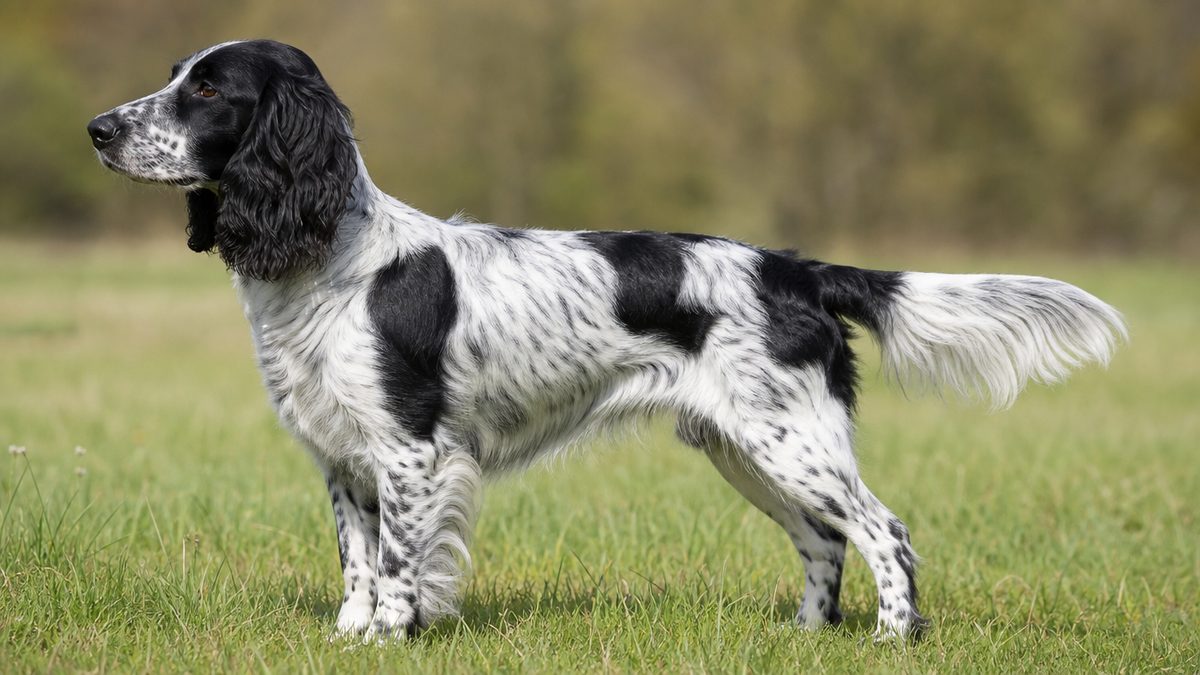
A Russian Spaniel is a compact Russian flushing dog, 40 to 45 cm at the withers for males and 38 to 43 cm for females, with a moderately long straight or slightly wavy close-lying coat, long silky drop ears that reach the nose, and a body deliberately longer than it is tall. It is the only gundog breed Russia has produced, and it is recognised by the Russian Kynological Federation under a standard approved on 29 January 2020.
The document to read is the RKF's own standard, which exists in Russian and in an official English translation the federation itself prepared Russian Kynological Federation. Its general appearance clause reads: Upstanding hunting dog less than medium size, moderately long. Strong bone and general harmony provide endurance and agility in work. High in front legs is characteristic, especially in males. Sexual dimorphism is clearly pronounced.
That last sentence matters more than it looks, and we will come back to it, because the most-read English page about this breed prints one height range for both sexes.
| Point | What the standard says |
|---|---|
| Origin | Russia in the Russian text, USSR and Russia in the official English text |
| Height, males | 40 to 45 cm at the withers |
| Height, females | 38 to 43 cm at the withers |
| Weight | Not given, although the English heading reads SIZE AND WEIGHT |
| Proportions | Body longer than height at withers by 10 to 15 per cent in males, 15 to 20 per cent in females |
| Utilisation | Hunting dog on swampy-meadow, field, steppe, upland and water game |
| Temperament | Hardworking, enduring, bright, sociable and friendly |
| Head | Lean, moderately long, oval from above, muzzle length equal to skull length |
| Ears | Set above or at eye level, hanging, close to the cheeks, long enough that the edge reaches the nose, covered in long silky slightly wavy hair |
| Coat | Moderately long, shiny, straight or slightly wavy, close to the body, with featherings on ears, chest, belly and the backs of the legs |
| Colour | Fifteen registered colours in two families, pied and speckled, and solid |
| Tail | Docked to half its length, or natural sabre-shaped or straight to the hock where docking is banned |
| Gait | Free, sound, balanced, moving to a light gallop as speed increases |
The clause every Indian reader should notice first
The tail. The Russian text says the tail is docked to half its length, then adds that in dogs born in countries where tail docking is prohibited, an undocked tail is permitted, sabre-shaped or straight, reaching the hock joint. India is such a country. Paragraph 6(8) of the Second Schedule Part II of the Prevention of Cruelty to Animals (Dog Breeding and Marketing) Rules, 2017 prohibits docking of tails and cropping of ears outright. So an Indian-born Russian Spaniel keeps its tail, and keeping it is standard-compliant rather than a defect. The same logic covers the dewclaws, which the standard says must be removed in countries where it is not prohibited by law.
The RKF's own standard prints an FCI-CLASSIFICATION row reading Group 8 Retrievers, Flushing dogs and Water dogs, Section 2 Flushing dogs, With working trial. The FCI does not hold this breed. The very next line of the same document says It has not yet been recognized by the FCI, and the breed is absent from FCI nomenclature under any name. That classification row is the RKF's own filing, written in FCI vocabulary because FCI group names are the shared language of judging worldwide. It is not a grant. This trap catches national bodies and readers alike, and it is the single most common way a page about an unrecognised breed goes wrong.
What the standard refuses to tell you
No weight. The English translation prints the heading SIZE AND WEIGHT and then gives height only. Every weight you will read for this breed comes from somewhere other than the standard, and the numbers disagree: 13 to 18 kg from Purina Russia, 9 to 16 kg from the North American breed club, and 9.1 to 15.9 kg in English Wikipedia's infobox against 13 to 18 kg in the body text of the same article. A page that gives you one weight without saying where it came from is guessing.
Is the Russian Spaniel a breed? Yes, and here are the two documents
Two conditions decide whether something is a breed rather than a type: a written standard has to exist somewhere, and a studbook has to exist somewhere. They do not have to be held by the same body. For the Russian Spaniel both are satisfied, and remarkably both are satisfied by a single primary document published by one national kennel club.
Condition one, a written standard
It exists. The Russian Kynological Federation publishes a full standard for the Russkiy Okhotnichiy Spaniel, approved by decision of the Presidium of SOKO RKF on 29 January 2020. It is a complete conformation document with general appearance, proportions, a behaviour clause, region-by-region description, gait, coat, fifteen numbered colours, size, faults, severe faults and disqualifying faults. An official English translation exists too, and its own title block states TRANSLATION: Russian Kynological Federation (RKF). Official authentic language English (EN). This is not a club sketch. It is a national kennel club's formal standard in two languages.
Condition two, a studbook
It exists, and the standard names it. The appendix to the standard is headed Colours for use when entering data into the All-Russian Unified Studbook (VERK) of the RKF, and then lists fifteen colours numbered 1 to 15 with Russian and English names, from Black and Brown through to Brown and tan speckled. A colour code list exists for exactly one reason: because dogs of this breed are being registered into a studbook and each entry needs a colour field. The document that establishes the standard also proves the studbook is in use.
The Russian Spaniel Club, founded in 2002 for the United States and Canada, states its mission as to establish and keep track of the breeding stock on the North American continent, control and document all breeding activity, maintain Russian Spaniel registry, and award RSC official pedigrees. That is a second studbook, in a second region, run by a second body. The two-condition test is therefore satisfied twice over, which is more than most FCI-recognised rare breeds can show.
What it is not
It is not FCI-recognised, and the RKF says so itself rather than leaving a reader to work it out. The Russian page carries the bold line the breed is to date not recognised by FCI, and the English PDF carries It has not yet been recognized by the FCI directly beneath its classification row. A search of FCI nomenclature returns nothing under Russian Spaniel or Russkiy Okhotnichiy Spaniel. English Wikipedia names four smaller bodies that do recognise the breed, the Continental Kennel Club, the Federation of International Canines, the North American Kennel Club and Universal Kennel Club International. Treat that list carefully: these are registries that accept applications rather than merit registries, the Universal Kennel Club standard Wikipedia cites returned HTTP 404 when requested on 8 September 2026, and Continental Kennel Club refused the session with HTTP 403, so nothing is claimed from it either way.
There is a quiet piece of evidence for this sitting inside the RKF's own website. The federation lists its Group 8 breeds in an index of 23 entries. Twenty-two of them carry an FCI breed number in the link text: English Cocker Spaniel No 5, German Spaniel No 104, Clumber Spaniel No 109, Field Spaniel No 123, Welsh Springer Spaniel No 126, Sussex Spaniel No 127 and so on. One entry carries no number at all, and instead reads Russian Hunting Spaniel (Breed recognised by RKF). The RKF has built the distinction into its own navigation.
| Condition | Satisfied? | By what document |
|---|---|---|
| Written standard exists anywhere | Yes | RKF standard approved 29 January 2020, published in Russian and official English |
| Studbook exists anywhere | Yes | All-Russian Unified Studbook (VERK) of the RKF, named in the standard's colour appendix |
| Second studbook, independently | Yes | Russian Spaniel Club registry for the USA and Canada, founded 2002 |
| Recognised by a national kennel club | Yes | The Russian Kynological Federation, which titles its own page Breed recognised by RKF |
| Recognised by the FCI | No | Absent from FCI nomenclature; the RKF states the non-recognition itself |
| Recognised by the AKC | No | Absent from the AKC's complete index including Foundation Stock Service breeds |
The verdict is breed, on the strength of the Russian Kynological Federation. That is what the documents support, and it is a stronger evidential position than the Saint-Usuge Spaniel's, which rests on one national body and one studbook. Anyone telling you the Russian Spaniel is not a real breed is using FCI recognition as a synonym for existence, and those are different things.
History: a breed assembled from imports, then standardised in 1951
The Russian Spaniel was built deliberately, out of English spaniels, over about sixty years, and given its first standard in 1951. In 2026 the Russian Kynological Federation named the whole year after it to mark that standard's 75th anniversary.
The RKF's own historical summary is unusually candid about the breed being made rather than found. Spaniels of English origin began arriving in Russia at the end of the 19th century. At the beginning of the 20th, enthusiasts began selecting the longer-legged and more vigorous dogs, because the small imported spaniels struggled with Russian terrain and weather. By the end of the 1930s a large population existed that fitted no known breed but shared a set of characteristics. After the Second World War, with European spaniels arriving again, focused selection produced the type they wanted. The first standard followed in 1951.
| Date | Event | Source |
|---|---|---|
| 1891 | A New Zealand newspaper advertisement mentions Russian Spaniels, sixty years before the breed existed | English Wikipedia |
| Late 19th century | A black Cocker Spaniel named Dash is sent from England to Grand Duke Nikolai Nikolaevich, a keen hunter | Vokrug Sveta, briefing from RKF experts |
| Early 20th century | Selection begins for longer-legged, more vigorous spaniels suited to Russian bird hunting | RKF standard |
| Late 1930s | A large non-conforming spaniel population exists in Moscow, Leningrad and Sverdlovsk | RKF standard and English Wikipedia |
| 1941 to 1945 | Breeding stock survives the war, including dogs that lived through the siege of Leningrad | Vokrug Sveta |
| 1951 | The first standard is developed and adopted | RKF standard |
| 1966 | A revised standard is adopted | English Wikipedia |
| 1988 | A USSR postage stamp, CPA 5948, depicts a Russian Spaniel at waterfowl hunting | English Wikipedia |
| 1990s | The breed is introduced overseas for the first time | English Wikipedia |
| 2000 | A further revised standard | English Wikipedia |
| 2002 | The Russian Spaniel Club is founded in the United States | English Wikipedia |
| 29 January 2020 | The current RKF standard is approved by the Presidium | RKF |
| 2022 | The official English translation is approved | RKF |
| 2026 | The RKF names the year after the breed, for the standard's 75th anniversary | Vokrug Sveta and the national breed club |
The 2026 Year of the Breed, and the people the RKF credits
This is current news rather than history, and it is the strongest signal of the breed's standing at home. The RKF declared 2026 the Year of the Russian Hunting Spaniel because exactly 75 years earlier, in 1951, the USSR approved the breed's first standard. RKF president Vladimir Golubev, quoted directly, explained the practice: behind the establishment of many breeds stand specific people whose enthusiasm made them possible, and dedicating a year to native breeds pays tribute to those specialists. He singled out the breed curator Anna Ervandovna Ayrapetyants, Candidate of Biological Sciences and Honoured Expert of All-Russian category, saying the entire post-war history of the breed unfolded before her eyes and that her work provided its reliable documentary memory.
The national breed club has run the year accordingly, announcing three national competitions, a children's drawing competition on the theme My friend the ROS, an amateur photography competition and an art competition on the theme of the breed in art, and staffing a 75th-anniversary breed stand at the RKF Cup and Moscow Cup shows held at Patriot Park on 20 and 21 June 2026.
Ayrapetyants recalled that news of the new breed was met with skepticism by part of the cynological community. That is worth knowing, because it is the same objection raised against the breed today in English: that it is a type rather than a breed. The answer in 1951 and the answer in 2026 are the same, and it is a documentary one. A standard was written and a studbook was opened.
Rarity: common at home, invisible abroad
The Russian Spaniel is not a rare breed. It is a popular breed with an invisible internet. That distinction is the most useful thing this page can give you, because almost every English source treats invisibility as rarity and then reasons wrongly from it.
Start with the evidence of scale at home. The RKF gave the breed an entire year of its calendar for 2026, which no federation does for a dying breed. It has a national breed club running three national competitions. It had a Soviet postage stamp in 1988. English Wikipedia records Moscow shows annually entering between 120 and 131 of the breed, which it says qualifies it as one of the most popular alongside the Irish Setter, although that figure traces to a club page archived in 2009 and should be treated as dated.
There is no annual registration figure for this breed that Bonbeno could confirm from a primary source. The French breeds in this batch have one because the Societe Centrale Canine publishes a full LOF table every year, and the British ones have one because the Kennel Club does. The RKF publishes its breed standards openly but Bonbeno found no equivalent public annual studbook table for the VERK. Rather than convert a show entry from 2009 into a population estimate, this page leaves the number blank and says so. If you see a specific figure for Russian Spaniel registrations quoted online, ask which RKF table it came from.
Now the invisibility, which is measurable
A Google search for the breed run from India returns about 122 results. For comparison, that is the same order of magnitude as the Saint-Usuge Spaniel, a French breed with 58 puppies registered in the whole of 2025. A breed that fills a national federation's calendar and a breed that produces 58 puppies a year have roughly the same English-language footprint.
The composition of those results is worse than the count. The top blocks are a YouTube video titled Russian Spaniel Pros and Cons and a set of Facebook posts. Google's own AI Overview declined to generate, returning An AI Overview is not available for this search, and the AI Mode answer it produced instead was sourced to Facebook and a breed-content aggregator rather than to the Russian Kynological Federation, which publishes the breed's actual standard and does not rank on this SERP at all.
| Route | Russian Spaniel | Control | Verdict |
|---|---|---|---|
| AKC full breed index, including Foundation Stock Service | Absent | Sussex Spaniel, Pont-Audemer Spaniel, Blue Picardy Spaniel and French Spaniel all present | Valid signal |
| AKC breed page | HTTP 404 | Sussex Spaniel HTTP 200, 651,940 bytes | Valid signal |
| Royal Canin India breed library | HTTP 404 | Sussex Spaniel HTTP 200, 394,269 bytes | Valid signal |
| Puppiezo, Indian marketplace | HTTP 404 | Sussex Spaniel HTTP 200, full priced page | Valid signal |
| India-located search for price and buy | A book, a garden flag, an empty classifieds shell | Live listings returned were Russian and Spanish | Valid signal |
| United Kennel Club | HTTP 403, refused | Sussex Spaniel also HTTP 403 | No signal, nothing claimed |
| Good Dog | HTTP 404 | Sussex Spaniel also HTTP 404 | No signal, nothing claimed |
A 404 only means something if a known-good page on the identical URL pattern returns 200. Two routes tested here failed their own controls: United Kennel Club refused this session with HTTP 403 for both the target and the control, and Good Dog returned 404 for the Sussex Spaniel control as well. Those rows prove nothing about this breed and are printed so you can see which routes were tried and why they were discarded. Any page that lists absences without controls is showing you its own broken URLs.
The comparison that makes the point
The AKC's complete breed index carries the Pont-Audemer Spaniel, a French breed that registered eight puppies in the whole of France in 2025. It carries the Russian Toy and the Russian Tsvetnaya Bolonka. It runs Russell Terrier, Russian Toy, Russian Tsvetnaya Bolonka with no Russian Spaniel between them. So the AKC has room for two Russian breeds and for a French spaniel that barely exists, and none for the only gundog Russia ever produced. Recognition pathways, not population, decide who gets a page.
Price in India: there is no Indian price, and here is the only published one anywhere
No Indian breeder, marketplace or kennel offers the Russian Spaniel, so there is no Indian price to quote and Bonbeno will not invent one. The only published price for this breed anywhere in the world is an import cost table on a North American club website, and it was last updated in 2008.
Every Indian route was tested with a control, and all of them came back empty Puppiezo, an Indian puppy marketplace Search for the phrase Russian Spaniel…. Royal Canin India returns HTTP 404 for the breed while returning HTTP 200 and 394,269 bytes for the Sussex Spaniel on the identical URL pattern. Puppiezo, which generates a priced page for almost every breed it can name, returns 404 here while returning a full page titled Buy Sussex Spaniel Puppies for Sale in India at Best Prices. An India-located search for the breed together with price, buy and puppy returned a print-on-demand book on Amazon.in, an Etsy India garden flag showing a different breed entirely, and an empty classified-ads category shell.
One Indian site does name the breed. GoofyTails, a pet retailer, includes the Russian Spaniel with Origin: Russia in its spaniel round-up, alongside the Sussex Spaniel. It ranks on the India SERP for the breed. It also sells nothing for it. An Indian reader can therefore find the breed named by an Indian retailer and still not buy one.
The only published price on earth, and why to read it carefully
The Russian Spaniel Club publishes a full import cost breakdown for bringing a puppy from Russia to the United States. It is genuinely detailed and genuinely useful as structure. It is also dated Last updated 03/31/08, which makes it eighteen years old at the time of writing.
| Expense | Live cargo | You carry it | Carrier carries it |
|---|---|---|---|
| Puppy, average | 550.00 | 550.00 | 550.00 |
| Puppy keeper fees | 300.00 | - | 150.00 |
| Puppy ID tattoo | 9.00 | - | - |
| First set of shots | 20.00 | - | - |
| Permission to export form | 25.00 | 25.00 | 25.00 |
| Medical form number 1 | 27.00 | 27.00 | 27.00 |
| Crate and padding | 86.00 | - | - |
| Customs, airport and international vet certificate | 135.00 | 40.00 | 40.00 |
| Transport, estimate to the east coast | 385.00 | 160.00 | 160.00 |
| Fee to the puppy carrier | - | - | 150.00 |
| Total | 1,537.00 | 802.00 | 1,102.00 |
It is eighteen years old. Airline live-cargo pricing, veterinary fees and Russian export paperwork have all moved since 2008. It ends in the United States, not India. No Indian leg, Indian customs charge or quarantine step is in it. It assumes routes that may not exist. The table names Delta and Aeroflot services from Russia that an Indian buyer cannot assume are available. It is a club estimate, not an invoice. The page says so itself: all prices listed here are approximate and might change without our knowledge. Bonbeno prints it because it is the only published figure for this breed on the internet, not because it is a quote.
Two details in that document are worth keeping. First, the Russian permission to export paperwork states that the dog has no special value to people of Russia and costs one thousand roubles, which is the legal formality that lets a dog leave. Second, on guarantees the club is unusually honest: the status of law in Russia provides us with no enforcing mechanism for any type of guarantee contract, and it says plainly that the club cannot be responsible in any way. Anyone selling you this breed with a health guarantee should be asked which jurisdiction would enforce it.
If someone in India offers you one
- Ask for the RKF pedigree, by number. The breed's studbook is the All-Russian Unified Studbook of the RKF. A dog of this breed without RKF papers is a dog someone has named for you.
- Ask which country it was born in, and check the tail against that answer. A docked tail on a dog claimed to be Indian-born is an offence under paragraph 6(8), and the standard itself expects the natural tail in banning countries.
- Ask to see the import paperwork. Live dogs are a Restricted import at ITC(HS) 01061900, capped at two pet dogs per passenger, and importing commercial dogs for breeding or any other commercial activity is barred outright. A commercial Indian seller with imported breeding stock has a problem to explain.
- Assume no health screening exists. OFA holds no breed code, so there is no hip, elbow, eye, thyroid or cardiac database for a breeder to have used. Nobody can show you a clearance that does not exist.
- Do not pay for a lifespan claim. The 14-year figure is a club assertion with no study behind it McMillan, K.M., Bielby, J., Williams, C.L..
Monthly cost of keeping one in India, built from live Indian prices
No Indian site publishes a cost of ownership for this breed, because no Indian site carries the breed. The components are all checkable, though, and every figure below was read live on 8 September 2026 from Indian vendors. Build your own total from these rather than trusting a breed-page number that was generated by a template.
Size drives most of this, and here the breed helps you. At 9 to 16 kg it is a small dog by the standards of the gundog group, so food, parasite cover and boarding all sit at the lower end. Grooming is genuinely cheap for a spaniel, for reasons the grooming section explains.
| Item | Price | Frequency | Source |
|---|---|---|---|
| Puppy vaccination course | from Rs 6,499 | Once, in the first year | Vetic, struck through from Rs 8,111 |
| Annual booster | from Rs 3,199 | Yearly | Vetic, struck through from Rs 3,806 |
| Anti-rabies | Rs 699 | Yearly | Vetic |
| DP vaccine | Rs 849 | Per course schedule | Vetic |
| Nine-in-one vaccine | Rs 899 | Per course schedule | Vetic |
| Kennel cough | Rs 1,349 | Yearly if boarding | Vetic |
| Parasite cover, NexGard Spectra 15 to 30 kg | Rs 3,308 for three tablets, Rs 1,102.67 a month | Monthly | Indian retail, MRP Rs 3,375 |
| Bath and blow dry | from Rs 934 | Every 3 to 6 weeks | Vetic Delhi |
| Haircut | from Rs 1,359 | Not recommended for this breed | Vetic Delhi |
| Full grooming package | from Rs 1,869 | Occasional | Vetic Delhi |
| Boarding, per 24 hours | Rs 599 to Rs 899 | As needed | PawSpace Bengaluru, three tiers |
| Boarding in festive season | 25 to 30 per cent higher | Seasonal | PawSpace's own note |
The NexGard Spectra pack priced above is the 15 to 30 kg band. A Russian Spaniel at 9 to 16 kg straddles that boundary, so many individuals belong in a lighter and cheaper band. Weigh the dog and let your nearby vet choose the pack. Dosing a small dog from the wrong band is both a waste of money and a clinical mistake.
What this breed does not cost you
- No clipping bill. Vokrug Sveta, briefing from RKF experts, states that clipping is not recommended and only correction is allowed. The North American club goes further and says very little grooming is required at all, that the coat repels water and that dried mud can be dusted off with light brushing. Budget for baths and ears, not for a full clip every six weeks.
- No breed-scheme screening fees. There is no hip scheme, elbow scheme or eye scheme for this breed anywhere, because OFA holds no breed code. That saves money and costs certainty, which is the wrong trade to be pleased about.
- No large-dog food bill. This is a small gundog. The standard tops out at 45 cm for males.
Boarding is the one line that moves seasonally: PawSpace Bengaluru runs three tiers at Rs 599, Rs 799 and Rs 899 per 24 hours and notes on its own site that festive season rates are 25 to 30 per cent higher. Against that, budget upward for two things. Ear care is a recurring, non-optional cost in an Indian monsoon for a breed whose ear reaches the nose. And veterinary diagnosis will occasionally be slower and therefore dearer, because your vet has no breed-specific literature to consult for this dog.
Heat tolerance in India: the coldest homeland in this batch of six
A Russian Spaniel can live in an Indian city and cannot work in one during summer. The gap between where this breed was made and where you propose to keep it is the largest in this batch of six spaniels, and it is worth seeing as numbers rather than adjectives.
All figures below are NASA POWER monthly climatology means for 2001 to 2020, pulled by explicit latitude and longitude, with wet-bulb temperature computed from the same cells using the Stull formula. Wet bulb matters more than dry-bulb temperature for a dog, because a dog sheds heat by panting, which is evaporative, and evaporation stops working as humidity rises.
| Place | Annual mean | Hottest month | Peak wet bulb | Relative humidity |
|---|---|---|---|---|
| Moscow | 4.28 C | July, 18.98 C | 16.58 C | 87.53 per cent |
| Saint Petersburg | 4.41 C | July, 18.31 C | 15.98 C | 88.87 per cent |
| Bengaluru | 23.74 C | April, 28.37 C | 21.86 C | 67.94 per cent |
| Pune | 23.86 C | April, 28.93 C | 22.97 C | 66.80 per cent |
| Delhi | 25.60 C | June, 35.88 C | 26.50 C | 45.56 per cent |
| Kolkata | 25.81 C | May, 31.53 C | 27.09 C | 73.93 per cent |
| Hyderabad | 26.10 C | May, 33.30 C | 23.35 C | 60.30 per cent |
| Mumbai | 26.77 C | May, 31.19 C | 25.77 C | 67.39 per cent |
| Kochi | 27.31 C | March, 29.42 C | 25.79 C | 78.83 per cent |
| Chennai | 27.95 C | May, 31.51 C | 26.11 C | 72.39 per cent |
Moscow's hottest month is colder than India's coldest. Moscow averages 18.98 C in July, its warmest month of the year. Bengaluru, the coolest city in the table, averages 20.22 C in December, its coldest month. There is no month anywhere in urban India as cool as the peak of a Moscow summer. Five Moscow months average below freezing: January at -10.65 C, February -9.62, March -4.06, November -2.19 and December -7.73.
Why the honest rating is still three out of five and not one
Three features of the dog work in your favour, and they are real rather than reassuring. It is small: 40 to 45 cm for males and 38 to 43 cm for females, at 9 to 16 kg, so it carries less mass to cool than any other spaniel in this batch. Its coat is close-lying rather than profuse: the standard describes the body coat as moderately long, shiny, straight or slightly wavy, and close to the body, with the long silky feathering restricted to the ears, chest, belly and the backs of the legs. And the North American club describes the coat as skintight and water-repellent rather than dense, which suits a humid climate better than an undercoated breed does.
What works against you is not the coat at all. It is what the dog was built to do. The RKF files this breed with working trial and calls it hardworking and enduring. A UK study of heat-related illness in dogs found that of the events with a recorded trigger, 652 of 879 followed exertion rather than a hot environment alone. The UK is cooler than every city in the table above, so that share is a floor for India rather than a ceiling. The danger to a Russian Spaniel in Chennai is not lying in a warm room. It is a game of fetch at three in the afternoon.
- Move exercise to the ends of the day. Before sunrise and after dark, in the hot months, without exception.
- Use wet-bulb, not temperature, to decide. Kolkata peaks at 27.09 C wet bulb in June and Delhi at 26.50 C in July. At those readings panting is barely working, whatever the thermometer says.
- Provide the cooling the law already requires. Paragraph 21(1) of the 2017 Rules requires cooling arrangements for long-haired breeds in high temperature locations. This is a feathered breed in a hot country.
- Never clip the coat to cool the dog. The RKF experts' own guidance is that clipping is not recommended. A clipped close-lying coat loses its sun barrier without gaining airflow.
- Learn the early signs. Heavy panting that does not settle with rest, brick-red gums, unsteadiness, vomiting. Cool the dog with room-temperature water and take it to a nearby vet immediately.
Ears in the monsoon: the one health risk every source agrees on
If you keep a Russian Spaniel in India, the ears are the thing that will actually cost you money and vet visits. It is the only health problem named by the RKF's experts, by the North American breed club and by the general veterinary literature on spaniels alike.
Read the ear clause of the standard as a description of a microclimate. The RKF standard specifies ears set above or at eye level, hanging, mobile, lying close against the cheeks, rounded and wide at the bottom, long enough that the edge of the ear reaches the nose, and covered in long, slightly wavy, silky hair. That is a heavy hair-covered flap sealing a warm canal against the side of the head, on a dog the standard also expects to hunt water game.
Both breed bodies name otitis and neither downplays it. The North American club lists it as one of only three health problems it recognises and calls it common in all spaniel breeds, adding that ears must be checked and cleaned regularly. Vokrug Sveta, briefing from RKF experts, says the ears require attention and that with inadequate care a tendency to otitis externa is possible.
Nobody has measured otitis in Russian Spaniels, because nobody has measured anything in Russian Spaniels. The closest real data is a Finnish study of 98,736 dogs across 55 veterinary clinics, which found otitis in 31.8 per cent of 468 Welsh Springer Spaniels, 27.0 per cent of 329 American Cocker Spaniels, 19.6 per cent of 491 English Springer Spaniels and 15.7 per cent of 1,467 English Cocker Spaniels. No Russian Spaniel appears in it. Those figures are other breeds and a cool northern climate, so read them as an indication of what a heavy-eared spaniel is prone to, not as this breed's rate in Kerala.
Why an Indian monsoon is the hard case
The Finnish figures come from a country whose climate resembles this breed's homeland. India adds two things Finland does not. Kochi runs 78.83 per cent relative humidity and Saint Petersburg runs 88.87, so ambient humidity alone is not the difference. The difference is warmth plus moisture together, which is what an ear canal needs to grow yeast and bacteria, and the swimming a flushing dog will do in standing monsoon water.
- Look every day in the monsoon, weekly otherwise. Lift the leather and smell. A yeasty or sour smell precedes visible discharge.
- Dry the ears after every swim and every bath. Cotton wool at the entrance of the canal only. Never push anything down it.
- Do not clean a healthy ear on a schedule. Over-cleaning strips the canal and causes the problem you are trying to prevent. Clean when there is something to clean.
- Get a swab before medicating. A yeast infection and a bacterial one look identical to an owner and need different drugs. Your nearby vet can tell them apart in minutes.
- Treat head-shaking as urgent, not annoying. Persistent shaking can burst a blood vessel in the ear flap and turn a cheap problem into a surgical one.
- Keep the feathering trimmed at the ear opening. This is the one place where correction, which the RKF experts do allow, earns its keep.
A note on sequence, because it saves money. Recurrent ear infections in a spaniel are often the visible end of a food or environmental allergy rather than a primary ear disease. The North American club lists food allergy as one of its three recognised problems in this breed and puts its onset between one and five months of age, naming chicken and carrots as the commonest allergens. If your dog's ears keep coming back, ask your nearby vet about the allergy question rather than buying a fourth bottle of ear drops.
Health: three claimed problems, zero published studies, and why that matters
The honest summary of Russian Spaniel health is that no veterinary study of this breed has ever been published. What exists instead is a breed club's short list of three problems, and a claim that there are no others. That claim deserves to be taken seriously and also examined, because nobody has looked.
What the breed bodies say
The Russian Spaniel Club names exactly three health problems: obesity, requiring a strict diet; otitis, requiring ears to be checked and cleaned regularly; and food allergies, usually identified between one and five months of age with chicken and carrots the most common allergens. It then states, in capitals, NO other breed-specific health problems. Vokrug Sveta's RKF experts agree in substance: the breed is distinguished by good health, the ears need attention, and the diet must be strictly controlled to prevent overeating.
The RKF standard adds the conformation faults the breed is actively selected against, which is a different kind of health information and a useful one. Disqualifying faults include aggression towards humans, cowardice, any deviation from a scissor bite regardless of severity, a wry jaw, extra or missing incisors or canines, congenital bobtail, cryptorchidism, and any colour not in the standard. A dog with any of those cannot be registered for breeding, which is a real filter even without a health database behind it.
Three independent checks were run on 8 September 2026 and all three came back empty. PubMed returned zero records for Russian Spaniel as a title and abstract term, for the plural, for Russian Hunting Spaniel and for russkiy spaniel, while returning 1,109 for Labrador Retriever and 369 for Cocker Spaniel in the same session, so the queries work. The Orthopedic Foundation for Animals has no breed code for it, so no hip, elbow, eye, thyroid or cardiac statistics exist. The largest UK longevity study lists 344 breeds it considered and this one appears in none of the rows, so it was never even excluded. The club's claim is not contradicted by any of that. It is also not supported by any of it. Nobody has looked.
| Condition | Status | Evidence |
|---|---|---|
| Otitis externa | Claimed by both breed bodies | No prevalence figure for this breed; 31.8 per cent measured in Welsh Springer Spaniels in Finland |
| Obesity | Claimed by both breed bodies | No prevalence figure; the club says strict diet must be maintained |
| Food allergy | Claimed by the North American club | Onset 1 to 5 months, chicken and carrots named; the club adds we have not seen any yet, but it's in the literature |
| Hip dysplasia | Unmeasured | No OFA breed code, so no evaluations exist |
| Elbow dysplasia | Unmeasured | No OFA breed code |
| Eye disease | Unmeasured | No OFA breed code, no national eye scheme |
| Thyroid disease | Unmeasured | No OFA breed code |
| Cardiac disease | Unmeasured | No OFA breed code |
| Any inherited disease | Unstudied | Zero PubMed records against working controls |
The one caveat on the zero, stated plainly
PubMed discards Cyrillic characters from queries. Russian-language veterinary literature about a Russian breed is therefore not searchable by that route, and its absence from PubMed is not proof that none exists. A Russian veterinary school may well have published on this breed in Russian in a journal PubMed does not index. Bonbeno could not search that literature and says so rather than converting a limitation of the tool into a finding about the breed.
The practical consequence for you is straightforward. Your vet will have no breed-specific literature for this dog. Treat it as a generic small-to-medium spaniel: watch the ears, keep it lean, and take a cautious line on anything unusual because there is no published baseline to reassure anyone. Consult your nearby vet about screening rather than assuming a clear breed record means a clear dog.
Lifespan: the most asked question about this breed has no researched answer
Google's People Also Ask box for this breed carries the question What is the average lifespan of a Russian Spaniel? The honest answer is that nobody has measured it. Two figures circulate and neither rests on a study.
| Figure | Source | Evidence behind it |
|---|---|---|
| 14 years | Russian Spaniel Club, About the Breed | None cited. Printed as Average Life Expectancy on a page last modified in 2003 |
| 12 to 14 years | Purina Russia breed page | None cited |
| No figure | RKF standard | The standard does not address lifespan, correctly, because standards describe conformation |
| Not measured | McMillan et al. 2024, the largest UK longevity study | The breed appears in none of the 344 candidate rows, so it was never considered |
The comparison with the rest of this batch is what makes the gap concrete. The Sussex Spaniel has a measured median longevity from 108 dogs and the Welsh Springer Spaniel from 572. The Picardy Spaniel and the Pont-Audemer Spaniel both appear in that study's 344-row candidate list and were both explicitly excluded, which at least means somebody considered them and wrote down a decision. The Russian Spaniel is not in the list at all. It was not rejected. It was never on the table.
Ask one question: how many dogs, and who counted them. A figure derived from thousands of veterinary records is evidence. A figure printed on a breed club page with no denominator is a belief held by people who love the breed, which is worth something but is not the same thing. The 14-year figure for this breed is the second kind. It may well be right. A dog of 9 to 16 kg with no documented inherited disease has every structural reason to live a long time, and small dogs do generally outlive large ones. That is an inference from body size, not a measurement of this breed.
What actually determines how long your dog lives
- Body condition. Obesity is the first of the three problems both breed bodies name, and it is the one thing you fully control. Keep the waist visible from above and the ribs findable without pressing.
- Heat management. Exertional heat illness is the specific Indian risk for a working breed, and it killed dogs in a country far cooler than this one.
- Ear disease caught early. Chronic untreated otitis ends in a surgical ear canal, which is expensive, painful and preventable.
- A vet who sees the dog yearly. With no breed literature to fall back on, your vet's own longitudinal record of your dog becomes the baseline nobody else has.
- Dental care. The standard demands a full dentition and a scissor bite. Keeping those teeth healthy is ordinary, unglamorous, and does more for lifespan than any supplement.
Temperament: what the standard requires, not what a breeder promises
The RKF standard's behaviour clause is one sentence long and it is enforceable: Russian Hunting Spaniel is a hardworking, enduring, bright, sociable, and friendly dog. Two temperament faults disqualify a dog outright, which turns that sentence from a description into a breeding filter.
Aggression towards a human and cowardice are both disqualifying faults. A dog showing either cannot be awarded a rating in the ring and cannot be bred from within the system. That is the strongest temperament guarantee any document about this breed offers, and it is stronger than a seller's assurance because it does not depend on the seller.
The North American club fills in the domestic picture: devoted and loyal, friendly towards other dogs and people, playful, good-natured as a house pet, and great with children. English Wikipedia adds that it is energetic and free-spirited, kept as a companion as well as a gundog because of its easy-going nature, and that it makes a reasonable watchdog, while noting the breed community's own view that deliberately developing watchdog qualities could harm the hunting qualities.
Every source agrees this is a friendly, biddable dog, and the disqualifying faults give that agreement real teeth. What does not exist is a temperament study, a behavioural survey or any measured comparison with other spaniels. Bonbeno's four-out-of-five ratings for trainability and for children are the considered agreement of two breed bodies plus a conformation rule with consequences, not a measurement. Meet the parents.
The trait that will surprise an Indian flat-dweller
Its size is the point of the breed. The whole reason the Russian Spaniel exists in its current form is that Russian hunters wanted a compact gundog they could keep in a city apartment and carry to the marshes. The North American club says it is fairly active indoors, can get plenty of exercise inside, and will do well in a small house or even a high-rise if walked regularly. That is an unusual claim for a working gundog and it is the breed's best argument for Indian urban life.
Do not over-read it. Vokrug Sveta's RKF experts are blunt in the other direction: the main purpose of the breed is hunting, the dog requires active walks, and it is not suited to an exclusively domestic, unhurried life. Both things are true. The flat is fine. The walks are not optional.
Training: start early, use food, never use force
To train a Russian Spaniel, work with its flushing instinct rather than against it, start in the first weeks at home, and pay in food and retrieves. Both breed bodies describe an easy dog to train, and the standard's disqualifying faults tell you exactly which method will ruin one.
The North American club's claim is specific and useful: these dogs start to work early in life and do not require a lot of training. The RKF describes the breed as bright and sociable and files it with a working trial, which means working ability is tested rather than assumed. Google's People Also Ask box asks whether Russian Spaniels are easy to train, and on the available evidence the answer is yes.
Cowardice is a disqualifying fault. A breed selected for decades against fearfulness is a breed that will be damaged, visibly and quickly, by aversive handling. Do not use a check chain, an e-collar, or a raised voice as a training tool on this dog. You would be manufacturing the exact trait the breed's own registry disqualifies.
An eight-week plan that fits Indian conditions
- Weeks 8 to 10: name, crate, and toilet. Short sessions, high-value food, indoors while the puppy's vaccination course is incomplete.
- Weeks 10 to 14: socialise on purpose, indoors and out. Carry the puppy to see traffic, lifts, markets and other dogs before it can walk there safely. This is the window that decides the adult dog, and in India it usually closes unused.
- Weeks 12 to 16: recall before freedom. A flushing dog that finds birds interesting will find your voice less interesting later. Build recall while the puppy still wants to be near you.
- Weeks 14 to 20: a retrieve, for fun. Two throws, then stop. Ending while the dog still wants more is the whole technique.
- Months 4 to 6: settle on a mat. The single most useful behaviour for a flat, and the one that makes a working breed liveable indoors.
- Months 6 to 12: proof everything outdoors, at dawn. Heat rules the calendar in most of India, so the training slot and the exercise slot are the same slot.
- Throughout: handle the ears daily. A dog that accepts ear handling as normal saves you a fight every monsoon for fourteen years.
One caution specific to this breed in India. There is no local trainer with Russian Spaniel experience, because there are no Russian Spaniels. Anyone claiming breed-specific expertise is claiming something unverifiable. Choose a trainer on method instead: reward-based, no aversives, and willing to explain what they are doing and why.
Exercise: a working dog's needs on an Indian clock
A Russian Spaniel needs about an hour to ninety minutes of real activity a day, split across two sessions, and in most of India both of those sessions have to happen in the dark. The quantity is ordinary for a gundog. The scheduling is the hard part.
The RKF standard's utilisation clause describes a hunting dog for swampy-meadow, field, steppe, upland and water game, and files the breed with a working trial. The gait clause expects free, sound, balanced movement at all paces, moving into a light gallop as speed rises. This is a dog built to quarter ground for hours.
| When | What | Why |
|---|---|---|
| Before sunrise, 40 to 60 minutes | Brisk walk with sniffing time, or off-lead work in a safe space | The only reliably cool window in Chennai, Kolkata, Mumbai and Kochi |
| After dark, 25 to 40 minutes | Second walk, lead work, short retrieves | Surfaces have cooled; wet bulb has dropped from its afternoon peak |
| Midday, indoors | Scent games, a snuffle mat, food puzzles, training reps | Mental work tires a flushing dog as effectively as distance and costs nothing in heat load |
| Twice a week | Swimming where clean water is available | The breed retrieves from water by design and swims and dives for wounded birds |
| Never | Midday running, cycling alongside, or fetch in the sun | 652 of 879 UK heat-illness events with a recorded trigger followed exertion |
The RKF standard is built around a dog that finds game by nose. Ten minutes of hunting kibble hidden around a flat will settle this breed more thoroughly than a hot kilometre on a road, and it can be done at two in the afternoon in Hyderabad in May without any risk at all. Indian owners of working breeds systematically under-use this, and it is free.
Two hard limits. Do not force distance work on a puppy under a year; growth plates close late and this is a breed with no orthopaedic database to tell anyone what its joints tolerate. And treat any refusal to continue in warm weather as information rather than disobedience.
Grooming: the lowest-maintenance coat in this batch of six
To groom a Russian Spaniel, brush the body coat weekly, comb the feathering twice a week, check the ears constantly, and do not clip. It is the easiest coat of the six spaniels in this batch by a clear margin, and both breed bodies say so independently.
The North American club's description is unusually direct: unlike most other spaniel breeds, very little grooming is required, the coat repels water, and if the dog gets muddy all that is needed is to let the coat dry and dust the mud off with light brushing. It calls the breed an average shedder and confines the extra care to the long fringed ears and the feathering on the backs of the legs. The RKF standard supports that structurally: the body coat is moderately long, shiny, straight or slightly wavy and close to the body, short and straight on the head and the fronts of the legs, with the longer soft silky feathering restricted to the neck, chest, belly, backs of the legs, ears and the underside of the tail.
Vokrug Sveta, briefing from RKF experts, states that the coat needs regular combing and competent grooming, that clipping is not recommended, and that only correction is allowed. Indian groomers default to a summer clip for any feathered breed, and it is the wrong call here. A close-lying coat that repels water and shades skin does more for a dog in the sun than bare skin does. Ask for correction of the ear and foot feathering and nothing else.
| Task | Frequency | Notes |
|---|---|---|
| Brush the body coat | Weekly | A slicker or rubber curry. The coat is close-lying, so this is quick |
| Comb the feathering | Twice weekly | Ears, chest, belly, backs of legs. Where mats actually form |
| Check ears | Daily in monsoon, weekly otherwise | The single most important task on this list |
| Bath | Every 4 to 6 weeks, or after muddy water | From Rs 934 at Vetic Delhi, or at home |
| Dry the ears and feathering | After every bath and swim | Damp feathering against skin is how hot spots start |
| Trim feathering at the ear opening | As needed | Correction, which the RKF experts allow; not a clip |
| Nails | Every 3 to 4 weeks | Flat-kept dogs wear nails down far less than field-worked ones |
| Teeth | Several times a week | The standard demands a full dentition and a scissor bite |
| Full clip | Never | Not recommended by the breed's own experts |
Budget accordingly. A haircut at Vetic Delhi starts at Rs 1,359 and a full grooming package at Rs 1,869, and for this breed you should be buying neither on a schedule. A bath from Rs 934 and a good comb at home is the honest cost.
Feeding: the one health problem you can eliminate entirely
Obesity is the first health problem both breed bodies name for this breed, and it is the only one wholly inside your control. Feed to body condition rather than to a chart, because no reliable weight standard exists for the Russian Spaniel.
Start from the awkward fact. The RKF standard gives no weight at all, and the figures that circulate disagree: 13 to 18 kg from Purina Russia, 9 to 16 kg from the North American club, and an infobox and body text inside the same Wikipedia article that contradict each other. So a feeding guide keyed to a target weight is keyed to a number nobody agrees on. Use body condition instead: ribs findable under light pressure, a waist visible from above, a tuck visible from the side.
The Russian Spaniel Club lists obesity as the first of its three recognised health issues and says a strict diet must be maintained. Vokrug Sveta's RKF experts say the same: strictly control the ration and do not allow overeating. When two breed bodies on two continents lead with the same warning, it is because they keep seeing fat dogs of this breed.
The food allergy question, handled properly
The North American club reports food allergy as its third recognised problem, usually identified between one and five months of age, with chicken and carrots named as the most common allergens, while candidly adding that the club has not seen any itself but that it is in the literature. Read that as a flag rather than a fact. It is a claim without a denominator, from an organisation that says it has not observed the thing it is reporting. Do not put a puppy on a chicken-free diet as a precaution. Do take persistent itching, recurrent ear trouble or loose stools to your nearby vet and ask about a properly run elimination trial.
- Two meals a day for an adult, three or four for a puppy. Measure with a cup or scales, never by eye.
- Take training treats out of the daily ration. In a breed this food-motivated, treats are where the extra kilo comes from.
- Weigh the dog monthly and write it down. With no breed baseline anywhere, your own record is the only trend line that exists.
- Keep water available and cool, especially in the months when exercise moves to dawn and dusk.
- Do not free-feed. The club's phrase is strict diet, and free-feeding is the opposite of it.
- Ask your vet before adding supplements. There is no breed-specific evidence for any of them here, because there is no breed-specific evidence for anything.
The first year, on an Indian calendar
If you obtain a Russian Spaniel puppy in India it will almost certainly have been imported, so the first year begins with paperwork rather than with a litter visit. Here is the sequence that keeps you legal and the dog healthy.
| Age | What happens | The rule or figure behind it |
|---|---|---|
| Before purchase | Confirm the RKF pedigree and the import paperwork | Live dogs are Restricted at ITC(HS) 01061900; two pet dogs per passenger maximum |
| 8 weeks | The earliest a puppy may legally be sold in India | Rule 8(1)(a) of the 2017 Rules |
| 7 to 8 weeks onward | First vaccinations begin | Rule 8(9) sets the window at seven to eight weeks to eighteen weeks |
| 8 to 16 weeks | Complete the course; vaccinate on your vet's schedule, not a website's | Vetic puppy course from Rs 6,499 |
| 10 to 14 weeks | Socialise deliberately, carrying the puppy where it cannot yet walk | The window closes whether or not you use it |
| 12 weeks onward | Daily ear handling becomes routine | Otitis is one of only three problems the breed's clubs name |
| 4 to 6 months | Teething; confirm the scissor bite is coming in correctly | Any deviation from a scissor bite is a disqualifying fault |
| 6 months | Discuss neutering timing with your vet, not with the internet | No breed data exists to inform the decision either way |
| 12 months | Annual booster and first adult weight recorded | Booster from Rs 3,199 at Vetic |
Rule 8(10) of the 2017 Rules bars the sale of dogs with known genetic defects, and paragraph 6(8) prohibits docking of tails and cropping of ears outright. If a seller offers you an Indian-born puppy of this breed with a docked tail, they have described an offence to you. The RKF standard itself expects the natural sabre or straight tail in countries where docking is banned, so refusing a docked dog costs you nothing in standard compliance.
A note on expectations. A puppy imported as live cargo will arrive stressed, will not be house-trained, and will have spent a long flight in a crate. The North American club's own guidance says puppies are not housebroken when shipped and are kept indoors before travel to avoid exposure to illness. Plan a quiet fortnight and a vet check in the first 48 hours.
Russian Spaniel against the spaniels you can actually compare it to
The People Also Ask box asks how a Russian Spaniel differs from a Springer Spaniel. Here is that answer, plus the comparisons that matter more for an Indian buyer, all drawn from the breeds' own standards.
| Breed | Height, males | Recognition | Measured lifespan | Tail in the standard |
|---|---|---|---|---|
| Russian Spaniel | 40 to 45 cm | RKF only, not FCI | Never measured | Docked to half, natural where banned |
| English Springer Spaniel | about 51 cm | FCI 125, KC, AKC | Measured | Traditionally docked |
| English Cocker Spaniel | 39 to 41 cm | FCI 5, KC, AKC | Measured | Traditionally docked |
| Welsh Springer Spaniel | 48 cm | FCI 126, KC, AKC | Measured, 572 dogs | Traditionally docked |
| Sussex Spaniel | 38 to 41 cm | FCI 127, KC, AKC | Measured, 108 dogs | Traditionally docked |
| Saint-Usuge Spaniel | 45 to 53 cm | SCC only, not FCI | Never measured | Undocked, explicitly |
Russian Spaniel against the English Springer Spaniel
- Smaller. 40 to 45 cm for a Russian Spaniel male against roughly 51 cm for an English Springer.
- Longer in body, by rule. The RKF standard requires the body to exceed the height at the withers by 10 to 15 per cent in males and 15 to 20 per cent in females.
- One line, not two. English Wikipedia's most useful observation about the breed is that it has only one line, where the English Springer is split into separate show and field lines of the same breed. For a buyer that means the working ability and the appearance have not diverged.
- Lighter coat. Skintight and water-repellent rather than profuse.
- No FCI number. The English Springer is FCI 125. The Russian Spaniel has none.
- No health data. The English Springer has decades of screening statistics. This breed has none at all.
If what appeals to you is a small, friendly, biddable, low-grooming spaniel that copes with a flat, the honest answer is that an English Cocker Spaniel gives you all of that, is available in India, has published health schemes you can demand results from, and has a measured lifespan. The Russian Spaniel's genuine advantages over it are a single undivided line and a temperament clause with disqualifying faults behind it. Its disadvantages are that you cannot buy one here, cannot screen it, and cannot know how long it lives.
Six mistakes people make about this breed
Most of the bad information about the Russian Spaniel comes from a small number of repeated errors. Each of these is checkable against a document, and each one is made by a page that ranks well.
- Saying it is not a real breed. It has a national kennel club's written standard, approved 29 January 2020, and a national studbook, the VERK, named in that standard's own appendix. English Wikipedia's infobox says it is not recognised as a breed by any major kennel club, while the lead sentence of the same article says the RKF recognises it. Both cannot be right.
- Reading the FCI classification row as FCI recognition. The RKF standard prints Group 8, Section 2, with working trial, and then says on the next line that the breed has not yet been recognized by the FCI. That row is the RKF's own filing in shared judging vocabulary, not a grant.
- Quoting one weight as though it were the standard's. The standard gives none. Purina Russia says 13 to 18 kg, the North American club says 9 to 16 kg, and Wikipedia's infobox contradicts its own body text English Wikipedia, Russian Spaniel.
- Quoting one height for both sexes. Wikipedia's infobox does exactly that, in a breed whose standard states that sexual dimorphism is clearly pronounced and gives 40 to 45 cm for males against 38 to 43 for females Russian Kynological Federation.
- Repeating the 14-year lifespan as a finding. It is a club assertion with no denominator, printed on a page whose footer says it was last modified in 2003. The breed appears in none of the 344 candidate rows of the largest UK longevity study.
- Treating NO other breed-specific health problems as a clean bill of health. Nobody has looked. Zero PubMed records against working controls, no OFA breed code, and no longevity study McMillan, K.M., Bielby, J., Williams, C.L..
The two language versions of the standard describe the tail differently. The Russian text makes docking the norm and the natural tail the exception for banning countries. The official English text reverses that, saying docking may occur in the countries where it is accepted and describing the natural tail plainly. For an Indian reader, who reads the English, the practical outcome is the same and correct, but the documents are not saying the same thing. The English translation also carries three different approval dates for itself: 29.01.2020 on its cover, 20.01.2020 in the running header of every subsequent page, and January 9, 2020 in the closing line. The Russian original is consistent at 29.01.2020, so the English file carries two transcription errors. The English text also renders sabre-shaped as sable shape, which is a different word entirely.
One more staleness worth flagging sits in the best-ranked English page. Wikipedia's International recognition section tells readers that there are currently five dogs in the AKC's Miscellaneous Class and names them, citing an AKC page retrieved in November 2009 and archived in 2014. All five have since been fully recognised by the AKC, so that paragraph describes the AKC of seventeen years ago. None of this makes the RKF standard unreliable. It makes it a real document produced by real people under deadline, which is what every standard is. It is quoted throughout this page precisely because it is the primary source, and the errors are reported rather than smoothed over because a reader comparing the two files will find them anyway.
Adoption, and the more useful question underneath it
You will not adopt a Russian Spaniel in India, because there are none here to surrender. The question worth asking instead is what you actually wanted when you searched for this breed, because the answer is almost certainly available and waiting.
Every route was checked. No Indian breeder, marketplace or kennel offers the breed. Royal Canin India and Puppiezo both return 404 against controls that return 200 Puppiezo, an Indian puppy marketplace. The AKC's complete index does not carry it. There is no Indian rescue for a breed with no Indian population, and there is no breed-specific rescue anywhere outside Russia, because the North American club that would run one has not substantially updated its website since 2003.
What you probably wanted
- A small, friendly, low-maintenance spaniel for a flat. An English Cocker Spaniel is all of those, is available across India, and comes with health schemes you can ask for results from.
- A gundog that is genuinely biddable. A Labrador Retriever or a Cocker, both with real published health data behind them.
- Something unusual. The most unusual dog available to you in India is the Indian pariah dog, which is heat-adapted by several thousand years of local selection, needs no clipping, and is sitting in a shelter in your city right now.
- A dog you can adopt this month. Every Indian city has municipal and NGO shelters, and you can adopt a crossbred spaniel type from one of them regularly.
Import as a pet, never commercially. Policy Condition 7 allows import as baggage or personal import to a maximum of two dogs per passenger, and Policy Condition 8 bars import of commercial dogs for breeding or any other commercial activity, with applications not meeting the conditions to be duly rejected. Insist on the RKF pedigree by number, budget well above the club's 2008 figure of 1,537 US dollars, and accept before you start that you are buying a dog whose health record does not exist and whose lifespan nobody has measured. That is a legitimate choice made with open eyes. It is not the choice most people searching this breed are actually trying to make.
The Russian Spaniel is a good dog and a well-documented breed at home. The RKF gave it a year. Its rarity outside Russia is an artefact of recognition politics rather than of quality. None of that changes the fact that in India, in 2026, it is a breed you can read about and cannot responsibly acquire.
Russian Spaniel questions people actually ask
Are Russian spaniels good family dogs?
Yes, on the evidence that exists, which is breed-body description rather than measurement. The RKF standard's behaviour clause calls the breed hardworking, enduring, bright, sociable and friendly, and it makes aggression towards humans and cowardice disqualifying faults, so a dog with a bad temperament cannot be shown or bred. The North American club calls it devoted, loyal, playful, good-natured and great with children. The condition is exercise: this is a working flushing dog, not a lapdog.
Are Russian Spaniels easy to train?
Yes, by both breed bodies' accounts. The North American club says these dogs start to work early in life and do not require a lot of training, and the RKF standard describes the breed as bright and sociable while filing it with a working trial, which means working ability is tested rather than assumed. No published study measures trainability in this breed, so this is consensus rather than data. Train with food and retrieves, and never with force, because cowardice is a disqualifying fault the breed has been selected against.
What are the differences between a Russian Spaniel and a Springer spaniel?
The Russian Spaniel is smaller, longer in body and single-lined. It stands 40 to 45 cm for males against the English Springer's roughly 51 cm, and its own standard requires the body to exceed the height at the withers by 10 to 15 per cent in males and 15 to 20 per cent in females. English Wikipedia adds the structural difference that matters most to a buyer: the Russian Spaniel has only one line, where the English Springer is split into separate show and field lines of the same breed. The English Springer is FCI breed number 125; the Russian Spaniel has no FCI number.
What is the average lifespan of a Russian Spaniel?
Nobody has measured it, and this is the most asked question about the breed. Two figures circulate: 14 years, asserted by the North American breed club with no study behind it, and 12 to 14 years from Purina Russia. Neither cites data. The breed does not appear in any of the 344 rows of the largest UK longevity study's candidate list, so it was never even considered for exclusion, unlike the Picardy and Pont-Audemer Spaniels which are both listed and excluded.
Is the Russian Spaniel a real breed?
Yes, on both of the tests that decide it. A written standard exists, approved by the Presidium of the Russian Kynological Federation on 29 January 2020 and published in Russian and in an official English translation. A studbook exists, the All-Russian Unified Studbook or VERK, named in that same standard's colour appendix. Both conditions are met by one primary document from one national kennel club. The breed is separately not FCI-recognised, which is a different question.
Why is the Russian Spaniel not recognised by the FCI?
Bonbeno cannot say why and will not guess. What is documented is that the North American club's import page, last updated on 31 March 2008, told buyers there were negotiations FCI and RKF about Russian Spaniel breed recognition. Eighteen years later the RKF's own current standard still carries the sentence It has not yet been recognized by the FCI. The breed appears nowhere in FCI nomenclature under any name.
Does the Russian Spaniel have a docked tail?
It depends on which language version of the standard you read, and in India the answer is no. The Russian text says the tail is docked to half its length and permits an undocked sabre or straight tail reaching the hock for dogs born in countries where docking is prohibited. The official English text reverses the emphasis, saying docking may happen in countries where it is accepted and describing the natural tail plainly. India prohibits docking outright under paragraph 6(8) of the 2017 Rules, so an Indian-born dog keeps its tail and remains standard-compliant.
What is the price of a Russian Spaniel in India?
There is no Indian price because no Indian seller offers the breed. Royal Canin India returns HTTP 404 where its Sussex Spaniel control returns 200. Puppiezo returns 404 where its Sussex Spaniel control returns a full priced page. An India-located search for the breed with price and buy returned a print-on-demand book, a garden flag showing a different breed, and an empty classifieds shell. Treat any Indian listing you find as unverified until the seller shows you an RKF pedigree.
How much does it cost to import a Russian Spaniel?
The only published figure anywhere is 1,537 US dollars all-in by live cargo from Russia, from the North American club's cost table. Read it with care, because that table was last updated on 31 March 2008 and its line items include a puppy at 550 dollars and transport at 385. The club's two other routes came to 802 and 1,102 dollars. No current equivalent is published by anyone, and none of these figures is an Indian cost.
How big is a Russian Spaniel?
The RKF standard gives 40 to 45 cm at the withers for males and 38 to 43 cm for females, and gives no weight at all despite its heading reading SIZE AND WEIGHT. Weights circulate from elsewhere: 13 to 18 kg from Purina Russia and 9 to 16 kg from the North American club. English Wikipedia's infobox prints one height range for both sexes in a breed whose standard says sexual dimorphism is clearly pronounced, and gives a weight that contradicts its own body text.
What health problems does the Russian Spaniel have?
Nobody has published a study, so every answer including this one is assertion. The North American club names exactly three problems, obesity, otitis and food allergy identified between one and five months with chicken and carrots the commonest allergens, and then claims there are no other breed-specific health problems. Treat that claim carefully: PubMed holds zero records, OFA has no breed code, and the largest longevity study never considered the breed, so nobody has looked. Absence of evidence is not evidence of absence. Consult your nearby vet rather than any breed page.
Can a Russian Spaniel handle the Indian climate?
It can live here and it cannot work here in summer. Moscow's annual mean is 4.28 C against Chennai's 27.95 C, and Moscow's hottest month, July at 18.98 C, is colder than the coolest month of every Indian city in this page's table, including Bengaluru's December at 20.22 C. The breed's small size and close-lying, water-repellent coat help more than any French spaniel in this batch. The risk is exertion, which triggered 652 of 879 UK heat-illness events with a recorded trigger.
Can I legally import a Russian Spaniel into India?
Only as your own pet, never to sell or breed. Live dogs sit at ITC(HS) 01061900 as a Restricted import. Policy Condition 7 allows import as baggage or personal import to a maximum of two dogs per passenger, and Policy Condition 8 bars import of commercial dogs for breeding or any other commercial activity. Because the breed is not FCI-recognised, an imported dog carries an RKF pedigree with no FCI equivalent, which affects what an Indian kennel club can register it against.
How rare is the Russian Spaniel?
It is common in Russia and effectively absent everywhere else. The RKF has given the breed a whole year of its calendar for 2026, its national breed club runs three national competitions, and the breed had a Soviet postage stamp in 1988. Outside Russia the picture inverts: about 122 Google results in India, no AKC listing, no Royal Canin India page, and a North American club whose website was last modified in 2003. This is a popular breed with an invisible internet.
How much does it cost to keep a Russian Spaniel in India each month?
Bonbeno publishes no monthly total because no Indian source carries the breed, but the components are checkable and were read live on 8 September 2026. A Vetic puppy vaccination course starts at Rs 6,499 and an annual booster at Rs 3,199. Parasite cover runs about Rs 1,103 a month. A bath and blow dry starts at Rs 934. Bengaluru boarding runs Rs 599 to Rs 899 for 24 hours, rising 25 to 30 per cent in festive season.
Compare with similar breeds
Russian Spaniel sits in 1 Bonbeno group. Each one compares it directly against the breeds it is genuinely an alternative to, on the same figures.