
Breed profile
Briard in India: Price, Coat, Heat and the Dewclaw Rule
FCI-Standard No. 113 read in its authentic French, the double hind dewclaw rule traced through three registries and set against the Dog Breeding and Marketing Rules 2017 quoted from the gazette text, the CSNB carrier frequency published with both its denominators, the bloat claim tested against three cohort studies and refused, the heat argument built from one dataset queried by coordinates, and every rupee figure on the ranking pages opened and divided by 84.38 and by 74.
Quick answer
No verified briard price in india exists, because Bonbeno found no Briard actually offered for sale anywhere in the country. The page ranking first prints Showing 0 results and offers seven Chihuahuas as the same breed. The page ranking second lists a Maltipoo, a Poodle and a Doxiepoo at Rs 98,999. DGFT Trade Notice 22/2022-23 requires import applications for breeding or trading to be duly rejected.
This guide is general information for Indian pet owners and is not a diagnosis. Consult a registered veterinarian near you before acting on anything you read here, and treat a distended abdomen with unproductive retching, sudden collapse, staggering, or heavy open-mouth panting that does not settle as an emergency rather than as something to watch overnight.
Briard at a glance
What a Briard actually is
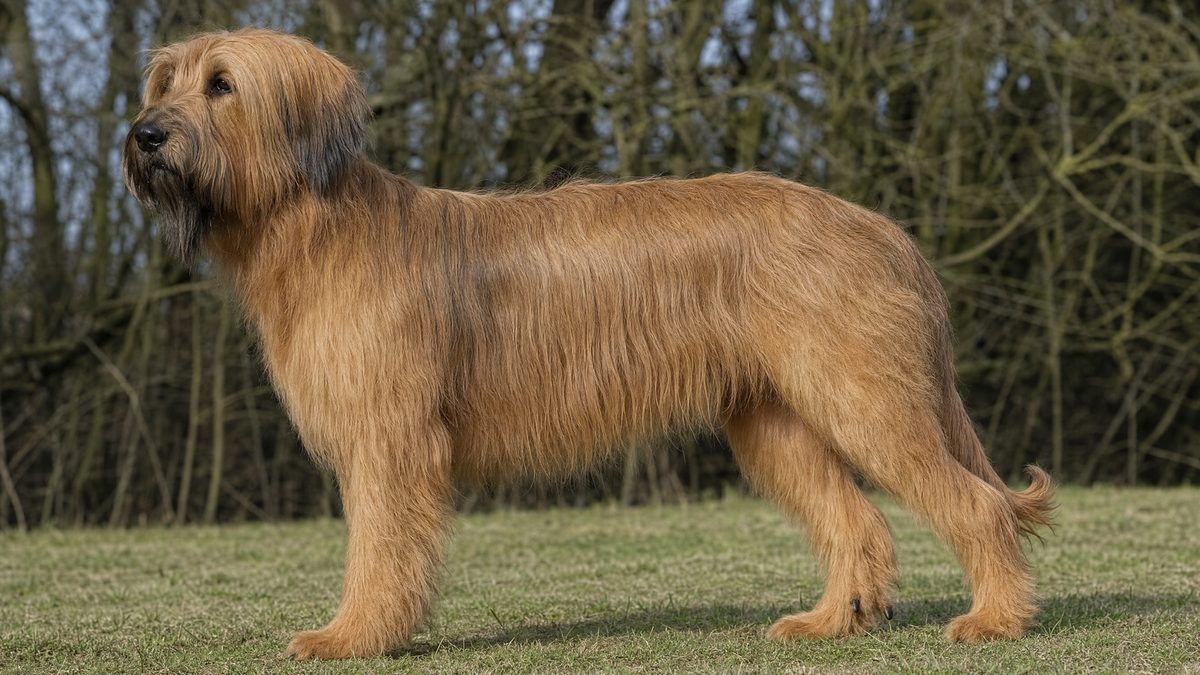
The Briard is a large French herding dog carrying a dry, goat-textured coat at least 7 cm long, a beard and moustache, eyebrows that fall over the eyes, and two dewclaws on each hind leg without which it cannot be shown. FCI-Standard No. 113 calls it the Berger de Brie and files it in Group 1, Section 1, Sheepdogs, with a working trial.
France is the country of origin and French is the official authentic language of the standard, so the French text governs wherever a translation differs. The FCI accepted the breed on a definitive basis on 14 December 1954, and the standard in force was published on 4 November 2008. The name is older than either date. The standard's own history note records that the breed was long called *Chiens de Berger francais de Plaine*, the French lowlands sheepdog, and that the name chien de Brie appeared for the first time in 1809, in the Abbot Rozier's Complete Agricultural Course.
FCI-113 opens its physical description in six words: The Briard is hardy, supple, muscled and well proportioned; lively and alert. The Royal Kennel Club compresses the same idea into Rugged appearance; supple, muscular and well-proportioned. Hardy and muscular are the two words to hold, because they describe a working animal rather than a coat on legs. It was bred for herd-driving and guarding, and the French army used it in both world wars as a sentinel and as an ambulance dog searching for the wounded on battlefields. That history matters more than it usually does, because it explains a temperament built to make decisions alone.
The measurements, from the registries rather than from a listing site
| Source | Male height | Female height | Weight |
|---|---|---|---|
| FCI-Standard No. 113 | 62 to 68 cm | 56 to 64 cm | Not specified |
| AKC breed standard | 23 to 27 in, 58 to 69 cm | 22 to 25.5 in, 56 to 65 cm | Not specified |
| AKC breed page | 23 to 27 in | 22 to 25.5 in | 55 to 100 lb, 25 to 45 kg |
| Royal Kennel Club | 61 to 69 cm | 58 to 65 cm | Not specified |
| Purina India | 39 to 46 cm | 35.5 to 42 cm | 11 to 16 kg |
Purina India's Briard page, which ranks fourth in India for this query, states the height as 39 to 46 centimetres and the weight as 11 to 16 kilograms. No kennel club in the world describes a Briard that size. The FCI floor for a male is 62 cm and the AKC gives 55 to 100 pounds American Kennel Club, Briard breed page. A 39 cm, 13 kg dog is roughly Shetland Sheepdog size. The same page calls the breed a large dog three lines above the number. Bonbeno raises this because an Indian buyer reading it would budget for the wrong animal, order the wrong food and buy the wrong crate.
What you are looking at
The head is long, set at two fifths of the height at the withers, with the skull and muzzle of equal length and a pronounced stop midway between the occiput and the nose. It is covered with hair forming beard, moustache and eyebrows slightly veiling the eyes, which is the single detail that makes the breed unmistakable. The AKC adds a useful visual rule: seen from above, from the front or in profile, the fully-coated silhouette reads as two rectangular forms, equal in length but differing in height and width.
The chest is wide and long and well let down to the elbows with well sprung ribs. The AKC calls the ribcage egg-shaped and says the breastbone descends smoothly to the level of the elbows. Hold that detail, because it is the anatomy people use to assert a bloat risk, and later on this page that assertion gets tested against the actual cohort studies rather than repeated.
The tail is natural and undocked, carried low, reaching at least the hock and finishing in a slight hook shaped like a printed J. The AKC disqualifies a tail that is non-existent or cut. That is convenient in India, where docking is prohibited anyway.
Colour, and the one that does not exist
Permitted colours are black, fawn, fawn with slight to medium black overlay often with a mask, grey and blue. All colours may show different degrees of greying. White, brown and mahogany are disqualifying, as is a coat of two distinct colours, a white blaze, or white hairs on the extremities of the limbs. The AKC permits one narrow exception, white hairs scattered through the coat and a chest spot up to one inch in diameter at the root of the hair, and disqualifies anything larger.
A seller in India offering a white Briard, a brown Briard, or a two-colour Briard is offering something the breed standard excludes from the ring. That is worth knowing before money moves, and it is the kind of check this guide exists to make possible.
The double dewclaw rule, read from the standards themselves
FCI-Standard No. 113 disqualifies a Briard that does not carry double dewclaws on both hind legs. The clause that describes them is affectionate and traditional. The clause that enforces them is not, and it is the second one that decides what happens in a ring.
The standard says the same thing twice, in two registers. Under Hindquarters it reads Dewclaws: By tradition, the shepherds want to keep the double dewclaws. The dewclaws form thumbs, well separated and with nails, relatively close to the foot. That sentence describes a custom. Further down, under the heading DYSQUALIFYING FAULTS, the same feature returns as Single dewclaw or total absence of dewclaws on hindlegs. A custom you are excluded for losing is a rule.
French is the authentic language of this standard, so the French text governs where the two differ. The French runs Ergots : Par tradition, les bergers ont tenu a conserver le double ergot. Les ergots forment des pouces bien separes avec ongles, assez pres du pied, and the disqualifying fault reads Ergot simple ou absence totale d'ergots aux membres posterieurs. Two separate conditions disqualify. A single dewclaw disqualifies. Total absence disqualifies. There is no partial credit and no discretion.
Three registries, one answer, three different ways of saying it
| Registry | How it describes them | What happens without them |
|---|---|---|
| FCI-Standard No. 113, published 2008 | By tradition, the shepherds want to keep the double dewclaws, forming thumbs, well separated and with nails | Disqualifying fault: single dewclaw or total absence of dewclaws on hindlegs |
| AKC breed standard, approved 1975 | Two dewclaws are required on each rear leg, placed low on the leg, giving a wide base to the foot | Disqualification: anything less than two dewclaws on each rear leg |
| Royal Kennel Club, updated 1 August 2025 | Double dewclaws set low on hindlegs of utmost importance | A feature described as unacceptable must not be rewarded in the show ring |
The American wording is the most precise of the three and the most useful to quote at a seller. Anything less than two dewclaws on each rear leg is a disqualification. That phrasing reaches the dog with doubles on one leg and a single on the other, which the FCI text arguably handles less cleanly. The AKC also settles a question owners actually ask, and settles it generously: Occasionally the nail may break off completely. The dog shall not be penalized for the missing nail so long as the digit itself is present. A lost nail is not a lost dewclaw.
What a double dewclaw is, and what nobody has shown it does
A dewclaw is the first digit, the thumb equivalent, sitting higher on the leg than the four weight-bearing toes. Most dogs have them in front and many have nothing behind. This breed's standard requires two on each hind leg and specifies that they form thumbs, well separated and with nails rather than sitting as one fused lump. The AKC goes further and states the ideal: Ideally the dewclaws form additional functioning toes.
Whether they function is a separate question from whether the standard wants them, and the honest answer is that nobody has demonstrated it. Purina India asserts that they have double dew claws which helps them balance, even on the most uneven of terrains, and cites nothing. Bonbeno searched for peer-reviewed work on hind dewclaw function in this breed and found none, so it reports the claim as an unevidenced tradition rather than adopting or contradicting it.
One asymmetry is worth naming. The AKC standard permits front dewclaws to be removed, saying dewclaws on the forelegs may or may not be removed, while requiring two behind. FCI-113 says nothing at all about front dewclaws. So the front pair is optional under one standard and unmentioned by the other, while the hind pairs are compulsory under both. Indian law, as the next section shows, takes a flatter view than either.
A hind dewclaw never touches the ground, so its nail never wears down. It keeps growing and it curls. A long-standing Briard grooming guide is blunt about the consequence: dewclaws will grow in a circle, and if they are not kept trimmed they will catch on a branch or a vine and can be ripped right out. That is four extra nails on the hind legs, on top of the ordinary ones, and they are the four Indian owners most reliably forget. Put them on the same monthly reminder as the rest.
Indian law protects the exact feature the standard demands
An Indian Briard owner faces no conflict over the hind dewclaws, because the Prevention of Cruelty to Animals (Dog Breeding and Marketing) Rules, 2017 forbid removing them and FCI-Standard No. 113 disqualifies a dog that has lost them. This is the reverse of the usual situation, and it deserves stating precisely rather than dramatically.
The instrument is G.S.R. 496(E), notified by the Ministry of Environment, Forest and Climate Change on 23 May 2017 under section 38 of the Prevention of Cruelty to Animals Act, 1960. Bonbeno downloaded the gazette PDF, extracted its text layer and searched the extraction rather than reading anyone's summary of it, because summaries of this particular document have a documented habit of inventing tidy rule numbers.
The clause sits in the Second Schedule, headed [See rules 5(2) and 6], in Part II, General requirements to be adhered to by breeders, inside paragraph 6, Common breeding techniques, at sub-paragraph (8). It reads, in full and verbatim:
There shall be no tail docking, ear cropping de-barking, de-clawing, branding, dyeing, injecting substances to enhance visual appeal, performing a surgery or procedure to camouflage or hide any defect or infirmity or any other kind of mutilation of any body part of the pup and any change of appearance by artificial means is strictly forbidden.
De-clawing is named in that list. In a dog, the routine procedure that phrase reaches is removal of the dewclaws, done on newborn puppies as a matter of habit in some countries. Even leaving the word aside, the same sentence forbids any other kind of mutilation of any body part of the pup and any change of appearance by artificial means. Amputating a digit the breed standard requires is a change of appearance by artificial means on any reading. The clause therefore catches the procedure twice.
Who the clause binds, and who it does not
State the scope accurately, because overstating it helps nobody. Paragraph 6(8) sits in the part of the Second Schedule addressed to breeders and speaks of the pup. Rule 6 provides that every breeder shall comply with the standards and requirements set out in the Second Schedule, and rule 5(2) makes compliance a condition of renewing a breeder's registration. So it binds registered breeders. It is not, on its face, a general prohibition addressed to every dog owner in India, and this page does not claim that it is.
The effect for a buyer is still clear. A registered breeder in India cannot lawfully hand you a Briard pup whose hind dewclaws were removed for looks, because that removal is precisely what paragraph 6(8) forbids. You would not want the dog either, since the same removal is a disqualifying fault under FCI-Standard No. 113, a disqualification under the AKC standard, and unacceptable under the Royal Kennel Club's. Law and standard point the same way, which is unusual enough to notice. This site reached the identical conclusion for the Beauceron, the other French herder whose standard makes double hind dewclaws compulsory.
Removal for a genuine veterinary reason is a different thing entirely
Do not read paragraph 6(8) as forbidding treatment. The clause targets cosmetic and concealing procedures, and says so in its own words, naming branding, dyeing, injecting substances to enhance visual appeal, and surgery to camouflage or hide any defect or infirmity. A registered veterinarian amputating a dewclaw that has been torn off, has gone septic, or carries a growth is treating a medical problem, not enhancing appearance. Nothing here should be used to argue against necessary surgery, and the decision belongs to the vet with the dog in front of them.
Two consequences follow. A dog treated that way has still lost a feature the standard requires, so it can no longer be shown under FCI rules whatever the reason. And keep the paperwork, because a dated veterinary record explaining why a dewclaw came off is the only thing separating treatment from the procedure the Rules forbid.
The ears are the clause that does bite
FCI-113 still contemplates cropping. Its ear clause reads If cropped, in countries where this practice is not forbidden, they should be carried erect. India is a country where the practice is forbidden, since ear cropping is named in the same paragraph 6(8). Purina's own breed page notes that cropping was traditional for this breed and calls the practice inhumane, wholly unnecessary and extremely painful for the dog.
The standard also makes naturally erect ears a disqualifying fault, listing ears covered with short hair, naturally erect among the exclusions. So a Briard in India should have flat, natural, long-haired ears that stand off the cheeks. Ears standing bolt upright are wrong whether surgery caused it or genetics did, and if surgery caused it the dog was cropped in a country where that is prohibited.
The 7 cm goat coat, and the one thing the standards disagree about
FCI-Standard No. 113 makes a coat shorter than 7 cm on the body a severe fault, and describes the hair as goat-like in texture, dry, supple and long. That single sentence sets the grooming load, the heat problem and the buying check, so it is worth reading exactly rather than paraphrased.
The FCI coat clause has two halves. Under COAT it reads Hair: Goat-like texture, dry, supple, long, with slight undercoat. Under SEVERE FAULTS it reads Coat: insufficient length (less than 7cm), hair soft or woolly. The authentic French is Flexueux, long, sec (genre poil de chevre) avec un leger sous-poil, and the fault is poil de longueur insuffisante (moins de 7 cm), poil mou ou laineux. So three qualities are demanded at once. It must be long, at 7 cm or more. It must be dry. It must not be soft or woolly.
The Royal Kennel Club gives the same floor in both units, Long, not less than 7 cms (2 3/4 ins) on body. Slightly wavy and very dry. The AKC describes texture rather than a minimum: The outer coat is coarse, hard and dry (making a dry rasping sound between the fingers). It lies down flat, falling naturally in long, slightly waving locks, and adds that on the shoulders the length of the hair is generally six inches or more, which is about 15 cm.
Where the three standards genuinely disagree
| Standard | Wording on the undercoat | What that implies |
|---|---|---|
| FCI-113, English | long, with slight undercoat | A thin second layer |
| FCI-113, authentic French | avec un leger sous-poil | Same, and this is the governing text |
| Royal Kennel Club | A fine dense undercoat required all over body | A thick second layer, and required |
| AKC | The undercoat is fine and tight on all the body | Fine, but close-packed everywhere |
Read those four rows together and the disagreement is real. The authentic French text asks for a light undercoat. The British standard requires a dense one, everywhere. Bonbeno does not resolve this, because the two registries genuinely differ and the FCI text governs only under FCI rules. What it does do is refuse to average them, and it flags the consequence later: the density of the undercoat is the single variable that decides how badly this dog suffers in Chennai, and the standard a given dog was bred to therefore matters in India in a way it does not matter in Europe.
Why goat-textured and dry is the useful phrase
A dry, harsh outer coat behaves differently from a soft one, and the difference is practical rather than aesthetic. A long-standing Briard grooming guide puts it in terms an owner can act on: A good, harsh coat can be cleaned by brushing, and will need bathing less often. A soft coat will collect dirt and oils, and need bathing more often. And more bathing makes the coat still softer. That is a feedback loop, and in a humid Indian city it runs in the wrong direction, because the instinct when a big hairy dog smells is to wash it again.
The same guide gives the buying instruction that follows: Look for a shampoo that does not say 'soft' or 'silky'. I use a crisp coat or harsh coat shampoo, to maintain texture. Hold that sentence. It is the single point where an ordinary Indian grooming purchase works against this breed's standard, and the grooming sections below return to it with the Indian salon menus in hand.
The beard, the moustache and the eyebrows are required, not decorative
FCI-113 puts them in the head clause, not the coat clause: the head is covered with hair forming beard, moustache and eyebrows slightly veiling the eyes. The Royal Kennel Club repeats it, Head carries hair forming a moustache, beard and eyebrows, lightly veiling eyes. The AKC adds a limit that owners in hot countries should know about: The hair is never so abundant that it masks the form of the head or completely covers the eyes, and the eyebrows arch up and out in a curve that lightly veils the eyes rather than lying flat over them.
So the correct Briard eyebrow veils the eye; it does not blind it. A grooming guide written by people who show the breed says trimming the hair between the eyes can help them see, and their eyes be seen, and notes that puppies in particular grow hair straight over the eyes. Trimming there is normal and does not offend the standard.
Measure the body coat. Under 7 cm is a severe fault under both the FCI and Royal Kennel Club standards The Royal Kennel Club. Then feel it. It should be dry and slightly rasping between the fingers, not soft and not woolly, because soft or woolly is a severe fault in its own right. A soft, short, silky-coated puppy sold to you as a Briard is either not one, or one the standard would penalise twice.
Briard price in India, checked page by page
No verified Briard price in India exists, because Bonbeno could not find a single actual Briard offered for sale anywhere in the country. Two Indian pages publish a rupee band. Neither of them has a dog attached to it, and the page ranking first prints, in its own words, Showing 0 results.
That is the finding, and it is more useful than a number would have been. What follows is every ranking page opened one at a time, with what each actually contains.
Position 1, and the seven Chihuahuas
Asia Pets holds the top spot in India for this query with a page titled Briard Puppies for Sale in Maharashtra. Its prose is confident: Every Briard puppy you see here is from a breeder we've personally checked out, and every single dog you see, Briards included, is available right now, from a real breeder, at their actual asking price.
The listing area of that same page reads Showing 0 results. Beneath it sits a block headed Here are available pets of the same breed from other locations, and the animals under that heading are a Chihuahua in Ahmednagar, a Chihuahua in Akola, a Chihuahua in Amravati, a Chihuahua in Nashik, a Chihuahua in Navi Mumbai, a Chihuahua in Parbhani and a Chihuahua in Pune. Seven Chihuahuas, described as the same breed as a Briard. A Chihuahua weighs under 3 kg. FCI-113 puts a male Briard at 62 to 68 cm at the withers.
The same site's breed page quotes Rs 50,000 to Rs 1,00,000 in India, gives the weight as 25 to 40 kg and the height as 56 to 69 cm, and attaches no source to the price and no dog to the listing. The height is right. The price has nothing behind it.
Position 2, and the price that belongs to a Maltipoo
Puppiezo ranks second with Briard Puppies For Sale in India At Best Prices, and its meta description promises KCI registered, vaccinated, and delivered pan-India. The page lists no Briard. What it lists, in a carousel headed Other Available Pets, is eight animals of seven other breeds.
| Name | Breed | Age | Price |
|---|---|---|---|
| Fizey | Maltipoo | 8 weeks | Rs 98,999 |
| Kuzo | Poodle | 8 weeks | Rs 92,599 |
| Dugu | Poodle | 8 weeks | Rs 92,599 |
| Kazuka | Cane Corso | 8 weeks | Rs 94,999 |
| Doir | Goldendoodle | 8 weeks | Rs 1,20,000 |
| Samy | Maltipoo | 8 weeks | Rs 98,999 |
| Tugi | Rottweiler | 8 weeks | Rs 76,499 |
| Yoki | Doxiepoo | 8 weeks | Rs 98,999 |
Rs 98,999 appears three times on that one page, attached to two Maltipoos and a Doxiepoo. Bonbeno has now recorded that identical figure on more than ten pages of this retailer, always beside whichever puppy is in stock, on breeds the site does not carry at all. It is a house price point, not a Briard price, and no honest guide should report it as one. The same two Maltipoos, Fizey and Samy, and the same Doxiepoo, Yoki, keep reappearing.
One further detail on that page is worth an Indian buyer's attention. Every animal in the carousel is listed at 8 weeks. Rule 8(1)(a) of the 2017 Rules provides that pups less than eight weeks in age are not sold. Eight weeks is the legal floor, not a quality claim.
Positions 5, 9 and 10 are quoting other countries
Dogbreedslist ranks fifth in India and gives Average $1500 - $3000 USD, stating outright that the Briard puppy price in the U.S. is anywhere between $1,500 and $3,000. It is not pretending to be an Indian figure; Google is simply serving it to Indian searchers. Its entire reference section is a single YouTube video. Pets4homes at position 9 quotes 800 to 1,500 pounds for a Kennel Club registered puppy in the United Kingdom, and The Spruce Pets at position 10 quotes 1,000 to 1,500 dollars rising to 3,000.
Searching briard price in india on Bing with the region set to India returns Today Silver Price in India at position 3 and Kidney Rate Today, Kidney Market Price in India at position 10. Its People also ask box asks how to find the best price in India, how PriceQ compares prices, and what the kidney price in Dhanbad is. Not one question mentions a dog. The only place the word Briard appears in those top results is an Amazon.in dog-food SKU, B-Paiva Chicken Flavour Dry Dog Food, Briard-1kg, which is sold as suitable for all breeds. In India, Briard is currently more available as a bag of kibble than as a dog.
Running the currency test on every rupee figure
Indian pages routinely publish a dollar price with an exchange rate applied and call it an Indian price. Bonbeno divides every suspicious rupee figure by two known rates, 84.38 and 74, and prints the arithmetic so a reader can check it in a calculator. On this breed the test comes back negative, and the negative result is itself informative.
The method is simple. A converted list gives round dollar amounts when you divide it. A rupee-native list gives nothing recognisable. Both rates have been caught in use on Indian pet pages, so both get run.
| Published figure | Where it appears | Divided by 84.38 | Divided by 74 | Verdict |
|---|---|---|---|---|
| Rs 50,000 | Asia Pets lower bound | $592.56 | $675.68 | Neither is round |
| Rs 1,00,000 | Asia Pets upper bound | $1,185.11 | $1,351.35 | Neither is round |
| Rs 98,999 | Puppiezo, three times | $1,173.25 | $1,337.82 | Neither is round |
| Rs 92,599 | Puppiezo, twice | $1,097.40 | $1,251.34 | Neither is round |
| Rs 94,999 | Puppiezo, Cane Corso | $1,125.85 | $1,283.77 | Neither is round |
| Rs 76,499 | Puppiezo, Rottweiler | $906.60 | $1,033.77 | Neither is round |
| Rs 1,20,000 | Puppiezo, Goldendoodle | $1,422.14 | $1,621.62 | Neither is round |
Not one figure resolves. So neither Indian page is a converted American price list, which is the pattern this site has caught repeatedly on other breeds. Something else is going on, and the shape of the numbers gives it away.
What a rupee-native charm price looks like
Look at the endings. Rs 98,999, Rs 92,599, Rs 94,999, Rs 76,499. Every one is a charm price built to sit just under a round rupee threshold, and charm prices are written by a human in the currency they are selling in. Rs 98,999 divides to 1,173.25 dollars at 84.38 and 1,337.82 at 74, which is not a number any American breeder ever quoted. It is a rupee-native price ladder, applied to whatever puppy the retailer has in stock, and it moves from a Maltipoo to a Doxiepoo without changing.
The Asia Pets band behaves differently again. Rs 50,000 and Rs 1,00,000 are not charm prices, they are round bracket ends, the kind of number a content writer picks to fill a template field. They divide to nothing, and no dog on the site carries them Asia Pets, Briard Puppies for Sale….
The direction of the error, which is the useful part
Run the conversion the other way and the Indian bands stop making sense on their own terms. Dogbreedslist puts the American price at 1,500 to 3,000 dollars. Convert that at the two rates and you get the comparison below.
| Figure | At 84.38 | At 74 |
|---|---|---|
| $1,500, US floor | Rs 1,26,570 | Rs 1,11,000 |
| $3,000, US ceiling | Rs 2,53,140 | Rs 2,22,000 |
| Asia Pets floor, Rs 50,000 | $592.56 | $675.68 |
| Asia Pets ceiling, Rs 1,00,000 | $1,185.11 | $1,351.35 |
The Asia Pets band tops out below the American floor. An Indian page is quoting a maximum of about 1,185 dollars for a breed whose cheapest published American puppy is 1,500 dollars, in a country with no breeding population, no lawful commercial import route and, on that same site, no dog. Prices fall when supply is abundant. Supply here is zero.
Rs 98,999 is not a Briard price. Bonbeno has now caught this exact figure on more than ten pages of one Indian retailer, three times on the Briard page alone, attached to breeds the site does not stock, including this one. It does not divide cleanly by any conversion rate, so it is not even a mistranslated dollar figure. It is a rupee-native charm price that follows whichever puppy is available. If you see it quoted anywhere as the price of a Briard, you are reading a page that copied a carousel.
None of this means an Indian seller is lying about a dog they have. It means Bonbeno could not find a dog. The next section explains why that is the expected outcome rather than a gap in the research, and it does so from the import rules rather than from an empty search result.
Why no lawful Indian supply chain can form
India classifies dogs as a Restricted import and requires that any application to import them for trading or breeding be rejected. That single rule, read directly from the trade notice rather than from a summary, explains the empty listing pages better than any market analysis could.
DGFT Trade Notice No. 22/2022-23, dated 19 December 2022, sets out the position. Bonbeno downloaded the notice and extracted its text rather than relying on a description of it, because this document is short, machine-readable and frequently paraphrased wrongly.
Under ITC (HS) 01061900, mammals other than those separately listed carry an import policy of Restricted, subject to Policy Condition 6 of the chapter. Policy Condition (7) then narrows it further: Import of dogs is allowed only for the following specific purposes, being a pet dog with valid pet book and relevant records/documents in the name of importer, dogs imported by R&D organisations with the recommendation of CPCSEA, and dogs for the internal security by the Defence and Police Force. Policy Condition (8) closes the door: Import of commercial dogs for breeding or any other commercial activities other than the purposes mentioned above is not permitted.
Paragraph 6 of the same notice states it again as an instruction to officials: any applications for trading/breeding purposes, or applications made on behalf of some another person/entity shall be duly rejected.
The one lawful route, and what it costs in effort
| Route | Who qualifies | Authorisation needed |
|---|---|---|
| Transfer of residence, up to two pets | A person moving to India after two years or more of continuous stay abroad, importing as passenger baggage | None from DGFT. Only cats and dogs qualify under the baggage rules |
| Transfer of residence, under two years abroad | Same person, shorter stay, or the pet not travelling as baggage | Import authorisation from DGFT required |
| More than two pets | Anyone | Import authorisation from DGFT, with applications examined by DAH&D |
| Temporary import | Anyone, for a limited stay | Import authorisation from DGFT, plus a local host undertaking |
| Research | R&D organisations | Recommendation of CPCSEA |
| Defence and Police | The forces themselves | Permitted under Policy Condition 7 |
| Breeding or trading | Nobody | Applications shall be duly rejected |
Entry is also confined geographically. Import of pet animals is allowed only through airports and seaports of Delhi, Mumbai, Chennai, Hyderabad, Bengaluru and Kolkata and, since October 2024, Kochi airport, with quarantine at the government station of those ports where required. An advance No Objection Certificate from the Regional or Quarantine Officer must be obtained seven days before travel, relaxable to three days, and the notice advises owners to start the application at least 2 months in advance. The full route is set out in how to import a dog to India.
What that means arithmetically
A breeding population needs unrelated founders. Under these rules the only Briards that can enter India are individual pets accompanying their own owners, who must already have owned them abroad, plus a handful for research or state security. There is no mechanism by which a kennel can lawfully import a stud and a bitch to found a line. Second Schedule Part II paragraph 6(3) of the 2017 Rules then bars the shortcut, prohibiting in-breeding within four generations and prohibiting incest breeding between parents and children or brother and sister outright, permitting only out breeding and line breeding. A tiny founder base cannot legally be bred out of.
Put those two instruments together and the empty listing pages stop looking like a search failure. They look like the predictable output of a legal regime. Bonbeno reports this from the two documents rather than from an absence of search results, because an absence of search results proves nothing on its own.
What you are actually being offered instead
Three patterns account for everything Bonbeno found. The first is substitution, where the page ranking first offers seven Chihuahuas under a heading calling them the same breed. The second is a carousel, where the page ranking second shows two Maltipoos, two Poodles, a Cane Corso, a Goldendoodle, a Rottweiler and a Doxiepoo on a page titled Briard Puppies For Sale. The third is an auto-generated shell, and the clearest example is a Kolkata grooming service whose site carries a dedicated Briard page purely because it carries a dedicated page for every breed in the nomenclature, including the Bergamasco Shepherd, the Komondor, the Braque du Puy and the Kumaon Mastiff.
It is not impossible for a genuine Briard to be in India. A returning family bringing their own dog home under the transfer-of-residence route is exactly what Policy Condition 7 contemplates. What such a dog will have is a pet book in the owner's name, an AQCS No Objection Certificate, a health certificate from the exporting country's veterinarian, and an entry stamp at one of seven ports. Ask to see those. A seller with a litter and no import trail has a supply chain that the rules do not permit to exist.
What a dog this size and this coat costs to keep in India
No India-wide monthly figure exists for this breed, because no Indian population exists to survey. What can be done honestly is to take published Indian cost structures for a large, long-coated dog and correct the two lines this breed changes. Bonbeno does that below rather than inventing a total.
The cost of ownership for this breed splits into three parts, and only one of them is unusual. Start with size, because size drives most of it. The AKC puts an adult at 55 to 100 pounds, which is 25 to 45 kg. Asia Pets, which at least gets the dimensions right, says 25 to 40 kg. So this is a large dog by every Indian grooming and food schedule, and a giant one at the top of its range.
Grooming, priced from published Indian menus
An Indian grooming cost guide published in 2026 gives a full groom at Rs 1,500 to Rs 3,000 for large breeds such as the Labrador, German Shepherd and Golden Retriever, and Rs 2,000 to Rs 4,000 and above for giants such as the Great Dane and Saint Bernard. It also warns, correctly for this coat, that a double-coated dog, a badly matted coat, or a nervous dog that needs extra handling time will push the price higher.
| Service | Published Indian cost |
|---|---|
| Basic bath and blow-dry | Rs 500 to Rs 1,250 |
| Full groom, large breed | Rs 1,500 to Rs 3,000 |
| Full groom, large breed in Bengaluru | Rs 3,000 onward |
| Full groom, Gurugram premium salon | Rs 1,850 to Rs 2,200 |
| Nail trimming | Rs 200 to Rs 300 |
| Ear cleaning | Rs 250 to Rs 400 |
| De-shedding treatment, add-on | Rs 200 to Rs 500 |
| Medicated or anti-tick bath | Rs 1,000 to Rs 1,500 |
| Home visit surcharge | Rs 200 to Rs 500 extra |
That table has an important omission and the same source names it: heavy matting attracts a de-matting fee, and matting is what makes grooms expensive and slow. On a coat with a 7 cm minimum length, matting is the default state of an unbrushed dog. Tier-2 cities run roughly 20 to 30 percent below metro rates for the same service.
The line that inverts, and the line nobody budgets
Indian grooming schedules assume you are paying a salon to cut hair. This breed does not need cutting. Dogbreedslist rates its grooming needs 5 out of 5 and calls it High Maintenance, then adds the sentence that changes the budget: No trimming or stripping needed. So the recurring salon haircut line, Rs 800 to Rs 1,600 elsewhere, largely disappears.
It is replaced by your own time and a one-off tool spend. A Briard grooming guide written by people who show the breed recommends a grooming table, noting that a 42 inch length works well for most Briards and that tables can range from $100 to $250 for a basic table. It names a preferred pin brush at around 50 dollars while adding that if you are just grooming one Briard, a lesser quality brush will do, with a pin length of 20 to 27 mm. A coarse comb and a greyhound comb complete the kit. None of that is a recurring cost, and all of it is cheaper than one year of de-matting fees.
The two Indian lines that do rise
Food scales with body mass, and a 25 to 45 kg dog on a large-breed diet is the top bracket of any Indian feeding schedule. Purina India's guidance is that large breeds like the Briard dog, as well as having large appetites, benefit from a different balance of nutrients including minerals and vitamins compared to smaller-breed dogs.
Parasite control is the second, and India makes it non-optional. A 2024 molecular survey of 719 dogs in Punjab found tick-borne haemoparasites at real rates by multiplex PCR: *Babesia gibsoni* in 8.9 percent, *Hepatozoon canis* in 5.1 percent, *Ehrlichia canis* in 2.6 percent and *Babesia vogeli* in 1.1 percent, with concurrent infections on top. Microscopy alone found far less, at 5.0, 1.0, 1.4 and 0.1 percent respectively, so the cheap test under-reports. A 7 cm coat is an excellent place for a tick to sit unnoticed, which makes the monthly preventive a fixed cost rather than a seasonal one.
Bonbeno will not publish a single monthly rupee figure for this breed, because doing so would mean inventing one. What it will say is where the money goes differently from a Labrador of the same weight. Food is the same. Veterinary care is the same. Tick prevention is the same or higher because of the coat. Salon haircuts are lower, because the breed is not cut. Your own time is much higher, and it is the line that decides whether the dog is comfortable. Anyone quoting you a precise all-in monthly Briard figure for India is quoting a template.
Heat tolerance, argued from the standard rather than asserted
Bonbeno rates the Briard 2 out of 5 for heat tolerance in India, and the rating is built from three things the breed standard itself specifies: a coat that must be at least 7 cm long, a body mass of 25 to 45 kg, and a muzzle that is long, square and never pointed. The first two work against the dog and the third works for it.
Most breed pages assert a heat verdict and cite nothing. This one derives it, so a reader can disagree with the reasoning rather than just with the number.
Argument one, the coat is a floor, not a preference
FCI-113 makes hair of insufficient length (less than 7cm) a severe fault. The Royal Kennel Club sets the same floor, not less than 7 cms on the body. The AKC says the shoulder coat runs to six inches or more, about 15 cm. So this is not a coat an Indian owner can breed shorter or trim away without leaving the breed. Seven centimetres is the minimum a correct Briard carries in May in Chennai.
The insulating layer beneath it is where the three registries part company, and the difference is decisive for India. The authentic French text asks only for un leger sous-poil, a light undercoat. The Royal Kennel Club requires a fine dense undercoat all over body. The AKC calls it fine and tight on all the body. A dog bred to the British interpretation carries substantially more insulation than one bred to the French, and in an Indian summer that is not a cosmetic distinction.
Argument two, mass works against a big dog
Heat is produced roughly in proportion to body mass and shed roughly in proportion to surface area, so a larger animal has less skin per kilogram to lose it through. At 25 to 45 kg the Briard sits at the wrong end of that ratio. The consequence is not theoretical. In a retrospective series of 126 client-owned dogs diagnosed with heatstroke, the overall mortality rate was 53 percent. That study was conducted at a veterinary teaching hospital in Israel, not in India, so it describes the severity of the condition rather than any Indian incidence, and this page does not pretend otherwise.
Argument three, the muzzle is the mitigating factor
Dogs cool mainly by panting, and panting works better with a long nasal passage. FCI-113 requires a muzzle that is strong, sufficiently broad and never pointed, of the same length as the skull, with the head running to two fifths of the height at the withers. The large UK longevity study classifies the breed as mesocephalic. That matters, because in the same dataset flat-faced dogs had a median lifespan of 11.2 years against the all-dog median of 12.5. A Briard's cooling apparatus is intact. It is the insulation over it that is the problem.
That is why the rating is 2 rather than 1. This dog is not a Bulldog struggling to move air. It is a well-ventilated engine wearing a 7 cm blanket it is not allowed to take off.
What the standard does not settle
Two honest gaps. First, nobody has measured thermoregulation in this breed specifically; Bonbeno searched PubMed for Briard together with heat, hyperthermia and thermoregulation terms and found no study of the kind. Second, the beard and moustache the standard requires sit directly around the mouth, and whether a wet beard helps evaporative cooling or simply stays wet in humid air is not something any source Bonbeno read has tested. It is left open rather than guessed at.
Do not shave a Briard for the Indian summer. The coat is a barrier in both directions, slowing solar gain reaching skin that has never been exposed, and the standard treats its absence as a severe fault. A Briard grooming guide notes that owners do sometimes clip the breed short and that senior dogs often prefer it, but adds a timing rule worth transplanting: if you are going to shave, do it a few weeks before cold weather arrives. In India that means the cool season, not April. If the dog is genuinely struggling in heat, the answer is a thinned undercoat, shade, moving air and a changed walk schedule, not a clipper in May.
The Brie plain against nine Indian cities, on one dataset
The hottest month on the Brie plain averages 19.14 C, which is cooler than the coldest month in seven of the nine Indian cities Bonbeno checked. That is the whole climate argument in one sentence, and the figures below come from a single dataset queried by explicit latitude and longitude so that no city can be served by mistake.
Method first, because on this site the method is the point. Every figure comes from NASA POWER climatology for 2001 to 2020, requested as T2M, T2M_MAX and RH2M and queried by coordinates rather than by place name. Bonbeno does not use slug-based climate pages for this comparison, because a slug can silently return a different city and the origin-climate figure is the most original claim a breed page makes.
The breed's home is the Brie, the agricultural plain east of Paris in Seine-et-Marne that gave the dog its name in 1809. The reference point used is Coulommiers at 48.8117 N, 3.0836 E.
| Place | Annual mean C | Hottest month | Coldest month C |
|---|---|---|---|
| Brie plain, 48.8117 N 3.0836 E | 10.61 | July, 19.14 C | January, 2.55 |
| Bengaluru | 23.74 | April, 28.37 C | December, 20.22 |
| Pune | 23.86 | April, 28.93 C | December, 19.62 |
| Delhi | 25.60 | June, 35.88 C | January, 13.61 |
| Kolkata | 25.81 | May, 31.53 C | January, 17.31 |
| Hyderabad | 26.10 | May, 33.30 C | December, 20.76 |
| Mumbai | 26.77 | May, 31.19 C | January, 23.19 |
| Kochi | 27.31 | March, 29.42 C | August, 25.91 |
| Ahmedabad | 27.57 | May, 35.06 C | January, 19.93 |
| Chennai | 27.95 | May, 31.51 C | January, 24.09 |
Read the last column, not the second
The annual means are the obvious comparison and they are the less useful one. Brie averages 10.61 C against Chennai's 27.95 C, a gap of 17.34 degrees, which tells you the dog comes from somewhere cold without telling you what it faces.
The sharper test is whether the breed's hottest month is warmer than an Indian city's coldest. Brie's July averages 19.14 C. Compare that with the coldest month in each city and the answer is that in seven of the nine, being Chennai at 24.09, Mumbai at 23.19, Hyderabad at 20.76, Bengaluru at 20.22, Ahmedabad at 19.93, Pune at 19.62 and Kochi at 25.91, the coolest month of the year is still warmer than the warmest month the breed evolved in NASA POWER climatology, 2001-2020.
Two cities break the pattern, and this page names them rather than hiding them. Delhi's January averages 13.61 C and Kolkata's 17.31 C, both below Brie's July. So a Briard in Delhi genuinely does get a winter, roughly a Brie spring, for a few weeks. It also gets a June averaging 35.88 C, which is 16.7 degrees hotter than anything in its ancestral calendar.
Humidity, and the city that never cools down
Temperature alone understates the problem, because panting is evaporative and evaporation slows as air saturates. Annual mean relative humidity runs 72.4 percent in Chennai and 78.8 percent in Kochi against 82.5 percent on the Brie plain, so on that measure Brie is actually the damper place NASA POWER climatology, 2001-2020. The difference is that Brie is damp at 10 C, where saturated air holds very little water in absolute terms, and Kochi is damp at 27 C, where it holds a great deal.
Kochi is the hardest case on the table for a different reason. Its coldest month, August, averages 25.91 C, and its hottest, March, averages 29.42 C. The annual swing is 3.5 degrees. There is no cool season in which a long, dry, 7 cm coat gets a rest, and no month in which the dog recovers.
First, NASA POWER serves data on a grid rather than at a point, so nearby places fall in the same cell. Coulommiers and Meaux, 25 km apart, returned identical values, which is the grid working as designed rather than an error. Second, the same property makes the dataset unreliable for sharply mountainous locations: a query for Shimla returned an annual mean of 21.15 C, which is far too warm for a hill station at 2,200 m and reflects the lower terrain averaged into the cell. Bonbeno therefore excludes Shimla from the table above rather than publishing a figure it does not believe. The nine cities listed are all lowland and the grid handles them properly.
Temperament, and who should not buy one
The Briard is a loyal, intelligent, protective herding dog that FCI-113 requires to be balanced, neither aggressive nor timid, steady and fearless. It is also a guard dog that barks, dislikes being left, and is described by the pet-food brand with the largest Indian breed library as unsuitable for a first-time owner.
FCI-113 states the temperament requirement in two short sentences: Balanced temperament, neither aggressive nor timid and The Briard should be steady and fearless. It then enforces it, listing Aggressive or overly shy as the first disqualifying fault. Temperament here is not a marketing adjective, it is a ring exclusion.
The AKC standard is warmer and more specific. The breed is a dog of heart, with spirit and initiative, wise and fearless with no trace of timidity, and it possesses an excellent memory and an ardent desire to please his master. It also names the reservation: He retains a high degree of his ancestral instinct to guard home and master. Although he is reserved with strangers, he is loving and loyal to those he knows. Some will display a certain independence.
The honest summary of Purina India's own checklist
Purina India publishes a need-to-know list for the breed, and read as a whole it is a warning rather than an invitation.
- Dog suitable for experienced owners. Stated in those words, first on the list.
- Extra training required. Also stated outright.
- Enjoys walking more than two hours a day. Not a maximum, a preference.
- Requires grooming daily.
- Chatty and vocal dog.
- Guard dog. Barks, alerts and it's physically protective.
- May require training to live with other pets, and may require training to live with kids.
- Some drool, and non hypoallergenic breed.
Seven of those eight lines describe work. That is the accurate picture of the breed and it is on the manufacturer's own page.
One page contradicting itself, and how to resolve it
Purina India's summary line says the breed is suitable for apartment living if sufficiently exercised. Further down the same page it says the opposite: This is a dog better suited to the rural suburbs or a countryside home due to both their size and guarding instincts, and that a large secure garden is a must. Dogbreedslist adds a third view, rating the breed 4 out of 5 for apartment friendliness while noting it will do best with at least an average-sized yard.
The resolution is in the conditional. Both sentences are true, and the clause if sufficiently exercised is carrying all the weight. A vocal, physically protective guard dog of 25 to 45 kg in an Indian flat is possible, and it is possible only for an owner who delivers two hours daily regardless of weather, plus grooming, plus training. Most people who intend that do not sustain it through a Chennai May.
The trait that makes it hard, stated plainly
Purina India's training note names it precisely: Remember they are an independent thinker used to making decisions for themselves, so you need to work hard to get them to listen to you and follow your guidance. That is not stubbornness, it is the job the breed was selected for. A dog driving a flock across the Brie plain had to act without instruction.
Two Indian consequences follow. A dog that makes its own decisions about strangers is a liability at a gate where domestic staff, deliveries and neighbours arrive daily. And a dog that guards the family will guard visiting children from their own parents unless socialised early and deliberately.
A first-time dog owner, on Purina India's own assessment. Anyone who cannot commit two hours a day of exercise plus grooming for twelve to fourteen years. Anyone in a flat with heavy footfall past the door. Anyone in Kochi, Chennai or coastal Kerala, where the coolest month of the year is still warmer than the hottest month the breed comes from NASA POWER climatology, 2001-2020. And anyone buying on the coat alone, which is what most people are actually buying.
Training a dog that was bred to decide for itself
Train a Briard with positive reinforcement, early and deliberate socialisation, and a job it can see the point of. The breed learns fast and remembers everything, which cuts both ways, and the AKC standard names an excellent memory as a breed characteristic rather than a compliment.
Start with what the sources agree on. The AKC standard calls the breed Intelligent, easily trained, faithful, gentle, and obedient, with an excellent memory and an ardent desire to please his master. Dogbreedslist rates trainability 4 out of 5 and intelligence 5 out of 5, placing the breed at rank 30 on its working-intelligence list. Purina India agrees the breed is clever and quick to learn with the right motivation.
Now the qualification, which every experienced source adds. Dogbreedslist: The Briard does require a firm hand when training, however, they will not respond well to anger and could become timid if frequently communicated to in anger. Purina India: positive reinforcement via the use of food, toys and the opportunity to perform inherently reinforcing behaviours such as herding or moving objects will work wonders.
Put those together and the method is settled. This dog is highly trainable by fairness and unreachable by force, and an excellent memory means a single frightening session is remembered for years.
The socialisation window is the part Indian owners underinvest in
Purina India is specific about where to spend the effort: Pay particular attention to early socialisation with people outside the family, as well as other animals and livestock. For a guarding herder in an Indian city, people outside the family means the maid, the cook, the driver, the courier, the meter reader, the neighbour's children and the building watchman. Every one of those is a stranger arriving at the boundary the dog thinks it is guarding.
Dogbreedslist adds the animal half: If you have cats or other pets, or would like to someday, be sure the Briard grows up with them or is exposed to them frequently while he is young. This breed has a strong prey drive. In an Indian neighbourhood that also means community dogs and cattle, which a herding breed will want to move.
Grooming is a training task before it is a grooming task
This is the instruction most likely to save an Indian owner money, and it belongs in the training section rather than the grooming one. Purina India puts it in a single clause: As this breed has a long coat, you should get them used to grooming early as well. A Briard grooming guide expands it into a method: begin long before they NEED grooming, with gentle brushing and lots of rewards, gradually increase the time, and be sure you decide when to stop, not the puppy.
The same guide notes that grooming is far easier with the dog lying down, so teach that early, and play with the toes, because someone has to trim those nails and handling the feet from day one makes it easy. On this breed that means the four hind dewclaw nails as well.
What to give it to do
Purina India frames the breed's motivation well: the Briard doesn't mind what job they are taught to do, as long as they get to do it with you. FCI-113 files the breed with working trial, meaning the FCI expects it to be tested at work rather than only judged standing still. Dogbreedslist notes the breed is ideally suited to defence dog/police dog trials.
Weeks 8 to 16, socialise hard and daily, and start handling the coat and the feet. Months 4 to 6, basic obedience and a settled greeting routine at the gate, because that is where the guarding instinct will first show. Months 6 to 12, add a real job: scent games, retrieve, obedience or agility indoors during the hot months. Year one to two, expect the independent streak to arrive as the dog matures and to test whatever you did not train properly. None of this is optional on a breed rated as needing an experienced owner.
The daily exercise requirement, and the Indian scheduling problem
Plan for a minimum of two hours of physical exercise a day, plus mental work on top, and expect behaviour problems if you fall short. Purina India states the two-hour figure as a floor rather than a target, and in an Indian summer the whole of it has to fit into the two ends of the day.
Purina India is unambiguous: A minimum of two hours physical exercise including free running, training and possibly even swimming is imperative to keep the Briard happy and pleasant to live with, and it adds that you should also add some time for mental exercise in the form of enrichment, problem solving and games. Its need-to-know summary separately lists enjoys walking more than two hours a day.
Dogbreedslist rates exercise needs 5 out of 5 and names the consequence of skimping: The Briard is a working dog and will become restless and can develop behavioral problems if not exercised enough. They need to go on a long daily walk, or run alongside your bicycle. Puppiezo's own spec card, on a page selling a dog it does not have, says 1-2 hours daily and rates energy High, which is the lowest figure Bonbeno found and sits below the manufacturer's stated minimum.
Where sources disagree, this page prints the disagreement rather than averaging it. Two hours is the figure with reasoning attached to it.
Why the requirement is high
The standard explains it. FCI-113 asks for a gait that is regular, supple, harmonious, in a manner which allows the dog to cover ground and accomplish its work with a minimum of effort and fatigue, with a long trot with good reach and good thrust from behind. The AKC is more vivid, describing movement as quicksilver, supple and light, almost like that of a large feline, and noting the dog is above all a trotter, single-tracking with conformation harmoniously balanced and strong to sustain him in the long day's work. This is an animal engineered for distance at a trot. A walk around the block does not touch it.
Fitting two hours into an Indian day
Here the climate figures become a scheduling constraint rather than a curiosity. Chennai's hottest month averages 31.51 C and Delhi's averages 35.88 C NASA POWER climatology, 2001-2020. Midday exercise in either is not a training choice, it is a heatstroke risk, and heatstroke carried 53 percent mortality across 126 hospitalised dogs in the series discussed above.
| Season | Workable window | What fills the rest |
|---|---|---|
| Cool season, roughly November to February | Both ends of the day are usable, and in Delhi January averages 13.61 C, which is close to a Brie spring | Little needed. This is when to do the long distance work |
| Hot season, March to June | Before sunrise and after dark only | Indoor scent work, obedience, food puzzles, stair work, a paddling pool |
| Monsoon | Short windows between rain, on wet ground | Indoor work again, plus a strict dry-the-dog routine afterwards |
| Coastal cities year round | Early morning only. Kochi's coolest month still averages 25.91 C | Most of the requirement has to be met indoors or in water |
Swimming is worth taking seriously here, because Purina India names it as a legitimate part of the two hours and it is the one form of hard exercise that cools the dog instead of heating it. Dogbreedslist also notes the breed enjoys a good swim. The cost is a soaked 7 cm coat, which brings its own drying problem, covered in the grooming sections.
Not a fat dog. A vocal one. Purina India already lists the breed as chatty and vocal and physically protective at baseline, and Dogbreedslist warns it will become restless and can develop behavioral problems without enough work. In an Indian apartment block the first symptom is barking at the corridor, the second is a complaint from the resident welfare association, and the third is a dog rehomed at eighteen months. The two hours are not a wellness suggestion, they are the price of the dog being tolerable to live near.
Grooming a 7 cm goat coat in Indian humidity
Comb a Briard to the skin, weekly at minimum and more often in a moult, and never bathe a matted one. The published time estimates run from one to two hours a week up to daily brushing, and the whole job is line brushing followed by a comb that proves you reached the skin.
Published frequency varies more than it should for a coat this well documented, so Bonbeno prints the range rather than picking a number.
| Source | Brushing | Bathing |
|---|---|---|
| Purina India | Requires grooming daily, to prevent matting | Not specified |
| Royal Kennel Club standard | Not specified; sets the 7 cm coat that creates the work | Not specified |
| Dogbreedslist | Grooming 5 of 5, High Maintenance, but no trimming or stripping needed | Not specified |
| Briard grooming guide | Thorough weekly brush-through, addressing mats at that time | Several baths a year if not being shown |
| Asia Pets | Daily brushing to prevent matting | Not specified |
The gap between daily and weekly is not really a disagreement about the dog. It is a disagreement about how thorough each session is. A dog combed properly to the skin once a week is in better condition than one brushed superficially every day, and the guide written by people who groom the breed says so: I do not brush daily but have found that if I thoroughly brush through the coat on a weekly basis and address mats at that time I can keep the coat under control.
Line brushing, which is the whole technique
The method is worth learning once. Take all the coat on the leg and quickly brush it upwards. Then, starting at the foot, begin brushing it back down. There will be a line to the skin between the hair going up, and what you have brushed down. Gradually, move this line up the leg, taking a little more hair with each stroke, and proceed over the whole dog by moving that line. Many groomers lightly mist the coat as they go to prevent breakage.
Then prove it worked. Once an area is brushed out, I use the poodle comb to go through the coat. This makes sure you have gotten all the way to the skin, and finds any missed matts. Always brush first, or the comb will pull out hair, or break it. The comb is the audit, not the tool.
The two mistakes that ruin the coat
- Never wash a matted Briard. The guide puts it in capitals: NEVER WASH A MATTED BRIARD, because it makes the mats almost impossible to remove. In an Indian monsoon this is the one to internalise, since the instinct after a muddy walk is to bathe the dog immediately.
- Never groom only the top layer. The failure mode is specific and it is quiet: a felt-like mat covering the entire body, which then has to be shaved off by a professional. The guide reports seeing felted coats where the owners genuinely thought they were grooming, but they never got to the skin. That is why the poodle comb matters.
For mats that have formed, work from the base with fingers and brush, or pull a few strands at a time with the end of the comb, and cut along the lengthwise direction of the hair in bad cases. The same source is honest about the endpoint: sometimes the kindest thing you can do is have your Briard shaved down, and take care of the coat as it grows back, because ripping mats out is no fun for the dog.
Raking, which is the Indian owner's most useful tool
Raking removes the old, dead coat and excess undercoat, and can make a pet dog easier to groom by removing undercoat, while still allowing the length of a show coat. Read that sentence with the heat argument in mind. It is the one intervention that reduces the insulating layer without touching the 7 cm outer coat the standard requires. In India that makes it the correct answer to a dog struggling in April, and a clipper the wrong one.
The same guide says that for a show we blow the coat dry while brushing, but air drying certainly works for home. Air drying works for home in a temperate climate. It works far less well where annual mean humidity runs 72.4 percent in Chennai and 78.8 percent in Kochi at temperatures near 28 C NASA POWER climatology, 2001-2020, and it works worst in monsoon months. A 7 cm coat left to air dry in saturated air stays damp against the skin for hours. Force dry with moving air after every bath and after every soaking, and dry the beard, which is the wettest part of the dog and the part that sits in the food bowl.
Can an Indian groomer actually handle this coat?
Yes, and this is the first long coat on Bonbeno for which the answer is a clean yes. A Briard needs bathing, force drying, combing to the skin and undercoat raking, and Indian salons already sell every one of those for long and double-coated breeds. No exotic service is required, because the standard asks for no haircut at all.
Bonbeno checked rather than assumed, because the two nearest breeds on this site came out the other way. The Bouvier des Flandres needs hand stripping, which Bonbeno found advertised in prose by exactly one Indian salon and priced on none. The Bergamasco Shepherd has a coat that the standard Indian service actively destroys, because its flocks are mats and de-matting is what an Indian salon is trained to do. The Briard is neither of those cases, and the reason sits in one line of a ranking page.
Dogbreedslist rates grooming 5 out of 5 and calls the breed High Maintenance, then says the thing that resolves the whole question: No trimming or stripping needed. Compare its wording for the Bouvier, where the same site specifies that professional trimming or stripping is needed. The Briard is a natural breed. The AKC standard allows only that some scissoring is normal, chiefly tidying the feet and the hair between the eyes.
What the Indian trade actually sells, read from published menus
A 2026 Indian grooming price guide describes the standard full groom as a bath with a dog-safe, pH-balanced shampoo, blow-dry with a temperature-controlled dryer, coat brushing and de-shedding, a haircut or trim, nail clipping, ear cleaning, eye and sanitary area cleaning. Strike the haircut and every remaining item is exactly what this coat needs.
A Kolkata grooming service illustrates where real Indian competence sits. Its breed-specific service imagery names the coats it actually works on: German Shepherd (Double Coat), German Shepherd (Long Coat), Golden Retriever (Double Coat), Cane Corso and Lhasa Apso. Those are long and double coats handled routinely. A Briard is mechanically closer to a long-coat German Shepherd than to anything unusual.
| What the coat needs | Available in India? | What it costs |
|---|---|---|
| Weekly combing to the skin | Yes, at home. This is the job that matters most and it is free | A poodle comb, a pin brush and about an hour |
| Bath with a harsh-coat shampoo | Yes, though you may have to bring your own product | Rs 500 to Rs 1,250 for bath and blow-dry |
| Force drying with moving air | Yes. Every published Indian package includes a blow-dry | Included in the groom |
| Undercoat raking or de-shedding | Yes, sold as a de-shedding treatment | Rs 200 to Rs 500 as an add-on |
| Nail work including four hind dewclaws | Yes, but say so explicitly at the counter | Rs 200 to Rs 300 |
| Ear cleaning | Yes | Rs 250 to Rs 400 |
| De-matting on a neglected coat | Yes, and it is the expensive one to avoid | A surcharge on top of the full groom |
| A breed haircut | Not needed. Decline it | Rs 800 to Rs 1,600 saved |
The one genuine product mismatch
It is small but real, and it is a shampoo. The Briard's coat must be dry and must not be soft or woolly, and soft or woolly is a severe fault. The breed's own grooming guidance follows from that: Look for a shampoo that does not say 'soft' or 'silky'. I use a crisp coat or harsh coat shampoo, to maintain texture, and rinse very thoroughly. The guide's author declines conditioner entirely, noting that others use a very light one.
The default Indian salon product is the opposite of that. Indian grooming menus are built around softening and finishing, with spa packages sold as bath plus massage plus conditioning at Rs 900 to Rs 2,500. Nobody is doing anything wrong. Most Indian salon dogs are Shih Tzus, Pomeranians, Labradors and Golden Retrievers, and softness is the desired result on all of them. On this breed it works against the standard, and the same grooming guide explains the loop: a soft coat collects dirt and oils, needs bathing more often, and more bathing makes the coat still softer.
How the search was checked
An absence is worth nothing without a control, so Bonbeno ran one in the same session. A search for Indian salon pages naming this breed returned two results: the Kolkata service above, whose Briard page exists only because it auto-generates a page for every breed in the nomenclature including the Komondor, the Braque du Puy and the Kumaon Mastiff, and a product review. The control search, for Indian long-coat and double-coat grooming pricing, returned ten genuine Indian sources in the same session, including published price guides and a Pathankot directory of salons. The tooling works. No Indian salon markets Briard-specific work because no Indian salon has met one.
Ask for a bath, a full force dry, a de-shedding or undercoat rake, nails including the double dewclaws on both hind legs, and ears. Then decline the haircut and decline the summer shave-down, which is the standard Indian answer to a big hairy dog in May and is wrong for this coat. Bring your own harsh-coat shampoo. Comb the dog to the skin yourself before the appointment, because a matted arrival converts a Rs 1,500 groom into a de-matting bill.
Health risks, lifespan and the numbers with denominators attached
The Briard's median lifespan is 12.6 years on the largest UK dataset available, and its principal documented orthopaedic risk is hip dysplasia at 14.0 percent across 3,144 OFA evaluations. Every figure below is published with the sample size it rests on, because a percentage without a denominator is decoration.
Lifespan, from a 584,734-dog study
The Briard is included in McMillan and colleagues' 2024 analysis of companion dog longevity, which used 584,734 unique dogs in the UK, including 284,734 deceased, across 155 breeds. Bonbeno opened the paper's supplementary tables rather than relying on the article body, because the breed-level results are not in the article body at all.
| Group | n | Deceased | Median survival, years | 95% CI | Hazard ratio | p |
|---|---|---|---|---|---|---|
| Briard | 201 | 76 | 12.6 | 11.3 to 13.4 | 0.82 (0.66, 1.03) | 0.09 |
| Bearded Collie | 1,165 | 570 | 13.9 | 13.7 to 14.0 | 0.64 (0.59, 0.69) | <0.001 |
| Border Collie | 12,917 | 7,969 | 13.1 | 13.0 to 13.2 | 0.85 (0.83, 0.87) | <0.001 |
| Old English Sheepdog | 1,210 | 604 | 12.1 | 11.9 to 12.5 | 0.98 (0.90, 1.06) | 0.61 |
| Bouvier des Flandres | 151 | 79 | 11.3 | 10.4 to 11.9 | 1.07 (0.86, 1.34) | 0.52 |
| German Shepherd Dog | 19,908 | 10,773 | 11.3 | 11.3 to 11.4 | 1.24 (1.22, 1.27) | <0.001 |
| Crossbred, the reference group | 111,053 | 72,445 | 12.0 | 12.0 to 12.1 | reference | reference |
Two things in that row deserve emphasis, and no ranking page mentions either. First, 12.6 years beats the crossbred median of 12.0 and sits just under the purebred median of 12.7 McMillan KM et al. 2024. Second, and more important, the p-value is 0.09. The Briard's apparent advantage over crossbreds is not statistically significant, and the confidence interval on the hazard ratio, 0.66 to 1.03, crosses 1. On a sample of 201 dogs of which 76 had died, the honest statement is that the breed is not distinguishable from an average dog rather than that it is longer-lived than one.
Compare how the ranking pages report life expectancy, none of which cites a study. They give 10 to 12 years at Dogbreedslist and Asia Pets, 12 years at the AKC, and 12 to 14 years on the Puppiezo page that has no dog attached American Kennel Club, Briard breed page Puppiezo, Briard Puppies For Sale in India…. The 12.6-year figure is the only published life expectancy for this breed with a sample size behind it.
The same study's Supplementary Table S6 gives the Briard as 119 alive and 76 deceased, totalling 195, while Supplementary Table S3 prints n = 201 with the same 76 deceased McMillan KM et al. 2024. The six-dog difference is not unique to this breed; the Labrador Retriever shows 43,182 against 43,428 and the Border Collie 12,943 against 12,917, in both directions. The two tables count at different stages of censoring. Bonbeno reports the survival estimate from S3 and flags the discrepancy so a later editor does not have to rediscover it.
Hip dysplasia, with the OFA denominator
Turn now to the health issues themselves, of which two are documented and the rest are asserted. The Orthopedic Foundation for Animals holds 3,144 hip evaluations for this breed, which is a large sample by breed-register standards and far more than most rare breeds ever accumulate. Bonbeno read the row from OFA's own statistics tables on 23 August 2026, confirming the breed label printed beside the numbers rather than guessing a breed code.
| Database | Evaluations | Normal | Abnormal | Breakdown |
|---|---|---|---|---|
| Hips | 3,144 | 84.7% | 14.0% dysplastic | Excellent 14.3%, Good 57.7%, Fair 12.7%; Mild 8.6%, Moderate 4.5%, Severe 0.9% |
| Elbows | 975 | 99.4% | 0.6% | All grade 1 |
| Patella | 75 | 100.0% | 0.0% | Below OFA's 50-evaluation reporting threshold in spirit |
| Congenital cardiac | 166 | 98.8% | 0.0% abnormal | 1.2% equivocal |
| Eyes, CAER summary | 614 | 97.4% | 2.6% | Breeder option 0.0% |
| Thyroid | 116 | 95.7% | 0.0% autoimmune thyroiditis | 4.3% equivocal |
The hip arithmetic checks out in both directions, which is worth doing on any table you are handed. Excellent plus Good plus Fair gives 14.3 + 57.7 + 12.7 = 84.7, the normal figure. Mild plus Moderate plus Severe gives 8.6 + 4.5 + 0.9 = 14.0, the dysplastic figure. Note also that severe dysplasia is rare at 0.9 percent, so most affected dogs sit in the mild band.
The French screening data, which points the right way
A 14-year retrospective study of official radiographic screening across 31 breeds in France found hip dysplasia prevalence ranging from 59.7 percent in the Cane Corso to 3.9 percent in the Siberian Husky. Comparing 1993 to 1999 against 2000 to 2006 in 15 breeds, a significant decrease in prevalence was detected in the Berger Picard, Bernese Mountain dog, Briard, Gordon Setter, White Swiss Sheepdog and Rottweiler, while changes in the others were not statistically significant. The Briard is one of six breeds where French screening demonstrably worked.
The French breed club's own guidance explains the machinery behind that. It grades on the FCI scale from A, aucun, through B intermediate, C light, D moderate to E severe, and it makes one clarification an Indian buyer will need: a dog with an intermediate stage is free of dysplasia. It is an articular imperfection but not pathological. The club advises radiographing before any mating, tells owners to specify to the vet that the film is for official reading, and notes that silver-halide radiographs can no longer be interpreted, so the study must be digital.
Congenital stationary night blindness and the RPE65 mutation
Congenital stationary night blindness is the Briard's signature inherited disease, caused by a single four-base-pair deletion in the RPE65 gene and inherited as a simple autosomal recessive. Two published carrier frequencies exist, 6.7 percent of 314 dogs and 12.6 percent of 95, and this page prints both rather than picking one.
The disease was first described in a litter of Briards in Sweden and reported in 1989 as a new animal model of congenital stationary night blindness, apparently inherited in an autosomal recessive manner. The genetics were settled a decade later, when Veske and colleagues identified a homozygous 4-bp deletion in RPE65 in affected Swedish Briard and Briard-Beagle dogs.
Aguirre and colleagues then established that this was not a Swedish problem. Their methods are worth quoting, because the sample is small and being honest about that matters: Fifteen briard dogs were studied, of which 10 were affected with csnb, and five were clinically normal. In addition, we tested samples from four Swedish dogs, and samples from a briard affected with progressive retinal atrophy. They found a homozygous four nucleotide (AAGA) deletion, representing nucleotides 487-490 of wildtype RPE65 sequence only in affected dogs, with heterozygous animals carrying one normal and one mutant allele.
Their conclusion carries the point an Indian buyer needs. Finding the same mutation in dogs of the same breed from different countries suggests a founder effect causing the propagation of a common mutant allele in the population at risk. One ancestral dog seeded this into the global breed, so there is no clean national sub-population to buy from.
Two carrier frequencies, and why they differ
| Source | Dogs tested | Clear | Carriers | Affected |
|---|---|---|---|---|
| OFA stationary night blindness database, read 23 August 2026 | 314 | 93.3% | 6.7%, about 21 dogs | 0.0% |
| Bechynova et al. 2006, Czech Republic, reported by Genomia | 95 | 82 dogs, 86.3% | 12 dogs, 12.6% | 1 dog, 1.1% |
Divide both out, because a carrier frequency you have not checked is a carrier frequency you are trusting. The Czech figures are exact: 82 plus 12 plus 1 is 95, 12 of 95 is 12.63 percent, 82 of 95 is 86.32 percent and 1 of 95 is 1.05 percent. The OFA rate of 6.7 percent across 314 evaluations works out at roughly 21 carrier dogs.
The two are not really in conflict. They measure different populations two decades apart. The Czech survey is a 2006 snapshot of one national population taken while testing was still new. The OFA figure is a cumulative voluntary register in 2026, dominated by breeders who test precisely because they intend to breed carefully, which biases it downward. Neither is the carrier rate in the breed as a whole, and nobody has measured that. What both establish is that the allele is still circulating a quarter of a century after the test became available.
OFA's stationary night blindness table holds 322 records in total across every breed it covers. 314 of them are Briards, and the breed sits at rank 1. That is 97.5 percent of the entire database for one breed. This is not a condition the Briard shares with others. For practical purposes it is a Briard disease with a handful of other entries beside it. The affected column reads 0.0 percent, which does not mean no affected dogs exist anywhere. It means affected dogs are not being submitted to a breeding register, which is what a screening programme looks like when it is working.
What the disease actually does
The name understates it. Degeneration begins early, and the first sign is loss of night vision at around six months of age while day vision stays normal, but the condition can progress to total blindness over the dog's life. Work on affected Swedish lines documented an aggravation of the disease with severe impairment of day vision in addition to night blindness in the offspring of two affected parents. Carriers show nothing at all, and the Czech laboratory is blunt about the consequence: Disease carriers cannot be clinically recognised. It can be found out by genetics test only.
The canine disease is regarded as the counterpart of Leber congenital amaurosis in children, which is why this breed became one of the most important models in veterinary ophthalmology. A review of dogs as models for human hereditary disease notes that congenital stationary night blindness is a well known disorder, restricted to a single breed, described in Briards, and that gene therapy has been successfully applied. Vision has been restored experimentally in RPE65-deficient Briards using viral vectors targeting the retinal pigment epithelium. None of that treatment is available to a pet owner anywhere, and certainly not in India.
The DNA test, and the Indian rule that names this disease by name
Indian law requires that breeding dogs be tested for night blindness, using that exact phrase, and for this one breed that legal requirement points squarely at its own signature disease. The Prevention of Cruelty to Animals (Dog Breeding and Marketing) Rules, 2017 name it alongside hip dysplasia, and both are the Briard's two documented problems.
The clause sits in the Second Schedule, Part III, Health related requirements, at paragraph 8, Veterinary care, sub-paragraph (10). Bonbeno extracted the gazette text and searched it, and it reads:
The dogs shall have been tested for genetic defects, including hip dysplasia, progressive retinal atrophy, night blindness, hypothyroidism, entropion, ectropion, overshot, undershot jaw (when incisors do not touch or mesh), wry mouth, two or more missing teeth, unilateral cryptorchid or full cryptorchid males.
Three of the named defects land directly on this breed. Night blindness is the Briard's defining inherited disease. Hip dysplasia is its principal orthopaedic risk at 14.0 percent of 3,144 OFA evaluations. Hypothyroidism is the third, and OFA's thyroid table shows 116 Briards evaluated with 95.7 percent normal, no autoimmune thyroiditis recorded and 4.3 percent equivocal.
This is an unusual alignment and it is worth stating carefully. The clause is a general list applied to every breeder in India; it was not drafted with the Briard in mind. But of the dozen defects it names, the first three are precisely the three this breed's own clubs and registers screen for. An Indian breeder complying with paragraph 8(10) on a Briard would be running very close to the international breeding protocol by accident.
Two limits on that. The Rules do not say which test satisfies the requirement, so a clinical eye examination and a DNA test would both arguably qualify, and they answer different questions. And the clause binds breeders operating under these Rules, not private owners.
What the DNA test tells you, and what it does not
The test is a cheek swab taken by a veterinarian and sent to a laboratory, which returns a certificate stating whether the dog is clear, a carrier, or affected. One European laboratory publishes the price at 56 dollars excluding VAT with a twelve business day turnaround. The French breed club sets out the full inheritance table, and it is the clearest published version.
- Two clear parents produce only clear puppies, with no need to test the litter.
- One clear plus one carrier produces 50 percent clear and 50 percent carriers, and no affected puppies.
- Two carriers produce 25 percent clear, 50 percent carriers and 25 percent affected. This is the mating the test exists to prevent.
- One clear plus one affected produces 100 percent carriers, and no affected puppies.
- Two affected parents produce 100 percent affected puppies.
So the test does three useful things. It tells you whether a specific dog will lose its sight to this mutation. It tells you whether that dog can pass it on. And it lets a breeder mate a carrier to a clear dog in safety, which keeps good bloodlines in a small gene pool instead of discarding them. The French club records the outcome plainly: the test has made it possible to avoid the birth of affected puppies and to limit the spread of the disease in the Briard.
The four things a clear certificate does not mean
- It does not mean the eyes are healthy. It tests one deletion in one gene. OFA's clinical eye examinations record 2.6 percent of 614 examined Briards as abnormal, and its detailed findings log distichiasis in 10 of 615 dogs, cataract of unknown significance in 29 of 615, persistent pupillary membranes iris to iris in 17 of 615, and only 489 of 615, or 79.5 percent, with no recorded finding at all. None of those is CSNB.
- It does not cover the hips. Hip status requires a radiograph read officially, and the French club stresses that the film must be digital and taken with the vet told in advance that it is for official reading.
- It does not transfer to the puppy automatically. The French club allows descendants to skip the test only if both parents are CNSB clear, both parents' genetic identifications are registered with the SCC, and the puppy's own genetic identification and its parentage link to both parents are registered with the Centrale Canine. Read the condition, not just the exemption.
- It does not survive translation into a seller's claim. A verbal assurance that the parents were clear is not a certificate. In India, with no recorded population to cross-check against, the certificate with the laboratory's name and the dog's microchip on it is the only version worth anything.
Ask for three documents before money moves, and expect a genuine seller to produce them without fuss. A CSNB DNA certificate for both parents naming the laboratory. An official hip reading for both parents on the FCI A to E scale, remembering that a B grade means the dog is free of dysplasia and is not a defect. And the import trail required by DGFT Trade Notice 22/2022-23, because a Briard in India that cannot show one did not arrive lawfully. If any of the three is missing, the honest position is that you do not know what you are buying.
Bloat, and the transfer this page refuses to make
The Briard is not named in any of the three major gastric dilatation-volvulus studies Bonbeno opened, and a PubMed search pairing the breed with bloat and volvulus terms returns zero records against controls that pass in the same session. The breed's own French club still runs a dedicated bloat page, and both facts belong on this page.
Here is the argument everyone makes and nobody checks. The Briard is a large, deep-chested dog, and FCI-113 asks for a chest wide and long, well let down to the elbows Official Standard of the Briard. Deep-chested large breeds are at elevated risk of gastric dilatation-volvulus. Therefore, the argument runs, the Briard is a bloat breed. Purina India states it as fact, that Briards are prone to bloating and stomach problems, and cites nothing. Bonbeno went to the cohort literature to check, and the breed is simply absent from it.
Three studies, and the Briard is in none of them
| Study | Population | Headline finding | Briard named? |
|---|---|---|---|
| Glickman et al. 2000, incidence and breed-related risk | 1,914 dogs of 11 named breeds | Incidence 23 cases per 1,000 dog-years for the 7 large breeds and 26 for the 4 giant breeds. Cumulative incidence 5.7%. Of 105 dogs that developed GDV, 30 (28.6%) died | No. The 11 are Akita, Bloodhound, Collie, Great Dane, Irish Setter, Irish Wolfhound, Newfoundland, Rottweiler, Saint Bernard, Standard Poodle and Weimaraner |
| Glickman et al. 2000, non-dietary risk factors | 1,637 dogs of the same 11 breeds | Cumulative incidence 6%. Risk rose with age, a first-degree relative with GDV, faster eating and a raised feeding bowl | No |
| Evans and Adams 2010, UK pedigree dogs | 15,881 deaths across 165 breeds, plus 36,006 live dogs | GDV caused 389 deaths, 2.5% of all deaths (95% CI 2.2 to 2.7). Median age at death 7.92 years | No. Highest mortality risk was the Bloodhound, Grand Bleu de Gascogne, German longhaired pointer and Neapolitan mastiff |
| O'Neill et al. 2017, UK emergency practice | 77,088 dogs at 50 emergency clinics | 492 cases, prevalence 0.64% (95% CI 0.58 to 0.70). 49.7% presented alive survived, rising to 79.3% of surgical cases | No. Highest odds ratios were Great Dane 114.3, Akita 84.4 and Dogue de Bordeaux 82.9 |
Check the arithmetic while you are here. Glickman's 30 deaths of 105 affected dogs is 28.57 percent, matching the stated 28.6. Evans and Adams' 389 GDV deaths in 15,881 deaths is 2.45 percent, matching the stated 2.5. Both hold.
The search, and the control that earns the absence
An absence is worthless without a control, so Bonbeno ran the queries through the NCBI E-utilities interface, which returns the query translation alongside the count. Searching Briard AND (gastric dilatation OR bloat OR volvulus) returned zero records, with a clean translation preserving both briard and briards as search terms. In the same session, Great Dane AND gastric dilatation returned 12 records and gastric dilatation volvulus AND dogs returned 187, while Briard AND dog returned 46. The database works, the disease terms work, and the breed term works. The zero is real.
A non-zero count would not have settled it either. Searching Briard AND (prevalence OR incidence OR survey OR cohort) returns 70 records, which looks like a literature. Bonbeno opened fifteen of them and not one was about the dog. Briard is a common French surname, and the hits were papers by Briard M, Briard JN and Briard E on cytomegalovirus in lung transplant recipients, surface EEG after brain injury, photophoretic force on a sphere and the digestion of pasteurised milk. Any page quoting a Briard research count without opening the records is quoting authors, not dogs.
So what should an Indian owner actually do?
Refusing the transfer does not mean dismissing the risk. It means being accurate about what is known. The breed has not been shown to carry elevated GDV risk, and it has not been shown not to, because nobody has studied it. What is established is that GDV is a catastrophe in any large dog, and the French breed club treats it as a breed concern regardless of the literature, devoting one of its three health pages to it under the heading C'EST L'URGENCE NUMERO 1 EN MEDECINE VETERINAIRE, the number one emergency in veterinary medicine.
The club's guidance is that signs appear in the minutes or hours following a meal and that an affected dog will enter a fatal coma in two or three hours. Its precautions are to split feeding into two meals, to prefer a rehydrated ration if only one meal is possible, to avoid heavy exercise in the hours after eating, and to watch any dog that vomits easily, since recurrence is frequent. It adds an instruction that transfers well to India: telephone the vet before you leave so the surgical kit is ready, and confirm in advance that your vet has that equipment at all.
The French club does not mention the feeding bowl, and the strongest evidence in this field does. Glickman's prospective cohort found that approximately 20 and 52 percent of cases of GDV among the large breed and giant breed dogs, respectively, were attributed to having a raised feed bowl. A raised bowl increased risk; it did not reduce it. Indian pet retail sells elevated feeders to large-breed owners as a health product. On this evidence, feed a large dog at floor level, split the ration, slow the eating, and keep it quiet for an hour or two afterwards.
Feeding a large breed slowly, in two meals, at floor level
Feed an adult Briard a large-breed diet split into at least two meals a day, at floor level rather than from a raised stand, and keep the dog quiet for an hour or two afterwards. Every part of that instruction comes from a source with evidence behind it, and one part contradicts what Indian pet retail sells.
Start with the size bracket, because it decides the food. The AKC puts an adult at 55 to 100 pounds, 25 to 45 kg. Purina India's guidance follows: large breeds like the Briard dog, as well as having large appetites, benefit from a different balance of nutrients including minerals and vitamins compared to smaller-breed dogs. A large-breed formulation is the right shelf in any Indian pet shop, and a small-breed or all-purpose food is not.
The three feeding rules with real evidence behind them
- Split the ration. The French breed club's first precaution against gastric torsion is to divide feeding into two meals, and it adds that where only one meal is possible you should prefer a rehydrated ration. Purina India gives the same instruction for this breed, noting that smaller, more frequent meals can help minimise this risk.
- Slow the eating. A prospective cohort of 1,637 large and giant breed dogs found that having a faster speed of eating was among the factors significantly associated with increased GDV risk, alongside increasing age and having a first-degree relative with a history of GDV. A slow-feeder bowl is a cheap intervention against an expensive event.
- Rest after meals. The French club advises avoiding any significant physical exercise in the hours which follow the taking of meals. In India this matters most in the cool season, when the long walk and the evening meal compete for the same window.
Elevated feeding stands are marketed to large-breed owners in India as a posture and digestion aid. The best evidence points the other way. In Glickman's cohort, approximately 20 and 52 percent of cases of GDV among the large breed and giant breed dogs, respectively, were attributed to having a raised feed bowl. Feed a Briard from the floor. If a veterinarian has recommended an elevated bowl for a specific medical reason such as megaoesophagus, follow the veterinarian, not this page.
Growth, and why not to rush it
A large-breed puppy grows for a long time and the skeleton is the thing at risk. Hip dysplasia is a developmental disorder, defined by the French breed club as a developmental disturbance leading to a more or less marked instability of the joint, with the acetabulum and femoral head losing their close contact. Genetics set the predisposition, but growth rate and body condition are the levers an owner controls, and 14.0 percent of 3,144 OFA-evaluated Briards were dysplastic.
The practical translation is to keep a growing Briard lean rather than fast. Under a 7 cm coat you cannot see body condition, so you have to feel for it. Run both hands flat along the ribcage. You should feel the ribs easily under a thin layer, without pressing. That check takes ten seconds and it is the only reliable one on a heavily coated dog, because the scales will not tell you what is muscle, what is fat and what is hair.
Food availability and cost in India
Large-breed dry food is widely available in India from the mainstream brands, and there is no supply problem for this dog. There is one oddity worth reporting, because it says something about how thin the Indian Briard market is. The only occurrence of the word Briard in Bing India's top results for the price query was an Amazon.in dog food SKU, B-Paiva Chicken Flavour Dry Dog Food, Briard-1kg, sold as suitable for all breeds. The name is a product line, not a breed formulation. Nothing about it is designed for this dog and nothing needs to be.
For the daily amount, follow the manufacturer's chart for the dog's target adult weight rather than its current weight, and adjust on body condition. Bonbeno publishes no gram figure here because no source it read gives one for this breed, and inventing a feeding quantity for a 25 to 45 kg range would be guessing at the exact point where guessing does harm.
FCI-113 requires a beard and moustache on the muzzle. That hair sits in the food bowl at every meal and in the water bowl between them, and in Indian heat a permanently damp beard is a bacterial culture. Use a deep narrow bowl rather than a wide shallow one, wipe and dry the beard after meals, and comb it out with the rest of the coat. It is the single highest-frequency grooming task on this breed and no ranking page mentions it.
The first year, month by month, with the Indian legal dates on it
A Briard puppy cannot lawfully be sold in India before eight weeks, should be vaccinated on a schedule starting at seven to eight weeks and completing around eighteen weeks, and loses its puppy coat at ten to twelve months. This timeline puts the legal dates, the veterinary dates and the coat dates on one calendar.
Two of those dates come from the Prevention of Cruelty to Animals (Dog Breeding and Marketing) Rules, 2017 and Bonbeno read both from the gazette text. Rule 8(1)(a), Conditions for sale, provides that pups less than eight weeks in age are not sold. Separately, Second Schedule Part III paragraph 8(9) provides that all pups shall be vaccinated which can start at the age of seven-eight weeks, and are usually completed at the age of eighteen weeks. Note that these are two differently numbered provisions in the same instrument, one a rule and one a schedule paragraph, and this page says which is which.
| Age | What happens | What you do |
|---|---|---|
| Under 8 weeks | Sale is unlawful under rule 8(1)(a) | Walk away from any seller offering a younger pup, whatever the reason given |
| 7 to 8 weeks | Vaccination may begin, per Second Schedule Part III para 8(9) | Confirm the course has started and get the record |
| 8 to 16 weeks | The socialisation window, and the one you cannot redo | Introduce strangers deliberately: staff, deliveries, neighbours, other animals and livestock |
| 8 to 16 weeks | Coat is short and easy, so grooming feels unnecessary | Start anyway. Brush gently with rewards, teach the dog to lie down for it, and handle the toes, including the four hind dewclaw nails FCI-Standard No. 113 |
| About 18 weeks | Vaccination course usually completes | Begin outdoor socialisation properly, and start tick prevention |
| 4 to 6 months | Guarding instinct begins to show at the gate | Train the greeting routine now, before it becomes a habit |
| About 6 months | The age at which night blindness first shows in affected dogs | If the parents were not both DNA clear, test the puppy. Watch for hesitancy in dim light |
| 6 months | Rule 8(1)(b) requires dogs over six months not be sold without first being sterilised, unless sold to another licensed breeder | Relevant if you are buying an older dog rather than a pup |
| 10 to 12 months | The puppy coat is lost and the adult coat comes in | This is the highest-risk matting period of the dog's life. Rake the old coat out before the change rather than after |
| 12 to 18 months | Adult height reached, independence arrives, hips can be radiographed officially | Book the official hip film digitally, since silver-halide radiographs are no longer readable |
The coat change at ten to twelve months is the event to plan for
This is the point in a Briard's life where most coats are ruined, and it is entirely preventable. The breed's grooming guidance names both the timing and the fix: raking can be used at the right time to prevent a lot of matting right before a coat change, such as losing the puppy coat at 10 to 12 months of age. Done properly, the whole appearance of a dog can change when all the dull old coat is gone, and the new shiny harsher coat is visible.
In an Indian household the risk is compounded, because ten to twelve months after a typical puppy purchase often lands in the monsoon or the hot season, exactly when the dog is being bathed more and combed less. A dead puppy coat plus humidity plus a skipped fortnight is how a felted coat starts.
Growth and exercise, in that order
Do not run a Briard puppy for its full adult two hours before the growth plates close. The adult requirement is a minimum of two hours plus mental work, and it applies to an adult. For a growing large-breed dog, frequent short sessions, free play on soft ground and training are the right currency, and forced repetitive exercise such as running alongside a bicycle, which Dogbreedslist suggests for the adult, is not.
By eighteen months a responsibly owned Briard in India should have three documents in a folder. A CSNB DNA result, either the dog's own or both parents' with registered parentage. An official hip reading on the FCI A to E scale. And the vaccination record required by the 2017 Rules. If you ever rehome the dog or breed from it, that folder is the difference between a documented animal and an anecdote.
Briard against the breeds it is cross-shopped with
Two comparisons matter for an Indian reader. The first is against the shaggy herders the Briard is genuinely similar to, where hard registry data lets you compare like with like. The second is against what can lawfully be obtained in India, which is a completely different list.
The shaggy herders, on data rather than adjectives
| Factor | Briard | Bearded Collie | Old English Sheepdog | Beauceron |
|---|---|---|---|---|
| Median lifespan, years | 12.6 (n=201) | 13.9 (n=1,165) | 12.1 (n=1,210) | Not in the study |
| Statistically distinguishable from crossbreds? | No, p = 0.09 | Yes, p < 0.001 | No, p = 0.61 | Not assessed |
| OFA hip evaluations | 3,144 | Not compared here | Not compared here | 1,453 |
| Hips dysplastic | 14.0% | Not compared here | Not compared here | Not read for this page |
| Coat length in the standard | Long, and under 7 cm is a severe fault | No stated minimum | No stated minimum | 3 to 4 cm, lying close to the body |
| Undercoat the standard asks for | A slight undercoat | Not compared here | Not compared here | Short, fine, dense and downy, and cannot be seen through the top coat |
| Hind dewclaws | Two on each leg, compulsory | Not required | Not required | Two on each leg, compulsory |
| Signature inherited disease | CSNB, RPE65 | Not compared here | Not compared here | Not the same disease |
| Named in the GDV cohort studies? | No Glickman LT et al. | No | No | No |
The most useful row is the second one. The Bearded Collie's longevity advantage over crossbreds is real and statistically solid at p < 0.001. The Briard's is not, at p = 0.09. Anyone choosing between the two on lifespan should know that only one of those numbers has been demonstrated.
The Beauceron, and the surprise buried in the two standards
The two French herders share the country, the group, the guarding temperament and the compulsory double hind dewclaws, worded almost identically in both standards FCI-Standard No. 44. The obvious difference is length. FCI-113 makes a Briard coat under 7 cm a severe fault, while FCI-44 specifies a Beauceron coat of 3 to 4 cm lying close to the body FCI-Standard No. 44.
Read the undercoat clauses, though, and the comparison inverts. FCI-44 requires the Beauceron's undercoat to be short, fine, dense and downy, preferably mouse grey, very close, and can't be seen through the top coat. FCI-113 asks only for un leger sous-poil, a light undercoat. So the shaggy breed has the lighter compulsory insulating layer and the short-coated one has the obligatory dense layer. The Briard still carries far more total hair, and in Chennai in May that decides the matter. But the gap between them is smaller than the photographs suggest, and neither is a hot-climate dog.
What an Indian buyer can actually obtain
This is the comparison that decides most real decisions, because the Briard cannot lawfully be imported for sale or breeding and does not appear in the leading Indian dog price list, which covers the top 40 breeds.
| What you wanted | Available in India | Why |
|---|---|---|
| The double dewclaw and the French herding temperament | Beauceron, and it is barely more obtainable | Same compulsory hind dewclaws, far shorter coat, better suited to Indian heat |
| A large protective guarding herder | German Shepherd | The most widely available guarding herder in India, though its median lifespan is 11.3 years against the Briard's 12.6 |
| The shaggy look and a family temperament | Bearded Collie, where obtainable | Median 13.9 years, the strongest longevity figure in the comparison table |
| A heat-adapted dog that does not need two hours a day | Indian pariah dog, adopted | Short coat, evolved in this climate, free, and available in every Indian city |
| An Indian guarding breed | Rajapalayam or Bakharwal | Indigenous, climate-adapted, and lawfully obtainable without an import authorisation |
Almost everyone drawn to this breed is drawn to the coat and the face, and that is a legitimate reason to love a dog. The trade is worth stating plainly. To get that coat in an Indian city you accept an animal whose warmest ancestral month is cooler than the coolest month in seven of nine Indian cities, which needs two hours a day plus daily coat work, which carries a 12.6 percent carrier rate for a blinding retinal mutation in one published survey, and which cannot lawfully be bought here at all. If you can meet all four, it is a magnificent dog. If you cannot meet the first, nothing else on the list matters.
What Indian owners actually get wrong with this breed
Nine failures account for almost all the avoidable harm to a Briard kept in India, and they are ranked below by how much damage each does and how hard it is to undo. The first two are the ones that cost money and the third is the one that costs the dog its coat.
- Believing a seller who has a Briard puppy. This is the error that precedes all the others. DGFT Trade Notice 22/2022-23 requires that applications to import dogs for trading or breeding shall be duly rejected, so no lawful commercial supply chain can form. The page ranking first in India for this query prints Showing 0 results and offers seven Chihuahuas as the same breed. The page ranking second lists a Maltipoo, a Poodle and a Doxiepoo. Whatever you are being shown is most likely a different dog.
- Budgeting from the wrong size. Purina India's own page gives the height as 39 to 46 cm and the weight as 11 to 16 kg, which is roughly half what every kennel club describes American Kennel Club, Briard breed page. An owner who buys a crate, a harness and a food quantity from those numbers has bought them for a different animal.
- Booking the summer shave-down. It is the standard Indian response to a big hairy dog in April and it is wrong here. The coat is a barrier in both directions, and FCI-113 makes a coat under 7 cm a severe fault. The correct intervention is raking out the dead undercoat, which reduces insulation while keeping the length the standard requires.
- Grooming only the top layer. This is the quiet one. A coat brushed superficially looks groomed and felts underneath, and a breed grooming guide reports felted coats where the owners genuinely thought they were grooming, but they never got to the skin. Use a poodle comb after brushing, because the comb is the proof.
- Washing a matted dog. The instruction is printed in capitals for a reason: NEVER WASH A MATTED BRIARD, because wetting sets the mats. In an Indian monsoon the instinct after a muddy walk is exactly the wrong one. Comb first, then bathe.
- Letting a 7 cm coat air dry in Indian humidity. The overseas guidance says air drying certainly works for home, and it does in a temperate climate. At Chennai's 72.4 percent and Kochi's 78.8 percent annual mean humidity, near 28 C, it leaves damp hair against skin for hours. Force dry with moving air, and dry the beard.
- Buying a raised feeding bowl because the dog is tall. Indian pet retail sells elevated feeders as a large-breed health product. Glickman's cohort attributed approximately 20 and 52 percent of GDV cases among large and giant breed dogs respectively to having a raised feed bowl. Feed at floor level, split the ration and slow the eating.
- Forgetting the four extra nails. A Briard has two dewclaws on each hind leg by requirement, they never touch the ground, and their nails never wear down. Left alone they grow in a circle and can be torn out on a branch. Ask for them explicitly at the salon, because a groomer who has never met the breed will not expect them.
- Treating a CSNB clear certificate as an eye clearance. It tests one four-base-pair deletion in one gene. OFA's clinical eye records show only 489 of 615 examined Briards, or 79.5 percent, with no finding at all, and the findings logged include distichiasis, cataract and persistent pupillary membranes, none of which a DNA test detects.
Two mistakes that are really the same mistake
Under-exercising and over-confining produce the identical outcome, and in an Indian apartment they usually happen together. Purina India rates the breed chatty and vocal and physically protective at baseline and asks for a minimum of two hours daily. Dogbreedslist warns it will become restless and can develop behavioral problems if not exercised enough. The first visible symptom is barking at the corridor. The last is a rehomed dog at eighteen months.
Nobody markets this breed as hypoallergenic often, and where anyone does, the answer is settled. Purina India lists it plainly as a non hypoallergenic breed and Dogbreedslist records Hypoallergenic: No with moderate shedding Dogbreedslist.info, Briard, price. Puppiezo's own spec card, on the page selling the dog, prints Shedding: Yes. FCI-113 says nothing whatever about shedding, because breed standards describe conformation rather than allergen load. A long coat is not a low-allergen coat, and an Indian buyer paying a premium on that basis is paying for nothing.
Adoption, and how to verify anything you are offered
Adopting a Briard in India is not realistically possible, because there is no Indian population to surrender from. What is possible, and what this section is really about, is adopting a dog that will actually thrive here, and verifying the paperwork if a genuine Briard is ever offered to you.
Take the honest position first. Bonbeno found no Indian Briard rescue, no Indian breed club and no Indian Briard in a shelter listing. That is the expected consequence of an import regime that permits entry only for a pet accompanying its owner, for research with CPCSEA recommendation, or for Defence and Police use. A breed with no lawful commercial supply chain does not generate a rescue population.
If a Briard genuinely is offered to you
It is not impossible. A family returning to India after two or more years abroad can lawfully bring their own dog as passenger baggage without a DGFT authorisation, and that is precisely the case Policy Condition 7 contemplates. Occasionally such a dog needs rehoming. Here is what to ask for.
- The import trail. A pet book in the original owner's name, an AQCS No Objection Certificate, a health certificate from the exporting country's veterinarian, and entry through one of the seven permitted ports, being Delhi, Mumbai, Chennai, Hyderabad, Bengaluru, Kolkata or, since October 2024, Kochi Department of Animal Husbandry….
- The hind legs. Two dewclaws on each, forming well separated thumbs with nails. Clean hind legs mean either a disqualified specimen or a different dog, and in India a removed dewclaw is also the procedure Second Schedule Part II paragraph 6(8) forbids.
- The coat. At least 7 cm on the body, dry and slightly rasping between the fingers, not soft and not woolly.
- The ears. Flat, long-haired, standing off the cheeks, about half the length of the head. Cropped ears are unlawful in India, and naturally erect ears are a disqualifying fault.
- The eyes. A CSNB DNA certificate for the dog or for both parents with registered parentage. For an adult, ask directly whether the dog hesitates in dim light, since that is how the disease first shows at around six months.
- The hips. An official reading on the FCI A to E scale, remembering that grade B means the dog is free of dysplasia.
The dog most Indian readers should actually adopt
Say this plainly rather than as a disclaimer. A reader drawn to a large, loyal, protective, intelligent dog with a striking face has excellent options in every Indian city, and all of them are heat-adapted in a way this breed is not. The Indian pariah dog is the obvious one. It carries a short coat suited to a climate where the coolest month in Kochi averages 25.91 C, needs no daily coat work, and is available free from any municipal shelter or street rescue.
There is a second argument for it that this page can make with numbers. The largest UK longevity dataset found crossbred dogs at a median of 12.0 years against 12.7 for purebreds, a real but modest gap, and the Briard's own 12.6 years is not statistically distinguishable from the crossbred figure at p = 0.09 McMillan KM et al. 2024. On the evidence, choosing a purebred Briard over a mixed-breed dog buys you appearance and temperament predictability. It does not buy you a demonstrably longer-lived animal.
Bonbeno does not sell dogs, broker puppies, take breeder commissions or accept payment for placement in any breed guide, and it will not link a puppy listing or recommend a seller. Every rupee figure on this page was opened, read and divided by two exchange rates, and where a figure could not be verified this page says so rather than repeating it. If you are set on this breed, the lawful route is to acquire the dog abroad, live with it there, and bring it home under the transfer-of-residence provision. There is no shortcut, and anyone in India offering you one is offering you something else.
Briard questions Indian buyers actually ask
How to find the best price in India?
For this breed you cannot, because there is no price to find. Bonbeno opened every Indian page ranking for the query and none had a Briard attached to a figure. The page ranking first prints Showing 0 results, and the two published rupee bands, Rs 50,000 to Rs 1,00,000 and Rs 98,999, sit beside zero dogs of this breed.
What is the Briard price in India?
No verified figure exists. Asia Pets quotes Rs 50,000 to Rs 1,00,000 with no source and no listed dog, while Puppiezo shows Rs 98,999 against two Maltipoos and a Doxiepoo on its Briard page. Neither number divides cleanly by 84.38 or by 74, so neither is even a converted dollar price.
Can you legally buy a Briard in India?
You cannot buy an imported one. DGFT Trade Notice 22/2022-23 permits dogs to enter India only as a pet with a valid pet book in the importer's name, for research with CPCSEA recommendation, or for Defence and Police use, and states that applications for trading or breeding purposes shall be duly rejected.
Why do Briards have double dewclaws?
Tradition, according to the standard itself, which says shepherds want to keep them. FCI-Standard No. 113 requires two on each hind leg and disqualifies a dog with a single dewclaw or none. Whether they serve a function has never been demonstrated in any study Bonbeno could find, so the claim that they aid balance is unevidenced.
Is it legal to remove a Briard's dewclaws in India?
No, not for cosmetic reasons. Second Schedule Part II paragraph 6(8) of the Dog Breeding and Marketing Rules 2017 forbids de-clawing, along with any other kind of mutilation of any body part of the pup and any change of appearance by artificial means. A veterinarian treating an injured or diseased dewclaw is doing something different and is not caught by that clause.
How long do Briards live?
A median of 12.6 years, with a 95 percent confidence interval of 11.3 to 13.4 years, from 201 Briards in a UK study of 584,734 dogs. The hazard ratio against crossbred dogs was 0.82 at p equals 0.09, so the breed is not statistically distinguishable from an average dog on longevity.
Are Briards prone to bloat?
Nobody has shown that they are. The Briard is not named in Glickman's 11-breed cohort, in Evans and Adams' UK survey of 165 breeds, or among the highest-risk breeds in O'Neill's emergency-practice study. A PubMed search pairing the breed with bloat and volvulus terms returned zero records while controls in the same session returned results.
What is congenital stationary night blindness in Briards?
An inherited retinal disease caused by a four-base-pair AAGA deletion at nucleotides 487 to 490 of the RPE65 gene, inherited as a simple autosomal recessive. Night vision is lost from around six months and the condition can progress to total blindness. Carriers show no signs and can only be identified by a DNA test.
How common is the CSNB carrier gene in Briards?
Two published figures exist and they differ. OFA's register records 6.7 percent carriers across 314 tested dogs, about 21 animals. A Czech survey of 95 Briards found 12 carriers, 12.6 percent, plus one affected dog. Neither is the rate for the whole breed, because both samples are self-selected.
Can Briards survive in Indian heat?
Poorly, and Bonbeno rates heat tolerance 2 out of 5. The Brie plain's hottest month averages 19.14 C, which is cooler than the coldest month in seven of the nine Indian cities checked, including Chennai at 24.09 C and Kochi at 25.91 C. The standard requires a coat of at least 7 cm that cannot be shaved away without leaving the breed.
Can an Indian groomer handle a Briard coat?
Yes. This coat needs bathing, force drying, combing to the skin and undercoat raking, and Indian salons already sell all four for long and double-coated breeds. No haircut and no hand stripping are required. Bring a harsh-coat shampoo rather than the softening products most Indian salons use, and decline the summer shave-down.
How much grooming does a Briard need?
Plan on a thorough comb to the skin at least weekly, daily during a moult, plus drying the beard after meals and trimming the four hind dewclaw nails monthly. Purina India says the breed requires grooming daily. The riskiest period is the coat change at ten to twelve months, when the puppy coat should be raked out before it felts.
How big is a Briard?
Males stand 62 to 68 cm at the withers and females 56 to 64 cm under FCI-Standard No. 113, and the AKC gives a weight of 55 to 100 pounds, roughly 25 to 45 kg. Purina India's page prints 39 to 46 cm and 11 to 16 kg, which matches no kennel club standard and should not be used for budgeting.
Are Briards good for first-time owners?
No. Purina India lists the breed as suitable for experienced owners and states that extra training is required, that it is a chatty and vocal guard dog which barks, alerts and is physically protective, and that it needs more than two hours of walking a day plus daily grooming.
Compare with similar breeds
Briard sits in 3 Bonbeno groups. Each one compares it directly against the breeds it is genuinely an alternative to, on the same figures.