
Breed profile
Schapendoes: Price in India, Heat Limits and Health
A shaggy Dutch herding dog that almost vanished in the Second World War, came back through a studbook started in 1954, and has since given veterinary genetics two named disease genes.
Quick answer
No Schapendoes price in India exists, and unlike most rare breeds there is not even a fabricated Indian figure to correct. No Indian page ranks for the breed, India's dog import policy is restricted, and the only prices in circulation are US dollar and euro asking prices from European breeders of a dog that Dutch registries themselves count in the low hundreds each year.
This page reports published veterinary research, registry screening datasets and Indian price data. It is not a diagnosis and it is not a treatment plan. Night blindness, a dog bumping into furniture in dim light, seizures or a loss of coordination in a young dog, and any sudden change in coat or appetite all need a physical examination. Consult your nearby vet before acting on anything here, and before starting or stopping any medicine.
Schapendoes at a glance
What a Schapendoes actually is
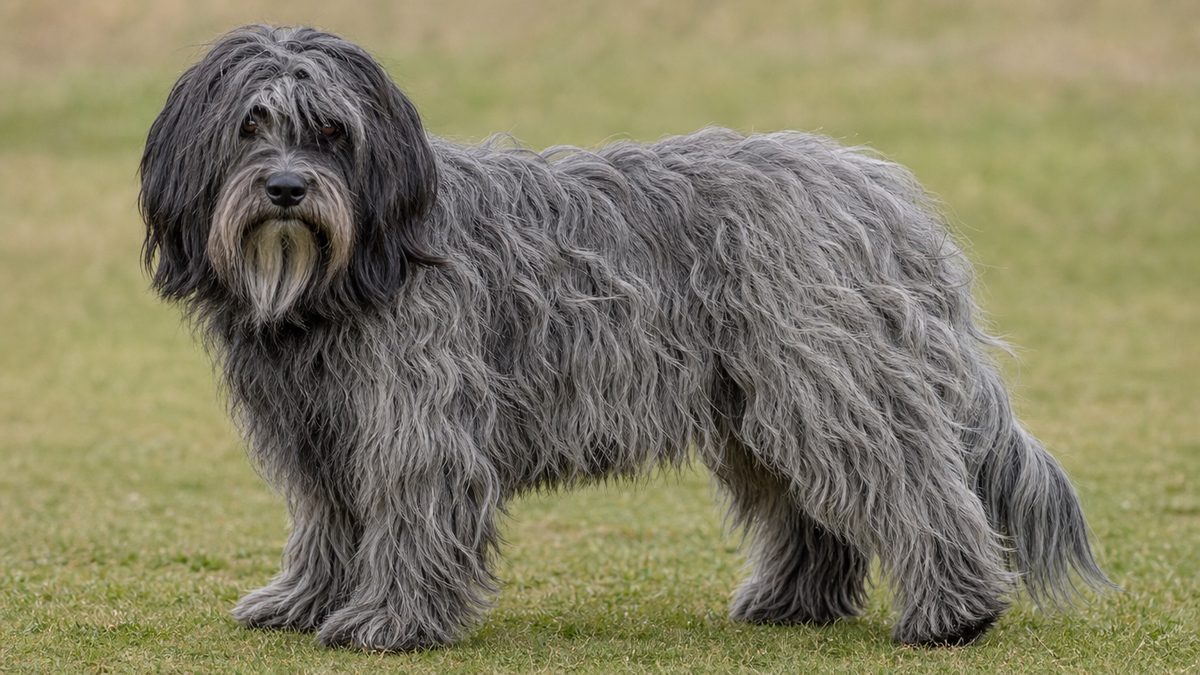
The Schapendoes is a lightly built, long-coated Dutch herding dog held by the FCI as standard 313, accepted definitively on 17 May 1991, and filed in Group 1 Sheepdogs and Cattledogs, Section 1 Sheepdogs, without a working trial.
The FCI breed standard's own utilization clause explains the whole shape of the dog. It states that because pasture for sheep sits mainly in quiet, lonely areas of the country, the Schapendoes needs great endurance, mobility and speed, that a great facility for jumping is essential, and that intelligence and the ability to act on his own are required. It closes by saying he has to be a true herding dog in character, body and soul. That is a working specification, not a description of a companion.
Four names for one dog
The naming is genuinely confusing and it matters for anyone searching. The FCI holds the breed under its Dutch name Nederlandse Schapendoes, with the English name Dutch Schapendoes. English-language sources also use plain Schapendoes and Dutch Sheepdog, and McMillan's 2024 supplementary table files it as Dutch Schapendoes, which is why searching the short name alone misses it there. Ranking pages split across at least two of these forms, with one large site filing it as Nederlandse Schapendoes.
The recovery, which is the reason the breed exists
The FCI standard's history is unusually specific about dates, and they are worth reading as a sequence. At the end of the nineteenth and beginning of the twentieth century the breed was found everywhere in the Netherlands where there was heathland and there were flocks of sheep. The canine authority P.M.C. Toepoel is named as the founder of the breed, and the standard records that during the years from 1940 to 1945, specimens of the almost vanished Schapendoes were used for breeding from wherever they could be found.
| Year | What happened |
|---|---|
| 1940 to 1945 | Almost vanished. Breeding stock gathered from wherever it could be found |
| 1947 | The Breed Club for Nederlandse Schapendoes founded |
| 1952 | Provisionally recognised by the Raad van Beheer |
| 1954 | The standard set up and a Stud Book started |
| 1971 | Definite recognition. Only registered dogs bred from since |
| 1991 | FCI definitive acceptance, 17 May |
That sequence is the two-condition test being met in public, with dates: a written standard in 1954 and a studbook opened in the same year, followed by national recognition seventeen years later and international recognition twenty years after that. Very few breeds can show the paperwork of their own recovery that cleanly.
The standard specifies no weight
FCI 313 gives height only: 43 to 50 cm for dogs and 40 to 47 cm for bitches, with the general appearance clause describing a lightly built long-coated dog with a height at withers of 40 to 50 cm. There is no weight figure anywhere in the document. Any kilogram range you meet for this breed comes from an aggregator, not from the standard.
The coat clause is the other one worth quoting. The Schapendoes has a thick coat with sufficient undercoat, long, a good 7 cm or more in the region of the hindquarters, not smooth but lightly waved. Definitely curly, frizzy hair is not permitted. The hairs grow very densely together, are fine and dry, but above all never silky, and where long the coat is inclined to stand off in tufts, giving a large girth especially at the rear, with a tremendous top knot, moustache and beard.
Colour is not restricted at all: all colours are permitted, with a preference for blue-grey to black. Dewclaws are permitted on both front and hind feet. And the disqualifying faults list contains exactly two entries, both of them the generic FCI clauses about aggression and physical or behavioural abnormality. There is not one breed-specific disqualification in the whole document, which is rare.
Schapendoes price in India, and the unusual reason there is not even a wrong figure
No Schapendoes price in India exists, and this breed is a rare case where no Indian page has invented one either, because no Indian page ranks for it at all.
Most rare-breed pages on this site have to spend their price section dismantling a fabricated Indian figure. Here there is nothing to dismantle. A Google India pull for this breed on 9 September 2026 returned Wikipedia, the American Kennel Club, the United Kennel Club, Royal Canin, Wisdom Panel, Dimensions.com, two breeder kennels and a Canadian club site. Not one Indian commercial page appeared, and the aggregator that normally supplies the fake number, whose own title tag for this breed reads Schapendoes - Price, Temperament, Life span, exposes no price at all in its content.
That absence is worth stating as a positive result rather than a gap, because the control passed. In the same session a search for labrador retriever puppy price in india returned ten genuine Indian commercial listings with real rupee prices, so Indian dog listings are richly indexed and the instrument was working. The Schapendoes simply is not sold here.
Why no Indian price can form
India's import policy for pet dogs is restricted and permitted only with a DGFT authorisation. The DGFT's own guidance states that dogs for commercial purposes like breeding, as a gift or other purposes are not allowed to be imported, and separately that new born puppies of less than 7 months are not to be allowed. The permitted routes are research with a CPCSEA recommendation, the Defence and Police forces, a certified therapy or emotional support dog, and a dog that has been with its owner for at least two years coming in on transfer of residence.
Import runs through seven ports only, the airports and seaports of Delhi, Mumbai, Chennai, Hyderabad, Bengaluru and Kolkata and, since October 2024, Kochi airport, and the application uses ITC(HS) code 01061900 with a permanent IEC number available for those without their own. Directorate General of Foreign Trade For a breed whose home country registers it in modest numbers and which has no Indian population at all, those two facts close the question. The full route is set out in how to import a dog to India.
European and North American breeder asking prices for this breed circulate in euros and US dollars. Converting one into rupees produces a figure no Indian seller has ever quoted and no Indian buyer could act on, which is the exact mechanism this site documents answer engines using. This page publishes no converted figure at all.
The 2024 Indian breed circular does not reach this breed either. CBIC Instruction 05/2024-Customs of 14 March 2024 reproduces a Department of Animal Husbandry and Dairying letter naming breeds prohibited for import, and among its entries sit four bare words the instrument never defines: Mastiffs (boerbulls), Terriers, Wolf dogs and Canario. A Dutch herding dog is none of those. The circular was in any event quashed by the Karnataka High Court on 10 April 2024 and set aside by the Delhi High Court that same month, so no Indian law in force today bans owning, breeding or selling any breed it named.
Cost of ownership in India for a 40 to 50 cm coated dog
The cost of ownership for a Schapendoes in India is dominated by two lines, coat care and parasite prevention, and both can be priced from Indian suppliers even though the dog itself cannot.
There is no Indian breed page for this dog carrying a monthly cost table, which means there is also no template constant to inherit. What follows is built from Indian retail and municipal prices that name their supplier, sized to a medium dog of roughly 15 to 20 kg.
- Core vaccination, per shot. Anti-rabies Rs 699, puppy DP Rs 849, 9-in-1 DHPPiL Rs 899, canine corona Rs 899 and kennel cough Rs 1,349 at one national clinic chain. These are promotional starting prices and the same chain quotes different course totals on different city pages, so note which city you were quoted.
- Deworming. Drontal Plus costs Rs 754 for six tablets against an MRP of Rs 838, which is Rs 125.67 per tablet at one tablet per 10 kg. A 15 to 20 kg Schapendoes therefore takes two tablets, about Rs 251 per deworming.
- Tick and flea prevention. NexGard Spectra for the 15 to 30 kg band is Rs 3,308 for three monthly tablets against an MRP of Rs 3,375, which works out at Rs 1,103 a month and covers the roundworm and hookworm role in the same tablet.
- Municipal registration. Rs 500 in Delhi for a new registration and Rs 500 to renew, with a Rs 100 monthly late fee. Rs 50 in Chennai, where the corporation issued 9,115 licences in 2024 and runs six pet clinics providing treatment and anti-rabies vaccination free of cost.
The line an Indian owner will actually feel
Grooming is the recurring cost that distinguishes this breed from most of its size. Seven centimetres of dense, lightly waved coat that stands off in tufts, plus a top knot, a moustache and a beard, is a genuine weekly job and something closer to a daily one during the monsoon. That is either your time or a groomer's fee, and in an Indian city it will usually be some of both.
The commonest Indian response to a heavy coat is to have it clipped off in April. The FCI standard requires sufficient undercoat and specifies a coat texture that is neither curly nor silky, and clipping a standing coat of this type frequently changes how it regrows. It also removes the layer between skin and sun. Budget for brushing, not for shearing.
One saving is worth naming because it is large and most owners miss it. Greater Chennai Corporation's six municipal pet clinics provide all treatment and anti-rabies vaccination free of cost. For a Chennai household that removes the biggest scheduled veterinary line above entirely.
Heat tolerance: Dutch heathland against four Indian cities
The Schapendoes has very poor heat tolerance, because it carries a long coat over a required undercoat and comes from a province whose hottest month is cooler than the coolest month of most Indian metros.
The homeland point used here is Assen in Drenthe, the heathland province the FCI standard names as the breed's working country. NASA POWER returned a cell elevation of 5.33 m against a real town elevation near 10 m, an error of under five metres, so this cell genuinely describes the place rather than a grid artefact. Every point below was queried by explicit latitude and longitude for the 2001 to 2020 climatology, and the cell elevation was checked against the real one in each case.
| Place | Annual mean C | Annual RH % | Hottest month | Peak wet bulb C |
|---|---|---|---|---|
| Assen, Drenthe | 9.84 | 84.35 | Jul 18.08 | 15.40 (Jul) |
| Bengaluru | 23.74 | 67.94 | Apr 28.37 | 21.86 (May) |
| Delhi | 25.60 | 45.56 | Jun 35.88 | 26.50 (Jul) |
| Chennai | 27.95 | 72.39 | May 31.51 | 26.11 (May) |
The single most useful comparison is between the fourth column of the first row and the second column of the rest. Assen's hottest month averages 18.08 C. Chennai's coolest month, January, averages 24.09 C, and Bengaluru's coolest month, December, averages 20.22 C. NASA POWER climatology 2001-2020 Both Indian cities are warmer in their coldest month than Drenthe is in its hottest.
Humidity is not the problem, which is the correction most pages get wrong
Indian breed content routinely warns that European breeds cannot cope with Indian humidity. Measured, that is backwards for this breed. Assen runs 84.35 percent annual relative humidity, higher than Chennai's 72.39 percent, higher than Bengaluru's 67.94 percent and far higher than Delhi's 45.56 percent. The Dutch heathland is a damp place. A Schapendoes's ancestors worked in wet air for centuries.
What they never met is wet air at thirty degrees, which is why the wet bulb column matters more than either temperature or humidity alone. Assen peaks at 15.40 C wet bulb in July. Delhi peaks at 26.50 C and Chennai at 26.11 C. A dog cools chiefly by panting, which is evaporative, and an eleven degree rise in wet bulb is an eleven degree cut in how much that mechanism can do.
The Indian clause written for exactly this dog
India's Dog Breeding and Marketing Rules 2017, Second Schedule Part IV paragraph 21(1), bar keeping dogs in outdoor facilities without the attending veterinary practitioner's written approval where they are not accustomed to local temperatures, where the breed cannot tolerate the temperatures prevalent in the area such as long-haired breeds in high temperature locations, or where the animal is sick, infirm, aged or young. The clause names long-haired breeds explicitly. A Schapendoes is the textbook case.
- Work the dog before sunrise. In Delhi, June averages 35.88 C, and there is no safe afternoon window for a coated dog in that month.
- Prefer Bengaluru or Pune if you have a choice of city. At 23.74 C and 23.86 C annual mean, they are the two least hostile Indian metros for this coat.
- Give shade and moving air rather than wetting the coat. A soaked 7 cm coat in humid air holds heat against the skin and stays wet for hours.
- Watch for panting that does not settle within five minutes of stopping and shade. That is the threshold between exercise and a heat event.
- Treat the monsoon as the skin season. A dense standing coat plus persistent damp is how hot spots start, and the coat hides them until they are large.
A pale or blue-grey coat reflects more solar radiation than a solid black one, and the standard permits all colours. If a Schapendoes is going to live in India, a lighter dog carries a measurably smaller radiant load than a black one, which is a rare instance where colour preference and welfare point the same way.
Temperament and household fit
The Schapendoes is a cheerful, attentive, high-spirited herding dog that bonds hard to its own people and needs a job, and the standard says so in almost those words.
The FCI text describes a normally and harmonically constructed herding dog with an attentive and courageous character, intelligent, watchful, jolly, lively, friendly and high spirited, developing great affection and loyalty towards people familiar to him. Notice what is absent from that list. There is no aloofness with strangers, no guarding language and no suspicion, which distinguishes it sharply from the other continental sheepdog in this batch.
This is a light, agile dog rather than a placid one, and Wisdom Panel's breed page reaches the same conclusion from the other direction, filing it under Herding and naming generalized progressive retinal atrophy as a condition discovered in the Schapendoes. The eyes get their own clause in the standard, which is unusual and tells you what the breed's makers valued. The expression is described as open minded, honest and lively, and the standard says shape, colour and expression are very characteristic for the breed. A dog bred to work independently at a distance from its handler had to be readable, and readability was written into the standard.
Who this breed suits
- Active households with time, because the exercise requirement is the real one and it does not shrink to fit a schedule.
- People who enjoy grooming, or who will genuinely pay someone else to do it every week.
- Homes with dog sports nearby. A breed the standard calls a remarkable jumper is built for agility and flyball, and both are available in Indian metros.
- Families with children, given a friendly, jolly, high-spirited dog with no guarding language anywhere in its standard.
Who should look elsewhere
- Anyone in a hot Indian city without full-time cooling. This is the limiting factor and it outranks every temperament consideration.
- Owners who are out ten hours a day. A herding dog bred for constant work does not do well warehoused.
- People who want a low-maintenance coat. Seven centimetres of standing coat is not low maintenance in any climate, let alone a monsoon one.
- Anyone hoping for a guard dog. Watchful is in the standard; protective is not.
A herding dog with no stock will find substitutes, and in an apartment the substitutes are usually running children, other pets and passing feet. This is not aggression and it responds well to being given a legitimate outlet. Teach a formal fetch or a scent game and use it deliberately when the dog starts to circle and gather.
Training a dog bred to act on its own
To train a Schapendoes, give it problems rather than drills, because the FCI standard specifically requires the ability to act on his own and a dog selected for independent judgement does not enjoy repetition.
That phrase in the utilization clause is the key to the breed. A shepherd working sheep across quiet, lonely heathland could not micromanage a dog at that distance, so the dog was selected to decide. The practical consequence is a dog that learns very fast, then thinks about whether the instruction still makes sense. Handled as a partner it is highly trainable. Handled as a machine it becomes creative.
Four priorities for the first year
- A reliable recall against movement. Herding instinct is triggered by motion, and in an Indian street the moving things are two-wheelers, cows, cats and children. Build recall on a long line against real motion, not in a quiet room.
- A settle on a mat. A high-spirited dog needs a taught off switch, particularly in a flat where it cannot simply take itself outside.
- Handling and grooming tolerance. This is a coat you will work on for fifteen years. Teach the puppy to lie on its side and be brushed out before it is big enough to argue.
- Socialise early and widely. The standard describes a friendly dog, and a friendly dog raised without exposure still becomes a worried one. Lifts, watchmen, traffic, monsoon rain and other dogs, all in short pleasant doses before four months.
Jumping deserves its own note because the standard calls a great facility for it essential, and because that facility is what gets Schapendoes out of gardens. A dog that can clear a boundary you assumed was adequate is not being disobedient. Check fence heights and balcony railings before assuming the dog will respect them.
Agility, flyball and scentwork all suit a jumping, galloping, independent herding dog, and all can be done indoors or in the early morning, which solves the Indian heat problem at the same time as the exercise problem. A Schapendoes with a sport is a far easier dog to live with than a Schapendoes with a longer walk.
How much exercise a Schapendoes really needs
A Schapendoes needs about 90 minutes of genuine activity a day plus mental work, which is substantially more than most 15 kg dogs and considerably more than Indian breed pages suggest.
The standard is unambiguous about why. The dog needed great endurance, mobility and speed to cover the distances the Dutch heathland involved, and in his work he gallops rather than trots, so his movement must be light footed and springy without excessive use of energy, and he must be able to jump well and turn swiftly. That is an animal built for sustained fast work, not for a walk around a colony park.
In India the constraint is thermal rather than physical. Across most of the country, from March to June, the safe outdoor windows are before sunrise and well after dark, which for a working coat is not a preference but the whole schedule. Plan on indoor and early-morning activity carrying the load for four months of the year.
- Two real outings a day, one of them long, both outside the heat of the day.
- Scentwork indoors, which tires a thinking dog faster than distance does and costs nothing.
- A jumping or agility outlet once the dog is physically mature, since the standard treats jumping as a defining capability.
- Structured play with rules, rather than unstructured chase, which in a herding breed can escalate rather than settle.
Hip and joint development is not finished in a medium breed until well past a year. This breed's OFA hip record is exceptional, but that record belongs to a screened breeding population, not to a puppy that was run beside a bicycle at seven months. Wait for maturity, and see your nearby vet if a young dog shows lameness rather than resting it and continuing.
Grooming seven centimetres of coat in an Indian monsoon
Groom a Schapendoes by brushing right down to the skin at least twice a week, daily in the monsoon, and never by clipping the coat off for summer.
The coat is long and dense but it is not a coat that mats solid, and the standard explains why: the hair is lightly waved, never curly, never frizzy, fine and dry but above all never silky. A dry, fine, waved coat combs out. A silky one would felt. That is a meaningful advantage over several breeds it is compared with, and it means brushing is a maintenance job rather than a rescue operation, provided it is done regularly.
The places that do mat are predictable: behind the ears, in the armpits, in the trousers behind the hind legs, and under the collar. Work those four areas every session and the rest of the coat looks after itself. The top knot, moustache and beard the standard calls tremendous need combing rather than brushing, and the beard needs drying after every drink.
The monsoon routine
- Dry to the skin, not to the touch. Overseas grooming guidance says towel off and let the dog air dry, which is correct in a Dutch autumn and poor advice in Indian humidity. A coat that feels dry on the outside can stay wet underneath for hours.
- Dry the beard and the feet every time. The standard describes fairly large oval feet with plentiful hair between the pads, which is exactly where monsoon skin problems begin.
- Check the skin visually, weekly. A dense standing coat hides a hot spot until it is large. Part the coat and look, do not just feel.
- Keep the ears dry. The ears hang free and are amply feathered, so they trap moisture. Plug them before a bath and dry them after rain.
- Check for ticks by parting the coat, not by stroking it. Given the Indian tick burden described in the health section, this is not optional.
This is a coated breed and it sheds. What it does not do is drop undercoat in the dramatic seasonal way a Nordic double coat does, because the coat is long, fine and retained rather than blown. In practice that means less hair on the floor and more hair in the dog, which is precisely why regular brushing matters more here than in a short-coated breed.
Health: exceptional hips, difficult eyes, and two genes found in this breed
The Schapendoes has one of the strongest hip records in OFA's entire dataset, one of the weaker eye records, and the distinction of being the breed in which two disease genes were identified.
Start with the register, because the numbers are unusually good and unusually specific. OFA holds the breed under code SCH. Its hip table records 105 evaluations at 98.1 percent normal and 1.9 percent dysplastic, against an all-breeds figure of 14.2 percent dysplastic. That places it 212th of 223 breeds in a table ordered worst-first, so only eleven breeds have a better record. Hip dysplasia, in other words, is genuinely rare in the screened population of this breed, which is the opposite of what the veterinary directory ranking for it implies by listing hip dysplasia first among five conditions, none of them breed-specific. The United Kennel Club, which holds the breed in its Herding Dog Group, publishes a full standard for it with its own Disqualifications section. United Kennel Club The American Kennel Club publishes a breed page as well.
The row closes arithmetically, which is what allows it to be trusted. Its grades are 30.5 percent Excellent, 59.0 percent Good and 8.6 percent Fair, which sum exactly to the printed 98.1 normal, and 1.0 mild plus 1.0 moderate plus 0.0 severe, which sums to 2.0 against a printed 1.9. The 30.5 percent Excellent figure is higher than the Labrador Retriever's 21.7 percent on a dataset of 324,934 Labrador hips.
A 105-dog denominator is small, and OFA's own inclusion threshold is 100 hip evaluations, so this breed sits just above the line for publication. More importantly, the dogs in an OFA table are dogs whose owners chose to screen them, which is a selected population. The figure is genuine and it is good. It is not a population prevalence.
The eyes, and OFA's contradiction with itself
The eye picture is the opposite. OFA records 120 eye evaluations at 90.8 percent normal and 9.2 percent abnormal, which ranks the breed 27th worst of 240 breeds in that table. That is a genuinely notable position for a breed with so few entries elsewhere.
The summary and the detail rows then disagree, as they do for many breeds, and both halves belong here. The summary reports 90.8 percent normal. The detail rows, on the same denominator of 120, record 84 normal, which is 70.0 percent, a gap of 20.8 points. The largest named findings are cataract of unknown significance at 14 of 120, or 11.7 percent, punctate anterior cortex cataract at 11 of 120, or 9.2 percent, and retinal dysplasia folds at 5 of 120. Neither figure should be quoted alone as the breed's eye rate.
| Database | Evaluations | Result | All-breeds comparison |
|---|---|---|---|
| Hips | 105 | 98.1% normal, 1.9% dysplastic | 14.2% dysplastic across all breeds |
| Eyes, summary line | 120 | 90.8% normal | 93.4% across all breeds |
| Eyes, detail rows | 120 | 70.0% normal (84 of 120) | A 20.8 point gap with the summary |
| Elbows | no published row | Below OFA's 50-evaluation threshold | OFA requires 100 hip or 50 other evaluations |
| Patella | no published row | Below OFA's 50-evaluation threshold | Same threshold |
CCDC66: a gene found in this breed
This is the fact no ranking page carries. Researchers investigating generalised progressive retinal atrophy began with a whole-genome scan in Schapendoes pedigrees and reported a peak two-point lod score of 4.78 at marker REN93E07 on canine chromosome 20, fine-mapping the locus to a 5.6 megabase region between markers FH3358 and TL336MS. They screened three candidate genes, CACNA2D3, HT017 and WNT5A, and found no causative variant, so they published an indirect DNA test based on linkage while the search continued.
Three years later the same group found it. The gene was coiled-coil domain containing 66, CCDC66, described in the paper itself as newly identified, and the mutation is a one base pair insertion in exon 6 creating a stop codon. Every affected dog was homozygous for the insertion and every obligate carrier heterozygous. The protein is normally detected in the inner segments of photoreceptors in mouse, dog and man, and the affected Schapendoes retina lacks it entirely. At the time, mutations in eleven genes were known to account for generalised progressive retinal atrophy in dogs; this made twelve, and it came out of a Dutch farm breed.
The finding was then confirmed in the other direction. A knockout mouse carrying a Ccdc66 null mutation developed retinal degeneration and dysfunction, which is the standard test of whether a candidate gene really causes the disease. For a buyer the practical consequence is simple: progressive retinal atrophy in this breed is recessive with a known variant, so ask for both parents' results.
CLN6: a second breed-specific variant, published in 2024
A 19-month-old Schapendoes presented with signs indicating a lysosomal storage disease, and pathology confirmed neuronal ceroid lipofuscinosis. Whole genome sequencing of the affected dog and both parents, followed by inspection of known NCL genes, identified a missense variant in CLN6, c.386T>C, in a highly conserved region and predicted to be harmful. The authors note that the finding enables pre-breeding DNA testing to prevent future cases in the breed. Neuronal ceroid lipofuscinosis presents as progressive loss of cognitive and motor function, seizures and visual impairment, and it is fatal.
Both the CCDC66 retinal variant and the CLN6 variant are recessive, and both have DNA tests. A carrier bred to a clear dog produces no affected puppies, so carriers are not a problem in themselves. What matters is that both parents were tested and that you were shown the results. Ask for the certificates, not for reassurance, and take them to your nearby vet if you cannot interpret them.
What we cannot tell you, and why
There is no reliable life expectancy figure for this breed, and that is a finding rather than an omission. McMillan 2024, the largest recent study of companion dog longevity, includes the breed in its supplementary tables under the name Dutch Schapendoes and flags it N for inclusion in the survival analysis, meaning it was considered and excluded. It therefore has no median, no confidence interval and no hazard ratio in that dataset, and the 12 to 14 year figure circulating on aggregator pages carries no denominator at all.
Two further papers include the breed without being about it, and both are worth knowing. A survey of canine CYP2C41 genotyped 36 dog breeds, which matters because that enzyme is one route by which drug metabolism differs between breeds. And a 2025 study established echocardiography reference intervals that included the breed, which gives a Dutch or European vet a baseline that did not previously exist. A retrospective of patent ductus arteriosus in 102 dogs, published in the Dutch veterinary journal, is the reason PDA appears on some breed lists for this dog.
The Indian risk that has nothing to do with the breed
Tick-borne disease is what an Indian Schapendoes would actually meet. In a West Bengal study of 584 dogs screened at veterinary clinics, Babesia gibsoni was detected in 76.54 percent, and 72.9 percent of the 584 screened carried two or more pathogens. In Kerala, 120 dogs were tested and Babesia was found in 80 of them, with the peak falling before the monsoon between March and May. Both studies sampled clinic caseloads and clinically suspected animals rather than random populations, so these are not general prevalence figures. They are, however, a clear statement that year-round tick control is mandatory here, and a 7 cm coat makes finding a tick considerably harder than a short one does.
Feeding a medium herding dog in India
Feed a Schapendoes to body condition rather than to a chart, because the FCI standard gives no weight at all and a lightly built 43 cm bitch and a 50 cm dog have materially different requirements.
The standard's silence on weight is the practical starting point. It specifies height, 43 to 50 cm for dogs and 40 to 47 cm for bitches, and describes the skeleton as fine boned, pliable and elastic, but attaches no kilogram figure to any of it. That is a deliberate description of a light-framed dog, and it means feeding charts that assume a stocky medium breed will overfeed this one.
Assess by hand and eye instead. You should feel the ribs easily under a thin covering, see a waist from above and a clear tuck from the side, and on a coated dog you must use your hands rather than your eyes because the coat conceals both weight gain and weight loss. Weigh monthly and adjust the ration in ten percent steps.
Indian practicalities
- Two meals a day for an adult, three for a growing dog, and never one large meal in a deep-chested breed.
- Feed after exercise and after the dog has cooled, not before, and avoid the hottest hours entirely.
- Do not free-feed in monsoon humidity. Food spoils faster than owners expect, and free-feeding hides the appetite change that is often the earliest sign of illness.
- Keep the beard out of the bowl or accept that you will be washing it. A narrow, deep bowl helps more than a wide one.
- Use part of the ration for training rather than adding treats to it, because a coated dog carrying extra weight in Indian heat is carrying two problems.
A dog that cools by panting loses water doing it, and a dog in Delhi in June is panting for much of the day. Multiple water points, changed twice daily, are not a luxury in an Indian summer. Watch intake, and mention any sustained increase in drinking to your nearby vet rather than simply refilling more often.
The first year, month by month
A Schapendoes puppy's first year turns on three things: getting socialisation done early, establishing grooming tolerance before the adult coat arrives, and protecting growing joints from the exercise the breed will later demand.
- Months 0 to 2. With the breeder. Indian law sets the floor at eight weeks: Rule 8(1)(a) of the 2017 Rules provides that pups less than eight weeks in age are not sold. For an imported dog the DGFT floor is far higher, at seven months.
- Month 2. Home. Vaccination begins, with anti-rabies about Rs 699 and the multivalent shots in the Rs 849 to Rs 899 band at one national chain. Begin daily handling: feet, ears, mouth, and lying on the side to be brushed.
- Months 2 to 4. The socialisation window and the highest-value period of the year. Lifts, watchmen, traffic, other dogs, children, umbrellas and monsoon rain, in short positive doses. A friendly breed still needs this.
- Month 3 to 4. Deworming per your vet's schedule, roughly Rs 126 to Rs 251 a dose depending on weight. Register with the municipality: Rs 500 in Delhi, Rs 50 in Chennai. Greater Chennai Corporation veterinary…
- Months 4 to 6. Teething, and the start of the coat change. This is when brushing tolerance pays for itself, because the puppy coat begins giving way to the adult one and the transitional coat tangles more than either.
- Months 6 to 9. Adolescence. The jumping ability the standard calls essential arrives before the judgement does. Re-check fences and balconies now rather than after the first escape.
- Months 8 to 12. The adult coat comes in properly and the grooming commitment becomes the real one. Move to a fixed twice-weekly session rather than an ad hoc one.
- Months 12 to 18. Physical maturity. Only now is higher-impact work reasonable, and only now should agility jump heights go up. Ask your vet before starting a jumping programme.
- Any time a young dog seems to lose coordination, has a seizure, or bumps into things in dim light. Do not wait. Both of this breed's known variants present neurologically or visually, and both are worth ruling in or out early.
Generalised progressive retinal atrophy begins with night blindness before daylight vision is affected. A young dog that hesitates on unlit stairs, will not go into a dark room, or bumps into furniture at dusk but not at noon is showing the classic early pattern. That is an ophthalmology appointment, not a training problem.
Schapendoes against the shaggy herders it is confused with
The FCI standard names the Schapendoes's relatives itself, which makes this the rare comparison table that comes from a primary source rather than from a writer's judgement.
The standard's history places the breed in a wide-ranging group of long-haired herding breeds with densely coated heads, and names them: the Bearded Collie, the Puli, the Owczarek Nizinny, the Bobtail, the Briard, the Bergamasker and the German Schafspudel of the variety found in Hessen, Odenwald and the Niederrhein. Three of those are the ones an Indian buyer might actually encounter.
| Schapendoes | Bearded Collie | Polish Lowland Sheepdog | Old English Sheepdog | |
|---|---|---|---|---|
| Height in the standard | 43 to 50 cm dogs, 40 to 47 bitches | Taller, similar type | Lower to the ground | Considerably larger |
| Build | Lightly built, fine boned | Lean and active | Cobby, compact | Heavy and profusely coated |
| Coat | Long, lightly waved, never curly, never silky, 7 cm plus | Long flat harsh outer coat | Long dense shaggy | Very profuse, prone to matting |
| Colour rule | All colours permitted, blue-grey to black preferred | Restricted | Restricted | Restricted |
| Signature ability | Remarkable jumper, gallops rather than trots | Herding endurance | Herding endurance | Drover |
| Breed-specific gene found in it | CCDC66 and CLN6 | Not comparable | Not comparable | Not comparable |
The distinguishing feature in practice is bone. The Schapendoes is described as lightly built with a fine-boned, pliable, elastic skeleton, which is why it moves the way the standard says it does. A heavy, thickset shaggy dog is not a Schapendoes regardless of its coat.
What an Indian buyer will actually be shown
The realistic comparison for an Indian household is not with another shaggy European herder, because none of them is available either. It is with a dog that is already here. If the appeal is a friendly, intelligent, athletic medium dog that wants a job and bonds hard to its family, that description fits a great many Indian shelter dogs, and it fits them without a 7 cm coat in a country with a 26 C wet bulb peak.
The Schapendoes is a genuinely admirable breed with an unusually well documented recovery and a real contribution to veterinary genetics. It is also close to the worst possible coat and energy combination for Indian conditions, and it is not obtainable here. Read this page for interest. Choose a dog by the adoption section.
Mistakes owners make with this breed
Most avoidable trouble with a Schapendoes comes from treating it as a placid shaggy companion, which is what the photographs suggest and what the standard flatly contradicts.
- Underestimating the exercise requirement. The standard requires great endurance, mobility and speed and says the dog gallops rather than trots. Two twenty-minute walks is not maintenance, it is deprivation.
- Clipping the coat for an Indian summer. It does not cool the dog, it removes the barrier against direct sun, and on a standing coat of this texture it often changes the regrowth permanently.
- Letting the dog air dry after a monsoon soaking. Standard advice in the Netherlands, and the fastest route to a hot spot in Mumbai. Dry to the skin.
- Assuming the eyes are fine because the hips are. They are not the same story. OFA ranks this breed 212th of 223 for hips and 27th worst of 240 for eyes.
- Accepting a breeder's word instead of a test result. Two recessive variants with DNA tests exist for this breed. Ask for both parents' certificates.
Two mistakes that come from the search results
The first is trusting the lifespan figure. The aggregators print 12 to 14 years with no source, while the study that would establish it excluded the breed under a name most people do not search for. The second is believing the shaggy coat makes the dog hypoallergenic. It does not, and the evidence is settled: measuring Can f 1 across so-called hypoallergenic breeds against 160 control dogs found the hypoallergenic group higher in hair and coat, with no difference in airborne allergen.
The 2017 Rules, Second Schedule Part II paragraph 6(3), prohibit in-breeding within the first four generations and incest breeding, listing uncle to niece, nephew to aunt, cousin to cousin and grandparent to grandchild among the prohibited matings. For a breed rebuilt from a handful of dogs between 1940 and 1945, overseas guidance on managing a narrow gene pool sometimes assumes close breeding is available. In India it is not.
Adopt, verify and source responsibly
There is no honest commercial route to a Schapendoes in India, so the realistic options are bringing your own dog on transfer of residence or choosing a different dog, and this section covers both without pretending otherwise.
The DGFT position is the whole answer. Import of pet dogs is restricted, requires an authorisation, and dogs for commercial purposes like breeding, as a gift or other purposes are not allowed to be imported, with new born puppies of less than 7 months not allowed at all. The only route without authorisation is the customs baggage route, for up to two pets, for a person transferring residence permanently to India after two years of continuous stay abroad.
If you are bringing your own dog to India
- Check the two-year rule. Continuous stay abroad must exceed two years for the baggage route; otherwise a DGFT authorisation is required.
- Start at least two months before travel, because the application goes to the Department of Animal Husbandry, Dairying and Fisheries for an NOC and then to the Exim Facilitation Committee, which meets once a month.
- Obtain the advance NOC from the AQCS at your port of entry seven days before travel, relaxable to three days in specific circumstances.
- Plan on one of seven ports: Delhi, Mumbai, Chennai, Hyderabad, Bengaluru, Kolkata or, since October 2024, Kochi.
- Carry the pet book, the vaccination certificate and the official veterinarian's health certificate, and expect quarantine where required.
- Bring the DNA test certificates too. If your dog is cleared for the CCDC66 and CLN6 variants, that paperwork is worth more to an Indian vet who has never seen the breed than any pedigree.
If you are choosing a dog rather than importing one
A Schapendoes in an Indian shelter would be extraordinary, because there is no population here to surrender from. That is worth saying plainly rather than gesturing at breed rescue that does not exist in this country for this breed.
What does exist is the dog underneath the description. Strip away the coat and what the FCI standard describes is an intelligent, watchful, jolly, lively, friendly, high-spirited dog with great endurance that wants a job and forms deep attachments to its own family. Indian shelters are full of dogs answering to every word of that, already adapted to the climate that would be this breed's main problem, at no purchase cost.
- Verify any claimed pedigree against the issuing registry's own records, not against a photograph or a certificate image.
- Ask which studbook a dog is registered in. The Dutch studbook has run since 1954 and the standard says only registered dogs have been bred from since 1971, so a genuine dog has a traceable line.
- Register the dog with your municipality. Rs 500 in Delhi, Rs 50 in Chennai. Greater Chennai Corporation veterinary…
- Use free municipal veterinary services where they exist, such as Greater Chennai Corporation's six pet clinics.
We report published prices and registry documents as editorial content. We do not recommend breeders, link puppy listings or quote a live price as an offer. For this breed we publish no price at all, in any currency, because no Indian figure exists and converting a European one would be arithmetic rather than reporting.
Schapendoes questions people actually ask
Is a Keeshond a good family dog?
This is the question Google's People also ask box returned for the Schapendoes, which is itself the finding: the box answered about a different Dutch breed. The Keeshond is a Dutch spitz and a well-regarded family dog. It is not the Schapendoes, which is a lightly built long-coated herding dog from the Drenthe heathland with far higher exercise needs.
What is the #1 best family dog?
There is no single answer, and for an Indian household the ranking that matters is climate rather than temperament. Dogs already adapted to Indian heat outperform any imported breed on the measure that limits a dog's day here. The Schapendoes sits at the wrong end of that scale, coming from a province whose hottest month averages 18.08 C.
What is the calmest dog for a family?
Not this one. The FCI standard describes a dog needing great endurance, mobility and speed, with a great facility for jumping essential, that gallops rather than trots in its work. A Schapendoes that appears calm indoors is usually a dog that has already had a substantial amount of exercise that day.
What is the Schapendoes price in India?
There is none. Unusually for a rare breed, no Indian page even attempts a figure, so there is no fabricated number to correct. India's dog import policy is restricted and commercial import for breeding is not allowed, so no domestic supply chain and therefore no market price can form.
How big does a Schapendoes get?
The FCI standard gives 43 to 50 cm at the withers for dogs and 40 to 47 cm for bitches. It gives no weight at all, which is worth knowing because every weight figure you will read for this breed comes from an aggregator rather than the standard. The general appearance clause describes a lightly built dog.
Are Schapendoes healthy dogs?
Their hips are exceptional and their eyes are not. OFA records 105 hip evaluations at 1.9 percent dysplastic, against 14.2 percent across all breeds, which places the breed 212th of 223 in that table where a low rank number is worse. The same register ranks it 27th worst of 240 breeds for eyes, at 9.2 percent abnormal.
What is CCDC66 and why does it matter?
CCDC66 is a gene that was newly identified through this breed. Researchers mapped generalised progressive retinal atrophy in Schapendoes pedigrees to canine chromosome 20, then found a one base pair insertion in exon 6 creating a stop codon. Every affected dog was homozygous and every obligate carrier heterozygous, and the affected retina lacked the protein entirely.
Is the Schapendoes hypoallergenic?
No dog breed is. Vredegoor and colleagues measured Can f 1 in hair and homes across breeds marketed as hypoallergenic and 160 control dogs, and found the hypoallergenic group carried higher levels in hair and coat, not lower, with no difference in airborne allergen. A long shaggy coat attracts the claim, and the claim is unsupported.
Can a Schapendoes live in India?
Only indoors, with cooling, and with real thought given to exercise timing. Its home province averages 9.84 C across the year against Chennai's 27.95 C, a gap of eighteen degrees, and the coat is long, dense and undercoated by requirement of the standard. Bengaluru at 23.74 C annual mean is the least unreasonable Indian city for it.
How much exercise does a Schapendoes need?
Substantially more than its size suggests. The FCI standard says pastures for sheep are situated mainly in quiet lonely areas of the country, so the dog needs great endurance, mobility and speed, and calls a great facility for jumping essential. Plan on 90 minutes of real activity a day plus mental work, not a stroll.
Is the Schapendoes recognised in Australia or by the American Kennel Club?
Dogs Australia does not hold it. The string Schapendoes appears zero times in the complete Dogs Australia Breed Listing of 18 March 2026, a document that names every breed across all seven of its groups. The United Kennel Club does hold it, in the Herding Dog Group with a full published standard, and the American Kennel Club publishes a breed page.
How long do Schapendoes live?
No reliable breed median exists. McMillan 2024, the largest recent study of dog longevity, files the breed as Dutch Schapendoes and flags it N for inclusion in the survival analysis, so it has no row of its own. The 12 to 14 year figure circulating on aggregator pages is not from that study and carries no stated denominator.
Compare with similar breeds
Schapendoes sits in 2 Bonbeno groups. Each one compares it directly against the breeds it is genuinely an alternative to, on the same figures.