
Breed profile
Cane da Pastore di Oropa
Piedmont's alpine herding dog, and the registry answer four publishers got wrong: ENCI holds it in an open register for populations in recovery, the FCI does not recognise it at all, and half of Italy's own standard is an unreadable scan.
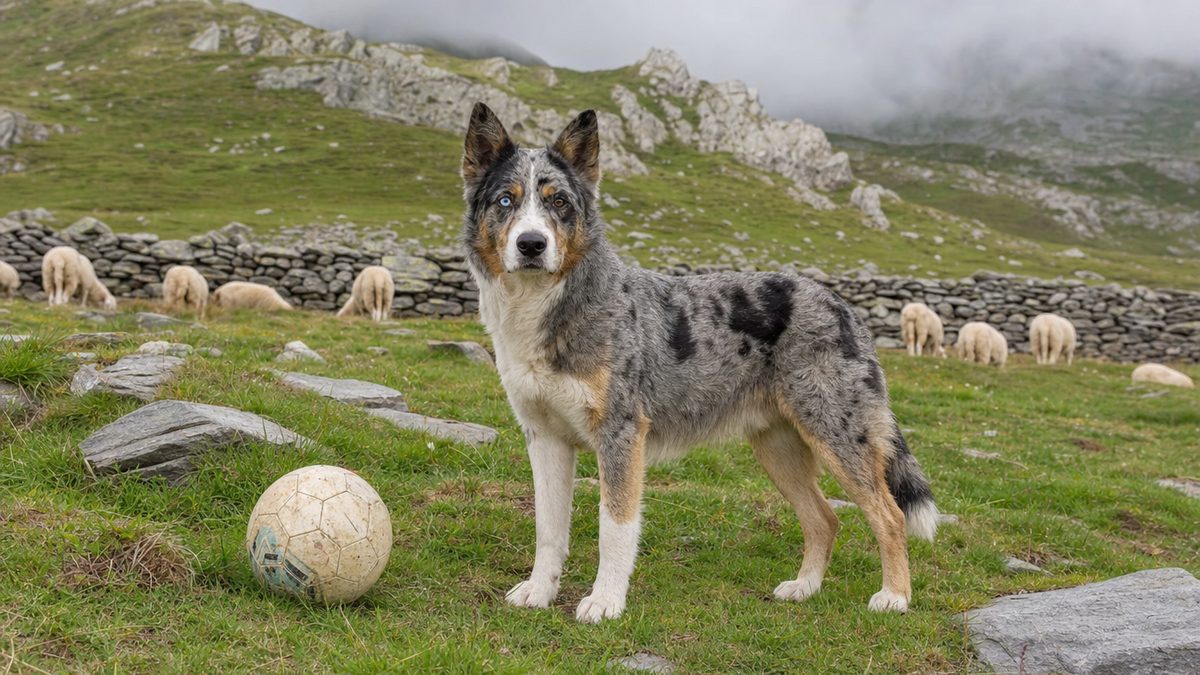
Quick answer
The Cane da Pastore di Oropa is the herding dog of the Biella Alps in Piedmont, 18 to 35 kg, rough-coated and frequently merle. ENCI files it as a population in recovery rather than a recognised breed, and the FCI does not recognise it at all. No price in India exists, because no lawful breeding import does. Heat tolerance rates 2 of 5, since Biella's hottest month averages 21.59 C against Chennai's coldest at 24.09 C.
This page summarises published breed-standard text, kennel-club register records, government notifications and peer-reviewed research for general information. It is not a diagnosis and it is not treatment advice. Consult a registered veterinarian about your own dog before acting on anything here, and treat collapse, unsteadiness, vomiting during exertion or a tongue that turns dusky in heat as an emergency.
Cane da Pastore di Oropa at a glance
What the Cane da Pastore di Oropa actually is
The Cane da Pastore di Oropa is the working herding dog of the Biella Alps in Piedmont, a medium-sized, athletic, rustic stock dog that drives sheep and cattle between the valley floor and the high alpine pasture, and Italy's own kennel club files it not as a recognised breed but as a population in recovery.
Start with the sentence ENCI prints in capitals at the top of its own breed page, because every English description of this dog gets it wrong. The Ente Nazionale della Cinofilia Italiana, which runs Italy's studbook under the Ministry of Agriculture, labels the entry RAZZA AMMESSA AL RSA (REGISTRO SUPPLEMENTARE APERTO), a breed admitted to the Open Supplementary Register, PER LA QUALE SONO STATE AVVIATE LE PROCEDURE DI RICONOSCIMENTO, for which the recognition procedures have been started. Started, not finished.
That register has a legal definition and it is worth reading in full, because it does not use the word breed. The Ministry-approved Norme tecniche del libro genealogico del cane di razza, in force from 1 September 2023, say at Article 3 paragraph 4 that there is also provided an open supplementary register (RSA) for the inscription of soggetti appartenenti a popolazioni tipiche italiane in fase di recupero come razze. Subjects belonging to typical Italian populations in the phase of being recovered as breeds. The same article's first paragraph names the two registers that hold breeds, the ROI and the RSR, and the RSA is not one of them.
The short version for an Indian reader
- No price in india exists for this dog. A search for the breed name plus price, run from an India location, returned no Indian seller, no listing and no rupee figure, and served Cane Corso price pages instead.
- No lawful breeding import is possible. Dogs are a Restricted import under ITC (HS) 01061900, and applications for trading or breeding purposes shall be duly rejected.
- Heat tolerance rates 2 of 5. The MERRA-2 grid cell covering Biella and Oropa averages 11.24 C across the year and 21.59 C in its hottest month, July, which is still cooler than the coldest month Chennai or Mumbai ever records.
- The health record is empty. No screening register anywhere carries this breed, and no life expectancy, clinical or behaviour study of it has ever been published.
A driving dog, not a flock guardian
Get this distinction right and half the internet's description of the breed falls away. A 2022 genomic study of 158 dogs across nine Italian shepherd breeds sorted them into livestock guardians and herding shepherds, and placed the Pastore d'Oropa firmly in the herding group alongside the Bergamasco, the Pastore Apuano, the Lupino del Gigante and the Pastore della Lessinia e del Lagorai, against the Maremma, the Mannara, the Fonni's dog and the Pastore della Sila as guardians. The paper spells out the behavioural difference: a herding shepherd shows a hunting motor pattern interrupted before the crush-bite-kill sequence, while a guardian never displays predatory behaviour toward the livestock at all.
Italy's own literature agrees with the working description. The standard's historical note calls this an ancient Italian type spread across the whole alpine and pre-alpine arc and used as a shepherd dog to drive the herd, still seen today accompanying flocks in their seasonal move from the lowlands to the mountains. Italian Wikipedia adds the trait that matters to a buyer, describing dogs that are very reactive and that share with other Italian shepherds a tendency to use physical force, bumping and sometimes light bites, on the sheep in the flock.
| Register | What it holds | Is the Oropa in it |
|---|---|---|
| ROI, Registro Origini Italiano | Dogs of recognised breeds with four generations of registered ancestry | No |
| RSR, Registro Supplementare Riconosciuti | Dogs of recognised breeds with under four generations of known ancestry | No |
| RSA, Registro Supplementare Aperto | Typical Italian populations in the recovery phase as breeds | Yes, since 20 November 2015 |
The RSR list is the sharpest control available, because it is the register one rung above and it does carry Italian recovery breeds. Updated to 22 December 2025, it lists the Spino degli Iblei at number 906 with the Club del Pastore Siciliano, and the Cane di Mannara or Mastino Siciliano at 903 with the Associazione Samannara. Searched case-insensitively, the same document contains the word Oropa zero times.
Italian Wikipedia opens by stating that the breed entered in 2016 as a full member of the 16 Italian breeds recognised by ENCI. ENCI's own Razze Italiane page names 18 Italian breeds and lists every one of them, and the Cane da Pastore di Oropa is not among them, even though two other non-FCI recovery breeds, the Spino degli Iblei and the Mastino Siciliano, are. The number is wrong, the year is wrong, and the status is wrong.
Exactly what recognition this breed holds, and from whom
The Cane da Pastore di Oropa holds one thing and one thing only: admission to ENCI's Registro Supplementare Aperto, granted by ENCI resolution on 20 November 2015, with the recognition procedures described as started rather than completed, and no recognition of any kind from the Federation Cynologique Internationale.
Check every rung with its own control, because guessing at this breed's status is how four separate publishers went wrong. Three registers matter here and each has a document that either names the breed or demonstrably does not.
Rung one, the FCI definitive nomenclature
The FCI's Group 1 page lists sheepdogs by country of origin, and country 9 is ITALY. It carries exactly two entries, the Cane da Pastore Abruzzese Maremmano at number 201 and the Cane da Pastore Bergamasco at number 194. There is no third Italian sheepdog. The document names Italy on its own face and lists the breeds under it, so the absence is read off the right page rather than off a URL that looked plausible.
Rung two, the FCI provisional register
The provisional register is a separate list and it is the one most often checked against the wrong document. Read from the FCI's own provisoire page, it carries 21 breeds, headed by four admitted on 11 February 2026, the Macedonian Shepherd Dog Karaman at 378, the Sabueso Fino Colombiano at 376, the Segugio dell'Appennino at 375 and the Tatransky Duric at 377. The page proves it is the provisional list by printing the rule that provisional breeds are not eligible for the CACIB until recognised definitively. The Cane da Pastore di Oropa is not on it. An Italian breed is, which is the control that matters: the Segugio dell'Appennino went provisional in February 2026, so the FCI's door is demonstrably open to Italian breeds and this one has not gone through it.
The link ENCI itself publishes goes nowhere
ENCI's breed page carries an FCI logo and a link reading Download da FCI, pointing at a nomenclature URL ending in the number 905. Follow it and the FCI serves HTTP 200 and the general breeds nomenclature index, with its ten definitive groups and the 21-breed provisional table, and no Oropa entry anywhere on it. The number 905 is not an FCI breed number at all. FCI numbers currently run to 378, and 905 is an internal ENCI code for a breed outside the FCI system. So the single link most likely to convince a reader that the FCI recognises this dog resolves, silently, to a page that proves the opposite.
Rung three, ENCI, and the category name that matters
ENCI runs three registers and its own public FAQ sets them out. The ROI holds dogs born in Italy to ROI parents, dogs registered in an FCI-recognised foreign studbook and owned by Italian citizens, and dogs whose ancestors for at least three generations were registered in the RSR. The RSR holds dogs with a genealogy shorter than the fourth generation whose origin is not impure and which show enough typicality to be considered purebred. And the RSA is the register in which are inscribed cani appartenenti a popolazioni tipiche italiane in fase di recupero come razze.
A breed in via di riconoscimento is not a recognised breed, and ENCI is careful about the distinction even where journalism is not. Its Oropa page says the procedures have been started; its Spino degli Iblei page, by contrast, says flatly RAZZA AMMESSA AL RSR, a breed admitted to the Registro Supplementare Riconosciuti, at code 906. Two Italian recovery breeds, two adjacent code numbers, two different rungs.
| ENCI code | Breed | ENCI register | On the 18-breed Razze Italiane page |
|---|---|---|---|
| 903 | Cane di Mannara / Mastino Siciliano | RSR, since 1 January 2024 | Yes |
| 905 | Cane da Pastore di Oropa | RSA, procedures started | No |
| 906 | Spino degli Iblei | RSR, since 1 July 2021 | Yes |
The Cane da Pastore di Oropa is registrable in Italy, judgeable at Italian shows, and covered by an ENCI-recognised breed club, and it is not a recognised breed of the FCI, of ENCI's own definitive list, or of any kennel club outside ItalyFederation Cynologique InternationaleFederation Cynologique Internationale. Both halves of that sentence are true at the same time, and the pages ranking for this dog print one half or the other rather than both.
Four dates, four wrong answers, and the page that settles it
Four publishers give four different years for this breed's recognition because four different things happened in four different years, and the association's own news page dates every one of them.
The association is the primary source here and it has been sitting in plain sight since 2013. The Associazione Amici del Cane Pastore d'Oropa publishes its own chronology, and read against the claims on the ranking pages it explains every error at once.
| Date | The event | Who turned it into a recognition claim |
|---|---|---|
| 7 October 2004 | Association founded in Biella before the notary Paolo Bilotti | Cited correctly by most Italian pages |
| 10 May 2013 | Formal application to ENCI for admission to the Libro Aperto (RSA) | Nobody reports it |
| 20 November 2015 | ENCI resolves to activate the RSA for the breed | Italian Wikipedia rounds it to 2016 |
| 12 July 2018 | ENCI delibera recognising the ASSOCIATION as the specialised breed association | German Wikipedia reads it as the breed being recognised in 2018 |
| 25 September 2021 | First national raduno with RSA recognition by ENCI judges, at Oropa | La Stampa reports a via libera dell'Enci |
| 16 October 2023 | Raduno at Doccio, in the Vercelli area | RAI calls the breed internationally recognised |
Take them one at a time. The association's own notice dated 20 November 2015 reads that ENCI had that day resolved the activation of the Registro Supplementare Aperto for the Cane di Oropa. That is the actual registry event, and Italian Wikipedia's 2016 is a year adrift of it.
The 2018 notice is about a different thing entirely. Dated 24 September 2018, it announces that ENCI, by delibera of 12 July 2018, had officially recognised the association as the specialised breed association for the protection of the Cane da Pastore d'Oropa. German Wikipedia turns that into a statement that the breed has been nationally recognised by ENCI since 2018, and the article carries the German Wikipedia dog portal's own quality-assurance banner warning of content defects.
The 2021 story, and what the newspaper got right
La Stampa reported on 20 September 2021 that after the via libera from ENCI, the breed was joining the 16 breeds recognised by ENCI, and that Piedmont finally had its own typical dog. A specialist outlet describing the identical event three days later got it right: Wamiz called the 25 September raduno the first national gathering carrying official RSA recognition, Registro Supplementare Aperto, from qualified ENCI judges. Same weekend, same event, one story about a recognised breed and one about a register that had already been open for six years.
The claim that is simply false
RAI's regional news service published a photogallery from the October 2023 raduno at Doccio whose text states that the Cane da Pastore d'Oropa is the only Piedmontese dog breed recognised at international level, a claim repeated in the page's own social description. There is no international recognition to hold. The FCI's Group 1 sheepdog list carries two Italian breeds and neither is this one, and the 21-breed provisional register does not include itFederation Cynologique Internationale.
English-language sources do better than Italian ones here, which is unusual. Wikipedia's List of Italian dog breeds files the Cane d'Oropa, Pastore d'Oropa or Pastore Biellese under a recognition value of ENCI (partial) rather than as a recognised breed. That is the closest any encyclopedia gets.
Recognition is not trivia here, it is the whole supply question. A breed with no FCI standard has no route into any FCI-member kennel club's studbook, and India's Kennel Club of India registers on FCI lines. So there is no Indian pedigree this dog could ever be issued, no Indian show class it could enter, and no Indian breed club to verify a seller's claim against. Anyone in India offering you a registered Cane da Pastore di Oropa is describing a document that does not existFederation Cynologique Internationale.
The breed standard in numbers, and why there are three of them
The most recent text, revised in November 2021 under Prof. Guidobono Cavalchini and sent to ENCI, gives males 55 to 65 cm and females 50 to 58 cm at the withers with a weight of 18 to 35 kg, and two earlier versions of the same standard give two different height ranges.
Weight is the one figure that has never moved. Every version of this breed standard, in every language, gives 18 to 35 kgEnte Nazionale della Cinofilia ItalianaAssociazione Amici del Cane Pastore…. Height has moved twice, and the three ranges do not merely differ in wording. They admit and exclude different dogs.
| Version | Males | Females | Weight |
|---|---|---|---|
| Older Italian text, on Agraria.org and on the image pages of ENCI's own PDF | 45 to 60 cm, no sex split | 45 to 60 cm, no sex split | 18 to 35 kg |
| English text inside ENCI's PDF, signed G. Mosca Tenna 09.02.2021 | 55 to 60 cm, tolerance plus or minus 3 cm | 52 to 57 cm, tolerance plus or minus 3 cm | 18 to 35 kg |
| Association revision of November 2021, supervised by Prof. Cavalchini | 55 to 65 cm | 50 to 58 cm | 18 to 35 kg |
Work two real dogs through that table and the problem stops being academic. A 64 cm male is correct under the November 2021 text, out of range under the 2021 English text even after its 3 cm tolerance, and 4 cm oversize under the older Italian textAgraria.org, Istruzione agraria online. A 47 cm bitch is correct under the older Italian text and undersize under both later ones. If you are ever handed a measurement and told it conforms, ask which document it conforms to.
What the current text actually describes
| Clause | What the standard says |
|---|---|
| General appearance | Mesomorph, harmoniously proportioned, combining elegance and strength, medium size, bone not heavy but robust, dry strong muscle, compact body tending to square |
| Working split | Dogs working sheep sit in the lower size and weight band, dogs working cattle in the upper band |
| Proportions | Body length slightly greater than height at the withers; skull length equal to muzzle length |
| Skull | As long as the muzzle, as wide as half the total head length, marked occipital crest |
| Stop | Evident but not excessively marked |
| Eyes | Tending to circular, brown iris shading with coat colour; blue or heterochromatic eyes tolerated only in merle dogs |
| Ears | Triangular and rather small, carried erect or semi-erect or semi-dropping, set well above the zygomatic arch, very mobile in attention |
| Neck | Well muscled, widening to the shoulder, no dewlap, coat thicker than the rest of the body |
| Topline | Straight back, croup often slightly higher than the withers |
| Tail | Set high, thick at the root, not past the hock, sabre at rest, waving in action, never curled over the back |
| Coat | Medium short or semi-long, rough, hard or woolly, short on head, outer ear and lower limbs, abundant undercoat |
| Gait | Trot, with pacing tolerated at low speed |
The clause an Indian reader has to read twice
The tail clause ends with a sentence that carries legal weight in India. All three versions say that anuri or brachiuri subjects are sought after, dogs born tailless or with a natural stump, rendered in the English text as bobbed or stumpy tails being of high value. Italian Wikipedia says the same thing about the working population, that many dogs are born brachyurous with a shortened tail.
That is a description of natural genetics, not of surgery, and the distinction matters because India's Prevention of Cruelty to Animals (Dog Breeding and Marketing) Rules 2017 state at Second Schedule Part II paragraph 6(8) that there shall be no tail docking, ear cropping, de-barking, de-clawing, branding, dyeing, injecting substances to enhance visual appeal, performing a surgery or procedure to camouflage or hide any defect or infirmity, or any other kind of mutilation of any body part of the pup, and that any change of appearance by artificial means is strictly forbidden. A breed standard that rewards a short tail is exactly the kind of standard that produces docked dogs where the law is weaker. In India it is not.
MyPersonalTrainer, which ranks for this breed in Italian, describes ears of medium size that fall close to the skull. Every version of the standard calls for triangular ears carried erect or semi-erectAssociazione Amici del Cane Pastore…. The genomic study that sampled 15 of these dogs states plainly that all the herding shepherd dogs in it had upright ears, the Bergamasco's semi-drop ears excepted. A drop-eared dog is not this breed.
Half of Italy's own standard cannot be read by a machine
The standard PDF ENCI serves from its own breed page is nine pages long, and pages one to four, the entire Italian text, are a photographic scan carrying zero font resources, so nobody quoting the Italian standard from that file has read it there.
The test is cheap and it settles the question. Download the file ENCI links as Scarica da ENCI (IT) and run a real PDF text extractor over it. Pages 5 to 9 return 1,896, 1,498, 1,362, 1,262 and 320 characters, and each carries embedded fonts. Pages 1 to 4 return zero characters each, and a resource probe shows no font dictionary at all on any of them, only a single full-page image object. Those four pages are photographs of a printed document.
That matters for a specific reason. A PDF with no text layer cannot have been read by anyone who merely pasted from it, so every Italian figure attributed to that file was either typed out by hand from the picture or copied from somewhere else. This page does neither. The Italian text quoted here comes from Agraria.org, an Italian agricultural-education atlas carrying ISSN 1970-2620, which reproduces the complete Italian standard as ordinary machine-readable HTML. Its text matches the scanned pages clause for clause, which is how the scan can be trusted at all.
The two halves of one file disagree with each other
ENCI publishes one PDF containing two versions of the standard, and they are not translations of each other.
| Clause | Italian half, pages 1 to 4 | English half, pages 5 to 9 |
|---|---|---|
| Build | Mediolineo | Mesomorph |
| Skull | Slightly domed | Prominent occipital crest |
| Ears | Erect or semi-erect | Rather small, erect or semi-erect or semi-dropping, very mobile in attention |
| Hock | Close to the ground, broad and muscular | Dry and far from ground |
| Hindquarters | Often slightly cow-hocked in profile | Stand true, moderate angulation |
| Coat texture | Hard or silky or woolly | Coarse, hart or woolly |
| White markings | All colours may carry white over under 50 percent of the coat | White on muzzle, chest and limbs; in merle dogs white must not exceed 30 percent |
| Faults | Dipped croup, dewlap | Slanting croup, dewlap, saddle back |
| Disqualifying faults | Five listed, ears and eye colour not among them | Adds low-set ears and blue eyes in non-merle dogs |
| Height | 45 to 60 cm | Males 55 to 60, females 52 to 57, tolerance 3 cm |
Two of those rows are flat contradictions rather than drift. The Italian text calls for a hock close to the ground; the English text calls for a hock far from the groundEnte Nazionale della Cinofilia Italiana. And the white limit halves, from under 50 percent of the whole coat to 30 percent in merle dogsEnte Nazionale della Cinofilia Italiana.
Which version is current
The English half is dated. Every one of its five pages carries the running footer G. Mosca Tenna 09.02.2021. The association's own site then published a further revision marked updated to November 2021 with the supervision of Prof. Cavalchini and inserted into an explanatory presentation sent to ENCI. That November text follows the English half on skull, ears, hock and the 30 percent merle white limit, and departs from it again on height, so the ordering is clear: the Italian scan is the oldest of the three and it is the one ENCI's own page hands you first.
Two smaller details tell you the English half was drafted rather than professionally translated. Its title and utilisation lines both read Sheperd, missing the h, and its coat clause reads coarse, hart or woolly where the Italian says duro, hard. Neither error is anywhere in the FCI's own published standards, because this document has never been through the FCI.
The English pages open with FCI Standard N deg xxx/xx.xx.xxx and a publication date line reading xx.xx.xxxx, and the Italian scan carries the same unfilled placeholder. This is a standard drafted on an FCI template by people preparing an application, with the FCI's own number and date left blank because there is no number and no date to fill in. It is the most honest thing on the document.
The history, and the three other breeds that vanished with it
This dog survived because Biellese shepherds needed something to move Biellese sheep and Pezzata Rossa d'Oropa cattle up to the alpine pasture, and it nearly disappeared in the 1950s for exactly the reason those two livestock breeds nearly did.
Read the history the way the recovery project itself frames it, because it is a livestock story rather than a dog story. The project text written by Prof. Luigi Guidobono Cavalchini and Dr Stefano Marelli of the Faculty of Veterinary Medicine at the University of Milan sets the breed alongside the Biellese and Bergamasca sheep, the Valdostana cattle and the Pezzata Rossa d'Oropa, all of them shaped by decades of selection for one environment: the Prealps and Alps, with a mountain and foothill climate that is variable, humid and often very cold, where for much of the year the high-altitude grazing lies under snow.
Then it names the cause of collapse without softening it. The mass abandonment of the mountains and the abrupt change in farming methods that followed the agricultural revolution of the 1950s produced a sharp numerical contraction, in some cases complete extinction, of all these local livestock populations, which the remaining farmers replaced with more popular and more productive foreign breeds and commercial hybridsAgraria.org, Istruzione agraria online. The dog went the way of the sheep it worked.
The founding question, asked in 2004
The association records its own starting logic in one sentence. In the Biella area and neighbouring territory two animal breeds had been selected to suit the environment and the local farmers' needs, the Pecora Biellese and the Pezzata Rossa d'Oropa cow, so why not also give value to a Biellese dog always used to look after them. The founders also noted, drily, that Piedmont was among the very few Italian regions with no dog of its own.
The work that followed was field survey before it was paperwork. Through 2004 and 2005 the group ran what it calls a meticulous and capillary monitoring of traceable dogs across the area, visiting mountain huts and summer pastures, photographing animals and interviewing the farmers who bred them, specifically to work out which characteristics belonged in the standard of a nascent breed. The first raduno of Biellese shepherd dogs anywhere was held on 13 February 2005 at Biella Fiere during the 28th national dog show, with the dogs presented by Guidobono Cavalchini and Marelli.
| Date | Milestone |
|---|---|
| 7 October 2004 | Association constituted in Biella |
| 13 February 2005 | First ever raduno of Biellese shepherd dogs, Biella Fiere |
| 9 October 2005 | Dogs shown working at the Fiera della Lana, Ternengo |
| 5 December 2005 | Patronage of the Province of Biella granted |
| 2 March 2006 | Film Cane da pastore oggi, cane di Oropa domani presented at the Palazzo della Provincia |
| 10 May 2013 | Application to ENCI for admission to the RSA |
| 20 November 2015 | ENCI activates the RSA |
What the project set out to build, in numbers
The written objectives are unusually concrete for a breed-recovery scheme, and one line gives the founding structure. Among the expected results the project lists genetic typing of dogs matching the standard and the formation of 8 families made up of 2 breeding males and 6 breeding females, as required by the disciplinari of ENCI and the FCI. Eight such families is 16 stud dogs and 48 brood bitches, which is the order of magnitude of founding stock this gene pool was assembled from.
The rest of the deliverables were an archive rather than a kennel: a historical and cultural archive on the breed, a biometric and morphological database, a database of behavioural reactivity, a photographic archive, a written breed standard, and the registration of dogs belonging to the Oropa population. The project also states openly that it wanted to identify any shared genetic basis with neighbouring populations, which is the question the later genomic papers went on to answer.
The project text argues that for dogs, unlike farm livestock, a wide enough base of pure subjects plus real enthusiasm can be enough to save a breed from extinction, and it names the Cane Corso as the precedent. That is a fair comparison and an instructive one for an Indian reader, because the Cane Corso is now sold across India at rupee prices in six figures while the Oropa has no Indian market at all. Recovery works. It just takes decades, and international recognition is what turns a saved landrace into a traded breed.
What is genuinely known about this breed's genetics
Four peer-reviewed papers mention this dog and every one is population genetics, they agree that it is genetically distinct from every other Italian shepherd, and two of them warn in different ways that it is less cohesive than an established breed.
Search the literature properly and the total is small enough to list. PubMed, asked for Oropa AND dog, returns a count of 1 with a clean query translation, and that record is the 2015 microsatellite study. Europe PMC, queried in the same session, returns 1 record for the phrase Pastore d'Oropa, 2 for Oropa AND dog of which one is an unrelated canine mast-cell-tumour paper, and 0 for the full breed name, while the controls in that same session return 13 for Bergamasco shepherd, 12 for livestock guardian dog and 5,946 for Labrador Retriever. The tools worked. The literature is simply this thin.
| Study | Method | Total dogs | Oropa dogs |
|---|---|---|---|
| Bigi et al. 2015, Animal 9(12) | 18 autosomal microsatellites | 212 across 10 breeds | Not stated in the abstract |
| Talenti et al. 2018, Ecology and Evolution 8(5) | 142,840 genome-wide SNPs | 1,609 canines, 182 breeds | Not stated in the text read |
| Bionda et al. 2022, Veterinary Sciences 10(1) | 170K CanineHD SNPchip | 158 across 9 shepherd breeds | 15 |
| Bionda et al. 2023, Animals 13(15) | CanineHD SNPchip | 274 across 15 Italian breeds | 15 |
The 2015 study is the only one that names the breed in its title area, and it is worth quoting on what it was for. Bigi, Marelli, Randi and Polli set out to estimate and compare the genetic diversity of four native Italian shepherd breeds, the Maremma, Bergamasco, Lupino del Gigante and Oropa shepherds, against cosmopolitan breeds long raised in Italy, using 212 individuals of 10 breeds genotyped at 18 autosomal microsatellite loci. Two findings stand out. The native Italian breeds showed generally higher genetic diversity than the long-established cosmopolitan breeds, and the Border Collie came out closer to the Italian breeds than any other cosmopolitan shepherd, close enough that the authors suggest it could be considered for improving working performance in Italian traditional working shepherd dogs.
The finding that should govern how you read this breed
The 2022 Veterinary Sciences paper sampled 15 Oropa dogs and every one of them survived quality control, where the Bergamasco fell from 15 to 11 and the Lupino del Gigante from 23 to 18. Its multidimensional scaling then produced a result the authors flag directly: the first principal component separates guardians from herders, and the second component isolates DORO from the other dogs. Of nine Italian shepherd breeds, the Oropa is the one that sits on its own.
Talenti and colleagues, working at far larger scale, reached the same conclusion from a different direction and added a caution. Their fastSTRUCTURE analysis at K equals 10 identified four Italian herding breeds with unique genetic signatures, the Lupo Italiano, the Bergamasco, the Pastore d'Oropa and the Lupino del Gigante. But a shared, non-breed-specific signature was also present in approximately half of the Bergamasco, Pastore d'Oropa and Lupino del Gigante dogs, which the authors read as those breeds demonstrating less cohesion than most well-established breeds.
Read plainly, that means about half the dogs sampled under this name did not look, genomically, like a settled breed. That is exactly what an open register is for, and it is also the honest reason ENCI's category is called a population in recovery rather than a breed.
Talenti et al. tabulate the Pastore d'Oropa as Herding, Local to Lombardy. Oropa is in the province of Biella, which is in Piedmont, not Lombardy. ENCI's own record of the breed association gives its seat at Sandigliano in the province of Biella and its region as PIE, and every Italian source places the breed in the BielleseAgraria.org, Istruzione agraria online. The genetics in that paper are not affected. The geography is simply wrong, and it has been repeated by later writers.
How many exist, and why this page will not give you a number
Nobody publishes a population figure for the Cane da Pastore di Oropa, so this page publishes none, and instead sets out every quantitative signal that does exist and states exactly what each one can and cannot tell you.
This is the section where a rare-breed page is most tempted to invent something, and where the sources genuinely run out. The association does not publish a census. ENCI does not publish a headline number. No regional or national programme document giving a count could be retrieved. What exists is four indirect signals, and they are worth more set out honestly than any single confident figure would be.
Signal one, the axis on ENCI's own chart
ENCI's breed page carries a bar chart headed Statistiche iscrizioni ultimi 10 anni, registrations over the last ten years, covering 2015 to 2024. The bars themselves are drawn by a client-side charting library and were not present in the captured page, so no per-year figure is readable and none is quoted here. The axis is readable, and an axis is derived from the data behind it. On the Oropa chart the vertical scale runs 0, 20, 40, 60, 80, 100, 120.
Run the control in the same session and that number acquires meaning. The Labrador Retriever page, scraped identically minutes apart, produced a chart whose vertical scale runs 0, 2000, 4000, 6000, 8000, 10000, 12000, and whose bars were equally absent from the captured DOM. The Spino degli Iblei, the RSR breed one rung above, scales to 160. So ENCI's own charting engine sized the Oropa's ten-year registration history at a hundredth of the Labrador's and below a comparable Sicilian recovery breed's. That is a scale statement, not a count, and it is the only thing that page will support.
| Signal | Value | What it establishes |
|---|---|---|
| ENCI ten-year chart axis, 2015 to 2024 | Tops at 120 | Peak annual registrations fall in the low three figures at most |
| Same chart, Labrador Retriever control | Tops at 12,000 | The chart engine scales to real data, so the comparison is meaningful |
| Same chart, Spino degli Iblei control | Tops at 160 | The Oropa is not the largest of Italy's recovery populations |
| Founding structure in the recovery project | 8 families of 2 males and 6 females | Founding breeding stock of the order of 64 dogs |
| Largest genotyped sample in any study | 15 dogs | Researchers could assemble 15 unrelated dogs passing quality control |
| German Wikipedia, sourced to Agraria.org | Threatened with extinction for years | Qualitative only, and it rests on a single reference |
Signal two, what the researchers could actually collect
Sample sizes are a floor on a population, never a ceiling, but they are informative when a study is trying to be representative. Two separate 2023 papers from Milan and Messina both used 15 Pastore d'Oropa dogs, and in the smaller of the two all 15 survived a call-rate and relatedness quality control that removed dogs from four of the other eight breedsBionda, A., Cortellari, M., Liotta. Retaining 15 unrelated animals from a population is a meaningful sign that the population is not down to a handful of families.
What is not evidence
One number circulating for this breed has to be knocked down before it spreads. The CLB catalogue for the October 2024 FCI Europe open sheepdog event contains the sentence that 22 specimens of the breed were present, and a search engine will show it next to the Oropa entry. Read the paragraph and the 22 belongs to the Pastore della Lessinia e del Lagorai, whose vice-president is quoted in the next sentence. It is not an Oropa figure and must not be used as one.
The working-sheepdog community's own catalogue is a useful independent check on status, and it agrees with ENCI rather than with the newspapers. Its bilingual Oropa entry states that the dogs of this breed in Italy are entered in ENCI's Open register, RSA, and that the breed is on the way to being recognized. That is a fourth independent source, after ENCI, the Norme tecniche and the association itself, using the language of a process under way rather than a process finished.
Price in India: there is no price, and here is the proof
No price in india exists for the Cane da Pastore di Oropa because no verifiable dog of this breed exists in India, no Indian seller lists one, and no lawful route brings breeding stock in.
Say it plainly first, then evidence it. A search for the breed name plus price, run from an India location on 25 August 2026, returned no Indian seller, no Indian listing, no kennel and no rupee figure for this breed. The control matters more than the result. The same tool in the same session, asked for Labrador Retriever puppy prices in India, returned a working Indian price marketplace with tiered rupee bands from a dozen domains. The tool worked and the Indian price web was reachable. This breed simply is not in it.
What an Indian searcher is actually shown
The results the query does return are the useful finding. Ranked among them were Indian Cane Corso price pages, a different Italian breed whose name shares the single word cane, the Italian for dog. An Indian buyer searching this breed's name plus price is served the price of a 45 to 50 kg Italian mastiff instead of a 25 kg alpine herding dog. Those pages quote real Indian money, which makes the substitution more convincing and more dangerous, not less.
The English-language aggregator that ranks for the term is worth naming too, because it is a shell. Creatures.com publishes a page titled Cane di Oropa Dog: Breed Facts, Prices & Breeders. Under Cane di Oropas for Sale it reads no active listings right now. Under Cane di Oropa Herdbook, no public herdbook records yet. Under Profiles, none. Under Breeders, no breeders listed yet. Its colour list runs to roughly 55 entries including albino, harlequin, brindle, piebald, leucistic, blue roan, blue tick and tuxedo, for a breed whose standard names three base colours, grey, black and fawnAssociazione Amici del Cane Pastore…. Its Featured Listings beside the breed are a dog in Iowa, a dog in Indiana and a blue pullet, which is a chicken, in Texas.
The one real price that exists anywhere
Italy has a published figure and it is worth reporting for what it is. MyPersonalTrainer gives an average price for an Oropa puppy with pedigree of 800 to 1,200 euro, varying with the kennel, the bloodline and health checks. Treat that as an Italian consumer-page estimate rather than a market rate, because the same page contradicts itself on the breed's weight inside two sections, giving males 25 to 30 kg in its summary box and 20 to 30 kg in the body text, against the standard's 18 to 35 kgAssociazione Amici del Cane Pastore….
Run the division test on any rupee figure you are shown
Indian pages for rare breeds routinely publish a dollar price converted into rupees and presented as a local market rate, and the arithmetic gives it away. Divide any rupee figure by 84.38 first, because that is the rate this has been caught at repeatedly and it is the strong test: a genuine rupee price will not resolve to a round dollar figure. Divide by 74 and by 80 as secondary checks, and treat a clean answer at 80 with suspicion in both directions, since any rupee figure ending in three zeros divides evenly at 80 by construction and proves nothing on its own.
| Rupee figure | At 84.38 | At 74 | At 80 | Verdict |
|---|---|---|---|---|
| Rs 30,000 | 355.53 | 405.41 | 375.00 | No round dollar value; rupee-native |
| Rs 60,000 | 711.07 | 810.81 | 750.00 | No round dollar value; rupee-native |
| Rs 90,000 | 1,066.60 | 1,216.22 | 1,125.00 | No round dollar value; rupee-native |
| Rs 1,20,000 | 1,422.14 | 1,621.62 | 1,500.00 | Clean only at 80, which round rupee figures always are |
Rs 98,999 is not any breed's price. It is a house charm price used by one Indian listing site, attached to whichever puppy is in stock, and it has been recorded on pages for breeds that site does not stock at all. It divides to 1,173.25 dollars at 84.38, so it is not even a currency conversion; it is a rupee-native price point. If you are quoted it for a Cane da Pastore di Oropa, or for anything else, you are reading a template rather than an offer.
The only lawful way this dog reaches India
One route exists and it is narrow: you must already own the dog abroad, bring it as your own pet on a valid pet book in your own name, and enter through one of seven named ports, because every application to import for breeding or trading is rejected by rule.
Read the policy line itself rather than a summary of it. DGFT Trade Notice No. 22/2022-23 of 19 December 2022 sets out the import position for pet animals and prints the tariff entry in full: ITC (HS) 01061900, Mammals, Other, import policy Restricted, subject to Policy Condition 6 of the chapter.
Policy Condition 7 then closes the door on almost everybody. Import of dogs is allowed only for three specific purposes: a pet dog with a valid pet book and relevant records in the name of the importer; dogs imported by R&D organisations for research on the recommendation of CPCSEA; and dogs for internal security by the Defence and Police Force. Policy Condition 8 adds that import of commercial dogs for breeding or any other commercial activity other than those purposes is not permitted.
Paragraph 6 of the trade notice is the sentence that ends any plan to found an Indian line. It states that any applications for trading or breeding purposes, or applications made on behalf of some another person or entity, shall be duly rejected.
| Situation | Position under Trade Notice 22/2022-23 |
|---|---|
| Up to two pets, permanent import, transferring residence after two years continuous stay abroad | Allowed as passenger baggage without DGFT authorisation; only cats and dogs qualify under baggage rules |
| Up to two pets, stay abroad under two years, or not carried as baggage | DGFT import authorisation required, examined by DAH&D |
| More than two pets | DGFT import authorisation required in every case |
| Import to breed or to sell | Application shall be duly rejected |
| Import on behalf of another person or entity | Application shall be duly rejected |
| Ports of entry | Only Delhi, Mumbai, Chennai, Hyderabad, Bangalore and Kolkata; DAHD added Kochi for pets arriving under the baggage rules in October 2024 |
The paperwork is specific. A permanent import needs a vaccination book, pet passport or pet book, a certificate for emotional support and a passport of the pet; a temporary import needs those plus a copy of the return ticket, the expected date of return, and an undertaking from the local host or relative accepting liability under the Foreign Trade (Development and Regulation) Act 1992 if the owner fails to take the animal back. Applications go in under ANF-2M against an Importer Exporter Code, and the notice advises pet owners to start at least two months before travel.
An advance No Objection Certificate then has to come from the Regional Officer or Quarantine Officer of one of the six ports the DGFT notice names, obtained seven days before travel and relaxable to three, after submitting the DGFT import licence and a health certificate from a veterinarian in the exporting country, with the prescribed disease testing done abroad and every test report travelling with the animal. Quarantine at a government station at the port of entry may be required.
Why the recognition question decides the import question
Put the two halves together and the supply picture closes completely. India cannot lawfully import this dog for breeding, and it has no route to register one either, because the breed has no FCI standard and the Kennel Club of India works on FCI linesFederation Cynologique Internationale. Even the single permitted route, a returning resident bringing a pet, presupposes that the family acquired the dog in Italy first, from a population that is itself in recovery.
There is one further obstacle nobody outside Italy mentions. Because the dogs sit in the RSA, the paperwork that travels with one is an entry in an open supplementary register for a population in recovery, not a pedigree from a studbook the FCI recognisesEnte Nazionale della Cinofilia Italiana. An Indian customs or quarantine officer asking for the animal's breed registration will be handed a document from a category that has no equivalent here.
India's 2017 Rules go further than most readers expect. Second Schedule Part II paragraph 6(9) states that breeding to create new breeds of dogs or unusual looks shall be strictly prohibited. A recovery programme whose stated aim is to stabilise a rural population into a registered breed, and whose standard rewards a naturally shortened tail, is a programme that could not lawfully be run in India in that form. It is entirely lawful in Italy. The point for an Indian reader is that the legal frame you would be operating under is not the one this breed was built in.
Cost of ownership, honestly bounded
Nobody can quote you a monthly cost of ownership for this breed in India, because no Indian owner of one has been identified, so the honest approach is to price the dog by its measurable characteristics rather than by its name.
Two things drive an Indian dog's running cost more than anything else: adult body weight, which sets the food bill and every weight-banded drug dose, and coat type, which sets the grooming bill. Both are known here from the breed standard even though the market is not. Weight is 18 to 35 kg across every version of the standard, with the working split that dogs used on sheep sit at the lighter end and dogs used on cattle at the heavierEnte Nazionale della Cinofilia Italiana.
That 18 to 35 kg range is unusually wide, and it is the single most important cost fact on this page. A 20 kg bitch and a 34 kg dog are not the same animal to feed, to dose or to insure. Anyone quoting you one monthly figure for a Cane da Pastore di Oropa without asking which end of the range the dog sits at is quoting a number they made up.
What the coat costs, and what it does not
This is a cheap coat to keep. The standard describes hair that is medium short or semi-long, rough, hard or woolly, short on the head, the outer ear and the lower limbs, over an abundant undercoat, and it permits but does not seek a small beard. No clipping, no stripping, no scissoring and no salon appears anywhere in it. A stiff brush, a slicker and time is the whole kit, which puts this breed's grooming spend well below any coated show breed and makes it genuinely affordable to maintain in that one respect.
The offsetting cost is veterinary, and it is structural rather than clinical. No Indian vet has seen this breed. There is no Indian breed club, no Indian screening scheme and no breed-specific guidance to hand a practice. Budget for the consultations that come from a dog nobody has a reference for, and expect to be the one supplying the breed standard and the research papers.
| Driver | What is known | Effect on an Indian budget |
|---|---|---|
| Adult weight | 18 to 35 kg, standard | Nearly a two-fold swing in food and weight-dosed medication |
| Coat care | No clipping or stripping in the standard | Low, a brush rather than a salon |
| Tick and flea control | Year-round need in most of India | A fixed monthly line, not seasonal |
| Cooling | Dense undercoat, alpine origin | Fans, shade and possibly air conditioning in summer |
| Exercise provision | A working herding dog | Space, or paid enrichment, or both |
| Purchase price in India | None exists | Cannot be budgeted at all |
| Import | Restricted, pet-only route | Airline crate, health certification, NOC, possible quarantine |
| Breed-specific vet knowledge | None in India | Longer consultations, more diagnostics |
The comparison that actually helps
If you want a running-cost analogue, take a mid-sized working herding dog you can actually buy here and price that. An Indian Labrador ladder runs Rs 30,000 to Rs 60,000 for a basic puppy, Rs 60,000 to Rs 90,000 for a KCI-registered one and Rs 90,000 to Rs 1,20,000 for champion bloodline. A 25 to 30 kg herding dog eats less than a 30 to 36 kg Labrador and needs more mental work, so food goes down and enrichment goes up.
The largest real cost of an unobtainable breed is the wrong dog. With no Indian supply and no Indian registry, anything offered here under this name is an unregistered dog of unknown parentage sold at a rare-breed premium. The money is not the problem. Fifteen years with an animal whose behaviour, size and health risks nobody could predict is the problemDirectorate General of Foreign Trade.
Heat tolerance: the humidity is not the problem, the temperature is
Heat tolerance rates 2 out of 5, because the MERRA-2 grid cell covering Biella and Oropa averages 11.24 C across the year and only 21.59 C in its hottest month, which is cooler than the coldest month either Chennai or Mumbai ever records.
Use coordinates rather than place names for this, because a climate page served for the wrong town would discredit the most original argument a breed page makes. NASA POWER's MERRA-2 climatology was queried by explicit latitude and longitude for the Oropa sanctuary at 45.6299 N, 7.9884 E, for Biella town at 45.5628 N, 8.0583 E, and for Monte Mucrone above Oropa at 45.6417 N, 7.9556 E. All three returned the same values and the same grid-cell elevation of 594.30 m, which tells you something important before any comparison starts.
MERRA-2's grid is coarse enough that the Oropa sanctuary at roughly 1,160 m, the town of Biella at roughly 420 m and the ridge above them all fall inside one cell whose mean elevation is 594.30 m. German Wikipedia, drawing on Agraria.org, describes these dogs working as herding dogs at altitudes from 1,200 to 2,500 m. So every Biella figure quoted here is warmer than the ground this breed actually works, which makes the heat argument below a conservative one rather than an exaggerated one.
| Month | Mean temperature | Mean relative humidity |
|---|---|---|
| January | 0.96 C | 71.75 percent |
| February | 2.30 C | 70.34 percent |
| March | 6.55 C | 67.92 percent |
| April | 10.77 C | 69.79 percent |
| May | 15.02 C | 70.63 percent |
| June | 19.49 C | 69.76 percent |
| July | 21.59 C | 66.38 percent |
| August | 21.02 C | 67.28 percent |
| September | 16.71 C | 69.54 percent |
| October | 11.78 C | 74.74 percent |
| November | 6.30 C | 76.11 percent |
| December | 1.90 C | 71.49 percent |
| Year | 11.24 C | 70.47 percent |
The humidity finding, which is not what you would guess
Biella is wet. Its annual mean relative humidity of 70.47 percent sits above Pune at 66.80, Mumbai at 67.39 and Bengaluru at 67.94, and only a little below Chennai at 72.39 and Kolkata at 73.93NASA POWER Climatology API. The recovery project describes the home climate in its own words as variable, humid and often very cold, with the high grazing under snow for much of the year.
So the usual line about a mountain dog meeting Indian humidity for the first time does not hold for this breed. It has met humidity. What it has never met is heat. The gap between Biella's 11.24 C annual mean and Chennai's 27.95 C is 16.71 C, and the gap that actually decides whether a dog can work is narrower and more brutal: Biella's hottest month, July at 21.59 C, is 2.50 C cooler than Chennai's coldest month, January at 24.09 CNASA POWER Climatology API.
Why a rough coat over an abundant undercoat is the wrong equipment
The coat this dog carries was selected by whether it could work cattle on a wet Alpine slope in October and sleep out. The standard calls for medium short or semi-long hair, rough, hard or woolly, with abundant undercoat, and it is short only on the head, the outer ear and the lower limbs. That is a double coat in every functional sense, and a double coat is an insulator in both directions only up to a point. Above roughly body temperature the coat stops helping and a dog panting in humid air cannot shed heat by evaporation fast enough.
The one mitigating trait is that the standard names the trot as the gait and tolerates pacing at low speed, describing an endurance animal rather than a sprinter. Low-intensity work is what Indian heat permits for most of the year anyway, so the breed's natural working tempo and India's thermal ceiling at least point the same way.
The undercoat that traps warmth in a Biella winter also holds a layer of still air that slows solar gain on skin in an Indian one, and shaving it removes the dog's sun protection while doing nothing for its ability to pant. Clip nothing that the standard does not describe as clipped, and it describes none of it. Cool the dog by moving air over wet skin on the belly, groin, armpits and paws instead, and by shifting all real work to before sunrise and after dark.
City by city: where in India this dog could actually live
Count the months in each Indian city that run hotter than Biella's hottest month and the answer sorts itself: 12 of 12 in Chennai and Mumbai, 9 in Bengaluru and Pune, 4 in Darjeeling and 0 in the high Himalaya.
Set one threshold and apply it everywhere. Biella's warmest month averages 21.59 C. Any Indian month whose mean sits above that is a month hotter than anything this breed's home range delivers in a normal year. The count below comes from NASA POWER climatology queried by explicit coordinates for each city, so no place name was trusted to resolve correctly.
| City | Annual mean | Coldest month | Months above 21.59 C | Verdict |
|---|---|---|---|---|
| Chennai | 27.95 C | 24.09 C | 12 | No |
| Mumbai | 26.77 C | 23.19 C | 12 | No |
| Ahmedabad | 27.57 C | 19.93 C | 10 | No |
| Kolkata | 25.81 C | 17.31 C | 10 | No |
| Bengaluru | 23.74 C | 20.22 C | 9 | Only with full management |
| Pune | 23.86 C | 19.62 C | 9 | Only with full management |
| Ooty | 23.50 C | 20.76 C | 9 | See the elevation caveat |
| Delhi | 25.60 C | 13.61 C | 8 | Winter only |
| Shimla | 21.15 C | 10.78 C | 6 | See the elevation caveat |
| Darjeeling | 18.42 C | 11.12 C | 4 | Workable |
| Srinagar | 9.13 C | -2.33 C | 0 | Yes |
| Gangtok | 7.45 C | -0.20 C | 0 | Yes |
| Manali | -0.56 C | -10.90 C | 0 | Yes |
MERRA-2 cells do not resolve hill stations. The cell returned for Shimla has a mean elevation of 897.65 m against a town that sits near 2,200 m, so the Shimla row above is too warm. The cells returned for Gangtok at 3,239.61 m, Manali at 3,984.73 m and Srinagar at 2,630.66 m all sit well above their towns, so those rows are too cold. Read the hill rows as directional. The plains rows, where the cell elevation and the city elevation are close, are the reliable ones and they are the ones that matter for most Indian readers.
What the two 9-month cities really mean
Bengaluru and Pune are where this argument gets interesting, because both are routinely described as mild. Both are mild by Indian standards and neither is mild by Biella's. Bengaluru's coldest month, December, averages 20.22 C and Pune's, also December, 19.62 C. Both dip below Biella's hottest month, Bengaluru by 1.37 C and Pune by 1.97 C, and that narrow margin in the single coolest month of the year is the entire overlap between this breed's thermal home and two of India's mildest large cities. For the other nine months both run hotter than anything the breed's home range produces.
Practically, that means a dawn and dusk life. Work before sunrise, work after dark, and treat the middle of the day in April and May as a period when the dog rests on a cool floor with air moving over it. A hardy working dog is hardy for its own conditions, and a herding dog bred to trot all day at 15 C will keep offering to work in conditions that are hurting it, which is precisely what makes the breed dangerous to own here rather than merely unsuited.
The honest recommendation
Two parts of India could keep this dog well and both are hill country. The eastern Himalayan belt around Darjeeling and Gangtok and the western Himalayan belt around Manali, Srinagar and the higher Himachal valleys deliver a thermal range this breed would recognise. Those are also, not coincidentally, the parts of India that still run transhumant sheep and cattle, which is the work the dog exists to do.
Everywhere else the honest answer is that you would be managing a heat problem for the animal's whole life. That is a choice a reader is entitled to make, and it is a different choice from the one they would make believing the breed is simply a medium-sized shepherd dog.
Treat frantic panting that does not settle, a tongue that darkens toward dusky red or blue, unsteadiness on the legs, vomiting or diarrhoea during exertion, or collapse as an emergency. Move the dog into shade, wet it with cool running water rather than ice, get air moving across it, and go to a veterinarian immediately. Heat injury in a double-coated dog progresses faster than owners expect.
Temperament, and the study that has never been done
The standard describes a balanced, watchful, non-aggressive dog that learns easily, and no behaviour study of this breed has ever been published, so everything below is breed-standard text and working description rather than measured data.
Start with the gap, because it is the most useful thing on this page for a buyer. Several Italian breeds now have measured behaviour: questionnaire studies exist for other European shepherds and give owners real effect sizes on trainability, aggression and separation problems. For the Cane da Pastore di Oropa there is nothing. Every paper that mentions this dog is population genetics, and none of the four measured a single behaviourNCBI PubMed E-utilities esearch. Read every temperament claim below, including the ones on this page, with a wider error bar than you would allow a Labrador.
What the standard requires
The November 2021 text is short and specific about character. It calls for a dog of balanced character, watchful but not aggressive, able when required to act with decision and courage without being reckless, whose gifts of intelligence, moderation and patience make a perfect shepherd, guard and utility dog, suited to the widest range of uses, that learns easily. Timid or aggressive behaviour is a disqualifying fault, not a minor one, and so is insufficient typicality.
The older Italian text disqualified a longer list, naming behaviour that is timid, aggressive, bad-tempered or nervous. Both versions put temperament faults in the same category as a depigmented nose and an incomplete bite, which is a stronger position than most working standards take.
The trait that decides whether this dog fits your household
Italian Wikipedia states the working reality that the standard's diplomatic language avoids. These dogs are characterologically very reactive, and they share with other Italian shepherd breeds the tendency to use physical force on the sheep in the flock, bumping and sometimes lighter or heavier bites. That is a description of a grip-capable herding dog, not a fault.
The 2022 genomic paper explains why that behaviour exists and where its limit sits. Herding shepherds work actively with the shepherd, moving stock and holding it in a group, and to do that they must show a hunting motor pattern that is interrupted before the crush-bite-kill sequence. A guardian breed, by contrast, never displays predatory behaviour toward livestock at all, because it was selected to mature early, before predatory sequences emerge. An Oropa is the first kind. The predatory sequence is present and it stops one step short.
| Question | What the sources support |
|---|---|
| Guarding voice | The standard names guard among its uses; expect alerting |
| With its own family | Standard calls for balance, moderation and patience |
| With strangers | Watchful but not aggressive by the standard; no measured data |
| With cats and poultry | Manage it. The motor pattern is predatory up to the final step |
| Left alone | No data of any kind exists for this breed |
| With children | No study, and no breed-club guidance in English |
| Handler dependence | Herding shepherds rely strongly on communication with the handler |
One trait that is genuinely well evidenced
Handler orientation is the exception. The 2022 paper reports that herding shepherd dogs rely strongly on communication with the shepherd during work while livestock guardians are more independent, and it identifies two genes previously linked to communication in dogs, NFIA and VPS13B, as differentially selected or highly homozygous in the herding group. That is a genomic argument rather than a behavioural test, but it points the same way as every working description: this is a dog that wants to be told what to do.
The recovery project states that it considered both kinds of dog: lighter, faster animals that are gentler and not at all bitey, suited to leading sheep and goats, and heavier animals suited to working cows and to night guarding at pasture or on the alp. That is why the weight range spans 18 to 35 kg, and it means two dogs of this breed can be genuinely different animals to live with. Ask which kind a dog descends from before you ask anything else.
Training: the mother does more of it than you will
The recovery project states outright that instruction in this breed happens mainly through the mother, who starts the young dog by emulation, and that a notable share of training success comes down to whether the inherited stock instinct is present at all.
This is the most specific training claim published about the breed anywhere, and it comes from the people who built the standard. It is important to underline the usefulness of setting the selection with due regard to the specific characteristics of aptitude for work in order to safeguard the true nature of the Cane d'Oropa, the project text says, and in this regard it must be considered that instruction happens principally thanks to the mother, who starts the young dog by emulation, and that a notable percentage of success in training is given by the presence or absence of the instinct, the so-called sense of the sheep and sense of the cow of the Anglo-Saxon authors. That instinct is inherited through the genetic patrimony.
Three practical consequences follow and none of them appears on any English page.
- A puppy raised away from working adults loses the cheapest part of its education. If you take one of these dogs out of a working context, you are the only teacher it gets, and you are a worse one than its mother would have been.
- Stock instinct is variable, not guaranteed. The project treats its presence or absence as the main determinant of training success, so two littermates can differ sharply.
- Obedience training will not substitute. What the mother transmits is a working pattern around livestock, and no amount of sit and stay reproduces it.
What the standard promises, and how to read it
The standard says the dog learns easily and calls it suited to the widest range of uses. Take that at face value for biddability and discount it for reliability under distraction, because a dog whose predatory sequence stops one step short of the bite is a dog whose recall is being tested against instinct every time something runs.
Genetics gives one further hint about how this breed learns. Bigi and colleagues found the Border Collie genetically closer to the native Italian shepherds than any other cosmopolitan shepherd breed they tested, close enough to suggest it could be considered for improving working performance in Italian traditional working shepherd dogs. If you want a training model to borrow from, borrow the one used for a Border Collie rather than the one used for a guarding mastiff.
| Period | Priority | Why |
|---|---|---|
| 8 to 16 weeks | Socialise to traffic, crowds, stairs, other dogs, and to heat management | The window closes and Indian street environments are dense |
| 3 to 6 months | Recall on a long line, every session, no exceptions | Chase behaviour appears before impulse control does |
| 4 to 8 months | Neutrality around cats, poultry and street dogs | The predatory sequence is present; the last step is the only brake |
| 6 to 12 months | Handler-focused work, direction changes, stop on cue | Herding shepherds rely on handler communication more than guardians do |
| 9 to 18 months | Substitute nose work for distance work in hot months | Low-intensity scent tasks tire the dog without heat load |
| 12 months onward | A job, weekly, forever | Selection was for work, and the standard's own history says so |
The training mistake specific to this breed
Treating it as a guard dog is the error. The standard does list guard among its uses and Italian consumer pages emphasise a marked guarding sense and a protective instinct toward territoryMyPersonalTrainer, MyPet. But the genomic evidence sorts it firmly into the herding group and away from the four Italian livestock guardians, and guardian training methods, which rely on early bonding to stock and on independence from the handler, are the opposite of what a handler-oriented herding dog needs.
If anyone advises breeding a promising working dog back to a close relative to fix its aptitude, that is unlawful in India. Second Schedule Part II paragraph 6(3) of the 2017 Rules permits only out breeding and line breeding, and prohibits in breeding, defined as mating between relatives of the second to fourth grade in straight or side line within the first four generations, giving uncle to niece, nephew to aunt, cousin to cousin and grandparent to grandchild as examples, and incest breeding between parents and children or brother and sister.
Exercise: build the day around the trot, not around distance
Plan on one to two hours of activity a day split across the cool ends of it, and weight that time toward low-intensity work, because the standard names the trot as this breed's gait and Indian heat makes any faster tempo unsafe for most of the year.
The standard gives the honest specification in three words. Under Andatura it says trot, with pacing tolerated at low speed. That is an endurance animal built to cover ground steadily for hours, not a sprinter and not a strength dog. The older Italian text says the same.
The published Italian guidance puts a number on it. MyPersonalTrainer states this dog needs at least 1 to 2 hours of physical exercise a day, with running, walks and outdoor games, and adds that mental stimulation through search games and training is essential. That figure is a consumer-page estimate rather than a study, and no study of this breed's activity budget exists, so treat it as a floor set by people who have met the dogs rather than as a measured requirement.
What the working job tells you that a number cannot
The real exercise specification is the job. These dogs accompany flocks on the seasonal move from the lowlands to the mountains and cattle to pasture on the plain and on the high alp, and German Wikipedia, drawing on Agraria.org, places that work at altitudes from 1,200 to 2,500 mWikipedia, Cane Pastore di Oropa. A dog whose ancestors covered mountain ground for a working day is not going to be satisfied by a lead walk around a block, regardless of the minutes.
The energy statement in the German account is worth reading for what it implies about pace. Their energy, powerful build and the physical reserves that come with it are what suit them to hard herding work at those altitudes, and their dense undercoat is what lets them tolerate very low temperatures and long wet spells without trouble. Every one of those attributes is a liability in Chennai and an asset in Manali.
| Session | Timing | Content |
|---|---|---|
| Morning, 40 to 60 minutes | Before sunrise | Steady trot on lead or long line, plus recall reps |
| Evening, 30 to 45 minutes | After full dark | Free movement in a secure space, direction-change games |
| Daily, 15 to 20 minutes indoors | Any time | Scent work, food puzzles, shaping new behaviours |
| Twice weekly | Cool part of the day | A structured job: fetch to a mark, tracking, obstacle work |
| Weekly | Coolest available window | One longer outing of 90 minutes or more if the season allows |
| April and May in the plains | Suspend outdoor work | Indoor scent and training only until the temperature drops |
Why nose work is the answer, not more walking
Scent work loads the brain without loading the thermoregulatory system, which is the exact trade an Indian owner of a double-coated alpine dog needs. A dog searching a room for hidden food is working hard and generating little heat, and it will settle afterwards the way it would after a long walk. In the months when the plains run above Biella's hottest month for weeks at a time, this is not an enrichment extra. It is the substitute for the entire outdoor programme.
The other reason to prefer nose work here is behavioural. A herding dog with unmet drive does not become quiet, it becomes a dog that chases motorbikes, herds children and grips at heels, and the breed's own working description names bumping and light biting toward stock as a normal part of the repertoire.
Running an alpine-coated herding dog beside a bicycle or a scooter in Indian daytime heat is the single fastest route to a heat emergency, because the dog will not stop offering to keep up. The standard describes a trotter with endurance and courage, and courage in this context means the dog overrides its own discomfort. Exercise on temperature, not on the dog's willingness.
Grooming a rough coat and double dewclaws in Indian humidity
Brush two or three times a week and daily through a moult, dry the dog actively after every soaking rather than letting it air dry, and check the rear dewclaws every fortnight, because this breed frequently carries doubles that never touch the ground and never wear down.
The coat is simple and the standard says so in one clause. Hair is medium short or semi-long, rough, hard or woolly, short on the head, the outer face of the ears and the lower part of the limbs, over an abundant undercoat, with a small beard permitted but not sought. The CLB working catalogue describes the same coat as variable in length but generally rather short, with short hair on head and legs.
Nothing in any version of the standard describes clipping, stripping, scissoring or trimming. So a stiff brush, a slicker, a comb for the neck ruff where the coat is thicker, and a nail clipper are the whole kit. MyPersonalTrainer recommends brushing once a week, increasing during the moult, checking ears, nails and teeth, and bathing only when necessary. In Indian conditions that weekly figure is too light and two or three times a week is the sensible floor, because a dense undercoat in a humid climate traps moisture at skin level between brushings.
The care instruction written for the wrong climate
Overseas breed clubs routinely tell owners to towel a dog off and let it air dry. That advice is written for a European autumn, and it does not transfer. In an Indian monsoon a dense double coat left to dry on its own stays wet at skin level for hours, and the combination of trapped moisture, warmth and skin flora is what produces hot spots and secondary pyoderma. Dry the dog actively. Towel, then a fan or a cool blow-dryer on the undercoat until the skin is dry to the touch, not just the guard hairs.
This breed has one genuine advantage over most imported coated dogs in that respect. Its ears are triangular and carried erect or semi-erect, set well above the zygomatic arch. An erect ear ventilates. A dropped, hair-filled ear canal is what turns Indian humidity into recurrent otitis, and this dog does not have one. Plug the ears when you bathe it anyway, and dry the outer canal afterwards, because the advantage is a reduction in risk rather than immunity from it.
| Task | Frequency | Note |
|---|---|---|
| Brush through to the skin | 2 to 3 times weekly, daily in moult | Undercoat, not just the topcoat |
| Full-body tick check by hand | Daily | Ears, neck, armpits, groin, between toes |
| Active drying after any soaking | Every time | Never leave a double coat to air dry in the monsoon |
| Bath | Only when genuinely dirty | Plug ears; a working coat sheds mud when dry |
| Rear dewclaws | Check fortnightly | Doubles are frequent and never wear down |
| Front nails, teeth, eyes | Fortnightly | Standard calls for big, curved, dark nails |
| Clipping or shaving | Never | Not described anywhere in the standard |
Double dewclaws, which most owners miss
The standard states that dewclaws are generally present, single or double, on the hindquarters, and the CLB catalogue puts it more strongly, saying the hindquarters have double dewclawsCani da Lavoro su Bestiame (CLB). A rear dewclaw does not contact the ground, so it does not wear, and a double one can grow round into the pad or catch and tear. Handle those feet from puppyhood and clip on a calendar rather than on appearance.
One thing you must not do about them is have them removed for tidiness. India's 2017 Rules prohibit de-clawing along with tail docking and ear cropping, and any other kind of mutilation of any body part of the pup, and any change of appearance by artificial means. The dewclaws stay.
Rated against Indian imported breeds, this is a rustic, low-maintenance coat with one unusual maintenance item. There is no salon cost, no professional trim, no coat-specific product and no seasonal clip. There is a brush, a drying routine that matters more here than in Italy, and a pair of rear dewclaws that need a diary entry.
Health: no screening scheme, no lifespan figure, and one warning from the researchers
This breed has no published life expectancy, no entry in any screening register anywhere in the world, and a breed standard that disqualifies no medical condition at all, and the only health guidance in the literature is a recommendation from geneticists that these breeds should start being screened.
Take the standard first, because what is missing from it is the point. The disqualifying faults are low-set ears, overshot or markedly undershot mouth, incomplete dentition with PM1 tolerated, shy or aggressive behaviour, insufficient typicality, severe faults of structure, coat and colour not described in the standard, a depigmented nose, and a blue eye in a non-merle dog. Not one of those is a disease. Unlike some regional standards, which disqualify hip dysplasia or progressive retinal atrophy outright, this one names no medical condition whatsoever and imposes no screening requirement.
The screening registers, checked with controls
The Orthopedic Foundation for Animals publishes its complete statistics tables inline, and the retrieved file runs to 2,225,910 characters holding 113,651 table cells. Searched case-insensitively it contains the string OROPA zero times, and the string PASTORE zero times. Controls run against the same file in the same session return LABRADOR 109 times, AUSTRALIAN SHEPHERD 197, BORDER COLLIE 84, ITALIAN 138, MAREMMA twice and BERGAMASCO once. The search works and the breed is genuinely absent.
The Bergamasco row is worth printing, strictly as a scale reference and not as a proxy. OFA lists BERGAMASCO at 105 hip evaluations, 75.2 percent normal, with 24.8 percent dysplastic split 14.3, 7.6 and 2.9 across the grades, and those three figures sum exactly to 24.8. OFA requires roughly 100 hip evaluations for a breed to appear at all, so the Bergamasco, an FCI-recognised Italian herding breed since 1956, only just clears the bar. A breed at ENCI's RSA tier is nowhere near it.
| Question | Answer | Source |
|---|---|---|
| Published life expectancy | None exists; this page publishes no figure | No paper, standard or club document gives one |
| OFA hip statistics | Zero rows, with controls passing in the same file | OFA disease statistics |
| Standard's disqualifying diseases | None listed | November 2021 standard |
| Mandatory health tests for registration | None published | ENCI breed page and standard |
| Clinical case literature | None | PubMed and Europe PMC with controls |
| Behaviour or welfare study | None | PubMed and Europe PMC with controls |
| Documented inherited risk | The merle gene, flagged by the breed's own association | Association standard page |
The 12 to 14 year figure, and why this page will not repeat it
Italian consumer pages give an average life expectancy of 12 to 14 years for this breed. That number is not traceable. No gazette, no ENCI document, no association page, no working catalogue and no peer-reviewed paper carries a lifespan for the Cane da Pastore di OropaNCBI PubMed E-utilities esearchEnte Nazionale della Cinofilia Italiana. It is a plausible figure for a 25 to 30 kg dog and it may well be right, which is exactly why it spreads. Bonbeno publishes no life expectancy for this breed.
The same page also names hip dysplasia, eye problems and digestive disorders as breed predispositions. There is no prevalence study behind any of the three. Hip dysplasia is worth screening for in any 25 to 35 kg working dog on general grounds, and the eye entry turns out to have unexpected support from an unrelated direction, but neither claim rests on data about this breed.
The 2022 genomic study found, unexpectedly, that several of the genes differentiating Italian herding from guardian dogs are associated with eye development and function, naming KIZ, NFIA, AGBL4, DLG2, DYNC2H1 and NID1, and noting that mutations in AGBL4, DYNC2H1 and KIZ cause retinal pathologies in humans while an NID1 mutation causes recessive inherited cataract in Romagnola cattle. The authors then write plainly that these breeds are not commonly screened for eye pathologies and that it is our opinion that screening for hereditary pathologies should be performed on these breeds. That is the closest thing to health guidance this breed has.
One number from a different breed, labelled as such
The only epidemiological study of inherited eye disease in an Italian shepherd concerns the Maremma sheepdog, and the 2022 paper reports it finding that over one third of the dogs were affected by at least one oculopathy, most commonly cataract, entropion, corneal dystrophy and retinal dysplasia. That is the Maremma, a livestock guardian, not the Oropa. It is printed here because it is the nearest available evidence and because it shows what a screening programme finds when one is finally run, and it must not be quoted as an Oropa figure by anyone.
The merle gene is this breed's one documented inherited risk
Merle is common in this breed, the standard permits it, and the breed's own association states in capitals that merle-to-merle matings are discouraged and forbidden by ENCI, recommending an M locus DNA test before breeding because cryptic merles look solid.
Establish first that merle really is common here. The CLB working catalogue says the coat colour is frequently merle tricolour on a grey base, and also solid. Italian Wikipedia describes the coat as generally spotted grey, giving the parenthetical lilac merle, sometimes with tan points, tricolour, spotted grey, black, fawn or sable. The standard's permitted colour list includes black merle, fawn merle and tricolour merle alongside their non-merle equivalents.
The standard also builds merle into its eye rules. Blue or heterochromatic eyes are tolerated only in merle dogs, and a blue eye in a non-merle dog is a disqualifying fault, while white in a merle dog must not exceed 30 percent of the total coat surface. Those two clauses exist because the breed's founders knew what merle does.
What the association publishes, in its own words
The breed's own standard page carries a heading in capitals reading that matings between two merles are discouraged and forbidden by ENCI, followed by a full technical note. The note explains that merle is inherited as an autosomal, incompletely dominant trait; that it alters not only base coat colour but eye colour, nose and pad pigment and skin; and that merle dogs typically have blue or partly blue eyes because the gene modifies dark pigment in the eye.
It then separates the two genotypes precisely. Heterozygous merle dogs, carrying one M allele and one m, typically show mottled patches of colour on a solid or pied coat and may have blue or partly blue eyes, and usually have no hearing or eye problems. Homozygous double merle dogs, carrying two M alleles, are predominantly white and often present a wide range of auditory and ophthalmological defects together with multiple anomalies of the skeletal, cardiac and reproductive systems.
| Genotype | Appearance | Health position |
|---|---|---|
| m/m, non-merle | Solid or normally marked | No merle-related risk |
| M/m, heterozygous merle | Mottled patches, may have blue or partly blue eyes | Usually no hearing or eye problems |
| M/M, double merle | Predominantly white | Wide range of auditory and ophthalmological defects, plus skeletal, cardiac and reproductive anomalies |
| Mc/m or Mc/Mc, cryptic merle | Looks non-merle or barely merle | No health problems, but can revert and produce merle offspring |
| Hidden merle on red or sable | Looks normal; only the eyes may be blue | Does not express merle but can produce merle offspring |
The instability that makes a DNA test necessary
The association's note is unusually careful about why visual assessment fails. Because a cryptic merle gene may be present even in dogs considered solid, it recommends running the M LOCUS (SILV) genetic test on such breeding animals before mating. It explains that merle affects only eumelanin, so a red dog of genotype ee that is genetically merle will look normal and be a hidden merle with only the eyes possibly blue, and that sable dogs carrying an Ay allele are similarly hard to distinguish by eye.
Then it makes the point that settles the argument. Inheritance of merle is genetically unstable for both the M and Mc alleles: in offspring, the M allele can occasionally shorten to produce Mc, while Mc can expand and revert to M. A dog that tested cryptic can therefore produce a full merle. The note closes by recommending that double merles, merles and cryptic merles are not bred to merles, and that breeding is preferably to non-merle m/m dogs.
A predominantly white puppy from two merle-patterned parents is the classic double merle presentation, and the association's own note lists the consequences: auditory and ophthalmological defects plus skeletal, cardiac and reproductive anomalies. Ask to see both parents. If both carry merle patterning, walk away. In India there is no breed club to appeal to and no registry that would refuse the litter, so the check has to be yours.
The Indian disease pressure this breed has never met
An alpine herding dog arriving in India meets a tick-borne disease load its home range does not carry, and the strongest Indian figure available is that 261 of 525 dogs screened across four Indian cities, 49.7 percent, were PCR-positive for at least one tick-borne pathogen.
The Indian evidence here is good, and it is about Indian dogs rather than about this breed. Abd Rani and colleagues screened 525 dogs across four Indian cities using both microscopy and PCR, and found 261 of 525, 49.7 percent with a 95 percent confidence interval of 45.4 to 54.1, infected with one or more canine tick-borne pathogen. Dividing 261 by 525 gives 0.4971, so the printed percentage checks out.
| Pathogen | Prevalence | 95 percent confidence interval |
|---|---|---|
| Hepatozoon canis | 30.0 percent | 26.0 to 34.0 |
| Ehrlichia canis | 20.6 percent | 17.2 to 24.3 |
| Mycoplasma haemocanis | 12.2 percent | 9.5 to 15.3 |
| Anaplasma platys | 6.5 percent | 4.5 to 8.9 |
| Babesia vogeli | 5.5 percent | 3.7 to 7.8 |
| Babesia gibsoni | 0.2 percent | 0.01 to 1.06 |
| Any of the above | 49.7 percent | 45.4 to 54.1 |
Two further findings from that study change how you manage a dog here. Concurrent infection with more than one pathogen occurred in 39 percent of cases, and the authors warn Indian veterinary practitioners that finding one such pathogen raises the potential for multiple infections that may need different clinical management. And potential tick vectors, most commonly Rhipicephalus and Haemaphysalis, were found on 278 of the dogs examined, 53 percent.
Microscopy alone would have missed almost all of it. Only 12 of 525 blood smears, 2.3 percent, showed Hepatozoon gamonts on examination, against 30 percent by PCR. If an Indian vet screens a dog of this breed for tick-borne disease and reports a clean smear, that is not a negative result. Ask for PCR.
Why this matters more for this breed than for a street dog
A dense double coat over 25 to 35 kg of dog is a tick habitat, and the parts of the coat that hide ticks are the parts a brush passes over. The standard's coat clause puts short hair on the head, the outer ear and the lower limbs and longer, thicker hair everywhere else, including a thicker ruff at the neck. Run the daily check by hand rather than by brush, at the ears, the neck ruff, the armpits, the groin and between the toes.
The second reason is naivety rather than coat. This dog's ancestors have had no exposure to Hepatozoon canis or Ehrlichia canis, because those pathogens are not part of the Biella Alps disease picture. An imported dog arrives immunologically new to the whole panel, which is a general truth about imported dogs and a particularly relevant one for a breed drawn from a small, geographically confined population.
The screening Indian law would require of a breeder
India's rules already name most of what this breed should be screened for, and they do it in a place people miss. Second Schedule Part III paragraph 8(10) of the Prevention of Cruelty to Animals (Dog Breeding and Marketing) Rules 2017 requires that dogs shall have been tested for genetic defects, including hip dysplasia, progressive retinal atrophy, night blindness, hypothyroidism, entropion, ectropion, overshot and undershot jaw where the incisors do not touch or mesh, wry mouth, two or more missing teeth, and unilateral or full cryptorchid males. That is a rule under the Second Schedule rather than Rule 8, which is a different provision headed Conditions for sale.
Set that list beside the geneticists' recommendation and the overlap is striking. Bionda and colleagues asked specifically for screening for hereditary pathologies in these Italian shepherd breeds and flagged eye development and function as the unexpected finding, naming retinal pathologies and cataract. Indian law already mandates testing for progressive retinal atrophy, night blindness, entropion and ectropion. A breeder complying with Indian law would be doing, by accident, most of what the researchers asked the breed's Italian custodians to start doing.
Rule 8(1)(a) of the same Rules states that every breeder shall ensure that pups less than eight weeks in age are not sold. The same rule requires that dogs over six months are not sold without first being sterilised unless sold to another licensed breeder, that only dogs in good health that have received medical inoculations are sold, and that each pup sold is micro-chipped with a complete record of treatment and vaccination maintained. Any seller who cannot meet those four conditions is not merely careless; they are outside the Rules.
Feeding: judge the dog, not the bag, across an 18 to 35 kg range
Feed to body condition rather than to a chart, because this breed's standard spans 18 to 35 kg and the lighter sheep-working dogs and heavier cattle-working dogs are different animals with different requirements.
No feeding study of this breed exists and no breed club publishes a diet. What does exist is a weight range wide enough to make any single portion recommendation meaningless. The standard gives 18 to 35 kg and states the working split directly: dogs working on sheep sit generally in the lower band of size and weight, and dogs working on cattle in the upper band.
That is nearly a two-fold difference in body mass between two correct examples of the same breed. Feeding both from the same scoop is how a 20 kg bitch becomes obese and a 33 kg dog stays underweight.
Body condition, scored by hand
Score body condition with your hands every fortnight and let the scale confirm it rather than lead it. On a correctly conditioned dog of this build you should feel the ribs easily under a thin fat cover without pressing, see a waist behind the ribs from above, and see an abdominal tuck from the side. The standard describes the underline as a belly that is toned and well held up, which is a description of a fit working dog rather than a racing tuck.
The Italian consumer guidance says the diet should be rich in high-quality protein with regular meals to maintain a healthy weight, that avoiding obesity is fundamental, and that two to three meals a day are advisable. The first two points are sound for any working dog. Read the third carefully, because the reasoning given for it, preventing gastric torsion, does not obviously apply here: the standard describes a chest that is broad and descends to the level of the elbows with a wide breast and a well-marked forechest, which is not the deep, narrow conformation most associated with bloatMyPersonalTrainer, MyPet. Split meals anyway, because splitting meals is good practice and costs nothing.
| Stage | Meals per day | Priority |
|---|---|---|
| 8 to 16 weeks | 4 | Steady growth, never rapid; joints of a working dog |
| 4 to 6 months | 3 | Watch the growth curve, not the bowl |
| 6 to 12 months | 2 to 3 | Hold lean condition through the growth spurt |
| 12 months to 7 years | 2 | Adjust with season; less in hot months, more in work |
| 7 years onward | 2 | Protein maintained, calories trimmed, joints watched |
| Any age, hot season | 2, both in cool hours | Digestion adds heat load; never feed before exertion |
What changes in an Indian summer
Appetite falls in heat and that is normal, not a problem to be fixed with toppers. Shift both meals into the cool hours, keep water available in more than one place, and never feed immediately before or after activity. A dog carrying an abundant undercoat in Indian heat is already working harder to stay cool than its Italian cousins ever do, and digestion adds to that load.
Indian availability is not a constraint for this breed the way it is for some. A 25 kg medium-breed adult formula is stocked everywhere in India, and this dog has no documented dietary sensitivity, no breed-specific requirement and no published prescription diet association. The consumer guidance naming digestive disorders as a predisposition rests on no study of this breed and should not drive your choice of food.
With no screening scheme, no lifespan data and no Indian veterinary precedent for this breed, keeping the dog lean is the single largest thing an owner can do for its long-term joints, heat tolerance and life. An overweight double-coated dog in an Indian summer is carrying two insulators instead of one.
The first eighteen months, month by month
Plan the first year around three things this breed makes non-negotiable: an early and heavy socialisation programme, recall built before the chase drive matures, and a heat routine established from the first summer.
No developmental study of this breed exists, so this timeline is built from what the standard requires, what the recovery project says about how these dogs learn, and what Indian conditions impose. Where a claim rests on general canine practice rather than on evidence about this breed, it is said so.
| Age | What to do | Why |
|---|---|---|
| Before collection | See both parents and confirm neither pair is merle to merle | Double merle is the one documented inherited risk |
| 8 weeks | Collect no earlier; Indian law prohibits sale below eight weeks | Rule 8(1)(a), 2017 Rules |
| 8 to 10 weeks | Micro-chip and vaccination record in hand; start tick prevention | Half of Indian dogs screened carried a tick-borne pathogen |
| 8 to 16 weeks | Socialise hard: traffic, crowds, stairs, tiled floors, other dogs, handling of feet | The window closes and rear dewclaws need lifelong handling |
| 10 to 16 weeks | Introduce cats, poultry and street dogs under control, never at speed | The predatory motor pattern is present from the start |
| 3 to 5 months | Recall on a long line, several short reps daily | Build it before the chase drive matures, not after |
| 4 to 6 months | Establish the hot-season routine: dawn and dark work, indoor scent games at midday | Nine to twelve Indian months run hotter than Biella's hottest |
| 5 to 7 months | Teach a settle on a cool surface with a fan; make it the default | The dog must learn to stop offering to work |
| 6 months | Do not sell or rehome unsterilised after six months except to a licensed breeder | Rule 8(1)(b), 2017 Rules |
| 6 to 9 months | Add direction changes, a stop on cue, and handler-focused work | Herding shepherds depend on handler communication |
| 9 to 12 months | Baseline veterinary work-up including eyes; discuss hip imaging timing | The geneticists who sampled this breed asked for screening |
| 12 to 18 months | Give it a weekly job and keep it for life | Selection was for work; the standard's history says nothing else |
The socialisation argument specific to this breed
Two of the standard's disqualifying faults are behavioural: shy behaviour and aggressive behaviour. The older Italian text disqualified a longer list including nervous and bad-tempered dogs. A standard that treats timidity as a disqualification is telling you that the breed's custodians consider a fearful dog a failed dog, and fear is the outcome an under-socialised puppy in a dense Indian city reaches by default. Socialise deliberately and early.
The second argument is the mother's. The recovery project states that instruction happens principally through the mother, who starts the young dog by emulation. A puppy sold away from working adults at eight weeks has already missed most of that, so whatever you build after eight weeks is the whole of its education.
Growth, and the one thing to avoid
Aim for steady rather than fast growth through the first year. This is general large-and-medium-breed practice rather than a breed-specific finding, and it is stated as such here, but the reasoning applies with force to a dog whose job is trotting over mountain ground for hours. A heavy puppy grown quickly on a rich diet carries load through joints that are still forming.
The heat side has a developmental edge too. A puppy going through its first Indian April and May is learning what normal feels like, and if normal is a midday walk it will keep asking for one at five years old. Set the dawn-and-dark pattern in the first summer and it holds.
This breed carries rear dewclaws, frequently doubles, and is often born with a naturally short or absent tailCani da Lavoro su Bestiame (CLB). India's 2017 Rules prohibit tail docking, ear cropping, de-barking, de-clawing, and any other kind of mutilation of any body part of the pup, and any change of appearance by artificial means. A short tail on this breed should be something the puppy was born with. If a seller cannot tell you which, that is itself the answer.
Head to head against the dogs an Indian buyer would actually consider
Everything this breed offers is available in India in a dog you can actually buy, register and get veterinary advice about, and the honest comparison shows what you gain and what you give up in each direction.
Set the alternatives out by what an Indian buyer can verify rather than by what a breed page claims. Four of the five below hold FCI numbers, which means an Indian pedigree, an Indian breed community and published screening data. The Oropa holds none of thoseEnte Nazionale della Cinofilia Italiana.
| Breed | FCI status | Available in India | What you gain | What you give up |
|---|---|---|---|---|
| Cane da Pastore di Oropa | None, ENCI RSA only | No verified supply | Nothing an Indian buyer can act on | Registry, screening data, vet familiarity, supply |
| Australian Shepherd | FCI 342, valid from 26 March 2009 | Yes | A merle-patterned herding dog with a real registry and screening | The specific alpine working history |
| Border Collie | FCI 297, valid from 24 June 1987 | Yes | The closest cosmopolitan shepherd genetically to the Italian natives | Even higher work demand and sensitivity |
| Cane da Pastore Bergamasco | FCI 194, valid from 4 September 2020 | Rare in India | The FCI-recognised Italian herding breed, with 105 OFA hip evaluations | A far more demanding corded coat |
| German Shepherd Dog | FCI 166, valid from 11 August 2010 | Yes, widely | Familiar to every Indian vet, fully documented | Higher hip and elbow burden, less heat-adapted than a short coat |
| Indian Pariah Dog | Not FCI, no import needed | Free from any Indian shelter | The heat answer, and a short coat | No herding selection at all |
The Australian Shepherd comparison is the one that matters
German Wikipedia records the confusion directly, noting that where these dogs turn up they are often mistaken for the smaller Australian Shepherd. The resemblance is real and it is not coincidence: both are medium herding dogs that carry merle. That makes the Aussie the honest substitute for an Indian buyer drawn to the look, since it is FCI 342 in Group 1 Section 1 and it has a registry, a screening culture and an Indian presence.
It also makes the Aussie the likeliest thing you are actually being sold. With no verifiable Oropa in India and no registry to check against, a merle herding-type puppy offered under the Oropa name here is far more plausibly an Australian Shepherd, an Aussie cross, or an unregistered merle dog of no particular breeding.
What the genetics say about the German Shepherd overlap
Talenti and colleagues found substantial breed introgression among the Italian herding populations running primarily in the direction from the German Shepherd Dog and the Lupo Italiano outward to the other related breeds. That is a real historical relationship rather than a modern crossbreeding accusation, and it explains part of why the type reads familiar. It also means the German Shepherd is a defensible substitute on temperament grounds for a buyer who wanted a biddable, handler-oriented working dog.
Bigi and colleagues point the other way on working style. Their finding that the Border Collie sits closer to the native Italian shepherds than any other cosmopolitan shepherd, close enough that they raise it as a candidate for improving working performance in Italian traditional shepherd dogs, makes the Border Collie the closest functional analogue available in India.
For heat, no imported herding breed beats an Indian pariah dog, which is short-coated, medium-sized, locally adapted and free. If what attracted you to the Cane da Pastore di Oropa was a rustic, medium-sized, hardy, unexaggerated working dog rather than a specific look, the Indian street dog is that description with a 5 of 5 heat rating and no import problem.
Mistakes Indian readers actually make with this breed
Seven errors account for almost everything that goes wrong here, and the first one is believing the breed is recognised, because every other mistake follows from it.
- Believing the breed is recognised. ENCI's own page says the recognition procedures have been started, the Ministry-approved Norme tecniche call the register one for populations in recovery rather than breeds, and the FCI recognises it neither definitively nor provisionallyFederation Cynologique Internationale. Four publishers say otherwise and all four are wrong.
- Trusting the FCI link on ENCI's own page. It resolves, at HTTP 200, to the FCI's general nomenclature index, which contains no entry for this breed at allEnte Nazionale della Cinofilia Italiana.
- Quoting a height from the wrong document. Three versions of the standard give 45 to 60 cm, 55 to 60 for males with a 3 cm tolerance, and 55 to 65 for males, and a working catalogue gives 52 to 60Ente Nazionale della Cinofilia ItalianaAssociazione Amici del Cane Pastore…Cani da Lavoro su Bestiame (CLB).
- Treating it as a livestock guardian. The genomics sort it into the herding group against four Italian guardian breeds, and guardian rearing methods are the opposite of what a handler-oriented herding dog needs.
- Ignoring merle. The breed carries merle commonly, and its own association states in capitals that merle-to-merle matings are discouraged and forbidden by ENCI, recommending an M locus DNA test because cryptic merles look solid.
- Shaving the coat for summer. Nothing in any version of the standard describes clipping, and removing the undercoat costs the dog sun protection without improving its ability to pant.
- Buying on a rare-breed premium. No verified dog of this breed exists in India, so a rupee price under this name is a price for something else.
The mistake that will cost the most money
Paying a premium for a name is the expensive one, and the Indian search results make it easy. Asking for this breed's price in india returns Indian Cane Corso pages, and a Cane Corso is a 45 to 50 kg Italian mastiff rather than a 25 kg alpine herding dog. The two breeds share one word. Anybody quoting six-figure rupee sums for an Oropa is either selling a Corso, selling a crossbreed, or selling nothing at all.
The English aggregators make the same mistake in a quieter way. Creatures.com titles its page Breed Facts, Prices and Breeders and then reports no listings, no herdbook records, no profiles and no breeders, while attaching a list of roughly 55 coat colours to a breed whose standard names three base coloursAssociazione Amici del Cane Pastore…. A page promising prices and containing none is not a market. It is a template with a breed name in it.
The mistake that will cost the dog the most
Working it in the heat is the one that hurts. This breed's home grid cell averages 11.24 C across the year, and its warmest month is cooler than the coldest month Chennai or Mumbai ever records, and sits within 2 C of the coldest month in Bengaluru and PuneNASA POWER Climatology API. The standard describes a dog of courage that acts with decision when required, which in practice means an animal that will keep offering to work past the point where it should stop.
Do not let anyone dock a tail, crop an ear or remove a dewclaw on this breed for conformity, and do not accept a puppy that has had it done. Second Schedule Part II paragraph 6(8) of India's 2017 Rules forbids tail docking, ear cropping, de-barking, de-clawing, branding, dyeing, injecting substances to enhance visual appeal, surgery to camouflage a defect, any other kind of mutilation of any body part of the pup, and any change of appearance by artificial means. The breed's own standard prizes a naturally short tail, which is a genetic trait rather than a surgical one.
Adoption, sourcing, and the honest answer to wanting this dog
There is no responsible way to buy a Cane da Pastore di Oropa in India, so the honest routes are two: adopt the dog you were actually looking for from an Indian shelter, or go to Biella, join the community around the recovery project and understand what you would be taking on.
Start with the breed's own governance, because it tells you exactly who is entitled to speak for it. ENCI recognised the Associazione Amici Cane da Pastore di Oropa as the specialised breed association by delibera of 12 July 2018, and its ENCI record gives its seat at Via Cesare Battisti 35, Sandigliano, province of Biella, region PIE, with a named president, vice president and an ENCI-appointed councillorEnte Nazionale della Cinofilia Italiana. That is a real, accountable body, and it is the only one.
The association disowns the pages selling this breed
The warning is published on the association's own site, repeated at the top of every page, and no English source carries it. It states that the Associazione Amici del Cane Pastore di Oropa and its members are totally unconnected to the Facebook pages relating to the breed, and that the only official channels are the association's own blog and one named Instagram account.
That is as clear a warning about breed-name marketing as any club anywhere publishes. A breed with roughly a hundred registrations a year at most has attracted enough unofficial social-media activity for its own custodians to formally disclaim it. Anything you are offered through a channel other than those two is, by the association's own statement, not connected to the people running the breed.
| Check | What a genuine answer looks like | What a red flag looks like |
|---|---|---|
| Registry | An ENCI RSA entry, from Italy | A claim of FCI or KCI registration, which cannot exist |
| Channel | The association's own blog or its named Instagram account | A Facebook page, which the association disowns |
| Parents | Both seen; not both merle-patterned | Photos only, or a predominantly white puppy |
| Age at sale | Eight weeks or older | Six or seven weeks, which is unlawful in India |
| Documents | Micro-chip and full vaccination record | A handwritten card |
| Import | A pet book in the importer's own name | An offer to arrange breeding stock, which is refused by rule |
| Price in rupees | There is none | Any rupee figure at all |
The adoption route, which is the real one
Ask what you actually wanted. If it was a medium-sized, rustic, hardy, biddable working dog that is loyal to its household and wants a job, every Indian city shelter has that dog and it is free. An Indian pariah-type dog is short-coated, locally adapted, and rates far higher on heat tolerance than any alpine breed could.
If it was the merle coat and the herding drive specifically, adopt an Australian Shepherd or a Border Collie from a breed-specific rescue rather than buying one, because both breeds are surrendered in India for exactly the reason this page has been describing: people acquire a working herding dog for a flat and cannot meet its needs.
If you genuinely want this breed
There is one honest path and it does not run through a website. Go to the Biellese, contact the association through the two channels it names, attend a raduno, and understand that you would be applying to take an animal out of a population that is still being recoveredAssociazione Amici del Cane Pastore…. Expect to be asked what work the dog will do. Expect the answer that you should take a different breed. Both are reasonable responses from people who have spent twenty years rebuilding a landrace.
Then weigh the return journey. India permits import of a pet dog on a valid pet book in the importer's own name, through seven ports, and rejects by rule any application made for breeding, for trading, or on behalf of another person. That is the whole route. There is no second one. The full route is set out in how to import a dog to India.
This is a genuinely interesting dog with a serious, twenty-year, university-supported recovery behind it, and none of that recovery has produced a supply chain to India or a body of health knowledge an Indian owner could rely onOrthopedic Foundation for Animals. Admire it, follow the project, and get your dog somewhere you can verify what you are getting.
Cane da Pastore di Oropa: the questions people actually ask
Is the Cane da Pastore di Oropa a recognised breed?
Not yet, and the distinction is ENCI's own. Its breed page reads RAZZA AMMESSA AL RSA, admitted to the Open Supplementary Register, for which the recognition procedures have been started. The Ministry-approved Norme tecniche define that register as holding typical Italian populations in the phase of recovery as breeds.
Is the Cane da Pastore di Oropa recognised by the FCI?
No, neither definitively nor provisionally. The FCI's Group 1 Section 1 sheepdog list carries exactly two Italian breeds, the Cane da Pastore Abruzzese Maremmano at 201 and the Cane da Pastore Bergamasco at 194, and the 21-breed provisional register does not include the Oropa.
What is the price of a Cane da Pastore di Oropa in India?
There is no price, because there is no verified dog of this breed in India. A search for the breed name plus price, run from an India location, returned no Indian seller, listing or rupee figure, while a Labrador control in the same session returned a full Indian price market.
How long does a Cane da Pastore di Oropa live?
Nobody knows, and this page publishes no figure. Italian consumer pages give 12 to 14 years, which is plausible for a 25 to 30 kg dog and traceable to nothing. No standard, ENCI document, association page or peer-reviewed paper carries a life expectancy for this breed.
How big does a Cane da Pastore di Oropa get?
Weight is 18 to 35 kg in every version of the standard, and height depends on which version you read. The November 2021 text gives males 55 to 65 cm and females 50 to 58 cm, an earlier English text gives 55 to 60 and 52 to 57 with a 3 cm tolerance, and the oldest Italian text gives one range of 45 to 60 cm.
Can a Cane da Pastore di Oropa survive Indian heat?
Only in the hills without heavy management. The grid cell covering Biella and Oropa averages 21.59 C in its hottest month, and every month of the year in Chennai and Mumbai runs hotter than that, with nine of twelve months hotter in Bengaluru and Pune, on NASA POWER climatology queried by explicit coordinates.
Can I import a Cane da Pastore di Oropa to India?
Only as your own pet, on a valid pet book in your own name, through one of seven named ports, and generally when transferring residence after two years abroad. Import for breeding or trading is not permitted, and applications for those purposes or on behalf of another person shall be duly rejected.
Is the Cane da Pastore di Oropa a guard dog or a herding dog?
A herding dog, on the genomic evidence. A 2022 study of 158 dogs across nine Italian shepherd breeds sorted it into the herding group with the Bergamasco and Lupino del Gigante, against the Maremma, Mannara, Fonni's dog and Pastore della Sila as livestock guardians. The standard does also list guard among its uses.
Why do some sources say the breed was recognised in 2016 and others in 2018?
Because two different things happened. ENCI resolved to activate the Registro Supplementare Aperto on 20 November 2015, which Italian Wikipedia rounds to 2016, and ENCI recognised the breed association, not the breed, by resolution of 12 July 2018, which German Wikipedia reads as recognition of the breed.
Is the Cane da Pastore di Oropa the same as an Australian Shepherd?
No, but the confusion is documented. German Wikipedia records that where these dogs appear they are often mistaken for the smaller Australian Shepherd, and both breeds carry merle. The Australian Shepherd is FCI 342 with a registry and screening data behind it, which the Oropa has neither of.
Can two merle Cane da Pastore di Oropa be bred together?
No. The breed's own association states in capitals that matings between two merles are discouraged and forbidden by ENCI, and recommends an M locus SILV DNA test before breeding because cryptic merles look solid. Double merle dogs are predominantly white with auditory, ophthalmological, skeletal, cardiac and reproductive defects.
Does the Cane da Pastore di Oropa have health testing requirements?
None published. Its standard disqualifies no medical condition at all, no screening register anywhere carries the breed, and OFA's complete statistics file returns zero rows for it while the Labrador control returns 109. The geneticists who sampled the breed recommended that screening for hereditary pathologies should begin.
Where can I buy a Cane da Pastore di Oropa?
Not in India, and not through social media anywhere. The breed's association publishes a notice that it and its members are totally unconnected to the Facebook pages about the breed, and that its own blog and one named Instagram account are the only official channels.
Does the Cane da Pastore di Oropa shed a lot?
Yes, seasonally. The standard describes medium short or semi-long hair, rough, hard or woolly, over an abundant undercoat, which is a double coat in every functional sense. Brush two or three times a week and daily through a moult, and never clip or shave it for an Indian summer.
Compare with similar breeds
Cane da Pastore di Oropa sits in 2 Bonbeno groups. Each one compares it directly against the breeds it is genuinely an alternative to, on the same figures.