
Breed profile
Pastore della Lessinia e del Lagorai: Register, Heat and India
A breed in formation, not a breed and not a type: a real standard, a real register, a genomics paper that calls it a variety, and an ENCI code the FCI has never issued.
Quick answer
The pastore della lessinia e del lagorai is a north-east Italian herding dog admitted to ENCI's open supplementary register, the RSA, with recognition procedures started and no FCI number at all. Bonbeno's verdict is breed in formation, between a breed and a type. Its ENCI code 907 is an Italian filing, not an FCI grant, and no dog of this breed is available in India.
This page reports registry documents, a peer-reviewed genomics study and Indian statutory text for general information. It is not veterinary advice and it cannot replace examining your own dog. No health screening scheme exists for this population, so nothing here should be read as a clearance. Merle-related deafness and eye defects, heat-related illness and joint disease all need a veterinarian who has seen the animal, and any collapse or hard panting in Indian heat is an emergency.
Pastore della Lessinia e del Lagorai at a glance
What the Pastore della Lessinia e del Lagorai is
The Pastore della Lessinia e del Lagorai is a medium-sized lupoid herding dog from the mountains of north-east Italy, held on ENCI's open supplementary register with recognition procedures started and no FCI number of any kind.
Start with the origin, because everything else follows from it. The breed standard places the population in the mountain and pre-alpine areas of north-east Italy, specifically eastern Lombardy, Trentino-Alto Adige, Veneto and Friuli Venezia Giulia, and in the neighbouring regions its flocks reached on transhumance, the seasonal movement of livestock from mountain to plain and back. It is known locally as the Lagorai, the pastore Mocheno, the pastore Bajo or the pastore delle Alpi, and Italian sources add pastore della val d'Adige and cane baio.
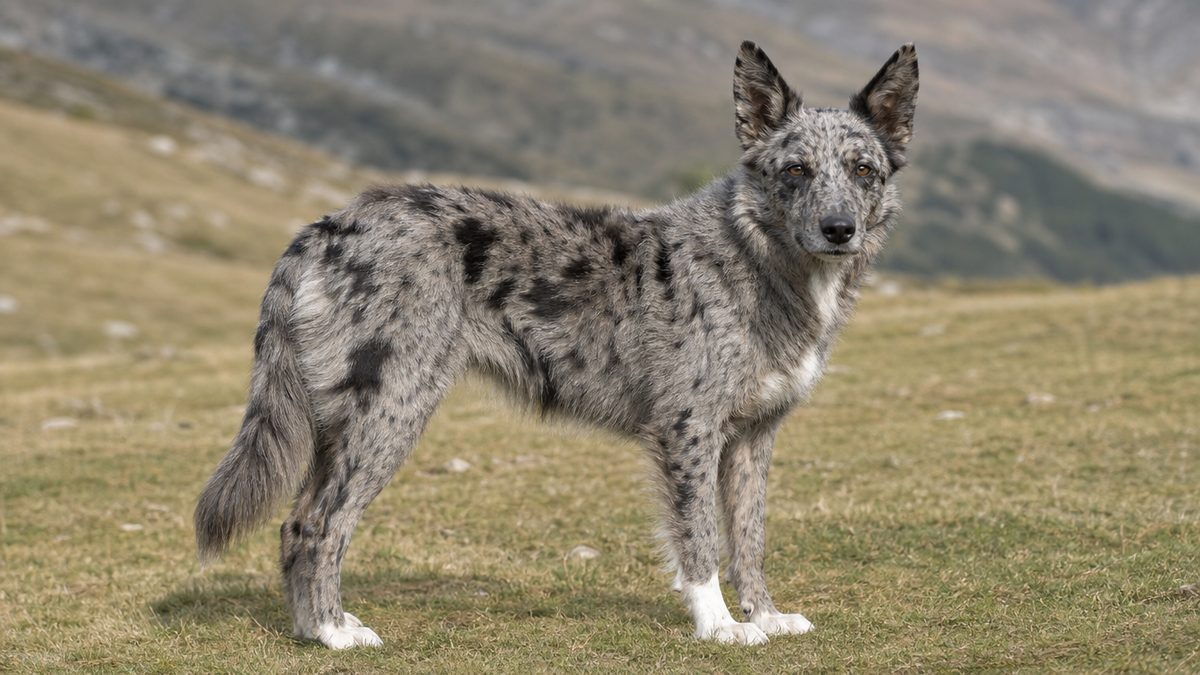
The standard's own description is precise and worth quoting rather than paraphrasing. The dog has a typically wolf-like appearance, mesomorphic, of medium size, well proportioned and harmonious in movement. It is agile but strongly muscular, with a light skeleton carrying strong muscle that never weighs it down. It is rustic, capable of working in extreme climatic conditions and on rough ground or ground full of natural obstacles, with shrewdness and great ease. It is markedly docile with people while remaining watchful. The coat is semi-long with a thick undercoat, which is precisely what makes it heat-sensitive in India.
The listicles ranking for the breed cover roughly this much and stop, without opening the register, the standard, the FCI indexes or the genetics. The sections below open all four.
Appearance, from the document that defines it
| Feature | What the ENCI standard says |
|---|---|
| Height at withers | Average 58 cm for males, 54 cm for females, tolerance 5 cm either way, and a greater deviation tolerable in a typical, harmonious dog |
| Weight | No number at all. In proportion to size and traditional function, normally lighter than it looks; particularly massive dogs are not sought |
| Head | Lupoid, lean and chiselled, skull and muzzle lines tending to parallel, muzzle equal to or slightly shorter than the skull |
| Ears | Triangular, set high, broad at the base, generally and preferably erect or semi-erect, sometimes drooping |
| Eyes | Slightly oval, medium, dark, hazel or amber. Heterochromia admitted but not sought, especially total |
| Tail | Medium length, natural, hanging or horizontal at rest, arched and merry in action |
| Dewclaws | With or without. Removal is not required |
| Coat | Semi-long, goat-like and harsh especially over the back, sometimes slightly wavy, with undercoat |
| Gait | Must permit covering hundreds of kilometres a day |
Two of those rows are unusual enough to flag. There is no weight figure, so any page quoting a kilogram range for this breed is not quoting the standard. And the tail is natural, with brachyury and anury, a short or absent tail, listed as serious faults. That makes this breed the mirror image of most European working standards, and it means an Indian-bred dog would face no conflict with the docking prohibition in Second Schedule Part II paragraph 6(8) of the 2017 Rules.
What it is for
The standard states the job in one line: a herding dog used for driving and guarding the flock. It expands on that with a description of work most breed pages never attempt, calling the dog tireless and attentive with livestock whether sheep, goats, cattle or horses, and saying it holds the line of the flock to protect cultivated ground. That last clause is the actual mechanics of alpine herding: the dog is a moving fence.
A working alpine herding dog that Italy is in the process of turning into a registered breed, and has not finished. It has a real standard, a real register, an active society and a genomics paper that says the process is incomplete. Bonbeno's verdict is breed in formation, which is a third position between a recognised breed and a landrace type, and the rest of this page sets out the evidence for it.
Registry status: what ENCI actually holds, and why code 907 is not an FCI number
ENCI holds this breed on the Registro Supplementare Aperto with recognition procedures started, and the code 907 it prints is an Italian filing rather than a Federation Cynologique Internationale grant.
The registry status is the question every ranking page gets wrong, so this section works from the register outward rather than from the encyclopedias inward.
What ENCI's own record says
ENCI's live breed record opens its Aspetto Generale block with two lines in capitals: RAZZA AMMESSA AL RSA (REGISTRO SUPPLEMENTARE APERTO) and PER LA QUALE SONO STATE AVVIATE LE PROCEDURE DI RICONOSCIMENTO. A breed admitted to the Open Supplementary Register, for which the recognition procedures have been started. Beneath it the record prints Codice FCI 907, Gruppo 1, Sezione 1.
Italy's Libro genealogico runs three registers, and the third one is the point. The open register, the RSA, exists specifically for the inscription of dogs belonging to typical Italian populations in the process of being recovered as breeds. So a dog can be genuinely on Italy's national books and hold no international number at all.
| Register | What it holds | This breed? |
|---|---|---|
| ROI, Registro Origini Italiano | Dogs of recognised breeds with four generations of registered ancestry | No |
| RSR, Registro Supplementare Riconosciuti | Dogs of recognised breeds with a shorter known genealogy | No |
| RSA, Registro Supplementare Aperto | Typical Italian populations in the phase of recovery as breeds | Yes, with procedures started |
The control that makes this reading safe
A group list is only conclusive if it includes the open register, so that was tested rather than assumed. The Cane Fonnese appears in ENCI's Group 2 list, between the Cane di San Bernardo and the following section heading, even though the Cane Fonnese is itself held only on the RSA. So ENCI's per-group lists do cover the open register, which means the Group 1 list is the complete picture for shepherd breeds, and this breed's presence in it is a genuine register finding rather than a listing accident.
Why 907 is not an FCI number, proved four ways
- ENCI's own standard says so. Its classification line reads that the breed is Gruppo 1, sezione 1a, numero 907 ammessa al RSA (Registro Supplementare Aperto) italiano. ENCI calls it an Italian RSA number in its own document.
- The same document leaves the FCI field blank. Its header reads FCI-Standard Nr: 000 pubblicato 00.00.0000 and TRADUZIONE: 00.00.0000 /EN/FR/DE/ES. The standard is laid out in the FCI's format with the FCI's own fields filled with zeros.
- The number is outside the FCI's range. The highest FCI breed number currently in use is 378, the Macedonian Shepherd Dog Karaman, admitted provisionally on 11 February 2026. A 907 cannot be an FCI number because the FCI has not reached 907.
- The FCI's own indexes do not hold it. The definitive letter P index carries 27 entries and the breed is absent, while the Piccolo Levriero Italiano at 200 sits on the same page proving the FCI files Italian breeds under Italian names. The 20-entry provisional register is also without it.
ENCI's breed record offers a Download da FCI button built from its own 907, pointing at fci.be. Follow it and it returns HTTP 200 and lands on the FCI's generic nomenclature index with no breed page and no standard, because the FCI holds no breed 907. It does not 404. It quietly deposits the reader on an FCI page that says nothing about this dog, which is exactly how a filing gets mistaken for a grant.
That trap is already in circulation. An Italian pedigree sales index lists 'Cane da pastore della lessinia e del lagorai (con pedigree) codice fci n 907' as a category, so ENCI's internal number is now being printed alongside genuine FCI numbers in commerce. Italian Wikipedia does the same in its infobox.
The 900 series, mapped
The number makes sense once you see the block it belongs to. Every Italian population in recovery carries one, and reading them together shows the ladder is live.
| Code | Breed | ENCI register | FCI holds it? |
|---|---|---|---|
| 902 | Cane Fonnese | RSA, procedures started | No |
| 904 | Cane da Pastore della Sila | RSA, procedures started | No |
| 905 | Cane da Pastore di Oropa | RSA, procedures started | No |
| 906 | Spino degli Iblei | RSR, one rung higher | No |
| 907 | Pastore della Lessinia e del Lagorai | RSA, procedures started | No |
| 908 | Cane delle Alpi Apuane | RSA, procedures started | No |
The Spino degli Iblei is the useful comparison. It carries the adjacent number 906 and reads RAZZA AMMESSA AL RSR, the Registro Supplementare Riconosciuti, so it has already climbed a rung that this breed has not. The route is real, it is in use, and this breed is on the first step of it.
And the society itself will not claim more than that
The strongest evidence for the verdict comes from the people running the recovery. The Societa Italiana Pastore della Lessinia e del Lagorai's own FAQ asks whether the breed is officially recognised by ENCI and answers Non ancora, not yet, adding that ENCI authorised a first raduno aimed at recognition but that definitive admission to the Libro genealogico awaits the results of genome examination in comparison with the DNA of other similar dog breeds. Its own website calls its standard a Standard provvisorio, a provisional standard.
So ENCI says admitted with procedures started; the society says not yet recognised. Both are true, and they are answering different questions. Admission to an open supplementary register is not recognition as a breed, and the recognition procedure is the thing in between.
What the genome study found, and why it is the thing holding recognition up
A 2018 genome-wide study classified this population as a Variety rather than a Breed, on an explicit four-metric test, and the breed society says definitive recognition now waits on exactly that kind of genome comparison.
This is the single most important piece of evidence about the breed and not one page ranking in India cites it.
Talenti and colleagues analysed 263 dogs from 23 closed Italian populations, seven Apennine grey wolves and an established dataset of 161 globally recognised breeds, using 142,840 genome-wide SNPs across 1,609 canines representing 182 breeds and 16 wild canids. It is the only study of its scale on Italian dog populations, and this breed is in it.
The test the paper applied
The authors set four numeric thresholds for what a purebred population looks like: a single-dog long homozygous run of at least 1,098.365 Mb, a ten-dog shared run of at least 48.092 Mb, homozygosity decay of at most 0.607, and an inbreeding coefficient F of at least 0.133. A population had to meet three or more of the four and appear as a single breed-specific clade in the bootstrapped phylogeny to be classed as a breed.
| Measure | Threshold | Pastore della Lessinia e del Lagorai | Pastore d'Oropa | Lupino del Gigante |
|---|---|---|---|---|
| Dogs sampled (N) | n/a | 10 | 15 | 10 |
| Inbreeding coefficient F | at least 0.133 | 0.079, fails | 0.043 | 0.141 |
| 1-Dog LnH (Mb) | at least 1,098.365 | 1,637.732, passes | 1,807.711 | 1,664.250 |
| Shared LnH (Mb) | at least 48.092 | 442.396, passes | 495.420 | 100.585 |
| Homozygosity decay | at most 0.607 | 0.475, passes | 0.579 | 0.424 |
| Clusters as its own clade | required | No | Yes | Yes |
| Status assigned | Variety | Breed | Breed |
So the population passes three of the four numeric thresholds and fails the phylogeny requirement. The paper's category for that outcome is a paraphyletic variety of another population rather than a breed in its own right.
What the paper says in words, which is blunter than the table
The discussion reads that the Pastore della Lessinia e del Lagorai and the Lupino del Gigante, both from north-east Italy, are monophyletic with each other and paraphyletic to the Lupo Italiano and the German Shepherd Dog, and then states the conclusion plainly: indicating their incomplete emergence as distinct breeds. A subset of each forms a breed-specific clade at 70 percent confidence, but four of the ten sampled Lessinia dogs fall into neither clade.
Read against the society's FAQ, that lines up exactly. The society says definitive admission to the Libro genealogico awaits the results of genome examination against the DNA of other similar breeds. The 2018 genomics is the kind of evidence that has to be answered, and on the published numbers it has not been answered yet.
The German Shepherd question, and a claim that has drifted
English Wikipedia states that in 2018 a genetic study found that just prior to 1859 a broadly distributed European herding dog gave rise to the German Shepherd Dog, the Berger Picard and five Italian herding breeds including this one. The paper says something adjacent but not the same: the German Shepherd Dog displays significant haplotype sharing with several Mediterranean and other European breeds dated between 1859 and 1867, well before the German Shepherd's establishment as a breed in 1899, and that these dates likely reflect a pervasive common livestock dog in continental Europe from which the German Shepherd was formed.
A haplotype-sharing date range is not a founding event, and a range beginning in 1859 is not a date just prior to 1859. The underlying point survives the correction and is genuinely interesting: this dog and the German Shepherd are both descendants of the same widespread continental herding stock, which is why the standard disqualifies wolf-grey colour outright, the one colour that would blur the line.
The literature is otherwise empty, and that was tested
PubMed holds zero records under the breed's own name. Searches for Lessinia Lagorai, Pastore della Lessinia and Lagorai shepherd dog all returned nothing, with the query translations read back and none of them rewritten into an author search. A control of Labrador retriever hip dysplasia returned 126 records in the same session, so the instrument was working. The Talenti paper reaches the breed only because it studies Italian populations as a set, not because anyone has studied this dog.
Searching Lupino del Gigante, the breed's closest genetic neighbour, PubMed silently translated it into an author search for del gigante and returned zero. Two of these Italian populations are one letter away from being reported as having no literature for reasons that have nothing to do with dogs. Always read the translation line PubMed prints before believing a zero.
Origin: transhumance, merino sheep, and a recovery that starts in 2016
The population's documented recovery starts in 2016 with a breed society, reaches ENCI's open register on 24 June 2020, and rests on a much older history of alpine transhumance that the standard itself traces to the Neolithic.
There are two histories here and they should not be blended. One is the deep account the standard and the society give, which is regional background. The other is the registry record, which is dated and checkable. This page keeps them apart.
The deep account, as the standard tells it
The standard's historical summary says evidence of driving dogs working sheep and goats in the Italian Alps goes back to the Neolithic, and that canine gene flows from German-speaking territories, both of local autochthonous breeds and of those that arrived with the spread of the merino sheep across Europe during the eighteenth and nineteenth centuries, were selected and typified by the shepherds of the upper Veneto and the Trentino valleys. The breed spread through an area long known for its wool industry and sheep and goat husbandry, carried by the nomadic practice of seasonal transhumance from mountain to plain and back.
The society's own historical notes go further back still, to the Paleoveneti and to rock carvings and decorated bronze situlae showing a lupoid dog with a curled tail in the attitude of a driving dog. That is heritage argument rather than pedigree evidence, and one page in the ranking set says so explicitly and correctly: claims about Neolithic shepherd dogs should be read as regional background, not as proof that a modern registered dog has a continuous pedigree from that period.
The registry record, which is short and dated
| Date | Event | How well sourced |
|---|---|---|
| From 2016 | SIPaLL begins pursuing official recognition with ENCI | Italian Wikipedia |
| 2018 | First and largest ENCI-authorised raduno, at Fara Gera d'Adda in Bergamo | Italian Wikipedia |
| 2018 | The Talenti genome study publishes, classing the population as a Variety | Peer-reviewed, Ecology and Evolution |
| 24 June 2020 | ENCI activates the Registro Supplementare Aperto for the breed | Italian Wikipedia, corroborated by an Italian working-dog site as end of June 2020 |
| 1 January 2021 | Publication date of the official standard | ENCI's own standard PDF |
| 15 June 2022 | Commissione Tecnica Centrale gives its concurring opinion on amendments | ENCI's own standard PDF |
| 24 November 2022 | ENCI's Consiglio Direttivo approves the amended standard | ENCI's own standard PDF |
| Ongoing | Recognition procedures started, not completed | ENCI's live breed record |
One detail in that table is worth pausing on, because it shows how small Italian cynology is. The 24 November 2022 meeting that approved this breed's amended standard is the same Consiglio Direttivo meeting on whose request the Ministry of Agriculture approved the wholesale revision of the Norme tecniche of the Libro genealogico, by ministerial decree of 22 February 2023, in force from 1 September 2023ENCI, breed standard for the Cane da…. This breed's paperwork was signed off at the same table as the rules that govern the studbook it wants to enter.
How many dogs there are, and why the usual figure needs care
The number in circulation is about 500. Italian Wikipedia says the breed currently counts roughly 500 individuals registered in the official studbook, and attributes it to a book published in 2017.
That attribution cannot support the claim. ENCI activated the register in June 2020, three years after the cited source was published, so a 2017 book cannot report how many dogs are on it. The figure may well be right as an estimate of the living population; it is not sourced as a register count. The society reports more than 100 members, which is a count of people rather than dogs and is the only membership figure it publishes.
That is the headline of one page ranking on page one for this breed, and it is posed as a question. Bonbeno cannot answer it, because no page anywhere publishes a per-year registration count for this population and ENCI's own ten-year registration chart on the breed record renders client-side. What can be said is narrower and checkable: the breed sits on the first rung of a three-rung Italian ladder, one neighbouring population at code 906 has already climbed higher, and the genomics samples ten dogs because ten was what was available.
Price in India: there is none, and the breed society explains why there is none anywhere
No price in india exists for the Pastore della Lessinia e del Lagorai, and the breed's own society states that because the breed is not yet recognised, breeders cannot exist.
Most rare-breed pages have to prove an absence with a search. On this breed the governing body of the recovery says it outright. The society's FAQ, answering a reader who wants to buy a puppy and asks for a recommended kennel, replies: Non essendo ancora la razza riconosciuta, non possono esistere allevatori. Since the breed is not yet recognised, breeders cannot exist. It adds that it does not deal in breeding itself, that it simply helps members publish litters born to them, and that with more than 100 members it will not privilege some over others.
That is a breed society declining to run a marketplace, which is unusual and worth respecting.
What an Indian search actually returns
A commerce-shaped search for this breed restricted to India returned no Indian result of any kind. The set was entirely Italian: Instagram and Facebook accounts of Italian owners, an Italian farm's photo gallery naming its alpha male, an Italian classifieds site, and one Italian tax-authority list of charities that happened to contain both the word Lessinia and the word India in unrelated entries.
The identical query shape on the Labrador Retriever, in the same session, returned a city-by-city rupee table running INR 30,000 to 1,20,000 and above across eight Indian cities, alongside Supertails, TradeIndia and Quora threads full of rupee figures. So the instrument finds Indian dog commerce when it exists, and for this breed it found none. The search engine itself was controlled the same way and passed.
The one price that exists anywhere, and why this page will not convert it
The only price attached to this breed in the searched result set is an Italian classified advertisement offering a male for stud: Per MONTA maschio di Pastore del Lagorai, 700 euro, Udine.
Three things about that figure. It is a stud fee, not a puppy price. It is in euros, in Italy. And Bonbeno will not convert it into rupees, because converting a foreign price is exactly how fake Indian breed prices are manufactured, and a converted figure would then circulate as though it described an Indian market that does not exist.
Take the number and divide it by 84.38, then by 80, then by 74. If any of those quotients is a figure a seller would actually print, such as 700, 800 or 1,500, you are looking at a converted foreign price rather than an Indian observation. This site has caught that mechanism repeatedly, including one Indian directory whose 155-breed price table had 453 of its 463 rupee values dividing to exact whole dollars at a single rate.
Why no Indian supply can lawfully form
Even setting aside the society's position, Indian law closes the route independently.
- Import for breeding or sale is barred. DGFT Trade Notice 22/2022-23 classifies dogs under ITC(HS) 01061900 as Restricted, allows import only as a pet with a valid pet book in the importer's own name, for R&D with CPCSEA recommendation, or for Defence and Police internal security, and states that applications for trading or breeding purposes shall be duly rejected.
- Entry is limited to seven places, the airports and seaports of Delhi, Mumbai, Chennai, Hyderabad, Bengaluru and Kolkata and, since October 2024, Kochi airport Department of Animal Husbandry….
- A permanent baggage import needs a transfer of residence after two years of continuous stay abroad, and covers up to two animals.
- And the paperwork that would travel with a dog is an RSA entry, an inscription on an open supplementary register for a population in recovery, not a pedigree from a studbook the FCI recognises.
The last point is the one that catches people. A buyer who imagines importing a papered dog and registering it with the Kennel Club of India against FCI nomenclature is imagining a document that does not exist for this breed. The FCI has no number for it, so there is nothing for the KCI to recognise it as.
What a dog of this size would cost to keep in India each month
Keeping a 25 kg alpine herding dog in an Indian metro costs roughly Rs 7,700 to Rs 12,300 a month on published Indian figures, and none of those figures depends on the breed being available.
There is no purchase price to report, but the cost of ownership is real and sourceable, because it is the cost of keeping any medium-large working dog in India. That is the part of this page an Indian reader can actually use.
The standard gives no weight, so this table assumes a dog of about 25 kg, which is what a 58 cm lupoid herding dog of moderate build typically weighs. Every line names its source.
| Line | Low | High | Source and basis |
|---|---|---|---|
| Food, premium dry | Rs 4,800 | Rs 6,200 | Arithmetic at about 250 to 330 g a day on published Indian premium pricing. Verify grams per day against the pack |
| Tick, flea and worm cover | Rs 1,103 | Rs 1,103 | NexGard Spectra 15 to 30 kg, three tablets Rs 3,308, dosed monthly |
| Deworming, if dosed separately | Rs 251 | Rs 377 | Drontal Plus at Rs 125.67 a tablet, one per 10 kg |
| Vaccination, annualised | Rs 267 | Rs 275 | Annual booster from Rs 3,199 at one clinic chain, divided by twelve |
| Consultation, annualised at two visits | Rs 83 | Rs 167 | Published Indian range of Rs 500 to 1,000 a consultation |
| Grooming, one bath a month | Rs 934 | Rs 1,869 | Bathing from Rs 934, complete bath and styling from Rs 1,869 |
| Municipal registration, annualised | Rs 4 | Rs 42 | Chennai Rs 50 a year, Delhi Rs 500 a year |
| Contingency at ten percent | Rs 244 | Rs 403 | Bonbeno's own allowance, not a quoted figure |
| Monthly total | Rs 7,686 | Rs 12,436 | Sum of the rows above |
Where an alpine coat changes the arithmetic
Grooming rises and vet visits may too. A semi-long coat with a thick undercoat in Indian humidity needs more bathing and far more drying than a smooth coat, and the published Indian grooming spread is wide: Rs 934 to Rs 1,869 at one Delhi clinic chain against a wider survey range of Rs 300 to Rs 2,000Voice of Stray Dogs. Budget high and do the daily work yourself.
Vaccination cost depends on the delivery model, not the drug. The puppy course starts at Rs 6,499 against a struck-through Rs 8,111 at one chain, with individual vaccines at Rs 699 for anti-rabies, Rs 899 for the 9-in-1 and Rs 1,349 for kennel cough. A dog charity's survey gives core vaccination as Rs 1,500 to Rs 3,000 for the first year, which does not overlap the package price at the top end. Greater Chennai Corporation provides treatment and anti-rabies vaccination free at its six municipal pet clinics.
Boarding is a per-night cost and a herding dog cannot simply be left. Bengaluru rates run Rs 599 for four hours, Rs 799 for daycare and Rs 899 overnight, so a fortnight adds about Rs 12,600.
The society's own guidance says this dog forms a close bond and cannot be left alone and marginalised, for example in a garden, and that if you are away for many hours a day it should at least have the company of another dog. Read honestly, that is a recommendation to keep two dogs, and it roughly doubles the table above. Very few breed pages price the temperament.
Heat tolerance in India, and why the usual climate instrument fails over this breed's mountains
This breed has low heat tolerance in India, and establishing that took extra care because NASA POWER's grid cell misses the Lessinia plateau by more than 840 metres and the Lagorai ridge by more than 940.
Climate on this site is worked from NASA POWER queried by explicit latitude and longitude, with the cell elevation echoed on every point. POWER returns a grid cell rather than a point, and the Lessinia and the Lagorai are precisely the terrain where a cell stops describing the place underneath it.
The instrument failed, and here is the evidence
| Point | Real elevation | POWER cell elevation | Error | Usable? |
|---|---|---|---|---|
| Bosco Chiesanuova, Lessinia | about 1,104 m | 260.49 m | minus 843.5 m | No |
| Erbezzo, Lessinia plateau | about 1,150 m | 260.49 m | minus 889.5 m | No |
| Passo Manghen, Lagorai ridge | about 2,047 m | 1,102.92 m | minus 944.1 m | No |
| Pieve Tesino, foot of the Lagorai | about 843 m | 792.43 m | minus 50.6 m | Yes |
Two independent tells fired at once on the Lessinia. The cell elevation is impossible for a plateau town, and the two Lessinia points 13 km apart returned byte-identical results, because they fall inside one cell. A single cell at 260 m is describing the Adige valley floor, not the pasture the dogs work. Quoting its numbers as the breed's homeland climate would have made the Lessinia look almost Mediterranean.
One point survived. Pieve Tesino, at the foot of the Lagorai, comes back 50.6 m low, which is within normal error, so it is the only alpine figure this page uses at face value.
The comparison, using the point that works
| Place | Cell elevation | Annual mean T2M | Hottest month mean daily max | Annual RH2M | Peak wet bulb |
|---|---|---|---|---|---|
| Pieve Tesino, Lagorai foot | 792.43 m | 9.61 C | 24.7 C | 75.89% | 16.1 C |
| Delhi | 206.37 m | 25.60 C | 41.9 C | 45.56% | 26.5 C |
| Mumbai | 97.15 m | 26.77 C | 39.5 C | 67.39% | 25.8 C |
| Chennai | 48.95 m | 27.95 C | 36.6 C | 72.39% | 26.1 C |
| Kolkata | 7.35 m | 25.81 C | 39.1 C | 73.93% | 27.1 C |
| Pune | 635.99 m | 23.86 C | 38.6 C | 66.80% | 23.0 C |
| Bengaluru | 841.72 m | 23.74 C | 36.3 C | 67.94% | 21.9 C |
The mean daily maximum column was computed from the daily T2M_MAX series for 2015 to 2024 and averaged per month, because the climatology and monthly endpoints return period extremes rather than means. The wet-bulb column uses mean T2M with RH2M, never T2M_MAX.
Humidity is not the problem, and this is the counterintuitive part
Pieve Tesino runs 75.89 percent annual relative humidity, which is higher than Chennai at 72.39, Kolkata at 73.93, Bengaluru at 67.94, Mumbai at 67.39, Pune at 66.80 and Delhi at 45.56. Alpine Italy is a damp place, and a page claiming this dog will be undone by Indian humidity is arguing from an assumption rather than a measurement.
What the dog has never met is heat, and heat with moisture. Its home peaks at 16.1 C wet bulb; Kolkata peaks at 27.1 C, Delhi at 26.5 C, Chennai at 26.1 C. That is roughly an eleven-degree step for the worst Indian cities, and even Bengaluru, the least punishing, sits 5.8 C above.
On dry-bulb terms the step is starker still. The hottest month at Pieve Tesino averages a daily maximum of 24.7 C. Delhi's averages 41.9 C. That is a 17.2 degree difference in the routine afternoon, and it is an ordinary May rather than a heatwave.
The obvious suggestion is Ooty, Shimla, Manali or Darjeeling, and the instrument fails at all four. POWER's Manali cell sits at 3,984.73 m against a town near 2,050 m and reports an annual mean of minus 0.56 C, which is plainly wrong. Ooty's cell is 1,455 m too low, Shimla's 1,302 m too low, Darjeeling's 731 m too low. Publishing wet-bulb figures for those towns would be publishing a cell rather than a place, and this page declines to.
The statutory hook is direct. Second Schedule Part IV paragraph 21(1) of the 2017 Rules bars keeping in outdoor facilities, without the attending veterinary practitioner's written approval, dogs not accustomed to the temperatures prevalent in the area and breeds that cannot tolerate them, such as long-haired breeds in high temperature locations. A semi-long alpine coat in an Indian yard is what that clause describes.
Managing a thick undercoat through an Indian summer
Manage this coat by clearing the undercoat rather than cutting the topcoat, moving all work outside daylight, and treating exertion rather than ambient temperature as the real risk.
The largest UK study of canine heat illness found that of 879 events with a recorded trigger, 652, or 74.2 percent, were exertional, against 113 environmental and 46 from confinement in a vehicle. For a dog whose standard says its gait must allow it to cover hundreds of kilometres a day, that statistic is the whole problem in one line.
The breed's own region already worries about this at latitudes far cooler than India's. A regional television item from the Adige valley is titled, in translation, thick coat in summer: caution with the Pastore della Lessinia del Lagorai. If the coat is a summer talking point in Trentino, it is a year-round one in Chennai.
Six rules for an Indian summer
- Work the dog before sunrise and after dark, and nowhere in between. Delhi's May afternoon averages 41.9 C against 24.7 C in the breed's home range.
- Strip the undercoat out, do not shave the topcoat off. The standard wants a harsh, goat-like outer coat that protects, and specifically does not want it long or voluminous enough to be weighed down. The undercoat is the layer to remove, and it is the layer that traps heat and monsoon damp.
- Keep the dog lean. Bodyweight at or above the breed and sex mean carries an odds ratio of 1.42 for heat-related illness, and the society's own guidance says an unworked dog needs a fairly sparing diet so it is not weighed down.
- Wet to the skin, not just the coat. A thick undercoat holds water against the body. Soak belly, groin and feet and let air move rather than leaving a wet blanket on the dog.
- Give shade and moving air rather than a single cold room. A dog bred to work outdoors will not settle indoors all day, so the yard has to be usable at dawn and dusk.
- Treat hard panting, staggering or collapse as an emergency. Case fatality for heat-related illness in the UK study was 14.18 percent.
Which Indian city is least bad
| City | Peak wet bulb | Gap over Pieve Tesino | Verdict |
|---|---|---|---|
| Bengaluru | 21.9 C | +5.8 C | Least bad, and the altitude helps. Still not comfortable in April |
| Pune | 23.0 C | +6.9 C | Workable with a hard summer routine |
| Mumbai | 25.8 C | +9.7 C | Difficult. The monsoon is a continuous load, not a relief |
| Chennai | 26.1 C | +10.0 C | Difficult, with no cool season to recover in |
| Delhi | 26.5 C | +10.4 C | Brutal in May and June, genuinely pleasant in January |
| Kolkata | 27.1 C | +11.0 C | The hardest of the six |
Delhi is the split case. Its January mean of 13.6 C is the only Indian figure in the set that a dog from the Lagorai would find ordinary, and its May mean daily maximum of 41.9 C is the worst. A dog there would have a good winter and a dangerous summer, which is a manageable pattern if the household plans for it and a fatal one if it does not.
No Indian prevalence figure for canine heat stroke exists in the indexed veterinary literature, so every heat statement here rests on UK epidemiology applied to a measured Indian climate. Saying so is more useful than filling the gap with a number nobody published.
Temperament, and a disagreement between the standard and the encyclopedia
The ENCI standard says this dog must not be aggressive and is friendly with people, other dogs and animals in general, while Italian Wikipedia says it has medium aggression suited to guarding, and the two cannot both be right.
This is the most consequential contradiction on the page for a buyer, so it gets set out side by side rather than smoothed over.
| Question | ENCI standard, 907 | Italian Wikipedia |
|---|---|---|
| Aggression | Must not be aggressive, must not be fearful, possibly circumspect and wary | Medium aggression, which makes it suitable for guarding and watching |
| With strangers | Friendly with people, other dogs and animals in general | Tends to be wary of those it does not know well |
| Handling | Learns with great ease, marked docility | Requires careful and experienced management |
| Working style | Conducts and moves livestock over long distances, holds the line of the flock | Pushing conductor working by bark, bite and impetuous action |
| Bond | Naturally forms a close bond with people | Creates a close bond and requires an almost constant presence |
The society sides with the standard. Its own guidance says that if correctly socialised and educated the dog has no inclination to aggression towards people or other animals. Italian Wikipedia's character section carries no citation for its aggression claim.
Bonbeno's reading is that the standard governs, because it is the document ENCI judges assess dogs against and the one that can disqualify a dog for unjustified aggression or fear. But the disagreement is not noise. A landrace being formalised into a breed contains more variation than a closed studbook does, and a population where four of ten sampled dogs sit outside both breed clades is exactly the sort of population where two honest observers can meet different dogs.
Who this dog suits in India
- A household that is home. The society's advice is explicit: this dog cannot be left alone and marginalised in a garden, and if you are out for many hours it should have another dog for company.
- Somebody who will give it a job. Marked spatial intelligence and orientation, and a standard built around covering ground, do not survive a life of two short walks.
- An owner comfortable with a wary dog. Circumspect and watchful is inside the standard. Nervous or sharp is outside it.
- Not a first dog, and not an apartment dog. Nothing in the registry documents or the society's guidance supports either.
The standard says the traditional use has made this a resistant, balanced dog, friendly with people, other dogs and animals in general. In an Indian city that last clause matters more than it does on an alpine pasture, because a herding dog with strong movement drive meets free-roaming dogs, cats, cattle and traffic every single day. Socialise inside the socialisation window and train the recall before anything else.
Training a herding dog bred to think for itself
Train this breed by working with its herding instinct rather than against it, because the standard describes innate driving and watching ability alongside marked docility and great ease of learning.
The standard's temperament clause is unusually specific about mental qualities. It names innate qualities of conducting and watching domestic animals, marked spatial intelligence and orientation, learning with great ease, and a natural close bond with people which it says makes the dog suitable for uses beyond herding. That is a description of a dog that solves problems and then checks in.
What works
- Give it something to move or manage. Herding balls, structured fetch with rules, or formal herding if you can reach it. A dog selected to hold the line of a flock needs a line to hold.
- Train the recall before the drive matures. Movement drive plus an Indian street is the combination to get ahead of.
- Use spatial problems. The standard singles out orientation. Hidden-object searches, multi-room recalls and directional sends are cheap, indoor, and hot-afternoon compatible.
- Socialise widely and early. The society's own line is that a correctly socialised and educated dog has no inclination to aggression, which frames socialising as a health intervention rather than an optional extra.
- Keep the handler relationship central. Marked docility with a close human bond is the lever; heavy correction wastes it.
What it resists
Isolation. More than any other item on this page, the society's warning about leaving the dog alone is a training issue as much as a welfare one. A dog that has learned that being left is normal is a dog that has learned to entertain itself, and a herding dog entertains itself by managing things.
Meaningless repetition. A population still carrying working selection has not had its independence bred out of it.
| Age | What should be in place | The Indian complication |
|---|---|---|
| 8 to 16 weeks | Name, crate, handling, coat and ear handling, first socialisation | Vaccination gaps limit ground contact; carry the puppy out |
| 4 to 6 months | Recall in a fenced space, lead manners, alone-time in small doses | Summer forces training into two short windows a day |
| 6 to 12 months | Recall under distraction, settle on cue, first structured movement work | Growth: no forced running or repetitive stairs |
| 12 to 18 months | Recall around street dogs and livestock, real stamina work | Monsoon coat care becomes daily rather than seasonal |
| 18 to 24 months | A dog that can work an hour and switch off for the rest of the day | No vet or trainer nearby will know the breed, so keep records |
Second Schedule Part II paragraph 6(3) of the 2017 Rules permits only out breeding and line breeding, and prohibits in-breeding between relatives of the second to fourth grade within four generations, naming uncle to niece, nephew to aunt, cousin to cousin and grandparent to grandchild, and incest breeding between parents and children or brother and sister. Paragraph 6(4) adds that female dogs shall not be mated after the age of eight years. For a population whose whole genetic problem is a small founder base, those are the right rules and they are stricter than most owners expect.
Daily exercise, and a standard that asks for hundreds of kilometres
This breed needs one to two hours of purposeful daily work, and the standard sets the bar higher than any Indian household will meet by asking for a gait that permits covering hundreds of kilometres a day.
Read the gait clause carefully, because it is doing more work than most standards' equivalents. It asks for a loose, merry trot or walk, functional enough that it can be maintained for a long period, which must permit the dog to cover hundreds of kilometres a day, with great agility and good balance especially in changes of direction and sudden accelerations, and a foot that skims the ground without extending uselessly forward or lifting too high, so as to save energy.
That is an engineering specification for a transhumance dog, not a description of a pet. Nobody in an Indian city is going to give this dog hundreds of kilometres. What the clause tells you is the size of the deficit you are managing.
| Slot | Winter, Nov to Feb | Summer, Mar to Jun | Monsoon, Jul to Sep |
|---|---|---|---|
| Early morning | 60 min walk with directional work | 45 min before sunrise, on grass | 40 min, dry the coat afterwards |
| Midday | Free movement in shade | Indoors. Spatial and scent problems | Indoors. Undercoat and skin check |
| Evening | 45 to 60 min including training | 30 to 40 min after dark | 30 min between showers |
| Weekly extra | One two-hour outing on varied ground | One pre-dawn long outing | Structured indoor work instead |
What under-exercise looks like
- Managing the household. A herding dog with nothing to move starts moving children, other pets and visitors.
- Patrolling and alerting. Not the same as guarding, and it escalates when the dog is bored rather than when there is a threat.
- Escape and roaming. Movement drive plus a gate is a bad pairing.
- Weight gain, which then compounds the heat risk. Bodyweight at or above the breed and sex mean carries an odds ratio of 1.42 for heat-related illness.
The society names the failure mode itself, in one sentence: its lively temperament requires that the dog is always occupied both physically and mentally, for example at minimum with sporting activities requiring obedience training. Minimum is the operative word.
Exertional cases made up 652 of the 879 UK heat-illness events with a recorded trigger, 74.2 percent, against 46 from vehicle confinement. The picture everyone carries, of the dog in the hot car, is the rarest of the three causes. The common one is a working dog being worked.
Grooming a semi-long alpine coat in Indian humidity
Groom this breed by clearing the thick undercoat and leaving the harsh outer coat alone, and treat drying after rain as the daily job rather than bathing.
The standard describes the coat with a working purpose attached to every clause, which makes it unusually easy to groom correctly. The hair is semi-long, goat-like and harsh especially over the back, sometimes slightly wavy and tending to curl, with undercoat. Silky hair is admitted but not sought, especially over the back where a harsh, goat-like coat that protects is preferred. It must guarantee protection from the weather and suit driving work in all conditions, and it must not be so long or voluminous that it can be weighed down by mud and ice.
That last clause is the whole grooming brief. This is a coat selected to shed dirt and water and to stay light. In an Indian monsoon the same design works, provided the undercoat is not left to mat underneath it.
The routine
- Rake the undercoat out twice a week, more in a shedding cycle. The undercoat is the layer that traps heat and holds monsoon damp against the skin.
- Do not shave or scissor the topcoat. The standard already treats an excessively curly coat as a fault and a short, smooth, flat coat over the whole body as a disqualification, and a shaved harsh coat frequently regrows soft.
- Dry the dog properly after rain. Not just the surface. Thick undercoat plus 90 percent August humidity is a skin problem waiting to happen.
- Check the coat behind the ears, on the tail and on the back of the thighs, which the standard names as the places the coat is most abundant and which are therefore where mats form first.
- Bathe monthly, not weekly. Over-bathing strips the harsh texture the standard wants.
The care advice most likely to be copied wrongly is the towel-and-air-dry instruction that European working-dog guidance takes for granted. In a Trentino autumn a dog dries in cool moving air. In a Mumbai August it does not dry at all. Where an overseas instruction assumes a climate India does not have, ignore the instruction rather than the dog.
Indian grooming costs
| Service | Published Indian price | How often for this coat |
|---|---|---|
| Bathing | From Rs 934 | Monthly, more in monsoon |
| Complete bath and styling | From Rs 1,869 | Quarterly at most |
| Haircut | From Rs 1,359 | Never. Ask for undercoat removal instead |
| Add-ons, nails and ears | From Rs 99 | Every visit |
| Wider Indian range, for sanity | Rs 300 to Rs 2,000 | Use it to judge any quote |
Indian groomers routinely offer a summer clip for any long-coated dog, and for this breed it is the wrong intervention twice over. It removes the harsh outer layer that keeps sun off the skin, and the standard disqualifies a short, smooth, flat coat over the whole body, so a shaved dog that regrows soft has been moved towards a disqualifying fault. Clear the undercoat instead. That is the layer causing the heat problem.
Merle: the colour that sells this breed, and the mating its own standard bans
The merle coat is what makes this breed attractive to buyers and it proves nothing about a dog's identity, and the standard prohibits mating two merle dogs together outright.
The merle coat is doing more commercial work for this breed than any other feature, so it gets its own section.
What the standard actually permits
Colour under the ENCI standard is either solid or multicoloured. Solid means black, brown, or fawn from the darker shades to the lighter, cinnamon through chestnut. Multicoloured means irregular patches of differing size, that is merle: grey, black and/or brown, liver and chamois in irregular speckled, mottled or spotted patches on a base of porcelain grey, bluish or cinnamon, plus a sand merle of uniform sand with a darker mask or saddle. All colours may carry minimal or traditional tan points. White patches are allowed only on the far extremities, and contiguous white must not exceed 20 percent of the coat surface, with contiguous white on the head admitted but not desirable.
The prohibition, in the standard's own closing notes
The standard ends with a line most breed standards do not carry: Divieto di accoppiamento tra soggetti entrambi fenotipicamente merle, a prohibition on mating two phenotypically merle dogs. It then explains why in the same breath: coats with extensive white patching and evident depigmentation, particularly of the iris, eyelid rims and nose, can be the consequence of matings between two merle parents.
The society's FAQ puts the consequence more plainly. The combination of two merle carriers can very probably cause the death of puppies in gestation or, worse, the birth of puppies with serious malformations and functional alterations, both physical and in character, and it states that ENCI has prohibited it absolutely, whatever the breed.
The ENCI circular that the society refers to circulates as a PDF, and the copy found is an image scan from which pypdf extracts zero characters. Nobody can quote a document nobody can read, so this page cites the two sources it did read: the breed standard, which carries the prohibition in its own text, and the society's FAQ, which gives the reason. The site-wide ENCI merle rule is reported here as the society describes it, not as something Bonbeno has read at source.
The colour is not the breed, and the society says so
This is the single most useful buyer-protection sentence anyone has written about this dog. Asked how to tell whether a grey-merle dog is a Pastore della Lessinia e del Lagorai, the society answers that such a dog is born only from two parents both belonging to the breed, lists the Border Collie, the Australian Shepherd, the Cane delle Alpi Apuane, the Pastore di Oropa and the Lupino del Gigante as other breeds that carry the same colour, and states flatly that the grey-merle coat colour does not qualify our breed in any way.
It adds the only assessment route that exists: every dog must be presented at a raduno and examined by a panel of three ENCI judges to verify typicality, and the society itself cannot judge dogs because that competence belongs to ENCI alone.
And Indian law is silent on merle, which matters
The word merle appears zero times in the whole Prevention of Cruelty to Animals (Dog Breeding and Marketing) Rules 2017 gazette. There is no Indian equivalent of the ENCI prohibition, and no Indian rule specific to double-merle breeding.
The nearest hook is general and it is arguable rather than settled. Second Schedule Part II paragraph 6(9) prohibits breeding to create new breeds of dogs or unusual looks. Deliberately pairing two merles to produce more heavily marked puppies is breeding for an unusual look, and the resulting deafness and eye defects would engage the welfare provisions elsewhere in the same Schedule. But an Indian buyer should understand the position honestly: the protection here comes from an Italian standard for a breed with no Indian presence, not from Indian law.
| Question | ENCI standard 907 | Indian law, 2017 Rules |
|---|---|---|
| Merle to merle mating | Prohibited outright | Not mentioned. The word merle appears zero times |
| Reason given | White patching and depigmentation of iris, eyelid rims and nose | n/a |
| Nearest Indian provision | n/a | Part II para 6(9), breeding for unusual looks, prohibited |
| Who enforces it | ENCI, through the studbook | State Animal Welfare Boards, through breeder registration |
| Does it protect an Indian buyer? | Only if the dog is ENCI-registered | Only if the breeder is registered under the Rules |
Health: no screening scheme, no prevalence data, and an encyclopedia contradicting itself
Nobody knows what this breed's inherited disease burden is, because no health screening scheme and no published prevalence data exist for the population.
That is the honest headline, and everything below either supports it or explains why the alternatives on offer are not evidence.
What the people running the recovery say
The society's FAQ answers the question directly. The Pastore della Lessinia e del Lagorai is a working dog and as such fairly rustic, no hereditary pathologies have been identified, and it therefore generally enjoys excellent health.
Read that carefully. It says none have been *identified*, which is a statement about the state of knowledge rather than about the dogs. A population with no screening scheme, no studbook health requirements and no published survey will identify nothing, whatever is actually there. That is not a criticism of the society, which is being accurate. It is a warning against reading the sentence as a clearance.
The list that appears from nowhere
Italian Wikipedia is the article most people will read, and it says both things at once. Its history section describes a dog of excellent constitution and health, free of the main hereditary pathologies. Its own section headed Patologie piu diffuse, most widespread pathologies, then lists six:
- Hip dysplasia (displasia dell'anca)
- Elbow dysplasia (displasia del gomito)
- Chronic superficial keratitis, or pannus (cheratite pannosa)
- Epilepsy (epilessia)
- Blood diseases (malattie del sangue)
- Degenerative myelopathy (mielopatia degenerativa del cane)
No source is attached to that list. The article's four references are the ENCI page, a 2017 book, the society's website and a dog blog, and none is cited against the pathology section. So one article states that the breed is free of the main hereditary pathologies and then names six of them, with nothing behind either claim.
Bonbeno's position is that neither half is usable. An uncited list of six conditions is not prevalence data, and an absence of testing is not health.
What the genetics does and does not tell you about health
The 2018 study gives one genuinely relevant number. The population's inbreeding coefficient F is 0.079, which is below the study's own purebred threshold of 0.133. A landrace being recovered from a wide founder base is less inbred than a closed studbook population, and low inbreeding is generally protective against recessive disease.
That is a real advantage and it is also fragile. The moment a recovery programme concentrates on a small number of typical dogs to fix a type, the coefficient rises. This is exactly why ENCI's studbook rules from 1 September 2023 matter to this breed more than to an established one: dogs born from a mating between parents and offspring, or between full siblings or half-siblings, cannot be entered in the Libro genealogico at all.
Italy and India both regulate close breeding, and they catch different things
| Mating | ENCI, from 1 September 2023 | India, 2017 Rules Second Schedule Part II para 6(3) |
|---|---|---|
| Parent to offspring | Progeny cannot be registered | Prohibited as incest breeding |
| Full siblings | Progeny cannot be registered | Prohibited as incest breeding |
| Half-siblings | Progeny cannot be registered | Not named in the clause |
| Uncle to niece, nephew to aunt | Not named | Prohibited as in-breeding |
| Cousin to cousin | Not named | Prohibited as in-breeding |
| Grandparent to grandchild | Not named | Prohibited as in-breeding |
| Dam minimum age | 16 months | Not stated for the dam; the sire must be past eighteen months |
| Dam maximum age | Over 7 years or 5 litters needs a vet certificate | Shall not be mated after eight years, para 6(4) |
That table is worth the trouble because the usual finding runs the other way. Overseas breed clubs often recommend practices Indian law forbids. Here, Indian law is the stricter instrument on collateral relatives, prohibiting cousin, uncle-niece and grandparent-grandchild matings within four generations that the Italian studbook rules do not name, while ENCI catches half-siblings that the Indian clause does not. Each closes a gap the other leaves open.
What Indian law would require of anyone breeding this dog here
Second Schedule Part III paragraph 8(10) requires that breeding dogs shall have been tested for genetic defects, including hip dysplasia, progressive retinal atrophy, night blindness, hypothyroidism, entropion, ectropion, overshot and undershot jaw, wry mouth, two or more missing teeth and cryptorchidism. The word is including, so the list is illustrative rather than closed.
Set that against a population with no screening scheme and the collision is clean: India would require hip-dysplasia testing of a breeding dog that Italy does not yet ask to be tested at all. For a buyer, the practical translation is that any dog of this breed offered in India should come with radiographs, and that no such radiographs are likely to exist.
Do not breed two merle dogs together, whatever anyone tells you about the colour being rare or desirable. The standard prohibits it, the society explains that the combination can kill puppies in gestation or produce serious malformations, and Indian law offers no specific protection against it. Everything else on this page about this breed's health is uncertain. That is not.
Feeding a working herding dog in an Indian kitchen
Feed this breed sparingly when it is not working, because the society's own guidance says an unworked dog needs a fairly sparing diet so it is not weighed down.
The society's feeding line is short and unusually direct: if the dog is not employed in work it needs una alimentazione piuttosto parca, a fairly sparing diet, so as not to be weighed down. That is a statement about a working dog living a non-working life, which is exactly what an Indian pet home would be.
The standard reinforces it from the other side. Weight is to be in proportion to size and to the traditionally performed function, normally lighter than it appears to the eye, and particularly massive dogs are not sought. A heavy Lagorai is off-standard by design as well as at risk in heat.
| Stage | Approach | Indian note |
|---|---|---|
| 8 weeks to 4 months | Medium to large breed puppy food, three or four meals | Sale under eight weeks is unlawful under Rule 8(1)(a), so a younger puppy is a legal red flag first |
| 4 to 12 months | Puppy food, two or three meals, growth kept steady | Do not push growth on a dog whose adult joints have no screening data behind them |
| 12 to 24 months | Transition to adult, two meals | Appetite falls in summer. Move the main meal to the cool hours rather than forcing it |
| Adult, working | Two meals, portioned to body condition | About 250 to 330 g a day of dry food, roughly Rs 4,800 to Rs 6,200 a month |
| Adult, not working | Two smaller meals. The sparing diet the society describes | This is the default in an Indian home, so assume it rather than the working ration |
| Senior | Reduced calories, joints watched | No breed lifespan figure exists, so judge the dog rather than a published median |
Dentition, which the standard is fussy about
The standard asks for complete dentition, tolerating only the absence of PM1 and M3, with a scissor bite and a level bite tolerated but not desirable. Missing one or more teeth other than PM1 and M3 is a serious fault, and prognathism or enognathism is likewise serious. If you meet an adult of this breed, count the teeth, and note that Indian law lists two or more missing teeth among the defects a breeding dog must have been tested for.
Parasite control, the Indian line nobody from an alpine pasture expects
For a 25 kg dog the efficient option on Indian shelves is a monthly combination covering ticks, fleas, roundworm and hookworm: NexGard Spectra in the 15 to 30 kg band, three tablets at Rs 3,308, which is Rs 1,103 a month. Separate deworming with Drontal Plus runs Rs 251 to Rs 377 per treatment at one tablet per 10 kg.
The reason this is not optional is Indian tick pressure, which has no alpine equivalent. A 2024 Odisha study screened 178 dogs and found *Ehrlichia canis* in 56, or 31.46 percent, with incidence higher among dogs over 20 kg at 75 percent and in the summer months at 55 percent. Those were dogs screened on history and clinical signs at a clinic, not a random population, so the figure describes a caseload rather than a national rate. Even read conservatively, a 25 kg outdoor-working dog sits in the study's highest-risk weight band.
One small mercy. The standard explicitly disqualifies strong, long moustaches and beard and thick eyebrows formed by long hair over the supraorbital arches, where those are attributable to crossbreeding. A correct Lagorai has a clean muzzle, which removes the wet-beard problem that plagues bearded working breeds in an Indian monsoon.
Month by month through the first year
A puppy of this breed spends its first year under three constraints at once: Indian vaccination timing, growth-plate caution on a population with no joint screening, and a summer that removes most of the usable day.
The legal floor first. Rule 8(1)(a) of the 2017 Rules requires that pups less than eight weeks in age are not sold, and Rule 8(1)(b) that dogs over six months are not sold without first being sterilised unless they go to another licensed breeder. ENCI adds a rule from the other end: a dam must be at least 16 months old for her progeny to be registrable.
| Age | Health and care | Training and socialisation | Season |
|---|---|---|---|
| 8 to 10 weeks | Core vaccination begins. Puppy DP from Rs 849, 9-in-1 from Rs 899 | Name, crate, handling of coat, feet and ears | Indoors by day. Floor temperature matters more than air |
| 10 to 14 weeks | Course continues. Anti-rabies from Rs 699 | Carried socialisation. Surfaces, sounds, livestock if reachable | No tar or concrete between 9am and 6pm |
| 3 to 4 months | Course completes. Deworming cycle established | Recall foundation in a fenced space | Two short outings a day, both outside daylight peak |
| 4 to 6 months | Teething. Count adult teeth as they arrive | Lead manners, settle work, short alone-time | Summer: shift everything before sunrise |
| 6 to 9 months | Sterilisation discussion. Municipal registration due | Recall under distraction, first directional work | Monsoon: daily drying and undercoat checks |
| 9 to 12 months | Hip and elbow radiographs worth doing at twelve months | Stamina on varied soft ground, not roads | Post-monsoon is the best training window of the Indian year |
| 12 months | First annual booster from Rs 3,199. Adult condition set | Real work: movement, spatial problems, distance | A full Indian year observed. Record what the coat did |
Three things specific to this breed
- Radiograph the hips and elbows even though nobody requires it. No screening scheme exists for this population and Italian Wikipedia's uncited list names both dysplasias first. A radiograph at twelve months is the only way an owner can replace a rumour with a fact about their own dog.
- Do not force growth or exercise before the plates close. For a breed with no published joint data, the conservative course is the only defensible one.
- Socialise around livestock and traffic early. A driving dog that first meets cattle at eighteen months in an Indian street is a problem you created by waiting.
Delhi charges Rs 500 for a new pet dog registration and Rs 500 to renew, with a Rs 100 monthly late fee. Greater Chennai Corporation licenses pet animals at Rs 50 and issued 9,115 licences in 2024, and runs six municipal clinics giving treatment and anti-rabies vaccination free. For a dog nobody in your city can identify, and for which no registry paper will ever exist in India, a municipal registration number is the only official record the animal will have.
Compare it with the breeds it is confused with, and with its own siblings on the register
Against the merle herding breeds it is mistaken for, this dog offers no registry paper, no health data and no availability, and against its Italian siblings on ENCI's open register it sits one rung lower than the Spino degli Iblei and one genomic verdict below the Pastore d'Oropa.
Google's own People also search for panel puts three neighbours beside this breed: the Pastor de Oropa, the Cane Paratore and the cane delle Alpi Apuane. All three are Italian recovery populations, which is a rare case of the panel getting the entity set exactly right.
| Breed | ENCI code | ENCI register | FCI | Talenti 2018 status |
|---|---|---|---|---|
| Pastore della Lessinia e del Lagorai | 907 | RSA, procedures started | None | Variety |
| Cane da Pastore di Oropa | 905 | RSA, procedures started | None | Breed |
| Cane da Pastore della Sila | 904 | RSA, procedures started | None | Not assigned |
| Cane delle Alpi Apuane | 908 | RSA, procedures started | None | Not in the study |
| Spino degli Iblei | 906 | RSR, one rung higher | None | Not in the study |
| Cane Fonnese | 902 | RSA, procedures started | None | Breed |
| Cane Paratore | None | On no ENCI register at all | None | Insufficient data, n = 2 |
| Cane da Pastore Bergamasco | n/a | Fully recognised, ROI | FCI 194 | Breed |
That table is the honest place to put this dog. It is not an unrecognised curiosity like the Cane Paratore, which is on none of ENCI's three registers. It is not a finished breed like the Bergamasco, which has held FCI 194 for decades. It is on the first rung of a real ladder, with a neighbour already on the second, and it is the only one of the group the genomics explicitly calls a Variety rather than a Breed.
Against the breeds an Indian buyer would actually be shown
If someone in India offers you a merle herding dog and calls it a Lagorai, these are the breeds it is far more likely to be.
| Breed | Registry | Health screening available | Available in India | How to tell them apart |
|---|---|---|---|---|
| Pastore della Lessinia e del Lagorai | ENCI RSA only, no FCI number | None exists | No | Lupoid head, erect or semi-erect ears, natural medium tail, no beard |
| Australian Shepherd | FCI 342, AKC, everywhere | Extensive, including MDR1 | Yes, widely | Often bobtailed, drop ears, heavier coat, blockier head |
| Border Collie | FCI 297, everywhere | Extensive, including CEA and TNS | Yes, widely | Typically black and white, crouching working style, smaller ears |
| Cane delle Alpi Apuane | ENCI RSA, code 908 | None | No | Different Italian region entirely, Tuscany rather than Triveneto |
| Cane da Pastore di Oropa | ENCI RSA, code 905 | None | No | Piedmont, Biella Alps, and a Breed rather than Variety verdict |
| An Indian street dog with a merle-patterned coat | None | n/a | Free | Merle is a colour, not a breed. Ask for parentage, not a photo |
Asked how a reader can tell whether their grey-merle dog is one of these, the society replies that a Pastore della Lessinia e del Lagorai is born only from two parents both belonging to the breed, native to the mountain areas of the Triveneto and eastern Lombardy and their transhumance zones, and that the grey-merle coat colour does not qualify our breed in any way. It then names the Border Collie, the Australian Shepherd, the Cane delle Alpi Apuane, the Pastore di Oropa and the Lupino del Gigante as breeds that also carry it. That is a breed society telling buyers not to buy on the colour.
The one thing this breed genuinely offers over its better-documented rivals is genetic diversity, and it comes with a caveat. Its inbreeding coefficient of 0.079 is below the purebred threshold, which is what a recovering landrace looks like. But low inbreeding is a property of a population under management in Italy, not a property of any individual dog in India, and there is no Indian population of this breed for it to describe.
What every page about this breed gets wrong, checked against the register
The two most-read articles on this breed contradict each other on its registry status and both are wrong, and Google's knowledge panel repeats the wrong one.
Each item below was checked against a primary document rather than against another article.
1. English Wikipedia says no kennel club recognises it. ENCI's live record says otherwise
English Wikipedia's infobox reads Breed status: Not recognized as a breed by any major kennel club, and the article text repeats that it is not recognized by any major kennel organisation. ENCI is Italy's FCI member body and it maintains a live breed record for this dog stating that it is admitted to the RSA with recognition procedures started, publishes its standard, and lists it in the Group 1 breed indexENCI, Elenco Razze Gruppo 1.
The article also carries a maintenance banner saying it relies on a single source, dated May 2019, which is more than a year before ENCI activated the register. The claim is not malicious; it is simply out of date and nobody has updated it.
2. Google's knowledge panel repeats it
Search the breed from India and Google's own description reads that it is an old Italian dog breed from Triveneto and it is not recognized by any major kennel organisation. That sentence is lifted from the Wikipedia article above, so the error now has a second, more authoritative-looking surface.
3. Italian Wikipedia goes wrong in the opposite direction
Italian Wikipedia gets the ENCI position right in its prose, correctly dating the register activation to 24 June 2020, and then prints Classificazione FCI - n. 907 in its infobox as though the FCI had issued it. It has not. The FCI's highest number in use is 378, and the breed is absent from both FCI indexesFederation Cynologique Internationale.
4. A breed-identification app repeats the English error
A dog-scanner site ranking on page one in India states that the breed is not recognized by any major kennel club. Same claim, same source, third surface.
5. The one page that gets it right is on a domain this site had written off
Bonbeno has previously caught creatures.com publishing gestation calculators for extinct breeds and 70-plus coat colours for a breed whose standard permits one. Its page on this breed is the opposite. It names the RSA admission and the started procedures, gives code 907 and the Group 1 Section 1 placement, observes that the ENCI-hosted standard still shows FCI Standard number 000 and blank international publication fields, and concludes that the records do not support saying the FCI has completed provisional or definitive recognition. It also tells readers to treat Neolithic origin claims as regional background rather than pedigree.
Its four marketplace counters read For sale 0, Herdbook 0, Profiles 0, Breeders 0, and it labels them honestly as empty rather than dressing them as data. Judge the page, not the domain: on this breed, that page is the most accurate in the ranking set.
6. The number 907 is already circulating as an FCI code in commerce
An Italian pedigree sales index lists the breed as 'Cane da pastore della lessinia e del lagorai (con pedigree) codice fci n 907'; in its for-sale categories. That is the trap completing its circuit: an internal Italian register number, printed by ENCI in a field labelled Codice FCI, copied by an encyclopedia, and then attached to dogs offered for sale as though it were international recognition.
7. Everybody gives a lifespan; nobody sources one
Twelve to fifteen years circulates, including in a YouTube breed video that pairs it with a dollar price band. No lifespan study exists for this population, the society publishes no figure, and the standard does not address it. Bonbeno publishes no lifespan for this breed, because there is nothing to publish.
Buying on the merle coat, which the society says qualifies nothing. Accepting a claim of FCI registration, which cannot exist for this breed. Assuming that rustic and alpine means adaptable, when the wet-bulb gap to Kolkata is about eleven degrees. Shaving the coat in an Indian summer, when the standard disqualifies a short flat coat and the undercoat is the layer to remove. And reading no hereditary pathologies identified as no hereditary pathologies present, when there is no screening scheme to identify them with.
Adoption, and the only honest sourcing advice for a breed still being formed
Adopt locally rather than chase this breed, because the society itself says recognised breeders cannot exist and Indian law bars importing a dog of any breed for breeding or sale.
How to evaluate a puppy of this breed is a question with an unusual answer: in India you cannot, because there are none, and in Italy the society says the competence belongs to ENCI alone. Every dog must be presented at a raduno and assessed by a panel of three ENCI judges for typicality, and the dogs presented at the first raduno and found typical are still awaiting recognition.
What Italy's own route looks like, for completeness
- Join the society. Membership is 15 euro a year, 20 for a supporting member and 5 for reduced categories including under-18s, students, over-65s, the unemployed and people with disabilities, with no documentation required.
- Litters are published, not brokered. The society says it does not deal in breeding and simply helps members publish litters born to them, and with more than 100 members it will not privilege some over others.
- Check the regulation banner. The society has a breeding and selection regulation, and advertisements marked with its IO RISPETTO IL REGOLAMENTO banner can be checked against it.
- Know the parents' names. The society asks owners to record parentage and the person the dog came from, because when the breed is admitted to the Libro genealogico, reconstructing genealogies and avoiding close relatives will depend on it.
None of that reaches India. Even a person who did all four could not lawfully import a dog here to breed from, because DGFT Trade Notice 22/2022-23 says applications for trading or breeding purposes shall be duly rejected, and permits import only as a personal pet, for CPCSEA-recommended research, or for Defence and Police use, through six named ports. DAHD added a seventh port, Cochin International Airport at Kochi, for pets arriving under the baggage rules in October 2024. The full route is set out in how to import a dog to India.
Adoption is the affordable and lawful route
Adoption will not produce this breed and that is not a failure of the advice. What a household drawn to a Lagorai usually wants is a medium, agile, weather-hardy, biddable herding-type dog with a strong handler bond and real stamina. Indian shelters hold that dog in numbers, already acclimatised, already exposed to local parasites, and already legal to own.
- Assess drive and biddability, not coat pattern. Merle is a colour and it tells you nothing.
- Take an adult if you want a working dog. Adult temperament is observable; puppy temperament is a forecast.
- Budget identically. A 25 kg adopted dog costs the same Rs 7,700 to Rs 12,400 a month.
- Register it and microchip it. Rs 500 in Delhi, Rs 50 in ChennaiGreater Chennai Corporation.
If someone in India offers you one anyway
| Check | A genuine answer | A red flag |
|---|---|---|
| Registry paper | An ENCI RSA inscription, from Italy, naming the dog | A claim of FCI registration, which cannot exist for this breed |
| The number 907 | Described as ENCI's Italian RSA code | Described as an FCI code or an FCI classification |
| Import route | A named DGFT route under Policy Condition 7 | Vagueness, or a claim of a commercial import |
| Port of entry | Delhi, Mumbai, Chennai, Hyderabad, Bengaluru, Kolkata or, since October 2024, Kochi | Any other port |
| Parentage | Both parents named, both of the breed | A merle coat offered as proof of breed |
| Merle pairing | One merle parent at most | Two merle parents, which the standard prohibits |
| Age at sale | Eight weeks or older, per Rule 8(1)(a) | Younger than eight weeks |
| Health papers | Hip and elbow radiographs, whatever they say | A claim that the breed has no hereditary disease |
| Price | There is no established price to check against | A rupee band that divides cleanly by 84.38, 80 or 74 |
Italy built a register specifically so that populations like this one could be brought back as breeds without being faked into existence, and this dog is on it, with a standard, a society, a genome study and an unfinished recognition procedure. That is what a breed looks like while it is still being made. Watching it honestly, and refusing to call it either recognised or non-existent, is more interesting than either of the two wrong answers currently on page one.
Bonbeno's verdict, stated once more so it is not lost: the Pastore della Lessinia e del Lagorai is a breed in formation. It is more than a type, because it has a written standard with a full disqualification list, an open register that holds it, and a specialised society whose amendments ENCI adopted. It is less than a breed, because the FCI holds no number for it, its own society says not yet, and the only genome-wide study of Italian dog populations classes it a Variety on an explicit test it partly failed. Both halves of that are true at once, and no page currently ranking says either.
Pastore della Lessinia e del Lagorai questions people actually ask
Quali sono i difetti del Pastore del Lagorai?
In English, what are the faults of the Lagorai Shepherd. The ENCI standard lists them in three tiers. Faults: wall eye, a tail curled over the back, an excessively curly coat. Serious faults: too short a muzzle, missing teeth other than PM1 and M3, excessive rear angulation, overshot or undershot bite, a short or absent tail, contiguous white patches exceeding 20 percent of the coat, and a depigmented nose. Disqualifying: lack of typicality, wolf-grey colour, a short smooth flat coat over the whole body, unjustified aggression or fear, albinism, and a predominantly or wholly white coat.
Qual è il prezzo di un Pastore della Lessinia?
In English, what is the price of a Lessinia Shepherd. There is no established price, and the breed society explains why: because the breed is not yet recognised, breeders cannot exist, so the society will not recommend one. The only price found anywhere in a searched result set was an Italian stud advertisement at 700 euro in Udine, which is a mating fee rather than a puppy price. In India there is no price at all, because there is no dog.
Che cane è il pastore del Lagorai?
In English, what kind of dog is the Lagorai Shepherd. It is a medium-sized lupoid herding dog from the mountains of north-east Italy, averaging 58 cm at the withers for a male and 54 cm for a female, semi-long coated with a thick undercoat, bred to drive and guard flocks across eastern Lombardy, Trentino-Alto Adige, Veneto and Friuli Venezia Giulia on seasonal transhumance. It is also called the Lagorai, pastore Mocheno, pastore Bajo or pastore delle Alpi.
Quali sono le caratteristiche del Cane da Pastore della Lessinia e del Lagorai?
In English, what are the characteristics of this breed. The standard describes a typically lupoid, mesomorphic, medium-sized dog, well proportioned and harmonious in movement, agile but strongly muscled, rustic and able to work in extreme climatic conditions and on rough ground. Temperament is intelligent, balanced and when necessary decisive and bold, with innate herding and watching ability, marked spatial intelligence, and a close natural bond with people. It must not be aggressive and must not be fearful.
Is the Pastore della Lessinia e del Lagorai a recognised breed?
Not yet, and its own society says so. ENCI's live record reads that it is a breed admitted to the Registro Supplementare Aperto for which the recognition procedures have been started, and the society's FAQ answers the recognition question with Non ancora, not yet, adding that definitive admission to the Libro genealogico awaits a genome comparison against similar breeds. Bonbeno files it as a breed in formation, which is neither a recognised breed nor a mere type.
Does the FCI recognise this breed, and what is code 907?
The FCI does not hold this breed at all, and 907 is ENCI's own number. It is absent from the FCI's definitive letter P index, which carries 27 entries including the Piccolo Levriero Italiano as an Italian-name control, and absent from the 20-entry provisional register whose highest number in use is 378. ENCI's own standard settles it by printing FCI-Standard Nr: 000 while calling 907 an Italian RSA number in the same document.
Why do English and Italian Wikipedia disagree about this breed?
Because both are wrong, in opposite directions. English Wikipedia says the breed is not recognised as a breed by any major kennel club, which ENCI's own live record contradicts, and it carries a single-source maintenance banner from May 2019. Italian Wikipedia prints Classificazione FCI n. 907 in its infobox, which reads as an FCI grant the FCI has never made. Google's knowledge panel repeats the English version.
What did the genetics actually find?
A 2018 study using 142,840 genome-wide SNPs across 1,609 canines classified this population as a Variety rather than a Breed. It sampled ten dogs, measured F at 0.079 against the study's own purebred threshold of 0.133, and found the population failed to cluster as a unique breed-specific clade. The paper says the breed and the Lupino del Gigante are monophyletic with each other and paraphyletic to the Lupo Italiano and German Shepherd Dog, indicating their incomplete emergence as distinct breeds, with four of the ten dogs falling into neither clade.
Is a merle puppy proof that a dog is a Pastore della Lessinia e del Lagorai?
No, and the breed society says so in its own FAQ. It answers that the grey-merle coat colour does not qualify the breed in any way, names the Border Collie, Australian Shepherd, Cane delle Alpi Apuane, Pastore di Oropa and Lupino del Gigante as other breeds that carry it, and states that a dog of this breed is born only from two parents both belonging to it. Only a panel of three ENCI judges at a raduno can assess typicality.
Why is merle to merle breeding banned?
Because two merle parents can produce dead or seriously affected puppies. The breed standard itself carries the prohibition in its closing notes, and links it to extensive white patching and depigmentation of the iris, eyelid rims and nose. The society's FAQ puts the reason plainly: the combination can very probably cause the death of puppies in gestation or the birth of puppies with serious physical and behavioural malformations. Indian law says nothing about merle at all.
Can you buy a Pastore della Lessinia e del Lagorai in India?
No. There is no Indian listing, no Indian breeder and no rupee figure anywhere for this breed, and a Labrador Retriever control run on the same search in the same session returned a full city-by-city Indian rupee table, so the instrument works. Importing one to breed or sell is also barred: DGFT Trade Notice 22/2022-23 states that applications for trading or breeding purposes shall be duly rejected.
Would this dog cope with Indian heat?
Poorly, and the measurement is awkward because NASA POWER fails badly over this breed's home terrain. The one usable alpine cell, at the foot of the Lagorai, gives an annual mean of 9.61 C, a hottest-month mean daily maximum of 24.7 C and a peak wet-bulb load of 16.1 C, against 27.1 C in Kolkata and 26.5 C in Delhi. That is a gap of about eleven degrees of wet bulb, on a semi-long coat with a thick undercoat.
What health problems does this breed have?
Nobody knows, and the honest answer is that no screening scheme and no prevalence data exist. The society states that no hereditary pathologies have been identified. Italian Wikipedia says in one section that the breed is free of the main hereditary pathologies and in another lists hip dysplasia, elbow dysplasia, chronic superficial keratitis, epilepsy, blood diseases and degenerative myelopathy, with no source attached to the list. An uncited list of six conditions is not evidence, and neither is an absence of testing.
How many Pastore della Lessinia e del Lagorai are there?
About 500 is the figure in circulation, and it should be treated carefully. Italian Wikipedia gives roughly 500 individuals registered in the official studbook, but attributes it to a 2017 book, three years before ENCI activated the register in June 2020. A 2017 source cannot support a count of dogs entered on a register that did not then exist. The society reports more than 100 members, which is a different quantity again.
Compare with similar breeds
Pastore della Lessinia e del Lagorai sits in 2 Bonbeno groups. Each one compares it directly against the breeds it is genuinely an alternative to, on the same figures.